CN112842258A - Methods, processors, and computer-readable media for event prevention and prediction - Google Patents
Methods, processors, and computer-readable media for event prevention and prediction Download PDFInfo
- Publication number
- CN112842258A CN112842258A CN202010940112.0A CN202010940112A CN112842258A CN 112842258 A CN112842258 A CN 112842258A CN 202010940112 A CN202010940112 A CN 202010940112A CN 112842258 A CN112842258 A CN 112842258A
- Authority
- CN
- China
- Prior art keywords
- features
- prediction
- subject
- risk
- fall
- Prior art date
- Legal status (The legal status is an assumption and is not a legal conclusion. Google has not performed a legal analysis and makes no representation as to the accuracy of the status listed.)
- Pending
Links
Images


Classifications
-
- G—PHYSICS
- G08—SIGNALLING
- G08B—SIGNALLING OR CALLING SYSTEMS; ORDER TELEGRAPHS; ALARM SYSTEMS
- G08B21/00—Alarms responsive to a single specified undesired or abnormal condition and not otherwise provided for
- G08B21/02—Alarms for ensuring the safety of persons
- G08B21/04—Alarms for ensuring the safety of persons responsive to non-activity, e.g. of elderly persons
- G08B21/0438—Sensor means for detecting
- G08B21/0492—Sensor dual technology, i.e. two or more technologies collaborate to extract unsafe condition, e.g. video tracking and RFID tracking
-
- A—HUMAN NECESSITIES
- A61—MEDICAL OR VETERINARY SCIENCE; HYGIENE
- A61B—DIAGNOSIS; SURGERY; IDENTIFICATION
- A61B5/00—Measuring for diagnostic purposes; Identification of persons
- A61B5/72—Signal processing specially adapted for physiological signals or for diagnostic purposes
- A61B5/7271—Specific aspects of physiological measurement analysis
- A61B5/7275—Determining trends in physiological measurement data; Predicting development of a medical condition based on physiological measurements, e.g. determining a risk factor
-
- A—HUMAN NECESSITIES
- A61—MEDICAL OR VETERINARY SCIENCE; HYGIENE
- A61B—DIAGNOSIS; SURGERY; IDENTIFICATION
- A61B5/00—Measuring for diagnostic purposes; Identification of persons
- A61B5/103—Measuring devices for testing the shape, pattern, colour, size or movement of the body or parts thereof, for diagnostic purposes
- A61B5/11—Measuring movement of the entire body or parts thereof, e.g. head or hand tremor or mobility of a limb
- A61B5/1116—Determining posture transitions
- A61B5/1117—Fall detection
-
- G—PHYSICS
- G06—COMPUTING OR CALCULATING; COUNTING
- G06F—ELECTRIC DIGITAL DATA PROCESSING
- G06F18/00—Pattern recognition
- G06F18/20—Analysing
- G06F18/21—Design or setup of recognition systems or techniques; Extraction of features in feature space; Blind source separation
- G06F18/214—Generating training patterns; Bootstrap methods, e.g. bagging or boosting
- G06F18/2148—Generating training patterns; Bootstrap methods, e.g. bagging or boosting characterised by the process organisation or structure, e.g. boosting cascade
-
- G—PHYSICS
- G06—COMPUTING OR CALCULATING; COUNTING
- G06V—IMAGE OR VIDEO RECOGNITION OR UNDERSTANDING
- G06V10/00—Arrangements for image or video recognition or understanding
- G06V10/70—Arrangements for image or video recognition or understanding using pattern recognition or machine learning
- G06V10/77—Processing image or video features in feature spaces; using data integration or data reduction, e.g. principal component analysis [PCA] or independent component analysis [ICA] or self-organising maps [SOM]; Blind source separation
- G06V10/7715—Feature extraction, e.g. by transforming the feature space, e.g. multi-dimensional scaling [MDS]; Mappings, e.g. subspace methods
-
- G—PHYSICS
- G06—COMPUTING OR CALCULATING; COUNTING
- G06V—IMAGE OR VIDEO RECOGNITION OR UNDERSTANDING
- G06V10/00—Arrangements for image or video recognition or understanding
- G06V10/70—Arrangements for image or video recognition or understanding using pattern recognition or machine learning
- G06V10/82—Arrangements for image or video recognition or understanding using pattern recognition or machine learning using neural networks
-
- G—PHYSICS
- G06—COMPUTING OR CALCULATING; COUNTING
- G06V—IMAGE OR VIDEO RECOGNITION OR UNDERSTANDING
- G06V20/00—Scenes; Scene-specific elements
- G06V20/50—Context or environment of the image
- G06V20/52—Surveillance or monitoring of activities, e.g. for recognising suspicious objects
-
- G—PHYSICS
- G06—COMPUTING OR CALCULATING; COUNTING
- G06V—IMAGE OR VIDEO RECOGNITION OR UNDERSTANDING
- G06V40/00—Recognition of biometric, human-related or animal-related patterns in image or video data
- G06V40/20—Movements or behaviour, e.g. gesture recognition
- G06V40/23—Recognition of whole body movements, e.g. for sport training
-
- G—PHYSICS
- G08—SIGNALLING
- G08B—SIGNALLING OR CALLING SYSTEMS; ORDER TELEGRAPHS; ALARM SYSTEMS
- G08B21/00—Alarms responsive to a single specified undesired or abnormal condition and not otherwise provided for
- G08B21/02—Alarms for ensuring the safety of persons
- G08B21/04—Alarms for ensuring the safety of persons responsive to non-activity, e.g. of elderly persons
- G08B21/0407—Alarms for ensuring the safety of persons responsive to non-activity, e.g. of elderly persons based on behaviour analysis
- G08B21/043—Alarms for ensuring the safety of persons responsive to non-activity, e.g. of elderly persons based on behaviour analysis detecting an emergency event, e.g. a fall
-
- G—PHYSICS
- G08—SIGNALLING
- G08B—SIGNALLING OR CALLING SYSTEMS; ORDER TELEGRAPHS; ALARM SYSTEMS
- G08B21/00—Alarms responsive to a single specified undesired or abnormal condition and not otherwise provided for
- G08B21/02—Alarms for ensuring the safety of persons
- G08B21/04—Alarms for ensuring the safety of persons responsive to non-activity, e.g. of elderly persons
- G08B21/0438—Sensor means for detecting
- G08B21/0476—Cameras to detect unsafe condition, e.g. video cameras
-
- G—PHYSICS
- G08—SIGNALLING
- G08B—SIGNALLING OR CALLING SYSTEMS; ORDER TELEGRAPHS; ALARM SYSTEMS
- G08B21/00—Alarms responsive to a single specified undesired or abnormal condition and not otherwise provided for
- G08B21/18—Status alarms
- G08B21/22—Status alarms responsive to presence or absence of persons
-
- G—PHYSICS
- G08—SIGNALLING
- G08B—SIGNALLING OR CALLING SYSTEMS; ORDER TELEGRAPHS; ALARM SYSTEMS
- G08B29/00—Checking or monitoring of signalling or alarm systems; Prevention or correction of operating errors, e.g. preventing unauthorised operation
- G08B29/18—Prevention or correction of operating errors
- G08B29/185—Signal analysis techniques for reducing or preventing false alarms or for enhancing the reliability of the system
- G08B29/186—Fuzzy logic; neural networks
-
- G—PHYSICS
- G08—SIGNALLING
- G08B—SIGNALLING OR CALLING SYSTEMS; ORDER TELEGRAPHS; ALARM SYSTEMS
- G08B31/00—Predictive alarm systems characterised by extrapolation or other computation using updated historic data
Landscapes
- Engineering & Computer Science (AREA)
- Physics & Mathematics (AREA)
- Health & Medical Sciences (AREA)
- General Physics & Mathematics (AREA)
- General Health & Medical Sciences (AREA)
- Theoretical Computer Science (AREA)
- Multimedia (AREA)
- Computer Vision & Pattern Recognition (AREA)
- Emergency Management (AREA)
- Business, Economics & Management (AREA)
- Evolutionary Computation (AREA)
- Artificial Intelligence (AREA)
- Life Sciences & Earth Sciences (AREA)
- Software Systems (AREA)
- Computing Systems (AREA)
- Gerontology & Geriatric Medicine (AREA)
- Medical Informatics (AREA)
- Psychiatry (AREA)
- Social Psychology (AREA)
- Databases & Information Systems (AREA)
- Computer Security & Cryptography (AREA)
- Mathematical Physics (AREA)
- Fuzzy Systems (AREA)
- Automation & Control Theory (AREA)
- Psychology (AREA)
- Human Computer Interaction (AREA)
- Surgery (AREA)
- Data Mining & Analysis (AREA)
- Biophysics (AREA)
- Pathology (AREA)
- Biomedical Technology (AREA)
- Heart & Thoracic Surgery (AREA)
- Molecular Biology (AREA)
- Physiology (AREA)
- Animal Behavior & Ethology (AREA)
- Public Health (AREA)
- Veterinary Medicine (AREA)
- Dentistry (AREA)
- Oral & Maxillofacial Surgery (AREA)
- General Engineering & Computer Science (AREA)
Abstract
Methods, processors, and computer-readable media for event prevention and prediction. There is provided a computer-implemented method comprising the steps of: generating a data stream based on information of an object located on an object in an environment; for the data stream, extracting features associated with movement of the object relative to the object or environment, wherein the movement is represented by spatiotemporal features extracted from the sensors; generating a prediction associated with a likelihood of movement based on the extracted features and generating a risk profile of movement based on a plurality of fall risk factors; and applying the prediction and risk profile to a rule base to perform the action.
Description
Technical Field
Aspects of example implementations relate to methods, systems, and user experiences associated with preventing and predicting events through a combination of action prediction, electronic health records, and individual event risk profiles.
Background
In the prior art, a person may fall from a bed, chair or other object. Such falls are a significant problem that can lead to injury (e.g., minor injury, disability, or death) of a person. In an in-hospital or hospital setting, falls and associated injuries are some of the major conditions that patients acquire during an in-hospital setting. It is estimated that over 1 million patients fall in hospitals annually in the united states, accounting for 85% of hospital acquired status. In addition, falls in 29% to 55% of patients result in injuries, with costs associated with falling injuries exceeding $ 300 billion per year. Prior art methods of fall detection can put significant physical, emotional, and legal stress on medical facilities such as hospitals and their employees.
Prior art approaches to solving the fall problem have focused on event detection methods, such as the use of bed exit alarms or pads on the bed or floor to trigger an alarm after the patient has fallen from the bed. Prior art methods analyze sensor data to detect a fall after it has occurred. However, in addition to sensor data, there are other various factors such as demographic information, health conditions, and environmental or ambient conditions that may contribute to a fall.
Fig. 1(a) to 1(c) illustrate various prior art methods. Some prior art methods are pressure based such that an alarm is triggered in response to the absence or presence of pressure on the pad. For example, fig. 1(a) shows a pressure sensitive pad 101 positioned under a patient sleeping on a bed, such that when pressure is applied to the pressure sensitive pad 101, an alarm can be triggered. However, this prior art approach may have various problems and disadvantages. For example, this prior art method is reactive and cannot be activated quickly enough before the patient leaves the bed. For example, but not by way of limitation, prior art methods based on pressure may lead to frequent false alarms due to problems with patient weight differences and non-falling movements and improper timing of the activation as described above. Thus, the pressure pad may not detect that the patient is out of the bed accurately.
Alternatively, the patient may manually trigger the alarm when or after a fall. Fig. 1(b) shows the bed exit alarm 103 positioned on a bed frame on which the patient may sleep. Other methods include using a caregiver with the patient, or an in-bed restraint that prevents the patient from moving altogether, as shown in fig. 1(c) as in-bed restraint 105.
In addition, in the prior art, the nurse must devote additional resources to patients with higher risk of falls. The assessment of fall risk may be based on prior art risk assessment tools such as the Morse fall scale or the motor test. However, this prior art approach has various problems and disadvantages. For example, but not by way of limitation, these risk assessments are unreliable because virtually all patients in a hospital will be rated as having a high risk of falling; therefore, it is not a useful tool to allocate resources to specific patients with higher risk of falling. Furthermore, fall risk may be related not only to mobility, but also to other factors not covered in prior art risk assessment tests. Those other factors may include, for example, the surrounding environment, the medical procedure, etc.
In addition, even if the nurse using the prior art method invests in additional resources, the patient may not remember or be able to call the nurse when intervention is required. Furthermore, because the difficulty of risk assessment presents a challenge to planning as to when a patient may need intervention, prior art methods make it difficult to prioritize patient care and to distinguish which patients may need help.
Furthermore, some prior art methods may use a sequence of motion history images as a visual feature, and in Markov (Markov) models for activity classification, the motion history images require manual selection of the desired motion and are sensitive to slight shocks of lighting or cameras, and may miss subtle human pose changes. These prior art methods focus only on bed activity and do not use contextual features to analyze fall risk. The prior art methods also apply segmented motion history rather than the dense trajectory or deep learning methods described herein.
Disclosure of Invention
Aspects of non-limiting example implementations relate to the prevention of falls, and more particularly to the anticipation of a fall before it occurs in order to potentially prevent the fall, rather than reacting to the fall only after it is detected.
According to an aspect of an example implementation, there is provided a computer-implemented method for: generating a data stream based on information of an object located on an object in an environment; for the data stream, extracting features associated with movement of the object relative to the object or environment, wherein the movement is represented by spatiotemporal features extracted from the sensors; generating a prediction associated with a likelihood of movement based on the extracted features and generating a risk profile for movement based on a plurality of fall risk factors; and applying the prediction and risk profile to a rule base to perform an action.
Example implementations may also include a non-transitory computer-readable medium having a storage and a processor capable of executing instructions for preventing and predicting events through action prediction, electronic health records, and individual event risk profiles.
Drawings
This patent or application file contains at least one drawing executed in color. Copies of this patent or patent application publication with color drawing(s) will be provided by the office upon request and payment of the necessary fee.
Fig. 1(a) to 1(c) illustrate various prior art methods.
FIG. 2 illustrates various aspects of objects and rooms according to an example implementation.
Fig. 3 illustrates various aspects of a system according to some example implementations.
Fig. 4 illustrates a workflow associated with a vision system or a predicted action or event, according to some example implementations.
Fig. 5 illustrates an illustration of a workflow associated with a vision system or a predicted action or event, according to some example implementations.
Fig. 6(a) -6 (c) illustrate dense sampling of local features according to some example implementations.
Fig. 7 illustrates extraction of a prediction instance according to some example implementations.
FIG. 8 illustrates an example process of some example implementations.
FIG. 9 illustrates an example computing environment with an example computer apparatus suitable for use in some example implementations.
FIG. 10 illustrates an example environment suitable for some example implementations.
Detailed Description
The following detailed description provides further details of the figures and example implementations of the present application. For clarity, the numbering and description of redundant elements between the drawings is omitted. The terminology used throughout the description is provided as an example and is not intended to be limiting.
Aspects of the example implementations relate to systems and methods associated with prevention of an event prior to occurrence of the event. For example, an event may be a movement of an object (e.g., a person) relative to an object (e.g., an environment), more specifically, a person (e.g., a patient) falling from a bed or chair, e.g., an object in a hospital or a resident in an elderly home subsequently referred to as an object. For example, but not by way of limitation, the above example implementations may be applied in non-hospital environments (e.g., in a subject's residence) to address conditions such as sleepwalking or other abnormal movements in sleep. Moreover, example implementations may be combined with other types of sensors that may predict and assess risk with respect to other types of conditions (e.g., sleep apnea, Sudden Infant Death Syndrome (SIDS), or other conditions). In a manner similar to that described above, with respect to control of hospital beds, example implementations may control other medical devices (e.g., intravenous nutrition, oxygen supply, respiratory support, etc.).
A vision-based approach is provided to predict whether an object is attempting to leave a safe location based on a motion trajectory and a deep Recurrent Neural Network (RNN). Furthermore, dynamic and subject-specific fall risk profiling is provided based on intrinsic and extrinsic factors as described below. Furthermore, a combination of a predictive model of whether a subject is about to leave a position in bed and risk profiling is used to generate a signaling strategy providing for fall prevention that is customized based on different fall severity in different risk situations.
More specifically, example implementations include systems and methods for fall prevention, such as fall prediction analysis and signals for prevention. Information received from sensors (e.g., video cameras) may be used to predict the risk of injury to a subject, and the likelihood of movement of a subject from a safe location (e.g., on a bed or chair) may be continuously estimated.
For example, the sensor may be a non-invasive vision-based sensor around the subject that may monitor the subject's activity. Color, gray scale, depth and other aspects of the video may be provided. In addition, sensors may be provided to capture passive infrared, microwave, ultrasound or other media to detect movement of the object.
Further, it is noted that the sensor not only senses the activity of the subject himself at the current location, but also the entire environment of the subject, including but not limited to the subject, the safe location of the subject (e.g., in a bed or chair), and the surrounding environment of the room in which the subject is located.
The likelihood is dynamic and may vary from object to object. Furthermore, the likelihood will generally decrease when the subject is in a safe position (e.g., lying in a bed or sitting in a chair) and increase as the subject moves from the safe position and attempts to transfer out of the safe position. By anticipating a fall before it actually occurs, falls can be prevented.
For example, the system may be continuously updated by monitoring risk factors based on information received from the subject's health record, behavioral patterns, vital signs, and surrounding conditions. A rating may be provided based on the signaling severity for providing recommendations on signaling strategies to be performed in order to prevent falls. As a result, instead of detecting a fall after it has occurred, a fall is predicted before it occurs.
Example implementations employ a vision-based approach that predicts whether an object is attempting to leave a secure location. Spatiotemporal visual features (e.g., dense trajectories) are used to extract local atomic motion patterns from a data stream (e.g., an image stream) of a moving body. Further, features are encoded using Fisher vectors, and activity predictions associated with an environment (e.g., a bed or chair) are made using neural networks.
Furthermore, example implementations employ dynamic and subject-specific risk profiling, which is associated with the risk of a fall. For example, the activity history, intrinsic factors, and external factors may be fused to provide a personalized risk analysis associated with a fall. Multiple risk factors associated with a fall may be encoded as variables and regression may be used to calculate fall risk. By using analysis of the behavioral patterns of the object, a predictive model may be generated to predict the next action of the object. For example, but not by way of limitation, if a subject lies down and sits up suddenly, the likelihood of the subject attempting to move out of bed may be calculated. Based on this calculation, a signal can be provided to the subject or another entity that can attempt to prevent a fall before it occurs. Thus, a signal having one of a plurality of likelihood levels is generated and provided which can be used to prevent or avoid falls.
In addition, a fall prevention signaling strategy is provided according to an example implementation. For example, by combining the risk of falling of the subject with the likelihood of the subject leaving a safe location, the severity of the intervention, as well as the timing and how to intervene, can be determined.
Aspects of example implementations relate to predicting an event, and more particularly predicting an object leaving a bed or chair. Example implementations relate to early prediction and risk assessment, followed by timely action. The methods described herein combine motion prediction, electronic health records, and individual fall risk profiles.
Fig. 2 illustrates the proposed system 200 according to an example implementation. In the environment 201, an object 203, such as a bed or chair, is provided. The subject 205 is in a resting position on the object 203. Further, a motion sensor 207 and a camera sensor 209 are provided. The motion sensor 207 may include, but is not limited to, a type of motion sensor that is passive infrared microwave or ultrasound or a combination thereof. The camera sensor 209 may be selected from one or more types including, but not limited to, grayscale, RGB (red green blue), night vision, depth, and/or heat. For example, the motion sensor 207 and the camera sensor 209 may be placed in a combined location (e.g., on a ceiling or wall of a room), or may be placed in separate locations, and may be positioned or selected to provide the necessary information in a privacy preserving manner (e.g., using a depth camera or motion sensor). Other privacy protection methods may be provided including, but not limited to, anonymization of information sensed or collected about objects, environments, etc. using motion sensors rather than cameras.
According to an example implementation, more specifically, by incorporating data received from one or more sensors with electronic data such as hospital information into an automatic learning system, a deep neural network provides vision-based motion prediction to predict the likelihood P of a subject leaving a safe location. Furthermore, intrinsic, individual and contextual features are fused to estimate fall risk R.
For example, the likelihood P that an object leaves the same location may be calculatedtAnd a fall risk R associated with the subject falling at time tt. For example, but not by way of limitation, if the subject is lying in bed, PtIndicating the possibility of the object leaving the bed, RtA continuous risk profile representing the risk that a subject will fall. When R istHigh (e.g., above a prescribed threshold), a high recall (recall) should be provided to the subject or others responsible for caring for the subject to be able to advance to help the high risk subject. On the other hand, when RtAt low times, false alarms may be avoided due to an increase in accuracy (precision) associated with the example implementation.
In addition, P and R are combined to determine the severity of the fall prevention intervention strategy to be applied. For example, signals may be generated and transmitted based on severity levels according to the following rule base:
if P is low and R is low, then no signal is issued
If P is low and R is high, then signal the object to suggest requesting help
If P is high and R is low, then signal the object to follow the safety program
If P is high and R is high, then a signal is sent to the subject to stay in a safe location. And also directly signal the staff to help immediately.
Fig. 3 shows an overview of a system according to an example implementation. As shown in system overview 300, a number of inputs are provided from the cameras and/or motion sensors described above.
More specifically, as shown at 301, spatiotemporal visual features are provided from a sensor such as a camera. For example, but not limitation, input from sensors at 301 may include, but is not limited to, a video stream 311 for which spatiotemporal visual features 313, such as dense trajectories, are generated, but is not limited to such. The camera not only senses the object, or even the bed, but also the entire environment in which the object is located, including but not limited to the surroundings of the room itself.
As shown at 303, information may be provided from electronic records such as historical events and health records. For example, but not by way of limitation, historical events include, but are not limited to, the time of the most recent event (e.g., toilet visit at 319), subject action (e.g., pressing alarm at 321), and the like. The health record may include, but is not limited to, information associated with a subject's vital signs (e.g., blood pressure at 315) and information associated with a recent related event (e.g., number of previous falls at 317).
At 323, the sensed information from 301 and the electronically recorded information from 303 are provided as inputs to a Recurrent Neural Network (RNN). More specifically, the present example implementation may include a Long Short Term Memory (LSTM) RNN or a deep Convolutional Neural Network (CNN), including a plurality of frames 325. In this example implementation, a method with two layers at 327 is provided.
Table 1 shows examples of sensed information 301 and electronic recorded information 303 that may be input into example implementations. Risk factors are divided into three main categories: human-specific, environmental and behavioral habits. The person-specific risk factors include information associated with the subject, such as vital signs, fall history, medical information, physical information, or demographic information. The environmental fall risk factors include information associated with the surroundings, e.g. location, units such as room type, presence of roommates, light intensity and temperature, and time information. Behavioral risk factors include information associated with behavioral habits, such as assistant requests, toilet visits (e.g., continuous activity), sleep pattern information (e.g., categorical activity), and medical procedures. Further, the risk factor variable may be characterized as a continuous variable or a discrete variable.
In addition to collecting information for a current medical incident, for example, information may be collected in advance, such as based on previous medical incidents or other activities occurring at home or hospital. According to some example implementations, the same sensors may be provided in the home and in the hospital, and the information received at each setting may be calibrated for the local environment.
Table 1: fall risk factor
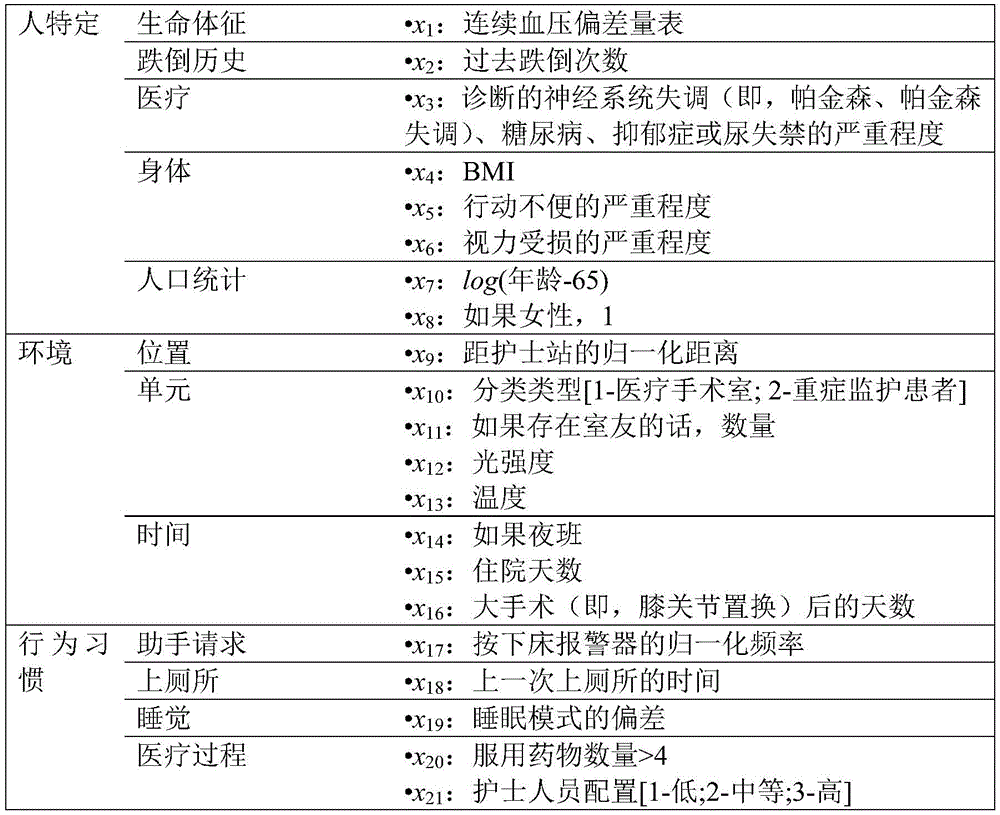
The risk factors described in table 1 are merely examples, and those skilled in the art will appreciate that other risk factors may be included or substituted for these. As mentioned above, the prior art methods do not take into account environmental risk factors.
In addition to the measurement of the current state of the risk factors described above, additional example implementations may include longitudinal measurements. For example, risk assessment may be performed over time for the subject as well as environmental and/or behavioral habits. Changes in the risk assessment over time can be used to predict future changes in the risk assessment. In one example implementation, risk factors such as those shown in table 1 may be obtained for a subject at time intervals (e.g., yearly, every five years, etc.). The results may be analyzed in a longitudinal manner to provide a prediction of future risk.
Furthermore, in addition to changes in risk factors that may be human specific, the risk factors may also change with respect to the environment. For example, but not by way of limitation, different rooms within a hospital may have different risk factors for the same subject and the same behavioral habits, or different hospitals may have different risk assessments for the same subject and the same behavioral habits in the same department of the hospital. These changes may be due to resource allocation, personnel configuration, room allocation, hospital layout, etc. As explained herein, these factors may be incorporated into the determination of risk factors.
The output 305 of the LSTM RNN includes dense layers 329; the LSTM layer is combined with the dense layer to predict the likelihood of an event (e.g., leaving the bed) at various times (e.g., timestamps). In this exemplary implementation, timestamps 1, 5, and k are indicated at 331, 333, and 335, respectively.
The outputs shown at 305 that provide the predicted likelihood of leaving the bed are combined to estimate the current fall risk. Alternatively, attention-based LSTM may be used. More specifically, this method can learn the importance of features during temporal relationship mining. Alternatively, alternative sequence models such as Gated Round Units (GRUs) and Time Convolutional Nets (TCNs) are used, other example implementations or alternatives may also be used.
Fig. 4 illustrates a workflow according to an example implementation. More specifically, a workflow 400 associated with a video monitoring component for motion prediction is provided. The output is a continuity scale P e [0,1] associated with the likelihood of the object moving away from a safe location (e.g., the object leaving the bed) at the current time.
At 401, a sensing device, such as a camera sensor, is provided to sense an environment. For example, and as described above, cameras may be employed, including but not limited to RGB, RGB-D, thermal imager, and night vision cameras. For example, but not by way of limitation, a depth camera or thermal imager may be used to segment objects in the background. At 403, the movement of the subject on the bed or chair is fluidized, as well as the movement of people that may occur in the environment surrounding the bed (e.g., the room in which the subject is located).
At 405, a feature extraction operation is performed such that features are extracted from the sequence of frames. For example, a dual stream Convolutional Neural Network (CNN) architecture may be employed to stack image and optical flow sequences to represent frame-level features. The spatial data from the image sequence comprises appearance information and the temporal data from the optical flow is associated with motion information. Alternatively, features such as skeletal joints may be used as the feature representation.
According to an example implementation, a window of consecutive frames may be processed to extract features representing the spatio-temporal dynamics of a moving pattern. For example, but not by way of limitation, these movement patterns may include the subject rolling in bed, as well as movements associated with the subject sitting up or lying down. According to one example implementation, the motion dynamics may be represented using densely sampled local spatiotemporal features called dense trajectories. Such dense sampling of local features may outperform sparse spatiotemporal interest points.
Thus, example implementations relate to using dense sampling methods and local features extracted along dense trajectories. Thus, features that are highly correlated with human motion can be encoded without the need for background segmentation. Methods that may be used in example implementations include, but are not limited to, Histogram of Oriented Gradients (HOG), Histogram of Optical Flow (HOF), and histogram of Motion Boundaries (MBH). However, as will be appreciated by those skilled in the art, other methods may be substituted for these methods.
At 407, the motion characteristics are learned. For example, video training data of a subject moving in bed, sitting in a chair, and walking may be used so that the system learns a codebook for feature encoding.
At 409, the feature vector sequence is encoded. Encoding the feature descriptors may include combining different feature types or using a subset of features. During training, the motion features are clustered, for example, using a Gaussian Mixture Model (GMM). During testing, features extracted from windows of consecutive frames may be encoded as Fisher vectors that can learn the distribution of descriptors, and thus may be less sensitive to the frequency of occurrence of individual words and the encoded additional information associated with the distance of individual descriptors from the center. According to alternative example implementations, the features may be represented using visual bag of words (BOV), soft BOV, or hash.
At 411, the information is fed to a prediction model, such as an RNN prediction model. Further details of the predictive model are discussed in more detail below.
Fig. 5 provides a pictorial visualization 500 of a workflow for video monitoring of motion prediction according to an example implementation. Predicting a person's actions with respect to potential events or actions targets a given continuous video stream, predicting actions in time. The video stream may include multiple sequential actions, such as a habitual activity that includes multiple actions, which may have subtle differences from one another, and follow a prescribed order. For example, but not by way of limitation, the difference between the sleep pattern of a subject in normal sleep and a subject in abnormal sleep with a higher risk of falling may only have a subtle difference in subject movement relative to the total movement during a sleep event.
The present example implementation uses dense trajectories to extract local spatio-temporal patterns, rather than frame-level representations. A Gaussian Mixture Model (GMM) is used to construct a codebook of descriptors of dense trajectories for various feature classes (e.g., trajectory, HOG, HOF, and MBH). The Fisher vectors from the trained codebook are used to represent short sequences of video, followed by a combination of short-range motion feature representations and advanced temporal models (e.g., TCN and LSTM) to learn long-range motion dependencies. In the case of the TCN model, the time convolution network consists of repeated convolution blocks, which are then non-linearly activated.
In the case of the LSTM model, the current sub-sequence is processed using the order information of the input data and given the information extracted from the previous sub-sequence using the memory unit. Thus, the LSTM may learn both short-term and long-term dependency patterns from the input features. This example implementation may include a bidirectional LSTM that includes two opposite unidirectional LSTM. The memory unit may be followed by a time-distributed dense layer, the results of which may be fed into an output soft maximum (softmax) layer for prediction.
For example, at 501, the use of a depth camera or thermal imager to segment foreground human objects and provide a stream of human movement in a bed or chair is shown. At 503, generating dense trajectories for feature extraction is disclosed. Further, at 505, various dense sampling methods are disclosed that result in learning of motion features using, for example, a GMM training motion codebook at 507. At 509, encoding the extracted features into a Fisher vector is disclosed, and at 511, outputting action possibilities is disclosed.
Fig. 6(a) to 6(c) illustrate example implementations employing the dense trajectory approach. As shown in fig. 6(a), the person is in a sitting position and the points of interest are sampled with greater density around the seated person. As can be seen in fig. 6(b), at 603, the sampled point of interest may show movement as a different color, texture, or point shape; as the greater the sampling density around a seated person, the greater the granularity provided for movement. Further, as shown in FIG. 6(c), at 605, the densely sampled points of interest show the person moving away from the chair and walking away.
Fig. 7 illustrates collection of model learning and training examples for predicting action likelihoods at 700, according to an example implementation. For the action classification task, the training instance of the action prediction is set to the (L, k) timestamp. For example, at 701, 703, 705, and 707, the sensed information is shown as frames (e.g., rolling or sitting up in bed). Furthermore, the classifier may classify whether sleep is normal based on training data, e.g. may look in sleep patterns or historical information associated with sleep patterns of subjects or other similar subjects in similar situations, or on the other hand, not be considered normal sleep activity (which may indicate a fall risk).
This information represents the sequence 715 used for feature extraction. Elements 709, 711, and 713 represent upcoming actions or events, such as sit up, leave, etc., at a future timestamp. Based on the learned long-term pattern and the recent observations made during the previous L frames, the task may predict an event or action, such as whether the object will move from a safe location in the bed or chair at the upcoming k timestamps.
As described above, and more particularly as provided at 411 of fig. 4, the input to the prediction model is a time series of encoded feature vectors. Neural network approaches include using LSTM, variants of RNN, model long-term dependencies, and provide predictions based on inputs. As shown above at 327 in fig. 3, one example implementation includes two LSTM layers, which are combined with one dense layer to predict the likelihood of the subject moving from a safe location in the bed at the subsequent 1, 5, and n time stamps (shown as 717, 719, and 721, respectively); the outputs of these predictions are combined to provide an estimate of the current fall risk.
As an alternative example implementation, attention-based LSTM may be used to learn the importance of features during temporal relationship mining. Other example implementations may use other sequence models, including but not limited to Gated Round Units (GRUs) and Time Convolutional Nets (TCNs).
More specifically, for consecutive M frames from a video sub-sequence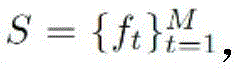 X represents the visual feature representation input to the predictive model. Input X for a given time step TtAt PtA likelihood of an action is predicted. According to an example implementation, if a soft maximum activation function is used in the output layer of a deep neural network, it is possible to perform a deep neural network by obtaining the current input X belonging to an existing actiontTo obtain an action PtThe output possibilities of (1).
Thus, the present example implementation provides for extracting local atomic motion patterns from an image stream of a moving human body using dense trajectories and Fisher vectors to encode features, and neural networks to predict events and activities associated with objects on a bed or chair or fall prevention.
In addition to the above-described prediction information associated with the prediction model, example implementations also include subject-specific dynamic risk profiling for individual timestamps. These example implementations may provide high recall or high risk objects.
As mentioned above, table 1 discloses risk factors associated with a fall. Some factors may be provided based on existing medical studies and hospital reports. Furthermore, the subject may have different combinations of risk factors associated with falls, and the fall risk may change over time, including during the time the subject is at the hospital. Furthermore, risks may vary across different medical units, and may also vary across hospitals.
For example, intrinsic subject features such as age over 65 years, mobility difficulties, visual impairments or low Body Mass Index (BMI) may be more likely to cause a fall. In addition, for subjects with a history of falls and neurological disorders, the risk of falls may be greater. The characteristics of the subject's room can also affect the risk of the subject falling and being injured. For example, due to staffing constraints, a surgical subject may have a higher risk than an intensive care subject, and a subject in a single person room may have a greater risk of falling. Furthermore, the time of day may also be an important factor, as injuries may be more frequent during night shifts, and elderly subjects may be more likely to fall the first day after moving to a new room.
Behavioral habits may also affect fall risk. For example, and without limitation, a probability or likelihood may be higher that a subject who has used the call button multiple times to indicate a need to move from a secure location on the bed (e.g., to a toilet) leaves the bed, while other subjects may press the call button without actually needing to leave the bed. Individual subject life assessments that may affect the risk of falling after a subject leaves the bed may include blood pressure, medication, or recent injuries. For example, a decrease in blood pressure may indicate postural hypertension, which is associated with a higher risk of falling, and taking more than four drugs may increase the risk of falling.
Example implementations provide a fall risk profile based on inputs (including those included in table 1) and calculation of risk probabilities. In other words, the risk factors may be provided based on medical studies, hospital reports, etc., and the data may be provided by the sensors such that the obtained values of the various fall risk factors include vital signs, electronic health record collection, etc., collected and encoded as continuous or categorical features. For example, but not by way of limitation, vital signs may be sensed automatically or collected by hospital staff.
According to one example implementation, if the data set is available from a hospital, a regression method can be applied to learn the feature weights b and estimate the fall risk R e [0,1]. Alternatively, hospital staff may provide a manual indication of the importance of the variables collected by the sensors. As described above, the sensor observes not only the current position of the object on the bed but also the entire environment, and thus is configured to sense additional information that can be used as a risk factor. The input risk variables may be encoded as continuous or categorical features as described above, and normalization may be applied to the various feature dimensions (e.g., scaling the risk score between zero and 1 so as to allow normalization and comparison across medical incidents, subjects, etc.). For N risk factors xiFor i e [1, N), e.g., those shown in Table 1]The logistic regression as an input risk factor at time t calculates the fall risk R for each subjecttThe following is shown in equations (1) and (2):
patient fall risk score St=b0+blow blood pressurex1+b#fallsx2+...bNxN (1)
Patient fall risk
Based on the above-mentioned possibility of moving away from a safe location P in combination with the fall risk R, a fall prevention signaling strategy can be adjusted. Table 2 provides examples of fall prevention protocols that depend on the values of P and R according to example implementations.
Table 2: fall prevention protocol

For example, the rule-based approach may be implemented as follows. If P is below the threshold and R is below the threshold, no signal may be provided because the probability of movement from the safe location and the fall risk are below the threshold.
In another scenario, if P is below a threshold and R is above a threshold, a signal may be provided to the subject suggesting that the subject needs help. This situation would indicate a high fall risk, but the probability of the object moving away from the safe location is not high.
Additionally, if P is above the threshold and R is below the threshold, a signal may be provided to the subject to follow the safety procedure. This situation may be associated with a high probability that the subject moves from a safe location, but a low risk of falling for the subject.
Further, if P is above the threshold and R is also above the threshold, a signal may be provided to the subject to stay in a safe location and a signal may also be provided to the staff to provide immediate assistance directly.
The above scenarios are merely examples and are not intended to be limiting. Those skilled in the art will appreciate that other examples may be implemented as well. For example, the signals transmitted in the context of a particular scenario may vary according to local hospital protocols, subject preferences, or other basis. Further, the thresholds for P and R may vary. Further, the protocol may not be limited to reminders and staff notifications, but may be integrated into other aspects of subject movement (e.g., rehabilitation, physical therapy, etc.).
Fig. 8 illustrates an example process 800 according to an example implementation. As illustrated herein, the example process 800 may be performed on one or more devices.
At 801, information is sensed, such as by a camera or motion sensor, as described above. Further, sensed information is received, and a stream is generated. The flow indicates the movement of an object on a surface (e.g., an object on a bed or chair or floor). Structures and techniques associated with the sensing of information and the generation of streams are described above with respect to example implementations.
At 803, features are extracted from the sequence of frames, and action features are learned. For example, but not by way of limitation, methods such as dense tracks, and additional techniques and implementations as described above, may be employed.
At 805, a sequence of feature vectors is encoded, e.g., based on a GMM training motion codebook, to encode a window of consecutive frames into, e.g., a Fisher vector. The coded feature vector sequence is fed into the prediction model described above with respect to fig. 3.
At 807, values of P and R associated with the probability or likelihood of the subject leaving the bed or chair and the fall risk are calculated. P and R are calculated based on the predictive model and risk profiling method as described above.
At 809, the values of P and R are evaluated to determine whether they are relatively high or low. For example, the values of P and/or R may be compared to a threshold. Based on the evaluation, a rule-based approach may be applied and one or more protocols, such as those shown in table 2 above, may be selected.
At 811, an action is performed based on the selected protocol. For example, but not by way of limitation, the action may include providing a signal to the subject, providing a signal to an external resource such as a third party (e.g., a caregiver or staff), or performing an action that is automatically performed with respect to the apparatus associated with the user, such as switching the position of a bed or protective device, placing a fall mitigation device or pad in place, activating an alarm, opening a door to a room, or other activity that may be understood as an action associated with a P and R based value implementation protocol that indicates a combination of a prediction of the subject's exit from a safe location on a bed or chair and a risk of falling, such as indicated in equations (1) and (2) above.
Regarding actions that may be taken, in addition to the examples described above, additional non-limiting examples may be employed. For example, and without limitation, the action may not be limited to providing a signal to the subject or a third party (e.g., a caregiver or a worker) to effect an immediate action to prevent a fall. Additional actions may include providing an aggregated risk profile for a plurality of subjects in, for example, a hospital department, hospital floor, or entire hospital in a privacy-preserving manner, and reallocating resources within the hospital, department, or other organizational entity based on the aggregated risk profile. According to one example implementation, if the fall risk is significantly higher at a particular time of day or night, additional resources may be allocated, or the object may be moved, to address those risk factors.
Further non-limiting examples of actions that may be performed based on the selected protocol may include, but are not limited to, dispatching a third party to intervene and prevent falls, enabling lights (e.g., for floor guidance) or markers for the subject, and providing alerts or suggestions through a speaker in the room or on the subject's mobile device; the information provided may be a pre-recorded message, an optical signal, an audio message, or other means of communication as will be appreciated by those skilled in the art.
As also explained above, the actions may involve controlling the apparatus to reduce the risk associated with the subject falling. For example, as explained above, features associated with the bed (e.g., automated or motorized tracks or other guards, pads on the floor, or other support structures) can guide objects away from the bed in a manner that reduces the risk of falling, or even increases the difficulty of inadvertently leaving the bed (e.g., by changing the position, angle, orientation of the bed, moving the bed itself, or moving other objects within the room).
In some example implementations, the system may interface with a sensing or detection system or determine through sensors or cameras described herein whether the subject has inadvertently not placed the protective features of the bed in its correct position. For example, a track detection system that detects when a track is not in an engaged position while a subject is sleeping may detect that the subject has inadvertently left the guard in place.
In the example implementations described above, the operation is performed at an online mobile application associated with the user. For example, the client device may include a camera sensor, or communicate directly with sensors in the room, and some or all of the processing may be performed locally on the online mobile application. However, example implementations are not so limited, and other methods may be substituted without departing from the scope of the present invention. For example, and without limitation, other example methods may perform operations remotely from the client device (e.g., at a server).
Fig. 9 illustrates an example computing environment 900 with an example computer apparatus 905 suitable for use in some example implementations. The computing device 905 in the computing environment 900 may include one or more processing units, cores or processors 910, memory 915 (e.g., RAM, ROM, etc.), internal storage 920 (e.g., magnetic, optical, solid state storage, and/or organic), and/or I/O interfaces 925, any of which may be coupled to a communication mechanism or bus 930 for communicating information, or embedded in the computing device 905.
Output device/interface 940 may include a display, television, monitor, printer, speakers, braille, etc. In some example implementations, an input/interface 935 (e.g., a user interface) and an output device/interface 940 may be embedded in or physically coupled to the computing device 905. In other example implementations, other computing devices may serve or provide the functionality of input/interface 935 and output device/interface 940 for computing device 905.
Examples of computing devices 905 may include, but are not limited to, highly mobile devices (e.g., smart phones, devices in vehicles and other machines, devices carried by humans and animals, etc.), mobile devices (e.g., tablets, notebooks, laptop computers, personal computers, portable televisions, radios, etc.), and devices that are not designed for mobility (e.g., desktop computers, server devices, other computers, kiosks, televisions with embedded and/or coupled with one or more processors, radios, etc.).
The I/O interface 925 may include, but is not limited to, a wired and/or wireless interface using any communication or I/O protocol or standard (e.g., ethernet, 802.11xs, a general system bus, WiMAX, modem, cellular network protocol, etc.) for communicating information at least to and/or from all connected components, devices, and networks in the computing environment 900. The network 950 may be any network or combination of networks (e.g., the internet, a local area network, a wide area network, a telephone network, a cellular network, a satellite network, etc.).
Processor 910 may execute under any Operating System (OS) (not shown) in a native or virtual environment. One or more applications may be deployed including a logic unit 955, an Application Programming Interface (API) unit 960, an input unit 965, an output unit 970, a learning and encoding unit 975, a P and R determination unit 980, a protocol and action unit 985, and an inter-unit communication mechanism 995 for the different units to communicate with each other, with the OS, and with other applications (not shown).
For example, the learning and encoding unit 975, the P and R determination unit 980, and the protocol and action unit 985 may implement one or more of the processes shown above for the above-described structure. The design, function, configuration, or implementation of the described units and elements may vary and are not limited to the descriptions provided.
In some example implementations, when information or execution instructions are received through API unit 960, they may be communicated to one or more other units (e.g., logic unit 955, input unit 965, learning and encoding unit 975, P and R determination unit 980, and protocol and action unit 985).
For example, as described above, the learning and encoding unit 975 may receive and process information from one or more sensors, perform feature extraction, learn motion features, and the like. The output of the learning and encoding unit 975 is provided to a P and R determination unit 980, the P and R determination unit 980 performing the necessary predictions, e.g. based on application of a neural network as described above and illustrated in fig. 2, and also determining R to provide a fall risk for the subject in the environment (as also described above). In addition, the protocol and action unit 985 may provide signals associated with actions based on the outputs of the learning and encoding unit 975 and the P and R determination unit 980.
In some cases, in some example implementations described above, the logic unit 955 may be configured to control the flow of information between the units and direct the services provided by the API unit 960, the input unit 965, the learning and encoding unit 975, the P and R determination unit 980, and the protocol and action unit 985. For example, the flow of one or more processes or implementations may be controlled by the logic unit 955 alone or in conjunction with the API unit 960.
FIG. 10 illustrates an example environment suitable for some example implementations. The environment 1000 includes devices 1005 and 1045, and each device is communicatively connected to at least one other device via, for example, a network 1060 (e.g., by a wired and/or wireless connection). Some devices may be communicatively connected to one or more storage devices 1030 and 1045.
Examples of the one or more devices 1005-1045 may each be a computing device 905 as described in fig. 9. Devices 1005-1045 may include, but are not limited to, a computer 1005 (e.g., a laptop computing device) having a monitor and associated webcam as described above, a mobile device 1010 (e.g., a smart phone or tablet), a television 1015, a device associated with the vehicle 1020, a server computer 1025, computing devices 1035-1040, storage devices 1030 and 1045.
In some implementations, the devices 1005-1020 may be considered user devices associated with users who may remotely obtain sensed input for use as input to the predictive model and/or risk profiling. In this example implementation, one or more of these user devices may be associated with one or more cameras that may sense the information needed for the predictive model and risk profiling, as described above.
Aspects of the example implementations may have various advantages and benefits. For example, but not by way of limitation, the present example implementation provides a predictive method and activity analysis. In addition, the present example implementation employs a passive approach using sensors around the object. Furthermore, the present example implementation can distinguish falls from other daily activities, such as standing, left down, lying down, not walking, and going up and down stairs.
Additionally, example implementations herein relate to cameras with depth sensors and motion sensors, and enable use of grayscale input without RGB. Furthermore, example implementations relate not only to movement of a person on a bed, but also to movement in any safe location.
Thus, example implementations may provide a prediction and risk profiling that allows for a high recall rate for high risk subjects according to a rule-based protocol approach. Although these example implementations relate primarily to objects in a hospital environment, other examples are contemplated. For example, but not by way of limitation, the above example implementations may be applied in non-hospital environments (e.g., in a subject's residence) to address conditions such as sleepwalking or other abnormal movements in sleep. Moreover, example implementations may be combined with other types of sensors that may predict and assess risk of other types of conditions (e.g., sleep apnea, Sudden Infant Death Syndrome (SIDS), or other conditions). In a similar manner as described above with respect to control of hospital beds, example implementations may control other medical devices, such as intravenous nutrition, oxygen supply, respiratory support, and the like.
Although a few example implementations have been shown and described, these example implementations are provided to convey the subject matter described herein to those skilled in the art. It should be understood that the subject matter described herein may be implemented in various forms and is not limited to the example implementations described. The subject matter described herein may be practiced without those specifically defined or described elements or with other or different elements or elements not described. It will be appreciated by those skilled in the art that changes may be made to these exemplary implementations without departing from the subject matter described herein as defined in the appended claims and their equivalents.
Aspects of certain non-limiting embodiments of the present disclosure address the features discussed above and/or other features not described above. However, aspects of the non-limiting embodiments need not address the features described above, which may not be addressed by aspects of the non-limiting embodiments of the present disclosure.
Cross Reference to Related Applications
This application claims priority from U.S. provisional patent application No.16/698,616, filed on 27/11/2019, the contents of which are incorporated herein by reference.
Claims (20)
Applications Claiming Priority (3)
| Application Number | Priority Date | Filing Date | Title |
|---|---|---|---|
| US201962881665P | 2019-08-01 | 2019-08-01 | |
| US16/698,616 US11410540B2 (en) | 2019-08-01 | 2019-11-27 | System and method for event prevention and prediction |
| US16/698,616 | 2019-11-27 |
Publications (1)
| Publication Number | Publication Date |
|---|---|
| CN112842258A true CN112842258A (en) | 2021-05-28 |
Family
ID=74258615
Family Applications (1)
| Application Number | Title | Priority Date | Filing Date |
|---|---|---|---|
| CN202010940112.0A Pending CN112842258A (en) | 2019-08-01 | 2020-09-09 | Methods, processors, and computer-readable media for event prevention and prediction |
Country Status (3)
| Country | Link |
|---|---|
| US (1) | US11410540B2 (en) |
| JP (1) | JP7559391B2 (en) |
| CN (1) | CN112842258A (en) |
Cited By (3)
| Publication number | Priority date | Publication date | Assignee | Title |
|---|---|---|---|---|
| CN114255565A (en) * | 2022-03-02 | 2022-03-29 | 济宁蜗牛软件科技有限公司 | Intelligent helmet capable of sensing danger and sensing system |
| CN116304562A (en) * | 2023-02-17 | 2023-06-23 | 中国矿业大学 | A Microseismic Signal Segmentation Method Based on Hidden Semi-Markov Model |
| CN120431677A (en) * | 2025-07-08 | 2025-08-05 | 运城市恩光科技有限公司 | Collaborative emergency response method, system and equipment based on smart wearable devices |
Families Citing this family (23)
| Publication number | Priority date | Publication date | Assignee | Title |
|---|---|---|---|---|
| US11800993B2 (en) * | 2019-06-28 | 2023-10-31 | Hill-Rom Services, Inc. | Exit monitoring system for patient support apparatus |
| US11222198B2 (en) * | 2019-11-21 | 2022-01-11 | International Business Machines Corporation | Video analysis system for optimizing an activity protocol |
| US20210270050A1 (en) * | 2020-02-27 | 2021-09-02 | Mirza Faizan | System to prevent injury from stair fall |
| US11587423B2 (en) * | 2020-08-03 | 2023-02-21 | Healthcare Integrated Technologies, Inc. | Fall validation with privacy-aware monitoring |
| CN112998697B (en) * | 2021-02-22 | 2022-06-14 | 电子科技大学 | Tumble injury degree prediction method and system based on skeleton data and terminal |
| JP7669505B2 (en) | 2021-02-25 | 2025-04-28 | チェリッシュ ヘルス インコーポレイテッド | Technique for tracking objects within a defined area |
| CN112907894B (en) * | 2021-03-02 | 2022-12-02 | 深圳市医创加科技有限公司 | Falling-bed early warning method and system based on patient action prejudgment |
| EP4309424A1 (en) * | 2021-03-18 | 2024-01-24 | Telefonaktiebolaget LM Ericsson (publ) | Systems, methods, computer programs for predicting whether a device will change state |
| CN112862219A (en) * | 2021-03-19 | 2021-05-28 | 浙江大学 | Hydroelectric generating set temperature prediction method based on time domain convolution and cyclic neural network |
| CN113361855A (en) * | 2021-05-07 | 2021-09-07 | 浙江警官职业学院 | Short, medium and long-term risk warning method and device |
| US12051262B2 (en) * | 2021-06-10 | 2024-07-30 | Sony Group Corporation | Clinical activity recognition with multiple cameras |
| KR102565463B1 (en) * | 2021-10-12 | 2023-08-10 | 경북대학교 산학협력단 | System and method for fall detection and activity recognition based on deep learning and computer readable program for the same |
| CN114224326B (en) * | 2021-11-18 | 2024-05-03 | 北京精密机电控制设备研究所 | Wearable gait phase and motion recognition device and method |
| CN114495267B (en) * | 2022-01-04 | 2025-04-08 | 哈尔滨工业大学(威海) | Old man fall risk assessment method based on multidimensional data fusion |
| CN114757395B (en) * | 2022-03-22 | 2023-06-16 | 欧亚高科数字技术有限公司 | Dangerous house monitoring method based on intelligent Internet of things |
| CN119156173A (en) | 2022-07-08 | 2024-12-17 | 三星电子株式会社 | Wearable device and method for measuring a state of a user |
| CN115171361B (en) * | 2022-09-02 | 2022-12-02 | 广东中科凯泽信息科技有限公司 | Dangerous behavior intelligent detection and early warning method based on computer vision |
| CN116644301B (en) * | 2023-03-15 | 2025-08-19 | 兰州理工大学 | High-precision model identification method, equipment and medium for piezoelectric ceramic system |
| WO2025240209A1 (en) * | 2024-05-14 | 2025-11-20 | Prev.Ai LLC | Systems and methods for fall prevention |
| CN118736783A (en) * | 2024-07-25 | 2024-10-01 | 诚联恺达科技有限公司 | Intelligent early warning and response system and method |
| CN118736499B (en) * | 2024-09-04 | 2024-11-15 | 成都寻道科技有限公司 | A method, system and device for predicting high-fall risk on campus based on visual monitoring |
| CN119544462B (en) * | 2024-11-12 | 2025-12-09 | 北京邮电大学 | Optical transmission network root alarm identification method and device based on space-time diagram network |
| CN120315397B (en) * | 2025-06-12 | 2025-10-31 | 浙江美格机械股份有限公司 | A method and system for safe production control of printing press equipment |
Citations (10)
| Publication number | Priority date | Publication date | Assignee | Title |
|---|---|---|---|---|
| US20170055917A1 (en) * | 2015-08-28 | 2017-03-02 | Erik E. Stone | Systems for automatic assessment of fall risk |
| US20170213145A1 (en) * | 2016-01-21 | 2017-07-27 | Verily Life Sciences Llc | Adaptive model-based system to automatically quantify fall risk |
| CN107735661A (en) * | 2015-06-30 | 2018-02-23 | Ishoe有限公司 | Using Machine Learning Algorithms to Identify Fall Risks |
| CN108090458A (en) * | 2017-12-29 | 2018-05-29 | 南京阿凡达机器人科技有限公司 | Tumble detection method for human body and device |
| CN108363966A (en) * | 2018-01-30 | 2018-08-03 | 广东工业大学 | A kind of interior fall detection method and system |
| WO2018163555A1 (en) * | 2017-03-07 | 2018-09-13 | コニカミノルタ株式会社 | Image processing device, image processing method, and image processing program |
| CN108549841A (en) * | 2018-03-21 | 2018-09-18 | 南京邮电大学 | A kind of recognition methods of the Falls Among Old People behavior based on deep learning |
| CN109643585A (en) * | 2016-08-24 | 2019-04-16 | 皇家飞利浦有限公司 | For carrying out patient-monitoring to predict and prevent the equipment, system and method for falling from bed |
| CN109886102A (en) * | 2019-01-14 | 2019-06-14 | 华中科技大学 | A kind of tumble behavior Spatio-temporal domain detection method based on depth image |
| CN110110707A (en) * | 2019-05-24 | 2019-08-09 | 苏州闪驰数控系统集成有限公司 | Artificial intelligence CNN, LSTM neural network dynamic identifying system |
Family Cites Families (4)
| Publication number | Priority date | Publication date | Assignee | Title |
|---|---|---|---|---|
| KR102494797B1 (en) | 2017-10-23 | 2023-02-06 | 노키아 테크놀로지스 오와이 | End-to-end learning in communication systems |
| US11883157B2 (en) | 2017-11-21 | 2024-01-30 | Omniscient Medical As | System, sensor and method for monitoring health related aspects of a patient |
| US11179064B2 (en) * | 2018-12-30 | 2021-11-23 | Altum View Systems Inc. | Method and system for privacy-preserving fall detection |
| US20210142643A1 (en) * | 2019-11-08 | 2021-05-13 | Smart Health Solutions LLC | Patient-fall scenario detector and systems and methods for remediating fall scenarios |
-
2019
- 2019-11-27 US US16/698,616 patent/US11410540B2/en active Active
-
2020
- 2020-07-15 JP JP2020121341A patent/JP7559391B2/en active Active
- 2020-09-09 CN CN202010940112.0A patent/CN112842258A/en active Pending
Patent Citations (10)
| Publication number | Priority date | Publication date | Assignee | Title |
|---|---|---|---|---|
| CN107735661A (en) * | 2015-06-30 | 2018-02-23 | Ishoe有限公司 | Using Machine Learning Algorithms to Identify Fall Risks |
| US20170055917A1 (en) * | 2015-08-28 | 2017-03-02 | Erik E. Stone | Systems for automatic assessment of fall risk |
| US20170213145A1 (en) * | 2016-01-21 | 2017-07-27 | Verily Life Sciences Llc | Adaptive model-based system to automatically quantify fall risk |
| CN109643585A (en) * | 2016-08-24 | 2019-04-16 | 皇家飞利浦有限公司 | For carrying out patient-monitoring to predict and prevent the equipment, system and method for falling from bed |
| WO2018163555A1 (en) * | 2017-03-07 | 2018-09-13 | コニカミノルタ株式会社 | Image processing device, image processing method, and image processing program |
| CN108090458A (en) * | 2017-12-29 | 2018-05-29 | 南京阿凡达机器人科技有限公司 | Tumble detection method for human body and device |
| CN108363966A (en) * | 2018-01-30 | 2018-08-03 | 广东工业大学 | A kind of interior fall detection method and system |
| CN108549841A (en) * | 2018-03-21 | 2018-09-18 | 南京邮电大学 | A kind of recognition methods of the Falls Among Old People behavior based on deep learning |
| CN109886102A (en) * | 2019-01-14 | 2019-06-14 | 华中科技大学 | A kind of tumble behavior Spatio-temporal domain detection method based on depth image |
| CN110110707A (en) * | 2019-05-24 | 2019-08-09 | 苏州闪驰数控系统集成有限公司 | Artificial intelligence CNN, LSTM neural network dynamic identifying system |
Cited By (3)
| Publication number | Priority date | Publication date | Assignee | Title |
|---|---|---|---|---|
| CN114255565A (en) * | 2022-03-02 | 2022-03-29 | 济宁蜗牛软件科技有限公司 | Intelligent helmet capable of sensing danger and sensing system |
| CN116304562A (en) * | 2023-02-17 | 2023-06-23 | 中国矿业大学 | A Microseismic Signal Segmentation Method Based on Hidden Semi-Markov Model |
| CN120431677A (en) * | 2025-07-08 | 2025-08-05 | 运城市恩光科技有限公司 | Collaborative emergency response method, system and equipment based on smart wearable devices |
Also Published As
| Publication number | Publication date |
|---|---|
| JP2021086605A (en) | 2021-06-03 |
| US20210035437A1 (en) | 2021-02-04 |
| JP7559391B2 (en) | 2024-10-02 |
| US11410540B2 (en) | 2022-08-09 |
Similar Documents
| Publication | Publication Date | Title |
|---|---|---|
| US11410540B2 (en) | System and method for event prevention and prediction | |
| US11688265B1 (en) | System and methods for safety, security, and well-being of individuals | |
| Rastogi et al. | A systematic review on machine learning for fall detection system | |
| US10736582B2 (en) | Monitoring and tracking system, method, article and device | |
| US11615687B2 (en) | Automated identification and creation of personalized kinetic state models of an individual | |
| Sarker et al. | Finding significant stress episodes in a discontinuous time series of rapidly varying mobile sensor data | |
| Pogorelc et al. | Automatic recognition of gait-related health problems in the elderly using machine learning | |
| US10755817B2 (en) | Systems, apparatuses and methods for predicting medical events and conditions reflected in gait | |
| KR102831533B1 (en) | Method and apparatus for determining a dangerous situation and managing the safety of the user | |
| KR102831595B1 (en) | System for determining a dangerous situation and managing the safety of the user | |
| JP7285046B2 (en) | Information processing device, information processing method and program | |
| US20080186189A1 (en) | System and method for predicting fall risk for a resident | |
| CN112437629B (en) | Determine the reliability of the monitored subject's vital signs | |
| Ward et al. | Fall detectors: a review of the literature | |
| CN113384247B (en) | Care system and automatic care method | |
| CN108877914A (en) | Behavior monitoring method and device, storage medium, the terminal of patient based on Internet of Things | |
| WO2019013257A1 (en) | Monitoring assistance system and method for controlling same, and program | |
| Mansoor et al. | A machine learning approach for non-invasive fall detection using Kinect | |
| CN110755091A (en) | Personal mental health monitoring system and method | |
| US12192682B2 (en) | Patient room real-time monitoring and alert system | |
| Pogorelc et al. | Detecting gait-related health problems of the elderly using multidimensional dynamic time warping approach with semantic attributes | |
| JP2019152914A (en) | Nursing facility child watching system and information processing method | |
| KR102807123B1 (en) | Elderly and infirm fit and ai analysis senior care system | |
| GB2581767A (en) | Patient fall prevention | |
| Al Duhayyim | Automated Disabled People Fall Detection Using Cuckoo Search with Mobile Networks. |
Legal Events
| Date | Code | Title | Description |
|---|---|---|---|
| PB01 | Publication | ||
| PB01 | Publication | ||
| CB02 | Change of applicant information |
Address after: Tokyo, Japan Applicant after: Fuji film business innovation Co.,Ltd. Address before: Tokyo, Japan Applicant before: Fuji Xerox Co.,Ltd. |
|
| CB02 | Change of applicant information | ||
| SE01 | Entry into force of request for substantive examination | ||
| SE01 | Entry into force of request for substantive examination |