(1) claiming priority from U.S. patent application No.16/581,138 entitled "SMART CONTENT record information FOR CONTENT AUTHORS" filed 24.9.2019 and continuing in part, which in turn claims the benefit and priority of indian provisional patent application No.201841039495 entitled "SMART CONTENT record information FOR CONTENT AUTHORS" filed 18.10.2018; and
(2) claim the benefit and priority of Indian provisional patent application No.201841039495 entitled "SMART CONTENT RECOMMOMATIONS FOR CONTENT AUTHORS" filed on 2018, month 10, month 18.
U.S. patent application No.16/581,138 and indian provisional patent application No.201841039495 are incorporated herein by reference in their entirety for all purposes.
Detailed Description
In the following description, for purposes of explanation, specific details are set forth in order to provide a thorough understanding of the various embodiments and examples. It will be apparent, however, that various embodiments may be practiced without these specific details. For example, circuits, systems, algorithms, structures, techniques, networks, processes, and other components may be shown as block diagram form components in order not to obscure the implementations in unnecessary detail. The drawings and description are not intended to be limiting.
Some examples (such as those disclosed with respect to the figures in this disclosure) may be described as a process which is depicted as a flowchart, a flow diagram, a data flow diagram, a structure diagram, a sequence diagram, or a block diagram. Although a sequence diagram or a flow diagram may describe the operations as a sequential process, many of the operations can be performed in parallel or concurrently. Further, the order of the operations may be rearranged. The process terminates after its operations are completed, but may have additional steps not included in the figure. The processes may correspond to methods, functions, procedures, subroutines, and the like. When a process corresponds to a function, its termination may correspond to a return of the function to the calling function or the main function.
The processes depicted herein, such as the processes described with reference to the figures in this disclosure, may be implemented in software (e.g., code, programs), hardware, or a combination thereof, which are executed by one or more processing units (e.g., processor cores). The software may be stored in a memory (e.g., on a memory device, on a non-transitory computer-readable storage medium). In some examples, the processes depicted in the sequence diagrams and flow diagrams herein may be implemented by any system disclosed herein. The particular series of processing steps in this disclosure is not intended to be limiting. According to alternative examples, other sequences of steps may also be performed. For example, alternative examples of the present disclosure may perform the steps outlined above in a different order. Moreover, each step shown in the figures may include multiple sub-steps that may be performed in various sequences as appropriate to the respective step. Further, additional steps may be added or removed depending on the particular application. One of ordinary skill in the art would recognize many variations, modifications, and alternatives.
In some examples, each process in the figures of the present disclosure may be performed by one or more processing units. The processing unit may include one or more processors, including single-core or multi-core processors, one or more cores of a processor, or a combination thereof. In some examples, the processing unit may include one or more special-purpose coprocessors, such as a graphics processor, a Digital Signal Processor (DSP), or the like. In some examples, some or all of the processing units may be implemented using custom circuits, such as Application Specific Integrated Circuits (ASICs) or Field Programmable Gate Arrays (FPGAs).
Certain embodiments described herein may be implemented as part of a Data Integration Platform Cloud (DIPC). In general, data integration involves combining data residing in different data sources and providing users with a unified access and a unified view of the data. In many cases, such as merging business entities with existing legacy databases, this process often occurs and becomes important. Data integration begins to occur more and more frequently in enterprise software systems as the amount of data continues to increase and the ability to analyze the data to provide useful results ("big data"). For example, considering a web application, a user may query various types of travel information (e.g., weather, hotels, airlines, demographics, crime statistics, etc.) therein. Enterprise applications do not necessarily require that all of these various data types be stored in a single database with a single schema, but rather can combine many heterogeneous data sources using a unified view and virtual schema in a DIPC so that they can be presented to users in a unified view.
DIPC is a cloud-based platform for data transformation, integration, replication, and governance (governance). It provides bulk and real-time data movement between the cloud and on-premise (on-premise) data sources while maintaining data consistency with default tolerances and elasticity. When combining these various data sources into one or more data warehouses, the DIPCs may be used to connect to the various data sources and prepare, transform, replicate, administer, and/or monitor data from these various sources. The DIPC can work with any type of data source and support any type of data in any format. DIPCs may provide cloud-based data integration for enterprises using platform as a service (PaaS) or infrastructure as a service (IaaS) architectures.
The DIPC may provide many different utilities including transferring the entire data source to a new cloud-based deployment and allowing easy access to cloud databases from the cloud platform. Data can be streamed to the latest new data sources in real time and any number of distributed data sources can be kept synchronized. The load can be distributed among the synchronized data sources such that they remain highly available to the end user. The underlying data management system may be used to reduce the amount of data moved over a network for deployment into a database cloud, big data cloud, third party cloud, and the like. The drag-and-drop user interface may be used to perform reusable extract, load, and transform (ELT) functions and templates. A real-time testing environment may be created to perform reporting and data analysis on replicated data sources in the cloud so that the data may remain highly available to end users. Data migration may be performed with zero downtime using duplicate synchronized data sources. The synchronized data sources can also be used for seamless disaster recovery to maintain availability.
Fig. 1 illustrates a computer system architecture utilizing a DIPC to integrate data from various existing platforms, in accordance with some embodiments. The first data source 102 may include a cloud-based storage repository. The second data source 104 may comprise an on-premise data center. To provide uniform access and views to the first data source 102 and the second data source 104, the DIPC 108 may copy the data 104 from the first data source 102 and the second data source using the existing high-performance ELT function library 106. DIPC 108 can also extract, enrich, and transform data when it is stored in a new cloud platform. Then, the DIPC 108 may provide access to any big data utility that resides in or is accessible by the cloud platform. In some embodiments, the original data sources 102 and 104 may continue to provide access to customers, while replicated data sources in the cloud platform may be used for testing, monitoring, remediation, and big data analysis. In some embodiments, data governance may be provided to parse, clean, and govern data sources within an existing collection of custom dashboards in a user interface.
Fig. 2 illustrates one of the custom dashboards in the user interface that may be used to configure, monitor and control service instances in DIPC 108. The summary dashboard 202 may provide controls 204 that allow a user to create a service instance. Next, a series of progressive web forms may be presented to guide the user through the type of information used to create the service instance. In a first step, the user will be required to provide the service name and description as well as the email address and service version type. The user may also be asked to provide a cluster size that specifies the number of virtual machines used in the service. The service version type determines which applications are installed on the virtual machine. In a second step and corresponding web form, the user may provide a running cloud database deployment to store the pattern of the DIPC servers. The same database may later be used to store data entities and perform integration tasks. Further, a storage cloud can be designated and/or provisioned as a backup utility. The user may also provide credentials that may be used to access existing data sources used in data integration. In a third step, the provisioning information may be validated and a service instance may be created. The new service instance may then be displayed in the summary area 206 of the summary dashboard 202. From there, the user can access any information of any running data integration service instance.
Fig. 3 illustrates an architectural diagram of a DIPC according to some embodiments. The request may be received by a
browser client 302, which
browser client 302 may implement using a set of JavaScript Extension Toolkit (JET) components. Alternatively or additionally, the system may receive the request through a
DIPC agent 304 operating at a customer's on-premise data center 306. The
DIPC agent 304 may include a
data integrator agent 308 and a replication service (such as Oracle's)
A service) 310. Each of these
agents 308, 310 may be positiveDuring normal operation, information is retrieved from the on-premise data center 306 and data is transmitted back to the DIPC using the connectivity service 312.
Incoming requests may be passed through a login service 314, which login service 314 may include a load balancing or other utility for routing requests through the DIPC. The login service 314 may use an identity management service (such as identity cloud service 316) to provide security and identity management for the cloud platform as part of an integrated enterprise security architecture. Identity cloud service 316 may manage user identities for both the cloud deployment and the on-premise applications described in this embodiment. In addition to identity cloud services 316, the DIPC may also use PaaS Service Manager (PSM) tool 318 to provide an interface to manage the lifecycle of platform services in a cloud deployment. For example, PSM utility 318 may be used to create and manage instances of data integration services in a cloud platform.
DIPC may be implemented on
Web logic server 320 to build and deploy enterprise applications in a cloud environment. The DIPC may include a
local repository 322, the
local repository 322 storing data policies, design information, metadata, and audit data for information transfer through the DIPC. It may also include a
monitoring service 324 to populate the
local repository 322. The
directory service 326 may include a collection of machine-readable open APIs to provide access to many SaaS and PaaS applications in a cloud deployment. The
directory service 326 may also be available to search
applications 338 that use distributed index services, such as
ApacheConnectivity services 328 and mediation (mediator)
services 330 may manage connections and provide transformation, authentication, and routing logic for information passing through the DIPC. Information within the DIPC may be communicated using an Event Driven Architecture (EDA) and corresponding message bus 332.
The DIPC may also include orchestration services 334. Orchestration service 334 may enable automation tasks by invoking REST endpoints, scripts, third-party automation frameworks, and the like. These tasks may then be performed by orchestration service 334 to provide DIPC functionality. Orchestration service 334 may use runtime services to import, transform, and store data. For example, the ELT runtime service 334 can execute a library of the ELT functions described above, while the replication runtime service 342 can replicate data from various data sources into the cloud-deployed DIPC repository 316. In addition, the DIPC may include a code generation service 336 that provides automatic code generation for ELT functions and copy functions.
I. Smart content-smart content recommendation
As described above, when a user creates/authors original media content (e.g., articles, news feeds, emails, blog articles, etc.), it is often useful to enhance the authored content with relevant attachments such as related images, audio/video clips, links to related articles or other content. However, in several respects, searching for such additional content and embedding the additional content in the user's original authored content can be difficult. Initial difficulties may involve finding secure/reliable additional content from trusted sources and ensuring that authorized users/authors incorporate the content into their work. Furthermore, from any such secure and authorized content repository, locating and incorporating/embedding any relevant content in its original authored content can be a manually intensive and inefficient process for the user/author.
Accordingly, certain aspects described herein relate to intelligent digital content recommendation tools. In some embodiments, the intelligent digital content recommendation tool may be an Artificial Intelligence (AI) -driven tool configured to process and analyze input content (e.g., text, images) from content authors in real-time and recommend related images, additional text content, and/or other related media content (e.g., audio or video clips, graphics, social media posts, etc.) from one or more trusted content repositories. The intelligent digital content recommendation tool may communicate with a plurality of backend services and content repositories, for example, to analyze text and/or visual input, extract keywords or topics from the input, classify and tag the input content, and store the classified/tagged content in one or more content repositories.
Additional aspects described herein, each of which may be performed directly via an intelligent digital content recommendation tool executing on a client operated by a content author, and/or indirectly by invoking various backend services, may include (a) receiving as input original content in the form of text and/or images, (b) extracting keywords and/or topics from the original content, (c) determining and storing associated keyword and/or topic tags for the original content, (d) converting the original content (e.g., the input text and/or images) into vectors within a multidimensional vector space, (e) comparing such vectors to a plurality of other content vectors, each representing additional content in a content repository, in order to find and identify various potentially relevant additional content related to the original content input authored by the user/author, and finally (f) retrieving and presenting the identified additional content to the author via the intelligent digital content recommendation tool. In some embodiments, each additional content item (e.g., an image, a link to a related article or web page, an audio or video file, a graphic, a social media post, etc.) may be displayed and/or thumbnails by an intelligent digital content recommendation tool in a GUI-based tool that allows a user to drag and drop or otherwise place additional content into the user's original authored content, including content positioning, formatting, resizing, etc.
Referring now to FIG. 4, a block diagram illustrating various components of a system 400 for intelligent content classification and recommendation is shown, including a client device 410, a content input processing and analysis service 420, a content recommendation engine 425, a content management and classification system 435, and a content retrieval and embedding service 445. In addition, the system 400 includes one or more content repositories 440 that store content files/resources, and one or more vector spaces 430. As described in more detail below, a vector space may refer to a multidimensional data structure configured to store one or more feature vectors. In some embodiments, the recommendation engine 425, associated software components and services 420 and 445, content management and classification system 435, and content repository 440 (which may store one or more data repositories or other data structures) may be implemented and stored as a back-end server system remote from the front-end client device 410. Thus, the interaction between the client device 410 and the content recommendation engine 425 may be an internet-based web browsing session or a client-server application session during which the user access may input originally authored content via the client device 410 and receive content recommendations from the content recommendation engine 425 in the form of additional content retrieved from the content repository 440 and linked or embedded into the content authoring user interface at the client device 410. Additionally or alternatively, the content recommendation engine 425 and/or the content repository 440 and related services may be implemented as dedicated software components executing on the client device 410.
The various computing infrastructure elements shown in this example (e.g., content recommendation engine 425, software components/services 420, 435, and 445, and content repository 440) may correspond to a high-level computer architecture created and maintained by an enterprise or organization that provides internet-based services and/or content to various client devices 410. Content described herein (which may also be referred to as content resources and/or content files, content links, etc.) may be stored in one or more content repositories, retrieved and categorized by the content recommendation engine 425, and provided to content authors at the client device 410. In various embodiments, a content author may enter various different media types or file types of content as original content at the client device 410, and similarly, various different media types or file types of content may be stored in the content store 440 and recommended for/embedded in the front-end user interface of the client device 410. These various different media types authored or recommended by a content author to the content author may include text (e.g., authoring a letter, article, or blog), images (selected by or for the author), audio or video content assets, graphics, social media content (e.g., posts, messages, or tweets on Facebook, Twitter, Instagram, etc.).
In some embodiments, the system 400 shown in fig. 4 may be implemented as a cloud-based multi-tier system, wherein upper tier user devices 410 may request and receive access to network-based resources and services via content processing/analysis component 420, and wherein application servers may be deployed and executed based on a set of base resources (e.g., cloud-based, SaaS, IaaS, PaaS, etc.) that include hardware and/or software resources. Further, while a cloud-based system may be used in some embodiments, in other examples, system 400 may use an on-premise datacenter, server farm, distributed computing system, and other various non-cloud computing architectures. Some or all of the functionality described herein for the generation and storage of the content processing/analysis component 420, the content recommendation engine 425, the content management and classification system 435, the content retrieval and embedding component 445, and the vector space 430 may be performed by representational state transfer (REST) services and/or web services, including Simple Object Access Protocol (SOAP) web services or APIs, and/or web content exposed through hypertext transfer protocol (HTTP) or HTTP security protocols. Thus, although not shown in fig. 4 to avoid obscuring the illustrated components in additional detail, the computing environment 400 may include additional client devices 410, one or more computer networks, one or more firewalls 435, proxy servers, and/or other intermediate network devices to facilitate interaction between the client devices 410, the content recommendation engine 425, and the backend content repository 440. Another embodiment of a similar system 500 is shown in more detail in fig. 5.
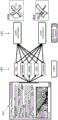
Referring briefly to FIG. 5, another exemplary diagram of a computing environment 500 is illustrated that shows a data flow/data transformation diagram for performing content classification and recommendation. Thus, the computing environment 500 illustrated in this example may correspond to one possible implementation of the computing environment 400 described above in FIG. 4. In FIG. 5, several of the diagram blocks are shown representing particular data states or data transformations rather than the structural hardware and/or software components described above in FIG. 4. Accordingly, block 505 may represent input content data received via a user interface. Block 510 represents a set of keywords determined by the system 400 based on the input content 505. As discussed above, the keywords 510 can be determined by the input processing/analysis component 420 using one or more keyword extraction and/or topic modeling processes, and the text feature vectors 515 can be generated based on the determined keywords 510.
Continuing with the example shown in fig. 5, a plurality of additional feature vectors 520 may be retrieved from the content repository 440. In this example, additional feature vectors 520 may be selected from the content repository 440 by performing one or more neural network trained image models and providing the determined keywords 510 to the trained models. Based on the output of the trained model, the resulting feature vectors 520 may be further narrowed to exclude feature vectors with a feature vector probability less than z%, resulting in a subset of the retrieved feature vectors 525. A feature space comparison 530 may then be performed between the test feature vector 515 and the subset of retrieved feature vectors 525. In some embodiments, and as shown in this example, the closest euclidean distance calculation may be used to identify the retrieved feature vector 525 that is closest to the test feature 515. Based on the feature space comparison 530, one or more recommendations 530 may be determined, each recommendation 530 being determined based on an associated feature vector 525 having a threshold proximity to the test feature vector 515 and each recommendation 530 corresponding to an image in the content repository 440.
The components shown in the system 400 for providing AI-based and feature vector analysis-based content recommendations and services to the client device 410 may be implemented in hardware, software, or a combination of hardware and software. For example, web services may be generated, deployed, and executed in the data center 440 using underlying system hardware or software components, such as data storage devices, network resources, computing resources (e.g., servers), and various software components. In some embodiments, the web service may be different software components executing on the same underlying computer server(s), network, data store, and/or within the same virtual machine. Some web-based content, computing infrastructure instances, and/or web services provided within the content recommendation engine 425 may use dedicated hardware and/or software resources, while others may share underlying resources (e.g., a shared cloud). In either case, some higher level services (e.g., user applications) and users on the client devices need not be aware of the underlying resources used to support the services.
In such embodiments, various application servers, database servers, and/or cloud storage systems, as well as other infrastructure components, such as web caches, network components, etc. (not shown in this example), may include various hardware and/or software components (e.g., Application Programming Interfaces (APIs), cloud resource managers, etc.) to provide and monitor classification and vectorization of content resources, as well as to manage underlying storage/server/network resources. The underlying resources of the content repository 440 may be stored within a content database and/or cloud storage system, which may include, for example, a collection of non-volatile computer memory devices implemented as databases, file-based storage, etc., a collection of network hardware and software components (e.g., routers, firewalls, gateways, load balancers, etc.), a collection of host servers, and various software resources (such as stored software images, installations, internal versions, templates, configuration files, etc.) corresponding to different versions of various platforms, servers, middleware, and application software. The data center housing the application servers, vector space 430, and related services/components of recommendation engine 425 may also include additional resources, such as virtual machine hypervisors, host operating systems, resource managers, and other cloud-based applications, as well as hardware and software infrastructure to support various internet-based services, such as infrastructure as a service (IaaS), platform as a service (PaaS), and software as a service (SaaS). In addition, the underlying hardware of the data center may be configured to support a variety of internal shared services, which may include, for example, security and identity services, integration services, repository services, enterprise management services, virus scanning services, backup and restore services, notification services, file transfer services, and the like.
As described above, many different types of computer architectures (cloud-based, web-based, hosted, multi-tier computing environments, distributed computing environments, etc.) may be used to provide web-based content recommendations (which may be implemented via one or more content recommendation application servers) from the content recommendation engine 425 to the client device 410, according to various embodiments described herein. However, in some implementations, a cloud computing platform may be used to provide certain advantageous features for the generation and management of web-based content. For example, in contrast to non-cloud-based implementations with fixed architectures and limited hardware resources, cloud computing platforms may provide resiliency and scalability to quickly provision, configure, and deploy many different types of computing infrastructure instances. Moreover, public cloud, private cloud, and public-private hybrid cloud platforms may be used in various embodiments to leverage the features and advantages of each different architecture.
Further, as shown in this example, system 400 also includes a content management and classification system 435. In some embodiments, the content management and classification system 435 may include a distributed storage processing system, one or more machine learning-based classification algorithms (and/or non-machine learning-based algorithms), and/or a storage architecture. As discussed in more detail below, in some embodiments, the content management and classification system 435 may access content resources (e.g., web-based articles, images, audio files, video files, graphics, social media content, etc.) via one or more content repositories 440 (e.g., web-based document repositories, web-based content providers, etc.). For example, within system 400, dedicated JavaScript or other software components may be installed and run on one or more application servers, database servers, and/or cloud systems that store content objects or web-based content. These software components may be configured to retrieve content resources (e.g., articles, images, web pages, documents, etc.) and transmit them to the content management and classification system 435 for analysis and classification. For example, each time a user within the operating organization of system 400 imports or creates new content (such as images or articles), the software components can retrieve the content to content management and classification system 435 for various processing and analysis (e.g., image processing, keyword extraction, topic analysis, etc.) described below. Further, while the content management and classification system 435 is described in this example as being implemented separately from the content recommendation engine 425 and the content repository 440, in other examples the content management and classification system 435 may be implemented locally with any of the content recommendation engine 425 and/or the storage devices storing the content repository 440, and thus need not receive separate content transmissions from those devices, but rather may analyze and classify those content resources stored or provided by their respective systems.
One or more vector spaces 430 may also be generated and used to store feature vectors corresponding to different content items within the content repository 440 and compare the feature vectors for the original authored content (e.g., received from the client device 410) with the feature vectors of additional content items in the content repository 440. In some embodiments, multiple multi-dimensional feature spaces 430 may be implemented within the system 400, such as a first feature space 430a for the subject matter of a text input/article and a second feature space 430b for an image. In other embodiments, additional separate multidimensional feature spaces 430 may be generated for different types of content media (e.g., feature spaces for audio data/files, feature spaces for video data/files, feature spaces for graphics, feature spaces for social media content, etc.). As discussed below, a comparison algorithm may be used to determine the distance between vectors within the feature space. Thus, in the feature space of the image feature vector, the algorithm may be used to identify the image closest to the received input image, in the feature space of the text feature vector, the algorithm may be used to identify the text (e.g., articles) closest to the received input text block, and so on. Additionally or alternatively, the comparison algorithm may use keywords/tags of a vector space to determine similarities between various media types.
In various embodiments, system 400 may be implemented using one or more computing systems and/or networks. These computing systems may include one or more computers and/or servers, which may be general purpose computers, special purpose server computers (e.g., desktop servers, UNIX servers, mid-end servers, mainframes, rack-mounted servers, etc.), server farms, server clusters, distributed servers, or any other suitable arrangement and/or combination of computing hardware. The content recommendation engine 425 may run an operating system and/or various additional server applications and/or intermediary applications, including hypertext transfer protocol (HTTP) servers, file transfer service (FTP) servers, Common Gateway Interface (CGI) servers, Java servers, database servers, and other computing systems. The content repository 440 may include database servers, such as those commercially available from Oracle, Microsoft, and the like. Each component in system 400 may be implemented using hardware, firmware, software, or a combination of hardware, firmware, and software.
In various implementations, each component within the system 400 may include at least one memory, one or more processing units (e.g., processor (s)), and/or storage. The processing unit(s) may be implemented in hardware (e.g., integrated circuits), computer-executable instructions, firmware, or a combination of hardware and instructions, as appropriate. In some examples, various components of system 400 may include several subsystems and/or modules. The subsystems and/or modules in the content recommendation engine 425 may be implemented in hardware, software executing on hardware (e.g., program code or instructions executable by a processor), or a combination thereof. In some examples, the software may be stored in a memory (e.g., a non-transitory computer-readable medium), on a memory device, or in some other physical memory, and may be executed by one or more processing units (e.g., one or more processors, one or more processor cores, one or more Graphics Processing Units (GPUs), etc.). Computer-executable instructions or firmware implementations of the processing unit(s) may include computer-executable instructions or machine-executable instructions written in any suitable programming language that may perform the various operations, functions, methods, and/or processes described herein. The memory may store program instructions that are loadable and executable on the processing unit(s), as well as data generated during the execution of these programs. The memory may be volatile (such as Random Access Memory (RAM)) and/or nonvolatile (such as Read Only Memory (ROM), flash memory, etc.). The memory may be implemented using any type of persistent storage device, such as a computer-readable storage medium. In some examples, a computer-readable storage medium may be configured to protect a computer from electronic communications containing malicious code.
Referring now to FIG. 6, a flow diagram is shown illustrating a process for generating feature vectors based on content assets in the content repository 440 and storing the feature vectors in the feature space 430. As described below, the steps in this process may be performed by one or more components in computing environment 400 (such as content management and classification system 435) and the various subsystems and subcomponents implemented therein.
In step 602, a content asset may be retrieved from content repository 440 or other data repository. As discussed above, individual content resources (which may also be referred to as content or content items) may correspond to data objects of any of a variety of content types: text items (e.g., text files, articles, emails, blogs, etc.), images, audio files, video files, 2D or 3D graphical objects, social media data items, and so forth. In some embodiments, content items may be retrieved from a particular content repository 440, such as a proprietary data repository owned and operated by a particular trusted organization. While content repository 440 may be an external data source (such as an internet web server or other remote data store), system 400 retrieving and vectorizing content from a local and/or privately-controlled content repository 440 may achieve some technical advantages in the operation of system 400, including ensuring that content from repository 440 will be retained and accessible when needed, and ensuring that users/authors are authorized to use and render content from repository 440. In some cases, the retrieval in step 602 (and subsequent steps 604 and 608) may be triggered in response to a new content item being stored in the content repository 440 and/or a modification to an item in the content repository 440.
In step 604, the content item retrieved in step 602 may be parsed/analyzed or the like to extract a set of item features or characteristics. The type of parsing, processing, feature extraction, and/or analysis performed in step 604 may depend on the type of content item. For image content items, artificial intelligence based image classification tools can be used to identify particular image features and/or generate image tags. As shown in the example image of fig. 7, the image analysis may identify a plurality of image features (e.g., smiles, waitress, counters, vending machines, coffee cups, cakes, hands, food, people, cafes, etc.), and may tag the image using each of these identified features. For text-based content items (such as blog articles, letters, emails, articles, etc.), the analysis performed in step 604 may include keyword extraction and processing tools (e.g., stemming, synonym retrieval, etc.), as shown in FIG. 8. One or both types of analysis (e.g., extracting features from images as shown in fig. 9, and extracting keywords/topics from textual content as shown in fig. 8) may be used for the textual content of fig. 8 via REST-based services or other web service usage analysis, machine learning algorithms, and/or Artificial Intelligence (AI), such as an AI-based cognitive image analysis service or similar AI/REST cognitive text service. Similar techniques may be used for other types of content items in step 604, such as video files, audio files, graphics, or social media posts, where a dedicated web service of the system 400 is used to extract and analyze particular features (e.g., words, objects in images/videos, facial expressions, etc.) depending on the media type of the content item.
In step 606, after extracting/determining particular content features (e.g., visual objects, keywords, topics, etc.) from the content item, a feature vector may be generated based on the extracted/determined features. Each set of features associated with a content item may be transformed into a vector that may be input into the common vector space 430 using various transformation techniques. The transformation algorithm may output a predetermined vector format (e.g., a 1x4096 dimensional vector). Then, in step 608, the feature vectors may be stored in one or more vector spaces 430 (e.g., a subject vector space 430a for text content, an image vector space 430b for image content, and/or a combined vector space for multiple content types). The vector space and feature vectors stored therein may be generated and maintained by the content management and classification system 435, the content recommendation engine 425, and/or other components of the system 400.
In some embodiments, the extracted/determined subset of content features may also be saved as tags associated with the content items. Exemplary processes for generating and storing image tags based on images and, in turn, retrieving images based on image tags are shown in fig. 9-11. Although these examples refer to image content items, similar tagging processes and/or keyword or topic extraction may be performed on text content items, audio/video content items, and so forth. As shown in fig. 9, in step 901, an image may be created and/or uploaded, for example, into the content repository 440. In step 902, the images may be transmitted from the content repository 440 to an Artificial Intelligence (AI) -based REST service configured to analyze the images and extract topics, specific visual features, and the like. The AI REST service may determine one or more specific image tags based on the identified image features and may transmit the image tags back to the content repository in step 903 for storage within or association with the image in step 904. In fig. 10, a process exactly the same as the process described in fig. 9 is shown for generating and storing an image tag based on an image. Further, fig. 10 shows several illustrative features 1001 that may be implemented within the AI REST service in certain embodiments, including an image tag determination/retrieval component, an Apache MxNet component, and a cognitive image service. After determining one or more tags for the content item, the tags may be either stored back into the content repository 440 or stored in a separate storage location. For example, referring to the example image of fig. 7, twelve or more potential image features may be extracted from the single image, all of which may be combined into a feature vector. However; the AI REST service and/or the content repository 440 may determine that for content matching, it is optimal to label the images with only some of the most common topics of images (e.g., coffee, retail).
Referring now briefly to FIG. 11, another example process is shown that relates to the process described in FIGS. 9 and 10 for generating and storing image tags based on an image. In FIG. 11, the reverse process is illustrated, where the image tag is used to retrieve a matching image from the content repository 440. In step 1101, the content authoring user interface 415 or other front end interface may determine one or more content tags based on input received via the interface. In this example, a single content tag ("waitress") is determined from the received user input, and in step 1102, the content tag is transmitted to a search API associated with content repository 440. The search API can be implemented within one or more separate layers of the computing system, including within the content input processing/analysis component 420, the content recommendation engine 425, and/or the content management and classification system 435. In step 1103, data identifying the matching images determined by the search API may be transmitted back to content authoring user interface 415 for integration in the interface or otherwise presented to the user.
Thus, upon completion of step 602-. Further, in some embodiments, separate sets of metadata tags may be generated for some or all of the content items and stored in vector space 430 as separate objects from the vector. Such tags may be stored in any of the data stores or components shown in fig. 4, or in separate data stores, and each tag may be associated with a content item in the store 440, a vector in the vector space 430, or both.
Referring now to fig. 12, another flow diagram is shown illustrating a second process for receiving original authored content from a user via a client device 410, extracting features and/or tags from the content in real-time (or near real-time) during an authoring session of the user, vectorizing the authored content (also in real-time or near real-time), and comparing vectors of the original authored content to one or more existing vector spaces 430 in order to identify and retrieve relevant/associated content from one or more available content repositories 440. Steps in this process may also be performed by one or more components within computing environment 400, such as content recommendation engine 425 in cooperation with client device 410, input processing/analysis component 420, and retrieval/embedding component 445, as well as the various subsystems and subcomponents implemented therein.
In step 1202, originally authored content may be received from a user via a client device 410. As discussed above, the originally authored content may correspond to user-entered text, new images created or imported by the user, new audio or video input recorded or imported by the user, new graphics created by the user, and so forth. Thus, step 1202 may be similar to step 602 discussed above. However, while the content in step 602 may be authored/stored content that was previously retrieved from repository 440, in step 1202 the content may be newly authored content that is received via a user interface, such as a web-based text input control, an image importer control, an image creation control, an audio/video creation control, or the like.
In step 1204, the content (e.g., originally authored content) received in step 1202 may be processed, for example, by input processing/analysis component 420. Step 1204 may be similar or identical to step 604 discussed above with respect to the parsing step, the processing step, the keyword/data feature extraction step, etc. For example, for textual input (e.g., blog articles, letters, emails, articles, etc.) received in step 1202, the processing in step 1204 may include text parsing, identification of keywords, stems, synonym analysis/retrieval, and so forth. In other examples, when an image is received in step 1202 (which may be uploaded by a user, imported from another system, and/or manually created or modified by a user via the content author user interface 415), step 1204 may include identifying particular image features and/or generating image tags using the AI-based image classification tool as described above. (see fig. 7). These analyses in step 1204 may be performed via a REST-based service or other web service using analysis, machine learning algorithms, and/or AI (such as an AI-based cognitive image analysis service and/or an AI/REST cognitive text service). Similar techniques/services may be used for other types of content items in step 1204, such as video files, audio files, graphics, or social media posts, where a dedicated web service of the system 400 is used to extract and analyze specific features (e.g., words, objects in images/videos, facial expressions, etc.) according to the media type of the content item. Step 1204 may also include any tagging process described herein for tagging text blocks, images, audio/video data, and/or other content with tags corresponding to any identified content subject matter, category, or feature.
In step 1206, one or more vectors compatible with one or more of the available vector spaces 430 may be generated based on the content received in step 1202. Step 1206 may be similar or identical to step 606 discussed above. As discussed above, the vector may be generated based on the particular features within the content (and/or tags) identified in step 1204. The vector generation process in step 1206 may use one or more data transformation techniques whereby a set of features associated with the originally authored content item may be transformed into a vector compatible with one of the common vector spaces 430. For example, FIG. 13 illustrates a technique by which, in step 1206, the image input received in step 1202 may be transformed into a feature vector (e.g., a 1x4096 dimensional vector) in a predetermined vector format. As shown in fig. 13, the image may be provided as an input to a model configured to extract and learn features in the image (e.g., using convolution, pooling, and other functions), and output a feature vector representing the input image. For example, as described in the article "visualization and interpretation relational Networks" by Matthew d. zeiler and Rob Fergus, new york university, incorporated herein by reference, 2014, within a Convolutional neural network, an initial layer of the neural network may detect simple features (such as linear edges) from an image, and more complex shapes and patterns in subsequent layers. For example, a first layer and/or a second layer in a convolutional neural network may detect simple edges or patterns, while subsequent layers may detect the actual complex objects (cups, flowers, dogs, etc.) present in the image. As an example, when receiving and processing a face image using a convolutional neural network, a first layer may detect edges in various directions, a second layer may detect different portions of a given face (e.g., eyes, nose, etc.), and a third layer may obtain a feature map of the entire face.
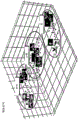
In step 1208, the feature vector generated in step 1206 may be compared to the compatible feature vector space 430 (or spaces 430a-n) populated during the processes 602-608 discussed above. For example, an illustrative vector space populated with feature vectors corresponding to an image is shown in fig. 14. In this example, each dot may represent a vectorized image, and the circle (and corresponding dot color) in fig. 14 may indicate one of three example labels associated with the image. In this case, the image tags are "coffee," "mountain," and "bird," and it should be understood that these tags are not mutually exclusive (i.e., the image may be tagged with one, two, or all three tags). Further, it should be understood that the layout of these labels and the multi-dimensional vector space in FIG. 14 is merely illustrative. In various embodiments, there is no limit to the number or types of tags that may be used, or to the dimensions of the vector space 430.
To perform the vector space comparison in step 1208, the content recommendation engine 425 may calculate the euclidean distance between the feature vector generated in step 1206 and each of the other feature vectors stored in the one or more vector spaces 430. Based on the calculated distances, the engine 425 may rank the feature vectors in ascending order of feature space distance such that the smaller the distance between two feature vectors, the higher the ranking. Such techniques may allow the content recommendation engine 425 to determine the set of highest ranked feature vectors within the vector space(s) 430 that are most similar in features/traits/etc. to the feature vectors generated in step 1206 based on the input received in step 1202. In some cases, a predetermined number (N) of the highest ranked feature vectors (e.g., 5 most similar articles, 10 most similar images, etc.) may be selected in step 1208, while in other cases all feature vectors that meet a particular proximity threshold (e.g., distance between vectors < threshold (T)) may be selected.
In some embodiments, the vector comparison in step 1208 may be a "depth feature space" comparison as shown in fig. 15. In these embodiments, the feature vectors generated in step 1206 may be compared without regard to any tags or other metadata. In other words, in depth feature comparison, the feature vector generated in step 1206 may be compared to every other feature stored in vector space 430. While it may be guaranteed that the depth feature comparison finds the closest vector in vector space 430, such a comparison may require additional processing resources and/or additional time to return the vector results. This is particularly true for large vector spaces that may include thousands or even millions of feature vectors, where each feature vector represents a separate content object/resource stored in repository 440. For example, to calculate the Euclidean distance between two image feature vectors of size 1x4096, approximately 10000 add and multiply instructions are required to be executed by the system 400. Thus, if there are 10000 images in the repository, then 10000000 operations must be performed.
Thus, in other embodiments, the vector comparison in step 1208 may be a "filtered feature space" comparison as shown in FIGS. 16-17. In the filtered feature space comparison, the vector space may first be filtered based on the tags (and/or other characteristics, such as resource media type, creation date, etc.) to identify that a subset of the feature vectors within the vector space(s) 430 have tags (and/or other characteristics) that match the tags (and/or other characteristics) of the feature vectors generated in step 1206. The feature vectors generated in step 1206 may then be compared to only those feature vectors in the subset having matching tags/characteristics. Thus, although there may be a possibility of losing the filtered and un-compared close feature vectors, the filtered feature space comparison may be performed more quickly and efficiently than the deep space comparison.
As described above, step 1208 may include comparing the feature vector generated in step 1206 to a single vector space or to multiple vector spaces. In some embodiments, the feature vectors generated in step 1206 may be compared to corresponding types of vector spaces. For example, when a text input is received in step 1202, the resulting feature vector may be compared to a vector within the topic vector space 430a, and when an image is received as an input in step 1202, the resulting feature vector may be compared to a vector within the image vector space 430b, and so on. In some embodiments, it may be possible to compare feature vectors corresponding to one type of input to a vector space containing vectors of different types (e.g., identify the image resource most closely related to text-based input, and vice versa). For example, FIG. 18 represents the process of receiving text input in step 1402 and retrieving similar images (e.g., closest in image vector space 430 b) and similar articles (e.g., closest in topic vector space 430 b) in step 1408.
For embodiments involving retrieving and/or comparing tags associated with content resources, problems may arise when tags of one resource are related to, but not exactly match, corresponding tags/keywords/features of another resource. An example of this potential problem is illustrated in fig. 19, where keywords extracted from an originally authored text content asset are compared to a set of image tags stored for a set of image content assets. In this example, none of the extracted keywords ("Everest," "Base Camp," "Summit," "Mountain," or "Himalaya") completely match the image tags ("Mountain," "Cappuccino," or "Macaw"). In some embodiments, word/phrase parsing and processing techniques such as stemming, word definition, and/or synonym retrieval and analysis may be used to detect matches between related but unmatched terms. However, even for related keywords/tags, these techniques may fail. Thus, in some embodiments, the content processing/analysis component 420 and/or the content recommendation engine 425 may perform word vector comparisons to address this issue. As shown in the example shown in FIG. 20, keywords extracted from the text document in FIG. 19 may be analyzed in a 3D word vector space, and the distance between the keywords and each image tag may be calculated. As shown in fig. 21, the keyword-to-tag vector space analysis performed in fig. 20 may determine that the image tag "mountain" is close enough to the extracted keyword within the word vector space that it should be considered an image tag match for filtered feature space comparison.
Another potential problem that may arise in embodiments that retrieve and/or compare tags associated with content resources is caused by homomorphic, heteronym keywords and/or resource tags. Homomorphic words or phrases (or homonyms) refer to words or phrases that have the same spelling and have different and unrelated meanings. An example of a homonymous image tag is shown in fig. 22, where the first image is labeled with the word "cane," which refers to a long-legged and long-necked bird, and the second image is labeled with the same word "cane," which refers to a machine having a projecting arm for moving weights. In this case, the content processing/analysis component 420 and/or the content recommendation engine 425 may perform word sense disambiguation processing on the two image tags to determine which word sense each word cane refers to. In this example, the word sense disambiguation process may initially retrieve the Wordnet database entry (or other defining data) associated with each tag, as shown in fig. 22 for two different "Crane" tags.
An illustrative word sense disambiguation process is shown in FIGS. 23-24. In this process, other keywords within the authored document and/or the particular context of the word "cane" in the document (e.g., description, part of speech, temporal, etc.) may be used by the content processing/analysis component 420 and/or the content recommendation engine 425 to determine the most likely meaning of the word cane within the authored text document, and thus which "cane" image tag is relevant to the authored text document. For example, referring now to FIG. 23, there is shown input text 2301 from which a plurality of related keywords 2302 have been extracted. The first extracted keyword ("cane") may be compared to the image tags within the content repository 440 and, in this example, two matching tags 2303 have been identified that correspond to the two "cane" tag images 2304a and 2304b within the content repository 440.
As shown in FIG. 24, to address the potential problem of word sense disambiguation, the disambiguation process may proceed by comparing one or more additional keywords 2302 extracted from the input content 2301 with other content tags of the two matching images 2304a and 2304 b. In this example, the additional extracted keywords "mechanical", "machine", "lifting", and "constraint" may be compared to the content tags and/or extracted features associated with each of the images 2304a and 2304 b. As shown in fig. 24, these additional comparisons may disambiguate the initial keyword match for "Crane" so that the content recommendation system 425 does not return the bird Crane image 2304a, but instead returns the construction Crane image 2304 b.
In other examples, similar disambiguation processing may be performed using image similarity. For example, the content processing/analysis component 420 and/or the content recommendation engine 425 may identify common image features between an image associated with authored content (e.g., a rendered or authored image) and two different "Crane" images in order to determine which Crane is the appropriate related image. These disambiguation processes may also be combined in various ways, such as comparing keywords extracted from an authored text document with visual features extracted from an image, and so forth. Thus, in a text document that involves the authoring of crane, the related words "boom" and "pulley" may visually match the underlying crane image if the boom and the sheave can be visually recognized in that image. Similarly, if the authored text document references crran and contains the related words "peak" and "features," then the "crran" keyword may be visually matched with the upper crane image if the beak and feather can be visually identified in that image.
Referring now to fig. 25-28, an end-to-end example of performing the process in fig. 12 is shown, particularly for an embodiment of retrieving a collection of related images of an article authored by a user via a user interface 415. Initially, at 2501 (FIG. 25), a user enters text of an article in a Demo Editor (AIditor) user interface. At 2502, a plurality of keywords are extracted from the text of the article, and at 2503, AI Rest Service compares the extracted keywords with image tags stored for the image library within the image content repository 440. Fig. 26 and 27 illustrate the same example process as fig. 25, but with additional details regarding the operation of AI Rest Service. As shown in fig. 26, using the techniques discussed above, AI Rest Service identifies one or more tags (e.g., "mountain") as being related to an authored article. Then, as shown in fig. 27, in some embodiments, this step may be performed using different software services, such as a first cognitive text REST service for determining a set of keywords from the text input, and a second internal REST service for mapping the keywords to image tags. Each of these services may be implemented within the content recommendation engine 425 and/or via an external service provider, and then, at step 2505 (shown in fig. 28), the content recommendation engine 425 may transmit the determined image tag(s) to a search API associated with the image content repository 440. In some cases, the search API may be implemented in a cloud-based content center (e.g., Oracle Content and Experience Cloud (CEC)). In step 2506, the search API may retrieve a set of related images based on tag matching, and in step 2507, the retrieved images (or scaled down versions of the images) may be transferred back and embedded within the user interface at 415 (at screen region 2810).
While the examples shown in fig. 25-28 illustrate a particular embodiment of retrieving a collection of related images of an article authored by a user, it should be understood that the steps in fig. 12 may be similarly performed to retrieve other types of content. For example, similar steps may be performed to retrieve articles (or other text documents) related to text entered by a user via the user interface 415. In other embodiments, related content assets of other media types (e.g., audio files, video clips, graphics, social media posts, etc.) may also be retrieved. Further, when a user imports/creates other types of input into the user interface beyond text (e.g., images drawn or uploaded, spoken audio input, video input, etc.), similar steps may be performed to retrieve various different types of related content assets (e.g., related articles, images, videos, audio, social media, etc.) depending on the configuration of the content recommendation engine 425 and/or user preferences.
For example, referring now to FIGS. 29-35, another example embodiment is shown in which the processing steps of FIG. 12 are performed to retrieve a collection of related articles (or other textual content resources) based on originally authored textual input (e.g., a user's blog article, email, article, etc.) received via the user interface 415. As shown in fig. 29, the user has authored a new article via the user interface 415, and the AI-based REST service invoked by the content recommendation engine 425 has identified a collection of article topics. As shown in fig. 30, the identified article topics can be compared to topics previously identified for a collection of articles in the article content repository 440. In these examples, FIG. 29 is shown according to one embodiment, while FIG. 30 shows another embodiment. Fig. 29 is only a subset of fig. 30, from which we can safely remove fig. 29. Thus, a similar technique to the process described above in FIG. 6) may be used to determine and store article topics as metadata or other associated data objects, with image features/tags determined and stored in association with the images. Similarly, for each article stored in the repository 440, the article content repository 440 may have metadata or other associated storage including article subject matter, dates, keywords, authors, publications, and the like. In the example shown in fig. 30, articles related to mumuman death have been determined to be potentially related to the user's newly created articles based on matching the subject matter of the articles. Fig. 31-35 illustrate an end-to-end process for using the system 400 to find articles relevant to an article entered by a user, similar to the steps shown in fig. 25-28 for finding relevant images. In step 3101 (FIG. 31), the user creates a new article via user interface 415. In step 3102, the article text is transmitted by the content recommendation engine 425 to one or more software services (e.g., an AI-based REST service), and in step 3103 (fig. 32), the software service(s) analyze the text of the article using cognitive text service functionality to determine one or more topics for the article. In step 3104, the determined article topics are transmitted back to the content recommendation engine 425, and in step 3105 the recommendation engine 425 sends both the article text and the identified topics to a separate API (e.g., within a cloud-based content center)), where in step 3106 the article may be saved to the repository 440 for future reference and indexed based on the identified topics. Also in step 3106 (FIG. 33), the existing repository 440 of articles can be searched via a search API to identify potentially relevant topics based on a topic matching process (FIG. 34). Finally, in step 3107 (FIG. 35), articles identified as potentially related to the newly created article may be transmitted back (in whole or simply linked) to be embedded within the user interface 415 (e.g., at user interface region 3510).
As illustrated in the above examples of fig. 29-33, certain embodiments described herein may include identification of the subject matter of the newly created text document and/or the subject matter of the text documents stored within the content repository 440, as well as comparison and identification of subject matter proximity and matches. In various embodiments described herein, various techniques including explicit semantic analysis may be used for textual topic evaluation and topic "proximity" techniques. As shown in fig. 29-30, in some cases, such techniques may provide fine-grained semantic representations of unrestricted natural language text using large-scale data sources (e.g., wikipedia) to represent the meaning of natural concepts derived from the data sources in a high-dimensional space. For example, text classification techniques may be used to formulate the meaning of any text based on wikipedia-based concepts. The semantic representation may be a feature vector of the text segment, which is transformed by topic modeling. Wikipedia (or another large-scale data source) can be used to include a large vocabulary (e.g., a bag of words) into the system to cover a wide range of words. The wikipedia-based concept may be the titles of wikipedia pages, which are used as classes/categories in classifying a given text segment. Given a text snippet, the closest wikipedia page title (e.g., "mountain event," "Stephen Hawking," "Car account," etc.) may be returned, which may be used as a class/category of text. The effectiveness of such techniques can be automatically evaluated by calculating semantic relatedness between segments of natural language text.
One of the advantages of using large-scale publicly available knowledge sources (e.g., wikipedia or other encyclopedia) in these text classification/relevance assessment techniques is that a large amount of highly organized human knowledge, pre-coded into publicly available resources, is accessible, which is in constant change/development. A semantic interpreter that maps segments of natural language text to a weighted sequence of wikipedia concepts ordered by their relevance to the input may be built using machine learning techniques based on wikipedia and/or other sources. Thus, the input text may be represented as a weighted vector of concepts, referred to as an interpretation vector. Therefore, the meaning of a text fragment is explained in terms of its similarity to many wikipedia concepts. Semantic relevance of the text can then be calculated by comparing their vectors in the space defined by the concepts, e.g. using cosine measures. Such semantic analysis may be explicit in the sense that explicit concepts may be based on human cognition. Because user input may be received in plain text via the user interface 415, conventional text classification algorithms may be used to rank the concepts represented by these articles according to their relevance to a given text snippet. Thus, online encyclopedias (e.g., wikipedia) can be used directly without the need for in-depth language understanding or pre-catalogued common knowledge. In some embodiments, each wikipedia concept may be represented as an attribute vector of words that appear in the corresponding article. The terms "frequency-inverted document frequency (TFIDF) scheme" may be used, for example, to assign weights to the entries of these vectors. These weights may quantify the strength of association between words and concepts. To speed up semantic interpretation, an inverted index may be used that maps each word into a list of concepts in which the word appears. The inverted index may also be used to discard insignificant associations between words and concepts by removing those concepts whose weight of a given word is below some threshold. The semantic interpreter may be implemented as a centroid-based classifier that may rank wikipedia concepts by relevance based on the received text segments. For example, a semantic interpreter in the content recommendation engine may receive an input text segment T and represent the segment as a vector (e.g., using the TFIDF scheme). The semantic interpreter may iterate over the text words, retrieve the corresponding entries from the inverted index, and merge them into a weighted vector. The entries of the weighting vector may reflect the relevance of the corresponding concept to the text T. To compute the semantic relevance of a pair of text segments, their vectors may be compared using, for example, a cosine metric.
In other examples, a similar method for generating features for text classification may include a supervised learning task, where words that occur in training documents may be used as features. Thus, in some examples, the bag of words may be augmented using wikipedia concepts. On the other hand, computing semantic relevance of a pair of texts is essentially a "one-time" task, so the word bag representation can be replaced with a concept-based representation. Eventery Gabrilovich and Shaul Markovitch of the Israel institute of technology computer science technology systems describe these and other related technologies in more detail in the paper "Computing and related Using Wikipedia-based Explicit Analysis", which is incorporated herein by reference for all purposes, as well as other related matters discussed therein. Using the techniques described in this paper and others, for a filtered subset of wikipedia, for each article, there may be one concept that is a title of the article. When the content recommendation engine 425 receives a text document via the user interface 415, the text may be summarized first. In these cases, after the stop word is removed and the word stem extracted, each unique word in the text may be weighted according to the frequency of occurrence and the frequency of inversion of words in the article. Each word may then be compared to see what wikipedia articles (concepts) it appears in, so the content recommendation engine 425 may create a concept vector for the word. The concept vectors for all words in a text document may be combined to form a weighted concept vector for the text document. The content recommendation engine 425 may then measure the similarity between each word concept vector and the text concept vector. All words above a certain threshold may then be selected as "keywords" for the document.
Referring now to fig. 36, an example semantic text analyzer system 3600 is shown that illustrates techniques used by the analyzer system 3600 to perform semantic text summarization in some embodiments described above. In various implementations, such a system 3600 may be integrated with and/or separate from the content recommendation engine 425.
In some implementations, explicit semantic analysis used to compute semantic relevance is reused to compute a text excerpt for a given text document. More specifically, the text excerpt is derived based on word embedding. In other words, the context of an n-gram (e.g., word) is captured to determine semantic similarity, as compared to typical similarity measures such as the cosine on a bag of words or edit distance on a string.
A given text document may be an article, a web page, or other text for which a text excerpt is desired. As with the classification methods described herein, text is not limited to written language, but may include other human-readable symbols, numbers, charts, tables, equations, formulas, and the like.
Text summarization methods using explicit semantic analysis generally operate as follows: (1) extracting grammatical units (e.g., sentences or words) from a given text document using any known technique for identifying and extracting such units, (2) each grammatical unit extracted and the text document represented as a weighted vector of knowledge base concepts; (3) calculating semantic relevance between the text document as a whole and each grammar unit using the weighting vectors, and (4) selecting one or more of the grammar units most semantically relevant to the entire text document for inclusion in a text excerpt of the text document. In some cases, a representation of a weighted vector of knowledge-base concepts may correspond to topic modeling, where each sentence or word may first be converted into a feature vector, and then feature differences/similarities may be calculated in a high-dimensional vector space. There are a number of ways in which WORDs can be converted into vectors, such as WORD2VEC or Laten Dirichlet Allocation.
FIG. 36 illustrates a text excerpt using explicit semantic analysis. First, a text summarizer is built based on knowledge base 3602. Knowledge base 3602 may be generic or domain specific. An example of a common knowledge base is a collection of encyclopedia articles, such as a collection of wikipedia articles or other encyclopedia of text articles. However, the knowledge base 3602 may alternatively be domain-specific, such as a collection of technical domain-specific text articles, such as a collection of medical, scientific, engineering, or financial articles.
Each article of the knowledge base 3602 is represented as an attribute vector of an n-gram (e.g., word) that appears in the article. Entries in the attribute vector are assigned weights. For example, the term "frequency-inverted document frequency scoring scheme" may be used to use the weights. Weights in the attribute vectors of articles quantify the strength of association between the articles' n-grams (e.g., words) and the articles that are concepts.
In some embodiments, the term "frequency-inverted document frequency scoring scheme" calculates a weight for a given n-gram t of a given article document d, as shown in the following equation:
here, tf ist,dRepresenting the frequency of the n-gram t in the document d. And dftRepresents the document frequency of the n-gram t in the knowledge base 3602. M represents the total number of documents in the training set, LdLength, L, of document d representing the number by termavgRepresents the average length of the training corpus, and K and b are free parameters. In some embodiments, k is approximately 1.5 and b is approximately 0.75.
The foregoing is one example of the term "frequency-inverted document frequency scoring scheme," which may be used to weight attributes of an attribute vector. Other statistical measures that reflect the importance of attributes (e.g., n-grams) to articles in knowledge base 3602 may be used. For example, other TF/IDF variants that take into account anchor text (such as BM25F) may be used with some type of knowledge base (such as, for example, a knowledge base of web pages or other hyperlinked document sets).
The weighted inverted index builder computer 3604 builds a weighted inverted index 3606 from the attribute vectors representing the articles of the knowledge base 3602. The weighted inverted index 3606 maps each different n-gram represented in the set of attribute vectors to a concept vector in which the concept (article) of the n-gram appears. Each concept in the concept vector may be weighted according to the strength of association between the concept and the n-gram to which the concept vector is mapped by the weighted inverted index 3606. In some implementations, the indexer computer 3604 uses the inverted index 3606 to discard insignificant associations between n-grams and concepts by removing from the concept vector those concepts whose weights for a given n-gram are below a threshold.
To generate a text excerpt for a given text document 3610, grammar units 3608 are extracted from the given text document 3610 and a semantic relevance between each grammar unit and the given text document 3610 is computed. A plurality of grammar units having a high semantic relevance to a given text document 3610 are selected for inclusion in the text excerpt.
The number of grammar units selected for inclusion in the text excerpt may vary based on a variety of different factors. One approach is to select a predefined number of syntax elements. For example, the predefined number may be configured by a user of the system or learned through a machine learning process. Another approach is to select all grammar units that have some degree of semantic relevance to a given text document 3610 above a predetermined threshold. The predefined threshold may be configured by a user of the system or learned through a machine learning process. Yet another possible approach is to determine the grammar unit that has the highest semantic relevance to the given text document 3610 and then select all other grammar units in which the grammar unit differs in semantic relevance from the given text document 3610 and has a highest degree below a predefined threshold. The grammar unit with the highest degree and any other grammar units below a predefined threshold are selected for inclusion in the text excerpt. Also, the predefined threshold may be configured by a user of the system or learned through a machine learning process.
In some implementations, grammar units having the highest or relatively high semantic relevance to a given text document 3610 are not always selected for inclusion in the text excerpt. For example, a first grammar unit having a lower semantic relevance to a given text document 3610 may be selected for inclusion in the text excerpt than a second grammar unit, which may not be selected for inclusion in the text excerpt if the first grammar unit is not sufficiently dissimilar relative to grammar units already selected for inclusion in the text excerpt. The degree of dissimilarity of grammatical elements with respect to existing text excerpts can be measured in a number of different ways, such as, for example, by using lexical methods, probabilistic methods, or a mixture of lexical and probabilistic methods. Using a dissimilarity measure to select a grammar unit to include in a text excerpt may prevent the inclusion of multiple similar grammar units in the same text excerpt.
In some implementations, other techniques for selecting multiple grammar units for inclusion in a text excerpt based on semantic relevance of the units to a given text document 3610 and their dissimilarity with respect to one or more other units may be used and are not limited to any particular technique. For example, given a semantic relevance of the plurality of grammar units to a given text document 3610 above a threshold, dissimilarity of each compound grammar unit with respect to a combination of the plurality of grammar units may be measured, and the plurality of grammar units that are most dissimilar to each other may be selected for inclusion in the text summary. Thus, the grammar units selected for inclusion in the text excerpt are semantically highly related to the text document as a whole, but are dissimilar to each other. This is a more useful text excerpt than text excerpts that contain highly semantically related, but similar grammar units, because similar grammar units are more likely to be redundant of each other than dissimilar grammar units with respect to information conveyed by grammar units.
Another possibility is to compute a composite similarity/dissimilarity measure for the grammar units and then select grammar units to be included in the text excerpt based on their composite scores. For example, the composite measure may be a weighted average of the semantic relevance measure and the dissimilarity measure. For example, a possible composite measure computed as a weighted average is:
(a. similarity) + (b. dissimilarity)
Here, the parameter similarity generally represents a semantic relevance of the grammar unit to the input text 3610. For example, the parameter similarity may be a similarity estimate 3620 computed for the syntax element. The parameter dissimilarity represents a dissimilarity measure of the dissimilarity of a syntax element with respect to a set of one or more syntax elements. For example, the set of one or more grammar units may be a set of one or more grammar units that have been selected for inclusion in the text excerpt. The parameter a represents the weight applied to the similarity measure in the weighted average. The parameter b represents the application of weight to the dissimilarity measure in the weighted average. The composite measure effectively balances the similarity measure and the dissimilarity measure with each other. They may be equally balanced with each other (e.g., a-0.5 and b-0.5). Alternatively, the similarity measure may be given greater weight (e.g., a-0.8 and b-0.2).
The grammar units extracted from a given text document may be sentences, phrases, paragraphs, words, n-grams, or other grammar units. In the case where the grammar unit 3608 extracted from a given text document 3610 is a word or n-gram, this process may be considered keyword generation as opposed to text summarization.
Text summarizer 3612 accepts text segments. The text segment is a given text document 3610 or grammatical element thereof. The text segment is represented as an "input" vector of weighted attributes (e.g., words or n-grams) for the text segment. Each weight in the input vector is for a corresponding attribute (e.g., word or n-gram) identified in the text segment and represents a strength of association between the text segment and the corresponding attribute. For example, the weight may be calculated according to a TF-IDF scheme or the like.
In some embodiments, the weights of the attributes in the input vector are calculated as follows:
here, tf ist,dIs the frequency of the n-gram t in this text fragment d. Parameters k, b, LdAnd LavgAs before, but with respect to knowledge base 3602 rather than the classification training set. In some embodiments, k is approximately 1.5 and b is approximately 0.75.
It should be noted that other weighting schemes are possible, and embodiments are not limited to any particular weighting scheme in forming the input vector. Forming the input vector may also include unit length normalization, such as described above with respect to the training data item vector.
Text summarizer 3612 iterates over the non-zero weighted attributes of the input vectors formed based on the text segments, retrieves the attribute vectors corresponding to the attributes from weighted inverted index 3606, and merges the retrieved attribute vectors into a weighted vector representing the concept of the text segment. This weighted vector of concepts is referred to hereinafter as the "concept" vector.
The attribute vectors corresponding to the attributes of the input vector retrieved from the weighted inverted index 3606 are also vectors of weights, respectively. However, the weights in the attribute vector quantify the strength of association between the corresponding concepts of knowledge base 3602 and the attributes mapped to the attribute vector by inverted index 3606.
Text summarizer 3612 creates concept vectors for the text segments. The concept vector is a vector of weights. Each weight in the concept vector represents the strength of association between a respective concept of knowledge base 3602 and a text passage. The concept weights in the concept vector are computed as a sum of values by text summarizer 3612, with each attribute having a non-zero weighted value in the input vector. Each value for an attribute of the sum is calculated as the product of (a) the weight of the attribute in the input vector and (b) the weight of the concept in the attribute vector for that attribute. Each concept weight in the concept vector reflects the relevance of the concept to the text segment. In some embodiments, the concept vector is normalized. For example, the concept vector may be normalized for a unit length or a concept length (e.g., class length as above).
Text summarizer 3612 may generate concept vectors 3616 for input text 3610 and concept vectors 3614 for each grammar unit 3608. The vector comparator 3618 compares the concept vectors 3614 generated for the grammar unit with the concept vectors 3616 generated for the input text 3610 using a similarity measure to generate a similarity estimate 3620. In some embodiments, a cosine similarity measure is used. Embodiments are not limited to any particular similarity measure and any similarity measure capable of measuring similarity between two non-zero vectors may be used.
The similarity estimate 3620 quantifies the semantic relevance between the grammar unit and the input text 3610 from which the grammar unit is extracted. For example, the similarity estimate 3620 may be a value between 1 and 0 (including 1 and 0), where values closer to 1 represent higher semantic relevance and values closer to 0 represent lower semantic relevance.
A similarity estimate 3620 may be computed for each grammar unit 3608. The similarity estimates 3620 generated for the grammar unit 3608 may be used to select one or more of the grammar units 3608 to include in a text excerpt of the input text 3610 (or to select one or more keywords for generating keywords for the input text 3610).
The above-described techniques have various applications for text summarization to provide accurate text summaries of longer text, such as, for example, news stories, blog articles, journal articles, web pages, and the like.
In any or all of the above embodiments, after one or more content assets (e.g., images, articles, etc.) have been identified as potentially relevant to the content that the user is currently creating via the user interface 415, the relevant content assets are transmitted back to the content recommendation engine 425, where they may be retrieved, modified, and embedded into the user interface 415, for example, by the content retrieval/embedding component 445. Using the retrieve/embed component 445, potentially relevant content resources can be provided to the user via the user interface 415 in such a way that the user can optionally include them in the content currently being created. Two example user interfaces are shown in fig. 37 and 38, where image recommendations are provided to a user during content creation. In FIG. 37, a media recommendation pane is shown that includes images selected based on the text of the content that the user is currently authoring via the user interface. In fig. 38, visual feature analysis has been used to select a set of images that may be related to the first image ("filename. jpg") selected by the user. Similar techniques and user interface screens may be used to allow a user to select, drag and drop images, links to articles and other text documents, audio/video files, etc., and embed them into content that the user is currently creating.
Fig. 39 depicts a simplified diagram of a distributed system 3900 in which the various examples discussed above may be implemented. In the example shown, the distributed system 3900 includes one or more client computing devices 3902, 3904, 3906, 3908 coupled to a server 3912 via one or more communication networks 3910. The client computing devices 3902, 3904, 3906, 3908 may be configured to run one or more applications.
In various embodiments, the server 3912 may be adapted to run one or more services or software applications that enable one or more operations associated with the content recommendation system 400. For example, a user may use a client computing device 3902, 3904, 3906, 3908 (e.g., corresponding to content creator device 410) to access one or more cloud-based services provided through via the content recommendation engine 425.
In various examples, the servers 3912 may also provide other services or software applications and may include non-virtual and virtual environments. In some examples, these services may be provided to users of the client computing devices 3902, 3904, 3906, 3908 as web-based services or cloud services, such as under a software as a service (SaaS) model. Users operating the client computing devices 3902, 3904, 3906, 3908, in turn, may interact with the server 3912 using one or more client applications to take advantage of the services provided by these components.
In the configuration depicted in fig. 39, server 3912 may include one or more components 3918, 3920, and 3922 that implement the functions performed by server 3912. These components may include software components, hardware components, or a combination thereof, which may be executed by one or more processors. It should be appreciated that a variety of different system configurations are possible, which may differ from the example distributed system 3900.
The
client computing devices 3902, 3904, 3906, 3908 may include various types of computing systems, such as portable handheld devices, such as smart phones and tablets; general purpose computers, such as personal computers and laptop computers; a workstation computer; wearable devices, such as head-mounted displays; gaming systems, such as handheld gaming devices, game consoles, and internet-enabled gaming devices; a thin client; various messaging devices; sensors and other sensing devices; and so on. These computing devices may run various types and versions of software applications and operating systems (e.g., Microsoft Windows
Apple
Or UNIX-like operating system, Linux, or Linux-like operating system, such as Google Chrome
TMTMOS) including various mobile operating systems (e.g., Microsoft Windows
Windows
Android
TM、
Palm
). The client devices may be capable of executing a variety of different applications, such as various internet-related applications, communication applications (e.g., electronic mail)A widget application, a Short Message Service (SMS) application), and various communication protocols may be used. The client device may provide an interface that enables a user of the client device to interact with the client device. The client device may also output information to the user via this interface. Although fig. 39 depicts only four client computing devices, any number of client computing devices may be supported.
Network(s) 3910 in distributed
system 3900 may be any type of network familiar to those skilled in the art that may support data communications using any of a variety of available protocols, including but not limited to TCP/IP (transmission control protocol/internet protocol), SNA (system network architecture), IPX (internet packet exchange), AppleTalk, and the like. By way of example only, the network(s) 3910 may be a Local Area Network (LAN), an ethernet-based network, a token ring, a wide area network, the internet, a virtual network, a Virtual Private Network (VPN), an intranet, an extranet, a Public Switched Telephone Network (PSTN), an infrared network, a wireless network (e.g., within any Institute of Electrical and Electronics Engineers (IEEE)802.11 protocol suite, a web site,
And/or any other network operating under a wireless protocol) and/or any combination of these and/or other networks.
The server 3912 may be comprised of one or more general purpose computers, special purpose server computers (including, by way of example, PC (personal computer) servers, and the like,
Servers, midrange servers, mainframe computers, rack-mounted servers, etc.), server farms, server clusters, or any other suitable arrangement and/or combination. The servers 3912 may include one or more virtual machines running virtual operating systems, or other computing architectures involving virtualization, such as one or more flexible pools of logical storage that may be virtualized to maintain virtual storage for the servers. In various examples, server 3912 may be adapted to operate to perform the aboveOne or more services or software applications operating.
The server 3912 may run an operating system, including any of the operating systems discussed above and any commercially available server operating systems. The servers 3912 can also run any of a variety of additional server applications and/or intermediate tier applications, including HTTP (HyperText transfer protocol) servers, FTP (File transfer protocol) servers, CGI (common gateway interface) servers, Web services, Web,
Servers, database servers, etc. Examples of database servers include, but are not limited to, database servers commercially available from Oracle, Microsoft, Sybase, IBM (international business machines), and the like.
In some implementations, the server 3912 may include one or more applications to analyze and consolidate data feeds and/or event updates received from users of the
client computing devices 3902, 3904, 3906, 3908. By way of example, the data feeds and/or event updates may include, but are not limited to, those received from one or more third-party information sources and a continuous data stream
Feeding,
Updates or real-time updates, which may include real-time events related to sensor data applications, financial tickers, network performance measurement tools (e.g., network monitoring and traffic management applications), clickstream analysis tools, automotive traffic monitoring, and the like. The server 3912 may also include one or more applications that display data feeds and/or real-time events via one or more display devices of the
client computing devices 3902, 3904, 3906, 3908.
Distributed
system 3900 may also include one or
more data repositories 3914, 3916. These data repositories may provide mechanisms for storing various types of information, such as the information described by the various examples discussed above.
Data repositories 3914, 3916 may resideLeft in various positions. For example, the data repository used by server 3912 may be local to server 3912, or may be remote from server 3912 and in communication with server 3912 via a network-based or dedicated connection.
Data repositories 3914, 3916 may be of different types. In some examples, the data repository used by server 3912 may be a database, e.g., a relational database, such as by
Databases provided by companies and other suppliers. One or more of these databases may be adapted to enable the storage, updating, and retrieval of data in the database in response to SQL-formatted commands.
In some examples, the application may also use one or more of the data repositories 3914, 3916 to store application data. The data repositories used by the applications may be of different types, such as, for example, key-value repositories, object repositories, or generic repositories supported by a file system.
In some examples, the cloud environment may provide one or more services, such as the services discussed above. Fig. 40 is a simplified block diagram of one or more components of system environment 4000 in which these and other services may be provided as cloud services. In the example shown in fig. 40, the cloud infrastructure system 4002 can provide one or more cloud services that can be requested by a user using one or more client computing devices 4004, 4006, and 4008. The cloud infrastructure system 4002 may include one or more computers and/or servers, which may include those described above with respect to the server 3912 of fig. 39. The computers in the cloud infrastructure system 4002 may be organized as general purpose computers, special purpose server computers, server farms, server clusters, or any other suitable arrangement and/or combination.
The network(s) 4010 can facilitate communications and data exchange between the clients 4004, 4006, and 4008 and the cloud infrastructure system 4002. The network(s) 4010 can include one or more networks. The networks may be of the same or different types. The network(s) 4010 may support one or more communication protocols, including wired and/or wireless protocols, to facilitate communications.
The example depicted in fig. 40 is merely one example of a cloud infrastructure system and is not intended to be limiting. It should be appreciated that in other examples, the cloud infrastructure system 4002 may have more or fewer components than shown in fig. 40, may combine two or more components, or may have a different configuration or arrangement of components. For example, although fig. 40 depicts three client computing devices, any number of client computing devices may be supported in other examples.
The term "cloud service" is generally used to refer to a service made available to users by a service provider's system (e.g., cloud infrastructure system 4002) as needed and via a communication network such as the internet. Typically, in a public cloud environment, the servers and systems that make up the cloud service provider system are different from the customer's own internal servers and systems. The system of the cloud service provider is managed by the cloud service provider. Customers may thus utilize cloud services provided by a cloud service provider without having to purchase separate licenses, support, or hardware and software resources for the services. For example, a cloud service provider's system may host applications, and users may order and use the applications on-demand and self-service via the internet without the users having to purchase infrastructure resources for executing the applications. Cloud services are intended to provide easy and scalable access to applications, resources, and services. Several providers offer cloud services. For example, by Redwood Shores, Calif

Companies provide several cloud services, such as middleware services, database services, Java cloud services, and the like.
In various examples, the cloud infrastructure system 4002 may provide one or more cloud services using different models, such as a software as a service (SaaS) model, a platform as a service (PaaS) model, an infrastructure as a service (IaaS) model, and other models including a hybrid service model. The cloud infrastructure system 4002 may include a suite of applications, middleware, databases, and other resources that enable provisioning of various cloud services.
The SaaS model enables applications or software to be delivered as a service to customers over a communications network, such as the internet, without the customers having to purchase hardware or software for the underlying applications. For example, the SaaS model may be used to provide customers with access to on-demand applications hosted by the cloud infrastructure system 4002. By
Examples of SaaS services provided by companies include, but are not limited to, various services for human resources/capital management, Customer Relationship Management (CRM), Enterprise Resource Planning (ERP), Supply Chain Management (SCM), Enterprise Performance Management (EPM), analytics services, social applications, and others.
The IaaS model is typically used to provide infrastructure resources (e.g., servers, storage, hardware, and networking resources) to customers as cloud services to provide flexible computing and storage capabilities.
Companies offer various IaaS services.
The PaaS model is typically used to provide platform and environmental resources as services that enable customers to develop, run, and manage applications and services without the customers having to purchase, build, or maintain such resources. By
Examples of PaaS services provided by companies include, but are not limited to, Oracle Java Cloud Services (JCS), Oracle database cloud services (DBCS), data management cloud services, various application development solution services, and other services.
In some examples, resources in the cloud infrastructure system 4002 may be shared by multiple users and dynamically reallocated on demand. In addition, resources can be allocated to users in different time zones. For example, the cloud infrastructure system 4002 may enable a first set of users in a first time zone to utilize resources of the cloud infrastructure system for a specified number of hours, and then enable the same resources to be reallocated to another set of users located in a different time zone, thereby maximizing utilization of the resources.
The cloud infrastructure system 4002 may provide cloud services via different deployment models. In the public cloud model, the cloud infrastructure system 4002 may be owned by a third party cloud service provider, and the cloud service is provided to any common public customer, where the customer may be an individual or an enterprise. In certain other embodiments, under the private cloud model, cloud infrastructure system 4002 may be operated within an organization (e.g., within an enterprise organization) and provide services to customers within the organization. For example, a customer may be a respective department of an enterprise, such as a human resources department, a payroll department, etc., or even an individual within the enterprise. In certain other embodiments, under the community cloud model, the cloud infrastructure system 4002 and the services provided may be shared by several organizations in the relevant community. Various other models, such as a mixture of the above-mentioned models, may also be used.
The client computing devices 4004, 4006, 4008 may be devices similar to those described above with respect to the client computing devices 3902, 3904, 3906, 3908 of fig. 39. The client computing devices 4004, 4006, 4008 of fig. 40 may be configured to operate a client application, such as a web browser, a proprietary client application (e.g., Oracle Forms), or some other application, that may be used by a user of the client computing device to interact with the cloud infrastructure system 4002 to use services provided by the cloud infrastructure system 4002.
In various examples, the cloud infrastructure system 4002 may also provide "big data" and related computing and analysis services. The term "big data" is generally used to refer to a very large set of data that can be stored and manipulated by analysts and researchers to visualize large amounts of data, detect trends, and/or otherwise interact with data. The analysis that the cloud infrastructure system 4002 may perform may involve using, analyzing, and manipulating large datasets to detect and visualize various trends, behaviors, relationships, etc. within the data. Such analysis may be performed by one or more processors, possibly processing data in parallel, performing simulations using data, and so forth. The data used for such analysis may include structured data (e.g., data stored in a database or structured according to a structured model) and/or unstructured data (e.g., data Blob).
As depicted in the embodiment of fig. 40, the cloud infrastructure system 4002 may include infrastructure resources 4030 for facilitating provisioning of various cloud services provided by the cloud infrastructure system 4002. Infrastructure resources 4030 may include, for example, processing resources, storage or memory resources, networking resources, and the like.
In some examples, to facilitate efficient supply of these resources to support various cloud services provided by the cloud infrastructure system 4002 for different customers, the resources may be bundled into a collection of resources or resource modules (also referred to as a "cluster (pod)"). Each resource module or cluster may include a pre-integrated and optimized combination of one or more types of resources. In some examples, different clusters may be pre-provisioned for different types of cloud services. For example, a first set of clusters may be provisioned for a database service, and a second set of clusters may be provisioned for a Java service, where the second set of clusters may include a different combination of resources than the clusters in the first set of clusters. For some services, the resources allocated to provision the service may be shared among the services.
The cloud infrastructure system 4002 itself may use the service 4032 internally, the service 4032 being shared by different components of the cloud infrastructure system 4002 and facilitating service provisioning of the cloud infrastructure system 4002. These internally shared services may include, but are not limited to, security and identity services, integration services, enterprise repository services, enterprise manager services, virus scanning and whitelisting services, high availability, backup and restore services, services for enabling cloud support, email services, notification services, file transfer services, and the like.
In various examples, the cloud infrastructure system 4002 may include multiple subsystems. These subsystems may be implemented in software or hardware or a combination thereof. As shown in fig. 40, the subsystems may include a user interface subsystem 4012, the user interface subsystem 4012 enabling a user or customer of the cloud infrastructure system 4002 to interact with the cloud infrastructure system 4002. The user interface subsystem 4012 can include a variety of different interfaces, such as a web interface 4014, an online store interface 4016 (where cloud services provided by the cloud infrastructure system 4002 are advertised and available for purchase by consumers), and other interfaces 4018. For example, a customer may use a client device to request (service request 4034) one or more services provided by cloud infrastructure system 4002 using one or more of interfaces 4014, 4016, and 4018. For example, a customer may visit an online store, browse cloud services provided by the cloud infrastructure system 4002, and place a subscription order for one or more of the services provided by the cloud infrastructure system 4002 that the customer wishes to subscribe to. The service request may include information identifying the customer and one or more services to which the customer desires to subscribe. For example, a customer may place an order for services such as those discussed above. As part of the order, the customer may provide information identifying, among other things, the amount of resources required by the customer and/or within what timeframe.
In some examples, such as the example depicted in fig. 40, cloud infrastructure system 4002 may include an Order Management Subsystem (OMS)4020 configured to process new orders. As part of this processing, OMS 4020 may be configured to: generating an account for the customer (if not already created); receiving billing and/or accounting information from the client, the billing and/or accounting information to be used to bill the client for providing the requested service to the client; verifying the customer information; after verification, ordering an order for the customer; and orchestrate various workflows to, among other things, prepare orders for supply.
Once properly verified, the OMS 4020 may invoke an order supply subsystem (OPS)4024 configured to supply resources, including processing resources, memory resources, and networking resources, for orders. Provisioning may include allocating resources for orders and configuring resources to facilitate services requested by customer orders. The manner in which resources are provisioned for an order and the type of provisioning resources may depend on the type of cloud service that the customer has subscribed to. For example, in accordance with one workflow, the OPS 4024 may be configured to determine a particular cloud service requested, and identify a plurality of clusters that may have been preconfigured for the particular cloud service. The number of clusters allocated for an order may depend on the size/quantity/level/range of services requested. For example, the number of clusters to allocate may be determined based on the number of users supported by the service, the duration of the service being requested, and the like. The assigned clusters can then be customized to the particular requesting customer to provide the requested service.
The cloud infrastructure system 4002 may send a response or notification 4044 to the requesting customer to indicate when the requested service is ready. In some cases, information (e.g., links) may be sent to the customer so that the customer can begin using and utilizing the benefits of the requested service.
The cloud infrastructure system 4002 may provide services to a plurality of customers. For each customer, the cloud infrastructure system 4002 is responsible for managing information related to one or more subscription orders received from the customer, maintaining customer data related to the orders, and providing the requested services to the customer. The cloud infrastructure system 4002 may also collect usage statistics about the customer's use of subscribed services. For example, statistics may be collected for the amount of storage used, the amount of data transferred, the number of users, and the amount of system uptime and system down time, among other things. This usage information may be used to bill the customer. The billing may be performed, for example, on a monthly basis.
The cloud infrastructure system 4002 may provide services to multiple customers in parallel. The cloud infrastructure system 4002 may store information for these customers, including possibly proprietary information. In some examples, cloud infrastructure system 4002 includes an Identity Management Subsystem (IMS)4028 configured to manage information for customers and provide separation of the managed information such that information related to one customer is not accessible to another customer. The IMS 4028 may be configured to provide various security-related services, such as identity services, such as information access management, authentication and authorization services, services for managing client identities and roles and related capabilities, and so forth.
Fig. 41 illustrates an example of a computer system 4100 that can be used to implement the various examples discussed above. In some examples, computer system 4100 can be used to implement any of the various servers and computer systems described above. As shown in fig. 41, computer system 4100 includes various subsystems, including a processing subsystem 4104 which communicates with various other subsystems via a bus subsystem 4102. These other subsystems may include a processing acceleration unit 4106, an I/O subsystem 4108, a storage subsystem 4118, and a communication subsystem 4124. The storage subsystem 4118 may include a non-transitory computer-readable storage medium 4122 and a system memory 4110.
Bus subsystem 4102 provides a mechanism for the various components and subsystems of computer system 4100 to communicate with one another as desired. Although bus subsystem 4102 is shown schematically as a single bus, alternative examples of bus subsystems may utilize multiple buses. Bus subsystem 4102 can be any of several types of bus structures including a memory bus or memory controller, a peripheral bus, and a local bus using any of a variety of bus architectures. For example, such architectures can include an Industry Standard Architecture (ISA) bus, a Micro Channel Architecture (MCA) bus, an enhanced ISA (eisa) bus, a Video Electronics Standards Association (VESA) local bus, and a Peripheral Component Interconnect (PCI) bus, which can be implemented as a Mezzanine bus manufactured according to the IEEE P1386.1 standard, or the like.
Processing subsystems 4104 control the operation of computer system 4100 and may include one or more processors, Application Specific Integrated Circuits (ASICs), or Field Programmable Gate Arrays (FPGAs). The processor may include a single-core or multi-core processor. The processing resources of computer system 4100 may be organized into one or more processing units 4132, 4134. A processing unit may include one or more processors (including single-core or multi-core processors), one or more cores from the same or different processors, a combination of cores and processors, or other combinations of cores and processors. In some examples, processing subsystems 4104 may include one or more special purpose coprocessors such as a graphics processor, a Digital Signal Processor (DSP), or the like. In some examples, some or all of processing subsystems 4104 may be implemented using custom circuits, such as an Application Specific Integrated Circuit (ASIC) or a Field Programmable Gate Array (FPGA).
In some examples, the processing units in the processing subsystem 4104 may execute instructions stored in the system memory 4110 or on the computer-readable storage medium 4122. In various examples, a processing unit may execute various programs or code instructions and may maintain multiple concurrently executing programs or processes. At any given time, some or all of the program code to be executed may reside in system memory 4110 and/or on computer-readable storage medium 4122, including possibly on one or more storage devices. With appropriate programming, the processing subsystem 4104 can provide the various functions described above. In the case where computer system 4100 is executing one or more virtual machines, one or more processing units can be assigned to each virtual machine.
In some examples, a processing acceleration unit 4106 may be provided for performing customized processing or for offloading some of the processing performed by the processing subsystem 4104, thereby accelerating the overall processing performed by the computer system 4100.
I/
O subsystem 4108 may include devices and mechanisms for inputting information to computer system 4100 and/or for outputting information from or via computer system 4100. In general, use of the term "input device" is intended to include all possible types of devices and mechanisms for inputting information to computer system 4100. User interface input devices may include, for example, a keyboard, a pointing device such as a mouse or trackball, a touchpad or touchscreen incorporated into the display, a scroll wheel, a click wheel, a dial, buttons, switches, a keypad, an audio input device with voice command recognition system, a microphone, and other types of input devices. The user interface input device may also include a user interface such as Microsoft Windows (R) for enabling a user to control and interact with the input device
Motion sensing and/or gesture recognition device for a motion sensor, Microsoft
360 game controller, a device providing an interface for receiving input using gestures and spoken commands. The user interface input device may also include an eye gesture recognition device, such as to detect eye activity from the user (e.g., "blinks" when taking pictures and/or making menu selections) and translate eye gestures into input devices (e.g., Google)
) Input of (2) Google
A blink detector. In addition, the user interface input devices may include devices that enable a user to interact with a speech recognition system (e.g.,
navigator) an interactive voice recognition sensing device.
Other examples of user interface input devices include, but are not limited to, three-dimensional (3D) mice, joysticks or pointers, game pads and graphics tablets, and audio/video devices such as speakers, digital cameras, digital camcorders, portable media players, webcams, image scanners, fingerprint scanners, barcode readers, 3D scanners, 3D printers, laser rangefinders, and eye gaze tracking devices. Further, the user interface input device may comprise, for example, a medical imaging input device, such as a computed tomography, magnetic resonance imaging, positional emission tomography, medical ultrasound examination device. User interface input devices may also include, for example, audio input devices such as MIDI keyboards, digital musical instruments, and the like.
In general, use of the term "output device" is intended to include all possible types of devices and mechanisms for outputting information from computer system 4100 to a user or other computer. The user interface output devices may include a display subsystem, indicator lights, or a non-visual display such as an audio output device. The display subsystem may be a Cathode Ray Tube (CRT), a flat panel device such as one that utilizes a Liquid Crystal Display (LCD) or a plasma display, a projection device, a touch screen, or the like. For example, user interface output devices may include, but are not limited to, various display devices that visually convey text, graphics, and audio/video information, such as monitors, printers, speakers, headphones, car navigation systems, plotters, voice output devices, and modems.
Storage subsystem 4118 provides a repository or data store for storing information used by computer system 4100. The storage subsystem 4118 provides a tangible, non-transitory computer-readable storage medium for storing the basic programming and data constructs that provide the functionality of some examples. Software (e.g., programs, code modules, instructions) that when executed by the processing subsystem 4104 provide the functionality described above may be stored in the storage subsystem 4118. The software may be executed by one or more processing units of processing subsystem 4104. The storage subsystem 4118 may also provide a repository for storing data used in accordance with the present disclosure.
The storage subsystem 4118 may include one or more non-transitory memory devices, including volatile and non-volatile memory devices. As shown in fig. 41, the storage subsystem 4118 includes a system memory 4110 and a computer-readable storage medium 4122. The system memory 4110 may include a number of memories, including a volatile main Random Access Memory (RAM) for storing instructions and data during program execution, and a non-volatile Read Only Memory (ROM) or flash memory in which fixed instructions are stored. In some embodiments, a basic input/output system (BIOS), containing the basic routines that help to transfer information between elements within computer system 4100, such as during start-up, may typically be stored in ROM. RAM typically contains data and/or program modules that are currently operated on and executed by the processing subsystem 4104. In some embodiments, system memory 4110 may include a variety of different types of memory, such as Static Random Access Memory (SRAM) or Dynamic Random Access Memory (DRAM), among others.
By way of example, and not limitation, as shown in fig. 41,
system memory 4110 may load
application programs 4112, program data 4111, and an
operating system 4116 that are being executed, which may include a client application, a Web browser, a middle tier application, a relational database management system (RDBMS), and the like. By way of example,
operating system 4116 may include various versions of Microsoft Windows
Apple
And/or Linux operating system, various commercial products
Or UNIX-like operating systems (including but not limited to various GNU/Linux operating systems, Google)
OS, etc.) and/or mobile operating systems, such as iOS, OS, and/or the like,
Phone、
OS、
10OS and
the OS operates the system.
The computer-
readable storage medium 4122 may store programming and data constructs that provide some of the example functionality. Computer
readable media 4122 may provide storage of computer readable instructions, data structures, program modules and other data for computer system 4100. Software (programs, code modules, instructions) that provide the functions described above may be stored when executed by processing subsystem 4104In the storage subsystem 4118. By way of example, the computer-
readable storage medium 4122 may include non-volatile memory, such as a hard disk drive, a magnetic disk drive, such as a CD ROM, DVD, a DVD, or a DVD, for example,
Optical disc drives for (blu-ray) discs or other optical media. Computer-
readable storage medium 4122 may include but is not limited to,
drives, flash memory cards, Universal Serial Bus (USB) flash drives, Secure Digital (SD) cards, DVD disks, digital video tapes, and the like. The computer-
readable storage medium 4122 may also include non-volatile memory based Solid State Drives (SSDs) (such as flash memory based SSDs, enterprise flash drives, solid state ROMs, etc.), volatile memory based SSDs (such as solid state RAM, dynamic RAM, static RAM, DRAM based SSDs, magnetoresistive RAM (mram) SSDs), and hybrid SSDs that use a combination of DRAM based and flash memory based SSDs. Computer-
readable storage media 4122 may provide storage of computer-readable instructions, data structures, program modules and other data for computer system 4100.
In some examples, the storage subsystem 4118 may further include a computer-readable storage media reader 4120, which computer-readable storage media reader 4120 may be further connected to a computer-readable storage medium 4122. The reader 4120 may receive and be configured to read data from a memory device, such as a disk, flash drive, or the like.
In some examples, computer system 4100 may support virtualization techniques, including but not limited to virtualization of processing and memory resources. For example, computer system 4100 may provide support for executing one or more virtual machines. Computer system 4100 can execute programs such as a hypervisor that facilitates configuration and management of virtual machines. Each virtual machine typically runs independently of the other virtual machines. Each virtual machine may be allocated memory, computing (e.g., processors, cores), I/O, and networking resources. Each virtual machine typically runs its own operating system, which may be the same or different from the operating systems executed by the other virtual machines executed by computer system 4100. Thus, computer system 4100 can potentially run multiple operating systems simultaneously.
The communication subsystem 4124 provides an interface to other computer systems and networks. The communication subsystem 4124 serves as an interface for receiving data from the computer system 4100 and transmitting data to other systems. For example, the communication subsystem 4124 may enable the computer system 4100 to establish a communication channel to one or more client devices via the internet for receiving information from the client devices and sending information to the client computing devices.
The communication subsystem 4124 may support both wired and/or wireless communication protocols. For example, in some examples, the communication subsystem 4124 may include Radio Frequency (RF) transceiver components, Global Positioning System (GPS) receiver components, and/or other components for accessing wireless voice and/or data networks (e.g., using cellular telephone technology, advanced data network technologies such as 3G, 4G, or EDGE (enhanced data rates for global evolution), WiFi (IEEE 802.11 family of standards), or other mobile communication technologies, or any combination thereof).
The
communication subsystem 4124 may receive and transmit data in various forms. For example, in some examples, the
communication subsystem 4124 may also receive input communications in the form of structured and/or unstructured data feeds 4126, event streams 4128,
event updates 4130, and so forth. For example,
communication subsystem 4124 may be configured to be real-time from a user of a social media network and/or in real-time such as
Feeding,
Update, other communication services such as web feeds of Rich Site Summary (RSS) feeds receive (or send) data feeds 4126, andand/or real-time updates from one or more third party information sources.
In some examples, the communication subsystem 4124 may be configured to receive data without an explicit end that may be continuous or unbounded in nature in the form of a continuous data stream, which may include an event stream 4128 and/or event updates 4130 of real-time events. Examples of applications that generate continuous data may include, for example, sensor data applications, financial tickers, network performance measurement tools (e.g., network monitoring and traffic management applications), click stream analysis tools, automotive traffic monitoring, and so forth.
The communication subsystem 4124 may also be configured to output structured and/or unstructured data feeds 4126, event streams 4128, event updates 4130, and the like, to one or more databases that may be in communication with one or more streaming data source computers coupled to the computer system 4100.
Computer system 4100 can be one of various types, including a hand-portable device (e.g.,
a cellular phone,
Computing tablet, PDA), wearable device (e.g., Google)
Head mounted display), personal computer, workstation, mainframe, kiosk, server rack, or any other data processing system.
Due to the ever-changing nature of computers and networks, the description of computer system 4100 depicted in FIG. 41 is intended only as a specific example. Many other configurations are possible with more or fewer components than the system depicted in FIG. 41. Based on the disclosure and teachings provided herein, a person of ordinary skill in the art will appreciate other ways and/or methods to implement the various embodiments.
Smart content-search result ranking
For a content recommendation system configured to recommend specific content (content items) in response to input from a client or a user, the process of evaluating the content items and ranking them with respect to each other plays an important role in the overall recommendation. For example, a user may enter one or more search terms into a search engine query interface, and the recommendation system may recommend one or more related content items (e.g., web pages, documents, images, etc.) that best match the entered search terms. In other examples, a user may author original content, such as emails, documents, online articles, blog articles, and so forth, using a content authoring system, which may be configured to provide recommendations of related content items, which may be related to the content authored by the user. For example, as described above, the content recommendation system may recommend relevant images or links to web pages or the like to the user so that the author may incorporate one or more of the recommended content items into the content being authored by the user, if desired. Several examples of such techniques are described in the sections above. As these examples illustrate, ranking and recommendation of particular content items may be applied to many different use cases in response to receiving manually entered user input and/or automatic input from other processes. The content items to be ranked and/or recommended may correspond to images, web pages, other media files, documents, digital objects, etc. that are available to the recommendation system for searching. These content items may be stored in one or more repositories accessible to the recommendation system, which may be private or public repositories (e.g., the internet).
However, ranking content items is a not straightforward task. For example, consider a recommendation system that performs recommendations using tag matching techniques. In such systems, content items available for search by the recommendation system are tagged, and the content items, along with the tags, may be stored in one or more repositories. Tagging may be performed by a content item tagging service/application. For a content item, one or more tags associated with the content item indicate the content contained by the content item. A value (also sometimes referred to as a tag probability) may also be associated with each tag, where the value provides a measure (e.g., probability) of the content indicated by the tag appearing in the content item. Upon receiving user input (e.g., search terms/phrases, content authored by a user) for which a recommendation of a content item is to be provided, the user input may be analyzed to identify one or more tags to be associated with the user input. The recommendation system may then identify a set of content items from the content items available for search using a tag matching technique, the associated tags of the content items matching the tags associated with the user input. The recommendation system may then use some sort of ranking algorithm to rank the content items within the identified collection and display the results to the user.
However, in some use cases, the effectiveness of the ranking algorithm used by the recommendation system may be limited and may not produce optimal results. For example, consider the case where there are multiple tags associated with a user input. For example, if a user types the words "coffee" and "person" in an image search engine, the labels "coffee" and "person" may be associated with the user input. In some embodiments, the search terms themselves may be considered tags associated with user input. For simplicity, it is assumed that the set of content items available for searching includes tagged images. Using these two tags, the recommendation system may retrieve a set of matching content items from a set of content items (e.g., images), wherein a content item is considered to be matching if at least one tag associated with the content item matches a tag associated with the user input. Consider a scenario (case 1) in which multiple matching content items are retrieved by a recommendation system, and each content item has associated with it a "coffee" and "people" label. One possible way to rank these retrieved content items is to (a) add, for each matching content item, the values associated with the labels "coffee" and "person" for that content item, and then (b) rank the content items based on their associated summed totals. However, this presents a problem because for a plurality of matching content items, the values associated with the matching tags can be accumulated to the same value, which is very likely because most tagging services normalize the probability to a scale of one. For example, three matching images may have associated label values as follows: image a (("coffee", 0.5), ("person", 0.5)), image B (("coffee", 0.2), ("person", 0.8)) and picture C (("coffee", 0.7), ("person", 0.3)). As can be seen, the sum of the values of the matching labels of each of these matching images is one ("1"), so conventional summation techniques cannot be used to rank one of these images over another. Thus, ranking images based solely on the summed sums of their matching tag values cannot be used to rank images.
Expanding on the above example, the set of matched images may also include images that match only one label (e.g., match only "coffee" or only "person") and have the same associated label value. This again presents a problem of ranking images. For example, consider that three matching images may have associated label values as follows: image a (("coffee", 0.5)) and image B (("person", 0.5)). Again, one of these images cannot be ranked above the other using conventional techniques.
The situation is further exacerbated when more than two labels are associated with the user input. For example, if a user types the words "coffee," person, "and" cafe "in an image search engine, the search tags associated with the user input are three" coffee, "" person, "and" cafe. The recommendation system may retrieve a set of matching content items from a set of content items (e.g., images), wherein a content item is considered to be a match if at least one tag associated with the content item matches a tag associated with the user input. The number of matching tags of the matched content items may vary from only one matching tag to a plurality of matching tags (the maximum of the three matching tags of the "coffee", "person" and "cafe" examples). Also in this scenario, for multiple matching content items, the values associated with the matching tags may be accumulated to the same value. For example, three matching images may have associated label values as follows: image a (("person", 0.8), ("coffee", 0.2)), image B (("person", 0.2), ("coffee", 0.2), ("cafe", 0.6)) and image C (("person", 0.5), ("cafe", 0.5)). As can be seen, the sum of the values of the matching labels of each of these matching images is one ("1"), and thus, one of these images cannot be ranked above the other using conventional summing techniques.
Thus, in many cases, a simple tag matching technique may not return an optimal content recommendation for a variety of reasons. For example, certain images (or other content items) in a repository may be tagged with only one or two content tags, while other images/content items may be tagged with a large number of tags, including tens or even hundreds of tags for a single content item. In such cases, conventional tag matching techniques may over-recommend re-tagged content items (e.g., because it more frequently includes at least one tag that matches the input term) and/or may under-recommend such items (e.g., because even if one or more content tags are matched, most of their tags will not match the input term). Similarly, input content provided by a user or client system may include only a few input terms (e.g., explicitly entered search terms or topics extracted from larger input text), or may include a relatively large number of input terms, depending on the input data received. In such cases, conventional tag matching techniques may either fail to identify certain related content items in the repository (e.g., because too few input terms match the tags of the related content items), or may erroneously recommend content items that are less relevant (e.g., because the less relevant content items include one or more matching tags).
In certain embodiments, improved techniques for evaluating, ranking, and recommending tagged content items are described herein. In some embodiments, the content recommendation system may receive input content (such as search queries, newly authored text input, etc.) from a client device. One or more tags may be included in or associated with input content received from the client device and/or may be determined and extracted from the input content based on pre-processing and analysis techniques performed on the input content. In addition, the content recommendation system may access a content repository that stores a plurality of tagged content items (such as images, media content files, links to web pages, and/or other documents). In some cases, the content repository may store data identifying tagged content items, and for each tagged content item, may also store associated tag information for each item, where the tag information for a content item includes information identifying one or more tags associated with the content item and a tag value for each associated tag.
In response to receiving input data to make a recommendation therefor, the content recommendation system may retrieve a set of matching tagged content items from the content repository from the set of searchable content items, wherein a content item is considered a matching content item if at least one content tag associated with the content item matches a tag associated with the input content. Then, for each matching tagged content item retrieved from the content repository, the content recommendation system may calculate two scores: (1) a first score based on the number of tags associated with a content item that match tags associated with input content (also referred to as a tag count score), and (2) a second score based on the tag value of each matching tag of the content item (also referred to as a tag value based score or TVBS). The content recommendation system then calculates a final ranking score for each of the matched content items based on the first and second scores of the matched content items. The final ranking scores computed for the set of matching content items are then used to generate a ranked list of matching content items. This ranked list is then used to identify a recommended subset of matched content items to be output to the user or client system.
Referring now to FIG. 42, a block diagram is shown illustrating a computing environment 4200 having a content recommendation system 4220 implemented to evaluate and rank content items from a content repository 4230 in response to input content received from a user or client system 4210, in accordance with certain embodiments. Also shown in this example are various components and subsystems within the content recommendation system 4220, including a Graphical User Interface (GUI)4215 by which the client system 4210 can interact with the content recommendation system 4220 to provide input content and receive data identifying a subset of recommended content items. In some embodiments, the GUI4215 may be a GUI of a separate client application 4215 (e.g., a web browser application) that a user uses to author content. In this embodiment, the content recommendation system 4220 may receive user-provided or authored content from a client application. The content recommendation system 4220 may receive content using an Application Programming Interface (API) that enables the client application and the content recommendation system 4220 to interact and exchange information with each other.
The embodiment depicted in fig. 42 is merely an example, and is not intended to unduly limit the scope of the claimed embodiments. One of ordinary skill in the art would recognize many possible variations, alternatives, and modifications. For example, in some implementations, the content recommendation system 4220 may have more or fewer systems or subsystems than those shown in fig. 42, may combine two or more systems, or may have a different configuration or arrangement of systems. The content recommendation system 4220 may be implemented as one or more computing systems, including in some embodiments separate systems using separate computing and network infrastructures with dedicated and specialized hardware and software. Alternatively or additionally, one or more of these components and subsystems may be integrated into a single system that performs the separate functionality. The various systems, subsystems, and components depicted in fig. 42 may be implemented in software (e.g., code, instructions, programs), hardware, or a combination thereof for execution by one or more processing units (e.g., processors, cores) of the respective system. The software may be stored on a non-transitory storage medium (e.g., on a memory device).
At a higher level, the content recommendation system 4220 is configured to receive user input content and then make content item recommendations in response to and based on the user input content. Recommendations are made from a collection of content items that are available and accessible to the content recommendation system 4220 for recommendation. The collection of content items may include images, documents of various types, media content, digital objects, and so forth. Based on the tag information associated with the user input content and the tag information associated with the set of content items, the content recommendation system 4220 is configured to identify a set of matching content items for the user input content using tag matching techniques. The content recommendation system 4220 is then configured to rank the content items in the set of matching content items using the innovative ranking techniques described in this disclosure. Based on the ranking, the content recommendation system 4220 is then configured to identify and recommend a subset of the matching content items to be output to the user or client system.
The content recommendation system 4220 comprises a content tagger subsystem 4222, the content tagger subsystem 4222 being configured to receive or retrieve content items available for recommendation by the content recommendation system 4220. Content items may include, but are not limited to, images, web pages, documents, media files, and the like. Content items may be received or retrieved from one or more content repositories 4230. The content repository 4230 may include various public or private content repositories, such as libraries or databases, including image libraries, document repositories, local or wide area networks of web-based resources (e.g., the internet), and so forth. One or more content repositories 4230 may be stored locally in the content recommendation system 4220, while other content repositories may be separate, remote from the content recommendation system 4220, and accessible to the content recommendation system 4220 via one or more computer networks.
In certain embodiments, for each content item, the content tagger subsystem 4222 is configured to retrieve and analyze the content of the content item and identify one or more content tags (tags) to be associated with the content item. For each tag associated with a content item, the content tagger 4222 may also determine a tag value associated with the tag, where the value provides a measure (e.g., probability) of occurrence of content indicated by the tag in the content item. The tag value of a tag may be compared to a numerical measure indicating how a particular content tag applies to that content item. One or more tags and corresponding tag values may be associated with a content item. For content items having multiple associated tags and corresponding tag values, the tag value may represent the relative prominence of the image subject or topic indicated by the tag in that image. For example, a first tag associated with a content item having a relatively high tag value may indicate that the content or feature indicated by that first tag is particularly relevant and prominent in that content item. Conversely, a second tag associated with the same content item having a lower tag value may indicate that the content or feature indicated by the second tag is less prominent or popular in the content item relative to the content indicated by the first content tag. For example, an image content item may have two associated tags and values, as shown below: ("human", 0.8), ("coffee", 0.2)). This indicates that the image contains content related to coffee (e.g., a coffee cup) and content related to a person (e.g., a person drinking coffee), and that the display of the person in the image is more prominent than the description of the coffee (e.g., a large portion of the image may depict the person, while the coffee cup may cover a small portion of the image). The tag value may be represented using different formats. For example, in some embodiments, the tag value may be expressed as a floating point number between 0.0 and 1.0. In some implementations, the sum of all tag values of tags associated with a particular content item may be summed to a fixed and uniform value (e.g., to 1).
In some embodiments, the content tagger 4222 may perform tagging tasks for content items using the services of the content tagging service, including identifying one or more tags to be associated with a content item and a tag value for each tag. In certain embodiments, the content tagger 4222 is implemented using one or more predictive machine learning models that have been trained to take a content item as input and predict the tags and associated tag values of the content item. In some embodiments, the labels may be selected from a set of preconfigured labels used to train the model. Various machine learning techniques using pre-trained machine learning models and/or other artificial intelligence-based tools may be used to determine the tags and corresponding tag values to be associated with content items, including AI-based text or image classification systems, topic or feature extraction, and/or any other combination of the above techniques.
In some embodiments, the content item retrieved from the content repository 4230 may already include an associated content tag and tag value. When the retrieved content item does not include tag information, and/or when the content recommendation system 4220 is configured to determine additional tags for the content item, the content tagger 4222 may be used to update or generate new tags for the retrieved content item. The content tagger 4222 may use a variety of different techniques to generate tag information (e.g., one or more tags and associated tag values) for a content item. For example, the content tagger 4222 may use any or all of the previously described techniques to analyze the retrieved content items and determine content tags, such as parsing, processing, feature extraction, and/or other analysis techniques. The type of parsing, processing, feature extraction, and/or analysis may depend on the type of content item. For example, for text-based content items, such as blog articles, letters, emails, articles, documents, and so forth, the analysis may include keyword extraction and processing tools (e.g., stem extraction, synonym retrieval, and so forth), topic analysis tools, and so forth. For content items that are images, artificial intelligence based image classification tools may be used to identify particular image features and/or generate image tags. For example, analysis of an image may identify a plurality of image features, and the image may be tagged with each of these identified features. One or both types of analysis (i.e., extracting tags from images and keywords/topics from textual content) may be performed via REST-based services or other web services using analysis, machine learning algorithms, and/or Artificial Intelligence (AI) based techniques, such as AI-based cognitive image analysis services, or similar AI/REST cognitive text services to be used for textual content. Similar techniques may be used for other types of content items, such as video files, audio files, graphics, or social media posts, where specific features (e.g., words, objects in images/videos, facial expressions, etc.) may be extracted and analyzed using specialized web services, depending on the media type of the content item.
In some embodiments, the content tagger 4222 may use one or more machine learning and/or artificial intelligence based pre-trained models trained with training data to identify and extract content features to be used to determine tags and tag values for content items. For example, the model training system may generate one or more models that may be trained in advance using a machine learning algorithm based on a training dataset that includes prior input data (e.g., text input, images, etc.) and training datasets of corresponding labels of the prior input data. In various embodiments, one or more different types of trained models may be used, including classification systems that perform supervised or semi-supervised learning techniques (such as naive bayes models, decision tree models, logistic regression models, or deep learning models), or any other machine learning or artificial intelligence based prediction system that may perform supervised or unsupervised learning techniques. For each machine learning model or model type, the trained model may be executed by one or more computing systems, during which execution the content item is provided as input to the one or more models, and output from the models may identify one or more tags as being associated with the content item, or the output of the models may be used to identify one or more tags to be associated with the content item. Thus, the content tagger 4222 may use a variety of different tools or techniques, such as, but not limited to, keyword extraction and processing (e.g., stemming, synonym retrieval, etc.), topic analysis, feature extraction from images, machine learning and AI-based modeling tools, and text or image classification systems, and/or any other combination of the above techniques, to determine or generate tag information (e.g., one or more tags and associated tag values) for each content item available for recommendation.
In some embodiments, the content items available for recommendation and their associated tag information (e.g., for each content item, one or more tags associated with the content item and corresponding tag values) may be stored in the data store 4223. In some embodiments, the content/tag information data store 4223 may store data identifying content items retrieved from the content repository 4230, which may include the items themselves (e.g., images, web pages, documents, media files, etc.), or additionally/alternatively, may include references to the items (e.g., item identifiers, network addresses from which content items may be retrieved, descriptions of the items, thumbnails of the items, etc.). An example illustrating the types of data that may be stored in the content/tag information data store 4223 is shown in fig. 45 and discussed in more detail below.
The content recommendation system 4220 comprises a tag identifier subsystem 4221, the tag identifier subsystem 4221 being configured to receive user input content from the device 4210 and determine one or more tags to be associated with the user content. In some embodiments, the user content received from device 4210 may include an associated tag. In some other embodiments, the tag identifier 4221 may be configured to process the input data to determine one or more tags to associate with the input data. As one example, the tag identifier 4221 may use a data tagging service to identify a set of one or more tags to be associated with input data. The tag identifier 4221 may then provide tags associated with the input data (which in some embodiments also includes user content) to a recommended content item identifier and ranker subsystem 4224 (which may be referred to as a content item ranker 4224 for brevity) for further processing.
In some embodiments, the tag identifier 4221 may use various techniques used by the content tagger 4222 and, as described above, determine one or more tags to associate with the received user content. In some embodiments, both the tag identifier 4221 and the content tagger 4222 may use the same superset of tags from which to determine the tags to be associated with the user input and the content item. In certain embodiments, the tag identifier 4221 and the content tagger 4222 may use the same data tagging service to identify tags to be associated with user content and content items, respectively. In still other embodiments, the tag identifier 4221 and content tagger 4222 subsystems may be implemented as a single subsystem configured to perform similar (or even identical) processing on the content items received from the repository 4230 and the input content received from the client system 4210.
As described, when content items are tagged by the content tagger 4222, for each content item, one or more tags to be associated with the content item and a tag value for each tag are identified. With respect to tagging user content, in some embodiments, the tag identifier 4221 is configured to determine only tags to be associated with user input without any associated tag values. In such embodiments, each tag is given equal weight relative to the ranking performed by the content item ranker 4224 based on the tag associated with the user input. In some other embodiments, both tags and associated tag values may be determined for user content and used by the content item ranker 4224 to rank content item recommendations.
As described above, the user content received and processed by the tag identifier 4221 may appear in different forms. For example, user content may include content of a document authored by a user (e.g., an email, an article, a blog post, a document, a social media post, an image, etc.), content created or selected by a user (e.g., a multimedia file), and so forth. As another example, the user input may be a document (e.g., a web page) accessed by the user. As yet another example, the user content may be search terms entered by a user (e.g., a browser-based search engine) for performing a search. In some embodiments, for example, for search terms, the terms themselves may be used as tags.
As depicted in fig. 42 and described above, the content item ranker 4224 receives as input from the tag identifier 4221 information identifying a set of one or more tags associated with the user content. Based on this tag information of the user content and on the content items available for recommendation, the content item ranker 4224 is configured to identify one or more content items that are most relevant and/or most relevant to the input content using a tag matching technique. Where multiple content items are identified as being relevant or relevant to the user input, the content item ranker 4224 is further configured to rank the content items using the innovative ranking techniques described herein. More details regarding various techniques used by the content item ranker 4224 for scoring and ranking content items are described in more detail below. The content item ranker 4224 is configured to generate a ranked list of content items to be recommended to the user in response to user input received for the user. The ranked list of content items is then provided to the recommendation selector subsystem 4225 for further processing.
Using the ranked list of content items received from the content item ranker 4224, the recommendation selector 4225 is configured to select one or more particular content items to recommend to the user in response to input content received from the client system 4210. In some scenarios, all content items in the ranked list may be selected for recommendation. In some other scenarios, a subset of the ranked content items may be selected for recommendation, wherein the subset includes less than all of the content items in the ranked list, and one or more of the content items included in the subset are selected based on the rankings of the content items in the ranked list. For example, the recommendation selector 4225 may select the top "X" (e.g., top 5, top 10, etc.) content items from the ranked list for recommendation, where X is some integer less than or equal to the number of ranked items. In some embodiments, the recommendation selector 4225 may select content items to be included in the subset to be recommended to the user based on scores associated with the content items in the ranked list. For example, only those content items having an associated score above a user-configurable threshold score may be selected for recommendation to the user.
Information identifying the content items selected for recommendation by the recommendation selector 4225 may then be communicated from the content recommendation system 4220 to the user's user client device 4210. Information about the recommended content items may then be output to the user via the user client device. For example, information about the recommendation may be output via a GUI4215 displayed on the user client device or via an application 4215 executed by the user client device. For example, if the user input corresponds to a search query input by the user via a web page displayed by a browser executed by the user device, information about the recommendation may also be output to the user via that web page or an additional web page displayed by the browser. In some embodiments, for each recommended content item, the information output to the user may include information identifying the content item (e.g., text information, a thumbnail of an image, etc.) and information for accessing the content item. For example, information to access a content item may take the form of a link (e.g., a URL) that, when selected by a user (e.g., by a mouse click action), will cause the corresponding content item to be accessed and displayed to the user via the user client device. In some embodiments, information identifying the content item and information for accessing the content item may be combined (e.g., a thumbnail representation of a recommended image that both identifies the image content item and may be selected by the user to access the image itself).
In various embodiments, the content recommendation system 4220, including its associated hardware/software components 4221 and services, may be implemented as a backend service remote from the front-end client device 4210. The interaction between the client device 4210 and the content recommendation system 4220 may be an internet-based web browsing session, or a client-server application session, during which user access may input user content (e.g., search terms, originally authored content, etc.) via the client device 4210 and content item recommendations may be received from the content recommendation system 4220. Additionally or alternatively, the content recommendation system 4220 and/or the content repository 4230 and related services may be implemented as specialized software components executing directly on the client device 4210.
In some embodiments, the system 4200 shown in fig. 42 may be implemented as a cloud-based multi-tier system in which upper tier user devices 4210 may request and receive access to network-based resources and services via content recommendation systems 4220 residing on backend application servers deployed and executed on an underlying resource-based set (e.g., cloud-based, SaaS, IaaS, PaaS, etc.). Some or all of the functionality described herein for the content recommendation system 4220 may be performed or accessed by a representational state transfer (REST) service and/or a web service including a Simple Object Access Protocol (SOAP) web service or API and/or web content exposed via hypertext transfer protocol (HTTP) or HTTP security protocol. Thus, although not shown in fig. 42 to avoid obscuring the illustrated components with additional detail, the computing environment 4200 may include additional client devices, one or more computer networks, one or more firewalls, proxy servers, routers, gateways, load balancers, and/or other intermediate network devices to facilitate interaction between the client device 4210, the content recommendation system 4220, and the content repository 4230.
In various embodiments, the systems depicted in computing environment 4200 may be implemented using one or more computing systems and/or networks, including dedicated server computers (such as desktop servers, UNIX servers, mid-end servers, mainframe computers, rack-mounted servers, etc.), server farms, server clusters, distributed servers, or any other suitable arrangement and/or combination of computing hardware. For example, the content recommendation system 4220 may run an operating system and/or various other server applications and/or intermediary layer applications, including hypertext transfer protocol (HTTP) servers, file transfer service (FTP) servers, Common Gateway Interface (CGI) servers, Java servers, database servers, and other computing systems. Any or all of the components or subsystems within the content recommendation system 4220 may include at least one memory, one or more processing units (e.g., processor (s)), and/or storage. The subsystems and/or modules in the content recommendation system 4220 may be implemented in hardware, software executed on hardware (e.g., program code or instructions executable by a processor), or a combination thereof. In some examples, the software may be stored in a memory (e.g., a non-transitory computer-readable medium), on a memory device, or in some other physical memory, and may be executed by one or more processing units (e.g., one or more processors, one or more processor cores, one or more Graphics Processing Units (GPUs), etc.). Computer-executable instructions or firmware implementations of the processing unit(s) may include computer-executable instructions or machine-executable instructions written in any suitable programming language that may perform the various operations, functions, methods, and/or processes described herein. The memory may store program instructions that are loadable and executable on the processing unit(s), as well as data generated during the execution of these programs. The memory may be volatile (such as Random Access Memory (RAM)) and/or nonvolatile (such as Read Only Memory (ROM), flash memory, etc.). The memory may be implemented using any type of persistent storage device, such as a computer-readable storage medium. In some examples, a computer-readable storage medium may be configured to protect a computer from electronic communications containing malicious code.
FIG. 43 depicts a simplified flowchart 4300 depicting a process performed by the content recommendation system for identifying and ranking content items related to user content according to some embodiments. The process depicted in fig. 43 may be implemented in software (e.g., code, instructions, programs) executed by one or more processing units (e.g., processors, cores) of a respective system, hardware, or a combination thereof. The software may be stored on a non-transitory storage medium (e.g., on a memory device). The method presented in FIG. 43 and described below is intended to be illustrative and not limiting. While fig. 43 depicts various processing steps occurring in a particular order or sequence, this is not intended to be limiting. In some alternative embodiments, the processes may be performed in a different order, or some steps may be performed in parallel. The process depicted in fig. 43 may be performed by one or more systems depicted in fig. 42, such as by content recommendation system 4220. As an example, for the embodiment depicted in fig. 42, the processing in 4302 and 4304 may be performed by the tag identifier 4221, the processing in 4306 through 4316 may be performed by the content item ranker 4224, and the processing in 4318 and 4320 may be performed by the recommendation selector 4225. However, it should be understood that the techniques and functionality described in connection with FIG. 43 need not be limited to only implementation within the particular computing infrastructure shown in FIG. 42, but may be implemented using other compatible computing infrastructures described herein.
In 4302, the content recommendation system 4220 may receive input content from one or more users or client systems 4210. As discussed above with reference to fig. 42, input content may be received from the client device 4210 via a graphical user interface 4215 (e.g., a web-based GUI) provided by the content recommendation system 4220. In other examples, the input content may be received by a web server or backend service executing in the content recommendation system 4220 based on data transmitted by a front-end application (e.g., mobile application) installed on the client device 4210.
In some embodiments, the input received in step 4302 may correspond to a set of search terms or phrases entered into the search engine user interface by the user. In other embodiments, the input content may correspond to original content authored by the user and input into the dedicated user interface. For example, the new original content may include online articles, newsletters, emails, blogs, etc., and such content may be input by a user via a software-based word processor tool, email client application, web development tool, etc. In still other examples, the input content received in step 4302 may be an image, a graphical, an audio input, or any other textual and/or multimedia content generated or selected by the user via client device 4310.
Referring briefly to FIG. 44, an example user interface 4400 is shown including a user interface screen 4410 that allows a user to input original authored content. In this example, user interface screen 4410 is generally labeled as a "content authoring user interface," however, in various embodiments, user interface 4410 may correspond to an interface of a word processor, an article designer or blogger, an email client application, or the like. In this example, the user interface 4410 includes a first text box 4411 in which the user can enter a title or subject of authored content, and a second text box 4412 in which the user can enter a full text (e.g., an article, email body, document, etc.) as input content. In addition, the user interface 4410 includes selectable buttons 4413 that allow a user to initiate a search for related content items (e.g., images, related articles, etc.) that may be incorporated into newly authored content. In some cases, selection of the button 4413 or similar user interface component may initiate the process shown in fig. 43 by first analyzing and transmitting user content received via the user interface 4410 (e.g., user content entered in 4411 and/or 4412) to the content recommendation system 4220. In other embodiments, the background process may run continuously (or periodically) within the front-end user interface to continuously (or periodically) analyze new text input received from the user (e.g., content entered by the user in 4411 and/or 4412) and re-initiate the process of FIG. 43 in response to the text update so that the content item recommendations may be continuously or periodically updated in real-time.
Referring back to FIG. 43, in 4304, the content recommendation system 4220 determines one or more tags for the input content received in step 4302. In some embodiments, the input content received in 4302 may already have tags associated with it or embedded in the input content, and the tag identifier 4221 may identify and extract a set of predetermined tags associated with the input content. If the input received in step 4302 corresponds to a search term, the tag identifier 4221 may simply use the search term entered by the user as a tag (e.g., excluding certain words such as articles, conjunctions, prepositions, quantifiers, etc.). In the case of originally authored text content or any other untagged input content received by the content recommendation system 4220, the tag identifier 4221 may be configured to analyze various characteristics of the input content received in 4302 and determine one or more tags to be associated with the received input content based on the analysis. As previously described, the tag identifier 4221 may use a variety of different techniques to determine one or more tags to be associated with the input content received in 4302.
Returning to the example user interface 4400 shown in fig. 44, for this example, the input received in 4302 may correspond to the text entered by the user in topic/topic box 4411 (i.e., "do coffee get healthier than tea for you"). also, the text entered in box 4412 may be displayed in a text-based manner. Based on the analysis of the subject matter in 4411 and the body text of the article authored in 4411, and any other input content that may be provided, the content recommendation system 4220 may determine in 4304 that the tags "coffee", "tea" and "person" are associated with the user content.
In 4306, based on the tags determined for the input content in 4302, the content recommendation system 4220 identifies a set of matching content items from the set of content items available for recommendation using a tag matching technique, wherein if at least one tag associated with a content item matches a tag determined for the input content in 4304, then the content item is considered a match and identified in 4306. The collection of content items identified in 4306 may also be referred to as a matching collection of content items and include content items that are candidates for recommendation to the user in response to the input content received in 4302. In various embodiments, data processing techniques such as stem extraction and synonym retrieval/comparison may be used as part of the matching process in 4306 to identify matching tags.
For example, in the embodiment depicted in fig. 42, the set of content items available for recommendation and their associated tag information (e.g., tags associated with content items and associated tag values) may be stored in the content/tag information data store 4223. As part of the processing in 4306, the content recommendation system 4220 may compare one or more tags determined in 4304 with tags associated with content items available for recommendation and identify from the collection content items having at least one associated tag that matches the tag identified in 4304.
Continuing with the example of FIG. 44 and assuming that the labels "coffee", "person" and "tea" have been determined in 4304 for the user input content received in 4302, the example table 4500 in FIG. 45 shows a matching set of content items identified by the content recommendation system 4220 (e.g., by the content item ranker 4224) from the set of content items available for making recommendations. As can be seen from table 4500, eight different image content items have been identified as having at least one associated label that matches at least one of the labels "coffee", "person", or "tea". As shown in this example, each matching image content item is identified using an image identifier 4501. The image description 4502 provided in fig. 45 is a description of the content of the matched image, and has been provided in fig. 45, so that it is not necessary to show the actual image. Each matching image has one or more associated labels 4503, and a label value 4504 is associated with each label. In the example of table 4500, the tag values are floating point values having a predetermined range (e.g., between 0.0 and 1.0), and the sum of the tag values of each content item is equal to the same total number (e.g., 1.0). Such embodiments provide additional technical advantages, such as uniformity of the sum of tag count scores, and the TVBS may ensure that content items with more associated tags are not artificially over-ranked or over-recommended based on a larger number of associated tags. In addition, as discussed below, by having tag values between 0.0 and 1.0, when they are multiplied (e.g., in the use case described below), the resulting values will allow content items to be ranked within a particular group or bucket, while ensuring that the highest-ranked content items within one group are not ranked higher than the lowest-ranked content items in the next higher group.
As can be seen from fig. 45, a content item (in this example an image) is considered a match if at least one tag associated with the content item matches a tag associated with the input content. The matched content items may have associated tags that match one or more tags associated with the input content. The matching content item may also have other tags associated with it that are different from the tags used to enter the content (e.g., Image _1, Image _3, etc.).
In 4308, a tag count score (first score) is calculated for each matching content item identified in 4306 based on the number of tags associated with the content item that match the tag determined for the input content. In some scenarios, each matching tag of a content item is assigned a value of one, so the tag count score calculated for the content item in 4308 is equal to the number of tags of the content item that match the tag associated with the input content. For the example matched images identified in fig. 45, table 4600 in fig. 46 identifies a label count score 4602 for each matched image identified in fig. 45 (and fig. 46). For example, the tag count score of Image _1 is "1" (one) because one tag ("person") associated with the Image matches the tag associated with the input content. As another example, the tag count score of Image _2 is "2" (two) because the two tags ("coffee" and "person") associated with the Image match the Image associated with the input content. As yet another example, the tag count score of Image _8 is "1" (one) because one tag ("coffee") associated with the Image matches the tag associated with the input content.
In 4310, the matching content items are grouped (bucketized) into groups or buckets based on the tag count scores computed in 4308 for the content items. In some embodiments, a group (or bucket) contains all content items having the same tag count score. Where each matching tag of a content item is assigned a value of one, each group or bucket includes content items having the same number of matching tags. 4310 may be optional and may not be performed in some embodiments.
Continuing with the example shown in FIG. 46, eight matching images may be grouped into two groups or buckets: a first group or bucket comprising content items having a tag count score of 1 (one) and a second group or bucket having a tag count score of 2 (two). The first group will include images { Image _1, Image _3, Image _6, and Image _8}, and the second group will include images { Image _2, Image _4, Image _5, and Image _7 }. Notably, in this example, no matching image matches all three tags ("coffee", "person", "tea") associated with the input content.
In 4312, for each group identified in 4310, a score based on the tag value (second score) is calculated for each candidate content item in that group. In some embodiments, a tag value-based score (TVBS) for a particular content item is calculated based on and using the tag value associated with the matching tag of that content item.
In certain embodiments, the TVBS for a content item is calculated by multiplying tag values associated with tags of the content item that match tags associated with the input content. For example:
TVBS of Image _1 in fig. 46 is 0.93
TVBS of Image _2 in fig. 46 is 0.5 × 0.5 — 0.25
TVBS of Image _3 in fig. 46 is 0.65
In fig. 46, TVBS of Image _4 is 0.35 × 0.60 is 0.21, and so on.
Table 4600 shows TVBS 4603 calculated for each matched image using the above-described technique.
In some embodiments, a naive bayes method is used to compute a score for a content item based on a tag value. For example, assume that two tag tags are determined for the input content1And tag2Then the Tag Value Based Score (TVBS) of an image content item may be expressed as:
ImageiTVBS (Image) of (1)i|tag1,tag2) Given tag1And tag2Image of (2)iProbability of (2)
This extension is used for "n" tags:
P(Imagei|tag1,tag2…,tagn) Given (tag)1And tag2And … tagn) Image of (2)iProbability of (2)
Suppose tag1,tag2…,tagnAre independent of each other:
ImageiTVBS ═ TVBSi=P(Imagei|tag1,tag2...,tagn)=P(Imagei|tag1)*P(Imagei|tag2)*...*P(Imagen|tagn)
Equation 1
Now by naive Bayes (Simple)
Bayes):(
Equation 2)
Wherein:
P(Imagei|tagt) For Imagei,tagtProbability of (2)
P(Imagei) Each image is considered unique and this term may be discarded or ignored
P(tagt) Frequency of tags in a collection of content items (i.e. with tags)tThe number of content items (e.g., images) in the set of tagged content items available for recommendation). Since this item is in the denominator, the lower the frequency of occurrence of a tag in the set of content items (i.e. the fewer the number of content items having this associated tag), the higher the TVBS score of the image having that tag.
After expansion, the above equation becomes:equation 3
The numerator in equation 3 is the product of the probabilities, which will result in a higher score when the probabilities may be equal (given that multiple images match the same label, the denominator will remain the same).
The following example illustrates the application of equation 3 in calculating a TVBS of a content item. Assume that the labels determined for the input content are "person" and "coffee". Assume further that the set of content items (images) available for recommendation contains three images with the following labels and label values:
image A: ("human", 0.5), ("coffee", 0.5)
And (3) image B: ("human", 0.1), ("coffee", 0.9)
And an image C: ("human", 0.8), ("coffee", 0.2)
For image a:
p (person | image) ═ 0.5 and P (coffee | image) ═ 0.5
By applying the equation 3 to the process,
wherein "frequency (people)" is the number of content items in the set of content items available for recommendation having a "people" tag associated therewith, and "frequency (coffee)" is the number of content items in the set of content items available for recommendation having a "coffee" tag associated therewith
TVBS of image a is 0.028
Using a similar technique, it is possible to use,
TVBS of image B (0.1/3) × (0.9/3) ═ 0.01
TVBS of image C ═ 0.8/3 ═ 0.2/3 ═ 0.018
As can be seen from this example, the TVBS is higher when the probabilities may be equal, given the same frequency (if the same label is matched for multiple images, the denominator will remain the same).
According to an extension of equation 3, the frequency of content items in the set of content items having a particular associated tag is considered for calculating the TVBS (and thus will also affect the overall ranking score, as described below). The smaller the number of content items having a particular associated tag (i.e. the lower the frequency), the higher the TVBS score of the image having the particular tag. In some embodiments, it is desirable to increase the likelihood that such content items having "rare" or less frequent tags are ranked higher than content items having more frequent tags, thereby increasing the likelihood that they are included in the list of content items recommended to the user. Thus, the value of the TVBS of a content item is inversely proportional to the frequency of occurrence of a particular tag in the set of content items (i.e., the number of content items in the set having an associated particular tag).
At 4314, a global ranking score is calculated for each matching content item identified at 4306 based on the tag count score calculated at 4308 for the content item and the TVBS calculated at 4312 for the content item. In some embodiments, the overall ranking score of a candidate content item may be calculated as the sum of the tag count score (calculated in 4308) and the TVBS (calculated in 4312) calculated for that content item. That is, for the Image content item Imagei:
Ranking score (Image)i)=TagsCountScorei+TVBSi- - -equation 4
For the example depicted in fig. 46, column 4604 indicates the overall ranking score calculated for each matched image by adding, for each matched image, the tag count score for that image (indicated in column 4602) and the TVBS for that image (indicated in column 4603). For example, the computed global ranking score is as follows:
Image_1:1+0.93=1.93
Image_2:2+0.25=2.25
image _ 3: 1+0.65 to 1.65, and so on.
In step 4316, the content recommendation system 4220 (e.g., the content item ranker 4224 in the content recommendation system 4220) generates a ranked list of matching content items based on the overall ranking score calculated for the content items in 4314. Thus, continuing with the example of fig. 44-46, based on the overall ranking scores computed for the matching images (in column 4604), the images may be ranked in order from highest to lowest, as follows: (1) image _2, (2) Image _5, (3) Image _4, (4) Image _7, (5) Image _6, (6) Image _1, (7) Image _8, and (8) Image _ 3.
In certain embodiments in which the tag values of the tags are in a range between 0.0 and 1.0, calculating the overall ranking score using the (TagCountScore + TVBS) method ensures that content items having a higher number of associated tags that match the tags associated with the input content are ranked higher than content items having a lower number of tag matches. For example, in the example of fig. 46, an image with a tag count score of 2 (corresponding to two tags associated with the image that match the tag associated with the input content) will always have a global ranking score, and therefore rank higher than an image with a tag count score of 1 (corresponding to two tags associated with the image that match the tag associated with the input content). This is because given a tag value between zero and one, the TVBS of an image calculated by multiplying the tag values associated with the matching tags cannot exceed one. This also means that for a first group or bucket of content items corresponding to the first tag count score and a second group or bucket of content items corresponding to the second tag count score, if the first tag count score is higher than the second tag count score, then each content item in the first group will be ranked (due to the higher overall ranking score) higher than the content items in the second group. Thus, in the example where three tags ("coffee", "person" and "tea") are determined for the input content, content items having three content tags that match the tags of the input content will always line up before content items having two matching content tags, each of the content items having two matching content tags will always line up before content items having one matching content tag, and so on. Within each group or bucket, content items may be ranked based on their TVBS, which facilitates higher and more equal parameters for matching content tags. However, it should be understood that in other embodiments, different equations or logic may be used to calculate the tag count score, TVBS, and overall ranking score in order to implement different content item ranking priorities and policies.
In 4318, the content recommendation system 4220 (e.g., recommendation selector 4225) may use the ranked list generated in 4316 to select one or more content items to recommend to the user. In some scenarios, all content items in the ranked list may be selected for recommendation. In some other scenarios, a subset of the ranked content items may be selected for recommendation, wherein the subset includes less than all of the content items in the ranked list, and one or more of the content items included in the subset are selected based on the rankings of the content items in the ranked list. For example, the recommendation selector 4225 may select the top "X" ranked (e.g., top 5 ranked, top 10 ranked, etc.) content items from a ranked list for recommendation, where X is some integer less than or equal to the number of ranked items in the list. In some embodiments, the recommendation selector 4225 may select content items to be included in the subset to be recommended to the user based on the overall ranking score associated with the content items in the ranked list. For example, only those content items having an associated score above a user-configurable threshold score may be selected for recommendation to the user.
In 4320, the content recommendation system 4220 may transmit information related to the content item selected in 4318 to the user device. Since this information comprises information related to content items to be recommended to the user, this information may be referred to as recommendation information. The recommendation information communicated in 4320 may also include ranking information (e.g., a global ranking score associated with the selected content item). This information may be used on the user device to determine how information (e.g., order) about recommended content items is displayed to the user via the user device. In some embodiments, as part of the recommendation information, the recommendation selector 4225 may transmit in step 4302 either the content item itself, or some information identifying the content item (e.g., a content item identifier and description, a thumbnail, a network path or download link, etc.), to the client device 4310 from which the input content was received.
Information about the selected recommendation may then be output to the user via the user device. For example, information about the recommendation may be output via a GUI4215 displayed on the user client device or via an application 4215 executed by the user client device. For example, if the user input corresponds to a search query input by the user via a web page displayed by a browser executed by the user device, information about the recommendation may also be output to the user via a web page showing search results or an additional web page displayed by the browser. In some embodiments, for each recommended content item, the information output to the user may include information identifying the content item (e.g., text information, a thumbnail of an image, etc.) and information for accessing the content item. For example, information to access a content item may take the form of a link (e.g., a URL) that, when selected by a user (e.g., by a mouse click action), will cause the corresponding content item to be accessed and displayed to the user via the user client device. In some embodiments, information identifying the content item and information for accessing the content item may be combined (e.g., a thumbnail representation of a recommended image that both identifies the image content item and may be selected by the user to access the image itself).
For example, referring to fig. 47, an example user interface 4700 is shown that corresponds to an update of the user interface screen 4400 from fig. 44 that displays information related to recommended images. In this example, based on the title/subject 4711, the body text 4712, and/or any other input content, the content recommendation system 4220 has selected the four highest ranked content item images from the ranked list of images to recommend to the user. Information related to the four highest ranked images is displayed in ranked order within the dedicated section 4714 of the user interface 4700 to show content item recommendations. In some embodiments, thumbnail representations of the recommended images may be displayed in 4714. The user interface 4700 may support a drag-and-drop function or other technique to allow a user to incorporate one or more suggested images displayed in 4714 into the body of authored content 4712.
The process depicted in fig. 43 and described above is not intended to be limiting. Various changes may be provided in different embodiments. For example, for the embodiment depicted in FIG. 43 and described above, the processing in 4312, 4314 and 4316 is performed for all matching content items identified in 4306. In some variations, the tag count score calculated in 4308 may be used to filter out certain content items from further processing. For example, where content items have different tag count scores, the content item with the lowest tag count score (or some other threshold) may be filtered out of further processing in the flow chart. In some other embodiments, only those content items having the highest tag count scores may be selected for further processing, thereby filtering out other content items from further processing. For example, the content item ranker 4224 may only calculate the TVBS for the highest tag score group (as determined in step 4304), or may calculate the TVBS in order from the highest to lowest tag count score group, during which time the calculation process may stop when a threshold number of candidate content items or threshold tag count scores are reached. Such filtering reduces the number of content items to be processed and may use fewer processing resources (e.g., processors, memory, network resources) so that the overall recommendation operation is performed faster and more efficiently.
In the method depicted in fig. 43 and described above, each tag associated with or determined for the input content in 4304 is given equal weight relative to the ranking performed by the content recommendation system 4220. Based on this assumption, the tag score for each matching content item is determined as the number of its content tags that match the tags of the input content. Thus, each matching content tag associated with a matching content item is evaluated/weighted equally with respect to the determination of the tag count score. However, in other embodiments, different weights may be given to tags associated with the input content. For example, for two tags determined for input content, one tag may be indicated as "more important" for the input content by giving a higher weight to the one tag than to the other tag. For example, for the example depicted in fig. 44-47 and described above, where the labels "person", "coffee" and "tea" are determined for the input content, rather than assigning equal importance to these three labels, the labels are weighted as follows: 1, 2, and 4. This weight may indicate the relative importance of the tag to the input content, e.g., "tea" is more important than "coffee" and "coffee" is more important than "person". In some embodiments, the logic used to calculate the tag count score for each content item may be modified to account for the different weights assigned to the tags of the input content. According to one such modified logic, the contribution of each matching tag of a content item is multiplied by a weight associated with the same tag for the input content. For example, using (person-1, coffee-2, tea-4) weights for the input content, the label count scores of the matching images in fig. 45 would be as follows:
Image_1:
-TagCountScore (unweighted) ═ person "tag match ═ 1
-TagCountScore (weighted) ═ person "tag match ═ 1
Image_2:
-TagCountScore (unweighted) ═ coffee "and" people "label matches ═ 1+1 ═ 2
-TagCountScore (weighted) ═ coffee "and" people "tags match ═ 2(1) +1(1) ═ 3
Image_3:
-TagCountScore (unweighted) ═ tea "tag match ═ 1
-TagCountScore (weighted) ═ tea "label match ═ 4(1) · 4
Image_4:
-TagCountScore (unweighted) ═ coffee "and" people "label matches ═ 1+1 ═ 2
-TagCountScore (weighted) ═ coffee "and" people "tags match ═ 2(1) +1(1) ═ 3
Image_5:
-TagCountScore (unweighted) ═ tea "and" people "label match ═ 1+1 ═ 2
-TagCountScore (weighted) ═ tea "and" people "tags match ═ 4(1) +1(1) ═ 5
Image_6:
-TagCountScore (unweighted) ═ coffee "label match ═ 1
-TagCountScore (weighted) ═ coffee "label match ═ 2(1) ═ 2
Image_7:
-TagCountScore (unweighted) ═ tea "and" people "label match ═ 1+1 ═ 2
-TagCountScore (weighted) ═ tea "and" people "tags match ═ 4(1) +1(1) ═ 5
Image_8:
-TagCountScore (unweighted) ═ coffee "label match ═ 1
-TagCountScore (weighted) ═ coffee "label match ═ 2(1) ═ 2
Since the tag count scores are different, the grouping or bucketing of content items performed in 4310 will be different. Thus, content items having content tags matching both the "tea" and "people" tags would be grouped together and assigned a tag score of 5, while content items having only one content tag matching "tea" would be grouped together and assigned a tag score of 4, and content items having content tags matching both the "coffee" and "people" tags would be grouped together and assigned a tag score of 3, and so on. Thus, in such embodiments, the overall ranking of candidate content items is affected not only by how many tags of the content item match the tags of the input content, but also by which particular tags of the content item match the input content tags and the weights given to the relative importance of those tags. In this example, images Image _5 and Image _7 will be the highest ranked overall content item based on their highest tag count score of 5 (tea 4+ person 1).
While specific embodiments have been described, various modifications, alterations, alternative constructions, and equivalents are possible. The embodiments described in this disclosure are not limited to operation within certain specific data processing environments, but may be freely operable within multiple data processing environments. Further, while embodiments have been described using a particular series of transactions and steps, it will be apparent to those skilled in the art that this is not intended to be limiting. Although some of the flowcharts describe the operations as a sequential process, many of the operations can be performed in parallel or concurrently. Further, the order of the operations may be rearranged. The process may have other steps not included in the figure. Various features and aspects of the above-described embodiments may be used alone or in combination.
In addition, although embodiments described in this disclosure have been described using a particular combination of hardware and software, it should be recognized that other combinations of hardware and software are possible. Some embodiments described herein may be implemented in hardware only or software only or a combination thereof. The various processes described herein may be implemented on the same processor or different processors in any combination.
Where a device, system, component, or module is described as being configured to perform certain operations or functions, such configuration may be achieved, for example, by designing an electronic circuit to perform the operations, by programming a programmable electronic circuit (such as a microprocessor) to perform the operations, such as by executing computer instructions or code, or a processor or core programmed to execute code or instructions stored on a non-transitory storage medium, or any combination thereof. The processes may communicate using a variety of techniques, including but not limited to conventional techniques for inter-process communication, and different pairs of processes may use different techniques, or the same pair of processes may use different techniques at different times.
Specific details are given in the present disclosure to provide a thorough understanding of the embodiments. However, embodiments may be practiced without these specific details. For example, well-known circuits, processes, algorithms, structures, and techniques have been shown without unnecessary detail in order to avoid obscuring the embodiments. This description provides example embodiments only, and is not intended to limit the scope, applicability, or configuration of other embodiments. Rather, the foregoing description of the embodiments will provide those skilled in the art with an enabling description for implementing various embodiments. Various changes may be made in the function and arrangement of elements.
The specification and drawings are, accordingly, to be regarded in an illustrative rather than a restrictive sense. It will, however, be evident that additions, subtractions, deletions, as well as other modifications and changes may be made thereto without departing from the broader spirit and scope of the present disclosure. Thus, while specific embodiments have been described, these embodiments are not intended to be limiting; various modifications and equivalents are within the scope of the disclosure.