CN112837747A - A protein binding site prediction method based on attention twin network - Google Patents
A protein binding site prediction method based on attention twin network Download PDFInfo
- Publication number
- CN112837747A CN112837747A CN202110041598.9A CN202110041598A CN112837747A CN 112837747 A CN112837747 A CN 112837747A CN 202110041598 A CN202110041598 A CN 202110041598A CN 112837747 A CN112837747 A CN 112837747A
- Authority
- CN
- China
- Prior art keywords
- training
- rbp
- layer
- attention
- neural network
- Prior art date
- Legal status (The legal status is an assumption and is not a legal conclusion. Google has not performed a legal analysis and makes no representation as to the accuracy of the status listed.)
- Granted
Links
Images


Classifications
-
- G—PHYSICS
- G16—INFORMATION AND COMMUNICATION TECHNOLOGY [ICT] SPECIALLY ADAPTED FOR SPECIFIC APPLICATION FIELDS
- G16B—BIOINFORMATICS, i.e. INFORMATION AND COMMUNICATION TECHNOLOGY [ICT] SPECIALLY ADAPTED FOR GENETIC OR PROTEIN-RELATED DATA PROCESSING IN COMPUTATIONAL MOLECULAR BIOLOGY
- G16B20/00—ICT specially adapted for functional genomics or proteomics, e.g. genotype-phenotype associations
- G16B20/30—Detection of binding sites or motifs
Landscapes
- Bioinformatics & Cheminformatics (AREA)
- Health & Medical Sciences (AREA)
- Life Sciences & Earth Sciences (AREA)
- Physics & Mathematics (AREA)
- Engineering & Computer Science (AREA)
- Proteomics, Peptides & Aminoacids (AREA)
- Biotechnology (AREA)
- Biophysics (AREA)
- Genetics & Genomics (AREA)
- Molecular Biology (AREA)
- Chemical & Material Sciences (AREA)
- Bioinformatics & Computational Biology (AREA)
- Analytical Chemistry (AREA)
- Evolutionary Biology (AREA)
- General Health & Medical Sciences (AREA)
- Medical Informatics (AREA)
- Spectroscopy & Molecular Physics (AREA)
- Theoretical Computer Science (AREA)
- Measuring Or Testing Involving Enzymes Or Micro-Organisms (AREA)
- Investigating Or Analysing Biological Materials (AREA)
Abstract
A protein binding site prediction method based on an attention twin network adopts a neural network with two convolutional layers to extract features of input, and then estimates binding probability according to the extracted features to obtain the predicted probability of RNA sequence binding protein. The invention adopts the deep neural network pairwise metric learning to effectively enhance the network capability of capturing mutual information between circRNAs, and uses available label data from other RBPs for pre-training, thereby obviously improving the prediction accuracy.
Description
Technical Field
The invention relates to a technology in the field of genetic engineering, in particular to an attention twin network-based prediction method (iDeepC) for recognizing RNA and protein binding sites with poor characteristics on circular RNA.
Background
Circular RNA (circrna) is an evolutionarily conserved class of non-coding RNAs that play a critical role in gene regulation. In general, circrnas bind to RNA Binding Proteins (RBPs) to function in many biological processes, and to understand the functional mechanism of circrnas, it is necessary to know which RBPs they bind to.
Existing calculation methods for predicting RBP-circRNA interaction include RBP general methods and RBP specific methods. The former trained a generic model for all pooled RBP-circRNA interactions, the latter trained a model for RBP-specific binding circRNAs for each RBP. The RBP-specific model is superior to the RBP-generic model in that it can capture unique binding patterns buried in a single RBP, but has a drawback in that more sub-modules are built, and the generalization ability of each individual model is weak when the RBP of interest is not in a known RBP.
Disclosure of Invention
The invention provides a protein binding site prediction method based on an attention twin network aiming at the problem of poor prediction accuracy of RBPs (radial basis function) with limited characteristics and known few target circRNAs (circRNAs), which adopts a deep neural network pair-wise metric learning to effectively enhance the network capability of capturing mutual information between circRNAs and uses available label data from other RBPs for pre-training, thereby remarkably improving the prediction accuracy.
The invention is realized by the following technical scheme:
the invention relates to a protein binding site prediction method based on an attention twin network, which adopts a neural network with two convolutional layers to extract the characteristics of input protein, and estimates the binding probability according to the extracted characteristics to obtain the predicted probability of binding protein by an RNA sequence.
The neural network comprises two Convolutional Neural Network (CNN) layers, a modified linear (ReLU) layer, a Full Connection (FC) layer, a global pooling layer and an H-swish activation layer which are connected in series, wherein: the first convolution neural network layer carries out convolution processing according to input RNA sequence information to obtain a result after convolution, the second convolution neural network layer carries out convolution processing according to the first convolution neural network layer to obtain a result after convolution, the correction linear (ReLU) layer carries out correction processing according to the result of the second convolution neural network layer to obtain a nonlinear result, and the H-swish activation layer carries out activation processing according to the result of the first convolution neural network layer through information of a Full Connection (FC) layer, a global pooling layer and a Full Connection (FC) layer to obtain a result after activation.
The extracted features include: testing RNA sequence xjFeatures f corresponding to support set sequencesθ(xq) And feature { fθ(xj),j=1…m}。
The binding probability refers to: wherein: metric function M (·) ═ F (| F)θ(xq)-fθ(xj)|),fθ(. h) is a feature vector, | - | is an absolute value, F (.) is a fully-connected layer, pqI.e. the predicted RNA sequence xqProbability of binding a protein.
The neural network constructs positive and negative sample pairs by sampling RBP data set; and training by taking the sample pair as a unit after one-hot coding.
The RBP data sets, namely RBP-24 and RBP-37. Wherein, each RBP of the RBP-37 is divided into a training set and a testing set according to the proportion of 8:2, when different fragments of the same RNA simultaneously appear in the training set and the testing set, the fragments are modified into the training set to ensure that the full-length sequence of the same RNA does not simultaneously appear in the training set and the testing set.
The pre-training is to use the result of the C22ORF28 training as the initialization parameters of the model, instead of the random initialization of the model parameters.
Technical effects
The invention integrally solves the problems that the prior art has low precision for predicting the circRNA, especially RBP with poor characteristics and less data volume, and the prior art can not capture motif in the circRNA.
Compared with the prior art, the invention uses a two-layer convolutional neural network of a lightweight attention mechanism as an embedded network, extracts the characteristics of two input RNA sequences, and measures the similarity through a measurement unit; the invention adopts a pair of samples sampled randomly as the input of the model to solve the problem of RBP training with insufficient data, namely, a pair of RNA sequences sampled randomly from a training set are used as the input, so that the training with less samples is not easy to over-fit. The generalization effect of the model is improved after the data enhancement.
Drawings
FIG. 1 is a flow chart of the present invention;
in the figure: A) an embedded network module and a metrics module, B) generating an architecture of the embedded network module. C) Predicting the binding fraction of the test sequence;
FIG. 2 is a schematic representation of the present method on RBP-37;
in the figure: A) an ROC curve of the method on an RBP-37 data set; B) the change curve of AUC along with the increase of the number of training samples;
FIG. 3 is a comparison of the performance of the method and CRIP, PASSION on RBP-37 data set;
in the figure: A) AUC for all 37 RBPs; B) AUC over 14 RBPs with a number of circRNA bound less than 5000, where the X-axis is the order of RBPs from small to large according to the number of samples bound to circRNA;
in the figure: A) the method for WTAP; B) CRIP for WTAP; C) the present method for TXR 1; D) CRIP for FXR 1;
FIG. 4 is a schematic diagram of the binding sites of hsa _ circ _000180 and hsa _ circ _0000078 for predicting two full-length circRNAs by this method;
FIG. 5 is a schematic representation of an example motif.
Detailed Description
As shown in FIG. 1, the present embodiment relates to a prediction system for recognizing poorly characterized RNA-protein binding sites on circular RNA based on attention twin network, comprising: an embedded network module, an attention module, and a metrics module, wherein: the attention module is a part of the embedded network module, the embedded network module is connected with the measurement module and transmits data characteristic information, the embedded network module performs characteristic extraction processing according to the input two pieces of RNA information to obtain characteristic vectors of the two pieces of RNA, and the measurement module performs measurement processing according to the information embedded in the network module to obtain the similarity probability.
The measurement module M consists of a full connection layer with an activation function of Sigmoid.
The embodiment relates to a prediction method of the system, which comprises the following steps:
s1, acquiring a reference data set, and dividing each RBP of the RBP-37 into a training set and a test set according to the ratio of 8: 2;
preferably, when different fragments of the same RNA are present in both the training and test sets, they are modified to the training set to ensure that the full-length sequence of the same RNA is not present in both the training and test sets at the same time.
Specifically, in this embodiment, parameters trained by C22ORF28 are loaded as initialization parameters of a model, a pair of sequences is sampled from a dataset, when both RNA sequences are positive samples, the label of the pair of sequences is 1, otherwise, the pair of sequences is 0, and the pair of sequences is input into a network for training after one-hot encoding. During testing, all positive samples of the RBP are defined as a support set, tested RNA and samples of the support set form a pair of input networks respectively, and the predicted value obtained on average is the probability of binding the predicted sequence.
S2, randomly initializing using the result of the C22ORF28 training as initialization parameters of the model instead of the model parameters, and in the pre-training, the number of input pair samples is five times the number of training samples on a specific task.
The pre-training is that: training by using a training set of C22ORF28, wherein the number of data input into the network each time is the size of the training set with the sampling logarithm of 5 times divided by the size of a batch, wherein the size of the batch is 128, and after training is finished, model parameters are saved as initialization parameters of other RBP training.
Because many RBP data sets on the RBP-24 and RBP-37 are poor in data volume and characteristics, pre-training on the relevant RBPs expects the network to learn certain binding characteristics and then fine-tune on the poor data volume and characteristics RBPs, which helps to improve the prediction.
S3, during training, constructing positive and negative sample pairs from the sampling of the designated RBP data set; after being coded, the data are input into an embedded network f according to the unit of a pairθExtracting to obtain a characteristic vector { fθ(xj) J is 1 or 2, and the difference d is | f between the representations according to the characteristicsθ(x1)- fθ(x2) The probability P ═ Sigmoid (f (d)) of the binding site is calculated, where: f. ofθ(. cndot.) is a feature vector, |, is the absolute value of the difference, and F (·) is the fully-connected layer.
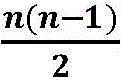
The sampling construction refers to: when the two samples sampled are positive samples, the label of the pair sampled is a positive sample, and when there is at least one negative sample in the two samples sampled, the label of the pair sampled is a negative sample, i.e., Dtr={(xi,xj) Y) | i, j ═ 1, 2, …, n, y ∈ {0, 1}, so the original training data is n, and the sampled data is enhanced to be n And (4) carrying out pairing.
The coding mode is one-hot coding.
The number of convolution kernels of two layers of convolution neural networks embedded in the network is respectively 64 and 32, the sizes of the convolution kernels are respectively 7x4 and 7x1, a Batch Normalization (BN) layer and a dropout layer with the probability of 0.25 are applied to the second layer, a ReLU activation function is used, the activation function of the last layer of the network is sigmoid, and the initial learning rate is 10-4The Adam optimizer of (1), the loss function uses binary cross entropy with a batch size of 128. The present example uses an early-stop mechanism during training, and stops training when there is no drop in loss over the 5 epoch validation sets to prevent overfitting during training.
Said embedded network FθAnd calculation of lightweight attention mechanisms used therein, i.e.
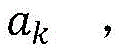 ak=Reshape(Hard_swish(F2(ReLU6(F1(pool(f1(xk) ))) wherein:
 f1、f2convolution operations of the first and second convolutional neural network layers, respectively, akIn order to be a function of attention,
 representing multiplication, xkOne-hot coding matrix for RNA sequence k, pool as global average pooling layer, ReLU6 and H-swish as activation functions, and Reshape (-) as a layer f for remodeling the output to the second convolutional neural network2Outputs operations of the same dimension.
S4, during testing, forming a sample pair by the test sequence of the query set and all the sequences in the support set, respectively extracting the feature vectors by the neural network, respectively calculating to obtain the probability of the binding points, and finally averaging the obtained result as the prediction score of the binding tendency of the test sequence, wherein the specific steps are as follows:
s41, during RBP testing, the set of m positive samples in the training set is used as a support set, namely { xiI 1 … m }; the set of test sequences is the query set, i.e. { xjJ 1 … n, based on the test RNA sequence xqAnd a sequence of support sets, which are embedded in the network to obtain the feature fθ(xq) And features f supporting all m sequences in the setθ(xj),j=1…m};
S42, for each sequence in the support set, respectively connecting with the characteristics of all query sequences to respectively estimate the binding probability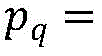
 Where M (-) is a metric function, M (-) F (| F)q(xi)-fq(xj)|),fq(. cndot.) is a feature vector, | - | is the absolute value of the difference, F (·) is the fully connected layer, pqI.e. the predicted RNA sequence xqProbability of binding a protein.
Specifically, this example evaluates the method on two reference sets, RBP-37 and RBP-24, RBP-37 consisting of 37 RBP fixed-length circRNAs; RBP-24 is composed of linear RNA sequences of 24 RBP unequal lengths. In addition, this example also constructed a full-length circRNA test dataset comprising full-length circRNA bound and not bound to RBP.
Evaluation index used in the present example Wherein:
 the sequence number representing the ith sample (the probability score is arranged from small to large and is arranged at the rank position); m, N are the number of positive samples and the number of negative samples, respectively;
 the sequence numbers of the positive samples are accumulated.
The predicted results of the experiment are as follows: in the experimental stage, this example is compared with the prediction method of RNA and protein binding sites represented on two reference data sets of a linear RNA data set RBP-24 and a circular circRNA, respectively, and comprises the following steps:
1)Zhang,K.,et al.CRIP:predicting circRNA-RBP-binding sites using a codon-based encoding and hybrid deep neural networks.RNA 2019;25(12):1604-1615.
2)Jia C,Bi Y,Chen J,et al.PASSION:an ensemble neural network approach for identifying the binding sites of RBPs on circRNAs[J].Bioinformatics,2020.
3)Maticzka,D.,et al.GraphProt:modeling binding preferences of RNA-binding proteins. Genome Biol 2014;15(1):R17.
4)Zhang,S.,et a1.A deep learning framework for modeling structural features of RNA-binding protein targets.Nucleic Acids Res 2016;44(4):e32.
5)Pan,X.Y.and Shen,H.B.Predicting RNA-protein binding sites and motifs through combining local and global deep convolutional neural networks.Bioinformatics 2018; 34(20):3427-3436.
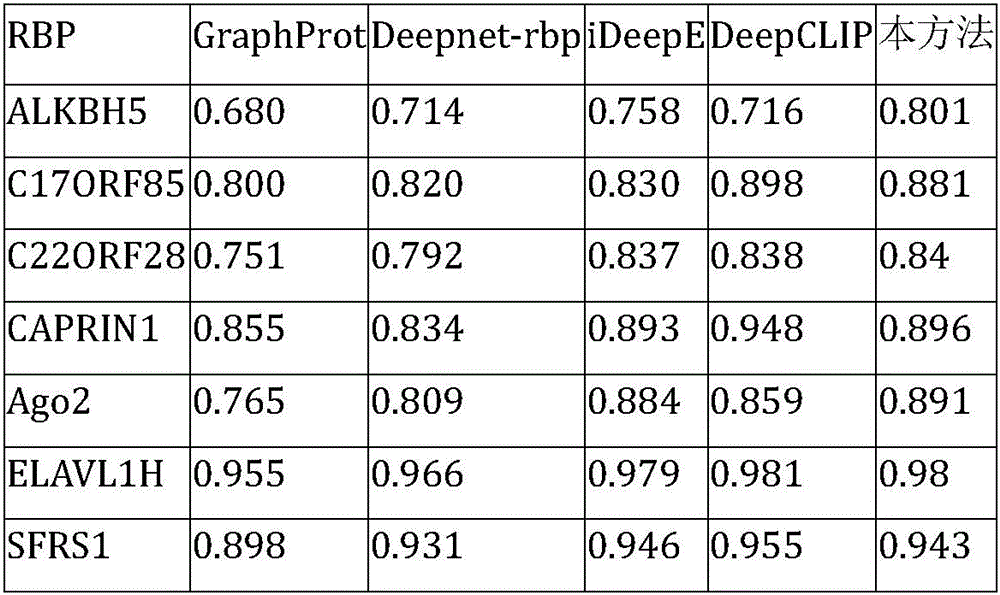
6) gronning, a.g.b., et al. Compressing the effect of the events on protein-RNA binding with deep depletion nucleic Acids Res 2020, results are shown in Table 1 and Table 2 below. This example obtained the best results on the average evaluation index AUC. The mean AUC of the method on RBP-37 was 0.9123, while the current best mean AUC for PASSIONG was 0.8845, the mean AUC of the method on RBP-24 was 0.941, and the current best mean AUC for DeepCLIP was 0.935.
TABLE 1 comparison of the performance of the method on RBP-37 dataset with CRIP and PASSON

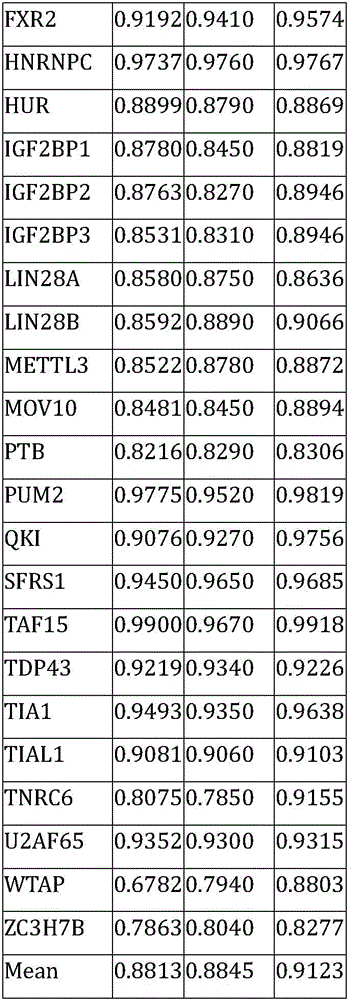
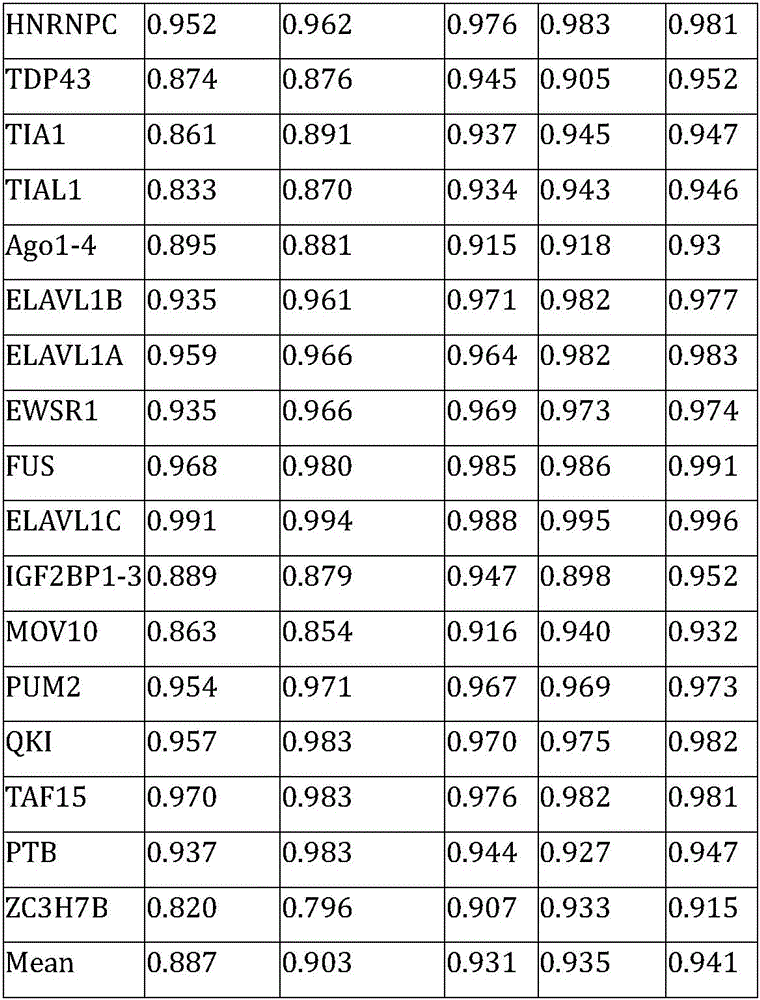
Table 2 compares the performance of the method with GraphProt, depnetrbp, depclip and idepe on RBP-24 dataset:
as shown in table 1, the present method was compared to the baseline methods CRIP and PASSION on over a total of 37 RBPs. Of the three methods, the method performs best on 29 RBPs, while PASSON performs best on 7 RBPs, and CRIP produces the highest AUC on only one RBP. See supplementary table S3 for details. The mean AUC for this method was 0.912, 0.031 higher than the AUC 0.881 for CRIP, 0.027 higher than the AUC 0.885 for enthusiasm. For some RBPs with limited number of binding rings, the method is obviously improved compared with CRIP and PASSON. For example, the AUC for TNRC6 for the present method is 0.916, while the AUC for CRIP and PASSION are 0.808 and 0.785, respectively.
As shown in Table 2, the mean AUC of this method was 0.941, 0.054 above AUC 0.887.887 for Graphprot, 0.038 above AUC 0.903.903 for Deepnet-rbp, 0.010 above AUC 0.931.931 for iDeepE, and 0.006 above AUC.935 for DeepCLIP over 24 data sets. Of the 24 RBPs, the present method achieved the highest AUC for 14 RBPs in five methods. The results show that the method is also effective in predicting RBP binding sites on linear RNAs and is superior to the existing method.
To further demonstrate the advantages of the method, the effectiveness of the method on RBPs with relatively few training samples was also investigated. As shown in fig. 3B, the method outperforms CRIP and PASISION for 14 RBPs with positive samples less than 5000. The mean AUC for this approach was 0.947, which is an increase of 0.059 and 0.057 over the CRIP AUC 0.888 and PASSION AUC, respectively. In addition, from the overall trend, the three methods achieve better effects as the number of training samples increases. For RBP-WTAP with the minimum number of positive samples (only 496 binding loops), the AUC of the method is as high as 0.880. However, the deep learning based approach CRIP produced a very low AUC of 0.678, and the two-layer ANN based approach PASISION yielded an AUC of 0.794. The result shows that the connected structure in the method is more effective in predicting the binding sites of RBPs with poor characteristics and is not influenced by the problem of data shortage in the deep model.
The study was on full-length RNA sequences. The method evaluation was performed using the two full length RNA sequences hsa _ circ _000180 and hsa _ circ _0000078 of AGO3 and EWSR1 as examples, as shown in FIG. 4. hsa _ circ _000180 is divided into five segments 101nt long. Wherein: there is a validated binding site, which the method can detect. For hsa _ circ _000078, it is divided into 9 parts. 3 of these are validated binding sites, which the present method can find.
Compared with CRIP and PASSION, the method not only can obtain better prediction effect, but also can capture binding motif from the learned CNN filter. This example verifies the detected motifs by the present method against the CISBP-RNA database, which preserves known binding motifs for linear RNAs. As shown in FIG. 5, the method detected five motifs of RBP TIA1, TIAL1, QKI, HRNPC and HUR that are visually similar to the linear RNA motifs known in the CISBP-RNA database. Furthermore, as shown in supplementary panel S2, the present method enables the detection of novel motifs that are not in CISBP-RNA, and these motifs may be specific motifs of RBP binding loops and are different from those of linear RNA. The results show that the method can learn the binding preference of RBPs to circRNAs, rather than just distinguish between bound and unbound sequences. Furthermore, circRNAs and linear RNAs have similar binding preferences for some RBPs but behave differently for other RBPs.
Through specific practical experiments, a tensierflow and a keras installation package are installed on a python computer or a server, the system is operated, a C22ORF28 pre-training model is loaded, fine adjustment is performed on a specified specific RBP training set, and then testing is performed. Also, models trained on the RBP-24 and RBP-37 data sets can be used to test other independent test sets. The method aims at the model structure design of the RNA binding protein tendency, the prediction effect on the RBP-24 and RBP-37 data sets is the best compared with the current method, the average AUC indexes are the best, the experimental results are shown in tables 1 and 2, the prediction precision of the method on the data sets RBP-24 and RBP-37 is the best compared with the current other methods, particularly the RBP with deficient data quantity and poor characteristics, and the effect is shown in figure 3B; and binding sites can be found on the full-length RNA by means of sliding windows, as shown in FIG. 4; most importantly, only a limited number of samples are required to capture the binding pattern of RBPs, motifs of the mined RNA, as shown in FIG. 5.
The foregoing embodiments may be modified in many different ways by those skilled in the art without departing from the spirit and scope of the invention, which is defined by the appended claims and all changes that come within the meaning and range of equivalency of the claims are therefore intended to be embraced therein.
Claims (9)



Priority Applications (1)
| Application Number | Priority Date | Filing Date | Title |
|---|---|---|---|
| CN202110041598.9A CN112837747B (en) | 2021-01-13 | 2021-01-13 | A protein binding site prediction method based on attention twin network |
Applications Claiming Priority (1)
| Application Number | Priority Date | Filing Date | Title |
|---|---|---|---|
| CN202110041598.9A CN112837747B (en) | 2021-01-13 | 2021-01-13 | A protein binding site prediction method based on attention twin network |
Publications (2)
| Publication Number | Publication Date |
|---|---|
| CN112837747A true CN112837747A (en) | 2021-05-25 |
| CN112837747B CN112837747B (en) | 2022-07-12 |
Family
ID=75927992
Family Applications (1)
| Application Number | Title | Priority Date | Filing Date |
|---|---|---|---|
| CN202110041598.9A Active CN112837747B (en) | 2021-01-13 | 2021-01-13 | A protein binding site prediction method based on attention twin network |
Country Status (1)
| Country | Link |
|---|---|
| CN (1) | CN112837747B (en) |
Cited By (13)
| Publication number | Priority date | Publication date | Assignee | Title |
|---|---|---|---|---|
| CN113177521A (en) * | 2021-05-26 | 2021-07-27 | 电子科技大学 | Intelligent radiation source identification method based on combined twin network |
| CN113936738A (en) * | 2021-12-14 | 2022-01-14 | 鲁东大学 | RNA-protein binding site prediction method based on deep convolutional neural network |
| CN114023376A (en) * | 2021-11-02 | 2022-02-08 | 四川大学 | RNA-protein binding site prediction method and system based on self-attention mechanism |
| CN114093419A (en) * | 2021-11-23 | 2022-02-25 | 上海交通大学 | RBP binding site prediction method based on multitask deep learning |
| CN114187963A (en) * | 2021-12-09 | 2022-03-15 | 上海交通大学 | Prediction method of protein binding nucleotide sites on full-length circular RNA |
| CN114783516A (en) * | 2022-04-19 | 2022-07-22 | 上海交通大学 | Protein ligand binding site detection method based on deep bidirectional neural network |
| US11398297B2 (en) * | 2018-10-11 | 2022-07-26 | Chun-Chieh Chang | Systems and methods for using machine learning and DNA sequencing to extract latent information for DNA, RNA and protein sequences |
| US20220246233A1 (en) * | 2021-02-03 | 2022-08-04 | International Business Machines Corportion | Structure-based, ligand activity prediction using binding mode prediction information |
| CN115273965A (en) * | 2022-07-15 | 2022-11-01 | 南京理工大学 | Method for predicting methylation modification sites of multiple types of RNA |
| CN115881215A (en) * | 2022-11-10 | 2023-03-31 | 安徽大学 | Prediction method of binding site of RNA binding protein and circular RNA |
| CN118609643A (en) * | 2024-03-07 | 2024-09-06 | 中国海洋大学 | A protein interaction prediction method based on dual synergy mechanism |
| CN119152948A (en) * | 2024-11-21 | 2024-12-17 | 鲁东大学 | A disease-related piRNA classification method based on graph attention network |
| CN119811500A (en) * | 2024-12-18 | 2025-04-11 | 上海交通大学 | A universal protein-RNA binding prediction method based on multi-molecular modality fusion |
Citations (6)
| Publication number | Priority date | Publication date | Assignee | Title |
|---|---|---|---|---|
| TW201737944A (en) * | 2015-11-12 | 2017-11-01 | 輝瑞大藥廠 | Tissue-specific genome engineering using CRISPR-CAS9 |
| US20190265955A1 (en) * | 2016-07-21 | 2019-08-29 | Ramot At Tel-Aviv University Ltd. | Method and system for comparing sequences |
| CN111667884A (en) * | 2020-06-12 | 2020-09-15 | 天津大学 | A Convolutional Neural Network Model for Predicting Protein Interactions Using Protein Primary Sequences Based on Attention Mechanism |
| CN111696624A (en) * | 2020-06-08 | 2020-09-22 | 天津大学 | DNA binding protein identification and function annotation deep learning method based on self-attention mechanism |
| CN111798921A (en) * | 2020-06-22 | 2020-10-20 | 武汉大学 | RNA binding protein prediction method and device based on multi-scale attention convolution neural network |
| CN111914917A (en) * | 2020-07-22 | 2020-11-10 | 西安建筑科技大学 | Target detection improved algorithm based on feature pyramid network and attention mechanism |
-
2021
- 2021-01-13 CN CN202110041598.9A patent/CN112837747B/en active Active
Patent Citations (6)
| Publication number | Priority date | Publication date | Assignee | Title |
|---|---|---|---|---|
| TW201737944A (en) * | 2015-11-12 | 2017-11-01 | 輝瑞大藥廠 | Tissue-specific genome engineering using CRISPR-CAS9 |
| US20190265955A1 (en) * | 2016-07-21 | 2019-08-29 | Ramot At Tel-Aviv University Ltd. | Method and system for comparing sequences |
| CN111696624A (en) * | 2020-06-08 | 2020-09-22 | 天津大学 | DNA binding protein identification and function annotation deep learning method based on self-attention mechanism |
| CN111667884A (en) * | 2020-06-12 | 2020-09-15 | 天津大学 | A Convolutional Neural Network Model for Predicting Protein Interactions Using Protein Primary Sequences Based on Attention Mechanism |
| CN111798921A (en) * | 2020-06-22 | 2020-10-20 | 武汉大学 | RNA binding protein prediction method and device based on multi-scale attention convolution neural network |
| CN111914917A (en) * | 2020-07-22 | 2020-11-10 | 西安建筑科技大学 | Target detection improved algorithm based on feature pyramid network and attention mechanism |
Non-Patent Citations (2)
| Title |
|---|
| JAEL SANYANDA WEKESAA ET AL.: "Multi-feature fusion for deep learning to predict plant lncRNA-protein interaction", 《GENOMICS》 * |
| MUHAO CHEN ET AL.: "Multifaceted protein-protein interaction prediction based on Siamese residual RCNN", 《BIOINFORMATICS》 * |
Cited By (16)
| Publication number | Priority date | Publication date | Assignee | Title |
|---|---|---|---|---|
| US11398297B2 (en) * | 2018-10-11 | 2022-07-26 | Chun-Chieh Chang | Systems and methods for using machine learning and DNA sequencing to extract latent information for DNA, RNA and protein sequences |
| US12412638B2 (en) * | 2021-02-03 | 2025-09-09 | International Business Machines Corporation | Structure-based, ligand activity prediction using binding mode prediction information |
| US20220246233A1 (en) * | 2021-02-03 | 2022-08-04 | International Business Machines Corportion | Structure-based, ligand activity prediction using binding mode prediction information |
| CN113177521A (en) * | 2021-05-26 | 2021-07-27 | 电子科技大学 | Intelligent radiation source identification method based on combined twin network |
| CN113177521B (en) * | 2021-05-26 | 2022-07-01 | 电子科技大学 | Intelligent radiation source identification method based on combined twin network |
| CN114023376A (en) * | 2021-11-02 | 2022-02-08 | 四川大学 | RNA-protein binding site prediction method and system based on self-attention mechanism |
| CN114093419A (en) * | 2021-11-23 | 2022-02-25 | 上海交通大学 | RBP binding site prediction method based on multitask deep learning |
| CN114187963A (en) * | 2021-12-09 | 2022-03-15 | 上海交通大学 | Prediction method of protein binding nucleotide sites on full-length circular RNA |
| CN113936738A (en) * | 2021-12-14 | 2022-01-14 | 鲁东大学 | RNA-protein binding site prediction method based on deep convolutional neural network |
| CN114783516A (en) * | 2022-04-19 | 2022-07-22 | 上海交通大学 | Protein ligand binding site detection method based on deep bidirectional neural network |
| CN115273965A (en) * | 2022-07-15 | 2022-11-01 | 南京理工大学 | Method for predicting methylation modification sites of multiple types of RNA |
| CN115881215A (en) * | 2022-11-10 | 2023-03-31 | 安徽大学 | Prediction method of binding site of RNA binding protein and circular RNA |
| CN118609643A (en) * | 2024-03-07 | 2024-09-06 | 中国海洋大学 | A protein interaction prediction method based on dual synergy mechanism |
| CN119152948A (en) * | 2024-11-21 | 2024-12-17 | 鲁东大学 | A disease-related piRNA classification method based on graph attention network |
| CN119811500A (en) * | 2024-12-18 | 2025-04-11 | 上海交通大学 | A universal protein-RNA binding prediction method based on multi-molecular modality fusion |
| CN119811500B (en) * | 2024-12-18 | 2025-10-31 | 上海交通大学 | A general protein-RNA binding prediction method based on multi-molecular modality fusion |
Also Published As
| Publication number | Publication date |
|---|---|
| CN112837747B (en) | 2022-07-12 |
Similar Documents
| Publication | Publication Date | Title |
|---|---|---|
| CN112837747A (en) | A protein binding site prediction method based on attention twin network | |
| Hu et al. | An improved deep learning method for predicting DNA-binding proteins based on contextual features in amino acid sequences | |
| Pan et al. | Prediction of RNA-protein sequence and structure binding preferences using deep convolutional and recurrent neural networks | |
| CN111696624B (en) | Deep learning method for DNA-binding protein identification and functional annotation based on self-attention mechanism | |
| US11398297B2 (en) | Systems and methods for using machine learning and DNA sequencing to extract latent information for DNA, RNA and protein sequences | |
| Pan et al. | IPMiner: hidden ncRNA-protein interaction sequential pattern mining with stacked autoencoder for accurate computational prediction | |
| Li et al. | Protein contact map prediction based on ResNet and DenseNet | |
| CN106650314A (en) | Method and system for predicting amino acid mutation | |
| CN113764034B (en) | Methods, devices, equipment and media for predicting potential BGCs in genome sequences | |
| KR101888628B1 (en) | Method and Media of Predicting protein-binding regions in RNA Using Nucleotide Profiles and Compositions | |
| Long et al. | Predicting protein phosphorylation sites based on deep learning | |
| Shujaat et al. | Cr-prom: A convolutional neural network-based model for the prediction of rice promoters | |
| CN116364209B (en) | A peptide design method based on protein language model and Monte Carlo | |
| WO2022112260A1 (en) | Predicting protein structures over multiple iterations using recycling | |
| CN114187963A (en) | Prediction method of protein binding nucleotide sites on full-length circular RNA | |
| Shao et al. | DeepSec: a deep learning framework for secreted protein discovery in human body fluids | |
| Hickl et al. | Binny: an automated binning algorithm to recover high-quality genomes from complex metagenomic datasets | |
| CN119811507A (en) | Liquid-liquid phase separation protein prediction method and system based on multiple characteristics | |
| CN109326329B (en) | A Zinc-binding Protein Action Site Prediction Method | |
| Gong et al. | A deep learning method for recovering missing signals in transcriptome-wide RNA structure profiles from probing experiments | |
| CN116325002A (en) | Prediction of protein structure using assisted folding networks | |
| CN118522342A (en) | Active framework-based targeted antigen peptide sequence generation and screening method | |
| KR20210010488A (en) | Machine-Learnable Biological Polymer Assembly | |
| Shaon et al. | A robust deep learning approach for identification of RNA 5-methyluridine sites | |
| CN110400605A (en) | A GPCR drug target ligand bioactivity prediction method and its application |
Legal Events
| Date | Code | Title | Description |
|---|---|---|---|
| PB01 | Publication | ||
| PB01 | Publication | ||
| SE01 | Entry into force of request for substantive examination | ||
| SE01 | Entry into force of request for substantive examination | ||
| GR01 | Patent grant | ||
| GR01 | Patent grant |