CN112745391B - PD-L1 binding molecules - Google Patents
PD-L1 binding molecules Download PDFInfo
- Publication number
- CN112745391B CN112745391B CN201911044297.0A CN201911044297A CN112745391B CN 112745391 B CN112745391 B CN 112745391B CN 201911044297 A CN201911044297 A CN 201911044297A CN 112745391 B CN112745391 B CN 112745391B
- Authority
- CN
- China
- Prior art keywords
- seq
- antibody
- antigen
- binding fragment
- single domain
- Prior art date
- Legal status (The legal status is an assumption and is not a legal conclusion. Google has not performed a legal analysis and makes no representation as to the accuracy of the status listed.)
- Active
Links
Images


Classifications
-
- C—CHEMISTRY; METALLURGY
- C07—ORGANIC CHEMISTRY
- C07K—PEPTIDES
- C07K16/00—Immunoglobulins [IGs], e.g. monoclonal or polyclonal antibodies
- C07K16/18—Immunoglobulins [IGs], e.g. monoclonal or polyclonal antibodies against material from animals or humans
- C07K16/28—Immunoglobulins [IGs], e.g. monoclonal or polyclonal antibodies against material from animals or humans against receptors, cell surface antigens or cell surface determinants
- C07K16/2803—Immunoglobulins [IGs], e.g. monoclonal or polyclonal antibodies against material from animals or humans against receptors, cell surface antigens or cell surface determinants against the immunoglobulin superfamily
- C07K16/2827—Immunoglobulins [IGs], e.g. monoclonal or polyclonal antibodies against material from animals or humans against receptors, cell surface antigens or cell surface determinants against the immunoglobulin superfamily against B7 molecules, e.g. CD80, CD86
Landscapes
- Health & Medical Sciences (AREA)
- Immunology (AREA)
- Chemical & Material Sciences (AREA)
- Organic Chemistry (AREA)
- General Health & Medical Sciences (AREA)
- Biophysics (AREA)
- Biochemistry (AREA)
- Genetics & Genomics (AREA)
- Medicinal Chemistry (AREA)
- Molecular Biology (AREA)
- Proteomics, Peptides & Aminoacids (AREA)
- Life Sciences & Earth Sciences (AREA)
- Peptides Or Proteins (AREA)
Abstract
Description
技术领域technical field
本申请属于生物技术领域,一般而言涉及PD-L1结合分子。更具体地,本申请涉及特异性识别PD-L1的单结构域抗体、其制备方法及其用途。This application belongs to the field of biotechnology, and generally relates to PD-L1 binding molecules. More specifically, the present application relates to a single-domain antibody that specifically recognizes PD-L1, its preparation method and its use.
背景技术Background technique
免疫检查点是免疫系统中起到抑制作用的调控分子,包括CTLA-4、PD-1、LAG-3、TIM-3等,目前基于CTLA-4和PD-1这两个免疫检查点已经有多个抗体药物上市。PD-1(programmed death 1,程序性死亡受体1),是一种重要的免疫抑制分子,其最初是从凋亡的小鼠T细胞杂交瘤2B4.11克隆出来。以PD-1为靶点的免疫调节对抗肿瘤、抗感染、抗自身免疫性疾病及器官移植存活等均有重要的意义。Immune checkpoints are regulatory molecules that play an inhibitory role in the immune system, including CTLA-4, PD-1, LAG-3, TIM-3, etc. Currently, there are two immune checkpoints based on CTLA-4 and PD-1 Multiple antibody drugs are on the market. PD-1 (programmed
PD-1的主要配体为PD-L1和PD-L2,其中PD-L1在介导肿瘤细胞逃逸过程中扮演着重要作用,其高表达于肿瘤细胞和一些抗原递呈细胞,且表达量可以被多种细胞因子如IFN-γ、TGF-β等诱导。在肿瘤微环境中,PD-L1的表达上调通过PD-1信号通路可直接抑制T细胞的抗肿瘤反应,介导肿瘤细胞的免疫逃逸。The main ligands of PD-1 are PD-L1 and PD-L2, among which PD-L1 plays an important role in mediating the escape of tumor cells. It is highly expressed in tumor cells and some antigen-presenting cells, and the expression level can be Induced by various cytokines such as IFN-γ, TGF-β, etc. In the tumor microenvironment, the upregulation of PD-L1 expression can directly inhibit the anti-tumor response of T cells and mediate the immune escape of tumor cells through the PD-1 signaling pathway.
单结构域抗体简称单域抗体(single domain antibody,sdAb),是含单个抗体重链可变区结构域的抗体。类似IgG抗体,它能够选择性结合特定的抗原,但单域抗体的分子量却远小于IgG抗体。目前第一个单域抗体是由骆驼科动物中发现的重链抗体改造而来的(Hamers-Casterman C,Atarhouch T,Muyldermans S,Robinson G,Hamers C,Songa EB,Bendahman N,Hamers R(1993)Naturally occurring antibodies devoid of lightchains.Nature 363(6428):446–448.);这些骆驼科动物中发现的重链抗体也被称为VHH片段。目前,对单域抗体的大多数研究基于重链可变结构域。Single domain antibody (single domain antibody, sdAb) is an antibody containing a single antibody heavy chain variable region domain. Similar to IgG antibodies, it can selectively bind to specific antigens, but the molecular weight of single domain antibodies is much smaller than that of IgG antibodies. At present, the first single-domain antibody was modified from the heavy chain antibody found in camelids (Hamers-Casterman C, Atarhouch T, Muyldermans S, Robinson G, Hamers C, Songa EB, Bendahman N, Hamers R (1993 ) Naturally occurring antibodies devoid of lightchains. Nature 363(6428):446–448.); heavy chain antibodies found in these camelids are also known as VHH fragments. Currently, most studies on single domain antibodies are based on heavy chain variable domains.
单域抗体具有许多优点。例如,它们具有较高的溶解度、良好的热稳定性和组织渗透性,有些单域抗体由于分子内二硫键的存在还可耐受木瓜蛋白酶等的降解作用;此外单域抗体可以在酵母、植物和哺乳动物细胞等多种表达宿主中产生,且表达量较高,使得其具有极高的成本效益。(Harmsen MM,De Haard HJ(2007)Properties,production,andapplications of camelid single-domain antibody fragments.Appl MicrobiolBiotechnol 77(1):13–22.)。单域抗体凭借其众多的优点,使其在各种生物技术和医疗领域具有良好的应用前景。目前Ablynx公司的第一个单域抗体药物已经获批上市。Single domain antibodies have many advantages. For example, they have high solubility, good thermal stability and tissue permeability, and some single-domain antibodies can withstand the degradation of papain due to the presence of intramolecular disulfide bonds; in addition, single-domain antibodies can be used in yeast, It can be produced in a variety of expression hosts such as plant and mammalian cells, and the expression level is high, making it extremely cost-effective. (Harmsen MM, De Haard HJ (2007) Properties, production, and applications of camelid single-domain antibody fragments. Appl Microbiol Biotechnol 77(1):13–22.). With its many advantages, single domain antibodies have good application prospects in various biotechnology and medical fields. At present, Ablynx's first single domain antibody drug has been approved for marketing.
目前针对PD-L1靶点的上市抗体药物还不多,因此,仍然需要研发新的特异性识别PD-L1的结合分子(例如单结构域抗体)用于癌症的免疫治疗,使其具有更低的毒副作用和更佳的临床药效。At present, there are not many marketed antibody drugs targeting PD-L1. Therefore, it is still necessary to develop new binding molecules (such as single-domain antibodies) that specifically recognize PD-L1 for cancer immunotherapy, so that it has a lower side effects and better clinical efficacy.
发明内容Contents of the invention
本发明的目的是提供一种新的PD-L1结合分子,具体而言,提供一种新的特异性识别PD-L1的单结构域抗体,所述特异性识别PD-L1的单结构域抗体具有更低的毒副作用和更佳的临床药效,能够更有效地治疗癌症。The purpose of the present invention is to provide a new PD-L1 binding molecule, specifically, to provide a new single-domain antibody that specifically recognizes PD-L1, and the single-domain antibody that specifically recognizes PD-L1 It has lower toxic and side effects and better clinical efficacy, and can treat cancer more effectively.
总的来说,本发明提供一种特异性识别PD-L1的结合分子或单结构域抗体,PD-L1单结构域抗体在下文中也称为PD-L1单结构域抗体、纳米抗体形式的PD-L1抗体、PD-L1纳米抗体或PD-L1的VHH抗体,以上术语可以互换使用。本申请还提供了构建和筛选所述PD-L1结合分子或单结构域抗体的方法,编码所述PD-L1结合分子或单结构域抗体的核酸分子、用于表达PD-L1结合分子或单结构域抗体的载体和宿主细胞以及包含所述PD-L1结合分子或单结构域抗体的组合物或试剂盒。本申请的PD-L1结合分子或单结构域抗体能够通过调节免疫系统治疗多种癌症,因此能够用于制备治疗癌症的药剂。In general, the present invention provides a binding molecule or single-domain antibody that specifically recognizes PD-L1, and the PD-L1 single-domain antibody is hereinafter also referred to as PD-L1 single-domain antibody or PD in the form of a nanobody. - L1 antibody, PD-L1 Nanobody or VHH antibody to PD-L1, the above terms may be used interchangeably. The present application also provides methods for constructing and screening the PD-L1 binding molecules or single-domain antibodies, nucleic acid molecules encoding the PD-L1 binding molecules or single-domain antibodies, used for expressing PD-L1 binding molecules or single-domain antibodies Carriers and host cells of domain antibodies, and compositions or kits comprising the PD-L1 binding molecules or single domain antibodies. The PD-L1 binding molecules or single domain antibodies of the present application can treat various cancers by regulating the immune system, and thus can be used to prepare medicaments for treating cancer.
具体而言,本发明提供纳米抗体形式的PD-L1抗体以及其人源化改造或亲和力成熟后的衍生分子,在保持高亲和力、低分子量等优势的同时,进行免疫原性修饰,改善了成药性,具有极大的治疗优势。Specifically, the present invention provides PD-L1 antibodies in the form of nanobodies and their derivative molecules after humanization or affinity maturation. While maintaining the advantages of high affinity and low molecular weight, the immunogenicity modification is carried out to improve drug delivery. sex, has a great therapeutic advantage.
在一些方面,本发明提供分离的PD-L1结合分子,其能够特异性结合PD-L1,并且包含如下的重链可变区CDR1、CDR2和CDR3:In some aspects, the invention provides an isolated PD-L1 binding molecule capable of specifically binding PD-L1 and comprising the following heavy chain variable region CDR1, CDR2 and CDR3:
(i)包含SEQ ID NO:1所示氨基酸序列的CDR1;(i) CDR1 comprising the amino acid sequence shown in SEQ ID NO: 1;
包含与SEQ ID NO:1具有至少80%、85%、90%、95%或99%同一性的氨基酸序列的CDR1;或A CDR1 comprising an amino acid sequence at least 80%, 85%, 90%, 95% or 99% identical to SEQ ID NO: 1; or
包含与SEQ ID NO:1相比具有不超过2个(如0个、1个、2个)氨基酸的添加、缺失和/或取代的差异的氨基酸序列的CDR1;CDR1 comprising an amino acid sequence differing from that of SEQ ID NO: 1 by no more than 2 (such as 0, 1, 2) amino acid additions, deletions and/or substitutions;
(ii)包含SEQ ID NO:2所示氨基酸序列的CDR2;(ii) CDR2 comprising the amino acid sequence shown in SEQ ID NO: 2;
包含与SEQ ID NO:2具有至少80%、85%、90%、95%或99%同一性的氨基酸序列的CDR2;或A CDR2 comprising an amino acid sequence at least 80%, 85%, 90%, 95% or 99% identical to SEQ ID NO: 2; or
包含与SEQ ID NO:2相比具有不超过2个(如0个、1个、2个)氨基酸的添加、缺失和/或取代的差异的氨基酸序列的CDR2;CDR2 comprising an amino acid sequence differing from that of SEQ ID NO: 2 by no more than 2 (such as 0, 1, 2) amino acid additions, deletions and/or substitutions;
和and
(iii)包含SEQ ID NO:3或12所示氨基酸序列的CDR3;(iii) CDR3 comprising the amino acid sequence shown in SEQ ID NO: 3 or 12;
包含与SEQ ID NO:3或12具有至少80%、85%、90%、95%或99%同一性的氨基酸序列的CDR3;或A CDR3 comprising an amino acid sequence at least 80%, 85%, 90%, 95% or 99% identical to SEQ ID NO: 3 or 12; or
包含与SEQ ID NO:3或12相比具有不超过2个(如0个、1个、2个)氨基酸的添加、缺失和/或取代的差异的氨基酸序列的CDR3。A CDR3 comprising an amino acid sequence differing from that of SEQ ID NO: 3 or 12 with additions, deletions and/or substitutions of no more than 2 (
在一些实施方案中,所述PD-L1结合分子包含如下的重链可变区CDR1、CDR2和CDR3:In some embodiments, the PD-L1 binding molecule comprises heavy chain variable region CDR1, CDR2 and CDR3 as follows:
(i)如式RTDSNIX1GMH所示的CDR1,其中X1为H、F或N;(i) CDR1 as shown in formula RTDSNIX 1 GMH, wherein X 1 is H, F or N;
(ii)如式TIFIDX2NTX3所示的CDR2,其中X2为G、L或A,X3为I或L;和(ii) CDR2 as shown in formula TIFIDX 2 NTX 3 , wherein X 2 is G, L or A, and X 3 is I or L; and
(iii)如式DVSGYGRX4所示的CDR3,其中X4为A或Y。(iii) CDR3 as shown in formula DVSGYGRX 4 , wherein X 4 is A or Y.
在一些实施方案中,所述PD-L1结合分子包含如下的重链可变区CDR1、CDR2和CDR3:In some embodiments, the PD-L1 binding molecule comprises heavy chain variable region CDR1, CDR2 and CDR3 as follows:
(i)SEQ ID NO:1所示的CDR1;(i) CDR1 shown in SEQ ID NO: 1;
(ii)SEQ ID NO:2所示的CDR2;和(ii) CDR2 shown in SEQ ID NO: 2; and
(iii)SEQ ID NO:3所示的CDR3。(iii) CDR3 shown in SEQ ID NO:3.
在一些实施方案中,所述PD-L1结合分子包含如下的重链可变区CDR1、CDR2和CDR3:In some embodiments, the PD-L1 binding molecule comprises heavy chain variable region CDR1, CDR2 and CDR3 as follows:
(i)SEQ ID NO:4所示的CDR1;(i) CDR1 shown in SEQ ID NO: 4;
(ii)SEQ ID NO:5所示的CDR2;和(ii) CDR2 shown in SEQ ID NO: 5; and
(iii)SEQ ID NO:3所示的CDR3。(iii) CDR3 shown in SEQ ID NO:3.
在一些实施方案中,所述PD-L1结合分子包含如下的重链可变区CDR1、CDR2和CDR3:In some embodiments, the PD-L1 binding molecule comprises heavy chain variable region CDR1, CDR2 and CDR3 as follows:
(i)SEQ ID NO:6所示的CDR1;(i) CDR1 shown in SEQ ID NO: 6;
(ii)SEQ ID NO:7所示的CDR2;和(ii) CDR2 shown in SEQ ID NO: 7; and
(iii)SEQ ID NO:3所示的CDR3。(iii) CDR3 shown in SEQ ID NO:3.
在一些实施方案中,所述PD-L1结合分子包含如下的重链可变区CDR1、CDR2和CDR3:In some embodiments, the PD-L1 binding molecule comprises heavy chain variable region CDR1, CDR2 and CDR3 as follows:
(i)SEQ ID NO:1所示的CDR1;(i) CDR1 shown in SEQ ID NO: 1;
(ii)SEQ ID NO:8所示的CDR2;和(ii) CDR2 shown in SEQ ID NO: 8; and
(iii)SEQ ID NO:9所示的CDR3。(iii) CDR3 shown in SEQ ID NO:9.
在一些实施方案中,所述PD-L1结合分子包含如下的重链可变区CDR1、CDR2和CDR3:In some embodiments, the PD-L1 binding molecule comprises heavy chain variable region CDR1, CDR2 and CDR3 as follows:
(i)SEQ ID NO:10所示的CDR1;(i) CDR1 shown in SEQ ID NO: 10;
(ii)SEQ ID NO:11所示的CDR2;和(ii) CDR2 shown in SEQ ID NO: 11; and
(iii)SEQ ID NO:12所示的CDR3。(iii) CDR3 shown in SEQ ID NO:12.
在一些实施方案中,所述PD-L1结合分子包含含有SEQ ID NO:16、17、18、19、20、21和22中任一种氨基酸序列的重链可变区(VH)。In some embodiments, the PD-L1 binding molecule comprises a heavy chain variable region (VH) comprising any one of the amino acid sequences of SEQ ID NO: 16, 17, 18, 19, 20, 21 and 22.
在一些实施方案中,所述PD-L1结合分子的重链可变区由SEQ ID NO:16、17、18、19、20、21和22中任一种氨基酸序列组成。In some embodiments, the heavy chain variable region of the PD-L1 binding molecule consists of any one of the amino acid sequences of SEQ ID NO: 16, 17, 18, 19, 20, 21 and 22.
在一些实施方案中,所述PD-L1结合分子的重链可变区(VH)包含与SEQ ID NO:16、17、18、19、20、21和22中任一种具有至少80%、85%、90%、95%或99%同一性并且保留特异性结合PD-L1的能力的氨基酸序列。In some embodiments, the heavy chain variable region (VH) of the PD-L1 binding molecule comprises at least 80% of any of SEQ ID NOs: 16, 17, 18, 19, 20, 21 and 22, An amino acid sequence that is 85%, 90%, 95% or 99% identical and retains the ability to specifically bind PD-L1.
在一些实施方案中,所述PD-L1结合分子的重链可变区(VH)包含与SEQ ID NO:16、17、18、19、20、21和22中任一种相比具有一处或多处氨基酸的添加、缺失和/或取代并且保留特异性结合PD-L1的能力的氨基酸序列。In some embodiments, the heavy chain variable region (VH) of the PD-L1 binding molecule comprises an An amino acid sequence that has the addition, deletion and/or substitution of multiple amino acids and retains the ability to specifically bind to PD-L1.
在一些优选的实施方案中,所述一处或多处氨基酸的添加、缺失和/或取代(例如,保守性取代)不超过五处,优选地不超过三处。In some preferred embodiments, the one or more amino acid additions, deletions and/or substitutions (eg, conservative substitutions) are no more than five, preferably no more than three.
在一些实施方案中,所述PD-L1结合分子为抗体,例如,但不限于,骆驼源抗体、人源化抗体或亲和力成熟的抗体。In some embodiments, the PD-L1 binding molecule is an antibody, such as, but not limited to, a camelid antibody, a humanized antibody, or an affinity matured antibody.
在一些实施方案中,所述PD-L1结合分子与另一分子融合,所述另一分子是例如免疫球蛋白(例如IgG)的Fc结构域、抗体、抗体的抗原结合片段、抗体-药物偶联物、抗体样分子、抗体样分子的抗原结合片段或荧光蛋白。In some embodiments, the PD-L1 binding molecule is fused to another molecule, e.g., the Fc domain of an immunoglobulin (e.g., IgG), an antibody, an antigen-binding fragment of an antibody, an antibody-drug conjugate. conjugates, antibody-like molecules, antigen-binding fragments of antibody-like molecules, or fluorescent proteins.
在一些优选的实施方案中,所述PD-L1结合分子与人IgG(如人IgG1或人IgG4)的Fc结构域融合。In some preferred embodiments, the PD-L1 binding molecule is fused to the Fc domain of human IgG (such as human IgG1 or human IgG4).
在一些方面,所述PD-L1结合分子为单结构域抗体。因此,本发明还提供分离的纳米抗体形式的PD-L1单结构域抗体。In some aspects, the PD-L1 binding molecule is a single domain antibody. Accordingly, the present invention also provides an isolated PD-L1 single domain antibody in the form of a Nanobody.
在一些实施方案中,所述PD-L1单结构域抗体或其抗原结合片段特异性结合PD-L1。In some embodiments, the PD-L1 single domain antibody or antigen-binding fragment thereof specifically binds PD-L1.
在一些实施方案中,所述PD-L1单结构域抗体或其抗原结合片段包含重链可变区(VH),所述重链可变区包含如下的CDR1、CDR2和CDR3:In some embodiments, the PD-L1 single domain antibody or antigen-binding fragment thereof comprises a heavy chain variable region (VH) comprising CDR1, CDR2 and CDR3 as follows:
(i)包含SEQ ID NO:1所示氨基酸序列的CDR1;(i) CDR1 comprising the amino acid sequence shown in SEQ ID NO: 1;
包含与SEQ ID NO:1具有至少80%、85%、90%、95%或99%同一性的氨基酸序列的CDR1;或A CDR1 comprising an amino acid sequence at least 80%, 85%, 90%, 95% or 99% identical to SEQ ID NO: 1; or
包含与SEQ ID NO:1相比具有不超过2个(如0个、1个、2个)氨基酸的添加、缺失和/或取代的差异的氨基酸序列的CDR1;CDR1 comprising an amino acid sequence differing from that of SEQ ID NO: 1 by no more than 2 (such as 0, 1, 2) amino acid additions, deletions and/or substitutions;
(ii)包含SEQ ID NO:2所示氨基酸序列的CDR2;(ii) CDR2 comprising the amino acid sequence shown in SEQ ID NO: 2;
包含与SEQ ID NO:2具有至少80%、85%、90%、95%或99%同一性的氨基酸序列的CDR2;或A CDR2 comprising an amino acid sequence at least 80%, 85%, 90%, 95% or 99% identical to SEQ ID NO: 2; or
包含与SEQ ID NO:2相比具有不超过2个(如0个、1个、2个)氨基酸的添加、缺失和/或取代的差异的氨基酸序列的CDR2;CDR2 comprising an amino acid sequence differing from that of SEQ ID NO: 2 by no more than 2 (such as 0, 1, 2) amino acid additions, deletions and/or substitutions;
和and
(iii)包含SEQ ID NO:3或12所示氨基酸序列的CDR3;(iii) CDR3 comprising the amino acid sequence shown in SEQ ID NO: 3 or 12;
包含与SEQ ID NO:3或12具有至少80%、85%、90%、95%或99%同一性的氨基酸序列的CDR3;或A CDR3 comprising an amino acid sequence at least 80%, 85%, 90%, 95% or 99% identical to SEQ ID NO: 3 or 12; or
包含与SEQ ID NO:3或12相比具有不超过2个(如0个、1个、2个)氨基酸的添加、缺失和/或取代的差异的氨基酸序列的CDR3。A CDR3 comprising an amino acid sequence differing from that of SEQ ID NO: 3 or 12 with additions, deletions and/or substitutions of no more than 2 (
在一些实施方案中,所述PD-L1单结构域抗体或其抗原结合片段包含重链可变区(VH),所述重链可变区包含如下的CDR1、CDR2和CDR3:In some embodiments, the PD-L1 single domain antibody or antigen-binding fragment thereof comprises a heavy chain variable region (VH) comprising CDR1, CDR2 and CDR3 as follows:
(i)如式RTDSNIX1GMH所示的CDR1,其中X1为H、F或N;(i) CDR1 as shown in formula RTDSNIX 1 GMH, wherein X 1 is H, F or N;
(ii)如式TIFIDX2NTX3所示的CDR2,其中X2为G、L或A,X3为I或L;和(ii) CDR2 as shown in formula TIFIDX 2 NTX 3 , wherein X 2 is G, L or A, and X 3 is I or L; and
(iii)如式DVSGYGRX4所示的CDR3,其中X4为A或Y。(iii) CDR3 as shown in formula DVSGYGRX 4 , wherein X 4 is A or Y.
在一些实施方案中,所述PD-L1单结构域抗体或其抗原结合片段包含重链可变区(VH),所述重链可变区包含:In some embodiments, the PD-L1 single domain antibody or antigen-binding fragment thereof comprises a heavy chain variable region (VH) comprising:
(i)SEQ ID NO:1所示的CDR1;(i) CDR1 shown in SEQ ID NO: 1;
(ii)SEQ ID NO:2所示的CDR2;和(ii) CDR2 shown in SEQ ID NO: 2; and
(iii)SEQ ID NO:3所示的CDR3。(iii) CDR3 shown in SEQ ID NO:3.
在一些实施方案中,所述PD-L1单结构域抗体或其抗原结合片段包含重链可变区(VH),所述重链可变区包含:In some embodiments, the PD-L1 single domain antibody or antigen-binding fragment thereof comprises a heavy chain variable region (VH) comprising:
(i)SEQ ID NO:4所示的CDR1;(i) CDR1 shown in SEQ ID NO: 4;
(ii)SEQ ID NO:5所示的CDR2;和(ii) CDR2 shown in SEQ ID NO: 5; and
(iii)SEQ ID NO:3所示的CDR3。(iii) CDR3 shown in SEQ ID NO:3.
在一些实施方案中,所述PD-L1单结构域抗体或其抗原结合片段包含重链可变区(VH),所述重链可变区包含:In some embodiments, the PD-L1 single domain antibody or antigen-binding fragment thereof comprises a heavy chain variable region (VH) comprising:
(i)SEQ ID NO:6所示的CDR1;(i) CDR1 shown in SEQ ID NO: 6;
(ii)SEQ ID NO:7所示的CDR2;和(ii) CDR2 shown in SEQ ID NO: 7; and
(iii)SEQ ID NO:3所示的CDR3。(iii) CDR3 shown in SEQ ID NO:3.
在一些实施方案中,所述PD-L1单结构域抗体或其抗原结合片段包含重链可变区(VH),所述重链可变区包含:In some embodiments, the PD-L1 single domain antibody or antigen-binding fragment thereof comprises a heavy chain variable region (VH) comprising:
(i)SEQ ID NO:1所示的CDR1;(i) CDR1 shown in SEQ ID NO: 1;
(ii)SEQ ID NO:8所示的CDR2;和(ii) CDR2 shown in SEQ ID NO: 8; and
(iii)SEQ ID NO:9所示的CDR3。(iii) CDR3 shown in SEQ ID NO:9.
在一些实施方案中,所述PD-L1单结构域抗体或其抗原结合片段包含重链可变区(VH),所述重链可变区包含:In some embodiments, the PD-L1 single domain antibody or antigen-binding fragment thereof comprises a heavy chain variable region (VH) comprising:
(i)SEQ ID NO:10所示的CDR1;(i) CDR1 shown in SEQ ID NO: 10;
(ii)SEQ ID NO:11所示的CDR2;和(ii) CDR2 shown in SEQ ID NO: 11; and
(iii)SEQ ID NO:12所示的CDR3。(iii) CDR3 shown in SEQ ID NO:12.
在一些实施方案中,所述PD-L1单结构域抗体或其抗原结合片段包含重链可变区(VH),其中所述重链可变区还包含FR区,所述FR区包含FR1、FR2、FR3和FR4,并且与CDR1、CDR2和CDR3在所述重链可变区上间隔排列形成从N端到C端为FR1-CDR1-FR2-CDR2-FR3-CDR3-FR4的结构。In some embodiments, the PD-L1 single domain antibody or antigen-binding fragment thereof comprises a heavy chain variable region (VH), wherein the heavy chain variable region further comprises a FR region, and the FR region comprises FR1, FR2, FR3 and FR4, and CDR1, CDR2 and CDR3 are arranged at intervals on the heavy chain variable region to form a structure of FR1-CDR1-FR2-CDR2-FR3-CDR3-FR4 from N-terminus to C-terminus.
在一些实施方案中,所述PD-L1单结构域抗体或其抗原结合片段包含重链可变区(VH),所述重链可变区还包含FR区,其中所述FR区包含如下的FR1、FR2、FR3和FR4:In some embodiments, the PD-L1 single domain antibody or antigen-binding fragment thereof comprises a heavy chain variable region (VH), and the heavy chain variable region further comprises a FR region, wherein the FR region comprises the following FR1, FR2, FR3 and FR4:
(a)包含SEQ ID NO:24所示的FR1;(a) comprising FR1 shown in SEQ ID NO: 24;
包含与SEQ ID NO:24具有至少90%、95%或99%同一性的氨基酸序列的FR1;或FR1 comprising an amino acid sequence at least 90%, 95% or 99% identical to SEQ ID NO: 24; or
包含与SEQ ID NO:24相比具有不超过2个(如0个、1个、2个)氨基酸的添加、缺失和/或取代的差异的氨基酸序列的FR1;FR1 comprising an amino acid sequence differing from that of SEQ ID NO: 24 with additions, deletions and/or substitutions of no more than 2 (eg, 0, 1, 2) amino acids;
(b)包含SEQ ID NO:25所示的FR2;(b) comprising FR2 shown in SEQ ID NO: 25;
包含与SEQ ID NO:25具有至少90%、95%或99%同一性的氨基酸序列的FR2;或FR2 comprising an amino acid sequence at least 90%, 95% or 99% identical to SEQ ID NO: 25; or
包含与SEQ ID NO:25相比具有不超过2个(如0个、1个、2个)氨基酸的添加、缺失和/或取代的差异的氨基酸序列的FR2;FR2 comprising an amino acid sequence differing from that of SEQ ID NO: 25 with additions, deletions and/or substitutions of no more than 2 (such as 0, 1, 2) amino acids;
(c)包含SEQ ID NO:26所示的FR3;(c) comprising FR3 shown in SEQ ID NO: 26;
包含与SEQ ID NO:26具有至少90%、95%或99%同一性的氨基酸序列的FR3;或FR3 comprising an amino acid sequence at least 90%, 95% or 99% identical to SEQ ID NO: 26; or
包含与SEQ ID NO:26相比具有不超过2个(如0个、1个、2个)氨基酸的添加、缺失和/或取代的差异的氨基酸序列的FR3;FR3 comprising an amino acid sequence differing from that of SEQ ID NO: 26 with additions, deletions and/or substitutions of no more than 2 (such as 0, 1, 2) amino acids;
和and
(d)包含SEQ ID NO:27所示的FR4;(d) comprising FR4 shown in SEQ ID NO: 27;
包含与SEQ ID NO:27具有至少90%、95%或99%同一性的氨基酸序列的FR4;或FR4 comprising an amino acid sequence at least 90%, 95% or 99% identical to SEQ ID NO: 27; or
包含与SEQ ID NO:27相比具有不超过2个(如0个、1个、2个)氨基酸的添加、缺失和/或取代的差异的氨基酸序列的FR4。FR4 comprising an amino acid sequence differing from that of SEQ ID NO: 27 by additions, deletions and/or substitutions of no more than 2 (
在一些实施方案中,所述PD-L1单结构域抗体或其抗原结合片段包含重链可变区(VH),所述重链可变区还包含FR区,其中所述FR区包含如下的FR1、FR2、FR3和FR4:In some embodiments, the PD-L1 single domain antibody or antigen-binding fragment thereof comprises a heavy chain variable region (VH), and the heavy chain variable region further comprises a FR region, wherein the FR region comprises the following FR1, FR2, FR3 and FR4:
(a)包含SEQ ID NO:28所示的FR1;(a) comprising FR1 shown in SEQ ID NO: 28;
包含与SEQ ID NO:28具有至少90%、95%或99%同一性的氨基酸序列的FR1;或FR1 comprising an amino acid sequence at least 90%, 95% or 99% identical to SEQ ID NO: 28; or
包含与SEQ ID NO:28相比具有不超过2个(如0个、1个、2个)氨基酸的添加、缺失和/或取代的差异的氨基酸序列的FR1;FR1 comprising an amino acid sequence differing from SEQ ID NO: 28 with additions, deletions and/or substitutions of no more than 2 (such as 0, 1, 2) amino acids;
(b)包含SEQ ID NO:29所示的FR2;(b) comprising FR2 shown in SEQ ID NO: 29;
包含与SEQ ID NO:29具有至少90%、95%或99%同一性的氨基酸序列的FR2;或FR2 comprising an amino acid sequence at least 90%, 95% or 99% identical to SEQ ID NO: 29; or
包含与SEQ ID NO:29相比具有不超过2个(如0个、1个、2个)氨基酸的添加、缺失和/或取代的差异的氨基酸序列的FR2;FR2 comprising an amino acid sequence differing from that of SEQ ID NO: 29 with additions, deletions and/or substitutions of no more than 2 (such as 0, 1, 2) amino acids;
(c)包含SEQ ID NO:30所示的FR3;(c) comprising FR3 shown in SEQ ID NO: 30;
包含与SEQ ID NO:30具有至少90%、95%或99%同一性的氨基酸序列的FR3;或FR3 comprising an amino acid sequence at least 90%, 95% or 99% identical to SEQ ID NO: 30; or
包含与SEQ ID NO:30相比具有不超过2个(如0个、1个、2个)氨基酸的添加、缺失和/或取代的差异的氨基酸序列的FR3;FR3 comprising an amino acid sequence differing from that of SEQ ID NO: 30 with additions, deletions and/or substitutions of no more than 2 (such as 0, 1, 2) amino acids;
和and
(d)包含SEQ ID NO:31所示的FR4;(d) comprising FR4 shown in SEQ ID NO: 31;
包含与SEQ ID NO:31具有至少90%、95%或99%同一性的氨基酸序列的FR4;或FR4 comprising an amino acid sequence at least 90%, 95% or 99% identical to SEQ ID NO: 31; or
包含与SEQ ID NO:31相比具有不超过2个(如0个、1个、2个)氨基酸的添加、缺失和/或取代的差异的氨基酸序列的FR4。FR4 comprising an amino acid sequence differing from SEQ ID NO: 31 with additions, deletions and/or substitutions of no more than 2 (
在一些实施方案中,所述PD-L1单结构域抗体或其抗原结合片段包含重链可变区(VH),所述重链可变区还包含FR区,其中所述FR区包含如下的FR1、FR2、FR3和FR4:In some embodiments, the PD-L1 single domain antibody or antigen-binding fragment thereof comprises a heavy chain variable region (VH), and the heavy chain variable region further comprises a FR region, wherein the FR region comprises the following FR1, FR2, FR3 and FR4:
(a)包含SEQ ID NO:32所示的FR1;(a) comprising FR1 shown in SEQ ID NO: 32;
包含与SEQ ID NO:32具有至少90%、95%或99%同一性的氨基酸序列的FR1;或FR1 comprising an amino acid sequence at least 90%, 95% or 99% identical to SEQ ID NO: 32; or
包含与SEQ ID NO:32相比具有不超过2个(如0个、1个、2个)氨基酸的添加、缺失和/或取代的差异的氨基酸序列的FR1;FR1 comprising an amino acid sequence differing from that of SEQ ID NO: 32 with additions, deletions and/or substitutions of no more than 2 (eg, 0, 1, 2) amino acids;
(b)包含SEQ ID NO:25所示的FR2;(b) comprising FR2 shown in SEQ ID NO: 25;
包含与SEQ ID NO:25具有至少90%、95%或99%同一性的氨基酸序列的FR2;或FR2 comprising an amino acid sequence at least 90%, 95% or 99% identical to SEQ ID NO: 25; or
包含与SEQ ID NO:25相比具有不超过2个(如0个、1个、2个)氨基酸的添加、缺失和/或取代的差异的氨基酸序列的FR2;FR2 comprising an amino acid sequence differing from that of SEQ ID NO: 25 with additions, deletions and/or substitutions of no more than 2 (such as 0, 1, 2) amino acids;
(c)包含SEQ ID NO:26所示的FR3;(c) comprising FR3 shown in SEQ ID NO: 26;
包含与SEQ ID NO:26具有至少90%、95%或99%同一性的氨基酸序列的FR3;或FR3 comprising an amino acid sequence at least 90%, 95% or 99% identical to SEQ ID NO: 26; or
包含与SEQ ID NO:26相比具有不超过2个(如0个、1个、2个)氨基酸的添加、缺失和/或取代的差异的氨基酸序列的FR3;FR3 comprising an amino acid sequence differing from that of SEQ ID NO: 26 with additions, deletions and/or substitutions of no more than 2 (such as 0, 1, 2) amino acids;
和and
(d)包含SEQ ID NO:27所示的FR4;(d) comprising FR4 shown in SEQ ID NO: 27;
包含与SEQ ID NO:27具有至少90%、95%或99%同一性的氨基酸序列的FR4;或FR4 comprising an amino acid sequence at least 90%, 95% or 99% identical to SEQ ID NO: 27; or
包含与SEQ ID NO:27相比具有不超过2个(如0个、1个、2个)氨基酸的添加、缺失和/或取代的差异的氨基酸序列的FR4。FR4 comprising an amino acid sequence differing from that of SEQ ID NO: 27 by additions, deletions and/or substitutions of no more than 2 (
在一些优选的实施方案中,所述PD-L1单结构域抗体或其抗原结合片段包含重链可变区(VH),所述重链可变区还包含FR区,其中所述FR区包含如下的FR1、FR2、FR3和FR4:In some preferred embodiments, the PD-L1 single domain antibody or antigen-binding fragment thereof comprises a heavy chain variable region (VH), and the heavy chain variable region further comprises a FR region, wherein the FR region comprises FR1, FR2, FR3 and FR4 as follows:
(a)SEQ ID NO:24所示的FR1;(a) FR1 shown in SEQ ID NO: 24;
(b)SEQ ID NO:25所示的FR2;(b) FR2 shown in SEQ ID NO: 25;
(c)SEQ ID NO:26所示的FR3;和(c) FR3 shown in SEQ ID NO: 26; and
(d)SEQ ID NO:27所示的FR4。(d) FR4 shown in SEQ ID NO:27.
在一些优选的实施方案中,所述PD-L1单结构域抗体或其抗原结合片段包含重链可变区(VH),所述重链可变区还包含FR区,其中所述FR区包含如下的FR1、FR2、FR3和FR4:In some preferred embodiments, the PD-L1 single domain antibody or antigen-binding fragment thereof comprises a heavy chain variable region (VH), and the heavy chain variable region further comprises a FR region, wherein the FR region comprises FR1, FR2, FR3 and FR4 as follows:
(a)SEQ ID NO:28所示的FR1;(a) FR1 shown in SEQ ID NO: 28;
(b)SEQ ID NO:29所示的FR2;(b) FR2 shown in SEQ ID NO: 29;
(c)SEQ ID NO:30所示的FR3;和(c) FR3 shown in SEQ ID NO: 30; and
(d)SEQ ID NO:31所示的FR4。(d) FR4 shown in SEQ ID NO:31.
在一些优选的实施方案中,所述PD-L1单结构域抗体或其抗原结合片段包含重链可变区(VH),所述重链可变区还包含FR区,其中所述FR区包含如下的FR1、FR2、FR3和FR4:In some preferred embodiments, the PD-L1 single domain antibody or antigen-binding fragment thereof comprises a heavy chain variable region (VH), and the heavy chain variable region further comprises a FR region, wherein the FR region comprises FR1, FR2, FR3 and FR4 as follows:
(a)SEQ ID NO:32所示的FR1;(a) FR1 shown in SEQ ID NO: 32;
(b)SEQ ID NO:25所示的FR2;(b) FR2 shown in SEQ ID NO: 25;
(c)SEQ ID NO:26所示的FR3;和(c) FR3 shown in SEQ ID NO: 26; and
(d)SEQ ID NO:27所示的FR4。(d) FR4 shown in SEQ ID NO:27.
在一些实施方案中,所述PD-L1单结构域抗体或其抗原结合片段包含重链可变区(VH),所述重链可变区包含SEQ ID NO:16、17、18、19、20、21和22中任一种氨基酸序列。In some embodiments, the PD-L1 single domain antibody or antigen-binding fragment thereof comprises a heavy chain variable region (VH) comprising SEQ ID NO: 16, 17, 18, 19, Any one of the amino acid sequences of 20, 21 and 22.
在一些实施方案中,所述PD-L1单结构域抗体或其抗原结合片段包含重链可变区(VH),所述重链可变区由SEQ ID NO:16、17、18、19、20、21和22中任一种氨基酸序列组成。In some embodiments, the PD-L1 single domain antibody or antigen-binding fragment thereof comprises a heavy chain variable region (VH) consisting of SEQ ID NO: 16, 17, 18, 19, 20, 21 and 22 in any amino acid sequence composition.
在一些实施方案中,所述PD-L1单结构域抗体或其抗原结合片段的重链可变区(VH)包含与SEQ ID NO:16、17、18、19、20、21和22中任一种具有至少80%、85%、90%、95%或99%同一性并且保留特异性结合PD-L1的能力的氨基酸序列。In some embodiments, the heavy chain variable region (VH) of the PD-L1 single domain antibody or antigen-binding fragment thereof comprises any of SEQ ID NO: 16, 17, 18, 19, 20, 21 and 22 An amino acid sequence that is at least 80%, 85%, 90%, 95% or 99% identical and retains the ability to specifically bind PD-L1.
在一些实施方案中,所述PD-L1单结构域抗体或其抗原结合片段的重链可变区(VH)包含与SEQ ID NO:16、17、18、19、20、21和22中任一种相比具有一处或多处氨基酸的添加、缺失和/或取代并且保留特异性结合PD-L1的能力的氨基酸序列。In some embodiments, the heavy chain variable region (VH) of the PD-L1 single domain antibody or antigen-binding fragment thereof comprises any of SEQ ID NO: 16, 17, 18, 19, 20, 21 and 22 An amino acid sequence that has one or more amino acid additions, deletions and/or substitutions and retains the ability to specifically bind to PD-L1.
在一些优选的实施方案中,所述一处或多处氨基酸的添加、缺失和/或取代(例如,保守性取代)不超过五处,优选地不超过三处。In some preferred embodiments, the one or more amino acid additions, deletions and/or substitutions (eg, conservative substitutions) are no more than five, preferably no more than three.
在一些实施方案中,所述PD-L1单结构域抗体为骆驼源抗体、人源化抗体或亲和力成熟的抗体。In some embodiments, the PD-L1 single domain antibody is a camelid antibody, a humanized antibody or an affinity matured antibody.
在一些优选的实施方案中,本发明提供人源化的PD-L1单结构域抗体,其包含如SEQ ID NO:17或18所示氨基酸序列的VH。In some preferred embodiments, the present invention provides a humanized PD-L1 single domain antibody, which comprises the VH of the amino acid sequence shown in SEQ ID NO: 17 or 18.
在一些优选的实施方案中,本发明提供亲和力成熟的PD-L1单结构域抗体,其包含如SEQ ID NO:19、20、21和22中任一项所示氨基酸序列的VH。In some preferred embodiments, the present invention provides an affinity-matured PD-L1 single domain antibody, which comprises a VH of the amino acid sequence shown in any one of SEQ ID NO: 19, 20, 21 and 22.
在一些实施方案中,所述PD-L1单结构域抗体或其抗原结合片段与另一分子融合,所述另一分子是例如免疫球蛋白(例如IgG)的Fc结构域、抗体、抗体的抗原结合片段、抗体-药物偶联物、抗体样分子、抗体样分子的抗原结合片段或荧光蛋白。In some embodiments, the PD-L1 single domain antibody or antigen-binding fragment thereof is fused to another molecule, e.g., an Fc domain of an immunoglobulin (e.g., IgG), an antibody, an antigen of an antibody Binding fragments, antibody-drug conjugates, antibody-like molecules, antigen-binding fragments of antibody-like molecules, or fluorescent proteins.
在一些优选的实施方案中,所述抗体或其抗原结合片段与人IgG(如人IgG1或人IgG4)的Fc结构域融合。In some preferred embodiments, the antibody or antigen-binding fragment thereof is fused to the Fc domain of a human IgG (eg, human IgGl or human IgG4).
在一些方面,本发明涉及分离的核酸分子,其包含编码如本文所公开的PD-L1结合分子的核苷酸序列或包含编码如本文所公开的PD-L1单结构域抗体或其抗原结合片段的核苷酸序列。In some aspects, the invention relates to an isolated nucleic acid molecule comprising a nucleotide sequence encoding a PD-L1 binding molecule as disclosed herein or comprising a nucleotide sequence encoding a PD-L1 single domain antibody or an antigen-binding fragment thereof as disclosed herein the nucleotide sequence.
在一些方面,本发明涉及包含编码如本文所公开的PD-L1结合分子的核苷酸序列的表达载体或包含编码如本文所公开的PD-L1单结构域抗体或其抗原结合片段的核酸分子的表达载体。In some aspects, the present invention relates to an expression vector comprising a nucleotide sequence encoding a PD-L1 binding molecule as disclosed herein or comprising a nucleic acid molecule encoding a PD-L1 single domain antibody or an antigen-binding fragment thereof as disclosed herein expression vector.
在一些方面,本发明涉及包含如本文所公开的表达载体的宿主细胞。In some aspects, the invention relates to host cells comprising an expression vector as disclosed herein.
在一些实施方案中,所述宿主细胞为细菌细胞、真菌细胞或哺乳动物细胞。In some embodiments, the host cell is a bacterial cell, a fungal cell, or a mammalian cell.
在一些方面,本发明涉及药物组合物,其包含如本文所公开的PD-L1结合分子或如本文所公开的PD-L1单结构域抗体或其抗原结合片段,以及药学上可接受的载体。In some aspects, the invention relates to a pharmaceutical composition comprising a PD-L1 binding molecule as disclosed herein or a PD-L1 single domain antibody or antigen-binding fragment thereof as disclosed herein, and a pharmaceutically acceptable carrier.
在一些方面,本发明涉及用于制备PD-L1结合分子的方法,其包括在宿主细胞中表达PD-L1结合分子并从宿主细胞分离所述PD-L1结合分子。In some aspects, the invention relates to a method for preparing a PD-L1 binding molecule comprising expressing the PD-L1 binding molecule in a host cell and isolating the PD-L1 binding molecule from the host cell.
在一些方面,本发明涉及用于制备PD-L1单结构域抗体或其抗原结合片段的方法,其包括在宿主细胞中表达PD-L1单结构域抗体或其抗原结合片段并从宿主细胞分离抗体或抗原结合片段。In some aspects, the invention relates to a method for preparing a PD-L1 single domain antibody or antigen-binding fragment thereof comprising expressing a PD-L1 single domain antibody or antigen-binding fragment thereof in a host cell and isolating the antibody from the host cell or antigen-binding fragments.
在一些方面,本发明涉及调节受试者的免疫应答的方法,其包括向受试者施用如本文所公开的PD-L1结合分子或施用如本文所公开的PD-L1单结构域抗体或其抗原结合片段,使得受试者中的免疫应答受到调节。In some aspects, the invention relates to methods of modulating an immune response in a subject comprising administering to a subject a PD-L1 binding molecule as disclosed herein or administering a PD-L1 single domain antibody as disclosed herein, or The antigen-binding fragment such that the immune response in the subject is modulated.
在一些实施方案中,所述受试者为患有与PD-L1相关的疾病的人或哺乳动物。具体地,所述受试者可能患有下述疾病,但不限于此:肾细胞癌、非小细胞肺癌、膀胱癌、尿路上皮癌、微卫星不稳定型实体瘤等。In some embodiments, the subject is a human or mammal with a disease associated with PD-L1. Specifically, the subject may suffer from the following diseases, but not limited thereto: renal cell carcinoma, non-small cell lung cancer, bladder cancer, urothelial carcinoma, microsatellite unstable solid tumor, and the like.
在一些方面,本发明涉及用于治疗或预防与PD-L1相关的疾病的方法,其中包括向患有所述与PD-L1相关的疾病的患者或有患有所述与PD-L1相关的疾病的倾向的受试者施用有效量的如本文所公开的PD-L1结合分子、或施用如本文所公开的PD-L1单结构域抗体或其抗原结合片段或施用有效量的包含如本文所公开的PD-L1结合分子、PD-L1单结构域抗体或其抗原结合片段的药物组合物。In some aspects, the present invention relates to a method for treating or preventing a disease associated with PD-L1, comprising administering to a patient suffering from the disease associated with PD-L1 or having the disease associated with PD-L1 A disease-prone subject is administered an effective amount of a PD-L1 binding molecule as disclosed herein, or a PD-L1 single domain antibody or an antigen-binding fragment thereof as disclosed herein, or an effective amount of a PD-L1 binding molecule as disclosed herein. The disclosed pharmaceutical composition of PD-L1 binding molecule, PD-L1 single domain antibody or antigen binding fragment thereof.
在一些方面,本发明涉及治疗可以通过消除、抑制或降低PD-L1活性而被改善、减缓、抑制或预防的任何疾病或病症的方法。In some aspects, the invention relates to methods of treating any disease or condition that can be ameliorated, slowed, inhibited or prevented by eliminating, inhibiting or reducing PD-L1 activity.
在另一些方面,本发明的方法还涉及通过联合疗法治疗或预防肿瘤的方法,所述方法包括向受试者施用有效量的本文所述的PD-L1结合分子、PD-L1单结构域抗体或其抗原结合片段和一种或多种其它药物。In some other aspects, the method of the present invention also relates to a method for treating or preventing tumors through combination therapy, the method comprising administering to a subject an effective amount of the PD-L1 binding molecules and PD-L1 single domain antibodies described herein or an antigen-binding fragment thereof and one or more other drugs.
在一些实施方案中,本文公开的方法还包括向受试者联合施用有效量的第二药物,其中本文公开的PD-L1结合分子或PD-L1单结构域抗体或其抗原结合片段是第一药物。在一个实施方案中,第二药物是用于治疗相关疾病的化疗剂、放疗剂或者生物大分子药物。在一个实施方案中,该生物大分子药物例如是通过T细胞识别攻击肿瘤细胞的各种单克隆抗体药,例如利妥昔单抗、西妥昔单抗与曲妥珠单抗。如本文所用的表述“第二药物”并不意味着它是指第一药物之外的唯一药物。因此,第二药物不必是一种药物,而可以是构成或包含多于一种这类药物。In some embodiments, the methods disclosed herein further comprise co-administering to the subject an effective amount of a second drug, wherein the PD-L1 binding molecule or PD-L1 single domain antibody or antigen-binding fragment thereof disclosed herein is the first drug. drug. In one embodiment, the second drug is a chemotherapeutic agent, a radiotherapeutic agent or a biomacromolecular drug used to treat the relevant disease. In one embodiment, the biomacromolecular drug is, for example, various monoclonal antibody drugs that attack tumor cells through T cell recognition, such as rituximab, cetuximab, and trastuzumab. The expression "second drug" as used herein does not mean that it refers to the only drug other than the first drug. Thus, the second drug need not be one drug, but may consist of or comprise more than one such drug.
在一些实施方案中,受试者或个体是哺乳动物,例如,小鼠或人,优选地是人。In some embodiments, the subject or individual is a mammal, eg, a mouse or a human, preferably a human.
在一些方面,本发明涉及如本文所公开的PD-L1结合分子在制备用于治疗或预防与PD-L1相关的疾病的药物中的用途。In some aspects, the invention relates to the use of a PD-L1 binding molecule as disclosed herein in the manufacture of a medicament for the treatment or prevention of a disease associated with PD-L1.
在一些方面,本发明涉及如本文所公开的PD-L1单结构域抗体或其抗原结合片段在制备用于治疗或预防与PD-L1相关的疾病的药物中的用途。In some aspects, the present invention relates to the use of a PD-L1 single domain antibody or an antigen-binding fragment thereof as disclosed herein in the manufacture of a medicament for treating or preventing a disease associated with PD-L1.
在一些实施方案中,所述与PD-L1相关的疾病选自,但不限于肾细胞癌、非小细胞肺癌、膀胱癌、尿路上皮癌、微卫星不稳定型实体瘤等。In some embodiments, the PD-L1-related disease is selected from, but not limited to, renal cell carcinoma, non-small cell lung cancer, bladder cancer, urothelial carcinoma, microsatellite unstable solid tumor, and the like.
在一些方面,本发明涉及使用如本文所公开的PD-L1结合分子、PD-L1单结构域抗体或其抗原结合片段的试剂盒或装置和相关方法,以及如本文所公开的药物组合物,其可用于治疗与PD-L1相关的疾病,例如,癌症。为此,本发明优选提供可用于治疗此类病症的制品,其包含含有如本文所公开的PD-L1结合分子、PD-L1单结构域抗体或其抗原结合片段的容器以及用于使用如本文所公开的PD-L1单结构域抗体或其抗原结合片段来治疗、改善或预防与PD-L1相关的疾病或其进展或复发的说明材料。In some aspects, the invention relates to kits or devices and related methods for using PD-L1 binding molecules, PD-L1 single domain antibodies or antigen-binding fragments thereof as disclosed herein, and pharmaceutical compositions as disclosed herein, It can be used to treat diseases related to PD-L1, for example, cancer. To this end, the present invention preferably provides an article of manufacture useful in the treatment of such disorders, comprising a container comprising a PD-L1 binding molecule as disclosed herein, a PD-L1 single domain antibody or an antigen-binding fragment thereof and for use as disclosed herein. The disclosed PD-L1 single-domain antibody or antigen-binding fragment thereof is used to treat, improve or prevent PD-L1-related diseases or their progression or recurrence.
本发明还涵盖本文所述的任何实施方案的任意组合。本文所述的任何实施方案或其任何组合适用于本文所述的发明的任何和所有PD-L1结合分子、PD-L1单结构域抗体或其抗原结合片段、方法和用途。The present invention also covers any combination of any of the embodiments described herein. Any embodiment described herein or any combination thereof applies to any and all PD-L1 binding molecules, PD-L1 single domain antibodies or antigen-binding fragments thereof, methods and uses of the invention described herein.
综上所述,本发明涉及以下实施方案:In summary, the present invention relates to the following embodiments:
1.一种分离的PD-L1结合分子,其特异性结合PD-L1,并且包含如下的重链可变区CDR1、CDR2和CDR3:1. An isolated PD-L1 binding molecule, which specifically binds to PD-L1, and comprises the following heavy chain variable region CDR1, CDR2 and CDR3:
(i)包含SEQ ID NO:1所示氨基酸序列的CDR1;(i) CDR1 comprising the amino acid sequence shown in SEQ ID NO: 1;
包含与SEQ ID NO:1具有至少80%、85%、90%、95%或99%同一性的氨基酸序列的CDR1;或A CDR1 comprising an amino acid sequence at least 80%, 85%, 90%, 95% or 99% identical to SEQ ID NO: 1; or
包含与SEQ ID NO:1相比具有不超过2个(如0个、1个、2个)氨基酸的添加、缺失和/或取代的差异的氨基酸序列的CDR1;CDR1 comprising an amino acid sequence differing from that of SEQ ID NO: 1 by no more than 2 (such as 0, 1, 2) amino acid additions, deletions and/or substitutions;
(ii)包含SEQ ID NO:2所示氨基酸序列的CDR2;(ii) CDR2 comprising the amino acid sequence shown in SEQ ID NO: 2;
包含与SEQ ID NO:2具有至少80%、85%、90%、95%或99%同一性的氨基酸序列的CDR2;或A CDR2 comprising an amino acid sequence at least 80%, 85%, 90%, 95% or 99% identical to SEQ ID NO: 2; or
包含与SEQ ID NO:2相比具有不超过2个(如0个、1个、2个)氨基酸的添加、缺失和/或取代的差异的氨基酸序列的CDR2;CDR2 comprising an amino acid sequence differing from that of SEQ ID NO: 2 by no more than 2 (such as 0, 1, 2) amino acid additions, deletions and/or substitutions;
和and
(iii)包含SEQ ID NO:3或12所示氨基酸序列的CDR3;(iii) CDR3 comprising the amino acid sequence shown in SEQ ID NO: 3 or 12;
包含与SEQ ID NO:3或12具有至少80%、85%、90%、95%或99%同一性的氨基酸序列的CDR3;或A CDR3 comprising an amino acid sequence at least 80%, 85%, 90%, 95% or 99% identical to SEQ ID NO: 3 or 12; or
包含与SEQ ID NO:3或12相比具有不超过2个(如0个、1个、2个)氨基酸的添加、缺失和/或取代的差异的氨基酸序列的CDR3。A CDR3 comprising an amino acid sequence differing from that of SEQ ID NO: 3 or 12 with additions, deletions and/or substitutions of no more than 2 (
2.根据实施方案1所述的PD-L1结合分子,其中所述PD-L1结合分子包含如下的重链可变区CDR1、CDR2和CDR3:2. The PD-L1 binding molecule according to
(i)如式RTDSNIX1GMH所示的CDR1,其中X1为H、F或N;(i) CDR1 as shown in formula RTDSNIX 1 GMH, wherein X 1 is H, F or N;
(ii)如式TIFIDX2NTX3所示的CDR2,其中X2为G、L或A,X3为I或L;和(ii) CDR2 as shown in formula TIFIDX 2 NTX 3 , wherein X 2 is G, L or A, and X 3 is I or L; and
(iii)如式DVSGYGRX4所示的CDR3,其中X4为A或Y。(iii) CDR3 as shown in formula DVSGYGRX 4 , wherein X 4 is A or Y.
3.根据实施方案1所述的PD-L1结合分子,其中所述PD-L1结合分子包含如下的重链可变区CDR1、CDR2和CDR3:3. The PD-L1 binding molecule according to
(i)SEQ ID NO:1所示的CDR1;(i) CDR1 shown in SEQ ID NO: 1;
(ii)SEQ ID NO:2所示的CDR2;和(ii) CDR2 shown in SEQ ID NO: 2; and
(iii)SEQ ID NO:3所示的CDR3。(iii) CDR3 shown in SEQ ID NO:3.
4.根据实施方案1所述的PD-L1结合分子,其中所述PD-L1结合分子包含如下的重链可变区CDR1、CDR2和CDR3:4. The PD-L1 binding molecule according to
(i)SEQ ID NO:4所示的CDR1;(i) CDR1 shown in SEQ ID NO: 4;
(ii)SEQ ID NO:5所示的CDR2;和(ii) CDR2 shown in SEQ ID NO: 5; and
(iii)SEQ ID NO:3所示的CDR3。(iii) CDR3 shown in SEQ ID NO:3.
5.根据实施方案1所述的PD-L1结合分子,其中所述PD-L1结合分子包含如下的重链可变区CDR1、CDR2和CDR3:5. The PD-L1 binding molecule according to
(i)SEQ ID NO:6所示的CDR1;(i) CDR1 shown in SEQ ID NO: 6;
(ii)SEQ ID NO:7所示的CDR2;和(ii) CDR2 shown in SEQ ID NO: 7; and
(iii)SEQ ID NO:3所示的CDR3。(iii) CDR3 shown in SEQ ID NO:3.
6.根据实施方案1所述的PD-L1结合分子,其中所述PD-L1结合分子包含如下的重链可变区CDR1、CDR2和CDR3:6. The PD-L1 binding molecule according to
(i)SEQ ID NO:1所示的CDR1;(i) CDR1 shown in SEQ ID NO: 1;
(ii)SEQ ID NO:8所示的CDR2;和(ii) CDR2 shown in SEQ ID NO: 8; and
(iii)SEQ ID NO:9所示的CDR3。(iii) CDR3 shown in SEQ ID NO:9.
7.根据实施方案1所述的PD-L1结合分子,其中所述PD-L1结合分子包含如下的重链可变区CDR1、CDR2和CDR3:7. The PD-L1 binding molecule according to
(i)SEQ ID NO:10所示的CDR1;(i) CDR1 shown in SEQ ID NO: 10;
(ii)SEQ ID NO:11所示的CDR2;和(ii) CDR2 shown in SEQ ID NO: 11; and
(iii)SEQ ID NO:12所示的CDR3。(iii) CDR3 shown in SEQ ID NO:12.
8.根据实施方案1所述的PD-L1结合分子,其中所述PD-L1结合分子包含含有SEQID NO:16、17、18、19、20、21和22中任一种氨基酸序列的重链可变区。8. The PD-L1 binding molecule according to
9.根据实施方案8所述的PD-L1结合分子,其中所述PD-L1结合分子的重链可变区由SEQ ID NO:16、17、18、19、20、21和22中任一种氨基酸序列组成。9. The PD-L1 binding molecule according to
10.根据实施方案1所述的PD-L1结合分子,其中所述PD-L1结合分子的重链可变区包含与SEQ ID NO:16、17、18、19、20、21和22中任一种具有至少80%、85%、90%、95%或99%同一性并且保留特异性结合PD-L1的能力的氨基酸序列。10. The PD-L1 binding molecule according to
11.根据实施方案1所述的PD-L1结合分子,其中所述PD-L1结合分子的重链可变区包含与SEQ ID NO:16、17、18、19、20、21和22中任一种相比具有一处或多处氨基酸的添加、缺失和/或取代并且保留特异性结合PD-L1的能力的氨基酸序列。11. The PD-L1 binding molecule according to
12.根据实施方案11所述的PD-L1结合分子,其中一处或多处氨基酸的添加、缺失和/或取代(例如,保守性取代)不超过五处,优选地不超过三处。12. The PD-L1 binding molecule according to embodiment 11, wherein one or more amino acid additions, deletions and/or substitutions (eg conservative substitutions) are no more than five, preferably no more than three.
13.根据实施方案1所述的PD-L1结合分子,其中所述PD-L1结合分子为骆驼源抗体、人源化抗体或亲和力成熟的抗体。13. The PD-L1 binding molecule according to
14.根据实施方案1-13中任一项所述的PD-L1结合分子,其中所述PD-L1结合分子与另一分子融合,所述另一分子选自免疫球蛋白(例如IgG)的Fc结构域、抗体、抗体的抗原结合片段、抗体-药物偶联物、抗体样分子、抗体样分子的抗原结合片段或荧光蛋白。14. The PD-L1 binding molecule according to any one of embodiments 1-13, wherein the PD-L1 binding molecule is fused to another molecule selected from the group consisting of immunoglobulins (eg IgG) Fc domains, antibodies, antigen-binding fragments of antibodies, antibody-drug conjugates, antibody-like molecules, antigen-binding fragments of antibody-like molecules, or fluorescent proteins.
15.根据实施方案14所述的PD-L1结合分子,其中所述PD-L1结合分子与人IgG(如人IgG1或人IgG4)的Fc结构域融合。15. The PD-L1 binding molecule according to
16.一种分离的单结构域抗体或其抗原结合片段,其特异性结合PD-L1,所述分离的单结构域抗体或其抗原结合片段包含重链可变区(VH),所述重链可变区包含如下的CDR1、CDR2和CDR3:16. An isolated single domain antibody or an antigen-binding fragment thereof, which specifically binds to PD-L1, said isolated single domain antibody or an antigen-binding fragment thereof comprising a heavy chain variable region (VH), said heavy chain The chain variable region comprises CDR1, CDR2 and CDR3 as follows:
(i)包含SEQ ID NO:1所示氨基酸序列的CDR1;(i) CDR1 comprising the amino acid sequence shown in SEQ ID NO: 1;
包含与SEQ ID NO:1具有至少80%、85%、90%、95%或99%同一性的氨基酸序列的CDR1;或A CDR1 comprising an amino acid sequence at least 80%, 85%, 90%, 95% or 99% identical to SEQ ID NO: 1; or
包含与SEQ ID NO:1相比具有不超过2个(如0个、1个、2个)氨基酸的添加、缺失和/或取代的差异的氨基酸序列的CDR1;CDR1 comprising an amino acid sequence differing from that of SEQ ID NO: 1 by no more than 2 (such as 0, 1, 2) amino acid additions, deletions and/or substitutions;
(ii)包含SEQ ID NO:2所示氨基酸序列的CDR2;(ii) CDR2 comprising the amino acid sequence shown in SEQ ID NO: 2;
包含与SEQ ID NO:2具有至少80%、85%、90%、95%或99%同一性的氨基酸序列的CDR2;或A CDR2 comprising an amino acid sequence at least 80%, 85%, 90%, 95% or 99% identical to SEQ ID NO: 2; or
包含与SEQ ID NO:2相比具有不超过2个(如0个、1个、2个)氨基酸的添加、缺失和/或取代的差异的氨基酸序列的CDR2;CDR2 comprising an amino acid sequence differing from that of SEQ ID NO: 2 by no more than 2 (such as 0, 1, 2) amino acid additions, deletions and/or substitutions;
和and
(iii)包含SEQ ID NO:3或12所示氨基酸序列的CDR3;(iii) CDR3 comprising the amino acid sequence shown in SEQ ID NO: 3 or 12;
包含与SEQ ID NO:3或12具有至少80%、85%、90%、95%或99%同一性的氨基酸序列的CDR3;或A CDR3 comprising an amino acid sequence at least 80%, 85%, 90%, 95% or 99% identical to SEQ ID NO: 3 or 12; or
包含与SEQ ID NO:3或12相比具有不超过2个(如0个、1个、2个)氨基酸的添加、缺失和/或取代的差异的氨基酸序列的CDR3。A CDR3 comprising an amino acid sequence differing from that of SEQ ID NO: 3 or 12 with additions, deletions and/or substitutions of no more than 2 (
17.根据实施方案16所述的分离的单结构域抗体或其抗原结合片段,其中所述重链可变区包含如下的CDR1、CDR2和CDR3:17. The isolated single domain antibody or antigen-binding fragment thereof of
(i)如式RTDSNIX1GMH所示的CDR1,其中X1为H、F或N;(i) CDR1 as shown in formula RTDSNIX 1 GMH, wherein X 1 is H, F or N;
(ii)如式TIFIDX2NTX3所示的CDR2,其中X2为G、L或A,X3为I或L;和(ii) CDR2 as shown in formula TIFIDX 2 NTX 3 , wherein X 2 is G, L or A, and X 3 is I or L; and
(iii)如式DVSGYGRX4所示的CDR3,其中X4为A或Y。(iii) CDR3 as shown in formula DVSGYGRX 4 , wherein X 4 is A or Y.
18.根据实施方案16所述的分离的单结构域抗体或其抗原结合片段,其中所述重链可变区包含:18. The isolated single domain antibody or antigen-binding fragment thereof according to
(i)SEQ ID NO:1所示的CDR1;(i) CDR1 shown in SEQ ID NO: 1;
(ii)SEQ ID NO:2所示的CDR2;和(ii) CDR2 shown in SEQ ID NO: 2; and
(iii)SEQ ID NO:3所示的CDR3。(iii) CDR3 shown in SEQ ID NO:3.
19.根据实施方案16所述的分离的单结构域抗体或其抗原结合片段,其中所述重链可变区包含:19. The isolated single domain antibody or antigen-binding fragment thereof according to
(i)SEQ ID NO:4所示的CDR1;(i) CDR1 shown in SEQ ID NO: 4;
(ii)SEQ ID NO:5所示的CDR2;和(ii) CDR2 shown in SEQ ID NO: 5; and
(iii)SEQ ID NO:3所示的CDR3。(iii) CDR3 shown in SEQ ID NO:3.
20.根据实施方案16所述的分离的单结构域抗体或其抗原结合片段,其中所述重链可变区包含:20. The isolated single domain antibody or antigen-binding fragment thereof according to
(i)SEQ ID NO:6所示的CDR1;(i) CDR1 shown in SEQ ID NO: 6;
(ii)SEQ ID NO:7所示的CDR2;和(ii) CDR2 shown in SEQ ID NO: 7; and
(iii)SEQ ID NO:3所示的CDR3。(iii) CDR3 shown in SEQ ID NO:3.
21.根据实施方案16所述的分离的单结构域抗体或其抗原结合片段,其中所述重链可变区包含:21. The isolated single domain antibody or antigen-binding fragment thereof according to
(i)SEQ ID NO:1所示的CDR1;(i) CDR1 shown in SEQ ID NO: 1;
(ii)SEQ ID NO:8所示的CDR2;和(ii) CDR2 shown in SEQ ID NO: 8; and
(iii)SEQ ID NO:9所示的CDR3。(iii) CDR3 shown in SEQ ID NO:9.
22.根据实施方案16所述的分离的单结构域抗体或其抗原结合片段,其中所述重链可变区包含:22. The isolated single domain antibody or antigen-binding fragment thereof according to
(i)SEQ ID NO:10所示的CDR1;(i) CDR1 shown in SEQ ID NO: 10;
(ii)SEQ ID NO:11所示的CDR2;和(ii) CDR2 shown in SEQ ID NO: 11; and
(iii)SEQ ID NO:12所示的CDR3。(iii) CDR3 shown in SEQ ID NO:12.
23.根据实施方案16所述的分离的单结构域抗体或其抗原结合片段,其中所述重链可变区还包含FR区,所述FR区包含FR1、FR2、FR3和FR4,并且与CDR1、CDR2和CDR3在所述重链可变区上间隔排列形成从N端到C端为FR1-CDR1-FR2-CDR2-FR3-CDR3-FR4的结构。23. The isolated single domain antibody or antigen-binding fragment thereof according to
24.根据实施方案23所述的分离的单结构域抗体或其抗原结合片段,其中所述FR区包含如下的FR1、FR2、FR3和FR4:24. The isolated single domain antibody or antigen-binding fragment thereof according to embodiment 23, wherein said FR regions comprise FR1, FR2, FR3 and FR4 as follows:
(a)包含SEQ ID NO:24所示的FR1;(a) comprising FR1 shown in SEQ ID NO: 24;
包含与SEQ ID NO:24具有至少90%、95%或99%同一性的氨基酸序列的FR1;或FR1 comprising an amino acid sequence at least 90%, 95% or 99% identical to SEQ ID NO: 24; or
包含与SEQ ID NO:24相比具有不超过2个(如0个、1个、2个)氨基酸的添加、缺失和/或取代的差异的氨基酸序列的FR1;FR1 comprising an amino acid sequence differing from that of SEQ ID NO: 24 with additions, deletions and/or substitutions of no more than 2 (eg, 0, 1, 2) amino acids;
(b)包含SEQ ID NO:25所示的FR2;(b) comprising FR2 shown in SEQ ID NO: 25;
包含与SEQ ID NO:25具有至少90%、95%或99%同一性的氨基酸序列的FR2;或FR2 comprising an amino acid sequence at least 90%, 95% or 99% identical to SEQ ID NO: 25; or
包含与SEQ ID NO:25相比具有不超过2个(如0个、1个、2个)氨基酸的添加、缺失和/或取代的差异的氨基酸序列的FR2;FR2 comprising an amino acid sequence differing from that of SEQ ID NO: 25 with additions, deletions and/or substitutions of no more than 2 (such as 0, 1, 2) amino acids;
(c)包含SEQ ID NO:26所示的FR3;(c) comprising FR3 shown in SEQ ID NO: 26;
包含与SEQ ID NO:26具有至少90%、95%或99%同一性的氨基酸序列的FR3;或FR3 comprising an amino acid sequence at least 90%, 95% or 99% identical to SEQ ID NO: 26; or
包含与SEQ ID NO:26相比具有不超过2个(如0个、1个、2个)氨基酸的添加、缺失和/或取代的差异的氨基酸序列的FR3;FR3 comprising an amino acid sequence differing from that of SEQ ID NO: 26 with additions, deletions and/or substitutions of no more than 2 (such as 0, 1, 2) amino acids;
和and
(d)包含SEQ ID NO:27所示的FR4;(d) comprising FR4 shown in SEQ ID NO: 27;
包含与SEQ ID NO:27具有至少90%、95%或99%同一性的氨基酸序列的FR4;或FR4 comprising an amino acid sequence at least 90%, 95% or 99% identical to SEQ ID NO: 27; or
包含与SEQ ID NO:27相比具有不超过2个(如0个、1个、2个)氨基酸的添加、缺失和/或取代的差异的氨基酸序列的FR4。FR4 comprising an amino acid sequence differing from that of SEQ ID NO: 27 by additions, deletions and/or substitutions of no more than 2 (
25.根据实施方案23所述的分离的单结构域抗体或其抗原结合片段,其中所述FR区包含如下的FR1、FR2、FR3和FR4:25. The isolated single domain antibody or antigen-binding fragment thereof according to embodiment 23, wherein said FR regions comprise FR1, FR2, FR3 and FR4 as follows:
(a)包含SEQ ID NO:28所示的FR1;(a) comprising FR1 shown in SEQ ID NO: 28;
包含与SEQ ID NO:28具有至少90%、95%或99%同一性的氨基酸序列的FR1;或FR1 comprising an amino acid sequence at least 90%, 95% or 99% identical to SEQ ID NO: 28; or
包含与SEQ ID NO:28相比具有不超过2个(如0个、1个、2个)氨基酸的添加、缺失和/或取代的差异的氨基酸序列的FR1;FR1 comprising an amino acid sequence differing from SEQ ID NO: 28 with additions, deletions and/or substitutions of no more than 2 (such as 0, 1, 2) amino acids;
(b)包含SEQ ID NO:29所示的FR2;(b) comprising FR2 shown in SEQ ID NO: 29;
包含与SEQ ID NO:29具有至少90%、95%或99%同一性的氨基酸序列的FR2;或FR2 comprising an amino acid sequence at least 90%, 95% or 99% identical to SEQ ID NO: 29; or
包含与SEQ ID NO:29相比具有不超过2个(如0个、1个、2个)氨基酸的添加、缺失和/或取代的差异的氨基酸序列的FR2;FR2 comprising an amino acid sequence differing from that of SEQ ID NO: 29 with additions, deletions and/or substitutions of no more than 2 (such as 0, 1, 2) amino acids;
(c)包含SEQ ID NO:30所示的FR3;(c) comprising FR3 shown in SEQ ID NO: 30;
包含与SEQ ID NO:30具有至少90%、95%或99%同一性的氨基酸序列的FR3;或FR3 comprising an amino acid sequence at least 90%, 95% or 99% identical to SEQ ID NO: 30; or
包含与SEQ ID NO:30相比具有不超过2个(如0个、1个、2个)氨基酸的添加、缺失和/或取代的差异的氨基酸序列的FR3;FR3 comprising an amino acid sequence differing from that of SEQ ID NO: 30 with additions, deletions and/or substitutions of no more than 2 (such as 0, 1, 2) amino acids;
和and
(d)包含SEQ ID NO:31所示的FR4;(d) comprising FR4 shown in SEQ ID NO: 31;
包含与SEQ ID NO:31具有至少90%、95%或99%同一性的氨基酸序列的FR4;或FR4 comprising an amino acid sequence at least 90%, 95% or 99% identical to SEQ ID NO: 31; or
包含与SEQ ID NO:31相比具有不超过2个(如0个、1个、2个)氨基酸的添加、缺失和/或取代的差异的氨基酸序列的FR4。FR4 comprising an amino acid sequence differing from SEQ ID NO: 31 with additions, deletions and/or substitutions of no more than 2 (
26.根据实施方案23所述的分离的单结构域抗体或其抗原结合片段,其中所述FR区包含如下的FR1、FR2、FR3和FR4:26. The isolated single domain antibody or antigen-binding fragment thereof of embodiment 23, wherein said FR regions comprise FR1, FR2, FR3 and FR4 as follows:
(a)包含SEQ ID NO:32所示的FR1;(a) comprising FR1 shown in SEQ ID NO: 32;
包含与SEQ ID NO:32具有至少90%、95%或99%同一性的氨基酸序列的FR1;或FR1 comprising an amino acid sequence at least 90%, 95% or 99% identical to SEQ ID NO: 32; or
包含与SEQ ID NO:32相比具有不超过2个(如0个、1个、2个)氨基酸的添加、缺失和/或取代的差异的氨基酸序列的FR1;FR1 comprising an amino acid sequence differing from that of SEQ ID NO: 32 with additions, deletions and/or substitutions of no more than 2 (eg, 0, 1, 2) amino acids;
(b)包含SEQ ID NO:25所示的FR2;(b) comprising FR2 shown in SEQ ID NO: 25;
包含与SEQ ID NO:25具有至少90%、95%或99%同一性的氨基酸序列的FR2;或FR2 comprising an amino acid sequence at least 90%, 95% or 99% identical to SEQ ID NO: 25; or
包含与SEQ ID NO:25相比具有不超过2个(如0个、1个、2个)氨基酸的添加、缺失和/或取代的差异的氨基酸序列的FR2;FR2 comprising an amino acid sequence differing from that of SEQ ID NO: 25 with additions, deletions and/or substitutions of no more than 2 (such as 0, 1, 2) amino acids;
(c)包含SEQ ID NO:26所示的FR3;(c) comprising FR3 shown in SEQ ID NO: 26;
包含与SEQ ID NO:26具有至少90%、95%或99%同一性的氨基酸序列的FR3;或FR3 comprising an amino acid sequence at least 90%, 95% or 99% identical to SEQ ID NO: 26; or
包含与SEQ ID NO:26相比具有不超过2个(如0个、1个、2个)氨基酸的添加、缺失和/或取代的差异的氨基酸序列的FR3;FR3 comprising an amino acid sequence differing from that of SEQ ID NO: 26 with additions, deletions and/or substitutions of no more than 2 (such as 0, 1, 2) amino acids;
和and
(d)包含SEQ ID NO:27所示的FR4;(d) comprising FR4 shown in SEQ ID NO: 27;
包含与SEQ ID NO:27具有至少90%、95%或99%同一性的氨基酸序列的FR4;或FR4 comprising an amino acid sequence at least 90%, 95% or 99% identical to SEQ ID NO: 27; or
包含与SEQ ID NO:27相比具有不超过2个(如0个、1个、2个)氨基酸的添加、缺失和/或取代的差异的氨基酸序列的FR4。FR4 comprising an amino acid sequence differing from that of SEQ ID NO: 27 by additions, deletions and/or substitutions of no more than 2 (
27.根据实施方案16所述的分离的单结构域抗体或其抗原结合片段,其中所述重链可变区包含或由选自SEQ ID NO:16、17、18、19、20、21和22中的任一种氨基酸序列组成。27. The isolated single domain antibody or antigen-binding fragment thereof according to
28.根据实施方案16所述的分离的单结构域抗体或其抗原结合片段,其中所述重链可变区包含与SEQ ID NO:16、17、18、19、20、21和22中任一种具有至少80%、85%、90%、95%或99%同一性并且保留特异性结合PD-L1的能力的氨基酸序列。28. The isolated single domain antibody or antigen-binding fragment thereof according to
29.根据实施方案16所述的分离的单结构域抗体或其抗原结合片段,其中所述重链可变区包含与SEQ ID NO:16、17、18、19、20、21和22中任一种相比具有一处或多处氨基酸的添加、缺失和/或取代并且保留特异性结合PD-L1的能力的氨基酸序列。29. The isolated single domain antibody or antigen-binding fragment thereof according to
30.根据实施方案16所述的分离的单结构域抗体或其抗原结合片段,其中所述分离的抗体为骆驼源抗体、人源化抗体或亲和力成熟的抗体。30. The isolated single domain antibody or antigen-binding fragment thereof according to
31.根据实施方案16-30中任一项所述的分离的单结构域抗体或其抗原结合片段,所述抗体或其抗原结合片段与另一分子融合,所述另一分子选自免疫球蛋白(例如IgG)的Fc结构域、抗体、抗体的抗原结合片段、抗体-药物偶联物、抗体样分子、抗体样分子的抗原结合片段或荧光蛋白。31. The isolated single domain antibody or antigen-binding fragment thereof according to any one of embodiments 16-30, fused to another molecule selected from an immunoglobulin Fc domain of a protein (eg IgG), antibody, antigen-binding fragment of an antibody, antibody-drug conjugate, antibody-like molecule, antigen-binding fragment of an antibody-like molecule, or fluorescent protein.
32.根据实施方案31所述的分离的单结构域抗体或其抗原结合片段,所述抗体或其抗原结合片段与人IgG(如人IgG1或人IgG4)的Fc结构域融合。32. The isolated single domain antibody or antigen-binding fragment thereof according to embodiment 31 fused to the Fc domain of a human IgG, such as human IgGl or human IgG4.
33.一种分离的核酸分子,其包含编码如实施方案1-15任一项中所定义的分离的PDL1结合分子或如实施方案16-32任一项中所定义的单结构域抗体或其抗原结合片段的核苷酸序列。33. An isolated nucleic acid molecule comprising a single domain antibody encoding an isolated PDL1 binding molecule as defined in any one of embodiments 1-15 or a single domain antibody as defined in any one of embodiments 16-32, or Nucleotide sequence of the antigen-binding fragment.
34.一种载体,其包含实施方案33的核酸分子。34. A vector comprising the nucleic acid molecule of embodiment 33.
35.一种宿主细胞,其包含实施方案34的载体。35. A host cell comprising the vector of embodiment 34.
36.一种药物组合物,其包含至少一种如实施方案1-15任一项中所定义的PDL1结合分子或如实施方案16-32任一项中所定义的单结构域抗体或其抗原结合片段,以及药学上可接受的载体。36. A pharmaceutical composition comprising at least one PDL1 binding molecule as defined in any one of embodiments 1-15 or a single domain antibody or an antigen thereof as defined in any one of embodiments 16-32 A combination fragment, and a pharmaceutically acceptable carrier.
37.一种制备如实施方案1-15任一项中所定义PDL1结合分子或如实施方案16-32任一项中所定义的的单结构域抗体或其抗原结合片段的方法,其包括以下步骤:37. A method of preparing a PDL1 binding molecule as defined in any one of embodiments 1-15 or a single domain antibody or antigen-binding fragment thereof as defined in any one of embodiments 16-32, comprising the following step:
-在实施方案35的宿主细胞中表达如实施方案1-15任一项中所定义的PDL1结合分子或如实施方案16-32任一项中所定义的单结构域抗体或其抗原结合片段;和- expressing in the host cell of embodiment 35 a PDL1 binding molecule as defined in any one of embodiments 1-15 or a single domain antibody or an antigen-binding fragment thereof as defined in any one of embodiments 16-32; and
-从所述宿主细胞分离所述PDL1结合分子或单结构域抗体或其抗原结合片段。- isolating said PDL1 binding molecule or single domain antibody or antigen-binding fragment thereof from said host cell.
38.根据实施方案1-15中任一项所定义的PDL1结合分子或如实施方案16-32任一项中所定义的单结构域抗体或其抗原结合片段在制备用于预防或治疗受试者中与PD-L1相关的疾病的药物中的用途。38. A PDL1-binding molecule as defined in any one of embodiments 1-15 or a single-domain antibody or an antigen-binding fragment thereof as defined in any one of embodiments 16-32 is used in preparation for prevention or treatment of a subject Use in medicine for diseases related to PD-L1 in patients.
39.根据实施方案38所述的用途,其中所述受试者为小鼠或人,优选为人。39. The use according to embodiment 38, wherein the subject is a mouse or a human, preferably a human.
40.根据实施方案38所述的用途,其中所述与PD-L1相关的疾病选自肾细胞癌、非小细胞肺癌、膀胱癌、尿路上皮癌、微卫星不稳定型实体瘤。40. The use according to embodiment 38, wherein the PD-L1-related disease is selected from renal cell carcinoma, non-small cell lung cancer, bladder cancer, urothelial carcinoma, and microsatellite unstable solid tumors.
41.一种用于预防或治疗受试者中与PD-L1相关的疾病的试剂盒,其包含容器,所述容器包含至少一种如实施方案1-15任一项中所定义的PDL1结合分子或如实施方案16-32任一项中所定义的抗体或其抗原结合片段。41. A kit for preventing or treating a disease associated with PD-L1 in a subject, comprising a container comprising at least one PDL1-binding compound as defined in any one of embodiments 1-15 A molecule or an antibody or an antigen-binding fragment thereof as defined in any one of embodiments 16-32.
附图说明Description of drawings
图1显示结合PD-L1的VHH抗体裂解液样本结合亲和力筛选的结果。Figure 1 shows the results of binding affinity screening of PD-L1-binding VHH antibody lysate samples.
图2显示抗PD-L1候选抗体分子的封闭实验筛选的结果。Figure 2 shows the results of the blocking assay screening of anti-PD-L1 candidate antibody molecules.
图3显示候选抗体分子细胞结合实验验证的结果:(A)同种型对照,(B)NB22D-21,(C)NB22gb-10,(D)阳性对照KN035。Figure 3 shows the results of cell binding experiments for candidate antibody molecules: (A) isotype control, (B) NB22D-21, (C) NB22gb-10, (D) positive control KN035.
图4显示NB22D-21分子的特异性结合反应实验验证结果。Figure 4 shows the experimental verification results of the specific binding reaction of NB22D-21 molecules.
图5显示NB22D-21分子的混合淋巴细胞反应实验验证结果。Figure 5 shows the experimental verification results of mixed lymphocyte reaction of NB22D-21 molecule.
图6显示NB22D-21分子及其经人源化改造后的衍生分子的结合实验验证结果。Fig. 6 shows the verification results of the binding experiment of NB22D-21 molecule and its derivative molecule after humanization transformation.
图7显示NB22D-21分子及其经人源化改造后的衍生分子的人鼠交叉反应实验结果。Fig. 7 shows the results of human-mouse cross-reaction experiments of NB22D-21 molecule and its derivative molecule after humanization transformation.
图8显示人源化改造后的衍生分子NB22D-21-huVH1的人鼠交叉反应实验的流式峰图结果:(A)对照分子KN035,(B)NB22D-21-huVH1。Figure 8 shows the results of flow cytometry of the human-mouse cross-reaction experiment of the derivative molecule NB22D-21-huVH1 after humanization: (A) control molecule KN035, (B) NB22D-21-huVH1.
图9显示NB22D-21分子及其人源化改造分子的结合封闭实验结果。Fig. 9 shows the results of binding and blocking experiments of NB22D-21 molecule and its humanized modified molecule.
图10显示亲和力成熟后的分子在PD-L1-CHO上的亲和力检测结果。Figure 10 shows the affinity detection results of the molecules after affinity maturation on PD-L1-CHO.
图11显示亲和力成熟后的分子阻断PD-1结合PD-L1-CHO细胞。Figure 11 shows that affinity matured molecules block PD-1 binding to PD-L1-CHO cells.
图12显示候选抗体分子的序列比对,其中用方框框出CDR序列。Figure 12 shows a sequence alignment of candidate antibody molecules with boxed CDR sequences.
序列表概述Sequence Listing Overview
本申请附带有包含许多核苷酸和氨基酸序列的序列表。下表A、B和C提供了所包含的序列的概述。Accompanying this application is a Sequence Listing containing numerous nucleotide and amino acid sequences. Tables A, B and C below provide a summary of the sequences included.
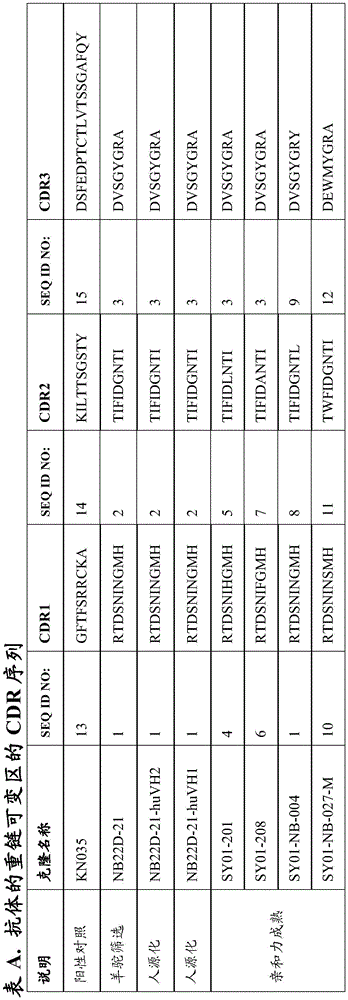


具体实施方式Detailed ways
本领域技术人员应该理解,本发明不限于本文中描述的特定方法学、实施方案和试剂,因为这些是示例性说明。还应理解本文中使用的术语仅为了描述具体实施方案,而并不意图限制本发明的范围,本发明的范围仅由所附权利要求书限定。It will be understood by those skilled in the art that this invention is not limited to the particular methodology, embodiments and reagents described herein, as these are illustrative. It is also to be understood that the terminology used herein is for the purpose of describing particular embodiments only, and is not intended to limit the scope of the invention, which will be defined only by the appended claims.
除非另外定义,本文中使用的所有技术和科学术语与本发明所属领域中普通技术人员通常的理解具有相同的含义。Unless defined otherwise, all technical and scientific terms used herein have the same meaning as commonly understood by one of ordinary skill in the art to which this invention belongs.
此外,除非上下文另有要求,单数形式的术语应包括复数形式,复数形式的术语应包括单数形式。更具体地,如在本说明书和所附权利要求中所使用的,除非上下文另外明确指出,否则单数形式“一种”和“这种”包括复数指示物。因此,例如,提及“一种抗体”包括多种抗体。Further, unless otherwise required by context, terms in the singular shall include the plural and terms in the plural shall include the singular. More specifically, as used in this specification and the appended claims, the singular forms "a" and "the" include plural referents unless the context clearly dictates otherwise. Thus, for example, reference to "an antibody" includes multiple antibodies.
定义definition
为了更好地理解本发明,相关术语的定义和解释提供如下。For a better understanding of the present invention, definitions and explanations of related terms are provided below.
术语“约”在与数字数值联合使用时意为涵盖具有比指定数字数值小5%的下限和比指定数字数值大5%的上限的范围内的数字数值。The term "about" when used in conjunction with a numerical value is meant to encompass a numerical value within a range having a lower limit of 5% less and an upper limit of 5% greater than the stated numerical value.
术语“抗体”在本文中以最广意义使用并且涵盖多种抗体结构物,包括但不限于单克隆抗体、多克隆抗体、多特异性抗体(例如,双特异性抗体)和抗体片段,只要它们显示出所需的抗原结合活性即可。完整抗体通常将包含至少两条全长重链和两条全长轻链,但在某些情况下可包括较少的链,例如骆驼科动物中天然存在的抗体可仅包含重链。The term "antibody" is used herein in the broadest sense and encompasses a variety of antibody constructs, including but not limited to monoclonal antibodies, polyclonal antibodies, multispecific antibodies (e.g., bispecific antibodies), and antibody fragments, so long as they It is sufficient that the desired antigen-binding activity is exhibited. A whole antibody will generally comprise at least two full-length heavy chains and two full-length light chains, but may in some cases comprise fewer chains, eg naturally occurring antibodies in camelids may comprise only heavy chains.
术语“单结构域抗体”简称单域抗体(single domain antibody,sdAb),是含单个抗体重链可变区结构域的抗体。类似IgG抗体,它能够选择性结合特定的抗原,但单域抗体的分子量却远小于IgG抗体。The term "single domain antibody" is referred to as a single domain antibody (single domain antibody, sdAb), which is an antibody containing a single antibody heavy chain variable region domain. Similar to IgG antibodies, it can selectively bind to specific antigens, but the molecular weight of single domain antibodies is much smaller than that of IgG antibodies.
如本文所用的术语“抗原结合部分”指与靶抗原特异性结合的部分。该术语包括能够与靶抗原特异性结合的抗体以及其他天然分子(例如受体,配体)或合成分子(例如,DARPin)。在一个优选的实施方案中,本发明抗体的抗原结合部分是抗体片段。The term "antigen-binding portion" as used herein refers to a portion that specifically binds to a target antigen. The term includes antibodies and other natural molecules (eg, receptors, ligands) or synthetic molecules (eg, DARPins) that are capable of specifically binding to a target antigen. In a preferred embodiment, the antigen-binding portion of an antibody of the invention is an antibody fragment.
术语“全长抗体”、“完好抗体”和“完整抗体”在本文中可互换地用来指一种抗体,所述抗体具有基本上与天然抗体结构相似的结构或具有含有Fc区的重链。The terms "full-length antibody", "intact antibody" and "whole antibody" are used interchangeably herein to refer to an antibody having a structure substantially similar to that of a native antibody or having a heavy Fc region-containing antibody. chain.
如本文所用,术语“单克隆抗体”或“单克隆抗体组合物”指具有单一氨基酸组成的抗体分子的制备物,而不指其产生的方法。单克隆抗体或其抗原结合片段可以例如通过杂交瘤技术、重组技术、噬菌体展示技术、合成技术例如CDR嫁接、或此类或其它本领域已知的技术的组合来产生。As used herein, the term "monoclonal antibody" or "monoclonal antibody composition" refers to a preparation of antibody molecules having a single amino acid composition, and not to the method by which they are produced. Monoclonal antibodies or antigen-binding fragments thereof can be produced, for example, by hybridoma technology, recombinant technology, phage display technology, synthetic technology such as CDR grafting, or combinations of these or other techniques known in the art.
如本文所用,术语“PD-1”是指程序性细胞死亡蛋白,其属于免疫球蛋白超家族并且作为共抑制性受体发挥作用以负调节免疫系统。PD-1是CD28/CTLA-4家族的成员,并且具有两种已知的配体,包括PD-L1和PD-L2。PD-1的替代名称或同义词包括PDCD1,PD1,CD279和SLEB2等。在NCBI登录号:NP_005009.2下公开了人PD-1的代表性氨基酸序列,并且在NCBI登录号NM_005018.3下显示了编码人PD-1的代表性核酸序列。As used herein, the term "PD-1" refers to a programmed cell death protein that belongs to the immunoglobulin superfamily and functions as a co-inhibitory receptor to negatively regulate the immune system. PD-1 is a member of the CD28/CTLA-4 family and has two known ligands, including PD-L1 and PD-L2. Alternative names or synonyms for PD-1 include PDCD1, PD1, CD279, and SLEB2, among others. A representative amino acid sequence of human PD-1 is disclosed under NCBI accession number: NP_005009.2, and a representative nucleic acid sequence encoding human PD-1 is shown under NCBI accession number NM_005018.3.
如本文所用,术语“PD-L1”是指程序性细胞死亡配体1(PD-L1,参见例如Freeman等人.(2000)J.Exp.Med.192:1027)。PD-L1的替代名称或同义词包括PDCD1L1,PDL1,B7H1,CD274和B7-H等。人PD-L1的代表性氨基酸序列在NCBI登录号NP_054862.1中公开,编码人PD-L1的代表性核酸序列显示在NCBI登录号:NM_014143.4下。PD-L1在胎盘,脾脏,淋巴结,胸腺,心脏,胎儿肝脏中表达,并且也在许多肿瘤或癌细胞中发现。PD-L1结合其受体PD-1或B7-1,其在活化的T细胞、B细胞和骨髓细胞上表达。PD-L1和其受体的结合诱导信号转导以抑制TCR介导的细胞因子产生和T细胞增殖的激活。因此,PD-L1在特定事件(例如妊娠,自身免疫疾病,组织同种异体移植物)期间抑制免疫系统中起主要作用,并且被认为允许肿瘤或癌细胞绕过免疫检查点并逃避免疫应答。As used herein, the term "PD-L1" refers to programmed cell death ligand 1 (PD-L1, see eg Freeman et al. (2000) J. Exp. Med. 192:1027). Alternative names or synonyms for PD-L1 include PDCD1L1, PDL1, B7H1, CD274, and B7-H, among others. A representative amino acid sequence of human PD-L1 is disclosed in NCBI Accession No. NP_054862.1, and a representative nucleic acid sequence encoding human PD-L1 is shown under NCBI Accession No.: NM_014143.4. PD-L1 is expressed in the placenta, spleen, lymph nodes, thymus, heart, fetal liver, and is also found in many tumors or cancer cells. PD-L1 binds its receptor PD-1 or B7-1, which is expressed on activated T cells, B cells and myeloid cells. Binding of PD-L1 and its receptor induces signal transduction to inhibit TCR-mediated activation of cytokine production and T cell proliferation. Thus, PD-L1 plays a major role in suppressing the immune system during specific events (e.g., pregnancy, autoimmune disease, tissue allografts) and is thought to allow tumor or cancer cells to bypass immune checkpoints and escape immune responses.
如本文所用,术语“结合”和“特异性结合”指抗体或抗原结合部分在体外测定法中,优选地在采用纯化的野生型抗原的生物光干涉测量(ForteBio)中与抗原表位结合。在某些实施方案中,在抗体或抗原结合部分优选地识别蛋白质和/或大分子的复杂混合物中其靶抗原时,将抗体或抗原结合部分称作特异性结合抗原。As used herein, the terms "bind" and "specifically bind" refer to the binding of an antibody or antigen-binding portion to an antigenic epitope in an in vitro assay, preferably in bioluminescent interferometry (ForteBio) using purified wild-type antigen. In certain embodiments, an antibody or antigen-binding portion is said to specifically bind an antigen when it preferentially recognizes its target antigen in a complex mixture of proteins and/or macromolecules.
取决于其重链恒定区的氨基酸序列,将抗体以“类”划分:IgA、IgD、IgE、IgG和IgM,并且这些类别中的几种可以进一步划分成亚类,如,IgG1、IgG2、IgG3和IgG4、IgA1以及IgA2。对应于不同抗体类的重链恒定区分别称作[image]δ、ε、γ和μ。可以在全部五个抗体类中找到的轻链恒定区(CL)称作κ和λ。在全长轻链和重链内,通常可变区和恒定区由约12个或更多个氨基酸的“J”区连接,且重链还包括约10个以上氨基酸的“D”区。参见例如Fundamental Immunology,Ch.7(Paul,W.编辑,第二版,Raven Press,N.Y.(1989))(其为所有目的以其整体在此引作参考)。每一轻链/重链对的可变区通常形成抗原结合位点。Depending on the amino acid sequence of the constant region of their heavy chains, antibodies are divided into "classes": IgA, IgD, IgE, IgG, and IgM, and several of these classes can be further divided into subclasses, eg, IgG1, IgG2, IgG3 and IgG4, IgA1, and IgA2. The heavy-chain constant regions that correspond to the different antibody classes are called [image] delta, epsilon, gamma, and mu, respectively. The light chain constant regions (CL) found in all five antibody classes are called kappa and lambda. Within full-length light and heavy chains, typically the variable and constant regions are joined by a "J" region of about 12 or more amino acids, with the heavy chain also including a "D" region of about 10 more amino acids. See, eg, Fundamental Immunology, Ch. 7 (Paul, W. ed., 2nd ed., Raven Press, N.Y. (1989)) (which is hereby incorporated by reference in its entirety for all purposes). The variable region of each light chain/heavy chain pair generally forms the antigen binding site.
术语“可变区”或“可变结构域”是指参与抗体与抗原结合的抗体重或轻链的结构域。天然抗体的重链和轻链的可变结构域通常具有相似的结构,其中每个结构域包含四个保守的框架区(FR)和三个互补决定区。(参见,例如,Kindt等Kuby Immunology,6th ed.,W.H.Freeman and Co.91页(2007))。单个VH或VL结构域可以足以给予抗原结合特异性。此外,可以使用来自与特定抗原结合的抗体的VH或VL结构域来分离结合所述抗原的抗体,以分别筛选互补VL或VH结构域的文库。参见,例如,Portolano等,J.Immunol.150:880-887(1993);Clarkson等,Nature 352:624-628(1991)。The term "variable region" or "variable domain" refers to the domains of an antibody heavy or light chain that participate in the binding of the antibody to an antigen. The variable domains of the heavy and light chains of native antibodies generally have similar structures, with each domain comprising four conserved framework regions (FRs) and three complementarity determining regions. (See, eg, Kindt et al. Kuby Immunology, 6 th ed., WH Freeman and Co. p. 91 (2007)). A single VH or VL domain may be sufficient to confer antigen binding specificity. In addition, VH or VL domains from antibodies that bind a particular antigen can be used to isolate antibodies that bind that antigen to screen libraries of complementary VL or VH domains, respectively. See, eg, Portolano et al., J. Immunol. 150:880-887 (1993); Clarkson et al., Nature 352:624-628 (1991).
可变区通常表现出由三个高变区连接的相对保守的构架区(FR)的相同的一般结构,所述高变区也被称为互补决定区或CDR。通常通过构架区定位(align)来自每对的两条链的CDR,所述CDR使得抗体可结合特异性表位。两条轻链和重链可变区从N-末端到C-末端通常包含结构域FR1、CDR1、FR2、CDR2、FR3、CDR3和FR4。Variable regions generally exhibit the same general structure of relatively conserved framework regions (FRs) joined by three hypervariable regions, also known as complementarity determining regions or CDRs. The CDRs from the two chains of each pair, which allow the antibody to bind a specific epitope, are usually aligned by the framework regions. Both light and heavy chain variable regions generally comprise the domains FR1, CDR1, FR2, CDR2, FR3, CDR3 and FR4 from N-terminus to C-terminus.
“抗体片段”是指不同于完整抗体的分子,其包含完整抗体的部分,所述部分结合完整抗体结合的抗原。"Antibody fragment" refers to a molecule other than an intact antibody that comprises the portion of an intact antibody that binds the antigen to which the intact antibody binds.
“亲和力”是指分子(例如抗体)的单一结合位点与其结合配偶体(例如抗原)之间全部非共价相互作用总和的强度。除非另有说明,在用于本文时,“结合亲和力”指反映结合对的成员(例如抗体与抗原)之间1∶1相互作用的内在结合亲和力。分子X对其配偶体Y的亲和力通常可用解离常数(Kd)来表述。亲和力可通过本领域知道的常用方法来测量,包括现有技术已知以及本文中所描述的那些。"Affinity" refers to the strength of the sum of all non-covalent interactions between a single binding site of a molecule (eg, an antibody) and its binding partner (eg, an antigen). As used herein, unless otherwise stated, "binding affinity" refers to intrinsic binding affinity that reflects a 1:1 interaction between members of a binding pair (eg, antibody and antigen). The affinity of a molecule X for its partner Y is usually expressed in terms of a dissociation constant (Kd). Affinity can be measured by common methods known in the art, including those known in the art and described herein.
如本文所用的术语“EC50”,也被称为“半数有效浓度”,是指在特定的暴露时间后诱导在基线和最大值之间的50%的应答的药物、抗体或毒剂的浓度。在本申请的上下文中,EC50的单位为“nM”。As used herein, the term " EC50 ", also known as "half effective concentration", refers to the concentration of a drug, antibody or poison that induces a 50% response between baseline and maximum after a specified exposure time. In the context of this application, the units of EC50 are "nM".
“人抗体”指具有这样的氨基酸序列的抗体,所述氨基酸序列对应于这样抗体的氨基酸序列,所述抗体由人或人细胞生成或来源于非人来源,其利用人抗体库或其它人抗体编码序列。人抗体的这种定义明确排除包含非人抗原结合残基的人源化抗体。"Human antibody" refers to an antibody having an amino acid sequence corresponding to that of an antibody produced by a human or human cell or derived from a non-human source using a human antibody library or other human antibody coding sequence. This definition of a human antibody specifically excludes humanized antibodies comprising non-human antigen-binding residues.
“人共有框架”是指这样的框架,即在选择人免疫球蛋白VL或VH框架序列中,其代表最常出现的氨基酸残基。一般而言,对人免疫球蛋白VL或VH序列的选择是从可变结构域序列的亚型中选择。一般而言,该序列的亚型是如Kabat等,Sequences of Proteins ofImmunological Interest,第五版,NIH Publication 91-3242,Bethesda MD(1991),1-3卷中的亚型。在一个实施方案中,对于VL,该亚型是如Kabat等(见上文)中的亚型κI。在一个实施方案中,对于VH,该亚型是如Kabat等(见上文)中的亚型III。"Human consensus framework" refers to a framework that represents the most frequently occurring amino acid residues in selected human immunoglobulin VL or VH framework sequences. In general, the selection of human immunoglobulin VL or VH sequences is from among subtypes of variable domain sequences. Generally, the subtypes of the sequences are as in Kabat et al., Sequences of Proteins of Immunological Interest, Fifth Edition, NIH Publication 91-3242, Bethesda MD (1991), vols. 1-3. In one embodiment, for VL, the subtype is subtype κI as in Kabat et al. (supra). In one embodiment, for VH, the subtype is subgroup III as in Kabat et al. (supra).
“人源化”抗体是指包含来自非人HVR的氨基酸残基和来自人FR的氨基酸残基的嵌合抗体。在一些实施方案中,人源化抗体将包含基本上所有的至少一个、通常两个可变结构域,其中所有或基本上所有的HVR(例如,CDR)对应于非人抗体的那些,并且所有或基本上所有的FR对应于人抗体的那些。人源化抗体任选可以包含至少一部分的来源于人抗体的抗体恒定区。抗体(例如非人抗体)的“人源化形式”是指已经进行了人源化的抗体。A "humanized" antibody refers to a chimeric antibody that comprises amino acid residues from non-human HVRs and amino acid residues from human FRs. In some embodiments, a humanized antibody will comprise substantially all of at least one, usually two, variable domains, wherein all or substantially all of the HVRs (e.g., CDRs) correspond to those of a non-human antibody, and all Or substantially all of the FRs correspond to those of a human antibody. A humanized antibody optionally can comprise at least a portion of an antibody constant region derived from a human antibody. A "humanized form" of an antibody (eg, a non-human antibody) refers to an antibody that has been humanized.
术语“保守取代”是指一个氨基酸被同一类别内的另一氨基酸取代,例如一个酸性氨基酸被另一酸性氨基酸取代,一个碱性氨基酸被另一碱性氨基酸取代,或一个中性氨基酸被另一中性氨基酸取代。示例性的取代如下表D所示:The term "conservative substitution" refers to the substitution of one amino acid by another amino acid within the same class, such as one acidic amino acid by another acidic amino acid, one basic amino acid by another basic amino acid, or one neutral amino acid by another Neutral amino acid substitutions. Exemplary substitutions are shown in Table D below:
表D.示例性的取代Table D. Exemplary Substitutions
氨基酸可以按照常见侧链的性质进行分组:Amino acids can be grouped by common side chain properties:
(1)疏水性:正亮氨酸,Met,Ala,Val,Leu,Ile;(1) hydrophobicity: norleucine, Met, Ala, Val, Leu, Ile;
(2)中性亲水性:Cys,Ser,Thr,Asn,Gln;(2) Neutral hydrophilicity: Cys, Ser, Thr, Asn, Gln;
(3)酸性:Asp,Glu;(3) Acidity: Asp, Glu;
(4)碱性:His,Lys,Arg;(4) Basic: His, Lys, Arg;
(5)影响链取向的残基:Gly,Pro;(5) Residues affecting chain orientation: Gly, Pro;
(6)芳族的:Trp,Tyr,Phe。(6) Aromatic: Trp, Tyr, Phe.
非保守性取代需要将这些类别中之一的成员交换为另一类。Non-conservative substitutions entail exchanging a member of one of these classes for another.
一种类型的取代变体包括取代母体抗体(例如人源化抗体)的一个或多个高变区残基。一般地,关于进一步研究所选择的得到的一种或多种变体相对于母体抗体具有某些生物学特性的改进(例如,改善)(例如,增加的亲和力、减少的免疫原性),和/或将具有母体抗体基本上保留的特定生物学特性。一种示例性的置换变体是亲和力成熟的抗体,其可以便利地产生,例如,使用基于噬菌体的亲和力成熟技术,诸如本文所述的那些技术。简言之,将一个或多个HVR残基突变,并且将变体抗体展示在噬菌体上,并针对特定的生物学活性(例如,结合亲和力)进行筛选。One type of substitutional variant involves substituting one or more hypervariable region residues of a parental antibody (eg, a humanized antibody). Typically, the resulting variant or variants selected for further study have certain improvements (e.g., improvements) in biological properties relative to the parental antibody (e.g., increased affinity, reduced immunogenicity), and and/or will have the particular biological properties substantially retained by the parental antibody. An exemplary substitutional variant is an affinity matured antibody, which can be conveniently generated, for example, using phage-based affinity maturation techniques, such as those described herein. Briefly, one or more HVR residues are mutated, and the variant antibodies are displayed on phage and screened for specific biological activity (eg, binding affinity).
相对于参比多肽序列的“百分比(%)氨基酸序列同一性”定义为在将所述序列进行比对(并在必要时导入空位)以获取最大百分比序列同一性,且不将任何保守取代视为序列同一性的部分之后,候选序列中的氨基酸残基与参比多肽序列中的相同氨基酸残基的百分比。可使用本领域各种方法进行序列比对以便测定百分比氨基酸序列同一性,例如,使用公众可得到的计算机软件如BLAST、BLAST-2、ALIGN或MEGALIGN(DNASTAR)软件。本领域技术人员可以决定测量比对的适宜参数,包括对所比较的序列全长获得最大比对所需的任何算法。当在本申请中提到序列同一性的百分比时,若未另外特别指出,这些百分比相对于较长序列的全长计算。相对于较长序列的全长计算适用于核酸序列和多肽序列两者。"Percent (%) amino acid sequence identity" relative to a reference polypeptide sequence is defined as aligning the sequences (and introducing gaps, if necessary) for the greatest percent sequence identity, and not considering any conservative substitutions as Following the portion of sequence identity, the percentage of amino acid residues in the candidate sequence that are identical to those in the reference polypeptide sequence. Alignment of sequences to determine percent amino acid sequence identity can be performed using various methods in the art, for example, using publicly available computer software such as BLAST, BLAST-2, ALIGN or MEGALIGN (DNASTAR) software. Those skilled in the art can determine appropriate parameters for measuring alignment, including any algorithms needed to achieve maximal alignment over the full length of the sequences being compared. Where percentages of sequence identity are referred to in this application, these percentages are calculated relative to the full length of the longer sequence, unless otherwise specifically indicated. Full-length calculations relative to longer sequences apply to both nucleic acid and polypeptide sequences.
术语“有效量”、“治疗有效量”指本发明的抗体或抗原结合片段的量或剂量,其以单一或多次剂量施用患者后,在治疗的受试者中产生预期效果,这包括受试者病症的改善(例如,一个或多个症状的改善)和/或症状进展的延迟等。“有效量”、“治疗有效量”也可以指足够降低PD-L1信号传导的量。The terms "effective amount" and "therapeutically effective amount" refer to the amount or dose of the antibody or antigen-binding fragment of the present invention, which, after single or multiple doses administered to a patient, produces the desired effect in a treated subject, including subject Improvement of the subject's condition (eg, improvement of one or more symptoms) and/or delay in the progression of symptoms, etc. "Effective amount" and "therapeutically effective amount" may also refer to an amount sufficient to reduce PD-L1 signaling.
有效量可以由作为本领域技术人员的主治医师通过考虑以下多种因素来容易地确定:诸如哺乳动物的物种;它的大小、年龄和一般健康;涉及的具体疾病;疾病的程度或严重性;个体患者的应答;施用的具体抗体;施用模式;施用制剂的生物利用率特征;选择的给药方案;和任何伴随疗法的使用。An effective amount can be readily determined by the attending physician, who is skilled in the art, by considering various factors such as the species of the mammal; its size, age and general health; the particular disease involved; the extent or severity of the disease; the individual patient's response; the particular antibody administered; the mode of administration; the bioavailability characteristics of the formulation administered; the chosen dosing regimen; and the use of any concomitant therapy.
本文所用术语“阻断”表示存在本发明的抗体时减少PD-L1的信号传递。PD-L1介导的信号传递阻断指本发明的PD-L1单结构域抗体存在时PD-L1信号传递水平低于PD-L1的对照水平(即不存在抗体时的PD-L1信号传递水平),降低的幅度大于或等于5%、10%、15%、20%、25%、30%、35%、40%、45%、50%、55%、60%、65%、70%、75%、80%、85%、90%、95%、99%或100%。可使用多种标准技术测量PD-L1信号传递水平,如作为非限制性实施例,测量下游基因激活和/或响应PD-L1激活的荧光素酶报告试验。本领域技术人员应理解可使用多种试验测量PD-L1信号传递水平,包括例如可商购获得的试剂盒。The term "blocking" as used herein means reducing signaling of PD-L1 in the presence of an antibody of the invention. PD-L1-mediated signal transmission block refers to the PD-L1 signal transmission level in the presence of the PD-L1 single domain antibody of the present invention is lower than the control level of PD-L1 (i.e. the PD-L1 signal transmission level in the absence of the antibody) ), the reduction is greater than or equal to 5%, 10%, 15%, 20%, 25%, 30%, 35%, 40%, 45%, 50%, 55%, 60%, 65%, 70%, 75%, 80%, 85%, 90%, 95%, 99% or 100%. The level of PD-L1 signaling can be measured using a variety of standard techniques, such as, by way of non-limiting example, measuring downstream gene activation and/or luciferase reporter assays in response to PD-L1 activation. Those of skill in the art will appreciate that PD-L1 signaling levels can be measured using a variety of assays, including, for example, commercially available kits.
术语“宿主细胞”、“宿主细胞系”和“宿主细胞培养物”可交换地使用且是指其中引入外源核酸的细胞,包括这种细胞的后代。宿主细胞包括“转化体”和“转化的细胞”,其包括初级转化的细胞和来源于其的后代,而不考虑传代的数目。后代在核酸含量上可能与亲本细胞不完全相同,而是可以包含突变。本文中包括与在最初转化的细胞中筛选或选择的具有相同功能或生物学活性的突变体后代。The terms "host cell", "host cell line" and "host cell culture" are used interchangeably and refer to a cell into which exogenous nucleic acid has been introduced, including the progeny of such a cell. Host cells include "transformants" and "transformed cells," which include the primary transformed cell and progeny derived therefrom, regardless of the number of passages. Progeny may not be identical in nucleic acid content to the parent cell, but may contain mutations. Included herein are mutant progeny that have the same function or biological activity as screened or selected for in the originally transformed cell.
术语“载体”当在本文中使用时是指能够增殖与其相连的另一个核酸的核酸分子。该术语包括作为自我复制核酸结构的载体以及结合到已经引入其的宿主细胞的基因组中的载体。一些载体能够指导与其可操作相连的核酸的表达。这样的载体在本文中被称为“表达载体”。The term "vector" as used herein refers to a nucleic acid molecule capable of propagating another nucleic acid to which it has been linked. The term includes vectors that are self-replicating nucleic acid structures as well as vectors that integrate into the genome of a host cell into which they have been introduced. Some vectors are capable of directing the expression of nucleic acids to which they are operably linked. Such vectors are referred to herein as "expression vectors."
“个体”或“受试者”包括哺乳动物。哺乳动物包括但不限于,家养动物(例如,牛,羊,猫,狗和马),灵长类动物(例如,人和非人灵长类动物如猴),兔,羊驼,以及啮齿类动物(例如,小鼠和大鼠)。在一些实施方案中,个体或受试者是人。"Individual" or "subject" includes mammals. Mammals include, but are not limited to, domestic animals (e.g., cattle, sheep, cats, dogs, and horses), primates (e.g., humans and non-human primates such as monkeys), rabbits, alpacas, and rodents Animals (eg, mice and rats). In some embodiments, the individual or subject is a human.
实施例Example
通过参考以下实施例将更容易地理解本文一般地描述的本发明,这些实施例是以举例说明的方式提供的,并且不旨在限制本发明。The invention generally described herein will be understood more readily by reference to the following examples, which are provided by way of illustration and not intended to be limiting of the invention.
本领域技术人员应该理解,除非另外注明,以下实施例中所用的试剂、质粒、细胞等均为可商购获得的产品。Those skilled in the art should understand that unless otherwise noted, the reagents, plasmids, cells, etc. used in the following examples are all commercially available products.
实施例1稳定表达PD-L1的细胞株的构建Example 1 Construction of cell lines stably expressing PD-L1
在本实施例中我们分别构建了表达人PD-L1、猴PD-L1、鼠PD-L1的CHO-s细胞,并制备了罗氏公司的对照抗体。In this example, we respectively constructed CHO-s cells expressing human PD-L1, monkey PD-L1, and mouse PD-L1, and prepared control antibodies from Roche.
1.1对照抗体制备1.1 Control antibody preparation
全基因合成对照抗体-Atezolizumab(罗氏)的轻链和重链基因序列(基因合成供应方:通用生物),对照抗体表达采用的是ExpiCHO瞬转表达系统(购自赛默飞世尔),培养基为ExpiCHOTM Expression Medium(Gibco,A29100-01),转染试剂盒为ExpiFectamineTM CHOTransfection Kit(Gibco,A29129)。The light chain and heavy chain gene sequences of the whole gene synthesis control antibody-Atezolizumab (Roche) (gene synthesis supplier: General Biology), the expression of the control antibody was expressed using the ExpiCHO transient expression system (purchased from Thermo Fisher), cultured The base is ExpiCHO ™ Expression Medium (Gibco, A29100-01), and the transfection kit is ExpiFectamine ™ CHOTransfection Kit (Gibco, A29129).
具体方法如下:通过分子克隆构建Atezolizumab抗体轻链和重链基因的ExpiCHO表达质粒,转染前一天将ExpiCHO细胞(购自Gibco A29127)进行传代,在25ml细胞培养物体系内,将构建好的质粒25μg(含有质量比为2:1的轻链、重链基因的质粒混合物)与转染试剂混合之后滴加入25ml ExpiCHO细胞培养物中,充分混匀,于37℃表达18-22小时后,根据试剂盒内说明添加补料培养基,补料后,细胞置于32℃培养,转染后第5天,添加第二次补料,并将细胞置于32℃培养,10-12天之后,将表达好的细胞混悬液高速离心取上清,所得上清经0.22μm滤膜过滤后采用Protein A/G亲和层析柱亲和纯化方法进行纯化,用100mM甘氨酸盐(pH3.0)洗脱目的蛋白,接着用1M Tris-HCl中和至pH7.0。小量取样后经SDS-PAGE鉴定后分装、入库冻存。The specific method is as follows: construct the ExpiCHO expression plasmids of the light chain and heavy chain genes of the atezolizumab antibody by molecular cloning, pass the ExpiCHO cells (purchased from Gibco A29127) one day before transfection, and put the constructed plasmids in a 25ml cell culture system 25μg (plasmid mixture containing light chain and heavy chain genes with a mass ratio of 2:1) was mixed with transfection reagent and added dropwise to 25ml ExpiCHO cell culture, mixed well, expressed at 37°C for 18-22 hours, according to The kit indicates to add feeding medium. After feeding, the cells are cultured at 32°C. On the 5th day after transfection, the second feed is added, and the cells are cultured at 32°C. After 10-12 days, The expressed cell suspension was centrifuged at high speed to obtain the supernatant, and the resulting supernatant was filtered through a 0.22 μm filter membrane and then purified by using the Protein A/G affinity chromatography column affinity purification method, using 100mM glycine salt (pH3.0) The protein of interest was eluted, followed by neutralization to pH 7.0 with 1M Tris-HCl. After a small amount of sampling was identified by SDS-PAGE, it was subpackaged and put into storage for frozen storage.
对照抗体KN035(氨基酸序列见序列表SEQ ID NO:23)的制备方法如下:The preparation method of the control antibody KN035 (see the sequence listing SEQ ID NO: 23 for the amino acid sequence) is as follows:
全基因合成对照抗体KN035全基因序列,通过分子克隆构建KN035抗体基因的ExpiCHO表达质粒,转染前一天将ExpiCHO细胞(购自Gibco A29127)进行传代,在25ml细胞培养物体系内,将构建好的质粒25μg与转染试剂混合后,按照上述对照抗体-Atezolizumab制备的方法进行转染,并表达出抗体。The entire gene sequence of the control antibody KN035 was synthesized with the whole gene, and the ExpiCHO expression plasmid of the KN035 antibody gene was constructed by molecular cloning. After mixing 25 μg of the plasmid with the transfection reagent, transfection was carried out according to the method for the preparation of the above-mentioned control antibody - Atezolizumab, and the antibody was expressed.
1.2稳定细胞株的构建1.2 Construction of stable cell lines
分别构建表达人PD-L1(gi号:NP_054862.1)、鼠PD-L1(gi号:NP_068693)和恒河猴PD-L1(gi号:ABO33163.1)全长蛋白的重组载体质粒,采用电转法将构建好的质粒导入CHO-s细胞(购自赛默飞世尔)和A375黑色素瘤细胞株(ATCC,CRL-1619)中。通过筛选分别得到以上三种物种PD-L1蛋白的高表达CHO-s细胞株以及高表达人PD-L1的A375细胞株(PD-L1-A375)。Recombinant vector plasmids expressing the full-length proteins of human PD-L1 (gi number: NP_054862.1), mouse PD-L1 (gi number: NP_068693) and rhesus monkey PD-L1 (gi number: ABO33163.1) were respectively constructed, using The constructed plasmid was introduced into CHO-s cells (purchased from Thermo Fisher) and A375 melanoma cell line (ATCC, CRL-1619) by electroporation. Through screening, the CHO-s cell lines with high expression of PD-L1 protein in the above three species and the A375 cell line with high expression of human PD-L1 (PD-L1-A375) were respectively obtained.
1.2.1表达人PD-1和PD-L1胞外域蛋白的质粒构建1.2.1 Construction of plasmids expressing human PD-1 and PD-L1 extracellular domain proteins
分别通过基因合成合成出含有人PD-L1、鼠PD-L1和恒河猴PD-L1全长蛋白基因序列的表达载体,连接后导入大肠杆菌,挑取大肠杆菌单克隆后测序得到正确的质粒克隆,进行质粒抽提并再次测序。The expression vectors containing the full-length protein gene sequences of human PD-L1, mouse PD-L1 and rhesus monkey PD-L1 were synthesized by gene synthesis respectively, and then introduced into E. coli after ligation, and the correct plasmid was obtained by sequencing after picking a single clone of E. coli Cloned, plasmid extracted and sequenced again.
1.2.2表达PD-1和PD-L1蛋白的CHO-s细胞株构建1.2.2 Construction of CHO-s cell lines expressing PD-1 and PD-L1 proteins
1.2.2.1电转1.2.2.1 Electric transfer
使用CD-CHO无血清培养基(Gibco,10743029)培养维持CHO-s细胞,电转前一天将细胞传代至5×10⁶/mL,第二天使用电转试剂盒(Invitrogen,NeonTM Kit,MPK10096)和电转仪(Invitrogen,NeonTM Transfection System,MP922947)将构建好的质粒分别导入CHO-s细胞中。将电转后的细胞加入3mL CD-CHO培养基中,放置于37℃二氧化碳培养箱中培养48小时。Use CD-CHO serum-free medium (Gibco, 10743029) to culture and maintain CHO-s cells, pass the cells to 5×10 6 /mL one day before electroporation, and use electroporation kit (Invitrogen, Neon TM Kit, MPK10096) the next day and an electroporator (Invitrogen, NeonTM Transfection System, MP922947) to introduce the constructed plasmids into CHO-s cells respectively. The electroporated cells were added to 3 mL of CD-CHO medium, and placed in a 37°C carbon dioxide incubator for 48 hours.
1.2.2.2细胞铺板与培养1.2.2.2 Cell plating and culture
将电转后的CHO-s细胞按2000个细胞/孔铺板96孔细胞培养板,加入终浓度30μM/mL L-蛋氨酸亚砜亚胺(L-Methionine sulfoximine,MSX)(Millipore,GSS-1015-F),保持体积为细胞培养体积为100μL/孔和1×GS补充物(Sigma,58672C),放置于37℃二氧化碳培养箱中培养,10天后补充加入含30μM MSX和1×GS补充物的培养基50μL。The CHO-s cells after electroporation were plated on 96-well cell culture plates at 2000 cells/well, and L-methionine sulfoximine (L-Methionine sulfoximine, MSX) (Millipore, GSS-1015-F ), maintain a volume of 100 μL/well for cell culture and 1×GS supplement (Sigma, 58672C), place it in a 37°C carbon dioxide incubator for culture, and add a medium containing 30 μM MSX and 1×GS supplement after 10
1.2.2.3克隆鉴定与细胞扩培1.2.2.3 Cloning identification and cell expansion
将长出的克隆挑取,转移至24孔细胞培养板中培养。利用FACS方法对细胞株进行鉴定,选择表达量高的克隆进行扩培和冻存。相关FACS鉴定方法如下:The grown clones were picked and transferred to 24-well cell culture plates for culture. The cell lines were identified by FACS method, and clones with high expression levels were selected for expansion and cryopreservation. The relevant FACS identification methods are as follows:
1)首先收集空CHO-s细胞及各个克隆CHO-s细胞2×10⁵个,300g离心去上清,将细胞用配制好的200μL FACS缓冲液(1×PBS+2%FBS)重悬在96-孔圆底板中;1) First collect empty CHO-s cells and 2×10 5 cloned CHO-s cells, centrifuge at 300g to remove the supernatant, and resuspend the cells in 200 μL of prepared FACS buffer (1×PBS+2% FBS) in 96-well round bottom plate;
2)将96孔圆底板300g离心5min,去上清;2) Centrifuge the 96-well round bottom plate at 300 g for 5 min, and remove the supernatant;
3)向对应孔中加入抗PD-L1抗体稀释液或阴性对照抗体稀释液,用排枪将细胞吹匀并放置于4℃孵育30分钟;3) Add anti-PD-L1 antibody diluent or negative control antibody diluent to the corresponding wells, blow the cells evenly with a row gun and place them at 4°C for 30 minutes;
4)将孵育后的细胞混合液300g离心去上清,向对应孔中加入200μL FACS缓冲液并使用排枪重悬细胞;4) Centrifuge the incubated cell mixture at 300g to remove the supernatant, add 200 μL of FACS buffer to the corresponding well and resuspend the cells using a row gun;
5)重复步骤4)两次,300g离心去上清;5) Repeat step 4) twice, and centrifuge at 300g to remove the supernatant;
6)加入PE标记的抗-人IgG Fc流式抗体(Abcam,ab98596),用排枪将细胞吹匀并放置于4℃孵育30分钟;6) Add PE-labeled anti-human IgG Fc flow antibody (Abcam, ab98596), blow the cells evenly with a row gun and incubate at 4°C for 30 minutes;
7)300g离心去上清,加入FACS缓冲液并重悬细胞;7) Centrifuge at 300g to remove the supernatant, add FACS buffer and resuspend the cells;
8)重复步骤7)两次,向孔中加入FACS缓冲液,每孔200μL,重悬细胞,通过流式细胞仪(Beckman,CytoFLEX AOO-1-1102)检测。8) Repeat step 7) twice, add FACS buffer to the wells, 200 μL per well, resuspend the cells, and detect by flow cytometry (Beckman, CytoFLEX AOO-1-1102).
1.2.3表达PD-L1的A375细胞株制备1.2.3 Preparation of A375 cell line expressing PD-L1
以1.2.2.1中电转CHO-s细胞同样的方法制备A375细胞株的PD-L1高表达细胞株(PD-L1-A375),用于A375细胞株的动物模型构建。实施例2动物免疫与血清效价检测The PD-L1 high-expressing cell line (PD-L1-A375) of the A375 cell line was prepared in the same way as the electroporation of CHO-s cells in 1.2.2.1, which was used for the construction of the animal model of the A375 cell line. Example 2 Animal immunity and serum titer detection
2.1动物免疫2.1 Animal immunity
购买PD-L1(NP_054862.1)胞外域蛋白(义翘神州,10084-H05H)免疫2只羊驼(南昌大佳科技)。每只羊驼每次免疫500μg,每2周免疫一次,共免疫4次。Purchase PD-L1 (NP_054862.1) ectodomain protein (Shenzhou, 10084-H05H) to immunize 2 alpacas (Nanchang Dajia Technology). Each alpaca was immunized with 500 μg each time, once every 2 weeks, and immunized 4 times in total.
2.2血清效价检测2.2 Serum titer detection
待羊驼免疫结束后取羊驼血清进行免疫效价检测。After the alpaca immunization, the alpaca serum was taken for immune titer detection.
免疫效价测定是通过ELISA方法测定免疫血清针对重组蛋白PD-L1(义翘神州,10084-H05H)的结合能力,并根据结合抗体的效价进行免疫效果的判定。The immunopotency determination is to measure the binding ability of the immune serum to the recombinant protein PD-L1 (Shenzhou, 10084-H05H) by ELISA method, and judge the immune effect according to the titer of the binding antibody.
具体方法如下所述:The specific method is as follows:
2.2.1抗原包被:在免疫效价测定的前一天,将抗原重组蛋白PD-L1用PBS稀释至终浓度2μg/mL,获得稀释液。将30μl获得的稀释液加入到ELISA板中,4℃包被过夜。在免疫效价测定当日用PBS润洗三遍,后用含有5%脱脂牛奶的PBST室温封闭两小时,再用PBS润洗三遍。2.2.1 Antigen coating: On the day before the immunopotency determination, the antigenic recombinant protein PD-L1 was diluted with PBS to a final concentration of 2 μg/mL to obtain a dilution. 30 μl of the obtained dilution was added to the ELISA plate and coated overnight at 4°C. On the day of immunopotency determination, rinse with PBS three times, then block with PBST containing 5% skimmed milk at room temperature for two hours, and then rinse with PBS three times.
2.2.2血清稀释:在另外一块稀释板上将未经免疫接种的阴性血清和免疫后血清用PBS进行稀释,首孔200倍稀释,然后后续7个孔采用3倍梯度稀释。2.2.2 Serum dilution: On another dilution plate, dilute the non-immunized negative serum and post-immunization serum with PBS, dilute 200-fold in the first well, and then use 3-fold gradient dilution in the subsequent 7 wells.
2.2.3抗体反应:稀释好的血清加入到第一块ELISA板中,37℃孵育1h,PBS洗两遍后以1:5000加入二抗羊抗骆驼科IgG抗体(购自南京金斯瑞)。2.2.3 Antibody reaction: Add the diluted serum to the first ELISA plate, incubate at 37°C for 1 hour, wash twice with PBS, and then add the secondary antibody (purchased from GenScript, Nanjing) at 1:5000. .
2.2.4显色读数:PBS清洗上述二抗3次后,加入显色液显色5分钟,加入终止液后,通过酶标仪(Molecular Devices,SpecterMax 190)在OD450下读板,结果见表1。2.2.4 Color development reading: After washing the above secondary antibody with PBS for 3 times, add color development solution for 5 minutes, add stop solution, and read the plate at OD450 with a microplate reader (Molecular Devices, SpecterMax 190). The results are shown in the table 1.
表1.Table 1.
其中,NSY004和NSY005两列分别为两只羊驼免疫后的血清稀释不同倍数后的ELISA显色实验结果,阴性血清为未免疫的羊驼血清ELISA实验结果。根据表1的结果,可见两只羊驼的免疫效价IgG效价均达到了256000,免疫效果较好,可用于下一步的外周血免疫抗体库构建。Among them, the two columns of NSY004 and NSY005 are the results of ELISA chromogenic experiment of two alpaca immunized sera after dilution of different times, and the negative serum is the result of ELISA experiment of unimmunized alpaca serum. According to the results in Table 1, it can be seen that the immune titer IgG titer of the two alpacas both reached 256,000, and the immune effect is good, which can be used for the next step of peripheral blood immune antibody library construction.
实施例3羊驼免疫库构建及初步筛选Example 3 Alpaca immune library construction and preliminary screening
动物免疫结束后,取羊驼新鲜血液50mL,通过Ficoll-Paque密度梯度分离液(GE,17144003S)分离外周血单核细胞(Peripheral Blood Mononuclear Cell,PBMC),进行抗人PD-L1抗体噬菌体羊驼免疫库构建。After animal immunization, 50 mL of alpaca fresh blood was taken, and peripheral blood mononuclear cells (Peripheral Blood Mononuclear Cell, PBMC) were separated by Ficoll-Paque density gradient separation medium (GE, 17144003S), and anti-human PD-L1 antibody phage alpaca Immunity library construction.
具体方法如下:The specific method is as follows:
将采集的羊驼血用PBS以1:1的比例稀释,取Ficoll-Paque密度梯度分离液15ml缓缓加入50ml离心管中,将离心管倾斜并沿管壁缓慢加入稀释好的羊驼血30mL,使得两种液体保持清晰的分离界面。4℃离心20min,保持加速度为升3降0。离心之后,整个液面分为四层,上层为血浆混合物,下层为红细胞和粒细胞,中层为Ficoll-Paque PLUS,在上、中层交界处有以PBMC为主的白色狭窄带,即PBMC细胞层。小心使用移液枪吸取中间的PBMC细胞转移至新的50mL离心管中。用PBS润洗两遍,4℃,1500rpm水平离心10min,最后用1.5ml PBS重悬,并通过显微镜计数。Dilute the collected alpaca blood with PBS at a ratio of 1:1, take 15ml of Ficoll-Paque density gradient separation solution and slowly add it to a 50ml centrifuge tube, tilt the centrifuge tube and slowly add 30mL of diluted alpaca blood along the tube wall , so that the two liquids maintain a clear separation interface. Centrifuge at 4°C for 20 min, maintaining an acceleration of 3 down to 0. After centrifugation, the entire liquid surface is divided into four layers, the upper layer is plasma mixture, the lower layer is red blood cells and granulocytes, the middle layer is Ficoll-Paque PLUS, and at the junction of the upper and middle layers there is a white narrow band mainly composed of PBMC, that is, the PBMC cell layer . Carefully use a pipette to transfer the middle PBMC cells to a new 50mL centrifuge tube. Rinse twice with PBS, centrifuge horizontally at 1500rpm for 10min at 4°C, and finally resuspend with 1.5ml PBS, and count through a microscope.
将分离的PBMC细胞提取RNA,通过反转录试剂盒(TaKaRa,6210A)将提取的RNA反转录成cDNA。由于羊驼抗体的分子形式不同于普通抗体,其不含有轻链而且重链不含有CH1,因此首先在VH前端和CH2上通过设计普通引物,PCR得到两个不同大小的片段,通过割胶回收较小的目的片段。然后通过比对常见的VHH所有Germline的氨基酸序列,设计出两端分别含有NcoI和NotI酶切位点的Germline特异性简并引物,从而以回收产物为模板扩增所有的VHH基因,最后通过双酶切和连接将目的抗体基因片段插入至噬菌体展示用载体上,需要指出的是的,该表达载体上VHH基因的C端融合在噬菌体表达载体中的GIII基因。连接产物通过回收试剂盒(Omega,D6492-02)回收,最后通过电转仪(Bio-Rad,MicroPulser)转化至感受态大肠杆菌SS320中,并涂布于氨苄抗性的2-YT固体平板。为了计算库容,通过取10μl库的菌液进行10倍梯度稀释,每个稀释梯度取2μl点在平板上,计算在平板上形成的克隆来计算所有电转化形成的总克隆数,即库容量。此免疫库库容量为1×10⁹。RNA was extracted from the isolated PBMC cells, and the extracted RNA was reverse-transcribed into cDNA by a reverse transcription kit (TaKaRa, 6210A). Since the molecular form of the alpaca antibody is different from ordinary antibodies, it does not contain the light chain and the heavy chain does not contain CH1. Therefore, firstly, common primers are designed on the front end of VH and CH2, and two fragments of different sizes are obtained by PCR. Small purpose fragments. Then, by comparing the amino acid sequences of all Germlines of common VHHs, Germline-specific degenerate primers containing NcoI and NotI restriction sites at both ends were designed to amplify all VHH genes using the recovered products as templates, and finally through double Digestion and ligation Insert the target antibody gene fragment into the phage display vector. It should be noted that the C-terminal of the VHH gene on the expression vector is fused to the GIII gene in the phage expression vector. The ligation product was recovered by a recovery kit (Omega, D6492-02), and finally transformed into competent Escherichia coli SS320 by an electroporator (Bio-Rad, MicroPulser), and spread on an ampicillin-resistant 2-YT solid plate. In order to calculate the storage capacity, take 10 μl of the bacterial solution of the library for 10-fold serial dilution, take 2 μl of each dilution gradient and spot on the plate, and count the clones formed on the plate to calculate the total number of clones formed by all electroporations, that is, the library capacity. The capacity of this immune library is 1×10 9 .
基于此库容容量,取10倍于库容的菌量(约20OD)加入到新鲜的2-YT液体培养基中,调整培养基的加入用量使得菌液稀释液初始OD值为0.05。置于37℃,220rpm培养至对数生长期,此时以50倍于细菌数的数量加入VSCM13辅助噬菌体,充分混匀,静置30min,然后在220rpm条件下培养1h,通过10000rpm离心5min后置换至羧苄青霉素/卡那霉素双抗性2-YT培养基中,并于30℃,220rpm培养过夜。次日,13000g离心10min,其上清通过加入20%PEG/NaCl溶液,沉淀得到羊驼免疫抗体库对应的噬菌体,经PBS润洗一次之后,用于目标靶点PD-L1抗体筛选。Based on this storage capacity, take 10 times the amount of bacteria (about 20 OD) of the storage capacity and add it to fresh 2-YT liquid medium, adjust the amount of medium added so that the initial OD value of the bacterial liquid dilution is 0.05. Place at 37°C and culture at 220rpm until the logarithmic growth phase. At this time, add VSCM13 helper phage in an
噬菌体筛选使用的是重组PD-L1蛋白,采用磁珠筛选和免疫管筛选两种方法,具体方法如下所述。Phage screening uses recombinant PD-L1 protein, using two methods of magnetic bead screening and immune tube screening, the specific methods are as follows.
3.1磁珠筛选3.1 Magnetic bead screening
基于将生物素标记的重组PD-L1蛋白结合到卵白素偶联的磁珠(购自赛默飞世尔,货号:11205D)上进行筛选,首先用生物素标记重组人PD-L1蛋白(生物素标记方法见Roche公司的生物素蛋白标记试剂盒说明书,货号:11418165001),将生物素标记的PD-L1蛋白和磁珠孵育,使得PD-L1蛋白结合于磁珠上。将结合有PD-L1抗原的磁珠和具有纳米抗体展示的噬菌体库室温孵育2小时,经PBST洗涤6-8次后,去除非特异性吸附的噬菌体,加入胰蛋白酶(Gibco)轻轻混匀20min,以洗脱特异性结合人PD-L1蛋白的纳米抗体展示噬菌体。接着将洗脱的噬菌体侵染对数期的SS320菌体(Lucigen,MC1061 F),并将噬菌体侵染的SS320菌体涂布于羧苄青霉素抗性平板,37℃过夜培养,第二天收集菌体。采用SS320菌体制备噬菌体,制备方法详见如上文库噬菌体制备方法。最终得到的噬菌体继续用于第二轮的筛选,在第二轮筛选结束时采用胰蛋白酶方式进行洗脱。将第二轮筛选得到的噬菌体用于第三轮筛选,在第三轮筛选结束时采用胰蛋白酶进行洗脱。如此反复,通过每轮随机挑选的10个克隆进行序列分析。结果显示,经过3轮的筛选后得到的单克隆噬菌体,测序后的单克隆,不同克隆的基因序列出现重复,证明序列富集明显。Based on the binding of biotin-labeled recombinant PD-L1 protein to avidin-coupled magnetic beads (purchased from Thermo Fisher, catalog number: 11205D) for screening, the recombinant human PD-L1 protein (Bio For the biotin labeling method, see Roche’s biotin protein labeling kit instructions, product number: 11418165001), incubate the biotin-labeled PD-L1 protein with the magnetic beads, so that the PD-L1 protein binds to the magnetic beads. Incubate the magnetic beads bound with PD-L1 antigen and the phage library with nanobody display at room temperature for 2 hours, wash 6-8 times with PBST, remove non-specifically adsorbed phage, add trypsin (Gibco) and mix gently for 20 minutes , to display phages by eluting Nanobodies that specifically bind to human PD-L1 protein. Then, the eluted phages were used to infect logarithmic phase SS320 cells (Lucigen, MC1061 F), and the phage-infected SS320 cells were spread on a carbenicillin-resistant plate, cultured overnight at 37°C, and collected the next day. bacteria. Use SS320 bacteria to prepare phage, and the preparation method is detailed in the above library phage preparation method. The finally obtained phages continue to be used for the second round of screening, and trypsin is used for elution at the end of the second round of screening. The phages obtained in the second round of screening were used for the third round of screening, and eluted with trypsin at the end of the third round of screening. Repeatedly, 10 clones were randomly selected in each round for sequence analysis. The results showed that the monoclonal phage obtained after 3 rounds of screening, the sequenced monoclonal, and the gene sequences of different clones were repeated, which proved that the sequence enrichment was obvious.
3.2免疫管筛选3.2 Immunotube screening
免疫管筛选是基于将抗原包被在免疫管表面,筛选和目的抗原结合的抗体展示噬菌体。筛选前一天提前使用重组人PD-L1蛋白包被免疫管,将结合有PD-L1抗原的免疫管和具有纳米抗体展示的噬菌体库室温孵育2小时,经PBST洗涤6-8次后,去除非特异性吸附的噬菌体,加入胰蛋白酶(Gibco)轻轻混匀20min,以洗脱特异性结合人PD-L1蛋白的纳米抗体展示噬菌体。接着将洗脱的噬菌体侵染对数期的SS320菌体(Lucigen,MC1061 F),并将噬菌体侵染的SS320菌体涂布于羧苄青霉素抗性平板,37℃过夜培养,第二天收集菌体。采用SS320菌体制备噬菌体,制备方法详见如上文库噬菌体制备方法。最终得到的噬菌体继续用于第二轮的筛选。在第二轮筛选结束时采用Trypsin方式进行洗脱。将第二轮筛选得到的噬菌体用于第三轮筛选,在第三轮筛选结束时采用Trypsin方式进行洗脱。如此反复,通过每轮随机挑选的10个克隆进行测序后并进行序列分析。结果显示,经过3轮的筛选,测序后的单克隆,不同克隆的基因序列出现重复,证明序列富集明显。The immunotube screening is based on coating the antigen on the surface of the immunotube, and screening the antibody display phages that bind to the target antigen. The day before the screening, the recombinant human PD-L1 protein was used to coat the immune tube in advance, and the immune tube bound to the PD-L1 antigen was incubated with the phage library with nanobody display for 2 hours at room temperature, washed 6-8 times with PBST, and the nonspecific protein was removed. Heteroadsorbed phages were added with trypsin (Gibco) and gently mixed for 20 min to elute the nanobody that specifically binds to human PD-L1 protein to display the phages. Then, the eluted phages were used to infect logarithmic phase SS320 cells (Lucigen, MC1061 F), and the phage-infected SS320 cells were spread on a carbenicillin-resistant plate, cultured overnight at 37°C, and collected the next day. bacteria. Use SS320 bacteria to prepare phage, and the preparation method is detailed in the above library phage preparation method. The final phages were then used for the second round of screening. At the end of the second round of screening, trypsin was used for elution. The phages obtained in the second round of screening were used for the third round of screening, and the trypsin method was used for elution at the end of the third round of screening. Repeatedly, 10 clones randomly selected in each round were sequenced and sequenced. The results showed that after 3 rounds of screening, the gene sequences of different clones were repeated in the single clone after sequencing, which proved that the sequence enrichment was obvious.
对两种不同筛选方法获得的噬菌体库进行单克隆筛选,分别挑取磁珠筛选和免疫管筛选的第三轮产物中的阳性克隆。具体方法如下:Monoclonal screening was performed on the phage libraries obtained by two different screening methods, and the positive clones in the third-round products of magnetic bead screening and immune tube screening were picked respectively. The specific method is as follows:
筛选前一天将重组人PD-L1蛋白包被到96孔ELISA板上,第二天于96孔板中制备诱导噬菌体上清,通过噬菌体ELISA筛选针对人PD-L1重组蛋白的阳性克隆,后挑取所有阳性克隆测序分析,将序列唯一的克隆制备裂解液,制备方法如下:前一天将该克隆的菌液以1:100接种50mL,37℃恒温摇床振荡培养14h,10000g常温离心5min,使用1mL PH 9.0含有benzonase核酸酶的Tris-HCl缓冲液重悬细菌,冰上裂解30min,4℃10000g离心10min,收集上清即得到阳性克隆裂解液。The day before the screening, the recombinant human PD-L1 protein was coated on a 96-well ELISA plate, and the induced phage supernatant was prepared in the 96-well plate on the second day, and positive clones targeting human PD-L1 recombinant protein were screened by phage ELISA, and then picked All positive clones were sequenced and analyzed, and the lysate was prepared from the clone with the only sequence. The preparation method was as follows: inoculate 50mL of the bacterial solution of the clone at a ratio of 1:100 the day before, shake and culture at 37°C for 14h, centrifuge at 10000g for 5min at room temperature, and use Resuspend the bacteria in 1 mL of pH 9.0 Tris-HCl buffer containing benzonase nuclease, lyse on ice for 30 min, centrifuge at 10,000 g at 4°C for 10 min, and collect the supernatant to obtain a positive clone lysate.
将制备好的阳性克隆裂解液进一步在流式水平上验证,筛选到特异性识别人PD-L1的候选抗体。流式水平验证方法如下:The lysates of the prepared positive clones were further verified at the flow cytometric level, and candidate antibodies that specifically recognized human PD-L1 were screened. The streaming level verification method is as follows:
1)首先收集培养好的人PD-L1-CHO细胞,300g离心去上清,将细胞用配制好的FACS缓冲液重悬,计数并将细胞悬液密度调整为2×10⁶个/mL;1) First collect the cultured human PD-L1-CHO cells, centrifuge at 300g to remove the supernatant, resuspend the cells in the prepared FACS buffer, count and adjust the density of the cell suspension to 2×10 6 cells/mL;
2)将PD-L1-CHO细胞以100μL每孔加入96孔圆底板,300g离心去上清;2) Add 100 μL of PD-L1-CHO cells to each well of a 96-well round bottom plate, and centrifuge at 300 g to remove the supernatant;
3)向对应孔中加入梯度稀释的候选抗体裂解液和对照抗体稀释液,用排枪将细胞吹匀并放置于4℃孵育30分钟;3) Add serially diluted candidate antibody lysate and control antibody dilution to the corresponding wells, blow the cells evenly with a row gun and place them at 4°C for 30 minutes;
4)将孵育后的细胞混合液300g离心去上清,向对应孔中加入200μL FACS缓冲液并使用排枪重悬细胞;4) Centrifuge the incubated cell mixture at 300g to remove the supernatant, add 200 μL of FACS buffer to the corresponding well and resuspend the cells using a row gun;
5)重复步骤4)两次,300g离心去上清;5) Repeat step 4) twice, and centrifuge at 300g to remove the supernatant;
6)加入PE标记的流式抗体(金斯瑞),用排枪将细胞吹匀并放置于4℃孵育30分钟;6) Add PE-labeled flow cytometry antibody (GenScript), blow the cells evenly with a row gun and incubate at 4°C for 30 minutes;
7)300g离心去上清,加入FACS缓冲液并重悬细胞;7) Centrifuge at 300g to remove the supernatant, add FACS buffer and resuspend the cells;
8)重复步骤7)两次,向孔中加入FACS缓冲液,每孔200μL,重悬细胞,通过流式细胞仪(Beckman,CytoFLEX AOO-1-1102)检测。8) Repeat step 7) twice, add FACS buffer to the wells, 200 μL per well, resuspend the cells, and detect by flow cytometry (Beckman, CytoFLEX AOO-1-1102).
抗PD-L1 VHH裂解液样本结合亲和力筛选的结果显示在图1中。The results of binding affinity screening of anti-PD-L1 VHH lysate samples are shown in Figure 1.
从图1可以看出,所示的克隆号的VHH分子对表达PD-L1的CHO细胞都有一定的亲和力。由于本检测实验只是定性和半定量,无法确认哪一个克隆号的VHH抗体分子亲和力比较好,需要进行进一步实验确认。It can be seen from Figure 1 that the VHH molecules of the indicated clone numbers all have certain affinity to CHO cells expressing PD-L1. Since this detection experiment is only qualitative and semi-quantitative, it is impossible to confirm which clone number has a better affinity for the VHH antibody molecule, and further experimental confirmation is required.
将制备好的阳性克隆裂解液进一步在流式水平上进行阻断筛选,筛选到特异性识别人PD-L1并阻断其与PD-1蛋白结合的候选抗体。流式水平验证方法如下:The prepared lysate of positive clones was further subjected to blocking screening at the flow cytometry level, and candidate antibodies that specifically recognized human PD-L1 and blocked its binding to PD-1 protein were screened. The streaming level verification method is as follows:
1)首先收集培养好的人PD-L1-CHO细胞,300g离心去上清,将细胞用配制好的FACS缓冲液重悬,计数并将细胞悬液密度调整为2×10⁶/mL;1) First collect the cultured human PD-L1-CHO cells, centrifuge at 300g to remove the supernatant, resuspend the cells in the prepared FACS buffer, count and adjust the density of the cell suspension to 2×10 6 /mL;
2)将PD-L1-CHO细胞以100μL每孔加入96孔圆底板,300g离心去上清;2) Add 100 μL of PD-L1-CHO cells to each well of a 96-well round bottom plate, and centrifuge at 300 g to remove the supernatant;
3)向对应孔中加入梯度稀释获得的浓度梯度分别为1:1、1:5和1:25的候选抗体裂解液和对照抗体稀释液,用排枪将细胞吹匀并放置于4℃孵育30分钟;3) Add candidate antibody lysates and control antibody dilutions with concentration gradients of 1:1, 1:5, and 1:25 to the corresponding wells, blow the cells evenly with a row gun and place them at 4°C to incubate for 30 minute;
4)将孵育后的细胞混合液300g离心去上清,向对应孔中加入200μL并使用排枪重悬细胞;4) Centrifuge the incubated cell mixture at 300 g to remove the supernatant, add 200 μL to the corresponding well and resuspend the cells with a row gun;
5)重复步骤4)两次,300g离心去上清;5) Repeat step 4) twice, and centrifuge at 300g to remove the supernatant;
6)向对应孔中加入PD-1-Fc蛋白稀释液(1μg/mL)100μL,重悬细胞并将细胞放置于4℃孵育30分钟;6) Add 100 μL of PD-1-Fc protein dilution solution (1 μg/mL) to the corresponding well, resuspend the cells and incubate the cells at 4°C for 30 minutes;
7)将孵育后的细胞混合液300g离心去上清,向对应孔中加入200μL并使用排枪重悬细胞;7) Centrifuge the incubated cell mixture at 300 g to remove the supernatant, add 200 μL to the corresponding well and resuspend the cells using a row gun;
8)重复步骤7)两次,300g离心去上清;8) Repeat step 7) twice, centrifuge at 300g to remove the supernatant;
9)加入PE标记的anti-human IgG Fc流式抗体(Abcam),用排枪将细胞吹匀并放置于4℃孵育30分钟;9) Add PE-labeled anti-human IgG Fc flow antibody (Abcam), blow the cells evenly with a row gun and place them at 4°C for 30 minutes;
10)300g离心去上清,加入FACS缓冲液并重悬细胞;10) Centrifuge at 300g to remove the supernatant, add FACS buffer and resuspend the cells;
11)重复步骤10)两次,向孔中加入FACS缓冲液,每孔200μL,重悬细胞,通过流式细胞仪(Beckman,CytoFLEX AOO-1-1102)检测。11) Repeat step 10) twice, add FACS buffer to the wells, 200 μL per well, resuspend the cells, and detect by flow cytometry (Beckman, CytoFLEX AOO-1-1102).
抗PD-L1抗体候选分子的封闭实验筛选结果如图2所示,通过ELISA和FACS等方法的初步筛选,可见筛选到的抗体序列制备的抗体裂解液中含有对PD-L1结合到PD1上的反应有封闭效果的抗体,我们筛选到10个有良好亲和力及阻断活性的候选分子。The screening results of the blocking experiment for anti-PD-L1 antibody candidate molecules are shown in Figure 2. Through preliminary screening by methods such as ELISA and FACS, it can be seen that the antibody lysate prepared from the screened antibody sequence contains the anti-PD-L1 binding to PD1. Reacting to antibodies with blocking effect, we screened 10 candidate molecules with good affinity and blocking activity.
实施例4嵌合VHH-Fc抗体的产生和表达Example 4 Production and Expression of Chimeric VHH-Fc Antibody
将筛选获得的阳性VHH候选抗体与人IgG1 Fc段融合,采用阳性VHH基因序列的C端连接到人IgG1 Fc段基因序列的N端的方式构建融合表达载体,将该融合表达载体质粒转化ExpiCHO细胞,诱导表达得到融合了Fc片段的VHH-Fc嵌合抗体蛋白。The positive VHH candidate antibody obtained by screening was fused with the Fc segment of human IgG1, and the fusion expression vector was constructed by linking the C-terminus of the positive VHH gene sequence to the N-terminus of the Fc segment gene sequence of human IgG1, and the fusion expression vector plasmid was transformed into ExpiCHO cells, The VHH-Fc chimeric antibody protein fused with the Fc fragment was induced to express.
抗体表达采用的是ExpiCHO瞬转表达系统,培养基为(Gibco,A29100-01),转染试剂盒为(Gibco,A29129)。具体方法如下:转染前一天将ExpiCHO细胞进行传代,在25ml体系内,将构建好的质粒25μg与转染试剂混合之后滴加入25ml ExpiCHO细胞培养物中,充分混匀,于37℃表达18-22小时后,根据试剂盒内说明添加补料培养基,补料后,细胞置于32℃培养,转染后第5天,添加第二次补料,并将细胞置于32℃培养,10-12天之后,将表达好的细胞混悬液高速离心取上清,所得上清经0.22μm过滤后采用Protein A/G亲和纯化方法进行纯化,用100mM甘氨酸盐(pH3.0)洗脱目的蛋白,接着用1M Tris-HCl中和。The antibody was expressed using the ExpiCHO transient expression system, the medium was (Gibco, A29100-01), and the transfection kit was (Gibco, A29129). The specific method is as follows: Passage the ExpiCHO cells one day before transfection, mix 25 μg of the constructed plasmid with the transfection reagent in a 25ml system, drop into 25ml ExpiCHO cell culture, mix well, and express 18- After 22 hours, add feed medium according to the instructions in the kit. After feeding, the cells were cultured at 32°C. On the 5th day after transfection, a second feed was added, and the cells were cultured at 32°C for 10 - After 12 days, the expressed cell suspension was centrifuged at high speed to obtain the supernatant, which was filtered at 0.22 μm and purified by Protein A/G affinity purification method, and eluted with 100 mM glycine salt (pH 3.0) The protein of interest was then neutralized with 1M Tris-HCl.
实施例5嵌合VHH-Fc抗体细胞水平的亲和活性验证Example 5 Verification of Affinity Activity at the Cell Level of Chimeric VHH-Fc Antibody
对获得的VHH-Fc候选抗体进行评价,采用FACS方法检测其与细胞上PD-L1蛋白的结合活性,具体方法如下:The obtained VHH-Fc candidate antibody was evaluated, and its binding activity to the PD-L1 protein on cells was detected by FACS method, the specific method is as follows:
1)收集培养好的人PD-L1-CHO细胞,300g离心去上清,将细胞用配制好的FACS缓冲液重悬,计数并将细胞悬液密度调整为2×10⁶个/mL;1) Collect the cultured human PD-L1-CHO cells, centrifuge at 300g to remove the supernatant, resuspend the cells in the prepared FACS buffer, count and adjust the density of the cell suspension to 2×10 6 cells/mL;
2)将PD-L1-CHO细胞以100μL每孔加入96孔圆底板,300g离心去上清;2) Add 100 μL of PD-L1-CHO cells to each well of a 96-well round bottom plate, and centrifuge at 300 g to remove the supernatant;
3)向对应孔中加入梯度稀释的候选抗体稀释液和对照抗体稀释液,用排枪将细胞吹匀并放置于4℃孵育30分钟;3) Add serially diluted candidate antibody dilutions and control antibody dilutions to the corresponding wells, blow the cells evenly with a row gun and place them at 4°C for 30 minutes;
4)将孵育后的细胞混合液300g离心去上清,向对应孔中加入200μL并使用排枪重悬细胞;4) Centrifuge the incubated cell mixture at 300 g to remove the supernatant, add 200 μL to the corresponding well and resuspend the cells with a row gun;
5)重复步骤4)两次,300g离心去上清;5) Repeat step 4) twice, and centrifuge at 300g to remove the supernatant;
6)加入PE标记的抗-人IgG Fc流式抗体(Abcam,ab98596),用排枪将细胞吹匀并放置于4℃孵育30分钟;6) Add PE-labeled anti-human IgG Fc flow antibody (Abcam, ab98596), blow the cells evenly with a row gun and incubate at 4°C for 30 minutes;
7)300g离心去上清,加入FACS缓冲液并重悬细胞;7) Centrifuge at 300g to remove the supernatant, add FACS buffer and resuspend the cells;
8)重复步骤10)两遍,向孔中加入FACS缓冲液,每孔200μL,重悬细胞,通过流式细胞仪(Beckman,CytoFLEX AOO-1-1102)检测。8) Repeat step 10) twice, add FACS buffer to the wells, 200 μL per well, resuspend the cells, and detect by flow cytometry (Beckman, CytoFLEX AOO-1-1102).
如表2所示,通过FACS实验,我们筛选到2个有高亲和力的纳米抗体候选分子,亲和力均高于或与对照抗体相似。As shown in Table 2, through FACS experiments, we screened two nanobody candidate molecules with high affinity, and the affinity was higher than or similar to that of the control antibody.
表2.抗体的EC50Table 2. Antibody EC50
实施例6嵌合VHH-Fc抗体阻断PD-1的活性验证Example 6 Verification of the activity of chimeric VHH-Fc antibody blocking PD-1
对获得的VHH-Fc候选抗体进行评价,采用FACS方法检测其对PD-1/PD-L1的阻断活性,具体方法如下:The obtained VHH-Fc candidate antibody was evaluated, and its blocking activity on PD-1/PD-L1 was detected by FACS method. The specific method is as follows:
1)收集培养好的人PD-L1-CHO细胞,300g离心去上清,将细胞用配制好的FACS缓冲液重悬,计数并将细胞悬液密度调整为2×10⁶/mL;1) Collect the cultured human PD-L1-CHO cells, centrifuge at 300g to remove the supernatant, resuspend the cells in the prepared FACS buffer, count and adjust the density of the cell suspension to 2×10 6 /mL;
2)将PD-L1-CHO细胞以100μL每孔加入96孔圆底板,300g离心去上清;2) Add 100 μL of PD-L1-CHO cells to each well of a 96-well round bottom plate, and centrifuge at 300 g to remove the supernatant;
3)向对应孔中加入梯度稀释的候选抗体稀释液和对照抗体稀释液,用排枪将细胞吹匀并放置于4℃孵育30分钟;3) Add serially diluted candidate antibody dilutions and control antibody dilutions to the corresponding wells, blow the cells evenly with a row gun and place them at 4°C for 30 minutes;
4)将孵育后的细胞混合液300g离心去上清,向对应孔中加入200μL并使用排枪重悬细胞;4) Centrifuge the incubated cell mixture at 300 g to remove the supernatant, add 200 μL to the corresponding well and resuspend the cells with a row gun;
5)重复步骤4)两次,300g离心去上清;5) Repeat step 4) twice, and centrifuge at 300g to remove the supernatant;
6)向对应孔中加入生物素标记的PD-1-Fc蛋白稀释液(1μg/mL)100μL,重悬细胞并将细胞放置于4℃孵育30分钟;6) Add 100 μL of biotin-labeled PD-1-Fc protein dilution (1 μg/mL) to the corresponding well, resuspend the cells and incubate the cells at 4°C for 30 minutes;
7)将孵育后的细胞混合液300g离心去上清,向对应孔中加入200μLFACS并使用排枪重悬细胞;7) Centrifuge the incubated cell mixture at 300 g to remove the supernatant, add 200 μL FACS to the corresponding well and resuspend the cells using a row gun;
8)重复步骤7)两次,300g离心去上清;8) Repeat step 7) twice, centrifuge at 300g to remove the supernatant;
9)加入PE标记的streptavidin(eBioscience,12-4317-87),用排枪将细胞吹匀并放置于4℃孵育30分钟;9) Add PE-labeled streptavidin (eBioscience, 12-4317-87), blow the cells evenly with a row gun and incubate at 4°C for 30 minutes;
10)300g离心去上清,加入FACS缓冲液并重悬细胞;10) Centrifuge at 300g to remove the supernatant, add FACS buffer and resuspend the cells;
11)重复步骤10)两遍,向孔中加入FACS缓冲液,每孔200μL,重悬细胞,通过流式细胞仪(Beckman,CytoFLEX AOO-1-1102)上机检测。11) Repeat step 10) twice, add FACS buffer to the wells, 200 μL per well, resuspend the cells, and detect on a flow cytometer (Beckman, CytoFLEX AOO-1-1102).
如表3所示,通过FACS实验,我们验证了实施例5中克隆编号为NB22D-21和NB22gb-10的2个纳米抗体候选分子同时拥有高阻断活性,其阻断活性均高于对照抗体或与对照抗体相似。As shown in Table 3, through FACS experiments, we verified that the two nanobody candidate molecules with clone numbers NB22D-21 and NB22gb-10 in Example 5 have high blocking activity at the same time, and their blocking activity is higher than that of the control antibody Or similar to the control antibody.
表3.抗体的IC50Table 3. Antibody IC50
实施例7嵌合VHH-Fc抗体阻断CD80的活性验证Example 7 Verification of the activity of chimeric VHH-Fc antibody blocking CD80
对获得的VHH-Fc候选抗体进行评价,采用FACS方法检测其对CD80/PD-L1的阻断活性,具体方法如下:The obtained VHH-Fc candidate antibody was evaluated, and its blocking activity on CD80/PD-L1 was detected by FACS method, the specific method is as follows:
1)收集培养好的人PD-L1-CHO细胞,300g离心去上清,将细胞用配制好的FACS缓冲液重悬,计数并将细胞悬液密度调整为2×10⁶/mL;1) Collect the cultured human PD-L1-CHO cells, centrifuge at 300g to remove the supernatant, resuspend the cells in the prepared FACS buffer, count and adjust the density of the cell suspension to 2×10 6 /mL;
2)将PD-L1-CHO细胞以100μL每孔加入96孔圆底板,300g离心去上清;2) Add 100 μL of PD-L1-CHO cells to each well of a 96-well round bottom plate, and centrifuge at 300 g to remove the supernatant;
3)向对应孔中加入梯度稀释的候选抗体稀释液和对照抗体稀释液,用排枪将细胞吹匀并放置于4℃孵育30分钟;3) Add serially diluted candidate antibody dilutions and control antibody dilutions to the corresponding wells, blow the cells evenly with a row gun and place them at 4°C for 30 minutes;
4)将孵育后的细胞混合液300g离心去上清,向对应孔中加入200μL并使用排枪重悬细胞;4) Centrifuge the incubated cell mixture at 300 g to remove the supernatant, add 200 μL to the corresponding well and resuspend the cells with a row gun;
5)重复步骤4)两次,300g离心去上清;5) Repeat step 4) twice, and centrifuge at 300g to remove the supernatant;
6)向对应孔中加入生物素标记的CD80蛋白稀释液(1μg/mL)100μL,重悬细胞并将细胞放置于4℃孵育30分钟;6) Add 100 μL of biotin-labeled CD80 protein dilution (1 μg/mL) to the corresponding well, resuspend the cells and incubate the cells at 4°C for 30 minutes;
7)将孵育后的细胞混合液300g离心去上清,向对应孔中加入200μL并使用排枪重悬细胞;7) Centrifuge the incubated cell mixture at 300 g to remove the supernatant, add 200 μL to the corresponding well and resuspend the cells using a row gun;
8)重复步骤7)两次,300g离心去上清;8) Repeat step 7) twice, centrifuge at 300g to remove the supernatant;
9)加入PE标记的链霉抗生物素蛋白(eBioscience,12-4317-87),用排枪将细胞吹匀并放置于4℃孵育30分钟;9) Add PE-labeled streptavidin (eBioscience, 12-4317-87), blow the cells evenly with a row gun and incubate at 4°C for 30 minutes;
10)300g离心去上清,加入FACS缓冲液并重悬细胞;10) Centrifuge at 300g to remove the supernatant, add FACS buffer and resuspend the cells;
11)重复步骤10)两次,向孔中加入FACS缓冲液,每孔200μL,重悬细胞,通过流式细胞仪(Beckman,CytoFLEX AOO-1-1102)检测。11) Repeat step 10) twice, add FACS buffer to the wells, 200 μL per well, resuspend the cells, and detect by flow cytometry (Beckman, CytoFLEX AOO-1-1102).
如表4所示,通过FACS实验,我们验证了实施例5中克隆编号为NB22D-21和NB22gb-10的2个纳米抗体候选分子同时拥有高阻断活性,其阻断活性均高于对照抗体或与对照抗体相似。As shown in Table 4, through FACS experiments, we verified that the two nanobody candidate molecules with clone numbers NB22D-21 and NB22gb-10 in Example 5 have high blocking activity at the same time, and their blocking activity is higher than that of the control antibody Or similar to the control antibody.
表4.抗体的IC50Table 4. IC50 of antibodies
实施例8嵌合VHH-Fc抗体在肿瘤细胞上的结合活性Example 8 Binding Activity of Chimeric VHH-Fc Antibody on Tumor Cells
为了评价VHH-Fc候选抗体在人黑色素瘤细胞系A375细胞(ATCC,CRL-1619)上的结合活性,采用FACS方法检测其与细胞上PD-L1蛋白的结合活性,具体方法如下:In order to evaluate the binding activity of the VHH-Fc candidate antibody on the human melanoma cell line A375 cells (ATCC, CRL-1619), the binding activity to the PD-L1 protein on the cells was detected by FACS method, the specific method is as follows:
1)用含0.25%EDTA的Trypsin消化A375细胞,收集细胞300g离心去上清,将细胞用配制好的FACS缓冲液重悬,计数并将细胞悬液密度调整为2×10⁶个/mL;1) Digest A375 cells with Trypsin containing 0.25% EDTA, collect the cells and centrifuge at 300 g to remove the supernatant, resuspend the cells in the prepared FACS buffer, count and adjust the density of the cell suspension to 2×10 6 cells/mL;
2)将A375细胞以100μL每孔加入96孔圆底板,300g离心去上清;2) Add A375 cells into 96-well round bottom plate at 100 μL per well, and centrifuge at 300 g to remove the supernatant;
3)向对应孔中加入梯度稀释的候选抗体稀释液和对照抗体稀释液,用排枪将细胞吹匀并放置于4℃孵育30分钟;3) Add serially diluted candidate antibody dilutions and control antibody dilutions to the corresponding wells, blow the cells evenly with a row gun and place them at 4°C for 30 minutes;
4)将孵育后的细胞混合液300g离心去上清,向对应孔中加入200μL并使用排枪重悬细胞;4) Centrifuge the incubated cell mixture at 300 g to remove the supernatant, add 200 μL to the corresponding well and resuspend the cells with a row gun;
5)重复步骤4)两次,300g离心去上清;5) Repeat step 4) twice, and centrifuge at 300g to remove the supernatant;
6)向对应孔中加入各个候选抗体和对照抗体稀释液(1μg/mL)100μL,重悬细胞并将细胞放置于4℃孵育30分钟;6) Add 100 μL of each candidate antibody and control antibody dilution (1 μg/mL) to the corresponding well, resuspend the cells and incubate the cells at 4°C for 30 minutes;
7)将孵育后的细胞混合液300g离心去上清,向对应孔中加入200μL并使用排枪重悬细胞;7) Centrifuge the incubated cell mixture at 300 g to remove the supernatant, add 200 μL to the corresponding well and resuspend the cells using a row gun;
8)重复步骤7)两次,300g离心去上清;8) Repeat step 7) twice, centrifuge at 300g to remove the supernatant;
9)加入PE标记的anti-biotin流式抗体(Abcam),用排枪将细胞吹匀并放置于4℃孵育30分钟;9) Add PE-labeled anti-biotin flow antibody (Abcam), blow the cells evenly with a row gun and place them at 4°C for 30 minutes;
10)300g离心去上清,加入FACS缓冲液并重悬细胞;10) Centrifuge at 300g to remove the supernatant, add FACS buffer and resuspend the cells;
11)重复步骤10)两次,向孔中加入FACS缓冲液,每孔200μL,重悬细胞,通过流式细胞仪(Beckman,CytoFLEX AOO-1-1102)检测,检测结果如图3所示。11) Repeat step 10) twice, add FACS buffer to the wells, 200 μL per well, resuspend the cells, and detect by flow cytometry (Beckman, CytoFLEX AOO-1-1102). The detection results are shown in Figure 3.
从图3可以看出,克隆编号为NB22D-21和NB22gb-10的2个纳米抗体候选分子在人黑色素瘤细胞系A375细胞上的结合活性与对照抗体相当。It can be seen from FIG. 3 that the binding activity of the two nanobody candidate molecules whose clone numbers are NB22D-21 and NB22gb-10 on the human melanoma cell line A375 cells is equivalent to that of the control antibody.
实施例9嵌合VHH-Fc抗体结合鼠、猴PD-L1的活性验证Example 9 Verification of the activity of chimeric VHH-Fc antibody binding to mouse and monkey PD-L1
为了评价VHH-Fc候选抗体与猴、鼠PD-L1的交叉结合活性,采用FACS方法检测其与细胞上PD-L1蛋白的结合活性,具体方法如下:In order to evaluate the cross-binding activity of the VHH-Fc candidate antibody with monkey and mouse PD-L1, the FACS method was used to detect its binding activity to the PD-L1 protein on cells, the specific method is as follows:
1)收集培养的小鼠PD-L1-CHO细胞和猴PD-L1-CHO细胞,300g离心去培养基,将细胞用配制好的FACS缓冲液重悬,计数并将细胞悬液密度调整为2×10⁶/mL;1) Collect the cultured mouse PD-L1-CHO cells and monkey PD-L1-CHO cells, centrifuge at 300g to remove the medium, resuspend the cells with the prepared FACS buffer, count and adjust the density of the cell suspension to 2 ×10 6 /mL;
2)分别将小鼠PD-L1-CHO细胞和猴PD-L1-CHO细胞以100μL每孔加入96孔圆底板,300g离心去上清;2) Add mouse PD-L1-CHO cells and monkey PD-L1-CHO cells to a 96-well round bottom plate at 100 μL per well, and centrifuge at 300 g to remove the supernatant;
3)向对应孔中加入梯度稀释的候选抗体稀释液和对照抗体稀释液,用排枪将细胞吹匀并放置于4℃孵育30分钟;3) Add serially diluted candidate antibody dilutions and control antibody dilutions to the corresponding wells, blow the cells evenly with a row gun and place them at 4°C for 30 minutes;
4)将孵育后的细胞混合液300g离心去上清,向对应孔中加入200μL并使用排枪重悬细胞;4) Centrifuge the incubated cell mixture at 300 g to remove the supernatant, add 200 μL to the corresponding well and resuspend the cells with a row gun;
5)重复步骤4)两次,300g离心去上清;5) Repeat step 4) twice, and centrifuge at 300g to remove the supernatant;
6)向对应孔中加入生物素标记的PD-1-Fc蛋白稀释液(1μg/mL)100μL,重悬细胞并将细胞放置于4℃孵育30分钟;6) Add 100 μL of biotin-labeled PD-1-Fc protein dilution (1 μg/mL) to the corresponding well, resuspend the cells and incubate the cells at 4°C for 30 minutes;
7)将孵育后的细胞混合液300g离心去上清,向对应孔中加入200μL并使用排枪重悬细胞;7) Centrifuge the incubated cell mixture at 300 g to remove the supernatant, add 200 μL to the corresponding well and resuspend the cells using a row gun;
8)重复步骤7)两次,300g离心去上清;8) Repeat step 7) twice, centrifuge at 300g to remove the supernatant;
9)加入PE标记的anti-biotin流式抗体(Abcam),用排枪将细胞吹匀并放置于4℃孵育30分钟;9) Add PE-labeled anti-biotin flow antibody (Abcam), blow the cells evenly with a row gun and place them at 4°C for 30 minutes;
10)300g离心去上清,加入FACS缓冲液并重悬细胞;10) Centrifuge at 300g to remove the supernatant, add FACS buffer and resuspend the cells;
11)重复步骤10)两次,向孔中加入FACS缓冲液,每孔200μL,重悬细胞,通过流式细胞仪(Beckman,CytoFLEX AOO-1-1102)检测。11) Repeat step 10) twice, add FACS buffer to the wells, 200 μL per well, resuspend the cells, and detect by flow cytometry (Beckman, CytoFLEX AOO-1-1102).
人鼠交叉反应检测结果显示克隆编号为NB22D-21的纳米抗体候选分子有一定的鼠PD-L1结合活性。The human-mouse cross-reaction test results showed that the nanobody candidate molecule with the clone number NB22D-21 had certain mouse PD-L1 binding activity.
人猴交叉反应的检测结果参见表5,从中可以看出,克隆编号为NB22D-21和NB22gb-10的2个纳米抗体候选分子均有很好的识别猴PD-L1的活性。The detection results of human-monkey cross-reactivity are shown in Table 5, from which it can be seen that the two nanobody candidate molecules with clone numbers NB22D-21 and NB22gb-10 have good activity in recognizing monkey PD-L1.
表5.EC50值Table 5. EC50 values
实施例10嵌合VHH-Fc抗体结合PD-L1的特异性检测Example 10 Specific detection of chimeric VHH-Fc antibody binding to PD-L1
为了确认候选分子结合PD-L1蛋白的特异性,采用ELISA法检测候选分子结合B7家族其他蛋白的活性,具体方法如下:In order to confirm the specificity of the candidate molecule binding to the PD-L1 protein, the ELISA method was used to detect the activity of the candidate molecule binding to other proteins of the B7 family. The specific method is as follows:
实验前一天向ELISA板中加入30μL终浓度为2μg/mL的B7-H1、B7-H2、B7-H3、B7-H4、B7-DC(以上蛋白均购自义翘神州公司,货号分别为10084-HNAH、11559-H08H、11188-H08H、10738-H08H、10292-H08H-B)等蛋白稀释液,4℃孵育过夜;第二天使用PBST润洗ELISA板3遍,随后加入150μL 5%PBSM封闭ELISA板,常温孵育2小时;再用PBST洗板3遍,接着将30μL候选抗体和对照抗体的稀释液加入ELISA板中,常温孵育1小时;用PBST洗板3遍,加入1:7000稀释的anti-human IgG Fc-HRP二抗,每孔30μL,常温孵育30分钟;用PBST洗板6遍后加入TMB显色,最后加入2M HCl终止反应,通过酶标仪(Molecular Devices,SpecterMax 190)在450nM波长下读值,其结果显示在表6和图4中。The day before the experiment, add 30 μL of B7-H1, B7-H2, B7-H3, B7-H4, B7-DC with a final concentration of 2 μg/mL to the ELISA plate (the above proteins were all purchased from Yiqiao Shenzhou Company, the catalog number is 10084 -HNAH, 11559-H08H, 11188-H08H, 10738-H08H, 10292-H08H-B) and other protein dilutions, incubate overnight at 4°C; wash the
抗体分子的特异性结合反应实验验证结果如表6和图4所示。The experimental verification results of the specific binding reaction of antibody molecules are shown in Table 6 and FIG. 4 .
表6.Table 6.

从表6和图4的结果可以看出,克隆编号为NB22D-21和NB22gb-10的2个纳米抗体候选分子对B7-H1以外的B7家族分子没有结合活性,只对B7-H1有结合活性,这个结合特异性与对照抗体一致。From the results in Table 6 and Figure 4, it can be seen that the two nanobody candidate molecules whose clone numbers are NB22D-21 and NB22gb-10 have no binding activity to B7 family molecules other than B7-H1, and only have binding activity to B7-H1 , this binding specificity was consistent with that of the control antibody.
实施例11嵌合VHH-Fc抗体的体外生物学活性验证Example 11 In vitro biological activity verification of chimeric VHH-Fc antibody
为了确认候选分子在体外刺激T细胞激活的能力,我们在体外建立了混合淋巴细胞反应体系,具体方法如下:In order to confirm the ability of candidate molecules to stimulate T cell activation in vitro, we established a mixed lymphocyte reaction system in vitro, the specific method is as follows:
使用美天旎分选试剂盒(Miltenyibiotec,130-050-201)体外分选CD14阳性的单核细胞和CD4阳性T细胞,体外使用100ng/mL IL-4和100ng/mL GM-CSF诱导培养7天将单核细胞诱导成为树突状细胞(Dendritic cell,DC),再将CD4阳性T细胞与DC以10:1的细胞数比例混合,向细胞中加入梯度稀释的候选抗体和对照抗体,37℃细胞培养箱中培养5天,培养72小时后取细胞上清,PBS稀释后使用IL-2ELISA试剂盒检测培养上清中的IL-2分泌量;培养5天后取细胞上清,PBS稀释后使用IFN-γELISA kit检测培养上清中的IFN-γ分泌量。CD14-positive monocytes and CD4-positive T cells were sorted in vitro using Miltenyi sorting kit (Miltenyibiotec, 130-050-201), and cultured with 100 ng/mL IL-4 and 100 ng/mL GM-CSF in vitro. On the first day, monocytes were induced to become dendritic cells (Dendritic cells, DCs), and then CD4 positive T cells were mixed with DCs at a cell ratio of 10:1, and serially diluted candidate antibodies and control antibodies were added to the cells, 37 Cultivate in a cell incubator at ℃ for 5 days, take the cell supernatant after 72 hours of culture, and use the IL-2ELISA kit to detect the secretion of IL-2 in the culture supernatant after dilution in PBS; The IFN-γ secretion in the culture supernatant was detected using the IFN-γELISA kit.
通过检测IL-2的分泌量,我们得到抗体分子的混合淋巴细胞反应测试验证结果,其如图5所示。从图5可以看出,本发明的纳米抗体候选分子可以激活免疫反应。By detecting the secretion of IL-2, we obtained the verification results of the mixed lymphocyte reaction test of the antibody molecule, which is shown in FIG. 5 . It can be seen from Figure 5 that the nanobody candidate molecule of the present invention can activate an immune response.
实施例12抗体人源化改造Example 12 Antibody Humanization Transformation
为了降低分子在体内的免疫原性,我们对候选分子进行了人源化设计。分别使用Discovery Studio和
实施例13人源化改造后的衍生分子结合人PD-L1-CHO细胞Example 13 Derivative Molecules After Humanization Transformation Bind to Human PD-L1-CHO Cells
为了检测人源化对分子结合人PD-L1抗原活性的影响,我们用FACS对候选分子及其人源化改造后的衍生分子进行了检测。In order to detect the effect of humanization on the binding activity of molecules to human PD-L1 antigen, we used FACS to detect the candidate molecules and their humanized derivatives.
1)收集培养好的人PD-L1-CHO细胞,300g离心去上清,将细胞用配制好的FACS缓冲液重悬,计数并将细胞悬液密度调整为2×10⁶个/mL;1) Collect the cultured human PD-L1-CHO cells, centrifuge at 300g to remove the supernatant, resuspend the cells in the prepared FACS buffer, count and adjust the density of the cell suspension to 2×10 6 cells/mL;
2)将PD-L1-CHO细胞以100μL每孔加入96孔圆底板,300g离心去上清;2) Add 100 μL of PD-L1-CHO cells to each well of a 96-well round bottom plate, and centrifuge at 300 g to remove the supernatant;
3)向对应孔中加入梯度稀释的候选抗体稀释液和对照抗体稀释液,用排枪将细胞吹匀并放置于4℃孵育30分钟;3) Add serially diluted candidate antibody dilutions and control antibody dilutions to the corresponding wells, blow the cells evenly with a row gun and place them at 4°C for 30 minutes;
4)将孵育后的细胞混合液300g离心去上清,向对应孔中加入200μL并使用排枪重悬细胞;4) Centrifuge the incubated cell mixture at 300 g to remove the supernatant, add 200 μL to the corresponding well and resuspend the cells with a row gun;
5)重复步骤4)两次,300g离心去上清;5) Repeat step 4) twice, and centrifuge at 300g to remove the supernatant;
6)加入PE标记的anti-human IgG Fc流式抗体(Abcam,ab98596),用排枪将细胞吹匀并放置于4℃孵育30分钟;6) Add PE-labeled anti-human IgG Fc flow antibody (Abcam, ab98596), blow the cells evenly with a row gun and incubate at 4°C for 30 minutes;
7)300g离心去上清,加入FACS缓冲液并重悬细胞;7) Centrifuge at 300g to remove the supernatant, add FACS buffer and resuspend the cells;
8)重复步骤7)两次,向孔中加入FACS缓冲液,每孔200μL,重悬细胞,通过流式细胞仪(Beckman,CytoFLEX AOO-1-1102)检测,结果如图6所示。8) Repeat step 7) twice, add FACS buffer to the wells, 200 μL per well, resuspend the cells, and detect by flow cytometry (Beckman, CytoFLEX AOO-1-1102), the results are shown in Figure 6.
从图6可以看出,人源化后得到的衍生分子与人PD-L1结合的亲和力和其母本分子相似。It can be seen from Figure 6 that the derived molecules obtained after humanization have a similar binding affinity to human PD-L1 as their parent molecules.
实施例14人源化改造后的衍生分子结合鼠PD-L1-CHO细胞Example 14 Derivative Molecules After Humanization Transformation Bind to Murine PD-L1-CHO Cells
为了检测人源化对分子结合鼠PD-L1抗原交叉活性的影响,我们用FACS对候选分子进行了检测。To test the effect of humanization on the cross-reactivity of molecules binding to the murine PD-L1 antigen, we tested the candidate molecules by FACS.
1)收集培养好的鼠PD-L1-CHO细胞,300g离心去上清,将细胞用配制好的FACS缓冲液重悬,计数并将细胞悬液密度调整为2×10⁶个/mL;1) Collect the cultured mouse PD-L1-CHO cells, centrifuge at 300g to remove the supernatant, resuspend the cells in the prepared FACS buffer, count and adjust the density of the cell suspension to 2×10 6 cells/mL;
2)将鼠PD-L1-CHO细胞以100μL每孔加入96孔圆底板,300g离心去上清;2) Add mouse PD-L1-CHO cells to a 96-well round bottom plate at 100 μL per well, and centrifuge at 300 g to remove the supernatant;
3)向对应孔中加入梯度稀释的候选抗体稀释液和对照抗体稀释液,用排枪将细胞吹匀并放置于4℃孵育30分钟;3) Add serially diluted candidate antibody dilutions and control antibody dilutions to the corresponding wells, blow the cells evenly with a row gun and place them at 4°C for 30 minutes;
4)将孵育后的细胞混合液300g离心去上清,向对应孔中加入200μL并使用排枪重悬细胞;4) Centrifuge the incubated cell mixture at 300 g to remove the supernatant, add 200 μL to the corresponding well and resuspend the cells with a row gun;
5)重复步骤4)两次,300g离心去上清;5) Repeat step 4) twice, and centrifuge at 300g to remove the supernatant;
6)加入PE标记的anti-human IgG Fc流式抗体(Abcam,ab98596),用排枪将细胞吹匀并放置于4℃孵育30分钟;6) Add PE-labeled anti-human IgG Fc flow antibody (Abcam, ab98596), blow the cells evenly with a row gun and incubate at 4°C for 30 minutes;
7)300g离心去上清,加入FACS缓冲液并重悬细胞;7) Centrifuge at 300g to remove the supernatant, add FACS buffer and resuspend the cells;
8)重复步骤7)两次,向孔中加入FACS缓冲液,每孔200μL,重悬细胞,通过流式细胞仪(Beckman,CytoFLEX AOO-1-1102)检测,结果参见图7和图8。8) Repeat step 7) twice, add FACS buffer to the wells, 200 μL per well, resuspend the cells, and detect by flow cytometry (Beckman, CytoFLEX AOO-1-1102), the results are shown in Figure 7 and Figure 8.
从图7可以看出,人源化改造后得到的衍生分子中,NB22D-21-huVH1与鼠PD-L1结合的亲和力要优于母本分子。It can be seen from Figure 7 that among the derivative molecules obtained after humanization, the binding affinity of NB22D-21-huVH1 to mouse PD-L1 is better than that of the parent molecule.
具体而言,从图7可以看出,相对于母本分子NB22D-21以及对照分子KN035,人源化改造后得到的衍生分子NB22D-21-huVH1具有非常好的结合鼠PD-L1蛋白的活性;选取其中KN035和NB22D-21-huVH1的流式峰图(如图8所示),从中可以清楚地看出:分别使用20μg/mL的KN035和NB22D-21-huVH1结合鼠PD-L1过表达细胞,FACS检测数据表明KN035不能识别CHO细胞表面的鼠PD-L1(图8(A)),而NB22D-21-huVH1能够很好地识别CHO细胞表面的鼠PD-L1(图8(B))(注:每个图中间的分界线为设定的荧光强度阈值位置)。Specifically, it can be seen from Figure 7 that, compared with the parent molecule NB22D-21 and the control molecule KN035, the derivative molecule NB22D-21-huVH1 obtained after humanization has a very good binding activity to the mouse PD-L1 protein ; Select the flow peak diagrams of KN035 and NB22D-21-huVH1 (as shown in Figure 8), from which it can be clearly seen that using 20 μg/mL of KN035 and NB22D-21-huVH1 combined with mouse PD-L1 overexpression Cells, FACS detection data showed that KN035 could not recognize mouse PD-L1 on the surface of CHO cells (Figure 8(A)), while NB22D-21-huVH1 could well recognize mouse PD-L1 on the surface of CHO cells (Figure 8(B) ) (Note: The dividing line in the middle of each figure is the set fluorescence intensity threshold position).
实施例15人源化改造后的衍生分子阻断PD-1的活性验证Example 15 Verification of the PD-1-blocking activity of the derived molecule after humanization transformation
对人源化后获得的衍生分子进行评价,采用FACS方法检测其对PD-1/PD-L1的阻断活性,具体方法如下:The derived molecules obtained after humanization were evaluated, and their blocking activity on PD-1/PD-L1 was detected by FACS method. The specific method is as follows:
1)收集培养好的人PD-L1-CHO细胞,300g离心去上清,将细胞用配制好的FACS缓冲液重悬,计数并将细胞悬液密度调整为2×10⁶/mL。1) Collect the cultured human PD-L1-CHO cells, centrifuge at 300g to remove the supernatant, resuspend the cells in the prepared FACS buffer, count and adjust the density of the cell suspension to 2×10 6 /mL.
2)将PD-L1-CHO细胞以100μL每孔加入96孔圆底板,300g离心去上清;2) Add 100 μL of PD-L1-CHO cells to each well of a 96-well round bottom plate, and centrifuge at 300 g to remove the supernatant;
3)向对应孔中加入梯度稀释的候选抗体稀释液和对照抗体稀释液,用排枪将细胞吹匀并放置于4℃孵育30分钟;3) Add serially diluted candidate antibody dilutions and control antibody dilutions to the corresponding wells, blow the cells evenly with a row gun and place them at 4°C for 30 minutes;
4)将孵育后的细胞混合液300g离心去上清,向对应孔中加入200μL并使用排枪重悬细胞;4) Centrifuge the incubated cell mixture at 300 g to remove the supernatant, add 200 μL to the corresponding well and resuspend the cells with a row gun;
5)重复步骤4)两次,300g离心去上清;5) Repeat step 4) twice, and centrifuge at 300g to remove the supernatant;
6)向对应孔中加入生物素标记的PD-1-Fc蛋白稀释液(1μg/mL)100μL,重悬细胞并将细胞放置于4℃孵育30分钟;6) Add 100 μL of biotin-labeled PD-1-Fc protein dilution (1 μg/mL) to the corresponding well, resuspend the cells and incubate the cells at 4°C for 30 minutes;
7)将孵育后的细胞混合液300g离心去上清,向对应孔中加入200μL FACS并使用排枪重悬细胞;7) Centrifuge the incubated cell mixture at 300 g to remove the supernatant, add 200 μL FACS to the corresponding well and resuspend the cells using a row gun;
8)重复步骤7)两次,300g离心去上清;8) Repeat step 7) twice, centrifuge at 300g to remove the supernatant;
9)加入PE标记的streptavidin(eBioscience,12-4317-87),用排枪将细胞吹匀并放置于4℃孵育30分钟;9) Add PE-labeled streptavidin (eBioscience, 12-4317-87), blow the cells evenly with a row gun and incubate at 4°C for 30 minutes;
10)300g离心去上清,加入FACS缓冲液并重悬细胞;10) Centrifuge at 300g to remove the supernatant, add FACS buffer and resuspend the cells;
11)重复步骤10)两次,向孔中加入FACS缓冲液,每孔200μL,重悬细胞,通过流式细胞仪(Beckman,CytoFLEX AOO-1-1102)检测,结果如图9所示。11) Repeat step 10) twice, add FACS buffer to the wells, 200 μL per well, resuspend the cells, and detect by flow cytometry (Beckman, CytoFLEX AOO-1-1102), the results are shown in Figure 9.
从图9可以看出,人源化改造后得到的衍生分子阻断PD-1蛋白结合PD-L1的活性与其母本分子相当。It can be seen from Figure 9 that the derivative molecule obtained after humanization is equivalent to its parent molecule in blocking PD-1 protein binding to PD-L1.
实施例16人源化分子的亲和力成熟Example 16 Affinity Maturation of Humanized Molecules
为了提升抗体分子结合人、鼠PD-L1抗原的亲和力和阻断活性,我们对人源化改造后获得的抗体衍生分子进行了亲和力成熟设计。In order to improve the affinity and blocking activity of antibody molecules binding to human and mouse PD-L1 antigens, we designed affinity maturation for the antibody-derived molecules obtained after humanization.
亲和力成熟采用单点饱和突变、多点组合突变、链置换等方法,采用Trim引物技术对CDR区定向设计引物,构建亲和力成熟抗体库,并利用噬菌体展示技术对亲和力成熟后的分子进行筛选。获得单克隆后制备VHH裂解液,并采用FACS检测克隆的亲和与阻断活性。通过筛选我们获得了4个可能优于母本的克隆,分别是SY01-201,SY01-208,SY01-NB-004,SY01-NB-027-M。Affinity maturation uses methods such as single-point saturation mutation, multi-point combination mutation, and strand replacement. Trim primer technology is used to design primers for the CDR region, and an affinity matured antibody library is constructed, and the molecules after affinity maturation are screened using phage display technology. The VHH lysate was prepared after the monoclonal was obtained, and the affinity and blocking activity of the clone were detected by FACS. Through screening, we obtained 4 clones that may be better than the mother parent, namely SY01-201, SY01-208, SY01-NB-004, SY01-NB-027-M.
具体的实验结果如图10和图11所示,从其细胞裂解液的定性/半定量结果可以大致看出,SY01-201,SY01-208,SY01-NB-004,SY01-NB-027-M四个分子的结合活性和阻断活性均与母本NB22D-21分子相似。The specific experimental results are shown in Figure 10 and Figure 11. It can be roughly seen from the qualitative/semi-quantitative results of the cell lysate that SY01-201, SY01-208, SY01-NB-004, SY01-NB-027-M The binding and blocking activities of the four molecules were similar to those of the parent NB22D-21 molecule.
实施例17NB22D-21分子在A375小鼠肿瘤模型中的药效验证Example 17 Drug efficacy verification of NB22D-21 molecule in A375 mouse tumor model
为了确认候选抗体分子在体内抑制肿瘤生长的活性,我们建立了基于过表达人PD-L1的人黑色素瘤A375细胞系的小鼠模型,具体方法如下:In order to confirm the activity of candidate antibody molecules in inhibiting tumor growth in vivo, we established a mouse model based on the human melanoma A375 cell line overexpressing human PD-L1, the specific method is as follows:
选取6周龄左右、大小和体重相似的NOD-SCID小鼠,将小鼠分为对照组和候选抗体组及阳性对照抗体组3组,每组8只。体外培养人黑色素瘤细胞系PD-L1-A375(实施例1制得),将1×10⁷个PD-L1-A375细胞与5×10⁶个PBMC细胞混合,尾静脉注射入小鼠体内,记为第0天。第2天向每组小鼠体内注射5mg/mL或10mg/mL的候选抗体或对照抗体,此后每7天给药一次,连续给药6次。第7天开始每周记录小鼠体重及肿瘤大小,直至肿瘤生长至1500mm3。Select NOD-SCID mice about 6 weeks old, with similar size and weight, and divide the mice into 3 groups: control group, candidate antibody group and positive control antibody group, with 8 mice in each group. Human melanoma cell line PD-L1-A375 (prepared in Example 1) was cultured in vitro, 1×10 7 PD-L1-A375 cells were mixed with 5×10 6 PBMC cells, and injected into mice through the tail vein. Recorded as
本领域技术人员将进一步认识到,在不脱离其精神或中心特征的情况下,本发明可以以其他具体形式来实施。由于本发明的前述描述仅公开了其示例性实施方案,应该理解的是,其他变化被认为是在本发明的范围内。因此,本发明不限于在此详细描述的特定实施方案。相反,应当参考所附权利要求来指示本发明的范围和内容。Those skilled in the art will further appreciate that the present invention may be embodied in other specific forms without departing from its spirit or central characteristics. Since the foregoing description of the invention disclosed only exemplary embodiments thereof, it should be understood that other variations are considered to be within the scope of the invention. Therefore, the invention is not to be limited to the particular embodiments described in detail herein. Instead, reference should be made to the appended claims as indicating the scope and content of the invention.
SEQUENCE LISTINGSEQUENCE LISTING
<110> 三优生物医药(上海)有限公司<110> Sanyou Biopharmaceutical (Shanghai) Co., Ltd.
<120> PD-L1结合分子<120> PD-L1 binding molecules
<130> IDC196019<130> IDC196019
<160> 36<160> 36
<170> PatentIn version 3.5<170> PatentIn version 3.5
<210> 1<210> 1
<211> 10<211> 10
<212> PRT<212> PRT
<213> Artificial Sequence<213> Artificial Sequence
<220><220>
<223> CDR1<223> CDR1
<400> 1<400> 1
Arg Thr Asp Ser Asn Ile Asn Gly Met HisArg Thr Asp Ser Asn Ile Asn Gly Met His
1 5 101 5 10
<210> 2<210> 2
<211> 9<211> 9
<212> PRT<212> PRT
<213> Artificial Sequence<213> Artificial Sequence
<220><220>
<223> CDR2<223> CDR2
<400> 2<400> 2
Thr Ile Phe Ile Asp Gly Asn Thr IleThr Ile Phe Ile Asp Gly Asn Thr Ile
1 51 5
<210> 3<210> 3
<211> 8<211> 8
<212> PRT<212> PRT
<213> Artificial Sequence<213> Artificial Sequence
<220><220>
<223> CDR3<223> CDR3
<400> 3<400> 3
Asp Val Ser Gly Tyr Gly Arg AlaAsp Val Ser Gly Tyr Gly Arg Ala
1 51 5
<210> 4<210> 4
<211> 10<211> 10
<212> PRT<212> PRT
<213> Artificial Sequence<213> Artificial Sequence
<220><220>
<223> CDR1<223> CDR1
<400> 4<400> 4
Arg Thr Asp Ser Asn Ile His Gly Met HisArg Thr Asp Ser Asn Ile His Gly Met His
1 5 101 5 10
<210> 5<210> 5
<211> 9<211> 9
<212> PRT<212> PRT
<213> Artificial Sequence<213> Artificial Sequence
<220><220>
<223> CDR2<223> CDR2
<400> 5<400> 5
Thr Ile Phe Ile Asp Leu Asn Thr IleThr Ile Phe Ile Asp Leu Asn Thr Ile
1 51 5
<210> 6<210> 6
<211> 10<211> 10
<212> PRT<212> PRT
<213> Artificial Sequence<213> Artificial Sequence
<220><220>
<223> CDR1<223> CDR1
<400> 6<400> 6
Arg Thr Asp Ser Asn Ile Phe Gly Met HisArg Thr Asp Ser Asn Ile Phe Gly Met His
1 5 101 5 10
<210> 7<210> 7
<211> 9<211> 9
<212> PRT<212> PRT
<213> Artificial Sequence<213> Artificial Sequence
<220><220>
<223> CDR2<223> CDR2
<400> 7<400> 7
Thr Ile Phe Ile Asp Ala Asn Thr IleThr Ile Phe Ile Asp Ala Asn Thr Ile
1 51 5
<210> 8<210> 8
<211> 9<211> 9
<212> PRT<212> PRT
<213> Artificial Sequence<213> Artificial Sequence
<220><220>
<223> CDR2<223> CDR2
<400> 8<400> 8
Thr Ile Phe Ile Asp Gly Asn Thr LeuThr Ile Phe Ile Asp Gly Asn Thr Leu
1 51 5
<210> 9<210> 9
<211> 8<211> 8
<212> PRT<212> PRT
<213> Artificial Sequence<213> Artificial Sequence
<220><220>
<223> CDR3<223> CDR3
<400> 9<400> 9
Asp Val Ser Gly Tyr Gly Arg TyrAsp Val Ser Gly Tyr Gly Arg Tyr
1 51 5
<210> 10<210> 10
<211> 10<211> 10
<212> PRT<212> PRT
<213> Artificial Sequence<213> Artificial Sequence
<220><220>
<223> CDR1<223> CDR1
<400> 10<400> 10
Arg Thr Asp Ser Asn Ile Asn Ser Met HisArg Thr Asp Ser Asn Ile Asn Ser Met His
1 5 101 5 10
<210> 11<210> 11
<211> 9<211> 9
<212> PRT<212> PRT
<213> Artificial Sequence<213> Artificial Sequence
<220><220>
<223> CDR2<223> CDR2
<400> 11<400> 11
Thr Trp Phe Ile Asp Gly Asn Thr IleThr Trp Phe Ile Asp Gly Asn Thr Ile
1 51 5
<210> 12<210> 12
<211> 8<211> 8
<212> PRT<212> PRT
<213> Artificial Sequence<213> Artificial Sequence
<220><220>
<223> CDR3<223> CDR3
<400> 12<400> 12
Asp Glu Trp Met Tyr Gly Arg AlaAsp Glu Trp Met Tyr Gly Arg Ala
1 51 5
<210> 13<210> 13
<211> 10<211> 10
<212> PRT<212> PRT
<213> Artificial Sequence<213> Artificial Sequence
<220><220>
<223> CDR1<223> CDR1
<400> 13<400> 13
Gly Phe Thr Phe Ser Arg Arg Cys Lys AlaGly Phe Thr Phe Ser Arg Arg Cys Lys Ala
1 5 101 5 10
<210> 14<210> 14
<211> 10<211> 10
<212> PRT<212> PRT
<213> Artificial Sequence<213> Artificial Sequence
<220><220>
<223> CDR2<223> CDR2
<400> 14<400> 14
Lys Ile Leu Thr Thr Ser Gly Ser Thr TyrLys Ile Leu Thr Thr Ser Gly Ser Thr Tyr
1 5 101 5 10
<210> 15<210> 15
<211> 19<211> 19
<212> PRT<212> PRT
<213> Artificial Sequence<213> Artificial Sequence
<220><220>
<223> CDR3<223> CDR3
<400> 15<400> 15
Asp Ser Phe Glu Asp Pro Thr Cys Thr Leu Val Thr Ser Ser Gly AlaAsp Ser Phe Glu Asp Pro Thr Cys Thr Leu Val Thr Ser Ser Gly Ala
1 5 10 151 5 10 15
Phe Gln TyrPhe Gln Tyr
<210> 16<210> 16
<211> 116<211> 116
<212> PRT<212> PRT
<213> Artificial Sequence<213> Artificial Sequence
<220><220>
<223> VH<223> VH
<400> 16<400> 16
Glu Val Gln Val Gln Glu Ser Gly Gly Gly Leu Val Gln Ala Gly GlyGlu Val Gln Val Gln Glu Ser Gly Gly Gly Leu Val Gln Ala Gly Gly
1 5 10 151 5 10 15
Ser Leu Arg Leu Ser Cys Ala His Ser Arg Thr Asp Ser Asn Ile AsnSer Leu Arg Leu Ser Cys Ala His Ser Arg Thr Asp Ser Asn Ile Asn
20 25 30 20 25 30
Gly Met His Trp Tyr Arg Gln Ala Pro Gly Lys Gln Arg Asp Trp ValGly Met His Trp Tyr Arg Gln Ala Pro Gly Lys Gln Arg Asp Trp Val
35 40 45 35 40 45
Gly Thr Ile Phe Ile Asp Gly Asn Thr Ile Val Thr Asp Ser Val LysGly Thr Ile Phe Ile Asp Gly Asn Thr Ile Val Thr Asp Ser Val Lys
50 55 60 50 55 60
Gly Arg Phe Thr Ile Ser Arg Asp Asn Ala Lys Asn Thr Leu Tyr LeuGly Arg Phe Thr Ile Ser Arg Asp Asn Ala Lys Asn Thr Leu Tyr Leu
65 70 75 8065 70 75 80
Gln Met Asn Thr Leu Lys Pro Glu Asp Thr Ala Val Tyr Phe Cys AlaGln Met Asn Thr Leu Lys Pro Glu Asp Thr Ala Val Tyr Phe Cys Ala
85 90 95 85 90 95
Ala Asp Val Ser Gly Tyr Gly Arg Ala Trp Gly Gln Gly Thr Gln ValAla Asp Val Ser Gly Tyr Gly Arg Ala Trp Gly Gln Gly Thr Gln Val
100 105 110 100 105 110
Thr Val Ser SerThr Val Ser Ser
115 115
<210> 17<210> 17
<211> 116<211> 116
<212> PRT<212> PRT
<213> Artificial Sequence<213> Artificial Sequence
<220><220>
<223> VH<223> VH
<400> 17<400> 17
Glu Val Gln Leu Val Glu Ser Gly Gly Gly Leu Val Gln Pro Gly GlyGlu Val Gln Leu Val Glu Ser Gly Gly Gly Leu Val Gln Pro Gly Gly
1 5 10 151 5 10 15
Ser Leu Arg Leu Ser Cys Ala Ala Ser Arg Thr Asp Ser Asn Ile AsnSer Leu Arg Leu Ser Cys Ala Ala Ser Arg Thr Asp Ser Asn Ile Asn
20 25 30 20 25 30
Gly Met His Trp Tyr Arg Gln Ala Pro Gly Lys Gly Arg Glu Trp ValGly Met His Trp Tyr Arg Gln Ala Pro Gly Lys Gly Arg Glu Trp Val
35 40 45 35 40 45
Gly Thr Ile Phe Ile Asp Gly Asn Thr Ile Val Thr Asp Ser Val LysGly Thr Ile Phe Ile Asp Gly Asn Thr Ile Val Thr Asp Ser Val Lys
50 55 60 50 55 60
Gly Arg Phe Thr Ile Ser Arg Asp Asn Ala Lys Asn Thr Leu Tyr LeuGly Arg Phe Thr Ile Ser Arg Asp Asn Ala Lys Asn Thr Leu Tyr Leu
65 70 75 8065 70 75 80
Gln Met Asn Thr Leu Arg Ala Glu Asp Thr Ala Val Tyr Tyr Cys AlaGln Met Asn Thr Leu Arg Ala Glu Asp Thr Ala Val Tyr Tyr Cys Ala
85 90 95 85 90 95
Ala Asp Val Ser Gly Tyr Gly Arg Ala Trp Gly Gln Gly Thr Thr ValAla Asp Val Ser Gly Tyr Gly Arg Ala Trp Gly Gln Gly Thr Thr Val
100 105 110 100 105 110
Thr Val Ser SerThr Val Ser Ser
115 115
<210> 18<210> 18
<211> 116<211> 116
<212> PRT<212> PRT
<213> Artificial Sequence<213> Artificial Sequence
<220><220>
<223> VH<223> VH
<400> 18<400> 18
Glu Val Gln Leu Val Glu Ser Gly Gly Gly Leu Val Gln Pro Gly GlyGlu Val Gln Leu Val Glu Ser Gly Gly Gly Leu Val Gln Pro Gly Gly
1 5 10 151 5 10 15
Ser Leu Arg Leu Ser Cys Ala His Ser Arg Thr Asp Ser Asn Ile AsnSer Leu Arg Leu Ser Cys Ala His Ser Arg Thr Asp Ser Asn Ile Asn
20 25 30 20 25 30
Gly Met His Trp Tyr Arg Gln Ala Pro Gly Lys Gly Arg Glu Trp ValGly Met His Trp Tyr Arg Gln Ala Pro Gly Lys Gly Arg Glu Trp Val
35 40 45 35 40 45
Gly Thr Ile Phe Ile Asp Gly Asn Thr Ile Val Thr Asp Ser Val LysGly Thr Ile Phe Ile Asp Gly Asn Thr Ile Val Thr Asp Ser Val Lys
50 55 60 50 55 60
Gly Arg Phe Thr Ile Ser Arg Asp Asn Ala Lys Asn Thr Leu Tyr LeuGly Arg Phe Thr Ile Ser Arg Asp Asn Ala Lys Asn Thr Leu Tyr Leu
65 70 75 8065 70 75 80
Gln Met Asn Thr Leu Arg Ala Glu Asp Thr Ala Val Tyr Tyr Cys AlaGln Met Asn Thr Leu Arg Ala Glu Asp Thr Ala Val Tyr Tyr Cys Ala
85 90 95 85 90 95
Ala Asp Val Ser Gly Tyr Gly Arg Ala Trp Gly Gln Gly Thr Thr ValAla Asp Val Ser Gly Tyr Gly Arg Ala Trp Gly Gln Gly Thr Thr Val
100 105 110 100 105 110
Thr Val Ser SerThr Val Ser Ser
115 115
<210> 19<210> 19
<211> 116<211> 116
<212> PRT<212> PRT
<213> Artificial Sequence<213> Artificial Sequence
<220><220>
<223> VH<223> VH
<400> 19<400> 19
Glu Val Gln Leu Val Glu Ser Gly Gly Gly Leu Val Gln Pro Gly GlyGlu Val Gln Leu Val Glu Ser Gly Gly Gly Leu Val Gln Pro Gly Gly
1 5 10 151 5 10 15
Ser Leu Arg Leu Ser Cys Ala His Ser Arg Thr Asp Ser Asn Ile HisSer Leu Arg Leu Ser Cys Ala His Ser Arg Thr Asp Ser Asn Ile His
20 25 30 20 25 30
Gly Met His Trp Tyr Arg Gln Ala Pro Gly Lys Gly Arg Glu Trp ValGly Met His Trp Tyr Arg Gln Ala Pro Gly Lys Gly Arg Glu Trp Val
35 40 45 35 40 45
Gly Thr Ile Phe Ile Asp Leu Asn Thr Ile Val Thr Asp Ser Val LysGly Thr Ile Phe Ile Asp Leu Asn Thr Ile Val Thr Asp Ser Val Lys
50 55 60 50 55 60
Gly Arg Phe Thr Ile Ser Arg Asp Asn Ala Lys Asn Thr Leu Tyr LeuGly Arg Phe Thr Ile Ser Arg Asp Asn Ala Lys Asn Thr Leu Tyr Leu
65 70 75 8065 70 75 80
Gln Met Asn Thr Leu Arg Ala Glu Asp Thr Ala Val Tyr Tyr Cys AlaGln Met Asn Thr Leu Arg Ala Glu Asp Thr Ala Val Tyr Tyr Cys Ala
85 90 95 85 90 95
Ala Asp Val Ser Gly Tyr Gly Arg Ala Trp Gly Gln Gly Thr Thr ValAla Asp Val Ser Gly Tyr Gly Arg Ala Trp Gly Gln Gly Thr Thr Val
100 105 110 100 105 110
Thr Val Ser SerThr Val Ser Ser
115 115
<210> 20<210> 20
<211> 116<211> 116
<212> PRT<212> PRT
<213> Artificial Sequence<213> Artificial Sequence
<220><220>
<223> VH<223> VH
<400> 20<400> 20
Glu Val Gln Leu Val Glu Ser Gly Gly Gly Leu Val Gln Pro Gly GlyGlu Val Gln Leu Val Glu Ser Gly Gly Gly Leu Val Gln Pro Gly Gly
1 5 10 151 5 10 15
Ser Leu Arg Leu Ser Cys Ala His Ser Arg Thr Asp Ser Asn Ile PheSer Leu Arg Leu Ser Cys Ala His Ser Arg Thr Asp Ser Asn Ile Phe
20 25 30 20 25 30
Gly Met His Trp Tyr Arg Gln Ala Pro Gly Lys Gly Arg Glu Trp ValGly Met His Trp Tyr Arg Gln Ala Pro Gly Lys Gly Arg Glu Trp Val
35 40 45 35 40 45
Gly Thr Ile Phe Ile Asp Ala Asn Thr Ile Val Thr Asp Ser Val LysGly Thr Ile Phe Ile Asp Ala Asn Thr Ile Val Thr Asp Ser Val Lys
50 55 60 50 55 60
Gly Arg Phe Thr Ile Ser Arg Asp Asn Ala Lys Asn Thr Leu Tyr LeuGly Arg Phe Thr Ile Ser Arg Asp Asn Ala Lys Asn Thr Leu Tyr Leu
65 70 75 8065 70 75 80
Gln Met Asn Thr Leu Arg Ala Glu Asp Thr Ala Val Tyr Tyr Cys AlaGln Met Asn Thr Leu Arg Ala Glu Asp Thr Ala Val Tyr Tyr Cys Ala
85 90 95 85 90 95
Ala Asp Val Ser Gly Tyr Gly Arg Ala Trp Gly Gln Gly Thr Thr ValAla Asp Val Ser Gly Tyr Gly Arg Ala Trp Gly Gln Gly Thr Thr Val
100 105 110 100 105 110
Thr Val Ser SerThr Val Ser Ser
115 115
<210> 21<210> 21
<211> 116<211> 116
<212> PRT<212> PRT
<213> Artificial Sequence<213> Artificial Sequence
<220><220>
<223> VH<223> VH
<400> 21<400> 21
Glu Val Gln Leu Val Glu Ser Gly Gly Gly Leu Val Gln Pro Gly GlyGlu Val Gln Leu Val Glu Ser Gly Gly Gly Leu Val Gln Pro Gly Gly
1 5 10 151 5 10 15
Ser Leu Arg Leu Ser Cys Ala His Ser Arg Thr Asp Ser Asn Ile AsnSer Leu Arg Leu Ser Cys Ala His Ser Arg Thr Asp Ser Asn Ile Asn
20 25 30 20 25 30
Gly Met His Trp Tyr Arg Gln Ala Pro Gly Lys Gly Arg Glu Trp ValGly Met His Trp Tyr Arg Gln Ala Pro Gly Lys Gly Arg Glu Trp Val
35 40 45 35 40 45
Gly Thr Ile Phe Ile Asp Gly Asn Thr Leu Val Thr Asp Ser Val LysGly Thr Ile Phe Ile Asp Gly Asn Thr Leu Val Thr Asp Ser Val Lys
50 55 60 50 55 60
Gly Arg Phe Thr Ile Ser Arg Asp Asn Ala Lys Asn Thr Leu Tyr LeuGly Arg Phe Thr Ile Ser Arg Asp Asn Ala Lys Asn Thr Leu Tyr Leu
65 70 75 8065 70 75 80
Gln Met Asn Thr Leu Arg Ala Glu Asp Thr Ala Val Tyr Tyr Cys AlaGln Met Asn Thr Leu Arg Ala Glu Asp Thr Ala Val Tyr Tyr Cys Ala
85 90 95 85 90 95
Ala Asp Val Ser Gly Tyr Gly Arg Tyr Trp Gly Gln Gly Thr Thr ValAla Asp Val Ser Gly Tyr Gly Arg Tyr Trp Gly Gln Gly Thr Thr Val
100 105 110 100 105 110
Thr Val Ser SerThr Val Ser Ser
115 115
<210> 22<210> 22
<211> 116<211> 116
<212> PRT<212> PRT
<213> Artificial Sequence<213> Artificial Sequence
<220><220>
<223> VH<223> VH
<400> 22<400> 22
Glu Val Gln Leu Val Glu Ser Gly Gly Gly Leu Val Gln Pro Gly GlyGlu Val Gln Leu Val Glu Ser Gly Gly Gly Leu Val Gln Pro Gly Gly
1 5 10 151 5 10 15
Ser Leu Arg Leu Ser Cys Ala His Ser Arg Thr Asp Ser Asn Ile AsnSer Leu Arg Leu Ser Cys Ala His Ser Arg Thr Asp Ser Asn Ile Asn
20 25 30 20 25 30
Ser Met His Trp Tyr Arg Gln Ala Pro Gly Lys Gly Arg Glu Trp ValSer Met His Trp Tyr Arg Gln Ala Pro Gly Lys Gly Arg Glu Trp Val
35 40 45 35 40 45
Gly Thr Trp Phe Ile Asp Gly Asn Thr Ile Val Thr Asp Ser Val LysGly Thr Trp Phe Ile Asp Gly Asn Thr Ile Val Thr Asp Ser Val Lys
50 55 60 50 55 60
Gly Arg Phe Thr Ile Ser Arg Asp Asn Ala Lys Asn Thr Leu Tyr LeuGly Arg Phe Thr Ile Ser Arg Asp Asn Ala Lys Asn Thr Leu Tyr Leu
65 70 75 8065 70 75 80
Gln Met Asn Thr Leu Arg Ala Glu Asp Thr Ala Val Tyr Tyr Cys AlaGln Met Asn Thr Leu Arg Ala Glu Asp Thr Ala Val Tyr Tyr Cys Ala
85 90 95 85 90 95
Ala Asp Glu Trp Met Tyr Gly Arg Ala Trp Gly Gln Gly Thr Thr ValAla Asp Glu Trp Met Tyr Gly Arg Ala Trp Gly Gln Gly Thr Thr Val
100 105 110 100 105 110
Thr Val Ser SerThr Val Ser Ser
115 115
<210> 23<210> 23
<211> 128<211> 128
<212> PRT<212> PRT
<213> Artificial Sequence<213> Artificial Sequence
<220><220>
<223> VH<223> VH
<400> 23<400> 23
Gln Val Gln Leu Val Glu Ser Gly Gly Gly Leu Val Gln Pro Gly GlyGln Val Gln Leu Val Glu Ser Gly Gly Gly Leu Val Gln Pro Gly Gly
1 5 10 151 5 10 15
Ser Leu Arg Leu Ser Cys Ala Ala Ser Gly Phe Thr Phe Ser Arg ArgSer Leu Arg Leu Ser Cys Ala Ala Ser Gly Phe Thr Phe Ser Arg Arg
20 25 30 20 25 30
Cys Lys Ala Trp Phe Arg Gln Ala Pro Gly Lys Glu Arg Glu Arg ValCys Lys Ala Trp Phe Arg Gln Ala Pro Gly Lys Glu Arg Glu Arg Val
35 40 45 35 40 45
Ala Lys Ile Leu Thr Thr Ser Gly Ser Thr Tyr Leu Ala Asp Ser ValAla Lys Ile Leu Thr Thr Ser Gly Ser Thr Tyr Leu Ala Asp Ser Val
50 55 60 50 55 60
Lys Gly Arg Phe Thr Ile Ser Arg Asp Asn Ser Lys Asn Thr Val TyrLys Gly Arg Phe Thr Ile Ser Arg Asp Asn Ser Lys Asn Thr Val Tyr
65 70 75 8065 70 75 80
Leu Gln Met Asn Ser Leu Arg Ala Glu Asp Thr Ala Val Tyr Tyr CysLeu Gln Met Asn Ser Leu Arg Ala Glu Asp Thr Ala Val Tyr Tyr Cys
85 90 95 85 90 95
Ala Ala Asp Ser Phe Glu Asp Pro Thr Cys Thr Leu Val Thr Ser SerAla Ala Asp Ser Phe Glu Asp Pro Thr Cys Thr Leu Val Thr Ser Ser
100 105 110 100 105 110
Gly Ala Phe Gln Tyr Trp Gly Gln Gly Thr Leu Val Thr Val Ser SerGly Ala Phe Gln Tyr Trp Gly Gln Gly Thr Leu Val Thr Val Ser Ser
115 120 125 115 120 125
<210> 24<210> 24
<211> 25<211> 25
<212> PRT<212> PRT
<213> Artificial Sequence<213> Artificial Sequence
<220><220>
<223> FR1<223>FR1
<400> 24<400> 24
Glu Val Gln Leu Val Glu Ser Gly Gly Gly Leu Val Gln Pro Gly GlyGlu Val Gln Leu Val Glu Ser Gly Gly Gly Leu Val Gln Pro Gly Gly
1 5 10 151 5 10 15
Ser Leu Arg Leu Ser Cys Ala His SerSer Leu Arg Leu Ser Cys Ala His Ser
20 25 20 25
<210> 25<210> 25
<211> 14<211> 14
<212> PRT<212> PRT
<213> Artificial Sequence<213> Artificial Sequence
<220><220>
<223> FR2<223> FR2
<400> 25<400> 25
Trp Tyr Arg Gln Ala Pro Gly Lys Gly Arg Glu Trp Val GlyTrp Tyr Arg Gln Ala Pro Gly Lys Gly Arg Glu Trp Val Gly
1 5 101 5 10
<210> 26<210> 26
<211> 39<211> 39
<212> PRT<212> PRT
<213> Artificial Sequence<213> Artificial Sequence
<220><220>
<223> FR3<223> FR3
<400> 26<400> 26
Val Thr Asp Ser Val Lys Gly Arg Phe Thr Ile Ser Arg Asp Asn AlaVal Thr Asp Ser Val Lys Gly Arg Phe Thr Ile Ser Arg Asp Asn Ala
1 5 10 151 5 10 15
Lys Asn Thr Leu Tyr Leu Gln Met Asn Thr Leu Arg Ala Glu Asp ThrLys Asn Thr Leu Tyr Leu Gln Met Asn Thr Leu Arg Ala Glu Asp Thr
20 25 30 20 25 30
Ala Val Tyr Tyr Cys Ala AlaAla Val Tyr Tyr Cys Ala Ala
35 35
<210> 27<210> 27
<211> 11<211> 11
<212> PRT<212> PRT
<213> Artificial Sequence<213> Artificial Sequence
<220><220>
<223> FR4<223>FR4
<400> 27<400> 27
Trp Gly Gln Gly Thr Thr Val Thr Val Ser SerTrp Gly Gln Gly Thr Thr Val Thr Val Ser Ser
1 5 101 5 10
<210> 28<210> 28
<211> 25<211> 25
<212> PRT<212> PRT
<213> Artificial Sequence<213> Artificial Sequence
<220><220>
<223> FR1<223>FR1
<400> 28<400> 28
Glu Val Gln Val Gln Glu Ser Gly Gly Gly Leu Val Gln Ala Gly GlyGlu Val Gln Val Gln Glu Ser Gly Gly Gly Leu Val Gln Ala Gly Gly
1 5 10 151 5 10 15
Ser Leu Arg Leu Ser Cys Ala His SerSer Leu Arg Leu Ser Cys Ala His Ser
20 25 20 25
<210> 29<210> 29
<211> 14<211> 14
<212> PRT<212> PRT
<213> Artificial Sequence<213> Artificial Sequence
<220><220>
<223> FR2<223> FR2
<400> 29<400> 29
Trp Tyr Arg Gln Ala Pro Gly Lys Gln Arg Asp Trp Val GlyTrp Tyr Arg Gln Ala Pro Gly Lys Gln Arg Asp Trp Val Gly
1 5 101 5 10
<210> 30<210> 30
<211> 39<211> 39
<212> PRT<212> PRT
<213> Artificial Sequence<213> Artificial Sequence
<220><220>
<223> FR3<223> FR3
<400> 30<400> 30
Val Thr Asp Ser Val Lys Gly Arg Phe Thr Ile Ser Arg Asp Asn AlaVal Thr Asp Ser Val Lys Gly Arg Phe Thr Ile Ser Arg Asp Asn Ala
1 5 10 151 5 10 15
Lys Asn Thr Leu Tyr Leu Gln Met Asn Thr Leu Lys Pro Glu Asp ThrLys Asn Thr Leu Tyr Leu Gln Met Asn Thr Leu Lys Pro Glu Asp Thr
20 25 30 20 25 30
Ala Val Tyr Phe Cys Ala AlaAla Val Tyr Phe Cys Ala Ala
35 35
<210> 31<210> 31
<211> 11<211> 11
<212> PRT<212> PRT
<213> Artificial Sequence<213> Artificial Sequence
<220><220>
<223> FR4<223>FR4
<400> 31<400> 31
Trp Gly Gln Gly Thr Gln Val Thr Val Ser SerTrp Gly Gln Gly Thr Gln Val Thr Val Ser Ser
1 5 101 5 10
<210> 32<210> 32
<211> 25<211> 25
<212> PRT<212> PRT
<213> Artificial Sequence<213> Artificial Sequence
<220><220>
<223> FR1<223>FR1
<400> 32<400> 32
Glu Val Gln Leu Val Glu Ser Gly Gly Gly Leu Val Gln Pro Gly GlyGlu Val Gln Leu Val Glu Ser Gly Gly Gly Leu Val Gln Pro Gly Gly
1 5 10 151 5 10 15
Ser Leu Arg Leu Ser Cys Ala Ala SerSer Leu Arg Leu Ser Cys Ala Ala Ser
20 25 20 25
<210> 33<210> 33
<211> 25<211> 25
<212> PRT<212> PRT
<213> Artificial Sequence<213> Artificial Sequence
<220><220>
<223> FR1<223>FR1
<400> 33<400> 33
Gln Val Gln Leu Val Glu Ser Gly Gly Gly Leu Val Gln Pro Gly GlyGln Val Gln Leu Val Glu Ser Gly Gly Gly Leu Val Gln Pro Gly Gly
1 5 10 151 5 10 15
Ser Leu Arg Leu Ser Cys Ala Ala SerSer Leu Arg Leu Ser Cys Ala Ala Ser
20 25 20 25
<210> 34<210> 34
<211> 14<211> 14
<212> PRT<212> PRT
<213> Artificial Sequence<213> Artificial Sequence
<220><220>
<223> FR2<223> FR2
<400> 34<400> 34
Trp Phe Arg Gln Ala Pro Gly Lys Glu Arg Glu Arg Val AlaTrp Phe Arg Gln Ala Pro Gly Lys Glu Arg Glu Arg Val Ala
1 5 101 5 10
<210> 35<210> 35
<211> 39<211> 39
<212> PRT<212> PRT
<213> Artificial Sequence<213> Artificial Sequence
<220><220>
<223> FR3<223> FR3
<400> 35<400> 35
Leu Ala Asp Ser Val Lys Gly Arg Phe Thr Ile Ser Arg Asp Asn SerLeu Ala Asp Ser Val Lys Gly Arg Phe Thr Ile Ser Arg Asp Asn Ser
1 5 10 151 5 10 15
Lys Asn Thr Val Tyr Leu Gln Met Asn Ser Leu Arg Ala Glu Asp ThrLys Asn Thr Val Tyr Leu Gln Met Asn Ser Leu Arg Ala Glu Asp Thr
20 25 30 20 25 30
Ala Val Tyr Tyr Cys Ala AlaAla Val Tyr Tyr Cys Ala Ala
35 35
<210> 36<210> 36
<211> 11<211> 11
<212> PRT<212> PRT
<213> Artificial Sequence<213> Artificial Sequence
<220><220>
<223> FR4<223>FR4
<400> 36<400> 36
Trp Gly Gln Gly Thr Leu Val Thr Val Ser SerTrp Gly Gln Gly Thr Leu Val Thr Val Ser Ser
1 5 101 5 10
Claims (24)
Priority Applications (6)
| Application Number | Priority Date | Filing Date | Title |
|---|---|---|---|
| CN201911044297.0A CN112745391B (en) | 2019-10-30 | 2019-10-30 | PD-L1 binding molecules |
| PCT/CN2020/125301 WO2021083335A1 (en) | 2019-10-30 | 2020-10-30 | Pd-l1 binding molecule |
| JP2022525333A JP7738551B2 (en) | 2019-10-30 | 2020-10-30 | PD-L1 binding molecule |
| EP20882932.5A EP4059962A4 (en) | 2019-10-30 | 2020-10-30 | PD-L1 BINDING MOLECULES |
| KR1020227016606A KR20220087488A (en) | 2019-10-30 | 2020-10-30 | PD-L1 binding molecule |
| US17/772,323 US20230002494A1 (en) | 2019-10-30 | 2020-10-30 | Pd-l1 binding molecule |
Applications Claiming Priority (1)
| Application Number | Priority Date | Filing Date | Title |
|---|---|---|---|
| CN201911044297.0A CN112745391B (en) | 2019-10-30 | 2019-10-30 | PD-L1 binding molecules |
Publications (2)
| Publication Number | Publication Date |
|---|---|
| CN112745391A CN112745391A (en) | 2021-05-04 |
| CN112745391B true CN112745391B (en) | 2022-11-22 |
Family
ID=75640504
Family Applications (1)
| Application Number | Title | Priority Date | Filing Date |
|---|---|---|---|
| CN201911044297.0A Active CN112745391B (en) | 2019-10-30 | 2019-10-30 | PD-L1 binding molecules |
Country Status (1)
| Country | Link |
|---|---|
| CN (1) | CN112745391B (en) |
Families Citing this family (4)
| Publication number | Priority date | Publication date | Assignee | Title |
|---|---|---|---|---|
| CN115884989A (en) * | 2020-08-31 | 2023-03-31 | 杭州九源基因工程有限公司 | Dual-functional fusion protein targeting PD-L1 and TGF beta and preparation method and application thereof |
| WO2023025306A1 (en) * | 2021-08-27 | 2023-03-02 | 三优生物医药(上海)有限公司 | Bispecific antibody targeting pd-l1 and cldn18.2, and preparation method therefor and use thereof |
| CN117736323A (en) * | 2022-09-21 | 2024-03-22 | 三优生物医药(上海)有限公司 | Anti-PD-L1 antibodies and their uses |
| CN115925947B (en) * | 2022-09-27 | 2023-08-22 | 上海百英生物科技股份有限公司 | Affinity maturation method and affinity maturation of anti-human PD-L1 single-domain antibody |
Citations (4)
| Publication number | Priority date | Publication date | Assignee | Title |
|---|---|---|---|---|
| WO2014100079A1 (en) * | 2012-12-21 | 2014-06-26 | Merck Sharp & Dohme Corp. | Antibodies that bind to human programmed death ligand 1 (pd-l1) |
| CN108456251A (en) * | 2017-02-21 | 2018-08-28 | 上海君实生物医药科技股份有限公司 | Anti- PD-L1 antibody and its application |
| CN109970857A (en) * | 2017-12-27 | 2019-07-05 | 信达生物制药(苏州)有限公司 | anti-PD-L1 antibodies and uses thereof |
| CN110156895A (en) * | 2019-05-30 | 2019-08-23 | 上海甲贝生物医药技术股份有限公司 | An anti-PD-L1 antibody or its functional fragment and use thereof |
-
2019
- 2019-10-30 CN CN201911044297.0A patent/CN112745391B/en active Active
Patent Citations (4)
| Publication number | Priority date | Publication date | Assignee | Title |
|---|---|---|---|---|
| WO2014100079A1 (en) * | 2012-12-21 | 2014-06-26 | Merck Sharp & Dohme Corp. | Antibodies that bind to human programmed death ligand 1 (pd-l1) |
| CN108456251A (en) * | 2017-02-21 | 2018-08-28 | 上海君实生物医药科技股份有限公司 | Anti- PD-L1 antibody and its application |
| CN109970857A (en) * | 2017-12-27 | 2019-07-05 | 信达生物制药(苏州)有限公司 | anti-PD-L1 antibodies and uses thereof |
| CN110156895A (en) * | 2019-05-30 | 2019-08-23 | 上海甲贝生物医药技术股份有限公司 | An anti-PD-L1 antibody or its functional fragment and use thereof |
Also Published As
| Publication number | Publication date |
|---|---|
| CN112745391A (en) | 2021-05-04 |
Similar Documents
| Publication | Publication Date | Title |
|---|---|---|
| CN111848800B (en) | PD-L1 single domain antibody and use thereof | |
| CN108124445B (en) | CTLA4 antibody, pharmaceutical composition and use thereof | |
| CN112745391B (en) | PD-L1 binding molecules | |
| CN118984839B (en) | An anti-CCR8 antibody or its antigen-binding fragment | |
| CN117751143A (en) | anti-PVRIG/anti-TIGIT bispecific antibodies and uses | |
| TW202237658A (en) | Anti-tnfr2 humanized antibody and use thereof | |
| WO2022007543A1 (en) | Anti-fgl1 antibody and use thereof | |
| CN118510805A (en) | A GPRC5D antibody and its application | |
| WO2022042715A1 (en) | BIFUNCTIONAL FUSION PROTEIN TARGETING PD-L1 AND TGFβ, PREPARATION METHOD THEREFOR, AND APPLICATION THEREOF | |
| WO2021143914A1 (en) | Activated anti-ox40 antibody, production method therefor and application thereof | |
| CN119698434A (en) | Anti-GPRC5D nanoantibodies and their applications | |
| JP2025157456A (en) | Single domain antibodies against CD47 and uses thereof | |
| US20260028402A1 (en) | Anti-cd100 antibody and use thereof | |
| US20240383974A1 (en) | Bispecific antibody and application thereof | |
| CN115197321B (en) | Antibodies targeting CD25 and uses thereof | |
| JP7738551B2 (en) | PD-L1 binding molecule | |
| US20230265185A1 (en) | Anti-cd22 single domain antibodies and therapeutic constructs | |
| CN114075284B (en) | CD47 binding molecules and uses thereof | |
| CN120865416B (en) | Anti-MICA/B antibodies and their applications | |
| US20250381225A1 (en) | Recombinant antibodies, chimeric antigen receptors, and uses thereof in treating cancers | |
| WO2024078558A1 (en) | Anti-cd100 antibody and use thereof | |
| WO2024061272A1 (en) | Anti-pd-l1 antibody and use thereof | |
| JP2025157455A (en) | Single domain antibody against PD-L1 and its uses | |
| CN116284406A (en) | A kind of PD-1 binding protein and its application | |
| CN118355032A (en) | BCMA Antibodies and Their Applications |
Legal Events
| Date | Code | Title | Description |
|---|---|---|---|
| PB01 | Publication | ||
| PB01 | Publication | ||
| SE01 | Entry into force of request for substantive examination | ||
| SE01 | Entry into force of request for substantive examination | ||
| GR01 | Patent grant | ||
| GR01 | Patent grant | ||
| PE01 | Entry into force of the registration of the contract for pledge of patent right |
Denomination of invention: PD-L1 binding molecule Effective date of registration: 20230519 Granted publication date: 20221122 Pledgee: Industrial Bank Co.,Ltd. Shanghai Pudong Sub branch Pledgor: Sanyou biomedical (Shanghai) Co.,Ltd. Registration number: Y2023310000202 |
|
| PE01 | Entry into force of the registration of the contract for pledge of patent right | ||
| PC01 | Cancellation of the registration of the contract for pledge of patent right |
Granted publication date: 20221122 Pledgee: Industrial Bank Co.,Ltd. Shanghai Pudong Sub branch Pledgor: Sanyou biomedical (Shanghai) Co.,Ltd. Registration number: Y2023310000202 |
|
| PC01 | Cancellation of the registration of the contract for pledge of patent right | ||
| PE01 | Entry into force of the registration of the contract for pledge of patent right |
Denomination of invention: PD-L1 binding molecule Granted publication date: 20221122 Pledgee: Industrial Bank Co.,Ltd. Shanghai Pudong Sub branch Pledgor: Sanyou biomedical (Shanghai) Co.,Ltd. Registration number: Y2024310000408 |
|
| PE01 | Entry into force of the registration of the contract for pledge of patent right | ||
| PC01 | Cancellation of the registration of the contract for pledge of patent right |
Granted publication date: 20221122 Pledgee: Industrial Bank Co.,Ltd. Shanghai Pudong Sub branch Pledgor: Sanyou biomedical (Shanghai) Co.,Ltd. Registration number: Y2024310000408 |
|
| PC01 | Cancellation of the registration of the contract for pledge of patent right | ||
| PE01 | Entry into force of the registration of the contract for pledge of patent right |
Denomination of invention: PD-L1 binding molecule Granted publication date: 20221122 Pledgee: Fengxian Branch of Shanghai Rural Commercial Bank Co.,Ltd. Pledgor: Sanyou biomedical (Shanghai) Co.,Ltd. Registration number: Y2025980032531 |
|
| PE01 | Entry into force of the registration of the contract for pledge of patent right |