CN112732787A - Equipment portrait and personalized operation and maintenance service method for important parts of motor train unit - Google Patents
Equipment portrait and personalized operation and maintenance service method for important parts of motor train unit Download PDFInfo
- Publication number
- CN112732787A CN112732787A CN202110000266.6A CN202110000266A CN112732787A CN 112732787 A CN112732787 A CN 112732787A CN 202110000266 A CN202110000266 A CN 202110000266A CN 112732787 A CN112732787 A CN 112732787A
- Authority
- CN
- China
- Prior art keywords
- fault
- case
- attr
- phenomenon
- emu
- Prior art date
- Legal status (The legal status is an assumption and is not a legal conclusion. Google has not performed a legal analysis and makes no representation as to the accuracy of the status listed.)
- Granted
Links
Images


Classifications
-
- G—PHYSICS
- G06—COMPUTING OR CALCULATING; COUNTING
- G06F—ELECTRIC DIGITAL DATA PROCESSING
- G06F16/00—Information retrieval; Database structures therefor; File system structures therefor
- G06F16/20—Information retrieval; Database structures therefor; File system structures therefor of structured data, e.g. relational data
- G06F16/24—Querying
- G06F16/245—Query processing
- G06F16/2458—Special types of queries, e.g. statistical queries, fuzzy queries or distributed queries
- G06F16/2462—Approximate or statistical queries
-
- G—PHYSICS
- G06—COMPUTING OR CALCULATING; COUNTING
- G06F—ELECTRIC DIGITAL DATA PROCESSING
- G06F16/00—Information retrieval; Database structures therefor; File system structures therefor
- G06F16/30—Information retrieval; Database structures therefor; File system structures therefor of unstructured textual data
- G06F16/35—Clustering; Classification
- G06F16/355—Creation or modification of classes or clusters
-
- G—PHYSICS
- G06—COMPUTING OR CALCULATING; COUNTING
- G06F—ELECTRIC DIGITAL DATA PROCESSING
- G06F18/00—Pattern recognition
- G06F18/20—Analysing
- G06F18/22—Matching criteria, e.g. proximity measures
-
- G—PHYSICS
- G06—COMPUTING OR CALCULATING; COUNTING
- G06F—ELECTRIC DIGITAL DATA PROCESSING
- G06F40/00—Handling natural language data
- G06F40/20—Natural language analysis
- G06F40/279—Recognition of textual entities
- G06F40/289—Phrasal analysis, e.g. finite state techniques or chunking
-
- G—PHYSICS
- G06—COMPUTING OR CALCULATING; COUNTING
- G06Q—INFORMATION AND COMMUNICATION TECHNOLOGY [ICT] SPECIALLY ADAPTED FOR ADMINISTRATIVE, COMMERCIAL, FINANCIAL, MANAGERIAL OR SUPERVISORY PURPOSES; SYSTEMS OR METHODS SPECIALLY ADAPTED FOR ADMINISTRATIVE, COMMERCIAL, FINANCIAL, MANAGERIAL OR SUPERVISORY PURPOSES, NOT OTHERWISE PROVIDED FOR
- G06Q10/00—Administration; Management
- G06Q10/20—Administration of product repair or maintenance
-
- G—PHYSICS
- G06—COMPUTING OR CALCULATING; COUNTING
- G06Q—INFORMATION AND COMMUNICATION TECHNOLOGY [ICT] SPECIALLY ADAPTED FOR ADMINISTRATIVE, COMMERCIAL, FINANCIAL, MANAGERIAL OR SUPERVISORY PURPOSES; SYSTEMS OR METHODS SPECIALLY ADAPTED FOR ADMINISTRATIVE, COMMERCIAL, FINANCIAL, MANAGERIAL OR SUPERVISORY PURPOSES, NOT OTHERWISE PROVIDED FOR
- G06Q50/00—Information and communication technology [ICT] specially adapted for implementation of business processes of specific business sectors, e.g. utilities or tourism
- G06Q50/40—Business processes related to the transportation industry
Landscapes
- Engineering & Computer Science (AREA)
- Theoretical Computer Science (AREA)
- Physics & Mathematics (AREA)
- General Physics & Mathematics (AREA)
- Business, Economics & Management (AREA)
- Data Mining & Analysis (AREA)
- General Engineering & Computer Science (AREA)
- Human Resources & Organizations (AREA)
- Health & Medical Sciences (AREA)
- Marketing (AREA)
- Strategic Management (AREA)
- Tourism & Hospitality (AREA)
- General Business, Economics & Management (AREA)
- Databases & Information Systems (AREA)
- Probability & Statistics with Applications (AREA)
- Economics (AREA)
- Artificial Intelligence (AREA)
- General Health & Medical Sciences (AREA)
- Computational Linguistics (AREA)
- Mathematical Physics (AREA)
- Software Systems (AREA)
- Fuzzy Systems (AREA)
- Entrepreneurship & Innovation (AREA)
- Evolutionary Computation (AREA)
- Operations Research (AREA)
- Quality & Reliability (AREA)
- Evolutionary Biology (AREA)
- Computer Vision & Pattern Recognition (AREA)
- Bioinformatics & Computational Biology (AREA)
- Bioinformatics & Cheminformatics (AREA)
- Audiology, Speech & Language Pathology (AREA)
- Life Sciences & Earth Sciences (AREA)
- Primary Health Care (AREA)
- Testing And Monitoring For Control Systems (AREA)
- Electric Propulsion And Braking For Vehicles (AREA)
Abstract
The invention provides an equipment portrait and personalized operation and maintenance service method for important parts of a motor train unit, which comprises the steps of firstly, carrying out FMEA (failure mode effect analysis) on each important part of the motor train unit to obtain the fault category possibly generated by each subsystem, and forming a characteristic case library after extracting fault phenomenon keywords and weights thereof from a fault case sample; secondly, constructing a label library of the operation and maintenance faults of the motor train unit, establishing an equipment portrait model for each motor train unit individual, periodically updating, and accurately depicting the fault rule of the motor train unit; and finally, realizing optimal similar case recommendation based on a nearest neighbor search algorithm, and finally realizing personalized and differentiated operation and maintenance of the motor train unit so as to reduce operation and maintenance cost and improve operation and maintenance efficiency.
Description
Technical Field
The invention relates to the technical field of important part monitoring and operation and maintenance methods, in particular to an equipment portrait and personalized operation and maintenance service method for important parts of a motor train unit.
Background
The motor train unit is main technical equipment for high-speed railway transportation, bears the important task of transporting passengers and goods, and directly influences the safety and benefit of the high-speed railway transportation by high-efficiency operation and maintenance. The motor train unit has numerous parts, complex structure, high integration level and huge operation and maintenance data, comprises a plurality of subsystems such as traction, braking, control and network, and covers a plurality of important parts such as a traction motor, wheels and a bogie.
The existing maintenance strategy mainly takes plan preventive maintenance as a main part and is embodied as a 5-level maintenance system, which comprises first-level routine maintenance, second-level key inspection, third-level important part decomposition maintenance, fourth-level system comprehensive decomposition maintenance and fifth-level whole vehicle comprehensive decomposition maintenance, corresponding fixed maintenance periodic structures are arranged for different vehicle types, and the problem of large investment of manpower and financial resources caused by lack of maintenance or excessive maintenance exists. With the rapid development of new generation information and communication technologies such as maintenance diagnosis equipment, an internet of things and an information physical system, a motor train unit maintenance system is integrated into more flexible and variable state maintenance, working modes and fault modes of all parts of a train are fully considered, and strict life management is carried out on some important parts with the life rule mastered, but the maintenance cycle structure does not depend on the operation mileage or the type of the train singly, and the personalized operation and maintenance scheme is formulated by considering the differentiated fault phenomenon of each train in the operation and maintenance process.
Chinese patent 'a behavior portrait method of internet of things device' (201710500863.9) discloses a behavior portrait method of internet of things device, which combines a user portrait system and an internet of things platform, and finally generates a multi-dimensional device behavior portrait by analyzing acquired behavior data of intelligent terminal device, extracting features and placing labels, and generates a model to be fed back to the internet of things platform. The literature, "CTCS — 1-level train control system regional train control data center fault diagnosis method research, Beijing: the Beijing university of transportation, 2019' provides an RDC shallow layer diagnosis model based on case reasoning and bag-of-words model and an RDC deep layer fault diagnosis model based on rough set theory and Bayesian network based on train Regional train control Data Center (RDC) failure mode and influence analysis, thereby realizing rapid and accurate fault classification and providing corresponding maintenance measures.
The equipment portrait actively or passively collects basic information according to data left by the automation equipment in the running process, then extracts effective information for the equipment to serve as a label, and constructs an abstract model of the equipment according to the label information. However, in the actual operation and maintenance process of the motor train unit, fault phenomena are mutually overlapped and associated, and the complex component composition and massive operation and maintenance data make it difficult to master the fault rule characteristics of each train, so that the operation and maintenance scheme of the motor train unit is seriously homogenized, the maintenance cycle structure is single, targeted and differential operation and maintenance services are lacked, and the conventional fault maintenance case is difficult to effectively utilize. Therefore, the equipment portrait and the personalized operation and maintenance scheme aiming at the operation and maintenance process of the motor train unit are formulated to be further researched
Disclosure of Invention
In order to solve the problems of accurate fault rule description and differential operation and maintenance scheme formulation of the motor train unit in the operation and maintenance process, the invention provides an equipment portrait and personalized operation and maintenance service method for important parts of the motor train unit.
The technical scheme of the invention is as follows:
firstly, FMEA analysis is carried out on each important part of the motor train unit to obtain fault types possibly generated by each subsystem, and a characteristic case library is formed after fault phenomenon keywords and weights of the fault case samples are extracted; secondly, constructing a label library of the operation and maintenance faults of the motor train unit, establishing an equipment portrait model for each motor train unit individual, periodically updating, and accurately depicting the fault rule of the motor train unit; and finally, realizing optimal similar case recommendation based on a nearest neighbor search algorithm, and finally realizing personalized and differentiated operation and maintenance of the motor train unit so as to reduce operation and maintenance cost and improve operation and maintenance efficiency.
The method specifically comprises the following steps:
step 1: establishing a label library of key components of the motor train unit by integrating design, manufacture and operation scene information of the key components of the motor train unit, wherein the label library comprises evaluation labels, attribute labels and behavior labels of the key components of the motor train unit;
specifically, a tag is a binary containing both device-specific attributes and values, formally described as: and the Tag is a Name, W, wherein the Name represents an attribute Name, W represents a weight, and the type and the value range of the weight are determined by the attribute, and specifically comprise a numerical type, an interval data type, a text type and the like.
Step 2: collecting historical fault information of the motor train unit from a system related to operation and maintenance management of the motor train unit, and constructing a characteristic case library based on a case representation method combining an object-oriented technology and a database technology. The method specifically comprises the following steps:
step 2.1: the driven train set train control system, the dispatching system, the interlocking system and the external system collect the historical fault information of the motor train set, perform FMEA analysis on the motor train set, determine the fault types possibly generated by each subsystem, analyze the fault phenomenon, the fault generation reason, the fault influence and the fault generation frequency of each fault type, summarize typical fault modes and screen out representative fault cases.
Step 2.2: performing text processing on the collected fault case text, including word segmentation, stop word removal and the like, extracting fault phenomenon keywords (namely evaluation labels), and defining the fault case of the motor train unit by using a quadruple:
C=(D,(S,E),R)
wherein D ═ { D ═ D1,d2,…,dnIndicates the failure cases of the motor train unitDescription including the number of vehicles, fault numbers, fault occurrence locations, fault categories, etc.; (S, E) represents a feature set of the fault case, S is a fault phenomenon feature set of the fault case and is expressed in the form of S { (attr)1:η1),(attr2:η2),…,(attrn:ηn) The failure case comprises a failure phenomenon keyword attr specific to the failure caseiAnd corresponding weight ηiE is attribute label and behavior label information of the fault case, including fault location, operation environment, operation parameters and the like, and the representation form is
E={(name1:W1),(name2:W2),…,(namem:Wm)};
And R is fault conclusion information of the motor train unit, including maintenance schemes and result evaluation.
And step 3: the method comprises the following steps of constructing an equipment portrait model of each motor train unit individual, specifically comprising the following steps:
step 3.1: device portrait model M for constructing each motor train unituIn the form:
Mu={(F1,E1):ω1,(F2,E2):ω2,…,(Fn,En):ωn}
on-device portrait model MuIn (F)i,Ei) A fault category feature vector representing an important component of a motor train unit, wherein each fault category feature vector is associated with a weight omegaiThe weight ωiThe number of times of the ith fault category of the component accounts for the proportion of the number of all fault categories in a set fixed historical time window, and only the weight is greater than a set threshold value omegathresηoldThe fault class feature vector of can appear in the equipment portrait model MuIn (1).
By creating a device portrait model MuThe method can focus on the fault category with high frequency of complex equipment such as a motor train unit and the parts thereof. Feature vector (F) in fault categoryi,Ei) In (F)iFor fault phenomenon interest model, phenotypeFormula is Fi={(attr1:η1),(attr2:η2),…,(attrp:ηp) Wherein, attrjRepresenting a fault phenomenon keyword, etajIs the corresponding weight, indicating the importance of the fault signature. EiIs the attribute and behavior characteristic model of the equipment component, and the expression form is Ei={(name1:W1),(name2:W2),…,(nameq:Wq)},namekIs attribute label or behavior label including basic information of component number, operation section, service time, load intensity, environment humidity, environment temperature, manufacturer, etc. to which the fault category belongs, WkIs the tag content.
Step 3.2: periodically updating device portrait model Mu。
The updating of the equipment portrait model is a periodic updating process, an updating period can be set according to the specific operation and maintenance condition of the equipment, and the fault feedback information in one period is statistically analyzed to update the equipment portrait model MuFault class feature vector (F) in (a)i,Ei) I is 1, …, n. Updating device representation model M based on updated device attributes and behavior informationuThe attribute and behavior feature model E of the equipment componentiI is 1, …, n. Method for updating fault phenomenon interest model F by applying Rocchio feedback algorithmiI is 1, …, n. The failure phenomenon interest model F is explained in detail belowiI-1, …, n. The invention only considers the positive feedback situation of the Rocchio feedback algorithm, so the calculation formula of the Rocchio feedback algorithm is as follows:

Foldis a failure phenomenon interest model before update, FnewIs an updated fault phenomenon interest model, alpha and beta are adjustment coefficients respectively representing the importance of the fault phenomenon interest model before updating and a positive feedback fault feature set DRAnd α + β ═ 1. Is specially updatedThe process comprises the following steps:
step 3.2.1: counting the fault phenomena of each subsystem of the motor train unit in an updating period to form a positive feedback fault feature set Therein
 The failure feature vector is a failure feature vector generated in a subsystem in an updating period and comprises a failure phenomenon keyword attrjAnd corresponding weight ηjWeight ηjEqual to the failure phenomenon keyword attrjNumber of occurrences njThe ratio is calculated by the formula
Step 3.2.2: set of failure features for positive feedback Each fault feature vector in
 Computing
 And
And the similarity of (c). Will be mixed with
 Highest degree of similarity
 Is marked as
 If it is
 sthresholdIf it is the similarity threshold, this is updated
 Is composed of
 Otherwise it will be
 Adding to M as a new fault class feature vectoruTraversing the positive feedback fault feature set
 And updating the fault category feature vector with the highest corresponding similarity.
Step 3.2.3: updating device portrait model MuMedium fault category feature vector (F)i,Ei) Weight ω of (d)iI is 1, …, n. Calculating the occurrence frequency ratio of all fault types of each motor train unit, wherein the occurrence frequency ratio is lower than a threshold value omegathresholdFault class of from MuIs deleted.
And 4, step 4: portraying a device model MuThe best similar case is recommended by the feature vector of each fault category in the equipment so as to form a personalized operation and maintenance scheme for each fault category of the equipment. The method specifically comprises the following steps:
step 4.1: traversal equipment portrait model MuIn each failure category (F)i,Ei) I is 1, …, n, finding out the fault case set under the ith fault category in the feature case library, and calculating the fault category feature vector (F)i,Ei) And i is 1, …, n is similar to the historical fault case in the fault case set, and the historical fault case with the highest similarity and the solution thereof are pushed.
Step 4.2: judging device portrait model MuIn each failure category (F)i,Ei) If the historical fault case and the solution thereof are applicable, the solution is directly applied to solve the current problem; if the fault type characteristic vector is not completely applicable, the maintenance scheme of the optimal similar case is corrected and stored in the characteristic case library to form an individualized maintenance scheme of the equipment fault type characteristic vector.
Advantageous effects
Compared with the prior art, the invention has the advantages that: integrating design, manufacture and operation scene information of key components of the motor train unit, and establishing a label library of the key components of the motor train unit; the fault case samples are arranged to form a characteristic case library, and a foundation is laid for case reasoning; by means of the user interest modeling correlation theory, an equipment portrait model is established, and a periodic model updating mechanism is established, so that operation and maintenance personnel can focus on the frequent fault type of each motor train unit through the equipment portrait model; and optimal similar case recommendation is realized based on a nearest neighbor search algorithm, case reuse and the formulation of an individualized operation and maintenance scheme of the motor train unit are finally realized, and differentiated operation and maintenance management of the motor train unit is realized.
Additional aspects and advantages of the invention will be set forth in part in the description which follows and, in part, will be obvious from the description, or may be learned by practice of the invention.
Drawings
The above and/or additional aspects and advantages of the present invention will become apparent and readily appreciated from the following description of the embodiments, taken in conjunction with the accompanying drawings of which:
FIG. 1 is a technical roadmap for the present invention.
Figure 2 is a fault case organizational chart of the method of the present invention.
FIG. 3 is a flow chart of the fault case recommendation and the personalized operation and maintenance solution formation.
Detailed Description
The following detailed description of embodiments of the invention is intended to be illustrative, and not to be construed as limiting the invention.
Referring to fig. 1, the invention designs an equipment portrait and personalized operation and maintenance service method facing important parts of a motor train unit aiming at the problem that fault phenomena of the motor train unit are mutually overlapped and associated in an operation and maintenance stage and the fault rule and characteristics of each train are difficult to grasp so as to formulate a personalized operation and maintenance scheme, and aims to establish an equipment portrait model for each motor train unit individual, finally realize optimal similar case recommendation based on a characteristic case library and a nearest neighbor search algorithm, realize case reuse and form a personalized operation and maintenance scheme. The specific implementation steps are as follows:
step 1: by integrating the design, manufacture and operation and maintenance scene information of the key parts of the motor train unit, a label library of the key parts of the motor train unit is established, wherein the label library comprises evaluation labels, attribute labels and behavior labels of the key parts of the motor train unit. The tag is a binary set containing both device-specific attributes and values, and is formally described as: and the Tag is a Name, W, wherein the Name represents an attribute Name, W represents a weight, and the type and the value range of the weight are determined by the attribute, and specifically comprise a numerical type, an interval data type, a text type and the like. The construction method of the label mainly comprises the following 3 methods:
(1) directly obtaining from the database: such tags can be obtained directly from the database, and are mostly applied to attribute tags, mainly describing basic information of the asset, such as < part name, bogie >.
(2) And (3) logical operation: the labels can be obtained through simple logic calculation, and are mostly applied to behavior labels to describe operation information of components, such as operation duration, failure times and the like.
(3) Text mining: for the text information of the whole life cycle of the equipment component, a text characterization technology is adopted to extract fault phenomenon keyword information, the fault phenomenon keyword information is mostly applied to evaluation labels, the evaluation labels are also called as fault phenomenon keywords, and the fault characteristic information of the equipment component is mainly described, such as operation load and the like. The extraction method of the fault phenomenon key words is specifically shown in step 2.2.
Step 2: referring to fig. 2, historical fault information of the motor train unit is collected in a system related to operation and maintenance management of the driven vehicle group, and a characteristic case library is constructed based on a case representation method combining an object-oriented technology and a database technology. The method specifically comprises the following steps:
step 2.1: collecting historical fault information of the motor train unit from a train control system, a dispatching system, an interlocking system and an external system of the motor train unit, carrying out FMEA (failure mode effect analysis) on the motor train unit, determining the fault type possibly generated by each subsystem, analyzing the fault phenomenon, the fault generation reason, the fault influence and the fault generation frequency of each fault type, summarizing a typical fault mode, and screening representative fault cases.
Step 2.2: and performing text processing such as word segmentation and stop word removal on the collected fault text, extracting fault phenomenon keywords, and defining a four-tuple C ═ D, (S, E) and R by using a fault case of the motor train unit. The method specifically comprises the following steps:
step 2.2.1: the Jieba is a Python Chinese word segmentation component which is commonly used at present, a professional vocabulary dictionary of the motor train unit is constructed by adding professional term descriptions which are commonly used in operation and maintenance faults of the motor train unit in the Jieba, and word segmentation is carried out on fault texts.
Step 2.2.2: and constructing a stop word dictionary and removing stop words.
Step 2.2.3: and judging the correlation between the words and the faults by adopting chi-square test, and screening the words with high correlation with the faults of the motor train unit as fault phenomenon keywords. The method specifically comprises the following steps:
(1) in the fault phenomenon keyword selection stage, a certain word is not related to a certain fault category C as an original hypothesis, and the larger the calculated chi-squared value result is, the larger the error of the original hypothesis is, and the more related the two are. Assume a total of N failure samples to determine whether they contain the feature word T and belong to the failure category CjFor the differentiation of conditions, A, B, C, D were obtained as four numerical quantities, as shown in table 1.
TABLE 1

(2) According to the original hypothesis CjThe proportion of the fault samples containing T in the category is the same as the proportion of all the fault samples containing the characteristic words T, and the theoretical value of A isComprises the following steps:

N=A+B+C+D
the difference is:

similar to the other cases, failure class CjThe chi-square value with the feature word T is:
χ(T,Cj)2=D11+D12+D21+D22
the chi-square value of the feature word T is:

(3) looking up the chi square table to find the critical value, if chi (T)2>And (5) determining the characteristic word T as a fault phenomenon keyword if the critical value is reached. After all fault phenomenon keywords are extracted, a fault phenomenon keyword word library can be obtained.
Step 2.2.4: and calculating the weight of each fault phenomenon keyword in each fault case by using the TF-IDF. The TF part refers to the frequency of a certain fault phenomenon keyword appearing in a sample of the fault case to which the certain fault phenomenon keyword T appears, and n is setiNext, if the total number of occurrences of the fault phenomenon keyword in the sample of the fault case is n, the TF of the fault phenomenon keyword T is:

on the other hand, assume that the number of all fault case samples under the fault category is N, and the number of fault case samples containing a certain fault phenomenon keyword is NiThen, the IDF of the fault phenomenon keyword T is:

therefore, in the fault case sample, the weight of the fault phenomenon keyword T is TFi*IDFiFor a certain fault case sample S, the fault features may correspond to a plurality of fault phenomenon keywords, and the vector space model constituting the fault case sample is S { (attr)1:TF1*IDF1),(attr2:TF2*IDF2),…,(attrn:TFn*IDFn) And the vector space model of the fault case sample after the weight normalization is S { (attr)1:η1),(attr2:η2),…,(attrn:ηn) Therein of
Step 2.2.5: each failure case of the motor train unit is defined by a four-tuple C ═ (D, (S, E), R). Wherein D ═ { D ═ D1,d2,…,dnThe description of the fault cases of the motor train unit is represented, and the fault cases comprise train numbers, fault occurrence places, fault types and the like; (S, E) represents a feature set of the fault case, S is a fault phenomenon feature set of the fault case and is expressed in the form of S { (attr)1:η1),(attr2:η2),…,(attrn:ηn) The failure case comprises a failure phenomenon keyword attr specific to the failure caseiAnd corresponding weight ηiE is attribute tag and behavior tag information of the fault case, including fault location, operating environment, operating parameters, etc., and the expression form is E { (name)1:W1),(name2:W2),…,(namem:Wm) }; and R is fault conclusion information of the motor train unit, including maintenance schemes and result evaluation.
And step 3: the method comprises the following steps of constructing an equipment portrait model of each motor train unit individual, specifically comprising the following steps:
step 3.1: constructing each motor trainDevice profile model M for group entitiesuIn the form:
Mu={(F1,E1):ω1,(F2,E2):ω2,…,(Fn,En):ωn}
on-device portrait model MuIn (F)i,Ei) A fault category feature vector representing an important component of a motor train unit, wherein each fault category feature vector is associated with a weight omegaiThe weight ωiIs the component failure category FiThe times account for the proportion of all fault types in a set fixed historical time window, and only the weight is greater than a set threshold value omegathresholdThe fault class feature vector of can appear in the equipment portrait model MuIn (1). By creating a device portrait model MuThe method can focus on the fault category with high frequency of complex equipment such as a motor train unit and the parts thereof. Feature vector (F) in fault categoryi,Ei) In (F)iFor the failure phenomenon interest model, the expression form is Fi={(attr1:η1),(attr2:η2),…,(attrp:ηp) Wherein, attrjRepresenting a fault phenomenon keyword, etajIs the corresponding weight, indicating the importance of the fault signature. The specific calculation method is shown in step 2.2.4. EiIs the attribute and behavior characteristic model of the equipment component, and the expression form is Ei={(name1:W1),(name2:W2),…,(nameq:Wq)},namekIs attribute label or behavior label including basic information of component number, operation section, service time, load intensity, environment humidity, environment temperature, manufacturer, etc. to which the fault category belongs, WkIs the tag content.
Step 3.2: periodically updating device portrait model Mu. The updating of the equipment portrait model is a periodic updating process, an updating period can be set according to the specific operation and maintenance condition of the equipment, and statistical analysis is carried out in one periodUpdating device representation model M with fault feedback informationuFault class feature vector (F) in (a)i,Ei) I is 1, …, n. Updating device representation model M based on updated device attributes and behavior informationuThe attribute and behavior feature model E of the equipment componentiI is 1, …, n. Failure phenomenon interest model F updated by applying Rocchio feedback algorithm ideaiI is 1, …, n. The failure phenomenon interest model F is described in detail belowiI-1, …, n. The invention only considers the positive feedback situation of the Rocchio feedback algorithm, so the calculation formula of the Rocchio feedback algorithm is as follows:

Foldis a failure phenomenon interest model before update, FnewIs an updated fault phenomenon interest model, alpha and beta are adjustment coefficients respectively representing the fault phenomenon interest model and the positive feedback fault feature set D before updatingRAnd α + β ═ 1. The specific updating process comprises the following steps:
step 3.2.1: counting the fault phenomena of each subsystem of the motor train unit in an updating period to form a positive feedback fault feature set Therein
 The failure feature vector is a failure feature vector generated in a subsystem in an updating period and comprises a failure phenomenon keyword attrjAnd corresponding weight ηjWeight ηjEqual to the failure phenomenon keyword attrjNumber of occurrences njThe ratio is calculated by the formula
Step 3.2.2: set of failure features for positive feedback Each fault feature vector in
 Computing
 And
And the similarity of (c). The similarity calculation method refers to step 4.1. Will be mixed with
 Highest degree of similarity
 Is marked as
 If it is
 sthresholdIf it is the similarity threshold, this is updated
 Is composed of
 Otherwise it will be
 Adding to M as a new fault class feature vectoruTraversing the positive feedback fault feature set
 And updating the fault category feature vector with the highest corresponding similarity.
Step 3.2.3: updating device portrait model MuMedium fault category feature vector (F)i,Ei) Weight ω of (d)i,i=1, …, n. Calculating the occurrence frequency ratio of all fault types of each motor train unit, wherein the occurrence frequency ratio is lower than a threshold value omegathresholdFault class of from MuIs deleted.
And 4, step 4: referring to FIG. 3, an image model M of the deviceuThe best similar case is recommended by the feature vector of each fault category in the equipment so as to form a personalized operation and maintenance scheme for each fault category of the equipment. The method specifically comprises the following steps:
step 4.1: traversal equipment portrait model MuIn each failure category (F)i,Ei) Finding out a fault case set i under a fault type i in the characteristic case library, and calculating a fault type characteristic vector (F)i,Ei) And i is equal to 1, …, n is similar to the fault case in the fault case set, and pushes the history case with the highest similarity and the solution thereof. Fault category feature vector (F)i,Ei) And case of failure The similarity calculation formula is as follows:


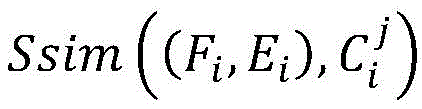

Degree of structural similarity The calculation formula of (2) is as follows:

wherein, is a fault class feature vector (F)i,Ei) And case of failure
 The number of the intersection attributes,
 is a fault class feature vector (F)i,Ei) And case of failure
 Number of union attributes.
Similarity of attributes The calculation formula of (2) is as follows:

wherein, a fault phenomenon interest model F is seti={(attr1:η1),(attr2:η2),…,(attrp:ηp) And failure case S { (attr) of (a)1:η1),(attr2:η2),…,(attrn:ηn) Consider only the common attributes of the two, then have

And

then The calculation formula of (2) is as follows:

model of attributes and behavioral characteristics of hypothetical device components
Ei={(name1:W1),(name2:W2),…,(nameq:Wq)}
And case of failure Attribute tag and behavior tag information in
E={(name1:W1),(name2:W2),…,(namem:Wm)}
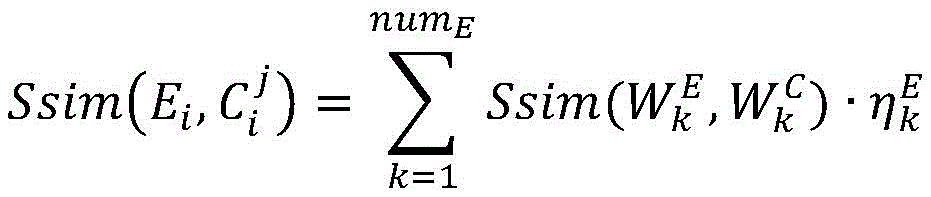
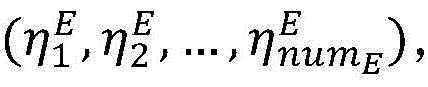
Considering only the common attribute of the two, then And
And and is the num through expert knowledgeEThe common attribute is given to the weight value according to different importance degrees
 Then
Then The calculation formula of (2) is as follows:
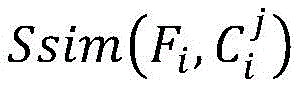
the value types of the weight values corresponding to the attribute tags and the behavior tags are a numerical type, a data interval type, a symbolic type determination and the like, aiming at different value types, the calculation method of (2) is as follows:
(1) numerical type Properties
A commonly used method for calculating the similarity of numerical attributes is as follows, max (W)k)、min(Wk) Are the maximum and minimum values of the property k in all cases.

(2) Data compartment type attribute
The similarity of the data interval type attributes is related to the upper and lower boundaries of the interval, and W is setk∈[Lk,Hk]Then, the similarity calculation formula is:

(3) determining symbolic attributes
Determining the symbolic attribute usually uses explicit notation to represent each value, and is a deterministic symbolic description, and the similarity calculation formula is as follows:

step 4.2: judging device portrait model MuOf the ith failure class (F)i,Ei) If the historical case and the solution thereof are applicable, the solution is directly applied to solve the current problem; if the fault type characteristic vector is not completely applicable, the maintenance scheme of the optimal similar case is corrected and stored in the characteristic case library, and then the personalized maintenance scheme of the fault type characteristic vector of the equipment is formed.
According to the method, a motor train unit is taken as a representative, an equipment portrait model is established by researching the differential fault phenomenon of important parts of complex products in the operation and maintenance process, optimal similar case recommendation is realized on the basis of a feature case library and a nearest neighbor search algorithm, and the formation of an individualized operation and maintenance scheme of the motor train unit is realized.
Although embodiments of the present invention have been shown and described above, it is understood that the above embodiments are exemplary and should not be construed as limiting the present invention, and that variations, modifications, substitutions and alterations can be made in the above embodiments by those of ordinary skill in the art without departing from the principle and spirit of the present invention.
The project of the invention is funded by a national key research project topic (No: 2018YFB1703402), an innovative seed fund of researchers at northwest university of industry (No: CX2020102) and great support of medium-sized Tangshan locomotive vehicle company Limited.
Claims (7)








Priority Applications (1)
| Application Number | Priority Date | Filing Date | Title |
|---|---|---|---|
| CN202110000266.6A CN112732787B (en) | 2021-01-02 | 2021-01-02 | Equipment profiling and personalized operation and maintenance service methods for important components of EMUs |
Applications Claiming Priority (1)
| Application Number | Priority Date | Filing Date | Title |
|---|---|---|---|
| CN202110000266.6A CN112732787B (en) | 2021-01-02 | 2021-01-02 | Equipment profiling and personalized operation and maintenance service methods for important components of EMUs |
Publications (2)
| Publication Number | Publication Date |
|---|---|
| CN112732787A true CN112732787A (en) | 2021-04-30 |
| CN112732787B CN112732787B (en) | 2024-04-16 |
Family
ID=75609460
Family Applications (1)
| Application Number | Title | Priority Date | Filing Date |
|---|---|---|---|
| CN202110000266.6A Active CN112732787B (en) | 2021-01-02 | 2021-01-02 | Equipment profiling and personalized operation and maintenance service methods for important components of EMUs |
Country Status (1)
| Country | Link |
|---|---|
| CN (1) | CN112732787B (en) |
Cited By (5)
| Publication number | Priority date | Publication date | Assignee | Title |
|---|---|---|---|---|
| CN115309890A (en) * | 2021-05-08 | 2022-11-08 | 中国移动通信集团浙江有限公司 | Fault classification method, device and equipment for video monitoring points |
| CN115685972A (en) * | 2022-11-08 | 2023-02-03 | 佳源科技股份有限公司 | Equipment fault diagnosis method based on FMECA and body |
| CN115946132A (en) * | 2023-03-15 | 2023-04-11 | 江西丹巴赫机器人股份有限公司 | An intelligent intensive warehouse and logistics robot system and its fault monitoring method |
| CN116523546A (en) * | 2023-06-29 | 2023-08-01 | 深圳市华图测控系统有限公司 | Method and device for intelligent reader behavior analysis and prediction system data acquisition and analysis |
| CN117312274A (en) * | 2023-10-08 | 2023-12-29 | 济南浪潮数据技术有限公司 | Database detection and repair method, system, storage medium and equipment |
Citations (10)
| Publication number | Priority date | Publication date | Assignee | Title |
|---|---|---|---|---|
| US5351247A (en) * | 1988-12-30 | 1994-09-27 | Digital Equipment Corporation | Adaptive fault identification system |
| US20170108856A1 (en) * | 2015-10-14 | 2017-04-20 | Honeywell International Inc. | Devices, methods, and systems for a distributed rule based automated fault detection |
| CN107168285A (en) * | 2017-05-26 | 2017-09-15 | 大连理工大学 | A kind of automobile intelligent fault diagnosis of combination subjective and objective information and cloud model and maintenance householder method and system |
| CN107315810A (en) * | 2017-06-27 | 2017-11-03 | 济南浪潮高新科技投资发展有限公司 | A kind of internet of things equipment behavior portrait method |
| CN109857831A (en) * | 2019-02-20 | 2019-06-07 | 云南电网有限责任公司信息中心 | A construction method of power equipment portrait label system based on big data technology |
| CN109902153A (en) * | 2019-04-02 | 2019-06-18 | 杭州安脉盛智能技术有限公司 | Equipment fault diagnosis method and system based on natural language processing and reasoning by cases |
| CN110070257A (en) * | 2019-01-04 | 2019-07-30 | 国网浙江省电力有限公司 | A kind of electric power acquisition O&M object portrait method based on label |
| WO2020215907A1 (en) * | 2019-04-23 | 2020-10-29 | 北京海益同展信息科技有限公司 | Server room inspection system |
| CN111966758A (en) * | 2020-06-30 | 2020-11-20 | 国网浙江省电力有限公司湖州供电公司 | Power hidden danger checking method based on portrait data analysis technology |
| CN112100506A (en) * | 2020-11-10 | 2020-12-18 | 中国电力科学研究院有限公司 | Information pushing method, system, equipment and storage medium |
-
2021
- 2021-01-02 CN CN202110000266.6A patent/CN112732787B/en active Active
Patent Citations (10)
| Publication number | Priority date | Publication date | Assignee | Title |
|---|---|---|---|---|
| US5351247A (en) * | 1988-12-30 | 1994-09-27 | Digital Equipment Corporation | Adaptive fault identification system |
| US20170108856A1 (en) * | 2015-10-14 | 2017-04-20 | Honeywell International Inc. | Devices, methods, and systems for a distributed rule based automated fault detection |
| CN107168285A (en) * | 2017-05-26 | 2017-09-15 | 大连理工大学 | A kind of automobile intelligent fault diagnosis of combination subjective and objective information and cloud model and maintenance householder method and system |
| CN107315810A (en) * | 2017-06-27 | 2017-11-03 | 济南浪潮高新科技投资发展有限公司 | A kind of internet of things equipment behavior portrait method |
| CN110070257A (en) * | 2019-01-04 | 2019-07-30 | 国网浙江省电力有限公司 | A kind of electric power acquisition O&M object portrait method based on label |
| CN109857831A (en) * | 2019-02-20 | 2019-06-07 | 云南电网有限责任公司信息中心 | A construction method of power equipment portrait label system based on big data technology |
| CN109902153A (en) * | 2019-04-02 | 2019-06-18 | 杭州安脉盛智能技术有限公司 | Equipment fault diagnosis method and system based on natural language processing and reasoning by cases |
| WO2020215907A1 (en) * | 2019-04-23 | 2020-10-29 | 北京海益同展信息科技有限公司 | Server room inspection system |
| CN111966758A (en) * | 2020-06-30 | 2020-11-20 | 国网浙江省电力有限公司湖州供电公司 | Power hidden danger checking method based on portrait data analysis technology |
| CN112100506A (en) * | 2020-11-10 | 2020-12-18 | 中国电力科学研究院有限公司 | Information pushing method, system, equipment and storage medium |
Non-Patent Citations (4)
| Title |
|---|
| MARK A ETAL.: "Product portfolio architectural complexity and operational performance :incorporating the roles of learning and fixed assets", JOURNAL OF OPERATIONS MANAGEMENT, vol. 29, no. 8 * |
| 刘冬梅;: "基于数据分析的车辆故障系统研发", 电子测量技术, no. 15 * |
| 寇兴怡;帅斌;黄文成;: "基于贝叶斯网络的高速动车组运营故障分析", 中国安全生产科学技术, no. 04, 30 April 2020 (2020-04-30) * |
| 赵永柱等: "基于电力资产全寿命周期的标签画像技术研究", 电网与清洁能源, vol. 34, no. 1 * |
Cited By (7)
| Publication number | Priority date | Publication date | Assignee | Title |
|---|---|---|---|---|
| CN115309890A (en) * | 2021-05-08 | 2022-11-08 | 中国移动通信集团浙江有限公司 | Fault classification method, device and equipment for video monitoring points |
| CN115685972A (en) * | 2022-11-08 | 2023-02-03 | 佳源科技股份有限公司 | Equipment fault diagnosis method based on FMECA and body |
| CN115946132A (en) * | 2023-03-15 | 2023-04-11 | 江西丹巴赫机器人股份有限公司 | An intelligent intensive warehouse and logistics robot system and its fault monitoring method |
| CN115946132B (en) * | 2023-03-15 | 2023-05-30 | 江西丹巴赫机器人股份有限公司 | Intelligent intensive warehouse and logistics robot system and fault monitoring method thereof |
| CN116523546A (en) * | 2023-06-29 | 2023-08-01 | 深圳市华图测控系统有限公司 | Method and device for intelligent reader behavior analysis and prediction system data acquisition and analysis |
| CN116523546B (en) * | 2023-06-29 | 2023-12-19 | 深圳市华图测控系统有限公司 | Method and device for intelligent reader behavior analysis and prediction system data acquisition and analysis |
| CN117312274A (en) * | 2023-10-08 | 2023-12-29 | 济南浪潮数据技术有限公司 | Database detection and repair method, system, storage medium and equipment |
Also Published As
| Publication number | Publication date |
|---|---|
| CN112732787B (en) | 2024-04-16 |
Similar Documents
| Publication | Publication Date | Title |
|---|---|---|
| Wu et al. | Literature review and prospect of the development and application of FMEA in manufacturing industry | |
| CN112732787A (en) | Equipment portrait and personalized operation and maintenance service method for important parts of motor train unit | |
| CN114579875B (en) | Equipment fault diagnosis and maintenance knowledge recommendation system based on knowledge graph | |
| CN113723632B (en) | Industrial equipment fault diagnosis method based on knowledge graph | |
| Cai et al. | Research on knowledge graph-driven equipment fault diagnosis method for intelligent manufacturing | |
| CN116644192A (en) | A knowledge map construction method based on the reliability of aircraft components | |
| CN105512195B (en) | A kind of product F MECA report analysis decision assistant method | |
| CN118035757A (en) | Electric drive assembly fault diagnosis method and device based on large language model | |
| CN117687824A (en) | Satellite fault diagnosis system based on quality problem knowledge graph | |
| Ding et al. | Brownian distance covariance-based few-shot learning framework considering noisy labels for fault diagnosis of train transmission systems | |
| CN119250540B (en) | Network security management method and system for digital asset | |
| CN114625883A (en) | A time series data and knowledge fusion characterization method for abnormal monitoring of industrial equipment | |
| CN112884179A (en) | Urban rail turn-back fault diagnosis method based on machine fault and text topic analysis | |
| CN116844336A (en) | Urban rail transit operation risk point comprehensive identification method based on accident text | |
| CN115619090A (en) | A Model-Based and Data-Driven Safety Assessment Method | |
| CN108337123A (en) | Individual networks awareness of safety Tendency Prediction method | |
| CN119884540B (en) | Dynamic truck scale metering method with automatic parameter fitting function | |
| CN118277941B (en) | Intelligent discovery method for abnormal price of civil aviation passenger ticket based on self-growth mechanism | |
| CN119180266A (en) | Historical data-based audit opinion generation method, device and equipment | |
| Li et al. | Research on construction of crude set model of critical fault information for bus based on can-bus data | |
| CN118552039A (en) | Identification and evaluation method and system for electric power spot market operation risk | |
| CN117762914A (en) | Data quality detection method and system | |
| Zhang et al. | Application of complex network theory in identifying critical elements of CRH2 train system | |
| CN113886592A (en) | Quality detection method for operation and maintenance data of power information communication system | |
| Liu et al. | Construction and Application of a Knowledge Graph in the Field of Fully Automated Metro Train Degraded Operation |
Legal Events
| Date | Code | Title | Description |
|---|---|---|---|
| PB01 | Publication | ||
| PB01 | Publication | ||
| SE01 | Entry into force of request for substantive examination | ||
| SE01 | Entry into force of request for substantive examination | ||
| GR01 | Patent grant | ||
| GR01 | Patent grant | ||
| OL01 | Intention to license declared | ||
| OL01 | Intention to license declared |