CN112712199B - Comprehensive energy system element location and volume determination method based on excitation demand response - Google Patents
Comprehensive energy system element location and volume determination method based on excitation demand response Download PDFInfo
- Publication number
- CN112712199B CN112712199B CN202011563529.6A CN202011563529A CN112712199B CN 112712199 B CN112712199 B CN 112712199B CN 202011563529 A CN202011563529 A CN 202011563529A CN 112712199 B CN112712199 B CN 112712199B
- Authority
- CN
- China
- Prior art keywords
- load
- generator
- diesel
- cost
- diesel generator
- Prior art date
- Legal status (The legal status is an assumption and is not a legal conclusion. Google has not performed a legal analysis and makes no representation as to the accuracy of the status listed.)
- Active
Links
Images


Classifications
-
- G—PHYSICS
- G06—COMPUTING OR CALCULATING; COUNTING
- G06Q—INFORMATION AND COMMUNICATION TECHNOLOGY [ICT] SPECIALLY ADAPTED FOR ADMINISTRATIVE, COMMERCIAL, FINANCIAL, MANAGERIAL OR SUPERVISORY PURPOSES; SYSTEMS OR METHODS SPECIALLY ADAPTED FOR ADMINISTRATIVE, COMMERCIAL, FINANCIAL, MANAGERIAL OR SUPERVISORY PURPOSES, NOT OTHERWISE PROVIDED FOR
- G06Q10/00—Administration; Management
- G06Q10/04—Forecasting or optimisation specially adapted for administrative or management purposes, e.g. linear programming or "cutting stock problem"
-
- G—PHYSICS
- G06—COMPUTING OR CALCULATING; COUNTING
- G06Q—INFORMATION AND COMMUNICATION TECHNOLOGY [ICT] SPECIALLY ADAPTED FOR ADMINISTRATIVE, COMMERCIAL, FINANCIAL, MANAGERIAL OR SUPERVISORY PURPOSES; SYSTEMS OR METHODS SPECIALLY ADAPTED FOR ADMINISTRATIVE, COMMERCIAL, FINANCIAL, MANAGERIAL OR SUPERVISORY PURPOSES, NOT OTHERWISE PROVIDED FOR
- G06Q50/00—Information and communication technology [ICT] specially adapted for implementation of business processes of specific business sectors, e.g. utilities or tourism
- G06Q50/06—Energy or water supply
-
- H—ELECTRICITY
- H02—GENERATION; CONVERSION OR DISTRIBUTION OF ELECTRIC POWER
- H02J—CIRCUIT ARRANGEMENTS OR SYSTEMS FOR SUPPLYING OR DISTRIBUTING ELECTRIC POWER; SYSTEMS FOR STORING ELECTRIC ENERGY
- H02J3/00—Circuit arrangements for AC mains or AC distribution networks
-
- H02J3/17—
-
- H—ELECTRICITY
- H02—GENERATION; CONVERSION OR DISTRIBUTION OF ELECTRIC POWER
- H02J—CIRCUIT ARRANGEMENTS OR SYSTEMS FOR SUPPLYING OR DISTRIBUTING ELECTRIC POWER; SYSTEMS FOR STORING ELECTRIC ENERGY
- H02J3/00—Circuit arrangements for AC mains or AC distribution networks
- H02J3/38—Arrangements for parallely feeding a single network by two or more generators, converters or transformers
- H02J3/381—Dispersed generators
-
- H—ELECTRICITY
- H02—GENERATION; CONVERSION OR DISTRIBUTION OF ELECTRIC POWER
- H02J—CIRCUIT ARRANGEMENTS OR SYSTEMS FOR SUPPLYING OR DISTRIBUTING ELECTRIC POWER; SYSTEMS FOR STORING ELECTRIC ENERGY
- H02J3/00—Circuit arrangements for AC mains or AC distribution networks
- H02J3/38—Arrangements for parallely feeding a single network by two or more generators, converters or transformers
- H02J3/46—Controlling of the sharing of output between the generators, converters, or transformers
- H02J3/466—Scheduling the operation of the generators, e.g. connecting or disconnecting generators to meet a given demand
-
- H02J2101/10—
-
- H02J2101/24—
-
- H02J2101/28—
-
- H02J2101/40—
-
- H02J2103/30—
-
- Y—GENERAL TAGGING OF NEW TECHNOLOGICAL DEVELOPMENTS; GENERAL TAGGING OF CROSS-SECTIONAL TECHNOLOGIES SPANNING OVER SEVERAL SECTIONS OF THE IPC; TECHNICAL SUBJECTS COVERED BY FORMER USPC CROSS-REFERENCE ART COLLECTIONS [XRACs] AND DIGESTS
- Y02—TECHNOLOGIES OR APPLICATIONS FOR MITIGATION OR ADAPTATION AGAINST CLIMATE CHANGE
- Y02B—CLIMATE CHANGE MITIGATION TECHNOLOGIES RELATED TO BUILDINGS, e.g. HOUSING, HOUSE APPLIANCES OR RELATED END-USER APPLICATIONS
- Y02B70/00—Technologies for an efficient end-user side electric power management and consumption
- Y02B70/30—Systems integrating technologies related to power network operation and communication or information technologies for improving the carbon footprint of the management of residential or tertiary loads, i.e. smart grids as climate change mitigation technology in the buildings sector, including also the last stages of power distribution and the control, monitoring or operating management systems at local level
- Y02B70/3225—Demand response systems, e.g. load shedding, peak shaving
-
- Y—GENERAL TAGGING OF NEW TECHNOLOGICAL DEVELOPMENTS; GENERAL TAGGING OF CROSS-SECTIONAL TECHNOLOGIES SPANNING OVER SEVERAL SECTIONS OF THE IPC; TECHNICAL SUBJECTS COVERED BY FORMER USPC CROSS-REFERENCE ART COLLECTIONS [XRACs] AND DIGESTS
- Y02—TECHNOLOGIES OR APPLICATIONS FOR MITIGATION OR ADAPTATION AGAINST CLIMATE CHANGE
- Y02E—REDUCTION OF GREENHOUSE GAS [GHG] EMISSIONS, RELATED TO ENERGY GENERATION, TRANSMISSION OR DISTRIBUTION
- Y02E10/00—Energy generation through renewable energy sources
- Y02E10/50—Photovoltaic [PV] energy
- Y02E10/56—Power conversion systems, e.g. maximum power point trackers
-
- Y—GENERAL TAGGING OF NEW TECHNOLOGICAL DEVELOPMENTS; GENERAL TAGGING OF CROSS-SECTIONAL TECHNOLOGIES SPANNING OVER SEVERAL SECTIONS OF THE IPC; TECHNICAL SUBJECTS COVERED BY FORMER USPC CROSS-REFERENCE ART COLLECTIONS [XRACs] AND DIGESTS
- Y04—INFORMATION OR COMMUNICATION TECHNOLOGIES HAVING AN IMPACT ON OTHER TECHNOLOGY AREAS
- Y04S—SYSTEMS INTEGRATING TECHNOLOGIES RELATED TO POWER NETWORK OPERATION, COMMUNICATION OR INFORMATION TECHNOLOGIES FOR IMPROVING THE ELECTRICAL POWER GENERATION, TRANSMISSION, DISTRIBUTION, MANAGEMENT OR USAGE, i.e. SMART GRIDS
- Y04S20/00—Management or operation of end-user stationary applications or the last stages of power distribution; Controlling, monitoring or operating thereof
- Y04S20/20—End-user application control systems
- Y04S20/222—Demand response systems, e.g. load shedding, peak shaving
Landscapes
- Engineering & Computer Science (AREA)
- Business, Economics & Management (AREA)
- Economics (AREA)
- Human Resources & Organizations (AREA)
- Power Engineering (AREA)
- Strategic Management (AREA)
- Theoretical Computer Science (AREA)
- General Physics & Mathematics (AREA)
- Physics & Mathematics (AREA)
- Marketing (AREA)
- General Business, Economics & Management (AREA)
- Health & Medical Sciences (AREA)
- Tourism & Hospitality (AREA)
- Public Health (AREA)
- Primary Health Care (AREA)
- General Health & Medical Sciences (AREA)
- Water Supply & Treatment (AREA)
- Development Economics (AREA)
- Game Theory and Decision Science (AREA)
- Entrepreneurship & Innovation (AREA)
- Operations Research (AREA)
- Quality & Reliability (AREA)
- Supply And Distribution Of Alternating Current (AREA)
Abstract
本申请涉及基于激励的需求响应下综合能源系统元件选址定容方法,属于综合能源需求侧响应研究领域,该方法包括:针对综合能源系统中元件的类型和数量,构建基于激励的需求响应下的系统模型;确定选址定容的目标函数;基于系统模型,对目标函数进行求解,算出系统的最低净成本以及系统在净成本最低的情况下各个元件的容量;将系统的最低净成本与未考虑需求响应的系统净成本进行比对,并计算下降的成本百分比;根据成本百分比和各个元件的容量进行选址定容。本申请实施例在容量优化过程中考虑了用户经济利益和系统电力储备,即,有效的将需求响应应用于综合能源系统的容量优化中,从而达到降低综合能源系统的净成本的有益效果。

This application relates to the method of site selection and capacity determination of components in an integrated energy system under incentive-based demand response, which belongs to the research field of integrated energy demand-side response. system model; determine the objective function of site selection and fixed capacity; based on the system model, solve the objective function to calculate the minimum net cost of the system and the capacity of each component of the system under the condition of the minimum net cost; compare the minimum net cost of the system with the Compare the net cost of the system without considering demand response, and calculate the percentage of cost reduction; select the site and capacity according to the percentage of cost and the capacity of each component. In the embodiment of the present application, the user's economic interests and system power reserve are considered in the process of capacity optimization, that is, the demand response is effectively applied to the capacity optimization of the integrated energy system, thereby achieving the beneficial effect of reducing the net cost of the integrated energy system.
Description
技术领域technical field
本申请涉及综合能源需求侧响应研究领域,特别是涉及基于激励的需求响应下综合能源系统元件选址定容方法。This application relates to the research field of integrated energy demand side response, in particular to the method of site selection and capacity determination of integrated energy system components under incentive-based demand response.
背景技术Background technique
2006年美国能源部首次提出需求响应的概念,是指电网与用户双向互动,引导用户在峰荷时段降低电力需求或在低谷时段增加电力需求,以达到新增较少的装机容量达到系统的电力供需平衡目的,实现社会效益最好、各方收益、最低成本能源服务。In 2006, the U.S. Department of Energy first proposed the concept of demand response, which refers to the two-way interaction between the power grid and users, guiding users to reduce power demand during peak load periods or increase power demand during trough periods, so as to achieve less new installed capacity to reach the power of the system The purpose of balancing supply and demand is to achieve the best social benefits, the benefits of all parties, and the lowest cost energy services.
在能源互联网背景下,分散化的能源市场和能源网络结构使得传统的电力需求侧响应逐步向综合需求侧响应的方向发展。针对于此,2015年国外学者Aras Sheikhi和Shahab Bahrami首次提出了综合需求响应(IDR)的概念。相较于传统需求响应将负荷进行时间平移的技术手段,综合需求响应将能源替代和转换作为技术手段引入到了需求响应中。综合需求侧响应依托于用户侧的多能源智能管理系统,其通过电力市场、天然气市场、碳交易市场等多个能源市场的价格或激励信号引导改变用户的综合用能行为。综合需求侧响应的实施目标是实现能源互联网中供需双侧资源协调优化,提高用户用能的可替代性,提高能源互联网中多能源系统以及多能源市场的运行稳定性和运行效率。In the context of energy Internet, the decentralized energy market and energy network structure make the traditional power demand side response gradually develop towards the comprehensive demand side response. In response to this, foreign scholars Aras Sheikhi and Shahab Bahrami first proposed the concept of Integrated Demand Response (IDR) in 2015. Compared with the technical means of time-shifting load in traditional demand response, integrated demand response introduces energy substitution and conversion as a technical means into demand response. Comprehensive demand-side response relies on the multi-energy intelligent management system on the user side, which guides and changes the comprehensive energy consumption behavior of users through the price or incentive signals of multiple energy markets such as the electricity market, natural gas market, and carbon trading market. The implementation goal of comprehensive demand-side response is to realize the coordination and optimization of resources on both sides of supply and demand in the Energy Internet, improve the substitutability of energy consumption by users, and improve the operational stability and efficiency of multi-energy systems and multi-energy markets in the Energy Internet.
随着电力市场的逐步改革和综合能源市场的不断发展,系统运营者可充分利用价格信号以及激励响应等因素,充分利用需求侧资源,终端能源用户可作为需求响应的直接参与者参与调度运行,为提高综合能源系统运行的经济性和可靠性提供重要保障。With the gradual reform of the electricity market and the continuous development of the comprehensive energy market, system operators can make full use of factors such as price signals and incentive responses to make full use of demand-side resources, and end energy users can participate in dispatching operations as direct participants of demand response. It provides an important guarantee for improving the economy and reliability of the operation of the integrated energy system.
目前现有的一些文献引入了一个舒适指标,通过用户主动参与需求侧响应计划来实施奖励。需求侧响应是为了应对电力市场的间歇性风电而实施的。在另外一些文献中,需求侧响应计划被重新制定,以减少智能电网结构下的电费。还有一部分文献,针对具有可再生能源和能量存储的负载中心的不可延迟负载,提出了一种需求响应策略,以优化可再生能源的功耗。Some of the current existing literature introduces a comfort index to implement incentives through users' active participation in demand-side response programs. Demand side response is implemented in response to intermittent wind power in the electricity market. In other literatures, demand side response programs have been reformulated to reduce electricity bills under smart grid structures. There is also a part of the literature that proposes a demand response strategy to optimize the power consumption of renewable energy for non-deferrable loads in load centers with renewable energy and energy storage.
目前针对相关技术中如何将需求响应应用于综合能源系统的容量优化中以降低综合能源系统的净成本,尚未提出有效的解决方案。At present, no effective solution has been proposed for how to apply demand response to the capacity optimization of the integrated energy system in related technologies to reduce the net cost of the integrated energy system.
发明内容Contents of the invention
本申请实施例提供了一种基于激励的需求响应下综合能源系统元件选址定容方法和系统,以至少解决相关技术中如何将需求响应应用于综合能源系统的容量优化中以降低综合能源系统的净成本的问题。The embodiment of the present application provides a method and system for site selection and capacity determination of components of an integrated energy system based on demand response based on incentives, to at least solve how to apply demand response to the capacity optimization of an integrated energy system in the related art to reduce the energy consumption of the integrated energy system. net cost of the problem.
第一方面,本申请实施例提供了一种基于激励的需求响应下综合能源系统元件选址定容方法,包括:针对综合能源系统中元件的类型和数量,构建基于激励的需求响应下的系统模型;确定选址定容的目标函数;基于所述系统模型,对所述目标函数进行求解,算出所述系统的最低净成本以及所述系统在净成本最低的情况下各个所述元件的容量;将所述系统的最低净成本与未考虑需求响应的系统净成本进行比对,并计算下降的成本百分比;根据所述成本百分比和各个所述元件的容量进行选址定容。In the first aspect, the embodiment of the present application provides a method for site selection and capacity determination of components of an integrated energy system under incentive-based demand response, including: constructing a system under incentive-based demand response according to the type and quantity of components in the integrated energy system Model; determine the objective function of site selection and fixed capacity; based on the system model, solve the objective function to calculate the minimum net cost of the system and the capacity of each of the components of the system when the net cost is the lowest ; Comparing the minimum net cost of the system with the net cost of the system without considering the demand response, and calculating the reduced cost percentage; performing site selection and capacity determination according to the cost percentage and the capacity of each of the components.
在其中一些实施例中,在所述元件包括柴油发电机的情况下,所述构建基于激励的需求响应下的系统模型包括:In some of these embodiments, in the case where the element includes a diesel generator, the building of the system model under incentive-based demand response includes:
用于供应负载和备用的在线柴油发电机的最小数量MinDGon为:The minimum number of on-line diesel generators MinDG on for supplying load and backup is:
MinDGon(t)=ceil((Pload(t)+Rs)/Pr(dg))MinDG on (t)=ceil((P load (t)+R s )/P r(dg) )
其中,ceil是向上取整函数,Pload是负载有功功率,Rs是静态旋转备用,Pr(dg)是柴油发电机的发电功率有铭值,t是时间;Among them, ceil is the function of rounding up, P load is the active power of the load, R s is the static spinning reserve, P r(dg) is the nominal value of the power generation of the diesel generator, and t is the time;
柴油发电机的实际输出功率Pdg(t)满足以下约束:The actual output power Pdg(t) of the diesel generator satisfies the following constraints:
MinDGon(t)·DGmin·Pr(dg)≤Pdg(t)≤Ndg·DGmax·Pr(dg) MinDG on (t) DG min P r(dg) ≤P dg(t) ≤N dg DG max P r(dg)
Pdg(t)≥Pload(t) P dg(t) ≥P load(t)
其中,DGmin是柴油发电机的负载下限标幺值,DGmax是柴油发电机的负载上限标幺值,Ndg是柴油发电机的数量;Among them, DG min is the lower limit per unit value of the diesel generator load, DG max is the upper limit per unit value of the diesel generator load, and N dg is the number of diesel generators;
实际的投入使用的柴油发电机数量DGon为:The actual number of diesel generators DG on put into use is:
DGon(t)=ceil(Pdg(t)/(DGmax·Pr(dg)))。DG on (t)=ceil(P dg (t)/(DG max ·P r(dg) )).
在其中一些实施例中,在所述元件包括柴油发电机、太阳能光伏和风力发电机的情况下,所述构建基于激励的需求响应下的系统模型包括:In some of these embodiments, in the case where the components include diesel generators, solar photovoltaics and wind power generators, the building of the system model under incentive-based demand response includes:
所述太阳能光伏和所述风力发电机的总发电量Pre为:The total power generation P re of the solar photovoltaic and the wind generator is:
Pre(t)=NwtPwt(t)+NpvPpv(t) Pre (t)=N wt P wt (t)+N pv P pv (t)
其中,Nwt为风力发电机的数量,Npv为太阳能光伏的数量,Pwt为风力发电机输出功率,Ppv为太阳能光伏输出功率,t为时间;Among them, N wt is the number of wind turbines, N pv is the number of solar photovoltaics, P wt is the output power of wind turbines, P pv is the output power of solar photovoltaics, and t is time;
用于供应负载和备用的在线柴油发电机的最小数量MinDGon为:The minimum number of on-line diesel generators MinDG on for supplying load and backup is:
MinDGon(t)=ceil((Pload(t)+Rs)/Pr(dg))MinDG on (t)=ceil((P load (t)+R s )/P r(dg) )
其中,ceil是向上取整函数,Pload是负载有功功率,Rs是静态旋转备用,Pr(dg)是柴油发电机的发电功率有铭值;Among them, ceil is the function of rounding up, P load is the active power of the load, R s is the static spinning reserve, P r(dg) is the nominal value of the power generation of the diesel generator;
柴油发电机的实际输出功率Pdg(t)满足以下约束:The actual output power Pdg(t) of the diesel generator satisfies the following constraints:
MinDGon(t)·DGmin·Pr(dg)≤Pdg(t)≤Ndg·DGmax·Pr(dg) MinDG on (t) DG min P r(dg) ≤P dg(t) ≤N dg DG max P r(dg)
Pdg(t)≥Pload(t)-Pre(t) P dg(t) ≥P load(t) -P re(t)
其中,DGmin是柴油发电机的负载下限标幺值,DGmax是柴油发电机的负载上限标幺值,Ndg是柴油发电机的数量。Among them, DG min is the lower limit per unit of diesel generator load, DG max is the upper limit per unit of diesel generator load, and N dg is the number of diesel generators.
在其中一些实施例中,在所述元件包括柴油发电机、太阳能光伏、风力发电机和电池的情况下,所述构建基于激励的需求响应下的系统模型包括:In some of these embodiments, in the case that the components include diesel generators, solar photovoltaics, wind power generators and batteries, the construction of the system model under incentive-based demand response includes:
用于供应负载和备用的在线柴油发电机的最小数量MinDGon为:The minimum number of on-line diesel generators MinDG on for supplying load and backup is:
MinDGon(t)=ceil((Pload(t)+Rs-BBout(t))/Pr(dg))MinDG on (t)=ceil((P load (t)+R s -BB out (t))/P r(dg) )
其中,ceil是向上取整函数,Pload是负载有功功率,Rs是静态旋转备用,BBout是可获取的电池输出功率,Pr(dg)是柴油发电机的发电功率有铭值,t是时间;Among them, ceil is the function of rounding up, P load is the active power of the load, R s is the static spinning reserve, BB out is the available battery output power, P r(dg) is the nominal value of the power generation of the diesel generator, t is time;
所述太阳能光伏和所述风力发电机的总发电量Pre为:The total power generation P re of the solar photovoltaic and the wind generator is:
Pre(t)=NwtPwt(t)+NpvPpv(t) Pre (t)=N wt P wt (t)+N pv P pv (t)
其中,Nwt为风力发电机的数量,Npv为太阳能光伏的数量,Pwt为风力发电机输出功率,Ppv为太阳能光伏输出功率;Among them, N wt is the number of wind turbines, N pv is the number of solar photovoltaics, P wt is the output power of wind turbines, and P pv is the output power of solar photovoltaics;
柴油发电机的实际输出功率Pdg(t)满足以下约束:The actual output power Pdg(t) of the diesel generator satisfies the following constraints:
MinDGon(t)·DGmin·Pr(dg)≤Pdg(t)≤Ndg·DGmax·Pr(dg) MinDG on (t) DG min P r(dg) ≤P dg(t) ≤N dg DG max P r(dg)
Pdg(t)≥Pload(t)-Pre(t)-BBout(t)P dg(t) ≥P load(t) -P re(t) -BB out (t)
其中,DGmin是柴油发电机的负载下限标幺值,DGmax是柴油发电机的负载上限标幺值,Ndg是柴油发电机的数量。Among them, DG min is the lower limit per unit of diesel generator load, DG max is the upper limit per unit of diesel generator load, and N dg is the number of diesel generators.
在其中一些实施例中,在所述系统的总发电量超出负载需求的情况下,对所述电池进行充电,且所述电池的输入功率Pbb.in为:In some of these embodiments, when the total power generation of the system exceeds the load demand, the battery is charged, and the input power P bb.in of the battery is:
Pbb.in(t)=min(BBbb.in(t),Pre(t)+MinPdg(t)-Pload(t))P bb.in (t)=min(BB bb.in (t),P re (t)+MinP dg (t)-P load (t))
Pbb.out(t)=0P bb.out (t) = 0
其中,min表示取最小值,BBbb.in为电池充电功率,Pbb.out为电池的输出功率。Among them, min means to take the minimum value, BB bb.in is the charging power of the battery, and P bb.out is the output power of the battery.
在其中一些实施例中,在所述系统的总发电量不满足负载需求的情况下,所述电池进行放电,且所述电池的输出功率Pbb.out为:In some of these embodiments, when the total power generation of the system does not meet the load demand, the battery is discharged, and the output power P bb.out of the battery is:
Pbb.out(t)=min(BBbb.out(t),Pload(t)-MinPdg(t)-Pre(t))P bb.out (t)=min(BB bb.out (t),P load (t)-MinP dg (t)-P re (t))
Pbb.in(t)=0P bb.in (t) = 0
其中,min表示取最小值,BBbb.out为电池放电功率,Pbb.in为电池的输入功率。Among them, min means to take the minimum value, BB bb.out is the discharge power of the battery, and P bb.in is the input power of the battery.
在其中一些实施例中,在所述元件包括柴油发电机、太阳能光伏、风力发电机、电池和飞轮的情况下,所述构建基于激励的需求响应下的系统模型包括:In some of these embodiments, in the case where the components include diesel generators, solar photovoltaics, wind generators, batteries and flywheels, the building of the system model under incentive-based demand response includes:
用于供应负载和备用的在线柴油发电机的最小数量MinDGon为:The minimum number of on-line diesel generators MinDG on for supplying load and backup is:
MinDGon(t)=ceil((Pload(t)+Rs-BBout(t)-FWout(t))/Pr(dg))MinDG on (t)=ceil((P load (t)+R s -BB out (t)-FW out (t))/P r(dg) )
其中,ceil是向上取整函数,Pload是负载有功功率,Rs是静态旋转备用,BBout是可获取的电池输出功率,FWout是飞轮的输出功率,Pr(dg)是柴油发电机的发电功率有铭值,t是时间;Among them, ceil is the function of rounding up, P load is the load active power, R s is the static spinning reserve, BB out is the available battery output power, FW out is the output power of the flywheel, P r(dg) is the diesel generator The generating power has a name value, and t is time;
所述太阳能光伏和所述风力发电机的总发电量Pre为:The total power generation P re of the solar photovoltaic and the wind generator is:
Pre(t)=NwtPwt(t)+NpvPpv(t) Pre (t)=N wt P wt (t)+N pv P pv (t)
其中,Nwt为风力发电机的数量,Npv为太阳能光伏的数量,Pwt为风力发电机输出功率,Ppv为太阳能光伏输出功率;Among them, N wt is the number of wind turbines, N pv is the number of solar photovoltaics, P wt is the output power of wind turbines, and P pv is the output power of solar photovoltaics;
柴油发电机的实际输出功率Pdg(t)满足以下约束:The actual output power Pdg(t) of the diesel generator satisfies the following constraints:
MinDGon(t)·DGmin·Pr(dg)≤Pdg(t)≤Ndg·DGmax·Pr(dg) MinDG on (t) DG min P r(dg) ≤P dg(t) ≤N dg DG max P r(dg)
Pdg(t)≥Pload(t)-Pre(t)-BBout(t)P dg(t) ≥P load(t) -P re(t) -BB out (t)
其中,DGmin是柴油发电机的负载下限标幺值,DGmax是柴油发电机的负载上限标幺值,Ndg是柴油发电机的数量。Among them, DG min is the lower limit per unit of diesel generator load, DG max is the upper limit per unit of diesel generator load, and N dg is the number of diesel generators.
在其中一些实施例中,所述的确定选址定容的目标函数包括:In some of these embodiments, the objective function for determining the location and capacity includes:
针对所述系统的净成本NPC,确定所述目标函数为:For the net cost NPC of the system, determine the objective function as:

在其中一些实施例中,所述的基于所述系统模型,对所述目标函数进行求解包括:In some of these embodiments, the solving of the objective function based on the system model includes:
保留满足以下约束条件的所述目标函数的解,丢弃不满足以下约束条件的所述目标函数的解:Keep the solutions of the objective function that satisfy the following constraints, and discard the solutions of the objective function that do not satisfy the following constraints:
发电机组功率的约束:Pi(min)(t)≤Pi(t)≤Pi(max)(t);Generator set power constraints: P i(min) (t)≤P i (t)≤P i(max) (t);
储能机组能量的约束:Ei(min)(t)≤Ei(t)≤Ei(max)(t);Constraints on the energy of energy storage units: E i(min) (t)≤E i (t)≤E i(max) (t);
系统运行备用约束:
负载均衡约束: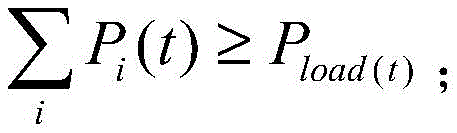
其中,Pi为元件有功功率,Ei为装置容量,Rs为静态旋转备用,Rd为动态备用,Pload为负载有功功率,t为时间。Among them, P i is the active power of the components, E i is the capacity of the device, R s is the static spinning reserve, R d is the dynamic reserve, P load is the active power of the load, and t is the time.
第二方面,本申请实施例提供了一种基于激励的需求响应下综合能源系统元件选址定容装置,包括:模型构建模块、函数确定模块、最低净成本计算模块、净成本比对模块和选址定容模块,其中,模型构建模块用于针对综合能源系统中元件的类型和数量,构建基于激励的需求响应下的系统模型;函数确定模块用于确定选址定容的目标函数;最低净成本计算模块用于基于所述系统模型,对所述目标函数进行求解,算出所述系统的最低净成本以及所述系统在净成本最低的情况下各个所述元件的容量;净成本比对模块用于将所述系统的最低净成本与未考虑需求响应的系统净成本进行比对,并计算下降的成本百分比;选址定容模块用于根据所述成本百分比和各个所述元件的容量进行选址定容。In the second aspect, the embodiment of the present application provides a device for site selection and capacity determination of integrated energy system components based on demand response based on incentives, including: a model building module, a function determination module, a minimum net cost calculation module, a net cost comparison module and The siting and capacity module, in which the model building module is used to construct a system model under the demand response based on incentives for the type and quantity of components in the integrated energy system; the function determination module is used to determine the objective function of the site selection; the minimum The net cost calculation module is used to solve the objective function based on the system model, and calculate the minimum net cost of the system and the capacity of each of the components of the system when the net cost is the lowest; net cost comparison The module is used to compare the minimum net cost of the system with the net cost of the system without considering demand response, and calculate the percentage of cost reduction; the site selection and capacity determination module is used to Perform site selection and capacity determination.
根据以上内容,本申请实施例的基于激励的需求响应下综合能源系统元件选址定容方法包括:针对综合能源系统中元件的类型和数量,构建基于激励的需求响应下的系统模型;确定选址定容的目标函数;基于系统模型,对目标函数进行求解,算出系统的最低净成本以及系统在净成本最低的情况下各个元件的容量;将系统的最低净成本与未考虑需求响应的系统净成本进行比对,并计算下降的成本百分比;根据成本百分比和各个元件的容量进行选址定容。本申请实施例在容量优化过程中考虑了用户经济利益和系统电力储备,即,有效的将需求响应应用于综合能源系统的容量优化中,从而达到降低综合能源系统的净成本的有益效果。Based on the above, the method for site selection and capacity determination of components in an integrated energy system under incentive-based demand response according to the embodiment of the present application includes: constructing a system model under incentive-based demand response according to the type and quantity of components in the integrated energy system; Based on the system model, solve the objective function to calculate the minimum net cost of the system and the capacity of each component in the case of the system with the lowest net cost; compare the minimum net cost of the system with the system without considering demand response Compare the net cost and calculate the reduced cost percentage; select the location and capacity according to the cost percentage and the capacity of each component. In the embodiment of the present application, the user's economic interests and system power reserve are considered in the process of capacity optimization, that is, the demand response is effectively applied to the capacity optimization of the integrated energy system, thereby achieving the beneficial effect of reducing the net cost of the integrated energy system.
附图说明Description of drawings
此处所说明的附图用来提供对本申请的进一步理解,构成本申请的一部分,本申请的示意性实施例及其说明用于解释本申请,并不构成对本申请的不当限定。在附图中:The drawings described here are used to provide a further understanding of the application and constitute a part of the application. The schematic embodiments and descriptions of the application are used to explain the application and do not constitute an improper limitation to the application. In the attached picture:
图1是根据本申请实施例的基于激励的需求响应下综合能源系统元件选址定容方法的流程图;Fig. 1 is a flowchart of a method for site selection and capacity determination of components of an integrated energy system under incentive-based demand response according to an embodiment of the present application;
图2是根据本申请实施例的四种类型的综合能源系统中元件示意图;Fig. 2 is a schematic diagram of elements in four types of integrated energy systems according to an embodiment of the present application;
图3是根据本申请实施例的旋转备用与可用的各元件备用的分类明细示意图;Fig. 3 is a schematic diagram of classification details of spinning reserve and available component reserve according to an embodiment of the present application;
图4是根据本申请实施例的基于激励的需求响应下综合能源系统元件选址定容装置的结构框图。Fig. 4 is a structural block diagram of a device for site selection and capacity determination of components of an integrated energy system under incentive-based demand response according to an embodiment of the present application.
具体实施方式detailed description
为了使本申请的目的、技术方案及优点更加清楚明白,以下结合附图及实施例,对本申请进行描述和说明。应当理解,此处所描述的具体实施例仅仅用以解释本申请,并不用于限定本申请。基于本申请提供的实施例,本领域普通技术人员在没有作出创造性劳动的前提下所获得的所有其他实施例,都属于本申请保护的范围。In order to make the purpose, technical solutions and advantages of the present application clearer, the present application will be described and illustrated below in conjunction with the accompanying drawings and embodiments. It should be understood that the specific embodiments described here are only used to explain the present application, and are not intended to limit the present application. Based on the embodiments provided in the present application, all other embodiments obtained by persons of ordinary skill in the art without creative efforts shall fall within the protection scope of the present application.
显而易见地,下面描述中的附图仅仅是本申请的一些示例或实施例,对于本领域的普通技术人员而言,在不付出创造性劳动的前提下,还可以根据这些附图将本申请应用于其他类似情景。此外,还可以理解的是,虽然这种开发过程中所作出的努力可能是复杂并且冗长的,然而对于与本申请公开的内容相关的本领域的普通技术人员而言,在本申请揭露的技术内容的基础上进行的一些设计,制造或者生产等变更只是常规的技术手段,不应当理解为本申请公开的内容不充分。Obviously, the accompanying drawings in the following description are only some examples or embodiments of the present application, and those skilled in the art can also apply the present application to other similar scenarios. In addition, it can also be understood that although such development efforts may be complex and lengthy, for those of ordinary skill in the art relevant to the content disclosed in this application, the technology disclosed in this application Some design, manufacturing or production changes based on the content are just conventional technical means, and should not be understood as insufficient content disclosed in this application.
在本申请中提及“实施例”意味着,结合实施例描述的特定特征、结构或特性可以包含在本申请的至少一个实施例中。在说明书中的各个位置出现该短语并不一定均是指相同的实施例,也不是与其它实施例互斥的独立的或备选的实施例。本领域普通技术人员显式地和隐式地理解的是,本申请所描述的实施例在不冲突的情况下,可以与其它实施例相结合。Reference in this application to an "embodiment" means that a particular feature, structure, or characteristic described in connection with the embodiment can be included in at least one embodiment of the present application. The occurrences of this phrase in various places in the specification are not necessarily all referring to the same embodiment, nor are separate or alternative embodiments mutually exclusive of other embodiments. It is understood explicitly and implicitly by those of ordinary skill in the art that the embodiments described in this application can be combined with other embodiments without conflict.
除非另作定义,本申请所涉及的技术术语或者科学术语应当为本申请所属技术领域内具有一般技能的人士所理解的通常意义。本申请所涉及的“一”、“一个”、“一种”、“该”等类似词语并不表示数量限制,可表示单数或复数。本申请所涉及的术语“包括”、“包含”、“具有”以及它们任何变形,意图在于覆盖不排他的包含;例如包含了一系列步骤或模块(单元)的过程、方法、系统、产品或设备没有限定于已列出的步骤或单元,而是可以还包括没有列出的步骤或单元,或可以还包括对于这些过程、方法、产品或设备固有的其它步骤或单元。本申请所涉及的“连接”、“相连”、“耦接”等类似的词语并非限定于物理的或者机械的连接,而是可以包括电气的连接,不管是直接的还是间接的。本申请所涉及的“多个”是指两个或两个以上。“和/或”描述关联对象的关联关系,表示可以存在三种关系,例如,“A和/或B”可以表示:单独存在A,同时存在A和B,单独存在B这三种情况。字符“/”一般表示前后关联对象是一种“或”的关系。本申请所涉及的术语“第一”、“第二”、“第三”等仅仅是区别类似的对象,不代表针对对象的特定排序。Unless otherwise defined, the technical terms or scientific terms involved in the application shall have the usual meanings understood by those with ordinary skill in the technical field to which the application belongs. Words such as "a", "an", "an" and "the" involved in this application do not indicate a limitation on quantity, and may indicate singular or plural numbers. The terms "comprising", "comprising", "having" and any variations thereof involved in this application are intended to cover non-exclusive inclusion; for example, a process, method, system, product or process that includes a series of steps or modules (units). The apparatus is not limited to the listed steps or units, but may further include steps or units not listed, or may further include other steps or units inherent to the process, method, product or apparatus. The words "connected", "connected", "coupled" and similar words mentioned in this application are not limited to physical or mechanical connection, but may include electrical connection, no matter it is direct or indirect. The "plurality" involved in this application refers to two or more than two. "And/or" describes the association relationship of associated objects, indicating that there may be three types of relationships. For example, "A and/or B" may indicate: A exists alone, A and B exist simultaneously, and B exists independently. The character "/" generally indicates that the contextual objects are an "or" relationship. The terms "first", "second", "third" and the like involved in this application are only used to distinguish similar objects, and do not represent a specific ordering of objects.
本申请实施例提供的一种计及基于激励的需求响应下综合能源系统元件选址定容方法中,可以通过用户主动参与需求侧响应计划来实施奖励,发挥激励需求侧响应的作用。图1是根据本申请实施例的基于激励的需求响应下综合能源系统元件选址定容方法的流程图,如图1所示,该方法包括:In a method for site selection and capacity determination of components of an integrated energy system that considers incentive-based demand response provided by an embodiment of the present application, rewards can be implemented by users actively participating in the demand-side response plan, and play the role of stimulating demand-side response. Fig. 1 is a flowchart of a method for site selection and capacity determination of components of an integrated energy system under incentive-based demand response according to an embodiment of the present application. As shown in Fig. 1 , the method includes:
S100:针对综合能源系统中元件的类型和数量,构建基于激励的需求响应下的系统模型;S100: Construct a system model under incentive-based demand response for the types and quantities of components in the integrated energy system;
S200:确定选址定容的目标函数;S200: Determine the objective function of site selection and capacity determination;
S300:基于系统模型,对目标函数进行求解,算出系统的最低净成本以及系统在净成本最低的情况下各个元件的容量;S300: Based on the system model, solve the objective function, calculate the minimum net cost of the system and the capacity of each component of the system under the condition of the minimum net cost;
S400:将系统的最低净成本与未考虑需求响应的系统净成本进行比对,并计算下降的成本百分比;S400: Comparing the minimum net cost of the system with the net cost of the system without considering demand response, and calculating the percentage of cost reduction;
S500:根据成本百分比和各个元件的容量进行选址定容。S500: site selection and capacity determination based on the cost percentage and the capacity of each component.
基于以上内容,能够有效的将需求响应应用于综合能源系统的容量优化中,达到了降低综合能源系统的净成本的目的。Based on the above content, the demand response can be effectively applied to the capacity optimization of the integrated energy system, and the goal of reducing the net cost of the integrated energy system is achieved.
考虑到一个完全可再生的独立电力系统,当需求侧响应规划在最佳规模下实施时,与其他组件(光伏电池板和风力涡轮机)相比,电池的存储容量被有效地降低了。然而,因为电池储能成本极高,以一个完整的可再生能源为基础的电力系统仍然是负担不起的。Considering a fully renewable stand-alone power system, when demand-side response planning is implemented at an optimal scale, the storage capacity of batteries is effectively reduced compared to other components (photovoltaic panels and wind turbines). However, due to the extremely high cost of battery energy storage, an electricity system based entirely on renewable energy remains unaffordable.
因此,本申请实施例中,将不同的元件设备投入使用,以构成四种类型的综合能源系统,图2是根据本申请实施例的四种类型的综合能源系统中元件示意图,如图2所示:Therefore, in the embodiment of the present application, different components and equipment are put into use to form four types of integrated energy systems. Figure 2 is a schematic diagram of components in the four types of integrated energy systems according to the embodiment of the application, as shown in Figure 2 Show:
类型一:柴油发电机为主的基本构型(基本只考虑柴油发电机);Type 1: The basic configuration based on diesel generators (basically only consider diesel generators);
类型二:在类型一的基础上添加了太阳能光伏和风力发电机这两种可再生能源,即包括柴油发电机、太阳能光伏和风力发电机;Type 2: On the basis of
类型三:在类型二的基础上添加了电池储能,即包括柴油发电机、太阳能光伏、风力发电机和电池;Type 3: Battery energy storage is added on the basis of
类型四:在类型三的基础上增加飞轮,即包括柴油发电机、太阳能光伏、风力发电机、电池和飞轮。Type 4: Flywheels are added on the basis of
可见,以上四种类型的综合能源系统中分别包含不同类型和数量的元件,对此,分别构建基于激励的需求响应下的系统模型,并对选址定容的目标函数进行求解,使各综合能源系统的净成本达到最低,得出各类型系统的最低净成本以及在系统净成本最低的情况下各个元件的容量,并且,将考虑了激励需求响应的系统净成本(即上述最低净成本)与未考虑需求响应的系统净成本进行逐一比对,计算下降的成本百分比,从而根据上述各个元件的容量和上述成本百分比来选址定容。进一步的提出了虚拟同步发电机控制原理。因此,本申请实施例在容量优化过程中考虑了用户经济利益和系统电力储备,以此来优化模型,能够极大的降低系统净成本。It can be seen that the above four types of integrated energy systems contain different types and quantities of components respectively. For this, the system models under incentive-based The net cost of the energy system is minimized, resulting in the minimum net cost of each type of system and the capacity of each element at the minimum net system cost, and will take into account the net cost of the system that motivates demand response (i.e. the minimum net cost above) Comparing with the net cost of the system without considering demand response one by one, calculate the percentage of cost reduction, so as to select the location and capacity according to the capacity of the above-mentioned components and the above-mentioned cost percentage. Further, the control principle of virtual synchronous generator is proposed. Therefore, in the embodiment of the present application, the user's economic interests and the system power reserve are considered in the process of capacity optimization, and the model is optimized in this way, which can greatly reduce the net cost of the system.
为了更清楚的对本申请进行说明,以下对每个步骤进行详细阐述。In order to describe the present application more clearly, each step is described in detail below.
步骤S100:针对综合能源系统中元件的类型和数量,构建基于激励的需求响应下的系统模型。作为本申请实施例的关键之一,分别针对四种类型的综合能源系统,构建基于激励的需求响应下的系统模型,具体如下:Step S100: Aiming at the types and quantities of components in the integrated energy system, construct a system model under incentive-based demand response. As one of the keys of the embodiment of this application, the system models under incentive-based demand response are constructed for four types of integrated energy systems, as follows:
类型一:是只考虑柴油发电机的基本系统,用于供应负载和备用的在线柴油发电机的最小数量MinDGon为:Type 1: It is a basic system that only considers diesel generators, and the minimum number of online diesel generators MinDG on for supplying load and backup is:
MinDGon(t)=ceil((Pload(t)+Rs)/Pr(dg))MinDG on (t)=ceil((P load (t)+R s )/P r(dg) )
其中,ceil是向上取整函数,Pload是负载有功功率,Rs是静态旋转备用,Pr(dg)是柴油发电机的发电功率有铭值,t是时间。Among them, ceil is the function of rounding up, P load is the active power of the load, R s is the static spinning reserve, P r(dg) is the rated value of the power generation of the diesel generator, and t is the time.
柴油发电机的实际输出功率Pdg(t)应该满足以下两个约束:The actual output power Pdg(t) of the diesel generator should satisfy the following two constraints:
MinDGon(t)·DGmin·Pr(dg)≤Pdg(t)≤Ndg·DGmax·Pr(dg) MinDG on (t) DG min P r(dg) ≤P dg(t) ≤N dg DG max P r(dg)
Pdg(t)≥Pload(t) P dg(t) ≥P load(t)
其中,DGmin是柴油发电机的负载下限标幺值,DGmax是柴油发电机的负载上限标幺值,Ndg是柴油发电机的数量。Among them, DG min is the lower limit per unit of diesel generator load, DG max is the upper limit per unit of diesel generator load, and N dg is the number of diesel generators.
实际的投入使用的柴油发电机数量DGon为:The actual number of diesel generators DG on put into use is:
DGon(t)=ceil(Pdg(t)/(DGmax·Pr(dg)))。DG on (t)=ceil(P dg (t)/(DG max ·P r(dg) )).
类型二:在上述类型一的系统中,加入了可再生能源,包括太阳能光伏和风力发电机,那么可再生能源的总发电量Pre可以表示为:Type 2: In the
Pre(t)=NwtPwt(t)+NpvPpv(t) Pre (t)=N wt P wt (t)+N pv P pv (t)
其中,Nwt为风力发电机的数量,Npv为太阳能光伏的数量,Pwt为风力发电机输出功率,Ppv为太阳能光伏输出功率。Among them, N wt is the number of wind turbines, N pv is the number of solar photovoltaics, P wt is the output power of wind turbines, and P pv is the output power of solar photovoltaics.
该类型二的系统中,备用电力仍由柴油发电机提供,用于供应负载和备用的在线柴油发电机的最小数量MinDGon为:In this type II system, the backup power is still provided by diesel generators, and the minimum number of online diesel generators MinDG on for supplying load and backup is:
MinDGon(t)=ceil((Pload(t)+Rs)/Pr(dg))MinDG on (t)=ceil((P load (t)+R s )/P r(dg) )
柴油发电机的实际输出功率Pdg(t)满足以下约束:The actual output power Pdg(t) of the diesel generator satisfies the following constraints:
MinDGon(t)·DGmin·Pr(dg)≤Pdg(t)≤Ndg·DGmax·Pr(dg) MinDG on (t) DG min P r(dg) ≤P dg(t) ≤N dg DG max P r(dg)
Pdg(t)≥Pload(t)-Pre(t)。P dg(t) ≥ P load(t) −P re(t) .
类型三:在上述类型二的基础上增加电池储能。因为电池储能可以提供动态旋转备用,所以在该场景下的在线柴油发电机的最小数量MinDGon为:Type 3: Add battery energy storage on the basis of
MinDGon(t)=ceil((Pload(t)+Rs-BBout(t))/Pr(dg))MinDG on (t)=ceil((P load (t)+R s -BB out (t))/P r(dg) )
其中,BBout是可获取的电池输出功率,可再生能源的总发电量Pre为:Among them, BB out is the available battery output power, and the total power generation of renewable energy P re is:
Pre(t)=NwtPwt(t)+NpvPpv(t) Pre (t)=N wt P wt (t)+N pv P pv (t)
柴油发电机的实际输出功率Pdg(t)则满足以下两个约束:The actual output power Pdg(t) of the diesel generator satisfies the following two constraints:
MinDGon(t)·DGmin·Pr(dg)≤Pdg(t)≤Ndg·DGmax·Pr(dg) MinDG on (t) DG min P r(dg) ≤P dg(t) ≤N dg DG max P r(dg)
Pdg(t)≥Pload(t)-Pre(t)-BBout(t)。P dg(t) ≥P load(t) -P re(t) -BB out (t).
可选的,当系统中的总发电量超出了负载需求时,可以对电池进行充电,那么电池的输入功率Pbb.in表示为:Optionally, when the total power generation in the system exceeds the load demand, the battery can be charged, then the input power P bb.in of the battery is expressed as:
Pbb.in(t)=min(BBbb.in(t),Pre(t)+MinPdg(t)-Pload(t))P bb.in (t)=min(BB bb.in (t),P re (t)+MinP dg (t)-P load (t))
Pbb.out(t)=0P bb.out (t) = 0
其中,min表示取最小值,BBbb.in为电池充电功率,Pbb.out为电池的输出功率。Among them, min means to take the minimum value, BB bb.in is the charging power of the battery, and P bb.out is the output power of the battery.
可选的,当系统中的总发电量不满足负荷需求时,电池也可以放电,那么电池的输出功率Pbb.out表示为:Optionally, when the total power generation in the system does not meet the load demand, the battery can also be discharged, then the output power P bb.out of the battery is expressed as:
Pbb.out(t)=min(BBbb.out(t),Pload(t)-MinPdg(t)-Pre(t))P bb.out (t)=min(BB bb.out (t),P load (t)-MinP dg (t)-P re (t))
Pbb.in(t)=0P bb.in (t) = 0
其中,BBbb.out为电池放电功率,Pbb.in为电池的输入功率。Among them, BB bb.out is the discharge power of the battery, and P bb.in is the input power of the battery.
可选的,当负荷需求和系统总发电量相等时,电池既不充电也不放电。Optionally, when the load demand is equal to the total system power generation, the battery is neither charged nor discharged.
类型四:在上述类型三的基础上增加飞轮。飞轮也可以提供旋转备用,故该场景下的在线柴油发电机的最小数量MinDGon为:Type 4: Add a flywheel on the basis of the
MinDGon(t)=ceil((Pload(t)+Rs-BBout(t)-FWout(t))/Pr(dg))MinDG on (t)=ceil((P load (t)+R s -BB out (t)-FW out (t))/P r(dg) )
其中,FWout是飞轮的输出功率。Among them, FW out is the output power of the flywheel.
可再生能源的总发电量Pre为:The total power generation P re of renewable energy is:
Pre(t)=NwtPwt(t)+NpvPpv(t) Pre (t)=N wt P wt (t)+N pv P pv (t)
又因为飞轮不直接供给负载,故柴油发电机的实际输出功率Pdg(t)满足以下约束:And because the flywheel does not directly supply the load, the actual output power Pdg(t) of the diesel generator satisfies the following constraints:
MinDGon(t)·DGmin·Pr(dg)≤Pdg(t)≤Ndg·DGmax·Pr(dg) MinDG on (t) DG min P r(dg) ≤P dg(t) ≤N dg DG max P r(dg)
Pdg(t)≥Pload(t)-Pre(t)-BBout(t)。P dg(t) ≥P load(t) -P re(t) -BB out (t).
可选的,当系统中的总发电量超出了负载需求时,可以对电池进行充电,那么电池的输入功率Pbb.in表示为:Optionally, when the total power generation in the system exceeds the load demand, the battery can be charged, then the input power P bb.in of the battery is expressed as:
Pbb.in(t)=min(BBbb.in(t),Pre(t)+MinPdg(t)-Pload(t))P bb.in (t)=min(BB bb.in (t),P re (t)+MinP dg (t)-P load (t))
Pbb.out(t)=0。P bb.out (t)=0.
可选的,当系统中的总发电量不满足负荷需求时,电池也可以进行放电,那么电池的输出功率Pbb.out表示为:Optionally, when the total power generation in the system does not meet the load demand, the battery can also be discharged, then the output power P bb.out of the battery is expressed as:
Pbb.out(t)=min(BBbb.out(t),Pload(t)-MinPdg(t)-Pre(t))P bb.out (t)=min(BB bb.out (t),P load (t)-MinP dg (t)-P re (t))
Pbb.in(t)=0。P bb.in (t)=0.
可选的,当负荷需求和系统总发电量相等时,电池既不充电也不放电。Optionally, when the load demand is equal to the total system power generation, the battery is neither charged nor discharged.
步骤S200:确定选址定容的目标函数。Step S200: Determine the objective function of site selection and capacity determination.
确定选址定容的目标函数,使得当前综合能源系统的总成本NPC达到最低;Determine the objective function of site selection and fixed capacity, so that the total cost NPC of the current integrated energy system can be minimized;

其中,Ni表示第i个部件,PCcap是资本成本、PCminor是年度维护成本、PCmajor是部件的替换成本、PCfuel是柴油发电机的燃料成本、PCLGC是政府对可再生能源发电的补贴、PCDR是激励需求响应成本。Among them, N i represents the i-th component, PC cap is the capital cost, PC minor is the annual maintenance cost, PC major is the replacement cost of the component, PC fuel is the fuel cost of the diesel generator, and PC LGC is the government’s contribution to renewable energy generation The subsidy, PC DR , is the incentive demand response cost.
步骤S300:基于系统模型,对目标函数进行求解,算出系统的最低净成本以及系统在净成本最低的情况下各个元件的容量。因此,对以上四种类型的系统分别求解,算出各类型的最低系统净成本,以及各系统在净成本最低的情况下各个元件的容量。进一步的,目标函数的解需要满足以下优化约束条件:Step S300: Based on the system model, solve the objective function, and calculate the minimum net cost of the system and the capacity of each component of the system under the condition of the minimum net cost. Therefore, the above four types of systems are solved separately, and the minimum system net cost of each type is calculated, as well as the capacity of each component of each system in the case of the minimum net cost. Further, the solution of the objective function needs to satisfy the following optimization constraints:
发电机组功率约束:Pi(min)(t)≤Pi(t)≤Pi(max)(t)Generator set power constraint: P i(min) (t)≤P i (t)≤P i(max) (t)
储能机组能量约束:Ei(min)(t)≤Ei(t)≤Ei(max)(t)Energy constraints of energy storage units: E i(min) (t)≤E i (t)≤E i(max) (t)
系统运行备用约束:
负载均衡约束:
其中,Pi为元件有功功率,Ei为装置容量,Rd为动态备用。基于上述内容,保留满足约束条件的解,任何不符合约束条件的解都会被丢弃。Among them, P i is the active power of the component, E i is the capacity of the device, and R d is the dynamic reserve. Based on the above, the solutions satisfying the constraints are kept, and any solutions not satisfying the constraints are discarded.
步骤S400:将系统的最低净成本与未考虑需求响应的系统净成本进行比对,并计算下降的成本百分比。即,本申请实施例将考虑了激励需求响应的系统净成本与未考虑需求响应的系统净成本进行逐一比对,以此计算下降的成本百分比。Step S400: Compare the minimum net cost of the system with the net cost of the system without considering demand response, and calculate the reduced cost percentage. That is, in the embodiment of the present application, the system net cost considering the incentive demand response is compared one by one with the system net cost not considering the demand response, so as to calculate the reduced cost percentage.
基于以上步骤,然后执行步骤S500:根据成本百分比和各个元件的容量进行选址定容。Based on the above steps, step S500 is then performed: selecting a location and setting a capacity according to the cost percentage and the capacity of each component.
图3是根据本申请实施例的旋转备用与可用的各元件备用的分类明细示意图,如图3所示,通过现有备用和旋转备用的关系,本申请实施例可实现计及激励需求侧响应的综合能源优化调度,考虑了基于激励的需求响应作用,从而进行布点规划,合理配置可再生能源发电装机容量与储能比例,实现元件设备的选址。Figure 3 is a schematic diagram of the classification details of the spinning reserve and the spare parts available according to the embodiment of the present application. As shown in Figure 3, through the relationship between the existing reserve and the spinning reserve, the embodiment of the present application can realize the incentive demand side response The comprehensive energy optimal dispatch of the system considers the role of demand response based on incentives, so as to plan the layout, rationally allocate the installed capacity of renewable energy power generation and the ratio of energy storage, and realize the site selection of component equipment.
综上,本申请实施例一方面考虑到了激励型需求侧响应,又将此运用到综合能源系统上,另一方面又考虑到了电力储能设备,同时将三者结合,综合全面考虑整体系统的最低承办,从而得出各元件的容量。对比同时期其他研究,更为客观与周密。To sum up, the embodiment of this application considers the incentive demand side response on the one hand, and applies it to the integrated energy system; Minimum undertaker to derive the capacity of each component. Compared with other studies in the same period, it is more objective and thorough.
需要说明的是,在上述流程中或者附图的流程图中示出的步骤可以在诸如一组计算机可执行指令的计算机系统中执行,并且,虽然在流程图中示出了逻辑顺序,但是在某些情况下,可以以不同于此处的顺序执行所示出或描述的步骤。It should be noted that the steps shown in the above flow or in the flow chart of the accompanying drawings can be executed in a computer system such as a set of computer-executable instructions, and although a logical order is shown in the flow chart, the In some cases, the steps shown or described may be performed in an order different from that herein.
本实施例还提供了一种基于激励的需求响应下综合能源系统元件选址定容装置,该装置用于实现上述实施例及优选实施方式,已经进行过说明的不再赘述。如以下所使用的术语“模块”可以实现预定功能的软件和/或硬件的组合。尽管以下实施例所描述的装置较佳地以软件来实现,但是硬件,或者软件和硬件的组合的实现也是可能并被构想的。This embodiment also provides a device for site selection and capacity determination of components of an integrated energy system under incentive-based demand response. The device is used to implement the above-mentioned embodiments and preferred implementation modes, and those that have already been explained will not be repeated. The term "module" as used below may be a combination of software and/or hardware that realizes a predetermined function. Although the devices described in the following embodiments are preferably implemented in software, implementations in hardware, or a combination of software and hardware are also possible and contemplated.
图4是根据本申请实施例的基于激励的需求响应下综合能源系统元件选址定容装置的结构框图,如图4所示,该装置包括:模型构建模块1、函数确定模块2、最低净成本计算模块3、净成本比对模块4和选址定容模块5,其中,模型构建模块1用于针对综合能源系统中元件的类型和数量,构建基于激励的需求响应下的系统模型;函数确定模块2用于确定选址定容的目标函数;最低净成本计算模块3用于基于系统模型,对目标函数进行求解,算出系统的最低净成本以及系统在净成本最低的情况下各个元件的容量;净成本比对模块4用于将系统的最低净成本与未考虑需求响应的系统净成本进行比对,并计算下降的成本百分比;选址定容模块5用于根据成本百分比和各个元件的容量进行选址定容。Fig. 4 is a structural block diagram of an integrated energy system component site selection and capacity setting device under incentive-based demand response according to an embodiment of the present application. As shown in Fig. 4, the device includes: a
需要说明的是,上述各个模块可以是功能模块也可以是程序模块,既可以通过软件来实现,也可以通过硬件来实现。对于通过硬件来实现的模块而言,上述各个模块可以位于同一处理器中;或者上述各个模块还可以按照任意组合的形式分别位于不同的处理器中。It should be noted that each of the above-mentioned modules may be a function module or a program module, and may be realized by software or by hardware. For the modules implemented by hardware, the above modules may be located in the same processor; or the above modules may be located in different processors in any combination.
以上所述实施例仅表达了本申请的几种实施方式,其描述较为具体和详细,但并不能因此而理解为对发明专利范围的限制。应当指出的是,对于本领域的普通技术人员来说,在不脱离本申请构思的前提下,还可以做出若干变形和改进,这些都属于本申请的保护范围。因此,本申请专利的保护范围应以所附权利要求为准。The above-mentioned embodiments only represent several implementation modes of the present application, and the description thereof is relatively specific and detailed, but it should not be construed as limiting the scope of the patent for the invention. It should be noted that those skilled in the art can make several modifications and improvements without departing from the concept of the present application, and these all belong to the protection scope of the present application. Therefore, the scope of protection of the patent application should be based on the appended claims.
Claims (10)


Priority Applications (1)
| Application Number | Priority Date | Filing Date | Title |
|---|---|---|---|
| CN202011563529.6A CN112712199B (en) | 2020-12-25 | 2020-12-25 | Comprehensive energy system element location and volume determination method based on excitation demand response |
Applications Claiming Priority (1)
| Application Number | Priority Date | Filing Date | Title |
|---|---|---|---|
| CN202011563529.6A CN112712199B (en) | 2020-12-25 | 2020-12-25 | Comprehensive energy system element location and volume determination method based on excitation demand response |
Publications (2)
| Publication Number | Publication Date |
|---|---|
| CN112712199A CN112712199A (en) | 2021-04-27 |
| CN112712199B true CN112712199B (en) | 2023-01-10 |
Family
ID=75546483
Family Applications (1)
| Application Number | Title | Priority Date | Filing Date |
|---|---|---|---|
| CN202011563529.6A Active CN112712199B (en) | 2020-12-25 | 2020-12-25 | Comprehensive energy system element location and volume determination method based on excitation demand response |
Country Status (1)
| Country | Link |
|---|---|
| CN (1) | CN112712199B (en) |
Citations (6)
| Publication number | Priority date | Publication date | Assignee | Title |
|---|---|---|---|---|
| CN104810861A (en) * | 2015-04-23 | 2015-07-29 | 广西电网有限责任公司电力科学研究院 | Optimal locating and constant volume method for distributed power supply in low-voltage distribution network |
| CN107665377A (en) * | 2017-09-20 | 2018-02-06 | 国网天津市电力公司 | A Multi-source Coupling Integrated Energy System Planning Method |
| CN110163450A (en) * | 2019-05-31 | 2019-08-23 | 国网山东省电力公司经济技术研究院 | A kind of distribution network planning bi-level optimal model construction method limited based on operation |
| WO2019196375A1 (en) * | 2018-04-13 | 2019-10-17 | 华南理工大学 | Demand side response-based microgrid optimal unit and time-of-use electricity price optimization method |
| CN111191820A (en) * | 2019-12-17 | 2020-05-22 | 国网浙江省电力有限公司 | Site selection and volume fixing optimization planning method for energy storage device in comprehensive energy system |
| CN111952980A (en) * | 2020-08-11 | 2020-11-17 | 合肥工业大学 | Integrated energy system optimization method and system considering demand-side response uncertainty |
Family Cites Families (12)
| Publication number | Priority date | Publication date | Assignee | Title |
|---|---|---|---|---|
| WO2012068388A1 (en) * | 2010-11-18 | 2012-05-24 | Marhoefer John J | Virtual power plant system and method incorporating renewal energy, storage and scalable value-based optimization |
| US9509176B2 (en) * | 2012-04-04 | 2016-11-29 | Ihi Inc. | Energy storage modeling and control |
| JP6816949B2 (en) * | 2014-11-26 | 2021-01-20 | ゼネラル・エレクトリック・カンパニイ | Power plant methods for strengthening control of power generation units |
| CN104680254B (en) * | 2015-02-14 | 2017-12-26 | 浙江大学 | A kind of power network planning scheme method for optimizing based on integrated cost model |
| US9926852B2 (en) * | 2015-03-03 | 2018-03-27 | General Electric Company | Methods and systems for enhancing control of power plant generating units |
| CN107301470B (en) * | 2017-05-24 | 2020-12-01 | 天津大学 | A two-layer optimization method for distribution network expansion planning and photovoltaic storage site selection and capacity determination |
| GB2594034B (en) * | 2017-07-28 | 2022-09-14 | Univ Florida State Res Found | Optimal control technology for distributed energy resources |
| CN109146117A (en) * | 2018-06-15 | 2019-01-04 | 中国电建集团福建省电力勘测设计院有限公司 | A kind of region multi-energy system running optimizatin method considering Demand-side resource |
| CN109492815B (en) * | 2018-11-15 | 2021-05-11 | 郑州大学 | Energy storage power station site selection and volume fixing optimization method for power grid under market mechanism |
| CN110135662B (en) * | 2019-06-06 | 2021-04-20 | 杭州电子科技大学 | Energy storage site selection constant volume multi-objective optimization method considering reduction of peak-valley difference |
| CN111523204B (en) * | 2020-03-31 | 2023-09-22 | 杭州鸿晟电力设计咨询有限公司 | A solution method for optimal configuration of grid-connected integrated energy grid electricity-gas energy storage system |
| CN111738498B (en) * | 2020-06-08 | 2024-05-24 | 国网安徽省电力有限公司经济技术研究院 | A robust planning method and system for integrated energy system |
-
2020
- 2020-12-25 CN CN202011563529.6A patent/CN112712199B/en active Active
Patent Citations (6)
| Publication number | Priority date | Publication date | Assignee | Title |
|---|---|---|---|---|
| CN104810861A (en) * | 2015-04-23 | 2015-07-29 | 广西电网有限责任公司电力科学研究院 | Optimal locating and constant volume method for distributed power supply in low-voltage distribution network |
| CN107665377A (en) * | 2017-09-20 | 2018-02-06 | 国网天津市电力公司 | A Multi-source Coupling Integrated Energy System Planning Method |
| WO2019196375A1 (en) * | 2018-04-13 | 2019-10-17 | 华南理工大学 | Demand side response-based microgrid optimal unit and time-of-use electricity price optimization method |
| CN110163450A (en) * | 2019-05-31 | 2019-08-23 | 国网山东省电力公司经济技术研究院 | A kind of distribution network planning bi-level optimal model construction method limited based on operation |
| CN111191820A (en) * | 2019-12-17 | 2020-05-22 | 国网浙江省电力有限公司 | Site selection and volume fixing optimization planning method for energy storage device in comprehensive energy system |
| CN111952980A (en) * | 2020-08-11 | 2020-11-17 | 合肥工业大学 | Integrated energy system optimization method and system considering demand-side response uncertainty |
Also Published As
| Publication number | Publication date |
|---|---|
| CN112712199A (en) | 2021-04-27 |
Similar Documents
| Publication | Publication Date | Title |
|---|---|---|
| CN111047114B (en) | Double-layer bidding optimization method of pumped storage unit in electric power spot market in the day ahead | |
| CN109787261B (en) | Optimal configuration method of energy storage system capacity on grid side and user side | |
| CN117973886B (en) | Comprehensive energy system collaborative planning operation method and system for hydrogen-containing energy full link | |
| CN109523065A (en) | A kind of micro- energy net Optimization Scheduling based on improvement quanta particle swarm optimization | |
| Hu et al. | Minimizing energy cost for green data center by exploring heterogeneous energy resource | |
| CN118970871B (en) | Day-ahead joint optimization scheduling method and system considering multi-element resource inertia | |
| CN111697578A (en) | Multi-target energy-storage-containing regional power grid operation control method | |
| CN110247392B (en) | Multi-standby resource robust optimization method considering wind power standby capacity and demand side response | |
| CN113888204A (en) | Multi-subject game virtual power plant capacity optimization configuration method | |
| CN115730747A (en) | Multi-subject benefit distribution method of comprehensive energy system and application thereof | |
| CN112068436A (en) | Layered distributed control method and system for integrated energy system in industrial park | |
| CN117010625A (en) | A virtual power plant optimization dispatching method and system for demand response and forecast error | |
| CN114004390A (en) | Energy storage system capacity planning method considering wind power delivery and investment risk | |
| Dai et al. | An equilibrium model of the electricity market considering the participation of virtual power plants | |
| CN118095737A (en) | A distributed coordinated optimization operation method for multiple virtual power plants participating in the power market | |
| CN117411089A (en) | A microgrid low-carbon operation method and system based on dynamic carbon emission responsibility factors | |
| Ye et al. | Coordinated optimization scheduling of data center and electricity retailer based on cooperative game theory | |
| CN116914732A (en) | Low-carbon dispatching method and system for combined heat and power system based on deep reinforcement learning | |
| CN113364042A (en) | Data center optical storage collaborative optimization configuration method and system | |
| CN116050637A (en) | Optimal scheduling method and system for integrated energy virtual power plant based on time-of-use electricity price | |
| CN113765105B (en) | Energy management method of microgrid group based on dynamic stochastic model | |
| CN111030101A (en) | Clean energy consumption linkage regulation and control method and system based on diversified big data | |
| CN115764980A (en) | An Optimal Dispatch Method of Power System Considering Wind Power Consumption | |
| CN107622331B (en) | An optimization method and device for a direct transaction method between a generating set and an electric power user | |
| CN112541778B (en) | An optimal operation method for a two-stage market clearing system based on microgrid participation |
Legal Events
| Date | Code | Title | Description |
|---|---|---|---|
| PB01 | Publication | ||
| PB01 | Publication | ||
| SE01 | Entry into force of request for substantive examination | ||
| SE01 | Entry into force of request for substantive examination | ||
| GR01 | Patent grant | ||
| GR01 | Patent grant |