CN112702746B - Coordinated Link Adaptation and Packet Scheduling in Dynamic Spectrum Sharing - Google Patents
Coordinated Link Adaptation and Packet Scheduling in Dynamic Spectrum Sharing Download PDFInfo
- Publication number
- CN112702746B CN112702746B CN202011146560.XA CN202011146560A CN112702746B CN 112702746 B CN112702746 B CN 112702746B CN 202011146560 A CN202011146560 A CN 202011146560A CN 112702746 B CN112702746 B CN 112702746B
- Authority
- CN
- China
- Prior art keywords
- radio access
- user equipment
- base station
- interworking
- access technology
- Prior art date
- Legal status (The legal status is an assumption and is not a legal conclusion. Google has not performed a legal analysis and makes no representation as to the accuracy of the status listed.)
- Active
Links
Images


Classifications
-
- H—ELECTRICITY
- H04—ELECTRIC COMMUNICATION TECHNIQUE
- H04B—TRANSMISSION
- H04B7/00—Radio transmission systems, i.e. using radiation field
- H04B7/02—Diversity systems; Multi-antenna system, i.e. transmission or reception using multiple antennas
- H04B7/04—Diversity systems; Multi-antenna system, i.e. transmission or reception using multiple antennas using two or more spaced independent antennas
- H04B7/06—Diversity systems; Multi-antenna system, i.e. transmission or reception using multiple antennas using two or more spaced independent antennas at the transmitting station
- H04B7/0613—Diversity systems; Multi-antenna system, i.e. transmission or reception using multiple antennas using two or more spaced independent antennas at the transmitting station using simultaneous transmission
- H04B7/0615—Diversity systems; Multi-antenna system, i.e. transmission or reception using multiple antennas using two or more spaced independent antennas at the transmitting station using simultaneous transmission of weighted versions of same signal
- H04B7/0617—Diversity systems; Multi-antenna system, i.e. transmission or reception using multiple antennas using two or more spaced independent antennas at the transmitting station using simultaneous transmission of weighted versions of same signal for beam forming
-
- H—ELECTRICITY
- H04—ELECTRIC COMMUNICATION TECHNIQUE
- H04W—WIRELESS COMMUNICATION NETWORKS
- H04W72/00—Local resource management
- H04W72/04—Wireless resource allocation
- H04W72/044—Wireless resource allocation based on the type of the allocated resource
- H04W72/046—Wireless resource allocation based on the type of the allocated resource the resource being in the space domain, e.g. beams
-
- H—ELECTRICITY
- H04—ELECTRIC COMMUNICATION TECHNIQUE
- H04B—TRANSMISSION
- H04B7/00—Radio transmission systems, i.e. using radiation field
- H04B7/02—Diversity systems; Multi-antenna system, i.e. transmission or reception using multiple antennas
- H04B7/04—Diversity systems; Multi-antenna system, i.e. transmission or reception using multiple antennas using two or more spaced independent antennas
- H04B7/0413—MIMO systems
- H04B7/0456—Selection of precoding matrices or codebooks, e.g. using matrices antenna weighting
-
- H—ELECTRICITY
- H04—ELECTRIC COMMUNICATION TECHNIQUE
- H04B—TRANSMISSION
- H04B7/00—Radio transmission systems, i.e. using radiation field
- H04B7/02—Diversity systems; Multi-antenna system, i.e. transmission or reception using multiple antennas
- H04B7/12—Frequency diversity
-
- H—ELECTRICITY
- H04—ELECTRIC COMMUNICATION TECHNIQUE
- H04L—TRANSMISSION OF DIGITAL INFORMATION, e.g. TELEGRAPHIC COMMUNICATION
- H04L5/00—Arrangements affording multiple use of the transmission path
- H04L5/003—Arrangements for allocating sub-channels of the transmission path
- H04L5/0048—Allocation of pilot signals, i.e. of signals known to the receiver
-
- H—ELECTRICITY
- H04—ELECTRIC COMMUNICATION TECHNIQUE
- H04W—WIRELESS COMMUNICATION NETWORKS
- H04W24/00—Supervisory, monitoring or testing arrangements
- H04W24/08—Testing, supervising or monitoring using real traffic
-
- H—ELECTRICITY
- H04—ELECTRIC COMMUNICATION TECHNIQUE
- H04W—WIRELESS COMMUNICATION NETWORKS
- H04W72/00—Local resource management
- H04W72/04—Wireless resource allocation
- H04W72/044—Wireless resource allocation based on the type of the allocated resource
- H04W72/0453—Resources in frequency domain, e.g. a carrier in FDMA
-
- H—ELECTRICITY
- H04—ELECTRIC COMMUNICATION TECHNIQUE
- H04W—WIRELESS COMMUNICATION NETWORKS
- H04W72/00—Local resource management
- H04W72/50—Allocation or scheduling criteria for wireless resources
- H04W72/54—Allocation or scheduling criteria for wireless resources based on quality criteria
- H04W72/541—Allocation or scheduling criteria for wireless resources based on quality criteria using the level of interference
-
- H—ELECTRICITY
- H04—ELECTRIC COMMUNICATION TECHNIQUE
- H04W—WIRELESS COMMUNICATION NETWORKS
- H04W72/00—Local resource management
- H04W72/50—Allocation or scheduling criteria for wireless resources
- H04W72/54—Allocation or scheduling criteria for wireless resources based on quality criteria
- H04W72/542—Allocation or scheduling criteria for wireless resources based on quality criteria using measured or perceived quality
Landscapes
- Engineering & Computer Science (AREA)
- Signal Processing (AREA)
- Computer Networks & Wireless Communication (AREA)
- Quality & Reliability (AREA)
- Mobile Radio Communication Systems (AREA)
Abstract
Description
技术领域technical field
本发明涉及一种用于链路自适应和分组调度的方法和装置。The present invention relates to a method and device for link adaptation and packet scheduling.
背景技术Background technique
本节旨在提供权利要求中记载的本发明的背景或上下文。此处的描述可包括可以被寻求的概念,但并不一定是先前已经构思或达成的概念。因此,除非本文另外指出,否则本节中所描述的内容不是本申请说明书和权利要求书的现有技术,也不能被认为是由于被包含在本节中而是现有技术。This section is intended to provide a background or context to the invention that is recited in the claims. The description herein may include concepts that may be pursued, but not necessarily concepts that have been previously conceived or accomplished. Therefore, unless otherwise indicated herein, what is described in this section is not prior art to the description and claims in this application and is not admitted to be prior art by inclusion in this section.
5G-NR(第五代新无线电)是由第三代合作伙伴计划(3GPP)为第五代移动网络开发的新无线电接入技术。在3GPP中已指定5G-NR能够在相同的频谱内与4G-LTE(长期演进)共存。无线接入网(RAN)运营方希望在相同的频谱中共存(即频谱共享)的能力,以节省宝贵的频谱资源,同时在相同的蜂窝范围下支持多个无线接入技术(RAT)。5G-NR (Fifth Generation New Radio) is a new radio access technology developed by the 3rd Generation Partnership Project (3GPP) for the fifth generation of mobile networks. It has been specified in 3GPP that 5G-NR can coexist with 4G-LTE (Long Term Evolution) within the same frequency spectrum. Radio Access Network (RAN) operators want the ability to coexist on the same spectrum (i.e., spectrum sharing) to save precious spectrum resources while supporting multiple Radio Access Technologies (RATs) under the same cellular range.
一些假设互通RAT(inter-radio-access technology)传输具有正交性的动态频谱共享(DSS)解决方案使用以下复用方法之一来最大程度地减少相同覆盖范围内共存的无线电接入技术之间的干扰:Some dynamic spectrum sharing (DSS) solutions that assume the orthogonality of interworking RAT (inter-radio-access technology) transmissions use one of the following multiplexing methods to minimize interference:
-时域复用(TDM-DSS):- Time domain multiplexing (TDM-DSS):
-时域复用(TDM-DSS);- Time domain multiplexing (TDM-DSS);
-TDM-FDM DSS。- TDM-FDM DSS.
在TDM-DSS中,RAT使用单独的非重叠时隙。先听后说和帧划分方案是时域复用的形式。一些优点是简单性和最高的瞬时峰值吞吐量,但是问题是更高的延时,因为RAT必须等待其时隙进行传输。此外,由于针对每个RAT的时间资源减少,所以可能会降低平均吞吐量。In TDM-DSS, the RATs use separate non-overlapping time slots. The listen-before-talk and frame division schemes are forms of time-domain multiplexing. Some advantages are simplicity and the highest instantaneous peak throughput, but the problem is higher latency because the RAT has to wait for its time slot to transmit. Furthermore, average throughput may be reduced due to reduced time resources for each RAT.
在FDM-DSS中,RAT使用单独的非重叠频率资源块,其优点是延时较低,但是由于用于传输的频率资源量的减少,因此可能导致降低的峰值吞吐量。此外,如果共存的RAT不使用相同的OFDM(正交频分复用)调制栅格(modulation raster),则通常在共存的RAT之间放置保护资源块,使这些资源块无法用于传输,从而降低了全局频谱效率。In FDM-DSS, RATs use separate non-overlapping frequency resource blocks, which has the advantage of lower latency, but may result in reduced peak throughput due to the reduced amount of frequency resources used for transmission. Furthermore, if the co-existing RATs do not use the same OFDM (Orthogonal Frequency Division Multiplexing) modulation raster, protection resource blocks are usually placed between the co-existing RATs so that these resource blocks cannot be used for transmission, thereby Reduced global spectral efficiency.
在TDM-FDM中,DSS RAT使用不重叠的时频代码资源块,通过时频资源池实现了灵活性,但由于无法在相同的时频资源上同时服务不同RAT的空间分离的用户,因此导致小区频谱效率较低。In TDM-FDM, DSS RATs use non-overlapping time-frequency code resource blocks to achieve flexibility through time-frequency resource pools, but since spatially separated users of different RATs cannot be served simultaneously on the same time-frequency resources, this leads to Cell spectrum efficiency is low.
与允许以一定量的交叉干扰为代价进行同时传输的方法相比,上述方法的一个问题或局限性在于频谱效率被降低,如下所述。One problem or limitation of the above approach is that the spectral efficiency is reduced compared to approaches that allow simultaneous transmission at the expense of a certain amount of cross-interference, as described below.
假设互通RAT传输不具有正交性的动态频谱共享(DSS)的一些解决方案使用以下复用方法之一来最大程度地减少相同覆盖范围内共存的RAT之间的干扰:Some solutions to Dynamic Spectrum Sharing (DSS) that assume non-orthogonality of interworking RAT transmissions use one of the following multiplexing methods to minimize interference between co-existing RATs within the same coverage area:
-非正交复用(NOM-DSS);- Non-orthogonal multiplexing (NOM-DSS);
-发射功率控制(TPC-DSS)。- Transmit Power Control (TPC-DSS).
-空分复用(SDM-DSS)-Space division multiplexing (SDM-DSS)
在SDM-DSS中,RAT使用重叠的时频代码波束资源。干扰缓解是通过在接收器处进行非线性连续干扰计算而被实现。NOM-DSS可以通过(准)正交复用方案提供一定的吞吐量增益,但是对于下行链路(DL),共存的RAT的用户设备(UE)必须能够对其他RAT的UE的传输进行解码。由于对多RAT解码能力的需求以及由于解码的迭代和非线性方法,相较于(准)正交复用方案,这可能会大大增加接收器的复杂度。高复杂度可能使其对许多应用都不可行。In SDM-DSS, RATs use overlapping time-frequency code beam resources. Interference mitigation is achieved by performing non-linear continuous interference calculations at the receiver. NOM-DSS can provide some throughput gain through a (quasi-)orthogonal multiplexing scheme, but for the downlink (DL), the user equipment (UE) of the co-existing RAT must be able to decode the transmissions of UEs of other RATs. Due to the requirement for multi-RAT decoding capability and due to the iterative and non-linear method of decoding, this may significantly increase the complexity of the receiver compared to (quasi-)orthogonal multiplexing schemes. The high complexity may make it impractical for many applications.
在TPC-DSS中,RAT假设覆盖范围部分重叠,并使用发射功率控制来限制互通RAT干扰的量,这具有的优势是简单,但由于发射功率降低,覆盖范围和吞吐量可能会降低。In TPC-DSS, the RATs assume partial overlap in coverage and use transmit power control to limit the amount of interworking RAT interference, which has the advantage of simplicity, but coverage and throughput may degrade due to reduced transmit power.
在SDM-DSS中,RAT使用重叠的时频代码资源。干扰缓解通过空间复用而被实现,其中MIMO(多输入多输出)信道的空间特点被用于形成对其他共存RAT的UE的完全或部分零值。作为优点,可以实现峰值吞吐量和最小延时,并且可以实现超过TDM/FDM/TDM-FDM方案的吞吐量增益,但是可能存在其他类型的SDM-DSS的类似问题:In SDM-DSS, RATs use overlapping time-frequency code resources. Interference mitigation is achieved through spatial multiplexing, where the spatial characteristics of the MIMO (Multiple Input Multiple Output) channel are used to form full or partial nulls to UEs of other co-existing RATs. As an advantage, peak throughput and minimal latency can be achieved, and throughput gains over TDM/FDM/TDM-FDM schemes can be achieved, but there may be similar issues with other types of SDM-DSS:
在不具有业务依赖的SDM-DSS中,现有的RF共享和(慢/快)协调方案无法利用通过利用RAT之间的数据随机到达超快协调可以利用的子帧/时隙级别所实现的增益,从而降低了可实现的频谱效率。In SDM-DSS with no traffic dependencies, existing RF sharing and (slow/fast) coordination schemes cannot take advantage of the subframe/slot level that can be exploited by exploiting data random arrival between RATs for ultrafast coordination gain, thereby reducing the achievable spectral efficiency.
在采用联合调度方法的SDM-DSS中,联合调度使用由共存RAT共享的单个调度器,并且可以实现最佳的全局吞吐量。然而,这可能需要在RAT之间共享所有与调度器相关的量,并增加计算复杂度,这在现实世界的部署中可能会被禁止。In SDM-DSS with joint scheduling approach, joint scheduling uses a single scheduler shared by coexisting RATs and can achieve the best global throughput. However, this may require sharing all scheduler-related volumes between RATs and increases computational complexity, which may be prohibitive in real-world deployments.
专利申请US 2019/222275公开了一种无线通信系统中的用户设备(UE)的方法,该方法包括:标识将被用于发送和接收数据的UE的每个天线的电场数据,基于E场数据,包括第一和第二上限的码字集合,与每个天线的候选波束相对应的码字集合,基于性能标准从该码字集合中选择至少一个码字,将码本配置为通过将至少一个码字添加到码本中,确定包括至少一个码字的码本是否满足停止向码本添加另一个码字的条件,并将配置的码本用于发送或接收该天线,来将每个天线用于每个天线。根据条件是否满足,每个天线上的数据。换句话说,US 2019/222275的方法的目的是针对5G终端的有效波束码本生成。Patent application US 2019/222275 discloses a method for a user equipment (UE) in a wireless communication system, the method comprising: identifying the electric field data of each antenna of the UE to be used for transmitting and receiving data, based on the E field data , a set of codewords including the first and second upper bounds, a set of codewords corresponding to the candidate beams of each antenna, at least one codeword is selected from the set of codewords based on performance criteria, and the codebook is configured to pass at least Adding a codeword to the codebook, determining whether the codebook including at least one codeword satisfies the condition of stopping adding another codeword to the codebook, and using the configured codebook for transmitting or receiving the antenna, to use each Antennas are used for each antenna. Data on each antenna depending on whether the condition is met. In other words, the method of US 2019/222275 aims at efficient beam codebook generation for 5G terminals.
发明内容Contents of the invention
一些实施例提供了一种用于链路自适应和分组调度的方法和装置,该方法和装置利用瞬时RAT交互业务的存在和特点来改进互通无线电接入技术(inter-radio-accesstechnology)(互通RAT)动态频谱共享下的用户吞吐量性能。Some embodiments provide a method and apparatus for link adaptation and packet scheduling that exploits the presence and characteristics of instantaneous RAT interworking traffic to improve inter-radio-access technology (interworking RAT) user throughput performance under dynamic spectrum sharing.
根据实施例,提供了一种用于LTE-NR超快协调以用于频谱共享的方法,该方法可以适用于具有单独的分组调度器但是共存并共享相同的射频(RF)范围的任何一对RAT或RAT组。According to an embodiment, there is provided a method for LTE-NR ultrafast coordination for spectrum sharing, which can be applied to any pair having separate packet schedulers but co-existing and sharing the same radio frequency (RF) range RAT or RAT group.
根据实施例,提供了一种用于链路自适应和分组调度的方法和装置,该方法和装置利用瞬时互通RAT业务的存在和特点来改进互通无线电接入技术动态频谱共享下的用户吞吐量性能。其执行到RAT的共享的频率和空间波束资源的联合划分,并基于资源划分和业务来修改链路自适应和分组调度度量。在图5中图示了实施例。According to an embodiment, there is provided a method and apparatus for link adaptation and packet scheduling, which exploits the presence and characteristics of instantaneous interworking RAT traffic to improve user throughput under interworking radio access technology dynamic spectrum sharing performance. It performs joint partitioning of shared frequency and spatial beam resources to RATs and modifies link adaptation and packet scheduling metrics based on resource partitioning and traffic. An embodiment is illustrated in FIG. 5 .
多个实施例的一些方面是RF共享的多RAT的共存,其中使用共享的射频电路系统、有源天线(例如大规模MIMO)和基于解调参考信号(DMRS)的传输来服务重叠频谱中的多个RAT的基站(BS)。所有这三个技术均可适用于LTE和NR共存场景。Some aspects of the various embodiments are RF-shared multi-RAT coexistence, where shared radio frequency circuitry, active antennas (e.g., massive MIMO), and demodulation reference signal (DMRS) based transmissions are used to serve A base station (BS) for multiple RATs. All three technologies are applicable to both LTE and NR coexistence scenarios.
共享RF的多RAT共存可以确保共存的RAT具有到用户的相同信道。通过具有相同的信道,可以仅经由空间域对传输进行正交化而无需互通RAT信道估计参考信号。大规模MIMO经由基于码本的传输实现用于MU-MIMO传输的高度定向的空间波束。两个RAT的基于DMRS的传输支持两者数据和参考符号关于其他RAT传输的正交化。由于这三个技术,LTE和NR之间的空分复用是可能的,并且被用作不同实施例的框架。Multi-RAT coexistence with shared RF can ensure that the co-existing RATs have the same channel to the user. By having the same channel, the transmission can be orthogonalized only via the spatial domain without intercommunicating RAT channel estimation reference signals. Massive MIMO enables highly directional spatial beams for MU-MIMO transmission via codebook-based transmission. DMRS-based transmissions of two RATs support orthogonalization of both data and reference symbols with respect to other RAT transmissions. Thanks to these three technologies, space division multiplexing between LTE and NR is possible and is used as a framework for different embodiments.
这里应该注意,在本说明书中,术语‘基站’是指包含逻辑通信系统层(例如L1、L2、L3)的逻辑元素。不同RAT的基站可以在相同的硬件中或在单独的硬件中实现。还应该引用的是,尽管可以使用表达“每个基站”和“每个移动站”或“每个用户设备”,但是这些术语不必表示每个现有的基站、移动站或用户设备,而是特定区域或集合中的基站、移动站或用户设备。例如,每个基站可以指的是某个地理区域内的所有基站或无线通信网络的运营商的所有基站或无线通信网络的运营商的基站的子集。It should be noted here that in this specification, the term 'base station' refers to a logical element comprising logical communication system layers (eg L1, L2, L3). Base stations of different RATs can be implemented in the same hardware or in separate hardware. It should also be cited that although the expressions "each base station" and "each mobile station" or "each user equipment" may be used, these terms do not necessarily denote every existing base station, mobile station or user equipment, but rather Base stations, mobile stations or user equipment in a particular area or collection. For example, each base station may refer to all base stations within a certain geographical area or all base stations of an operator of a wireless communication network or a subset of base stations of an operator of a wireless communication network.
根据实施例,提供了一种多RAT资源管理器,确定每个BS的波束频率资源池或向每个RAT的调度器提供策略以确定其资源池。波束频率资源池是BS可以用于其频率资源分配和波束形成的波束频率对资源集合。每个BS的调度器将其传输限制在其资源池内。策略是每个BS用于从自身的业务度量确定自身的资源池并且从其他RAT的BS确定共享业务度量的过程。共享业务度量可以包括:1)针对每个调度候选用户:资源负载、每个资源的单用户优先级度量、多用户MIMO状态和波束索引;以及2)请求的预留资源负载。According to an embodiment, a multi-RAT resource manager is provided that determines a beam frequency resource pool of each BS or provides a policy to a scheduler of each RAT to determine its resource pool. A beam frequency resource pool is a set of beam frequency pair resources that a BS can use for its frequency resource allocation and beamforming. Each BS's scheduler limits its transmissions within its resource pool. Policy is the process by which each BS determines its own resource pool from its own traffic metrics and shared traffic metrics from BSs of other RATs. Shared traffic metrics may include: 1) for each scheduling candidate user: resource load, single user priority metric for each resource, multi-user MIMO status, and beam index; and 2) requested reserved resource load.
根据实施例,提供了一种资源池划分最优性问题定义,其基于业务度量以及多个RAT的BS的频率和波束分配来定义波束频率资源池划分的最优性。使该问题的效用函数最大化会使得所有共存RAT的用户之间的吞吐量对数的加权和最大。最优性函数包含资源负载、每个资源的单用户优先级度量、多用户MIMO状态以及波束索引。According to an embodiment, a resource pool partition optimality problem definition is provided that defines optimality of beam frequency resource pool partition based on traffic metrics and frequency and beam allocations of BSs of multiple RATs. Maximizing the utility function of this problem maximizes the weighted sum of the throughput logarithms among users of all co-existing RATs. The optimality function includes resource loading, per-resource single-user priority metrics, multi-user MIMO status, and beam index.
根据实施例,提供了波束频率资源池确定或策略的方法,其使用共享的动态调度器量作为输入并且使用空间波束码本和判别式分类器。针对以下策略框架定义了输入、输出和过程:1)波束角度分离;2)多元回归或支持向量聚类;3)组合搜索;以及4)神经网络。可以在样本上训练神经网络分类器,该样本优化所定义的基于用户吞吐量的效用函数或执行任意阈值函数。波束频率资源池是动态确定的(例如小于10毫秒的间隔),并且可以周期性地确定或由事件触发器确定。According to an embodiment, a method of beam frequency resource pool determination or strategy is provided, using a shared dynamic scheduler quantity as input and using a spatial beam codebook and a discriminative classifier. Inputs, outputs, and processes are defined for the following policy frameworks: 1) beam angle separation; 2) multiple regression or support vector clustering; 3) combinatorial search; and 4) neural networks. A neural network classifier can be trained on samples that optimize a defined utility function based on user throughput or perform an arbitrary threshold function. The beam frequency resource pool is determined dynamically (eg, at intervals of less than 10 milliseconds), and may be determined periodically or by event triggers.
根据实施例,提供了一种多RAT资源管理器,其直接计算互通RAT干扰预测并将其共享给每个基站(BS),或者确定互通RAT干扰预测策略。如果使用策略,则每个基站基于瞬时共享业务和其他RAT的基站的调度器量来计算互通RAT干扰。该策略是每个调度器用于确定其资源池和互通RAT干扰预测的过程。干扰预测是动态确定的(例如小于10毫秒的间隔),并且可以周期性地确定或由事件触发器确定。According to an embodiment, a multi-RAT resource manager is provided that directly calculates and shares interworking RAT interference prediction to each base station (BS), or determines an interworking RAT interference prediction strategy. If policies are used, each base station calculates the interworking RAT interference based on the instantaneous shared traffic and the scheduler quantities of other RAT's base stations. The policy is the process each scheduler uses to determine its resource pool and interworking RAT interference prediction. Interference predictions are determined dynamically (eg, at intervals of less than 10 milliseconds), and may be determined periodically or by event triggers.
根据实施例,提供了一种根据互通RAT干扰预测来修改链路自适应和调度器优先级排序的方法。针对此方法,通过预测的互通RAT干扰来调节每个波束频率资源处的预测接收信噪比(SINR)。然后将调节后的预测接收SINR用于链路自适应和调度器优先级排序。According to an embodiment, a method of modifying link adaptation and scheduler prioritization based on interworking RAT interference prediction is provided. For this method, the predicted receive signal-to-noise ratio (SINR) at each beam frequency resource is adjusted by the predicted interworking RAT interference. The adjusted predicted received SINR is then used for link adaptation and scheduler prioritization.
通过联合利用业务中的频域和空间域可变性两者,可以实现优于FDM、TDM和SDM的吞吐量和延时增益,并且可以共存地适用于NR-LTE。Through joint utilization of both frequency domain and space domain variability in traffic, throughput and delay gains over FDM, TDM and SDM can be achieved, and can be co-existingly suitable for NR-LTE.
根据一些方面,提供了独立权利要求的主题。在从属权利要求中定义了一些其他方面。未落入权利要求书范围内的实施例将被解释为对理解本公开有用的示例。According to some aspects, the subject-matter of the independent claims is provided. Some other aspects are defined in the dependent claims. Embodiments that do not fall within the scope of the claims are to be construed as examples useful for understanding the present disclosure.
根据第一方面,提供了一种方法,包括:According to the first aspect, a method is provided, comprising:
基于无线电接入网络的基站的天线阵列的辐射图案,定义大小为NB的空间波束码本,该无线电接入网络利用互通无线电接入技术,其中每个波束对应于主波瓣关于天线阵列唯一地指向一角度方向的辐射图案;A codebook of spatial beams of size N B is defined based on the radiation pattern of the antenna array of a base station of a radio access network utilizing an interworking radio access technology in which each beam corresponds to a main lobe unique with respect to the antenna array a radiation pattern pointing in an angular direction;
针对无线电接入技术的候选用户设备从空间波束码本中指配空间波束索引;assigning a spatial beam index from a spatial beam codebook to a candidate user equipment for a radio access technology;
针对每个空间波束索引指配用于无线电接入技术的候选用户设备的子载波集合;以及assigning, for each spatial beam index, a set of subcarriers for a candidate user equipment of a radio access technology; and
用于将其他无线电接入技术的所指配的子载波集合和空间波束索引用于以下:针对候选用户设备进行资源池划分、链路适配和分组调度中的一项或多项。The assigned subcarrier set and spatial beam index for other radio access technologies are used for one or more of resource pool division, link adaptation and packet scheduling for candidate user equipments.
根据第二方面,提供了一种装置,包括:According to a second aspect, there is provided an apparatus comprising:
用于基于无线电接入网络的基站的天线阵列的辐射图案来定义大小为NB的空间波束码本的部件,无线电接入网络利用互通无线电接入技术,其中每个波束对应于主波瓣关于天线阵列唯一地指向一角度方向的辐射图案;means for defining a codebook of spatial beams of size NB based on the radiation pattern of the antenna array of a base station of a radio access network utilizing an interworking radio access technology, where each beam corresponds to a main lobe about A radiation pattern in which the antenna array is uniquely directed in an angular direction;
用于针对无线电接入技术的候选用户设备从空间波束码本指配空间波束索引的部件;means for assigning a spatial beam index from a spatial beam codebook for a candidate user equipment of a radio access technology;
用于针对每个空间波束索引指配用于无线电接入技术的候选用户设备的子载波集合的部件;以及means for assigning, for each spatial beam index, a set of subcarriers for a candidate user equipment of a radio access technology; and
用于将其他无线电接入技术的所指配的子载波集合和空间波束索引用于以下的部件:针对候选用户设备进行资源池划分、链路适配和分组调度中的一项或多项。The means for using the assigned subcarrier set and spatial beam index of the other radio access technology for one or more of resource pool partitioning, link adaptation and packet scheduling for candidate user equipments.
根据第三方面,提供了一种装置,包括:至少一个处理器;以及至少一个存储器,包括计算机程序代码;至少一个存储器和计算机程序代码配置为与至少一个处理器一起使装置至少执行以下操作:According to a third aspect, there is provided an apparatus comprising: at least one processor; and at least one memory including computer program code; the at least one memory and the computer program code are configured to, together with the at least one processor, cause the apparatus to at least perform the following operations:
基于无线电接入网络的基站的天线阵列的辐射图案来定义大小为NB的空间波束码本,该无线电接入网络利用互通无线电接入技术,其中每个波束对应于主波瓣关于天线阵列唯一地指向一角度方向的辐射图案;A codebook of spatial beams of size NB is defined based on the radiation pattern of the antenna array of a base station of a radio access network utilizing an interworking radio access technology, where each beam corresponds to a main lobe unique with respect to the antenna array a radiation pattern pointing in an angular direction;
针对无线电接入技术的候选用户设备从空间波束码本中指配空间波束索引;assigning a spatial beam index from a spatial beam codebook to a candidate user equipment for a radio access technology;
针对每个空间波束索引指配用于无线电接入技术的候选用户设备的子载波集合;以及assigning, for each spatial beam index, a set of subcarriers for a candidate user equipment of a radio access technology; and
将其他无线电接入技术的所指配的子载波集合和空间波束索引用于以下:针对候选用户设备进行资源池划分、链路适配和分组调度中的一项或多项。The assigned subcarrier sets and spatial beam indices of other radio access technologies are used for one or more of resource pool partitioning, link adaptation and packet scheduling for candidate user equipments.
根据第四方面,提供了一种方法,包括:According to a fourth aspect, a method is provided, comprising:
获得关于至少一个空间波束的信息,所述至少一个空间波束由基站基于无线电接入网络的基站的天线阵列的辐射图案从大小为NB的空间波束码本中针对用户设备而指配,该无线电接入网络利用互通无线电接入技术,其中各个波束对应于主波瓣关于天线阵列唯一地指向一角度方向的辐射图案;Obtaining information on at least one spatial beam assigned by a base station for a user equipment from a codebook of spatial beams of size NB based on a radiation pattern of an antenna array of a base station of a radio access network, the radio the access network utilizes an interworking radio access technology in which each beam corresponds to a radiation pattern with a main lobe pointing uniquely in an angular direction with respect to the antenna array;
计算关于在基站与用户设备之间的通信的业务度量;calculating traffic metrics for communications between the base station and user equipment;
将所计算的业务度量发送给资源管理器;sending the calculated traffic metrics to the resource manager;
从资源管理器接收资源池和互通RAT干扰图;receiving the resource pool and interworking RAT interference map from the resource manager;
使用资源池和互通RAT干扰图用于调节针对用户设备的链路适配和分组调度。Resource pools and interworking RAT interference graphs are used to coordinate link adaptation and packet scheduling for user equipments.
根据第五方面,提供了一种计算机程序,包括适用于执行至少以下操作的计算机可读程序代码部件:According to a fifth aspect there is provided a computer program comprising computer readable program code means adapted to perform at least the following operations:
基于无线电接入网络的基站的天线阵列的辐射图案,定义大小为NB的空间波束码本,无线电接入网络利用互通无线电接入技术,其中每个波束对应于主波瓣关于天线阵列唯一地指向一角度方向的辐射图案;A spatial beam codebook of size N B is defined based on the radiation pattern of the antenna array of the base station of the radio access network utilizing an interworking radio access technology, where each beam corresponds to a main lobe uniquely with respect to the antenna array a radiation pattern pointing in an angular direction;
针对无线电接入技术的候选用户设备从空间波束码本中指配空间波束索引;assigning a spatial beam index from a spatial beam codebook to a candidate user equipment for a radio access technology;
针对每个空间波束索引指配用于无线电接入技术的候选用户设备的子载波集合;以及assigning, for each spatial beam index, a set of subcarriers for a candidate user equipment of a radio access technology; and
将其他无线电接入技术的所指配的子载波集合和空间波束索引用于针对候选用户设备的资源池划分、链路适配和分组调度中的一项或多项。The assigned subcarrier set and spatial beam index of the other radio access technology is used for one or more of resource pool partitioning, link adaptation and packet scheduling for candidate user equipments.
根据第六方面,提供了一种在计算机可读介质上实施的方面的计算机程序。According to a sixth aspect there is provided a computer program of the aspect embodied on a computer readable medium.
附图说明Description of drawings
为了更完整地理解本发明的示例实施例,现在参考以下结合附图进行的描述,其中:For a more complete understanding of example embodiments of the present invention, reference is now made to the following description taken in conjunction with the accompanying drawings, in which:
图1示出了根据本发明的至少一些实施例的示例性无线通信接入网络的一部分;Figure 1 illustrates a portion of an exemplary wireless communication access network in accordance with at least some embodiments of the present invention;
图2示出了根据本发明的至少一些实施例的装置的框图;Figure 2 illustrates a block diagram of an apparatus according to at least some embodiments of the invention;
图3示出了根据本发明的至少一些实施例的装置;Figure 3 illustrates an apparatus according to at least some embodiments of the invention;
图4示出了用于无线通信的布置的示例,该布置包括多个装置、网络和网络元件;Figure 4 shows an example of an arrangement for wireless communication comprising a plurality of devices, networks and network elements;
图5示出了根据实施例的互通无线电接入技术动态频谱共享的示例;Figure 5 shows an example of dynamic spectrum sharing for interworking radio access technologies according to an embodiment;
图6示出了根据实施例的使用集中式操作的互通RAT业务感知链路自适应和分组调度;Figure 6 illustrates interworking RAT traffic-aware link adaptation and packet scheduling using centralized operation, according to an embodiment;
图7示出了根据实施例的使用分布式操作的互通RAT业务感知链路自适应和分组调度;Figure 7 illustrates interworking RAT traffic-aware link adaptation and packet scheduling using distributed operations, according to an embodiment;
图8示出了根据实施例的监督学习的示例;Figure 8 shows an example of supervised learning according to an embodiment;
图9图示了根据本发明的至少一些实施例的方法的示例;Figure 9 illustrates an example of a method in accordance with at least some embodiments of the invention;
图10a图示了根据本发明的至少一些实施例的装置的框图的示例;以及Figure 10a illustrates an example of a block diagram of an apparatus according to at least some embodiments of the invention; and
图10b图示了根据本发明的至少一些实施例的另一装置的框图的示例。Figure 10b illustrates an example of a block diagram of another apparatus in accordance with at least some embodiments of the invention.
具体实施方式Detailed ways
以下实施例是示例性的。尽管说明书可能在多个位置引用“一”、“一个”或“一些”实施例,但这并不一定意味着每个此类引用均指相同的实施例,或者该特征仅适用单个实施例。不同实施例的单个特征也可以组合以提供其他实施例。The following examples are exemplary. Although the specification may refer to "an", "an" or "some" embodiments in multiple places, this does not necessarily mean that each such reference refers to the same embodiment or that the feature applies to only a single embodiment. Single features of different embodiments may also be combined to provide other embodiments.
根据实施例,可以如下定义空间波束码本。这在图9中用框902进行了图示。According to an embodiment, a spatial beam codebook may be defined as follows. This is illustrated with
定义了大小为NB的空间波束码本,并且其元素由b索引,其中b=1,2,…,NB。每个空间波束(此后称为波束)对应于其主波瓣在方位角(即水平)平面和天顶角(zenith plane)(即垂直)平面中唯一指向关于天线阵列宽边的角度方向的辐射图。第b个波束的角度方向可以被表示为(hb,vb),其中hb和vb分别是第b个波束的水平角和垂直角。A spatial beam codebook of size NB is defined and its elements are indexed by b, where b=1,2,..., NB . Each spatial beam (hereafter referred to as beam) corresponds to the radiation whose main lobe is uniquely pointing in an angular direction about the broadside of the antenna array in the azimuth (i.e., horizontal) plane and the zenith plane (i.e., vertical) plane picture. The angular direction of the b-th beam can be expressed as (h b , v b ), where h b and v b are the horizontal and vertical angles of the b-th beam, respectively.
每个RAT的每个候选用户(被索引为u)从空间波束码本被指配空间波束索引(bu)(904),这可以通过来自UE的反馈或通过对用户设备的参考信号的测量进行向量量化而被确定。向量量化的方法可以基于最小化互相关或最小化角距离或其他方法,并根据实现而定。Each candidate user (indexed u) of each RAT is assigned a spatial beam index ( bu ) from the spatial beam codebook (904), which can be through feedback from the UE or through measurement of the reference signal of the user equipment is determined by vector quantization. The method of vector quantization can be based on minimizing cross-correlation or minimizing angular distance or other methods, depending on the implementation.
针对每个所指配的空间波束索引,可以针对无线电接入技术的候选用户设备指配子载波集合(906)。For each assigned spatial beam index, a set of subcarriers may be assigned for a candidate user equipment of a radio access technology (906).
在一些实施例的上下文中,将所指配的子载波集合和空间波束索引用于资源池划分、链路自适应和分组调度(908)。在物理(PHY)层应用于用户设备的波束形成可以使用码本波束权重或原始(即非码本)波束权重。In the context of some embodiments, the assigned subcarrier sets and spatial beam indices are used for resource pool partitioning, link adaptation and packet scheduling (908). Beamforming applied to the user equipment at the physical (PHY) layer may use codebook beam weights or raw (ie non-codebook) beam weights.
根据实施例,可以如下定义波束频率资源池(此后也被称为资源池)。According to an embodiment, a beam frequency resource pool (hereinafter also referred to as a resource pool) may be defined as follows.
波束频率资源是一种用于数据传输的资源、由子载波集合(即资源块)组成,这些子载波通过多个被天线发送,并且子载波的每天线权重由波束索引确定。每个波束频率资源都可以通过(b,f)对或三元组(hb,vb,f)而被寻址,其中


波束频率资源池是用于RAT使用的成对资源的集合。在一些实施例的上下文中,假设RAT的资源池对其他RAT的资源池是排他的。通常,资源池彼此是非正交的(即可能是相互干扰的)。A beam frequency resource pool is a collection of paired resources for RAT use. In the context of some embodiments, it is assumed that a RAT's resource pool is exclusive to other RAT's resource pools. Typically, resource pools are non-orthogonal to each other (ie, may interfere with each other).
对第r个RAT唯一的指配指示符值可以被表示为




由于资源池不重叠,因此
在下文中,根据实施例描述干扰计算。In the following, interference calculation is described according to an embodiment.
互通RAT干扰可以被表述为接收功率比,其中互通RAT传输的预期或测量的接收功率在分子中,而分母是所需信号的预期或测量的接收功率。该值是互通RAT传输的空间波束索引(或波束权重)和频率索引(即资源块索引)以及所需信号的空间波束索引(或波束权重)和频率索引的函数。Interworking RAT interference may be expressed as a received power ratio, where the expected or measured received power of the interworking RAT transmission is in the numerator and the denominator is the expected or measured received power of the desired signal. This value is a function of the spatial beam index (or beam weight) and frequency index (ie resource block index) of the interworking RAT transmission and the spatial beam index (or beam weight) and frequency index of the desired signal.
在资源(Iresource)处的干扰可以被定义为:The interference at the resource (I resource ) can be defined as:
Iresource=IbeamIfrequency (2)I resource = I beam I frequency (2)
其中Ibeam表示由于不同的波束而引起的干扰信号比,并且Ifrequency表示由于不同的频率而引起的干扰信号比。第b个波束上的第k个波束的Ibeam被表示为接收功率比Wherein I beam represents the interference-signal ratio due to different beams, and I frequency represents the interference-signal ratio due to different frequencies. The I beam of the kth beam on the bth beam is expressed as the received power ratio

其中wk和wb分别表示第k个波束和第b个波束的波束权重,H是用户的有效信道,并且Pk和Pb分别表示所分配的第k个波束和第b个波束的功率。where w k and w b denote the beam weights of the k-th beam and b-th beam, respectively, H is the effective channel of the user, and P k and P b denote the allocated power of the k-th beam and b-th beam, respectively .
Ifrequency是干扰子载波到信号载波之间的频率间隙的函数。例如,当使用OFDM时,可以将第r个RAT的第f个频率上的第q个RAT的第g个频率处的资源中的Ifrequency表示为:I frequency is a function of the frequency gap between the interfering subcarrier and the signal carrier. For example, when OFDM is used, the I frequency in the resource at the g-th frequency of the q-th RAT on the f-th frequency of the r-th RAT can be expressed as:

其中Ns是子载波的数目,Ts是OFDM符号的持续时间,并且φ是RAT的子载波的频率。当RAT使用相同的正交频分复用(OFDM)栅格时,Ifrequency=0。where N s is the number of subcarriers, T s is the duration of the OFDM symbol, and φ is the frequency of the subcarriers of the RAT. I frequency =0 when the RATs use the same Orthogonal Frequency Division Multiplexing (OFDM) grid.
互通RAT传输(β)对第r个RAT的(b,f)资源的总干扰可以定义为:The total interference of the interworking RAT transmission (β) to the (b, f) resources of the r-th RAT can be defined as:

其中,调度选择指示符xq,k,g∈{0,1}指示调度器是否选择了第q个RAT的(k,g)资源以用于传输。Wherein, the scheduling selection indicator x q, k, g ∈ {0, 1} indicates whether the scheduler has selected (k, g) resources of the qth RAT for transmission.
同时,假设采用OFDM传输,则RAT内跨波束传输(γ)的总干扰仅取决于在频率上所使用的协同调度用户的波束:At the same time, assuming OFDM transmission, the total interference of intra-RAT cross-beam transmission (γ) depends only on the beams used for co-scheduled users on frequency:

优先级度量定义Priority Metric Definition
在下文中,根据实施例,将提供优先级度量的定义。In the following, according to an embodiment, a definition of a priority metric will be provided.
每个资源的优先级度量pu,r,f是在给定单个资源的情况下对用户的调度优先级排序的测量。The per-resource priority metric pu ,r,f is a measure of the scheduling priority ranking of users given a single resource.
示例是比例公平(PF)调度,其中

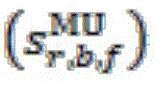

多用户信噪比项取决于RAT内干扰和互通RAT干扰之和

其中
由于SINR取决于所有RAT的波束频率选择和调度选择,因此优先级度量也是所有RAT的波束频率选择和调度选择的函数:
在下文中,根据实施例,将提供操作模式的一些示例。In the following, according to an embodiment, some examples of operation modes will be provided.
操作模式的第一示例是集中式操作模式,并且操作模式的第二示例是分布式操作模式。A first example of an operating mode is a centralized operating mode, and a second example of an operating mode is a distributed operating mode.
在集中式操作模式下,资源管理器从业务度量直接计算资源池和互通RAT干扰图。资源管理器向每个基站传送其资源池和互通RAT干扰图。基站基于其指配的资源池和互通RAT干扰图执行链路自适应和分组调度。In the centralized mode of operation, the resource manager directly computes resource pools and interworking RAT interference graphs from traffic metrics. The resource manager transmits its resource pool and interworking RAT interference map to each base station. The base station performs link adaptation and packet scheduling based on its assigned resource pool and interworking RAT interference graph.
根据实施例,集中式操作过程如图6所示,并且至少包括以下阶段:According to an embodiment, the centralized operation process is shown in Figure 6, and includes at least the following stages:
在阶段1中执行初始设置。在初始设置中,每个基站向资源管理器发送基站能力和参数化信息。这在图6中用箭头C1.1进行了描绘。基站能力和参数化信息可以包括例如互通RAT业务感知操作的类型、所支持的资源池确定方法、所支持的互通RAT干扰预测方法和波束码本定义。基于接收到的有关基站所支持的资源池划分方法的信息,资源管理器设计资源池策略和干扰策略(图6中的框C1.2)。Initial setup is performed in
连续操作的示例从阶段2开始。阶段2可以周期性地被执行,例如,按每个调度机会或更大的间隔被执行,或者可以由事件触发。An example of continuous operation begins with phase 2. Phase 2 may be performed periodically, eg, every scheduling opportunity or at greater intervals, or may be triggered by an event.
基站从空间波束码本向用户设备(UE)指配波束,如图6中的框C2.1所示。波束可以周期性地指配,例如,按每个调度机会或更大的间隔指配,或者可以由事件触发。这可以由每个基站执行,或者可以从UE反馈回基站。然后,基站可以计算业务度量(图6中的框C2.2)。业务度量可以周期性地重新计算,例如按每个调度机会或更大的间隔重新计算,或者可以由事件触发。对于每个调度候选用户,计算得到的业务度量可以包括:资源负载、每个资源的单用户优先级度量、多用户MIMO状态指示符和波束索引。计算得到的业务度量还可以包括请求预留资源负载。The base station assigns beams to the user equipment (UE) from the spatial beam codebook, as shown in block C2.1 in Fig. 6 . Beams may be assigned periodically, eg, every scheduling opportunity or at greater intervals, or may be triggered by events. This can be performed by each base station, or can be fed back from the UE to the base station. The base station can then calculate traffic metrics (block C2.2 in Fig. 6). Business metrics can be recalculated periodically, such as on every scheduling opportunity or at greater intervals, or can be triggered by events. For each scheduling candidate user, the calculated service metric may include: resource load, single user priority metric for each resource, multi-user MIMO status indicator and beam index. The calculated service metric may also include request reservation resource load.
当已经计算出业务度量时,所计算的业务度量可以由每个基站发送到资源管理器(图6中的箭头C2.3)。同样,所计算的业务度量的传输可以周期性地被执行,例如按每个调度机会或更大的间隔被执行,或者可以由事件触发。When the traffic metric has been calculated, the calculated traffic metric can be sent by each base station to the resource manager (arrow C2.3 in Fig. 6). Likewise, the transmission of the calculated traffic metrics may be performed periodically, for example at every scheduling opportunity or at greater intervals, or may be triggered by events.
资源管理器接收所发送的计算的业务度量,并且可以使用所接收的业务度量的信息来确定资源池(图6中的框C2.4)。在该确定中,作为过程,资源管理器可以使用来自基站的每波束度量作为输入,并使用资源池策略。该确定可以周期性地执行,例如按每个调度机会或更大的间隔执行,或者可以由事件触发。The resource manager receives the sent calculated traffic metrics and can use the information of the received traffic metrics to determine resource pools (block C2.4 in Fig. 6). In this determination, as a procedure, the resource manager may use per-beam metrics from the base station as input and use a resource pool policy. This determination may be performed periodically, such as at every scheduling opportunity or greater interval, or may be triggered by an event.
资源管理器还可以确定预测干扰图(图6中的框C2.5)。该确定可以基于资源池,其中预测干扰图的确定也可以周期性地被执行,例如按每个调度机会或更大的间隔执行,或者可以由事件触发。The resource manager may also determine a predicted interference map (block C2.5 in Figure 6). The determination may be based on a resource pool, wherein the determination of the predicted interference map may also be performed periodically, for example per scheduling opportunity or at greater intervals, or may be triggered by an event.
资源管理器可以将资源池和预测干扰图发送到基站(图6中的箭头C2.6)。资源管理器可以周期性地发送资源池和预测干扰图,例如按每个调度机会或更大的间隔发送,或者可以由事件触发。The resource manager can send the resource pool and the predicted interference map to the base station (arrow C2.6 in Fig. 6). The resource manager may send the resource pool and predicted interference map periodically, eg, every scheduling opportunity or at greater intervals, or may be triggered by an event.
基站从资源管理器接收关于资源池和预测干扰图的信息,并执行调节后的链路自适应和分组调度(图6中的框C2.7)。调节后的链路自适应和分组调度可以由每个基站按每个调度机会执行,例如按传输时间间隔执行。The base station receives information about resource pools and predicted interference maps from the resource manager and performs adjusted link adaptation and packet scheduling (block C2.7 in Figure 6). Adjusted link adaptation and packet scheduling may be performed by each base station per scheduling opportunity, eg per transmission time interval.
根据实施例,在图7中图示了分布式操作过程。在分布式操作下,资源池确定和互通RAT干扰确定策略在初始设置过程期间由资源管理器传送。在连续操作期间,基于共享的业务度量和策略,每个基站将选择恰当的资源池表和互通RAT干扰图。然后,它将根据资源池表和互通RAT干扰图执行链路自适应和分组调度。According to an embodiment, a distributed operation process is illustrated in FIG. 7 . Under distributed operation, resource pool determination and interworking RAT interference determination policies are communicated by the resource manager during the initial setup procedure. During continuous operation, based on shared traffic metrics and policies, each base station will select the appropriate resource pool table and interworking RAT interference graph. It will then perform link adaptation and packet scheduling based on the resource pool table and interworking RAT interference graph.
在阶段1中执行初始设置。在初始设置中,每个基站向资源管理器发送基站能力和参数化信息。这在图7中用箭头D1.1进行了描绘。基站能力和参数化信息可以包括例如互通RAT业务感知操作的类型、所支持的资源池确定方法、所支持的互通RAT干扰预测方法和波束码本定义。基于接收到的有关基站所支持的资源池划分方法的信息,资源管理器设计资源池策略和干扰策略(图7中的框D1.2)。资源管理器将设计的资源池策略和干扰策略发送到基站(图7中的块D1.3)。基站接收设计的资源池策略和干扰策略,并配置链路自适应和分组调度(图7中的框D1.4)。Initial setup is performed in
在初始设置阶段之后,连续操作(阶段2)可以开始。类似于上述集中式操作模式下的C2.1,基站从空间波束码本向UE指配波束(图7中的框D2.1)。类似于集中式操作模式下的C2.2,基站也计算业务度量(图7中的框D2.2),并交换计算得到的业务度量(图7中的箭头D2.3)。根据实施例,执行该操作使得每个基站将计算的业务度量发送到系统中的每个其他基站。计算得到的业务度量可以周期性地被发送,例如按每个调度机会或更大的间隔发送,或者可以由事件触发。After the initial setup phase, continuous operation (phase 2) can begin. Similar to C2.1 in the centralized mode of operation described above, the base station assigns beams to UEs from the spatial beam codebook (block D2.1 in Fig. 7). Similar to C2.2 in the centralized mode of operation, the base stations also calculate traffic metrics (block D2.2 in Fig. 7) and exchange the computed traffic metrics (arrow D2.3 in Fig. 7). According to an embodiment, this is performed such that each base station sends the calculated traffic metric to every other base station in the system. The computed traffic metrics may be sent periodically, such as every scheduling opportunity or at greater intervals, or may be triggered by events.
在框D2.4中,基站可以确定其自己的资源池,其中将基站自己的业务度量和其他RAT的其他基站的业务度量用作输入。资源池策略被用作该确定中的过程。该确定可以周期性地执行,例如按每个调度机会或更大的间隔执行,或者可以由事件触发。In block D2.4, the base station may determine its own resource pool, using as input the base station's own traffic metrics and traffic metrics of other base stations of other RATs. Resource pool policies are used as a procedure in this determination. This determination may be performed periodically, such as at every scheduling opportunity or greater interval, or may be triggered by an event.
在框D2.5中,基站可以基于它们自己的资源池和其他基站的资源池来确定它们自己的预测干扰图。该确定可以周期性地执行,例如按每个调度机会或更大的间隔执行,或者可以由事件触发。In block D2.5, the base stations may determine their own predicted interference map based on their own resource pool and the resource pools of other base stations. This determination may be performed periodically, such as at every scheduling opportunity or greater interval, or may be triggered by an event.
在框D2.6中,类似于结合上述框C2.7所述的集中式操作模式的调节后的链路自适应和分组调度,基站可以执行调节后的链路自适应和分组调度。In block D2.6, the base station may perform adjusted link adaptation and packet scheduling similar to the adjusted link adaptation and packet scheduling described in connection with block C2.7 above for the centralized mode of operation.
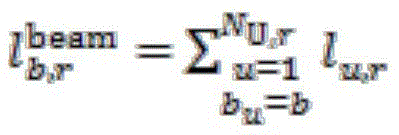
在下文中,根据实施例,将更详细地解释一些业务度量定义。对于每个调度,候选用户共享业务度量可以包括资源负载(lu,r)、每个资源的单用户优先级度量
资源负载(lu,r)指示假设SU-MIMO传输且无互通RAT干扰的情况下耗尽缓冲区所需的资源数量。负载上限是频率资源总数: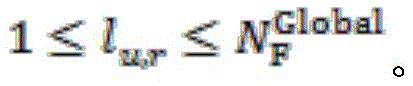
每个资源的单用户优先级度量

多用户MIMO(MU-MIMO)状态指示符(mu,r)采用二进制值:mu,r∈{false,true}值为真表示第u个用户的数据能够进行MU-MIMO传输;否则,该值为假。该指示符取决于MIMO传输模式以及用户是否超过了与多用户MIMO配对有关的阈值。如果用户的状态为假,则无法与来自相同RAT或相同资源上的其他RAT的用户一起来调度该用户。在一些方法中,仅基于DMRS的传输模式可以被用于互通RATMU-MIMO,这是因为DMRS和数据子载波均是波束形成的,因此可以从其他RAT的同时传输被正交化。The multi-user MIMO (MU-MIMO) status indicator (mu , r ) adopts a binary value: m u, r ∈ {false, true} is true, indicating that the data of the u-th user can be transmitted by MU-MIMO; otherwise, The value is false. This indicator depends on the MIMO transmission mode and whether the user exceeds a threshold related to multi-user MIMO pairing. If the user's status is false, the user cannot be scheduled with users from the same RAT or other RATs on the same resource. In some approaches, only DMRS-based transmission modes can be used for interworking RAT MU-MIMO, since both DMRS and data subcarriers are beamformed and thus can be orthogonalized from simultaneous transmissions from other RATs.
波束索引(bu,r)是从虚拟波束码本针对第u个用户被指配的波束的索引。The beam index (b u,r ) is the index of the beam assigned to the u-th user from the virtual beam codebook.
业务度量定义还可以包括请求预留资源负载
资源池划分最优性问题定义Resource pool partition optimality problem definition
以下互通RAT波束频率资源池划分的最优性问题可以被定义为:The optimality problem of the following interworking RAT beam frequency resource pool partitioning can be defined as:
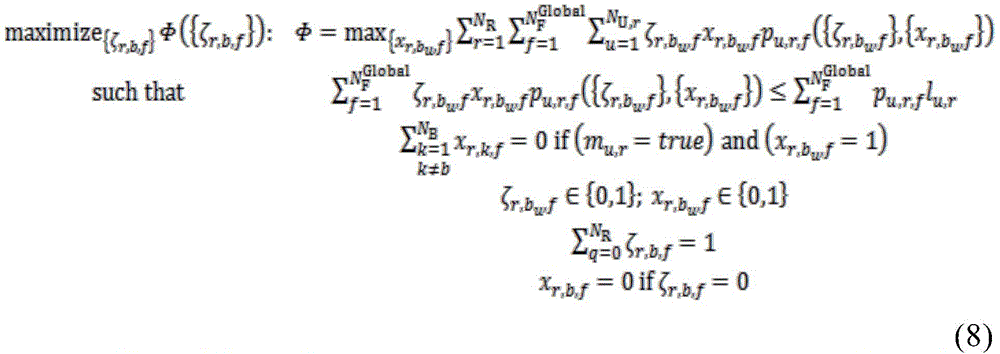
其中


内部max()项是依赖于调度器选择的多用户多RAT和优先级度量。第一个条件方程保留用户的总优先级度量,而第二个条件方程为SU-MIMO用户提供条件。第三和第四条件提供了二进制编程约束,而最后的条件则限制了基于资源池划分的调度选择。The internal max() term is a multi-user multi-RAT and priority metric dependent on the scheduler choice. The first conditional equation preserves the user's overall priority metric, while the second conditional equation provides conditions for SU-MIMO users. The third and fourth conditions provide binary programming constraints, while the last condition restricts scheduling choices based on resource pool partitioning.
子带定义subband definition
子带Asubband可以被定义为连续频率组内的资源集合:


资源池策略resource pool policy
资源池策略是由资源管理器使用来确定资源池的过程,或者是由每个BS使用来确定其自己的资源池的过程。将要定义的所有策略共享三个公共步骤,然后是一个特定于策略的步骤,该步骤将划分用于能支持MU-MIMO的传输的资源。总体策略如下。A resource pool policy is a process used by a resource manager to determine a resource pool, or by each BS to determine its own resource pool. All policies to be defined share three common steps, followed by a policy-specific step that will allocate resources for MU-MIMO capable transmissions. The overall strategy is as follows.
总体资源池划分策略Overall Resource Pool Division Strategy
在第一公共步骤中,从全局资源池中分派预留资源。总预留资源负载



可以将每个RAT的预留子带定义为



在第二公共步骤中,将非预留资源池划分到SU-MIMO和MU-MIMO子带。每RAT SU-MIMO优先级度量

类似地,每RAT的MU-MIMO优先级度量

根据每个RAT的度量,可以将全局SU-MIMO优先级度量定义为

全局SU-MIMO和MU-MIMO优先级度量可以被用于按比例地在SU-MIMO和MU-MIMO传输之间划分非预留子带,其中SU-MIMO子带被预留用于SU-MIMO传输而MU-MIMO子带被预留用于MU-MIMO传输。SU-MIMO子带和MU-MIMO子带相互排他且穷举。尽管在资源池确定期间描绘了SU-MIMO和MU-MIMO子带,但是基站调度器可以在分组调度期间覆盖该预留。换句话说,SU-MIMO传输最终可以由调度器分配在MU-MIMO子带内。Global SU-MIMO and MU-MIMO priority metrics can be used to proportionally divide non-reserved subbands between SU-MIMO and MU-MIMO transmissions, where SU-MIMO subbands are reserved for SU-MIMO transmission while MU-MIMO subbands are reserved for MU-MIMO transmission. SU-MIMO subbands and MU-MIMO subbands are mutually exclusive and exhaustive. Although SU-MIMO and MU-MIMO subbands are depicted during resource pool determination, the base station scheduler can override this reservation during packet scheduling. In other words, SU-MIMO transmissions can eventually be allocated within MU-MIMO subbands by the scheduler.
SU-MIMO子带


而MU-MIMO子带


SU-MIMO子带

从第一位置开始,SU-MIMO子带可以被定义为



在第三公共步骤中,将SU-MIMO子带划分为不同的RAT。一旦确定了SU-MIMO子带

在公平比例调度下,这种基于优先级度量的划分可能会最大化用户吞吐量的对数之和。Under fair proportional scheduling, this priority metric based partitioning may maximize the sum of logarithms of user throughput.
在SU-MIMO子带内的每个每RAT SU-MIMO子带的频域第一位置


在作为特定于策略的步骤的下一第四步骤中,将MU-MIMO子带划分为不同的RAT。一旦确定了MU-MIMO子带
根据实施例,可以针对MU-MIMO子带定义四个划分策略:基于波束角度分离的划分策略;基于多元回归或支持向量聚类的划分策略;基于组合搜索的划分方案;以及基于神经网络的资源池划分。According to an embodiment, four partitioning strategies can be defined for MU-MIMO subbands: partitioning strategies based on beam angle separation; partitioning strategies based on multiple regression or support vector clustering; partitioning schemes based on combination search; and resources based on neural networks pool division.
基于波束角度分离的划分Division based on beam angle separation
在下文中,将更详细地描述第一划分策略,即,基于波束角度分离的划分策略。根据实施例,该过程至少包括以下:In the following, the first division strategy, ie, the division strategy based on beam angle separation, will be described in more detail. According to an embodiment, the process includes at least the following:
A.0定义以下任意常数:水平角度分离阈值

A.1针对每个RAT的所有用户计算水平波束角的加权平均值A.1 Calculation of the weighted average of the horizontal beam angles for all users of each RAT

检查水平波束角度分离:如果
A.3通过RAT对水平波束角进行划分可以使用一维多类判别式分类器执行,其中具体技术根据实施方式而定。分类器为每个RAT提供一对水平角阈值,



A.4 MU-MIMO子带内第r个RAT的资源池为
A.5每种RAT的所有用户的垂直波束角的加权平均值可以计算为:A.5 The weighted average of the vertical beam angles of all users for each RAT can be calculated as:
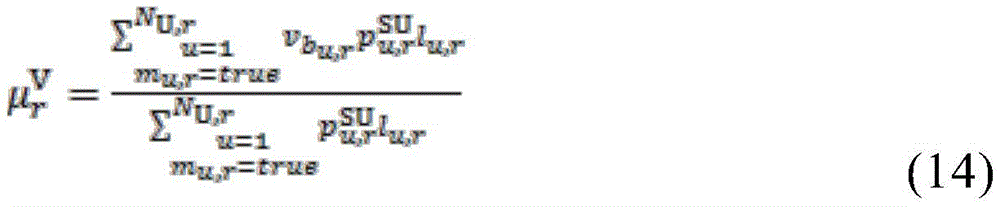
A.6垂直波束角度分离可以如下检查:如果
A.7通过RAT对垂直波束角进行划分可以使用一维多类判别分类器执行,其中具体技术根据实现而定。分类器为每个RAT提供一对垂直角阈值,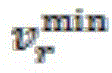



用于MU-MIMO子带内第r个RAT的资源池为
A.9针对第r个RAT的每RAT MU-MIMO子带长度可以通过以下公式计算:A.9 The per-RAT MU-MIMO subband length for the r-th RAT can be calculated by the following formula:

A.10可以将MU-MIMO子带细分为每RAT MU-MIMO子带,向第r个RAT提供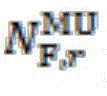
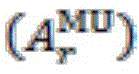

A.11用于MU-MIMO子带内第r个RAT的资源池为

基于多元回归或支持向量聚类的划分Partitioning based on multiple regression or support vector clustering
第二种划分策略可以称为基于多元回归或支持向量聚类的划分策略,该策略通过计算每波束资源边界然后执行多元回归或支持向量聚类来执行资源池划分,其中自变量是每个波束的水平和垂直波束角,而因变量是每个波束的频域边界。过程如下:The second partitioning strategy can be referred to as a multiple regression or support vector clustering based partitioning strategy, which performs resource pool partitioning by computing per-beam resource boundaries and then performing multiple regression or support vector clustering, where the independent variable is each beam The horizontal and vertical beam angles of , while the dependent variable is the frequency-domain boundary of each beam. The process is as follows:
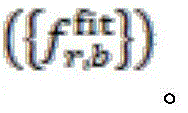
针对每个RAT的每个波束,可以计算每波束的总优先级度量:
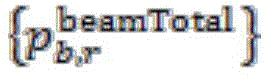
B.1针对任何RAT,波束优先级度量列表中具有零优先级度量的所有条目可以被丢弃:
B.2然后可以将每个RAT的波束优先级度量列表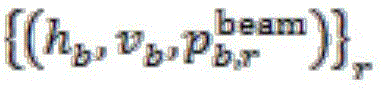
B.3在该步骤中,可以创建三维列表,其中每个元素的前两个维度是水平和垂直波束方向角,而第三个维度是频域中的对应目标边界:
根据实施例,如何创建目标边界,存在两个选项。第一选项基于的是负载均衡目标边界,如下:Depending on the embodiment, there are two options how the target boundary is created. The first option is based on load balancing target boundaries, as follows:
对于每个波束

其中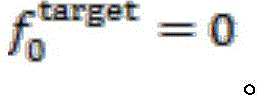
第二选项基于的是挑选目标边界(cherry-picking target boundary),如下:The second option is based on cherry-picking target boundaries, as follows:
定义每波束优先级度量: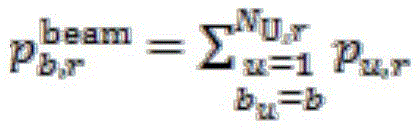
定义每波束负载: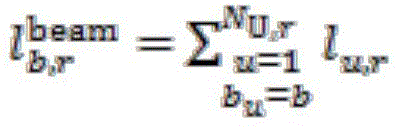
根据实施例,可以如下对每个波束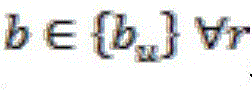
1.初始化:
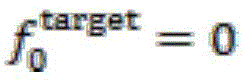
2.当
a.
b.
c.
d.n=n+1d.n=n+1
3.如果
a.对于r=1,2,...,NR-1a. For r=1, 2, ..., N R -1
i.
ii.
b.
4.针对r=1,2,...,NR 4. For r=1, 2, ..., N R
a.
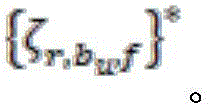
在B.4创建列表后,可以对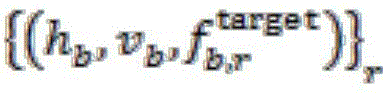

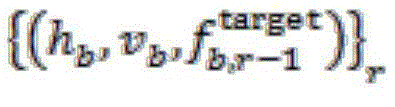

B.5MU-MIMO子带内第r个RAT的资源划分为


基于组合搜索的划分Combined Search Based Partitioning
第三种划分策略可以被称为基于组合搜索的划分方案,其通过搜索使方程(6)中描述的最优性问题最大化的划分指示符集合
在通过组合搜索解决的划分指示符集合给定的情况下,MU-MIMO子带内第r个RAT的资源划分为
提供给波束的频率资源总数为
基于神经网络的划分Neural network based division
第四划分策略可以被称为基于神经网络的资源池划分,它对于超高效地估算高计算需求但性能优异的划分方案的行为可能很有用。根据实施例,如下定义神经网络的输入和输出就足够了:A fourth partitioning strategy, which can be referred to as neural network-based resource pool partitioning, can be useful for ultra-efficiently estimating the behavior of computationally demanding but high-performance partitioning schemes. According to an embodiment, it is sufficient to define the input and output of the neural network as follows:
神经网络输入:Neural network input:
·每波束总优先级度量:
·不同干扰值下的每波束每资源优先级度量:
ο
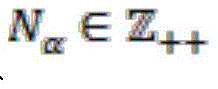
ο其中
ο
·每束负载:
神经网络输出:Neural network output:
·选项1:三维二项式‘概率’Option 1: 3D binomial 'probability'
ο划分指示符图:
·选项2:二维“实值”Option 2: Two-dimensional "real-valued"
ο每个波束的频率资源数目:
如果输出了划分指示符图,则MU-MIMO子带内第r个RAT的资源划分为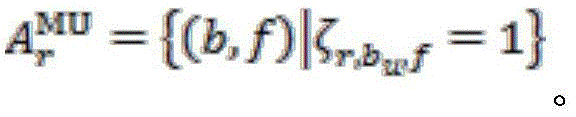



神经网络训练阶段Neural Network Training Phase
可以根据使用上述四个策略或任何其他划分策略中的任何一个策略生成的样本来训练神经网络(NN)。神经网络架构(例如,全连接、递归、卷积)和超参数根据实施方式而定。神经网络训练可以通过监督学习来进行,其中输入-输出样本来自生成的训练集,如图8所示。图8所示的示例使用完全连接的神经网络架构。A neural network (NN) can be trained on samples generated using any of the above four strategies or any other partitioning strategy. The neural network architecture (eg, fully connected, recursive, convolutional) and hyperparameters are implementation specific. Neural network training can be performed by supervised learning, where input-output samples are derived from a generated training set, as shown in Figure 8. The example shown in Figure 8 uses a fully connected neural network architecture.
有关神经网络训练策略的详细信息根据实现而定。Details about the neural network training strategy are implementation specific.
神经网络预测阶段Neural Network Prediction Phase
在其预测阶段,使用神经网络输出解码器从原始神经网络输出生成划分决策,这被表示为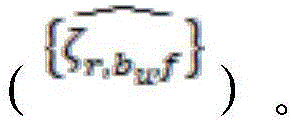


另一方面,如果神经网络输出是被分配给RAT


强化学习方法Reinforcement Learning Methods
基于神经网络的资源池拆分也可以通过强化学习来实现,其中,执行在线判定,并经由探索或开发来生成训练样本。常见的强化学习技术是使用深度神经网络(DNN)对Bellman方程的Q函数建模。这里,深层Q网络对Bellman方程的Q值集合建模:Neural network-based resource pool splitting can also be achieved through reinforcement learning, where online decisions are performed and training samples are generated via exploration or exploitation. A common reinforcement learning technique is to use a deep neural network (DNN) to model the Q-function of the Bellman equation. Here, a deep Q-network models the set of Q-values of the Bellman equation:

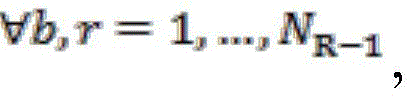
其中η是未来折现因子(0<η≤1),s是系统所处的状态,并且a是在状态s下所采取的行动。在这种情况下,状态s表示给定的业务度量状态以及从集合



Q值表示在采取行动a时观察到的未来奖励,它等于即时奖励和假设采取行动a系统将过渡到的状态s′的潜在最大未来奖励之和。Q值是深度神经网络的输出。在这种情况下,Q函数的奖励值r(s,a)是方程(6)的最优性函数Φ({ζr,b,f})的净增加:The Q-value represents the observed future reward when action a is taken, and it is equal to the sum of the immediate reward and the potential maximum future reward of the state s′ to which the system would transition assuming action a is taken. The Q value is the output of the deep neural network. In this case, the reward value r(s, a) of the Q function is a net increase in the optimality function Φ({ζ r, b, f }) of equation (6):
r(s,a)=Φ(s′(s,a))-Φ(s), (20)r(s,a)=Φ(s'(s,a))-Φ(s), (20)
假设η=1,在这种情况下,行动a的Q值表示最优性的剩余最大潜在增长,方法是用
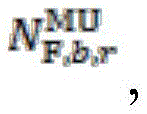
互通RAT干扰图定义Definition of interworking RAT interference graph
互通RAT干扰图是三维图,其中每个元素是指配给已分配给每个RAT的每个波束频率资源的预测互通RAT干扰信号比值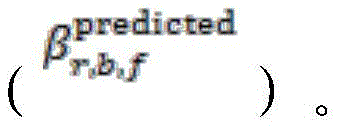
可以定义以下策略以根据资源池划分{ζr,b,f}来预测互通RAT干扰:总干扰策略和最大干扰者策略。The following strategies can be defined to predict interworking RAT interference according to the resource pool partition {ζr ,b,f }: total interference strategy and maximum interferer strategy.
总干扰策略total interference strategy
在完全(总)干扰策略下,对每个分配的资源的预测互通RAT干扰是来自所有其他RAT可能使用的所有资源的干扰之和。假设使用分配给其他RAT的所有资源。Under the full (total) interference strategy, the predicted interworking RAT interference for each allocated resource is the sum of the interference from all resources that may be used by all other RATs. All resources allocated to other RATs are assumed to be used.

最大干扰者策略maximum disruptor strategy
在最大干扰者策略下,对每个分配的资源的预测互通RAT干扰是来自由另一RAT可能使用的所有资源的最大干扰者。Under the maximum interferer strategy, the predicted interworking RAT interference for each allocated resource is the maximum interferer from all resources that may be used by another RAT.

互通RAT干扰调节的链路自适应和分组调度Link Adaptation and Packet Scheduling for Interworking RAT Interference Adjustment
用于获得预测干扰图和资源池的基本原理是在联合FDM-SDM共存的情况下针对互通RAT干扰调节链路自适应和分组调度。The rationale for obtaining the predicted interference graph and resource pool is to adjust link adaptation and packet scheduling against interworking RAT interference in case of joint FDM-SDM coexistence.
资源池提供用于用户分配的非受限资源列表。这限制了调度指示符的值,其中如果ζr,b,f=0,则xr,b,f=0。A resource pool provides an unrestricted list of resources for user allocation. This constrains the value of the scheduling indicator, where if ζ r,b,f =0, then x r,b,f =0.
同时,干扰图用于调节分配的资源池内的多用户SINR。互通RAT干扰调节的多用户SINR

其中RAT内跨波束干扰
经调节的多用户SINR用于调制和编码方案(MCS)确定和优先级度量计算。在比例公平调度中,调节后的每资源优先级度量为:The adjusted multi-user SINR is used for modulation and coding scheme (MCS) determination and priority metric calculation. In proportional fair scheduling, the adjusted per-resource priority metric is:

然后,调度器使用调节后的优先级度量将用户指配给资源。和优先级度量最大化指配是多用户MIMO挑选,其中迭代选择所有剩余频率和剩余用户中具有最高和多用户优先级度量的多用户MIMO配对。使用调节后的优先级度量的具体频域资源-用户配对方案根据实施方式而定。The scheduler then uses the adjusted priority metric to assign users to resources. The sum priority metric maximization assignment is multiuser MIMO picking, where the multiuser MIMO pair with the highest sum multiuser priority metric among all remaining frequencies and remaining users is iteratively selected. The specific frequency domain resource-user pairing scheme using the adjusted priority metric depends on the implementation.
上述方法使得能够进行联合空分复用和频分复用以用于互通RAT动态频谱共享。通过联合利用业务中的频域和空间域可变性,它有可能可以提供优于FDM、TDM和SDM的吞吐量和延时增益,并且可以共存地适用于NR-LTE(即3GPP规范支持的假设)。The method described above enables joint space division multiplexing and frequency division multiplexing for interworking RAT dynamic spectrum sharing. By jointly exploiting the frequency-domain and space-domain variability in traffic, it is possible to provide throughput and delay gains over FDM, TDM and SDM, and can be compatible with NR-LTE (i.e., the assumption supported by the 3GPP specification ).
对于一些实施例的一种动机是潜在地在不需要联合多RAT调度器的情况下改进吞吐量和延时。系统级RAN仿真已经表明,与现有技术(即,TDM/FDM共存方案)相比,实施例(即,SDM+FDM)在小区边缘用户吞吐量以及平均小区吞吐量方面都获得了一些增益。One motivation for some embodiments is to potentially improve throughput and latency without requiring a joint multi-RAT scheduler. System-level RAN simulations have shown that the embodiments (ie, SDM+FDM) achieve some gains in cell edge user throughput as well as average cell throughput compared to prior art (ie, TDM/FDM coexistence scheme).
RF前端包括在基带处理器和一个或多个天线端口之间的RF电路系统。RF前端包括传输路径/链和接收路径/链。RF前端的电路系统的示例包括一个或多个带通滤波器、功率放大器、本地振荡器和混频器。传输路径将基带信号转换为RF信号,以经由天线端口将RF信号馈送到天线。接收路径将由与天线端口连接的天线接收的RF信号转换为被馈送到基带部分的基带信号。基带处理器和天线端口之间的信号转换可以经由至少一个中频进行。RF频率可以是许可的频率或非许可的频率。根据至少一些实施例的示例可以至少利用低于6GHz的RF频率。The RF front end includes RF circuitry between the baseband processor and one or more antenna ports. The RF front end includes transmit paths/chains and receive paths/chains. Examples of circuitry for an RF front end include one or more bandpass filters, power amplifiers, local oscillators, and mixers. The transmission path converts the baseband signal into an RF signal to feed the RF signal to the antenna via the antenna port. The receive path converts the RF signal received by the antenna connected to the antenna port into a baseband signal which is fed to the baseband section. Signal conversion between the baseband processor and the antenna port can be performed via at least one intermediate frequency. The RF frequency may be a licensed frequency or an unlicensed frequency. Examples according to at least some embodiments may utilize at least RF frequencies below 6 GHz.
基带信号包括根据调制方法的未调制信号或包括一个或多个符号的调制信号。基带信号可以是包括同相相位和正交相位的IQ信号。调制方法的示例是诸如正交频分复用(OFDM)方案之类的多载波调制方法。OFDM符号可以形成用于无线通信系统的通信信道的传输突发。通信信道的示例至少包括共享和专用通信信道,其可以是上行链路(UL)信道或下行链路(DL)信道。上行链路信道是指用于将数据从无线设备传输到接入节点的信道,而下行链路信道是指用于将数据从接入节点传输到无线设备的信道。The baseband signal includes an unmodulated signal or a modulated signal including one or more symbols according to a modulation method. The baseband signal may be an IQ signal including an in-phase phase and a quadrature phase. An example of a modulation method is a multi-carrier modulation method such as an Orthogonal Frequency Division Multiplexing (OFDM) scheme. OFDM symbols may form transmission bursts for a communication channel of a wireless communication system. Examples of communication channels include at least shared and dedicated communication channels, which may be uplink (UL) channels or downlink (DL) channels. An uplink channel refers to a channel used to transmit data from a wireless device to an access node, while a downlink channel refers to a channel used to transmit data from an access node to a wireless device.
无线通信中的MIMO是一种支持传输和接收多个独立数据流的技术。这有助于提高可以可靠地进行通信的最大数据速率。以下各节介绍了MIMO的一些应用。MIMO in wireless communications is a technology that supports the transmission and reception of multiple independent data streams. This helps increase the maximum data rate at which reliable communication can take place. The following sections describe some applications of MIMO.
MIMO收发器(MIMO TRX)至少包括RF前端和天线端口,该天线端口用于连接到多个天线以用于MIMO传输的发送TX和接收RX。MIMO收发器可能能够进行单天线传输,例如,单输入多输出、单输入单输出。RF前端可以连接到基带处理器。RF前端包括在基带处理器和天线端口之间通过RF前端的多个唯一硬件(HW)路径。硬件路径包括发送路径和接收路径。每个HW路径都引入了特定传输路径所特有的延迟。用于MIMO传输的基带信号由两个或多个传输路径处理,并经由天线端口馈送到至少两个天线。经由每个天线的信号的传输时间应该在时间上对齐,以减少MIMO传输所需的延迟裕度。A MIMO transceiver (MIMO TRX) includes at least an RF front end and an antenna port for transmit TX and receive RX connected to multiple antennas for MIMO transmission. A MIMO transceiver may be capable of single-antenna transmission, eg, single-input multiple-output, single-input single-output. The RF front end can be connected to the baseband processor. The RF front end includes multiple unique hardware (HW) paths through the RF front end between the baseband processor and the antenna ports. The hardware path includes a sending path and a receiving path. Each HW path introduces a delay that is unique to the particular transmission path. Baseband signals for MIMO transmission are processed by two or more transmission paths and fed to at least two antennas via antenna ports. The transmission times of the signals via each antenna should be aligned in time to reduce the delay margin required for MIMO transmission.
基带收发器TRX可以是执行对经由RF前端所发送和接收的信号的基带处理的基带处理器。基带处理器和RF前端之间的典型接口包括模数转换器ADC和数模转换器DAC。基带处理器处理基带信号,以供RF前端进行发送和接收。The baseband transceiver TRX may be a baseband processor performing baseband processing of signals transmitted and received via the RF front end. Typical interfaces between the baseband processor and the RF front end include analog-to-digital converters ADC and digital-to-analog converters DAC. The baseband processor processes baseband signals for transmission and reception by the RF front end.
实施例中的至少一些实施例可以被应用在支持TSN的无线通信系统或无线通信网络中。5G标准被视为一个示例,它可以满足在延时和可靠性以及通过TSN网络运行的应用的高精度同步准确性方面非常严格的要求。其他标准也是可行的。At least some of the embodiments may be applied in a wireless communication system or wireless communication network supporting TSN. The 5G standard is seen as an example that can meet very stringent requirements in terms of latency and reliability as well as high-precision synchronization accuracy for applications running over TSN networks. Other criteria are also possible.
在下文中,将使用基于长期演进高级(LTE Advanced,LTE-A)或新无线电(NR,5G)的无线电接入架构作为可以应用实施例的接入架构的示例,来描述不同的示例性实施例,然而,不将实施例局限于这种架构。对于本领域技术人员显而易见的是,通过恰当地调节参数和过程,实施例还可应用于具有合适的部件的其他种类的通信网络。针对合适系统的其他选项的一些示例是通用移动电信系统(UMTS)无线电接入网络(UTRAN或E-UTRAN)、长期演进(LTE,与E-UTRA相同)、无线局域网(WLAN或WiFi)、微波接入全球互通(WiMAX)、
图1描绘了简化的系统架构的示例,其仅示出了一些元件和功能实体,全部是逻辑单元,其实施方式可能与所示出的不同。图1所示的连接是逻辑连接;实际的物理连接可能有所不同。对于本领域技术人员显而易见的是,该系统通常还包括除图1所示的功能和结构之外的其他功能和结构。Figure 1 depicts an example of a simplified system architecture, showing only some elements and functional entities, all being logical units, the implementation of which may differ from what is shown. The connections shown in Figure 1 are logical; actual physical connections may vary. It is obvious to those skilled in the art that the system generally includes other functions and structures besides those shown in FIG. 1 .
然而,实施例不局限于作为示例给出的系统,但本领域技术人员可以将该解决方案应用于具有必要特性的其他通信系统。However, the embodiments are not limited to the system given as an example, but a person skilled in the art can apply the solution to other communication systems having the necessary properties.
图1的示例示出了示例性无线电接入网络的一部分。The example of Figure 1 shows a part of an exemplary radio access network.
图1示出了被配置用于处于小区中的一个或多个通信信道上的无线连接中的用户设备100和102,其中接入节点(诸如(e/g)NodeB)104提供该小区。从用户设备到(e/g)NodeB的物理链路称为上行链路或反向链路,而从(e/g)NodeB到用户设备的物理链路称为下行链路或前向链路。应当理解,可以通过使用适合于这种用法的任何节点、主机、服务器或接入点等实体来实现(e/g)NodeB或其功能性。Fig. 1 shows
通信系统通常包括一个以上的(e/g)NodeB,在这种情况下,(e/g)NodeB也可以被配置用于通过为此目的而设计的有线或无线链路彼此通信。这些链路可用于信令目的。(e/g)NodeB是被配置用于控制其耦合到的通信系统的无线电资源的计算设备。NodeB也可以被称为基站、接入点或包括能够在无线环境中操作的中继站的任何其他类型的接口设备。(e/g)NodeB包括或耦合到收发器。从(e/g)NodeB的收发器向天线单元提供连接,该连接建立到用户设备的双向无线电链路。天线单元可以包括多个天线或天线元件。(e/g)NodeB进一步连接到核心网络110(CN或下一代核心NGC)。根据系统,CN侧的对方可以是:服务网关(S-GW,路由和转发用户分组);分组数据网络网关(P-GW),用于提供用户设备(UE)与外部分组数据网络的连接性;或移动管理实体(MME);等等。CN可以包括可以称为管理实体的网络实体或节点。网络实体的示例至少包括接入管理功能(AMF)。A communication system usually comprises more than one (e/g)NodeB, in which case the (e/g)NodeBs may also be configured to communicate with each other via wired or wireless links designed for this purpose. These links can be used for signaling purposes. A (e/g) NodeB is a computing device configured to control the radio resources of a communication system to which it is coupled. A NodeB may also be referred to as a base station, an access point, or any other type of interface device including a relay station capable of operating in a wireless environment. The (e/g) NodeB includes or is coupled to a transceiver. A connection is provided from the transceiver of the (e/g)NodeB to the antenna unit, which establishes a two-way radio link to the user equipment. An antenna unit may comprise a plurality of antennas or antenna elements. (e/g) NodeB is further connected to core network 110 (CN or Next Generation Core NGC). Depending on the system, the counterparty on the CN side can be: Serving Gateway (S-GW, routing and forwarding user packets); Packet Data Network Gateway (P-GW), used to provide connectivity between User Equipment (UE) and external packet data networks ; or Mobility Management Entity (MME); etc. A CN may include network entities or nodes which may be referred to as management entities. Examples of network entities include at least an Access Management Function (AMF).
用户设备(也称为用户设备(UE)、用户终端、终端设备、无线设备、移动台(MS)等)图示了一种类型的设备,在该设备上分配并且指配了空中接口上的资源,并且因此,本文所描述的与用户设备有关的任何特征可以由诸如中继节点、eNB和gNB之类的对应网络装置来实现。这种中继节点的示例是指向基站的层3中继(自回程中继)。User equipment (also known as user equipment (UE), user terminal, terminal device, wireless device, mobile station (MS), etc.) illustrates a type of equipment on which the resources, and thus any features described herein in relation to user equipment may be implemented by corresponding network devices such as relay nodes, eNBs and gNBs. An example of such a relay node is a layer 3 relay pointing to a base station (self-backhaul relay).
用户设备通常是指便携式计算设备,该便携式计算设备包括带有或不带有用户识别模块(SIM)的无线移动通信设备,包括但不限于以下类型的设备:移动台(移动电话)、智能手机、个人数字助理(PDA)、听筒、使用无线调制解调器的设备(警报或测量设备等)、膝上型计算机和/或触摸屏计算机、平板计算机、游戏机、笔记本计算机和多媒体设备。应当理解,用户设备也可以是几乎排他的仅上行设备,其示例是将图像或视频剪辑加载到网络的照相机或摄像机。用户设备也可以是具有在物联网(IoT)网络中运行的能力的设备,物联网网络是一种从场景,在该场景中,为对象提供了在不需要人与人或人与计算机交互的情况下通过网络传输数据的能力。用户设备也可以利用云。在一些应用中,用户设备可以包括带有无线电零部件(诸如手表、耳机或眼镜)的小型便携式设备,并且在云中进行计算。用户设备(或在一些实施例中,层3中继节点)被配置用于执行用户设备功能性中的一个或多个。用户设备也可以被称为订户单元、移动台、远程终端、接入终端、用户终端或用户设备(UE),仅提及几个名称或装置。User equipment generally refers to portable computing devices, including wireless mobile communication devices with or without a Subscriber Identity Module (SIM), including but not limited to the following types of devices: mobile stations (mobile phones), smartphones , personal digital assistants (PDAs), handsets, devices using wireless modems (alarm or measuring devices, etc.), laptop and/or touchscreen computers, tablet computers, game consoles, notebook computers and multimedia devices. It should be understood that a user device may also be an almost exclusively uplink-only device, an example of which is a camera or video camera that uploads images or video clips to the network. A user device may also be a device with the capability to operate in an Internet of Things (IoT) network, which is a secondary scenario in which objects are provided with the The ability to transmit data over a network without any circumstances. User devices can also take advantage of the cloud. In some applications, the user equipment may comprise a small portable device with radio components such as a watch, earphones or glasses, and the computation is done in the cloud. A user equipment (or in some embodiments, a layer 3 relay node) is configured to perform one or more of the user equipment functionalities. A user equipment may also be called a subscriber unit, mobile station, remote terminal, access terminal, user terminal or user equipment (UE), just to mention a few names or devices.
本文描述的各种技术也可以应用于信息物理系统(CPS)(协作控制物理实体的计算元件的系统)。CPS可以实现和利用嵌入在不同位置处的物理对象中的大量互连ICT设备(传感器、执行器、处理器微控制器等)。所涉及的物理系统具有固有移动性的移动信息物理系统是信息物理系统的子类别。移动物理系统的示例包括人类或动物运输的移动机器人和电子设备。The various techniques described herein may also be applied to cyber-physical systems (CPS) (systems of computing elements that cooperatively control physical entities). A CPS can implement and utilize a large number of interconnected ICT devices (sensors, actuators, processor microcontrollers, etc.) embedded in physical objects at different locations. Mobile cyber-physical systems in which the physical systems involved have inherent mobility are a subcategory of cyber-physical systems. Examples of mobile physical systems include mobile robots and electronics for human or animal transportation.
另外,尽管已经将装置描绘为单个实体,但是可以实现不同的单元、处理器和/或存储器单元(图1中未全部示出)。Additionally, although the apparatus has been depicted as a single entity, different units, processors and/or memory units (not all shown in FIG. 1 ) may be implemented.
5G支持使用多输入多输出(MIMO)天线、比LTE(所谓的小小区概念)多得多的基站或节点,包括与更小的基站协作运行并取决于服务需求、用例和/或可用频谱而采用多种无线电技术的宏站点。5G移动通信支持广泛的用例和相关应用,包括视频流传输、增强现实、不同的数据共享方式以及各种形式的机器类型应用(诸如(大规模)机器类型通信(mMTC),包括车辆安全、不同的传感器和实时控制。5G有望具有(即低于6GHz)cmWave和mmWave的多个无线电接口,并且还能够与LTE等现有的遗留无线电接入技术集成。至少是在早期阶段,作为一种系统,可以实现与LTE的集成,其中LTE提供了宏覆盖,并且5G无线电接口接入通过聚合到LTE而来自小小区。换句话说,5G计划同时支持互通RAT的可操作性(诸如LTE-5G)和RI间的可操作性(无线电接口间的可操作性,诸如低于6GHz–cmWave、低于6GHz–cmWave–mmWave)。被认为是在5G网络中使用的概念之一是网络切片,其中可以在相同的基础设施中创建多个独立的且专用的虚拟子网(网络实例),以运行对延时、可靠性、吞吐量和移动性有不同要求的服务。5G supports many more base stations or nodes than LTE (the so-called small cell concept) using multiple-input multiple-output (MIMO) antennas, including cooperating with smaller base stations and depending on service requirements, use cases and/or available spectrum Macro site with multiple radio technologies. 5G mobile communications support a wide range of use cases and related applications, including video streaming, augmented reality, different ways of data sharing, and various forms of machine-type applications such as (massive) machine-type communications (mMTC), including vehicle safety, different sensors and real-time control. 5G is expected to have (i.e. sub-6GHz) multiple radio interfaces of cmWave and mmWave and also be able to integrate with existing legacy radio access technologies like LTE. At least in the early stages, as a system , can achieve integration with LTE, where LTE provides macro coverage, and 5G radio interface access comes from small cells by aggregation to LTE. In other words, 5G plans to simultaneously support the operability of interworking RATs (such as LTE-5G) and RI (operability between radio interfaces, such as sub-6GHz–cmWave, sub-6GHz–cmWave–mmWave). One of the concepts considered to be used in 5G networks is network slicing, where the Create multiple independent and dedicated virtual subnets (network instances) within the same infrastructure to run services with different requirements on latency, reliability, throughput and mobility.
LTE网络中的当前架构完全分布在无线电中,并且完全集中在核心网络中。5G中的低延时应用和服务需要使内容靠近无线电,从而导致局部突发和多接入边缘计算(MEC)。5G使分析和知识生成可以在数据源处进行。这种方法需要利用可能无法连续连接到网络的资源,诸如笔记本计算机、智能手机、平板计算机和传感器。MEC为应用和服务托管提供了分布式计算环境。它还具有在蜂窝用户附近存储和处理内容的功能,以加快响应时间。边缘计算涵盖了广泛的技术,诸如无线传感器网络、移动数据采集、移动签名分析、协作式分布式对等ad hoc联网和处理,也可分为本地云/雾计算和格/网计算、露计算、移动边缘计算、cloudlet、分布式数据存储和检索、自主自我修复网络、远程云服务、增强和虚拟现实、数据缓存、物联网(大规模连接性和/或延时关键)、危急通信(自动驾驶汽车、交通安全、实时分析、时间临界控制、医疗保健应用)。The current architecture in LTE networks is fully distributed in the radio and fully centralized in the core network. Low-latency applications and services in 5G will require content to be brought close to the radio, leading to localized bursting and multi-access edge computing (MEC). 5G enables analysis and knowledge generation to take place at the source of the data. This approach requires utilizing resources that may not be continuously connected to the network, such as laptops, smartphones, tablets, and sensors. MEC provides a distributed computing environment for application and service hosting. It also features the ability to store and process content close to cellular users for faster response times. Edge computing covers a wide range of technologies, such as wireless sensor networks, mobile data collection, mobile signature analysis, collaborative distributed peer-to-peer ad hoc networking and processing, and can also be divided into local cloud/fog computing and grid/grid computing, dew computing , mobile edge computing, cloudlets, distributed data storage and retrieval, autonomous self-healing networks, remote cloud services, augmented and virtual reality, data caching, Internet of Things (connectivity and/or latency critical at scale), emergency communications (automated driving cars, traffic safety, real-time analytics, time-critical control, healthcare applications).
通信系统还能够与诸如公共交换电话网或因特网112之类的其他网络通信,或利用由它们提供的服务。通信网络也可能能够支持云服务的使用,例如,核心网络操作的至少一部分可以作为云服务来执行(这在图1中由“云”114描绘)。通信系统还可以包括中央控制实体等,其为不同运营商的网络提供设施以例如在频谱共享中进行协作。The communication system is also capable of communicating with, or utilizing the services provided by, other networks such as the Public Switched Telephone Network or the
可以通过利用网络功能虚拟化(NFV)和软件定义联网(SDN)将边缘云引入无线电接入网络(RAN)中。使用边缘云可能意味着要至少部分地在可操作地耦合到包括无线电零部件的远程无线电头端或基站的服务器、主机或节点中执行接入节点操作。节点操作也可能分布在多个服务器、节点或主机之间。cloudRAN架构的应用使得能够在RAN侧执行RAN实时功能(在分布式单元DU 104中)并且以集中方式执行非实时功能(在集中式单元CU 108中)。Edge clouds can be brought into the radio access network (RAN) by leveraging network functions virtualization (NFV) and software-defined networking (SDN). Using an edge cloud may mean performing access node operations at least in part in a server, host or node operatively coupled to a remote radio head or base station including radio components. Node operations may also be distributed across multiple servers, nodes, or hosts. Application of the cloudRAN architecture enables execution of RAN real-time functions (in the distributed unit DU 104 ) at the RAN side and non-real-time functions (in the centralized unit CU 108 ) in a centralized manner.
还应该理解,核心网络操作和基站操作之间的劳动指配可能不同于LTE的劳动指配,或者甚至不存在。可能会使用的其他一些技术进步是大数据和全IP,这可能会改变网络的构建和管理方式。5G(或新无线电,NR)网络被设计为支持多个层次结构,其中MEC服务器可以放置在核心与基站或节点B(gNB)之间。应当理解,MEC也可以应用于4G网络。gNB是支持5G网络(即NR)的下一代Node B(或新的Node B)。It should also be understood that the assignment of labor between core network operation and base station operation may be different from that of LTE, or even non-existent. Some other technological advancements that may be used are big data and all-IP, which may change the way networks are built and managed. 5G (or New Radio, NR) networks are designed to support multiple hierarchies, where MEC servers can be placed between the core and base stations or Node Bs (gNBs). It should be understood that MEC can also be applied to 4G networks. gNB is the next-generation Node B (or new Node B) that supports 5G networks (ie, NR).
5G还可以利用卫星通信,例如通过提供回程来增强或补充5G服务的覆盖范围。可能的用例是为机器对机器(M2M)或物联网(IoT)设备或车上乘客提供服务连续性,或确保危急通信以及未来的铁路/海事/航空通信的服务可用性。卫星通信可以利用对地静止轨道(GEO)卫星系统,也可以利用低地球轨道(LEO)卫星系统,特别是巨型星座(其中部署了数百个(纳米)卫星的系统)。巨型星座中的每个卫星106可以覆盖创建地面小区的多个卫星启用式网络实体。可以通过地面中继节点104或通过位于地面上或位于卫星中的gNB创建地面小区。5G can also take advantage of satellite communications, for example by providing backhaul to enhance or supplement the coverage of 5G services. Possible use cases are providing continuity of service for machine-to-machine (M2M) or Internet of Things (IoT) devices or passengers on board, or ensuring service availability for emergency communications and future rail/maritime/air communications. Satellite communications can make use of geostationary orbit (GEO) satellite systems as well as low earth orbit (LEO) satellite systems, especially mega-constellations (systems in which hundreds of (nano)satellites are deployed). Each
对于本领域技术人员显而易见的是,所描绘的系统仅仅是无线电接入系统的一部分的示例,并且在实践中,该系统可以包括多个(e/g)NodeB,用户设备可以接入多个无线电小区,并且该系统还可以包括其他装置,诸如物理层中继节点或其他网络元件等。(e/g)NodeB中的至少一个可以是家庭(e/g)NodeB。另外,在无线电通信系统的地理区域中,可以提供多个不同种类的无线电小区以及多个无线电小区。无线电小区可以是宏小区(或伞形小区),它们是通常具有长达数十千米的直径的大小区,或者是诸如微小区、毫微微小区或微微小区之类的较小的小区。图1的(e/g)NodeB可以提供任何种类的这些小区。蜂窝无线电系统可以被实现为包括多种小区的多层网络。通常,在多层网络中,一个接入节点提供一种小区(一个或多个),因此需要多个(e/g)NodeB来提供这种网络结构。It will be apparent to those skilled in the art that the depicted system is only an example of a part of a radio access system, and that in practice the system may include multiple (e/g)NodeBs, and user equipment may access multiple radio access systems. cells, and the system may also include other devices, such as physical layer relay nodes or other network elements. At least one of the (e/g)NodeBs may be a Home (e/g)NodeB. Furthermore, in a geographical area of the radio communication system, a plurality of different kinds of radio cells as well as a plurality of radio cells may be provided. The radio cells may be macrocells (or umbrella cells), which are large cells typically with a diameter of up to tens of kilometers, or smaller cells such as microcells, femtocells or picocells. The (e/g)NodeB of Figure 1 may provide any kind of these cells. A cellular radio system can be implemented as a multi-layer network comprising various cells. Usually, in a multi-layer network, one access node provides a cell (one or more), so multiple (e/g)NodeBs are required to provide this network structure.
为了满足改善通信系统的部署和性能的需求,已经引入了“即插即用”(e/g)NodeB的概念。通常,能够使用“即插即用”(e/g)Node B的网络,除家庭(e/g)Node B(H(e/g)NodeB)之外,还包括家庭节点B网关或HNB-GW(图1中未示出)。通常安装在运营商网络内的HNB网关(HNB-GW)可能会将业务从大量HNB聚合回核心网络。To meet the need to improve the deployment and performance of communication systems, the concept of "plug and play" (e/g)NodeB has been introduced. Typically, networks capable of using "plug and play" (e/g)Node Bs include Home Node B gateways or HNB- GW (not shown in Figure 1). A HNB gateway (HNB-GW), usually installed within an operator's network, may aggregate traffic from a large number of HNBs back to the core network.
下面进一步详细描述用于实现一些实施例的合适的装置和可能的机制。在这方面,首先参考图2,其示出了图3中描绘的示例性装置或电子装置50的示意性框图,根据本发明的实施例,其可以包含发送器。Suitable means and possible mechanisms for implementing some embodiments are described in further detail below. In this regard, reference is first made to Fig. 2, which shows a schematic block diagram of the exemplary device or
电子装置50可以是,例如,无线通信系统的无线设备、移动终端或用户设备。然而,应当理解,本发明的实施例可以在可能需要发送射频信号的任何电子设备或装置中实现。The
装置50可以包括用于包含和保护设备的壳体30。装置50还可以包括液晶显示器形式的显示器32。在本发明的其他实施例中,显示器可以是适合于显示图像或视频的任何合适的显示技术。装置50还可以包括小键盘34。在本发明的其他实施例中,可以采用任何合适的数据或用户界面机制。例如,用户界面可以被实现为虚拟键盘或数据输入系统,作为触敏显示器的一部分。该装置可以包括麦克风36或任何合适的音频输入,该音频输入可以是数字或模拟信号输入。装置50还可以包括音频输出设备,该音频输出设备在本发明的实施例中可以是以下任何一种:耳机38、扬声器或模拟音频或数字音频输出连接。装置50还可以包括电池40(或者在本发明的其他实施例中,该设备可以由任何合适的移动能量设备(诸如太阳能电池、燃料电池或发条发电机)供电。结合实施例讨论的术语电池也可以是这些移动能量设备之一。此外,装置50可以包括不同种类的能量设备的组合,例如可再充电电池和太阳能电池。该装置还可以包括用于与其他设备进行短距离视线通信的红外端口41。在其他实施例中,装置50还可以包括任何合适的短距离通信解决方案,诸如,例如蓝牙无线连接或USB/火线有线连接。
装置50可以包括控制器56或用于控制装置50的处理器。控制器56可以连接到存储器58,在本发明的实施例中,该存储器可以存储数据和/或还可以存储用于在控制器56上实现的指令。控制器56还可以连接至编解码器电路系统54,该编解码器电路系统54适合于进行音频和/或视频数据的编码和解码,或者辅助控制器56所进行的编码和解码。The
装置50还可以包括读卡器48和智能卡46,例如通用集成电路卡(UICC)读卡器和用于提供用户信息并且适合于提供用于在网络上对用户进行认证和授权的认证信息的UICC。The
装置50可以包括无线接口电路系统52(也可以称为射频模块),其连接至控制器(或处理器),并且适于生成无线通信信号,例如用于与蜂窝通信网络、无线通信系统或无线局域网通信。无线电接口电路系统52包括一个或多个发送器和一个或多个接收器。在这种情况下,发送器和接收器可以配置为一个实体,诸如无线电收发器。装置50还可以包括连接到无线电接口电路系统52的多个天线59,用于将在无线电接口电路系统52处生成的射频信号发送到(多个)其他装置以及从(多个)其他装置接收射频信号。
在本发明的一些实施例中,装置50包括能够记录或检测成像的照相机42。In some embodiments of the invention,
关于图4,示出了可以在其中利用本发明的实施例的系统的示例。系统10包括可以通过一个或多个网络进行通信的多个通信设备。系统10可以包括有线和/或无线网络的任何组合,包括但不限于无线蜂窝电话网络(诸如GSM(2G、3G、4G、LTE、5G)、UMTS、CDMA网络等)、无线局域网(WLAN)(诸如由IEEE 802.x标准中的任何一个定义)、蓝牙个人局域网、以太网局域网、令牌环局域网、广域网和因特网。With respect to Figure 4, an example of a system in which embodiments of the present invention may be utilized is shown.
例如,图4所示的系统示出了移动电话网络11和因特网28的表示。到因特网28的连接性可以包括但不限于长距离无线连接、短距离无线连接以及各种有线连接(包括但不限于电话线、电缆线、电源线和类似的通信路径)。For example, the system shown in FIG. 4 shows a representation of the mobile telephone network 11 and the
系统10中示出的示例通信设备可以包括但不限于电子设备或装置50、个人数字助理(PDA)和移动电话14的组合、PDA 16、集成消息传递设备(IMD)18、台式计算机20、笔记本计算机22、平板计算机。当由移动的个人携带时,装置50可以是静止的或移动的。装置50还可以处于运输模式中,包括但不限于汽车、卡车、出租车、公共汽车、火车、轮船、飞机、自行车、摩托车或任何类似的合适的运输模式。Example communication devices shown in
一些或另外的装置可以发送和接收呼叫和消息,并通过与基站24的无线连接25与服务提供商通信。基站24可以连接到网络服务器26,该网络服务器26允许移动电话网络11与因特网28之间的通信。该系统可以包括附加的通信设备和各种类型的通信设备。Some or additional devices may send and receive calls and messages, and communicate with service providers via
通信设备可以使用各种传输技术进行通信,包括但不限于码分多址(CDMA)、全球移动通信系统(GSM)、通用移动电信系统(UMTS)、时分多址(TDMA)、频分多址(FDMA)、传输控制协议-互联网协议(TCP-IP)、短消息服务(SMS)、多媒体消息服务(MMS)、电子邮件、即时消息服务(IMS)、蓝牙、IEEE 802.11、长期演进无线通信技术(LTE)和任何类似的无线通信技术。这里要提到的其他一些可能的传输技术是高速下行分组接入(HSDPA)、高速上行分组接入(HSUPA)、LTE高级(LTE-A)载波聚合双载波以及所有多载波技术。涉及实现本发明的各种实施例的通信设备可以使用各种介质进行通信,包括但不限于无线电、红外、激光、电缆连接以及任何合适的连接。在下文中,将更详细地描述利用本发明的装置的一些示例实施方式。A communication device may communicate using a variety of transmission technologies, including but not limited to Code Division Multiple Access (CDMA), Global System for Mobile Communications (GSM), Universal Mobile Telecommunications System (UMTS), Time Division Multiple Access (TDMA), Frequency Division Multiple Access (FDMA), Transmission Control Protocol-Internet Protocol (TCP-IP), Short Message Service (SMS), Multimedia Messaging Service (MMS), Email, Instant Messaging Service (IMS), Bluetooth, IEEE 802.11, Long Term Evolution wireless communication technology (LTE) and any similar wireless communication technology. Some other possible transport technologies to be mentioned here are High Speed Downlink Packet Access (HSDPA), High Speed Uplink Packet Access (HSUPA), LTE-Advanced (LTE-A) Carrier Aggregation Dual Carrier and all multi-carrier technologies. Communications devices involved in implementing various embodiments of the present invention may communicate using a variety of media, including but not limited to radio, infrared, laser, cable connections, and any suitable connection. In the following, some example embodiments of devices utilizing the present invention will be described in more detail.
图10a图示了根据本发明的至少一些实施例的装置的框图的示例。装置1000可以是,例如,基站的一部分。装置1000包括处理器1002和MIMO收发器1004。处理器可操作地连接到收发器以控制收发器。该装置可以包括存储器1006。存储器可以可操作地连接到处理器。应当理解,存储器可以是单独的存储器或包括在处理器和/或收发器中。存储器1006可以用于存储例如关于辐射图案1008、子载波1010和空间波束码本1012的信息和/或用于某些其他信息。装置1000还可以包括用于测量业务(通信路径)属性的业务度量块1018和链路自适应块1018。Figure 10a illustrates an example of a block diagram of an apparatus according to at least some embodiments of the invention.
图10a以简化的方式示出了MIMO天线的辐射图案1019的示例。Figure 10a shows an example of a
根据实施例,处理器被配置用于控制收发器和/或执行根据实施例的方法所描述的一种或多种功能性。According to an embodiment, the processor is configured to control the transceiver and/or perform one or more functionalities described in the method according to the embodiments.
根据实施例,提供了一种装置,该装置包括:用于测量在经由MIMO收发器(包括连接到RF前端传输路径的多个天线端口1016)的RF前端传输路径馈送到天线端口的校准信号与在MIMO收发器的一个或多个其他天线端口处接收到的校准信号之间的延迟的部件,其中校准信号在根据测量集合测量至少一个延迟时被馈送到每个天线端口;以及用于基于测量得到的延迟来确定针对被馈送至RF前端传输路径以使跨天线端口的传输定时对准的基带信号的一种或多种延迟配置的部件。According to an embodiment, there is provided an apparatus comprising: for measuring the difference between a calibration signal fed to an antenna port via an RF front-
图10b图示了根据本发明的至少一些实施例的装置1020的框图的示例。装置1020可以是,例如,资源管理器的一部分。装置1020包括处理器1022、存储器1024和收发器1024。处理器可操作地连接到收发器以控制收发器。该装置可以包括存储器1026。存储器可以可操作地连接到处理器。应当理解,存储器可以是单独的存储器或包括在处理器和/或收发器中。存储器1026可以用于存储例如关于资源池1028、干扰图1030和空间波束码本1032的信息和/或用于一些其他信息。Figure 10b illustrates an example of a block diagram of an
根据实施例,处理器被配置用于控制收发器和/或执行根据实施例的方法所描述的一种或多种功能性。According to an embodiment, the processor is configured to control the transceiver and/or perform one or more functionalities described in the method according to the embodiments.
存储器可以是计算机可读介质,该计算机可读介质可以是非暂时性的。存储器可以是适合局部技术环境的任何类型并且可以使用任何合适的数据存储技术(诸如,基于半导体的存储器设备、磁性存储器设备和系统、光学存储器设备和系统、固定存储器和可移除存储器)来实现。数据处理器可以是适合本地技术环境的任何类型,并且可以包括通用计算机、专用计算机、微处理器、数字信号处理器(DSP)和基于多核处理器架构的处理器中的一个或多个,作为非限制性示例。The memory can be a computer readable medium, which can be non-transitory. The memory may be of any type suitable to the local technological environment and may be implemented using any suitable data storage technology, such as semiconductor-based memory devices, magnetic memory devices and systems, optical memory devices and systems, fixed memory, and removable memory . A data processor may be of any type appropriate to the local technical environment, and may include one or more of a general purpose computer, a special purpose computer, a microprocessor, a digital signal processor (DSP), and a processor based on a multi-core processor architecture, as Non-limiting example.
本发明的实施例可以被实现在软件、硬件、应用逻辑或者软件、硬件和应用逻辑的组合中。软件、应用逻辑和/或硬件可以驻留在存储器或者任何计算机介质上。在示例性实施例中,应用逻辑、软件或者指令集合被保持在各种常规计算机可读介质中的任何一种上。在本文的上下文中,“存储器”或者:计算机可读介质可以是可以包含、存储、传送、传播或者传输可供或者可与指令执行系统、装置或者设备(诸如计算机)一起使用的指令的任何介质或者部件。Embodiments of the present invention may be implemented in software, hardware, application logic, or a combination of software, hardware, and application logic. Software, application logic and/or hardware may reside in memory or on any computer medium. In the exemplary embodiment, the application logic, software, or an instruction set is maintained on any one of various conventional computer-readable media. In this context, "memory" or: a computer-readable medium may be any medium that can contain, store, communicate, propagate, or transmit instructions that are available or usable with an instruction execution system, apparatus, or device, such as a computer or parts.
在相关的情况下,对“计算机可读存储介质”、“计算机程序产品”、“有形计算机程序”等或“处理器”、“处理电路系统”等的引用应该被理解为不仅囊括了具有不同架构的计算机,诸如单处理器/多处理器架构以及串行/并行架构,而且还囊括了专用电路,诸如现场可编程门阵列(FPGA)、专用电路(ASIC)、信号处理设备和其它设备。对计算机程序代码部件、计算机程序、计算机指令、计算机代码等的引用应理解为表示用于可编程处理器固件的软件,诸如硬件设备的可编程内容,作为用于处理器的指令或针对固定功能设备、门阵列、可编程逻辑设备等配置的指令或用于它们的配置设置。Where relevant, references to "computer-readable storage medium", "computer program product", "tangible computer program", etc. or "processor", "processing circuitry" etc. should be understood to include not only architectures, such as uniprocessor/multiprocessor architectures and serial/parallel architectures, but also encompasses special-purpose circuits such as field-programmable gate arrays (FPGAs), application-specific circuits (ASICs), signal processing devices, and others. References to computer program code components, computer programs, computer instructions, computer code, etc. shall be understood to mean software for programmable processor firmware, such as programmable content of hardware devices, as instructions for a processor or for fixed function Instructions for configuration of devices, gate arrays, programmable logic devices, etc., or configuration settings for them.
尽管以上示例描述了在无线设备或gNB中运行的本发明的实施例,但是应当理解,如上所述的本发明可以被实现为包括了在其中发送和/或接收射频信号的电路系统的任何装置的一部分。因此,例如,本发明的实施例可以被实现在移动电话中,被实现在基站中,被实现在诸如台式计算机或平板计算机之类的包括射频通信部件的计算机中(例如无线局域网、蜂窝无线电等)。Although the above examples describe embodiments of the present invention operating in a wireless device or gNB, it should be understood that the present invention as described above may be implemented in any apparatus including circuitry for transmitting and/or receiving radio frequency signals therein a part of. Thus, for example, embodiments of the invention may be implemented in a mobile telephone, in a base station, in a computer such as a desktop or tablet computer that includes radio frequency communication components (e.g., wireless local area network, cellular radio, etc. ).
通常,本发明的各种实施例可以被实现在硬件或专用电路或其任何组合中。虽然可以框图或使用一些其它图形表示来图示和描述本发明的各个方面,但很好理解的是,本文描述的这些框、装置、系统、技术或方法可以被实施在(作为非限制性示例)硬件、软件、固件、专用电路或逻辑、通用硬件或控制器或其它计算设备、或其一些组合中。In general, the various embodiments of the invention may be implemented in hardware or special purpose circuits or any combination thereof. While various aspects of the invention may be illustrated and described in block diagrams or using some other graphical representation, it is well understood that the blocks, devices, systems, techniques or methods described herein may be implemented in (as non-limiting example ) hardware, software, firmware, special purpose circuits or logic, general purpose hardware or controllers or other computing devices, or some combination thereof.
可以在各种组件中实践本发明的实施例,诸如集成电路模块、现场可编程门阵列(FPGA)、专用集成电路(ASIC)、微控制器、微处理器、这些模块的组合。集成电路的设计高度自动化的过程。复杂和强大的软件工具可用于将逻辑级设计转换成易于蚀刻和形成在半导体衬底上的半导体电路设计。Embodiments of the invention may be practiced in various components, such as integrated circuit modules, field programmable gate arrays (FPGAs), application specific integrated circuits (ASICs), microcontrollers, microprocessors, combinations of these modules. The design of integrated circuits is a highly automated process. Sophisticated and powerful software tools are available to convert logic level designs into semiconductor circuit designs that are easily etched and formed on semiconductor substrates.
程序(诸如,加利福尼亚州圣何塞的Synopsys,Inc.of Mountain View,California and Cadence Design公司提供的程序)通过使用已经建立好的设计规则和预先存储的设计模块库来自动路由导体并且定位半导体芯片上的组件。一旦已经完成半导体电路的设计,便可以将产生的设计(标准化的电子格式(例如,Opus、GDSII等))发送给半导体制造设施或“厂”进行制造。Programs such as those provided by Synopsys, Inc. of Mountain View, California and Cadence Design, Inc. of San Jose, Calif. automatically route conductors and locate the components. Once the design of a semiconductor circuit has been completed, the resulting design (in a standardized electronic format (eg, Opus, GDSII, etc.)) can be sent to a semiconductor fabrication facility or "fab" for fabrication.
如在本申请中使用的,术语“电路系统”可以指以下中的一个或多个或全部:As used in this application, the term "circuitry" may refer to one or more or all of the following:
(a)纯硬件电路实现(诸如仅在模拟和/或数字电路系统中的实施方式);以及(a) a purely hardware circuit implementation (such as an implementation in analog and/or digital circuitry only); and
(b)硬件电路和软件的组合,诸如(如适用):(b) A combination of hardware circuitry and software such as (if applicable):
(i)(多个)模拟和/或数字硬件电路与软件/固件的组合;以及(i) a combination of analog and/or digital hardware circuit(s) and software/firmware; and
(ii)具有软件(包括共同工作以使诸如移动电话或服务器之类的装置执行各种功能的(多个)数字信号处理器、软件以及(多个)存储器)的(多个)硬件处理器的任何部分;以及(ii) Hardware processor(s) with software (including digital signal processor(s), software, and memory(s) that work together to enable a device such as a mobile phone or server to perform various functions any part of ; and
(c)需要软件(例如,固件)才能运行的(多个)硬件电路和/或(多个)处理器,诸如(多个)微处理器或(多个)微处理器的一部分,但当操作不需要软件时,软件可以不存在。(c) hardware circuit(s) and/or processor(s), such as microprocessor(s) or part of a microprocessor(s) that require software (e.g., firmware) to operate, but when When the software is not required for operation, the software need not be present.
电路系统的这种定义适用于该术语在本申请中的所有使用,包括在任何权利要求中。作为进一步的示例,如本申请中所使用的,术语“电路系统”也涵盖仅硬件电路或处理器(或多个处理器)或硬件电路或处理器及其(或它们)伴随软件和/或固件的一部分的实施方式。术语“电路系统”还涵盖(例如,并且如果适用于特定权利要求元素)用于移动设备的基带集成电路或处理器集成电路或在服务器、蜂窝网络设备或其他计算或网络设备中的类似集成电路。This definition of circuitry applies to all uses of this term in this application, including in any claims. As a further example, as used in this application, the term "circuitry" also covers merely a hardware circuit or processor (or multiple processors) or a hardware circuit or processor and its (or their) accompanying software and/or An implementation of a portion of the firmware. The term "circuitry" also covers (for example, and if applicable to a particular claim element) baseband integrated circuits or processor integrated circuits for mobile devices or similar integrated circuits in servers, cellular network equipment, or other computing or networking equipment .
示例example
以下是根据至少一些实施例的示例列表。The following is a list of examples in accordance with at least some embodiments.
1.一种装置,包括:1. A device comprising:
用于基于无线电接入网络的基站的天线阵列的辐射图案来定义大小为NB的空间波束码本的部件,该无线电接入网络利用互通无线电接入技术,其中每个波束对应于其主波瓣关于该天线阵列唯一地指向一角度方向的辐射图案;Means for defining a codebook of spatial beams of size N B based on the radiation pattern of an antenna array of a base station of a radio access network utilizing an interworking radio access technology, where each beam corresponds to its main beam a radiation pattern with lobes pointing uniquely to an angular direction with respect to the antenna array;
用于针对无线电接入技术的候选用户设备从该空间波束码本中指配空间波束索引的部件;means for assigning a spatial beam index from the spatial beam codebook for a candidate user equipment of a radio access technology;
用于针对每个空间波束索引指配用于该无线电接入技术的候选用户设备的子载波集合的部件;以及means for assigning, for each spatial beam index, a set of subcarriers for a candidate user equipment of the radio access technology; and
用于将其他无线电接入技术的所指配的子载波集合和空间波束索引用于以下的部件:针对该候选用户设备进行资源池划分、链路自适应和分组调度中的一项或多项。means for using the assigned subcarrier set and spatial beam index of the other radio access technology for one or more of resource pool partitioning, link adaptation and packet scheduling for the candidate user equipment .
2.根据示例1的装置,包括用于以下项的部件:2. The device according to example 1, comprising means for:
从该候选用户设备获得参考信号的信息;以及obtaining reference signal information from the candidate user equipment; and
使用所获得的信息来指配用于该候选用户设备的空间波束索引。The obtained information is used to assign a spatial beam index for the candidate user equipment.
3.根据示例1或2的装置,包括:3. The device according to example 1 or 2, comprising:
基于该互通无线电接入技术传输的预期或测量的接收功率和期望信号的预期或测量的接收功率,确定所利用的互通无线电接入技术中的两个或更多个无线电接入技术之间的干扰以获得互通无线电接入技术干扰图。Based on the expected or measured received power of the interworking radio access technology transmissions and the expected or measured received power of the desired signal, determining the distance between two or more of the utilized interworking radio access technologies Interference to obtain an interworking radio access technology interference map.
4.根据示例1、2或3的装置,包括:4. The device according to example 1, 2 or 3, comprising:
定义波束频率资源池,在该波束频率资源池中,波束频率资源是用于数据传输的资源,所述资源包括经由空间波束通过该天线阵列的多个天线被发送的子载波集合。A beam frequency resource pool is defined. In the beam frequency resource pool, the beam frequency resource is a resource used for data transmission, and the resource includes a set of subcarriers transmitted through multiple antennas of the antenna array via a spatial beam.
5.根据示例3或4的装置,包括:5. The device according to example 3 or 4, comprising:
选择波束频率资源池和干扰图来用于基站;以及selecting a pool of beam frequency resources and an interference map to use for the base station; and
使用该波束频率资源池和该干扰图来执行链路自适应和分组调度。Link adaptation and packet scheduling are performed using the pool of beam frequency resources and the interference graph.
6.根据示例5的装置,包括以下中的一项:6. The device of example 5, comprising one of the following:
使用集中式操作模式,在该集中式操作模式中,资源管理器基于信号测量而选择该波束频率资源池和该干扰图来用于所述基站;using a centralized mode of operation in which a resource manager selects the pool of beam frequency resources and the interference map for the base station based on signal measurements;
使用分布式操作模式,在该分布式操作模式中,该基站:using a distributed mode of operation in which the base station:
从资源管理器接收用于确定该波束频率资源池和该干扰图的信息;以及receiving information from a resource manager for determining the beam frequency resource pool and the interference graph; and
选择恰当的波束频率资源池和干扰图。Select the appropriate beam frequency resource pool and interference map.
7.根据示例1至6中任一项的装置,包括以下中的至少一项:7. The device according to any one of examples 1 to 6, comprising at least one of the following:
针对共存的无线电接入技术提供相同的射频信道以用于在该基站与该候选用户设备之间进行通信;providing the same radio frequency channel for communication between the base station and the candidate user equipment for co-existing radio access technologies;
使用有源天线作为该天线阵列;using an active antenna as the antenna array;
在该基站与该候选用户设备之间利用基于解调参考信号的传输。Demodulation reference signal based transmission is utilized between the base station and the candidate user equipment.
8.一种方法,包括:8. A method comprising:
基于无线电接入网络的基站的天线阵列的辐射图案,定义大小为NB的空间波束码本,该无线电接入网络利用互通无线电接入技术,其中每个波束对应于主波瓣关于该天线阵列唯一地指向一角度方向的辐射图案;A codebook of spatial beams of size NB is defined based on the radiation pattern of the antenna array of a base station of a radio access network utilizing an interworking radio access technology, where each beam corresponds to a main lobe unique with respect to the antenna array a radiation pattern pointing in an angular direction;
针对无线电接入技术的候选用户设备从该空间波束码本指配空间波束索引;assigning a spatial beam index to a candidate user equipment for a radio access technology from the spatial beam codebook;
针对每个空间波束索引指配用于该无线电接入技术的候选用户设备的子载波集合;以及assigning, for each spatial beam index, a set of subcarriers for candidate user equipment of the radio access technology; and
将该其他无线电接入技术的所指配的子载波集合和空间波束索引用于以下中的一项或多项:针对该候选用户设备进行资源池划分、链路自适应和分组调度。The assigned subcarrier set and spatial beam index of the other radio access technology are used for one or more of the following: performing resource pool division, link adaptation and packet scheduling for the candidate user equipment.
9.根据示例8该的方法,还包括:9. The method according to example 8, further comprising:
从该候选用户设备获得参考信号的信息;以及obtaining reference signal information from the candidate user equipment; and
使用所获得的信息来指配用于候选用户设备的空间波束索引。The obtained information is used to assign spatial beam indices for candidate user equipments.
10.根据示例8或9的方法,包括:10. The method according to example 8 or 9, comprising:
基于该互通无线电接入技术传输的预期或测量的接收功率和期望信号的预期或测量的接收功率,确定所利用的互通无线电接入技术中的两个或更多个无线电接入技术之间的干扰以获得互通无线电接入技术干扰图。Based on the expected or measured received power of the interworking radio access technology transmissions and the expected or measured received power of the desired signal, determining the distance between two or more of the utilized interworking radio access technologies Interference to obtain an interworking radio access technology interference map.
11.根据示例8、9或10的方法,包括:11. The method according to example 8, 9 or 10 comprising:
定义波束频率资源池,在该波束频率资源池中的波束频率资源是用于数据传输的资源,所述资源包括经由空间波束通过该天线阵列的多个天线被发送的子载波集合。A beam frequency resource pool is defined, and the beam frequency resources in the beam frequency resource pool are resources used for data transmission, and the resources include a set of subcarriers transmitted through multiple antennas of the antenna array via spatial beams.
12.根据示例10或11的方法,包括:12. The method according to example 10 or 11, comprising:
选择波束频率资源池和干扰图来用于基站;以及selecting a pool of beam frequency resources and an interference map to use for the base station; and
使用该波束频率资源池和该干扰图来执行链路自适应和分组调度。Link adaptation and packet scheduling are performed using the pool of beam frequency resources and the interference graph.
13.根据示例12的方法,包括以下中的一项:13. The method according to example 12, comprising one of the following:
使用集中式操作模式,在该集中式操作模式中,资源管理器基于信号测量而选择波束频率资源池和干扰图来用于基站;using a centralized mode of operation in which the resource manager selects beam frequency resource pools and interference maps for base stations based on signal measurements;
使用分布式操作模式,在该分布式操作模式中,该基站:using a distributed mode of operation in which the base station:
从资源管理器接收用于确定该波束频率资源池和该干扰图的信息;以及receiving information from a resource manager for determining the beam frequency resource pool and the interference graph; and
选择恰当的波束频率资源池和干扰图。Select the appropriate beam frequency resource pool and interference map.
14.根据示例8至13中任一项的方法,包括以下中的至少一项:14. The method according to any one of examples 8 to 13, comprising at least one of the following:
针对共存的无线电接入技术提供相同的射频信道以用于在该基站与该候选用户设备之间进行通信;providing the same radio frequency channel for communication between the base station and the candidate user equipment for co-existing radio access technologies;
使用有源天线作为该天线阵列;using an active antenna as the antenna array;
在该基站与该候选用户设备之间利用基于解调参考信号的传输。Demodulation reference signal based transmission is utilized between the base station and the candidate user equipment.
15.一种装置,包括:至少一个处理器;以及至少一个存储器,该至少一个存储器包括计算机程序代码;该至少一个存储器和该计算机程序代码配置为与该至少一个处理器一起使该装置至少执行以下操作:15. An apparatus comprising: at least one processor; and at least one memory, the at least one memory comprising computer program code; the at least one memory and the computer program code configured to, together with the at least one processor, cause the apparatus to at least execute Do the following:
基于无线电接入网络的基站的天线阵列的辐射图案,定义大小为NB的空间波束码本,该无线电接入网络利用互通无线电接入技术,其中每个波束对应于其主波瓣关于该天线阵列唯一地指向一角度方向的辐射图案;A codebook of spatial beams of size NB is defined based on the radiation pattern of the antenna array of a base station of a radio access network utilizing an interworking radio access technology, where each beam corresponds to its main lobe with respect to the antenna array a radiation pattern pointing uniquely in an angular direction;
针对该无线电接入技术的候选用户设备从空间波束码本指配空间波束索引;assigning a spatial beam index from a spatial beam codebook to candidate user equipments for the radio access technology;
针对每个空间波束索引指配用于该无线电接入技术的候选用户设备的子载波集合;以及assigning, for each spatial beam index, a set of subcarriers for candidate user equipment of the radio access technology; and
将其他无线电接入技术的所指配的子载波集合和空间波束索引以用于针对该候选用户设备进行资源池划分、链路自适应和分组调度中的一项或多项。The assigned subcarrier set and spatial beam index of other radio access technologies are used for one or more of resource pool division, link adaptation and packet scheduling for the candidate user equipment.
16.一种装置,包括:16. A device comprising:
用于获得关于至少一个空间波束的信息的部件,该至少一个空间波束由基站基于无线电接入网络的基站的天线阵列的辐射图案从大小为NB的空间波束码本针对用户设备而指配,该无线电接入网络利用互通无线电接入技术,其中每个波束对应于主波瓣关于该天线阵列唯一地指向一角度方向的辐射图案;Means for obtaining information about at least one spatial beam assigned by the base station for the user equipment from a spatial beam codebook of size NB based on a radiation pattern of an antenna array of a base station of the radio access network, the the radio access network utilizes an interworking radio access technology in which each beam corresponds to a radiation pattern with a main lobe pointing uniquely in an angular direction with respect to the antenna array;
用于计算关于在该基站与该用户设备之间的通信的业务度量的部件;means for calculating traffic metrics relating to communications between the base station and the user equipment;
用于将所计算的业务度量发送给资源管理器的部件;means for sending the calculated traffic metrics to the resource manager;
用于从该资源管理器接收资源池和互通RAT干扰图的部件;means for receiving a resource pool and an interworking RAT interference map from the resource manager;
用于将该资源池和该互通RAT干扰图用于调节针对该用户设备的链路自适应和分组调度的部件。Means for using the resource pool and the interworking RAT interference graph to adjust link adaptation and packet scheduling for the user equipment.
17.根据示例16的装置,被配置为通过以下方式中的一项或多项来调节链路自适应和分组调度:17. The apparatus of example 16, configured to adjust link adaptation and packet scheduling by one or more of:
按间隔;by interval;
由预定事件触发。Triggered by a scheduled event.
18.一种方法,包括:18. A method comprising:
获得关于至少一个空间波束的信息,该至少一个空间波束由基站基于无线电接入网络的基站的天线阵列的辐射图案从大小为NB的空间波束码本中针对用户设备而指配,该无线电接入网络利用互通无线电接入技术,其中每个波束对应于主波瓣关于该天线阵列唯一地指向一角度方向的辐射图案;Obtaining information on at least one spatial beam assigned by the base station for a user equipment from a codebook of spatial beams of size NB based on a radiation pattern of an antenna array of a base station of a radio access network, the radio access network the network utilizes an interworking radio access technology in which each beam corresponds to a radiation pattern with a main lobe pointing uniquely in an angular direction with respect to the antenna array;
计算关于在该基站与该用户设备之间的通信的业务度量;calculating a traffic metric for communications between the base station and the user equipment;
将所计算的业务度量发送给资源管理器;sending the calculated traffic metrics to the resource manager;
从该资源管理器接收资源池和互通RAT干扰图;receiving a resource pool and an interworking RAT interference map from the resource manager;
使用该资源池和该互通RAT干扰图以用于调节针对该用户设备的链路自适应和分组调度。Using the resource pool and the interworking RAT interference graph for adjusting link adaptation and packet scheduling for the user equipment.
19.一种装置,包括:19. A device comprising:
第一电路系统,被配置为基于无线电接入网络的基站的天线阵列的辐射图案,定义大小为NB的空间波束码本,该无线电接入网络利用互通无线电接入技术,其中每个波束对应于主波瓣关于该天线阵列唯一地指向一角度方向的辐射图案;A first circuit system configured to define a codebook of spatial beams of size NB based on the radiation pattern of an antenna array of a base station of a radio access network utilizing an interworking radio access technology, where each beam corresponds to a radiation pattern in which the main lobe points uniquely in an angular direction with respect to the antenna array;
第二电路系统,被配置为针对无线电接入技术的候选用户设备从该空间波束码本中指配空间波束索引;The second circuitry is configured to assign a spatial beam index from the spatial beam codebook for a radio access technology candidate user equipment;
第三电路系统,被配置为针对每个空间波束索引指配用于该无线电接入技术的候选用户设备的子载波集合;以及third circuitry configured to assign, for each spatial beam index, a set of subcarriers for candidate user equipment of the radio access technology; and
第四电路系统,被配置为将该其他无线电接入技术的所指配的子载波集合和空间波束索引用于针对该候选用户设备进行资源池划分、链路自适应和分组调度。The fourth circuit system is configured to use the assigned subcarrier set and spatial beam index of the other radio access technology to perform resource pool division, link adaptation and packet scheduling for the candidate user equipment.
20.一种资源管理器,包括:20. A resource manager comprising:
用于基于无线电接入网络的基站的天线阵列的辐射图案来定义大小为NB的空间波束码本的部件,该无线电接入网络利用互通无线电接入技术,其中每个波束对应于主波瓣关于该天线阵列唯一地指向一角度方向的辐射图案;Means for defining a codebook of spatial beams of size NB based on the radiation pattern of an antenna array of a base station of a radio access network utilizing an interworking radio access technology, where each beam corresponds to a main lobe about the radiation pattern of the antenna array is uniquely directed in an angular direction;
用于针对该无线电接入技术的候选用户设备从该空间波束码本中指配用于的空间波束索引的部件;means for assigning, from the spatial beam codebook, a spatial beam index for a candidate user equipment for the radio access technology;
用于针对每个空间波束索引指配用于该无线电接入技术的候选用户设备的子载波集合的部件;以及means for assigning, for each spatial beam index, a set of subcarriers for a candidate user equipment of the radio access technology; and
用于使用其他无线电接入技术的所指配的子载波集合和空间波束索引以用于以下中的一项或多项的部件:针对该候选用户设备的资源池划分、链路自适应和分组调度。means for using the assigned subcarrier set and spatial beam index of the other radio access technology for one or more of: resource pool partitioning, link adaptation and grouping for the candidate user equipment scheduling.
21.一种基站,包括:21. A base station comprising:
用于基于无线电接入网络基站的天线阵列的辐射图案、从大小为NB的空间波束码本获得关于基站针对用户设备所指配的至少一个空间波束的信息的部件,该无线电接入网络利用互通无线电接入技术,其中每个波束对应于其主波瓣唯一地指向关于该天线阵列的角度方向的辐射图案;Means for obtaining information about at least one spatial beam assigned by a base station for a user equipment from a spatial beam codebook of size NB based on a radiation pattern of an antenna array of a base station of a radio access network utilizing Interworking radio access technology in which each beam corresponds to a radiation pattern with its main lobe pointing uniquely in an angular direction with respect to the antenna array;
用于计算关于在该基站与该用户设备之间的通信的业务度量的部件;means for calculating traffic metrics relating to communications between the base station and the user equipment;
用于将所计算的业务度量发送给资源管理器的部件;means for sending the calculated traffic metrics to the resource manager;
用于从该资源管理器接收资源池和互通RAT干扰图的部件;means for receiving a resource pool and an interworking RAT interference map from the resource manager;
用于将该资源池和该互通RAT干扰图用于调节针对该用户设备的链路自适应和分组调度的部件。Means for using the resource pool and the interworking RAT interference graph to adjust link adaptation and packet scheduling for the user equipment.
上述描述已经通过示例性且非限制性示例提供了对本发明的示例性实施例的充分且富有信息的描述。然而,对于相关领域中的技术人员而言,鉴于上述描述,在结合附图和随附权利要求阅读了上述描述时,各种修改和更改都可能变得明显。然而,本发明的教导的所有这种和类似修改仍然落在本发明的范围内。The foregoing description has provided a sufficient and informative description of exemplary embodiments of this invention by way of illustrative and non-limiting examples. However, various modifications and alterations may become apparent to those skilled in the relevant arts in view of the foregoing description, when read in conjunction with the accompanying drawings and the appended claims. However, all such and similar modifications of the teachings of this invention will still fall within the scope of this invention.
Claims (19)
Applications Claiming Priority (2)
| Application Number | Priority Date | Filing Date | Title |
|---|---|---|---|
| FI20195908 | 2019-10-23 | ||
| FI20195908 | 2019-10-23 |
Publications (2)
| Publication Number | Publication Date |
|---|---|
| CN112702746A CN112702746A (en) | 2021-04-23 |
| CN112702746B true CN112702746B (en) | 2022-11-22 |
Family
ID=73013171
Family Applications (1)
| Application Number | Title | Priority Date | Filing Date |
|---|---|---|---|
| CN202011146560.XA Active CN112702746B (en) | 2019-10-23 | 2020-10-23 | Coordinated Link Adaptation and Packet Scheduling in Dynamic Spectrum Sharing |
Country Status (3)
| Country | Link |
|---|---|
| US (1) | US11464013B2 (en) |
| EP (1) | EP3813270A1 (en) |
| CN (1) | CN112702746B (en) |
Families Citing this family (7)
| Publication number | Priority date | Publication date | Assignee | Title |
|---|---|---|---|---|
| US11990970B2 (en) * | 2018-06-28 | 2024-05-21 | Nokia Technologies Oy | Methods and apparatuses of multi-user multiple-input multiple-output beam selection and user pairing using deep learning |
| US11929803B2 (en) * | 2020-07-29 | 2024-03-12 | Qualcomm Incorporated | Connected mode beam management for narrowband systems |
| WO2022103616A1 (en) | 2020-11-11 | 2022-05-19 | Google Llc | Repetitive communications for improving reliability of satellite communications |
| CN116420322A (en) * | 2020-11-11 | 2023-07-11 | 谷歌有限责任公司 | Flexible band pairing for satellite communications |
| US11412525B1 (en) * | 2021-04-19 | 2022-08-09 | At&T Intellectual Property I, L.P. | Resource allocation for supporting service differentiation in dynamic spectrum sharing (DSS) deployments |
| CN115549728A (en) * | 2021-06-29 | 2022-12-30 | 华为技术有限公司 | Method and device for determining a coordinated cell |
| US12520166B2 (en) * | 2023-01-05 | 2026-01-06 | Qualcomm Incorporated | Hybrid beamforming selection for higher-order MIMO |
Citations (3)
| Publication number | Priority date | Publication date | Assignee | Title |
|---|---|---|---|---|
| CN109588059A (en) * | 2016-05-13 | 2019-04-05 | 瑞典爱立信有限公司 | Network architecture, method and apparatus for wireless communication network |
| CN109842476A (en) * | 2017-11-29 | 2019-06-04 | 中兴通讯股份有限公司 | Data transmission method for uplink and device, data receiver method and device |
| CN110226293A (en) * | 2017-02-02 | 2019-09-10 | 高通股份有限公司 | Multilink new radio physical uplink control channel beam selection and reporting based at least in part on physical downlink control channels or physical downlink shared channel reference signals |
Family Cites Families (9)
| Publication number | Priority date | Publication date | Assignee | Title |
|---|---|---|---|---|
| US9467865B2 (en) * | 2014-05-16 | 2016-10-11 | Qualcomm Incorporated | Avoidance of interference during simultaneous multi-active technologies in global mode |
| US10200103B2 (en) * | 2016-11-23 | 2019-02-05 | Samsung Electronics Co., Ltd. | Method and apparatus to enable multi-resolution CSI reporting in advanced wireless communication systems |
| US10243772B2 (en) * | 2017-04-04 | 2019-03-26 | Qualcomm Incorporated | Reference signal resource location techniques in wireless communications |
| US10735066B2 (en) | 2017-12-22 | 2020-08-04 | Samsung Electronics Co., Ltd. | Methods of beam codebook generation for the 5G terminals |
| FI20195547A1 (en) * | 2019-06-20 | 2020-12-21 | Nokia Technologies Oy | Systems and apparatus for adaptive modulation category |
| US11171750B2 (en) * | 2019-08-02 | 2021-11-09 | Qualcomm Incorporated | Per beam waveform selection |
| CN112886996B (en) * | 2019-11-29 | 2024-08-20 | 北京三星通信技术研究有限公司 | Signal receiving method, user equipment, electronic equipment and computer storage medium |
| US12166556B2 (en) * | 2020-06-22 | 2024-12-10 | Samsung Electronics Co., Ltd. | Method and apparatus for uplink transmit beam selection |
| US11303333B2 (en) * | 2020-07-17 | 2022-04-12 | Nokia Technologies Oy | Method and an apparatus for a transmission scheme |
-
2020
- 2020-10-20 US US17/074,729 patent/US11464013B2/en active Active
- 2020-10-20 EP EP20202696.9A patent/EP3813270A1/en active Pending
- 2020-10-23 CN CN202011146560.XA patent/CN112702746B/en active Active
Patent Citations (3)
| Publication number | Priority date | Publication date | Assignee | Title |
|---|---|---|---|---|
| CN109588059A (en) * | 2016-05-13 | 2019-04-05 | 瑞典爱立信有限公司 | Network architecture, method and apparatus for wireless communication network |
| CN110226293A (en) * | 2017-02-02 | 2019-09-10 | 高通股份有限公司 | Multilink new radio physical uplink control channel beam selection and reporting based at least in part on physical downlink control channels or physical downlink shared channel reference signals |
| CN109842476A (en) * | 2017-11-29 | 2019-06-04 | 中兴通讯股份有限公司 | Data transmission method for uplink and device, data receiver method and device |
Also Published As
| Publication number | Publication date |
|---|---|
| EP3813270A1 (en) | 2021-04-28 |
| US11464013B2 (en) | 2022-10-04 |
| CN112702746A (en) | 2021-04-23 |
| US20210127382A1 (en) | 2021-04-29 |
Similar Documents
| Publication | Publication Date | Title |
|---|---|---|
| CN112702746B (en) | Coordinated Link Adaptation and Packet Scheduling in Dynamic Spectrum Sharing | |
| EP3940968B1 (en) | A method and an apparatus for a transmission scheme | |
| US11012133B2 (en) | Efficient data generation for beam pattern optimization | |
| CN116709556A (en) | Resource Allocation in Joint Communication and Sensing | |
| EP3701636B1 (en) | Parallel scheduler architecture | |
| US20250266891A1 (en) | Method for beam management | |
| CN116471696B (en) | Allocating resources for communication services and sensing services | |
| EP4044449A1 (en) | Beam selection for cellular access nodes | |
| WO2022238097A1 (en) | Method and apparatus for partial csi reporting | |
| US20250240067A1 (en) | Determining spatial direction for transmission and/or reception | |
| CN118383003A (en) | Techniques for positioning based on sequenced uplink transmissions for non-terrestrial networks | |
| US20230403700A1 (en) | Method for Beam Mapping | |
| EP4120579A1 (en) | Interference aware eigen-beamforming based on second order statistics | |
| CN119631308A (en) | Control mechanism for multi-transmitter-receiver communication | |
| CN119817073A (en) | Network node based beam prediction for cell group setup | |
| CN117795887A (en) | Devices, methods, and computer programs | |
| US20250337472A1 (en) | Apparatus and method for selecting an odd number of antenna ports for sounding reference signal resource transmission | |
| WO2021047767A1 (en) | Mobility of integrated access and backhaul nodes | |
| US20240094744A1 (en) | Antenna measurement using unmanned aerial vehicles | |
| US20260046977A1 (en) | Synchronization signal block (ssb) transmission constraint for intra-ssb burst physical broadcast channel combining | |
| WO2024168569A1 (en) | Beam pair information reporting | |
| WO2026035420A1 (en) | Synchronization signal block (ssb) transmission constraint for intra-ssb burst physical broadcast channel combining | |
| WO2025219836A1 (en) | Method for indicating capability information for improving channel estimation accuracy | |
| WO2025219834A1 (en) | Method for indicating capability information for improving channel estimation accuracy | |
| WO2025229250A1 (en) | Uplink sounding reference signal resource configuration for an odd number of antenna ports |
Legal Events
| Date | Code | Title | Description |
|---|---|---|---|
| PB01 | Publication | ||
| PB01 | Publication | ||
| SE01 | Entry into force of request for substantive examination | ||
| SE01 | Entry into force of request for substantive examination | ||
| GR01 | Patent grant | ||
| GR01 | Patent grant |