Disclosure of Invention
Therefore, the present invention is to solve the problem in the prior art that the magnetic moment orientations that can be identified are relatively single and inconvenient to use, so as to provide a magnetic identification device, method and system, and a measured object with magnetic codes.
In one aspect of the embodiments of the present invention, a magnetic code identification method is provided for identifying a magnetic code having a plurality of magnetic patterns, wherein an included angle between a straight line where a magnetic moment orientation of at least one magnetic pattern is located and a straight line where a magnetization direction is located forms an acute angle, and the magnetic code identification method includes: moving the magnetic code to a first magnetic field, carrying out magnetization processing on the magnetic patterns by using the first magnetic field, and detecting the orientation of a first magnetic moment of each magnetic pattern, wherein the first magnetic field is an excitation magnetic field formed by arranging a first magnet and a second magnet in parallel in the same magnetizing direction above the first magnet or the second magnet; moving the magnetic code to a second magnetic field, performing magnetization processing on the magnetic patterns by using the second magnetic field, and detecting a second magnetic moment orientation of each magnetic pattern, wherein the second magnetic field is an excitation magnetic field formed above a magnetic sensor arranged between the first magnet and the second magnet; determining the coercivity of the corresponding magnetic pattern according to the first magnetic moment orientation and the second magnetic moment orientation; and determining magnetic encoding information corresponding to each magnetic image according to the detected first magnetic moment orientation, the detected second magnetic moment orientation and the detected coercive force.
Optionally, the determining the coercivity of the corresponding magnetic pattern by the first magnetic moment orientation and the second magnetic moment orientation includes: when the second magnetic moment orientation is completely the same as the first magnetic moment orientation, determining that the corresponding magnetic pattern is a high coercivity code; and when the orientation of the second magnetic moment is opposite to the orientation of the first magnetic moment, determining that the corresponding magnetic pattern is a low-coercivity code.
In another aspect of the embodiment of the invention, a measured object with a magnetic code is further provided, the magnetic code comprises a plurality of magnetic patterns, and an included angle between a straight line where the magnetic moment of at least one magnetic pattern is oriented and a straight line where the magnetizing direction is located is an acute angle.
Optionally, the magnetic patterns further include magnetic patterns in which a straight line in which the magnetic moments are oriented is perpendicular to or parallel to a straight line in which the magnetization direction is located.
In one aspect of the embodiments of the present invention, there is provided a magnetic identification device, including: the magnetic sensor comprises a first magnet, a second magnet and a magnetic sensor, wherein the first magnet and the second magnet are arranged side by side and have the same magnetizing direction, the magnetizing direction is parallel to the arrangement direction, and an excitation magnetic field is formed around the first magnet and the second magnet; the magnetic sensor is arranged between the first magnet and the second magnet and used for detecting the coercive force and the magnetic moment orientation on a measured object; the magnetic moment orientation at least comprises a magnetic moment orientation with an acute angle formed by an included angle between a straight line and a magnetizing direction straight line, the exciting magnetic field comprises a first magnetic field formed above the first magnet or the second magnet and a second magnetic field formed above the magnetic sensor, and the magnetic field intensity of the first magnetic field is greater than that of the second magnetic field.
Optionally, the first magnet or the second magnet is a permanent magnet or a soft magnet.
Optionally, the first magnet and the second magnet are strip magnets with the same size, and the arrangement direction is perpendicular to the length direction of the strip magnets.
Optionally, the magnetic sensor is an array formed by a plurality of magnetic detection components, and the arrangement direction of the plurality of magnetic detection components is parallel to the length direction of the elongated magnet.
Optionally, the magnetic detection component is a single magnetic resistor or a magnetoresistive half-bridge or a magnetoresistive full-bridge.
Optionally, the magnetic detection component sensitivity direction comprises at least one of: a direction parallel to the alignment direction, a direction perpendicular to the surface of the object to be measured, a direction parallel to the object to be measured and perpendicular to the alignment direction.
Optionally, the magnetic moment orientations of the measured object include a high coercivity magnetically encoded first type of magnetic moment orientation and a low coercivity magnetically encoded second type of magnetic moment orientation; the first magnetic field is capable of changing the first type of magnetic moment orientation, and the second magnetic field is incapable of changing the first type of magnetic moment orientation but capable of changing the second type of magnetic moment orientation.
In another aspect of the embodiments of the present invention, there is provided a magnetic identification system, including: the magnetic identification device and the object to be measured with magnetic encoding.
The invention can achieve the following technical effects:
1. according to the embodiment of the invention, the magnetic code is magnetized in the first magnetic field formed by the first magnet and the second magnet which are arranged side by side and have the same magnetizing direction, and then enters the second magnetic field, and in the process, the magnetic sensor detects the coercive force and the magnetic moment orientation of the magnetic code. Because the magnetic moment orientation of the magnetic coding at least comprises the magnetic moment orientation of which the included angle between the straight line and the magnetizing direction forms an acute angle, the magnetic identification device is not limited to detecting the magnetic coding vertical to or parallel to the surface of the measured object, the magnetic moment orientation detection diversity is improved, and more coding numbers are provided.
2. The magnetic sensor is arranged between the first magnet and the second magnet through the first magnet and the second magnet which are arranged side by side and have the same magnetizing directions, so that a magnetic field with larger magnetic field intensity can be formed above the first magnet or the second magnet and a magnetic field with relatively smaller magnetic field intensity can be formed above the magnetic sensor, when a measured object with a magnetic code moves along the magnetizing direction (or in the reverse direction), the magnetic code is firstly magnetized by the first magnetic field and then enters the second magnetic field, and in the process, the magnetic sensor detects the coercive force and the magnetic moment orientation of the magnetic code. Because the magnetic moment orientation of the magnetic code at least comprises the magnetic moment orientation of which the included angle between the straight line and the magnetizing direction forms an acute angle, the magnetic identification device is not limited to detecting the magnetic code vertical to or parallel to the surface of the measured object, the detection diversity of the magnetic moment orientation is improved, and more code numbers are provided; on the other hand, because magnetic sensor sets up between first magnet and second magnet for no matter the measured object is forward movement or reverse movement, all can realize the detection of magnetic encoding coercive force and magnetic moment orientation, avoid producing the misprediction, facilitate the use.
3. By adopting a group of horizontal magnetization structures (two magnets) and a magnetic sensor, the cost is reduced under the condition of realizing effective detection of magnetic information of a magnetic pattern, the miniaturization of a product is facilitated, and the development trend of miniaturization and integration of modern electronic components is met.
4. The array formed by the plurality of magnetic detection components is used as a magnetic sensor, the arrangement direction of the plurality of magnetic detection components is parallel to the length direction of the strip-shaped magnet, and the sensitivity direction of each magnetic detection component can be different and is used for measuring different magnetic moment orientations so as to improve the detection accuracy.
5. According to the magnetic moment orientation of the magnetic codes on the measured object, corresponding sensitivity directions are respectively set, so that accurate magnetic moment orientation detection aiming at the specific measured object is realized, and the detection accuracy is further improved.
Detailed Description
The technical solutions of the present invention will be described clearly and completely with reference to the accompanying drawings, and it should be understood that the described embodiments are some, but not all embodiments of the present invention. All other embodiments, which can be derived by a person skilled in the art from the embodiments given herein without making any creative effort, shall fall within the protection scope of the present invention.
In the description of the present invention, it should be noted that the terms "center", "upper", "lower", "left", "right", "vertical", "horizontal", "inner", "outer", etc., indicate orientations or positional relationships based on the orientations or positional relationships shown in the drawings, and are only for convenience of description and simplicity of description, but do not indicate or imply that the device or element being referred to must have a particular orientation, be constructed and operated in a particular orientation, and thus, should not be construed as limiting the present invention. Furthermore, the terms "first," "second," and "third" are used for descriptive purposes only and are not to be construed as indicating or implying relative importance.
In the description of the present invention, it should be noted that, unless otherwise explicitly specified or limited, the terms "mounted," "connected," and "connected" are to be construed broadly, e.g., as meaning either a fixed connection, a removable connection, or an integral connection; can be mechanically or electrically connected; the two elements may be directly connected or indirectly connected through an intermediate medium, or may be communicated with each other inside the two elements, or may be wirelessly connected or wired connected. The specific meanings of the above terms in the present invention can be understood in specific cases to those skilled in the art.
In addition, the technical features involved in the different embodiments of the present invention described below may be combined with each other as long as they do not conflict with each other.
Example 1
The embodiment of the invention provides a magnetic identification device, which is used for identifying the coercive force and magnetic moment orientation on a measured object with magnetic codes. As shown in fig. 1, the magnetic recognition apparatus includes: the magnetic sensor comprises a first magnet 1, a second magnet 2 and a magnetic sensor 3, wherein the first magnet 1 and the second magnet 2 are arranged side by side and have the same magnetizing direction, the magnetizing direction is parallel to the arrangement direction, and an exciting magnetic field is formed around the first magnet 1 and the second magnet 2. The first magnet 1 or the second magnet 2 is a permanent magnet or a soft magnet, that is, the first magnet 1 and the second magnet 2 may be both permanent magnets or both soft magnets, or one of the permanent magnets and the other soft magnet. The permanent magnet can be made of neodymium iron boron, samarium cobalt or hard magnetic ferrite; the soft magnet is made of silicon steel sheet, permalloy or soft magnetic ferrite, and can also be realized by a coil or the coil and the soft magnetic material.
In an optional implementation manner of the embodiment of the present invention, the first magnet 1 and the second magnet 2 may be strip magnets with the same size, and the arrangement direction is perpendicular to the length direction of the strip magnets.
For convenience of description, in the embodiment of the present invention, the elongated magnet is taken as an example, and a coordinate system is established in a space where the magnetic identification device is located, as shown in fig. 1, the first magnet and the second magnet are arranged along an x-axis direction in an xy plane, and a magnetizing direction is a positive direction of the x-axis (of course, a negative direction of the x-axis may also be used). The first magnet and the second magnet are disposed along the y-axis direction. A view of the xz plane is shown in fig. 2.
The magnetic sensor device 3 is arranged between the first magnet 1 and the second magnet 2 and used for detecting the coercive force and the magnetic moment orientation on a measured object; the magnetic moment orientation at least comprises an acute angle formed by an included angle between a straight line where the magnetic moment orientation is located and a straight line where the magnetizing direction is located, the exciting magnetic field comprises a first magnetic field formed above the first magnet 1 or the second magnet 2 and a second magnetic field formed above the magnetic sensor 3, the magnetic field strength of the first magnetic field is larger than that of the second magnetic field, and the specific magnetic field distribution is shown in fig. 3 and 4. In the embodiment of the present invention, that the line in which the magnetic moments are oriented has an acute angle with the magnetization direction may mean that the magnetic moments are oriented at an acute angle or an obtuse angle, for example, 45 ° or 135 ° with the positive direction of the x-axis.
In the embodiment of the invention, the coercivity is mainly detected by judging whether the magnetically encoded magnetic material is high coercivity or low coercivity according to the detection result, the high coercivity and the low coercivity are relative coercivity, and the specific coercivity value can be set according to the requirement. The magnetic moment orientation of the measured object in the embodiment of the invention comprises a first type of magnetic moment orientation of high coercivity magnetic coding and a second type of magnetic moment orientation of low coercivity magnetic coding; the first magnetic field is capable of changing the first type of magnetic moment orientation, and the second magnetic field is incapable of changing the first type of magnetic moment orientation but capable of changing the second type of magnetic moment orientation. The first magnetic field and the second magnetic field are respectively magnetic fields generated by the first magnet and the second magnet around the measured object, the positions of the first magnetic field and the second magnetic field can be realized through the structural arrangement of the magnetic identification device, and specifically, the required magnetic field distribution effect can be achieved by adjusting the x-direction and z-direction sizes of the first magnet and the second magnet, the distance between the two magnets and the height (z-direction distance) between the whole device and the measured object. In order to achieve the preset effect, the sizes need to be optimized, and the optimization result can be obtained through simulation and actual measurement.
In the embodiment of the invention, the first type of magnetic moment orientation and the second type of magnetic moment orientation are classified according to the coercive force of magnetic coding, and the directions of the magnetic moment orientations in different types can be the same or different.
Due to different magnetic moment orientations, under the excitation of an external magnetic field, the magnetic material is easily magnetized by the external magnetic field parallel to the easy magnetization direction; and an external magnetic field perpendicular to the easy magnetization direction does not easily magnetize the magnetic material. The magnitude of the coercivity determines the magnitude of the external magnetic field required to change its magnetization direction. A magnetic material having a high coercive force, which is not easily changed in magnetization direction by an external magnetic field after being magnetized; a magnetic material having a low coercive force is relatively easily changed in magnetization direction by an external magnetic field after being magnetized. The magnetization direction is parallel to the magnetization direction, the magnetization direction is the final presentation result of the magnetization direction, when the magnetization direction is changed, the magnetization direction is opposite to the original magnetization direction, and otherwise, the magnetization direction and the original magnetization direction are in the same direction. In the embodiment of the invention, by setting the easy magnetization direction (namely the magnetic moment orientation) which forms an acute angle with the magnetization direction, each magnetic pattern direction is respectively magnetized when the measured object moves due to the relative position relationship between the first magnetic field and the measured object and the second magnetic field, so that the magnetic sensors can conveniently identify.
For a clearer description of the embodiments of the present application, three easy magnetization directions are used for illustration, and specifically, the easy magnetization directions are divided into: the direction of movement (x-axis direction) is at a positive or negative angle to the direction of movement (x-axis direction) as shown in fig. 5 a. Preferably, the angles between the easy magnetization direction and the traveling direction (x-axis direction) are ± 45 ° respectively.
When the magnetic encoding passes over the first magnet, the first magnetic field (which may be referred to as the front excitation field) orients the magnetically encoded magnetic moment into three states, as shown in FIG. 5 b.
The second magnetic field (which may be referred to as the in-situ excitation field) produces a different effect on the high coercivity magnetic encoding and the low coercivity magnetic encoding when the magnetic encoding passes over the air gap between the first magnet and the second magnet (i.e., over the magnetic sensor).
When the magnetic encoding is a high coercivity magnetic encoding, the second magnetic field is insufficient to change the magnetic moment orientation and the magnetically encoded magnetization state changes little (or substantially no) as shown in FIG. 5 c.
When the magnetic encoding is a low coercivity magnetic encoding, the second magnetic field reverses the magnetic moment orientation, as shown in FIG. 5 d.
Thus, 3 easy magnetization directions for the magnetic encoding, in combination with the high coercivity, low coercivity material, there are 6 states for the magnetic encoding to pass over the magnetic sensor, as shown in FIG. 5 e.
In order to more accurately detect magnetic moment orientations of different magnetic codes, the magnetic sensor according to the embodiment of the present invention is an array formed by a plurality of magnetic detection elements, and an arrangement direction of the plurality of magnetic detection elements is parallel to a length direction of the elongated magnet, where the length direction may be a y-axis direction, as shown in fig. 6. Each magnetic sensing means may be a single magnetoresistive or a magnetoresistive half-bridge or a magnetoresistive full-bridge. The sensitivity directions of the magnetic detection components can be different for measuring different magnetic moment orientations to improve detection accuracy.
Of course, in order to increase the universality of the magnetic identification device, the sensitivity direction of the magnetic detection component according to the embodiment of the present invention includes at least one of the following: a direction parallel to the arrangement direction (i.e., x-axis direction), a direction perpendicular to the arrangement direction and parallel to a direction (z-axis direction) directed toward the object to be measured, and a direction perpendicular to the arrangement direction and parallel to the elongated magnet length direction (y-axis direction). In the embodiment of the invention, the magnetic detection components in the three directions can be adopted, so that the magnetic moment orientations at different angles can be detected. Of course, in order to further improve the detection accuracy, corresponding sensitivity directions can be set according to the magnetic moment orientations of the magnetic codes on the measured object, so that the accurate magnetic moment orientation detection for the specific measured object is realized.
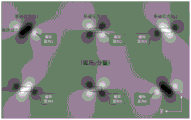
In the embodiment of the invention, a plurality of magnetic detection components are adopted to form an array, and a plurality of magnetic detection components are utilized to acquire multi-channel signals, so that the magnetic image of magnetic coding can be detected. The magnetic images with the 6 magnetic moment orientations are shown in fig. 7a, 7b, and 7c depending on the detected magnetic field component. According to the 6 different magnetic images, different easy magnetization directions and high and low coercive forces can be encoded, for example, 3 easy magnetization directions are encoded into A, B, C, and high and low coercive forces are encoded into 0 and 1.
When the distribution of the z component of the magnetic field on the upper surface of the magnet is as shown in fig. 8, the magnetic moment of the magnetic code changes as shown in fig. 9 when the magnetic code whose easy magnetization direction is the z direction is excited by the magnetic field in the z direction. When it is moved over the sensor, the detected magnetic image is shown in fig. 10 for different detected magnetic field components. The magnetic images of different magnetic field components are different from the magnetic coded image of the easy magnetization direction in the xy plane, so that the magnetic identification sensor can also identify the magnetic code of which the easy magnetization direction is the z direction.
According to the embodiment of the invention, the following technical effects can be achieved:
1. the magnetic sensor is arranged between the first magnet and the second magnet through the first magnet and the second magnet which are arranged side by side and have the same magnetizing directions, so that a magnetic field with larger magnetic field intensity can be formed above the first magnet or the second magnet and a magnetic field with relatively smaller magnetic field intensity can be formed above the magnetic sensor, when a measured object with a magnetic code moves along the magnetizing direction (or in the reverse direction), the magnetic code is firstly magnetized by the first magnetic field and then enters the second magnetic field, and in the process, the magnetic sensor detects the coercive force and the magnetic moment orientation of the magnetic code. Because the magnetic moment orientation of the magnetic code at least comprises the direction with an acute included angle with the straight line of the magnetizing direction, the magnetic identification device is not limited to detect the magnetic code vertical to or parallel to the surface of the measured object, the magnetic moment orientation detection diversity is improved, and more code numbers are provided; on the other hand, because magnetic sensor sets up between first magnet and second magnet for no matter the measured object is forward movement or reverse movement, all can realize the detection of magnetic encoding coercive force and magnetic moment orientation, avoid producing the misprediction, facilitate the use.
2. By adopting a group of horizontal magnetization structures (two magnets) and a magnetic sensor, the cost is reduced under the condition of realizing effective detection of magnetic information of a magnetic pattern, the miniaturization of a product is facilitated, and the development trend of miniaturization and integration of modern electronic components is met.
3. The array formed by the plurality of magnetic detection components is used as a magnetic sensor, the arrangement direction of the plurality of magnetic detection components is parallel to the length direction of the strip-shaped magnet, and the sensitivity direction of each magnetic detection component can be different and is used for measuring different magnetic moment orientations so as to improve the detection accuracy.
4. According to the magnetic moment orientation of the magnetic codes on the measured object, corresponding sensitivity directions are respectively set, so that accurate magnetic moment orientation detection aiming at the specific measured object is realized, and the detection accuracy is further improved.
Example 2
The present embodiment provides a test object with a magnetic code, which may be a security element comprising magnetic material arranged on an object such as a banknote, cheque, bank card, ticket, stamp, document, ticket or other such object, wherein the magnetic material forms the magnetic code. In the embodiment of the present invention, the magnetic code includes a plurality of magnetic patterns, and a magnetic moment of at least one of the magnetic patterns is oriented in a direction forming an acute angle with an included angle of a straight line where the magnetization direction of the embodiment 1 is located. The magnetic moment orientation of the magnetic pattern also comprises a direction perpendicular or parallel to the line of the magnetizing direction.
According to the embodiment of the invention, the easy magnetization direction (namely the magnetic moment orientation) forming an acute angle with the straight line of the magnetization direction is arranged, so that the magnetic code of the measured object in the magnetic moment orientation is easy to be magnetized, and the magnetic sensor can conveniently identify the magnetic code.
Example 3
The present embodiment provides a magnetic identification system, comprising: the embodiment of the invention provides a magnetic identification device and a measured object with magnetic codes.
For specific description, reference may be made to the above embodiments, which are not described herein in detail.
Example 4
The embodiment of the invention provides a magnetic code identification method, which is used for identifying a magnetic code with a plurality of magnetic patterns, wherein an included angle between a straight line where the magnetic moment orientation of at least one magnetic pattern is located and a straight line where the magnetizing direction is located is an acute angle, as shown in fig. 11, the magnetic code identification method comprises the following steps:
step S11, moving the magnetic code to a first magnetic field, performing magnetization processing on the magnetic patterns by using the first magnetic field, and detecting a first magnetic moment orientation of each magnetic pattern, where the first magnetic field is an excitation magnetic field formed by arranging a first magnet and a second magnet above the first magnet or the second magnet in parallel with the same magnetization direction.
Step S12, moving the magnetic code to a second magnetic field, performing magnetization processing on the magnetic patterns by using the second magnetic field, and detecting a second magnetic moment orientation of each magnetic pattern, wherein the second magnetic field is an excitation magnetic field formed above a magnetic sensor disposed between the first magnet and the second magnet.
And step S13, determining the coercive force of the corresponding magnetic pattern through the first magnetic moment orientation and the second magnetic moment orientation.
And step S14, determining magnetic encoding information corresponding to each magnetic image according to the detected first magnetic moment orientation, the detected second magnetic moment orientation and the detected coercive force.
In the embodiment of the present invention, the first magnetic field is used to magnetize the magnetic pattern on the magnetic code, and then the magnetic pattern enters the second magnetic field, wherein the magnetic moment orientation of the magnetic code can be identified by using the magnetic sensor, specifically, the magnetic image shown in fig. 7a to 7c can be formed by using signals collected by a plurality of sensor channels, so as to determine the magnetic moment orientation corresponding to each magnetic pattern in each stage. As for the magnitude of the coercive force, it can be determined using the change in the orientation of the magnetic moment before and after passing through the first magnetic field and the second magnetic field.
Optionally, in the embodiment of the present invention, determining the coercivity of the corresponding magnetic pattern according to the first magnetic moment orientation and the second magnetic moment orientation includes: when the second magnetic moment orientation is completely the same as the first magnetic moment orientation, determining that the corresponding magnetic pattern is a high coercivity code; and when the orientation of the second magnetic moment is opposite to the orientation of the first magnetic moment, determining that the corresponding magnetic pattern is a low-coercivity code.
For a detailed description, refer to the description of fig. 5a-5e, which are not repeated herein.
According to an embodiment of the present invention. The magnetic encoding is magnetized in a first magnetic field formed by a first magnet and a second magnet which are arranged side by side and have the same magnetizing direction, and then the first magnetic field enters a second magnetic field, and in the process, the magnetic sensor detects the coercive force and the magnetic moment orientation of the magnetic encoding. Because the included angle between the straight line of the magnetic moment orientation of at least one magnetic pattern and the straight line of the magnetizing direction forms an acute angle, the magnetic identification device is not limited to detecting the magnetic codes vertical to or parallel to the surface of the measured object, the magnetic moment orientation detection diversity is improved, and more coding numbers are provided.
It should be understood that the above examples are only for clarity of illustration and are not intended to limit the embodiments. Other variations and modifications will be apparent to persons skilled in the art in light of the above description. And are neither required nor exhaustive of all embodiments. And obvious variations or modifications therefrom are within the scope of the invention.