CN112686242B - Fine-grained image classification method based on multilayer focusing attention network - Google Patents
Fine-grained image classification method based on multilayer focusing attention network Download PDFInfo
- Publication number
- CN112686242B CN112686242B CN202011588241.4A CN202011588241A CN112686242B CN 112686242 B CN112686242 B CN 112686242B CN 202011588241 A CN202011588241 A CN 202011588241A CN 112686242 B CN112686242 B CN 112686242B
- Authority
- CN
- China
- Prior art keywords
- attention
- feature
- image
- layer
- network
- Prior art date
- Legal status (The legal status is an assumption and is not a legal conclusion. Google has not performed a legal analysis and makes no representation as to the accuracy of the status listed.)
- Active
Links
- 238000000034 method Methods 0.000 title claims abstract description 38
- 239000010410 layer Substances 0.000 claims abstract description 73
- 238000011176 pooling Methods 0.000 claims abstract description 18
- 230000007246 mechanism Effects 0.000 claims abstract description 7
- 239000002356 single layer Substances 0.000 claims abstract description 6
- 239000011159 matrix material Substances 0.000 claims description 26
- 238000004364 calculation method Methods 0.000 claims description 18
- 229940050561 matrix product Drugs 0.000 claims description 13
- 238000013459 approach Methods 0.000 claims description 9
- 230000000694 effects Effects 0.000 claims description 7
- 230000004913 activation Effects 0.000 claims description 6
- 230000004807 localization Effects 0.000 claims description 6
- 230000008569 process Effects 0.000 claims description 4
- 238000010606 normalization Methods 0.000 claims description 3
- 238000012549 training Methods 0.000 abstract description 4
- 230000006870 function Effects 0.000 description 15
- 239000000523 sample Substances 0.000 description 8
- 238000013527 convolutional neural network Methods 0.000 description 7
- 238000003909 pattern recognition Methods 0.000 description 5
- 238000011160 research Methods 0.000 description 5
- 238000004422 calculation algorithm Methods 0.000 description 2
- 238000013145 classification model Methods 0.000 description 2
- 238000000205 computational method Methods 0.000 description 2
- 238000013135 deep learning Methods 0.000 description 2
- 238000011161 development Methods 0.000 description 2
- 230000018109 developmental process Effects 0.000 description 2
- 238000010586 diagram Methods 0.000 description 2
- 238000000605 extraction Methods 0.000 description 2
- 230000010365 information processing Effects 0.000 description 2
- 238000012545 processing Methods 0.000 description 2
- 238000012360 testing method Methods 0.000 description 2
- 101100153586 Caenorhabditis elegans top-1 gene Proteins 0.000 description 1
- 241000282472 Canis lupus familiaris Species 0.000 description 1
- 101001121408 Homo sapiens L-amino-acid oxidase Proteins 0.000 description 1
- 102100026388 L-amino-acid oxidase Human genes 0.000 description 1
- 101100370075 Mus musculus Top1 gene Proteins 0.000 description 1
- 101100012902 Saccharomyces cerevisiae (strain ATCC 204508 / S288c) FIG2 gene Proteins 0.000 description 1
- 230000009286 beneficial effect Effects 0.000 description 1
- 230000008901 benefit Effects 0.000 description 1
- 238000001514 detection method Methods 0.000 description 1
- 238000002474 experimental method Methods 0.000 description 1
- 238000010801 machine learning Methods 0.000 description 1
- 238000005457 optimization Methods 0.000 description 1
- 230000011218 segmentation Effects 0.000 description 1
- 241000894007 species Species 0.000 description 1
- 238000010200 validation analysis Methods 0.000 description 1
Images


Landscapes
- Image Analysis (AREA)
Abstract
Description
技术领域Technical Field
本发明涉及一种基于多层聚焦注意力网络的细粒度图像分类方法,属于计算机视觉技术领域。The present invention relates to a fine-grained image classification method based on a multi-layer focused attention network, and belongs to the technical field of computer vision.
背景技术Background Art
随着深度学习、卷积网络技术的不断发展,深度学习网络在计算机视觉领域得到广泛的应用,如图像检索,场景解析,目标跟踪等。在细粒度图像识别领域,深度卷积网络也得到广泛地研究与应用。由于在细粒度图像识别中,类内差异容易受姿态,视角与位置等因素影响。其次类间具有相似性。最后手工标注位置不稳定且耗费人力。因此细粒度识别任务更具有挑战性。Zhang等人提出强监督细粒度图像分类模型(Part-basedRegionConvolutional Neural Network,R-CNN)借助边界框和部分批注标签进行对象部件定位等操作得到对象与部件的图像块,最后将对象部件等特征级联之后进行分类。强监督细粒度图像分类模型(Part-based R-CNN)分类准确率取得不错的效果,但存在算法速度慢,过于依赖标签,定位检测不稳定等问题。因此Wei等人提出掩膜卷积神经网络模型(Mask-CNN)在训练时仅需要部分批注和图像等级标签。同时借助全卷积网络(FullyConvolutional Networks,FCN)学习部分掩膜来进行对象部件定位等操作得到对象与部件的图像块,最后将对象部件等特征级联之后进行分类。掩膜卷积神经网络模型(Mask-CNN)取得很好的定位效果以及分类准确率,并且大大降低对标记依赖性,但是任避免不了强监督标记分类。Lin等人提出高阶特征编码双线性卷积网络(Bilinear-CNN,B-CNN)和改进的双线性卷积网络,通过对特征图进行外积操作建立了特征图中通道之间的线性相关,并进行端到端的联合优化学习,在细粒度分类任务上取得了优异的性能。但是存在无法捕捉特征图中通道之间的非线性关系,于是Ge等人提出一种核化的双线性卷积网络,通过使用核函数的方式有效地建模特征图中通道之间的非线性关系,改进了高阶特征编码方法,提升特征的表达能力。但是该方法存在外积导致特征的维度增大为原来的平方等缺点。Zheng等人提出多注意力卷积神经网络(Multi-attention Convolutional Neural Network,MA-CNN)模型抛弃手工标记对象部件的方法,采用弱监督学习方法。同时定位多个对象部件,提出信道分组损耗,通过聚类产生多个部分。将这些部分分别与特征进行点乘得到局部精细化的特征分别进行分类,取得很好的分类准确率。但是该方法中对象的部件数量有限(2个或4个),因此会限制分类的准确。先前工作通常采用定位或者分割来解决类内的差异性,但是类间相似性依然影响特征的学习;With the continuous development of deep learning and convolutional network technology, deep learning networks have been widely used in the field of computer vision, such as image retrieval, scene parsing, target tracking, etc. In the field of fine-grained image recognition, deep convolutional networks have also been widely studied and applied. In fine-grained image recognition, intra-class differences are easily affected by factors such as posture, perspective and position. Secondly, there are similarities between classes. Finally, manual annotation positions are unstable and labor-intensive. Therefore, fine-grained recognition tasks are more challenging. Zhang et al. proposed a strongly supervised fine-grained image classification model (Part-basedRegionConvolutionalNeuralNetwork, R-CNN) to obtain image blocks of objects and parts by using bounding boxes and partial annotation labels to locate object parts, and finally classify the object parts and other features after cascading. The strongly supervised fine-grained image classification model (Part-based R-CNN) has achieved good results in classification accuracy, but there are problems such as slow algorithm speed, over-reliance on labels, and unstable positioning detection. Therefore, Wei et al. proposed a mask convolutional neural network model (Mask-CNN) that only requires partial annotations and image-level labels during training. At the same time, the fully convolutional network (FCN) is used to learn partial masks to perform operations such as object component positioning to obtain image blocks of objects and components, and finally the features such as object components are cascaded for classification. The mask convolutional neural network model (Mask-CNN) achieves good positioning effect and classification accuracy, and greatly reduces the dependence on labels, but it is still inevitable to use strong supervised label classification. Lin et al. proposed a high-order feature encoding bilinear convolutional network (Bilinear-CNN, B-CNN) and an improved bilinear convolutional network. By performing outer product operations on feature maps, the linear correlation between channels in feature maps is established, and end-to-end joint optimization learning is performed, achieving excellent performance in fine-grained classification tasks. However, there is a problem that the nonlinear relationship between channels in feature maps cannot be captured. Therefore, Ge et al. proposed a kernelized bilinear convolutional network, which effectively models the nonlinear relationship between channels in feature maps by using kernel functions, improves the high-order feature encoding method, and enhances the expression ability of features. However, this method has the disadvantage that the outer product causes the dimension of the feature to increase to the original square. Zheng et al. proposed a Multi-attention Convolutional Neural Network (MA-CNN) model that abandoned the method of manually marking object parts and adopted a weakly supervised learning method. It simultaneously locates multiple object parts, proposes channel grouping loss, and generates multiple parts through clustering. These parts are point-multiplied with the features to obtain local refined features and then classified separately, achieving good classification accuracy. However, the number of object parts in this method is limited (2 or 4), which limits the accuracy of classification. Previous work usually uses positioning or segmentation to solve intra-class differences, but inter-class similarities still affect feature learning;
面向数据的年代,特征选择这个任务越来越不适合人工来做。模式识别的问题就是用计算的方法根据样本的特征将样本划分到一定的类别中去。模式识别就是通过计算机用数学技术方法来研究模式的自动处理和判读,把环境与客体统称为模式。随着计算机技术的发展,人类有可能研究复杂的信息处理过程,其过程的一个重要形式是生命体对环境及客体的识别。模式识别以图像处理与计算机视觉、语音语言信息处理等为主要研究方向,研究人类模式识别的机理以及有效的计算方法。In the data-oriented era, the task of feature selection is becoming less and less suitable for manual work. The problem of pattern recognition is to use computational methods to classify samples into certain categories based on their characteristics. Pattern recognition is to use mathematical techniques to study the automatic processing and interpretation of patterns through computers, and the environment and objects are collectively referred to as patterns. With the development of computer technology, humans have the possibility to study complex information processing processes, an important form of which is the recognition of the environment and objects by living organisms. Pattern recognition focuses on image processing, computer vision, speech and language information processing, etc., and studies the mechanism of human pattern recognition and effective computational methods.
计算机要解释一张图片的内容是很难的,因为计算机看到的图片是一个大的数字矩阵,它对图像传递的思想、知识和意义一无所知。为了理解图像的内容,我们必须应用图像分类,这是使用计算机视觉和机器学习算法从图像中抽取意义的任务。It is difficult for a computer to interpret the content of a picture because the picture a computer sees is a large matrix of numbers and it has no idea about the thoughts, knowledge and meaning conveyed by the image. In order to understand the content of the image, we must apply image classification, which is the task of extracting meaning from images using computer vision and machine learning algorithms.
细粒度图像分类是近年来计算机视觉、模式识别等领域一个热门的研究课题。其目的是对粗粒度的大类别进行更加细致的子类划分。细粒度图像的类别精度更加细致,类间差异更加细微,往往只能借助于微小的局部差异才能区分出不同的类别。而与人脸识别等对象级分类任务相比,细粒度图像的类内差异更加巨大,存在着姿态、光照、遮挡、背景干扰等诸多不确定因素。因此,细粒度图像分类是一项极有意义的研究任务。Fine-grained image classification has been a hot research topic in the fields of computer vision and pattern recognition in recent years. Its purpose is to divide the coarse-grained large categories into more detailed subcategories. The category accuracy of fine-grained images is more detailed, and the differences between categories are more subtle. Often, different categories can only be distinguished with the help of tiny local differences. Compared with object-level classification tasks such as face recognition, the intra-class differences of fine-grained images are even greater, and there are many uncertain factors such as posture, lighting, occlusion, and background interference. Therefore, fine-grained image classification is a very meaningful research task.
细粒度图像分类无论在工业界还是学术界都有着广泛的研究需求与应用场景。与之相关的研究课题主要包括识别不同种类的鸟、狗、花、车、飞机等。在实际生活中,识别不同的子类别又存在着巨大的应用需求。例如,在生态保护中,有效识别不同种类的生物,是进行生态研究的重要前提。如果能够借助于计算机视觉的技术,实现低成本的细粒度图像识别,那么无论对于学术界,还是工业界而言,都有着非常重要的意义。Fine-grained image classification has a wide range of research needs and application scenarios in both industry and academia. Related research topics mainly include identifying different types of birds, dogs, flowers, cars, airplanes, etc. In real life, there is a huge application demand for identifying different subcategories. For example, in ecological protection, effectively identifying different types of organisms is an important prerequisite for ecological research. If we can use computer vision technology to achieve low-cost fine-grained image recognition, it will be of great significance to both academia and industry.
发明内容Summary of the invention
本发明提供了一种基于多层聚焦注意力网络的细粒度图像分类方法,多层聚焦网络模型能有效定位识别对象位置;卷积特征注意力模块能在增强目标对象有效特征的提取,同时相比同类模块降低计算复杂度;定位区域选择机制增强模型泛化能力;双线性注意力最大池化增强特征的表达,降低维度和减少卷积层参数误差造成估计均值的偏移的误差,提高模型的鲁棒性。The present invention provides a fine-grained image classification method based on a multi-layer focused attention network. The multi-layer focused network model can effectively locate and identify the position of the object; the convolutional feature attention module can enhance the extraction of effective features of the target object while reducing the computational complexity compared with similar modules; the positioning area selection mechanism enhances the generalization ability of the model; the bilinear attention maximum pooling enhances the expression of features, reduces the dimension and reduces the error of the estimated mean offset caused by the convolutional layer parameter error, thereby improving the robustness of the model.
本发明的技术方案是:一种基于多层聚焦注意力网络的细粒度图像分类方法,所述方法的具体步骤如下:The technical solution of the present invention is: a fine-grained image classification method based on a multi-layer focused attention network, and the specific steps of the method are as follows:
Step1、首层聚焦网络是结合了卷积块注意力特征模块的单层聚焦卷积网络,其生成特征与注意力积矩阵,同时输出定位区域;Step 1: The first-layer focusing network is a single-layer focusing convolutional network combined with the convolutional block attention feature module, which generates feature and attention product matrices and outputs the positioning area at the same time;
Step2、裁剪及遮挡操作:经Step1操作之后得到了定位区域,裁剪操作根据该定位区域对原图像进行裁剪得到裁剪图像;遮挡操作根据Step1操作之后得到的定位区域对原图相应位置进行遮挡,得到遮挡图像;Step 2, cropping and occluding operations: After the operation in Step 1, the positioning area is obtained. The cropping operation crops the original image according to the positioning area to obtain a cropped image; the occluding operation occludes the corresponding position of the original image according to the positioning area obtained after the operation in Step 1 to obtain an occluded image;
Step3、把得到的裁剪图像及遮挡图像分别输入到第二、三层聚焦网络,生成特征与注意力矩阵积矩阵;Step 3, input the obtained cropped image and occluded image into the second and third layer focusing networks respectively to generate feature and attention matrix product matrices;
Step4、分类预测方法:把特征与注意力矩阵积矩阵输入到全连接层得到分类预测结果,分类预测结果采用注意力中心损失进行优化。
作为本发明的进一步方案,所述步骤Step1的具体步骤如下:As a further solution of the present invention, the specific steps of Step 1 are as follows:
Step1.1、图像输入的首层聚焦网络采用Inception-V3作为基础网络,用于提取图像的基础特征;Step 1.1, the first-layer focusing network of the image input uses Inception-V3 as the basic network to extract the basic features of the image;
Step1.2、由Step1.1得到Inception-V3网络提取图像的特征图F∈RC×H×W输入卷积块特征注意力模块中得到特征图Fa∈RC×H×W和注意力图A∈RM×H×W,如计算公式所示:


其中C、H、W分别表示特征图的通道数、高度、宽度,

Step1.3、双线性注意力最大池化:将Step1.2得到的特征图Fa∈RC×H×W与每个注意力图A∈RM×H×W相乘,生成M个部分的特征与注意力矩阵积矩阵Fk∈RC×H×W,加入非线性激活函数,最大池化层,如计算公式所示:
Step1.4、定位区域选择机制:在注意力图A∈RM×H×W中有M个特征矩阵表示图像中的不同对象部件,使用softmax函数处理注意力图A得到

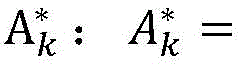
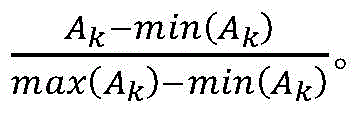
作为本发明的进一步方案,所述步骤Step2的具体步骤如下:As a further solution of the present invention, the specific steps of Step 2 are as follows:
Step2.1、根据Step1.4得到的定位区域


Step2.2、根据定位区域


作为本发明的进一步方案,所述步骤Step3的具体步骤如下:As a further solution of the present invention, the specific steps of Step 3 are as follows:
Step3.1、将定位区域输入裁剪和遮挡模块对原图像进行裁剪和遮挡得到裁剪图像和遮挡图像分别作为第二、三层聚焦网络的输入;Step 3.1, input the positioning area into the cropping and occlusion module to crop and occlude the original image to obtain the cropped image and occluded image as the input of the second and third layer focusing network respectively;
Step3.2、第二、三层聚焦网络按照Step1.1、Step1.2、Step1.3的步骤对裁剪或遮挡后的图像进行操作,生成特征与注意力矩阵积矩阵。Step3.2, the second and third layer focusing networks operate on the cropped or occluded image according to the steps of Step1.1, Step1.2, and Step1.3 to generate the feature and attention matrix product matrix.
作为本发明的进一步方案,所述步骤Step4中,分类预测结果采用注意力中心损失进行优化包括:As a further solution of the present invention, in
在首层聚焦网络和使用裁剪图像作为输入的第二层聚焦网络中使用注意力中心损失,通过惩罚每个种类的样本和该种类样本中心的偏移,使得同一种类的样本尽量聚合在一起;对属于同一对象部件的特征的方差进行惩罚,即部件特征Pk∈RM×C将趋近于全局特征中心Ek∈RM×C,在同一对象部件kth中反馈注意力图A;其中损失函数LC计算公式如:
本发明的有益效果是:本发明多层聚焦网络模型能有效定位识别对象位置;卷积特征注意力模块能在增强目标对象有效特征的提取,同时相比同类模块降低计算复杂度;定位区域选择机制增强模型泛化能力;双线性注意力最大池化增强特征的表达,降低维度和减少卷积层参数误差造成估计均值的偏移的误差,提高模型的鲁棒性。The beneficial effects of the present invention are as follows: the multi-layer focusing network model of the present invention can effectively locate and identify the position of the object; the convolutional feature attention module can enhance the extraction of effective features of the target object while reducing the computational complexity compared with similar modules; the positioning area selection mechanism enhances the generalization ability of the model; the bilinear attention maximum pooling enhances the expression of features, reduces the dimension and reduces the error of the estimated mean caused by the convolutional layer parameter error, thereby improving the robustness of the model.
附图说明BRIEF DESCRIPTION OF THE DRAWINGS
图1为本发明中多层聚焦网络总体架构图;FIG1 is a diagram showing the overall architecture of a multi-layer focusing network in the present invention;
图2为本发明中单层聚焦网络具体流程图;FIG2 is a specific flow chart of a single-layer focusing network in the present invention;
图3为本发明所采用公共数据集的示例图。FIG. 3 is an example diagram of a public data set used in the present invention.
具体实施方式DETAILED DESCRIPTION
实施例1:如图1-3所示,一种基于多层聚焦注意力网络的细粒度图像分类方法,所述方法的具体步骤如下:Embodiment 1: As shown in FIG. 1-3, a fine-grained image classification method based on a multi-layer focused attention network, the specific steps of the method are as follows:
Step1、公共数据集CUB-200-2011共包含来自200个鸟类物种的11788张图像,其中5994张训练与验证图像,5794张测试图像。将训练图像输入首层聚焦网络,首层聚焦网络是结合了卷积块注意力特征模块的单层聚焦卷积网络,其生成特征与注意力积矩阵,同时输出定位区域;Step 1. The public dataset CUB-200-2011 contains a total of 11,788 images from 200 bird species, including 5,994 training and validation images and 5,794 test images. The training images are input into the first-layer focusing network, which is a single-layer focusing convolutional network combined with a convolutional block attention feature module. It generates feature and attention product matrices and outputs the positioning area at the same time;
Step2、裁剪及遮挡操作:经Step1操作之后得到了定位区域,裁剪操作根据该定位区域对原图像进行裁剪得到裁剪图像;遮挡操作根据Step1操作之后得到的定位区域对原图相应位置进行遮挡,得到遮挡图像;Step 2, cropping and occluding operations: After the operation in Step 1, the positioning area is obtained. The cropping operation crops the original image according to the positioning area to obtain a cropped image; the occluding operation occludes the corresponding position of the original image according to the positioning area obtained after the operation in Step 1 to obtain an occluded image;
Step3、把得到的裁剪图像及遮挡图像分别输入到第二、三层聚焦网络,生成特征与注意力矩阵积矩阵;Step 3, input the obtained cropped image and occluded image into the second and third layer focusing networks respectively to generate feature and attention matrix product matrices;
Step4、分类预测方法:把特征与注意力矩阵积矩阵输入到全连接层得到分类预测结果,分类预测结果采用注意力中心损失进行优化。
作为本发明的进一步方案,所述步骤Step1的具体步骤如下:As a further solution of the present invention, the specific steps of Step 1 are as follows:
Step1.1、图像输入的首层聚焦网络采用Inception-V3作为基础网络,用于提取图像的基础特征;Step 1.1, the first-layer focusing network of the image input uses Inception-V3 as the basic network to extract the basic features of the image;
Step1.2、由Step1.1得到Inception-V3网络提取图像的特征图F∈RC×H×W输入卷积块特征注意力模块中得到特征图Fa∈RC×H×W和注意力图A∈RM×H×W,如计算公式所示:


其中C、H、W分别表示特征图的通道数、高度、宽度,

Step1.3、双线性注意力最大池化:将Step1.2得到的特征图Fa∈RC×H×W与每个注意力图A∈RM×H×W相乘,生成M个部分的特征与注意力矩阵积矩阵Fk∈RC×H×W,加入非线性激活函数,最大池化层,如计算公式所示:
Step1.4、定位区域选择机制:在注意力图A∈RM×H×W中有M个特征矩阵表示图像中的不同对象部件,使用softmax函数处理注意力图A得到


作为本发明的进一步方案,所述步骤Step2的具体步骤如下:As a further solution of the present invention, the specific steps of Step 2 are as follows:
Step2.1、根据Step1.4得到的定位区域


Step2.2、根据定位区域


作为本发明的进一步方案,所述步骤Step3的具体步骤如下:As a further solution of the present invention, the specific steps of Step 3 are as follows:
Step3.1、将定位区域输入裁剪和遮挡模块对原图像进行裁剪和遮挡得到裁剪图像和遮挡图像分别作为第二、三层聚焦网络的输入;Step 3.1, input the positioning area into the cropping and occlusion module to crop and occlude the original image to obtain the cropped image and occluded image as the input of the second and third layer focusing network respectively;
Step3.2、第二、三层聚焦网络按照Step1.1、Step1.2、Step1.3的步骤对裁剪或遮挡后的图像进行操作,生成特征与注意力矩阵积矩阵。Step3.2, the second and third layer focusing networks operate on the cropped or occluded image according to the steps of Step1.1, Step1.2, and Step1.3 to generate the feature and attention matrix product matrix.
作为本发明的进一步方案,所述步骤Step4中,分类预测结果采用注意力中心损失进行优化包括:As a further solution of the present invention, in
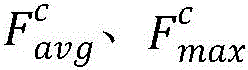
在首层聚焦网络和使用裁剪图像作为输入的第二层聚焦网络中使用注意力中心损失,通过惩罚每个种类的样本和该种类样本中心的偏移,使得同一种类的样本尽量聚合在一起;对属于同一对象部件的特征的方差进行惩罚,即部件特征Pk∈RM×C将趋近于全局特征中心Ek∈RM×C,在同一对象部件kth中反馈注意力图A;其中损失函数LC计算公式如:
把特征与注意力矩阵积矩阵输入到全连接层训练好的模型输入公共数据集CUB-200-2011的5794张测试图像,分类结果与真实标签对比得到分类准确率及各模块组合结果如表1所示。The feature and attention matrix product matrix is input into the fully connected layer. The trained model is input into 5794 test images of the public dataset CUB-200-2011. The classification results are compared with the true labels to obtain the classification accuracy and the combination results of each module as shown in Table 1.
表1组成部分及其组合的贡献Table 1 Contribution of components and their combinations

实施例2,如图1-3所示,一种基于多层聚焦注意力网络的细粒度图像分类方法,本实施例与实施例1相同,不同之处在于,本实施例中公共数据集CUB-200-2011(200类11788张鸟类图像)、FGVC-Aircraft(100类10000张飞机图像)以及Stanford Cars(196类16185张汽车图像)上分别对本文方法进行评估,分别获得89.7%、93.6%、95.1%的Top-1准确率;在三个细粒度公共数据集上得到的结果与当前主流细粒度图像分类方法(VGG-19、ResNet-101等)比较结果如表2所示,实验结果表明,本方法的分类准确率高于目前主流方法。Example 2, as shown in Figures 1-3, a fine-grained image classification method based on a multi-layer focused attention network, this embodiment is the same as Example 1, except that, in this embodiment, the method of this invention is evaluated on the public datasets CUB-200-2011 (11,788 bird images in 200 categories), FGVC-Aircraft (10,000 aircraft images in 100 categories), and Stanford Cars (16,185 car images in 196 categories), respectively, and the Top-1 accuracy rates of 89.7%, 93.6%, and 95.1% are obtained respectively; the results obtained on the three fine-grained public datasets are compared with the current mainstream fine-grained image classification methods (VGG-19, ResNet-101, etc.) as shown in Table 2. The experimental results show that the classification accuracy of this method is higher than that of the current mainstream methods.
表2与当前方法准确率对比Table 2 Comparison of accuracy with current methods

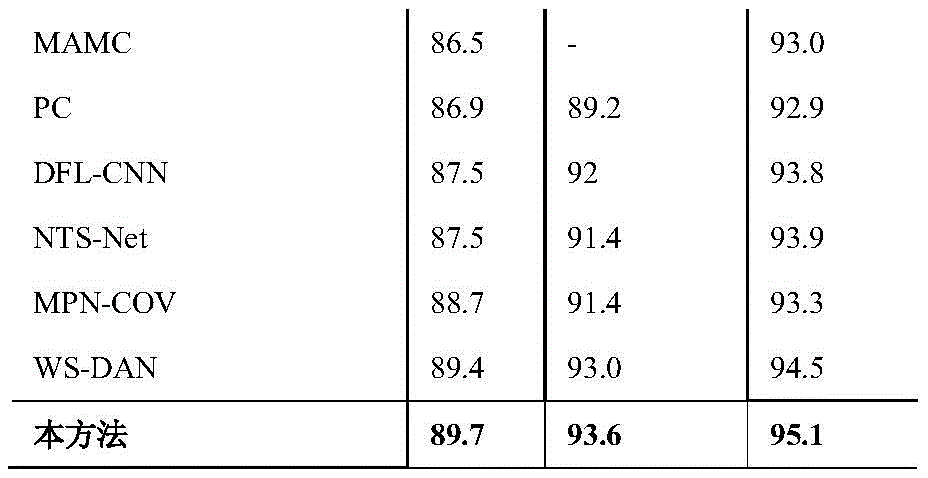
本发明提出一种基于多层聚焦注意力卷积网络的细粒度图像分类方法,整体结构如图1所示,具体单层聚焦网络内部流程图如图2所示,能够提取更多有效的局部特征,聚焦于对象的识别位置。得到更具有判别力的图像表达。同时多层聚焦卷积网络之间相互对抗、相互合作、相互受益、共同进步,进一步提高网络的性能。实验表明本文所提出的多层聚焦网络在图3所示的三个细粒度图像数据集上均取得优异的性能。The present invention proposes a fine-grained image classification method based on a multi-layer focused attention convolutional network. The overall structure is shown in Figure 1, and the specific single-layer focused network internal flow chart is shown in Figure 2. It can extract more effective local features and focus on the recognition position of the object. A more discriminative image expression is obtained. At the same time, the multi-layer focused convolutional networks confront each other, cooperate with each other, benefit from each other, and make progress together, further improving the performance of the network. Experiments show that the multi-layer focused network proposed in this article has achieved excellent performance on the three fine-grained image datasets shown in Figure 3.
上面结合附图对本发明的具体实施方式作了详细说明,但是本发明并不限于上述实施方式,在本领域普通技术人员所具备的知识范围内,还可以在不脱离本发明宗旨的前提下作出各种变化。The specific implementation modes of the present invention are described in detail above in conjunction with the accompanying drawings, but the present invention is not limited to the above implementation modes, and various changes can be made within the knowledge scope of ordinary technicians in this field without departing from the purpose of the present invention.
Claims (3)





Priority Applications (1)
| Application Number | Priority Date | Filing Date | Title |
|---|---|---|---|
| CN202011588241.4A CN112686242B (en) | 2020-12-29 | 2020-12-29 | Fine-grained image classification method based on multilayer focusing attention network |
Applications Claiming Priority (1)
| Application Number | Priority Date | Filing Date | Title |
|---|---|---|---|
| CN202011588241.4A CN112686242B (en) | 2020-12-29 | 2020-12-29 | Fine-grained image classification method based on multilayer focusing attention network |
Publications (2)
| Publication Number | Publication Date |
|---|---|
| CN112686242A CN112686242A (en) | 2021-04-20 |
| CN112686242B true CN112686242B (en) | 2023-04-18 |
Family
ID=75454562
Family Applications (1)
| Application Number | Title | Priority Date | Filing Date |
|---|---|---|---|
| CN202011588241.4A Active CN112686242B (en) | 2020-12-29 | 2020-12-29 | Fine-grained image classification method based on multilayer focusing attention network |
Country Status (1)
| Country | Link |
|---|---|
| CN (1) | CN112686242B (en) |
Families Citing this family (5)
| Publication number | Priority date | Publication date | Assignee | Title |
|---|---|---|---|---|
| CN113936145B (en) * | 2021-10-08 | 2024-06-11 | 南京信息工程大学 | A fine-grained recognition method based on attention graph sorting |
| CN114998964B (en) * | 2022-06-02 | 2023-04-18 | 天津道简智创信息科技有限公司 | Novel license quality detection method |
| CN114708466B (en) * | 2022-06-08 | 2022-09-09 | 南京智莲森信息技术有限公司 | Part abnormal fine granularity classification method and system, storage medium and computing equipment |
| CN117058389B (en) * | 2023-08-28 | 2025-08-19 | 中国矿业大学 | Multi-attribute-driven transducer-based automatic image clipping method and device |
| CN120564762B (en) * | 2025-07-31 | 2025-09-23 | 无锡学院 | Acoustic signal recognition method, electronic device and storage medium |
Citations (4)
| Publication number | Priority date | Publication date | Assignee | Title |
|---|---|---|---|---|
| CN110569905A (en) * | 2019-09-10 | 2019-12-13 | 江苏鸿信系统集成有限公司 | Fine-grained image classification method based on generation of confrontation network and attention network |
| CN110619369A (en) * | 2019-09-23 | 2019-12-27 | 常熟理工学院 | Fine-grained image classification method based on feature pyramid and global average pooling |
| CN111191737A (en) * | 2020-01-05 | 2020-05-22 | 天津大学 | Fine-grained image classification method based on multi-scale repeated attention mechanism |
| CN112132058A (en) * | 2020-09-25 | 2020-12-25 | 山东大学 | A head pose estimation method based on multi-level image feature refinement learning, its implementation system, and storage medium |
Family Cites Families (13)
| Publication number | Priority date | Publication date | Assignee | Title |
|---|---|---|---|---|
| US8706914B2 (en) * | 2007-04-23 | 2014-04-22 | David D. Duchesneau | Computing infrastructure |
| US10223611B1 (en) * | 2018-03-08 | 2019-03-05 | Capital One Services, Llc | Object detection using image classification models |
| CN110084285A (en) * | 2019-04-08 | 2019-08-02 | 安徽艾睿思智能科技有限公司 | Fish fine grit classification method based on deep learning |
| CN110197202A (en) * | 2019-04-30 | 2019-09-03 | 杰创智能科技股份有限公司 | A kind of local feature fine granularity algorithm of target detection |
| CN110083705B (en) * | 2019-05-06 | 2021-11-02 | 电子科技大学 | A multi-hop attention depth model, method, storage medium and terminal for target emotion classification |
| US10461421B1 (en) * | 2019-05-07 | 2019-10-29 | Bao Tran | Cellular system |
| CN110533024B (en) * | 2019-07-10 | 2021-11-23 | 杭州电子科技大学 | Double-quadratic pooling fine-grained image classification method based on multi-scale ROI (region of interest) features |
| CN110598029B (en) * | 2019-09-06 | 2022-03-22 | 西安电子科技大学 | Fine-grained image classification method based on attention transfer mechanism |
| CN110674874B (en) * | 2019-09-24 | 2022-11-29 | 武汉理工大学 | Fine-grained image identification method based on target fine component detection |
| CN111178432B (en) * | 2019-12-30 | 2023-06-06 | 武汉科技大学 | Weakly supervised fine-grained image classification method based on multi-branch neural network model |
| CN111160356A (en) * | 2020-01-02 | 2020-05-15 | 博奥生物集团有限公司 | Image segmentation and classification method and device |
| CN111539469B (en) * | 2020-04-20 | 2022-04-08 | 东南大学 | Weak supervision fine-grained image identification method based on vision self-attention mechanism |
| CN111652236B (en) * | 2020-04-21 | 2022-04-29 | 东南大学 | A lightweight and fine-grained image recognition method for cross-layer feature interaction in weakly supervised scenarios |
-
2020
- 2020-12-29 CN CN202011588241.4A patent/CN112686242B/en active Active
Patent Citations (4)
| Publication number | Priority date | Publication date | Assignee | Title |
|---|---|---|---|---|
| CN110569905A (en) * | 2019-09-10 | 2019-12-13 | 江苏鸿信系统集成有限公司 | Fine-grained image classification method based on generation of confrontation network and attention network |
| CN110619369A (en) * | 2019-09-23 | 2019-12-27 | 常熟理工学院 | Fine-grained image classification method based on feature pyramid and global average pooling |
| CN111191737A (en) * | 2020-01-05 | 2020-05-22 | 天津大学 | Fine-grained image classification method based on multi-scale repeated attention mechanism |
| CN112132058A (en) * | 2020-09-25 | 2020-12-25 | 山东大学 | A head pose estimation method based on multi-level image feature refinement learning, its implementation system, and storage medium |
Also Published As
| Publication number | Publication date |
|---|---|
| CN112686242A (en) | 2021-04-20 |
Similar Documents
| Publication | Publication Date | Title |
|---|---|---|
| CN112686242B (en) | Fine-grained image classification method based on multilayer focusing attention network | |
| Hu et al. | An efficient convolutional neural network model based on object-level attention mechanism for casting defect detection on radiography images | |
| Yang et al. | Masked relation learning for deepfake detection | |
| Karnati et al. | Flepnet: feature level ensemble parallel network for facial expression recognition | |
| CN108898620B (en) | Target Tracking Method Based on Multiple Siamese Neural Networks and Regional Neural Networks | |
| Zhao et al. | Saliency detection by multi-context deep learning | |
| CN107871106B (en) | Face detection method and device | |
| CN110674874B (en) | Fine-grained image identification method based on target fine component detection | |
| CN111898432B (en) | Pedestrian detection system and method based on improved YOLOv3 algorithm | |
| CN114626461B (en) | Cross-domain object detection method based on domain adaptation | |
| CN113269089A (en) | Real-time gesture recognition method and system based on deep learning | |
| Tan et al. | Fine-grained classification via hierarchical bilinear pooling with aggregated slack mask | |
| CN111488805B (en) | A Video Behavior Recognition Method Based on Salient Feature Extraction | |
| CN113963026A (en) | Target tracking method and system based on non-local feature fusion and online update | |
| CN104102922B (en) | A Pest Image Classification Method Based on Context-Aware Dictionary Learning | |
| CN114049582A (en) | Weak supervision behavior detection method and device based on network structure search and background-action enhancement | |
| CN114743257A (en) | Method for detecting and identifying image target behaviors | |
| CN114333062A (en) | Pedestrian re-recognition model training method based on heterogeneous dual networks and feature consistency | |
| Le Louedec et al. | Segmentation and detection from organised 3D point clouds: A case study in broccoli head detection | |
| Cho et al. | Learning local attention with guidance map for pose robust facial expression recognition | |
| CN116363555A (en) | Behavior Recognition Method Based on Transformer Semantic Information Enhancement | |
| Li | Edge aware learning for 3D point cloud | |
| CN119888527A (en) | YOLOv 8-based target recognition model and method for infrared thermal imaging of high-altitude unmanned aerial vehicle | |
| Jin et al. | Complex Patterned Fabric Defects Detector Based on Improved RT-DETR | |
| CN110020688A (en) | Pedestrian detection method is blocked based on deep learning |
Legal Events
| Date | Code | Title | Description |
|---|---|---|---|
| PB01 | Publication | ||
| PB01 | Publication | ||
| SE01 | Entry into force of request for substantive examination | ||
| SE01 | Entry into force of request for substantive examination | ||
| GR01 | Patent grant | ||
| GR01 | Patent grant |