CN112684890A - Physical examination guiding method and device, storage medium and electronic equipment - Google Patents
Physical examination guiding method and device, storage medium and electronic equipment Download PDFInfo
- Publication number
- CN112684890A CN112684890A CN202011608308.6A CN202011608308A CN112684890A CN 112684890 A CN112684890 A CN 112684890A CN 202011608308 A CN202011608308 A CN 202011608308A CN 112684890 A CN112684890 A CN 112684890A
- Authority
- CN
- China
- Prior art keywords
- physical examination
- information
- emotion
- action
- user
- Prior art date
- Legal status (The legal status is an assumption and is not a legal conclusion. Google has not performed a legal analysis and makes no representation as to the accuracy of the status listed.)
- Pending
Links
- 238000000034 method Methods 0.000 title claims abstract description 54
- 230000009471 action Effects 0.000 claims abstract description 91
- 230000008451 emotion Effects 0.000 claims abstract description 87
- 230000036651 mood Effects 0.000 claims abstract description 11
- 230000033001 locomotion Effects 0.000 claims description 20
- 230000008859 change Effects 0.000 claims description 14
- 230000005611 electricity Effects 0.000 claims description 13
- 238000004590 computer program Methods 0.000 claims description 4
- 208000019901 Anxiety disease Diseases 0.000 abstract description 6
- 230000036506 anxiety Effects 0.000 abstract description 6
- 230000003190 augmentative effect Effects 0.000 abstract description 2
- 210000001508 eye Anatomy 0.000 description 35
- 239000008280 blood Substances 0.000 description 15
- 210000004369 blood Anatomy 0.000 description 15
- 230000008569 process Effects 0.000 description 12
- 238000004891 communication Methods 0.000 description 10
- 238000001514 detection method Methods 0.000 description 10
- 238000005516 engineering process Methods 0.000 description 10
- 230000006870 function Effects 0.000 description 10
- 238000010586 diagram Methods 0.000 description 8
- 150000002632 lipids Chemical class 0.000 description 8
- 230000009286 beneficial effect Effects 0.000 description 7
- 210000003811 finger Anatomy 0.000 description 6
- 238000012545 processing Methods 0.000 description 6
- 230000036772 blood pressure Effects 0.000 description 5
- 238000004364 calculation method Methods 0.000 description 4
- 238000000605 extraction Methods 0.000 description 4
- 210000003128 head Anatomy 0.000 description 4
- 238000006243 chemical reaction Methods 0.000 description 3
- 230000036541 health Effects 0.000 description 3
- 230000003862 health status Effects 0.000 description 3
- 210000003813 thumb Anatomy 0.000 description 3
- PXFBZOLANLWPMH-UHFFFAOYSA-N 16-Epiaffinine Natural products C1C(C2=CC=CC=C2N2)=C2C(=O)CC2C(=CC)CN(C)C1C2CO PXFBZOLANLWPMH-UHFFFAOYSA-N 0.000 description 2
- 210000001015 abdomen Anatomy 0.000 description 2
- 238000013480 data collection Methods 0.000 description 2
- 210000003414 extremity Anatomy 0.000 description 2
- 230000004424 eye movement Effects 0.000 description 2
- 230000003993 interaction Effects 0.000 description 2
- 238000007726 management method Methods 0.000 description 2
- 210000001747 pupil Anatomy 0.000 description 2
- 238000012360 testing method Methods 0.000 description 2
- 238000012549 training Methods 0.000 description 2
- 230000009466 transformation Effects 0.000 description 2
- 206010037660 Pyrexia Diseases 0.000 description 1
- 208000031975 Yang Deficiency Diseases 0.000 description 1
- 210000000577 adipose tissue Anatomy 0.000 description 1
- 230000005540 biological transmission Effects 0.000 description 1
- 210000005252 bulbus oculi Anatomy 0.000 description 1
- 230000001413 cellular effect Effects 0.000 description 1
- 238000013500 data storage Methods 0.000 description 1
- 230000007812 deficiency Effects 0.000 description 1
- 230000002996 emotional effect Effects 0.000 description 1
- 238000002474 experimental method Methods 0.000 description 1
- 239000000284 extract Substances 0.000 description 1
- 210000000744 eyelid Anatomy 0.000 description 1
- 239000011521 glass Substances 0.000 description 1
- 230000005802 health problem Effects 0.000 description 1
- 239000011159 matrix material Substances 0.000 description 1
- 238000010295 mobile communication Methods 0.000 description 1
- 238000012986 modification Methods 0.000 description 1
- 230000004048 modification Effects 0.000 description 1
- 230000003287 optical effect Effects 0.000 description 1
- 238000009877 rendering Methods 0.000 description 1
- 210000004243 sweat Anatomy 0.000 description 1
- 210000000106 sweat gland Anatomy 0.000 description 1
- 238000012795 verification Methods 0.000 description 1
Images




Landscapes
- User Interface Of Digital Computer (AREA)
Abstract
The embodiment of the application relates to the technical field of AR (augmented reality), and discloses a physical examination guiding method, which comprises the following steps: receiving eye feature information collected by AR wearable equipment and posture feature information collected by mobile terminal equipment; detecting whether the emotion of the user is matched with a preset emotion or not based on the eye characteristic information, and detecting whether the physical examination action of the user in the target physical examination item is standard or not based on the posture characteristic information; if the emotion is matched with the preset emotion, generating pacifying voice information corresponding to the preset emotion, and sending the pacifying voice information to the AR wearable device; if the physical examination actions are not normative, generating AR demonstration action information corresponding to the target physical examination items, and pushing the AR demonstration action information to the AR wearable device. By adopting the embodiment of the application, the user can be effectively guided to finish the target physical examination items correctly and normatively, and the possible tension or anxiety mood of the user can be relieved.
Description
Technical Field
The present application relates to the field of AR technologies, and in particular, to a physical examination guidance method, apparatus, storage medium, and electronic device.
Background
Along with the function of the mobile terminal equipment is more and more comprehensive, the mobile terminal equipment gradually has the function of acquiring the health condition of people, the problem of difficult queuing when people go to a hospital for physical examination is effectively solved, and the health problem of the user can be mastered at any time. However, for different physical examination items, people are often required to make corresponding physical examination actions, for example, when checking the iris condition of people, people are required to open eyes, and when measuring blood fat and blood pressure, people are required to put fingers in the sensing area of the mobile terminal device. The prior art can not solve the problem that it is difficult for users to make correct and normative physical examination actions for different physical examination items, especially for the old people with poor comprehension ability and reaction ability, how to correctly and normatively complete the physical examination items.
In view of the above, the present invention is proposed to provide a physical examination guidance generation method, apparatus, storage medium, electronic device and stereo parking system that overcome or at least partially solve the above problems.
Disclosure of Invention
The embodiment of the application provides a physical examination guiding method, a physical examination guiding device, a storage medium and electronic equipment, which can effectively guide a user to correctly and normatively finish a target physical examination item and relieve tension or anxiety which may occur to the user. The technical scheme is as follows:
in a first aspect, the present application provides a method for physical examination guidance, which is characterized in that the method includes:
receiving eye feature information collected by AR wearable equipment and posture feature information collected by mobile terminal equipment;
detecting whether the emotion of the user is matched with a preset emotion or not based on the eye characteristic information, and detecting whether the physical examination action of the user in a target physical examination item is standard or not based on the posture characteristic information;
if the emotion is matched with the preset emotion, generating pacifying voice information corresponding to the preset emotion, and sending the pacifying voice information to the AR wearable device; wherein the soothing voice information is used for instructing the AR wearable device to play soothing voice;
if the physical examination actions are not standard, generating AR demonstration action information corresponding to the target physical examination items, and pushing the AR demonstration action information to the AR wearable device; wherein the AR demonstration motion information is to instruct the AR wearable device to generate an AR demonstration motion video.
In a second aspect, the present application provides a physical examination guidance apparatus, which is characterized in that the apparatus includes:
the receiving module is used for receiving the eye feature information acquired by the AR wearable equipment and the body state feature information acquired by the mobile terminal equipment;
the matching module is used for detecting whether the emotion of the user is matched with a preset emotion or not based on the eye characteristic information and detecting whether the physical examination action of the user in the target physical examination item is standard or not based on the posture characteristic information;
the soothing module generates soothing voice information corresponding to the preset emotion if the emotion is matched with the preset emotion, and sends the soothing voice information to the AR wearable device; wherein the soothing voice information is used for instructing the AR wearable device to play soothing voice;
an action module, configured to generate AR demonstration action information corresponding to the target physical examination item if the physical examination action is not normative, and push the AR demonstration action information to the AR wearable device; wherein the AR demonstration motion information is to instruct the AR wearable device to generate an AR demonstration motion video.
In a third aspect, embodiments of the present application provide a computer storage medium storing a plurality of instructions adapted to be loaded by a processor and to perform the above-mentioned method steps.
In a fourth aspect, an embodiment of the present application provides an electronic device, which may include: a processor and a memory; wherein the memory stores a computer program adapted to be loaded by the processor and to perform the above-mentioned method steps.
The beneficial effects brought by the technical scheme provided by some embodiments of the application at least comprise: the physical examination items are completed by the aid of the mobile terminal device, the user is guided to complete the physical examination items correctly and standardly by the aid of the AR wearable device and the cloud server, and accuracy and reliability of physical examination guidance are improved by the aid of AR technology; and the anxiety or the nervous mood which may appear in the user is pacified, and the success rate of completing the physical examination items is effectively increased.
Drawings
In order to more clearly illustrate the embodiments of the present application or the technical solutions in the prior art, the drawings used in the description of the embodiments or the prior art will be briefly described below, it is obvious that the drawings in the following description are only some embodiments of the present application, and for those skilled in the art, other drawings can be obtained according to the drawings without creative efforts.
Fig. 1 is a schematic structural diagram of a physical examination guidance method provided in an embodiment of the present application;
fig. 2 is a schematic flowchart of a physical examination guidance method according to an embodiment of the present application;
fig. 3 is a schematic flowchart illustrating a process of detecting whether an emotion of a user matches at least one preset emotion according to an embodiment of the present application;
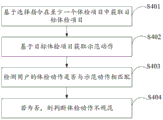
fig. 4 is a schematic flowchart illustrating a process of detecting whether a physical examination action of a user in a target physical examination item is normative according to an embodiment of the present application;
FIG. 5 is a schematic diagram of exemplary actions of an AR according to an embodiment of the present application;
fig. 6 is a schematic structural diagram of a physical examination guidance device provided in an embodiment of the present application;
fig. 7 is a schematic structural diagram of an electronic device according to an embodiment of the present application.
Detailed Description
The technical solutions in the embodiments of the present application will be clearly and completely described below with reference to the drawings in the embodiments of the present application, and it is obvious that the described embodiments are only a part of the embodiments of the present application, and not all of the embodiments. All other embodiments, which can be derived by a person skilled in the art from the embodiments given herein without making any creative effort, shall fall within the protection scope of the present application.
In the description of the present application, it is to be understood that the terms "first," "second," and the like are used for descriptive purposes only and are not to be construed as indicating or implying relative importance. In the description of the present application, it is noted that, unless explicitly stated or limited otherwise, "including" and "having" and any variations thereof, are intended to cover non-exclusive inclusions. For example, a process, method, system, article, or apparatus that comprises a list of steps or elements is not limited to only those steps or elements listed, but may alternatively include other steps or elements not listed, or inherent to such process, method, article, or apparatus. The specific meaning of the above terms in the present application can be understood in a specific case by those of ordinary skill in the art. Further, in the description of the present application, "a plurality" means two or more unless otherwise specified. "and/or" describes the association relationship of the associated objects, meaning that there may be three relationships, e.g., a and/or B, which may mean: a exists alone, A and B exist simultaneously, and B exists alone. The character "/" generally indicates that the former and latter associated objects are in an "or" relationship.
The present application will be described in detail with reference to specific examples.
As shown in fig. 1, a schematic structural diagram of a physical examination guidance method provided in an embodiment of the present application includes: server 101, mobile terminal device 102, AR wearable device 103, and user 104.
The server 101 may include a memory, a processor, a communication unit, and a storage controller. The memory, processor, communication unit and memory controller are electrically connected to each other, directly or indirectly, to enable transmission or interaction of data. For example, the components may be electrically connected to each other via one or more communication buses or signal lines. The memory may include, among other things, high-speed random access memory, and may also include non-volatile memory, such as one or more magnetic storage devices, flash memory, or other non-volatile solid-state memory. In some examples, the memory may further include remote memory remotely located from the processor, the remote memory being connectable to the cloud server via a network. Examples of such networks may include, but are not limited to, the internet, intranets, local area networks, mobile communication networks, and combinations thereof. Further, the communication unit couples various input/output devices to the processor and to the memory, and the software programs and modules within the memory may also include an operating system, which may include various software components and/or drivers for managing system tasks (e.g., memory management, storage device control, power management, etc.), and may communicate with various hardware or software components to provide an operating environment for other software components. In the embodiment of the present application, the server 101 is a processing device that receives information sent by the AR wearable device 103 and the mobile terminal device 102, processes the information, and then sends instruction information to the AR wearable device 103 and the mobile terminal device 102.
A Mobile Terminal device (Terminal device)102 includes, but is not limited to, a Mobile Station (MS), a Mobile Terminal device (Mobile Terminal), a Mobile phone (Mobile Telephone), a handset (handset), a portable device (portable equipment), and the like, and the Terminal device may communicate with one or more core networks through a Radio Access Network (RAN), for example, the Mobile Terminal device may be a Mobile phone (or called "cellular" phone), a computer with a wireless communication function, and the like, and the Mobile Terminal device may also be a portable, pocket, hand-held, computer-embedded, or vehicle-mounted Mobile device or device. In this embodiment of the application, the mobile terminal device 102 is configured to measure health status information of the user 104, where the health status information is information of a current physical state of the user 104, and the health status information may include: mild, yang deficiency, qi deficiency, fever, cold, pharyngolaryngitis, etc. For example: acquiring tongue image information of a user by using a camera, and judging health state information of the user based on the tongue image information; the blood pressure and blood fat sensor is used for collecting blood pressure and blood fat information of a user, and health state information of the user is judged based on the blood pressure and blood fat component information.
Augmented Reality (AR) is a technology for calculating the position and angle of a camera image in real time and adding a corresponding image, and is a new technology for seamlessly integrating real world information and virtual world information, and the technology aims to sleeve a virtual world on a screen in the real world and perform interaction. AR wearable device 103, may be understood as a wearable device implementing AR technology, for example: AR intelligent glasses, AR intelligent helmets and the like.
As shown in fig. 2, is a schematic flow chart of a physical examination guidance method provided in an embodiment of the present application, and includes the following steps:
s101, receiving eye feature information collected by the AR wearable device and posture feature information collected by the mobile terminal device.
The server 101 instructs the image acquisition unit of the AR wearable device 103 to acquire eye feature information of the user 104 by pushing a first acquisition instruction to the AR wearable device 103, and instructs the image acquisition unit of the mobile terminal device 102 to acquire body state feature information of the user 104 by pushing a second acquisition instruction to the mobile terminal device 102.
The eye feature information may be understood to include information such as a pupil position, a pupil shape, an iris position, an iris shape, an eyelid position, an eye corner position, and a light spot (also referred to as purkinje spot) position. For example, AR wearable device 103 employs eye tracking (eye tracking) to acquire eye feature information. Eye tracking, also known as gaze tracking, is a technique that estimates the gaze and/or point of regard of an eye by measuring eye movement. The sight line may be understood as a three-dimensional vector, and in one example, the three-dimensional vector (i.e., the sight line) may be represented by coordinates in a coordinate system constructed by using the center of the head of the user as a coordinate origin, using the right side of the head as an x-axis positive half axis, using the right side of the head as a y-axis positive half axis, and using the front side of the head as a z-axis positive half axis. The gaze point may be understood as a two-dimensional coordinate of the above three-dimensional vector (i.e. the line of sight) projected on a plane. Currently, the most popular eyeball tracking method is called pupil-cornea reflection technique (PCCR), and may also include a method that is not based on an eye image, such as estimating the eye movement based on a contact/non-contact sensor (e.g., an electrode, a capacitive sensor). The image capturing unit of the AR wearable device 103 may be an infrared camera device, an infrared image sensor, a camera, a video camera, or the like.
The posture characteristic information may be understood as the body or body part of the user 104 being in one or more states, such as open fingers, open eyes or open mouth, etc. The body state characteristic information is acquired by an image acquisition unit of the mobile terminal device 102, and the image acquisition unit of the mobile terminal device 102 may be an infrared camera device, an infrared image sensor, a camera, a video camera, or the like.
S102, detecting whether the emotion of the user is matched with a preset emotion or not based on the eye feature information.
The preset emotions may be understood as the server 101 classifying the emotions of the user into a limited number based on preset rules, for example: happiness, anger, fear, surprise, likes, dislikes, etc.
In an embodiment, as shown in fig. 3, a schematic flowchart of detecting whether an emotion of a user matches at least one preset emotion provided in an embodiment of the present application includes the following steps:
s301, acquiring iris characteristic information based on the eye characteristic information.
The server 101 intercepts the acquired eye characteristic image according to a preset iris image acquisition model to obtain a corresponding iris image, wherein the iris image acquisition model comprises gradient calculation formula calculation and an iris intercepting template. The iris image acquisition model is a model used for acquiring a corresponding iris image from the eye characteristic image, the gradient calculation formula is a calculation formula used for calculating the gradient value of any pixel point in the image, and the iris interception template is an interception template used for acquiring the corresponding iris image from the eye characteristic image.
The server 101 extracts iris feature information from the iris image according to a preset iris feature extraction model. For example, the iris feature extraction formula can be expressed as, wherein (x)0,y0) Coordinate values of center points of the superimposed iris image, alpha, beta and u0Is the parameter value in the formula, specifically, alpha is the effective filter width of the iris feature extraction formula, beta is the effective filter length of the iris feature extraction formula, u0Determining the frequency of a modulation term in the formula; j isAn imaginary number, that is, (x, y) is a pixel set including each pixel, G (x, y) is a calculated value calculated for the pixels included in the pixel set, G (x, y) includes a calculated value for each pixel, and the calculated value is an imaginary number including a real part and an imaginary part; and converting the calculated values of the pixel points according to an imaginary number conversion rule to obtain iris characteristic information containing the characteristic value of each pixel point. In one embodiment, the calculated imaginary number is converted according to an imaginary number conversion rule, that is, the polarity of the imaginary number is quantized to obtain a 2-bit binary number, specifically, when the real part and the imaginary part of the calculated value are both positive, the characteristic value is 11; when the real part is positive and the imaginary part is negative, the characteristic value is 10; when the real part is negative and the imaginary part is positive, the characteristic value is 01; when both the real and imaginary parts are negative, the eigenvalue is 00. And converting the calculated value of each pixel point according to the rule to obtain the characteristic value of each pixel point, namely the iris characteristic information.
S302, obtaining the emotion of the user based on the iris characteristic information.
Before executing this step, the server 101 needs to process the iris feature information for many experiments and preset emotions, and construct an emotion and iris feature information matching model. And (3) taking the average value of the plurality of preset iris characteristic information corresponding to each emotion as the classification characteristic information corresponding to the emotion, so as to construct a matching model of the emotion and the iris characteristic information, wherein the preset emotion and iris characteristic information in the model is uniquely calibrated. For example, the iris characteristic information corresponding to the emotion of "tension" is G1=(11,11,01,11,00,00,01,……)。
The server 101 calculates the similarity between the iris feature information and each category of emotion, and acquires an emotion with the highest similarity as a user emotion corresponding to the iris feature information. Specifically, the similarity can be determined by P ═ 1- [ (f)1-g1)2+(f2-g2)2+…+(fn-gn)2]/(g1 2+g2 2+…+gn 2) Is calculated to obtain whereinThe iris characteristic information is Gf=(f1,f2,……,fn) The classification characteristic information of a certain emotion type is Gg=(g1,g2,……gn)。
S303, detecting whether the emotion is matched with at least one preset emotion.
Based on the above step S302, it is detected that the emotion matches at least one preset emotion. For example, the AR wearable device 103 collects eye feature information and pushes it to the server 101; the server 101 acquires that the emotion of the user at this time is "nervous" based on the eye feature information.
In another embodiment, detecting whether the emotion of the user matches a preset emotion based on the eye feature information further includes: receiving skin electricity change information collected by AR wearable equipment; acquiring the emotion of the user based on the skin electricity change information and the eye feature information; whether the mood of the user matches at least one preset mood. For example, the process of obtaining the emotion of the user based on the skin electricity change information is as follows: extracting skin electricity change information of five emotions in a Bio Vid Emo _ DB data set, and dividing the data set into a training set, a verification set and a test set; extracting time domain and frequency domain characteristics of the skin electricity change information; training skin electricity change information through a deep belief network to obtain high-level characteristics of the skin electricity change information; connecting an SVM classifier at the top layer of the DBN, and performing reverse fine adjustment on the weight and the threshold of the DBN model; calculating the high-level characteristics of the test set by using the trained DBN-SVM network; matching with a preset emotion based on the high-level characteristics.
The beneficial effects brought by the technical scheme provided by some embodiments of the application at least comprise: sweat secreted by sweat glands under different emotional states can cause the change of skin conductivity, and the AR wearable equipment is used for acquiring skin electricity change information, so that convenience and reliability are realized; the emotion of the user is more reliable and objective by utilizing the skin electricity change information and the eye feature information.
S103, generating pacifying voice information corresponding to the preset emotion, and sending the pacifying voice information to the AR wearable device.
The soothing voice information may be understood as voice information including voice content that is purposefully soothed based on a preset emotion. For example, for a "stressful" mood of the user, the voice content of the soothing voice information includes, but is not limited to, "relax", "get good soon", and the like.
The server 101 generates soothing voice information corresponding to a preset emotion, and transmits the soothing voice information to the AR wearable device. The pacifying voice information is used for instructing the AR wearable device to play the pacifying voice through the speaker unit, and the speaker unit includes but is not limited to a speaker, a voice processing unit, a voice playing unit and the like.
The beneficial effects brought by the technical scheme provided by some embodiments of the application at least comprise: the stress emotion which possibly appears in the user is pacified by the pacifying voice, so that the physical examination failure caused by the fact that the user is in anxiety when the physical examination item is completed is avoided, and the success rate of the completion of the physical examination item is improved.
S104, detecting whether the physical examination action of the user in the target physical examination items is standard or not based on the physical examination feature information.
The body state feature information may be understood as the body or body part of the user 104 in one or more states, such as open fingers, open eyes, open mouth, relative position of the hand with respect to the mobile terminal device as a spatial reference point, etc.
The target physical examination items can be understood as target physical examination items selected among at least one physical examination items based on the selection instruction. For example, the at least one physical examination item includes: blood pressure detection, blood fat detection, body fat detection, tongue image detection and the like, and the target physical examination item is blood fat detection.
The physical examination action can be understood as a targeted action made by the user after receiving the requirement of the target physical examination item, for example, the tongue image examination requires the user to align the tongue surface with the image acquisition unit of the mobile terminal device.
The server 101 acquires physical examination actions of the user in one target physical examination item based on the physical examination feature information. In one application embodiment, the method for the server 101 to obtain the posture feature information includes: selecting a reference node, and acquiring the spatial position of the human skeleton node relative to the reference node; and judging the body state characteristic information of the human body according to the space position of the human body skeleton node relative to the reference node and the relative position between the skeleton nodes.
The beneficial effects brought by the technical scheme provided by some embodiments of the application at least comprise: the body and the limbs of the human body are identified and spatially positioned in a mode of collecting human body skeleton node information, so that information such as human body posture characteristics and skeleton positions is obtained, the body state characteristic information is synthesized through the obtained information data, and the objectivity and the accuracy of data collection are improved.
As shown in fig. 4, it is a schematic flowchart of detecting whether a physical examination action of a user in a target physical examination item is normative according to an embodiment of the present application, and the method includes the following steps:
s401, acquiring target physical examination items from at least one physical examination item based on the selection instruction.
The selection instruction comes from the AR wearable device 103 or the mobile terminal device 102. The server 101 receives the selection instruction, and acquires the target physical examination items among the at least one physical examination items based on the selection instruction.
S402, acquiring demonstration actions based on the target physical examination items.
Exemplary actions may be understood as physical examination actions for completing the targeted physical examination items. For example, an exemplary action of blood lipid detection is to place the pulp of the thumb on the blood lipid sensor of the mobile terminal device 102.
S403, detecting whether the physical examination action of the user is matched with the demonstration action.
In the embodiment of the present application, the step of detecting whether the physical examination action of the user matches with the demonstration action includes: acquiring corresponding key body parts based on the target physical examination items; acquiring a demonstration action based on the key body part; and detecting whether the physical examination action of the user is matched with the demonstration action, and if not, judging that the physical examination action is not standard.
S404, if not, judging that the physical examination action is not standard.
For example, if the target detection item is blood lipid examination, the exemplary action is to place the finger abdomen of the thumb on the blood lipid sensor of the mobile terminal device 102; the server detects physical examination actions of the user as pinching the five fingers in the palm based on the physical characteristic information, and then judges that the physical examination actions are not standard.
The beneficial effects brought by the technical scheme provided by some embodiments of the application at least comprise: the body and the limbs of the human body are identified and spatially positioned in a mode of collecting human body skeleton node information, so that information such as human body posture characteristics and skeleton positions is obtained, the body state characteristic information is synthesized through the obtained information data, and the objectivity and the accuracy of data collection are improved.
S105, generating AR demonstration action information corresponding to the target physical examination items, and sending the AR demonstration action information to the AR wearable device.
The AR demonstration motion information may be understood as information containing demonstration motion based on AR technology for instructing the AR wearable device to generate AR demonstration motion video. Herein, the AR demonstration motion video may be understood as a video containing demonstration motion generated based on AR technology.
For example, as shown in fig. 5, a schematic structural diagram of an exemplary action of an AR provided in the embodiment of the present application includes a mobile terminal device 102, a real hand 601, and an AR virtual hand 602; if the target detection item is blood lipid examination, the demonstration action is to place the finger abdomen of the thumb on the blood lipid sensor of the mobile terminal device 102; server 101 generates AR demonstration action information including demonstration actions and pushes the AR demonstration action information to AR wearable device 103; the AR wearable device 103 receives the AR demonstration motion information, and obtains real scene information based on the AR demonstration motion information, wherein the real scene information comprises the mobile terminal device 102 and a real hand 601; the AR wearable device 103 analyzes the real scene and camera position information, and the AR demonstration motion information is based on generating a virtual scene: the AR virtual hand 602 is placed on a blood fat sensor of the mobile terminal device 102, the AR demonstration action video, namely the graphic system, which is merged based on the above contents calculates the affine transformation from the virtual object coordinates to the camera view plane according to the position information of the camera and the positioning marks in the real scene, then draws the virtual object on the view plane according to the affine transformation matrix, and finally, the virtual object is realized directly through the S-HMD or is merged with the video of the real scene; finally the user acquires the scene as shown in fig. 5 through AR wearable device 103.
In one embodiment, the server 101 receives a physical examination completion instruction from the mobile terminal device; the physical examination completion instruction is pushed after the mobile terminal equipment judges that the user completes the target physical examination item; sending guiding completion information to the AR wearable device based on the physical examination completion instruction; wherein the guidance completion instruction is used to instruct the AR wearable device to stop generating the AR demonstration action video and to play the completion voice.
For example, the mobile terminal device detects that the blood lipid data of the user is uploaded, generates a physical examination completion instruction, and pushes the physical examination completion instruction to the server 101; the server 101 receives a physical examination completion instruction from the mobile terminal device and sends guidance completion information to the AR wearable device; the wearable equipment of AR stops generating the video of the demonstration action of AR and plays the completion voice, and the content of the completion voice is as follows: "you have successfully completed the blood lipid detection, please close the detection page".
The beneficial effects brought by the technical scheme provided by some embodiments of the application at least comprise: the physical examination items are completed by the aid of the mobile terminal device, the user is guided to complete the physical examination items correctly and standardly by the aid of the AR wearable device and the cloud server, and accuracy and reliability of physical examination guidance are improved by the aid of AR technology; and the anxiety or the nervous mood which may appear in the user is pacified, and the success rate of completing the physical examination items is effectively increased.
The following are embodiments of the apparatus of the present application that may be used to perform embodiments of the method of the present application. For details which are not disclosed in the embodiments of the apparatus of the present application, reference is made to the embodiments of the method of the present application.
Please refer to fig. 6, which shows a schematic structural diagram of a physical examination guidance apparatus according to an exemplary embodiment of the present application. The physical examination guidance apparatus may be implemented as all or part of the apparatus by software, hardware or a combination of both. The physical examination guiding device comprises a receiving module 601, a matching module 602, a pacifying module 603 and an action module 604.
The receiving module 601 is used for receiving the eye feature information acquired by the AR wearable device and the posture feature information acquired by the mobile terminal device;
a matching module 602, configured to detect whether a user's emotion matches a preset emotion based on the eye feature information, and detect whether a physical examination action of the user in a target physical examination item is normative based on the posture feature information;
a pacifying module 603 configured to generate pacifying voice information corresponding to the preset emotion and send the pacifying voice information to the AR wearable device if the emotion matches the preset emotion; wherein the soothing voice information is used for instructing the AR wearable device to play soothing voice;
an action module 604, configured to generate AR demonstration action information corresponding to the target physical examination item if the physical examination action is not normative, and push the AR demonstration action information to the AR wearable device; wherein the AR demonstration motion information is to instruct the AR wearable device to generate an AR demonstration motion video.
It should be noted that, in the physical examination guidance apparatus provided in the above embodiment, only the division of the above functional modules is illustrated in the example of the physical examination guidance method, in practical application, the above functions may be allocated to different functional modules according to needs, that is, the internal structure of the apparatus may be divided into different functional modules to complete all or part of the above described functions. In addition, the image source tracking device and the image source tracking method provided by the above embodiments belong to the same concept, and details of implementation processes thereof are referred to in the method embodiments and are not described herein again.
The above-mentioned serial numbers of the embodiments of the present application are merely for description and do not represent the merits of the embodiments.
The beneficial effects brought by the technical scheme provided by some embodiments of the application at least comprise: the physical examination items are completed by the aid of the mobile terminal device, the user is guided to complete the physical examination items correctly and standardly by the aid of the AR wearable device and the cloud server, and accuracy and reliability of physical examination guidance are improved by the aid of AR technology; and the anxiety or the nervous mood which may appear in the user is pacified, and the success rate of completing the physical examination items is effectively increased.
The present application further provides a computer program product, which stores at least one instruction, and the at least one instruction is loaded and executed by the processor to implement the control method according to the above embodiments.
Fig. 7 is a schematic structural diagram of an electronic device according to an embodiment of the present disclosure. As shown in fig. 7, the electronic device 7 may include: at least one processor 701, at least one network interface 704, a user interface 703, memory 705, at least one communication bus 702.
Wherein a communication bus 702 is used to enable connective communication between these components.
The user interface 703 may include a Display screen (Display) and a Camera (Camera), and the optional user interface 703 may also include a standard wired interface and a standard wireless interface.
The network interface 704 may include a standard wired interface, a wireless interface (e.g., a Wi-Fi interface), among others.
The Memory 705 may include a Random Access Memory (RAM) or a Read-Only Memory (Read-Only Memory). Optionally, the memory 705 includes a non-transitory computer-readable medium. The memory 705 may be used to store instructions, programs, code sets, or instruction sets. The memory 705 may include a program storage area and a data storage area, wherein the program storage area may store instructions for implementing an operating system, instructions for at least one function (such as a touch function, a sound playing function, an image playing function, etc.), instructions for implementing the various method embodiments described above, and the like; the storage data area may store data and the like referred to in the above respective method embodiments. The memory 705 may optionally be at least one memory device located remotely from the processor 701. As shown in fig. 7, the memory 705, which is a kind of computer storage medium, may include therein an operating system, a network communication module, a user interface module, and a loading application of a driver file.
In the electronic device 700 shown in fig. 7, the user interface 703 is mainly used as an interface for providing input for a user to obtain data input by the user; the processor 701 may be configured to call a loading application of the driver file stored in the memory 705, and specifically perform the following operations:
receiving eye feature information collected by AR wearable equipment and posture feature information collected by mobile terminal equipment;
detecting whether the emotion of the user is matched with a preset emotion or not based on the eye characteristic information, and detecting whether the physical examination action of the user in a target physical examination item is standard or not based on the posture characteristic information;
if the emotion is matched with the preset emotion, generating pacifying voice information corresponding to the preset emotion, and sending the pacifying voice information to the AR wearable device; wherein the soothing voice information is used for instructing the AR wearable device to play soothing voice;
if the physical examination actions are not standard, generating AR demonstration action information corresponding to the target physical examination items, and pushing the AR demonstration action information to the AR wearable device; wherein the AR demonstration motion information is to instruct the AR wearable device to generate an AR demonstration motion video.
In one application embodiment, the processor 701 detects whether the physical examination action of the user in the target physical examination items is normative based on the physical examination feature information, including:
acquiring the target physical examination items in at least one physical examination item based on a selection instruction;
obtaining a demonstration action based on the target physical examination items; wherein the demonstration action is for completing the target physical examination item;
detecting whether the physical examination action of the user matches the demonstration action;
if not, judging that the physical examination action is not standard.
In one application embodiment, the processor 701 obtains exemplary actions based on the target physical examination items, including:
acquiring corresponding key body parts based on the target physical examination items;
acquiring the demonstration action based on the key body parts;
the detecting whether the physical examination action of the user matches the demonstration action comprises:
extracting key body part information to be determined included in the posture characteristic information based on the posture characteristic information;
detecting whether the key body part information to be determined is matched with the key body part information;
if not, judging that the physical examination action is not standard.
In an application embodiment, the selection instruction is from the AR wearable device or the mobile terminal device.
In an embodiment of the application, the processor 701 detects whether the emotion of the user matches with at least one preset emotion based on the eye feature information, including:
acquiring iris characteristic information based on the eye characteristic information;
acquiring the emotion of the user based on the iris feature information;
detecting whether the emotion matches the at least one preset emotion.
In an embodiment of the application, the processor 701 detects whether the emotion of the user matches a preset emotion based on the eye feature information, and further includes:
receiving skin electricity change information collected by the AR wearable device;
acquiring the emotion of the user based on the skin electricity change information and the eye feature information;
detecting whether the mood of the user matches with the at least one preset mood.
In one embodiment, the processor 701 further performs the following steps:
receiving a physical examination completion instruction from the mobile terminal equipment; the physical examination completion instruction is pushed by the mobile terminal equipment after the user finishes the target physical examination item;
sending a guidance completion message to the AR wearable device based on the physical examination completion instruction; wherein the guidance-completion instruction is to instruct the AR wearable device to stop generating the AR demonstration action video and to play a completion voice.
It will be understood by those skilled in the art that all or part of the processes of the methods of the embodiments described above can be implemented by a computer program, which can be stored in a computer-readable storage medium, and when executed, can include the processes of the embodiments of the methods described above. The storage medium may be a magnetic disk, an optical disk, a read-only memory or a random access memory.
The above disclosure is only for the purpose of illustrating the preferred embodiments of the present application and is not to be construed as limiting the scope of the present application, so that the present application is not limited thereto, and all equivalent variations and modifications can be made to the present application.
Claims (10)
1. A method of physical examination guidance, the method comprising:
receiving eye feature information collected by AR wearable equipment and posture feature information collected by mobile terminal equipment;
detecting whether the emotion of the user is matched with a preset emotion or not based on the eye characteristic information, and detecting whether the physical examination action of the user in a target physical examination item is standard or not based on the posture characteristic information;
if the emotion is matched with the preset emotion, generating pacifying voice information corresponding to the preset emotion, and sending the pacifying voice information to the AR wearable device; wherein the soothing voice information is used for instructing the AR wearable device to play soothing voice;
if the physical examination actions are not standard, generating AR demonstration action information corresponding to the target physical examination items, and pushing the AR demonstration action information to the AR wearable device; wherein the AR demonstration motion information is to instruct the AR wearable device to generate an AR demonstration motion video.
2. The physical examination guidance method of claim 1, wherein the detecting whether the physical examination action of the user in the target physical examination items is normative based on the physical examination feature information comprises:
acquiring the target physical examination items in at least one physical examination item based on a selection instruction;
obtaining a demonstration action based on the target physical examination items; wherein the demonstration action is for completing the target physical examination item;
detecting whether the physical examination action of the user matches the demonstration action;
if not, judging that the physical examination action is not standard.
3. The physical examination guidance method of claim 2, wherein obtaining demonstrative actions based on the target physical examination items comprises:
acquiring corresponding key body parts based on the target physical examination items;
acquiring the demonstration action based on the key body parts;
the detecting whether the physical examination action of the user matches the demonstration action comprises:
extracting key body part information to be determined included in the posture characteristic information based on the posture characteristic information;
detecting whether the key body part information to be determined is matched with the key body part information;
if not, judging that the physical examination action is not standard.
4. The physical examination guidance method of claim 1, wherein the selection instruction is from the AR wearable device or the mobile terminal device.
5. The physical examination guidance method of claim 1, wherein detecting whether the emotion of the user matches at least one preset emotion based on the eye feature information comprises:
acquiring iris characteristic information based on the eye characteristic information;
acquiring the emotion of the user based on the iris feature information;
detecting whether the emotion matches the at least one preset emotion.
6. The physical examination guidance method of claim 1, wherein the detecting whether the emotion of the user matches a preset emotion based on the eye feature information further comprises:
receiving skin electricity change information collected by the AR wearable device;
acquiring the emotion of the user based on the skin electricity change information and the eye feature information;
detecting whether the mood of the user matches with the at least one preset mood.
7. The method for physical examination guidance according to claim 1, further comprising:
receiving a physical examination completion instruction from the mobile terminal equipment; the physical examination completion instruction is pushed by the mobile terminal equipment after the user finishes the target physical examination item;
sending a guidance completion message to the AR wearable device based on the physical examination completion instruction; wherein the guidance-completion instruction is to instruct the AR wearable device to stop generating the AR demonstration action video and to play a completion voice.
8. A physical examination-guided apparatus, the apparatus comprising:
the receiving module is used for receiving the eye feature information acquired by the AR wearable equipment and the body state feature information acquired by the mobile terminal equipment;
the matching module is used for detecting whether the emotion of the user is matched with a preset emotion or not based on the eye characteristic information and detecting whether the physical examination action of the user in the target physical examination item is standard or not based on the posture characteristic information;
the soothing module generates soothing voice information corresponding to the preset emotion if the emotion is matched with the preset emotion, and sends the soothing voice information to the AR wearable device; wherein the soothing voice information is used for instructing the AR wearable device to play soothing voice;
an action module, configured to generate AR demonstration action information corresponding to the target physical examination item if the physical examination action is not normative, and push the AR demonstration action information to the AR wearable device; wherein the AR demonstration motion information is to instruct the AR wearable device to generate an AR demonstration motion video.
9. A computer storage medium, characterized in that it stores a plurality of instructions adapted to be loaded by a processor and to perform the method steps according to any of claims 1 to 6.
10. An electronic device, comprising: a processor and a memory; wherein the memory stores a computer program adapted to be loaded by the processor and to perform the method steps of any of claims 1 to 6.
Priority Applications (1)
| Application Number | Priority Date | Filing Date | Title |
|---|---|---|---|
| CN202011608308.6A CN112684890A (en) | 2020-12-29 | 2020-12-29 | Physical examination guiding method and device, storage medium and electronic equipment |
Applications Claiming Priority (1)
| Application Number | Priority Date | Filing Date | Title |
|---|---|---|---|
| CN202011608308.6A CN112684890A (en) | 2020-12-29 | 2020-12-29 | Physical examination guiding method and device, storage medium and electronic equipment |
Publications (1)
| Publication Number | Publication Date |
|---|---|
| CN112684890A true CN112684890A (en) | 2021-04-20 |
Family
ID=75454905
Family Applications (1)
| Application Number | Title | Priority Date | Filing Date |
|---|---|---|---|
| CN202011608308.6A Pending CN112684890A (en) | 2020-12-29 | 2020-12-29 | Physical examination guiding method and device, storage medium and electronic equipment |
Country Status (1)
| Country | Link |
|---|---|
| CN (1) | CN112684890A (en) |
Cited By (2)
| Publication number | Priority date | Publication date | Assignee | Title |
|---|---|---|---|---|
| CN115620389A (en) * | 2022-09-13 | 2023-01-17 | 中科动境科技(北京)有限公司 | Virtual reality sports training method, device, equipment and storage medium |
| CN117558453A (en) * | 2024-01-12 | 2024-02-13 | 成都泰盟软件有限公司 | An AR physical examination assistance system based on big data model |
Citations (5)
| Publication number | Priority date | Publication date | Assignee | Title |
|---|---|---|---|---|
| US20180116613A1 (en) * | 2015-05-20 | 2018-05-03 | Koninklijke Philips N.V. | Guiding system for positioning a patient for medical imaging |
| US20190239850A1 (en) * | 2018-02-06 | 2019-08-08 | Steven Philip Dalvin | Augmented/mixed reality system and method for the guidance of a medical exam |
| US20200197746A1 (en) * | 2017-08-18 | 2020-06-25 | Alyce Healthcare Inc. | Method for providing posture guide and apparatus thereof |
| CN111708939A (en) * | 2020-05-29 | 2020-09-25 | 平安科技(深圳)有限公司 | Push method and device based on emotion recognition, computer equipment and storage medium |
| CN112120716A (en) * | 2020-09-02 | 2020-12-25 | 中国人民解放军军事科学院国防科技创新研究院 | A wearable multimodal emotional state monitoring device |
-
2020
- 2020-12-29 CN CN202011608308.6A patent/CN112684890A/en active Pending
Patent Citations (5)
| Publication number | Priority date | Publication date | Assignee | Title |
|---|---|---|---|---|
| US20180116613A1 (en) * | 2015-05-20 | 2018-05-03 | Koninklijke Philips N.V. | Guiding system for positioning a patient for medical imaging |
| US20200197746A1 (en) * | 2017-08-18 | 2020-06-25 | Alyce Healthcare Inc. | Method for providing posture guide and apparatus thereof |
| US20190239850A1 (en) * | 2018-02-06 | 2019-08-08 | Steven Philip Dalvin | Augmented/mixed reality system and method for the guidance of a medical exam |
| CN111708939A (en) * | 2020-05-29 | 2020-09-25 | 平安科技(深圳)有限公司 | Push method and device based on emotion recognition, computer equipment and storage medium |
| CN112120716A (en) * | 2020-09-02 | 2020-12-25 | 中国人民解放军军事科学院国防科技创新研究院 | A wearable multimodal emotional state monitoring device |
Non-Patent Citations (1)
| Title |
|---|
| 李雪莉 等, 陕西科学技术出版社 * |
Cited By (2)
| Publication number | Priority date | Publication date | Assignee | Title |
|---|---|---|---|---|
| CN115620389A (en) * | 2022-09-13 | 2023-01-17 | 中科动境科技(北京)有限公司 | Virtual reality sports training method, device, equipment and storage medium |
| CN117558453A (en) * | 2024-01-12 | 2024-02-13 | 成都泰盟软件有限公司 | An AR physical examination assistance system based on big data model |
Similar Documents
| Publication | Publication Date | Title |
|---|---|---|
| US11328187B2 (en) | Information processing apparatus and information processing method | |
| CN102789313B (en) | User interaction system and method | |
| JP2019145108A (en) | Electronic device for generating image including 3d avatar with facial movements reflected thereon, using 3d avatar for face | |
| WO2021073743A1 (en) | Determining user input based on hand gestures and eye tracking | |
| US11562271B2 (en) | Control method, terminal, and system using environmental feature data and biological feature data to display a current movement picture | |
| CN112034977A (en) | Method for MR intelligent glasses content interaction, information input and recommendation technology application | |
| US20240212388A1 (en) | Wearable devices to determine facial outputs using acoustic sensing | |
| US10860104B2 (en) | Augmented reality controllers and related methods | |
| CN109600550A (en) | A kind of shooting reminding method and terminal device | |
| CN108550117A (en) | An image processing method, device and terminal equipment | |
| CN108012026B (en) | Method for protecting eyesight and mobile terminal | |
| CN108983982A (en) | Combination system of AR head-mounted display equipment and terminal equipment | |
| CN109272473B (en) | Image processing method and mobile terminal | |
| Chen et al. | Lisee: A headphone that provides all-day assistance for blind and low-vision users to reach surrounding objects | |
| CN109461124A (en) | A kind of image processing method and terminal device | |
| CN109376621A (en) | A kind of sample data generation method, device and robot | |
| WO2018214115A1 (en) | Face makeup evaluation method and device | |
| CN106681509A (en) | Interface operating method and system | |
| CN112684890A (en) | Physical examination guiding method and device, storage medium and electronic equipment | |
| CN108898058A (en) | The recognition methods of psychological activity, intelligent necktie and storage medium | |
| CN113342157B (en) | Eye tracking processing method and related device | |
| CN112230777A (en) | A Cognitive Training System Based on Non-contact Interaction | |
| CN111339878B (en) | Correction type real-time emotion recognition method and system based on eye movement data | |
| CN108255308A (en) | A kind of gesture interaction method and system based on visual human | |
| WO2020175969A1 (en) | Emotion recognition apparatus and emotion recognition method |
Legal Events
| Date | Code | Title | Description |
|---|---|---|---|
| PB01 | Publication | ||
| PB01 | Publication | ||
| SE01 | Entry into force of request for substantive examination | ||
| SE01 | Entry into force of request for substantive examination | ||
| RJ01 | Rejection of invention patent application after publication |
Application publication date: 20210420 |
|
| RJ01 | Rejection of invention patent application after publication |