CN112679555A - Broad-spectrum divalent platinum complex and preparation method and application thereof - Google Patents
Broad-spectrum divalent platinum complex and preparation method and application thereof Download PDFInfo
- Publication number
- CN112679555A CN112679555A CN202110046601.6A CN202110046601A CN112679555A CN 112679555 A CN112679555 A CN 112679555A CN 202110046601 A CN202110046601 A CN 202110046601A CN 112679555 A CN112679555 A CN 112679555A
- Authority
- CN
- China
- Prior art keywords
- complex
- group
- ligand
- platinum complex
- divalent platinum
- Prior art date
- Legal status (The legal status is an assumption and is not a legal conclusion. Google has not performed a legal analysis and makes no representation as to the accuracy of the status listed.)
- Granted
Links
Images


Classifications
-
- Y—GENERAL TAGGING OF NEW TECHNOLOGICAL DEVELOPMENTS; GENERAL TAGGING OF CROSS-SECTIONAL TECHNOLOGIES SPANNING OVER SEVERAL SECTIONS OF THE IPC; TECHNICAL SUBJECTS COVERED BY FORMER USPC CROSS-REFERENCE ART COLLECTIONS [XRACs] AND DIGESTS
- Y02—TECHNOLOGIES OR APPLICATIONS FOR MITIGATION OR ADAPTATION AGAINST CLIMATE CHANGE
- Y02B—CLIMATE CHANGE MITIGATION TECHNOLOGIES RELATED TO BUILDINGS, e.g. HOUSING, HOUSE APPLIANCES OR RELATED END-USER APPLICATIONS
- Y02B20/00—Energy efficient lighting technologies, e.g. halogen lamps or gas discharge lamps
-
- Y—GENERAL TAGGING OF NEW TECHNOLOGICAL DEVELOPMENTS; GENERAL TAGGING OF CROSS-SECTIONAL TECHNOLOGIES SPANNING OVER SEVERAL SECTIONS OF THE IPC; TECHNICAL SUBJECTS COVERED BY FORMER USPC CROSS-REFERENCE ART COLLECTIONS [XRACs] AND DIGESTS
- Y02—TECHNOLOGIES OR APPLICATIONS FOR MITIGATION OR ADAPTATION AGAINST CLIMATE CHANGE
- Y02E—REDUCTION OF GREENHOUSE GAS [GHG] EMISSIONS, RELATED TO ENERGY GENERATION, TRANSMISSION OR DISTRIBUTION
- Y02E10/00—Energy generation through renewable energy sources
- Y02E10/50—Photovoltaic [PV] energy
- Y02E10/549—Organic PV cells
Abstract
The invention belongs to the technical field of organic electroluminescent materials, and particularly relates to an organic metal broad-spectrum divalent platinum complex and a preparation method and application thereof. The bivalent platinum complex provided by the invention has a chemical structure shown in formulas I, II, III and IV. The chemical structure has the performance of realizing high-efficiency electroluminescent broad-spectrum phosphorescent light emission. According to the invention, carbazole is introduced into a ligand structure of a bivalent platinum complex through a structure of N atom and pyrazole pyridine linkage, the structure has a proper triplet state energy and a multiple multi-resonance excited state → ground state transition conjugated system which are positioned in a visible light region, the phosphorescence luminescence peak of the obtained platinum complex coordinated by the tetradentate ligand is between 500-600 nm, and the half-peak width of the luminescence spectrum can reach 100-150 nm. The series of phosphorescent platinum complexes can be used for developing single-molecule white light and blue-green light devices, can also be used for three-primary-color white light devices, and are applied to illumination or display products.
Description
Technical Field
The invention relates to the technical field of photoelectric materials and devices, in particular to a bivalent platinum complex, a preparation method thereof and an organic photoelectric device using the bivalent platinum complex as a luminescent material.
Background
White organic light-emitting diodes (WOLEDs) can be applied to the next generation of illumination and display fields due to their characteristics of surface light emission, flexibility, lightness, thinness, proximity to sunlight, low blue light, no glare hazard, and the like. In terms of light emission, white is a "combined" color, which can be obtained by combining three primary colors, red, green and blue, or RGB, and is a constituent light color of a certain amount of red, green and blue light. So in colorology, white phosphor light can contain all colors. Yellow light is a complementary color of blue light, and if white light filters out blue light, yellow light is formed; cyan light is a complementary color to red light, and if white light filters out red light to form cyan light. Therefore, complementary light colors can be mutually matched to form a white light source with high efficiency and high stability in the aspect of luminescence, and one or more colors can be filtered by the white light source to obtain light of other colors. Therefore, the high-efficiency broad-spectrum luminescent material can be used as a white phosphor light emitting device and has practical application value in the aspects of display and illumination.
Disclosure of Invention
The technical problem to be solved by the invention is as follows: a divalent platinum complex suitable for use as a light-emitting material in organic light-emitting diode (OLED) display and lighting technologies is provided.
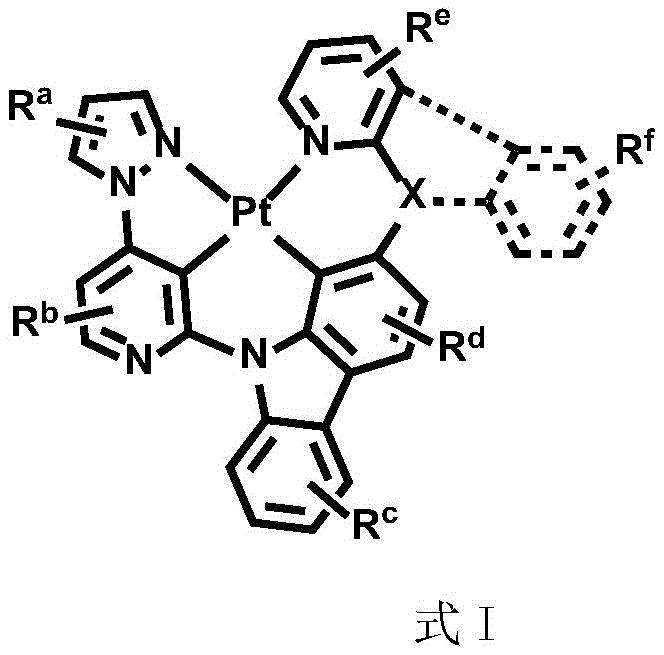
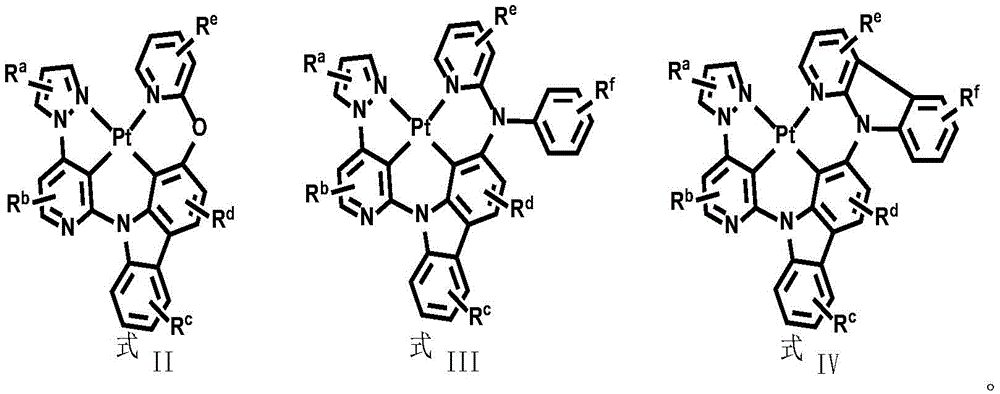
In order to solve the technical problem, the divalent platinum complex disclosed by the invention has a structure shown in a formula (I):
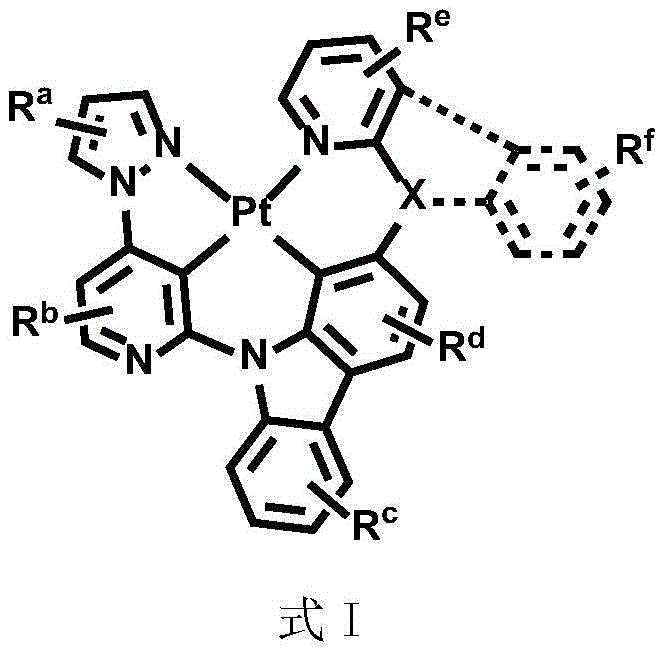
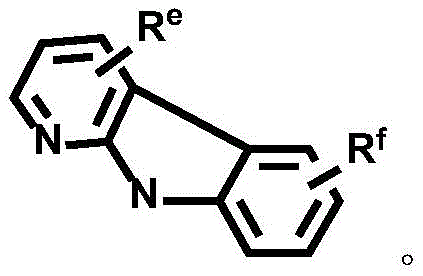
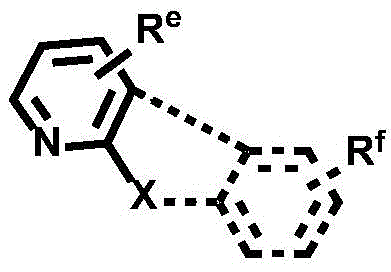
wherein R isa、Rb、Rc、Rd、ReAnd RfEach independently is mono-or polysubstituted, and Ra、Rb、Rc、Rd、ReAnd RfEach independently selected from a single atom substituent or a multiple atom substituent; the monoatomic substituent includes a hydrogen atom, an isotope atom thereof, or a halogen atom; the polyatomic substituent group comprises alkyl and arylSubstituted alkyl, fluoro-substituted alkyl, aryl, alkyl-substituted aryl, aryl-substituted aryl, deuterated alkyl, deuterated aryl, cycloalkyl, cycloalkenyl, heteroaryl, alkenyl, alkynyl, nitro, cyano, isocyano, arylsulfonyl, monohydrocarbylamino, dihydrocarbylamino, monoarylamino, diarylamino, alkoxy, aryloxy, haloalkyl, ester, alkoxycarbonyl, amide, alkoxycarbonylamino, aryloxycarbonylamino, carbamoyl, alkylthio, phosphoramido, silyl, or the aforementioned substituents containing an isotopic atom;
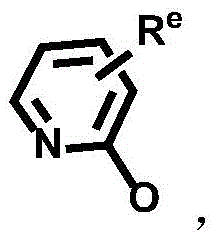
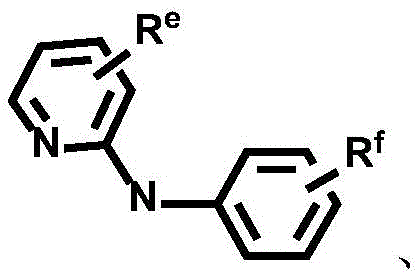
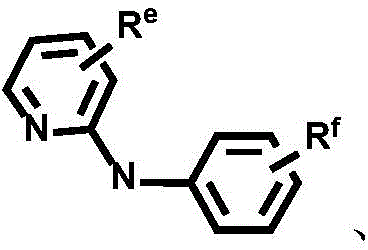
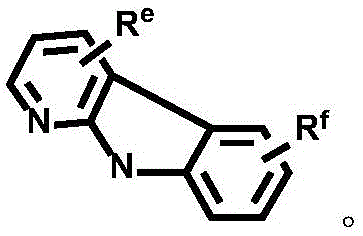
alternatively, X is linked to an O or N atom, and when X is an O atom,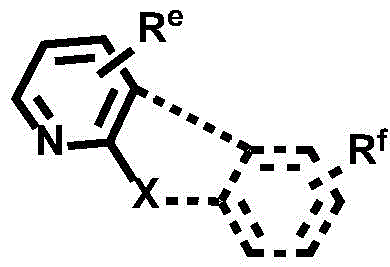 part being pyridyloxy
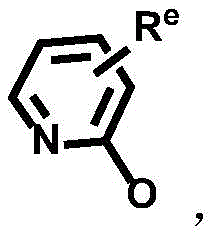


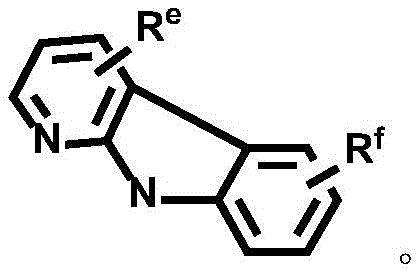
Alternatively, the divalent platinum complex may be any one of formula II, formula III and formula IV, wherein the substituent R in formula II, formula III and formula IVa、Rb、Rc、Rd、ReAnd RfThe substituent ranges are equivalent to above;
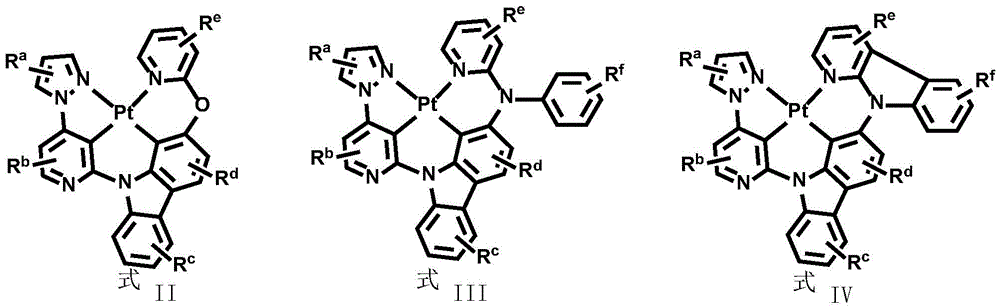
alternatively, Ra、Rb、Rc、Rd、ReAnd RfEach independently selected from a hydrogen, deuterium, tritium, fluorine, chlorine, bromine or iodine atom;
alternatively, Ra、Rb、Rc、Rd、ReAnd RfEach independently selected from methyl, deuterated methyl, benzyl, diphenylmethyl, triphenylmethyl; ethyl, 2-phenylethyl, 2,2, 2-trifluoroethyl; propyl, isopropyl, 3,3, 3-trifluoropropyl, 1,1,1,3,3, 3-hexafluoro-2-propyl; butyl, isobutyl, hexafluoroisobutyl, tert-butyl; cyclopropyl, cyclobutyl, cyclopentyl, cyclohexyl, cycloheptyl; phenyl group, 2-methylphenyl group, 2-isopropylphenyl group, 2-ethylphenyl group, 4-methylphenyl group, 4-isopropylphenyl group, 4-ethylphenyl group, 4-tert-butylphenyl group, 2, 3-dimethylphenyl group, 2, 3-diethylphenyl group, 2, 3-diisopropylphenyl group, 2, 3-diisobutylphenyl group, 2, 3-dicyclohexylphenyl group, 2, 3-dicyclopropylphenyl group, 2, 3-dicyclobutylphenyl group, 2, 3-dicyclopentylphenyl group, 2, 4-dimethylphenyl group, 2, 4-diethylphenyl group, 2, 4-diisopropylphenyl group, 2, 4-diisobutylphenyl group, 2, 4-dicyclohexylphenyl group, 2, 4-dicyclopropylphenyl group, 2, 4-dicyclobutylphenyl group, 2, 4-dicyclopentylphenyl, 2, 6-dimethylphenyl, 2, 6-diethylphenyl, 2, 6-diisopropylphenyl, 2, 6-diisobutylphenyl, 2, 6-dicyclohexylphenyl, 2, 6-dicyclopropylphenyl, 2, 6-dicyclobutylphenyl, 2, 6-dicyclopentylphenyl, 3, 5-dimethylphenyl, 3, 5-diethylphenyl, 3, 5-diisopropylphenyl, 3, 5-diisobutylphenyl, 3, 5-dicyclohexylphenyl, 3, 5-dicyclopropylphenyl, 3, 5-dicyclobutylphenyl, 3, 5-dicyclopentylphenyl, 2,3,5, 6-tetramethylphenyl, 2,4, 6-trimethylphenyl, 2,4, 6-triethylphenyl, 2,4, 6-triisopropylphenyl, 2,4, 6-triisobutylphenyl, 2,4, 6-tricyclohexylphenyl, 2,4, 6-tricyclopropylphenyl, 2,4, 6-tricyclobutylphenyl, 2,4, 6-tricyclopentylphenyl;
alternatively, Ra、Rb、Rc、Rd、ReAnd RfEach independently selected from hydrogen, deuterium, -CDH2、-CD2H、-CD3、-CDR1R2、-CD2R1Wherein R is1And R2Each independently selected from alkyl, arylaryl-substituted alkyl, alkyl-substituted aryl, aryl-substituted aryl, cycloalkyl;
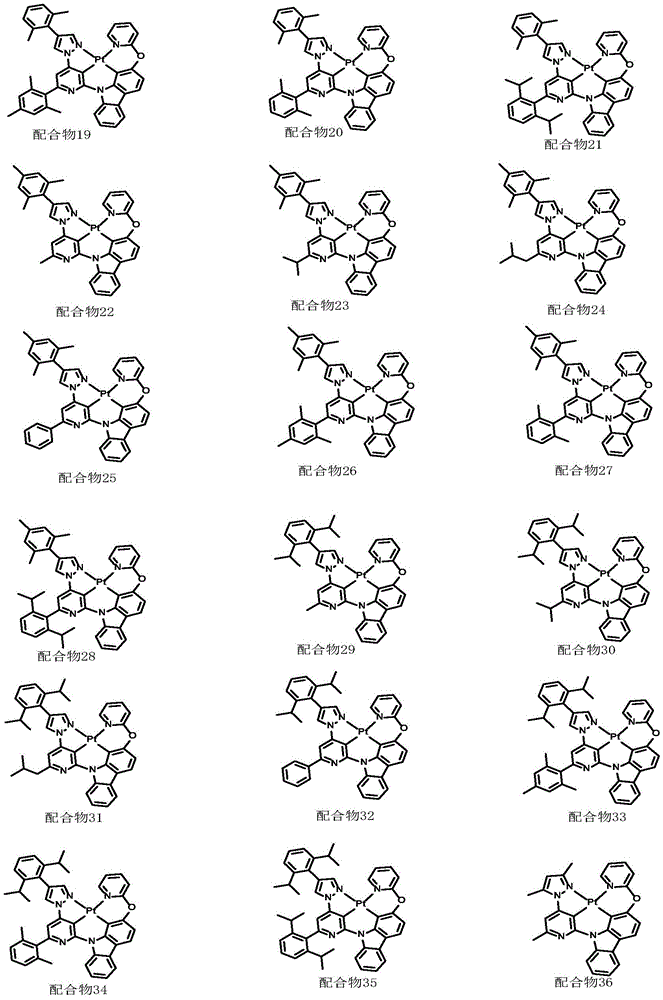
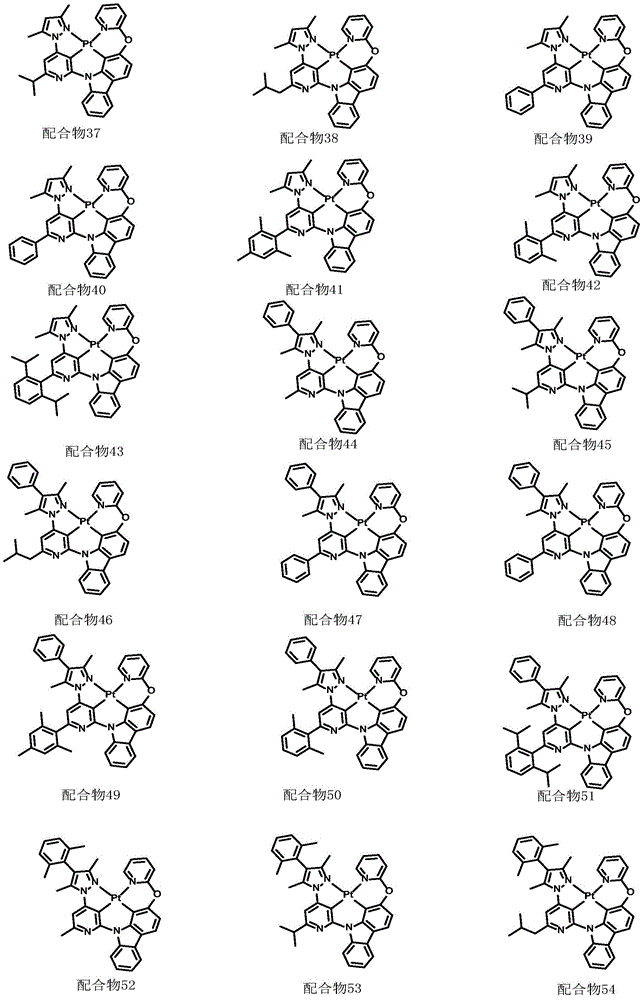
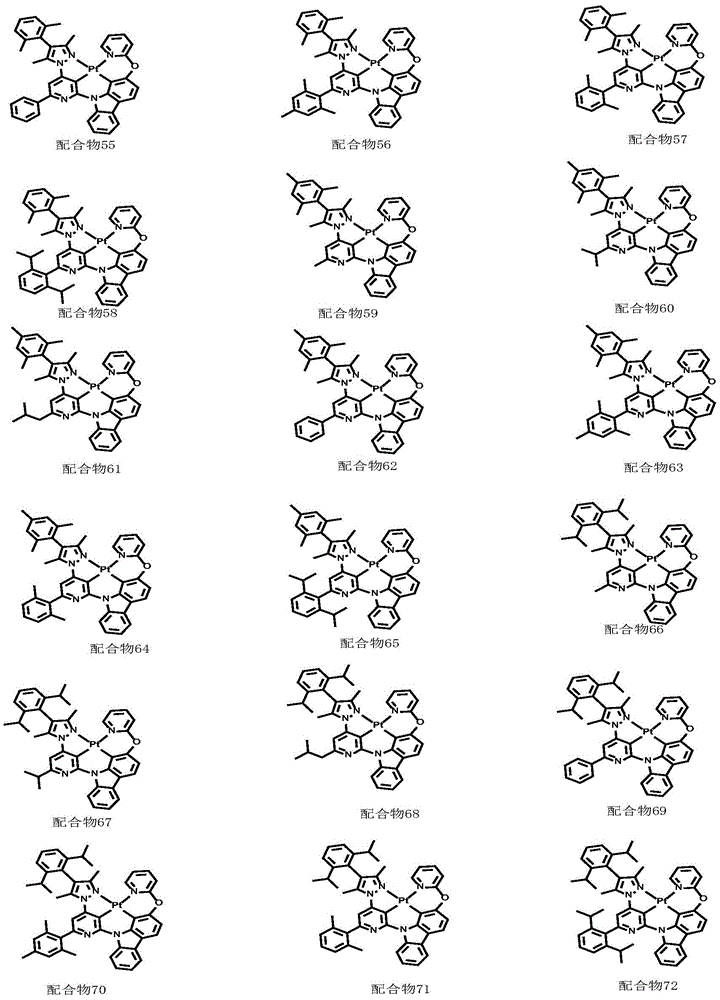
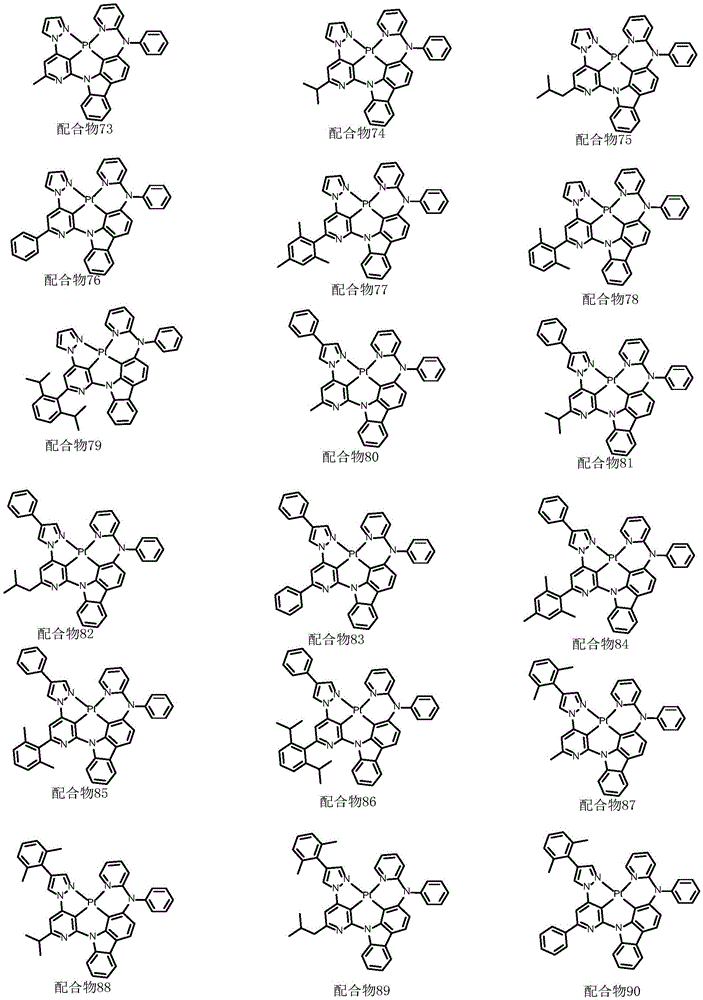
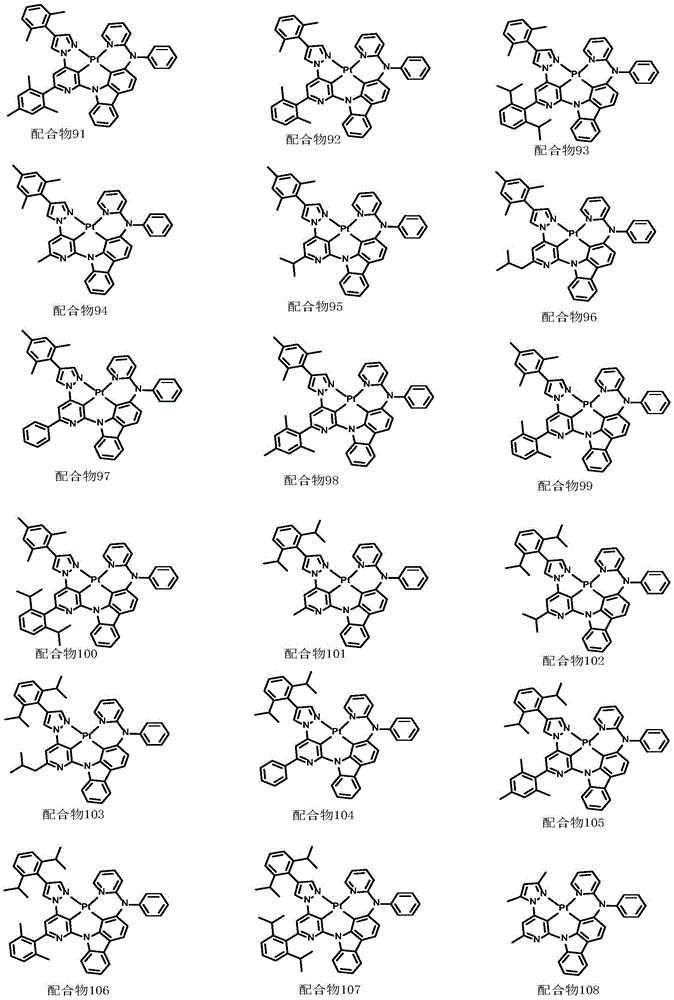
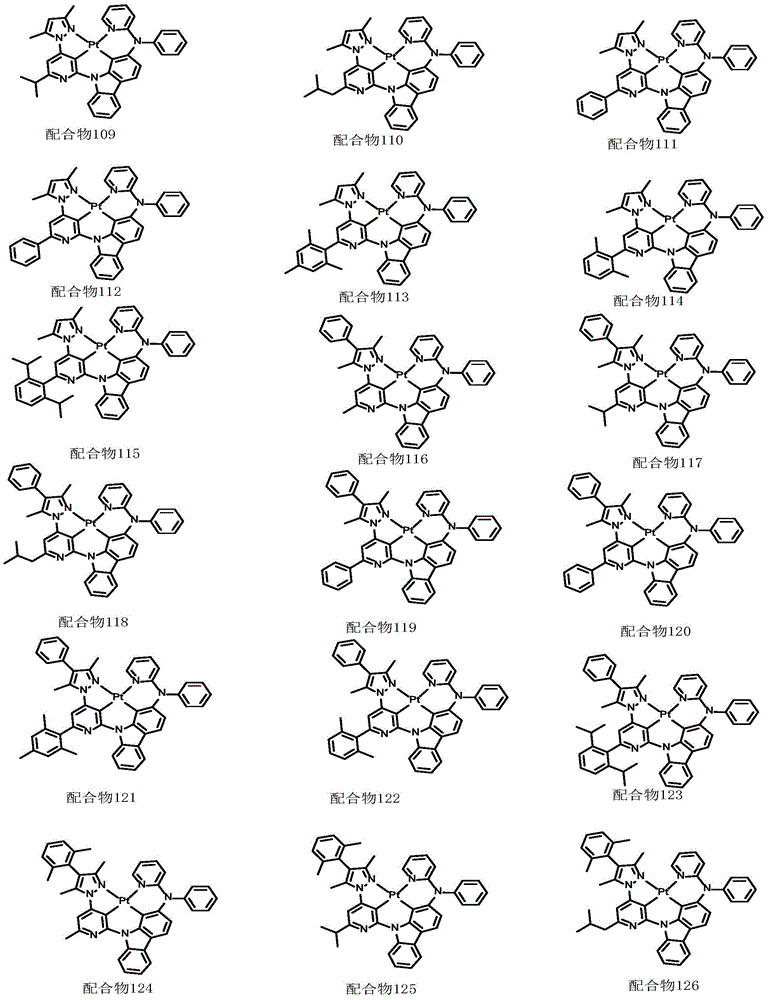
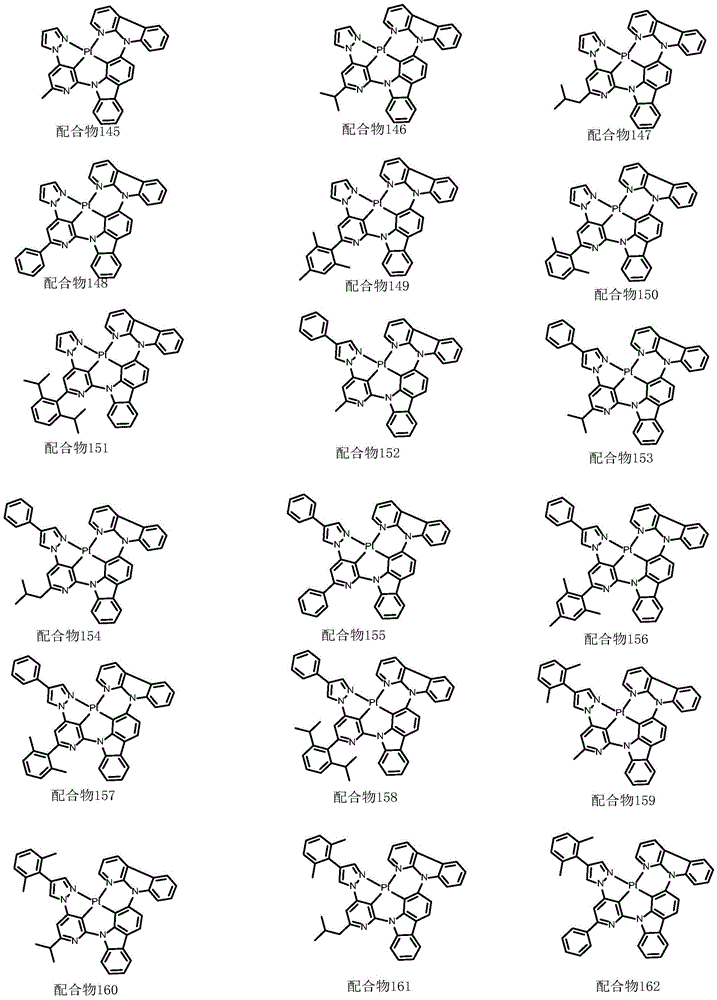
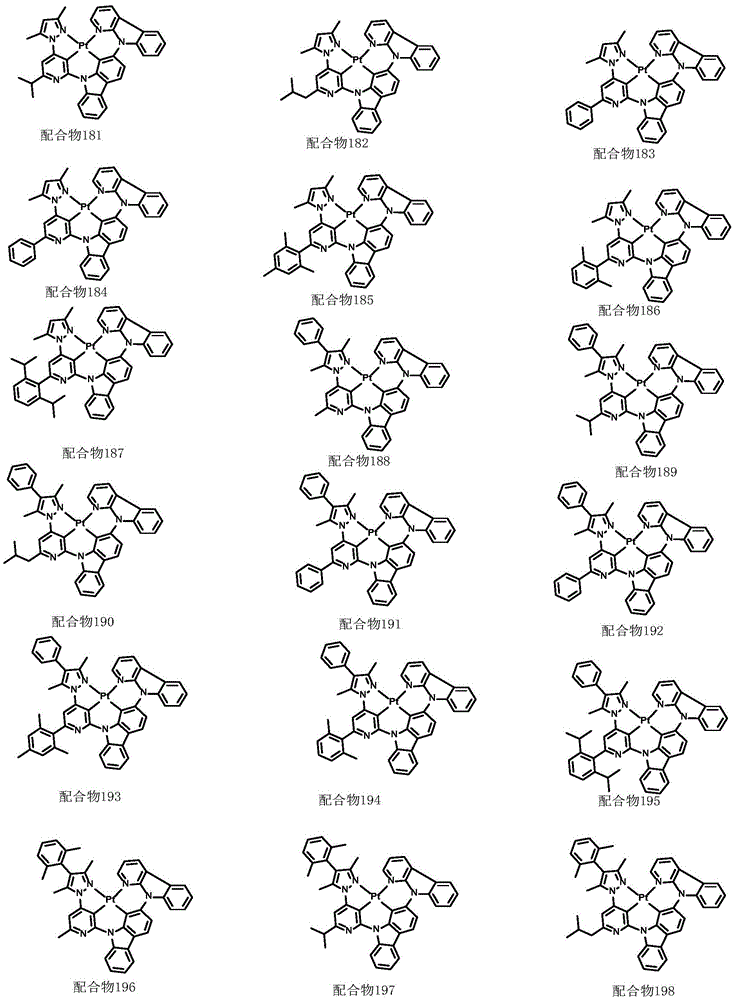
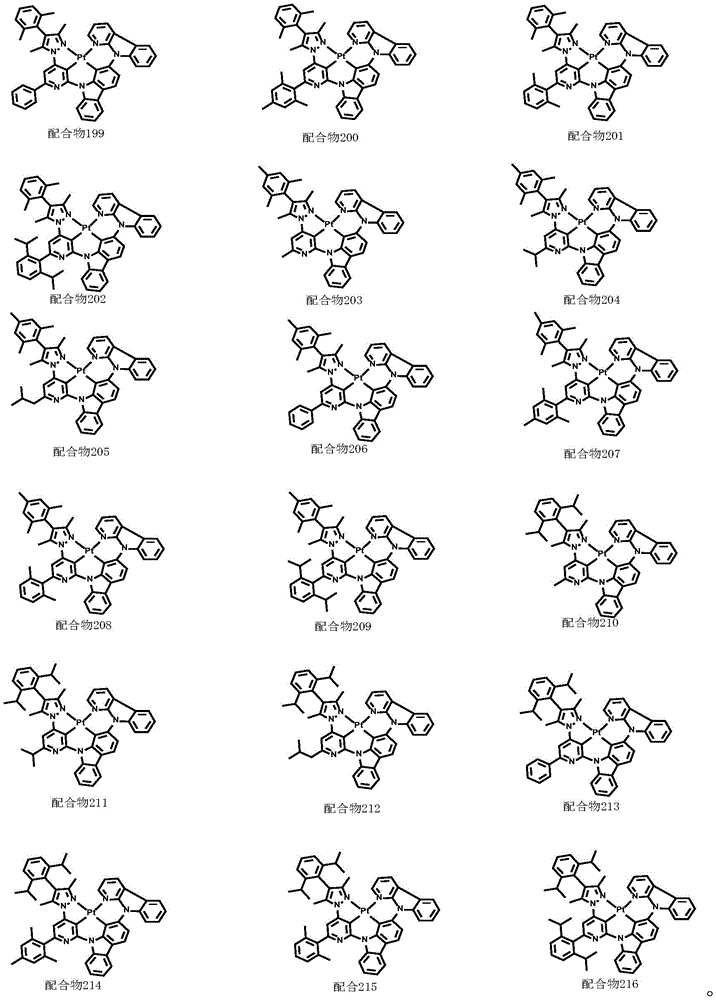
optionally, the divalent platinum complex provided by the invention has a structure selected from one of the following complexes 1-216:

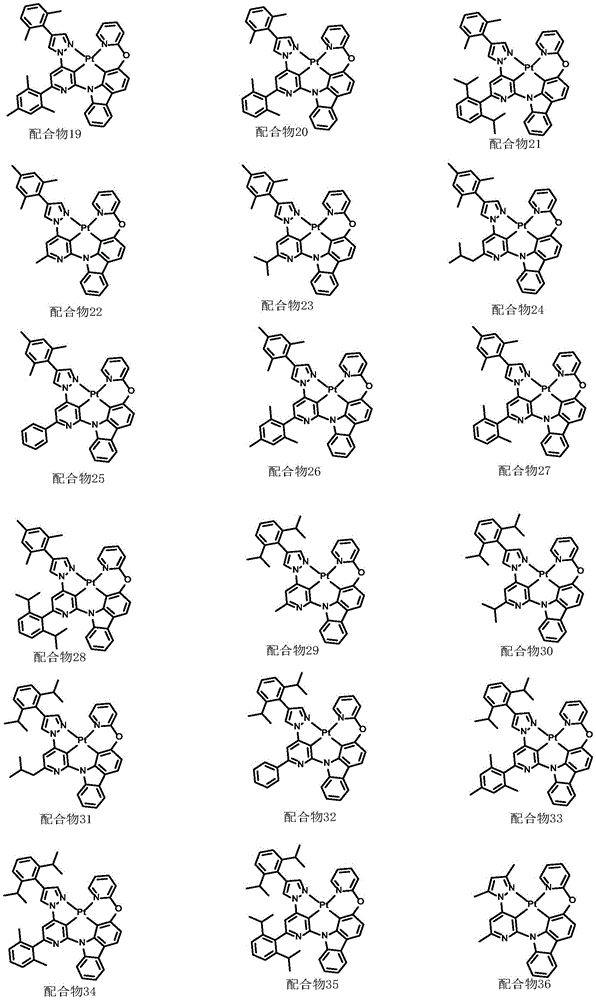
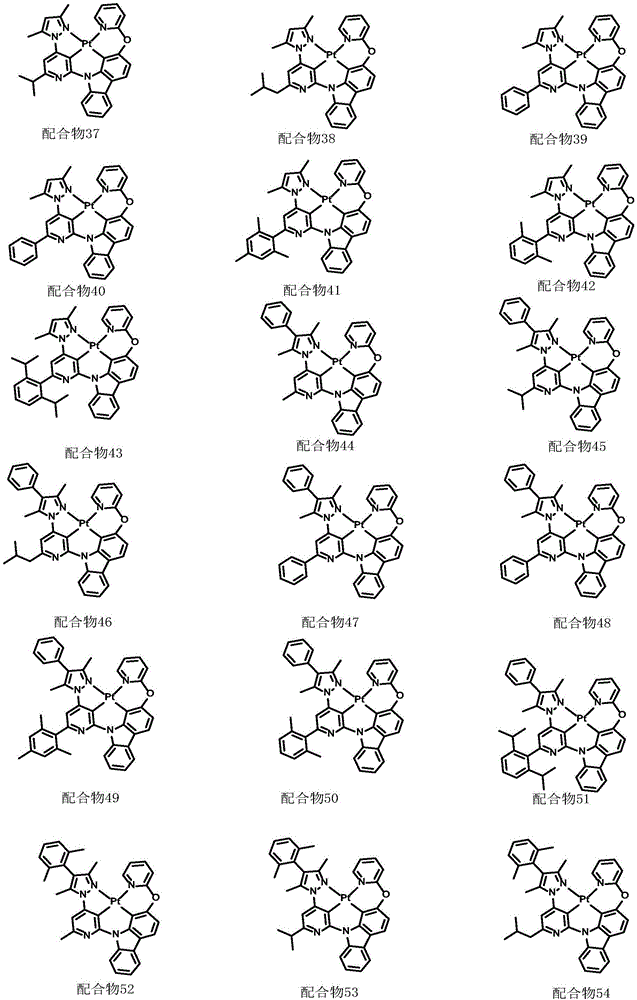

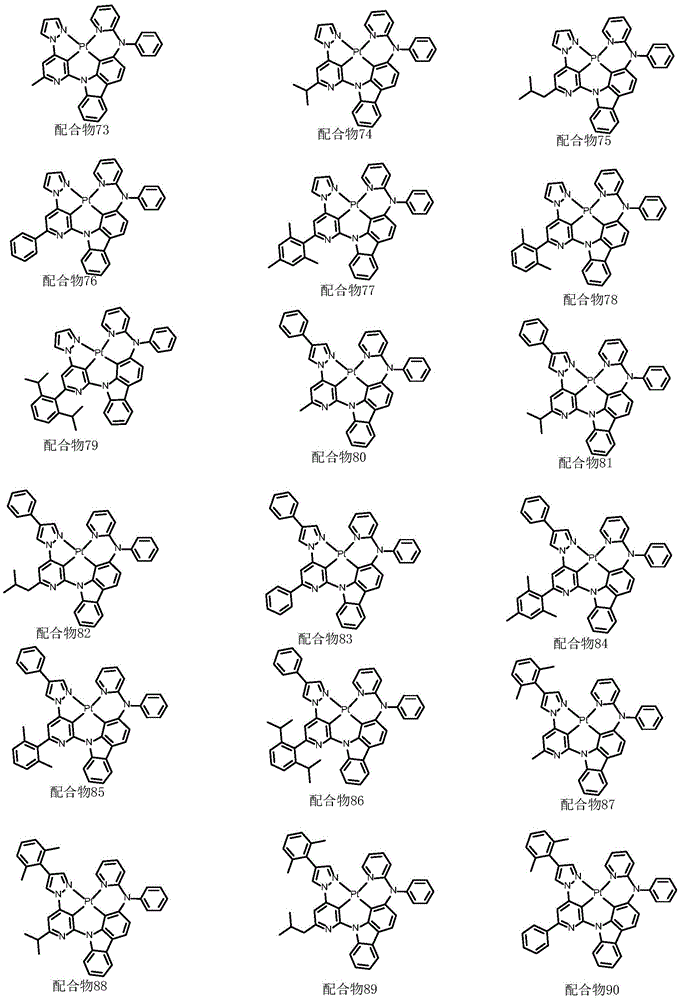
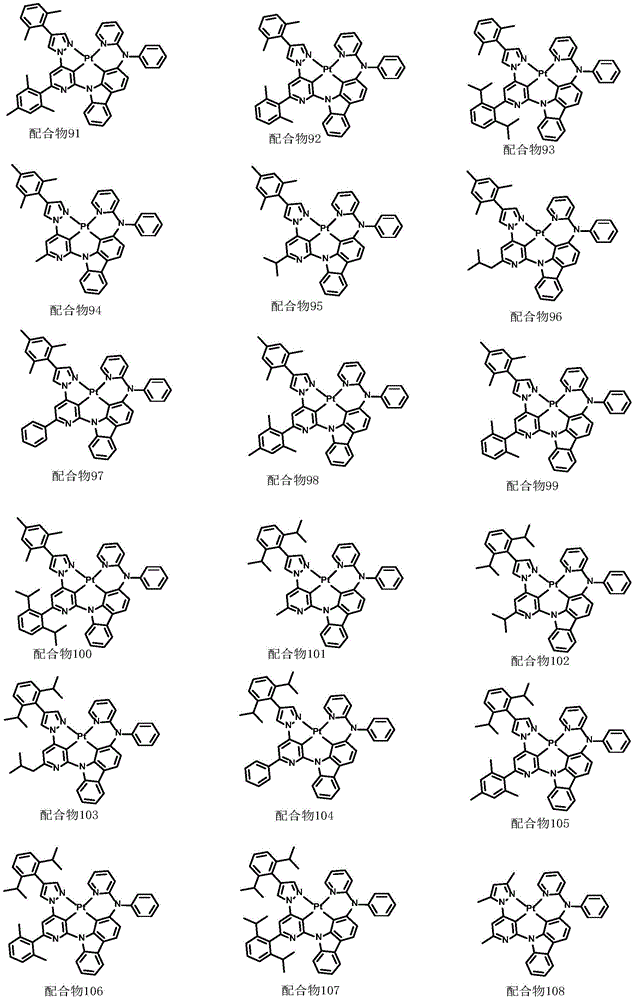

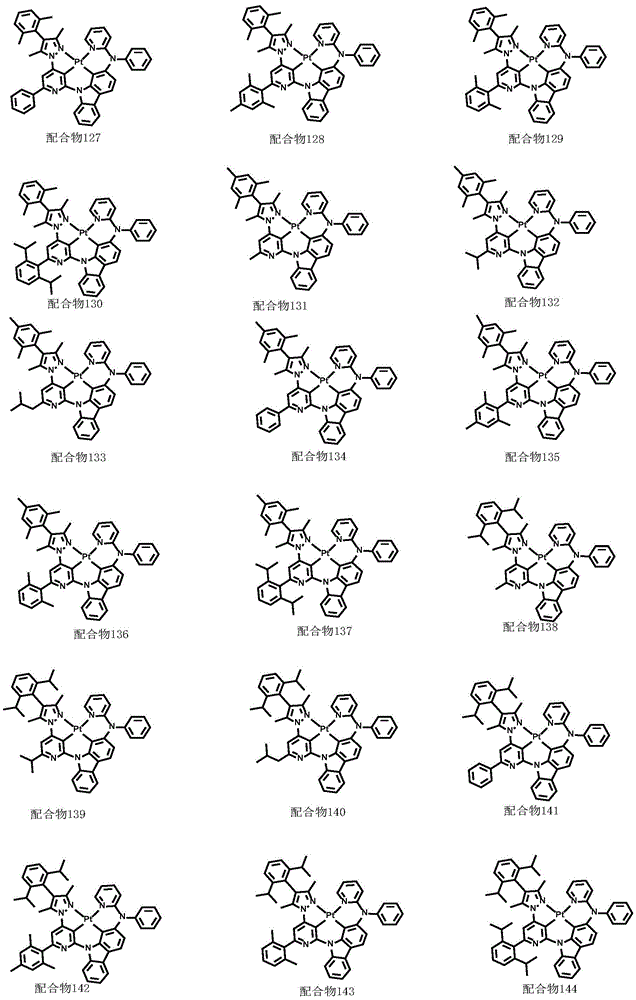
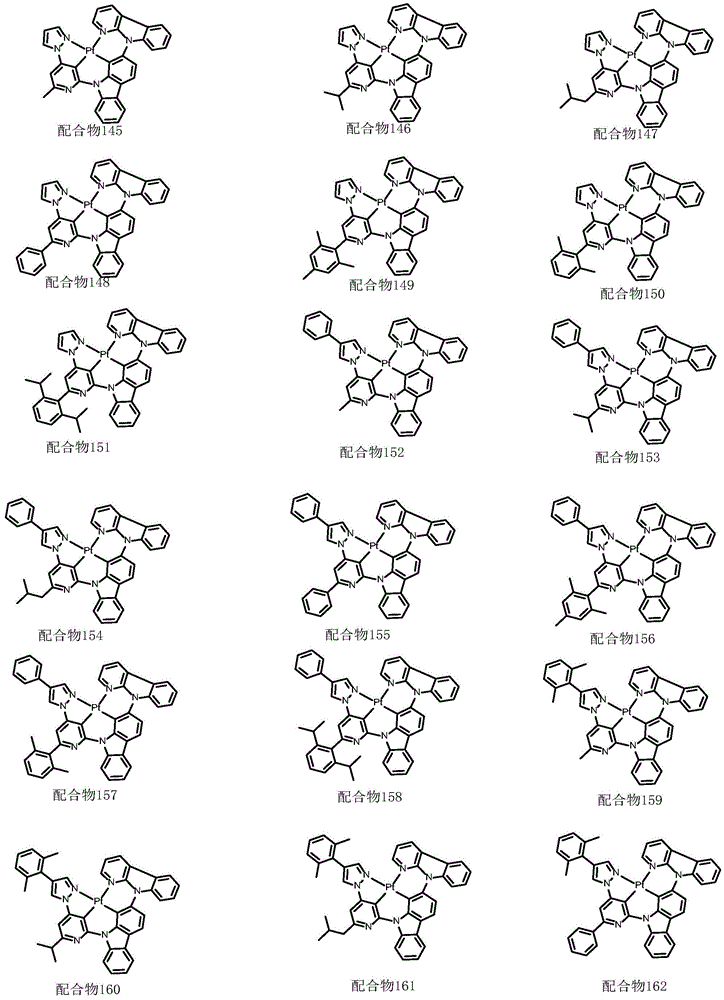
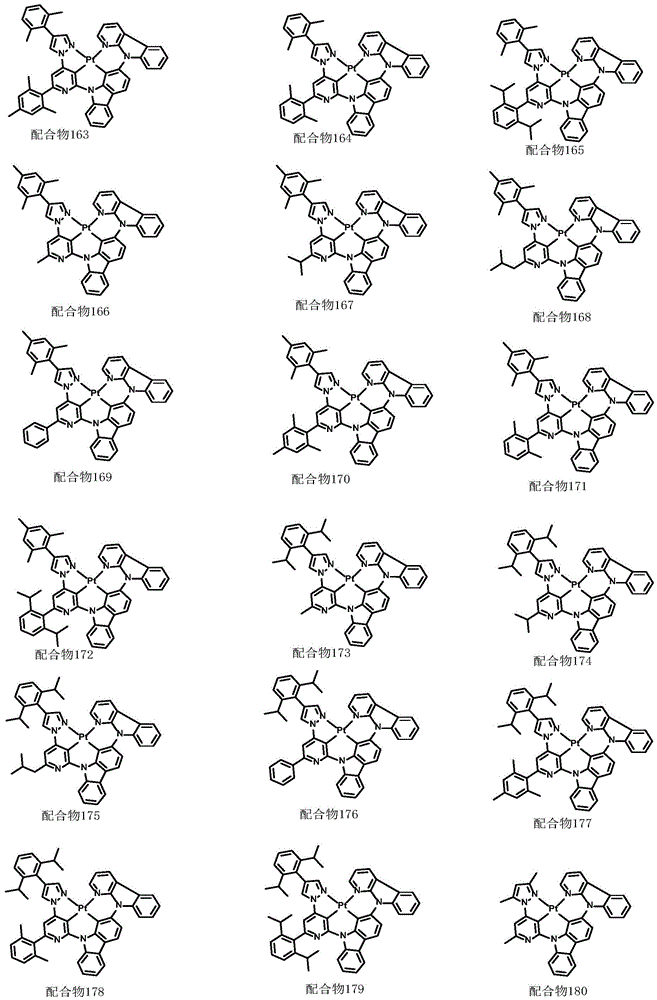


the embodiment of the invention also provides application of the divalent platinum complex as an electroluminescent material or a photoluminescent material.
Alternatively, the divalent platinum complex can be used as a monomolecular white phosphorescent light-emitting material or a cyan phosphorescent light-emitting material. The wide-spectrum phosphorescence wavelength peak of the divalent platinum complex provided by the embodiment of the invention is within the range of 500-600 nm, wherein the half-peak width of the white phosphor wavelength can exceed 100 nm.
The invention also provides an organic photoelectric device which comprises a light-emitting layer, wherein the light-emitting layer contains the bivalent platinum complex. Optionally, the divalent platinum complex is a light emitting material or a guest material in a light emitting layer of the organic photoelectric device.
The invention has the beneficial effects that: compared with the prior art, the invention provides a wide-spectrum phosphorescent luminescent material by introducing N-pyrazolopyridyl into a ligand of a bivalent platinum complex, wherein one pyridine ring forms a C-Pt metal bond with a metal center through a carbon atom. In the embodiment of the invention, the disclosed bivalent platinum complex molecule coordinated by the neutral tetradentate ligand containing the pyrazolopyridine structure can emit white phosphorescence as a phosphorescent light-emitting material, has good stability and high efficiency, can reach a red light range in a long wavelength region, and is completely suitable for being used as an organic phosphorescent white light or blue light and green light emitter in OLED related products. In addition, the compounds provided by the embodiment of the invention are easy to prepare, sublimate and purify, are dissolved in common organic solvents, and can be suitable for device manufacturing processes processed by an evaporation method and a solution method. The luminescent performance of the material has the characteristics of low energy and good color purity, is comprehensively superior to various fluorescent materials in the prior art, and simultaneously achieves the functions of emitting white phosphor light color and improving the performance of devices; meanwhile, the series of luminescent materials can be used as auxiliary light color materials of red light and are connected with red light materials in series to form the device so as to form a white phosphor light source with high efficiency and high stability, and the white phosphor light source has great development potential in the field of display and illumination.
Drawings
FIG. 1 is a graph of luminescence spectra of complex 2 in solution and thin films in accordance with an embodiment of the present invention;
FIG. 2 is a graph of the luminescence spectrum of complex 74 in solution and in thin films in accordance with an embodiment of the present invention;
FIG. 3 is a graph of the luminescence spectrum of complex 146 in solution and in thin films in accordance with embodiments of the present invention;
FIG. 4 shows the UV-VIS absorption spectrum of complex 2 in accordance with an embodiment of the present invention
FIG. 5 is a chart of the UV-VIS absorption spectrum of complex 74 in accordance with an embodiment of the present invention;
FIG. 6 is a chart of the UV-VIS absorption spectrum of complex 146 in accordance with an embodiment of the present invention;
FIG. 7 shows a complex 2 according to an embodiment of the present invention1H NMR nuclear magnetic spectrum;
FIG. 8 is a drawing of complex 74 in accordance with an embodiment of the present invention1H NMR nuclear magnetic spectrum;
FIG. 9 is a drawing of complex 146 in accordance with an embodiment of the present invention1H NMR nuclear magnetic spectrum;
FIG. 10 is a mass spectrum of complex 2 in an embodiment of the present invention;
FIG. 11 is a mass spectrum of complex 74 in accordance with an embodiment of the present invention;
FIG. 12 is a mass spectrum of complex 146 according to an embodiment of the present invention;
FIG. 13 is a graph showing the purification of complex 2 after sublimation in accordance with an embodiment of the present invention;
FIG. 14 is a cross-sectional view of an OLED device in an embodiment of the present invention;
FIG. 15 energy level structure diagram of OLED device
FIG. 16 luminescent image of white phosphor device of complex 2
Detailed Description
The present invention is further illustrated by the following examples, which are intended to be illustrative only and are not to be construed as limiting the invention. The technical scheme of the invention is to be modified or replaced equivalently without departing from the scope of the technical scheme of the invention, and the technical scheme of the invention is covered by the protection scope of the invention. The present invention may be understood more readily by reference to the following detailed description and the examples included therein.
All exemplary complexes represent a substituent ortho to the nitrogen atom on the pyridine and represent the general structural formula I.
Synthesis of Compounds
The various methods of preparation of the compounds provided herein are exemplary. These methods are intended to illustrate the various methods of preparation, but are not intended to be limiting to any particular method, and the temperature, catalyst, concentration, reactant composition, and other process conditions may vary.
In CDCl3Or DMSO-d6In solution, recording by Varian liquid NMR1HNMR (hydrogen nuclear magnetic resonance) and13the C NMR (carbon nuclear magnetic resonance) spectrum is 300, 400 or 500MHz and the chemical shifts are based on residual protonated solvent. If CDCl is used3As the solvent, tetramethylsilane (δ ═ 0.00ppm) was used as an internal reference, and the recording was made1H NMR (hydrogen nuclear magnetic resonance) spectroscopy; using CDCl3(δ 77.00ppm) is reported as the internal reference13C NMR (carbon nuclear magnetic resonance) spectroscopy. If DMSO-d is used6As solvent, residual H is used2O (δ ═ 3.33ppm) was recorded as the internal reference1H NMR (hydrogen nuclear magnetic resonance) spectroscopy; using DMSO-d6(delta. 39.52ppm) is recorded as internal reference13C NMR (carbon nuclear magnetic resonance) spectroscopy. The following abbreviations are used for explanation1Multiplicity of H NMR (hydrogen nuclear magnetic resonance): s is singlet, d is singlet, t is triplet, q is tetrad, p is quintet, m is multiline, br is broad.
The general synthetic method comprises the following steps:
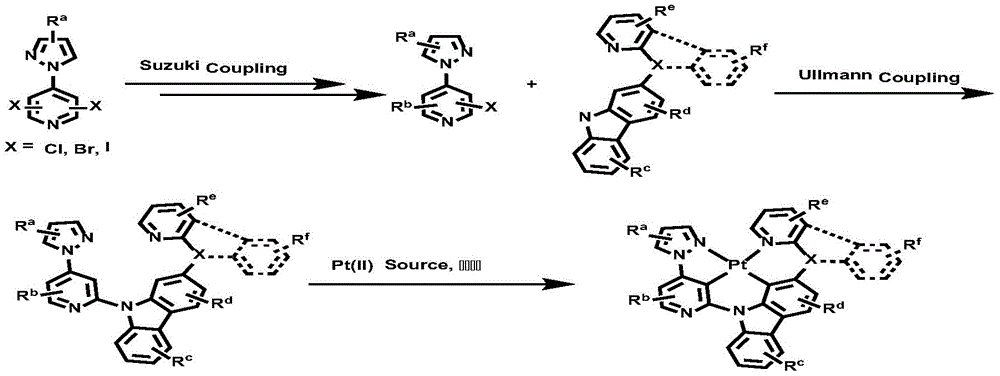
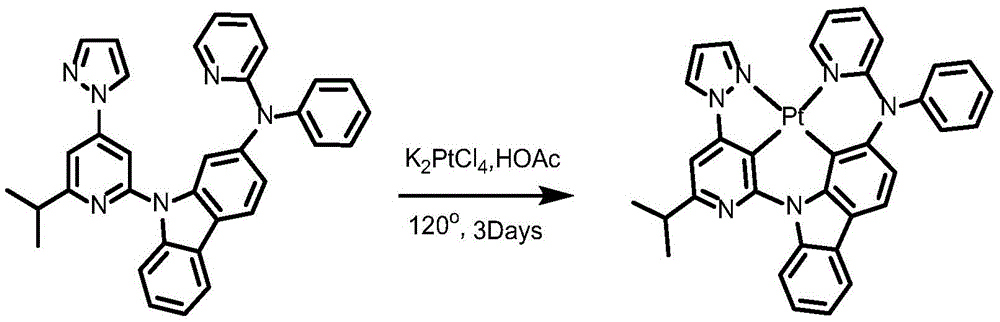
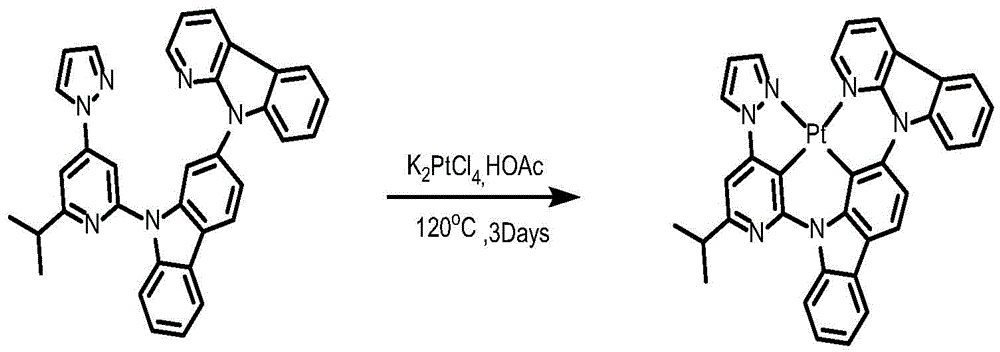
the complex provided by the invention can be synthesized by the following general route, and the specific steps are coupling reaction of fragments and metal coordination cyclization reaction.
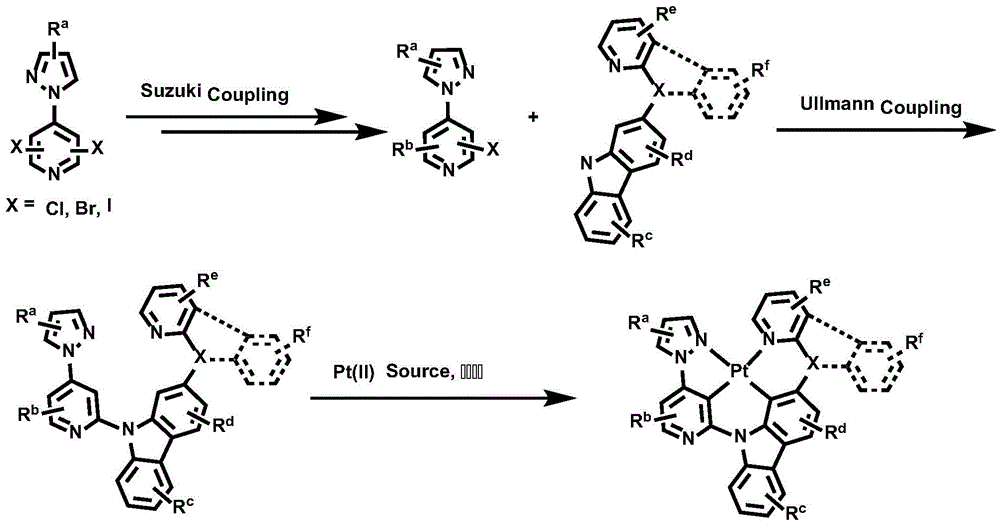
Wherein R isa、Rb、Rc、Rd、ReAnd RfAre as defined for formula I.
Example 1
Complex 2 and preparation thereof
Synthesis of ligand L2, 2- (benzyloxy) -9- (6- (prop-1-en-2-yl) -4- (1H-pyrazol-1-yl) pyridin-2-yl) -9H-carbazole:
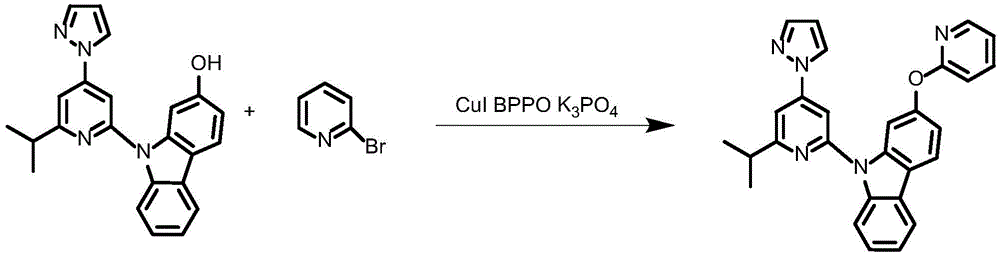
dibromopyridine (1.37g,4.4mmol),9- (6-isopropyl-4- (1H-pyrazol-1-yl) pyridin-2-yl) -9H-carbazol-2-ol (1.04g,4mmol), cuprous iodide (590mg,3.2mmol), N, N' -bis (2-phenylphenyl) oxamide (58mg,0.4mmol), potassium phosphate (3.26g,10mmol) and dimethyl sulfoxide (20mL) were added to a 75mL stopcock equipped with a magnetic rotor, and the resulting mixture was bubbled with nitrogen for 10 minutes and then heated to 130 ℃ and stirred for 36 hours. Cooling to room temperature, adding water to quench the reaction, extracting with ethyl acetate, combining organic phases, washing with a proper amount of saturated sodium chloride aqueous solution, and then adding anhydrous sodium sulfate for drying. The solvent was removed by distillation under the reduced pressure, and the resulting crude product was purified by column chromatography on silica gel with an eluent of petroleum ether/ethyl acetate 25: 1 to give ligand L2 as a white solid in 86% yield.
Synthesis of complex 2:
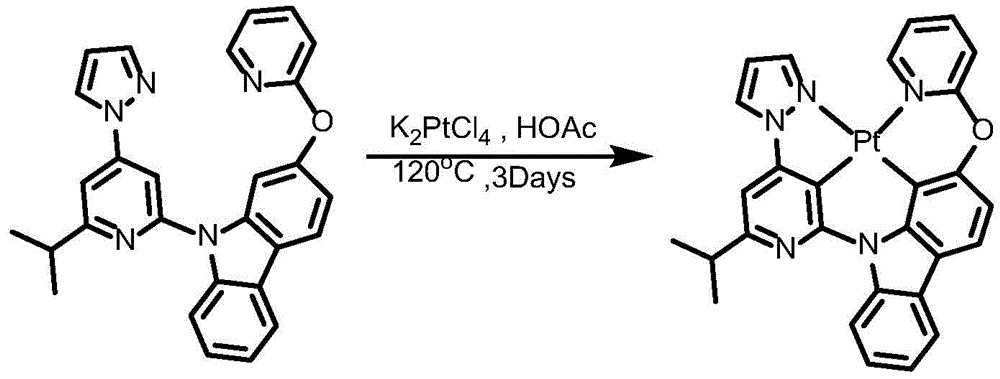
ligand L2(110mg,0.24mmol), potassium chloroplatinite (108mg, 0.264mmol) and acetic acid (24mL) were added to a 75mL sealed tube with a magnetic rotor, and the resulting mixture was bubbled with nitrogen for 10 minutes, stirred at 30 ℃ for 24 hours, then heated to 120 ℃ and stirred for 24 hours. Cooling to room temperature, adding water to quench the reaction, extracting with dichloromethane, combining organic phases, washing with a proper amount of saturated aqueous sodium chloride solution, and then adding anhydrous sodium sulfate for drying. The solvent was removed by distillation under the reduced pressure, and the resulting crude product was purified by column chromatography on silica gel with an eluent of dichloromethane: petroleum ether at 1: 1 to give complex 2 as a greenish solid in 41.5% yield. 1H NMR (400MHz, DMSO-d6) δ 9.64(d, J ═ 8.4Hz,1H),9.05(d, J ═ 2.8Hz,1H),8.92(dd, J ═ 5.9,1.7Hz,1H), 8.26-8.19 (m,1H),8.14(dd, J ═ 6.7,5.9Hz,2H),7.94(d, J ═ 8.2Hz,1H),7.59(d, J ═ 7.5Hz,1H),7.52(s,1H),7.47(t, J ═ 8.5Hz,1H),7.39(dd, J ═ 7.2,5.9Hz,1H),7.30(t, J ═ 7.4Hz,1H),7.19(d, J ═ 8.6H), 1.95 (d, J ═ 6H), 1H, 7.6H, 1H: 638.21[ M + H ] +.
Example 2
Complex 74 and preparation thereof
Synthesis of ligand L74, 2- ((6' -phenyl- [2,4' -bipyridine ] -2' -yl) oxy) -9- (pyridin-2-yl) -9H-carbazole:
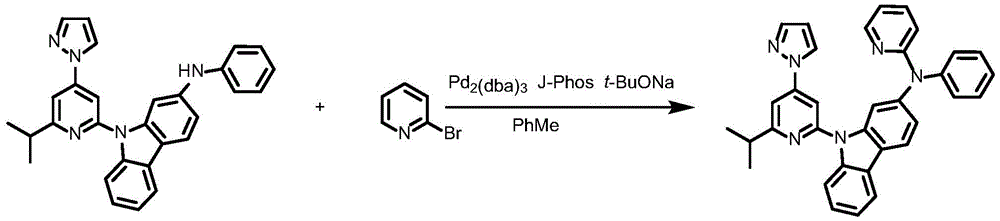
dibromopyridine (1.37g,4.4mmol),9- (6-isopropyl-4- (1H-pyrazol-1-yl) pyridin-2-yl) -N-phenyl-9H-carbazol-2-amine (148mg,0.3mmol),2- (dicyclohexylphosphino) biphenyl (119mg, 0.4mmol), tris (dibenzylideneacetone) dipalladium (189mg, 0.2mmol), sodium tert-butoxide (577mg, 6mmol) and toluene (12mL) were added to a 75mL stopcock with magnetic stirring, and the resulting mixture was bubbled with nitrogen for 10 min and then heated to 100 ℃ and stirred overnight. Cooling to room temperature, adding water to quench the reaction, extracting with ethyl acetate, combining organic phases, washing with a proper amount of saturated sodium chloride aqueous solution, and then adding anhydrous sodium sulfate for drying. Distilling under reduced pressure to remove solvent, and collecting the crude productThe product was purified by column chromatography on silica gel eluting with petroleum ether/ethyl acetate 10: 1 to give ligand L74 as a white solid in 91.8% yield.1H NMR(400MHz,DMSO-d6)δ8.74(ddd,J=4.8,1.8,0.9Hz,1H),8.68(ddd,J=4.9,1.9,0.8Hz,1H),8.37–8.26(m,4H),8.09–7.97(m,4H),7.83(dd,J=2.5,1.7Hz,1H),7.81–7.79(m,2H),7.65(d,J=1.1Hz,1H),7.53–7.46(m,2H),7.46–7.40(m,4H),7.39–7.35(m,1H),7.27(dd,J=2.1Hz,1H).
Synthesis of Complex 74:
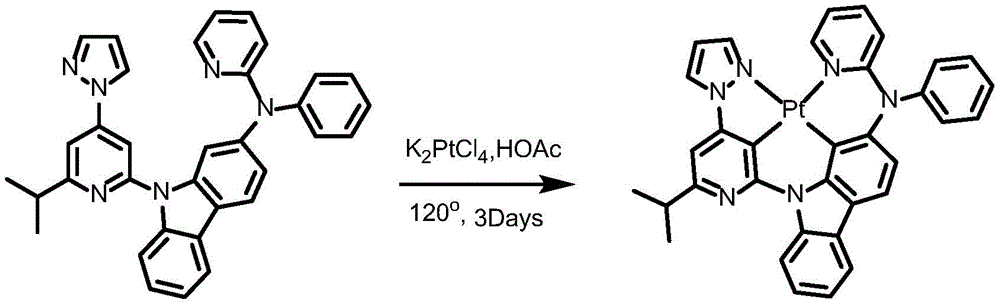
ligand L74(129mg,0.263mmol), potassium chloroplatinite (120mg, 0.289mmol) and acetic acid (27mL) were added to a 100mL sealed tube with a magnetic rotor, and the resulting mixture was bubbled with nitrogen for 10 minutes, stirred at 30 ℃ for 24 hours, heated to 120 ℃ and stirred for 24 hours. Cooling to room temperature, adding water to quench the reaction, extracting with dichloromethane, combining organic phases, washing with a proper amount of saturated aqueous sodium chloride solution, and then adding anhydrous sodium sulfate for drying. The solvent was removed by distillation under the reduced pressure, and the resulting crude product was purified by column chromatography on silica gel with a eluent of dichloromethane: methanol 600: 1 to give complex 74 as a pale yellow solid in 48.6% yield.1H NMR(400MHz,DMSO-d6)δ9.62(d,J=4Hz,1H),9.02(d,J=8Hz,1H),8.94(d,J=7.5Hz,1H),8.04(d,J=7.7Hz,1H),7.94(d,J=2.2Hz,1H),7.87(ddd,J=1.8Hz,1H),7.69(d,J=8.4Hz,1H),7.60(t,J=7.8Hz,2H),7.49(d,J=4.5Hz,2H),7.47(d,J=1.9Hz,1H),7.44(d,J=1.2Hz,1H),7.42(s,2H),7.25(dd,J=3.9Hz,1H),7.11–7.05(m,1H),6.92(d,J=8.7Hz,1H),6.89–6.85(m,1H),6.73(d,J=8.5Hz,1H),5.74–5.71(m,1H),3.17(dt,J=6.9Hz,1H),1.45(d,J=6.9Hz,6H).
Example 3
Complex 146 and preparation thereof
Ligand L146, ((6' - (2, 6-diisopropylphenyl) - [2,4' -bipyridine ] -2' -yl) oxy) -9- (pyridin-2-yl) -9H-carbazole synthesis:
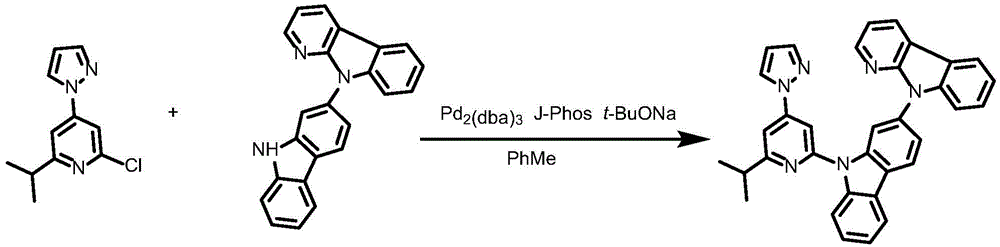
to a 75mL stopcock equipped with a magnetic rotor was added 9- (9H-carbazol-2-yl) -9H-pyrido [2,3-b ] indole (224mg,0.5mmol), 2-chloro-6-isopropyl-4- (1H-pyrazol-1-yl) pyridine (423mg,1.5mmol),2- (dicyclohexylphosphino) biphenyl (119mg, 0.4mmol), tris (dibenzylideneacetone) dipalladium (189mg, 0.2mmol), sodium tert-butoxide (577mg, 6mmol) and toluene (12mL), and the resulting mixture was heated to 80 ℃ after bubbling nitrogen for 10 minutes and stirred overnight. Cooling to room temperature, adding water to quench the reaction, extracting with ethyl acetate, combining organic phases, washing with a proper amount of saturated sodium chloride aqueous solution, and then adding anhydrous sodium sulfate for drying. Removing solvent by distillation under reduced pressure, and separating and purifying the obtained crude product by silica gel column chromatography with petroleum ether and ethyl acetate at ratio of 25: 1 to obtain white solid ligand L146 with yield of 64%
Synthesis of Complex 146:
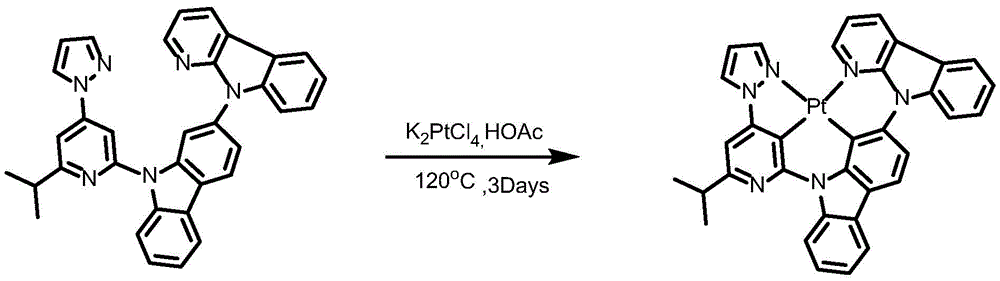
ligand L146(70mg,0.12mmol), potassium chloroplatinite (54mg, 0.132mmol) and acetic acid (12mL) were added to a 48mL lock tube with a magnetic rotor, and the resulting mixture was bubbled with nitrogen for 10 minutes, stirred at 30 ℃ for 24 hours, then heated to 120 ℃ and stirred for 24 hours. Cooling to room temperature, adding water to quench the reaction, extracting with dichloromethane, combining organic phases, washing with a proper amount of saturated aqueous sodium chloride solution, and then adding anhydrous sodium sulfate for drying. The solvent was removed by distillation under the reduced pressure, and the resulting crude product was purified by column chromatography on silica gel with an eluent of dichloromethane/methanol 600: 1 to give orange solid complex 146 in 35.6% yield.1H NMR(400MHz,DMSO-d6)δ9.65(d,J=8.5Hz,1H),9.19(d,J=5.5Hz,1H),9.06(t,J=4.9Hz,2H),8.45(d,J=7.7Hz,1H),8.26(d,J=8.4Hz,1H),8.21(d,J=7.4Hz,1H),8.11–8.03(m,2H),7.84(d,J=8.3Hz,1H),7.68(dd,J=7.8Hz,2H),7.53(s,3H),7.33(dd,J=5.3Hz,1H),6.91(t,J=2.5Hz,1H),3.27–3.11(m,1H),1.34(d,J=17.7Hz,6H).
Example 4
Ligand 181L and preparation thereof
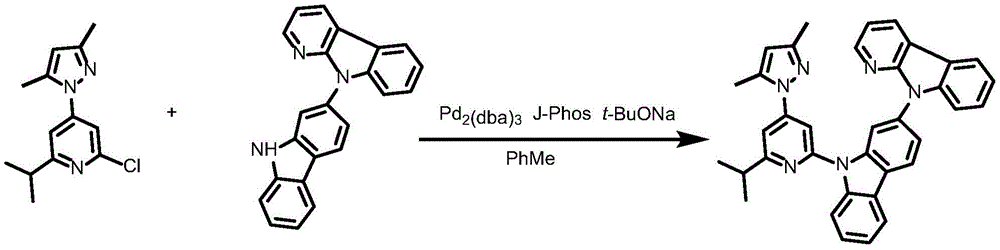
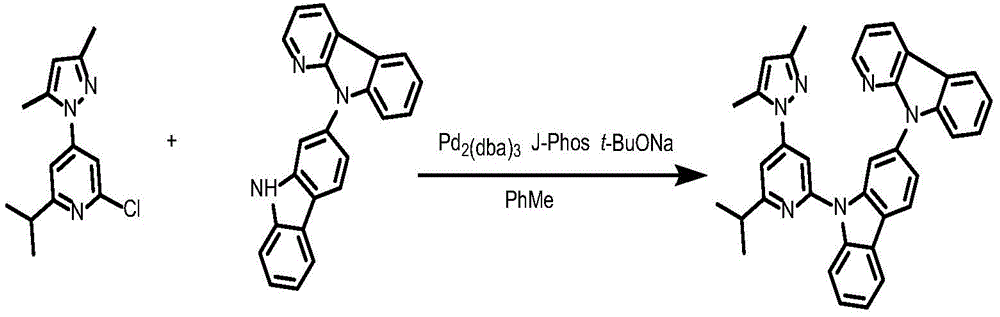
To a 75mL stopcock with magnetic stirring was added 2-chloro-4- (3, 5-dimethyl-1H-pyrazol-1-yl) -6-isopropylpyridine (1.37g,4.4mmol),9- (6-isopropyl-4- (1H-pyrazol-1-yl) pyridin-2-yl) -N-phenyl-9H-carbazol-2-amine (148mg,0.3mmol),2- (dicyclohexylphosphino) biphenyl (119mg, 0.4mmol), tris (dibenzylideneacetone) dipalladium (189mg, 0.2mmol), sodium tert-butoxide (577mg, 6mmol) and toluene (12mL), and the resulting mixture was bubbled with nitrogen for 10 minutes and then heated to 100 ℃ and stirred overnight. Cooling to room temperature, adding water to quench the reaction, extracting with ethyl acetate, combining organic phases, washing with a proper amount of saturated sodium chloride aqueous solution, and then adding anhydrous sodium sulfate for drying. The solvent was removed by distillation under the reduced pressure, and the resulting crude product was purified by column chromatography on silica gel with an eluent of petroleum ether/ethyl acetate 10: 1 to give ligand 181L as a white solid in 91.8% yield.1H NMR(400MHz,DMSO-d6)δ8.74(ddd,J=4.8,1.8,0.9Hz,1H),8.68(ddd,J=4.9,1.9,0.8Hz,1H),8.37–8.26(m,4H),8.09–7.97(m,4H),7.83(dd,J=2.5,1.7Hz,1H),7.81–7.79(m,2H),7.65(d,J=1.1Hz,1H),7.53–7.46(m,2H),7.46–7.40(m,4H),7.39–7.35(m,1H),7.27(dd,J=2.1Hz,1H).
Synthesis of complex 181:
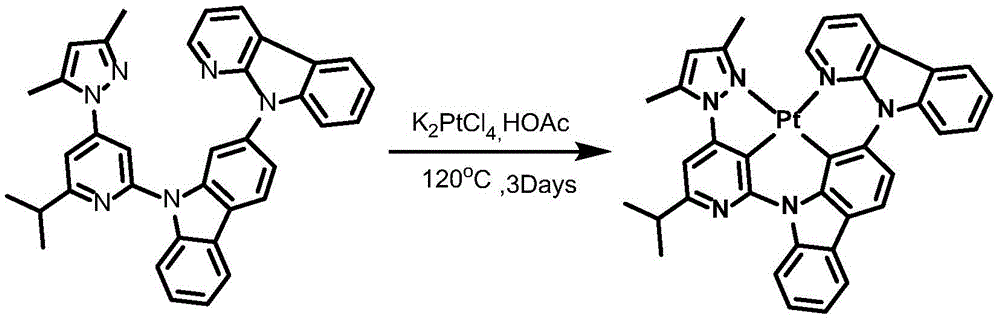
ligand L181(100mg,0.24mmol), potassium chloroplatinite (108mg, 0.264mmol) and acetic acid (24mL) were added to a 75mL sealed tube with a magnetic rotor, and the resulting mixture was bubbled with nitrogen for 10 minutes, stirred at 30 ℃ for 24 hours, then heated to 120 ℃ and stirred for 24 hours. Cooling to room temperature, adding water to quench the reaction, extracting with dichloromethane, combining organic phases, washing with a proper amount of saturated aqueous sodium chloride solution, and then adding anhydrous sodium sulfate for drying. The solvent was removed by distillation under the reduced pressure, and the resulting crude product was purified by column chromatography on silica gel with an eluent of dichloromethane: petroleum ether at 1: 1 to give the greenish solid complex 181 in 41.5% yield. 1H NMR (400MHz, DMSO-d6) δ 9.64(d, J ═ 8.4Hz,1H),9.05(d, J ═ 2.8Hz,1H),8.92(dd, J ═ 5.9,1.7Hz,1H), 8.26-8.19 (m,1H),8.14(dd, J ═ 6.7,5.9Hz,2H),7.94(d, J ═ 8.2Hz,1H),7.59(d, J ═ 7.5Hz,1H),7.52(s,1H),7.47(t, J ═ 8.5Hz,1H),7.39(dd, J ═ 7.2,5.9Hz,1H),7.30(t, J ═ 7.4Hz,1H),7.19(d, J ═ 8.6H), 1.95 (d, J ═ 6H, 1H), 1H (89.6H, 1H), 1H, and 7.6H.
Example 5
Ligand 183L and preparation thereof

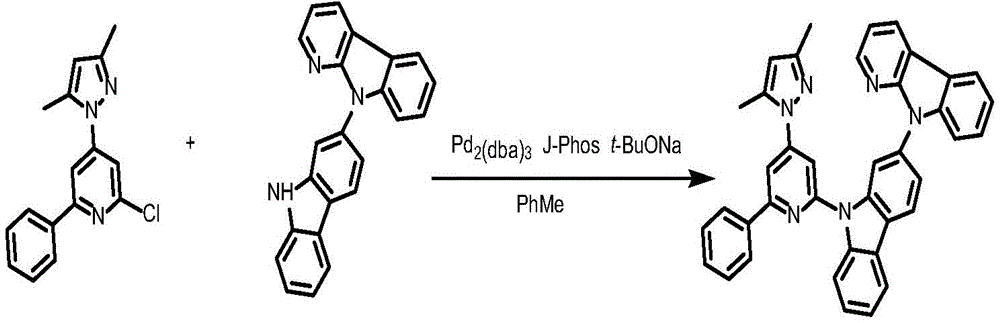
To a 75mL stopcock with magnetic stirring was added 2-chloro-4- (3, 5-dimethyl-1H-pyrazol-1-yl) -6-phenylpyridine (1.37g,4.4mmol),9- (6-isopropyl-4- (1H-pyrazol-1-yl) pyridin-2-yl) -N-phenyl-9H-carbazol-2-amine (148mg,0.3mmol),2- (dicyclohexylphosphino) biphenyl (119mg, 0.4mmol), tris (dibenzylideneacetone) dipalladium (189mg, 0.2mmol), sodium tert-butoxide (577mg, 6mmol) and toluene (12mL), and the resulting mixture was bubbled with nitrogen for 10 minutes and then heated to 100 ℃ and stirred overnight. Cooling to room temperature, adding water to quench the reaction, extracting with ethyl acetate, combining organic phases, washing with a proper amount of saturated sodium chloride aqueous solution, and then adding anhydrous sodium sulfate for drying. The solvent was removed by distillation under the reduced pressure, and the resulting crude product was purified by column chromatography on silica gel with an eluent of petroleum ether/ethyl acetate 10: 1 to give 183L as a white solid ligand in 91.8% yield.1H NMR(400MHz,DMSO-d6)δ8.74(ddd,J=4.8,1.8,0.9Hz,1H),8.68(ddd,J=4.9,1.9,0.8Hz,1H),8.37–8.26(m,4H),8.09–7.97(m,4H),7.83(dd,J=2.5,1.7Hz,1H),7.81–7.79(m,2H),7.65(d,J=1.1Hz,1H),7.53–7.46(m,2H),7.46–7.40(m,4H),7.39–7.35(m,1H),7.27(dd,J=2.1Hz,1H).
Synthesis of the Complex 183:

ligand L183(120mg,0.24mmol), potassium chloroplatinite (108mg, 0.264mmol) and acetic acid (24mL) were added to a 75mL sealed tube with a magnetic rotor, and the resulting mixture was bubbled with nitrogen for 10 minutes, stirred at 30 ℃ for 24 hours, then heated to 120 ℃ and stirred for 24 hours. Cooling to room temperature, adding water to quench the reaction, extracting with dichloromethane, combining organic phases, washing with a proper amount of saturated aqueous sodium chloride solution, and then adding anhydrous sodium sulfate for drying. The solvent was removed by distillation under the reduced pressure, and the resulting crude product was purified by column chromatography on silica gel with an eluent of dichloromethane: petroleum ether at 1: 1 to give cyan-green solid complex 183 in 41.5% yield. 1H NMR (400MHz, DMSO-d6) δ 9.64(d, J ═ 8.4Hz,1H),9.05(d, J ═ 2.8Hz,1H),8.92(dd, J ═ 5.9,1.7Hz,1H), 8.26-8.19 (m,1H),8.14(dd, J ═ 6.7,5.9Hz,2H),7.94(d, J ═ 8.2Hz,1H),7.59(d, J ═ 7.5Hz,1H),7.52(s,1H),7.47(t, J ═ 8.5Hz,1H),7.39(dd, J ═ 7.2,5.9Hz,1H),7.30(t, J ═ 7.4Hz,1H),7.19(d, J ═ 8.6H), 1.95 (d, J ═ 6H), 1H, 7.6H, 1H: 638.21[ M + H ] +.
Example 6 characterization of luminescent properties of divalent platinum complexes 2,4, 74, 76, 146, 181, 183
The embodiment of the invention also provides application of the divalent platinum complex as an electroluminescent material or a photoluminescent material.
Optionally, the divalent platinum complex is a blue-green phosphorescent light emitting material or a phosphorescent light emitting material. The phosphorescence wavelength peak of the bivalent platinum complex provided by the embodiment of the invention is within the range of 500-600 nm.
Representative data for emitter color purity can be obtained from the emission spectra of thin films prepared using 10% doped complex materials in Polymethylmethacrylate (PMMA). Table 1 shows the emission spectra data of the complexes. In table 1 below, λ is a peak wavelength, and CIE (x, y) is a chromaticity coordinate parameter according to the international commission on illumination standard. The peak wavelengths of the complexes 2, 74 and 146 prepared by the embodiment of the invention are between 470-520nm, the half-peak widths of the complexes are all more than 80nm, the fluorescence efficiency from light to luminescence in the film is more than 60%, and the divalent platinum complex with the structure shown in the general formula I is a high-efficiency broad-spectrum luminescent material.
TABLE 1 emission spectra data
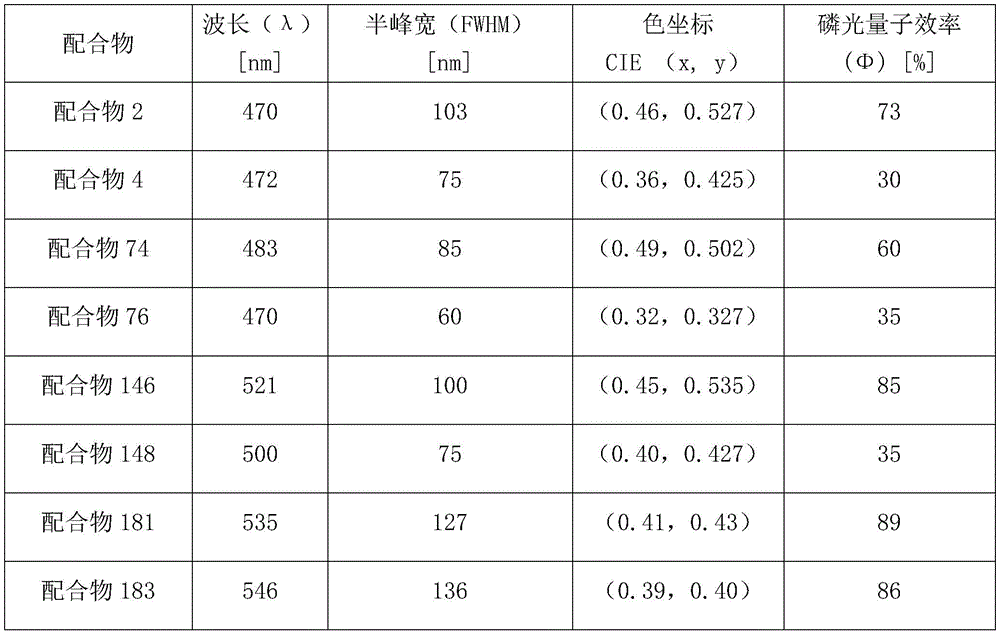
FIGS. 1 to 3 in the drawings show the luminescence spectra of bivalent platinum complexes 2 and 74, 146 in solution and thin film, respectively; under the excitation of 400nm ultraviolet light, the main light-emitting energy of the three complexes in a dichloromethane solution and polymethyl methacrylate (PMMA) is between 470-520nm wavelength, and all the complex wavelengths are in blue-green phosphor region. The series of complexes are good blue-green luminescent materials and can be used as complementary color auxiliary materials of red light.
FIG. 4 is a graph of the luminescence spectrum of a bivalent platinum complex 2 in a PMMA film under the excitation of 400nm ultraviolet light along with the change of concentration; the luminous spectrum has slightly reduced energy along with the increase of concentration, but still comprises a main blue region, the components of a long wavelength region are increased, the wavelength of all complexes is finally included in blue, green and red phosphor regions, and the half-peak width of 75 percent concentration doping reaches 121 nm. The luminescence of the series of complexes can be regulated and controlled between blue-green luminescence and white luminescence through doping concentration.
FIGS. 5 and 6 show the UV-VIS absorption spectra of the divalent platinum complexes 74 and 146 in the dichloromethane solution, and it can be known from the absorption spectra that the absorption spectra have very strong absorption in the region of 250-450 nm. Wherein the absorption below 370nm can be attributed to a pi-pi transition centered on the ligand in the complex. Wherein the absorption peak after 370nm can be assigned as valence transition (MLCT) transition between the metal ion and the ligand at the center of the complex. The energy absorption of such molecules is very efficient and can be used as a preferred molecular structure of the doped material molecules. The wavelength below 280nm is pi-pi transition of benzene ring or pyridine ring under the permission of spin, and the wavelength below 280nm and 370nm is pi-pi transition of carbazole ligand part; absorption at wavelengths above 370nm results from the d-pi transition of the metal to ligand transition state.
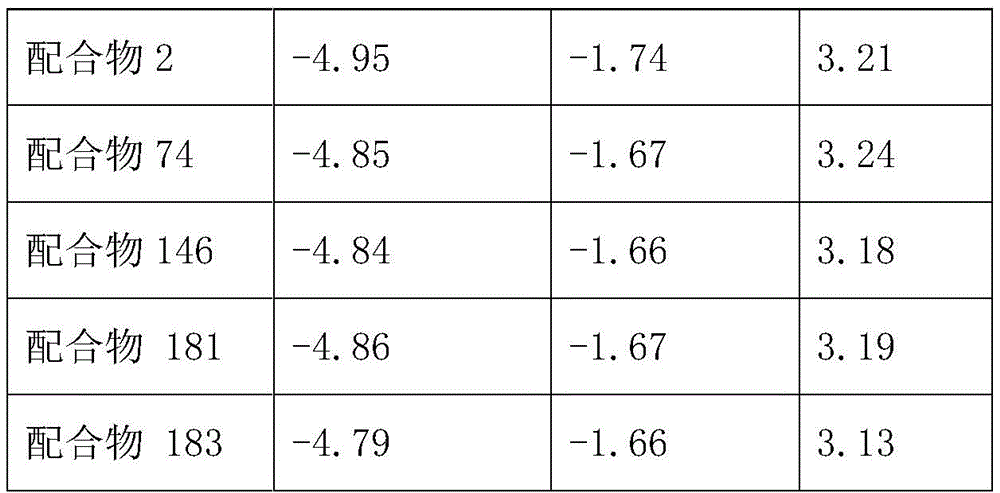
Bandgap and related optics for divalent platinum complexes 2, 74, 146 provided for embodiments of the inventionThe properties are characterized as follows: band gap value (E) of the materialg) The Lowest Unoccupied Molecular Orbital (LUMO) and Highest Occupied Molecular Orbital (HOMO) values were measured using Cyclic Voltammetry (CV). The whole test process was carried out on CHI600D electrochemical workstation (Shanghai Chenghua instruments Co.) in glove box (Lab2000, Etelux), with Pt column as working electrode, Ag/AgCl as reference electrode, and Pt wire as auxiliary electrode to form a three-electrode system, and the medium adopted in the test process was 0.1M tetrabutylammonium hexafluorophosphate (Bu)4NPF6) The measured potentials were measured with ferrocene (Fc) added as an internal standard. In the following table, λ is the peak wavelength of the divalent platinum complex dissolved in dichloromethane, FWHM is the half-peak width thereof, and triplet photon energy (E) of the materialT1) From the formula 1240/λ0→1Is calculated to (lambda)0→1The first oscillation peak at 77K) in units of electron ford (eV).
Table 2 shows the energy level data of the complexes. From the data in table 2, it is clear that the energy level of the HOMO orbital of complex 183 is lower than that of complexes 2, 74, 146, 181, indicating that the HOMO energy level of the material can be lowered by the bulky aryl group. The triplet energies of several bivalent platinum complexes are 2.72-2.78eV, which is mainly related to the parent nucleus structure, indicating that the triplet radiative transitions are consistent at low temperatures, i.e. the molecular thermal motion limitation. This also shows that the divalent platinum complexes can regulate and control the energy level and the emission spectrum thereof within a small range by introducing substituent groups, thereby obtaining an optimal light-emitting spectrum interval.
TABLE 2 energy level data

The attached figures 7, 8 and 9 in the specification are respectively monomolecular of complexes 2, 74 and 1461H nuclear magnetic spectrum shows that the complex can exist independently and stably and is easy to be detected by hydrogen spectrumSeparating, purifying and characterizing. From the nuclear magnetic spectrum, the bivalent platinum complex does not show signals of aggregation morphology except that the corresponding bivalent platinum complex has stable structural representation, which indicates that the bivalent platinum complex molecules exist in a state of single molecule separation in a solution state.
FIG. 10 is a mass spectrometric characterization of the molecule of complex 2. The molecular signal of the mass spectrum molecule shows that the M/C peak value is 639.1, which is consistent with the molecular ion peak of the compound 2, and the complex structure is a designed structure.
FIG. 11 is a mass spectrometric characterization of the molecule of complex 74. The molecular signal of the mass spectrum molecule shows that the M/C peak value is 713.6, which is consistent with the molecular ion peak of compound 74, and the complex structure is a designed structure.
FIG. 12 is a mass spectrometric characterization of the molecule of complex 146. The molecular signal of the mass spectrum molecule shows that the M/C peak value is 711.3, which is consistent with the molecular ion peak of the compound 146, and the complex structure is a designed structure.
FIG. 13 is an analysis diagram of the purity of complex 2 after purification in an ultrahigh pressure liquid phase. The liquid phase purity is 99.86%, which indicates the availability of ultra-high purity products that can be obtained by the methods provided herein, and the availability of the complexes for suitable process scaling-up.
Example 7 application of the divalent platinum complex of the present invention to an OLED light-emitting device
The present invention also provides an organic photoelectric device, as shown in fig. 14, including a light-emitting layer, wherein the light-emitting layer includes the above divalent platinum complex. Optionally, the divalent platinum complex is a light-emitting material, a host material, or a guest material in a light-emitting layer of the organic photoelectric device.
Fig. 14 shows a cross-sectional view of an OLED light emitting device 1000 comprising one of the divalent platinum complexes disclosed herein. OLED device 1000 includes a substrate 1002, an anode layer 1004, a hole transport layer 1006, a light emitting layer 1008, an electron transport layer 1010, and a metallic cathode layer 1012. The anode 1004 is typically a transparent material such as indium tin oxide. Light emitting layer 1008 can be a light emitting material that includes one or more emitters and a host. Where EIL refers to an electron injection layer, it can be considered as a part of the electron transport layer 1010. HIL is a hole injection layer and can be considered to be part of the hole transport layer 1006. CPL is the cathode capping layer.
And sequentially placing a crucible containing OLED organic materials and a crucible containing metal aluminum particles on an organic evaporation source and an inorganic evaporation source. Closing the cavity, and performing primary vacuum pumping and high vacuum pumping steps to ensure that the vacuum degree of evaporation in the OLED evaporation equipment reaches 10E-7And (5) Torr. An OLED evaporation film forming method comprises the following steps: and opening an OLED organic evaporation source, and preheating the OLED organic material at 100 ℃ for 15 minutes to ensure that water vapor in the OLED organic material is further removed. And then carrying out rapid heating treatment on the organic material to be evaporated, opening a baffle above an evaporation source until the organic material runs out of the evaporation source of the material, and slowly raising the temperature when a crystal oscillator piece detector detects the evaporation rate, wherein the temperature rise amplitude is 1-5 ℃, opening the baffle right below a mask plate until the evaporation rate is stabilized at 1A/s, carrying out OLED film formation, closing the baffle above the mask plate and the baffle right above the evaporation source when a computer end detects that the organic film on the ITO substrate reaches a preset film thickness, and closing an evaporation source heater of the organic material. The evaporation process for the other organic materials and the cathode metal material is as described above. And the packaging adopts UV epoxy resin for photocuring packaging. The encapsulated samples were tested for IVL performance using Mc Science M6100 for IVL equipment.
The complex 2 disclosed by the specification is used as a white phosphorescent light-emitting doping material in a light-emitting layer to prepare a white phosphorescent device. When the bivalent platinum complex is used as a doping material in an OLED device, a white phosphorescent device is prepared by a distillation method, and the structure of the device 1 is (ITO,95nm)/4,4 '-cyclohexyl di [ N, N-di (4-methylphenyl) aniline ] (TAPC,30nm)/9,9' - (1, 3-phenyl) di-9H-carbazole (mCP,10 nm)/mCP: complex 2 (20: 1, 20 nm)/bis [2- ((oxo) diphenylphosphino) phenyl ] ether (DPEPO,5nm)/3,3'- [5' - [3- (3-pyridyl) phenyl ] [1,1':3',1 "-terphenyl ] -3, 3" -diyl ] bipyridine (TmPyPB,40 nm)/lithium fluoride (LiF,1 nm)/aluminum (Al,100nm), wherein the device level diagram is shown in fig. 15:
wherein ITO is an anode, TAPC is a hole transport material layer 1, mCP is a hole transport layer 2 and a luminescent layer main body material, DPEPO and TmPyPB are electron transport layers, and Al is a cathode. Wherein the electroluminescence spectrum is shown in FIG. 16:
the cyan phosphorescent device prepared by the complex 2 has the peak wavelength of 536nm, the half-peak width of 117nm and CIE coordinate values of (0.36 and 0.32), and well covers green light and red light intervals. The highest current efficiency energy efficiency (PE) of the device is 48.8lmW-1The maximum Current Efficiency (CE) is 90.5cdA-1And the highest External Quantum Efficiency (EQE) reaches 29.7 percent, belonging to a high-efficiency light-emitting device.
TABLE 3 luminescent Properties of the devices
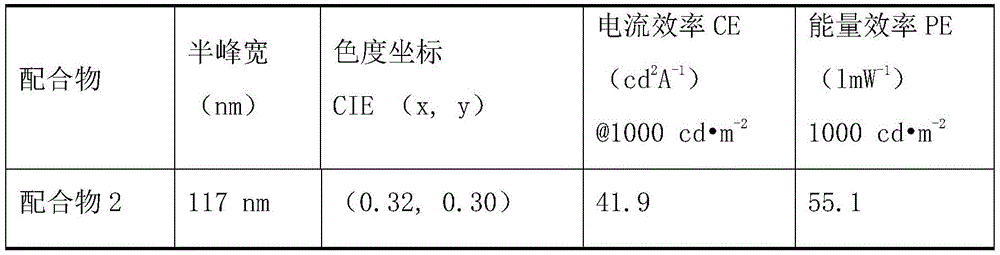
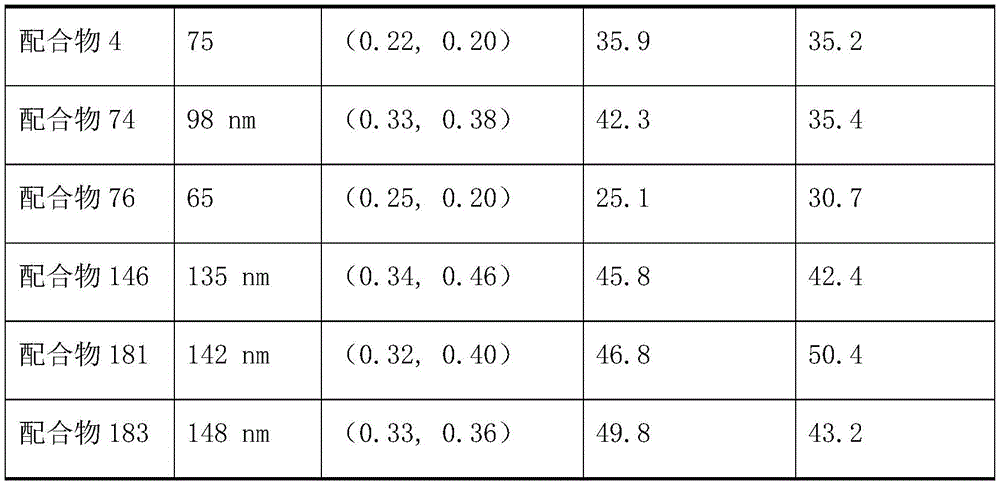
Table 3 shows the comparison of the luminescence property data of the white phosphor light emitting devices prepared by the respective complexes. Under the same condition, the efficiency of the light-emitting device is consistent with the luminous quantum efficiency of the bivalent platinum complex per se, and is 1000 cd.m-2The efficiency is higher under the brightness.
The invention is illustrated by an exemplary example that the general structural formula I can be used as a white phosphorescent doped material to prepare a single doped white phosphorescent device or a red phosphorescent material to form a double doped white phosphorescent device, wherein the materials are not limited to the structures illustrated; depending on the application, the device structure may be either a bottom emitting device or a top emitting device. Wherein the ETL layer 1010 and the HTL 1006 may further comprise one or more transport layer materials, and there may be another charge injection layer in the divalent platinum complex and in proximity to the electrode. The materials of the injection layer may include EIL (electron injection layer), HIL (hole injection layer) and CPL (cathode capping layer), which may be in the form of a single layer or dispersed in an electron or hole transport material. The host material may be any suitable host material known in the art. The emission color of the OLED is determined by the emission energy (optical energy gap) of the material of the light-emitting layer 1008, which can be tuned by tuning the electronic structure of the emitting divalent platinum complex and/or host material as described above. The hole transport material in the HTL layer 1006 and the electron transport material in the ETL layer 1010 may include any suitable hole transporter known in the art. The divalent platinum complex provided by the embodiment of the invention can exhibit phosphorescence. Phosphorescent OLEDs (i.e., OLEDs having phosphorescent emitters) generally have higher device efficiencies than other OLEDs, such as fluorescent OLEDs. Light-emitting devices based on electrophosphorescent emitters are described in nature 395, page 151-154 and in more detail in WO2000/070655, which is hereby incorporated by reference, for the reason that it contains information about OLEDs, in particular fluorescent OLEDs.
It will be understood by those of ordinary skill in the art that the foregoing embodiments are specific examples for carrying out the invention, and that various changes in form and details may be made therein without departing from the spirit and scope of the invention in practice.
Claims (10)













Priority Applications (1)
| Application Number | Priority Date | Filing Date | Title |
|---|---|---|---|
| CN202110046601.6A CN112679555B (en) | 2021-01-14 | 2021-01-14 | Broad-spectrum divalent platinum complex and preparation method and application thereof |
Applications Claiming Priority (1)
| Application Number | Priority Date | Filing Date | Title |
|---|---|---|---|
| CN202110046601.6A CN112679555B (en) | 2021-01-14 | 2021-01-14 | Broad-spectrum divalent platinum complex and preparation method and application thereof |
Publications (2)
| Publication Number | Publication Date |
|---|---|
| CN112679555A true CN112679555A (en) | 2021-04-20 |
| CN112679555B CN112679555B (en) | 2023-04-07 |
Family
ID=75457787
Family Applications (1)
| Application Number | Title | Priority Date | Filing Date |
|---|---|---|---|
| CN202110046601.6A Active CN112679555B (en) | 2021-01-14 | 2021-01-14 | Broad-spectrum divalent platinum complex and preparation method and application thereof |
Country Status (1)
| Country | Link |
|---|---|
| CN (1) | CN112679555B (en) |
Cited By (1)
| Publication number | Priority date | Publication date | Assignee | Title |
|---|---|---|---|---|
| CN115991724A (en) * | 2021-10-15 | 2023-04-21 | 中国石油化工股份有限公司 | Blue phosphorescent divalent platinum complex, preparation method and application thereof, and organic optoelectronic device |
Citations (4)
| Publication number | Priority date | Publication date | Assignee | Title |
|---|---|---|---|---|
| US20120215001A1 (en) * | 2011-02-18 | 2012-08-23 | Jian Li | Four coordinated platinum and palladium complexes with geometrically distorted charge transfer state and their applications in light emitting devices |
| CN104232076A (en) * | 2013-06-10 | 2014-12-24 | 代表亚利桑那大学的亚利桑那校董会 | Phosphorescent tetradentate metal complexes with improved emission spectra |
| CN104693243A (en) * | 2013-10-14 | 2015-06-10 | 代表亚利桑那大学的亚利桑那校董事会 | Platinum complexes and devices |
| CN110372756A (en) * | 2019-08-05 | 2019-10-25 | 南京工业大学 | Bivalent platinum complex and preparation method and application thereof |
-
2021
- 2021-01-14 CN CN202110046601.6A patent/CN112679555B/en active Active
Patent Citations (4)
| Publication number | Priority date | Publication date | Assignee | Title |
|---|---|---|---|---|
| US20120215001A1 (en) * | 2011-02-18 | 2012-08-23 | Jian Li | Four coordinated platinum and palladium complexes with geometrically distorted charge transfer state and their applications in light emitting devices |
| CN104232076A (en) * | 2013-06-10 | 2014-12-24 | 代表亚利桑那大学的亚利桑那校董会 | Phosphorescent tetradentate metal complexes with improved emission spectra |
| CN104693243A (en) * | 2013-10-14 | 2015-06-10 | 代表亚利桑那大学的亚利桑那校董事会 | Platinum complexes and devices |
| CN110372756A (en) * | 2019-08-05 | 2019-10-25 | 南京工业大学 | Bivalent platinum complex and preparation method and application thereof |
Cited By (1)
| Publication number | Priority date | Publication date | Assignee | Title |
|---|---|---|---|---|
| CN115991724A (en) * | 2021-10-15 | 2023-04-21 | 中国石油化工股份有限公司 | Blue phosphorescent divalent platinum complex, preparation method and application thereof, and organic optoelectronic device |
Also Published As
| Publication number | Publication date |
|---|---|
| CN112679555B (en) | 2023-04-07 |
Similar Documents
| Publication | Publication Date | Title |
|---|---|---|
| JP7461466B2 (en) | Boron nitrogen compound, organic electroluminescent composition and organic electroluminescent device containing the same | |
| CN109748938B (en) | Divalent platinum complexes, their applications and organic optoelectronic devices | |
| JP5812583B2 (en) | Triazine derivative, method for producing the same, and organic electroluminescent device comprising the same | |
| CN114621274B (en) | Boron nitride compound, organic electroluminescent composition and organic electroluminescent device comprising same | |
| CN114621271B (en) | Boron nitride compound, organic electroluminescent composition and organic electroluminescent device comprising same | |
| CN110372756B (en) | A kind of divalent platinum complex and its preparation method and application | |
| CN111205273A (en) | Bivalent platinum complex and preparation method and application thereof | |
| CN114621272B (en) | Boron nitride compound, organic electroluminescent composition and organic electroluminescent device comprising same | |
| CN108440424A (en) | Acenaphthene and pyrazines derivatives and its application | |
| KR20210093180A (en) | Metal complex, electroluminescent device including the same, and use thereof | |
| CN112125932A (en) | A kind of divalent platinum complex and its application | |
| CN115504999A (en) | Polycyclic compounds and their organic electroluminescent devices | |
| CN111943987A (en) | A blue-white light tunable divalent platinum complex and its preparation method and application | |
| CN115260242B (en) | Organic electroluminescent material and device thereof | |
| CN114621273B (en) | Boron nitride compound, organic electroluminescent composition and organic electroluminescent device comprising same | |
| CN112940045B (en) | Bivalent platinum complex, preparation method thereof and application thereof in luminescent material | |
| CN112679555B (en) | Broad-spectrum divalent platinum complex and preparation method and application thereof | |
| CN116804020B (en) | A nitrogen-containing heterocyclic organic compound and its application in OLED devices | |
| CN115991724B (en) | Blue phosphorescent divalent platinum complex, preparation method and application thereof, and organic photoelectric device | |
| CN115991722B (en) | Yellow-green phosphorescence bivalent platinum complex, preparation method and application thereof, and organic photoelectric device | |
| CN115583976B (en) | Divalent platinum complex with adjustable luminescence spectrum, preparation method and application thereof as yellow phosphorescent material in organic optoelectronic device | |
| RU2844516C2 (en) | Divalent metal complex, method for production thereof and use thereof and organic optoelectronic device | |
| CN119978011B (en) | Blue luminescent compound containing cyclohexyl dibenzofuran structure and organic electroluminescent device containing same | |
| TWI852706B (en) | Divalent metal complex, preparation method and use thereof, and organic optoelectronic device | |
| CN115991725B (en) | Green phosphorescent divalent platinum complexes, their preparation methods and applications, and organic optoelectronic devices |
Legal Events
| Date | Code | Title | Description |
|---|---|---|---|
| PB01 | Publication | ||
| PB01 | Publication | ||
| SE01 | Entry into force of request for substantive examination | ||
| SE01 | Entry into force of request for substantive examination | ||
| GR01 | Patent grant | ||
| GR01 | Patent grant |