Drawings
The present invention will now be described, for illustrative but not limitative purposes, according to its preferred embodiments, with particular reference to the accompanying drawings, in which:
fig. 1 shows an overall view of a door locking device according to the present invention;
fig. 2 shows an exploded view of the door locking device according to fig. 1;
figure 3 shows a perspective view of a shielding intermediate element of the door locking device according to the invention;
FIG. 4 shows a partially cut-away perspective view of a protective shell of a door locking device according to the present invention;
fig. 5 shows a rear perspective view of a door locking device according to the present invention in a configuration: in this configuration, the slide is in the retracted position;
fig. 6 shows a rear perspective view of the door locking device according to fig. 4 in the following configuration: in this configuration, the slider is in the extracted position;
FIG. 7 shows the door locking device of FIG. 6 in longitudinal cross-section;
fig. 8 shows a slide of the door locking device according to the invention in a partially cut-away perspective view;
figure 9 shows a longitudinal section of the door locking device according to the invention, in which the arrangement of the electronic control unit can be seen;
FIG. 10 illustrates the connection of the electrical connector;
figure 11 shows the connection of the electrical connectors to the various parts of the electrical circuit of the electronic control unit of the door locking device according to the invention;
figure 12 shows the means for moving the door locking device according to the invention in its coupling with the slider, in which the unlocking means assume a first configuration;
figure 13 shows the means for moving the door locking device according to the invention in its coupling with the slider, wherein the unlocking means assume a second configuration;
fig. 14 shows an emergency release system of the door locking device according to the present invention;
fig. 15 illustrates a partial sectional view of a washing machine to show an arrangement of a door locking device according to the present invention;
fig. 16 shows the door locking device in the following configuration: in this configuration, the slider is in the extracted position;
fig. 17 shows the door locking device in the following configuration: in this configuration, the slider is pushed to the retracted position;
fig. 18 shows the door locking device in a configuration in which the emergency release system returns to its initial position;
figure 19 shows how the water flow is distributed over the slider or intermediate protective element of the door locking device according to the invention;
FIG. 20 shows an exploded view of a second embodiment of a door locking device according to the present invention;
fig. 21 shows a perspective detail of the door locking device according to fig. 20 without the protective element and some movement transmission members;
FIG. 22 shows another perspective view of a detail of FIG. 21;
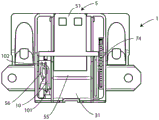
FIG. 23 shows a top view of the opened door locking device according to FIG. 20;
FIG. 24 shows a bottom perspective view of the control electronics of the door locking device according to FIG. 20;
figure 25 shows details of the control electronics of the door locking device according to figure 20;
FIG. 26 shows the circuitry of the control electronics of the door locking device according to FIG. 20;
FIG. 27 shows a top view of the door locking device opened in a first operating configuration;
FIG. 28 shows a top view of the open door locking device in a second operational configuration;
FIG. 29 shows a top view of the open door locking device in a third operational configuration; and
figure 30 shows a top view of the opened door locking device in a fourth operating configuration.
Detailed Description
Like parts will be designated by the same reference numerals in the various drawings.
With reference to fig. 1 and 2, a door locking device according to the invention is shown, indicated as a whole by the reference numeral 1.
The door locking device 1 mainly comprises a base 2, a protective element 3, an upper cover 4, a slide 5, an electronic control unit 6, a moving means 7 and an emergency unlocking system 8.
The base 2 has a first housing 21 and a second housing 22, the function of which will be better explained below.
Furthermore, the base 2 has a connector support 23, into which connector support 23 an electrical connector can be inserted.
Referring also to fig. 3, 4 and 5, it can be seen that the protective intermediate element 3 can be mechanically coupled to said base 2 by coupling means (for example screws or the like) or more preferably by interlocking, and that the protective intermediate element 3 is substantially hollow on the outside so as to be defined together with said base 2, said first shell 21 and said second shell 22.
The protective intermediate element 3, together with the cap 4, also defines a third housing 31 by means of two side walls 32, indicated respectively with 321 and 322, and an upper surface 33 of the protective intermediate element 3 itself. The opening 34 is again identified by means of the cover.
On the outer wall of the side wall 322, there are two windows 3221 and 3222 horizontally aligned.
On the side, the protective intermediate element 3 also has holes 35 for fixing screws (not shown in the figures), while between the upper surface 33 and the front surface opposite to the rear surface where the openings 34 are identified, a system of partitions 36 is provided. In particular, the baffle system 36 has: a pair of parallel partitions 361, said pair of parallel partitions 361 laterally bounding said upper surface 33; and a further partition 362, said further partition 362 extending along said front surface to delimit the front opening 37, the function of which will be better explained below. The parallel partition 361 and the further partition 362 are seamless.
Furthermore, the protective intermediate element 3 has a first recess 381 on one side and a second recess 382 on the opposite side.
In practice, the upper surface 33 is interposed between the first void 381 and the second void 382.
In addition, the first void 381 and the second void 382 are also bounded by the pair of partition plates 361. Laterally, the lateral receptacle 382 also has a slot 383.
The shielding intermediate element 3 further comprises a fixing tongue 39 for fixing the entire door-locking device 1 to a household appliance equipped with a door-locking device.
The cap 4 has a shape adapted to be arranged on the wall 32, the cap 4 covering the entire surface of said protective intermediate element 3 and having side edges adapted to be arranged outside said side walls 32.
Furthermore, as mentioned above, when the cap 4 is coupled to the protective intermediate element, the opening 34 is completed.
The base 2, the protective intermediate element 3 and the top cover 4 together form, when coupled, a protective shell I of the door locking device 1 according to the invention. The upper surface of said top cover 4 comprises a flat portion 41 and a steep portion 42, so that when said top cover 4 is placed on said protective intermediate element 3, said edges remain facing downwards and project with respect to the periphery of said protective intermediate element 3 itself, wherein said flat portion 41 has longitudinal reliefs 411 arranged parallel to each other, said longitudinal reliefs 411 being adapted to guide water that may fall on the cover 4.
The base 2 has a set of rectangular holes 24 on the convex bottom (as shown in fig. 2) of the housing 21 for accommodating the motor, the set of rectangular holes 24 having a function of discharging any water drops entering the base 2 of the door locking device as shown in fig. 4.
The slide 5 is slidably movable and interposed between the protective intermediate element 3 and the top cover 4, so that the slide 5 can pass through the window 34 in a retracted position (see fig. 5) and in an extracted position (see fig. 6 and 7).
Referring to fig. 8, the slider 5 has a locking portion 51 for being withdrawn through the opening 34 when the slider 5 is in the withdrawn position, and for interacting with a door of a washing machine or a home appliance to which the door locking device 1 is generally mounted.
The slider 5 further comprises: the rack 52, the rack 52 is inserted into the first void 381; and a longitudinal bar 53, the longitudinal bar 53 being provided with teeth 531, the longitudinal bar 53 being inserted in said lateral housing 382 and being able to slide in said lateral housing 382 and even being able to move through said slot 383. The locking portion 51 has a groove 511 in the shape of a "Y" at the top, and also two through holes 512 and 513, the through holes 512 and 513 being adapted to allow the outflow or passage of any water that may eventually fall on the locking portion 51.
Between said locking portion 51 and said rack 52 and between said locking portion 51 and said longitudinal bar 53, respectively, said slider 5 also has some ribs 54 for accommodating any possible water drops that may fall on the slider 5, as will be explained in detail below.
Finally, the slide 5 comprises, behind said locking portion 51, a flat drainage element 55, which flat drainage element 55 has a steep or slightly descending surface for the water to flow onto the upper surface 33 of said shield intermediate element 3.
In the assembly shown, the ribs 54 are located within parallel partitions 361 so that water falls on the upper surface 33.
The electronic control unit 6, visible in fig. 9, comprises, in the case in question, a printed circuit 61, which printed circuit 61 is arranged below said upper surface 33 of said containing intermediate device 3 so as to be protected, on which printed circuit the electric circuit for connecting the electronic components is shown, and also visible in fig. 10 and 11, the electronic control unit 6 comprises two microswitches 611 and 612, each of which is arranged in correspondence with a respective one of said side windows 3221 and 3222 of said side wall 322, so that said longitudinal rod 53 of said slider 5 can interfere with the microswitches 611 and 612 when said slider 5 is moved.
The electronic control unit 6 also comprises an electrical connector 62, which electrical connector 62 is connected and fixed to the printed circuit 61 and is intended to be inserted into the connector support 23 of the base 2. The connector 62 is intended to electrically and operatively connect the circuitry of the printed circuit 61 to the control logic of the household appliance (not shown in the figures) on which the door locking device 1 is installed.
The electronic control unit 6 also comprises a reed switch 63 (as known in the art) for checking the status of the closed door or the open door, and a PTC 64 for protecting the motor 71 that actuates the device.
When assembling the door locking device 1, the electrical connector 62 and the support 23 for the connector are placed in correspondence with said front opening 37, said front opening 37 being limited and protected by said further partition 362 as described against any dripping, as will be better explained below.
As can be seen from fig. 12 and 13, the moving device 7 includes: a motor 71, the motor 71 having a shaft 72 provided in the first housing 21 of the base 2; a pinion 73 keyed on said shaft 72; a gear 74, said gear 74 being arranged in said second housing 22 of said base 2, being engaged with said rack 52 of the slider 5 by means of a pinion 75 integral with this gear 74.
Said electronic control unit 6 and said moving means 7 constitute a system for moving and controlling the slide 5.
The emergency unlocking system 8 includes a lever 81 (see also fig. 14), the lever 81 having: a first portion 811, the free end of which 811 interferes with the tooth 531 of the longitudinal bar 53 of the slider 5; a second portion 812, the second portion 812 forming a "V" shape with the first portion 811; a pin 813, the pin 813 being disposed between the first portion 811 and the second portion 812 at a vertex of a "V" formed by the first portion 811 and the second portion 812.
The pin 813 pivots on the base 2.
Furthermore, said emergency unlocking system 8 also comprises a further longitudinal element 814, which further longitudinal element 814 is coupled at one end to said second portion 812 by a flexible elbow 815, which in the present embodiment is made of plastic. At the other end, the longitudinal element 814 comprises a release buoy 816, to which release buoy 816 a lanyard or any other traction member (not shown in the figures) may be coupled.
The emergency unlocking system 8 also comprises a helical spring 82 arranged on the pin 813, the helical spring 82 being able to keep the rod 81 in a predetermined position, as better described below.
The operation of the door locking device 1 described above is as follows.
More specifically, in order to better understand the operation of the door locking device 1, the functional operation and the protective operation are distinguished in terms of possible water droplets that may fall on the door locking device 1 itself.
In summary, reference is now additionally made to fig. 15, in which the installation of the door locking device 1 in the washing machine 9 is illustrated, wherein the body or frame 92 and the cover 91 are clearly distinguished. Of course, the slider 5 is configured to interfere with the cover 91 when it is in the extracted position, to keep it closed.
Regarding the functional operation, by means of a control logic (not shown in the figures) of the washing machine 9 connected to the electronic control unit 6 via the electrical connector 62, the motor 71 is allowed to be driven to rotate a gear 74 by means of a pinion 73 moved by a motor shaft 72, the gear 74 being in fact a reduction gear.
Thus, the pinion 75 engaged with the rack 52 of the slider 5 enables the slider 5 itself to pass from a retracted position, in which the locking portion 51 of the slider 5 is housed completely or partially inside the protective shell I, and said longitudinal rod 53 closes the microswitch 611 overlapping the corresponding window 3221, to an extracted position, in which the locking portion 51 of the slider 5 protrudes from said opening 34 and therefore from said protective shell I, and the longitudinal rod 53 moves accordingly, opening the microswitch 611 and closing the microswitch 612 physically overlapping the window 3222.
When the microswitch 611 and 612 combination is closed, the control logic unit of the washing machine 9 can electronically determine whether the door 91 is locked. The control unit of the washing machine detects whether the door 91 is closed by a signal transmitted from a reed switch 63 provided on the printed circuit 61, the reed switch 63 interfering with a magnet (not shown) placed on the door 91 in correspondence therewith in a closed state.
Thus, in the extracted position, the slider 5 interferes with the door 91 of the washing machine 9, locking the door 91 in position.
Besides, with reference to fig. 16, when the slider 5 is in the extracted position, the lever 81 is in an initial position in which the lever 81 is held by the coil spring 82 and in which the lever 81 does not interfere with the movement of the slider 5.
In case it is necessary to open the door 91 for emergency reasons during the washing cycle, the lanyard or any mechanical element (not shown in fig. 17) connected to the release float 816 needs to be pulled in the direction of arrow a.
In this way, thanks to the traction of the longitudinal element 814, by rotating the rod 81 according to the arrow B, thanks to the flexible elbow 815 it is obtained that the free end of the first portion 811 will engage the teeth 531 of the longitudinal rod 53, forcing the slider 5 from the extracted position to the retracted position.
The lanyard is then released and the lever 81 will return to its original position by rotating in the direction of arrow C, due to the action of the spring 82, as shown in figure 18.
However, as mentioned above, water often leaks from the drum, which often wets the door locking device and associated electrical components.
According to the door locking device 1 of the present invention, in the case where water falls on the upper surface of the top cover 4, the water is first guided through the longitudinal embossed portion 411 of the flat portion, which will not drop the water laterally, and can be turned toward the steep portion 42, thereby preventing the water from entering the door locking device 1.
If the slide 5 is in the extracted position, a part of the water may anyway fall on the surface of the slide 5, for example by seeping through the opening 34 in the door locking device 1.
However, in this case, a part of the water is collected by the grooves 511, which easily turn the water due to the "Y" shape at the side, thereby dropping the water. However, other parts of the water may be guided and drip through the two through holes 512 and 513 located approximately at the edge of the locking portion 51 in order to drain the water out of the body of the door locking device 1.
In the event that an excessive amount of water falls on the slider 5, when the slider 5 is in the extracted position, such that the grooves 511 of the locking portion 51 cannot collect water in their entirety and allow water to fall to the sides, the ribs 54 will tend to collect water on the flat drainage element 55, which in turn will concentrate the water on the upper surface 33 of said protective intermediate element 3, so that the water can flow through the partitions 361 and 362 without risk of dripping on the electronic components of the electronic control unit 6 or on the electrical connector 62, as shown in fig. 19, wherein the flow of water is indicated by the dashed arrows.
In particular, it can also be observed how the flat draining element 55 promotes the outflow of water from the surface of the locking portion 51 of the slider 5 onto the upper surface 33 of said shielding intermediate element 3.
Furthermore, if water still penetrates between the protective element 3 and the top cover 4, for example due to a particularly violent splash, in this case it still tends to be contained between the parallel partitions 361, so as to lie on the upper surface 33 of the protective intermediate element 3, and is then guided again by the partitions 361, bifurcating into two streams guided by the partitions 362, so as to prevent water and humidity from reaching the electronic control unit 6 and the connector 62.
Referring now to fig. 20 to 24, the structure of a second embodiment of the door locking device according to the present invention is observed.
In particular, similar parts will not be described again, and only modifications to the above-described first embodiment will be considered hereinafter.
In particular, it can be observed that the slide 5 comprises, in addition to the rack 52, a further rack 52', in correspondence of which, on a surface facing upwards in particular in this case, a constraint path 56 is obtained, this constraint path 56 having: a first seat 561; a second seat 562 opposite to the first seat 561; a third seat 563 arranged at the rear of said first seat 561 and a fourth seat 564 opposite said first seat 561 and parallel to said second seat 562. Furthermore, the door locking device 1 comprises a control member 10, which control member 10 has a first end 101 hinged on said guard element 3 and a second end 102 engaged or arranged to slide in said constraint path 56.
The slider 5 further comprises: a tooth 57, as better defined hereinafter, which tooth 57 cooperates with the switch 67 by opening the switch 67; a recess 57', which recess 57' does not actuate the switch 67, leaving it in the closed state; a raised portion 57 "located at the same height of the tooth 57, the raised portion 57" cooperating with the switch 67 by opening the switch 67. The function and effect of the signal generated by the interaction between the tooth loose piece 57 and the portions 57' and 57 "and the switch 67 will be better described below.
The door lock 1 of the second embodiment in question also has a return spring 58, which return spring 58 serves to return the slider 5 to the extracted position, as will be better explained below.
In this embodiment, the gear 74 of the moving means 7 has a shaft 741, to one end of which shaft 741 a further pinion 742 is connected, which pinion 742 is intended to engage with the further rack 52'.
The electronic control unit 6 (see fig. 24-26) is realized by a suitably cut-out moulded plastic support 65, in which the ramps and the metal connections 66 are provided.
The electronic control unit 6 further comprises a switch 67, the switch 67 having a release mechanism 671, which release mechanism 671 engages with the teeth 57 and portions 57 "of the sledge 5 when the sledge 5 is put in place, as will be described in detail below. The motor 71 of the moving unit tends to move the slider 5 into the retracted configuration under its active action (i.e. when energized), while the return spring 58 always tends to return the slider 5 to the extracted condition, contrary to the action of the motor. In particular, when said slider 5 is extracted, different signals are successively present due to the interaction of the tooth 57 and the portion 57 ″ with the release mechanism 671 of the switch 67, due to the opening and closing of the switch 67 by the release mechanism 671.
In some embodiments, the electronic control unit 6 may be implemented by means of a printed circuit (as in the first embodiment described above) or other system for implementing an electronic or microelectronic circuit.
Referring to fig. 26, the electrical diagram can be seen along with some of the major control connections between the motor 71, reed switch 63 and switch 67.
The second embodiment of the door lock 1 described above operates as follows.
The structure of the door locking device 1 according to the present embodiment is similar to that described with respect to the first embodiment. Therefore, the operation in the case where water drops fall thereon is completely similar to that of the first embodiment described above.
On the other hand, with regard to the functional operation of the door locking device 1, starting from the configuration of fig. 27, in fig. 27 the slider 5 is in the retracted position, the return spring 58 tends to draw the slider 5 out, the motor is closed, the switch 67 is open (because the release mechanism 671 interacts with the portion 57 "), and the control member 10 is in traction, in contrast to the reaction to the spring 58. When the motor 71 is activated by the household appliance control logic (not shown in the figures) in order to extract the slider 5, by rotating according to arrow a, the pinion 73 moves the gear 74, which in turn moves the further pinion 742, acting on the racks 52 and 52', thus bringing the second end 102 of the control member 10 from the first seat 561 to the second seat 562, as shown in fig. 28. In this step, the contact 67 is closed because the release mechanism 671 passes from the opposite part of the tooth 57 out of the part 57 ".
Subsequently, due to the interruption of the action of said motor 71, due to the timing effect after the slider 5 reaches the stop 3611 (or by closure of the reading switch 67, since the release mechanism 671 has moved outside the portion 57 ", opposite the tooth 57), following the action of the return spring 58, said second end 102 is constrained to position itself in said third seat 563, allowing said slider 5 to move from said retracted position to said extracted position, as shown in fig. 29. The position 563 in the direction of movement is not defined by the member 10, but its extension is based on the interaction of the slider 5 with the door of the household appliance that must be locked (not shown). Basically, the extension or travel of the slider 5 is limited (by defining the position 563 at which the end 102 of the member 10 on the slider 5 stops) by the fact that the free end of the slider 5 contacts the wall of the door of the household appliance to be locked.
At the same time, in this extracted position, the release mechanism 671 moves to the portion 57' without interference, closing the switch 67. In this way, the control logic of the household appliance can determine that the slider 5 is in the extracted position.
Subsequently, upon further actuation of the motor 71, which always rotates according to arrow a, the second end 102 of the control member 10 reaches the fourth seat 564 from the third seat 563, as shown in fig. 30, producing the same reporting of the position state of the slider 5, of the spring 58 and of the switch 67 in the state shown in fig. 28. In fact, the height of the end 102 in the direction of movement is the same while remaining on the other seat 564 of the constraint path with respect to the seat 562 of fig. 28.
Naturally, once the motor 71 stops its action, the return spring 58 moves the second end 102 from the fourth seat 564 to the first seat 561.
In this way, the slider 5 reaches the retracted position from the extracted position.
In this way, by rotating the motor 71 in only one direction of rotation, it is possible to move the slider 5 from the retracted position to the extracted position and vice versa, thus greatly simplifying its control.
The tooth 57 is in a particular abnormal operating condition, i.e. a condition resulting from some unauthorized use, the system is not activated without the household appliance door, so that the stroke of the slider 5 is not interrupted by contact with the free end of the slider 5 abutting against the household appliance door (which is not present in this abnormal condition). In other words, the slider 5 has an additional travel beyond the normal state of the locked door, wherein the release mechanism 671 is provided in correspondence with the portion 57'. In order to issue this additional travel signal, the tooth 57 intervenes, which tooth 57 interacts with the release mechanism 671 of the switch 67, issuing an additional travel signal, thus causing the household appliance to malfunction. The advantage of the door lock according to the invention is that it is particularly compact.
The present invention has been described for illustrative but not limitative purposes, according to its preferred embodiments, but it is to be understood that modifications and/or changes can be made by those skilled in the art without departing from the relevant scope as defined in the enclosed claims.