CN112643668B - A push-grab synergy method for robotic arms in dense environments - Google Patents
A push-grab synergy method for robotic arms in dense environments Download PDFInfo
- Publication number
- CN112643668B CN112643668B CN202011386635.1A CN202011386635A CN112643668B CN 112643668 B CN112643668 B CN 112643668B CN 202011386635 A CN202011386635 A CN 202011386635A CN 112643668 B CN112643668 B CN 112643668B
- Authority
- CN
- China
- Prior art keywords
- network
- robotic arm
- depth
- action
- value
- Prior art date
- Legal status (The legal status is an assumption and is not a legal conclusion. Google has not performed a legal analysis and makes no representation as to the accuracy of the status listed.)
- Active
Links
Images


Classifications
-
- B—PERFORMING OPERATIONS; TRANSPORTING
- B25—HAND TOOLS; PORTABLE POWER-DRIVEN TOOLS; MANIPULATORS
- B25J—MANIPULATORS; CHAMBERS PROVIDED WITH MANIPULATION DEVICES
- B25J9/00—Programme-controlled manipulators
- B25J9/16—Programme controls
- B25J9/1694—Programme controls characterised by use of sensors other than normal servo-feedback from position, speed or acceleration sensors, perception control, multi-sensor controlled systems, sensor fusion
- B25J9/1697—Vision controlled systems
-
- B—PERFORMING OPERATIONS; TRANSPORTING
- B25—HAND TOOLS; PORTABLE POWER-DRIVEN TOOLS; MANIPULATORS
- B25J—MANIPULATORS; CHAMBERS PROVIDED WITH MANIPULATION DEVICES
- B25J15/00—Gripping heads and other end effectors
- B25J15/08—Gripping heads and other end effectors having finger members
-
- B—PERFORMING OPERATIONS; TRANSPORTING
- B25—HAND TOOLS; PORTABLE POWER-DRIVEN TOOLS; MANIPULATORS
- B25J—MANIPULATORS; CHAMBERS PROVIDED WITH MANIPULATION DEVICES
- B25J19/00—Accessories fitted to manipulators, e.g. for monitoring, for viewing; Safety devices combined with or specially adapted for use in connection with manipulators
- B25J19/02—Sensing devices
- B25J19/021—Optical sensing devices
- B25J19/023—Optical sensing devices including video camera means
-
- B—PERFORMING OPERATIONS; TRANSPORTING
- B25—HAND TOOLS; PORTABLE POWER-DRIVEN TOOLS; MANIPULATORS
- B25J—MANIPULATORS; CHAMBERS PROVIDED WITH MANIPULATION DEVICES
- B25J9/00—Programme-controlled manipulators
- B25J9/16—Programme controls
- B25J9/1656—Programme controls characterised by programming, planning systems for manipulators
- B25J9/1661—Programme controls characterised by programming, planning systems for manipulators characterised by task planning, object-oriented languages
-
- B—PERFORMING OPERATIONS; TRANSPORTING
- B25—HAND TOOLS; PORTABLE POWER-DRIVEN TOOLS; MANIPULATORS
- B25J—MANIPULATORS; CHAMBERS PROVIDED WITH MANIPULATION DEVICES
- B25J9/00—Programme-controlled manipulators
- B25J9/16—Programme controls
- B25J9/1679—Programme controls characterised by the tasks executed
-
- G—PHYSICS
- G06—COMPUTING OR CALCULATING; COUNTING
- G06N—COMPUTING ARRANGEMENTS BASED ON SPECIFIC COMPUTATIONAL MODELS
- G06N3/00—Computing arrangements based on biological models
- G06N3/02—Neural networks
- G06N3/04—Architecture, e.g. interconnection topology
- G06N3/045—Combinations of networks
-
- G—PHYSICS
- G06—COMPUTING OR CALCULATING; COUNTING
- G06N—COMPUTING ARRANGEMENTS BASED ON SPECIFIC COMPUTATIONAL MODELS
- G06N3/00—Computing arrangements based on biological models
- G06N3/02—Neural networks
- G06N3/08—Learning methods
- G06N3/084—Backpropagation, e.g. using gradient descent
Landscapes
- Engineering & Computer Science (AREA)
- Mechanical Engineering (AREA)
- Robotics (AREA)
- Physics & Mathematics (AREA)
- Theoretical Computer Science (AREA)
- General Health & Medical Sciences (AREA)
- General Physics & Mathematics (AREA)
- Computational Linguistics (AREA)
- Data Mining & Analysis (AREA)
- Evolutionary Computation (AREA)
- Biomedical Technology (AREA)
- Molecular Biology (AREA)
- Computing Systems (AREA)
- General Engineering & Computer Science (AREA)
- Biophysics (AREA)
- Mathematical Physics (AREA)
- Software Systems (AREA)
- Artificial Intelligence (AREA)
- Life Sciences & Earth Sciences (AREA)
- Health & Medical Sciences (AREA)
- Multimedia (AREA)
- Image Analysis (AREA)
Abstract
一种适用于密集环境下的机械臂推抓协同方法,分为仿真训练与实际抓取两个部分。首先在仿真环境中搭建与真实抓取相似的场景,构建FCN网络(推网络)φp和抓网络φg,由动作后的状态给出评价,以此更新φp和φg网络参数,得到训练后的网络参数文件。在实际抓取部分,搭建实际抓取环境,导入仿真训练后的深度网络参数,根据网络输出的Q值图控制机械臂动作。本发明可以通过机械臂自主决策动作(抓或推)改变抓取环境,尤其适用于物体密集环境中。

A push-grab synergy method for robotic arms in dense environments is divided into two parts: simulation training and actual grasping. First, build a scene similar to the real grasping in the simulation environment, construct the FCN network (push network) φ p and the grasping network φ g , and give the evaluation by the state after the action, so as to update the network parameters of φ p and φ g , and get The trained network parameter file. In the actual grasping part, the actual grasping environment is built, the deep network parameters after simulation training are imported, and the action of the robotic arm is controlled according to the Q-value map output by the network. The invention can change the grasping environment through the autonomous decision-making action (grasping or pushing) of the robotic arm, and is especially suitable for the dense environment of objects.
Description
技术领域technical field
本发明设计一种适用于密集环境下的机械臂推抓协同方法。特别地,针对具有密集型环境的抓取任务,利用推抓动作的结合,能够有效的实现端到端的目标物体的抓取。The present invention designs a robotic arm push-grab synergy method suitable for dense environments. In particular, for grasping tasks with dense environments, the combination of pushing and grasping actions can effectively achieve end-to-end grasping of target objects.
背景技术Background technique
随着电子商务的飞速发展,机器人代替人类拾取物体成为在仓储管理,无人商店,工业生产流水线等其他工业,商业领域中必不可少的环节。因此,如何让机器人高效的拾取物体成为了工业机器人主要研究内容之一。然而就目前已存的大多数抓取方法而言,它们仅适用于物体间隔空隙较大的场景,在面对密集物体排布时,机械夹爪容易卡在刚性物体连接处上方,无法快速地正确地抓取单个物体。许多研究者在考虑密集物体场景时,会选择用夹爪吸盘来代替机械夹爪,利用深度彩色相机拍摄当前物品堆放场景的彩色深度图,对图像进行物体分割和计算机械臂吸盘吸取位置。但是对于目前使用同样广泛的装配机械夹爪的机械臂还是很难轻松抓取排列紧密的刚性物体,这使得该种机械臂抓取目标物体的泛化性变差。With the rapid development of e-commerce, picking up objects by robots instead of humans has become an indispensable link in warehouse management, unmanned stores, industrial production lines and other industrial and commercial fields. Therefore, how to make robots pick up objects efficiently has become one of the main research contents of industrial robots. However, as far as most of the existing grasping methods are concerned, they are only suitable for scenes with large gaps between objects. When faced with dense objects, the mechanical gripper is easy to get stuck above the connection of rigid objects, and it is impossible to quickly Grab a single object correctly. When considering dense object scenes, many researchers choose to use gripper suction cups instead of mechanical grippers, use a depth color camera to take a color depth map of the current object stacking scene, segment the image and calculate the suction position of the robotic arm suction cup. However, it is still difficult to easily grasp tightly arranged rigid objects with the same widely used robotic arm with mechanical grippers, which makes the generalization of the robotic arm for grasping the target object poor.
M.R.Dogar等研究人员在2012年发表了A planning framework fornonprehensile manipulation under clutter and uncertainty,通过手工调制的方法设计以了一个扫抓框架,能从复杂密集环境中抓取物体,提出可以通过抓扫结合的方式解决密集环境抓取困难问题。但是通过手工调制的方法只能针对一种环境,鲁棒性差,方法不可迁移。M.R.Dogar and other researchers published A planning framework for nonprehensile manipulation under clutter and uncertainty in 2012. They designed a sweep-grasping framework by hand-modulating methods, which can grasp objects from complex and dense environments, and proposed a combination of grasping and sweeping. way to solve the difficult problem of grasping the dense environment. However, the method by manual modulation can only target one environment, the robustness is poor, and the method cannot be transferred.
随着人工智能的发展,深度强化学习方法在智能体面对复杂环境决策博弈取得了显著的突破。深度强化学习通过智能体与环境不断交互中,做出决策,并在决策后得到一系列奖励。智能体通过此奖励不断地优化自己的决策过程,目标是使累积奖励的期望最大化,最终得到最优策略。With the development of artificial intelligence, deep reinforcement learning methods have made significant breakthroughs in the decision-making game of agents facing complex environments. Deep reinforcement learning makes decisions through the constant interaction between the agent and the environment, and gets a series of rewards after the decision. The agent continuously optimizes its decision-making process through this reward, with the goal of maximizing the expectation of the accumulated reward and finally obtaining the optimal policy.
A.Boularias等研究人员在2015年AAAI会议上发表了Learning to manipulateunknown objects in clutter by reinforcement,基于模型的强化学习,对感知和控制策略建模预测被推动的运动对象,但是此工作建模过程较为复杂,且是两段式控制。I.Popov等研究人员在2017年发表了Data-efficient deep reinforcement learning fordexterous manipulation,基于强化学习实现了端到端的控制,从图像像素级到关节扭矩,但是此工作具有极高的样本复杂度,使得系统训练时间很长,并且系统代价昂贵。因此如何无模型进行控制与降低样本复杂度成为值得思考的问题。A. Boularias and other researchers published Learning to manipulate unknown objects in clutter by reinforcement at the 2015 AAAI conference, model-based reinforcement learning, modeling perception and control strategies to predict the moving objects to be pushed, but the modeling process of this work is relatively Complicated and two-stage control. Researchers such as I.Popov published Data-efficient deep reinforcement learning fordexterous manipulation in 2017, based on reinforcement learning to achieve end-to-end control, from image pixel level to joint torque, but this work has extremely high sample complexity, making The system training time is long and the system is expensive. Therefore, how to control without model and reduce the sample complexity becomes a problem worth thinking about.
发明内容SUMMARY OF THE INVENTION
本发明要克服现有技术的上述不足,提出了一种适用于密集环境下的机械臂推抓协同方法。本发明通过以下技术方案实现:在仿真阶段,首先对彩色深度图像做预处理,输入到提取特征网络中,得到特征图像;然后把特征图像分别输入到推网络与抓网络中,得到相应的Q值图;然后根据Q值图以及一定的策略选择动作,执行动作;然后进行神经网络参数的更新,并重复上述过程直至推抓取成功率到达一定阈值;仿真结束,将训练得到神经网络参数用于实际系统,使机械臂成功进行推抓物体。In order to overcome the above-mentioned shortcomings of the prior art, the present invention proposes a push-grab synergy method suitable for a manipulator in a dense environment. The present invention is realized by the following technical solutions: in the simulation stage, firstly, the color depth image is preprocessed and input into the extraction feature network to obtain the feature image; then the feature image is input into the push network and the capture network respectively to obtain the corresponding Q Then select the action according to the Q value map and a certain strategy, and execute the action; then update the neural network parameters, and repeat the above process until the success rate of pushing and grasping reaches a certain threshold; after the simulation, the neural network parameters obtained from the training are used as Based on the actual system, the robotic arm can successfully push and grasp objects.
本发明具有机械臂能智能改变密集物体的特点,能将密集推散,避免了机械臂因物体聚集而抓取失败,从而提高了在物体复杂密集中的抓取成功率和效率。The invention has the characteristics that the mechanical arm can intelligently change the dense objects, can push the dense objects away, avoids the grasping failure of the mechanical arm due to the gathering of objects, thereby improving the success rate and efficiency of grasping in complex and dense objects.
本发明提出了一种适用于密集环境下的机械臂抓推协同方法,包含以下步骤:The present invention proposes a grab-push synergy method for a robotic arm suitable for a dense environment, comprising the following steps:
1)利用虚拟机器人仿真实验平台CoppeliaSim搭建机械臂抓推系统的环境;1) Use the virtual robot simulation experiment platform CoppeliaSim to build the environment for the grasping and pushing system of the robotic arm;
具体步骤如下:Specific steps are as follows:
1-1)在CoppeliaSim中导入任意机械臂模型并初始位置Pxyz和任意两指或两指以上的机械夹爪模型;1-1) Import any robot arm model in CoppeliaSim and initial position P xyz and any mechanical gripper model with two or more fingers;
1-2)在CoppeliaSim中导入深度彩色相机,设定CoppeliaSim中的工作空间;1-2) Import the depth color camera in CoppeliaSim, and set the workspace in CoppeliaSim;
1-3)步骤1-2)中设定的工作空间中导入m个物体模型作为仿真训练物品;1-3) Import m object models into the workspace set in step 1-2) as simulation training items;
2)构建深度学习网络和加载深度学习模型,并在步骤1)中搭建的仿真环境训练深度学习网络,并得到训练后的网络,具体步骤如下:2) Build a deep learning network and load a deep learning model, and train the deep learning network in the simulation environment built in step 1), and obtain the trained network. The specific steps are as follows:
2-1)构建全卷积神经网络

2-2)令初始时刻为t=1;2-2) Let the initial moment be t=1;
2-3)利用步骤1)中初始化仿真环境;2-3) Utilize the initialization simulation environment in step 1);
2-4)利用步骤1-2)中的彩色深度相机获得大小均为224×224RGB图像Itc和深度图像Itd;将Itd和Itc进行坐标转换,去噪操作后得到RGB高度图I′tc和深度高度图I′td;并将RGB高度图I′tc和深度高度图I′td预处理后得到彩色图像图集Gtc.和深度图像图集Gtd,作为状态St,预处理具体步骤如下:2-4) Utilize the color depth camera in step 1-2) to obtain the size of 224 × 224RGB image I tc and depth image I td ; Coordinate conversion is carried out with I td and It, and RGB height map I is obtained after the denoising operation ' tc and depth height map I'td; preprocess RGB height map I' tc and depth height map I' td to obtain color image atlas G tc . and depth image atlas G td , as state S t , pre- The specific steps are as follows:
2-4-1)将RGB高度图I′tc和深度高度图I′td用最邻近插值的方法缩放至像素大小为448×448的彩色高度图I″tc和像素大小为448×448的深度高度图I″td;2-4-1) Scale the RGB heightmap I' tc and the depth height map I' td to a color heightmap I" tc with a pixel size of 448×448 and a depth with a pixel size of 448×448 using the nearest neighbor interpolation method heightmap I″ td ;
2-4-2)均分360°为16等份,得到旋转角度集合θr={22.5°,45°,…,360°}将步骤2-4-1)中的I″tc和I″td通过仿射变换旋转θ°,其中θ°∈θr,分别得到彩色图像集合Gtc={I″′tc 0,I″′tc 1…I″′tc 15}和深度图集合Gtd={I″′td 0,I″′td 1…I″′td 15}; 2-4-2 ) Divide 360° into 16 equal parts to obtain a set of rotation angles θ r = {22.5°, 45°, ..., 360°} td is rotated by θ° through affine transformation, where θ°∈θ r , to obtain a color image set G tc ={I″′ tc 0 ,I″′ tc 1 …I″′ tc 15 } and a depth map set G td = {I″′ td 0 , I″′ td 1 …I″′ td 15 };
2-5)将步骤2-4-2)中得到的Gtc和Gtd分别输入两个独立的网络φg和φp,输出一组t时刻时每个动作对应的预测Q值图,Qpt和Qgt,具体步骤如下:2-5) Input G tc and G td obtained in step 2-4-2) into two independent networks φ g and φ p respectively, and output a set of predicted Q-value maps corresponding to each action at time t, Q pt and Q gt , the specific steps are as follows:
2-5-1)从步骤2-4-2)中得到的Gtc和Gtd取出16组相同角度的I″′tci和I″′tdi,依次输入步骤2-1)的CNN网络得到彩色特征图Ici,深度特征图Idi,共计32张特征图。并将所有旋转同一角度的彩色特征图Ici和深度特征图Idi拼接成推张量Ii,共计16维,其中i∈{0,1,…,15};2-5-1) From the G tc and G td obtained in step 2-4-2), take out 16 groups of I″′ tci and I″′ tdi with the same angle, and then input the CNN network in step 2-1) in turn to get the color Feature map I ci , depth feature map I di , a total of 32 feature maps. And concatenate all the color feature maps I ci and depth feature maps I di rotated at the same angle into a push tensor I i , with a total of 16 dimensions, where i∈{0,1,…,15};
2-5-2)将步骤2-5-1)中的Ii依次送入PushNet深度Q网络中得到像素级推Q值图,同时也依次送入GraspNet深度Q网络中得到像素级抓Q值图,并且上采样恢复224×224尺寸大小,得到推预测Q值图集合Qpt={Qpt1,Qpt2,…,Qpt15}和抓预测Q值图集合Qgt={Qgt1,Qgt2,…,Qgt15};2-5-2) Send I i in step 2-5-1) into the PushNet depth Q network in turn to obtain the pixel-level push Q value map, and also sequentially send it into the GraspNet depth Q network to obtain the pixel-level capture Q value. and upsampling to restore the size of 224×224 to obtain a set of predicted Q-value maps Q pt ={Q pt1 ,Q pt2 ,...,Q pt15 } and a set of predicted Q-value maps Q gt ={Q gt1 ,Q gt2 ,...,Q gt15 };
2-6)随机生成随机数λ,选择动作像素坐标和旋转角度;2-6) Randomly generate a random number λ, and select the action pixel coordinates and rotation angle;
2-6-1)若λ>ε,其中ε是0至1的一个随机常数。械臂根据当前的预测q值,选择最大值q值对应的动作a′t:2-6-1) If λ>ε, where ε is a random constant from 0 to 1. The robotic arm selects the action a′ t corresponding to the maximum q value according to the current predicted q value:

(xp,yp)=argmax(x,y)(Qgt,Qpt)) (2)(x p ,y p )=argmax (x,y) (Q gt ,Q pt )) (2)
式(1)中φp(st),φg(st)表示当前状态为St时,推网络和抓网络输出的Q值图。式(2)中xp,yp表示最大q值所对应的动作的像素坐标。In formula (1), φ p (s t ), φ g (s t ) represent the Q-value map output by the push network and the catch network when the current state is S t . In formula (2), x p , y p represent the pixel coordinates of the action corresponding to the maximum q value.
判断步骤2-5-2)中的推预测Q值图集合Qpt和抓取预测Q值图集合Qgt的最大值qpi和qgi,其中i∈{0,1,…,15}。得到最大值q值的以及(xp,yp)像素处深度值zp和机械臂末端的旋转角度α,其中α=360/i;Determine the maximum values q pi and q gi of the push predicted Q-value map set Q pt and the grabbed predicted Q-value map set Q gt in step 2-5-2), where i∈{0,1,...,15}. Obtain the maximum q value and the depth value z p at (x p , y p ) pixels and the rotation angle α of the end of the manipulator, where α=360/i;
比较qpi和qgi,决定执行的动作。若qgi>qpi,则去执行步骤2-7-1)中的抓取动作;若qgi<qpi,则去执行步骤2-7-2)中的推动作;Compare q pi and q gi , and decide the action to perform. If q gi >q pi , then go to execute the grab action in step 2-7-1); if q gi <q pi , go to execute the pushing action in step 2-7-2);
2-6-2)若λ≤ε,选择随机探索动作和其像素坐标(xp,yp,zp),(xp,yp,zp)在工作空间内;2-6-2) If λ≤ε, select random exploration action and its pixel coordinates (x p , y p , z p ), (x p , y p , z p ) in the workspace;
2-7)将像素坐标(xp,yp,zp)变换至世界坐标系坐标(xw,yw,zw),机械臂根据选择的动作at′=((xw,yw,zw),α),做出相应的动作,改变拾取环境,其中α表示推或者抓取动作以及下爪角度;2-7) Transform the pixel coordinates (x p , y p , z p ) to the world coordinate system coordinates (x w , y w , z w ), and the robotic arm according to the selected action at t ′=((x w , y w , z w ), α), make corresponding actions and change the picking environment, where α represents the pushing or grasping action and the angle of the lower claw;
2-7-1)机械臂执行抓取动作,则经由Inverse Kinematics计算后,机械臂末端旋转
2-7-2)机械臂执行推动作,则经由Inverse Kinematics计算后,机械臂末端旋转
2-8)待机械臂完成动作a′t后,重复步骤2-4),得到It+1,c和It+1,d,同时得到Gt+1,c和Gt+1,d作为下一状态st+1。同时观察工作空间内是否还剩余物体,若未剩余,则设置此回合结束标志F=1,否则设置F=0;2-8) After the robotic arm completes the action a' t , repeat step 2-4) to obtain It +1,c and It +1,d , and obtain G t+1,c and G t+1 at the same time, d as the next state s t+1 . At the same time, observe whether there are any remaining objects in the workspace. If not, set the end of the round flag F=1, otherwise set F=0;
2-9)根据当前状态st+1计算机械臂做出动作后的奖励值Rt,奖励计算规则如下:2-9) Calculate the reward value R t after the robotic arm makes an action according to the current state s t+1 , and the reward calculation rules are as follows:
2-9-1)利用步骤2-8)中It+1,c和It+1,d与步骤2-4)中的Itc和Itd做差值对比,若超过阈值τ,2-9-1) Use I t+1,c and It +1,d in step 2-8) to compare the difference with I tc and I td in step 2-4), if it exceeds the threshold τ,

则判断机械臂推抓取。式(3)中n为深度特征图中像素点的个数,τ为一个常数阈值。设置奖励为Rt(st,st+1)=0.5;Then it is judged that the robotic arm pushes and grasps. In formula (3), n is the number of pixels in the depth feature map, and τ is a constant threshold. Set the reward as R t (s t ,s t+1 )=0.5;
2-9-2)利用步骤2-7-1)中夹爪;2-9-2) Use the clamping jaws in step 2-7-1);
2-9-3)量程l,若机械夹爪未能完全闭合,即l<k,则视为抓取成功Rt(st,st+1)=1;2-9-3) Range l, if the mechanical gripper fails to close completely, i.e. l<k, it will be regarded as successful grasping R t (s t , s t+1 )=1;
2-9-4)其余情况则视为推失败和抓取失败,设置奖励为Rt(st,st+1)=0。记录抓取动作次数j和抓取成功次数k;2-9-4) Other cases are regarded as failure to push and grasp, and the reward is set as R t (s t , s t+1 )=0. Record the number of grabbing actions j and the number of successful grabs k;
2-10)记录一条状态转移变量元组(st,at,Rg(st,st+1),st+1,F),并将其存至经验池
2-11)根据步骤2-9)中计算得到的Rg和步骤2-8)中的st+1,重复步骤2-5)得到下一状态预测最大q值,计算目标值函数yt 2-11) According to R g calculated in step 2-9) and s t+1 in step 2-8), repeat step 2-5) to obtain the predicted maximum q value of the next state, and calculate the objective value function y t
yt=Rat(st,st+1)+γQ(st+1,argmax(Q(ss+1,a′t))) (4)y t =R at (s t ,s t+1 )+γQ(s t+1 ,argmax(Q(s s+1 ,a′ t ))) (4)
误差为:The error is:
δt=|Qπ(st,at)-yt| (5)δ t =|Q π (s t ,at )-y t | (5)
2-12)根据Huber函数定义φg和φp的损失函数:2-12) Define the loss functions of φ g and φ p according to the Huber function:

优化目标函数为:The optimization objective function is:

式(7)中b表示训练采样数量;In formula (7), b represents the number of training samples;
使用随机梯度下降的方法更新优化目标值Jt,只通过计算估计执行动作的单像素p和对应执行动作的估计网络φψ梯度并反向传播,其他像素点的梯度以0损失反向传播,加快网络更新速度;Use the stochastic gradient descent method to update the optimization target value J t , only by calculating the single pixel p that estimates the action and the estimated network φ ψ gradient corresponding to the action and back-propagating, and the gradients of other pixels are back-propagated with 0 loss, Speed up network updates;
2-13)计算当前成功率
2-14)令当前时间为t+1,确认回合结束标志F,若F=1,则确认为当前回合结束,重新返回步骤1-3)中;若F=0,则确认为当前回合未结束,则重新返回步骤2-4)中获得t+1时刻的状态;2-14) Let the current time be t+1, and confirm the round end flag F. If F=1, it is confirmed that the current round is over, and return to step 1-3); if F=0, it is confirmed that the current round has not been completed. End, then return to the state obtained at time t+1 in step 2-4);
3)利用步骤2)中训练后的FCN网络参数进行实际抓取物体,具体步骤如下:3) Use the FCN network parameters trained in step 2) to actually grab the object, and the specific steps are as follows:
3-1)搭建真实抓取系统,该系统包括一台机械臂,一台深度彩色相机,一台机械夹爪,一台计算机和待拾取物块;3-1) Build a real grasping system, which includes a robotic arm, a depth color camera, a mechanical gripper, a computer and the object to be picked up;
3-2)用棋盘格标定法获得相机外参Ecam,旋转矩阵R和平移矩阵M,设机械臂末端初始位置为Pxyz,并将待拾取物体随机置于工作空间中;3-2) Use the checkerboard calibration method to obtain the camera external parameters E cam , the rotation matrix R and the translation matrix M, set the initial position of the end of the mechanical arm as P xyz , and randomly place the object to be picked up in the workspace;

式(8)中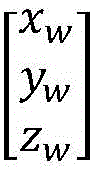

3-3)取当前时刻为t,使用深度彩色相机获得当前工作空间内彩色图像Itc和深度图像Itd作为当前状态st,经由步2-4-2)步骤中得到Gtc和Gtd,并将Gtc和Gtd输入步骤2-13)中训练后的FCN网络计算得到预测q值,由公式(1)得到最大动作对应动坐标(xw,yw,zw)和世界坐标系下的旋转角度α;3-3) Take the current moment as t, use the depth color camera to obtain the color image I tc and the depth image I td in the current workspace as the current state s t , and obtain G tc and G td through step 2-4-2) step , and input G tc and G td into the FCN network after training in step 2-13) to calculate the predicted q value, and obtain the maximum action corresponding to the moving coordinates (x w , y w , z w ) and world coordinates from formula (1). The rotation angle α under the system;
3-4)若机械臂执行推动作,则经由Inverse Kinematics计算后,机械臂末端旋转

3-5)令时间为t+1,利用相机获取得到当前工作空间RGB图像It+1,c和深度图像It+1,d,生成Gt+1,c和Gt+1,d作为St+1。若公式(3)成立,则判断机械臂推抓取,否则,则判断失败。同时利用深度信息It+1,d判断工作空间内是否有物体剩余,若未剩余,则进入步骤3-3),若有剩余,则继续步骤3-3)。3-5) Let the time be t+1, use the camera to obtain the RGB image It+1,c and the depth image It+1,d in the current workspace, and generate G t+1,c and G t+1,d as S t+1 . If formula (3) is established, it is judged that the robotic arm pushes and grasps; otherwise, the judgment fails. At the same time, the depth information It +1,d is used to judge whether there is any object remaining in the workspace, if not, proceed to step 3-3), and if there is any remaining, proceed to step 3-3).
优选地,步骤2-4)中总共旋转32次,彩色高度图旋转16次,深度高度图旋转16次。Preferably, in steps 2-4), a total of 32 rotations are performed, the color height map is rotated 16 times, and the depth height map is rotated 16 times.
优选地,步骤2-5)中得到1605632个Q值和1605632个可能执行的动作。Preferably, 1605632 Q values and 1605632 possible actions are obtained in step 2-5).
优选地,步骤2-7-2)和3-4)中机械臂朝方向推5cm。Preferably, in steps 2-7-2) and 3-4), the robotic arm pushes 5 cm in the direction.
本发明的优点在于:The advantages of the present invention are:
本发明提出了一种适用密集环境下的机械臂推抓协同方法,训练全程由机械臂自主完成;并且依次经过密集连接卷积网络和强化学习决策网络的连接,上采样,做到了端到端的输出动作语义,输入深度彩色图像,输出机械臂的目标位置,从而提高了处理效率。本发明利用深度强化学习DQN的方法,能够依据当前物体环境实时动态规划动作语义,在实现推抓结合的同的时,规划最合适抓取的方向,大大增加了机械臂在复杂环境下抓取物块的成功率。The invention proposes a robotic arm pushing and grasping collaboration method suitable for a dense environment. The whole training process is independently completed by the robotic arm; and through the connection of the densely connected convolutional network and the reinforcement learning decision network in turn, upsampling is achieved to achieve end-to-end. Output action semantics, input depth color images, and output the target position of the robotic arm, thereby improving processing efficiency. The invention utilizes the deep reinforcement learning DQN method, which can dynamically plan the action semantics in real time according to the current object environment, and plan the most suitable grasping direction while realizing the combination of push and grasp, which greatly increases the grasping ability of the robotic arm in complex environments. Block success rate.
附图说明Description of drawings
图1为本发明的方法流程图。FIG. 1 is a flow chart of the method of the present invention.
图2为本发明的仿真训练流程图。FIG. 2 is a flow chart of the simulation training of the present invention.
图3为本发明的FCN网络架构。FIG. 3 is an FCN network architecture of the present invention.
图4为本发明的实际抓取流程图。FIG. 4 is a flow chart of the actual grabbing of the present invention.
图5为本发明的搭建的实际抓取环境。FIG. 5 is an actual grabbing environment constructed by the present invention.
图6为本发明的仿真训练系统结构图。FIG. 6 is a structural diagram of a simulation training system of the present invention.
图7为本发明的实际推抓系统结构图。FIG. 7 is a structural diagram of the actual push-grab system of the present invention.
图8为本发明的仿真训练成功率图。FIG. 8 is a graph of the simulation training success rate of the present invention.
具体实施实例Specific implementation example
本发明提出了一种适用于密集环境下的机械臂推抓协同方法,下面结合附图和具体实施例对本发明进一步详细说明如下:The present invention proposes a robotic arm push-grab synergy method suitable for dense environments. The present invention is further described in detail below with reference to the accompanying drawings and specific embodiments:
本发明提出一种适用于密集环境下的机械臂推抓协同方法,整体流程图如图1所示,具体包含以下步骤:The present invention proposes a method for pushing and grasping robotic arms in a dense environment. The overall flow chart is shown in Figure 1, which specifically includes the following steps:
1)构建机器人仿真平台,本实例采用的是CoppeliaSim仿真软件,具体步骤如下:1) Build a robot simulation platform. This example uses CoppeliaSim simulation software. The specific steps are as follows:
1-1)在CoppeliaSim仿真软件中导入一台可编程控制的机械臂,在本实施实例中采用的是Universal Robots UR5机械臂;导入任意一款机械夹爪,本实施实例选取BY-P80智能夹持器,设机械臂初始位置为Pxyz;1-1) Import a programmable-controlled robotic arm in the CoppeliaSim simulation software. In this example, the Universal Robots UR5 robotic arm is used; import any mechanical gripper, and this example selects the BY-P80 smart gripper Holder, set the initial position of the manipulator as P xyz ;
1-2)在CoppeliaSim软件中导入深度彩色相机,本实施实例中选取用IntelRealsenseD415相机,置于工作空间上方50cm处,并斜下方45°朝下;1-2) Import the depth color camera in CoppeliaSim software, choose and use IntelRealsenseD415 camera in this implementation example, be placed at 50cm above the working space, and 45° obliquely downward;
1-3)划定工作空间,导入待抓取物体。本实施实例中设定为长70cm,宽70cm的正方形工作空间,在工作空间中导入待抓取的物体,实施实例选取为八个物体,分别是两个个边长为50*50mm,高为30mm,半径为25mm的拱形和两个个半径为25mm,高30mm的半圆体。一个30mm*30mm*30mm的正方体,一个40mm*20mm*40mm的长方体,一个42mm*20mm*40mm的三角体,以及一个半径为25mm,高30mm的的圆柱体。其中任意两块拱形和两个半圆体组合成一个长方体,其余物体以任意角度随意放置在工作空间内;1-3) Delineate the workspace and import the objects to be grasped. In this implementation example, a square workspace with a length of 70cm and a width of 70cm is set, and the objects to be grasped are imported into the workspace. The implementation example selects eight objects, two with a side length of 50*50mm and a height of 30mm arch with 25mm radius and two semicircles with 25mm radius and 30mm height. A 30mm*30mm*30mm cube, a 40mm*20mm*40mm cuboid, a 42mm*20mm*40mm triangle, and a 25mm radius, 30mm high cylinder. Among them, any two arches and two semicircles are combined into a cuboid, and the rest of the objects are randomly placed in the workspace at any angle;
2)构建
2-1)构建PushNetφp推网络和GraspNetφg抓网络。以PushNetφp推网络为例,PushNet推网络包含特征提取网络和Q值估计网络,网络的顺序依次如下:2-1) Construct PushNetφp push network and GraspNetφg grab network. Taking the PushNetφp network as an example, the PushNet network includes a feature extraction network and a Q-value estimation network. The order of the networks is as follows:
在ImageNet预训练后导入特征提取网络模型Densenet-121,输入为224×224×3图像,输出为1024×1的矩阵特征。定义两层Conv2d层为卷积核大小为1,步长为1,激活函数为Relu函数,归一化函数为BatchNorm2d函数,初始化为Kaiming_normal函数。输入尺寸为1024×1,输出尺寸为14×14×1。定义上采样层为放大系数为16倍,采用双线性插值方法;After ImageNet pre-training, the feature extraction network model Densenet-121 is imported, the input is 224×224×3 images, and the output is 1024×1 matrix features. Define the two-layer Conv2d layer as the convolution kernel size is 1, the step size is 1, the activation function is the Relu function, the normalization function is the BatchNorm2d function, and the initialization is the Kaiming_normal function. The input size is 1024×1 and the output size is 14×14×1. The upsampling layer is defined as the amplification factor of 16 times, and the bilinear interpolation method is used;
2-2)选取当前时刻为t;2-2) Select the current moment as t;
2-3)利用步骤1)中初始化仿真环境;2-3) Utilize the initialization simulation environment in step 1);
2-4)利用realsenseD415彩色深度相机得到当前工作空间大小均为224×224×3的RGB图像Itc和深度图像Itd;将Itd和Itc从像素坐标转换至机器人坐标,并采用阈值法进行去噪操作后得到RGB高度图I′tc和深度高度图I′td;并将RGB高度图I′tc和深度高度图I′td预处理后得到彩色图像图集Gtc.和深度图像图集Gtd,作为状态St,预处理具体步骤如下:2-4) Utilize realsenseD415 color depth camera to obtain RGB image I tc and depth image I td whose current workspace size is 224×224×3; convert I td and I tc from pixel coordinates to robot coordinates, and adopt the threshold method After the denoising operation, the RGB height map I' tc and the depth height map I' td are obtained; after preprocessing the RGB height map I' tc and the depth height map I' td , the color image atlas G tc . and the depth image map are obtained Set G td , as state S t , the specific steps of preprocessing are as follows:
2-4-1)将RGB高度图I′tc和深度高度图I′td用最邻近插值的方法缩放至像素大小为448×448的彩色高度图I″tc和像素大小为448×448的深度高度图I″td;2-4-1) Scale the RGB heightmap I' tc and the depth height map I' td to a color heightmap I" tc with a pixel size of 448×448 and a depth with a pixel size of 448×448 using the nearest neighbor interpolation method heightmap I″ td ;
2-4-2)将彩色高度图I″tc和深度高度图I″td进行仿射变化等角度旋转成大小均为224×224×3的16张彩色RGB高度图,并组成彩色图像图集Gtc={I″′tc 0,I″′tc 1…I″′tc 15}和大小均为224×224×3的16张深度高度图,并组成的深度图像图集Gtd={I″′td 0,I″′td 1…I″′td 15};最后将两者作为网络输入状态St;2-4-2) Rotate the color height map I″ tc and the depth height map I″ td into 16 color RGB height maps with a size of 224×224×3, and form a color image atlas G tc ={I″′ tc 0 ,I″′ tc 1 …I″′ tc 15 } and 16 depth height maps with the size of 224×224×3, and the depth image atlas G td ={I ″′ td 0 , I″′ td 1 …I″′ td 15 }; finally take the two as the network input state S t ;
2-5)将步骤2-4-2)中得到的Gtc和Gtd分别输入两个独立的网络φg和φp,输出一组t时刻时每个动作对应的预测Q值图,Qpt和Qgt,具体步骤如下:2-5) Input G tc and G td obtained in step 2-4-2) into two independent networks φ g and φ p respectively, and output a set of predicted Q-value maps corresponding to each action at time t, Q pt and Q gt , the specific steps are as follows:
2-5-1)从步骤2-4-2)中得到的Gtc和Gtd取出16组相同角度的I″′tci和I″′tdi依次输入至步骤2-1)中的Densenet-121网络,得到16个大小为1024×1×14×14的彩色图像特征和16个大小为1024×1×14×14的深度图像特征;将旋转相同角度的16个彩色图像特征和16个深度图像特征在第二维度上拼接成1024×2×14×14深度彩色图像特征Ii,其中i∈{0,1,…,15};2-5-1) From the G tc and G td obtained in step 2-4-2), take out 16 groups of I″′ tci and I″′ tdi of the same angle and input them to Densenet-121 in step 2-1) in turn network to obtain 16 color image features of size 1024 × 1 × 14 × 14 and 16 depth image features of size 1024 × 1 × 14 × 14; 16 color image features and 16 depth images rotated at the same angle The features are stitched into 1024×2×14×14 depth color image features I i in the second dimension, where i ∈ {0,1,…,15};
2-5-2)将步骤2-5-1)中的Ii依次输入至PushNetφp推网络,同时也依次输入至GraspNetφg抓网络中,输出224×224预测抓Q值图集Qgt={Qgt1,Qgt2,…,Qgt15}和224×224预测推Q值图集Qpt={Qpt1,Qpt2,…,Qpt15},共计得到1605632个q值;2-5-2) Input I i in step 2-5-1) to PushNetφp push network in turn, and also input to GraspNetφg grab network in turn, output 224×224 predicted grab Q value atlas Q gt = {Q gt1 ,Q gt2 ,...,Q gt15 } and 224×224 predicted push Q-value atlas Q pt ={Q pt1 ,Q pt2 ,...,Q pt15 }, a total of 1,605,632 q values are obtained;
2-6)取ε=0.1。生成随机数λ,本实施实例中λ>0.1,由公式2-6) Take ε=0.1. Generate a random number λ, λ>0.1 in this example, by the formula

(xp,yp)=argmax(x,y)(Qgt,Qpt)) (2)(x p ,y p )=argmax (x,y) (Q gt ,Q pt )) (2)
式(1)中φp(st),φg(st)表示当前状态为St时,推网络和抓网络输出的Q值图,式(2)中xp,yp表示最大q值所对应的动作的像素坐标。In formula (1), φ p (s t ) and φ g (s t ) represent the Q value map output by the push network and the grab network when the current state is S t . In formula (2), x p , y p represent the maximum q The pixel coordinates of the action the value corresponds to.
计算最大q值的像素坐标(xp,yp,zp)和机械臂末端的旋转角度α,设动作为推atp;Calculate the pixel coordinates (x p , y p , z p ) of the maximum q value and the rotation angle α of the end of the manipulator, and set the action to push a tp ;
2-7)将像素坐标(xp,yp,zp)变换至世界坐标系坐标(xw,yw,zw),机械臂根据选择的动作at′=((xw,yw,zw),α),做出相应的动作,改变拾取环境,其中a表示推或者抓取动作以及下爪角度,具体步骤如下:2-7) Transform the pixel coordinates (x p , y p , z p ) to the world coordinate system coordinates (x w , y w , z w ), and the robotic arm according to the selected action at t ′=((x w , y w , z w ), α), make corresponding actions and change the picking environment, where a represents the pushing or grasping action and the angle of the lower claw. The specific steps are as follows:
2-7-1)机械臂执行抓取动作,则经由Inverse Kinematics计算后,机械臂末端旋转
2-7-2)机械臂执行推动作,则经由Inverse Kinematics计算后,机械臂末端旋转
2-8)待机械臂回到初始位置Pxyz后,得到当前工作空间RGB图像It+1,c和深度图像It+1,d,生成Gt+1,c和Gt+1,d作为St+1。本实施实例中It+1,d≥10,工作空间内还存在物体,F=0;2-8) After the robotic arm returns to the initial position P xyz , obtain the current workspace RGB image It+1,c and the depth image It+1,d , and generate G t+1,c and G t+1, d as S t+1 . In this example, if I t+1,d ≥ 10, there are still objects in the workspace, and F=0;
2-9)计算机械臂完成动作后的奖励Rt,对步骤2-8)中St+1与步骤2-4)中的St两者状态中每个像素点做差值对比,本实施实例中:2-9) Calculate the reward R t after the robotic arm completes the action, and compare the difference between each pixel in the states of S t +1 in step 2-8) and S t in step 2-4). In the implementation example:

式(3)中n为特征图中像素的总个数,则判断为机械臂推成功,设置奖励为Rt(st,st+1)=0.5。记录抓取动作次数j和抓取成功次数k;In formula (3), n is the total number of pixels in the feature map, then it is judged that the robotic arm is pushed successfully, and the reward is set as R t (s t , s t+1 )=0.5. Record the number of grabbing actions j and the number of successful grabs k;
2-10)记录一条状态转移变量元组(st,at,Rg(st,st+1),st+1,F),并将其存至经验池
2-11)根据步骤2-6)中计算得到的Rt和步骤2-7)中的st+1,重复步骤2-5)得到下一状态预测最大q值,计算目标值函数yt:2-11) According to R t calculated in step 2-6) and s t+1 in step 2-7), repeat step 2-5) to obtain the maximum q value predicted for the next state, and calculate the objective value function y t :
yt=Rat(st,st+1)+γQ(st+1,argmax(Q(ss+1,a′tp))) (4)y t =R at (s t ,s t+1 )+γQ(s t+1 ,argmax(Q(s s+1 ,a′ tp ))) (4)
误差为:The error is:
δt=|Qπ(st,a′tp)-yt| (5)δ t =|Q π (s t ,a′ tp )-y t | (5)
2-12)计算损失函数:2-12) Calculate the loss function:

优化目标函数为:The optimization objective function is:

式(7)中,b表示训练采样数量,使用随机梯度下降的方法更新优化目标值Jt,实例中选择学习率为0.0001,动量因子为0.9,权重衰减因子为0.00002;In formula (7), b represents the number of training samples, and the optimization target value J t is updated by the method of stochastic gradient descent. In the example, the learning rate is 0.0001, the momentum factor is 0.9, and the weight decay factor is 0.00002;
2-13)计算当前成功率
2-14)令当前时间为t+1,确认回合结束标志F,若F=1,则确认为当前回合结束,重新返回步骤中;若F=0,则确认为当前回合未结束,则重新返回步骤2-2)中获得t+1时刻的状态;2-14) Let the current time be t+1, confirm the round end flag F, if F = 1, it is confirmed that the current round is over, and return to the step; if F = 0, it is confirmed that the current round is not over, and the Return to the state obtained at time t+1 in step 2-2);
3)搭建真实深度强化学习抓取系统:3) Build a real deep reinforcement learning grasping system:
3-1)如图7,该系统需要一台装有Ubuntu系统的计算机,本实例中采用的计算机CPU使用Intel Core i7-7800K 3.50Ghz,GPU使用的是Nvidia TITAN Xp,一个BY-P80智能夹持器,一台RealsenseD435深度彩色相机和八个待抓物体,四块块边长为50mm*50mm,高为30mm,半径为25mm的拱形和两个个半径为25mm,高30mm的半圆体。一个30mm*30mm*30mm的正方体,一个40mm*20mm*40mm的长方体,一个42mm*20mm*40mm的三角体,以及一个半径为25mm,高30mm的圆柱体。机械臂基座固定于工作台上,并将机械夹爪安装至机械臂末端。深度彩色相机置于机械臂正对面高25cm处并以俯视角度45°朝下。计算机与机械臂和深度彩色相机进行连接,用以接收深度彩色图像和实时控制机械臂运动。工作空间内任意放置两块拱形和两个半圆体组合成一个长方体,其余物体以任意角度随意放置在工作空间内;3-1) As shown in Figure 7, the system requires a computer with Ubuntu system, the computer used in this example uses Intel Core i7-7800K 3.50Ghz CPU, GPU uses Nvidia TITAN Xp, a BY-P80 smart clip Holder, a RealsenseD435 depth color camera and eight objects to be grasped, four blocks with a side length of 50mm*50mm, a height of 30mm, an arch with a radius of 25mm, and two semicircles with a radius of 25mm and a height of 30mm. A 30mm*30mm*30mm cube, a 40mm*20mm*40mm cuboid, a 42mm*20mm*40mm triangle, and a 25mm radius, 30mm high cylinder. The base of the manipulator is fixed on the workbench, and the gripper is installed on the end of the manipulator. The depth color camera is placed at a height of 25 cm opposite the robotic arm and faces downward at a top-down angle of 45°. The computer is connected with the robotic arm and the depth color camera to receive depth color images and control the movement of the robotic arm in real time. Arbitrarily place two arches and two semicircles in the workspace to form a cuboid, and the rest of the objects are placed in the workspace at any angle;
3-2)用棋盘格标定法获得相机外参Ecam(旋转矩阵R和平移矩阵M),设机械臂末端初始位置为Pxyz,并将待拾取物体随机置于工作空间中;3-2) Obtain the camera external parameter E cam (rotation matrix R and translation matrix M) with the checkerboard calibration method, set the initial position of the end of the mechanical arm to be P xyz , and randomly place the object to be picked up in the workspace;

式(8)中

3-3)取当前时刻为t,使用深度彩色相机获得当前工作空间内彩色图像Itc和深度图像Itd作为当前状态st,经由步骤2-4-1)和2-4-2)步骤中得到Gtc和Gtd,并将Gtc和Gtd输入步骤2-13)中训练后的FCN网络计算得到预测Q值图,由式(1)得到最大动作对应动坐标(xw,yw,zw)和世界坐标系下的旋转角度α;3-3) Take the current moment as t, use the depth color camera to obtain the color image I tc and the depth image I td in the current working space as the current state s t , via steps 2-4-1) and 2-4-2) Obtain G tc and G td in , and input G tc and G td into the FCN network after training in step 2-13) to calculate the predicted Q value map, and obtain the maximum action corresponding to the moving coordinate (x w , y from formula (1)) w , z w ) and the rotation angle α in the world coordinate system;
3-4)本实施实例中机械臂执行推动作,则经由Inverse Kinematics计算后,机械臂末端旋转
3-5)令当前时间为t+1,利用相机获取得到当前工作空间RGB图像It+1,c和深度图像It+1,d,生成Gt+1,c和Gt+1,d作为St+1;实施实例式(3)中τ=300,并且机械臂推成功;确认回合结束标志F,实施实例中F=0,则确认为当前回合未结束,则重新返回步骤2-2)0中获得t+1时刻的状态。3-5) Let the current time be t+1, use the camera to obtain the RGB image I t+1,c and the depth image It+1,d of the current workspace, and generate G t+1,c and G t+1, d as S t+1 ; τ=300 in the implementation example formula (3), and the mechanical arm is pushed successfully; confirm the round end sign F, in the implementation example, F=0, then confirm that the current round is not over, then return to step 2 -2) The state at time t+1 is obtained in 0.
本方法经实验证明,在密集环境下,经过推抓动作的结合实验成功率达80%。The method has been proved by experiments that in a dense environment, the combined experiment success rate of pushing and grasping action is up to 80%.
以上所述并非是对本发明的限制,本发明也并不仅限于上述举例,本技术领域的技术人员在本发明的实质范围内所做出的变化,改型,添加或替换,也属于本发明的保护范围。The above is not a limitation of the present invention, and the present invention is not limited to the above examples. Changes, modifications, additions or substitutions made by those skilled in the art within the essential scope of the present invention also belong to the present invention. protected range.
Claims (4)





Priority Applications (1)
| Application Number | Priority Date | Filing Date | Title |
|---|---|---|---|
| CN202011386635.1A CN112643668B (en) | 2020-12-01 | 2020-12-01 | A push-grab synergy method for robotic arms in dense environments |
Applications Claiming Priority (1)
| Application Number | Priority Date | Filing Date | Title |
|---|---|---|---|
| CN202011386635.1A CN112643668B (en) | 2020-12-01 | 2020-12-01 | A push-grab synergy method for robotic arms in dense environments |
Publications (2)
| Publication Number | Publication Date |
|---|---|
| CN112643668A CN112643668A (en) | 2021-04-13 |
| CN112643668B true CN112643668B (en) | 2022-05-24 |
Family
ID=75349949
Family Applications (1)
| Application Number | Title | Priority Date | Filing Date |
|---|---|---|---|
| CN202011386635.1A Active CN112643668B (en) | 2020-12-01 | 2020-12-01 | A push-grab synergy method for robotic arms in dense environments |
Country Status (1)
| Country | Link |
|---|---|
| CN (1) | CN112643668B (en) |
Families Citing this family (15)
| Publication number | Priority date | Publication date | Assignee | Title |
|---|---|---|---|---|
| CN113392703B (en) * | 2021-05-11 | 2024-02-02 | 杭州电子科技大学 | Autonomous grasping method for robotic arms based on attention mechanism and irrational action suppression |
| CN113359704B (en) * | 2021-05-13 | 2022-04-19 | 浙江工业大学 | Self-adaptive SAC-PID method suitable for complex unknown environment |
| CN115431258B (en) * | 2021-06-04 | 2025-05-16 | 京东科技信息技术有限公司 | Robotic arm control method, device, electronic device and storage medium |
| CN113664825B (en) * | 2021-07-19 | 2022-11-25 | 清华大学深圳国际研究生院 | Stacking scene mechanical arm grabbing method and device based on reinforcement learning |
| CN113664828A (en) * | 2021-08-17 | 2021-11-19 | 东南大学 | Robot grabbing-throwing method based on deep reinforcement learning |
| CN116152462A (en) * | 2021-11-16 | 2023-05-23 | 鲁班嫡系机器人(深圳)有限公司 | Method, device, system and storage medium for grabbing target object and training model |
| CN114474060B (en) * | 2022-02-16 | 2023-06-16 | 华南理工大学 | Control method and device for industrial robot and storage medium |
| CN114620479B (en) * | 2022-04-24 | 2022-09-30 | 广东天太机器人有限公司 | Mechanical arm control system and method for improving stacking efficiency of rectangular packaging boxes |
| CN114952841B (en) * | 2022-05-26 | 2025-06-24 | 上海交通大学 | A method and device for pushing, pulling and grabbing in sandy soil burial conditions |
| CN115457424A (en) * | 2022-08-05 | 2022-12-09 | 北京空间飞行器总体设计部 | Single-machine task scene information acquisition and single intelligent agent motion control method |
| CN116330283A (en) * | 2023-03-24 | 2023-06-27 | 南京工业大学 | A method for manipulators to grab target objects in dense scenes |
| CN117086862A (en) * | 2023-06-14 | 2023-11-21 | 东南大学 | Flexible grasping method with six degrees of freedom for robotic arms based on dual-agent reinforcement learning |
| CN118587171B (en) * | 2024-05-24 | 2025-07-29 | 北京智源人工智能研究院 | Flexible object operation method and device based on predictive operation characterization |
| CN118721208B (en) * | 2024-07-29 | 2025-11-04 | 北京理工大学 | Robotic arm manipulation method based on selective state space and model-based reinforcement learning |
| CN118789555B (en) * | 2024-08-27 | 2025-10-03 | 中山大学 | Robot grasping control method and system based on non-modal segmentation |
Citations (6)
| Publication number | Priority date | Publication date | Assignee | Title |
|---|---|---|---|---|
| WO2017151926A1 (en) * | 2016-03-03 | 2017-09-08 | Google Inc. | Deep machine learning methods and apparatus for robotic grasping |
| CN107662208A (en) * | 2017-08-24 | 2018-02-06 | 浙江工业大学 | Flexible joint mechanical arm finite time self-adaptive backstepping control method based on neural network |
| CN108052004A (en) * | 2017-12-06 | 2018-05-18 | 湖北工业大学 | Industrial machinery arm autocontrol method based on depth enhancing study |
| CN110450153A (en) * | 2019-07-08 | 2019-11-15 | 清华大学 | A method for active picking of robotic arm items based on deep reinforcement learning |
| CN111079561A (en) * | 2019-11-26 | 2020-04-28 | 华南理工大学 | Robot intelligent grabbing method based on virtual training |
| CN111331607A (en) * | 2020-04-03 | 2020-06-26 | 山东大学 | Automatic grabbing and stacking method and system based on mechanical arm |
-
2020
- 2020-12-01 CN CN202011386635.1A patent/CN112643668B/en active Active
Patent Citations (6)
| Publication number | Priority date | Publication date | Assignee | Title |
|---|---|---|---|---|
| WO2017151926A1 (en) * | 2016-03-03 | 2017-09-08 | Google Inc. | Deep machine learning methods and apparatus for robotic grasping |
| CN107662208A (en) * | 2017-08-24 | 2018-02-06 | 浙江工业大学 | Flexible joint mechanical arm finite time self-adaptive backstepping control method based on neural network |
| CN108052004A (en) * | 2017-12-06 | 2018-05-18 | 湖北工业大学 | Industrial machinery arm autocontrol method based on depth enhancing study |
| CN110450153A (en) * | 2019-07-08 | 2019-11-15 | 清华大学 | A method for active picking of robotic arm items based on deep reinforcement learning |
| CN111079561A (en) * | 2019-11-26 | 2020-04-28 | 华南理工大学 | Robot intelligent grabbing method based on virtual training |
| CN111331607A (en) * | 2020-04-03 | 2020-06-26 | 山东大学 | Automatic grabbing and stacking method and system based on mechanical arm |
Also Published As
| Publication number | Publication date |
|---|---|
| CN112643668A (en) | 2021-04-13 |
Similar Documents
| Publication | Publication Date | Title |
|---|---|---|
| CN112643668B (en) | A push-grab synergy method for robotic arms in dense environments | |
| CN112605983B (en) | Mechanical arm pushing and grabbing system suitable for intensive environment | |
| CN110450153B (en) | A deep reinforcement learning-based active picking method for robotic arms | |
| Liu et al. | A digital twin-based sim-to-real transfer for deep reinforcement learning-enabled industrial robot grasping | |
| CN115464659B (en) | A robotic arm grasping control method based on deep reinforcement learning DDPG algorithm based on visual information | |
| JP7145843B2 (en) | Robot manipulator training | |
| CN110400345B (en) | A push-grab collaborative sorting method for radioactive waste based on deep reinforcement learning | |
| CN111618847B (en) | Autonomous grasping method of robotic arm based on deep reinforcement learning and dynamic motion primitives | |
| Kiatos et al. | Robust object grasping in clutter via singulation | |
| CN108052004A (en) | Industrial machinery arm autocontrol method based on depth enhancing study | |
| Bahety et al. | Bag all you need: Learning a generalizable bagging strategy for heterogeneous objects | |
| CN111331607A (en) | Automatic grabbing and stacking method and system based on mechanical arm | |
| CN113664828A (en) | Robot grabbing-throwing method based on deep reinforcement learning | |
| CN107291072B (en) | Mobile robot path planning system and method | |
| CN116330283A (en) | A method for manipulators to grab target objects in dense scenes | |
| CN117644520A (en) | Multi-arm robot picking task planning method, device, electronic equipment and medium | |
| CN113762159B (en) | A target capture detection method and system based on a directed arrow model | |
| CN116197890A (en) | Control method and device for double-arm robot, conveying method, and double-arm robot | |
| Van Molle et al. | Learning to grasp from a single demonstration | |
| Paul et al. | Deterministic policy gradient based robotic path planning with continuous action spaces | |
| CN119141536B (en) | A multi-manipulator deep reinforcement learning control method and device for recycling item sorting | |
| CN113936276A (en) | Object posture recognition and grabbing transfer robot method based on deep learning | |
| CN120395966A (en) | Multi-object stable grasping method and system for dexterous hands based on vision and tactile perception | |
| Alet et al. | Robotic gripper design with evolutionary strategies and graph element networks | |
| Li et al. | Fast motion planning via free c-space estimation based on deep neural network |
Legal Events
| Date | Code | Title | Description |
|---|---|---|---|
| PB01 | Publication | ||
| PB01 | Publication | ||
| SE01 | Entry into force of request for substantive examination | ||
| SE01 | Entry into force of request for substantive examination | ||
| GR01 | Patent grant | ||
| GR01 | Patent grant |