CN112634912A - Packet loss compensation method and device - Google Patents
Packet loss compensation method and device Download PDFInfo
- Publication number
- CN112634912A CN112634912A CN202011502968.6A CN202011502968A CN112634912A CN 112634912 A CN112634912 A CN 112634912A CN 202011502968 A CN202011502968 A CN 202011502968A CN 112634912 A CN112634912 A CN 112634912A
- Authority
- CN
- China
- Prior art keywords
- audio data
- frame
- audio
- packet loss
- sequence
- Prior art date
- Legal status (The legal status is an assumption and is not a legal conclusion. Google has not performed a legal analysis and makes no representation as to the accuracy of the status listed.)
- Granted
Links
- 238000000034 method Methods 0.000 title claims abstract description 73
- 238000005070 sampling Methods 0.000 claims description 77
- 230000015572 biosynthetic process Effects 0.000 claims description 33
- 238000003786 synthesis reaction Methods 0.000 claims description 33
- 238000004364 calculation method Methods 0.000 claims description 20
- 238000012549 training Methods 0.000 claims description 14
- 238000012545 processing Methods 0.000 description 14
- 230000008569 process Effects 0.000 description 11
- 238000010586 diagram Methods 0.000 description 10
- 230000005540 biological transmission Effects 0.000 description 6
- 238000004422 calculation algorithm Methods 0.000 description 6
- 238000004891 communication Methods 0.000 description 5
- 238000009499 grossing Methods 0.000 description 5
- 230000000694 effects Effects 0.000 description 4
- 108090000623 proteins and genes Proteins 0.000 description 4
- 230000002238 attenuated effect Effects 0.000 description 3
- 238000005516 engineering process Methods 0.000 description 3
- 230000004927 fusion Effects 0.000 description 3
- 238000013528 artificial neural network Methods 0.000 description 2
- 238000004590 computer program Methods 0.000 description 2
- 230000003247 decreasing effect Effects 0.000 description 2
- 230000002349 favourable effect Effects 0.000 description 2
- 230000006870 function Effects 0.000 description 2
- 230000004913 activation Effects 0.000 description 1
- 238000004458 analytical method Methods 0.000 description 1
- 230000001364 causal effect Effects 0.000 description 1
- 230000001413 cellular effect Effects 0.000 description 1
- 230000008859 change Effects 0.000 description 1
- 230000000295 complement effect Effects 0.000 description 1
- 238000010205 computational analysis Methods 0.000 description 1
- 230000009977 dual effect Effects 0.000 description 1
- 238000002474 experimental method Methods 0.000 description 1
- 239000011159 matrix material Substances 0.000 description 1
- 238000012986 modification Methods 0.000 description 1
- 230000004048 modification Effects 0.000 description 1
- 238000003062 neural network model Methods 0.000 description 1
- 230000003287 optical effect Effects 0.000 description 1
- 230000003252 repetitive effect Effects 0.000 description 1
- 230000004044 response Effects 0.000 description 1
- 239000004984 smart glass Substances 0.000 description 1
- 238000000638 solvent extraction Methods 0.000 description 1
- 238000001228 spectrum Methods 0.000 description 1
Images


Classifications
-
- G—PHYSICS
- G10—MUSICAL INSTRUMENTS; ACOUSTICS
- G10L—SPEECH ANALYSIS TECHNIQUES OR SPEECH SYNTHESIS; SPEECH RECOGNITION; SPEECH OR VOICE PROCESSING TECHNIQUES; SPEECH OR AUDIO CODING OR DECODING
- G10L19/00—Speech or audio signals analysis-synthesis techniques for redundancy reduction, e.g. in vocoders; Coding or decoding of speech or audio signals, using source filter models or psychoacoustic analysis
- G10L19/0017—Lossless audio signal coding; Perfect reconstruction of coded audio signal by transmission of coding error
-
- G—PHYSICS
- G10—MUSICAL INSTRUMENTS; ACOUSTICS
- G10L—SPEECH ANALYSIS TECHNIQUES OR SPEECH SYNTHESIS; SPEECH RECOGNITION; SPEECH OR VOICE PROCESSING TECHNIQUES; SPEECH OR AUDIO CODING OR DECODING
- G10L25/00—Speech or voice analysis techniques not restricted to a single one of groups G10L15/00 - G10L21/00
- G10L25/03—Speech or voice analysis techniques not restricted to a single one of groups G10L15/00 - G10L21/00 characterised by the type of extracted parameters
-
- G—PHYSICS
- G10—MUSICAL INSTRUMENTS; ACOUSTICS
- G10L—SPEECH ANALYSIS TECHNIQUES OR SPEECH SYNTHESIS; SPEECH RECOGNITION; SPEECH OR VOICE PROCESSING TECHNIQUES; SPEECH OR AUDIO CODING OR DECODING
- G10L25/00—Speech or voice analysis techniques not restricted to a single one of groups G10L15/00 - G10L21/00
- G10L25/03—Speech or voice analysis techniques not restricted to a single one of groups G10L15/00 - G10L21/00 characterised by the type of extracted parameters
- G10L25/24—Speech or voice analysis techniques not restricted to a single one of groups G10L15/00 - G10L21/00 characterised by the type of extracted parameters the extracted parameters being the cepstrum
-
- G—PHYSICS
- G10—MUSICAL INSTRUMENTS; ACOUSTICS
- G10L—SPEECH ANALYSIS TECHNIQUES OR SPEECH SYNTHESIS; SPEECH RECOGNITION; SPEECH OR VOICE PROCESSING TECHNIQUES; SPEECH OR AUDIO CODING OR DECODING
- G10L25/00—Speech or voice analysis techniques not restricted to a single one of groups G10L15/00 - G10L21/00
- G10L25/27—Speech or voice analysis techniques not restricted to a single one of groups G10L15/00 - G10L21/00 characterised by the analysis technique
- G10L25/30—Speech or voice analysis techniques not restricted to a single one of groups G10L15/00 - G10L21/00 characterised by the analysis technique using neural networks
Landscapes
- Engineering & Computer Science (AREA)
- Computational Linguistics (AREA)
- Signal Processing (AREA)
- Health & Medical Sciences (AREA)
- Audiology, Speech & Language Pathology (AREA)
- Human Computer Interaction (AREA)
- Physics & Mathematics (AREA)
- Acoustics & Sound (AREA)
- Multimedia (AREA)
- Artificial Intelligence (AREA)
- Evolutionary Computation (AREA)
- Data Exchanges In Wide-Area Networks (AREA)
Abstract
The present specification provides a packet loss compensation method and an apparatus, where the packet loss compensation method includes: receiving a sound data stream, and if a current frame in the sound data stream is determined to be a packet loss frame and a previous frame of the current frame is not a packet loss frame, determining the current frame to be a first packet loss frame; acquiring M frames of historical audio data before the first packet loss frame from the audio data stream to generate a first audio sequence; determining audio features of the M frames of historical audio data, and generating a second audio sequence based on the audio features of the M frames of historical audio data; based on the first audio sequence, a position in the second audio sequence where the cross-correlation with the first audio sequence is maximum is determined, and audio data after the position in the second audio sequence where the cross-correlation is maximum is determined as first compensated audio data of the first lost packet frame. The method can reduce the occurrence of mechanical and repeated problems of the played audio data.
Description
Technical Field
The present disclosure relates to the field of audio processing technologies, and in particular, to a packet loss compensation method and apparatus.
Background
To complete a call transmission over the internet, the data in the call is typically broken into packets. These packets are transmitted from the sender to the receiver over the network and recombined at the receiver to produce a continuous video stream and audio stream. However, when the data packet arrives at the receiving end, the problem that the individual data packet is completely lost may occur, and thus the call quality is deteriorated, so that the receiving end needs to complement the lost data packet to improve the call quality. The process of handling Packet Loss is called Packet Loss compensation, and a PLC (Packet Loss compensation) module of the receiving party is responsible for creating audio (or video) to fill in the interval caused by Packet Loss.
In order to conceal the influence caused by packet loss, the prior art generally directly uses the historical audio data of the frame immediately preceding the lost packet frame as the compensation audio data of the lost packet frame. However, in the case of packet loss of consecutive multiple frames, the generated compensation audio data of each frame is the same as the historical audio data of the last frame before the packet-lost frame, which results in mechanical and repeated audio data played by the receiving party.
Disclosure of Invention
In view of this, embodiments of the present specification provide a packet loss compensation method. The present specification also relates to a packet loss compensation apparatus, a computing device, and a computer-readable storage medium, which are used to solve the technical problems in the prior art.
According to a first aspect of embodiments herein, there is provided a packet loss compensation method, including:
receiving a radio data stream;
if the current frame in the audio data stream is determined to be a packet loss frame and the previous frame of the current frame is not a packet loss frame, determining the current frame to be a first packet loss frame;
obtaining M frames of historical audio data before the first packet loss frame from the audio data stream to generate a first audio sequence, wherein M is a positive integer greater than 1;
determining audio features of the M frames of historical audio data, and generating a second audio sequence based on the audio features of the M frames of historical audio data;
based on the first audio sequence, determining a position in the second audio sequence where the cross-correlation with the first audio sequence is maximum, and determining audio data after the position in the second audio sequence where the cross-correlation is maximum as first compensated audio data of the first lost packet frame.
Optionally, the generating a second audio sequence based on the audio features of the M frames of historical audio data includes:
determining the audio characteristic of the historical audio data of the frame above the first lost frame as the predicted audio characteristic of the audio data of the first lost frame;
inputting the audio features of the M frames of historical audio data and the predicted audio features of the audio data of the first missing packet frame into an audio synthesis model to obtain the second audio sequence, wherein the second audio sequence comprises the synthesized M frames and the sampled audio data of the first missing packet frame.
Optionally, the determining, based on the first audio sequence, a position in the second audio sequence where cross-correlation with the first audio sequence is largest comprises:
acquiring N continuous sampling audio data from the first audio sequence along the direction from the end point to the starting point based on the sampling frequency of the second audio sequence to obtain a first sampling audio data group, wherein N is a positive integer greater than 1;
taking N as the length of the sampling audio data group, acquiring N continuous sampling audio data from the second audio sequence along the end point to the starting point direction one by one to obtain a second sampling audio data group set, wherein the length of the sampling audio data group is the number of the sampling audio data included in the sampling audio data group;
and for each obtained second sampled audio data group, performing cross-correlation calculation on the obtained second sampled audio data group and the first sampled audio data group, and determining the position with the maximum cross-correlation according to the position of the second sampled audio data group with the maximum cross-correlation.
Optionally, the determining the position with the maximum cross-correlation with the position of the second sampled audio data group with the maximum cross-correlation includes:
and determining the position of the sampled audio data closest to the end point in the second sampled audio data group with the maximum cross correlation as the position with the maximum cross correlation.
Optionally, the method further comprises:
acquiring X sample audio data which are not played from the first audio sequence along the direction from the end point to the starting point, wherein X is more than 1 and less than the number of one frame of sample audio data;
fusing X pieces of sampled audio data before the position with the maximum cross correlation in the second audio sequence with the X pieces of sampled audio data which are not played to obtain fused audio data;
replacing X audio data which are not played in the first audio sequence with the fused audio data, and splicing the fused audio data with the compensation audio data of the first lost packet frame.
Optionally, the method further comprises:
if the current frame in the audio data stream is determined to be a packet loss frame and the previous frame of the current frame is a packet loss frame, determining the current frame to be a continuous packet loss frame, wherein the continuous packet loss frame is a packet loss frame which is not a first packet loss frame in a plurality of continuous packet loss frames;
and determining second compensation audio data of the continuously lost packet frames based on the audio characteristics of the historical audio data of the last non-lost packet frame before the current frame.
Optionally, the determining second compensation audio data of the continuously dropped frame based on the audio feature of the historical audio data of the last non-dropped frame before the current frame includes:
taking the audio characteristic of historical audio data of the last non-packet-loss frame before the current frame as the predicted audio characteristic of the continuous packet-loss frame;
and inputting the predicted audio characteristics of the continuous lost packet frame into an audio synthesis model to obtain second compensation audio data of the continuous lost packet frame.
Optionally, the method further comprises:
if the current frame in the audio data stream is determined not to be a packet loss frame and the previous frame of the current frame is a packet loss frame, determining the current frame to be a target frame;
acquiring actual audio data of the target frame, and determining predicted audio data of the target frame based on audio features of historical audio data of the last non-packet-lost frame before the current frame;
determining a position with maximum cross-correlation with the actual audio data of the target frame in the predicted audio data of the target frame based on the actual audio data of the target frame;
and fusing the Y sampled audio data after the position with the maximum cross correlation with the Y sampled audio data in the direction from the starting point to the end point in the actual audio data of the target frame to obtain the audio data fused with the target frame, wherein Y is a positive integer greater than 1.
Optionally, the method further comprises:
inputting sample audio features and sample sampled audio data into the audio synthesis model, and outputting predicted sampled audio data;
training the audio synthesis model based on the predicted sampled audio data and the sample sampled audio data until a training stop condition is reached.
According to a second aspect of embodiments herein, there is provided a packet loss compensation apparatus including:
a receiving module configured to receive a stream of radio data;
a first determining module, configured to determine that a current frame in the audio data stream is a first packet loss frame if the current frame is determined to be a packet loss frame and a previous frame of the current frame is not a packet loss frame;
a first generation module, configured to obtain M frames of historical audio data before the first packet loss frame from the audio data stream, and generate a first audio sequence, where M is a positive integer greater than 1;
a second generation module configured to determine audio features of the M frames of historical audio data and generate a second audio sequence based on the audio features of the M frames of historical audio data;
a second determining module configured to determine, based on the first audio sequence, a position in the second audio sequence where the cross-correlation with the first audio sequence is the largest, and determine audio data after the position in the second audio sequence where the cross-correlation is the largest as first compensated audio data of the first lost packet frame.
According to a third aspect of embodiments herein, there is provided a computing device comprising:
a memory and a processor;
the memory is to store computer-executable instructions, and the processor is to execute the computer-executable instructions to:
receiving a radio data stream;
if the current frame in the audio data stream is determined to be a packet loss frame and the previous frame of the current frame is not a packet loss frame, determining the current frame to be a first packet loss frame;
obtaining M frames of historical audio data before the first packet loss frame from the audio data stream to generate a first audio sequence, wherein M is a positive integer greater than 1;
determining audio features of the M frames of historical audio data, and generating a second audio sequence based on the audio features of the M frames of historical audio data;
based on the first audio sequence, determining a position in the second audio sequence where the cross-correlation with the first audio sequence is maximum, and determining audio data after the position in the second audio sequence where the cross-correlation is maximum as first compensated audio data of the first lost packet frame.
According to a fourth aspect of embodiments herein, there is provided a computer-readable storage medium storing computer-executable instructions that, when executed by a processor, implement the steps of the packet loss compensation method.
The packet loss compensation method provided by the present specification receives an audio data stream, and if it is determined that a current frame in the audio data stream is a packet loss frame and a previous frame of the current frame is not a packet loss frame, it is determined that the current frame is a first packet loss frame; obtaining M frames of historical audio data before the first packet loss frame from the audio data stream to generate a first audio sequence, wherein M is a positive integer greater than 1; determining audio features of the M frames of historical audio data, and generating a second audio sequence based on the audio features of the M frames of historical audio data; based on the first audio sequence, determining a position in the second audio sequence where the cross-correlation with the first audio sequence is maximum, and determining audio data after the position in the second audio sequence where the cross-correlation is maximum as first compensated audio data of the first lost packet frame. According to the method, a second audio sequence is generated through historical audio data and audio features of M frames before a first lost packet frame, the real first audio sequence is compared with a second audio sequence generated through prediction, the position with the maximum cross correlation with the first audio sequence in the second audio sequence is obtained, first compensation audio data of the first lost packet frame is further determined, the obtained compensation audio data are different from the historical audio data of the previous frame, and therefore the problem that the played audio data are mechanical and repetitive can be reduced.
Drawings
Fig. 1 is a schematic structural diagram of a NetEQ provided in an embodiment of the present disclosure;
fig. 2 is a flowchart of a packet loss compensation method according to an embodiment of the present disclosure;
fig. 3 is a schematic diagram of frequency band division provided in an embodiment of the present specification;
fig. 4 is a schematic structural diagram of an LPCNet model provided in an embodiment of the present specification;
FIG. 5 is a diagram of a first audio sequence and a second audio sequence provided in an embodiment of the present disclosure;
fig. 6 is a flowchart illustrating a packet loss compensation method applied to audio transmission according to an embodiment of the present disclosure;
fig. 7 is a schematic structural diagram of a packet loss compensation apparatus according to an embodiment of the present disclosure;
fig. 8 is a block diagram of a computing device according to an embodiment of the present disclosure.
Detailed Description
In the following description, numerous specific details are set forth in order to provide a thorough understanding of the present description. This description may be embodied in many different forms and should not be construed as limited to the embodiments set forth herein, as those skilled in the art will be able to make and use the present disclosure without departing from the spirit and scope of the present disclosure.
The terminology used in the description of the one or more embodiments is for the purpose of describing the particular embodiments only and is not intended to be limiting of the description of the one or more embodiments. As used in one or more embodiments of the present specification and the appended claims, the singular forms "a," "an," and "the" are intended to include the plural forms as well, unless the context clearly indicates otherwise. It should also be understood that the term "and/or" as used in one or more embodiments of the present specification refers to and encompasses any and all possible combinations of one or more of the associated listed items.
It will be understood that, although the terms first, second, etc. may be used herein in one or more embodiments to describe various information, these information should not be limited by these terms. These terms are only used to distinguish one type of information from another. For example, a first can also be referred to as a second and, similarly, a second can also be referred to as a first without departing from the scope of one or more embodiments of the present description. The word "if" as used herein may be interpreted as "at … …" or "when … …" or "in response to a determination", depending on the context.
First, the noun terms to which one or more embodiments of the present specification relate are explained.
Packet loss compensation: when the data packet is lost, a similar audio data packet or noise packet is generated to replace the lost data packet, and the playing effect is improved under the condition of low packet loss rate based on the short-time similarity of the audio.
WebRTC (Web Real-Time Communications, Web Real-Time communication): is a real-time communication technology, which allows network applications or stations to establish point-to-point (Peer-to-Peer) connections between browsers without the aid of an intermediate medium, so as to realize transmission of video streams and/or audio streams or other arbitrary data.
NetEQ: the module in WebRTC is a high-level voice quality processing technology developed for an IP (Internet Protocol Address) telecommunication system, and can effectively reduce the delay effect caused by cache while greatly improving the voice quality.
A PLC component: for generating compensated audio data for the lost packet frame and for enabling a smooth switching between the compensated audio data and the actual audio data.
LPCnet: the model is a model combining Digital Signal Processing (DSP) and Neural Network (NN) ingeniously, can be applied to the work of a vocoder in speech synthesis, and can synthesize high-quality speech on a common CPU (Central Processing Unit) in real time.
Next, an application scenario of the packet loss compensation method provided in the embodiment of the present specification is described.
In the process of audio data transmission, the problem of audio data loss may occur in the process of transmitting audio data from a transmitting party to a receiving party through a network, and the receiving party can perform packet loss compensation through a PLC component in a NetEQ module of the WebRTC.
The NetEQ comprises an MCU (Micro Controller Unit) module and a DSP module, wherein the MCU module is mainly responsible for calculating and counting time delay and jitter and generating a corresponding control command; and the DSP module is responsible for receiving and carrying out corresponding data packet processing according to the control command of the MCU. The PLC component of NetEQ corresponds to two modules, namely packet loss (expand) and merge (merge) in the DSP processing in fig. 1. However, in this way, the audio data is usually compensated for the lost frames by repeating packets or noise packets, and in the case of consecutive lost packets, the compensated audio data generated for a plurality of lost frames is the same, which causes the played audio data to be mechanically repeated, thereby reducing the audio playing effect.
For this reason, the present specification provides a packet loss compensation method, which can solve the above technical problem, and its specific implementation can be referred to the following embodiments.
In the present specification, a packet loss compensation method is provided, and the present specification relates to a packet loss compensation apparatus, a computing device, and a computer-readable storage medium, which are described in detail in the following embodiments one by one.
Fig. 2 shows a flowchart of a packet loss compensation method according to an embodiment of the present specification, which specifically includes the following steps:
In implementations, the audio data stream may be transmitted to the computing device in real-time in the form of data packets, and the computing device may receive the audio data stream in real-time.
In an implementation, after the computing device receives the audio data stream in real time, it may determine whether a data packet of a current frame in the received audio data stream exists in real time, that is, determine whether the current frame is a packet loss frame. If the current frame is determined to be a packet loss frame, because the packet loss compensation needs to be performed to obtain the compensated audio data and the problem that smooth switching between the compensated audio data and the real audio data may not be possible exists, but smooth switching between the compensated audio data and the compensated audio data can be realized, in order to determine whether the problem of smooth switching needs to be solved subsequently, it is also necessary to determine whether the previous frame of the current frame is a packet loss frame, and if it is determined that the previous frame of the current frame is not a packet loss frame, the current frame can be determined to be the first packet loss frame.
As an example, assuming that the current frame is the 10 th frame in the audio data stream, the 10 th frame may be determined as the first lost frame as long as the 9 th frame in the audio data stream is not a lost packet frame. For example, if the 9 th frame is not a lost packet frame, but the 5 th frame and the 6 th frame are both lost packet frames, since the 5 th frame and the 6 th frame are not adjacent to the 10 th frame, i.e., the 5 th frame and the 6 th frame are not lost packet frames consecutive to the 10 th frame, the 10 th frame may be determined as the first lost packet frame.
Further, after the current frame is determined to be the first lost packet frame, a command for enabling packet loss compensation may be generated, so as to perform the operation of packet loss compensation subsequently.
In some embodiments, the present specification embodiments also use NetEQ for packet loss compensation, but replace PLC components in NetEQ with audio synthesis models.
As an example, referring to fig. 1, the audio data stream may be sent to the computing device in the form of data packets, and after the computing device receives the data packets, the data packets may be stored in a jitter buffer of the MCU module in the NetEQ. The MCU module and the DSP module of the NetEQ can share a memory, i.e., a data packet stored in a jitter buffer of the MCU module can be acquired by the DSP module. The MCU module is responsible for command decision, a packet loss command can be generated according to the data packet loss condition and sent to the DSP module, the DSP module can perform packet loss compensation processing on audio data of a speech buffer (sync _ buffer) according to the packet loss compensation command to obtain compensation audio data, the compensation audio data are temporarily stored in a NetEQ algorithm buffer, the compensation audio data in the NetEQ algorithm buffer are stored in the speech buffer, and the sound card can acquire the compensation audio data from the speech buffer for playing. In addition, after decoding a normally arrived data packet through a decoder, the DSP module stores an obtained audio data stream into a decoding buffer area, DSP processes the audio data stream in the decoding buffer area, temporarily stores the processed audio data stream into a NetEQ algorithm buffer area, stores the audio data stream in the NetEQ algorithm buffer area into a voice buffer area, and the sound card can acquire the audio data from the voice buffer area to play.
Wherein M is a positive integer greater than 1. For example, M may be 8.
In the embodiment of the present application, it is exemplified that the predicted audio data is synthesized using Modified _ LPCNet (adjusted LPCNet). In one possible implementation, Modified _ LPCNet may determine the audio feature with 4 frames of audio data as a set of input, and thus, the value of M may be greater than or equal to 4 and is a multiple of 4.
It should be noted that, the foregoing merely exemplifies the value of M by using Modified _ LPCNet synthesized and predicted audio data, and in other embodiments, the value range of M may also be determined in other manners, which is not limited in this embodiment of the present application.
As an example, taking a processing unit of 10 milliseconds for processing audio data by NetEQ as an example, after receiving a packet loss compensation enabling command, the DSP module may obtain, for a first packet loss frame, historical audio data of an M frame before the first packet loss frame from sync _ buffer _ to generate a first audio sequence.
The first audio sequence comprises sampling audio data obtained by sampling historical audio data of previous M frames. For example, assuming that M takes 8, 8 x 10 milliseconds of historical audio data may be taken from the speech buffer to form the first audio sequence.
The audio features may include, among others, BFCC (Bark Frequency cepstrum coefficients) coefficients, pitch period and gene correlation.
Wherein the second audio sequence is a predicted audio sequence.
In some embodiments, determining the specific implementation of the audio features of the M frames of historical audio data may include: and performing Fourier transform on each frame of historical audio data in the M frames of historical audio data to obtain a spectrogram of each frame of historical audio data. For the spectrogram of each frame of historical audio data, the spectrogram can be divided into frequency bands according to the mode of fig. 3, a plurality of frequency bands can be obtained for each frame of historical audio data, and the energy in each frequency band is calculated. And then, taking Log (logarithm) of the frequency spectrum to compress a dynamic range to obtain a cepstrum, and performing DCT (Discrete Cosine transform) on the cepstrum to obtain the final BFCC. In this way, the BFCC coefficient of each frame of historical audio data may be obtained. Pitch period (pitch period) and gene correlation (pitch correlation) may also be determined from the sampling frequency. And determining the determined BFCC coefficients, the pitch period and the pitch correlation as the audio characteristics of each frame of audio data.
For example, the gene cycle may be 10 milliseconds.
In the present specification embodiment, the PLC component in NetEQ is replaced with an audio synthesis model. After determining the audio features of the M frames of historical audio data, a second audio sequence may be obtained through an audio synthesis model based on the audio features of the M frames of historical audio data.
In some embodiments, generating a specific implementation of the second audio sequence based on the audio features of the M frames of historical audio data may include: determining the audio characteristic of the historical audio data of the frame above the first lost frame as the predicted audio characteristic of the audio data of the first lost frame; and inputting the audio characteristics of the M frames of historical audio data and the predicted audio characteristics of the audio data of the first lost packet frame into an audio synthesis model to obtain the second audio sequence.
Wherein the second audio sequence comprises the synthesized sampled audio data of the M frames and the first lost packet frame.
That is, the audio feature of the most adjacent frame of audio data may be used as the predicted audio feature of the audio data of the first lost packet frame. The predicted audio features and the M frames of audio features are input into an audio synthesis model together, so that a second audio sequence can be obtained.
The audio synthesis model may be a Modified _ LPCNet model, that is, an adjusted LPCNet model.
In some embodiments, the LPCNet model may include two sub-networks, which are a Frame rate network (Frame rate network) and a Sample rate network (Sample rate network), and one computation module, which may be a module for computing LPCs. The Frame rate network provides primarily an input for the Sample rate network of a condition vector that is computed once a Frame and remains unchanged for that Frame time. The LPC calculation module calculates linear prediction parameters LPC from the input audio features, and LPC is also calculated once per frame and remains unchanged within the frame.
As an example, referring to fig. 4, fig. 4 is a structural diagram of the LPCNet model. The left-hand dashed box is the frame rate network, which includes convolutional layers and fully-connected layers, and is used to determine the condition vector f. The right dotted line frame is a sampling rate network comprising a concat function and a sparse matrix GRUAGate control circulation unit GRUBA dual Fully Connected layer FC (full Connected), and an activation function layer to generate audio data. The upper dashed box is the LPC calculation module, which is used to calculate the linear prediction parameter LPC.
In the embodiment of the present specification, the convolutional layer of the Modified _ LPCNet model may be adjusted to a causal convolutional layer. The sampling rate of the Modified _ LPCNet model may be adjusted to be the same as that of NetEQ, or may be adjusted according to actual conditions.
As an example, adjusting the sampling rate of the Modified _ LPCNet model may include: adjusting band partitioning, adjusting BFCC dimensions, adjusting FRAME _ SIZE, adjusting LPC _ ORDER, adjusting PITCH _ MIN _ PERIOD and PITCH _ MAX _ PERIOD, and the like.
For example, referring to the following table, assume that the sample rate before adjustment is 16kHz and the sample rate after adjustment is 8 kHz. The following table is a comparison of the parameters of the LPCNet model before adjusting the sampling rate and the Modified _ LPCNet model after adjusting the sampling rate.

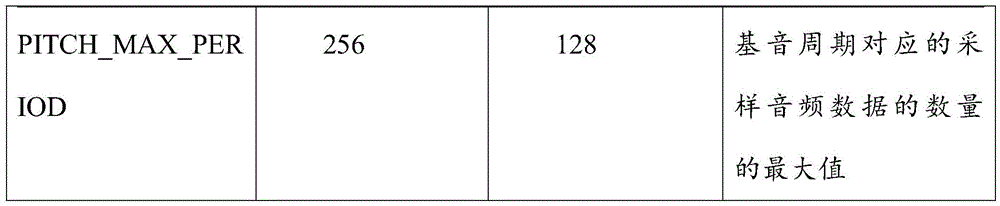
In an implementation, the method for training the audio synthesis model may include: inputting the sample audio features and the sample sampling audio data into an audio synthesis model, and outputting prediction sampling audio data; training the audio synthesis model based on the predicted sampled audio data and the sample sampled audio data until a training stop condition is reached.
As an example, the sample Audio source data may be decoded to obtain a sample Audio File, where the sample Audio File may be a wave Audio File Format (wav Format) File, and all the sample Audio files are resampled to the working sampling rate to obtain a sample Audio File, and the sample Audio files are spliced together to form a sample input File, where the sample input File may be a pcm Format File. Under the folder corresponding to the LPCNet on the linux machine, make (generates) an executable file of the training data. The executable file may be modified according to actual project requirements, such as whether silent frames are to be removed, whether a biquad filter is to be invoked, whether random noise is to be added, and so on. The modified executable file is invoked to generate sample audio features and sample audio data required for model training. And then inputting the sample audio features and the sample audio data into an audio synthesis model, wherein the audio synthesis model can automatically learn the nonlinear part of the sampling and output predicted audio data, iterative training can be carried out on the model based on the predicted audio data and the sample audio data until the number of iterations is reached or the accuracy of the model is greater than a preset threshold value, the audio synthesis model meeting the requirements can be obtained through training, and model training is stopped.
In this specification, the audio feature of the historical audio data of the frame immediately preceding the first lost frame may be determined as the predicted audio feature of the first lost frame, and the predicted audio feature and the M-frame predicted audio feature may be input into the above-mentioned audio synthesis model, so as to output a second audio sequence, where the second audio sequence is the predicted sampled audio data of the M +1 frame.
For example, taking M as 8 as an example, assuming that the 9 th frame is a lost frame, the audio feature of the 8 th frame may be used as the predicted audio feature of the 9 th frame, and the audio feature of the first 8 th frame and the predicted audio feature are input into an audio synthesis model, so as to obtain a second audio sequence, where the second audio sequence includes 9 frames of sampled audio data. Referring to fig. 5, the first audio sequence of fig. 5 includes 8 frames of audio data, and the second audio sequence includes 9 frames of audio data. Assuming that the sampling frequency is 8KHz and each frame of audio data is 10ms, the number of the sampled audio data included in each frame of audio data is 80, the first audio sequence includes 640 sampled audio data, and the second audio sequence includes 720 sampled audio data.
It should be noted that, for example, the audio feature of the historical audio data of the previous frame is the predicted audio feature of the first lost frame, in other embodiments, other conventional algorithms or neural network models may be used to predict the predicted audio feature of the first lost frame through the audio feature of the historical audio data of the previous M frames, which is not limited in this embodiment of the present specification.
In an implementation, based on the first audio sequence, determining a position in the second audio sequence where the cross-correlation with the first audio sequence is the greatest may include: and acquiring N continuous sampling audio data from the first audio sequence along the direction from the end point to the starting point based on the sampling frequency of the second audio sequence to obtain a first sampling audio data group. Taking N as the length of the sampling audio data group, acquiring N continuous sampling audio data from the second audio sequence along the end point to the starting point direction one by one to obtain a second sampling audio data group set, wherein the length of the sampling audio data group is the number of the sampling audio data included in the sampling audio data group; and for each obtained second sampled audio data group, performing cross-correlation calculation on the obtained second sampled audio data group and the first sampled audio data group, and determining the position with the maximum cross-correlation according to the position of the second sampled audio data group with the maximum cross-correlation.
Wherein N is a positive integer greater than 1.
In the embodiment of the present application, taking a sampling rate of 4kHz as an example, the number of audio data sampled in one pitch period at the sampling rate of 4kHz is [8, 64 ]. Since too small a value of N is not favorable for correlation calculation, the calculation amount of correlation calculation increases accordingly. Therefore, on the basis of the pitch period, the value of N is limited to the maximum value and the minimum value, and the value range of N can be limited to [60, 120] under the sampling rate of 4 kHz.
It should be noted that, the above only takes the sampling rate of 4kHz as an example to describe the value range of N, and in other embodiments, the value range of N may also be determined in other sampling rates or other manners, which is not limited in this embodiment of the application.
As an example, the first audio sequence may be resampled (sample) to the same sampling frequency based on the sampling frequency of the second audio sequence, and N consecutive sampled audio data may be obtained from the resampled first audio sequence along the end-to-start direction, resulting in the first sampled audio data set.
Because the second audio sequence comprises the synthesized M frames of sampled audio data and the predicted sampled audio data of the first missing packet frame, and the first audio sequence comprises the M frames of sampled audio data, in the process of playing audio, the first audio sequence is played first, and then the predicted sampled audio data of the first missing packet frame in the second audio sequence is played, in order to make the connection between the first audio sequence and the second audio sequence smoother, the position with the maximum cross correlation with the first audio sequence in the second audio sequence can be determined.
In some embodiments, determining the position with the maximum cross-correlation with the position of the second sampled audio data group with the maximum cross-correlation may include: and determining the position of the sampled audio data closest to the end point in the second sampled audio data group with the maximum cross correlation as the position with the maximum cross correlation.
That is, the position where the last sampled audio data in the second audio data group having the largest cross-correlation is located may be determined as the position where the cross-correlation is largest.
Illustratively, taking the sampling frequency as 8KHz and N as 80 as an example, the first audio sequence may be sampled based on 8KHz, and assuming that the first audio sequence includes 8 frames of audio data, after sampling, the first audio sequence may include 640 sampled audio data. It is possible to acquire 80 sampled audio data in the first audio sequence in the end point direction toward the start point as a first sampled audio data group, and acquire 80 consecutive sampled audio data in the second audio sequence in the end point direction toward the start point with 80 as the length of the sampled audio data group, resulting in a second sampled audio data group set. For each second sampled audio data group, performing cross-correlation calculation on the obtained second sampled audio data group and the first sampled audio data group, determining a second sampled audio data group with the maximum cross-correlation with the first sampled audio data group, which is called a target sampled audio group, and determining the position of the last sampled audio data in the target sampled audio data group as the position with the maximum cross-correlation.
For example, referring to FIG. 5, in FIG. 5, A is the first sampled audio data set in the first audio sequence and B1、B2、B3、BjAre each a second sampled audio data set in a second audio sequence, and B2Is to sample the second audio data set B1A second sampled audio data group obtained by shifting the audio sampling points corresponding to the 1 sampled audio data to the left, and so on, the second sampled audio data group B can be always obtained1Left shift until j-1 sampled audio data are left shifted to obtain a second sampled audio data group BjThus, a second set of sampled audio data sets can be obtained. Wherein j is greater than 1 and less than the number of sampling points corresponding to the P frame. A is respectively connected with B1、B2、B3、......,BjPerforming cross-correlation calculation, and respectively connecting 80 sampled audio data included in A with B if the length N of the sampled audio data group is 801、B2、B3、......,BjThe correlation calculation is performed on the included 80 sampled audio data. Specifically, the audio data of 80 samples included in A is compared with B1The included 80 sampled audio data are paired to obtain 80 sampled audio data pairs, the values of each pair of sampled audio data are multiplied to obtain 80 products, and the 80 products are added to obtain the first sampled audio data group A and the second sampled audio data group B1The cross correlation degree of the first sampled audio data group A and the second sampled audio data group B can be obtained by the same method2、B3、......,BjThe cross-correlation degree of the first sampling audio data group is determined, i.e. j cross-correlation degrees can be obtained, a target second sampling audio data group corresponding to the maximum cross-correlation degree in the j cross-correlation degrees is determined, and the target second sampling audio data group is assumed to be B3Then B is3The position where the last sampled audio data is located is determined as the position where the cross-correlation is largest.
Wherein P may be a positive integer greater than 1 and less than M.
As an example, in order to increase the probability of determining the position where the cross-correlation is the largest, many second sampled audio data sets may be acquired in the second audio sequence, but this increases the amount of calculation, and in order to reduce the amount of calculation, the number of acquired second sampled audio data sets may be reduced. Therefore, it can be obtained from big data or experience that P is preferably 2, taking 1 frame as 10ms as an example, i.e. j is greater than 1 and less than 20 ms.
It should be noted that, in the above method for determining the cross-correlation by taking the example of determining the cross-correlation degree by multiplying the values of each pair of sampled audio data, in other embodiments, the sampled audio data may be down-sampled, for example, the sampled audio data is resampled at 4kHz, then the position with the maximum cross-correlation is determined from the resampled audio data, that is, the position with the maximum cross-correlation with the coarse granularity is searched, then sampling is performed near the determined position with the maximum cross-correlation according to the original sampling rate, that is, the position with the maximum cross-correlation with the fine granularity is searched, and then the position with the maximum cross-correlation is determined. In addition, a minimum distortion algorithm may be used to assist in determining a position where the cross-correlation is maximum, which is not limited by the embodiments of the present specification.
In some embodiments, after determining the location with the largest cross-correlation, the sampled audio data before the location may be considered to be the most similar to the original audio data in the audio data stream, and the sampled audio data after the location is the compensated audio data of the first lost packet frame.
Further, after the position with the maximum cross-correlation is determined, since the audio playing sequence is to play the first audio sequence first and then play the compensation audio data of the first lost packet frame, in order to make the switching between the first audio sequence and the compensation audio data smoother, the first audio sequence and the second audio sequence may be merged. The specific implementation method comprises the following steps: acquiring X pieces of sample audio data which are not played from the first audio sequence along the direction from the end point to the starting point; fusing X pieces of sampled audio data before the position with the maximum cross correlation in the second audio sequence with the X pieces of unplayed sampled audio data to obtain fused audio data, and replacing the X pieces of unplayed audio data in the first audio sequence with the fused audio data; and splicing the fused audio data and the compensation audio data of the first lost packet frame.
Wherein X is greater than 1 and less than the number of one frame of sampled audio data.
That is to say, X sample audio data that are not played back and forth in the first audio sequence are fused with X sample audio data that are not played back and are located before the position where the cross correlation is the largest in the second audio sequence, and then the connection between the audio data that are located ahead in the fused audio data and the historical audio data in the first audio sequence is smooth, so that the X audio data that are not played back in the first audio sequence can be replaced by the fused audio data, that is, the data that are located ahead in the fused audio data and the historical audio data in the first audio sequence are spliced, and thus, when the audio data are played, the fused audio data can be played continuously when the audio data are played to the previous audio data of the X sample audio data that are not played. The connection between the later audio data in the fused audio data and the compensation audio data of the first lost packet frame is smooth, so that the fused audio data and the compensation audio data of the first lost packet frame can be spliced. Therefore, when the audio data is played, the compensation audio data of the first lost packet frame can be continuously played when the last audio data in the fused audio data is played.
In the embodiment of the application, by fusing the sample audio data which is not played in the first audio sequence, the sample audio data before the position with the maximum cross correlation in the second audio sequence, and the compensation audio data of the first lost packet frame, smooth switching between the first audio sequence and the compensation audio data of the first lost packet frame can be realized, that is, smooth switching between the received real audio data and the compensated compensation audio data obtained through compensation is realized, and the playing effect of the audio data is enhanced.
For example, taking X as 100 as an example, 100 pieces of sampled audio data that are not played in the audio data buffer are obtained and linearly decreased, 100 pieces of sampled audio data that are before the position with the maximum cross-correlation in the second audio sequence are linearly increased, and then the sampled audio data at the corresponding positions are added together, so that 100 pieces of fused audio data can be obtained. 100 sampled audio data before the position with the maximum cross-correlation in the second audio sequence are replaced by the 100 fused data, and it is assumed that 160 sampled audio data are behind the position with the maximum cross-correlation in the second audio sequence, that is, the number of the compensated audio data of the first lost packet frame is 160, the 100 fused audio data and the 160 compensated audio data can be spliced to obtain spliced audio data, and then audio playing can be performed according to the spliced audio data. In this way, a smooth switching between the first audio sequence and the compensated audio data may be achieved.
Further, the above describes a process of performing packet loss compensation when the current frame is the first packet loss frame, and if the current frame is not the first packet loss frame, the following manner needs to be adopted for packet loss compensation.
In implementation, if it is determined that a current frame in the audio data stream is a lost frame and a previous frame of the current frame is a lost frame, it is determined that the current frame is a continuous lost frame, where the continuous lost frame is a lost frame that is not a first lost frame in a plurality of continuous lost frames. And determining second compensation audio data of the continuously lost packet frames based on the audio characteristics of the historical audio data of the last non-lost packet frame before the current frame.
As an example, for convenience of description, a non-first lost frame of a plurality of consecutive lost frames may be referred to as a consecutive lost frame, and the compensation audio data of the consecutive lost frame may be referred to as second compensation audio data. For example, assuming that the current frame in the audio data stream is the 10 th frame, and both the 9 th frame and the 8 th frame are lost packet frames, the 8 th frame is the first lost packet frame in a plurality of consecutive lost packet frames, and the 10 th frame may be referred to as a consecutive lost packet frame.
As an example, the last non-lost packet frame before the current frame is the last frame of the first lost packet frame. For example, assuming that a current frame in the audio data stream is a 10 th frame, and both the 9 th frame and the 8 th frame are lost packet frames, neither the first 7 frames is a lost packet frame, it may be determined that the 7 th frame is a last non-lost packet frame before the current frame, or it may be determined that the first lost packet frame is an 8 th frame, and a previous frame of the first lost packet frame is a 7 th frame.
That is, if a packet loss frame continuous to the current frame exists before the current frame, it is described that packet loss compensation processing has been performed, and it is not necessary to determine the position with the maximum cross-correlation, and it is not necessary to splice audio data, and the second compensation audio data of the continuous packet loss frame may be determined based on the audio feature of the historical audio data of the last non-packet loss frame before the current frame.
As an example, after determining that the current frame is a continuous packet loss frame, the NetEQ module may generate a continuous packet loss compensation command, and the DSP module receives the continuous packet loss compensation command and determines the second compensation audio data of the current frame based on the audio feature of the historical audio data of the previous frame of the first packet loss frame. Continuing with the above example, the second compensated audio data for the consecutively missing packet frames, i.e., the 10 th frame, may be determined based on the audio characteristics of the historical audio data for the 7 th frame.
In some embodiments, determining, based on the audio characteristics of the historical audio data of the last non-packet-lost frame before the current frame, a specific implementation of the second compensation audio data of the continuously-lost packet frame may include: taking the audio characteristic of historical audio data of the last non-packet-loss frame before the current frame as the predicted audio characteristic of the continuous packet-loss frame; and inputting the predicted audio characteristics of the continuous lost packet frame into an audio synthesis model to obtain second compensation audio data of the continuous lost packet frame.
That is, new compensated audio data, i.e., second compensated audio data, may be synthesized using the Modified _ LPCNet model with the audio characteristics of the historical audio data of the last non-packet-lost frame before the current frame as the predicted audio characteristics of the continuously lost frames.
It should be noted that, the longer the packet loss compensation time is, the poorer the similarity between the generated compensation audio data and the actual audio data is, so that in the case of occurrence of continuous packet loss, the volume of the generated compensation audio data needs to be attenuated, for example, to 0.9 times of the original volume every 10 milliseconds. In this way, the difference of the compensated audio data from the actual audio data can be reduced audibly.
It should be noted that, in the process of performing packet loss compensation, the obtained first compensated audio data and second compensated audio data may be both stored in the compensation buffer, a smoothing coefficient is set for the compensated audio data corresponding to each frame, and the smoothing coefficient is attenuated according to the number of times of performing packet loss compensation operation. For example, the smoothing coefficient may be referred to as a mute _ slope, an initial value of which depends on the energy of two pitch periods before the first lost frame, and assuming that the first pitch period before the first lost frame is vector1, the second pitch period is vector2, and a ratio is the energy of vector 1/the energy of vector2, and the ratio is a ratio between the energies of two pitch periods, which may be used to indicate a trend of energy change before the lost frame. For example, a ratio >1.5 indicates that the audio is onset, and several levels of smoothing coefficients can be set according to the ratio. And attenuating the value of the smoothing coefficient according to the number of times of continuously performing packet loss compensation.
According to the method, the first compensation audio data and the second compensation audio data are determined by adopting different methods for the first lost frame and the continuous lost frame, and due to the random characteristic of the audio synthesis model when the audio data is output, the second compensation audio data obtained by each lost frame in the continuous lost frame are different, so that different compensation audio data of each lost frame can be obtained, the generated compensation audio data are different under the condition of continuous lost, and the problem that the generated audio is mechanical and repeated in the prior art can be effectively solved.
Further, the above describes a process of performing packet loss compensation when the current frame is a packet loss frame, and if the current frame is not a packet loss frame but the previous frame of the current frame is a packet loss frame, the compensated audio data of the previous frame of the current frame and the actual audio data of the current frame need to be spliced, so that smooth switching between the audio data can be performed.
In implementation, if it is determined that a current frame in the audio data stream is not a lost packet frame and a previous frame of the current frame is a lost packet frame, determining that the current frame is a target frame; acquiring actual audio data of the target frame, and determining predicted audio data of the target frame based on audio features of historical audio data of the last non-packet-lost frame before the current frame; determining a position with maximum cross-correlation with the actual audio data of the target frame in the predicted audio data of the target frame based on the actual audio data of the target frame; and fusing the Y sampled audio data after the position with the maximum cross correlation with the Y sampled audio data in the direction from the starting point to the end point in the actual audio data of the target frame to obtain the audio data fused with the target frame.
Wherein Y is a positive integer greater than 1.
As an example, taking a sampling rate of 8kHz as an example, Y may take a value of min (60, 202-the position where the cross-correlation is the largest). Where 202 is an empirical value obtained through a large number of experiments. For example, assume that the position where the cross-correlation is the largest is the position where the 100 th sample audio data is located, and therefore the value of Y is min (60, 102) which is 60.
That is, if the current frame is not a lost packet frame, it indicates that packet loss has ended, and for convenience of distinguishing from the case where the current frame is a lost packet frame, the current frame is referred to as a target frame if the current frame is not a lost packet frame. If the actual audio data of the current frame is received, which indicates that the actual audio data of the next frame of the last lost packet frame has been received, since the audio data of the last lost frame is compensated for packet loss, it may not be linked with the actual audio data of the target frame, and therefore, the predicted audio data of the target frame can be synthesized according to the audio characteristics of the historical audio data of the last non-packet-lost frame before the current frame, and the predicted audio data and the actual audio data are fused, the audio data after the fusion of the target frame can be determined, the connection between the audio data at the front in the fused audio data and the compensated audio data of the last lost packet frame is smooth, the connection between the later audio data in the fused audio data and the actual audio data of the target frame is smooth, smooth switching between the compensated audio data of the lost packet frame and the actual audio data of the target frame can be achieved.
The packet loss compensation method provided by the present specification receives an audio data stream, and if it is determined that a current frame in the audio data stream is a packet loss frame and a previous frame of the current frame is not a packet loss frame, it is determined that the current frame is a first packet loss frame; obtaining M frames of historical audio data before the first packet loss frame from the audio data stream to generate a first audio sequence, wherein M is a positive integer greater than 1; determining audio features of the M frames of historical audio data, and generating a second audio sequence based on the audio features of the M frames of historical audio data; based on the first audio sequence, determining a position in the second audio sequence where the cross-correlation with the first audio sequence is maximum, and determining audio data after the position in the second audio sequence where the cross-correlation is maximum as first compensated audio data of the first lost packet frame. According to the method, a second audio sequence is generated through historical audio data and audio features of M frames before a first lost packet frame, the real first audio sequence is compared with a second audio sequence generated through prediction, the position with the maximum cross correlation with the first audio sequence in the second audio sequence is obtained, first compensation audio data of the first lost packet frame is further determined, the obtained compensation audio data are different from the historical audio data of the previous frame, and therefore the problem that played audio data are mechanical and repeated can be reduced.
The packet loss compensation method provided in this specification is further described below with reference to fig. 6, taking an application of the packet loss compensation method in audio transmission as an example. Fig. 6 shows a processing flow chart of a packet loss compensation method applied in audio transmission according to an embodiment of the present specification, which specifically includes the following steps:
Step 604, if it is determined that the current frame in the audio data stream is a packet loss frame and the previous frame of the current frame is not a packet loss frame, determining that the current frame is the first packet loss frame.
For example, assuming that the current frame is the 10 th frame and the 9 th frame is not a lost packet frame, but the 5 th frame and the 6 th frame are both lost packet frames, since the 5 th frame and the 6 th frame are not adjacent to the 10 th frame, i.e., the 5 th frame and the 6 th frame are not lost packet frames continuous to the 10 th frame, the 10 th frame may be determined as the first lost packet frame.
Step 606, obtaining M frames of historical audio data before the first packet loss frame from the audio data stream, and generating a first audio sequence.
Wherein M is a positive integer greater than 1.
In the prior art, packet loss compensation is usually realized by a PLC component of NetEQ, and in this embodiment, the PLC component in NetEQ may be replaced.
For example, referring to fig. 1, the audio data stream may be sent to the computing device in the form of a data packet, and after the computing device receives the data packet, the data packet may be stored in a jitter buffer of an MCU module in the NetEQ, and the data packet is subjected to computational analysis to make a command decision. If the data packet is determined to be missing the audio data of the current frame by analysis, a packet loss compensation command can be generated and sent to the DSP module, and the DSP module can process the audio data in the voice buffer area based on the packet loss compensation command to obtain the compensated audio data.
As an example, taking a processing unit of 10 milliseconds for processing audio data by NetEQ as an example, after receiving the packet loss compensation enabling command, the DSP module may obtain, for a first packet loss frame, historical audio data of M frames before the first packet loss frame from the voice buffer, and generate a first audio sequence.
It should be noted that, for specific implementation of step 606, reference may be made to related description of step 206, and this embodiment is not described herein again.
For example, when the audio features of M frames of historical audio data are determined, fourier transform may be performed on each frame of historical audio data in the M frames of historical audio data to obtain a spectrogram of each frame of historical audio data. For the spectrogram of each frame of historical audio data, the spectrogram can be divided according to the mode of fig. 4, each frame of historical audio data obtains a plurality of frequency bands, energy in each frequency band is calculated, Log compresses a dynamic range to obtain cepstrum, and DCT decorrelation is performed to obtain the final BFCC. In this way, the BFCC coefficient of each frame of historical audio data may be obtained. Pitch period (pitch period) and gene correlation (pitch correlation) may also be determined from the sampling frequency. And determining the determined BFCC coefficients, the pitch period and the pitch correlation as the audio characteristics of each frame of audio data.
Step 610, determining the audio characteristic of the historical audio data of the previous frame of the first lost packet frame as the predicted audio characteristic of the audio data of the first lost packet frame.
Step 612, inputting the audio features of the M frames of historical audio data and the predicted audio features of the audio data of the first lost packet frame into an audio synthesis model to obtain the second audio sequence.
Wherein the second audio sequence comprises the synthesized sampled audio data of the M frames and the first lost packet frame.
It should be noted that the above steps 608 to 612 are the lower descriptions of the step 208, and specific implementation may refer to the relevant description of the step 208, which is not described herein again.
And 614, acquiring N continuous sampling audio data from the first audio sequence along the end point to the starting point direction based on the sampling frequency of the second audio sequence to obtain a first sampling audio data group.
In the embodiment of the present application, taking a sampling rate of 4kHz as an example, the number of audio data sampled in one pitch period at the sampling rate of 4kHz is [8, 64 ]. Since too small a value of N is not favorable for correlation calculation, the calculation amount of correlation calculation increases accordingly. Therefore, on the basis of the pitch period, the value of N is limited to the maximum value and the minimum value, and the value range of N can be limited to [60, 120] under the sampling rate of 4 kHz.
And 616, taking N as the length of the sampled audio data group, successively acquiring N consecutive sampled audio data from the second audio sequence along the end point to the start point direction, and obtaining a second sampled audio data group set, wherein the length of the sampled audio data group is the number of the sampled audio data included in the sampled audio data group.
Illustratively, taking the sampling frequency as 8KHz and N as 80 as an example, the first audio sequence may be sampled based on 8KHz, and assuming that the first audio sequence includes 8 frames of audio data, after sampling, the first audio sequence may include 640 sampled audio data. It is possible to acquire 80 sampled audio data in the first audio sequence in the end point direction toward the start point as a first sampled audio data group, and acquire 80 consecutive sampled audio data in the second audio sequence in the end point direction toward the start point with 80 as the length of the sampled audio data group, resulting in a second sampled audio data group set. And for each second sampled audio data group, performing cross-correlation calculation on the obtained second sampled audio data group and the first sampled audio data group, and determining the position with the maximum cross-correlation based on the position of the second sampled audio data group with the maximum cross-correlation. For example, the position of the last sampled audio data in the second sampled audio data group may be determined as the position where the cross-correlation is largest.
For example, in performing the cross-correlation calculation, 80 sampled audio data in the first sampled audio data group may be paired with 80 sampled audio data in the second sampled audio data group to obtain 80 sampled audio data pairs, the values of each pair of sampled audio data may be multiplied to obtain 80 products, and the 80 products may be added to obtain the cross-correlation degree between the first sampled audio data group and the second sampled audio data group.
Step 620, determining the audio data after the position with the maximum cross correlation in the second audio sequence as the first compensated audio data of the first lost packet frame.
In the embodiment of the present application, the position with the largest cross-correlation is the position with the largest cross-correlation between the sampled audio data in the first sampled audio data group and the sampled audio data in the second sampled audio data group, therefore, the audio data before the position with the largest cross-correlation in the second audio sequence may be regarded as M frames of audio data, and the audio data after the position with the largest cross-correlation may be regarded as the compensated audio data of the first lost packet frame of the model synthesis.
It should be noted that, the steps 614 to 620 are the lower descriptions of the step 210, and specific implementation may refer to the related description of the step 206, which is not described herein again.
At step 622, X sample audio data that are not played are obtained from the first audio sequence along the direction from the end point to the start point.
Wherein X is less than the number of sampled audio data of one frame.
In order to achieve smooth switching of the audio data in the first audio sequence and the compensated audio data of the compensated first lost packet frame during playing, X sample audio data not played in the first audio sequence may be obtained from an audio data buffer.
The audio data before the comparison in the fusion data obtained in this way is joined smoothly with the audio data in the first audio sequence, and the audio data after the comparison in the fusion data is joined smoothly with the compensated audio data of the first lost frame.
For example, taking X as 100 as an example, 100 pieces of sampled audio data that are not played in the audio data buffer are obtained and linearly decreased, 100 pieces of sampled audio data that are before the position with the maximum cross-correlation in the second audio sequence are linearly increased, and then the sampled audio data at the corresponding positions are added together, so that 100 pieces of fused audio data can be obtained. 100 sampled audio data before the position with the maximum cross-correlation in the second audio sequence are replaced by the 100 fused data, and it is assumed that 160 sampled audio data are behind the position with the maximum cross-correlation in the second audio sequence, that is, the number of the compensated audio data of the first lost packet frame is 160, the 100 fused audio data and the 160 compensated audio data can be spliced to obtain spliced audio data, and then audio playing can be performed according to the spliced audio data. In this way, a smooth switching between the first audio sequence and the compensated audio data may be achieved.
It should be noted that, in the above steps 622 to 626, the lower description of the step 210 of fusing the first audio sequence and the second audio sequence is given, and specific implementation may refer to the related description of the step 210, which is not described herein again.
That is, new compensation audio data, i.e., second compensation audio data, may be synthesized using the Modified _ LPCNet model with the audio characteristics of the historical audio data of the frame immediately preceding the first lost frame as the prediction characteristics of the non-first lost frame.
It should be noted that, the longer the compensation time is, the poorer the similarity between the generated compensation audio data and the actual audio data is, and therefore, when packet loss continues, the volume of the generated compensation audio data needs to be attenuated, for example, to 0.9 times the original volume every 10 milliseconds.
According to the method, the first compensation audio data and the second compensation audio data are determined by adopting different methods for the first lost frame and the continuous lost frame, and due to the random characteristic of the audio synthesis model when the audio data is output, the second compensation audio data obtained by each lost frame in the continuous lost frame are different, so that different compensation audio data of each lost frame can be obtained, the generated compensation audio data are different under the condition of continuous lost, and the problem that the generated audio is mechanical and repeated in the prior art can be effectively solved.
It should be noted that steps 628 to 632 are the lower description of the process of performing packet loss compensation when the current frame is not a packet loss frame in step 210, and this embodiment is not described herein again.
And 636, acquiring actual audio data of the target frame, and determining predicted audio data of the target frame based on the audio characteristics of historical audio data of the last non-packet-lost frame before the current frame.
That is, if the packet loss is over, the actual audio data of the next frame of the last lost packet frame is already received, and since the audio data of the last lost packet frame is obtained by packet loss compensation, the actual audio data may not be linked with the actual audio data of the target frame, the predicted audio data of the target frame may be continuously determined.
And step 640, fusing the Y sampled audio data before the position with the maximum cross correlation with the Y sampled audio data in the direction from the starting point to the ending point in the actual audio data of the target frame to obtain the audio data fused with the target frame.
Wherein Y is a positive integer greater than 1.
The connection between the audio data at the front in the fused audio data and the compensation audio data of the last lost packet frame is smooth, and the connection between the audio data at the back in the fused audio data and the actual audio data of the target frame is smooth, so that the smooth switching between the compensation audio data of the lost packet frame and the actual audio data of the target frame can be realized.
The packet loss compensation method provided by the present specification receives an audio data stream, and if it is determined that a current frame in the audio data stream is a packet loss frame and a previous frame of the current frame is not a packet loss frame, it is determined that the current frame is a first packet loss frame; obtaining M frames of historical audio data before the first packet loss frame from the audio data stream to generate a first audio sequence, wherein M is a positive integer greater than 1; determining audio features of the M frames of historical audio data, and generating a second audio sequence based on the audio features of the M frames of historical audio data; based on the first audio sequence, determining a position in the second audio sequence where the cross-correlation with the first audio sequence is maximum, and determining audio data after the position in the second audio sequence where the cross-correlation is maximum as first compensated audio data of the first lost packet frame. According to the method, a second audio sequence is generated through historical audio data and audio features of M frames before a first lost packet frame, the real first audio sequence is compared with a second audio sequence generated through prediction, the position with the maximum cross correlation with the first audio sequence in the second audio sequence is obtained, first compensation audio data of the first lost packet frame is further determined, the obtained compensation audio data are different from the historical audio data of the previous frame, and therefore the problem that played audio data are mechanical and repeated can be reduced.
Corresponding to the above method embodiment, the present specification further provides an embodiment of a packet loss compensation apparatus, and fig. 7 illustrates a schematic structural diagram of the packet loss compensation apparatus provided in the embodiment of the present specification. As shown in fig. 7, the apparatus includes:
a receiving module 702 configured to receive an audio data stream;
a first determining module 704, configured to determine that a current frame in the audio data stream is a first packet loss frame if the current frame is determined to be a packet loss frame and a previous frame of the current frame is not a packet loss frame;
a first generating module 706, configured to obtain M frames of historical audio data before a first packet-lost frame from the audio data stream, and generate a first audio sequence, where M is a positive integer greater than 1;
a second generation module 708 configured to determine audio features of the M frames of historical audio data and generate a second audio sequence based on the audio features of the M frames of historical audio data;
a second determining module 710 configured to determine, based on the first audio sequence, a position in the second audio sequence where the cross-correlation with the first audio sequence is the largest, and determine audio data after the position in the second audio sequence where the cross-correlation is the largest as first compensated audio data of the first lost packet frame.
Optionally, the second generating module 708 is configured to:
determining the audio characteristic of the historical audio data of the frame above the first lost frame as the predicted audio characteristic of the audio data of the first lost frame;
inputting the audio features of the M frames of historical audio data and the predicted audio features of the audio data of the first missing packet frame into an audio synthesis model to obtain the second audio sequence, wherein the second audio sequence comprises the synthesized M frames and the sampled audio data of the first missing packet frame.
Optionally, the second determining module 710 is configured to:
acquiring N continuous sampling audio data from the first audio sequence along the direction from the end point to the starting point based on the sampling frequency of the second audio sequence to obtain a first sampling audio data group, wherein N is a positive integer greater than 1;
taking N as the length of the sampling audio data group, acquiring N continuous sampling audio data from the second audio sequence along the end point to the starting point direction one by one to obtain a second sampling audio data group set, wherein the length of the sampling audio data group is the number of the sampling audio data included in the sampling audio data group;
and for each obtained second sampled audio data group, performing cross-correlation calculation on the obtained second sampled audio data group and the first sampled audio data group, and determining the position with the maximum cross-correlation according to the position of the second sampled audio data group with the maximum cross-correlation.
Optionally, the second determining module 710 is configured to:
and determining the position of the sampled audio data closest to the end point in the second sampled audio data group with the maximum cross correlation as the position with the maximum cross correlation.
Optionally, the second determining module 710 is further configured to:
acquiring X sample audio data which are not played from the first audio sequence along the direction from the end point to the starting point, wherein X is more than 1 and less than the number of one frame of sample audio data;
fusing X pieces of sampled audio data before the position with the maximum cross correlation in the second audio sequence with the X pieces of sampled audio data which are not played to obtain fused audio data;
replacing X audio data which are not played in the first audio sequence with the fused audio data, and splicing the fused audio data with the compensation audio data of the first lost packet frame.
Optionally, the second determining module 710 is further configured to:
if the current frame in the audio data stream is determined to be a packet loss frame and the previous frame of the current frame is a packet loss frame, determining the current frame to be a continuous packet loss frame, wherein the continuous packet loss frame is a packet loss frame which is not a first packet loss frame in a plurality of continuous packet loss frames;
and determining second compensation audio data of the continuously lost packet frames based on the audio characteristics of the historical audio data of the last non-lost packet frame before the current frame.
Optionally, the second determining module 710 is further configured to:
taking the audio characteristic of historical audio data of the last non-packet-loss frame before the current frame as the predicted audio characteristic of the continuous packet-loss frame;
and inputting the predicted audio characteristics of the continuous lost packet frame into an audio synthesis model to obtain second compensation audio data of the continuous lost packet frame.
Optionally, the second determining module 710 is further configured to:
if the current frame in the audio data stream is determined not to be a packet loss frame and the previous frame of the current frame is a packet loss frame, determining the current frame to be a target frame;
acquiring actual audio data of the target frame, and determining predicted audio data of the target frame based on audio features of historical audio data of the last non-packet-lost frame before the current frame;
determining a position with maximum cross-correlation with the actual audio data of the target frame in the predicted audio data of the target frame based on the actual audio data of the target frame;
and fusing the Y sampled audio data after the position with the maximum cross correlation with the Y sampled audio data in the direction from the starting point to the end point in the actual audio data of the target frame to obtain the audio data fused with the target frame, wherein Y is a positive integer greater than 1.
Optionally, the apparatus further comprises:
the prediction module is used for inputting the sample audio characteristics and the sample sampling audio data into the audio synthesis model and outputting the prediction sampling audio data;
a training module to train the audio synthesis model based on the predictive sampled audio data and the sample sampled audio data until a training stop condition is reached.
The packet loss compensation method provided by the present specification receives an audio data stream, and if it is determined that a current frame in the audio data stream is a packet loss frame and a previous frame of the current frame is not a packet loss frame, it is determined that the current frame is a first packet loss frame; obtaining M frames of historical audio data before the first packet loss frame from the audio data stream to generate a first audio sequence, wherein M is a positive integer greater than 1; determining audio features of the M frames of historical audio data, and generating a second audio sequence based on the audio features of the M frames of historical audio data; based on the first audio sequence, determining a position in the second audio sequence where the cross-correlation with the first audio sequence is maximum, and determining audio data after the position in the second audio sequence where the cross-correlation is maximum as first compensated audio data of the first lost packet frame. According to the method, a second audio sequence is generated through historical audio data and audio features of M frames before a first lost packet frame, the real first audio sequence is compared with a second audio sequence generated through prediction, the position with the maximum cross correlation with the first audio sequence in the second audio sequence is obtained, first compensation audio data of the first lost packet frame is further determined, the obtained compensation audio data are different from the historical audio data of the previous frame, and therefore the problem that played audio data are mechanical and repeated can be reduced.
The above is a schematic scheme of the packet loss compensation apparatus according to this embodiment. It should be noted that the technical solution of the packet loss compensation device and the technical solution of the packet loss compensation method belong to the same concept, and details of the technical solution of the packet loss compensation device, which are not described in detail, can be referred to the description of the technical solution of the packet loss compensation method.
Fig. 8 illustrates a block diagram of a computing device 800 provided in accordance with an embodiment of the present description. The components of the computing device 800 include, but are not limited to, memory 810 and a processor 820. The processor 820 is coupled to the memory 810 via a bus 830, and the database 850 is used to store data.
In one embodiment of the present description, the above-described components of computing device 800, as well as other components not shown in FIG. 8, may also be connected to each other, such as by a bus. It should be understood that the block diagram of the computing device architecture shown in FIG. 8 is for purposes of example only and is not limiting as to the scope of the description. Those skilled in the art may add or replace other components as desired.
Wherein, the processor 820 is configured to execute the following computer-executable instructions:
receiving a radio data stream;
if the current frame in the audio data stream is determined to be a packet loss frame and the previous frame of the current frame is not a packet loss frame, determining the current frame to be a first packet loss frame;
obtaining M frames of historical audio data before the first packet loss frame from the audio data stream to generate a first audio sequence, wherein M is a positive integer greater than 1;
determining audio features of the M frames of historical audio data, and generating a second audio sequence based on the audio features of the M frames of historical audio data;
based on the first audio sequence, determining a position in the second audio sequence where the cross-correlation with the first audio sequence is maximum, and determining audio data after the position in the second audio sequence where the cross-correlation is maximum as first compensated audio data of the first lost packet frame.
The above is an illustrative scheme of a computing device of the present embodiment. It should be noted that the technical solution of the computing device and the technical solution of the packet loss compensation method belong to the same concept, and details that are not described in detail in the technical solution of the computing device can be referred to the description of the technical solution of the packet loss compensation method.
An embodiment of the present specification also provides a computer readable storage medium storing computer instructions that, when executed by a processor, are operable to:
receiving a radio data stream;
if the current frame in the audio data stream is determined to be a packet loss frame and the previous frame of the current frame is not a packet loss frame, determining the current frame to be a first packet loss frame;
obtaining M frames of historical audio data before the first packet loss frame from the audio data stream to generate a first audio sequence, wherein M is a positive integer greater than 1;
determining audio features of the M frames of historical audio data, and generating a second audio sequence based on the audio features of the M frames of historical audio data;
based on the first audio sequence, determining a position in the second audio sequence where the cross-correlation with the first audio sequence is maximum, and determining audio data after the position in the second audio sequence where the cross-correlation is maximum as first compensated audio data of the first lost packet frame.
The above is an illustrative scheme of a computer-readable storage medium of the present embodiment. It should be noted that the technical solution of the storage medium and the technical solution of the packet loss compensation method belong to the same concept, and details that are not described in detail in the technical solution of the storage medium can be referred to the description of the technical solution of the packet loss compensation method.
The foregoing description has been directed to specific embodiments of this disclosure. Other embodiments are within the scope of the following claims. In some cases, the actions or steps recited in the claims may be performed in a different order than in the embodiments and still achieve desirable results. In addition, the processes depicted in the accompanying figures do not necessarily require the particular order shown, or sequential order, to achieve desirable results. In some embodiments, multitasking and parallel processing may also be possible or may be advantageous.
The computer instructions comprise computer program code which may be in the form of source code, object code, an executable file or some intermediate form, or the like. The computer-readable medium may include: any entity or device capable of carrying the computer program code, recording medium, usb disk, removable hard disk, magnetic disk, optical disk, computer Memory, Read-Only Memory (ROM), Random Access Memory (RAM), electrical carrier wave signals, telecommunications signals, software distribution medium, and the like. It should be noted that the computer readable medium may contain content that is subject to appropriate increase or decrease as required by legislation and patent practice in jurisdictions, for example, in some jurisdictions, computer readable media does not include electrical carrier signals and telecommunications signals as is required by legislation and patent practice.
It should be noted that, for the sake of simplicity, the foregoing method embodiments are described as a series of acts or combinations, but those skilled in the art should understand that the present disclosure is not limited by the described order of acts, as some steps may be performed in other orders or simultaneously according to the present disclosure. Further, those skilled in the art should also appreciate that the embodiments described in this specification are preferred embodiments and that acts and modules referred to are not necessarily required for this description.
In the above embodiments, the descriptions of the respective embodiments have respective emphasis, and for parts that are not described in detail in a certain embodiment, reference may be made to related descriptions of other embodiments.
The preferred embodiments of the present specification disclosed above are intended only to aid in the description of the specification. Alternative embodiments are not exhaustive and do not limit the invention to the precise embodiments described. Obviously, many modifications and variations are possible in light of the above teaching. The embodiments were chosen and described in order to best explain the principles of the specification and its practical application, to thereby enable others skilled in the art to best understand the specification and its practical application. The specification is limited only by the claims and their full scope and equivalents.
Claims (12)
1. A packet loss compensation method, the method comprising:
receiving a radio data stream;
if the current frame in the audio data stream is determined to be a packet loss frame and the previous frame of the current frame is not a packet loss frame, determining the current frame to be a first packet loss frame;
obtaining M frames of historical audio data before the first packet loss frame from the audio data stream to generate a first audio sequence, wherein M is a positive integer greater than 1;
determining audio features of the M frames of historical audio data, and generating a second audio sequence based on the audio features of the M frames of historical audio data;
based on the first audio sequence, determining a position in the second audio sequence where the cross-correlation with the first audio sequence is maximum, and determining audio data after the position in the second audio sequence where the cross-correlation is maximum as first compensated audio data of the first lost packet frame.
2. The packet loss compensation method according to claim 1, wherein the generating a second audio sequence based on the audio features of the M frames of historical audio data comprises:
determining the audio characteristic of the historical audio data of the frame above the first lost frame as the predicted audio characteristic of the audio data of the first lost frame;
inputting the audio features of the M frames of historical audio data and the predicted audio features of the audio data of the first missing packet frame into an audio synthesis model to obtain the second audio sequence, wherein the second audio sequence comprises the synthesized M frames and the sampled audio data of the first missing packet frame.
3. The packet loss compensation method according to claim 1, wherein the determining, based on the first audio sequence, the position in the second audio sequence where the cross-correlation with the first audio sequence is the largest comprises:
acquiring N continuous sampling audio data from the first audio sequence along the direction from the end point to the starting point based on the sampling frequency of the second audio sequence to obtain a first sampling audio data group, wherein N is a positive integer greater than 1;
taking N as the length of the sampling audio data group, acquiring N continuous sampling audio data from the second audio sequence along the end point to the starting point direction one by one to obtain a second sampling audio data group set, wherein the length of the sampling audio data group is the number of the sampling audio data included in the sampling audio data group;
and for each obtained second sampled audio data group, performing cross-correlation calculation on the obtained second sampled audio data group and the first sampled audio data group, and determining the position with the maximum cross-correlation according to the position of the second sampled audio data group with the maximum cross-correlation.
4. The packet loss compensation method according to claim 3, wherein the determining the position with the maximum cross-correlation with the position of the second sampled audio data group with the maximum cross-correlation comprises:
and determining the position of the sampled audio data closest to the end point in the second sampled audio data group with the maximum cross correlation as the position with the maximum cross correlation.
5. The packet loss compensation method according to claim 1, wherein the method further comprises:
acquiring X sample audio data which are not played from the first audio sequence along the direction from the end point to the starting point, wherein X is more than 1 and less than the number of one frame of sample audio data;
fusing X pieces of sampled audio data before the position with the maximum cross correlation in the second audio sequence with the X pieces of sampled audio data which are not played to obtain fused audio data;
replacing X audio data which are not played in the first audio sequence with the fused audio data, and splicing the fused audio data with the compensation audio data of the first lost packet frame.
6. The packet loss compensation method according to claim 1, wherein the method further comprises:
if the current frame in the audio data stream is determined to be a packet loss frame and the previous frame of the current frame is a packet loss frame, determining the current frame to be a continuous packet loss frame, wherein the continuous packet loss frame is a packet loss frame which is not a first packet loss frame in a plurality of continuous packet loss frames;
and determining second compensation audio data of the continuously lost packet frames based on the audio characteristics of the historical audio data of the last non-lost packet frame before the current frame.
7. The packet loss compensation method according to claim 6, wherein the determining the second compensation audio data of the continuously lost packet frame based on the audio characteristics of the historical audio data of the last non-lost packet frame before the current frame comprises:
taking the audio characteristic of historical audio data of the last non-packet-loss frame before the current frame as the predicted audio characteristic of the continuous packet-loss frame;
and inputting the predicted audio characteristics of the continuous lost packet frame into an audio synthesis model to obtain second compensation audio data of the continuous lost packet frame.
8. The packet loss compensation method according to claim 1, wherein the method further comprises:
if the current frame in the audio data stream is determined not to be a packet loss frame and the previous frame of the current frame is a packet loss frame, determining the current frame to be a target frame;
acquiring actual audio data of the target frame, and determining predicted audio data of the target frame based on audio features of historical audio data of the last non-packet-lost frame before the current frame;
determining a position with maximum cross-correlation with the actual audio data of the target frame in the predicted audio data of the target frame based on the actual audio data of the target frame;
and fusing the Y sampled audio data after the position with the maximum cross correlation with the Y sampled audio data in the direction from the starting point to the end point in the actual audio data of the target frame to obtain the audio data fused with the target frame, wherein Y is a positive integer greater than 1.
9. The packet loss compensation method according to claim 2 or 7, wherein the method further comprises:
inputting sample audio features and sample sampled audio data into the audio synthesis model, and outputting predicted sampled audio data;
training the audio synthesis model based on the predicted sampled audio data and the sample sampled audio data until a training stop condition is reached.
10. A packet loss compensation apparatus, comprising:
a receiving module configured to receive a stream of radio data;
a first determining module, configured to determine that a current frame in the audio data stream is a first packet loss frame if the current frame is determined to be a packet loss frame and a previous frame of the current frame is not a packet loss frame;
a first generation module, configured to obtain M frames of historical audio data before the first packet loss frame from the audio data stream, and generate a first audio sequence, where M is a positive integer greater than 1;
a second generation module configured to determine audio features of the M frames of historical audio data and generate a second audio sequence based on the audio features of the M frames of historical audio data;
a second determining module configured to determine, based on the first audio sequence, a position in the second audio sequence where the cross-correlation with the first audio sequence is the largest, and determine audio data after the position in the second audio sequence where the cross-correlation is the largest as first compensated audio data of the first lost packet frame.
11. A computing device, comprising:
a memory and a processor;
the memory is configured to store computer-executable instructions, and the processor is configured to execute the computer-executable instructions to implement the method of:
receiving a radio data stream;
if the current frame in the audio data stream is determined to be a packet loss frame and the previous frame of the current frame is not a packet loss frame, determining the current frame to be a first packet loss frame;
obtaining M frames of historical audio data before the first packet loss frame from the audio data stream to generate a first audio sequence, wherein M is a positive integer greater than 1;
determining audio features of the M frames of historical audio data, and generating a second audio sequence based on the audio features of the M frames of historical audio data;
based on the first audio sequence, determining a position in the second audio sequence where the cross-correlation with the first audio sequence is maximum, and determining audio data after the position in the second audio sequence where the cross-correlation is maximum as first compensated audio data of the first lost packet frame.
12. A computer readable storage medium storing computer instructions which, when executed by a processor, implement the steps of the packet loss compensation method according to any one of claims 1 to 9.
Priority Applications (1)
| Application Number | Priority Date | Filing Date | Title |
|---|---|---|---|
| CN202011502968.6A CN112634912B (en) | 2020-12-18 | 2020-12-18 | Packet loss compensation method and device |
Applications Claiming Priority (1)
| Application Number | Priority Date | Filing Date | Title |
|---|---|---|---|
| CN202011502968.6A CN112634912B (en) | 2020-12-18 | 2020-12-18 | Packet loss compensation method and device |
Publications (2)
| Publication Number | Publication Date |
|---|---|
| CN112634912A true CN112634912A (en) | 2021-04-09 |
| CN112634912B CN112634912B (en) | 2024-04-09 |
Family
ID=75317076
Family Applications (1)
| Application Number | Title | Priority Date | Filing Date |
|---|---|---|---|
| CN202011502968.6A Active CN112634912B (en) | 2020-12-18 | 2020-12-18 | Packet loss compensation method and device |
Country Status (1)
| Country | Link |
|---|---|
| CN (1) | CN112634912B (en) |
Cited By (5)
| Publication number | Priority date | Publication date | Assignee | Title |
|---|---|---|---|---|
| CN113436639A (en) * | 2021-08-26 | 2021-09-24 | 北京百瑞互联技术有限公司 | Audio stream compensation method, device, storage medium and equipment |
| CN113838477A (en) * | 2021-09-13 | 2021-12-24 | 阿波罗智联(北京)科技有限公司 | Packet loss recovery method and device for audio data packet, electronic equipment and storage medium |
| CN116129917A (en) * | 2023-02-17 | 2023-05-16 | 展讯半导体(成都)有限公司 | Audio frame loss compensation method, device, equipment, storage medium and program product |
| CN119517047A (en) * | 2023-08-22 | 2025-02-25 | 广州视源电子科技股份有限公司 | Training method, device and computer equipment for audio packet loss compensation model |
| WO2025218210A1 (en) * | 2024-04-15 | 2025-10-23 | 北京字跳网络技术有限公司 | Method and apparatus for processing audio experiencing packet loss, medium, and device |
Citations (14)
| Publication number | Priority date | Publication date | Assignee | Title |
|---|---|---|---|---|
| US20040184443A1 (en) * | 2003-03-21 | 2004-09-23 | Minkyu Lee | Low-complexity packet loss concealment method for voice-over-IP speech transmission |
| CN1901431A (en) * | 2006-07-04 | 2007-01-24 | 华为技术有限公司 | Lost frame hiding method and device |
| JP2008111991A (en) * | 2006-10-30 | 2008-05-15 | Ntt Docomo Inc | Decoding device, encoding device, decoding method, and encoding method |
| JP2008139661A (en) * | 2006-12-04 | 2008-06-19 | Nippon Telegr & Teleph Corp <Ntt> | Voice signal receiving apparatus, voice packet loss compensation method used therefor, program for implementing the method, and recording medium recording the program |
| CN101325631A (en) * | 2007-06-14 | 2008-12-17 | 华为技术有限公司 | Method and device for realizing packet loss hiding |
| CN101894565A (en) * | 2009-05-19 | 2010-11-24 | 华为技术有限公司 | Speech signal restoration method and device |
| KR20160004462A (en) * | 2014-07-02 | 2016-01-13 | 한양대학교 산학협력단 | Adaptive muting system and mehtod using g.722 codec packet loss concealment and steepest descent criterion |
| CN106251875A (en) * | 2016-08-12 | 2016-12-21 | 广州市百果园网络科技有限公司 | The method of a kind of frame losing compensation and terminal |
| CN106788876A (en) * | 2015-11-19 | 2017-05-31 | 电信科学技术研究院 | A kind of method and system of voice Discarded Packets compensation |
| CN108011686A (en) * | 2016-10-31 | 2018-05-08 | 腾讯科技(深圳)有限公司 | Information coded frame loss recovery method and apparatus |
| CN109496333A (en) * | 2017-06-26 | 2019-03-19 | 华为技术有限公司 | A kind of frame loss compensation method and device |
| CN109963184A (en) * | 2017-12-14 | 2019-07-02 | 阿里巴巴集团控股有限公司 | A kind of method, apparatus and electronic equipment of audio-video network broadcasting |
| CN111554308A (en) * | 2020-05-15 | 2020-08-18 | 腾讯科技(深圳)有限公司 | Voice processing method, device, equipment and storage medium |
| CN111640442A (en) * | 2020-06-01 | 2020-09-08 | 北京猿力未来科技有限公司 | Method for processing audio packet loss, method for training neural network and respective devices |
-
2020
- 2020-12-18 CN CN202011502968.6A patent/CN112634912B/en active Active
Patent Citations (14)
| Publication number | Priority date | Publication date | Assignee | Title |
|---|---|---|---|---|
| US20040184443A1 (en) * | 2003-03-21 | 2004-09-23 | Minkyu Lee | Low-complexity packet loss concealment method for voice-over-IP speech transmission |
| CN1901431A (en) * | 2006-07-04 | 2007-01-24 | 华为技术有限公司 | Lost frame hiding method and device |
| JP2008111991A (en) * | 2006-10-30 | 2008-05-15 | Ntt Docomo Inc | Decoding device, encoding device, decoding method, and encoding method |
| JP2008139661A (en) * | 2006-12-04 | 2008-06-19 | Nippon Telegr & Teleph Corp <Ntt> | Voice signal receiving apparatus, voice packet loss compensation method used therefor, program for implementing the method, and recording medium recording the program |
| CN101325631A (en) * | 2007-06-14 | 2008-12-17 | 华为技术有限公司 | Method and device for realizing packet loss hiding |
| CN101894565A (en) * | 2009-05-19 | 2010-11-24 | 华为技术有限公司 | Speech signal restoration method and device |
| KR20160004462A (en) * | 2014-07-02 | 2016-01-13 | 한양대학교 산학협력단 | Adaptive muting system and mehtod using g.722 codec packet loss concealment and steepest descent criterion |
| CN106788876A (en) * | 2015-11-19 | 2017-05-31 | 电信科学技术研究院 | A kind of method and system of voice Discarded Packets compensation |
| CN106251875A (en) * | 2016-08-12 | 2016-12-21 | 广州市百果园网络科技有限公司 | The method of a kind of frame losing compensation and terminal |
| CN108011686A (en) * | 2016-10-31 | 2018-05-08 | 腾讯科技(深圳)有限公司 | Information coded frame loss recovery method and apparatus |
| CN109496333A (en) * | 2017-06-26 | 2019-03-19 | 华为技术有限公司 | A kind of frame loss compensation method and device |
| CN109963184A (en) * | 2017-12-14 | 2019-07-02 | 阿里巴巴集团控股有限公司 | A kind of method, apparatus and electronic equipment of audio-video network broadcasting |
| CN111554308A (en) * | 2020-05-15 | 2020-08-18 | 腾讯科技(深圳)有限公司 | Voice processing method, device, equipment and storage medium |
| CN111640442A (en) * | 2020-06-01 | 2020-09-08 | 北京猿力未来科技有限公司 | Method for processing audio packet loss, method for training neural network and respective devices |
Non-Patent Citations (1)
| Title |
|---|
| GABRIEL MITTAG等: "Non-intrusive Estimation of Packet Loss Rates in Speech Communication Systems Using Convolutional Neural Networks", 2018 IEEE INTERNATIONAL SYMPOSIUM ON MULTIMEDIA * |
Cited By (6)
| Publication number | Priority date | Publication date | Assignee | Title |
|---|---|---|---|---|
| CN113436639A (en) * | 2021-08-26 | 2021-09-24 | 北京百瑞互联技术有限公司 | Audio stream compensation method, device, storage medium and equipment |
| CN113838477A (en) * | 2021-09-13 | 2021-12-24 | 阿波罗智联(北京)科技有限公司 | Packet loss recovery method and device for audio data packet, electronic equipment and storage medium |
| US12277940B2 (en) | 2021-09-13 | 2025-04-15 | Apollo Intelligent Connectivity (Beijing) Technology Co., Ltd. | Packet loss recovery method for audio data packet, electronic device and storage medium |
| CN116129917A (en) * | 2023-02-17 | 2023-05-16 | 展讯半导体(成都)有限公司 | Audio frame loss compensation method, device, equipment, storage medium and program product |
| CN119517047A (en) * | 2023-08-22 | 2025-02-25 | 广州视源电子科技股份有限公司 | Training method, device and computer equipment for audio packet loss compensation model |
| WO2025218210A1 (en) * | 2024-04-15 | 2025-10-23 | 北京字跳网络技术有限公司 | Method and apparatus for processing audio experiencing packet loss, medium, and device |
Also Published As
| Publication number | Publication date |
|---|---|
| CN112634912B (en) | 2024-04-09 |
Similar Documents
| Publication | Publication Date | Title |
|---|---|---|
| CN112634912B (en) | Packet loss compensation method and device | |
| US12277953B2 (en) | Speech signal processing method and apparatus, electronic device, and storage medium | |
| JP7258182B2 (en) | Speech processing method, device, electronic device and computer program | |
| US11763829B2 (en) | Bandwidth extension method and apparatus, electronic device, and computer-readable storage medium | |
| US11605394B2 (en) | Speech signal cascade processing method, terminal, and computer-readable storage medium | |
| CN114175152B (en) | System and method for enhancing a degraded audio signal | |
| US20220180881A1 (en) | Speech signal encoding and decoding methods and apparatuses, electronic device, and storage medium | |
| EP4229629B1 (en) | Real-time packet loss concealment using deep generative networks | |
| JP7615510B2 (en) | Speech enhancement method, speech enhancement device, electronic device, and computer program | |
| CN112751820A (en) | Digital voice packet loss concealment using deep learning | |
| CN114267372A (en) | Voice noise reduction method, system, electronic device and storage medium | |
| WO2021227749A1 (en) | Voice processing method and apparatus, electronic device, and computer readable storage medium | |
| CN113035207A (en) | Audio processing method and device | |
| EP4571740A1 (en) | Audio-visual speech enhancement | |
| CN113571081B (en) | Speech enhancement method, device, equipment and storage medium | |
| Soltanmohammadi et al. | Low-complexity streaming speech super-resolution | |
| CN116110424B (en) | Voice bandwidth expansion method and related device | |
| HK40046825A (en) | Voice signal processing method and apparatus, electronic device and storage medium | |
| RU2802279C1 (en) | Method for improving a speech signal with a low delay, a computing device and a computer-readable medium that implements the above method | |
| HK40046825B (en) | Voice signal processing method and apparatus, electronic device and storage medium | |
| Florencio et al. | Enhanced adaptive playout scheduling and loss concealment techniques for voice over ip networks | |
| HK40086102B (en) | Speech bandwidth expansion method and related apparatus | |
| HK40086102A (en) | Speech bandwidth expansion method and related apparatus | |
| CN117765951A (en) | Information processing method and device for telephone voice recognition | |
| CN120676290A (en) | A method, device and system for controlling acoustic feedback of a low-delay sound reinforcement system |
Legal Events
| Date | Code | Title | Description |
|---|---|---|---|
| PB01 | Publication | ||
| PB01 | Publication | ||
| SE01 | Entry into force of request for substantive examination | ||
| SE01 | Entry into force of request for substantive examination | ||
| GR01 | Patent grant | ||
| GR01 | Patent grant |