[go: up one dir, main page]

CN112631523A - Selection method for solid state disk garbage recovery victim block - Google Patents

Selection method for solid state disk garbage recovery victim block Download PDF

Info

Publication number
CN112631523A
CN112631523A CN202011601090.1A CN202011601090A CN112631523A CN 112631523 A CN112631523 A CN 112631523A CN 202011601090 A CN202011601090 A CN 202011601090A CN 112631523 A CN112631523 A CN 112631523A
Authority
CN
China
Prior art keywords
block
solid state
garbage collection
state disk
blocks
Prior art date
Legal status (The legal status is an assumption and is not a legal conclusion. Google has not performed a legal analysis and makes no representation as to the accuracy of the status listed.)
Granted
Application number
CN202011601090.1A
Other languages
Chinese (zh)
Other versions
CN112631523B (en
Inventor
孔小冲
姚英彪
徐欣
范金龙
冯维
刘兆霆
Current Assignee (The listed assignees may be inaccurate. Google has not performed a legal analysis and makes no representation or warranty as to the accuracy of the list.)
Beijing Juanpeng Interactive Entertainment Technology Co ltd
Original Assignee
Hangzhou Dianzi University
Priority date (The priority date is an assumption and is not a legal conclusion. Google has not performed a legal analysis and makes no representation as to the accuracy of the date listed.)
Filing date
Publication date
Application filed by Hangzhou Dianzi University filed Critical Hangzhou Dianzi University
Priority to CN202011601090.1A priority Critical patent/CN112631523B/en
Publication of CN112631523A publication Critical patent/CN112631523A/en
Application granted granted Critical
Publication of CN112631523B publication Critical patent/CN112631523B/en
Active legal-status Critical Current
Anticipated expiration legal-status Critical

Links

Images

Classifications

    • GPHYSICS
    • G06COMPUTING OR CALCULATING; COUNTING
    • G06FELECTRIC DIGITAL DATA PROCESSING
    • G06F3/00Input arrangements for transferring data to be processed into a form capable of being handled by the computer; Output arrangements for transferring data from processing unit to output unit, e.g. interface arrangements
    • G06F3/06Digital input from, or digital output to, record carriers, e.g. RAID, emulated record carriers or networked record carriers
    • G06F3/0601Interfaces specially adapted for storage systems
    • G06F3/0628Interfaces specially adapted for storage systems making use of a particular technique
    • G06F3/0646Horizontal data movement in storage systems, i.e. moving data in between storage devices or systems
    • G06F3/0652Erasing, e.g. deleting, data cleaning, moving of data to a wastebasket
    • GPHYSICS
    • G06COMPUTING OR CALCULATING; COUNTING
    • G06FELECTRIC DIGITAL DATA PROCESSING
    • G06F3/00Input arrangements for transferring data to be processed into a form capable of being handled by the computer; Output arrangements for transferring data from processing unit to output unit, e.g. interface arrangements
    • G06F3/06Digital input from, or digital output to, record carriers, e.g. RAID, emulated record carriers or networked record carriers
    • G06F3/0601Interfaces specially adapted for storage systems
    • G06F3/0602Interfaces specially adapted for storage systems specifically adapted to achieve a particular effect
    • G06F3/0614Improving the reliability of storage systems
    • G06F3/0616Improving the reliability of storage systems in relation to life time, e.g. increasing Mean Time Between Failures [MTBF]
    • GPHYSICS
    • G06COMPUTING OR CALCULATING; COUNTING
    • G06FELECTRIC DIGITAL DATA PROCESSING
    • G06F3/00Input arrangements for transferring data to be processed into a form capable of being handled by the computer; Output arrangements for transferring data from processing unit to output unit, e.g. interface arrangements
    • G06F3/06Digital input from, or digital output to, record carriers, e.g. RAID, emulated record carriers or networked record carriers
    • G06F3/0601Interfaces specially adapted for storage systems
    • G06F3/0628Interfaces specially adapted for storage systems making use of a particular technique
    • G06F3/0638Organizing or formatting or addressing of data
    • G06F3/064Management of blocks
    • GPHYSICS
    • G06COMPUTING OR CALCULATING; COUNTING
    • G06FELECTRIC DIGITAL DATA PROCESSING
    • G06F3/00Input arrangements for transferring data to be processed into a form capable of being handled by the computer; Output arrangements for transferring data from processing unit to output unit, e.g. interface arrangements
    • G06F3/06Digital input from, or digital output to, record carriers, e.g. RAID, emulated record carriers or networked record carriers
    • G06F3/0601Interfaces specially adapted for storage systems
    • G06F3/0668Interfaces specially adapted for storage systems adopting a particular infrastructure
    • G06F3/0671In-line storage system
    • G06F3/0673Single storage device
    • G06F3/0679Non-volatile semiconductor memory device, e.g. flash memory, one time programmable memory [OTP]

Landscapes

  • Engineering & Computer Science (AREA)
  • Theoretical Computer Science (AREA)
  • Human Computer Interaction (AREA)
  • Physics & Mathematics (AREA)
  • General Engineering & Computer Science (AREA)
  • General Physics & Mathematics (AREA)
  • Techniques For Improving Reliability Of Storages (AREA)
  • Information Retrieval, Db Structures And Fs Structures Therefor (AREA)

Abstract

本发明属于计算机存储系统设计技术领域,具体涉及用于固态硬盘垃圾回收受害块的选择方法。包括如下步骤:S1,在固态硬盘SSD触发垃圾回收后,遍历所有块,计算每个块的收益B;S2,在所有块的收益B计算完成后,挑选收益B最大的块作为回收块。本发明能够通过将闪存块的未来可写入量折算到现在,避免了擦除次数较少的块因无效页较少不会被选择成VB的弊端;本发明具有能够保证在进行垃圾回收的VB选择时,考虑闪存块的磨损均衡,实现垃圾回收和磨损均衡的相统一,从而提升SSD性能和寿命的特点。
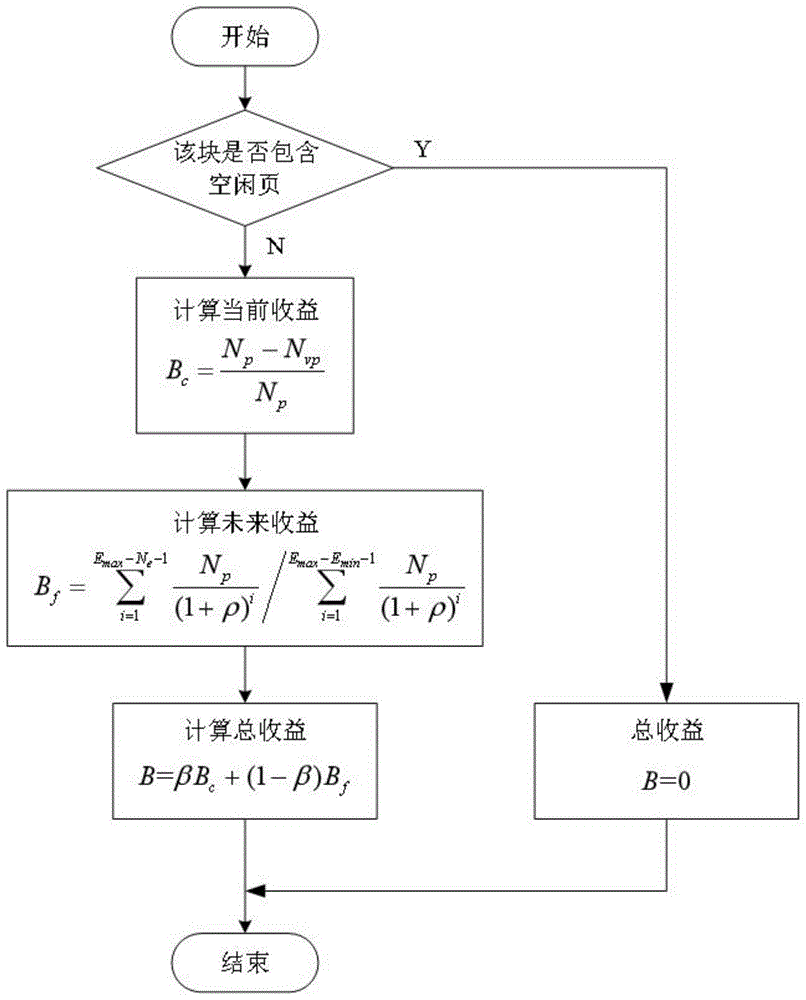
Figure 202011601090

The invention belongs to the technical field of computer storage system design, and in particular relates to a method for selecting victim blocks for garbage collection of solid-state hard disks. It includes the following steps: S1, after the solid-state drive SSD triggers garbage collection, traverse all blocks and calculate the revenue B of each block; S2, after the calculation of the revenue B of all blocks is completed, select the block with the largest revenue B as the recycling block. The invention can convert the future writable amount of the flash memory block to the present, so as to avoid the disadvantage that the block with less erasing times will not be selected as VB due to less invalid pages; When selecting VB, consider the wear leveling of flash memory blocks to achieve the unification of garbage collection and wear leveling, thereby improving the performance and life of SSD.

Figure 202011601090

Description

Selection method for solid state disk garbage recovery victim block
Technical Field
The invention belongs to the technical field of computer storage system design, and particularly relates to a selection method for a solid state disk garbage recycling victim block.
Background
In modern computer systems, the memory system is gradually becoming a performance bottleneck, i.e. a so-called computational memory performance wall, due to fast processor performance and slow memory performance. The solid state disk SSD using NAND flash memory chips as storage media alleviates this problem to some extent, and thus it has become a research hotspot in the mainstream storage device and storage field.
Due to the inherent characteristics of the NAND flash memory of remote updating and erasing before writing, the SSD needs to perform internal Garbage Collection (GC) after writing for a period of time to obtain a new available space. Garbage collection operation after selecting a Victim Block (VB: Vistum Block), it is necessary to migrate the valid pages in the Block to other free space and then erase the selected Victim Block to obtain a re-writable free Block. On one hand, effective page migration and block erasure may affect the host IO request of SSD service, and the performance of SSD is reduced; on the other hand, extra page writes are also caused, increasing wear of the SSD, affecting the lifetime of the SSD. Thus, garbage collection has a direct impact on the performance and lifetime of SSDs.
One key concern of GC is how to select VB. At present, the method mainly comprises a greedy selection mode based on efficiency and a comprehensive selection mode considering wear balance. The greedy selection mode only considers the recovery efficiency, and selects the block with the most invalid pages as VB, so that the most free pages can be obtained by garbage recovery at one time. After the recovery block is selected in the mode, the wear of the flash memory block is balanced and is left to be processed by the wear balancing module. Unlike the efficiency-based greedy selection of VB, the VB integrated selection method considering wear leveling needs to balance a plurality of factors such as the block recovery efficiency, the degree of wear, and the data cooling and heating when selecting a recovery block.
In fact, there is a close link between wear leveling and garbage collection of SSDs. The purpose of garbage collection is to make space available immediately, and the purpose of wearing the wear leveling surface is to make the erase times of each data block more even, and the essence is to make space available in the future. Therefore, if garbage collection and wear leveling can be unified, the performance and life of the SSD can be improved.
For example, the wear leveling garbage recycling accelerating device supporting two bit widths described in chinese patent application No. CN201910751746.9 includes a data reading module, a maximum value generating module, a configuration module, a data bus, and a control bus, where the configuration module gives data reading information and maximum value generating information, initiates data reading, and feeds back a comparison result to the system bus after the maximum value is generated, the data reading module reads the content of a block information table of a corresponding address from the data bus according to the data reading information from the configuration module, and the maximum value generating module iteratively compares data entering from the data reading module according to the maximum value generating information given by the configuration module to finally obtain a maximum value index. Although the hardware acceleration strategy is adopted to help realize wear leveling and garbage collection, the free combination of two bus bit widths and two firmware structure sizes can be supported, the time consumed by erasing and writing of the Flash each time is reduced, the use efficiency and the service life of the Flash are improved, the method has the defects that the scheme cost is high due to the adoption of the hardware acceleration strategy, the method is not beneficial to practical popularization and application, and the scheme does not realize the unification of the garbage collection and the wear leveling.
Disclosure of Invention
The invention provides a selection method for a solid state disk garbage recovery victim block, which can realize the unification of garbage recovery and wear balance, thereby improving the performance and the service life of an SSD, and aims to solve the problem that the existing selection mode of the solid state disk garbage recovery victim block in the prior art cannot realize the unification of garbage recovery and wear balance.
In order to achieve the purpose, the invention adopts the following technical scheme:
the selection method for the solid state disk garbage recovery victim block comprises the following steps:
s1, after the solid state disk SSD triggers garbage collection, traversing all the blocks, and calculating the income B of each block;
and S2, after the profit B of all the blocks is calculated, selecting the block with the maximum profit B as a recovery block.
Preferably, step S1 includes the steps of:
if the calculated block includes a free page, S11 defines that the benefit B of the block is 0.
Preferably, step S1 further includes the steps of:
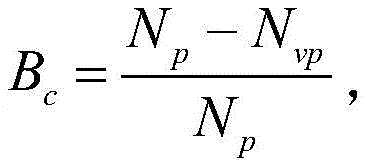
s12, if the calculated block does not contain free pages, counting the number N of effective pages in the blockvpCalculating the current profit
Figure BDA0002869367150000031
Then the next step is performed, where NpThe total number of pages contained for each block;
s13, calculating the future benefit of the block
Figure BDA0002869367150000032
Then the next step is performed, wherein EmaxAnd EminRespectively representing the maximum and minimum erase times, N, of all blockseRepresenting the number of erasures of the selected block, p being a positive number, for modeling discount losses;
s14, calculating the gain B of the block as beta multiplied by Bc+(1-β)×BfWherein, beta is a weight coefficient, and the value range is 0 to 1, which is used for balancing the importance of future income and current income.
Preferably, the current profit B is set forth in step S12cReflecting how much of the available space that the block can immediately obtain is reclaimed, the current profit BcIs a positive number ranging from 0 to 1.
Preferably, the future profit B is set forth in step S13fReflecting how much space is available in the future, the future benefits BfIs a positive number ranging from 0 to 1.
Preferably, step S2 further includes the steps of:
and if a plurality of blocks with the maximum profit B exist, randomly selecting one of the blocks as a recovery block.
Compared with the prior art, the invention has the beneficial effects that: (1) the method can convert the future writable amount of the flash memory block to the present, thereby avoiding the defect that the block with less erasing times cannot be selected to be VB because of less invalid pages; (2) the method and the device can ensure that the wear balance of the flash memory blocks is considered when VB selection of garbage recovery is carried out, and realize the unification of the garbage recovery and the wear balance, thereby improving the performance and the service life of the SSD.
Drawings
FIG. 1 is a flowchart of a selection method for garbage collection of solid state disk victim blocks according to the present invention;
fig. 2 is a flowchart illustrating a specific example of the selection method for garbage collection of solid state disk.
Detailed Description
In order to more clearly illustrate the embodiments of the present invention, the following description will explain the embodiments of the present invention with reference to the accompanying drawings. It is obvious that the drawings in the following description are only some examples of the invention, and that for a person skilled in the art, other drawings and embodiments can be derived from them without inventive effort.
Example 1:
as shown in fig. 1, the present invention provides a selection method for garbage collection victim blocks of a solid state disk, comprising the following steps:
and S1, traversing all the blocks and calculating the profit B of each block after the solid state disk SSD triggers garbage collection.
Step S1 is further specifically divided into the following steps:
s11, if the calculated block includes a free page, defining the profit B of the block to be 0;
s12, if the calculated block does not contain free pages, counting the number N of effective pages in the blockvpCalculating the current profit
Figure BDA0002869367150000041
Then the next step is performed, where NpThe total number of pages contained for each block;
s13, calculating the future benefit of the block
Figure BDA0002869367150000042
Then the next step is performed, wherein EmaxAnd EminRespectively representing the maximum and minimum erase times, N, of all blockseRepresenting the number of erasures of the selected block, p being a positive number, for modeling discount losses;
s14, calculating the gain B of the block as beta multiplied by Bc+(1-β)×BfWherein, beta is a weight coefficient, and the value range is 0 to 1, which is used for balancing the importance of future income and current income.
S2, after the profit B of all blocks is calculated, selecting the block with the maximum profit B as a recovery block; and if a plurality of blocks with the maximum profit B exist, randomly selecting one of the blocks as a recovery block.
Wherein the current profit B in step S12cReflecting how much of the available space that the block can immediately obtain is reclaimed, the current profit BcIs a positive number ranging from 0 to 1; the future profit B in step S13fReflecting how much space is available in the future, the future benefits BfIs a positive number ranging from 0 to 1.
The method of the present invention is specifically applied to the process of the actual case, as shown in fig. 2.
In fig. 2, it is assumed that VB blocks are selected among 8 blocks, each block containing 4 physical pages, triggering garbage collection when the available space is below 0.2; block x _ y indicates Block x has been erased y times, e.g., Block0_4 indicates Block0 has been erased 4 times.
Recycle block selection as shown in fig. 2, the blocks with the most invalid pages are selected as recycle blocks in steps a (1) and a (2), which is also the conventional VB selection method; steps b (1) and b (2) select the reclaim block according to the method proposed by the present invention. The whole process also comprises three page updating operations besides garbage collection.
With the traditional VB selection method, the block with the most invalid pages is selected as the recycle block:
initially the number of free pages was 6 and the total number of pages was 32, with 6/32 being 0.19<0.2 resulting in garbage collection.
In step a (1), block 1 with the most invalid pages is selected as a recycle block, and one page needs to be migrated (to page 2 of block 6), and the number of times of erasing block 1 is 6.
Step a (2), page 0 of block 4, page 1 of block 4, and page 1 of block 6, which are updated, are written into page 3 of block 6, page 0 of block 7, and page 1 of block 7, respectively. The free pages remain 6, again triggering garbage collection.
In step a (3), the block 4 with the largest number of invalid pages is selected as garbage collection, one page needs to be migrated (to page 2 of block 7), and the number of times of erasing of the block 4 is 7. The whole process is finished, and the erasing standard deviation of the flash memory is 1.90.
The method provided by the invention is utilized to select the recovery block:
initially the free pages are 6 and the total number of pages is 32, 6/32 ═ 0.19<0.2 resulting in garbage collection. (in this example, β is 0.6 and ρ is 0.5.)
In step b (1), the gains of 8 blocks are respectively: 0.32,0.45,0.70,0.65,0.15,0.15,0,0. The block 2 with the highest score is selected as the recycle block, two pages (page 2 to block 6 and page 3 to block 6) need to be migrated, and the number of times of erasing of the block 2 becomes 2.
And step b (2), updating page 0 of the block 4, page 1 of the block 4, and writing the updated pages into page 0 of the block 7 and page 1 of the block 7 respectively. The free pages remain 6, again triggering garbage collection.
In step b (3), the gains of 8 blocks are respectively: 0.34,0.45,0,0.70,0,45,0.15,0.32,0. The block 3 with the highest score is selected as the recycle block, two pages (page 2 transferred to block 7 and page 3 of block 7) need to be transferred, and the number of times of erasing of the block 3 becomes 3. Page 1 of block 6 updates page 0 written to block 2. The whole process is finished, and the erasing standard deviation of the flash memory is 1.26
The method mainly solves the selection problem of the damaged block (VB) in the garbage recovery process of the solid state disk, and the basic idea is that when the VB is selected, the current income (namely the currently available free space) and the future income (namely the data volume which can be written in the future) of each block are comprehensively considered, a uniform grading standard is provided, and the block with the highest score is selected as the recovery block, so that garbage recovery operation and wear leveling operation are unified, and the effects of improving the performance and the service life of the SSD are achieved.
The foregoing has outlined rather broadly the preferred embodiments and principles of the present invention and it will be appreciated that those skilled in the art may devise variations of the present invention that are within the spirit and scope of the appended claims.

Claims (6)

1. The selection method for the solid state disk garbage recovery victim block is characterized by comprising the following steps of:
s1, after the solid state disk SSD triggers garbage collection, traversing all the blocks, and calculating the income B of each block;
and S2, after the profit B of all the blocks is calculated, selecting the block with the maximum profit B as a recovery block.
2. The method for selecting the solid state disk garbage collection victim block according to claim 1, wherein the step S1 comprises the steps of:
if the calculated block includes a free page, S11 defines that the benefit B of the block is 0.
3. The method for selecting the solid state disk garbage collection victim block according to claim 2, wherein the step S1 further comprises the steps of:
s12, if the calculated block does not contain free pages, counting the number N of effective pages in the blockvpCalculating the current profit
Figure FDA0002869367140000011
Then the next step is performed, where NpThe total number of pages contained for each block;
s13, calculating the future benefit of the block
Figure FDA0002869367140000012
Then the next step is performed, wherein EmaxAnd EminRespectively representing the maximum erasure of all blocksNumber of times and minimum number of erasures, NeRepresenting the number of erasures of the selected block, p being a positive number, for modeling discount losses;
s14, calculating the gain B of the block as beta multiplied by Bc+(1-β)×BfWherein, beta is a weight coefficient, and the value range is 0 to 1, which is used for balancing the importance of future income and current income.
4. The method for selecting the solid state disk garbage collection victim block of claim 3, wherein the current profit B is obtained in step S12cReflecting how much of the available space that the block can immediately obtain is reclaimed, the current profit BcIs a positive number ranging from 0 to 1.
5. The method for selecting the solid state disk garbage collection victim block of claim 3, wherein the future profit B is obtained in step S13fReflecting how much space is available in the future, the future benefits BfIs a positive number ranging from 0 to 1.
6. The method for selecting the solid state disk garbage collection victim block according to any one of claims 2-5, wherein the step S2 further comprises the steps of:
and if a plurality of blocks with the maximum profit B exist, randomly selecting one of the blocks as a recovery block.
CN202011601090.1A 2020-12-29 2020-12-29 Selection method for solid state disk garbage recovery victim block Active CN112631523B (en)

Priority Applications (1)

Application Number Priority Date Filing Date Title
CN202011601090.1A CN112631523B (en) 2020-12-29 2020-12-29 Selection method for solid state disk garbage recovery victim block

Applications Claiming Priority (1)

Application Number Priority Date Filing Date Title
CN202011601090.1A CN112631523B (en) 2020-12-29 2020-12-29 Selection method for solid state disk garbage recovery victim block

Publications (2)

Publication Number Publication Date
CN112631523A true CN112631523A (en) 2021-04-09
CN112631523B CN112631523B (en) 2022-08-30

Family

ID=75286349

Family Applications (1)

Application Number Title Priority Date Filing Date
CN202011601090.1A Active CN112631523B (en) 2020-12-29 2020-12-29 Selection method for solid state disk garbage recovery victim block

Country Status (1)

Country Link
CN (1) CN112631523B (en)

Cited By (1)

* Cited by examiner, † Cited by third party
Publication number Priority date Publication date Assignee Title
CN119311200A (en) * 2023-07-13 2025-01-14 四川大学 A NAND flash memory garbage collection method based on page sequence number and update time

Citations (4)

* Cited by examiner, † Cited by third party
Publication number Priority date Publication date Assignee Title
US20100325351A1 (en) * 2009-06-12 2010-12-23 Bennett Jon C R Memory system having persistent garbage collection
CN108628758A (en) * 2018-03-14 2018-10-09 深圳忆联信息系统有限公司 A kind of method and solid state disk of selection garbage reclamation object block
CN111324303A (en) * 2020-01-21 2020-06-23 深圳忆联信息系统有限公司 SSD garbage recycling method and device, computer equipment and storage medium
CN111708713A (en) * 2020-05-20 2020-09-25 杭州电子科技大学 An intelligent garbage collection and scheduling method for solid-state drives

Patent Citations (4)

* Cited by examiner, † Cited by third party
Publication number Priority date Publication date Assignee Title
US20100325351A1 (en) * 2009-06-12 2010-12-23 Bennett Jon C R Memory system having persistent garbage collection
CN108628758A (en) * 2018-03-14 2018-10-09 深圳忆联信息系统有限公司 A kind of method and solid state disk of selection garbage reclamation object block
CN111324303A (en) * 2020-01-21 2020-06-23 深圳忆联信息系统有限公司 SSD garbage recycling method and device, computer equipment and storage medium
CN111708713A (en) * 2020-05-20 2020-09-25 杭州电子科技大学 An intelligent garbage collection and scheduling method for solid-state drives

Non-Patent Citations (1)

* Cited by examiner, † Cited by third party
Title
OHHOON KWON: "FeGC: An efficient garbage collection scheme for flash memory based", 《THE JOURNAL OF SYSTEMS AND SOFTWARE》 *

Cited By (1)

* Cited by examiner, † Cited by third party
Publication number Priority date Publication date Assignee Title
CN119311200A (en) * 2023-07-13 2025-01-14 四川大学 A NAND flash memory garbage collection method based on page sequence number and update time

Also Published As

Publication number Publication date
CN112631523B (en) 2022-08-30

Similar Documents

Publication Publication Date Title
US10795586B2 (en) System and method for optimization of global data placement to mitigate wear-out of write cache and NAND flash
US8103820B2 (en) Wear leveling method and controller using the same
JP5603997B2 (en) Storage apparatus and data control method
CN107710169B (en) Access method and device of flash memory device
CN109496300B (en) Storage medium garbage collection method, storage medium and program product
CN102222046B (en) Abrasion equilibrium method and device
CN103092766B (en) A kind of loss equalizing implementation method for NAND FLASH
US20200225882A1 (en) System and method for compaction-less key-value store for improving storage capacity, write amplification, and i/o performance
US11126561B2 (en) Method and system for organizing NAND blocks and placing data to facilitate high-throughput for random writes in a solid state drive
US20190146925A1 (en) Method and system for enhancing flash translation layer mapping flexibility for performance and lifespan improvements
CN108733306B (en) A file merging method and device
KR20210099870A (en) Memory system and operating method thereof
CN103838676B (en) Data-storage system, date storage method and PCM bridges
CN110633047A (en) Method for managing flash memory module and related flash memory controller and electronic device
CN106557432B (en) Buffer memory management method, memory control circuit unit and storage device
CN112346666A (en) Writing and block granularity compression and combination method and system of key value storage system based on OCSSD
EP4012547B1 (en) Storage method and apparatus for key value (kv) and storage device
US20200327066A1 (en) Method and system for online recovery of logical-to-physical mapping table affected by noise sources in a solid state drive
CN111708713A (en) An intelligent garbage collection and scheduling method for solid-state drives
KR101480424B1 (en) Apparatus and method for optimization for improved performance and enhanced lifetime of hybrid flash memory devices
US20200133511A1 (en) Optimized placement of data contained in a garbage collected storage system
CN110347613A (en) Method, controller and the multi-tenant solid-state disk of RAID are realized in multi-tenant solid-state disk
CN116134519A (en) Balanced three-level read disturb management in memory devices
WO2017123776A1 (en) System and method of write amplification factor mitigation and flash lifespan extension
US11429519B2 (en) System and method for facilitating reduction of latency and mitigation of write amplification in a multi-tenancy storage drive

Legal Events

Date Code Title Description
PB01 Publication
PB01 Publication
SE01 Entry into force of request for substantive examination
GR01 Patent grant
GR01 Patent grant
TR01 Transfer of patent right

Effective date of registration: 20240708

Address after: 518000 1002, Building A, Zhiyun Industrial Park, No. 13, Huaxing Road, Henglang Community, Longhua District, Shenzhen, Guangdong Province

Patentee after: Shenzhen Wanzhida Technology Co.,Ltd.

Country or region after: China

Address before: 310018 no.1158, No.2 street, Baiyang street, Hangzhou Economic and Technological Development Zone, Hangzhou, Zhejiang Province

Patentee before: HANGZHOU DIANZI University

Country or region before: China

TR01 Transfer of patent right

Effective date of registration: 20250416

Address after: 1034, 10th Floor, Building 27, Taihu Beili, Tongzhou District, Beijing, 100000

Patentee after: Beijing Juanpeng Interactive Entertainment Technology Co.,Ltd.

Country or region after: China

Address before: 518000 1002, Building A, Zhiyun Industrial Park, No. 13, Huaxing Road, Henglang Community, Longhua District, Shenzhen, Guangdong Province

Patentee before: Shenzhen Wanzhida Technology Co.,Ltd.

Country or region before: China

TR01 Transfer of patent right