CN112614119A - Medical image region-of-interest visualization method, device, storage medium and equipment - Google Patents
Medical image region-of-interest visualization method, device, storage medium and equipment Download PDFInfo
- Publication number
- CN112614119A CN112614119A CN202011587331.1A CN202011587331A CN112614119A CN 112614119 A CN112614119 A CN 112614119A CN 202011587331 A CN202011587331 A CN 202011587331A CN 112614119 A CN112614119 A CN 112614119A
- Authority
- CN
- China
- Prior art keywords
- image
- model
- region
- interest
- training
- Prior art date
- Legal status (The legal status is an assumption and is not a legal conclusion. Google has not performed a legal analysis and makes no representation as to the accuracy of the status listed.)
- Granted
Links
Images

Classifications
-
- G—PHYSICS
- G06—COMPUTING OR CALCULATING; COUNTING
- G06T—IMAGE DATA PROCESSING OR GENERATION, IN GENERAL
- G06T7/00—Image analysis
- G06T7/0002—Inspection of images, e.g. flaw detection
- G06T7/0012—Biomedical image inspection
-
- G—PHYSICS
- G06—COMPUTING OR CALCULATING; COUNTING
- G06F—ELECTRIC DIGITAL DATA PROCESSING
- G06F18/00—Pattern recognition
- G06F18/20—Analysing
- G06F18/21—Design or setup of recognition systems or techniques; Extraction of features in feature space; Blind source separation
- G06F18/214—Generating training patterns; Bootstrap methods, e.g. bagging or boosting
-
- G—PHYSICS
- G06—COMPUTING OR CALCULATING; COUNTING
- G06F—ELECTRIC DIGITAL DATA PROCESSING
- G06F18/00—Pattern recognition
- G06F18/20—Analysing
- G06F18/24—Classification techniques
-
- G—PHYSICS
- G06—COMPUTING OR CALCULATING; COUNTING
- G06N—COMPUTING ARRANGEMENTS BASED ON SPECIFIC COMPUTATIONAL MODELS
- G06N3/00—Computing arrangements based on biological models
- G06N3/02—Neural networks
- G06N3/04—Architecture, e.g. interconnection topology
- G06N3/045—Combinations of networks
-
- G—PHYSICS
- G06—COMPUTING OR CALCULATING; COUNTING
- G06N—COMPUTING ARRANGEMENTS BASED ON SPECIFIC COMPUTATIONAL MODELS
- G06N3/00—Computing arrangements based on biological models
- G06N3/02—Neural networks
- G06N3/08—Learning methods
-
- G—PHYSICS
- G06—COMPUTING OR CALCULATING; COUNTING
- G06V—IMAGE OR VIDEO RECOGNITION OR UNDERSTANDING
- G06V10/00—Arrangements for image or video recognition or understanding
- G06V10/20—Image preprocessing
- G06V10/25—Determination of region of interest [ROI] or a volume of interest [VOI]
-
- G—PHYSICS
- G06—COMPUTING OR CALCULATING; COUNTING
- G06T—IMAGE DATA PROCESSING OR GENERATION, IN GENERAL
- G06T2207/00—Indexing scheme for image analysis or image enhancement
- G06T2207/20—Special algorithmic details
- G06T2207/20081—Training; Learning
-
- G—PHYSICS
- G06—COMPUTING OR CALCULATING; COUNTING
- G06T—IMAGE DATA PROCESSING OR GENERATION, IN GENERAL
- G06T2207/00—Indexing scheme for image analysis or image enhancement
- G06T2207/20—Special algorithmic details
- G06T2207/20084—Artificial neural networks [ANN]
-
- G—PHYSICS
- G06—COMPUTING OR CALCULATING; COUNTING
- G06T—IMAGE DATA PROCESSING OR GENERATION, IN GENERAL
- G06T2207/00—Indexing scheme for image analysis or image enhancement
- G06T2207/20—Special algorithmic details
- G06T2207/20092—Interactive image processing based on input by user
- G06T2207/20104—Interactive definition of region of interest [ROI]
-
- G—PHYSICS
- G06—COMPUTING OR CALCULATING; COUNTING
- G06T—IMAGE DATA PROCESSING OR GENERATION, IN GENERAL
- G06T2207/00—Indexing scheme for image analysis or image enhancement
- G06T2207/30—Subject of image; Context of image processing
- G06T2207/30004—Biomedical image processing
- G06T2207/30016—Brain
Landscapes
- Engineering & Computer Science (AREA)
- Theoretical Computer Science (AREA)
- Physics & Mathematics (AREA)
- Data Mining & Analysis (AREA)
- General Physics & Mathematics (AREA)
- Artificial Intelligence (AREA)
- General Engineering & Computer Science (AREA)
- Evolutionary Computation (AREA)
- Life Sciences & Earth Sciences (AREA)
- General Health & Medical Sciences (AREA)
- Health & Medical Sciences (AREA)
- Computer Vision & Pattern Recognition (AREA)
- Biophysics (AREA)
- Software Systems (AREA)
- Evolutionary Biology (AREA)
- Computational Linguistics (AREA)
- Bioinformatics & Computational Biology (AREA)
- Bioinformatics & Cheminformatics (AREA)
- Molecular Biology (AREA)
- Computing Systems (AREA)
- Biomedical Technology (AREA)
- Mathematical Physics (AREA)
- Medical Informatics (AREA)
- Multimedia (AREA)
- Nuclear Medicine, Radiotherapy & Molecular Imaging (AREA)
- Radiology & Medical Imaging (AREA)
- Quality & Reliability (AREA)
- Image Analysis (AREA)
Abstract
The invention discloses a method, a device, a storage medium and equipment for visualizing a region of interest of a medical image, wherein a convolutional neural network is used as a classification model, and multi-scale input data is adopted for training in the training process of the model: 1) original image, 2) image blocks randomly taken from the original image; the randomly extracted image blocks and the original images are alternately used as the input of the model, the model can comprehensively learn the input information from the images in different scales, and the model can also learn the whole information of the images. The training labels adopt mental disease label categories, namely the output of the model is health, schizophrenia, bipolar affective disorder and the like. According to the method, the specific training strategy is utilized, the model is fused with the local information and the overall information of the image, the image is classified quickly and accurately, and meanwhile, a more refined region-of-interest visualization result for the specified category can be achieved compared with the existing method.
Description
Technical Field
The present invention relates to image data analysis technologies, and in particular, to a method, an apparatus, a storage medium, and a device for visualizing a region of interest in a medical image.
Background
At present, an image classification method based on deep learning, especially a Convolutional Neural Network (CNN), is one of mainstream research methods in the field of image analysis, and has achieved a good effect in various application scenarios, but in a fine-grained image classification task, the performance of deep learning algorithms such as CNN is still to be improved. Taking the mental disease classification task based on the brain structure magnetic resonance image as an example, because the anatomical structure of the brain is complex, the influence of the mental disease on the brain structure is relatively slight, and different from diseases with exact focus such as tumor, stroke and the like, the influence of the mental disease on the brain is often distributed in a plurality of positions in the brain, so for the mental disease diagnosis task, the whole brain structure magnetic resonance image has a large amount of redundant information, so the whole brain structure magnetic resonance image is directly used as the input of a deep learning model, and the accurate diagnosis of the mental disease is difficult to realize.
In order to solve the problem, the current latest research proposes that a specific image area is located by utilizing prior information, and the specific image area is regarded as an image area highly related to a classification label according to prior, such as a hippocampus area in a brain magnetic resonance image in a dementia diagnosis task, a vehicle logo area in an automobile brand classification task, and the like. And extracting the positioning area as an image block, and classifying the image block as the input of the deep learning model. The strategy can greatly reduce redundant information in the original image, thereby improving the classification precision. However, the above strategy has four problems: 1) the image interested region needs to be manually defined in advance, and for some images which are difficult to classify (such as a brain structure magnetic resonance image of a schizophrenia patient), it is difficult to precisely define which specific image regions are affected in advance; 2) for different images, it is difficult to determine the size of the image block containing the region of interest, and therefore the region of interest may be out of the range of the predefined image block, or contained in multiple image blocks, thus causing the absence or segmentation of the classification-related features; 3) after the interested region is well defined, the interested region is extracted from each image data, and the assistance of a target detection algorithm is needed, so the precision of the target detection algorithm greatly determines the performance of a subsequent classification model; 4) predefined regions of interest may be associated with each other, and therefore directly extracting regions of interest for classification will result in loss of such potential association information, thereby not achieving efficient utilization of data.
One drawback of deep learning classification models is their difficult interpretability, i.e., it is difficult to provide models with which to infer and decide upon which features. In order to solve the problem, the latest research at present adopts a strategy of a Class Activation Map (CAM) and a Gradient-based Class activation map (Grad-CAM), that is, the neuron weight of a network model full connection layer or the average value of each channel feature map is used for weighting the Gradient activation condition of each channel of the network, so as to obtain the response condition of the model to a specific Class label of each input image, and further visualize which regions of the image the deep learning model makes a larger response. At present, CAM and Grad-CAM are widely applied to various fields of image processing, but the method needs to utilize gradient activation conditions on a feature map obtained by down-sampling in a deep neural network model, so that a large-scale up-sampling operation is needed in a visualization process, an obtained category activation map is fuzzy, and if an application scene needs fine explanation (for example, the visualization close to a voxel level is needed in medical image analysis), the CAM method cannot obtain a fine visualization result.
In conclusion, the model in the prior art has poor fusion of local information and overall information of the image, and has low classification speed and accuracy of the image; the fineness of the visualization result of the region of interest for the formulation category is not high. A high-speed and high-precision method for image classification and region-of-interest visualization is needed.
Disclosure of Invention
In order to overcome the deficiencies of the prior art, it is an object of the present invention to provide a method, an apparatus, a storage medium and a device for visualizing a region of interest of a medical image, which solve the above mentioned problems.
The purpose of the invention is realized by adopting the following technical scheme.
A method for automatically classifying medical images and visualizing interested areas comprises the following steps:
step 1, establishing a classification model;
step 2, randomly extracting an image block with any size from any position on an original image in training data as the input of a model for training;
step 3, training the whole original image in the step 2 as the input of a model to obtain a class label matched with the image block and determine a corresponding weight;
step 4, changing the selected position of the original image in the step 2, and extracting image blocks with any size as the input of the model for training;
step 5, training by taking the whole original image in the step 2 as the input of the model;
step 6, repeating the step 4 and the step 5, traversing the whole original image by the position of the selected image block, and learning the global and local texture information of different positions of the image through iterative training to obtain a trained generator;
step 7, verifying and testing, loading the trained generator, randomly taking T image blocks from the original image, enabling the sampled image block set to cover the whole image in an overlapping manner, and obtaining an interested area activation graph L of the original image X aiming at the class label c by fusing the activation graphs in each image blockc(X);
Step 8, activating the map L through the interested region of the original image XcAnd (X) realizing the activation condition of the neural network to each category of the input test image, marking the interested region of the neural network, and realizing the visualization of the neural network.
Preferably, in step 1, a convolutional neural network is used as the classification model.
Preferably, the image block size is a square size block.
Preferably, the training labels are in the category of psychiatric label and the model outputs are health, schizophrenia, and bipolar disorder.
Preferably, the disease label class c, the region of interest activation map l of the neural network for the corresponding image patchc(x) Comprises the following steps:

in the formula: f. ofk(x) When the input image block is x, the convolutional neural network outputs a characteristic diagram of k channels by the last convolutional layer; taking the average value of the gradient values of the label class c on k characteristic channels of the last convolutional layer as the weight of each characteristic graph; ReLU (-) is a linear rectifying unit activation function; upsamp (·) is an upsampling operation, i.e., upsampling the channel weighted summed feature map size to the input image block size.
Preferably, the activation map L of the region of interest of the original image Xc(X) is:

in the formula: lc(xt) is the region-of-interest activation map of the tth image block calculated according to formula 1; activation map l for the region of interest of the tth image blockc(xt) according to xtCopying the spatial position on the original image X to a blank image with the same size as the original image X
 The operation of (1);
 image block x for convolutional neural network modeltThe probability predicted as the class c is the output result of the output layer before the thresholding operation in the neural network, and the output result is used as the region-of-interest activation map l of the t-th image blockc(xt) The weight of (c); by Hadamard product, i.e. matrix diagramMultiplying the image corresponding to the position element;
 recording matrix for overlapping condition, the size of which is the same as that of original image X, and each element of which is the image
 Pasting operation on corresponding position
 The inverse of the number of overlaps.
The invention also provides an apparatus for recognizing a medical image, the apparatus comprising:
an image acquisition module for acquiring a medical image;
the image processing module is used for carrying out primary processing on the medical image through an image processing method to obtain a binary image convenient for learning;
the region extraction module is used for performing morphological random block selection processing on the processed binary image to obtain a region of interest;
and (4) visualizing the classification identification, and identifying the region of interest by using the convolutional neural network model trained by the method.
The invention also provides a computer storage medium having a computer program stored thereon, characterized in that the program, when executed by a processor, implements the method as described above.
The present invention also provides an electronic device, the device comprising: a processor and a memory; the memory has stored thereon computer readable instructions which, when executed by the processor, implement the aforementioned method.
Compared with the prior art, the invention has the beneficial effects that: 1. the fusion of the model to the local information and the overall information of the image is realized by utilizing a specific training strategy, and the rapid and accurate classification of the image is realized;
2. a new deep learning visualization method is provided, and a more refined region-of-interest visualization result for a specified category compared with the existing method can be realized.
Drawings
FIG. 1 is a schematic diagram of training and testing of the image classification and visualization system of the present invention.
Detailed Description
In order to make the objects, technical solutions and advantages of the embodiments of the present invention clearer, the technical solutions in the embodiments of the present invention will be clearly and completely described below with reference to the drawings in the embodiments of the present invention, and it is obvious that the described embodiments are some, but not all, embodiments of the present invention. All other embodiments, which can be obtained by a person skilled in the art without any inventive step based on the embodiments of the present invention, are within the scope of the present invention.
Furthermore, the described features, structures, or characteristics may be combined in any suitable manner in one or more embodiments. In the following description, numerous specific details are provided to provide a thorough understanding of embodiments of the invention. One skilled in the relevant art will recognize, however, that the invention may be practiced without one or more of the specific details, or with other methods, components, devices, steps, and so forth. In other instances, well-known methods, devices, implementations or operations have not been shown or described in detail to avoid obscuring aspects of the invention.
If a block diagram is present in the figures, the block diagram shown is only a functional entity and does not necessarily correspond to a physically separate entity. I.e. these functional entities may be implemented in the form of software, or in one or more hardware modules or integrated circuits, or in different networks and/or processor means and/or microcontroller means.
The flow charts shown in the drawings are merely illustrative and do not necessarily include all of the contents and operations/steps, nor do they necessarily have to be performed in the order described. For example, some operations/steps may be decomposed, and some operations/steps may be combined or partially combined, so that the actual execution sequence may be changed according to the actual situation.
Before explaining the technical solutions of the embodiments of the present invention in detail, some related technical solutions, terms and principles are described below.
Convolutional Neural Network (CNN)
CNN is a multi-layered supervised learning neural network that deals with image-related machine learning problems.
A typical CNN consists of a convolutional layer (Convolution), a Pooling layer (firing), and a fully connected layer (FullyConnection). The low hidden layer generally consists of convolution layers and pooling layers, wherein the convolution layers are used for enhancing the original signal characteristics of the image and reducing noise through convolution operation, and the pooling layers are used for reducing the calculation amount while keeping the image rotation invariance according to the principle of image local correlation. The fully connected layer is located at the upper layer of the CNN, the input of the fully connected layer is a feature image obtained by feature extraction of the convolutional layer and the pooling layer, the output of the fully connected layer is a connectable classifier, and the input image is classified by adopting logistic regression, Softmax regression or a Support Vector Machine (SVM).
The CNN training process generally adopts a gradient descent method to minimize a loss function, weight parameters of all layers in the network are reversely adjusted layer by layer through a loss layer connected behind a full connection layer, and the accuracy of the network is improved through frequent iterative training. The training sample set of CNN is usually composed of vector pairs in the form of "input vector, ideal output vector", and the weighting parameters of all layers of the network may be initialized with some different small random numbers before training is started. Because CNN can be regarded as an input-to-output mapping in nature, and a large number of input-to-output mapping relationships can be learned without any precise mathematical expressions between inputs and outputs, CNN can be trained with a training sample set composed of known vector pairs to have the capability of mapping between input-output pairs.
Softmax layer
The Softmax function maps multiple scalars into a probability distribution with each value range of the output being (0, 1). The softmax function is often used in the last layer of the neural network as the output layer for multi-classification.
Residual neural network (ResidualNeralNet, ResNet)
Typical network structures for CNNs include ResNet, AlexNet, VGGNet, GoogleNet, SENet, and the like.
Compared with other network structures, the ResNet is the most different in that it can set a bypass branch to connect the input directly into the layer behind the network, so that the layer behind the network can also directly learn the residual error. The method can solve the problem that the original information is lost more or less when the information is transferred by the traditional CNN, thereby protecting the integrity of the data.
ImageNet data set
The ImageNet dataset is a large visual database for visual object recognition software research. Image URLs in excess of 1400 million were manually annotated by ImageNet to indicate objects in the picture; a bounding box is also provided in at least one million images.
ASAP (automatic Slide Analysis Platform, automatic slice Analysis Platform)
ASAP is an open source platform for histopathology WSI (Whole slice Image) analysis that integrates browsing, labeling, etc. functions. ASAP is built based on a number of mature open source software packages, such as OpenSlide, Qt, OpenCV, and the like.
TensorFlow
Tensorflow is a second generation artificial intelligence learning system developed by Google based on DistBerief, and the naming of the Tensorflow comes from the operation principle of the Tensorflow. Tensor means an N-dimensional array, Flow means computation based on a dataflow graph, and TensorFlow is a computation process in which tensors Flow from one end of the Flow graph to the other. TensorFlow is a system that transports complex data structures into artificial intelligent neural networks for analysis and processing.
TFRecord data format
TFRecord is a data format that may allow arbitrary data to be converted to formats supported by the tensrflow, which may make the data set of the tensrflow more easily compatible with network application architectures.
PNPoly algorithm
The algorithm is proposed by w. The idea of the algorithm is as follows: and (4) starting a ray from the point to be measured, and then judging the number of intersection points of the ray and the irregular area. If the number of the intersection points on the two sides of the point is odd, the point is in the polygon, otherwise, the point is outside the polygon. This algorithm works for any irregular pattern.
The principle and implementation details of the technical solution of the embodiments of the present invention are explained in detail below.
Example one
A method for automatically classifying medical images and visualizing interested areas takes a mental disease diagnosis task based on a brain structure magnetic resonance image as an example, and the method is as follows.
A Convolutional Neural Network (CNN) is used as a classification model, and in the training process of the model, multi-scale input data are adopted for training, namely the training data comprises two parts: 1) original image, 2) image blocks randomly derived from the original image.
For each training data, firstly, randomly extracting an image block (such as 48 × 48 × 48) from any position on the image as the input of the model for training, and then training by taking the whole image as the input of the model.
Because each training data needs to participate in multiple iterations of model training (set to 2000 times in an experiment and can be adjusted according to actual conditions), the sampling position of an image block can traverse the whole image, and therefore the model can learn local texture information of different positions of the image; on the other hand, the original image that has not been clipped is also used as input training data, so the model can learn the entire information of the image. According to the description, in the model training process, the randomly extracted image blocks and the original images are alternately used as the input of the model, and through the training strategy, the model can comprehensively learn the input information from the images in different scales, so that more reliable judgment on mental disease brain change modes is obtained. The training labels adopt mental disease label categories, namely the output of the model is health, schizophrenia, bipolar affective disorder and the like.
And after the model training is finished, inputting any test image into the model to obtain a prediction result of the model for the disease label.
For the trained model, the whole image may be input as the test image as described above, or an image block (e.g., 48 × 48 × 48) may be input, and the disease prediction result on the image block region may be obtained. For the disease label class c, the region of interest activation map l of the neural network for the image block can be calculated byc(x):

In the above formula, fk(x) When the input CNN image block is x, the characteristic diagram of k channels output by the last layer of convolution layer of CNN; taking the average value of the gradient values of the label class c on k characteristic channels of the last convolutional layer as the weight of each characteristic graph; ReLU (-) is a linear rectifying unit activation function; upsamp (·) is an upsampling operation, i.e., upsampling the channel weighted summed feature map size to the input image block size. It should be noted that, unlike the conventional CAM method, which requires upsampling of the feature map to the original input image size, the method only requires upsampling of the feature map to the input image block size, thereby greatly reducing the problem of blurring of the activation map of the region of interest due to upsampling.
According to the calculation, each image block of the input model in the testing stage can obtain the corresponding activation condition. T image blocks (T2000 in the experiment) are randomly selected from the original image, and the sampled image block set can cover the whole image in an overlapping manner. By fusing the activation maps in each image block, the region-of-interest activation map L of the original image X for the class label c can be obtainedc(X):

In the above formula, /)c(xt) Activating the image of the region of interest of the tth image block obtained according to the calculation; activation map l for the region of interest of the tth image blockc(xt) According to xtCopying the spatial position on the original image X to a blank image with the same size as the original image X
 The operation of (1);
 image block x for CNN modeltThe probability of the predicted image block as the class c (in the neural network, the output result of the output layer before the thresholding operation) is used as the region-of-interest activation map l of the t-th image blockc(xt) The weight of (c); is the product of hadamard (i.e. multiplication of the elements of the matrix (image) at corresponding positions;
 recording matrix for overlapping condition, the size of which is the same as that of original image X, and each element of which is the image
 Pasting operation on corresponding position
 The inverse of the number of overlaps.
According to the calculation, the obtained interesting region activation map of the original image X can realize the activation condition of the neural network on each type of the input test image, mark the interesting region of the neural network, provide a visualization method of the neural network, provide a basis for subsequent analysis and positioning and reclassification of the interesting region, and simultaneously reserve more details compared with the existing CAM method.
Specifically, the training process of the model is as shown in fig. 1. The classification network is a deep convolution neural network, the network structure of the classification network mainly comprises 5 convolution layers with convolution kernel size of 3 multiplied by 3 and step length of 1, each convolution layer comprises a batch normalization layer, a ReLU activation function layer and a maximum pooling layer with pooling kernel size of 2 multiplied by 2 and step length of 2, each convolution layer is processed by a group of convolution layer, batch normalization layer, activation function layer and pooling layer, the size of a feature map is reduced by half, the number of channels is doubled, finally 128-dimensional vectors are output, and n-dimensional vectors (n is the category number of a sample set to be classified) are output after processing by a layer of full connection layer.
The loss function of the model adopts a cross entropy loss function commonly used in a neural network algorithm, an optimization mode adopts an adaptive moment estimation algorithm, the learning rate is set to be 1e-4, and the model parameters are updated through a gradient descent method.
And (3) effect testing:
the image classifier and the visualization system obtained by training are used for judging the label of a single image in 0.1 second by utilizing a Pythroch building model and testing on an Intel (R) Xeon (R) CPU E5-2670v22.50GHz processor carrying a CentOs 6.5 system, and testing 3200 cases of magnetic resonance structure image data collected from different centers to obtain the classification accuracy of 5 types of mental diseases of 85 percent; meanwhile, cortical feature extraction is carried out on the region of interest obtained through visualization, the extracted features are subjected to classification test by using a linear SVM, and compared with the classification precision of the feature extracted directly from the whole cerebral cortex without the region of interest as input of the linear SVM, the obtained result is improved by 10%.
Special description:
1. in terms of network structure, the network structure of the classified network is not limited to the aforementioned structure, and may include, but is not limited to, ResNet, densnet, LSTM, GRU, etc.;
2. in the classification model training stage, the fixed size of the image block of the input model is not limited to the aforementioned size of 48 × 48 × 48, but may be other sizes;
3. in the classification model training stage, image blocks input into the model are not limited to fixed sizes, and variable-size image blocks can be used as input, namely the model is trained by the image blocks with various sizes;
4. the loss function part is not limited to the cross entropy loss function described above, and may be a classification loss function such as Focal loss and BCEloss.
5. The invention is explained by taking a magnetic resonance structural image as an example, but the invention is applicable to objects including, but not limited to, medical images, remote sensing images, microscope slice images, natural images and the like of other modalities
6. The invention discloses an image classification and region-of-interest visualization method. The method realizes the fusion of the local information and the overall information of the image by the model by utilizing a specific training strategy for the first time, and realizes the rapid and accurate classification of the image
7. The invention provides a novel deep learning visualization method, which can realize more refined visualization result of the region of interest of the specified category compared with the existing method
Example two
The invention also provides an apparatus for recognizing a medical image, the apparatus comprising:
an image acquisition module for acquiring a medical image;
the image processing module is used for carrying out primary processing on the medical image through an image processing method to obtain a binary image convenient for learning;
the region extraction module is used for performing morphological random block selection processing on the processed binary image to obtain a region of interest;
and (4) visualizing the classification identification, and identifying the region of interest by using the convolutional neural network model trained by the method.
EXAMPLE III
The invention also provides a computer storage medium having a computer program stored thereon, characterized in that the program, when executed by a processor, implements the method as described above.
The computer readable media described herein may be a computer readable signal medium or a computer readable storage medium, or any combination of the two. A computer readable storage medium may be, for example, but not limited to, an electronic, magnetic, optical, electromagnetic, infrared, or semiconductor system, apparatus, or device, or any combination of the foregoing. More specific examples of the computer readable storage medium may include, but are not limited to: an electrical connection having one or more wires, a portable computer diskette, a hard disk, a Random Access Memory (RAM), a read-only memory (ROM), an erasable programmable read-only memory (EPROM or flash memory), an optical fiber, a portable compact disc read-only memory (CD-ROM), an optical storage device, a magnetic storage device, or any suitable combination of the foregoing. In the present invention, a computer readable storage medium may be any tangible medium that can contain, or store a program for use by or in connection with an instruction execution system, apparatus, or device. In the present invention, however, a computer readable signal medium may include a propagated data signal with computer readable program code embodied therein, for example, in baseband or as part of a carrier wave. Such a propagated data signal may take many forms, including, but not limited to, electro-magnetic, optical, or any suitable combination thereof. A computer readable signal medium may also be any computer readable medium that is not a computer readable storage medium and that can communicate, propagate, or transport a program for use by or in connection with an instruction execution system, apparatus, or device. Program code embodied on a computer readable medium may be transmitted using any appropriate medium, including but not limited to: wireless, wire, fiber optic cable, RF, etc., or any suitable combination of the foregoing.
The computer-readable medium may be included in the electronic device described in the above embodiments; or may exist separately without being assembled into the electronic device. The computer readable medium carries one or more programs which, when executed by an electronic device, cause the electronic device to implement the method as described in the embodiments below. For example, the electronic device may implement the steps of the aforementioned method.
Example four
The present invention also provides an electronic device, the device comprising: a processor and a memory; the memory has stored thereon computer readable instructions which, when executed by the processor, implement the aforementioned method.
The method may be implemented as a computer software program. For example, embodiments of the invention include a computer program product comprising a computer program embodied on a computer-readable medium, the computer program comprising program code for performing the method illustrated in the flow chart. In such an embodiment, the computer program may be downloaded and installed from a network via the communication section, and/or installed from a removable medium. The computer program, when executed by a Central Processing Unit (CPU), performs various functions defined in the methods, apparatus and devices of the present application.
In view of the above, it is desirable to provide,
finally, it should be noted that: the above examples are only intended to illustrate the technical solution of the present invention, but not to limit it; although the present invention has been described in detail with reference to the foregoing embodiments, it will be understood by those of ordinary skill in the art that: the technical solutions described in the foregoing embodiments may still be modified, or some technical features may be equivalently replaced; and such modifications or substitutions do not depart from the spirit and scope of the corresponding technical solutions of the embodiments of the present invention.
Claims (9)
1. A method for visualizing a region of interest in a medical image, the method comprising:
step 1, establishing a classification model;
step 2, randomly extracting an image block with any size from any position on an original image in training data as the input of a model for training;
step 3, training the whole original image in the step 2 as the input of a model to obtain a class label matched with the image block and determine a corresponding weight;
step 4, changing the selected position of the original image in the step 2, and extracting image blocks with any size as the input of the model for training;
step 5, training by taking the whole original image in the step 2 as the input of the model;
step 6, repeating the step 4 and the step 5, traversing the whole original image by the position of the selected image block, and learning the global and local texture information of different positions of the image through iterative training to obtain a trained generator;
step 7, verifying and testing, loading the trained generator, randomly taking T image blocks from the original image, enabling the sampled image block set to cover the whole image in an overlapping manner, and obtaining an interested area activation graph L of the original image X aiming at the class label c by fusing the activation graphs in each image blockc(X);
Step 8, activating the map L through the interested region of the original image XcAnd (X) realizing the activation condition of the neural network to each category of the input test image, marking the interested region of the neural network, and realizing the visualization of the neural network.
2. The method of claim 1, wherein: in step 1, a convolutional neural network is used as a classification model.
3. The method of claim 1, wherein: the image block size is in square size.
4. The method of claim 1, wherein: the training labels are in the category of psychiatric label, and the model outputs are health, schizophrenia, and bipolar affective disorder.
5. The method according to claim 1 or 4, characterized in that: class c disease label, region of interest activation map of neural network for corresponding image patch lc(x) Comprises the following steps:

in the formula:
fk(x) When the input image block is x, the convolutional neural network outputs a characteristic diagram of k channels by the last convolutional layer;

ReLU (-) is a linear rectifying unit activation function;
upsamp (·) is an upsampling operation, i.e., upsampling the channel weighted summed feature map size to the input image block size.
6. The method of claim 5, wherein: region of interest activation map L of original image Xc(X) is:

in the formula:
lc(xt) The region-of-interest activation map of the tth image block calculated according to the formula 1;


degree is Hadamard product, i.e. multiplication of elements at corresponding positions of the matrix image;

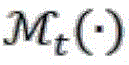
7. An apparatus for recognizing a medical image, the apparatus comprising:
an image acquisition module for acquiring a medical image;
the image processing module is used for carrying out primary processing on the medical image through an image processing method to obtain a binary image convenient for learning;
the region extraction module is used for performing morphological random block selection processing on the processed binary image to obtain a region of interest;
visualizing the classification marker, identifying a region of interest by a convolutional neural network model trained by the method of any one of claims 1-6.
8. A computer storage medium on which a computer program is stored, which program, when being executed by a processor, is adapted to carry out the method according to any one of claims 1-6.
9. An electronic device, comprising: a processor and a memory; the memory has stored thereon computer-readable instructions that, when executed by the processor, implement the method of any of claims 1-6.
Priority Applications (1)
| Application Number | Priority Date | Filing Date | Title |
|---|---|---|---|
| CN202011587331.1A CN112614119B (en) | 2020-12-28 | 2020-12-28 | Medical image region of interest visualization method, device, storage medium and equipment |
Applications Claiming Priority (1)
| Application Number | Priority Date | Filing Date | Title |
|---|---|---|---|
| CN202011587331.1A CN112614119B (en) | 2020-12-28 | 2020-12-28 | Medical image region of interest visualization method, device, storage medium and equipment |
Publications (2)
| Publication Number | Publication Date |
|---|---|
| CN112614119A true CN112614119A (en) | 2021-04-06 |
| CN112614119B CN112614119B (en) | 2024-04-12 |
Family
ID=75248829
Family Applications (1)
| Application Number | Title | Priority Date | Filing Date |
|---|---|---|---|
| CN202011587331.1A Active CN112614119B (en) | 2020-12-28 | 2020-12-28 | Medical image region of interest visualization method, device, storage medium and equipment |
Country Status (1)
| Country | Link |
|---|---|
| CN (1) | CN112614119B (en) |
Cited By (10)
| Publication number | Priority date | Publication date | Assignee | Title |
|---|---|---|---|---|
| CN113239993A (en) * | 2021-04-29 | 2021-08-10 | 中国人民解放军海军军医大学第三附属医院 | Pathological image classification method, pathological image classification system, terminal and computer-readable storage medium |
| CN113269752A (en) * | 2021-05-27 | 2021-08-17 | 中山大学孙逸仙纪念医院 | Image detection method, device terminal equipment and storage medium |
| CN113327221A (en) * | 2021-06-30 | 2021-08-31 | 北京工业大学 | Image synthesis method and device fusing ROI (region of interest), electronic equipment and medium |
| CN113592807A (en) * | 2021-07-28 | 2021-11-02 | 北京世纪好未来教育科技有限公司 | Training method, image quality determination method and device, and electronic equipment |
| CN113781465A (en) * | 2021-09-18 | 2021-12-10 | 长春理工大学 | Visualization method of medical image segmentation model based on Grad-CAM |
| CN114419309A (en) * | 2022-01-07 | 2022-04-29 | 福州大学 | An automatic high-dimensional feature extraction method based on brain T1-w magnetic resonance images |
| CN114782676A (en) * | 2022-04-02 | 2022-07-22 | 北京广播电视台 | Method and system for extracting region of interest of video |
| CN114964476A (en) * | 2022-05-27 | 2022-08-30 | 中国石油大学(北京) | Fault diagnosis method, device and equipment for dynamic equipment of oil and gas pipeline system |
| CN116245832A (en) * | 2023-01-30 | 2023-06-09 | 北京医准智能科技有限公司 | Image processing method, device, equipment and storage medium |
| CN119152288A (en) * | 2024-11-13 | 2024-12-17 | 江西农业大学 | Multi-label image classification method and device, readable storage medium and electronic equipment |
Citations (9)
| Publication number | Priority date | Publication date | Assignee | Title |
|---|---|---|---|---|
| CN107977969A (en) * | 2017-12-11 | 2018-05-01 | 北京数字精准医疗科技有限公司 | A kind of dividing method, device and the storage medium of endoscope fluorescence image |
| CN109389587A (en) * | 2018-09-26 | 2019-02-26 | 上海联影智能医疗科技有限公司 | A kind of medical image analysis system, device and storage medium |
| CN109635835A (en) * | 2018-11-08 | 2019-04-16 | 深圳蓝韵医学影像有限公司 | A kind of breast lesion method for detecting area based on deep learning and transfer learning |
| CN109741346A (en) * | 2018-12-30 | 2019-05-10 | 上海联影智能医疗科技有限公司 | Area-of-interest exacting method, device, equipment and storage medium |
| CN110245657A (en) * | 2019-05-17 | 2019-09-17 | 清华大学 | Pathological image similarity detection method and detection device |
| CN110909756A (en) * | 2018-09-18 | 2020-03-24 | 苏宁 | Convolutional neural network model training method and device for medical image recognition |
| WO2020162834A1 (en) * | 2019-02-08 | 2020-08-13 | Singapore Health Services Pte Ltd | Method and system for classification and visualisation of 3d images |
| WO2020215557A1 (en) * | 2019-04-24 | 2020-10-29 | 平安科技(深圳)有限公司 | Medical image interpretation method and apparatus, computer device and storage medium |
| WO2020243556A1 (en) * | 2019-05-29 | 2020-12-03 | Leica Biosystems Imaging, Inc. | Neural network based identification of areas of interest in digital pathology images |
-
2020
- 2020-12-28 CN CN202011587331.1A patent/CN112614119B/en active Active
Patent Citations (9)
| Publication number | Priority date | Publication date | Assignee | Title |
|---|---|---|---|---|
| CN107977969A (en) * | 2017-12-11 | 2018-05-01 | 北京数字精准医疗科技有限公司 | A kind of dividing method, device and the storage medium of endoscope fluorescence image |
| CN110909756A (en) * | 2018-09-18 | 2020-03-24 | 苏宁 | Convolutional neural network model training method and device for medical image recognition |
| CN109389587A (en) * | 2018-09-26 | 2019-02-26 | 上海联影智能医疗科技有限公司 | A kind of medical image analysis system, device and storage medium |
| CN109635835A (en) * | 2018-11-08 | 2019-04-16 | 深圳蓝韵医学影像有限公司 | A kind of breast lesion method for detecting area based on deep learning and transfer learning |
| CN109741346A (en) * | 2018-12-30 | 2019-05-10 | 上海联影智能医疗科技有限公司 | Area-of-interest exacting method, device, equipment and storage medium |
| WO2020162834A1 (en) * | 2019-02-08 | 2020-08-13 | Singapore Health Services Pte Ltd | Method and system for classification and visualisation of 3d images |
| WO2020215557A1 (en) * | 2019-04-24 | 2020-10-29 | 平安科技(深圳)有限公司 | Medical image interpretation method and apparatus, computer device and storage medium |
| CN110245657A (en) * | 2019-05-17 | 2019-09-17 | 清华大学 | Pathological image similarity detection method and detection device |
| WO2020243556A1 (en) * | 2019-05-29 | 2020-12-03 | Leica Biosystems Imaging, Inc. | Neural network based identification of areas of interest in digital pathology images |
Non-Patent Citations (2)
| Title |
|---|
| 李维嘉;陈爽;张雷;吴正灏;: "基于深度学习图像处理的肺部造影检测研究", 自动化与仪器仪表, no. 12, 25 December 2019 (2019-12-25), pages 108 - 110 * |
| 管姝;张骞予;谢红薇;强彦;程臻;: "CT影像识别的卷积神经网络模型", 计算机辅助设计与图形学学报, no. 08, 15 August 2018 (2018-08-15), pages 150 - 155 * |
Cited By (13)
| Publication number | Priority date | Publication date | Assignee | Title |
|---|---|---|---|---|
| CN113239993A (en) * | 2021-04-29 | 2021-08-10 | 中国人民解放军海军军医大学第三附属医院 | Pathological image classification method, pathological image classification system, terminal and computer-readable storage medium |
| CN113269752A (en) * | 2021-05-27 | 2021-08-17 | 中山大学孙逸仙纪念医院 | Image detection method, device terminal equipment and storage medium |
| CN113327221A (en) * | 2021-06-30 | 2021-08-31 | 北京工业大学 | Image synthesis method and device fusing ROI (region of interest), electronic equipment and medium |
| CN113592807B (en) * | 2021-07-28 | 2024-04-09 | 北京世纪好未来教育科技有限公司 | A training method, image quality determination method and device, and electronic equipment |
| CN113592807A (en) * | 2021-07-28 | 2021-11-02 | 北京世纪好未来教育科技有限公司 | Training method, image quality determination method and device, and electronic equipment |
| CN113781465A (en) * | 2021-09-18 | 2021-12-10 | 长春理工大学 | Visualization method of medical image segmentation model based on Grad-CAM |
| CN114419309A (en) * | 2022-01-07 | 2022-04-29 | 福州大学 | An automatic high-dimensional feature extraction method based on brain T1-w magnetic resonance images |
| CN114782676A (en) * | 2022-04-02 | 2022-07-22 | 北京广播电视台 | Method and system for extracting region of interest of video |
| CN114964476B (en) * | 2022-05-27 | 2023-08-22 | 中国石油大学(北京) | Fault diagnosis method, device and equipment for oil and gas pipeline system moving equipment |
| CN114964476A (en) * | 2022-05-27 | 2022-08-30 | 中国石油大学(北京) | Fault diagnosis method, device and equipment for dynamic equipment of oil and gas pipeline system |
| CN116245832A (en) * | 2023-01-30 | 2023-06-09 | 北京医准智能科技有限公司 | Image processing method, device, equipment and storage medium |
| CN116245832B (en) * | 2023-01-30 | 2023-11-14 | 浙江医准智能科技有限公司 | Image processing method, device, equipment and storage medium |
| CN119152288A (en) * | 2024-11-13 | 2024-12-17 | 江西农业大学 | Multi-label image classification method and device, readable storage medium and electronic equipment |
Also Published As
| Publication number | Publication date |
|---|---|
| CN112614119B (en) | 2024-04-12 |
Similar Documents
| Publication | Publication Date | Title |
|---|---|---|
| CN112614119B (en) | Medical image region of interest visualization method, device, storage medium and equipment | |
| Adegun et al. | Deep learning techniques for skin lesion analysis and melanoma cancer detection: a survey of state-of-the-art | |
| CN110503654B (en) | A method, system and electronic device for medical image segmentation based on generative adversarial network | |
| Rachapudi et al. | Improved convolutional neural network based histopathological image classification | |
| Liu et al. | Automatic segmentation of cervical nuclei based on deep learning and a conditional random field | |
| Albattah et al. | Custom CornerNet: a drone-based improved deep learning technique for large-scale multiclass pest localization and classification | |
| CN110309856A (en) | Image classification method, the training method of neural network and device | |
| CN114283162B (en) | Real scene image segmentation method based on contrast self-supervision learning | |
| Liu et al. | Vehicle-related scene understanding using deep learning | |
| Pan et al. | Cell detection in pathology and microscopy images with multi-scale fully convolutional neural networks | |
| Xing et al. | Traffic sign recognition using guided image filtering | |
| Öğrekçi et al. | A comparative study of vision transformers and convolutional neural networks: sugarcane leaf diseases identification | |
| CN114155251A (en) | A context-aware convolutional neural network for whole-brain 3D anatomical structure segmentation | |
| Aziz et al. | Channel boosted convolutional neural network for classification of mitotic nuclei using histopathological images | |
| CN108230330B (en) | Method for quickly segmenting highway pavement and positioning camera | |
| Ahmed et al. | Symmetric image contents analysis and retrieval using decimation, pattern analysis, orientation, and features fusion | |
| Davamani et al. | Deep transfer learning technique to detect white blood cell classification in regular clinical practice using histopathological images | |
| Sadr et al. | A shallow convolutional neural network for cerebral neoplasm detection from magnetic resonance imaging | |
| CN116030463B (en) | Dendritic spine labeling method and tracking method of neuron fluorescence microscopic image | |
| Verma et al. | Automatic classification of melanoma using grab-cut segmentation & convolutional neural network | |
| Raj et al. | Shape Feature Extraction Techniques for Computer Vision Applications | |
| Kalyani et al. | Deep learning-based detection and classification of adenocarcinoma cell nuclei | |
| Li et al. | Weakly supervised cervical histopathological image classification using multilayer hidden conditional random fields | |
| Park et al. | Classification of cervical cancer using deep learning and machine learning approach | |
| Shazuli et al. | Improved whale optimization algorithm with deep learning-driven retinal fundus image grading and retrieval |
Legal Events
| Date | Code | Title | Description |
|---|---|---|---|
| PB01 | Publication | ||
| PB01 | Publication | ||
| SE01 | Entry into force of request for substantive examination | ||
| SE01 | Entry into force of request for substantive examination | ||
| GR01 | Patent grant | ||
| GR01 | Patent grant |