CN112613391B - Hyperspectral image waveband selection method based on reverse learning binary rice breeding algorithm - Google Patents
Hyperspectral image waveband selection method based on reverse learning binary rice breeding algorithm Download PDFInfo
- Publication number
- CN112613391B CN112613391B CN202011507865.9A CN202011507865A CN112613391B CN 112613391 B CN112613391 B CN 112613391B CN 202011507865 A CN202011507865 A CN 202011507865A CN 112613391 B CN112613391 B CN 112613391B
- Authority
- CN
- China
- Prior art keywords
- binary
- population
- individuals
- individual
- rice
- Prior art date
- Legal status (The legal status is an assumption and is not a legal conclusion. Google has not performed a legal analysis and makes no representation as to the accuracy of the status listed.)
- Active
Links
Images


Classifications
-
- G—PHYSICS
- G06—COMPUTING OR CALCULATING; COUNTING
- G06V—IMAGE OR VIDEO RECOGNITION OR UNDERSTANDING
- G06V20/00—Scenes; Scene-specific elements
- G06V20/10—Terrestrial scenes
- G06V20/13—Satellite images
-
- G—PHYSICS
- G06—COMPUTING OR CALCULATING; COUNTING
- G06F—ELECTRIC DIGITAL DATA PROCESSING
- G06F18/00—Pattern recognition
- G06F18/20—Analysing
- G06F18/21—Design or setup of recognition systems or techniques; Extraction of features in feature space; Blind source separation
- G06F18/214—Generating training patterns; Bootstrap methods, e.g. bagging or boosting
-
- G—PHYSICS
- G06—COMPUTING OR CALCULATING; COUNTING
- G06N—COMPUTING ARRANGEMENTS BASED ON SPECIFIC COMPUTATIONAL MODELS
- G06N3/00—Computing arrangements based on biological models
- G06N3/004—Artificial life, i.e. computing arrangements simulating life
- G06N3/006—Artificial life, i.e. computing arrangements simulating life based on simulated virtual individual or collective life forms, e.g. social simulations or particle swarm optimisation [PSO]
-
- G—PHYSICS
- G06—COMPUTING OR CALCULATING; COUNTING
- G06V—IMAGE OR VIDEO RECOGNITION OR UNDERSTANDING
- G06V20/00—Scenes; Scene-specific elements
- G06V20/10—Terrestrial scenes
- G06V20/194—Terrestrial scenes using hyperspectral data, i.e. more or other wavelengths than RGB
-
- Y—GENERAL TAGGING OF NEW TECHNOLOGICAL DEVELOPMENTS; GENERAL TAGGING OF CROSS-SECTIONAL TECHNOLOGIES SPANNING OVER SEVERAL SECTIONS OF THE IPC; TECHNICAL SUBJECTS COVERED BY FORMER USPC CROSS-REFERENCE ART COLLECTIONS [XRACs] AND DIGESTS
- Y02—TECHNOLOGIES OR APPLICATIONS FOR MITIGATION OR ADAPTATION AGAINST CLIMATE CHANGE
- Y02A—TECHNOLOGIES FOR ADAPTATION TO CLIMATE CHANGE
- Y02A40/00—Adaptation technologies in agriculture, forestry, livestock or agroalimentary production
- Y02A40/10—Adaptation technologies in agriculture, forestry, livestock or agroalimentary production in agriculture
Landscapes
- Engineering & Computer Science (AREA)
- Physics & Mathematics (AREA)
- Theoretical Computer Science (AREA)
- General Physics & Mathematics (AREA)
- Data Mining & Analysis (AREA)
- Life Sciences & Earth Sciences (AREA)
- Artificial Intelligence (AREA)
- General Engineering & Computer Science (AREA)
- Evolutionary Computation (AREA)
- Computer Vision & Pattern Recognition (AREA)
- Biophysics (AREA)
- Bioinformatics & Computational Biology (AREA)
- Bioinformatics & Cheminformatics (AREA)
- Astronomy & Astrophysics (AREA)
- Remote Sensing (AREA)
- Multimedia (AREA)
- Health & Medical Sciences (AREA)
- Biomedical Technology (AREA)
- Evolutionary Biology (AREA)
- Computational Linguistics (AREA)
- General Health & Medical Sciences (AREA)
- Molecular Biology (AREA)
- Computing Systems (AREA)
- Mathematical Physics (AREA)
- Software Systems (AREA)
- Measuring Or Testing Involving Enzymes Or Micro-Organisms (AREA)
Abstract
本发明提供了一种基于反向学习二进制水稻育种算法的高光谱图像波段选择方法,首先在初始化时用二进制编码表示水稻个体的基因,并将二进制运算规则中的加法和减法算子运用到更新公式中,以得到二进制形式的解;其次引入反向种群策略对二进制水稻育种算法进行优化,扩大种群的搜索范围,避免算法陷入局部最优,并提升算法的全局搜索性能;最后利用基于反向学习的二进制水稻育种算法对高光谱图像进行波段选择,从而快速地获得全局最优波段子集。本发明能够提高波段选择的性能,在保证图像分类精度的同时选取最具代表性的波段特征,具有一定的普适性,可广泛适用于图像处理和模式识别等相关领域。

The invention provides a hyperspectral image band selection method based on a reverse learning binary rice breeding algorithm. First, the genes of rice individuals are represented by binary codes during initialization, and the addition and subtraction operators in the binary operation rules are applied to update In the formula, in order to obtain a binary solution; secondly, the reverse population strategy is introduced to optimize the binary rice breeding algorithm, so as to expand the search range of the population, avoid the algorithm from falling into local optimum, and improve the global search performance of the algorithm; The learned binary rice breeding algorithm performs band selection on hyperspectral images to quickly obtain a globally optimal band subset. The invention can improve the performance of band selection, select the most representative band features while ensuring the image classification accuracy, has certain universality, and can be widely used in related fields such as image processing and pattern recognition.
Description
技术领域technical field
本发明属于高光谱遥感图像处理领域,涉及智能优化算法在图像处理方面的应用,尤其涉及在高光谱图像波段选择问题上的解决方法,具体地说是一种基于反向学习二进制水稻育种算法的高光谱图像波段选择方法。The invention belongs to the field of hyperspectral remote sensing image processing, relates to the application of an intelligent optimization algorithm in image processing, in particular to a solution to the problem of hyperspectral image band selection, and specifically relates to a binary rice breeding algorithm based on reverse learning. Hyperspectral image band selection method.
背景技术Background technique
二十世纪六十年代,遥感技术发展起来用于对地物目标进行观测,通过光谱仪感知遥远的目标从而获得数据,并对数据进行分析处理得到所需信息。高光谱遥感是一种利用多而窄的电磁波波段来获取目标信息的技术,已经被广泛应用在植被检测分类,土壤调查,城市遥感监测,城市规划,海洋水域监测等领域。In the 1960s, remote sensing technology was developed to observe ground objects, perceive distant targets through spectrometers to obtain data, and analyze and process the data to obtain the required information. Hyperspectral remote sensing is a technology that uses many and narrow electromagnetic wave bands to obtain target information. It has been widely used in vegetation detection and classification, soil survey, urban remote sensing monitoring, urban planning, marine water monitoring and other fields.
高光谱遥感图像中包含了丰富的数据信息,既能反映目标中的光谱信息又能反映目标中二维空间的图像信息,具有较高的光谱分辨率,可以对地物目标进行分类和辨识,在目标分类、识别等方面具有重大研究意义。高光谱遥感图像的特点是波段数量多且数据量大,在对其进行处理时如果将原始图像的所有波段信息都作为特征向量,存储和计算的成本较高,且原始信息中包含许多冗余信息,不利于后续的处理。因此,需要对高光谱图像进行波段选择以降低后续图像分类的计算量,避免出现因特征过多而带来的“维数灾难”问题。Hyperspectral remote sensing images contain rich data information, which can reflect both the spectral information in the target and the image information in the two-dimensional space in the target. It has high spectral resolution and can classify and identify ground objects. It has great research significance in object classification and recognition. Hyperspectral remote sensing images are characterized by a large number of bands and a large amount of data. When processing them, if all band information of the original image is used as a feature vector, the cost of storage and calculation is high, and the original information contains a lot of redundancy. information, which is not conducive to subsequent processing. Therefore, it is necessary to perform band selection on hyperspectral images to reduce the computational complexity of subsequent image classification and avoid the "curse of dimensionality" caused by too many features.
高光谱图像波段选择就是从原始光谱波段中筛选出对分类识别最有效的波段构成波段子集,排除大量无用波段,从而实现维度的压缩,降低图像处理的难度。高光谱图像波段选择按照一定的评价准则函数来搜索全局最优波段子集,主要包括两个技术:一是选择合适的评价准则函数评估波段子集的质量,即判断选择的波段子集是否为最优子集;另一方面是选择合适的搜索算法,从而快速高效地搜索到最优解。搜索特征子集的算法大致可以分为三类,第一类是完全搜索,比较常采用的两个方法有穷举法和分支界定法,这类算法虽然一定能够找到全局最优的特征子集,但是当原始特征的数目较大时,需要搜索的空间会很大,算法的执行效率不高;第二类是启发式搜索,包括序列前向选择(SFS)、序列后向选择(SBS)、双向搜索(BDS)、增L去R选择算法(LRS)、序列浮动选择和决策树(DTM)等方法,这类方法复杂度低,但是在寻优的过程中,一旦某个波段特征被选择或者删除就不能被撤回,可能会导致陷入局部最优解;第三类是随机搜索,包括模拟退火算法(SA)、禁忌搜索算法和遗传算法(GA)等,这类方法的效果一般优于启发式搜索。高光谱图像波段选择是一个时间复杂度为O(2N)的N-P难问题,在波段特征维度很高时,只能获得近似最优解。因此,可以将波段选择问题视为一个组合优化问题并采用随机搜索策略进行求解。即初始化时随机产生波段子集,波段子集的质量通过一定评价标准(适应度值函数)加以度量,通过不断迭代更新波段子集使其向最优解靠拢,直到达到最大迭代次数或寻找到全局最优子集就输出。解的形式为二进制编码,编码的长度等于高光谱图像波段集合的维度,其中每一位用0或1表示该波段是否被选择进入波段子集。The selection of hyperspectral image bands is to select the most effective bands for classification and identification from the original spectral bands to form a subset of bands, and eliminate a large number of useless bands, thereby realizing dimension compression and reducing the difficulty of image processing. The selection of hyperspectral image bands is based on a certain evaluation criterion function to search for the global optimal band subset, which mainly includes two techniques: one is to select an appropriate evaluation criterion function to evaluate the quality of the band subset, that is, to determine whether the selected band subset is The optimal subset; on the other hand, it is to choose an appropriate search algorithm, so as to search for the optimal solution quickly and efficiently. Algorithms for searching feature subsets can be roughly divided into three categories. The first category is full search. The two most commonly used methods are the exhaustive method and the branch-and-bound method. Although these algorithms can definitely find the globally optimal feature subsets , but when the number of original features is large, the space to be searched will be large, and the execution efficiency of the algorithm is not high; the second type is heuristic search, including sequence forward selection (SFS), sequence backward selection (SBS) , Bidirectional Search (BDS), L-to-R Selection (LRS), Sequence Floating Selection and Decision Tree (DTM) and other methods, these methods have low complexity, but in the process of optimization, once a certain band feature is selected Selection or deletion cannot be withdrawn, which may lead to a local optimal solution; the third type is random search, including simulated annealing algorithm (SA), tabu search algorithm and genetic algorithm (GA), etc. The effect of such methods is generally better. for heuristic search. The band selection of hyperspectral images is an NP-hard problem with a time complexity of O(2 N ). Therefore, the band selection problem can be regarded as a combinatorial optimization problem and solved by a random search strategy. That is, the band subset is randomly generated during initialization, and the quality of the band subset is measured by a certain evaluation standard (fitness value function). The global optimal subset is output. The solution is in the form of a binary code whose length is equal to the dimension of the hyperspectral image band set, where each bit uses 0 or 1 to indicate whether the band is selected into the band subset.
现有的随机搜索策略有遗传算法和粒子群算法等,虽然这些算法都在高光谱图像波段选择问题上取得了一定的进展,但仍存在许多不足,例如遗传算法收敛速度慢,不能快速得到最优解。而粒子群算法存在得到解的精度不高,容易陷入局部最优等问题,因此还需要进一步探究高效的高光谱图像波段选择的搜索策略。The existing random search strategies include genetic algorithm and particle swarm algorithm. Although these algorithms have made some progress in the problem of hyperspectral image band selection, there are still many shortcomings. optimal solution. However, the particle swarm optimization algorithm has problems such as low accuracy of the solution and easy to fall into local optimum. Therefore, it is necessary to further explore the efficient search strategy for hyperspectral image band selection.
发明内容SUMMARY OF THE INVENTION
本发明的目的在于:为了克服现有高光谱图像波段选择技术的不足,降低波段的维度,缩短训练时间,简化模型和提高分类器的精度,本发明提出了一种基于反向学习二进制水稻育种算法的高光谱图像波段选择方法,在保证分类精度的同时快速得到全局最优的波段子集。The purpose of the present invention is: in order to overcome the shortcomings of the existing hyperspectral image band selection technology, reduce the dimension of the band, shorten the training time, simplify the model and improve the accuracy of the classifier, the present invention proposes a binary rice breeding based on reverse learning. The algorithm's hyperspectral image band selection method can quickly obtain the globally optimal band subset while ensuring the classification accuracy.
为了达到上述目的,本发明采用的技术方案是:In order to achieve the above object, the technical scheme adopted in the present invention is:
一种基于反向学习二进制水稻育种算法的高光谱图像波段选择方法,其特征在于,包括如下步骤:A method for selecting a hyperspectral image band based on a reverse learning binary rice breeding algorithm, characterized in that it comprises the following steps:
步骤1.读取高光谱图像,提取图像中的波段信息,并构成原始波段特征数据集,将数据集分成训练集和测试集两部分,其中训练集用于波段选择,测试集用来对筛选出的波段子集的分类效果进行测试;
步骤2.初始化随机生成二进制水稻育种算法种群并设置二进制水稻育种算法所需的参数,包括种群大小N,N为3的倍数,最大迭代次数itermax,最大自交次数tmax;Step 2. Initialize the randomly generated binary rice breeding algorithm population and set the parameters required by the binary rice breeding algorithm, including the population size N, where N is a multiple of 3, the maximum number of iterations iter max , and the maximum number of selfing t max ;
步骤3.设定反向学习概率pm,生成一个随机数rand,若rand<pm,则应用反向学习策略生成原始种群对应的二进制反向种群,否则直接跳转执行步骤5;Step 3. Set the reverse learning probability p m to generate a random number rand, if rand<p m , apply the reverse learning strategy to generate the binary reverse population corresponding to the original population, otherwise jump directly to step 5;
步骤4.同时计算出原始种群和反向种群中个体的适应度值,并选择其中适应度值高的个体构成新的初始种群。其中,构成新的初始种群的方法为:二进制水稻育种算法原始种群有N个水稻种子个体,生成的反向种群中的个体数同样为N,将原始种群和反向种群分别按照适应度值从大到小排序,将原始种群中排列在前n1的个体和反向种群中排列在前n2的个体选择组成最终的初始种群。Step 4. Calculate the fitness values of individuals in the original population and the reverse population at the same time, and select individuals with high fitness values to form a new initial population. Among them, the method of forming a new initial population is as follows: the original population of the binary rice breeding algorithm has N rice seed individuals, and the number of individuals in the generated reverse population is also N. Sorting from large to small, the individuals ranked in the top n 1 in the original population and the individuals ranked in the top n 2 in the reverse population are selected to form the final initial population.
其中N=n1+n2;where N=n 1 +n 2 ;
步骤5.将二进制水稻育种算法中的初始种群映射为相应的波段子集,水稻育种算法中的二进制基因序列与波段之间的映射方式为:二进制水稻育种算法中每一维基因都有两个候选值,即0或者1,“0”表示该基因对应的波段未被选择,“1”表示该基因对应的波段被选择,每个水稻种子基因序列的编码长度等于高光谱图像中包含的波段数目;Step 5. Map the initial population in the binary rice breeding algorithm to the corresponding band subset. The mapping method between the binary gene sequence and the band in the rice breeding algorithm is: in the binary rice breeding algorithm, each dimension gene has two Candidate value, namely 0 or 1, "0" indicates that the band corresponding to the gene is not selected, "1" indicates that the band corresponding to the gene is selected, and the encoding length of each rice seed gene sequence is equal to the band contained in the hyperspectral image number;
步骤6.根据适应度函数计算种群中个体的适应值,按照个体的适应度值从大到小排序,将水稻种群划分为三系:保持系,恢复系,不育系,适应度值最优的1/3个体被选择为保持系,适应度值最差的1/3个体被选择为不育系,剩下1/3的个体被选择为恢复系;Step 6. Calculate the fitness value of the individuals in the population according to the fitness function, sort the individual fitness values from large to small, and divide the rice population into three lines: maintainer line, restorer line, sterile line, and the fitness value is the best 1/3 of the individuals are selected as the maintainer line, 1/3 of the individuals with the worst fitness value are selected as the sterile line, and the remaining 1/3 of the individuals are selected as the restorer line;
步骤7.分别随机从不育系和保持系中选择个体作为父本和母本进行杂交操作,即将父本和母本的基因通过重新组合产生新的基因序列,分别计算新个体和参与杂交的不育系个体的适应度值,从中选择适应度值好的个体的基因保留至下一代;Step 7. Randomly select individuals from the sterile line and the maintainer line as the male parent and the female parent to carry out the hybridization operation, that is, the genes of the male parent and the female parent are recombined to generate a new gene sequence, and the new individual and the participating hybrid are calculated respectively. The fitness value of the individual of the sterile line, from which the genes of the individual with good fitness value are selected and retained to the next generation;
步骤8.随机选择恢复系中的个体进行自交操作,用计算机二进制运算规则中的加法和减法算子代替原来自交操作中的加法和减法算子,计算出新个体的适应度值并跟自交前的个体的适应度值进行比较,若新个体的适应度值优于自交前个体的适应度值,则用产生的新个体替换原始个体,此时将该个体的自交次数记为0;否则不替换,该个体的自交次数加1;Step 8. Randomly select individuals in the restorer system to perform the self-crossing operation, replace the addition and subtraction operators in the original self-crossing operation with the addition and subtraction operators in the computer binary operation rules, and calculate the fitness value of the new individual and follow it. The fitness values of the individuals before selfing are compared. If the fitness value of the new individual is better than the fitness value of the individual before selfing, the original individual is replaced by the new individual, and the number of selfings of the individual is recorded. is 0; otherwise, no replacement is performed, and the number of self-crosses of the individual is increased by 1;
步骤9.当达到最大自交次数时,恢复系个体进行重置操作,即在搜索空间中随机选择一组基因序列替换原始个体中的基因,并将自交次数归0,重置操作中的加法同样采用计算机二进制运算规则表示;Step 9. When the maximum number of selfing times is reached, the recovery system individuals perform the reset operation, that is, randomly select a set of gene sequences in the search space to replace the genes in the original individuals, and set the number of selfing times to 0. Addition is also represented by computer binary operation rules;
步骤10.记录全局最优的水稻个体的基因序列及其对应的适应度值,该基因序列可映射为全局最优的波段子集,即二进制水稻育种算法中每一维基因都有两个候选值,即0或者1,“0”表示该基因对应的波段未被选择,“1”表示该基因对应的波段被选择;Step 10. Record the gene sequence of the globally optimal rice individual and its corresponding fitness value. The gene sequence can be mapped to the globally optimal band subset, that is, there are two candidates for each dimension gene in the binary rice breeding algorithm. value, namely 0 or 1, "0" indicates that the band corresponding to the gene is not selected, and "1" indicates that the band corresponding to the gene is selected;
步骤11.判断是否满足终止条件,其中,终止条件设为达到最大迭代次数,若否,则返回执行所述步骤6;若是,则输出全局最优的水稻个体的基因序列对应的波段子集及其适应度值;Step 11. Judging whether the termination condition is met, wherein the termination condition is set to reach the maximum number of iterations, if not, return to step 6; if so, output the band subset corresponding to the gene sequence of the globally optimal rice individual and its fitness value;
作为进一步优选的,所述步骤3中反向学习策略的定义为,设种群中有N个水稻个体,即X={x1,x2,…,xN},X∈[a,b](a,b为搜索空间的上界和下界),每个水稻个体xi∈X满足xi∈[ai,bi](i=1,2,…,N),则其反向个体定义为:As a further preference, the definition of the reverse learning strategy in the step 3 is that there are N rice individuals in the population, that is, X={x 1 ,x 2 ,...,x N }, X∈[a,b] (a, b are the upper and lower bounds of the search space), each rice individual x i ∈ X satisfies x i ∈ [a i ,b i ](i=1,2,...,N), then its reverse individual defined as:

对于由d维二进制编码构成的个体



作为进一步优选的,所述步骤4中构成新的初始种群的方法为:二进制水稻育种算法原始种群有N个水稻种子个体,生成的反向种群中的个体数同样为N。将原始种群和反向种群分别按照适应度值从大到小排序,将原始种群中排列在前n1的个体和反向种群中排列在前n2的个体选择组成最终的初始种群。其中N=n1+n2。As a further preferred method, the method for forming a new initial population in the step 4 is as follows: the original population of the binary rice breeding algorithm has N rice seed individuals, and the number of individuals in the generated reverse population is also N. The original population and the reverse population are sorted according to their fitness values from large to small, and the individuals ranked in the top n 1 in the original population and the individuals ranked in the top n 2 in the reverse population are selected to form the final initial population. where N=n 1 +n 2 .
作为进一步优选的,所述步骤6中用适应度值评估所选波段子集的质量,其适应度函数计算公式为:As a further preference, in the step 6, the fitness value is used to evaluate the quality of the selected band subset, and the fitness function calculation formula is:

其中R表示本次选择波段的个数,C表示波段总数,α和β为两个权重系数,α的范围介于0和1之间,β=1-α,Accuracy表示选择的波段子集参与分类得到的分类正确率,采用K-NN作为分类器进行分类,对于二分类问题,分类精度计算公式表示为:Among them, R represents the number of bands selected this time, C represents the total number of bands, α and β are two weight coefficients, α ranges between 0 and 1, β=1-α, and Accuracy indicates that the selected band subset participates in The classification accuracy obtained by classification is classified by using K-NN as the classifier. For the two-class problem, the classification accuracy calculation formula is expressed as:

其中,Tp(真正例):真实类别为正例,分类也为正例;Tn(真负例):真实类别为负例,分类为负例;Fp(假正例):真实类别为负例,分类为正例;Fn(假反例):真实类别为正例,分类也为负例。Among them, T p (true example): the true category is a positive example, and the classification is also a positive example; T n (true negative example): the true category is a negative example, and the classification is a negative example; F p (false positive example): the true category is a negative example, and the classification is a positive example; F n (false negative example): the real category is a positive example, and the classification is also a negative example.
计算种群适应度值后进行降序排序,将种群分成保持系,恢复系和不育系,生成三系的公式为:After calculating the fitness value of the population, sort the population in descending order, and divide the population into maintainer line, restorer line and sterile line. The formula for generating three lines is:
M={x1,x2,…,xm},m=N/3 (5)M={x 1 ,x 2 ,...,x m },m=N/3 (5)
R={xm+1,xm+2,…,x2m},m=N/3 (6)R={x m+1 ,x m+2 ,...,x 2m },m=N/3 (6)
S={x2m+1,x2m+2,…,xn},m=N/3 (7)S={x 2m+1 ,x 2m+2 ,...,x n },m=N/3 (7)
其中N为种群大小,m为每个子种群大小,M表示保持系个体的集合,R表示保持系个体的集合,S表示不育系个体的集合。Among them, N is the population size, m is the size of each subpopulation, M represents the set of maintenance line individuals, R represents the set of maintenance line individuals, and S represents the set of sterile line individuals.
作为进一步优选的,所述步骤7中通过杂交产生新个体的基因的公式为:As a further preference, in the step 7, the formula for generating the gene of the new individual by crossbreeding is:


其中
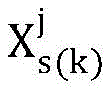
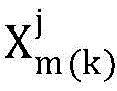
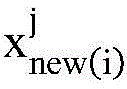
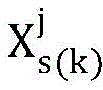
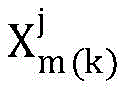
作为进一步优选的,所述步骤8中恢复系水稻种子自交产生新个体的更新公式为:As a further preference, in the step 8, the update formula for the self-crossing of the restorer rice seeds to generate a new individual is:
subresult=XbestsubXr(k) (10)sub result =X best subX r(k) (10)
Xnew(i)=(r3*subresult)add Xr(i) (11)X new(i) = (r 3 *sub result )add X r(i) (11)
其中Xr(i)和Xr(k)分别表示恢复系中第i个和第k个水稻种子个体,Xbest表示当前最优个体,subresult表示Xbest与Xr(k)通过二进制减法规则运算得到的结果,r3是[0,1]之间产生的随机数,add和sub分别代表二进制运算规则中的加法和减法算子,二进制的加法运算依据“逢二进一”规则,具体为:0+0=0,0+1=1,1+0=1,1+1=0(进位为1),二进制的减法运算依据“借一当二”的规则,具体为:0-0=0,0-1=1(借位为1),1-1=0,1-0=1。where X r(i) and X r(k) represent the i-th and k-th rice seed individuals in the restorer line, respectively, X best represents the current optimal individual, and sub result represents the binary subtraction between X best and X r(k) The result obtained by the rule operation, r3 is a random number generated between [0,1], add and sub represent the addition and subtraction operators in the binary operation rules, respectively. The binary addition operation is based on the "every two into one" rule. It is: 0+0=0, 0+1=1, 1+0=1, 1+1=0 (carry is 1), the binary subtraction operation is based on the rule of "borrowing one as two", specifically: 0- 0=0, 0-1=1 (borrow is 1), 1-1=0, 1-0=1.
作为进一步优选的,所述步骤9中恢复系进行重置操作时的更新公式为:As a further preference, the update formula when the restoration system performs the reset operation in the step 9 is:
Xnew(i)=Xr(i)add(r4*(Rmax-Rmin))+Rmin (12)X new(i) =X r(i) add(r 4 *(R max -R min ))+R min (12)
其中Rmax和Rmin分别表示二进制搜索空间的上界和下界,r4是[0,1]范围内生成的一个随机数,Xr(i)表示恢复系中第i个水稻种子个体,add表示二进制运算规则中的加法算子,二进制的加法运算依据“逢二进一”规则,具体为:0+0=0,0+1=1,1+0=1,1+1=0(进位为1)。where R max and R min represent the upper and lower bounds of the binary search space, respectively, r 4 is a random number generated in the range of [0,1], X r(i) represents the ith rice seed individual in the restorer line, add Indicates the addition operator in the binary operation rule. The binary addition operation is based on the "every two into one" rule, specifically: 0+0=0, 0+1=1, 1+0=1, 1+1=0 ( The carry is 1).
本发明与现有技术相比具有以下优点:Compared with the prior art, the present invention has the following advantages:
1、本发明通过引入反向学习构造反向种群,并结合适应度值函数对原始种群和反向种群中的个体进行优胜劣汰,从而优化了水稻种群中的个体组成,得到一组较优的初始种群,弥补了因种群初始化时采用纯随机策略而导致的算法运行结果差异化大,稳定性较低的缺陷。1. The present invention constructs a reverse population by introducing reverse learning, and combines the fitness value function to select the individuals in the original population and the reverse population for survival of the fittest, thereby optimizing the individual composition of the rice population and obtaining a set of better initial populations. The population makes up for the defect of the large difference and low stability of the algorithm operation results caused by the pure random strategy used in the initialization of the population.
3、本发明在水稻育种算法初始化时采用二进制编码表示水稻个体的基因,采用计算机二进制运算规则重新定义更新操作中的加法和减法算子,直接在二进制空间进行运算,无需通过转换函数进行进制的转换就能得到二进制形式的解,使其更适应于求解波段选择问题。3. The present invention uses binary codes to represent the genes of rice individuals when the rice breeding algorithm is initialized, uses computer binary operation rules to redefine the addition and subtraction operators in the update operation, and directly performs operations in the binary space, without the need for conversion functions. The transformation of , can get the solution in binary form, which makes it more suitable for solving the band selection problem.
2、本发明利用基于反向学习的二进制水稻育种算法对原始高光谱图像波段数据集进行波段选择,排除冗余的波段,筛选出最有效的波段子集,在提高图像分类正确率和分类效率的同时选择较少的波段特征。2. The present invention uses the binary rice breeding algorithm based on reverse learning to perform band selection on the original hyperspectral image band data set, eliminates redundant bands, and filters out the most effective band subsets, which improves the accuracy and efficiency of image classification. while selecting fewer band features.
附图说明Description of drawings
图1是波段选择基本流程图。Figure 1 is a basic flow chart of band selection.
图2是本发明实施例方法的流程图。FIG. 2 is a flowchart of a method according to an embodiment of the present invention.
图3是计算机二进制运算规则实例图。FIG. 3 is a diagram of an example of a computer binary operation rule.
具体实施方式Detailed ways
为了更好地理解本发明,下面结合实施例进一步阐明本发明的内容,但本发明的内容不仅仅局限于下面的实施例。本领域技术人员可以对本发明作各种改动或修改,这些等价形式同样在本申请所列权利要求书限定范围之内。In order to better understand the present invention, the content of the present invention is further illustrated below in conjunction with the embodiments, but the content of the present invention is not limited to the following embodiments. Those skilled in the art can make various changes or modifications to the present invention, and these equivalent forms are also within the scope defined by the claims listed in this application.
请见图1,图2是本发明所采用的技术方案是:一种基于反向学习二进制水稻育种算法的高光谱图像波段选择方法,其特征在于,包括以下步骤:Please refer to Fig. 1, Fig. 2 is that the technical solution adopted in the present invention is: a hyperspectral image band selection method based on a reverse learning binary rice breeding algorithm, characterized in that, comprising the following steps:
步骤1.读取高光谱图像,提取图像中的波段信息,并构成原始波段特征数据集,将数据集分成训练集和测试集两部分,其中训练集用于波段选择,测试集用来对筛选出的波段子集的分类效果进行测试;
步骤2.初始化随机生成二进制水稻育种算法种群并设置二进制水稻育种算法所需的参数,包括种群大小N(N一般为3的倍数),最大迭代次数itermax,最大自交次数tmax;Step 2. Initialize the randomly generated binary rice breeding algorithm population and set the parameters required by the binary rice breeding algorithm, including the population size N (N is generally a multiple of 3), the maximum number of iterations iter max , and the maximum number of selfing t max ;
步骤3.设定反向学习概率pm,生成一个范围在(0,1)之间的随机数rand,若rand<pm,则根据反向学习策略生成原始种群对应的二进制反向种群。Step 3. Set the reverse learning probability p m to generate a random number rand in the range of (0, 1). If rand<p m , generate a binary reverse population corresponding to the original population according to the reverse learning strategy.
其中,反向学习策略的定义为,设种群中有N个水稻个体,即X={x1,x2,…,xN},X∈[a,b](a,b为搜索空间的上界和下界),每个水稻个体xi∈X满足xi∈[ai,bi](i=1,2,…,N),则其反向个体定义为:Among them, the definition of the reverse learning strategy is that there are N rice individuals in the population, that is, X={x 1 ,x 2 ,...,x N }, X∈[a,b] (a,b is the search space upper bound and lower bound), each rice individual x i ∈ X satisfies x i ∈ [a i ,b i ](i=1,2,…,N), then its reverse individual is defined as:

对于由d维二进制编码构成的个体



若rand<pm不成立,则直接跳转执行步骤5;If rand<p m does not hold, then jump directly to step 5;
步骤4.分别计算原始种群和反向种群中个体的适应度值,并选择其中适应度值高的个体构成新的初始种群;其中,构成新的初始种群的方法为:二进制水稻育种算法原始种群有N个水稻种子个体,生成的反向种群中的个体数同样为N。将原始种群和反向种群分别按照适应度值从大到小排序,将原始种群中排列在前n1的个体和反向种群中排列在前n2的个体选择组成最终的初始种群。其中N=n1+n2。Step 4. Calculate the fitness values of individuals in the original population and the reverse population respectively, and select individuals with high fitness values to form a new initial population; wherein, the method for forming a new initial population is: binary rice breeding algorithm original population There are N rice seed individuals, and the number of individuals in the generated reverse population is also N. The original population and the reverse population are sorted according to their fitness values from large to small, and the individuals ranked in the top n 1 in the original population and the individuals ranked in the top n 2 in the reverse population are selected to form the final initial population. where N=n 1 +n 2 .
步骤5.将二进制水稻育种算法中的初始种群映射为相应的波段子集,每个水稻种子基因序列的编码长度等于高光谱图像中包含的波段数目;Step 5. Map the initial population in the binary rice breeding algorithm to a corresponding band subset, and the coding length of each rice seed gene sequence is equal to the number of bands contained in the hyperspectral image;
其中,水稻育种算法中的二进制基因序列与波段之间的映射方式为:二进制水稻育种算法中每一维基因都有两个候选值,即0或者1,“0”表示该基因对应的波段未被选择,“1”表示该基因对应的波段被选择。Among them, the mapping method between the binary gene sequence and the band in the rice breeding algorithm is as follows: each dimension gene in the binary rice breeding algorithm has two candidate values, namely 0 or 1, "0" means that the band corresponding to the gene is not is selected, "1" indicates that the band corresponding to the gene is selected.
步骤6.根据适应度函数计算种群中个体的适应值,按照个体的适应度值从大到小排序,将水稻种群划分为三系:保持系,恢复系,不育系,适应度值最优的1/3个体被选择为保持系,适应度值最差的1/3个体被选择为不育系,剩下1/3的个体被选择为恢复系;Step 6. Calculate the fitness value of the individuals in the population according to the fitness function, sort the individual fitness values from large to small, and divide the rice population into three lines: maintainer line, restorer line, sterile line, and the fitness value is the best 1/3 of the individuals are selected as the maintainer line, 1/3 of the individuals with the worst fitness value are selected as the sterile line, and the remaining 1/3 of the individuals are selected as the restorer line;
适应度值用于评估所选波段子集的质量,其适应度函数计算公式为:The fitness value is used to evaluate the quality of the selected band subset, and its fitness function is calculated as:

其中,R表示本次选择波段的个数,C表示波段总数,α和β为两个权重系数,α的范围介于0和1之间,β=1-α,Accuracy表示选择的波段子集参与分类得到的分类正确率,采用K-NN作为分类器进行分类,对于二分类问题,分类精度计算公式表示为:Among them, R represents the number of bands selected this time, C represents the total number of bands, α and β are two weight coefficients, α ranges between 0 and 1, β=1-α, and Accuracy represents the selected band subset The classification accuracy obtained by participating in the classification is classified by using K-NN as the classifier. For the two-class problem, the classification accuracy calculation formula is expressed as:

其中,Tp(真正例):真实类别为正例,分类也为正例;Tn(真负例):真实类别为负例,分类为负例;Fp(假正例):真实类别为负例,分类为正例;Fn(假反例):真实类别为正例,分类也为负例。Among them, T p (true example): the true category is a positive example, and the classification is also a positive example; T n (true negative example): the true category is a negative example, and the classification is a negative example; F p (false positive example): the true category is a negative example, and the classification is a positive example; F n (false negative example): the real category is a positive example, and the classification is also a negative example.
计算种群适应度值后进行降序排序,将种群分成保持系,恢复系和不育系,生成三系的公式为:After calculating the fitness value of the population, sort the population in descending order, and divide the population into maintainer line, restorer line and sterile line. The formula for generating three lines is:
M={x1,x2,…,xm},m=N/3 (5)M={x 1 ,x 2 ,...,x m },m=N/3 (5)
R={xm+1,xm+2,…,x2m},m=N/3 (6)R={x m+1 ,x m+2 ,...,x 2m },m=N/3 (6)
S={x2m+1,x2m+2,…,xn},m=N/3 (7)S={x 2m+1 ,x 2m+2 ,...,x n },m=N/3 (7)
其中N为种群大小,m为每个子种群大小,M表示保持系个体的集合,R表示保持系个体的集合,S表示不育系个体的集合。Among them, N is the population size, m is the size of each subpopulation, M represents the set of maintenance line individuals, R represents the set of maintenance line individuals, and S represents the set of sterile line individuals.
步骤7.分别随机从不育系和保持系中选择个体作为父本和母本进行杂交操作,即将父本和母本的基因通过重新组合产生新的基因序列,分别计算的新个体和参与杂交的不育系个体的适应值,从中选择适应度值较好的个体的基因保留至下一代;Step 7. Randomly select individuals from the sterile line and the maintainer line as the male parent and the female parent to perform the hybridization operation, that is, the genes of the male parent and the female parent are recombined to generate a new gene sequence, and the new individual and the participating hybrid are calculated separately. The fitness value of the individual of the sterile line is selected, and the genes of the individual with better fitness value are selected and retained to the next generation;
通过杂交产生新个体的基因的公式为:The formula for generating the genes of a new individual by crossing is:


其中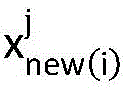
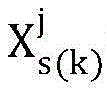
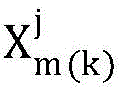
步骤8.随机选择恢复系中的个体进行自交操作,计算出新个体的适应度值并跟自交前的个体的适应度值进行比较,若新个体的适应度值优于自交前个体的适应度值,就用产生的新个体替换原始个体,此时将该个体的自交次数记为0;否则不替换,该个体的自交次数加1;Step 8. Randomly select individuals in the restorer line for self-crossing operation, calculate the fitness value of the new individual and compare it with the fitness value of the individual before selfing. If the fitness value of the new individual is better than that of the individual before selfing If the fitness value of , replaces the original individual with the new individual generated, at this time, the number of self-crossing of the individual is recorded as 0; otherwise, the number of self-crossing of the individual is increased by 1;
恢复系水稻种子自交产生新个体的更新公式为:The updated formula for the selfing of restorer rice seeds to generate new individuals is:
subresult=XbestsubXr(k) (10)sub result =X best subX r(k) (10)
Xnew(i)=(r3*subresult)add Xr(i) (12)X new(i) = (r3*sub result )add X r(i) (12)
其中,Xnew(i)表示第i个水稻种子,Xr(i)和Xr(k)分别表示恢复系中第i个和第k个水稻种子个体,Xbest表示当前最优个体,r3是[0,1]之间产生的随机数,subresult表示Xbest与Xr(k)通过计算机二进制减法规则运算得到的结果,add和sub分别代表二进制运算规则中的加法和减法算子。Among them, X new(i) represents the ith rice seed, X r(i) and X r(k) represent the ith and k th rice seed individuals in the restorer line, respectively, X best represents the current optimal individual, and r3 is a random number generated between [0,1], sub result represents the result obtained by X best and X r(k) through the computer binary subtraction rule, add and sub represent the addition and subtraction operators in the binary operation rule, respectively.
其中,二进制的加法运算,依据“逢二进一”规则,具体为:0+0=0,0+1=1,1+0=1,1+1=0(进位为1)。Among them, the binary addition operation is based on the "every two into one" rule, specifically: 0+0=0, 0+1=1, 1+0=1, 1+1=0 (carry is 1).
二进制的减法运算,依据“借一当二”的规则,具体为:0-0=0,0-1=1(借位为1),1-1=0,1-0=1。The binary subtraction operation is based on the rule of "borrowing one as two", specifically: 0-0=0, 0-1=1 (borrow is 1), 1-1=0, 1-0=1.
步骤9.当达到最大自交次数时,恢复系个体进行重置操作,即在搜索空间中随机选择一组基因序列替换原始个体中的基因,并将自交次数归0;Step 9. When the maximum number of selfings is reached, the recovery system individuals perform a reset operation, that is, randomly select a set of gene sequences in the search space to replace the genes in the original individuals, and return the number of selfings to 0;
恢复系进行重置操作时的更新公式为:The update formula when the recovery system performs the reset operation is:
Xnew(i)=Xr(i)add(r4*(Rmax-Rmin))+Rmin (14)X new(i) =X r(i) add(r 4 *(R max -R min ))+R min (14)
其中,Xnew(i)表示第i个水稻种子,Rmax和Rmin分别表示二进制搜索空间的上界和下界,r4是[0,1]范围内生成的一个随机数,Xr(i)表示恢复系中第i个水稻种子个体,add表示二进制运算规则中的加法算子。Among them, X new (i) represents the ith rice seed, R max and R min represent the upper and lower bounds of the binary search space, respectively, r 4 is a random number generated in the range of [0, 1], X r(i ) represents the ith rice seed individual in the restorer line, and add represents the addition operator in the binary operation rule.
其中,二进制的加法运算,依据“逢二进一”规则,具体为:0+0=0,0+1=1,1+0=1,1+1=0(进位为1)。Among them, the binary addition operation is based on the "every two into one" rule, specifically: 0+0=0, 0+1=1, 1+0=1, 1+1=0 (carry is 1).
步骤10.记录全局最优的水稻个体的基因序列及其对应的适应度值,该基因序列可映射为全局最优的波段子集,即二进制水稻育种算法中每一维基因都有两个候选值,即0或者1,“0”表示该基因对应的波段未被选择,“1”表示该基因对应的波段被选择;Step 10. Record the gene sequence of the globally optimal rice individual and its corresponding fitness value. The gene sequence can be mapped to the globally optimal band subset, that is, there are two candidates for each dimension gene in the binary rice breeding algorithm. value, namely 0 or 1, "0" indicates that the band corresponding to the gene is not selected, and "1" indicates that the band corresponding to the gene is selected;
步骤11.判断是否满足终止条件,其中,终止条件设为达到最大迭代次数,若否,则返回执行所述步骤6;若是,则输出全局最优的水稻个体的基因序列对应的波段子集及其适应度值;Step 11. Judging whether the termination condition is met, wherein the termination condition is set to reach the maximum number of iterations, if not, return to step 6; if so, output the band subset corresponding to the gene sequence of the globally optimal rice individual and its fitness value;
图3是计算机二进制运算规则实例图,其中:Figure 3 is an example diagram of a computer binary operation rule, wherein:
图3(a)是两个二进制基因序列通过计算机二进制加法运算规则相加后得到二进制解的实例图,依据“逢二进一”规则,二进制加法运算规则为:Figure 3(a) is an example diagram of a binary solution obtained by adding two binary gene sequences through the computer binary addition operation rule. According to the "every two into one" rule, the binary addition operation rule is:
0+0=00+0=0
0+1=10+1=1
1+0=11+0=1
1+1=0(进位为1)。1+1=0 (carry 1).
图3(b)是两个二进制基因序列通过计算机二进制减法运算规则相减后得到二进制解的实例图,依据“借一当二”的规则,二进制减法运算规则为:Figure 3(b) is an example diagram of the binary solution obtained by subtracting two binary gene sequences through the computer binary subtraction operation rule. According to the rule of "borrowing one as two", the binary subtraction operation rule is:
0-0=00-0=0
0-1=1(借位为1)0-1=1 (borrow is 1)
1-1=01-1=0
1-0=1。1-0=1.
应当理解的是,本说明书中未作详细描述的内容属于本领域专业技术人员公知的现有技术。It should be understood that the content not described in detail in this specification belongs to the prior art known to those skilled in the art.
应当理解的是,上述针对较佳实施例的描述较为详细,并不能因此而认为是对本发明专利保护范围的限制,本领域的普通技术人员在本发明的启示下,在不脱离本发明权利要求所保护的范围情况下,还可以做出替换或变形,均落入本发明的保护范围之内,本发明的请求保护范围应以所附权利要求为准。It should be understood that the above description of the preferred embodiment is relatively detailed, and therefore should not be considered as a limitation on the scope of the patent protection of the present invention. In the case of the protection scope, substitutions or deformations can also be made, which all fall within the protection scope of the present invention, and the claimed protection scope of the present invention shall be subject to the appended claims.
Claims (7)








Priority Applications (1)
| Application Number | Priority Date | Filing Date | Title |
|---|---|---|---|
| CN202011507865.9A CN112613391B (en) | 2020-12-18 | 2020-12-18 | Hyperspectral image waveband selection method based on reverse learning binary rice breeding algorithm |
Applications Claiming Priority (1)
| Application Number | Priority Date | Filing Date | Title |
|---|---|---|---|
| CN202011507865.9A CN112613391B (en) | 2020-12-18 | 2020-12-18 | Hyperspectral image waveband selection method based on reverse learning binary rice breeding algorithm |
Publications (2)
| Publication Number | Publication Date |
|---|---|
| CN112613391A CN112613391A (en) | 2021-04-06 |
| CN112613391B true CN112613391B (en) | 2022-06-07 |
Family
ID=75240763
Family Applications (1)
| Application Number | Title | Priority Date | Filing Date |
|---|---|---|---|
| CN202011507865.9A Active CN112613391B (en) | 2020-12-18 | 2020-12-18 | Hyperspectral image waveband selection method based on reverse learning binary rice breeding algorithm |
Country Status (1)
| Country | Link |
|---|---|
| CN (1) | CN112613391B (en) |
Families Citing this family (2)
| Publication number | Priority date | Publication date | Assignee | Title |
|---|---|---|---|---|
| CN112908416B (en) * | 2021-04-13 | 2024-02-02 | 湖北工业大学 | Biomedical data feature selection method and device, computing equipment and storage medium |
| CN115114838B (en) * | 2022-07-22 | 2023-02-07 | 黑龙江八一农垦大学 | Spectral characteristic wavelength selection method based on particle swarm algorithm thought and simulated annealing strategy |
Citations (8)
| Publication number | Priority date | Publication date | Assignee | Title |
|---|---|---|---|---|
| CN103614456A (en) * | 2013-09-02 | 2014-03-05 | 石河子农业科技开发研究中心 | Microsatellite marker specific primers for identification of Sinkiang colored cotton series No.1 to23 varieties and applications thereof |
| CN103714354A (en) * | 2014-01-16 | 2014-04-09 | 西安电子科技大学 | Hyperspectral image wave band selection method based on quantum-behaved particle swarm optimization algorithm |
| CN104732240A (en) * | 2015-04-07 | 2015-06-24 | 河海大学 | Hyperspectral image waveband selecting method applying neural network to carry out sensitivity analysis |
| CN108197710A (en) * | 2018-01-31 | 2018-06-22 | 湖北工业大学 | A kind of method and system of power distribution network switching optimization |
| CN109378036A (en) * | 2018-09-17 | 2019-02-22 | 湖北工业大学 | A heuristic optimization method based on the breeding mechanism of two-line hybrid rice |
| CN110414729A (en) * | 2019-07-19 | 2019-11-05 | 西北农林科技大学 | Prediction method of plant potential maximum photosynthetic capacity based on characteristic wavelength |
| CN110610054A (en) * | 2019-09-23 | 2019-12-24 | 北京师范大学 | A method and system for constructing a soil moisture cuboid inversion model |
| CN111126549A (en) * | 2019-12-24 | 2020-05-08 | 昆明理工大学 | Double-star spectrum fitting method based on strategy improved goblet and sea squirt intelligent algorithm |
Family Cites Families (1)
| Publication number | Priority date | Publication date | Assignee | Title |
|---|---|---|---|---|
| US10564316B2 (en) * | 2014-09-12 | 2020-02-18 | The Climate Corporation | Forecasting national crop yield during the growing season |
-
2020
- 2020-12-18 CN CN202011507865.9A patent/CN112613391B/en active Active
Patent Citations (8)
| Publication number | Priority date | Publication date | Assignee | Title |
|---|---|---|---|---|
| CN103614456A (en) * | 2013-09-02 | 2014-03-05 | 石河子农业科技开发研究中心 | Microsatellite marker specific primers for identification of Sinkiang colored cotton series No.1 to23 varieties and applications thereof |
| CN103714354A (en) * | 2014-01-16 | 2014-04-09 | 西安电子科技大学 | Hyperspectral image wave band selection method based on quantum-behaved particle swarm optimization algorithm |
| CN104732240A (en) * | 2015-04-07 | 2015-06-24 | 河海大学 | Hyperspectral image waveband selecting method applying neural network to carry out sensitivity analysis |
| CN108197710A (en) * | 2018-01-31 | 2018-06-22 | 湖北工业大学 | A kind of method and system of power distribution network switching optimization |
| CN109378036A (en) * | 2018-09-17 | 2019-02-22 | 湖北工业大学 | A heuristic optimization method based on the breeding mechanism of two-line hybrid rice |
| CN110414729A (en) * | 2019-07-19 | 2019-11-05 | 西北农林科技大学 | Prediction method of plant potential maximum photosynthetic capacity based on characteristic wavelength |
| CN110610054A (en) * | 2019-09-23 | 2019-12-24 | 北京师范大学 | A method and system for constructing a soil moisture cuboid inversion model |
| CN111126549A (en) * | 2019-12-24 | 2020-05-08 | 昆明理工大学 | Double-star spectrum fitting method based on strategy improved goblet and sea squirt intelligent algorithm |
Non-Patent Citations (4)
| Title |
|---|
| Exploring the Influence of Spatial Resolution on the Digital Mapping of Soil Organic Carbon by Airborne Hyperspectral VNIR Imaging;Long Guo 等;《remote sensing》;20190501;第11卷(第9期);全文 * |
| Whale optimization approaches for wrapper feature selection;Majdi Mafarja 等;《Applied Soft Computing》;20171108(第62期);全文 * |
| 基于烟花算法的Otsu多阈值图像分割法;陈宏伟 等;《湖北工业大学学报》;20181231;第33卷(第1期);全文 * |
| 基于红边优化植被指数的寒地水稻叶片叶绿素含量遥感反演研究;于丰华 等;《智慧农业(中英文)》;20200331;第2卷(第1期);全文 * |
Also Published As
| Publication number | Publication date |
|---|---|
| CN112613391A (en) | 2021-04-06 |
Similar Documents
| Publication | Publication Date | Title |
|---|---|---|
| Esmaeili et al. | Hyperspectral image band selection based on CNN embedded GA (CNNeGA) | |
| Wang et al. | Deep mixture of experts via shallow embedding | |
| CN110163258B (en) | A zero-shot learning method and system based on semantic attribute attention redistribution mechanism | |
| Liu et al. | Uncertainty and confidence in land cover classification using a hybrid classifier approach | |
| CN113190699A (en) | Remote sensing image retrieval method and device based on category-level semantic hash | |
| Kong et al. | A graph‐related high‐order neural network architecture via feature aggregation enhancement for identification application of diseases and pests | |
| Zuo et al. | FSL-EGNN: Edge-labeling graph neural network for hyperspectral image few-shot classification | |
| CN114218292B (en) | A Multivariate Time Series Similarity Retrieval Method | |
| CN112434628B (en) | Small sample image classification method based on active learning and collaborative representation | |
| CN114329031B (en) | A fine-grained bird image retrieval method based on graph neural network and deep hashing | |
| CN111062438B (en) | Image propagation weak supervision fine granularity image classification algorithm based on correlation learning | |
| CN116206158A (en) | Scene image classification method and system based on double hypergraph neural network | |
| CN119479835B (en) | Gene data mining method based on transducer | |
| CN113222068A (en) | Remote sensing image multi-label classification method based on adjacency matrix guidance label embedding | |
| CN115331049A (en) | Building damage classification method based on post-disaster unmanned aerial vehicle remote sensing image | |
| CN116524301A (en) | 3D point cloud scene instance shape searching and positioning method based on contrast learning | |
| CN109447110A (en) | The method of the multi-tag classification of comprehensive neighbours' label correlative character and sample characteristics | |
| CN109978050A (en) | Decision Rules Extraction and reduction method based on SVM-RF | |
| CN111325284A (en) | An adaptive learning method and device based on multi-objective dynamic distribution | |
| CN112613391B (en) | Hyperspectral image waveband selection method based on reverse learning binary rice breeding algorithm | |
| Wang et al. | R2-trans: Fine-grained visual categorization with redundancy reduction | |
| Shen et al. | Equiangular basis vectors | |
| CN119579879A (en) | A point cloud semantic segmentation method based on improved RandLA-Net network | |
| CN120151069B (en) | An Evolutionary Multi-Task Intrusion Detection Feature Selection Method Based on Dual-View Dimensionality Reduction | |
| Luo et al. | Saliency guided discriminative learning for insect pest recognition |
Legal Events
| Date | Code | Title | Description |
|---|---|---|---|
| PB01 | Publication | ||
| PB01 | Publication | ||
| SE01 | Entry into force of request for substantive examination | ||
| SE01 | Entry into force of request for substantive examination | ||
| GR01 | Patent grant | ||
| GR01 | Patent grant |