CN112532690B - Message parsing method and device, electronic equipment and storage medium - Google Patents
Message parsing method and device, electronic equipment and storage medium Download PDFInfo
- Publication number
- CN112532690B CN112532690B CN202011219354.7A CN202011219354A CN112532690B CN 112532690 B CN112532690 B CN 112532690B CN 202011219354 A CN202011219354 A CN 202011219354A CN 112532690 B CN112532690 B CN 112532690B
- Authority
- CN
- China
- Prior art keywords
- message
- analysis
- parsing
- driver
- shared buffer
- Prior art date
- Legal status (The legal status is an assumption and is not a legal conclusion. Google has not performed a legal analysis and makes no representation as to the accuracy of the status listed.)
- Active
Links
- 238000000034 method Methods 0.000 title claims abstract description 73
- 238000004458 analytical method Methods 0.000 claims abstract description 250
- 239000000872 buffer Substances 0.000 claims abstract description 169
- 230000005540 biological transmission Effects 0.000 claims description 20
- 230000006854 communication Effects 0.000 claims description 10
- 238000004891 communication Methods 0.000 claims description 9
- 238000005538 encapsulation Methods 0.000 claims description 5
- 238000012545 processing Methods 0.000 abstract description 36
- 230000008569 process Effects 0.000 description 30
- 230000006870 function Effects 0.000 description 22
- 230000007246 mechanism Effects 0.000 description 11
- 238000010586 diagram Methods 0.000 description 9
- 238000005516 engineering process Methods 0.000 description 7
- 238000013507 mapping Methods 0.000 description 7
- 238000001514 detection method Methods 0.000 description 6
- 230000009471 action Effects 0.000 description 3
- 238000012550 audit Methods 0.000 description 3
- 238000011161 development Methods 0.000 description 3
- 230000006872 improvement Effects 0.000 description 2
- 238000007689 inspection Methods 0.000 description 2
- 238000007726 management method Methods 0.000 description 2
- 238000012986 modification Methods 0.000 description 2
- 230000004048 modification Effects 0.000 description 2
- 230000002265 prevention Effects 0.000 description 2
- 230000004044 response Effects 0.000 description 2
- OKTJSMMVPCPJKN-UHFFFAOYSA-N Carbon Chemical compound [C] OKTJSMMVPCPJKN-UHFFFAOYSA-N 0.000 description 1
- 101001094649 Homo sapiens Popeye domain-containing protein 3 Proteins 0.000 description 1
- 101000608234 Homo sapiens Pyrin domain-containing protein 5 Proteins 0.000 description 1
- 101000578693 Homo sapiens Target of rapamycin complex subunit LST8 Proteins 0.000 description 1
- 102100027802 Target of rapamycin complex subunit LST8 Human genes 0.000 description 1
- 230000003139 buffering effect Effects 0.000 description 1
- 230000001413 cellular effect Effects 0.000 description 1
- 230000008859 change Effects 0.000 description 1
- 238000004590 computer program Methods 0.000 description 1
- 230000007123 defense Effects 0.000 description 1
- 229910021389 graphene Inorganic materials 0.000 description 1
- 230000003993 interaction Effects 0.000 description 1
- 230000003287 optical effect Effects 0.000 description 1
- 230000003068 static effect Effects 0.000 description 1
- 238000006467 substitution reaction Methods 0.000 description 1
- 238000012546 transfer Methods 0.000 description 1
- 239000002699 waste material Substances 0.000 description 1
Images


Classifications
-
- H—ELECTRICITY
- H04—ELECTRIC COMMUNICATION TECHNIQUE
- H04L—TRANSMISSION OF DIGITAL INFORMATION, e.g. TELEGRAPHIC COMMUNICATION
- H04L67/00—Network arrangements or protocols for supporting network services or applications
- H04L67/50—Network services
- H04L67/56—Provisioning of proxy services
- H04L67/568—Storing data temporarily at an intermediate stage, e.g. caching
-
- H—ELECTRICITY
- H04—ELECTRIC COMMUNICATION TECHNIQUE
- H04L—TRANSMISSION OF DIGITAL INFORMATION, e.g. TELEGRAPHIC COMMUNICATION
- H04L69/00—Network arrangements, protocols or services independent of the application payload and not provided for in the other groups of this subclass
- H04L69/22—Parsing or analysis of headers
Landscapes
- Engineering & Computer Science (AREA)
- Computer Networks & Wireless Communication (AREA)
- Signal Processing (AREA)
- Computer Security & Cryptography (AREA)
- Computer And Data Communications (AREA)
Abstract
The application provides a message analysis method, a message analysis device, electronic equipment and a storage medium, wherein the method is applied to a server, and the server is loaded with a driving program for collecting messages; the driver provides a shared buffer area for a plurality of message analysis engines carried in the server; the method comprises the following steps: performing message pre-analysis on the message acquired by the driver, wherein the message pre-analysis at least comprises network layer message analysis; writing the message which is subjected to message pre-analysis into a shared buffer provided by the driver; reading the message which is subjected to message pre-analysis completion from the shared buffer area based on the message analysis engine; and further executing message analysis aiming at the read message, wherein the message analysis at least comprises application layer message analysis. The method and the device can improve the message processing performance of the server under the multi-engine processing scene.
Description
Technical Field
The present application relates to the field of network technologies, and in particular, to a method and an apparatus for parsing a packet, an electronic device, and a storage medium.
Background
With the rapid development of network technology, the network security defense system faces a great challenge. In order to cope with the ever-changing network attack means, message processing software based on a DPI (Deep Packet Inspection) technology, such as an intrusion detection system, an intrusion prevention system, protocol auditing software, and the like, is widely applied. The software collects messages from the network card, processes the messages and then processes the service of an application layer according to the message processing result; the message processing at least comprises message analysis from a network layer to an application layer according to a protocol stack corresponding to a message analysis engine.
For example, in practical applications, a driver, such as pf _ ring, DPDK (Data Plane Development Kit), etc., is usually installed in a server, and the server performs packet collection based on the driver and writes the collected packet into a lock-free buffer provided by the driver. The server may have several message parsing engines corresponding to different protocol stacks, and the driver provides a lock-free buffer for each message parsing engine. When the server performs service processing of an application layer, the message analysis engine can call a driver to collect messages, read the messages from the corresponding lock-free buffer area, perform network layer message analysis, transmission layer message analysis and application layer message analysis on the read messages according to a protocol stack of the message analysis engine, and then provide the messages for the application layer to perform service processing.
In the related art, in order to improve the capability of discovering security threats by message processing software, functions such as attack detection, protocol audit and the like need to be integrated, and in essence, a plurality of message analysis engines with different service processing capabilities in an application layer are integrated.
Disclosure of Invention
In view of this, the present application provides a message parsing method, a message parsing apparatus, an electronic device, and a storage medium, so as to solve the problem that in a scenario where a plurality of message parsing engines loaded in a server operate, copies of the same message in buffer areas corresponding to different message parsing engines are repeatedly parsed.
The application provides a message analysis method, which is applied to a server, wherein the server is loaded with a driving program for collecting messages; the driver provides a shared buffer area for a plurality of message analysis engines loaded in the server; the method comprises the following steps:
performing message pre-analysis on the message acquired by the driver, wherein the message pre-analysis at least comprises network layer message analysis;
writing the message which is subjected to message pre-analysis into a shared buffer provided by the driver;
reading the message which is subjected to message pre-analysis completion from the shared buffer area based on the message analysis engine;
and further executing message analysis aiming at the read message, wherein the message analysis at least comprises application layer message analysis.
Optionally, the writing the packet that is pre-parsed into the shared buffer provided by the driver includes:
using the result of message pre-analysis as the message header, using the message as the message load, and performing message encapsulation;
and writing the packaged message into a shared buffer provided by the driver.
Optionally, the message pre-analysis includes network layer message analysis and transmission layer message analysis; the message parsing comprises application layer message parsing.
Optionally, the further performing, for the read packet, application layer packet parsing includes:
and further reading the message load of the message, and further executing application layer message analysis aiming at the read message load of the message.
Optionally, the packet that is completed by the packet pre-parsing further includes a count value, where the count value indicates the number of packet parsing engines that read the packet that is completed by the packet pre-parsing from the shared buffer.
Optionally, when the message pre-parsing completed message is read from the shared buffer based on the message parsing engine, the method further includes:
when any message analysis engine starts to read the message of which the message pre-analysis in the shared buffer is completed, adding 1 to a count value corresponding to the message of which the message pre-analysis is completed;
when any message analysis engine finishes reading the message of which the message pre-analysis in the shared buffer is finished, subtracting 1 from the count value corresponding to the message of which the message pre-analysis is finished;
and when the count value corresponding to any message which is subjected to the message pre-analysis is reduced to 0, removing the message which is subjected to the message pre-analysis from the shared buffer area.
Optionally, the driver includes a pf _ ring driver; the shared buffer includes a shared lock-free ring queue.
The application provides a message analysis device, which is applied to a server, wherein the server is loaded with a driving program for collecting messages; the driver provides a shared buffer area for a plurality of message analysis engines loaded in the server; the device comprises:
the message pre-analysis unit is used for performing message pre-analysis on the message acquired by the driving program, wherein the message pre-analysis at least comprises network layer message analysis;
the write buffer unit is used for writing the message which is subjected to message pre-analysis into a shared buffer area provided by the driver;
a read buffer unit, configured to read the packet that is pre-parsed from the shared buffer based on the packet parsing engine;
and the message analysis unit is used for further executing message analysis aiming at the read message, wherein the message analysis at least comprises application layer message analysis.
Optionally, the write buffer unit is specifically configured to:
using the result of message pre-analysis as the message header, using the message as the message load, and performing message encapsulation;
and writing the packaged message into a shared buffer provided by the driver.
Optionally, the message pre-analysis includes network layer message analysis and transmission layer message analysis; the message parsing comprises application layer message parsing.
Optionally, when the packet analysis includes application layer packet analysis, the packet analysis unit is specifically configured to: and further reading the message load of the message, and further executing application layer message analysis aiming at the read message load of the message.
Optionally, the packet that is completed by the packet pre-parsing further includes a count value, where the count value indicates the number of packet parsing engines that read the packet that is completed by the packet pre-parsing from the shared buffer.
Optionally, the read buffer unit is further configured to:
when any message analysis engine starts to read the message of which the message pre-analysis in the shared buffer is completed, adding 1 to a count value corresponding to the message of which the message pre-analysis is completed;
when any message analysis engine finishes reading the message of which the message pre-analysis in the shared buffer is finished, subtracting 1 from the count value corresponding to the message of which the message pre-analysis is finished;
and when the count value corresponding to any message which is subjected to the message pre-analysis is reduced to 0, removing the message which is subjected to the message pre-analysis from the shared buffer area.
Optionally, the driver includes a pf _ ring driver; the shared buffer includes a shared lock-free ring queue.
The application also provides an electronic device, which comprises a communication interface, a processor, a memory and a bus, wherein the communication interface, the processor and the memory are mutually connected through the bus;
the memory stores machine-readable instructions, and the processor executes the method by calling the machine-readable instructions.
The present application also provides a machine-readable storage medium having stored thereon machine-readable instructions which, when invoked and executed by a processor, implement the above-described method.
In a scenario that a plurality of message analysis engines process, when the message analysis engines acquire messages based on a driver of a server, the driver provides a shared buffer area for the plurality of message analysis engines in the server, and after the server at least analyzes the network layer messages of the acquired messages, the messages at least analyzed by the network layer messages are written into the shared buffer area based on the driver.
On one hand, the driving program of the server provides a shared buffer area for a plurality of message analysis engines in the server, so that the collected same message can be prevented from being copied for many times, and the copies can be prevented from being written into the buffer areas corresponding to different message analysis engines respectively, and the server resource is saved; on the other hand, after the server at least performs network layer message analysis on the message collected by the driver, the message is written into the shared buffer area, and after different message analysis engines read the pre-analyzed message from the shared buffer area, only message analysis of other layers needs to be performed according to the corresponding protocol stack, so that in a scene processed by a plurality of message analysis engines in the server, repeated partial layer message analysis on the copy of the same message in different buffer areas is avoided, and thus the message processing performance is improved in a multi-engine processing scene.
Drawings
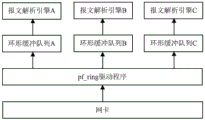
FIG. 1 is a diagram illustrating a related art message parsing engine invoking a driver to collect a message in accordance with an exemplary embodiment;
fig. 2 is a schematic diagram illustrating an exemplary embodiment of a message parsing engine calling a driver to collect a message in a message parsing method according to the present application;
FIG. 3 is a flow diagram illustrating a method for message parsing in accordance with an exemplary embodiment;
FIG. 4 is a block diagram of a message parsing device in accordance with an exemplary embodiment;
fig. 5 is a hardware structure diagram of an electronic device in which a message parsing apparatus is located according to an exemplary embodiment.
Detailed Description
Reference will now be made in detail to the exemplary embodiments, examples of which are illustrated in the accompanying drawings. When the following description refers to the accompanying drawings, like numbers in different drawings represent the same or similar elements unless otherwise indicated. The implementations described in the following exemplary examples do not represent all implementations consistent with the present application. Rather, they are merely examples of apparatus and methods consistent with certain aspects of the present application, as detailed in the appended claims.
The terminology used herein is for the purpose of describing particular embodiments only and is not intended to be limiting of the application. As used in this application and the appended claims, the singular forms "a", "an", and "the" are intended to include the plural forms as well, unless the context clearly indicates otherwise. It should also be understood that the term "and/or" as used herein refers to and encompasses any and all possible combinations of one or more of the associated listed items.
It is to be understood that although the terms first, second, third, etc. may be used herein to describe various information, such information should not be limited to these terms. These terms are only used to distinguish one type of information from another. For example, first information may also be referred to as second information, and similarly, second information may also be referred to as first information, without departing from the scope of the present application. The word "if," as used herein, may be interpreted as "at \8230; \8230when" or "when 8230; \823030when" or "in response to a determination," depending on the context.
In order to make those skilled in the art better understand the technical solution in the embodiment of the present disclosure, a brief description will be given below to the related art of message parsing related to the embodiment of the present disclosure.
In a network system, a protocol is a standard which two communication parties should obey in a communication process, and a plurality of protocols can form a communication protocol set; for example, TCP/IP is a common set of communication protocols.
The TCP/IP architecture divides the network architecture into four layers, which may include from bottom to top: a network interface layer (equivalent to a physical layer and a data link layer), a network layer, a transport layer, and an application layer. Wherein, the network interface layer can define the network interface, the existing data link layer protocol and physical layer protocol in OSI/RM system can be used in the network interface layer of TCP/IP system; the network layer may send the data packet from the network interface layer to the destination end through a certain path, and the protocol of the network layer may include IP, ARP, RARP, ICMP, IGMP, etc.; the transport layer can provide reliable transmission service among the processes, and the protocols of the transport layer can comprise TCP, UDP and the like; the application layer may provide support for business processes such as file transfer, email, network management, etc., and the protocols of the application layer may include FTP, POP3, SNMP, HTTP, DNS, etc.
When the application layer performs service processing, it needs to perform message parsing on the data packet from the network interface layer to obtain the quintuple information of the ethernet frame in the data packet, and then send the ethernet frame to corresponding different service applications for processing according to the quintuple information. The message analysis may include network layer message analysis and transport layer message analysis, and the five-tuple information may include a source address, a destination address, a source port, a destination port, and a transport protocol.
However, network attack gradually shifts from a network layer and a transport layer to an application layer, and if quintuple information of a message is obtained only by network layer message analysis and transport layer message analysis, a specific service type carried by the message cannot be identified, and a network attack means aiming at the application layer cannot be protected. Therefore, the information security protection problem of the application layer can be solved through the DPI technology.
The DPI technology can perform deep inspection on the packet loads of different packets through application layer packet parsing to obtain information such as specific service type and traffic size carried by the packet, and identify service application processing or user actions corresponding to the packet, thereby implementing functions such as attack detection or traffic control. The deep detection may be performed by tracking a protocol interaction process of a service application and/or performing deep recognition on a packet load of a packet, where the deep recognition specifically may include feature matching, application layer gateway recognition, and the like.
The deep recognition can be realized based on a message analysis engine, and one server can be provided with a plurality of message analysis engines; each message parsing engine can provide different deep recognition functions for service application of an application layer, such as functions of attack detection, protocol audit and the like. Each message parsing engine is provided with a corresponding protocol stack which can define various specifications to be followed in the process of transmitting a data packet from a network interface layer to an application layer; the protocol stack is a specific software implementation of a network protocol suite, and may include protocols of multiple layers in a network architecture.
In practical applications, when the service application of the application layer implements the function, the process of performing the message parsing based on the message parsing engine may include: a message analysis engine corresponding to the service application in the server can call a driver installed on the server to collect a data packet in the network; the driver copies the acquired data packet into a buffer area and maps the memory to an application layer through a memory mapping mechanism; the message analysis engine can read the message in the buffer area through a memory mapping mechanism and analyze the read message until the message analysis of an application layer is completed.
Referring to fig. 1, fig. 1 is a schematic diagram illustrating a related art message parsing engine invoking a driver to collect a message according to an exemplary embodiment. The service application of the application layer is loaded with a plurality of message analysis engines in the server, and each message analysis engine can correspondingly realize different service functions. For example, the message analysis engine a may correspondingly implement a protocol audit function, the message analysis engine B may correspondingly implement an intrusion prevention function, and the message analysis engine C may implement a flow control function; it should be clear that the number of the message parsing engines that can be loaded in the server does not only include three cases, and the service functions that can be correspondingly implemented by the parsing engines also include only the functions of the above examples, and this specification is not limited.
Taking a driver installed on a server as pf _ ring as an example, a prior art scheme is described below; it should be clear that this is only an exemplary description and does not represent a limitation of the present description.
In a prior art scheme, when a message parsing engine carried by a server calls a driver pf _ ring to collect a message from a network card, the driver pf _ ring provides a separate ring buffer queue a, a separate ring buffer queue B and a separate ring buffer queue C for the message parsing engine a, the message parsing engine B and the message parsing engine C, and copies of the collected message are written into the ring buffer queues corresponding to the message parsing engines respectively; each message analysis engine can read messages required by service processing from the corresponding ring buffer queue through a memory mapping mechanism mmap (); each message analysis engine can analyze the read message by a network layer message, a transmission layer message and an application layer message, and then perform service processing of an application layer according to the result of the message analysis.
Therefore, in the above-illustrated prior art scheme, on one hand, since the driver pf _ ring provides an individual ring buffer queue for each message parsing engine, and copies of the messages acquired from the network card are written into the ring buffer queue corresponding to each message parsing engine, a large number of copy operations and write operations need to be performed, which may cause consumption of server resources; on the other hand, in a multi-engine processing scenario, if multiple message parsing engines all need to read and process the same message collected from the network card, copies of the message in different ring buffer queues will be respectively subjected to transmission layer message parsing, network layer message parsing and application layer message parsing by the corresponding message parsing engines, and for service applications of an application layer, the result of the same message subjected to the network layer message parsing and the transmission layer message parsing is not different, and quintuple information of the message can be obtained, so that the method is equivalent to performing repeated network layer message parsing and transmission layer message parsing on copies of the same message in different ring buffer queues, and waste of server computing resources is caused.
In view of this, the present specification aims to provide a technical solution for completing message parsing by a message parsing engine based on a message that has been at least subjected to network layer message parsing in a shared buffer provided by a driver of a server in a scenario of processing by a plurality of message parsing engines.
When the method is realized, the message analysis method is applied to a server, and the server is loaded with a driving program for collecting messages; the driver provides a shared buffer area for a plurality of message analysis engines carried in the server; the method comprises the following steps:
performing message pre-analysis on the message acquired by the driver, wherein the message pre-analysis at least comprises network layer message analysis;
writing the message which is subjected to message pre-analysis into a shared buffer provided by the driver;
reading the message which is subjected to message pre-analysis from the shared buffer area based on the message analysis engine;
and further executing message analysis aiming at the read message, wherein the message analysis at least comprises application layer message analysis.
Therefore, in a scenario in which a plurality of message parsing engines process messages, when a message parsing engine collects a message based on a driver of a server, the driver provides a shared buffer for the plurality of message parsing engines in the server, and after the server performs at least network layer message parsing on the collected message, the server writes the message that has undergone at least network layer message parsing into the shared buffer based on the driver.
Compared with the prior art, in the message parsing method provided by the specification, on one hand, the driver of the server in the specification provides a shared buffer for a plurality of message parsing engines in the server, so that multiple copies of the same collected message can be avoided, and the copies can be prevented from being written into buffers corresponding to different message parsing engines respectively, thereby saving server resources; on the other hand, in this specification, after at least network layer packet parsing is performed on a packet acquired by a driver, the packet is written into a shared buffer, and after different packet parsing engines read the pre-parsed packet from the shared buffer, only packet parsing of other layers needs to be performed according to corresponding protocol stacks, so that in a scenario where multiple packet parsing engines in the server process, duplicate packet parsing of a part of layers on copies of the same packet in different buffers is avoided, and thus, packet processing performance is improved in a scenario where multiple engines process packets.
In this specification, the service application of the application layer may perform message parsing based on message parsing engines corresponding to different service functions to implement corresponding service functions. Specifically, the message parsing engine may call a driver installed on the server to collect a data packet in a network; the driver can copy the Ethernet frames in the collected data packet and write the Ethernet frames into a buffer area provided by the message analysis engine; the message analysis engine can read the message in the buffer area and analyze the message; the service application of the application layer can perform service processing according to the message analysis result, thereby realizing the corresponding service function.
The following describes a message parsing method provided in this specification by using a specific embodiment and combining a specific application scenario.
Referring to fig. 2, fig. 2 is a schematic diagram illustrating an exemplary embodiment of a message parsing engine calling a driver to collect a message in the message parsing method according to the present application.
In an application scenario of the present specification, a server is loaded with a plurality of message parsing engines, and each message parsing engine can correspondingly implement a different service function. When a message analysis engine carried by a server calls a driver pf _ ring to collect messages from a network card, the driver pf _ ring provides a shared ring buffer queue for a message analysis engine A, a message analysis engine B and a message analysis engine C respectively, and copies of the collected messages are written into the shared ring buffer queue; each message parsing engine can read the message required by service processing from the shared ring buffer queue through a memory mapping mechanism mmap (); each message analysis engine can analyze the read message by a network layer message, a transmission layer message and an application layer message, and then perform service processing of an application layer according to the result of the message analysis.
In an application scenario of the present specification, before writing a copy of a collected packet into a shared ring buffer queue, a packet pre-parsing may be performed on the collected packet, where the packet pre-parsing may include a network layer packet parsing, or may include a network layer packet parsing and a transport layer packet parsing; and writing the acquired message into a shared ring buffer queue after the message pre-analysis is finished. It should be clear that the message pre-analysis on the collected message may be executed by the server, or may be executed by a driver or other programs loaded in the server, which is not limited in this specification.
Therefore, compared with the prior art, in the message parsing method provided by the specification, on one hand, the driver of the server in the specification provides a shared buffer for a plurality of message parsing engines in the server, so that multiple copies of the same collected message can be avoided, and the copies can be prevented from being written into buffers corresponding to different message parsing engines respectively, thereby saving server resources; on the other hand, in this specification, after at least network layer packet parsing is performed on a packet acquired by a driver, the packet is written into a shared buffer, and after different packet parsing engines read the pre-parsed packet from the shared buffer, only packet parsing of other layers needs to be performed according to corresponding protocol stacks, so that in a scenario where multiple packet parsing engines in the server process, duplicate packet parsing of a part of layers on copies of the same packet in different buffers is avoided, and thus, packet processing performance is improved in a scenario where multiple engines process packets.
Referring to fig. 3, fig. 3 is a flowchart illustrating a message parsing method according to an exemplary embodiment, where the method is applied to a server, and the server is loaded with a driver for collecting a message; the driver provides a shared buffer area for a plurality of message analysis engines carried in the server; the method comprises the following steps:
step 301: performing message pre-analysis on a message acquired by a driver, wherein the message pre-analysis at least comprises network layer message analysis;
step 302: writing the message which is subjected to message pre-analysis into a shared buffer provided by the driver;
step 303: reading the message which is subjected to message pre-analysis from the shared buffer area based on the message analysis engine;
step 304: and further executing message analysis aiming at the read message, wherein the message analysis at least comprises application layer message analysis.
In this specification, the server is loaded with a driver, the driver may collect a data packet from the network card, the data packet may include a message that needs to be analyzed, and a specific form of the message may be an ethernet frame. It should be clear that, since the computer device is connected to the network through the network card, the driver in the server collects the data packets in the network, and it can also be said that the driver collects the data packets from the network card, which is only an exemplary description and is not meant to limit the present specification.
In practical applications, the driver may be a driver that has a function of collecting a data packet from a network card and is capable of providing a buffer for a message parsing engine installed in a server. For example, the driver may be pf _ ring, DPDK (Data Plane Development Kit), and the like, and regarding the specific implementation manner of the driver, the embodiment of the present disclosure is only an exemplary example, and is not limited.
In this specification, the server performs message pre-analysis on a message collected by the driver, where the message pre-analysis at least includes network layer message analysis.
In practical applications, the message pre-parsing may be a network layer message parsing, or a network layer message parsing and a transport layer message parsing.
It should be noted that, because there is no difference in the results of network layer packet parsing or transport layer packet parsing performed on the same packet by different packet parsing engines, before the driver writes the collected packet into the buffer, the server performs packet pre-parsing on the packet collected by the driver, and in a scenario where multiple packet parsing engines perform packet processing in the server, it is possible to avoid that each packet parsing engine repeatedly performs network layer packet parsing or network layer packet parsing and transport layer packet parsing on the same packet, thereby saving the computing resources of the server.
In this specification, the driver of the server writes the message that is pre-parsed into the shared buffer provided by the driver.
In practical applications, the buffer may be a ring buffer. The ring buffer can be a closed loop capable of accommodating a fixed number of elements, and the server can allocate memory spaces for the ring buffer when the ring buffer is initialized, wherein the memory spaces can be reused; when the elements are queued or dequeued in the ring buffer, only the address indicating the element memory needs to be returned, thereby avoiding the overhead of frequently allocating and releasing the memory. The elements in the ring buffer are that the data or messages in the ring buffer are analyzed into fields with fixed length in advance, and then the head identifiers of the elements are added in front of the fields with fixed length.
For example, when the Driver in the server is a DPDK, the DPDK may receive a packet through a PMD (Poll Mode Driver). The DPDK may provide a memory pool (memory pool) for the server, allocate an object of a fixed size, and store the object in use by using a ring; different Mempool Library are distinguished by name. The above-mentioned mempoool Library may further store an Mbuf Library for allocating and releasing a buffer to the DPDK application for storing the cache message. The DPDK may further include Ring Library for providing a linked list queue management with fifo, fixed length, lock-less, and concurrent issue/enqueue features.
It should be noted that, the ring buffer can ensure that the data or the messages therein operate according to the principle of "first in first out", that is, the message parsing engine can ensure that the data or the messages in the ring buffer are sequentially accessed. In addition, in a scenario where multi-threaded communication is required, the ring buffer facilitates efficient and frequent implementation of multi-threaded communication.
In an embodiment shown in the foregoing description, after performing message pre-parsing on a message collected by the driver, the server uses a result of the message pre-parsing as a message header, and uses the message as a message load to perform message encapsulation; and writing the packaged message into a shared buffer provided by the driver.
In practical applications, when the message is pre-parsed into a network layer message, the server may obtain a source address (including a source IP and a source MAC) and a destination address (including a destination IP and a destination MAC) of the message collected by the driver, and encapsulate the source address and the destination address in header information of the message that is obtained by performing the pre-parsing. When the message is pre-analyzed to be a network layer message analysis and a transmission layer message analysis, the server may obtain a source address (including a source IP and a source MAC), a destination address (including a destination IP and a destination MAC), a source port, a destination port, and a transmission protocol of the message collected by the driver, that is, may obtain quintuple information of the message collected by the driver, and encapsulate the quintuple information in header information of the message that is pre-analyzed.
For example, the server performs network layer message analysis on a message acquired by the driver from the network card to obtain a source address and a destination address of the message; and the server packages the network layer message into a message with the message pre-analyzed completion according to the result of the network layer message analysis, wherein the source address and the destination address of the message obtained by the analysis are packaged in the header information of the message with the message pre-analyzed completion.
In one illustrated embodiment, the driver comprises a pf ring driver and the shared buffer comprises a shared lockless ring queue.
In practical application, due to a competition mechanism of read-write operation, when a write process and a read process in the same buffer queue are performed concurrently, an interruption situation may occur; thus, in the related art, a separate circular buffer queue may be provided for each message parsing engine. In this specification, the pf _ ring driver may provide a shared lockless ring queue for a plurality of message parsing engines installed in a server.
It should be noted that, when the driver is the pf _ ring driver, the shared buffer is a shared lock-free circular queue, and because the lock-free circular queue has a "lock-free" characteristic, when the driver in the server writes the message that is performed with the message pre-analysis into the shared lock-free circular queue and the message analysis engine reads the message that is performed with the message pre-analysis from the shared lock-free circular queue occur simultaneously, the write process and the read process do not affect each other, and for a buffer queue that may be interrupted, the waiting time caused by the interruption may be avoided, so that the speed of processing the message by the server may be increased.
In this specification, the server reads the message that is pre-parsed from the shared buffer based on a message parsing engine.
In practical applications, the message parsing engine may access the shared buffer through a zero-copy data mechanism provided by the driver and between the shared buffer and a service application of an application layer, and read a message that is pre-parsed in the shared buffer.
For example, when the driver is a pf _ ring driver, the message parsing engine may access the shared buffer through a memory mapping mechanism mmap (), and read a message in the shared buffer after message pre-parsing is completed. The mmap () is a memory mapping mechanism different from a read/write mechanism, and does not need to copy a message subjected to pre-analysis completion in the message in the shared buffer to an application layer first, and then call the message subjected to pre-analysis completion copied to the application layer by a service application of the application layer; through mmap (), the service application of the application layer can directly access the shared buffer area, and read the message from the shared buffer area by using the read pointer.
For another example, when the driver is a DPDK driver, the message parsing engine may access the shared buffer through IVSHMEME Library, and read a message that is pre-parsed in the shared buffer.
In this specification, the message parsing engine further executes message parsing on the read message, where the message parsing at least includes application layer message parsing.
In practical applications, after the server detects that the message subjected to message pre-parsing is subjected to network layer message parsing according to the header information of the message subjected to message pre-parsing, the server may perform transport layer message parsing and application layer message parsing on the message subjected to message pre-parsing. When the server detects that the message subjected to message pre-analysis is subjected to network layer message analysis and transmission layer message analysis according to the header information of the message subjected to message pre-analysis, the server can perform application layer message analysis on the message subjected to message pre-analysis.
It should be understood that, in a network architecture, the transmission and parsing processes of a message need to be performed layer by layer according to the hierarchy and protocol of the architecture, but this is only performed in sequence, and does not represent that the processing result of each layer may affect the processing result of the next layer; for example, the network layer packet parsing, the transport layer packet parsing, and the application layer packet parsing in this specification may include that the server performs packet parsing on different fields in a packet at different layers of an architecture, which only indicates that packet parsing of each layer needs to be performed in sequence, and does not indicate that a packet parsing result of a previous layer may affect packet parsing of a next layer, and packet parsing of a next layer does not need to rely on a packet parsing result of a previous layer.
For example, a message parsing engine corresponding to a protocol auditing function of a service application obtains a source address and a destination address of the message, and after detecting that the message subjected to message pre-parsing is subjected to network layer message parsing, may perform transport layer message parsing and application layer message parsing on the message subjected to message pre-parsing to obtain a source port, a destination port, and a transport protocol of the message, and perform deep identification on the content of the message.
It should be noted that, the server further executes application layer message parsing on the message that is completed by the message pre-parsing based on the message parsing engine, so as to detect information such as a specific service type and a traffic size of the message collected by the driver, so that a service application on an application layer can perform corresponding service processing according to a result of the message parsing of each layer.
In an embodiment shown, the message parsing engine obtains the result of the message pre-parsing according to header information of a message that is read from the shared buffer and is completed by the message pre-parsing.
In practical applications, when the message is pre-parsed into a network layer message, the server may obtain a source address (including a source IP and a source MAC) and a destination address (including a destination IP and a destination MAC) of the message collected by the driver according to header information of the message that is read by the message parsing engine and is pre-parsed, and detect that the message that is pre-parsed is only parsed by the network layer. When the message pre-analysis is network layer message analysis and transport layer message analysis, the server may obtain a source address (including a source IP and a source MAC), a destination address (including a destination IP and a destination MAC), a source port, a destination port, and a transport protocol of the message collected by the driver according to header information of the message that is completed by the message pre-analysis, that is, may obtain quintuple information of the message collected by the driver, and detect that the message that is completed by the message pre-analysis is subjected to the network layer message analysis and the transport layer message analysis.
For example, a message parsing engine corresponding to a protocol auditing function of a service application reads a segment of message subjected to message pre-parsing from the shared buffer, and only obtains a source address and a destination address of the message according to header information of the message subjected to message pre-parsing, so that it can be detected that the message subjected to message pre-parsing is subjected to network layer message parsing.
In an embodiment, when the message pre-parsing is a network layer message parsing and a transport layer message parsing, the further message parsing is an application layer message parsing. Before the message collected by the driver is written into the shared buffer area, the server analyzes the collected message by a network layer message and a transmission layer message; after the message parsing engine reads the first message from the shared buffer, it only needs to perform application layer message parsing on the message that is pre-parsed.
For example, the server performs network layer message analysis and transmission layer message analysis on a message acquired by the driver from the network card, and obtains quintuple information of the message; and the server encapsulates the message into a message with message pre-analysis completion according to the result of the message analysis of the network layer, wherein the quintuple information obtained by the analysis is encapsulated into the header information of the message with message pre-analysis completion. The message parsing engine corresponding to the intrusion detection function of the service application reads a segment of message which is subjected to message pre-parsing from the shared buffer, obtains five-tuple information of the message according to header information of the message which is subjected to message pre-parsing, and can detect that the message which is subjected to message pre-parsing is subjected to network layer message parsing and transmission layer message parsing. The message analysis engine only needs to analyze the application layer message of the message to deeply identify the content of the message.
It should be noted that, before the message collected by the driver is written into the shared buffer, the server performs network layer message analysis and transport layer message analysis on the collected message, and for an application layer, the results of the network layer message analysis and the transport layer message analysis performed on the same message based on different protocol stacks are all five-tuple information of the message; therefore, after different message analysis engines read the pre-analyzed message from the shared buffer area, different application layer message analysis is only needed to be carried out according to the corresponding protocol stack; therefore, in a scene that a plurality of message analysis engines in the server operate, repeated message analysis of partial layers of copies of the same message in different buffer areas is avoided, and the message processing performance under a multi-engine processing scene is improved.
In another embodiment shown in the above, the packet pre-parsed may include a packet header and a packet payload, and at this time, the further performing application layer packet parsing on the read packet may include: and further reading the message load of the message, and further executing application layer message analysis aiming at the read message load of the message.
In practical application, when the message is pre-analyzed into a network layer message analysis and a transmission layer message analysis, the server already obtains quintuple information of the message acquired by the driver, and encapsulates the quintuple information into header information of the message after the message is pre-analyzed; when the message parsing engine reads a message which is subjected to message pre-parsing from the shared buffer, the five-tuple information of the message can be acquired from the read header information of the message; the message analysis engine can directly analyze the application layer message of the read message load of the message.
It should be noted that, when the message is pre-analyzed to be a network layer message analysis and a transport layer message analysis, the server already obtains the quintuple information of the message collected by the driver, and at this time, the message analysis engine only needs to perform application layer message analysis on the read message load of the message according to its corresponding protocol stack, so as to detect information such as a specific service type and a traffic size of the message collected by the driver, so that the service application on the application layer can perform corresponding service processing.
In another embodiment, the message with message preresolution completed may include a message header, a message payload, and a count value, where the count value represents the number of message parsing engines reading the message with message preresolution completed from the shared buffer.
In practical applications, when a plurality of message parsing engines in a server process a message that is pre-parsed from a shared buffer at the same time, it is necessary to determine whether a certain segment of the message that is pre-parsed from the shared buffer is being processed, and when all the message parsing engines finish processing the message. The count value may indicate the number of message parsing engines that read the message from the shared buffer that have performed message pre-parsing.
It should be noted that, by adding a count value to the packet that is subjected to packet pre-parsing and is used to indicate the number of packet parsing engines that read the packet that is subjected to packet pre-parsing from the shared buffer, it can be determined whether a packet that is subjected to packet pre-parsing in the shared buffer is being read and called by the packet parsing engine, and whether the packet parsing engine has finished reading and calling, so that in a scenario of multi-engine concurrent processing, it is determined whether the packet that is subjected to packet pre-parsing can be removed from the shared buffer.
In another embodiment shown, when the message that is pre-parsed includes a count value, and when the message that is pre-parsed is read from the shared buffer based on the message parsing engine, the message parsing method may include: when any message analysis engine starts to read the message of which the message pre-analysis is finished in the shared buffer area, adding 1 to the count value corresponding to the message of which the message pre-analysis is finished; when any message analysis engine finishes reading the message of which the message pre-analysis is finished in the shared buffer area, subtracting 1 from the count value corresponding to the message of which the message pre-analysis is finished; and when the count value of the message of which any message is preresolved is reduced to 0, removing the message from the shared buffer area.
In practical applications, the count value may represent the number of message parsing engines that read the message from the shared buffer after message pre-parsing is completed. When the count value is not 0, indicating that a plurality of message analysis engines are reading or calling the message pre-analysis completed message corresponding to the count value currently; when one message analysis engine finishes reading the message after the message pre-analysis is finished, subtracting 1 from the count value corresponding to the message after the message pre-analysis is finished; when the count value of a message with a certain segment of message being pre-analyzed is reduced to 0, it indicates that all the message analysis engines have finished reading the message with the segment of message being pre-analyzed. When a new message pre-parsed is required to be written into a certain memory of the shared buffer, if the count value corresponding to the message pre-parsed in the memory is 0, the new message pre-parsed message can cover the message pre-parsed in the segment; if the count value corresponding to the message subjected to message pre-analysis on the memory is not 0, the new message subjected to message pre-analysis cannot cover the message which is still read or called and is subjected to message pre-analysis, and the next memory needs to be polled.
For example, the message parsing engine calls a polling interface of a driver pf _ ring to receive a message, if a message which is pre-parsed and completed is read from the shared non-locked circular queue, a count value corresponding to the message is increased by 1, and a memory pointer after mmap () memory mapping is returned, wherein the content pointed by the memory pointer is the message which is read from the shared non-locked circular queue by the message parsing engine and is pre-parsed and completed; after the message analysis engine finishes receiving the message, subtracting 1 from the count value corresponding to the message; if the count value is reduced to 0, the message can be overwritten by a new message.
It should be noted that, when the message subjected to message pre-parsing includes the count value, and a new message subjected to message pre-parsing needs to be written into a certain memory of the shared buffer, it may be determined whether the message subjected to message pre-parsing and corresponding to the count value is being called by the message parsing engine through the value of the count value, so as to determine whether the new message subjected to message pre-parsing and corresponding to the count value can directly cover the original message in the memory.
In the technical solution of this specification, in a scenario where a plurality of message parsing engines are processing, when a message parsing engine collects a message based on a driver of a server, the driver provides a shared buffer for the plurality of message parsing engines in the server, and after the server performs at least network layer message parsing on the collected message, the server writes the message that has undergone at least network layer message parsing into the shared buffer based on the driver. On one hand, the driver of the server in the present specification provides a shared buffer for a plurality of message parsing engines in the server, so that multiple copies of the same collected message can be avoided, and the copies can be prevented from being written into buffers corresponding to different message parsing engines, thereby saving server resources; on the other hand, in this specification, after at least network layer packet parsing is performed on a packet acquired by a driver, the packet is written into a shared buffer, and after different packet parsing engines read the pre-parsed packet from the shared buffer, only packet parsing of other layers needs to be performed according to corresponding protocol stacks, so that in a scenario where multiple packet parsing engines in the server process, duplicate packet parsing of a part of layers on copies of the same packet in different buffers is avoided, and thus, packet processing performance is improved in a scenario where multiple engines process packets.
Further, in the technical solution of the present specification, when the driver is a pf _ ring driver, the shared buffer is a shared lock-free ring queue, and because the lock-free ring queue has a "lock-free" characteristic, when the driver in the server writes the message that is completed by the message pre-analysis into the shared lock-free ring queue and the message analysis engine reads the message that is completed by the message pre-analysis from the shared lock-free ring queue simultaneously occur, the write process and the read process do not affect each other, and with respect to the buffer queue with a lock mechanism, the waiting time caused by the lock mechanism can be avoided, so that the speed of processing the message by the server can be increased.
Further, in the technical solution of the present specification, a count value is added to the message that has been subjected to message pre-parsing, so as to indicate the number of message parsing engines that read the message that has been subjected to message pre-parsing from the shared buffer, and in a scenario of multi-engine concurrent processing, when a new message that has been subjected to message pre-parsing needs to be written into a certain memory of the shared buffer, it is determined whether the message that has been subjected to message pre-parsing and is corresponding to the count value is being called by the message parsing engine through the value of the count value, so as to determine whether the new message that has been subjected to message pre-parsing can directly cover the original message in the memory.
Corresponding to the above method embodiments, the present specification further provides an embodiment of a message parsing apparatus.
Referring to fig. 4, fig. 4 is a block diagram of a message parsing apparatus according to an exemplary embodiment, where the apparatus is applied to a server, where the server is loaded with a driver for collecting a message, and the driver provides a shared buffer for a plurality of message parsing engines loaded in the server, and the apparatus may include the following units:
a message pre-analysis unit 401, configured to perform message pre-analysis on a message acquired by the driver, where the message pre-analysis at least includes network layer message analysis;
a write buffer unit 402, configured to write the message that is pre-parsed into a shared buffer provided by the driver;
a reading buffer unit 403, configured to read the packet that is pre-parsed from the shared buffer based on the packet parsing engine;
a message parsing unit 404, configured to further perform message parsing on the read message, where the message parsing at least includes application layer message parsing.
In this embodiment, optionally, the write buffering unit 402 is specifically configured to: using the result of message pre-analysis as the message header, using the message as the message load, and performing message encapsulation; and writing the packaged message into a shared buffer provided by the driver.
In this embodiment, the message pre-parsing includes network layer message parsing and transport layer message parsing; the message parsing includes application layer message parsing.
In this embodiment, when the message parsing includes application layer message parsing, the message parsing unit 404 is specifically configured to: and further reading the message load of the message, and further executing application layer message analysis aiming at the read message load of the message.
In this embodiment, the message that has been pre-parsed further includes a count value, and the count value indicates the number of message parsing engines that read the message from the shared buffer.
In this embodiment, the read buffer unit 403 is further configured to: when any one message analysis engine starts to read the message of which the message pre-analysis in the shared buffer is finished, adding 1 to a count value corresponding to the message of which the message pre-analysis is finished; when any one of the message analysis engines finishes reading the message with the message pre-analysis completed in the shared buffer area, subtracting 1 from the count value corresponding to the message with the message pre-analysis completed; and when the count value corresponding to the message subjected to the pre-analysis of any message is reduced to 0, removing the message subjected to the pre-analysis of the message from the shared buffer area.
In this embodiment, the driver includes a pf _ ring driver; the shared buffer includes a shared lockless ring queue.
In addition, this specification also provides an embodiment of an electronic device in which the message parsing apparatus is located.
Corresponding to the above method embodiments, the present specification further provides an embodiment of a message parsing apparatus. The embodiment of the message analysis device in the present specification can be applied to electronic equipment. The device embodiments may be implemented by software, or by hardware, or by a combination of hardware and software. Taking a software implementation as an example, as a logical device, the device is formed by reading, by a processor of a storage device where the device is located, a corresponding computer program instruction in a non-volatile memory into an internal memory for operation. In terms of hardware, please refer to fig. 5, where fig. 5 is a hardware structure diagram of an electronic device where a message parsing apparatus is located in an exemplary embodiment, and besides the processor, the memory, the network interface, and the nonvolatile memory shown in fig. 3, the electronic device where the apparatus is located in the embodiment may also include other hardware generally according to an actual function of the electronic device, which is not described again.
The implementation process of the functions and actions of each unit in the above device is specifically described in the implementation process of the corresponding step in the above method, and is not described herein again.
For the device embodiments, since they substantially correspond to the method embodiments, reference may be made to the partial description of the method embodiments for relevant points. The above-described embodiments of the apparatus are only illustrative, and the units described as separate parts may or may not be physically separate, and parts displayed as units may or may not be physical units, may be located in one place, or may be distributed on a plurality of network units. Some or all of the modules can be selected according to actual needs to achieve the purpose of the solution in the specification. One of ordinary skill in the art can understand and implement it without inventive effort.
The systems, devices, modules or units illustrated in the above embodiments may be implemented by a computer chip or an entity, or by a product with certain functions. A typical implementation device is a computer, which may take the form of a personal computer, laptop computer, cellular telephone, camera phone, smart phone, personal digital assistant, media player, navigation device, email messaging device, game console, tablet computer, wearable device, or a combination of any of these devices.
In a typical configuration, a computer includes one or more processors (CPUs), input/output interfaces, network interfaces, and memory.
The memory may include forms of volatile memory in a computer readable medium, random Access Memory (RAM) and/or non-volatile memory, such as Read Only Memory (ROM) or flash memory (flash RAM). Memory is an example of a computer-readable medium.
Computer-readable media, including both non-transitory and non-transitory, removable and non-removable media, may implement information storage by any method or technology. The information may be computer readable instructions, data structures, modules of a program, or other data. Examples of computer storage media include, but are not limited to, phase change memory (PRAM), static Random Access Memory (SRAM), dynamic Random Access Memory (DRAM), other types of Random Access Memory (RAM), read Only Memory (ROM), electrically Erasable Programmable Read Only Memory (EEPROM), flash memory or other memory technology, compact disc read only memory (CD-ROM), digital Versatile Discs (DVD) or other optical storage, magnetic cassettes, magnetic disk storage, quantum memory, graphene-based storage media or other magnetic storage devices, or any other non-transmission medium that can be used to store information that can be accessed by a computing device. As defined herein, a computer readable medium does not include a transitory computer readable medium such as a modulated data signal and a carrier wave.
It should also be noted that the terms "comprises," "comprising," or any other variation thereof, are intended to cover a non-exclusive inclusion, such that a process, method, article, or apparatus that comprises a list of elements does not include only those elements but may include other elements not expressly listed or inherent to such process, method, article, or apparatus. Without further limitation, an element defined by the phrases "comprising a," "8230," "8230," or "comprising" does not exclude the presence of other like elements in a process, method, article, or apparatus comprising the element.
The foregoing description has been directed to specific embodiments of this disclosure. Other embodiments are within the scope of the following claims. In some cases, the actions or steps recited in the claims may be performed in a different order than in the embodiments and still achieve desirable results. In addition, the processes depicted in the accompanying figures do not necessarily require the particular order shown, or sequential order, to achieve desirable results. In some embodiments, multitasking and parallel processing may also be possible or may be advantageous.
The terminology used in the description of the one or more embodiments is for the purpose of describing the particular embodiments only and is not intended to be limiting of the description of the one or more embodiments. As used in this specification and the appended claims, the singular forms "a", "an", and "the" are intended to include the plural forms as well, unless the context clearly indicates otherwise. It should also be understood that the term "and/or" as used herein refers to and encompasses any and all possible combinations of one or more of the associated listed items.
It should be understood that although the terms first, second, third, etc. may be used in one or more embodiments of the present description to describe various information, such information should not be limited to these terms. These terms are only used to distinguish one type of information from another. For example, first information may also be referred to as second information, and similarly, second information may also be referred to as first information, without departing from the scope of one or more embodiments herein. The word "if" as used herein may be interpreted as "at" \8230; "or" when 8230; \8230; "or" in response to a determination ", depending on the context.
The above description is only for the purpose of illustrating the preferred embodiments of the one or more embodiments of the present disclosure, and is not intended to limit the scope of the one or more embodiments of the present disclosure, and any modifications, equivalent substitutions, improvements, etc. made within the spirit and principle of the one or more embodiments of the present disclosure should be included in the scope of the one or more embodiments of the present disclosure.
The above description is only a preferred embodiment of the present disclosure, and should not be taken as limiting the present disclosure, and any modifications, equivalents, improvements, etc. made within the spirit and principle of the present disclosure should be included in the scope of the present disclosure.
Claims (9)
1. A message analysis method is applied to a server and is characterized in that the server carries a driver used for collecting messages; the driver provides a shared buffer area for a plurality of message analysis engines loaded in the server; the method comprises the following steps:
performing message pre-analysis on the message acquired by the driver, wherein the message pre-analysis comprises network layer message analysis and transmission layer message analysis;
writing the message which is subjected to message pre-analysis into a shared buffer provided by the driver;
reading the message which is subjected to message pre-analysis completion from the shared buffer area based on the message analysis engine;
and further executing message analysis aiming at the read message, wherein the message analysis comprises application layer message analysis.
2. The method of claim 1, wherein writing the packet with the pre-parsed completion to a shared buffer provided by the driver comprises:
using the result of message pre-analysis as the message header, using the message as the message load, and performing message encapsulation;
and writing the packaged message into a shared buffer provided by the driver.
3. The method according to claim 1, wherein the further performing application layer packet parsing on the read packet comprises:
and further reading the message load of the message, and further executing application layer message analysis aiming at the read message load of the message.
4. The method of claim 3, wherein the packet with the packet pre-parse completed further comprises a count value, the count value representing a number of packet parsing engines reading the packet with the packet pre-parse completed from the shared buffer.
5. The method of claim 4, wherein when the message is read from the shared buffer based on the message parsing engine, the method further comprises:
when any message analysis engine starts to read the message of which the message pre-analysis in the shared buffer is completed, adding 1 to a count value corresponding to the message of which the message pre-analysis is completed;
when any message analysis engine finishes reading the message of which the message pre-analysis in the shared buffer is finished, subtracting 1 from the count value corresponding to the message of which the message pre-analysis is finished;
and when the count value corresponding to any message which is subjected to the message pre-analysis is reduced to 0, removing the message which is subjected to the message pre-analysis from the shared buffer area.
6. The method of claim 1, comprising:
the drivers include a pf _ ring driver;
the shared buffer includes a shared lock-free ring queue.
7. A message analysis device is applied to a server and is characterized in that the server is loaded with a driver program for collecting messages; the driver provides a shared buffer area for a plurality of message analysis engines loaded in the server; the device comprises:
the message pre-analysis unit is used for performing message pre-analysis on the message acquired by the driver, wherein the message pre-analysis comprises network layer message analysis and transmission layer message analysis;
the write buffer unit is used for writing the message which is subjected to message pre-analysis into a shared buffer area provided by the driver;
the read buffer unit is used for reading the message subjected to message pre-analysis from the shared buffer area based on the message analysis engine;
and the message analysis unit is used for further executing message analysis aiming at the read message, wherein the message analysis comprises application layer message analysis.
8. An electronic device is characterized by comprising a communication interface, a processor, a memory and a bus, wherein the communication interface, the processor and the memory are connected with each other through the bus;
the memory stores machine-readable instructions, and the processor executes the method of any one of claims 1 to 6 by calling the machine-readable instructions.
9. A machine-readable storage medium having stored thereon machine-readable instructions which, when invoked and executed by a processor, carry out the method of any of claims 1 to 6.
Priority Applications (1)
| Application Number | Priority Date | Filing Date | Title |
|---|---|---|---|
| CN202011219354.7A CN112532690B (en) | 2020-11-04 | 2020-11-04 | Message parsing method and device, electronic equipment and storage medium |
Applications Claiming Priority (1)
| Application Number | Priority Date | Filing Date | Title |
|---|---|---|---|
| CN202011219354.7A CN112532690B (en) | 2020-11-04 | 2020-11-04 | Message parsing method and device, electronic equipment and storage medium |
Publications (2)
| Publication Number | Publication Date |
|---|---|
| CN112532690A CN112532690A (en) | 2021-03-19 |
| CN112532690B true CN112532690B (en) | 2023-03-24 |
Family
ID=74979640
Family Applications (1)
| Application Number | Title | Priority Date | Filing Date |
|---|---|---|---|
| CN202011219354.7A Active CN112532690B (en) | 2020-11-04 | 2020-11-04 | Message parsing method and device, electronic equipment and storage medium |
Country Status (1)
| Country | Link |
|---|---|
| CN (1) | CN112532690B (en) |
Families Citing this family (1)
| Publication number | Priority date | Publication date | Assignee | Title |
|---|---|---|---|---|
| CN114157467B (en) * | 2021-11-25 | 2024-06-04 | 山东科技大学 | Distributed switchable industrial honey net trapping method |
Citations (2)
| Publication number | Priority date | Publication date | Assignee | Title |
|---|---|---|---|---|
| CN101089829A (en) * | 2007-08-01 | 2007-12-19 | 杭州华三通信技术有限公司 | Shared buffer store system and implementing method |
| CN106774277A (en) * | 2017-01-17 | 2017-05-31 | 爱普(福建)科技有限公司 | A kind of data sharing method between many Virtual Controllers |
Family Cites Families (13)
| Publication number | Priority date | Publication date | Assignee | Title |
|---|---|---|---|---|
| CN101453386A (en) * | 2007-12-07 | 2009-06-10 | 英业达股份有限公司 | Network packet capturing method |
| CN101504617B (en) * | 2009-03-23 | 2011-05-11 | 华为技术有限公司 | Data transmitting method and device based on processor sharing internal memory |
| CN102651690B (en) * | 2011-02-28 | 2015-11-25 | 国际商业机器公司 | To the method and apparatus that shared drive controls |
| CN102520936B (en) * | 2011-11-30 | 2017-02-08 | 厦门雅迅网络股份有限公司 | Method for realizing sharing of Socket communication service on Android platform |
| CN102693162A (en) * | 2011-12-29 | 2012-09-26 | 中国科学技术大学苏州研究院 | Method for process communication among multiple virtual machines on multi-core platform based on shared memory and intercore interruption |
| US9952999B2 (en) * | 2013-09-19 | 2018-04-24 | Intel Corporation | Methods and apparatus to manage cache memory in multi-cache environments |
| CN104092581A (en) * | 2014-06-30 | 2014-10-08 | 国家电网公司 | Quick message processing method in message recording and analyzing system of intelligent substation |
| US9633060B2 (en) * | 2015-05-14 | 2017-04-25 | Walleye Software, LLC | Computer data distribution architecture with table data cache proxy |
| US10812376B2 (en) * | 2016-01-22 | 2020-10-20 | Red Hat, Inc. | Chaining network functions to build complex datapaths |
| CN107707546B (en) * | 2017-09-29 | 2020-02-18 | 江苏农林职业技术学院 | Message copying method and novel network adapter supporting message copying function |
| CN111327645B (en) * | 2018-11-28 | 2023-11-21 | 鸿合科技股份有限公司 | Network sharing method and device and electronic equipment |
| CN110932998B (en) * | 2019-11-28 | 2022-11-01 | 杭州迪普科技股份有限公司 | Message processing method and device |
| CN111371920A (en) * | 2020-03-16 | 2020-07-03 | 广州根链国际网络研究院有限公司 | DNS front-end analysis method and system |
-
2020
- 2020-11-04 CN CN202011219354.7A patent/CN112532690B/en active Active
Patent Citations (2)
| Publication number | Priority date | Publication date | Assignee | Title |
|---|---|---|---|---|
| CN101089829A (en) * | 2007-08-01 | 2007-12-19 | 杭州华三通信技术有限公司 | Shared buffer store system and implementing method |
| CN106774277A (en) * | 2017-01-17 | 2017-05-31 | 爱普(福建)科技有限公司 | A kind of data sharing method between many Virtual Controllers |
Also Published As
| Publication number | Publication date |
|---|---|
| CN112532690A (en) | 2021-03-19 |
Similar Documents
| Publication | Publication Date | Title |
|---|---|---|
| US20210377188A1 (en) | Hardware acceleration techniques using flow selection | |
| US8094560B2 (en) | Multi-stage multi-core processing of network packets | |
| US8225329B1 (en) | Tail synchronized FIFO for fast user space packet access | |
| CN112532538A (en) | Flow control method and device, electronic equipment and computer readable storage medium | |
| EP4143691B1 (en) | Systems for providing an lpm implementation for a programmable data plane through a distributed algorithm | |
| US10693787B2 (en) | Throttling for bandwidth imbalanced data transfers | |
| US8555374B2 (en) | High performance packet processing using a general purpose processor | |
| US20170116057A1 (en) | Packet processing on a multi-core processor | |
| US20080263554A1 (en) | Method and System for Scheduling User-Level I/O Threads | |
| US20100103938A1 (en) | Context Sharing Between A Streaming Processing Unit (SPU) and A Packet Management Unit (PMU) In A Packet Processing Environment | |
| CN107729135B (en) | Method and apparatus for sequential parallel data processing | |
| Scholz | A look at Intels dataplane development kit | |
| US11258707B1 (en) | Systems for building data structures with highly scalable algorithms for a distributed LPM implementation | |
| CN114025018A (en) | Data processing method, device, network equipment and computer readable storage medium | |
| CN110602211B (en) | Out-of-order RDMA method and device with asynchronous notification | |
| CN112532690B (en) | Message parsing method and device, electronic equipment and storage medium | |
| CN116915667B (en) | Network traffic acquisition method and device, electronic equipment and storage medium | |
| US20060098648A1 (en) | Packet transmission device | |
| CN114024758A (en) | Flow characteristic extraction method, system, storage medium and electronic equipment | |
| US7940764B2 (en) | Method and system for processing multicast packets | |
| CN115033407B (en) | System and method for collecting and identifying flow suitable for cloud computing | |
| CN119276790B (en) | Message processing method, device, equipment, network card and computer program product | |
| US7603539B2 (en) | Systems and methods for multi-frame control blocks | |
| Wang et al. | Design and analysis of a robust pipelined memory system | |
| CN118200417B (en) | NETMAP-based FPGA algorithm card call processing method and system |
Legal Events
| Date | Code | Title | Description |
|---|---|---|---|
| PB01 | Publication | ||
| PB01 | Publication | ||
| SE01 | Entry into force of request for substantive examination | ||
| SE01 | Entry into force of request for substantive examination | ||
| GR01 | Patent grant | ||
| GR01 | Patent grant |