CN112527463A - Container mirror image downloading acceleration method based on object storage - Google Patents
Container mirror image downloading acceleration method based on object storage Download PDFInfo
- Publication number
- CN112527463A CN112527463A CN202011500164.2A CN202011500164A CN112527463A CN 112527463 A CN112527463 A CN 112527463A CN 202011500164 A CN202011500164 A CN 202011500164A CN 112527463 A CN112527463 A CN 112527463A
- Authority
- CN
- China
- Prior art keywords
- atomic
- image
- mirror
- container
- priority
- Prior art date
- Legal status (The legal status is an assumption and is not a legal conclusion. Google has not performed a legal analysis and makes no representation as to the accuracy of the status listed.)
- Granted
Links
Images

Classifications
-
- G—PHYSICS
- G06—COMPUTING OR CALCULATING; COUNTING
- G06F—ELECTRIC DIGITAL DATA PROCESSING
- G06F9/00—Arrangements for program control, e.g. control units
- G06F9/06—Arrangements for program control, e.g. control units using stored programs, i.e. using an internal store of processing equipment to receive or retain programs
- G06F9/44—Arrangements for executing specific programs
- G06F9/455—Emulation; Interpretation; Software simulation, e.g. virtualisation or emulation of application or operating system execution engines
- G06F9/45533—Hypervisors; Virtual machine monitors
- G06F9/45558—Hypervisor-specific management and integration aspects
-
- G—PHYSICS
- G06—COMPUTING OR CALCULATING; COUNTING
- G06F—ELECTRIC DIGITAL DATA PROCESSING
- G06F9/00—Arrangements for program control, e.g. control units
- G06F9/06—Arrangements for program control, e.g. control units using stored programs, i.e. using an internal store of processing equipment to receive or retain programs
- G06F9/44—Arrangements for executing specific programs
- G06F9/455—Emulation; Interpretation; Software simulation, e.g. virtualisation or emulation of application or operating system execution engines
- G06F9/45533—Hypervisors; Virtual machine monitors
- G06F9/45558—Hypervisor-specific management and integration aspects
- G06F2009/45562—Creating, deleting, cloning virtual machine instances
-
- Y—GENERAL TAGGING OF NEW TECHNOLOGICAL DEVELOPMENTS; GENERAL TAGGING OF CROSS-SECTIONAL TECHNOLOGIES SPANNING OVER SEVERAL SECTIONS OF THE IPC; TECHNICAL SUBJECTS COVERED BY FORMER USPC CROSS-REFERENCE ART COLLECTIONS [XRACs] AND DIGESTS
- Y02—TECHNOLOGIES OR APPLICATIONS FOR MITIGATION OR ADAPTATION AGAINST CLIMATE CHANGE
- Y02D—CLIMATE CHANGE MITIGATION TECHNOLOGIES IN INFORMATION AND COMMUNICATION TECHNOLOGIES [ICT], I.E. INFORMATION AND COMMUNICATION TECHNOLOGIES AIMING AT THE REDUCTION OF THEIR OWN ENERGY USE
- Y02D10/00—Energy efficient computing, e.g. low power processors, power management or thermal management
Landscapes
- Engineering & Computer Science (AREA)
- Software Systems (AREA)
- Theoretical Computer Science (AREA)
- Physics & Mathematics (AREA)
- General Engineering & Computer Science (AREA)
- General Physics & Mathematics (AREA)
- Management, Administration, Business Operations System, And Electronic Commerce (AREA)
- Image Processing (AREA)
Abstract
Description
技术领域technical field
本发明属于云计算领域,特别涉及一种基于对象存储的容器镜像下载加速方法。The invention belongs to the field of cloud computing, and particularly relates to an object storage-based container image download acceleration method.
背景技术Background technique
容器技术主要包含应用程序打包、资源隔离、资源限制等技术,使得容器化的应用具有了轻量、易于部署和移植、弹性伸缩等特点,简化了应用程序的交付流程和管理。像Docker这样的容器已经越来越流行,它是一种轻量级内核虚拟化技术,可替代传统的虚拟机。容器的部署分为两步,一是拉取容器镜像,二是启动容器。虽然启动一个容器实例可能只需要几秒钟甚至是不到一秒钟,比虚拟机快的多,使得快速部署大量容器实例成为可能,但是容器的镜像拉取却是一个很缓慢的过程。有相关研究曾统计过,镜像仓库Docker Hub的前69个镜像平均的部署时间高达13.4秒,而92%的时间耗费在网路传输镜像数据这个过程。更为糟糕的是,在大规模的并发部署中,因为资源争夺还会加剧这种情况。Container technology mainly includes application packaging, resource isolation, resource limitation and other technologies, which make containerized applications lightweight, easy to deploy and transplant, and elastically scale, simplifying the application delivery process and management. Containers like Docker, a lightweight kernel virtualization technology that can replace traditional virtual machines, have grown in popularity. The deployment of the container is divided into two steps, one is to pull the container image, and the other is to start the container. Although it may only take a few seconds or even less than a second to start a container instance, which is much faster than a virtual machine, making it possible to quickly deploy a large number of container instances, but pulling container images is a very slow process. According to relevant research, the average deployment time of the first 69 images of the image warehouse Docker Hub is as high as 13.4 seconds, and 92% of the time is spent in the process of transmitting image data over the network. Worse yet, in large-scale concurrent deployments, this can be exacerbated by resource contention.
容器镜像由多层叠加而成,每一层都可以添加、删除或覆盖其下面的层中的文件。默认情况下,Docker并行下载镜像层,且最大并行度为3。然后,从第一层开始,将这些层依次解压缩并提取到磁盘。在现实环境中可用网络带宽受限时,并行下载多个层将延迟第一层的下载完成,从而延迟解压缩和提取过程开始的时刻。因此,延迟第一层的下载最终导致提取阶段的减慢。Docker总是以压缩的形式发送镜像层,通常以tar文件的形式实现,再将镜像提取到磁盘之前对镜像进行解压缩。这降低了镜像层的传输成本,但增加了客户端节点上的CPU需求。Docker通过调用标准函数来解压镜像,而标准函数恰好是单线程的,通过单线程解压,整个过程受到了限制。综上所述,使用传统容器镜像拉取方式将会浪费宝贵的计算资源,并且容器部署的时间将会远远延长,所以在当前环境下需要进一步优化容器镜像拉取的方式。A container image is made up of multiple layers, each of which can add, delete, or overwrite files in the layers below it. By default, Docker downloads image layers in parallel, with a maximum parallelism of 3. Then, starting with the first layer, the layers are sequentially decompressed and extracted to disk. When the available network bandwidth is limited in a real-world environment, downloading multiple layers in parallel will delay the completion of the download of the first layer, thereby delaying the moment when the decompression and extraction process begins. Therefore, delaying the download of the first layer eventually leads to a slowdown in the extraction phase. Docker always sends image layers in compressed form, usually as a tar file, and decompresses the image before extracting it to disk. This reduces the transfer cost of the image layer, but increases the CPU requirement on the client node. Docker decompresses images by calling standard functions, and the standard functions happen to be single-threaded. Through single-threaded decompression, the entire process is limited. To sum up, using the traditional container image pulling method will waste valuable computing resources, and the container deployment time will be much longer. Therefore, in the current environment, it is necessary to further optimize the container image pulling method.
发明内容SUMMARY OF THE INVENTION
为了降低了私有云中容器镜像拉取时间,本发明提出一种基于对象存储的容器镜像下载加速方法,如图1,具体包括以下步骤:In order to reduce the pulling time of container images in the private cloud, the present invention proposes an object storage-based container image download acceleration method, as shown in Figure 1, which specifically includes the following steps:
S1、获取原子镜像的使用频率、复用程度和原子镜像特性,并以此构建原子镜像权重模型;S1. Obtain the usage frequency, degree of reuse, and atomic mirror characteristics of atomic mirrors, and construct the atomic mirror weight model accordingly;
S2、基于TOPSIS方法,根据剩余宽带、I/O负载、CPU利用率、内存利用率属性建立CEPH资源模型,根据该模型计算每个节点资源总分;S2. Based on the TOPSIS method, establish a CEPH resource model according to the remaining bandwidth, I/O load, CPU utilization, and memory utilization attributes, and calculate the total resource score of each node according to the model;
S3、根据原子镜像权重模型计算每个原子镜像权重,根据原子镜像权重的降序放置原子镜像;S3. Calculate the weight of each atomic mirror according to the atomic mirror weight model, and place the atomic mirrors according to the descending order of the atomic mirror weights;
S4、基于贪心算法,对该原子镜像进行节点放置选择,放置时节点资源总分越高放置原子镜像的优先级越高,根据节点存储能力能否满足原子镜像需求判断节点能否放置原子镜像;S4. Based on the greedy algorithm, select the node placement for the atomic image. The higher the node resource total score during placement, the higher the priority of placing the atomic image. Whether the node can place the atomic image is judged according to whether the node's storage capacity can meet the requirements of the atomic image;
S5、若能放置,则将该原子镜像存放到被选节点上,并记录该原子镜像与被选节点映射关系,并返回步骤S2,直到所有原子镜像放置完成;S5. If it can be placed, store the atomic image on the selected node, record the mapping relationship between the atomic image and the selected node, and return to step S2 until all atomic images are placed;
S6、若不能放置,则从CEPH节点资源中去掉该被选节点,判断CEPH资源节点是否为空,如果不为空则跳转至步骤S4。S6. If it cannot be placed, remove the selected node from the CEPH node resource, determine whether the CEPH resource node is empty, and jump to step S4 if it is not empty.
进一步的,根据原子镜像权重模型计算每个原子镜像权重具体包括以下步骤:Further, calculating the weight of each atomic mirror according to the atomic mirror weight model specifically includes the following steps:
S11、计算各个原子镜像的使用次数,并对使用次数进行归一化处理,获取原子镜像的频率参数;S11. Calculate the number of times of use of each atomic mirror image, and normalize the number of times of use to obtain frequency parameters of the atomic mirror image;
S12、计算各个原子镜像的容器复用平均比率和类型复用平均比率,对两个平均比率进行线性加权融合,得到原子镜像复用程度;S12. Calculate the average ratio of container reuse and the average ratio of type reuse of each atomic image, and perform linear weighted fusion on the two average ratios to obtain the degree of reuse of atomic images;
S13、采用TOPSIS方法,根据原子镜像大小、容器实时性及容器业务重要程度,计算属性优先级比率;S13. Using the TOPSIS method, calculate the attribute priority ratio according to the size of the atomic image, the real-time performance of the container and the importance of the container business;
S14、对原子镜像的频率参数、复用程度属性以及优先级比率进行加权求和,得到原子镜像的总分。S14 , weighting and summing the frequency parameters, the multiplexing degree attribute, and the priority ratio of the atomic mirror image to obtain the total score of the atomic mirror image.
进一步的,原子镜像的频率参数表示为:Further, the frequency parameter of the atomic mirror image is expressed as:


其中,


进一步的,原子镜像复用程度表示为:Further, the degree of atomic mirror reuse is expressed as:


其中,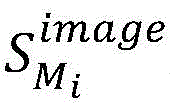


进一步的,原子镜像的属性优先级比率的获取包括:Further, the acquisition of the attribute priority ratio of the atomic mirror includes:
原子镜像大小根据镜像层大小确认优先级,镜像层越小优先级越高;The atomic image size determines the priority according to the size of the image layer. The smaller the image layer, the higher the priority;
原子镜像容器实时性根据原子镜像容器类型确认优先级,其优先级分值为(0,10]左开右闭区间,默认优先级为5,警类容器优先级为10,日志收集类容器优先级为1;The real-time priority of the atomic image container is confirmed according to the type of the atomic image container. The priority score is (0,10) left open and right closed interval. The default priority is 5, the priority of the police container is 10, and the log collection container has priority. level is 1;
原子镜像容器业务重要程度根据核心服务容器设置优先级,其优先级分值区间为(0,10]左开右闭区间,默认优先级为5,核心结账付费服务优先级为10,广告服务优先级为1;The business importance of the atomic image container is set according to the priority of the core service container. Its priority score range is (0,10] left open and right closed range, the default priority is 5, the core checkout payment service priority is 10, and the advertising service priority is level is 1;
根据上述三个属性构建原始数据矩阵,该矩阵中第i行、j列的元素表示第i个待评估的镜像层的第j个属性的属性值;The original data matrix is constructed according to the above three attributes, and the elements in the i-th row and the j-th column in the matrix represent the attribute value of the j-th attribute of the i-th mirror layer to be evaluated;
对原始数据矩阵中的属性进行指标属性同向化;Perform index attribute isotropy on the attributes in the original data matrix;
构造加权规范矩阵,并进行归一化处理,得到标准化的数据矩阵;Construct a weighted norm matrix and perform normalization to obtain a standardized data matrix;
计算获取镜像层优先级最高方案以及镜像层优先级最低方案,分别计算各层数据与优先级最高方案、优先级最低方案的接近程度;Calculate and obtain the scheme with the highest priority of the mirror layer and the scheme with the lowest priority of the mirror layer, and calculate the closeness of the data of each layer to the scheme with the highest priority and the lowest priority respectively;
计算出各层与最优方案贴近程度,该贴近程度即为原子镜像的属性优先级比率。Calculate the closeness of each layer to the optimal solution, which is the attribute priority ratio of the atomic mirror.
进一步的,原子镜像的总分表示为:Further, the total score of the atomic mirror image is expressed as:

其中,

进一步的,根据CEPH资源模型计算每个节点资源总分的过程包括:Further, the process of calculating the total resource score of each node according to the CEPH resource model includes:
S21、基于TOPSIS方法,构建OSD权重因子决策矩阵,矩阵中第i行、j列的元素为第i个节点的第j个属性的属性值;S21. Based on the TOPSIS method, construct an OSD weight factor decision matrix, and the elements in the i-th row and j-th column in the matrix are the attribute values of the j-th attribute of the i-th node;
S22、对OSD权重因子决策矩阵进行归一化处理,并为每个属性选择一个加权系数,获得规范化加权决策矩阵;S22, normalize the OSD weighting factor decision matrix, and select a weighting coefficient for each attribute to obtain a normalized weighted decision matrix;
S23、计算规范化加权决策矩阵的正理想值和负理想值,并计算每个OSD节点到正理想解与负理想解的距离;S23. Calculate the positive ideal value and the negative ideal value of the normalized weighted decision matrix, and calculate the distance from each OSD node to the positive ideal solution and the negative ideal solution;
S24、根据每个OSD节点到正理想解与负理想解的距离计算每个OSD与最优OSD的相对贴近度,该相对贴合度即为每个节点资源总分。S24. Calculate the relative closeness of each OSD to the optimal OSD according to the distance from each OSD node to the positive ideal solution and the negative ideal solution, and the relative closeness is the total resource score of each node.
本发明在结合对象存储的基础上,保证了使用频繁、复用率高的原子镜像能够拥有较充足资源,有效降低了容器镜像拉取时间,且能够提高总体资源利用率。Based on the combination of object storage, the present invention ensures that atomic images that are frequently used and have a high reuse rate can have sufficient resources, effectively reduce the pulling time of container images, and can improve overall resource utilization.
附图说明Description of drawings
图1为本发明一种基于对象存储的容器镜像下载加速方法流程图。FIG. 1 is a flowchart of an object storage-based container image download acceleration method according to the present invention.
具体实施方式Detailed ways
下面将结合本发明实施例中的附图,对本发明实施例中的技术方案进行清楚、完整地描述,显然,所描述的实施例仅仅是本发明一部分实施例,而不是全部的实施例。基于本发明中的实施例,本领域普通技术人员在没有做出创造性劳动前提下所获得的所有其他实施例,都属于本发明保护的范围。The technical solutions in the embodiments of the present invention will be clearly and completely described below with reference to the accompanying drawings in the embodiments of the present invention. Obviously, the described embodiments are only a part of the embodiments of the present invention, but not all of the embodiments. Based on the embodiments of the present invention, all other embodiments obtained by those of ordinary skill in the art without creative efforts shall fall within the protection scope of the present invention.
本发明提出一种基于对象存储的容器镜像下载加速方法,如图1,具体包括以下步骤:The present invention proposes an object storage-based container image download acceleration method, as shown in Figure 1, which specifically includes the following steps:
S1、获取原子镜像的使用频率、复用程度和原子镜像特性,并以此构建原子镜像权重模型;S1. Obtain the usage frequency, degree of reuse, and atomic mirror characteristics of atomic mirrors, and construct the atomic mirror weight model accordingly;
S2、基于TOPSIS方法,根据剩余宽带、I/O负载、CPU利用率、内存利用率属性建立CEPH资源模型,根据该模型计算每个节点资源总分;S2. Based on the TOPSIS method, establish a CEPH resource model according to the remaining bandwidth, I/O load, CPU utilization, and memory utilization attributes, and calculate the total resource score of each node according to the model;
S3、根据原子镜像权重模型计算每个原子镜像权重,根据原子镜像权重的降序放置原子镜像;S3. Calculate the weight of each atomic mirror according to the atomic mirror weight model, and place the atomic mirrors according to the descending order of the atomic mirror weights;
S4、基于贪心算法,对该原子镜像进行节点放置选择,放置时节点资源总分越高放置原子镜像的优先级越高,根据节点存储能力能否满足原子镜像需求判断节点能否放置原子镜像;S4. Based on the greedy algorithm, select the node placement for the atomic image. The higher the node resource total score during placement, the higher the priority of placing the atomic image. Whether the node can place the atomic image is judged according to whether the node's storage capacity can meet the requirements of the atomic image;
S5、若能放置,则将该原子镜像存放到被选节点上,并记录该原子镜像与被选节点映射关系,并返回步骤S2,直到所有原子镜像放置完成;S5. If it can be placed, store the atomic image on the selected node, record the mapping relationship between the atomic image and the selected node, and return to step S2 until all atomic images are placed;
S6、若不能放置,则从CEPH节点资源中去掉该被选节点,判断CEPH资源节点是否为空,如果不为空则跳转至步骤S4。S6. If it cannot be placed, remove the selected node from the CEPH node resource, determine whether the CEPH resource node is empty, and jump to step S4 if it is not empty.
在本实施例中,通过原子镜像权重模型计算每个原子镜像总分,具体包括以下步骤:In this embodiment, calculating the total score of each atomic mirror image through the atomic mirror image weight model specifically includes the following steps:
S11:计算各原子镜像Ii的频率参数
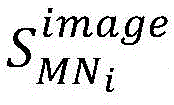
原子镜像为Ii,


所有镜像层类型总数为n,镜像层次数平均值为μN,对镜像使用次数进行归一化处理,获取到Ii的频率参数

S12:计算各原子镜像Ii的复用比率
当前所有容器总量为c,原子镜像Ii,


所有镜像层类型总数为n,容器复用平均比率为μMN,对其进行归一化处理,获取到Ii的复用平均比率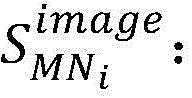

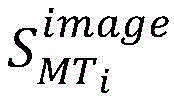
所有镜像类型总数为Dc,使用了Ii的镜像集合为Ti,Ii的镜像类型复用比率为MTi。则Ii在所有类别容器中被复用的频率模型为:The total number of all mirror types is Dc, the mirror set using I i is T i , and the mirror type multiplexing ratio of I i is MT i . Then the frequency model of I i reused in all class containers is:

所有镜像层类型总数为n,镜像类型复用平均比率为μMT,对其进行归一化处理,获取到Ii的类型复用平均比率

加权求和得到Ii的原子镜像复用程度

其中,α,β分别为容器复用频率和镜像类型复用比率的权重。Among them, α and β are the weights of the container reuse frequency and the image type reuse ratio, respectively.
S13:计算各原子镜像Ii的属性优先级比率
采用TOPSIS方法,考虑Ii原子镜像大小SZi,容器实时性RTi及容器业务重要程度IMi,计算属性优先级比率
原子镜像Ii大小SZi,根据镜像层确认该属性的优先级,镜像层越小,代表占用资源越少,因此优先级越高,统一预处理单位为MB;The size of the atomic image I i is SZ i , and the priority of the attribute is confirmed according to the image layer. The smaller the image layer is, the less resources are occupied, so the higher the priority, the unified preprocessing unit is MB;
原子镜像Ii容器实时性RTi(容器本身性质),根据使用Ii的镜像类型,判断其容器实时性要求,实时性要求越高,则优先级越高,优先级的分值区间为(0,10]左开右闭区间,默认为5分;如告警类容器优先级可设为10分,日志收集类容器优先级为1分;Atomic image I i container real-time RT i (the nature of the container itself), according to the image type using I i , to determine the real-time requirements of its container, the higher the real-time requirements, the higher the priority, the priority score range is ( 0,10] Left open and right closed interval, the default is 5 points; for example, the priority of the alarm container can be set to 10 points, and the priority of the log collection container is 1 point;
原子镜像Ii容器业务重要程度IMi(业务场景性质),根据实际业务场景设置优先级,核心服务容器优先级高,边缘服务容器优先级低,分值区间为(0,10]左开右闭区间,默认为5分;如核心结账付费服务可设10分,广告服务可设1分。Atomic Image I i The importance of container business IM i (the nature of the business scenario), the priority is set according to the actual business scenario, the core service container has a high priority, and the edge service container has a low priority, and the score range is (0,10] left open right Closed interval, the default is 5 points; for example, core checkout paid services can be set to 10 points, and advertising services can be set to 1 point.
当前共有n个待评估的镜像层,每个镜像层都有3个属性(SZi,RTi,IMi),则构建原始数据矩阵为:There are currently n image layers to be evaluated, and each image layer has 3 attributes (SZ i , RT i , IM i ), then the original data matrix is constructed as:

其中,RTi和IMi属性同向,SZi属性不同向,因此进行指标属性同向化:Among them, RT i and IM i attributes are in the same direction, and SZ i attributes are not in the same direction, so the index attributes are in the same direction:

进一步,属性进行向量规范化:Further, attributes are vector-normalized:


由此得到归一化处理后的标准化矩阵Zimage:From this, the normalized matrix Z image after normalization is obtained:

镜像层优先级最高方案:The highest priority scheme of the mirror layer:

镜像层优先级最低方案:The lowest priority scheme of the mirror layer:

计算各层数据与优先级最高方案接近程度:Calculate how close each layer of data is to the highest-priority solution:

其中,wj代表第j个属性的权重(重要程度)。Among them, w j represents the weight (importance level) of the j-th attribute.
计算各层数据与优先级最底方案接近程度:Calculate how close each layer of data is to the lowest priority solution:

其中,wj代表第j个属性的权重(重要程度)。Among them, w j represents the weight (importance level) of the j-th attribute.
算各层与最优方案贴近程度,得出其属性优先级比率

S14:计算原子镜像Ii的总分
通过对Ii的频率参数


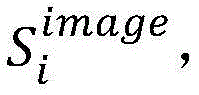

其中,

根据原子镜像权重模型计算每个原子镜像总分,即在考虑Ceph节点剩余存储容量基础上,实时获取每个节点剩余带宽Bj、I/O负载Lj、CPU利用率Cj和内存利用率Rj等属性,并进行归一化处理;基于TOPSIS方法,建立Ceph资源模型,并计算每个节点的资源得分
若剩余宽带为Bj,I/O负载为Lj,CPU利用率为Cj,内存利用率为Rj。m为OSD的总个数,基于TOPSIS方法,由此构建OSD权重因子决策矩阵M,表示为:If the remaining bandwidth is B j , the I/O load is L j , the CPU utilization is C j , and the memory utilization is R j . m is the total number of OSDs. Based on the TOPSIS method, the OSD weight factor decision matrix M is constructed, which is expressed as:

fij是矩阵M中的元素,i和j分别是行号和列号,归一化处理得到规范化的决策矩阵M`,表示为:f ij is the element in the matrix M, i and j are the row number and column number, respectively, and the normalized decision matrix M` is obtained by normalization, which is expressed as:

因为四种资源对OSD节点性能比重不同,带宽和I/O相对比重更大。选取合适的加权系数W,构建规范化加权决策矩阵Zosd:Because the four kinds of resources have different proportions to OSD node performance, bandwidth and I/O have a relatively larger proportion. Select an appropriate weighting coefficient W to construct a normalized weighted decision matrix Z osd :
W=[WB,WL,WC,WR];W=[W B ,W L ,W C ,W R ];
Zosd=Wj*M`ij,i=1,2,…,m;j=1,2,3,4;确定加权矩阵Zosd的正理想解和负理想解:Z osd =W j *M` ij ,i=1,2,...,m; j=1,2,3,4; determine the positive and negative ideal solutions of the weighting matrix Z osd :


计算每个OSD到正理想解与负理想解的距离D+和D-:Calculate the distances D + and D- for each OSD to the positive and negative ideal solutions:


其中:in:


计算出每个OSD与最优OSD的相对贴近度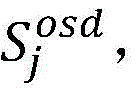

第j个OSD总分为
基于贪心算法,对该原子镜像进行节点放置选择具体包括以下步骤:Based on the greedy algorithm, the node placement selection for the atomic image includes the following steps:
通过原子镜像权重模型,计算每个原子镜像的权重;Calculate the weight of each atomic mirror through the atomic mirror weight model;
基于贪心算法,按原子镜像权重,从大到小依次选择Ceph放置节点,判断节点能否放置该原子镜像;Based on the greedy algorithm, according to the weight of the atomic image, select Ceph to place the node in order from large to small, and determine whether the node can place the atomic image;
如果放置成功,则继续判断所有原子镜像是否放置完成:如果没有放置完成,则重新计算CEPH资源模型,并对剩余原子镜像进行节点放置选择;如果放置完成,则所有原子镜像都被放置到对应节点上,则最终放置成功,结束流程;If the placement is successful, continue to judge whether all atomic images are placed: if not, recalculate the CEPH resource model, and select nodes for the remaining atomic images; if the placement is complete, all atomic images are placed on the corresponding node on, the final placement is successful, and the process ends;
如果放置失败,则去掉被选节点,并判断CEPH资源节点是否为空:如果不为空,则重新进行放置策略判断;如果为空,则表明所有节点都无法放置该原子镜像,则最终放置失败,结束流程;If the placement fails, remove the selected node and judge whether the CEPH resource node is empty: if it is not empty, the placement strategy is judged again; if it is empty, it means that all nodes cannot place the atomic image, and the final placement fails , end the process;
如果最终放置成功,对于每个原子镜像i层Ii,所有镜像层类型总数为n,m为OSD的总个数,Tj代表j节点上放置的镜像层集合:If the final placement is successful, for each atomic mirror i layer I i , the total number of all mirror layer types is n, m is the total number of OSDs, and T j represents the set of mirror layers placed on the j node:
Tj={Ia,Ib…|a,b∈1,2,…,n;j∈1,2,…,m};T j = {I a ,I b ...|a,b∈1,2,...,n; j∈1,2,...,m};
对于每个原子镜像i层Ii,所有镜像层个数为n,Ii的使用次数Ni,Ii大小SZi,放置Ii的节点Tj硬盘读取速度Lj,节点Tj网络带宽速度Bj,CEPH内部文件寻址时间SAT,镜像拉取总时间为CT,表示为:For each atomic mirror i layer I i , the number of all mirror layers is n, the number of times I i is used N i , the size of I i SZ i , the node T j where I i is placed, the hard disk read speed L j , the node T j network The bandwidth speed B j , the CEPH internal file addressing time SAT, and the total image pull time CT are expressed as:

其中,CT越小,代表容器镜像下载速度越快。Among them, the smaller the CT, the faster the download speed of the container image.
如果最终放置失败,则输出对应原子镜像并返回错误。If the final placement fails, the output corresponds to the atomic mirror and an error is returned.
本文方法引进CEPH作为容器镜像存储后端,由容器原生的带宽与单线程等限制策略提升为高并发、高可用策略,极大的提高了资源利用率。在此基础之上,对原生CEPH节点选择及资源部署策略进行优化,保证了使用频繁、复用率高的原子镜像拥有充足资源且拉取速度更快,最终降低了容器镜像的拉取时间。The method in this paper introduces CEPH as the backend of container image storage, and improves the resource utilization rate from the limitation strategy of native bandwidth and single thread to high concurrency and high availability strategy. On this basis, the native CEPH node selection and resource deployment strategy are optimized to ensure that atomic images that are frequently used and have a high reuse rate have sufficient resources and are pulled faster, which ultimately reduces the pulling time of container images.
尽管已经示出和描述了本发明的实施例,对于本领域的普通技术人员而言,可以理解在不脱离本发明的原理和精神的情况下可以对这些实施例进行多种变化、修改、替换和变型,本发明的范围由所附权利要求及其等同物限定。Although embodiments of the present invention have been shown and described, it will be understood by those skilled in the art that various changes, modifications, and substitutions can be made in these embodiments without departing from the principle and spirit of the invention and modifications, the scope of the present invention is defined by the appended claims and their equivalents.
Claims (7)




Priority Applications (1)
| Application Number | Priority Date | Filing Date | Title |
|---|---|---|---|
| CN202011500164.2A CN112527463B (en) | 2020-12-17 | 2020-12-17 | Container mirror image downloading acceleration method based on object storage |
Applications Claiming Priority (1)
| Application Number | Priority Date | Filing Date | Title |
|---|---|---|---|
| CN202011500164.2A CN112527463B (en) | 2020-12-17 | 2020-12-17 | Container mirror image downloading acceleration method based on object storage |
Publications (2)
| Publication Number | Publication Date |
|---|---|
| CN112527463A true CN112527463A (en) | 2021-03-19 |
| CN112527463B CN112527463B (en) | 2023-08-04 |
Family
ID=75001369
Family Applications (1)
| Application Number | Title | Priority Date | Filing Date |
|---|---|---|---|
| CN202011500164.2A Active CN112527463B (en) | 2020-12-17 | 2020-12-17 | Container mirror image downloading acceleration method based on object storage |
Country Status (1)
| Country | Link |
|---|---|
| CN (1) | CN112527463B (en) |
Cited By (2)
| Publication number | Priority date | Publication date | Assignee | Title |
|---|---|---|---|---|
| CN116700902A (en) * | 2023-06-25 | 2023-09-05 | 天津大学 | Container acceleration deployment method and device for asynchronous parallel extraction of mirror image layer |
| CN119960698A (en) * | 2025-01-27 | 2025-05-09 | 桂林电子科技大学 | A Ceph storage system data migration method based on P4 network telemetry optimization |
Citations (8)
| Publication number | Priority date | Publication date | Assignee | Title |
|---|---|---|---|---|
| CN106453492A (en) * | 2016-08-30 | 2017-02-22 | 浙江大学 | Docker container cloud platform container scheduling method based on fuzzy mode recognition |
| CN106506587A (en) * | 2016-09-23 | 2017-03-15 | 中国人民解放军国防科学技术大学 | A Docker image download method based on distributed storage |
| CN107729020A (en) * | 2017-10-11 | 2018-02-23 | 北京航空航天大学 | A kind of method for realizing extensive container rapid deployment |
| CN108401031A (en) * | 2018-03-13 | 2018-08-14 | 深圳市腾讯计算机系统有限公司 | A kind of image file transmission method, device and storage medium |
| US20190173949A1 (en) * | 2017-03-22 | 2019-06-06 | Hitachi, Ltd. | Data processing system |
| CN110633128A (en) * | 2019-08-14 | 2019-12-31 | 广西电网电力调度控制中心 | Cloud platform power system analysis and calculation method based on Docker and Ceph |
| CN111522667A (en) * | 2020-04-27 | 2020-08-11 | 中国地质大学(武汉) | Resource scheduling method based on mirror image existence mechanism scoring strategy in container cloud environment |
| US20200293499A1 (en) * | 2019-03-15 | 2020-09-17 | Fungible, Inc. | Providing scalable and concurrent file systems |
-
2020
- 2020-12-17 CN CN202011500164.2A patent/CN112527463B/en active Active
Patent Citations (8)
| Publication number | Priority date | Publication date | Assignee | Title |
|---|---|---|---|---|
| CN106453492A (en) * | 2016-08-30 | 2017-02-22 | 浙江大学 | Docker container cloud platform container scheduling method based on fuzzy mode recognition |
| CN106506587A (en) * | 2016-09-23 | 2017-03-15 | 中国人民解放军国防科学技术大学 | A Docker image download method based on distributed storage |
| US20190173949A1 (en) * | 2017-03-22 | 2019-06-06 | Hitachi, Ltd. | Data processing system |
| CN107729020A (en) * | 2017-10-11 | 2018-02-23 | 北京航空航天大学 | A kind of method for realizing extensive container rapid deployment |
| CN108401031A (en) * | 2018-03-13 | 2018-08-14 | 深圳市腾讯计算机系统有限公司 | A kind of image file transmission method, device and storage medium |
| US20200293499A1 (en) * | 2019-03-15 | 2020-09-17 | Fungible, Inc. | Providing scalable and concurrent file systems |
| CN110633128A (en) * | 2019-08-14 | 2019-12-31 | 广西电网电力调度控制中心 | Cloud platform power system analysis and calculation method based on Docker and Ceph |
| CN111522667A (en) * | 2020-04-27 | 2020-08-11 | 中国地质大学(武汉) | Resource scheduling method based on mirror image existence mechanism scoring strategy in container cloud environment |
Non-Patent Citations (5)
| Title |
|---|
| LI WANG 等: "Design and Implementation of Ceph Block Device in Userspace for Container Scenarios", 《IEEE》 * |
| 孟向导: "基于Docker云平台容器迁移及运维管理系统的设计与实现", 《中国优秀硕士学位论文全文数据库电子期刊》 * |
| 彭丽苹 等: "基于 Docker 的云资源弹性调度策略", 《计算机应用》, vol. 38, no. 2 * |
| 梁明远: "数据中心环境下Docker镜像分发技术研究与实现", 《中国优秀硕士学位论文全文数据库电子期刊》 * |
| 蒋溢 等: "基于对象存储文件系统的协作式缓存一致性策略", 《计算机工程与设计》, vol. 33, no. 11 * |
Cited By (3)
| Publication number | Priority date | Publication date | Assignee | Title |
|---|---|---|---|---|
| CN116700902A (en) * | 2023-06-25 | 2023-09-05 | 天津大学 | Container acceleration deployment method and device for asynchronous parallel extraction of mirror image layer |
| CN116700902B (en) * | 2023-06-25 | 2024-03-12 | 天津大学 | A container accelerated deployment method and device for asynchronous parallel extraction of image layers |
| CN119960698A (en) * | 2025-01-27 | 2025-05-09 | 桂林电子科技大学 | A Ceph storage system data migration method based on P4 network telemetry optimization |
Also Published As
| Publication number | Publication date |
|---|---|
| CN112527463B (en) | 2023-08-04 |
Similar Documents
| Publication | Publication Date | Title |
|---|---|---|
| CN105100146B (en) | Date storage method, apparatus and system | |
| US8554738B2 (en) | Mitigation of obsolescence for archival services | |
| US20120030180A1 (en) | Archive-system-independent archive-type objects | |
| CN103516585B (en) | Method and system for distributing messages according to priorities | |
| CN107169083A (en) | Public security bayonet socket magnanimity vehicle data storage and retrieval method and device, electronic equipment | |
| CN104391930A (en) | Distributed file storage device and method | |
| US20140237009A1 (en) | Servicing database operations using a messaging server | |
| CN110347651A (en) | Method of data synchronization, device, equipment and storage medium based on cloud storage | |
| CN106254466B (en) | HDFS distributed file sharing method based on local area network | |
| CN109510869A (en) | A method and device for dynamic unloading of Internet of Things services based on edge computing | |
| CN112527463A (en) | Container mirror image downloading acceleration method based on object storage | |
| WO2024037629A1 (en) | Data integration method and apparatus for blockchain, and computer device and storage medium | |
| CN116383223A (en) | Asset data processing method, related device and storage medium | |
| CN108460072A (en) | With electricity consumption data retrieval method and system | |
| CN119484290B (en) | Flow rate limiting system, flow rate limiting method and flow rate limiting device | |
| CN117932330A (en) | Mixed expert model acceleration method and system based on local sensitive hash algorithm | |
| WO2025011408A1 (en) | Task processing method, automatic question answering method, and image generation method | |
| CN116680040B (en) | Container processing method, device, equipment, storage medium and program product | |
| CN112631680B (en) | Microservice container scheduling system, method, device and computer equipment | |
| Yin et al. | An optimal image storage strategy for container-based edge computing in smart factory | |
| US20230336509A1 (en) | Efficiently handling retained messages in a system with bridged message brokers | |
| CN111949218A (en) | Load balancing method, system, medium and terminal for high-availability storage system | |
| CN117692401A (en) | Message sending method, device, server and storage medium | |
| CN109992575A (en) | Distributed storage system for big data | |
| CN119211210A (en) | Method and system for accelerating AIGC application container image loading in edge scenarios |
Legal Events
| Date | Code | Title | Description |
|---|---|---|---|
| PB01 | Publication | ||
| PB01 | Publication | ||
| SE01 | Entry into force of request for substantive examination | ||
| SE01 | Entry into force of request for substantive examination | ||
| GR01 | Patent grant | ||
| GR01 | Patent grant |