CN112500353A - Levosimendan prodrug compound, preparation method and application thereof - Google Patents
Levosimendan prodrug compound, preparation method and application thereof Download PDFInfo
- Publication number
- CN112500353A CN112500353A CN202011421074.4A CN202011421074A CN112500353A CN 112500353 A CN112500353 A CN 112500353A CN 202011421074 A CN202011421074 A CN 202011421074A CN 112500353 A CN112500353 A CN 112500353A
- Authority
- CN
- China
- Prior art keywords
- methyl
- phenyl
- oxo
- hydroxymethyl
- levosimendan
- Prior art date
- Legal status (The legal status is an assumption and is not a legal conclusion. Google has not performed a legal analysis and makes no representation as to the accuracy of the status listed.)
- Granted
Links
- 150000001875 compounds Chemical class 0.000 title claims abstract description 85
- WHXMKTBCFHIYNQ-SECBINFHSA-N levosimendan Chemical compound C[C@@H]1CC(=O)NN=C1C1=CC=C(NN=C(C#N)C#N)C=C1 WHXMKTBCFHIYNQ-SECBINFHSA-N 0.000 title claims abstract description 70
- 229960000692 levosimendan Drugs 0.000 title claims abstract description 70
- 239000000651 prodrug Substances 0.000 title claims abstract description 39
- 229940002612 prodrug Drugs 0.000 title claims abstract description 39
- 238000002360 preparation method Methods 0.000 title claims description 52
- 239000003814 drug Substances 0.000 claims abstract description 16
- 150000003839 salts Chemical class 0.000 claims abstract description 16
- 125000004433 nitrogen atom Chemical group N* 0.000 claims abstract description 11
- 125000003178 carboxy group Chemical group [H]OC(*)=O 0.000 claims abstract description 4
- QAOWNCQODCNURD-UHFFFAOYSA-L sulfate group Chemical group S(=O)(=O)([O-])[O-] QAOWNCQODCNURD-UHFFFAOYSA-L 0.000 claims abstract description 4
- 150000001204 N-oxides Chemical class 0.000 claims abstract description 3
- 239000012453 solvate Substances 0.000 claims abstract description 3
- 125000000542 sulfonic acid group Chemical group 0.000 claims abstract description 3
- -1 4- (4-methylpiperazin-1-ylmethyl) phenyl Chemical group 0.000 claims description 100
- OAKJQQAXSVQMHS-UHFFFAOYSA-N Hydrazine Chemical compound NN OAKJQQAXSVQMHS-UHFFFAOYSA-N 0.000 claims description 48
- POXIZPBFFUKMEQ-UHFFFAOYSA-N 2-cyanoethenylideneazanide Chemical group [N-]=C=[C+]C#N POXIZPBFFUKMEQ-UHFFFAOYSA-N 0.000 claims description 22
- 125000001424 substituent group Chemical group 0.000 claims description 14
- 230000002378 acidificating effect Effects 0.000 claims description 13
- 206010019280 Heart failures Diseases 0.000 claims description 9
- LPXPTNMVRIOKMN-UHFFFAOYSA-M sodium nitrite Chemical compound [Na+].[O-]N=O LPXPTNMVRIOKMN-UHFFFAOYSA-M 0.000 claims description 8
- DYHSDKLCOJIUFX-UHFFFAOYSA-N tert-butoxycarbonyl anhydride Chemical compound CC(C)(C)OC(=O)OC(=O)OC(C)(C)C DYHSDKLCOJIUFX-UHFFFAOYSA-N 0.000 claims description 8
- KXDHJXZQYSOELW-UHFFFAOYSA-M Carbamate Chemical compound NC([O-])=O KXDHJXZQYSOELW-UHFFFAOYSA-M 0.000 claims description 7
- 125000001997 phenyl group Chemical group [H]C1=C([H])C([H])=C(*)C([H])=C1[H] 0.000 claims description 7
- 125000000999 tert-butyl group Chemical group [H]C([H])([H])C(*)(C([H])([H])[H])C([H])([H])[H] 0.000 claims description 7
- KPZZAYYKUNSEHE-UHFFFAOYSA-N CC(C1C(C=C2)=CC=C2N)C=NN(CO)C1=O Chemical compound CC(C1C(C=C2)=CC=C2N)C=NN(CO)C1=O KPZZAYYKUNSEHE-UHFFFAOYSA-N 0.000 claims description 6
- MNDMDCJDDYWWQK-UHFFFAOYSA-N 2-(4-aminophenyl)-5-methyl-4,5-dihydropyridazin-3-one Chemical compound NC1=CC=C(C=C1)N1N=CC(CC1=O)C MNDMDCJDDYWWQK-UHFFFAOYSA-N 0.000 claims description 5
- 229930040373 Paraformaldehyde Natural products 0.000 claims description 5
- 150000001732 carboxylic acid derivatives Chemical class 0.000 claims description 5
- 229920002866 paraformaldehyde Polymers 0.000 claims description 5
- 125000003349 3-pyridyl group Chemical group N1=C([H])C([*])=C([H])C([H])=C1[H] 0.000 claims description 4
- 125000000217 alkyl group Chemical group 0.000 claims description 4
- 208000037265 diseases, disorders, signs and symptoms Diseases 0.000 claims description 4
- 125000004435 hydrogen atom Chemical group [H]* 0.000 claims description 4
- CUONGYYJJVDODC-UHFFFAOYSA-N malononitrile Chemical compound N#CCC#N CUONGYYJJVDODC-UHFFFAOYSA-N 0.000 claims description 4
- 238000000034 method Methods 0.000 claims description 4
- 230000008569 process Effects 0.000 claims description 4
- 229910052705 radium Inorganic materials 0.000 claims description 4
- 229910052701 rubidium Inorganic materials 0.000 claims description 4
- 235000010288 sodium nitrite Nutrition 0.000 claims description 4
- WIKLENLRBCGHQB-LLVKDONJSA-N C[C@H](C1)C(C(C=C2)=CC=C2NC(OC(C)(C)C)=O)=NN(CO)C1=O Chemical compound C[C@H](C1)C(C(C=C2)=CC=C2NC(OC(C)(C)C)=O)=NN(CO)C1=O WIKLENLRBCGHQB-LLVKDONJSA-N 0.000 claims description 3
- 125000002057 carboxymethyl group Chemical group [H]OC(=O)C([H])([H])[*] 0.000 claims description 3
- 229910019142 PO4 Inorganic materials 0.000 claims description 2
- 125000004202 aminomethyl group Chemical group [H]N([H])C([H])([H])* 0.000 claims description 2
- NBIIXXVUZAFLBC-UHFFFAOYSA-K phosphate Chemical compound [O-]P([O-])([O-])=O NBIIXXVUZAFLBC-UHFFFAOYSA-K 0.000 claims description 2
- 239000010452 phosphate Substances 0.000 claims description 2
- XLYOFNOQVPJJNP-UHFFFAOYSA-N water Substances O XLYOFNOQVPJJNP-UHFFFAOYSA-N 0.000 abstract description 37
- 230000007547 defect Effects 0.000 abstract description 5
- UFHFLCQGNIYNRP-UHFFFAOYSA-N Hydrogen Chemical compound [H][H] UFHFLCQGNIYNRP-UHFFFAOYSA-N 0.000 abstract description 3
- 229910052739 hydrogen Inorganic materials 0.000 abstract description 3
- 239000001257 hydrogen Substances 0.000 abstract description 3
- 125000004169 (C1-C6) alkyl group Chemical group 0.000 abstract 1
- 125000004185 ester group Chemical group 0.000 abstract 1
- YMWUJEATGCHHMB-UHFFFAOYSA-N Dichloromethane Chemical compound ClCCl YMWUJEATGCHHMB-UHFFFAOYSA-N 0.000 description 72
- OKKJLVBELUTLKV-UHFFFAOYSA-N Methanol Chemical compound OC OKKJLVBELUTLKV-UHFFFAOYSA-N 0.000 description 61
- 239000002904 solvent Substances 0.000 description 44
- IAZDPXIOMUYVGZ-WFGJKAKNSA-N Dimethyl sulfoxide Chemical compound [2H]C([2H])([2H])S(=O)C([2H])([2H])[2H] IAZDPXIOMUYVGZ-WFGJKAKNSA-N 0.000 description 37
- XEKOWRVHYACXOJ-UHFFFAOYSA-N Ethyl acetate Chemical compound CCOC(C)=O XEKOWRVHYACXOJ-UHFFFAOYSA-N 0.000 description 33
- ZMANZCXQSJIPKH-UHFFFAOYSA-N Triethylamine Chemical compound CCN(CC)CC ZMANZCXQSJIPKH-UHFFFAOYSA-N 0.000 description 30
- 238000006243 chemical reaction Methods 0.000 description 29
- 230000002829 reductive effect Effects 0.000 description 26
- 238000002390 rotary evaporation Methods 0.000 description 24
- 238000005160 1H NMR spectroscopy Methods 0.000 description 23
- 239000007787 solid Substances 0.000 description 23
- 238000002330 electrospray ionisation mass spectrometry Methods 0.000 description 22
- 238000003756 stirring Methods 0.000 description 21
- 239000012141 concentrate Substances 0.000 description 20
- 238000004809 thin layer chromatography Methods 0.000 description 19
- 239000000243 solution Substances 0.000 description 16
- ZMXDDKWLCZADIW-UHFFFAOYSA-N N,N-Dimethylformamide Chemical compound CN(C)C=O ZMXDDKWLCZADIW-UHFFFAOYSA-N 0.000 description 14
- 238000004440 column chromatography Methods 0.000 description 14
- WYURNTSHIVDZCO-UHFFFAOYSA-N Tetrahydrofuran Chemical compound C1CCOC1 WYURNTSHIVDZCO-UHFFFAOYSA-N 0.000 description 12
- 230000000694 effects Effects 0.000 description 11
- 239000000203 mixture Substances 0.000 description 11
- RTZKZFJDLAIYFH-UHFFFAOYSA-N Diethyl ether Chemical compound CCOCC RTZKZFJDLAIYFH-UHFFFAOYSA-N 0.000 description 10
- 239000002253 acid Substances 0.000 description 10
- 239000006184 cosolvent Substances 0.000 description 10
- QTBSBXVTEAMEQO-UHFFFAOYSA-N Acetic acid Chemical compound CC(O)=O QTBSBXVTEAMEQO-UHFFFAOYSA-N 0.000 description 9
- 239000002585 base Substances 0.000 description 9
- 239000003480 eluent Substances 0.000 description 9
- VHYFNPMBLIVWCW-UHFFFAOYSA-N 4-Dimethylaminopyridine Chemical compound CN(C)C1=CC=NC=C1 VHYFNPMBLIVWCW-UHFFFAOYSA-N 0.000 description 8
- BHPQYMZQTOCNFJ-UHFFFAOYSA-N Calcium cation Chemical compound [Ca+2] BHPQYMZQTOCNFJ-UHFFFAOYSA-N 0.000 description 8
- 206010007556 Cardiac failure acute Diseases 0.000 description 8
- VEXZGXHMUGYJMC-UHFFFAOYSA-N Hydrochloric acid Chemical compound Cl VEXZGXHMUGYJMC-UHFFFAOYSA-N 0.000 description 8
- 229910001424 calcium ion Inorganic materials 0.000 description 8
- 229940079593 drug Drugs 0.000 description 8
- 239000005457 ice water Substances 0.000 description 8
- 230000002503 metabolic effect Effects 0.000 description 8
- BDAGIHXWWSANSR-UHFFFAOYSA-N methanoic acid Natural products OC=O BDAGIHXWWSANSR-UHFFFAOYSA-N 0.000 description 8
- 239000012074 organic phase Substances 0.000 description 8
- 239000003960 organic solvent Substances 0.000 description 8
- 239000007864 aqueous solution Substances 0.000 description 7
- 239000000463 material Substances 0.000 description 7
- 239000000126 substance Substances 0.000 description 7
- PMZURENOXWZQFD-UHFFFAOYSA-L Sodium Sulfate Chemical compound [Na+].[Na+].[O-]S([O-])(=O)=O PMZURENOXWZQFD-UHFFFAOYSA-L 0.000 description 6
- PFKFTWBEEFSNDU-UHFFFAOYSA-N carbonyldiimidazole Chemical compound C1=CN=CN1C(=O)N1C=CN=C1 PFKFTWBEEFSNDU-UHFFFAOYSA-N 0.000 description 6
- 238000001514 detection method Methods 0.000 description 6
- 239000012153 distilled water Substances 0.000 description 6
- 238000001727 in vivo Methods 0.000 description 6
- 238000002347 injection Methods 0.000 description 6
- 239000007924 injection Substances 0.000 description 6
- 230000004060 metabolic process Effects 0.000 description 6
- FVAUCKIRQBBSSJ-UHFFFAOYSA-M sodium iodide Chemical compound [Na+].[I-] FVAUCKIRQBBSSJ-UHFFFAOYSA-M 0.000 description 6
- IVOMOUWHDPKRLL-KQYNXXCUSA-N Cyclic adenosine monophosphate Chemical compound C([C@H]1O2)OP(O)(=O)O[C@H]1[C@@H](O)[C@@H]2N1C(N=CN=C2N)=C2N=C1 IVOMOUWHDPKRLL-KQYNXXCUSA-N 0.000 description 5
- OFOBLEOULBTSOW-UHFFFAOYSA-N Malonic acid Chemical compound OC(=O)CC(O)=O OFOBLEOULBTSOW-UHFFFAOYSA-N 0.000 description 5
- XBDQKXXYIPTUBI-UHFFFAOYSA-M Propionate Chemical compound CCC([O-])=O XBDQKXXYIPTUBI-UHFFFAOYSA-M 0.000 description 5
- 230000008859 change Effects 0.000 description 5
- 239000012043 crude product Substances 0.000 description 5
- 238000001914 filtration Methods 0.000 description 5
- 230000007246 mechanism Effects 0.000 description 5
- 125000002496 methyl group Chemical group [H]C([H])([H])* 0.000 description 5
- 239000003208 petroleum Substances 0.000 description 5
- 239000000047 product Substances 0.000 description 5
- 239000002994 raw material Substances 0.000 description 5
- HPALAKNZSZLMCH-UHFFFAOYSA-M sodium;chloride;hydrate Chemical class O.[Na+].[Cl-] HPALAKNZSZLMCH-UHFFFAOYSA-M 0.000 description 5
- 238000012360 testing method Methods 0.000 description 5
- OSWFIVFLDKOXQC-UHFFFAOYSA-N 4-(3-methoxyphenyl)aniline Chemical compound COC1=CC=CC(C=2C=CC(N)=CC=2)=C1 OSWFIVFLDKOXQC-UHFFFAOYSA-N 0.000 description 4
- LFQSCWFLJHTTHZ-UHFFFAOYSA-N Ethanol Chemical compound CCO LFQSCWFLJHTTHZ-UHFFFAOYSA-N 0.000 description 4
- DHMQDGOQFOQNFH-UHFFFAOYSA-N Glycine Chemical compound NCC(O)=O DHMQDGOQFOQNFH-UHFFFAOYSA-N 0.000 description 4
- AEMRFAOFKBGASW-UHFFFAOYSA-N Glycolic acid Chemical compound OCC(O)=O AEMRFAOFKBGASW-UHFFFAOYSA-N 0.000 description 4
- FFDGPVCHZBVARC-UHFFFAOYSA-N N,N-dimethylglycine Chemical compound CN(C)CC(O)=O FFDGPVCHZBVARC-UHFFFAOYSA-N 0.000 description 4
- NBIIXXVUZAFLBC-UHFFFAOYSA-N Phosphoric acid Chemical compound OP(O)(O)=O NBIIXXVUZAFLBC-UHFFFAOYSA-N 0.000 description 4
- JUJWROOIHBZHMG-UHFFFAOYSA-N Pyridine Chemical compound C1=CC=NC=C1 JUJWROOIHBZHMG-UHFFFAOYSA-N 0.000 description 4
- 102000010861 Type 3 Cyclic Nucleotide Phosphodiesterases Human genes 0.000 description 4
- 108010037543 Type 3 Cyclic Nucleotide Phosphodiesterases Proteins 0.000 description 4
- 150000007513 acids Chemical class 0.000 description 4
- 238000004090 dissolution Methods 0.000 description 4
- 238000001035 drying Methods 0.000 description 4
- 238000002474 experimental method Methods 0.000 description 4
- 235000019253 formic acid Nutrition 0.000 description 4
- 238000004128 high performance liquid chromatography Methods 0.000 description 4
- BWHMMNNQKKPAPP-UHFFFAOYSA-L potassium carbonate Chemical compound [K+].[K+].[O-]C([O-])=O BWHMMNNQKKPAPP-UHFFFAOYSA-L 0.000 description 4
- 239000007858 starting material Substances 0.000 description 4
- LMDZBCPBFSXMTL-UHFFFAOYSA-N 1-ethyl-3-(3-dimethylaminopropyl)carbodiimide Chemical compound CCN=C=NCCCN(C)C LMDZBCPBFSXMTL-UHFFFAOYSA-N 0.000 description 3
- TURQRNGXQZEOCW-UHFFFAOYSA-N 3-oxo-3-(pyridin-4-ylmethylamino)propanoic acid Chemical compound OC(=O)CC(=O)NCC1=CC=NC=C1 TURQRNGXQZEOCW-UHFFFAOYSA-N 0.000 description 3
- 229960000549 4-dimethylaminophenol Drugs 0.000 description 3
- FXHOOIRPVKKKFG-UHFFFAOYSA-N N,N-Dimethylacetamide Chemical compound CN(C)C(C)=O FXHOOIRPVKKKFG-UHFFFAOYSA-N 0.000 description 3
- 238000005481 NMR spectroscopy Methods 0.000 description 3
- MUBZPKHOEPUJKR-UHFFFAOYSA-N Oxalic acid Chemical compound OC(=O)C(O)=O MUBZPKHOEPUJKR-UHFFFAOYSA-N 0.000 description 3
- 229920003078 Povidone K 12 Polymers 0.000 description 3
- KDYFGRWQOYBRFD-UHFFFAOYSA-N Succinic acid Natural products OC(=O)CCC(O)=O KDYFGRWQOYBRFD-UHFFFAOYSA-N 0.000 description 3
- 230000009286 beneficial effect Effects 0.000 description 3
- 210000004413 cardiac myocyte Anatomy 0.000 description 3
- KRKNYBCHXYNGOX-UHFFFAOYSA-N citric acid Chemical compound OC(=O)CC(O)(C(O)=O)CC(O)=O KRKNYBCHXYNGOX-UHFFFAOYSA-N 0.000 description 3
- LYZCWDIVOAXKQP-UHFFFAOYSA-N diazinan-3-one Chemical group O=C1CCCNN1 LYZCWDIVOAXKQP-UHFFFAOYSA-N 0.000 description 3
- 238000005886 esterification reaction Methods 0.000 description 3
- 125000001495 ethyl group Chemical group [H]C([H])([H])C([H])([H])* 0.000 description 3
- 235000011389 fruit/vegetable juice Nutrition 0.000 description 3
- 210000004051 gastric juice Anatomy 0.000 description 3
- IXCSERBJSXMMFS-UHFFFAOYSA-N hydrogen chloride Substances Cl.Cl IXCSERBJSXMMFS-UHFFFAOYSA-N 0.000 description 3
- 229910000041 hydrogen chloride Inorganic materials 0.000 description 3
- 239000013067 intermediate product Substances 0.000 description 3
- 230000000968 intestinal effect Effects 0.000 description 3
- 239000007788 liquid Substances 0.000 description 3
- 150000007522 mineralic acids Chemical class 0.000 description 3
- 239000012046 mixed solvent Substances 0.000 description 3
- 230000002107 myocardial effect Effects 0.000 description 3
- 150000007524 organic acids Chemical class 0.000 description 3
- 150000007530 organic bases Chemical class 0.000 description 3
- 229920001223 polyethylene glycol Polymers 0.000 description 3
- YLQBMQCUIZJEEH-UHFFFAOYSA-N tetrahydrofuran Natural products C=1C=COC=1 YLQBMQCUIZJEEH-UHFFFAOYSA-N 0.000 description 3
- CZDYPVPMEAXLPK-UHFFFAOYSA-N tetramethylsilane Chemical compound C[Si](C)(C)C CZDYPVPMEAXLPK-UHFFFAOYSA-N 0.000 description 3
- 231100000331 toxic Toxicity 0.000 description 3
- 230000002588 toxic effect Effects 0.000 description 3
- 238000005406 washing Methods 0.000 description 3
- 238000005303 weighing Methods 0.000 description 3
- OISVCGZHLKNMSJ-UHFFFAOYSA-N 2,6-Lutidine Substances CC1=CC=CC(C)=N1 OISVCGZHLKNMSJ-UHFFFAOYSA-N 0.000 description 2
- RCOVTJVRTZGSBP-UHFFFAOYSA-N 4-(chloromethyl)benzoyl chloride Chemical compound ClCC1=CC=C(C(Cl)=O)C=C1 RCOVTJVRTZGSBP-UHFFFAOYSA-N 0.000 description 2
- JRWZLRBJNMZMFE-UHFFFAOYSA-N Dobutamine Chemical compound C=1C=C(O)C(O)=CC=1CCNC(C)CCC1=CC=C(O)C=C1 JRWZLRBJNMZMFE-UHFFFAOYSA-N 0.000 description 2
- VZCYOOQTPOCHFL-OWOJBTEDSA-N Fumaric acid Chemical compound OC(=O)\C=C\C(O)=O VZCYOOQTPOCHFL-OWOJBTEDSA-N 0.000 description 2
- 239000004471 Glycine Substances 0.000 description 2
- DGAQECJNVWCQMB-PUAWFVPOSA-M Ilexoside XXIX Chemical compound C[C@@H]1CC[C@@]2(CC[C@@]3(C(=CC[C@H]4[C@]3(CC[C@@H]5[C@@]4(CC[C@@H](C5(C)C)OS(=O)(=O)[O-])C)C)[C@@H]2[C@]1(C)O)C)C(=O)O[C@H]6[C@@H]([C@H]([C@@H]([C@H](O6)CO)O)O)O.[Na+] DGAQECJNVWCQMB-PUAWFVPOSA-M 0.000 description 2
- AFVFQIVMOAPDHO-UHFFFAOYSA-N Methanesulfonic acid Chemical compound CS(O)(=O)=O AFVFQIVMOAPDHO-UHFFFAOYSA-N 0.000 description 2
- YNAVUWVOSKDBBP-UHFFFAOYSA-N Morpholine Chemical compound C1COCCN1 YNAVUWVOSKDBBP-UHFFFAOYSA-N 0.000 description 2
- PVNIIMVLHYAWGP-UHFFFAOYSA-N Niacin Chemical compound OC(=O)C1=CC=CN=C1 PVNIIMVLHYAWGP-UHFFFAOYSA-N 0.000 description 2
- 239000002202 Polyethylene glycol Substances 0.000 description 2
- 102000004257 Potassium Channel Human genes 0.000 description 2
- LCTONWCANYUPML-UHFFFAOYSA-N Pyruvic acid Chemical compound CC(=O)C(O)=O LCTONWCANYUPML-UHFFFAOYSA-N 0.000 description 2
- VYPSYNLAJGMNEJ-UHFFFAOYSA-N Silicium dioxide Chemical compound O=[Si]=O VYPSYNLAJGMNEJ-UHFFFAOYSA-N 0.000 description 2
- VMHLLURERBWHNL-UHFFFAOYSA-M Sodium acetate Chemical compound [Na+].CC([O-])=O VMHLLURERBWHNL-UHFFFAOYSA-M 0.000 description 2
- QAOWNCQODCNURD-UHFFFAOYSA-N Sulfuric acid Chemical compound OS(O)(=O)=O QAOWNCQODCNURD-UHFFFAOYSA-N 0.000 description 2
- HEDRZPFGACZZDS-MICDWDOJSA-N Trichloro(2H)methane Chemical compound [2H]C(Cl)(Cl)Cl HEDRZPFGACZZDS-MICDWDOJSA-N 0.000 description 2
- 238000010521 absorption reaction Methods 0.000 description 2
- 229910052784 alkaline earth metal Inorganic materials 0.000 description 2
- 229910000147 aluminium phosphate Inorganic materials 0.000 description 2
- 230000008901 benefit Effects 0.000 description 2
- 230000000747 cardiac effect Effects 0.000 description 2
- 230000001419 dependent effect Effects 0.000 description 2
- 108700003601 dimethylglycine Proteins 0.000 description 2
- XBDQKXXYIPTUBI-UHFFFAOYSA-N dimethylselenoniopropionate Natural products CCC(O)=O XBDQKXXYIPTUBI-UHFFFAOYSA-N 0.000 description 2
- 229960001089 dobutamine Drugs 0.000 description 2
- 150000007529 inorganic bases Chemical class 0.000 description 2
- 229940124975 inotropic drug Drugs 0.000 description 2
- 230000003834 intracellular effect Effects 0.000 description 2
- JVTAAEKCZFNVCJ-UHFFFAOYSA-N lactic acid Chemical compound CC(O)C(O)=O JVTAAEKCZFNVCJ-UHFFFAOYSA-N 0.000 description 2
- 239000012669 liquid formulation Substances 0.000 description 2
- 150000004702 methyl esters Chemical class 0.000 description 2
- YNBADRVTZLEFNH-UHFFFAOYSA-N methyl nicotinate Chemical compound COC(=O)C1=CC=CN=C1 YNBADRVTZLEFNH-UHFFFAOYSA-N 0.000 description 2
- 229960003574 milrinone Drugs 0.000 description 2
- PZRHRDRVRGEVNW-UHFFFAOYSA-N milrinone Chemical compound N1C(=O)C(C#N)=CC(C=2C=CN=CC=2)=C1C PZRHRDRVRGEVNW-UHFFFAOYSA-N 0.000 description 2
- 238000012544 monitoring process Methods 0.000 description 2
- 229940078490 n,n-dimethylglycine Drugs 0.000 description 2
- 235000005985 organic acids Nutrition 0.000 description 2
- 229920000036 polyvinylpyrrolidone Polymers 0.000 description 2
- 235000013855 polyvinylpyrrolidone Nutrition 0.000 description 2
- 230000009090 positive inotropic effect Effects 0.000 description 2
- 229910000027 potassium carbonate Inorganic materials 0.000 description 2
- 108020001213 potassium channel Proteins 0.000 description 2
- AMMGCGVWJMRTQI-UHFFFAOYSA-N prop-1-en-2-yl carbonochloridate Chemical compound CC(=C)OC(Cl)=O AMMGCGVWJMRTQI-UHFFFAOYSA-N 0.000 description 2
- UMJSCPRVCHMLSP-UHFFFAOYSA-N pyridine Natural products COC1=CC=CN=C1 UMJSCPRVCHMLSP-UHFFFAOYSA-N 0.000 description 2
- 239000011541 reaction mixture Substances 0.000 description 2
- 230000009467 reduction Effects 0.000 description 2
- YGSDEFSMJLZEOE-UHFFFAOYSA-N salicylic acid Chemical compound OC(=O)C1=CC=CC=C1O YGSDEFSMJLZEOE-UHFFFAOYSA-N 0.000 description 2
- 229910052708 sodium Inorganic materials 0.000 description 2
- 239000011734 sodium Substances 0.000 description 2
- 239000001632 sodium acetate Substances 0.000 description 2
- 235000017281 sodium acetate Nutrition 0.000 description 2
- 235000009518 sodium iodide Nutrition 0.000 description 2
- 239000000725 suspension Substances 0.000 description 2
- 238000003786 synthesis reaction Methods 0.000 description 2
- LFKDJXLFVYVEFG-UHFFFAOYSA-N tert-butyl carbamate Chemical compound CC(C)(C)OC(N)=O LFKDJXLFVYVEFG-UHFFFAOYSA-N 0.000 description 2
- 239000012085 test solution Substances 0.000 description 2
- JOXIMZWYDAKGHI-UHFFFAOYSA-N toluene-4-sulfonic acid Chemical compound CC1=CC=C(S(O)(=O)=O)C=C1 JOXIMZWYDAKGHI-UHFFFAOYSA-N 0.000 description 2
- VZCYOOQTPOCHFL-UHFFFAOYSA-N trans-butenedioic acid Natural products OC(=O)C=CC(O)=O VZCYOOQTPOCHFL-UHFFFAOYSA-N 0.000 description 2
- BJEPYKJPYRNKOW-REOHCLBHSA-N (S)-malic acid Chemical compound OC(=O)[C@@H](O)CC(O)=O BJEPYKJPYRNKOW-REOHCLBHSA-N 0.000 description 1
- QDVBKXJMLILLLB-UHFFFAOYSA-N 1,4'-bipiperidine Chemical compound C1CCCCN1C1CCNCC1 QDVBKXJMLILLLB-UHFFFAOYSA-N 0.000 description 1
- PVOAHINGSUIXLS-UHFFFAOYSA-N 1-Methylpiperazine Chemical compound CN1CCNCC1 PVOAHINGSUIXLS-UHFFFAOYSA-N 0.000 description 1
- KHEDIYCQDPMFKF-UHFFFAOYSA-N 2-(sulfooxy)acetic acid Chemical compound OC(=O)COS(O)(=O)=O KHEDIYCQDPMFKF-UHFFFAOYSA-N 0.000 description 1
- WHXMKTBCFHIYNQ-UHFFFAOYSA-N 2-[[4-(4-methyl-6-oxo-4,5-dihydro-1h-pyridazin-3-yl)phenyl]hydrazinylidene]propanedinitrile Chemical compound CC1CC(=O)NN=C1C1=CC=C(NN=C(C#N)C#N)C=C1 WHXMKTBCFHIYNQ-UHFFFAOYSA-N 0.000 description 1
- HIGULTVOVROJID-UHFFFAOYSA-N 2-pyrrolidin-1-ylacetic acid;hydrochloride Chemical compound Cl.OC(=O)CN1CCCC1 HIGULTVOVROJID-UHFFFAOYSA-N 0.000 description 1
- FPQQSJJWHUJYPU-UHFFFAOYSA-N 3-(dimethylamino)propyliminomethylidene-ethylazanium;chloride Chemical compound Cl.CCN=C=NCCCN(C)C FPQQSJJWHUJYPU-UHFFFAOYSA-N 0.000 description 1
- PBVZQAXFSQKDKK-UHFFFAOYSA-N 3-Methoxy-3-oxopropanoic acid Chemical compound COC(=O)CC(O)=O PBVZQAXFSQKDKK-UHFFFAOYSA-N 0.000 description 1
- BMYNFMYTOJXKLE-UHFFFAOYSA-N 3-azaniumyl-2-hydroxypropanoate Chemical compound NCC(O)C(O)=O BMYNFMYTOJXKLE-UHFFFAOYSA-N 0.000 description 1
- WUBBRNOQWQTFEX-UHFFFAOYSA-N 4-aminosalicylic acid Chemical compound NC1=CC=C(C(O)=O)C(O)=C1 WUBBRNOQWQTFEX-UHFFFAOYSA-N 0.000 description 1
- 206010002091 Anaesthesia Diseases 0.000 description 1
- 239000004475 Arginine Substances 0.000 description 1
- XOTFCODUVYGHEC-UHFFFAOYSA-N CCOC(COP(=O)(OCC)OCC)OCC Chemical compound CCOC(COP(=O)(OCC)OCC)OCC XOTFCODUVYGHEC-UHFFFAOYSA-N 0.000 description 1
- 229940122434 Calcium sensitizer Drugs 0.000 description 1
- 229920000858 Cyclodextrin Polymers 0.000 description 1
- FEWJPZIEWOKRBE-JCYAYHJZSA-N Dextrotartaric acid Chemical compound OC(=O)[C@H](O)[C@@H](O)C(O)=O FEWJPZIEWOKRBE-JCYAYHJZSA-N 0.000 description 1
- WHXSMMKQMYFTQS-UHFFFAOYSA-N Lithium Chemical compound [Li] WHXSMMKQMYFTQS-UHFFFAOYSA-N 0.000 description 1
- 108090000362 Lymphotoxin-beta Proteins 0.000 description 1
- KDXKERNSBIXSRK-UHFFFAOYSA-N Lysine Natural products NCCCCC(N)C(O)=O KDXKERNSBIXSRK-UHFFFAOYSA-N 0.000 description 1
- 239000004472 Lysine Substances 0.000 description 1
- FYYHWMGAXLPEAU-UHFFFAOYSA-N Magnesium Chemical compound [Mg] FYYHWMGAXLPEAU-UHFFFAOYSA-N 0.000 description 1
- 241001465754 Metazoa Species 0.000 description 1
- WHNWPMSKXPGLAX-UHFFFAOYSA-N N-Vinyl-2-pyrrolidone Chemical compound C=CN1CCCC1=O WHNWPMSKXPGLAX-UHFFFAOYSA-N 0.000 description 1
- MBBZMMPHUWSWHV-BDVNFPICSA-N N-methylglucamine Chemical compound CNC[C@H](O)[C@@H](O)[C@H](O)[C@H](O)CO MBBZMMPHUWSWHV-BDVNFPICSA-N 0.000 description 1
- GRYLNZFGIOXLOG-UHFFFAOYSA-N Nitric acid Chemical compound O[N+]([O-])=O GRYLNZFGIOXLOG-UHFFFAOYSA-N 0.000 description 1
- 229920002565 Polyethylene Glycol 400 Polymers 0.000 description 1
- ZLMJMSJWJFRBEC-UHFFFAOYSA-N Potassium Chemical compound [K] ZLMJMSJWJFRBEC-UHFFFAOYSA-N 0.000 description 1
- 208000032023 Signs and Symptoms Diseases 0.000 description 1
- FAPWRFPIFSIZLT-UHFFFAOYSA-M Sodium chloride Chemical class [Na+].[Cl-] FAPWRFPIFSIZLT-UHFFFAOYSA-M 0.000 description 1
- FEWJPZIEWOKRBE-UHFFFAOYSA-N Tartaric acid Natural products [H+].[H+].[O-]C(=O)C(O)C(O)C([O-])=O FEWJPZIEWOKRBE-UHFFFAOYSA-N 0.000 description 1
- 239000007983 Tris buffer Substances 0.000 description 1
- 102000013534 Troponin C Human genes 0.000 description 1
- 230000009471 action Effects 0.000 description 1
- 230000001154 acute effect Effects 0.000 description 1
- 239000000853 adhesive Substances 0.000 description 1
- 230000001070 adhesive effect Effects 0.000 description 1
- 239000000808 adrenergic beta-agonist Substances 0.000 description 1
- 230000002411 adverse Effects 0.000 description 1
- 239000003513 alkali Substances 0.000 description 1
- BJEPYKJPYRNKOW-UHFFFAOYSA-N alpha-hydroxysuccinic acid Natural products OC(=O)C(O)CC(O)=O BJEPYKJPYRNKOW-UHFFFAOYSA-N 0.000 description 1
- 150000001413 amino acids Chemical class 0.000 description 1
- 229960004909 aminosalicylic acid Drugs 0.000 description 1
- 150000003863 ammonium salts Chemical class 0.000 description 1
- 230000037005 anaesthesia Effects 0.000 description 1
- 239000003963 antioxidant agent Substances 0.000 description 1
- 230000003078 antioxidant effect Effects 0.000 description 1
- 239000003125 aqueous solvent Substances 0.000 description 1
- ODKSFYDXXFIFQN-UHFFFAOYSA-N arginine Natural products OC(=O)C(N)CCCNC(N)=N ODKSFYDXXFIFQN-UHFFFAOYSA-N 0.000 description 1
- JUHORIMYRDESRB-UHFFFAOYSA-N benzathine Chemical compound C=1C=CC=CC=1CNCCNCC1=CC=CC=C1 JUHORIMYRDESRB-UHFFFAOYSA-N 0.000 description 1
- SRSXLGNVWSONIS-UHFFFAOYSA-N benzenesulfonic acid Chemical compound OS(=O)(=O)C1=CC=CC=C1 SRSXLGNVWSONIS-UHFFFAOYSA-N 0.000 description 1
- 229940092714 benzenesulfonic acid Drugs 0.000 description 1
- WPYMKLBDIGXBTP-UHFFFAOYSA-N benzoic acid Chemical compound OC(=O)C1=CC=CC=C1 WPYMKLBDIGXBTP-UHFFFAOYSA-N 0.000 description 1
- RXUBZLMIGSAPEJ-UHFFFAOYSA-N benzyl n-aminocarbamate Chemical compound NNC(=O)OCC1=CC=CC=C1 RXUBZLMIGSAPEJ-UHFFFAOYSA-N 0.000 description 1
- 230000015572 biosynthetic process Effects 0.000 description 1
- KDYFGRWQOYBRFD-NUQCWPJISA-N butanedioic acid Chemical compound O[14C](=O)CC[14C](O)=O KDYFGRWQOYBRFD-NUQCWPJISA-N 0.000 description 1
- 159000000007 calcium salts Chemical class 0.000 description 1
- KXDHJXZQYSOELW-UHFFFAOYSA-N carbonic acid monoamide Natural products NC(O)=O KXDHJXZQYSOELW-UHFFFAOYSA-N 0.000 description 1
- 229940082638 cardiac stimulant phosphodiesterase inhibitors Drugs 0.000 description 1
- 238000007675 cardiac surgery Methods 0.000 description 1
- 230000003293 cardioprotective effect Effects 0.000 description 1
- 210000004027 cell Anatomy 0.000 description 1
- 239000003153 chemical reaction reagent Substances 0.000 description 1
- 235000015165 citric acid Nutrition 0.000 description 1
- 208000035850 clinical syndrome Diseases 0.000 description 1
- 238000001816 cooling Methods 0.000 description 1
- 239000000625 cyclamic acid and its Na and Ca salt Substances 0.000 description 1
- 229940097362 cyclodextrins Drugs 0.000 description 1
- HCAJEUSONLESMK-UHFFFAOYSA-N cyclohexylsulfamic acid Chemical compound OS(=O)(=O)NC1CCCCC1 HCAJEUSONLESMK-UHFFFAOYSA-N 0.000 description 1
- 238000000354 decomposition reaction Methods 0.000 description 1
- 230000007423 decrease Effects 0.000 description 1
- 239000003405 delayed action preparation Substances 0.000 description 1
- 238000003745 diagnosis Methods 0.000 description 1
- ZBCBWPMODOFKDW-UHFFFAOYSA-N diethanolamine Chemical compound OCCNCCO ZBCBWPMODOFKDW-UHFFFAOYSA-N 0.000 description 1
- UCQFCFPECQILOL-UHFFFAOYSA-N diethyl hydrogen phosphate Chemical compound CCOP(O)(=O)OCC UCQFCFPECQILOL-UHFFFAOYSA-N 0.000 description 1
- HPNMFZURTQLUMO-UHFFFAOYSA-N diethylamine Chemical compound CCNCC HPNMFZURTQLUMO-UHFFFAOYSA-N 0.000 description 1
- 230000000916 dilatatory effect Effects 0.000 description 1
- 239000003085 diluting agent Substances 0.000 description 1
- 239000007884 disintegrant Substances 0.000 description 1
- 208000035475 disorder Diseases 0.000 description 1
- 239000002934 diuretic Substances 0.000 description 1
- 229940030606 diuretics Drugs 0.000 description 1
- 239000002552 dosage form Substances 0.000 description 1
- 230000000857 drug effect Effects 0.000 description 1
- 230000036267 drug metabolism Effects 0.000 description 1
- 230000002708 enhancing effect Effects 0.000 description 1
- 230000032050 esterification Effects 0.000 description 1
- CCIVGXIOQKPBKL-UHFFFAOYSA-M ethanesulfonate Chemical compound CCS([O-])(=O)=O CCIVGXIOQKPBKL-UHFFFAOYSA-M 0.000 description 1
- KWFADUNOPOSMIJ-UHFFFAOYSA-N ethyl 3-chloro-3-oxopropanoate Chemical compound CCOC(=O)CC(Cl)=O KWFADUNOPOSMIJ-UHFFFAOYSA-N 0.000 description 1
- PQVSTLUFSYVLTO-UHFFFAOYSA-N ethyl n-ethoxycarbonylcarbamate Chemical compound CCOC(=O)NC(=O)OCC PQVSTLUFSYVLTO-UHFFFAOYSA-N 0.000 description 1
- 238000011156 evaluation Methods 0.000 description 1
- 239000000945 filler Substances 0.000 description 1
- 238000009472 formulation Methods 0.000 description 1
- 239000001530 fumaric acid Substances 0.000 description 1
- 235000011087 fumaric acid Nutrition 0.000 description 1
- 229960004275 glycolic acid Drugs 0.000 description 1
- 230000000004 hemodynamic effect Effects 0.000 description 1
- 231100000086 high toxicity Toxicity 0.000 description 1
- 125000004029 hydroxymethyl group Chemical group [H]OC([H])([H])* 0.000 description 1
- 230000002102 hyperpolarization Effects 0.000 description 1
- 230000006872 improvement Effects 0.000 description 1
- 230000002401 inhibitory effect Effects 0.000 description 1
- 230000000297 inotrophic effect Effects 0.000 description 1
- 239000007951 isotonicity adjuster Substances 0.000 description 1
- 239000004310 lactic acid Substances 0.000 description 1
- 235000014655 lactic acid Nutrition 0.000 description 1
- 230000000670 limiting effect Effects 0.000 description 1
- 238000004895 liquid chromatography mass spectrometry Methods 0.000 description 1
- 229910052744 lithium Inorganic materials 0.000 description 1
- GLXDVVHUTZTUQK-UHFFFAOYSA-M lithium hydroxide monohydrate Substances [Li+].O.[OH-] GLXDVVHUTZTUQK-UHFFFAOYSA-M 0.000 description 1
- 229940040692 lithium hydroxide monohydrate Drugs 0.000 description 1
- 230000007774 longterm Effects 0.000 description 1
- 239000000314 lubricant Substances 0.000 description 1
- 239000012931 lyophilized formulation Substances 0.000 description 1
- 229910052749 magnesium Inorganic materials 0.000 description 1
- 239000011777 magnesium Substances 0.000 description 1
- VZCYOOQTPOCHFL-UPHRSURJSA-N maleic acid Chemical compound OC(=O)\C=C/C(O)=O VZCYOOQTPOCHFL-UPHRSURJSA-N 0.000 description 1
- 239000011976 maleic acid Substances 0.000 description 1
- 239000001630 malic acid Substances 0.000 description 1
- 235000011090 malic acid Nutrition 0.000 description 1
- 238000004519 manufacturing process Methods 0.000 description 1
- 238000004949 mass spectrometry Methods 0.000 description 1
- 238000001819 mass spectrum Methods 0.000 description 1
- 229940098779 methanesulfonic acid Drugs 0.000 description 1
- AUCYKHRRBXHKOH-UHFFFAOYSA-N methyl 2-phosphonooxyacetate Chemical compound COC(=O)COP(O)(O)=O AUCYKHRRBXHKOH-UHFFFAOYSA-N 0.000 description 1
- BMWOSLXYXGTLAR-UHFFFAOYSA-N methyl 2-pyrrolidin-1-ylacetate Chemical compound COC(=O)CN1CCCC1 BMWOSLXYXGTLAR-UHFFFAOYSA-N 0.000 description 1
- USPIYTHCOVQJDP-UHFFFAOYSA-N methyl 4-[(4-methylpiperazin-1-yl)methyl]benzoate Chemical compound C1=CC(C(=O)OC)=CC=C1CN1CCN(C)CC1.C1=CC(C(=O)OC)=CC=C1CN1CCN(C)CC1 USPIYTHCOVQJDP-UHFFFAOYSA-N 0.000 description 1
- 229960001238 methylnicotinate Drugs 0.000 description 1
- 230000005012 migration Effects 0.000 description 1
- 238000013508 migration Methods 0.000 description 1
- 238000002156 mixing Methods 0.000 description 1
- 230000004048 modification Effects 0.000 description 1
- 238000012986 modification Methods 0.000 description 1
- JDRMYOQETPMYQX-UHFFFAOYSA-N monomethyl succinate Chemical compound COC(=O)CCC(O)=O JDRMYOQETPMYQX-UHFFFAOYSA-N 0.000 description 1
- 229910000403 monosodium phosphate Inorganic materials 0.000 description 1
- 235000019799 monosodium phosphate Nutrition 0.000 description 1
- 210000002464 muscle smooth vascular Anatomy 0.000 description 1
- 235000001968 nicotinic acid Nutrition 0.000 description 1
- 239000011664 nicotinic acid Substances 0.000 description 1
- 229960003512 nicotinic acid Drugs 0.000 description 1
- 229910017604 nitric acid Inorganic materials 0.000 description 1
- YTJSFYQNRXLOIC-UHFFFAOYSA-N octadecylsilane Chemical compound CCCCCCCCCCCCCCCCCC[SiH3] YTJSFYQNRXLOIC-UHFFFAOYSA-N 0.000 description 1
- 210000000056 organ Anatomy 0.000 description 1
- 235000006408 oxalic acid Nutrition 0.000 description 1
- WLJNZVDCPSBLRP-UHFFFAOYSA-N pamoic acid Chemical compound C1=CC=C2C(CC=3C4=CC=CC=C4C=C(C=3O)C(=O)O)=C(O)C(C(O)=O)=CC2=C1 WLJNZVDCPSBLRP-UHFFFAOYSA-N 0.000 description 1
- FJKROLUGYXJWQN-UHFFFAOYSA-N papa-hydroxy-benzoic acid Natural products OC(=O)C1=CC=C(O)C=C1 FJKROLUGYXJWQN-UHFFFAOYSA-N 0.000 description 1
- 239000002245 particle Substances 0.000 description 1
- JLFNLZLINWHATN-UHFFFAOYSA-N pentaethylene glycol Chemical compound OCCOCCOCCOCCOCCO JLFNLZLINWHATN-UHFFFAOYSA-N 0.000 description 1
- 230000010412 perfusion Effects 0.000 description 1
- 210000005259 peripheral blood Anatomy 0.000 description 1
- 239000011886 peripheral blood Substances 0.000 description 1
- 230000003836 peripheral circulation Effects 0.000 description 1
- 239000008194 pharmaceutical composition Substances 0.000 description 1
- 239000000825 pharmaceutical preparation Substances 0.000 description 1
- 239000012071 phase Substances 0.000 description 1
- 239000008055 phosphate buffer solution Substances 0.000 description 1
- 125000002467 phosphate group Chemical group [H]OP(=O)(O[H])O[*] 0.000 description 1
- 239000002571 phosphodiesterase inhibitor Substances 0.000 description 1
- 230000036470 plasma concentration Effects 0.000 description 1
- 239000001267 polyvinylpyrrolidone Substances 0.000 description 1
- 229910052700 potassium Inorganic materials 0.000 description 1
- 239000011591 potassium Substances 0.000 description 1
- FCTRVTQZOUKUIV-MCDZGGTQSA-M potassium;[[[(2r,3s,4r,5r)-5-(6-aminopurin-9-yl)-3,4-dihydroxyoxolan-2-yl]methoxy-hydroxyphosphoryl]oxy-hydroxyphosphoryl] hydrogen phosphate Chemical compound [K+].C1=NC=2C(N)=NC=NC=2N1[C@@H]1O[C@H](COP(O)(=O)OP(O)(=O)OP(O)([O-])=O)[C@@H](O)[C@H]1O FCTRVTQZOUKUIV-MCDZGGTQSA-M 0.000 description 1
- 229940069328 povidone Drugs 0.000 description 1
- 239000000843 powder Substances 0.000 description 1
- 125000002924 primary amino group Chemical group [H]N([H])* 0.000 description 1
- 238000004393 prognosis Methods 0.000 description 1
- 235000019260 propionic acid Nutrition 0.000 description 1
- 125000006239 protecting group Chemical group 0.000 description 1
- 230000004088 pulmonary circulation Effects 0.000 description 1
- 238000004537 pulping Methods 0.000 description 1
- 125000002206 pyridazin-3-yl group Chemical group [H]C1=C([H])C([H])=C(*)N=N1 0.000 description 1
- TXQWFIVRZNOPCK-UHFFFAOYSA-N pyridin-4-ylmethanamine Chemical compound NCC1=CC=NC=C1 TXQWFIVRZNOPCK-UHFFFAOYSA-N 0.000 description 1
- 229940107700 pyruvic acid Drugs 0.000 description 1
- IUVKMZGDUIUOCP-BTNSXGMBSA-N quinbolone Chemical compound O([C@H]1CC[C@H]2[C@H]3[C@@H]([C@]4(C=CC(=O)C=C4CC3)C)CC[C@@]21C)C1=CCCC1 IUVKMZGDUIUOCP-BTNSXGMBSA-N 0.000 description 1
- 238000011160 research Methods 0.000 description 1
- 229960004889 salicylic acid Drugs 0.000 description 1
- 230000035945 sensitivity Effects 0.000 description 1
- 230000001235 sensitizing effect Effects 0.000 description 1
- 239000000377 silicon dioxide Substances 0.000 description 1
- AJPJDKMHJJGVTQ-UHFFFAOYSA-M sodium dihydrogen phosphate Chemical compound [Na+].OP(O)([O-])=O AJPJDKMHJJGVTQ-UHFFFAOYSA-M 0.000 description 1
- 239000012265 solid product Substances 0.000 description 1
- 230000003381 solubilizing effect Effects 0.000 description 1
- 238000004611 spectroscopical analysis Methods 0.000 description 1
- 238000001228 spectrum Methods 0.000 description 1
- 238000013112 stability test Methods 0.000 description 1
- 230000000087 stabilizing effect Effects 0.000 description 1
- 238000006467 substitution reaction Methods 0.000 description 1
- 239000001384 succinic acid Substances 0.000 description 1
- 208000024891 symptom Diseases 0.000 description 1
- 239000011975 tartaric acid Substances 0.000 description 1
- 235000002906 tartaric acid Nutrition 0.000 description 1
- DKACXUFSLUYRFU-UHFFFAOYSA-N tert-butyl n-aminocarbamate Chemical compound CC(C)(C)OC(=O)NN DKACXUFSLUYRFU-UHFFFAOYSA-N 0.000 description 1
- 238000010998 test method Methods 0.000 description 1
- 229940126585 therapeutic drug Drugs 0.000 description 1
- 230000001225 therapeutic effect Effects 0.000 description 1
- 210000001519 tissue Anatomy 0.000 description 1
- 231100000419 toxicity Toxicity 0.000 description 1
- 230000001988 toxicity Effects 0.000 description 1
- ODLHGICHYURWBS-LKONHMLTSA-N trappsol cyclo Chemical compound CC(O)COC[C@H]([C@H]([C@@H]([C@H]1O)O)O[C@H]2O[C@@H]([C@@H](O[C@H]3O[C@H](COCC(C)O)[C@H]([C@@H]([C@H]3O)O)O[C@H]3O[C@H](COCC(C)O)[C@H]([C@@H]([C@H]3O)O)O[C@H]3O[C@H](COCC(C)O)[C@H]([C@@H]([C@H]3O)O)O[C@H]3O[C@H](COCC(C)O)[C@H]([C@@H]([C@H]3O)O)O3)[C@H](O)[C@H]2O)COCC(O)C)O[C@@H]1O[C@H]1[C@H](O)[C@@H](O)[C@@H]3O[C@@H]1COCC(C)O ODLHGICHYURWBS-LKONHMLTSA-N 0.000 description 1
- 230000002792 vascular Effects 0.000 description 1
- 210000004509 vascular smooth muscle cell Anatomy 0.000 description 1
- 229940124549 vasodilator Drugs 0.000 description 1
- 239000003071 vasodilator agent Substances 0.000 description 1
- 238000012795 verification Methods 0.000 description 1
- 239000000080 wetting agent Substances 0.000 description 1
Images


Classifications
-
- C—CHEMISTRY; METALLURGY
- C07—ORGANIC CHEMISTRY
- C07D—HETEROCYCLIC COMPOUNDS
- C07D237/00—Heterocyclic compounds containing 1,2-diazine or hydrogenated 1,2-diazine rings
- C07D237/02—Heterocyclic compounds containing 1,2-diazine or hydrogenated 1,2-diazine rings not condensed with other rings
- C07D237/04—Heterocyclic compounds containing 1,2-diazine or hydrogenated 1,2-diazine rings not condensed with other rings having less than three double bonds between ring members or between ring members and non-ring members
-
- A—HUMAN NECESSITIES
- A61—MEDICAL OR VETERINARY SCIENCE; HYGIENE
- A61P—SPECIFIC THERAPEUTIC ACTIVITY OF CHEMICAL COMPOUNDS OR MEDICINAL PREPARATIONS
- A61P9/00—Drugs for disorders of the cardiovascular system
- A61P9/04—Inotropic agents, i.e. stimulants of cardiac contraction; Drugs for heart failure
-
- C—CHEMISTRY; METALLURGY
- C07—ORGANIC CHEMISTRY
- C07D—HETEROCYCLIC COMPOUNDS
- C07D401/00—Heterocyclic compounds containing two or more hetero rings, having nitrogen atoms as the only ring hetero atoms, at least one ring being a six-membered ring with only one nitrogen atom
- C07D401/02—Heterocyclic compounds containing two or more hetero rings, having nitrogen atoms as the only ring hetero atoms, at least one ring being a six-membered ring with only one nitrogen atom containing two hetero rings
- C07D401/12—Heterocyclic compounds containing two or more hetero rings, having nitrogen atoms as the only ring hetero atoms, at least one ring being a six-membered ring with only one nitrogen atom containing two hetero rings linked by a chain containing hetero atoms as chain links
-
- C—CHEMISTRY; METALLURGY
- C07—ORGANIC CHEMISTRY
- C07D—HETEROCYCLIC COMPOUNDS
- C07D401/00—Heterocyclic compounds containing two or more hetero rings, having nitrogen atoms as the only ring hetero atoms, at least one ring being a six-membered ring with only one nitrogen atom
- C07D401/14—Heterocyclic compounds containing two or more hetero rings, having nitrogen atoms as the only ring hetero atoms, at least one ring being a six-membered ring with only one nitrogen atom containing three or more hetero rings
-
- C—CHEMISTRY; METALLURGY
- C07—ORGANIC CHEMISTRY
- C07D—HETEROCYCLIC COMPOUNDS
- C07D403/00—Heterocyclic compounds containing two or more hetero rings, having nitrogen atoms as the only ring hetero atoms, not provided for by group C07D401/00
- C07D403/02—Heterocyclic compounds containing two or more hetero rings, having nitrogen atoms as the only ring hetero atoms, not provided for by group C07D401/00 containing two hetero rings
- C07D403/12—Heterocyclic compounds containing two or more hetero rings, having nitrogen atoms as the only ring hetero atoms, not provided for by group C07D401/00 containing two hetero rings linked by a chain containing hetero atoms as chain links
-
- C—CHEMISTRY; METALLURGY
- C07—ORGANIC CHEMISTRY
- C07F—ACYCLIC, CARBOCYCLIC OR HETEROCYCLIC COMPOUNDS CONTAINING ELEMENTS OTHER THAN CARBON, HYDROGEN, HALOGEN, OXYGEN, NITROGEN, SULFUR, SELENIUM OR TELLURIUM
- C07F9/00—Compounds containing elements of Groups 5 or 15 of the Periodic Table
- C07F9/02—Phosphorus compounds
- C07F9/547—Heterocyclic compounds, e.g. containing phosphorus as a ring hetero atom
- C07F9/645—Heterocyclic compounds, e.g. containing phosphorus as a ring hetero atom having two nitrogen atoms as the only ring hetero atoms
- C07F9/6509—Six-membered rings
- C07F9/650905—Six-membered rings having the nitrogen atoms in the positions 1 and 2
Landscapes
- Chemical & Material Sciences (AREA)
- Organic Chemistry (AREA)
- Health & Medical Sciences (AREA)
- Engineering & Computer Science (AREA)
- Bioinformatics & Cheminformatics (AREA)
- Cardiology (AREA)
- General Health & Medical Sciences (AREA)
- Life Sciences & Earth Sciences (AREA)
- Heart & Thoracic Surgery (AREA)
- Medicinal Chemistry (AREA)
- Nuclear Medicine, Radiotherapy & Molecular Imaging (AREA)
- General Chemical & Material Sciences (AREA)
- Pharmacology & Pharmacy (AREA)
- Chemical Kinetics & Catalysis (AREA)
- Animal Behavior & Ethology (AREA)
- Hospice & Palliative Care (AREA)
- Public Health (AREA)
- Veterinary Medicine (AREA)
- Biochemistry (AREA)
- Molecular Biology (AREA)
- Pharmaceuticals Containing Other Organic And Inorganic Compounds (AREA)
Abstract
The invention relates to a levosimendan prodrug compound and a solvate, a hydrate, an N-oxide, a stereoisomer and a pharmaceutically acceptable salt thereof, wherein the structural formula of the levosimendan prodrug compound is shown as follows,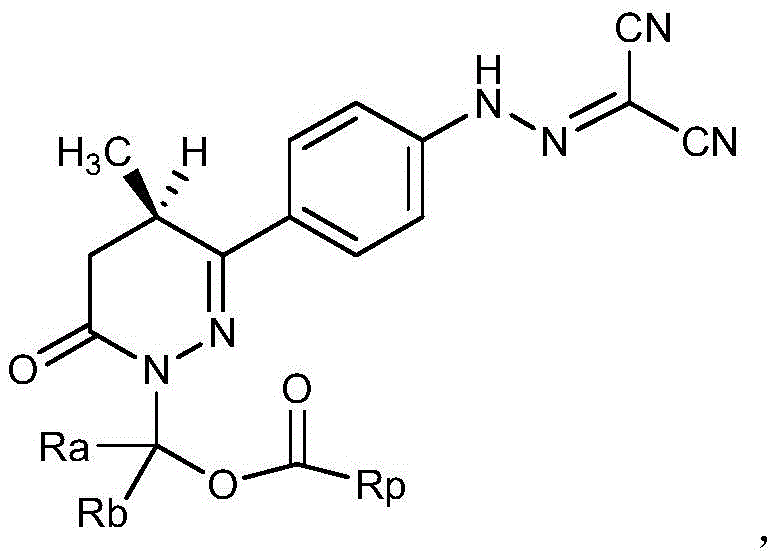 wherein R isaAnd RbAre independently selected from hydrogen or C1-C6 alkyl; rp is selected from basic group containing N atom or carboxyl and phosphoric acidAcid groups of ester groups, sulfate groups or sulfonic acid groups; the prodrug compound overcomes the defects of poor water solubility of levosimendan and the like, has an ideal pharmacokinetic curve and has an excellent medicament application prospect.
Description
Technical Field
The invention relates to a levosimendan prodrug compound, a preparation method and application thereof, belonging to the fields of chemical synthesis and medicaments.
Technical Field
Acute heart failure (heart failure) refers to the clinical syndrome of a series of symptoms such as reduction of myocardial contractility, reduction of cardiac output, increase of pulmonary circulation pressure, increase of peripheral circulation resistance, and insufficient tissue and organ perfusion, wherein the symptoms and signs of heart failure occur or worsen rapidly. The annual fatality rate of acute heart failure in China is as high as 34 percent (the recent prognosis condition and influencing factors of the elderly patients with acute decompensation heart failure, Chinese medicine guidance, 2017, 14 (14): 52-55).
According to the basic diagnosis and treatment guidelines for acute heart failure (2019) in China, acute heart failure needs to be treated by medicines such as positive inotropic drugs, diuretics, vasodilators and the like. Commonly used inotropic drugs include calcium sensitizers (e.g., levosimendan), beta adrenergic receptor agonists (e.g., dobutamine), phosphodiesterase inhibitors (e.g., milrinone), and the like. (Primary guideline for acute Heart failure (2019), J. Zhonghua general practitioner, 2019, 10, 925-930).
Levosimendan is used clinically mainly for treating various acute heart failure diseasesSymptoms, developed by the company orleon (Orion) finland, first appeared on the market in sweden in 10 months of 2000. The chemical name of which is (R) - [ [4- (1,4,5, 6-tetrahydro-4-methyl-6-oxo-pyridazin-3-yl) phenyl]-hydrazono group]-malononitrile, of formula: c14H12N6O, molecular weight: 280.28, CAS. NO.131741-08-7, having a molecular structure represented by the formula:
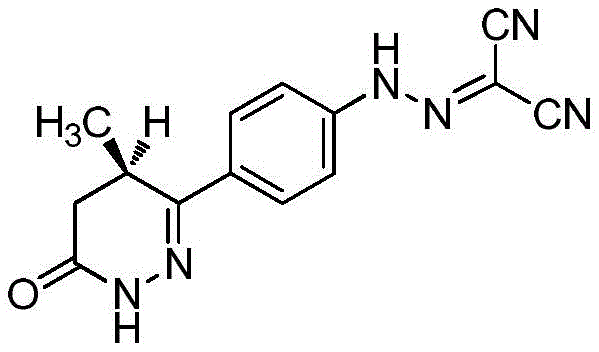
as a multi-target drug, the major mechanisms of action of levosimendan in the treatment of acute heart failure can be summarized in the following two points: first, levosimendan, as a calcium ion sensitizer, exerts a positive inotropic effect on cardiac myocytes by enhancing the sensitivity of cardiac fibrillar troponin C to calcium ions, without increasing the calcium ion concentration in the cardiac myocytes; secondly, levosimendan opens ATP-dependent potassium channels (K) on cardiomyocytes and vascular smooth muscle cellsATP) Causing vascular smooth muscle cell hyperpolarization, dilating coronary and peripheral blood vessels and reducing resistance of the circulatory system. Furthermore, levosimendan has a weak phosphodiesterase-III (PDE-III) inhibitory effect, and increases cyclic adenosine monophosphate (cAMP) concentration in myocardial cells to some extent, thereby increasing intracellular calcium ion concentration, but studies have shown that this mechanism does not produce significant effects within the clinically effective therapeutic range.
Traditional heart failure treatment drugs such as dobutamine and milrinone and the like all play a positive inotropic role by increasing cAMP concentration through different mechanisms and further increasing intracellular calcium ion concentration. Levosimendan exerts a positive inotropic effect through a calcium ion sensitizing mechanism and does not increase myocardial energy expenditure because it does not act through a mechanism of intramolecular calcium ion enhancement or intermolecular calcium ion migration. Moreover, studies have shown that levosimendan has a unique cardioprotective action, which can bring long-term beneficial hemodynamic and energy-balancing effects to patients, and these characteristics make levosimendan more advantageous than traditional therapeutic drugs for heart failure. (Levosimendan in Cardiac Surgery: Evaluating the evaluation. journal of cardio and Vascular Anesthesia,2019,33, 1146-.
Since levosimendan has poor solubility and stability in water, it is important to study how to improve its water solubility. The injection is prepared from sterile absolute ethyl alcohol solution of levosimendan which is clinically adopted at present, a cosolvent is required to be added, povidone K12 is adopted as the cosolvent by original manufacturers, and polyethylene glycol PEG400 or hydroxypropyl-beta-cyclodextrin is adopted as the cosolvent by Chinese imitation pharmaceutical manufacturers. In addition, there are a number of patent documents reporting the use of a cosolvent to improve the water solubility of levosimendan, such as substituted cyclodextrins as a solubilizer (a pharmaceutical formulation for injection containing levosimendan and a process for its preparation, Chinese patent publication (publication) No. 108261398A; lyophilized formulation of levosimendan and a process for its preparation, Chinese patent publication (publication) No. 1626085A); polyvinylpyrrolidone is used as a solubilizer (Parential formulations of levosimendan, world patent WO 2017037737A 1); povidone K12PF is used as solubilizer (a pharmaceutical preparation for injection containing levosimendan and its preparation method, Chinese patent publication (publication) No. 108261398A), etc.
The problem of poor water solubility of the medicine is solved by adopting a non-aqueous solvent and a cosolvent, so that the problem is not an ideal solution, and the absolute ethyl alcohol enters a circulatory system to bring adverse effects and side effects for patients with acute heart failure. The aforementioned co-solvents, such as povidone K12, tend to cause unwanted side effects.
Therefore, there is a need for a levosimendan derivative compound which can effectively solve the problem of solubility and can be prepared in a simple manner, thereby reducing the technical defects of inconvenience in use caused by insolubility and instability of levosimendan in water.
Disclosure of Invention
In view of the above technical problems, the present inventors have provided a prodrug compound of levosimendan, which is a compound having a structure represented by the general formula I, solvate, hydrate, N-oxide, stereoisomer, and pharmaceutically acceptable salt thereof;

wherein Ra and Rb are respectively selected from hydrogen atoms or alkyl groups of C1-C6;
rp is selected from a basic group containing N atoms or an acidic group containing carboxyl, phosphate, sulfate and sulfonic acid groups.
The basic group containing an N atom is a basic group which can form a salt with an inorganic acid or an organic acid. The acidic group is an acidic group which can form a salt with an inorganic base or an organic base.
Wherein Ra and Rb are preferably each a hydrogen atom.
In the technical aspect, levosimendan is insoluble in water and extremely difficult to form a salt, so that the solubility problem cannot be solved in a salt forming mode, the prodrug molecule provided by the invention has a water-soluble substituent, and the water-soluble substituent is not added randomly and has the following characteristics:
1. the synthesiser is able to synthesise and prepare the molecule;
2. the molecules have excellent water solubility or form soluble salts with other acids, bases, organic solvent reagents;
3. has the characteristics of a prodrug molecule, namely can be rapidly metabolized in vivo to form levosimendan.
4. Has a unified mother ring structure, and has the characteristic of no toxic or side effect in vivo metabolism after corresponding substituent groups are broken.
Therefore, in order to find compound molecules satisfying these three conditions, the inventors screened the following kinds of substituents and parent ring structures, i.e., formula I, based on years of drug research experience in combination with the prior art.
Firstly, connecting-CH on the 1-N position of tetrahydropyridazinone ring in the levosimendan structural formula2-O-structure, which in combination with other substituents, is rapidly cleavable during in vivo metabolism and converted to levosimendan with high conversion. Thirdly, the substituent must have experimental verification that no additional side effects are brought after metabolism.
Thus, for the substituent, the basic group containing an N atom is selected from 4- (morpholin-1-ylmethyl) phenyl, 4- (4-methylpiperazin-1-ylmethyl) phenyl, N-dimethylaminomethyl, pyridin-3-yl, 4- (piperidin-1-yl) -piperidin-1-yl, aminomethyl, pyridin-4-ylmethylaminoformylmethyl or pyrrolidin-1-ylmethyl.
Preferably, the acidic group is selected from carboxymethyl, carboxyethyl, carboxymethoxy, phosphoryloxymethyl, sulfonyloxymethyl, sulfomethyl, phosphoryloxyethyl, sulfonyloxyethyl or sulfoethyl.
The present inventors have not studied the prodrug direction of levosimendan and have developed a series of compounds as described above, and first, the present inventors have introduced some solubilizing groups of specific structure to all compounds having the structure of formula I as described above for the problem of poor water solubility of levosimendan.
Structurally, the substituent is introduced to the N-position 1 of the tetrahydropyridazinone ring in the levosimendan structural formula, and the introduction of the side chain has the following characteristics compared with the introduction of the side chain at other sites through earlier experiments:
1) the preparation method is simple;
2) the introduced side chain can smoothly pass through N-CH2The inter-covalent bond is broken to form the parent drug levosimendan, which contributes to the improvement of the decomposition activity of the prodrug.
The inventors have preferred a series of compounds, including the following structural formula, Rp group name and chemical name, see table 1.
TABLE 1 structural formulae and chemical names of preferred Compounds


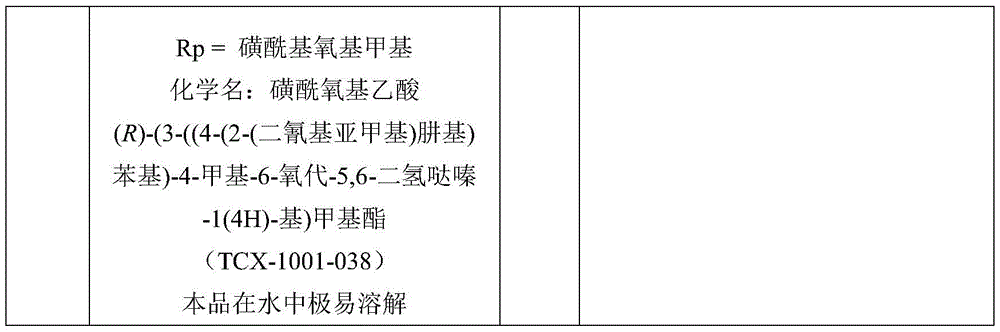
After the structure is formed, the water solubility of the prodrug molecule can be obviously improved. Levosimendan is not only insoluble in water, but also insoluble or poorly soluble in most organic solvents, whereas the water solubility of levosimendan prodrug compounds provided by the inventors ranges between very slightly soluble and very readily soluble.
Solubility determination
The determination is carried out according to a pentadeca-based test method of the routine in the four parts of China pharmacopoeia 2020 edition: weighing the test sample ground into fine powder, adding water with the temperature of about 25 ℃ gradually in a water bath with the temperature of 25 +/-2 ℃, shaking strongly for 30 seconds every 5 minutes, and observing the dissolution condition within 30 minutes, wherein if no visible solute particles exist, the test sample is regarded as being completely dissolved.
TABLE 2 definition of solubility
| Is very easy to dissolve | It means that 1g (ml) of solute can be dissolved in less than 1ml of solvent |
| Is easy to dissolve | It means that 1g (ml) of solute can be dissolved in 1-less than 10ml of solvent |
| Dissolution | It means that 1g (ml) of solute can be dissolved in 10-less than 30ml of solvent |
| Slightly soluble | It means that 1g (ml) of solute can be dissolved in 30-less than 100ml of solvent |
| Slightly soluble | It means that 1g (ml) of solute can be dissolved in 100-less than 1000ml of solvent |
| Minimal dissolution | It means that 1g (ml) of solute can be dissolved in 1000-less than 10000ml of solvent |
| Hardly soluble or insoluble | It means that 1g (ml) of solute cannot be completely dissolved in 10000ml of solvent |
According to the related studies of levosimendan, levosimendan is found to be hardly salifiable (whether by adding inorganic or organic acids or bases) and to have extremely poor solubility in most solvents (including organic solvents and water). Therefore, levosimendan preparations on the market are all prepared into injections dissolved in organic solvents (anhydrous ethanol is selected as the organic solvent of the commercial products), and meanwhile, the levosimendan preparations can be prepared only by adding cosolvent (povidone K12 with high toxicity is selected as the cosolvent of the commercial products at present). In conclusion, the preparation of levosimendan by introducing an organic solvent as a solvent due to the solubility problem of levosimendan and adding a cosolvent is easy to bring toxicity or side effects, thereby causing medication safety accidents.
The invention can synthesize levosimendan prodrug molecule, belongs to the first synthesis, and is a molecule directly having solubility between extremely-soluble and extremely-soluble. And the substituent of the prodrug molecule has the characteristic of containing a basic group of an N atom or containing an acidic group of carboxyl, phosphate group, sulfate group, sulfonic group and the like, so that salts are easily formed in water, or an acid-base regulator (strong acid, strong base, weak acid, weak base, pH regulator with a stabilizing effect and the like) is added to achieve the purpose of easier dissolution. Therefore, the levosimendan prodrug molecule prepared by the invention has milestone effect in the pharmaceutical prospect.
The invention solves the problem that levosimendan has poor solubility in most solvents (including water). The liquid formulation of levosimendan avoids the disadvantages of having to use organic solvents and at the same time requiring the addition of toxic co-solvents.
Meanwhile, levosimendan cannot be dispersed in gastric juice and intestinal juice due to the solubility limit of levosimendan per se, and is difficult to prepare into an oral preparation. The novel compound designed and prepared by the invention solves the defect, can be dispersed in water, namely can be dispersed in gastric juice or intestinal juice in a molecular or ionic form, is beneficial to oral absorption of organisms, and solves the problem that levosimendan is difficult to prepare into an oral preparation.
In addition, the metabolic behavior of the compound which is designed and prepared by the inventor to be metabolized and converted into levosimendan in a human body can be utilized to prepare a controlled release preparation which is more suitable for exerting the drug effect of levosimendan.
These characteristics will make the present invention extremely valuable both clinically and commercially.
Unless otherwise indicated, these terms have the following meanings.
"alkyl" means a straight or branched chain alkyl group consisting of 1 to 6 carbons.
"pharmaceutically acceptable salt" means a pharmaceutically acceptable acid or base addition salt. The compounds of formula (I) having basic properties can be converted into their pharmaceutically acceptable acid addition salts by treatment with a suitable acid. Suitable acids include, for example, inorganic acids, such as hydrohalic acids, e.g., hydrochloric or hydrobromic acid; sulfuric acid; nitric acid; acids such as phosphoric acid; or organic acids such as acetic acid, propionic acid, glycolic acid, lactic acid, pyruvic acid, oxalic acid, malonic acid, succinic acid, maleic acid, fumaric acid, malic acid, tartaric acid, citric acid, methanesulfonic acid, ethanesulfonic acid, benzenesulfonic acid, p-toluenesulfonic acid, cyclamic acid, salicylic acid, p-aminosalicylic acid, pamoic acid and the like. The compounds of formula (I) having acidic properties can be converted into their pharmaceutically acceptable base addition salts by treating the acid form with a suitable organic or inorganic base. Suitable base salt forms include, for example, ammonium salts, alkali and alkaline earth metal salts such as lithium, sodium, potassium, magnesium, calcium salts and the like, salts with organic bases such as N, N' -dibenzylethylenediamine, N-methyl-D-glucamine, diethylamine, diethanolamine, and salts with amino acids such as arginine, lysine and the like.
The invention can also be prepared into preparations which are prepared by the compound of the invention with effective dose and pharmaceutically acceptable auxiliary materials. The pharmaceutically acceptable auxiliary materials refer to auxiliary materials required for preparing any pharmaceutical dosage form suitable for human or animal, for example, when the pharmaceutically acceptable auxiliary materials are prepared into an oral solid preparation, the pharmaceutically acceptable auxiliary materials refer to diluents, adhesives, wetting agents, disintegrants, lubricants and glidants; when the injection is prepared, the pharmaceutically acceptable auxiliary materials refer to a pH regulator, a cosolvent, an antioxidant, an isotonic agent and the like.
Preferably: the basic group containing N atoms is selected from 4- (morpholine-1-ylmethyl) phenyl, 4- (4-methylpiperazin-1-ylmethyl) phenyl, N-dimethylaminomethyl or pyridin-3-yl.
Further preferably, the basic group containing an N atom is selected from 4- (morpholin-1-ylmethyl) phenyl or 4- (4-methylpiperazin-1-ylmethyl) phenyl.
The invention provides a preparation method of the compound, which comprises the following steps:
(1) tert-butyl (R) - (4- ((4-methyl-6-oxo-1, 4,5, 6-tetrahydropyridazin-3-yl) phenyl) carbamate is prepared by reacting di-tert-butyl dicarbonate with (R) -6- ((4-aminophenyl) -5-methyl-4, 5-dihydropyridazin-3 (2H) -one;
(2) reacting tert-butyl (R) - (4- ((4-methyl-6-oxo-1, 4,5, 6-tetrahydropyridazin-3-yl) phenyl) carbamate with paraformaldehyde in the presence of a base to obtain tert-butyl (R) - (4- (1- (hydroxymethyl) -4-methyl-6-oxo-1, 4,5, 6-tetrahydropyridazin-3-yl) phenyl) carbamate;
(3) converting tert-butyl (R) - (4- (1- (hydroxymethyl) -4-methyl-6-oxo-1, 4,5, 6-tetrahydropyridazin-3-yl) phenyl) carbamate, de-Boc groups, to (R) -6- ((4-aminophenyl) -2- (hydroxymethyl) -5-methyl-4, 5-dihydropyridazin-3 (2H) -one under acidic conditions;
(4) reacting (R) -6- ((4-aminophenyl) -2- (hydroxymethyl) -5-methyl-4, 5-dihydropyridazin-3 (2H) -one with sodium nitrite and malononitrile under an acidic condition to prepare (R) -N- ((4- (1- (hydroxymethyl) -4-methyl-6-oxo-1, 4,5, 6-tetrahydropyridazin-3-yl) phenyl) dicyanomethylene) hydrazine;
(5) and (R) -N- ((4- (1- (hydroxymethyl) -4-methyl-6-oxo-1, 4,5, 6-tetrahydropyridazin-3-yl) phenyl) dicyanomethylene) hydrazine prepared in the step (4) is respectively reacted with carboxylic acid of a corresponding substituent or an activated form thereof to obtain the prodrug compound.
The synthetic route is shown as the following formula:

in the above preparation method, the present invention also provides the intermediate (R) - (4- (1- (hydroxymethyl) -4-methyl-6-oxo-1, 4,5, 6-tetrahydropyridazin-3-yl) phenyl) carbamic acid tert-butyl ester in the above steps (2), (3) and (4), use of (R) -6- ((4-aminophenyl) -2- (hydroxymethyl) -5-methyl-4, 5-dihydropyridazin-3 (2H) -one and (R) -N- ((4- (1- (hydroxymethyl) -4-methyl-6-oxo-1, 4,5, 6-tetrahydropyridazin-3-yl) phenyl) dicyanomethylene) hydrazine for the preparation of a medicament for the treatment of heart failure disorders.

The invention provides a preparation method of a compound of a general formula I, which comprises the following steps:
(1) preparation of (R) - (4- ((4-methyl-6-oxo-1, 4,5, 6-tetrahydropyridazin-3-yl) phenyl) carbamic acid tert-butyl
Placing (R) -6- ((4-aminophenyl) -5-methyl-4, 5-dihydropyridazin-3 (2H) -one, di-tert-butyl dicarbonate, triethylamine and tetrahydrofuran in a container, stirring for 1-5 days at room temperature, detecting no raw material by TLC, filtering, performing reduced pressure rotary evaporation to remove the solvent, adding petroleum ether into the concentrate, pulping for 10-60 minutes at room temperature, filtering, and drying the obtained solid to obtain a light brown solid.
(2) Preparation of (R) - (4- (1- (hydroxymethyl) -4-methyl-6-oxo-1, 4,5, 6-tetrahydropyridazin-3-yl) phenyl) carbamic acid tert-butyl ester
Putting the (R) - (4- ((4-methyl-6-oxo-1, 4,5, 6-tetrahydropyridazin-3-yl) phenyl) carbamic acid tert-butyl ester obtained in the step (1) and methanol into a container, adding paraformaldehyde and potassium carbonate while stirring, stirring at room temperature until the TLC monitoring reaction is complete, carrying out reduced pressure rotary evaporation to remove the solvent, purifying the concentrate by column chromatography, and obtaining a white solid by using an eluent which is a mixed solvent of petroleum ether and ethyl acetate (v: v 1: 1).
(3) Preparation of (R) -6- ((4-aminophenyl) -2- (hydroxymethyl) -5-methyl-4, 5-dihydropyridazin-3 (2H) -one hydrochloride
And (2) placing the tert-butyl (R) - (4- ((4-methyl-6-oxo-1, 4,5, 6-tetrahydropyridazin-3-yl) phenyl) carbamate obtained in the step (2) into a container, adding ethyl acetate, stirring at room temperature for 1-10 minutes, dropwise adding an ethyl acetate solution of hydrogen chloride, stirring at room temperature after dropwise adding until no raw material remains after TLC detection, and concentrating under reduced pressure to remove the solvent to obtain a crude product of (R) -6- ((4-aminophenyl) -2- (hydroxymethyl) -5-methyl-4, 5-dihydropyridazin-3 (2H) -one hydrochloride and a yellow solid, wherein the crude product is directly subjected to the next reaction.
(4) Preparation of (R) -N- ((4- (1- (hydroxymethyl) -4-methyl-6-oxo-1, 4,5, 6-tetrahydropyridazin-3-yl) phenyl) dicyanomethylene) hydrazine
And (2) transferring the (R) -6- ((4-aminophenyl) -2- (hydroxymethyl) -5-methyl-4, 5-dihydropyridazin-3 (2H) -one hydrochloride crude product obtained in the step (3) into a container by using a hydrochloric acid aqueous solution, adding a sodium nitrite aqueous solution into the reaction solution under the control of an ice water bath at 5-10 ℃, continuing stirring for 10 minutes to 2 hours under the ice water bath after the addition is finished, adding a malononitrile aqueous solution into the reaction solution at 5-10 ℃, removing the ice water bath after the addition is finished, stirring for 1 to 5 hours at room temperature, slowly adding a sodium acetate aqueous solution, adjusting the pH value to 5-6 to obtain a yellow suspension, filtering, washing with water and drying to obtain a yellow solid.
(5) Preparation of the Compounds of the formula I
And (R) -N- ((4- (1- (hydroxymethyl) -4-methyl-6-oxo-1, 4,5, 6-tetrahydropyridazin-3-yl) phenyl) dicyanomethylene) hydrazine prepared in the step (4) is respectively esterified with carboxylic acid with corresponding substituent groups or activated forms thereof to obtain the compound with the general formula.
All compounds of the invention not only have general structures, but also can be prepared by carrying out esterification reaction on a common intermediate product (R) -N- ((4- (1- (hydroxymethyl) -4-methyl-6-oxo-1, 4,5, 6-tetrahydropyridazin-3-yl) phenyl) dicyanomethylene) hydrazine, namely, by preparing a front-end intermediate product, and then carrying out esterification reaction on subsequent substituent compounds by carboxylic acid of corresponding substituents or activated forms thereof, so that the preparation route of the preparation method is that the intermediate product is prepared firstly and then various specific compounds of the prodrug compound are synthesized by a main mode of esterification.
In the preparation method, the compound (R) -N- ((4- (1- (hydroxymethyl) -4-methyl-6-oxo-1, 4,5, 6-tetrahydropyridazin-3-yl) phenyl) dicyanomethyl) hydrazino, TSTU and carboxylic acid substituted by different Rp groups are taken in a container in the step (5), dichloromethane is added, triethylamine is added under stirring, the mixture is stirred for 1-10 hours at room temperature, no raw material is left after TLC detection, the solvent is removed by reduced pressure rotary evaporation, the obtained concentrate is purified by column chromatography, and the eluent is a mixed solvent of dichloromethane and methanol (v: v 50:1), so that the prodrug compound of levosimendan is obtained.
The invention further provides the application of the prodrug compound in preparing a medicament for treating heart failure diseases.
Has the advantages that:
the invention provides a levosimendan prodrug compound, which is prepared by carrying out corresponding substitution on 1-N of a tetrahydropyridazinone ring in a levosimendan structural formula, solves the technical defect of extremely poor water solubility of levosimendan, and has the characteristics of good stability, easier drug metabolism, convenient use and the like. The preparation does not need to adopt absolute ethyl alcohol as a solvent and other cosolvents, and is greatly convenient for clinical use. The levosimendan prodrug compound can be quickly converted into levosimendan in vivo, has high conversion rate and good drug-forming property. Based on the pharmacokinetic data obtained, it can be concluded that the compounds provided by the present invention are capable of acting as prodrugs of levosimendan. These compounds also have the advantage of pharmacokinetic control of the rate of levosimendan release in vivo. In addition, the problem that levosimendan is not suitable for oral administration can be solved.
Abbreviation interpretation:
TSTU: 2-succinimidyl-1, 1,3, 3-tetramethyluronium tetrafluoroborate;
TLC: thin layer chromatography;
1H-NMR: nuclear magnetic resonance hydrogen spectroscopy;
TMS: tetramethylsilane
DMSO-d6: hexadeuterio dimethyl sulfoxide;
ESI-MS: electrospray ionization-mass spectrometry;
KATP: ATP-dependent potassium ion channels;
PDE-III: phosphodiesterase-III;
cAMP: cyclic adenosine monophosphate;
PEG: polyethylene glycol.
DCM: dichloromethane;
MtOH: methanol;
DMF: n, N-dimethylformamide;
boc group: an amino protecting group, t-butyloxycarbonyl, is commonly used.
Drawings
Process for preparing TCX1001-031 compound of FIG. 11H-NMR chart;
FIG. 2 ESI-MS plot of TCX1001-031 compound;
FIG. 3 liquid chromatogram of compound TCX 1001-031;
FIG. 4 is a graph of the change in self-content in pharmacokinetic experiments for compounds TCX 1001-031;
FIG. 5 is a graph of the change in the amount of levosimendan released in the pharmacokinetic test of the compound TCX 1001-031;
FIG. 6 metabolic conversion in pharmacokinetic experiments for compound TCX 1001-031.
Detailed Description
The following detailed description is provided for the purpose of illustrating the embodiments and the advantageous effects thereof, and is not intended to limit the scope of the present disclosure.
The structure of the compound is determined by nuclear magnetic resonance hydrogen spectrum (1HNMR) and/or Mass Spectrometry (MS).1HNMR were determined by Bruker Spectrometer AVIII HD NMR Spectrometer (400MHz) with a chemical shift (. delta.) of 10-6The units in (ppm) are given. Internal standard Tetramethylsilane (TMS), chemical shift: δ, s: a single peak; d: double peaks; t: a triplet; q: quartering; m: multiple peaks. Mass spectra were determined on an Agilent Accurate-Mass Q-TOF LC/MS Mass spectrometer.
Unless otherwise stated, benzyl carbazate was purchased from Shanghai Haohnhong biomedical science and technology, Inc., paraformaldehyde was purchased from Shanghai Michelin Biotechnology, Inc., diethyl phosphate was purchased from Shanghai Michelin Biotechnology, Inc., diethyl 2, 2-diethoxyethyl phosphate was purchased from Afahesa (China) chemical, Inc., tert-butoxycarbonylhydrazine was purchased from Shanghai Bigdi medicinal science, Inc., (R) -6- ((4-aminophenyl) -5-methyl-4, 5-dihydropyridazin-3 (2H) -one was purchased from Beijing Cheng Guang Co., Ltd., (TLC was thin-layer chromatography), TSTU was O- (N-succinimidyl) -N N N 'N' -tetramethyltetrafluoroborate, DCM was dichloromethane, MtOH is methanol, DMF is dimethylformamide, and the specification of petroleum ether is 60-90 ℃.
The synthetic route for the common intermediate, N- ((4- (1- (hydroxymethyl) -4-methyl-6-oxo-1, 4,5, 6-tetrahydropyridazin-3-yl) phenyl) dicyanomethylene) hydrazine (5), is as follows:

preparation of (R) - (4- ((4-methyl-6-oxo-1, 4,5, 6-tetrahydropyridazin-3-yl) phenyl) carbamic acid tert-butyl ester
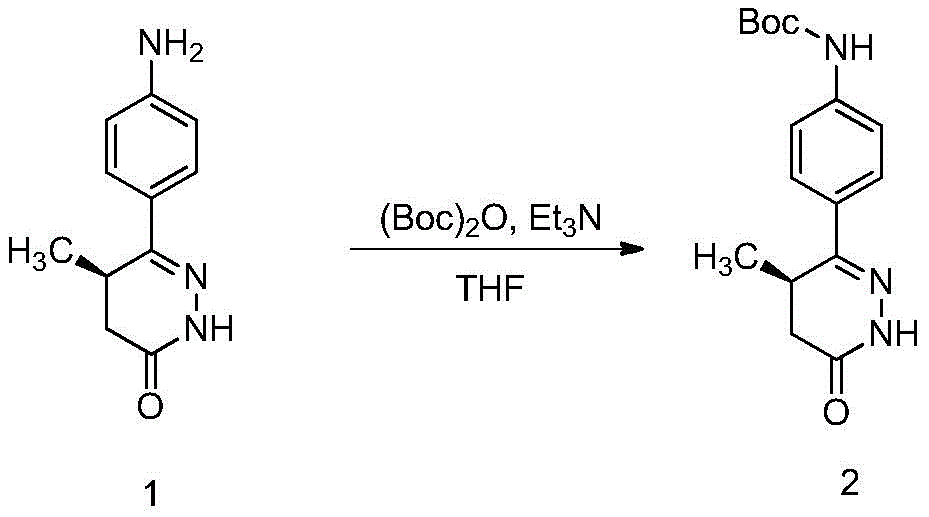
(R) -6- ((4-aminophenyl) -5-methyl-4, 5-dihydropyridazin-3 (2H) -one (101g,0.5mol), di-tert-butyl dicarbonate (163.5g,0.75mol), triethylamine (76g,0.75mol) and tetrahydrofuran (1L) were placed in a 2L one-necked flask, and stirred at room temperature for 3 days, and TLC showed no starting material remaining.filtration, removal of the solvent by rotary evaporation under reduced pressure, petroleum ether (300mL) was added to the residue with stirring, and stirred at room temperature for 20 minutes, filtered, and dried to give the title compound 84g, a pale brown solid in 54% yield.1H-NMR(400MHz,DMSO-d6)δ:10.86(s,1H),9.55(s,1H),7.66-7.70 (m,2H),7.50-7.53(m,2H),3.35-3.38(m,1H),2.63-2.69(m,1H),2.18-2.23(m,1H),1.48(s, 9H),1.05(d,3H,J=7.2Hz);ESI-MS(m/z):Calcd.For C16H21N3O3+H:304.16;Found: 304.17。
Preparation of di- (R) - (4- (1- (hydroxymethyl) -4-methyl-6-oxo-1, 4,5, 6-tetrahydropyridazin-3-yl) phenyl) carbamic acid tert-butyl ester

Tert-butyl (R) - (4- ((4-methyl-6-oxo-1, 4,5, 6-tetrahydropyridazin-3-yl) phenyl) carbamate (100g, 0.33mol), and 2.5L of methanol were placed in a 3L three-necked flask, and paraformaldehyde (128.2g,4.27mol) and potassium carbonate (95.3g,0.69mol) were added with stirring, stirred at room temperature overnight, the reaction was monitored by TLC for completion, the solvent was removed by rotary evaporation under reduced pressure, and the concentrate was purified by column chromatography (petroleum ether: ethyl acetate, v: v ═ 1:1) to obtain 60.0g of the title compound as a white solid in 55% yield.1H-NMR(400MHz,DMSO-d6)δ:9.56(s,1H),7.74(d,2H,J=8.5Hz),7.53 (d,2H,J=8.5Hz),6.13-6.17(m,1H),5.10-5.15(m,1H),4.95-5.00(m,1H),3.35-3.41(m, 1H),2.67-2.73(m,1H),2.28-2.33(m,1H),1.48(s,9H),1.06(d,3H,J=7.2Hz);ESI-MS (m/z):Calcd.For C17H23N3O4+H:334.17;Found:334.18。
Preparation of tris, (R) -6- ((4-aminophenyl) -2- (hydroxymethyl) -5-methyl-4, 5-dihydropyridazin-3 (2H) -one hydrochloride

Tert-butyl (R) - (4- ((4-methyl-6-oxo-1, 4,5, 6-tetrahydropyridazin-3-yl) phenyl) carbamate (20g,0.06 mol) is placed in a 500mL three-necked flask, 50mL of ethyl acetate is added, after stirring for 5 minutes at room temperature, an ethyl acetate solution of hydrogen chloride (100mL,20 wt%) is added dropwise, after dropwise addition, stirring is carried out for 2 hours at room temperature, no raw material remains after TLC detection, the solvent is removed by rotary evaporation under reduced pressure to obtain 23g of yellow solid, and the crude product is directly subjected to the next reaction.
Preparation of tetra (R) -N- ((4- (1- (hydroxymethyl) -4-methyl-6-oxo-1, 4,5, 6-tetrahydropyridazin-3-yl) phenyl) dicyanomethylene) hydrazine
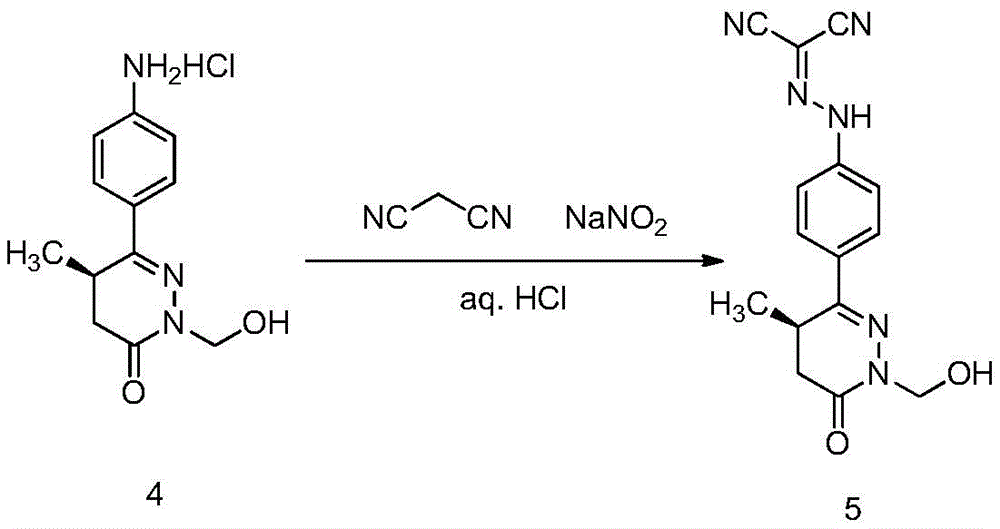
Transferring 23g of the compound (R) -6- ((4-aminophenyl) -2- (hydroxymethyl) -5-methyl-4, 5-dihydropyridazin-3 (2H) -one hydrochloride obtained in the third step to a 2L beaker by using a 2.6% hydrochloric acid aqueous solution (500mL), cooling the mixture in an ice-water bath, adding a solution prepared by dissolving 7.05g of sodium nitrite (0.1mol) in 50mL of water at 5 to 10 ℃ to the reaction solution, continuing to stir for 30 minutes in the ice-water bath after the addition is finished, dissolving malononitrile (6.2g,0.094mol) in 50mL of water, adding the mixture to the reaction solution at 5 to 10 ℃ and removing the ice-water bath after the addition is finished, stirring the mixture at room temperature for 2 hours, slowly adding a 20% sodium acetate aqueous solution, adjusting the pH value to 5 to 6 to obtain a yellow suspension, filtering, washing with water, drying to obtain 11.2 g of the title compound, yellow solid, two-step yield 60%.1H-NMR(400MHz,DMSO-d6)δ:13.1(br,s,1H),7.88-7.92(m, 2H),7.52-7.55(m,2H),5.13(d,1H,J=10Hz),5.00(d,1H,J=10Hz),3.37-3.43(m,1H), 2.71-2.77(m,1H),2.31-2.35(m,1H),1.08(d,3H,J=7.2Hz);ESI-MS(m/z):Calcd.For C15H14N6O2+H:311.12;Found:311.13。
Example 1: preparation of (R) - (3- ((4- (2- (dicyanomethylene) hydrazino) phenyl) -4-methyl-6-oxo-5, 6-dihydropyridazin-1 (4H) -yl) methyl nicotinate (TCX-1001-029)
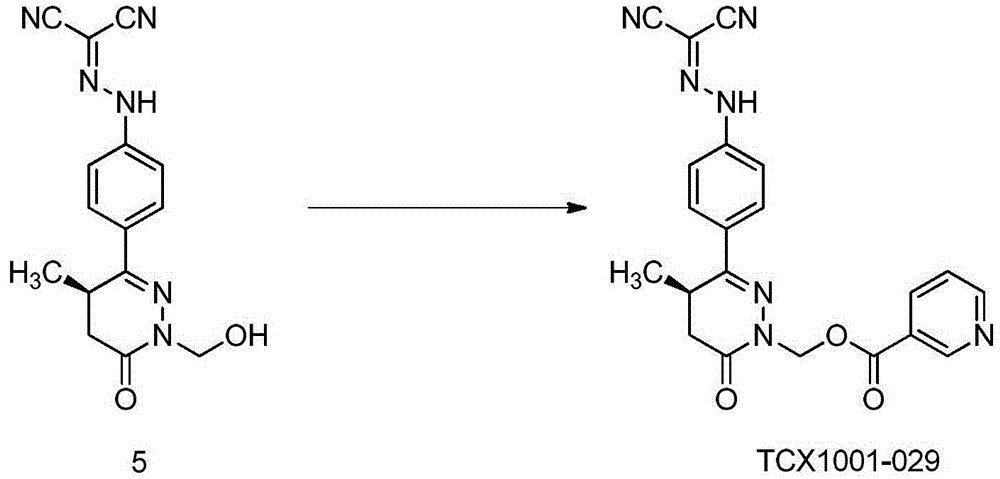
The compound (R) -N- ((4- (1- (hydroxymethyl) -4-methyl-6-oxo-1, 4,5, 6-tetrahydropyridazin-3-yl) phenyl) dicyanomethylene) hydrazine (0.26g,0.84mmol), TSTU (0.3g,1mmol) and nicotinic acid (0.11g,0.92mmol) were put in a 50mL one-necked flask, 5mL of dichloromethane was added, triethylamine (0.3g,3mmol) was added with stirring, and the mixture was stirred at room temperature for 5 hours. TLC showed no material remaining, the solvent was removed by rotary evaporation under reduced pressure and the resulting concentrate was purified by Pre-HPLC (eluent: DCM/MeOH, v: v ═ 50/1) to give the title compound 0.12g as a yellow solid in 34% yield.1H-NMR(400 MHz,DMSO-d6)δ:13.1(br,s,1H),9.08(s,1H),8.83-8.85(m,1H),8.27-8.30(m,1H), 7.90-7.92(m,2H),7.54-7.60(m,3H),5.98-6.08(m,2H),3.50-3.54(m,1H),2.91-2.97(m,1H), 2.51-2.53(m,1H),1.13(d,3H,J=7.2Hz);ESI-MS(m/z):Calcd.For C21H17N7O3+H: 416.14;Found:416.15。
Example 2: preparation of glycine (R) - (3- ((4- (2- (dicyanomethylene) hydrazino) phenyl) -4-methyl-6-oxo-5, 6-dihydropyridazin-1 (4H) -yl) methyl ester (TCX-1001-032)

The compound (R) -N- ((4- (1- (hydroxymethyl) -4-methyl-6-oxo-1, 4,5, 6-tetrahydropyridazin-3-yl) phenyl) dicyanomethylene) hydrazine (0.2g,0.64mmol), glycine (0.12g,1.6mmol), 1- (3-dimethylaminopropyl) -3-ethylcarbodiimide (0.31g,1.6mmol), 4-lutidine (0.08g,0.64mmol) and 5mL of N, N-dimethylacetamide were sequentially added to a 50mL single-necked flask and stirred at room temperature overnight. The solvent was removed by rotary evaporation under reduced pressure, and the concentrate was purified by column chromatography (eluent: DCM/MeOH, v: v ═ 30/1) to give the title compound 70mg as a yellow solid in 30% yield.1H-NMR (400MHz,DMSO-d6)δ:13.2(br,s,1H),7.75-7.81(m,2H),7.36-7.41(m,2H),5.95-6.05(m, 2H),3.48-3.54(m,1H),3.17-3.23(m,2H),2.95-3.02(m,1H),2.67-2.69(m,1H),1.14(d,3H, J=7.2Hz);ESI-MS(m/z):Calcd.For C19H21N7O3+H:368.14;Found:368.15。
Example 3: preparation of (R) - (3- ((4- (2- (dicyanomethylene) hydrazino) phenyl) -4-methyl-6-oxo-5, 6-dihydropyridazin-1 (4H) -yl) methyl 2-pyrrolidin-1-yl-acetate (TCX-1001-) -039)

Compound (R) -N- ((4- (1- (hydroxymethyl) -4-methyl-6-oxo-1, 4,5, 6-tetrahydropyridazin-3-yl) phenyl) dicyanomethylene) hydrazine (300mg,0.97mmol), 2- (pyrrolidin-1-yl) acetic acid hydrochloride (321mg,1.94mmol), EDCI (465mg, 2.43mmol), DMAP (118mg,0.97mmol) was dissolved in DMA (10mL) and stirred at room temperature for 18 hours. Ethyl acetate (10mL) and water (10mL) were added to the system, and the mixture was stirred and separated. The organic phase was washed with water (3 × 10mL) and dried over anhydrous sodium sulfate. The solvent was removed by rotary evaporation under reduced pressure and the crude product was purified by Pre-HPLC to give the title compound 210mg as a yellow solid product in 51.3% yield.1H-NMR(400MHz,DMSO-d6)δ:13.0(br,s,1H),7.80-7.74(m, 2H),7.38-7.33(m,2H),6.05-5.95(m,2H),3.52-3.46(m,1H),3.35(s,2H),3.02-2.95(m,1H), 2.68-2.66(m,1H),2.61-2.58(m,2H),1.72-1.70(m,2H),1.13(d,3H,J=7.2Hz);ESI-MS(m/z): Calcd.For C20H20N7O3+H:407.16;Found:407.217。
Example 4: preparation of N, N-dimethylglycine (R) - (3- ((4- (2- (dicyanomethylene) hydrazino) phenyl) -4-methyl-6-oxo-5, 6-dihydropyridazin-1 (4H) -yl) methyl ester (TCX-1001-030)

The compound (R) -N- ((4- (1- (hydroxymethyl) -4-methyl-6-oxo-1, 4,5, 6-tetrahydropyridazin-3-yl) phenyl) dicyanodimethylene) hydrazine (0.2g,0.64mmol), N, N-dimethylglycine (0.16g,1.6mmol), 1- (3-dimethylaminopropyl) -3-ethylcarbodiimide (0.31g,1.6mmol), 4-lutidine (0.08g,0.64mmol), and 5mL of N, N-dimethylacetamide were sequentially added to a 50mL single-neck flask and stirred at room temperature overnight. The solvent was removed by rotary evaporation under reduced pressure and the concentrate was purified by column chromatography (eluent: DCM/MeOH, v: v ═ 30/1) to give the title compound 0.06g as a yellow solid in 24% yield.1H-NMR(400MHz,DMSO-d6)δ:13.0(br,s,1H),7.74-7.80(m,2H),7.33-7.38(m,2H), 5.95-6.05(m,2H),3.46-3.52(m,1H),3.19-3.25(m,2H),2.95-3.02(m,1H),2.75-2.85(m,6H), 2.66-2.68(m,1H),1.13(d,3H,J=7.2Hz);ESI-MS(m/z):Calcd.For C19H21N7O3+H:396.17; Found:396.18。
Example 5: preparation of (R) - (3- ((4- (2- (dicyanomethylene) hydrazino) phenyl) -4-methyl-6-oxo-5, 6-dihydropyridazin-1 (4H) -yl) methyl 4- (morpholin-1-ylmethyl) benzoate (TCX-1001-031)
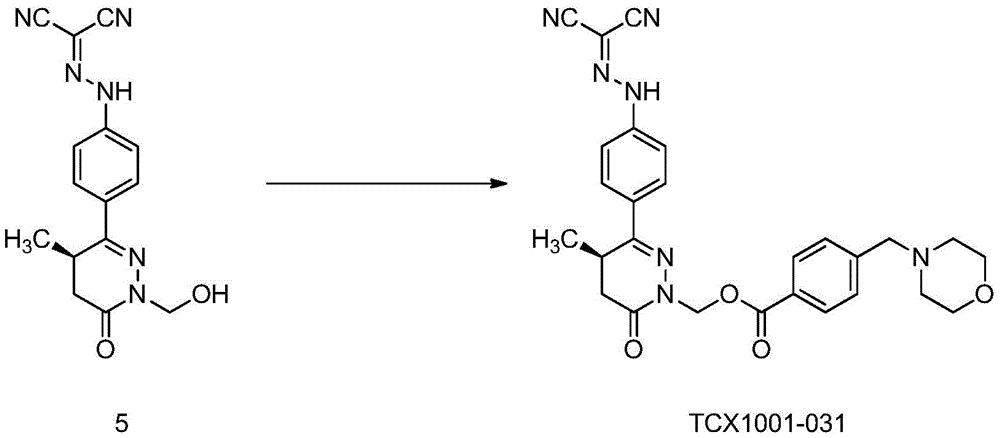
The compound (R) -N- ((4- (1- (hydroxymethyl) -4-methyl-6-oxo-1, 4,5, 6-tetrahydropyridazin-3-yl) phenyl) dicyanodimethylene) hydrazine (0.2g,0.64mmol) was dissolved in 2mL of pyridine, 4-chloromethylbenzoyl chloride (0.22g,1.16 mmol) was added thereto, and the mixture was stirred at room temperature for 2 hours, and 30mL of ethyl acetate was added to dilute the reaction solution, and the organic phase was washed with distilled water and saturated brine in this order, dried over anhydrous sodium sulfate, and spin-dried, and the resulting concentrate was dissolved in DMF (3mL), and sodium iodide (0.05g) was added thereto, morpholine (0.13g, 1.5mmol) was added thereto, and the mixture was stirred at room temperature overnight. The solvent was removed by rotary evaporation under reduced pressure, and the resulting concentrate was purified by column chromatography (eluent: DCM/MeOH, v: v ═ 70/1) to give the title compound 0.11g as a yellow solid in 33% yield.1H-NMR(400MHz,DMSO-d6)δ:13.1(br,s,1H),7.95-8.03(m,2H), 7.77-7.83(m,2H),7.53-7.63(m,2H),7.38-7.42(m,2H),5.92-6.06(m,2H),3.56-4.51(m,6H), 3.35-3.53(m,2H),2.71-3.15(m,4H),2.41-2.46(m,1H),1.13(d,3H,J=7.2Hz);ESI-MS (m/z):Calcd.For C27H27N7O4+H:514.21;Found:514.22。
Example 6: preparation of (R) - (3- ((4- (2- (dicyanomethylene) hydrazino) phenyl) -4-methyl-6-oxo-5, 6-dihydropyridazin-1 (4H) -yl) methyl 4- ((4-methylpiperazin-1-yl) methyl) benzoate (TCX-1001-033)

The compound (R) -N- ((4- (1- (hydroxymethyl) -4-methyl-6-oxo-1, 4,5, 6-tetrahydropyridazin-3-yl) phenyl) dicyanomethylene) hydrazine (0.2g,0.64mmol) was dissolved in 2mL of pyridine, 4-chloromethylbenzoyl chloride (0.22g,1.16 mmol) was added thereto, the mixture was stirred at room temperature for 2 hours, and 30mL of ethyl acetate was added to dilute the reaction solution, which was then washed with distilled water and saturated brine in this order. The organic phase was dried over anhydrous sodium sulfate, the solvent was removed by rotary evaporation under reduced pressure, the concentrate was dissolved in DMF (3mL), sodium iodide (0.05g) was added, then N-methylpiperazine (0.15g,1.5mmol) was added, and the mixture was stirred at room temperature overnight. The solvent was removed by rotary evaporation under reduced pressure and the concentrate was purified by column chromatography (eluent: DCM/MeOH, v: v ═ 30/1) to give the title compound 0.05g as a yellow solid in 15.0% yield.1H-NMR(400MHz,DMSO-d6)δ:13.2(br,s,1H), 7.95-7.88(m,2H),7.83-7.78(m,2H),7.59-7.54(m,2H),7.33-7.29(m,2H),6.06-5.90(m,2H), 3.70-3.58(m,2H),3.52-3.48(m,1H),3.43-3.27(m,5H),3.04-2.98(m,1H),2.93-2.80(m,3H), 2.69(s,3H),2.47-2.41(m,1H),1.13(d,3H,J=7.2Hz);ESI-MS(m/z):Calcd.For C27H27N7O4+H:527.12;Found:526.80。
Example 7: preparation of (R) - (3- ((4- (2- (dicyanomethylene) hydrazino) phenyl) -4-methyl-6-oxo-5, 6-dihydropyridazin-1 (4H) -yl) methyl 4- (piperidin-1-yl) piperidin-1-ylcarboxylate (TCX-1001-) -037)

10mL of anhydrous tetrahydrofuran, 1.24g of (R) -N- ((4- (1- (hydroxymethyl) -4-methyl-6-oxo-1, 4,5, 6-tetrahydro-l-o-ne)Pyridazin-3-yl) phenyl) dicyanomethylene) hydrazine, 0.71g N, N' -carbonyldiimidazole and 0.67g 4-piperidinopiperidine were put in this order into a 50mL single-necked flask, and after the reaction was stirred at room temperature for 48 hours, TLC monitoring (developing solvent: dichloromethane/methanol 10/1) was complete. The solvent was removed by rotary evaporation under reduced pressure and the concentrate was purified by column chromatography (eluent: DCM/MeOH, v: v ═ 30/1) to give the title compound 0.50g as a yellow solid in 24.8% yield.1H-NMR(400MHz,DMSO-d6)δ:12.35(s, 1H),7.76-7.80(d,2H),7.40-7.43(d,2H),5.94-6.02(m,2H),4.25(m,2H),3.43-3.49(d, 1H),2.70-2.76(d,3H),2.60-2.65(d,1H),2.5(t,4H),2.3-2.45(m,1H),1.8(m,2H),1.51-1.65(m, 4H),1.3-1.5(m,4H),1.08-1.14(d,3H);ESI-MS(m/z):Calcd.For C26H32N8O3+H:505.6; Found:505.61。
Example 8: preparation of (R) - (3- ((4- (2- (dicyanomethylene) hydrazino) phenyl) -4-methyl-6-oxo-5, 6-dihydropyridazin-1 (4H) -yl) methyl 2-carboxy-acetate (TCX-1001-041)

Malonic acid (0.21g,2.06mmol), triethylamine (0.36mL,2.6mmol), DMAP (13mg,0.1mmol), isopropenyl chloroformate (0.08mL,0.73mmol) were added successively to 10mL of dichloromethane, the temperature in an ice-water bath was lowered to 0 ℃, then a solution of (R) -N- ((4- (1- (hydroxymethyl) -4-methyl-6-oxo-1, 4,5, 6-tetrahydropyridazin-3-yl) phenyl) dicyanomethylene) hydrazine (0.16g,0.52mmol) in dichloromethane (10mL) was added, and the reaction was stirred at 0 ℃ for 2 hours, then poured into 3mL of a 10% aqueous acetic acid solution and stirred at room temperature for 0.5 hours. The reaction mixture was washed with distilled water and saturated brine in this order, and the organic phase was dried over anhydrous sodium sulfate. The solvent was removed by rotary evaporation under reduced pressure, and the concentrate was purified by column chromatography (dichloromethane/methanol/formic acid, v: v: v ═ 20/1/0.05) to give the title compound 80mg as a yellow solid in 39.0% yield.1H-NMR (400MHz,DMSO-d6)δ:14.1(br,s,1H),13.1(br,s,1H),7.90-7.92(m,2H),7.54-7.60(m, 2H),5.98-6.08(m,2H),3.55-3.60(m,1H),3.4(s,2H),2.91-2.97(m,1H),2.51-2.53(m,1H), 1.13(d,3H,J=7.2Hz);ESI-MS(m/z):Calcd.For C21H17N7O3+H:397.12;Found:397.15。
Example 9: preparation of (R) - (3- ((4- (2- (dicyanomethylene) hydrazino) phenyl) -4-methyl-6-oxo-5, 6-dihydropyridazin-1 (4H) -yl) methyl 3-carboxypropionate (TCX-1001-034)
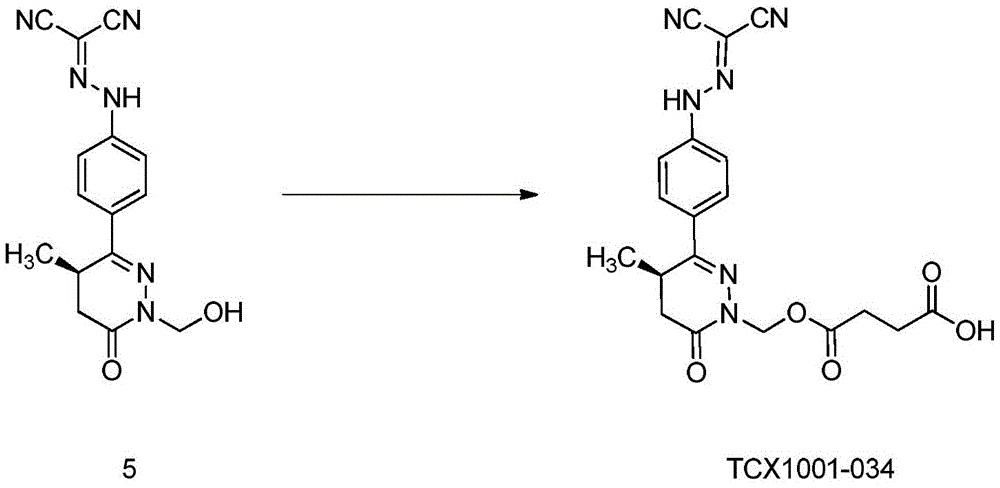
Succinic acid (0.488g,4.12mmol), triethylamine (0.72mL,5.2mmol), 4-dimethylaminopyridine DMAP (26mg,0.2mmol), isopropenyl chloroformate (0.16mL,1.46mmol) were dissolved in 10mL of dichloromethane, the temperature in an ice-water bath was reduced to 0 ℃, then a solution of (R) -N- ((4- (1- (hydroxymethyl) -4-methyl-6-oxo-1, 4,5, 6-tetrahydropyridazin-3-yl) phenyl) dicyanomethylene) hydrazine (0.32g,1.04mmol) in dichloromethane (10mL) was added, and the reaction was stirred at 0 ℃ for 2 hours, then poured into 3mL of 10% aqueous acetic acid and stirred at room temperature for 0.5 hours. The reaction mixture was washed with distilled water and saturated brine in this order, and the organic phase was dried over anhydrous sodium sulfate. The solvent was removed by rotary evaporation under reduced pressure, and the concentrate was purified by column chromatography (dichloromethane/methanol/formic acid, v: v: v ═ 20/1/0.05) to give the title compound 0.14g as a yellow solid in 33% yield.1H-NMR(400MHz,DMSO-d6)δ:14.3(br,s,1H),13.4(br,s,1H),7.91-7.93(m,2H), 7.55-7.61(m,2H),5.99-6.10(m,2H),3.51-3.54(m,1H),2.91-2.97(m,1H),2.75-2.51(m,5H), 1.13(d,3H,J=7.2Hz);ESI-MS m/z:Calcd.For C21H17N7O3+H:411.14;Found:411.15。
Example 10: preparation of (R) - (3- ((4- (2- (dicyanomethylene) hydrazino) phenyl) -4-methyl-6-oxo-5, 6-dihydropyridazin-1 (4H) -yl) methyl carboxymethyloxycarbonate (TCX-1001-035)

Taking (R) -N- ((4- (1- (hydroxymethyl) -4-methyl-6-oxo-1, 4,5, 6-tetrahydropyridazin-3-yl) benzeneYl) Dicyanomethylene) hydrazine (0.16g,0.52mmol), N, N' -carbonyldiimidazole CDI (95mg,0.57mmol), 2-hydroxyacetic acid ((40mg, 0.57mmol) was dissolved in 5mL THF, stirred at room temperature for 48 hours, TLC monitored reaction completion. The solvent was removed by rotary evaporation under reduced pressure, and the concentrate was purified by column chromatography (dichloromethane/methanol/formic acid, v: v: v ═ 20/1/0.05) to give the title compound 60mg as a yellow solid in 28% yield.1H-NMR(400MHz,DMSO-d6)δ:14.1(br,s,1H),13.1(br,s,1H), 7.90-7.92(m,2H),7.56-7.61(m,2H),5.97-6.08(m,2H),5.2(s,2H),3.50-3.54(m,1H), 2.91-2.97(m,1H),2.52-2.54(m,1H),1.14(d,3H,J=7.2Hz);ESI-MS(m/z):Calcd.For C21H17N7O3+H:413.14;Found:413.15。
Example 11: preparation of (R) - (3- ((4- (2- (dicyanomethylene) hydrazino) phenyl) -4-methyl-6-oxo-5, 6-dihydropyridazin-1 (4H) -yl) methyl phosphonooxyacetate (TCX-1001-040)

(R) -N- ((4- (1- (hydroxymethyl) -4-methyl-6-oxo-1, 4,5, 6-tetrahydropyridazin-3-yl) phenyl) dicyanomethylene) hydrazine (0.26g,0.84mmol), TSTU (0.3g,1mmol) and (phosphoryloxy) acetic acid (0.16g,1mmol) were taken in a 50mL one-neck flask, 5mL of dichloromethane were added, triethylamine (0.3g,3mmol) was added with stirring, stirring at room temperature for 15 hours, and no starting material remained by TLC. The solvent was removed by rotary evaporation under reduced pressure and the concentrate was isolated by Pre-HPLC preparative to give the title compound 0.11g as a yellow solid in 29% yield.1H-NMR(400MHz,DMSO-d6)δ:13.1(br,s, 1H),7.90-7.92(m,2H),7.54-7.60(m,2H),5.98-6.08(m,2H),5.7(br,s,2H),4.3(s,2H), 3.50-3.54(m,1H),2.91-2.97(m,1H),2.51-2.53(m,1H),1.13(d,3H,J=7.2Hz);ESI-MS (m/z):Calcd.For C21H17N7O3+H:449.09;Found:449.10。
Example 12: preparation of (R) - (3- ((4- (2- (dicyanomethylene) hydrazino) phenyl) -4-methyl-6-oxo-5, 6-dihydropyridazin-1 (4H) -yl) methyl sulfonyloxyacetate (TCX-1001-
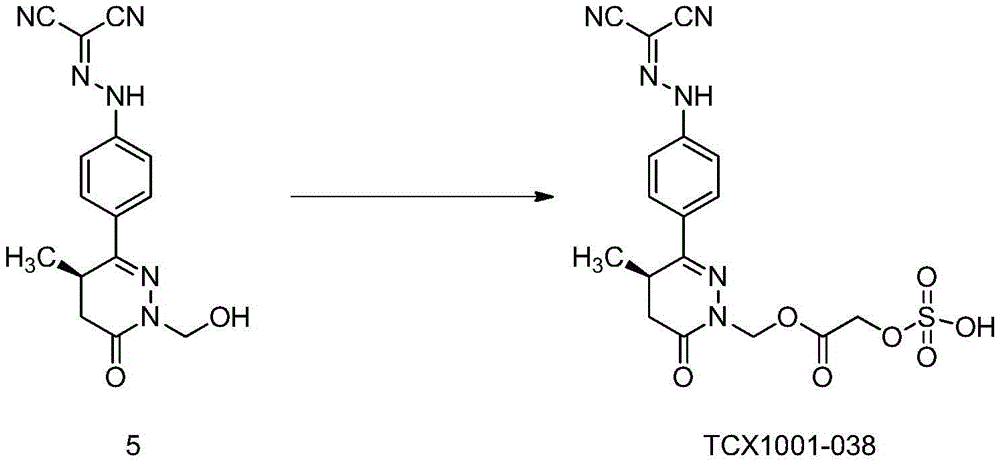
A50 mL single vial of (R) -N- ((4- (1- (hydroxymethyl) -4-methyl-6-oxo-1, 4,5, 6-tetrahydropyridazin-3-yl) phenyl) dicyanomethylene) hydrazine (0.52g,1.68mmol), TSTU (0.6g,2mmol) and (sulfooxy) acetic acid (0.32g,2mmol) was charged with 15mL of dichloromethane, triethylamine (0.6g,6mmol) was added with stirring, stirred at room temperature for 15 hours and monitored by TLC for no starting material remaining. The solvent was removed by rotary evaporation under reduced pressure and the concentrate was isolated by Pre-HPLC preparative to give the title compound 0.15g as a yellow solid in 20% yield.1H-NMR(400MHz,DMSO-d6)δ:15.1(br,s, 1H),13.1(br,s,1H),7.90-7.92(m,2H),7.54-7.60(m,2H),5.98-6.08(m,2H),4.2(s,2H), 3.52-3.56(m,1H),2.91-2.97(m,1H),2.52-2.54(m,1H),1.13(d,3H,J=7.2Hz);ESI-MS (m/z):Calcd.For C21H17N7O3+H:449.08;Found:449.10。
Example 13: preparation of (R) - (3- ((4- (2- (dicyanomethylene) hydrazino) phenyl) -4-methyl-6-oxo-5, 6-dihydropyridazin-1 (4H) -yl) methyl 3-oxo-3- ((pyridin-4-ylmethyl) amino) propionate (TCX-1001- & lt 036 & gt)
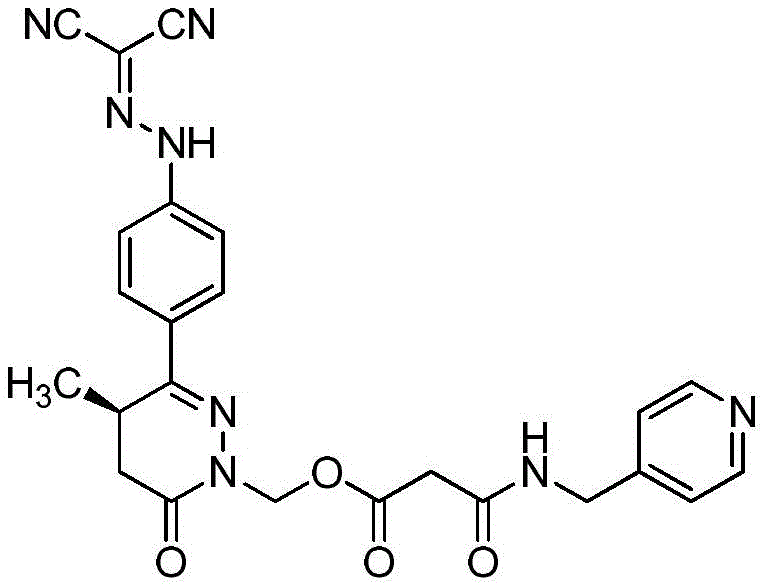
(1) Preparation of ethyl 3-oxo-3- ((pyridin-4-ylmethyl) amino) propionate
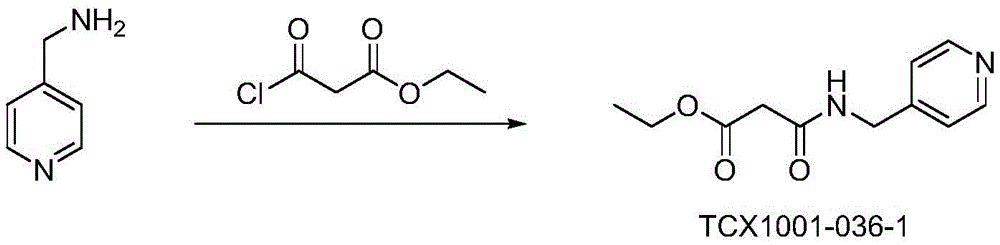
Ethyl chloroformylacetate (5.8mL,46.23mmol) and 4-pyridylmethylamine (5g,46.23mmol) were dissolved in 200mL of THF, the reaction was cooled to 0 deg.C, triethylamine (9.5mL,69.35mmol) was slowly added dropwise, and the reaction was stirred at room temperature for 2 hours after the addition. TLC monitored the reaction complete. Removing solvent by rotary evaporation under reduced pressure, dissolving the concentrate in 200mL ethyl acetate, washing with distilled water and saturated sodium chloride water, and mixing the organic phase with anhydrous sodium sulfateAnd (5) drying. The solvent was removed by rotary evaporation under reduced pressure, and the concentrate was purified by column chromatography (dichloromethane/methanol, v: v ═ 50/1) to give the desired product ethyl 3-oxo-3- ((pyridin-4-ylmethyl) amino) propionate 5g as a brown solid in 48% yield.1H-NMR(400MHz, CDCl3)δ:8.57-8.55(m,1H),8.13-8.10(m,2H),7.35-7.30(m,2H),4.62-4.60(m,2H), 4.26-4.18(m,2H),3.4(s,2H),1.32-1.37(t,3H,J=7.2Hz);ESI-MS(m/z):Calcd. For C21H17N7O3+H:223.10;Found:222.90。
(2) Preparation of 3-oxo-3- ((pyridin-4-ylmethyl) amino) propionic acid

Ethyl 3-oxo-3- ((pyridin-4-ylmethyl) amino) propionate (2.2g,10mmol) was dissolved in a mixed solvent of 10mL of methanol, 10mL of THF and 5mL of water, and lithium hydroxide monohydrate (0.84g,20mmol) was added to stir the reaction solution at room temperature for 16 hours. TLC monitored the reaction complete. The solvent was removed by rotary evaporation under reduced pressure, diluted with 10mL of water, adjusted to pH 5-6 with 3N HCl aqueous solution, extracted with ethyl acetate (20 mL. times.3), and the organic phases were combined. The organic phase was washed with distilled water and saturated brine in this order, and dried over anhydrous sodium sulfate. The solvent was removed by rotary evaporation under reduced pressure, and the concentrate was purified by column chromatography (dichloromethane/methanol/formic acid, v: v: v ═ 20/1/0.05) to give the desired product, 3-oxo-3- ((pyridin-4-ylmethyl) amino) propionic acid, 1.5g, in 77% yield.1H-NMR(400MHz,DMSO-d6)δ:13.1(br,s,1H), 8.67-8.65(m,1H),8.18-8.16(m,2H),7.40-7.35(m,2H),4.62-4.60(m,2H),3.4(s,2H); ESI-MS(m/z):Calcd.For C21H17N7O3+H:195.07;Found:195.10。
(3) Preparation of (R) - (3- ((4- (2- (dicyanomethylene) hydrazino) phenyl) -4-methyl-6-oxo-5, 6-dihydropyridazin-1 (4H) -yl) methyl 3-oxo-3- ((pyridin-4-ylmethyl) amino) propionate (TCX-1001- & lt 036 & gt)
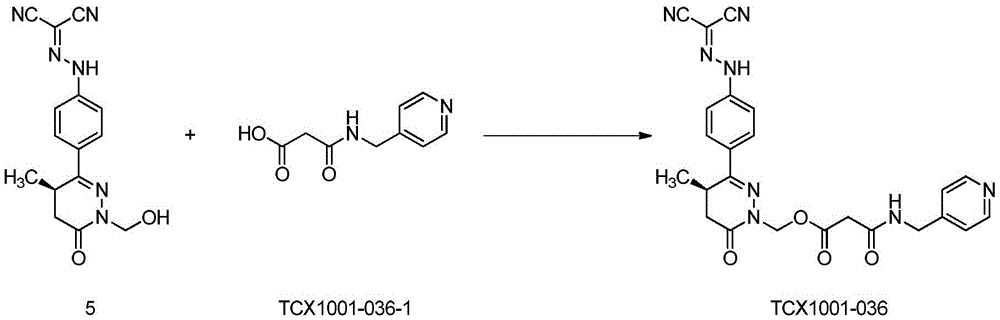
The compound (R) -N- ((4- (1- (hydroxymethyl) -4-methyl-6-oxo-1, 4,5, 6-tetrahydropyridazin-3-yl) phenyl) dicyanomethylene) hydrazine (0.26g,0.84mmol), TSTU (0.3g,1mmol), 3-oxo-3- ((pyridin-4-ylmethyl) amino) propanoic acid (0.18g,0.92mmol) was taken in a 50mL one-necked flask, 5mL of dichloromethane was added, triethylamine (0.3g,3mmol) was added with stirring, stirring was carried out at room temperature for 5 hours, no starting material remained by TLC detection, the solvent was removed by rotary evaporation under reduced pressure, and the resultant was purified by column chromatography (eluent: DCM/MeOH, v: 50/1) to give 0.11g of the title compound as a yellow solid in 27% yield.1H-NMR(400MHz,DMSO-d6)δ:13.2(br,s,1H),8.71-8.68(m,1H),8.32-8.29(m,2H), 7.95-7.93(m,2H),7.65-7.62(m,2H),7.45-7.40(m,2H),6.08-5.98(m,2H),4.62-4.60(m, 2H),3.54-3.50(m,1H),3.4(s,2H),2.98-2.92(m,1H),2.53-2.51(m,1H),1.15(d,3H,J= 7.2Hz);ESI-MS(m/z):Calcd.For C21H17N7O3+H:487.14;Found:487.15。
The invention solves the problem that levosimendan has poor solubility in most solvents (including water). The liquid formulation of levosimendan avoids the disadvantages of having to use organic solvents and at the same time requiring the addition of toxic co-solvents.
Meanwhile, levosimendan itself is difficult to prepare into an oral preparation due to its solubility limit. The novel compound prepared by the invention solves the defect, can be dispersed in water, namely can be dispersed in gastric juice or intestinal juice in a molecular or ionic form, is beneficial to oral absorption of organisms, and can solve the problem that levosimendan is difficult to prepare into an oral preparation.
Example 14: sample stability test
After the compound samples prepared in examples 1-13 above were exposed (exposed) to strong light (4500Lx + -500 Lx), high temperature (60 deg.C + -2 deg.C) and high humidity (90% + -5%) for 10 days, no significant change in appearance or related substances was observed. Thus, the samples of the compounds prepared in examples 1-13 were initially tested for stability.
Example 15: sample determination test
The detection chromatographic conditions are as follows: octadecylsilane chemically bonded silica is used as a filling agent; phosphate buffer solution (weighing 1.56g of sodium dihydrogen phosphate, adding 1000ml of water for dissolving, adjusting pH value to 3.5 with phosphoric acid) -methanol (30: 70) is used as a mobile phase; the flow rate was 1.0mL per minute; the column temperature is 30 ℃; the detection wavelength is 254 nm; the injection volume is 10. mu.L.
Test solution: taking a proper amount of the product (TCX-H1001-031), precisely weighing, and dissolving in methanol to obtain a solution containing 0.5mg of sample per 1 ml.
Precisely measuring the test solution, injecting into a liquid chromatograph, and recording the chromatogram.
FIGS. 1 to 3 are the compounds TCX-H1001-031, respectively, prepared in example 51H-NMR chart, ESI-MS chart, liquid chromatogram.
Example 16: pharmacokinetic testing of Compounds
FIGS. 4-6 are graphs of the change in plasma levels of TCX-1001-031 compound, the change in the release of levosimendan, and the pharmacokinetic metabolic conversion, respectively. As can be seen from the figure, TCX-1001-031 can be completely metabolized within 1 minute, i.e., its content decreases to 0 within 1 minute; the content of the original drug levosimendan released in the metabolism begins to rise rapidly and then gradually and completely tends to be stable along with the metabolism of the prodrug, which shows that the metabolic conversion rate of TCX-1001-031 converted into the raw material is about 40 percent in 10 minutes, and the prodrug belongs to a good-quality prodrug molecule.
Table 3 shows the results of in vivo administration of certain specific compounds of the present invention, showing that they are completely metabolized within 1-10 minutes, respectively, with levosimendan levels increasing and becoming completely stable with prodrug metabolism. The conversion of these compounds to levosimendan in plasma is about 30-45% within 10 minutes.
TABLE 3 metabolic conversion
| Compound (I) | Metabolic conversion rate |
| 1(TCX1001-029) | 39.4% |
| 2(TCX1001-031) | 40.0% |
| 3(TCX1001-032) | 35.1% |
| 4(TCX1001-030) | 38.9% |
| 5(TCX1001-037) | 35.6% |
| 6(TCX1001-033) | 44.6% |
| 7(TCX1001-036) | 36.9% |
| 8(TCX1001-039) | 35.1% |
| 9(TCX1001-041) | 35.6% |
| 10(TCX1001-034) | 34.9% |
| 11(TCX1001-035) | 37.8% |
| 12(TCX1001-040) | 37.6% |
| 13(TCX1001-038) | 36.4% |
From the results of the drug-induced experiments, the metabolic conversion rates of the 13 prodrug molecules in plasma are within 10 minutes, wherein the metabolic conversion rates are the highest among 1, 2, 4 and 6, and the 13 compound molecules all have the potential of becoming prodrugs according to the existing data.
The examples merely represent several embodiments of the present invention, which are described in more detail and detail, but are not to be construed as limiting the scope of the invention. It should be noted that, for a person skilled in the art, several variations and modifications can be made without departing from the inventive concept, which falls within the scope of the present invention, and therefore the scope of the present patent is defined by the appended claims.
Claims (10)
1. A prodrug compound of levosimendan, which is a compound having a structure represented by the general formula I, a solvate, a hydrate, an N-oxide, a stereoisomer, and a pharmaceutically acceptable salt thereof;
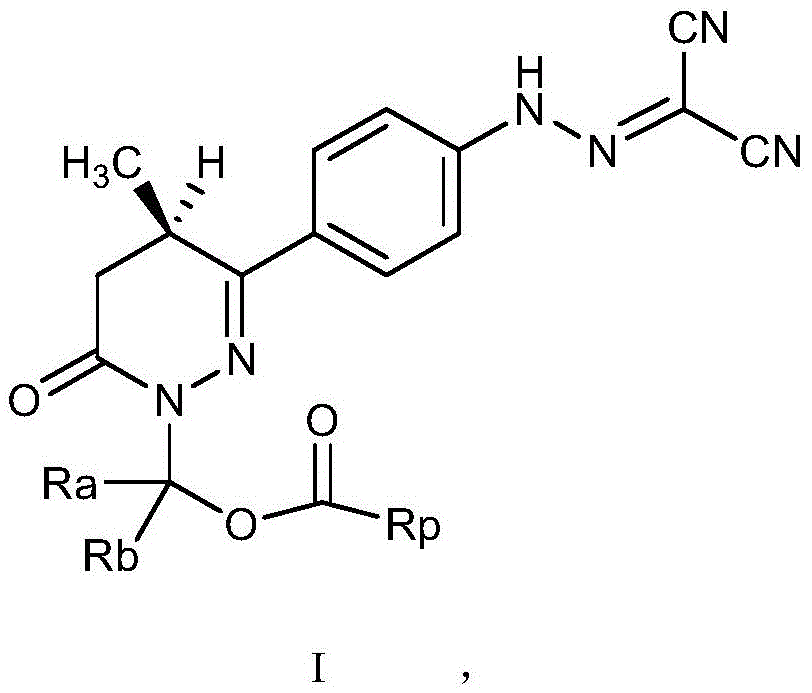
wherein Ra and Rb are respectively selected from hydrogen atoms or alkyl groups of C1-C6;
rp is selected from a basic group containing N atoms or an acidic group containing carboxyl, phosphate, sulfate and sulfonic acid groups.
2. The prodrug compound of claim 1, wherein Ra and Rb are each a hydrogen atom.
3. Prodrug compound according to claim 2, characterized in that the basic group containing an N atom is selected from 4- (morpholin-1-ylmethyl) phenyl, 4- (4-methylpiperazin-1-ylmethyl) phenyl, N-dimethylaminomethyl, pyridin-3-yl, 4- (piperidin-1-yl) -piperidin-1-yl, aminomethyl, pyridin-4-ylmethyl carbamoylmethyl or pyrrolidin-1-ylmethyl.
4. The prodrug compound of claim 2 wherein the acidic group is selected from the group consisting of carboxymethyl, carboxyethyl, carboxymethoxy, phosphoryloxymethyl, sulfonyloxymethyl, sulfomethyl, phosphoryloxyethyl, sulfonyloxyethyl, and sulfoethyl.
5. Prodrug compound according to claim 3, characterized in that the basic group containing a N atom is selected from 4- (morpholin-1-ylmethyl) phenyl, 4- (4-methylpiperazin-1-ylmethyl) phenyl, N-dimethylaminomethyl or pyridin-3-yl.
6. The prodrug compound of claim 4 wherein the acidic group is selected from the group consisting of carboxymethyl, carboxyethyl, phosphoryloxymethyl, sulfonyloxymethyl, and sulfomethyl.
7. Prodrug compound according to claim 5, characterized in that the basic group containing a N atom is selected from 4- (morpholin-1-ylmethyl) phenyl or 4- (4-methylpiperazin-1-ylmethyl) phenyl.
8. A process for the preparation of a prodrug compound of levosimendan according to claim 1, comprising the steps of:
(1) tert-butyl (R) - (4- ((4-methyl-6-oxo-1, 4,5, 6-tetrahydropyridazin-3-yl) phenyl) carbamate is prepared by reacting di-tert-butyl dicarbonate with (R) -6- ((4-aminophenyl) -5-methyl-4, 5-dihydropyridazin-3 (2H) -one;
(2) reacting tert-butyl (R) - (4- ((4-methyl-6-oxo-1, 4,5, 6-tetrahydropyridazin-3-yl) phenyl) carbamate with paraformaldehyde in the presence of a base to obtain tert-butyl (R) - (4- (1- (hydroxymethyl) -4-methyl-6-oxo-1, 4,5, 6-tetrahydropyridazin-3-yl) phenyl) carbamate;
(3) converting (R) - (4- (1- (hydroxymethyl) -4-methyl-6-oxo-1, 4,5, 6-tetrahydropyridazin-3-yl) phenyl) carbamic acid tert-butyl ester with de-Boc groups under acidic conditions to (R) -6- ((4-aminophenyl) -2- (hydroxymethyl) -5-methyl-4, 5-dihydropyridazin-3 (2H) -one;
(4) reacting (R) -6- ((4-aminophenyl) -2- (hydroxymethyl) -5-methyl-4, 5-dihydropyridazin-3 (2H) -one with sodium nitrite and malononitrile under an acidic condition to prepare (R) -N- ((4- (1- (hydroxymethyl) -4-methyl-6-oxo-1, 4,5, 6-tetrahydropyridazin-3-yl) phenyl) dicyanomethylene) hydrazine;
(5) and (R) -N- ((4- (1- (hydroxymethyl) -4-methyl-6-oxo-1, 4,5, 6-tetrahydropyridazin-3-yl) phenyl) dicyanomethylene) hydrazine prepared in the step (4) is respectively reacted with carboxylic acid of a corresponding substituent or an activated form thereof to obtain the prodrug compound.
9. Use of the prodrug compound of any one of claims 1 to 7 for the preparation of a medicament for the treatment of a heart failure disease.
10. The process of claim 8 wherein said intermediate of steps (2), (3) and (4) is tert-butyl (R) - (4- (1- (hydroxymethyl) -4-methyl-6-oxo-1, 4,5, 6-tetrahydropyridazin-3-yl) phenyl) carbamate, use of (R) -6- ((4-aminophenyl) -2- (hydroxymethyl) -5-methyl-4, 5-dihydropyridazin-3 (2H) -one and (R) -N- ((4- (1- (hydroxymethyl) -4-methyl-6-oxo-1, 4,5, 6-tetrahydropyridazin-3-yl) phenyl) dicyanomethylene) hydrazine for the preparation of a medicament for the treatment of heart failure disorders.
Priority Applications (1)
| Application Number | Priority Date | Filing Date | Title |
|---|---|---|---|
| CN202011421074.4A CN112500353B (en) | 2020-12-08 | 2020-12-08 | Levosimendan prodrug compound, preparation method and application thereof |
Applications Claiming Priority (1)
| Application Number | Priority Date | Filing Date | Title |
|---|---|---|---|
| CN202011421074.4A CN112500353B (en) | 2020-12-08 | 2020-12-08 | Levosimendan prodrug compound, preparation method and application thereof |
Publications (2)
| Publication Number | Publication Date |
|---|---|
| CN112500353A true CN112500353A (en) | 2021-03-16 |
| CN112500353B CN112500353B (en) | 2022-11-25 |
Family
ID=74971220
Family Applications (1)
| Application Number | Title | Priority Date | Filing Date |
|---|---|---|---|
| CN202011421074.4A Active CN112500353B (en) | 2020-12-08 | 2020-12-08 | Levosimendan prodrug compound, preparation method and application thereof |
Country Status (1)
| Country | Link |
|---|---|
| CN (1) | CN112500353B (en) |
Cited By (1)
| Publication number | Priority date | Publication date | Assignee | Title |
|---|---|---|---|---|
| US20230278963A1 (en) * | 2020-06-19 | 2023-09-07 | Korea Institute Of Science And Technology | Novel oxopyridazinyl-phenyl-carbonohydrazonoyl dicyanide compound and use thereof |
Citations (6)
| Publication number | Priority date | Publication date | Assignee | Title |
|---|---|---|---|---|
| CN1135484A (en) * | 1995-01-11 | 1996-11-13 | 默克专利股份有限公司 | 3-alkylcarbonyl-thiadiazineone |
| DE10215240A1 (en) * | 2002-04-06 | 2003-10-16 | Merck Patent Gmbh | Treating chronic atrial fibrillation and associated atrial contraction dysfunction, using calcium ion sensitizers, preferably 3,6-dihydro-1,3,4-thiadiazin-2-one derivatives |
| US20040029870A1 (en) * | 2000-11-17 | 2004-02-12 | Heimo Haikala | Anti-inflammatory agents |
| WO2017133517A1 (en) * | 2016-02-03 | 2017-08-10 | 四川海思科制药有限公司 | Phosphamide derivative, method for manufacturing the same, and uses thereof |
| WO2020130214A1 (en) * | 2018-12-19 | 2020-06-25 | 한국과학기술연구원 | Novel hydrazone derivative with aryl or heteroaryl group substituted at terminal amine group thereof and use thereof |
| WO2020169042A1 (en) * | 2019-02-20 | 2020-08-27 | 江苏恒瑞医药股份有限公司 | 6-oxo-1,6-dihydropyridazine prodrug derivative, preparation method therefor, and application thereof in medicine |
-
2020
- 2020-12-08 CN CN202011421074.4A patent/CN112500353B/en active Active
Patent Citations (7)
| Publication number | Priority date | Publication date | Assignee | Title |
|---|---|---|---|---|
| CN1135484A (en) * | 1995-01-11 | 1996-11-13 | 默克专利股份有限公司 | 3-alkylcarbonyl-thiadiazineone |
| US20040029870A1 (en) * | 2000-11-17 | 2004-02-12 | Heimo Haikala | Anti-inflammatory agents |
| DE10215240A1 (en) * | 2002-04-06 | 2003-10-16 | Merck Patent Gmbh | Treating chronic atrial fibrillation and associated atrial contraction dysfunction, using calcium ion sensitizers, preferably 3,6-dihydro-1,3,4-thiadiazin-2-one derivatives |
| WO2017133517A1 (en) * | 2016-02-03 | 2017-08-10 | 四川海思科制药有限公司 | Phosphamide derivative, method for manufacturing the same, and uses thereof |
| WO2020130214A1 (en) * | 2018-12-19 | 2020-06-25 | 한국과학기술연구원 | Novel hydrazone derivative with aryl or heteroaryl group substituted at terminal amine group thereof and use thereof |
| WO2020169042A1 (en) * | 2019-02-20 | 2020-08-27 | 江苏恒瑞医药股份有限公司 | 6-oxo-1,6-dihydropyridazine prodrug derivative, preparation method therefor, and application thereof in medicine |
| CN112996776A (en) * | 2019-02-20 | 2021-06-18 | 江苏恒瑞医药股份有限公司 | 6-oxo-1, 6-dihydropyridazine prodrug derivatives, preparation method and application thereof in medicines |
Non-Patent Citations (3)
| Title |
|---|
| CHARALAMPOS PIERRAKOS, ET AL.: "Levosimendan in Critical Illness: A Literature Review", 《JOURNAL OF CLINICAL MEDICINE RESEARCH》 * |
| 张万年主编: "《现代药物设计学》", 31 May 2006 * |
| 李志裕主编: "《药物化学》", 30 April 2009 * |
Cited By (1)
| Publication number | Priority date | Publication date | Assignee | Title |
|---|---|---|---|---|
| US20230278963A1 (en) * | 2020-06-19 | 2023-09-07 | Korea Institute Of Science And Technology | Novel oxopyridazinyl-phenyl-carbonohydrazonoyl dicyanide compound and use thereof |
Also Published As
| Publication number | Publication date |
|---|---|
| CN112500353B (en) | 2022-11-25 |
Similar Documents
| Publication | Publication Date | Title |
|---|---|---|
| TW200406412A (en) | N-substituted piperidinyl-imidazopyridine compounds as 5-HT4 receptor modulators | |
| EP4332102A1 (en) | Isoquinolone compound and use thereof | |
| CN114929701B (en) | Crystallization of a PDE3/PDE4 dual inhibitor and its application | |
| CN111132984A (en) | Salts and crystalline forms of apoptosis signal-regulated kinase 1 inhibitor | |
| TW202220962A (en) | Crystal form of selective nav inhibitor and preparation method thereof | |
| BR112019021447A2 (en) | fumarate salt, crystalline form i of said salt, methods for preparing them, pharmaceutical composition comprising the salt and crystalline form i and use of the fumarate salt, crystalline form i and the pharmaceutical composition | |
| JP2024547113A (en) | Pharmaceutically acceptable salts and crystalline forms of GLP-1 receptor agonists and methods for preparing same | |
| TW202444710A (en) | A crystalline form of lipoprotein compounds and preparation method thereof | |
| CN107793371B (en) | A class of bromodomain recognition protein inhibitors and preparation method and use thereof | |
| CN112500353B (en) | Levosimendan prodrug compound, preparation method and application thereof | |
| JP7252417B2 (en) | Benzopyrazole Compounds as RHO Kinase Inhibitors, Salt Forms, Crystal Forms and Methods of Making Same | |
| CN112243437A (en) | Acryloyl group-containing nuclear transport modulators and uses thereof | |
| JP2013512216A (en) | Crystal forms of substituted pyrazolopyrimidines | |
| WO2024234619A1 (en) | Crystal form of compound, and pharmaceutical composition and use thereof | |
| US11591299B1 (en) | Prodrug compound of levosimendan, preparation method and use thereof | |
| WO2023236879A1 (en) | Polymorph of benzo[c]chroman compound, preparation method therefor and use thereof | |
| AU2023236233A1 (en) | Salt form and crystal form of vanin enzyme inhibitor, method for preparing same, and use thereof | |
| WO2022171117A1 (en) | Salt of nitrogen-containing fused heterocyclic compound or crystal form thereof, and preparation method therefor, pharmaceutical composition thereof, and use thereof | |
| WO2023061372A1 (en) | Malate salt of xanomeline derivative, crystalline form a, and preparation method therefor and use thereof | |
| JP7289017B2 (en) | Crystal of pyrrolidinyl urea derivative and use thereof | |
| CN102344443A (en) | Open-loop maleimide compound utilizing click chemosynthesis and application in treating diseases thereof | |
| WO2025168354A1 (en) | Small molecule prostaglandin f receptor antagonists | |
| JP2025533592A (en) | Pharmaceutically acceptable salts of tetralin derivatives, crystalline forms and preparation methods | |
| KR20120088398A (en) | Novel five-membered heteroaromatic ring compounds having activity for T-type calcium channel | |
| TW202333694A (en) | Crystal form of fused ring derivative and preparation method and application thereof |
Legal Events
| Date | Code | Title | Description |
|---|---|---|---|
| PB01 | Publication | ||
| PB01 | Publication | ||
| SE01 | Entry into force of request for substantive examination | ||
| SE01 | Entry into force of request for substantive examination | ||
| GR01 | Patent grant | ||
| GR01 | Patent grant |