Disclosure of Invention
The embodiment of the invention provides an edge application discovery method and device and an edge application service support method and device, which are used for at least solving the problem that the implementation of an MEC (media independent component) technology cannot be effectively supported in the related technology.
According to an embodiment of the present invention, there is provided an edge application discovery method applied to EAC, the method including:
sending an application discovery request message to a core network, so that the core network matches a target Edge Application Server (EAS) according to application content information carried in the application discovery request message; wherein the application content information includes at least network parameter information indicating information that the EAC uses to match a corresponding EAS;
receiving target EAS information replied by the core network; wherein the target EAS information is used to indicate the target EAS.
According to another embodiment of the present invention, there is also provided an edge application service support method applied to EAC, the method including:
sending an application service request message to a gateway, triggering an EAS access service mechanism through the gateway to forward the application service request message to an EAS Application Function (AF) of the core network, and further requesting an EAS service from the core network; wherein the application service request message is used to indicate the EAS service that the EAC requests from the core network;
and receiving an application service request response message replied by the gateway, wherein the application service request response message is generated by the gateway according to an application service registration completion message sent by the core network, and the application service registration completion message is used for indicating the core network to complete the registration of the EAS service of the EAC.
According to another embodiment of the present invention, there is also provided an edge application service support method applied to EAC, the method including:
sending an application service request message to a gateway, triggering an EAS access service mechanism through the gateway to forward the application service request message to an EAS AF of the core network, and further requesting an EAS service from the core network; wherein the application service request message is used to indicate the EAS service that the EAC requests from the core network;
and receiving an application service request rejection message replied by the gateway, wherein the application service request rejection message is generated by the gateway according to an application service registration rejection message sent by the core network, and the application service registration rejection message is used for indicating that the EAS service provided by the EAC is not found by the core network.
According to another embodiment of the present invention, there is also provided an edge application service support method applied to EAC, the method including:
sending an application service release message to a gateway, triggering an EAS access service release mechanism through the gateway to forward the application service release message to an EAS AF of the core network, and further requesting to release the EAS service from the core network; wherein the application service deactivation message is used to instruct the EAC to request the deactivated EAS service from the core network;
and receiving an application service release response message replied by the gateway, wherein the application service release response message is generated by the gateway according to an application service release completion message sent by the core network, and the application service release completion message is used for indicating that the core network releases the EAS service for the EAC.
According to another embodiment of the present invention, there is also provided an edge application service support method applied to EAC, the method including:
sending an application service update message to a gateway, triggering an EAS access service update mechanism through the gateway to forward the application service update message to an EAS AF of the core network, and further requesting the core network to update the EAS service; wherein the application service update message is used to instruct the EAC to request the updated EAS service from the core network;
and receiving an application service update response message replied by the gateway, wherein the application service update response message is generated by the gateway according to an application service update completion message sent by the core network, and the application service update completion message is used for indicating that the EAS service is updated by the core network.
According to another embodiment of the present invention, there is also provided an edge application discovery method applied to a core network, the method including:
receiving an application discovery request message sent by an EAC, and matching a target EAS according to application content information carried in the application discovery request message; wherein the application content information includes at least network parameter information indicating information that the EAC uses to match a corresponding EAS;
replying target EAS information to the EAC; wherein the target EAS information is used to indicate the target EAS.
According to another embodiment of the present invention, there is also provided an edge application service support method applied to a gateway, the method including:
receiving an application service request message sent by an EAC, triggering an EAS access service mechanism to forward the application service request message to an EAS Application Function (AF) of the core network, and further requesting an EAS service from the core network; wherein the application service request message is used to indicate the EAS service that the EAC requests from the core network;
generating an application service request response message according to the application service registration completion message sent by the core network, and replying the application service request response message to the EAC; wherein the application service registration completion message is used to instruct the core network to complete registration of the EAS service for the EAC.
According to another embodiment of the present invention, there is also provided an edge application service support method applied to a gateway, the method including:
receiving an application service request message sent by an EAC, triggering an EAS access service mechanism to forward the application service request message to an EAS AF of the core network, and further requesting an EAS service from the core network; wherein the application service request message is used to indicate the EAS service that the EAC requests from the core network;
generating an application service request rejection message according to the application service registration rejection message sent by the core network, and replying the application service request rejection message to the EAC; wherein the application service registration reject message is used to indicate that the core network does not discover the EAS service provided for the EAC.
According to another embodiment of the present invention, there is also provided an edge application service support method applied to a gateway, the method including:
receiving an application service release message sent by an EAC, triggering an EAS access service release mechanism to forward the application service release message to an EAS AF of the core network, and further requesting to release the EAS service from the core network; wherein the application service deactivation message is used to instruct the EAC to request the deactivated EAS service from the core network;
generating an application service release response message according to the application service release completion message sent by the core network, and replying the application service release response message to the EAC; wherein the application service deactivation completion message is used to indicate that the core network has deactivated the EAS service for the EAC.
According to another embodiment of the present invention, there is also provided an edge application service support method applied to a gateway, the method including:
receiving an application service update message sent by an EAC, triggering an EAS access service update mechanism to forward the application service update message to an EAS AF of the core network, and further requesting the core network to update the EAS service; wherein the application service update message is used to instruct the EAC to request the updated EAS service from the core network;
generating an application service update response message according to the application service update completion message sent by the core network, and replying the application service update response message to the EAC; wherein the application service update complete message is used to indicate that the core network has updated the EAS service.
According to another embodiment of the present invention, there is also provided an edge application discovery apparatus applied to an EAC, the apparatus including:
a first sending module, configured to send an application discovery request message to a core network, so that the core network matches a target edge application server EAS according to application content information carried in the application discovery request message; wherein the application content information includes at least network parameter information indicating information that the EAC uses to match a corresponding EAS;
a first receiving module, configured to receive target EAS information replied by the core network; wherein the target EAS information is used to indicate the target EAS.
According to another embodiment of the present invention, there is also provided an edge application service support apparatus applied to EAC, the apparatus including:
a second sending module, configured to send an application service request message to a gateway, trigger an EAS access service mechanism through the gateway to forward the application service request message to an EAS application function AF of the core network, and further request an EAS service from the core network; wherein the application service request message is used to indicate the EAS service that the EAC requests from the core network;
a second receiving module, configured to receive an application service request response message returned by the gateway, where the application service request response message is generated by the gateway according to an application service registration completion message sent by the core network, and the application service registration completion message is used to instruct the core network to complete registration of the EAS service for the EAC.
According to another embodiment of the present invention, there is also provided an edge application service support apparatus applied to EAC, the apparatus including:
a third sending module, configured to send an application service request message to a gateway, trigger an EAS access service mechanism through the gateway to forward the application service request message to an EAS AF of the core network, and further request an EAS service from the core network; wherein the application service request message is used to indicate the EAS service that the EAC requests from the core network;
a third receiving module, configured to receive an application service request rejection message returned by the gateway, where the application service request rejection message is generated by the gateway according to an application service registration rejection message sent by the core network, and the application service registration rejection message is used to indicate that the EAS service provided by the EAC is not found by the core network.
According to another embodiment of the present invention, there is also provided an edge application service support apparatus applied to EAC, the apparatus including:
a fourth sending module, configured to send an application service release message to a gateway, trigger an EAS access service release mechanism through the gateway to forward the application service release message to an EAS AF of the core network, and further request the core network to release an EAS service; wherein the application service deactivation message is used to instruct the EAC to request the deactivated EAS service from the core network;
a fourth receiving module, configured to receive an application service release response message returned by the gateway, where the application service release response message is generated by the gateway according to an application service release completion message sent by the core network, and the application service release completion message is used to indicate that the core network has released the EAS service for the EAC.
According to another embodiment of the present invention, there is also provided an edge application service support apparatus applied to EAC, the apparatus including:
a fifth sending module, configured to send an application service update message to a gateway, trigger an EAS access service update mechanism through the gateway to forward the application service update message to an EAS AF of the core network, and further request the core network to update an EAS service; wherein the application service update message is used to instruct the EAC to request the updated EAS service from the core network;
a fifth receiving module, configured to receive an application service update response message returned by the gateway, where the application service update response message is generated by the gateway according to an application service update completion message sent by the core network, and the application service update completion message is used to indicate that the EAS service is updated by the core network.
According to another embodiment of the present invention, there is also provided an edge application discovery apparatus, which is applied to a core network, and includes:
a sixth receiving module, configured to receive an application discovery request message sent by the EAC, and match the target EAS according to application content information carried in the application discovery request message; wherein the application content information includes at least network parameter information indicating information that the EAC uses to match a corresponding EAS;
the first reply module is used for replying the target EAS information to the EAC; wherein the target EAS information is used to indicate the target EAS.
According to another embodiment of the present invention, there is also provided an edge application service support apparatus applied to a gateway, including:
a seventh receiving module, configured to receive an application service request message sent by the EAC, and trigger an EAS access service mechanism to forward the application service request message to an EAS application function AF of the core network, so as to request an EAS service from the core network; wherein the application service request message is used to indicate the EAS service that the EAC requests from the core network;
a second reply module, configured to generate an application service request response message according to the application service registration completion message sent by the core network, and reply the application service request response message to the EAC; wherein the application service registration completion message is used to instruct the core network to complete registration of the EAS service for the EAC.
According to another embodiment of the present invention, there is also provided an edge application service support apparatus applied to a gateway, including:
an eighth receiving module, configured to receive an application service request message sent by the EAC, and trigger an EAS access service mechanism to forward the application service request message to an EAS AF of the core network, so as to request an EAS service from the core network; wherein the application service request message is used to indicate the EAS service that the EAC requests from the core network;
a third reply module, configured to generate an application service request rejection message according to the application service registration rejection message sent by the core network, and reply the application service request rejection message to the EAC; wherein the application service registration reject message is used to indicate that the core network does not discover the EAS service provided for the EAC.
According to another embodiment of the present invention, there is also provided an edge application service support apparatus applied to a gateway, including:
a ninth receiving module, configured to receive an application service release message sent by the EAC, and trigger an EAS access service release mechanism to forward the application service release message to an EAS AF of the core network, so as to request the core network to release an EAS service; wherein the application service deactivation message is used to instruct the EAC to request the deactivated EAS service from the core network;
a fourth reply module, configured to generate an application service release response message according to the application service release completion message sent by the core network, and reply the application service release response message to the EAC; wherein the application service deactivation completion message is used to indicate that the core network has deactivated the EAS service for the EAC.
According to another embodiment of the present invention, there is also provided an edge application service support apparatus applied to a gateway, including:
a tenth receiving module, configured to receive an application service update message sent by the EAC, and trigger an EAS access service update mechanism to forward the application service update message to an EAS AF of the core network, so as to request the core network to update an EAS service; wherein the application service update message is used to instruct the EAC to request the updated EAS service from the core network;
a fifth reply module, configured to generate an application service update response message according to the application service update completion message sent by the core network, and reply the application service update response message to the EAC; wherein the application service update complete message is used to indicate that the core network has updated the EAS service.
According to another embodiment of the present invention, there is also provided a computer-readable storage medium having a computer program stored thereon, wherein the computer program is arranged to, when executed, perform the steps of any of the above method embodiments.
According to another embodiment of the present invention, there is also provided an electronic device, including a memory in which a computer program is stored and a processor configured to execute the computer program to perform the steps in any of the above method embodiments.
According to the embodiment of the invention, the application discovery request message can be sent to the core network through the EAC, so that the core network can match the target edge application server EAS according to the application content information carried in the application discovery request message; the application content information at least comprises network parameter information, and the network parameter information is used for indicating information used by the EAC to match the corresponding EAS; further receiving target EAS information replied by the core network through the EAC; wherein the target EAS information is used to indicate the target EAS. Therefore, the embodiment of the invention can solve the problem that the implementation of the MEC technology cannot be effectively supported in the related technology, and further realize the MEC in the 5G WWC scene.
Detailed Description
Hereinafter, embodiments of the present invention will be described in detail with reference to the accompanying drawings in conjunction with the embodiments.
It should be noted that the terms "first," "second," and the like in the description and claims of the present invention and in the drawings described above are used for distinguishing between similar elements and not necessarily for describing a particular sequential or chronological order.
To further describe the method and apparatus for discovering the edge application and the method and apparatus for supporting the edge application service in the embodiments of the present invention, the following describes the application scenarios of the method and apparatus for discovering the edge application and the method and apparatus for supporting the edge application service in the embodiments of the present invention:
with the rapid development of the mobile internet and the internet of things, the 5G service has the characteristic of diverse requirements. The third Generation Partnership Project (3rd Generation Partnership Project, 3GPP) defines a more typical scenario in 5G applications: enhanced Mobile Broadband (eMBB), Ultra-reliable and Low Latency Communication (URLLC), mass Machine Type of Communication (mMTC), vehicle networking (V2X), and the like. On one hand, the eMBB scene provides a large-traffic mobile broadband service, such as high-speed downloading, high-definition video, Virtual Reality (VR)/Augmented Reality (AR), etc., the peak rate of the service usually exceeds 10Gbps, and the bandwidth requirement is as high as dozens of Gbps, so that huge pressure is caused on wireless transmission and return mobile networks; therefore, the above traffic demands require that the traffic be sunk as far as possible to the edge of the network to achieve local offloading of the traffic. On the other hand, the URLLC scenario and the V2X scenario can provide ultra-high reliable ultra-low delay communication, such as automatic driving, industrial control, telemedicine, etc., which requires high reliability of 99.999% end-to-end and ultra-low delay of less than 1ms end-to-end; therefore, the above service requirement also needs to sink the service to the edge of the network, so as to reduce the network delay caused by network transmission and multi-stage service forwarding.
The MEC technology is developed according to the service requirements of the 5G related service scenarios. The MEC serves as a key technology of 5G evolution, provides cloud computing capability and an IT service environment for edge application at the edge of a mobile network closer to a client, and has the characteristics of ultralow time delay, ultrahigh bandwidth, localization, high real-time analysis and processing and the like. For the MEC, the European Telecommunications Standardization Institute (ETSI) has standard specifications for the architecture of the MEC, and 3GPP has certain technical specifications for the MEC. However, how to apply the MEC system to the fixed network in the fixed network, especially to the 5G WWC fixed-mobile convergence scenario, has no relevant standard research yet.
In order to implement business support for MEC in a 5G WWC scenario, embodiments of the present invention provide an edge application discovery method and apparatus, an edge application service support method and apparatus, and the following describes the edge application discovery method and apparatus, the edge application service support method and apparatus in embodiments of the present invention:
in one aspect, an embodiment of the present invention provides an Edge Application discovery method, which is applied to an Edge Application Client (EAC). Fig. 1 is a flowchart (a) of an edge application discovery method according to an embodiment of the present invention, and as shown in fig. 1, the edge application discovery method according to the embodiment of the present invention includes:
s102, the EAC sends an Application discovery request message to a core network, so that the core network matches a target Edge Application Server (Edge Application Server, EAS) according to Application content information carried in the Application discovery request message; wherein the application content information at least includes network parameter information indicating information used by the EAC to match the corresponding EAS.
In the embodiment of the present invention, in a 5G WWC scenario, the core network may be a 5G core network 5 GC. In step S102, the network parameter information may include at least one of the following: a Domain Name (DN) of the target EAS, an Edge Data Network (EDN) address of the target EAS, a Slice service request of the EAC, i.e., Network Slice Selection Assistance Information (NSSAI) of the EAC.
In an optional embodiment, in step S102, the sending the application discovery request message to the core network includes:
and sending the application discovery request message to the gateway, and triggering the application discovery request service through the gateway so as to send the application discovery request message to the core network.
In the embodiment of the present invention, the Gateway may be a 5G home Gateway (5G-responsive Gateway, 5G-RG) or a Fixed Network home Gateway (FN-RG). The EAC may send an application discovery request message to the core network through a corresponding gateway.
It should be noted that the above procedure for the gateway corresponding to the 5G-RG and the FN-RG to send the application discovery request message to the core network is also different. The following describes the procedure of sending the application discovery request message corresponding to the 5G-RG and the FN-RG to the core network in various alternative embodiments:
in an optional embodiment, in a case that the gateway is a 5G-RG, sending an application discovery request message to the gateway, and triggering an application discovery request service through the gateway to send the application discovery request message to a core network includes:
and sending the application discovery request message to the 5G-RG through a preset first interface, and triggering the application discovery request service to the core network through the 5G-RG so as to send the application discovery request message to the core network.
In the above optional embodiment, the 5G-RG needs to be registered to the core network in advance, that is, before sending the application discovery request message to the 5G-RG through the preset first interface, the 5G-RG is registered to the core network.
On the premise of sending an application discovery request message through the 5G-RG, correspondingly, receiving target EAS information replied by the core network, including:
and receiving target EAS information replied by the 5G-RG, wherein the target EAS information is sent to the 5G-RG by the core network.
In an optional embodiment, in a case that the gateway is the FN-RG, sending an application discovery request message to the gateway, and triggering an application discovery request service through the gateway to send the application discovery request message to the core network includes:
and sending the application discovery request message to the FN-RG through a preset second interface, and triggering the application request service to the proxy through the FN-RG so as to send the application discovery request message to the core network through the proxy.
In the above alternative embodiment, the second interface is used to indicate an interface different from the first interface. Since the FN-RG cannot directly support the implementation of the 5G service, the FN-RG needs to use an Access Gateway Function (AGF) or a Fixed Mobile Interworking Function (FMIF) of the 5G WWC network as a proxy of the FN-RG to implement the support of the 5G service.
In the above alternative embodiment, the FN-RG also needs to be registered in the core network in advance, i.e. the FN-RG is registered in the core network via the proxy before the FN-RG triggers the application to request services to the proxy.
On the premise of sending an application discovery request message through the FN-RG, correspondingly, receiving target EAS information replied by a core network, including:
and receiving target EAS information replied by the FN-RG, wherein the target EAS information is sent to the FN-RG by the core network through a proxy.
S104, the EAC receives target EAS information replied by the core network; wherein the target EAS information is used to indicate the target EAS.
In an embodiment of the present invention, in step S102, the target EAS information includes at least one of: an Internet Protocol (IP) address of the target EAS, domain name information of the target EAS, and identification information of the target EAS.
In an optional embodiment, in step S104, the matching, by the core network, the target EAS according to the application content information carried in the application discovery request message includes:
the core network obtains the network parameter information according to the application discovery request message, and initiates a matching request through a Policy Control Function (PCF) to match the target EAS through a preset User Route Selection Policy (URSP).
According to the embodiment of the invention, the application discovery request message can be sent to the core network through the EAC, so that the core network can match the target edge application server EAS according to the application content information carried in the application discovery request message; the application content information at least comprises network parameter information, and the network parameter information is used for indicating information used by the EAC to match the corresponding EAS; further receiving target EAS information replied by the core network through the EAC; wherein the target EAS information is used to indicate the target EAS. Therefore, through the interaction between the EAC and the core network, for example, 5GC, the discovery of the core network for the corresponding EAC can be realized, and further the discovery of the edge application in the 5G WWC scene can be realized. Therefore, the embodiment of the invention can achieve the effect of realizing edge computing processing in a 5G transmission network, thereby realizing the business support of MEC in a 5G WWC scene.
The edge application discovery method in the embodiment of the invention can be suitable for various 5G WWC scenes, for example, in a scene corresponding to an intelligent home, a home user can be used as the EAC to realize the discovery of the home user by the 5GC and the support of the corresponding MEC business.
To further illustrate the process of discovering the edge application in the 5G WWC scenario in the embodiment of the present invention, the edge application discovery method described above is further described below by way of an exemplary embodiment:
exemplary embodiment 1
In the exemplary embodiment, the gateway is a 5G-RG. In the present exemplary embodiment, the workflow of the edge application discovery method is as follows:
s201, the EAC sends an application discovery request and carries application content to the 5G-RG through the B1 interface.
S202, after receiving the application discovery request sent by the EAC, the 5G-RG triggers an App service request to the 5GC, and the premise of the step is that the 5G-RG is registered to the 5 GC.
S203, 5GC receives the application discovery request from EAC, and obtains the DN and EDN address corresponding to the target EASEAC, the NSSAI information corresponding to EAC (here, the NSSAI requested by EAC), and other related network parameter information to match EAS.
S204, 5GC analyzes the obtained network parameter information including DN, EDN address and S-NSSAI corresponding to EAC, initiates a request through PCF, so that PCF obtains corresponding EAS information through URSP, and replies IP address of EAS, domain name information of target EAS, identification information of target EAS, S-NSSAI information of target EAS (here, NSSAI information allowed by target EAS) and Edge Location (Edge Location) information (namely UPF information) related to EAS access, and PDU session ID information used for user plane forwarding, etc. to 5G-RG.
S205, 5G-RG returns the acquired EAS related information to EAC.
It should be noted that, in the exemplary embodiment, application types corresponding to the EAC are various, and accordingly, application contents that need to be carried by different application types WiFi protocols are different, so that the B1 interface in the exemplary embodiment needs to support different application contents, thereby implementing an edge application service in a corresponding scenario. The embodiment of the invention does not limit the application content required to be supported by the B1 interface, and can increase the support to relevant scenes, such as edge application service of intelligent home application, by expanding the protocol of the B1 interface according to actual requirements.
Exemplary embodiment 2
In the exemplary embodiment, the gateway is a FN-RG. In the present exemplary embodiment, the workflow of the edge application discovery method is as follows:
s301, the EAC sends an application discovery request and carries application content to the FN-RG through the B2 interface.
It should be noted that the technical requirements of the B2 interface in the above steps are different from those of the B1 interface in exemplary embodiment 1. Since the FN-RG cannot support the requirement of 5G service, the requirement of 5G service for FN-RG can only be used as a proxy of FN-RG through AGF or FMIF in 5G WWC network to realize the support of 5G service.
S302, after receiving the application discovery request from the EAC, the FN-RG sends the request to the AGF or FMIF, which is a precondition for the FN-RG registering to the 5GC through the AGF or FMIF proxy.
S303, 5GC receives application discovery request from EAC, and obtains DN, EDN address, S-NSSAI and other related network parameter information corresponding to EAC for matching EAS.
S304, 5GC analyzes the obtained network parameter information including DN corresponding to the target EAS, EDN address and NSSAI corresponding to EAC, initiates a request through PCF to make PCF obtain corresponding EAS information through URSP, and replies IP address of EAS, domain name information of target EAS, identification information of target EAS, S-NSSAI information of target EAS and edge position information related to EAS access, and PDU session ID information used by user plane forwarding to FN-RG proxy AGF or FMIF.
S305, the proxy AGF or FMIF of the FN-RG replies the obtained EAS related information to the FN-RG so as to be notified to the EAC by the FN-RG.
In this exemplary embodiment, the application types corresponding to the EAC are various, the application contents that the WiFi protocol needs to carry are different for different application types, and the content of different application contents can be supported through the B2 interface, thereby implementing the smart home edge application service.
Similarly, in the exemplary embodiment, the application types corresponding to the EAC are various, and accordingly, the application contents that need to be carried by the WiFi protocols of different application types are different, so that the B2 interface in the exemplary embodiment needs to support different application contents, thereby implementing the edge application service in the corresponding scenario. The embodiment of the invention does not limit the application content required to be supported by the B2 interface, and can increase the support to relevant scenes, such as edge application service of intelligent home application, by expanding the protocol of the B2 interface according to actual requirements.
In the embodiment of the present invention, on the basis of the discovery of the edge application in the 5G WWC scenario, the function of the gateway may be expanded, so that the EAC can support different edge application service contents through the gateway with the expanded function. The following describes the process of the EAC supporting different edge application service contents through the gateway with extended functions:
in an optional embodiment, the method for discovering an edge application in the embodiment of the present invention further includes:
the EAC sends an application service request message to the gateway, and triggers an EAS access service mechanism through the gateway to forward the application service request message to an EAS Application Function (AF) of a core network so as to request an EAS service from the core network; wherein, the application service request message is used for indicating the EAS service requested by the EAC to the core network;
and receiving an application service request response message replied by the gateway, wherein the application service request response message is generated by the gateway according to an application service registration completion message sent by the core network, and the application service registration completion message is used for indicating that the core network completes the registration of the EAS service of the EAC.
In the above alternative embodiment, the gateway may be a 5G-RG capable of supporting 5G services.
Note that the above-described EAS AF is used to indicate AF applied to EAS service support.
In an optional embodiment, the application service request message carries application authentication information, where the application authentication information is used to instruct the EAS to perform access authentication on the EAC, and the application authentication information includes at least one of the following information: domain Name System (DNS) information of the application service, Identity Document (ID) information of the EAC.
In an optional embodiment, the sending the application service request message to the gateway includes:
sending an application service request message to the gateway through the third interface; and the third interface supports carrying of the corresponding content of the plurality of application services.
In an optional embodiment, before sending the application service request message to the gateway, the method further includes:
the gateway sends a registration authentication request to a core network; the authentication registration request is used for indicating the gateway to perform registration authentication to the core network;
the gateway initiates a request to the PCF through an Access and Mobility Management Function (AMF) so that the PCF obtains the policy information from the gateway to the EAS by searching a preset URSP policy; wherein the policy information includes at least one of: an IP address of the EAS, User Plane Function (UPF) information corresponding to the EAS;
the gateway establishes a Packet Data Unit (PDU) session from the gateway to the UPF indicated by the UPF information according to the strategy information; wherein, the PDU session is used for carrying EAC to EAS traffic and/or redirection operation of the traffic.
In an optional embodiment, the registration authentication request is generated by a Subscription Permanent Identifier (SUPI) package or a Subscription encrypted Identifier (SUCI) package based on a Line-ID format.
In an optional embodiment, the URSP policy is configured locally, or the URSP policy is configured in a process that the gateway sends a registration authentication request to the core network.
In an optional embodiment, the policy information is further used for the AMF to establish a policy-related link between an edge application service of the gateway and the PCF; after the gateway establishes the PDU session between the gateway and the UPF indicated by the UPF information according to the policy information, the method further includes:
the PCF executes a configuration updating mechanism of the gateway and provides the URSP strategy to the gateway through the PCF so as to indicate the gateway to register the associated information and the user position information according to the URSP strategy; and/or the presence of a gas in the gas,
providing URSP routing strategy information requested by the EAS AF through the PCF, and matching edge application flow through the URSP routing strategy information; wherein the URSP routing policy information includes at least one of: data Network Name (DNN), Single Network Slice Selection Assistance information (S-NSSAI); edge application traffic is used to indicate traffic in the direction of the EAC to the EAS; and/or the presence of a gas in the gas,
policy services are provided by the PCF for binding of the UE to the AMF.
Through the above alternative embodiments, a mechanism for making an application service request between the EAC and the gateway can be implemented. To further illustrate the mechanism for making application service requests between the EAC and the gateway described above, the following is described by way of an exemplary embodiment:
exemplary embodiment 3
Fig. 2 is a flowchart (a) of an application service request mechanism between an EAC and a gateway, for example, 5G-RG, according to an exemplary embodiment of the present invention, as shown in fig. 2, the workflow of the application service request mechanism between the EAC and the gateway, for example, is as follows:
s401, EAC sends application service request information to 5G-RG;
s402, the 5G-RG is triggered to register the EAS access service to an edge Application server Application function (EAS AF) of the 5GC to complete registration of the EAS service, and returns Application service response information to the EAC after receiving an Application service registration completion notification from the 5 GC.
A WiFi protocol is used between the interfaces corresponding to the EAC and the 5G-RG, and DNS information of application service, ID information of the EAC, and the like are encapsulated in a message application layer corresponding to the application client service request information sent by the EAC, so as to be used for access authentication of the EAS to the EAC.
Optionally, the above interface needs to support carrying support for different edge application service contents.
Optionally, before the step S401 is executed, the 5G-RG needs to access registration authentication through a user, so as to acquire information from the 5G-RG to the corresponding EAS through the 5GC, that is, perform discovery of EAS. Fig. 3 is a flowchart of an EAS discovery mechanism provided in accordance with an exemplary embodiment of the present invention, as shown in fig. 3, the workflow of the EAS discovery mechanism in this exemplary embodiment is as follows:
s501, the 5G-RG realizes the registration authentication to the 5GC through a user registration realizing mechanism. The user registration information used by the 5G-RG is SUPI or SUCI encapsulation in Line-ID format.
S502, 5G-RG requests the strategy configuration to EAS, AMF requests PCF to make PCF obtain the strategy information from 5G-RG to EAS by looking up URSP strategy.
It should be noted that the EAS discovery mechanism described above needs to be implemented by means of the URSP policy. The URSP policy can be configured locally through the 5G-RG, and can also be configured in the registration flow of the 5G-RG.
In the process of executing step S502, the policy information from the 5G-RG to the EAS is also used for the AMF to establish a policy-related link between the edge application service of the 5G-RG and the PCF; on the other hand, a configuration updating mechanism of the gateway can be executed through the PCF, and the URSP strategy is provided to the gateway through the PCF so as to indicate the gateway to register the associated information and the user position information according to the URSP strategy; on the other hand, URSP routing strategy information requested by the EAS AF can be provided through the PCF, and edge application flow is matched through the URSP routing strategy information; on the other hand, policy services for binding the UE to the AMF may also be provided by the PCF. The URSP policy information includes at least one of: DNN, S-NSSAI. The edge application traffic is used to indicate traffic in the direction of the EAC to the EAS;
furthermore, the operator may also implement the above procedure by configuring local policies to the UE.
Through the process of S502, the 5G-RG acquires the IP address of the EAS, the UPF information, and the like.
S503, the EAC sends an edge application service registration request to the 5G-RG.
S504, after receiving the strategy information corresponding to the EAS in S502, the 5G-RG can establish a PDU session to UPF; the PDU session is used to carry AC to EAS traffic and traffic redirection, etc.
Optionally, the EAC may also send an application service request to the 5G-RG to determine, through communication with the 5GC, that the EAS AF completes service access authentication for the AC user.
In an optional embodiment, the method for discovering an edge application in the embodiment of the present invention further includes:
sending an application service request message to a gateway, triggering an EAS access service mechanism through the gateway to forward the application service request message to an EAS AF of a core network, and further requesting an EAS service from the core network; wherein, the application service request message is used for indicating the EAS service requested by the EAC to the core network;
and receiving an application service request rejection message replied by the gateway, wherein the application service request rejection message is generated by the gateway according to an application service registration rejection message sent by the core network, and the application service registration rejection message is used for indicating that the core network does not find the EAS service provided for the EAC and does not find the EAS service provided for the EAC.
Through the above optional embodiments, in a mechanism for making an application service request between the EAC and the gateway, processing in a scenario where the corresponding EAS service is not found in the core network can be realized. To further illustrate the mechanism for making application service requests between the EAC and the gateway described above, the following is described by way of an exemplary embodiment:
exemplary embodiment 4
Fig. 4 is a flowchart illustrating an application service request mechanism between an EAC and a gateway according to an exemplary embodiment of the present invention (ii), and as shown in fig. 4, in this exemplary embodiment, the workflow of the application service request mechanism between the EAC and the gateway, such as 5G-RG, is as follows:
s601, EAC sends application client service request information to 5G-RG;
s602, the 5G-RG is triggered to register the EAS access service to the EAS AF of the 5GC, finds that the 5GC does not have the requested EAS service, and returns the application service registration rejection information to the EAC upon receiving the application service rejection information from the 5 GC.
In an optional embodiment, the method for discovering an edge application in the embodiment of the present invention further includes:
sending an application service release message to a gateway, triggering an EAS access service release mechanism through the gateway to forward the application service release message to an EAS AF of a core network, and further requesting the release of the EAS service from the core network; wherein, the application service release message is used for indicating the EAC to request the released EAS service from the core network;
and receiving an application service release response message replied by the gateway, wherein the application service release response message is generated by the gateway according to an application service release completion message sent by the core network, and the application service release completion message is used for indicating that the EAS service is released and completed by the core network for EAC.
In an optional embodiment, the sending the application service release message to the gateway further includes:
sending an application service release message to a gateway, sending the application service release message to an EAS AF of a core network by the gateway through an Access Gateway Function (AGF), and further indicating the EAS AF to initiate an application service release request to the core network according to the application service release message;
and under the condition that the core network determines that the PDU resource information is exclusively occupied by the EAS service, the core network initiates an application service resource release request, informs the gateway through the AGF, and releases the user plane resource to the gateway.
Through the above optional embodiments, a mechanism for releasing the application service between the EAC and the gateway can be implemented. To further illustrate the mechanism for releasing the application service between the EAC and the gateway, the following is described with an exemplary embodiment:
exemplary embodiment 5
Fig. 5 is a schematic flowchart of an application service release mechanism between an EAC and a gateway according to an exemplary embodiment of the present invention, and as shown in fig. 5, in this exemplary embodiment, a workflow of the application service release mechanism between the EAC and the gateway, such as 5G-RG, is as follows:
s701, the EAC sends application service release information to the 5G-RG;
s702, 5G-RG is triggered to access the service releasing information to the EAS AF of the 5GC, and after receiving the releasing information of the edge application service from the 5GC, the releasing response information of the application service is replied to the EAC.
In this exemplary embodiment, the release or withdrawal of the application service corresponding to the EAC may cause the release of the PDU resource. In contrast, after the 5GC EAS AF receives the release information of the application service sent by the 5G-RG, the 5GC EAS AF can notify the PCF and the AMF, and trigger the AMF to send out a PDU resource release request. Fig. 6 is a schematic flowchart of a PDU resource release according to an embodiment of the present invention, and as shown in fig. 6, the working flow of the PDU resource release is as follows:
in step S702, the EAS AF may further initiate an application service release request to the 5GC, and the 5GC checks whether the EAS service corresponding to the EAC ID monopolizes the PDU resource information, if so, the 5GC initiates an application service resource release request to the AGF, releases the user plane resource to the 5G-RG through the AGF, and notifies the EAC of the user plane resource by the 5G-RG.
In an optional embodiment, the method for discovering an edge application in the embodiment of the present invention further includes:
sending an application service updating message to a gateway, triggering an EAS access service updating mechanism through the gateway to forward the application service updating message to an EAS AF of a core network, and further requesting the core network to update the EAS service; wherein the application service update message is used to instruct the EAC to request an updated EAS service from the core network;
and receiving an application service update response message replied by the gateway, wherein the application service update response message is generated by the gateway according to an application service update completion message sent by the core network, and the application service update completion message is used for indicating that the EAS service is updated by the core network.
In an optional embodiment, the sending an application service update message to the gateway, and triggering an EAS access service update mechanism through the gateway to forward the application service update message to an EAS AF of the core network, thereby requesting the core network to update the EAS service further includes:
and sending an application service updating message to the gateway, triggering an EAS access service updating mechanism through the gateway to forward the application service updating message to an EAS AF of the core network, and further instructing the EAS AF to select and update the EAS for the application service of the EAC according to the application service updating message.
In an optional embodiment, the EAS AF selects an application service for updating the EAS for the EAC according to the application service update message, including:
the EAS AF requests the PCF of the core network to update the EAS information, wherein the updated EAS information at least comprises an identifier of the updated EAS, and the updated EAS is the EAS meeting the corresponding requirements of the EAS service indicated by the application service update message;
the EAS AF records the corresponding relation between the identifier of the EAC and the identifier of the updated EAS;
the EAS AF reselects the UPF according to the updated EAS information and instructs the gateway to establish a PDU session between the gateway and the reselected UPF;
the EAS AF sends an application service update complete message to the gateway via the PDU session to instruct the gateway to generate an application service update response message in response to the application service update complete message to reply to the EAC.
Through the above optional embodiments, a mechanism for updating an application service between the EAC and the gateway can be implemented. To further illustrate the mechanism for updating application services between the EAC and the gateway, the following is described with an exemplary embodiment:
exemplary embodiment 6
Fig. 7 is a schematic flowchart of an application service update mechanism between an EAC and a gateway according to an exemplary embodiment of the present invention, and as shown in fig. 7, in this exemplary embodiment, a workflow of the application service update mechanism between the EAC and the gateway, such as 5G-RG, is as follows:
s801, sending application service update information to a 5G-RG by an EAC;
s802, 5G-RG is triggered to access EAS service update information to EAS AF of 5GC, and returns application service update response information to EAC after receiving the updated information of the edge application service from 5 GC.
Optionally, the EAC issues an application service update request triggering the RG to send the service update request to the EAS AF of the 5GC, which may select a new suitable EAS for satisfying the application service of the AC according to the updated service request. The following is a description of the process of selecting a new suitable EAS:
the EAS AF requests the PCF of the 5GC for EAS information that meets the requirements of the updated AC application service, including the EAS ID, EAS IP address, etc., thereby resulting in possible EAS re-discovery. The EAS rediscovery mechanism references an application service request response flow.
Alternatively, the EAS AF may need to record the EAC ID to new EAS ID correspondence.
Optionally, the migration of EAS results in a reselection of UPF.
Alternatively, the 5G-RG needs to establish the 5G-RG to the reselected UPF to establish the PDU session.
Optionally, the EAS AF reply applies the service update completion information to the EAC.
Through the embodiment of the invention, on the basis of realizing the discovery of the edge application under the 5G WWC scene, the communication requirements to EAS formed when the application service between the EAC and the gateway, such as 5G-RG, is requested, updated and deleted can be further realized, and further the realization of the MEC business under the 5G WWC scene can be further supported.
On the other hand, the embodiment of the invention also provides an edge application service support method which is applied to the EAC. Fig. 8 is a flowchart (one) of an edge application service support method according to an embodiment of the present invention, and as shown in fig. 8, the edge application service support method in the embodiment of the present invention includes:
s902, sending an application service request message to a gateway, triggering an EAS access service mechanism through the gateway to forward the application service request message to an EAS Application Function (AF) of a core network, and further requesting an EAS service from the core network; wherein, the application service request message is used for indicating the EAS service requested by the EAC to the core network;
and S904, receiving an application service request response message replied by the gateway, wherein the application service request response message is generated by the gateway according to an application service registration completion message sent by the core network, and the application service registration completion message is used for indicating that the core network completes the registration of the EAS service of the EAC.
In an optional embodiment, the application service request message carries application authentication information, where the application authentication information is used to instruct the EAS to perform access authentication on the EAC, and the application authentication information includes at least one of the following information: domain Name Server (DNS) information of the application service and identity Identification (ID) information of the EAC.
In an optional embodiment, the sending the application service request message to the gateway includes:
sending an application service request message to the gateway through the third interface; and the third interface supports carrying of the corresponding content of the plurality of application services.
In an optional embodiment, before sending the application service request message to the gateway, the method further includes:
the gateway sends a registration authentication request to a core network; the authentication registration request is used for indicating the gateway to perform registration authentication to the core network;
the gateway initiates a request to the PCF through an access and mobility management function AMF so that the PCF obtains the policy information from the gateway to the EAS by searching a preset URSP policy; wherein the policy information includes at least one of: an IP address of the EAS, and user plane function UPF information corresponding to the EAS;
the gateway establishes a PDU session from the gateway to the UPF indicated by the UPF information according to the strategy information; wherein, the PDU session is used for carrying EAC to EAS traffic and/or redirection operation of the traffic.
In an alternative embodiment, the registration authentication request is generated by a subscription permanent identity SUPI package or a subscription encrypted identity SUCI package based on the Line-ID format.
In an optional embodiment, the URSP policy is configured locally, or the URSP policy is configured in a process that the gateway sends a registration authentication request to the core network.
In an optional embodiment, the policy information is further used for the AMF to establish a policy-related link between an edge application service of the gateway and the PCF; after the gateway establishes the PDU session between the gateway and the UPF indicated by the UPF information according to the policy information, the method further includes:
the PCF executes a configuration updating mechanism of the gateway and provides the URSP strategy to the gateway through the PCF so as to indicate the gateway to register the associated information and the user position information according to the URSP strategy; and/or the presence of a gas in the gas,
providing URSP routing strategy information requested by the EAS AF through the PCF, and matching edge application flow through the URSP routing strategy information; wherein the URSP routing policy information includes at least one of: the data network name DNN, S-NSSAI; edge application traffic is used to indicate traffic in the direction of the EAC to the EAS; and/or the presence of a gas in the gas,
policy services are provided by the PCF for binding of the UE to the AMF.
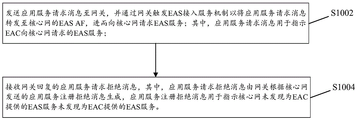
On the other hand, the embodiment of the invention also provides an edge application service support method which is applied to the EAC. Fig. 9 is a flowchart (ii) of an edge application service support method according to an embodiment of the present invention, and as shown in fig. 9, the edge application service support method in the embodiment of the present invention includes:
s1002, sending an application service request message to a gateway, triggering an EAS access service mechanism through the gateway to forward the application service request message to an EAS AF of a core network, and further requesting an EAS service from the core network; wherein, the application service request message is used for indicating the EAS service requested by the EAC to the core network;
and S1004, receiving an application service request rejection message replied by the gateway, wherein the application service request rejection message is generated by the gateway according to an application service registration rejection message sent by the core network, and the application service registration rejection message is used for indicating that the core network does not find the EAS service provided for the EAC and does not find the EAS service provided for the EAC.
On the other hand, the embodiment of the invention also provides an edge application service support method which is applied to the EAC. Fig. 10 is a flowchart (iii) of an edge application service support method provided according to an embodiment of the present invention, and as shown in fig. 10, the edge application service support method in the embodiment of the present invention includes:
s1102, sending an application service release message to a gateway, triggering an EAS access service release mechanism through the gateway to forward the application service release message to an EAS AF of a core network, and further requesting the release of the EAS service from the core network; wherein, the application service release message is used for indicating the EAC to request the released EAS service from the core network;
and S1104, receiving an application service release response message replied by the gateway, wherein the application service release response message is generated by the gateway according to an application service release completion message sent by the core network, and the application service release completion message is used for indicating that the core network releases the EAS service for EAC.
In an optional embodiment, the sending the application service release message to the gateway further includes:
sending an application service release message to a gateway, sending the application service release message to an EAS AF of a core network by the gateway through an Access Gateway Function (AGF), and further indicating the EAS AF to initiate an application service release request to the core network according to the application service release message;
in case the core network determines that the EAS service monopolizes PDU resource information, the core network initiates an application service resource release request and informs the gateway through the AGF, and releases the user plane resources.
On the other hand, the embodiment of the invention also provides an edge application service support method which is applied to the EAC. Fig. 11 is a flowchart (iv) of an edge application service support method provided in an embodiment of the present invention, and as shown in fig. 11, the edge application service support method in the embodiment of the present invention includes:
s1202, sending an application service updating message to a gateway, triggering an EAS access service updating mechanism through the gateway to forward the application service updating message to an EAS AF of a core network, and further requesting the core network to update the EAS service; wherein the application service update message is used to instruct the EAC to request an updated EAS service from the core network;
and S1204, receiving an application service update response message returned by the gateway, wherein the application service update response message is generated by the gateway according to an application service update completion message sent by the core network, and the application service update completion message is used for indicating that the core network has updated the EAS service.
In an optional embodiment, the sending an application service update message to the gateway, and triggering an EAS access service update mechanism through the gateway to forward the application service update message to an EAS AF of the core network, thereby requesting the core network to update the EAS service further includes:
and sending an application service updating message to the gateway, triggering an EAS access service updating mechanism through the gateway to forward the application service updating message to an EAS AF of the core network, and further instructing the EAS AF to select and update the EAS for the application service of the EAC according to the application service updating message.
In an optional embodiment, the EAS AF selects an application service for updating the EAS for the EAC according to the application service update message, including:
the EAS AF requests the PCF of the core network to update the EAS information, wherein the updated EAS information at least comprises an identifier of the updated EAS, and the updated EAS is the EAS meeting the corresponding requirements of the EAS service indicated by the application service update message;
the EAS AF records the corresponding relation between the identifier of the EAC and the identifier of the updated EAS;
the EAS AF reselects the UPF according to the updated EAS information and instructs the gateway to establish a PDU session between the gateway and the reselected UPF;
the EAS AF sends an application service update complete message to the gateway via the PDU session to instruct the gateway to generate an application service update response message in response to the application service update complete message to reply to the EAC.
On the other hand, an embodiment of the present invention further provides an edge application discovery method, which is applied to a core network, and fig. 12 is a flowchart (ii) of the edge application discovery method provided in the embodiment of the present invention, as shown in fig. 12, the edge application discovery method in the embodiment of the present invention includes:
s1302, receiving an application discovery request message sent by the EAC, and matching the target EAS according to the application content information carried in the application discovery request message; the application content information at least comprises network parameter information, and the network parameter information is used for indicating information used by the EAC to match the corresponding EAS;
s1304, replying the target EAS information to the EAC; wherein the target EAS information is used to indicate the target EAS.
It should be noted that, the remaining optional embodiments and technical effects of the edge application discovery method applied to the core network correspond to those of the edge application discovery method applied to the EAC, and thus are not described herein again.
On the other hand, an embodiment of the present invention further provides an edge application service support method, which is applied to a gateway, fig. 13 is a flowchart (five) of an edge application discovery method provided in the embodiment of the present invention, and as shown in fig. 13, the edge application service support method in the embodiment of the present invention includes:
s1402, receiving an application service request message sent by EAC, and triggering an EAS access service mechanism to forward the application service request message to an EAS Application Function (AF) of a core network, thereby requesting an EAS service from the core network; wherein, the application service request message is used for indicating the EAS service requested by the EAC to the core network;
s1404, generating an application service request response message according to the application service registration completion message sent by the core network, and replying the application service request response message to the EAC; wherein the application service registration completion message is used to indicate that the core network completes registration of the EAS service for the EAC.
It should be noted that, the remaining optional embodiments and technical effects of the above-mentioned edge application service support method applied to the gateway correspond to the above-mentioned edge application service support method applied to the EAC, and therefore, no further description is given here.
On the other hand, an embodiment of the present invention further provides an edge application service support method, which is applied to a gateway, fig. 14 is a flowchart (six) of an edge application discovery method provided in the embodiment of the present invention, and as shown in fig. 14, the edge application service support method in the embodiment of the present invention includes:
s1502, receiving an application service request message sent by EAC, and triggering an EAS access service mechanism to forward the application service request message to an EAS AF of a core network, thereby requesting an EAS service to the core network; wherein, the application service request message is used for indicating the EAS service requested by the EAC to the core network;
s1504, generating an application service request rejection message according to the application service registration rejection message sent by the core network, and replying the application service request rejection message to the EAC; wherein the application service registration reject message is used to indicate that the core network does not discover the EAS service provided for the EAC.
It should be noted that, the remaining optional embodiments and technical effects of the above-mentioned edge application service support method applied to the gateway correspond to the above-mentioned edge application service support method applied to the EAC, and therefore, no further description is given here.
On the other hand, an embodiment of the present invention further provides an edge application service support method, which is applied to a gateway, fig. 15 is a flowchart (seventh) of an edge application discovery method provided in the embodiment of the present invention, and as shown in fig. 15, the edge application service support method in the embodiment of the present invention includes:
s1602, receiving an application service release message sent by the EAC, triggering an EAS access service release mechanism to forward the application service release message to an EAS AF of a core network, and further requesting the core network to release the EAS service; wherein, the application service release message is used for indicating the EAC to request the released EAS service from the core network;
s1604, generating an application service release response message according to the application service release completion message sent by the core network, and replying the application service release response message to the EAC; wherein the application service deactivation completion message is used to indicate that the core network has deactivated the EAS service for EAC.
It should be noted that, the remaining optional embodiments and technical effects of the above-mentioned edge application service support method applied to the gateway correspond to the above-mentioned edge application service support method applied to the EAC, and therefore, no further description is given here.
On the other hand, an embodiment of the present invention further provides an edge application service support method, which is applied to a gateway, fig. 16 is a flowchart (eight) of an edge application discovery method provided according to an embodiment of the present invention, as shown in fig. 16, the edge application service support method in the embodiment of the present invention includes:
s1702, receiving an application service update message sent by EAC, and triggering an EAS access service update mechanism to forward the application service update message to an EAS AF of a core network, thereby requesting the core network to update the EAS service; wherein the application service update message is used to instruct the EAC to request an updated EAS service from the core network;
s1704, generating an application service update response message according to the application service update completion message sent by the core network, and replying the application service update response message to the EAC; wherein the application service update complete message is used to indicate that the core network has updated the EAS service.
It should be noted that, the remaining optional embodiments and technical effects of the above-mentioned edge application service support method applied to the gateway correspond to the above-mentioned edge application service support method applied to the EAC, and therefore, no further description is given here.
Through the above description of the embodiments, those skilled in the art can clearly understand that the method according to the above embodiments can be implemented by software plus a necessary general hardware platform, and certainly can also be implemented by hardware, but the former is a better implementation mode in many cases. Based on such understanding, the technical solutions of the present invention may be embodied in the form of a software product, which is stored in a storage medium (e.g., ROM/RAM, magnetic disk, optical disk) and includes instructions for enabling a terminal device (e.g., a mobile phone, a computer, a server, or a network device) to execute the method according to the embodiments of the present invention.
On the other hand, the embodiment of the present invention further provides an edge application discovery apparatus, which is applied to the EAC, and the apparatus is used to implement the foregoing embodiment and the preferred embodiment, which have already been described and are not described again. As used below, the term "module" may be a combination of software and/or hardware that implements a predetermined function. Although the means described in the embodiments below are preferably implemented in software, an implementation in hardware, or a combination of software and hardware is also possible and contemplated.
Fig. 17 is a block diagram (a) of a structure of an edge application discovery apparatus according to an embodiment of the present invention, and as shown in fig. 17, the edge application discovery apparatus according to the embodiment of the present invention includes:
a first sending module 102, configured to send an application discovery request message to a core network, so that the core network matches a target edge application server EAS according to application content information carried in the application discovery request message; the application content information at least comprises network parameter information, and the network parameter information is used for indicating information used by the EAC to match the corresponding EAS;
a first receiving module 104, configured to receive target EAS information replied by a core network; wherein the target EAS information is used to indicate the target EAS.
It should be noted that the remaining optional embodiments and technical effects of the edge application discovery apparatus applied to the EAC correspond to the edge application discovery method applied to the EAC, and therefore, the detailed description thereof is omitted.
On the other hand, an embodiment of the present invention further provides an edge application service support apparatus, which is applied to the EAC, and the apparatus is used to implement the foregoing embodiment and the preferred embodiment, which have already been described and are not described again. As used below, the term "module" may be a combination of software and/or hardware that implements a predetermined function. Although the means described in the embodiments below are preferably implemented in software, an implementation in hardware, or a combination of software and hardware is also possible and contemplated.
Fig. 18 is a block diagram (one) of a structure of an edge application service support apparatus according to an embodiment of the present invention, and as shown in fig. 18, the edge application service support apparatus according to the embodiment of the present invention includes:
a second sending module 202, configured to send an application service request message to a gateway, and trigger an EAS access service mechanism through the gateway to forward the application service request message to an EAS application function AF of a core network, so as to request an EAS service from the core network; wherein, the application service request message is used for indicating the EAS service requested by the EAC to the core network;
a second receiving module 204, configured to receive an application service request response message returned by the gateway, where the application service request response message is generated by the gateway according to an application service registration completion message sent by the core network, and the application service registration completion message is used to indicate that the core network completes registration of the EAS service that is the EAC.
It should be noted that, the remaining optional embodiments and technical effects of the above-mentioned edge app service supporting apparatus applied to the EAC correspond to the above-mentioned edge app service supporting method applied to the EAC, and therefore, no further description is given here.
On the other hand, an embodiment of the present invention further provides an edge application service support apparatus, which is applied to the EAC, and the apparatus is used to implement the foregoing embodiment and the preferred embodiment, which have already been described and are not described again. As used below, the term "module" may be a combination of software and/or hardware that implements a predetermined function. Although the means described in the embodiments below are preferably implemented in software, an implementation in hardware, or a combination of software and hardware is also possible and contemplated.
Fig. 19 is a block diagram (ii) of a structure of an edge application service support apparatus according to an embodiment of the present invention, and as shown in fig. 19, the edge application service support apparatus according to the embodiment of the present invention includes:
a third sending module 302, configured to send an application service request message to a gateway, and trigger an EAS access service mechanism through the gateway to forward the application service request message to an EAS AF of a core network, so as to request an EAS service from the core network; wherein, the application service request message is used for indicating the EAS service requested by the EAC to the core network;
a third receiving module 304, configured to receive an application service request rejection message returned by the gateway, where the application service request rejection message is generated by the gateway according to an application service registration rejection message sent by the core network, and the application service registration rejection message is used to indicate that the EAS service provided by the EAC is not found by the core network.
It should be noted that, the remaining optional embodiments and technical effects of the above-mentioned edge app service supporting apparatus applied to the EAC correspond to the above-mentioned edge app service supporting method applied to the EAC, and therefore, no further description is given here.
On the other hand, an embodiment of the present invention further provides an edge application service support apparatus, which is applied to the EAC, and the apparatus is used to implement the foregoing embodiment and the preferred embodiment, which have already been described and are not described again. As used below, the term "module" may be a combination of software and/or hardware that implements a predetermined function. Although the means described in the embodiments below are preferably implemented in software, an implementation in hardware, or a combination of software and hardware is also possible and contemplated.
Fig. 20 is a block diagram (three) of the structure of the edge application service support apparatus according to the embodiment of the present invention, and as shown in fig. 20, the edge application service support apparatus according to the embodiment of the present invention includes:
a fourth sending module 402, configured to send an application service release message to the gateway, and trigger an EAS access service release mechanism through the gateway to forward the application service release message to an EAS AF of the core network, thereby requesting to release the EAS service from the core network; wherein, the application service release message is used for indicating the EAC to request the released EAS service from the core network;
a fourth receiving module 404, configured to receive an application service release response message returned by the gateway, where the application service release response message is generated by the gateway according to an application service release completion message sent by the core network, and the application service release completion message is used to indicate that the core network has released the EAS service for EAC.
It should be noted that, the remaining optional embodiments and technical effects of the above-mentioned edge app service supporting apparatus applied to the EAC correspond to the above-mentioned edge app service supporting method applied to the EAC, and therefore, no further description is given here.
On the other hand, an embodiment of the present invention further provides an edge application service support apparatus, which is applied to the EAC, and the apparatus is used to implement the foregoing embodiment and the preferred embodiment, which have already been described and are not described again. As used below, the term "module" may be a combination of software and/or hardware that implements a predetermined function. Although the means described in the embodiments below are preferably implemented in software, an implementation in hardware, or a combination of software and hardware is also possible and contemplated.
Fig. 21 is a block diagram (iv) of the structure of the edge application service support apparatus according to the embodiment of the present invention, and as shown in fig. 21, the edge application service support apparatus according to the embodiment of the present invention includes:
a fifth sending module 502, configured to send an application service update message to the gateway, and trigger an EAS access service update mechanism through the gateway to forward the application service update message to an EAS AF of the core network, so as to request the core network to update the EAS service; wherein the application service update message is used to instruct the EAC to request an updated EAS service from the core network;
a fifth receiving module 504, configured to receive an application service update response message returned by the gateway, where the application service update response message is generated by the gateway according to an application service update completion message sent by the core network, and the application service update completion message is used to indicate that the core network has updated the EAS service.
It should be noted that, the remaining optional embodiments and technical effects of the above-mentioned edge app service supporting apparatus applied to the EAC correspond to the above-mentioned edge app service supporting method applied to the EAC, and therefore, no further description is given here.
On the other hand, the embodiment of the present invention further provides an edge application discovery apparatus, which is applied to a core network, and is used to implement the foregoing embodiment and preferred embodiments, which have been described and are not described again. As used below, the term "module" may be a combination of software and/or hardware that implements a predetermined function. Although the means described in the embodiments below are preferably implemented in software, an implementation in hardware, or a combination of software and hardware is also possible and contemplated.
Fig. 22 is a block diagram (ii) of a structure of an edge application discovery apparatus according to an embodiment of the present invention, and as shown in fig. 22, the edge application discovery apparatus according to the embodiment of the present invention includes:
a sixth receiving module 602, configured to receive an application discovery request message sent by the EAC, and match the target EAS according to application content information carried in the application discovery request message; the application content information at least comprises network parameter information, and the network parameter information is used for indicating information used by the EAC to match the corresponding EAS;
a first reply module 604 for replying the target EAS information to the EAC; wherein the target EAS information is used to indicate the target EAS.
It should be noted that, the remaining optional embodiments and technical effects of the edge application discovery apparatus applied to the core network correspond to those of the edge application discovery method applied to the core network, and therefore, no further description is given here.
On the other hand, the embodiment of the present invention further provides an edge application service support apparatus, which is applied to a gateway, and the apparatus is used to implement the foregoing embodiment and the preferred embodiment, and the description of the apparatus is omitted for brevity. As used below, the term "module" may be a combination of software and/or hardware that implements a predetermined function. Although the means described in the embodiments below are preferably implemented in software, an implementation in hardware, or a combination of software and hardware is also possible and contemplated.
Fig. 23 is a block diagram (five) of the structure of the edge application service support apparatus according to the embodiment of the present invention, and as shown in fig. 23, the edge application service support apparatus according to the embodiment of the present invention includes:
a seventh receiving module 702, configured to receive an application service request message sent by the EAC, and trigger an EAS access service mechanism to forward the application service request message to an EAS application function AF of the core network, thereby requesting an EAS service from the core network; wherein, the application service request message is used for indicating the EAS service requested by the EAC to the core network;
a second reply module 704, configured to generate an application service request response message according to the application service registration completion message sent by the core network, and reply the application service request response message to the EAC; wherein the application service registration completion message is used to indicate that the core network completes registration of the EAS service for the EAC.
It should be noted that other optional embodiments and technical effects of the above-mentioned edge application service support apparatus applied to the gateway correspond to those of the above-mentioned edge application service support method applied to the gateway, and therefore, no further description is given here.
On the other hand, the embodiment of the present invention further provides an edge application service support apparatus, which is applied to a gateway, and the apparatus is used to implement the foregoing embodiment and the preferred embodiment, and the description of the apparatus is omitted for brevity. As used below, the term "module" may be a combination of software and/or hardware that implements a predetermined function. Although the means described in the embodiments below are preferably implemented in software, an implementation in hardware, or a combination of software and hardware is also possible and contemplated.
Fig. 24 is a block diagram (six) of the structure of the edge application service support apparatus according to the embodiment of the present invention, and as shown in fig. 24, the edge application service support apparatus according to the embodiment of the present invention includes:
an eighth receiving module 802, configured to receive an application service request message sent by the EAC, and trigger an EAS access service mechanism to forward the application service request message to an EAS AF of the core network, so as to request an EAS service from the core network; wherein, the application service request message is used for indicating the EAS service requested by the EAC to the core network;
a third replying module 804, configured to generate an application service request rejection message according to the application service registration rejection message sent by the core network, and reply the application service request rejection message to the EAC; wherein the application service registration reject message is used to indicate that the core network does not discover the EAS service provided for the EAC.
It should be noted that other optional embodiments and technical effects of the above-mentioned edge application service support apparatus applied to the gateway correspond to those of the above-mentioned edge application service support method applied to the gateway, and therefore, no further description is given here.
On the other hand, the embodiment of the present invention further provides an edge application service support apparatus, which is applied to a gateway, and the apparatus is used to implement the foregoing embodiment and the preferred embodiment, and the description of the apparatus is omitted for brevity. As used below, the term "module" may be a combination of software and/or hardware that implements a predetermined function. Although the means described in the embodiments below are preferably implemented in software, an implementation in hardware, or a combination of software and hardware is also possible and contemplated.
Fig. 25 is a block diagram (seventh) of the structure of the edge application service support apparatus according to the embodiment of the present invention, and as shown in fig. 25, the edge application service support apparatus according to the embodiment of the present invention includes:
a ninth receiving module 902, configured to receive an application service release message sent by the EAC, and trigger an EAS access service release mechanism to forward the application service release message to an EAS AF of the core network, thereby requesting to release the EAS service from the core network; wherein, the application service release message is used for indicating the EAC to request the released EAS service from the core network;
a fourth reply module 904, configured to generate an application service release response message according to the application service release completion message sent by the core network, and reply the application service release response message to the EAC; wherein the application service deactivation completion message is used to indicate that the core network has deactivated the EAS service for EAC.
It should be noted that other optional embodiments and technical effects of the above-mentioned edge application service support apparatus applied to the gateway correspond to those of the above-mentioned edge application service support method applied to the gateway, and therefore, no further description is given here.
On the other hand, the embodiment of the present invention further provides an edge application service support apparatus, which is applied to a gateway, and the apparatus is used to implement the foregoing embodiment and the preferred embodiment, and the description of the apparatus is omitted for brevity. As used below, the term "module" may be a combination of software and/or hardware that implements a predetermined function. Although the means described in the embodiments below are preferably implemented in software, an implementation in hardware, or a combination of software and hardware is also possible and contemplated.
Fig. 26 is a block diagram (eight) of the structure of the edge application service support apparatus according to the embodiment of the present invention, and as shown in fig. 26, the edge application service support apparatus according to the embodiment of the present invention includes:
a tenth receiving module 1002, configured to receive an application service update message sent by the EAC, and trigger an EAS access service update mechanism to forward the application service update message to an EAS AF of the core network, so as to request the core network to update the EAS service; wherein the application service update message is used to instruct the EAC to request an updated EAS service from the core network;
a fifth reply module 1004, configured to generate an application service update response message according to the application service update completion message sent by the core network, and reply the application service update response message to the EAC; wherein the application service update complete message is used to indicate that the core network has updated the EAS service.
It should be noted that other optional embodiments and technical effects of the above-mentioned edge application service support apparatus applied to the gateway correspond to those of the above-mentioned edge application service support method applied to the gateway, and therefore, no further description is given here.
It should be noted that, the above modules may be implemented by software or hardware, and for the latter, the following may be implemented, but not limited to: the modules are all positioned in the same processor; alternatively, the modules are respectively located in different processors in any combination.
On the other hand, the embodiment of the present invention further provides a computer-readable storage medium, in which a computer program is stored, where the computer program is configured to, when executed, perform the steps in any of the above method embodiments.
In an exemplary embodiment, the computer-readable storage medium may include, but is not limited to: various media capable of storing computer programs, such as a usb disk, a Read-Only Memory (ROM), a Random Access Memory (RAM), a removable hard disk, a magnetic disk, or an optical disk.
In another aspect, an embodiment of the present invention further provides an electronic apparatus, which includes a memory and a processor, where the memory stores a computer program, and the processor is configured to execute the computer program to perform the steps in any of the method embodiments described above.
In an exemplary embodiment, the electronic apparatus may further include a transmission device and an input/output device, wherein the transmission device is connected to the processor, and the input/output device is connected to the processor.
For specific examples in this embodiment, reference may be made to the examples described in the above embodiments and exemplary embodiments, and details of this embodiment are not repeated herein.
It will be apparent to those skilled in the art that the various modules or steps of the invention described above may be implemented using a general purpose computing device, they may be centralized on a single computing device or distributed across a network of computing devices, and they may be implemented using program code executable by the computing devices, such that they may be stored in a memory device and executed by the computing device, and in some cases, the steps shown or described may be performed in an order different than that described herein, or they may be separately fabricated into various integrated circuit modules, or multiple ones of them may be fabricated into a single integrated circuit module. Thus, the present invention is not limited to any specific combination of hardware and software.
The above description is only a preferred embodiment of the present invention and is not intended to limit the present invention, and various modifications and changes may be made by those skilled in the art. Any modification, equivalent replacement, or improvement made within the principle of the present invention should be included in the protection scope of the present invention.