[go: up one dir, main page]

CN112488867B - User attribute deduction method and system in social information service - Google Patents

User attribute deduction method and system in social information service Download PDF

Info

Publication number
CN112488867B
CN112488867B CN202011501115.0A CN202011501115A CN112488867B CN 112488867 B CN112488867 B CN 112488867B CN 202011501115 A CN202011501115 A CN 202011501115A CN 112488867 B CN112488867 B CN 112488867B
Authority
CN
China
Prior art keywords
user
attribute
attributes
correlation
social
Prior art date
Legal status (The legal status is an assumption and is not a legal conclusion. Google has not performed a legal analysis and makes no representation as to the accuracy of the status listed.)
Active
Application number
CN202011501115.0A
Other languages
Chinese (zh)
Other versions
CN112488867A (en
Inventor
毛剑
杨依桐
林其箫
刘建伟
Current Assignee (The listed assignees may be inaccurate. Google has not performed a legal analysis and makes no representation or warranty as to the accuracy of the list.)
Beihang University
Original Assignee
Beihang University
Priority date (The priority date is an assumption and is not a legal conclusion. Google has not performed a legal analysis and makes no representation as to the accuracy of the date listed.)
Filing date
Publication date
Application filed by Beihang University filed Critical Beihang University
Priority to CN202011501115.0A priority Critical patent/CN112488867B/en
Publication of CN112488867A publication Critical patent/CN112488867A/en
Application granted granted Critical
Publication of CN112488867B publication Critical patent/CN112488867B/en
Active legal-status Critical Current
Anticipated expiration legal-status Critical

Links

Images

Classifications

    • G06Q10/40
    • GPHYSICS
    • G06COMPUTING OR CALCULATING; COUNTING
    • G06FELECTRIC DIGITAL DATA PROCESSING
    • G06F18/00Pattern recognition
    • G06F18/20Analysing
    • G06F18/24Classification techniques
    • G06F18/241Classification techniques relating to the classification model, e.g. parametric or non-parametric approaches
    • G06F18/2411Classification techniques relating to the classification model, e.g. parametric or non-parametric approaches based on the proximity to a decision surface, e.g. support vector machines
    • GPHYSICS
    • G06COMPUTING OR CALCULATING; COUNTING
    • G06NCOMPUTING ARRANGEMENTS BASED ON SPECIFIC COMPUTATIONAL MODELS
    • G06N20/00Machine learning
    • G06N20/10Machine learning using kernel methods, e.g. support vector machines [SVM]
    • GPHYSICS
    • G06COMPUTING OR CALCULATING; COUNTING
    • G06NCOMPUTING ARRANGEMENTS BASED ON SPECIFIC COMPUTATIONAL MODELS
    • G06N7/00Computing arrangements based on specific mathematical models
    • G06N7/01Probabilistic graphical models, e.g. probabilistic networks
    • YGENERAL TAGGING OF NEW TECHNOLOGICAL DEVELOPMENTS; GENERAL TAGGING OF CROSS-SECTIONAL TECHNOLOGIES SPANNING OVER SEVERAL SECTIONS OF THE IPC; TECHNICAL SUBJECTS COVERED BY FORMER USPC CROSS-REFERENCE ART COLLECTIONS [XRACs] AND DIGESTS
    • Y02TECHNOLOGIES OR APPLICATIONS FOR MITIGATION OR ADAPTATION AGAINST CLIMATE CHANGE
    • Y02DCLIMATE CHANGE MITIGATION TECHNOLOGIES IN INFORMATION AND COMMUNICATION TECHNOLOGIES [ICT], I.E. INFORMATION AND COMMUNICATION TECHNOLOGIES AIMING AT THE REDUCTION OF THEIR OWN ENERGY USE
    • Y02D10/00Energy efficient computing, e.g. low power processors, power management or thermal management

Landscapes

  • Engineering & Computer Science (AREA)
  • Theoretical Computer Science (AREA)
  • Physics & Mathematics (AREA)
  • Data Mining & Analysis (AREA)
  • General Physics & Mathematics (AREA)
  • Software Systems (AREA)
  • Artificial Intelligence (AREA)
  • General Engineering & Computer Science (AREA)
  • Evolutionary Computation (AREA)
  • Computing Systems (AREA)
  • Mathematical Physics (AREA)
  • Computer Vision & Pattern Recognition (AREA)
  • Probability & Statistics with Applications (AREA)
  • Computational Mathematics (AREA)
  • Mathematical Analysis (AREA)
  • Algebra (AREA)
  • Mathematical Optimization (AREA)
  • Life Sciences & Earth Sciences (AREA)
  • Bioinformatics & Cheminformatics (AREA)
  • Bioinformatics & Computational Biology (AREA)
  • Pure & Applied Mathematics (AREA)
  • Evolutionary Biology (AREA)
  • Medical Informatics (AREA)
  • Information Retrieval, Db Structures And Fs Structures Therefor (AREA)
  • Management, Administration, Business Operations System, And Electronic Commerce (AREA)

Abstract

本发明公开了一种社交信息服务中用户属性推演方法及系统,所述方法包括以下步骤:S1,根据用户属性值挖掘多种属性之间的关联性并使用Kulc系数度量关联性,得到多种属性之间关联性的值;S2,根据多种属性之间关联性和用户节点的第一特征向量,对用户的第一特征向量进行特征变换,得到用户节点的第二特征向量;S3,根据用户节点的第二特征向量以及SVM分类方法,得到用户有该属性的先验概率;S4,利用马尔可夫随机场对用户社交关系信息进行建模,在马尔可夫随机场中对用户先验概率进行置信传播,获得用户有该属性的后验概率。根据本发明的方法可以实现根据社交网络中部分已知属性信息,高效地推演出其他未知属性信息,提高了推演的准确性和扩展性。

Figure 202011501115

The present invention discloses a user attribute deduction method and system in social information services. The method includes the following steps: S1. According to the user attribute value, the correlation between various attributes is excavated and the Kulc coefficient is used to measure the correlation, and various attributes are obtained. The value of the correlation between attributes; S2, according to the correlation between various attributes and the first feature vector of the user node, perform feature transformation on the first feature vector of the user to obtain the second feature vector of the user node; S3, according to The second eigenvector of the user node and the SVM classification method are used to obtain the prior probability that the user has this attribute; S4, use the Markov random field to model the user's social relationship information, and use the Markov random field to model the user's prior probability The probability is used for belief propagation to obtain the posterior probability that the user has the attribute. According to the method of the present invention, other unknown attribute information can be deduced efficiently according to part of the known attribute information in the social network, and the accuracy and expansibility of the deduction are improved.

Figure 202011501115

Description

User attribute deduction method and system in social information service
Technical Field
The invention relates to the technical field of information security, in particular to a user attribute deduction method and a user attribute deduction system in social information service.
Background
With the increasing development of online social networks, social networks become more important in person-to-person contact and the network information becomes very rich. Social network information analysis and mining has become a popular research issue for both the industry and academia. In the social network, a large amount of user attribute information, interpersonal relationship information and user behavior information are gathered, such as attribute information provided by a user, such as gender, telephone, family address and the like, friends and group relationships of the user in instant messaging application, and behavior information, such as purchasing articles, giving evaluation, watching videos and the like, of the user in various network services. The analysis of the relevance of various information of the user in the social network can help to mine deeper user attributes, more accurately predict the next action of the user, and provide data support for researching the development direction of the social network.
Currently, in the research of social network attribute deduction, there are three methods as follows: feature-based methods, network structure-based methods, and methods that combine the two. Each method has respective advantages and disadvantages, and is suitable for different scenes. The method based on the user characteristics is to analyze the marked user data, find out the characteristics with distinguishing significance, construct a model by using methods such as a machine learning algorithm and the like, and conjecture the attribute data of the unmarked user; the method based on the network structure utilizes the friend relationship and community classification of the user to carry out modeling, and further deduces the attribute of the user; the method for combining the two methods is a method for analyzing and processing the characteristics of the user, modeling through user relationship, and deducing attributes by using algorithms such as random walk and the like.
However, the attribute deduction method in the prior art is short of algorithm performance tests applied to a large-scale social network data set, in addition, in the large-scale social network data set, known user attributes account for a small part, the accuracy of deducting unknown attributes from part of known attributes needs to be improved, and the precision and the expansibility of a deduction algorithm are poor. Therefore, there is room for improvement in the above-described technology.
Disclosure of Invention
The present invention is directed to solving at least one of the problems of the prior art. Therefore, one objective of the present invention is to provide a method for deducing user attributes in a social information service, where the method can efficiently deduce other unknown attribute information according to part of known attribute information in a social network, and improve the accuracy and extensibility of the deduction.
The invention also provides a system with the user attribute deduction method in the social information service.
The method for deducing the user attribute in the social information service comprises the following steps:
s1, mining the relevance among multiple attributes according to the user attribute value and measuring the relevance by using a Kulc coefficient to obtain the relevance value among the multiple attributes;
s2, performing feature transformation on the first feature vector of the user according to the relevance among the attributes and the first feature vector of the user node to obtain a second feature vector of the user node;
s3, obtaining the prior probability of the user with the attribute according to the second feature vector of the user node and an SVM classification method;
and S4, modeling the social relation information of the user by utilizing the Markov random field, and performing belief propagation on the prior probability of the user in the Markov random field to obtain the posterior probability of the user with the attribute.
According to the user attribute deduction method in the social information service, the method can be used for efficiently deducting other unknown attribute information according to part of known attribute information in the social network, and the deduction accuracy and expansibility are improved.
According to an embodiment of the method for deducing the user attribute in the social information service, the step S2 comprises the following steps:
s201, initializing attribute behavior vectors of user nodes with known labels, namely
Figure BDA0002843623350000021
S202, calculating a weight value w (a) according to the correlation between the user attributes ij ,a st );
S203, calculating a weight vector according to the weight values of the attributes and the target attributes
Figure BDA0002843623350000022
S204, weighting the attribute behavior feature vector by using the weight between the attribute values and the weight between the user and the attribute, and obtaining the weighted attribute behavior feature vector through transformation
Figure BDA0002843623350000023
According to the method for deducing the user attribute in the social information service, the relevance between the two attributes can be expressed as delta 2 :{a ij →a st },
Figure BDA0002843623350000024
Wherein a is ij Represents the value of an attribute, and the Kulc coefficient metric correlation between the two attributes is expressed as @>
Figure BDA0002843623350000025
According to the user attribute deduction method in the social information service, the relevance among the three attributes can be expressed as delta 3 :{(a ij ,a kl )→a st },Δ 3 -1 :{a st →(a ij ,a kl ) Expressed as the Kulc coefficient metric correlation between the three attributes
Figure BDA0002843623350000026
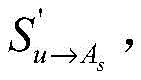
According to the method for deducing the user attribute in the social information service, provided by the embodiment of the invention, for the relevance of the three attributes, when the deduced target attribute is A s When the expression is
Figure BDA0002843623350000031
According to the user attribute deduction method in the social information service, the weighted feature vector is obtained through transformation
Figure BDA0002843623350000032
According to the user attribute deduction method in the social information service, the attribute association rule is mined by adopting an Apriori algorithm based on a data cube.
According to the user attribute deduction method in the social information service, when the Markov random field is used for modeling the user social relationship information, a graph Propagation algorithm is used for carrying out Belief Propagation in a social network graph by using Loopy Belief Propagation.
According to a second aspect of the present invention, a system for deducting user attributes in a social information service is provided, wherein the method for deducting user attributes in a social information service according to any one of the first aspect is adopted. The system has the same advantages as the user attribute deduction method in the social information service compared with the prior art, and is not described again here.
Additional aspects and advantages of the invention will be set forth in part in the description which follows and, in part, will be obvious from the description, or may be learned by practice of the invention.
Drawings
The above and/or additional aspects and advantages of the present invention will become apparent and readily appreciated from the following description of the embodiments, taken in conjunction with the accompanying drawings of which:
FIG. 1 is a flow diagram of a method for user attribute deduction in a social information service according to an embodiment of the present invention;
FIG. 2 is a flowchart of step S2 according to an embodiment of the present invention;
fig. 3 is a schematic diagram of a social network model of a method for deducing user attributes in a social information service according to an embodiment of the present invention.
Detailed Description
Reference will now be made in detail to embodiments of the present invention, examples of which are illustrated in the accompanying drawings, wherein like reference numerals refer to the same or similar elements or elements having the same or similar functions throughout. The embodiments described below with reference to the accompanying drawings are illustrative only for the purpose of explaining the present invention, and are not to be construed as limiting the present invention.
In the description of the present invention, it is to be understood that the terms "central," "longitudinal," "transverse," "length," "width," "thickness," "upper," "lower," "front," "rear," "left," "right," "vertical," "horizontal," "top," "bottom," "inner," "outer," "clockwise," "counterclockwise," "axial," "radial," "circumferential," and the like are used in the orientations and positional relationships indicated in the drawings for convenience in describing the invention and to simplify the description, but are not intended to indicate or imply that the device or element so referred to must have a particular orientation, be constructed and operated in a particular orientation, and are not to be construed as limiting the invention.

A user attribute deduction method in a social information service according to an embodiment of the present invention is described below with reference to fig. 1 to 3. As shown in fig. 1, a method for deducting user attributes in a social information service according to an embodiment of the present invention includes the following steps:
s1, mining the relevance among multiple attributes according to the user attribute value and measuring the relevance by using a Kulc coefficient to obtain the relevance value among the multiple attributes;
s2, performing feature transformation on the first feature vector of the user according to the relevance among the multiple attributes and the first feature vector of the user node to obtain a second feature vector of the user node;
s3, obtaining the prior probability of the user with the attribute according to the second feature vector of the user node and an SVM classification method;
and S4, modeling the social relation information of the user by utilizing the Markov random field, and performing belief propagation on the prior probability of the user in the Markov random field to obtain the posterior probability of the user with the attribute.
According to the user attribute deduction method in the social information service, other unknown attribute information can be deduced efficiently according to part of known attribute information in the social network, and the deduction accuracy and expansibility are improved.
Further, before detailing the user attribute deduction method in the social information service of the present invention, first, the social network abstraction can be represented as a graph, G = (V, E, W), where V represents the set of all nodes in the social network. Further, there are three nodes in the social network graph model, namely, a user node, an attribute node, and a behavior node, i.e., V = V u ∪V a ∪V b In which V is u Representing the set of all user nodes in the social network, V a Representing the set of all attribute nodes in the social network, V b Representing all behavioral nodes in a social networkAnd (4) collecting.
Further, for the set of all attribute nodes, V a ={A 1 ,A 2 ,A 3 ,...,A N A denotes the attribute of each user in the social network, A i ={a i1 ,a i2 ,...,a in },a ij Represents attribute A i The jth attribute value of (2). Further, V b ={b 1 ,b 2 ,b 3 ,...,b m }. Furthermore, the user in the social network has N attributes, the attribute i has N attribute values, and the number of the attribute values of each attribute is set to be N i Dimension of attribute value
Figure BDA0002843623350000041
Further, a user in a social network has m behaviors, E represents a set of relationship edges between social network nodes, and W represents a set of relationship edge weights between social network nodes.
It should be noted that, in the method for deducing user attributes in social information service according to the embodiment of the present invention, the input is a network graph G formed by a social network and part of user attribute feature vectors already labeled, and the output is attribute feature vectors of other users in the social network except for the known feature vectors.
According to the user attribute deduction method in the social information service, the attribute association rule is mined by adopting an Apriori algorithm based on a data cube.
Further, the attribute association rule mining method based on the Apriori algorithm of the data cube comprises the following two steps, wherein the first step is to find out all frequent item sets; the second step is to generate strong association rules from the frequent itemsets, which need to be accounted for, and these rules must satisfy minimum support and minimum confidence.
Specifically, the input to the Apriori algorithm process based on a data cube is an n-dimensional data cube CB [ d 1 ,d 2 ,d 3 ,...,d n ]The minimum support degree min _ sup. The method comprises the following specific steps:
firstly, initializing, namely setting a frequent item set L between n dimensions;
second, a 1-itemset candidate set, C, is generated for each dimension i,di = { all mutually different values in di dimension },
Figure BDA0002843623350000051
then, a 1-itemset frequent items set L is generated 1 =gen_frequent(1,C 1 ) (ii) a And then circularly generating a k-itemsets candidate set, and generating a k-itemsets frequent set, wherein L = L ≧ L $ k (ii) a Up to L k When empty, the cycle is stopped. The output of this process is a frequent item set L across the n dimensions.
Among them, gen _ frequency (1, C) 1 ) Is from the candidate set C k In the generation of frequent item set L k ,gen_candidate(k,L k-1 ) Is a k-itemset candidate set from the (k-1) frequent items set. According to the method for deducing the user attribute in the social information service, as shown in fig. 2, the step S2 includes the following steps:
s201, initializing attribute behavior vector of user node with known label, namely
Figure BDA0002843623350000052
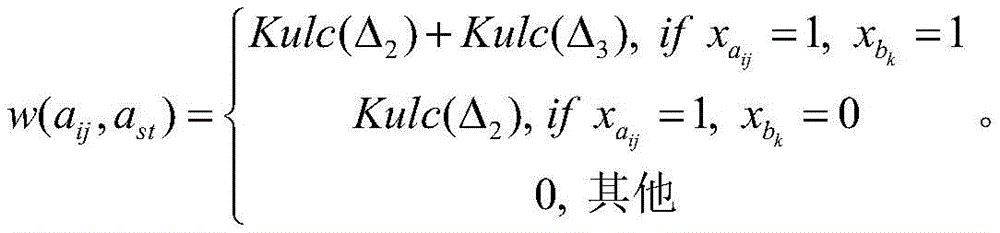
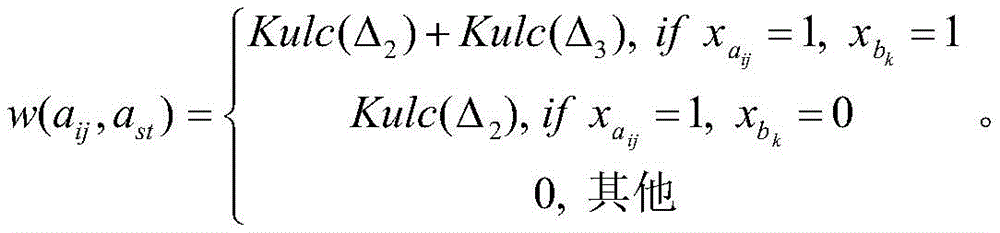
S202, calculating a weight value w (a) according to the correlation between the user attributes ij ,a st );
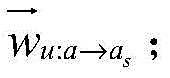
S203, calculating a weight vector according to the weight values of the attributes and the target attributes
Figure BDA0002843623350000053
S204, weighting the attribute behavior feature vector by using the weight between the attribute values and the weight between the user and the attribute, and obtaining the weighted attribute behavior feature vector through transformation
Figure BDA0002843623350000054
According to the method for deducing the user attribute in the social information service, disclosed by the embodiment of the invention, between two attributesCan be expressed as Δ 2 :{a ij →a st },
Figure BDA0002843623350000055
Wherein a is ij Representing the value of an attribute, the Kulc coefficient metric correlation between two attributes is expressed as ≦ ≦ value>
Figure BDA0002843623350000056
According to the user attribute deduction method in the social information service, the relevance among the three attributes can be expressed as delta 3 :{(a ij ,a kl )→a st },Δ 3 -1 :{a st →(a ij ,a kl ) Expressed as Kulc coefficient metric correlation between the three attributes
Figure BDA0002843623350000057
It should be noted that, in the following description,
Figure BDA0002843623350000061
according to the user attribute deduction method in the social information service, the target attribute A is set for the relevance of the three attributes s Having n attribute values, A s ={a s1 ,a s2 ,...,a sn Where the encoding of the attribute value is x, initialize the attribute behavior vector of the user node of the known tag
Figure BDA0002843623350000062
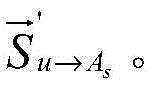
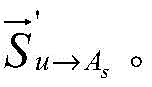
When the derived target attribute is A s When the expression is
Figure BDA0002843623350000063
Social messages according to one embodiment of the inventionMethod for deducing user attribute in information service, obtaining weighted characteristic vector by conversion
Figure BDA0002843623350000064
It is noted that for
Figure BDA0002843623350000065
Wherein each dimension represents an attribute value a based on multi-dimensional attribute relevance ij For the target attribute value a st The weighted attribute feature of (1).
Set target Attribute A s There are n attribute values, A s ={a s1 ,a s2 ,...,a sn },Δ 3 :{(a ij ,a kl )→a st },Δ 2 :{a ij →a st The attribute behavior vector of user u is
Figure BDA0002843623350000066
When the target attribute is A S
Figure BDA0002843623350000067
Further, each dimension of the weight vector is a weight between the associated attribute value and the target attribute value,
Figure BDA0002843623350000068
where α is an attribute weight coefficient.
Further, for four-dimensional attribute behavior correlation, when the derived target attribute is A s When the utility model is used, the water is discharged,
Figure BDA0002843623350000069
for
Figure BDA00028436233500000610
Wherein each dimension tableAttribute value a based on multi-dimensional attribute relevance ij For the target attribute value a st The weighted attribute feature of (1).
Attribute behavior vector for users
Figure BDA00028436233500000611
For target attribute A s Is expanded, i.e.
Figure BDA0002843623350000071
Wherein,
Figure BDA0002843623350000072
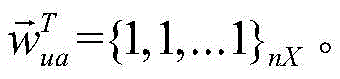
the weight vector is
Figure BDA0002843623350000073
Figure BDA0002843623350000074
Further, in step S3, the feature vector of each user is one of SVM inputs, specifically, each user' S feature vector is input in step S3
Figure BDA0002843623350000075
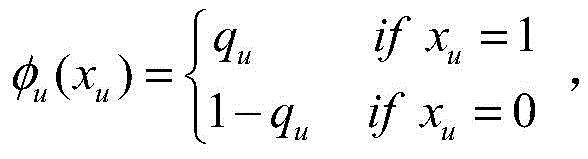
An SVM kernel function is set to be an RBF kernel through an SVM method in machine learning, c and g are obtained through cross-validation, and data are further trained to obtain the prior probability q that a user has the target attribute u
According to the user attribute deduction method in the social information service, when the Markov random field is used for modeling the user social relationship information, a graph Propagation algorithm is used for carrying out Belief Propagation in a social network graph by using Loopy Belief Propagation.
Further, in belief propagation, the information passed by the t-th iteration is:
Figure BDA0002843623350000076
wherein:
Figure BDA0002843623350000077
q u is the prior probability that the target user has the target attribute,
Figure BDA0002843623350000078
w is the weight of the edge (u, v).
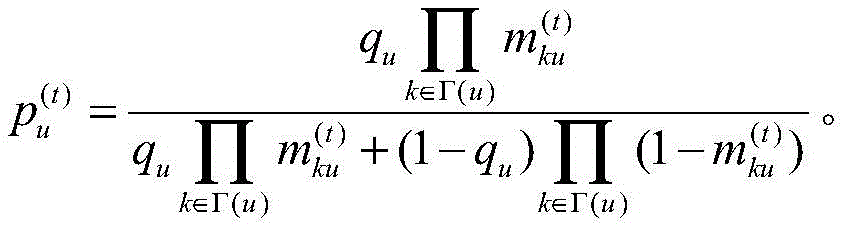
Further, the target attribute a of the target user is obtained st The posterior probability of (2):
Figure BDA0002843623350000079
in summary, according to the user attribute deduction method in the social information service, according to part of known attribute information in the social network, other unknown attribute information can be deduced efficiently, and the deduction accuracy and expansibility are improved.
The invention also provides a system for deducing the user attribute in the social information service, and the system adopts the method for deducing the user attribute in the social information service, so that the system has the advantages of higher deduction accuracy, higher expansibility and the like.
In the description herein, references to the description of the term "one embodiment," "some embodiments," "an illustrative embodiment," "an example," "a specific example," or "some examples" or the like mean that a particular feature, structure, material, or characteristic described in connection with the embodiment or example is included in at least one embodiment or example of the invention. In this specification, the schematic representations of the terms used above do not necessarily refer to the same embodiment or example. Furthermore, the particular features, structures, materials, or characteristics described may be combined in any suitable manner in any one or more embodiments or examples.
While embodiments of the present invention have been shown and described, it will be understood by those of ordinary skill in the art that: various changes, modifications, substitutions and alterations can be made to the embodiments without departing from the principles and spirit of the invention, the scope of which is defined by the claims and their equivalents.

Claims (8)

1.一种社交信息服务中用户属性推演方法,其特征在于,包括以下步骤:1. A method for deducing user attributes in a social information service, characterized by comprising the following steps: S1,根据用户属性值挖掘多种属性之间的关联性并使用Kulc系数度量关联性,得到多种属性之间关联性的值;S1, mining the correlation between multiple attributes based on user attribute values and using the Kulc coefficient to measure the correlation, to obtain the value of the correlation between multiple attributes; S2,根据多种属性之间关联性和用户节点的第一特征向量,对用户的第一特征向量进行特征变换,得到用户节点的第二特征向量;S2, performing feature transformation on the first feature vector of the user according to the correlation between the multiple attributes and the first feature vector of the user node, to obtain a second feature vector of the user node; S3,根据用户节点的第二特征向量以及SVM分类方法,得到用户有该属性的先验概率;S3, according to the second feature vector of the user node and the SVM classification method, obtain the prior probability that the user has the attribute; S4,利用马尔可夫随机场对用户社交关系信息进行建模,在马尔可夫随机场中对用户先验概率进行置信传播,获得用户有该属性的后验概率;S4, using Markov random fields to model user social relationship information, performing belief propagation on user prior probabilities in the Markov random field, and obtaining the posterior probability that the user has the attribute; 步骤S2包括以下步骤:Step S2 includes the following steps: S201,初始化已知标签的用户节点的属性行为向量,即S201, initialize the attribute behavior vector of the user node with known label, that is
Figure FDA0003859830400000011
S202,根据用户属性之间相关性计算权重值w(aij,ast);S202, calculating a weight value w(a ij ,a st ) according to the correlation between user attributes; S203,根据属性和目标属性的权重值计算权重向量
Figure FDA0003859830400000012
S203, calculating a weight vector according to the weight values of the attribute and the target attribute
Figure FDA0003859830400000012
S204,利用属性值之间的权重和用户及属性之间的权重对属性行为特征向量进行加权,通过变换获得加权后的属性行为特征向量
Figure FDA0003859830400000013
S204, weighting the attribute behavior feature vector using the weights between attribute values and the weights between users and attributes, and obtaining the weighted attribute behavior feature vector by transformation
Figure FDA0003859830400000013
2.根据权利要求1所述的社交信息服务中用户属性推演方法,其特征在于,两个属性之间的关联性可表示为Δ2:{aij→ast},
Figure FDA0003859830400000016
其中aij表示属性值,两个属性之间的Kulc系数度量关联性表示为
Figure FDA0003859830400000014
2. The method for deducing user attributes in social information services according to claim 1, wherein the correlation between two attributes can be expressed as Δ 2 : {a ij →a st },
Figure FDA0003859830400000016
Where a ij represents the attribute value, and the Kulc coefficient between two attributes measures the association as
Figure FDA0003859830400000014
3.根据权利要求1所述的社交信息服务中用户属性推演方法,其特征在于,三个属性之间的关联性可表示为,Δ3:{(aij,akl)→ast},Δ3 -1:{ast→(aij,akl)},三个属性之间的Kulc系数度量关联性表示为3. The method for deducing user attributes in a social information service according to claim 1, characterized in that the correlation between the three attributes can be expressed as, Δ 3 : {(a ij , a kl )→a st }, Δ 3 -1 : {a st →(a ij , a kl )}, and the Kulc coefficient measurement correlation between the three attributes is expressed as
Figure FDA0003859830400000015
4.根据权利要求3所述的社交信息服务中用户属性推演方法,其特征在于,对于三种属性关联性,当推演的目标属性为As时,表达式为4. The method for deducing user attributes in social information services according to claim 3 is characterized in that, for the three attribute associations, when the deduced target attribute is As , the expression is
Figure FDA0003859830400000021
5.根据权利要求1所述的社交信息服务中用户属性推演方法,其特征在于,通过变换获得加权后的特征向量
Figure FDA0003859830400000022
5. The method for deducing user attributes in social information services according to claim 1, characterized in that the weighted feature vector is obtained by transformation
Figure FDA0003859830400000022
6.根据权利要求1-5中任一项所述的社交信息服务中用户属性推演方法,其特征在于,采用基于数据立方体的Apriori算法挖掘属性关联规则。6. The method for deducing user attributes in a social information service according to any one of claims 1 to 5, characterized in that the attribute association rules are mined using an Apriori algorithm based on a data cube. 7.根据权利要求6所述的社交信息服务中用户属性推演方法,其特征在于,利用马尔可夫随机场对用户社交关系信息进行建模时,使用图传播算法在社交网络图中利用LoopyBelief Propagation进行置信传播。7. The method for deducing user attributes in social information services according to claim 6 is characterized in that when using Markov random fields to model user social relationship information, a graph propagation algorithm is used to use LoopyBelief Propagation to perform belief propagation in a social network graph. 8.一种社交信息服务中用户属性推演系统,其特征在于,采用了根据权利要求1-7中任一项所述的社交信息服务中用户属性推演方法。8. A system for deducing user attributes in a social information service, characterized by adopting a method for deducing user attributes in a social information service according to any one of claims 1-7.
CN202011501115.0A 2020-12-18 2020-12-18 User attribute deduction method and system in social information service Active CN112488867B (en)

Priority Applications (1)

Application Number Priority Date Filing Date Title
CN202011501115.0A CN112488867B (en) 2020-12-18 2020-12-18 User attribute deduction method and system in social information service

Applications Claiming Priority (1)

Application Number Priority Date Filing Date Title
CN202011501115.0A CN112488867B (en) 2020-12-18 2020-12-18 User attribute deduction method and system in social information service

Publications (2)

Publication Number Publication Date
CN112488867A CN112488867A (en) 2021-03-12
CN112488867B true CN112488867B (en) 2023-04-18

Family

ID=74914285

Family Applications (1)

Application Number Title Priority Date Filing Date
CN202011501115.0A Active CN112488867B (en) 2020-12-18 2020-12-18 User attribute deduction method and system in social information service

Country Status (1)

Country Link
CN (1) CN112488867B (en)

Family Cites Families (4)

* Cited by examiner, † Cited by third party
Publication number Priority date Publication date Assignee Title
JP5791565B2 (en) * 2012-05-18 2015-10-07 日本電信電話株式会社 User attribute estimation device, user attribute estimation method, and program
US9183282B2 (en) * 2013-03-15 2015-11-10 Facebook, Inc. Methods and systems for inferring user attributes in a social networking system
CN108520470B (en) * 2017-02-28 2022-06-03 百度在线网络技术(北京)有限公司 Method and apparatus for generating user attribute information
CN108921189B (en) * 2018-05-23 2021-05-18 北京航空航天大学 Deduction method and device for social network user attributes

Also Published As

Publication number Publication date
CN112488867A (en) 2021-03-12

Similar Documents

Publication Publication Date Title
Liu et al. Motif-preserving dynamic attributed network embedding
Cavallari et al. Embedding both finite and infinite communities on graphs [application notes]
Gibert et al. Graph embedding in vector spaces by node attribute statistics
US10073887B2 (en) System and method for performing k-nearest neighbor search based on minimax distance measure and efficient outlier detection
Xie et al. Self-supervised representation learning via latent graph prediction
Yang et al. Link-based attributed graph clustering via approximate generative Bayesian learning
Lu et al. An imputation method for missing data based on an extreme learning machine auto-encoder
CN107403390B (en) A friend recommendation method that combines Bayesian inference and random walks on graphs
CN104731962A (en) Method and system for friend recommendation based on similar associations in social network
CN106886524A (en) A kind of community network community division method based on random walk
Jin et al. Modeling with node degree preservation can accurately find communities
Ding et al. User identification across multiple social networks based on naive Bayes model
CN110008348B (en) Method and device for network graph embedding by combining nodes and edges
Zhou et al. Learning to correlate accounts across online social networks: An embedding-based approach
Azaouzi et al. An evidential influence-based label propagation algorithm for distributed community detection in social networks
CN112488867B (en) User attribute deduction method and system in social information service
Liang et al. A new hybrid ant colony optimization based on brain storm optimization for feature selection
Li et al. A supervised similarity measure for link prediction based on KNN
Rao A generic sensor fusion problem: classification and function estimation
CN108090132B (en) A Community Overlapped Partitioning Method Fusing Label Average Partitioning Distance and Structural Relationship
Liu et al. Distributed and robust support vector machine
Abramson Sequence classification with neural conditional random fields
Azzouzi et al. An effective modified possibilistic Fuzzy C-Means clustering algorithm for noisy data problems
Thiagarajan et al. Robust local scaling using conditional quantiles of graph similarities
Tiwari et al. Link Prediction in Social Networks using Histogram Based Gradient Boosting Regression Tree

Legal Events

Date Code Title Description
PB01 Publication
PB01 Publication
SE01 Entry into force of request for substantive examination
CB03 Change of inventor or designer information

Inventor after: Mao Jian

Inventor after: Yang Yitong

Inventor after: Lin Qixiao

Inventor after: Liu Jianwei

Inventor before: Mao Jian

Inventor before: Yang Yitong

Inventor before: Lin Qixiao

Inventor before: Liu Jianwei

GR01 Patent grant
GR01 Patent grant