CN112486319A - VR (virtual reality) interaction method, device, equipment and medium based on touch rendering equipment - Google Patents
VR (virtual reality) interaction method, device, equipment and medium based on touch rendering equipment Download PDFInfo
- Publication number
- CN112486319A CN112486319A CN202011357888.6A CN202011357888A CN112486319A CN 112486319 A CN112486319 A CN 112486319A CN 202011357888 A CN202011357888 A CN 202011357888A CN 112486319 A CN112486319 A CN 112486319A
- Authority
- CN
- China
- Prior art keywords
- coordinate system
- environment
- haptic
- preset
- force
- Prior art date
- Legal status (The legal status is an assumption and is not a legal conclusion. Google has not performed a legal analysis and makes no representation as to the accuracy of the status listed.)
- Granted
Links
Images


Classifications
-
- G—PHYSICS
- G06—COMPUTING OR CALCULATING; COUNTING
- G06F—ELECTRIC DIGITAL DATA PROCESSING
- G06F3/00—Input arrangements for transferring data to be processed into a form capable of being handled by the computer; Output arrangements for transferring data from processing unit to output unit, e.g. interface arrangements
- G06F3/01—Input arrangements or combined input and output arrangements for interaction between user and computer
- G06F3/016—Input arrangements with force or tactile feedback as computer generated output to the user
-
- G—PHYSICS
- G06—COMPUTING OR CALCULATING; COUNTING
- G06F—ELECTRIC DIGITAL DATA PROCESSING
- G06F3/00—Input arrangements for transferring data to be processed into a form capable of being handled by the computer; Output arrangements for transferring data from processing unit to output unit, e.g. interface arrangements
- G06F3/01—Input arrangements or combined input and output arrangements for interaction between user and computer
- G06F3/011—Arrangements for interaction with the human body, e.g. for user immersion in virtual reality
-
- G—PHYSICS
- G06—COMPUTING OR CALCULATING; COUNTING
- G06F—ELECTRIC DIGITAL DATA PROCESSING
- G06F3/00—Input arrangements for transferring data to be processed into a form capable of being handled by the computer; Output arrangements for transferring data from processing unit to output unit, e.g. interface arrangements
- G06F3/01—Input arrangements or combined input and output arrangements for interaction between user and computer
- G06F3/048—Interaction techniques based on graphical user interfaces [GUI]
- G06F3/0481—Interaction techniques based on graphical user interfaces [GUI] based on specific properties of the displayed interaction object or a metaphor-based environment, e.g. interaction with desktop elements like windows or icons, or assisted by a cursor's changing behaviour or appearance
- G06F3/04815—Interaction with a metaphor-based environment or interaction object displayed as three-dimensional, e.g. changing the user viewpoint with respect to the environment or object
Landscapes
- Engineering & Computer Science (AREA)
- General Engineering & Computer Science (AREA)
- Theoretical Computer Science (AREA)
- Human Computer Interaction (AREA)
- Physics & Mathematics (AREA)
- General Physics & Mathematics (AREA)
- User Interface Of Digital Computer (AREA)
Abstract
The invention provides a VR interaction method, device, equipment and medium based on a touch rendering device. According to the method, a first coordinate system of a touch rendering device, a second coordinate system of a VR device and a third coordinate system of an operation panel in the VR environment are unified in a preset three-dimensional platform environment to determine a global coordinate system, then, under the global coordinate system, the initial speed of a virtual touch probe HIP and a preset algorithm are determined to determine a feedback force, the feedback force is used as force feedback output of the touch rendering device, finally, in the preset three-dimensional platform environment, a convex bounding box in the VR environment is created according to the preset convex decomposition collision detection algorithm, and under the VR environment, a model to be processed is operated according to the feedback force and the convex bounding box, so that the reality of the single-point force touch rendering device is increased for interactive feedback in typical scenes such as mechanical assembly and the like under the VR environment.
Description
Technical Field
The invention relates to the technical field of computer assistance, in particular to a VR interaction method, device, equipment and medium based on touch rendering equipment.
Background
With the development of computer-aided technology, force feedback technology is gradually applied to the industrial field, wherein more and more haptic rendering devices are also applied to aspects of social production.
Among them, for the spring force model used for the force haptic rendering, God-Object, which is a force haptic rendering model, has been proposed very early, and the human posterior is improved according to the puncture depth thereof, including the force haptic rendering sensing the friction force variation of the contact surface, the continuous feedback force smoothing, etc.
However, due to the limitation of various technologies, application scenes and particularly hardware devices, the haptic force rendering technology has the problems of small interaction dimension, limited interaction space, unreal interaction feedback and limited interaction scene, and does not exert the unique advantages of haptic force in human-computer interaction.
Disclosure of Invention
The invention provides a VR interaction method, a VR interaction device, VR interaction equipment and a VR interaction medium based on touch rendering equipment, and the VR interaction method, the VR interaction device, the VR interaction equipment and the VR interaction medium are used for enriching the unique advantages of haptic force in human-computer interaction.
In a first aspect, an embodiment of the present invention provides a VR interaction method based on a haptic rendering device, including:
unifying a first coordinate system of the touch rendering equipment, a second coordinate system of the VR equipment and a third coordinate system of the operating panel in the VR environment in a preset three-dimensional platform environment to determine a global coordinate system;
determining a feedback force according to an initial speed of a virtual haptic probe HIP and a preset algorithm under the global coordinate system, wherein the feedback force is used as a force feedback output of the haptic rendering device;
in the preset three-dimensional platform environment, creating a convex bounding box in the VR environment according to a preset convex decomposition collision detection algorithm;
and operating the model to be processed according to the feedback force and the convex bounding box under the VR environment.
In one possible design, after unifying, in the preset three-dimensional platform environment, the first coordinate system of the haptic rendering device, the second coordinate system of the VR device, and the third coordinate system of the operating panel in the VR environment to determine the global coordinate system, the method further includes:
setting a VR interactive interface under the global coordinate system, wherein the VR interactive interface comprises an auxiliary information interface displayed on a screen of the VR equipment and an immersion interactive operation interface with the virtual probe three-dimensional model VHIP position as a reference;
using the auxiliary information interface as a child object of the VR device display camera;
using the immersive interactive operational interface as a child object of the HIP displayed in the VR environment by a pen-type force haptic device of the haptic rendering device.
In one possible design, after the sub-object of the virtual haptic probe HIP displayed in the VR environment by the pen-type force haptic device as the haptic rendering device, further comprising:
and displaying an information prompt interface when the HIP interacts with the model to be processed.
In one possible design, the VR interaction method of the haptic rendering device further includes:
drawing a real-time line to draw a button guide line for selecting an interactive operation mode,
responsive to user interaction with the button, to determine the immersive interactive operational interface.
In one possible design, determining the feedback force according to the initial velocity of the virtual haptic probe HIP and a preset algorithm in the global coordinate system comprises:
when the HIP contacts the surface of the model to be processed and grabs the model to be processed to move, determining the initial speed of the HIP;
and determining a feedback force according to the distance difference between the VHIP position and the HIP position, the preset hardness of the model to be processed, the preset field force and the initial speed.
In one possible design, the operating on the model to be processed according to the feedback force and the convex bounding box in the VR environment includes:
acquiring a trigger instruction acting on a joystick of the haptic rendering device;
responding to the trigger instruction, and operating the model to be processed according to the feedback force and the convex bounding box.
In a second aspect, an embodiment of the present invention further provides a VR interaction apparatus based on a haptic rendering device, including:
the processing module unifies a first coordinate system of the touch rendering equipment, a second coordinate system of the VR equipment and a third coordinate system of the operating panel in the VR environment in a preset three-dimensional platform environment to determine a global coordinate system;
the calculation module is used for determining a feedback force according to the initial speed of the virtual tactile probe HIP and a preset algorithm under the global coordinate system, and the feedback force is used as force feedback output of the tactile rendering equipment;
the creating module is used for creating a convex bounding box under the VR environment according to a preset convex decomposition collision detection algorithm in the preset three-dimensional platform environment;
and the operating module is used for operating the model to be processed according to the feedback force and the convex bounding box in the VR environment.
In one possible design, the VR interaction device based on the haptic rendering apparatus further includes: a setup module specifically configured to:
setting a VR interactive interface under the global coordinate system, wherein the VR interactive interface comprises an auxiliary information interface displayed on a screen of the VR equipment and an immersion interactive operation interface with the virtual probe three-dimensional model VHIP position as a reference;
using the auxiliary information interface as a child object of the VR device display camera;
using the immersive interactive operational interface as a child object of the HIP displayed in the VR environment by a pen-type force haptic device of the haptic rendering device.
In one possible design, the VR interaction device based on the haptic rendering apparatus further includes: and the display module is used for displaying an information prompt interface when the HIP interacts with the model to be processed.
In one possible design, the processing module is further configured to:
drawing a real-time line to draw a button guide line for selecting an interactive operation mode,
responsive to user interaction with the button, to determine the immersive interactive operational interface.
In one possible design, the calculation module is specifically configured to:
when the HIP contacts the surface of the model to be processed and grabs the model to be processed to move, determining the initial speed of the HIP;
and determining a feedback force according to the distance difference between the VHIP position and the HIP position, the preset hardness of the model to be processed, the preset field force and the initial speed.
In one possible design, the processing module is specifically configured to:
acquiring a trigger instruction acting on a joystick of the haptic rendering device;
responding to the trigger instruction, and operating the model to be processed according to the feedback force and the convex bounding box.
In a third aspect, an embodiment of the present invention further provides an electronic device, including:
a processor; and the number of the first and second groups,
a memory for storing executable instructions of the processor;
wherein the processor is configured to perform any one of the possible haptic rendering device based VR interaction methods of the first aspect via execution of the executable instructions.
In a fourth aspect, an embodiment of the present invention further provides a storage medium having a computer program stored thereon, where the computer program is executed by a processor to implement any one of the possible VR interaction methods based on a haptic rendering device in the first aspect.
The VR interaction method, device, equipment and medium based on the touch rendering equipment provided by the embodiment of the invention have the advantages that in the preset three-dimensional platform environment, unifying a first coordinate system of the haptic rendering device, a second coordinate system of the VR device, and a third coordinate system of the operation panel in the VR environment to determine a global coordinate system, and then, determining a feedback force according to an initial velocity of the virtual haptic probe HIP and a preset algorithm in a global coordinate system, the feedback force being used as a force feedback output of a haptic rendering device, and finally, in a preset three-dimensional platform environment, a convex bounding box in a VR environment is created according to a preset convex decomposition collision detection algorithm, and in the VR environment, and operating the model to be processed according to the feedback force and the convex bounding box, so that the single-point force touch rendering equipment is more realistic for interactive feedback in typical scenes such as mechanical assembly and the like in a VR (virtual reality) environment.
Drawings
In order to more clearly illustrate the embodiments of the present invention or the technical solutions in the prior art, the drawings needed to be used in the description of the embodiments or the prior art will be briefly introduced below, and it is obvious that the drawings in the following description are some embodiments of the present invention, and for those skilled in the art, other drawings can be obtained according to these drawings without creative efforts.
FIG. 1 is a schematic diagram of an application scene of a VR interaction method based on a haptic rendering device shown in accordance with an example embodiment of the present invention;
FIG. 2 is a flow diagram illustrating a VR interaction method based on a haptic rendering device in accordance with an example embodiment of the present invention;
FIG. 3 is a schematic diagram of a coordinate system in the embodiment of FIG. 2;
FIG. 4 is a schematic view of a convex decomposition method;
FIG. 5 is a flowchart illustration of a VR interaction method based on a haptic rendering device according to another example embodiment of the present invention;
FIG. 6 is a diagram of a force haptic computing framework shown in accordance with an exemplary embodiment of the present invention;
FIG. 7 is a schematic structural diagram of a VR interaction device based on a haptic rendering apparatus according to an example embodiment of the present invention;
fig. 8 is a schematic structural diagram of an electronic device shown in accordance with an example embodiment of the present invention.
Detailed Description
In order to make the objects, technical solutions and advantages of the embodiments of the present invention clearer, the technical solutions in the embodiments of the present invention will be clearly and completely described below with reference to the drawings in the embodiments of the present invention, and it is obvious that the described embodiments are some, but not all, embodiments of the present invention. All other embodiments, which can be derived by a person skilled in the art from the embodiments given herein without making any creative effort, shall fall within the protection scope of the present invention.
The terms "first," "second," "third," "fourth," and the like in the description and in the claims, as well as in the drawings, if any, are used for distinguishing between similar elements and not necessarily for describing a particular sequential or chronological order. It is to be understood that the data so used is interchangeable under appropriate circumstances such that the embodiments of the invention described herein are capable of operation in sequences other than those illustrated or described herein. Furthermore, the terms "comprises," "comprising," and "having," and any variations thereof, are intended to cover a non-exclusive inclusion, such that a process, method, system, article, or apparatus that comprises a list of steps or elements is not necessarily limited to those steps or elements expressly listed, but may include other steps or elements not expressly listed or inherent to such process, method, article, or apparatus.
Fig. 1 is a schematic diagram illustrating an application scenario of a VR interaction method based on a haptic rendering device according to an example embodiment of the present invention. As shown in fig. 1, the system applied by the VR interaction method based on the haptic rendering device includes the haptic rendering device and a VR device (e.g., a head-mounted VR display) which is an integration of multiple modules of vision (provided by the VR device), haptic (provided by the haptic rendering device), logic processing (provided by a feedback force calculation module), and the like.
Fig. 2 is a flowchart illustrating a VR interaction method based on a haptic rendering device according to an example embodiment of the present invention. As shown in fig. 2, the VR interaction method based on a haptic rendering device provided by the present embodiment includes:
In this step, the first coordinate system of the haptic rendering device, the second coordinate system of the VR device, and the third coordinate system of the operation panel in the VR environment are unified in a preset three-dimensional platform environment (for example, Unity3D environment) to determine a global coordinate system, so that the haptic rendering device, the VR device, and the third coordinate system of the operation panel in the VR environment are unified in a coordinate system.
Optionally, fig. 3 is a schematic diagram of a coordinate system in the embodiment shown in fig. 2. As shown in fig. 3, in this embodiment, a relatively fixed VR usage area and haptic rendering device usage area may be set (e.g., desktop level usage may be possible). The position of the VR device (e.g., VR headset) serves as the local coordinate system origin and is aligned to the global coordinate system origin, while the position of the joystick-based pen-test haptic rendering device base for the local coordinate system origin requires alignment to the desktop operating area operating space of the VR coordinate system.
Secondly, setting a Virtual reality interactive Interface, wherein the interactive Interface provided in the embodiment is divided into an auxiliary information Interface displayed on a screen and an immersive interactive operation Interface with reference to a Virtual Hair Interface Point (VHIP) position according to a head reference system and a body reference system in a VR design theory.
In addition, under the global coordinate system, a VR interactive Interface can be further set, where the VR interactive Interface includes an auxiliary information Interface displayed on a screen of the VR device, and an immersive interactive operation Interface with the virtual probe three-dimensional model VHIP position as a reference, the auxiliary information Interface is used as a sub-object of a display camera of the VR device, and the immersive interactive operation Interface is used as a virtual tactile probe (HIP) displayed by a pen-type force tactile device of the tactile rendering device in the VR environment. Moreover, when the HIP interacts with the model, an interface of the prompt message may be added in this embodiment, and a two-dimensional coordinate system implemented inside the interface is also used.
Optionally, in this embodiment, when the HIP interacts with the model to be processed, an information prompt interface may also be displayed. Also, real-time lines may be drawn to draw button guide lines that select an interactive mode of operation, and in response to user interaction with the buttons, to determine an immersive interactive operational interface
The button guidance lines can be used for selecting an interactive operation mode from the real-time line drawing of the viewport coordinate system, so that more intuitive interactive guidance can be performed on the user. For drawing the guide line, the coordinate transformation is as shown in the following equation 1:
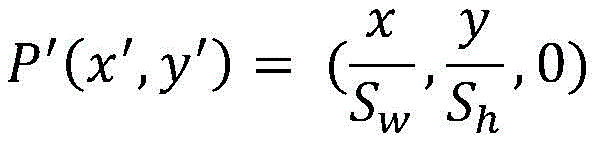
in the Unity3D environment, an OpenGL method is used for drawing a real-time line which can move along with the HIP, the coordinate transformation of the line is as in formula 1, when a preset key is pressed down and an operation interface is called out, the position P of the current HIP is recorded0(x0,y0,z0) Real-time HIP position is P1(x1,y1,z1). Wherein (S)w,Sh) Is the length and width of the current display screen. During drawing, the current position needs to be pushed, the material of an OpenGL line is set, an orthogonal coordinate system is selected, a guide line is drawn on a screen according to a formula calculation point P', and the drawing is finished and then the drawing is pushed.
And 102, determining a feedback force according to the initial speed of the virtual haptic probe HIP and a preset algorithm under the global coordinate system, wherein the feedback force is used as force feedback output of the haptic rendering device.
In this step, it is determined that a feedback force for a force feedback output as a haptic rendering device is determined according to an initial velocity of the virtual haptic probe HIP and a preset algorithm in the global coordinate system.
103, in the preset three-dimensional platform environment, creating a convex bounding box in the VR environment according to a preset convex decomposition collision detection algorithm;
in this step, in the preset three-dimensional platform environment, a convex bounding box in the VR environment is created according to a preset convex decomposition collision detection algorithm.
Here, it is worth explaining that the calculation of the feedback force in the prior art is based on a spring force calculation model. In particular, for the spring force model used for force haptic rendering, related force haptic rendering models have been proposed for a long time, and subsequent researchers have made improvements (HIP and VHIP) according to their penetration depths, including force haptic rendering to sense friction force variation of a contact surface, continuous feedback force smoothing, and the like.
The HIP of the force haptic rendering device is set to constrain its object to the VHIP of the touchable virtual object surface. For surface ambiguities, VHIP is used for processing in this embodiment. The VHIP is to arrange a three-dimensional object on the basis of the HIP proxy to perform puncture operation in the virtual environment instead of the HIP, and the HIP is constrained on the contact surface, so that the distance between the VHIP and the HIP is calculated to be the puncture depth. However, the understanding of the puncture depth is also a simple linear distance of spatial translation, the discontinuity and penetration problems in practical use still exist, and a great deal of constraints are required to be added to the use environment, and the problems are particularly prominent in the operation space with six degrees of freedom. In order to further solve the problems of direct feedback force, a method based on generalized puncture depth is provided and is continuously optimized and improved.
Also for the penetration depth of the spring force, a generalized penetration depth (PDg) is defined. PDg separates two overlapping interacting interactive objects using translation and rotation. Assuming that there are two overlapping polygons a and B, where a is a movable object superimposed on B, the two can be separated after applying a rigid motion to a. The shortest distance required to separate a from B can thus be calculated by defining a PDg in the operating space of six degrees of freedom in combination with the associated distance vector, as shown in equation 2:

where q is the local coordinate system of the virtual object A and F is the world coordinate system in world space in which the haptic rendering device can move freely, where σ isA(q, o) is a distance measure defined by the virtual object A in 6-DOF space between two coordinate systems q and o (world coordinate system and local coordinate system), the method is used for identifying that the virtual object A is in a local coordinate system, and any point in the virtual object A does not intersect with the virtual object B.
Therefore, the PDg can be calculated using an optimization method to separate a from B using a distance metric. In general, any distance metric may be chosen for definition, and for ease of computation, the vector norm is typically chosen to be used as the base distance metric. The vector norm, which will typically be between and at two different points on object a, can be defined as in equation 3:

where x (q) represents a point in A in configuration q. [ q ] of1,q2,q3]Denotes q0And q is1The vector portion of the relative direction difference quaternion between; [ q ] of4,q5,q6]Representing the relative positional difference between the sums, V is the volume of the virtual object a, and I represents the diagonal entry of the inertia tensor of a.
In order to realize concave polyhedron interaction which often occurs in interactive operation of force touch rendering, a classical convex decomposition algorithm is adopted in the embodiment for realizing. However, classical convex decomposition algorithms require re-topology of the object's patch structure. Concave polyhedron surface convex decomposition is a method for gradually decomposing the surfaces of some complex non-convex objects into a set consisting of some small convex surface patches so as to realize a concave collision detection response method, and the method is a search method based on a conjugate graph.
Setting O as polyhedron boundary set, taking any surface as seed surface, setting the included projection as A1, traversing the rest patches according to the following rules, and then recursively selecting any seed surface, wherein the following three conditions are required to be satisfied in the traversing process:
1) the current traversal patch must be composed of non-concave edges;
2) if any point except the adjacent point of the patch contained by the current bump exists in the current traversal patch, the point is invisible to any surface of the current bump;
3) when the current traversal patch is updated into the bump, the updated bump cannot have an intersection point with the surface on the original lug.
After the traversal decomposition, for the set of patches in the concave polyhedron, the following relationship exists, as shown in expressions 4 and 5:


in expression 5, O is a set of polyhedral boundary surfaces, AiDenotes a set of convex pieces included in the ith bump, ajRepresenting the patch of the jth bump.
FIG. 4 is a schematic view of a convex decomposition method. As shown in FIG. 4, defining Seed as Seed surface, based on the yoke map search algorithm, first traverse the neighboring surfaces of Seed (in the figure, surfaces P3, P4, P5, P6) and then determine whether these neighboring surfaces are located at the same bump as the Seed surface according to the three conditions traversed by convex decomposition. In fig. 4, it can be seen that Seed belongs to the same convex patch a as P3, P4, P5, and P6 has a concave edge so that condition 1 is not satisfied). During the traversal of the surface, a BFS (breadth-first traversal) method is usually adopted, and then P1 and P2 are traversed, and whether a is determined, which is known from the following conditions: p1 has concave edges, and P2 does not satisfy the condition 2), so the boundary surfaces of a are Seed, P3, P4 and P5 through the traversal process. Similarly, when P2 is defined as Seed, for traversal plane P7, P1 can obtain convex patch b of which P1 and P2 belong to the same genus from the above condition analysis. From the above decomposition example, the polygon a is a non-convex geometric solid, and after the surface convex decomposition is performed on the polygon a, two convex surface patches can be obtained, and then convex hulls are solved respectively to obtain the convex body a and the convex body b.
And 104, operating the model to be processed according to the feedback force and the convex bounding box in the VR environment.
The method comprises the steps of calculating spring force based on constraint and damping, adding damping, carrying out high simulation optimization on direct feedback force of force touch rendering, then generating a convex bounding box in Unity3D through a collision detection module based on a convex decomposition collision detection algorithm, finally realizing operation mode switching based on touch rendering in a Unity3D environment, and carrying out direct operation on an object.
In the embodiment, a first coordinate system of the haptic rendering device, a second coordinate system of the VR device, and a third coordinate system of the operating panel in the VR environment are unified in a preset three-dimensional platform environment to determine a global coordinate system, then, in the global coordinate system, an initial velocity of the virtual haptic probe HIP and a preset algorithm are determined to determine a feedback force, the feedback force is used as a force feedback output of the haptic rendering device, and finally, in the preset three-dimensional platform environment, a convex bounding box in the VR environment is created according to a preset convex decomposition collision detection algorithm, and in the VR environment, a model to be processed is operated according to the feedback force and the convex bounding box, so that the single-point-force haptic rendering device increases reality for interactive feedback in typical scenes such as mechanical assembly in the VR environment.
Fig. 5 is a flowchart illustrating a VR interaction method based on a haptic rendering device according to another example embodiment of the present invention. As shown in fig. 5, the VR interaction method based on a haptic rendering device provided by the present embodiment includes:
In this step, the first coordinate system of the haptic rendering device, the second coordinate system of the VR device, and the third coordinate system of the operation panel in the VR environment are unified in a preset three-dimensional platform environment (for example, Unity3D environment) to determine a global coordinate system, so that the haptic rendering device, the VR device, and the third coordinate system of the operation panel in the VR environment are unified in a coordinate system.
Optionally, fig. 3 is a schematic diagram of a coordinate system in the embodiment shown in fig. 2. As shown in fig. 3, in this embodiment, a relatively fixed VR usage area and haptic rendering device usage area may be set (e.g., desktop level usage may be possible). The position of the VR device (e.g., VR headset) serves as the local coordinate system origin and is aligned to the global coordinate system origin, while the position of the joystick-based pen-test haptic rendering device base for the local coordinate system origin requires alignment to the desktop operating area operating space of the VR coordinate system.
Secondly, setting a Virtual reality interactive Interface, wherein the interactive Interface provided in the embodiment is divided into an auxiliary information Interface displayed on a screen and an immersive interactive operation Interface with reference to a Virtual Hair Interface Point (VHIP) position according to a head reference system and a body reference system in a VR design theory.
In addition, under the global coordinate system, a VR interactive Interface can be further set, where the VR interactive Interface includes an auxiliary information Interface displayed on a screen of the VR device, and an immersive interactive operation Interface with the virtual probe three-dimensional model VHIP position as a reference, the auxiliary information Interface is used as a sub-object of a display camera of the VR device, and the immersive interactive operation Interface is used as a virtual tactile probe (HIP) displayed by a pen-type force tactile device of the tactile rendering device in the VR environment. Moreover, when the HIP interacts with the model, an interface of the prompt message may be added in this embodiment, and a two-dimensional coordinate system implemented inside the interface is also used.
Optionally, in this embodiment, when the HIP interacts with the model to be processed, an information prompt interface may also be displayed. Also, real-time lines may be drawn to draw button guide lines that select an interactive mode of operation, and in response to user interaction with the buttons, to determine an immersive interactive operational interface
The button guidance lines can be used for selecting an interactive operation mode from the real-time line drawing of the viewport coordinate system, so that more intuitive interactive guidance can be performed on the user. For drawing the guide line, the coordinate transformation is as shown in the following equation 1:

in the Unity3D environment, an OpenGL method is used for drawing a real-time line which can move along with the HIP, the coordinate transformation of the line is as in formula 1, when a preset key is pressed down and an operation interface is called out, the position P of the current HIP is recorded0(x0,y0,z0) Real-time HIP position is P1(x1,y1,z1). Wherein (S)w,Sh) Is the length and width of the current display screen. During drawing, the current position needs to be pushed, the material of an OpenGL line is set, an orthogonal coordinate system is selected, a guide line is drawn on a screen according to a formula calculation point P', and the drawing is finished and then the drawing is pushed.
And step 203, determining a feedback force according to the distance difference between the VHIP position and the HIP position, the preset hardness of the model to be processed, the preset field force and the initial speed.
FIG. 6 is a diagram illustrating a force haptic computing framework according to an example embodiment of the present invention, such as that shown in FIG. 6, for haptic rendering taking into account only virtual feedback forces and torque feedback on moving objects, and output by a haptic device. Before each frame starts, whether the HIP interacts with an object needs to be judged, and when the HIP touches the surface of a virtual object and grabs the object to move, the initial speed of the HIP needs to be preprocessed. In the step, the feedback force is preliminarily calculated, and finally, due to the high reduction degree simulation requirement of the real world, the proper gravity G is used as the field force, the output haptic result is integrally calculated, and the final formula is as follows:

where Δ x is a distance difference between the HIP and the VHIP, and k is a hardness of the touch object, and the experimental virtual object set in this step is an ideal rigid body, so that k is 1.
For torque force TuserIn the calculation, ξ is the rotational stiffness, ω is the rotational axis and Δ θ is the difference in rotational angle between the two frames.
In addition, preprocessing is needed before the real virtual reality scene is operated, and mesh data of a three-dimensional model can be obtained in Unity3D, wherein a set of points is a Vertex array, and a normal set is a normal array. Finding out the patch set PlaneV [, ]accordingto the vertex set. And judging whether non-coplanar vertexes of adjacent surfaces are visible or not according to the patch set and the corresponding normal thereof, if so, adding a convex hull subset set TMesh [ ], generating a bounding box (BoxCloder) for the convex hull subset, adding a rigid body (Rigidibody) component, and not checking a gravity option, namely not using a gravity system of an engine.
And step 205, responding to the trigger instruction, and operating the model to be processed according to the feedback force and the convex bounding box.
Alternatively, for a single-point joystick-based force haptic rendering device with two buttons, the button near the pen tip is set as button 1, and the button near the pen barrel is set as button 2. And when the button 2 is pressed, acquiring the position P (x, y, z) of the current pen point, calling out an operation UI interface from the center of the point P, long-pressing the button 2 to move the HIP, calling out a secondary selection button corresponding to the button when the pen point clicks the corresponding button, continuing long-pressing the button 2 to move the HIP, and separating and freezing the corresponding axis of the object when the pen point clicks the corresponding button.
Fig. 7 is a schematic structural diagram of a VR interaction device based on a haptic rendering apparatus according to an example embodiment of the present invention. As shown in fig. 7, the present embodiment provides a VR interaction device 300 based on a haptic rendering device, including:
the processing module 301 unifies a first coordinate system of the haptic rendering device, a second coordinate system of the VR device, and a third coordinate system of the operating panel in the VR environment in a preset three-dimensional platform environment to determine a global coordinate system;
a calculating module 302, configured to determine, in the global coordinate system, a feedback force according to an initial velocity of a virtual haptic probe HIP and a preset algorithm, where the feedback force is used as a force feedback output of the haptic rendering device;
a creating module 303, configured to create a convex bounding box in the VR environment according to a preset convex decomposition collision detection algorithm in the preset three-dimensional platform environment;
an operation module 304, configured to operate a model to be processed according to the feedback force and the convex bounding box in the VR environment.
In one possible design, the VR interaction device based on the haptic rendering apparatus further includes: the setting module 305 is specifically configured to:
setting a VR interactive interface under the global coordinate system, wherein the VR interactive interface comprises an auxiliary information interface displayed on a screen of the VR equipment and an immersion interactive operation interface with the virtual probe three-dimensional model VHIP position as a reference;
using the auxiliary information interface as a child object of the VR device display camera;
using the immersive interactive operational interface as a child object of the HIP displayed in the VR environment by a pen-type force haptic device of the haptic rendering device.
In one possible design, the VR interaction device based on the haptic rendering apparatus further includes: and the display module 306 is configured to display an information prompt interface when the HIP interacts with the model to be processed.
In one possible design, the processing module 304 is further configured to:
drawing a real-time line to draw a button guide line for selecting an interactive operation mode,
responsive to user interaction with the button, to determine the immersive interactive operational interface.
In one possible design, the calculation module 302 is specifically configured to:
when the HIP contacts the surface of the model to be processed and grabs the model to be processed to move, determining the initial speed of the HIP;
and determining a feedback force according to the distance difference between the VHIP position and the HIP position, the preset hardness of the model to be processed, the preset field force and the initial speed.
In one possible design, the processing module 304 is specifically configured to:
acquiring a trigger instruction acting on a joystick of the haptic rendering device;
responding to the trigger instruction, and operating the model to be processed according to the feedback force and the convex bounding box.
The above various virtualizations may be configured as one or more integrated circuits implementing the above methods, for example: one or more Application Specific Integrated Circuits (ASICs), or one or more microprocessors (DSPs), or one or more Field Programmable Gate Arrays (FPGAs), among others. For another example, when one of the above modules is implemented in the form of a Processing element scheduler code, the Processing element may be a general-purpose processor, such as a Central Processing Unit (CPU) or other processor capable of calling program code. For another example, these modules may be integrated together and implemented in the form of a system-on-a-chip (SOC).
In addition, functional units in the embodiments of the present invention may be integrated into one processing unit, or each unit may exist alone physically, or two or more units are integrated into one unit. The integrated unit can be realized in a form of hardware, or in a form of hardware plus a software functional unit.
It should be noted that the VR interaction apparatus based on the haptic rendering device provided in the embodiment shown in fig. 8 may be used to execute the VR interaction method based on the haptic rendering device provided in the embodiments shown in fig. 2 to fig. 5, and specific implementation and technical effects are similar, and are not described herein again.
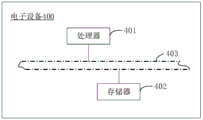
Fig. 8 is a schematic structural diagram of an electronic device shown in accordance with an example embodiment of the present invention. As shown in fig. 8, the present embodiment provides an electronic device 400, including:
a processor 401; and the number of the first and second groups,
a memory 402 for storing executable instructions of the processor, which may also be a flash (flash memory);
wherein the processor 401 is configured to perform the steps of the above-described method via execution of the executable instructions. Reference may be made in particular to the description relating to the preceding method embodiment.
Alternatively, the memory 402 may be separate or integrated with the processor 401.
When the memory 402 is a device independent from the processor 401, the electronic device 400 may further include:
a bus 403 for connecting the processor 401 and the memory 402.
The present embodiment also provides a readable storage medium, in which a computer program is stored, and when at least one processor of the electronic device executes the computer program, the electronic device executes the methods provided by the above various embodiments.
The present embodiment also provides a program product comprising a computer program stored in a readable storage medium. The computer program can be read from a readable storage medium by at least one processor of the electronic device, and the execution of the computer program by the at least one processor causes the electronic device to implement the methods provided by the various embodiments described above.
Those of ordinary skill in the art will understand that: all or a portion of the steps of implementing the above-described method embodiments may be performed by hardware associated with program instructions. The program may be stored in a computer-readable storage medium. When executed, the program performs steps comprising the method embodiments described above; and the aforementioned storage medium includes: various media that can store program codes, such as ROM, RAM, magnetic or optical disks.
Finally, it should be noted that: the above embodiments are only used to illustrate the technical solution of the present invention, and not to limit the same; while the invention has been described in detail and with reference to the foregoing embodiments, it will be understood by those skilled in the art that: the technical solutions described in the foregoing embodiments may still be modified, or some or all of the technical features may be equivalently replaced; and the modifications or the substitutions do not make the essence of the corresponding technical solutions depart from the scope of the technical solutions of the embodiments of the present invention.
Claims (10)
1. A VR interaction method based on a haptic rendering device, comprising:
unifying a first coordinate system of the touch rendering equipment, a second coordinate system of the VR equipment and a third coordinate system of the operating panel in the VR environment in a preset three-dimensional platform environment to determine a global coordinate system;
determining a feedback force according to an initial speed of a virtual haptic probe HIP and a preset algorithm under the global coordinate system, wherein the feedback force is used as a force feedback output of the haptic rendering device;
in the preset three-dimensional platform environment, creating a convex bounding box in the VR environment according to a preset convex decomposition collision detection algorithm;
and operating the model to be processed according to the feedback force and the convex bounding box under the VR environment.
2. The VR interaction method based on the haptic rendering device of claim 1, further comprising, after unifying a first coordinate system of the haptic rendering device, a second coordinate system of the VR device, and a third coordinate system of an operation panel in the VR environment to determine a global coordinate system in the preset three-dimensional platform environment, the method further comprising:
setting a VR interactive interface under the global coordinate system, wherein the VR interactive interface comprises an auxiliary information interface displayed on a screen of the VR equipment and an immersion interactive operation interface with the virtual probe three-dimensional model VHIP position as a reference;
using the auxiliary information interface as a child object of the VR device display camera;
using the immersive interactive operational interface as a child object of a virtual haptic probe HIP displayed in the VR environment by a pen-type force haptic device of the haptic rendering device.
3. The haptic rendering device-based VR interaction method of claim 2, further comprising, after the acting of the immersive interaction interface as a child object of a virtual haptic probe HIP displayed in the VR environment by a pen-type force haptic device of the haptic rendering device:
and displaying an information prompt interface when the HIP interacts with the model to be processed.
4. The VR interaction method based on a haptic rendering device of claim 3, further comprising:
drawing a real-time line to draw a button guide line for selecting an interactive operation mode,
responsive to user interaction with the button, to determine the immersive interactive operational interface.
5. The VR interaction method based on a haptic rendering device of claim 3, wherein determining the feedback force according to an initial velocity of the virtual haptic probe HIP and a preset algorithm in the global coordinate system comprises:
when the HIP contacts the surface of the model to be processed and grabs the model to be processed to move, determining the initial speed of the HIP;
and determining a feedback force according to the distance difference between the VHIP position and the HIP position, the preset hardness of the model to be processed, the preset field force and the initial speed.
6. The VR interaction method of any of claims 1-5, wherein operating a model to be processed according to the feedback force and the convex bounding box in the VR environment comprises:
acquiring a trigger instruction acting on a joystick of the haptic rendering device;
responding to the trigger instruction, and operating the model to be processed according to the feedback force and the convex bounding box.
7. A VR interaction device based on a haptic rendering device, comprising:
the processing module unifies a first coordinate system of the touch rendering equipment, a second coordinate system of the VR equipment and a third coordinate system of the operating panel in the VR environment in a preset three-dimensional platform environment to determine a global coordinate system;
the calculation module is used for determining a feedback force according to the initial speed of the virtual tactile probe HIP and a preset algorithm under the global coordinate system, and the feedback force is used as force feedback output of the tactile rendering equipment;
the creating module is used for creating a convex bounding box under the VR environment according to a preset convex decomposition collision detection algorithm in the preset three-dimensional platform environment;
and the operating module is used for operating the model to be processed according to the feedback force and the convex bounding box in the VR environment.
8. The VR interaction device of claim 7, further comprising:
a setup module specifically configured to:
setting a VR interactive interface under the global coordinate system, wherein the VR interactive interface comprises an auxiliary information interface displayed on a screen of the VR equipment and an immersion interactive operation interface with the virtual probe three-dimensional model VHIP position as a reference;
using the auxiliary information interface as a child object of the VR device display camera;
using the immersive interactive operational interface as a child object of the HIP displayed in the VR environment by a pen-type force haptic device of the haptic rendering device.
9. An electronic device, comprising:
a processor; and the number of the first and second groups,
a memory for storing executable instructions of the processor;
wherein the processor is configured to perform the haptic rendering device based VR interaction method of any of claims 1-6 via execution of the executable instructions.
10. A storage medium having stored thereon a computer program, which when executed by a processor implements the VR interaction method based on a haptic rendering device of any of claims 1 to 6.
Priority Applications (1)
| Application Number | Priority Date | Filing Date | Title |
|---|---|---|---|
| CN202011357888.6A CN112486319B (en) | 2020-11-27 | 2020-11-27 | VR (virtual reality) interaction method, device, equipment and medium based on touch rendering equipment |
Applications Claiming Priority (1)
| Application Number | Priority Date | Filing Date | Title |
|---|---|---|---|
| CN202011357888.6A CN112486319B (en) | 2020-11-27 | 2020-11-27 | VR (virtual reality) interaction method, device, equipment and medium based on touch rendering equipment |
Publications (2)
| Publication Number | Publication Date |
|---|---|
| CN112486319A true CN112486319A (en) | 2021-03-12 |
| CN112486319B CN112486319B (en) | 2023-04-18 |
Family
ID=74935916
Family Applications (1)
| Application Number | Title | Priority Date | Filing Date |
|---|---|---|---|
| CN202011357888.6A Active CN112486319B (en) | 2020-11-27 | 2020-11-27 | VR (virtual reality) interaction method, device, equipment and medium based on touch rendering equipment |
Country Status (1)
| Country | Link |
|---|---|
| CN (1) | CN112486319B (en) |
Cited By (2)
| Publication number | Priority date | Publication date | Assignee | Title |
|---|---|---|---|---|
| CN113096226A (en) * | 2021-03-19 | 2021-07-09 | 华南理工大学 | Bolt virtual assembly force sense rendering method based on GPS |
| CN116596995A (en) * | 2023-05-26 | 2023-08-15 | 燕熠 | A virtual reality human-computer interaction method using the user's torso as a reference frame |
Citations (4)
| Publication number | Priority date | Publication date | Assignee | Title |
|---|---|---|---|---|
| CN101615072A (en) * | 2009-06-18 | 2009-12-30 | 东南大学 | Tactile Reproduction Method of Texture Force Based on Shape Restoration from Image Grayscale |
| CN104765451A (en) * | 2015-03-31 | 2015-07-08 | 浙江理工大学 | Double interactive contact haptic generation method |
| CN109917911A (en) * | 2019-02-20 | 2019-06-21 | 西北工业大学 | A kind of vibrotactile feedback device design method based on information physical interaction |
| CN111897427A (en) * | 2020-07-29 | 2020-11-06 | 东南大学 | Hardness tactile reproduction method based on bionic properties of tactile perception |
-
2020
- 2020-11-27 CN CN202011357888.6A patent/CN112486319B/en active Active
Patent Citations (4)
| Publication number | Priority date | Publication date | Assignee | Title |
|---|---|---|---|---|
| CN101615072A (en) * | 2009-06-18 | 2009-12-30 | 东南大学 | Tactile Reproduction Method of Texture Force Based on Shape Restoration from Image Grayscale |
| CN104765451A (en) * | 2015-03-31 | 2015-07-08 | 浙江理工大学 | Double interactive contact haptic generation method |
| CN109917911A (en) * | 2019-02-20 | 2019-06-21 | 西北工业大学 | A kind of vibrotactile feedback device design method based on information physical interaction |
| CN111897427A (en) * | 2020-07-29 | 2020-11-06 | 东南大学 | Hardness tactile reproduction method based on bionic properties of tactile perception |
Non-Patent Citations (4)
| Title |
|---|
| 孟继君: "基于轴不变量的偏置型6R机械臂建模与运动规划研究", 《中国优秀硕士学位论文全文数据库(信息科技辑)》 * |
| 杨润党等: "虚拟环境下产品装配技术的研究与实现", 《计算机集成制造系统》 * |
| 沈佳中: "基于反馈力的触觉渲染虚拟装配系统的研究与实现", 《中国优秀硕士学位论文全文数据库(信息科技辑)》 * |
| 王怀瑜: "防碰撞系统中体素相交检测算法的研究", 《中国优秀硕士学位论文全文数据库(信息科技辑)》 * |
Cited By (2)
| Publication number | Priority date | Publication date | Assignee | Title |
|---|---|---|---|---|
| CN113096226A (en) * | 2021-03-19 | 2021-07-09 | 华南理工大学 | Bolt virtual assembly force sense rendering method based on GPS |
| CN116596995A (en) * | 2023-05-26 | 2023-08-15 | 燕熠 | A virtual reality human-computer interaction method using the user's torso as a reference frame |
Also Published As
| Publication number | Publication date |
|---|---|
| CN112486319B (en) | 2023-04-18 |
Similar Documents
| Publication | Publication Date | Title |
|---|---|---|
| JP6999662B2 (en) | 3D graphical user interface for information input in virtual reality environment | |
| US7084869B2 (en) | Methods and apparatus for detecting and correcting penetration between objects | |
| Zachmann | Virtual reality in assembly simulation-collision detection, simulation algorithms, and interaction techniques | |
| EP2313826B1 (en) | Physics simulation-based interaction for surface computing | |
| Ryken et al. | Applying virtual reality techniques to the interactive stress analysis of a tractor lift arm | |
| KR101318244B1 (en) | System and Method for Implemeting 3-Dimensional User Interface | |
| US10895950B2 (en) | Method and system for generating a holographic image having simulated physical properties | |
| JP2013097813A (en) | Simulation for machine working of workpiece | |
| EP3846004B1 (en) | Selection of an edge with an immersive gesture in 3d modeling | |
| CN111665933A (en) | Method and device for operating object in virtual or augmented reality | |
| JPH11328233A (en) | Interference checking apparatus and method | |
| JP2021119452A (en) | Selection of vertex using immersive gesture in 3d modeling | |
| EP3751433A1 (en) | Computer-implemented method, system and computer program product for simulating the behaviour of a hand that interacts with objects in a virtual environment | |
| CN112486319B (en) | VR (virtual reality) interaction method, device, equipment and medium based on touch rendering equipment | |
| Matthews et al. | Shape aware haptic retargeting for accurate hand interactions | |
| Huang et al. | Conceptual three-dimensional modeling using intuitive gesture-based midair three-dimensional sketching technique | |
| Nasim et al. | Physics-based interactive virtual grasping | |
| JP2021131847A (en) | Selection of face using immersive gesture in 3d modeling | |
| Sasaki et al. | Facetons: face primitives with adaptive bounds for building 3D architectural models in virtual environment | |
| Vlasov et al. | Haptic rendering of volume data with collision detection guarantee using path finding | |
| Moustakas et al. | A geometry education haptic VR application based on a new virtual hand representation | |
| Li et al. | Six-degree-of-freedom haptic rendering using translational and generalized penetration depth computation | |
| Saremi et al. | Optimisation algorithms for hand posture estimation | |
| Maciel et al. | An efficient dynamic point algorithm for line‐based collision detection in real time virtual environments involving haptics | |
| Tadeja et al. | FAST Design Methodology for Swift XR Prototyping: An Interior Design System Example |
Legal Events
| Date | Code | Title | Description |
|---|---|---|---|
| PB01 | Publication | ||
| PB01 | Publication | ||
| SE01 | Entry into force of request for substantive examination | ||
| SE01 | Entry into force of request for substantive examination | ||
| GR01 | Patent grant | ||
| GR01 | Patent grant |