CN112428691B - Digital printing method and system - Google Patents
Digital printing method and system Download PDFInfo
- Publication number
- CN112428691B CN112428691B CN202011268991.3A CN202011268991A CN112428691B CN 112428691 B CN112428691 B CN 112428691B CN 202011268991 A CN202011268991 A CN 202011268991A CN 112428691 B CN112428691 B CN 112428691B
- Authority
- CN
- China
- Prior art keywords
- itm
- layer
- release layer
- ink
- silicone
- Prior art date
- Legal status (The legal status is an assumption and is not a legal conclusion. Google has not performed a legal analysis and makes no representation as to the accuracy of the status listed.)
- Active
Links
- 238000000034 method Methods 0.000 title claims abstract description 162
- 238000007639 printing Methods 0.000 title claims abstract description 86
- 239000000203 mixture Substances 0.000 claims abstract description 258
- 238000009472 formulation Methods 0.000 claims abstract description 198
- XLYOFNOQVPJJNP-UHFFFAOYSA-N water Substances O XLYOFNOQVPJJNP-UHFFFAOYSA-N 0.000 claims abstract description 96
- 238000012546 transfer Methods 0.000 claims abstract description 74
- 239000007788 liquid Substances 0.000 claims abstract description 60
- 229920003169 water-soluble polymer Polymers 0.000 claims abstract description 26
- 238000012545 processing Methods 0.000 claims abstract description 19
- 229920001296 polysiloxane Polymers 0.000 claims description 113
- 238000001035 drying Methods 0.000 claims description 106
- 239000000758 substrate Substances 0.000 claims description 105
- 239000012153 distilled water Substances 0.000 claims description 46
- 230000008569 process Effects 0.000 claims description 31
- 238000001704 evaporation Methods 0.000 claims description 24
- 230000008020 evaporation Effects 0.000 claims description 24
- 238000011144 upstream manufacturing Methods 0.000 claims description 22
- 238000000151 deposition Methods 0.000 claims description 18
- 230000003068 static effect Effects 0.000 claims description 17
- 229920000642 polymer Polymers 0.000 claims description 11
- 238000004049 embossing Methods 0.000 claims description 6
- 150000003242 quaternary ammonium salts Chemical class 0.000 abstract description 39
- 239000010410 layer Substances 0.000 description 395
- 239000000976 ink Substances 0.000 description 305
- 239000000463 material Substances 0.000 description 65
- 239000000243 solution Substances 0.000 description 41
- 238000001723 curing Methods 0.000 description 37
- 239000004094 surface-active agent Substances 0.000 description 37
- 230000002209 hydrophobic effect Effects 0.000 description 31
- 229920000139 polyethylene terephthalate Polymers 0.000 description 26
- 239000005020 polyethylene terephthalate Substances 0.000 description 26
- 125000000524 functional group Chemical group 0.000 description 23
- 229910052799 carbon Inorganic materials 0.000 description 21
- 238000005259 measurement Methods 0.000 description 20
- 239000007787 solid Substances 0.000 description 18
- 239000004744 fabric Substances 0.000 description 17
- 239000012530 fluid Substances 0.000 description 17
- -1 phosphate anion Chemical class 0.000 description 17
- 238000000576 coating method Methods 0.000 description 16
- 230000032683 aging Effects 0.000 description 15
- 230000015572 biosynthetic process Effects 0.000 description 15
- 238000004140 cleaning Methods 0.000 description 15
- 239000011248 coating agent Substances 0.000 description 14
- 239000006096 absorbing agent Substances 0.000 description 13
- 239000004205 dimethyl polysiloxane Substances 0.000 description 13
- 238000004519 manufacturing process Methods 0.000 description 13
- 239000002245 particle Substances 0.000 description 13
- 229920000435 poly(dimethylsiloxane) Polymers 0.000 description 13
- 125000004432 carbon atom Chemical group C* 0.000 description 12
- 238000003892 spreading Methods 0.000 description 12
- 230000007480 spreading Effects 0.000 description 12
- PEDCQBHIVMGVHV-UHFFFAOYSA-N Glycerine Chemical compound OCC(O)CO PEDCQBHIVMGVHV-UHFFFAOYSA-N 0.000 description 11
- 239000003960 organic solvent Substances 0.000 description 10
- 239000000049 pigment Substances 0.000 description 10
- 229920005989 resin Polymers 0.000 description 10
- 239000011347 resin Substances 0.000 description 10
- 239000011159 matrix material Substances 0.000 description 9
- 229920005573 silicon-containing polymer Polymers 0.000 description 9
- 239000004721 Polyphenylene oxide Substances 0.000 description 8
- 230000000052 comparative effect Effects 0.000 description 8
- 229920001971 elastomer Polymers 0.000 description 8
- 230000006870 function Effects 0.000 description 8
- 230000000670 limiting effect Effects 0.000 description 8
- 229920000570 polyether Polymers 0.000 description 8
- 238000002360 preparation method Methods 0.000 description 8
- 230000002829 reductive effect Effects 0.000 description 8
- 125000000391 vinyl group Chemical group [H]C([*])=C([H])[H] 0.000 description 8
- 239000000853 adhesive Substances 0.000 description 7
- 230000001070 adhesive effect Effects 0.000 description 7
- 239000003086 colorant Substances 0.000 description 7
- 229920002379 silicone rubber Polymers 0.000 description 7
- OKTJSMMVPCPJKN-UHFFFAOYSA-N Carbon Chemical group [C] OKTJSMMVPCPJKN-UHFFFAOYSA-N 0.000 description 6
- 239000011324 bead Substances 0.000 description 6
- 239000000356 contaminant Substances 0.000 description 6
- 230000008021 deposition Effects 0.000 description 6
- 239000011888 foil Substances 0.000 description 6
- 239000012528 membrane Substances 0.000 description 6
- 230000003287 optical effect Effects 0.000 description 6
- 230000035515 penetration Effects 0.000 description 6
- 239000005060 rubber Substances 0.000 description 6
- 239000002356 single layer Substances 0.000 description 6
- 239000007921 spray Substances 0.000 description 6
- 239000004971 Cross linker Substances 0.000 description 5
- 238000004458 analytical method Methods 0.000 description 5
- 230000007547 defect Effects 0.000 description 5
- 239000002270 dispersing agent Substances 0.000 description 5
- 239000003365 glass fiber Substances 0.000 description 5
- 239000004615 ingredient Substances 0.000 description 5
- 239000003112 inhibitor Substances 0.000 description 5
- 239000002243 precursor Substances 0.000 description 5
- 239000000126 substance Substances 0.000 description 5
- IJGRMHOSHXDMSA-UHFFFAOYSA-N Atomic nitrogen Chemical compound N#N IJGRMHOSHXDMSA-UHFFFAOYSA-N 0.000 description 4
- 229910002656 O–Si–O Inorganic materials 0.000 description 4
- 238000013006 addition curing Methods 0.000 description 4
- 239000000654 additive Substances 0.000 description 4
- 239000003795 chemical substances by application Substances 0.000 description 4
- 230000003750 conditioning effect Effects 0.000 description 4
- 238000011109 contamination Methods 0.000 description 4
- 239000006185 dispersion Substances 0.000 description 4
- 230000000694 effects Effects 0.000 description 4
- 239000011521 glass Substances 0.000 description 4
- 239000003230 hygroscopic agent Substances 0.000 description 4
- 230000003993 interaction Effects 0.000 description 4
- 229920006267 polyester film Polymers 0.000 description 4
- 239000002952 polymeric resin Substances 0.000 description 4
- 229920003002 synthetic resin Polymers 0.000 description 4
- 239000004944 Liquid Silicone Rubber Substances 0.000 description 3
- 229920000459 Nitrile rubber Polymers 0.000 description 3
- 229920002873 Polyethylenimine Polymers 0.000 description 3
- 239000004372 Polyvinyl alcohol Substances 0.000 description 3
- VYPSYNLAJGMNEJ-UHFFFAOYSA-N Silicium dioxide Chemical compound O=[Si]=O VYPSYNLAJGMNEJ-UHFFFAOYSA-N 0.000 description 3
- 229910002808 Si–O–Si Inorganic materials 0.000 description 3
- XAGFODPZIPBFFR-UHFFFAOYSA-N aluminium Chemical compound [Al] XAGFODPZIPBFFR-UHFFFAOYSA-N 0.000 description 3
- 230000008859 change Effects 0.000 description 3
- 239000012141 concentrate Substances 0.000 description 3
- 238000007796 conventional method Methods 0.000 description 3
- 238000010586 diagram Methods 0.000 description 3
- 239000000428 dust Substances 0.000 description 3
- 239000005350 fused silica glass Substances 0.000 description 3
- 238000011065 in-situ storage Methods 0.000 description 3
- 238000003801 milling Methods 0.000 description 3
- 239000013500 performance material Substances 0.000 description 3
- 229920006254 polymer film Polymers 0.000 description 3
- 229920002451 polyvinyl alcohol Polymers 0.000 description 3
- 229920000036 polyvinylpyrrolidone Polymers 0.000 description 3
- 239000001267 polyvinylpyrrolidone Substances 0.000 description 3
- 235000013855 polyvinylpyrrolidone Nutrition 0.000 description 3
- 230000003014 reinforcing effect Effects 0.000 description 3
- BTURAGWYSMTVOW-UHFFFAOYSA-M sodium dodecanoate Chemical compound [Na+].CCCCCCCCCCCC([O-])=O BTURAGWYSMTVOW-UHFFFAOYSA-M 0.000 description 3
- 230000003746 surface roughness Effects 0.000 description 3
- 229920002554 vinyl polymer Polymers 0.000 description 3
- OCKGFTQIICXDQW-ZEQRLZLVSA-N 5-[(1r)-1-hydroxy-2-[4-[(2r)-2-hydroxy-2-(4-methyl-1-oxo-3h-2-benzofuran-5-yl)ethyl]piperazin-1-yl]ethyl]-4-methyl-3h-2-benzofuran-1-one Chemical compound C1=C2C(=O)OCC2=C(C)C([C@@H](O)CN2CCN(CC2)C[C@H](O)C2=CC=C3C(=O)OCC3=C2C)=C1 OCKGFTQIICXDQW-ZEQRLZLVSA-N 0.000 description 2
- 229920002943 EPDM rubber Polymers 0.000 description 2
- PXHVJJICTQNCMI-UHFFFAOYSA-N Nickel Chemical compound [Ni] PXHVJJICTQNCMI-UHFFFAOYSA-N 0.000 description 2
- 229910019142 PO4 Inorganic materials 0.000 description 2
- 229920003171 Poly (ethylene oxide) Polymers 0.000 description 2
- 229910004283 SiO 4 Inorganic materials 0.000 description 2
- XUIMIQQOPSSXEZ-UHFFFAOYSA-N Silicon Chemical compound [Si] XUIMIQQOPSSXEZ-UHFFFAOYSA-N 0.000 description 2
- QAOWNCQODCNURD-UHFFFAOYSA-L Sulfate Chemical compound [O-]S([O-])(=O)=O QAOWNCQODCNURD-UHFFFAOYSA-L 0.000 description 2
- XSQUKJJJFZCRTK-UHFFFAOYSA-N Urea Chemical compound NC(N)=O XSQUKJJJFZCRTK-UHFFFAOYSA-N 0.000 description 2
- 238000004833 X-ray photoelectron spectroscopy Methods 0.000 description 2
- 230000000996 additive effect Effects 0.000 description 2
- 229910052782 aluminium Inorganic materials 0.000 description 2
- 150000001721 carbon Chemical group 0.000 description 2
- 239000000969 carrier Substances 0.000 description 2
- 239000003054 catalyst Substances 0.000 description 2
- 125000002091 cationic group Chemical group 0.000 description 2
- 150000001768 cations Chemical class 0.000 description 2
- 239000001913 cellulose Substances 0.000 description 2
- 229920002678 cellulose Polymers 0.000 description 2
- 150000001875 compounds Chemical class 0.000 description 2
- 238000010276 construction Methods 0.000 description 2
- 239000002274 desiccant Substances 0.000 description 2
- 230000001627 detrimental effect Effects 0.000 description 2
- KPUWHANPEXNPJT-UHFFFAOYSA-N disiloxane Chemical class [SiH3]O[SiH3] KPUWHANPEXNPJT-UHFFFAOYSA-N 0.000 description 2
- 238000009826 distribution Methods 0.000 description 2
- 239000000806 elastomer Substances 0.000 description 2
- 238000005516 engineering process Methods 0.000 description 2
- 238000011156 evaluation Methods 0.000 description 2
- 239000000835 fiber Substances 0.000 description 2
- 239000006260 foam Substances 0.000 description 2
- 230000005484 gravity Effects 0.000 description 2
- 125000002887 hydroxy group Chemical group [H]O* 0.000 description 2
- 230000000977 initiatory effect Effects 0.000 description 2
- 238000009434 installation Methods 0.000 description 2
- 229910052751 metal Inorganic materials 0.000 description 2
- 239000002184 metal Substances 0.000 description 2
- 229910052757 nitrogen Inorganic materials 0.000 description 2
- 229910052760 oxygen Inorganic materials 0.000 description 2
- 125000004430 oxygen atom Chemical group O* 0.000 description 2
- 239000010452 phosphate Substances 0.000 description 2
- 229920003023 plastic Polymers 0.000 description 2
- 239000004033 plastic Substances 0.000 description 2
- 238000003825 pressing Methods 0.000 description 2
- 229910052710 silicon Inorganic materials 0.000 description 2
- 239000010703 silicon Substances 0.000 description 2
- LIVNPJMFVYWSIS-UHFFFAOYSA-N silicon monoxide Chemical compound [Si-]#[O+] LIVNPJMFVYWSIS-UHFFFAOYSA-N 0.000 description 2
- 239000004945 silicone rubber Substances 0.000 description 2
- 239000002002 slurry Substances 0.000 description 2
- 238000004381 surface treatment Methods 0.000 description 2
- 238000009736 wetting Methods 0.000 description 2
- 239000002759 woven fabric Substances 0.000 description 2
- KAKVFSYQVNHFBS-UHFFFAOYSA-N (5-hydroxycyclopenten-1-yl)-phenylmethanone Chemical compound OC1CCC=C1C(=O)C1=CC=CC=C1 KAKVFSYQVNHFBS-UHFFFAOYSA-N 0.000 description 1
- SERLAGPUMNYUCK-DCUALPFSSA-N 1-O-alpha-D-glucopyranosyl-D-mannitol Chemical compound OC[C@@H](O)[C@@H](O)[C@H](O)[C@H](O)CO[C@H]1O[C@H](CO)[C@@H](O)[C@H](O)[C@H]1O SERLAGPUMNYUCK-DCUALPFSSA-N 0.000 description 1
- 201000004384 Alopecia Diseases 0.000 description 1
- QGZKDVFQNNGYKY-UHFFFAOYSA-O Ammonium Chemical compound [NH4+] QGZKDVFQNNGYKY-UHFFFAOYSA-O 0.000 description 1
- 244000186140 Asperula odorata Species 0.000 description 1
- 101100129500 Caenorhabditis elegans max-2 gene Proteins 0.000 description 1
- UXVMQQNJUSDDNG-UHFFFAOYSA-L Calcium chloride Chemical compound [Cl-].[Cl-].[Ca+2] UXVMQQNJUSDDNG-UHFFFAOYSA-L 0.000 description 1
- 229910000669 Chrome steel Inorganic materials 0.000 description 1
- VYZAMTAEIAYCRO-UHFFFAOYSA-N Chromium Chemical compound [Cr] VYZAMTAEIAYCRO-UHFFFAOYSA-N 0.000 description 1
- FBPFZTCFMRRESA-FSIIMWSLSA-N D-Glucitol Natural products OC[C@H](O)[C@H](O)[C@@H](O)[C@H](O)CO FBPFZTCFMRRESA-FSIIMWSLSA-N 0.000 description 1
- FBPFZTCFMRRESA-JGWLITMVSA-N D-glucitol Chemical compound OC[C@H](O)[C@@H](O)[C@H](O)[C@H](O)CO FBPFZTCFMRRESA-JGWLITMVSA-N 0.000 description 1
- 102100024452 DNA-directed RNA polymerase III subunit RPC1 Human genes 0.000 description 1
- 235000008526 Galium odoratum Nutrition 0.000 description 1
- 101000689002 Homo sapiens DNA-directed RNA polymerase III subunit RPC1 Proteins 0.000 description 1
- 229920001213 Polysorbate 20 Polymers 0.000 description 1
- 241001620634 Roger Species 0.000 description 1
- BLRPTPMANUNPDV-UHFFFAOYSA-N Silane Chemical group [SiH4] BLRPTPMANUNPDV-UHFFFAOYSA-N 0.000 description 1
- DBMJMQXJHONAFJ-UHFFFAOYSA-M Sodium laurylsulphate Chemical compound [Na+].CCCCCCCCCCCCOS([O-])(=O)=O DBMJMQXJHONAFJ-UHFFFAOYSA-M 0.000 description 1
- BCKXLBQYZLBQEK-KVVVOXFISA-M Sodium oleate Chemical compound [Na+].CCCCCCCC\C=C/CCCCCCCC([O-])=O BCKXLBQYZLBQEK-KVVVOXFISA-M 0.000 description 1
- CZMRCDWAGMRECN-UGDNZRGBSA-N Sucrose Chemical compound O[C@H]1[C@H](O)[C@@H](CO)O[C@@]1(CO)O[C@@H]1[C@H](O)[C@@H](O)[C@H](O)[C@@H](CO)O1 CZMRCDWAGMRECN-UGDNZRGBSA-N 0.000 description 1
- 229930006000 Sucrose Natural products 0.000 description 1
- 239000002250 absorbent Substances 0.000 description 1
- 230000002745 absorbent Effects 0.000 description 1
- 239000011358 absorbing material Substances 0.000 description 1
- 150000001252 acrylic acid derivatives Chemical class 0.000 description 1
- 229920000800 acrylic rubber Polymers 0.000 description 1
- 229920006397 acrylic thermoplastic Polymers 0.000 description 1
- 230000009471 action Effects 0.000 description 1
- 239000012790 adhesive layer Substances 0.000 description 1
- 238000013019 agitation Methods 0.000 description 1
- 125000003545 alkoxy group Chemical group 0.000 description 1
- 230000004075 alteration Effects 0.000 description 1
- 239000004411 aluminium Substances 0.000 description 1
- 125000003368 amide group Chemical group 0.000 description 1
- 150000001412 amines Chemical class 0.000 description 1
- 150000003863 ammonium salts Chemical class 0.000 description 1
- 239000008365 aqueous carrier Substances 0.000 description 1
- 239000013011 aqueous formulation Substances 0.000 description 1
- 239000012298 atmosphere Substances 0.000 description 1
- 125000004429 atom Chemical group 0.000 description 1
- 230000009286 beneficial effect Effects 0.000 description 1
- 230000008901 benefit Effects 0.000 description 1
- 239000011230 binding agent Substances 0.000 description 1
- 239000001110 calcium chloride Substances 0.000 description 1
- 229910001628 calcium chloride Inorganic materials 0.000 description 1
- 239000004202 carbamide Substances 0.000 description 1
- 229910052804 chromium Inorganic materials 0.000 description 1
- 239000011651 chromium Substances 0.000 description 1
- 238000005253 cladding Methods 0.000 description 1
- 230000008602 contraction Effects 0.000 description 1
- 238000003851 corona treatment Methods 0.000 description 1
- 239000003431 cross linking reagent Substances 0.000 description 1
- 238000007872 degassing Methods 0.000 description 1
- 239000008367 deionised water Substances 0.000 description 1
- 229910021641 deionized water Inorganic materials 0.000 description 1
- 230000001419 dependent effect Effects 0.000 description 1
- 150000002009 diols Chemical class 0.000 description 1
- 238000006073 displacement reaction Methods 0.000 description 1
- GVGUFUZHNYFZLC-UHFFFAOYSA-N dodecyl benzenesulfonate;sodium Chemical compound [Na].CCCCCCCCCCCCOS(=O)(=O)C1=CC=CC=C1 GVGUFUZHNYFZLC-UHFFFAOYSA-N 0.000 description 1
- 239000012154 double-distilled water Substances 0.000 description 1
- 238000010894 electron beam technology Methods 0.000 description 1
- HIHIPCDUFKZOSL-UHFFFAOYSA-N ethenyl(methyl)silicon Chemical compound C[Si]C=C HIHIPCDUFKZOSL-UHFFFAOYSA-N 0.000 description 1
- 229920006229 ethylene acrylic elastomer Polymers 0.000 description 1
- 230000001747 exhibiting effect Effects 0.000 description 1
- 239000000945 filler Substances 0.000 description 1
- 238000001914 filtration Methods 0.000 description 1
- 238000007667 floating Methods 0.000 description 1
- 239000008394 flocculating agent Substances 0.000 description 1
- 229920001973 fluoroelastomer Polymers 0.000 description 1
- 125000002485 formyl group Chemical class [H]C(*)=O 0.000 description 1
- 230000003676 hair loss Effects 0.000 description 1
- 238000010438 heat treatment Methods 0.000 description 1
- 239000001866 hydroxypropyl methyl cellulose Substances 0.000 description 1
- 229920003088 hydroxypropyl methyl cellulose Polymers 0.000 description 1
- 235000010979 hydroxypropyl methyl cellulose Nutrition 0.000 description 1
- UFVKGYZPFZQRLF-UHFFFAOYSA-N hydroxypropyl methyl cellulose Chemical compound OC1C(O)C(OC)OC(CO)C1OC1C(O)C(O)C(OC2C(C(O)C(OC3C(C(O)C(O)C(CO)O3)O)C(CO)O2)O)C(CO)O1 UFVKGYZPFZQRLF-UHFFFAOYSA-N 0.000 description 1
- 238000003384 imaging method Methods 0.000 description 1
- 238000007654 immersion Methods 0.000 description 1
- 238000007641 inkjet printing Methods 0.000 description 1
- 239000000905 isomalt Substances 0.000 description 1
- 235000010439 isomalt Nutrition 0.000 description 1
- HPIGCVXMBGOWTF-UHFFFAOYSA-N isomaltol Natural products CC(=O)C=1OC=CC=1O HPIGCVXMBGOWTF-UHFFFAOYSA-N 0.000 description 1
- 239000011344 liquid material Substances 0.000 description 1
- 239000006193 liquid solution Substances 0.000 description 1
- 239000010687 lubricating oil Substances 0.000 description 1
- 238000013507 mapping Methods 0.000 description 1
- 230000007246 mechanism Effects 0.000 description 1
- 238000002844 melting Methods 0.000 description 1
- 230000008018 melting Effects 0.000 description 1
- 238000000386 microscopy Methods 0.000 description 1
- 230000005012 migration Effects 0.000 description 1
- 238000013508 migration Methods 0.000 description 1
- 239000000178 monomer Substances 0.000 description 1
- 239000002105 nanoparticle Substances 0.000 description 1
- 229910052759 nickel Inorganic materials 0.000 description 1
- 238000006385 ozonation reaction Methods 0.000 description 1
- 230000000149 penetrating effect Effects 0.000 description 1
- 230000000704 physical effect Effects 0.000 description 1
- 238000009832 plasma treatment Methods 0.000 description 1
- 229920003229 poly(methyl methacrylate) Polymers 0.000 description 1
- 229920000728 polyester Polymers 0.000 description 1
- 239000000256 polyoxyethylene sorbitan monolaurate Substances 0.000 description 1
- 235000010486 polyoxyethylene sorbitan monolaurate Nutrition 0.000 description 1
- 239000004810 polytetrafluoroethylene Substances 0.000 description 1
- 229920001343 polytetrafluoroethylene Polymers 0.000 description 1
- 229920002635 polyurethane Polymers 0.000 description 1
- 239000004814 polyurethane Substances 0.000 description 1
- 229940096992 potassium oleate Drugs 0.000 description 1
- MLICVSDCCDDWMD-KVVVOXFISA-M potassium;(z)-octadec-9-enoate Chemical compound [K+].CCCCCCCC\C=C/CCCCCCCC([O-])=O MLICVSDCCDDWMD-KVVVOXFISA-M 0.000 description 1
- RLEFZEWKMQQZOA-UHFFFAOYSA-M potassium;octanoate Chemical compound [K+].CCCCCCCC([O-])=O RLEFZEWKMQQZOA-UHFFFAOYSA-M 0.000 description 1
- PYJBVGYZXWPIKK-UHFFFAOYSA-M potassium;tetradecanoate Chemical compound [K+].CCCCCCCCCCCCCC([O-])=O PYJBVGYZXWPIKK-UHFFFAOYSA-M 0.000 description 1
- QQONPFPTGQHPMA-UHFFFAOYSA-N propylene Natural products CC=C QQONPFPTGQHPMA-UHFFFAOYSA-N 0.000 description 1
- 230000001681 protective effect Effects 0.000 description 1
- 125000001453 quaternary ammonium group Chemical group 0.000 description 1
- 238000004064 recycling Methods 0.000 description 1
- 230000009467 reduction Effects 0.000 description 1
- 230000002787 reinforcement Effects 0.000 description 1
- 239000012779 reinforcing material Substances 0.000 description 1
- 230000000717 retained effect Effects 0.000 description 1
- 102220298895 rs1025502215 Human genes 0.000 description 1
- 102220187649 rs145044428 Human genes 0.000 description 1
- 102220279244 rs1555053901 Human genes 0.000 description 1
- 229910000077 silane Inorganic materials 0.000 description 1
- 229960005480 sodium caprylate Drugs 0.000 description 1
- 229940080264 sodium dodecylbenzenesulfonate Drugs 0.000 description 1
- 229940082004 sodium laurate Drugs 0.000 description 1
- 235000019333 sodium laurylsulphate Nutrition 0.000 description 1
- 229940045845 sodium myristate Drugs 0.000 description 1
- BYKRNSHANADUFY-UHFFFAOYSA-M sodium octanoate Chemical compound [Na+].CCCCCCCC([O-])=O BYKRNSHANADUFY-UHFFFAOYSA-M 0.000 description 1
- JUQGWKYSEXPRGL-UHFFFAOYSA-M sodium;tetradecanoate Chemical compound [Na+].CCCCCCCCCCCCCC([O-])=O JUQGWKYSEXPRGL-UHFFFAOYSA-M 0.000 description 1
- 239000002904 solvent Substances 0.000 description 1
- 239000000600 sorbitol Substances 0.000 description 1
- 238000005507 spraying Methods 0.000 description 1
- 229910001220 stainless steel Inorganic materials 0.000 description 1
- 239000010935 stainless steel Substances 0.000 description 1
- 238000003860 storage Methods 0.000 description 1
- 239000005720 sucrose Substances 0.000 description 1
- ISXSCDLOGDJUNJ-UHFFFAOYSA-N tert-butyl prop-2-enoate Chemical compound CC(C)(C)OC(=O)C=C ISXSCDLOGDJUNJ-UHFFFAOYSA-N 0.000 description 1
- 238000012360 testing method Methods 0.000 description 1
- 229920001169 thermoplastic Polymers 0.000 description 1
- 239000004416 thermosoftening plastic Substances 0.000 description 1
- 230000007704 transition Effects 0.000 description 1
- 238000002604 ultrasonography Methods 0.000 description 1
- 238000005406 washing Methods 0.000 description 1
- 239000000080 wetting agent Substances 0.000 description 1
Images




Classifications
-
- B—PERFORMING OPERATIONS; TRANSPORTING
- B41—PRINTING; LINING MACHINES; TYPEWRITERS; STAMPS
- B41J—TYPEWRITERS; SELECTIVE PRINTING MECHANISMS, i.e. MECHANISMS PRINTING OTHERWISE THAN FROM A FORME; CORRECTION OF TYPOGRAPHICAL ERRORS
- B41J2/00—Typewriters or selective printing mechanisms characterised by the printing or marking process for which they are designed
- B41J2/005—Typewriters or selective printing mechanisms characterised by the printing or marking process for which they are designed characterised by bringing liquid or particles selectively into contact with a printing material
- B41J2/0057—Typewriters or selective printing mechanisms characterised by the printing or marking process for which they are designed characterised by bringing liquid or particles selectively into contact with a printing material where an intermediate transfer member receives the ink before transferring it on the printing material
-
- B—PERFORMING OPERATIONS; TRANSPORTING
- B41—PRINTING; LINING MACHINES; TYPEWRITERS; STAMPS
- B41J—TYPEWRITERS; SELECTIVE PRINTING MECHANISMS, i.e. MECHANISMS PRINTING OTHERWISE THAN FROM A FORME; CORRECTION OF TYPOGRAPHICAL ERRORS
- B41J2/00—Typewriters or selective printing mechanisms characterised by the printing or marking process for which they are designed
- B41J2/005—Typewriters or selective printing mechanisms characterised by the printing or marking process for which they are designed characterised by bringing liquid or particles selectively into contact with a printing material
- B41J2/01—Ink jet
-
- B—PERFORMING OPERATIONS; TRANSPORTING
- B41—PRINTING; LINING MACHINES; TYPEWRITERS; STAMPS
- B41M—PRINTING, DUPLICATING, MARKING, OR COPYING PROCESSES; COLOUR PRINTING
- B41M5/00—Duplicating or marking methods; Sheet materials for use therein
-
- B—PERFORMING OPERATIONS; TRANSPORTING
- B41—PRINTING; LINING MACHINES; TYPEWRITERS; STAMPS
- B41M—PRINTING, DUPLICATING, MARKING, OR COPYING PROCESSES; COLOUR PRINTING
- B41M5/00—Duplicating or marking methods; Sheet materials for use therein
- B41M5/025—Duplicating or marking methods; Sheet materials for use therein by transferring ink from the master sheet
- B41M5/0256—Duplicating or marking methods; Sheet materials for use therein by transferring ink from the master sheet the transferable ink pattern being obtained by means of a computer driven printer, e.g. an ink jet or laser printer, or by electrographic means
-
- B—PERFORMING OPERATIONS; TRANSPORTING
- B41—PRINTING; LINING MACHINES; TYPEWRITERS; STAMPS
- B41M—PRINTING, DUPLICATING, MARKING, OR COPYING PROCESSES; COLOUR PRINTING
- B41M5/00—Duplicating or marking methods; Sheet materials for use therein
- B41M5/025—Duplicating or marking methods; Sheet materials for use therein by transferring ink from the master sheet
- B41M5/03—Duplicating or marking methods; Sheet materials for use therein by transferring ink from the master sheet by pressure
-
- C—CHEMISTRY; METALLURGY
- C09—DYES; PAINTS; POLISHES; NATURAL RESINS; ADHESIVES; COMPOSITIONS NOT OTHERWISE PROVIDED FOR; APPLICATIONS OF MATERIALS NOT OTHERWISE PROVIDED FOR
- C09D—COATING COMPOSITIONS, e.g. PAINTS, VARNISHES OR LACQUERS; FILLING PASTES; CHEMICAL PAINT OR INK REMOVERS; INKS; CORRECTING FLUIDS; WOODSTAINS; PASTES OR SOLIDS FOR COLOURING OR PRINTING; USE OF MATERIALS THEREFOR
- C09D11/00—Inks
- C09D11/30—Inkjet printing inks
- C09D11/32—Inkjet printing inks characterised by colouring agents
- C09D11/322—Pigment inks
-
- C—CHEMISTRY; METALLURGY
- C09—DYES; PAINTS; POLISHES; NATURAL RESINS; ADHESIVES; COMPOSITIONS NOT OTHERWISE PROVIDED FOR; APPLICATIONS OF MATERIALS NOT OTHERWISE PROVIDED FOR
- C09D—COATING COMPOSITIONS, e.g. PAINTS, VARNISHES OR LACQUERS; FILLING PASTES; CHEMICAL PAINT OR INK REMOVERS; INKS; CORRECTING FLUIDS; WOODSTAINS; PASTES OR SOLIDS FOR COLOURING OR PRINTING; USE OF MATERIALS THEREFOR
- C09D11/00—Inks
- C09D11/30—Inkjet printing inks
- C09D11/38—Inkjet printing inks characterised by non-macromolecular additives other than solvents, pigments or dyes
-
- C—CHEMISTRY; METALLURGY
- C09—DYES; PAINTS; POLISHES; NATURAL RESINS; ADHESIVES; COMPOSITIONS NOT OTHERWISE PROVIDED FOR; APPLICATIONS OF MATERIALS NOT OTHERWISE PROVIDED FOR
- C09D—COATING COMPOSITIONS, e.g. PAINTS, VARNISHES OR LACQUERS; FILLING PASTES; CHEMICAL PAINT OR INK REMOVERS; INKS; CORRECTING FLUIDS; WOODSTAINS; PASTES OR SOLIDS FOR COLOURING OR PRINTING; USE OF MATERIALS THEREFOR
- C09D11/00—Inks
- C09D11/54—Inks based on two liquids, one liquid being the ink, the other liquid being a reaction solution, a fixer or a treatment solution for the ink
-
- B—PERFORMING OPERATIONS; TRANSPORTING
- B41—PRINTING; LINING MACHINES; TYPEWRITERS; STAMPS
- B41M—PRINTING, DUPLICATING, MARKING, OR COPYING PROCESSES; COLOUR PRINTING
- B41M1/00—Inking and printing with a printer's forme
- B41M1/06—Lithographic printing
-
- B—PERFORMING OPERATIONS; TRANSPORTING
- B41—PRINTING; LINING MACHINES; TYPEWRITERS; STAMPS
- B41M—PRINTING, DUPLICATING, MARKING, OR COPYING PROCESSES; COLOUR PRINTING
- B41M5/00—Duplicating or marking methods; Sheet materials for use therein
- B41M5/0011—Pre-treatment or treatment during printing of the recording material, e.g. heating, irradiating
-
- B—PERFORMING OPERATIONS; TRANSPORTING
- B41—PRINTING; LINING MACHINES; TYPEWRITERS; STAMPS
- B41M—PRINTING, DUPLICATING, MARKING, OR COPYING PROCESSES; COLOUR PRINTING
- B41M5/00—Duplicating or marking methods; Sheet materials for use therein
- B41M5/0011—Pre-treatment or treatment during printing of the recording material, e.g. heating, irradiating
- B41M5/0017—Application of ink-fixing material, e.g. mordant, precipitating agent, on the substrate prior to printing, e.g. by ink-jet printing, coating or spraying
-
- B—PERFORMING OPERATIONS; TRANSPORTING
- B41—PRINTING; LINING MACHINES; TYPEWRITERS; STAMPS
- B41M—PRINTING, DUPLICATING, MARKING, OR COPYING PROCESSES; COLOUR PRINTING
- B41M5/00—Duplicating or marking methods; Sheet materials for use therein
- B41M5/0041—Digital printing on surfaces other than ordinary paper
Landscapes
- Chemical & Material Sciences (AREA)
- Engineering & Computer Science (AREA)
- Life Sciences & Earth Sciences (AREA)
- Materials Engineering (AREA)
- Wood Science & Technology (AREA)
- Organic Chemistry (AREA)
- Chemical Kinetics & Catalysis (AREA)
- General Engineering & Computer Science (AREA)
- Ink Jet Recording Methods And Recording Media Thereof (AREA)
- Ink Jet (AREA)
- Inks, Pencil-Leads, Or Crayons (AREA)
Abstract
The invention relates to a digital printing method and system. An aqueous treatment composition for an ITM (intermediate transfer member) of a printing system and a printing method comprising the step of applying the treatment composition to the surface of an ITM, wherein the treatment composition comprises: at least 3 wt% quaternary ammonium salt, at least 1 wt% water soluble polymer and at least 65 wt% water. Also disclosed is a printing system comprising an ITM and a processing station to form a thin layer of a liquid treatment formulation on a surface of the ITM.
Description
The application is PCT application number PCT/IB2017/053177, is named as a digital printing method and system, and is a divisional application of a China national phase application with application number 201780042135.6 after a PCT application with application date of 2017, 5, month and 30 enters the China national phase.
Cross Reference to Related Applications
The present disclosure claims priority from U.S. patent application serial No. 62/343,123 filed on 30/5/2016 and U.S. patent application serial No. 62/343,108 filed on 30/5/2016, both of which are incorporated herein by reference in their entirety.
Technical Field
The present disclosure relates to a digital printing process, aqueous treatment formulations, and related kits and systems.
Background
The following patent publications provide potentially relevant background material, and are incorporated herein by reference in their entirety:
WO/2017/009722 (publication PCT/IB2016/053049, filed 5/25/2016);
WO/2016/166690 (publication PCT/IB2016/052120, filed 4/2016);
WO/2016/151462 (published PCT/IB2016/051560, filed 3/20/2016);
WO/2016/113698 (publication PCT/IB2016/050170, filed on month 1 and 14 of 2016);
WO/2015/110988 (publication PCT/IB2015/050501, filed 22/1/2015);
WO/2015/036812 (publication PCT/IB2013/002571, filed on 12.9.2013);
WO/2015/036864 (publication PCT/IB2014/002366 filed 9, 11, 2014);
WO/2015/036865 (publication PCT/IB2014/002395 filed 9, 11, 2014);
WO/2015/036906 (publication PCT/IB2014/064277 filed 9, 12, 2014);
WO/2013/136220 (publication PCT/IB2013/051719, filed on 5.3.3.2013);
WO/2013/132419 (publication PCT/IB2013/051717, filed on 5.3.3.2013);
WO/2013/132424 (publication PCT/IB2013/051727 filed on 3, 5, 2013);
WO/2013/132420 (publication PCT/IB2013/051718 filed on 3, 5, 2013);
WO/2013/132439 (publication PCT/IB2013/051755 filed on 3, 5, 2013);
WO/2013/132438 (publication PCT/IB2013/051751 filed on 3, 5, 2013);
WO/2013/132418 (publication PCT/IB2013/051716 filed on 3, 5, 2013);
WO/2013/132356 (publication PCT/IB2013/050245 filed on month 10 of 2013);
WO/2013/132345 (publication PCT/IB2013/000840, filed on 3/5/2013);
WO/2013/132339 (publication PCT/IB2013/000757, filed on 3/5/2013);
WO/2013/132343 (publication PCT/IB2013/000822 filed on 3, 5, 2013);
WO/2013/132340 (publication PCT/IB2013/000782, filed on 5.3.3.2013);
WO/2013/132432 (publication PCT/IB2013/051743 filed on 3, 5, 2013);
fig. 1 is a flow diagram of a conventional printing process in which an Intermediate Transfer Member (ITM) is pre-treated prior to depositing an ink image thereon. In step S1, a treatment solution is applied to the surface of the hydrophobic ITM to pre-treat the ITM surface. In step S9, droplets of an aqueous ink are inkjet jetted onto the pre-treated ITM surface to form an ink image thereon. In step S13, the ink image on the ITM surface is dried. In step S17, the dried ink image is transferred to a substrate.
Embodiments of the present invention relate to improved printing methods, improved ITMs (or portions thereof), and improved compositions for pretreating ITMs prior to depositing droplets of aqueous ink.
Disclosure of Invention
An aspect of the present invention relates to a printing method, comprising: a. providing an Intermediate Transfer Member (ITM) comprising a silicone-based release layer surface, the surface being sufficiently hydrophilic to satisfy at least one of the following properties: (i) the receding contact angle of a distilled water droplet deposited on the surface of the silicone-based release layer is at most 60 °; and (ii) a 10 second Dynamic Contact Angle (DCA) of a droplet of distilled water deposited on the surface of the silicone-based release layer is at most 108 °; b. providing an aqueous treatment formulation comprising: i. at least 3% by weight of a quaternary ammonium salt having a solubility in water of at least 5% at 25 ℃; at least 1 wt% of at least one water soluble polymer having a solubility in water of at least 5% at 25 ℃; a carrier liquid comprising water, said water comprising at least 65% by weight of said aqueous treatment formulation; the aqueous treatment formulation has the following properties: i. a static surface tension in the range of 20 dynes/cm and 40 dynes/cm at 25 ℃; ii.25 ℃ dynamic viscosity of at least 10 cP; and iii.60 ℃ evaporation load is at most 8:1 by weight; c. applying an aqueous treatment formulation onto a silicone-based release layer surface of the ITM to form a wet-treated layer thereon having a thickness of at most 0.8 μm; d. subjecting the wet-processed layer to a drying process to form a dried-processed film from the wet-processed layer on the surface of the silicone-based release layer; e. depositing droplets of aqueous ink onto the drying treatment film to form an ink image on a release layer surface of the silicone-based release layer surface; f. drying the ink image to leave an ink image residue on the silicone-based release layer surface; transferring the ink image residue to the printing substrate by pressure contact between the ITM and the printing substrate.
An aspect of the present invention relates to a printing method, comprising: a. providing an Intermediate Transfer Member (ITM) comprising a silicone-based release layer surface, the surface being sufficiently hydrophilic to satisfy at least one of the following properties: (i) the receding contact angle of a distilled water droplet deposited on the surface of the silicone-based release layer is at most 60 °; and (ii) a 10 second Dynamic Contact Angle (DCA) of a distilled water droplet deposited on the surface of the silicone-based release layer is at most 108 °; b. providing an aqueous treatment formulation comprising: i. at least 3% by weight of a quaternary ammonium salt having a solubility in water of at least 5% at 25 ℃; at least 1 wt% of at least one water soluble polymer having a solubility in water of at least 5% at 25 ℃; a carrier liquid comprising water, said water comprising at least 65% by weight of said aqueous treatment formulation; the aqueous treatment formulation had the following properties: i. a static surface tension in the range of 20 dynes/cm and 40 dynes/cm at 25 ℃; ii.25 ℃ dynamic viscosity of at least 10 cP; and iii.60 ℃ evaporation load is at most 8:1 by weight; c. applying an aqueous treatment formulation onto a silicone-based release layer surface of the ITM to form a wet-treated layer thereon; d. subjecting the wet-processed layer to a drying process to form a dried-processed film from the wet-processed layer on the surface of the silicone-based release layer; e. depositing aqueous ink droplets onto the drying treatment film to form an ink image on a release layer surface of the silicone-based release layer surface; f. drying the ink image to leave an ink image residue on the silicone-based release layer surface; transferring the ink image residue to the printing substrate by pressure contact between the ITM and the printing substrate.
In some embodiments, provided aqueous treatment formulations have an evaporation duty at 60 ℃ of at most 6:1, at most 5:1, at most 4:1, at most 3.5:1, or at most 3:1, and optionally, at least 2:1, at least 2.2:1, or at least 2.5: 1.
In some embodiments, the concentration of the quaternary ammonium salt in the provided aqueous treatment formulation is in the range of 3% to 15%; the concentration of the water-soluble polymer is in the range of 2.5% to 10%, or 2.5% to 8%, the 60 ℃ evaporation load is in the range of 2.5:1 to 4:1, and the viscosity is at least 12cP, and optionally, at least 14cP or at least 16 cP.
In some embodiments, the aqueous treatment formulation provided herein has a total surfactant concentration of at least 6%, at least 7%, at least 8%, at least 9%, or at least 10%, and optionally, in the range of 6% to 40%, 6% to 30%, 6% to 20%, 7% to 30%, 7% to 20%, 7% to 15%, 8% to 25%, 8% to 20%, 8% to 15%, or 8% to 13%.
In some embodiments, the total concentration of organic solvent within the provided aqueous treatment formulation is at most 3 wt.%, at most 2 wt.%, at most 1 wt.%, or at most 0.5 wt.%, or wherein the formulation is free of organic solvent.
In some embodiments, provided are aqueous treatment formulations wherein the total concentration of liquid hygroscopic agent within the aqueous treatment formulation is at most 1.5 wt.%, at most 1 wt.%, at most 0.5 wt.%, at most 0.3 wt.%, or at most 0.1 wt.%, or wherein the aqueous treatment formulation is free of liquid hygroscopic agent.
In some embodiments, the quaternary ammonium salt of the provided aqueous treatment formulation is an organic quaternary ammonium salt.
In some embodiments, the first carbon chain of the organic quaternary ammonium salt has a length of at least 6 carbon atoms, and optionally in the range of 6 to 20, 6 to 18, 8 to 20, or 8 to 18 carbon atoms.
In some embodiments, wherein the second carbon chain of the organic quaternary ammonium salt has a length of at most 3 carbon atoms or at most 2 carbon atoms.
In some embodiments, wherein the third carbon chain of the organic quaternary ammonium salt has a length of at most 3 carbon atoms, at most 2 carbon atoms, or 1 carbon atom.
In some embodiments, the organic quaternary ammonium salt is a cationic organic quaternary ammonium salt optionally having a sulfate or phosphate anion.
In some embodiments, the silicone-based release layer surface has sufficient hydrophilicity to satisfy at least one of the following properties: the receding contact angle of a distilled water droplet deposited on the surface of the silicone-based release layer is at most 60 °.
In some embodiments, the silicone-based release layer surface has sufficient hydrophilicity to satisfy at least one of the following properties: a 10 second Dynamic Contact Angle (DCA) of a distilled water droplet deposited on a surface of the silicone-based release layer is at most 108 °.
In some embodiments, wherein the ITM provided comprises a support layer and a release layer having a silicone-based release layer surface and a second surface, the second surface (i) opposite the silicone-based release layer surface and (ii) being attached to the support layer, and wherein the release layer is formed of an addition-cured silicone material, and wherein the release layer has a thickness of at most 500 micrometers (μm).
In some embodiments, the release layer of the ITM provided consists essentially of, or contains at least 95% by weight of, an addition-cured silicone.
In some embodiments, the functional groups within the silicone-based release layer surface of the ITM provided comprise at most 3 wt% of the addition-cured silicone material.
In some embodiments, a polyether diol-functionalized polydimethylsiloxane is impregnated in the addition-cured silicone material of the provided ITM.
In some embodiments, the release layer of the ITM provided is adapted such that the polar groups of the ink receiving surface have an orientation away from or opposite the second surface.
In some embodiments, the surface hydrophobicity of the silicone-based release layer surface of the ITM provided is less than the bulk hydrophobicity of the cured silicone material within the release layer, the surface hydrophobicity characterized by a receding contact angle of a drop of distilled water on the ink-receiving surface, the bulk hydrophobicity characterized by a receding contact angle of a drop of distilled water disposed on an inner surface formed by exposing a region of the cured silicone material within the release layer to form an exposed region.
In some embodiments, the aqueous treatment formulation is applied to the silicone-based release layer surface such that the wet treatment layer has a thickness of at most 0.5 μm, or at most 0.4 μm.
In some embodiments, the wet-processed layer is formed and/or thinned by urging the rounded surface toward the ITM, or vice versa, wherein: i. the circular surface has a radius of curvature of at most 2mm, or at most 1.5mm, or at most 1.25mm, or at most 1mm, and/or ii.
In some embodiments, the wet-treated layer is formed and/or thinned by a stationary applicator and/or a rounded surface that directly or indirectly applies a force to the in-service ITM to (i) deform the ITM to cause a depression therein; and (ii) establishing a velocity gradient of the flowing aqueous treatment formulation, the velocity gradient being normal to the ITM and formed in the interstitial region between the ITM and the stationary applicator.
In some embodiments, the velocity gradient has a magnitude of at least 10 6 sec -1 Or at least 2X 10 6 sec -1 。
In some embodiments, the aqueous treatment formulation is applied to at least one or more portions of the ITM running at a speed of at least 1 meter/second, or at least 1.5 meters/second, or at least 2 meters/second to form a wet treatment layer thereon.
In some embodiments, the formation of the wet treatment layer or the thinning thereof comprises forcing the aqueous treatment formulation to flow, thereby causing a velocity gradient to be established normal to the ITM, the velocity gradient having a magnitude of at least 10 6 sec -1 Or at least 2X 10 6 sec -1 。
In some embodiments, the release surface of the ITM has a shore a hardness of at most 50, or at most 45, or at most 40, or at most 35, or at most 30, or at most 25, or at most 20, or at most 15.
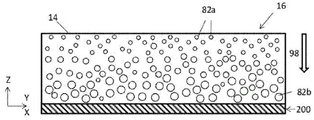
In some embodiments, the drying of the wet treatment layer is sufficiently fast to allow a rapid increase in viscosity of the aqueous treatment formulation sufficient to inhibit surface tension driven beading, thereby allowing the dried treatment film to have a smooth upper surface.
In some embodiments, the smooth upper surface of the dry-processed film is characterized by an average roughness, R a At most 12 nanometers, or at most 10 nanometers, or at most 9 nanometers, or at most 8 nanometers, or at most 7 nanometers, or at most 5 nanometers.
In some embodiments, the drying of the treatment solution is performed fast enough to prevent beading and leave a continuous hydrophilic and cohesive polymeric treatment film having a thickness of at most 200nm, or at most 150nm, or at most 120nm, or at most 100nm, or at most 80nm, or at most 70nm, or at most 60nm, or at most 50nm, or at most 40nm, or at most 30 nm.
In some embodiments, the thickness of the dried treatment film on which the aqueous ink droplets are deposited is at most 200nm, or at most 120nm, or at most 100nm, or at most 80 nm.
In some embodiments, the thickness of the dried treatment film on which the aqueous ink droplets are deposited is at least 15nm, or at least 20nm, or at least 30 nm.
In some embodiments, the dry-treated film is continuous across a rectangle of the release surface of the ITM, wherein the rectangle has a width of at least 10cm and a length of at least 10 m.
In some embodiments, the dried film comprises at least 50%, or at least 75%, or at least 90%, or at least 95%, or at least 99%, or 100% of the area of the rectangle, and the thickness of the dried film deviates no more than 50%, or no more than 40%, or no more than 30% from the average thickness value within the rectangle
In some embodiments, during the drying process of the wet treated layer, its dynamic viscosity increases by at least 1000-fold over a period of up to 250 milliseconds.
In some embodiments, the liquid content of the dried treatment film is at most 10 wt.%, or at most 7.5 wt.%, or at most 5 wt.%, or at most 2.5 wt.%, or at most 1.5 wt.%, or at most 1 wt.%.
In some embodiments, the droplets of aqueous ink are deposited onto the drying treatment film by inkjet.
In some embodiments, the ink image residue is transferred to the print substrate along with the non-printed areas of the dried treatment film.
In some embodiments, the thickness of the dried treated film is at most 120 nm.
In some embodiments, the dry-treated film has sufficient cohesion such that during transfer of the ink image residue, the dry-treated film is completely separated from the ITM and transferred to the print substrate along with the dried ink image in both the printed and non-printed areas.
In some embodiments, the transfer of the ink image residue is performed at a transfer temperature of at most 100 ℃ or at most 90 ℃.
In some embodiments, the solids (e.g., nanopigments and/or resins) of the aqueous ink migrate into the bulk of the drying treatment film to interact with (e.g., bind to) the quaternary ammonium salt residing within the drying treatment film (e.g., to facilitate droplet spreading).
In some embodiments, the solids of the aqueous ink migrate into the bulk of the drying treatment film to interact with the quaternary ammonium salt residing within the drying treatment film so as to facilitate droplet spreading.
In some embodiments, the method is performed such that: i. forming a set of ink dots IDS of ink substrate resident ink dots; a plurality of droplets (drop complexity) DP of aqueous ink droplets deposited onto the ITM resident drying treatment film form a set of ink dots IDS of ink substrate resident ink dots such that there is a correspondence between: A. a correspondence exists between each given drop of the plurality of drops DP and a respective given substrate resident drop of the set of b. ink dots, thereby causing the given drop to create and/or evolve into the given substrate resident ink dot; during deposition, whenever a droplet of the plurality of droplets collides with a drying process film on the ITM, the kinetic energy of the colliding droplet deforms the droplet; the maximum impact radius of each deformed droplet on the ITM surface has a maximum impact radius value R Maximum impact (ii) a v. after impact, physico-chemical forces spread the deformed droplet, thereby causing the substrate to resideEach ink dot of the ink dot set IDS has a dry dot radius R Dry spot on substrate (ii) a For each droplet of the plurality of droplets and a corresponding ink dot of the ink dot set IDS, at a. substrate resident dry dot radius R Dry spot on substrate Maximum impact radius value R of deformed liquid drop Maximum impact At least 1.1.
In some embodiments, the method is performed such that: i. a plurality of droplets DP of droplets deposited onto the ITM-resident drying process film produce a set of substrate-resident ink dots IDS (i.e., fixedly adhered to the top substrate surface), each droplet of the plurality of droplets DP corresponding to a different respective substrate-resident ink dot of the set of ink dots IDS; depositing each droplet of the plurality of droplets DP onto the substrate according to the jetting parameters; the jetting parameters together with the physicochemical properties of the ink drops of the plurality of drops DP define the ink jet paper dot radius R Direct jetting onto ink-jet paper, theory A radius of an ink dot obtained by directly jetting ink droplets onto an inkjet paper instead of jetting ink onto a dry processing film; and iv (A) the dry dot radius R of the dots of the dot set IDS Dry spot on substrate And (B) ink-jet paper dot radius R Direct jetting onto ink-jet paper, theory At least 1.1.
In some embodiments, the cardinality of the ink dot set is at least 5, or at least 10, or at least 20, or at least 50, or at least 100, and each dot of the ink dot set is different on the substrate.
In some embodiments, the ink dots of a set of ink dots are contained within a square geometric projection projected onto a printing substrate, each ink dot of the set of ink dots being fixedly adhered to the surface of the printing substrate, all the ink dots within the square geometric projection being counted as individual members of a set of ink dots IDS.
In some embodiments, the method is performed such that: i. forming a set of ink dots IDS of ink substrate resident ink dots; the cardinality of the ink dot set is at least 5, or at least 10, or at least 20, or at least 50, or at least 100, each ink dot of the ink dot set being different on the substrate; the ink dots of the ink dot set are contained within a square geometric projection projected on the printing substrate, each ink of the ink dot setDots are fixedly adhered to the surface of the printing substrate, all of the ink dots within the square geometric projection being counted as individual members of a set of ink dots IDS; each of said ink dots containing at least one colorant dispersed in an organic polymeric resin, each of said dots having an average thickness of less than 2,000nm and a diameter of from 5 microns to 300 microns; v. each of the dots has a generally convex shape with a deviation from convexity (DC) Dot ) Is defined by the formula: DC (direct current) Dot (iii) 1-AA/CSA, AA being the calculated projected area of said dots, said area disposed substantially parallel to said printed substrate; and CSA is a convex shaped surface area that minimally defines the contour of the projected area; average deviation of convexity from the set of ink Dots (DC) Point mean value ) At most 0.05, at most 0.04, at most 0.03, at most 0.025, at most 0.022, at most 0.02, at most 0.018, at most 0.017, at most 0.016, at most 0.015, or at most 0.014.
In some embodiments, the aqueous treatment formulation is applied to at least a portion or portions of the ITM that are running at a speed of at least 1 meter per second, or at least 1.5 meters per second, or at least 2 meters per second to form a wet treatment layer thereon.
In some embodiments, the method is performed such that the water soluble polymer concentration of the water soluble polymer within the aqueous treatment formulation is at most 10 wt.%, or at most 8 wt.%, or at most 6 wt.%, or at most 5 wt.%.
An aqueous treatment formulation for use with an intermediate transfer member of a printing system, the aqueous treatment formulation comprising: (a) a first surfactant composition comprising a first surfactant comprising a quaternary ammonium salt having a solubility in water of at least 5% at 25 ℃; (b) at least 1% by weight of a water-soluble polymer having a solubility in water of at least 5% at 25 ℃; and (c) a carrier liquid comprising water, said water comprising at least 65% by weight of the treatment formulation; wherein the concentration of the quaternary ammonium salt in the aqueous treatment formulation is at least 3 wt.%; and wherein the treatment formulation has (i) a static surface tension at 25 ℃ in the range of 20 dynes/cm and 40 dynes/cm, (ii) a 60 ℃ evaporation load of up to 8:1 by weight, and (iii) a 25 ℃ viscosity in the range of 10cP to 100 cP.
In some embodiments, the solubility of the quaternary ammonium salt is at least 7%, at least 10%, at least 15%, or at least 20%, optionally, at most 50%, at most 40%, or at most 35%, or further optionally, in a range from 5% to 40%, 5% to 30%, 5% to 25%, 7% to 35%, 10% to 35%, 12% to 35%, or 15% to 35%.
In some embodiments, the concentration of the quaternary ammonium salt within the aqueous treatment formulation is at least 4%, at least 5%, at least 6%, or at least 7%, optionally, at most 30%, at most 25%, or at most 20%, or further optionally, in a range of 2% to 30%, 3% to 30%, 4% to 20%, 5% to 25%, 6% to 20%, or 7% to 20%.
In some embodiments, the concentration of the water-soluble polymer within the aqueous treatment formulation is at least 1.5 wt.%, or at least 2 wt.%, at least 2.5 wt.%, at least 3 wt.%, or at least 3.5 wt.%, optionally, at most 10 wt.%, or at most 9 wt.%, or at most 8 wt.%, or at most 7 wt.%, or at most 6 wt.%, or further optionally, at least 1.5 wt.% to 20 wt.%, or 2 wt.% to 10 wt.%, 2 wt.% to 8 wt.%, 2 wt.% to 7 wt.%, 2.5 wt.% to 10 wt.%, 2.5 wt.% to 8 wt.%, 2.5 wt.% to 7 wt.%, 2.5 wt.% to 6 wt.%, 3 wt.% to 8 wt.%, 3 wt.% to 7 wt.%, 3 wt.% to 6 wt.%, 3.5 wt.% to 10 wt.%, 3.5 wt.% to 8 wt.%, or a combination thereof, 3.5 to 7 wt%, 3.5 to 6 wt%, or 4 to 6 wt%.
In some embodiments, the solubility of the water soluble polymer in water is at least 7%, at least 10%, at least 12%, or at least 15%.
In some embodiments, wherein the water soluble polymer is selected from the group consisting of polyvinyl alcohol, water soluble cellulose, polyvinyl pyrrolidone (PVP), polyethylene oxide, polyethyleneimine and water soluble acrylates.
In some embodiments, wherein the evaporation duty at 60 ℃ is at most 6:1, or at most 5:1, at most 4:1, at most 3.5:1, or at most 3:1, and optionally, at least 2:1, at least 2.2:1, or at least 2.5: 1.
In some embodiments, further comprising a second surfactant selected to reduce the static surface tension of the aqueous treatment formulation, wherein the second surfactant is optionally a silicon polyether, the second surfactant optionally having a concentration within the formulation of at least 1 wt.%, at least 1.5 wt.%, at least 2 wt.%, at least 2.5 wt.%, or at least 3 wt.%, optionally, at most 15 wt.%, at most 12 wt.%, at most 10 wt.%, at most 8 wt.%, or at most 7 wt.%, or further optionally, in a range of 1.5 wt.% to 13 wt.%, 1.5 wt.% to 10 wt.%, 2 wt.% to 13 wt.%, 2 wt.% to 10 wt.%, 2.5 wt.% to 13 wt.%, 2.5 wt.% to 10 wt.%, or 3 wt.% to 10 wt.%.
In some embodiments, the treatment formulation further comprises a water-absorbing agent disposed within said carrier liquid at least in the range of 25 ℃ to 60 ℃; thus, the water absorbing agent functions as a water absorbing agent when the aqueous treatment solution is evaporated to form a solid film.
In some embodiments, further comprising a water-absorbing agent disposed within the carrier liquid, the water-absorbing agent being a solid at least in the range of 25 ℃ to 60 ℃ in a pure state; thus, the water absorbing agent functions as a water absorbing agent when the aqueous treatment solution is evaporated to form a solid film.
In some embodiments, the water absorbing agent has a concentration of 1% to 25%, 1% to 15%, 1% to 10%, 2.5% to 20%, 2.5% to 12%, 3% to 15%, 3% to 12%, 3% to 10%, or 3.5% to 12%.
In some embodiments, the concentration of the quaternary ammonium salt is in the range of 3% to 15%; the concentration of the water-soluble polymer is in the range of 2.5% to 10%, or 2.5% to 8%, or 2.5% to 7%, or 2.5% to 6%, the evaporation load at 60 ℃ is in the range of 2.5:1 to 4:1, and the viscosity is at least 12cP, and optionally, at least 14cP or at least 16 cP.
In some embodiments, the static surface tension is in a range from 25 dynes/cm to 36 dynes/cm.
In some embodiments, the water absorbing agent has a concentration of 2.5% to 10%.
In some embodiments, the aqueous treatment formulation has a total surfactant concentration of at least 6%, at least 7%, at least 8%, at least 9%, or at least 10%, and optionally, in the range of 6% to 40%, 6% to 30%, 6% to 20%, 7% to 30%, 7% to 20%, 7% to 15%, 8% to 25%, 8% to 20%, 8% to 15%, or 8% to 13%.
In some embodiments, all components of the aqueous treatment formulation are completely dissolved.
In some embodiments, the total concentration of organic solvent within the aqueous treatment formulation is at most 3 wt.%, at most 2 wt.%, at most 1 wt.%, or at most 0.5 wt.%, or wherein the formulation is free of organic solvent.
In some embodiments, the total concentration of liquid hygroscopic agent within the aqueous treatment formulation is at most 1.5 wt.%, at most 1 wt.%, at most 0.5 wt.%, at most 0.3 wt.%, or at most 0.1 wt.%, or wherein the aqueous treatment formulation is free of liquid hygroscopic agent.
In some embodiments, the quaternary ammonium salt is an organic quaternary ammonium salt.
In some embodiments, the first carbon chain of the organic quaternary ammonium salt has a length of at least 6 carbon atoms, and optionally, in a range of 6 to 20, 6 to 18, 8 to 20, or 8 to 18 carbon atoms.
In some embodiments, the second carbon chain of the organic quaternary ammonium salt has a length of at most 3 carbon atoms or at most 2 carbon atoms.
In some embodiments, the third carbon chain of the organic quaternary ammonium salt has a length of at most 3 carbon atoms, at most 2 carbon atoms, or 1 carbon atom.
In some embodiments, the organic quaternary ammonium salt is a cationic organic quaternary ammonium salt optionally having a sulfate or phosphate anion.
In some embodiments, the polyethyleneimine comprises at most 0.8%, 0.6%, 0.4%, or 0.3%, or 0.2%, or 0.1% by weight of the formulation, or wherein the polyethyleneimine comprises at most 30%, at most 20%, at most 15%, at most 10%, or at most 5% of the water-soluble polymer.
In some embodiments, the viscosity is at least 12cP, at least 14cP, or at least 16cP, optionally at most 90cP, at most 80cP, at most 70cP, at most 60cP, at most 55cP, or at most 50cP, and further optionally, in a range of 10cP to 80cP, 12cP to 60cP, 12cP to 55cP, or 14cP to 60 cP.
In some embodiments, the water-soluble polymer concentration of the water-soluble polymer in the aqueous treatment formulation is at most 10 wt.%, or at most 8 wt.%, or at most 6 wt.%, or at most 5 wt.%.
In some embodiments, provided ITMs comprise: (a) a support layer; and (b) a release layer having an ink-receiving surface for receiving an ink image, and a second surface opposite the ink-receiving surface, the second surface being attached to the support layer, the release layer being formed from an addition-cured silicone material, the release layer having a thickness of at most 500 micrometers (μm); the ITM satisfies at least one of the following structural properties: (1) the total surface energy of the ink-receiving surface is at least 2, at least 3, at least 4, at least 5, at least 6, at least 8, or at least 10mN/m higher than the total surface energy of a modified ink-receiving surface produced by subjecting the ink-receiving surface of the respective release layer to a standard aging procedure; (2) the total surface energy of the ink receiving surface is at least 4mN/m, at least 6mN/m, at least 8mN/m, at least 10mN/m, at least 12mN/m, at least 14mN/m, or at least 16mN/m higher than the total surface energy of the hydrophobic ink receiving surface of a corresponding release layer prepared by standard air curing of a silicone precursor of the cured silicone material; (3) a receding contact angle of a distilled water droplet on the ink receiving surface that is at least 7 °, at least 8 °, at least 10 °, at least 12 °, at least 14 °, at least 16 °, at least 18 °, or at least 20 ° lower than a receding contact angle of a distilled water droplet on an ink receiving surface of a corresponding release layer prepared by standard air curing of an organosilicon precursor of the cured silicone material; (4) (ii) the receding contact angle of a distilled water droplet on the ink receiving surface is at least 5 °, at least 6 °, at least 7 °, or at least 8 ° lower than the receding contact angle of a distilled water droplet on an aged surface produced by subjecting the ink receiving surface to a standard aging procedure; (5) the ink-receiving surface having a surface hydrophobicity characterized by a receding contact angle of a distilled water drop on the ink-receiving surface that is less than a bulk hydrophobicity of the cured silicone material within the release layer, the bulk hydrophobicity characterized by a receding contact angle of a distilled water drop disposed on an inner surface formed by exposing a region of the cured silicone material within the release layer to form an exposed region; wherein the receding contact angle measured on the ink receiving surface is at least 7 °, at least 8 °, at least 10 °, at least 12 °, at least 14 °, at least 16 °, at least 18 °, or at least 20 ° lower than the receding contact angle measured on the exposed area; and
(6) a receding contact angle of a distilled water droplet on the ink receiving surface is at most 60 °, at most 58 °, at most 56 °, at most 54 °, at most 52 °, at most 50 °, at most 48 °, at most 46 °, at most 44 °, at most 42 °, at most 40 °, at most 38 °, or at most 36 °.
In some embodiments, the addition-cured silicone material consists essentially of, or contains at least 95% by weight of, an addition-cured silicone.
In some embodiments, the functional group constitutes at most 5 wt.%, at most 3 wt.%, at most 2 wt.%, or at most 1 wt.% of the addition-cured silicone material, or wherein the addition-cured silicone material is substantially free of the functional group.
In some embodiments, a polyether diol-functionalized polydimethylsiloxane is impregnated in the addition-cured silicone material.
In some embodiments, the polyether diol-functional siloxane is impregnated in the addition-cured silicone material, but does not form part of the covalent structure of the addition-cured silicone material.
An Intermediate Transfer Member (ITM) for use with a printing system (e.g., this may be the ITM of the 'ITM provided'), the ITM comprising: (a) a support layer; and (b) a release layer having an ink receiving surface for receiving an ink image, and a second surface opposite the ink receiving surface, the second surface being attached to the support layer, the release layer being formed of an addition cured silicone material, the release layer having a thickness of at most 500 micrometers (μm); the ink receiving surface is adapted to satisfy at least one of the following structural properties: (i) a receding contact angle of a distilled water droplet on the ink receiving surface of at most 60 °; (ii) a 10 second Dynamic Contact Angle (DCA) of at most 108 ° for a distilled water droplet deposited on the ink receiving surface; and wherein the release layer has at least one of the following structural properties: (1) the addition-cured silicone material consisting essentially of, or containing at least 95 weight percent of the addition-cured silicone; (2) the functional groups comprise up to 3 wt.% of the addition-cured silicone material.
In some embodiments, the receding contact angle is at most 58 °, at most 56 °, at most 54 °, at most 52 °, at most 50 °, at most 48 °, at most 46 °, at most 44 °, at most 42 °, at most 40 °, at most 38 °, or at most 37 °.
In some embodiments, the ITM (i.e., printing method) provided has the following features: the functional group constitutes at most 2 wt.%, at most 1 wt.%, at most 0.5 wt.%, at most 0.2 wt.%, or at most 0.1 wt.% of the addition-cured silicone material, or wherein the addition-cured silicone material is substantially free of the functional group. In some embodiments, a polyether diol-functionalized polydimethylsiloxane is impregnated in the addition-cured silicone material.
In some embodiments, the ITM (i.e., printing method) provided has the following features: the polyether diol functional siloxane is impregnated in the addition-cured silicone material, but does not form part of the covalent structure of the addition-cured silicone material.
In some embodiments, the ITMs (i.e., printing methods) provided have the following characteristics: the thickness of the release layer is at most 500 μm, at most 100 μm, at most 50 μm, at most 25 μm, or at most 15 μm.
In some embodiments, the ITM (i.e., printing method) provided has the following features: the thickness of the release layer is in a range of 1 μm to 100 μm, 5 μm to 100 μm, 8 μm to 100 μm, 10 μm to 100 μm, or 10 μm to 80 μm.
In some embodiments, the ITM (i.e., printing method) provided has the following features: the support layer has a thickness in a range of about 50 micrometers (μ) to 1000 μ, 100 μ to 800 μ, or 100 μ to 500 μ.
In some embodiments, the ITM (i.e., printing method) provided has the following features: the total surface energy of the ink receiving surface is at least 2J/m higher than the total surface energy of a modified ink receiving surface produced by subjecting the ink receiving surface of the corresponding release layer to a standard aging procedure 2 At least 3J/m 2 At least 4J/m 2 At least 5J/m 2 At least 6J/m 2 At least 8J/m 2 Or at least 10J/m 2 。
In some embodiments, the ITM (i.e., printing method) provided has the following features: the total surface energy of the ink-receiving surface is at least 4J/m greater than the total surface energy of the hydrophobic ink-receiving surface of a corresponding release layer prepared by standard air curing of an organosilicon precursor of a cured silicone material 2 At least 6J/m 2 At least 8J/m 2 At least 10J/m 2 At least 12J/m 2 At least 14J/m 2 Or at least 16J/m 2 。
In some embodiments, the ITM (i.e., printing method) provided has the following features: wherein the receding contact angle of a distilled water droplet on the ink receiving surface is at least 7 °, at least 8 °, at least 10 °, at least 12 °, at least 15 °, at least 18 °, or at least 20 ° lower than the receding contact angle of a distilled water droplet on the ink receiving surface of a corresponding release layer prepared by standard air curing of a silicone precursor of a cured silicone material.
In some embodiments, the receding contact angle of a distilled water droplet on the ink receiving surface is at least 5 °, at least 6 °, at least 7 °, or at least 8 ° lower than the receding contact angle of a distilled water droplet on an aged surface generated by subjecting the ink receiving surface to a standard aging procedure.
In some embodiments, the ink-receiving surface has a surface hydrophobicity characterized by a receding contact angle of a drop of distilled water on the ink-receiving surface that is less than a bulk hydrophobicity of the cured silicone material within the release layer, the bulk hydrophobicity characterized by a receding contact angle of a drop of distilled water disposed on an inner surface formed by exposing a region of the cured silicone material within the release layer to form an exposed region.
In some embodiments, the ITM (i.e., printing method) provided has the following features: the receding contact angle measured on the ink receiving surface is at least 7 °, at least 8 °, at least 10 °, at least 12 °, at least 14 °, at least 16 °, at least 18 °, or at least 20 ° lower than the receding contact angle measured on the exposed area.
In some embodiments, the receding contact angle of the distilled water drop on the ink receiving surface is at least 25 °, at least 28 °, at least 30 °, at least 32 °, at least 34 °, or at least 36 °, and further optionally, in a range of 25 ° to 60 °, 28 ° to 60 °, 30 ° to 55 °, 30 ° to 50 °, 32 ° to 60 °, 32 ° to 55 °, 32 ° to 44 °, 35 ° to 60 °, 35 ° to 55 °, 36 ° to 44 °, or 38 ° to 50 °.
In some embodiments, wherein the release layer is adapted such that the polar groups of the ink receiving surface have an orientation away from or opposite the second surface. In some embodiments, wherein the release layer is adapted such that when the ITM is in the operational mode, the ink receiving surface is exposed to the ambient environment, the polar groups of the ink receiving surface have an orientation towards or facing the ambient environment.
In some embodiments, the ITM (i.e., printing method) provided has the following features: the ITM forms a component in a digital printing system.
In some embodiments, the ITM (i.e., printing method) provided has the following features: the support layer includes an elastomeric compliant layer attached to the second surface of the release layer, the elastomeric compliant layer adapted to closely follow a surface contour of a print substrate onto which the ink image is imprinted.
In some embodiments, the ITMs (i.e., printing methods) provided have the following characteristics: the support layer includes a reinforcing layer attached to the compliant layer.
In some embodiments, the ITM (i.e., printing method) provided has the following features: the release layer contains a total amount of functional groups of at most 3 wt.%, at most 2 wt.%, at most 1 wt.%, at most 0.5 wt.%, at most 0.2 wt.%, or substantially 0 wt.% within its silicone polymer matrix.
In some embodiments, the ITM (i.e., printing method) provided has the following features: the release layer contains a total amount of up to 3 wt%, up to 2 wt%, up to 1 wt%, up to 0.5 wt%, up to 0.2 wt%, or substantially 0 wt% of functional groups selected from the group of moieties consisting of C-O, S-O, O-H and COO within its silicone polymer matrix.
In some embodiments, the ITM (i.e., printing method) provided has the following features: the release layer contains a total amount of up to 3 wt%, up to 2 wt%, up to 1 wt%, up to 0.5 wt%, up to 0.2 wt%, or substantially 0 wt% of functional groups selected from the group consisting of silane, alkoxy, amido, and amido-alkoxy moieties within its silicone polymer matrix.
In some embodiments, the ITM (i.e., printing method) provided has the following features: the release layer contains a total amount of up to 3 wt%, up to 2 wt%, up to 1 wt% in its silicone polymer matrix,Up to 0.5 wt.%, up to 0.2 wt.%, or substantially 0 wt.% of a compound selected from the group consisting of amine, ammonium, aldehyde, SO 2 、SO 3 、SO 4 、PO 3 、PO 4 And C-O-C.
In some embodiments, the ITM (i.e., printing method) provided has the following features: the addition-cured silicone material has a structure composed of a vinyl-functional silicone.
In some embodiments, the ITMs (i.e., printing methods) provided have the following characteristics: the addition-cured silicone material contains polar groups of the "MQ" type.
In some embodiments, the ITMs (i.e., printing methods) provided have the following characteristics: the total surface energy of the ink receiving surface was evaluated using an Owens-Wendt surface energy model.
In some embodiments, the ITM (i.e., printing method) provided has the following features: the 10 second DCA is at most 108 °, at most 106 °, at most 103 °, at most 100 °, at most 96 °, at most 92 °, or at most 88 °, optionally, at least 60 °, at least 65 °, at least 70 °, at least 75 °, at least 78 °, at least 80 °, at least 82 °, at least 84 °, or at least 86 °, and further optionally, in a range of 60 ° to 108 °, 65 ° to 105 °, 70 ° to 100 °, 70 ° to 96 °, 70 ° to 92 °, 75 ° to 105 °, 75 ° to 100 °,80 ° to 105 °,80 ° to 100 °, 85 ° to 105 °, or 85 ° to 100 °.
In some embodiments, the ITM (i.e., printing method) provided has the following features: the ink receiving surface is adapted such that for the distilled water droplet deposited on the ink receiving surface, the difference between the 70 second Dynamic Contact Angle (DCA) and the 10 second DCA is at least 7 °, at least 8 °, at least 10 °, or at least 12 °, optionally at most 25 °, at most 22 °, at most 20 °, at most 18 °, or at most 17 °, and further optionally, in the range of 6 ° to 25 °, 6 ° to 22 °, 6 ° to 20 °, 6 ° to 18 °, 6 ° to 17 °, 7 ° to 25 °, 7 ° to 20 °, 7 ° to 17 °,8 ° to 25 °,8 ° to 22 °, 18 ° to 20 °,8 ° to 17 °,10 ° to 25 °,10 ° to 22 °,10 ° to 20 °,10 ° to 18 °, or 10 ° to 17 °.
In some embodiments, the ink receiving surface is adapted such that for the distilled water droplets deposited on the ink receiving surface, the 70 second DCA is at most 92 °, at most 90 °, at most 88 °, at most 85 °, at most 82 °, at most 80 °, at most 78 °, at most 76 °, at most 74 °, or at most 72 °, optionally at least 55 °, at least 60 °, at least 65 °, or at least 68 °, and further optionally, in a range of 55 ° to 92 °, 55 ° to 90 °, 55 ° to 85 °, 55 ° to 80 °, 65 ° to 92 °, 65 ° to 90 °, 65 ° to 85 °, 65 ° to 80 °, 68 ° to 85 °, 68 ° to 80 °, 70 ° to 92 °, 70 ° to 90 °, 70 ° to 85 °, or 70 ° to 80 °.
A printing system, comprising: a. an Intermediate Transfer Member (ITM) comprising a flexible endless belt mounted on a plurality of guide rollers; b. an image forming station configured to form an ink image on a surface of the ITM, first and second guide rollers arranged upstream and downstream of the image forming station to define an upper run and a lower run through the image forming station; b. an impression station through which a lower run of the ITM passes, the impression station disposed downstream of the image forming station and configured to transfer an ink image from a surface of the ITM to a substrate; a processing station disposed downstream of the embossing station and upstream of the image forming station for forming a uniform thin layer of liquid treatment formulation on the ITM surface on a lower run thereof, the processing station comprising: i. a coater for coating the ITM with a liquid treatment formulation; a coating thickness adjustment assembly for removing excess liquid to leave only a desired uniform thin layer of treatment formulation, the coating thickness adjustment assembly comprising a rounded tip facing the ITM surface on a lower stroke.
In some embodiments, the rounded tip is the tip of a spatula.
In some embodiments, the doctor blade is oriented normal to the ITM surface.
In some embodiments, the rounded tip is pushed toward the ITM surface and/or vice versa.
In some embodiments, the rounded tip is pushed toward the ITM surface by a backing roll having a soft outer surface and/or vice versa.
In some embodiments, (i) the backing roll is disposed inside the closed loop of the endless belt and positioned opposite the blade and/or (ii) the backing roll and the rounded tip are disposed on opposite sides of the lower run of the ITM.
In some embodiments, the outer surface of the backing roll has one or more of the following properties: (i) elasticity; (ii) zero memory; (iii) maintaining a soft outer surface thereof over a range of temperatures; (iv) constructed of polyurethane.
In some embodiments, the difference between the maximum and minimum values of the temperature range is at least 10 ℃, or at least 20 ℃, or at least 50 ℃ and/or the average value of the temperature range is between 50 ℃ and 120 ℃.
In some embodiments, the backing roll has a compressible surface that is compressed when the rounded tip is pushed against the ITM surface and/or vice versa, thereby causing the rounded tip to penetrate into the ITM at a penetration depth.
In some embodiments, when the rounded tip is pushed against the surface of the ITM and/or vice versa, the rounded tip is thereby caused to penetrate into the ITM at a penetration depth.
In some embodiments, the penetration depth is at least 1m, or at least 2mm and/or at most 5mm, or at most 4mm, or at most 3mm in size.
In some embodiments, the rounded tip is pushed towards the ITM and/or vice versa against the liquid solution disposed in the gap between the rounded tip and the portion of the ITM surface facing the rounded tip, under a force equilibrium, thereby keeping the gap constant.
In some embodiments, the size of the gap adjusts the thickness of the desired uniform thin layer of treatment formulation.
In some embodiments, the ratio between the gap and the thickness of the desired uniform thin layer is at least 0.1, or at least 0.25, or at least 0.5, and/or at most 10, or at most 4, or at most 2.
In some embodiments, (i) the size of the gap is at most 2 microns, or at most 1 micron, or at most 0.8 microns, or at most 0.6 microns, and/or (ii) the ratio between the size of the gap and the penetration depth of the rounded tip through the ITM surface is at most 0.01, or at most 0.005, or at most 0.001, or at most 0.0005.
In some embodiments, the penetration depth is set to a set point value, and the magnitude of the pushing force is adjusted to maintain the penetration depth at the set point value.
In some embodiments, the radius of curvature of the rounded scraper tip is at most 2mm, or at most 1.5mm, or at most 1.25mm, or at most 1 mm.
In some embodiments, the coater used to coat the ITM is selected from the group consisting of (i) a spray device and (ii) a wetting tray positioned below the lower run of the ITM, in which a quantity of liquid treatment formulation is placed.
In some embodiments, the system includes a cleaning station positioned downstream of the impression station and upstream of the conditioning station for removing residual material remaining on the ITM surface after the transfer of the ink image to the substrate.
In some embodiments, the scraper is one of a plurality of scrapers mounted on the circumference of a turret that is rotatable to facilitate replacement of the scraper that is pushed against the surface.
In some embodiments, the spacing of the blades on the circumference of the turret is such that during rotation of the turret to change blades, the blade being changed does not stop working before the changing blade begins to function.
In some embodiments, a blade cleaning device is disposed adjacent to the turret to remove any deposits that adhere to the now inactive blade.
In some embodiments, a blade cleaning device is provided adjacent the turret to remove any deposits that adhere to the now inactive blade.
In some embodiments, the cleaning device is a rotating brush.
A printing method includes: a. providing an aqueous ink, an aqueous treatment formulation, and an Intermediate Transfer Member (ITM) having a release surface; b. applying an aqueous treatment formulation onto the release surface of the ITM to form a wet treatment layer thereon; c. subjecting the wet-processed layer to a drying process to form a dried-processed film from the wet-processed layer and on the ITM; d. depositing aqueous ink droplets onto the drying process film to form an ink image thereon; e. drying the ink image to leave an ink image residue on the release surface of the ITM; transferring the ink image residue to the printing substrate by pressure contact between the ITM and the substrate.
In some embodiments, the ink image residue is transferred to the print substrate along with the non-printed areas of the drying treatment film.
In some embodiments, the drying process film mechanically links and/or adheres the non-printed areas to the ink image residue during and/or immediately after transfer.
In some embodiments, the drying treatment film is continued over a plurality of different substrate resident ink dots immediately after the ink image residue.
In some embodiments, at least the release surface of the ITM has a shore a hardness of at most 50, or at most 45, or at most 40, or at most 35, or at most 30, or at most 25, or at most 20, or at most 15.
In some embodiments, the ITM is in the form of an endless belt mounted on a plurality of rollers, the wet processing layer being formed by applying pressure (e.g., in a normal direction) to the surface of the ITM at an inter-roller location between the upstream and downstream rollers.
In some embodiments, (i) an aqueous treatment formulation is applied to the ITM while the ITM is in-service, thereby causing at least a portion or portions thereof to move at a speed of at least 0.5 meters per second, or at least 1 meter per second, or at least 1.5 meters per second, or at least 2 meters per second, or at least 2.5 meters per second, or at least 3 meters per second, and (ii) an aqueous treatment formulation is applied to one or more in-service portions of the ITM to form a wet-treated layer thereon.
In some embodiments, the wet-treated layer is formed by applying a force to the ITM from a highly rounded surface having a radius of curvature of at most 5mm, or at most 3mm, or at most 2.5mm, or at most 2mm, or at most 1.75mm, or at most 1.5mm, or at most 1.25mm, or at most 1 mm.
In some embodiments, the highly rounded surface is a surface of a doctor blade.
In some embodiments, the doctor blade is oriented in the cross-print direction and is urged against the ITM with a force density of at least 250g/cm, or at least 350g/cm, or at least 400gm/cm, and/or at most 1kg/cm, or at most 750g/cm, or at most 600g/cm in the cross-print direction.
In some embodiments, the doctor blade is formed of a wear resistant material having a brinell hardness in excess of 100.
In some embodiments, the blade is smooth and/or has a regular cylindrical surface.
In some embodiments, the surface roughness RA of the doctor blade is at most a few microns, or at most 1 micron, or at most 0.5 micron.
In some embodiments, the doctor blade is one of a plurality of doctor blades mounted on a turret that is rotatable to allow for rapid replacement of the doctor blade interacting with the surface of the ITM.
In some embodiments, the spacing of the blades on the turret is such that during rotation of the turret to change blades, the changed blades do not stop interacting with the ITM before the changing blade begins to interact with the ITM.
In some embodiments, a cleaning device, such as a rotating brush, is provided near the turret to the rounded edge of at least one blade that is not currently interacting with the ITM.
In some embodiments, wherein prior to applying the aqueous treatment solution to the release surface of the ITM, the release surface of the ITM is washed to remove any treatment film remaining on the release surface after completion of the previous print cycle.
In some embodiments, washing of the release surface of the ITM is performed using an aqueous treatment solution to dissolve any dry treatment film on the release layer.
In some embodiments, the wet treated layer has a thickness of at most 2 μ, or at most 1.5 μ, or at most 1 μ, or at most 0.9 μ, or at most 0.8 μ, or at most 0.7 μ, or at most 0.6 μ, or at most 0.5 μ, or at most 0.4 μ, or at most 0.3 μ, or at most 0.2 μ, or at most 0.15 μ.
In some embodiments, the wet processed layer has a uniform thickness.
In some embodiments, over a rectangle having a width of at least wcm and a length of at least lcm, the entire rectangle is covered by the wet treatment film, thereby causing the thickness of the wet treatment film to deviate from the average thickness value within the rectangle by no more than 50%, or no more than 40%, or no more than 30%, or no more than 20%, or no more than 10%, or no more than 5%, or no more than 2.5%, or no more than 1%, wherein (i) the value of w is at least 10, or at least 20, or at least 30, and/or at most 100, or at most 80, or at most 60, and (ii) the value of l is at least 50, or at least 100, or at least 250, or at least 500, or at least 1000.
In some embodiments, the formation of the i.thin wet treatment layer comprises generating a velocity gradient of the aqueous treatment solution at strong velocity gradient (IVG) locations that are (a) generally displaced (e.g., at most 3 microns, or at most 2 microns, or at most 1 micron) from the release surface of the ITM and/or (B) between the applicator and the release surface of the applicator; at the IVG position, the magnitude of the velocity gradient equals or exceeds a VG value, said VG value being at least 10 6 sec -1 Or at least 2X 10 6 sec -1 Or at least 4X 10 6 sec -1 Or at least 5X 10 6 sec -1 Or at least 7.5X 10 6 sec -1 Or at least 10 7 sec -1 Or at least 2X 10 7 sec -1 Or at least 4X 10 7 sec -1 Or at least 5X 10 7 sec -1 Or at least 7.5X 10 7 sec -1 。
In some embodiments, the velocity gradient is oriented in the printing direction such that: i. at an upstream position upstream of the IVG position, the maximum velocity gradient is at most x% of the velocity gradient value at the IVG position; at a downstream position downstream of the IVG position, the maximum velocity gradient is at most x% of the velocity gradient value at the IVG position; x has a value of at most 50, or at most 30, or at most 20, or at most 10; the upstream and downstream positions are each displaced in the printing direction from the IVG position by at most 2cm, or at most 1.5cm, or at most 1.25cm, or at most 1cm, or at most 9mm, or at most 8mm, or at most 7.5mm, or at most 7mm, or at most 6mm, or at most 5 mm.
In some embodiments, the drying of the treatment solution is performed sufficiently fast to prevent beading and leave a continuous hydrophilic and cohesive polymeric treatment film having a thickness (e.g., a substantially uniform thickness) of at most 200nm, or at most 150nm, or at most 120nm, or at most 100nm, or at most 80nm, or at most 70nm, or at most 60nm, or at most 50nm, or at most 40nm, or at most 30 nm.
However, in various embodiments, even if the dried film is extremely thin, it is thicker than a single layer or monolayer type construction. Thus, in various embodiments, the thickness of the dried treatment layer may be at least 20 nanometers, or at least 30 nanometers, or at least 40 nanometers, or at least 50 nanometers. In some embodiments, providing such "bulk" (i.e., minimum thickness features-e.g., in conjunction with one or more other features described below) facilitates the formation of a dried handling film having cohesive and/or elastic properties-which may be used in step S117 where it is desired that the dried handling film (i.e., at that stage, bearing a dried ink image thereon) maintain its structural integrity when transferred from the ITM to a substrate.
In some embodiments, the thickness of the dried treatment film on which the ink droplets are deposited is at most 200nm, or at most 100nm, or at most 50nm, or at most 30 nm.
In some embodiments, the thickness of the dried film on which the ink droplets are deposited is at least 15nm, or at least 20m, or at least 30nm, or at least 50nm, or at least 75 nm.
In some embodiments, the dry-treated film is continuous across a rectangle of the release surface of the ITM, wherein the rectangle has a width of at least w cm and a length of at least l cm, wherein (i) w has a value of at least 10, or at least 20, or at least 30, and/or at most 100, or at most 80, or at most 60, and (ii) l has a value of at least 50, or at least 100, or at least 250, or at least 500, or at least 1000.
In some embodiments, the dry-treated film is continuous, such that the thickness of the dry-treated film deviates no more than 50%, or no more than 40%, or no more than 30%, or no more than 20%, or no more than 10%, or no more than 5%, or no more than 2.5%, or no more than 1% from the average thickness value within the rectangle for at least 50%, or at least 75%, or at least 90%, or at least 95%, or at least 99%, or 100% of the area of the rectangle.
In some embodiments, during the drying process of the wet-processed layer, its dynamic viscosity increases by at least 100-fold, or at least 500-fold, or at least 1000-fold, or at least 2500-fold, or at least 5000-fold, or at least 10,000-fold, or at least 25,000-fold over a time period of at most 1 second, or at most 500 milliseconds, or at most 250 milliseconds, or at most 150 milliseconds, or at most 100 milliseconds, or at most 75 milliseconds, or at most 50 milliseconds, or at most 25 milliseconds, or at most 15 milliseconds, or at most 10 milliseconds.
In some embodiments, the liquid content of the dried treated membrane is at most 10 wt.%, or at most 7.5 wt.%, or at most 5 wt.%, or at most 2.5 wt.%, or at most 1.5 wt.%, or at most 1 wt.%.
In some embodiments, the drying treatment removes at least 80 wt%, or at least 90 wt%, or at least 95 wt% of the water in the wet treatment layer (e.g., over a time period of at most 1 second, or at most 0.5 seconds, or at most 100 milliseconds, or at most 50 milliseconds, or at most 25 milliseconds, or at most 10 milliseconds) to form a dry treatment film.
In some embodiments, the drying process removes at least 80 wt.%, or at least 90 wt.%, or at least 95 wt.% of the 60 degrees celsius/1 atmosphere liquid of the wet-processed layer to form a dried processed film.
In some embodiments, the surface (e.g., upper surface) of the dried treated film on which the aqueous ink droplets are deposited is characterized by an average roughness, R a (typical one-dimensional roughness average parameters) are at most 30nm, or at most 25nm, or at most 20nm, or at most 18 nm, or at most 16 nm, or at most 15nm, or at most 14 nm, or at most 12nmOr at most 10 nanometers, or at most 9 nanometers, or at most 8 nanometers, or at most 7 nanometers, or at most 5 nanometers, and/or at least 3 nanometers, or at least 5 nanometers.
In some embodiments, the drying treatment film on which the aqueous ink droplets are deposited and the surface (e.g., upper surface) of the drying treatment film have (i) an average roughness R through the drying treatment layer a And (ii) a non-dimensional ratio between thicknesses, wherein the non-dimensional ratio is at least 0.02, or at least 0.03, or at least 0.04, or at least 0.05, or at least 0.06, or at least 0.07, or at least 0.08, or at least 0.09, or at least 0.10, or at least 0.11, or at least 0.12, or at least 0.13, or at least 0.14, or at least 0.15, or at least 0.16, or at least 0.17, or at least 0.18, or at least 0.19, or at least 0.2.
In some embodiments, the drying treatment film on which the aqueous ink droplets are deposited and the surface (e.g., upper surface) of the drying treatment film have (i) an average roughness R through the drying treatment layer a And (ii) a non-dimensional ratio between thicknesses, wherein the non-dimensional ratio is at most 0.5, at most 0.4, at most 0.3, at most 0.25, at most 0.2, at most 0.15, or at most 0.1, and optionally, at least 0.02, or at least 0.03, or at least 0.04, or at least 0.05, or at least 0.06, or at least 0.07, or at least 0.08.
In some embodiments, upon drying, the drying treatment film is continuous.
In some embodiments, the aqueous treatment formulation is provided in the form of a solution.
In some embodiments, the aqueous treatment formulation is provided in the form of a dispersion.
In some embodiments, wherein the solids of the aqueous ink (e.g., nanopigments and/or resins) migrate into the bulk of the drying treatment film to interact with (e.g., bind to) the quaternary ammonium salt residing within the drying treatment film (e.g., to facilitate droplet spreading).
In some embodiments, the substrate is selected from the group consisting of an uncoated fibrous printing substrate, a commercial coated fibrous printing substrate, and a plastic printing substrate.
In some embodiments, the printing substrate is paper, optionally selected from the group of papers consisting of security paper, uncoated offset paper, coated offset paper, copy paper, groundwood paper, coated groundwood paper, groundwood-free paper, coated groundwood-free paper, and laser paper.
In some embodiments, the transferring is performed at a transfer temperature of at most 120 ℃, or at most 100 ℃, or at most 90 ℃, or at most 80 ℃.
In some embodiments, the solids (e.g., nanopigments and/or resins) of the aqueous ink migrate into the bulk of the dry treated film to interact with (e.g., bind to) the quaternary ammonium salt residing within the dry treated film.
In some embodiments, the method is performed such that a set of ink dots IDS of ink substrate resident ink dots is formed.
In some embodiments, the method is performed such that the plurality of droplets DP of aqueous ink droplets deposited onto the drying treatment film on which the ITM resides form a set of ink dots IDS of ink-substrate-resident ink dots, such that there is correspondence between (i) each given droplet of the plurality of droplets DP and (ii) a respective given substrate-resident ink dot of the set of ink dots, thereby causing the given droplet to be generated and/or evolved into an ink dot on which the given substrate resides.
In some embodiments, the method is performed such that, during deposition, whenever a droplet of the plurality of droplets collides with a drying process film on the ITM, the kinetic energy of the colliding droplet deforms the droplet.
In some embodiments, the method is performed such that: (i) the maximum impact radius of each deformed droplet on the ITM surface has a maximum impact radius value R Maximum impact And (ii) after impact and/or during and/or after transfer, the physico-chemical forces spread the deformed droplets or the dots obtained thereby, whereby each dot of a set of ink dots IDS in which the substrate resides has a dry dot radius R Dry spots on a substrate (ii) a (iii) For each of the plurality of droplets and the corresponding ink dot of the ink dot set IDS, at
i. Radius of substrate dwell dry point R Dry spots on a substrate (ii) a And
maximum impact radius value R of deformed droplet Maximum impact ,
At least 1, or at least 1.01, or at least 1.02, or at least 1.03, or at least 1.04, or at least 1.05, or at least 1.1, or at least 1.15, or at least 1.2, or at least 1.25, or at least 1.3, or at least 1.35, or at least 1.4, or at least 1.45, or at least 1.5, and optionally, at most 2, at most 1.8, at most 1.7, at most 1.6, or at most 1.55.
In some embodiments, the method is performed such that: i. a plurality of droplets DP of droplets deposited onto the ITM-resident drying process film produce a set of substrate-resident ink dots IDS (i.e., fixedly adhered to the top substrate surface), each droplet of the plurality of droplets DP corresponding to a different corresponding substrate-resident ink dot of the set of ink dots IDS; depositing each droplet of the plurality of droplets DP onto the substrate according to the jetting parameters; the jetting parameters, together with the physicochemical properties of the ink droplets of the plurality of droplets DP, define the ink jet paper dot radius R Direct jetting onto ink-jet paper, theory A radius of an ink dot obtained by directly jetting ink droplets onto an inkjet paper instead of jetting ink onto a dry processing film; and iv (A) the dry dot radius R of the dots of the dot set IDS Dry spot on substrate And (B) ink-jet paper dot radius R Direct jetting onto ink-jet paper, theory At least 1, or at least 1.01, or at least 1.02, or at least 1.03, or at least 1.04, or at least 1.05, or at least 1.1, or at least 1.15, or at least 1.2, or at least 1.25, or at least 1.3, or at least 1.35, or at least 1.4, or at least 1.45, or at least 1.5, and optionally, at most 2, at most 1.8, at most 1.7, at most 1.6, or at most 1.55.
In some embodiments, the cardinality of the set of ink dots is at least 5, or at least 10, or at least 20, or at least 50, or at least 100, each ink dot of the set of ink dots being different on the substrate.
In some embodiments, the method is performed such that the ink dots of a set of ink dots are contained within a square geometric projection projected onto the printing substrate, each ink dot of the set of ink dots being fixedly adhered to the surface of the printing substrate, all the ink dots within the square geometric projection being counted as individual members of the set of ink dots IDS.
In some embodiments, the method is performed such that: each of the ink dots comprises at least one colorant dispersed in an organic polymeric resin, each of the dots having an average thickness of less than 2,000nm and a diameter of from 5 microns to 300 microns.
In some embodiments, the method is performed such that: each of the dots has a generally convex shape with a deviation from convexity (DC) Dot ) Is defined by the formula: DC (direct current) Dot (iii) 1-AA/CSA, AA being the calculated projected area of said dots, said area disposed substantially parallel to said printed substrate; and CSA is a convex shaped surface area that minimally defines the contour of the projected area; wherein the mean deviation of convexity from the set of ink Dots (DC) Point mean value ) At most 0.05, at most 0.04, at most 0.03, at most 0.025, at most 0.022, at most 0.02, at most 0.018, at most 0.017, at most 0.016, at most 0.015, or at most 0.014.
In some embodiments, the method is performed such that: wherein each dot comprises at least one colorant dispersed in an organic polymeric resin, each said dot covering a continuous area of the top surface of the substrate; each said dot is disposed entirely above said continuous region, such that (i) a projected perpendicular line extending downward toward said top substrate surface first meets said dot at each point in said continuous region before encountering said top substrate surface; and/or (ii) each of said ink dots has a diameter of 15 microns to 300 microns; and/or (iii) each of the ink dots has an average thickness of at most 1,800 nm; each of the ink dots is characterized by a dimensionless aspect ratio (R) defined by Longitudinal and transverse ):R Longitudinal and transverse =D Dot /H Dot In which D is Dot Is the diameter; and H Dot Is the average thickness; and/or (iv) the aspect ratio is at least 50, or at least 60, or at least 75, or at least 95, or at least 110, or at least 120, or at least 135, or at least 150, or at least 170,Or at least 180, or at least 190, or at least 200, or at least 220, or at least 240, or at least 260, or at least 280, or at least 300.
In some embodiments, the method is performed such that: the aspect ratio is at most 400, at most 350, or at most 325.
In some embodiments, the method is performed such that: each dot containing at least one colorant dispersed in an organic polymeric resin, each dot covering a continuous area of the top surface of the substrate; each said dot is disposed entirely above said continuous region, such that (i) a projected perpendicular line extending downward toward said top substrate surface first meets said dot at each point in said continuous region before encountering said top substrate surface; and/or (ii) each of said ink dots has a diameter of 15 microns to 300 microns; and/or (iii) each of the ink dots has an average thickness of at most 1,800 nm; each of the ink dots is characterized by a dimensionless aspect ratio (R) defined by Longitudinal and transverse ):R Longitudinal and transverse beams =D Dot /H Dot Wherein D is Dot Is the diameter; and H Dot Is the average thickness; and/or (iv) the aspect ratio is in the range of 140 to 400, 150 to 300, 160 to 300, 180 to 300, 200 to 300, 210 to 300, 220 to 300, 230 to 300, or 240 to 300.
In some embodiments, the method is performed such that: at least one (or at least a majority or all) of the ink dots of ink droplet set IDS contain less than 2% of a charge director.
In some embodiments, the method is performed such that: at least one (or at least a majority or all) of the ink dots of ink-drop set IDS are free of charge director.
In some embodiments, the method is performed such that: at least one (or at least a majority or all) of the ink dots of the ink dot set IDS has a thickness of at most 1,500nm, or at most 1000nm, or at most 800nm, or at most 600nm, or at most 400nm, or at most 350nm, or at most 300nm, or at most 250 nm.
In some embodiments, the method is performed such that: at least one (or at least a majority or all) of the ink dots of ink-drop set IDS contain at least 1.2% by weight of the colorant.
In some embodiments, the method is performed such that: at least one (or at least a majority or all) of the ink dots of ink droplet set IDS contain at least 5% by weight of the resin.
In some embodiments, the method is performed such that: at least one (or at least a majority or all) of the dots of a dot set IDS is such that the total concentration of the colorant and the resin within the dot is at least 40%.
In some embodiments, the method is performed such that: at least one (or at least a majority or all) of the dots of a dot set IDS is such that the weight ratio of the resin to the colorant within the dot is at least 1: 1.
In some embodiments, the method is performed such that: at least one (or at least most or all) of the ink dots of ink dot set IDS are such that there is no adhesive failure when subjected to standard tape testing.
In some embodiments, the method is performed such that: at least one (or at least a majority or all) of which each of said ink dots has a surface concentration of nitrogen at a membrane upper surface that exceeds a bulk concentration of nitrogen within said membrane, said bulk concentration being measured at a depth of at least 30 nanometers below said membrane upper surface, and wherein the ratio of said surface concentration to said bulk concentration is at least 1.1 to 1.
In some embodiments, the method is performed such that: at least one (or at least a majority or all) of the film upper surface of each of the ink dots exhibits an X-ray photoelectron spectroscopy (XPS) peak at 402.0 + -0.4 eV.
In some embodiments, the method is performed such that: at least one (or at least a majority or all) of the ink dots of the ink droplet set have a temperature in the range of 90 ℃ to 195 ℃ of 10 6 cP to 3.10 8 A first dynamic viscosity in the range of cP.
In some embodiments, the method is performedThe method comprises the following steps: a first dynamic viscosity of at most 7.10 7 cP。
In some embodiments, the method is performed such that: the first dynamic viscosity is 10 6 cP to 10 8 In the range of cP.
In some embodiments, the method is performed such that: the first dynamic viscosity is at least 4.10 6 cP。
In some embodiments, the method is performed such that: at least one (or at least a majority or all) of the plurality of continuous dots.
In some embodiments, the method is performed such that: the dot thickness is at most 1,200nm, or at most 1,000nm, or at most 800nm, or at most 650nm, or at most 500nm, or at most 450nm, or at most 400nm for at least one (or at least most or all).
In some embodiments, the method is performed such that the ITM is any ITM disclosed herein and/or the aqueous treatment solution is any aqueous treatment solution disclosed herein.
In some embodiments, the aqueous ink comprises a pigment, a binder, a dispersant, and at least one additive.
Drawings
Some embodiments of a printing system are described herein with reference to the drawings. This description, taken in conjunction with the accompanying drawings, enables one of ordinary skill in the art to understand how to implement the teachings of the present disclosure by way of non-limiting examples. The figures are for illustrative discussion purposes and are not intended to show structural details of embodiments in more detail than is necessary for a fundamental understanding of the present disclosure. For purposes of clarity and conciseness, some objects depicted in the drawings are not drawn to scale.
In the figure:
FIG. 1 is a flow chart of a prior art printing method;
fig. 2 and 12 are flow diagrams of a printing process according to some embodiments of the present invention;
FIGS. 3A-3D, 4A-4B, 5, 6-9, 10A-10B, and 11A-11C illustrate a printing system or components thereof;
FIG. 11D shows shear strength as a function of position;
13A-13E schematically depict the process of ink drop deposition on an ITM (e.g., a release surface thereof);
FIGS. 14A-14B provide an instrumentally plotted topographical feature map of a dried process film produced in accordance with the present invention;
15A-15D illustrate some examples of ink dots on a paper substrate;
FIG. 16 schematically shows a cross-section through a carrier;
figures 17 to 21 show schematically different stages of manufacturing an ITM according to the method of the invention;
FIG. 22 is a cross-sectional view through a completed ITM after installation in a printing system;
FIGS. 23A and 23B schematically show a cross-section through a release layer prepared according to the prior art;
FIG. 23C schematically shows a cross-section through a release layer prepared according to a method of the invention;
figures 24A to 24D schematically illustrate an apparatus in which some embodiments of the method of the invention may be implemented, showing different stages of manufacture;
FIGS. 25A-25C are images of various ink patterns printed onto a release layer of an ITM of the present invention, wherein the release layer is cured relative to the PET carrier surface; and
fig. 26A-26C are images of various ink patterns printed onto the release layer of a prior art ITM, where the release layer is air cured.
Detailed Description
The invention is herein described, by way of example only, with reference to the accompanying drawings. With specific reference now to the drawings in detail, it is stressed that the particulars shown are by way of example and for purposes of illustrative discussion of the preferred embodiments of the present invention only, and are presented in the cause of providing what is believed to be the most useful and readily understood description of the principles and conceptual aspects of the invention. In this regard, no attempt is made to show structural details of the present invention in more detail than is necessary for a fundamental understanding of the present invention, the description taken with the drawings making apparent to those skilled in the art how the several forms of the present invention may be embodied in practice. Like reference characters generally refer to like elements throughout the drawings.
Definition of
Within the present application, the following terms are to be understood as having the following meanings:
a) the term "receding contact angle" or "RCA" refers to a receding contact angle measured using a drop shape method using a Dataphysics OCA15 Pro contact angle measurement device or similar video-based optical contact angle measurement system. Similar "advancing contact angle" or "ACA" refers to an advancing contact angle measured in substantially the same manner.
b) The term "standard aging procedure" refers to an accelerated aging protocol in a standard convection oven at 160 ℃ for 2 hours for each release layer tested.
c) The term "standard air cure" refers to a conventional curing method for curing a release layer, wherein the release layer surface (or "ink receiving surface") is exposed to air during curing of the release layer.
d) The term "bulk hydrophobicity" is characterized by the receding contact angle of a drop of distilled water disposed on the inner surface of the release layer formed by exposing a region of cured silicone material within the release layer.
e) The term "image transfer member" or "intermediate transfer member" or "transfer member" refers to a component of a printing system on which ink is initially applied by a printhead, for example, by an inkjet head, and the jetted image is subsequently transferred to another substrate or substrates, typically the final printed substrate.
f) The term "blanket" refers to a flexible transfer member that can be mounted within a printing device to form a belt-like structure on two or more rollers, at least one of which is capable of rotating and moving the blanket (e.g., by moving its belt) to travel around the rollers.
g) The term "on the release surface" with respect to an object such as an ink image or ink residue means supported by and/or over the release surface. The term "on the release surface" does not necessarily mean direct contact between the ink image or ink residue and the release surface.
h) The term "having a static surface tension sufficiently high to increase the static surface tension of an aqueous treatment formulation" and the like with respect to a particular surfactant within an aqueous treatment formulation is evaluated by adding an additional amount or aliquot of the particular surfactant to the formulation and comparing the resulting static surface tension of the formulation to the static surface tension of the formulation prior to the addition of those aliquots.
i) The term "liquid desiccant" refers to a desiccant that is liquid at least one temperature in the range of 25 ℃ to 90 ℃ and has a vapor pressure of at most 0.05ata, and more typically at most 0.02ata, at most 0.01ata, or at most 0.003ata, in neat form and at 90 ℃. The term "liquid moisture absorber" refers in particular to materials such as glycerol.
j) The terms "hydrophobic" and "hydrophilic" and the like may be used in a relative sense and not in an absolute sense.
k) The term '(treatment) formulation' refers to a solution or dispersion.
l) now defines the evaporation load at x degrees Celsius, where x is a positive number. When the solution is y% solids weight and z% liquids weight at x degrees celsius, the 'x-degree celsius evaporation load' of the solution is the z/y ratio. The unit of 'evaporation load' is "solvent weight/total solute weight". For the purposes of this disclosure, the evaporation load is always defined at atmospheric pressure. For the purposes of this disclosure, the term 'evaporation load' with the default value of 'x' being 60 degrees celsius — no prefix of a specified temperature refers to an evaporation load of 60 degrees celsius at atmospheric pressure.
m) when a portion of the ITM is running at a speed of v meters per second, this means that a portion of the blanket ITM is moving at a speed of at least v meters per second-e.g., relative to a fixed applicator, in a direction parallel to its local surface/plane.
n) the term 'static surface tension' refers to the static surface tension at 25 ℃ and atmospheric pressure.
o) the term 'thickness' of the wet layer is defined as follows. When a volume vol of material covers a surface area of a surface having an area SA with a wet layer, the thickness of the wet layer is assumed to be vol/SA.
p) the term 'thickness' of the dry film is defined as follows. When a volume vol of x wt% liquid material wets or covers a surface area SA of a surface and all liquid is evaporated off to convert the wet layer to a dry film, the dry film thickness is assumed to be
vol/ρ Wet layer (100-x)/()SA·ρ Dry layer )
Where ρ is Wet layer Is the specific gravity of the wet layer and p Dry layer Is the specific gravity of the dry layer.
q) the term 'continuous wet layer' refers to a continuous wet layer covering the convex region without any exposed sub-regions within the perimeter of the convex region.
r) the term 'continuous thin dried film' refers to a continuous dried film that covers the convex region without any discontinuities in the perimeter of the convex region.
s) the term 'cohesive film/tensile strength' refers to a construct that remains together when peeled from a surface to which it is adhered-i.e., when peeled from a surface, the 'cohesive film' retains its structural integrity and is peeled as a skin, rather than breaking into small pieces.
t) the term 'normally applied force' refers to a force having at least one component in the normal direction-and optionally 'normally applied' force may have additional components in other directions (e.g., along the surface to which the force is applied).
u) unless otherwise specified, physical properties of a liquid (e.g., treatment formulation) such as viscosity and surface tension refer to properties at 25 ℃.
v) unless otherwise indicated, 'concentration' means by weight-i.e., the weight of a formulation component/total weight of the formulation.
Discussion of FIG. 2
Fig. 2 is a flow chart of a method of indirectly printing by aqueous ink onto a silicone-based release follow-up surface of an Intermediate Transfer Member (ITM). In some embodiments, the method of fig. 2 (or any combination of steps thereof) may be performed using the apparatus (or one or more components thereof) disclosed in fig. 3A-3D, 4A-4B, 5-9, 10A-10B, and 11A-11C. In particular, and as will be discussed below, embodiments of the present invention relate to methods and apparatus that can be used to produce uniformly sub-micron thick wet processed layers on large areas of ITM and/or at high printing speeds.
In various embodiments, fig. 2 may be performed to generate an ink image characterized by any combination of the following features: uniform and controlled dot gain, good and uniform print gloss, and good image quality due to high quality dots with consistent dot crown and/or well-defined boundaries.
Steps S201-S205 relate to the ingredients or components or consumables used in the printing process of fig. 2, while steps S209-S225 relate to the process itself.
Briefly, the steps of fig. 2 are as follows: in steps S201 and S205, an ITM (i.e., including a silicone-based release layer surface) and an aqueous treatment formulation (e.g., solution) are provided, each having particular properties discussed below. In step S209, an aqueous treatment formulation is applied onto the release layer surface of the ITM to form a wet treated layer thereon. In step S213, the wet-processed layer is subjected to a drying process, thereby forming a drying-processed film on the ITM. In step S217, droplets of aqueous ink are deposited onto the drying process film to form an ink image on the ITM surface. In step S221, the ink image is dried to leave an ink image residue on the ITM surface, and in step S225, the ink image residue is transferred to a print substrate.
Embodiments of the present invention relate to methods, devices and kits for achieving potentially competing goals of dot gain, image gloss and dot quality, preferably in production environments where high print speeds are critical. According to some embodiments, the inventors have found that it is useful to perform the method of fig. 2, thereby making the dried process film formed in step S213 very thin (e.g., at most 150 nanometers, or at most 120 nanometers, or at most 100 nanometers, or at most 80 nanometers, or at most 70 nanometers, or at most 60 nanometers, or at most 50 nanometers, and optionally, at least 20 nanometers or at least 30 nanometers) and/or continuous over a large area and/or characterized by a very smooth upper surface and/or being rich in quaternary ammonium salts (e.g., to promote point gain) and/or having properties that promote good transfer from the ITM to the substrate (i.e., the properties of the film itself or the film relative to the ITM surface).
For example, a thicker treatment film may negatively impact its gloss or uniformity, as dried ink residue may reside below the treatment film and on the substrate surface after transfer. Therefore, it may be preferable to generate a very thin processing film.
For example, discontinuities in the treatment film and/or treatment films of different thicknesses may produce an image of uneven gloss on the substrate, or may generate an ink image residue that loses its mechanical integrity when transferred to the substrate (in step S113). Thus, it may be preferred to produce a treatment film that is continuous over a large area — preferably, cohesive enough to maintain structural integrity and/or thermo-rheological properties on the printed substrate, so that the treatment film is tacky at a transfer temperature between 75 degrees celsius and 150 degrees celsius.
For example, the presence of quaternary ammonium salts in the dry-processed film may promote spreading of ink droplets, but not necessarily uniform droplet spreading. However, the combination of (i) a high concentration of quaternary ammonium salt in the dried treated film and (ii) a treated film of uniform thickness with a very smooth upper surface can promote uniform droplet spreading.
Embodiments of the present invention relate to techniques for achieving these results simultaneously, even though they require potentially competing goals. For example, the requirement that the treatment film be very thin makes it more challenging to form a treatment film that is continuous over a large area and/or has sufficient cohesion for good transfer to the substrate and/or has a very smooth and uniform upper surface.
Discussion of step S201
Although the ITM provided in step S201 has a silicone-based release layer, its release surface may be less hydrophobic or significantly less hydrophobic than many conventional silicone-based release layers. The structural properties may be measured and characterized in various ways.
For example, as shown in step S201 of fig. 2, the Intermediate Transfer Member (ITM) includes a silicone-based release layer surface having sufficient hydrophilicity to satisfy at least one of the following properties: (i) the receding contact angle of a distilled water droplet deposited on the surface of the silicone-based release layer is at most 60 °; (ii) the 10-second Dynamic Contact Angle (DCA) of a distilled water droplet deposited on the surface of the silicone-based release layer is at most 108 °.
Any of a number of techniques for reducing the hydrophobicity of the silicone-based release layer may be employed.
In some embodiments, polar functional groups are introduced into and/or created in the silicone-based release layer. In one embodiment, functional groups may be added to the prepolymer batch (e.g., monomers in solution) -these functional groups may become part of the silicone polymer network upon curing. Alternatively or additionally, the silicone-based release layer is pre-treated (e.g., by corona discharge, or by electron beam) to increase its surface energy.
Alternatively, the silicone-based release layer may be fabricated to have reduced hydrophobicity even when substantially free of functional groups. In one embodiment, the silicone polymer backbone of the release layer may be configured such that its polar groups (e.g., O-Si-O) are oriented in a direction generally normal to the local plane of the ITM surface and face 'up' toward the release layer surface.
The present inventors have heretofore considered that the technique of the previous paragraph can provide excellent image transfer (step S225).
Discussion of step S205 of FIG. 2
One feature of the aqueous treatment formulation provided in step S205 is that the static surface tension of the aqueous treatment formulation is in the range of 20 dynes/cm and 40 dynes/cm. For example, the aqueous treatment formulation comprises one or more surfactants.
Thus, the aqueous treatment formulation of step S205 is less hydrophilic than many conventional treatment solutions and is significantly less hydrophilic than water.
In some embodiments, the combination of (i) a silicone-based release layer having reduced hydrophobicity (step S201) and (ii) an aqueous treatment formulation having reduced hydrophilicity reduces (but does not necessarily eliminate) surface tension effects that promote beading of conventional aqueous treatment solutions.
In addition to a static surface tension in the range of 20 dynes/cm and 40 dynes/cm, the aqueous treatment formulation provided in step S205 has the following properties:
a. the aqueous treatment formulation comprises at least 3 wt% of a quaternary ammonium salt. This may be used to ensure that the dry-processed film (i.e., generated in step S217) is rich in quaternary ammonium salts, which may be used to promote good dot gain;
b. the aqueous treatment formulation comprises at least 1 wt.% (e.g., at least 1.5 wt.%, or at least 2 wt.%, or at least 3 wt.%) of at least one water-soluble polymer having a solubility in water of at least 5% at 25 ℃. This can be used to facilitate the formation of a polymer film or matrix in the dried process film (generated in step S217) that has sufficient cohesion to achieve good transfer in step 225.
A dynamic viscosity of at least 10cP at 25 ℃. As discussed below, it is believed that the increased viscosity can be used to counteract any surface tension driven beading tendency.
d. An evaporation load at 60 ℃ of at most 8:1 (e.g., at most 7:1, or at most 6:1, or at most 5:1, or at most 4:1) by weight. Thus, the solution has a low specific heat capacity relative to conventional treatment formulations having a higher evaporation load. Furthermore, for a particular necessary residue thickness of the aqueous treatment solution, and for a given heat output delivered to the aqueous treatment solution, the viscosity of the aqueous treatment formulation will increase rapidly with evaporation to achieve a high absolute viscosity that effectively counteracts surface tension.
Physically, it is more difficult to induce a flow of a fluid having a higher viscosity than a fluid having a lower viscosity — that is, in order to induce a flow of a fluid having a higher viscosity, a larger driving force is required. The combination of at least a moderate initial viscosity (i.e., a 25 ℃ dynamic viscosity of at least 10cP) and a rapid viscosity increase upon evaporation on the ITM surface (e.g., due to a low evaporation load) ensures that the aqueous treatment formulation reaches a relatively 'high' (e.g., at least 10,000cP) viscosity in a relatively short time (e.g., at most 1 second or at most 0.5 seconds). Thus, even if there is some thermodynamic tendency toward beading, actual beading, which may negatively affect the properties of the dried processed film (i.e., formed in step S213), can be suppressed or significantly reduced.
In some embodiments, the 25 ℃ dynamic viscosity of the initial aqueous treatment formulation can be at least 12cP, or at least 14 cP-e.g., in the range of 10cP to 100cP, 12cP to 100cP, 14cP to 100cP, 10cP to 60cP, or 12cP to 40 cP.
To summarize: the following combinations: (A) the release layer has sufficient hydrophilicity sufficient to satisfy at least one of the following properties: (i) the receding contact angle of a distilled water droplet deposited on the surface of the silicone-based release layer is at most 60 °; and (ii) a 10-second Dynamic Contact Angle (DCA) of a droplet of distilled water deposited on the surface of the silicone-based release layer is at most 108 °; (B) static surface tensions of aqueous treatment formulations in the range of 20 dynes/cm to 40 dynes/cm may be used to minimize the magnitude of the thermodynamic driving force that would cause beading. In addition, the viscosity related features described above can be used to counteract this driving force.
This reduction in the magnitude of the thermodynamic forces driving beading and the counteracting of this tendency ensure that any tendency to beading does not prevent the formation of a layer of wet treatment formulation in step S209 having a uniform thickness in step S209.
In an embodiment of the invention, the aqueous treatment formulation comprises a carrier liquid comprising water, the water comprising at least 65 wt.% (e.g., at least 70 wt.% or at least 75 wt.%) of the aqueous treatment formulation;
discussion of step S209
In step S209, an aqueous treatment formulation is applied onto a silicone-based release layer surface of the ITM to form a wet treatment layer thereon having a thickness of at most 0.8 μm (e.g., at most 0.7 μm, or at most 0.6 μm, or at most 0.5 μm).
The "thickness of the wet layer" is defined as follows: when a volume vol of material covers a surface area of a surface having an area SA with a wet layer, the thickness of the wet layer is assumed to be vol/SA.
Preferably, step S209 is performed, thereby making the wet-processed layer have a uniform thickness and preferably defect-free over a large area, for example, over the entire area of the peeling layer. This can be particularly challenging when the wet processed layer has a sub-micron thickness.
As noted above, it is useful that the aqueous treatment formulation have at least a 'moderate viscosity' (e.g., a 25 ℃ dynamic viscosity of at least 10cP) to counteract beading. However, at such viscosities, there may be challenges associated with obtaining a uniform layer of submicron thickness of the aqueous treatment formulation.
In step S209, an aqueous treatment formulation is applied onto the silicone-based release layer surface to form a wet-treated layer having a thickness of at most 0.8 μ M.
Embodiments of the present invention relate to apparatus and methods for applying the wet treatment layer, thereby making the thickness preferably uniform over a large area of the ITM.
In some embodiments, after coating the ITM surface with an initial coating of an aqueous treatment formulation, excess treatment formulation may be removed from the initial coating or a wet treatment layer having a uniform thickness of at most 0.8 μ M may be obtained.
In some embodiments, this may be achieved by pushing a highly rounded surface (e.g., of a doctor blade) toward the ITM, or vice versa. For example, the radius of curvature of the highly rounded surface may be at most 1.5mm, or at most 1.25mm, or at most 1 mm.
At high print speeds (e.g., where the surface velocity of the ITM is relatively large (e.g., at least 1 meter/second, or at least 1.25 meters/second, or at least 1.5 meters/second)), removing excess liquid to form a treatment layer having a submicron thickness may require establishing a relatively large velocity gradient (i.e., shear) in the interstitial region between the elevational surface and the ITM (e.g., the velocity gradient is normal to the ITM surface) -e.g., at least 10 meters/second 6 sec -1 Or at least 2X 10 6 sec -1 The velocity gradient of (a).
As described above, the 25 ℃ dynamic viscosity of the treatment formulation may be at least 10 cP. Even if step S209 is performed at higher temperatures, the dynamic viscosity at these higher temperatures may be at least 3cP, or at least 5cP, or at least 10 cP. Thus, in some embodiments of the invention, a relatively large force (e.g., pushing the highly rounded surface toward the ITM or vice versa) is required to achieve the desired uniform thickness of sub-0.8 μ Μ (preferred).
In some embodiments, the circular surface is urged in the cross-print direction toward the ITM or vice versa with a force density of at least 250g/cm, or at least 350g/cm, or at least 400gm/cm, and/or at most 1kg/cm, or at most 750g/cm, or at most 600 g/cm.
In some embodiments, the wet treatment layer is formed by applying a pressure between the applicator and the ITM, said pressure having a magnitude of at least 0.1 bar, or at least 0.25 bar, or at least 0.35 bar, or at least 0.5 bar, and optionally at most 2 bar, or at most 1.5 bar, or at most 1 bar.
Discussion of step S213
In step S213, the wet-processed layer is subjected to a drying process, thereby forming a drying-processed film.
For example, during the drying process of the wet-processed layer, its dynamic viscosity increases by at least a factor of 1000 over a period of time of at most 0.5 seconds or at most 0.25 seconds.
In some embodiments, the thickness of the dried treated film (e.g., a cohesive polymeric treated film) is at most 150 nanometers, or at most 120 nanometers, or at most 100 nanometers, or at most 80 nanometers, or at most 60 nanometers.
In some embodiments, the dried treated film has a smooth upper surface. For example, the drying of the wet-treated layer is sufficiently rapid, thereby allowing the viscosity of the aqueous treatment formulation to rapidly increase sufficiently to inhibit surface tension driven beading, and thus the dry-treated film has a smooth upper surface.
In some embodiments, the smooth upper surface of the dry-processed film is characterized by an average roughness, R a At most 12 nanometers, or at most 10 nanometers, or at most 9 nanometers, or at most 8 nanometers, or at most 7 nanometers, or at most 5 nanometers. The skilled artisan refers to fig. 13 and the accompanying discussion.
In some embodiments, the dry-treated film is continuous across a rectangle of the release surface of the ITM, wherein the rectangle has a width of at least 10cm and a length of at least 10 m.
In some embodiments, the treatment film is transparent.
One of the purposes of drying the treatment film is to protect the ITM surface from direct contact with aqueous ink droplets deposited on the treatment film. However, the aqueous ink droplets can 'erode' the thickness of the drying treatment film, particularly when the drying treatment film is very thin (e.g., up to 150 nanometers, or up to 120 nanometers, or up to 100 nanometers, or up to 80 nanometers). Thus, in some embodiments, the water-soluble polymer concentration of the water-soluble polymer within the provided aqueous treatment formulation (e.g., in step S205 of fig. 2 or in step S95 of fig. 12) is at most 10 wt.%, or at most 8 wt.%, or at most 6 wt.%, or at most 5 wt.%.
Discussion of Steps S217-S221
In step S217, droplets of aqueous ink are deposited (e.g., by droplet deposition) onto the drying process film to form an ink image on the ITM surface. In step S221, the ink image is dried to leave an ink image residue on the ITM surface.
For example, the presence of quaternary ammonium salts in the dry-processed film may be used to promote dot spreading and/or dot gain (e.g., uniform dot spreading and/or dot gain) at or immediately after droplet deposition-the artisan mentions the discussion below with reference to fig. 13A-13E. As described above, the formation of a drying-treated film having a uniform thickness and/or being defect-free and/or having a very smooth upper surface (in step S213) may facilitate uniform flow of the aqueous ink on the upper surface of the film.
Discussion of step S225
In step SS25, the ink image residue is transferred to a substrate. For example, the ink image residue may be transferred to the print substrate along with the non-printed areas of the drying process film.
In embodiments, the dry-treated film has sufficient cohesion such that during transfer of the ink image residue, the dry-treated film is completely separated from the ITM and transferred to the print substrate along with the dried ink image in both the printed and non-printed areas.
In some embodiments, the temperature of the ITM during transfer is in a range between 80 ℃ and 120 ℃. In some embodiments, the ITM temperature is at most 100 ℃ or at most 90 ℃. In some embodiments, the ITM temperature is at least 100 ℃, or at least 110 ℃, or at least 120 ℃.
In some embodiments, the presence of the water-soluble polymer in the aqueous treating solution provided in step S205 helps to ensure (i.e., by forming a polymer film or matrix) that the dried treating film formed in step S213 has sufficient cohesiveness during transfer.
In some embodiments, the substrate of the ink image residue is a glossy paper, such as a glossy coated paper.
The transfer may be perfect (i.e., the ink image residue and the dry process film are transferred to the substrate as a whole). Alternatively, the transfer may be imperfect-to this end, the cleaning station may clean away material remaining on the ITM surface after the transfer step of S225.
Discussion of FIGS. 3A-3B
Fig. 3A is a schematic diagram of a system for indirect printing according to some embodiments of the present invention. The system of fig. 3A includes an Intermediate Transfer Member (ITM)210 comprising a flexible endless belt mounted on a plurality of guide rollers 232, 240, 250, 251, 253, 242. In other embodiments (not shown), the ITM 220 is a drum or a belt wrapped around a drum.
In the embodiment of fig. 3A, the ITM 210 (i.e., its belt) moves in a clockwise direction. The direction of belt travel defines an upstream direction and a downstream direction. Rollers 242, 240 are positioned upstream and downstream of image forming station 212, respectively — thus, roller 242 may be referred to as an "upstream roller" and roller 240 may be referred to as a "downstream roller".
The system of fig. 3A further includes:
(a) the image forming station 212 (e.g., including print bars 222A-222D, wherein each print bar includes one or more inkjet heads) is configured to form an ink image (not shown) on a surface of the ITM 210 (e.g., by depositing droplets on a dry process film-see, e.g., step S217 of fig. 2 or step S109 of fig. 12);
(b) a drying station 214 for drying the ink image (see, e.g., step S221 of FIG. 2 or step S113 of FIG. 12)
(c) An impression station 216 where an ink image is transferred from the surface of the ITM 210 onto a sheet or web substrate (see, e.g., step S225 of fig. 2 or step S117 of fig. 12).
In the specific non-limiting embodiment of FIG. 3A, the embossing station 216 includes an embossing cylinder 220 and a blanket cylinder 218 that carries a compressible blanket 219. In some embodiments, a heater 231 may be provided shortly before the nip between the two rollers 218 and 220 of the image transfer station to help tack the ink film to facilitate transfer to a substrate (e.g., a sheet substrate or a web substrate). Substrate feed is schematically shown.
(d) A cleaning station 258 (i.e., shown schematically as a block in fig. 3A) in which residual material (e.g., a treated treatment film and/or ink image or portion thereof) is cleaned from the surface of the ITM 210 (the cleaning step is not shown in fig. 2).
(e) A treatment station 260 (i.e., schematically shown as a box in fig. 3A) in which a layer (e.g., of uniform thickness) of a liquid treatment formulation (e.g., an aqueous treatment formulation) is formed on the ITM surface (e.g., see step S209 of fig. 2 or step S101 of fig. 12).
Those skilled in the art will appreciate that not every component shown in FIG. 3A is required.
FIG. 3B shows a plurality of 'positions' Loc fixed in space A -Loc J ,Loc A At roller 242, Loc B At the 'beginning' of the image workstation 212, Loc C At the 'end' of the imaging station 212, and so on. Thus, at the image forming station 212 on the upper run of the ITM 210, at position Loc A And Loc B In the region (e.g., in the step of FIG. 2)In S217). In the position Loc C And Loc E The ink image is dried in the areas in between (see, e.g., step S221 of fig. 2 or step S105 of fig. 12) to form ink image residue — which can occur as the ink image moves (e.g., due to clockwise rotation of the ITM) through the drying station 214. Ink image residue in position Loc E And Loc F From the ITM surface to the substrate at the impression station 216 (see, e.g., step S225 of fig. 2 or step S117 of fig. 12). The material remaining on the surface of the ITM 210 after transferring ink image residue may be at Loc G And Loc H Is removed from the surface of the ITM 210 at cleaning station 258 therebetween. May be in the position Loc in step S209 of fig. 2 (or step S101 of fig. 12) I And Loc J In between, the processing station 260 forms a wet processed layer on the surface of the ITM 210 (see, e.g., step S209 of fig. 2 or step S101 of fig. 12). Subjecting the wet-processed layer to a drying process (i.e., converting the wet-processed layer into a dry-processed film) (see, for example, step S213 of fig. 2 or step S105 of fig. 12) -this may be at a position Loc on the right-hand side J And Loc A Occurs in (c). After the dry processing film is conveyed (e.g., by counterclockwise rotation of the ITM 210) to the image forming station 212, an ink image may then be formed by droplet deposition onto the dry processing film (e.g., see step S217 of fig. 2 or step S109 of fig. 2).
As shown in fig. 3A-3B, at position Loc A And Loc D The ITM portion in between is the upper stroke of the ITM 210 (i.e., its belt). The upper run (shown in fig. 3C) is between (i) an upstream guide roller 242 upstream of the image forming station 212 and (ii) a downstream guide roller 240 downstream of the image forming station. The upper run passes through the image forming station 212.
Lower stroke of ITM at position Loc of ITM 210 D And Loc A And is shown in fig. 3D. The lower run passes through the embossing station 216, the cleaning station 258, and the processing station 260.
One example of a processing station is shown in FIG. 4A.
In the specific non-limiting embodiment of fig. 4A, the ITM 210 is moved from right to left as viewed (as indicated by arrow 2012) on a scraper, generally designated 2014, and is suitably mounted within the can 2016. In fig. 4A, doctor blade 202014 is of the doctor-bar type and is formed from a rigid bar or brace 2020 that extends across the width of ITM 210. In its upper surface, facing the lower side of the ITM 210, a bar 2020 is formed having a channel or groove 24, within which channel or groove 24 is supported a rod 2022 made of fused silica and having a smooth and regular cylindrical surface with a roughness of not more than a few microns, preferably less than 10 microns and in particular less than 0.5 microns.
Prior to passing over the scraper 2014, the underside of the ITM 210 (or lower run) is coated with an excess of a treatment formulation (e.g., solution) 2030 (e.g., provided in step S205 of fig. 2 or step S95 of fig. 12). The manner in which excess treatment formulation (e.g., solution) is applied to the ITM 210, particularly the underside thereof in this illustration, is described below with reference to fig. 5, but is not critical to the invention. The ITM 210 may, for example, simply be submerged in a tank containing a liquid, a fountain of treated formulation (e.g., solution), or, as shown in fig. 5, sprayed with upwardly directed jets 1128.
In one embodiment of the invention, a liquid-permeable cloth is placed over the upwardly directed spray head, whereby the liquid penetrates the cloth and forms a layer on the side of the cloth facing the surface to be coated. In this case the spray head would be used to push the cloth towards the surface, but the liquid would be prevented from contacting the surface by the liquid penetrating it, which would function in the same way as the hydrodynamic bearing.
As shown, when the ITM 210 is proximate the doctor blade 2014, it has a coating 2030 of liquid that is significantly greater than the desired thickness of the film to be applied to the ITM 210.
The function of the blade 2014 is to remove excess liquid 2030 from the ITM 210 and ensure that the remaining liquid spreads evenly and uniformly over the entire surface of the ITM 210. To accomplish this, the ITM 210 is urged toward the blades 2014, for example, by air pressure (not shown). Alternatively, the force urging the ITM 210 toward the blade 2014 may be a backing roll 1141, in some embodiments, a sponge roll, pressing down on the upper or opposite side of the web by its own weight or by its spring action. As another alternative, the blade 2014 itself may be pushed toward the ITM 210 while the latter is held under tension.
The tip of the blade 2014, which is comprised of a cylindrical smooth rod 2022, has a uniform radius across the width of the ITM 210, and its smoothness ensures laminar flow of the liquid in the gap between it and the underside of the ITM 210. The nature of the flow may be similar to that of the liquid lubricant in the hydrodynamic bearing and reduces the liquid film 2030 (i.e., the surface of the 'down stroke' of the ITM) that remains adhered to the underside of the ITM 210 to a certain thickness depending on the force urging the ITM against the blade 2014 and the radius of curvature of the rod 2022. Since both the radius and the force are constant across the width of the web, the resulting film is uniform and its thickness can be set by appropriate selection of the applied force and the rod diameter. The excess liquid removed by scraper 2014 forms a pool 2032 immediately upstream of the rod 2022 before falling into the tank 2016.
In an alternative embodiment of the invention, the surface of the ITM 210 to be coated with liquid may face upward rather than downward. In this case, rather than applying an excess of liquid to the ITM 210 (i.e., the 'lower running' surface of the ITM), the liquid may be metered onto the surface to create and maintain a similar small pool of liquid upstream of the line of contact between the wiping sheet and the upper side surface of the web. In this case, an air knife may be provided to prevent the treatment formulation (e.g., solution) from overflowing the side edges of the ITM 210 from the bath.
In an embodiment of the invention, the bath 2032 provides a constant supply of treatment formulation (e.g., solution) across the width of the ITM 210, thereby allowing all areas of the ITM 210 to be coated even if the liquid is repelled by portions of the surface of the web before reaching the blade 2014 for any reason (e.g., 'beaded').
The tank 2016 into which the remaining treatment formulation (e.g., solution) falls may be a main tank from which liquid is drawn to coat the underside of the web with excess treatment formulation (e.g., solution), or it may be a separate tank that is drained into a main tank and/or to a suitable disposal system.
The rod 2022 is made of a hard material, such as fused silica, to resist wear. There may be small particles of grit or dust in the liquid which may damage the rounded edges over which the liquid flows. Materials other than fused silica may be used, but preferably the material should have a brinell hardness in excess of 100 (e.g., in excess of 200, or in excess of 500, or even in excess of 1000). In embodiments of the invention, the material should be capable of forming smooth rods with uniform diameters and surface roughness of less than 10 microns, particularly less than 0.5 microns.
A bar 2022, which may have a radius of 6mm but may only be 0.5mm, is relatively fragile and may require a bar 2020 for support. In order to hold the bar 2022 accurately in place, a bar is formed having a groove 24 in which the bar 2022 rests. The rod may be retained in the groove 24 in any suitable manner. For example, adhesive may be used and bar 2020 may be used to press bar 2022 against a flat surface such as a glass sheet until the adhesive cures. As another alternative, the groove may be precisely machined to be slightly narrower than the rod diameter, and heat shrinking may be used to hold the rod in place within the groove.
Sometimes, when certain formulations (e.g., solutions) are applied using such blades, deposits 34 of solute accumulate on the downstream side of the blade 2014. While not wishing to be bound by theory, it is believed that this may be caused by the immobilized membrane of formulation (e.g., solution) adhering to the downstream side of the scraper and leaving the solute behind as it dries. Regardless of the cause of the formation of such deposits and their composition, if allowed to overgrow, it can eventually interfere with the layer of treatment formulation (e.g., solution) applied to the ITM 210.
Embodiments of the present invention relate to apparatus and methods for replacing blades 2014 when they become dirty. Fig. 4B shows an embodiment of how the doctor blade can be easily changed and preferably without interrupting the web coating process or requiring a printing system that applies a conditioning agent to its ITM.
In fig. 4B, twelve blades 1122 are uniformly mounted in notches around the circumference of the cylindrical rotatable turret 1120. The axially extending scraper 1122 functions in the same manner as the scraper bar 1122 in fig. 4A, and the turret 1120 serves the same purpose as the bar support 2020. Instead of using a rod of circular cross-section, the blade 1122 is configured as a strip having smooth rounded and polished edges. A strip with rounded edges of uniform radius of curvature may be made, for example, by flattening a rod of circular cross-section. The blade 1122 may suitably be made of stainless steel, but other hard materials that resist wear may alternatively be used.
The manner in which the turret 1120 and blade 122 interact with the ITM 110 is illustrated in fig. 5, with fig. 5 illustrating one embodiment of the cleaning station 258 and the treatment station 260 (e.g., for applying a layer of wet treatment formulation-e.g., as in step S209 of fig. 2 or step S101 of fig. 2).
In the embodiment of fig. 5, two separate tanks 1125, 1127 are shown. An amount of treatment solution (e.g., having one or more properties of step S205 of fig. 2 or step S95 of fig. 12) is stored in tank 1125. For example, the treatment solution may be sprayed (i.e., via spray device 774) onto the surface of ITM 210. Also shown in FIG. 5 are brushes 1126A and 1126B for mechanically removing material from the surface of the ITM 210 to clean the ITM surface-for example, pressure may be applied between backing rollers 772A-772B disposed on opposing brushes 1126A-1126B, respectively.
In some embodiments, the material removed from the surface of the ITM comprises a dry treatment film, which may be dissolved, for example, in a liquid treatment formulation stored in tank 1125 (e.g., having one or more properties in step S205 of fig. 2 or step S95 of fig. 12) -which may allow for recycling of the treatment formulation.
Regardless of any mechanical properties of the system, in embodiments of the invention, the aqueous treatment formulation provided in step S205 of fig. 2 or step S95 of fig. 12 is completely soluble (e.g., after drying, it may be completely soluble in the aqueous treatment formulation).
The treatment formulation 1128 may be sprayed through a spraying device 1128. In the embodiment of FIG. 5, one scraper 1122 is active-this is labeled 1122 Movement of a movable part . A relatively thick layer of treatment formulation may be applied (e.g.,via device 1128) and may pass through a doctor blade 1122 Movement of a movable part And backing roll 1141 to remove excess treatment formulation, backing roll 1141 is pushed against doctor blade 1122 Movement of 。
The spray apparatus 1128 is one example of an 'applicator' for applying a coating of treatment formulation to the surface of the ITM 210. Another example of an applicator is the bath 2032, where the liquid contents of the bath remain on the ITM surface.
Generally, scraper 1122 Movement of (or its rounded tip) and backing roll 1141 (or alternatively, a means for providing air pressure to the rounded tip 1123) are generally coating thickness adjustment assemblies-thus, in fig. 10A and 11A, the 'final thickness' of the treatment formulation may be adjusted according to the amount of force urging the tip 1123 toward the opposite portion of the ITM 210 (e.g., toward the backing roll 1141), or vice versa.
In the embodiment of FIG. 5, only one blade 122 interacts with the ITM 110 at any given time, but when the blade becomes dirty, the turret 120 rotates to bring the next adjacent blade into the operational position in which the blade is active, i.e., sufficiently close to the surface to remove excess liquid, and only allow a film of the desired thickness to adhere to the surface downstream of the apparatus.
Before returning to the operating position, at some later stage of the turret rotation cycle, the soiled blade 1122 passes through a cleaning device, such as a brush 1130, which removes any deposits and cleans the blade, after which the blade is again functional.
Rotation of the turret 1120 may be initiated by an operator as desired, or may be performed at regular intervals.
The number of blades on turret 1120 need not be twelve, but it is desirable that there be a sufficient number such that during a transition, as shown in fig. 8-9, there should be time for two blades 1122 to function and interact with ITM 110 simultaneously. As a result, the blade is substantially continuously replaced so as not to interrupt the film metering operation, which in turn allows the doctor blade to be changed without interrupting the printing system.
Fig. 8-9 are a more detailed perspective and exploded cross-sectional views of the turret 1120 and the scraper cleaning brush 1130, respectively. Both mounted on a shaft rotatably supported in a metal frame 1140 in the immersion tank 1127. The shafts of the turret 1120 and the scraper cleaning brush 1130 are connected to respective drive motors 1412 and 1144 mounted outside the tank 1127. As can be seen in fig. 7, the turret 1120 is made of a hollow cylinder and its cylindrical surface may be perforated to reduce its weight and moment of inertia while still providing sufficient strength to support the blade 1122.
While the blades 1122 supported by the turret 1120 have been shown as flat strips, it should be understood that they may alternatively be formed as circular rods as described with reference to fig. 4.
It has been found that for certain conditioning agents, vigorous agitation of the conditioning agent solution can result in the formation of foam or lather. The foam may be broken using ultrasound, and such a defoaming device may be incorporated in tank 1125.
As shown in FIG. 10A, when the scraper 1122 is in use Movement of Being pushed toward the backing roll 1141, or vice versa, the doctor blade may penetrate into the lower run of the ITM 210. As shown in fig. 10A, ITM 210 (i.e., its lower run) is disposed between roller 1141 and doctor blade 1122 Movement of In the meantime. Thus, when roller 1141 is pushed against doctor blade 1122 Movement of At this time, roller 1141 is pushed over ITM 210 (i.e., its lower stroke) and ITM 210 is pushed against doctor blade 1122 Movement of -and vice versa.
In the embodiment of FIGS. 10A-10B, a scraper blade 1122 is shown Movement of Central axis 1188. In FIGS. 10A-10B, a scraper 1122 Movement of Is labeled 1123.
In the embodiment of fig. 10A, the tip 1123 faces the surface (i.e., local normal) of the ITM 210. In the embodiment of FIG. 10A, a scraper 1122 Movement of a movable part Oriented substantially normal to the local surface of the ITM 210 facing the rounded tip 1123.
In the embodiment of fig. 10A, a downward force may be applied by roller 1141 toward rounded tip 1123 (i.e., via ITM). Alternatively, air pressure may be used to bias ITM 210 toward rounded tip 1123. This results in scraper 122 Movement of a movable part Removing other than thin liquid films (e.g. smaller than normal)Often less than 1 micron) and the thickness is determined by the radius of curvature and the applied pressure.
The spray device 1128, or a bath in which the surface of the ITM may be soaked, or any other device for applying an initial coating, may be considered an 'applicator' for coating the ITM with a liquid treatment formulation. In addition, the combination of (i) the rounded surface 1123 (e.g., rounded tip) and the means for applying a reactive force (e.g., roller 1141) to urge the rounded surface 1112 in an opposite direction toward the ITM 210 (or vice versa) forms a thickness adjustment assembly for removing excess liquid so as to leave only a desired uniform thin layer (e.g., sub-micron thickness) of treatment formulation.
In embodiments of the invention, the applicator may still indirectly apply pressure to the ITM through the treatment fluid even though the rounded tip 1123 is in external contact with the opposing ITM surface (e.g., to maintain a gap therebetween).
In some embodiments, the rounded tip applies a pressure of at least 0.1 bar, or at least 0.25 bar, or at least 0.35 bar, or at least 0.5 bar, and optionally, at most 2 bar, or at most 1.5 bar, or at most 1 bar.
The pressure may be oriented in the printing direction. For example, 'pressure strip' (e.g. the strip may be elongate in the cross-print direction) (e.g. having a length of at least 10cm, or at least 30cm, or at least 50 cm) may be applied to the ITM by an applicator, whereby (i) the maximum pressure applied to the ITM within the strip is pdelta maximum, the value of which is at least 0.1 bar, or at least 0.25 bar, or at least 0.35 bar, or at least 0.5 bar, and optionally at most 2 bar, or at most 1.5 bar, or at most 1 bar; (ii) (ii) the local pressure applied by the applicator to the ITM at all locations within the strip is at least 0.5 × P strip maximum, and (iii) the maximum pressure is at most 0.2 × P strip maximum or at most 0.1 × P strip maximum at all locations in the cross-print direction on opposite sides of the strip (upstream and downstream of the strip-displaced from the strip by at most 2cm, or at most 1cm, or at most 5mm, or at most 3mm, or at most 2mm, or at most 1mm, or at most 0.5 mm).
As shown in fig. 11A, the presence (e.g., held stationary) of a rounded tip 1123 (e.g., a scraper) can create a shear field or velocity gradient-see, for example, fig. 11B and 11C. At locations on the ITM surface, the velocity of the treatment fluid may be non-zero (e.g., substantially equal to the velocity of the ITM) due to a non-stick boundary condition with the ITM surface; at the applicator, the velocity of the treatment fluid may be zero.
In some embodiments, i. the formation of a thin wet processed layer (e.g., in step S209 of fig. 2 or step S101 of fig. 12) comprises i.x at a strong velocity gradient IVG position x ═ x IVG position The location(s) that generate a velocity gradient of the aqueous treatment solution (e.g., in a direction normal to the surface of the ITM) are (i) typically displaced from (e.g., at most 3 microns, or at most 2 microns, or at most 1 micron) and/or between the applicator and the stripping surface of the applicator; at the IVG position, the magnitude of the velocity gradient equals or exceeds a VG value, said VG value being at least 10 6 sec -1 Or at least 2X 10 6 sec -1 Or at least 4X 10 6 sec -1 Or at least 5X 10 6 sec -1 Or at least 7.5X 10 6 sec -1 Or at least 10 7 sec -1 Or at least 2X 10 7 sec -1 Or at least 4X 10 7 sec -1 Or at least 5X 10 7 sec -1 Or at least 7.5X 10 7 sec -1 。
In some embodiments, the velocity gradient is oriented in the printing direction such that:
i. at an upstream position upstream of the IVG position, the maximum velocity gradient is at most x% of the velocity gradient value at the IVG position;
at a downstream position downstream of the IVG position, the maximum velocity gradient is at most x% of the velocity gradient value at the IVG position;
x has a value of at most 50, or at most 30, or at most 20, or at most 10; and/or
The upstream position and the downstream position are each displaced from the IVG position by at most 2cm, or at most 1.5cm, or at most 1.25cm, or at most 1cm, or at most 9mm, or at most 8mm, or at most 7.5mm, or at most 7mm, or at most 6mm, or at most 5 mm.
In some embodiments, the circular surface is pushed toward the ITM or vice versa in the cross-print direction at a force density of at least 250g/cm, or at least 350g/cm, or at least 400gm/cm, and/or at most 1kg/cm, or at most 750g/cm, or at most 600 g/cm.
Discussion of FIG. 12
Embodiments of the present invention relate to the printing process depicted in fig. 12. In some non-limiting embodiments, the method of fig. 12 can be performed using the apparatus, systems, and devices described in fig. 3-11. The order of steps in FIG. 12 is not limiting-in particular, steps S91-S99 may be performed in any order. In some embodiments, steps S101-S117 are performed in the order shown in fig. 12.
In some embodiments, step S91 may be performed to provide any feature or combination of features of step S201 of fig. 2.
In some embodiments, step S95 may be performed to provide any feature or combination of features of step S205 of fig. 2.
In some embodiments, step S101 may be performed to provide any feature or combination of features of step S209 of fig. 2.
In some embodiments, step S105 may be performed to provide any feature or combination of features of step S213 of fig. 2.
In some embodiments, step S109 may be performed to provide any feature or combination of features of step S217 of fig. 2.
In some embodiments, step S113 may be performed to provide any feature or combination of features of step S221 of fig. 2.
In some embodiments, step S117 may be performed to provide any feature or combination of features of step S225 of fig. 2.
Steps S91-99 relate to the ingredients or components or consumables used in the process of fig. 12, while steps S101-S117 relate to the process itself. Briefly, in step S101, (i) a thin treatment layer of a wet treatment formulation is applied to an Intermediate Transfer Member (ITM) (e.g., having a release layer with hydrophobic properties), (ii) in step S105, such treatment layer is dried (e.g., flash dried) into a thin dried treatment film on the release surface of the ITM, (iii) in step S109, droplets of aqueous ink are deposited (e.g., by jetting) onto the thin dried treatment film, (iv) in step S113, the ink image is dried to leave an ink image on the dried treatment film on the ITM, and (v) in step S117, the ink image is transferred onto a print substrate (e.g., along with the dried treatment film).
The composition of steps S91-S99 and the details of process steps S101-S117 are described below.
In an embodiment of the present invention, steps S91-S117 are performed as follows:
(A) in step S91, providing an ITM-e.g., at most moderately hydrophobic and/or having hydrophobic properties and/or having a silicone-based release layer and/or only moderately hydrophobic and/or lacking functional groups;
(B) in step S95, providing an aqueous treatment solution (e.g., (i) having a low evaporative load, and/or (ii) being surfactant-rich, and/or (ii) having only moderate hydrophilicity, and/or (iii) comprising a water-soluble polymer, and/or (iv) comprising a quaternary ammonium salt, and/or (v) having a viscosity sufficiently low such that the solution can be spread into a uniform thin layer, and/or (vi) comprising a hygroscopic material, and/or (vii) being substantially free of organic solvents, and/or (viii) having at most a low concentration of a flocculant comprising a multivalent cation;
(C) in step S99, providing an aqueous ink;
(D) in step S101, an aqueous treatment formulation is applied to a release surface of an ITM (e.g., an on-stream ITM) to form a thin wet-treated layer (e.g., thickness ≦ 0.8 μ) thereon;
(E) in step S105, the wet thin treatment layer is subjected to a drying treatment (e.g., rapid drying) on the ITM release surface to leave a thin dried treatment film (e.g., thickness ≦ 0.08 μ) of the water-soluble polymer on the ITM release surface. For example, the thin dried process film may have one or both of the following properties: (i) for example, the treatment film is a continuous and/or cohesive film; (ii) the upper surface of the dry-processed film is characterized by a very low roughness;
(F) in step S109, aqueous ink droplets are deposited (e.g., by inkjet) onto the thin drying process film to form an ink image thereon;
(G) in step S119, the ink image leaves an ink residue on the drying process film (e.g., to achieve good dot spread)
(H) In step S119, the dried ink image (e.g., at a relatively low temperature) (e.g., in conjunction with a drying process film) is transferred from the ITM surface to a printing substrate (e.g., paper-or plastic-based).
In some embodiments, the process of fig. 12 is performed such that there is little or no beading when the aqueous treatment solution is applied to the ITM in step S101, thereby allowing the resulting thin dried treatment film (i.e., obtained in step S105) to be continuous and/or have a smooth (e.g., extremely smooth) upper surface. The smooth upper surface may be important for obtaining a high quality substrate-resident ink image.
One feature associated with conventional methods of pre-treating an ITM and applying an ink image on top of the pre-treated ITM is that the dried treatment formulation (e.g., after drying) resides on top of the ink image after transfer to a substrate and may add undesirable gloss to the ink image. To overcome or minimize this potential undesirable effect, a thin dry processed film (e.g., having a thickness of at most 400 nanometers, or at most 200 nanometers, or at most 100 nanometers, or even less) is obtained in step S105. Additionally, in some embodiments, such a thin dry process film (i.e., obtained in step S105) is continuous, which may be beneficial, as discussed below.
Although not limiting, in some embodiments, the process of fig. 12 is performed such that the image transfer of step S117 is performed at a low temperature (e.g., for an uncoated substrate) -e.g., the temperature is at most 90 ℃, or at most 85 ℃, at most 80 ℃, or at most 75 ℃, at most 70 ℃, or at most 65 ℃, at most 60 ℃ -e.g., at about 60 ℃.
Discussion of step S91 of FIG. 12
In various embodiments, an ITM (i.e., the ITM provided in step S91 of fig. 12 or in step S201 of fig. 2) may provide one or more (i.e., any combination) of the following features a1-a 5:
A1:in some embodiments, the release layer is formed from a silicone material (e.g., addition cure) — this provides the ITM with hydrophobic properties useful in step S117;
A2:prior to use in the method of fig. 12, the silicone-based release layer has been grown in a manner that reduces its hydrophobicity. For example, rather than relying on the addition of functional reactive groups to render the release layer hydrophilic, the silicone release layer may be cured such that the polar atoms in the polar groups (e.g., oxygen atoms in polar Si-O-Si moieties) are aligned or otherwise face outward relative to the release layer surface. In this embodiment, in step S117, the oxygen atoms of the "Si-O-Si" cannot chemically bond with the material in the processing solution, the dried ink image, and/or the dried processing film under typical process conditions. However, in steps S101-S105, the hydrophilicity of the outwardly facing polarity "O" may be benefited.
A3:The release surface of the ITM may have moderately hydrophobic properties, but is not excessively hydrophobic. Thus, the release surface can have a surface energy (at 25 ℃) of at least 23 dynes/cm, and more typically at least 25 dynes/cm, at least 28 dynes/cm, at least 30 dynes/cm, at least 32 dynes/cm, at least 34 dynes/cm, or at least 36 dynes/cm, and/or at most 48 dynes/cm, at most 46 dynes/cm, at most 44 dynes/cm, at most 42 dynes/cm, at most 40 dynes/cm, at most 38 dynes/cm, or at most 37 dynes/cm.
A4:The receding contact angle of a distilled water droplet on the surface of the ink receptive or release layer is typically at least 30 °, and more typically 30 ° to 75 °, 30 ° to 65 °, 30 ° to 55 °, or 35 ° to 55 °;
A5:the release layer of the ITM may be free or substantially free of crosslinked polymerA structurally bonded functional group; the inventors believe that these functional groups may increase or promote undesirable adhesion.
Discussion of step S95 of FIG. 12
In step S95, an aqueous treatment formulation is provided. Such treatment formulations comprise at least 50 wt.%, or at least 55 wt.%, or at least 60 wt.%, or at least 65 wt.% of an aqueous carrier liquid).
In various embodiments, the aqueous treatment formulation (i.e., the aqueous treatment formulation in its initial state prior to application of step S101 of fig. 12 or the aqueous treatment formulation in its initial state prior to application of step S205 of fig. 1) may provide one or more (i.e., any combination) of the following features:
B1.low evaporation load-In some embodiments, the initial aqueous treatment formulation has a low evaporation load and is relatively rich in materials that are solid at 60 ℃ (and at atmospheric pressure). As will be discussed below, in some embodiments, this may be useful, thereby allowing the viscosity to increase rapidly during step S105 in a very short time, thereby offsetting any tendency of the aqueous treatment formulation to bead on the release surface of the ITM, which has hydrophobic properties. For example, the evaporation duty at 60 ℃ may be at most 10:1, or at most 9:1, or at most 8:1, or at most 6:1, or at most 5:1, or at most 4: 1. In some embodiments, this is useful for obtaining a continuous dry-processed film lacking bald clumps.
B2.Rich in surfactantIn some embodiments, the initial aqueous treatment formulation comprises at least 2 wt.%, or at least 2.5 wt.%, at least 3 wt.%, or at least 4 wt.%, or at least 5 wt.%, or at least 6 wt.%, or at least 7 wt.%, or at least 8 wt.%, or at least 9 wt.%, or at least 10 wt.% of one or more surfactants. For example, one or more surfactants present in the initial aqueous treatment formulation (e.g., at least 50 wt.%, or at least 75 wt.%, or at least 90 wt.% of the surfactant in the treatment formulation) may be solid at 60 ℃, thus contributing to a low evaporation load. In some embodimentsRelatively higher concentrations of surfactant in the initial aqueous treatment formulation may be used to render the aqueous treatment formulation less hydrophilic, thereby reducing the tendency of the aqueous treatment formulation to bead on the release surface of the ITM in steps S101 and/or S105. In some embodiments, because the surfactant is a wetting agent, a relatively higher concentration of surfactant may be used to spread the aqueous ink droplets (or counteract any tendency of the ink droplets to shrink) on the surface of the dried ink film during steps S109 and/or S113, thereby increasing the coverage of the resulting ink dots that ultimately reside on the substrate.
B3.In the presence (e.g. in relatively high concentration) of quaternary ammonium saltsIn some embodiments, the initial aqueous treatment formulation comprises at least 1.5 wt.% (e.g., at least 2 wt.%, at least 2.5 wt.%, at least 3 wt.%, at least 4 wt.%, at least 5 wt.%) quaternary ammonium salt. In some embodiments, the solubility of the quaternary ammonium salt in water is at least 5% at 25 ℃. In some embodiments, the ammonium quaternary ammonium salt contains aliphatic substituents.
B4.Initial aqueous treatment formulation of moderate hydrophilicityIn some embodiments, the initial aqueous treatment formulation is only moderately hydrophilic-e.g., a static surface tension at 25 ℃ of at most 32 dynes/cm (e.g., between 20 and 32 dynes/cm), or at most 30 dynes/cm (e.g., between 20 and 32 dynes/cm), or at most 28 dynes/cm (e.g., between 20 and 32 dynes/cm). Because the release surface of the ITM has a moderately hydrophobic (or moderately hydrophilic) nature, it may not be useful to employ an initial aqueous treatment formulation having a high hydrophilicity, which would result in the aqueous treatment formulation beading on the surface of the ITM in steps S101 and/or S105. This may be particularly important where the wet treatment layer is thin, and it is desirable to avoid baldness, so the resulting thin dry treatment film is continuous.
B5. The presence of a water-soluble polymer forming the polymer matrix (e.g., after drying in step S105 of FIG. 21 or after After drying in step S213 of FIG. 2)In some embodiments, the initial aqueous formulation comprises at least 1.5 wt% (e.g., at least 2 wt%)Amount%, at least 2.5 wt%, or at least 3 wt%) of at least one water-soluble polymer, more particularly a matrix-forming polymer, having a solubility in water of at least 5% at 25 ℃. The one or more polymers include, but are not limited to, polyvinyl alcohol (PVA), water-soluble cellulose, including derivatives thereof, such as hydroxypropyl methylcellulose, PVP, polyethylene oxide, and acrylics. In some embodiments, even when the dried film is relatively thin, the formation of the polymer matrix facilitates the formation of the film and/or imparts a desired elasticity and/or cohesion or tensile strength to the dried film.
B6.Before applying to the ITM in step S101 of FIG. 12 (or before applying to the ITM in step S209 of FIG. 2) Relatively low viscosity-As will be discussed below, in step S101 of fig. 12 (or in step S209 of fig. 2), the inventors have found that it is desirable to apply a thin but relatively uniform layer of wet aqueous treatment formulation. To this end, the 25 ℃ dynamic viscosity of the initial aqueous treatment formulation may be at most 100cP, or at most 80cP, or at most 40cP, or at most 30 cP. Alternatively or additionally, the 25 ℃ dynamic viscosity of the initial aqueous treatment formulation may be at least 8cP, or at least 10cP, or at least 12cP, or at least 14 cP-for example, in the range of 8cP to 100cP, 10cP to 100cP, 12cP to 100cP, 14cP to 100cP, 10cP to 60cP, or 12cP to 40 cP.
In some embodiments, this feature may be particularly useful when applying a treatment formulation to the ITM, as the ITM moves at high speeds (e.g., past an applicator configuration-e.g., a fixed applicator configuration).
B7. Without organic solvents such as glycerolIn some embodiments, the presence of a low vapor pressure organic solvent may delay drying of the treatment formulation on the ITM surface in step S105 and/or produce a treatment film that lacks the desired elasticity and/or cohesiveness or tensile strength desired for transfer step S117. In some embodiments, the formulation is free of organic solvent, regardless of its vapor pressure in the pure state, and/or comprises at most 3 wt.%, at most 2 wt.%, at most 1 wt.%, or at most 0.5 wt.%, or at most 0.25 wt.%, or at most 0.1 wt.% of organic solvent. Specifically, in oneIn some embodiments, the formulation is free of organic solvents and/or comprises at most 3 wt.%, at most 2 wt.%, at most 1 wt.%, or at most 0.5 wt.%, or at most 0.25 wt.%, or at most 0.1 wt.% of glycerol. In some embodiments, the formulation is completely free of glycerol.
B8. Containing water-absorbing materialsIn some embodiments, the initial aqueous treatment formulation comprises a solid water absorbing agent selected to absorb water from the ink when the water absorbing agent is disposed within the solid drying treatment film. For example, such a solid water absorbing agent may have a melting point (i.e., when in a pure state) of at most 60 ℃, or at most 50 ℃, or at most 40 ℃, or at most 30 ℃, or at most 25 ℃ such as, for example, at least 1.5 wt%, or at least 2 wt%, or at least 2.5 wt%, or at least 3 wt%. Examples of such water absorbents include, but are not limited to, sucrose, urea, sorbitol, and isomalt.
B9. There are various types of surfactants, including at least one surfactant with a surface tension exceeding that of the bulk formulation Sex agentIn some embodiments, the initial aqueous treatment formulation comprises a first surfactant and a second surfactant, wherein the first surfactant is more hydrophobic (and has a lower surface tension) than the second surfactant (e.g., quaternary ammonium salt). In one embodiment, the first surfactant comprises a silicon polyether and/or the second surfactant is a quaternary ammonium salt. For example, the absolute value of the respective surface tension difference between the first surfactant and the second surfactant can be at least 5 dynes/cm, or at least 7.5 dynes/cm, or at least 10 dynes/cm. For example, (i) the surface tension of the first surfactant is less than the surface tension of the initial aqueous treatment formulation (e.g., at least 1 dyne/cm, or at least 2 dyne/cm, or at least 3 dyne/cm, or at least 4 dyne/cm, or at least 5 dyne/cm, or at least 7 dyne/cm), and/or (ii) the surface tension of the second surfactant exceeds the surface tension of the initial aqueous treatment formulation (e.g., at least 1 dyne/cm, or at least 2 dyne/cm, or at least 3 dyne/cm, or at least 4 dyne/cm, or at least 5 dyne/cm, or at least7 dynes/cm).
In some embodiments, the primary purpose of the first surfactant is to reduce the hydrophilicity of the initial aqueous treatment formulation (e.g., the values described above in' feature a 4) — e.g., so the treatment formulation does not bead in steps S101 and/or S105. Alternatively or additionally, the primary purpose of the second surfactant is to provide any of the features described in B3 above.
In various embodiments, the initial aqueous treatment formulation comprises at least 2 wt.%, or at least 2.5% wt/wt, at least 3 wt.%, or at least 4 wt.%, or at least 5 wt.% of the first surfactant and/or at least 2 wt.%, or at least 2.5 wt.%, or at least 3 wt.%, or at least 4 wt.%, or at least 5 wt.% of the second surfactant. For example, the ratio between the weight concentration of the first surfactant and the weight concentration of the second surfactant is at least 0.1, or at least 0.2, or 0.25, or at least 0.33, or at least 0.5, or at least 0.75 and/or at most 10, or at most 4, or at most 3, at most 2, or at most 4/3.
B10. Flocculants containing multivalent cations (such as calcium chloride) with up to low concentrationsIn some embodiments, these compounds are believed to be detrimental to image quality.
Discussion of step S99 of FIG. 12
Latent characteristics of aqueous inks:
characteristic C1:in some embodiments (e.g. relating to the method of figure 2 or figure 12), the ink provides one or more features (any combination of features) disclosed in PCT/IB13/51755 or US2015/0025179, PCT/IB14/02395 or US14/917461, all of which are incorporated herein by reference.
Discussion of step S105 of FIG. 12
Characteristic D1:the dried process layer formed in step S105 is thin, but not a monolayer (e.g., significantly thicker than a monolayer) -e.g., having a thickness of at most 100 nanometers. In some embodiments, the dried treated layer is extremely thin, having at most 80 nanometers, orA thickness of at most 75 nanometers, or at most 70 nanometers, or at most 65 nanometers, or at most 60 nanometers, or at most 55 nanometers, or at most 50 nanometers. However, in various embodiments, even if the dried film is extremely thin, it is thicker than a single layer or monolayer type construction. Thus, in various embodiments, the thickness of the dried treatment layer may be at least 20 nanometers, or at least 30 nanometers, or at least 40 nanometers, or at least 50 nanometers. In some embodiments, providing such 'bodies' (i.e., the minimum thickness feature-e.g., in conjunction with one or more other features described below) facilitates the formation of a dried handling film having cohesiveness and/or elasticity-which may be used in step S117, where it is desired that the dried handling film (i.e., at that stage, bearing the dried ink image thereon) maintain its structural integrity when transferred from the ITM to the substrate.
In some embodiments, the dried treatment formulation may add undesirable gloss to the resulting ink image after transfer to a substrate-thus, the ability to form a thin, but cohesive, dried treatment layer may be useful. Thin layers also help evaporate and dry the layer into a film.
Feature D2:the drying process film formed on the ITM in step S105 is continuous and has no 'bald blocks' thereon, although it is thin or extremely thin. As will be discussed below, in some embodiments, to achieve this (i.e., particularly for thin or very thin layers), both of the following may be required: (i) the initially applied wet layer applied in step S101 is continuous and free of bald clumps, even though the initially applied wet layer is relatively thin, having a thickness of at most about 1 μ (or at most 0.8 μ, or at most 0.6 μ, or at most 0.4 μ, and more typically at most 0.3 μ, at most 0.25 μ, or at most 0.2 μ, and/or at least 0.1 μ), and (ii) the drying process of step S105 occurs very rapidly, wherein the viscosity of the drying process formulation increases very rapidly (e.g., increases by at least 100, or at most 50, or at most 40, or at most 30, or at most 25, or at most 20, or at most 15, or at most 10 milliseconds, or at least 1000, or at least 10,000 times) in time. Because the ITM release layer has a hydrophobic characterThe water is of a nature and the treatment formulation is aqueous and more hydrophilic, so the aqueous treatment formulation may undergo beading when applied to the ITM peel layer. However, if the viscosity increases rapidly after application of the wet treatment layer, the higher viscosity treatment formulation may resist beading better than the lower viscosity formulation. In some embodiments and as discussed above in feature "B1," the aqueous treatment formulation may be rich in solids and/or include a low evaporation load-which may facilitate a rapid increase in viscosity.
Another anti-beading feature that can be used to obtain a continuous dry-processed film (i.e., anti-beading of the treatment formulations in steps S101-S105) can relate to the relative properties of: (i) the release surface of the ITM, which in some embodiments has hydrophobic properties but is not excessively hydrophobic (see feature "BA"), and (ii) the aqueous treatment formulation, which in some embodiments has hydrophilic properties but is not excessively hydrophilic (see feature "B4"). when the static surface tension between the aqueous treatment formulation and the release layer of the ITM can be relatively small, the driving force for beading is small, and the viscosity developed by the aqueous treatment (e.g., when it increases rapidly) can be sufficient to prevent beading.
As discussed above, although the peel ply of the ITM is only moderately hydrophobic (see feature "A3"), the ITM peel ply may have specific properties (see feature "a 5") that limit the adhesion between the ITM peel ply and the dry-treated film-thus, even if the treated surface is only moderately hydrophobic to avoid beading of the treatment formulation thereon in steps S101 and/or S105, it may be possible (e.g., due at least in part to feature "B2") to avoid 'penalizing' the benefit in step S117 when it is desired to later minimize the adhesion between the peel ply of the ITM and the dry-treated film.
In some embodiments, this can be used to generate a substrate resident ink image with appropriate image integrity (see, e.g., fig. 15A-15D).
Feature D3.The dried process film formed on the ITM in step S105 is characterized by extremely low surface roughness-in some embodiments, the surface roughness may beTo pass a roughness average value R of at most 20nm, or at most 18 nm, or at most 16 nm, or at most 15nm, or at most 14 nm, or at most 12nm, or at most 10nm, or at most 9 nm, or at most 8 nm, or at most 7nm, or at most 6 nm a (commonly used one-dimensional roughness parameters). The dried film formed on the ITM can have an R of at least 3 nanometers or at least 5 nanometers a 。
In some embodiments, such a low roughness average value R may be achieved even for thin or extremely thin dry-processed films formed in step S105 a For example, even at the roughness average R a And the thickness of the dried treatment layer is at least 0.02, or at least 0.03, or at least 0.04, or at least 0.05, or at least 0.06, or at least 0.07, or at least 0.08, or at least 0.9, or at least 0.1, or at least 0.11, or at least 0.12, or at least 0.13, or at least 0.14, or at least 0.15, or at least 0.16, or at least 0.17, or at least 0.18, or at least 0.19, or at least 0.2.
In some embodiments, the drying treatment film on which the aqueous ink droplets are deposited and the surface (e.g., upper surface) of the drying treatment film have (i) an average roughness R through the drying treatment layer a And (ii) a non-dimensional ratio between thicknesses, wherein the non-dimensional ratio is at most 0.5, at most 0.4, at most 0.3, at most 0.25, at most 0.2, at most 0.15, or at most 0.1, and optionally, at least 0.02, or at least 0.03, or at least 0.04, or at least 0.05, or at least 0.06, or at least 0.07, or at least 0.08.
Characteristic D4: in some embodiments, a continuous dry film covering an entire rectangle of at least 10cm x 1m, or 1m2, 3m2, or 10m2 overall, may be obtained. The film may have a thickness or average thickness of at most 120nm, at most 100nm, at most 80nm, at most 60nm, at most 50nm, or at most 40nm, and typically at least 20nm, at least 25nm, or at least 30 nm.
Discussion of Steps S109-S117
In various embodiments, steps S109 and/or S113 and/or S117 may be performed to provide one or more of the following process-related features:
feature E1:in some embodiments, step S117 is performed at a low transfer temperature (e.g., at most 90 ℃, or 80 ℃, or 75 ℃, or 70 ℃, or 65 ℃, or 60 ℃), even when the image is transferred to an uncoated substrate due to thermoplastic properties and/or tensile strength. In some embodiments, providing a low temperature transfer step may serve to reduce or avoid clogging of the inkjet head, and/or may also serve to make the printing process overall more environmentally friendly.
In some embodiments, both the dried handling film and the dried ink image are tacky at the transfer temperature and therefore can be cleanly peeled from the release layer even at relatively low temperatures. The properties may be at least partially attributed to the chemical nature of the initial aqueous treatment solution. In some embodiments, the chemistry and structure of the release layer (see, e.g., feature 'a 5') may also be used to provide the low temperature transfer process in step S117.
Feature E2:spreading-the manner in which the droplets are deposited on the film (e.g. wetting angle) and the physical and/or chemical properties of the treated film [ A2 and/or A3 and/or A8-the nanoparticles in the ink may also contribute]Such that upon impact drying the treated film, the radius of the ink dot immediately exceeds the radius of the precursor droplet-e.g., the size of each droplet increases to exceed the size resulting from droplet spreading caused by the impact energy of the droplet. [ max 2 · R max, or max D-impact 2 · R impact max]。
Figures 13A-13E schematically depict the process of ink drop deposition on an ITM (e.g., its release surface). In fig. 13A, the ink droplets move toward the ITM. Fig. 13B-13C depict ink drops immediately after a collision between (i) the drop and (ii) the ITM (or a drying process film thereon). The kinetic energy of the droplets causes deformation of the droplets-this is illustrated in fig. 13B-13C. In particular, the kinetic energy of the droplet causes the droplet to expand outwardly-fig. 13C shows that the maximum radius of the droplet at impact, i.e. the maximum increase in radius, is due to deformation caused by the kinetic energy of the droplet. After the droplets reach the maximum radius (R "at impact or" rmax impact "are used interchangeably), for example, within 10 milliseconds of impact, the droplets (or their subsequent dots because each droplet eventually becomes a dot after drying — the first dot resides on the ITM (e.g., by the drying process film), as shown in fig. 13D, and after transfer, the droplets reside on the substrate, as shown in fig. 13E) due to kinetic energy driven droplet deformation. The droplet or its subsequent spot may be further expanded due to physicochemical forces or chemical interactions. This is the spreading phenomenon schematically illustrated by comparing fig. 13C or 13D with fig. 13B. Again, note that 13A-13E are schematic and that the droplets that do not require deformation will have the particular shape shown in fig. 13A-13E.
Figures 14A-14B provide instrumentally rendered topographical maps of dried process films generated in accordance with embodiments of the present invention.
General comments regarding FIGS. 2 and 12In some embodiments, step S201 of fig. 2 may be performed to provide any feature or combination of features of step S91 of fig. 12. In some embodiments, step S205 of fig. 2 may be performed to provide any feature or combination of features of step S95 of fig. 12. In some embodiments, step S209 of fig. 2 may be performed to provide any feature or combination of features of step S101 of fig. 12. In some embodiments, step S213 of fig. 2 may be performed to provide any feature or combination of features of step S105 of fig. 12. In some embodiments, step S217 of fig. 2 may be performed to provide any feature or combination of features of step S109 of fig. 12. In some embodiments, step S221 of fig. 2 may be performed to provide any feature or combination of features of step S113 of fig. 12. In some embodiments, step S225 of fig. 2 may be performed to provide any feature or combination of features of step S117 of fig. 12.
Fig. 14A-14B provide an instrumental mapping of dried, continuously processed films generated according to some embodiments of the invention. The topographical maps generated by the Zygo laser interferometer showed average film thicknesses of about 40-50 nm (FIG. 14A) and about 100nm (FIG. 14B), respectively. The film surface was extremely smooth, exhibiting an average roughness (R) of about 7nm in FIG. 14A a ) And a slightly smaller average roughness (R) is shown in fig. 14B a ). In other topographical profiles, an average film thickness of about 40nm and an R of about 5nm were observed a 。
The film is typically free of bare spots and is defect-free, even at 20cm, despite its thinness (typically at most 120nm, at most 100nm, at most 80nm, at most 70nm, at most 60nm, at most 50nm, or at most 40nm, more typically 30nm to 100nm, 40nm to 80nm, 40nm to 70nm, or 40nm to 60nm) 2 、50cm 2 Or 200cm 2 Or over a larger area.
Without wishing to be bound by theory, the inventors believe that the ultra-smooth surface of the dry-processed film enables the spreading of the ink dots to occur in a uniform and controlled manner, thereby enabling the formation of undesirable creeks and the like to be significantly reduced or avoided. The shape of the resulting ink dot is very similar in quality to the excellent shapes (convexity, circularity, edge definition) obtained in application No. PCT/IB2013/000840 from Landa Corporation, which is incorporated by reference for all purposes as if fully set forth herein. This is particularly surprising in view of the spreading mechanism utilized by the present disclosure, as compared to the surface tension controlled droplet pinning and contraction disclosed in that application.
Fig. 15A-15D illustrate some examples of ink dots on a paper substrate. In particular, fig. 15A provides a top view of a magnified image of a single dot adhered to a coated paper substrate (130GSM) after being ink jetted onto and transferred from an ITM according to an embodiment of the present invention; fig. 15B provides a top view of a magnified image of a plurality of inkjet ink dots disposed within a field of view on a coated paper substrate (130GSM) according to an embodiment of the present invention; fig. 15C provides a top view of a magnified image of a single dot of ink adhered to an uncoated paper substrate after being jetted onto and transferred from an ITM according to an embodiment of the present invention; fig. 15D provides a top view of a magnified image of a plurality of ink jet dots disposed within a field of view on an uncoated paper substrate according to an embodiment of the invention.
The point and crown measurements were performed according to the procedure disclosed in PCT/IB 2013/000840. Further, the point and convexity measurements are performed substantially as follows:
image acquisition method
The acquisition of the point images was performed using lext (olympus) OLS3000 microscopy. The images were taken with an optical zoom of X100 and X20. The color image is stored in uncompressed format (Tiff) with a resolution of 640x640 pixels.
Further, in order to measure the dot thickness and diameter, a ZYGO microscope having an X100 lens was used.
Concerning analysis
The basic parameters (and units thereof) included in this work are:
diameter-fitting Ring [ D points ] [ mic ]
Diameter [ P ] [ mic ]
Area measured [ A ] [ pix ^2]
Minimum convex area [ CSA ] [ pix ^2]
Optical uniformity [ STD ] [8bit tone value ]
Thickness [ H dot ] [ mic ]
From these parameters, the following are calculated:
aspect ratio: r is equal to D point/H point [ dimensionless ]
Point circularity: ER-P2/(4 pi. A) [ dimensionless ]
DR Point: ER-1 [ dimensionless ]
Convexity: CX-AA/CSA [ dimensionless ]
Non-convexity: dc point 1-CX [ dimensionless ]
The analysis was performed using MATLAB image processing tools, using the above described analysis procedure applied in WO2013/132418, where possible.
Blanket
The ITM may be manufactured in the inventive manner described in fig. 17-22 and the description associated therewith. Such ITM may be particularly suitable for Nanographic Printing by Landa Corporation TM Provided is a technology.
Referring now to fig. 16, fig. 16 schematically shows a cross-section through the carrier 10. In all of the drawings, the carrier 10 is shown as a solid black line in order to separate it from the layers forming part of the finished product. The carrier 10 has a carrier contact surface 12.
In some embodiments, the carrier contact surface 12 can be a well-polished planar surface having a roughness (Ra) of at most about 50nm, at most 30nm, at most 20m, at most 15nm, at most 12nm, or more typically, at most 10nm, at most 7nm, or at most 5 nm. In some embodiments, the support contact surface 12 may be between 1nm and 50nm, between 3nm and 25nm, between 3nm and 20nm, or between 5nm and 20 nm.
The hydrophilic nature of the carrier contact surface 12 is described below.
In some embodiments, the carrier 10 may be non-flexible, e.g., formed from a glass sheet or a thick metal sheet.
In some embodiments, the carrier 10 may advantageously be formed from a flexible foil, such as a flexible foil consisting essentially of or comprising aluminum, nickel and/or chromium. In one embodiment, the foil is an aluminized PET (polyethylene terephthalate, polyester) sheet, such as PET coated with pyrolytic aluminum metal. The top coat of aluminium may be protected by a polymer coating, the sheet typically having a thickness between 0.05mm and 1.00mm in order to remain flexible but difficult to bend through small radii to avoid wrinkling.
In some embodiments, the support 10 may be advantageously formed of an antistatic polymer film such as a polyester film such as PET. The antistatic properties of the antistatic film can be achieved by various means known to those skilled in the art, including the addition of various additives (such as ammonium salts) to the polymer composition.
In one step of the method of making an ITM of the present invention, the result of which is shown in fig. 17, a fluid first curable composition (shown as 36 in fig. 24B) is provided and a layer 16 is formed therefrom on the carrier contacting surface 12, the layer 16 constituting an initial release layer having an outer ink transfer surface 14.
The fluid first curable composition of layer 16 may include an elastomer, typically made from a silicone polymer, for example, a polydimethylsiloxane such as a vinyl terminated polydimethylsiloxane.
In some embodiments, the fluid first curable material comprises a vinyl-functional silicone polymer, such as a vinyl-silicone polymer that contains at least one pendant vinyl group in addition to a terminal vinyl group, such as a vinyl-functional polydimethylsiloxane.
In some exemplary embodiments, the fluid first curable material comprises a vinyl terminated polydimethylsiloxane, a vinyl functional polydimethylsiloxane that includes at least one pendant vinyl group in addition to a terminal vinyl group on the polysiloxane chain, a crosslinker, and an addition cure catalyst, and optionally further comprises a cure retarder.
As is known in the art, the curable adhesive composition may contain any suitable amount of an addition curing catalyst, typically up to 0.01% per mole of prepolymer.
Exemplary formulations for the fluid first curable material are provided below in the examples.
A layer 16 of a fluid first curable composition is applied to the carrier contact surface 12 and subsequently cured. The layer 16 can be spread to the desired thickness using, for example, a doctor blade (knife on roll) without allowing the doctor blade to contact the surface of the ink transfer surface 14 that will ultimately be used as the ITM, so that defects in the doctor blade do not affect the quality of the finished product. After curing, the "release" layer 16 may have a thickness of between about 2 microns and about 200 microns. An apparatus in which such steps and methods may be implemented is schematically illustrated in fig. 24A and 24B.
For example, the release layer formulation detailed above may be uniformly applied to a PET carrier, leveled to a thickness of 5-200 microns (. mu.) and cured at 120-130 ℃ for about 2-10 minutes. Surprisingly, the hydrophobicity of the ink transfer surface of the release layer so prepared (as assessed by its Receding Contact Angle (RCA) of 0.5-5 microliters (μ Ι) of distilled water droplets) can be about 60 °, while the other side of the same release layer (which serves to approximate the hydrophobicity of a layer typically prepared with an air interface) can have a RCA that is significantly higher, typically about 90 °. The PET carrier used to create ink transfer surface 14 may generally exhibit RCA of about 40 ° or less. All contact angle measurements were performed using a contact angle analyzer-Kruss TM "Easy Drop" FM40Mk2 and/or Dataphysics OCA15 Pro (P)article and Surface Sciences pty.ltd., Gosford, NSW, Australia).
In a subsequent step of the process, the result of which is shown in fig. 18, a further layer 18, referred to as a compliant layer, is applied to the layer 16 on the side opposite the ink transfer surface 14. Compliant layer 18 is an elastomeric layer that allows layer 16 and its outermost surface 14 to closely follow the surface contours of the substrate on which the ink image is imprinted. Attaching the side of the compliant layer 18 opposite the ink transfer surface 14 may include applying an adhesive or bonding composition in addition to the material of the compliant layer 18. In general, the compliant layer 18 can generally have a thickness of between about 100 microns and about 300 microns or more.
While the compliant layer 18 may have the same composition as the release layer 16, material and process economics may warrant the use of a less expensive material. In addition, compliant layer 18 is typically selected to have different mechanical properties (e.g., greater resistance to stretch) than peel layer 16. Such desired property differences may be achieved, for example, by utilizing different compositions relative to the release layer 16, by varying the ratios between the ingredients of the formulation used to prepare the release layer 16, and/or by adding additional ingredients to such formulation, and/or by selecting different curing conditions. For example, the addition of filler particles may advantageously increase the mechanical strength of compliant layer 18 relative to release layer 16.
In some embodiments, the compliant layer 18 may comprise various rubbers. Preferably, such rubbers are stable at temperatures of at least 100 ℃ and may include rubbers such as alkyl acrylate copolymer rubbers (ACM), methyl vinyl silicone rubbers (VMQ), ethylene propylene diene monomer rubbers (EPDM), fluoroelastomer polymers, nitrile rubbers (NBR), ethylene acrylic Elastomers (EAM) and hydrogenated nitrile rubbers (HNBR).
As a non-limiting example, will LSR 2530(Momentive Performance Materials Inc., Waterford NY) two-component liquid silicone rubber was applied to the previously cured
 release layer 16 with both components at 11 are mixed. The silicone rubber mixture was metered/smoothed with a spatula to obtain an initial compliant layer 18 having a thickness of about 250 microns, and then cured at 150 ℃160 ℃ for about 5 minutes.
In a subsequent step of the method, the result of which is shown in fig. 19, a reinforcing or support layer 20 is constructed over the compliant layer 18. The support layer 20 typically comprises a fibrous reinforcement in the form of a mesh or fabric to provide the support layer 20 with sufficient structural integrity to withstand stretching as the ITM is held in tension in the printing system. The support layer 20 is formed by coating a fibrous reinforcing material with a resin that is subsequently cured and remains flexible after curing.
Alternatively, the support layer 20 may be formed separately as a reinforcing layer, comprising such fibers embedded and/or impregnated within a separately cured resin. In this case, the support layer 20 may be attached to the compliant layer 18 via an adhesive layer, optionally eliminating the need to cure the support layer 20 in situ. Generally, the support layer 20, whether formed in situ on the compliant layer 18 or formed separately, may have a thickness of between about 100 microns and about 500 microns, a portion of which is attributed to the thickness of the fiber or fabric, which typically varies between about 50 microns and about 300 microns. However, the support layer thickness is not limiting. For heavy duty applications, for example, the support layer may have a thickness of greater than 200 microns, greater than 500 microns, or 1mm or greater.
For example, for the multilayer ITM structure described herein, including the vinyl-functionalized release coating 16 and the bicomponent silicone rubber compliant layer 18, a support layer 20 comprising a woven fabric of glass fibers is applied. The glass fiber fabric having a thickness of about 100 μm is a plain weave fabric having 16 yarns/cm in the vertical direction. Embedding a glass fiber fabric into a liquid silicone rubber containing a compliant layer LSR 2530 in a curable fluid. In summary, the resulting
 support layer 20 has a thickness of about 200 microns and is cured at 150 ℃ for about 2-5 minutes. Preferably, a more dense woven fabric (e.g., having 24x23 yarns/cm) may be usedRice).
After the support layer 20 is formed or attached in situ, additional layers may be constructed on its back side as desired. Fig. 20 shows an optional carpet 22 secured to the opposite side of support layer 20 (e.g., by a cured adhesive or resin), and fig. 21 shows a high friction layer 24 applied to the opposite side of carpet 22. As will be appreciated by those skilled in the art, a variety of relatively soft rubbers may be used to prepare the layer having high friction properties, with silicone elastomers being but one example of such rubbers. The high friction layer 24 may be directly attached to the support layer 20 in the absence of an intervening layer, such as the blanket 22.
As noted above, all of the layers of the release layer (e.g., 18, 20, 22, 24 or any intervening adhesive or primer layers, etc.) added to the ITM collectively form the base of the structure, as shown with respect to base 200 in fig. 23C.
Prior to use of the ITM, the carrier 10 must be removed to expose the ink transfer surface 14 of the release layer 16, as shown in fig. 22. Typically, the finished product may simply be peeled from the carrier 10.
If the carrier 10 is a flexible foil it may be preferable to leave it in place on the ITM until the ITM is installed into the printing system. The foil will serve to protect the ink transfer surface 14 of the ITM during storage, transport and installation. In addition, after the manufacturing process is completed, the carrier 10 may be replaced by a substitute foil suitable as a protective film.
Figures 24A to 24D schematically illustrate an apparatus 90 that can manufacture ITMs. Fig. 24A provides a schematic illustration of such an apparatus 90, the apparatus 90 having an unwind roller 40 and a wind-up roller 42 that move a flexible endless conveyor 100. A dispensing station 52 may be positioned along the path followed by the conveyor 100, capable of dispensing a curable fluid composition suitable for the desired ITM; a flattening station 54 capable of controlling the thickness of the curable layer as it moves downstream of said station; and a curing station 56 capable of at least partially curing the layer so that it can be used as an initial layer for subsequent steps, if any. The dispensing station 52, the flattening station 54 and the curing station 56 constitute a layer forming station 50 a. As shown at 50b, the apparatus 90 may optionally include more than one layer forming station. In addition, the forming station 50 may include additional sub-stations, illustrated by the dispensing roller 58 in station 50 a.
In some embodiments, the need for the carousel conveyor 100 is avoided: the carrier 10 is tensioned directly between the rollers 40 and 42. The raw carrier 10 is unwound from an unwind roll 40 and, after passing through stations 50a and 50b, is rewound onto a wind-up roll 42.
Although not shown in the figures, the apparatus may also include a "surface treatment" station upstream of the dispensing station which facilitates subsequent application of the curable composition, or as the case may be, attachment to the carrier contact surface or the initiation layer. As described with respect to the support, an optional surface treatment station (not shown) may be adapted for physical treatment (e.g., corona treatment, plasma treatment, ozonation, etc.).
Fig. 24B schematically shows how the carrier 10 placed on the conveyor 100 is coated in the forming station 50 of the apparatus 90. At the dispensing station 52, the curable composition 36 of the release layer 16 is applied to the carrier contacting surface 12. As the carrier 10 is driven in the direction of the arrow, the curable composition 36 is leveled at a leveling station 54 to a desired thickness, such as by using a doctor blade. As the smoothening layer travels downstream, it enters a curing station 56, which curing station 56 is configured to at least partially cure the curable composition 36, thereby enabling the formation of the initiation layer 16 at the exit side of the curing station. Such exemplary steps have been described in connection with fig. 16 and 17.
Fig. 24C and 24D schematically show how the additional layer is applied (forming the base). In fig. 24C, curable composition 38 is dispensed at a dispensing station 52 (which may be the same or different from the station used to coat the carrier with release layer 16, as shown in fig. 24B). The curable composition 38 is leveled to a desired thickness at the leveling station 54, then enters the curing station 56, and exits the curing station 56 with sufficient curing to serve as the initial layer 18 for subsequent steps, and so on. Such exemplary steps have been described in connection with fig. 18. Referring now to fig. 24C, fig. 24C schematically depicts a curable composition 39 applied at the dispensing station 52. The body of the support layer (e.g., fabric) may be conveyed by a dispensing roller 58. The exemplary fabric may be submerged into the curable composition at station 60 before it enters curing station 56. In this manner, the support layer 20 may be formed on the exit side of the curing station.
Fig. 23A and 23B schematically illustrate how defects appear in portions of an outer layer 80 (e.g., a release layer) prepared according to the methods described above in the art. Fig. 23A illustrates different phenomena related to bubbles that may be trapped in any curable composition if curing occurs before such bubbles can be eliminated (e.g., by degassing). As can be seen from the figure, as the micro-bubbles 82 migrate towards the air interface, the layers 80 are oriented on the body 800 during manufacture, so that along the direction of migration (indicated by the arrows) they can coalesce into larger bubbles. The bubbles (regardless of their size) may remain trapped within the bulk of the layer or on its surface, with the upper portion of the bubble envelope forming a protrusion 84. When bubbles adjacent to the surface are broken while the layer curing proceeds, the dimples 86 can remain even if the cladding of the bubbles protruding from the surface partially disappears. These phenomena therefore generally provide a "gradient" of bubbles, the upper part being generally filled with larger bubbles and/or having a higher density of bubbles per cross-sectional area or volume than the lower part, lower and higher with respect to the orientation during layer manufacture. The effect of bubble-derived defects on the surface is self-evident, and the heterogeneity of the surface generally negatively affects any subsequent interaction, for example, with the ink image. Over time, such ITMs typically operate under tension and/or under pressure, and the pits may widen and merge to form more pronounced fractures. Thus, this phenomenon may affect the structural integrity of the surface, and any mechanical properties such as integrity will be imparted to the ITM.
Fig. 23B schematically illustrates different phenomena related to solid contaminants such as dust. Although in the present illustration dust is shown in addition to bubbles, this need not necessarily be the case and each such surface or layer defect can occur independently. As can be seen from the figure, solid contaminants can remain on the surface. If settling of contaminants occurs after the outer layer 80 is cured, these contaminants 92 can even be removed by properly cleaning the outer surface. Still, this phenomenon is undesirable because it requires additional processing before such ITMs can be used. If such contamination occurs while the layer is still uncured, the contamination may be trapped on the surface of layer 80 (e.g., contamination 94, which appears to be "floating") or may even be submerged within the release layer (e.g., contamination 96). As can be readily appreciated, larger/heavier contaminants may sink deeper than smaller/heavier contaminants.
Unlike methods known in the art, the methods disclosed herein include forming a layer of a fluid first curable material, wherein one side of the layer contacts a carrier contact surface, the layer comprising an initial release layer. The carrier contact surface serves to protect the initial release layer, imparting the desired properties to the ink transfer layer, while the carrier serves as a physically robust support structure upon which additional layers are added to form the ITM until the ITM is complete. As a result, many potential sources of defects are avoided. Furthermore, the smoothness of the ink transfer surface is primarily (if not exclusively) determined by the carrier contact surface.
Fig. 23C schematically illustrates a cross-section through an outer layer 16 (e.g., a release layer) prepared according to a method of the present invention. For comparison with previous figures, a cross-section is shown without a carrier and in the same orientation as in fig. 23A and 23B, although the fabrication is performed in an inverted orientation as indicated by the arrows. As will be described in detail below, the base 200 is attached to the first outer layer 16 after the layers are at least partially cured, and thus is not equivalent to the body 800 already serving as a support during the manufacturing process. For purposes of illustration only, layer 16 is shown as including a significant number of bubbles 82, although this need not be the case. However, if present, such bubbles will exhibit a different pattern than previously described. First, since the now uppermost ink transfer surface 14 of layer 16 was previously in contact with the carrier, no protrusions were observed and the release layer was free of phenomena such as those previously shown by surface protruding bubbles 84. Also, the dimples previously shown as cavities 86 are highly unlikely because they mean the use of incompatible curable layers and carriers. In accordance with the method of the present invention, the curable material properly wets the support as a result of the formation of the outer layer, and it is believed that substantially no air bubbles are entrapped between the support and the initial layer formed thereon. Thus, such bubbles, if present, will be disposed in the bulk of the layer. However, since the fabrication is performed in an inverted orientation compared to the conventional method, the gradient of the bubbles will be inverted for the same reason. Thus, and as depicted in fig. 23C, the micro-bubbles are closer to the outer surface than the larger bubbles, which are closer to the base.
The inventive release layer structures of the present invention prepared from addition cure formulations may be substantially free of functional groups, or insubstantial amounts of functional groups (e.g., insubstantial amounts of OH groups), covalently attached within the polymer matrix. For example, these functional groups may include moieties such as C-O, S-O and OH.
Because these release layer structures contain at most an insubstantial amount of such functional groups, it is expected that their release layers will be highly hydrophobic. However, the inventors have surprisingly found that the release layer surface produced by the method of the invention may in fact be slightly hydrophilic and significantly more hydrophilic than the corresponding release layer, i.e. the release layers have the same composition but are manufactured using conventional curing techniques, wherein the release layers are exposed to air ("standard air curing"). Without wishing to be bound by theory, the inventors believe that the intimate contact between the carrier contacting surface and the initial release layer surface induces a slightly hydrophilic nature of the carrier contacting surface in the release layer surface.
As discussed above, an ITM release layer having a low surface energy may facilitate transfer of a dried ink image to a printing substrate. However, during the ink receiving phase, aqueous ink droplets ejected onto such a low energy hydrophobic release layer tend to bead up after the initial impact, thereby compromising image quality. A higher energy, less hydrophobic release layer can mitigate this effect but is detrimental to image transfer quality. The inventors have found that the release layer structure of the present invention typically has a characteristic moderately hydrophobic release surface, as indicated by a receding contact angle of distilled water of at most 80 °, or at most 70 °, typically at most 60 °, or at most 50 °, and more typically, 30 ° -60 °, 35 ° -60 °, 30 ° -55 °, 30 ° -50 °, 30 ° -45 °, or 35 ° -50 °. However, surprisingly, both ink receiving and transfer of the dried heated ink image can be of good quality. It must be emphasized that by using a support surface with a higher hydrophilicity (lower contact angle with respect to distilled water droplets) and/or by corona (or similar) treatment, lower receding contact angle values (and the dynamic contact angles discussed below) can be achieved.
Without wishing to be bound by theory, the inventors believe that the induced surface properties described above improve the interaction between polar groups (e.g., O-Si-O) on the release layer surface and corresponding polar moieties (e.g., OH groups in water) in an aqueous liquid (e.g., aqueous inkjet ink) deposited thereon, thereby assisting in receiving ejected ink droplets. Subsequently, after drying the ink and heating the ink film to transfer temperature, these interactions are weakened, enabling complete transfer of the dried or substantially dried ink image. Thus, the release layer structure of the present invention, both in the ink receiving phase and the ink film transfer phase, performs significantly better than would be expected for a release layer with moderate hydrophobicity but without the special surface structure and properties induced by the carrier contact surface.
Examples
Reference is now made to the following examples, which together with the above descriptions illustrate the invention in a non limiting manner.
List of materials used:


The carriers used as substrates in the production of the release layer surface included (1) antistatic polyester films (examples 1 to 7); (2) untreated polyester film, i.e. not antistatic (example 11); and (3) aluminized polyester film (example 10).
Example 1
The ITM release layer of example 1 had the following composition (by weight):

the release layer is prepared substantially as described in the blanket preparation procedure of the present invention, as follows.
Blanket preparation procedure (peel ply for curing on carrier surface)
All components of the release layer formulation were thoroughly mixed together. An initial release layer of the desired thickness was coated onto the PET sheet using a rod/knife (other coating methods may also be used) and then cured at 150 ℃ for 3 minutes. Subsequently, Siloprene LSR 2530 was coated on top of the release layer using a knife to obtain the desired thickness. Curing was then carried out at 150 ℃ for 3 minutes. Another layer of Siloprene LSR 2530 was then coated on top of the previous (cured) silicone layer and a glass fiber fabric was incorporated into this wet fresh layer, thereby allowing the wet silicone to penetrate into the fabric structure. Curing was then carried out at 150 ℃ for 3 minutes. The final layer of Siloprene LSR 2530 was then coated onto the glass fabric and cured again at 150 ℃ for 3 minutes. The overall blanket structure was then cooled to room temperature and the PET removed.
Example 2
The ITM release layer of example 2 had the following composition:
| component name | Number of parts |
| DMS-V35 | 70 |
| XPRV-5000 | 30 |
| VQM-146 | 40 |
| Inhibitor 600 | 5 |
| SIP6831.2 | 0.1 |
| Cross-linker HMS-301 | 12 |
| Silsurf A010-D-UP | 5 |
The blanket was prepared essentially as described in example 1.
Example 3
The ITM release layer of example 3 had the following composition:
| component name | Number of copies |
| DMS-V35 | 70 |
| XPRV-5000 | 30 |
| VQM-146 | 40 |
| Inhibitor 600 | 5 |
| SIP6831.2 | 0.1 |
| |
6.5 |
| Silsurf A010-D-UP | 5 |
The blanket was prepared essentially as described in example 1.
Example 4
The ITM release layer of example 4 had the following composition:
| component name | Number of parts |
| DMS- |
100 |
| VQM-146 | 40 |
| Inhibitor 600 | 3 |
| SIP6831.2 | 0.1 |
| Cross-linker HMS-301 | 5 |
The blanket was prepared essentially as described in example 1.
Example 5
ITM release layer of example 5 made of LSR 2530(Momentive Performance Materials inc., Waterford, NY) two-component liquid silicone rubber was prepared, wherein the two components were mixed in a ratio of 1: 1. The blanket was prepared essentially as described in example 1.
Example 6
The ITM release layer of example 6 had essentially the same composition as example 4, but contained a commercially available silicone-based resin SR545 containing polar groups (Momentive Performance Materials inc., Waterford, NY). These polar groups are of the "MQ" type, where "M" represents Me 3 SiO, and "Q" represents SiO 4 . The complete composition is as follows:
| component name | Number of parts |
| DMS- |
100 |
| VQM-146 | 40 |
| SR545 | 5 |
| Inhibitor 600 | 3 |
| SIP6831.2 | 0.1 |
| Cross-linker HMS-301 | 5 |
The blanket was prepared essentially as described in example 1.
Example 7
The ITM release layer of example 7 had essentially the same composition as example 6, but contained polymer RV 5000, which included a vinyl-functional polydimethylsiloxane having high density vinyl groups, as described above. The complete composition is as follows:
| component name | Number of parts |
| DMS-V35 | 70 |
| RV 5000 | 30 |
| VQM-146 | 40 |
| Inhibitor 600 | 5 |
| SIP6831.2 | 0.1 |
| Cross-linker HMS-301 | 12 |
| SR545 | 5 |
The blanket was prepared essentially as described in example 1.
Comparative examples 1A to 1F
The ITM release layer was prepared as the "corresponding release layer" or "reference release layer" of the compositions of examples 1-6, thereby making the corresponding release layers (referred to as comparative examples 1A-1F) have the same compositions as examples 1-6, respectively. However, during curing of the release layer, the release layer surface (or "ink receiving surface") is exposed to air ("standard air cure") according to conventional manufacturing procedures provided below.
Comparative Blanket preparation procedure (peel ply exposed to air during curing)
A first layer of Siloprene LSR 2530 was coated on a PET sheet using a rod/knife and then cured at 150 ℃ for 3 minutes to obtain the desired thickness. Another layer of Siloprene LSR 2530 was then coated on top of the previous (cured) silicone layer and a glass fiber fabric was incorporated into this wet fresh layer, thereby allowing the wet silicone to penetrate into the fabric structure. Siloprene LSR 2530 was then coated on top of the glass fabric and cured at 150 ℃ for 3 minutes. All components of the release layer formulation were thoroughly mixed together prior to forming the initial release layer. The release layer was coated on top of the cured Siloprene LSR 2530 to obtain the desired thickness, followed by curing at 150 ℃ for 3 minutes while exposing the release layer surface to air.
Example 8
The contact angle of a distilled water drop on the Surface of the release layer was measured using a dedicated Dataphysics OCA15 Pro contact angle measuring device (Particle and Surface Sciences pty.ltd., gossford, NSW, Australia). The procedure for performing the Receding Contact Angle (RCA) and Advancing Contact Angle (ACA) Measurements is a conventional technique as elaborated by dr.
The results of examples 1-6 are provided below, as well as the results for release layers produced according to comparative examples 1A-1F.
In almost all cases, the release surface generated against the support surface exhibited a lower receding contact angle than the same formulation cured in air. More typically, the receding contact angle relative to the release surface produced on the surface of the support exhibits a receding contact angle that is at least 5 °, at least 7 °, at least 10 °, at least 12 °, or at least 15 °, or 5 ° -30 °, 7 ° -30 °,10 ° -30 °,5 ° -25 °,5 ° -22 °, 7 ° -25 °, or 10 ° -25 °, lower.
Example 9
The release surfaces produced in examples 1-6 and the corresponding release surfaces produced in comparative examples 1A-1F were aged at 160 ℃ for 2 hours to simulate the aging of the release layers under extended operating conditions. The receding contact angle was measured and the results were as follows:


with respect to the comparative examples, it is apparent that the receding contact angle is substantially maintained after the aging process is performed. However, with respect to examples 1-6 of the present invention, it is apparent that the receding contact angle generally increases by 4 ° to 15 ° after the aging process is performed. Without wishing to be bound by theory, the inventors believe that the increase in contact angle in the release layer structure of the present invention may be due to a loss of hydrophilic behavior (or an increase in hydrophobic behavior) due to some change in the position of polar groups (e.g., Si-O-Si) on the release layer surface.
Example 10
A blanket comprising the release layer of the composition of example 2 was substantially as described in example 1, but prepared for an aluminized PET carrier surface.
Example 11
A release layer having the release layer composition of example 2 was substantially as described in example 1, but was prepared for a commercially available PET carrier surface that was not subjected to an antistatic pretreatment.
Example 12
The release layers generated in examples 2, 10 and 11 according to the present invention were subjected to contact angle measurement to determine both advancing and receding contact angles. The results are as follows:

examples 10 and 11 exhibited receding contact angles that were about 30 deg. less than the receding contact angle for the same composition with the release layer cured while exposed to air. The release layer surface of example 2 prepared against the antistatic PET carrier surface showed a receding contact angle that was about 50 ° less than the receding contact angle of the same composition prepared when exposed to air.
Example 13
The support surfaces utilized in examples 2, 10 and 11 were subjected to contact angle measurements to determine both advancing and receding contact angles. The results are as follows:

as can be seen from the receding contact angles obtained, the three support surfaces exhibited hydrophilic behavior, and the PET subjected to antistatic treatment exhibited the greatest degree of hydrophilic behavior (20 ° RCA versus 40 ° RCA).
Notably, the hydrophilic behavior of the carrier surface induces, at least partially, in the respective release surface: the formulation cured upon exposure to air had an RCA of 65 °; the same formulation prepared for antistatic PET surface had a RCA of 45 °; the antistatic PET support used showed an RCA of 20 °. Thus, the release layer structure of the present invention has a release surface with hydrophilic/hydrophobic properties intermediate between those of the same formulation cured in air and the carrier surface itself.
Example 14
The release layer surface energy of the ink receiving surface of the following examples was calculated: example 1A, cure under exposure to air; example 1, surface cure for antistatic PET; and example 1, surface cure for antistatic PET followed by standard aging procedure at 160 ℃ for 2 hours. The three examples have the same chemistry.
For each of these examples, the total surface energy was calculated using the classical "harmonic mean" method (also known as the Owens-Wendt surface energy model, see, e.g., KRUSS Technical Note TN306 e). The results were as follows:
| stripping preparation | Total surface energy J/m 2 |
| EXAMPLE 1A- -air curing | 20.9 |
| EXAMPLE 1 aged | 22.6 |
| Example 1 | 26.1 |
In example 1A, cured upon exposure to air, the release layer surface was extremely hydrophobic and, as expected, the total surface energy of the surface was low,20.9J/m 2 . For Polydimethylsiloxane (PDMS), this is very close to the literature value for surface energy. Notably, example 1, which is directed to antistatic PET surface cure, exhibits about 26J/m 2 Which is less moderately hydrophobic than the "air cured" sample. The total surface energy is from about 26J/m after the formulation is subjected to a standard aging procedure 2 Reduced to 23J/m 2 The following. This result appears to confirm the RCA results obtained for the various aged and unaged materials of this exemplary formulation.
Example 15
The release layer surface energy of the ink receiving surface of the following examples was calculated: example 2A, cure under exposure to air; example 2, surface cure for antistatic PET; and example 2, a standard aging procedure was performed for 2 hours at 160 ℃ for antistatic PET surface cure. The three examples have the same chemistry.
As in example 14, the total surface energy was calculated using the classical "harmonic mean" method. The results are as follows:
| stripping preparation | Total surface energy (J/m) 2 ) |
| EXAMPLE 2A- -air curing | 34.6 |
| Example 2 aged | 39.9 |
| Example 2 | 49.1 |
In example 2A, cured upon exposure to air, the release layer surface was less hydrophobic than the release layer of example 1A, and had a total surface energy of about 35J/m 2. Notably, example 2, which was surface cured against antistatic PET, exhibited a total surface energy of about 49J/m2, which had significantly lower hydrophobicity than the "air cured" sample. After subjecting such a formulation to a standard aging procedure, the total surface energy is reduced from about 49J/m2 to about 40J/m 2. This result appears to confirm the RCA results obtained for the various aged and unaged materials of this exemplary formulation.
Example 16
The temperature of the blanket surface was maintained at 75 ℃. The image was printed on the blanket at a speed of 1.7 m/s (typically a 10-100% color gradient) with a resolution of 1200 dpi. An uncoated Paper (a4 Xerox Premium Paper, 80gsm) was placed between the press roll and the blanket and the roll was pressed onto the blanket while the pressure was set to 3 bar. The rollers move over the paper, exerting pressure on the line of contact between the blanket and the paper and facilitating the transfer process. In some cases, incomplete transfer may be observed, with ink residue remaining on the blanket surface. To evaluate the degree of ink residue, glossy paper (A4Burgo glossy paper 130gsm) was applied on the blanket, similar to uncoated paper, and the transfer process was performed again. Any ink that remains on the blanket and is not transferred to the uncoated paper will be transferred to the glossy paper. Therefore, the ink remaining (% of the image surface area) of the glossy paper can be evaluated according to the following ratio:
A-No visible residue
B-1-5% visible residue
C-visible residue of more than 5%
The results of the evaluation were as follows:
| stripping preparation | Grade of transfer |
| Example 4 | B |
| Example 1 | B |
| Example 2 | A |
| Example 3 | A |
| Example 6 | C |
Example 17
Example 16 was repeated for the release surfaces of examples 2 and 3, but the printing speed on the blanket was 3.4 m/s. Both release surfaces maintained a transfer grade a.
Example 18
The ITM release layer compositions of examples 2 and 3 were cured relative to the PET substrate according to the procedure provided in example 1. The ITM release layer compositions of examples 2 and 3 were cured against air according to the procedure provided in comparative examples 1B and 1C. The samples were then subjected to Dynamic Contact Angle (DCA) measurements at 10 seconds and subsequently at 70 seconds according to the following procedure:
the droplets were placed on a smooth PTFE membrane surface with as little drop as possible so that the kinetic energy did not spread the droplets. A pendant drop is then formed. Subsequently, the sample is raised until it touches the bottom of the droplet. If the drop is large enough, the adhesion of the surface will pull it off the tip. The needle tip is positioned above the surface at a height such that the growing hanging drop will touch the surface and break off before it falls freely due to its own weight.
The dynamic contact angles were then measured at 10 seconds and 70 seconds. The results are as follows:

it was observed that the initial measurement of the dynamic contact angle at 10 seconds provided a strong indication of the hydrophilicity of the release layer surface. Subsequent measurements at 70 seconds provide an indication of the extent to which any liquid disposed within the release layer (e.g., polyether diol-functionalized polydimethylsiloxane) has incorporated into the droplets. This combination may further reduce the measured DCA.
Thus, the samples cured for PET showed significantly lower (more hydrophilic) initial DCA measurements (105 °, 87 °) relative to the hydrophilic initial DCA measurements (114 °, 113 °) for the corresponding samples cured by air. In addition to the hydrophilicity shown, the samples cured for PET showed a decrease in DCA of 8 ° to 17 ° between the first and second measurements.
Fig. 25A-25C provide images of various ink patterns printed onto the release layer of the ITM of the present invention, wherein the release layer of example 2 is surface cured against a PET carrier. Fig. 26A-26C are images of the same ink pattern printed onto the release layer of example 2, but where the release layer is cured for air. Comparing between fig. 25A and 26A, it is apparent that the release layer of the ITM of the present invention exhibits higher optical density and more accurately reflects the ink image pattern. A comparison between fig. 25C and 26C leads to the same conclusion. Now making a comparison between fig. 25B and 26B, it is apparent that each dot in fig. 25B is significantly larger than the corresponding dot in fig. 26B.
As used in this specification and the claims section that follows, the term "receding contact angle" or "RCA" refers to a receding contact angle measured at ambient temperature using the aforementioned drop shape method using a Dataphysics OCA15 Pro contact angle measurement device or a comparable video-based optical contact angle measurement system. Similar "advancing contact angle" or "ACA" refers to an advancing contact angle measured in substantially the same manner.
As used in this specification and the claims that follow, the term "dynamic Contact Angle" or "DCA" refers to a dynamic Contact Angle as measured at ambient temperature Using the Method detailed by Roger p.woodward, in the above-mentioned "Contact Angle Measurements Using the Drop Shape Method" Using the Dataphysics OCA15 Pro Contact Angle measurement device or a comparable video-based optical Contact Angle measurement system, and as detailed above in example 17.
As used in this specification and the claims that follow, the term "standard aging procedure" refers to an accelerated aging protocol of 2 hours at 160 ℃ in a standard convection oven for each release layer tested.
As used in this specification and the claims that follow, the term "standard air cure" refers to a conventional curing method for curing a release layer, as described with respect to comparative examples 1A-1F, wherein the release layer surface (or "ink receiving surface") is exposed to air during curing of the release layer.
As used in this specification and in the claims section that follows, the term "bulk hydrophobicity" is characterized by the receding contact angle of a drop of distilled water disposed on the inner surface of the release layer formed by exposing a region of cured silicone material within the release layer.
Examples C1-C12
Exemplary compositions of ITM aqueous treatment fluids of the present invention are provided in the following table:


examples C13-C22
The composition of the ITM aqueous treatment fluid and its various properties are provided in the table below as example compositions C13-C22.

For examples C1-C12, the viscosity of each sample measured at room temperature is provided below (all values are in cP):
C1=19.2
C2=18.15
C3=22.3
C4=36.2
C5=19.8
C6=21.2
C7=28.1
C8=18.0
C9=50.0
C10=48.2
C11=20.2
C12=20.7
the surface tension of these aqueous treatment formulations is more uniform for the 12 exemplary formulations, and is typically in the range of 26 to 29mN/m, or 26 to 28mN/m, at room temperature.
Example C23
Additional aqueous treatment formulations are provided in example C23. This formulation is surfactant free except for the quaternary ammonium salt (Larostate 264A), which is present at a relatively high percentage (8 wt%), to substantially reduce the surface tension of the aqueous treatment formulation. The surface tension and viscosity at room temperature were 32.3mN/m and 17.8cP, respectively.

Preparation of the pigment
The pigments used in the examples described below are typically supplied with an initial particle size of a few microns. These pigments are milled in the presence of a dispersant to the submicron range and the two materials are fed to the milling unit as an aqueous mixture. Unless otherwise specified, 30g of the pigment was mixed with a dispersant in a weight satisfying the weight ratio shown in the following examples. Deionized water was added to the balance of 200 g. Attri in Union ProcessIn tor HDDM-01/HD-01, the liquid slurry was reduced in size in the presence of 4500g of chrome steel beads (Glen Mills Inc., USA) of 0.8mm diameter and at an energy input for a time sufficient to produce a slurry containing particles having a diameter of 100nm or less (D) or a mixture of particles having a diameter of 100nm or less (D) of the same V50 ≦ 100nm) median diameter (e.g., per volume particle analysis). Typically, the mill is operated at about 3000rpm for at least 48 hours, with the duration of milling also being dependent on the initial particle size.
The particle size and its distribution in the compositions thus prepared were determined using the DLS method (Malvern Zetasizer Nano ZS). Unless otherwise indicated, aliquots were removed from the compositions under consideration and, if necessary, diluted in Double Distilled Water (DDW) to obtain samples having a solids concentration of about 1 wt.%. Prior to DLS measurements, the liquid samples were briefly sonicated (about 7 seconds at 75% of maximum power in Sonics Vibracell VCX 750(750 watts)) to ensure proper dispersion of the pigment particles during evaluation of particle size and distribution. Based on the results of the volume analysis of the particles.
Once the pigment-dispersant mixture reached the desired particle size, 50g of water was added to the chamber of the milling apparatus and the resulting diluted dispersion was extracted therefrom. The beads are separated by filtering the diluted millbase through a suitable screen. The pigment concentration of the stage was 12% by weight.
Adding to the mill base containing the pigment dispersant sodium laurate (SDD) and/or at least one additive from the following additives: potassium laurate, sodium oleate, potassium oleate, sodium myristate, potassium myristate, sodium lauryl sulfate, sodium dodecylbenzenesulfonate, potassium caprylate, and sodium caprylate. Water was added as needed to produce a composition having a pigment concentration of 10% by weight.
Example I1 ink composition
In this example, the preparation of an ink composition is described: will be provided with Blue D7079 was subjected to the HDDM-01/HD-01 attritor as described above
 190 and the materials are mixed in the following proportions:

will now have a D of less than 100nm V A50% grind concentrate was further diluted with 50g of water and extracted from the mill at a pigment concentration of 12% by weight. Mill concentrate was further processed as described below to prepare an ink composition in a first stage, 2.4g of sodium dodecanoate was added to 200g of mill concentrate to produce a mill. The mixture was stirred to homogeneity (5' magnetic stirrer, 50rpm) and incubated at 60 ℃ for 1 day. The mixture was then cooled to ambient temperature.
In the second stage, the ink ingredients were added to the mill base as follows:

the mixture was stirred at ambient temperature for 30 minutes to give an ink jettable ink composition with a viscosity of less than 10 cP.
Examples I2 to I5-ink compositions
The ink of example I1 was formulated, but 5g, 10g, 12g and 15g of TWEEN 20 were added.
Dot gain
Dot gain refers to the increase in dot size relative to the initial spherical droplet diameter. The dot gain is determined by the ratio of the final dot diameter to the initial drop diameter. It would be highly desirable to find a way to increase dot size without having to increase droplet volume.
Using the inventive techniques disclosed herein, the inventors have obtained a point gain of at least 1.5 or 1.6, and more typically at least 1.7, at least 1.8, at least 1.9, or at least 2.0, or in the range of 1.5 to 2.2, 1.5 to 2.1, 1.7 to 2.1, or 1.8 to 2.1.
For example, using droplets having a volume of 6.3 picoliters (D ═ 22.9 microns) and using the aqueous treatment formulation of the present invention, dried ink dots were obtained in the diameter range of 40 microns to 48 microns.
As used herein in the specification and in the claims section that follows, the terms "hydrophobic" and "hydrophilic" and the like may be used in a relative sense and not necessarily in an absolute sense.
As used herein in the present specification and in the claims section that follows, the term "functional group" refers to a group or moiety that is attached to the polymeric structure of the release layer and has a higher polarity than the O-Si-O groups of conventional addition cured silicones. Various embodiments are provided herein. The inventors have observed that pure addition cured polydimethylsiloxane polymers contain O-Si-O, SiO 4 、Si-CH 3 And C-C groups, and most other functional groups will have higher dipoles, thereby making them considered "functional". Those skilled in the art will appreciate that these functional groups may have a tendency or strong tendency to react with components typically present in aqueous inks utilized in indirect inkjet printing at processing temperatures up to 120 ℃.
Unless defined otherwise, all technical and scientific terms used herein have the same meaning as commonly understood by one of ordinary skill in the art to which this invention belongs. In case of conflict, the present specification, including definitions, will control.
In the description and claims of this disclosure, each of the verbs "comprise," "include," and "have," and their conjugates, are used to indicate that the subject or subjects of the verb are not necessarily a complete list of members, components, elements, steps, or parts of the subject or subjects of the verb. These terms encompass the terms "consisting of and" consisting essentially of.
Thus, as used herein, the singular forms "a," "an," and "the" include plural references and mean "at least one" or "one or more," unless the context clearly dictates otherwise.
Positional or actuation terms such as "upper," "lower," "right," "left," "bottom," "below," "low," "top," "above," "elevated," "high," "vertical," "horizontal," "rearward," "forward," "upstream," and "downstream," as well as grammatical variations thereof, may be used herein for exemplary purposes only to describe the relative positioning, location, or displacement of certain components to indicate a first component and a second component, or both, in the current illustration. These terms do not necessarily indicate that, for example, a "bottom" component is below a "top" component, and in such an orientation, the components or both may be flipped, rotated, moved, placed in a diagonal orientation or position, placed horizontally or vertically, or similarly modified in space.
Unless otherwise indicated, the use of the expression "and/or" between the last two members of the list of options for selection indicates that the selection of one or more of the listed options is appropriate and can be made.
As used herein in the specification and in the claims section that follows, the term "%" refers to weight percent, unless explicitly specified otherwise.
Similarly, the term "ratio" as used in this specification and the immediately preceding claims refers to weight ratios, unless expressly specified otherwise.
In this disclosure, unless otherwise indicated, adjectives such as "substantially" and "about" that modify the condition or relationship of one or more features of an embodiment of the present technology, are understood to mean that the condition or feature is defined within a tolerance range that is acceptable for operation of the embodiment in the intended application.
While the present disclosure has been described in terms of certain embodiments and generally associated methods, alterations and permutations of the embodiments and methods will be apparent to those skilled in the art. The present disclosure should be understood as not being limited by the particular embodiments described herein, but only by the scope of the appended claims.
Claims (14)
1. A method of printing, comprising:
a. providing an intermediate transfer member ITM comprising a silicone-based release layer surface, said surface being sufficiently hydrophilic to satisfy at least one of the following properties: (i) a receding contact angle of a distilled water droplet deposited on the surface of the silicone-based release layer is at most 60 °; and (ii) a 10 second dynamic contact angle DCA of a droplet of distilled water deposited on a surface of the silicone-based release layer of at most 108 °;
b. providing an aqueous treatment formulation comprising:
i. at least 1% by weight of at least one water-soluble polymer having a solubility in water of at least 5% at 25 ℃; and
a carrier liquid comprising water, said water comprising at least 65% by weight of the aqueous treatment formulation;
c. applying the aqueous treatment formulation onto the silicone-based release layer surface of the ITM to form a wet-treated layer thereon having a thickness of at most 0.8 μ ι η;
d. subjecting the wet-processed layer to a drying process to form a dried-processed film from the wet-processed layer on the surface of the silicone-based release layer, wherein:
i. the drying treatment is sufficiently fast to inhibit beading so that the dried hydrophilic treatment film formed thereby is a cohesive polymeric treatment film; and is
During the drying treatment of the wet treated layer, the dynamic viscosity of the wet treated layer increases by at least a factor of 500 over a period of at most 1 second;
e. depositing droplets of aqueous ink onto the drying treatment film to form an ink image on the silicone-based release layer surface;
f. drying the ink image to leave an ink image residue on the silicone-based release layer surface; and
g. transferring the ink image residue onto the printing substrate by pressure contact between the ITM and the printing substrate.
2. The method of claim 1, wherein the drying of the wet treated layer is sufficiently rapid, wherebyRapidly increasing the viscosity of the aqueous treatment formulation sufficient to inhibit surface tension driven beading, thereby providing the dried treatment film with a smooth upper surface characterized by an average roughness R a At most 12 nm.
3. The method of claim 2, wherein the drying process is sufficiently fast so that the thickness of the continuous hydrophilic and cohesive polymer treatment film is at most 150 nm.
4. The method of claim 1, wherein the thickness of the dried treated film is at most 150 nm.
5. The method of claim 1, wherein during the drying process of the wet-processed layer, its dynamic viscosity increases by at least a factor of 1000 over a period of up to 250 milliseconds.
6. The method of claim 1, wherein the dry-treated film has sufficient cohesion such that during transfer of the ink image residue, the dry-treated film is completely separated from the ITM and transferred to the print substrate with the dried ink image in both printed and non-printed areas.
7. The method of claim 1, wherein the static surface tension of the aqueous treatment formulation is in the range of 20 dynes/cm and 40 dynes/cm at 25 ℃.
8. The method of claim 7, wherein the aqueous treatment formulation has a 60 ℃ evaporation load of up to 8:1 by weight.
9. The method of claim 8, wherein during the drying process of the wet laid layer, the dynamic viscosity of the wet laid layer increases by at least 2500 times over a period of up to 1 second.
10. The method of claim 8, wherein during the drying process of the wet laid layer, the dynamic viscosity of the wet laid layer increases by a factor of at least 25000 over a period of up to 100 milliseconds.
11. The method of claim 8, wherein during the drying process of the wet-processed layer, the dynamic viscosity of the wet-processed layer increases by at least 25000 times over a time period of at most 50 milliseconds.
12. A printing system, comprising:
a. an intermediate transfer member ITM comprising a silicone-based release layer surface, said surface being sufficiently hydrophilic to satisfy at least one of the following properties: (i) a receding contact angle of a distilled water droplet deposited on the surface of the silicone-based release layer is at most 60 °; and (ii) a 10 second dynamic contact angle DCA of a droplet of distilled water deposited on a surface of the silicone-based release layer of at most 108 °;
b. an amount of an aqueous treatment formulation comprising:
i. at least 1% by weight of at least one water-soluble polymer having a solubility in water of at least 5% at 25 ℃; and
a carrier liquid comprising water, said water comprising at least 65% by weight of the aqueous treatment formulation;
c. a treatment station configured to apply the aqueous treatment formulation to the silicone-based release layer surface of the ITM to form a wet-treated layer thereon having a thickness of at most 0.8 μ ι η;
d. an image forming station disposed downstream of the processing station, the image forming station configured to form an ink image on the silicone-based release layer surface of the ITM; and
e. an embossing station at which the ink image is deposited from the ITM surface to a substrate,
wherein the system is configured to thereby:
A. the wet process layer is subjected to a drying process on the ITM at a location downstream of the process station and upstream of the image forming station;
B. the drying treatment is effective to form a dried hydrophilic treatment film from the wet treatment layer;
C. the drying treatment is sufficiently fast to inhibit beading so that the dried hydrophilic treatment film formed thereby is a cohesive polymeric treatment film;
D. during the drying process of the wet treatment layer, the dynamic viscosity of the wet treatment layer increases by at least a factor of 500 over a period of up to 1 second;
E. at the image forming station, forming the ink image by depositing droplets of aqueous ink droplets onto the drying treatment film present on the silicone-based release layer surface of the ITM.
13. A method of printing, comprising:
a. providing an intermediate transfer member ITM comprising a silicone-based release layer surface, said surface being sufficiently hydrophilic to satisfy at least one of the following properties: (i) a receding contact angle of a distilled water droplet deposited on the surface of the silicone-based release layer is at most 60 °; and (ii) a 10 second dynamic contact angle DCA of a droplet of distilled water deposited on a surface of the silicone-based release layer of at most 108 °;
b. providing an aqueous treatment formulation comprising at least 1 wt% of at least one water soluble polymer having a solubility in water of at least 5% at 25 ℃, the aqueous treatment formulation comprising at least 50 wt% of a water carrier liquid;
c. applying the aqueous treatment formulation onto the silicone-based release layer surface of the ITM to form a wet-treated layer thereon having a thickness of at most 0.8 μ ι η;
d. subjecting the wet-processed layer to a drying process to form a dried-processed film from the wet-processed layer on the surface of the silicone-based release layer, wherein:
i. the drying treatment is sufficiently fast to inhibit beading so that the dried hydrophilic treatment film formed thereby is a cohesive polymeric treatment film; and is provided with
During the drying treatment of the wet treated layer, the dynamic viscosity of the wet treated layer increases by at least a factor of 500 over a period of at most 1 second;
e. depositing droplets of aqueous ink onto the drying treatment film to form an ink image on the silicone-based release layer surface;
f. drying the ink image to leave an ink image residue on the silicone-based release layer surface; and
g. transferring the ink image residue onto the printing substrate by pressure contact between the ITM and the printing substrate.
14. A printing system, comprising:
a. an intermediate transfer member ITM comprising a silicone-based release layer surface, said surface being sufficiently hydrophilic to satisfy at least one of the following properties: (i) a receding contact angle of a distilled water droplet deposited on the surface of the silicone-based release layer is at most 60 °; and (ii) a 10 second dynamic contact angle DCA of a droplet of distilled water deposited on a surface of the silicone-based release layer of at most 108 °;
b. an amount of an aqueous treatment formulation comprising at least 1 wt% of at least one water soluble polymer having a solubility in water of at least 5% at 25 ℃, the aqueous treatment formulation comprising at least 50 wt% of a water carrier liquid;
c. a treatment station configured to apply the aqueous treatment formulation to the silicone-based release layer surface of the ITM to form a wet-treated layer thereon having a thickness of at most 0.8 μ ι η;
d. an image forming station disposed downstream of the processing station, the image forming station configured to form an ink image on the silicone-based release layer surface of the ITM; and
e. an embossing station at which the ink image is deposited from the ITM surface to a substrate,
wherein the system is configured to thereby:
A. the wet process layer is subjected to a drying process on the ITM at a location downstream of the process station and upstream of the image forming station;
B. the drying treatment is effective to form a dried hydrophilic treatment film from the wet treatment layer;
C. the drying treatment is sufficiently fast to inhibit beading so that the dried hydrophilic treatment film formed thereby is a cohesive polymeric treatment film;
D. during the drying process of the wet-processed layer, the dynamic viscosity of the wet-processed layer increases by at least 500 times over a period of at most 1 second;
E. at the image forming station, forming the ink image by depositing droplets of aqueous ink droplets onto the drying treatment film present on the silicone-based release layer surface of the ITM.
Applications Claiming Priority (6)
| Application Number | Priority Date | Filing Date | Title |
|---|---|---|---|
| US201662343108P | 2016-05-30 | 2016-05-30 | |
| US201662343123P | 2016-05-30 | 2016-05-30 | |
| US62/343,123 | 2016-05-30 | ||
| US62/343,108 | 2016-05-30 | ||
| CN201780042135.6A CN109476155A (en) | 2016-05-30 | 2017-05-30 | Digital printing method and system |
| PCT/IB2017/053177 WO2017208152A1 (en) | 2016-05-30 | 2017-05-30 | Digital printing process and system |
Related Parent Applications (1)
| Application Number | Title | Priority Date | Filing Date |
|---|---|---|---|
| CN201780042135.6A Division CN109476155A (en) | 2016-05-30 | 2017-05-30 | Digital printing method and system |
Publications (2)
| Publication Number | Publication Date |
|---|---|
| CN112428691A CN112428691A (en) | 2021-03-02 |
| CN112428691B true CN112428691B (en) | 2022-09-27 |
Family
ID=78829266
Family Applications (1)
| Application Number | Title | Priority Date | Filing Date |
|---|---|---|---|
| CN202011268991.3A Active CN112428691B (en) | 2016-05-30 | 2017-05-30 | Digital printing method and system |
Country Status (3)
| Country | Link |
|---|---|
| US (4) | US11203199B2 (en) |
| JP (4) | JP6980704B2 (en) |
| CN (1) | CN112428691B (en) |
Families Citing this family (29)
| Publication number | Priority date | Publication date | Assignee | Title |
|---|---|---|---|---|
| US11809100B2 (en) | 2012-03-05 | 2023-11-07 | Landa Corporation Ltd. | Intermediate transfer members for use with indirect printing systems and protonatable intermediate transfer members for use with indirect printing systems |
| US12053978B2 (en) | 2012-03-05 | 2024-08-06 | Landa Corporation Ltd. | Digital printing system |
| CN104271356B (en) | 2012-03-05 | 2016-10-19 | 兰达公司 | Digital printing process |
| US9498946B2 (en) | 2012-03-05 | 2016-11-22 | Landa Corporation Ltd. | Apparatus and method for control or monitoring of a printing system |
| US11104123B2 (en) | 2012-03-05 | 2021-08-31 | Landa Corporation Ltd. | Digital printing system |
| MX381618B (en) | 2012-03-05 | 2025-03-12 | Landa Corp Ltd | INK FILM STRUCTURES |
| US9517618B2 (en) | 2012-03-15 | 2016-12-13 | Landa Corporation Ltd. | Endless flexible belt for a printing system |
| GB201401173D0 (en) | 2013-09-11 | 2014-03-12 | Landa Corp Ltd | Ink formulations and film constructions thereof |
| GB2536489B (en) | 2015-03-20 | 2018-08-29 | Landa Corporation Ltd | Indirect printing system |
| US11806997B2 (en) | 2015-04-14 | 2023-11-07 | Landa Corporation Ltd. | Indirect printing system and related apparatus |
| GB201609463D0 (en) | 2016-05-30 | 2016-07-13 | Landa Labs 2012 Ltd | Method of manufacturing a multi-layer article |
| CN112428691B (en) | 2016-05-30 | 2022-09-27 | 兰达公司 | Digital printing method and system |
| JP6970541B2 (en) * | 2017-07-04 | 2021-11-24 | キヤノン株式会社 | Recording device, liquid absorption device and control method |
| JP7225230B2 (en) | 2017-11-19 | 2023-02-20 | ランダ コーポレイション リミテッド | digital printing system |
| WO2019102297A1 (en) | 2017-11-27 | 2019-05-31 | Landa Corporation Ltd. | Digital printing system |
| US11707943B2 (en) | 2017-12-06 | 2023-07-25 | Landa Corporation Ltd. | Method and apparatus for digital printing |
| WO2019111223A1 (en) | 2017-12-07 | 2019-06-13 | Landa Corporation Ltd. | Digital printing process and method |
| CN112399918B (en) | 2018-06-26 | 2023-01-31 | 兰达公司 | Intermediate Transmission Components of Digital Printing System |
| US10994528B1 (en) | 2018-08-02 | 2021-05-04 | Landa Corporation Ltd. | Digital printing system with flexible intermediate transfer member |
| US12001902B2 (en) | 2018-08-13 | 2024-06-04 | Landa Corporation Ltd. | Correcting distortions in digital printing by implanting dummy pixels in a digital image |
| GB2577086B (en) | 2018-09-13 | 2022-02-23 | Landa Labs 2012 Ltd | Printing on cylindrical objects |
| JP7246496B2 (en) | 2018-10-08 | 2023-03-27 | ランダ コーポレイション リミテッド | Friction reduction means for printing systems and methods |
| US11787170B2 (en) | 2018-12-24 | 2023-10-17 | Landa Corporation Ltd. | Digital printing system |
| CN113692354B (en) | 2019-03-31 | 2024-03-26 | 兰达公司 | System and method for preventing or minimizing printing defects during printing |
| US11921454B2 (en) * | 2019-09-05 | 2024-03-05 | Landa Corporation Ltd. | Controlling and monitoring a digital printing system by inspecting a periodic pattern of a flexible substrate |
| CN114746813A (en) | 2019-11-25 | 2022-07-12 | 兰达公司 | Drying inks using infrared radiation in digital printing |
| US11321028B2 (en) | 2019-12-11 | 2022-05-03 | Landa Corporation Ltd. | Correcting registration errors in digital printing |
| JP7657229B2 (en) | 2019-12-29 | 2025-04-04 | ランダ コーポレイション リミテッド | Printing method and system |
| EP4264377A4 (en) | 2021-02-02 | 2024-11-13 | Landa Corporation Ltd. | REDUCING DISTORTIONS IN PRINTED IMAGES |
Citations (6)
| Publication number | Priority date | Publication date | Assignee | Title |
|---|---|---|---|---|
| JP2000206801A (en) * | 1999-01-11 | 2000-07-28 | Canon Inc | Image forming device |
| JP2004340983A (en) * | 2003-03-20 | 2004-12-02 | Ricoh Co Ltd | Intermediate transfer member, image forming apparatus, image forming method, and dry toner for image formation |
| CN104245340A (en) * | 2012-03-05 | 2014-12-24 | 兰达公司 | Treatment of release layer |
| CN104271686A (en) * | 2012-03-05 | 2015-01-07 | 兰达公司 | Inkjet Ink Formulation |
| CN104271356A (en) * | 2012-03-05 | 2015-01-07 | 兰达公司 | digital printing process |
| US9327519B1 (en) * | 2015-09-28 | 2016-05-03 | Xerox Corporation | Sacrificial coating and indirect printing apparatus employing sacrificial coating on intermediate transfer member |
Family Cites Families (307)
| Publication number | Priority date | Publication date | Assignee | Title |
|---|---|---|---|---|
| NL235287A (en) | 1958-01-20 | |||
| US3053319A (en) | 1960-12-14 | 1962-09-11 | Beloit Iron Works | Web dewatering apparatus |
| JPS4843941A (en) | 1971-10-07 | 1973-06-25 | ||
| US3935055A (en) | 1974-08-30 | 1976-01-27 | Nupla Corporation | Assembly tool for use in attaching fiberglass tool handles |
| DE2632243C3 (en) | 1976-07-17 | 1979-08-30 | Heidelberger Druckmaschinen Ag, 6900 Heidelberg | Transfer drum for printing machines that can be adjusted to variable sheet lengths |
| US4520048A (en) | 1983-01-17 | 1985-05-28 | International Octrooi Maatschappij "Octropa" B.V. | Method and apparatus for coating paper and the like |
| JPS59171975A (en) | 1983-03-19 | 1984-09-28 | Ricoh Co Ltd | Transfer type electrostatic recording method |
| US4555437A (en) | 1984-07-16 | 1985-11-26 | Xidex Corporation | Transparent ink jet recording medium |
| US4575465A (en) | 1984-12-13 | 1986-03-11 | Polaroid Corporation | Ink jet transparency |
| JPS6223783A (en) | 1985-07-25 | 1987-01-31 | Canon Inc | Thermal transfer recording method |
| US4792473A (en) | 1986-10-31 | 1988-12-20 | Endura Tape, Inc. | Self adhesive wallboard tape |
| JPS63274572A (en) | 1987-05-01 | 1988-11-11 | Canon Inc | Image forming device |
| JPH01142811A (en) | 1987-11-28 | 1989-06-05 | Fanuc Ltd | Physical distribution management system |
| US4867830A (en) | 1988-05-26 | 1989-09-19 | Chung Nan Y | Method of tabbing pressure sensitive tape |
| US5062364A (en) | 1989-03-29 | 1991-11-05 | Presstek, Inc. | Plasma-jet imaging method |
| US5575873A (en) | 1991-08-06 | 1996-11-19 | Minnesota Mining And Manufacturing Company | Endless coated abrasive article |
| JPH05249870A (en) | 1992-03-10 | 1993-09-28 | Matsushita Electric Ind Co Ltd | Photosensitive belt |
| TW219419B (en) | 1992-05-21 | 1994-01-21 | Ibm | Mobile data terminal with external antenna |
| JPH06954A (en) | 1992-06-17 | 1994-01-11 | Seiko Epson Corp | Inkjet recording method |
| US5502476A (en) | 1992-11-25 | 1996-03-26 | Tektronix, Inc. | Method and apparatus for controlling phase-change ink temperature during a transfer printing process |
| US5333771A (en) | 1993-07-19 | 1994-08-02 | Advance Systems, Inc. | Web threader having an endless belt formed from a thin metal strip |
| US5642141A (en) | 1994-03-08 | 1997-06-24 | Sawgrass Systems, Inc. | Low energy heat activated transfer printing process |
| JPH08267899A (en) * | 1995-03-29 | 1996-10-15 | Toshiba Corp | Printing method and apparatus thereof |
| JPH08272224A (en) | 1995-03-30 | 1996-10-18 | Ricoh Co Ltd | Multicolor image forming apparatus and tension adjusting method for intermediate transfer member |
| US5780412A (en) | 1995-08-09 | 1998-07-14 | The Sherwin-Williams Company | Alkaline-stable hard surface cleaning compounds combined with alkali-metal organosiliconates |
| US5683841A (en) | 1995-11-17 | 1997-11-04 | Fuji Photo Film Co., Ltd. | Method for preparation of waterless lithographic printing plate by electrophotographic process |
| JP3301295B2 (en) | 1995-12-01 | 2002-07-15 | 東洋インキ製造株式会社 | Method for producing finely divided pigment |
| JP3597289B2 (en) | 1995-12-28 | 2004-12-02 | 花王株式会社 | Stretchable material, method for producing the same, and product using the same |
| JPH09300678A (en) | 1996-05-20 | 1997-11-25 | Mitsubishi Electric Corp | Recording device |
| JPH10119429A (en) | 1996-10-11 | 1998-05-12 | Arkwright Inc | Ink jet ink absorption film composite |
| JPH10130597A (en) | 1996-11-01 | 1998-05-19 | Sekisui Chem Co Ltd | Curable adhesive sheet and method for producing the same |
| JPH1191147A (en) | 1997-07-22 | 1999-04-06 | Ricoh Co Ltd | Image forming method and apparatus |
| US5865299A (en) | 1997-08-15 | 1999-02-02 | Williams; Keith | Air cushioned belt conveyor |
| JPH11138740A (en) | 1997-11-05 | 1999-05-25 | Nikka Kk | Manufacture of doctor blade |
| KR100252101B1 (en) | 1997-12-12 | 2000-04-15 | 윤종용 | Developer Supply Method of Wet Developer |
| US6155669A (en) | 1998-01-08 | 2000-12-05 | Xerox Corporation | Pagewidth ink jet printer including a printbar mounted encoding system |
| JP2000094660A (en) | 1998-09-22 | 2000-04-04 | Brother Ind Ltd | Image forming device |
| JP2000108337A (en) | 1998-09-30 | 2000-04-18 | Brother Ind Ltd | Image forming device |
| JP3712547B2 (en) | 1998-10-30 | 2005-11-02 | 三菱重工業株式会社 | Feed control method and fraud detection device for sheet-fed printing machine |
| JP2000141710A (en) | 1998-11-10 | 2000-05-23 | Brother Ind Ltd | Image forming device |
| JP2000141883A (en) | 1998-11-18 | 2000-05-23 | Ricoh Co Ltd | Ink jet recording method, recording material reproducing method, recording material, and ink |
| JP2000168062A (en) | 1998-12-09 | 2000-06-20 | Brother Ind Ltd | Inkjet printer |
| JP2000190468A (en) | 1998-12-25 | 2000-07-11 | Brother Ind Ltd | Image forming device |
| JP2000343025A (en) | 1999-03-31 | 2000-12-12 | Kyocera Corp | Printing scraping blade and processing method thereof |
| JP2000337464A (en) | 1999-05-27 | 2000-12-05 | Fuji Xerox Co Ltd | Endless belt and image forming device |
| US6335046B1 (en) | 1999-07-29 | 2002-01-01 | Sara Lee Bakery Group, Inc. | Method and apparatus for molding dough |
| US6136081A (en) | 1999-08-10 | 2000-10-24 | Eastman Kodak Company | Ink jet printing method |
| JP2001088430A (en) | 1999-09-22 | 2001-04-03 | Kimoto & Co Ltd | Ink jet recording material |
| CN1182442C (en) | 1999-10-15 | 2004-12-29 | 株式会社理光 | Photoreceptor assembly and image forming device |
| JP3631129B2 (en) | 1999-11-12 | 2005-03-23 | キヤノン株式会社 | Ink set and method for forming colored portion on recording medium |
| JP2001139865A (en) | 1999-11-18 | 2001-05-22 | Sharp Corp | Aqueous ink composition |
| FR2801836B1 (en) | 1999-12-03 | 2002-02-01 | Imaje Sa | SIMPLIFIED MANUFACTURING PRINTER AND METHOD OF MAKING |
| JP4196241B2 (en) | 1999-12-07 | 2008-12-17 | Dic株式会社 | Water-based ink composition and method for producing water-based ink |
| US6741738B2 (en) | 2000-03-13 | 2004-05-25 | Tms, Inc. | Method of optical mark recognition |
| JP2002103598A (en) | 2000-07-26 | 2002-04-09 | Olympus Optical Co Ltd | Printer |
| JP2002049211A (en) | 2000-08-03 | 2002-02-15 | Pfu Ltd | Liquid development full color electrophotographic equipment |
| JP4756293B2 (en) | 2000-08-31 | 2011-08-24 | Dic株式会社 | Advanced printing method |
| US6937259B2 (en) | 2000-09-04 | 2005-08-30 | Matsushita Electric Industrial Co., Ltd. | Image forming device and recording intermediate belt mounting jig |
| DE60128306T2 (en) | 2000-09-14 | 2008-01-10 | Dai Nippon Printing Co., Ltd. | Intermediate transfer recording medium and image imaging method |
| US6377772B1 (en) | 2000-10-04 | 2002-04-23 | Nexpress Solutions Llc | Double-sleeved electrostatographic roller and method of using |
| US6633735B2 (en) | 2000-11-29 | 2003-10-14 | Samsung Electronics Co., Ltd. | Reduction of seam mark from an endless seamed organophotoreceptor belt |
| US6595615B2 (en) | 2001-01-02 | 2003-07-22 | 3M Innovative Properties Company | Method and apparatus for selection of inkjet printing parameters |
| US6843976B2 (en) | 2001-02-27 | 2005-01-18 | Noranda Inc. | Reduction of zinc oxide from complex sulfide concentrates using chloride processing |
| DE10117504A1 (en) | 2001-04-07 | 2002-10-17 | Degussa | Inject ink |
| US6551757B1 (en) | 2001-05-24 | 2003-04-22 | Eastman Kodak Company | Negative-working thermal imaging member and methods of imaging and printing |
| US6558767B2 (en) | 2001-06-20 | 2003-05-06 | Xerox Corporation | Imageable seamed belts having polyvinylbutyral and isocyanate outer layer |
| JP3558056B2 (en) | 2001-06-27 | 2004-08-25 | セイコーエプソン株式会社 | Image forming device |
| US20040105971A1 (en) | 2001-09-05 | 2004-06-03 | Parrinello Luciano M. | Polymer processing of a substantially water-resistant microporous substrate |
| JP2003076159A (en) | 2001-09-07 | 2003-03-14 | Ricoh Co Ltd | Image forming device |
| JP2003094795A (en) * | 2001-09-20 | 2003-04-03 | Ricoh Co Ltd | Image recording material and recording method thereof |
| JP2003107819A (en) | 2001-09-27 | 2003-04-09 | Kanegafuchi Chem Ind Co Ltd | Resin tubular molded body and method for producing the same |
| JP2003145914A (en) | 2001-11-07 | 2003-05-21 | Konica Corp | Ink jet recording method and ink jet recording device |
| US6779885B2 (en) | 2001-12-04 | 2004-08-24 | Eastman Kodak Company | Ink jet printing method |
| US20030113501A1 (en) | 2001-12-14 | 2003-06-19 | Xerox Corporation | Imageable seamed belts having improved adhesive with plasticizer between interlocking seaming members |
| JP4393748B2 (en) | 2002-04-19 | 2010-01-06 | 株式会社リコー | Inkjet ink |
| JP2004011263A (en) | 2002-06-06 | 2004-01-15 | Sumitomo Denko Steel Wire Kk | Anchorage fixture for pc steel material |
| EP2237092A1 (en) | 2002-07-15 | 2010-10-06 | Tomoegawa Paper Co. Ltd. | Production method for an optical fiber tape core |
| CN100537216C (en) | 2002-10-07 | 2009-09-09 | 日本写真印刷株式会社 | Transfer material |
| JP4375652B2 (en) | 2002-11-21 | 2009-12-02 | 日本ニュークローム株式会社 | Doctor blade |
| JP2004223956A (en) | 2003-01-24 | 2004-08-12 | Fuji Photo Film Co Ltd | Transfer medium for inkjet recording and method for forming image |
| DE10306104B4 (en) | 2003-02-14 | 2005-03-24 | Heidelberger Druckmaschinen Ag | Apparatus and method for detecting the edge of a recording material |
| DE10311219A1 (en) | 2003-03-14 | 2004-09-30 | Werner Kammann Maschinenfabrik Gmbh | Method and device for printing on a web |
| US20040200369A1 (en) | 2003-04-11 | 2004-10-14 | Brady Thomas P. | Method and system for printing press image distortion compensation |
| US20040221943A1 (en) | 2003-05-09 | 2004-11-11 | Xerox Corporation | Process for interlocking seam belt fabrication using adhesive tape with release substrate |
| US6984216B2 (en) | 2003-05-09 | 2006-01-10 | Troy Polymers, Inc. | Orthopedic casting articles |
| US7055946B2 (en) | 2003-06-12 | 2006-06-06 | Lexmark International, Inc. | Apparatus and method for printing with an inkjet drum |
| JP4674786B2 (en) | 2003-06-24 | 2011-04-20 | コニカミノルタビジネステクノロジーズ株式会社 | Image forming apparatus and image forming method |
| US20050074260A1 (en) | 2003-10-03 | 2005-04-07 | Xerox Corporation | Printing apparatus and processes employing intermediate transfer with molten intermediate transfer materials |
| US7129858B2 (en) | 2003-10-10 | 2006-10-31 | Hewlett-Packard Development Company, L.P. | Encoding system |
| US20050103437A1 (en) | 2003-11-19 | 2005-05-19 | Carroll James M. | Seaming iron with automatic traction |
| US7065308B2 (en) | 2003-11-24 | 2006-06-20 | Xerox Corporation | Transfer roll engagement method for minimizing media induced motion quality disturbances |
| JP4562388B2 (en) | 2003-12-26 | 2010-10-13 | エスケー化研株式会社 | Water-based paint composition |
| JP2005224737A (en) | 2004-02-16 | 2005-08-25 | Mitsubishi Paper Mills Ltd | Coating liquid removal method |
| JP2005297234A (en) | 2004-04-07 | 2005-10-27 | Shin Etsu Chem Co Ltd | Silicone rubber sheet for thermocompression bonding and manufacturing method thereof |
| JP4006416B2 (en) | 2004-06-03 | 2007-11-14 | キヤノン株式会社 | Inkjet recording method and inkjet recording apparatus |
| CN100540584C (en) | 2004-06-29 | 2009-09-16 | 大日本油墨化学工业株式会社 | Cationic polyurethane resin aqueous dispersion, inkjet receptor containing same, and inkjet recording medium produced using same |
| TWI347344B (en) | 2004-06-29 | 2011-08-21 | Dainippon Ink & Chemicals | Aqueous cationic polyurethane resin dispersion, ink-jet receiving agent comprising the dispersion, and ink-jet recording medium using the same |
| JP4391898B2 (en) | 2004-07-06 | 2009-12-24 | 株式会社リコー | Belt drive control device, belt device and image forming apparatus |
| KR101984416B1 (en) | 2004-08-20 | 2019-05-30 | 헌터더글라스인코포레이티드 | Apparatus and method for making a window covering having operable vanes |
| US20060066704A1 (en) | 2004-09-28 | 2006-03-30 | Fuji Photo Film Co., Ltd. | Image forming apparatus |
| JP2006139029A (en) | 2004-11-11 | 2006-06-01 | Ricoh Co Ltd | Mark forming method on moving body and moving body with mark |
| US7134953B2 (en) | 2004-12-27 | 2006-11-14 | 3M Innovative Properties Company | Endless abrasive belt and method of making the same |
| JP2006224583A (en) | 2005-02-21 | 2006-08-31 | Konica Minolta Holdings Inc | Adhesion recovering method for transfer member, transfer apparatus, and image recording apparatus |
| JP2006234212A (en) | 2005-02-23 | 2006-09-07 | Matsushita Electric Ind Co Ltd | refrigerator |
| JP2006231666A (en) | 2005-02-24 | 2006-09-07 | Seiko Epson Corp | Inkjet recording device |
| US7740350B2 (en) * | 2005-06-15 | 2010-06-22 | Xerox Corporation | Printing apparatus |
| JP2007025246A (en) | 2005-07-15 | 2007-02-01 | Seiko Epson Corp | Image forming apparatus |
| JP2007058154A (en) | 2005-07-26 | 2007-03-08 | Fuji Xerox Co Ltd | Intermediate transfer belt, production method thereof and image-forming device |
| WO2007023987A1 (en) | 2005-08-23 | 2007-03-01 | Ricoh Company, Ltd. | Ink for recording, and ink cartridge, ink recorded matter, inkjet recording apparatus and inkjet recording method using the same |
| JP4509891B2 (en) | 2005-08-24 | 2010-07-21 | 株式会社東芝 | Belt drive |
| JP4783102B2 (en) | 2005-09-14 | 2011-09-28 | 株式会社リコー | Image forming apparatus and image forming control program |
| US7845786B2 (en) | 2005-09-16 | 2010-12-07 | Fujifilm Corporation | Image forming apparatus and ejection state determination method |
| JP4743502B2 (en) | 2005-09-20 | 2011-08-10 | 富士フイルム株式会社 | Image forming apparatus |
| DE602006017946D1 (en) | 2005-09-30 | 2010-12-16 | Fujifilm Corp | Recording material, planographic printing plate using this recording material, and method of manufacturing the planographic printing plate |
| JP2007111891A (en) | 2005-10-18 | 2007-05-10 | Mitsubishi Heavy Ind Ltd | Printing machine and its controlling method |
| CN102381019B (en) | 2005-11-25 | 2014-04-30 | 卡巴-诺塔赛斯有限公司 | Method for detection of occurrence of printing errors on printed substrates during processing thereof on a printing press |
| US8916247B2 (en) | 2006-04-06 | 2014-12-23 | Aisapack Holding S.A. | Thermoplastic tubular packaging body with an embedded strip |
| US8199359B2 (en) | 2006-04-28 | 2012-06-12 | Kyocera Mita Corporation | System and method for reducing visibility of registration errors in an image to be printed using a digital color printer by convolution with a laplacian kernel |
| JP4387374B2 (en) | 2006-04-28 | 2009-12-16 | シャープ株式会社 | Image forming apparatus, image forming apparatus control method, program, and recording medium therefor |
| JP4752599B2 (en) | 2006-05-08 | 2011-08-17 | 富士ゼロックス株式会社 | Droplet discharge device |
| JP2008007652A (en) | 2006-06-29 | 2008-01-17 | Fujifilm Corp | Azo dye, thermal transfer recording ink sheet, thermal transfer recording method, color toner, ink jet ink and color filter |
| JP4884151B2 (en) | 2006-09-27 | 2012-02-29 | 株式会社リコー | Position detection device, speed detection device, movement control device, belt conveyance device, rotating body drive device, and image forming device |
| WO2008057907A1 (en) | 2006-11-01 | 2008-05-15 | Syron Engineering & Manufacturing, Llc | Gripper having inductive sensor for detecting displacement |
| US7665817B2 (en) | 2006-11-29 | 2010-02-23 | Xerox Corporation | Double reflex printing |
| DE602006002039D1 (en) | 2006-12-04 | 2008-09-11 | C B G Acciai S R L | Pre-scoop blade with curved lamellar profile and manufacturing process for the doctor blade |
| JP5135809B2 (en) | 2007-01-26 | 2013-02-06 | 富士ゼロックス株式会社 | Polyimide film and polyimide endless belt manufacturing apparatus, and polyimide film and polyimide endless belt manufacturing method |
| EP2642343B1 (en) | 2007-02-02 | 2015-10-07 | Canon Kabushiki Kaisha | Magenta toner and full-color image-forming method |
| JP2008194997A (en) | 2007-02-15 | 2008-08-28 | Fuji Xerox Co Ltd | Belt rotating device and image forming device |
| JP4442627B2 (en) | 2007-03-28 | 2010-03-31 | ブラザー工業株式会社 | Image recording device |
| JP2008254203A (en) | 2007-03-30 | 2008-10-23 | Fujifilm Corp | Inkjet recording apparatus and inkjet recording method |
| JP2008257118A (en) | 2007-04-09 | 2008-10-23 | Fuji Xerox Co Ltd | Endless belt for image forming apparatus, belt stretching device for image forming apparatus, and image forming apparatus |
| JP2009000916A (en) | 2007-06-21 | 2009-01-08 | Fujifilm Corp | Inkjet recording apparatus and recording method |
| JP2009036914A (en) | 2007-07-31 | 2009-02-19 | Canon Inc | Image forming apparatus and image forming method |
| KR101154896B1 (en) | 2007-08-06 | 2012-06-18 | 삼성전자주식회사 | Fusing unit and image forming apparatus including the same |
| JP4960814B2 (en) | 2007-09-18 | 2012-06-27 | 富士フイルム株式会社 | Image forming apparatus and method of controlling image forming apparatus |
| JP4971126B2 (en) | 2007-12-26 | 2012-07-11 | 富士フイルム株式会社 | Liquid applicator |
| US7965414B2 (en) | 2008-01-23 | 2011-06-21 | Xerox Corporation | Systems and methods for detecting image quality defects |
| JP4525778B2 (en) | 2008-03-07 | 2010-08-18 | 富士ゼロックス株式会社 | Material for recording |
| CN101249768B (en) | 2008-03-17 | 2011-02-16 | 汕头市新协特种纸科技有限公司 | Thermal transfer printing paper capable of ink-jet printing and preparation method thereof |
| JP4513912B2 (en) | 2008-03-21 | 2010-07-28 | 富士ゼロックス株式会社 | Image forming apparatus belt, belt stretching apparatus, and image forming apparatus |
| US8342672B2 (en) * | 2008-03-24 | 2013-01-01 | Fuji Xerox Co., Ltd. | Recording apparatus |
| JP5040766B2 (en) | 2008-03-25 | 2012-10-03 | 富士ゼロックス株式会社 | Recording device |
| JP5018585B2 (en) | 2008-03-24 | 2012-09-05 | 富士ゼロックス株式会社 | Recording device |
| JP2009227909A (en) | 2008-03-25 | 2009-10-08 | Fujifilm Corp | Ink set for inkjet, image recording method, and image recorder |
| JP2009240925A (en) | 2008-03-31 | 2009-10-22 | Fujifilm Corp | Apparatus and method for applying liquid, inkjet recording apparatus and method therefor |
| JP2009271422A (en) | 2008-05-09 | 2009-11-19 | Ricoh Co Ltd | Endless belt, belt device, intermediate transfer unit, and image forming apparatus |
| JP4591544B2 (en) | 2008-05-21 | 2010-12-01 | 富士ゼロックス株式会社 | Correction information creating apparatus, image forming apparatus, and program |
| JP5137894B2 (en) | 2008-05-27 | 2013-02-06 | キヤノン株式会社 | Color image forming apparatus |
| JP5203065B2 (en) * | 2008-06-24 | 2013-06-05 | 富士フイルム株式会社 | Liquid coating method and image forming apparatus |
| US8096650B2 (en) | 2008-07-28 | 2012-01-17 | Xerox Corporation | Duplex printing with integrated image marking engines |
| JP5730764B2 (en) | 2008-08-08 | 2015-06-10 | サン−ゴバン パフォーマンス プラスティックス コーポレイション | Thermal spray masking tape |
| JP2010076214A (en) | 2008-09-25 | 2010-04-08 | Fuji Xerox Co Ltd | Ink acceptable particle, recording device, material for recording, and cartridge for storing ink acceptable particle |
| JP2010100012A (en) | 2008-10-27 | 2010-05-06 | Fuji Xerox Co Ltd | Recording apparatus |
| US7857414B2 (en) | 2008-11-20 | 2010-12-28 | Xerox Corporation | Printhead registration correction system and method for use with direct marking continuous web printers |
| JP5568240B2 (en) | 2009-02-02 | 2014-08-06 | 東レ・ダウコーニング株式会社 | Curable silicone rubber composition |
| US8310178B2 (en) | 2009-02-27 | 2012-11-13 | Canon Kabushiki Kaisha | Motor control apparatus and image forming apparatus |
| US8318271B2 (en) | 2009-03-02 | 2012-11-27 | Eastman Kodak Company | Heat transferable material for improved image stability |
| JP5230490B2 (en) | 2009-03-09 | 2013-07-10 | 富士フイルム株式会社 | Image forming apparatus |
| US8229336B2 (en) | 2009-03-24 | 2012-07-24 | Fuji Xerox Co., Ltd. | Endless belt, cartridge, and image forming apparatus |
| JP4849147B2 (en) | 2009-03-26 | 2012-01-11 | 富士ゼロックス株式会社 | Recording apparatus and recording material |
| JP2010228392A (en) | 2009-03-27 | 2010-10-14 | Nippon Paper Industries Co Ltd | Ink-jet recording medium |
| JP5627189B2 (en) | 2009-03-31 | 2014-11-19 | デュプロ精工株式会社 | Liquid ejection device |
| JP5463713B2 (en) | 2009-04-02 | 2014-04-09 | 凸版印刷株式会社 | Doctor for gravure coating |
| US20100300604A1 (en) | 2009-05-29 | 2010-12-02 | William Krebs Goss | Image transfer belt with controlled surface topography to improve toner release |
| US8177352B2 (en) | 2009-08-04 | 2012-05-15 | Xerox Corporation | Drum maintenance system for reducing duplex dropout |
| JP2011037070A (en) | 2009-08-07 | 2011-02-24 | Riso Kagaku Corp | Ejection control mechanism and ejection control method of printer |
| JP5493608B2 (en) | 2009-09-07 | 2014-05-14 | 株式会社リコー | Transfer device and image forming apparatus |
| JP2011064850A (en) | 2009-09-16 | 2011-03-31 | Seiko Epson Corp | Transfer device and image forming device |
| JP4897023B2 (en) | 2009-09-18 | 2012-03-14 | 富士フイルム株式会社 | Ink composition, ink set, and inkjet image forming method |
| JP5490474B2 (en) | 2009-09-18 | 2014-05-14 | 富士フイルム株式会社 | Image forming method and ink composition |
| JP5430315B2 (en) | 2009-09-18 | 2014-02-26 | 富士フイルム株式会社 | Image forming method and ink composition |
| JP2011067956A (en) | 2009-09-24 | 2011-04-07 | Fuji Xerox Co Ltd | Particle scattering apparatus and image forming apparatus |
| JP5444993B2 (en) | 2009-09-24 | 2014-03-19 | ブラザー工業株式会社 | Recording device |
| EP2484648A4 (en) | 2009-09-28 | 2014-01-15 | Asahi Glass Co Ltd | LAMINATED GLASS SUBSTRATE, PROCESS FOR PRODUCTION OF LAMINATED GLASS SUBSTRATE, AND ELECTRONIC DEVICE WITH LAMINATED GLASS SUBSTRATE |
| US8282201B2 (en) | 2009-12-21 | 2012-10-09 | Xerox Corporation | Low force drum maintenance filter |
| JP5343890B2 (en) | 2010-02-22 | 2013-11-13 | 株式会社リコー | Image forming apparatus and image forming method |
| JP5209652B2 (en) | 2010-02-24 | 2013-06-12 | 三菱重工印刷紙工機械株式会社 | Sheet-fed duplex printing machine |
| US20120088051A1 (en) | 2010-03-09 | 2012-04-12 | Avery Dennison Corporation | Reconfigurable Multilayer Laminates and Methods |
| JP5424945B2 (en) | 2010-03-15 | 2014-02-26 | キヤノン株式会社 | Transfer ink jet recording method and transfer ink jet recording apparatus |
| JP5187338B2 (en) | 2010-03-29 | 2013-04-24 | ブラザー工業株式会社 | Image forming apparatus |
| JP5473721B2 (en) | 2010-03-30 | 2014-04-16 | 富士フイルム株式会社 | Inkjet ink composition and method for producing the same, ink set, and image forming method |
| JP5062282B2 (en) | 2010-03-31 | 2012-10-31 | ブラザー工業株式会社 | Recording device |
| US10632740B2 (en) | 2010-04-23 | 2020-04-28 | Landa Corporation Ltd. | Digital printing process |
| WO2017208152A1 (en) | 2016-05-30 | 2017-12-07 | Landa Corporation Ltd. | Digital printing process and system |
| US8362108B2 (en) | 2010-04-28 | 2013-01-29 | Canon Kabushiki Kaisha | Transfer ink jet recording aqueous ink |
| US8303071B2 (en) | 2010-05-11 | 2012-11-06 | Xerox Corporation | System and method for controlling registration in a continuous feed tandem printer |
| JP5804773B2 (en) | 2010-06-03 | 2015-11-04 | キヤノン株式会社 | Image forming apparatus |
| JP5822559B2 (en) | 2010-07-15 | 2015-11-24 | キヤノン株式会社 | Pressure roller, image heating apparatus using the pressure roller, and method for manufacturing the pressure roller |
| US8119315B1 (en) | 2010-08-12 | 2012-02-21 | Xerox Corporation | Imaging members for ink-based digital printing comprising structured organic films |
| JP5725808B2 (en) | 2010-11-18 | 2015-05-27 | キヤノン株式会社 | Transfer type inkjet recording method |
| JP5800663B2 (en) * | 2010-11-24 | 2015-10-28 | キヤノン株式会社 | Transfer type inkjet recording method |
| TW201228831A (en) | 2010-12-22 | 2012-07-16 | Nippon Synthetic Chem Ind | Transfer-printing laminated material |
| TWI404638B (en) | 2011-03-16 | 2013-08-11 | Wistron Corp | Method and transfer system for transferring film to workpiece by supercritical fluid |
| CN102675962B (en) | 2011-03-16 | 2015-06-17 | 富士胶片株式会社 | Ink composite, ink group and inkjet imaging method |
| JP5720345B2 (en) | 2011-03-18 | 2015-05-20 | セイコーエプソン株式会社 | Recording device |
| JP2012196787A (en) | 2011-03-18 | 2012-10-18 | Seiko Epson Corp | Apparatus and method for ejecting liquid |
| JP5772121B2 (en) | 2011-03-23 | 2015-09-02 | セイコーエプソン株式会社 | Image forming apparatus and image forming method |
| CN102811932A (en) | 2011-03-23 | 2012-12-05 | 富士胶片株式会社 | Grippers and Printers |
| US8398223B2 (en) | 2011-03-31 | 2013-03-19 | Eastman Kodak Company | Inkjet printing process |
| CN102229294A (en) | 2011-05-07 | 2011-11-02 | 广州市昌成陶瓷有限公司 | Composite transfer printing method |
| JP2013019950A (en) | 2011-07-07 | 2013-01-31 | Ricoh Co Ltd | Belt device, and image forming apparatus |
| JP5836675B2 (en) | 2011-07-13 | 2015-12-24 | キヤノン株式会社 | Image forming apparatus |
| DE102011112116A1 (en) | 2011-09-02 | 2013-03-07 | Robert Bosch Gmbh | Method for adjusting processing position of material web in e.g. digital inkjet printing machine, involves controlling resultant force in web section based on control variable for adjusting processing position of material web |
| US9573361B2 (en) * | 2011-10-06 | 2017-02-21 | Canon Kabushiki Kaisha | Image-forming method |
| JP6004626B2 (en) | 2011-10-12 | 2016-10-12 | キヤノン株式会社 | Encoder system, apparatus with position detection function, and copying machine |
| JP5879905B2 (en) | 2011-10-14 | 2016-03-08 | 富士ゼロックス株式会社 | Image recording composition, image recording apparatus, and image recording method |
| JP6067967B2 (en) | 2011-11-16 | 2017-01-25 | スリーエム イノベイティブ プロパティズ カンパニー | Thermally expandable adhesive sheet and manufacturing method thereof |
| JP5129883B1 (en) | 2011-12-21 | 2013-01-30 | アイセロ化学株式会社 | Hydraulic transfer film |
| JP5236090B2 (en) | 2012-02-01 | 2013-07-17 | 株式会社小森コーポレーション | Sheet-like object identification method and identification apparatus |
| JP2013199114A (en) * | 2012-02-24 | 2013-10-03 | Canon Inc | Image recording method |
| US8596750B2 (en) | 2012-03-02 | 2013-12-03 | Eastman Kodak Company | Continuous inkjet printer cleaning method |
| US9643403B2 (en) | 2012-03-05 | 2017-05-09 | Landa Corporation Ltd. | Printing system |
| US9498946B2 (en) | 2012-03-05 | 2016-11-22 | Landa Corporation Ltd. | Apparatus and method for control or monitoring of a printing system |
| CN117341358A (en) | 2012-03-05 | 2024-01-05 | 兰达公司 | Control apparatus and method for digital printing system |
| MX381618B (en) | 2012-03-05 | 2025-03-12 | Landa Corp Ltd | INK FILM STRUCTURES |
| US11104123B2 (en) | 2012-03-05 | 2021-08-31 | Landa Corporation Ltd. | Digital printing system |
| US10642198B2 (en) | 2012-03-05 | 2020-05-05 | Landa Corporation Ltd. | Intermediate transfer members for use with indirect printing systems and protonatable intermediate transfer members for use with indirect printing systems |
| JP2013186361A (en) | 2012-03-09 | 2013-09-19 | Fuji Xerox Co Ltd | Transfer member, process cartridge, and image forming apparatus |
| US9517618B2 (en) | 2012-03-15 | 2016-12-13 | Landa Corporation Ltd. | Endless flexible belt for a printing system |
| DE102012011783A1 (en) | 2012-06-15 | 2013-12-19 | Heidelberger Druckmaschinen Ag | Method for indirect application of printing fluid on printing material, involves transmitting printing fluid and increasing printing fluid viscosity by substance of fluid conditioning agent in contact area by reaction with other substance |
| CN104661825A (en) | 2012-06-15 | 2015-05-27 | 海德堡印刷机械股份公司 | Method for indirect application of printing liquids to printing substrates |
| JP2014008609A (en) | 2012-06-27 | 2014-01-20 | Seiko Epson Corp | Method of manufacturing recorded matter |
| JP2014047005A (en) | 2012-08-30 | 2014-03-17 | Ricoh Co Ltd | Sheet separation transport device, and image forming apparatus |
| JP6268766B2 (en) | 2012-09-12 | 2018-01-31 | 株式会社リコー | Image forming apparatus and image forming method |
| JP2014094827A (en) | 2012-11-12 | 2014-05-22 | Panasonic Corp | Conveyance device for base material and conveyance method for base material |
| JP6071450B2 (en) * | 2012-11-14 | 2017-02-01 | キヤノン株式会社 | Intermediate transfer member manufacturing method and image recording method |
| JP5750423B2 (en) | 2012-11-30 | 2015-07-22 | 京セラドキュメントソリューションズ株式会社 | CLEANING DEVICE, BELT CONVEYING DEVICE HAVING THE SAME, AND IMAGE FORMING DEVICE |
| EP2741144A2 (en) | 2012-12-07 | 2014-06-11 | Canon Kabushiki Kaisha | Endless belt, belt driving device and image forming apparatus |
| US8764156B1 (en) | 2012-12-19 | 2014-07-01 | Xerox Corporation | System and method for controlling dewpoint in a print zone within an inkjet printer |
| US8845072B2 (en) | 2012-12-20 | 2014-09-30 | Eastman Kodak Company | Condensation control system for inkjet printing system |
| US20140175707A1 (en) | 2012-12-21 | 2014-06-26 | 3M Innovative Properties Company | Methods of using nanostructured transfer tape and articles made therefrom |
| JP2014131843A (en) | 2013-01-07 | 2014-07-17 | Ricoh Co Ltd | Image formation apparatus |
| US8801171B2 (en) * | 2013-01-16 | 2014-08-12 | Xerox Corporation | System and method for image surface preparation in an aqueous inkjet printer |
| JP6147030B2 (en) | 2013-03-04 | 2017-06-14 | キヤノン株式会社 | Image recording method |
| JP5862605B2 (en) | 2013-05-09 | 2016-02-16 | コニカミノルタ株式会社 | Image forming apparatus |
| CN103627337B (en) | 2013-05-14 | 2016-08-17 | 苏州邦立达新材料有限公司 | A kind of thermohardening type is without impression silicone pressure sensitive adhesive tape and preparation method thereof |
| US9242455B2 (en) * | 2013-07-16 | 2016-01-26 | Xerox Corporation | System and method for transfixing an aqueous ink in an image transfer system |
| US8917329B1 (en) | 2013-08-22 | 2014-12-23 | Gopro, Inc. | Conversion between aspect ratios in camera |
| GB201401173D0 (en) | 2013-09-11 | 2014-03-12 | Landa Corp Ltd | Ink formulations and film constructions thereof |
| EP3044010B1 (en) * | 2013-09-11 | 2019-11-06 | Landa Corporation Ltd. | Release layer treatment formulations |
| US9273218B2 (en) | 2013-09-20 | 2016-03-01 | Xerox Corporation | Coating for aqueous inkjet transfer |
| US9157001B2 (en) * | 2013-09-20 | 2015-10-13 | Xerox Corporation | Coating for aqueous inkjet transfer |
| CN103568483A (en) | 2013-10-14 | 2014-02-12 | 安徽华印机电股份有限公司 | Printing device |
| US9033445B1 (en) | 2013-10-25 | 2015-05-19 | Eastman Kodak Company | Color-to-color correction in a printing system |
| US9303185B2 (en) * | 2013-12-13 | 2016-04-05 | Xerox Corporation | Indirect printing apparatus employing sacrificial coating on intermediate transfer member |
| JP6632190B2 (en) | 2014-03-25 | 2020-01-22 | キヤノン株式会社 | Liquid ejection device and liquid ejection method |
| JP6296870B2 (en) | 2014-04-14 | 2018-03-20 | キヤノン株式会社 | Image recording method |
| US9284469B2 (en) | 2014-04-30 | 2016-03-15 | Xerox Corporation | Film-forming hydrophilic polymers for transfix printing process |
| US20150315403A1 (en) * | 2014-04-30 | 2015-11-05 | Xerox Corporation | Sacrificial coating and indirect printing apparatus employing sacrificial coating on intermediate transfer member |
| US9428663B2 (en) | 2014-05-28 | 2016-08-30 | Xerox Corporation | Indirect printing apparatus employing sacrificial coating on intermediate transfer member |
| US20150361288A1 (en) | 2014-06-17 | 2015-12-17 | Xerox Corporation | Sacrificial coating compositions for indirect printing processes |
| JP2016007841A (en) | 2014-06-26 | 2016-01-18 | 株式会社リコー | Image formation device and image formation method |
| EP3160749B1 (en) | 2014-06-27 | 2019-07-24 | Fujifilm Dimatix, Inc. | High height ink jet printing |
| US9346301B2 (en) | 2014-07-31 | 2016-05-24 | Eastman Kodak Company | Controlling a web-fed printer using an image region database |
| US9593255B2 (en) | 2014-09-23 | 2017-03-14 | Xerox Corporation | Sacrificial coating for intermediate transfer member of an indirect printing apparatus |
| US9428664B2 (en) | 2014-10-02 | 2016-08-30 | Xerox Corporation | Undercoat layer with low release force for aqueous printing transfix system |
| EP3012105B1 (en) | 2014-10-23 | 2019-08-14 | Canon Kabushiki Kaisha | Recording method and recording apparatus |
| WO2016066233A1 (en) | 2014-10-31 | 2016-05-06 | Hewlett-Packard Indigo B.V. | Electrostatic printing apparatus and intermediate transfer members |
| EP3017949B1 (en) * | 2014-11-06 | 2017-12-13 | Canon Kabushiki Kaisha | Intermediate transfer member and image forming method |
| US9616697B2 (en) | 2015-02-26 | 2017-04-11 | LCY Chemical Corp. | Blanket for transferring a paste image from an engraved plate to a substrate |
| KR20160112465A (en) | 2015-03-19 | 2016-09-28 | 삼성전자주식회사 | Devoloping device and image forming apparatus using the same |
| US9816000B2 (en) | 2015-03-23 | 2017-11-14 | Xerox Corporation | Sacrificial coating and indirect printing apparatus employing sacrificial coating on intermediate transfer member |
| JP2016185688A (en) | 2015-03-27 | 2016-10-27 | 株式会社日立産機システム | Printing inspection apparatus, inkjet recording system, and printing distortion correcting method used for them |
| GB2537813A (en) | 2015-04-14 | 2016-11-02 | Landa Corp Ltd | Apparatus for threading an intermediate transfer member of a printing system |
| US10703093B2 (en) | 2015-07-10 | 2020-07-07 | Landa Corporation Ltd. | Indirect inkjet printing system |
| US9227429B1 (en) | 2015-05-06 | 2016-01-05 | Xerox Corporation | Indirect aqueous inkjet printer with media conveyor that facilitates media stripping in a transfer nip |
| US9707751B2 (en) | 2015-06-23 | 2017-07-18 | Canon Kabushiki Kaisha | Transfer-type ink jet recording apparatus |
| EP3115848B1 (en) | 2015-06-26 | 2023-05-24 | Oki Electric Industry Co., Ltd. | Belt, transfer belt unit, and image forming apparatus |
| CN105058999A (en) | 2015-08-12 | 2015-11-18 | 河南卓立膜材料股份有限公司 | Thermal transfer ribbon with night luminous function and preparation method thereof |
| JP2017093178A (en) | 2015-11-11 | 2017-05-25 | 三星電子株式会社Samsung Electronics Co.,Ltd. | Power supply for motor control |
| CN105844621A (en) | 2016-03-17 | 2016-08-10 | 阜阳市飞扬印务有限公司 | Method for detecting quality of printed matter |
| JP6701899B2 (en) | 2016-04-05 | 2020-05-27 | セイコーエプソン株式会社 | Liquid ejecting apparatus and medium pressing method |
| US9969182B2 (en) | 2016-04-19 | 2018-05-15 | Canon Kabushiki Kaisha | Image recording method, and treatment liquid and liquid set used therein |
| JP7144328B2 (en) | 2016-05-30 | 2022-09-29 | ランダ コーポレイション リミテッド | digital printing process |
| CN112428691B (en) | 2016-05-30 | 2022-09-27 | 兰达公司 | Digital printing method and system |
| GB201609463D0 (en) | 2016-05-30 | 2016-07-13 | Landa Labs 2012 Ltd | Method of manufacturing a multi-layer article |
| WO2017208246A1 (en) | 2016-05-30 | 2017-12-07 | Landa Corporation Ltd. | Digital printing process |
| IL262529B2 (en) | 2016-05-30 | 2023-06-01 | Landa Labs 2012 Ltd | Method of manufacturing a multi-layer article |
| US9649834B1 (en) | 2016-06-25 | 2017-05-16 | Xerox Corporation | Stabilizers against toxic emissions in imaging plate or intermediate blanket materials |
| JP6811050B2 (en) | 2016-07-26 | 2021-01-13 | リンナイ株式会社 | Thermal equipment |
| US10471752B2 (en) * | 2016-08-08 | 2019-11-12 | Palo Alto Research Center Incorporated | Anilox patterns and doctor blades for metering high viscosity pigmented inks |
| CN109414926B (en) | 2016-08-10 | 2020-03-31 | 柯尼格及包尔公开股份有限公司 | Machine design for sequential processing of sheet-like substrates |
| JP6112253B1 (en) | 2016-09-28 | 2017-04-12 | 富士ゼロックス株式会社 | Image forming apparatus |
| JP6784126B2 (en) | 2016-09-30 | 2020-11-11 | ブラザー工業株式会社 | Sheet transfer device and image recording device |
| US10353321B2 (en) | 2016-11-28 | 2019-07-16 | Oki Data Corporation | Belt unit with recesses having auxiliary recesses formed therein, transfer unit, and image forming unit including the belt unit |
| US10913835B2 (en) | 2016-11-30 | 2021-02-09 | Landa Labs (2012) Ltd. | Thermal transfer printing |
| JP6940968B2 (en) | 2017-03-28 | 2021-09-29 | キヤノン株式会社 | Recording devices, recording systems, control methods, and programs |
| US10372067B2 (en) | 2017-05-30 | 2019-08-06 | Canon Kabushiki Kaisha | Electrophotographic belt and electrophotographic image forming apparatus |
| JP6784228B2 (en) | 2017-05-30 | 2020-11-11 | 京セラドキュメントソリューションズ株式会社 | An intermediate transfer unit and an image forming apparatus equipped with an intermediate transfer unit |
| US10549526B2 (en) | 2017-06-02 | 2020-02-04 | Canon Kabushiki Kaisha | Image forming apparatus and image forming method |
| JP2019018388A (en) | 2017-07-12 | 2019-02-07 | キヤノン株式会社 | Recording device |
| CN114683686B (en) | 2017-07-14 | 2025-06-10 | 兰达公司 | Intermediate transfer member |
| WO2019102297A1 (en) | 2017-11-27 | 2019-05-31 | Landa Corporation Ltd. | Digital printing system |
| DE102017221397A1 (en) | 2017-11-29 | 2019-05-29 | Krones Ag | Transport system for containers in the beverage industry and lubrication procedures |
| US11707943B2 (en) | 2017-12-06 | 2023-07-25 | Landa Corporation Ltd. | Method and apparatus for digital printing |
| WO2019111223A1 (en) | 2017-12-07 | 2019-06-13 | Landa Corporation Ltd. | Digital printing process and method |
| WO2019117909A1 (en) | 2017-12-14 | 2019-06-20 | Hewlett-Packard Development Company, L.P. | Lateral adjustment of print substrate based on a camera image |
| CN112399918B (en) | 2018-06-26 | 2023-01-31 | 兰达公司 | Intermediate Transmission Components of Digital Printing System |
| JP7013342B2 (en) | 2018-07-19 | 2022-01-31 | 東芝三菱電機産業システム株式会社 | Multi-phase motor drive |
| US10994528B1 (en) | 2018-08-02 | 2021-05-04 | Landa Corporation Ltd. | Digital printing system with flexible intermediate transfer member |
| JP2020038313A (en) | 2018-09-05 | 2020-03-12 | コニカミノルタ株式会社 | Image forming apparatus |
| JP7246496B2 (en) | 2018-10-08 | 2023-03-27 | ランダ コーポレイション リミテッド | Friction reduction means for printing systems and methods |
| US11787170B2 (en) | 2018-12-24 | 2023-10-17 | Landa Corporation Ltd. | Digital printing system |
| WO2020141465A1 (en) | 2019-01-03 | 2020-07-09 | Landa Corporation Ltd | Formulations for use with an intermediate transfer member of indirect printing systems and printing processes utilizing same |
| JP7556730B2 (en) | 2019-09-30 | 2024-09-26 | 理想科学工業株式会社 | Water-based inkjet ink set |
| US11321028B2 (en) | 2019-12-11 | 2022-05-03 | Landa Corporation Ltd. | Correcting registration errors in digital printing |
| JP7657229B2 (en) | 2019-12-29 | 2025-04-04 | ランダ コーポレイション リミテッド | Printing method and system |
-
2017
- 2017-05-30 CN CN202011268991.3A patent/CN112428691B/en active Active
- 2017-05-30 JP JP2018562655A patent/JP6980704B2/en active Active
-
2020
- 2020-02-18 US US16/793,995 patent/US11203199B2/en active Active
-
2021
- 2021-11-09 US US17/522,383 patent/US11724488B2/en active Active
- 2021-11-17 JP JP2021186789A patent/JP7244611B2/en active Active
-
2023
- 2023-03-09 JP JP2023036167A patent/JP7531644B2/en active Active
- 2023-06-01 US US18/204,697 patent/US12240229B2/en active Active
-
2024
- 2024-07-30 JP JP2024123121A patent/JP2024156784A/en active Pending
-
2025
- 2025-01-13 US US19/018,190 patent/US20250222690A1/en active Pending
Patent Citations (6)
| Publication number | Priority date | Publication date | Assignee | Title |
|---|---|---|---|---|
| JP2000206801A (en) * | 1999-01-11 | 2000-07-28 | Canon Inc | Image forming device |
| JP2004340983A (en) * | 2003-03-20 | 2004-12-02 | Ricoh Co Ltd | Intermediate transfer member, image forming apparatus, image forming method, and dry toner for image formation |
| CN104245340A (en) * | 2012-03-05 | 2014-12-24 | 兰达公司 | Treatment of release layer |
| CN104271686A (en) * | 2012-03-05 | 2015-01-07 | 兰达公司 | Inkjet Ink Formulation |
| CN104271356A (en) * | 2012-03-05 | 2015-01-07 | 兰达公司 | digital printing process |
| US9327519B1 (en) * | 2015-09-28 | 2016-05-03 | Xerox Corporation | Sacrificial coating and indirect printing apparatus employing sacrificial coating on intermediate transfer member |
Also Published As
| Publication number | Publication date |
|---|---|
| US20220153015A1 (en) | 2022-05-19 |
| JP7244611B2 (en) | 2023-03-22 |
| CN112428691A (en) | 2021-03-02 |
| US20250222690A1 (en) | 2025-07-10 |
| JP7531644B2 (en) | 2024-08-09 |
| JP2024156784A (en) | 2024-11-06 |
| JP2023085283A (en) | 2023-06-20 |
| US11203199B2 (en) | 2021-12-21 |
| US20200353746A1 (en) | 2020-11-12 |
| US12240229B2 (en) | 2025-03-04 |
| JP6980704B2 (en) | 2021-12-15 |
| US11724488B2 (en) | 2023-08-15 |
| US20230382101A1 (en) | 2023-11-30 |
| JP2019526466A (en) | 2019-09-19 |
| JP2022033778A (en) | 2022-03-02 |
Similar Documents
| Publication | Publication Date | Title |
|---|---|---|
| CN112428691B (en) | Digital printing method and system | |
| CN109689371B (en) | digital printing method | |
| US11396190B2 (en) | Digital printing process | |
| EP3463897B1 (en) | Digital printing process and system | |
| US11679615B2 (en) | Digital printing process and method | |
| US10632740B2 (en) | Digital printing process | |
| WO2017208246A1 (en) | Digital printing process | |
| HK40069727A (en) | Digital printing process | |
| HK40047836B (en) | Digital printing process and system | |
| HK40069728A (en) | Digital printing process | |
| HK40047836A (en) | Digital printing process and system | |
| HK40005641A (en) | Digital printing process and system | |
| HK40007533A (en) | Digital printing process | |
| HK40007533B (en) | Digital printing process |
Legal Events
| Date | Code | Title | Description |
|---|---|---|---|
| PB01 | Publication | ||
| PB01 | Publication | ||
| SE01 | Entry into force of request for substantive examination | ||
| SE01 | Entry into force of request for substantive examination | ||
| REG | Reference to a national code |
Ref country code: HK Ref legal event code: DE Ref document number: 40047836 Country of ref document: HK |
|
| GR01 | Patent grant | ||
| GR01 | Patent grant |