CN112424246A - Stain resistant coating compositions - Google Patents
Stain resistant coating compositions Download PDFInfo
- Publication number
- CN112424246A CN112424246A CN201980047407.0A CN201980047407A CN112424246A CN 112424246 A CN112424246 A CN 112424246A CN 201980047407 A CN201980047407 A CN 201980047407A CN 112424246 A CN112424246 A CN 112424246A
- Authority
- CN
- China
- Prior art keywords
- coating composition
- substrate
- resin particles
- urethane acrylate
- matting agent
- Prior art date
- Legal status (The legal status is an assumption and is not a legal conclusion. Google has not performed a legal analysis and makes no representation as to the accuracy of the status listed.)
- Granted
Links
Classifications
-
- C—CHEMISTRY; METALLURGY
- C09—DYES; PAINTS; POLISHES; NATURAL RESINS; ADHESIVES; COMPOSITIONS NOT OTHERWISE PROVIDED FOR; APPLICATIONS OF MATERIALS NOT OTHERWISE PROVIDED FOR
- C09D—COATING COMPOSITIONS, e.g. PAINTS, VARNISHES OR LACQUERS; FILLING PASTES; CHEMICAL PAINT OR INK REMOVERS; INKS; CORRECTING FLUIDS; WOODSTAINS; PASTES OR SOLIDS FOR COLOURING OR PRINTING; USE OF MATERIALS THEREFOR
- C09D175/00—Coating compositions based on polyureas or polyurethanes; Coating compositions based on derivatives of such polymers
- C09D175/04—Polyurethanes
- C09D175/14—Polyurethanes having carbon-to-carbon unsaturated bonds
-
- C—CHEMISTRY; METALLURGY
- C09—DYES; PAINTS; POLISHES; NATURAL RESINS; ADHESIVES; COMPOSITIONS NOT OTHERWISE PROVIDED FOR; APPLICATIONS OF MATERIALS NOT OTHERWISE PROVIDED FOR
- C09D—COATING COMPOSITIONS, e.g. PAINTS, VARNISHES OR LACQUERS; FILLING PASTES; CHEMICAL PAINT OR INK REMOVERS; INKS; CORRECTING FLUIDS; WOODSTAINS; PASTES OR SOLIDS FOR COLOURING OR PRINTING; USE OF MATERIALS THEREFOR
- C09D175/00—Coating compositions based on polyureas or polyurethanes; Coating compositions based on derivatives of such polymers
- C09D175/04—Polyurethanes
-
- C—CHEMISTRY; METALLURGY
- C08—ORGANIC MACROMOLECULAR COMPOUNDS; THEIR PREPARATION OR CHEMICAL WORKING-UP; COMPOSITIONS BASED THEREON
- C08F—MACROMOLECULAR COMPOUNDS OBTAINED BY REACTIONS ONLY INVOLVING CARBON-TO-CARBON UNSATURATED BONDS
- C08F290/00—Macromolecular compounds obtained by polymerising monomers on to polymers modified by introduction of aliphatic unsaturated end or side groups
- C08F290/02—Macromolecular compounds obtained by polymerising monomers on to polymers modified by introduction of aliphatic unsaturated end or side groups on to polymers modified by introduction of unsaturated end groups
- C08F290/06—Polymers provided for in subclass C08G
- C08F290/061—Polyesters; Polycarbonates
-
- C—CHEMISTRY; METALLURGY
- C08—ORGANIC MACROMOLECULAR COMPOUNDS; THEIR PREPARATION OR CHEMICAL WORKING-UP; COMPOSITIONS BASED THEREON
- C08F—MACROMOLECULAR COMPOUNDS OBTAINED BY REACTIONS ONLY INVOLVING CARBON-TO-CARBON UNSATURATED BONDS
- C08F290/00—Macromolecular compounds obtained by polymerising monomers on to polymers modified by introduction of aliphatic unsaturated end or side groups
- C08F290/02—Macromolecular compounds obtained by polymerising monomers on to polymers modified by introduction of aliphatic unsaturated end or side groups on to polymers modified by introduction of unsaturated end groups
- C08F290/06—Polymers provided for in subclass C08G
- C08F290/067—Polyurethanes; Polyureas
-
- C—CHEMISTRY; METALLURGY
- C08—ORGANIC MACROMOLECULAR COMPOUNDS; THEIR PREPARATION OR CHEMICAL WORKING-UP; COMPOSITIONS BASED THEREON
- C08G—MACROMOLECULAR COMPOUNDS OBTAINED OTHERWISE THAN BY REACTIONS ONLY INVOLVING UNSATURATED CARBON-TO-CARBON BONDS
- C08G18/00—Polymeric products of isocyanates or isothiocyanates
- C08G18/06—Polymeric products of isocyanates or isothiocyanates with compounds having active hydrogen
- C08G18/08—Processes
- C08G18/0804—Manufacture of polymers containing ionic or ionogenic groups
- C08G18/0819—Manufacture of polymers containing ionic or ionogenic groups containing anionic or anionogenic groups
- C08G18/0823—Manufacture of polymers containing ionic or ionogenic groups containing anionic or anionogenic groups containing carboxylate salt groups or groups forming them
-
- C—CHEMISTRY; METALLURGY
- C08—ORGANIC MACROMOLECULAR COMPOUNDS; THEIR PREPARATION OR CHEMICAL WORKING-UP; COMPOSITIONS BASED THEREON
- C08G—MACROMOLECULAR COMPOUNDS OBTAINED OTHERWISE THAN BY REACTIONS ONLY INVOLVING UNSATURATED CARBON-TO-CARBON BONDS
- C08G18/00—Polymeric products of isocyanates or isothiocyanates
- C08G18/06—Polymeric products of isocyanates or isothiocyanates with compounds having active hydrogen
- C08G18/08—Processes
- C08G18/10—Prepolymer processes involving reaction of isocyanates or isothiocyanates with compounds having active hydrogen in a first reaction step
- C08G18/12—Prepolymer processes involving reaction of isocyanates or isothiocyanates with compounds having active hydrogen in a first reaction step using two or more compounds having active hydrogen in the first polymerisation step
-
- C—CHEMISTRY; METALLURGY
- C08—ORGANIC MACROMOLECULAR COMPOUNDS; THEIR PREPARATION OR CHEMICAL WORKING-UP; COMPOSITIONS BASED THEREON
- C08G—MACROMOLECULAR COMPOUNDS OBTAINED OTHERWISE THAN BY REACTIONS ONLY INVOLVING UNSATURATED CARBON-TO-CARBON BONDS
- C08G18/00—Polymeric products of isocyanates or isothiocyanates
- C08G18/06—Polymeric products of isocyanates or isothiocyanates with compounds having active hydrogen
- C08G18/08—Processes
- C08G18/16—Catalysts
- C08G18/18—Catalysts containing secondary or tertiary amines or salts thereof
-
- C—CHEMISTRY; METALLURGY
- C08—ORGANIC MACROMOLECULAR COMPOUNDS; THEIR PREPARATION OR CHEMICAL WORKING-UP; COMPOSITIONS BASED THEREON
- C08G—MACROMOLECULAR COMPOUNDS OBTAINED OTHERWISE THAN BY REACTIONS ONLY INVOLVING UNSATURATED CARBON-TO-CARBON BONDS
- C08G18/00—Polymeric products of isocyanates or isothiocyanates
- C08G18/06—Polymeric products of isocyanates or isothiocyanates with compounds having active hydrogen
- C08G18/28—Polymeric products of isocyanates or isothiocyanates with compounds having active hydrogen characterised by the compounds used containing active hydrogen
- C08G18/2805—Compounds having only one group containing active hydrogen
- C08G18/285—Nitrogen containing compounds
- C08G18/2875—Monohydroxy compounds containing tertiary amino groups
-
- C—CHEMISTRY; METALLURGY
- C08—ORGANIC MACROMOLECULAR COMPOUNDS; THEIR PREPARATION OR CHEMICAL WORKING-UP; COMPOSITIONS BASED THEREON
- C08G—MACROMOLECULAR COMPOUNDS OBTAINED OTHERWISE THAN BY REACTIONS ONLY INVOLVING UNSATURATED CARBON-TO-CARBON BONDS
- C08G18/00—Polymeric products of isocyanates or isothiocyanates
- C08G18/06—Polymeric products of isocyanates or isothiocyanates with compounds having active hydrogen
- C08G18/28—Polymeric products of isocyanates or isothiocyanates with compounds having active hydrogen characterised by the compounds used containing active hydrogen
- C08G18/30—Low-molecular-weight compounds
- C08G18/32—Polyhydroxy compounds; Polyamines; Hydroxyamines
- C08G18/3225—Polyamines
- C08G18/3228—Polyamines acyclic
-
- C—CHEMISTRY; METALLURGY
- C08—ORGANIC MACROMOLECULAR COMPOUNDS; THEIR PREPARATION OR CHEMICAL WORKING-UP; COMPOSITIONS BASED THEREON
- C08G—MACROMOLECULAR COMPOUNDS OBTAINED OTHERWISE THAN BY REACTIONS ONLY INVOLVING UNSATURATED CARBON-TO-CARBON BONDS
- C08G18/00—Polymeric products of isocyanates or isothiocyanates
- C08G18/06—Polymeric products of isocyanates or isothiocyanates with compounds having active hydrogen
- C08G18/28—Polymeric products of isocyanates or isothiocyanates with compounds having active hydrogen characterised by the compounds used containing active hydrogen
- C08G18/30—Low-molecular-weight compounds
- C08G18/32—Polyhydroxy compounds; Polyamines; Hydroxyamines
- C08G18/3225—Polyamines
- C08G18/3228—Polyamines acyclic
- C08G18/3231—Hydrazine or derivatives thereof
-
- C—CHEMISTRY; METALLURGY
- C08—ORGANIC MACROMOLECULAR COMPOUNDS; THEIR PREPARATION OR CHEMICAL WORKING-UP; COMPOSITIONS BASED THEREON
- C08G—MACROMOLECULAR COMPOUNDS OBTAINED OTHERWISE THAN BY REACTIONS ONLY INVOLVING UNSATURATED CARBON-TO-CARBON BONDS
- C08G18/00—Polymeric products of isocyanates or isothiocyanates
- C08G18/06—Polymeric products of isocyanates or isothiocyanates with compounds having active hydrogen
- C08G18/28—Polymeric products of isocyanates or isothiocyanates with compounds having active hydrogen characterised by the compounds used containing active hydrogen
- C08G18/30—Low-molecular-weight compounds
- C08G18/32—Polyhydroxy compounds; Polyamines; Hydroxyamines
- C08G18/3271—Hydroxyamines
- C08G18/3275—Hydroxyamines containing two hydroxy groups
-
- C—CHEMISTRY; METALLURGY
- C08—ORGANIC MACROMOLECULAR COMPOUNDS; THEIR PREPARATION OR CHEMICAL WORKING-UP; COMPOSITIONS BASED THEREON
- C08G—MACROMOLECULAR COMPOUNDS OBTAINED OTHERWISE THAN BY REACTIONS ONLY INVOLVING UNSATURATED CARBON-TO-CARBON BONDS
- C08G18/00—Polymeric products of isocyanates or isothiocyanates
- C08G18/06—Polymeric products of isocyanates or isothiocyanates with compounds having active hydrogen
- C08G18/28—Polymeric products of isocyanates or isothiocyanates with compounds having active hydrogen characterised by the compounds used containing active hydrogen
- C08G18/30—Low-molecular-weight compounds
- C08G18/34—Carboxylic acids; Esters thereof with monohydroxyl compounds
- C08G18/348—Hydroxycarboxylic acids
-
- C—CHEMISTRY; METALLURGY
- C08—ORGANIC MACROMOLECULAR COMPOUNDS; THEIR PREPARATION OR CHEMICAL WORKING-UP; COMPOSITIONS BASED THEREON
- C08G—MACROMOLECULAR COMPOUNDS OBTAINED OTHERWISE THAN BY REACTIONS ONLY INVOLVING UNSATURATED CARBON-TO-CARBON BONDS
- C08G18/00—Polymeric products of isocyanates or isothiocyanates
- C08G18/06—Polymeric products of isocyanates or isothiocyanates with compounds having active hydrogen
- C08G18/28—Polymeric products of isocyanates or isothiocyanates with compounds having active hydrogen characterised by the compounds used containing active hydrogen
- C08G18/40—High-molecular-weight compounds
- C08G18/42—Polycondensates having carboxylic or carbonic ester groups in the main chain
-
- C—CHEMISTRY; METALLURGY
- C08—ORGANIC MACROMOLECULAR COMPOUNDS; THEIR PREPARATION OR CHEMICAL WORKING-UP; COMPOSITIONS BASED THEREON
- C08G—MACROMOLECULAR COMPOUNDS OBTAINED OTHERWISE THAN BY REACTIONS ONLY INVOLVING UNSATURATED CARBON-TO-CARBON BONDS
- C08G18/00—Polymeric products of isocyanates or isothiocyanates
- C08G18/06—Polymeric products of isocyanates or isothiocyanates with compounds having active hydrogen
- C08G18/28—Polymeric products of isocyanates or isothiocyanates with compounds having active hydrogen characterised by the compounds used containing active hydrogen
- C08G18/40—High-molecular-weight compounds
- C08G18/48—Polyethers
-
- C—CHEMISTRY; METALLURGY
- C08—ORGANIC MACROMOLECULAR COMPOUNDS; THEIR PREPARATION OR CHEMICAL WORKING-UP; COMPOSITIONS BASED THEREON
- C08G—MACROMOLECULAR COMPOUNDS OBTAINED OTHERWISE THAN BY REACTIONS ONLY INVOLVING UNSATURATED CARBON-TO-CARBON BONDS
- C08G18/00—Polymeric products of isocyanates or isothiocyanates
- C08G18/06—Polymeric products of isocyanates or isothiocyanates with compounds having active hydrogen
- C08G18/28—Polymeric products of isocyanates or isothiocyanates with compounds having active hydrogen characterised by the compounds used containing active hydrogen
- C08G18/67—Unsaturated compounds having active hydrogen
- C08G18/671—Unsaturated compounds having only one group containing active hydrogen
- C08G18/672—Esters of acrylic or alkyl acrylic acid having only one group containing active hydrogen
-
- C—CHEMISTRY; METALLURGY
- C08—ORGANIC MACROMOLECULAR COMPOUNDS; THEIR PREPARATION OR CHEMICAL WORKING-UP; COMPOSITIONS BASED THEREON
- C08G—MACROMOLECULAR COMPOUNDS OBTAINED OTHERWISE THAN BY REACTIONS ONLY INVOLVING UNSATURATED CARBON-TO-CARBON BONDS
- C08G18/00—Polymeric products of isocyanates or isothiocyanates
- C08G18/06—Polymeric products of isocyanates or isothiocyanates with compounds having active hydrogen
- C08G18/70—Polymeric products of isocyanates or isothiocyanates with compounds having active hydrogen characterised by the isocyanates or isothiocyanates used
- C08G18/72—Polyisocyanates or polyisothiocyanates
- C08G18/74—Polyisocyanates or polyisothiocyanates cyclic
- C08G18/75—Polyisocyanates or polyisothiocyanates cyclic cycloaliphatic
- C08G18/751—Polyisocyanates or polyisothiocyanates cyclic cycloaliphatic containing only one cycloaliphatic ring
- C08G18/752—Polyisocyanates or polyisothiocyanates cyclic cycloaliphatic containing only one cycloaliphatic ring containing at least one isocyanate or isothiocyanate group linked to the cycloaliphatic ring by means of an aliphatic group
- C08G18/753—Polyisocyanates or polyisothiocyanates cyclic cycloaliphatic containing only one cycloaliphatic ring containing at least one isocyanate or isothiocyanate group linked to the cycloaliphatic ring by means of an aliphatic group containing one isocyanate or isothiocyanate group linked to the cycloaliphatic ring by means of an aliphatic group having a primary carbon atom next to the isocyanate or isothiocyanate group
- C08G18/755—Polyisocyanates or polyisothiocyanates cyclic cycloaliphatic containing only one cycloaliphatic ring containing at least one isocyanate or isothiocyanate group linked to the cycloaliphatic ring by means of an aliphatic group containing one isocyanate or isothiocyanate group linked to the cycloaliphatic ring by means of an aliphatic group having a primary carbon atom next to the isocyanate or isothiocyanate group and at least one isocyanate or isothiocyanate group linked to a secondary carbon atom of the cycloaliphatic ring, e.g. isophorone diisocyanate
-
- C—CHEMISTRY; METALLURGY
- C08—ORGANIC MACROMOLECULAR COMPOUNDS; THEIR PREPARATION OR CHEMICAL WORKING-UP; COMPOSITIONS BASED THEREON
- C08L—COMPOSITIONS OF MACROMOLECULAR COMPOUNDS
- C08L75/00—Compositions of polyureas or polyurethanes; Compositions of derivatives of such polymers
- C08L75/04—Polyurethanes
- C08L75/14—Polyurethanes having carbon-to-carbon unsaturated bonds
-
- C—CHEMISTRY; METALLURGY
- C08—ORGANIC MACROMOLECULAR COMPOUNDS; THEIR PREPARATION OR CHEMICAL WORKING-UP; COMPOSITIONS BASED THEREON
- C08L—COMPOSITIONS OF MACROMOLECULAR COMPOUNDS
- C08L75/00—Compositions of polyureas or polyurethanes; Compositions of derivatives of such polymers
- C08L75/04—Polyurethanes
- C08L75/14—Polyurethanes having carbon-to-carbon unsaturated bonds
- C08L75/16—Polyurethanes having carbon-to-carbon unsaturated bonds having terminal carbon-to-carbon unsaturated bonds
-
- C—CHEMISTRY; METALLURGY
- C09—DYES; PAINTS; POLISHES; NATURAL RESINS; ADHESIVES; COMPOSITIONS NOT OTHERWISE PROVIDED FOR; APPLICATIONS OF MATERIALS NOT OTHERWISE PROVIDED FOR
- C09D—COATING COMPOSITIONS, e.g. PAINTS, VARNISHES OR LACQUERS; FILLING PASTES; CHEMICAL PAINT OR INK REMOVERS; INKS; CORRECTING FLUIDS; WOODSTAINS; PASTES OR SOLIDS FOR COLOURING OR PRINTING; USE OF MATERIALS THEREFOR
- C09D133/00—Coating compositions based on homopolymers or copolymers of compounds having one or more unsaturated aliphatic radicals, each having only one carbon-to-carbon double bond, and at least one being terminated by only one carboxyl radical, or of salts, anhydrides, esters, amides, imides, or nitriles thereof; Coating compositions based on derivatives of such polymers
- C09D133/02—Homopolymers or copolymers of acids; Metal or ammonium salts thereof
-
- C—CHEMISTRY; METALLURGY
- C09—DYES; PAINTS; POLISHES; NATURAL RESINS; ADHESIVES; COMPOSITIONS NOT OTHERWISE PROVIDED FOR; APPLICATIONS OF MATERIALS NOT OTHERWISE PROVIDED FOR
- C09D—COATING COMPOSITIONS, e.g. PAINTS, VARNISHES OR LACQUERS; FILLING PASTES; CHEMICAL PAINT OR INK REMOVERS; INKS; CORRECTING FLUIDS; WOODSTAINS; PASTES OR SOLIDS FOR COLOURING OR PRINTING; USE OF MATERIALS THEREFOR
- C09D151/00—Coating compositions based on graft polymers in which the grafted component is obtained by reactions only involving carbon-to-carbon unsaturated bonds; Coating compositions based on derivatives of such polymers
- C09D151/08—Coating compositions based on graft polymers in which the grafted component is obtained by reactions only involving carbon-to-carbon unsaturated bonds; Coating compositions based on derivatives of such polymers grafted on to macromolecular compounds obtained otherwise than by reactions only involving carbon-to-carbon unsaturated bonds
-
- C—CHEMISTRY; METALLURGY
- C09—DYES; PAINTS; POLISHES; NATURAL RESINS; ADHESIVES; COMPOSITIONS NOT OTHERWISE PROVIDED FOR; APPLICATIONS OF MATERIALS NOT OTHERWISE PROVIDED FOR
- C09D—COATING COMPOSITIONS, e.g. PAINTS, VARNISHES OR LACQUERS; FILLING PASTES; CHEMICAL PAINT OR INK REMOVERS; INKS; CORRECTING FLUIDS; WOODSTAINS; PASTES OR SOLIDS FOR COLOURING OR PRINTING; USE OF MATERIALS THEREFOR
- C09D175/00—Coating compositions based on polyureas or polyurethanes; Coating compositions based on derivatives of such polymers
- C09D175/04—Polyurethanes
- C09D175/14—Polyurethanes having carbon-to-carbon unsaturated bonds
- C09D175/16—Polyurethanes having carbon-to-carbon unsaturated bonds having terminal carbon-to-carbon unsaturated bonds
-
- C—CHEMISTRY; METALLURGY
- C09—DYES; PAINTS; POLISHES; NATURAL RESINS; ADHESIVES; COMPOSITIONS NOT OTHERWISE PROVIDED FOR; APPLICATIONS OF MATERIALS NOT OTHERWISE PROVIDED FOR
- C09D—COATING COMPOSITIONS, e.g. PAINTS, VARNISHES OR LACQUERS; FILLING PASTES; CHEMICAL PAINT OR INK REMOVERS; INKS; CORRECTING FLUIDS; WOODSTAINS; PASTES OR SOLIDS FOR COLOURING OR PRINTING; USE OF MATERIALS THEREFOR
- C09D5/00—Coating compositions, e.g. paints, varnishes or lacquers, characterised by their physical nature or the effects produced; Filling pastes
- C09D5/02—Emulsion paints including aerosols
- C09D5/024—Emulsion paints including aerosols characterised by the additives
- C09D5/027—Dispersing agents
-
- C—CHEMISTRY; METALLURGY
- C09—DYES; PAINTS; POLISHES; NATURAL RESINS; ADHESIVES; COMPOSITIONS NOT OTHERWISE PROVIDED FOR; APPLICATIONS OF MATERIALS NOT OTHERWISE PROVIDED FOR
- C09D—COATING COMPOSITIONS, e.g. PAINTS, VARNISHES OR LACQUERS; FILLING PASTES; CHEMICAL PAINT OR INK REMOVERS; INKS; CORRECTING FLUIDS; WOODSTAINS; PASTES OR SOLIDS FOR COLOURING OR PRINTING; USE OF MATERIALS THEREFOR
- C09D7/00—Features of coating compositions, not provided for in group C09D5/00; Processes for incorporating ingredients in coating compositions
- C09D7/40—Additives
- C09D7/42—Gloss-reducing agents
-
- C—CHEMISTRY; METALLURGY
- C08—ORGANIC MACROMOLECULAR COMPOUNDS; THEIR PREPARATION OR CHEMICAL WORKING-UP; COMPOSITIONS BASED THEREON
- C08K—Use of inorganic or non-macromolecular organic substances as compounding ingredients
- C08K3/00—Use of inorganic substances as compounding ingredients
- C08K3/18—Oxygen-containing compounds, e.g. metal carbonyls
- C08K3/24—Acids; Salts thereof
- C08K3/26—Carbonates; Bicarbonates
- C08K2003/265—Calcium, strontium or barium carbonate
-
- C—CHEMISTRY; METALLURGY
- C08—ORGANIC MACROMOLECULAR COMPOUNDS; THEIR PREPARATION OR CHEMICAL WORKING-UP; COMPOSITIONS BASED THEREON
- C08K—Use of inorganic or non-macromolecular organic substances as compounding ingredients
- C08K3/00—Use of inorganic substances as compounding ingredients
- C08K3/18—Oxygen-containing compounds, e.g. metal carbonyls
- C08K3/24—Acids; Salts thereof
- C08K3/26—Carbonates; Bicarbonates
-
- C—CHEMISTRY; METALLURGY
- C08—ORGANIC MACROMOLECULAR COMPOUNDS; THEIR PREPARATION OR CHEMICAL WORKING-UP; COMPOSITIONS BASED THEREON
- C08K—Use of inorganic or non-macromolecular organic substances as compounding ingredients
- C08K3/00—Use of inorganic substances as compounding ingredients
- C08K3/34—Silicon-containing compounds
- C08K3/36—Silica
Landscapes
- Chemical & Material Sciences (AREA)
- Organic Chemistry (AREA)
- Chemical Kinetics & Catalysis (AREA)
- Polymers & Plastics (AREA)
- Health & Medical Sciences (AREA)
- Medicinal Chemistry (AREA)
- Engineering & Computer Science (AREA)
- Wood Science & Technology (AREA)
- Materials Engineering (AREA)
- Life Sciences & Earth Sciences (AREA)
- Dispersion Chemistry (AREA)
- Manufacturing & Machinery (AREA)
- Paints Or Removers (AREA)
- Application Of Or Painting With Fluid Materials (AREA)
Abstract
一种涂料组合物,其由(i)氨酯丙烯酸酯树脂颗粒;(ii)丙烯酸树脂颗粒的混合物的水性分散体;以及(iii)消光剂制备。一种赋予基材耐污性的方法,其包括将涂料组合物施涂到该基材的至少一部分上。A coating composition prepared from (i) urethane acrylate resin particles; (ii) an aqueous dispersion of a mixture of acrylic resin particles; and (iii) a matting agent. A method of imparting stain resistance to a substrate comprising applying a coating composition to at least a portion of the substrate.
Description
Technical Field
The present invention relates to stain resistant coating compositions and low gloss coatings prepared therefrom.
Background
In waterborne architectural paints and other coating compositions, stain resistance can be achieved by formulating the composition to produce a smooth, glossy surface when dry. Stain resistance refers to resistance to stains, difficulty wetting by stains, difficulty adhering by stains, and/or ease of stain removal without damaging the coating (i.e., washability). Conventional high gloss or semi-gloss paints resist staining and/or are washable.
Disclosure of Invention
The present invention comprises a coating composition comprising an aqueous dispersion of a mixture of urethane acrylate resin particles and acrylic resin particles, wherein the urethane acrylate resin particles and the acrylic resin particles are different from each other, and a matting agent.
Detailed Description
For purposes of the following detailed description, it is to be understood that the invention may assume various alternative variations and step sequences, except where expressly specified to the contrary. It is also to be understood that the specific compositions, coated substrates, multilayer coatings, and methods described in the following specification are merely exemplary embodiments of the invention. Moreover, other than in any operating examples, or where otherwise indicated, all numbers expressing, for example, quantities of ingredients used in the specification and claims are to be understood as being modified in all instances by the term "about". Accordingly, unless indicated to the contrary, the numerical parameters set forth in the following specification and attached claims are approximations that may vary depending upon the desired properties to be obtained by the present invention. At the very least, and not as an attempt to limit the application of the doctrine of equivalents to the scope of the claims, each numerical parameter should at least be construed in light of the number of reported significant digits and by applying ordinary rounding techniques.
Notwithstanding that the numerical ranges and parameters setting forth the broad scope of the invention are approximations, the numerical values set forth in the specific examples are reported as precisely as possible. Any numerical value, however, inherently contains certain errors necessarily resulting from the standard deviation found in their respective testing measurements.
Moreover, it should be understood that any numerical range recited herein is intended to include all sub-ranges subsumed therein. For example, a range of "1 to 10" is intended to include all sub-ranges between (and including) the recited minimum value of 1 and the recited maximum value of 10, i.e., having a minimum value of 1 or greater and a maximum value of 10 or less.
In this application, the use of the singular includes the plural and plural encompasses singular, unless specifically stated otherwise. Further, in this application, the use of "or" means "and/or" unless specifically stated otherwise, even though "and/or" may be explicitly used in certain instances.
As noted above, certain embodiments of the present invention relate to aqueous dispersions. As used herein, the term "dispersion" refers to a two-phase system in which one phase comprises finely divided particles (e.g., less than 500nm in diameter, distributed throughout the second phase (which is the continuous phase). dispersions of the present invention are typically "organic-in-water" emulsions in which the aqueous medium provides the continuous phase of the dispersion in which the particles are suspended as the organic phase.
As used herein, the terms "aqueous," "aqueous phase," "aqueous medium," and the like refer to a medium consisting of water alone or consisting essentially of water (e.g., at least 50 weight percent water) in combination with another material (e.g., an inert organic solvent). In certain embodiments, the amount of organic solvent present in the aqueous dispersion of the present invention is less than 20 weight percent, such as less than 10 weight percent, or in some cases less than 5 weight percent, or in other cases less than 2 weight percent, where the weight percentages are based on the total weight of the dispersion. Non-limiting examples of suitable organic solvents are propylene glycol monobutyl ether, ethylene glycol monohexyl ether, ethylene glycol monobutyl ether, n-butanol, benzyl alcohol, and petroleum ether.
The term "polymer" used interchangeably with "resin" is meant to encompass oligomers and includes, but is not limited to, homopolymers and copolymers. "prepolymer" refers to a polymer produced as an intermediate stage that is further reacted before polymerization is complete.
The coating composition of the present invention having improved stain resistance comprises a mixture of an aqueous dispersion of urethane acrylate resin particles (i) and acrylic resin particles (ii) with a matting agent (iii). By "mixture" is meant that components (i), (ii), (iii) do not react with each other, but rather remain as distinct particles. Although not limited thereto, the coating composition of the present invention may be used as an architectural paint, such as an interior paint for coating surfaces such as interior walls and the like.
The aqueous dispersion comprises urethane acrylate resin particles (i) produced as an aqueous dispersion of a reaction product obtained by polymerizing a resin reaction mixture comprising: (A) a carboxyl group-containing polyurethane prepolymer comprising the reaction product obtained by reacting a mixture of: (a) a polyol; (b) a polymerizable ethylenically unsaturated monomer containing at least one acrylic functional group and at least one active hydrogen group; (c) a polyisocyanate; (d) a chain terminating amine, and (e) a chain extending amine; (B) a polymerizable ethylenically unsaturated monomer; and (C) a neutralizing amine. The dispersion of urethane acrylate resin particles can be prepared by: forming a carboxyl-containing, isocyanate-terminated polyurethane prepolymer, adding a multi-ethylenically unsaturated monomer to the prepolymer to obtain a prepolymer/monomer mixture, dispersing the prepolymer/monomer mixture in water with a neutralizing agent (e.g., a neutralizing amine), a chain terminator and a chain extender, and polymerizing the ethylenically unsaturated monomer.
Suitable polyols (a) in the polyurethane prepolymer-producing reaction mixture (A) comprise a number average molecular weight (M)N) Those in the range of 300-7000, as determined by gel permeation chromatography using polystyrene standards, in particular diols and triols and mixtures thereof, but higher functionality polyols can also be used, for example, as minor components in admixture with diols. The polyol can be a member of any chemical class of polymer polyols used in conventional polyurethane formulations. In particular, the polyol can be a polyester, polyesteramide, polyether, polythioether, polycarbonate, polyacetal, polyolefin, or polysiloxane.
Polyester polyols which may be used include, but are not limited to, hydroxyl-terminated reaction products of polyols such as ethylene glycol, propylene glycol, diethylene glycol, neopentyl glycol, 1, 4-butanediol, furan dimethanol, cyclohexane dimethanol, glycerol, trimethylolpropane or pentaerythritol or mixtures thereof with polycarboxylic acids, especially dicarboxylic acids or ester-forming derivatives thereof, for example succinic, glutaric and adipic acids or methyl esters thereof, phthalic anhydride or dimethyl terephthalate. Polyesters obtained by linking lactones (e.g., caprolactone) with polyols may also be used.
Polyesteramides may be obtained by including amino alcohols (such as ethanolamine) in polyesterification mixtures. Polyether polyols that may be used include products obtained by polymerization of cyclic oxides, such as ethylene oxide, propylene oxide or tetrahydrofuran, or by addition of one or more such oxides to polyfunctional initiators, such as water, ethylene glycol, propylene glycol, diethylene glycol, cyclohexanedimethanol, glycerol, trimethylolpropane, pentaerythritol or bisphenol a. Particularly useful polyethers include polyoxypropylene diols and triols, poly (oxyethylene-oxypropylene) diols and triols obtained by the simultaneous or sequential addition of ethylene oxide and propylene oxide to a suitable initiator, and polytetramethylene ether glycols obtained by the polymerization of tetrahydrofuran.
Polythioether polyols which may be used include products obtained by condensation of thiodiglycol, alone or with other glycols, dicarboxylic acids, formaldehyde, amino alcohols or aminocarboxylic acids.
Polycarbonate polyols which may be used include products obtained by reacting diols such as 1, 3-propanediol, 1, 4-butanediol, 1, 6-hexanediol, diethylene glycol or tetraethylene glycol with diaryl carbonates, for example diphenyl carbonate, or with phosgene.
Polyacetal polyols which may be used include those prepared by reacting a diol (e.g., diethylene glycol, triethylene glycol or hexanediol) with formaldehyde. Suitable polyacetals can also be prepared by polymerizing cyclic acetals.
Suitable polyolefin polyols include hydroxyl terminated butadiene homopolymers and copolymers.
The polyol (a) of the reaction mixture (a) may further comprise acid group-containing monomers, such as carboxyl group-containing diols and triols, which can impart water dispersibility to the polyurethane prepolymer. Suitable carboxyl-containing diols include, for example, those of the formula R1C(CH2OH)2A dihydroxyalkanoic acid of COOH wherein R1Is hydrogen or C1-C10Alkyl groups such as 2, 2-dimethylolpropionic acid (DMPA). If desired, the carboxyl group-containing diol or triol may be incorporated into the polyester by reaction with a dicarboxylic acid prior to incorporation into the prepolymer. Useful acid group-containing compounds include aminocarboxylic acids such as lysine, cystine, and 3, 5-diaminobenzoic acid.
The polymerizable ethylenically unsaturated monomer (b) containing at least one acrylic functional group and at least one active hydrogen group contained in the reaction mixture (a) contains an ethylenically unsaturated group, such as acrylate, methacrylate. The acrylate and methacrylate functional groups may be represented by the formula CH2=C(R2) -C (O) O-represents, wherein R2Is hydrogen or methyl. The other monomers contained in component (b) may comprise allyl carbamate and allyl carbonate. The allyl carbamate and the allyl carbonate can be respectively represented by the formula CH2=CH-CH2-NH-C (O) O-and CH2=CH-CH2-O- (C) O-represents. For example, the ethylenically unsaturated monomer having an acrylic functional group and an active hydrogen group used in preparing the polyurethane prepolymer may include a hydroxyalkyl (meth) acrylate. Suitable hydroxyalkyl (meth) acrylates include those having 1 to 18 carbon atoms in the alkyl group, which is substituted or unsubstituted. Specific non-limiting examples of such materials include 2-hydroxyethyl (meth) acrylate (HEMA), 2-hydroxypropyl (meth) acrylate, 2-hydroxybutyl (meth) acrylate, hexane-1, 6-diol mono (meth) acrylate, 4-hydroxybutyl (meth) acrylate, and mixtures thereof. As used herein, the term "(meth) acrylate" is intended to encompass both acrylates and methacrylates.
The polyisocyanates (c) in the reaction mixture (a) used to produce the polyurethane prepolymer may be aliphatic or aromatic or mixtures thereof. Diisocyanates may be used, although higher polyisocyanates such as isocyanurates of diisocyanates such as diphenylmethane diisocyanate (MDI) (including the 2,4', 2' and 4,4' isomers thereof, homopolymers and mixtures thereof, mixtures of diphenylmethane diisocyanates (MDI) and oligomers thereof, and the reaction products of polyisocyanates with isocyanate-reactive hydrogen atom containing components to form polymeric polyisocyanates (prepolymers) as described herein, Toluene Diisocyanate (TDI) (including the 2,4TDI and 2,6TDI in any suitable isomer mixture thereof, hexamethylene diisocyanate (HMDI or HDI), isophorone diisocyanate (IPDI), butylene diisocyanate, trimethylhexamethylene diisocyanate), bis (isocyanatocyclohexyl) methane (including 4,4' -diisocyanatodicyclohexylmethane (H12MDI), isocyanatomethyl-1, 8-octane diisocyanate, tetramethylxylene diisocyanate (TMXDI), 1, 5-Naphthalene Diisocyanate (NDI), p-phenylene diisocyanate (PPDI), 1, 4-Cyclohexane Diisocyanate (CD), tolidine diisocyanate (TODD), any suitable mixtures of these polyisocyanates, and any suitable mixtures of one or more of these polyisocyanates with MDI-type polyisocyanates.
Suitable chain-terminating amines (d) comprise C1-C6Alkylamines (such as butylamine, diethylamine, diisopropylamine and dibutylamine) and C1-C6Hydroxylamines (such as ethanolamine, diethanolamine, and diisopropanolamine). Suitable chain-extending amines (e) may comprise ethylenediamine, diethylenetriamine, triethylenetetramine, propylenediamine, butylenediamine, hexamethylenediamine, cyclohexanediamine, piperazine, 2-methylpiperazine, phenylenediamine, tolylenediamine, tris (2-aminoethyl) amine, 4 '-methylenebis (2-chloroaniline), 3' -dichloro-4, 4 '-diphenyldiamine, 2, 6-diaminopyridine, 4' -diaminodiphenylmethane, isophoronediamine, and adducts of diethylenetriamine with acrylates or hydrolysates thereof, in particular C2-C10Alkylamines such as Dimethylethylenediamine (DMEA). The amount of chain extender used should be approximately equal to the free isocyanate groups in the prepolymer and the ratio of active hydrogens in the chain extender to isocyanate groups in the prepolymer can be in the range of (0.7 to 1.3): 1.
The water-dispersible polyurethane prepolymer can be prepared in a conventional manner by reacting a stoichiometric excess of polyisocyanate with polyol under substantially anhydrous conditions at a temperature between 30 ℃ and 130 ℃ until the reaction between isocyanate groups and active hydrogen (hydroxyl) groups is substantially complete. The polyisocyanate and the active hydrogen-containing component are suitably reacted in such a ratio that the ratio of the number of isocyanate groups to the number of active hydrogen groups is in the range of 1.1:1 to 6:1, such as in the range of 1.5:1 to 3: 1.
Suitable auxiliaries and/or additives may be contained in the reaction mixture (A), such as free-radical polymerization inhibitors and/or antioxidants (anti-yellowing additives), such as 3-methyl-2-butenol, organopyrocarbonates and triphenyl phosphite.
Suitable polymerizable ethylenically unsaturated monomers (B) included in the resin reaction mixture include ethylenically unsaturated hydrocarbons, esters and ethers, such as esters of acrylic and methacrylic acid,and esters of vinyl alcohol and styrene. Specific examples include butadiene, isoprene, styrene, substituted styrenes, acrylic acid, methacrylic acid, and lower alkyl (C) groups of maleic acid1-C6) Esters such as Butyl Methacrylate (BMA), vinyl acetate and vinyl butyrate, acrylonitrile, vinyl methyl ether, propyl ether and butyl ether, vinyl chloride, vinylidene chloride, and the like. Other suitable multi-ethylenically unsaturated monomers include allyl methacrylate, C1-C6Diacrylates of glycols (such as butanediol diacrylate and hexanediol diacrylate), divinylbenzene, divinyl ether, divinyl sulfide, trimethylolpropane triacrylate, and the like.
The neutralizing amine (C) is included to neutralize the acid functionality of the carboxyl groups and is added to the resin reaction to render the reaction product water dispersible, i.e., to substantially neutralize the amount of carboxyl functionality, as is well known in the art. Suitably, the amine is added at 65% to 100% amine equivalents per equivalent of carboxyl functionality. The tertiary amines useful in the practice of the present invention are relatively volatile, allowing them to evaporate from the coating upon curing. Examples would include the formula N (R)3)(R4)(R5) Wherein R is3、R4And R5Independently is C1–C4Alkyl and hydroxyalkyl. Examples of such tertiary amines are triethylamine, dimethylethanolamine, methyldiethanolamine and methyldiethanolamine. The prepolymer/monomer mixture can be dispersed in water using techniques well known in the art. The mixture may be added to the water with stirring, or alternatively, the water may be stirred into the mixture.
Subjecting the resin reaction mixture to free radical initiated polymerization by adding a free radical initiator thereto. Suitable free-radical initiators include the so-called redox initiators, which consist of at least one organic reducing agent and at least one peroxide and/or hydroperoxide (e.g.tert-butyl hydroperoxide) with a sulfur compound (e.g.the sodium salt of hydroxymethanesulfinic acid, sodium sulfite, sodium bisulfite, sodium thiosulfate or acetone bisulfite adduct), or hydrogen peroxide with ascorbic acid. Alternatively, the free radical polymerization of the resin reaction mixture may be carried out by adding the polymerization initiator at an elevated temperature, i.e., a temperature sufficient to release free radicals and complete chain extension of the prepolymer at a rate that maintains the polymerization reaction, since the chain extension reaction begins after the addition of the chain extender to the aqueous dispersion. Suitable temperatures range from 50 ℃ to 90 ℃. Suitable thermal free radical initiators include, but are not limited to, peroxide compounds, azo compounds, persulfate compounds, and mixtures thereof.
It is to be understood that the order of addition of the ethylenically unsaturated monomer (B) and the amine component (C) may vary. The initiator composition may be added to the resin reaction mixture in one or more stages to effect and continue polymerization.
The aqueous dispersion of acrylic resin particles (ii) comprises the reaction product of ethylenically unsaturated monomers, which may comprise multi-ethylenically unsaturated monomers.
Suitable ethylenically unsaturated monomers having only one site of unsaturation, i.e., monoethylenically unsaturated monomers, include, but are not limited to, styrene, alpha-p-methylstyrene, vinyltoluene, 4-methylstyrene, t-butylstyrene, 2-chlorostyrene, vinylpyridine, vinylpyrrolidone, methyl crotonate, sodium crotonate, ethyl acrylate, propyl acrylate, isopropyl acrylate, butyl acrylate, 2-ethylhexyl acrylate, decyl acrylate, hydroxyethyl acrylate, methyl methacrylate, ethyl methacrylate, propyl methacrylate, isopropyl methacrylate, butyl methacrylate, sec-butyl methacrylate, isobutyl methacrylate, n-pentyl methacrylate, isoamyl methacrylate, n-hexyl methacrylate, t-butyl methacrylate, 2-ethylhexyl methacrylate, methyl methacrylate, 2-ethylhexyl crotonate, methyl crotonate, butyl methacrylate, isobutyl methacrylate, n-pentyl methacrylate, isoamyl methacrylate, n-hexyl, N-octyl methacrylate, methallyl methacrylate, phenyl methacrylate, benzyl methacrylate, allyl methacrylate, cyclohexyl methacrylate, 2-hydroxyethyl methacrylate, 2-hydroxypropyl methacrylate, N-dimethylaminoethyl methacrylate, N-diethylaminoethyl methacrylate, t-butylaminoethyl methacrylate, 2-sulfoethyl methacrylate, trifluoroethyl methacrylate, glycidyl methacrylate, 2-N-butoxyethyl methacrylate, 2-chloroethyl methacrylate, 2-ethylbutyl methacrylate, cinnamyl methacrylate, cyclopentyl methacrylate, 2-ethoxyethyl methacrylate, furfuryl methacrylate, hexafluoroisopropyl methacrylate, cyclohexyl methacrylate, and the like, 3-methoxybutyl methacrylate, 2-nitro-2-methylpropyl methacrylate, 2-phenoxyethyl methacrylate, 2-phenylethyl methacrylate, propargyl methacrylate, tetrahydrofurfuryl methacrylate, tetrahydropyranyl methacrylate, methacrylamide, N-methylmethacrylamide, N-ethylmethacrylamide, N-diethylmethacrylamide, N-dimethylmethacrylamide, N-phenylmethylacrylamide, acrylamide, N-diethylacrylamide, N-ethylacrylamide, methyl 2-cyanoacrylate, methyl α -chloroacrylate, methacrolein, acrolein, 2-methoxybutyl methacrylate, 2-nitro-2-methylpropyl methacrylate, 2-phenoxyethyl methacrylate, N-diethylmethacrylamide, N-ethylmethacrylamide, N-methylacrylate, 2-methylacrylate, N-, Methacrylonitrile and acrylonitrile.
Specific non-limiting examples of multi-ethylenically unsaturated monomers that may be used in the acrylic resin particles (ii) include, but are not limited to, diacrylates such as 1, 6-hexanediol diacrylate, 1, 4-butanediol diacrylate, ethylene glycol diacrylate, diethylene glycol diacrylate, tetraethylene glycol diacrylate, tripropylene glycol diacrylate, neopentyl glycol diacrylate, 1, 4-butanediol dimethacrylate, poly (butylene glycol) diacrylate, tetraethylene glycol dimethacrylate, 1, 3-butanediol diacrylate, triethylene glycol diacrylate, triisopropylene glycol diacrylate, polyethylene glycol diacrylate and/or bisphenol a dimethacrylate; triacrylates, such as trimethylolpropane triacrylate, trimethylolpropane trimethacrylate, pentaerythritol monohydroxy triacrylate, and/or trimethylolpropane triethoxy triacrylate; tetraacrylates such as pentaerythritol tetraacrylate and/or di-trimethylolpropane tetraacrylate; and/or pentaacrylates, such as dipentaerythritol (monohydroxy) pentaacrylate.
The acrylic polymer may be prepared via aqueous emulsion polymerization techniques or via organic solution polymerization techniques with groups capable of salt formation, such as acid or amine groups. Upon neutralizing these groups with a base or an acid, the polymer can be dispersed into an aqueous medium.
The matting agent (iii) of the invention comprises an inorganic and/or organic matting agent. Suitable inorganic matting agents comprise silica, aluminium silicate and/or calcium carbonate having a particle size of less than 100 microns, such as less than 10 microns. Suitable organic matting agents comprise waxes, thermoplastic polymers and/or thermosetting polymers, wherein the organic matting agent is different from the urethane acrylate resin particles (i) and the acrylic resin particles (ii). The matting agent should be capable of imparting low gloss to the coating, where low gloss is defined as a gloss level of 1 to 3 (matte, velvet-like and eggshell finishes, respectively) for Master Painters Institute (MPI) with 60 ° gloss below 20 units and 85 ° gloss below 35 units.
It has been found that when the z-average particle size of the urethane acrylate resin particles is smaller than the z-average particle size of the acrylic particles, the stain resistance can be improved. In contrast, when the z-average particle size of the acrylic resin particles is smaller than that of the urethane acrylate resin particles, the stain resistance cannot be improved. The z-average particle size can be measured using dynamic light scattering techniques and instruments well known in the art. The sample is diluted and dispersed in a suitable solvent for light scattering. A measuring instrument, such as a Malvern Zetasizer Nano ZS, evaluates the change in the light intensity pattern of the sample and calculates the average particle size and distribution. For example, the z-average particle size of the acrylic resin particles may be at least 10% larger than the urethane acrylate resin particles, such as at least 20% or 30% or 40% or 50% or 60%. For example, the particle size of the acrylic resin may be in the range of 120nm to 150nm, while the particle size of the urethane acrylate resin may be in the range of 55nm to 140 nm. Without wishing to be bound by any particular theory, in one aspect, the smaller urethane acrylate resin particles may fill the gaps between the larger acrylic resin particles, thereby forming a tightly filled paint film that is more resistant to stain penetration. Furthermore, urethane acrylate resin particles may self-delaminate to the surface of the paint film, thereby forming resin-rich areas on the surface that are resistant to the penetration of stains. The z-average particle size of each of the urethane acrylate particles and the acrylic resin particles can be selected via polymerization conditions and/or monomer component concentrations, as is well known in the art. For example, the z-average particle size of the urethane acrylate particles can be adjusted by varying the relative amount of tertiary amine included in the amine component (c). In particular, higher amounts of neutralizing amine result in smaller urethane acrylate particles. The water-dispersible polyurethane polymer contains a water-compatible segment and a water-incompatible segment. Without being bound by any particular theory, it is believed that when the water-dispersible polyurethane polymer is added to water, the polymer chains align themselves to form microparticles with the water-compatible segment at the surface of the microparticles and the water-incompatible segment inside the microparticles. A polymer having relatively more water-compatible segments and relatively less water-incompatible segments will form microparticles having a relatively higher surface area and a relatively lower internal volume, resulting in smaller sized microparticles. A greater amount of acid and a greater amount of neutralized amine in the polyurethane polymer results in more water-compatible polymer segments and less water-incompatible polymer segments, resulting in smaller microparticles. 50% to 100% of the acid in the polyurethane polymer can be neutralized with the neutralizing amine (C) before the microparticle structure is completed by polymerizing the polymerizable ethylenically unsaturated monomer (B).
The urethane acrylate resin particles may include 30 to 90 wt%, such as 50 to 80 wt%, of the urethane prepolymer (a), and 10 to 70 wt%, such as 20 to 50 wt%, of the polymer formed from the polymerizable ethylenically unsaturated monomer (B). The polyurethane prepolymer (a) may comprise 30 to 90 wt%, such as 40 to 60 wt% of polyol (a); from 0.3 to 8% by weight, such as from 0.5 to 3% by weight, of a polymerizable ethylenically unsaturated monomer (b) containing at least one hydroxyl group; 20 to 60 wt%, such as 30 to 50 wt% of polyisocyanate (c); 0.2 to 6 wt%, such as 0.4 to 3 wt% of a chain terminating amine (d); 0.5 to 6 wt.%, such as 2 to 4 wt.% of the chain extending amine (e). Number average molecular weight (M) of polyurethane prepolymer (a)NAs determined by gel permeation chromatography) may be in the range of 1800-25000, such as 5000-10000, and the acid equivalent weight may be 800 to 3000Such as 1000 to 2000 (as determined by titration with a standard base solution).
Likewise, the z-particle size of the acrylic resin particles can be adjusted by varying the surfactant type and/or concentration and/or using a seed latex. The surfactant type and concentration may determine the number and size of micelles formed during the emulsion polymerization, which in turn determines the particle size of the resulting acrylic latex. The surfactant stabilizes the polymer particles during nucleation and growth within the micelle. To better control particle size and produce a narrower particle size distribution, seed latexes may be used as nucleation sites for polymerization. The number of particles remains constant as monomers and surfactants are added to grow the latex particles.
The coating composition of the present invention can be prepared by mixing together the aqueous dispersion of urethane acrylate resin particles, the aqueous dispersion of acrylic resin particles, and the matting agent in any order. The matting agent can be incorporated into the aqueous dispersion of acrylic resin particles during its preparation, such as during the milling stage. The coating composition of the present invention may comprise at least 5 weight% and up to 50 weight%, including all amounts therebetween, of urethane acrylate resin based on total resin solids. For example, the urethane acrylate resin may comprise 10 to 35 weight percent of the total resin solids in the coating composition, including all amounts therebetween. The coating composition of the present invention may comprise at least 50 weight percent and up to 95 weight percent, including all amounts of acrylic acid therebetween, based on total resin solids. For example, acrylic acid may comprise 65 to 90 weight percent of the total resin solids in the coating composition, including all amounts therebetween. The matting agent may be present in the coating composition in an amount of 5 to 50 wt.% (including all amounts therebetween) based on total solids, with the balance of the solids being attributed to other components of the formulation, such as pigments, resins, rheology modifiers, wetting agents, defoamers, coalescing agents, and biocides.
In addition to the above-described antioxidants, catalysts, and initiators, such as biocides, biostatic agents, reinforcing agents, thixotropic agents, accelerators, surfactants, coalescing agents, plasticizers, extenders, stabilizers, corrosion inhibitors, diluents, hindered amine light stabilizers, and UV light absorbers, the coating compositions of the present invention may be formulated to further comprise a variety of optional ingredients and/or additives. Depending on the Volatile Organic Compounds (VOCs) of such other components, in particular the coalescent and/or plasticizer, the coating composition of the present invention may contain little or no VOCs, such as less than 50g/L or less than 25g/L or less than 5g/L or no VOCs.
The present invention also relates to a method of coating a substrate with the stain-resistant coating composition described herein. The method comprises applying a coating composition to at least a portion of a substrate. The coating composition may be applied in liquid form and dried, such as at ambient temperature conditions in the range of-10 ℃ to 50 ℃.
The formulation of the coating composition involves the process of selecting and mixing the appropriate coating ingredients in the correct proportions to provide a paint with specific processing and handling properties and a final dry paint film with the desired properties. The aqueous coating composition can be applied by conventional application methods such as, for example, brushing, rolling, and spraying methods such as, for example, air atomized spraying, air assisted spraying, airless spraying, high volume low pressure spraying, and air assisted airless spraying. Suitable substrates include, but are not limited to, for example, concrete, cement board, MDF (medium density fiberboard) and particle board, gypsum board, wood, stone, metal, plastic, wallpaper, textile, and the like, which may be pre-primed by an aqueous or solvent based primer. When applied to a substrate and dried to form a coating thereon, the dried coating containing urethane acrylate resin and acrylic resin along with a matting agent is found to be stain resistant at low gloss levels. Stain resistance can be measured as described in the examples below.
Illustrating the invention are the following examples, which should not be considered as limiting the invention to their details. All parts and percentages in the examples, as well as throughout the specification, are by weight unless otherwise indicated.
Examples of the invention
The following base formulations and test methods were used in the examples.
I. Basic formulation
Coating compositions were prepared with different resin blends according to the base formulation in table 1 (no VOC), keeping the total resin solids weight constant. The abrasive ingredients are mixed using a high speed Cowles disperser at a speed sufficient to create a vortex where the blades meet the paint. After the addition of the matting agent, the milling process was restarted for 20 minutes, then the diluted ingredients were added using a conventional laboratory mixer and mixed for 30 minutes after the last addition.
Table 1. basic formulation.


1Magnesium silicate rheology modifiers, available from The Carey Company (Addison, IL).
2Hydroxyethyl cellulose rheology modifier, available from SETylose USA (platimine, LA).
3Mineral oil antifoam, available from Ashland (Columbus, OH).
4A dispersant, available from The Dow Chemical Company (Midland, Mich.).
5Nonionic surfactants, available from Evonik Industries AG (Essen, Germany).
6Aluminum silicate matting agents, available from The Cary Company (Addison, IL).
7Hydrophobically modified ethylene oxide urethane rheology modifiers available from The Dow Chemical Company.
8Rutile titanium dioxide slurry, available from Tronox Limited (Stamford, CT).
9Coalescents (no VOC), available from The Eastman Chemical Company (Kingsport, TN).
10Microbiocides available from Thor Specialties, Inc (Shelton, CT).
Stain resistance test method
The stain resistance test method is a more challenging modified version of astm d 4828, intended to remove stains using fewer scrub cycles. The film was prepared by drawdown of the base formulation onto a black Leneta frosted plate (Form P121-10N) using a7 mil horseshoe draw-down bar. The film was dried at ambient conditions for 7 days before the stain was applied. The following stains were applied to the paint film by a one inch filter paper strip saturated with fluid: red wine, grape juice, coffee concentrate and hot coffee (70 ℃). The following stains were applied directly to the paint film: mustard, red lipstick, green crayon, graphite powder and Leneta dyeing medium ST-1. After 30 minutes, the lipstick and Leneta media were wiped off, and the paint film was rinsed and placed in a washability machine (Gardner Abrasion Tester). Will contain 10g of water and 6g of SOFT (detergent, Henkel Corporation) wet cellulose sponge was placed in a 1000g rack and the board was scrubbed for 6 cycles. After the plates were rinsed and dried for at least 2 hours, each of the 9 stains was rated on an integer scale of 0 (no stain removal) to 10 (complete stain removal).
Gloss testing method
Low gloss is defined herein as a gloss level of 1 to 3 (matte, velvet-like, and eggshell finishes, respectively) for Master Painters Institute (MPI) with 60 ° gloss below 20 units and 85 ° gloss below 35 units. Gloss was measured according to astm d 523 using a micro-TRI-gloss meter by BYK Gardner.
Examples 1 to 11: synthesis of urethane acrylates (PUA)
Example 1(PUA1)
Urethane acrylate resins were prepared in a four-necked round bottom flask equipped with an electronic temperature probe, mechanical stirrer, condenser and heating mantle. The following components were used:
TABLE 2


11Polyester polyols, available from Chemtura Corporation Middlebury (CT).
12Antioxidant/radical scavenger, obtainable from Oxiris (Barcelona, Spain).
13Biocides, available from Lonza (Allendale, NJ).
Charge a was stirred in a flask at 90 ℃ for thirty minutes. Charge B was added and the mixture was adjusted to 50 ℃. Feed C was added over 20 minutes. The addition funnel for feed C was flushed with feed D. The reaction mixture was held at 90 ℃ for three hours.
Charge E was heated to 85 ℃ in a separate four-necked flask under a nitrogen atmosphere. 1085g of the reaction product of feeds A, B, C and D were added to feed E over 15 minutes. The mixture was cooled to 28 ℃, a nitrogen atmosphere was established and maintained in the flask for the remainder of the reaction. Charge F, G and H were added to the reaction flask followed by charge I for thirty minutes. The temperature exotherm rose to 39 ℃. Brookfield viscosity was measured on a Brookfield viscometer DV-II + Pro using a #2 spindle at 60RPM at 25 ℃. The non-volatile content was measured by comparing the initial sample weight to the sample weight after 1 hour exposure to 110 ℃. The final dispersion had a brookfield viscosity of 170 cps, a pH of 7.61, and a non-volatile content of 28.9%. The monomer content on a solids basis is reported in table 3.
Examples 2-11(PUA2-PUA11)
Example 1 was repeated in examples 2-11 using the monomer contents reported in Table 3, using either a polyester polyol (FOMREZ 55-112) or a polyether polyol (POLYTHF 1000). The initiators in feeds H and I were added in the same amounts relative to the monomers as in example 1. In examples 2 to 7 and 11, EDA and DEA in feed E of example 1 were replaced with adipic Acid Dihydrazide (ADH). Polyurethane and acrylicThe percentages of the components of the composition are reported as weight percent of the total solid urethane acrylate polymer. The percent of neutralized amine TEA and DMEA is reported as the weight percent of the final urethane acrylate resin dispersion in water. In all examples described below, a urethane acrylate resin having the composition in table 3 was used to prepare a base formulation, which was mixed with a base acrylic latex rhopelex at 10% to 33% of total resin solidsTMSG-30.
TABLE 3 urethane acrylate composition (PUA1-PUA 11).


14Polyether polyols, available from BASF Corporation (Florham Park, NJ).
Examples 12 to 16
In examples 12-16 reported in table 4, base formulations were prepared using control resins (base acrylic latex only, comparative example 12) and blends of PUA1 with base acrylic (examples 13 and 14). The matting agent was excluded from comparative examples 15 and 16. The gloss level of the base formulations containing the PUA/base acrylic blend (examples 13 and 14) when the gloss reducing agent is present is comparable to the 100% base acrylic control (comparative example 12).
TABLE 4 base formulations with and without matting agent.

Examples 17 to 23
In examples 17-23 reported in Table 5, base formulations were prepared using a blend of a control resin (base acrylic latex only, comparative example 17) and 33% PUA and 67% base acrylic (urethane acrylate resins of examples 2-7 (PUA2-PUA7) were used in examples 18-23). In the base formulations comprising the resin blends comprising PUA18-PUA23 (examples 18-23), the stain resistance was improved by up to 51% compared to the base formulation comprising only the base acrylic control resin (comparative example 17).
TABLE 5 formulation containing 33% PUA/67% base acrylic blend.


Examples 24 to 26
In examples 24-26 reported in table 6, base formulations were prepared using the urethane acrylate resin of example 2 (PUA2) and a base acrylic latex at different blending ratios. As the amount of PUA increased from 10% to 30% of the resin blend solids in the base formulation, the stain resistance increased.
Table 6 step blending of PUA.

Examples 27 to 30
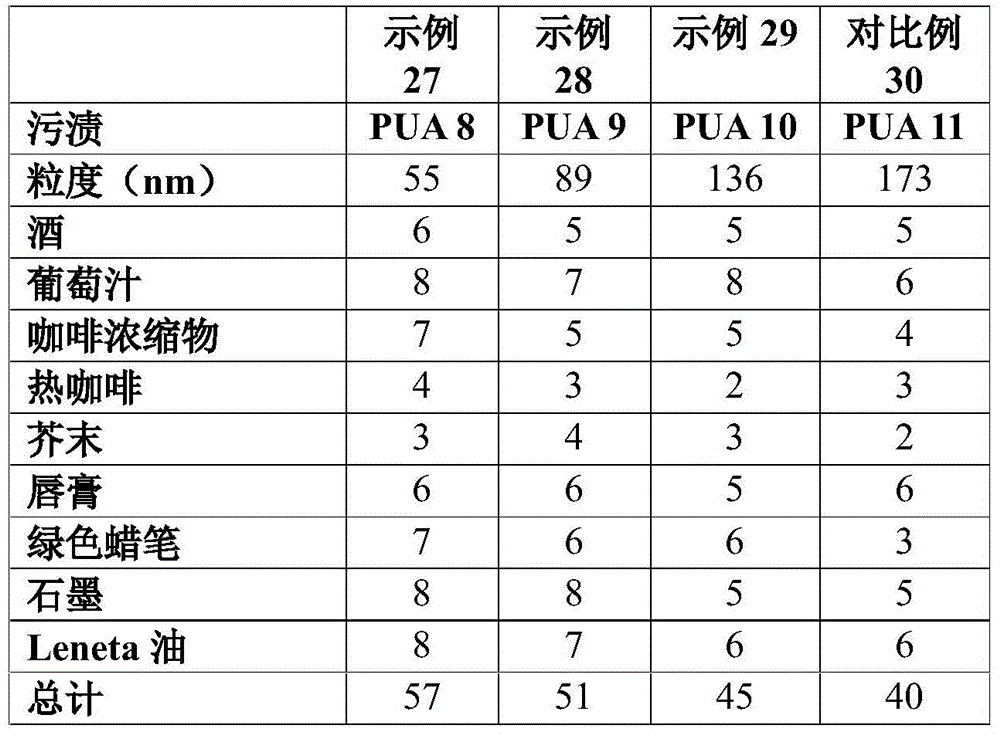
In examples 27 to 30 reported in Table 7, base formulations were prepared using the urethane acrylate resins of examples 8 to 11(PUA 8-PUA11) at a ratio of 30% PUA/70% base acrylic latex. The particle sizes of PUA8-11 recorded in Table 6 were achieved by varying the amount of neutralized tertiary amine (DMEA) as shown in Table 3. The z-average particle size was measured using a Zetasizer from Malvern Instruments. Stain resistance can be improved with the PUA resin particles (examples 27 to 29) having a reduced particle size (smaller than the base acrylic resin shown in comparative example 31). When the PUA resin particles were larger than the base acrylic acid, the stain resistance was not improved (comparative example 30).
TABLE 7 various PUA particle sizes.
Comparative examples 31 to 35
In comparative examples 31-35, reported in Table 8, base formulations were prepared using a blend of control (base acrylic latex only, comparative example 31) and 30% comparative acrylic A-D with 70% base acrylic. The comparative acrylic resin was synthesized using emulsion polymerization methods well known in the art and was similar in composition to the base acrylic resin. At various particle sizes of the comparative acrylic resin, a negligible increase in stain resistance was observed using a 30% comparative acrylic/70% base acrylic blend in the base formulation. This indicates that some degree of resin incompatibility during the blending of the PUA with the base acrylic acid results in a particle size effect on the stain resistance enhancement.
Table 8 comparative acrylic resin blends.

Examples 36 to 39
In examples 36 and 37, base formulations were prepared using PUA1 and blended with base acrylic latex at 10% and 20%. In comparative examples 38 and 39, PUA1 of examples 36 and 37 was replaced with a polyurethane resin (PUR, NeoRez R-2180, available from DSM Coating Resins, LLC, The Netherlands).
Greater stain resistance was observed for base formulations comprising 10% and 20% PUA1 resin blends compared to base formulations comprising 10% and 20% PUR resin blends.
Table 9 comparative polyurethane resin blends.
| Example 36 | Example 37 | Comparative example 38 | Comparative example 39 | |
| Stain or soil | 10%PUA 1 | 20%PUA 1 | 10%PUR | 20%PUR |
| Wine | 3 | 5 | 3 | 4 |
| Grape juice | 5 | 7 | 4 | 6 |
| Coffee concentrate | 7 | 8 | 6 | 7 |
| Hot coffee | 6 | 7 | 5 | 6 |
| Mustard | 2 | 3 | 2 | 0 |
| Lipstick | 5 | 8 | 3 | 5 |
| Green crayon | 9 | 9 | 9 | 7 |
| Graphite (II) | 10 | 10 | 7 | 7 |
| Leneta oil | 9 | 9 | 7 | 5 |
| Total of | 56 | 66 | 46 | 47 |
In view of the above description and examples, the present invention therefore especially relates to the subject matter of the following clauses and claims, but is not limited thereto.
Clause 1: a coating composition comprising an aqueous dispersion of a mixture of (i) urethane acrylate resin particles and (ii) acrylic resin particles, and (iii) a matting agent, wherein the (i) urethane acrylate resin particles and (ii) acrylic resin particles are different from each other.
Clause 2: the coating composition of clause 1, wherein the urethane acrylate resin comprises urea groups.
Clause 3: the coating composition of clause 1, wherein the coating composition comprises 5-50 wt.% of the urethane acrylate resin based on total resin solids.
Clause 4: the coating composition of clause 3, wherein the coating composition comprises 10-35 wt.% of the urethane acrylate resin based on total resin solids.
Clause 5: the coating composition of clause 1, wherein the matting agent comprises an inorganic matting agent.
Clause 6: the coating composition of clause 5, wherein the inorganic matting agent comprises silica, aluminum silicate, and/or calcium carbonate.
Clause 7: the coating composition of clause 1, wherein the matting agent comprises an organic matting agent.
Clause 8: the coating composition of clause 7, wherein the organic matting agent comprises a wax, a thermoplastic polymer, and/or a thermoset polymer, wherein the organic matting agent is different from the urethane acrylate resin particles (a) and the acrylic resin particles (b).
Clause 9: the coating composition of clause 1, wherein the matting agent is present in an amount from 5 to 50 weight percent based on total solids.
Clause 10: the coating composition of clause 1, wherein the coating composition, when applied to a substrate and after drying as a coating, has a 60 ° gloss level of no more than 20 units.
Clause 11: the coating composition of clause 10, wherein when applied to a substrate and dried as a coating, the coating composition has an 85 ° gloss level of no more than 35 units.
Clause 12: the coating composition of any of clauses 1-11, wherein the z-average particle size of the acrylic resin particles is at least 10% greater than the urethane acrylate resin particles.
Clause 13: the coating composition of any of clauses 1-12, wherein when the coating composition is applied to a substrate and dried to form a coating, the coating exhibits increased stain resistance as compared to the same coating composition that does not include the urethane acrylate resin particles.
Clause 14: the coating composition of any of clauses 1-13, wherein the z-average particle size of the urethane acrylate resin particles is at least 50% smaller than the acrylic resin particles.
Clause 15: the coating composition of any of clauses 1-14, wherein the VOC of the composition is less than 50 g/L.
Clause 16: the coating composition of any of clauses 1-15, wherein the urethane acrylate resin particles and the acrylic resin particles are incompatible with each other.
Clause 17: a method of imparting stain resistance to a substrate having low gloss comprising applying the coating composition of any of clauses 1-15 to at least a portion of the substrate.
Clause 18: the method of clause 17, further comprising drying the coating composition at ambient temperature to form a coating.
Clause 19: a substrate at least partially coated with the coating composition of any of clauses 1-16.
Clause 20: the substrate of clause 19, wherein the coated portion of the substrate is at least partially non-metallic.
Clause 21: the substrate of clause 19, wherein the coated portion of the substrate is non-metallic.
Clause 22: the substrate of any of clauses 19-21, wherein the substrate is a building component.
While certain aspects of the present invention have been described above for purposes of illustration, it will be apparent to those skilled in the art that numerous variations of the details of the present invention may be made without departing from the invention as defined in the appended claims.
Claims (23)
Applications Claiming Priority (3)
| Application Number | Priority Date | Filing Date | Title |
|---|---|---|---|
| US16/035,815 US11193039B2 (en) | 2018-07-16 | 2018-07-16 | Stain resistant coating compositions |
| US16/035,815 | 2018-07-16 | ||
| PCT/IB2019/056051 WO2020016766A1 (en) | 2018-07-16 | 2019-07-16 | Stain resistant coating compositions |
Publications (2)
| Publication Number | Publication Date |
|---|---|
| CN112424246A true CN112424246A (en) | 2021-02-26 |
| CN112424246B CN112424246B (en) | 2024-01-16 |
Family
ID=68084867
Family Applications (1)
| Application Number | Title | Priority Date | Filing Date |
|---|---|---|---|
| CN201980047407.0A Active CN112424246B (en) | 2018-07-16 | 2019-07-16 | Fouling resistant coating composition |
Country Status (7)
| Country | Link |
|---|---|
| US (1) | US11193039B2 (en) |
| EP (1) | EP3824006A1 (en) |
| CN (1) | CN112424246B (en) |
| AU (1) | AU2019307870B2 (en) |
| CA (1) | CA3106496A1 (en) |
| MX (1) | MX2021000464A (en) |
| WO (1) | WO2020016766A1 (en) |
Families Citing this family (4)
| Publication number | Priority date | Publication date | Assignee | Title |
|---|---|---|---|---|
| US11059993B2 (en) * | 2018-09-07 | 2021-07-13 | Ppg Industries Ohio, Inc. | Coating composition exhibiting specific gloss properties for extreme washable coatings |
| US11111409B2 (en) | 2019-01-03 | 2021-09-07 | Ppg Industries Ohio, Inc. | Coating composition comprising self-crosslinkable core-shell particles and imparting improved stain resistance |
| US20250109312A1 (en) * | 2023-10-02 | 2025-04-03 | Henry Company, Llc | Stable Hybrid Formulations of Acrylic Emulsion and Polyurethane Dispersions and Applications Thereof |
| WO2025114292A1 (en) | 2023-11-30 | 2025-06-05 | Covestro Deutschland Ag | Polyurethane dispersions |
Citations (7)
| Publication number | Priority date | Publication date | Assignee | Title |
|---|---|---|---|---|
| US20030228424A1 (en) * | 2002-03-06 | 2003-12-11 | Dove Clive Nicholas | Water borne coating composition for film transfer and casting process |
| CN101622290A (en) * | 2007-02-22 | 2010-01-06 | 帝斯曼知识产权资产管理有限公司 | Radiation curable aqueous composition for low gloss coatings |
| CN103732631A (en) * | 2011-08-09 | 2014-04-16 | 湛新比利时股份有限公司 | Aqueous radiation curable coating compositions |
| US20150141568A1 (en) * | 2013-11-18 | 2015-05-21 | Hyundai Motor Company | Matte clear coating composition |
| CN105324447A (en) * | 2013-05-30 | 2016-02-10 | 陶氏环球技术有限责任公司 | Aqueous composition |
| CN105669938A (en) * | 2016-03-24 | 2016-06-15 | 万华化学集团股份有限公司 | Waterborne radiation-supportive curing polyurethane acrylate combination, preparation method and coating |
| CN105940067A (en) * | 2014-01-29 | 2016-09-14 | 关西涂料株式会社 | Aqueous coating composition |
Family Cites Families (36)
| Publication number | Priority date | Publication date | Assignee | Title |
|---|---|---|---|---|
| US4554018A (en) * | 1984-02-01 | 1985-11-19 | Allied Colloids Limited | Production of polymeric thickeners and their use in printing |
| US4844952A (en) | 1987-12-30 | 1989-07-04 | Ppg Industries, Inc. | Multilayered finish having good stain resistance |
| GB8904102D0 (en) | 1988-03-09 | 1989-04-05 | Ici Resins Bv | Polyurethane coating compositions |
| US5574083A (en) | 1993-06-11 | 1996-11-12 | Rohm And Haas Company | Aromatic polycarbodiimide crosslinkers |
| GB9400663D0 (en) | 1994-01-14 | 1994-03-09 | Ucb Sa | Aqueous polyurethane resin compositions |
| CA2141715C (en) | 1994-02-08 | 1999-09-14 | Bruce A. Gruber | Organic solvent free urethane/acrylic polymer laminating adhesive for flexible packaging |
| US5998543A (en) | 1996-05-28 | 1999-12-07 | Eastman Chemical Company | Stable amino-containing polymer latex blends |
| GB0005612D0 (en) | 2000-03-09 | 2000-05-03 | Avecia Bv | Aqueous polymer compositions |
| CA2409087A1 (en) | 2001-10-25 | 2003-04-25 | Armstrong World Industries, Inc. | Low-temperature coalescing fluoropolymer coatings |
| GB0130651D0 (en) | 2001-12-21 | 2002-02-06 | Ici Plc | Aqueous compositions containing polyurethane-acrylic hybrid polymer dispersions |
| US7358295B2 (en) | 2002-04-05 | 2008-04-15 | Lubrizol Advanced Materials, Inc. | Hybrid polymer composition, and article therefrom |
| US7001952B2 (en) | 2002-04-19 | 2006-02-21 | Ppg Industries Ohio, Inc. | Coating compositions containing polyurethane dispersions and highly crosslinked polymer particles |
| CN100345872C (en) | 2002-09-18 | 2007-10-31 | 威士伯来源有限公司 | Self-crosslinkable water-based coating composition |
| US7745514B2 (en) | 2003-06-24 | 2010-06-29 | Ppg Industries Ohio, Inc. | Tinted, abrasion resistant coating compositions and coated articles |
| DK1699839T3 (en) | 2003-12-17 | 2017-02-27 | Dsm Ip Assets Bv | SOIL-PREVENTIVE AURINY RANGE-VINYL COATING COMPOSITIONS |
| TWI413668B (en) * | 2007-05-16 | 2013-11-01 | Lg Chemical Ltd | Composition for anti-glare film and anti-glare film prepared using the same |
| AU2009215691B2 (en) | 2008-02-19 | 2014-08-28 | Lubrizol Advanced Materials, Inc. | Aqueous polyurethane hybrid compositions |
| KR101574365B1 (en) | 2008-03-20 | 2015-12-03 | 바스프 에스이 | Polymer dispersions containing phosphorous polymers and emulsifiers |
| US8653180B2 (en) | 2008-06-11 | 2014-02-18 | Rohm And Haas Company | Aqueous compositions comprising a blend of emulsion vinyl copolymer and polyurethane dispersion |
| US8461256B2 (en) | 2009-12-28 | 2013-06-11 | Rohm And Haas Company | Low VOC aqueous compositions of acrylic-urethane block copolymers |
| WO2011098514A1 (en) * | 2010-02-11 | 2011-08-18 | Dsm Ip Assets B.V. | Radiation curable liquid composition for low gloss coatings |
| US9000069B1 (en) | 2010-07-02 | 2015-04-07 | The Sherwin-Williams Company | Self-stratifying coatings |
| US8637609B1 (en) * | 2010-12-17 | 2014-01-28 | The Sherwin-Williams Company | Blends of acrylic latices and polyurethane dispersions for coatings |
| CN103443666B (en) * | 2011-03-28 | 2016-06-29 | 木本股份有限公司 | Light-shielding material for optical equipment and manufacturing method thereof |
| US8912249B2 (en) | 2011-04-25 | 2014-12-16 | E I Du Pont De Nemours And Company | Method of preparing encapsulated pigment dispersions which include polyurethane dispersions |
| CN102964898B (en) * | 2011-08-05 | 2016-05-25 | 罗门哈斯公司 | There is the water-based paint compositions of improved hydrophilic spot repellency |
| CA2851964C (en) | 2011-12-22 | 2020-01-07 | Dow Global Technologies Llc | A new process for making crosslinkable polyurethane/acrylic hybrid dispersions |
| EP2823008A4 (en) | 2012-03-06 | 2015-11-04 | Valspar Sourcing Inc | Latex polymer for improved paint washability |
| BR112015022726A2 (en) | 2013-03-14 | 2017-07-18 | Cabot Corp | core-shell polymeric materials |
| US20140303281A1 (en) | 2013-03-14 | 2014-10-09 | The Sherwin-Williams Company | Hybrid latex particles for self-stratifying coatings |
| US9040621B2 (en) | 2013-03-15 | 2015-05-26 | Ppg Industries Ohio, Inc. | Aqueous dispersions of microgel encapsulated particles utilizing hyperbranched acrylic polymers |
| US10487166B2 (en) | 2014-12-19 | 2019-11-26 | Dow Global Technologies Llc | Aqueous polymer dispersion and process of making the same |
| US20170369750A1 (en) | 2015-03-12 | 2017-12-28 | Henkel Ag & Co. Kgaa | Aqueous polyurethane acrylate hybrid dispersions |
| EP3303491B1 (en) | 2015-06-01 | 2021-10-20 | Swimc Llc | Waterborne coating composition |
| KR101708315B1 (en) | 2015-06-02 | 2017-02-20 | 엘지전자 주식회사 | Clothes treating apparatus |
| EP3307803A1 (en) | 2015-06-09 | 2018-04-18 | PPG Industries Ohio, Inc. | Stain resistant coating compositions and coatings formed therefrom |
-
2018
- 2018-07-16 US US16/035,815 patent/US11193039B2/en active Active
-
2019
- 2019-07-16 MX MX2021000464A patent/MX2021000464A/en unknown
- 2019-07-16 CA CA3106496A patent/CA3106496A1/en active Pending
- 2019-07-16 EP EP19779548.7A patent/EP3824006A1/en active Pending
- 2019-07-16 AU AU2019307870A patent/AU2019307870B2/en active Active
- 2019-07-16 WO PCT/IB2019/056051 patent/WO2020016766A1/en not_active Ceased
- 2019-07-16 CN CN201980047407.0A patent/CN112424246B/en active Active
Patent Citations (7)
| Publication number | Priority date | Publication date | Assignee | Title |
|---|---|---|---|---|
| US20030228424A1 (en) * | 2002-03-06 | 2003-12-11 | Dove Clive Nicholas | Water borne coating composition for film transfer and casting process |
| CN101622290A (en) * | 2007-02-22 | 2010-01-06 | 帝斯曼知识产权资产管理有限公司 | Radiation curable aqueous composition for low gloss coatings |
| CN103732631A (en) * | 2011-08-09 | 2014-04-16 | 湛新比利时股份有限公司 | Aqueous radiation curable coating compositions |
| CN105324447A (en) * | 2013-05-30 | 2016-02-10 | 陶氏环球技术有限责任公司 | Aqueous composition |
| US20150141568A1 (en) * | 2013-11-18 | 2015-05-21 | Hyundai Motor Company | Matte clear coating composition |
| CN105940067A (en) * | 2014-01-29 | 2016-09-14 | 关西涂料株式会社 | Aqueous coating composition |
| CN105669938A (en) * | 2016-03-24 | 2016-06-15 | 万华化学集团股份有限公司 | Waterborne radiation-supportive curing polyurethane acrylate combination, preparation method and coating |
Also Published As
| Publication number | Publication date |
|---|---|
| US20200017709A1 (en) | 2020-01-16 |
| CN112424246B (en) | 2024-01-16 |
| AU2019307870A1 (en) | 2021-02-18 |
| MX2021000464A (en) | 2021-04-19 |
| US11193039B2 (en) | 2021-12-07 |
| EP3824006A1 (en) | 2021-05-26 |
| AU2019307870B2 (en) | 2024-06-27 |
| WO2020016766A1 (en) | 2020-01-23 |
| CA3106496A1 (en) | 2020-01-23 |
Similar Documents
| Publication | Publication Date | Title |
|---|---|---|
| CN100460433C (en) | Aqueous Self-Crosslinking Polyurethane Dispersions and Polyurethane:Acrylic Hybrid Dispersions | |
| CN112424246B (en) | Fouling resistant coating composition | |
| US11421130B2 (en) | Coating composition for extreme washable coatings comprising self-crosslinkable core-shell particles | |
| TWI655244B (en) | Radiation-curable aqueous composition having controlled polymer flow and preparation method thereof | |
| CN113272349B (en) | Coating compositions imparting improved stain resistance | |
| KR20000070962A (en) | Universal Pigment Pastes and Their Use for the Manufacture of Aqueous Paints | |
| US20030092833A1 (en) | Universal pigment pastes and their use for the manufacture of aqueous paints | |
| CN112074555B (en) | Aqueous coating composition | |
| AU2020252207B2 (en) | Stain resistant coating composition | |
| RU2781645C1 (en) | Coating composition providing high staining resistance |
Legal Events
| Date | Code | Title | Description |
|---|---|---|---|
| PB01 | Publication | ||
| PB01 | Publication | ||
| SE01 | Entry into force of request for substantive examination | ||
| SE01 | Entry into force of request for substantive examination | ||
| GR01 | Patent grant | ||
| GR01 | Patent grant |