CN112395508A - Artificial intelligence talent position recommendation system and processing method thereof - Google Patents
Artificial intelligence talent position recommendation system and processing method thereof Download PDFInfo
- Publication number
- CN112395508A CN112395508A CN202011561842.6A CN202011561842A CN112395508A CN 112395508 A CN112395508 A CN 112395508A CN 202011561842 A CN202011561842 A CN 202011561842A CN 112395508 A CN112395508 A CN 112395508A
- Authority
- CN
- China
- Prior art keywords
- job
- data
- social network
- information
- talent
- Prior art date
- Legal status (The legal status is an assumption and is not a legal conclusion. Google has not performed a legal analysis and makes no representation as to the accuracy of the status listed.)
- Granted
Links
Images


Classifications
-
- G—PHYSICS
- G06—COMPUTING OR CALCULATING; COUNTING
- G06F—ELECTRIC DIGITAL DATA PROCESSING
- G06F16/00—Information retrieval; Database structures therefor; File system structures therefor
- G06F16/90—Details of database functions independent of the retrieved data types
- G06F16/95—Retrieval from the web
- G06F16/953—Querying, e.g. by the use of web search engines
- G06F16/9535—Search customisation based on user profiles and personalisation
-
- G—PHYSICS
- G06—COMPUTING OR CALCULATING; COUNTING
- G06F—ELECTRIC DIGITAL DATA PROCESSING
- G06F16/00—Information retrieval; Database structures therefor; File system structures therefor
- G06F16/90—Details of database functions independent of the retrieved data types
- G06F16/901—Indexing; Data structures therefor; Storage structures
-
- G—PHYSICS
- G06—COMPUTING OR CALCULATING; COUNTING
- G06F—ELECTRIC DIGITAL DATA PROCESSING
- G06F16/00—Information retrieval; Database structures therefor; File system structures therefor
- G06F16/90—Details of database functions independent of the retrieved data types
- G06F16/906—Clustering; Classification
-
- G—PHYSICS
- G06—COMPUTING OR CALCULATING; COUNTING
- G06F—ELECTRIC DIGITAL DATA PROCESSING
- G06F16/00—Information retrieval; Database structures therefor; File system structures therefor
- G06F16/90—Details of database functions independent of the retrieved data types
- G06F16/95—Retrieval from the web
- G06F16/953—Querying, e.g. by the use of web search engines
- G06F16/9536—Search customisation based on social or collaborative filtering
-
- G—PHYSICS
- G06—COMPUTING OR CALCULATING; COUNTING
- G06F—ELECTRIC DIGITAL DATA PROCESSING
- G06F40/00—Handling natural language data
- G06F40/20—Natural language analysis
- G06F40/279—Recognition of textual entities
- G06F40/289—Phrasal analysis, e.g. finite state techniques or chunking
- G06F40/295—Named entity recognition
-
- G06Q10/40—
-
- G—PHYSICS
- G06—COMPUTING OR CALCULATING; COUNTING
- G06F—ELECTRIC DIGITAL DATA PROCESSING
- G06F2216/00—Indexing scheme relating to additional aspects of information retrieval not explicitly covered by G06F16/00 and subgroups
- G06F2216/03—Data mining
Landscapes
- Engineering & Computer Science (AREA)
- Databases & Information Systems (AREA)
- Theoretical Computer Science (AREA)
- Physics & Mathematics (AREA)
- General Engineering & Computer Science (AREA)
- General Physics & Mathematics (AREA)
- Data Mining & Analysis (AREA)
- Health & Medical Sciences (AREA)
- Artificial Intelligence (AREA)
- Audiology, Speech & Language Pathology (AREA)
- Computational Linguistics (AREA)
- General Health & Medical Sciences (AREA)
- Software Systems (AREA)
- Management, Administration, Business Operations System, And Electronic Commerce (AREA)
Abstract
The invention belongs to the field of big data, and particularly relates to an artificial intelligence talent position recommendation system and a processing method thereof. The system comprises a data acquisition and database management module, a position social network construction module, a skill and demand deep analysis module and an information retrieval and position recommendation module, and is mainly applied to the position recommendation environment of talents. The system has the advantages that the system is wide in the field of job recommendation provided for talents, deep support relations between professional techniques learned by the talents and emerging job techniques are deeply excavated, and comprehensive analysis is performed on job information in different fields by utilizing the advantages of social networks, so that the limitation that the recommended job information receives keywords of job seekers is avoided. The job information retrieval model realizes hierarchy of a social network in a layered index mode, refines job data layer by layer, and finally recommends key jobs to job seekers, and is high in recommendation accuracy and fast in job information retrieval.
Description
Technical Field
The invention belongs to the field of big data, and particularly relates to an artificial intelligence talent position recommendation system and a processing method thereof.
Background
Artificial intelligence talent position recommendation based on a mobile social network is an important part in recommendation algorithm application, and the future intention position of a talent is identified based on mobile position data. The mainstream job recommendation takes the keyword information of job seekers as the basis of recommendation, and the core of the mainstream job recommendation lies in analyzing the whole information of the keywords, so that the job hunting field of the job seekers is easily limited, and for part of talents without work experience, a large amount of recruitment information is faced, and the job posts suitable for the job posts can not be quickly and accurately positioned; meanwhile, the technical requirements of part of industries are updated rapidly, the requirements on talents are changed continuously, and the changed talents requirements are different from the common job position recommendation method.
At present, a job recommendation system performs analysis and processing according to the surface keyword information of resume data of job seekers, such as graduates, working experiences and learned professions of job seekers; or for a small amount of other information such as personality, political aspect, ability assessment, etc., so that its recommendation information is limited. For the analysis of the support relationship between the deep-level technology of talents and job requirements, the achieved level is not sufficient to support the subsequent research, so the job recommendation technology at the present stage still needs to be improved.
Disclosure of Invention
The invention aims to solve the problems that the analysis of the support relationship between deep requirements and technologies in the conventional position recommendation method is insufficient and a job seeker cannot quickly and accurately position a target position due to too much position information. According to the artificial intelligence talent position recommendation system and the analysis method thereof, the potential support relation between the new technical requirements and the technology possessed by the artificial intelligence talents is deeply excavated, and a more comprehensive position recommendation solution is provided for job seekers; meanwhile, the job recommendation system based on the mobile social network can optimize the structural relationship among similar jobs, and reduces the limitation of a large amount of job information on job recommendation of job seekers in a layer-by-layer refining mode.
In order to achieve the purpose, the invention is realized by the following technical scheme:
an artificial intelligence talent position recommendation system and a processing method thereof comprise the following steps:
the data acquisition and database management module is used for data acquisition, data classification and data preprocessing and constructing a job skill matching database and comprises a data acquisition device and a data preprocessing device;
the system comprises a position social network construction module, a position social network optimization module and a position social network management module, wherein the position social network construction module is used for analyzing potential relations of technical support among positions, mining incidence relations among different positions, and establishing a position social network diagram;
the skill and position demand deep analysis module is used for deeply analyzing a potential support relation between professional skills of an artificial intelligent talent job seeker and the skill demand of a new position and comprises a deep digging device;
the information retrieval and job recommendation module carries out hierarchical indexing on the job network map, carries out comprehensive analysis on the refined job information layer by layer and the job hunting intention information of the user, and carries out accurate job recommendation on job hunters, and the module comprises a layer index construction device and a job recommendation device.
An artificial intelligence talent position recommendation system, data acquisition device, the collection is based on real-time position data, new economic technology keyword data and user's job hunting demand data on the mobile device.
The artificial intelligence talent position recommendation system is characterized in that the data preprocessing device is set as follows:
(1) constructing a job requirement knowledge base J, wherein the job requirement knowledge base J comprises a job ID, work experience requirements of job seekers, study histories of the job seekers and technical requirements of the job seekers;
(2) maintaining the keywords Tw of the emerging technology, including the ID of the emerging technology, the technical requirement of the emerging technology and the employment field of the emerging technology;
(3) integrating the position data into structured data Struc = (J, Tw) according to the position data and a requirement knowledge base;
(4) and mining talent keyword information AIF including basic information of artificial intelligence talents, graduates, academic professions, professional skills and technical requirements.
The artificial intelligence talent position recommendation system is characterized in that the entity naming device is set as follows:
(1) extracting position information according to the integrated structured position data Struc, and converting the position information into an entity with category attributes;
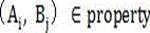
(2) fitting the extracted position entity into a node entity N in the social network, and defining a node attribute property = (Struc, C, O), wherein C represents a category attribute, and O represents other attributes of the node;
(3) and maintaining the requirement attribute of each entity node in real time by combining the job requirement knowledge base.
The artificial intelligence talent position recommendation system is characterized in that the network relation construction device is set as follows: calculating the similarity degree of different job spaces according to the similarity of the demand attributes of the different job spaces, and adopting a formula: carrying out the measurement, wherein
 Corresponding to a threshold value controller, which is,
 indicating the degree of similarity between the two demand attributes,
 (ii) a Establishing a mutual relation according to the similarity degree among the positions, and further establishing a position social network; the social network graph storage device is configured to store the relationship of the position social network, and the relationship is marked as G = (N, E), wherein G represents the whole social network graph, and N represents an entity in the graphNodes, E, represent the relationship between nodes, i.e., edges.
The artificial intelligence talent position recommendation system is characterized in that the position social network optimization device is set as follows:
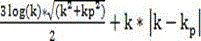
(1) by using linear functions Limiting the search number of the kernels, improving the Enumelate top-k algorithm, mining dense structures in the position social network, and storing the structure information of the dense structures, wherein
 And
And is a hyper-parameter in dense structure excavation and guarantees
 ;
;
(2) Analyzing the excavated dense structure by formula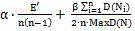 The importance degree of the dense structure is measured, the dense structure is ranked from large to small according to the importance row metric value of the dense structure, the first 75% of the dense structure is taken out and summarized into a super node SuperNode, and further the whole network structure is optimized, wherein alpha is the weight of the sub-graph edge, beta is the weight of the sub-graph node degree,
 the number of edges that actually exist in the sub-graph,
 representing nodes
 The degree of (a) is greater than (b),
 ,
, representing the maximum degree of the nodes in the subgraph.
According to the artificial intelligence talent position recommendation system, the deep excavation device carries out semantic fitting on professional skills learned by talents and new technical position requirements by applying semantic relations, the association relation between the skills and positions is deeply excavated, and the professional skills and the positions are mapped.
The artificial intelligence talent position recommendation system is characterized in that the hierarchical index construction device is set as follows:
(1) performing representation learning on the original social network graph to obtain an Embedding Vector of each node in the graph;
(2) extracting a bridge node BN by analyzing the overlapping relation among nodes contained in different SuperNodes;
(3) combining the characterization Vector of the node and the frequency of the bridge node BN through a formula Calculating key coefficients of bridge nodes, sorting according to the key coefficients from big to small, extracting the first 75% of BN as key nodes, and marking as key nodes KeyNodes, wherein count (BN) is the frequency of the nodes, and NE (BN) is all adjacent points of the BN nodes in the subgraph;
(4) and establishing index relationships from bottom to top for the optimized social network diagram output by the social network optimizing device, the excavated dense structure and the extracted KeyNodes in sequence, and further establishing a hierarchical index structure of the position information.
An artificial intelligence talent position recommendation system, position recommendation device set up to:
(1) the method comprises the steps of performing structural processing on AIF data by analyzing technical support and position requirements of talents, wherein the processed data comprises talent IDs, workplace expectations, wage expectations, learned specialties and skills owned by the talents;
(2) according to the demand information and the Struc data, the structured AIF data and the optimized network structure are preliminarily fitted through a skill and job demand depth analysis module, then an upper dense structural layer is indexed, a KeyNodes layer is indexed through the dense structural layer, and then jobs represented by KeyNodes entity nodes are recommended to talents.
A processing method of an artificial intelligence talent position recommendation system comprises the following specific steps:
step 1: extracting learned specialties and learned key technologies according to the acquired talent information AIF data;
step 2: analyzing the relationship support among the acquired job requirement knowledge base J, the major and the key technology according to the combination of the newly-developed technical key word Tw;
and step 3: according to the position entities extracted by the entity naming device, the association degree among all positions is measured by combining a skill and position demand depth analysis module, and then a position social network diagram is established;
and 4, step 4: mining dense structures in the position social network, and storing the structure information of the dense structures;
and 5: measuring the importance degree of the dense structure according to the excavated dense structure;
step 6: performing representation learning on the original social network graph to obtain a Vector of each node in the graph, wherein each Vector corresponds to 128-dimensional representation data;
and 7: extracting bridge nodes according to the overlapping relation among the nodes contained in different SuperNodes;
and 8: calculating key coefficients of the bridge nodes;
and step 9: establishing an index relationship among the optimized social network graph, the mined dense structures and the key nodes in a hierarchical index mode, and further establishing a hierarchical information retrieval model of the position information;
step 10: associating the talents with position information according to a technical support relation deeply mined from a demand knowledge base J;
step 11: refining through indexing according to a large amount of matched position information, and indexing to a second layer structure SeconddStruc;
step 12: according to the SecondStruc structure information and the calculated key nodes, mapping the matching relationship to the top layer, namely the KeyNodes layer;
step 13: converting the matched key nodes back to KeyJob and recommending the KeyJob to talents;
step 14: when the KeyJob information is too little, the recommendation information is returned to the second layer through the reverse index, so that more job information is output, and further, jobs are recommended for job seekers.
In summary, the beneficial effects of the invention include:
(1) the system provided by the invention is mainly applied to the job recommendation environment of talents, by constructing a job social network, utilizing the advantages of the social network and a dense subgraph mining algorithm, the associated job jobs in different fields are identified, and the job recommendations in different fields corresponding to the same technology are realized through the association relationship among job entities.
(2) The invention not only depends on the resume data of talents and the limited keyword information thereof, but also deeply excavates the internal technical support relationship thereof by analyzing the information of professional skills, emerging technologies and the like, thereby avoiding that the positions recommended for job seekers are limited in a certain field as far as possible.
(3) In the system provided by the invention, the social network diagram is hierarchically divided, and the optimized network structure, the dense structure and the KeyNodes are used for establishing the index structure in a hierarchical index mode, so that great progress is realized in the position information retrieval.
(4) The method is scientific and reasonable and has strong adaptability.
The foregoing is a summary of the present application and thus contains, by necessity, simplifications, generalizations and omissions of detail; those skilled in the art will appreciate that the summary is illustrative of the application and is not intended to be in any way limiting. Other aspects, features and advantages of the devices and/or methods and/or other subject matter described in this specification will become apparent as the description proceeds. The summary is provided to introduce a selection of concepts in a simplified form that are further described below in the detailed description. This summary is not intended to identify key features or essential features of the claimed subject matter, nor is it intended to be used as an aid in determining the scope of the claimed subject matter.
Drawings
The above-described and other features of the present application will become more fully apparent from the following description and appended claims, taken in conjunction with the accompanying drawings. It is to be understood that these drawings are solely for purposes of illustrating several embodiments of the present application and are not intended as a definition of the limits of the application, for which reference should be made to the appended drawings, wherein the disclosure is to be interpreted in a more complete and detailed manner.
FIG. 1 is a system block diagram of an artificial intelligence talent position recommendation system based on a mobile social network according to the present invention.
FIG. 2 is a flowchart of a processing method of an artificial intelligence talent position recommendation system based on a mobile social network according to the present invention.
Detailed Description
In the following detailed description, reference is made to the accompanying drawings, which form a part hereof. In the drawings, the same/similar reference numerals generally refer to the same/similar parts unless otherwise specified in the specification. The illustrative embodiments described in the detailed description, drawings, and claims should not be considered limiting of the application. Other embodiments of, and changes to, the present application may be made without departing from the spirit or scope of the subject matter presented in the present application. It should be readily understood that the aspects of the present application, as generally described in the specification and illustrated in the figures herein, could be arranged, substituted, combined, designed in a wide variety of different configurations, and that all such modifications are expressly contemplated and made part of this application.
Referring to fig. 1, an artificial intelligence talent position recommendation system includes: the system comprises a data acquisition and database management module, a position social network construction module, a skill and position demand deep analysis module and an information retrieval and position recommendation module.
The data acquisition and database management module is used for data acquisition, data classification and data preprocessing and constructing a job skill matching database and comprises a data acquisition device and a data preprocessing device; the job social network construction module is used for analyzing potential relations of technical support among jobs, mining incidence relations among different jobs, establishing a job social network diagram, and maintaining and optimizing a network structure, and comprises an entity naming device, a network relation construction device, a social network diagram storage device and a job social network optimization device; the skill and position requirement deep analysis module is used for deeply analyzing a potential support relationship between professional skills of an artificial intelligent talent job seeker and the skill requirements of emerging positions and comprises a deep digging device; the information retrieval and job recommendation module carries out hierarchical indexing on the job network map, carries out comprehensive analysis on the refined job information layer by layer and the job hunting intention information of the user, and carries out accurate job recommendation on job hunters, and the module comprises a layer index construction device and a job recommendation device.
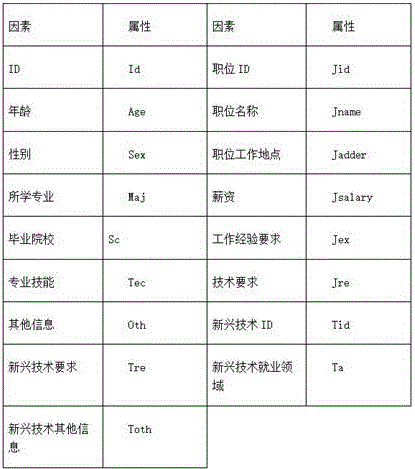
Furthermore, the data acquisition device is used for acquiring real-time job position data, new economic technology keyword data and job application requirement data of the user on the basis of the mobile equipment. The job data includes: job ID, job name, job place, salary, job experience requirements, technical requirements and the like. The basic information data of the artificial intelligence talents collected by the module comprises: ID. Name, gender, age, academic specialty, graduation institution, skills possessed, and other information. The data classification device in the module divides the acquired position data into eight categories: technical, product, design, operation, market, function, and game roles, among others. The database management device in the module is mainly used for constructing a data body, in order to realize the integrity of data, the classified data are respectively subjected to attribute definition, and all data must be organized, described and stored according to a uniform data model. Therefore, the data has the integral structural characteristic, faces to the whole system and realizes the sharing of the data. The database management module divides the collected original data into three categories, position data (recorded as Jo): the system comprises information such as job ID, job name, job place, salary, work experience requirements, technical requirements and the like. Artificial intelligence talent basic information data (noted as AIF): including ID, name, gender, age, academic specialty, graduation institution, skills possessed, and other information. Emerging technology keyword data (denoted as Tw): including emerging technology ID, emerging technology skill requirements, emerging technology employment areas, and other data. The database management device defines attributes of the collected data, constructs a data body, and establishes an attribute list 1 according to the data source type.
Attribute List 1
Further, the data preprocessing device is configured to:
(1) constructing a job requirement knowledge base J, wherein the job requirement knowledge base J comprises a job ID, work experience requirements of job seekers, study histories of the job seekers and technical requirements of the job seekers;
(2) maintaining the keywords Tw of the emerging technology, including the ID of the emerging technology, the technical requirement of the emerging technology and the employment field of the emerging technology;
(3) integrating the position data into structured data Struc = (J, Tw) according to the position data and a requirement knowledge base;
(4) and mining talent keyword information AIF including basic information of artificial intelligence talents, graduates, academic professions, professional skills and technical requirements.
Further, the entity naming device is configured to:
(1) extracting position information according to the integrated structured position data Struc, and converting the position information into an entity with category attributes;
(2) fitting the extracted position entity into a node entity N in the social network, and defining a node attribute property = (Struc, C, O), wherein C represents a category attribute, and O represents other attributes of the node;
(3) and maintaining the requirement attribute of each entity node in real time by combining the job requirement knowledge base.
Further, the network relationship constructing device is configured to: calculating the similarity degree of different job spaces according to the similarity of the demand attributes of the different job spaces, and adopting a formula: carrying out the measurement, wherein
 Corresponding to a threshold value controller, which is,
 indicating the degree of similarity between the two demand attributes,
 (ii) a Establishing a mutual relation according to the similarity degree among the positions, and further establishing a position social network; the social network graph storage device is configured to store relationships of the position social network, and the relationships are recorded as G = (N, E), where G represents the entire social network graph, N represents entity nodes in the graph, and E represents relationships between the nodes, i.e., edges.
Further, the position social network optimizing device is configured to:
(1) by using linear functions Limiting the search number of the kernels, improving the Enumelate top-k algorithm, mining dense structures in the position social network, and storing the structure information of the dense structures, wherein
 And
And is a hyper-parameter in dense structure excavation and guarantees
 ;
;
(2) Analyzing the excavated dense structure by formula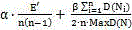 The importance degree of the dense structure is measured, the dense structure is ranked from large to small according to the importance row metric value of the dense structure, the first 75% of the dense structure is taken out and summarized into a super node SuperNode, and further the whole network structure is optimized, wherein alpha is the weight of the sub-graph edge, beta is the weight of the sub-graph node degree,
 the number of edges that actually exist in the sub-graph,
 representing nodes
 The degree of (a) is greater than (b),
 ,
, representing the maximum degree of the nodes in the subgraph.
Furthermore, the deep mining device carries out semantic fitting on the professional skills learned by the talents and the requirements of the positions of the emerging technology by applying the semantic relation, deeply mines the incidence relation between the skills and the positions and maps the professional skills and the positions.
Further, the hierarchical index building device is configured to:
(1) performing representation learning on the original social network graph to obtain an Embedding Vector of each node in the graph;
(2) extracting a bridge node BN by analyzing the overlapping relation among nodes contained in different SuperNodes;
(3) combining the token Vector of the node and the frequency of the bridge node BN,by the formula Calculating key coefficients of bridge nodes, sorting according to the key coefficients from big to small, extracting the first 75% of BN as key nodes, and marking as key nodes KeyNodes, wherein count (BN) is the frequency of the nodes, and NE (BN) is all adjacent points of the BN nodes in the subgraph;
(4) and establishing index relationships from bottom to top for the optimized social network diagram output by the social network optimizing device, the excavated dense structure and the extracted KeyNodes in sequence, and further establishing a hierarchical index structure of the position information.
Further, the position recommending device is configured to:
(1) the method comprises the steps of performing structural processing on AIF data by analyzing technical support and position requirements of talents, wherein the processed data comprises talent IDs, workplace expectations, wage expectations, learned specialties and skills owned by the talents;
(2) according to the demand information and the Struc data, the structured AIF data and the optimized network structure are preliminarily fitted through a skill and job demand depth analysis module, then an upper dense structural layer is indexed, a KeyNodes layer is indexed through the dense structural layer, and then jobs represented by KeyNodes entity nodes are recommended to talents.
Referring to fig. 2, a processing method of an artificial intelligence talent position recommendation system specifically includes the following steps:
step 1: extracting learned specialties and learned key technologies according to the acquired talent information AIF data;
step 2: analyzing the relationship support among the acquired job requirement knowledge base J, the major and the key technology according to the combination of the newly-developed technical key word Tw;
and step 3: according to the position entity extracted by the entity naming device, combining the skill and position demand depth analysis module and passing through a formula Measuring the degree of association among the positions, and further establishing a position social network diagram G = (N, E);
and 4, step 4: by using linear functions Limiting the search number of the kernels, improving the Enumelate top-k algorithm, further realizing the mining of dense structures in the position social network, and storing the structural information;
and 5: according to the excavated dense structure, by formula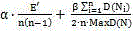 The importance degree of the dense structure is measured, the dense structures are ranked from large to small according to the importance row metric value of the dense structure, the top 75% of the dense structures are taken out and summarized into a super node, and then the whole network structure is optimized;
step 6: performing representation learning on the original social network graph to obtain a Vector of each node in the graph, wherein each Vector corresponds to 128-dimensional representation data;
and 7: extracting a bridge node BN according to the overlapping relation among nodes contained in different SuperNodes;
and 8: according to the formula Calculating key coefficients of the bridge nodes, sorting according to the key coefficients from big to small, extracting the first 75% of BN as key nodes, and marking as key nodes KeyNodes;
and step 9: establishing an index relationship among the optimized social network graph, the mined dense structures and the key nodes in a hierarchical index mode, and further establishing a hierarchical information retrieval model of the position information;
step 10: associating the talents with position information according to a technical support relation deeply mined from a demand knowledge base J;
step 11: refining through indexing according to a large amount of matched position information, and indexing to a second layer structure SeconddStruc;
step 12: according to the SecondStruc structure information and the calculated key nodes, mapping the matching relationship to the top layer, namely the KeyNodes layer;
step 13: converting the matched key nodes back to KeyJob and recommending the KeyJob to talents;
step 14: when the KeyJob information is too little, the recommendation information is returned to the second layer through the reverse index, so that more job information is output, and further, jobs are recommended for job seekers.
In conclusion, the system provided by the invention identifies the associated work positions in different fields by constructing the position social network, utilizing the advantages of the social network and adopting the dense subgraph mining algorithm, and realizes the position recommendation in different fields corresponding to the same technology by the association relationship among the position entities. The method not only depends on resume data of talents and limited keyword information thereof, but also deeply excavates the internal technical support relationship by analyzing information such as professional skills and emerging technologies and the like, thereby avoiding that positions recommended for job seekers are limited to a certain field as far as possible. According to the invention, the social network diagram is hierarchically divided, and the optimized network structure, the dense structure and the KeyNodes are used for establishing the index structure in a hierarchical index mode, so that great progress is realized in job information retrieval, and the method is scientific and reasonable and has strong adaptability.
While the foregoing has been described in detail with reference to block diagrams, flowcharts, and/or implementation examples that illustrate various implementations of apparatus and/or methods of the present application, it will be apparent to those of ordinary skill in the art that the various functions and/or operations in the block diagrams, flowcharts, and/or implementations can be implemented, individually and/or collectively, in various hardware, software, firmware, or virtually any combination thereof. Those skilled in the art will recognize that while the apparatus and/or methods are described in the manner described in this specification and then engineering practices to integrate the described apparatus and/or methods into a data processing system, as is common in the art, that is, at least some of the apparatus and/or methods described in this specification can be integrated into a data processing system through a reasonable amount of experimentation, and that with respect to substantially any plural and/or singular terms used in this specification, those skilled in the art can interpret the plural as singular and/or the singular as plural as long as this is appropriate from a context and/or application, and that various combinations of the singular and/or plural may be explicitly stated in this specification for clarity.
While various aspects and embodiments of the present application are disclosed herein, those skilled in the art will appreciate that other aspects and embodiments of the present application are disclosed herein by way of illustration, not of limitation, the true scope and spirit of the present application being indicated by the following claims.
Claims (10)






Priority Applications (1)
| Application Number | Priority Date | Filing Date | Title |
|---|---|---|---|
| CN202011561842.6A CN112395508B (en) | 2020-12-25 | 2020-12-25 | Artificial intelligence talent position recommendation system and processing method thereof |
Applications Claiming Priority (1)
| Application Number | Priority Date | Filing Date | Title |
|---|---|---|---|
| CN202011561842.6A CN112395508B (en) | 2020-12-25 | 2020-12-25 | Artificial intelligence talent position recommendation system and processing method thereof |
Publications (2)
| Publication Number | Publication Date |
|---|---|
| CN112395508A true CN112395508A (en) | 2021-02-23 |
| CN112395508B CN112395508B (en) | 2024-03-29 |
Family
ID=74625210
Family Applications (1)
| Application Number | Title | Priority Date | Filing Date |
|---|---|---|---|
| CN202011561842.6A Active CN112395508B (en) | 2020-12-25 | 2020-12-25 | Artificial intelligence talent position recommendation system and processing method thereof |
Country Status (1)
| Country | Link |
|---|---|
| CN (1) | CN112395508B (en) |
Cited By (5)
| Publication number | Priority date | Publication date | Assignee | Title |
|---|---|---|---|---|
| CN112883198A (en) * | 2021-02-24 | 2021-06-01 | 广州视源电子科技股份有限公司 | Knowledge graph construction method and device, storage medium and computer equipment |
| CN113806598A (en) * | 2021-09-23 | 2021-12-17 | 广东省通信产业服务有限公司广州分公司 | Professional talent classification statistical database and method beneficial to cloud search |
| CN115438228A (en) * | 2021-06-04 | 2022-12-06 | 中国移动通信集团浙江有限公司 | Menu generating method, device, device and program product |
| US20230281565A1 (en) * | 2022-03-04 | 2023-09-07 | HireTeamMate Incorporated | System and method for generating lower-dimension graph representations in talent acquisition platforms |
| CN118467846A (en) * | 2024-07-09 | 2024-08-09 | 北京位来小猎科技有限公司 | Intelligent post recommendation system based on WeChat social relationship |
Citations (10)
| Publication number | Priority date | Publication date | Assignee | Title |
|---|---|---|---|---|
| US20130275429A1 (en) * | 2012-04-12 | 2013-10-17 | Graham York | System and method for enabling contextual recommendations and collaboration within content |
| US20140143164A1 (en) * | 2012-11-20 | 2014-05-22 | Christian Posse | Techniques for quantifying the job-seeking propensity of members of a social network service |
| US20170359437A1 (en) * | 2016-06-09 | 2017-12-14 | Linkedin Corporation | Generating job recommendations based on job postings with similar positions |
| CN108920544A (en) * | 2018-06-13 | 2018-11-30 | 桂林电子科技大学 | A kind of personalized position recommended method of knowledge based map |
| US20190087916A1 (en) * | 2017-09-21 | 2019-03-21 | Microsoft Technology Licensing, Llc | Model-based recommendation of career path transitions in social networks |
| US20190384861A1 (en) * | 2018-06-15 | 2019-12-19 | Linkedin Corporation | Real-time graph traversals for network-based recommendations |
| CN110674318A (en) * | 2019-08-14 | 2020-01-10 | 中国科学院计算机网络信息中心 | Data recommendation method based on citation network community discovery |
| US20200151647A1 (en) * | 2018-11-09 | 2020-05-14 | Microsoft Technology Licensing, Llc | Recommending jobs based on title transition embeddings |
| CN111177583A (en) * | 2019-12-30 | 2020-05-19 | 山东合天智汇信息技术有限公司 | Social platform-based interpersonal analysis method and system |
| CN111737495A (en) * | 2020-06-28 | 2020-10-02 | 福州数据技术研究院有限公司 | Middle-high-end talent intelligent recommendation system and method based on domain self-classification |
-
2020
- 2020-12-25 CN CN202011561842.6A patent/CN112395508B/en active Active
Patent Citations (10)
| Publication number | Priority date | Publication date | Assignee | Title |
|---|---|---|---|---|
| US20130275429A1 (en) * | 2012-04-12 | 2013-10-17 | Graham York | System and method for enabling contextual recommendations and collaboration within content |
| US20140143164A1 (en) * | 2012-11-20 | 2014-05-22 | Christian Posse | Techniques for quantifying the job-seeking propensity of members of a social network service |
| US20170359437A1 (en) * | 2016-06-09 | 2017-12-14 | Linkedin Corporation | Generating job recommendations based on job postings with similar positions |
| US20190087916A1 (en) * | 2017-09-21 | 2019-03-21 | Microsoft Technology Licensing, Llc | Model-based recommendation of career path transitions in social networks |
| CN108920544A (en) * | 2018-06-13 | 2018-11-30 | 桂林电子科技大学 | A kind of personalized position recommended method of knowledge based map |
| US20190384861A1 (en) * | 2018-06-15 | 2019-12-19 | Linkedin Corporation | Real-time graph traversals for network-based recommendations |
| US20200151647A1 (en) * | 2018-11-09 | 2020-05-14 | Microsoft Technology Licensing, Llc | Recommending jobs based on title transition embeddings |
| CN110674318A (en) * | 2019-08-14 | 2020-01-10 | 中国科学院计算机网络信息中心 | Data recommendation method based on citation network community discovery |
| CN111177583A (en) * | 2019-12-30 | 2020-05-19 | 山东合天智汇信息技术有限公司 | Social platform-based interpersonal analysis method and system |
| CN111737495A (en) * | 2020-06-28 | 2020-10-02 | 福州数据技术研究院有限公司 | Middle-high-end talent intelligent recommendation system and method based on domain self-classification |
Non-Patent Citations (5)
| Title |
|---|
| DOMENICONI, G.等: "Job Recommendation from Semantic Similarity of LinkedIn Users Skills", 《PROCEEDINGS OF THE 5TH INTERNATIONAL CONFERENCE ON PATTERN RECOGNITION APPLICATIONS AND METHODS》, pages 270 - 277 * |
| MENGSHU LIU等: "Tripartite Vector Representations for Better Job Recommendation", 《ARXIV》, pages 1 - 5 * |
| 常亮等: "知识图谱的推荐系统综述", 《智能系统学报》, pages 207 - 216 * |
| 王超: "基于社交关系的职位推荐系统的架构与实现", 《中国优秀硕士学位论文全文数据库 信息科技辑》, pages 138 - 1508 * |
| 陈梦婷: "高校实习全生命周期管理与岗位推荐系统的研究与实现", 《中国优秀硕士学位论文全文数据库 社会科学Ⅱ辑》, pages 131 - 315 * |
Cited By (7)
| Publication number | Priority date | Publication date | Assignee | Title |
|---|---|---|---|---|
| CN112883198A (en) * | 2021-02-24 | 2021-06-01 | 广州视源电子科技股份有限公司 | Knowledge graph construction method and device, storage medium and computer equipment |
| CN112883198B (en) * | 2021-02-24 | 2024-05-24 | 广州视源电子科技股份有限公司 | A knowledge graph construction method, device, storage medium and computer equipment |
| CN115438228A (en) * | 2021-06-04 | 2022-12-06 | 中国移动通信集团浙江有限公司 | Menu generating method, device, device and program product |
| CN113806598A (en) * | 2021-09-23 | 2021-12-17 | 广东省通信产业服务有限公司广州分公司 | Professional talent classification statistical database and method beneficial to cloud search |
| CN113806598B (en) * | 2021-09-23 | 2024-04-05 | 广东省通信产业服务有限公司广州分公司 | Professional classification statistical database and method facilitating cloud search |
| US20230281565A1 (en) * | 2022-03-04 | 2023-09-07 | HireTeamMate Incorporated | System and method for generating lower-dimension graph representations in talent acquisition platforms |
| CN118467846A (en) * | 2024-07-09 | 2024-08-09 | 北京位来小猎科技有限公司 | Intelligent post recommendation system based on WeChat social relationship |
Also Published As
| Publication number | Publication date |
|---|---|
| CN112395508B (en) | 2024-03-29 |
Similar Documents
| Publication | Publication Date | Title |
|---|---|---|
| CN112395508A (en) | Artificial intelligence talent position recommendation system and processing method thereof | |
| CN104361102B (en) | A kind of expert recommendation method and system based on group matches | |
| US10019442B2 (en) | Method and system for peer detection | |
| Jeevalatha et al. | Performance analysis of undergraduate students placement selection using decision tree algorithms | |
| CN104573130B (en) | The entity resolution method and device calculated based on colony | |
| CN106682172A (en) | Keyword-based document research hotspot recommending method | |
| CN107480694B (en) | Weighting selection integration three-branch clustering method adopting two-time evaluation based on Spark platform | |
| CN108920556A (en) | Recommendation expert method based on subject knowledge map | |
| CN107239892A (en) | Region talent's equilibrium of supply and demand quantitative analysis method based on big data | |
| Pan et al. | Clustering of designers based on building information modeling event logs | |
| CN110766273A (en) | Semi-supervised clustering teaching asset classification method for optimizing feature weight | |
| Xu et al. | CET-4 score analysis based on data mining technology | |
| CN111144831B (en) | Accurate selection screening system and method suitable for recruitment | |
| CN118656698B (en) | A classification method and device for multiple historical and cultural resources | |
| Umair et al. | Main path analysis to filter unbiased literature | |
| Kanwal et al. | Research paper recommendation system based on multiple features from citation network | |
| CN117556118A (en) | Visual recommendation system and method based on scientific research big data prediction | |
| Kashevarova | Technological development modeling based on patent analysis: Review of the state-of-the-art | |
| Plevris et al. | Literature review of masonry structures under earthquake excitation utilizing machine learning algorithms | |
| CN109543189A (en) | Robot data interoperability domain body mapping method based on semantic similarity | |
| Wijayanti et al. | K-means cluster analysis for students graduation: case study: STMIK Widya Cipta Dharma | |
| CN119761676A (en) | A project team building method and system based on knowledge graph | |
| CN113902290B (en) | Expert matching effectiveness measuring and calculating method facing evaluation task | |
| CN119443574A (en) | A method for matching experts and projects based on AI large language model | |
| Jyothi et al. | Efficacy of knowledge graphs to systematize primitive research methodology |
Legal Events
| Date | Code | Title | Description |
|---|---|---|---|
| PB01 | Publication | ||
| PB01 | Publication | ||
| SE01 | Entry into force of request for substantive examination | ||
| SE01 | Entry into force of request for substantive examination | ||
| GR01 | Patent grant | ||
| GR01 | Patent grant |