CN112384558B - Pre-expanded polyamide particles, expanded polyamide molding, and process for producing same - Google Patents
Pre-expanded polyamide particles, expanded polyamide molding, and process for producing same Download PDFInfo
- Publication number
- CN112384558B CN112384558B CN201980045723.4A CN201980045723A CN112384558B CN 112384558 B CN112384558 B CN 112384558B CN 201980045723 A CN201980045723 A CN 201980045723A CN 112384558 B CN112384558 B CN 112384558B
- Authority
- CN
- China
- Prior art keywords
- polyamide
- expanded particles
- water
- temperature
- mold
- Prior art date
- Legal status (The legal status is an assumption and is not a legal conclusion. Google has not performed a legal analysis and makes no representation as to the accuracy of the status listed.)
- Active
Links
Images


Classifications
-
- C—CHEMISTRY; METALLURGY
- C08—ORGANIC MACROMOLECULAR COMPOUNDS; THEIR PREPARATION OR CHEMICAL WORKING-UP; COMPOSITIONS BASED THEREON
- C08J—WORKING-UP; GENERAL PROCESSES OF COMPOUNDING; AFTER-TREATMENT NOT COVERED BY SUBCLASSES C08B, C08C, C08F, C08G or C08H
- C08J9/00—Working-up of macromolecular substances to porous or cellular articles or materials; After-treatment thereof
- C08J9/22—After-treatment of expandable particles; Forming foamed products
- C08J9/228—Forming foamed products
-
- C—CHEMISTRY; METALLURGY
- C08—ORGANIC MACROMOLECULAR COMPOUNDS; THEIR PREPARATION OR CHEMICAL WORKING-UP; COMPOSITIONS BASED THEREON
- C08L—COMPOSITIONS OF MACROMOLECULAR COMPOUNDS
- C08L77/00—Compositions of polyamides obtained by reactions forming a carboxylic amide link in the main chain; Compositions of derivatives of such polymers
- C08L77/06—Polyamides derived from polyamines and polycarboxylic acids
-
- C—CHEMISTRY; METALLURGY
- C08—ORGANIC MACROMOLECULAR COMPOUNDS; THEIR PREPARATION OR CHEMICAL WORKING-UP; COMPOSITIONS BASED THEREON
- C08J—WORKING-UP; GENERAL PROCESSES OF COMPOUNDING; AFTER-TREATMENT NOT COVERED BY SUBCLASSES C08B, C08C, C08F, C08G or C08H
- C08J9/00—Working-up of macromolecular substances to porous or cellular articles or materials; After-treatment thereof
- C08J9/16—Making expandable particles
-
- C—CHEMISTRY; METALLURGY
- C08—ORGANIC MACROMOLECULAR COMPOUNDS; THEIR PREPARATION OR CHEMICAL WORKING-UP; COMPOSITIONS BASED THEREON
- C08J—WORKING-UP; GENERAL PROCESSES OF COMPOUNDING; AFTER-TREATMENT NOT COVERED BY SUBCLASSES C08B, C08C, C08F, C08G or C08H
- C08J9/00—Working-up of macromolecular substances to porous or cellular articles or materials; After-treatment thereof
- C08J9/22—After-treatment of expandable particles; Forming foamed products
-
- C—CHEMISTRY; METALLURGY
- C08—ORGANIC MACROMOLECULAR COMPOUNDS; THEIR PREPARATION OR CHEMICAL WORKING-UP; COMPOSITIONS BASED THEREON
- C08J—WORKING-UP; GENERAL PROCESSES OF COMPOUNDING; AFTER-TREATMENT NOT COVERED BY SUBCLASSES C08B, C08C, C08F, C08G or C08H
- C08J9/00—Working-up of macromolecular substances to porous or cellular articles or materials; After-treatment thereof
- C08J9/22—After-treatment of expandable particles; Forming foamed products
- C08J9/228—Forming foamed products
- C08J9/232—Forming foamed products by sintering expandable particles
-
- C—CHEMISTRY; METALLURGY
- C08—ORGANIC MACROMOLECULAR COMPOUNDS; THEIR PREPARATION OR CHEMICAL WORKING-UP; COMPOSITIONS BASED THEREON
- C08J—WORKING-UP; GENERAL PROCESSES OF COMPOUNDING; AFTER-TREATMENT NOT COVERED BY SUBCLASSES C08B, C08C, C08F, C08G or C08H
- C08J2201/00—Foams characterised by the foaming process
- C08J2201/02—Foams characterised by the foaming process characterised by mechanical pre- or post-treatments
- C08J2201/034—Post-expanding of foam beads or sheets
-
- C—CHEMISTRY; METALLURGY
- C08—ORGANIC MACROMOLECULAR COMPOUNDS; THEIR PREPARATION OR CHEMICAL WORKING-UP; COMPOSITIONS BASED THEREON
- C08J—WORKING-UP; GENERAL PROCESSES OF COMPOUNDING; AFTER-TREATMENT NOT COVERED BY SUBCLASSES C08B, C08C, C08F, C08G or C08H
- C08J2377/00—Characterised by the use of polyamides obtained by reactions forming a carboxylic amide link in the main chain; Derivatives of such polymers
-
- C—CHEMISTRY; METALLURGY
- C08—ORGANIC MACROMOLECULAR COMPOUNDS; THEIR PREPARATION OR CHEMICAL WORKING-UP; COMPOSITIONS BASED THEREON
- C08J—WORKING-UP; GENERAL PROCESSES OF COMPOUNDING; AFTER-TREATMENT NOT COVERED BY SUBCLASSES C08B, C08C, C08F, C08G or C08H
- C08J2377/00—Characterised by the use of polyamides obtained by reactions forming a carboxylic amide link in the main chain; Derivatives of such polymers
- C08J2377/06—Polyamides derived from polyamines and polycarboxylic acids
Landscapes
- Chemical & Material Sciences (AREA)
- Health & Medical Sciences (AREA)
- Chemical Kinetics & Catalysis (AREA)
- Medicinal Chemistry (AREA)
- Polymers & Plastics (AREA)
- Organic Chemistry (AREA)
- Engineering & Computer Science (AREA)
- Materials Engineering (AREA)
- Manufacture Of Porous Articles, And Recovery And Treatment Of Waste Products (AREA)
Abstract
本发明的聚酰胺预发泡颗粒的特征在于,在使用差示扫描量热计在升温速度10℃/分钟的条件下从30℃升温至280℃时所得到的DSC曲线中,最大吸热峰的峰温度为150℃以上275℃以下,将最大吸热峰的高温侧的逼近熔解终止后的DSC曲线的直线作为基线,相当于外推熔解起始温度与外推熔解终止温度之差的最大吸热峰的峰宽为30℃以上80℃以下,该外推熔解起始温度是最大吸热峰的低温侧的拐点处的切线与基线的交点的温度,该外推熔解终止温度是最大吸热峰的高温侧的拐点处的切线与基线的交点的温度。
The polyamide pre-expanded particles of the present invention are characterized in that in the DSC curve obtained when the temperature is raised from 30°C to 280°C at a heating rate of 10°C/min using a differential scanning calorimeter, the maximum endothermic peak The peak temperature is above 150°C and below 275°C, taking the straight line of the DSC curve approaching the end of melting on the high temperature side of the maximum endothermic peak as the baseline, which is equivalent to the maximum difference between the extrapolated melting start temperature and the extrapolated melting end temperature The peak width of the endothermic peak is not less than 30°C and not more than 80°C, the extrapolated melting start temperature is the temperature of the intersection point of the tangent line at the inflection point on the low temperature side of the maximum endothermic peak and the baseline, and the extrapolated melting end temperature is the temperature of the maximum endothermic peak The temperature at the intersection of the tangent line at the inflection point on the high temperature side of the thermal peak and the baseline.
Description
技术领域technical field
本发明涉及聚酰胺预发泡颗粒、以及聚酰胺发泡成型体及其制造方法。The invention relates to polyamide pre-expanded particles, a polyamide foamed molded body and a manufacturing method thereof.
背景技术Background technique
树脂发泡材料作为现有的实心树脂材料和金属材料的替代材料被用作汽车或电子设备的部件、容器的结构材料。这些树脂发泡材料具有低密度、高绝热性、缓冲性,这些特性得到了有效利用。Resin foam materials are used as structural materials for parts of automobiles or electronic equipment, and containers as substitutes for existing solid resin materials and metal materials. These resin foams have low density, high thermal insulation, and cushioning properties, and these properties are effectively utilized.
现有的树脂发泡材料中使用了轻质性、耐冲击性等优异的聚乙烯、聚苯乙烯、聚丙烯等通用树脂,这些通用树脂的发泡成型体适合用于缓冲材料等。但是,这些通用树脂的耐热性差,因此不能用于需要更高的耐热性的部件、例如汽车用部件等中。General-purpose resins such as polyethylene, polystyrene, and polypropylene, which are excellent in lightness and impact resistance, are used in existing resin foam materials, and foamed molded products of these general-purpose resins are suitable for cushioning materials and the like. However, these general-purpose resins are poor in heat resistance, and thus cannot be used in parts requiring higher heat resistance, such as automotive parts and the like.
另一方面,工程树脂、特别是聚酰胺树脂作为耐热性高、并且耐磨耗性、耐化学药品性等也优异的塑料而为人所知。因此认为,若利用聚酰胺树脂的发泡成型体,则即使在进一步要求耐热性的用途中也能够应用。On the other hand, engineering resins, particularly polyamide resins, are known as plastics having high heat resistance and excellent abrasion resistance, chemical resistance, and the like. Therefore, it is thought that if a foamed molded article of polyamide resin is used, it can be applied even to applications requiring further heat resistance.
作为制造发泡成型体的技术,可以举出挤出发泡法、发泡注射成型法、模内发泡成型法(也被称为珠粒发泡成型法)等。Extrusion foaming, foam injection molding, in-mold foam molding (also referred to as bead foam molding) etc. are mentioned as a technique for manufacturing a foam molding.
挤出发泡法为下述方法:利用挤出机将有机或无机发泡剂压入到熔融状态的树脂中,通过在挤出机出口处释放压力而得到具有一定的截面形状的板状、片状或柱状的发泡体,将该发泡体放入到模具中进行热加工,或者通过挖补而成型为目标形状。The extrusion foaming method is the following method: use an extruder to press an organic or inorganic foaming agent into the resin in a molten state, and release the pressure at the exit of the extruder to obtain a plate with a certain cross-sectional shape, For sheet-like or column-shaped foams, the foams are put into a mold and heat-processed, or molded into a target shape by filling.
发泡注射成型法为下述方法:对具备发泡性的树脂进行注射成型,在模具内使其发泡,由此得到具有空孔的发泡成型体。The foam injection molding method is a method of injecting a foamable resin and foaming it in a mold to obtain a foam molded article having pores.
模内发泡成型法为下述方法:将具备发泡性的树脂预发泡颗粒填充在模具内,用水蒸气等进行加热,使颗粒发泡并同时使颗粒彼此热熔合,由此得到发泡成型体。该模内发泡成型法具有容易自由地设定产品形状、容易获得高发泡倍率的发泡成型体等优点,在产业界得到了广泛普及。The in-mold foam molding method is a method of filling a mold with foamable resin pre-expanded particles, heating them with steam, etc., causing the particles to foam and at the same time thermally fusing the particles to each other, thereby obtaining foamed particles. Formed body. This in-mold foam molding method has the advantages of being easy to freely set the shape of the product and obtaining a foam molded product with a high expansion ratio, and has been widely used in the industry.
截至目前,已经公开了通过模内发泡成型法制造聚酰胺树脂发泡成型体的示例。专利文献1中公开了将聚酰胺发泡颗粒通过以两个阶段进行加热而使发泡更为均匀、容易成型的方法。So far, there have been disclosed examples in which polyamide resin foam molded articles are produced by the in-mold foam molding method. Patent Document 1 discloses a method of heating polyamide foamed particles in two stages to make foaming more uniform and easy to shape.
现有技术文献prior art literature
专利文献patent documents
专利文献1:日本专利第6068737号公报Patent Document 1: Japanese Patent No. 6068737
发明内容Contents of the invention
发明所要解决的课题The problem to be solved by the invention
但是,现有技术的聚酰胺预发泡颗粒存在下述课题:在成型时所形成的熔合界面处,不同的发泡颗粒间的树脂的相互扩散不完全,在施加弯曲应力时会成为断裂的起点,得不到充分的机械强度。However, the polyamide pre-expanded particles of the prior art have the following problems: at the fusion interface formed during molding, the interdiffusion of resin between different expanded particles is not complete, and it will become fractured when a bending stress is applied. Starting point, sufficient mechanical strength cannot be obtained.
本发明所要解决的课题在于改善使聚酰胺预发泡颗粒进行模内发泡成型时的成型性,得到充分的机械强度,并且提供显示出充分的机械强度的聚酰胺发泡成型体及其制造方法。The problem to be solved by the present invention is to improve the moldability when polyamide pre-expanded particles are subjected to in-mold foam molding, obtain sufficient mechanical strength, and provide a polyamide foam molded article exhibiting sufficient mechanical strength and its production method.
用于解决课题的手段means to solve the problem
本发明人为了解决课题进行了深入研究,结果发现,通过制成在使用差示扫描量热计在升温速度10℃/分钟的条件下从30℃升温至280℃时所得到的DSC曲线中显示出特定的最大吸热峰的聚酰胺树脂预发泡颗粒,可解决上述课题,从而完成了本发明。特别发现,作为成型时的前处理,通过使聚酰胺树脂预发泡颗粒含水,可改善成型时的颗粒间的熔合性,提高弯曲断裂强度。The inventors of the present invention conducted intensive research to solve the problem. As a result, they found that by making a DSC curve obtained when the temperature was raised from 30°C to 280°C at a temperature increase rate of 10°C/min using a differential scanning calorimeter, it was found that The polyamide resin pre-expanded particles showing a specific maximum endothermic peak can solve the above-mentioned problems, and the present invention has been completed. In particular, it has been found that by adding water to polyamide resin pre-expanded particles as a pretreatment during molding, the fusion properties between the particles during molding can be improved and the bending fracture strength can be increased.
即,本发明如下所述。That is, the present invention is as follows.
(1)(1)
一种聚酰胺预发泡颗粒,其特征在于,A kind of polyamide pre-expanded particle is characterized in that,
在使用差示扫描量热计在升温速度10℃/分钟的条件下从30℃升温至280℃时所得到的DSC曲线中,最大吸热峰的峰温度为150℃以上275℃以下,In the DSC curve obtained when the temperature is raised from 30°C to 280°C at a heating rate of 10°C/min using a differential scanning calorimeter, the peak temperature of the maximum endothermic peak is 150°C to 275°C,
将上述最大吸热峰的高温侧的逼近熔解终止后的DSC曲线的直线作为基线,相当于外推熔解起始温度与外推熔解终止温度之差的上述最大吸热峰的峰宽为30℃以上80℃以下,该外推熔解起始温度是上述最大吸热峰的低温侧的拐点处的切线与上述基线的交点的温度,该外推熔解终止温度是上述最大吸热峰的高温侧的拐点处的切线与上述基线的交点的温度。Taking the straight line of the DSC curve approaching the end of melting on the high temperature side of the above-mentioned maximum endothermic peak as the baseline, the peak width of the above-mentioned maximum endothermic peak corresponding to the difference between the extrapolated melting start temperature and the extrapolated melting end temperature is 30°C Above 80°C, the extrapolated melting start temperature is the temperature of the intersection point of the tangent at the inflection point on the low temperature side of the above maximum endothermic peak and the above baseline, and the extrapolated melting end temperature is the temperature at the high temperature side of the above maximum endothermic peak The temperature at the intersection of the tangent line at the inflection point and the above baseline.
(2)(2)
如(1)所述的聚酰胺预发泡颗粒,其中,在颗粒内以4.5质量%以上15质量%以下的比例含有水。The polyamide pre-expanded particle as described in (1) which contains water in the ratio of 4.5 mass % or more and 15 mass % or less in a particle.
(3)(3)
如(1)或(2)所述的聚酰胺预发泡颗粒,其中,以平均粒径(D1)与独立气泡的平均径(D2)之比表示的D1/D2为6.0以上。The polyamide pre-expanded particles according to (1) or (2), wherein D1/D2 expressed as a ratio of the average particle diameter (D1) to the average diameter of closed cells (D2) is 6.0 or more.
(4)(4)
如(1)~(3)中任一项所述的聚酰胺预发泡颗粒,其中,上述聚酰胺为聚酰胺6/66。The polyamide pre-expanded particles according to any one of (1) to (3), wherein the polyamide is polyamide 6/66.
(5)(5)
如(1)~(4)中任一项所述的聚酰胺预发泡颗粒,其具有中空部或凹状外形部。The polyamide pre-expanded particle as described in any one of (1)-(4), which has a hollow part or a concave outer shape part.
(6)(6)
如(1)~(5)中任一项所述的聚酰胺预发泡颗粒,其中,表面附着水的量为14%以下。The polyamide pre-expanded particles according to any one of (1) to (5), wherein the amount of surface-attached water is 14% or less.
(7)(7)
如(1)~(6)中任一项所述的聚酰胺预发泡颗粒,其中,表面附着水的量比颗粒内的含水量少。The polyamide pre-expanded particles according to any one of (1) to (6), wherein the amount of water attached to the surface is smaller than the water content in the particles.
(8)(8)
一种聚酰胺发泡成型体,其特征在于,成型体中(1)~(7)中任一项所述的聚酰胺预发泡颗粒相互发生了熔合。A polyamide foamed molded article, characterized in that the polyamide pre-expanded particles described in any one of (1) to (7) in the molded article are fused with each other.
(9)(9)
一种聚酰胺发泡成型体的制造方法,其特征在于,使(1)~(7)中任一项所述的聚酰胺预发泡颗粒加热熔合。A method for producing a polyamide expanded molded article, comprising heating and fusing the polyamide pre-expanded particles according to any one of (1) to (7).
(10)(10)
一种聚酰胺发泡成型体的制造方法,其特征在于,进行含水处理使(1)~(7)中任一项所述的聚酰胺预发泡颗粒以3质量%以上15质量%以下的比例包含水后,使聚酰胺预发泡颗粒加热熔合。A method for producing a polyamide foamed molded body, characterized in that the polyamide pre-expanded particles described in any one of (1) to (7) are subjected to an aqueous treatment so that the polyamide pre-expanded particles have an amount of 3% by mass or more and 15% by mass or less. After the proportion contains water, the polyamide pre-expanded particles are heated and fused.
(11)(11)
如(10)所述的聚酰胺发泡成型体的制造方法,其中,上述含水处理是浸渍在40℃以上的温水中的工序。The method for producing a polyamide foam molded article according to (10), wherein the aqueous treatment is a step of immersing in warm water of 40°C or higher.
(12)(12)
如(10)或(11)所述的聚酰胺发泡成型体的制造方法,其中,含水处理时间为30分钟以下。The method for producing a polyamide foam molded article according to (10) or (11), wherein the aqueous treatment time is 30 minutes or less.
(13)(13)
如(10)~(12)中任一项所述的聚酰胺发泡成型体的制造方法,其具有以下工序:The method for producing a polyamide foam molding as described in any one of (10) to (12), which has the following steps:
在对聚酰胺预发泡颗粒进行含水处理后,除去表面附着水以使表面附着水量为14%以下。After the polyamide pre-expanded particles are treated with water, the surface-adhered water is removed so that the amount of surface-adhered water is 14% or less.
(14)(14)
如(13)所述的聚酰胺发泡成型体的制造方法,其具有以下工序:The manufacturing method of the polyamide foam molding as described in (13), it has the following steps:
在对聚酰胺预发泡颗粒进行含水处理后,除去表面附着水以使表面附着水量比含水量少。After the polyamide pre-expanded particles are treated with water, the surface-attached water is removed so that the amount of surface-attached water is less than the water content.
(15)(15)
一种聚酰胺发泡成型体的制造方法,其特征在于,将(1)~(7)中任一项所述的聚酰胺预发泡颗粒填充在模具内,设定成型温度为100℃以上,利用(上述成型温度-5℃)以下的温度的饱和水蒸气加热1秒以上10秒以下,之后利用上述成型温度的饱和水蒸气使其加热熔合。A method for producing a polyamide foam molding, characterized in that the polyamide pre-expanded particles described in any one of (1) to (7) are filled in a mold, and the molding temperature is set at 100°C or higher , heating with saturated water vapor at a temperature of (the above-mentioned molding temperature - 5° C.) or lower for 1 second to 10 seconds, and then heating and fusing with saturated water vapor at the above-mentioned molding temperature.
(16)(16)
一种聚酰胺发泡成型体的制造方法,其特征在于,将含水量为0质量%以上12质量%以下的聚酰胺预发泡颗粒填充在模具内,设定成型温度为100℃以上,利用(上述成型温度-5℃)以下的温度的饱和水蒸气加热15秒以上,之后利用上述成型温度的饱和水蒸气使其加热熔合。A method for producing a polyamide foamed molded body, characterized in that polyamide pre-expanded particles with a water content of 0% by mass or more and 12% by mass or less are filled in a mold, the molding temperature is set to be 100°C or more, and the mold is used (The molding temperature - 5° C.) or less is heated with saturated water vapor for 15 seconds or more, and then heated and fused with the saturated water vapor at the molding temperature.
发明的效果The effect of the invention
根据本发明,能够提供出可提供机械强度和成型性优异的聚酰胺发泡成型体的聚酰胺预发泡颗粒;机械强度和成型性优异的聚酰胺发泡成型体;以及可改善成型时的颗粒间的熔合性、机械强度优异的聚酰胺发泡成型体的制造方法。According to the present invention, it is possible to provide polyamide pre-expanded particles that can provide a polyamide foam molding excellent in mechanical strength and moldability; a polyamide foam molding excellent in mechanical strength and moldability; A method for producing a polyamide foam molded article having excellent interparticle fusion properties and mechanical strength.
附图说明Description of drawings
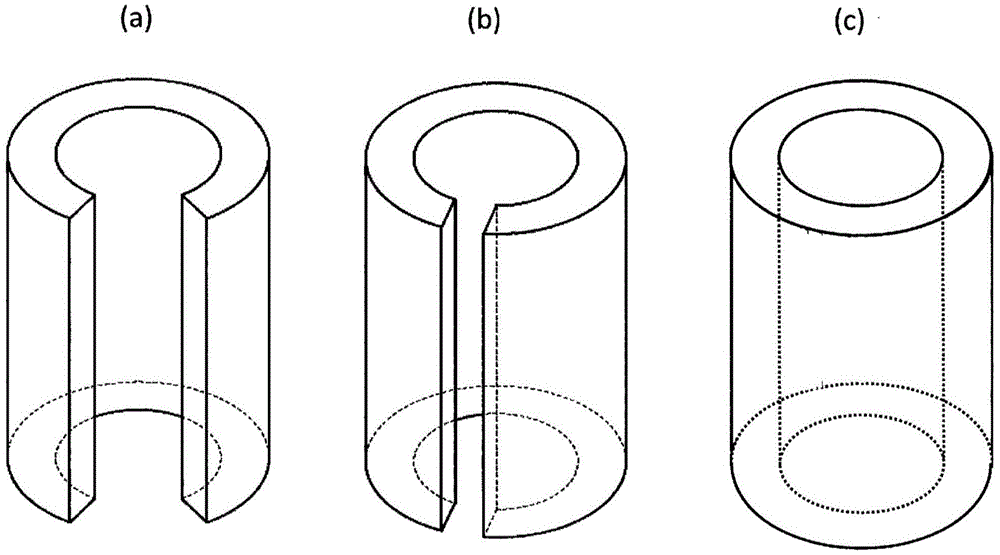
图1是示出本发明的具有中空部或凹状外形部的聚酰胺预发泡颗粒的截面图的图。FIG. 1 is a diagram showing a cross-sectional view of a polyamide pre-expanded particle having a hollow portion or a concave outer shape portion of the present invention.
图2是示出对于本发明的聚酰胺预发泡颗粒使用差示扫描量热计在升温速度10℃/分钟的条件下从30℃升温至280℃时所得到的DSC曲线的一例的图。Fig. 2 is a graph showing an example of a DSC curve obtained when the polyamide pre-expanded particles of the present invention are heated from 30°C to 280°C at a heating rate of 10°C/min using a differential scanning calorimeter.
具体实施方式Detailed ways
以下对本发明的具体实施方式(下文中称为“本实施方式”)进行详细说明。以下的实施方式是用于说明本发明的例示,本发明并不限于以下的实施方式,可以在其要点的范围内进行各种变形来实施。需要说明的是,本发明的实施方式中,A(数值)~B(数值)是指A以上B以下。Specific embodiments of the present invention (hereinafter referred to as "this embodiment") will be described in detail below. The following embodiments are examples for explaining the present invention, and the present invention is not limited to the following embodiments, and various modifications can be made within the scope of the gist. In addition, in embodiment of this invention, A (numerical value) - B (numerical value) mean A to B and below.
[聚酰胺预发泡颗粒][Polyamide pre-expanded particles]
本实施方式的聚酰胺预发泡颗粒的特征在于,在使用差示扫描量热计在升温速度10℃/分钟的条件下从30℃升温至280℃时所得到的DSC曲线中,最大吸热峰的峰温度为150℃以上275℃以下,将最大吸热峰的高温侧的逼近熔解终止后的DSC曲线的直线作为基线,相当于外推熔解起始温度与外推熔解终止温度之差的最大吸热峰的峰宽为30℃以上80℃以下,该外推熔解起始温度是最大吸热峰的低温侧的拐点处的切线与基线的交点的温度,该外推熔解终止温度是最大吸热峰的高温侧的拐点处的切线与基线的交点的温度。The polyamide pre-expanded particles of the present embodiment are characterized in that the maximum endothermic heat is obtained in the DSC curve obtained when the temperature is raised from 30°C to 280°C at a temperature increase rate of 10°C/min using a differential scanning calorimeter. The peak temperature of the peak is above 150°C and below 275°C, and the straight line of the DSC curve approaching the end of melting on the high temperature side of the maximum endothermic peak is taken as the baseline, which is equivalent to the difference between the extrapolated melting start temperature and the extrapolated melting end temperature The peak width of the maximum endothermic peak is not less than 30°C and not more than 80°C, the extrapolated melting start temperature is the temperature of the intersection point of the tangent line at the inflection point on the low temperature side of the largest endothermic peak and the baseline, and the extrapolated melting end temperature is the maximum The temperature at the intersection of the tangent line at the inflection point on the high temperature side of the endothermic peak and the baseline.
由此,在将聚酰胺预发泡颗粒进行发泡成型时可充分发泡。Thus, sufficient foaming can be achieved when the polyamide pre-expanded particles are foam-molded.
下面对本实施方式的聚酰胺预发泡颗粒中包含的聚酰胺系树脂进行详细说明。作为聚酰胺系树脂,例如可以举出聚酰胺、聚酰胺共聚物、这些的混合物。Next, the polyamide-based resin contained in the polyamide pre-expanded particles of the present embodiment will be described in detail. Examples of polyamide-based resins include polyamides, polyamide copolymers, and mixtures thereof.
作为聚酰胺,可以举出通过二胺与二羧酸的缩聚得到的聚酰胺66、聚酰胺610、聚酰胺612、聚酰胺46、聚酰胺1212等;通过内酰胺的开环聚合得到的聚酰胺6、聚酰胺12等。作为聚酰胺共聚物,例如可以举出聚酰胺6/66、聚酰胺66/6、聚酰胺66/610、聚酰胺66/612、聚酰胺66/6T(T表示对苯二甲酸成分)、聚酰胺66/6I(I表示间苯二甲酸成分)、聚酰胺6T/6I等。其中优选脂肪族聚酰胺,更优选聚酰胺6、聚酰胺66、聚酰胺6/66、聚酰胺66/6等。它们可以单独使用1种,也可以将2种以上组合使用。Examples of polyamides include polyamide 66, polyamide 610, polyamide 612, polyamide 46, polyamide 1212 obtained by polycondensation of diamine and dicarboxylic acid; polyamide obtained by ring-opening polymerization of lactam 6. Polyamide 12, etc. Examples of polyamide copolymers include polyamide 6/66, polyamide 66/6, polyamide 66/610, polyamide 66/612, polyamide 66/6T (T represents a terephthalic acid component), polyamide Amide 66/6I (I represents isophthalic acid component), polyamide 6T/6I, etc. Among them, aliphatic polyamides are preferred, and polyamide 6, polyamide 66, polyamide 6/66, polyamide 66/6, and the like are more preferred. These may be used individually by 1 type, and may use it in combination of 2 or more types.
作为这些的混合物,例如可以举出聚酰胺66与聚酰胺6的混合物、聚酰胺66与聚酰胺612的混合物、聚酰胺66与聚酰胺610的混合物、聚酰胺66与聚酰胺6I的混合物、聚酰胺66与聚酰胺6T的混合物等。其中,从提高发泡成型体的结晶度、使耐热性和熔合率充分的方面出发,混合物的情况下的聚酰胺树脂优选包含超过50质量%的脂肪族聚酰胺,更优选包含60质量%以上的脂肪族聚酰胺。Examples of these mixtures include a mixture of polyamide 66 and polyamide 6, a mixture of polyamide 66 and polyamide 612, a mixture of polyamide 66 and polyamide 610, a mixture of polyamide 66 and polyamide 6I, A mixture of amide 66 and polyamide 6T, etc. Among them, the polyamide resin in the case of a mixture preferably contains more than 50% by mass of aliphatic polyamide, and more preferably contains 60% by mass, from the viewpoint of improving the crystallinity of the foamed molded product and making the heat resistance and fusion rate sufficient. The above aliphatic polyamides.
需要说明的是,聚酰胺系树脂的熔点是指依据JIS K7121通过差示扫描量热测定(DSC)所测得的值。将测定中出现的表示吸热的峰作为表示树脂熔解的峰,将在最高温侧出现的表示吸热的峰处的温度作为熔点。In addition, the melting point of a polyamide-type resin means the value measured by differential scanning calorimetry (DSC) based on JISK7121. The peak showing endotherm that appeared during the measurement was taken as the peak showing melting of the resin, and the temperature at the peak showing endotherm that appeared on the highest temperature side was taken as the melting point.
作为测定装置,可以使用市售的差示扫描量热计,例如可以举出PerkinElmer公司制造的DSC7等。As a measuring device, a commercially available differential scanning calorimeter can be used, for example, DSC7 manufactured by PerkinElmer, etc. can be used.
作为测定条件,可以使用通常的条件,例如可以举出在惰性气体气氛下,温度条件为将树脂保持在超过其熔点的温度下,之后以20℃/分钟骤冷至室温左右,接着以20℃/分钟升温至超过熔点的温度的条件等。As the measurement conditions, common conditions can be used. For example, under an inert gas atmosphere, the temperature condition is to keep the resin at a temperature exceeding its melting point, then rapidly cool it to about room temperature at 20°C/min, and then heat it at 20°C. Conditions for raising the temperature to a temperature exceeding the melting point per minute, etc.
可以通过在聚酰胺系树脂的合成中添加封端剂而将聚酰胺系树脂在末端所具有的高反应性的官能团(氨基和羧基)转变为低反应性的官能团(对聚酰胺系树脂的末端进行封端)。It is possible to convert the highly reactive functional groups (amino and carboxyl groups) at the end of the polyamide resin into low-reactivity functional groups (to the end of the polyamide resin) by adding an end-capping agent in the synthesis of the polyamide resin. be capped).
这种情况下,作为添加封端剂的时机,可以举出原料投料时、聚合开始时、聚合中后期或聚合终止时。In this case, examples of timing for adding the terminal blocking agent include the time of feeding raw materials, the time of initiation of polymerization, the middle and late stages of polymerization, or the time of termination of polymerization.
作为封端剂,只要是能够与聚酰胺系树脂的氨基或羧基之间发生反应的单官能性的化合物就没有特别限制,例如可以举出一元羧酸、一元胺、酸酐、单异氰酸酯、一元酰卤化物、单酯类、一元醇类等。它们可以单独使用1种,也可以将2种以上组合使用。The end-blocking agent is not particularly limited as long as it is a monofunctional compound capable of reacting with the amino group or carboxyl group of the polyamide resin, for example, monocarboxylic acid, monoamine, acid anhydride, monoisocyanate, monoacyl Halides, monoesters, monohydric alcohols, etc. These may be used individually by 1 type, and may use it in combination of 2 or more types.
作为聚酰胺系树脂的胺值和酸值,均可设为0当量/1×106g以上,另外,从在聚酰胺系树脂的熔融滞留时不容易发生凝胶化和劣化的观点、以及在树脂的使用环境下不容易发生着色和水解等问题的方面出发,优选为200当量/1×106g以下、更优选为100当量/1×106g以下。Both the amine value and the acid value of the polyamide-based resin can be set to 0 equivalent/1×10 6 g or more, and from the viewpoint of less likely to cause gelation and deterioration when the polyamide-based resin stays in the melt, and It is preferably 200 equivalents/1×10 6 g or less, more preferably 100 equivalents/1×10 6 g or less from the viewpoint of less likely to cause problems such as coloring and hydrolysis under the environment in which the resin is used.
聚酰胺系树脂的饱和吸水率(23℃100%RH)优选为3%以上,从在对发泡颗粒进行含水处理的情况下能够表现出熔合性的方面出发,饱和吸水率优选为该范围,更优选为6%以上。The saturated water absorption rate (23° C. 100% RH) of the polyamide-based resin is preferably 3% or more, and the saturated water absorption rate is preferably within this range from the viewpoint of exhibiting fusion properties when the foamed particles are treated with water. More preferably, it is 6% or more.
作为本实施方式的聚酰胺预发泡颗粒中包含的聚酰胺系树脂以外的其他成分,可以在不损害本发明目的的范围内添加稳定剂、冲击改良剂、阻燃剂、润滑剂、颜料、染料、耐候性改良剂、抗静电剂、耐冲击改性剂、结晶成核剂、玻璃珠、无机填充材料、交联剂、滑石等成核剂或其他热塑性树脂。关于本实施方式的聚酰胺系树脂发泡成型体中的其他成分的含量,相对于聚酰胺系树脂100质量份可以为15质量份以下,优选为6质量份以下。更优选为3质量份以下。As components other than the polyamide-based resin contained in the polyamide pre-expanded particles of this embodiment, stabilizers, impact modifiers, flame retardants, lubricants, pigments, Dyes, weather resistance modifiers, antistatic agents, impact modifiers, crystallization nucleating agents, glass beads, inorganic fillers, crosslinking agents, nucleating agents such as talc, or other thermoplastic resins. The content of other components in the polyamide-based resin foam molding of the present embodiment may be 15 parts by mass or less, preferably 6 parts by mass or less, based on 100 parts by mass of the polyamide-based resin. More preferably, it is 3 parts by mass or less.
作为稳定剂没有特别限定,例如可以举出受阻酚系抗氧化剂、硫系抗氧化剂、磷系抗氧化剂、亚磷酸酯化合物、硫醚系化合物等有机系抗氧化剂或热稳定剂;受阻胺系、二苯甲酮系、咪唑系等光稳定剂或紫外线吸收剂;金属钝化剂等。它们可以单独使用1种,也可以将2种以上组合使用。The stabilizer is not particularly limited, and examples thereof include organic antioxidants such as hindered phenolic antioxidants, sulfur-based antioxidants, phosphorus-based antioxidants, phosphite compounds, and thioether-based compounds; and heat stabilizers; hindered amine-based, Benzophenone series, imidazole series and other light stabilizers or ultraviolet absorbers; metal deactivators, etc. These may be used individually by 1 type, and may use it in combination of 2 or more types.
作为热稳定剂,从在120℃以上的高温环境下长期有效地防止热老化的方面出发,优选铜化合物,还优选该铜化合物与卤化碱金属化合物的组合。此处,作为卤化碱金属化合物,可以举出氯化锂、溴化锂、碘化锂、氟化钠、氯化钠、溴化钠、碘化钠、氟化钾、氯化钾、溴化钾、碘化钾等。它们可以单独使用1种,也可以将2种以上组合使用。As a heat stabilizer, a copper compound is preferable, and a combination of the copper compound and an alkali metal halide compound is also preferable from the viewpoint of effectively preventing heat aging for a long period of time in a high-temperature environment of 120° C. or higher. Here, examples of the alkali metal halide compound include lithium chloride, lithium bromide, lithium iodide, sodium fluoride, sodium chloride, sodium bromide, sodium iodide, potassium fluoride, potassium chloride, potassium bromide, Potassium iodide etc. These may be used individually by 1 type, and may use it in combination of 2 or more types.
作为阻燃剂没有特别限定,优选卤素系阻燃剂与锑化合物的组合。The flame retardant is not particularly limited, but a combination of a halogen-based flame retardant and an antimony compound is preferable.
此处,作为卤素系阻燃剂,优选溴化聚苯乙烯、溴化聚苯醚、溴化双酚型环氧树脂、溴化苯乙烯马来酸酐共聚物、溴化环氧树脂、溴化苯氧基树脂、十溴二苯醚、十溴联苯、溴化聚碳酸酯、全氯环十五烷、溴化交联芳香族聚合物,另外,作为锑化合物,优选三氧化锑、五氧化锑、锑酸钠。Here, as the halogen-based flame retardant, brominated polystyrene, brominated polyphenylene ether, brominated bisphenol-type epoxy resin, brominated styrene-maleic anhydride copolymer, brominated epoxy resin, brominated Phenoxy resin, decabromodiphenyl ether, decabromobiphenyl, brominated polycarbonate, perchlorocyclopentadecane, brominated cross-linked aromatic polymer, in addition, antimony trioxide, penta Antimony oxide, sodium antimonate.
作为阻燃剂,从热稳定性的方面出发,优选二溴聚苯乙烯与三氧化锑的组合。As the flame retardant, a combination of dibrominated polystyrene and antimony trioxide is preferable from the viewpoint of thermal stability.
另外,作为阻燃剂,也可以使用非卤素系阻燃剂,具体地说,可以举出三聚氰胺氰尿酸酯、红磷、次膦酸金属盐、含氮磷酸系化合物等,特别优选次膦酸金属盐与含氮磷酸系化合物(例如还包括三聚氰胺或三聚氰胺的缩合物(蜜白胺、三聚二氰亚胺等)与多磷酸的反应生成物或混合物)的组合。In addition, non-halogen-based flame retardants can also be used as flame retardants, specifically, melamine cyanurate, red phosphorus, phosphinic acid metal salts, nitrogen-containing phosphoric acid compounds, etc., and phosphine-containing phosphoric acid compounds are particularly preferred. A combination of an acid metal salt and a nitrogen-containing phosphoric acid compound (for example, a reaction product or mixture of melamine or a condensate of melamine (melamine, melamine, etc.) and polyphosphoric acid).
在需要调节聚酰胺预发泡颗粒的平均气泡径的情况下,可以添加气泡调整剂。作为气泡调整剂,在无机成核剂中有滑石、氧化硅、硅酸钙、碳酸钙、氧化铝、氧化钛、硅藻土、粘土、碳酸氢钠、氧化铝、硫酸钡、氧化铝、膨润土等,关于其用量,通常相对于树脂发泡颗粒的原料总量添加0.005~5质量份。When it is necessary to adjust the average cell diameter of the polyamide pre-expanded particles, a cell regulator can be added. As the cell regulator, there are talc, silicon oxide, calcium silicate, calcium carbonate, aluminum oxide, titanium oxide, diatomaceous earth, clay, sodium bicarbonate, aluminum oxide, barium sulfate, aluminum oxide, bentonite among inorganic nucleating agents etc. About the usage-amount, 0.005-5 mass parts are added normally with respect to the raw material whole quantity of resin foamed particle|grains.
[聚酰胺预发泡颗粒的制造方法][Manufacturing method of polyamide pre-expanded particles]
作为聚酰胺预发泡颗粒的制造方法,可以为利用热塑性树脂的热塑性的方法、利用固体状态的颗粒的切削等后加工的方法等,只要能够对颗粒赋予所期望的外形的方法,任何方法均可应用。其中,作为生产率优异、能够制造稳定形状的颗粒的方法,可以适当地应用使用了设有排出截面的模头的熔融挤出法。作为熔融挤出法,可以任意地应用下述现有公知的方法来制造:将热塑性树脂利用挤出机熔融挤出,通过线料切割或水中切割等工业上通常使用的方法进行造粒并使所得到的粒料发泡而得到发泡颗粒的方法;以及将发泡剂从机筒中途注入到挤出机中,在排出的同时使其发泡,冷却后进行水中切割或线料切割而直接得到发泡颗粒的方法;在挤出机内使其熔融并从具有所期望的截面形状的模头挤出,冷却后利用造粒机切割成规定的长度,由此制造出基材树脂粒料,使该基材树脂粒料含浸发泡剂,通过加热使其以规定的发泡倍率进行发泡的方法;等等。As a method for producing polyamide pre-expanded particles, there may be a method utilizing the thermoplasticity of thermoplastic resin, a method of post-processing such as cutting of particles in a solid state, etc., as long as the desired shape can be imparted to the particles, any method is acceptable. applicable. Among them, as a method capable of producing pellets having excellent productivity and a stable shape, a melt extrusion method using a die provided with a discharge cross section can be suitably applied. As the melt extrusion method, the following conventionally known methods can be arbitrarily applied to produce: thermoplastic resin is melted and extruded by an extruder, pelletized by a method commonly used in industry such as strand cutting or water cutting, and made A method for obtaining foamed particles by foaming the obtained pellets; and injecting a foaming agent into an extruder from the middle of a barrel, making it foam while being discharged, and performing water cutting or strand cutting after cooling to obtain A method of directly obtaining foamed pellets; melting them in an extruder and extruding them from a die with a desired cross-sectional shape, and cutting them into predetermined lengths with a pelletizer after cooling to produce base resin pellets Material, the method of impregnating the substrate resin pellets with a foaming agent and heating it to a predetermined expansion ratio; and so on.
此处,作为制造本实施方式的聚酰胺预发泡颗粒时所使用的发泡剂没有特别限定,可以举出空气或可成为气体的化合物等。Here, the foaming agent used in the production of the polyamide pre-expanded particles of the present embodiment is not particularly limited, and examples thereof include air or a compound that can become a gas.
作为可成为气体的化合物的示例,可以举出:二氧化碳、氮、氧、氢、水、氩、氦、氖等无机化合物;三氯氟甲烷(R11)、二氯二氟甲烷(R12)、氯二氟甲烷(R22)、四氯二氟乙烷(R112)、二氯氟乙烷(R141b)、氯二氟乙烷(R142b)、二氟乙烷(R152a)、HFC-245fa、HFC-236ea、HFC-245ca、HFC-225ca等氟烃;HFO-1234y、HFO-1234ze(E)等氢氟代烯烃;丙烷、正丁烷、异丁烷、正戊烷、异戊烷、新戊烷等饱和烃;二甲醚、二乙醚、甲乙醚、异丙醚、正丁醚、二异丙醚、呋喃、糠醛、2-甲基呋喃、四氢呋喃、四氢吡喃等醚类;氯代甲烷、氯代乙烷等氯代烃类;甲醇、乙醇等醇类;等等。Examples of compounds that can become gases include inorganic compounds such as carbon dioxide, nitrogen, oxygen, hydrogen, water, argon, helium, and neon; trichlorofluoromethane (R11), dichlorodifluoromethane (R12), chlorine Difluoromethane (R22), tetrachlorodifluoroethane (R112), dichlorofluoroethane (R141b), chlorodifluoroethane (R142b), difluoroethane (R152a), HFC-245fa, HFC-236ea , HFC-245ca, HFC-225ca and other fluorocarbons; HFO-1234y, HFO-1234ze(E) and other hydrofluoroolefins; propane, n-butane, isobutane, n-pentane, isopentane, neopentane, etc. Saturated hydrocarbons; dimethyl ether, diethyl ether, methyl ethyl ether, isopropyl ether, n-butyl ether, diisopropyl ether, furan, furfural, 2-methylfuran, tetrahydrofuran, tetrahydropyran and other ethers; methyl chloride, Chlorinated hydrocarbons such as chloroethane; alcohols such as methanol and ethanol; etc.
这些空气或可成为气体的化合物可以单独使用1种,也可以将2种以上组合使用。These air or gaseous compounds may be used alone or in combination of two or more.
[聚酰胺预发泡颗粒的形状][Shape of polyamide pre-expanded particles]
本实施方式的聚酰胺预发泡颗粒可以赋予任意的3维形状。通过该3维形状,能够在发泡成型体中生成连通空隙、赋予吸音性能。聚酰胺树脂预发泡颗粒的正射影像可以采取任意形状,通常的实心珠粒形状是指正射影像具有圆形或椭圆形的大致球状的形状。The polyamide pre-expanded particles of this embodiment can be given an arbitrary three-dimensional shape. With this three-dimensional shape, communicating voids can be formed in the foam molded article, and sound-absorbing performance can be imparted. The orthophoto of the polyamide resin pre-expanded particles can take any shape, and the usual solid bead shape means that the orthophoto has a circular or elliptical roughly spherical shape.
作为本发明的一个实施方式的具有中空部是指,聚酰胺预发泡颗粒的正射影像在内部具有中空区域并且具有包围外中空圆区域的外周区域,是指存在可得到具有中空区域和外周区域的正射影像的方向。Having a hollow part as one embodiment of the present invention means that the orthophoto image of polyamide pre-expanded particles has a hollow area inside and a peripheral area surrounding the outer hollow circular area, and means that there is a hollow area and a peripheral area that can be obtained. The orientation of the orthophoto of the region.
另外,具有凹状外形部是指,按照凹状外形部满足凹部的条件和/或上述贯通孔的条件的方式选择树脂发泡颗粒的形状。由此,熔合成型后的聚酰胺发泡成型体能够良好地形成连通空隙(连续的空隙、连通的空隙)。In addition, having a concave outer shape means that the shape of the expanded resin particles is selected so that the concave outer shape satisfies the conditions of the concave part and/or the above-mentioned conditions of the through-holes. Thereby, the polyamide foam molded article after fusion molding can form communicating voids (continuous voids, continuous voids) favorably.
本实施方式中,聚酰胺预发泡颗粒的凹状外形部可以是贯通孔、也可以不是贯通孔,特别优选聚酰胺预发泡颗粒为具有凹部的形状。通过形成具有凹部的形状,可得到现有的聚酰胺预发泡颗粒中不存在的填充状态,成型后所得到的聚酰胺发泡成型体的连通空隙的结构能够在吸音性能、机械强度这两方面实现特别优异的平衡。In this embodiment, the concave outer shape of the polyamide pre-expanded particle may or may not be a through-hole, and it is particularly preferable that the polyamide pre-expanded particle has a concave shape. By forming a shape with a concave portion, a filling state that does not exist in conventional polyamide pre-expanded particles can be obtained, and the structure of the interconnected voids of the polyamide foam molding obtained after molding can improve both sound absorption performance and mechanical strength. A particularly excellent balance is achieved.
关于作为上述具有凹部的形状特别优异的形状,可以举出在聚酰胺预发泡颗粒中设有槽状凹部的结构,在制造聚酰胺发泡成型体时通过在使聚酰胺预发泡颗粒间热熔合时槽状凹部相邻的聚酰胺预发泡颗粒呈部分咬合的填充状态进行接合,由此会形成聚酰胺预发泡颗粒间的接合面积大、强度高的聚酰胺发泡成型体,同时,在相邻的聚酰胺预发泡颗粒的槽进行连结的形态下进行接合的情况下,会形成遍布聚酰胺发泡成型体内的空隙、即连通空隙。Regarding the shape that is particularly excellent as the shape having the above-mentioned recesses, there can be mentioned a structure in which groove-like recesses are provided in the polyamide pre-expanded particles. During heat fusion, the polyamide pre-expanded particles adjacent to the groove-shaped recesses are joined in a partially occluded filling state, thereby forming a polyamide foam molding with a large joint area between the polyamide pre-expanded particles and high strength. At the same time, when the grooves of adjacent polyamide pre-expanded particles are joined together, voids throughout the polyamide foam molding, that is, communicating voids are formed.
作为上述槽状凹部,例如可以举出将切下中空的近似为圆的一部分而得到的形状(C形状、U形状等)的截面重叠的形状(图1(a)、(b))、将切下中空的近似为多边形(三角形、四边形等)的一部分的截面重叠的形状等。此处,上述中空的近似为圆和中空的近似为多边形的中空可以为近似圆,也可以为近似多边形,优选与包围中空的形状为相同形状。另外,优选上述中空的形状的中心与包围上述中空的形状的中心重叠的形状(例如同心圆的O形状等)。As the above-mentioned groove-shaped concave portion, for example, a shape in which cross-sections of a shape (C-shape, U-shape, etc.) obtained by cutting out a part of a hollow approximate circle are overlapped (FIG. 1(a), (b)), A shape in which the cross-sections of a part of a hollow approximate polygon (triangle, quadrangle, etc.) overlap, etc. is cut out. Here, the hollows that are approximately circular and the hollows that are approximately polygonal may be approximately circular or approximately polygonal, and are preferably the same shape as the shape surrounding the hollow. Moreover, it is preferable that the center of the said hollow shape overlaps the center of the said hollow shape (for example, the O shape of a concentric circle, etc.).
作为上述中空部的例子,例如可以举出将中空的圆形(圆形、椭圆形)重叠的形状等(图1(c))。As an example of the said hollow part, the shape etc. which overlapped hollow circles (circle, ellipse) etc. are mentioned, for example (FIG.1(c)).
本实施方式中,聚酰胺预发泡颗粒具有中空部或凹状外形部这一点可以通过利用光学显微镜一边改变颗粒的观察方向一边观察并判定聚酰胺预发泡颗粒的透过图像来进行确认。In the present embodiment, the fact that the polyamide pre-expanded particles have a hollow portion or a concave outer shape can be confirmed by observing and judging the transmission image of the polyamide pre-expanded particles with an optical microscope while changing the observation direction of the particles.
[聚酰胺预发泡颗粒的最大吸热峰][Maximum endothermic peak of polyamide pre-expanded particles]
关于本实施方式的聚酰胺预发泡颗粒,在使用差示扫描量热计在升温速度10℃/分钟的条件下从30℃升温至280℃时所得到的DSC曲线中,最大吸热峰的峰温度为150℃以上275℃以下。最大吸热峰的峰温度优选为155℃以上220℃以下、更优选为160℃以上190℃以下。最大吸热峰的峰温度处于上述范围时,容易进行使用饱和蒸气的发泡成型,具有在实用上优选的倾向。Regarding the polyamide pre-expanded particles of this embodiment, in the DSC curve obtained when the temperature was raised from 30°C to 280°C at a temperature increase rate of 10°C/min using a differential scanning calorimeter, the maximum endothermic peak The peak temperature is not less than 150°C and not more than 275°C. The peak temperature of the maximum endothermic peak is preferably not less than 155°C and not more than 220°C, more preferably not less than 160°C and not more than 190°C. When the peak temperature of the maximum endothermic peak is in the above-mentioned range, foam molding using saturated steam is easy to perform, and it tends to be practically preferable.
另外,关于本实施方式的聚酰胺预发泡颗粒,在上述DSC曲线中,将最大吸热峰的高温侧的逼近熔解终止后的DSC曲线的直线作为基线,相当于外推熔解起始温度与外推熔解终止温度之差的最大吸热峰的峰宽为30℃以上80℃以下,该外推熔解起始温度是最大吸热峰的低温侧的拐点处的切线与基线的交点的温度,该外推熔解终止温度是最大吸热峰的高温侧的拐点处的切线与基线的交点的温度。最大吸热峰的峰宽优选为35℃以上75℃以下、更优选为40℃以上70℃以下。最大吸热峰的峰宽处于上述范围时,可增强在温度条件下发泡颗粒间的熔合力、并且抑制因发泡颗粒的泡破裂所致的材料强度的降低,具有成型性提高的倾向。In addition, regarding the polyamide pre-expanded particles of this embodiment, in the above-mentioned DSC curve, the straight line of the DSC curve approaching the end of melting on the high temperature side of the maximum endothermic peak is taken as the baseline, which corresponds to the extrapolation of the melting start temperature and The peak width of the maximum endothermic peak of the difference between the extrapolated melting end temperature is not less than 30°C and not more than 80°C, and the extrapolated melting start temperature is the temperature of the intersection point of the tangent line at the inflection point on the low temperature side of the maximum endothermic peak and the baseline, The extrapolated melting end temperature is the temperature of the intersection point of the tangent line at the inflection point on the high temperature side of the maximum endothermic peak and the base line. The peak width of the maximum endothermic peak is preferably from 35°C to 75°C, more preferably from 40°C to 70°C. When the peak width of the maximum endothermic peak is in the above range, the fusion force between expanded particles under temperature conditions can be enhanced, and the decrease in material strength due to cell rupture of expanded particles can be suppressed, and the moldability tends to be improved.
需要说明的是,关于最大吸热峰,在具有多个吸热峰的情况下,是指吸热量最大的峰。It should be noted that the maximum endothermic peak refers to the peak with the largest endothermic amount when there are a plurality of endothermic peaks.
图2是示出对于本实施方式的聚酰胺预发泡颗粒使用差示扫描量热计在升温速度10℃/分钟的条件下从30℃升温至280℃时所得到的DSC曲线的一例的图。图2中,A为最大吸热峰的低温侧的DSC曲线与基线的交点,B为最大吸热峰的高温侧的DSC曲线与基线的交点,C为最大吸热峰的低温侧的拐点处的切线与基线的交点,D为最大吸热峰的高温侧的拐点处的切线与基线的交点。另外,CT为外推熔解起始温度,DT为外推熔解终止温度,PT为最大吸热峰的峰温度。最大吸热峰的峰宽相当于从DT减去CT的值。FIG. 2 is a graph showing an example of a DSC curve obtained when the polyamide pre-expanded particles of the present embodiment are heated from 30° C. to 280° C. at a heating rate of 10° C./min using a differential scanning calorimeter. . In Figure 2, A is the intersection point of the DSC curve on the low temperature side of the maximum endothermic peak and the baseline, B is the intersection point of the DSC curve on the high temperature side of the maximum endothermic peak and the baseline, and C is the inflection point on the low temperature side of the maximum endothermic peak D is the intersection point of the tangent line and the baseline, and D is the intersection point of the tangent line at the inflection point of the high temperature side of the maximum endothermic peak and the baseline. In addition, C T is the extrapolated melting start temperature, DT is the extrapolated melting end temperature, and PT is the peak temperature of the maximum endothermic peak. The peak width of the maximum endothermic peak corresponds to the value obtained by subtracting CT from DT .
作为用于使上述最大吸热峰的峰温度为150℃以上275℃以下、使上述最大吸热峰的峰宽为30℃以上80℃以下的方法,例如可以举出适宜地选择聚酰胺预发泡颗粒中使用的聚酰胺树脂的种类、以及按下述所示调整聚酰胺预发泡颗粒的含水率等方法。As a method for making the peak temperature of the above-mentioned maximum endothermic peak 150°C to 275°C, and the peak width of the above-mentioned maximum endothermic peak to be 30°C to 80°C, for example, appropriate selection of polyamide pre-cured The type of polyamide resin used in the foam particles, and the method of adjusting the moisture content of the polyamide pre-expanded particles as shown below.
[聚酰胺预发泡颗粒的溶剂处理][Solvent treatment of polyamide pre-expanded particles]
通过对聚酰胺预发泡颗粒进行溶剂处理,能够降低发泡成型时的高温环境下的聚酰胺树脂组合物的粘度,提高成型品的熔合性,提高机械强度、例如弯曲断裂强度。By solvent-treating the polyamide pre-expanded particles, the viscosity of the polyamide resin composition in a high-temperature environment during foam molding can be reduced, the fusion property of molded articles can be improved, and mechanical strength such as bending fracture strength can be improved.
作为溶剂处理中使用的溶剂,可以举出水、乙醇、甲醇等极性溶剂,也可以使用它们的混合溶剂。Examples of the solvent used in the solvent treatment include polar solvents such as water, ethanol, and methanol, and mixed solvents thereof may be used.
这些溶剂中,从获得容易性、处理容易性的方面出发,优选水。Among these solvents, water is preferable from the viewpoint of availability and ease of handling.
下面对于使用水作为对聚酰胺预发泡颗粒进行溶剂处理时的溶剂的示例进行说明。An example of using water as a solvent in the solvent treatment of polyamide pre-expanded particles will be described below.
[聚酰胺预发泡颗粒的含水率][Moisture content of polyamide pre-expanded particles]
通过按照使聚酰胺预发泡颗粒的含水率达到3质量%以上15质量%以下的方式预先进行含水处理,能够降低之后的热熔合工序中发泡成型时的高温环境下的聚酰胺树脂组合物的粘度,提高成型品的熔合性,提高机械强度、例如弯曲断裂强度。这是由于,在模内成型时的温度条件下,通过聚酰胺发泡颗粒内的气泡的体积增加而使其膨胀,促进因聚酰胺树脂的粘度降低所致的不同的发泡颗粒间的树脂的相互扩散。By performing the water-containing treatment in advance so that the water content of the polyamide pre-expanded particles becomes 3% by mass or more and 15% by mass or less, the polyamide resin composition in the high-temperature environment during foam molding in the subsequent thermal fusion process can be reduced. Viscosity, improve the fusion of molded products, improve mechanical strength, such as bending fracture strength. This is because, under the temperature conditions during in-mold molding, the volume of the bubbles in the polyamide foamed particles increases to expand it, which promotes the resin formation between different foamed particles due to the decrease in the viscosity of the polyamide resin. mutual diffusion.
聚酰胺预发泡颗粒的含水率若大于15质量%,则在聚酰胺预发泡颗粒内部的独立气泡内产生冷凝水,在模内发泡成型时的加热时以蒸发热的形式产生吸热作用。该颗粒内部的冷凝水通过从发泡颗粒的外表面的传热而进行加热,因此与利用水蒸气的潜热直接加热的聚酰胺预发泡颗粒外部的表面附着水相比,聚酰胺预发泡颗粒内部的加热效率差,这会妨碍模内发泡成型时的聚酰胺预发泡颗粒的升温。其结果,聚酰胺预发泡颗粒不能充分发泡,由于膨胀能力不足而不能进行发泡颗粒间的熔合,发泡颗粒界面处发生剥离,得不到充分的弯曲断裂强度。从这样的方面出发,聚酰胺预发泡颗粒的含水率优选为15%质量以下、更优选为12质量%以下。If the moisture content of the polyamide pre-expanded particles is greater than 15% by mass, condensed water will be generated in the independent cells inside the polyamide pre-expanded particles, and heat will be absorbed in the form of evaporation heat during heating during in-mold foam molding. effect. The condensed water inside the particles is heated by heat transfer from the outer surface of the expanded particles, so compared with the surface-attached water outside the polyamide pre-expanded particles that is directly heated by the latent heat of water vapor, the polyamide pre-expanded The heating efficiency inside the pellets is poor, which hinders the temperature rise of the polyamide pre-expanded pellets during in-mold foam molding. As a result, the polyamide pre-expanded particles could not be fully expanded, and the fusion between the expanded particles could not proceed due to insufficient expansion ability, and peeling occurred at the interface of the expanded particles, so that sufficient bending breaking strength could not be obtained. From such a point of view, the moisture content of the polyamide pre-expanded particles is preferably 15% by mass or less, more preferably 12% by mass or less.
另外,通过适当地调整聚酰胺预发泡颗粒的含水率,能够抑制成型品的发泡径的波动。进行了含水处理的聚酰胺预发泡颗粒中,在干燥的聚酰胺发泡颗粒中观察到的因分子链间的氢键所致的相互作用减轻,因此玻璃化转变温度前后的储能模量的变化少,在发泡成型中针对急剧的温度变化仍显示出均匀的发泡行为,粒径的波动减小。该粒径的波动是成型品内产生空隙的原因,因此会发生机械强度的降低。从这样的方面出发,本实施方式中,聚酰胺预发泡颗粒优选含水3质量%以上。含水率更优选为4.5质量%以上、进一步优选为6质量%以上。In addition, by appropriately adjusting the water content of the polyamide pre-expanded particles, fluctuations in the foam diameter of molded articles can be suppressed. In the polyamide pre-expanded particles treated with water, the interaction due to the hydrogen bond between the molecular chains observed in the dried polyamide expanded particles is reduced, so the storage modulus before and after the glass transition temperature There are few changes, and even the rapid temperature change in foam molding still shows uniform foaming behavior, and the fluctuation of particle size is reduced. This fluctuation in particle diameter is the cause of voids in the molded product, and therefore reduces the mechanical strength. From such a point of view, in the present embodiment, the polyamide pre-expanded particles preferably contain 3% by mass or more of water. The water content is more preferably 4.5% by mass or more, and still more preferably 6% by mass or more.
聚酰胺预发泡颗粒的含水量由聚酰胺预发泡颗粒的重量(W0)以及除去聚酰胺预发泡颗粒的表面附着水之后的重量(W1)、将聚酰胺预发泡颗粒在80℃真空干燥6小时后的重量(W2)计算出。含水量(%)由(W1-W2)/W2×100计算出。The water content of the polyamide pre-expanded particles is determined by the weight (W0) of the polyamide pre-expanded particles and the weight (W1) after removing the water attached to the surface of the polyamide pre-expanded particles. The weight (W2) after vacuum drying for 6 hours was calculated. The water content (%) was calculated from (W1-W2)/W2×100.
另外,在计算具有中空部或凹状外形部的聚酰胺预发泡颗粒的含水率时,通过使用高压气体,能够除去滞留在中空部或凹状外形部的表面附着水。例如可以适当地使用调整为100米/秒以上的风速的空气等。In addition, when calculating the water content of the polyamide pre-expanded particles having the hollow portion or the concave outer shape portion, by using high-pressure gas, it is possible to remove the surface-adhered water remaining in the hollow portion or the concave outer shape portion. For example, air adjusted to a wind speed of 100 m/s or more can be used appropriately.
该含水的聚酰胺预发泡颗粒在50℃赋予50%应变时的压缩应力(S1)与在90℃赋予50%应变时的压缩应力(S2)之比S2/S1为0.2以上1.0以下的范围时,能够在不会受到成型机内的温度波动的影响的情况下使发泡行为均匀化,进行成型品的熔合,得到强度充分的发泡体。The ratio S2/S1 of the compressive stress (S1) when a 50% strain is imparted at 50°C to the compressive stress (S2) when a 50% strain is imparted at 90°C of the water-containing polyamide pre-expanded particles is in the range of 0.2 to 1.0 In this case, the foaming behavior can be made uniform without being affected by the temperature fluctuation in the molding machine, the fusion of the molded product can be performed, and a foam with sufficient strength can be obtained.
另外,从能够抑制发泡径的波动的方面出发,聚酰胺预发泡颗粒的平均粒径(D1)与独立气泡的平均泡孔径(D2)之比D1/D2优选为6.0以上。该比值为该范围时,在独立气泡膨胀时各泡孔壁间的应变均匀化,能够使其不容易发生内部破裂。在发生内部泡破裂时,膨胀能力显著降低,因此发泡颗粒间的熔合率会降低。从这样的方面出发,D1/D2更优选为7.0以上、进一步优选为10以上。In addition, the ratio D1/D2 of the average particle diameter (D1) of the polyamide pre-expanded particles to the average cell diameter (D2) of closed cells is preferably 6.0 or more from the viewpoint of suppressing fluctuations in cell diameter. When the ratio is in this range, the strain between the cell walls becomes uniform when the independent cells expand, making it less likely that internal rupture will occur. When internal cell rupture occurs, the expansion ability is remarkably reduced, and thus the fusion rate between expanded particles is reduced. From such a viewpoint, D1/D2 is more preferably 7.0 or more, and still more preferably 10 or more.
聚酰胺预发泡颗粒的平均粒径通过使用JIS Z8801中规定的试验用筛的试验方法而计算出。The average particle diameter of the polyamide pre-expanded particles is calculated by a test method using a test sieve prescribed in JIS Z8801.
另外,聚酰胺预发泡颗粒的独立气泡径的平均泡孔径D2(mm)的测定中,对于聚酰胺预发泡颗粒的中心面,由利用电子显微镜等拍摄的图像计算出30个独立气泡面积(S),对于各独立气泡求出与圆形近似的情况下的直径d=2(S/3.14)1/2,将30个的算数平均值作为聚酰胺预发泡颗粒的平均独立气泡径(D2)。需要说明的是,对于具有中空部或凹状外形部的聚酰胺预发泡颗粒,针对在出现中空部或凹状外形部的形状的方向上推出的中心面利用上述方法计算出平均泡孔径。In addition, in the measurement of the average cell diameter D2 (mm) of the closed cell diameter of the polyamide pre-expanded particles, the area of 30 closed cells is calculated from the image taken by an electron microscope or the like for the center plane of the polyamide pre-expanded particles. (S) For each independent cell, the diameter d=2(S/3.14) 1/2 in the case of approximating a circle is obtained, and the arithmetic mean value of 30 cells is used as the average independent cell diameter of the polyamide pre-expanded particles (D2). It should be noted that, for polyamide pre-expanded particles having a hollow portion or a concave outer shape, the average cell diameter was calculated by the method described above with respect to the central plane protruding in the direction in which the shape of the hollow portion or the concave outer shape appeared.
聚酰胺预发泡颗粒的含水处理可以通过在温水下进行浸渍处理来调整含水量。含水处理为40℃以上的温水时,含水速度加快,能够使其高效地含水。另外,从能够抑制在玻璃化转变点以上时预发泡颗粒的变形的方面出发,优选在70℃以下实施。另外,从抑制内部的添加剂的溶出量的方面出发,聚酰胺预发泡颗粒的含水时间优选为30分钟以内、更优选为15分钟以内。另外,从能够均匀地进行处理的方面出发,聚酰胺预发泡颗粒的含水时间优选为1分钟以上。The water content of polyamide pre-expanded particles can be adjusted by dipping in warm water. When the water-containing treatment is warm water of 40° C. or higher, the water-containing speed is accelerated, and water can be efficiently contained. Moreover, it is preferable to carry out at 70 degreeC or less from a point which can suppress the deformation|transformation of the pre-expanded particle|grains at the time of a glass transition point or more. In addition, from the viewpoint of suppressing the amount of elution of additives inside, the water content time of the polyamide pre-expanded particles is preferably within 30 minutes, more preferably within 15 minutes. In addition, the water-containing time of the polyamide pre-expanded particles is preferably 1 minute or more from the viewpoint of uniform treatment.
另外,为了除去含水处理后的聚酰胺预发泡颗粒的表面附着水,可以使用脱水机等进行处理。关于脱水处理的旋转速度,优选以100rpm以上的速度实施,从能够缩短处理时间的方面出发,更优选为500rpm以上。另外,脱水处理的旋转速度优选为50000转以下。从生产率的方面出发,脱水处理的时间优选为10分钟以内、更优选为5分钟以内。另外,从均匀性的方面出发,脱水处理的时间优选为1分钟以上。In addition, in order to remove water attached to the surface of the polyamide pre-expanded particles after the water treatment, treatment may be performed using a dehydrator or the like. The rotational speed of the dehydration treatment is preferably performed at a speed of 100 rpm or higher, and more preferably 500 rpm or higher since the processing time can be shortened. In addition, the rotational speed of the dehydration treatment is preferably 50,000 revolutions or less. From the viewpoint of productivity, the dehydration treatment time is preferably within 10 minutes, more preferably within 5 minutes. In addition, from the viewpoint of uniformity, the dehydration treatment time is preferably 1 minute or more.
聚酰胺预发泡颗粒的表面附着水量由聚酰胺预发泡颗粒的重量(W0)以及除去了聚酰胺预发泡颗粒的表面附着水后的重量(W1)、将聚酰胺预发泡颗粒在80℃真空干燥6小时后的重量(W2)计算出。表面附着水量(%)由(W0-W1)/W2×100计算出。The amount of water attached to the surface of the polyamide pre-expanded particles is determined by the weight (W0) of the polyamide pre-expanded particles and the weight (W1) after removing the surface-attached water of the polyamide pre-expanded particles. The weight (W2) after vacuum drying at 80°C for 6 hours was calculated. The amount of water attached to the surface (%) was calculated from (W0-W1)/W2×100.
另外,在计算具有中空部或凹状外形部的聚酰胺预发泡颗粒的含水率时,通过使用高压气体,能够除去滞留在中空部或凹状外形部的表面附着水。例如可以适宜地使用调整为100米/秒以上的风速的空气等。In addition, when calculating the water content of the polyamide pre-expanded particles having the hollow portion or the concave outer shape portion, by using high-pressure gas, it is possible to remove the surface-adhered water remaining in the hollow portion or the concave outer shape portion. For example, air adjusted to a wind speed of 100 m/s or more can be suitably used.
聚酰胺预发泡颗粒的表面附着水优选为14%以下。因此,聚酰胺预发泡颗粒的表面附着水优选按照达到14%以下的方式除去。表面附着水的量为14%以下时,在模内发泡成型的原料填充时不容易发生由表面附着水彼此的相互作用所致的颗粒间的凝集,会使预发泡颗粒最密填充在模内,形成稀疏缺陷少的成型体,机械强度提高。从这样的方面出发,聚酰胺预发泡颗粒的表面附着水更优选为10%以下、进一步优选为7%以下。The surface-attached water of the polyamide pre-expanded particles is preferably 14% or less. Therefore, it is preferable to remove the water adhered to the surface of the polyamide pre-expanded particles so as to be 14% or less. When the amount of surface-attached water is 14% or less, it is not easy to cause aggregation between particles caused by the interaction of surface-attached water when the raw materials for in-mold foam molding are filled, and the pre-expanded particles will be filled most densely. In the mold, a molded body with few sparse defects is formed, and the mechanical strength is improved. From such a point of view, the surface-attached water of the polyamide pre-expanded particles is more preferably 10% or less, and still more preferably 7% or less.
此外,通过将表面附着水量调整得比颗粒内的含水量少,能够降低向聚酰胺预发泡颗粒中导入压缩空气时的导入量的波动,从成型品的机械强度稳定的方面出发是优选的。In addition, by adjusting the amount of water attached to the surface to be less than the water content in the particles, fluctuations in the amount of introduction of compressed air into the polyamide pre-expanded particles can be reduced, which is preferable in terms of stabilizing the mechanical strength of the molded product. .
作为对聚酰胺预发泡颗粒进行含水处理的方法,可以在制造聚酰胺预发泡颗粒时预先调整聚酰胺树脂组合物的含水量。例如,通过在高温的水中对所挤出的熔融树脂进行粒料化,而在将发泡前的粒料的含水量调整为5%以上的状态下进行发泡,由此能够得到含水率高的聚酰胺预发泡颗粒。该粒料化时的温度优选为40℃以上、更优选为50℃以上。As a method of water-containing treatment of the polyamide pre-expanded particles, the water content of the polyamide resin composition may be adjusted in advance when producing the polyamide pre-expanded particles. For example, by pelletizing the extruded molten resin in high-temperature water, and then foaming the pellets before foaming with a moisture content of 5% or more, it is possible to obtain a resin with a high moisture content. Polyamide pre-expanded particles. The temperature at the time of pelletizing is preferably 40°C or higher, more preferably 50°C or higher.
如上所述,作为溶剂处理,对使用水的示例进行了说明,例如在溶剂处理的溶剂为乙醇时,优选预先进行处理以使聚酰胺预发泡颗粒的乙醇含量为3质量%以上15质量%以下。As described above, the example of using water as the solvent treatment has been described. For example, when the solvent for the solvent treatment is ethanol, it is preferable to perform the treatment in advance so that the ethanol content of the polyamide pre-expanded particles is 3% by mass or more and 15% by mass. the following.
关于进行含乙醇处理时的聚酰胺预发泡颗粒的含乙醇量和含水量的测定,在从聚酰胺预发泡颗粒中除去表面附着水和表面附着乙醇后,加入THF制备测定试样。使用GC-MS-SIM(选择性离子监测,SelectedIon Monitoring)法分别对水、乙醇进行定量,根据作为各自的定量值(%)的W(水)、W(EtOH),由含水率=W(水)/(100-W(水)-W(EtOH))×100、含乙醇率=W(EtOH)/(100-W(水)-W(EtOH))×100进行计算。Regarding the measurement of the ethanol content and water content of the polyamide pre-expanded particles when the ethanol-containing treatment was performed, THF was added to prepare a measurement sample after removing surface-adhered water and surface-adhered ethanol from the polyamide pre-expanded particles. Use GC-MS-SIM (Selected Ion Monitoring, Selected Ion Monitoring) method to quantify water and ethanol respectively, according to W (water) and W (EtOH) as respective quantitative values (%), from water content = W ( Water)/(100-W(water)-W(EtOH))×100, ethanol content=W(EtOH)/(100-W(water)-W(EtOH))×100 for calculation.
[聚酰胺发泡成型体][Polyamide foam molding]
本实施方式的聚酰胺发泡成型体的特征在于,成型体中上述聚酰胺预发泡颗粒相互发生了熔合。The polyamide foam molded article of this embodiment is characterized in that the polyamide pre-expanded particles are fused to each other in the molded article.
[聚酰胺发泡成型体的制造方法][Manufacturing method of polyamide foam molding]
本实施方式的聚酰胺发泡成型体可以通过使聚酰胺预发泡颗粒加热熔合而成型为任意的立体形状。The polyamide foam molded article of this embodiment can be molded into an arbitrary three-dimensional shape by heating and fusing polyamide pre-expanded particles.
本实施方式的聚酰胺发泡成型体的制造中,可以将聚酰胺预发泡颗粒填充在关闭的模具内进行发泡而得到,也可以采用填充在不能密闭的模具内并进行加热使树脂发泡颗粒相互熔合的方法。可以根据树脂种类和成型条件使用通用的模内发泡自动成型机。In the manufacture of the polyamide foam molding of this embodiment, polyamide pre-expanded particles can be filled in a closed mold and foamed, or can be filled in a mold that cannot be sealed and heated to make the resin foam. The method by which bubble particles are fused to each other. General-purpose in-mold foaming automatic molding machines can be used depending on the type of resin and molding conditions.
聚酰胺预发泡颗粒的加热温度为100℃以上270℃以下时,可进行颗粒间的熔合,因而优选该加热温度,更优选为105℃以上260℃以下。成型方法没有特别限定,例如可以将预发泡颗粒填充在成型用模具的型腔内,通过加热而产生发泡,同时使预发泡颗粒彼此热熔合,之后通过冷却使生成物固化,进行成型。此处,预发泡颗粒的填充方法没有特别限定,例如可以举出:在稍微打开模具的状态下填充预发泡颗粒的裂缝法;在关闭模具的状态下填充经加压压缩的预发泡颗粒的压缩法;在将经加压压缩的预发泡颗粒填充至模具中后进行上述裂缝法的压缩裂缝法;等等。When the heating temperature of the polyamide pre-expanded particles is 100°C to 270°C, fusion between the particles can proceed, so this heating temperature is preferable, more preferably 105°C to 260°C. The molding method is not particularly limited. For example, pre-expanded particles can be filled in the cavity of a molding mold, foaming can be generated by heating, and the pre-expanded particles can be thermally fused to each other, and then the product can be solidified by cooling to perform molding. . Here, the filling method of the pre-expanded particles is not particularly limited, and examples thereof include: the crack method of filling the pre-expanded particles with the mold slightly open; filling the compressed pre-expanded particles with the mold closed. A compression method of pellets; a compression cracking method of performing the above-mentioned cracking method after filling pre-expanded pellets compressed by pressure into a mold; and the like.
本发明中,从对于预发泡颗粒的气泡赋予一定的气体压力、使颗粒内部的气泡大小(泡孔尺寸)均匀的方面出发,优选在将预发泡颗粒填充至成型用模具的型腔内之前针对预发泡颗粒进行基于气体的加压处理。关于加压处理的方法没有特别限定,例如,从有效地进行气体对预发泡颗粒的加压处理的方面出发,作为气氛压力优选为0.3~6.0MPa,作为气氛温度优选为5~50℃。In the present invention, from the viewpoint of imparting a certain gas pressure to the air cells of the pre-expanded particles and making the size of the air cells (cell size) inside the particles uniform, it is preferable to fill the pre-expanded particles into the cavity of the mold for molding. Gas-based pressurization was previously performed on pre-expanded granules. The method of pressure treatment is not particularly limited. For example, from the viewpoint of effectively performing pressure treatment of pre-expanded particles with gas, the atmospheric pressure is preferably 0.3 to 6.0 MPa, and the atmospheric temperature is preferably 5 to 50°C.
作为加压处理中使用的气体没有特别限定,可以举出二氧化碳、氮、氧、氢、氩、氦、氖等无机化合物;三氯氟甲烷(R11)、二氯二氟甲烷(R12)、氯二氟甲烷(R22)、四氯二氟乙烷(R112)、二氯氟乙烷(R141b)、氯二氟乙烷(R142b)、二氟乙烷(R152a)、HFC-245fa、HFC-236ea、HFC-245ca、HFC-225ca等氟烃;HFO-1234y、HFO-1234ze(E)等氢氟代烯烃;丙烷、正丁烷、异丁烷、正戊烷、异戊烷、新戊烷等饱和烃;二甲醚、二乙醚、甲乙醚、异丙醚、正丁醚、二异丙醚、呋喃、糠醛、2-甲基呋喃、四氢呋喃、四氢吡喃等醚类;氯代甲烷、氯化乙烷等氯化烃类;甲醇、乙醇等醇类;等等。The gas used in the pressure treatment is not particularly limited, and examples include inorganic compounds such as carbon dioxide, nitrogen, oxygen, hydrogen, argon, helium, and neon; trichlorofluoromethane (R11), dichlorodifluoromethane (R12), chlorine Difluoromethane (R22), tetrachlorodifluoroethane (R112), dichlorofluoroethane (R141b), chlorodifluoroethane (R142b), difluoroethane (R152a), HFC-245fa, HFC-236ea , HFC-245ca, HFC-225ca and other fluorocarbons; HFO-1234y, HFO-1234ze(E) and other hydrofluoroolefins; propane, n-butane, isobutane, n-pentane, isopentane, neopentane, etc. Saturated hydrocarbons; dimethyl ether, diethyl ether, methyl ethyl ether, isopropyl ether, n-butyl ether, diisopropyl ether, furan, furfural, 2-methylfuran, tetrahydrofuran, tetrahydropyran and other ethers; methyl chloride, Chlorinated hydrocarbons such as chlorinated ethane; alcohols such as methanol and ethanol; etc.
其中,从阻燃性、耐热性、尺寸稳定性的方面出发,优选使用无机气体。Among these, inorganic gases are preferably used from the viewpoint of flame retardancy, heat resistance, and dimensional stability.
这些空气或可成为气体的化合物可以单独使用1种,也可以将2种以上组合使用。These air or gaseous compounds may be used alone or in combination of two or more.
将聚酰胺系树脂预发泡颗粒进行成型时所使用的热介质体可以为通用的热介质体形式,从抑制发泡成型体的氧化劣化的方面出发,优选为饱和水蒸气或过热水蒸气,从能够对发泡成型体均匀地进行加热的方面出发,更优选饱和水蒸气。The heat medium used when molding the polyamide-based resin pre-expanded particles may be in the form of a general-purpose heat medium, and from the viewpoint of suppressing the oxidative deterioration of the foamed molded body, saturated water vapor or superheated steam is preferred. , from the viewpoint of being able to uniformly heat the foamed molded article, saturated water vapor is more preferable.
作为热介质体使用饱和水蒸气的情况下,优选设定成型温度为100℃以上,利用(成型温度-5℃以下)的温度的饱和水蒸气进行1秒以上10秒以下加热(预热),之后利用成型温度的饱和水蒸气进行加热熔合。When using saturated water vapor as the heat medium, it is preferable to set the molding temperature at 100°C or higher and heat (preheat) for 1 second to 10 seconds with saturated steam at a temperature of (molding temperature - 5°C or lower), Then heat and fuse with saturated water vapor at the molding temperature.
上述预热中使用的饱和水蒸气的温度为(成型温度-5℃)以下,优选为(成型温度-6℃)以下,更优选为(成型温度-7℃)以下。另外,上述饱和水蒸气的温度优选为(成型温度-15℃)以上,更优选为(成型温度-14℃)以上,进一步优选为(成型温度-13℃)以上。该温度为上述的温度范围时,具有能够在抑制聚酰胺预发泡颗粒的膨胀和熔合的同时使水分扩散到聚酰胺预发泡颗粒中的倾向。The temperature of the saturated steam used in the above preheating is (molding temperature - 5°C) or lower, preferably (molding temperature - 6°C) or lower, more preferably (molding temperature - 7°C) or lower. In addition, the temperature of the saturated steam is preferably (molding temperature - 15°C) or higher, more preferably (molding temperature - 14°C) or higher, and still more preferably (molding temperature - 13°C) or higher. When the temperature is within the above-mentioned temperature range, it tends to be possible to diffuse moisture into the polyamide pre-expanded particles while suppressing expansion and fusion of the polyamide pre-expanded particles.
另外,上述预热中使用的饱和水蒸气的加热时间为1秒以上10秒以下,优选为1秒以上5秒以下,更优选为1秒以上3秒以下。以往,通过将聚酰胺预发泡颗粒预热至接近成型温度的工序会使得成型所需要的总时间延长,具有生产率降低的问题,但加热时间为上述范围时,能够以该问题为实用上可容许的范围使水分扩散到聚酰胺预发泡颗粒中,具有提高成型温度下的熔合性的倾向。In addition, the heating time of the saturated steam used in the above-mentioned preheating is from 1 second to 10 seconds, preferably from 1 second to 5 seconds, more preferably from 1 second to 3 seconds. In the past, the process of preheating polyamide pre-expanded particles to a temperature close to the molding temperature prolongs the total time required for molding, which has the problem of lowering productivity. However, when the heating time is within the above range, this problem can be solved practically The allowable range allows moisture to diffuse into the polyamide pre-expanded particles, which tends to improve the fusion property at the molding temperature.
本实施方式的聚酰胺发泡成型体的制造方法的另一方式的特征在于,将含水量为0质量%以上12质量%以下的聚酰胺预发泡颗粒填充在模具内,设定成型温度为100℃以上,利用(上述成型温度-5℃)以下的温度的饱和水蒸气加热15秒以上,之后利用上述成型温度的饱和水蒸气使其加热熔合。Another aspect of the method for producing a polyamide foam molded article according to this embodiment is characterized in that polyamide pre-expanded particles having a water content of 0% by mass or more and 12% by mass or less are filled in the mold, and the molding temperature is set at 100°C or higher, heated with saturated water vapor at a temperature below (the above-mentioned molding temperature - 5°C) for more than 15 seconds, and then heated and fused with saturated water vapor at the above-mentioned molding temperature.
通过使用上述制造方法,能够改善成型时的聚酰胺预发泡颗粒间的熔合性,制造出机械强度优异的聚酰胺发泡成型体。By using the above-mentioned production method, the fusion properties between polyamide pre-expanded particles during molding can be improved, and a polyamide foam molded article excellent in mechanical strength can be produced.
本实施方式的聚酰胺发泡成型体的制造方法的其他方式中,将聚酰胺预发泡颗粒填充在成型用模具的型腔内的方法没有特别限定,可以举出上述的裂缝法、压缩法、压缩裂缝法等。In other aspects of the method for producing a polyamide foam molded article of this embodiment, the method of filling the polyamide pre-expanded particles into the cavity of the molding die is not particularly limited, and examples thereof include the above-mentioned slit method and compression method. , compression cracking method, etc.
另外,聚酰胺预发泡颗粒可以在填充在成型用模具的型腔内之前进行溶剂处理。溶剂处理中使用的溶剂、溶剂处理方法等可以与上述相同。In addition, the polyamide pre-expanded particles may be subjected to a solvent treatment before being filled in the cavity of the molding die. The solvent used in the solvent treatment, the solvent treatment method, and the like may be the same as described above.
此外,聚酰胺预发泡颗粒优选在填充至成型用模具的型腔内之前进行基于气体的加压处理。加压处理的方法、加压处理中使用的气体等可以与上述相同。In addition, the polyamide pre-expanded particles are preferably subjected to a pressure treatment by gas before being filled into the cavity of the molding die. The method of the pressure treatment, the gas used for the pressure treatment, and the like may be the same as those described above.
本实施方式的聚酰胺发泡成型体的制造方法的其他方式中,聚酰胺预发泡颗粒的成型温度为100℃以上,从促进颗粒间的熔合的方面出发,优选为100℃以上270℃以下、更优选为105℃以上260℃以下。In another aspect of the method for producing a polyamide foam molded article of this embodiment, the molding temperature of the polyamide pre-expanded particles is 100°C or higher, and is preferably 100°C or higher and 270°C or lower from the viewpoint of promoting fusion between the particles. , More preferably at least 105°C and at most 260°C.
本实施方式的聚酰胺发泡成型体的制造方法的另一方式中,聚酰胺预发泡颗粒在利用成型温度的饱和水蒸气加热之前,利用(成型温度-5℃)以下的温度的饱和水蒸气进行15秒以上的加热(预热)。In another aspect of the method for producing a polyamide foam molded article of this embodiment, the polyamide pre-expanded particles are heated with saturated water at a temperature of (molding temperature - 5° C.) or lower before heating the polyamide pre-expanded particles with saturated steam at the molding temperature. The steam is heated (preheated) for 15 seconds or more.
上述预热中使用的饱和水蒸气的温度为(成型温度-5℃)以下,优选为(成型温度-6℃)以下,更优选为(成型温度-7℃)以下。另外,上述饱和水蒸气的温度优选为(成型温度-15℃)以上,更优选为(成型温度-14℃)以上,进一步优选为(成型温度-13℃)以上。上述饱和水蒸气的温度为上述范围时,具有能够在抑制聚酰胺预发泡颗粒的膨胀和熔合的同时使水分扩散到聚酰胺预发泡颗粒中的倾向。The temperature of the saturated steam used in the above preheating is (molding temperature - 5°C) or lower, preferably (molding temperature - 6°C) or lower, more preferably (molding temperature - 7°C) or lower. In addition, the temperature of the saturated steam is preferably (molding temperature - 15°C) or higher, more preferably (molding temperature - 14°C) or higher, and still more preferably (molding temperature - 13°C) or higher. When the temperature of the saturated water vapor is within the above range, moisture tends to diffuse into the polyamide pre-expanded particles while suppressing expansion and fusion of the polyamide pre-expanded particles.
另外,上述预热中使用的饱和水蒸气的加热时间为15秒以上,优选为15~120秒,更优选为30~90秒。以往,通过将聚酰胺预发泡颗粒预热至接近成型温度的工序会使成型所需要的总时间延长,具有生产率降低的问题,但加热时间为上述范围时,能够以该问题为实用上可容许的范围使水分扩散到聚酰胺预发泡颗粒中,具有提高成型温度下的熔合性的倾向。In addition, the heating time of the saturated steam used in the above-mentioned preheating is 15 seconds or more, preferably 15 to 120 seconds, and more preferably 30 to 90 seconds. In the past, the process of preheating polyamide pre-expanded particles to a temperature close to the molding temperature prolongs the total time required for molding and reduces productivity. However, when the heating time is within the above range, this problem can be used as a practical The allowable range allows moisture to diffuse into the polyamide pre-expanded particles, which tends to improve the fusion property at the molding temperature.
本实施方式的聚酰胺发泡成型体的制造方法的另一方式中,聚酰胺预发泡颗粒的含水量为0质量%以上12质量%以下,从熔合性的方面出发,优选为1.5质量%以上12质量%以下、更优选为3质量%以上12质量%以下。In another aspect of the method for producing a polyamide expanded molded article of the present embodiment, the water content of the polyamide pre-expanded particles is 0% by mass or more and 12% by mass or less, preferably 1.5% by mass from the viewpoint of fusion properties. The above is 12% by mass or less, more preferably 3% by mass or more and 12% by mass or less.
需要说明的是,该另一方式中,聚酰胺预发泡颗粒中包含的聚酰胺系树脂和聚酰胺系树脂以外的其他成分、聚酰胺预发泡颗粒的形状可以与上述相同。In addition, in this another form, the polyamide-type resin contained in a polyamide pre-expanded particle, other components other than a polyamide-type resin, and the shape of a polyamide pre-expanded particle may be the same as above.
[成型体弯曲强度][Molded product bending strength]
将本实施方式的聚酰胺发泡成型体成型后,使用干燥机在60℃干燥24小时,除去成型体所包含的水分。对于该聚酰胺发泡成型体,依据JISK7171测定其弯曲强度(MPa)。从将成型体作为结构部件使用时的可靠性的方面出发,弯曲强度优选为2.8MPa以上、更优选为3.0MPa以上、进一步优选为3.3MPa以上。After molding the polyamide foam molded article of this embodiment, it was dried at 60° C. for 24 hours using a drier to remove moisture contained in the molded article. About this polyamide foam molding, the bending strength (MPa) was measured based on JISK7171. From the viewpoint of reliability when the molded article is used as a structural member, the bending strength is preferably 2.8 MPa or more, more preferably 3.0 MPa or more, and still more preferably 3.3 MPa or more.
[成型体弯曲模量][Molded product flexural modulus]
可以制作树脂发泡成型体的试验片(试验片尺寸;长300mm、宽40mm、厚20mm)来求出该弯曲模量。聚酰胺发泡成型的弯曲模量依据JIS K 7171(2008)进行测定。The flexural modulus can be obtained by producing a test piece (test piece size: length 300 mm, width 40 mm, thickness 20 mm) of the resin foam molded body. The flexural modulus of polyamide foam molding was measured in accordance with JIS K 7171 (2008).
弯曲模量优选为50MPa以上、更优选为70MPa以上、进一步优选为80MPa以上。The flexural modulus is preferably 50 MPa or more, more preferably 70 MPa or more, still more preferably 80 MPa or more.
实施例Example
以下通过实施例说明本发明的实施方式。但是,本发明的范围并不受实施例的任何限定。Embodiments of the present invention are described below by way of examples. However, the scope of the present invention is not limited by the Examples at all.
下面对实施例和比较例中使用的评价方法进行说明。Evaluation methods used in Examples and Comparative Examples will be described below.
(1-1)聚酰胺预发泡颗粒的含水量(1-1) Moisture content of polyamide pre-expanded particles
称量酰胺预发泡颗粒(W0)后,使颗粒扩散在干燥的纤维片(Kim Towel日本制纸)上,用其他纤维片除去表面附着水,之后进行称量(W1)。将该聚酰胺预发泡颗粒在80℃真空干燥6小时后,再次进行称量(W2),分别计算出含水量(%)=(W1-W2)/W2×100和表面附着水(%)=(W0-W1)/W2×100。After weighing the amide pre-expanded particles (W0), the particles were spread on a dry fiber sheet (Kim Towel Nippon Paper), and other fiber sheets were used to remove surface-adhered water, followed by weighing (W1). After the polyamide pre-expanded particles were vacuum-dried at 80°C for 6 hours, weighed again (W2), calculated respectively water content (%)=(W1-W2)/W2×100 and surface attached water (%) =(W0-W1)/W2×100.
(1-2)具有中空部或凹状外形部的聚酰胺预发泡颗粒的含水量(1-2) Moisture content of polyamide pre-expanded particles having a hollow portion or a concave shape portion
称量聚酰胺预发泡颗粒(W0)后,将聚酰胺预发泡颗粒填充在具有通气性的金属丝网内部,利用100m/s风速的喷气枪吹喷10秒除去表面附着水后进行称量(W1)。将该聚酰胺预发泡颗粒在80℃真空干燥6小时后,再次进行称量(W2),分别计算出含水率(%)(W1-W2)/W2×100和表面附着水(%)(W0-W1)/W2×100的比例。After weighing the polyamide pre-expanded particles (W0), fill the polyamide pre-expanded particles in the inside of the air-permeable wire mesh, and use an air jet gun with a wind speed of 100m/s for 10 seconds to remove the attached water on the surface. Quantity (W1). After this polyamide pre-expanded particle was vacuum-dried at 80 DEG C for 6 hours, weighed again (W2), calculated moisture content (%) (W1-W2)/W2 * 100 and surface attached water (%) ( The ratio of W0-W1)/W2×100.
(1-3)进行了含乙醇处理的情况下的聚酰胺预发泡颗粒的含乙醇量和含水量(1-3) Ethanol content and water content of polyamide pre-expanded particles in the case of ethanol-containing treatment
与(i)上述(1-1)同样地除去聚酰胺预发泡颗粒的表面附着水和表面附着乙醇后,称量聚酰胺预发泡颗粒1g,填充到玻璃制三角烧瓶中。向其中加入THF20mL,在加盖的状态下在50℃加热1小时。冷却至常温后,采集2mL,追加THF使其为合计5mL。(i) After removing surface-adhered water and surface-adhered ethanol of the polyamide pre-expanded particles in the same manner as in (1-1) above, 1 g of the polyamide pre-expanded particles was weighed and filled into a glass Erlenmeyer flask. 20 mL of THF was added thereto, and the mixture was heated at 50° C. for 1 hour with the lid on. After cooling to room temperature, 2 mL was collected, and THF was added to make a total of 5 mL.
将该试样转移至GC西林瓶中,利用GC-MS-SIM(选择性离子监测)法对水和乙醇分别进行定量。关于所使用的峰,设水:m/z=18、乙醇:m/z=45。This sample was transferred to a GC vial, and water and ethanol were respectively quantified by the GC-MS-SIM (selected ion monitoring) method. As for the peaks used, water: m/z=18, ethanol: m/z=45.
关于校正曲线和标准资料,称量乙醇和蒸馏水,分别溶解于THF中,由此制作3个水准的浓度,分别利用GC-MS-SIM(选择性离子监测)法进行分析,由浓度和SIM面积制作校正曲线。Regarding the calibration curve and standard data, ethanol and distilled water were weighed and dissolved in THF to prepare three levels of concentration, and analyzed by GC-MS-SIM (Selected Ion Monitoring) method, based on the concentration and SIM area. Make a calibration curve.
<GC-MS测定条件><GC-MS measurement conditions>
GC-MS装置:Agilent公司制造HP6890N/5973GC-MS device: HP6890N/5973 manufactured by Agilent
烘箱:在50℃保持1min后,以10℃/min从50℃升温至130℃Oven: keep at 50°C for 1min, then heat up from 50°C to 130°C at 10°C/min
前注入口的温度200℃The temperature of the front injection port is 200°C
分流比20:1Split ratio 20:1
柱:Sigma-Aldrich公司制造WATERCOL191029711UColumn: WATERCOL191029711U manufactured by Sigma-Aldrich
长度30.0m、内径0.25mm、膜厚0.20μm、流量1.0mL/minLength 30.0m, inner diameter 0.25mm, film thickness 0.20μm, flow rate 1.0mL/min
(ii)由(i)中得到的水、乙醇各自的定量值(%)即W(水)、W(EtOH)计算出含水率=W(水)/(100-W(水)-W(EtOH))×100、含乙醇率=W(EtOH)/(100-W(水)-W(EtOH))×100。(ii) by water obtained in (i), the respective quantitative values (%) of ethanol, that is, W (water), W (EtOH), calculate the water content=W (water)/(100-W (water)-W( EtOH))×100, ethanol content=W(EtOH)/(100-W(water)-W(EtOH))×100.
(2)聚酰胺发泡成型体的弯曲强度(2) Bending strength of polyamide foam molding
聚酰胺发泡成型体的弯曲强度依据JIS K 7171(2008)来实施。制作在40℃进行了24小时以上真空干燥处理的树脂发泡成型体和树脂发泡成型体的试验片(试验片尺寸;长300mm、宽40mm、厚20mm)。弯曲强度测定使用岛津制作所制造的自动绘图仪(AG-5000D)型,沿厚度方向施加负荷,由此测量弯曲强度(MPa)。The flexural strength of the polyamide foam molding was implemented in accordance with JIS K 7171 (2008). A resin foam molded article subjected to a vacuum drying treatment at 40° C. for 24 hours or more and a test piece of the resin foam molded article (test piece size: length 300 mm, width 40 mm, thickness 20 mm) were prepared. Bending strength measurement Using an automatic plotter (AG-5000D) manufactured by Shimadzu Corporation, a load was applied in the thickness direction to measure the bending strength (MPa).
(3)聚酰胺发泡成型体的比容(3) Specific volume of polyamide foam molding
将聚酰胺树脂发泡成型体切成长方体后,测定质量W(g)。计算出体积V(cc),将V/W(cc/g)作为比容。The mass W (g) was measured after the polyamide resin foam molding was cut into a cuboid. The volume V (cc) was calculated, and V/W (cc/g) was taken as the specific volume.
(4)聚酰胺发泡成型体的填充缺陷(4) Filling defects of polyamide foam moldings
用显微镜拍摄在聚酰胺树脂发泡成型体的面(100mm×100mm)内未填充发泡珠粒的空隙缺陷,利用图像软件计算出空隙缺陷的面积。图像软件使用Image J1.48v(免费软件Version 1.46开发者Wayne Rasband2014年7月10日)。计算出缺陷面积(S),求出近似圆形的情况下的直径d=2(S/3.14)1/2。Void defects not filled with expanded beads in the surface (100 mm×100 mm) of the polyamide resin foam molding were photographed with a microscope, and the area of the void defects was calculated using image software. Image software uses Image J1.48v (free software Version 1.46 developer Wayne Rasband July 10, 2014). The defect area (S) was calculated, and the diameter d=2(S/3.14) 1/2 in the case of an approximately circular shape was obtained.
将空隙面积为1mm2以上的空隙具有3个以上的情况记为“有填充不良”、具有1个~2个的情况记为“稍有填充不良”、未确认到缺陷的情况记为“无填充不良”。When there were 3 or more voids with a void area of 1 mm 2 or more, it was recorded as "poor filling", when there were 1 to 2 voids, it was recorded as "slight filling defect", and when no defect was confirmed, it was recorded as "no filling". Poor padding".
(5)聚酰胺发泡成型体的熔合率(5) Fusion rate of polyamide foam molding
在纵:300mm、横:300mm、厚:20mm的板状发泡成型体的表面使用切割刀按照沿纵向2等分的方式切出深度5mm的切口线,沿着该切口线对发泡成型体进行分割。对于该分割面出现的预发泡颗粒,测定预发泡颗粒在颗粒内发生断裂(预发泡颗粒被分割面破坏)的颗粒数(a)、以及沿着预发泡颗粒彼此的界面断裂(预发泡颗粒彼此的界面成为分割面)的颗粒数(b),按照下式(1)计算出熔合率(%)。Use a cutting knife to cut a 5mm deep incision line on the surface of the plate-shaped foam molding body with length: 300mm, width: 300mm, and thickness: 20mm, and cut the foam molded body along the incision line. to split. For the pre-expanded particles that appear on the split surface, the number of particles (a) in which the pre-expanded particles are fractured in the particle (the pre-expanded particles are broken by the split surface) and the interfacial fractures ( The number (b) of particles whose interface between pre-expanded particles becomes a partition surface) was calculated according to the following formula (1) to calculate the fusion ratio (%).
熔合率(%)={a/(a+b)}×100···(1)Fusion rate (%)={a/(a+b)}×100···(1)
(6)聚酰胺预发泡颗粒的平均粒径D1(mm)(6) Average particle diameter D1 (mm) of polyamide pre-expanded particles
将100g的聚酰胺预发泡颗粒使用JIS Z8801中规定的标称尺寸为d1=5.6mm、d2=4.75mm、d3=4mm、d4=3.35mm、d5=2.36mm、d6=1.7mm、d7=1.4mm、d8=1mm的标准筛进行分级,将通过筛di而在筛di+1截住的颗粒的重量比例记为Xi,通过下式求出全部颗粒聚集体的平均粒径D1。100g of polyamide pre-expanded particles use the nominal size specified in JIS Z8801 as d 1 =5.6mm, d 2 =4.75mm, d 3 =4mm, d 4 =3.35mm, d 5 =2.36mm, d 6 = 1.7mm, d 7 = 1.4mm, d 8 = 1mm standard sieve for classification, the weight ratio of particles passing through sieve d i and intercepted in sieve d i+1 is denoted as X i , and all The average particle diameter D1 of particle aggregates.
D1=ΣXi(di·di+1)1/2 D1=ΣX i (d i ·d i+1 ) 1/2
(i表示1~7的整数)(i represents an integer from 1 to 7)
(7)聚酰胺预发泡颗粒的独立气泡径的平均泡孔径D2(mm)的测定(7) Determination of the average cell diameter D2 (mm) of the independent cell diameter of polyamide pre-expanded particles
利用扫描型电子显微镜拍摄割断聚酰胺预发泡颗粒的中心的面。关于独立气泡的泡孔面积的计算,由SEM像使用图像软件来求出。图像软件使用Image J1.48v(免费软件Version 1.46开发者Wayne Rasband 2014年7月10日)。计算出30个独立气泡面积(S),对于各独立气泡求出假定为圆形的情况下的直径d=2(S/3.14)1/2,将30个的算数平均值作为聚酰胺预发泡颗粒的平均独立气泡径(D2)。The surface cutting the center of the polyamide pre-expanded particle was imaged with a scanning electron microscope. The calculation of the cell area of the independent cells was obtained from the SEM image using image software. Image software used Image J1.48v (Freeware Version 1.46 developer Wayne Rasband July 10, 2014). Calculate the area (S) of 30 independent cells, calculate the diameter d=2(S/3.14) 1/2 in the case of assuming a circular shape for each independent cell, and use the arithmetic mean value of the 30 cells as the polyamide pre-expansion The average independent cell diameter (D2) of the bubble particles.
(8)使用差示扫描量热计(DSC)进行的聚酰胺预发泡颗粒的最大吸热峰的测定(8) Determination of the maximum endothermic peak of polyamide pre-expanded particles using a differential scanning calorimeter (DSC)
使用差示扫描量热计(DSC)(Hitachi High-Tech Science公司制造的“EXSTARDSC7020”)测定聚酰胺预发泡颗粒的最大吸热峰的峰温度和峰宽。除去聚酰胺预发泡颗粒的表面附着水和/或表面附着乙醇后,将聚酰胺预发泡颗粒填充在铝制密闭容器中,在50mL/分钟的氮气流中进行测定。具体地说,将聚酰胺预发泡颗粒以10℃/分钟从30℃升温至280℃,测定其热量变化,由此得到DSC曲线。The peak temperature and peak width of the maximum endothermic peak of the polyamide pre-expanded particles were measured using a differential scanning calorimeter (DSC) (“EXSTARDSC7020” manufactured by Hitachi High-Tech Science Co., Ltd.). After removing the surface-adhered water and/or surface-adhered ethanol of the polyamide pre-expanded particles, the polyamide pre-expanded particles were filled in an aluminum airtight container, and the measurement was performed in a nitrogen flow of 50 mL/min. Specifically, the temperature of the polyamide pre-expanded particles was raised from 30°C to 280°C at 10°C/min, and the heat change was measured to obtain a DSC curve.
在所得到的DSC曲线中,对于表示从测定开始起的最大吸热量的最大吸热峰的峰顶温度(℃)进行测定。另外,在DSC曲线中,将最大吸热峰的高温侧的逼近熔解终止后的DSC曲线的直线作为基线,求出相当于外推熔解起始温度与外推熔解终止温度之差的上述最大吸热峰的峰宽(℃),该外推熔解起始温度是最大吸热峰的低温侧的拐点处的切线与上述基线的交点的温度,该外推熔解终止温度是最大吸热峰的高温侧的拐点处的切线与上述基线的交点的温度。In the obtained DSC curve, the peak top temperature (° C.) of the maximum endothermic peak representing the maximum endothermic heat from the start of the measurement was measured. In addition, in the DSC curve, the straight line of the DSC curve approaching the end of melting on the high temperature side of the maximum endothermic peak is used as a baseline, and the above-mentioned maximum endothermic value corresponding to the difference between the extrapolated melting start temperature and the extrapolated melting end temperature is obtained. The peak width (°C) of the thermal peak, the extrapolated melting start temperature is the temperature of the intersection point of the tangent at the inflection point of the low temperature side of the maximum endothermic peak and the above baseline, and the extrapolated melting end temperature is the high temperature of the maximum endothermic peak The temperature at the intersection of the tangent line at the inflection point of the side and the above baseline.
[聚酰胺预发泡颗粒的制造例(A-1)][Manufacturing example (A-1) of polyamide pre-expanded particles]
将聚酰胺6/66树脂(2430A、株式会社DSM制造、20℃的表面张力46mN/m、表中记为“PA6/66”)滑石0.8%使用挤出机进行熔融,将从挤出模头排出的线料在水中造粒,得到平均粒径1.4mm的粒料。该粒料的熔点为193℃。将所得到的粒料投入到10℃的压力釜中,吹入4MPa的二氧化碳使其吸收12小时。接着将二氧化碳含浸粒料转移至发泡装置中,吹入20秒200℃的空气,得到聚酰胺发泡颗粒的聚集体。所得到的聚酰胺预发泡颗粒具有实心球状的截面形状的4.0倍的发泡倍率,平均粒径为2.2mm,独立气泡的平均径为0.15mm,含水率为1.5%,表面附着水为0%。Polyamide 6/66 resin (2430A, manufactured by DSM Co., Ltd., surface tension at 20°C: 46 mN/m, described as "PA6/66" in the table) talc 0.8% was melted using an extruder, and the The discharged strands were pelletized in water to obtain pellets with an average particle diameter of 1.4 mm. The pellets had a melting point of 193°C. The obtained pellets were put into an autoclave at 10° C., and 4 MPa of carbon dioxide was blown in and absorbed for 12 hours. Next, the carbon dioxide-impregnated pellets were transferred to a foaming device, and air at 200° C. was blown in for 20 seconds to obtain aggregates of polyamide foamed pellets. The obtained polyamide pre-expanded particles have an expansion ratio of 4.0 times that of a solid spherical cross-sectional shape, an average particle diameter of 2.2mm, an average diameter of independent cells of 0.15mm, a moisture content of 1.5%, and a surface attachment of 0 %.
[实施例1][Example 1]
将制造例(A-1)的聚酰胺预发泡颗粒装入透水性的无纺布袋中,在加热至50℃的恒温水槽中浸渍30分钟后,得到含水的聚酰胺预发泡颗粒。该聚酰胺预发泡颗粒的含水率为12%、表面附着水率为7.0%、平均粒径(D1)为2.3mm、独立气泡的平均径(D2)为0.15mm。The polyamide pre-expanded particles of Production Example (A-1) were put into a water-permeable non-woven bag, and immersed in a constant temperature water tank heated to 50° C. for 30 minutes to obtain water-containing polyamide pre-expanded particles. The polyamide pre-expanded particles had a water content of 12%, a surface-attached water content of 7.0%, an average particle diameter (D1) of 2.3 mm, and an average diameter (D2) of independent cells of 0.15 mm.
将所得到的聚酰胺预发泡颗粒封入高压釜中,用时1小时导入压缩空气直至高压釜内的压力达到0.4MPa为止,之后使压力为0.4MPa保持24小时,由此对聚酰胺预发泡颗粒实施加压处理。The obtained polyamide pre-expanded particles were sealed in an autoclave, and compressed air was introduced for 1 hour until the pressure in the autoclave reached 0.4 MPa, and then the pressure was maintained at 0.4 MPa for 24 hours, thereby pre-expanding the polyamide. The pellets are subjected to pressure treatment.
将加压处理后的聚酰胺预发泡颗粒填充到模内成型模具的型腔(型腔尺寸为纵:300mm、横:300mm、高:25mm)内,之后合模。之后将该模具安装在模内发泡成型机。Fill the pressure-treated polyamide pre-expanded particles into the cavity of the in-mold molding mold (the dimensions of the cavity are vertical: 300mm, horizontal: 300mm, and high: 25mm), and then close the mold. The mold is then installed in an in-mold foam molding machine.
之后向型腔内供给10秒105℃的饱和水蒸气,之后向型腔内供给30秒116℃的饱和水蒸气,使聚酰胺预发泡颗粒发泡且使其热熔合,由此使聚酰胺预发泡颗粒成型为发泡体。通过向模具的型腔内供给冷却水而将所得到的发泡体冷却,之后进行开模,取出聚酰胺发泡成型体。该聚酰胺发泡成型体干燥后的比容为5.4(cc/g),弯曲强度为4.5MPa。该成型体中未观察到因发泡颗粒填充不良所致的缺陷。Then supply saturated water vapor at 105°C for 10 seconds into the cavity, and then supply saturated steam at 116°C for 30 seconds to expand the polyamide pre-expanded particles and thermally fuse them, thereby making the polyamide The pre-expanded particles are shaped into a foam. The obtained foam was cooled by supplying cooling water into the cavity of the mold, and then the mold was opened to take out the polyamide foam molded article. The specific volume after drying of this polyamide foam molding was 5.4 (cc/g), and the bending strength was 4.5 MPa. Defects due to poor filling of expanded particles were not observed in this molded body.
[实施例2][Example 2]
将制造例(A-1)的聚酰胺预发泡颗粒装入透水性的无纺布袋中,在加热至50℃的恒温水槽中浸渍5分钟后,利用脱水机以1000rpm/分钟进行3分钟脱水处理,得到含水的聚酰胺预发泡颗粒。该聚酰胺预发泡颗粒的含水率为7.4%、表面附着水率为7.5%、平均粒径(D1)为2.3mm、独立气泡的平均径(D2)为0.15mm。The polyamide pre-expanded particles of Production Example (A-1) were packed into a water-permeable non-woven bag, immersed in a constant temperature water tank heated to 50°C for 5 minutes, and then carried out at 1000rpm/min by a dehydrator for 3 minutes. Dehydration treatment to obtain water-containing polyamide pre-expanded particles. The polyamide pre-expanded particles had a moisture content of 7.4%, a surface adhesion moisture content of 7.5%, an average particle diameter (D1) of 2.3 mm, and an average diameter (D2) of independent cells of 0.15 mm.
将所得到的聚酰胺预发泡颗粒封入高压釜中,用时1小时导入压缩空气直至高压釜内的压力达到0.4MPa为止,之后使压力为0.4MPa保持24小时,由此对聚酰胺预发泡颗粒实施加压处理。The obtained polyamide pre-expanded particles were sealed in an autoclave, and compressed air was introduced for 1 hour until the pressure in the autoclave reached 0.4 MPa, and then the pressure was maintained at 0.4 MPa for 24 hours, thereby pre-expanding the polyamide. The pellets are subjected to pressure treatment.
将加压处理后的聚酰胺预发泡颗粒填充到模内成型模具的型腔(型腔尺寸为纵:300mm、横:300mm、高:25mm)内,之后合模。之后将该模具安装在模内发泡成型机中。Fill the pressure-treated polyamide pre-expanded particles into the cavity of the in-mold molding mold (the dimensions of the cavity are vertical: 300mm, horizontal: 300mm, and high: 25mm), and then close the mold. The mold was then installed in an in-mold foam molding machine.
之后向型腔内供给10秒105℃的饱和水蒸气,之后向型腔内供给30秒116℃的饱和水蒸气,使聚酰胺预发泡颗粒发泡且使其热熔合,由此使聚酰胺预发泡颗粒成型为发泡体。通过向模具的型腔内供给冷却水而将所得到的发泡体冷却,之后进行开模,取出聚酰胺发泡成型体。该聚酰胺发泡成型体干燥后的比容为5.4(cc/g),弯曲强度为4.5MPa。该成型体中未观察到因发泡颗粒填充不良所致的缺陷。Then supply saturated water vapor at 105°C for 10 seconds into the cavity, and then supply saturated steam at 116°C for 30 seconds to expand the polyamide pre-expanded particles and thermally fuse them, thereby making the polyamide The pre-expanded particles are shaped into a foam. The obtained foam was cooled by supplying cooling water into the cavity of the mold, and then the mold was opened to take out the polyamide foam molded article. The specific volume after drying of this polyamide foam molding was 5.4 (cc/g), and the bending strength was 4.5 MPa. Defects due to poor filling of expanded particles were not observed in this molded body.
[实施例3][Example 3]
将制造例(A-1)的聚酰胺预发泡颗粒装入透水性的无纺布袋中,在加热至50℃的恒温水槽中浸渍3分钟后,利用脱水机以1000rpm/分钟进行3分钟脱水处理,得到含水的聚酰胺预发泡颗粒。该聚酰胺预发泡颗粒的含水率为6.3%、表面附着水率为7.5%、平均粒径(D1)为2.3mm、独立气泡的平均径(D2)为0.15mm。Put the polyamide pre-expanded particles of Production Example (A-1) into a water-permeable non-woven bag, soak in a constant temperature water tank heated to 50°C for 3 minutes, and then use a dehydrator at 1000rpm/min for 3 minutes. Dehydration treatment to obtain water-containing polyamide pre-expanded particles. The polyamide pre-expanded particles had a water content of 6.3%, a surface-attached water content of 7.5%, an average particle diameter (D1) of 2.3 mm, and an average diameter (D2) of independent cells of 0.15 mm.
将所得到的聚酰胺预发泡颗粒封入高压釜中,用时1小时导入压缩空气直至高压釜内的压力达到0.4MPa为止,之后使压力为0.4MPa保持24小时,由此对聚酰胺预发泡颗粒实施加压处理。The obtained polyamide pre-expanded particles were sealed in an autoclave, and compressed air was introduced for 1 hour until the pressure in the autoclave reached 0.4 MPa, and then the pressure was maintained at 0.4 MPa for 24 hours, thereby pre-expanding the polyamide. The pellets are subjected to pressure treatment.
将加压处理后的聚酰胺预发泡颗粒填充到模内成型模具的型腔(型腔尺寸为纵:300mm、横:300mm、高:25mm)内,之后合模。之后将该模具安装在模内发泡成型机中。Fill the pressure-treated polyamide pre-expanded particles into the cavity of the in-mold molding mold (the dimensions of the cavity are vertical: 300mm, horizontal: 300mm, and high: 25mm), and then close the mold. The mold was then installed in an in-mold foam molding machine.
之后向型腔内供给10秒105℃的饱和水蒸气,之后向型腔内供给30秒116℃的饱和水蒸气,使聚酰胺预发泡颗粒发泡且使其热熔合,由此使聚酰胺预发泡颗粒成型为发泡体。通过向模具的型腔内供给冷却水而将所得到的发泡体冷却,之后进行开模,取出聚酰胺发泡成型体。该聚酰胺发泡成型体干燥后的比容为5.2(cc/g),弯曲强度为3.8MPa。该成型体中未观察到因发泡颗粒填充不良所致的缺陷。Then supply saturated water vapor at 105°C for 10 seconds into the cavity, and then supply saturated steam at 116°C for 30 seconds to expand the polyamide pre-expanded particles and thermally fuse them, thereby making the polyamide The pre-expanded particles are shaped into a foam. The obtained foam was cooled by supplying cooling water into the cavity of the mold, and then the mold was opened to take out the polyamide foam molded article. The specific volume after drying of this polyamide foam molding was 5.2 (cc/g), and the bending strength was 3.8 MPa. Defects due to poor filling of expanded particles were not observed in this molded body.
[实施例4][Example 4]
将制造例(A-1)的聚酰胺预发泡颗粒装入透水性的无纺布袋中,在加热至50℃的恒温水槽中浸渍1分钟后,利用脱水机以1000rpm/分钟进行3分钟脱水处理,得到含水的聚酰胺发泡颗粒。该发泡颗粒的含水率为4.5%、表面附着水率为5.2%、平均粒径(D1)为2.2mm、独立气泡的平均径(D2)为0.15mm。Put the polyamide pre-expanded particles of Production Example (A-1) into a water-permeable non-woven bag, soak in a constant temperature water tank heated to 50°C for 1 minute, and then use a dehydrator at 1000rpm/min for 3 minutes. After dehydration treatment, water-containing polyamide foamed particles are obtained. The expanded particles had a water content of 4.5%, a surface-attached water content of 5.2%, an average particle diameter (D1) of 2.2 mm, and an average diameter (D2) of independent cells of 0.15 mm.
将所得到的聚酰胺预发泡颗粒封入高压釜中,用时1小时导入压缩空气直至高压釜内的压力达到0.4MPa为止,之后使压力为0.4MPa保持24小时,由此对聚酰胺预发泡颗粒实施加压处理。The obtained polyamide pre-expanded particles were sealed in an autoclave, and compressed air was introduced for 1 hour until the pressure in the autoclave reached 0.4 MPa, and then the pressure was maintained at 0.4 MPa for 24 hours, thereby pre-expanding the polyamide. The pellets are subjected to pressure treatment.
将加压处理后的聚酰胺预发泡颗粒填充到模内成型模具的型腔(型腔尺寸为纵:300mm、横:300mm、高:25mm)内,之后合模。之后将该模具安装在模内发泡成型机中。Fill the pressure-treated polyamide pre-expanded particles into the cavity of the in-mold molding mold (the dimensions of the cavity are vertical: 300mm, horizontal: 300mm, and high: 25mm), and then close the mold. The mold was then installed in an in-mold foam molding machine.
之后向型腔内供给10秒105℃的饱和水蒸气,之后向型腔内供给30秒116℃的饱和水蒸气,使聚酰胺发泡颗粒发泡且使其热熔合,由此使聚酰胺发泡颗粒成型为发泡体。通过向模具的型腔内供给冷却水而将所得到的发泡体冷却,之后进行开模,取出聚酰胺发泡成型体。该聚酰胺发泡成型体干燥后的比容为5.0(cc/g),弯曲强度为3.5MPa。该成型体中未观察到因发泡颗粒填充不良所致的缺陷。Then supply saturated water vapor at 105°C for 10 seconds into the cavity, and then supply saturated steam at 116°C for 30 seconds into the cavity to foam and thermally fuse the polyamide foamed particles, thereby making the polyamide foamed Foam particles are shaped into foams. The obtained foam was cooled by supplying cooling water into the cavity of the mold, and then the mold was opened to take out the polyamide foam molded article. The specific volume after drying of this polyamide foam molding was 5.0 (cc/g), and the flexural strength was 3.5 MPa. Defects due to poor filling of expanded particles were not observed in this molded body.
[实施例5][Example 5]
将制造例(A-1)的聚酰胺预发泡颗粒在23℃、55%的恒温恒湿室中保存48小时以上,测定含水率,结果含水率为3.5%、表面附着水为0%、平均粒径(D1)为2.2mm、独立气泡的平均径(D2)为0.15mm。The polyamide pre-expanded particles of Production Example (A-1) were stored in a constant temperature and humidity room at 23°C and 55% for more than 48 hours, and the moisture content was measured. The result was that the moisture content was 3.5%, and the water attached to the surface was 0%, The average particle diameter (D1) was 2.2 mm, and the average diameter (D2) of independent cells was 0.15 mm.
将所得到的聚酰胺预发泡颗粒封入高压釜中,用时1小时导入压缩空气直至高压釜内的压力达到0.4MPa为止,之后使压力为0.4MPa保持24小时,由此对聚酰胺预发泡颗粒实施加压处理。The obtained polyamide pre-expanded particles were sealed in an autoclave, and compressed air was introduced for 1 hour until the pressure in the autoclave reached 0.4 MPa, and then the pressure was maintained at 0.4 MPa for 24 hours, thereby pre-expanding the polyamide. The pellets are subjected to pressure treatment.
将加压处理后的聚酰胺预发泡颗粒填充到模内成型模具的型腔(型腔尺寸为纵:300mm、横:300mm、高:25mm)内,之后合模。之后将该模具安装在模内发泡成型机中。Fill the pressure-treated polyamide pre-expanded particles into the cavity of the in-mold molding mold (the dimensions of the cavity are vertical: 300mm, horizontal: 300mm, and high: 25mm), and then close the mold. The mold was then installed in an in-mold foam molding machine.
之后向型腔内供给10秒105℃的饱和水蒸气,之后向型腔内供给30秒116℃的饱和水蒸气,使聚酰胺预发泡颗粒发泡且使其热熔合,由此使聚酰胺预发泡颗粒成型为发泡体。通过向模具的型腔内供给冷却水而将所得到的发泡体冷却,之后进行开模,取出聚酰胺发泡成型体。该聚酰胺发泡成型体干燥后的比容为4.8(cc/g),弯曲强度为3.0MPa。该成型体中未观察到因成型体的发泡颗粒填充不良所致的缺陷。Then supply saturated water vapor at 105°C for 10 seconds into the cavity, and then supply saturated steam at 116°C for 30 seconds to expand the polyamide pre-expanded particles and thermally fuse them, thereby making the polyamide The pre-expanded particles are shaped into a foam. The obtained foam was cooled by supplying cooling water into the cavity of the mold, and then the mold was opened to take out the polyamide foam molded article. The specific volume after drying of this polyamide foam molding was 4.8 (cc/g), and the bending strength was 3.0 MPa. Defects due to poor filling of the expanded particles of the molded body were not observed in the molded body.
[实施例6][Example 6]
将制造例(A-1)的聚酰胺预发泡颗粒在23℃、55%的恒温恒湿室中保存12小时,测定含水率,结果含水率为3.0%、表面附着水为0%、平均粒径(D1)为2.2mm、独立气泡的平均径(D2)为0.15mm。The polyamide pre-expanded particles of Production Example (A-1) were stored in a constant temperature and humidity room at 23°C and 55% for 12 hours, and the water content was measured. The result was that the water content was 3.0%, and the surface adhesion water was 0%. The particle diameter (D1) was 2.2 mm, and the average diameter (D2) of the independent cells was 0.15 mm.
将所得到的聚酰胺预发泡颗粒封入高压釜中,用时1小时导入压缩空气直至高压釜内的压力达到0.4MPa为止,之后使压力为0.4MPa保持24小时,由此对聚酰胺预发泡颗粒实施加压处理。The obtained polyamide pre-expanded particles were sealed in an autoclave, and compressed air was introduced for 1 hour until the pressure in the autoclave reached 0.4 MPa, and then the pressure was maintained at 0.4 MPa for 24 hours, thereby pre-expanding the polyamide. The pellets are subjected to pressure treatment.
将加压处理后的聚酰胺预发泡颗粒填充到模内成型模具的型腔(型腔尺寸为纵:300mm、横:300mm、高:25mm)内,之后合模。之后将该模具安装在模内发泡成型机中。Fill the pressure-treated polyamide pre-expanded particles into the cavity of the in-mold molding mold (the dimensions of the cavity are vertical: 300mm, horizontal: 300mm, and high: 25mm), and then close the mold. The mold was then installed in an in-mold foam molding machine.
之后向型腔内供给10秒105℃的饱和水蒸气,之后向型腔内供给30秒116℃的饱和水蒸气,使聚酰胺预发泡颗粒发泡且使其热熔合,由此使聚酰胺预发泡颗粒成型为发泡体。通过向模具的型腔内供给冷却水而将所得到的发泡体冷却,之后进行开模,取出聚酰胺发泡成型体。该聚酰胺发泡成型体干燥后的比容为4.8(cc/g),弯曲强度为2.8MPa。该成型体中未观察到因发泡颗粒填充不良所致的缺陷。Then supply saturated water vapor at 105°C for 10 seconds into the cavity, and then supply saturated steam at 116°C for 30 seconds to expand the polyamide pre-expanded particles and thermally fuse them, thereby making the polyamide The pre-expanded particles are shaped into a foam. The obtained foam was cooled by supplying cooling water into the cavity of the mold, and then the mold was opened to take out the polyamide foam molded article. The specific volume after drying of this polyamide foam molding was 4.8 (cc/g), and the bending strength was 2.8 MPa. Defects due to poor filling of expanded particles were not observed in this molded body.
[实施例7][Example 7]
将制造例(A-1)的聚酰胺预发泡颗粒装入透水性的无纺布袋中,在加热至50℃的恒温水槽中浸渍5分钟后,得到含水的聚酰胺预发泡颗粒。该聚酰胺预发泡颗粒的含水率为7.5%、表面附着水率为15%、平均粒径(D1)为2.3mm、独立气泡的平均径(D2)为0.15mm。The polyamide pre-expanded particles of Production Example (A-1) were put into a water-permeable non-woven bag, and immersed in a constant temperature water tank heated to 50° C. for 5 minutes to obtain water-containing polyamide pre-expanded particles. The polyamide pre-expanded particles had a water content of 7.5%, a surface-attached water content of 15%, an average particle diameter (D1) of 2.3 mm, and an average diameter (D2) of independent cells of 0.15 mm.
将所得到的聚酰胺预发泡颗粒封入高压釜中,用时1小时导入压缩空气直至高压釜内的压力达到0.4MPa为止,之后使压力为0.4MPa保持24小时,由此对聚酰胺预发泡颗粒实施加压处理。The obtained polyamide pre-expanded particles were sealed in an autoclave, and compressed air was introduced for 1 hour until the pressure in the autoclave reached 0.4 MPa, and then the pressure was maintained at 0.4 MPa for 24 hours, thereby pre-expanding the polyamide. The pellets are subjected to pressure treatment.
将加压处理后的聚酰胺预发泡颗粒填充到模内成型模具的型腔(型腔尺寸为纵:300mm、横:300mm、高:25mm)内,之后合模。之后将该模具安装在模内发泡成型机中。Fill the pressure-treated polyamide pre-expanded particles into the cavity of the in-mold molding mold (the dimensions of the cavity are vertical: 300mm, horizontal: 300mm, and high: 25mm), and then close the mold. The mold was then installed in an in-mold foam molding machine.
之后向型腔内供给10秒105℃的饱和水蒸气,之后向型腔内供给30秒116℃的饱和水蒸气,使聚酰胺预发泡颗粒发泡且使其热熔合,由此使聚酰胺预发泡颗粒成型为发泡体。通过向模具的型腔内供给冷却水而将所得到的发泡体冷却,之后进行开模,取出聚酰胺发泡成型体。该聚酰胺发泡成型体干燥后的比容为5.5(cc/g),弯曲强度为4.3MPa。该成型体中观察到许多因发泡颗粒填充不良所致的缺陷。Then supply saturated water vapor at 105°C for 10 seconds into the cavity, and then supply saturated steam at 116°C for 30 seconds to expand the polyamide pre-expanded particles and thermally fuse them, thereby making the polyamide The pre-expanded particles are shaped into a foam. The obtained foam was cooled by supplying cooling water into the cavity of the mold, and then the mold was opened to take out the polyamide foam molded article. The specific volume after drying of this polyamide foam molding was 5.5 (cc/g), and the flexural strength was 4.3 MPa. Many defects due to poor filling of expanded particles were observed in this molded body.
[实施例8][Example 8]
将制造例(A-1)的聚酰胺预发泡颗粒装入透水性的无纺布袋中,在加热至50℃的恒温水槽中浸渍5分钟后,利用脱水机以1000rpm/分钟进行1分钟脱水处理,得到含水的聚酰胺预发泡颗粒。该聚酰胺预发泡颗粒的含水率为7.5%、表面附着水率为11%、平均粒径(D1)为2.3mm、独立气泡的平均径(D2)为0.15mm。Put the polyamide pre-expanded particles of Production Example (A-1) into a water-permeable non-woven bag, soak in a constant temperature water tank heated to 50°C for 5 minutes, and then use a dehydrator at 1000rpm/min for 1 minute. Dehydration treatment to obtain water-containing polyamide pre-expanded particles. The polyamide pre-expanded particles had a water content of 7.5%, a surface-attached water content of 11%, an average particle diameter (D1) of 2.3 mm, and an average diameter (D2) of independent cells of 0.15 mm.
将所得到的聚酰胺预发泡颗粒封入高压釜中,用时1小时导入压缩空气直至高压釜内的压力达到0.4MPa为止,之后使压力为0.4MPa保持24小时,由此对聚酰胺预发泡颗粒实施加压处理。The obtained polyamide pre-expanded particles were sealed in an autoclave, and compressed air was introduced for 1 hour until the pressure in the autoclave reached 0.4 MPa, and then the pressure was maintained at 0.4 MPa for 24 hours, thereby pre-expanding the polyamide. The pellets are subjected to pressure treatment.
将加压处理后的聚酰胺预发泡颗粒填充到模内成型模具的型腔(型腔尺寸为纵:300mm、横:300mm、高:25mm)内,之后合模。之后将该模具安装在模内发泡成型机中。Fill the pressure-treated polyamide pre-expanded particles into the cavity of the in-mold molding mold (the dimensions of the cavity are vertical: 300mm, horizontal: 300mm, and high: 25mm), and then close the mold. The mold was then installed in an in-mold foam molding machine.
之后向型腔内供给10秒105℃的饱和水蒸气,之后向型腔内供给30秒116℃的饱和水蒸气,使聚酰胺预发泡颗粒发泡且使其热熔合,由此使聚酰胺预发泡颗粒成型为发泡体。通过向模具的型腔内供给冷却水而将所得到的发泡体冷却,之后进行开模,取出聚酰胺发泡成型体。该聚酰胺发泡成型体干燥后的比容为5.4(cc/g),弯曲强度为4.3MPa。该成型体中稍微观察到了因发泡颗粒填充不良所致的缺陷。Then supply saturated water vapor at 105°C for 10 seconds into the cavity, and then supply saturated steam at 116°C for 30 seconds to expand the polyamide pre-expanded particles and thermally fuse them, thereby making the polyamide The pre-expanded particles are shaped into a foam. The obtained foam was cooled by supplying cooling water into the cavity of the mold, and then the mold was opened to take out the polyamide foam molded article. The specific volume after drying of this polyamide foam molding was 5.4 (cc/g), and the flexural strength was 4.3 MPa. Defects due to poor filling of expanded particles were slightly observed in this molded article.
[实施例9][Example 9]
[聚酰胺预发泡颗粒的制造例(A-2)][Manufacturing example (A-2) of polyamide pre-expanded particles]
将聚酰胺6/66树脂(2430A、株式会社DSM制造、20℃的表面张力46mN/m、表中记为“PA6/66”)滑石0.5%使用挤出机进行熔融,将从挤出模头排出的线料在水中造粒,得到平均粒径1.4mm的粒料。该粒料的熔点为193℃。将所得到的粒料投入到10℃的压力釜中,吹入4MPa的二氧化碳使其吸收12小时。接着将二氧化碳含浸粒料转移至发泡装置中,吹入20秒200℃的空气,得到聚酰胺发泡颗粒的聚集体。所得到的聚酰胺预发泡颗粒具有实心球状的截面形状的3.5倍的发泡倍率,平均粒径为2.0mm,独立气泡的平均径为0.25mm,含水率为1.5%,表面附着水为0%。Polyamide 6/66 resin (2430A, manufactured by DSM Co., Ltd., surface tension 46 mN/m at 20° C., described as "PA6/66" in the table) talc 0.5% was melted using an extruder, and the The discharged strands were pelletized in water to obtain pellets with an average particle diameter of 1.4 mm. The pellets had a melting point of 193°C. The obtained pellets were put into an autoclave at 10° C., and 4 MPa of carbon dioxide was blown in and absorbed for 12 hours. Next, the carbon dioxide-impregnated pellets were transferred to a foaming device, and air at 200° C. was blown in for 20 seconds to obtain aggregates of polyamide foamed pellets. The obtained polyamide pre-expanded particles have an expansion ratio of 3.5 times that of a solid spherical cross-sectional shape, an average particle diameter of 2.0mm, an average diameter of independent cells of 0.25mm, a moisture content of 1.5%, and a surface attachment of 0 %.
将制造例(A-2)的聚酰胺预发泡颗粒装入透水性的无纺布袋中,在加热至50℃的恒温水槽中浸渍5分钟后,利用脱水机以1000rpm/分钟进行3分钟脱水处理,得到含水的聚酰胺预发泡颗粒。该发泡颗粒的含水率为7.7%、表面附着水率为7.0%、平均粒径(D1)为2.1mm、独立气泡的平均径(D2)为0.25mm。Put the polyamide pre-expanded particles of Production Example (A-2) into a water-permeable non-woven bag, soak in a constant temperature water tank heated to 50°C for 5 minutes, and then use a dehydrator at 1000rpm/min for 3 minutes. Dehydration treatment to obtain water-containing polyamide pre-expanded particles. The expanded particles had a water content of 7.7%, a surface-attached water content of 7.0%, an average particle diameter (D1) of 2.1 mm, and an average diameter (D2) of independent cells of 0.25 mm.
将所得到的聚酰胺预发泡颗粒封入高压釜中,用时1小时导入压缩空气直至高压釜内的压力达到0.4MPa为止,之后使压力为0.4MPa保持24小时,由此对聚酰胺预发泡颗粒实施加压处理。The obtained polyamide pre-expanded particles were sealed in an autoclave, and compressed air was introduced for 1 hour until the pressure in the autoclave reached 0.4 MPa, and then the pressure was maintained at 0.4 MPa for 24 hours, thereby pre-expanding the polyamide. The pellets are subjected to pressure treatment.
将加压处理后的聚酰胺预发泡颗粒填充到模内成型模具的型腔(型腔尺寸为纵:300mm、横:300mm、高:25mm)内,之后合模。之后将该模具安装在模内发泡成型机中。Fill the pressure-treated polyamide pre-expanded particles into the cavity of the in-mold molding mold (the dimensions of the cavity are vertical: 300mm, horizontal: 300mm, and high: 25mm), and then close the mold. The mold was then installed in an in-mold foam molding machine.
之后向型腔内供给10秒105℃的饱和水蒸气,之后向型腔内供给30秒116℃的饱和水蒸气,使聚酰胺预发泡颗粒发泡且使其热熔合,由此使聚酰胺预发泡颗粒成型为发泡体。通过向模具的型腔内供给冷却水而将所得到的发泡体冷却,之后进行开模,取出聚酰胺发泡成型体。该聚酰胺发泡成型体干燥后的比容为4.8(cc/g),弯曲强度为3.3MPa。该成型体中未观察到因发泡颗粒填充不良所致的缺陷。Then supply saturated water vapor at 105°C for 10 seconds into the cavity, and then supply saturated steam at 116°C for 30 seconds to expand the polyamide pre-expanded particles and thermally fuse them, thereby making the polyamide The pre-expanded particles are shaped into a foam. The obtained foam was cooled by supplying cooling water into the cavity of the mold, and then the mold was opened to take out the polyamide foam molded article. The specific volume after drying of this polyamide foam molding was 4.8 (cc/g), and the bending strength was 3.3 MPa. Defects due to poor filling of expanded particles were not observed in this molded body.
[实施例10][Example 10]
[聚酰胺预发泡颗粒的制造例(A-3)][Manufacturing example (A-3) of polyamide pre-expanded particles]
将聚酰胺6/66树脂(2430A、株式会社DSM制造、20℃的表面张力46mN/m、表中记为“PA6/66”)滑石0.1%使用挤出机进行熔融,将从挤出模头排出的线料在水中造粒,得到平均粒径1.4mm的粒料。该粒料的熔点为193℃。将所得到的粒料投入到10℃的压力釜中,吹入4MPa的二氧化碳使其吸收12小时。接着将二氧化碳含浸粒料转移至发泡装置中,吹入20秒200℃的空气,得到聚酰胺发泡颗粒的聚集体。所得到的聚酰胺预发泡颗粒具有实心球状的截面形状的3.5倍的发泡倍率,平均粒径为2.0mm,独立气泡的平均径为0.4mm,含水率为1.5%,表面附着水为0%。Polyamide 6/66 resin (2430A, manufactured by DSM Co., Ltd., surface tension at 20°C: 46 mN/m, described as "PA6/66" in the table) 0.1% talc was melted using an extruder, and the The discharged strands were pelletized in water to obtain pellets with an average particle diameter of 1.4 mm. The pellets had a melting point of 193°C. The obtained pellets were put into an autoclave at 10° C., and 4 MPa of carbon dioxide was blown in and absorbed for 12 hours. Next, the carbon dioxide-impregnated pellets were transferred to a foaming device, and air at 200° C. was blown in for 20 seconds to obtain aggregates of polyamide foamed pellets. The obtained polyamide pre-expanded particles have an expansion ratio of 3.5 times that of a solid spherical cross-sectional shape, an average particle diameter of 2.0 mm, an average diameter of independent cells of 0.4 mm, a moisture content of 1.5%, and a surface attachment of 0 %.
将制造例(A-3)的聚酰胺预发泡颗粒装入透水性的无纺布袋中,在加热至50℃的恒温水槽中浸渍5分钟后,利用脱水机以1000rpm/分钟进行3分钟脱水处理,得到含水的聚酰胺预发泡颗粒。该发泡颗粒的含水率为7.5%、表面附着水率为7.4%、平均粒径(D1)为2.1mm、独立气泡的平均径(D2)为0.4mm。Put the polyamide pre-expanded particles of Production Example (A-3) into a water-permeable non-woven bag, soak in a constant temperature water tank heated to 50°C for 5 minutes, and then use a dehydrator at 1000rpm/min for 3 minutes. Dehydration treatment to obtain water-containing polyamide pre-expanded particles. The expanded particles had a water content of 7.5%, a surface-attached water content of 7.4%, an average particle diameter (D1) of 2.1 mm, and an average diameter (D2) of independent cells of 0.4 mm.
将所得到的聚酰胺预发泡颗粒封入高压釜中,用时1小时导入压缩空气直至高压釜内的压力达到0.4MPa为止,之后使压力为0.4MPa保持24小时,由此对聚酰胺预发泡颗粒实施加压处理。The obtained polyamide pre-expanded particles were sealed in an autoclave, and compressed air was introduced for 1 hour until the pressure in the autoclave reached 0.4 MPa, and then the pressure was maintained at 0.4 MPa for 24 hours, thereby pre-expanding the polyamide. The pellets are subjected to pressure treatment.
将加压处理后的聚酰胺预发泡颗粒填充到模内成型模具的型腔(型腔尺寸为纵:300mm、横:300mm、高:25mm)内,之后合模。之后将该模具安装在模内发泡成型机中。Fill the pressure-treated polyamide pre-expanded particles into the cavity of the in-mold molding mold (the dimensions of the cavity are vertical: 300mm, horizontal: 300mm, and high: 25mm), and then close the mold. The mold was then installed in an in-mold foam molding machine.
之后向型腔内供给10秒105℃的饱和水蒸气,之后向型腔内供给30秒116℃的饱和水蒸气,使聚酰胺预发泡颗粒发泡且使其热熔合,由此使聚酰胺预发泡颗粒成型为发泡体。通过向模具的型腔内供给冷却水而将所得到的发泡体冷却,之后进行开模,取出聚酰胺发泡成型体。该聚酰胺发泡成型体干燥后的比容为4.5(cc/g),弯曲强度为3.0MPa。该成型体中未观察到因发泡颗粒填充不良所致的缺陷。Then supply saturated water vapor at 105°C for 10 seconds into the cavity, and then supply saturated steam at 116°C for 30 seconds to expand the polyamide pre-expanded particles and thermally fuse them, thereby making the polyamide The pre-expanded particles are shaped into a foam. The obtained foam was cooled by supplying cooling water into the cavity of the mold, and then the mold was opened to take out the polyamide foam molded article. The specific volume after drying of this polyamide foam molding was 4.5 (cc/g), and the flexural strength was 3.0 MPa. Defects due to poor filling of expanded particles were not observed in this molded body.
[实施例11][Example 11]
[聚酰胺预发泡颗粒的制造例(A-4)][Manufacturing example (A-4) of polyamide pre-expanded particles]
将聚酰胺6/66树脂(2430A、株式会社DSM制造、20℃的表面张力46mN/m、表中记为“PA6/66”)滑石0.8%使用挤出机进行熔融,将从异形挤出模头排出的线料在水中造粒,得到平均粒径1.4mm的粒料。该粒料的熔点为193℃。将所得到的粒料投入到10℃的压力釜中,吹入4MPa的二氧化碳使其吸收12小时。接着将二氧化碳含浸粒料转移至发泡装置中,吹入20秒200℃的空气,得到聚酰胺发泡颗粒的聚集体。所得到的聚酰胺预发泡颗粒具有图1(c)中记载的截面形状的3.8倍的发泡倍率,平均粒径为2.2mm,独立气泡的平均径为0.18mm,含水率为1.5%,表面附着水为0%。Polyamide 6/66 resin (2430A, manufactured by DSM Co., Ltd., surface tension at 20°C: 46 mN/m, described as "PA6/66" in the table) talc 0.8% was melted using an extruder, and extruded from a profiled extrusion die The strands discharged from the head were pelletized in water to obtain pellets with an average particle diameter of 1.4 mm. The pellets had a melting point of 193°C. The obtained pellets were put into an autoclave at 10° C., and 4 MPa of carbon dioxide was blown in and absorbed for 12 hours. Next, the carbon dioxide-impregnated pellets were transferred to a foaming device, and air at 200° C. was blown in for 20 seconds to obtain aggregates of polyamide foamed pellets. The obtained polyamide pre-expanded particle has the expansion ratio of 3.8 times of the cross-sectional shape recorded in Fig. 1 (c), and average particle diameter is 2.2mm, and the average diameter of independent cell is 0.18mm, and moisture content is 1.5%, Surface attached water was 0%.
将制造例(A-4)的聚酰胺预发泡颗粒装入透水性的无纺布袋中,在加热至50℃的恒温水槽中浸渍5分钟后,利用脱水机以1000rpm/分钟进行3分钟脱水处理,得到含水的聚酰胺发泡颗粒。该聚酰胺预发泡颗粒的含水率为9.5%、表面附着水率为9.0%、平均粒径(D1)为2.3mm、独立气泡的平均径(D2)为0.18mm。Put the polyamide pre-expanded particles of Production Example (A-4) into a water-permeable non-woven bag, soak in a constant temperature water tank heated to 50°C for 5 minutes, and then use a dehydrator at 1000rpm/min for 3 minutes. After dehydration treatment, water-containing polyamide foamed particles are obtained. The polyamide pre-expanded particles had a water content of 9.5%, a surface-attached water rate of 9.0%, an average particle diameter (D1) of 2.3 mm, and an average diameter (D2) of independent cells of 0.18 mm.
将所得到的聚酰胺预发泡颗粒封入高压釜中,用时1小时导入压缩空气直至高压釜内的压力达到0.4MPa为止,之后使压力为0.4MPa保持24小时,由此对聚酰胺预发泡颗粒实施加压处理。The obtained polyamide pre-expanded particles were sealed in an autoclave, and compressed air was introduced for 1 hour until the pressure in the autoclave reached 0.4 MPa, and then the pressure was maintained at 0.4 MPa for 24 hours, thereby pre-expanding the polyamide. The pellets are subjected to pressure treatment.
将加压处理后的聚酰胺预发泡颗粒填充到模内成型模具的型腔(型腔尺寸为纵:300mm、横:300mm、高:25mm)内,之后合模。之后将该模具安装在模内发泡成型机中。Fill the pressure-treated polyamide pre-expanded particles into the cavity of the in-mold molding mold (the dimensions of the cavity are vertical: 300mm, horizontal: 300mm, and high: 25mm), and then close the mold. The mold was then installed in an in-mold foam molding machine.
之后向型腔内供给10秒105℃的饱和水蒸气,之后向型腔内供给30秒116℃的饱和水蒸气,使聚酰胺预发泡颗粒发泡且使其热熔合,由此将聚酰胺发预发泡颗粒成型为发泡体。通过向模具的型腔内供给冷却水而将所得到的发泡体冷却,之后进行开模,取出聚酰胺发泡成型体。该聚酰胺发泡成型体干燥后的比容为5.2(cc/g),弯曲强度为3.8MPa。该成型体中未观察到因发泡颗粒填充不良所致的缺陷。Then supply saturated water vapor at 105°C for 10 seconds into the cavity, and then supply saturated steam at 116°C for 30 seconds into the cavity to foam and thermally fuse the polyamide pre-expanded particles, thereby forming polyamide The pre-expanded particles are formed into a foam. The obtained foam was cooled by supplying cooling water into the cavity of the mold, and then the mold was opened to take out the polyamide foam molded article. The specific volume after drying of this polyamide foam molding was 5.2 (cc/g), and the bending strength was 3.8 MPa. Defects due to poor filling of expanded particles were not observed in this molded body.
[实施例12][Example 12]
将制造例(A-1)的聚酰胺预发泡颗粒装入透水性的无纺布袋中,在加热至30℃的乙醇中浸渍240分钟后,得到浸渍有乙醇的聚酰胺预发泡颗粒。将该聚酰胺预发泡颗粒表面的乙醇用无纺布除去。聚酰胺预发泡颗粒的含乙醇率为9.5%。另外,平均粒径(D1)为2.2mm,独立气泡的平均径(D2)为0.15mm。The polyamide pre-expanded particles of Production Example (A-1) were packed into a water-permeable non-woven bag, and after being immersed in ethanol heated to 30° C. for 240 minutes, polyamide pre-expanded particles impregnated with ethanol were obtained. . Ethanol on the surface of the polyamide pre-expanded particles was removed with a non-woven fabric. The ethanol content of the polyamide pre-expanded particles is 9.5%. In addition, the average particle diameter (D1) was 2.2 mm, and the average diameter (D2) of the closed cells was 0.15 mm.
将所得到的聚酰胺预发泡颗粒封入高压釜中,用时1小时导入压缩空气直至高压釜内的压力达到0.4MPa为止,之后使压力为0.4MPa保持24小时,由此对聚酰胺预发泡颗粒实施加压处理。The obtained polyamide pre-expanded particles were sealed in an autoclave, and compressed air was introduced for 1 hour until the pressure in the autoclave reached 0.4 MPa, and then the pressure was maintained at 0.4 MPa for 24 hours, thereby pre-expanding the polyamide. The pellets are subjected to pressure treatment.
将加压处理后的聚酰胺预发泡颗粒填充到模内成型模具的型腔(型腔尺寸为纵:300mm、横:300mm、高:25mm)内,之后合模。之后将该模具安装在模内发泡成型机中。Fill the pressure-treated polyamide pre-expanded particles into the cavity of the in-mold molding mold (the dimensions of the cavity are vertical: 300mm, horizontal: 300mm, and high: 25mm), and then close the mold. The mold was then installed in an in-mold foam molding machine.
之后向型腔内供给10秒105℃的饱和水蒸气,之后向型腔内供给30秒116℃的饱和水蒸气,使聚酰胺预发泡颗粒发泡且使其热熔合,由此使聚酰胺预发泡颗粒成型为发泡体。通过向模具的型腔内供给冷却水而将所得到的发泡体冷却,之后进行开模,取出聚酰胺发泡成型体。该聚酰胺发泡成型体干燥后的比容为5.0(cc/g),弯曲强度为3.0MPa。该成型体中未观察到因发泡颗粒填充不良所致的缺陷。Then supply saturated water vapor at 105°C for 10 seconds into the cavity, and then supply saturated steam at 116°C for 30 seconds to expand the polyamide pre-expanded particles and thermally fuse them, thereby making the polyamide The pre-expanded particles are shaped into a foam. The obtained foam was cooled by supplying cooling water into the cavity of the mold, and then the mold was opened to take out the polyamide foam molded article. The specific volume after drying of this polyamide foam molding was 5.0 (cc/g), and the flexural strength was 3.0 MPa. Defects due to poor filling of expanded particles were not observed in this molded body.
[实施例13][Example 13]
将制造例(A-1)的聚酰胺预发泡颗粒装入透水性的无纺布袋中,在加热至30℃的乙醇与水的比例为50:50的混合溶剂中浸渍240分钟,得到聚酰胺预发泡颗粒。将该聚酰胺预发泡颗粒表面的水和乙醇用无纺布除去后,利用GC-MS对水和乙醇的含量进行定量。聚酰胺预发泡颗粒的含乙醇率为6%、含水率为7%。另外,平均粒径(D1)为2.2mm、独立气泡的平均径(D2)为0.15mm。The polyamide pre-expanded particles of Production Example (A-1) were packed into a water-permeable non-woven bag, and the ratio of ethanol and water heated to 30°C was immersed in a mixed solvent of 50:50 for 240 minutes to obtain Polyamide pre-expanded particles. After removing water and ethanol on the surface of the polyamide pre-expanded particles with a nonwoven fabric, the contents of water and ethanol were quantified by GC-MS. The ethanol content of the polyamide pre-expanded particles is 6%, and the water content is 7%. In addition, the average particle diameter (D1) was 2.2 mm, and the average diameter (D2) of the closed cells was 0.15 mm.
将所得到的聚酰胺预发泡颗粒封入高压釜中,用时1小时导入压缩空气直至高压釜内的压力达到0.4MPa为止,之后使压力为0.4MPa保持24小时,由此对聚酰胺预发泡颗粒实施加压处理。The obtained polyamide pre-expanded particles were sealed in an autoclave, and compressed air was introduced for 1 hour until the pressure in the autoclave reached 0.4 MPa, and then the pressure was maintained at 0.4 MPa for 24 hours, thereby pre-expanding the polyamide. The pellets are subjected to pressure treatment.
将加压处理后的聚酰胺预发泡颗粒填充到模内成型模具的型腔(型腔尺寸为纵:300mm、横:300mm、高:25mm)内,之后合模。之后将该模具安装在模内发泡成型机中。Fill the pressure-treated polyamide pre-expanded particles into the cavity of the in-mold molding mold (the dimensions of the cavity are vertical: 300mm, horizontal: 300mm, and high: 25mm), and then close the mold. The mold was then installed in an in-mold foam molding machine.
之后向型腔内供给10秒105℃的饱和水蒸气,之后向型腔内供给30秒116℃的饱和水蒸气,使聚酰胺预发泡颗粒发泡且使其热熔合,由此使聚酰胺预发泡颗粒成型为发泡体。通过向模具的型腔内供给冷却水而将所得到的发泡体冷却,之后进行开模,取出聚酰胺发泡成型体。该聚酰胺发泡成型体干燥后的比容为5.2(cc/g),弯曲强度为4.3MPa。该成型体中未观察到因发泡颗粒填充不良所致的缺陷。Then supply saturated water vapor at 105°C for 10 seconds into the cavity, and then supply saturated steam at 116°C for 30 seconds to expand the polyamide pre-expanded particles and thermally fuse them, thereby making the polyamide The pre-expanded particles are shaped into a foam. The obtained foam was cooled by supplying cooling water into the cavity of the mold, and then the mold was opened to take out the polyamide foam molded article. The specific volume after drying of this polyamide foam molding was 5.2 (cc/g), and the bending strength was 4.3 MPa. Defects due to poor filling of expanded particles were not observed in this molded body.
[实施例14][Example 14]
[聚酰胺预发泡颗粒的制造例(A-5)][Manufacturing example of polyamide pre-expanded particles (A-5)]
将聚酰胺6树脂(1022B、(株式会社)宇部兴产制造、20℃的表面张力46mN/m、表中记为“PA6”)中滑石0.8%使用挤出机进行熔融,将从挤出模头排出的线料在水中造粒,得到平均粒径1.4mm的粒料。该粒料的熔点为224℃。将所得到的粒料投入到10℃的压力釜中,吹入4MPa的二氧化碳使其吸收12小时。接着将二氧化碳含浸粒料转移至发泡装置中,吹入20秒240℃的空气,得到聚酰胺发泡颗粒的聚集体。所得到的聚酰胺预发泡颗粒具有实心球状的截面形状的2.9倍的发泡倍率,平均粒径为2.0mm,独立气泡的平均径为0.10mm,含水率为1.5%,表面附着水为0%。0.8% of talc in polyamide 6 resin (1022B, manufactured by Ube Industries, Ltd., surface tension at 20°C: 46 mN/m, referred to as "PA6" in the table) was melted using an extruder, and the The strands discharged from the head were pelletized in water to obtain pellets with an average particle diameter of 1.4 mm. The pellets had a melting point of 224°C. The obtained pellets were put into an autoclave at 10° C., and 4 MPa of carbon dioxide was blown in and absorbed for 12 hours. Next, the carbon dioxide-impregnated pellets were transferred to a foaming device, and air at 240° C. was blown in for 20 seconds to obtain aggregates of polyamide foamed pellets. The obtained polyamide pre-expanded particles have an expansion ratio of 2.9 times that of a solid spherical cross-sectional shape, an average particle diameter of 2.0 mm, an average diameter of independent cells of 0.10 mm, a moisture content of 1.5%, and surface adhesion water of 0 %.
将制造例(A-5)的聚酰胺预发泡颗粒装入透水性的无纺布袋中,在加热至50℃的恒温水槽中浸渍5分钟后,利用脱水机以1000rpm/分钟进行3分钟脱水处理,得到含水的聚酰胺发泡颗粒。该聚酰胺预发泡颗粒的含水率为11.0%、表面附着水率为7.0%、平均粒径(D1)为2.0mm、独立气泡的平均径(D2)为0.10mm。Put the polyamide pre-expanded particles of Production Example (A-5) into a water-permeable non-woven bag, soak in a constant temperature water tank heated to 50°C for 5 minutes, and then use a dehydrator at 1000rpm/min for 3 minutes. After dehydration treatment, water-containing polyamide foamed particles are obtained. The polyamide pre-expanded particles had a moisture content of 11.0%, a surface adhesion moisture content of 7.0%, an average particle diameter (D1) of 2.0 mm, and an average diameter (D2) of independent cells of 0.10 mm.
将所得到的聚酰胺预发泡颗粒封入高压釜中,用时1小时导入压缩空气直至高压釜内的压力达到0.4MPa为止,之后使压力为0.4MPa保持24小时,由此对聚酰胺预发泡颗粒实施加压处理。The obtained polyamide pre-expanded particles were sealed in an autoclave, and compressed air was introduced for 1 hour until the pressure in the autoclave reached 0.4 MPa, and then the pressure was maintained at 0.4 MPa for 24 hours, thereby pre-expanding the polyamide. The pellets are subjected to pressure treatment.
将加压处理后的聚酰胺预发泡颗粒填充到模内成型模具的型腔(型腔尺寸为纵:300mm、横:300mm、高:25mm)内,之后合模。之后将该模具安装在模内发泡成型机中。Fill the pressure-treated polyamide pre-expanded particles into the cavity of the in-mold molding mold (the dimensions of the cavity are vertical: 300mm, horizontal: 300mm, and high: 25mm), and then close the mold. The mold was then installed in an in-mold foam molding machine.
之后向型腔内供给10秒140℃的饱和水蒸气,之后向型腔内供给30秒的150℃的饱和水蒸气,使聚酰胺预发泡颗粒发泡且使其热熔合,由此使聚酰胺预发泡颗粒成型为发泡体。通过向模具的型腔内供给冷却水而将所得到的发泡体冷却,之后进行开模,取出聚酰胺发泡成型体。该聚酰胺发泡成型体干燥后的比容为4.1(cc/g),弯曲强度为2.8MPa。该成型体中未观察到因发泡颗粒填充不良所致的缺陷。Then, 10 seconds of saturated water vapor at 140° C. is supplied into the cavity, and then 150° C. of saturated water vapor is supplied into the cavity for 30 seconds, so that the polyamide pre-expanded particles are expanded and thermally fused, thereby making the polyamide The amide pre-expanded particles are formed into a foam. The obtained foam was cooled by supplying cooling water into the cavity of the mold, and then the mold was opened to take out the polyamide foam molded article. The specific volume after drying of this polyamide foam molding was 4.1 (cc/g), and the bending strength was 2.8 MPa. Defects due to poor filling of expanded particles were not observed in this molded body.
[比较例1][Comparative example 1]
将制造例(A-1)的聚酰胺预发泡颗粒封入高压釜中,用时1小时导入压缩空气直至高压釜内的压力达到0.4MPa为止,之后使压力为0.4MPa保持24小时,由此对聚酰胺预发泡颗粒实施加压处理。将加压处理后的聚酰胺预发泡颗粒填充到模内成型模具的型腔(型腔尺寸为纵:300mm、横:300mm、高:25mm)内,之后合模。之后将该模具安装在模内发泡成型机中。The polyamide pre-expanded particles of Production Example (A-1) were sealed in an autoclave, and compressed air was introduced in 1 hour until the pressure in the autoclave reached 0.4 MPa, and then the pressure was maintained at 0.4 MPa for 24 hours, thereby reducing the pressure on the autoclave. Polyamide pre-expanded particles are subjected to pressure treatment. Fill the pressure-treated polyamide pre-expanded particles into the cavity of the in-mold molding mold (the dimensions of the cavity are vertical: 300mm, horizontal: 300mm, and high: 25mm), and then close the mold. The mold was then installed in an in-mold foam molding machine.
之后向型腔内供给10秒105℃的饱和水蒸气,之后向型腔内供给30秒116℃的饱和水蒸气,使聚酰胺预发泡颗粒发泡且使其热熔合,由此使聚酰胺预发泡颗粒成型为发泡体。通过向模具的型腔内供给冷却水而将所得到的发泡体冷却,之后进行开模,取出聚酰胺发泡成型体。该聚酰胺发泡成型体干燥后的比容为4.8(cc/g),弯曲强度为2.5MPa。该成型体中未观察到因发泡颗粒填充不良所致的缺陷。Then supply saturated water vapor at 105°C for 10 seconds into the cavity, and then supply saturated steam at 116°C for 30 seconds to expand the polyamide pre-expanded particles and thermally fuse them, thereby making the polyamide The pre-expanded particles are shaped into a foam. The obtained foam was cooled by supplying cooling water into the cavity of the mold, and then the mold was opened to take out the polyamide foam molded article. The specific volume after drying of this polyamide foam molding was 4.8 (cc/g), and the bending strength was 2.5 MPa. Defects due to poor filling of expanded particles were not observed in this molded body.
[比较例2][Comparative example 2]
将制造例(A-1)的聚酰胺预发泡颗粒装入透水性的无纺布袋中,在加热至50℃的恒温水槽中浸渍60分钟后,利用脱水机以1000rpm/分钟进行3分钟脱水处理,得到含水的聚酰胺预发泡颗粒。该发泡颗粒的含水率为15.4%、表面附着水率为7.5%、平均粒径(D1)为2.3mm、独立气泡的平均径(D2)为0.15mm。Put the polyamide pre-expanded particles of Production Example (A-1) into a water-permeable non-woven bag, soak in a constant temperature water tank heated to 50°C for 60 minutes, and then use a dehydrator at 1000rpm/min for 3 minutes. Dehydration treatment to obtain water-containing polyamide pre-expanded particles. The expanded particles had a water content of 15.4%, a surface-attached water rate of 7.5%, an average particle diameter (D1) of 2.3 mm, and an average diameter (D2) of independent cells of 0.15 mm.
将所得到的聚酰胺预发泡颗粒封入高压釜中,用时1小时导入压缩空气直至高压釜内的压力达到0.4MPa为止,之后使压力为0.4MPa保持24小时,由此对聚酰胺预发泡颗粒实施加压处理。The obtained polyamide pre-expanded particles were sealed in an autoclave, and compressed air was introduced for 1 hour until the pressure in the autoclave reached 0.4 MPa, and then the pressure was maintained at 0.4 MPa for 24 hours, thereby pre-expanding the polyamide. The pellets are subjected to pressure treatment.
将加压处理后的聚酰胺预发泡颗粒填充到模内成型模具的型腔(型腔尺寸为纵:300mm、横:300mm、高:25mm)内,之后合模。之后将该模具安装在模内发泡成型机中。Fill the pressure-treated polyamide pre-expanded particles into the cavity of the in-mold molding mold (the dimensions of the cavity are vertical: 300mm, horizontal: 300mm, and high: 25mm), and then close the mold. The mold was then installed in an in-mold foam molding machine.
之后向型腔内供给10秒105℃的饱和水蒸气,之后向型腔内供给30秒116℃的饱和水蒸气,使聚酰胺预发泡颗粒发泡且使其热熔合,由此使聚酰胺预发泡颗粒成型为发泡体。通过向模具的型腔内供给冷却水而将所得到的发泡体冷却,之后进行开模,取出聚酰胺发泡成型体。该聚酰胺发泡成型体干燥后的比容为5.4(cc/g),弯曲强度为2.7MPa。该成型体中观察到许多因发泡颗粒填充不良所致的缺陷。Then supply saturated water vapor at 105°C for 10 seconds into the cavity, and then supply saturated steam at 116°C for 30 seconds to expand the polyamide pre-expanded particles and thermally fuse them, thereby making the polyamide The pre-expanded particles are shaped into a foam. The obtained foam was cooled by supplying cooling water into the cavity of the mold, and then the mold was opened to take out the polyamide foam molded article. The specific volume after drying of this polyamide foam molding was 5.4 (cc/g), and the flexural strength was 2.7 MPa. Many defects due to poor filling of expanded particles were observed in this molded body.
[比较例3][Comparative example 3]
将制造例(A-5)的聚酰胺预发泡颗粒在23℃、55%的恒温恒湿室中保存48小时以上,测定含水率,结果含水率为3.5%、表面附着水为0%、平均粒径(D1)为2.0mm、独立气泡的平均径(D2)为0.10mm。The polyamide pre-expanded particles of Production Example (A-5) were stored in a constant temperature and humidity chamber of 23° C. and 55% for more than 48 hours, and the moisture content was measured. The result was that the moisture content was 3.5%, and the surface adhesion water was 0%, The average particle diameter (D1) was 2.0 mm, and the average diameter (D2) of independent cells was 0.10 mm.
将所得到的聚酰胺预发泡颗粒封入高压釜中,用时1小时导入压缩空气直至高压釜内的压力达到0.4MPa为止,之后使压力为0.4MPa保持24小时,由此对聚酰胺预发泡颗粒实施加压处理。The obtained polyamide pre-expanded particles were sealed in an autoclave, and compressed air was introduced for 1 hour until the pressure in the autoclave reached 0.4 MPa, and then the pressure was maintained at 0.4 MPa for 24 hours, thereby pre-expanding the polyamide. The pellets are subjected to pressure treatment.
将加压处理后的聚酰胺预发泡颗粒填充到模内成型模具的型腔(型腔尺寸为纵:300mm、横:300mm、高:25mm)内,之后合模。之后将该模具安装在模内发泡成型机中。Fill the pressure-treated polyamide pre-expanded particles into the cavity of the in-mold molding mold (the dimensions of the cavity are vertical: 300mm, horizontal: 300mm, and high: 25mm), and then close the mold. The mold was then installed in an in-mold foam molding machine.
之后向型腔内供给10秒140℃的饱和水蒸气,之后向型腔内供给30秒150℃的饱和水蒸气,使聚酰胺预发泡颗粒发泡且使其热熔合,由此使聚酰胺预发泡颗粒成型为发泡体。通过向模具的型腔内供给冷却水而将所得到的发泡体冷却,之后进行开模,取出聚酰胺发泡成型体。该聚酰胺发泡成型体干燥后的比容为3.8(cc/g),弯曲强度为0.5MPa。该成型体中未观察到因发泡颗粒填充不良所致的缺陷。Then, supply saturated steam at 140°C for 10 seconds into the cavity, and then supply saturated steam at 150°C for 30 seconds to expand the polyamide pre-expanded particles and thermally fuse them, thereby making the polyamide The pre-expanded particles are shaped into a foam. The obtained foam was cooled by supplying cooling water into the cavity of the mold, and then the mold was opened to take out the polyamide foam molded article. The specific volume after drying of this polyamide foam molding was 3.8 (cc/g), and the flexural strength was 0.5 MPa. Defects due to poor filling of expanded particles were not observed in this molded body.
[实施例15][Example 15]
将制造例(A-5)的聚酰胺预发泡颗粒在23℃、55%的恒温恒湿室中保存48小时以上,测定含水率,结果含水率为3.5%、表面附着水为0%、平均粒径(D1)为2.0mm、独立气泡的平均径(D2)为0.10mm。The polyamide pre-expanded particles of Production Example (A-5) were stored in a constant temperature and humidity chamber of 23° C. and 55% for more than 48 hours, and the moisture content was measured. The result was that the moisture content was 3.5%, and the surface adhesion water was 0%, The average particle diameter (D1) was 2.0 mm, and the average diameter (D2) of independent cells was 0.10 mm.
将所得到的聚酰胺预发泡颗粒封入高压釜中,用时1小时导入压缩空气直至高压釜内的压力达到0.4MPa为止,之后使压力为0.4MPa保持24小时,由此对聚酰胺预发泡颗粒实施加压处理。The obtained polyamide pre-expanded particles were sealed in an autoclave, and compressed air was introduced for 1 hour until the pressure in the autoclave reached 0.4 MPa, and then the pressure was maintained at 0.4 MPa for 24 hours, thereby pre-expanding the polyamide. The pellets are subjected to pressure treatment.
将加压处理后的聚酰胺预发泡颗粒填充到模内成型模具的型腔(型腔尺寸为纵:300mm、横:300mm、高:25mm)内,之后合模。之后将该模具安装在模内发泡成型机中。Fill the pressure-treated polyamide pre-expanded particles into the cavity of the in-mold molding mold (the dimensions of the cavity are vertical: 300mm, horizontal: 300mm, and high: 25mm), and then close the mold. The mold was then installed in an in-mold foam molding machine.
之后向型腔内供给45秒140℃的饱和水蒸气,进一步向型腔内供给30秒150℃的饱和水蒸气,使聚酰胺预发泡颗粒发泡且使其热熔合,由此使聚酰胺预发泡颗粒成型为发泡体。通过向模具的型腔内供给冷却水而将所得到的发泡体冷却,之后进行开模,取出聚酰胺发泡成型体。该聚酰胺发泡成型体干燥后的比容为3.8(cc/g),弯曲强度为2.8MPa,熔合率为90%。该成型体中未观察到因发泡颗粒填充不良所致的缺陷。Then, supply saturated water vapor at 140°C for 45 seconds into the cavity, and further supply saturated steam at 150°C for 30 seconds into the cavity to foam and thermally fuse the polyamide pre-expanded particles, thereby making the polyamide The pre-expanded particles are shaped into a foam. The obtained foam was cooled by supplying cooling water into the cavity of the mold, and then the mold was opened to take out the polyamide foam molded article. The dried polyamide foam molding had a specific volume of 3.8 (cc/g), a bending strength of 2.8 MPa, and a fusion rate of 90%. Defects due to poor filling of expanded particles were not observed in this molded body.
另外,向型腔内供给45秒140℃的饱和水蒸气后,中止成型,从模中取出吸水的聚酰胺发泡颗粒,除去表面附着水后,对吸水率进行分析,结果含水率为7.5%。另外进行DSC测定,结果最大吸热峰的峰温度为195℃、最大吸热峰的峰宽为32℃。In addition, after supplying saturated water vapor at 140°C for 45 seconds into the cavity, the molding was stopped, and the polyamide foamed particles that had absorbed water were taken out from the mold, and after removing the water attached to the surface, the water absorption rate was analyzed, and the water content was 7.5%. . Separately, DSC measurement was performed, and as a result, the peak temperature of the maximum endothermic peak was 195°C, and the peak width of the maximum endothermic peak was 32°C.

工业实用性Industrial Applicability
根据本发明,通过使用在DSC曲线中显示出特定的最大吸热峰的聚酰胺预发泡颗粒进行模内发泡成型,能够提供机械强度优异的聚酰胺发泡成型体。另外,特别是通过使用对含水量进行了调整的聚酰胺预发泡颗粒进行模内发泡成型,能够提供机械强度优异的聚酰胺发泡成型体。According to the present invention, by performing in-mold foam molding using polyamide pre-expanded particles showing a specific maximum endothermic peak in a DSC curve, a polyamide foam molded article excellent in mechanical strength can be provided. In addition, in particular, in-mold foam molding using polyamide pre-expanded particles with adjusted water content can provide a polyamide foam molded article excellent in mechanical strength.
本发明的聚酰胺发泡成型体利用其特征,能够适宜地用于在高温条件下使用的绝热材料和汽车部件,例如油盘、发动机罩、气缸盖罩、其他罩形状的部件、进气歧管及其集成部件、车体结构体、导管类、电器设备壳、电池壳等。另外,作为由本发明的特定结构的聚酰胺发泡颗粒制造的连通空隙发泡成型体的用途例,可以举出在要求轻质性和静音化的机动车、电车、汽车等车辆和航空器等中用于降低驱动噪音的部件,尤其是在汽车发动机罩、发动机胶囊、发动机室罩、变速机外壳、吸音罩、电动汽车用电动机外壳、吸音罩等吸音隔音部件用途中能够特别适宜地使用。The polyamide foam molded article of the present invention can be suitably used for heat insulating materials and automobile parts used under high temperature conditions, such as oil pans, engine covers, cylinder head covers, other cover-shaped parts, intake manifolds, etc. Tubes and their integrated components, car body structures, conduits, electrical equipment shells, battery shells, etc. In addition, examples of uses of the intercommunicating void foamed molded article produced from the polyamide foamed particles of the specific structure of the present invention include vehicles such as automobiles, trains, and automobiles and aircrafts that require light weight and quietness. Parts for reducing driving noise can be particularly suitably used for sound-absorbing and sound-insulating parts such as automobile hoods, engine capsules, engine compartment covers, transmission casings, sound-absorbing covers, motor casings for electric vehicles, and sound-absorbing covers.
符号的说明Explanation of symbols
A 低温侧的DSC曲线与基线的交点A Intersection point of the DSC curve on the low temperature side and the baseline
B 高温侧的DSC曲线与基线的交点B Intersection point of the DSC curve on the high temperature side and the baseline
C 最大吸热峰的低温侧的拐点处的切线与基线的交点C Intersection point of the tangent line at the inflection point of the low temperature side of the maximum endothermic peak and the baseline
D 最大吸热峰的高温侧的拐点处的切线与基线的交点D Intersection point of the tangent line at the inflection point of the high temperature side of the maximum endothermic peak and the baseline
CT 外推熔解起始温度C T extrapolated melting onset temperature
DT 外推熔解终止温度D T extrapolated melting end temperature
PT 最大吸热峰的峰温度P T peak temperature of maximum endothermic peak
Claims (13)
Priority Applications (1)
| Application Number | Priority Date | Filing Date | Title |
|---|---|---|---|
| CN202310217552.7A CN116178779A (en) | 2018-08-08 | 2019-07-31 | Polyamide pre-expanded particles, polyamide foam molded article and manufacturing method thereof |
Applications Claiming Priority (5)
| Application Number | Priority Date | Filing Date | Title |
|---|---|---|---|
| JP2018149652 | 2018-08-08 | ||
| JP2018149651 | 2018-08-08 | ||
| JP2018-149652 | 2018-08-08 | ||
| JP2018-149651 | 2018-08-08 | ||
| PCT/JP2019/029988 WO2020031803A1 (en) | 2018-08-08 | 2019-07-31 | Pre-expanded polyamide beads, molded polyamide foam, and production method therefor |
Related Child Applications (1)
| Application Number | Title | Priority Date | Filing Date |
|---|---|---|---|
| CN202310217552.7A Division CN116178779A (en) | 2018-08-08 | 2019-07-31 | Polyamide pre-expanded particles, polyamide foam molded article and manufacturing method thereof |
Publications (2)
| Publication Number | Publication Date |
|---|---|
| CN112384558A CN112384558A (en) | 2021-02-19 |
| CN112384558B true CN112384558B (en) | 2023-03-28 |
Family
ID=69414131
Family Applications (2)
| Application Number | Title | Priority Date | Filing Date |
|---|---|---|---|
| CN201980045723.4A Active CN112384558B (en) | 2018-08-08 | 2019-07-31 | Pre-expanded polyamide particles, expanded polyamide molding, and process for producing same |
| CN202310217552.7A Pending CN116178779A (en) | 2018-08-08 | 2019-07-31 | Polyamide pre-expanded particles, polyamide foam molded article and manufacturing method thereof |
Family Applications After (1)
| Application Number | Title | Priority Date | Filing Date |
|---|---|---|---|
| CN202310217552.7A Pending CN116178779A (en) | 2018-08-08 | 2019-07-31 | Polyamide pre-expanded particles, polyamide foam molded article and manufacturing method thereof |
Country Status (6)
| Country | Link |
|---|---|
| US (2) | US11884818B2 (en) |
| EP (1) | EP3835345B1 (en) |
| JP (1) | JP6956274B2 (en) |
| KR (2) | KR102504438B1 (en) |
| CN (2) | CN112384558B (en) |
| WO (1) | WO2020031803A1 (en) |
Families Citing this family (12)
| Publication number | Priority date | Publication date | Assignee | Title |
|---|---|---|---|---|
| JPWO2020049802A1 (en) | 2018-09-04 | 2021-08-12 | 株式会社ジェイエスピー | Polyamide-based resin foam particles and their manufacturing method |
| EP3950794B1 (en) * | 2019-03-28 | 2025-01-22 | Asahi Kasei Kabushiki Kaisha | Polyamide-based resin pre-expanded particles, polyamide-based resin foam shaped product, and method of producing polyamide-based resin foam shaped product |
| JP7424855B2 (en) * | 2020-02-14 | 2024-01-30 | 株式会社ジェイエスピー | Polyamide resin foam particles and polyamide resin foam particle moldings |
| JP7213836B2 (en) * | 2020-02-18 | 2023-01-27 | 株式会社ジェイエスピー | Polyamide-based resin expanded particles and polyamide-based resin expanded particles molded product |
| JP7398294B2 (en) * | 2020-02-18 | 2023-12-14 | 株式会社ジェイエスピー | Polyamide resin foam particles, polyamide resin foam particle molded articles, and manufacturing method of polyamide resin foam particles |
| EP4234615A4 (en) * | 2020-10-22 | 2024-09-18 | JSP Corporation | METHOD FOR PRODUCING MULTI-STAGE EXPANDED PARTICLES FROM A POLYAMIDE-BASED RESIN |
| JP7624866B2 (en) * | 2020-10-22 | 2025-01-31 | 株式会社ジェイエスピー | Method for producing multi-stage expanded polyamide resin beads |
| JP7624900B2 (en) * | 2021-08-16 | 2025-01-31 | 株式会社ジェイエスピー | Method for producing expandable polyamide resin particles and method for producing expanded polyamide resin particles |
| JPWO2023054542A1 (en) * | 2021-09-30 | 2023-04-06 | ||
| CN118647657A (en) * | 2022-03-10 | 2024-09-13 | 旭化成株式会社 | Bead foam and foamed particles and methods for producing the same |
| CN118974154A (en) | 2022-03-30 | 2024-11-15 | 株式会社Jsp | Method for producing expandable polyamide resin particles, method for producing polyamide resin foamed particles, and polyamide resin foamed particles |
| CN121263470A (en) | 2023-05-24 | 2026-01-02 | 巴斯夫欧洲公司 | Polyamide foam particles and methods for preparing polyamide foam particles |
Citations (3)
| Publication number | Priority date | Publication date | Assignee | Title |
|---|---|---|---|---|
| CN105940043A (en) * | 2014-01-31 | 2016-09-14 | 三菱瓦斯化学株式会社 | Method for granulating polyamide or polyamide composition |
| CN107250233A (en) * | 2015-03-18 | 2017-10-13 | 旭化成株式会社 | The manufacture method of polyamide series resin expanded moldings and polyamide series resin expanded moldings |
| JP2018044127A (en) * | 2016-09-16 | 2018-03-22 | 旭化成株式会社 | Polyamide resin foamed molding |
Family Cites Families (12)
| Publication number | Priority date | Publication date | Assignee | Title |
|---|---|---|---|---|
| JPS61268737A (en) * | 1985-05-24 | 1986-11-28 | Asahi Chem Ind Co Ltd | Polyamide pre-expanded particles and foam and their manufacturing method |
| JP3377575B2 (en) | 1993-11-16 | 2003-02-17 | 株式会社ジエイエスピー | Molded polymer foam particles having voids |
| JPH07179645A (en) | 1993-12-22 | 1995-07-18 | Gunze Ltd | Foamed particle comprising polyamide resin |
| JP2011105879A (en) | 2009-11-19 | 2011-06-02 | Asahi Kasei Chemicals Corp | Polyamide foamed particle, method for manufacturing the same, group of polyamide foamed particles and foam molded product |
| US20110294910A1 (en) | 2010-04-27 | 2011-12-01 | Basf Se | Expandable pelletized polyamide material |
| JP6081674B2 (en) | 2014-09-30 | 2017-02-15 | 積水化成品工業株式会社 | Amide-based elastomer expanded particles, method for producing the same, foamed molded article, and method for producing the same |
| JP6422806B2 (en) * | 2015-03-30 | 2018-11-14 | 積水化成品工業株式会社 | Amide-based foamed resin particles and foamed molded article |
| JP6385321B2 (en) | 2015-09-30 | 2018-09-05 | 積水化成品工業株式会社 | Surface-modified foamable particles, method for producing foamed particles, and method for producing foamed molded articles |
| JP6746447B2 (en) * | 2016-09-16 | 2020-08-26 | 旭化成株式会社 | Insulator |
| JP6746446B2 (en) | 2016-09-16 | 2020-08-26 | 旭化成株式会社 | Fiber reinforced composite |
| JP6933909B2 (en) * | 2017-03-09 | 2021-09-08 | 旭化成株式会社 | Fiber composite and its manufacturing method |
| JP6962716B2 (en) * | 2017-06-12 | 2021-11-05 | 旭化成株式会社 | Fiber complex |
-
2019
- 2019-07-31 EP EP19847208.6A patent/EP3835345B1/en active Active
- 2019-07-31 US US17/266,612 patent/US11884818B2/en active Active
- 2019-07-31 CN CN201980045723.4A patent/CN112384558B/en active Active
- 2019-07-31 CN CN202310217552.7A patent/CN116178779A/en active Pending
- 2019-07-31 KR KR1020207031783A patent/KR102504438B1/en active Active
- 2019-07-31 JP JP2020535692A patent/JP6956274B2/en active Active
- 2019-07-31 KR KR1020237006400A patent/KR102520740B1/en active Active
- 2019-07-31 WO PCT/JP2019/029988 patent/WO2020031803A1/en not_active Ceased
-
2023
- 2023-12-08 US US18/533,638 patent/US20240166873A1/en active Pending
Patent Citations (3)
| Publication number | Priority date | Publication date | Assignee | Title |
|---|---|---|---|---|
| CN105940043A (en) * | 2014-01-31 | 2016-09-14 | 三菱瓦斯化学株式会社 | Method for granulating polyamide or polyamide composition |
| CN107250233A (en) * | 2015-03-18 | 2017-10-13 | 旭化成株式会社 | The manufacture method of polyamide series resin expanded moldings and polyamide series resin expanded moldings |
| JP2018044127A (en) * | 2016-09-16 | 2018-03-22 | 旭化成株式会社 | Polyamide resin foamed molding |
Also Published As
| Publication number | Publication date |
|---|---|
| WO2020031803A1 (en) | 2020-02-13 |
| US20240166873A1 (en) | 2024-05-23 |
| KR20200139234A (en) | 2020-12-11 |
| KR102504438B1 (en) | 2023-02-27 |
| JP6956274B2 (en) | 2021-11-02 |
| EP3835345B1 (en) | 2022-08-17 |
| EP3835345A1 (en) | 2021-06-16 |
| CN116178779A (en) | 2023-05-30 |
| KR20230033025A (en) | 2023-03-07 |
| US20210317308A1 (en) | 2021-10-14 |
| CN112384558A (en) | 2021-02-19 |
| KR102520740B1 (en) | 2023-04-11 |
| JPWO2020031803A1 (en) | 2021-04-01 |
| US11884818B2 (en) | 2024-01-30 |
| EP3835345A4 (en) | 2021-09-29 |
Similar Documents
| Publication | Publication Date | Title |
|---|---|---|
| CN112384558B (en) | Pre-expanded polyamide particles, expanded polyamide molding, and process for producing same | |
| CN107250233B (en) | Polyamide-based resin foam-molded product and method for producing polyamide-based resin foam-molded product | |
| CN113614158B (en) | Pre-expanded polyamide resin beads, expanded polyamide resin molded article, and process for producing expanded polyamide resin molded article | |
| CN107825726B (en) | Fiber-reinforced composite | |
| JP6861001B2 (en) | Polyamide-based resin foam molded product | |
| JP7579059B2 (en) | Polyamide resin foam particles | |
| CN114514271B (en) | Spacer, method for producing same, and composite body | |
| JP7328356B2 (en) | Method for producing expanded polyamide resin particles | |
| JP2017014501A (en) | Polyamide resin foam and method for producing polyamide resin foam | |
| JP2018043490A (en) | Insulator | |
| US20240400781A1 (en) | Polyamide-based resin foam particles, polyamide-based resin composition, and production method | |
| JP2025054835A (en) | Polyamide resin expanded particles and polyamide resin expanded molded article | |
| JP2006035687A (en) | Manufacturing method of polyamide resin foam | |
| JP2021123312A (en) | Rim and pneumatic tire assembly |
Legal Events
| Date | Code | Title | Description |
|---|---|---|---|
| PB01 | Publication | ||
| PB01 | Publication | ||
| SE01 | Entry into force of request for substantive examination | ||
| SE01 | Entry into force of request for substantive examination | ||
| GR01 | Patent grant | ||
| GR01 | Patent grant |