CN112367334A - Network traffic identification method and device, electronic equipment and storage medium - Google Patents
Network traffic identification method and device, electronic equipment and storage medium Download PDFInfo
- Publication number
- CN112367334A CN112367334A CN202011324405.2A CN202011324405A CN112367334A CN 112367334 A CN112367334 A CN 112367334A CN 202011324405 A CN202011324405 A CN 202011324405A CN 112367334 A CN112367334 A CN 112367334A
- Authority
- CN
- China
- Prior art keywords
- network
- traffic identification
- data stream
- network traffic
- data
- Prior art date
- Legal status (The legal status is an assumption and is not a legal conclusion. Google has not performed a legal analysis and makes no representation as to the accuracy of the status listed.)
- Pending
Links
Images


Classifications
-
- H—ELECTRICITY
- H04—ELECTRIC COMMUNICATION TECHNIQUE
- H04L—TRANSMISSION OF DIGITAL INFORMATION, e.g. TELEGRAPHIC COMMUNICATION
- H04L63/00—Network architectures or network communication protocols for network security
- H04L63/14—Network architectures or network communication protocols for network security for detecting or protecting against malicious traffic
- H04L63/1408—Network architectures or network communication protocols for network security for detecting or protecting against malicious traffic by monitoring network traffic
-
- G—PHYSICS
- G06—COMPUTING OR CALCULATING; COUNTING
- G06N—COMPUTING ARRANGEMENTS BASED ON SPECIFIC COMPUTATIONAL MODELS
- G06N3/00—Computing arrangements based on biological models
- G06N3/02—Neural networks
- G06N3/04—Architecture, e.g. interconnection topology
- G06N3/044—Recurrent networks, e.g. Hopfield networks
-
- G—PHYSICS
- G06—COMPUTING OR CALCULATING; COUNTING
- G06N—COMPUTING ARRANGEMENTS BASED ON SPECIFIC COMPUTATIONAL MODELS
- G06N3/00—Computing arrangements based on biological models
- G06N3/02—Neural networks
- G06N3/04—Architecture, e.g. interconnection topology
- G06N3/045—Combinations of networks
Landscapes
- Engineering & Computer Science (AREA)
- Physics & Mathematics (AREA)
- Theoretical Computer Science (AREA)
- General Engineering & Computer Science (AREA)
- Computing Systems (AREA)
- General Health & Medical Sciences (AREA)
- General Physics & Mathematics (AREA)
- Computational Linguistics (AREA)
- Data Mining & Analysis (AREA)
- Evolutionary Computation (AREA)
- Biomedical Technology (AREA)
- Molecular Biology (AREA)
- Artificial Intelligence (AREA)
- Life Sciences & Earth Sciences (AREA)
- Biophysics (AREA)
- Mathematical Physics (AREA)
- Software Systems (AREA)
- Health & Medical Sciences (AREA)
- Computer Security & Cryptography (AREA)
- Computer Hardware Design (AREA)
- Computer Networks & Wireless Communication (AREA)
- Signal Processing (AREA)
- Data Exchanges In Wide-Area Networks (AREA)
Abstract
The invention provides a network traffic identification method, a network traffic identification device, electronic equipment and a storage medium, wherein the method comprises the following steps: preprocessing a network data packet sequence to be identified to obtain a plurality of data streams; inputting each data stream into a network traffic identification model to obtain a traffic identification result of each data stream output by the network traffic identification model; the network traffic identification model is obtained by training based on the sample data stream and the sample traffic type thereof; the network flow identification model is used for extracting the space-time characteristics of each data stream and identifying the flow of each data stream based on the space-time characteristics; the space-time characteristics can be obtained by extracting through a convolutional neural network and a cyclic neural network or extracting through the convolutional neural network and a time sequence convolutional network. The network traffic identification method, the network traffic identification device, the electronic equipment and the storage medium provided by the invention fully utilize the time sequence relation and the spatial characteristics among the data packets, and improve the accuracy of traffic identification.
Description
Technical Field
The present invention relates to the field of network security technologies, and in particular, to a network traffic identification method and apparatus, an electronic device, and a storage medium.
Background
With the rapid development of internet technology, the network threat and the risks faced by the current network are increasingly intensified. Especially, in recent years, network attack events are frequent, and attack means such as trojan, worm, lemonavirus, session hijacking, denial of service attack, information flow monitoring, protocol fingerprint and the like on the internet are endless, and the security situation of the internet is still severe, so that an effective network traffic identification method is required to identify malicious traffic in advance.
The current research on network traffic identification is mainly based on two major categories, namely traffic characteristics and traffic content. For example, in 1980, Anderson et al first proposed the concept of intrusion detection to discover any behavior that could damage the host system. The key of anomaly detection is to find an effective detection algorithm to analyze network sample data. Heberlein et al, 1990, proposed a Network Monitor (NSM) for detecting Network traffic data. The system uses a profile of network resource usage and compares the current network pattern used with historical profiles to discover potential security violations. Zhang et al applies the algorithm of random forests to network intrusion detection systems. The method is realized by constructing a model on the network flow by using a random forest algorithm. The algorithm is based on an unsupervised learning method, so that the problem of label dependence in supervised learning is solved.
In 2010, Li et al propose a threshold-based network traffic anomaly detection method by analyzing and detecting network traffic. The algorithm sets an intrusion detection alarm threshold value by counting multipoint anomalies. Shreekhand et al used RP (random forest) and MLP (multi-layered perceptron) to classify normal traffic and DoS attack traffic, respectively, into two categories for 80 features in CICIDS2017 data sets. Yao et al propose a graph-based feature learning algorithm to represent network flow relationships on a host and select important features that reveal different patterns of benign and offensive network flows through a feature evaluation program. Hou and the like extract flow-based features and mode-based features in NetFlow data, and a method of random forest and downsampling is used for detecting DDoS. Yepeng Yao et al propose a method for systematically combining graph kernels with deep learning techniques to identify low-intensity network attack traffic. The graph kernel features and the flow statistics features are used as inputs to different neural networks, respectively. The results of both are weighted at the output layer as the final output. Mohammad loadfolahi et al propose a deep packet inspection that classifies network traffic by sending packets into a deep packet frame embedded in a layered autoencoder and convolutional neural network. Fang Feng et al propose a plug-and-play device to detect denial-of-service attacks and privacy attacks that includes capture attacks and a Deep Neural Network (DNN) that is used to detect DoS attacks using a Deep Neural Network (DNN) detection model.
Generally, the existing network traffic identification method mainly includes: port-based identification methods, deep packet inspection-based identification methods, traditional machine learning-based identification methods (statistical-based identification methods and behavior-based identification methods).
In the port-based method, only port number identification of a transport layer is needed, and an Internet Assigned Number Authority (IANA) allocates a public and fixed port number to each application. Such as: http 80 port, dns 53 port. However, as the number of new applications increases, many applications no longer use queryable fixed port numbers, especially P2P applications, which have become popular in recent years, and the strategy of random port is commonly adopted. In addition, some applications have begun to use port disguise techniques in order to evade the detection of intrusion detection systems or firewalls. Coupled with the use of NAT, the method of identifying traffic through ports has become less accurate and has become impractical.
With the continuous decline of the accuracy rate of identifying network traffic by using a port-based method, researchers gradually explore a deep packet inspection-based classification method. The method comprises the steps of predefining certain fixed character strings or character string modes, establishing a fingerprint library, and matching the predefined fingerprint library in a regular expression mode by checking the head part and the load content of a data packet in a network stream so as to judge the traffic class. But this method cannot handle encrypted traffic and is computationally complex.
The conventional machine learning-based method mainly includes the following two methods, which are a statistical-based method and a behavior-based method. The statistical-based method utilizes the characteristics of different flow characteristics generated by different types of applications, extracts characteristic data of some important characteristics, and inputs the characteristic data into a certain machine learning model for training, such as: support Vector Machines (SVM), Random Forest (RF), etc. The trained model can learn the difference between different flow characteristics. However, the method needs to select a proper flow feature set based on expert knowledge, and is not as high in accuracy as the method of deep packet inspection. While behavior-based approaches learn the behavior of communications between hosts by using traffic characteristics. For example, the communication between one host and a plurality of other hosts, the protocol and port used for each host, and the like. The basic idea of this approach is that the behavior patterns generated by different applications differ. For example, P2P uses different ports to communicate with different hosts, while the communication port of web applications is more fixed. However, the disadvantage of this method is that, like the statistical-based method, it relies on the expert's extensive knowledge of the characteristics of network attacks, and in order to improve the traffic classification performance, it is necessary to design a suitable set of traffic characteristics.
Disclosure of Invention
The invention provides a network flow identification method, a network flow identification device, electronic equipment and a storage medium, which are used for solving the defect of low flow identification accuracy in the prior art.
The invention provides a network flow identification method, which comprises the following steps:
preprocessing a network data packet sequence to be identified to obtain a plurality of data streams;
inputting each data stream into a network traffic identification model to obtain a traffic identification result of each data stream output by the network traffic identification model;
the network traffic identification model is obtained by training based on a sample data stream and a sample traffic type thereof;
the network flow identification model is used for extracting the space-time characteristics of each data stream and identifying the flow of each data stream based on the space-time characteristics; the space-time characteristics can be obtained by extracting through a convolutional neural network and a cyclic neural network, or by extracting through a convolutional neural network and a time sequence convolutional network.
According to the network traffic identification method provided by the invention, each data stream is input to the network traffic identification model to obtain the traffic identification result of each data stream output by the network traffic identification model, and the method specifically comprises the following steps:
inputting any data stream into a spatial feature extraction layer of the network traffic identification model to obtain spatial features of each data packet in any data stream output by the spatial feature extraction layer;
after the spatial features of each data packet in any data stream are sequenced according to time, the spatial features are input to a time sequence feature extraction layer of the network traffic identification model, and the time-space features of any data stream output by the time sequence feature extraction layer are obtained;
and inputting the space-time characteristics of any data stream into a flow identification layer of the network flow identification model to obtain a flow identification result of any data stream output by the flow identification layer.
According to the network traffic identification method provided by the invention, the spatial feature extraction layer can be constructed based on a convolutional neural network, and the time sequence feature extraction layer can be constructed based on a long-time memory network or a time sequence convolutional network.
According to the network traffic identification method provided by the invention, the loss function of the network traffic identification model is determined based on the probability and the modulation index of the corresponding sample traffic type in the traffic identification result of each sample data stream and the type weight of each traffic type; wherein the modulation index is used to suppress loss of simple sample data streams and loss of amplification difficult sample data streams.
According to the network traffic identification method provided by the invention, the type weight of any traffic type is determined based on the number of sample data streams corresponding to any traffic type and the total number of the sample data streams of all traffic types.
According to the network traffic identification method provided by the invention, the loss function of the network traffic identification model is as follows:
FL=-αt(1-pt)γlog(pt)
αt=numt/numall
where t is the sample traffic type of any sample data stream, ptCalculating the probability, num, of the corresponding type t obtained after the network flow identification model identifies the flow of any sample data streamtNum is the number of sample data streams belonging to type tallThe total amount of sample data streams for all traffic types.
According to the network traffic identification method provided by the present invention, the preprocessing is performed on the sequence of network data packets to be identified to obtain a plurality of data streams, and the method specifically includes:
performing stream switching on the network data packet sequence to be identified, and dividing data packets with the same quintuple information into the same data stream to obtain a plurality of data streams;
the quintuple information comprises a source IP, a source port, a destination IP, a destination port and a protocol.
The invention also provides a network flow identification device, comprising:
the data preprocessing unit is used for preprocessing the network data packet sequence to be identified to obtain a plurality of data streams;
the traffic identification unit is used for inputting each data stream into the network traffic identification model to obtain a traffic identification result of each data stream output by the network traffic identification model;
the network traffic identification model is obtained by training based on a sample data stream and a sample traffic type thereof;
the network flow identification model is used for extracting the space-time characteristics of each data stream and identifying the flow of each data stream based on the space-time characteristics; the space-time characteristics can be obtained by extracting through a convolutional neural network and a cyclic neural network, or by extracting through a convolutional neural network and a time sequence convolutional network.
The invention further provides an electronic device, which includes a memory, a processor and a computer program stored in the memory and capable of running on the processor, wherein the processor executes the computer program to implement any of the steps of the network traffic identification method.
The present invention also provides a non-transitory computer readable storage medium having stored thereon a computer program which, when executed by a processor, performs the steps of the network traffic identification method as any one of the above.
According to the network traffic identification method, the network traffic identification device, the electronic equipment and the storage medium, the deep learning mechanism is utilized, the time-space characteristics of each data stream are automatically extracted through the combination of the convolutional neural network and the cyclic neural network or the combination of the convolutional neural network and the time sequence convolutional network, traffic identification is carried out based on the time-space characteristics of each data stream, the time sequence relation and the space characteristics among data packets are fully utilized, and the accuracy of traffic identification is improved.
Drawings
In order to more clearly illustrate the technical solutions of the present invention or the prior art, the drawings needed for the description of the embodiments or the prior art will be briefly described below, and it is obvious that the drawings in the following description are some embodiments of the present invention, and those skilled in the art can also obtain other drawings according to the drawings without creative efforts.
Fig. 1 is a schematic flow chart of a network traffic identification method provided in the present invention;
FIG. 2 is a schematic flow chart of a method for training and testing a network traffic model according to the present invention;
fig. 3 is a schematic structural diagram of a network traffic identification apparatus provided in the present invention;
fig. 4 is a schematic structural diagram of an electronic device provided in the present invention.
Detailed Description
In order to make the objects, technical solutions and advantages of the present invention clearer, the technical solutions of the present invention will be clearly and completely described below with reference to the accompanying drawings, and it is obvious that the described embodiments are some, but not all embodiments of the present invention. All other embodiments, which can be derived by a person skilled in the art from the embodiments given herein without making any creative effort, shall fall within the protection scope of the present invention.
Fig. 1 is a schematic flow chart of a network traffic identification method according to an embodiment of the present invention, and as shown in fig. 1, the method includes:
the network traffic identification model is obtained by training based on the sample data stream and the sample traffic type thereof;
the network flow identification model is used for extracting the space-time characteristics of each data stream and identifying the flow of each data stream based on the space-time characteristics; the space-time characteristics can be obtained by extracting through a convolutional neural network and a cyclic neural network, or by extracting through a convolutional neural network and a time sequence convolutional network.
Specifically, a network data packet sequence to be identified is subjected to data preprocessing, and is divided into a plurality of data streams, and network traffic identification is performed by taking the data streams as a unit. In the embodiment of the invention, the problem that the characteristics need to be designed manually in the traditional machine learning method is solved by considering that deep learning can directly and automatically learn the characteristics from the original data, so that a network traffic identification model is constructed based on a deep learning mechanism. After each data stream is input into the network traffic identification model, the network traffic identification model extracts the characteristics of each data stream and identifies the traffic based on the extracted data packet characteristics.
When extracting the characteristics of the network traffic, the current network traffic identification method generally adopts the packet length, the interval time of the packets, the number of bits of the data stream per second, the duration of the data stream, or the content of the data packets in the data stream. However, in the embodiment of the present invention, the time sequence relationship between the data packets in the network data stream is considered, and the time sequence relationship between the data packets is used as an important feature of the network traffic, so that the accuracy of network traffic identification can be effectively improved, and especially when detecting DoS attacks, the time sequence relationship of the data packets plays an important role. Therefore, after the data streams are input into the network traffic identification model, the network traffic identification model extracts the space-time characteristics of each data stream, and performs traffic identification based on the space-time characteristics of each data stream to obtain a traffic identification result of each data stream. The space-time characteristics of the data stream include the space characteristics of each data packet in the data stream and the time sequence relationship between the data packets. The traffic identification result of the data flow may include whether the data flow is attack traffic or not, and may also include a specific traffic type of the data flow, which is not specifically limited in this embodiment of the present invention.
In addition, when the network flow identification model extracts the time-space characteristics of the data stream, the characteristics can be extracted through the convolutional neural network and the cyclic neural network, and the characteristics can also be extracted through the convolutional neural network and the time sequence convolutional network. The convolutional neural network can effectively extract the spatial characteristics of each data packet in the data stream, the cyclic neural network and the time sequence convolutional network can extract the time sequence characteristics among the data packets, and the time sequence convolutional network has a better extraction effect on the time sequence characteristics than the cyclic neural network.
Before step 120 is executed, the network traffic recognition model may also be obtained through pre-training, and specifically, the network traffic recognition model may be obtained through training in the following manner: first, a large number of sample data streams are collected, and the sample traffic type of the sample data streams is determined. And then, training an initial model based on the sample data flow and the sample flow type thereof, thereby obtaining a network flow identification model.
The method provided by the embodiment of the invention utilizes a deep learning mechanism, automatically extracts the space-time characteristics of each data stream through the combination of the convolutional neural network and the cyclic neural network or the combination of the convolutional neural network and the time sequence convolutional network, and performs flow identification based on the space-time characteristics of each data stream, thereby fully utilizing the time sequence relation and the space characteristics among data packets and improving the accuracy of flow identification.
Based on the above embodiment, step 120 specifically includes:
inputting any data stream into a spatial feature extraction layer of the network traffic identification model to obtain the spatial feature of each data packet in the data stream output by the spatial feature extraction layer.
Specifically, the spatial feature extraction layer is configured to extract spatial features of each packet in any data stream. The spatial feature extraction layer can be constructed based on a Convolutional Neural Network (CNN). Here, the convolutional neural network may regard each data stream as a graph, and regard the data packets in the data stream as pixels in the graph to perform feature extraction, so as to obtain the spatial features of each data packet.
When the CNN is used to extract the spatial features of the data packets, a convolution kernel W may be used to perform convolution operation with a two-dimensional matrix X corresponding to the data packets, where the data packets in the data stream may be processed into a corresponding two-dimensional matrix form by using a One-hot (One-hot) vector.
After the two-dimensional matrix X is input into the CNN network, the corresponding output vector of the two-dimensional matrix X is calculated, namely the spatial characteristic of each data packet. The spatial characteristics of each data packet can be calculated by adopting the following formula:
Q=Fn(…(F2(F1(XW(1))W(2))…)W(n))
the method comprises the following specific steps:

wherein, F1, F2, … and Fn are the transformation function F of each layer of CNN neural network respectively; w (1), W (2), …, W (n) are weighting parameters, i.e. filters for convolution operations; i and j are respectively the horizontal and vertical coordinates of the two-dimensional matrix X, and m and n in the filter w (m, n) are respectively the length and width of the filter w.
And after the spatial features of each data packet in the data stream are sequenced according to time, the spatial features are input to a time sequence feature extraction layer of a network flow identification model, and the time-space features of the data stream output by the time sequence feature extraction layer are obtained.
Specifically, the spatial features of each data packet in the data stream are sorted according to time and then input to the time-series feature extraction layer together. Here, the time-series feature extraction layer is configured to extract a time-series relationship between the data packets based on the spatial feature of each data packet sorted in the time sequence, so as to obtain a time-space feature of the data stream. The time sequence feature extraction layer can be constructed based on a long-time and short-time memory network or a time sequence convolution network.
Because the input of the hidden layer of the basic Recurrent Neural Network (RNN) covers the previous data information with the recursion of time, the context information is easily lost, and thus the learning result depending on knowledge for a long time is biased. However, the number of data packets in the data stream is large, and a Long-Term dependence problem exists when extracting a time sequence relationship between the data packets, so that in the embodiment of the present invention, when a time sequence feature extraction layer is constructed, a Long Short-Term Memory Network (LSTM) or a time sequence Convolutional Network (TCN) is used to solve the Long-Term dependence problem and improve accuracy and integrity of time sequence feature extraction between the data packets.
If the LSTM is adopted to extract the space-time characteristics of the data stream, the LSTM antecedent propagation calculation formula is as follows, and the time-space characteristics of the data stream at a certain moment are obtainedInput qtFirstly, the output of the part is obtained through a forgetting gate as follows:
ft=σ(Wf*[ht-1,qt]+bf)
where σ is the activation function; wfIs a forgetting gate weight parameter; h ist-1Is the output of the hidden layer at the previous time; bfIs the forgetting gate bias value.
qtThe outputs on the input gates are as follows:
it=σ(Wi·[ht-1,qt]+bi)

wherein, WiIs the information gate weight coefficient; biIs the information gate offset value; wcIs the cell gate weight coefficient.
Cell gate state CtThe calculation is as follows:

wherein, Ct-1Is the state of the cytogate at the previous time.
Finally, the output of the hidden layer of each cell is calculated:
ot=σ(Wo·[ht-1,qt]+bo)
ht=ot*tanh(Ct)
wherein, WoIs the output gate weight coefficient; boIs the output gate offset value.
Finally, the output of each packet in the hidden layer is used as the space-time characteristic of the data stream.
The TCN may also be used to extract spatiotemporal features of the data stream. Wherein, TCN has the following two features: 1) the structural convolution is a causal relationship, i.e. no information in the past is missed, similar to RNN; 2) a TCN can input a sequence of arbitrary length and map it to an output sequence of the same length.
Assume the input sequence of TCNs is as follows:
Q={q1,q2,q3,q4,…,qt}
the resulting corresponding outputs are:
Y={y1,y2,y3,y4,…,yt}
the overall architecture formula is as follows:
Y=1D FCN+F(qt)
unlike the conventional CNN, which uses a full connection layer to obtain a feature vector with a fixed length, the FCN can receive an input image with any size. The first 5 layers of the conventional CNN are convolutional layers, the last three layers are one-dimensional vectors with different lengths, and the last three layers are denoted as convolutional layers by the FCN, so that the CNN is called a full convolutional network.
The 1D FCN is added to prevent network degradation and to allow the network to generate an identity map, so:
1D FCN=1×1Conv=x
for a one-dimensional input sequence Q ═ Q (Q)1,q2,…qt) The filter is F ═ F1,f2,…,fK) Then q istThe convolution of the hole at expansion ratio d is:

where K is the convolution kernel size, d is the expansion coefficient, qt-(K-k)dThe domain size of the hole convolution is (K-1) d +1, which is data information in the past.
And inputting the space-time characteristics of the data stream into a flow identification layer of a network flow identification model to obtain a flow identification result of the data stream output by the flow identification layer.
Specifically, the traffic identification layer is configured to classify the data stream based on a spatio-temporal feature of the data stream, so as to obtain a traffic identification result of the data stream. Wherein, the flow identification layer can be constructed based on a Softmax classifier.
The existing deep learning model generally adopts methods such as down sampling to balance sample data, and then the sample is input into a neural network for processing. However, in the field of network traffic identification, the actual network traffic has a very unbalanced distribution of normal traffic and abnormal traffic, and the above method is very poor for the samples with unbalanced distribution, and when the traffic identification is actually performed, the data stream belonging to the class with a small number of samples is erroneously classified into the class with a large number of sample data, which results in a great reduction in the accuracy of traffic identification.
In addition, in real network traffic, even normal network traffic has a large difference between the respective samples. Some samples are easily identified and some samples are not sufficiently distinct to be easily identified. However, the existing network traffic identification methods ignore the problem of poor classification effect caused by different sample identification difficulties in network data streams.
In contrast, based on any of the above embodiments, the loss function of the network traffic identification model is determined based on the probability of the corresponding sample traffic type in the traffic identification result of each sample data stream, the modulation index, and the type weight of each traffic type; wherein the modulation index is used for suppressing the loss of the simple sample data stream and the loss of the amplification difficult sample data stream.
Specifically, before the actual traffic recognition is performed by using the network traffic recognition model, a loss function may be set for the actual traffic recognition model, and each parameter in the network traffic recognition model is continuously adjusted by using the loss function until the loss function converges, so as to obtain a trained network traffic recognition model.
Considering the number of different types of sample data streams in the network traffic is unbalanced, when a loss function is designed, on the basis of the probability of the corresponding sample traffic type in the traffic identification result of each sample data stream, a corresponding type weight can be set for each traffic type to balance the problem of sample imbalance caused by the large difference of the number of different types of sample data streams. And the type weight of any traffic type is used for adjusting the proportion of the loss of the sample data stream of the traffic type in the loss of all the sample data streams.
Furthermore, the effect of solving the problem of sample imbalance by only type weights is not ideal because although apparently the model training effect is not good due to sample imbalance, the effect is not good in nature because of the number of samples imbalance and because of the presence of some difficult samples (Hard sample) and a large number of simple samples (Easy sample). The difficult samples are samples with unobvious features and difficult identification, and the simple samples are samples easy to identify. For simple samples, although the class of samples are easily distinguished by the classifier and the loss is small, due to the large number of the samples, the loss of the simple samples is still larger than that of the difficult samples after being accumulated, so that the features of the difficult samples are difficult to learn in the training process of the model, and the recognition accuracy of the difficult samples is low. Therefore, when designing the loss function, a modulation index can be set for suppressing the loss of the simple sample data stream and correspondingly amplifying the loss of the difficult sample data stream so as to solve the problem of poor classification effect caused by different difficulty degrees of sample identification.
The method provided by the embodiment of the invention determines the loss function of the network traffic identification model based on the probability and the modulation index of the corresponding sample traffic type in the traffic identification result of each sample traffic and the type weight of each traffic type, balances the problem of sample imbalance caused by large difference of the number of different types of sample traffic, and overcomes the problem of poor classification effect caused by different difficulty degrees of sample identification.
Based on any of the above embodiments, the type weight of any traffic type is determined based on the number of sample data streams corresponding to the traffic type and the total amount of the sample data streams of all the traffic types.
Specifically, when the type weight of each traffic type is set, the embodiment of the present invention does not set the type weight of each traffic type to a fixed numerical value, but determines the type weight of each traffic type based on the number of sample data streams corresponding to any traffic type and the total number of sample data streams of all traffic types. Here, the type weight of any traffic type is dynamically determined according to the number of sample data streams corresponding to the traffic type and the total number of all sample data streams, and when the number of sample data streams of a certain traffic type or several traffic types changes due to changes of acquired samples, adaptive adjustment of the type weight can be performed, so that the flexibility of a loss function is improved.
According to the method provided by the embodiment of the invention, the type weight of the flow type is dynamically determined based on the number of the sample data streams corresponding to any flow type and the total amount of the sample data streams of all the flow types, so that the flexibility of a loss function is improved.
Based on any of the above embodiments, the loss function of the network traffic identification model is:
FL=-αt(1-pt)γlog(pt)
αt=numt/numall
where t is the sample traffic type of any sample data stream, ptCalculating the probability, num, of the corresponding type t obtained after the flow identification of the sample data stream is performed for the network flow identification modeltNum is the number of sample data streams belonging to type tallThe total amount of sample data streams for all traffic types.
Specifically, the loss function given in the embodiment of the present invention is obtained based on the cross-entropy loss function improvement. Wherein, the conventional cross entropy loss function is as follows:
inputting N samples into a C classifier, and obtaining the output of X belonging to RN×CThere are, in common, class C; wherein the output of a certain sample is recorded as x ∈ R1×CI.e. x [ j ]]Is a certain row vector of x, then the cross entropy penalty can be written as:
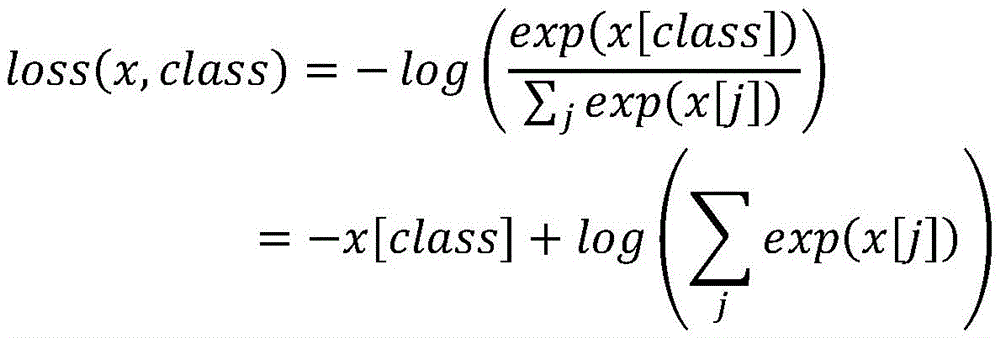
wherein class ∈ [0, C) is the class label of this sample, if a type weight vector W ∈ R is set for each type of class label1×CThen the cross entropy loss of the band type weights can be modified as follows:

where W [ class ] is the type weight for class, the type.
The losses of N samples can be summed or averaged over the end:
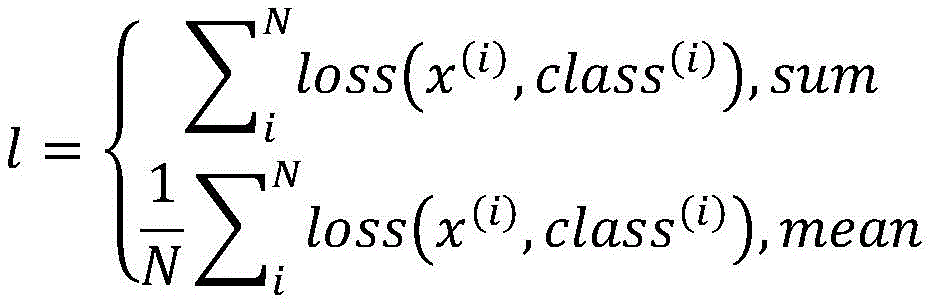
on the basis of cross entropy loss, a loss function of the network traffic identification model can be constructed on the basis of the following modes:
let the output of a class C classifier be y ∈ RC×1Defining function f to convert output y into probability value p ═ f (y), and when class label of sample is t, marking as pt=p[t]Representing the probability of the classifier z being measured as class t, in combination with the cross entropy loss above, can be defined as:
FL=-(1-pt)log(pt)
wherein a weight (1-p) is added before the cross entropy losst) The weight is related to the probability of sample prediction and can be used to suppress the loss of simple sample data streams and amplify the loss of difficult sample data streams accordingly. To better control the magnitude of the previous weight, an index γ may also be added to the weight, changing the above equation to:
FL=-(1-pt)γlog(pt)
when the value of gamma is 0, the loss is equivalent to the cross entropy loss, and the larger the gamma is, the more the loss of the simple sample is restrained, and the loss of the difficult sample is amplified correspondingly. Meanwhile, in order to solve the problem of unbalanced sample types, a type of weight α can be added to the above formulat:
FL=-αt(1-pt)γlog(pt)
αt=numt/numall
Where t is the sample traffic type of any sample data stream, ptCalculating the probability, num, of the corresponding type t obtained after the flow identification of the sample data stream is performed for the network flow identification modeltNum is the number of sample data streams belonging to type tallThe total amount of sample data streams for all traffic types.
Based on any of the above embodiments, step 110 specifically includes:
performing flow cutting on a network data packet sequence to be identified, and dividing data packets with the same quintuple information into the same data stream to obtain a plurality of data streams;
the quintuple information comprises a source IP, a source port, a destination IP, a destination port and a protocol.
Specifically, the network data packet sequence to be identified is cut into streams according to quintuple information, and data packets with the same quintuple information are divided into the same data stream to obtain a plurality of data streams.
The quintuple information comprises a source IP, a source port, a destination IP, a destination port and a protocol.
The set of all data packets in the original network data packet sequence to be identified is denoted by the set P, and each data packet is denoted by PiTo express, then:
P={p1,…,p|P|}
pi=(xi,X,ti)
i=1,2,…,|P|,ti∈[0,∞)
wherein x isiFive-tuple information representing a packet, X being the content of the packet, represented in a two-dimensional array format, tiIndicating the time at which the packet begins to be transmitted.
Based on any of the above embodiments, fig. 2 is a schematic flow chart of a method for training and testing a network traffic model according to an embodiment of the present invention, as shown in fig. 2, the method includes:
firstly, preprocessing a received PCAP data packet file, and extracting each data stream in the PCAP data packet file to be used as training and test sample data. Where a data flow refers to all packets having the same five tuple (source IP, source port, destination IP, destination port, protocol). Each packet in each stream is then processed into a form of a two-bit matrix by One-hot technique to simulate a picture as an input to the convolutional neural network CNN. The spatial characteristics of each data packet in each data stream are extracted through the CNN. The spatial characteristics of the data packets in a data stream are ordered according to time sequence and then used as the input of LSTM and TCN. And inputting the space-time characteristics of each data stream output by the LSTM or the TCN into a Softmax classifier, calculating the flow type through a Softmax function, comparing the flow type with a real type label and calculating loss so as to continuously adjust the network weight until the network converges.
In the testing stage, the original data of the testing sample is still a pcap packet, and the pcap packet is subjected to flow cutting to obtain various types of data flow samples, including normal flow samples and other various types of attack data flow samples. And randomly disordering the samples, inputting the samples into a trained model, outputting the flow type corresponding to each sample, comparing the flow type with a real type label, and outputting a detection result by using a confusion matrix.
The network traffic identification device provided by the present invention is described below, and the network traffic identification device described below and the network traffic identification method described above may be referred to in correspondence with each other.
Based on any of the above embodiments, fig. 3 is a schematic structural diagram of a network traffic identification device provided in an embodiment of the present invention, and as shown in fig. 3, the device includes: a data preprocessing unit 310 and a traffic identification unit 320.
The data preprocessing unit 310 is configured to preprocess a sequence of network data packets to be identified, so as to obtain a plurality of data streams;
the traffic identification unit 320 is configured to input each data stream to the network traffic identification model, and obtain a traffic identification result of each data stream output by the network traffic identification model;
the network traffic identification model is obtained by training based on the sample data stream and the sample traffic type thereof;
the network flow identification model is used for extracting the space-time characteristics of each data stream and identifying the flow of each data stream based on the space-time characteristics; the space-time characteristics can be obtained by extracting through a convolutional neural network and a cyclic neural network, or by extracting through a convolutional neural network and a time sequence convolutional network.
The device provided by the embodiment of the invention utilizes a deep learning mechanism, automatically extracts the space-time characteristics of each data stream through the combination of the convolutional neural network and the cyclic neural network or the combination of the convolutional neural network and the time sequence convolutional network, and performs flow identification based on the space-time characteristics of each data stream, thereby fully utilizing the time sequence relation and the space characteristics among data packets and improving the accuracy of flow identification.
Based on any of the above embodiments, the traffic identification unit 320 is specifically configured to:
inputting any data stream into a spatial feature extraction layer of a network traffic identification model to obtain spatial features of each data packet in the data stream output by the spatial feature extraction layer;
after the spatial features of each data packet in the data stream are sequenced according to time, the spatial features are input to a time sequence feature extraction layer of a network flow identification model, and the time-space features of the data stream output by the time sequence feature extraction layer are obtained;
and inputting the space-time characteristics of the data stream into a flow identification layer of a network flow identification model to obtain a flow identification result of the data stream output by the flow identification layer.
Based on any one of the embodiments, the loss function of the network traffic identification model is determined based on the probability and the modulation index of the corresponding sample traffic type in the traffic identification result of each sample data stream and the type weight of each traffic type; wherein the modulation index is used for suppressing the loss of the simple sample data stream and the loss of the amplification difficult sample data stream.
The device provided by the embodiment of the invention determines the loss function of the network traffic identification model based on the probability of the corresponding sample traffic type, the modulation index and the type weight of each traffic type in the traffic identification result of each sample traffic, balances the problem of sample imbalance caused by large difference of the number of different types of sample traffic, and overcomes the problem of poor classification effect caused by different difficulty degrees of sample identification.
Based on any of the above embodiments, the type weight of any traffic type is determined based on the number of sample data streams corresponding to the traffic type and the total amount of the sample data streams of all the traffic types.
The device provided by the embodiment of the invention dynamically determines the type weight of the flow type based on the number of the sample data streams corresponding to any flow type and the total amount of the sample data streams of all the flow types, thereby improving the flexibility of the loss function.
Based on any of the above embodiments, the loss function of the network traffic identification model is:
FL=-αt(1-pt)γlog(pt)
αt=numt/numall
where t is the sample traffic type of any sample data stream, ptCalculating the probability, num, of the corresponding type t obtained after the flow identification of the sample data stream is performed for the network flow identification modeltNum is the number of sample data streams belonging to type tallThe total amount of sample data streams for all traffic types.
Based on any of the above embodiments, the data preprocessing unit 310 is specifically configured to:
performing flow cutting on a network data packet sequence to be identified, and dividing data packets with the same quintuple information into the same data stream to obtain a plurality of data streams;
the quintuple information comprises a source IP, a source port, a destination IP, a destination port and a protocol.
Fig. 4 illustrates a physical structure diagram of an electronic device, which may include, as shown in fig. 4: a processor (processor)410, a communication Interface 420, a memory (memory)430 and a communication bus 440, wherein the processor 410, the communication Interface 420 and the memory 430 are communicated with each other via the communication bus 440. Processor 410 may invoke logic instructions in memory 430 to perform a network traffic identification method comprising: preprocessing a network data packet sequence to be identified to obtain a plurality of data streams; inputting each data stream into a network traffic identification model to obtain a traffic identification result of each data stream output by the network traffic identification model; the network traffic identification model is obtained by training based on a sample data stream and a sample traffic type thereof; the network flow identification model is used for extracting the space-time characteristics of each data stream and identifying the flow of each data stream based on the space-time characteristics; the space-time characteristics can be obtained by extracting through a convolutional neural network and a cyclic neural network, or by extracting through a convolutional neural network and a time sequence convolutional network.
In addition, the logic instructions in the memory 430 may be implemented in the form of software functional units and stored in a computer readable storage medium when the software functional units are sold or used as independent products. Based on such understanding, the technical solution of the present invention may be embodied in the form of a software product, which is stored in a storage medium and includes instructions for causing a computer device (which may be a personal computer, a server, or a network device) to execute all or part of the steps of the method according to the embodiments of the present invention. And the aforementioned storage medium includes: a U-disk, a removable hard disk, a Read-Only Memory (ROM), a Random Access Memory (RAM), a magnetic disk or an optical disk, and other various media capable of storing program codes.
In another aspect, the present invention also provides a computer program product, which includes a computer program stored on a non-transitory computer-readable storage medium, the computer program including program instructions, when the program instructions are executed by a computer, the computer being capable of executing the network traffic identification method provided by the above methods, the method including: preprocessing a network data packet sequence to be identified to obtain a plurality of data streams; inputting each data stream into a network traffic identification model to obtain a traffic identification result of each data stream output by the network traffic identification model; the network traffic identification model is obtained by training based on a sample data stream and a sample traffic type thereof; the network flow identification model is used for extracting the space-time characteristics of each data stream and identifying the flow of each data stream based on the space-time characteristics; the space-time characteristics can be obtained by extracting through a convolutional neural network and a cyclic neural network, or by extracting through a convolutional neural network and a time sequence convolutional network.
In yet another aspect, the present invention also provides a non-transitory computer readable storage medium having stored thereon a computer program, which when executed by a processor is implemented to perform the network traffic identification methods provided above, the method comprising: preprocessing a network data packet sequence to be identified to obtain a plurality of data streams; inputting each data stream into a network traffic identification model to obtain a traffic identification result of each data stream output by the network traffic identification model; the network traffic identification model is obtained by training based on a sample data stream and a sample traffic type thereof; the network flow identification model is used for extracting the space-time characteristics of each data stream and identifying the flow of each data stream based on the space-time characteristics; the space-time characteristics can be obtained by extracting through a convolutional neural network and a cyclic neural network, or by extracting through a convolutional neural network and a time sequence convolutional network.
The above-described embodiments of the apparatus are merely illustrative, and the units described as separate parts may or may not be physically separate, and parts displayed as units may or may not be physical units, may be located in one place, or may be distributed on a plurality of network units. Some or all of the modules may be selected according to actual needs to achieve the purpose of the solution of the present embodiment. One of ordinary skill in the art can understand and implement it without inventive effort.
Through the above description of the embodiments, those skilled in the art will clearly understand that each embodiment can be implemented by software plus a necessary general hardware platform, and certainly can also be implemented by hardware. With this understanding in mind, the above-described technical solutions may be embodied in the form of a software product, which can be stored in a computer-readable storage medium such as ROM/RAM, magnetic disk, optical disk, etc., and includes instructions for causing a computer device (which may be a personal computer, a server, or a network device, etc.) to execute the methods described in the embodiments or some parts of the embodiments.
Finally, it should be noted that: the above examples are only intended to illustrate the technical solution of the present invention, but not to limit it; although the present invention has been described in detail with reference to the foregoing embodiments, it will be understood by those of ordinary skill in the art that: the technical solutions described in the foregoing embodiments may still be modified, or some technical features may be equivalently replaced; and such modifications or substitutions do not depart from the spirit and scope of the corresponding technical solutions of the embodiments of the present invention.
Claims (10)
Priority Applications (1)
| Application Number | Priority Date | Filing Date | Title |
|---|---|---|---|
| CN202011324405.2A CN112367334A (en) | 2020-11-23 | 2020-11-23 | Network traffic identification method and device, electronic equipment and storage medium |
Applications Claiming Priority (1)
| Application Number | Priority Date | Filing Date | Title |
|---|---|---|---|
| CN202011324405.2A CN112367334A (en) | 2020-11-23 | 2020-11-23 | Network traffic identification method and device, electronic equipment and storage medium |
Publications (1)
| Publication Number | Publication Date |
|---|---|
| CN112367334A true CN112367334A (en) | 2021-02-12 |
Family
ID=74533146
Family Applications (1)
| Application Number | Title | Priority Date | Filing Date |
|---|---|---|---|
| CN202011324405.2A Pending CN112367334A (en) | 2020-11-23 | 2020-11-23 | Network traffic identification method and device, electronic equipment and storage medium |
Country Status (1)
| Country | Link |
|---|---|
| CN (1) | CN112367334A (en) |
Cited By (15)
| Publication number | Priority date | Publication date | Assignee | Title |
|---|---|---|---|---|
| CN113037749A (en) * | 2021-03-08 | 2021-06-25 | 中国科学院信息工程研究所 | C & C channel discrimination method and system |
| CN113067724A (en) * | 2021-03-11 | 2021-07-02 | 西安电子科技大学 | Periodic flow forecasting method based on random forest |
| CN113114690A (en) * | 2021-04-15 | 2021-07-13 | 恒安嘉新(北京)科技股份公司 | Threat event identification method, device, equipment and storage medium |
| CN114186637A (en) * | 2021-12-13 | 2022-03-15 | 中国农业银行股份有限公司 | Traffic identification method, device, server and storage medium |
| CN114615093A (en) * | 2022-05-11 | 2022-06-10 | 南京信息工程大学 | Anonymous network traffic identification method and device based on traffic reconstruction and inheritance learning |
| CN114650229A (en) * | 2022-03-21 | 2022-06-21 | 河海大学 | Network encryption traffic classification method and system based on three-layer model SFTF-L |
| CN114745335A (en) * | 2022-04-29 | 2022-07-12 | 中国工商银行股份有限公司 | Network traffic classification, device, storage medium, and electronic apparatus |
| CN115225731A (en) * | 2022-07-29 | 2022-10-21 | 中国人民解放军陆军工程大学 | Online protocol identification method based on hybrid neural network |
| CN115396212A (en) * | 2022-08-26 | 2022-11-25 | 国科华盾(北京)科技有限公司 | Training method and device for detection model, computer equipment and storage medium |
| CN115801605A (en) * | 2022-11-28 | 2023-03-14 | 上海叠念信息科技有限公司 | Deep packet detection method based on weight network model |
| CN115935274A (en) * | 2021-08-17 | 2023-04-07 | 中移(苏州)软件技术有限公司 | Resale behavior recognition model training method, device, equipment and storage medium |
| CN116186512A (en) * | 2022-12-15 | 2023-05-30 | 西安电子科技大学 | Efficient encrypted voice flow recognition method |
| CN116319086A (en) * | 2023-05-17 | 2023-06-23 | 南京信息工程大学 | A stream association method and system for Tor anonymous network |
| CN116684133A (en) * | 2023-06-01 | 2023-09-01 | 江苏大学 | SDN network abnormal traffic classification device and method based on parallel fusion of double-layer attention and spatio-temporal features |
| CN117113262A (en) * | 2023-10-23 | 2023-11-24 | 北京中科网芯科技有限公司 | Network traffic identification method and system |
Citations (9)
| Publication number | Priority date | Publication date | Assignee | Title |
|---|---|---|---|---|
| CN106790019A (en) * | 2016-12-14 | 2017-05-31 | 北京天融信网络安全技术有限公司 | The encryption method for recognizing flux and device of feature based self study |
| CN108200006A (en) * | 2017-11-21 | 2018-06-22 | 中国科学院声学研究所 | A kind of net flow assorted method and device based on the study of stratification space-time characteristic |
| CN108664687A (en) * | 2018-03-22 | 2018-10-16 | 浙江工业大学 | A kind of industrial control system space-time data prediction technique based on deep learning |
| CN109873774A (en) * | 2019-01-15 | 2019-06-11 | 北京邮电大学 | Method and device for identifying network traffic |
| CN110138787A (en) * | 2019-05-20 | 2019-08-16 | 福州大学 | A kind of anomalous traffic detection method and system based on hybrid neural networks |
| CN110730140A (en) * | 2019-10-12 | 2020-01-24 | 西安电子科技大学 | A deep learning traffic classification method based on the combination of spatiotemporal characteristics |
| US20200067935A1 (en) * | 2018-08-27 | 2020-02-27 | Ciena Corporation | Network architecture providing device identification and redirection using whitelisting traffic classification |
| US20200236124A1 (en) * | 2019-01-20 | 2020-07-23 | Helios Data Inc. | Data segmentation |
| US10778705B1 (en) * | 2019-04-05 | 2020-09-15 | Hoseo University Academic Cooperation Foundation | Deep-learning-based intrusion detection method, system and computer program for web applications |
-
2020
- 2020-11-23 CN CN202011324405.2A patent/CN112367334A/en active Pending
Patent Citations (9)
| Publication number | Priority date | Publication date | Assignee | Title |
|---|---|---|---|---|
| CN106790019A (en) * | 2016-12-14 | 2017-05-31 | 北京天融信网络安全技术有限公司 | The encryption method for recognizing flux and device of feature based self study |
| CN108200006A (en) * | 2017-11-21 | 2018-06-22 | 中国科学院声学研究所 | A kind of net flow assorted method and device based on the study of stratification space-time characteristic |
| CN108664687A (en) * | 2018-03-22 | 2018-10-16 | 浙江工业大学 | A kind of industrial control system space-time data prediction technique based on deep learning |
| US20200067935A1 (en) * | 2018-08-27 | 2020-02-27 | Ciena Corporation | Network architecture providing device identification and redirection using whitelisting traffic classification |
| CN109873774A (en) * | 2019-01-15 | 2019-06-11 | 北京邮电大学 | Method and device for identifying network traffic |
| US20200236124A1 (en) * | 2019-01-20 | 2020-07-23 | Helios Data Inc. | Data segmentation |
| US10778705B1 (en) * | 2019-04-05 | 2020-09-15 | Hoseo University Academic Cooperation Foundation | Deep-learning-based intrusion detection method, system and computer program for web applications |
| CN110138787A (en) * | 2019-05-20 | 2019-08-16 | 福州大学 | A kind of anomalous traffic detection method and system based on hybrid neural networks |
| CN110730140A (en) * | 2019-10-12 | 2020-01-24 | 西安电子科技大学 | A deep learning traffic classification method based on the combination of spatiotemporal characteristics |
Non-Patent Citations (2)
| Title |
|---|
| ANUEL LOPEZ-MARTIN,BELEN CARRO,ANTONIO SANCHEZ-ESGUEVILLAS,JAIME: "Network traffic classifier with convolutional and recurrent neural network for Internet of things", 《IEEE》 * |
| 陈晔欣: "基于深度学习的网络流量分类技术研究", 《中国优秀硕士学位论文全文数据库信息科技辑》 * |
Cited By (21)
| Publication number | Priority date | Publication date | Assignee | Title |
|---|---|---|---|---|
| CN113037749A (en) * | 2021-03-08 | 2021-06-25 | 中国科学院信息工程研究所 | C & C channel discrimination method and system |
| CN113067724A (en) * | 2021-03-11 | 2021-07-02 | 西安电子科技大学 | Periodic flow forecasting method based on random forest |
| CN113067724B (en) * | 2021-03-11 | 2022-04-19 | 西安电子科技大学 | Periodic flow forecasting method based on random forest |
| CN113114690A (en) * | 2021-04-15 | 2021-07-13 | 恒安嘉新(北京)科技股份公司 | Threat event identification method, device, equipment and storage medium |
| CN115935274A (en) * | 2021-08-17 | 2023-04-07 | 中移(苏州)软件技术有限公司 | Resale behavior recognition model training method, device, equipment and storage medium |
| CN114186637A (en) * | 2021-12-13 | 2022-03-15 | 中国农业银行股份有限公司 | Traffic identification method, device, server and storage medium |
| CN114650229A (en) * | 2022-03-21 | 2022-06-21 | 河海大学 | Network encryption traffic classification method and system based on three-layer model SFTF-L |
| CN114745335A (en) * | 2022-04-29 | 2022-07-12 | 中国工商银行股份有限公司 | Network traffic classification, device, storage medium, and electronic apparatus |
| CN114745335B (en) * | 2022-04-29 | 2023-10-03 | 中国工商银行股份有限公司 | Classification of network traffic, devices, storage media and electronic equipment |
| CN114615093B (en) * | 2022-05-11 | 2022-07-26 | 南京信息工程大学 | Anonymous network traffic identification method and device based on traffic reconstruction and inheritance learning |
| CN114615093A (en) * | 2022-05-11 | 2022-06-10 | 南京信息工程大学 | Anonymous network traffic identification method and device based on traffic reconstruction and inheritance learning |
| CN115225731A (en) * | 2022-07-29 | 2022-10-21 | 中国人民解放军陆军工程大学 | Online protocol identification method based on hybrid neural network |
| CN115225731B (en) * | 2022-07-29 | 2024-03-05 | 中国人民解放军陆军工程大学 | Online protocol identification method based on hybrid neural network |
| CN115396212A (en) * | 2022-08-26 | 2022-11-25 | 国科华盾(北京)科技有限公司 | Training method and device for detection model, computer equipment and storage medium |
| CN115801605A (en) * | 2022-11-28 | 2023-03-14 | 上海叠念信息科技有限公司 | Deep packet detection method based on weight network model |
| CN116186512A (en) * | 2022-12-15 | 2023-05-30 | 西安电子科技大学 | Efficient encrypted voice flow recognition method |
| CN116319086A (en) * | 2023-05-17 | 2023-06-23 | 南京信息工程大学 | A stream association method and system for Tor anonymous network |
| CN116319086B (en) * | 2023-05-17 | 2023-07-21 | 南京信息工程大学 | A stream association method and system for Tor anonymous network |
| CN116684133A (en) * | 2023-06-01 | 2023-09-01 | 江苏大学 | SDN network abnormal traffic classification device and method based on parallel fusion of double-layer attention and spatio-temporal features |
| CN117113262A (en) * | 2023-10-23 | 2023-11-24 | 北京中科网芯科技有限公司 | Network traffic identification method and system |
| CN117113262B (en) * | 2023-10-23 | 2024-02-02 | 北京中科网芯科技有限公司 | Network traffic identification method and system |
Similar Documents
| Publication | Publication Date | Title |
|---|---|---|
| CN112367334A (en) | Network traffic identification method and device, electronic equipment and storage medium | |
| Marín et al. | Deepmal-deep learning models for malware traffic detection and classification | |
| Sangkatsanee et al. | Practical real-time intrusion detection using machine learning approaches | |
| Bouzida et al. | Neural networks vs. decision trees for intrusion detection | |
| Robinson et al. | Ranking of machine learning algorithms based on the performance in classifying DDoS attacks | |
| WO2020159439A1 (en) | System and method for network anomaly detection and analysis | |
| CN108566364A (en) | Intrusion detection method based on neural network | |
| CN110611640A (en) | DNS protocol hidden channel detection method based on random forest | |
| Fathima et al. | Improving distributed denial of service attack detection using supervised machine learning | |
| CN115842667A (en) | Internet of things DDoS detection system based on hybrid strategy | |
| Ongun et al. | PORTFILER: Port-level network profiling for self-propagating malware detection | |
| McCarthy et al. | Feature vulnerability and robustness assessment against adversarial machine learning attacks | |
| Al-Fawa'reh et al. | Detecting stealth-based attacks in large campus networks | |
| Alsajri et al. | Enhancing IoT security to leveraging ML for DDoS attack prevention in distributed network routing | |
| Smadia et al. | Vpn encrypted traffic classification using xgboost | |
| CN119172143A (en) | A method, system, device and medium for classifying and identifying malicious traffic based on graph convolutional neural network | |
| Suresh et al. | Detection of malicious activities by AI-Supported Anomaly-Based IDS | |
| CN111464510B (en) | Network real-time intrusion detection method based on rapid gradient lifting tree classification model | |
| Chen et al. | HoleMal: A lightweight IoT malware detection framework based on efficient host-level traffic processing | |
| Lu et al. | Botnets detection based on IRC-community | |
| Alqaraleh | An Efficient Ensemble Network Anomaly Detection System for Cyber-Attacks | |
| Tan et al. | Flowspotter: Intelligent iot threat detection via imaging network flows | |
| CN119341825A (en) | Internet of Things intrusion detection method, model and training method and electronic device based on Transformer and GNN hybrid model | |
| Subramaniam et al. | Network security modeling using NetFlow data: Detecting botnet attacks in IP traffic | |
| Patetta et al. | Line rate botnet detection with SmartNIC-embedded feature extraction |
Legal Events
| Date | Code | Title | Description |
|---|---|---|---|
| PB01 | Publication | ||
| PB01 | Publication | ||
| SE01 | Entry into force of request for substantive examination | ||
| SE01 | Entry into force of request for substantive examination | ||
| RJ01 | Rejection of invention patent application after publication |
Application publication date: 20210212 |
|
| RJ01 | Rejection of invention patent application after publication |