CN112356815B - A system and method for pedestrian active collision avoidance based on monocular camera - Google Patents
A system and method for pedestrian active collision avoidance based on monocular camera Download PDFInfo
- Publication number
- CN112356815B CN112356815B CN202011383475.5A CN202011383475A CN112356815B CN 112356815 B CN112356815 B CN 112356815B CN 202011383475 A CN202011383475 A CN 202011383475A CN 112356815 B CN112356815 B CN 112356815B
- Authority
- CN
- China
- Prior art keywords
- pedestrian
- follows
- camera
- braking
- detection
- Prior art date
- Legal status (The legal status is an assumption and is not a legal conclusion. Google has not performed a legal analysis and makes no representation as to the accuracy of the status listed.)
- Active
Links
Images


Classifications
-
- B—PERFORMING OPERATIONS; TRANSPORTING
- B60—VEHICLES IN GENERAL
- B60T—VEHICLE BRAKE CONTROL SYSTEMS OR PARTS THEREOF; BRAKE CONTROL SYSTEMS OR PARTS THEREOF, IN GENERAL; ARRANGEMENT OF BRAKING ELEMENTS ON VEHICLES IN GENERAL; PORTABLE DEVICES FOR PREVENTING UNWANTED MOVEMENT OF VEHICLES; VEHICLE MODIFICATIONS TO FACILITATE COOLING OF BRAKES
- B60T7/00—Brake-action initiating means
- B60T7/12—Brake-action initiating means for automatic initiation; for initiation not subject to will of driver or passenger
- B60T7/22—Brake-action initiating means for automatic initiation; for initiation not subject to will of driver or passenger initiated by contact of vehicle, e.g. bumper, with an external object, e.g. another vehicle, or by means of contactless obstacle detectors mounted on the vehicle
-
- G—PHYSICS
- G06—COMPUTING OR CALCULATING; COUNTING
- G06N—COMPUTING ARRANGEMENTS BASED ON SPECIFIC COMPUTATIONAL MODELS
- G06N3/00—Computing arrangements based on biological models
- G06N3/02—Neural networks
- G06N3/04—Architecture, e.g. interconnection topology
- G06N3/045—Combinations of networks
-
- G—PHYSICS
- G06—COMPUTING OR CALCULATING; COUNTING
- G06N—COMPUTING ARRANGEMENTS BASED ON SPECIFIC COMPUTATIONAL MODELS
- G06N3/00—Computing arrangements based on biological models
- G06N3/02—Neural networks
- G06N3/08—Learning methods
-
- G—PHYSICS
- G06—COMPUTING OR CALCULATING; COUNTING
- G06T—IMAGE DATA PROCESSING OR GENERATION, IN GENERAL
- G06T7/00—Image analysis
- G06T7/80—Analysis of captured images to determine intrinsic or extrinsic camera parameters, i.e. camera calibration
-
- G—PHYSICS
- G06—COMPUTING OR CALCULATING; COUNTING
- G06V—IMAGE OR VIDEO RECOGNITION OR UNDERSTANDING
- G06V20/00—Scenes; Scene-specific elements
- G06V20/50—Context or environment of the image
- G06V20/56—Context or environment of the image exterior to a vehicle by using sensors mounted on the vehicle
-
- G—PHYSICS
- G06—COMPUTING OR CALCULATING; COUNTING
- G06V—IMAGE OR VIDEO RECOGNITION OR UNDERSTANDING
- G06V40/00—Recognition of biometric, human-related or animal-related patterns in image or video data
- G06V40/10—Human or animal bodies, e.g. vehicle occupants or pedestrians; Body parts, e.g. hands
-
- G—PHYSICS
- G06—COMPUTING OR CALCULATING; COUNTING
- G06V—IMAGE OR VIDEO RECOGNITION OR UNDERSTANDING
- G06V2201/00—Indexing scheme relating to image or video recognition or understanding
- G06V2201/07—Target detection
-
- Y—GENERAL TAGGING OF NEW TECHNOLOGICAL DEVELOPMENTS; GENERAL TAGGING OF CROSS-SECTIONAL TECHNOLOGIES SPANNING OVER SEVERAL SECTIONS OF THE IPC; TECHNICAL SUBJECTS COVERED BY FORMER USPC CROSS-REFERENCE ART COLLECTIONS [XRACs] AND DIGESTS
- Y02—TECHNOLOGIES OR APPLICATIONS FOR MITIGATION OR ADAPTATION AGAINST CLIMATE CHANGE
- Y02T—CLIMATE CHANGE MITIGATION TECHNOLOGIES RELATED TO TRANSPORTATION
- Y02T10/00—Road transport of goods or passengers
- Y02T10/10—Internal combustion engine [ICE] based vehicles
- Y02T10/40—Engine management systems
Landscapes
- Engineering & Computer Science (AREA)
- Physics & Mathematics (AREA)
- Theoretical Computer Science (AREA)
- General Physics & Mathematics (AREA)
- Computing Systems (AREA)
- General Engineering & Computer Science (AREA)
- Biophysics (AREA)
- Computational Linguistics (AREA)
- Data Mining & Analysis (AREA)
- Evolutionary Computation (AREA)
- General Health & Medical Sciences (AREA)
- Molecular Biology (AREA)
- Artificial Intelligence (AREA)
- Biomedical Technology (AREA)
- Life Sciences & Earth Sciences (AREA)
- Mathematical Physics (AREA)
- Software Systems (AREA)
- Health & Medical Sciences (AREA)
- Multimedia (AREA)
- Computer Vision & Pattern Recognition (AREA)
- Human Computer Interaction (AREA)
- Transportation (AREA)
- Mechanical Engineering (AREA)
- Traffic Control Systems (AREA)
Abstract
本发明公开了一种基于单目相机的行人主动避撞系统及方法。本发明所提出的基于单目相机的主动避撞方法,首先,利用目标检测算法并结合深度估计网络与相机内参实现了行人检测与空间位置估计,弥补了单目视觉深度信息缺失问题,且相较于毫米波雷达的行人检测方案具有更高的准确性和鲁棒性。然后,利用卡尔曼滤波和匈牙利算法实现了行人跟踪与速度估计,并根据安全距离模型提出碰撞风险评估模型,能够有效避免制动误触发工况,提升驾驶舒适性。本发明所提出的基于单目相机的主动避撞系统具有成本低,通用性强,可扩展性好等优点。
The invention discloses a pedestrian active collision avoidance system and method based on a monocular camera. The active collision avoidance method based on the monocular camera proposed by the present invention, first of all, uses the target detection algorithm combined with the depth estimation network and the internal parameters of the camera to realize pedestrian detection and spatial position estimation, which makes up for the lack of monocular vision depth information, and relatively Compared with the pedestrian detection scheme of millimeter wave radar, it has higher accuracy and robustness. Then, the pedestrian tracking and speed estimation are realized by using the Kalman filter and the Hungarian algorithm, and a collision risk assessment model is proposed according to the safety distance model, which can effectively avoid the false triggering condition of the brake and improve driving comfort. The active collision avoidance system based on the monocular camera proposed by the present invention has the advantages of low cost, strong versatility, and good scalability.
Description
技术领域Technical Field
本发明涉及一种行人主动避撞系统及方法,特别涉及一种基于单目相机的行人主动避撞系统及方法。The present invention relates to a pedestrian active collision avoidance system and method, and in particular to a pedestrian active collision avoidance system and method based on a monocular camera.
背景技术Background Art
目前,行人主动避撞系统的发展对减少道路交通事故,提高驾驶安全性具有重要意义,主要包括行人检测,测距和主动制动等方面的研究。At present, the development of active pedestrian collision avoidance systems is of great significance to reducing road traffic accidents and improving driving safety, mainly including research on pedestrian detection, ranging and active braking.
在行人检测方面,基于毫米波雷达的行人检测方案可以直接返回障碍物的距离,但是毫米波雷达对金属表面敏感,行人反射波很弱,容易引起误判,同时失去语义信息。随着深度学习的发展,基于视觉的行人检测方法在准确性和鲁棒性等方面都取得了极大的进步,但是受到相机成像的限制,基于视觉的行人检测方案无法直接测量行人距离。而近年来,基于单目视觉的深度估计方法不断发展,极大地提高了视觉测距的准确性,弥补了单目视觉深度缺失的问题。In terms of pedestrian detection, the pedestrian detection scheme based on millimeter-wave radar can directly return the distance of obstacles, but millimeter-wave radar is sensitive to metal surfaces, and the pedestrian reflection wave is very weak, which is easy to cause misjudgment and lose semantic information. With the development of deep learning, vision-based pedestrian detection methods have made great progress in accuracy and robustness, but due to the limitations of camera imaging, vision-based pedestrian detection schemes cannot directly measure the distance of pedestrians. In recent years, the depth estimation method based on monocular vision has been continuously developed, which has greatly improved the accuracy of visual ranging and made up for the problem of monocular vision depth loss.
在主动制动方面,安全距离模型主要根据距离车辆最近的行人距离决定是否采取主动制动。这样容易产生车辆检测到行人处于安全距离阈值内,即触发主动制动的敏感工况发生。而在人车交通环境中,距离自车最近的行人碰撞风险不一定最高,在自车前进方向上的行人也不一定会发生碰撞。因此,需要对行人进行跟踪和速度估计并对碰撞风险进行评估,从而决定是否采取主动制动,以防止制动误触发,提升驾驶舒适性。In terms of active braking, the safety distance model mainly determines whether to take active braking based on the distance of the pedestrian closest to the vehicle. This easily leads to the sensitive condition that the vehicle detects that the pedestrian is within the safety distance threshold, i.e., triggers active braking. In a pedestrian-vehicle traffic environment, the pedestrian closest to the vehicle may not have the highest collision risk, and pedestrians in the direction of the vehicle may not necessarily collide. Therefore, it is necessary to track pedestrians, estimate their speed, and evaluate the collision risk to decide whether to take active braking to prevent false triggering of the brakes and improve driving comfort.
发明内容Summary of the invention
本发明的目的是为了提高行人主动避撞系统对行人检测的准确性和鲁棒性,减少系统成本,增加系统可扩展性,同时,避免制动误触发工况,提升驾驶舒适性而提供的一种基于单目相机的行人主动避撞系统及方法。The purpose of the present invention is to improve the accuracy and robustness of pedestrian detection by the pedestrian active collision avoidance system, reduce system costs, increase system scalability, and at the same time, avoid false braking triggering conditions and improve driving comfort, thereby providing a pedestrian active collision avoidance system and method based on a monocular camera.
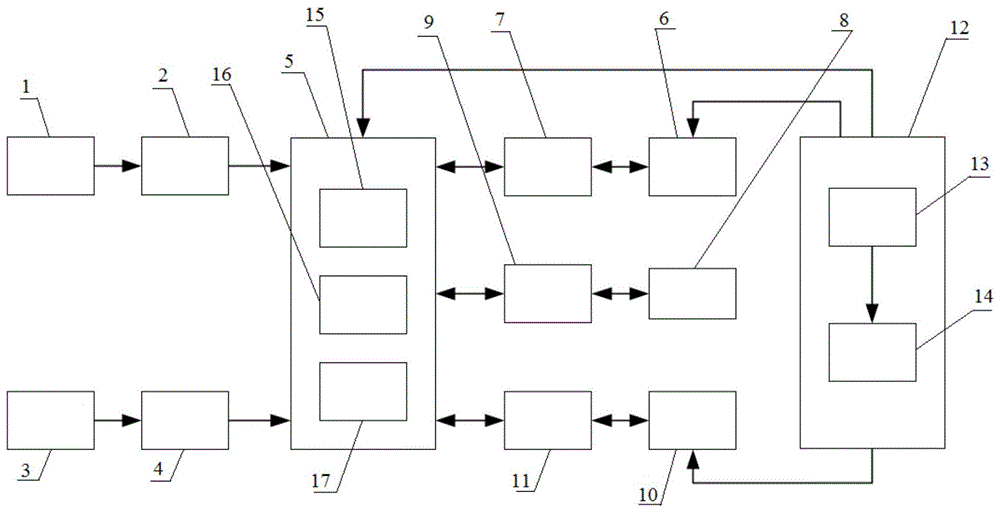
本发明提供的基于单目相机的行人主动避撞系统包括有相机、USB传输模块、车速传感器、RS485传输模块、主控器、显示器、HDMI传输模块、显卡、PCI-E传输模块、制动控制器、CAN传输模块和电源,其中相机通过USB传输模块与主控器连接;车速传感器通过RS485传输模块与主控器连接;显示器通过HDMI传输模块与主控器连接;显卡通过PCI-E传输模块与主控器连接,制动控制器通过CAN传输模块与主控器连接;电源与主控器、显示器和制动控制器相连接,电源为主控器、显示器和制动控制器提供电能。The pedestrian active collision avoidance system based on a monocular camera provided by the present invention comprises a camera, a USB transmission module, a vehicle speed sensor, an RS485 transmission module, a main controller, a display, an HDMI transmission module, a graphics card, a PCI-E transmission module, a brake controller, a CAN transmission module and a power supply, wherein the camera is connected to the main controller through the USB transmission module; the vehicle speed sensor is connected to the main controller through the RS485 transmission module; the display is connected to the main controller through the HDMI transmission module; the graphics card is connected to the main controller through the PCI-E transmission module, and the brake controller is connected to the main controller through the CAN transmission module; the power supply is connected to the main controller, the display and the brake controller, and the power supply provides electrical energy to the main controller, the display and the brake controller.
主控器中设置有中央处理单元CPU、Flash存储器和DDR4内存,同时配有UBS接口、RS485接口、CAN接口、HDMI接口和PCI-E接口,主控器接受来自相机的图像数据和来自车速传感器的车速信息,处理后向制动控制器发送控制指令。The main controller is equipped with a central processing unit CPU, Flash memory and DDR4 memory, and is also equipped with UBS interface, RS485 interface, CAN interface, HDMI interface and PCI-E interface. The main controller receives image data from the camera and vehicle speed information from the vehicle speed sensor, and sends control instructions to the brake controller after processing.
电源内包括有锂电池和稳压电路,锂电池与稳压电路连接后形成稳定的12V、5V和24V电压,其中24V电压负责为显示器供电,12V电压负责为主控器供电,5V电压负责为制动控制器供电。The power supply includes a lithium battery and a voltage stabilizing circuit. When the lithium battery is connected to the voltage stabilizing circuit, stable voltages of 12V, 5V and 24V are formed. The 24V voltage is responsible for powering the display, the 12V voltage is responsible for powering the main controller, and the 5V voltage is responsible for powering the brake controller.
制动控制器中设置有CAN收发电路、滤波电路、保护电路和电机控制电路,其中CAN收发电路依次连接滤波电路和保护电路,以抑制数据传输过程中的噪声和辐射干扰;电机控制电路设置保护电路和继电器从而实现对线控制动系统中助力电机的转速和启停控制。The brake controller is equipped with a CAN transceiver circuit, a filter circuit, a protection circuit and a motor control circuit. The CAN transceiver circuit is connected to the filter circuit and the protection circuit in sequence to suppress noise and radiation interference during data transmission; the motor control circuit is equipped with a protection circuit and a relay to achieve speed and start-stop control of the power-assisting motor in the wire control brake system.
上述的相机、USB传输模块、车速传感器、RS485传输模块、主控器、显示器、HIDM传输模块、显卡、PCI-E传输模块、制动控制器、CAN传输模块、电源、锂电池、稳压电路、CPU、Flash存储器和DDR4内存均为现有设备的组装,因此,具体型号和规格没有进行赘述。The above-mentioned camera, USB transmission module, vehicle speed sensor, RS485 transmission module, main controller, display, HIDM transmission module, graphics card, PCI-E transmission module, brake controller, CAN transmission module, power supply, lithium battery, voltage stabilizing circuit, CPU, Flash memory and DDR4 memory are all assemblies of existing equipment, so the specific models and specifications are not repeated.
本发明提供的基于单目相机的行人主动避撞方法,其方法如下所述:The present invention provides a monocular camera-based pedestrian active collision avoidance method, and the method is as follows:
第一步、通过相机和车速传感器获取图像数据和当前车速,并标定相机内参;The first step is to obtain image data and current vehicle speed through the camera and vehicle speed sensor, and calibrate the camera internal parameters;
第二步、将图像输入到行人检测网络与深度估计网络,得到行人检测边框和对应深度图;The second step is to input the image into the pedestrian detection network and the depth estimation network to obtain the pedestrian detection bounding box and the corresponding depth map;
第三步、根据图像检测边框和对应深度图,并结合相机内参,计算行人在相机坐标系下的空间位置;The third step is to detect the border and the corresponding depth map based on the image, and calculate the spatial position of the pedestrian in the camera coordinate system in combination with the camera intrinsic parameters;
第四步、根据检测边框与行人空间位置,利用行人跟踪算法对行人进行跟踪和速度估计;Step 4: According to the detected border and the spatial position of the pedestrian, the pedestrian tracking algorithm is used to track the pedestrian and estimate its speed;
第五步、根据当前车速和预期安全距离,计算安全距离阈值;Step 5: Calculate the safety distance threshold based on the current vehicle speed and expected safety distance;
第六步、根据安全距离阈值,行人空间位置和速度以及行人跟踪编号,进行行人碰撞风险评估;Step 6: Perform pedestrian collision risk assessment based on the safety distance threshold, pedestrian spatial position and speed, and pedestrian tracking number;
第七步、在分析出当前行人有碰撞风险后,向制动控制器发送制动信号,采用分级制动,进行主动制动。Step 7: After analyzing that the current pedestrian is at risk of collision, a braking signal is sent to the brake controller, and graded braking is used for active braking.
第一步中,单目相机标定后的内参矩阵记为K,公式如下:In the first step, the intrinsic parameter matrix of the monocular camera after calibration is recorded as K, and the formula is as follows:

其中fx和fy为相机在x和y方向的焦距,cx和cy为像素坐标平移量,单目相机标定,可自制棋盘格标定板,并采用Matlab标定工具箱或ROS标定工具进行标定。Where fx and fy are the focal lengths of the camera in the x and y directions, cx and cy are the pixel coordinate translations. For monocular camera calibration, you can make your own checkerboard calibration plate and use the Matlab calibration toolbox or ROS calibration tool for calibration.
第二步中行人检测网络采用单阶段检测网络,并将原通用物体检测权重作为预训练权重,利用迁移学习再训练,提升网络对行人的检测精度和速度,前述的单阶段检测网络可采用YOLO或SSD或CenterNet,深度估计网络可采用Monodepth等无监督深度估计网络。In the second step, the pedestrian detection network adopts a single-stage detection network, and uses the original general object detection weights as pre-training weights, and uses transfer learning for retraining to improve the network's pedestrian detection accuracy and speed. The aforementioned single-stage detection network can use YOLO or SSD or CenterNet, and the depth estimation network can use unsupervised depth estimation networks such as Monodepth.
在第三步中行人空间位置计算的具体步骤如下:The specific steps of pedestrian spatial position calculation in the third step are as follows:
步骤1、通过行人检测网络和深度估计网络获取行人检测边框和对应深度图;Step 1: Obtain pedestrian detection bounding boxes and corresponding depth maps through pedestrian detection networks and depth estimation networks;
步骤2、提取检测框内对应的行人深度图;Step 2: Extract the corresponding pedestrian depth map in the detection frame;
步骤3、用聚类算法将检测框内的深度图分为前景和背景;Step 3: Use a clustering algorithm to divide the depth map in the detection frame into foreground and background;
步骤4、根据相机内参和深度图计算前景坐标空间位置,具体公式如下:Step 4: Calculate the foreground coordinate space position based on the camera intrinsic parameters and depth map. The specific formula is as follows:
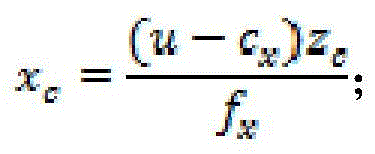

其中,u,v和zc代表深度图中的像素坐标和深度,fx和fy为相机焦距,cx和cy为像素坐标平移量,xc和yc是前景的空间坐标;Where u, v and zc represent the pixel coordinates and depth in the depth map, fx and fy are the camera focal lengths, cx and cy are the pixel coordinate translations, and xc and yc are the spatial coordinates of the foreground.
步骤5、计算出前景坐标的空间位置后,取平均值作为当前行人的空间位置坐标。Step 5: After calculating the spatial position of the foreground coordinates, take the average value as the spatial position coordinate of the current pedestrian.
第四步中行人跟踪与速度估计的具体步骤如下:The specific steps of pedestrian tracking and speed estimation in the fourth step are as follows:
步骤1、构建行人状态向量X=[x,y,z,vx,vy,vz],其中x,y,z代表行人的位置,vx,vy,vz代表行人速度,并且所有速度都初始化为0;Step 1: Construct a pedestrian state vector X = [x, y, z, vx , vy , vz ], where x, y, z represent the position of the pedestrian, vx , vy , vz represent the pedestrian's speed, and all speeds are initialized to 0;
步骤2、建立卡尔曼滤波器的预测公式如下所示:Step 2: Establish the prediction formula of the Kalman filter as follows:
X′=FX:X′=FX:
其中X′为当前时刻状态向量,X为前一时刻状态向量,F为状态转移矩阵;假设行人为匀速运动模型,可得:Where X′ is the current state vector, X is the previous state vector, and F is the state transfer matrix. Assuming that the pedestrian is a uniform motion model, we can get:

步骤3、构建方差矩阵,公式如下:Step 3: Construct the variance matrix. The formula is as follows:
P′=FPFT+Q;P′=FPF T +Q;
其中P′为当前时刻协方差矩阵,P为前一时刻协方差矩阵,Q为系统噪声;考虑到速度状态的不确定性大于位置的不确定性,可得公式如下:Where P′ is the covariance matrix at the current moment, P is the covariance matrix at the previous moment, and Q is the system noise; considering that the uncertainty of the velocity state is greater than the uncertainty of the position, the formula is as follows:
P=diag([10,10,10,1e4,1e4,1e4])P=diag([10, 10, 10, 1e4, 1e4, 1e4])
步骤4、计算前后两帧中行人状态向量的欧式距离,公式如下:Step 4: Calculate the Euclidean distance between the pedestrian state vectors in the previous and next frames. The formula is as follows:

其中下标i和j代表前后两帧中的行人编号;The subscripts i and j represent the pedestrian numbers in the previous and next frames;
构建NxM的度量矩阵A,其中N是前一帧中行人检测框的数量,M是当前帧中行人检测框的数量,矩阵中的元素aij由dij构成;Construct an NxM metric matrix A, where N is the number of pedestrian detection boxes in the previous frame, M is the number of pedestrian detection boxes in the current frame, and the elements a ij in the matrix are composed of d ij ;
步骤5、根据度量矩阵,利用匈牙利匹配算法,对行人进行匹配;Step 5: Match pedestrians using the Hungarian matching algorithm based on the metric matrix;
步骤6、根据匹配后的观测值进行状态更新,具体公式如下:Step 6: Update the state according to the matched observation value. The specific formula is as follows:
y=z-HX′;y = z - HX′;
S=HP′HT+RS=HP′H T +R
K=P′HTS-1:K=P′H T S -1 :
X=X′+KyX=X′+Ky
P=(I-KH)P′;P = (I - KH)P';
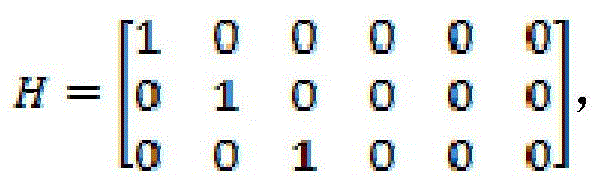
其中z=[x,y,z]为测量值,H为测量矩阵,y为测量残差,s为测量残差协方差,K为卡尔曼增益,X′为更新前的状态估计,X更新后的状态估计,P更新后的协方差估计;Where z = [x, y, z] is the measurement value, H is the measurement matrix, y is the measurement residual, s is the measurement residual covariance, K is the Kalman gain, X′ is the state estimate before update, X is the state estimate after update, and P is the covariance estimate after update;
预测,匹配和更新循环迭代,即可完成行人跟踪和速度估计。Pedestrian tracking and velocity estimation are completed by iterating the prediction, matching and update loops.
第六步中行人碰撞风险评估的具体步骤如下:The specific steps of pedestrian collision risk assessment in
步骤1、找到距离车辆最近的行人,并判断当前距离是否小于预警距离,如果不小于则直接进行下一帧判断;如果小于则继续进行下一步;Step 1: Find the pedestrian closest to the vehicle and determine whether the current distance is less than the warning distance. If not, proceed directly to the next frame judgment; if less, proceed to the next step;
步骤2、根据安全距离模型中的预警距离Sw以及当前车速v0,求出车辆行驶到最近行人处的时间t,公式如下:Step 2: According to the warning distance S w in the safety distance model and the current vehicle speed v 0 , calculate the time t for the vehicle to travel to the nearest pedestrian. The formula is as follows:

步骤3、假设车辆的宽度为w,已知行人横向速度vy和横向距离dh即可求出行人到达危险区域的时间t1和离开危险区域的时间t2,公式如下:Step 3: Assuming the width of the vehicle is w, the time t1 when the pedestrian arrives at the danger zone and the time t2 when the pedestrian leaves the danger zone can be calculated by knowing the lateral speed vy and lateral distance dh of the pedestrian. The formula is as follows:


步骤4、根据车辆行驶时间t和行人碰撞危险时间[t1,t2],进行碰撞风险评估,决定是否采取主动制动,具体方式如下:Step 4: Based on the vehicle travel time t and the pedestrian collision risk time [t 1 , t 2 ], perform collision risk assessment and decide whether to take active braking. The specific method is as follows:
如果t不属于[t1,t2],则认为不存在碰撞风险,忽略该标号行人,并对其他行人继续进行风险评估;If t does not belong to [t 1 , t 2 ], it is considered that there is no collision risk, the pedestrian with this number is ignored, and the risk assessment of other pedestrians continues;
如果t属于[t1,t2],则认为存在碰撞风险,进一步采取主动制动策略。If t belongs to [t 1 , t 2 ], it is considered that there is a collision risk, and an active braking strategy is further adopted.
第七步中主动制动策略分为三级,包括一级预警和两级制动,三级制动的安全距离阈值分别为Sw,Sd和Sb,距离行人越近则制动强度越大,通过分级制动提高驾驶舒适性。In the seventh step, the active braking strategy is divided into three levels, including a first-level warning and a second-level braking. The safety distance thresholds of the three-level braking are Sw , Sd and Sb respectively. The closer the distance to the pedestrian, the greater the braking intensity. Driving comfort is improved through graded braking.
本发明的有益效果:Beneficial effects of the present invention:
第一,本发明利用目标检测算法并结合深度估计网络实现了行人检测与距离估计,弥补了单目视觉深度信息缺失问题,且具有更高的准确性和鲁棒性。First, the present invention utilizes the target detection algorithm and combines it with the depth estimation network to realize pedestrian detection and distance estimation, which makes up for the problem of missing monocular vision depth information and has higher accuracy and robustness.
第二,本发明利用卡尔曼滤波和匈牙利算法实现了行人跟踪与速度估计,并基于安全距离模型提出碰撞风险评估模型,能够有效避免制动误触发工况,提升驾驶舒适性。Second, the present invention uses Kalman filtering and the Hungarian algorithm to achieve pedestrian tracking and speed estimation, and proposes a collision risk assessment model based on a safe distance model, which can effectively avoid false braking triggering conditions and improve driving comfort.
第三,本发明所提出的基于单目相机的主动避撞系统具有成本低,通用性强,可扩展性好等优点。Third, the active collision avoidance system based on a monocular camera proposed in the present invention has the advantages of low cost, strong versatility, and good scalability.
附图说明BRIEF DESCRIPTION OF THE DRAWINGS
图1为本发明所述的避撞系统整体结构示意图。FIG1 is a schematic diagram of the overall structure of the collision avoidance system according to the present invention.
图2为本发明所述的避撞方法整体流程示意图。FIG. 2 is a schematic diagram of the overall flow of the collision avoidance method according to the present invention.
图3为本发明所述的行人空间位置计算流程图。FIG3 is a flowchart of pedestrian spatial position calculation according to the present invention.
图4为本发明所述的原始输入图片。FIG. 4 is an original input picture according to the present invention.
图5为本发明所述的行人检测网络输出图。FIG. 5 is a diagram showing the output of the pedestrian detection network according to the present invention.
图6为本发明所述的为深度估计网络输出图。FIG6 is a diagram showing the output of a depth estimation network according to the present invention.
图7为本发明所述的行人空间位置输出图。FIG. 7 is a diagram showing the spatial position output of a pedestrian according to the present invention.
图8为本发明所述的行人跟踪与速度估计输出图。FIG. 8 is a diagram showing the output of pedestrian tracking and speed estimation according to the present invention.
图9为本发明所述的分级制动过程示意图。FIG. 9 is a schematic diagram of the graded braking process according to the present invention.
图10为本发明所述的安全距离阈值示意图。FIG. 10 is a schematic diagram of the safety distance threshold according to the present invention.
图11为本发明所述的碰撞风险评估模型流程图。FIG. 11 is a flow chart of the collision risk assessment model according to the present invention.
图12为本发明所述的碰撞风险评估模型示意图。FIG. 12 is a schematic diagram of a collision risk assessment model according to the present invention.
图1中的标注如下:The annotations in Figure 1 are as follows:
1、相机 2、USB传输模块 3、车速传感器 4、RS485传输模块1.
5、主控器 6、显示器 7、HDMI传输模块 8、显卡 9、PCI-E传输模块5.
10、制动控制器 11、CAN传输模块 12、电源 13、锂电池10.
14、稳压电路 15、CPU 16、Flash存储器 17、DDR4内存。14.
具体实施方式DETAILED DESCRIPTION
请参阅图1至图12所示:Please refer to Figures 1 to 12:
本发明提供的基于单目相机的行人主动避撞系统包括有相机1、USB传输模块2、车速传感器3、RS485传输模块4、主控器5、显示器6、HDMI传输模块7、显卡8、PCI-E传输模块9、制动控制器10、CAN传输模块11和电源12,其中相机1通过USB传输模块2与主控器5连接;车速传感器3通过RS485传输模块4与主控器5连接;显示器6通过HDMI传输模块7与主控器5连接;显卡8通过PCI-E传输模块9与主控器5连接,制动控制器10通过CAN传输模块11与主控器5连接;电源12与主控器5、显示器6和制动控制器10相连接,电源12为主控器5、显示器6和制动控制器10提供电能。The pedestrian active collision avoidance system based on a monocular camera provided by the present invention includes a camera 1, a
主控器5中设置有中央处理单元CPU15、Flash存储器16和DDR4内存17,同时配有UBS接口、RS485接口、CAN接口、HDMI接口和PCI-E接口,主控器5接受来自相机1的图像数据和来自车速传感器3的车速信息,处理后向制动控制器10发送控制指令。The main controller 5 is provided with a central processing unit CPU15, a
电源12内包括有锂电池13和稳压电路14,锂电池13与稳压电路14连接后形成稳定的12V、5V和24V电压,其中24V电压负责为显示器6供电,12V电压负责为主控器5供电,5V电压负责为制动控制器10供电。The
制动控制器10中设置有CAN收发电路、滤波电路、保护电路和电机控制电路,其中CAN收发电路依次连接滤波电路和保护电路,以抑制数据传输过程中的噪声和辐射干扰;电机控制电路设置保护电路和继电器从而实现对线控制动系统中助力电机的转速和启停控制。The
上述的相机、USB传输模块、车速传感器、RS485传输模块、主控器、显示器、HIDM传输模块、显卡、PCI-E传输模块、制动控制器、CAN传输模块、电源、锂电池、稳压电路、CPU、Flash存储器和DDR4内存均为现有设备的组装,因此,具体型号和规格没有进行赘述。The above-mentioned camera, USB transmission module, vehicle speed sensor, RS485 transmission module, main controller, display, HIDM transmission module, graphics card, PCI-E transmission module, brake controller, CAN transmission module, power supply, lithium battery, voltage stabilizing circuit, CPU, Flash memory and DDR4 memory are all assemblies of existing equipment, so the specific models and specifications are not repeated.
本发明提供的基于单目相机的行人主动避撞方法,其方法如下所述:The present invention provides a monocular camera-based pedestrian active collision avoidance method, and the method is as follows:
第一步、通过相机1和车速传感器3获取图像数据和当前车速,并标定相机1内参;The first step is to obtain image data and current vehicle speed through camera 1 and
第二步、将图像输入到行人检测网络与深度估计网络,得到行人检测边框和对应深度图;The second step is to input the image into the pedestrian detection network and the depth estimation network to obtain the pedestrian detection bounding box and the corresponding depth map;
第三步、根据图像检测边框和对应深度图,并结合相机1内参,计算行人在相机1坐标系下的空间位置;Step 3: Detect the border and the corresponding depth map based on the image, and calculate the spatial position of the pedestrian in the coordinate system of camera 1 in combination with the intrinsic parameters of camera 1;
第四步、根据检测边框与行人空间位置,利用行人跟踪算法对行人进行跟踪和速度估计;Step 4: According to the detected border and the spatial position of the pedestrian, the pedestrian tracking algorithm is used to track the pedestrian and estimate its speed;
第五步、根据当前车速和预期安全距离,计算安全距离阈值;Step 5: Calculate the safety distance threshold based on the current vehicle speed and expected safety distance;
第六步、根据安全距离阈值,行人空间位置和速度以及行人跟踪编号,进行行人碰撞风险评估;Step 6: Perform pedestrian collision risk assessment based on the safety distance threshold, pedestrian spatial position and speed, and pedestrian tracking number;
第七步、在分析出当前行人有碰撞风险后,向制动控制器10发送制动信号,采用分级制动,进行主动制动。Step 7: After analyzing that the current pedestrian has a collision risk, a braking signal is sent to the
第一步中,单目相机1标定后的内参矩阵记为K,公式如下:In the first step, the internal parameter matrix of monocular camera 1 after calibration is recorded as K, and the formula is as follows:

其中fx和fy为相机在x和y方向的焦距,cx和cy为像素坐标平移量,单目相机1标定,可自制棋盘格标定板,并采用Matlab标定工具箱或ROS标定工具进行标定。Where fx and fy are the focal lengths of the camera in the x and y directions, cx and cy are the pixel coordinate translations. For the calibration of the monocular camera 1, a self-made checkerboard calibration plate can be used, and the calibration can be performed using the Matlab calibration toolbox or the ROS calibration tool.
第二步中行人检测网络采用单阶段检测网络,并将原通用物体检测权重作为预训练权重,利用迁移学习再训练,提升网络对行人的检测精度和速度,前述的单阶段检测网络可采用YOLO或SSD或CenterNet,深度估计网络可采用Monodepth等无监督深度估计网络。In the second step, the pedestrian detection network adopts a single-stage detection network, and uses the original general object detection weights as pre-training weights, and uses transfer learning for retraining to improve the network's pedestrian detection accuracy and speed. The aforementioned single-stage detection network can use YOLO or SSD or CenterNet, and the depth estimation network can use unsupervised depth estimation networks such as Monodepth.
在第三步中行人空间位置计算的具体步骤如下:The specific steps of pedestrian spatial position calculation in the third step are as follows:
步骤1、通过行人检测网络和深度估计网络获取行人检测边框和对应深度图;Step 1: Obtain pedestrian detection bounding boxes and corresponding depth maps through pedestrian detection networks and depth estimation networks;
步骤2、提取检测框内对应的行人深度图;Step 2: Extract the corresponding pedestrian depth map in the detection frame;
步骤3、用聚类算法将检测框内的深度图分为前景和背景;Step 3: Use a clustering algorithm to divide the depth map in the detection frame into foreground and background;
步骤4、根据相机内参和深度图计算前景坐标空间位置,具体公式如下:Step 4: Calculate the foreground coordinate space position based on the camera intrinsic parameters and depth map. The specific formula is as follows:
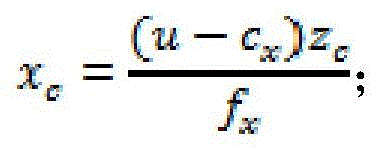

其中,u,v和zc代表深度图中的像素坐标和深度,fx和fy为相机焦距,cx和cy为像素坐标平移量,xc和yc是前景的空间坐标;Where u, v and zc represent the pixel coordinates and depth in the depth map, fx and fy are the camera focal lengths, cx and cy are the pixel coordinate translations, and xc and yc are the spatial coordinates of the foreground.
步骤5、计算出前景坐标的空间位置后,取平均值作为当前行人的空间位置坐标。Step 5: After calculating the spatial position of the foreground coordinates, take the average value as the spatial position coordinate of the current pedestrian.
第四步中行人跟踪与速度估计的具体步骤如下:The specific steps of pedestrian tracking and speed estimation in the fourth step are as follows:
步骤1、构建行人状态向量X=[x,y,z,vx,vy,vz],其中x,y,z代表行人的位置,vx,vy,vz代表行人速度,并且所有速度都初始化为0;Step 1: Construct a pedestrian state vector X = [x, y, z, vx , vy , vz ], where x, y, z represent the position of the pedestrian, vx , vy , vz represent the pedestrian's speed, and all speeds are initialized to 0;
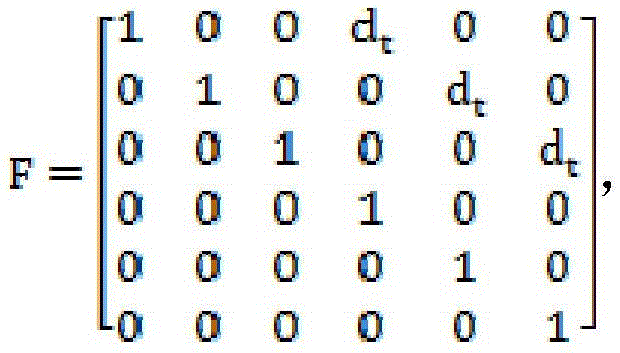
步骤2、建立卡尔曼滤波器的预测公式如下所示:Step 2: Establish the prediction formula of the Kalman filter as follows:
X′=FX;X′=FX;
其中X′为当前时刻状态向量,X为前一时刻状态向量,F为状态转移矩阵;假设行人为匀速运动模型,可得:Where X′ is the current state vector, X is the previous state vector, and F is the state transfer matrix. Assuming that the pedestrian is a uniform motion model, we can get:

步骤3、构建方差矩阵,公式如下:Step 3: Construct the variance matrix. The formula is as follows:
P′=FPFT+Q;P′=FPF T +Q;
其中P′为当前时刻协方差矩阵,P为前一时刻协方差矩阵,Q为系统噪声;考虑到速度状态的不确定性大于位置的不确定性,可得公式如下:Where P′ is the covariance matrix at the current moment, P is the covariance matrix at the previous moment, and Q is the system noise; considering that the uncertainty of the velocity state is greater than the uncertainty of the position, the formula is as follows:
P=diag([10,10,10,1e4,1e4,1e4])P=diag([10, 10, 10, 1e4, 1e4, 1e4])
步骤4、计算前后两帧中行人状态向量的欧式距离,公式如下:Step 4: Calculate the Euclidean distance between the pedestrian state vectors in the previous and next frames. The formula is as follows:

其中下标i和j代表前后两帧中的行人编号;The subscripts i and j represent the pedestrian numbers in the previous and next frames;
构建NxM的度量矩阵A,其中N是前一帧中行人检测框的数量,M是当前帧中行人检测框的数量,矩阵中的元素aij由dij构成;Construct an NxM metric matrix A, where N is the number of pedestrian detection boxes in the previous frame, M is the number of pedestrian detection boxes in the current frame, and the elements a ij in the matrix are composed of d ij ;
步骤5、根据度量矩阵,利用匈牙利匹配算法,对行人进行匹配;Step 5: Match pedestrians using the Hungarian matching algorithm based on the metric matrix;
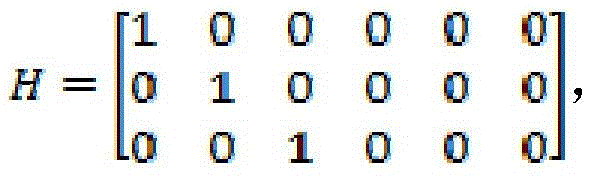
步骤6、根据匹配后的观测值进行状态更新,具体公式如下:Step 6: Update the state according to the matched observation value. The specific formula is as follows:
y=z-HX′;y = z - HX′;
S=HP′HT+RS=HP′H T +R
K=P′HTS-1:K=P′H T S -1 :
X=X′+KyX=X′+Ky
P=(I-KH)P′;P = (I - KH)P';
其中z=[x,y,z]为测量值,H为测量矩阵,y为测量残差,S为测量残差协方差,K为卡尔曼增益,X′为更新前的状态估计,X更新后的状态估计,P更新后的协方差估计;Where z = [x, y, z] is the measurement value, H is the measurement matrix, y is the measurement residual, S is the measurement residual covariance, K is the Kalman gain, X′ is the state estimate before update, X is the state estimate after update, and P is the covariance estimate after update;

预测,匹配和更新循环迭代,即可完成行人跟踪和速度估计。Pedestrian tracking and velocity estimation are completed by iterating the prediction, matching and update loops.
第六步中行人碰撞风险评估的具体步骤如下:The specific steps of pedestrian collision risk assessment in
步骤1、找到距离车辆最近的行人,并判断当前距离是否小于预警距离,如果不小于则直接进行下一帧判断;如果小于则继续进行下一步;Step 1: Find the pedestrian closest to the vehicle and determine whether the current distance is less than the warning distance. If not, proceed directly to the next frame judgment; if less, proceed to the next step;
步骤2、根据安全距离模型中的预警距离Sw以及当前车速v0,求出车辆行驶到最近行人处的时间t,公式如下:Step 2: According to the warning distance S w in the safety distance model and the current vehicle speed v 0 , calculate the time t for the vehicle to travel to the nearest pedestrian. The formula is as follows:

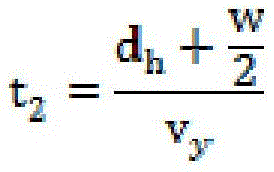
步骤3、假设车辆的宽度为w,已知行人横向速度vy和横向距离dh即可求出行人到达危险区域的时间t1和离开危险区域的时间t2,公式如下:Step 3: Assuming the width of the vehicle is w, the time t1 when the pedestrian arrives at the danger zone and the time t2 when the pedestrian leaves the danger zone can be calculated by knowing the lateral speed vy and lateral distance dh of the pedestrian. The formula is as follows:

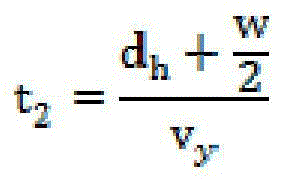
步骤4、根据车辆行驶时间t和行人碰撞危险时间[t1,t2],进行碰撞风险评估,决定是否采取主动制动,具体方式如下:Step 4: Based on the vehicle travel time t and the pedestrian collision risk time [t 1 , t 2 ], perform collision risk assessment and decide whether to take active braking. The specific method is as follows:
如果t不属于[t1,t2],则认为不存在碰撞风险,忽略该标号行人,并对其他行人继续进行风险评估;If t does not belong to [t 1 , t 2 ], it is considered that there is no collision risk, the pedestrian with this number is ignored, and the risk assessment of other pedestrians continues;
如果t属于[t1,t2],则认为存在碰撞风险,进一步采取主动制动策略。If t belongs to [t 1, t 2 ], it is considered that there is a collision risk and an active braking strategy is further adopted.
第七步中主动制动策略分为三级,包括一级预警和两级制动,三级制动的安全距离阈值分别为Sw,Sd和Sb,距离行人越近则制动强度越大,通过分级制动提高驾驶舒适性。In the seventh step, the active braking strategy is divided into three levels, including a first-level warning and a second-level braking. The safety distance thresholds of the three-level braking are Sw , Sd and Sb respectively. The closer the distance to the pedestrian, the greater the braking intensity. Driving comfort is improved through graded braking.
以图12为例,说明本发明所提出的碰撞风险评估模型可以避免制动误触发工况,具体如下:Taking FIG. 12 as an example, it is explained that the collision risk assessment model proposed in the present invention can avoid the brake mis-triggering condition, as follows:
图中ID4号行人当前距离车辆最近,且达到安全距离阈值。但该行人横向距离较远,此时碰撞风险评估模型计算出车辆行驶时间t不属于行人碰撞危险时间[t1,t2],即可忽略ID4号行人。In the figure, pedestrian ID4 is currently closest to the vehicle and has reached the safety distance threshold. However, the pedestrian is farther away laterally. At this time, the collision risk assessment model calculates that the vehicle travel time t does not belong to the pedestrian collision risk time [t 1 , t 2 ], so pedestrian ID4 can be ignored.
再判断距离第二近的ID2号行人,该行人速度为正,横向距离为负,所以碰撞时间为负,即可忽略ID2号行人。Then judge the pedestrian ID2 who is the second closest. The pedestrian's speed is positive and the lateral distance is negative, so the collision time is negative, and the pedestrian ID2 can be ignored.
再判断ID3号行人,计算得出,当车辆距离该行人达到安全距离阈值时,车辆行驶时间t属于行人碰撞危险时间[t1,t2],则采取主动制动策略。Then the pedestrian ID3 is judged and calculated. When the distance between the vehicle and the pedestrian reaches the safety distance threshold, the vehicle travel time t belongs to the pedestrian collision danger time [t 1 , t 2 ], and the active braking strategy is adopted.
碰撞风险评估模型使得车辆忽略了距离较近但没有碰撞风险的ID2号和ID4号行人。而在真正有碰撞风险的ID3号行人处,采取了主动制动。如果没有ID3号行人,在对ID1号行人进行风险评估后,也可忽略该行人,那么车辆无需停车,即可直接通过,提高了驾驶的舒适性。The collision risk assessment model allows the vehicle to ignore pedestrians ID2 and ID4, which are close but not at risk of collision. Active braking is applied to pedestrian ID3, who is at real risk of collision. If there is no pedestrian ID3, the pedestrian ID1 can also be ignored after risk assessment, and the vehicle can pass directly without stopping, which improves driving comfort.
Claims (1)





Priority Applications (1)
| Application Number | Priority Date | Filing Date | Title |
|---|---|---|---|
| CN202011383475.5A CN112356815B (en) | 2020-12-01 | 2020-12-01 | A system and method for pedestrian active collision avoidance based on monocular camera |
Applications Claiming Priority (1)
| Application Number | Priority Date | Filing Date | Title |
|---|---|---|---|
| CN202011383475.5A CN112356815B (en) | 2020-12-01 | 2020-12-01 | A system and method for pedestrian active collision avoidance based on monocular camera |
Publications (2)
| Publication Number | Publication Date |
|---|---|
| CN112356815A CN112356815A (en) | 2021-02-12 |
| CN112356815B true CN112356815B (en) | 2023-04-25 |
Family
ID=74536934
Family Applications (1)
| Application Number | Title | Priority Date | Filing Date |
|---|---|---|---|
| CN202011383475.5A Active CN112356815B (en) | 2020-12-01 | 2020-12-01 | A system and method for pedestrian active collision avoidance based on monocular camera |
Country Status (1)
| Country | Link |
|---|---|
| CN (1) | CN112356815B (en) |
Families Citing this family (5)
| Publication number | Priority date | Publication date | Assignee | Title |
|---|---|---|---|---|
| CN113449646A (en) * | 2021-06-29 | 2021-09-28 | 长沙理工大学 | Head-up display system with safe distance prompt |
| CN113587895B (en) * | 2021-07-30 | 2023-06-30 | 杭州三坛医疗科技有限公司 | Binocular distance measuring method and device |
| CN114495064B (en) * | 2022-01-28 | 2025-09-09 | 浙江大学 | Vehicle surrounding obstacle early warning method based on monocular depth estimation |
| CN115240170B (en) * | 2022-08-01 | 2025-04-01 | 厦门理工学院 | A road pedestrian detection and tracking method and system based on event camera |
| CN116012453B (en) * | 2023-03-28 | 2023-06-09 | 常州星宇车灯股份有限公司 | Monocular distance measuring method, device, equipment and medium for intelligent driving of vehicle and vehicle |
Citations (2)
| Publication number | Priority date | Publication date | Assignee | Title |
|---|---|---|---|---|
| CN106671961A (en) * | 2017-03-02 | 2017-05-17 | 吉林大学 | Active anti-collision system based on electric automobile and control method thereof |
| CN108205658A (en) * | 2017-11-30 | 2018-06-26 | 中原智慧城市设计研究院有限公司 | Detection of obstacles early warning system based on the fusion of single binocular vision |
Family Cites Families (17)
| Publication number | Priority date | Publication date | Assignee | Title |
|---|---|---|---|---|
| JP4657765B2 (en) * | 2005-03-09 | 2011-03-23 | 三菱自動車工業株式会社 | Nose view system |
| US20140176714A1 (en) * | 2012-12-26 | 2014-06-26 | Automotive Research & Test Center | Collision prevention warning method and device capable of tracking moving object |
| CN103204123B (en) * | 2013-03-25 | 2015-07-08 | 中国电子科技集团公司第三十八研究所 | Vehicle-pedestrian detecting, tracking and early-warning device and method |
| CN104210489B (en) * | 2014-09-16 | 2017-06-13 | 武汉理工大学 | Vehicle and pedestrian impact bypassing method and system under bus or train route cooperative surroundings |
| CN104442571B (en) * | 2014-11-26 | 2016-06-01 | 重庆长安汽车股份有限公司 | A kind of night-vision navigation integrated system and control method |
| KR102534353B1 (en) * | 2016-10-11 | 2023-05-22 | 모빌아이 비젼 테크놀로지스 엘티디. | Navigating a vehicle based on a detected barrier |
| KR101851155B1 (en) * | 2016-10-12 | 2018-06-04 | 현대자동차주식회사 | Autonomous driving control apparatus, vehicle having the same and method for controlling the same |
| JP6589926B2 (en) * | 2017-04-07 | 2019-10-16 | トヨタ自動車株式会社 | Object detection device |
| CN107886043B (en) * | 2017-07-20 | 2022-04-01 | 吉林大学 | Vision-aware anti-collision early warning system and method for forward-looking vehicles and pedestrians of automobile |
| CN107757583A (en) * | 2017-10-13 | 2018-03-06 | 奇瑞汽车股份有限公司 | A kind of low speed driving active brake method and system |
| CN108583571A (en) * | 2018-04-28 | 2018-09-28 | 深圳市商汤科技有限公司 | Collision control method and device, electronic equipment and storage medium |
| CN111754542B (en) * | 2019-03-27 | 2023-08-04 | 丰翼科技(深圳)有限公司 | Target object determining method, tracking method, device, equipment and storage medium thereof |
| CN110276988A (en) * | 2019-06-26 | 2019-09-24 | 重庆邮电大学 | An Assisted Driving System Based on Collision Warning Algorithm |
| CN110765922B (en) * | 2019-10-18 | 2023-05-02 | 华南理工大学 | An AGV detection obstacle system with binocular vision objects |
| CN111332288A (en) * | 2020-03-14 | 2020-06-26 | 昆明理工大学 | A vehicle-pedestrian collision avoidance method based on vision system |
| CN111731240A (en) * | 2020-06-18 | 2020-10-02 | 北京百度网讯科技有限公司 | Method, device, equipment and storage medium for evaluating the rationality of sudden braking |
| CN112001298B (en) * | 2020-08-20 | 2021-09-21 | 佳都科技集团股份有限公司 | Pedestrian detection method, device, electronic equipment and storage medium |
-
2020
- 2020-12-01 CN CN202011383475.5A patent/CN112356815B/en active Active
Patent Citations (2)
| Publication number | Priority date | Publication date | Assignee | Title |
|---|---|---|---|---|
| CN106671961A (en) * | 2017-03-02 | 2017-05-17 | 吉林大学 | Active anti-collision system based on electric automobile and control method thereof |
| CN108205658A (en) * | 2017-11-30 | 2018-06-26 | 中原智慧城市设计研究院有限公司 | Detection of obstacles early warning system based on the fusion of single binocular vision |
Also Published As
| Publication number | Publication date |
|---|---|
| CN112356815A (en) | 2021-02-12 |
Similar Documents
| Publication | Publication Date | Title |
|---|---|---|
| CN112356815B (en) | A system and method for pedestrian active collision avoidance based on monocular camera | |
| CN107972662B (en) | Vehicle forward collision early warning method based on deep learning | |
| US9805274B2 (en) | Partially occluded object detection using context and depth ordering | |
| CN103253263B (en) | Detection of obstacles and collision warning equipment and method thereof | |
| KR101982298B1 (en) | Method and apparatus for detecting sudden moving objecj appearance at vehicle | |
| US9513108B2 (en) | Sensor system for determining distance information based on stereoscopic images | |
| CN104590130A (en) | Adaptive Adjustment Method of Rearview Mirror Based on Image Recognition | |
| CN114091598B (en) | Multi-vehicle cooperative environment sensing method based on semantic-level information fusion | |
| KR101891460B1 (en) | Method and apparatus for detecting and assessing road reflections | |
| CN114495064A (en) | Monocular depth estimation-based vehicle surrounding obstacle early warning method | |
| KR102044193B1 (en) | System and Method for alarming collision of vehicle with support vector machine | |
| US20160180192A1 (en) | System and method for partially occluded object detection | |
| WO2019065970A1 (en) | Vehicle exterior recognition device | |
| CN102303563B (en) | Front vehicle collision early warning system and method | |
| US12451012B2 (en) | Method for collision warning, electronic device, and storage medium | |
| CN108021899A (en) | Vehicle intelligent front truck anti-collision early warning method based on binocular camera | |
| CN114763136A (en) | Guide vehicle driving auxiliary system based on deep learning | |
| CN110083099B (en) | An autonomous driving architecture system and working method compliant with automotive functional safety standards | |
| CN111497741B (en) | Collision early warning method and device | |
| CN118097628A (en) | Driver fatigue detection method and device for face shielding | |
| CN109435839A (en) | One kind closing on lane vehicle turn signal detection device and method | |
| Zhao et al. | Moving object classification using horizontal laser scan data | |
| CN109920001A (en) | Distance Estimation Method Based on Pedestrian Head Height | |
| WO2019123582A1 (en) | Object information generation device and object information generation program | |
| CN107256382A (en) | Virtual bumper control method and system based on image recognition |
Legal Events
| Date | Code | Title | Description |
|---|---|---|---|
| PB01 | Publication | ||
| PB01 | Publication | ||
| SE01 | Entry into force of request for substantive examination | ||
| SE01 | Entry into force of request for substantive examination | ||
| GR01 | Patent grant | ||
| GR01 | Patent grant |