CN112346103A - V2X-based intelligent networking automobile dynamic co-location method and device - Google Patents
V2X-based intelligent networking automobile dynamic co-location method and device Download PDFInfo
- Publication number
- CN112346103A CN112346103A CN202011179628.4A CN202011179628A CN112346103A CN 112346103 A CN112346103 A CN 112346103A CN 202011179628 A CN202011179628 A CN 202011179628A CN 112346103 A CN112346103 A CN 112346103A
- Authority
- CN
- China
- Prior art keywords
- vehicle
- coordinate system
- absolute position
- position coordinates
- geodetic coordinate
- Prior art date
- Legal status (The legal status is an assumption and is not a legal conclusion. Google has not performed a legal analysis and makes no representation as to the accuracy of the status listed.)
- Pending
Links
Images


Classifications
-
- G—PHYSICS
- G01—MEASURING; TESTING
- G01S—RADIO DIRECTION-FINDING; RADIO NAVIGATION; DETERMINING DISTANCE OR VELOCITY BY USE OF RADIO WAVES; LOCATING OR PRESENCE-DETECTING BY USE OF THE REFLECTION OR RERADIATION OF RADIO WAVES; ANALOGOUS ARRANGEMENTS USING OTHER WAVES
- G01S19/00—Satellite radio beacon positioning systems; Determining position, velocity or attitude using signals transmitted by such systems
- G01S19/38—Determining a navigation solution using signals transmitted by a satellite radio beacon positioning system
- G01S19/39—Determining a navigation solution using signals transmitted by a satellite radio beacon positioning system the satellite radio beacon positioning system transmitting time-stamped messages, e.g. GPS [Global Positioning System], GLONASS [Global Orbiting Navigation Satellite System] or GALILEO
- G01S19/42—Determining position
- G01S19/45—Determining position by combining measurements of signals from the satellite radio beacon positioning system with a supplementary measurement
- G01S19/46—Determining position by combining measurements of signals from the satellite radio beacon positioning system with a supplementary measurement the supplementary measurement being of a radio-wave signal type
-
- H—ELECTRICITY
- H04—ELECTRIC COMMUNICATION TECHNIQUE
- H04W—WIRELESS COMMUNICATION NETWORKS
- H04W4/00—Services specially adapted for wireless communication networks; Facilities therefor
- H04W4/30—Services specially adapted for particular environments, situations or purposes
- H04W4/40—Services specially adapted for particular environments, situations or purposes for vehicles, e.g. vehicle-to-pedestrians [V2P]
Landscapes
- Engineering & Computer Science (AREA)
- Radar, Positioning & Navigation (AREA)
- Remote Sensing (AREA)
- Computer Networks & Wireless Communication (AREA)
- Physics & Mathematics (AREA)
- General Physics & Mathematics (AREA)
- Signal Processing (AREA)
- Traffic Control Systems (AREA)
- Navigation (AREA)
Abstract
本发明公开了一种基于V2X的智能网联汽车动态协同定位方法与装置,所述方法包括:步骤1,通过本车采集本车在大地坐标系中的绝对位置坐标


The invention discloses a V2X-based intelligent network-connected vehicle dynamic co-location method and device. The method includes: step 1, collecting the absolute position coordinates of the vehicle in the geodetic coordinate system through the vehicle
Description
Technical Field
The invention relates to the technical field of intelligent traffic, in particular to a V2X-based intelligent networking automobile dynamic co-location method and device.
Background
The accuracy and credibility of the vehicle position information directly influence the realization of system functions based on the common position characteristics of the vehicles, and are key factors for realizing a plurality of targets related to the vehicle operation safety and traffic efficiency. Currently, Global Navigation Satellite System (GNSS) has become popular and widely used to provide a location service for vehicles, and among them, Global Positioning System (GPS) in the united states is the most widely used and developed. GNSS positioning is a convenient and low-cost positioning approach, but has many limitations. On the one hand, its error level is typically around 10 meters, which level of accuracy is not satisfactory for many of the aforementioned technical applications. On the other hand, the GNSS positioning method is greatly influenced by environmental factors, such as building shielding, atmospheric interference and the like, so that the reliability and stability of GNSS positioning are reduced. The rapid development of intelligent transportation systems puts urgent demands on high-precision and reliable positioning services.
Researchers have proposed a number of solutions for improving vehicle positioning performance, mainly divided into two categories: the GNSS-based enhanced assistance technology represented by differential positioning is adopted, but the wide deployment difficulty of the differential base station is higher; the other type is that other measurement means are used to obtain relevant information to improve the positioning accuracy of satellite positioning, including map matching, dead reckoning, cellular network positioning and the like, but the map matching and cellular network positioning technologies still cannot meet the requirement of unmanned high-accuracy positioning, and dead reckoning can cause the accumulation of positioning errors over time.
With the development of modern intelligent traffic systems, the vehicle-road cooperative system fully utilizes various advanced technical means to deepen the association between the vehicle road and the road facilities. Vehicle-to-vehicle (V2V) and vehicle-to-road (V2I) wireless Communication based on technologies such as WIFI and dedicated Short-Range Communication (DSRC) provides important links for nodes such as vehicles and road side units to form a network and share useful information, researchers have utilized the wireless Communication to develop positioning assistance functions to carry out a great deal of research, and an effective way is provided for solving the problems of high precision and high reliability in positioning.
Currently, there is a multi-vehicle co-location algorithm that considers the relative position between vehicles in a vehicle-to-vehicle communication environment. The method acquires, processes and stores motion state information, position information, relative position information of two vehicles and prediction information of the environmental vehicle on the vehicle through a vehicle-vehicle communication technology and sensors such as a vehicle-mounted GPS and a millimeter wave radar, and then performs data fusion and prediction on the acquired information to obtain the positioning information with higher positioning precision and better positioning effect.
However, this solution has the following disadvantages:
(1) in the scheme, only the front millimeter wave radar is used for detecting the vehicles in a specific area in front of the vehicles, and the relative positions of the left, right and rear vehicles of the self-vehicle cannot be effectively detected.
(2) The vehicle-to-vehicle communication range is larger than the radar detection range, the number of the environmental vehicles around the vehicle is large, but the corresponding relation between the radar detection environmental vehicles and the environmental vehicles sensed by vehicle-to-vehicle communication is not considered in the scheme.
(3) The scheme does not consider unstable factors existing in vehicle-to-vehicle communication and millimeter wave radar detection, and the result of the vehicle positioning fusion estimation at each moment is only related to nearby vehicles acquired at the moment, so that the method is difficult to adapt to the operating condition with unstable communication conditions.
Disclosure of Invention
The invention aims to provide an intelligent networked automobile dynamic co-location method based on V2X to overcome or at least alleviate at least one of the above defects of the prior art.
In order to achieve the above object, the present invention provides a dynamic co-location method for an intelligent networked automobile based on V2X, where the dynamic co-location method for an intelligent networked automobile based on V2X includes:
step 1, acquiring absolute position coordinates of the vehicle in a geodetic coordinate system through the vehicle Acquiring the absolute position coordinates of the environmental vehicle in a geodetic coordinate system in a vehicle-vehicle communication mode; the environment vehicle is an equipment vehicle which is near the vehicle and can be detected by a radar detector on the environment vehicle;
step 31, converting the absolute position coordinates of the environmental vehicle in the geodetic coordinate system in the step 1 into the vehicle local coordinate system of the host vehicle to obtain the absolute position coordinates of the environmental vehicle i in the vehicle local coordinate system of the host vehicle
Step 32, the environmental vehicle in the step 1 is usedThe relative position coordinates of the vehicle in the vehicle are converted into the local coordinate system of the vehicle, and the relative position coordinates A of the environment vehicle i in the local coordinate system of the vehicle are obtained0j,j=1,2…;
Step 33, evaluation AiAnd A0jThe similarity index between them, and obtain AiAnd A0jRelative position coordinate M of the vehicle in the local vehicle coordinate system of the vehicle when the environmental vehicle i with the minimum similarity index is in the local vehicle coordinate system of the vehiclei;
Step 4, according to the M of the environmental vehicle iiThe absolute position estimation value of the vehicle in the geodetic coordinate system obtained by the vehicle-vehicle communication method is calculated by using the formula (5)

Wherein, showing the absolute position coordinates of the host vehicle in the geodetic coordinate system,
 expressing an inverse matrix of a rotation matrix between a geodetic coordinate system and a vehicle local coordinate system of the host vehicle, and psi expresses a course angle of the host vehicle in the geodetic coordinate system;


Further, step 1, acquiring absolute position coordinates of the road side unit in a geodetic coordinate system in a vehicle-road communication mode and acquiring position information of the vehicle relative to a road test in a radio distance measurement mode;
according to road side unit The absolute position estimated value of the vehicle in the geodetic coordinate system obtained by the vehicle-road communication mode is calculated and obtained by the formula (7)

In the formula, representing the absolute position coordinates, L, of the roadside unit m in the geodetic coordinate systemmRThe direction angle gamma is the included angle between the connecting line between the vehicle and the road side unit m and the transverse axis of the geodetic coordinate system, and the value orientation is [0, 2 pi ]]Positive in the counterclockwise direction;
the vehicle-related position information in step 5 further includes R at time ttAn
Further, at time t +1, when N ist+10 and Rt+1When the position of the vehicle is equal to 0, the vehicle calculates the position estimation value of the vehicle at the time t +1 by using the positioning information and the vehicle state information obtained by fusing the time t and combining the vehicle kinematics formula, and carries out the calculation with the absolute position coordinate of the vehicle in the geodetic coordinate system acquired in the step 1 at the time t +1Line fusion, obtaining fusion positioning information at t +1 moment according to formula (5)
Further, step 5 employs a least squares estimation pair N represented by equation (8)tAn
Step 2, filtering the absolute position coordinate information and R of the vehicle in the geodetic coordinate systemtAn Carrying out fusion:

wherein,
further, step 33 employs mahalanobis distance D of formula (3)ij(Ai,A0j) Determining AiAnd A0jSimilarity indexes between the two;

wherein S is a covariance matrix of position coordinates A of the environmental vehicle, A-N (0, S), A is a random variable including AiAnd A0jAnd N is a Gaussian distribution.
Further, in step 33, a is determined by the nearest neighbor method represented by formula (4)iAnd A0jRelative position coordinate M of the vehicle in the vehicle local coordinate system of the vehicle corresponding to the environment vehicle i with the minimum similarity indexi;
Mi=arg minjDij(Ai,A0j) (4)。
Further, the intelligent networked automobile dynamic co-location method based on V2X further includes:
and 6, issuing the absolute position coordinates of the vehicle obtained in the step 5 in the geodetic coordinate system at the time t through a V2X communication mode.
The invention also provides an intelligent networking automobile dynamic cooperative positioning device based on V2X, which is characterized by comprising:
a data acquisition unit for acquiring absolute position coordinates of the host vehicle in a geodetic coordinate system by the host vehicle Acquiring the absolute position coordinates of the environmental vehicle in a geodetic coordinate system in a vehicle-vehicle communication mode; the environment vehicle is an equipment vehicle which is near the vehicle and can be detected by a radar detector on the environment vehicle;
a filtering unit for processing absolute position coordinate information of the host vehicle in the geodetic coordinate system by filtering;
the matching unit is used for finding out the relative position coordinates of each environment vehicle in the vehicle local coordinate system of the vehicle by matching the absolute position coordinates of the environment vehicles in the geodetic coordinate system with the relative position coordinates of the environment vehicles in the vehicle;
a first coordinate conversion subunit, configured to convert the absolute position coordinates of the environmental vehicle in the geodetic coordinate system in the data acquisition unit into the vehicle local coordinate system of the host vehicle, so as to obtain the absolute position coordinates of the environmental vehicle i in the vehicle local coordinate system of the host vehicle
A second coordinate conversion subunit, configured to convert the relative position coordinates of the environmental vehicle in the data acquisition unit to the local vehicle coordinate system of the host vehicle, so as to obtain relative position coordinates a of the environmental vehicle i in the local vehicle coordinate system of the host vehicle0j,j=1,2…;
First calculatorUnit for assessing AiAnd A0jThe similarity index between them, and obtain AiAnd A0jRelative position coordinate M of the vehicle in the local vehicle coordinate system of the vehicle when the environmental vehicle i with the minimum similarity index is in the local vehicle coordinate system of the vehiclei;
A second calculation subunit for calculating according to MiThe absolute position estimation value of the vehicle in the geodetic coordinate system obtained by the vehicle-vehicle communication method is calculated by using the formula (5)

Wherein, showing the absolute position coordinates of the host vehicle in the geodetic coordinate system,
 expressing an inverse matrix of a rotation matrix between a geodetic coordinate system and a vehicle local coordinate system of the host vehicle, and psi expresses a course angle of the host vehicle in the geodetic coordinate system;
a fusion unit for recording that the vehicle has N near the time tt(NtLess than or equal to 8) vehicles in the environment, and fusing the related position information of the vehicle, wherein the related position information of the vehicle comprises N acquired by a skimming unittAn And the absolute position coordinate information of the vehicle in the geodetic coordinate system is obtained by filtering of the filtering unit, the absolute position coordinate of the vehicle in the geodetic coordinate system at the time t is positioned, and positioning information obtained by fusion of the time t is obtained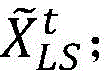
And a distribution unit for distributing the absolute position coordinates of the vehicle in the geodetic coordinate system at the time t, which are obtained by the fusion unit, through a V2X communication method.
Furthermore, the data acquisition unit is also used for acquiring the absolute position coordinates of the road side unit in a geodetic coordinate system in a vehicle-road communication mode and acquiring the position information of the vehicle relative to the road test in a radio distance measurement mode;
the matching unit further includes:
a third calculation subunit for calculating, by equation (7), an absolute position estimation value of the host vehicle in the geodetic coordinate system obtained by the vehicle-road communication method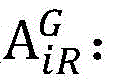

In the formula,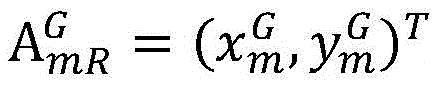 representing the absolute position coordinates, L, of the roadside unit m in the geodetic coordinate systemmRThe direction angle gamma is the included angle between the connecting line between the vehicle and the road side unit m and the transverse axis of the geodetic coordinate system, and the value orientation is [0, 2 pi ]]Positive in the counterclockwise direction;
the vehicle-related position information further includes R at time ttAn
The localization fusion unit is also configured to apply a least squares estimation represented by equation (8) to N obtained by the matching unittAn RtAn
RtAn And the host vehicle on the geodetic coordinate system obtained by filtering of the filtering unitAnd (3) performing fusion on the absolute position coordinate information:

wherein,
further, at time t +1, when N ist+10 and Rt+1When the time is equal to 0, the vehicle calculates the position estimation value of the vehicle at the time t +1 by using the positioning information and the vehicle state information obtained by fusing the time t and the vehicle state information according to the vehicle kinematics formula, and fuses the position estimation value with the absolute position coordinates of the vehicle in the geodetic coordinate system acquired in the step 1 at the time t +1, and the fused positioning information at the time t +1 is obtained according to the formula (8)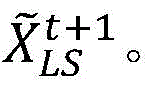
The invention adopts the communication network of the Internet of vehicles (V2X) to carry out auxiliary positioning, thereby realizing the enhancement of the combined positioning of the GNSS and the millimeter wave radar, further improving the positioning precision of the intelligent Internet-connected vehicles and the adaptability to the positioning environment, and having the following advantages:
1. aiming at the problems that the GNSS is not high in positioning accuracy and positioning information is easy to lose, a V2V or V2I communication mode is utilized to collect the positions of an environmental vehicle and a road side unit and the relative distance between the environmental vehicle and a self vehicle, and a multi-vehicle cooperative dynamic positioning system based on V2X information interaction and sharing is designed. 2. Aiming at the fact that the number of the environmental vehicles is large, a Mahalanobis distance measurement environmental vehicle multi-source position difference method is adopted to achieve correct correlation matching between the environmental vehicles received by the internet of vehicles and the environmental vehicles obtained by detection of the vehicle-mounted radar. 3. Aiming at the possible instability phenomenon of V2X communication and radar observation, a dynamic cooperation method considering historical positioning information is designed to adapt to the working condition that environmental vehicle information is unstable.
Drawings
Fig. 1 is a schematic diagram of a dynamic co-location of an intelligent networked automobile based on V2X according to an embodiment of the present invention.
FIG. 2 is a schematic diagram illustrating relative positions of a host vehicle and an environmental vehicle according to an embodiment of the present invention.
Fig. 3 is a schematic view of a local coordinate system of a vehicle according to an embodiment of the present invention.
Detailed Description
The invention is described in detail below with reference to the figures and examples.
As shown in fig. 1, the method for dynamically co-locating a vehicle on an intelligent internet based on V2X in the embodiment of the present invention includes:
step 1, each equipped vehicle comprises a data acquisition unit, the data acquisition unit of the vehicle acquires absolute position coordinates of the vehicle in a geodetic coordinate system and relative position coordinates of the environmental vehicle in the vehicle, and the data acquisition unit of the vehicle acquires absolute position coordinates of the environmental vehicle in the geodetic coordinate system in a vehicle-vehicle communication mode.
The data acquisition unit comprises a GNSS receiver, a millimeter wave radar, a vehicle-to-vehicle communication (V2V) device and a vehicle-to-road communication (V2I) device.
The GNSS receiver observes absolute position coordinate information of the self-vehicle in a geodetic coordinate system, wherein the absolute position information is a latitude and longitude coordinate of the earth, and is converted into a geodetic plane coordinate of a local area through coordinate transformation, and the geodetic plane coordinate comprises a vehicle horizontal coordinate, a vehicle vertical coordinate and a vehicle course angle.
The millimeter wave radar detects the relative position coordinate information of the vehicle in the environment. The equipped vehicle can obtain the distance and angle of the environmental vehicle relative to the host vehicle through the millimeter wave radar, namely the relative position of the environmental vehicle in the vehicle local coordinate system of the host vehicle. In view of the detection range of the millimeter wave radar and the problem of shielding between vehicles, and at the same time, to reduce the amount of calculation for fusion and positioning of the vehicle, in this embodiment, the environmental vehicle is an equipped vehicle that is near the vehicle and on which the radar detector can detect, that is, an equipped vehicle that can be directly detected by the radar detector is regarded as the environmental vehicle in this embodiment. As shown in fig. 2, environmental vehicles in 8 directions around the own vehicle are selected as environmental vehicles, No. 0 is the own vehicle, and No. 1 to No. 8 are all environmental vehicles.
The inter-vehicle communication device is used for mutually transmitting absolute position coordinate information of the vehicle in the geodetic coordinate system between the vehicles. For example, the GNSS receiver of the host vehicle corresponding to the vehicle No. 0 observes the absolute position coordinate information of the host vehicle in the geodetic coordinate system, the GNSS receiver of the environmental vehicle corresponding to the vehicle No. 1 observes the absolute position coordinate information of the environmental vehicle corresponding to the vehicle No. 1 in the geodetic coordinate system, and the vehicle-to-vehicle communication device of the host vehicle corresponding to the vehicle No. 0 interacts with the vehicle-to-vehicle communication device information of the environmental vehicle corresponding to the vehicle No. 1, so that the host vehicle corresponding to the vehicle No. 0 can acquire the absolute position coordinate information of the environmental vehicle corresponding to the vehicle No. 1 in the geodetic coordinate system, and similarly, the environmental vehicle corresponding to the vehicle No. 1 can acquire the absolute position coordinate information of the host vehicle corresponding. The way of information interaction between other environmental vehicles and the vehicle through the vehicle-to-vehicle communication device is similar to the above example, and is not described in detail here. Each equipped vehicle shares own-vehicle GNSS information and relative position information of an environmental vehicle, which is detected by the own vehicle by the millimeter wave radar, with all other vehicles within communication range.
The vehicle-road communication device is used for mutually transmitting the absolute position coordinates of the road side unit in the earth coordinate system between the road side unit and the equipped vehicle. The position of the road side unit can be measured in advance in an accurate measuring mode, and the equipped vehicle receives the position information of the road side unit in a communication range through vehicle-road communication.
Equipped vehicles also range by radio, for example: the method includes pulse ranging (also called time ranging), phase ranging, frequency ranging and the like, and acquires relative position information (relative distance and direction angle) of the vehicle from the road side unit. That is, the vehicle acquires the relative position information of the vehicle on the roadside unit in a radio distance measurement manner.
And 2, processing absolute position coordinate information of the vehicle in the geodetic coordinate system through filtering. The absolute position coordinate information of the equipped vehicle in the geodetic coordinate system, which is obtained by observing the equipped vehicle through the GNSS receiver, is noisy, and the vehicle kinematic model has a nonlinear characteristic, so that the state of the absolute position coordinate information of the equipped vehicle in the geodetic coordinate system is estimated by adopting the extended Kalman filter in the embodiment of the invention. For example: NSS receiver observationVector X ═ Xt,yt,Ψt)TThe navigation system consists of latitude and longitude and course angle acquired by GNSS, and a control vector u is (v, omega)TThe vehicle yaw angle control system is composed of a vehicle speed and a yaw angle speed, wherein the yaw angle speed is obtained through conversion according to a vehicle steering angle and the vehicle speed, and the vehicle speed and the steering angle are obtained through the vehicle CAN in the longitudinal direction. The absolute position coordinate of the vehicle in the geodetic coordinate system obtained by filtering is expressed as The absolute position coordinates of the surrounding vehicle i in the geodetic coordinate system are expressed as
It should be emphasized that the sequence of the collected data and the filtering process is described above by taking the car No. 0 as the vehicle. In fact, when other equipped vehicles are used as the host vehicle, the "absolute position coordinates of the host vehicle in the geodetic coordinate system" acquired by the host vehicle is filtered in the same manner as in step 2, and then the vehicle-to-vehicle communication is transmitted to the environmental vehicle relative to the host vehicle.
And 3, each equipped vehicle can obtain absolute position information through a vehicle-mounted GNSS receiver, and meanwhile can obtain relative position information through millimeter wave radar detection, theoretically, the two pieces of position information are completely consistent, but both pieces of position information contain random errors, so that the relative position information and the absolute position information of the same vehicle have deviation. In the embodiment of the invention, the vehicle realizes the matching of the environmental vehicle information by using the deviation. That is, the relative position coordinates of each environmental vehicle in the vehicle local coordinate system of the host vehicle are found by matching the absolute position coordinates of the environmental vehicle in the geodetic coordinate system with the relative position coordinates of the environmental vehicle in the host vehicle, so as to confirm the correspondence between the environmental vehicle received by the vehicle-to-vehicle communication and the environmental vehicle detected by the millimeter wave radar.
The step 3 specifically comprises the following steps:
step 31, defining the local coordinate system of the vehicle as shown in FIG. 3, and taking the origin at the center of gravity of the vehicleFixed with the vehicle, the y axis is along the longitudinal direction of the vehicle, the x axis is along the transverse direction of the vehicle, and the coordinate of any point in the coordinate system is expressed as (x)b,yb)。
The absolute position coordinates of the environmental vehicle in step 1 in the geodetic coordinate system are determined by the following equation (1)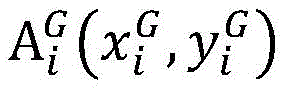 Converting the coordinate into the local coordinate system of the vehicle to obtain the absolute position coordinate of the environmental vehicle i in the local coordinate system of the vehicle

Where Ψ denotes the heading angle of the host vehicle in the geodetic coordinate system, i.e., as described above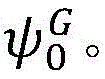
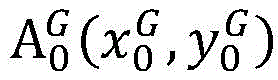 The absolute position coordinates of the host vehicle in the geodetic coordinate system are shown.
Step 32, detecting the relative distance delta d between the environment vehicle and the vehicle according to the millimeter wave radar of the vehicle0jAnd the direction angle theta0jThe following expression (2) is used to obtain the relative position coordinates A of the vehicle in the local coordinate system of the vehicle in the environment vehicle i0j,j=1,2…。

Step 33, evaluation AiAnd A0jThe similarity index between them is obtained as AiAnd A0jRelative position coordinate M of the vehicle in the local vehicle coordinate system of the vehicle when the environmental vehicle i with the minimum similarity index is in the local vehicle coordinate system of the vehiclei。
In one embodiment, mahalanobis distance D of equation (3) is used in step 33ij(Ai,A0j) Determining AiAnd A0jSimilarity indexes between the two;

where S is a covariance matrix of position coordinates a of the environmental vehicle, the present embodiment assumes that environmental vehicle position information a (random variable) includes aiAnd A0jFitting the Gaussian distribution N, namely A to N (0, S).
In addition, A isiAnd A0jThe similarity index between the two can be evaluated by adopting Euclidean distance, Manhattan distance and the like besides the Mahalanobis distance. The distance between two points is measured in many ways:
determination of A in step 33 by the nearest neighbor method represented by formula (4)iAnd A0jRelative position coordinate M of the vehicle in the vehicle local coordinate system of the vehicle corresponding to the environment vehicle i with the minimum similarity indexi;
Mi=arg minjDij(Ai,A0j) (4)。
There are many ways to mathematically describe the degree of approximation between two variables, and the present embodiment chooses the nearest neighbor method. Various "distances" and "correlation coefficients" are commonly used as dissimilarity or similarity dissimilarity measures. For example: euclidean distance, manhattan distance, and chebyshev distance.
In the above embodiment, 8 vehicles around the vehicle are selected as the co-located target environment vehicles, and the mahalanobis distance measurement is adopted to measure the absolute position coordinates a of the environment vehicle iiAnd relative position coordinate A0jThe environmental vehicle information is correctly matched according to the proximity degree between the environmental vehicle information and the environmental vehicle information.
Step 4, according to the M of the environmental vehicle iiThe absolute position estimation value of the vehicle in the geodetic coordinate system obtained by the vehicle-vehicle communication method is calculated by using the formula (5)

Wherein, showing the absolute position coordinates of the host vehicle in the geodetic coordinate system,
 an inverse matrix representing a rotation matrix between the geodetic coordinate system and the vehicle local coordinate system of the host vehicle.
The vehicle acquires absolute position information of the environmental vehicle in a communication range through vehicle-to-vehicle communication, and simultaneously detects relative position information of the environmental vehicle to the vehicle through a millimeter wave radar, and indirect estimation of the position of the vehicle is achieved based on the two information.
And 5, after the steps are carried out, the equipped vehicle can obtain a plurality of vehicle positioning estimated values with noise, and the data fusion estimation in the step is required to improve the vehicle positioning accuracy.
If the host vehicle acquires nearby N by vehicle-to-vehicle communication at time tt(NtLess than or equal to 8) absolute positions of equipped vehicles and relative position information of environment vehicles detected by millimeter wave radar, and the related position information of the vehicle can be fused, wherein the related position information of the vehicle comprises N acquired in step 4tAn And
And step 2, filtering the absolute position coordinate information of the vehicle in the geodetic coordinate system Positioning the absolute position coordinates of the vehicle in a geodetic coordinate system at the moment t to obtain positioning information obtained by fusing the t moment


wherein,
in one embodiment, step 5 is preceded by:
the absolute position estimated value of the vehicle in the geodetic coordinate system obtained by the vehicle-road communication mode is calculated and obtained by the formula (7)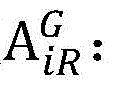

In the formula, representing the absolute position coordinates, L, of the roadside unit m in the geodetic coordinate systemmRThe direction angle gamma is the included angle between the connecting line between the vehicle and the road side unit m (the connecting line between the geometric centers) and the transverse axis of the geodetic coordinate system, and the value orientation is [0, 2 pi ]]And positive in the counterclockwise direction.
The vehicle-related position information in step 5 includes N obtained in step 4 at time ttAn
Step 2, filtering the absolute position coordinate information of the vehicle in the geodetic coordinate system And RtAn


wherein,
the vehicle obtains a plurality of vehicle position information with noise through vehicle-road cooperation, and optimal fusion estimation is achieved by adopting a least square method.
The fusion estimation method described above is such that the result of the vehicle-location fusion estimation at each time is related only to the nearby vehicles and the roadside unit information acquired at that time. In the practical situation of vehicle operation, the instability factor exists between the V2X communication and the observation of the millimeter wave radar, and the number of the vehicles in the environment around the vehicle can change along with the time. Therefore, historical information needs to be considered in the design of the fusion algorithm to adapt to the working condition that the environmental vehicle information is unstable, and the specific method is as follows:
at the time t +1,when N is presentt+10 and Rt+1When the vehicle speed is equal to 0, the vehicle calculates the position estimation value of the vehicle at the time t +1 by using the positioning information and the vehicle state information (such as the vehicle speed, the acceleration and the steering angle) obtained by fusion at the time t and combining a vehicle kinematic formula, and then the position estimation value is fused with the absolute position coordinates of the vehicle in the geodetic coordinate system acquired in the step 1 at the time t +1, and the fusion positioning information at the time t +1 is obtained according to the formula (5)
And 6, issuing the absolute position coordinates of the vehicle obtained in the step 5 in the geodetic coordinate system at the time t through a V2X communication mode.
And the positioning information obtained by filtering, target matching and data fusion of the information acquired by the GNSS receiver, the millimeter wave radar, the vehicle-vehicle communication equipment and the vehicle-road communication equipment is issued by the vehicle-vehicle communication equipment and the vehicle-road communication equipment. Other equipped vehicles in the communication range can obtain a fusion positioning information data set of the vehicle through vehicle-vehicle communication, wherein the fusion positioning information data set comprises the absolute vehicle position estimated by the vehicle based on the extended Kalman filter and the cooperative vehicle path positioning information based on least square Vehicle state (vehicle speed, heading angle) information, and the like.
The invention also provides an intelligent networking automobile dynamic cooperative positioning device based on V2X, which comprises: the device comprises a data acquisition unit, a filtering unit, a matching unit, a fusion unit and a release unit.
The data acquisition unit is used for acquiring the absolute position coordinates of the vehicle in a geodetic coordinate system through the vehicle Acquiring the absolute position coordinates of the environmental vehicle in a geodetic coordinate system in a vehicle-vehicle communication mode; the environmental vehicle is an equipment vehicle which is near the vehicle and can be detected by a radar detector on the environmental vehicle.
The filtering unit is used for processing absolute position coordinate information of the vehicle in a geodetic coordinate system through filtering;
the matching unit is used for finding out the relative position coordinates of each environmental vehicle in the vehicle local coordinate system of the vehicle by matching the absolute position coordinates of the environmental vehicles in the geodetic coordinate system with the relative position coordinates of the environmental vehicles in the vehicle. The matching unit specifically comprises a first coordinate conversion subunit, a second coordinate conversion subunit, a first calculation subunit and a second calculation subunit.
The first coordinate conversion subunit is used for converting the absolute position coordinates of the environmental vehicle in the data acquisition unit in the geodetic coordinate system into the vehicle local coordinate system of the vehicle to obtain the absolute position coordinates of the environmental vehicle i in the vehicle local coordinate system of the vehicle
The second coordinate conversion subunit is used for converting the relative position coordinates of the environmental vehicle in the data acquisition unit to the vehicle local coordinate system of the vehicle to obtain the relative position coordinates A of the environmental vehicle i in the vehicle local coordinate system of the vehicle0j,j=1,2…;
The first calculation subunit is used for assessing AiAnd A0jThe similarity index between them, and obtain AiAnd A0jRelative position coordinate M of the vehicle in the local vehicle coordinate system of the vehicle when the environmental vehicle i with the minimum similarity index is in the local vehicle coordinate system of the vehiclei;
A second computing subunit for computing according to MiThe absolute position estimation value of the vehicle in the geodetic coordinate system obtained by the vehicle-vehicle communication method is calculated by using the formula (5)

Wherein, showing the absolute position coordinates of the host vehicle in the geodetic coordinate system,
 and psi represents the inverse matrix of the rotation matrix between the geodetic coordinate system and the vehicle local coordinate system of the host vehicle, and psi represents the heading angle of the host vehicle in the geodetic coordinate system.
The fusion unit is used for recording that the vehicle has N near the time tt(NtLess than or equal to 8) vehicles in the environment, and fusing the related position information of the vehicle, wherein the related position information of the vehicle comprises N acquired by a matching unittAn And the absolute position coordinate information of the vehicle in the geodetic coordinate system obtained by filtering of the filtering unit
 Positioning the absolute position coordinates of the vehicle in a geodetic coordinate system at the moment t to obtain positioning information obtained by fusing the t moment
The fusion unit uses the least square estimation represented by formula (6) to obtain N for the matching unittAn And the absolute position coordinate information of the vehicle in the geodetic coordinate system obtained by filtering by the filtering unit is fused:

wherein,
in one embodiment, the data acquisition unit is further used for acquiring absolute position coordinates of the road side unit in a geodetic coordinate system through a vehicle-road communication mode and acquiring position information of the vehicle relative to the drive test through a radio distance measurement mode.
The matching unit further comprises a third calculation subunit. The third calculation subunit is used for calculating and obtaining the absolute position estimated value of the vehicle in the geodetic coordinate system through the vehicle-road communication mode by the formula (7)

In the formula, representing the absolute position coordinates, L, of the roadside unit m in the geodetic coordinate systemmRThe direction angle gamma is the included angle between the connecting line between the vehicle and the road side unit m and the transverse axis of the geodetic coordinate system, and the value orientation is [0, 2 pi ]]And positive in the counterclockwise direction.
The vehicle-related position information further includes R at time ttAn
The localization fusion unit is also configured to apply a least squares estimation represented by equation (8) to the matching unit NtAn RtAn
RtAn And the absolute position coordinate information of the vehicle in the geodetic coordinate system obtained by filtering by the filtering unit is fused with:

wherein,
in one embodiment, the fusion estimation method described above, at each time, the result of the host vehicle location fusion estimation is related only to the nearby vehicles and the roadside unit information acquired at that time. In the practical situation of vehicle operation, the instability factor exists between the V2X communication and the observation of the millimeter wave radar, and the number of the vehicles in the environment around the vehicle can change along with the time. Therefore, historical information needs to be considered in the design of the fusion algorithm to adapt to the working condition that the environmental vehicle information is unstable, and the specific method is as follows:
at time t +1, when Nt+10 and Rt+1When the time is equal to 0, the vehicle calculates the position estimation value of the vehicle at the time t +1 by using the positioning information and the vehicle state information obtained by fusion at the time t and combining the vehicle kinematic formula, fuses the position estimation value with the absolute position coordinates of the vehicle in the geodetic coordinate system acquired in the step 1 at the time t +1, and obtains the fusion positioning information at the time t +1 according to the formula (6) or (8)
The issuing unit is used for issuing the absolute position coordinates of the vehicle in the geodetic coordinate system at the time t, which are obtained by the fusion unit, through a V2X communication mode.
Finally, it should be pointed out that: the above examples are only for illustrating the technical solutions of the present invention, and are not limited thereto. Those of ordinary skill in the art will understand that: modifications can be made to the technical solutions described in the foregoing embodiments, or some technical features may be equivalently replaced; such modifications or substitutions do not depart from the spirit and scope of the corresponding technical solutions of the embodiments of the present invention.
Claims (10)
1. A dynamic cooperative positioning method of an intelligent networked automobile based on V2X is characterized by comprising the following steps:
step 1, acquiring absolute position coordinates of the vehicle in a geodetic coordinate system through the vehicle Acquiring the absolute position coordinates of the environmental vehicle in a geodetic coordinate system in a vehicle-vehicle communication mode; the environment vehicle is an equipment vehicle which is near the vehicle and can be detected by a radar detector on the environment vehicle;
step 2, processing absolute position coordinate information of the vehicle in a geodetic coordinate system through filtering;
step 3, finding out the relative position coordinates of each environmental vehicle in the vehicle local coordinate system of the vehicle by matching the absolute position coordinates of the environmental vehicles in the geodetic coordinate system with the relative position coordinates of the environmental vehicles in the vehicle;
step 31, converting the absolute position coordinates of the environmental vehicle in the geodetic coordinate system in the step 1 into the vehicle local coordinate system of the host vehicle to obtain the absolute position coordinates A of the environmental vehicle i in the vehicle local coordinate system of the host vehiclei,i=1,2…;
Step 32, converting the relative position coordinates of the environment vehicle in the host vehicle in the step 1 into the vehicle local coordinate system of the host vehicle, and obtaining the relative position coordinates A of the environment vehicle i in the host vehicle in the vehicle local coordinate system of the host vehicle0j,j=1,2…;
Step 33, evaluation AiAnd A0jThe similarity index between them, and obtain AiAnd A0jRelative position coordinate M of the vehicle in the local vehicle coordinate system of the vehicle when the environmental vehicle i with the minimum similarity index is in the local vehicle coordinate system of the vehiclei;
Step 4, according to the M of the environmental vehicle iiThe absolute position estimation value of the vehicle in the geodetic coordinate system obtained by the vehicle-vehicle communication method is calculated by using the formula (5)

Wherein, showing the absolute position coordinates of the host vehicle in the geodetic coordinate system,
 expressing an inverse matrix of a rotation matrix between a geodetic coordinate system and a vehicle local coordinate system of the host vehicle, and psi expresses a course angle of the host vehicle in the geodetic coordinate system;
step 5, recording that the vehicle has N near the time tt(NtNot more than 8) vehicles in the environment, and fusing the relevant position information of the vehicle, wherein the relevant position information of the vehicle comprises N acquired in step 4tAn And step 2, the absolute position coordinate information of the vehicle in the geodetic coordinate system obtained by filtering is used for positioning the absolute position coordinate of the vehicle in the geodetic coordinate system at the time t to obtain positioning information obtained by fusing the time t
2. The V2X-based intelligent networked automobile dynamic cooperative positioning method as claimed in claim 1, wherein the step 1 further collects absolute position coordinates of the road side unit in a geodetic coordinate system and position information of a relative road test of the automobile in a vehicle-road communication mode;
step 5 also includes before:
according to road side unit The absolute value of the vehicle in the geodetic coordinate system obtained by the vehicle-road communication mode is calculated by the formula (7)Position estimation

In the formula, representing the absolute position coordinates, L, of the roadside unit m in the geodetic coordinate systemmRThe direction angle gamma is the included angle between the connecting line between the vehicle and the road side unit m and the transverse axis of the geodetic coordinate system, and the value orientation is [0, 2 pi ]]Positive in the counterclockwise direction;
the vehicle-related position information in step 5 further includes R at time ttAn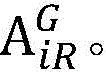
3. The intelligent networked automobile dynamic cooperative positioning method based on V2X as claimed in claim 1 or 2, wherein, at time t +1, when N is Nt+10 and Rt+1When the time is equal to 0, the vehicle calculates the position estimation value of the vehicle at the time t +1 by using the positioning information and the vehicle state information obtained by fusing the time t, and combining the vehicle kinematic formula, and fuses the position estimation value with the absolute position coordinates of the vehicle in the geodetic coordinate system acquired in the step 1 at the time t +1, and the fused positioning information at the time t +1 is obtained according to the formula (5)
4. The intelligent networked automobile dynamic co-location method based on V2X of claim 3, wherein step 5 uses least squares estimation pair N represented by equation (8)tAn Step 2, filtering the absolute position coordinate information and R of the vehicle in the geodetic coordinate systemtAn
 Carrying out fusion:

wherein,
5. the V2X-based intelligent networked automobile dynamic co-location method according to claim 4, wherein the Mahalanobis distance D of formula (3) is adopted in step 33ij(Ai,A0j) Determining AiAnd A0jSimilarity indexes between the two;

wherein S is a covariance matrix of position coordinates A of the environmental vehicle, A-N (0, S), A is a random variable including AiAnd A0jAnd N is a Gaussian distribution.
6. The V2X-based intelligent networked automobile dynamic co-location method, according to claim 5, wherein the nearest neighbor method represented by formula (4) is adopted to determine A in step 33iAnd A0jRelative position coordinate M of the vehicle in the vehicle local coordinate system of the vehicle corresponding to the environment vehicle i with the minimum similarity indexi;
Mi=arg minj Dij(Ai,A0j) (4)。
7. The V2X-based intelligent networked automobile dynamic co-location method according to claim 3, further comprising:
and 6, issuing the absolute position coordinates of the vehicle obtained in the step 5 in the geodetic coordinate system at the time t through a V2X communication mode.
8. The utility model provides an intelligence networking car developments cooperative localization device based on V2X which characterized in that includes:
a data acquisition unit for acquiring absolute position coordinates of the host vehicle in a geodetic coordinate system by the host vehicle Acquiring the absolute position coordinates of the environmental vehicle in a geodetic coordinate system in a vehicle-vehicle communication mode; the environment vehicle is an equipment vehicle which is near the vehicle and can be detected by a radar detector on the environment vehicle;
a filtering unit for processing absolute position coordinate information of the host vehicle in the geodetic coordinate system by filtering;
the matching unit is used for finding out the relative position coordinates of each environment vehicle in the vehicle local coordinate system of the vehicle by matching the absolute position coordinates of the environment vehicles in the geodetic coordinate system with the relative position coordinates of the environment vehicles in the vehicle;
a first coordinate conversion subunit, configured to convert the absolute position coordinates of the environmental vehicle in the geodetic coordinate system in the data acquisition unit into the vehicle local coordinate system of the host vehicle, to obtain absolute position coordinates a of the environmental vehicle i in the vehicle local coordinate system of the host vehiclei,i=1,2…;
A second coordinate conversion subunit, configured to convert the relative position coordinates of the environmental vehicle in the data acquisition unit to the local vehicle coordinate system of the host vehicle, so as to obtain relative position coordinates a of the environmental vehicle i in the local vehicle coordinate system of the host vehicle0j,j=1,2…;
A first calculation subunit for assessing AiAnd A0jThe similarity index between them, and obtain AiAnd A0jRelative position coordinate M of the vehicle in the local vehicle coordinate system of the vehicle when the environmental vehicle i with the minimum similarity index is in the local vehicle coordinate system of the vehiclei;
A second calculation subunit for calculating according to MiThe absolute position estimation value of the vehicle in the geodetic coordinate system obtained by the vehicle-vehicle communication method is calculated by using the formula (5)

Wherein, showing the absolute position coordinates of the host vehicle in the geodetic coordinate system,
 expressing an inverse matrix of a rotation matrix between a geodetic coordinate system and a vehicle local coordinate system of the host vehicle, and psi expresses a course angle of the host vehicle in the geodetic coordinate system;
a fusion unit for recording that the vehicle has N near the time tt(NtLess than or equal to 8) vehicles in the environment, and fusing the related position information of the vehicle, wherein the related position information of the vehicle comprises N acquired by a skimming unittAn And the absolute position coordinate information of the vehicle in the geodetic coordinate system is obtained by filtering of the filtering unit, the absolute position coordinate of the vehicle in the geodetic coordinate system at the time t is positioned, and positioning information obtained by fusion of the time t is obtained
And a distribution unit for distributing the absolute position coordinates of the vehicle in the geodetic coordinate system at the time t, which are obtained by the fusion unit, through a V2X communication method.
9. The V2X-based intelligent networked automobile dynamic cooperative positioning device, wherein the data acquisition unit is further configured to acquire absolute position coordinates of the road side unit in a geodetic coordinate system through a vehicle-road communication manner and acquire position information of the relative road test of the vehicle through a radio distance measurement manner;
the matching unit further includes:
a third calculation subunit for calculating, by equation (7), an absolute position estimation value of the host vehicle in the geodetic coordinate system obtained by the vehicle-road communication method

In the formula, representing the absolute position coordinates, L, of the roadside unit m in the geodetic coordinate systemmRThe direction angle gamma is the included angle between the connecting line between the vehicle and the road side unit m and the transverse axis of the geodetic coordinate system, and the value orientation is [0, 2 pi ]]Positive in the counterclockwise direction;
the vehicle-related position information further includes R at time ttAn
The localization fusion unit is also configured to apply a least squares estimation represented by equation (8) to N obtained by the matching unittAn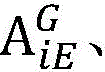 RtAn
RtAn And the absolute position coordinate information of the vehicle in the geodetic coordinate system obtained by filtering by the filtering unit is fused with:

wherein,
10. the intelligent networked automobile dynamic cooperative positioning method based on V2X as claimed in claim 8 or 9, wherein, at time t +1, when N is Nt+10 and Rt+1When the time is equal to 0, the vehicle calculates the position estimation value of the vehicle at the time t +1 by using the positioning information and the vehicle state information obtained by fusing the time t and the vehicle state information according to the vehicle kinematics formula, and fuses the position estimation value with the absolute position coordinates of the vehicle in the geodetic coordinate system acquired in the step 1 at the time t +1, and the fused positioning information at the time t +1 is obtained according to the formula (8)
Priority Applications (1)
| Application Number | Priority Date | Filing Date | Title |
|---|---|---|---|
| CN202011179628.4A CN112346103A (en) | 2020-10-29 | 2020-10-29 | V2X-based intelligent networking automobile dynamic co-location method and device |
Applications Claiming Priority (1)
| Application Number | Priority Date | Filing Date | Title |
|---|---|---|---|
| CN202011179628.4A CN112346103A (en) | 2020-10-29 | 2020-10-29 | V2X-based intelligent networking automobile dynamic co-location method and device |
Publications (1)
| Publication Number | Publication Date |
|---|---|
| CN112346103A true CN112346103A (en) | 2021-02-09 |
Family
ID=74356448
Family Applications (1)
| Application Number | Title | Priority Date | Filing Date |
|---|---|---|---|
| CN202011179628.4A Pending CN112346103A (en) | 2020-10-29 | 2020-10-29 | V2X-based intelligent networking automobile dynamic co-location method and device |
Country Status (1)
| Country | Link |
|---|---|
| CN (1) | CN112346103A (en) |
Cited By (8)
| Publication number | Priority date | Publication date | Assignee | Title |
|---|---|---|---|---|
| CN113267188A (en) * | 2021-05-06 | 2021-08-17 | 长安大学 | Vehicle co-location method and system based on V2X communication |
| CN114296090A (en) * | 2021-12-22 | 2022-04-08 | 华人运通(上海)自动驾驶科技有限公司 | Vehicle positioning method, device, equipment and medium |
| CN114417386A (en) * | 2022-01-21 | 2022-04-29 | 深圳市雪球科技有限公司 | Device positioning and coordinate list generation method and device, electronic device and storage medium |
| CN114608553A (en) * | 2022-02-21 | 2022-06-10 | 南京航空航天大学 | Automatic driving automobile positioning system and method |
| CN115061176A (en) * | 2022-08-05 | 2022-09-16 | 合肥工业大学 | A vehicle GPS enhanced positioning method based on V2V instantaneous data exchange |
| CN115166721A (en) * | 2022-09-05 | 2022-10-11 | 湖南众天云科技有限公司 | Radar and GNSS information calibration fusion method and device in roadside sensing equipment |
| CN116088014A (en) * | 2023-03-03 | 2023-05-09 | 北京理工大学 | Main car information coordinate system conversion method and system based on longitude and latitude information |
| WO2023216520A1 (en) * | 2022-05-09 | 2023-11-16 | 厦门雅迅网络股份有限公司 | Assisted vehicle positioning method and apparatus |
Citations (15)
| Publication number | Priority date | Publication date | Assignee | Title |
|---|---|---|---|---|
| JP2003337029A (en) * | 2002-05-17 | 2003-11-28 | Aisin Aw Co Ltd | Position detecting device |
| WO2012001443A1 (en) * | 2010-06-29 | 2012-01-05 | Nokia Corporation . | Portable communication terminals and methods for cooperative positioning support during poor satellite coverage |
| CN107976704A (en) * | 2016-10-25 | 2018-05-01 | 法国国家太空研究中心 | The collaborative of vehicle location is improved |
| CN108345020A (en) * | 2018-02-09 | 2018-07-31 | 长沙智能驾驶研究院有限公司 | Vehicle positioning method, system and computer readable storage medium |
| CN108627854A (en) * | 2017-03-23 | 2018-10-09 | 德尔福技术有限公司 | It is improved using the automated vehicle GPS accuracy of V2V communications |
| CN109307857A (en) * | 2018-11-12 | 2019-02-05 | 湖北工业大学 | A multi-sensor-based autonomous tracking and positioning device and method |
| CN110208842A (en) * | 2019-05-28 | 2019-09-06 | 长安大学 | Vehicle high-precision locating method under a kind of car networking environment |
| CN110440801A (en) * | 2019-07-08 | 2019-11-12 | 浙江吉利控股集团有限公司 | A kind of location aware information acquisition method, apparatus and system |
| US20200003907A1 (en) * | 2017-03-17 | 2020-01-02 | Veoneer Us Inc. | Grouping for efficient cooperative positioning calculations |
| CN111123341A (en) * | 2019-11-15 | 2020-05-08 | 西安电子科技大学 | 3D co-location method for UAV swarms |
| CN111208526A (en) * | 2020-01-17 | 2020-05-29 | 西北工业大学 | Multi-UAV Co-location Method Based on Lidar and Positioning Vector Matching |
| CN111288984A (en) * | 2020-03-04 | 2020-06-16 | 武汉大学 | Multi-vehicle joint absolute positioning method based on Internet of vehicles |
| CN111526487A (en) * | 2020-04-17 | 2020-08-11 | 西南民族大学 | Collaborative vehicle positioning method based on fusion of GPS and vehicle ranging information |
| CN111541990A (en) * | 2020-04-30 | 2020-08-14 | 重庆车辆检测研究院有限公司 | System, method and device for acquiring test data of vehicle-road cooperative system |
| CN111554088A (en) * | 2020-04-13 | 2020-08-18 | 重庆邮电大学 | Multifunctional V2X intelligent roadside base station system |
-
2020
- 2020-10-29 CN CN202011179628.4A patent/CN112346103A/en active Pending
Patent Citations (15)
| Publication number | Priority date | Publication date | Assignee | Title |
|---|---|---|---|---|
| JP2003337029A (en) * | 2002-05-17 | 2003-11-28 | Aisin Aw Co Ltd | Position detecting device |
| WO2012001443A1 (en) * | 2010-06-29 | 2012-01-05 | Nokia Corporation . | Portable communication terminals and methods for cooperative positioning support during poor satellite coverage |
| CN107976704A (en) * | 2016-10-25 | 2018-05-01 | 法国国家太空研究中心 | The collaborative of vehicle location is improved |
| US20200003907A1 (en) * | 2017-03-17 | 2020-01-02 | Veoneer Us Inc. | Grouping for efficient cooperative positioning calculations |
| CN108627854A (en) * | 2017-03-23 | 2018-10-09 | 德尔福技术有限公司 | It is improved using the automated vehicle GPS accuracy of V2V communications |
| CN108345020A (en) * | 2018-02-09 | 2018-07-31 | 长沙智能驾驶研究院有限公司 | Vehicle positioning method, system and computer readable storage medium |
| CN109307857A (en) * | 2018-11-12 | 2019-02-05 | 湖北工业大学 | A multi-sensor-based autonomous tracking and positioning device and method |
| CN110208842A (en) * | 2019-05-28 | 2019-09-06 | 长安大学 | Vehicle high-precision locating method under a kind of car networking environment |
| CN110440801A (en) * | 2019-07-08 | 2019-11-12 | 浙江吉利控股集团有限公司 | A kind of location aware information acquisition method, apparatus and system |
| CN111123341A (en) * | 2019-11-15 | 2020-05-08 | 西安电子科技大学 | 3D co-location method for UAV swarms |
| CN111208526A (en) * | 2020-01-17 | 2020-05-29 | 西北工业大学 | Multi-UAV Co-location Method Based on Lidar and Positioning Vector Matching |
| CN111288984A (en) * | 2020-03-04 | 2020-06-16 | 武汉大学 | Multi-vehicle joint absolute positioning method based on Internet of vehicles |
| CN111554088A (en) * | 2020-04-13 | 2020-08-18 | 重庆邮电大学 | Multifunctional V2X intelligent roadside base station system |
| CN111526487A (en) * | 2020-04-17 | 2020-08-11 | 西南民族大学 | Collaborative vehicle positioning method based on fusion of GPS and vehicle ranging information |
| CN111541990A (en) * | 2020-04-30 | 2020-08-14 | 重庆车辆检测研究院有限公司 | System, method and device for acquiring test data of vehicle-road cooperative system |
Non-Patent Citations (6)
| Title |
|---|
| JOÃO B. PINTO NETO,ET AL: "An accurate cooperative positioning system for vehicular safety applications", 《COMPUTERS AND ELECTRICAL ENGINEERING》 * |
| 孙宁: "基于多源信息融合的智能汽车环境感知技术研究", 《中国博士学位论文全文数据库 工程科技II辑》 * |
| 曹晋龙等: "基于信息级的 T-Rn 型多基地系统定位方法研究", 《现代雷达》 * |
| 朱丽芳等: "一发多收MIMO雷达的目标关联特性", 《雷达科学与技术》 * |
| 谢伯元等: "基于车路协同的车辆状态估计方法", 《汽车工程》 * |
| 贾兴江等: "双/多机测角频差定位算法研究", 《信号处理》 * |
Cited By (10)
| Publication number | Priority date | Publication date | Assignee | Title |
|---|---|---|---|---|
| CN113267188A (en) * | 2021-05-06 | 2021-08-17 | 长安大学 | Vehicle co-location method and system based on V2X communication |
| CN114296090A (en) * | 2021-12-22 | 2022-04-08 | 华人运通(上海)自动驾驶科技有限公司 | Vehicle positioning method, device, equipment and medium |
| CN114417386A (en) * | 2022-01-21 | 2022-04-29 | 深圳市雪球科技有限公司 | Device positioning and coordinate list generation method and device, electronic device and storage medium |
| CN114608553A (en) * | 2022-02-21 | 2022-06-10 | 南京航空航天大学 | Automatic driving automobile positioning system and method |
| CN114608553B (en) * | 2022-02-21 | 2024-05-24 | 南京航空航天大学 | A self-driving car positioning system and method |
| WO2023216520A1 (en) * | 2022-05-09 | 2023-11-16 | 厦门雅迅网络股份有限公司 | Assisted vehicle positioning method and apparatus |
| CN115061176A (en) * | 2022-08-05 | 2022-09-16 | 合肥工业大学 | A vehicle GPS enhanced positioning method based on V2V instantaneous data exchange |
| CN115166721A (en) * | 2022-09-05 | 2022-10-11 | 湖南众天云科技有限公司 | Radar and GNSS information calibration fusion method and device in roadside sensing equipment |
| CN116088014A (en) * | 2023-03-03 | 2023-05-09 | 北京理工大学 | Main car information coordinate system conversion method and system based on longitude and latitude information |
| CN116088014B (en) * | 2023-03-03 | 2023-07-04 | 北京理工大学 | Main car information coordinate system conversion method and system based on longitude and latitude information |
Similar Documents
| Publication | Publication Date | Title |
|---|---|---|
| CN112346103A (en) | V2X-based intelligent networking automobile dynamic co-location method and device | |
| EP3904908A1 (en) | Method and system for map improvement using feedback from positioning based on radar and motion sensors | |
| US11237005B2 (en) | Method and arrangement for sourcing of location information, generating and updating maps representing the location | |
| CN102529975B (en) | Systems and methods for precise sub-lane vehicle positioning | |
| US9162682B2 (en) | Method and device for determining the speed and/or position of a vehicle | |
| CN106352867B (en) | Method and device for determining the position of a vehicle | |
| US8775063B2 (en) | System and method of lane path estimation using sensor fusion | |
| CN110208842A (en) | Vehicle high-precision locating method under a kind of car networking environment | |
| US11287281B2 (en) | Analysis of localization errors in a mobile object | |
| CN105741546A (en) | Intelligent vehicle target tracking system through integration of road side equipment and vehicle sensor and method thereof | |
| CN112147651B (en) | A robust estimation method for asynchronous multi-vehicle collaborative target state | |
| CN107247275B (en) | Bus-based urban GNSS vulnerability monitoring system and method | |
| CN104835353A (en) | Cooperation relative positioning method based on INS and GNSS pseudo-range double difference for VANET | |
| US20250305851A1 (en) | Method and system for map building using radar and motion sensors | |
| CN107274721A (en) | Many vehicle cooperative localization methods in a kind of intelligent transportation system | |
| CN117014815A (en) | A multi-sensor multi-vehicle collaborative positioning system and method | |
| CN108254775A (en) | Onboard navigation system and its implementation | |
| Zhu et al. | Localization of autonomous vehicles in tunnels based on roadside multi-sensor fusion | |
| Tsogas et al. | Using digital maps to enhance lane keeping support systems | |
| CN115451957A (en) | Inertial navigation satellite navigation positioning method and system based on inertial navigation satellite navigation tight combination | |
| Song et al. | RFID/in-vehicle sensors-integrated vehicle positioning strategy utilising LSSVM and federated UKF in a tunnel | |
| Javed et al. | Vehicle Localization in GPS-Denied Scenarios Using Arc-Length-Based Map Matching | |
| JP2020046413A (en) | Data structure, storage device, terminal device, server device, control method, program, and storage medium | |
| Cao et al. | A macrozone LBS scheme based on data fusion of vehicle GNSS and roadside Millimeter-Wave Radar in a road traffic scenario | |
| Toledo-Moreo et al. | Positioning and digital maps |
Legal Events
| Date | Code | Title | Description |
|---|---|---|---|
| PB01 | Publication | ||
| PB01 | Publication | ||
| SE01 | Entry into force of request for substantive examination | ||
| SE01 | Entry into force of request for substantive examination | ||
| RJ01 | Rejection of invention patent application after publication | ||
| RJ01 | Rejection of invention patent application after publication |
Application publication date: 20210209 |