CN112313876A - Impedance matching network model based on correction scheme and performance repeatability - Google Patents
Impedance matching network model based on correction scheme and performance repeatability Download PDFInfo
- Publication number
- CN112313876A CN112313876A CN201980040232.0A CN201980040232A CN112313876A CN 112313876 A CN112313876 A CN 112313876A CN 201980040232 A CN201980040232 A CN 201980040232A CN 112313876 A CN112313876 A CN 112313876A
- Authority
- CN
- China
- Prior art keywords
- matching network
- reactance
- stepper motor
- tuning element
- variable tuning
- Prior art date
- Legal status (The legal status is an assumption and is not a legal conclusion. Google has not performed a legal analysis and makes no representation as to the accuracy of the status listed.)
- Pending
Links
Images


Classifications
-
- H—ELECTRICITY
- H01—ELECTRIC ELEMENTS
- H01J—ELECTRIC DISCHARGE TUBES OR DISCHARGE LAMPS
- H01J37/00—Discharge tubes with provision for introducing objects or material to be exposed to the discharge, e.g. for the purpose of examination or processing thereof
- H01J37/32—Gas-filled discharge tubes
- H01J37/32009—Arrangements for generation of plasma specially adapted for examination or treatment of objects, e.g. plasma sources
- H01J37/32082—Radio frequency generated discharge
- H01J37/32174—Circuits specially adapted for controlling the RF discharge
- H01J37/32183—Matching circuits
-
- H—ELECTRICITY
- H03—ELECTRONIC CIRCUITRY
- H03H—IMPEDANCE NETWORKS, e.g. RESONANT CIRCUITS; RESONATORS
- H03H11/00—Networks using active elements
- H03H11/02—Multiple-port networks
- H03H11/28—Impedance matching networks
- H03H11/30—Automatic matching of source impedance to load impedance
-
- H—ELECTRICITY
- H03—ELECTRONIC CIRCUITRY
- H03H—IMPEDANCE NETWORKS, e.g. RESONANT CIRCUITS; RESONATORS
- H03H11/00—Networks using active elements
- H03H11/02—Multiple-port networks
- H03H11/40—Impedance converters
-
- H—ELECTRICITY
- H03—ELECTRONIC CIRCUITRY
- H03H—IMPEDANCE NETWORKS, e.g. RESONANT CIRCUITS; RESONATORS
- H03H7/00—Multiple-port networks comprising only passive electrical elements as network components
- H03H7/38—Impedance-matching networks
-
- H—ELECTRICITY
- H03—ELECTRONIC CIRCUITRY
- H03H—IMPEDANCE NETWORKS, e.g. RESONANT CIRCUITS; RESONATORS
- H03H7/00—Multiple-port networks comprising only passive electrical elements as network components
- H03H7/38—Impedance-matching networks
- H03H7/40—Automatic matching of load impedance to source impedance
Landscapes
- Physics & Mathematics (AREA)
- Engineering & Computer Science (AREA)
- Plasma & Fusion (AREA)
- Chemical & Material Sciences (AREA)
- Analytical Chemistry (AREA)
- Plasma Technology (AREA)
- Drying Of Semiconductors (AREA)
- Control Of Motors That Do Not Use Commutators (AREA)
- Electrotherapy Devices (AREA)
Abstract
A matching network system for a Radio Frequency (RF) power delivery system includes a matching network having a variable tuning element. The matching network introduces a variable impedance between the RF power generator and the load. The stepper motor adjusts the position of the variable tuning element. The matching network system also includes a controller in communication with the matching network. The controller receives the position of the stepper motor and compares the position to a stored predetermined position. The controller generates and applies a position correction to the position to provide improved repeatability or reproducibility.
Description
Cross Reference to Related Applications
This application claims priority from U.S. patent application No. 16/164892, filed on day 19, month 10, 2018. The entire disclosure of the above application is incorporated herein by reference.
Technical Field
The present disclosure relates to a matching network for an RF generator system and to a control system for a matching network in an RF generator control system.
Background
The background description provided herein is for the purpose of generally presenting the context of the disclosure. Work of the presently named inventors, to the extent it is described in this background section, as well as aspects of the description that may not otherwise qualify as prior art at the time of filing, are neither expressly nor impliedly admitted as prior art against the present disclosure.
Plasma etching is often used in semiconductor manufacturing. In plasma etching, ions are accelerated by an electric field to etch exposed surfaces on a substrate. The electric field is generated based on a Radio Frequency (RF) power signal generated by an RF generator of an RF power system. The RF power signal generated by the RF generator must be precisely controlled to effectively perform the plasma etch.
The RF power system may include an RF generator, a matching network, and a load (e.g., a plasma chamber). The RF generator generates an RF power signal that is received at the matching network. The matching network matches an input impedance of the matching network to a characteristic impedance of a transmission line between the RF generator and the matching network. This impedance matching helps to maximize the amount of power forwarded to the matching network ("forward power") and minimize the amount of power reflected back from the matching network to the RF generator ("reverse power"). When the input impedance of the matching network matches the characteristic impedance of the transmission line, forward power can be maximized and reverse power can be minimized.
Some semiconductor device manufacturing systems employ multiple plasma chambers in order to increase the throughput of semiconductor devices. In such systems, the matching network associated with each plasma chamber of a semiconductor device manufacturing system can affect the uniformity of semiconductor devices produced across multiple plasma chambers. While match network control systems enable specific measures of uniformity across multiple plasma chambers, the ever-increasing demand for smaller components and increased throughput requires continued improvements to current configurations.
Disclosure of Invention
Further areas of applicability of the present disclosure will become apparent from the detailed description, claims, and drawings. The detailed description and specific examples are intended for purposes of illustration only and are not intended to limit the scope of the present disclosure.
A matching network for a Radio Frequency (RF) power delivery system includes at least one variable tuning element. The matching network further comprises a stepper motor for displacing the variable tuning element. The stepper motor is configured to adjust the variable tuning element such that each adjustment step of the stepper motor results in a constant change in the reactance of the matching network.
A matching network system for a Radio Frequency (RF) power delivery system includes a matching network having a variable tuning element. The matching network introduces a variable impedance between the RF power generator and the load. The stepper motor adjusts the position of the variable tuning element. The matching network system also includes a controller in communication with the matching network. The controller receives the position of the stepper motor and compares the position to a stored predetermined position. The controller generates a position correction and applies the position correction to the position.
A control system for a matching network includes a processor and a memory. The memory stores instructions executable by the processor. Instructions executed by the processor are configured to adjust the stepper motor to displace the variable tuning element. The stepper motor adjusts the variable tuning element according to the adjustment step of the stepper motor and results in a constant change in the reactance of the matching network, the stepper motor defining a correction model for the matching network, wherein for a predetermined reactance of the matching network, a position correction is applied according to the predetermined reactance.
A method for adjusting a matching network includes providing a stepper motor and adjusting the stepper motor to displace a variable tuning element. The method further comprises determining a position of the variable tuning element from at least one of: each adjustment step of the stepper motor results in a constant change in the reactance of the matching network and the application of a correction model for the matching network. For the correction model, for a predetermined reactance of the matching network, a position correction is applied according to the predetermined reactance.
Drawings
The present disclosure will become more fully understood from the detailed description and the accompanying drawings, wherein:
FIG. 1 is a schematic block diagram of an RF generator system configured in accordance with various embodiments;
FIG. 2 is a schematic block diagram of an expanded view of a matching network and a load, including the matching network;
FIG. 3 is a schematic block diagram of a plurality of plasma chamber tools having a plurality of matching networks and loads;
FIG. 4 is an example of a Smith chart showing the load and tuning space for the matching network;
FIG. 5 is a plot of the tuning position of a variable capacitor versus the ideal L relationship for the corresponding capacitance;
FIG. 6 depicts the relationship between the tuning position of the capacitor and the reactance of the matching network with respect to the capacitor;
FIG. 7 is a graphical representation of capacitance variation versus position variation for various portions of a range of turns of a capacitor in a matching network;
FIG. 8 is a graphical representation of the location of the tuning element and the relative output impedance of the matching network;
FIG. 9 is a functional block diagram of an example control module according to various embodiments of the present disclosure; and
fig. 10 is a flow diagram of control of a matching network, in accordance with various embodiments.
In the drawings, reference numbers may be reused to identify similar and/or identical elements.
Detailed Description
In the field of RF power sources or power supplies, there are generally two methods of applying an RF signal to a load. The first, more conventional approach, is to apply a continuous wave signal to the load. In continuous wave mode, the continuous wave signal is typically a sine wave that is continuously output by the power source to the load. In the continuous wave method, the RF signal exhibits a sinusoidal output, and the amplitude and/or frequency of the sinusoidal wave may be varied in order to vary the output power applied to the load.
A second method of applying an RF signal to a load involves a pulsed RF signal, rather than applying a continuous wave signal to the load. In the pulsed mode of operation, the RF sinusoidal signal is modulated by the modulation signal so as to define an envelope for the modulated sinusoidal signal. In conventional pulse modulation schemes, the RF sinusoidal signal is typically output at a constant frequency and amplitude. The power delivered to the load is varied by varying the modulation signal rather than varying the sinusoidal RF signal.
In a typical RF power supply configuration, the output power applied to the load is determined using sensors that measure the forward and reverse power or voltage and current of the RF signal applied to the load. Any one of these signals is analyzed in the control loop. The analysis determines a power value for adjusting the output of the RF power supply in order to vary the power applied to the load. In RF power delivery systems where the load is a plasma chamber, the varying impedance of the load causes a corresponding varying power to be applied to the load, since the applied power is to some extent a function of the impedance of the load.
In plasma systems, power is typically delivered in one of two configurations. In a first configuration, power is capacitively coupled to the plasma chamber. Such systems are known as Capacitively Coupled Plasma (CCP) systems. In a second configuration, power is inductively coupled to the plasma chamber. Such systems are commonly referred to as Inductively Coupled Plasma (ICP) systems. The plasma delivery system generally includes a bias power and a source power applied to one or more electrodes. The source power typically generates a plasma, and the bias power tunes the plasma to the energy supplied relative to the bias RF power. The bias and source may share the same electrode or separate electrodes may be used depending on various design considerations.
When the RF power delivery system drives a load in the form of a plasma chamber, the electric field generated by the power delivered to the plasma chamber results in ion energy within the chamber. One characteristic measure of ion energy is the Ion Energy Distribution Function (IEDF). The Ion Energy Distribution Function (IEDF) can be controlled with an RF waveform. For systems in which multiple RF power signals are applied to a load, one way to control the IEDF occurs by varying the multiple RF signals, which are frequency and phase dependent. The frequency between the multiple RF power signals is locked and the relative phase between the multiple RF signals is also locked. Examples of such systems may be found with reference to U.S. patent No. 7602127, U.S. patent No. 8110991, and U.S. patent No. 8395322, which are assigned to the assignee of the present invention and incorporated by reference herein.
RF plasma processing systems include components for plasma generation and control. One such component is known as a plasma chamber or reactor. Typical plasma chambers or reactors employed in RF plasma processing systems, such as for thin film fabrication by way of example, employ a dual frequency system. One frequency (source) of the dual frequency system controls the plasma generation and the other frequency (bias) of the dual frequency system controls the ion energy. Examples of dual-band systems include the systems described in U.S. patent No. 7602127, U.S. patent No. 8110991, and U.S. patent No. 8395322, referenced above. The dual frequency system described in the above-referenced patent requires a closed loop control system to accommodate the RF power supply operation for the purpose of controlling ion density and its corresponding Ion Energy Distribution Function (IEDF).
There are a number of ways to control a plasma chamber used to generate plasma. For example, the phase and frequency of the driving RF signal may be used to control the generation of the plasma. For RF driven plasma sources, periodic waveforms that affect plasma sheath dynamics and corresponding ion energies, as well as the frequency and associated phase interaction of the periodic waveforms, are generally known. Another approach involves dual frequency operation. That is, two RF frequency sources are used to provide power to the plasma chamber to provide substantially independent control of ion density and electron density.
Another approach uses a broadband RF power source to drive the plasma chamber, but includes certain difficulties. One difficulty is coupling power to the electrodes. A second difficulty is that the transfer function of the waveform produced by the actual sheath voltage to the desired IEDF must be formulated to a wide processing space for supporting material surface interactions. In yet another approach, in an inductively coupled plasma, the power applied to the source electrode is controlled to control the plasma density while the power applied to the bias electrode is controlled to control the IEDF to provide etch rate control. By using source and bias electrode control, the etch rate is controlled via ion density and energy.
Fig. 1 depicts an RF generator or power supply system 10 configured in accordance with various embodiments. The power supply system 10 includes a Radio Frequency (RF) generator or power supply 12, a (match or) match network 18, and a load or plasma chamber 32. In various embodiments, the RF generator 12 is referred to as a source RF generator and the matching network 18 is referred to as a source matching network. It will be appreciated that in various embodiments, the RF generator 12 may be referred to as a source or bias RF generator, and the matching network 18 may be referred to as a corresponding source or bias matching network.
The RF generator 12 includes an RF power source or amplifier 14, an RF sensor 16, and a processor, controller or control module 20. The RF power source 14 generates an RF power signal 22 that is output to the sensor 16. The sensor 16 receives the output of the RF power source 14 and generates a corresponding RF power signal to (match or) a matching network 18. Sensor 16 also outputs signals that vary according to various parameters sensed from load 32. Although the sensor 16 is shown within the RF generator 12, in various embodiments, the RF sensor 16 may be located external to the RF power generator 12. Such external sensing may occur at the output of the RF generator, at the input of an impedance matching device located between the RF generator and the plasma chamber, or between the output of an impedance matching circuit (including the interior of the impedance matching device) and the plasma chamber.
The sensor 16 generates a sensor signal X, Y that is received by the controller or power control module 20. Power control module 20 processes signals 26 and generates one or more feedback control signals 28 to power source 14. The RF power source 14 adjusts the RF power signal 22 based on the received feedback control signal. The power control module 20 may include a Proportional Integral Derivative (PID) controller or a subset thereof and/or a Direct Digital Synthesis (DDS) component and/or any of the various components described below in connection with the term module. In various embodiments, the power control module 20 is a first PID controller or subset and may include functions, processes, processors, or sub-modules. The feedback control signal 28 may be a drive signal and have a DC offset or rail voltage, voltage or current amplitude, frequency and phase.
In various embodiments, the RF power source 14, the sensor 16, the controller 20, and the matching network 18 may be referred to as a source RF power source 14, a source sensor 16, a source controller 20, and a source matching network 18. Similarly, in various embodiments, the RF power source 14, the sensor 16, the controller 20, and the matching network 18 may be referred to as a bias RF power source 14, a bias sensor 16, a bias controller 20, and a bias matching network 18. In various embodiments and as described above, source refers to an RF generator that generates a plasma, and bias refers to an RF generator that tunes a plasma Ion Energy Distribution Function (IEDF) with respect to a bias RF power supply. In various embodiments, the source and bias RF power supplies operate at different frequencies. In various embodiments, the source RF power supply operates at a higher frequency than the bias RF power supply.
For semiconductor device fabrication, nodes continue to shrink to provide greater density and higher performance, commensurate with smaller die area. High volume manufacturing has additionally employed scaling along the height axis to take advantage of the volume to area ratio of three-dimensional devices. Further, manufacturers continue to employ tighter process control constraints to achieve new node productivity at the yield of previous nodes. As a result, semiconductor manufacturers have adopted the plasma chamber match initiative to ensure that production rates remain at a desirable economic level. Manufacturers achieve this goal by imposing tighter process control constraints.
The chamber matching initiative has several goals, including improving the tuning repeatability of the matching network. Another object is to improve the tuning reproducibility of the matching network. Another objective is to respond to customer demand for increased tool matching for manufacturing processes that use multiple plasma chambers. Yet another objective is to optimize reflected power across multiple matching networks for each chamber in a tool cluster. Yet another objective is to obtain repeatable results from the matching network for a given tuning location. Yet another objective is to reduce production eligibility through procurement levels. Yet another objective is to reduce variability across a set of tools. Yet another objective is to maintain high factory throughput and output because double patterning has transitioned to quad patterning and requires tighter process control. While in earlier systems a typical goal was to match chamber results to within 5% of each other, a goal with advanced nodes was to match the mean of selected ideal chambers (typically on the order of a few angstroms) to within 1/2 σ -1 σ. Therefore, chamber matching in the RF domain is crucial.
One current approach for providing improved reproducibility between impedance matching networks involves the use of tunable pad (padder) capacitors placed in both series and parallel with the respective tuning and load capacitors. However, pad capacitors add cost to the matching network and complexity during fabrication.
The impedance matching network model of various embodiments improves tuning repeatability and tuning reproducibility by changing the tuning steps of variable reactance elements, such as capacitors in the matching network, to operate in the optimal region of the matching network tuning space. For tuning repeatability, another aspect of the design creates a relationship for the tuning capacitor and the load capacitor such that each step of adjustment of the capacitor results in a consistent change in the reactance of the matching network. For tuning reproducibility, one aspect of the design uses a least squares approximation of the tuning capacitor and the load capacitor at the time of manufacture to generate the characterization.
Fig. 2 depicts a schematic block diagram of a matching network 40 that receives an RF input signal 42 and generates an output 44 to a load 46. The matching network 40 includes a load inductor LL48 and a load capacitor C L50. In various embodiments, matching network 40 and load 46 correspond to matching network 18 and load 32, respectively, of fig. 1, and RF generator 12 generates RF input signal 42. Matching network 40 also includes a tuning inductor L T52 and a tuning capacitor CT54, in the tuning branch. The schematic block diagram of fig. 2 further shows that the load impedance Z is includedLAnd a tuning impedance ZTRepresents the impedance. Load capacitor C L50 and a tuning capacitor CT54 are variable capacitors and are adjustable to vary the respective load impedance and tuning impedance in order to provide a suitable match between the RF generator (e.g., 12 of fig. 1) supplying the RF input and the load 46.
Fig. 3 depicts a schematic block diagram of a semiconductor manufacturing tool system 50 including a plurality of loads 52a, 52b, 52c, …, 52n, such as plasma chambers or other semiconductor manufacturing equipment. Each load is connected to an RF generator, such as RF generator system 10, although only matching networks 54a, 54b, 54c, …, 54n are shown in fig. 3. Each matching network 54a, 54b, 54c, …, 54n is connected to a respective load 52a, 52b, 52c, …, 52 n. In various embodiments, each respective matching network 54 may be controlled in accordance with the teachings of the present disclosure. For example, each matching network 54 may be configured to facilitate chamber matching in order to reduce variability across a set of matching network 52/load 52 combinations. Fig. 3 also includes a controller 56 that creates a process for chamber matching by way of non-limiting example (controller 20 of fig. 1) for centralized control by communicating with matching network 54, or for centralized control of matching network 54.
FIG. 4 depicts an exemplary load space Z LOAD64 and a tuning space Z TUNE66. Tuning space Z TUNE66 is a load space Z LOAD64. In various scenarios, a customer may provide for a load space Z LOAD64. As can be seen in FIG. 4, tuning space Z is traversed along path 68 in a clockwise direction from top left to bottom rightTUNEThe periphery of 66 represents the load capacitance CLThe change from the maximum capacitance to the minimum capacitance. Likewise, tuning space Z is traversed from bottom right to top left in a clockwise direction along 70TUNEThe periphery of 66 represents the load capacitance CLChange from minimum to maximum capacitance. As the position of the variable capacitor changes, the circuit impedance changes due to the reactance change associated with the capacitance change, as can be seen in the traces of path 68, path 70 and path 72 in the smith chart of fig. 4. Similarly, the tuning space ZTUNEPath 72 within 66 represents tuning capacitance CTThe change from the minimum tuning capacitance to the maximum tuning capacitance.
As can be seen in the Smith chart of FIG. 4, there is a tuning space Z TUNE66 versus the corresponding load impedance ZLAnd a tuning impedance ZTHaving a greater influence (that is to say, respectively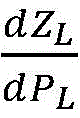 And
And ) The area of (a). Also, there is a
 tuning space Z TUNE66 change in position versus load impedance ZLAnd a tuning impedance ZTWith less affected areas.
The non-uniformity of impedance versus variation in position variation in the matching network tuning space presents a challenge to consistent control. End users develop Statistical Process Control (SPC) limits based on matching network locations. Because of the impedance sensitivity base relative to the positionThe SPC may be inconsistent because of the capacitance variation in location in the tuning space. E.g. in the tuning space Z TUNE66, not only does the positional accuracy suffer due to the range of values, but the reactance resolution is poor. This poses a challenge to meet low percentage SPC constraints. Regulating CLAnd CTHas an accuracy of 1/2, 1/4, 1/8 and 1/16 rotations of the stepper motor. It is therefore desirable to provide control that allows higher motor step resolution in the lower quadrant of the tuning space and reduces resolution as motor steps increase. Such control will enable more consistent changes in impedance with respect to positional changes across the entire tuning space. Such consistency would provide greater repeatability in the implementation of the matching network.
Fig. 5 provides an example of an ideal correspondence between the position of the variable capacitor and the capacitance of the controlled capacitor. As can be seen in fig. 5, the relationship between the position of the capacitor and the capacitance is consistent. That is, the change in position results in a consistent or linear change in capacitance. This relationship addresses the repeatability of control of capacitors in the matching network. In fig. 5, the graph depicts the position of the variable capacitor between the absolute minimum value Abs Min and the absolute maximum value Abs Max of the variable capacitor. In various configurations, the variable capacitor cannot achieve an absolute minimum and an absolute maximum. Therefore, the curve 74 includes a position Min as a minimum value and a position Max as a maximum value, and the position of the variable capacitor depicted by the curve 74 varies between Min and Max. The capacitance of the variable capacitor at position Min is CxMin. Likewise, the capacitance of the variable capacitor at position Max is CxMax. With respect to a particular position P1 to Min and Max, the output is CxP1. The capacitance curve 74 of fig. 5 depicts an ideal variable capacitor in which the capacitance varies linearly with position.
One method for improving the repeatability and consistency of the matching network can be seen with reference to fig. 6. In FIG. 6, the x-axis depicts the location of an example capacitor, which may be the load capacitor C shown in FIG. 2LOr a tuning capacitor CT. The y-axis represents the impedance Z. In FIG. 6A first waveform 80 represents the impedance Z of the matching network relative to the position X of a variable reactive element, such as a capacitorx. FIG. 6 depicts ZxMedium differential resolution region 84, where ZxHaving a substantially vertical component, wherein a small change in position X results in an impedance ZxIs greatly changed. FIG. 6 also depicts an ideal resolution region 86, where ZxHaving a substantially horizontal component, wherein a small change in position X results in an impedance ZxTo provide a corresponding small change in impedance ZxConsistency of the curve with respect to position X.
Except for the impedance curve ZxIn addition, fig. 6 depicts an impedance curve Z of one of the tuning or load branches of the matching network y88, wherein Zy=Zx+ZLXWherein Z isLXIs the reactance of the inductive component in the corresponding branch of the matching network. Similar sets of curves exist for the other tuning or loading branches of the matching network. One or both legs of the matching network may be controlled using the methods described in this specification. FIG. 6 also depicts a waveform 82 representing a theoretically ideal relationship between a change in position X and a corresponding change in impedance Z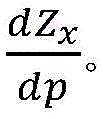 As can be seen in fig. 6, the ideal relationship suggests a linear relationship in which for a given change in position X, the corresponding change in impedance Z remains substantially the same. Except
 ideal curve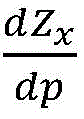
82, FIG. 6 also depicts a curve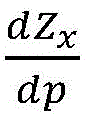
90. Curve Z y88 represents the variability of the impedance with respect to the position and reactance of the capacitor. Therefore, the impedance curve Z y88 is represented as an impedance band including an average impedance curve 88 '"within the range of impedance curves 88', 88". Curve line
90 represents Zx80 relative to position X. As can be seen from the above, the first, 90 to such as ZxZ of the moiety 84x80 are higher, and for steeper sections such as ZxThe flatter portion of the
 portion 86 is lower. This means that as X increases, the impedance change is smaller for a given change in position X. Ideal curve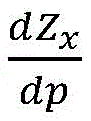
82 is shown that in a preferred implementation,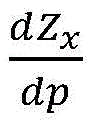 82 are linear and horizontal so that impedance Z changes by an equal amount in response to changes in position X regardless of the position of the tuning or load capacitor.
Fig. 6 also shows that the X-axis position can be characterized by the number of revolutions of a stepper or servo motor that adjusts the variable reactance element to position X. Impedance curve Z y88 by covering the impedance curve Z y88, respectively, is subdivided. For example, turn 1-3T1-T3A band defining the position X of the stepper motor. From T1-T3Defined band versus impedance curve Z y88 wherein a small change in X results in ZyCorresponds to a relatively large change area. Similarly, turn T4-T5A second band defining the position X of the stepper motor. From T4-T5Defined band versus impedance curve Z y88 where a small change in X results in a ratio to the strip T1-T3Small change of Z producedy88 corresponds to the changed area. Turning T6-TnA third band defining the position X of the stepper motor. From T6-TnDefined band versus impedance curve Z y88 wherein a small change in X results in Z y88 correspond to a generally small and consistent area of change. It will be appreciated that T refers to a full revolution, but as mentioned above, in a typical configuration the stepper motor has 1 for a given change in position XAccuracy of/2 step, 1/4 step, 1/8 step, and 1/16 step.
FIG. 7 provides an impedance Z for a given change in position X y88. In various embodiments, 200 full steps complete one revolution of the stepper motor. Similarly, 4001/2 steps complete one full revolution of the stepper motor, and 8001/4 steps, 16001/8 steps, or 32001/16 steps complete one full revolution of the stepper motor. The length of the segment of the circle and the impedance Z for a given change of position X y88, respectively. As can be seen in FIG. 7, the transition T1-T3Showing the impedance Z y88, as represented by segment 100. Note that reference numeral 100 may refer to a circle T1-T3All of the fragments of (a). Similarly, T4-T5Showing the impedance Z for a given change in position X y88 specific circle T1-T3Smaller changes. Definition of T4-T5Segment 102 of (a) thus represents T for a variable reactance element such as a capacitor4-T5Given a change in position within the range, the impedance Z represented by segment 102yLess than Z y88 for a circle T as represented by segment 1001-T3Is changed. That is, the capacitor counter-rotates T4-T5Counter-rotating T1-T3With improved impedance resolution. Although in the circle T4-T5Only three segments are labeled, but it will be understood that each segment may be referred to as a segment 102. Similarly, circle T6-TnIndicating that a relatively small change in position X results in an impedance Z y88, as represented by segment 104. That is, the capacitor has a capacitance for T6-TnFurther improved impedance resolution. Similarly, as described above, the circle T6-TnAny of the fragments may be referred to as fragment 104.
As can be seen from FIGS. 6 and 7, e.g., T can be obtained by1-T3The tape applies smaller steps such as 1/8 steps or 1/16 steps to achieve consistency and repeatability. For the strip T6-TnFor example, by applying a step size such as 1/2Or 1 step larger steps to achieve consistency and repeatability. Further, fig. 7 can be used to characterize the matching network with a variable reactance step that remains constant. That is, the constant reactance step size is determined by dividing the possible unequal displacement of the variable capacitor between each step size. The number of steps is determined based on the equal reactance change between each adjustment step.
By way of non-limiting example, Table 1 below depicts the available step sizes S1、…、S15The relationship between and the reactance in the various position bands of the variable capacitive element in one of the tuning or load branches of the matching network.
TABLE 1

Table 1 includes information for transitioning T in a column1-T3In the second row, T4-T5And T in the third column6-TnIs changed. In the first column, referred to as the step size, 16 steps covering a part of or the whole coverage of a revolution are shown by way of example. However, one skilled in the art will recognize that the step size may be a full step size, 1/2 step size, 1/4 step size, 1/8 step size, or 1/16 step size. The step column of Table 1 shows, by way of example, 16 steps S for each of the bands0-S15。
In the column T1-T3In the reactance, ZyIs shown as a selected Z such as FIG. 6yThe initial reactance of (a). In the column T1-T3Step size S in reactance0,ZyIs the initial reactance. E.g. in column T1-T3It can be seen in the reactance that the step size is chosen to represent the step size S0、S1、S7And S11Corresponding constant reactance step Z ofy、2Zy、3Zy、4Zy. Middle step S2-S6、S8-S10、S12-S15Is N/A to indicate these stepsLong lengths are not used because they do not provide a constant and consistent change to the reactance. Likewise, the column T4-T5Reactance is shown at a corresponding step S1、S5、S9、S12And S15Corresponding increasing reactance step 5Zy、6Zy、7Zy、8ZyAnd 9Zy. Other positions S0、S2-S4、S6-S8、S10、S11、S13And S14Are represented as N/as where these positions are not used because they do not provide a constant and consistent change in reactance when moving from the first position to the second position. Likewise, the column T6-TnReactance is shown at step S0、S3、S6、S9、S12And S15At 10Z for rotation rangey、11Zy、12Zy、13Zy、14ZyAnd 15ZyA continuous, consistent and constant reactance increase.
Those skilled in the art will recognize that the step size S0-S15Can be applied to each column T respectively1-T3Reactance, T4-T5Reactance and T6-TnThe magnitude of the reactance varies. E.g. with respect to column T1-T3Reactance, step size S0-S15May refer to 1/16 steps or 1/8 steps, however, relative to column T4-T5Reactance, step size S0-S15May refer to 1/4 steps or 1/2 steps. Also with respect to column T6-TnReactance, step size S0-S15Which may refer to 1/2 steps or full steps. Those skilled in the art will further recognize that a particular correlation with respect to Table 1 is across columns T1-T3Reactance to T6-TnReactance of reactance uniformly increases ZyR (r spans from Z)yTo 15ZyThe range of revolutions) of (a). Those skilled in the art will further recognize that while several intermediate steps are available, intermediate steps that do not provide a constant, consistent change in reactance areAnd is unusable.
In addition to providing repeatability by consistency across tuning spaces, there are also reproducibility challenges. The present disclosure discusses model corrections for improving reproducibility between two matching networks. For calibration of a matching network actuator such as a stepper motor, the motor setting positions are applied to provide a global model to resemble ideal capacitor operation. The tuning method will drive the capacitor towards a position to achieve maximum power delivery with a reflected power of 0 watts. The reported positions are corrected to the global model. It will be noted, however, that the implementation does not correct for capacitance, but rather for reactance of a particular (tuning or load) branch of the circuit. The calibration separates the series (load) and shunt (tuning) legs and characterizes the reactance range over the range of positions measured by the network analyzer. The least squares approximation corrects the change in actual reactance to stepper motor position to a global model. This will ensure repetitive matching for the matching network and enhanced room matching since each match will report a tuning position with similar values for the same local conditions.
FIG. 8 is an impedance Z plotted against the position X of a variable reactance element, such as a load or tuning capacitoryThe figure (a). As can be seen from the linear graph, the solid line 110 represents the ideal impedance Z with respect to positiony. However, the actual impedance may vary within the range as represented by the curves 112, 114. Thus, for a given range of positions, such as between α and β, the impedance ZyMay be identical at multiple locations. Variability in the relationship between location and impedance can affect the reproducibility of the matching network.
Reproducibility can be improved (such as while manufacturing) by characterizing the variable capacitors in the matching network. For example, the variable capacitor and matching network may be modeled by fabrication. The error 116 as shown in fig. 8 may be determined, such as using a least squares approximation. The error 116 may be used as a correction and control in the matching network. In various examples, the correction may be linear or may be implemented using a look-up table.
Fig. 9 shows the control module 120. The control module or controller 56 of fig. 3 may be implemented as the control module 120. The control module 120 may include a current position module 122, a desired position module 124, a constant response module 126, a position adjustment module 128, and a step control module 130. In various embodiments, control module 120 includes a processor that executes code associated with modules 122, 124, 126, 128, and 130. The operation of modules 122, 124, 126, 128, and 130 is described below with respect to the method of fig. 10.
For a further defined structure of the control module 56 of fig. 3, see the method of fig. 10 provided below and the definition of the term "module" provided below. The system disclosed herein may operate using a number of methods, an example RF control system method illustrated in fig. 10. Although the following operations are primarily described with respect to the implementation of fig. 3, the operations may be simply modified to accommodate other implementations of the present disclosure. The operations may be performed iteratively. Although the following operations are illustrated and described primarily as being performed sequentially, one or more of the following operations may be performed while one or more other operations are being performed.
Fig. 10 depicts a flow diagram 140 of a multiple-input multiple-output control system for controlling the matching networks 1, …, matching network n of fig. 3 by way of non-limiting example. The method begins at 142, where various initialization and startup processes are performed and continues to 144. At 144, the control module 122 determines the current location of the passive elements of the matching network and the reactance of the matching network, such as any of the matching networks 54a, …, 54n of fig. 3. Control continues to 146 where it is determined whether adjustment of the matching network is necessary. If no adjustment is necessary, control continues to block 144 where the current position of the passive element in the reactance of the matching network is again determined. If adjustment is required, control continues to 148.
At 148, the matching network is adjusted to improve the repeatability and reproducibility of the matching network. With respect to repeatability, at 150, the controller 120 determines adjustments to the position of passive elements in the matching network, such as adjustments that occur in constant reactance steps. A constant reactance step improves the repeatability of the matching network. The constant reactance step is determined as described above in connection with fig. 6 and 7. That is, the controller 120 may include a correlation between the change in reactance and the adjustment of the capacitive element. For example, the adjustment may be described with respect to the number of revolutions or partial revolutions of a stepper motor that controls the position of a capacitive element in the matching network. When the desired change in the constant reactance step is determined at 150, the controller 120 will determine an adjustment based on the reactance step rather than a capacitance adjustment at 150.
In various embodiments, at 154, a correlation between the position of the variable reactance element of the matching network and the constant reactance step is determined. In various embodiments, 154 characterizes the matching network for a constant reactance step by measuring a reactance value and correlating the position of the variable capacitive element based on the reactance value. In various embodiments, the characterization may occur during the manufacture and/or assembly of the matching network to be characterized. The characterization may be presented in various configurations, including by an equation to be performed at 150 or by a look-up table stored in memory 58.
In addition to tuning to achieve repeatability, 148 may also improve the repeatability of matching network group operations of multiple matching networks, for example, to minimize variability between the operations of the matching networks 54a, …, 54n of fig. 3. At 152, once the desired adjustment position of the matching network is determined based on the reactance, the desired adjustment position may be modified or corrected according to the error described at fig. 8. At 156, wherein a position error of the matching network is determined as described with respect to fig. 8 for the matching network of the ideal position characterization of the selected reactance. The error may be presented in various configurations, including by an equation to be executed at 152 or by a look-up table stored in memory 58. One or both of the adjustments at 150, 152 may be for a new commanded position of the capacitive element of the matching network. That is, the correction at 150 may or may not be applied to the new command position of the variable capacitance of the matching network, the correction at 152 may or may not be applied to the new command position of the variable capacitance of the matching network, or both the correction at 150 and the correction at 152 may or may not be applied to the new command position of the variable capacitance of the matching network. Once the adjustment has been applied to the correction, the controller 120 outputs a command to adjust the persistent element of the matching network. Control and returns to 144.
Various embodiments will improve the ability of semiconductor manufacturers to perform chamber matching. Chamber matching has been conceived as a solution to the productivity and yield of advanced nodes. For Critical Dimension (CD) and trench depth, RF power coupling of 2MHz and 13MHz is considered to have a significant impact on processing results. Semiconductor manufacturers may also apply the concepts of the present disclosure in RF power delivery systems to achieve more repeatable and reproducible RF power coupling. This will improve yield and tool uptime, as semiconductor manufacturers face the challenge of delivering RF power with higher accuracy.
The foregoing description is merely illustrative in nature and is in no way intended to limit the disclosure, its application, or uses. The broad teachings of the disclosure can be implemented in a variety of forms. Therefore, while this disclosure includes particular examples, the true scope of the disclosure should not be so limited since other modifications will become apparent from the drawings, the specification, and the following claims. It should be understood that one or more steps within a method may be performed in a different order (or simultaneously) without altering the principles of the present disclosure. Further, although each of the embodiments is described above as having certain features, any one or more of the features described with respect to any embodiment of the present disclosure may be implemented in or in combination with the features of any other embodiment, even if the combination is not explicitly described. In other words, the described embodiments are not mutually exclusive and substitutions of one or more embodiments with another embodiment remain within the scope of the disclosure.
Various terms are used to describe spatial and functional relationships between elements (e.g., between modules, circuit elements, semiconductor layers, etc.), including "connected," coupled, "" adjacent, "" beside, "" top, "" above, "" below, "and" disposed. When a relationship between a first element and a second element is described in the present disclosure above, unless explicitly described as "direct", the relationship may be a direct relationship in which there are no other intermediate elements between the first element and the second element, but may also be an indirect relationship in which there are (spatially or functionally) one or more intermediate elements between the first element and the second element. As used herein, the phrase "A, B and at least one of C" should be interpreted to mean logic that uses a non-exclusive logical OR (a OR B OR C), and should not be interpreted to mean "at least one of a, at least one of B, and at least one of C.
In the figures, the direction of arrows, as represented by the arrows, generally show the flow of information (e.g., data or instructions) of interest to the description. For example, when element a and element B exchange various information but the information transmitted from element a to element B is related to the description, an arrow may point from element a to element B. Such a one-way arrow does not imply that no other information is transferred from element B to element a. Further, for information sent from element a to element B, element B may send an information request or an acknowledgement of receipt of the information to element a.
In applications that include the following definitions, the term "module" or the term "controller" may be replaced with the term "circuit". The term "module" may refer to or include: an Application Specific Integrated Circuit (ASIC), a digital, analog, or hybrid analog/digital discrete circuit, a digital, analog, or hybrid analog/digital integrated circuit, a combinational logic circuit, a Field Programmable Gate Array (FPGA), a processor circuit (shared, dedicated, or group) that executes code, a memory circuit (shared, dedicated, or group) that stores code executed by the processor circuit, other suitable hardware components that provide the described functionality, or a combination of some or all of the above, such as in a system-on-a-chip.
The module may include one or more interface circuits. In some examples, the interface circuit may include a wired or wireless interface connected to a Local Area Network (LAN), the internet, a Wide Area Network (WAN), or a combination thereof. The functionality of any given module of the present disclosure may be distributed among multiple modules connected via interface circuits. For example, multiple modules may allow load balancing. In a further example, a server (also considered remote or cloud) module may perform some functions on behalf of a client module.
The term code, as used above, may include software, firmware, and/or microcode, and may refer to programs, routines, functions, classes, data structures, and/or objects. The term shared processor circuit encompasses a single processor circuit that executes some or all code from multiple modules. The term group processor circuit includes processor circuits that, in combination with additional processor circuits, execute some or all code from one or more modules. References to multiple processor circuits include multiple processor circuits on discrete dies, multiple processor circuits on a single die, multiple cores of a single processor circuit, multiple threads of a single processor circuit, or combinations thereof. The term shared memory circuit includes a single memory circuit that stores some or all code from multiple modules. The term group memory circuit includes memory circuits that store some or all code from one or more modules in combination with additional memory.
The term memory circuit is a subset of the term computer readable medium. The term computer-readable medium as used herein does not encompass transitory electrical or electromagnetic signals propagating through a medium, such as on a carrier wave, and thus, the term computer-readable medium may be considered tangible and non-transitory. Non-limiting examples of a non-transitory tangible computer-readable medium are a non-volatile memory circuit (such as a flash memory circuit, an erasable programmable read-only memory circuit, or a mask read-only memory circuit), a volatile memory circuit (such as a static random access memory circuit or a dynamic random access memory circuit), a magnetic storage medium (such as an analog or digital tape or hard drive), and an optical storage medium (such as a CD, DVD, or blu-ray disc).
The apparatus and methods described in this application may be implemented in part or in whole by a special purpose computer created by configuring a general purpose computer to perform one or more particular functions embodied by a computer program. The functional blocks, flow components, and other elements described above are used as software specifications, which can be translated into a computer program through the routine work of a technician or programmer.
The computer program includes processor-executable instructions stored on at least one non-transitory tangible computer-readable medium. The computer program may also comprise or rely on stored data. The computer programs may include a basic input/output system (BIOS) that interacts with the hardware of the special purpose computer, a device driver that interacts with specific devices of the special purpose computer, one or more operating systems, user applications, background services, background applications, and so forth.
The computer program may include: (i) descriptive text to be parsed, such as HTML (hypertext markup language), XML (extensible markup language), or JSON (JavaScript object notation), (ii) assembly code, (iii) object code generated by a compiler from source code, (iv) source code for execution by an interpreter, (v) source code for compilation and execution by a just-in-time compiler, and so forth. By way of example only, the source code may be written using syntax from the following languages, including: C. c + +, C #, object-oriented C, Swift, Haskell, Go, SQL, R, Lisp, Fortran、Perl、Pascal、Curl、OCaml、
 HTML5 (HyperText markup language version 5), Ada, ASP (dynamic Server Page), PHP (PHP: HyperText preprocessor), Scala, Eiffel, Smalltalk, Erlang, Ruby, Ada, Adp,
 Visual
 Lua, MATLAB, SIMULINK and
Claims (20)
1. a matching network for a Radio Frequency (RF) power delivery system, comprising:
at least one variable tuning element; and
a stepper motor for displacing the variable tuning element,
wherein the stepper motor is configured to adjust the variable tuning element such that each adjustment step of the stepper motor results in a constant change in the reactance of the matching network.
2. The matching network of claim 1, wherein the variable tuning element adjusts within a predetermined band of adjustments according to a change in reactance with respect to a change in position, and the predetermined band defines an adjustment increment that results in the constant change in the reactance for each step of adjustment.
3. The matching network of claim 2, wherein each band defines a predetermined number of revolutions of the stepper motor.
4. The matching network of claim 2, wherein a correction model is assigned to the matching network, wherein for a predetermined reactance of the matching network, a position correction is applied according to the predetermined reactance.
5. The matching network of claim 1, wherein a correction model is applied to the matching network, wherein for a predetermined position of the variable tuning element, a position correction is applied to the predetermined position.
6. The matching network of claim 5, wherein the correction model is determined from a least squares approximation of a difference between a measured reactance and a predefined reactance of the matching network for a selected position of the variable tuning element.
7. The matching network of claim 1, wherein the variable tuning element is a capacitor disposed in one of a tuning branch and a load branch of the matching network.
8. A matching network system for a Radio Frequency (RF) power delivery system, comprising:
a matching network having a variable tuning element, the matching network introducing a variable impedance between the RF power generator and the load;
a stepper motor for adjusting the position of the variable tuning element; and
a controller in communication with the matching network, the controller receiving the position of the stepper motor, the controller comparing the position to a stored predetermined position, the controller generating a position correction and applying the position correction to the position.
9. The matching network of claim 8, wherein the stepper motor is configured to adjust the variable tuning element such that each adjustment step results in a constant change in reactance of the matching network.
10. The matching network of claim 9, wherein the constant change in reactance step size is determined by defining a predetermined band of adjustments according to the constant change in reactance step size and by assigning positions according to the constant change in reactance step size.
11. The matching network of claim 8, wherein the position correction is determined from a least squares approximation of a difference between a measured reactance and a predefined reactance of the matching network for a selected position of the variable tuning element.
12. A control system for a matching network, comprising:
a processor; and
a memory, wherein the memory stores instructions executable by the processor, the instructions configured to:
the stepper motor is adjusted to displace the variable tuning element,
wherein the stepper motor performs at least one of the following steps:
adjusting the variable tuning element according to the adjustment step of the stepper motor and resulting in a constant change in the reactance of the matching network; and
a correction model for the matching network is defined, wherein for a predetermined reactance of the matching network, a position correction is applied in accordance with the predetermined reactance.
13. The matching network of claim 12, wherein the instructions are further configured to: when adjusting the variable tuning element in accordance with the adjustment step of the stepper motor, the variable tuning element is adjusted within a predetermined band of adjustments in accordance with a change in reactance with respect to a change in position, and the predetermined band defines, for each step of adjustment, an adjustment increment that results in the constant change in the reactance.
14. The matching network of claim 13, wherein the instructions are further configured to: a predetermined number of revolutions of the stepper motor is defined for each band.
15. The matching network of claim 12, wherein the variable tuning element is a capacitor disposed in one of a tuning branch and a load branch of the matching network.
16. A method for tuning a matching network, comprising:
providing a stepper motor and adjusting the stepper motor to displace a variable tuning element; and
determining a position of the variable tuning element as a function of at least one of:
each adjustment step of the stepper motor results in a constant change in the reactance of the matching network; and
applying a correction model for the matching network, wherein for a predetermined reactance of the matching network, a position correction is applied in accordance with the predetermined reactance.
17. The method of claim 16, wherein when adjusting the variable tuning element such that each adjustment step of the stepper motor results in the constant change in the reactance of the matching network, adjusting the variable tuning element within a predetermined band of adjustments according to the change in reactance with respect to change in position, wherein the predetermined band defines, for each step of adjustment, an adjustment increment that results in the constant change in the reactance.
18. The method of claim 17, wherein each band defines a predetermined number of revolutions of the stepper motor.
19. The method of claim 16, wherein the variable tuning element is a capacitor disposed in one of a tuning branch and a load branch of the matching network.
20. The method of claim 16, wherein the correction model is determined from a least squares approximation of a difference between a measured reactance and a predefined reactance of the matching network for a selected position of the variable tuning element.
Applications Claiming Priority (3)
| Application Number | Priority Date | Filing Date | Title |
|---|---|---|---|
| US16/164,892 US10910197B2 (en) | 2018-10-19 | 2018-10-19 | Impedance matching network model based correction scheme and performance repeatability |
| US16/164,892 | 2018-10-19 | ||
| PCT/US2019/056759 WO2020081827A1 (en) | 2018-10-19 | 2019-10-17 | Impedance matching network model based correction scheme and performance repeatability |
Publications (1)
| Publication Number | Publication Date |
|---|---|
| CN112313876A true CN112313876A (en) | 2021-02-02 |
Family
ID=70280929
Family Applications (1)
| Application Number | Title | Priority Date | Filing Date |
|---|---|---|---|
| CN201980040232.0A Pending CN112313876A (en) | 2018-10-19 | 2019-10-17 | Impedance matching network model based on correction scheme and performance repeatability |
Country Status (8)
| Country | Link |
|---|---|
| US (1) | US10910197B2 (en) |
| EP (1) | EP3868020A4 (en) |
| JP (1) | JP7078761B2 (en) |
| KR (1) | KR102567432B1 (en) |
| CN (1) | CN112313876A (en) |
| SG (1) | SG11202011527SA (en) |
| TW (1) | TWI811467B (en) |
| WO (1) | WO2020081827A1 (en) |
Cited By (2)
| Publication number | Priority date | Publication date | Assignee | Title |
|---|---|---|---|---|
| CN116095939A (en) * | 2023-03-20 | 2023-05-09 | 中国原子能科学研究院 | Apparatus and method for reducing high frequency power reflection of large beam current back-spinning accelerator |
| CN119582792A (en) * | 2024-11-18 | 2025-03-07 | 中国原子能科学研究院 | A pulse width internal impedance matching method for a pulse high frequency ionization device |
Families Citing this family (11)
| Publication number | Priority date | Publication date | Assignee | Title |
|---|---|---|---|---|
| US11158488B2 (en) * | 2019-06-26 | 2021-10-26 | Mks Instruments, Inc. | High speed synchronization of plasma source/bias power delivery |
| US11114279B2 (en) | 2019-06-28 | 2021-09-07 | COMET Technologies USA, Inc. | Arc suppression device for plasma processing equipment |
| CN114063699B (en) * | 2020-07-31 | 2022-11-25 | 星宸科技股份有限公司 | Direct current offset calibration system and method thereof |
| US11923175B2 (en) * | 2021-07-28 | 2024-03-05 | COMET Technologies USA, Inc. | Systems and methods for variable gain tuning of matching networks |
| CN114518704B (en) * | 2021-12-24 | 2025-04-04 | 深圳市恒运昌真空技术股份有限公司 | Radio frequency impedance matching device and method |
| US12183548B2 (en) * | 2022-05-05 | 2024-12-31 | Applied Materials, Inc. | High bandwidth architecture for centralized coherent control at the edge of processing tool |
| TW202425049A (en) * | 2022-08-22 | 2024-06-16 | 日商東京威力科創股份有限公司 | Plasma treatment equipment |
| US12136537B2 (en) * | 2022-10-10 | 2024-11-05 | Applied Materials, Inc. | Cost effective radio frequency impedance matching networks |
| US20240152114A1 (en) * | 2022-11-03 | 2024-05-09 | Applied Materials, Inc. | Radio frequency impedance matching network with flexible tuning algorithms |
| CN118263076A (en) * | 2022-12-26 | 2024-06-28 | 中微半导体设备(上海)股份有限公司 | Plasma processing device |
| US20250285840A1 (en) * | 2024-03-05 | 2025-09-11 | Applied Materials, Inc. | Rf power splitting and control |
Citations (6)
| Publication number | Priority date | Publication date | Assignee | Title |
|---|---|---|---|---|
| US20120013416A1 (en) * | 2007-04-19 | 2012-01-19 | Kim Jae-Hyun | Impedance matching methods and systems performing the same |
| US8477077B1 (en) * | 2012-01-25 | 2013-07-02 | Clearcount Medical Solutions, Inc. | Antenna coupler mechanism systems and methods |
| TW201440140A (en) * | 2013-02-20 | 2014-10-16 | Tokyo Electron Ltd | Plasma processing apparatus and plasma processing method |
| TW201727694A (en) * | 2015-11-04 | 2017-08-01 | 蘭姆研究公司 | System and method for correcting a variable capacitance conversion model and performing variable position conversion of a variable capacitance in a matching network of a plasma processing system |
| WO2017161641A1 (en) * | 2016-03-23 | 2017-09-28 | 北京北方微电子基地设备工艺研究中心有限责任公司 | Impedance matching system, impedance matching method and semiconductor processing equipment |
| CN107294510A (en) * | 2016-04-13 | 2017-10-24 | 朗姆研究公司 | For the system and method for multimode tuned impedance matching network in a step-wise fashion |
Family Cites Families (8)
| Publication number | Priority date | Publication date | Assignee | Title |
|---|---|---|---|---|
| US5589844A (en) * | 1995-06-06 | 1996-12-31 | Flash Comm, Inc. | Automatic antenna tuner for low-cost mobile radio |
| US8744384B2 (en) | 2000-07-20 | 2014-06-03 | Blackberry Limited | Tunable microwave devices with auto-adjusting matching circuit |
| JP5582823B2 (en) * | 2010-02-26 | 2014-09-03 | 東京エレクトロン株式会社 | Automatic alignment apparatus and plasma processing apparatus |
| US8576013B2 (en) * | 2011-12-29 | 2013-11-05 | Mks Instruments, Inc. | Power distortion-based servo control systems for frequency tuning RF power sources |
| JP6249659B2 (en) | 2013-07-25 | 2017-12-20 | 東京エレクトロン株式会社 | Plasma processing equipment |
| KR102085470B1 (en) | 2016-03-18 | 2020-03-05 | 가부시키가이샤 히다치 고쿠사이 덴키 | Matcher |
| US10229816B2 (en) * | 2016-05-24 | 2019-03-12 | Mks Instruments, Inc. | Solid-state impedance matching systems including a hybrid tuning network with a switchable coarse tuning network and a varactor fine tuning network |
| US20190108976A1 (en) | 2017-10-11 | 2019-04-11 | Advanced Energy Industries, Inc. | Matched source impedance driving system and method of operating the same |
-
2018
- 2018-10-19 US US16/164,892 patent/US10910197B2/en active Active
-
2019
- 2019-10-07 TW TW108136285A patent/TWI811467B/en active
- 2019-10-17 WO PCT/US2019/056759 patent/WO2020081827A1/en not_active Ceased
- 2019-10-17 KR KR1020207036074A patent/KR102567432B1/en active Active
- 2019-10-17 EP EP19874739.6A patent/EP3868020A4/en not_active Withdrawn
- 2019-10-17 SG SG11202011527SA patent/SG11202011527SA/en unknown
- 2019-10-17 CN CN201980040232.0A patent/CN112313876A/en active Pending
- 2019-10-17 JP JP2020569827A patent/JP7078761B2/en active Active
Patent Citations (6)
| Publication number | Priority date | Publication date | Assignee | Title |
|---|---|---|---|---|
| US20120013416A1 (en) * | 2007-04-19 | 2012-01-19 | Kim Jae-Hyun | Impedance matching methods and systems performing the same |
| US8477077B1 (en) * | 2012-01-25 | 2013-07-02 | Clearcount Medical Solutions, Inc. | Antenna coupler mechanism systems and methods |
| TW201440140A (en) * | 2013-02-20 | 2014-10-16 | Tokyo Electron Ltd | Plasma processing apparatus and plasma processing method |
| TW201727694A (en) * | 2015-11-04 | 2017-08-01 | 蘭姆研究公司 | System and method for correcting a variable capacitance conversion model and performing variable position conversion of a variable capacitance in a matching network of a plasma processing system |
| WO2017161641A1 (en) * | 2016-03-23 | 2017-09-28 | 北京北方微电子基地设备工艺研究中心有限责任公司 | Impedance matching system, impedance matching method and semiconductor processing equipment |
| CN107294510A (en) * | 2016-04-13 | 2017-10-24 | 朗姆研究公司 | For the system and method for multimode tuned impedance matching network in a step-wise fashion |
Cited By (2)
| Publication number | Priority date | Publication date | Assignee | Title |
|---|---|---|---|---|
| CN116095939A (en) * | 2023-03-20 | 2023-05-09 | 中国原子能科学研究院 | Apparatus and method for reducing high frequency power reflection of large beam current back-spinning accelerator |
| CN119582792A (en) * | 2024-11-18 | 2025-03-07 | 中国原子能科学研究院 | A pulse width internal impedance matching method for a pulse high frequency ionization device |
Also Published As
| Publication number | Publication date |
|---|---|
| EP3868020A4 (en) | 2022-07-06 |
| WO2020081827A1 (en) | 2020-04-23 |
| SG11202011527SA (en) | 2020-12-30 |
| KR102567432B1 (en) | 2023-08-16 |
| US10910197B2 (en) | 2021-02-02 |
| TWI811467B (en) | 2023-08-11 |
| KR20210009360A (en) | 2021-01-26 |
| JP7078761B2 (en) | 2022-05-31 |
| JP2021530833A (en) | 2021-11-11 |
| TW202025863A (en) | 2020-07-01 |
| US20200126761A1 (en) | 2020-04-23 |
| EP3868020A1 (en) | 2021-08-25 |
Similar Documents
| Publication | Publication Date | Title |
|---|---|---|
| CN112313876A (en) | Impedance matching network model based on correction scheme and performance repeatability | |
| JP7376702B2 (en) | Extreme value search controller and method for automatic frequency tuning for RF impedance matching | |
| CN113826184B (en) | High speed synchronization of plasma source/bias power delivery | |
| KR102364174B1 (en) | Feedback control by RF waveform customization for ion energy distribution | |
| KR102330684B1 (en) | Supervisory Control of Radio Frequency (RF) Impedance Tuning Operation | |
| EP3676864B1 (en) | Balancing rf circuit and control for a cross-coupled simo distribution network | |
| CN116325071A (en) | Apparatus and tuning method for mitigating changes in radio frequency load impedance caused by periodic disturbances |
Legal Events
| Date | Code | Title | Description |
|---|---|---|---|
| PB01 | Publication | ||
| PB01 | Publication | ||
| SE01 | Entry into force of request for substantive examination | ||
| SE01 | Entry into force of request for substantive examination | ||
| WD01 | Invention patent application deemed withdrawn after publication | ||
| WD01 | Invention patent application deemed withdrawn after publication |
Application publication date: 20210202 |