CN112240928A - Homogeneous phase chemiluminescence analysis method and application thereof - Google Patents
Homogeneous phase chemiluminescence analysis method and application thereof Download PDFInfo
- Publication number
- CN112240928A CN112240928A CN201910655723.8A CN201910655723A CN112240928A CN 112240928 A CN112240928 A CN 112240928A CN 201910655723 A CN201910655723 A CN 201910655723A CN 112240928 A CN112240928 A CN 112240928A
- Authority
- CN
- China
- Prior art keywords
- donor
- group
- polysaccharide
- particles
- detected
- Prior art date
- Legal status (The legal status is an assumption and is not a legal conclusion. Google has not performed a legal analysis and makes no representation as to the accuracy of the status listed.)
- Granted
Links
- 238000004458 analytical method Methods 0.000 title abstract description 14
- 239000002245 particle Substances 0.000 claims abstract description 214
- 239000003153 chemical reaction reagent Substances 0.000 claims abstract description 80
- 238000000034 method Methods 0.000 claims abstract description 80
- 238000006243 chemical reaction Methods 0.000 claims abstract description 70
- 238000001514 detection method Methods 0.000 claims abstract description 45
- 239000003795 chemical substances by application Substances 0.000 claims abstract description 42
- 239000000203 mixture Substances 0.000 claims abstract description 35
- 230000009870 specific binding Effects 0.000 claims abstract description 30
- 150000001875 compounds Chemical class 0.000 claims abstract description 25
- 239000003642 reactive oxygen metabolite Substances 0.000 claims abstract description 13
- 230000005281 excited state Effects 0.000 claims abstract description 9
- 238000009826 distribution Methods 0.000 claims description 91
- 150000004676 glycans Chemical class 0.000 claims description 88
- 229920001282 polysaccharide Polymers 0.000 claims description 88
- 239000005017 polysaccharide Substances 0.000 claims description 88
- 239000004005 microsphere Substances 0.000 claims description 68
- 125000000524 functional group Chemical group 0.000 claims description 55
- 229920002307 Dextran Polymers 0.000 claims description 29
- 108020003175 receptors Proteins 0.000 claims description 29
- 239000000126 substance Substances 0.000 claims description 24
- 239000007853 buffer solution Substances 0.000 claims description 22
- 239000004793 Polystyrene Substances 0.000 claims description 21
- 229920002223 polystyrene Polymers 0.000 claims description 21
- 125000003172 aldehyde group Chemical group 0.000 claims description 20
- -1 polyethylene Polymers 0.000 claims description 19
- 125000003178 carboxy group Chemical group [H]OC(*)=O 0.000 claims description 18
- 239000004816 latex Substances 0.000 claims description 17
- 229920000126 latex Polymers 0.000 claims description 17
- 229910052751 metal Inorganic materials 0.000 claims description 17
- 239000002184 metal Substances 0.000 claims description 17
- 108090001008 Avidin Proteins 0.000 claims description 16
- QVGXLLKOCUKJST-UHFFFAOYSA-N atomic oxygen Chemical compound [O] QVGXLLKOCUKJST-UHFFFAOYSA-N 0.000 claims description 16
- 239000011248 coating agent Substances 0.000 claims description 16
- 238000000576 coating method Methods 0.000 claims description 16
- 239000001301 oxygen Substances 0.000 claims description 16
- 239000000463 material Substances 0.000 claims description 15
- 229910052760 oxygen Inorganic materials 0.000 claims description 15
- MYMOFIZGZYHOMD-UHFFFAOYSA-N Dioxygen Chemical compound O=O MYMOFIZGZYHOMD-UHFFFAOYSA-N 0.000 claims description 13
- YBJHBAHKTGYVGT-ZKWXMUAHSA-N (+)-Biotin Chemical compound N1C(=O)N[C@@H]2[C@H](CCCCC(=O)O)SC[C@@H]21 YBJHBAHKTGYVGT-ZKWXMUAHSA-N 0.000 claims description 12
- 229920002527 Glycogen Polymers 0.000 claims description 12
- 229920002472 Starch Polymers 0.000 claims description 12
- 210000004369 blood Anatomy 0.000 claims description 12
- 239000008280 blood Substances 0.000 claims description 12
- 229940096919 glycogen Drugs 0.000 claims description 12
- 230000007246 mechanism Effects 0.000 claims description 12
- 235000019698 starch Nutrition 0.000 claims description 12
- 239000008107 starch Substances 0.000 claims description 12
- 125000003277 amino group Chemical group 0.000 claims description 11
- 239000000427 antigen Substances 0.000 claims description 10
- 102000036639 antigens Human genes 0.000 claims description 10
- 108091007433 antigens Proteins 0.000 claims description 10
- 238000003556 assay Methods 0.000 claims description 10
- 238000011534 incubation Methods 0.000 claims description 10
- 230000008569 process Effects 0.000 claims description 10
- 229920000936 Agarose Polymers 0.000 claims description 9
- 238000009739 binding Methods 0.000 claims description 9
- 229960002685 biotin Drugs 0.000 claims description 9
- 239000011616 biotin Substances 0.000 claims description 9
- 239000013522 chelant Substances 0.000 claims description 9
- 239000003504 photosensitizing agent Substances 0.000 claims description 9
- 210000002966 serum Anatomy 0.000 claims description 9
- BZYUMXXOAYSFOW-UHFFFAOYSA-N 2,3-dimethylthiophene Chemical compound CC=1C=CSC=1C BZYUMXXOAYSFOW-UHFFFAOYSA-N 0.000 claims description 7
- 108010090804 Streptavidin Proteins 0.000 claims description 7
- 230000027455 binding Effects 0.000 claims description 7
- 230000005284 excitation Effects 0.000 claims description 7
- 108010087904 neutravidin Proteins 0.000 claims description 7
- 229910052693 Europium Inorganic materials 0.000 claims description 6
- 229920002670 Fructan Polymers 0.000 claims description 6
- 229920001202 Inulin Polymers 0.000 claims description 6
- 229920000057 Mannan Polymers 0.000 claims description 6
- 239000004743 Polypropylene Substances 0.000 claims description 6
- 235000020958 biotin Nutrition 0.000 claims description 6
- 150000001720 carbohydrates Chemical class 0.000 claims description 6
- 235000014633 carbohydrates Nutrition 0.000 claims description 6
- 229960002086 dextran Drugs 0.000 claims description 6
- OGPBJKLSAFTDLK-UHFFFAOYSA-N europium atom Chemical compound [Eu] OGPBJKLSAFTDLK-UHFFFAOYSA-N 0.000 claims description 6
- JYJIGFIDKWBXDU-MNNPPOADSA-N inulin Chemical compound O[C@H]1[C@H](O)[C@@H](CO)O[C@@]1(CO)OC[C@]1(OC[C@]2(OC[C@]3(OC[C@]4(OC[C@]5(OC[C@]6(OC[C@]7(OC[C@]8(OC[C@]9(OC[C@]%10(OC[C@]%11(OC[C@]%12(OC[C@]%13(OC[C@]%14(OC[C@]%15(OC[C@]%16(OC[C@]%17(OC[C@]%18(OC[C@]%19(OC[C@]%20(OC[C@]%21(OC[C@]%22(OC[C@]%23(OC[C@]%24(OC[C@]%25(OC[C@]%26(OC[C@]%27(OC[C@]%28(OC[C@]%29(OC[C@]%30(OC[C@]%31(OC[C@]%32(OC[C@]%33(OC[C@]%34(OC[C@]%35(OC[C@]%36(O[C@@H]%37[C@@H]([C@@H](O)[C@H](O)[C@@H](CO)O%37)O)[C@H]([C@H](O)[C@@H](CO)O%36)O)[C@H]([C@H](O)[C@@H](CO)O%35)O)[C@H]([C@H](O)[C@@H](CO)O%34)O)[C@H]([C@H](O)[C@@H](CO)O%33)O)[C@H]([C@H](O)[C@@H](CO)O%32)O)[C@H]([C@H](O)[C@@H](CO)O%31)O)[C@H]([C@H](O)[C@@H](CO)O%30)O)[C@H]([C@H](O)[C@@H](CO)O%29)O)[C@H]([C@H](O)[C@@H](CO)O%28)O)[C@H]([C@H](O)[C@@H](CO)O%27)O)[C@H]([C@H](O)[C@@H](CO)O%26)O)[C@H]([C@H](O)[C@@H](CO)O%25)O)[C@H]([C@H](O)[C@@H](CO)O%24)O)[C@H]([C@H](O)[C@@H](CO)O%23)O)[C@H]([C@H](O)[C@@H](CO)O%22)O)[C@H]([C@H](O)[C@@H](CO)O%21)O)[C@H]([C@H](O)[C@@H](CO)O%20)O)[C@H]([C@H](O)[C@@H](CO)O%19)O)[C@H]([C@H](O)[C@@H](CO)O%18)O)[C@H]([C@H](O)[C@@H](CO)O%17)O)[C@H]([C@H](O)[C@@H](CO)O%16)O)[C@H]([C@H](O)[C@@H](CO)O%15)O)[C@H]([C@H](O)[C@@H](CO)O%14)O)[C@H]([C@H](O)[C@@H](CO)O%13)O)[C@H]([C@H](O)[C@@H](CO)O%12)O)[C@H]([C@H](O)[C@@H](CO)O%11)O)[C@H]([C@H](O)[C@@H](CO)O%10)O)[C@H]([C@H](O)[C@@H](CO)O9)O)[C@H]([C@H](O)[C@@H](CO)O8)O)[C@H]([C@H](O)[C@@H](CO)O7)O)[C@H]([C@H](O)[C@@H](CO)O6)O)[C@H]([C@H](O)[C@@H](CO)O5)O)[C@H]([C@H](O)[C@@H](CO)O4)O)[C@H]([C@H](O)[C@@H](CO)O3)O)[C@H]([C@H](O)[C@@H](CO)O2)O)[C@@H](O)[C@H](O)[C@@H](CO)O1 JYJIGFIDKWBXDU-MNNPPOADSA-N 0.000 claims description 6
- 229940029339 inulin Drugs 0.000 claims description 6
- 150000002772 monosaccharides Chemical class 0.000 claims description 6
- YWAKXRMUMFPDSH-UHFFFAOYSA-N pentene Chemical compound CCCC=C YWAKXRMUMFPDSH-UHFFFAOYSA-N 0.000 claims description 6
- 229920002401 polyacrylamide Polymers 0.000 claims description 6
- 229920000058 polyacrylate Polymers 0.000 claims description 6
- 239000005020 polyethylene terephthalate Substances 0.000 claims description 6
- 229920000139 polyethylene terephthalate Polymers 0.000 claims description 6
- 229920000193 polymethacrylate Polymers 0.000 claims description 6
- 229920001155 polypropylene Polymers 0.000 claims description 6
- 229940032147 starch Drugs 0.000 claims description 6
- 108091034117 Oligonucleotide Proteins 0.000 claims description 5
- 239000003085 diluting agent Substances 0.000 claims description 5
- 210000002381 plasma Anatomy 0.000 claims description 5
- 210000000582 semen Anatomy 0.000 claims description 5
- 210000002700 urine Anatomy 0.000 claims description 5
- RTZKZFJDLAIYFH-UHFFFAOYSA-N Diethyl ether Chemical compound CCOCC RTZKZFJDLAIYFH-UHFFFAOYSA-N 0.000 claims description 4
- 108010021625 Immunoglobulin Fragments Proteins 0.000 claims description 4
- 102000008394 Immunoglobulin Fragments Human genes 0.000 claims description 4
- 206010036790 Productive cough Diseases 0.000 claims description 4
- 239000011324 bead Substances 0.000 claims description 4
- 229930002875 chlorophyll Natural products 0.000 claims description 4
- 235000019804 chlorophyll Nutrition 0.000 claims description 4
- 210000003608 fece Anatomy 0.000 claims description 4
- 239000012530 fluid Substances 0.000 claims description 4
- 125000002887 hydroxy group Chemical group [H]O* 0.000 claims description 4
- 238000000338 in vitro Methods 0.000 claims description 4
- 210000002751 lymph Anatomy 0.000 claims description 4
- 229960000907 methylthioninium chloride Drugs 0.000 claims description 4
- 210000003097 mucus Anatomy 0.000 claims description 4
- 150000004032 porphyrins Chemical class 0.000 claims description 4
- 229930187593 rose bengal Natural products 0.000 claims description 4
- 229940081623 rose bengal Drugs 0.000 claims description 4
- STRXNPAVPKGJQR-UHFFFAOYSA-N rose bengal A Natural products O1C(=O)C(C(=CC=C2Cl)Cl)=C2C21C1=CC(I)=C(O)C(I)=C1OC1=C(I)C(O)=C(I)C=C21 STRXNPAVPKGJQR-UHFFFAOYSA-N 0.000 claims description 4
- 210000003802 sputum Anatomy 0.000 claims description 4
- 208000024794 sputum Diseases 0.000 claims description 4
- FIQMHBFVRAXMOP-UHFFFAOYSA-N triphenylphosphane oxide Chemical compound C=1C=CC=CC=1P(C=1C=CC=CC=1)(=O)C1=CC=CC=C1 FIQMHBFVRAXMOP-UHFFFAOYSA-N 0.000 claims description 4
- OQVVVVYHNKQXHR-UHFFFAOYSA-N 2-pyridin-2-ylpyridine-3-carboxylic acid Chemical compound OC(=O)C1=CC=CN=C1C1=CC=CC=N1 OQVVVVYHNKQXHR-UHFFFAOYSA-N 0.000 claims description 3
- RNGCGRQNGQFBJS-UHFFFAOYSA-N 4,4,5,5,6,6,6-heptafluoro-1-[4-[2-[4-(4,4,5,5,6,6,6-heptafluoro-3-oxohexanoyl)phenyl]phenyl]phenyl]hexane-1,3-dione Chemical compound C1=CC(C(=O)CC(=O)C(F)(F)C(F)(F)C(F)(F)F)=CC=C1C1=CC=CC=C1C1=CC=C(C(=O)CC(=O)C(F)(F)C(F)(F)C(F)(F)F)C=C1 RNGCGRQNGQFBJS-UHFFFAOYSA-N 0.000 claims description 3
- FERIUCNNQQJTOY-UHFFFAOYSA-M Butyrate Chemical compound CCCC([O-])=O FERIUCNNQQJTOY-UHFFFAOYSA-M 0.000 claims description 3
- FERIUCNNQQJTOY-UHFFFAOYSA-N Butyric acid Natural products CCCC(O)=O FERIUCNNQQJTOY-UHFFFAOYSA-N 0.000 claims description 3
- 102000014914 Carrier Proteins Human genes 0.000 claims description 3
- 229910052692 Dysprosium Inorganic materials 0.000 claims description 3
- 102000004856 Lectins Human genes 0.000 claims description 3
- 108090001090 Lectins Proteins 0.000 claims description 3
- 239000000020 Nitrocellulose Substances 0.000 claims description 3
- 239000004677 Nylon Substances 0.000 claims description 3
- 108010058846 Ovalbumin Proteins 0.000 claims description 3
- 239000004698 Polyethylene Substances 0.000 claims description 3
- KJTLSVCANCCWHF-UHFFFAOYSA-N Ruthenium Chemical compound [Ru] KJTLSVCANCCWHF-UHFFFAOYSA-N 0.000 claims description 3
- 239000002262 Schiff base Substances 0.000 claims description 3
- 150000004753 Schiff bases Chemical class 0.000 claims description 3
- 229910052771 Terbium Inorganic materials 0.000 claims description 3
- 108010017596 Vitellins Proteins 0.000 claims description 3
- CXPKUWDMXKAUBN-UHFFFAOYSA-N [Os].[Sm] Chemical compound [Os].[Sm] CXPKUWDMXKAUBN-UHFFFAOYSA-N 0.000 claims description 3
- 108091008324 binding proteins Proteins 0.000 claims description 3
- 229920002678 cellulose Polymers 0.000 claims description 3
- 239000001913 cellulose Substances 0.000 claims description 3
- 229920002301 cellulose acetate Polymers 0.000 claims description 3
- 239000002738 chelating agent Substances 0.000 claims description 3
- ATNHDLDRLWWWCB-AENOIHSZSA-M chlorophyll a Chemical compound C1([C@@H](C(=O)OC)C(=O)C2=C3C)=C2N2C3=CC(C(CC)=C3C)=[N+]4C3=CC3=C(C=C)C(C)=C5N3[Mg-2]42[N+]2=C1[C@@H](CCC(=O)OC\C=C(/C)CCC[C@H](C)CCC[C@H](C)CCCC(C)C)[C@H](C)C2=C5 ATNHDLDRLWWWCB-AENOIHSZSA-M 0.000 claims description 3
- 238000003745 diagnosis Methods 0.000 claims description 3
- 201000010099 disease Diseases 0.000 claims description 3
- 208000037265 diseases, disorders, signs and symptoms Diseases 0.000 claims description 3
- KBQHZAAAGSGFKK-UHFFFAOYSA-N dysprosium atom Chemical compound [Dy] KBQHZAAAGSGFKK-UHFFFAOYSA-N 0.000 claims description 3
- 150000002081 enamines Chemical class 0.000 claims description 3
- 150000002084 enol ethers Chemical class 0.000 claims description 3
- 108091009323 immunoglobulin binding proteins Proteins 0.000 claims description 3
- 102000028557 immunoglobulin binding proteins Human genes 0.000 claims description 3
- 239000003999 initiator Substances 0.000 claims description 3
- 239000002523 lectin Substances 0.000 claims description 3
- 239000003446 ligand Substances 0.000 claims description 3
- 229920001220 nitrocellulos Polymers 0.000 claims description 3
- 229920001778 nylon Polymers 0.000 claims description 3
- 229940092253 ovalbumin Drugs 0.000 claims description 3
- IEQIEDJGQAUEQZ-UHFFFAOYSA-N phthalocyanine Chemical compound N1C(N=C2C3=CC=CC=C3C(N=C3C4=CC=CC=C4C(=N4)N3)=N2)=C(C=CC=C2)C2=C1N=C1C2=CC=CC=C2C4=N1 IEQIEDJGQAUEQZ-UHFFFAOYSA-N 0.000 claims description 3
- 229920000573 polyethylene Polymers 0.000 claims description 3
- 229920000642 polymer Polymers 0.000 claims description 3
- 229920000915 polyvinyl chloride Polymers 0.000 claims description 3
- 239000004800 polyvinyl chloride Substances 0.000 claims description 3
- 229910052761 rare earth metal Inorganic materials 0.000 claims description 3
- 150000002910 rare earth metals Chemical class 0.000 claims description 3
- 229910052707 ruthenium Inorganic materials 0.000 claims description 3
- 229920001059 synthetic polymer Polymers 0.000 claims description 3
- GZCRRIHWUXGPOV-UHFFFAOYSA-N terbium atom Chemical compound [Tb] GZCRRIHWUXGPOV-UHFFFAOYSA-N 0.000 claims description 3
- 229920002554 vinyl polymer Polymers 0.000 claims description 3
- AUONHKJOIZSQGR-UHFFFAOYSA-N oxophosphane Chemical compound P=O AUONHKJOIZSQGR-UHFFFAOYSA-N 0.000 claims description 2
- 125000003396 thiol group Chemical group [H]S* 0.000 claims 2
- RBTBFTRPCNLSDE-UHFFFAOYSA-N 3,7-bis(dimethylamino)phenothiazin-5-ium Chemical group C1=CC(N(C)C)=CC2=[S+]C3=CC(N(C)C)=CC=C3N=C21 RBTBFTRPCNLSDE-UHFFFAOYSA-N 0.000 claims 1
- IICCLYANAQEHCI-UHFFFAOYSA-N 4,5,6,7-tetrachloro-3',6'-dihydroxy-2',4',5',7'-tetraiodospiro[2-benzofuran-3,9'-xanthene]-1-one Chemical compound O1C(=O)C(C(=C(Cl)C(Cl)=C2Cl)Cl)=C2C21C1=CC(I)=C(O)C(I)=C1OC1=C(I)C(O)=C(I)C=C21 IICCLYANAQEHCI-UHFFFAOYSA-N 0.000 claims 1
- 125000003368 amide group Chemical group 0.000 claims 1
- 125000000597 dioxinyl group Chemical group 0.000 claims 1
- 125000005439 maleimidyl group Chemical group C1(C=CC(N1*)=O)=O 0.000 claims 1
- 230000035945 sensitivity Effects 0.000 abstract description 11
- 239000000243 solution Substances 0.000 description 62
- 239000000523 sample Substances 0.000 description 45
- XLYOFNOQVPJJNP-UHFFFAOYSA-N water Substances O XLYOFNOQVPJJNP-UHFFFAOYSA-N 0.000 description 27
- 150000001299 aldehydes Chemical class 0.000 description 22
- 239000007987 MES buffer Substances 0.000 description 19
- 238000003756 stirring Methods 0.000 description 18
- BVKZGUZCCUSVTD-UHFFFAOYSA-L Carbonate Chemical compound [O-]C([O-])=O BVKZGUZCCUSVTD-UHFFFAOYSA-L 0.000 description 16
- 239000006228 supernatant Substances 0.000 description 15
- 239000000872 buffer Substances 0.000 description 14
- 238000003018 immunoassay Methods 0.000 description 13
- 238000002156 mixing Methods 0.000 description 13
- 239000007787 solid Substances 0.000 description 12
- 238000002360 preparation method Methods 0.000 description 11
- 238000005406 washing Methods 0.000 description 10
- 239000000839 emulsion Substances 0.000 description 9
- LFQSCWFLJHTTHZ-UHFFFAOYSA-N Ethanol Chemical compound CCO LFQSCWFLJHTTHZ-UHFFFAOYSA-N 0.000 description 8
- 239000008367 deionised water Substances 0.000 description 8
- 229910021641 deionized water Inorganic materials 0.000 description 8
- 238000005119 centrifugation Methods 0.000 description 7
- 238000012123 point-of-care testing Methods 0.000 description 7
- 238000010438 heat treatment Methods 0.000 description 6
- 230000003993 interaction Effects 0.000 description 6
- 239000000725 suspension Substances 0.000 description 6
- 238000012360 testing method Methods 0.000 description 6
- 150000001412 amines Chemical class 0.000 description 5
- 239000012071 phase Substances 0.000 description 5
- 239000000047 product Substances 0.000 description 5
- 239000012279 sodium borohydride Substances 0.000 description 5
- 229910000033 sodium borohydride Inorganic materials 0.000 description 5
- 150000003573 thiols Chemical class 0.000 description 5
- HGINCPLSRVDWNT-UHFFFAOYSA-N Acrolein Chemical compound C=CC=O HGINCPLSRVDWNT-UHFFFAOYSA-N 0.000 description 4
- IJGRMHOSHXDMSA-UHFFFAOYSA-N Atomic nitrogen Chemical compound N#N IJGRMHOSHXDMSA-UHFFFAOYSA-N 0.000 description 4
- FAPWRFPIFSIZLT-UHFFFAOYSA-M Sodium chloride Chemical compound [Na+].[Cl-] FAPWRFPIFSIZLT-UHFFFAOYSA-M 0.000 description 4
- PPBRXRYQALVLMV-UHFFFAOYSA-N Styrene Chemical compound C=CC1=CC=CC=C1 PPBRXRYQALVLMV-UHFFFAOYSA-N 0.000 description 4
- ROOXNKNUYICQNP-UHFFFAOYSA-N ammonium persulfate Chemical compound [NH4+].[NH4+].[O-]S(=O)(=O)OOS([O-])(=O)=O ROOXNKNUYICQNP-UHFFFAOYSA-N 0.000 description 4
- 239000007864 aqueous solution Substances 0.000 description 4
- 210000004027 cell Anatomy 0.000 description 4
- 238000002038 chemiluminescence detection Methods 0.000 description 4
- 238000001816 cooling Methods 0.000 description 4
- 238000000502 dialysis Methods 0.000 description 4
- 239000007791 liquid phase Substances 0.000 description 4
- 239000000178 monomer Substances 0.000 description 4
- JQWHASGSAFIOCM-UHFFFAOYSA-M sodium periodate Chemical compound [Na+].[O-]I(=O)(=O)=O JQWHASGSAFIOCM-UHFFFAOYSA-M 0.000 description 4
- ZMBHCYHQLYEYDV-UHFFFAOYSA-N trioctylphosphine oxide Chemical compound CCCCCCCCP(=O)(CCCCCCCC)CCCCCCCC ZMBHCYHQLYEYDV-UHFFFAOYSA-N 0.000 description 4
- 238000001132 ultrasonic dispersion Methods 0.000 description 4
- 241000894006 Bacteria Species 0.000 description 3
- 102100031051 Cysteine and glycine-rich protein 1 Human genes 0.000 description 3
- OKKJLVBELUTLKV-UHFFFAOYSA-N Methanol Chemical compound OC OKKJLVBELUTLKV-UHFFFAOYSA-N 0.000 description 3
- ZMXDDKWLCZADIW-UHFFFAOYSA-N N,N-Dimethylformamide Chemical compound CN(C)C=O ZMXDDKWLCZADIW-UHFFFAOYSA-N 0.000 description 3
- HEMHJVSKTPXQMS-UHFFFAOYSA-M Sodium hydroxide Chemical compound [OH-].[Na+] HEMHJVSKTPXQMS-UHFFFAOYSA-M 0.000 description 3
- 238000012512 characterization method Methods 0.000 description 3
- 238000004140 cleaning Methods 0.000 description 3
- 238000010586 diagram Methods 0.000 description 3
- 229940079593 drug Drugs 0.000 description 3
- 239000003814 drug Substances 0.000 description 3
- 239000007788 liquid Substances 0.000 description 3
- 238000005259 measurement Methods 0.000 description 3
- CXKWCBBOMKCUKX-UHFFFAOYSA-M methylene blue Chemical group [Cl-].C1=CC(N(C)C)=CC2=[S+]C3=CC(N(C)C)=CC=C3N=C21 CXKWCBBOMKCUKX-UHFFFAOYSA-M 0.000 description 3
- 239000002105 nanoparticle Substances 0.000 description 3
- 108020004707 nucleic acids Proteins 0.000 description 3
- 102000039446 nucleic acids Human genes 0.000 description 3
- 150000007523 nucleic acids Chemical class 0.000 description 3
- 102000004169 proteins and genes Human genes 0.000 description 3
- 108090000623 proteins and genes Proteins 0.000 description 3
- 239000011541 reaction mixture Substances 0.000 description 3
- 230000009467 reduction Effects 0.000 description 3
- VDNLFJGJEQUWRB-UHFFFAOYSA-N rose bengal free acid Chemical compound OC(=O)C1=C(Cl)C(Cl)=C(Cl)C(Cl)=C1C1=C2C=C(I)C(=O)C(I)=C2OC2=C(I)C(O)=C(I)C=C21 VDNLFJGJEQUWRB-UHFFFAOYSA-N 0.000 description 3
- HIXDQWDOVZUNNA-UHFFFAOYSA-N 2-(3,4-dimethoxyphenyl)-5-hydroxy-7-methoxychromen-4-one Chemical compound C=1C(OC)=CC(O)=C(C(C=2)=O)C=1OC=2C1=CC=C(OC)C(OC)=C1 HIXDQWDOVZUNNA-UHFFFAOYSA-N 0.000 description 2
- 238000002965 ELISA Methods 0.000 description 2
- 241000233866 Fungi Species 0.000 description 2
- MHAJPDPJQMAIIY-UHFFFAOYSA-N Hydrogen peroxide Chemical compound OO MHAJPDPJQMAIIY-UHFFFAOYSA-N 0.000 description 2
- PEEHTFAAVSWFBL-UHFFFAOYSA-N Maleimide Chemical compound O=C1NC(=O)C=C1 PEEHTFAAVSWFBL-UHFFFAOYSA-N 0.000 description 2
- 229910020889 NaBH3 Inorganic materials 0.000 description 2
- MWUXSHHQAYIFBG-UHFFFAOYSA-N Nitric oxide Chemical compound O=[N] MWUXSHHQAYIFBG-UHFFFAOYSA-N 0.000 description 2
- 241000700605 Viruses Species 0.000 description 2
- 150000001408 amides Chemical class 0.000 description 2
- 229910001870 ammonium persulfate Inorganic materials 0.000 description 2
- 238000009792 diffusion process Methods 0.000 description 2
- 238000007865 diluting Methods 0.000 description 2
- 150000002013 dioxins Chemical class 0.000 description 2
- 230000003203 everyday effect Effects 0.000 description 2
- 239000004744 fabric Substances 0.000 description 2
- 239000000706 filtrate Substances 0.000 description 2
- 230000005283 ground state Effects 0.000 description 2
- 230000028993 immune response Effects 0.000 description 2
- 238000004519 manufacturing process Methods 0.000 description 2
- 239000002207 metabolite Substances 0.000 description 2
- 229910052757 nitrogen Inorganic materials 0.000 description 2
- 230000003287 optical effect Effects 0.000 description 2
- 239000008363 phosphate buffer Substances 0.000 description 2
- 238000011160 research Methods 0.000 description 2
- 150000003839 salts Chemical class 0.000 description 2
- 238000007789 sealing Methods 0.000 description 2
- 238000004062 sedimentation Methods 0.000 description 2
- 239000011780 sodium chloride Substances 0.000 description 2
- 238000009210 therapy by ultrasound Methods 0.000 description 2
- 238000004448 titration Methods 0.000 description 2
- NWZSZGALRFJKBT-KNIFDHDWSA-N (2s)-2,6-diaminohexanoic acid;(2s)-2-hydroxybutanedioic acid Chemical compound OC(=O)[C@@H](O)CC(O)=O.NCCCC[C@H](N)C(O)=O NWZSZGALRFJKBT-KNIFDHDWSA-N 0.000 description 1
- FHUDAMLDXFJHJE-UHFFFAOYSA-N 1,1,1-trifluoropropan-2-one Chemical compound CC(=O)C(F)(F)F FHUDAMLDXFJHJE-UHFFFAOYSA-N 0.000 description 1
- FTRWLSZFQILOOD-UHFFFAOYSA-N 2-(methylaminomethyl)-3,4-dihydro-2h-naphthalen-1-one Chemical compound C1=CC=C2C(=O)C(CNC)CCC2=C1 FTRWLSZFQILOOD-UHFFFAOYSA-N 0.000 description 1
- DUILGEYLVHGSEE-UHFFFAOYSA-N 2-(oxiran-2-ylmethyl)isoindole-1,3-dione Chemical compound O=C1C2=CC=CC=C2C(=O)N1CC1CO1 DUILGEYLVHGSEE-UHFFFAOYSA-N 0.000 description 1
- UYQMAGRFYJIJOQ-UHFFFAOYSA-N 4,4,4-trifluoro-1-naphthalen-1-ylbutane-1,3-dione Chemical compound C1=CC=C2C(C(=O)CC(=O)C(F)(F)F)=CC=CC2=C1 UYQMAGRFYJIJOQ-UHFFFAOYSA-N 0.000 description 1
- VVXLFFIFNVKFBD-UHFFFAOYSA-N 4,4,4-trifluoro-1-phenylbutane-1,3-dione Chemical compound FC(F)(F)C(=O)CC(=O)C1=CC=CC=C1 VVXLFFIFNVKFBD-UHFFFAOYSA-N 0.000 description 1
- BDDLHHRCDSJVKV-UHFFFAOYSA-N 7028-40-2 Chemical compound CC(O)=O.CC(O)=O.CC(O)=O.CC(O)=O BDDLHHRCDSJVKV-UHFFFAOYSA-N 0.000 description 1
- ROFVEXUMMXZLPA-UHFFFAOYSA-N Bipyridyl Chemical compound N1=CC=CC=C1C1=CC=CC=N1 ROFVEXUMMXZLPA-UHFFFAOYSA-N 0.000 description 1
- 241000196324 Embryophyta Species 0.000 description 1
- 102000004190 Enzymes Human genes 0.000 description 1
- 108090000790 Enzymes Proteins 0.000 description 1
- 108010008177 Fd immunoglobulins Proteins 0.000 description 1
- 229920001503 Glucan Polymers 0.000 description 1
- 108090000288 Glycoproteins Proteins 0.000 description 1
- 102000003886 Glycoproteins Human genes 0.000 description 1
- 206010020751 Hypersensitivity Diseases 0.000 description 1
- 102000015728 Mucins Human genes 0.000 description 1
- 108010063954 Mucins Proteins 0.000 description 1
- 102000011931 Nucleoproteins Human genes 0.000 description 1
- 108010061100 Nucleoproteins Proteins 0.000 description 1
- 102000007982 Phosphoproteins Human genes 0.000 description 1
- 108010089430 Phosphoproteins Proteins 0.000 description 1
- VMHLLURERBWHNL-UHFFFAOYSA-M Sodium acetate Chemical compound [Na+].CC([O-])=O VMHLLURERBWHNL-UHFFFAOYSA-M 0.000 description 1
- OUUQCZGPVNCOIJ-UHFFFAOYSA-M Superoxide Chemical compound [O-][O] OUUQCZGPVNCOIJ-UHFFFAOYSA-M 0.000 description 1
- 230000004913 activation Effects 0.000 description 1
- 208000026935 allergic disease Diseases 0.000 description 1
- 239000012491 analyte Substances 0.000 description 1
- 239000003242 anti bacterial agent Substances 0.000 description 1
- 239000003429 antifungal agent Substances 0.000 description 1
- 229940121375 antifungal agent Drugs 0.000 description 1
- 239000002246 antineoplastic agent Substances 0.000 description 1
- 239000003443 antiviral agent Substances 0.000 description 1
- 150000001491 aromatic compounds Chemical class 0.000 description 1
- 230000009286 beneficial effect Effects 0.000 description 1
- 210000001124 body fluid Anatomy 0.000 description 1
- 239000010839 body fluid Substances 0.000 description 1
- 238000004113 cell culture Methods 0.000 description 1
- 239000001752 chlorophylls and chlorophyllins Substances 0.000 description 1
- 239000000084 colloidal system Substances 0.000 description 1
- 230000000295 complement effect Effects 0.000 description 1
- 230000021615 conjugation Effects 0.000 description 1
- 230000007547 defect Effects 0.000 description 1
- 239000006185 dispersion Substances 0.000 description 1
- 239000000975 dye Substances 0.000 description 1
- 230000000694 effects Effects 0.000 description 1
- 238000000835 electrochemical detection Methods 0.000 description 1
- 230000007613 environmental effect Effects 0.000 description 1
- 210000003527 eukaryotic cell Anatomy 0.000 description 1
- LNBHUCHAFZUEGJ-UHFFFAOYSA-N europium(3+) Chemical compound [Eu+3] LNBHUCHAFZUEGJ-UHFFFAOYSA-N 0.000 description 1
- 230000007717 exclusion Effects 0.000 description 1
- 239000000284 extract Substances 0.000 description 1
- 238000011049 filling Methods 0.000 description 1
- 238000005429 filling process Methods 0.000 description 1
- 238000011010 flushing procedure Methods 0.000 description 1
- 235000013305 food Nutrition 0.000 description 1
- 238000007710 freezing Methods 0.000 description 1
- 230000008014 freezing Effects 0.000 description 1
- 102000037865 fusion proteins Human genes 0.000 description 1
- 108020001507 fusion proteins Proteins 0.000 description 1
- RBTKNAXYKSUFRK-UHFFFAOYSA-N heliogen blue Chemical compound [Cu].[N-]1C2=C(C=CC=C3)C3=C1N=C([N-]1)C3=CC=CC=C3C1=NC([N-]1)=C(C=CC=C3)C3=C1N=C([N-]1)C3=CC=CC=C3C1=N2 RBTKNAXYKSUFRK-UHFFFAOYSA-N 0.000 description 1
- 239000005556 hormone Substances 0.000 description 1
- 229940088597 hormone Drugs 0.000 description 1
- IKDUDTNKRLTJSI-UHFFFAOYSA-N hydrazine monohydrate Substances O.NN IKDUDTNKRLTJSI-UHFFFAOYSA-N 0.000 description 1
- 239000001257 hydrogen Substances 0.000 description 1
- 229910052739 hydrogen Inorganic materials 0.000 description 1
- 230000002209 hydrophobic effect Effects 0.000 description 1
- TUJKJAMUKRIRHC-UHFFFAOYSA-N hydroxyl Chemical compound [OH] TUJKJAMUKRIRHC-UHFFFAOYSA-N 0.000 description 1
- 230000009610 hypersensitivity Effects 0.000 description 1
- 230000001900 immune effect Effects 0.000 description 1
- 230000036046 immunoreaction Effects 0.000 description 1
- 238000000126 in silico method Methods 0.000 description 1
- 238000001727 in vivo Methods 0.000 description 1
- 239000008235 industrial water Substances 0.000 description 1
- 238000002372 labelling Methods 0.000 description 1
- 238000004020 luminiscence type Methods 0.000 description 1
- 210000004698 lymphocyte Anatomy 0.000 description 1
- 239000006249 magnetic particle Substances 0.000 description 1
- 238000003760 magnetic stirring Methods 0.000 description 1
- 239000011859 microparticle Substances 0.000 description 1
- 238000012986 modification Methods 0.000 description 1
- 230000004048 modification Effects 0.000 description 1
- 229940051875 mucins Drugs 0.000 description 1
- 230000007935 neutral effect Effects 0.000 description 1
- 238000006386 neutralization reaction Methods 0.000 description 1
- 229940094443 oxytocics prostaglandins Drugs 0.000 description 1
- 239000000575 pesticide Substances 0.000 description 1
- 238000005424 photoluminescence Methods 0.000 description 1
- 239000013612 plasmid Substances 0.000 description 1
- 108090000765 processed proteins & peptides Proteins 0.000 description 1
- 150000003180 prostaglandins Chemical class 0.000 description 1
- 150000003212 purines Chemical class 0.000 description 1
- 238000012207 quantitative assay Methods 0.000 description 1
- 239000000376 reactant Substances 0.000 description 1
- 239000012048 reactive intermediate Substances 0.000 description 1
- 210000003296 saliva Anatomy 0.000 description 1
- 239000013535 sea water Substances 0.000 description 1
- 238000011896 sensitive detection Methods 0.000 description 1
- 238000000926 separation method Methods 0.000 description 1
- 239000001632 sodium acetate Substances 0.000 description 1
- 235000017281 sodium acetate Nutrition 0.000 description 1
- 239000002689 soil Substances 0.000 description 1
- 239000002904 solvent Substances 0.000 description 1
- 238000001179 sorption measurement Methods 0.000 description 1
- 238000011895 specific detection Methods 0.000 description 1
- 150000003431 steroids Chemical class 0.000 description 1
- 210000001519 tissue Anatomy 0.000 description 1
- 238000012546 transfer Methods 0.000 description 1
- 239000011782 vitamin Substances 0.000 description 1
- 229940088594 vitamin Drugs 0.000 description 1
- 229930003231 vitamin Natural products 0.000 description 1
- 235000013343 vitamin Nutrition 0.000 description 1
Images


Classifications
-
- G—PHYSICS
- G01—MEASURING; TESTING
- G01N—INVESTIGATING OR ANALYSING MATERIALS BY DETERMINING THEIR CHEMICAL OR PHYSICAL PROPERTIES
- G01N33/00—Investigating or analysing materials by specific methods not covered by groups G01N1/00 - G01N31/00
- G01N33/48—Biological material, e.g. blood, urine; Haemocytometers
- G01N33/50—Chemical analysis of biological material, e.g. blood, urine; Testing involving biospecific ligand binding methods; Immunological testing
- G01N33/53—Immunoassay; Biospecific binding assay; Materials therefor
- G01N33/531—Production of immunochemical test materials
- G01N33/532—Production of labelled immunochemicals
-
- G—PHYSICS
- G01—MEASURING; TESTING
- G01N—INVESTIGATING OR ANALYSING MATERIALS BY DETERMINING THEIR CHEMICAL OR PHYSICAL PROPERTIES
- G01N21/00—Investigating or analysing materials by the use of optical means, i.e. using sub-millimetre waves, infrared, visible or ultraviolet light
- G01N21/75—Systems in which material is subjected to a chemical reaction, the progress or the result of the reaction being investigated
- G01N21/76—Chemiluminescence; Bioluminescence
-
- G—PHYSICS
- G01—MEASURING; TESTING
- G01N—INVESTIGATING OR ANALYSING MATERIALS BY DETERMINING THEIR CHEMICAL OR PHYSICAL PROPERTIES
- G01N33/00—Investigating or analysing materials by specific methods not covered by groups G01N1/00 - G01N31/00
- G01N33/48—Biological material, e.g. blood, urine; Haemocytometers
- G01N33/50—Chemical analysis of biological material, e.g. blood, urine; Testing involving biospecific ligand binding methods; Immunological testing
- G01N33/53—Immunoassay; Biospecific binding assay; Materials therefor
- G01N33/536—Immunoassay; Biospecific binding assay; Materials therefor with immune complex formed in liquid phase
-
- G—PHYSICS
- G01—MEASURING; TESTING
- G01N—INVESTIGATING OR ANALYSING MATERIALS BY DETERMINING THEIR CHEMICAL OR PHYSICAL PROPERTIES
- G01N33/00—Investigating or analysing materials by specific methods not covered by groups G01N1/00 - G01N31/00
- G01N33/48—Biological material, e.g. blood, urine; Haemocytometers
- G01N33/50—Chemical analysis of biological material, e.g. blood, urine; Testing involving biospecific ligand binding methods; Immunological testing
- G01N33/58—Chemical analysis of biological material, e.g. blood, urine; Testing involving biospecific ligand binding methods; Immunological testing involving labelled substances
Landscapes
- Health & Medical Sciences (AREA)
- Life Sciences & Earth Sciences (AREA)
- Immunology (AREA)
- Engineering & Computer Science (AREA)
- Chemical & Material Sciences (AREA)
- Urology & Nephrology (AREA)
- Biomedical Technology (AREA)
- Hematology (AREA)
- Molecular Biology (AREA)
- Physics & Mathematics (AREA)
- General Physics & Mathematics (AREA)
- Analytical Chemistry (AREA)
- Pathology (AREA)
- General Health & Medical Sciences (AREA)
- Biochemistry (AREA)
- Cell Biology (AREA)
- Microbiology (AREA)
- Medicinal Chemistry (AREA)
- Biotechnology (AREA)
- Food Science & Technology (AREA)
- Chemical Kinetics & Catalysis (AREA)
- Plasma & Fusion (AREA)
- Measuring Or Testing Involving Enzymes Or Micro-Organisms (AREA)
- Investigating Or Analysing Materials By The Use Of Chemical Reactions (AREA)
Abstract
The invention relates to a homogeneous phase chemiluminescence analysis method and application thereof. The method comprises the following steps: step S1, contacting the sample to be tested with the receptor reagent and the donor reagent, and generating a mixture to be tested after reaction; wherein the receptor agent comprises a receptor particle capable of reacting with a reactive oxygen species to produce a detectable chemiluminescent signal; the donor agent comprising a donor particle capable of generating reactive oxygen species in an excited state, the donor particle comprising a first support having a sensitizer filled therein, the first support having a surface chemically bonded to one of the members of the specific binding pair; step S2, exciting the mixture to be detected to generate chemiluminescence by using energy or active compounds, and detecting the signal intensity of the chemiluminescence; therefore, whether the sample to be detected contains the target molecule to be detected and/or the concentration of the target molecule to be detected in the sample to be detected is judged. The method has ultrahigh sensitivity and wide detection range.
Description
Technical Field
The invention belongs to the field of chemiluminescence analysis, and particularly relates to a homogeneous phase chemiluminescence analysis method and application thereof.
Background
Immunoassays have evolved in many varieties over half a century. Depending on whether the substances to be tested are to be separated from the reaction system during the assay, heterogeneous (Heterogenous) immunoassays and Homogeneous (Homogeneous) immunoassays can be used. Heterogeneous immunoassay refers to the operation process of introducing a probe for labeling, wherein various related reagents are required to be separated after mixed reaction, and an object to be detected is separated from a reaction system and then detected, and is the mainstream method in the existing immunoassay. Such as enzyme-linked immunosorbent assay (ELISA method) and magnetic particle chemiluminescence method. Homogeneous immunoassay refers to direct measurement after mixing and reacting an analyte with a relevant reagent in a reaction system in the measurement process, and no redundant separation or cleaning step is needed. Up to now, various sensitive detection methods are applied to homogeneous immunoassays, such as optical detection methods, electrochemical detection methods, and the like.
For example, Light-activated chemiluminescence Assay (LiCA) is a typical homogeneous immunoassay. It is based on two kinds of antigen or antibody coated on the surface of microsphere, and immune complex is formed in liquid phase to draw two kinds of microsphere. Under the excitation of laser, the transfer of singlet oxygen between the microspheres occurs, so that high-level red light is generated, and the number of photons is converted into the concentration of target molecules through a single photon counter and mathematical fitting. When the sample does not contain the target molecules, immune complexes cannot be formed between the two microspheres, the distance between the two microspheres exceeds the propagation range of singlet oxygen, the singlet oxygen is rapidly quenched in a liquid phase, and no high-energy level red light signal is generated during detection. It has the characteristics of high speed, homogeneous phase (no flushing), high sensitivity and simple operation. Light-activated chemiluminescence has been used in a number of detection projects.
The light-activated chemiluminescence detection is basically characterized by 'double spheres', wherein the 'double spheres' means that a system consists of 'luminescent microspheres' and 'photosensitive microspheres', and the two microspheres have good suspension characteristics in a liquid phase. The liquid dynamic characteristics of the microspheres are completely met when the microspheres meet antigens or antibodies in a liquid phase. The efficiency and time of singlet oxygen generation by the photosensitive microsphere, the stability of the photosensitive microsphere, the production cost of the photosensitive microsphere and the convenience of use of the photosensitive microsphere all influence the final detection result of the light-activated chemiluminescent product.
With the progress of the detection industry, the demand for the hypersensitivity reagent is more and more, the requirement on the sensitivity is extremely high, the detection range is very wide, and the existing homogeneous phase chemiluminescence detection method is difficult to meet the detection conditions. Therefore, there is a need to develop a homogeneous chemiluminescence analysis method that can satisfy both the sensitivity requirement and the linear range requirement.
Disclosure of Invention
The technical problem to be solved by the invention is to provide a homogeneous chemiluminescence analysis method aiming at the defects of the prior art, and when the method is used for detection, the method has ultrahigh sensitivity and wide detection range.
To this end, the present invention provides in a first aspect a homogeneous chemiluminescent assay method comprising the steps of:
step S1, contacting the sample to be tested with the receptor reagent and the donor reagent, and generating a mixture to be tested after reaction; wherein the receptor agent comprises a receptor particle capable of reacting with a reactive oxygen species to produce a detectable chemiluminescent signal; the donor agent comprising a donor particle capable of generating reactive oxygen species in an excited state, the donor particle comprising a first support having a sensitizer filled therein, the first support having a surface chemically bonded to one of the members of the specific binding pair;
step S2, exciting the mixture to be detected to generate chemiluminescence by using energy or active compounds, and detecting the signal intensity of the chemiluminescence; therefore, whether the sample to be detected contains the target molecule to be detected and/or the concentration of the target molecule to be detected in the sample to be detected is judged.
In some embodiments of the invention, the surface of the first support is not coated or linked with a polysaccharide substance that is directly chemically bonded to one of the members of the specific binding pair.
In other embodiments of the invention, the surface of the first support bears a bonding functionality for chemically bonding one of the specific binding pair members to the surface of the first support.
In some embodiments of the invention, the bonding functional group is selected from the group consisting of amine, amide, hydroxyl, aldehyde, carboxyl, maleimide, and thiol; preferably selected from aldehyde groups and/or carboxyl groups.
In some embodiments of the present invention, the bonding functional group content on the surface of the first support is 100 to 500nmol/mg, preferably 200 to 400 nmol/mg.
In some embodiments of the invention, the surface of the first support is coated with at least two successive polysaccharide layers, wherein the first polysaccharide layer is spontaneously associated with the second polysaccharide layer.
In other embodiments of the present invention, each of the successive polysaccharide layers is spontaneously associated with each of the previous polysaccharide layers.
In some embodiments of the invention, the polysaccharide has pendant functional groups, and the functional groups of the continuous polysaccharide layer are oppositely charged from the functional groups of the preceding polysaccharide layer.
In other embodiments of the present invention, the polysaccharide has pendant functional groups, and the continuous polysaccharide layer is covalently linked to the previous polysaccharide layer by a reaction between the functional groups and the functional groups of the previous polysaccharide layer.
In some embodiments of the invention, the functional groups of the continuous polysaccharide layer alternate between amine functional groups and amine reactive functional groups.
In other embodiments of the present invention, the amine-reactive functional group is an aldehyde group or a carboxyl group.
In some embodiments of the invention, the first polysaccharide layer is spontaneously associated with the first support.
In other embodiments of the present invention, the outermost polysaccharide layer of the coating has at least one pendant functional group.
In some embodiments of the invention, the pendant functional groups of the outermost polysaccharide layer of the coating are selected from at least one of aldehyde, carboxyl, thiol, amino, hydroxyl, and maleic groups; preferably selected from aldehyde groups and/or carboxyl groups.
In other embodiments of the present invention, the pendant functional groups of the outermost polysaccharide layer of the coating are directly or indirectly bound by one of the members of the specific binding pair chemically bonded.
In some embodiments of the invention, the polysaccharide is selected from carbohydrates containing three or more unmodified or modified monosaccharide units; preferably selected from the group consisting of dextran, starch, glycogen, inulin, fructan, mannan, agarose, galactan, carboxydextran and aminodextran; more preferably selected from dextran, starch, glycogen and polyribose.
In some embodiments of the present invention, the particle size of the first carrier is selected from 100 to 400nm, preferably 150 to 350nm, and more preferably 180 to 220 nm.
In other embodiments of the present invention, the first support is magnetic or non-magnetic, preferably non-magnetic.
In some embodiments of the invention, the first support has a shape selected from the group consisting of a tape, a sheet, a rod, a tube, a well, a microtiter plate, a bead, a particle, and a microsphere; microspheres are preferred.
In other embodiments of the present invention, the material of the first carrier is selected from natural, synthetic or modified naturally occurring polymers; preferably a synthetic polymer.
In some embodiments of the present invention, the first carrier is made of a material selected from agarose, cellulose, nitrocellulose, cellulose acetate, polyvinyl chloride, polystyrene, polyethylene, polypropylene, poly (4-methylbutene), polyacrylamide, polymethacrylate, polyethylene terephthalate, nylon, polyvinyl butyrate, or polyacrylate; preferably selected from polystyrene, polypropylene, poly (4-methylbutene), polyacrylamide, polymethacrylate, polyethylene terephthalate or polyacrylate.
In some embodiments of the invention, the first support is polystyrene latex microspheres.
In other embodiments of the present invention, the sensitizer is a photoactivated photosensitizer and/or a chemically activated initiator, preferably a photoactivated photosensitizer.
In some embodiments of the invention, the sensitizer is selected from methylene blue, rose bengal, a porphyrin, a phthalocyanine and chlorophyll.
In other embodiments of the invention, the specific binding pair member is selected from a pair of substances capable of specifically binding to each other, consisting of an antibody, an antibody fragment, a ligand, an oligonucleotide binding protein, a lectin, a hapten, an antigen, an immunoglobulin binding protein, avidin, or biotin.
In some embodiments of the invention, the specific binding pair member is avidin-biotin.
In further embodiments of the invention, the avidin is selected from the group consisting of ovalbumin, streptavidin, vitellin, neutravidin and an avidin-like, preferably neutravidin and/or streptavidin.
In some embodiments of the present invention, the avidin is chemically bonded to the surface of the first support by reacting an amino group with an aldehyde group on the surface of the first support to form a schiff base.
In some embodiments of the invention, the donor particles are controlled to have a size distribution coefficient of variation C.V value ≧ 5% in the donor agent.
In other embodiments of the present invention, the donor particles are controlled to have a size distribution variation coefficient C.V value of 8% or more in the donor agent; preferably, the variation coefficient C.V value of the particle size distribution of the donor particles in the donor agent is controlled to be more than or equal to 10%.
In some embodiments of the invention, the donor particles are controlled to have a coefficient of variation of particle size distribution C.V value ≦ 40% in the donor agent; still more preferably, the donor particles are controlled to have a variation coefficient of size distribution C.V value of 20% or less in the donor agent.
In other embodiments of the present invention, the donor particles exhibit a polydispersity in their size distribution in the donor agent.
In some embodiments of the invention, the concentration of the donor particles in the donor agent is from 10 μ g/ml to 1mg/ml, preferably from 20 μ g/ml to 500 μ g/ml, more preferably from 50 μ g/ml to 200 μ g/ml.
In other embodiments of the present invention, the donor reagent further comprises a buffer solution having a pH of 7.0 to 9.0, wherein the donor particles are suspended in the buffer solution.
In some embodiments of the invention, the buffer solution contains a polysaccharide selected from carbohydrates containing three or more unmodified or modified monosaccharide units, preferably selected from dextran, starch, glycogen, inulin, fructan, mannan, agarose, galactan, carboxydextran, and aminodextran; more preferably selected from dextran, starch, glycogen and polyribose.
In further embodiments of the present invention, the dextran has a molecular weight distribution Mw selected from 10000 to 1000000kDa, preferably from 100000 to 800000kDa, more preferably from 300000 to 700000 kDa.
In some embodiments of the invention, the content of dextran in the buffer solution is 0.01 to 1 wt%, preferably 0.05 to 0.5 wt%.
In other embodiments of the present invention, the receptor particles in the receptor agent include a second carrier, the interior of the second carrier is filled with a luminescent composition, the surface of the second carrier is coated with at least one polysaccharide layer, the surface of the polysaccharide layer is connected with a reporter molecule, and the reporter molecule can specifically bind to a target molecule to be detected.
In some embodiments of the present invention, the luminescent composition comprises a chemiluminescent compound and a metal chelate.
In other embodiments of the present invention, the chemiluminescent compound is selected from the group consisting of olefinic compounds, preferably from the group consisting of dimethylthiophene, dibutyldione compounds, dioxins, enol ethers, enamines, 9-alkylidenexanthanes, 9-alkylene-N-9, 10 dihydroacridines, arylethyletherenes, arylimidazoles, and lucigenins and derivatives thereof, more preferably from the group consisting of dimethylthiophene and derivatives thereof.
In some embodiments of the invention, the metal of the metal chelate is a rare earth metal or a group VIII metal, preferably selected from europium, terbium, dysprosium, samarium osmium and ruthenium, more preferably europium.
In other embodiments of the present invention, the metal chelate comprises a chelating agent selected from the group consisting of: NHA, BHHT, BHHCT, DPP, TTA, NPPTA, NTA, TOPO, TPPO, BFTA, 2-dimethyl-4-perfluorobutanoyl-3-butanone, 2' -bipyridine, bipyridylcarboxylic acid, azacrown ether, azacryptand phosphine oxide and derivatives thereof.
In some embodiments of the present invention, the sample to be tested is diluted with a diluent and then contacted with an acceptor reagent including acceptor particles and a donor reagent including donor particles.
In some embodiments of the invention, the chemiluminescence has a detection wavelength of 520 to 620 nm.
In other embodiments of the present invention, the laser irradiation is performed using red excitation light of 600 to 700 nm.
In some embodiments of the invention, the concentration of the receptor particle in the receptor agent is from 1ug/mL to 1000 ug/mL; preferably 10ug/mL to 500 ug/mL; more preferably 20ug/mL to 200 ug/mL.
In other embodiments of the present invention, the reactive oxygen species is singlet oxygen.
In other embodiments of the present invention, the sample to be tested is selected from materials suspected of containing the target molecule to be tested, which include but are not limited to: blood, serum, plasma, sputum, lymph, semen, vaginal mucus, feces, urine, or spinal fluid.
In a second aspect, the invention provides a clinical use of a method according to the first aspect of the invention for in vitro diagnosis of a disease in a patient.
In a third aspect, the present invention provides a homogeneous chemiluminescent analyzer for detecting the presence and/or concentration of a target molecule to be detected in a sample to be detected using the method of the first aspect of the present invention.
In some embodiments of the invention, the homogeneous chemiluminescent analyzer comprises the following components:
the sample adding mechanism is used for adding a sample to be detected into the reaction container;
a reagent addition mechanism for adding an acceptor reagent containing acceptor particles and/or a donor reagent containing donor particles to a reaction vessel.
An incubation module for providing a suitable temperature for a homogeneous chemiluminescent reaction of a substance in a reaction vessel;
a detection module for detecting a chemiluminescent signal produced by the homogeneous chemiluminescent reaction.
The invention has the beneficial effects that: according to the homogeneous phase chemiluminescence analysis method, the donor reagent containing the specific donor particles is added into a sample to be detected, the efficiency of generating active oxygen by the donor particles is high, the active oxygen is more easily transferred to the acceptor particles in a homogeneous system and is not easily interfered by other substances, the stability of the donor particles is high, the active oxygen can stably exist in the donor reagent and is not easily inactivated, and therefore the method is high in detection sensitivity and wide in detection range. In addition, the donor particles are low in production cost, convenient to use and capable of being universally used in various detection items.
Drawings
The invention will be further explained with reference to the drawings.
FIG. 1 is a Gaussian distribution diagram of aldehyde-based polystyrene latex microspheres prepared in example 1.
Fig. 2 is a Nicomp distribution diagram of aldehyde-based polystyrene latex microspheres prepared in example 1.
Fig. 3 is a Gaussian distribution plot of donor particles prepared in example 1.
FIG. 4 is a Gaussian distribution plot of dextran-coated microspheres prepared in example 2
Fig. 5 is a Gaussian distribution plot of donor particles prepared in example 2.
FIG. 6 is a Gaussian distribution graph of aldehyde-based polystyrene latex microspheres prepared in example 3.
Fig. 7 is a Gaussian distribution graph of aldehyde-based polystyrene latex microspheres embedded with a light-emitting composition prepared in example 3.
FIG. 8 is a Gaussian distribution diagram of aldehyde-based polystyrene latex microspheres with embedded luminescent composition coated with dextran prepared in example 3.
FIG. 9 is a Gaussian distribution plot of acceptor particles prepared in example 3 with an average particle size around 250 nm.
FIG. 10 is a graph of correlation coefficients for CRP assays at different concentrations in serum and whole blood in example 7.
Detailed Description
In order that the invention may be readily understood, a detailed description of the invention is provided below. However, before the invention is described in detail, it is to be understood that this invention is not limited to particular embodiments described. It is also to be understood that the terminology used herein is for the purpose of describing particular embodiments only, and is not intended to be limiting. The practice of the invention is not limited to the following examples, and any variations and/or modifications made thereto are intended to fall within the scope of the invention.
Where a range of values is provided, it is understood that each intervening value, to the extent that there is no stated or intervening value in that stated range, to the extent that there is no such intervening value, is encompassed within the invention. The upper and lower limits of these smaller ranges may independently be included in the smaller ranges, and are also encompassed within the invention, subject to any specifically excluded limit in the stated range. Where a specified range includes one or both of the limits, ranges excluding either or both of those included limits are also included in the invention.
Unless otherwise defined, all terms used herein have the same meaning as commonly understood by one of ordinary skill in the art to which this invention belongs. Although any methods and materials similar or equivalent to those described herein can also be used in the practice or testing of the present invention, the preferred methods and materials are now described. Term (I)
The term "active oxygen" as used herein refers to a general term for a substance which is composed of oxygen, contains oxygen, and is active in nature, and is mainly an excited oxygen molecule, including superoxide anion (O) which is an electron reduction product of oxygen2(-) and the two-electron reduction product hydrogen peroxide (H)2O2) The three-electron reduction product hydroxyl radical (. OH) and nitric oxide and singlet oxygen (1O)2) And the like.
The term "donor particles" as used herein refers to particles containing a sensitizer capable of generating a reactive intermediate, such as a reactive oxygen species, upon activation by energy or a reactive compound, to react with the acceptor particles. The donor particles may be light activated (e.g., dyes and aromatic compounds) or chemically activated (e.g., enzymes, metal salts, etc.). In some embodiments of the invention, the donor particles are polymeric microspheres filled with photosensitizers, which may be known in the art, preferably relatively light stable and not reactive with singlet oxygen, non-limiting examples of which include compounds such as methylene blue, rose bengal, porphyrins, phthalocyanines, and chlorophylls, as disclosed in, for example, U.S. patent No. 5709994, which is incorporated herein by reference in its entirety, and derivatives of these compounds having 1-50 atom substituents that are used to render these compounds more lipophilic or more hydrophilic and/or as linkers to specific binding partner members. Examples of other photosensitizers known to those skilled in the art may also be used in the present invention, such as those described in US patent No. US6406913, which is incorporated herein by reference.
The term "acceptor particle" as used herein refers to a particle that contains a compound that reacts with reactive oxygen species to produce a detectable signal. The donor particles are induced by energy or an active compound to activate and release reactive oxygen species in a high energy state that are captured by the acceptor particles in close proximity, thereby transferring energy to activate the acceptor particles. In some embodiments of the present invention, the acceptor particle comprises a luminescent composition and a carrier, wherein the luminescent composition is filled in the carrier and/or coated on the surface of the carrier.
The "carrier" according to the present invention is selected from the group consisting of strips, sheets, rods, tubes, wells, microtiter plates, beads, particles and microspheres, which may be microspheres or microparticles known to those skilled in the art, which may be of any size, which may be organic or inorganic, which may be expandable or non-expandable, which may be porous or non-porous, which may be magnetic or non-magnetic, which has any density, but preferably has a density close to that of water, preferably capable of floating in water, and which are composed of transparent, partially transparent or opaque materials.
In the present invention, the "chemiluminescent compound", i.e., a compound referred to as a label, may undergo a chemical reaction to cause luminescence, such as by being converted to another compound formed in an electronically excited state. The excited state may be a singlet state or a triplet excited state. The excited state may relax to the ground state to emit light directly, or may return to the ground state itself by transferring excitation energy to an emission energy acceptor. In this process, the energy acceptor particle will be transitioned to an excited state to emit light.
A "specific binding pair member" as used herein refers to a pair of substances that are capable of specifically binding to each other.
The "variation coefficient C.V value of particle size distribution" described in the present invention refers to the variation coefficient of particle size in Gaussian distribution in the detection result of the nanometer particle size analyzer. The coefficient of variation is calculated as: C.V value (standard deviation SD/Mean) x 100%.
The term "Nicomp distribution" as used herein refers to an algorithmic distribution in the US PSS nanometer particle sizer, NICOMP. Compared with a Gaussian single-peak algorithm, the Nicomp multi-peak algorithm has unique advantages in the analysis of multi-component liquid dispersion systems with nonuniform particle size distribution and the stability analysis of colloidal systems.
The term "test sample" as used herein refers to a mixture to be tested that contains or is suspected of containing a target molecule to be tested. The test sample that can be used in the present invention includes body fluids such as blood (which may be anticoagulated blood commonly seen in collected blood samples), plasma, serum, urine, semen, saliva, cell cultures, tissue extracts, and the like. Other types of samples to be tested include solvents, seawater, industrial water samples, food samples, environmental samples such as soil or water, plant material, eukaryotic cells, bacteria, plasmids, viruses, fungi, and cells from prokaryotes. The sample to be tested can be diluted with a diluent as required before use. For example, to avoid the HOOK effect, the sample to be tested may be diluted with a diluent before the on-line detection and then detected on the detection instrument.
The term "target molecule to be detected" as used herein refers to a substance in a sample to be detected during detection. One or more substances having a specific binding affinity for the target molecule to be detected will be used for the detection of the target molecule. The target molecule to be detected may be a protein, a peptide, an antibody or a hapten which allows it to bind to an antibody. The target molecule to be detected may be a nucleic acid or oligonucleotide that binds to a complementary nucleic acid or oligonucleotide. The target molecule to be detected may be any other substance that can form a member of a specific binding pair. Other examples of typical target molecules to be detected include: drugs such as steroids, hormones, proteins, glycoproteins, mucins, nucleoproteins, phosphoproteins, drugs of abuse, vitamins, antibacterial agents, antifungal agents, antiviral agents, purines, antitumor agents, amphetamines, heteroazoids, nucleic acids, and prostaglandins, and metabolites of any of these drugs; pesticides and metabolites thereof; and a receptor. Analytes also include cells, viruses, bacteria, and fungi.
The term "antibody" as used herein is used in the broadest sense and includes antibodies of any isotype, antibody fragments that retain specific binding to an antigen, including but not limited to Fab, Fv, scFv, and Fd fragments, chimeric antibodies, humanized antibodies, single chain antibodies, bispecific antibodies, and fusion proteins comprising an antigen-binding portion of an antibody and a non-antibody protein. In any case desired, the antibody may be further conjugated to other moieties, such as a member of a specific binding pair member, e.g., biotin or avidin (a member of a biotin-avidin specific binding pair member), and the like.
The term "antigen" as used herein refers to a substance that stimulates the body to produce an immune response and that binds to the immune response product antibodies and sensitized lymphocytes in vitro and in vivo to produce an immune effect.
The term "binding" as used herein refers to direct association between two molecules due to interactions such as covalent, electrostatic, hydrophobic, ionic and/or hydrogen bonding, including but not limited to interactions such as salt and water bridges.
The term "specific binding" as used herein refers to the mutual discrimination and selective binding reaction between two substances, and is the conformation correspondence between the corresponding reactants in terms of the three-dimensional structure. Under the technical idea disclosed by the invention, the detection method of the specific binding reaction comprises but is not limited to the following steps: double antibody sandwich, competition, neutralization competition, indirect or capture.
Detailed description of the preferred embodiments
The present invention will be described in more detail with reference to examples.
It is generally accepted by those skilled in the art that the more uniform the size of the particle size of the microspheres, the better the performance of homogeneous chemiluminescent assays using the microspheres. Current research on microspheres employed in homogeneous chemiluminescence therefore tends to result in microspheres of more uniform particle size. After research, the inventor of the application finds that when the microspheres with uniform particle size are used for homogeneous chemiluminescence detection, the sensitivity and the detection range of the detection result are difficult to guarantee at the same time. However, by adopting the microspheres with proper particle size uniformity (for example, the variation coefficient of the particle size distribution of the microspheres is more than 5%), the sensitivity of the light-activated chemiluminescence detection can be ensured, and the detection range can be widened.
Accordingly, the present invention relates in a first aspect to a homogeneous chemiluminescent assay method comprising the steps of:
step S1, contacting the sample to be tested with the receptor reagent and the donor reagent, and generating a mixture to be tested after reaction; wherein the receptor agent comprises a receptor particle capable of reacting with a reactive oxygen species to produce a detectable chemiluminescent signal; the donor agent comprising a donor particle capable of generating reactive oxygen species in an excited state, the donor particle comprising a first support having a sensitizer filled therein, the first support having a surface chemically bonded to one of the members of the specific binding pair;
step S2, exciting the mixture to be detected to generate chemiluminescence by using energy or active compounds, and detecting the signal intensity of the chemiluminescence; therefore, whether the sample to be detected contains the target molecule to be detected and/or the concentration of the target molecule to be detected in the sample to be detected is judged.
In some embodiments of the invention, the surface of the first support is not coated or linked with a polysaccharide substance that is directly chemically bonded to one of the members of the specific binding pair.
In other embodiments of the invention, the surface of the first support bears a bonding functionality for chemically bonding one of the specific binding pair members to the surface of the first support.
In some embodiments of the invention, the bonding functional group is selected from the group consisting of amine, amide, hydroxyl, aldehyde, carboxyl, maleimide, and thiol; preferably selected from aldehyde groups and/or carboxyl groups.
In some embodiments of the present invention, the bonding functional group content on the surface of the first support is 100 to 500nmol/mg, preferably 200 to 400 nmol/mg.
In some embodiments of the invention, the surface of the first support is coated with at least two successive polysaccharide layers, wherein the first polysaccharide layer is spontaneously associated with the second polysaccharide layer.
In other embodiments of the present invention, each of the successive polysaccharide layers is spontaneously associated with each of the previous polysaccharide layers.
In some embodiments of the invention, the polysaccharide has pendant functional groups, and the functional groups of the continuous polysaccharide layer are oppositely charged from the functional groups of the preceding polysaccharide layer.
In other embodiments of the present invention, the polysaccharide has pendant functional groups, and the continuous polysaccharide layer is covalently linked to the previous polysaccharide layer by a reaction between the functional groups and the functional groups of the previous polysaccharide layer.
In some embodiments of the invention, the functional groups of the continuous polysaccharide layer alternate between amine functional groups and amine reactive functional groups.
In other embodiments of the present invention, the amine-reactive functional group is an aldehyde group or a carboxyl group.
In some embodiments of the invention, the first polysaccharide layer is spontaneously associated with the first support.
In other embodiments of the present invention, the outermost polysaccharide layer of the coating has at least one pendant functional group.
In some embodiments of the invention, the pendant functional groups of the outermost polysaccharide layer of the coating are selected from at least one of aldehyde, carboxyl, thiol, amino, hydroxyl, and maleic groups; preferably selected from aldehyde groups and/or carboxyl groups.
In other embodiments of the present invention, the pendant functional groups of the outermost polysaccharide layer of the coating are directly or indirectly bound by one of the members of the specific binding pair chemically bonded.
In some embodiments of the invention, the polysaccharide is selected from carbohydrates containing three or more unmodified or modified monosaccharide units; preferably selected from the group consisting of dextran, starch, glycogen, inulin, fructan, mannan, agarose, galactan, carboxydextran and aminodextran; more preferably selected from dextran, starch, glycogen and polyribose.
In some embodiments of the present invention, the particle size of the first carrier is selected from 100 to 400nm, preferably 150 to 350nm, and more preferably 180 to 220 nm.
In other embodiments of the present invention, the first support is magnetic or non-magnetic, preferably non-magnetic.
In some embodiments of the invention, the first support has a shape selected from the group consisting of a tape, a sheet, a rod, a tube, a well, a microtiter plate, a bead, a particle, and a microsphere; microspheres are preferred.
In other embodiments of the present invention, the material of the first carrier is selected from natural, synthetic or modified naturally occurring polymers; preferably a synthetic polymer.
In some embodiments of the present invention, the first carrier is made of a material selected from agarose, cellulose, nitrocellulose, cellulose acetate, polyvinyl chloride, polystyrene, polyethylene, polypropylene, poly (4-methylbutene), polyacrylamide, polymethacrylate, polyethylene terephthalate, nylon, polyvinyl butyrate, or polyacrylate; preferably selected from polystyrene, polypropylene, poly (4-methylbutene), polyacrylamide, polymethacrylate, polyethylene terephthalate or polyacrylate.
In some embodiments of the invention, the first support is polystyrene latex microspheres.
In other embodiments of the present invention, the sensitizer is a photoactivated photosensitizer and/or a chemically activated initiator, preferably a photoactivated photosensitizer.
In some embodiments of the invention, the sensitizer is selected from methylene blue, rose bengal, a porphyrin, a phthalocyanine and chlorophyll.
In other embodiments of the invention, the specific binding pair member is selected from a pair of substances capable of specifically binding to each other, consisting of an antibody, an antibody fragment, a ligand, an oligonucleotide binding protein, a lectin, a hapten, an antigen, an immunoglobulin binding protein, avidin, or biotin.
In some embodiments of the invention, the specific binding pair member is avidin-biotin.
In further embodiments of the invention, the avidin is selected from the group consisting of ovalbumin, streptavidin, vitellin, neutravidin and an avidin-like, preferably neutravidin and/or streptavidin.
In some embodiments of the present invention, the avidin is chemically bonded to the surface of the first support by reacting an amino group with an aldehyde group on the surface of the first support to form a schiff base.
In some embodiments of the invention, the donor particles are controlled to have a size distribution coefficient of variation C.V value ≧ 5% in the donor agent.
In other embodiments of the present invention, the donor particles are controlled to have a size distribution variation coefficient C.V value of 8% or more in the donor agent; preferably, the variation coefficient C.V value of the particle size distribution of the donor particles in the donor agent is controlled to be more than or equal to 10%.
In some embodiments of the invention, the donor particles are controlled to have a coefficient of variation of particle size distribution C.V value ≦ 40% in the donor agent; still more preferably, the donor particles are controlled to have a variation coefficient of size distribution C.V value of 20% or less in the donor agent.
It should be noted that the C.V value of the donor particle size distribution variation coefficient refers to C.V value of the donor particle size distribution variation coefficient after it is coated with the desired material.
In some embodiments of the invention, the donor particle may have a coefficient of variation in size distribution C.V value of 5%, 5.5%, 6%, 6.5%, 7%, 7.5%, 8%, 8.5%, 9%, 9.5%, 10%, 10.5%, 11%, 11.5%, 12%, 12.5%, 13%, 13.5%, 14%, 14.5%, 15%, 15.5%, 16%, 16.5%, 17%, 17.5%, 18%, 18.5%, 19%, 19.5%, 20%, 25%, 30%, 35%, or 40%, etc. in the donor reagent.
In other embodiments of the present invention, the donor particles exhibit a polydispersity in their size distribution in the donor agent.
In some embodiments of the invention, the concentration of the donor particles in the donor agent is from 10 μ g/ml to 1mg/ml, preferably from 20 μ g/ml to 500 μ g/ml, more preferably from 50 μ g/ml to 200 μ g/ml.
In other embodiments of the present invention, the donor reagent further comprises a buffer solution having a pH of 7.0 to 9.0, wherein the donor particles are suspended in the buffer solution.
In some embodiments of the invention, the buffer solution contains a polysaccharide selected from carbohydrates containing three or more unmodified or modified monosaccharide units, preferably selected from dextran, starch, glycogen, inulin, fructan, mannan, agarose, galactan, carboxydextran, and aminodextran; more preferably selected from dextran, starch, glycogen and polyribose.
In further embodiments of the present invention, the dextran has a molecular weight distribution Mw selected from 10000 to 1000000kDa, preferably from 100000 to 800000kDa, more preferably from 300000 to 700000 kDa.
In some embodiments of the invention, the content of dextran in the buffer solution is 0.01 to 1 wt%, preferably 0.05 to 0.5 wt%.
In some embodiments of the invention, the recipient particle has a particle size distribution variation coefficient C.V value of 5% or more in the recipient agent.
In some embodiments of the invention, the acceptor particles have a particle size distribution variation coefficient C.V value of 8% or more in the acceptor reagent; preferably, the acceptor particle has a variation coefficient C.V value of 10% or more in the particle size distribution of the acceptor reagent.
In other embodiments of the invention, the recipient particle has a coefficient of variation of particle size distribution C.V value of less than or equal to 40% in the recipient agent; still more preferably, the recipient particle has a particle size distribution variation coefficient C.V value of 20% or less in the recipient agent.
It should be noted that the value of C.V for the variation coefficient of the particle size distribution of the acceptor particles in the present invention refers to the value of C.V for the variation coefficient of the particle size distribution of the acceptor particles after the acceptor particles are coated with the desired substance.
In some embodiments of the invention, the recipient particle may have a coefficient of variation of particle size distribution C.V value of 5%, 5.5%, 6%, 6.5%, 7%, 7.5%, 8%, 8.5%, 9%, 9.5%, 10%, 10.5%, 11%, 11.5%, 12%, 12.5%, 13%, 13.5%, 14%, 14.5%, 15%, 15.5%, 16%, 16.5%, 17%, 17.5%, 18%, 18.5%, 19%, 19.5%, 20%, 25%, 30%, 35%, or 40% or the like in the recipient agent.
In some embodiments of the invention, the acceptor particles exhibit a particle size distribution in the acceptor agent that is polydisperse.
In some embodiments of the invention, the value of the variation coefficient C.V of the particle size distribution is calculated by Gaussian distribution.
In other embodiments of the invention, the acceptor particle exhibits two or more peaks in the acceptor agent's Gaussian distribution curve using a Gaussian distribution analysis.
In some embodiments of the invention, the receptive agent comprises at least two distributions of average particle size receptive particles.
In some embodiments of the present invention, the acceptor particles in the acceptor agent include a second carrier, the second carrier is filled with a luminescent composition, the surface of the second carrier is coated with at least one polysaccharide layer, and the surface of the polysaccharide layer is connected with a reporter molecule, and the reporter molecule can specifically bind to a target molecule to be detected.
In some embodiments of the invention, the surface of the support is coated with at least two successive polysaccharide layers, wherein the first polysaccharide layer is spontaneously associated with the second polysaccharide layer.
In other embodiments of the present invention, each of the successive polysaccharide layers is spontaneously associated with each of the previous polysaccharide layers.
In some embodiments of the invention, the polysaccharide has pendant functional groups, and the functional groups of the continuous polysaccharide layer are oppositely charged from the functional groups of the preceding polysaccharide layer.
In other embodiments of the present invention, the polysaccharide has pendant functional groups, and the continuous polysaccharide layer is covalently linked to the preceding polysaccharide layer by a reaction between the functional groups and the functional groups of the preceding polysaccharide layer.
In some embodiments of the invention, the functional groups of the continuous polysaccharide layer alternate between amine functional groups and amine reactive functional groups.
In other embodiments of the present invention, the amine-reactive functional group is an aldehyde group or a carboxyl group.
In some embodiments of the invention, the first polysaccharide layer is spontaneously associated with the support.
In other embodiments of the present invention, the outermost polysaccharide layer of the coating has at least one pendant functional group.
In some embodiments of the invention, the pendant functional groups of the outermost polysaccharide layer of the coating are selected from at least one of aldehyde, carboxyl, thiol, amino, hydroxyl, and maleic groups; preferably selected from aldehyde groups and/or carboxyl groups.
In other embodiments of the present invention, the pendant functional groups of the outermost polysaccharide layer of the coating are directly or indirectly linked to a reporter molecule capable of specifically binding to the target molecule to be detected.
In some embodiments of the invention, the pendant functional groups of the outermost polysaccharide layer of the coating are directly or indirectly bound to one of the members of the specific binding pair.
In some embodiments of the present invention, the luminescent composition comprises a chemiluminescent compound and a metal chelate.
In other embodiments of the present invention, the chemiluminescent compound is selected from the group consisting of olefinic compounds, preferably from the group consisting of dimethylthiophene, dibutyldione compounds, dioxins, enol ethers, enamines, 9-alkylidenexanthanes, 9-alkylene-N-9, 10 dihydroacridines, arylethyletherenes, arylimidazoles, and lucigenins and derivatives thereof, more preferably from the group consisting of dimethylthiophene and derivatives thereof.
In some embodiments of the invention, the metal of the metal chelate is a rare earth metal or a group VIII metal, preferably selected from europium, terbium, dysprosium, samarium osmium and ruthenium, more preferably europium.
In other embodiments of the present invention, the metal chelate comprises a chelating agent selected from the group consisting of: 4 ' - (10-methyl-9-anthracenyl) -2,2 ': 6 ' 2 "-bipyridine-6, 6" -dimethylamine ] tetraacetic acid (MTTA), 2- (1 ', 1 ', 2 ', 2 ', 3 ', 3 ' -heptafluoro-4 ', 6 ' -hexanedion-6 ' -yl) -Naphthalene (NHA), 4 ' -bis (2 ', 3 ', 3 "-heptafluoro-4 ', 6" -hexanedion-6 "-yl) -o-terphenyl (BHHT), 4 ' -bis (1 ', 2 ', 3 ', 3" -heptafluoro-4 ', 6 "-hexanedion-6" -yl) -chlorosulphonyl-o-terphenyl (BHHCT), 4, 7-biphenyl-1, 10-phenanthroline (DPP), 1,1, 1-trifluoroacetone (TTA), 3-naphthoyl-1, 1, 1-trifluoroacetone (NPPTA), Naphthyltrifluorobutanedione (NTA), trioctylphosphine oxide (TOPO), triphenylphosphine oxide (TPPO), 3-benzoyl-1, 1, 1-trifluoroacetone (BFTA), 2-dimethyl-4-perfluorobutanoyl-3-butanone (fod), 2' -bipyridine (bpy), bipyridylcarboxylic acid, azacrown ether, azacryptand trioctylphosphine oxide and derivatives thereof.
In some embodiments of the present invention, the sample to be tested is diluted with a diluent and then contacted with an acceptor reagent including acceptor particles and a donor reagent including donor particles.
In some embodiments of the invention, the chemiluminescence has a detection wavelength of 520 to 620 nm; preferably 610-620 nm, more preferably 615 nm.
In other embodiments of the present invention, the laser irradiation is performed with 600 to 700nm red excitation light; preferably, red exciting light with 640-680nm is adopted for laser irradiation; more preferably, the laser irradiation is performed with 660nm red excitation light.
In some embodiments of the invention, the concentration of the receptor particle in the receptor agent is from 1ug/mL to 1000 ug/mL; preferably 10ug/mL to 500 ug/mL; more preferably 20ug/mL to 200 ug/mL.
In other embodiments of the present invention, the reactive oxygen species is singlet oxygen.
In other embodiments of the present invention, the sample to be tested is selected from materials suspected of containing the target molecule to be tested, which include but are not limited to: blood, serum, plasma, sputum, lymph, semen, vaginal mucus, feces, urine, or spinal fluid.
A second aspect of the invention relates to the clinical use of a method according to the first aspect of the invention for in vitro diagnosis of a disease in a patient.
A third aspect of the present invention relates to a homogeneous chemiluminescent analyzer for detecting the presence and/or concentration of a target molecule to be detected in a sample to be detected using the method according to the first aspect of the present invention.
In some embodiments of the invention, the homogeneous chemiluminescent analyzer comprises the following components:
the sample adding mechanism is used for adding a sample to be detected into the reaction container;
a reagent addition mechanism for adding an acceptor reagent containing acceptor particles and/or a donor reagent containing donor particles to a reaction vessel.
An incubation module for providing a suitable temperature for a homogeneous chemiluminescent reaction of a substance in a reaction vessel;
a detection module for detecting a chemiluminescent signal produced by the homogeneous chemiluminescent reaction.
In other embodiments of the present invention, the homogeneous chemiluminescent analyzer is a POCT analyzer. The POCT analyzer is a point-of-care testing (point-of-care testing) instrument for clinical testing (bedside testing) performed beside a patient. The principle of the homogeneous immunoassay POCT analyzer is as follows: the biomolecule to be detected in the sample to be detected reacts with the donor particles and the acceptor particles to form immune complexes, the interaction draws the donor particles and the acceptor particles closer, and under the irradiation of laser (the wavelength is 680nm), the sensitizer in the donor particles converts oxygen in the surrounding environment into more active monomer oxygen. The monomer oxygen diffuses to the acceptor particle and reacts with the chemiluminescence agent in the acceptor particle to further activate the luminescent group on the acceptor particle to enable the luminescent group to emit light with the wavelength of 520-620 nm. The half-life of the monomeric oxygen is 4 [ mu ] Sec, and the diffusion distance in the solution is about 200 nm. If there is no interaction between the biomolecules and singlet oxygen cannot diffuse to the receptor particle, no light signal is generated. Therefore, the concentration of the target molecule to be detected in the sample to be detected can be calculated by measuring the intensity of light emitted by the mixture.
The POCT analyzer comprises a sample adding mechanism, an incubation module, a detection module and a circuit control module; the sample adding mechanism, the incubation module and the detection module are all electrically connected with the circuit control module. Under the control of the circuit control module, the incubation module is used for adjusting the temperature of the reagent card and substances in the reagent card, the reagent adding mechanism is used for transferring the substances in the reagent card, and the detection module is used for emitting laser and measuring the light intensity emitted by a sample to be detected. In a preferred embodiment of the present invention, the sample adding mechanism and the reagent adding mechanism may be the same mechanism, and the functions of sample adding and reagent adding are respectively realized by means of Tip heads.
In other embodiments of the present invention, the sample to be tested is selected from materials suspected of containing the target molecule to be tested, which include but are not limited to: blood, serum, plasma, sputum, lymph, semen, vaginal mucus, feces, urine, or spinal fluid.
Example III
Example 1: preparation of Donor particles whose surfaces are not coated or connected with polysaccharide and preparation of Donor reagent (I) aldehyde group polystyrene latex microspheres
a)A100 ml three-necked flask was prepared, 40mmol of styrene, 5mmol of acrolein and 10ml of water were added thereto, and after stirring for 10min, N was introduced thereinto2 30min。
b) 0.11g of ammonium persulfate and 0.2g of sodium chloride were weighed and dissolved in 40ml of water to prepare an aqueous solution. Adding the aqueous solution into the reaction system of the step a), and continuously introducing N2 30min。
c) The reaction system was warmed to 70 ℃ and reacted for 15 hours.
d) The emulsion after completion of the reaction was cooled to room temperature and filtered through a suitable filter cloth. And washing the obtained emulsion by using deionized water through centrifugal sedimentation for a plurality of times until the conductivity of the supernatant at the beginning of centrifugation is close to that of the deionized water, then diluting the supernatant with water, and storing the diluted supernatant in an emulsion form.
e) The latex microspheres had a Gaussian distribution with an average particle diameter of 201.3nm, a coefficient of variation (C.V.) -8.0%, a Gaussian distribution as shown in fig. 1, and a Nicomp distribution as shown in fig. 2, as measured by a nano-particle sizer. The aldehyde group content of the latex microsphere is 260nmol/mg measured by an electric conductivity titration method.
Filling of (II) sensitizers
a) A25 ml round bottom flask was prepared, 0.11g of copper phthalocyanine and 10ml of N, N-dimethylformamide were added, magnetic stirring was carried out, and the temperature in the water bath was raised to 75 ℃ to obtain a photosensitizer solution.
b) Preparing a 100ml three-neck flask, adding 10ml 95% ethanol, 10ml water and 10ml aldehyde polystyrene latex microspheres obtained in the step (I) with the concentration of 10%, magnetically stirring, and heating in a water bath to 70 ℃.
c) Slowly dropwise adding the solution obtained in the step a) into the three-neck flask obtained in the step b), reacting at 70 ℃ for 2 hours, stopping stirring, and naturally cooling to obtain an emulsion.
d) The emulsion was centrifuged for 1 hour at 30000G, the supernatant discarded after centrifugation and resuspended in 50% ethanol. After repeated centrifugation washing three times, the suspension was resuspended in 50mM CB buffer at pH 10 to a final concentration of 20 mg/ml.
(III) preparation of Donor reagent by modifying avidin on the surface of microsphere
a) Treating microsphere suspension: and (3) sucking a certain amount of the microspheres prepared in the step (II) to centrifuge in a high-speed refrigerated centrifuge, removing the supernatant, adding a certain amount of MES buffer solution, performing ultrasonic treatment on an ultrasonic cell disruption instrument until the particles are resuspended, and adding the MES buffer solution to adjust the concentration of the microspheres to 100 mg/ml.
b) Preparing an avidin solution: a certain amount of streptavidin was weighed and dissolved in MES buffer to 8 mg/ml.
c) Mixing: mixing the treated microsphere suspension, 8mg/ml avidin and MES buffer solution in a volume ratio of 2:5:1, and quickly mixing to obtain a reaction solution.
d) Reaction: preparing 25mg/ml NaBH by MES buffer solution3Adding CN solution according to the volume ratio of 1:25 to the reaction solution, and quickly and uniformly mixing. The reaction was rotated at 37 ℃ for 48 hours.
e) And (3) sealing: MES buffer solution is prepared into 75mg/ml Gly solution and 25mg/ml NaBH3Adding CN solution into the solution according to the volume ratio of 2:1:10 of the reaction solution, mixing uniformly, and carrying out rotary reaction for 2 hours at 37 ℃. Then, 200mg/ml BSA solution (MES buffer) was added thereto at a volume ratio of 5:8, and the mixture was rapidly mixed and subjected to a rotary reaction at 37 ℃ for 16 hours.
f) Cleaning: adding MES buffer solution into the reacted solution, centrifuging by a high-speed refrigerated centrifuge, removing supernatant, adding fresh MES buffer solution, resuspending by an ultrasonic method, centrifuging again, washing for 3 times, finally suspending by using a small amount of donor particle buffer solution, measuring solid content, and adjusting the concentration to 150 mu g/ml by using the donor particle buffer solution to obtain the donor reagent containing donor particles.
g) The average diameter of the donor particles in the gaussian distribution was 227.7nm as measured by a nanometer particle sizer, and the coefficient of variation (C.V.) -6.5%, as shown in fig. 3.
Example 2: polysaccharide coated donor particles and preparation of donor reagents
The preparation of aldehyde-based polystyrene latex microspheres and the filling process of the sensitizer were the same as the preparation steps of (a) and (b) in example 1.
Preparation of (mono) aminodextran
a) A500 mL four-necked flask was placed in an oil bath pan, equipped with a condenser tube, and purged with nitrogen.
b) 10g of 1 dextran with the average molecular weight distribution of 500000KDa, 100ml of deionized water, 2g of NaOH and 10g N- (2, 3-epoxypropyl) phthalimide are sequentially added, and the mixture is mechanically stirred.
c) After the oil bath is carried out for 2 hours at the temperature of 90 ℃, the heating is closed, and the stirring is maintained for natural cooling.
d) The reaction mixture separated out the main mixture in 2L of methanol, the solid was collected and dried.
e) A200 mL four-necked flask was placed in an oil bath pan, equipped with a condenser tube, and purged with nitrogen.
f) The dried solid, 100mL of deionized water, 1.8g of sodium acetate, and 5mL of 50% hydrazine hydrate were sequentially added, the pH was adjusted to 4, and the mixture was mechanically stirred.
g) After the oil bath is carried out for 1 hour at the temperature of 85 ℃, the heating is closed, and the stirring is maintained for natural cooling.
h) The pH of the reaction solution is adjusted to be neutral and then filtered, and the filtrate is collected.
i) The filtrate is put into a dialysis bag, and is dialyzed for 2 days at the temperature of 4 ℃ by deionized water, and the water is changed for 3 to 4 times every day.
j) After dialysis, the resulting solution was lyophilized to obtain 9.0g of an aminodextran solid.
k) The amino group content was found to be 0.83mmol/g by TNBSA method.
Preparation of (di) aldehyde dextran
a) 10g of dextran with a mean molecular weight distribution of 500000kDa were weighed into a 250 beaker, and 100mL of 0.1M/pH 6.0 phosphate buffer was added and dissolved with stirring at room temperature.
b) 1.8g of sodium metaperiodate was weighed into a 50mL beaker, and 10mL of 0.1M/pH 6.0 phosphate buffer was added and dissolved with stirring at room temperature.
c) Slowly dropwise adding the sodium metaperiodate solution into the glucan solution, reacting until no bubbles are generated, and continuing stirring for 1 hour.
d) The reaction mixture is put into a dialysis bag, and is dialyzed for 2 days at the temperature of 4 ℃ by deionized water, and the water is changed for 3 to 4 times every day.
e) After dialysis, the mixture was freeze-dried to obtain 9.6g of aldehyde dextran solid.
f) The aldehyde group content was measured by using the BCA Kit to be 0.94 mmol/g.
(III) microsphere-coated dextran
a) 50mg of the aminodextran solid was placed in a 20mL round-bottom flask, and 5mL of 50mM/pH 10 carbonate buffer was added and dissolved with stirring at 30 ℃ in the dark.
b) 100mg of donor particles were added to the aminodextran solution and stirred for 2 hours.
c) 10mg of sodium borohydride was dissolved in 0.5mL of 50mM/pH 10 carbonate buffer solution, and the solution was added dropwise to the reaction solution, followed by overnight reaction at 30 ℃ in the absence of light.
d) After the reaction, the mixture 30000G was centrifuged, the supernatant was discarded, and 50mM/pH 10 carbonate buffer was added thereto for ultrasonic dispersion. After repeating the centrifugal washing three times, the volume was adjusted to 20mg/ml by using 50mM/pH 10 carbonate buffer.
e) 100mg of aldehyde dextran solid was placed in a 20mL round-bottom flask, 5mL of 50mM/pH 10 carbonate buffer was added, and the mixture was dissolved with stirring at 30 ℃ in the dark.
f) The particles are added into the aldehyde dextran solution and stirred for 2 hours.
g) 15mg of sodium borohydride was dissolved in 0.5mL of 50mM/pH 10 carbonate buffer solution, and the solution was added dropwise to the reaction solution and reacted overnight at 30 ℃ with exclusion of light.
h) After the reaction, the mixture 30000G was centrifuged, the supernatant was discarded, and 50mM/pH 10 carbonate buffer was added thereto for ultrasonic dispersion. After repeating the centrifugal washing three times, the volume was adjusted to 20mg/ml by using 50mM/pH 10 carbonate buffer.
i) The gaussian distribution average particle size of the microspheres was 235.6nm as measured by a nano-particle sizer, and the coefficient of variation (C.V.) -8.1%, as shown in fig. 4.
(IV) preparing donor reagent by modifying avidin on the surface of microsphere
h) Treating microsphere suspension: and (3) sucking a certain amount of microspheres prepared in the step (three) into a high-speed freezing centrifugal machine for centrifugation, removing a supernatant, adding a certain amount of MES buffer solution, performing ultrasonic treatment on an ultrasonic cell disruption instrument until the microspheres are resuspended, and adding the MES buffer solution to adjust the concentration of donor particles to 100 mg/ml.
i) Preparing an avidin solution: a certain amount of neutravidin was weighed and dissolved to 8mg/ml by adding MES buffer.
j) Mixing: mixing the treated microsphere suspension, 8mg/ml avidin and MES buffer solution in a volume ratio of 2:5:1, and quickly mixing to obtain a reaction solution.
k) Reaction: preparing 25mg/ml NaBH by MES buffer solution3Adding CN solution according to the volume ratio of 1:25 to the reaction solution, and quickly and uniformly mixing. The reaction was rotated at 37 ℃ for 48 hours.
l) sealing: MES buffer solution is prepared into 75mg/ml Gly solution and 25mg/ml NaBH3Adding CN solution into the solution according to the volume ratio of 2:1:10 of the reaction solution, mixing uniformly, and carrying out rotary reaction for 2 hours at 37 ℃. Then, 200mg/ml BSA solution (MES buffer) was added thereto at a volume ratio of 5:8, and the mixture was rapidly mixed and subjected to a rotary reaction at 37 ℃ for 16 hours.
m) cleaning: adding MES buffer solution into the reacted solution, centrifuging by a high-speed refrigerated centrifuge, removing supernatant, adding fresh MES buffer solution, performing ultrasonic resuspension, centrifuging again, washing for 3 times, finally suspending with a small amount of donor particle buffer solution, measuring solid content, and adjusting the concentration to 150 mu g/ml/ml by using the donor particle buffer solution to obtain the donor reagent containing donor particles.
n) the average diameter of the donor particles in the gaussian distribution measured by a nano-particle sizer was 249.9nm, and the coefficient of variation (C.V.) -11.6%, as shown in fig. 5.
Example 3: preparation of receptor particles
1. Preparation and characterization process of aldehyde polystyrene latex microspheres
1) A100 ml three-necked flask was prepared, 40mmol of styrene, 5mmol of acrolein and 10ml of water were added thereto, and after stirring for 10min, N was introduced thereinto2 30min;
2) 0.11g of ammonium persulfate and 0.2g of sodium chloride were weighed and dissolved in 40ml of water to prepare an aqueous solution. Adding the aqueous solution into the reaction system in the step 1, and continuously introducing N2 30min;
3) Heating the reaction system to 70 ℃ and reacting for 15 hours;
4) the emulsion after completion of the reaction was cooled to room temperature and filtered through a suitable filter cloth. Washing the obtained emulsion with deionized water by secondary centrifugal sedimentation until the conductivity of the supernatant at the beginning of centrifugation is close to that of the deionized water, then diluting with water, and storing in an emulsion form;
5) the mean particle size of the latex microspheres in a Gaussian distribution measured by a nanometer particle sizer was 202.2nm, the coefficient of variation (C.V.) -4.60%, and the Gaussian distribution curve is shown in fig. 6. The aldehyde group content of the latex microsphere is 280nmol/mg measured by an electric conductivity titration method.
2. Process and characterization of embedding luminescent compositions within microspheres
1) A25 ml round-bottom flask was prepared, and 0.1g of a dimethylthiophene derivative and 0.1g of europium (III) complex (MTTA-EU) were added3+) 10ml of 95% ethanol, magnetically stirring, heating in a water bath to 70 ℃ to obtain a complex solution;
2) preparing a 100ml three-neck flask, adding 10ml of 95% ethanol, 10ml of water and 10ml of aldehyde polystyrene latex microspheres with the concentration of 10% obtained in the step 1, magnetically stirring, and heating to 70 ℃ in a water bath;
3) slowly dripping the complex solution in the step 1) into the three-neck flask in the step 2), reacting for 2 hours at 70 ℃, stopping stirring, and naturally cooling;
4) and centrifuging the emulsion for 1 hour at 30000G, and removing supernatant after centrifugation to obtain the aldehyde polystyrene microspheres embedded with the luminescent composition.
5) The average particle size of the microspheres in a Gaussian distribution measured by a nanometer particle sizer was 204.9nm, and the coefficient of variation (C.V.) (see FIG. 7) was 5.00%
3. Process and characterization for coating polysaccharide coating on microsphere surface
1) Taking 50mg of aminodextran solid, putting the aminodextran solid in a 20mL round-bottom flask, adding 5mL of 50mM/pH 10 carbonate buffer solution, and stirring and dissolving the aminodextran solid at 30 ℃ in the dark;
2) adding 100mg of aldehyde polystyrene microspheres which are prepared in the step 2 and are filled with the luminescent composition into the aminodextran solution, and stirring for 2 hours;
3) dissolving 10mg of sodium borohydride in 0.5mL of 50mM/pH 10 carbonate buffer solution, dropwise adding the solution into the reaction solution, and reacting overnight at 30 ℃ in a dark place;
4) after the reaction, the mixture 30000G was centrifuged, the supernatant was discarded, and 50mM/pH 10 carbonate buffer was added thereto for ultrasonic dispersion. After repeated centrifugal washing for three times, the solution is fixed by 50mM/pH 10 carbonate buffer solution to a final concentration of 20 mg/ml;
5) adding 100mg aldehyde dextran solid into a 20mL round-bottom flask, adding 5mL 50mM/pH 10 carbonate buffer, and stirring and dissolving at 30 ℃ in the dark;
6) adding the microspheres into an aldehyde dextran solution and stirring for 2 hours;
7) dissolving 15mg of sodium borohydride in 0.5mL of 50mM/pH 10 carbonate buffer solution, dropwise adding the solution into the reaction solution, and reacting overnight at 30 ℃ in a dark place;
8) after the reaction, the mixture 30000G was centrifuged, the supernatant was discarded, and 50mM/pH 10 carbonate buffer was added thereto for ultrasonic dispersion. After repeating the centrifugal washing three times, the volume was adjusted to 20mg/ml by using 50mM/pH 10 carbonate buffer.
9) The average particle size of Gaussian distribution of the particle size of the microspheres at this time was 241.6nm as measured by a nanometer particle sizer, and the coefficient of variation (C.V.) (see fig. 8) was 12.90%.
Conjugation procedure for PCT antibody
1) The paired PCT antibody was dialyzed into 50mM CB buffer at PH 10 to a measured concentration of 1 mg/ml.
2) Adding 0.5ml of microspheres obtained in the step 3 and 0.5ml of paired antibody I obtained in the step 1) into a 2ml centrifuge tube, uniformly mixing, and adding 100 mu l of 10mg/ml NaBH4The solution (50mM CB buffer) was reacted at 2-8 ℃ for 4 hours.
3) After completion of the reaction, 0.5ml of 100mg/ml BSA solution (50mM CB buffer) was added thereto, and the reaction was carried out at 2 to 8 ℃ for 2 hours.
4) After completion of the reaction, the reaction mixture was centrifuged at 30000G for 45min, and the supernatant was discarded after centrifugation and resuspended in 50mM MES buffer. The centrifugal washing was repeated four times, and diluted with a buffer solution to a final concentration of 50. mu.g/ml to obtain a solution of antibody I-conjugated receptor particles.
5) The mean particle size of the Gaussian distribution of the particle sizes of the acceptor particles at this time was 253.5nm as measured by a nanometer particle sizer, and the coefficient of variation (C.V value) was 9.60% (as shown in fig. 9).
Example 4: preparation of Donor reagents comprising the following series of Donor particles Using the method in example 1
Donor reagent 1: the average particle size of the donor particles in the Gaussian distribution curve is 226.5nm, and the value of the variation coefficient C.V of the particle size distribution is 3.8%; nicomp distribution is unimodal.
Donor reagent 2: the average particle size of donor particles in a Gaussian distribution curve is 225.3nm, and the value of the variation coefficient C.V of the particle size distribution is 4.6%; nicomp distribution is unimodal.
Donor reagent 3: the average particle size of donor particles in a Gaussian distribution curve is 225.2nm, and the value of the variation coefficient of particle size distribution C.V is 5.0%; nicomp distribution is unimodal.
Donor reagent 4: the average particle size of donor particles in a Gaussian distribution curve is 226.7nm, and the value of the variation coefficient of particle size distribution C.V is 8.1%; nicomp distribution is unimodal.
Donor reagent 5: the average particle size of donor particles in a Gaussian distribution curve is 227.8nm, and the value of the variation coefficient of the particle size distribution C.V is 15.6%; nicomp distribution is unimodal.
Donor reagent 6: the average particle size of donor particles in a Gaussian distribution curve is 225.9nm, and the value of the variation coefficient of particle size distribution C.V is 26.1%; nicomp distribution is unimodal.
Donor reagent 7: the average particle size of donor particles in a Gaussian distribution curve is 225.1nm, and the value of the variation coefficient C.V of the particle size distribution is 32.4%; nicomp distribution is unimodal.
Example 5: light-activated chemiluminescence immunoassay analyzer
The principle of the light-activated chemiluminescence immunoassay analyzer in the embodiment is as follows: the target molecule to be detected in the sample to be detected reacts with the donor particles and the acceptor particles to form immune complexes, the interaction draws the donor particles and the acceptor particles closer, and under the irradiation of laser (the wavelength is 680nm), the sensitizer in the donor particles converts oxygen in the surrounding environment into more active monomer oxygen. The monomer oxygen diffuses to the acceptor particle and reacts with the chemiluminescence agent in the acceptor particle to further activate the luminescent group on the acceptor particle to enable the luminescent group to emit light with the wavelength of 520-620 nm. The half-life of the monomeric oxygen is 4 [ mu ] Sec, and the diffusion distance in the solution is about 200 nm. If there is no interaction between the biomolecules and singlet oxygen cannot diffuse to the receptor particle, no light signal is generated. Therefore, the concentration of the target molecule to be detected in the sample to be detected can be calculated by measuring the intensity of light emitted by the mixture. Wherein the donor particle comprises a first support, the interior of which is filled with a sensitizer, the surface of which chemically bonds to one of the members of the specific binding pair.
One preferred structure of the photoluminescence immunoassay analyzer described in this embodiment includes the following components:
the reagent sample adding module is used for adding a sample to be detected, an acceptor reagent and/or a donor reagent into the reaction container; wherein the donor reagent comprises donor particles, and the variation coefficient C.V value of the particle size distribution of the donor particles in the donor reagent is more than or equal to 5%;
an incubation module for providing a suitable temperature environment for a homogeneous chemiluminescent reaction in a reaction vessel; the incubation module can adopt a metal bath, a water bath or an oil bath and the like;
a detection module comprising a laser exciter and a photon detector (PMT) for optical signal detection for detecting a chemiluminescent signal generated by a homogeneous chemiluminescent reaction.
The reagent sample adding module, the incubation module and the detection module are all electrically connected with the circuit control module. Under the control of the circuit control module, the incubation module is used for adjusting the temperature of an immunoreaction substance, the reagent sample adding module is used for transferring the substance in the reaction container, and the detection module is used for emitting laser and measuring the light intensity emitted by a sample to be detected.
Example 6: test results and analysis on computer (test substance: PCT antigen)
(1) The donor reagents of example 1 and example 2 were simultaneously loaded with the acceptor reagent of example 3 using the analyzer of example 5 to detect PCT antigens, and the results are shown in table 1. The PCT quantitative assay detection kit (photo-activated chemiluminescence method) used in this example was composed of a reagent 1(R1 ') containing acceptor particles coated with a primary anti-PCT antibody, a reagent 2(R2 ') containing a biotin-labeled secondary anti-PCT antibody, and additionally included a general-purpose liquid (R3 ') containing donor particles. Wherein R1' is the receptor reagent prepared using the receptor particles (particle size distribution variation coefficient C.V value: 9.6%) in example 3; r3' is the donor reagent prepared using the donor particles of examples 1 and 2.
TABLE 1

As can be seen from the results in table 1, the analytical methods provided herein are excellent in both sensitivity and upper limit of detection. And the assay method using the donor reagent in example 1 has better sensitivity and upper limit of detection than the assay method using the donor reagent in example 2. It can be seen that the performance of the donor particles using the non-polysaccharide coated particles is more excellent.
(2) The results of the in-silico detection of the donor reagent of example 4 and the acceptor reagent of example 3 were performed simultaneously
The PCT quantitative determination detection kit (photo-excited chemiluminescence method) used in this example was composed of a reagent 1(R1 ') containing acceptor particles coated with a first anti-PCT antibody, a reagent 2(R2 ') containing a biotin-labeled second anti-PCT antibody, and additionally included a universal solution (R3 ') containing donor particles. Wherein R1' is the receptor reagent prepared using the receptor particles (particle size distribution variation coefficient C.V value: 9.6%) in example 3; r3' is a series of donor reagents prepared using example 4.
The detection process is completed on a full-automatic light-activated chemiluminescence analysis system (LiCA HT) developed by Boyang Biotechnology (Shanghai) Inc., and a detection result is output, and the specific experimental steps are as follows:
1. respectively adding the uniformly mixed sample, the prepared R1 'and the prepared R2' into an 8X 12 white board;
2. putting the white board added with the sample into a LiCA HT instrument for reaction in the following reaction mode;
(1) mixing 40ul sample, 15ul R1 'and 15ul R2' well;
(2) incubating at 37 ℃ for 8 min;
(3) 160ul of the universal solution (R3') was added;
(4) incubating at 37 ℃ for 2 min;
(5) the excitation readings and the specific detection results are shown in table 2 below.
TABLE 2
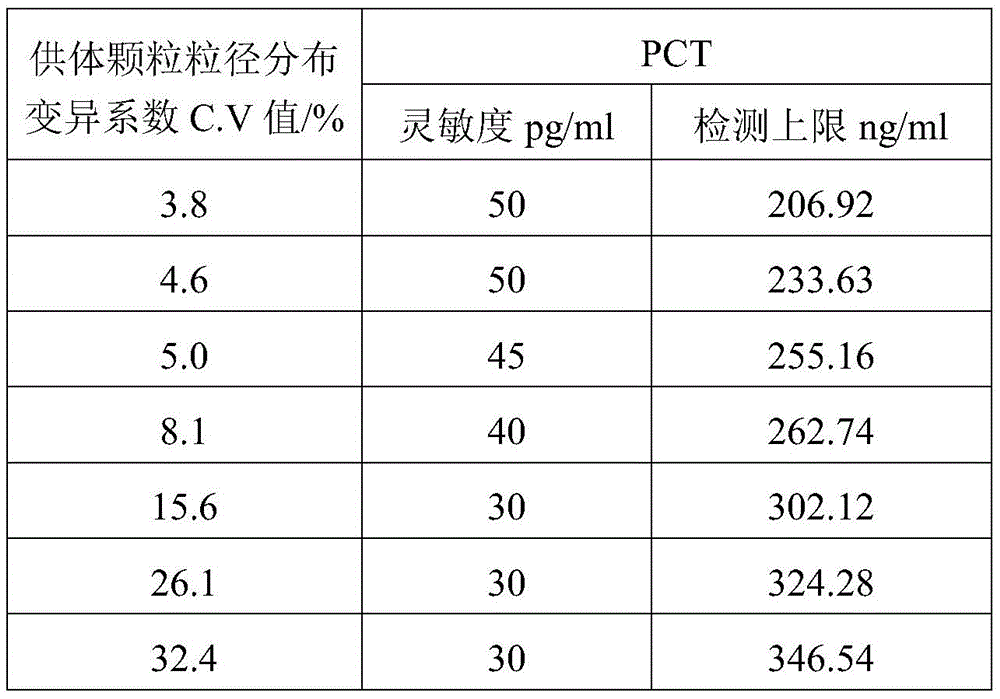
As can be seen from Table 2, when the variation coefficient of the particle size distribution of the donor particles used is 5% or more, the on-machine detection using the donor reagent containing the donor particles has a relatively suitable sensitivity and a wide detection range.
Example 7: detection of clinical samples of CRP at different concentrations
Using the photo-activated chemiluminescence immunoassay analyzer in example 5, 50 μ L of clinical samples (including serum and whole blood) with different concentrations of CRP were added to the reaction cuvette, the mean value was taken in parallel channels of each well, 50 μ L of biotinylated anti-CRP antibody, 50 μ L of receptor reagent containing coupled CRP receptor particles was reacted at 37 ℃ for 7.5min, 50 μ L of donor reagent prepared in example 4 was further added, and the reaction was carried out at 37 ℃ for 5min, and then the light-activated assay was carried out, and the experimental results are shown in Table 3 and FIG. 10. As can be seen from table 3 and fig. 10, the correlation coefficient using serum and whole blood reached 0.9988. The experimental result shows that the donor particle greatly reduces the nonspecific adsorption in the sample, has very good correlation between the measurement results aiming at the serum and the whole blood, greatly enhances the adaptability of the donor reagent to the clinical sample, and can be directly used for the detection of the clinical whole blood sample.
TABLE 3
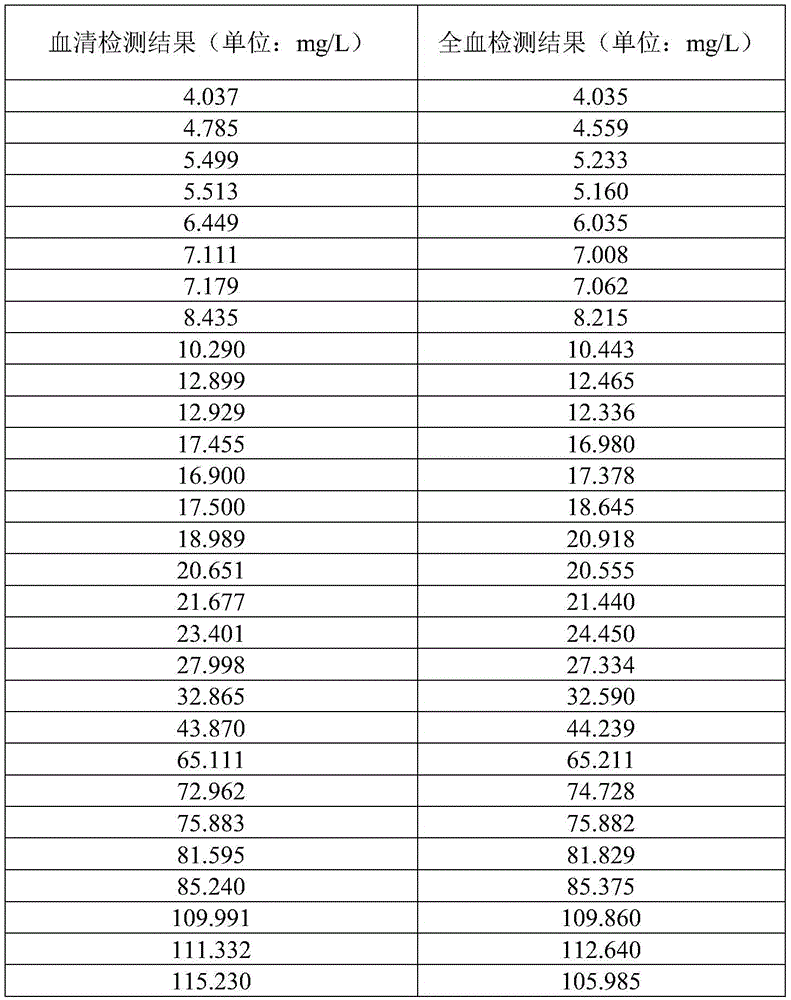

It should be noted that the above-mentioned embodiments are only for explaining the present invention, and do not constitute any limitation to the present invention. The present invention has been described with reference to exemplary embodiments, but the words which have been used herein are words of description and illustration, rather than words of limitation. The invention can be modified, as prescribed, within the scope of the claims and without departing from the scope and spirit of the invention. Although the invention has been described herein with reference to particular means, materials and embodiments, the invention is not intended to be limited to the particulars disclosed herein, but rather extends to all other methods and applications having the same functionality.
Claims (51)
1. A homogeneous chemiluminescent assay method comprising the steps of:
step S1, contacting the sample to be tested with the receptor reagent and the donor reagent, and generating a mixture to be tested after reaction; wherein the receptor agent comprises a receptor particle capable of reacting with a reactive oxygen species to produce a detectable chemiluminescent signal; the donor agent comprising a donor particle capable of generating reactive oxygen species in an excited state, the donor particle comprising a first support having a sensitizer filled therein, the first support having a surface chemically bonded to one of the members of the specific binding pair;
step S2, exciting the mixture to be detected to generate chemiluminescence by using energy or active compounds, and detecting the signal intensity of the chemiluminescence; therefore, whether the sample to be detected contains the target molecule to be detected and/or the concentration of the target molecule to be detected in the sample to be detected is judged.
2. The method of claim 1, wherein the surface of the first support is free of coating or has attached thereto a polysaccharide substance that is directly chemically bonded to one of the members of the specific binding pair.
3. A method according to claim 1 or claim 2, wherein the surface of the first support carries a bonding functionality for chemically bonding one of the members of the specific binding pair to the surface of the first support.
4. The method of claim 3, wherein the bonding functional group is selected from the group consisting of amine group, amide group, hydroxyl group, aldehyde group, carboxyl group, maleimide group, and thiol group; preferably selected from aldehyde groups and/or carboxyl groups.
5. The method according to claim 3 or 4, wherein the bonded functional group content on the surface of the first support is 100 to 500nmol/mg, preferably 200 to 400 nmol/mg.
6. The method of claim 1, wherein the surface of the first support is coated with at least two successive polysaccharide layers, wherein a first polysaccharide layer is spontaneously associated with a second polysaccharide layer.
7. The method of claim 6, wherein each of the successive polysaccharide layers is spontaneously associated with each of the previous polysaccharide layers.
8. The method of claim 6 or 7, wherein said polysaccharide has pendant functional groups, said functional groups of said successive polysaccharide layers being oppositely charged from said functional groups of said previous polysaccharide layer.
9. The method of any one of claims 6 to 8, wherein the polysaccharide has pendant functional groups and the continuous polysaccharide layer is covalently linked to the previous polysaccharide layer by a reaction between the functional groups and the functional groups of the previous polysaccharide layer.
10. The method of claim 9, wherein the functional groups of the continuous polysaccharide layer alternate between amine functional groups and amine-reactive functional groups.
11. The method of claim 10, wherein the amine-reactive functional group is an aldehyde group or a carboxyl group.
12. The method of any one of claims 6 to 11, wherein the first polysaccharide layer spontaneously associates with the first support.
13. The method of any one of claims 6 to 12, wherein the outermost polysaccharide layer of the coating has at least one pendant functional group.
14. The method according to any one of claims 6 to 13, wherein the pendant functional group of the outermost polysaccharide layer of the coating is selected from at least one of aldehyde group, carboxyl group, mercapto group, amino group, hydroxyl group and maleic amine group; preferably selected from aldehyde groups and/or carboxyl groups.
15. The method of claim 14, wherein the pendant functional groups of the outermost polysaccharide layer of the coating are directly or indirectly bound by one of the members of the specific binding pair chemically bonded.
16. The method according to any one of claims 6 to 15, wherein the polysaccharide is selected from the group consisting of carbohydrates containing three or more unmodified or modified monosaccharide units; preferably selected from the group consisting of dextran, starch, glycogen, inulin, fructan, mannan, agarose, galactan, carboxydextran and aminodextran; more preferably selected from dextran, starch, glycogen and polyribose.
17. The method according to any one of claims 1 to 16, wherein the particle size of the first carrier is selected from 100 to 400nm, preferably 150 to 350nm, more preferably 180 to 220 nm.
18. The method according to any one of claims 1 to 17, wherein the first support is magnetic or non-magnetic, preferably non-magnetic.
19. The method of any one of claims 1 to 18, wherein the first support has a shape selected from the group consisting of a tape, a sheet, a rod, a tube, a well, a microtiter plate, a bead, a particle, and a microsphere; microspheres are preferred.
20. The method according to any one of claims 1 to 19, wherein the first support is made of a material selected from natural, synthetic or modified naturally occurring polymers; preferably a synthetic polymer.
21. The method according to claim 20, wherein the first carrier is selected from agarose, cellulose, nitrocellulose, cellulose acetate, polyvinyl chloride, polystyrene, polyethylene, polypropylene, poly (4-methylbutene), polyacrylamide, polymethacrylate, polyethylene terephthalate, nylon, polyvinyl butyrate, or polyacrylate; preferably selected from polystyrene, polypropylene, poly (4-methylbutene), polyacrylamide, polymethacrylate, polyethylene terephthalate or polyacrylate.
22. The method of any one of claims 1 to 21, wherein the first support is polystyrene latex microspheres.
23. A method according to any one of claims 1 to 22, wherein the sensitizer is a photoactivated photosensitizer and/or a chemically activated initiator, preferably a photoactivated photosensitizer.
24. The method according to any one of claims 1 to 23, wherein the sensitizer is selected from methylene blue, rose bengal, a porphyrin, a phthalocyanine and chlorophyll.
25. The method of any one of claims 1 to 24, wherein the specific binding pair member is selected from a pair of substances capable of specifically binding to each other, consisting of an antibody, an antibody fragment, a ligand, an oligonucleotide binding protein, a lectin, a hapten, an antigen, an immunoglobulin binding protein, avidin or biotin.
26. The method of claim 25, wherein the specific binding pair member is avidin-biotin.
27. Method according to claim 25 or 26, wherein the avidin is selected from the group consisting of ovalbumin, streptavidin, vitellin, neutravidin and avidin-like, preferably neutravidin and/or streptavidin.
28. The method according to any one of claims 25 to 27, wherein the avidin is chemically bonded to the surface of the first support by reacting an amino group with an aldehyde group on the surface of the first support to form a schiff base.
29. The method of any one of claims 1 to 28, wherein the donor particles are controlled to have a variation coefficient of size distribution C.V value of 5% or more in the donor agent.
30. The method of claim 29, wherein the donor particles are controlled to have a size distribution variation coefficient C.V value of 8% or more in the donor reagent; preferably, the variation coefficient C.V value of the particle size distribution of the donor particles in the donor agent is controlled to be more than or equal to 10%.
31. The method of claim 29 or 30, wherein the donor particles are controlled to have a coefficient of variation of particle size distribution C.V value ≦ 40% in the donor agent; still more preferably, the donor particles are controlled to have a variation coefficient of size distribution C.V value of 20% or less in the donor agent.
32. A method as claimed in any one of claims 1 to 31 wherein the donor particles exhibit a polydispersity in their size distribution in the donor agent.
33. A method according to any one of claims 1 to 32, wherein the concentration of the donor particles in the donor agent is from 10 μ g/ml to 1mg/ml, preferably from 20 μ g/ml to 500 μ g/ml, more preferably from 50 μ g/ml to 200 μ g/ml.
34. A method according to any one of claims 1 to 33, further comprising a buffer solution having a pH of from 7.0 to 9.0 in which the donor particles are suspended.
35. The method according to claim 34, wherein the buffer solution contains a polysaccharide selected from the group consisting of carbohydrates containing three or more unmodified or modified monosaccharide units, preferably from the group consisting of dextran, starch, glycogen, inulin, fructan, mannan, agarose, galactan, carboxydextran, and aminodextran; more preferably selected from dextran, starch, glycogen and polyribose.
36. The process according to claim 35, wherein the dextran has a molecular weight distribution Mw selected from 10000 to 1000000kDa, preferably from 100000 to 800000kDa, more preferably from 300000 to 700000 kDa.
37. The method according to claim 36, wherein the content of dextran in the buffer solution is 0.01 to 1 wt%, preferably 0.05 to 0.5 wt%.
38. The method according to any one of claims 1 to 37, wherein the receptor particles in the receptor reagent comprise a second carrier, the interior of the second carrier is filled with the luminescent composition, the surface of the second carrier is coated with at least one polysaccharide layer, the surface of the polysaccharide layer is connected with a reporter molecule, and the reporter molecule can be specifically bound with a target molecule to be detected.
39. The method of claim 38, wherein the luminescent composition comprises a chemiluminescent compound and a metal chelate.
40. A method according to claim 39, wherein said chemiluminescent compound is selected from the group consisting of olefinic compounds, preferably from the group consisting of dimethylthiophene, dibutyldione compounds, dioxines, enol ethers, enamines, 9-alkylidenexanthanes, 9-alkylene-N-9, 10 dihydroacridines, arylethyletherenes, arylimidazoles and lucigenins and derivatives thereof, more preferably from the group consisting of dimethylthiophene and its derivatives.
41. The process according to claim 39 or 40, wherein the metal of the metal chelate is a rare earth metal or a group VIII metal, preferably selected from europium, terbium, dysprosium, samarium osmium and ruthenium, more preferably europium.
42. A process as claimed in any one of claims 39 to 41, wherein the metal chelate comprises a chelating agent selected from: NHA, BHHT, BHHCT, DPP, TTA, NPPTA, NTA, TOPO, TPPO, BFTA, 2-dimethyl-4-perfluorobutanoyl-3-butanone, 2' -bipyridine, bipyridylcarboxylic acid, azacrown ether, azacryptand phosphine oxide and derivatives thereof.
43. The method of any one of claims 1 to 42, wherein the sample to be tested is diluted with a diluent and then contacted with an acceptor reagent comprising acceptor particles and a donor reagent comprising donor particles.
44. The method according to any one of claims 1 to 43, wherein the chemiluminescence is detected at a wavelength of 520 to 620 nm.
45. The method according to any one of claims 1 to 44, wherein the laser irradiation is carried out with red excitation light of 600 to 700 nm.
46. The method of any one of claims 1 to 45, wherein the concentration of the receptor particles in the receptor agent is from 1ug/mL to 1000 ug/mL; preferably 10ug/mL to 500 ug/mL; more preferably 20ug/mL to 200 ug/mL.
47. The method according to any one of claims 1 to 46, wherein the active oxygen is singlet oxygen.
48. The method of any one of claims 1 to 47, wherein the sample to be tested is selected from materials suspected of containing target molecules to be tested, including but not limited to: blood, serum, plasma, sputum, lymph, semen, vaginal mucus, feces, urine, or spinal fluid.
49. A clinical use of the method of any one of claims 1 to 48 for the in vitro diagnosis of a disease in a patient.
50. A homogeneous chemiluminescent analyzer which utilizes the method of any one of claims 1 to 48 to detect the presence and/or concentration of target molecules to be detected in a sample to be detected.
51. The homogeneous chemiluminescent analyzer of claim 50 comprises the following components:
the sample adding mechanism is used for adding a sample to be detected into the reaction container;
a reagent adding mechanism for adding an acceptor reagent containing acceptor particles and/or a donor reagent containing donor particles to a reaction vessel;
an incubation module for providing a suitable temperature for a homogeneous chemiluminescent reaction of a substance in a reaction vessel;
a detection module for detecting a chemiluminescent signal produced by the homogeneous chemiluminescent reaction.
Priority Applications (1)
| Application Number | Priority Date | Filing Date | Title |
|---|---|---|---|
| CN201910655723.8A CN112240928B (en) | 2019-07-19 | 2019-07-19 | Homogeneous chemiluminescence analysis method and application thereof |
Applications Claiming Priority (1)
| Application Number | Priority Date | Filing Date | Title |
|---|---|---|---|
| CN201910655723.8A CN112240928B (en) | 2019-07-19 | 2019-07-19 | Homogeneous chemiluminescence analysis method and application thereof |
Publications (2)
| Publication Number | Publication Date |
|---|---|
| CN112240928A true CN112240928A (en) | 2021-01-19 |
| CN112240928B CN112240928B (en) | 2023-06-13 |
Family
ID=74167866
Family Applications (1)
| Application Number | Title | Priority Date | Filing Date |
|---|---|---|---|
| CN201910655723.8A Active CN112240928B (en) | 2019-07-19 | 2019-07-19 | Homogeneous chemiluminescence analysis method and application thereof |
Country Status (1)
| Country | Link |
|---|---|
| CN (1) | CN112240928B (en) |
Cited By (3)
| Publication number | Priority date | Publication date | Assignee | Title |
|---|---|---|---|---|
| CN116430033A (en) * | 2023-02-13 | 2023-07-14 | 科美博阳诊断技术(上海)有限公司 | Photoactivated chemiluminescence detection kit and method of use thereof |
| CN116754533A (en) * | 2023-07-18 | 2023-09-15 | 复旦大学 | A long afterglow homogeneous detection method |
| CN118191330A (en) * | 2024-02-28 | 2024-06-14 | 浙江夸克生物科技有限公司 | A high-sensitivity and high-linear latex microsphere detection reagent and method |
Citations (6)
| Publication number | Priority date | Publication date | Assignee | Title |
|---|---|---|---|---|
| US7179660B1 (en) * | 2000-03-06 | 2007-02-20 | Dade Behring Marburg Gmbh | Carriers coated with polysaccharides, their preparation and use |
| CN101620229A (en) * | 2008-07-02 | 2010-01-06 | 博阳生物科技(上海)有限公司 | Hepatits B virus e antibody assay kit and assay method thereof |
| CN101750487A (en) * | 2008-12-02 | 2010-06-23 | 博阳生物科技(上海)有限公司 | Dry method photic stimulation chemiluminescence immunoassay reagent kit and preparation and application thereof |
| CN108051585A (en) * | 2017-11-27 | 2018-05-18 | 北京科美生物技术有限公司 | A homogeneous immunoassay kit, detection method and application thereof |
| CN109988333A (en) * | 2019-04-04 | 2019-07-09 | 成都爱兴生物科技有限公司 | A kind of polystyrene microsphere |
| CN110736735A (en) * | 2018-07-18 | 2020-01-31 | 博阳生物科技(上海)有限公司 | A homogeneous chemiluminescence detection kit and its application |
-
2019
- 2019-07-19 CN CN201910655723.8A patent/CN112240928B/en active Active
Patent Citations (6)
| Publication number | Priority date | Publication date | Assignee | Title |
|---|---|---|---|---|
| US7179660B1 (en) * | 2000-03-06 | 2007-02-20 | Dade Behring Marburg Gmbh | Carriers coated with polysaccharides, their preparation and use |
| CN101620229A (en) * | 2008-07-02 | 2010-01-06 | 博阳生物科技(上海)有限公司 | Hepatits B virus e antibody assay kit and assay method thereof |
| CN101750487A (en) * | 2008-12-02 | 2010-06-23 | 博阳生物科技(上海)有限公司 | Dry method photic stimulation chemiluminescence immunoassay reagent kit and preparation and application thereof |
| CN108051585A (en) * | 2017-11-27 | 2018-05-18 | 北京科美生物技术有限公司 | A homogeneous immunoassay kit, detection method and application thereof |
| CN110736735A (en) * | 2018-07-18 | 2020-01-31 | 博阳生物科技(上海)有限公司 | A homogeneous chemiluminescence detection kit and its application |
| CN109988333A (en) * | 2019-04-04 | 2019-07-09 | 成都爱兴生物科技有限公司 | A kind of polystyrene microsphere |
Cited By (3)
| Publication number | Priority date | Publication date | Assignee | Title |
|---|---|---|---|---|
| CN116430033A (en) * | 2023-02-13 | 2023-07-14 | 科美博阳诊断技术(上海)有限公司 | Photoactivated chemiluminescence detection kit and method of use thereof |
| CN116754533A (en) * | 2023-07-18 | 2023-09-15 | 复旦大学 | A long afterglow homogeneous detection method |
| CN118191330A (en) * | 2024-02-28 | 2024-06-14 | 浙江夸克生物科技有限公司 | A high-sensitivity and high-linear latex microsphere detection reagent and method |
Also Published As
| Publication number | Publication date |
|---|---|
| CN112240928B (en) | 2023-06-13 |
Similar Documents
| Publication | Publication Date | Title |
|---|---|---|
| CN112240929A (en) | A kind of donor particle for homogeneous chemiluminescence analysis and its application | |
| CN116559153A (en) | A kind of homogeneous chemiluminescent detection kit and its application | |
| EP3839485B1 (en) | Microsphere composition for chemiluminescence analysis and use thereof | |
| CN116413255A (en) | A kind of homogeneous chemiluminescent detection kit and its application | |
| CN110736735A (en) | A homogeneous chemiluminescence detection kit and its application | |
| CN116577319A (en) | A kind of microsphere composition and application thereof for chemiluminescent detection | |
| CN112240928A (en) | Homogeneous phase chemiluminescence analysis method and application thereof | |
| CN116500020A (en) | A kind of chemiluminescence analysis method and its application | |
| CN110736736B (en) | Homogeneous phase chemiluminescence POCT detection method and device using same | |
| CN112240930A (en) | Homogeneous phase chemiluminescence analysis method and application thereof | |
| CN113125701A (en) | Homogeneous phase chemiluminescence detection kit and application thereof | |
| CN112114131B (en) | A homogeneous chemiluminescence detection method and its application | |
| CN112240936A (en) | Application of donor reagent in diagnosis of myocardial damage of main body | |
| CN116482083A (en) | A homogeneous chemiluminescence POCT detection method and a device using the detection method | |
| CN113125702B (en) | A homogeneous chemiluminescence detection kit and its application | |
| CN121068912A (en) | Acceptor reagent for homogeneous chemiluminescence detection and application thereof | |
| CN112240937A (en) | Application of donor reagent in diagnosis of main body infected bacterial inflammatory disease | |
| CN117805359A (en) | Myoglobin homogeneous detection kit and application thereof | |
| CN112114148B (en) | Use of a receptor reagent in diagnosing bacterial inflammatory diseases in a subject | |
| CN119846218A (en) | Antibody affinity detection kit, antibody affinity detection method and application thereof | |
| CN116859041A (en) | Homogeneous detection kit for creatine kinase isozymes and application thereof | |
| CN113125698A (en) | Receptor reagent and application thereof | |
| CN116859057A (en) | Myoglobin homogeneous detection kit and application thereof | |
| CN113125419A (en) | Donor reagent and application thereof | |
| CN113125417A (en) | A receptor reagent and its application |
Legal Events
| Date | Code | Title | Description |
|---|---|---|---|
| PB01 | Publication | ||
| PB01 | Publication | ||
| CB02 | Change of applicant information |
Address after: 200131 3rd and 5th floors, building 1, No.88 Cailun Road, Pudong New Area pilot Free Trade Zone, Shanghai Applicant after: Kemei Boyang diagnostic technology (Shanghai) Co.,Ltd. Applicant after: Kemei Diagnostic Technology Co.,Ltd. Address before: 201210 the third and fifth floors of Building 1, No. 88, Cailun Road, Pudong New Area, Shanghai Applicant before: BEYOND DIAGNOSTICS (SHANGHAI) Co.,Ltd. Applicant before: Kemei Diagnostic Technology Co.,Ltd. |
|
| CB02 | Change of applicant information | ||
| SE01 | Entry into force of request for substantive examination | ||
| SE01 | Entry into force of request for substantive examination | ||
| GR01 | Patent grant | ||
| GR01 | Patent grant |