CN112233742A - Medical record document classification system, equipment and storage medium based on clustering - Google Patents
Medical record document classification system, equipment and storage medium based on clustering Download PDFInfo
- Publication number
- CN112233742A CN112233742A CN202011063653.6A CN202011063653A CN112233742A CN 112233742 A CN112233742 A CN 112233742A CN 202011063653 A CN202011063653 A CN 202011063653A CN 112233742 A CN112233742 A CN 112233742A
- Authority
- CN
- China
- Prior art keywords
- clustering
- cluster
- module
- medical record
- document
- Prior art date
- Legal status (The legal status is an assumption and is not a legal conclusion. Google has not performed a legal analysis and makes no representation as to the accuracy of the status listed.)
- Granted
Links
Images

Classifications
-
- G—PHYSICS
- G16—INFORMATION AND COMMUNICATION TECHNOLOGY [ICT] SPECIALLY ADAPTED FOR SPECIFIC APPLICATION FIELDS
- G16H—HEALTHCARE INFORMATICS, i.e. INFORMATION AND COMMUNICATION TECHNOLOGY [ICT] SPECIALLY ADAPTED FOR THE HANDLING OR PROCESSING OF MEDICAL OR HEALTHCARE DATA
- G16H10/00—ICT specially adapted for the handling or processing of patient-related medical or healthcare data
- G16H10/60—ICT specially adapted for the handling or processing of patient-related medical or healthcare data for patient-specific data, e.g. for electronic patient records
-
- G—PHYSICS
- G06—COMPUTING OR CALCULATING; COUNTING
- G06F—ELECTRIC DIGITAL DATA PROCESSING
- G06F16/00—Information retrieval; Database structures therefor; File system structures therefor
- G06F16/30—Information retrieval; Database structures therefor; File system structures therefor of unstructured textual data
- G06F16/35—Clustering; Classification
- G06F16/355—Creation or modification of classes or clusters
-
- G—PHYSICS
- G06—COMPUTING OR CALCULATING; COUNTING
- G06F—ELECTRIC DIGITAL DATA PROCESSING
- G06F18/00—Pattern recognition
- G06F18/20—Analysing
- G06F18/23—Clustering techniques
- G06F18/232—Non-hierarchical techniques
- G06F18/2321—Non-hierarchical techniques using statistics or function optimisation, e.g. modelling of probability density functions
-
- G—PHYSICS
- G06—COMPUTING OR CALCULATING; COUNTING
- G06F—ELECTRIC DIGITAL DATA PROCESSING
- G06F40/00—Handling natural language data
- G06F40/30—Semantic analysis
-
- G—PHYSICS
- G06—COMPUTING OR CALCULATING; COUNTING
- G06N—COMPUTING ARRANGEMENTS BASED ON SPECIFIC COMPUTATIONAL MODELS
- G06N3/00—Computing arrangements based on biological models
- G06N3/004—Artificial life, i.e. computing arrangements simulating life
- G06N3/006—Artificial life, i.e. computing arrangements simulating life based on simulated virtual individual or collective life forms, e.g. social simulations or particle swarm optimisation [PSO]
-
- G—PHYSICS
- G16—INFORMATION AND COMMUNICATION TECHNOLOGY [ICT] SPECIALLY ADAPTED FOR SPECIFIC APPLICATION FIELDS
- G16H—HEALTHCARE INFORMATICS, i.e. INFORMATION AND COMMUNICATION TECHNOLOGY [ICT] SPECIALLY ADAPTED FOR THE HANDLING OR PROCESSING OF MEDICAL OR HEALTHCARE DATA
- G16H50/00—ICT specially adapted for medical diagnosis, medical simulation or medical data mining; ICT specially adapted for detecting, monitoring or modelling epidemics or pandemics
- G16H50/20—ICT specially adapted for medical diagnosis, medical simulation or medical data mining; ICT specially adapted for detecting, monitoring or modelling epidemics or pandemics for computer-aided diagnosis, e.g. based on medical expert systems
-
- G—PHYSICS
- G16—INFORMATION AND COMMUNICATION TECHNOLOGY [ICT] SPECIALLY ADAPTED FOR SPECIFIC APPLICATION FIELDS
- G16H—HEALTHCARE INFORMATICS, i.e. INFORMATION AND COMMUNICATION TECHNOLOGY [ICT] SPECIALLY ADAPTED FOR THE HANDLING OR PROCESSING OF MEDICAL OR HEALTHCARE DATA
- G16H50/00—ICT specially adapted for medical diagnosis, medical simulation or medical data mining; ICT specially adapted for detecting, monitoring or modelling epidemics or pandemics
- G16H50/70—ICT specially adapted for medical diagnosis, medical simulation or medical data mining; ICT specially adapted for detecting, monitoring or modelling epidemics or pandemics for mining of medical data, e.g. analysing previous cases of other patients
-
- Y—GENERAL TAGGING OF NEW TECHNOLOGICAL DEVELOPMENTS; GENERAL TAGGING OF CROSS-SECTIONAL TECHNOLOGIES SPANNING OVER SEVERAL SECTIONS OF THE IPC; TECHNICAL SUBJECTS COVERED BY FORMER USPC CROSS-REFERENCE ART COLLECTIONS [XRACs] AND DIGESTS
- Y02—TECHNOLOGIES OR APPLICATIONS FOR MITIGATION OR ADAPTATION AGAINST CLIMATE CHANGE
- Y02D—CLIMATE CHANGE MITIGATION TECHNOLOGIES IN INFORMATION AND COMMUNICATION TECHNOLOGIES [ICT], I.E. INFORMATION AND COMMUNICATION TECHNOLOGIES AIMING AT THE REDUCTION OF THEIR OWN ENERGY USE
- Y02D10/00—Energy efficient computing, e.g. low power processors, power management or thermal management
Landscapes
- Engineering & Computer Science (AREA)
- Theoretical Computer Science (AREA)
- Data Mining & Analysis (AREA)
- Health & Medical Sciences (AREA)
- Physics & Mathematics (AREA)
- General Health & Medical Sciences (AREA)
- Public Health (AREA)
- Medical Informatics (AREA)
- Biomedical Technology (AREA)
- General Engineering & Computer Science (AREA)
- General Physics & Mathematics (AREA)
- Primary Health Care (AREA)
- Epidemiology (AREA)
- Artificial Intelligence (AREA)
- Databases & Information Systems (AREA)
- Pathology (AREA)
- Life Sciences & Earth Sciences (AREA)
- Evolutionary Computation (AREA)
- Computational Linguistics (AREA)
- Bioinformatics & Computational Biology (AREA)
- Computer Vision & Pattern Recognition (AREA)
- Probability & Statistics with Applications (AREA)
- Evolutionary Biology (AREA)
- Biophysics (AREA)
- Bioinformatics & Cheminformatics (AREA)
- Molecular Biology (AREA)
- Computing Systems (AREA)
- Mathematical Physics (AREA)
- Software Systems (AREA)
- Audiology, Speech & Language Pathology (AREA)
- Information Retrieval, Db Structures And Fs Structures Therefor (AREA)
Abstract
The invention discloses a medical record document classification system, equipment and a storage medium based on clustering, wherein the system comprises: a preprocessing module: acquiring a plurality of electronic medical record documents as a sample set, and vectorizing and representing samples in the sample set; an initialization module: the method comprises the steps of performing preliminary clustering on a sample set represented by the vector quantization by adopting a density clustering method; a sample clustering module: the method is used for optimizing the initial clustering result by adopting an improved crow search algorithm to obtain a final clustering result; a document classification module: the method is used for determining the clustering cluster to which the vectorized document to be classified belongs, and classifying the document to be classified through semantic similarity in the clustering cluster to which the vectorized document to be classified belongs. The invention can give consideration to overall analysis and local difference analysis based on clustering and subdivision classification, and realizes accurate classification of medical record documents.
Description
Technical Field
The invention relates to the technical field of document classification, in particular to a medical record document classification system, equipment and a storage medium based on clustering.
Background
With the development of artificial intelligence technology in the medical industry, a large amount of document data is generated, and through the analysis and processing of the document data, a large amount of beneficial information contained in the document data can be obtained. For example, in the medical industry, various medical record, prescription record and diagnosis record are electronized, and text data in the medical industry is analyzed, so that the intelligent level can be further improved, and assistance is provided for public health. The clustering analysis of massive text data is an important content in the text data analysis, massive electronic medical record records form a huge medical record library, and the analysis and the processing of the electronic medical records can provide a basis for intelligent auxiliary diagnosis and analysis of diseases in turn.
Because the symptoms and the examination results of different groups with the same disease are not always the same, and the symptoms or the examination results of different diseases have certain similarity, the existing disease screening mode is difficult to distinguish individual differences and the similarity of the symptoms among different diseases, thereby influencing accurate judgment.
Disclosure of Invention
In view of the above, the invention provides a medical record document classification system, device and storage medium based on clustering, which are used for solving the problem that the existing case classification mode is difficult to distinguish individual differences and the similarity of symptoms among different diseases.
In a first aspect of the present invention, a system for classifying medical record documents based on clustering is disclosed, the system comprising:
a preprocessing module: acquiring a plurality of electronic medical record documents as a sample set, and vectorizing and representing samples in the sample set;
an initialization module: the method comprises the steps of performing preliminary clustering on a sample set represented by the vector quantization by adopting a density clustering method;
a sample clustering module: the method is used for optimizing the initial clustering result by adopting an improved crow search algorithm to obtain a final clustering result;
a document classification module: the method is used for determining the clustering cluster to which the vectorized document to be classified belongs, and classifying the document to be classified through semantic similarity in the clustering cluster to which the vectorized document to be classified belongs.
Preferably, the initialization module is specifically configured to:
calculating Euclidean distances between sample vectors represented by vectorization and initializing a truncation distance;
calculating the local density ρ of the sampleiSum distance offset deltaiCalculating the product of the two gammai=ρiδi;
Will gammaiAnd (5) performing descending order arrangement, wherein the first K points are selected as the centers of all the clusters, and K is the number of the cluster categories.
Preferably, in the sample clustering module, the optimizing the preliminary clustering result by using the improved crow search algorithm specifically includes:
initializing population quantity N, maximum iteration times T, flight distance l and perception probability P; initializing a population position XiAnd memorizing;
setting a fitness function, and calculating the fitness of each individual in the population;
updating the population position:
updating the population position:

wherein x isi,t+1Is the position of ith crow at the t +1 iteration, xi,tIs the position, x, of the ith crow at the t-th iterations,t、xh,tFor randomly chosen positions from the t-th iteration, w1、w2Is a weight, mj,tThe Tibetan food position of the jth crow in the tth iteration; lgsig (·) is a logarithmic sigmoid transfer function, and ri、rjare all [0,1]Uniformly distributed random numbers between them, Pj,tRepresenting the perception probability of the crow j after the t-th iteration; r (0,1) is a random number between 0 and 1, N (0,1)dD-dimensional standard normal distribution;
detecting the feasibility of the new position of each crow, and recalculating the fitness of each individual;
if the fitness function value of the new position of the individual is better than the fitness value of the memorized position, the memory is updated through the new position;
and updating the population position again, and performing iterative operation until convergence to obtain the optimal position of the individual, namely the clustering center point vector.
Preferably, in the sample clustering module, the flight distance l of the individual i at the t-th iterationi,tAccording to local density ρiSum distance offset deltaiProduct of (a) gammai,tAnd (3) dynamic adjustment:

Preferably, the fitness function is the sum of the intra-class distance values and the minimum, namely:

where K is the number of clusters in the cluster, d (X)i,Cj) Is a particle X of the j-th typeiTo a corresponding cluster center point CjThe distance of (c).
Preferably, the document classification module is specifically configured to:
vectorizing the documents to be classified, calculating Euclidean distances between the vectorized documents to be classified and the clustering center points determined by the sample clustering module, and selecting the clustering cluster with the minimum Euclidean distance;
calculating cosine similarity between the vectorized document to be classified and each text feature vector in the belonged clustering cluster, and selecting the category corresponding to the sample with the largest cosine similarity as the category of the document to be classified.
In a second aspect of the present invention, an electronic device is disclosed, comprising: at least one processor, at least one memory, a communication interface, and a bus;
the processor, the memory and the communication interface complete mutual communication through the bus;
the memory stores program instructions executable by the processor which are invoked by the processor to implement the system according to the first aspect of the invention.
In a third aspect of the invention, a computer-readable storage medium is disclosed, which stores computer instructions for causing a computer to implement the system of the first aspect of the invention.
Compared with the prior art, the invention has the following beneficial effects:
1) the invention is based on the electronic medical record library, can realize accurate clustering and subdivision classification of medical records, adopts an improved crow search algorithm to optimize density clustering during clustering, and updates the position according to the situation based on the perception probability: carrying out rapid local optimization based on a crow search algorithm; and combining the thought of a brain storm algorithm, randomly fusing the positions of the two individuals, adding random disturbance, and performing global optimization. According to the method, the global optimization advantage of the head storm algorithm is combined on the basis of quickly searching the local optimal solution by the crow algorithm, the overall optimization capability of the algorithm is effectively improved, and quick and accurate sample clustering is realized; during classification, the medical record is subdivided in the cluster based on the cluster to be classified, and auxiliary diagnosis based on the medical record level can be realized.
2) The invention analyzes the similarity between different medical records or different diseases by clustering, and the medical records or diseases with certain similarity of symptoms or professional detection results are clustered into one class; meanwhile, medical records or diseases are subdivided in the clustering clusters through semantic similarity calculation, and the influence of individual difference is eliminated; the invention can realize the consideration of global overall analysis and local difference analysis based on clustering and subdivision classification, and provides a reliable foundation for medical document data analysis or disease auxiliary diagnosis.
Drawings
In order to more clearly illustrate the embodiments of the present invention or the technical solutions in the prior art, the drawings used in the description of the embodiments or the prior art will be briefly described below, it is obvious that the drawings in the following description are only some embodiments of the present invention, and for those skilled in the art, other drawings can be obtained according to the drawings without creative efforts.
FIG. 1 is a schematic diagram of a medical record document classification system based on clustering according to the present invention.
Detailed Description
The technical solutions in the embodiments of the present invention will be clearly and completely described below with reference to the embodiments of the present invention, and it is obvious that the described embodiments are only a part of the embodiments of the present invention, and not all of the embodiments. All other embodiments, which can be obtained by a person skilled in the art without any inventive step based on the embodiments of the present invention, are within the scope of the present invention.
As shown in fig. 1, the medical record document classification system based on clustering according to the present invention has a schematic structural diagram, and the system includes: the system comprises a preprocessing module 1, an initialization module 2, a sample clustering module 3 and a document classification module 4;
the system comprises a preprocessing module 1, a sample set and a display module, wherein the preprocessing module is used for acquiring a plurality of electronic medical record documents as the sample set and vectorizing and expressing samples in the sample set;
an initialization module 2, configured to perform preliminary clustering on the sample set represented by the vector quantization by using a density clustering method, specifically configured to:
calculating Euclidean distances between sample vectors represented by vectorization and initializing a truncation distance;
calculating the local density rho and the distance offset delta of the sampleiCalculating the product of the two gammai=ρiδi;
Will gammaiAnd (5) performing descending order arrangement, wherein the first K points are selected as the centers of all the clusters, and K is the number of the cluster categories.
The sample clustering module 3 is used for optimizing the preliminary clustering result by adopting an improved crow searching algorithm to obtain a final clustering result;
the optimization of the preliminary clustering result by adopting the improved crow searching algorithm specifically comprises the following steps:
setting a population number N, a maximum iteration number T, an individual dimension N, a flight distance l and a perception probability P; initializing population locations And memorizing;
setting a fitness function, and calculating the fitness of each individual in the population; the fitness function is the sum of the intra-class distance values and the minimum, namely:
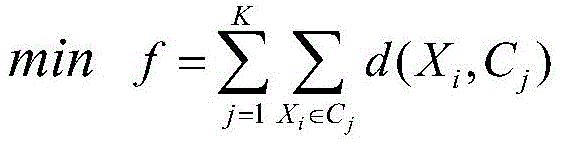
where K is the number of clusters in the cluster, d (X)i,Cj) Is a particle X of the j-th typeiTo a corresponding cluster center point CjThe distance of (c).
Updating the population position:

wherein x isi,t+1Is the position of ith crow at the t +1 iteration, xi,tIs the position, x, of the ith crow at the t-th iterations,t、xh,tFor randomly chosen positions from the t-th iteration, w1、w2Is a weight, mj,tThe Tibetan food position of the jth crow in the tth iteration; lgsig (·) is a logarithmic sigmoid transfer function, and ri、rjare all [0,1]Uniformly distributed random numbers between them, Pj,tRepresenting crowj is the perception probability after the t-th iteration; r (0,1) is a random number between 0 and 1, N (0,1)dD-dimensional standard normal distribution;
li,tfor the flight distance, l, of the individual i at the t-th iterationi,tAccording to the local density rho i and the distance offset delta of the individual iiProduct of (a) gammai,tAnd (3) dynamic adjustment:
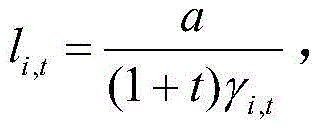
In an iterative process, the local density ρ of an individual i is calculatediSum distance offset deltaiProduct of (a) gammaiDue to gammaiThe larger the flight distance, the closer the cluster center is, the smaller the flight distance is, and the optimal point is missed when the flight distance is too large.
Detecting the feasibility of the new position of each crow, and recalculating the fitness of each individual;
if the fitness function value of the new position of the individual is better than the fitness value of the memorized position, the memory is updated through the new position;
and updating the population position again, and performing iterative operation until convergence to obtain the optimal position of the individual, namely the clustering center point vector.
The invention adopts an improved crow search algorithm to optimize density clustering, and based on the perception probability, location updating is carried out according to conditions: if crow j does not know to be tracked by crow i (r)j≥Pj,t) The crow i follows the crow j to search for Tibetan food, and rapid local optimization is carried out; if crow j knows to be tracked by crow i (r)j<Pj,t) The invention combines the thought of a brainstorming algorithm when randomly entering the search space, randomly fuses two individual positions and adds random disturbance to perform global optimization. The invention combines the advantage of global optimization of the head storm algorithm on the basis of quickly searching the local optimal solution by the crow algorithm, effectively improves the overall optimization capability of the algorithm and realizes quick and accurate sample clustering.
And the document classification module 4 is used for determining the clustering cluster to which the vectorized document to be classified belongs, and classifying the document to be classified in the clustering cluster to which the vectorized document to be classified belongs through semantic similarity. The document classification module is specifically configured to:
vectorizing the documents to be classified, calculating Euclidean distances between the vectorized documents to be classified and the clustering center points determined by the sample clustering module, and selecting the clustering cluster with the minimum Euclidean distance;
calculating cosine similarity between the vectorized document to be classified and each text feature vector in the belonged clustering cluster, and selecting the category corresponding to the sample with the largest cosine similarity as the category of the document to be classified.
The invention is based on the electronic medical record library, and can realize accurate clustering and subdivision classification of medical records, wherein eye bleeding is taken as an example, and is a common disease. The ocular hemorrhage may be a local lesion of the eye, or a manifestation of a systemic disease in the eye, and the ocular hemorrhage (including external and internal hemorrhage, i.e., fundus and ocular surface hemorrhage) is usually caused by trauma or pathology, while the pathological condition is usually related to systemic disease factors. Different bleeding parts and properties may cause different symptoms such as visual disturbance, double vision, pain, photophobia, etc. The most common ocular surface bleeding is caused by ocular inflammation, such as conjunctivitis, iritis, ocular trauma, etc. Spontaneous hemorrhage is often seen in the elderly, especially in elderly patients with essential diseases such as hypertension, diabetes, and arteriosclerosis; fundus hemorrhage refers to hemorrhage of the retina (deepest, bottommost part of the eye) in the eye, or intravitreal hemorrhage. This phenomenon is invisible to the naked eye only, may not be red, painful, itchy in the early stage, and is visible by specialized fundus examination, which is more dangerous than ocular surface bleeding. Four groups of people wary of fundus hemorrhage: namely high risk group with fundus hemorrhage such as diabetes, hypertension, high myopia, age-related macular degeneration, etc.
Electronic medical record documents taking eye bleeding as a chief complaint symptom are obtained from a medical record library, the electronic medical record documents can comprise patient description symptoms, detection indexes, professional fundus examination results, disease diagnosis results and the like, and TF-IDF is adopted to carry out vectorization representation on each electronic medical record document to form a vectorization sample set; the initialization module is used for carrying out preliminary clustering on the sample set, the clustering effect is optimized through the sample clustering module, vectorization and cluster judgment are finally carried out on medical record documents to be classified, and classification is carried out in the cluster through semantic similarity, so that corresponding disease names are obtained.
Because the symptoms and the examination results of different groups with the same disease are not always the same, and the symptoms or the examination results of different diseases have certain similarity, the existing disease screening mode is difficult to distinguish individual differences and the similarity of the symptoms among different diseases, thereby influencing accurate judgment. The invention analyzes the similarity between different medical records or different diseases by clustering, gathers the medical records or diseases with certain similarity of symptoms or professional detection results into one class, and carries out medical record or disease subdivision in the clustering class cluster by semantic similarity calculation to eliminate the influence of individual difference.
The present invention also discloses an electronic device, comprising: at least one processor, at least one memory, a communication interface, and a bus;
the processor, the memory and the communication interface complete mutual communication through the bus;
the memory stores program instructions which can be executed by the processor, and the processor calls the program instructions to realize a system consisting of the preprocessing module, the initialization module, the sample clustering module and the document classification module. The storage medium includes: u disk, removable hard disk, ROM, RAM, magnetic disk or optical disk, etc.
The invention also discloses a computer readable storage medium which stores computer instructions, and the computer instructions enable the computer to realize a system consisting of the preprocessing module, the initialization module, the sample clustering module and the document classification module.
The above description is only for the purpose of illustrating the preferred embodiments of the present invention and is not to be construed as limiting the invention, and any modifications, equivalents, improvements and the like that fall within the spirit and principle of the present invention are intended to be included therein.
Claims (8)
1. A system for clustering-based medical record document classification, the system comprising:
a preprocessing module: acquiring a plurality of electronic medical record documents as a sample set, and vectorizing and representing samples in the sample set;
an initialization module: the method comprises the steps of performing preliminary clustering on a sample set represented by the vector quantization by adopting a density clustering method;
a sample clustering module: the method is used for optimizing the initial clustering result by adopting an improved crow search algorithm to obtain a final clustering result;
a document classification module: the method is used for determining the clustering cluster to which the vectorized document to be classified belongs, and classifying the document to be classified through semantic similarity in the clustering cluster to which the vectorized document to be classified belongs.
2. The cluster-based medical record document classification system of claim 1, wherein the initialization module is specifically configured to:
calculating Euclidean distances between sample vectors represented by vectorization and initializing a truncation distance;
calculating the local density rho and the distance offset delta of the sampleiCalculating the product of the two gammai=ρiδi;
Will gammaiAnd (5) performing descending order arrangement, wherein the first K points are selected as the centers of all the clusters, and K is the number of the cluster categories.
3. The system for classifying medical record documents based on clustering according to claim 2, wherein in the sample clustering module, the optimizing the preliminary clustering result by using the improved crow search algorithm specifically comprises:
initializing population quantity N, maximum iteration times T, flight distance l and perception probability P; initializing a population position XiAnd memorizing;
setting a fitness function, and calculating the fitness of each individual in the population;
updating the population position:

wherein x isi,t+1Is the position of ith crow at the t +1 iteration, xi,tIs the position, x, of the ith crow at the t-th iterations,t、xh,tFor randomly chosen positions from the t-th iteration, w1、w2Is a weight, mj,tThe Tibetan food position of the jth crow in the tth iteration; lgsig (·) is a logarithmic sigmoid transfer function, and ri、rjare all [0,1]Uniformly distributed random numbers between them, Pj,tRepresenting the perception probability of the crow j after the t-th iteration; r (0,1) is a random number between 0 and 1, N (0,1)dD-dimensional standard normal distribution;
detecting the feasibility of the new position of each crow, and recalculating the fitness of each individual;
if the fitness function value of the new position of the individual is better than the fitness value of the memorized position, the memory is updated through the new position;
and updating the population position again, and performing iterative operation until convergence to obtain the optimal position of the individual, namely the clustering center point vector.
4. The system of claim 3, wherein the sample clustering module further comprises a distance of flight,/, of individual i at the t-th iterationi,tAccording to local density ρiSum distance offset deltaiProduct of (a) gammai,tAnd (3) dynamic adjustment:

5. The cluster-based medical record document classification system as recited in claim 3, wherein the fitness function is the sum of the intra-class distance values and the minimum, namely:

where K is the number of clusters in the cluster, d (X)i,Cj) Is a particle X of the j-th typeiTo a corresponding cluster center point CjThe distance of (c).
6. The cluster-based medical record document classification system of claim 2, wherein the document classification module is specifically configured to:
vectorizing the documents to be classified, calculating Euclidean distances between the vectorized documents to be classified and the clustering center points determined by the sample clustering module, and selecting the clustering cluster with the minimum Euclidean distance;
calculating cosine similarity between the vectorized document to be classified and each text feature vector in the belonged clustering cluster, and selecting the category corresponding to the sample with the largest cosine similarity as the category of the document to be classified.
7. An electronic device, comprising: at least one processor, at least one memory, a communication interface, and a bus;
the processor, the memory and the communication interface complete mutual communication through the bus;
the memory stores program instructions executable by the processor, the processor invoking the program instructions to implement the system of any one of claims 1-6.
8. A computer readable storage medium storing computer instructions which cause a computer to implement the system of any one of claims 1 to 6.
Priority Applications (1)
| Application Number | Priority Date | Filing Date | Title |
|---|---|---|---|
| CN202011063653.6A CN112233742B (en) | 2020-09-30 | 2020-09-30 | Medical record document classification system, equipment and storage medium based on clustering |
Applications Claiming Priority (1)
| Application Number | Priority Date | Filing Date | Title |
|---|---|---|---|
| CN202011063653.6A CN112233742B (en) | 2020-09-30 | 2020-09-30 | Medical record document classification system, equipment and storage medium based on clustering |
Publications (2)
| Publication Number | Publication Date |
|---|---|
| CN112233742A true CN112233742A (en) | 2021-01-15 |
| CN112233742B CN112233742B (en) | 2024-02-23 |
Family
ID=74121057
Family Applications (1)
| Application Number | Title | Priority Date | Filing Date |
|---|---|---|---|
| CN202011063653.6A Active CN112233742B (en) | 2020-09-30 | 2020-09-30 | Medical record document classification system, equipment and storage medium based on clustering |
Country Status (1)
| Country | Link |
|---|---|
| CN (1) | CN112233742B (en) |
Cited By (6)
| Publication number | Priority date | Publication date | Assignee | Title |
|---|---|---|---|---|
| CN113031877A (en) * | 2021-04-12 | 2021-06-25 | 中国移动通信集团陕西有限公司 | Data storage method, device, equipment and medium |
| CN113988149A (en) * | 2021-07-09 | 2022-01-28 | 西安邮电大学 | A Service Clustering Method Based on Particle Swarm Fuzzy Clustering |
| CN113990514A (en) * | 2021-10-28 | 2022-01-28 | 平安医疗健康管理股份有限公司 | Abnormality detection device for doctor diagnosis and treatment behavior, computer device and storage medium |
| CN115188484A (en) * | 2022-07-15 | 2022-10-14 | 上海浙江大学高等研究院 | Multi-party mixed data tracing method and system based on potential group tool variables |
| CN117789907A (en) * | 2024-02-28 | 2024-03-29 | 山东金卫软件技术有限公司 | Intelligent management method of smart medical data based on multi-source data fusion |
| CN119007977A (en) * | 2024-07-23 | 2024-11-22 | 东莞城市学院 | Auxiliary diagnosis method and system for traditional Chinese medicine based on artificial intelligent image recognition |
Citations (7)
| Publication number | Priority date | Publication date | Assignee | Title |
|---|---|---|---|---|
| US20070129885A1 (en) * | 2005-11-09 | 2007-06-07 | Harald Wellmann | Optimum route determination with tiling |
| KR20080050226A (en) * | 2006-12-01 | 2008-06-05 | 한국전자통신연구원 | Modular multiplication device and design method |
| CN107480426A (en) * | 2017-07-20 | 2017-12-15 | 广州慧扬健康科技有限公司 | From iteration case history archive cluster analysis system |
| CN109190023A (en) * | 2018-08-15 | 2019-01-11 | 深圳信息职业技术学院 | The method, apparatus and terminal device of Collaborative Recommendation |
| CN109242002A (en) * | 2018-08-10 | 2019-01-18 | 深圳信息职业技术学院 | High dimensional data classification method, device and terminal device |
| US10540381B1 (en) * | 2019-08-09 | 2020-01-21 | Capital One Services, Llc | Techniques and components to find new instances of text documents and identify known response templates |
| US20200285900A1 (en) * | 2019-03-06 | 2020-09-10 | Wuhan University | Power electronic circuit fault diagnosis method based on optimizing deep belief network |
-
2020
- 2020-09-30 CN CN202011063653.6A patent/CN112233742B/en active Active
Patent Citations (7)
| Publication number | Priority date | Publication date | Assignee | Title |
|---|---|---|---|---|
| US20070129885A1 (en) * | 2005-11-09 | 2007-06-07 | Harald Wellmann | Optimum route determination with tiling |
| KR20080050226A (en) * | 2006-12-01 | 2008-06-05 | 한국전자통신연구원 | Modular multiplication device and design method |
| CN107480426A (en) * | 2017-07-20 | 2017-12-15 | 广州慧扬健康科技有限公司 | From iteration case history archive cluster analysis system |
| CN109242002A (en) * | 2018-08-10 | 2019-01-18 | 深圳信息职业技术学院 | High dimensional data classification method, device and terminal device |
| CN109190023A (en) * | 2018-08-15 | 2019-01-11 | 深圳信息职业技术学院 | The method, apparatus and terminal device of Collaborative Recommendation |
| US20200285900A1 (en) * | 2019-03-06 | 2020-09-10 | Wuhan University | Power electronic circuit fault diagnosis method based on optimizing deep belief network |
| US10540381B1 (en) * | 2019-08-09 | 2020-01-21 | Capital One Services, Llc | Techniques and components to find new instances of text documents and identify known response templates |
Non-Patent Citations (2)
| Title |
|---|
| GUPTA, DEEPAK,ET AL.: ""Improved diagnosis of Parkinson\'s disease using optimized crow search algorithm"", 《COMPUTERS & ELECTRICAL ENGINEERING》, vol. 68, pages 412 - 424 * |
| 王颖,等: ""基于乌鸦搜索算法的新型特征选择算法"", 《吉林大学学报(理学版)》, vol. 57, no. 4, pages 869 - 874 * |
Cited By (8)
| Publication number | Priority date | Publication date | Assignee | Title |
|---|---|---|---|---|
| CN113031877A (en) * | 2021-04-12 | 2021-06-25 | 中国移动通信集团陕西有限公司 | Data storage method, device, equipment and medium |
| CN113031877B (en) * | 2021-04-12 | 2024-03-08 | 中国移动通信集团陕西有限公司 | Data storage methods, devices, equipment and media |
| CN113988149A (en) * | 2021-07-09 | 2022-01-28 | 西安邮电大学 | A Service Clustering Method Based on Particle Swarm Fuzzy Clustering |
| CN113990514A (en) * | 2021-10-28 | 2022-01-28 | 平安医疗健康管理股份有限公司 | Abnormality detection device for doctor diagnosis and treatment behavior, computer device and storage medium |
| CN115188484A (en) * | 2022-07-15 | 2022-10-14 | 上海浙江大学高等研究院 | Multi-party mixed data tracing method and system based on potential group tool variables |
| CN117789907A (en) * | 2024-02-28 | 2024-03-29 | 山东金卫软件技术有限公司 | Intelligent management method of smart medical data based on multi-source data fusion |
| CN117789907B (en) * | 2024-02-28 | 2024-05-10 | 山东金卫软件技术有限公司 | Intelligent medical data intelligent management method based on multi-source data fusion |
| CN119007977A (en) * | 2024-07-23 | 2024-11-22 | 东莞城市学院 | Auxiliary diagnosis method and system for traditional Chinese medicine based on artificial intelligent image recognition |
Also Published As
| Publication number | Publication date |
|---|---|
| CN112233742B (en) | 2024-02-23 |
Similar Documents
| Publication | Publication Date | Title |
|---|---|---|
| CN112233742B (en) | Medical record document classification system, equipment and storage medium based on clustering | |
| Chang et al. | An assessment of machine learning models and algorithms for early prediction and diagnosis of diabetes using health indicators | |
| Sun et al. | Prediction of cardiovascular diseases based on machine learning | |
| de La Torre et al. | Weighted kappa loss function for multi-class classification of ordinal data in deep learning | |
| CN108806792B (en) | Deep learning face diagnosis system | |
| Mandava | MDensNet201-IDRSRNet: Efficient cardiovascular disease prediction system using hybrid deep learning | |
| CN103064941B (en) | Image search method and device | |
| CN107193919A (en) | The search method and system of a kind of electronic health record | |
| Usman et al. | Intelligent automated detection of microaneurysms in fundus images using feature-set tuning | |
| CN112669968A (en) | Disease risk prediction method and equipment | |
| Akyol et al. | Diabetes mellitus data classification by cascading of feature selection methods and ensemble learning algorithms | |
| Kabir et al. | Multi-classification based Alzheimer's disease detection with comparative analysis from brain MRI scans using deep learning | |
| CN105718726A (en) | Medical auxiliary examination system knowledge acquisition and inference method based on rough set | |
| Rathi et al. | Early prediction of diabetes using machine learning techniques | |
| Aljehane | An intelligent moth flame optimization with inception network for diabetic retinopathy detection and grading | |
| Jabbar et al. | Liver fibrosis processing, multiclassification, and diagnosis based on hybrid machine learning approaches | |
| CN108804549A (en) | Eyeground contrastographic picture search method based on the adjustment of medical image features weight | |
| CN120544808A (en) | Training method and electronic device for ophthalmic disease prediction model | |
| Dai et al. | Study of cardiac arrhythmia classification based on convolutional neural network | |
| Veras et al. | SURF descriptor and pattern recognition techniques in automatic identification of pathological retinas | |
| Graselin et al. | A systematic review based on the detection of PCOS using machine learning techniques | |
| Sutradhar et al. | An early warning system of heart failure mortality with combined machine learning methods | |
| Pavalarajan et al. | Detection of Alzheimer's disease at Early Stage using Machine Learning | |
| Anusuya et al. | Deep learning model for predicting diabetes disease using svm | |
| Li et al. | Weighted graph convolutional network with feature mask for low back pain prediction |
Legal Events
| Date | Code | Title | Description |
|---|---|---|---|
| PB01 | Publication | ||
| PB01 | Publication | ||
| SE01 | Entry into force of request for substantive examination | ||
| SE01 | Entry into force of request for substantive examination | ||
| GR01 | Patent grant | ||
| GR01 | Patent grant |