CN112230901B - A network programming framework system and method based on asynchronous IO model - Google Patents
A network programming framework system and method based on asynchronous IO model Download PDFInfo
- Publication number
- CN112230901B CN112230901B CN202011180057.6A CN202011180057A CN112230901B CN 112230901 B CN112230901 B CN 112230901B CN 202011180057 A CN202011180057 A CN 202011180057A CN 112230901 B CN112230901 B CN 112230901B
- Authority
- CN
- China
- Prior art keywords
- node
- iobuffer
- thread
- queue
- processor
- Prior art date
- Legal status (The legal status is an assumption and is not a legal conclusion. Google has not performed a legal analysis and makes no representation as to the accuracy of the status listed.)
- Active
Links
Images




Classifications
-
- G—PHYSICS
- G06—COMPUTING OR CALCULATING; COUNTING
- G06F—ELECTRIC DIGITAL DATA PROCESSING
- G06F8/00—Arrangements for software engineering
- G06F8/20—Software design
-
- G—PHYSICS
- G06—COMPUTING OR CALCULATING; COUNTING
- G06F—ELECTRIC DIGITAL DATA PROCESSING
- G06F8/00—Arrangements for software engineering
- G06F8/30—Creation or generation of source code
- G06F8/31—Programming languages or programming paradigms
-
- G—PHYSICS
- G06—COMPUTING OR CALCULATING; COUNTING
- G06F—ELECTRIC DIGITAL DATA PROCESSING
- G06F9/00—Arrangements for program control, e.g. control units
- G06F9/06—Arrangements for program control, e.g. control units using stored programs, i.e. using an internal store of processing equipment to receive or retain programs
- G06F9/46—Multiprogramming arrangements
- G06F9/50—Allocation of resources, e.g. of the central processing unit [CPU]
- G06F9/5005—Allocation of resources, e.g. of the central processing unit [CPU] to service a request
- G06F9/5011—Allocation of resources, e.g. of the central processing unit [CPU] to service a request the resources being hardware resources other than CPUs, Servers and Terminals
- G06F9/5016—Allocation of resources, e.g. of the central processing unit [CPU] to service a request the resources being hardware resources other than CPUs, Servers and Terminals the resource being the memory
-
- G—PHYSICS
- G06—COMPUTING OR CALCULATING; COUNTING
- G06F—ELECTRIC DIGITAL DATA PROCESSING
- G06F9/00—Arrangements for program control, e.g. control units
- G06F9/06—Arrangements for program control, e.g. control units using stored programs, i.e. using an internal store of processing equipment to receive or retain programs
- G06F9/46—Multiprogramming arrangements
- G06F9/50—Allocation of resources, e.g. of the central processing unit [CPU]
- G06F9/5005—Allocation of resources, e.g. of the central processing unit [CPU] to service a request
- G06F9/5011—Allocation of resources, e.g. of the central processing unit [CPU] to service a request the resources being hardware resources other than CPUs, Servers and Terminals
- G06F9/5022—Mechanisms to release resources
-
- G—PHYSICS
- G06—COMPUTING OR CALCULATING; COUNTING
- G06F—ELECTRIC DIGITAL DATA PROCESSING
- G06F9/00—Arrangements for program control, e.g. control units
- G06F9/06—Arrangements for program control, e.g. control units using stored programs, i.e. using an internal store of processing equipment to receive or retain programs
- G06F9/46—Multiprogramming arrangements
- G06F9/50—Allocation of resources, e.g. of the central processing unit [CPU]
- G06F9/5005—Allocation of resources, e.g. of the central processing unit [CPU] to service a request
- G06F9/5027—Allocation of resources, e.g. of the central processing unit [CPU] to service a request the resource being a machine, e.g. CPUs, Servers, Terminals
-
- G—PHYSICS
- G06—COMPUTING OR CALCULATING; COUNTING
- G06F—ELECTRIC DIGITAL DATA PROCESSING
- G06F2209/00—Indexing scheme relating to G06F9/00
- G06F2209/50—Indexing scheme relating to G06F9/50
- G06F2209/5011—Pool
-
- G—PHYSICS
- G06—COMPUTING OR CALCULATING; COUNTING
- G06F—ELECTRIC DIGITAL DATA PROCESSING
- G06F2209/00—Indexing scheme relating to G06F9/00
- G06F2209/50—Indexing scheme relating to G06F9/50
- G06F2209/5018—Thread allocation
-
- Y—GENERAL TAGGING OF NEW TECHNOLOGICAL DEVELOPMENTS; GENERAL TAGGING OF CROSS-SECTIONAL TECHNOLOGIES SPANNING OVER SEVERAL SECTIONS OF THE IPC; TECHNICAL SUBJECTS COVERED BY FORMER USPC CROSS-REFERENCE ART COLLECTIONS [XRACs] AND DIGESTS
- Y02—TECHNOLOGIES OR APPLICATIONS FOR MITIGATION OR ADAPTATION AGAINST CLIMATE CHANGE
- Y02D—CLIMATE CHANGE MITIGATION TECHNOLOGIES IN INFORMATION AND COMMUNICATION TECHNOLOGIES [ICT], I.E. INFORMATION AND COMMUNICATION TECHNOLOGIES AIMING AT THE REDUCTION OF THEIR OWN ENERGY USE
- Y02D10/00—Energy efficient computing, e.g. low power processors, power management or thermal management
Landscapes
- Engineering & Computer Science (AREA)
- Software Systems (AREA)
- Theoretical Computer Science (AREA)
- General Engineering & Computer Science (AREA)
- Physics & Mathematics (AREA)
- General Physics & Mathematics (AREA)
- Computing Systems (AREA)
- Stored Programmes (AREA)
- Devices For Executing Special Programs (AREA)
Abstract
本发明提供了一种基于异步IO模型的网络编程框架系统及方法,系统包括:通道层,用于接收待处理的原始数据;管道层,用于从所述通道层读取所述原始数据,并通过保存的多个处理器节点对所述原始数据进行操作;其中,所述多个处理器节点通过前向指针和后向指针首尾相连以形成责任链形式的链式处理模型,且每个处理器节点绑定有一个工作者线程,使得所述处理器节点的方法执行处于其绑定的工作者线程中。本实施例通过管道层和处理器节点上的处理器上下文的设计,为处理器节点提供单线程运行环境,既能给予每个处理器节点单线程的运行环境来减低编码的难度,又可以给予整体责任链模式串行化运行的可能来提升运行性能。

The present invention provides a network programming framework system and method based on an asynchronous IO model. The system includes: a channel layer for receiving raw data to be processed; a pipeline layer for reading the original data from the channel layer, And operate on the original data through a plurality of saved processor nodes; wherein, the plurality of processor nodes are connected end to end through forward pointers and backward pointers to form a chain processing model in the form of a chain of responsibility, and each A processor node is bound with a worker thread, so that the method execution of the processor node is in its bound worker thread. This embodiment provides a single-threaded operating environment for processor nodes through the design of the pipeline layer and the processor context on the processor node. It can not only provide each processor node with a single-threaded operating environment to reduce the difficulty of coding, but also give The possibility of serializing the operation of the overall chain of responsibility mode to improve operating performance.
Description
技术领域technical field
本发明涉及计算机技术领域,特别涉及一种基于异步IO模型的网络编程框架系统及方法。The invention relates to the field of computer technology, in particular to a network programming framework system and method based on an asynchronous IO model.
背景技术Background technique
在网络编程方面,操作系统为上层应用提供了几种网络模型,分别是:阻塞IO模型,非阻塞IO模型,IO复用模型,信号驱动模型,异步IO模型。在语言层面的API方面,Java语言在JDK1.0时提供了Socket套接字接口,提供了对阻塞IO模型的支持。在JDK1.4版本的时候提供了对非阻塞IO模型的支持。在JDK1.7版本的时候提供了对异步IO模型的支持。In terms of network programming, the operating system provides several network models for upper-layer applications, namely: blocking IO model, non-blocking IO model, IO multiplexing model, signal-driven model, and asynchronous IO model. In terms of API at the language level, the Java language provided a Socket socket interface in JDK1.0, providing support for the blocking IO model. Support for the non-blocking IO model was provided in the JDK1.4 version. Support for the asynchronous IO model was provided in the JDK1.7 version.
阻塞IO模型实现和应用起来较为简单,但是在并发量较高的时候,程序的整体性能不够高,开销也比较大。因为阻塞IO模型,针对每一个连接都需要消耗一个线程,而在长连接的情况下,对服务器的线程消耗会很大。The blocking IO model is relatively simple to implement and apply, but when the amount of concurrency is high, the overall performance of the program is not high enough, and the overhead is relatively high. Because of the blocking IO model, a thread needs to be consumed for each connection, and in the case of long connections, the thread consumption of the server will be very large.
IO复用模型解决了阻塞IO模型在实现中对资源消耗大的问题。通过 IO复用技术,可以实现较少的线程支撑大量的接入链接。在高并发和大量接入的场景中,IO复用模型的性能较高。然而IO复用模型在实现上比较复杂,需要用户手动处理数据的读写操作。The IO multiplexing model solves the problem of large resource consumption in the implementation of the blocking IO model. Through IO multiplexing technology, fewer threads can support a large number of access links. In scenarios with high concurrency and massive access, the performance of the IO multiplexing model is higher. However, the implementation of the IO multiplexing model is relatively complicated, requiring the user to manually handle data read and write operations.
发明内容Contents of the invention
有鉴于此,本发明的目的在于提供一种基于异步IO模型的网络编程框架系统及方法,以解决上述问题。In view of this, the object of the present invention is to provide a network programming framework system and method based on an asynchronous IO model to solve the above problems.
本发明实施例提供了一种基于异步IO模型的网络编程框架系统,包括:The embodiment of the present invention provides a network programming framework system based on the asynchronous IO model, including:
通道层,用于接收待处理的原始数据;The channel layer is used to receive the raw data to be processed;
管道层,用于从所述通道层读取所述原始数据,并通过保存的多个处理器节点对所述原始数据进行操作;其中,所述多个处理器节点通过前向指针和后向指针首尾相连以形成责任链形式的链式处理模型,且每个处理器节点绑定有一个工作者线程,使得所述处理器节点的方法执行处于其绑定的工作者线程中。The pipeline layer is used to read the original data from the channel layer, and operate on the original data through the saved multiple processor nodes; wherein, the multiple processor nodes pass forward pointers and backward The pointers are connected end to end to form a chain processing model in the form of a chain of responsibility, and each processor node is bound to a worker thread, so that the method execution of the processor node is in its bound worker thread.
本实施例提供的基于异步IO模型的网络编程框架系统,通过管道层和处理器节点上的处理器上下文的设计,为处理器节点提供单线程运行环境,既能给予每个处理器节点单线程的运行环境来减低编码的难度,又可以给予整体责任链模式串行化运行的可能来提升运行性能。The network programming framework system based on the asynchronous IO model provided in this embodiment, through the design of the pipeline layer and the processor context on the processor node, provides a single-threaded operating environment for the processor node, which can give each processor node a single thread The operating environment can reduce the difficulty of coding, and it can also give the possibility of serial operation of the overall chain of responsibility mode to improve operating performance.
附图说明Description of drawings
为了更清楚地说明本发明实施方式的技术方案,下面将对实施方式中所需要使用的附图作简单地介绍,应当理解,以下附图仅示出了本发明的某些实施例,因此不应被看作是对范围的限定,对于本领域普通技术人员来讲,在不付出创造性劳动的前提下,还可以根据这些附图获得其他相关的附图。In order to illustrate the technical solutions of the embodiments of the present invention more clearly, the accompanying drawings used in the embodiments will be briefly introduced below. It should be understood that the following drawings only show some embodiments of the present invention, and therefore do not It should be regarded as a limitation on the scope, and those skilled in the art can also obtain other related drawings based on these drawings without creative work.
图1是本发明第一实施例提供的基于异步IO模型的网络编程框架系统的模块示意图。Fig. 1 is a schematic diagram of the modules of the network programming framework system based on the asynchronous IO model provided by the first embodiment of the present invention.
图2是绑定工作者线程和处理器节点的工作流程图。Fig. 2 is a workflow diagram of binding worker threads and processor nodes.
图3是读取完成器的start方法的工作流程图。Fig. 3 is a work flow diagram of the start method of the read completer.
图4是自适应分配内存的流程示意图。FIG. 4 is a schematic flow chart of adaptively allocating memory.
图5是写出完成器的写出方法的流程示意图。FIG. 5 is a schematic flowchart of a writing method of a writing completer.
图6是写出完成器的队列写出数据的流程示意图。FIG. 6 is a schematic flow chart of writing data out of the queue of the write completer.
图7是写出完成器的重置状态的流程示意图。FIG. 7 is a schematic flowchart of a reset state of a write completer.
图8是stack结构的数据结构图。Fig. 8 is a data structure diagram of the stack structure.
图9是本发明第二实施例提供的基于异步IO模型的网络编程框架方法的流程示意图。FIG. 9 is a schematic flow chart of the network programming framework method based on the asynchronous IO model provided by the second embodiment of the present invention.
具体实施方式Detailed ways
为使本发明实施方式的目的、技术方案和优点更加清楚,下面将结合本发明实施方式中的附图,对本发明实施方式中的技术方案进行清楚、完整地描述,显然,所描述的实施方式是本发明一部分实施方式,而不是全部的实施方式。基于本发明中的实施方式,本领域普通技术人员在没有作出创造性劳动前提下所获得的所有其他实施方式,都属于本发明保护的范围。因此,以下对在附图中提供的本发明的实施方式的详细描述并非旨在限制要求保护的本发明的范围,而是仅仅表示本发明的选定实施方式。基于本发明中的实施方式,本领域普通技术人员在没有作出创造性劳动前提下所获得的所有其他实施方式,都属于本发明保护的范围。In order to make the purpose, technical solutions and advantages of the embodiments of the present invention clearer, the technical solutions in the embodiments of the present invention will be clearly and completely described below in conjunction with the accompanying drawings in the embodiments of the present invention. Obviously, the described embodiments It is some embodiments of the present invention, but not all of them. Based on the implementation manners in the present invention, all other implementation manners obtained by persons of ordinary skill in the art without creative efforts fall within the protection scope of the present invention. Accordingly, the following detailed description of the embodiments of the invention provided in the accompanying drawings is not intended to limit the scope of the claimed invention, but merely represents selected embodiments of the invention. Based on the implementation manners in the present invention, all other implementation manners obtained by persons of ordinary skill in the art without creative efforts fall within the protection scope of the present invention.
请参阅图1,本发明第一实施例提供了一种基于异步IO模型的网络编程框架系统,包括:Referring to Fig. 1, the first embodiment of the present invention provides a network programming framework system based on the asynchronous IO model, including:
通道层10,用于接收待处理的原始数据。The channel layer 10 is used to receive raw data to be processed.
管道层20,用于从所述通道层10读取所述原始数据,并通过保存的多个处理器节点对所述原始数据进行操作;其中,所述多个处理器节点通过前向指针和后向指针首尾相连以形成责任链形式的链式处理模型,且每个处理器节点绑定有一个工作者线程,使得所述处理器节点的方法执行处于其绑定的工作者线程中。The pipeline layer 20 is configured to read the original data from the channel layer 10, and operate on the original data through a plurality of saved processor nodes; wherein, the plurality of processor nodes pass forward pointers and The backward pointers are connected end to end to form a chain processing model in the form of a chain of responsibility, and each processor node is bound to a worker thread, so that the method execution of the processor node is in its bound worker thread.
在本实施例中,在异步IO(AIO)的API中,通道层10是对Socket 套接字的抽象,但是通道本身是双向的,可以同时进行读和写。对于读取而言,可能存在读取、解码、转化、逻辑处理。对于写出而言,则可能存在处理、转化、编码、写出形成的一个责任链形式的链式处理模型。In this embodiment, in an asynchronous IO (AIO) API, the channel layer 10 is an abstraction of Socket, but the channel itself is bidirectional, and can be read and written at the same time. For reading, there may be reading, decoding, conversion, logical processing. For writing, there may be a chain processing model in the form of a chain of responsibility formed by processing, conversion, encoding, and writing.
在本实施例中,管道层20是用来存放处理器节点的。对于外部API而言,只需要往管道层20中添加处理器节点,也就是WriteProcessor(写处理器)或者ReadProcessor(读处理器)。管道层20会生成包裹处理器节点的处理器上下文,也就是ProcessorContext。管道层20主要有如下两个作用:In this embodiment, the pipeline layer 20 is used to store processor nodes. For the external API, it is only necessary to add a processor node to the pipeline layer 20, that is, a WriteProcessor (write processor) or a ReadProcessor (read processor). The pipeline layer 20 will generate a processor context wrapping the processor node, that is, ProcessorContext. The pipeline layer 20 mainly has the following two functions:
1、为处理器节点生成处理器上下文,处理器上下文则为处理器节点提供了一个单线程运行环境。1. Generate a processor context for the processor node, and the processor context provides a single-threaded operating environment for the processor node.
2、提供默认的首尾两个处理器,方便于开发者集中关注在事务上。处理器上下文首先来说的是处理器上下文。2. Provide the default first and last two processors, which is convenient for developers to focus on the transaction. Processor context First of all, the processor context.
具体地,处理器上下文提供如下作用:Specifically, the processor context provides the following functions:
(1)、通过前向和后向指针,形成处理器上下文链条,支撑处理器节点形成责任链模式运作。(1) Through the forward and backward pointers, a processor context chain is formed to support the operation of the processor node in the chain of responsibility mode.
其中,每一次新增一个处理器上下文的时候,将自身的前向指向链条中最后一个,而最后一个上下文将自己的后向指向该新增的上下文。Wherein, each time a new processor context is added, its forward direction points to the last one in the chain, and the last context points its own backward direction to the newly added context.
(2)、每一个处理器上下文都会绑定一个工作者线程,确保处理器节点实例方法只会运行在该工作者线程上。(2) Each processor context is bound to a worker thread to ensure that the processor node instance method will only run on the worker thread.
在本实施例中,在通道层10上读取到原始数据后,首先需要考虑的是将数据解码,并且解码得到一个业务上可以完整解释的一个业务包,然后业务包经过转换、计算、逻辑处理,完成业务应用并且可能需要生成应答数据。从单一职责的角度考虑,数据的读取、解码、转换、计算步骤,每一个步骤都应该使用单独的实现去完成对应的功能。而下游的输入就是上游的输出,也就是责任链模式。但只是简单的责任链模式还不够。Java的 API设计,在内核完成数据读取后,就会调用回调方法传入读取的数据进行处理,因此这个时候该线程是被占据的,在回调方法返回之前,该线程就无法用于其他地方。如果回调方法中有执行的比较慢的业务操作部分,比如涉及到IO操作。那么线程被占用的时间就会比较长。如果这种情况较多,将会导致线程整体消耗在数据读写上的时间变少,带来效率的下降。为解决这个问题,现有技术一般将读取、解码、转化这种消耗CPU的操作应该是直接利用初始AIO的线程池中来完成。而业务方法处理则可以视情况,放入到额外的线程池中进行处理,即将不同类型职责的线程分开。但是这样会带来一个难题,在责任链中的不同处理器节点,可能运行在不同的线程中,这将会导致并发处理上的困难,也就带来了实际编码上的困难。因此,对于责任链上的每一个单独的处理器节点,需要让这个节点运行在一个单独的线程中。这样,对于节点上处理器代码的开发,就简化为一个单线程的环境了。而如果责任链上的每一个点的运行线程一致的,则责任链的整体运行本身又是串行化的,可以取得最大的程序效能(减少了不必要的线程上下文切换开销)。如此,既能给予每个处理器节点单线程的运行环境来减低编码的难度,又可以给予整体责任链模式串行化运行的可能来提升运行性能。In this embodiment, after the original data is read on the channel layer 10, the first thing to consider is to decode the data and obtain a service package that can be completely explained in terms of business, and then the service package is converted, calculated, and logically processing, to complete the business application and may need to generate response data. From the perspective of a single responsibility, each step of data reading, decoding, conversion, and calculation should use a separate implementation to complete the corresponding function. The downstream input is the upstream output, which is the chain of responsibility model. But the simple Chain of Responsibility pattern is not enough. Java's API design, after the kernel completes the data reading, it will call the callback method to pass in the read data for processing, so the thread is occupied at this time, and the thread cannot be used for other tasks before the callback method returns. place. If there is a relatively slow business operation part in the callback method, such as involving IO operations. Then the thread will be occupied for a longer time. If there are many such cases, it will lead to less time spent on reading and writing data by threads as a whole, resulting in a decrease in efficiency. In order to solve this problem, in the prior art, such CPU-consuming operations as reading, decoding, and converting should be done directly by using the initial AIO thread pool. Business method processing can be put into an additional thread pool for processing according to the situation, that is, threads with different types of responsibilities are separated. But this will bring a problem. Different processor nodes in the responsibility chain may run in different threads, which will lead to difficulties in concurrent processing, and also bring difficulties in actual coding. Therefore, for each individual processor node in the chain of responsibility, you need to have this node run in a separate thread. In this way, the development of the processor code on the node is simplified to a single-threaded environment. And if the running threads of each point on the chain of responsibility are consistent, the overall operation of the chain of responsibility itself is serialized, and the maximum program performance can be achieved (reducing unnecessary thread context switching overhead). In this way, each processor node can be given a single-threaded operating environment to reduce the difficulty of coding, and the overall chain of responsibility mode can be serialized to improve operating performance.
在本实施例中,为了保证每个处理器节点单线程的运行环境,首先在新建上下文实例DefaultProcessorContext的时候,构造方法中需要两个必须入参:1)处理器实例;2)工作者对象。通过传入的这个工作者对象实例,将处理器上下文和这个实例绑定在一起。In this embodiment, in order to ensure a single-threaded operating environment for each processor node, first, when creating a new context instance DefaultProcessorContext, the construction method requires two necessary parameters: 1) a processor instance; 2) a worker object. Bind the processor context with the worker object instance passed in.
如图2所示,在完成绑定后,所述处理器节点在执行业务时,首先判断调用方法的线程是否与处理器上下文绑定的工作者线程一致;若是,则直接执行对应的方法内容;若不是,则将这个调用包装为一个可运行对象,并将可运行对象投递到工作者线程的队列中,等待被处理。As shown in Figure 2, after the binding is completed, when the processor node executes the business, it first judges whether the thread calling the method is consistent with the worker thread bound to the processor context; if so, directly executes the corresponding method content ; If not, wrap this call into a runnable object, and post the runnable object to the queue of the worker thread, waiting to be processed.
在本实施例中,工作者线程的分配可通过工作者组接口来获取。该接口只有一个方法next,用来获取下一个工作者线程,具体到实现上,可以有不同的策略选择,主要有:In this embodiment, the allocation of worker threads can be acquired through the worker group interface. This interface has only one method next, which is used to obtain the next worker thread. In terms of implementation, different strategies can be selected, mainly including:
1、轮训选择。在初始化工作者组对象的时候,初始化一个数组的工作者对象,然后轮训选择其中一个作为下一个提供出去的工作者实例。1. Rotation training selection. When initializing the worker group object, initialize an array of worker objects, and then select one of them as the next worker instance provided by rotation training.
2、最小负载选择。将工作者绑定到节点上时进行标记。每次都选择绑定节点最少的工作者提供出去。2. Minimum load selection. Marking is done when workers are bound to nodes. Each time, the worker with the fewest bound nodes is selected and provided.
对于工作者而言,它是继承了Thread类,实现了JnetWorker接口。其本身内部有一个任务队列用于外部放入任务。工作者对象在初始化后就会调用start方法来启动线程。而其run方法的实现就是一个while循环,不断的从任务队列中取出任务进行执行。这个队列只有一个消费者,就是这个工作者本身,但是有多个生产者。因为这个工作者线程可以绑定不同的节点,而这些节点的上游节点也会绑定不同的工作者。因此会有多个工作者向这个工作者的队列中放入任务,所以这个队列是一个MPSC类型的队列。For workers, it inherits the Thread class and implements the JnetWorker interface. It has a task queue inside itself for placing tasks externally. After the worker object is initialized, it will call the start method to start the thread. The implementation of its run method is a while loop, which continuously takes out tasks from the task queue for execution. This queue has only one consumer, which is the worker itself, but has multiple producers. Because this worker thread can be bound to different nodes, and the upstream nodes of these nodes will also be bound to different workers. Therefore, multiple workers will put tasks into the worker's queue, so this queue is an MPSC type queue.
从工作者的工作模式“死循环获取任务队列中的任务不断执行”,实现工作者有两种思路:From the worker's working mode of "obtaining continuous execution of tasks in the task queue in an infinite loop", there are two ways to realize the worker:
1、使用阻塞队列,工作者线程阻塞在任务的获取方法上,外部线程通过放入任务的方式,工作者线程从阻塞中解除,进而不断提取任务执行。1. Using the blocking queue, the worker thread is blocked on the task acquisition method, and the external thread puts in the task, and the worker thread is released from the block, and then continuously extracts the task for execution.
2、使用非阻塞队列,工作者线程在没有任务的情况下,通过 LockSupport类的功能暂停当前线程。当外部线程在队列中放入数据后,就通过LockSupport来唤醒工作者线程。2. Using a non-blocking queue, the worker thread suspends the current thread through the function of the LockSupport class when there is no task. When the external thread puts data in the queue, it wakes up the worker thread through LockSupport.
第一种方式实现简单,但是阻塞队列的性能会相对差一些。毕竟每一次投放任务都需要执行一次唤醒操作。The first method is simple to implement, but the performance of blocking queues will be relatively poor. After all, every delivery task needs to perform a wake-up operation.
第二种方式实现较为复杂,但是性能较高。首先非阻塞队列的出队入队效率对比阻塞队列都是要高的。其次,放入任务的线程可以通过工作者状态的判断,如果工作者处于工作中,则需要执行唤醒,也就是说,如果任务稳定的投放,实际上大多数情况下都没有唤醒操作。对比方案一每次投放任务都需要执行唤醒,是节省了很多不需要的线程切换成本的。而对于工作者线程而言,只要队列有任务,就直接从中提取即可,无需让自身陷入暂停状态,也不用像方案一中调用阻塞队列可能导致的锁开销。The second method is more complicated to implement, but has higher performance. First of all, the dequeue and enqueue efficiency of non-blocking queues is higher than that of blocking queues. Secondly, the thread that is put into the task can be judged by the status of the worker. If the worker is working, it needs to be woken up. That is to say, if the task is placed stably, in fact, there is no wakeup operation in most cases. Compared with the first solution, every time a task is launched, it needs to be woken up, which saves a lot of unnecessary thread switching costs. As for the worker thread, as long as there are tasks in the queue, it can be directly extracted from it, without putting itself in a suspended state, and without the lock overhead that may be caused by calling the blocking queue in
基于上述的考虑,本实施例工作者线程的实现上,优选地采用了第二种方案。Based on the above considerations, the implementation of worker threads in this embodiment preferably adopts the second solution.
综上所述,本实施例提供的基于异步IO模型的网络编程框架系统,通过管道层和处理器节点上的处理器上下文的设计,为处理器节点提供单线程运行环境,既能给予每个处理器节点单线程的运行环境来减低编码的难度,又可以给予整体责任链模式串行化运行的可能来提升运行性能。To sum up, the network programming framework system based on the asynchronous IO model provided by this embodiment provides a single-threaded operating environment for the processor node through the design of the pipeline layer and the processor context on the processor node, which can not only give each The single-threaded operating environment of the processor node reduces the difficulty of coding, and can also give the possibility of serial operation of the overall chain of responsibility mode to improve operating performance.
为便于对本发明的理解,下面对本发明的一些优选实施例做更进一步的描述。In order to facilitate the understanding of the present invention, some preferred embodiments of the present invention will be further described below.
在上述实施例的基础上,在本发明的一个优选实施例中,还包括:On the basis of the foregoing embodiments, in a preferred embodiment of the present invention, it also includes:
自适应IoBuffer模块30,用于作为贯穿网络编程框架系统的数据承载容器以及连通网络编程框架系统的API与Java AIO中的API;其中,所述自适应IoBuffer模块30具有读取标记以及写入标记,并根据两个标记的切换实现读写的状态翻转;The adaptive IoBuffer module 30 is used as a data bearing container throughout the network programming framework system and an API connecting the network programming framework system and the API in Java AIO; wherein, the adaptive IoBuffer module 30 has a read mark and a write mark , and according to the switching of the two tags, the state flipping of reading and writing is realized;
分配器40,用于完成对IoBuffer的申请。The allocator 40 is used to complete the application for IoBuffer.
在现有框架中,Java中自带的API中使用的是ByteBuffer。这是一个抽象类,其具体的内部实现根据存储的空间是堆内内存则是 HeapByteBuffer,如果存储空间是直接内存则是DirectByteBuffer。ByteBuffer 主要的问题有两点:In the existing framework, ByteBuffer is used in the API that comes with Java. This is an abstract class, and its specific internal implementation is HeapByteBuffer according to the storage space is heap memory, or DirectByteBuffer if the storage space is direct memory. There are two main problems with ByteBuffer:
1、API操作比较繁琐,需要了解position、limit、capacity属性。而且本身还具备读状态、写状态的区别。如果写入完成后需要读取还需要”翻转“操作,比较麻烦。1. API operations are relatively cumbersome, and you need to understand the position, limit, and capacity attributes. And it also has the difference between read status and write status. If you need to read after the writing is completed, you need to "flip" the operation, which is troublesome.
2、一旦申请完毕,容量是固定的。2. Once the application is completed, the capacity is fixed.
第一点的话只是带了一些繁琐操作,第二点对编程的效率影响就比较大了。网络流量的不确定性,业务对象大小的不确定性,使得很难在一开始的时候就明确具体可能会使用的内存大小,自然也就无法申请到最合适的大小。常常会出现在使用中需要扩容的情况。而如果在业务逻辑操作中出现扩容的动作,对编程的连续性是有很大的影响的。The first point just brings some cumbersome operations, and the second point has a greater impact on the efficiency of programming. The uncertainty of network traffic and the size of business objects make it difficult to clarify the specific memory size that may be used at the beginning, and naturally it is impossible to apply for the most suitable size. There are often situations where capacity expansion is required during use. However, if there is an expansion action in the business logic operation, it will have a great impact on the continuity of programming.
为了解决这个问题,本实施例创建了IoBuffer类。In order to solve this problem, this embodiment creates the IoBuffer class.
具体地,IoBuffer只有writeIndex和readIndex,readIndex和writeIndex 两个标记位解决的是读写的状态翻转的繁琐问题,并没有读写状态的区分。读写操作都可以直接进行而无需进行状态切换。Specifically, IoBuffer only has writeIndex and readIndex. The two flag bits of readIndex and writeIndex solve the cumbersome problem of reading and writing state inversion, and there is no distinction between read and write states. Both read and write operations can proceed directly without state switching.
IoBuffer在写入的过程中如果容量不足,会自动进行扩容动作。这扩容动作本身对上层是无感知的。其原理就是IoBuffer在每次写入的时候,都检查下当前剩余的空间是否满足写入的要求。如果不满足的话,则将底层的存储空间重新申请一个足够的大小,并且将当前存储空间的内容复制到新申请的存储空间中。之后“丢弃”(如果是开启了内存池,则此时将旧存储空间归还给内存池;否则就是直接丢弃,等待JVM进行GC)旧存储空间,将新申请的存储空间当成当前存储空间,继续在该空间上进行读写操作。If the capacity of IoBuffer is insufficient during the writing process, it will automatically expand the capacity. This expansion action itself is imperceptible to the upper layer. The principle is that IoBuffer checks whether the current remaining space meets the writing requirements every time it is written. If it is not satisfied, re-apply a sufficient size for the underlying storage space, and copy the content of the current storage space to the newly applied storage space. Then "discard" (if the memory pool is enabled, the old storage space will be returned to the memory pool at this time; otherwise, it will be discarded directly and wait for the JVM to GC) the old storage space, and the newly applied storage space will be regarded as the current storage space, and continue Read and write operations are performed on this space.
IoBuffer的底层可能是字节数组也可能是直接内存,这与ByteBuffer是相同的。而AIO中的API的承载媒介都是ByteBuffer。因此IoBuffer需要提供将与ByteBuffer的转换方法。更确切一些的说,需要提供一个方法,可以将自身内部存储的内容或者是可以写入的空间,以ByteBuffer的形式提供出去。具体的实现方式根据IoBuffer内部存储形式的不同也不同。如果内部存储是字节数组的话,可以直接依靠java.nio.ByteBuffer#wrap(byte[], int,int)方法将字节数组转化为ByteBuffer实例;如果内存存储是直接内存的话,在使用内存池的情况下,IoBuffer使用的内存区域是一个内存块中的某个部分,则可以通过java.nio.ByteBuffer#duplicate方法从DirectByteBuffer 中分出一个ByteBuffer的副本,并且设置其position和limit参数来将该 ByteBuffer对应到IoBuffer的具体内容上。The bottom layer of IoBuffer may be byte array or direct memory, which is the same as ByteBuffer. The carrier medium of the API in AIO is ByteBuffer. Therefore, IoBuffer needs to provide a conversion method with ByteBuffer. To be more precise, it is necessary to provide a method that can provide the content stored in itself or the space that can be written in the form of ByteBuffer. The specific implementation method is different according to the internal storage form of IoBuffer. If the internal storage is a byte array, you can directly rely on the java.nio.ByteBuffer#wrap(byte[], int, int) method to convert the byte array into a ByteBuffer instance; if the memory storage is direct memory, use the memory pool In the case that the memory area used by IoBuffer is a certain part of a memory block, you can use the java.nio.ByteBuffer#duplicate method to separate a copy of ByteBuffer from DirectByteBuffer, and set its position and limit parameters to set the ByteBuffer corresponds to the specific content of IoBuffer.
在本实施例中,分配器40主要用于完成对IoBuffer的申请。IoBuffer接口是为了屏蔽底层存储区域类型的复杂性。而分配器40则是为了屏蔽不同分配逻辑的复杂性。总体上来说,分配器40分为池化分配器和非池化分配器。池化分配器内部采用了内存池技术,对于内存的分配和回收更为高效。非池化分配器每次申请空间的时候都是直接新建。服务端程序一般应用池化分配器。客户端和测试的情况下,可以使用非池化分配器。In this embodiment, the allocator 40 is mainly used to complete the application for IoBuffer. The IoBuffer interface is to shield the complexity of the underlying storage area type. The allocator 40 is to shield the complexity of different allocation logics. Generally speaking, allocators 40 are classified into pooled allocators and non-pooled allocators. The memory pool technology is used inside the pooled allocator, which is more efficient for memory allocation and recovery. The non-pooled allocator creates a new space directly every time it applies for space. Server-side programs generally use pooled allocators. In the case of clients and tests, non-pooled allocators can be used.
在上述实施例的基础上,在本发明的一个优选实施例中,还包括:On the basis of the foregoing embodiments, in a preferred embodiment of the present invention, it also includes:
读取完成器50,用于在通道层10上启动监听以及在监听到通道层读取到数据后执行对应的处理逻辑;The read completer 50 is used to start monitoring on the channel layer 10 and execute corresponding processing logic after monitoring that the channel layer reads data;
其中,如图3所示,启动监听的过程(即star方法)具体为:Among them, as shown in Figure 3, the process of starting monitoring (that is, the star method) is specifically:
根据初始配置大小,从分配器申请IoBuffer实例;According to the initial configuration size, apply for an IoBuffer instance from the allocator;
将申请的IoBuffer实例设置到ReadEntry的对象属性,并使用IoBuffer 实例创建可写ByteBuffer,设置到ReadEntry属性;其中,ReadEntry类用于存储当前正在使用的IoBuffer和其生成出来的ByteBuffer;Set the applied IoBuffer instance to the object property of ReadEntry, and use the IoBuffer instance to create a writable ByteBuffer, and set it to the ReadEntry property; among them, the ReadEntry class is used to store the currently used IoBuffer and the generated ByteBuffer;
使用所述ByteBuffer进行读取API调用,并将ReadEntry作为附件传入;Use the ByteBuffer to make a read API call, and pass in ReadEntry as an attachment;
其中,如图4所示,执行对应的处理逻辑的过程(即complete方法) 具体为:Wherein, as shown in FIG. 4, the process of executing the corresponding processing logic (that is, the complete method) is specifically:
判断当前读取的数据的长度是否为-1;Determine whether the length of the currently read data is -1;
若是,则将ReadEntry中的IoBuffer执行free调用来释放空间,并执行通道关闭方法;If so, execute the free call on the IoBuffer in ReadEntry to release the space, and execute the channel closing method;
若否,则判断当前读取的数据的长度是否大于0;If not, then judge whether the length of the currently read data is greater than 0;
若大于,则IoBuffer中的写入标记增加本次读取的长度,并将IoBuffer 实例传递到管道层上,以触发管道层的读取方法;If it is larger, the write mark in IoBuffer increases the length of this read, and the IoBuffer instance is passed to the pipeline layer to trigger the read method of the pipeline layer;
若不大于,则将IoBuffer释放;If not greater than, release the IoBuffer;
根据自适应算法判断本次需要的IoBuffer的容量大小,并调用分配器分配该大小的IoBuffer。Determine the capacity of the IoBuffer needed this time according to the adaptive algorithm, and call the allocator to allocate the IoBuffer of the size.
将所述IoBuffer设置到ReadEntry中,并使用所述IoBuffer创建可写 ByteBuffer实例,作为通道层读取的容器载体,将ReadEntry作为附件传入,执行通道读取。Set the IoBuffer into the ReadEntry, and use the IoBuffer to create a writable ByteBuffer instance as a container carrier for channel layer reading, pass in the ReadEntry as an attachment, and execute channel reading.
优选地,根据自适应算法判断本次需要的IoBuffer的容量大小,并调用分配器分配该大小的IoBuffer,具体为:Preferably, the capacity of the IoBuffer required this time is judged according to the adaptive algorithm, and the allocator is called to allocate the IoBuffer of the size, specifically:
在读取完成器初始化的时候对其赋予一个初始容量下标,根据所述初始容量下标从预设的数组中获取值,来确定IoBuffer的大小;其中,所述数组包括第一分段以及第二分段,所述第一分段中的数值为根据预算值递增;所述第二分段的值为根据预算倍速递增。When the read completer is initialized, an initial capacity subscript is given to it, and the value is obtained from a preset array according to the initial capacity subscript to determine the size of the IoBuffer; wherein the array includes the first segment and In the second section, the value in the first section increases according to the budget value; the value in the second section increases according to the budget double speed.
在本实施例中,实现自适应的IoBuffer大小调整,首先是有一个准备好的大小数组,如表1所示:In this embodiment, to realize adaptive IoBuffer size adjustment, first, there is a prepared size array, as shown in Table 1:
表1Table 1

IoBuffer的大小就是从该数组中找寻的值。读取完成器50初始化的时候被赋予一个初始容量下标,根据这个下标从数组中获取值,来确定 IoBuffer的大小。通过移动这个下标,也就是在对应的变化IoBuffer的大小。可以看到这个数组有2个分段,这个也是考虑到如果对方发送的数据比较小时,递增的幅度就小一些;如果发送的数据更大了,使用16作为递增单位则递增效率很低,此时就可以使用2倍递增。The size of the IoBuffer is the value sought from this array. When the read completer 50 is initialized, it is given an initial capacity subscript, and the value is obtained from the array according to this subscript to determine the size of the IoBuffer. By moving the subscript, the size of the IoBuffer is correspondingly changed. It can be seen that this array has 2 segments. This is also considering that if the data sent by the other party is relatively small, the incremental range will be smaller; if the sent data is larger, using 16 as the incremental unit will increase the incremental efficiency. 2x increments can be used.
在具体实现时,如果读取的字节数大于等于预期,则容量下标右移,也就是扩容一次;如果读取的字节数小于预期,则判断是否小于指定缩容大小(当前容量下标左移缩容步长得到的数组的值),第一次小于则设置一个标志位,第二次小于则执行缩容并复位标志位。在缩容上相对谨慎,避免一次接受的数据较少,而后续接受的数据较大又需要扩容导致增加读取次数。当完成容量下标的移动或者属性设置后,根据容量下标从大小数组中取出对应的大小,进行IoBuffer的申请。也就是通过控制容量下标的位置,来实现对IoBuffer大小的控制。In actual implementation, if the number of bytes read is greater than or equal to the expected value, the capacity subscript is moved to the right, that is, the capacity is expanded once; The value of the array obtained by shifting the shrinking step to the left), if the first time is less than, a flag will be set, and if the second time is smaller, shrinking will be performed and the flag will be reset. It is relatively cautious in shrinking capacity, to avoid accepting less data at one time, and increasing the number of reads due to larger data received later and requiring expansion. After the movement of the capacity subscript or attribute setting is completed, the corresponding size is taken out from the size array according to the capacity subscript, and the application for IoBuffer is performed. That is, by controlling the position of the capacity subscript, the size of the IoBuffer can be controlled.
从读取完成器50的执行过程可以看出,进行过一次读取后,承载内容的IoBuffer都会被投递到管道层20中进行处理,并且重新申请一个IoBuffer 进行下一轮的读取。这种设计是从几个方面进行了考量。It can be seen from the execution process of the read completer 50 that after a read, the IoBuffer carrying the content will be delivered to the pipeline layer 20 for processing, and an IoBuffer will be re-applied for the next round of reading. This design is considered from several aspects.
首先,由于不确定所述管道层20后端的线程是否与读取完成器50使用了一样的线程,因此可能在调用管道的fireRead方法后,IoBuffer还没有消费完全方法就返回了。此时如果直接使用IoBuffer则可能会造成并发的问题。First of all, because it is uncertain whether the thread at the back end of the pipeline layer 20 is the same thread as the read completer 50, it is possible that after the fireRead method of the pipeline is called, the IoBuffer returns before the method is fully consumed. At this time, if IoBuffer is used directly, it may cause concurrency problems.
第二,如果不直接使用该IoBuffer,也可以申请一个读取大小的 IoBuffer,将内容复制后,投递这新申请的IoBuffer。但是这么一来,在效率上会有所不足。首先是需要申请IoBuffer和复制内容;其次是如果经过自适应算法判断需要扩容,还是需要再次申请空间,也就是说这种方式可能会有1~2次的空间申请动作。对比目前的实现方式只有一次的空间申请动作,效率要低。Second, if you do not use the IoBuffer directly, you can also apply for an IoBuffer with a read size, copy the content, and deliver the newly applied IoBuffer. But in this way, the efficiency will be insufficient. First, you need to apply for IoBuffer and copy content; second, if you need to expand the capacity after the adaptive algorithm judges, you still need to apply for space again, which means that this method may have 1 or 2 space application actions. Compared with the current implementation method, the space application action is only once, and the efficiency is lower.
优选地,还包括:Preferably, it also includes:
写出完成器60,用于实现写处理器的写出方法,通过写出方法,实现对数据的写出;其中,写出方法在写出时,对需要写出的数据首先放入队列中,并配置队列消费标识位,使用竞争的方式获取到队列的消费权,才能执行消费队列的数据,执行写出操作而后再进行消费;消费包括:在通道上没有注册写出回调的时候,由调用写出方法的线程执行写出回调注册;在写出回调方法执行的时候,从队列中获取数据用于继续写出。Write-out completer 60 is used to implement the write-out method of the write processor, and realizes writing out of data by the write-out method; wherein, when the write-out method is written out, the data to be written out is first put into the queue , and configure the queue consumption flag, use the competition method to obtain the consumption right of the queue, and then consume the data of the queue, execute the write operation and then consume; consumption includes: when there is no write callback registered on the channel, by The thread that calls the write method executes the write callback registration; when the write callback method is executed, the data is obtained from the queue to continue writing.
与读取完成器的接口定义十分相似,写出完成器60也定义了一个WriteEntry,用于存储IoBuffer和对应的ByteBuffer。道理也是相似的,因为在通道上调用的是Java的AIO的相关API,这些API只能通过 ByteBuffer来交互,而IoBuffer生成可以读取的ByteBuffer总是从头复制数据,因此需要保留初始的ByteBuffer,直到其写完为止。Very similar to the interface definition of the read completer, the write completer 60 also defines a WriteEntry for storing the IoBuffer and the corresponding ByteBuffer. The reason is similar, because the APIs related to Java's AIO are called on the channel. These APIs can only interact through ByteBuffer, and the ByteBuffer generated by IoBuffer that can be read always copies the data from the beginning, so the initial ByteBuffer needs to be retained until until it is written.
写出完成器60最为重要的是要实现写处理器的写出方法,这是出站方向最终必然会调用到的方法。通过这个方法,实现了对数据的写出。The most important thing for the write-out completer 60 is to implement the write-out method of the write processor, which is the method that will eventually be called in the outbound direction. Through this method, the writing of data is realized.
在设计写出完成器60之前,需要认识到一个问题:写出完成器中60 的部分方法是可能运行在多线程之下的。多线程来源是两点:Before designing the write-out completer 60, one problem needs to be recognized: some methods in the write-out completer 60 may run under multi-threading. The source of multithreading is two points:
1、外部线程对写出方法的调用。1. The external thread calls the write method.
2、异步IO的API在写出数据完成之后调用到completed方法。2. The asynchronous IO API calls the completed method after writing the data.
通常而言,一个通道上一次只能注册一个写出回调(写出回调也被写出完成器60实现了),但是写出方法却可能被连续调用。为此,本实施例的写出方法需要写出的数据首先放入队列中,而后再进行消费。Generally speaking, only one write-out callback can be registered on a channel at a time (the write-out callback is also implemented by the write-out completer 60), but the write-out method may be called continuously. For this reason, the writing method of this embodiment needs to put the written data into the queue first, and then consume it.
在处理过程中,有两个地方会产生消费:During processing, consumption occurs in two places:
1.在通道上没有注册写出回调的时候,由调用写出方法的线程执行写出回调注册。1. When the write-out callback is not registered on the channel, the thread that calls the write-out method executes the write-out callback registration.
2.在写出回调方法completed执行的时候,从队列中获取数据用于继续写出。2. When the write callback method completed is executed, the data is obtained from the queue to continue writing.
从队列中取出了数据随后就能注册写出回调,而写出回调在通道上单位时间内只能注册一个,这就意味着上述的两种情况不能并发,需要使用某种手段进行控制。为此,在本实施例中,写出完成器需要有一个队列消费标识位,使用竞争的方式获取到队列的消费权,才能执行消费队列的数据,执行写出操作。The write callback can be registered after the data is taken out of the queue, and only one write callback can be registered per unit time on the channel, which means that the above two situations cannot be concurrent and need to be controlled by some means. Therefore, in this embodiment, the write-out completer needs to have a queue consumption flag, and obtain the consumption right of the queue by means of competition, in order to consume the data of the queue and execute the write-out operation.
基于这一点,本实施例的写出完成器60具有一个状态属性。该属性有两个值:1)空闲;2)工作中。Based on this, the write completer 60 of this embodiment has a status attribute. This attribute has two values: 1) idle; 2) working.
该属性初始为空闲,只有通过竞争,成功更新该属性为“工作中”的线程才能消费队列,并且在通道上注册写回调方法。This attribute is initially idle, and only through competition, the thread that successfully updates this attribute to "working" can consume the queue and register the write callback method on the channel.
综合上述,本实施例的写出方法的实现流程如图5所示,其中:Based on the above, the implementation process of the writing method in this embodiment is shown in Figure 5, where:
本实施例中引入了一个实例参数:当前待写出字节总数,并声明为pendingWriteBytes。这个参数用于统计当前队列中字节总数,方便于在批量写出的时候获得队列中的字节总数。竞争成功,未必队列就存在数据。因此从查询写出完成器60状态到竞争更新成功,这个时间段内,其他线程可能已经完成了数据的写出工作。因此在竞争更新状态成功后,还需要进行队列内是否有数据的判断。如果存在数据,则执行“进行队列数据写出”工作。其流程如图6所示。In this embodiment, an instance parameter is introduced: the total number of bytes currently to be written, which is declared as pendingWriteBytes. This parameter is used to count the total number of bytes in the current queue, which is convenient for obtaining the total number of bytes in the queue when writing in batches. If the competition is successful, there may not be data in the queue. Therefore, during the time period from querying the state of the write completer 60 to the success of the competition update, other threads may have completed the data writing work. Therefore, after the competition update status is successful, it is necessary to judge whether there is data in the queue. If there is data, perform the work of "writing out queue data". Its process is shown in Figure 6.
如果竞争更新状态成功,却发现队列中已经没有数据了。此时需要先释放队列的控制权限,也就是将写出完成器的状态设置为“空闲”。但是在状态设置为空闲后,并不能马上结束流程。因为在查询队列没有数据,到更新写出完成器这段时间内,可能其他线程已经又再次往队列中添加了数据,但是因为写出完成器的状态仍然是“工作中”,所以无法注册通道写出回调。因此这个线程在将写出完成器的状态设置为“空闲中”后,还需要进行队列是否为空检查,如果不为空,则需要再次发起竞争流程确保数据可以写出。因此,重置状态的流程如图7所示。If the competition updates the status successfully, it is found that there is no more data in the queue. At this point, you need to release the control authority of the queue first, that is, set the status of the write completer to "idle". But after the status is set to idle, the process cannot be ended immediately. Because there is no data in the query queue, other threads may have added data to the queue again during the period until the update of the write-out completer, but because the status of the write-out completer is still "working", the channel cannot be registered Write out the callback. Therefore, after the thread sets the state of the write completer to "idle", it needs to check whether the queue is empty. If it is not empty, it needs to initiate the competition process again to ensure that the data can be written. Therefore, the process of resetting the state is shown in Figure 7.
completed方法completed method
上述提及的completed方法是写出完成器60的另外一个重要方法。这个方法是回调方法,也就是说当数据写出完毕的时候,内核就会回调这个方法,执行该方法的线程就是在在启动AIO服务器时候传入的线程,这个也是Java AIO的API提供的。The above-mentioned completed method is another important method for writing out the completer 60 . This method is a callback method, which means that when the data is written out, the kernel will call back this method. The thread that executes this method is the thread passed in when the AIO server is started. This is also provided by the Java AIO API.
completed方法执行的时候,根据上面的分析可知,此时写出完成器60 的状态必然是工作中。对于这个方法而言,其实现内容是相对比较简单的,主要是几块构成:When the completed method is executed, according to the above analysis, it can be seen that the status of writing the completer 60 must be working. For this method, its implementation content is relatively simple, mainly composed of several components:
1.如果上次传入的ByteBuffer尚未写出完毕,则继续注册写出回调,流程结束。1. If the ByteBuffer passed in last time has not been written, continue to register the write callback, and the process ends.
2.如果上次传入的ByteBuffer已经写出完毕,则释放WriteEntry中存储的IoBuffer。2. If the ByteBuffer passed in last time has been written out, release the IoBuffer stored in the WriteEntry.
3.步骤2执行完毕后,判断当前队列中是否存在数据。如果存在,则执行“进行队列写出”流程;如果不存在,则执行“重置状态流程”。3. After
在上述实施例的基础上,在本发明的一个优选实施例中,还包括:On the basis of the foregoing embodiments, in a preferred embodiment of the present invention, it also includes:
轻量级对象缓存池70,用于将对象实例缓存起来供后续分配使用来避免瞬时大量小对象反复生成和消亡造成分配和GC压力;其中:The lightweight object cache pool 70 is used to cache object instances for subsequent allocation to avoid allocation and GC pressure caused by the repeated generation and demise of a large number of instantaneous small objects; wherein:
在只有单线程的情况,轻量级对象缓存池构建一个Queue容器,对象回收时放入Queue,分配时从Queue取出,如果Queue中已经没有对象实例了,则创建一个新的实例;In the case of only a single thread, the lightweight object cache pool builds a Queue container, puts the object into the Queue when it is recycled, and takes it out of the Queue when it is allocated. If there is no object instance in the Queue, a new instance is created;
在多线程的情况下,分配时从当前线程的Queue容器中取出一个对象或者创建一个对象实例分配;在回收时采用如下策略之一:In the case of multi-threading, when allocating, take an object from the Queue container of the current thread or create an object instance for allocation; when recycling, one of the following strategies is adopted:
将对象回收至分配线程的Queue容器中;Recycle the object to the Queue container where the thread is allocated;
将对象回收至本线程的Queue容器,当成本线程的对象使用;Recycle the object to the Queue container of this thread, and use it as an object of the cost thread;
策略三:将对象暂存于本线程,在后续合适时机归还至分配线程。Strategy 3: temporarily store the object in this thread, and return it to the allocation thread at an appropriate time in the future.
具体地,轻量级对象缓存池70实际上是一个相对独立的组件,也可以看成是工具类来直接使用。Specifically, the lightweight object cache pool 70 is actually a relatively independent component, and can also be regarded as a tool class for direct use.
轻量级对象缓存池70简单说就是将对象实例缓存起来供后续分配使用来避免瞬时大量小对象反复生成和消亡造成分配和GC压力。其中:The lightweight object cache pool 70 is simply to cache object instances for subsequent allocation to avoid allocation and GC pressure caused by the repeated generation and demise of a large number of instantaneous small objects. in:
首先,考虑只有单线程的情况,此时简单的构建一个Queue容器,对象回收时放入Queue,分配时从Queue取出,如果Queue中已经没有对象实例了,则创建一个新的实例。这种方式非常容易就构建了一个单线程的对象池实现。额外需要考虑的细节就是为Queue设置一个大小的上限,避免池化的对象实例过多而导致消耗太多的内存。First, consider the case of only a single thread. At this time, simply build a Queue container, put the object into the Queue when it is recycled, and take it out of the Queue when it is allocated. If there is no object instance in the Queue, create a new instance. In this way, it is very easy to build a single-threaded object pool implementation. An additional detail that needs to be considered is to set an upper limit for the size of the Queue to avoid excessive memory consumption due to too many pooled object instances.
接着,考虑多线程的情况,分配时与单线程情况相同,从当前线程的 Queue容器中取出一个对象或者创建一个对象实例分配即可。但回收时却遇到了麻烦,对象实例被回收时的线程和分配时的线程可能一致,那处理方式与单线程相同。如果不一致,此时存在不同的策略选择,大致来说有三种:Next, considering the multi-threaded situation, the allocation is the same as the single-threaded situation, just take an object from the Queue container of the current thread or create an object instance for allocation. But there is trouble when recycling. The thread when the object instance is recycled may be the same as the thread when it is allocated, and the processing method is the same as that of a single thread. If they are inconsistent, there are different strategic options at this time, roughly speaking, there are three types:
策略一:将对象回收至分配线程的Queue容器中。Strategy 1: Recycle the object to the Queue container where the thread is allocated.
策略二:将对象回收至本线程的Queue容器,当成本线程的对象使用Strategy 2: Recycle the object to the Queue container of this thread, and use it as an object of the cost thread
策略三:将对象暂存于本线程,在后续合适时机归还至分配线程。Strategy 3: temporarily store the object in this thread, and return it to the allocation thread at an appropriate time in the future.
其中,每一种策略均各自的优缺点。Each of these strategies has its own advantages and disadvantages.
对于策略一,由于存在多个线程并发的归还对象实例到借出线程,因此对于借出线程而言,其存储对象实例的Queue容器必须是MPSC类型,多个归还线程,一个借出线程。但是采用MPSC队列的形式,伴随着对象的借出和归还,队列内部的节点也是在不断的生成和消亡,这样就变相的降低了对象缓存池的效果。For
对于策略二,如果线程之间呈现明显的借出和回收分工,则会导致对象缓存池失去作用。因为借出线程总是无法回收到对象,因此只能不断的新建对象实例,而回收线程因为很少分配对象,导致回收的对象超出上限被抛弃,从而无法有效的复用。For the second strategy, if there is an obvious division of labor between lending and recycling between threads, the object cache pool will become useless. Because the lending thread cannot always reclaim the object, it can only create new object instances continuously, and the reclaiming thread rarely allocates objects, causing the reclaimed objects to exceed the upper limit and be discarded, so that they cannot be reused effectively.
对于策略三,由于对象暂存于本线程,可以避开在回收时的并发竞争。并且因为在后续仍然会归还到借出线程,也避免了策略二可能导致的缓存失效情况。For strategy three, since objects are temporarily stored in this thread, concurrency competition during recycling can be avoided. And because it will still be returned to the lending thread in the future, it also avoids the cache failure that may be caused by
基于上述考虑,本实施例优选的采用了策略三。Based on the above considerations, strategy three is preferably adopted in this embodiment.
其中,在策略三的实现上。首先需要构建一个数据结构用于存储当前线程分配和回收的对象实例。为了避免在出列和入列上结构本身的开销,本实施例采用数组的方式来存储对象。内部通过一个指针来实现类似堆栈的压栈和弹栈功能。将这个结构定义为Stack,每一个Stack实例都单属于一个特定的线程,Stack通过线程变量的方式存储,避免全局竞争。每一个从Stack被申请的对象实例都属于这个特定的Stack实例,最终必然要回收到该Stack实例之中。Among them, in the realization of strategy three. First, a data structure needs to be constructed to store object instances allocated and recovered by the current thread. In order to avoid the overhead of the structure itself in dequeuing and enqueuing, this embodiment uses an array to store objects. Internally, a pointer is used to implement stack-like push and pop functions. Define this structure as a Stack. Each Stack instance belongs to a specific thread. The Stack is stored in a thread variable to avoid global competition. Every object instance applied from the Stack belongs to this specific Stack instance, and must eventually be recycled into the Stack instance.
通过Stack结构,对于借出线程而言,就能支撑其对象的申请和回收。而要支撑在其他线程暂存借出对象,需要另外的数据结构。在应用运行的过程中,对于特定的一个线程而言,可能会有多个属于不同Stack实例的对象要被暂存。显然这些对象应该按照其从属的Stack实例区分开来,为此设计一个Map<Stack,Queue>的结构。使用Stack作为映射键来进行区分,为每一个Stack都生成一个Queue结构来存储暂存于本线程的从属于其他线程Stack的对象。当需要暂存其他线程的对象实例时,通过该对象关联的Stack,找到或者创建属于其的Queue结构,将对象实例放入这个 Queue结构中。这里的Queue结构,定义为WeakOrderQueue,这个名称是因为其只保证元素有序,但是并不保证及时的可见性,只保证一个最终可见。同样的,这个Map结构一样也是通过线程变量的方式来实现并发安全。通过Stack结构和Map结构,本实施例已经实现了当前线程回收和分配对象,其他线程暂存回收对象的效果。那么还差一个功能就是在合适的时机将回收对象归还至其从属的分配线程。对于这个功能,可以在Stack 的内部增加一个WeakOrderQueue列表,每当其他线程生成一个与Stack 关联的WeakOrderQueue,就将实例添加到Stack的WeakOrderQueue列表中。当Stack内部持有的对象数组没有元素供分配时,则遍历 WeakOrderQueue列表,将WeakOrderQueue中的数据转移到数组中。此时数组中就有了元素,就可以执行对象的分配了。Through the Stack structure, for the lending thread, it can support the application and recycling of its objects. To support temporary storage of loaned objects in other threads, additional data structures are required. During the running of the application, for a specific thread, there may be multiple objects belonging to different Stack instances to be temporarily stored. Obviously, these objects should be distinguished according to their subordinate Stack instances, and a Map<Stack, Queue> structure is designed for this purpose. Use Stack as a mapping key to distinguish, and generate a Queue structure for each Stack to store objects temporarily stored in this thread and subordinate to other thread Stacks. When the object instance of other threads needs to be temporarily stored, find or create the Queue structure belonging to it through the Stack associated with the object, and put the object instance into the Queue structure. The Queue structure here is defined as WeakOrderQueue. This name is because it only guarantees the order of elements, but it does not guarantee timely visibility, only one is finally visible. Similarly, this Map structure also achieves concurrency safety through thread variables. Through the Stack structure and the Map structure, this embodiment has realized the effect that the current thread reclaims and allocates objects, and other threads temporarily store the reclaimed objects. Then one more function is to return the reclaimed object to its subordinate allocation thread at the right time. For this function, a WeakOrderQueue list can be added inside the Stack, and whenever other threads generate a WeakOrderQueue associated with the Stack, the instance is added to the WeakOrderQueue list of the Stack. When the object array held inside the Stack has no elements for allocation, it traverses the WeakOrderQueue list and transfers the data in the WeakOrderQueue to the array. At this point, there are elements in the array, and the allocation of objects can be performed.
如图8所示,可以将Stack描述如下:As shown in Figure 8, the Stack can be described as follows:
持有一个Element数组用于存储和分配回收对象。Holds an Element array for storing and allocating recycled objects.
持有WeakOrderQueue列表用于在element数组没有数据时从其他线程的WeakOrderQueue中转移数据到Element数组。Holding the WeakOrderQueue list is used to transfer data from the WeakOrderQueue of other threads to the Element array when the element array has no data.
WeakOrderQueue是一个SPSC操作类型的结构,暂存线程放入对象,分配线程取出对象。在本实施例,WeakOrderQueue的设计既不是循环数组也不是SPSC队列。而是通过一个固定大小的片段数组来存储对象,每一个片段数组通过指针进行连接。内部保留Head、Tail两个指针。Head指针供Stack使用,标识当前正在读取的片段数组,Tail指针供WeakOrderQueue使用,标识最后一个数据可以写入的片段数组。WeakOrderQueue is a structure of SPSC operation type, the temporary storage thread puts the object, and the allocation thread takes out the object. In this embodiment, the design of WeakOrderQueue is neither circular array nor SPSC queue. Instead, a fixed-size fragment array is used to store objects, and each fragment array is connected by a pointer. Two pointers, Head and Tail, are reserved internally. The Head pointer is used by the Stack to identify the fragment array currently being read, and the Tail pointer is used by the WeakOrderQueue to identify the fragment array where the last data can be written.
WeakOrderQueue为了完成SPSC操作(回收线程放入对象,原分配线程取出对象),其内部设计并非循环数组也不是SPSC队列,而是采用数组队列的方式。简单来说就是通过固定大小的片段数组存储对象,每一个片段数组通过Next指针链接。内部保留Head,Tail两个指针。Head指针供Stack使用,标识当前正在读取片段数组,Tail指针供WeakOrderQueue使用,标识最后一个数据可以写入的片段数组。In order to complete the SPSC operation of WeakOrderQueue (the recovery thread puts the object, and the original allocation thread takes out the object), its internal design is not a circular array or an SPSC queue, but an array queue. Simply put, objects are stored through a fixed-size fragment array, and each fragment array is linked by a Next pointer. The Head and Tail pointers are reserved internally. The Head pointer is used by the Stack to identify the fragment array that is currently being read, and the Tail pointer is used by the WeakOrderQueue to identify the fragment array where the last data can be written.
在上述实施例的基础上,在本发明的一个优选实施例中,还包括:On the basis of the foregoing embodiments, in a preferred embodiment of the present invention, it also includes:
内存池80,用于提供内存的申请和释放;其中,在内存池中:The memory pool 80 is used to provide memory application and release; wherein, in the memory pool:
将一块连续的内存区域由2n个连续的单位空间构成;A continuous memory area is composed of 2 n continuous unit spaces;
采用完全二叉树管理2n个连续的单位空间,每一个单位空间对应一个叶子节点;节点的值代表该节点对应的内存区域内可以分配的连续空间长度,节点的初始值对应于其管理的区域大小;Use a complete binary tree to manage 2 n continuous unit spaces, each unit space corresponds to a leaf node; the value of the node represents the length of the continuous space that can be allocated in the memory area corresponding to the node, and the initial value of the node corresponds to the size of the area it manages ;
如果两个节点的值都是初始值,则父节点的值也是初始值,否则父节点的值是2个子节点的值中的较大者;If the values of both nodes are initial values, the value of the parent node is also the initial value, otherwise the value of the parent node is the larger of the values of the two child nodes;
在申请空间时,首先将申请大小规范化不小于其值的2n大小,称为规范大小;如果根节点的值小于规范大小,意味着无法分配;根节点的值大于等于规范大小,则存在可以分配的空间;When applying for space, first normalize the application size to a size not less than 2n of its value, called the normative size; if the value of the root node is less than the normative size, it means that it cannot be allocated; if the value of the root node is greater than or equal to the normative size, there is allocated space;
如果存在可以分配的空间,则从根节点开始向下寻找;If there is space that can be allocated, it will search downward from the root node;
如果当前节点的值大于或者等于规范大小,则继续从子节点中寻找直到到达规范大小对应的维度,该维度上找到的节点的值与规范大小相等的节点可用于分配空间;If the value of the current node is greater than or equal to the specification size, continue to search from the child nodes until the dimension corresponding to the specification size is reached, and the node whose value is equal to the specification size found on this dimension can be used to allocate space;
将分配节点的值更新为0,按照规则更新父节点的值,直到根节点为止。Update the value of the assigned node to 0, and update the value of the parent node according to the rules until the root node.
在本实施例中,考虑到网络IO操作需要进行大量的数据读写,也就需要进行大量频繁的内存空间申请操作。如果这些操作都依赖JVM自身的话,那会对JVM产生很大的压力,而GC方面的影响也会影响到框架的整体稳定性,因为GC的发生出现峰值抖动等情况。In this embodiment, considering that the network IO operation requires a large amount of data reading and writing, it also requires a large number of frequent memory space application operations. If these operations all rely on the JVM itself, it will put a lot of pressure on the JVM, and the impact of GC will also affect the overall stability of the framework, because GC has peak jitter and other situations.
为了解决这个问题,就需要提供一个内存池供框架直接使用从而绕开 JVM的申请和分配,这样一来,也就不存在GC的问题了。In order to solve this problem, it is necessary to provide a memory pool for the framework to use directly so as to bypass the application and allocation of the JVM, so that there is no GC problem.
在本实施例中,内存池80的基本作用就是提供内存的申请和释放。而为了在这个过程中减少GC,申请和释放的空间必然是其本身持有,不是在申请和释放的过程中再次向JVM申请。因此内存池本身一定是持有一大块可以用于分配的内存。对于socket通道而言,其数据读写的载体是byte[] 对象。那么内存池的设计就可以简化为如何在一个byte[]上高效的申请和释放。In this embodiment, the basic function of the memory pool 80 is to provide memory application and release. In order to reduce GC in this process, the application and release space must be held by itself, instead of applying to the JVM again during the application and release process. So the memory pool itself must hold a large chunk of memory that can be allocated. For the socket channel, the carrier of its data reading and writing is a byte[] object. Then the design of the memory pool can be simplified as how to efficiently apply and release on a byte[].
对于申请而言,其难度在于两个方面:For the application, the difficulty lies in two aspects:
如何判断申请的长度在对应的byte[]存在足够的空闲空间。How to judge the length of the application and there is enough free space in the corresponding byte[].
如何寻找申请长度在byte[]上对应的空闲空间。How to find the free space corresponding to the requested length in byte[].
对于问题二,在初始情况下,在一个"空白"的byte[]上申请空间是最容易的,因为此时只需要判断数组的长度和申请的长度就能明确是否可以申请,并且可以在任意足够长度的下标处选择其作为起点进行空间分配。但是进行第二次分配的时候就很麻烦了。可以使用一个变量用来记录当前 byte[]剩余可分配的空间,可以可以快速判断是否有足够的空间进行分配。不过在具体分配的时候就需要避开之前已经分配的空间,而如果去寻找之前分配的空间就成了首要问题。For
为便于理解,下面将一以实际的应用场景来分析这个问题。假定一开始有16个字节的内存区域可以分配,如表2:For ease of understanding, the following will analyze this problem with an actual application scenario. Assume that a 16-byte memory area can be allocated at the beginning, as shown in Table 2:
表2Table 2

如果要申请一个8字节的空间,申请后的情况可能如表3所示,也可能如表4所示(颜色浅的数字表示被申请的空间):If you want to apply for an 8-byte space, the situation after the application may be as shown in Table 3, or it may be as shown in Table 4 (numbers in light colors indicate the applied space):
表3table 3

表4Table 4

显然,对于表4的情况,如果还要申请一块8字节的空间,虽然整体而言有可以分配的容量,却也是无法申请到空间了。因此,在分配空间的时候应该优先采用第一种分配模式的模式,尽可能的靠前分配,减少碎片空间的产生。Obviously, for the situation in Table 4, if you still need to apply for an 8-byte space, although there is a capacity that can be allocated as a whole, you cannot apply for the space. Therefore, when allocating space, the first allocation mode should be used first, and the allocation should be as early as possible to reduce the generation of fragmented space.
再考虑下分配时寻找空间的问题,显然需要有一种方式来标记已经被使用的空间,再分配的时候避免分配空间的重叠(重叠的空间会带来数据的紊乱)。Considering the problem of finding space when allocating, it is obvious that there needs to be a way to mark the space that has been used, and avoid overlapping of allocated space when re-allocating (overlapping space will cause data disorder).
最最简单的思路,使用位图来标记每一个可以分配的最小单位。假定可以分配的最小单位是1k的字节。16个1k的byte[]就可以使用byte[2] 来表示是否使用中。在检查分配的时候,从头开始遍历位图,当发现空闲空间时开始标记计算,如果在遇到不可用区域前满足了申请长度,则表示可以申请成功。The simplest idea is to use a bitmap to mark each smallest unit that can be allocated. It is assumed that the smallest unit that can be allocated is 1k bytes. 16 byte[] of 1k can use byte[2] to indicate whether it is in use. When checking the allocation, it traverses the bitmap from the beginning, and starts marking calculation when free space is found. If the application length is met before encountering an unavailable area, it means that the application can be successful.
这种查找方法无疑效率是很低的。并且在空间碎片化程度很高的时候,可能会出现空闲空间的总容量足够,但是却无法分配足够长度的连续空间的问题。因此无论是通过记录空闲空间总量来判断是否可以分配以及线性查找方式确认分配空间起始标识的做法,两者都是不可取的。This search method is undoubtedly very inefficient. And when the degree of space fragmentation is high, there may be a problem that the total capacity of free space is sufficient, but a continuous space of sufficient length cannot be allocated. Therefore, it is not advisable to judge whether it can be allocated by recording the total amount of free space or to confirm the start identifier of the allocated space by linear search.
废弃掉这个解决方案,再回头思考判断是否可以申请的问题,实际上应该使用当前内存池最大连续长度来判断是否可以申请。如果申请的长度连最大空闲连续长度都无法满足,必然是无法申请的。Abandon this solution, and then think back to the question of judging whether it can be applied for. In fact, the maximum continuous length of the current memory pool should be used to judge whether it can be applied for. If the length of the application cannot even meet the maximum free continuous length, the application must not be possible.
而对于查找而言,现有的思路是线性查找,其方法如表5所示:For search, the existing idea is linear search, and its method is shown in Table 5:
表5table 5

为了提升效率,可以想到的是将线性查找O(n)换成二分查找 O(logn)。观察上面的示意图,判断分配单位是否空闲只有一个维度;如果增加更多的维度,每一层维度都是下层维度的聚合,那么查询上层维度显然就更快了,因为上层维度的长度更短。从这个角度出发,可以将查找的思路抽象为:In order to improve efficiency, it is conceivable to replace linear search O(n) with binary search O(logn). Observing the above schematic diagram, there is only one dimension to judge whether the allocation unit is free; if more dimensions are added, each dimension is the aggregation of the lower dimension, then querying the upper dimension is obviously faster, because the length of the upper dimension is shorter. From this perspective, the idea of searching can be abstracted as:
表6Table 6

显然,要申请一个空间为4的区域,从维度2开始寻找,只需要寻找2 个空闲的区域即可;而从维度1开始寻找,则需要寻找连续的4个区域,寻找的时间成本就变为2倍。推而广之,可以将维度继续升高,最终会变成如表7的情况:Obviously, to apply for an area with a space of 4, start searching from
表7Table 7
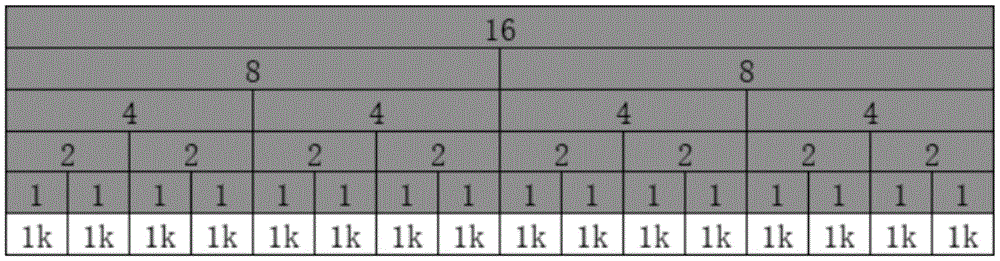
这种表达方式就变成了一颗完全二叉树。当需要申请空间时,首先要找到合适的维度。为此,就需要对申请的大小进行规范化,不能再申请任意的大小(只需要最终给出的大小大于等于申请的大小,就是满足客户方要求的),申请的大小必须是某一个维度上的单位值(比如上表的1,2,4, 8,16)。申请的时候从顶层维度查找,如果申请大小不相符则向下下级维度继续查询。查询到符合的维度后,在该维度上遍历,确认可以使用的区域。This expression becomes a complete binary tree. When you need to apply for space, you must first find the appropriate dimension. For this reason, it is necessary to standardize the size of the application, and it is not possible to apply for any size (only the final size given is greater than or equal to the size of the application, which is to meet the requirements of the client), and the size of the application must be in a certain dimension Unit value (such as 1, 2, 4, 8, 16 in the above table). When applying, search from the top-level dimension. If the application size does not match, continue querying to the lower-level dimension. After the matching dimension is found, traverse the dimension to confirm the usable area.
表8Table 8
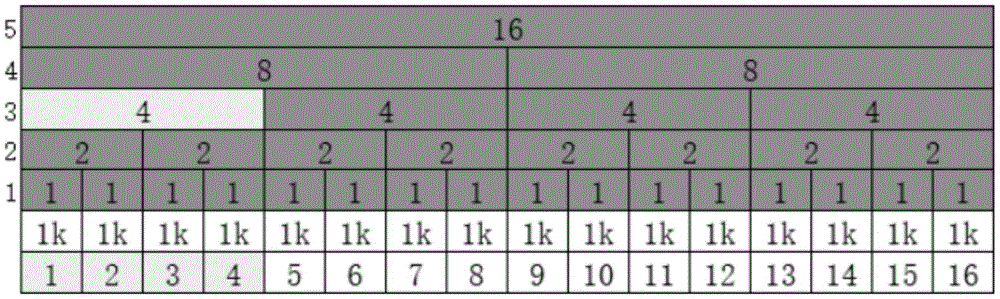
比如维度3上第一个区域被使用了,意味着其管理的内存空间的1,2, 3,4处于被使用状态。维度上的每一个区域都标记了当前管理区域可以分配的最大连续空间。仍然以表8为例,如果维度3的第一个区域被使用了,其可分配空间下降为0。此时其父节点,也就是维度4的第一个区域,显然无法继续分配大小为8的空间了。其能分配的空间为8-4=4。For example, if the first area on dimension 3 is used, it means that 1, 2, 3, and 4 of the memory space it manages are in use. Each area on the dimension marks the maximum contiguous space that can be allocated in the current management area. Still taking Table 8 as an example, if the first area of dimension 3 is used, its allocable space drops to 0. At this time, its parent node, that is, the first area of dimension 4, obviously cannot continue to allocate space with a size of 8. The space it can allocate is 8-4=4.
因此,当一个维度上的某个区域被分配后,应该向上更新父节点区域的可分配长度大小。父节点的可分配大小取决于2个子节点。当两个子节点都没有分配的情况下,父节点的可分配大小是2个子节点之和,或者说此时是初始值。如果两个子节点有一个分配后,父节点的可分配大小应该是2 个子节点中较大的那个值。Therefore, when an area in one dimension is allocated, the allocatable length of the parent node area should be updated upwards. The allocatable size of the parent node depends on the 2 child nodes. When neither child node is allocated, the allocatable size of the parent node is the sum of the two child nodes, or the initial value at this time. If two child nodes have an allocation, the allocatable size of the parent node should be the larger value of the two child nodes.
这个更新大小的动作应该不断向上执行,到达根节点。比如申请1k的空间,申请成功后,内存池应该如表9所示:This action of updating the size should be performed continuously upwards, reaching the root node. For example, to apply for 1k space, after the application is successful, the memory pool should be as shown in Table 9:
表9Table 9

如果此时要再申请2k的大小,内存池变化为如表10所示:If you want to apply for a size of 2k again at this time, the memory pool will change as shown in Table 10:
表10Table 10
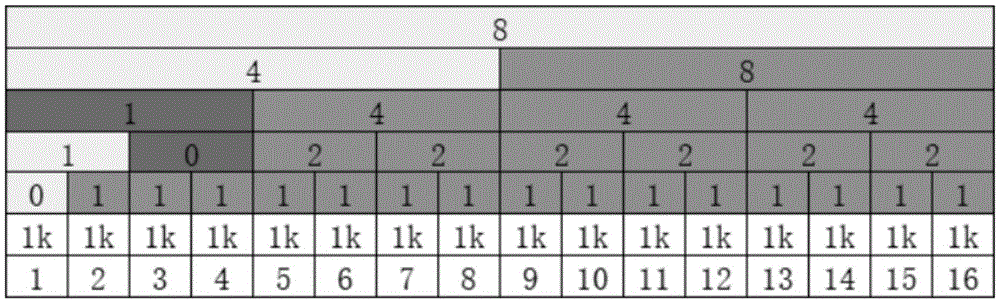
通过这种方式,即同时解决了确认是否可分配以及如何分配两个问题,In this way, the two problems of whether the confirmation can be allocated and how to allocate it are solved at the same time,
根据上面的过程,可以将对一块连续内存区域的分配算法描述如下:According to the above process, the allocation algorithm for a continuous memory area can be described as follows:
将一块连续的内存区域由2n个连续的单位空间构成;A continuous memory area is composed of 2 n continuous unit spaces;
采用完全二叉树管理2n个连续的单位空间,每一个单位空间对应一个叶子节点;节点的值代表该节点对应的内存区域内可以分配的连续空间长度,节点的初始值对应于其管理的区域大小;Use a complete binary tree to manage 2 n continuous unit spaces, each unit space corresponds to a leaf node; the value of the node represents the length of the continuous space that can be allocated in the memory area corresponding to the node, and the initial value of the node corresponds to the size of the area it manages ;
如果两个节点的值都是初始值,则父节点的值也是初始值,否则父节点的值是2个子节点的值中的较大者;If the values of both nodes are initial values, the value of the parent node is also the initial value, otherwise the value of the parent node is the larger of the values of the two child nodes;
在申请空间时,首先将申请大小规范化不小于其值的2n大小,称为规范大小;如果根节点的值小于规范大小,意味着无法分配;根节点的值大于等于规范大小,则存在可以分配的空间;When applying for space, first normalize the application size to a size not less than 2n of its value, called the normative size; if the value of the root node is less than the normative size, it means that it cannot be allocated; if the value of the root node is greater than or equal to the normative size, there is allocated space;
如果存在可以分配的空间,则从根节点开始向下寻找;If there is space that can be allocated, it will search downward from the root node;
如果当前节点的值大于或者等于规范大小,则继续从子节点中寻找直到到达规范大小对应的维度,该维度上找到的节点的值与规范大小相等的节点可用于分配空间;If the value of the current node is greater than or equal to the specification size, continue to search from the child nodes until the dimension corresponding to the specification size is reached, and the node whose value is equal to the specification size found on this dimension can be used to allocate space;
将分配节点的值更新为0,按照规则更新父节点的值,直到根节点为止。Update the value of the assigned node to 0, and update the value of the parent node according to the rules until the root node.
在具体的实现时,每个节点存储的值不是该节点管理的空间大小,而是该节点代表的子树能分配的最小深度(深度越小,意味着越靠近根节点)。节点管理内存大小是2h-n个内存单位,h是管理内存空间的二叉树的最大深度,n是该节点的深度。也就是说,节点的深度决定了其管理的内存大小。如果一个节点的值大于h,则意味着该节点没有空间可以再分配内存了。虽然换了一种表述方式,但是其本质是相同的,因此可以将其内存80 的分配流程通过如下流程表述:In a specific implementation, the value stored by each node is not the size of the space managed by the node, but the minimum depth that can be allocated to the subtree represented by the node (the smaller the depth, the closer to the root node). The node management memory size is 2 hn memory units, h is the maximum depth of the binary tree that manages the memory space, and n is the depth of the node. That is, the depth of a node determines the amount of memory it manages. If a node's value is greater than h, it means that the node has no room to allocate memory. Although it is expressed in a different way, its essence is the same, so the allocation process of its memory 80 can be expressed through the following process:
对于一块连续的内存区域由2n个连续的单位空间构成:For a contiguous memory area consisting of 2 n contiguous unit spaces:
采用完全二叉树管理2n个连续的单位空间,每一个单位空间对应一个叶子节点。A complete binary tree is used to manage 2n continuous unit spaces, and each unit space corresponds to a leaf node.
完全二叉树的高度为h,每一个节点管理的最大单位空间数量为2h-n,n为当前节点的深度。The height of the complete binary tree is h, and the maximum unit space managed by each node is 2h-n, where n is the depth of the current node.
节点的值代表该节点当前最大可以分配的空间所在的深度,也就是可以分配的最小深度。节点的初始值与节点的深度相同。The value of a node represents the depth at which the node's current maximum space can be allocated, that is, the minimum depth that can be allocated. The initial value of a node is the same as the depth of the node.
如果两个节点的值都是初始值,则父节点的值也是初始值,否则父节点的值是2个子节点的值中的较小者。If the values of both nodes are the initial value, then the value of the parent node is also the initial value, otherwise the value of the parent node is the smaller of the values of the 2 child nodes.
申请空间时,首先将申请大小规范化不小于其值的2d*单位空间(比如1k)大小,获取d值,称为规范大小。规范大小实际上就是所要分配合适空间大小的节点对应的深度。When applying for space, first normalize the application size to a size not less than 2 d * unit space (such as 1k) of its value, and obtain the d value, which is called the normalized size. The canonical size is actually the depth corresponding to the node to allocate the appropriate space size.
如果根节点的值小于规范大小,意味着可以分配。根节点的值大于等于规范大小,则意味着对应的深度已经分配完毕了,本次申请无法成功。如果存在可以分配的空间,则从根节点开始向下寻找直到到达对应的深度。寻找过程中,如果左子节点的值小于规范大小则尝试右子节点。If the value of the root node is less than the specification size, it means that it can be allocated. If the value of the root node is greater than or equal to the specification size, it means that the corresponding depth has been allocated, and this application cannot be successful. If there is space that can be allocated, it will search down from the root node until it reaches the corresponding depth. During the search, if the value of the left child is less than the canonical size, the right child is tried.
到达对应深度的节点即为可以分配的节点。将分配节点的值更新为 h+1,按照规则更新父节点的值,直到根节点为止。The nodes that reach the corresponding depth are the nodes that can be allocated. Update the value of the assigned node to h+1, and update the value of the parent node according to the rules until the root node.
请参阅图9,本发明第二实施例还提供了一种基于异步IO模型的网络编程方法,包括:Referring to FIG. 9, the second embodiment of the present invention also provides a network programming method based on the asynchronous IO model, including:
S201,接收待处理的原始数据;S201, receiving raw data to be processed;
S202,从所述通道层读取所述原始数据,并通过保存的多个处理器节点对所述原始数据进行操作;其中,所述多个处理器节点通过前向指针和后向指针首尾相连以形成责任链形式的链式处理模型,且每个处理器节点绑定有一个工作者线程,使得所述处理器节点的方法执行处于其绑定的工作者线程中。S202. Read the original data from the channel layer, and operate on the original data through a plurality of stored processor nodes; wherein, the plurality of processor nodes are connected end-to-end through forward pointers and backward pointers A chain processing model in the form of a chain of responsibility is formed, and each processor node is bound to a worker thread, so that the method execution of the processor node is in its bound worker thread.
以上所述仅为本发明的优选实施例而已,并不用于限制本发明,对于本领域的技术人员来说,本发明可以有各种更改和变化。凡在本发明的精神和原则之内,所作的任何修改、等同替换、改进等,均应包含在本发明的保护范围之内。The above descriptions are only preferred embodiments of the present invention, and are not intended to limit the present invention. For those skilled in the art, the present invention may have various modifications and changes. Any modifications, equivalent replacements, improvements, etc. made within the spirit and principles of the present invention shall be included within the protection scope of the present invention.
Claims (8)
Priority Applications (1)
| Application Number | Priority Date | Filing Date | Title |
|---|---|---|---|
| CN202011180057.6A CN112230901B (en) | 2020-10-29 | 2020-10-29 | A network programming framework system and method based on asynchronous IO model |
Applications Claiming Priority (1)
| Application Number | Priority Date | Filing Date | Title |
|---|---|---|---|
| CN202011180057.6A CN112230901B (en) | 2020-10-29 | 2020-10-29 | A network programming framework system and method based on asynchronous IO model |
Publications (2)
| Publication Number | Publication Date |
|---|---|
| CN112230901A CN112230901A (en) | 2021-01-15 |
| CN112230901B true CN112230901B (en) | 2023-06-20 |
Family
ID=74109809
Family Applications (1)
| Application Number | Title | Priority Date | Filing Date |
|---|---|---|---|
| CN202011180057.6A Active CN112230901B (en) | 2020-10-29 | 2020-10-29 | A network programming framework system and method based on asynchronous IO model |
Country Status (1)
| Country | Link |
|---|---|
| CN (1) | CN112230901B (en) |
Families Citing this family (3)
| Publication number | Priority date | Publication date | Assignee | Title |
|---|---|---|---|---|
| CN114442926A (en) * | 2021-12-21 | 2022-05-06 | 天津光电通信技术有限公司 | Optical signal data analysis and processing method based on PCIe data acquisition card |
| CN118259887B (en) * | 2024-03-27 | 2026-01-02 | 清华大学 | Stateful Programmable Data Plane System and Chip Based on Predictive Execution |
| CN118075059B (en) * | 2024-04-17 | 2024-07-12 | 杭州石原子科技有限公司 | Gateway execution method, device and equipment based on MySQL protocol |
Citations (3)
| Publication number | Priority date | Publication date | Assignee | Title |
|---|---|---|---|---|
| CN1542607A (en) * | 2003-04-21 | 2004-11-03 | �Ҵ���˾ | Simultaneous multithread processor and method for improving performance |
| CN102906706A (en) * | 2010-05-24 | 2013-01-30 | 索尼电脑娱乐公司 | Information processing device and information processing method |
| CN107980118A (en) * | 2015-06-10 | 2018-05-01 | 无比视视觉技术有限公司 | Multi-core processor devices using multithreading |
Family Cites Families (1)
| Publication number | Priority date | Publication date | Assignee | Title |
|---|---|---|---|---|
| US11556396B2 (en) * | 2015-05-08 | 2023-01-17 | Seth Lytle | Structure linked native query database management system and methods |
-
2020
- 2020-10-29 CN CN202011180057.6A patent/CN112230901B/en active Active
Patent Citations (3)
| Publication number | Priority date | Publication date | Assignee | Title |
|---|---|---|---|---|
| CN1542607A (en) * | 2003-04-21 | 2004-11-03 | �Ҵ���˾ | Simultaneous multithread processor and method for improving performance |
| CN102906706A (en) * | 2010-05-24 | 2013-01-30 | 索尼电脑娱乐公司 | Information processing device and information processing method |
| CN107980118A (en) * | 2015-06-10 | 2018-05-01 | 无比视视觉技术有限公司 | Multi-core processor devices using multithreading |
Also Published As
| Publication number | Publication date |
|---|---|
| CN112230901A (en) | 2021-01-15 |
Similar Documents
| Publication | Publication Date | Title |
|---|---|---|
| CN112230901B (en) | A network programming framework system and method based on asynchronous IO model | |
| US9176769B2 (en) | Partitioned array objects in a distributed runtime | |
| CN103473031B (en) | Collaborative concurrent type frog messaging bus, driving member composition model and component method for splitting | |
| WO2024119764A1 (en) | Task scheduling method and apparatus, electronic device, and storage medium | |
| CN102103497A (en) | Finite state machine actuating device and method, and method for establishing and using finite state machine | |
| CN101878472A (en) | Memory management | |
| CN110633135A (en) | Asynchronous task allocation method, device, computer equipment and storage medium | |
| CN110362301B (en) | A processing method of terminal application behavior reflection | |
| CN110362363A (en) | A method of model realization controls terminal applies when based on operation | |
| US9535678B2 (en) | Providing distributed array containers for programming objects | |
| CN116339968A (en) | A computing resource and cache resource scheduling method, device and system | |
| CN112346835B (en) | Scheduling processing method and system based on coroutine | |
| Swenson et al. | A new approach to zero-copy message passing with reversible memory allocation in multi-core architectures | |
| WO2025092876A1 (en) | Transaction processing method and blockchain node in blockchain system | |
| CN104331275B (en) | A kind of Java card and its method using patch installing | |
| CN111752551A (en) | A method, system, electronic device and storage medium for generating an instantiated object | |
| CN116107772A (en) | Multi-thread data processing method, device, processor and electronic equipment | |
| CN110347448A (en) | A method of the model when operation of construction terminal applies behavior | |
| CN115543613A (en) | Data processing method, device, electronic device and storage medium | |
| CN115858134B (en) | A multi-task resource control method and device for a solid state disk | |
| CN104182180B (en) | Low-energy EDF (earliest deadline first) real-time task scheduling method for mixed main memory embedded system | |
| CN100530139C (en) | System and method for updating references when incrementally compacting a heap | |
| WO2024098888A1 (en) | Model storage optimization method, and electronic device | |
| CN103473032B (en) | Independent driving member and driving member composition model and component method for splitting can be run | |
| CA2600504C (en) | Container-level transaction management system and method therefor |
Legal Events
| Date | Code | Title | Description |
|---|---|---|---|
| PB01 | Publication | ||
| PB01 | Publication | ||
| SE01 | Entry into force of request for substantive examination | ||
| SE01 | Entry into force of request for substantive examination | ||
| CB02 | Change of applicant information | ||
| CB02 | Change of applicant information |
Address after: 361000 one of 504, No. 18, guanri Road, phase II, software park, Xiamen, Fujian Applicant after: XIAMEN YILIANZHONG YIHUI TECHNOLOGY CO.,LTD. Address before: Room 504, No.18, guanri Road, phase II, software park, Xiamen City, Fujian Province, 361000 Applicant before: XIAMEN YILIANZHONG YIHUI TECHNOLOGY CO.,LTD. |
|
| GR01 | Patent grant | ||
| GR01 | Patent grant | ||
| CP03 | Change of name, title or address | ||
| CP03 | Change of name, title or address |
Address after: Unit 303-1, No. 16 Guanri Road, Phase II Software Park, Xiamen Torch High tech Zone, Xiamen City, Fujian Province 361000 Patentee after: Xiamen Tengyun Yihui Technology Co.,Ltd. Country or region after: China Address before: 504-1, No. 18 Guanri Road, Software Park Phase II, Xiamen City, Fujian Province Patentee before: XIAMEN YILIANZHONG YIHUI TECHNOLOGY CO.,LTD. Country or region before: China |