[go: up one dir, main page]

CN112224034B - Energy conversion device and vehicle - Google Patents

Energy conversion device and vehicle Download PDF

Info

Publication number
CN112224034B
CN112224034B CN201910582136.0A CN201910582136A CN112224034B CN 112224034 B CN112224034 B CN 112224034B CN 201910582136 A CN201910582136 A CN 201910582136A CN 112224034 B CN112224034 B CN 112224034B
Authority
CN
China
Prior art keywords
bridge arm
coil
motor
power supply
power
Prior art date
Legal status (The legal status is an assumption and is not a legal conclusion. Google has not performed a legal analysis and makes no representation as to the accuracy of the status listed.)
Active
Application number
CN201910582136.0A
Other languages
Chinese (zh)
Other versions
CN112224034A (en
Inventor
潘华
李吉成
黄日
牟利
陈冠辉
Current Assignee (The listed assignees may be inaccurate. Google has not performed a legal analysis and makes no representation or warranty as to the accuracy of the list.)
BYD Co Ltd
Original Assignee
BYD Co Ltd
Priority date (The priority date is an assumption and is not a legal conclusion. Google has not performed a legal analysis and makes no representation as to the accuracy of the date listed.)
Filing date
Publication date
Application filed by BYD Co Ltd filed Critical BYD Co Ltd
Priority to CN201910582136.0A priority Critical patent/CN112224034B/en
Publication of CN112224034A publication Critical patent/CN112224034A/en
Application granted granted Critical
Publication of CN112224034B publication Critical patent/CN112224034B/en
Active legal-status Critical Current
Anticipated expiration legal-status Critical

Links

Images

Classifications

    • BPERFORMING OPERATIONS; TRANSPORTING
    • B60VEHICLES IN GENERAL
    • B60LPROPULSION OF ELECTRICALLY-PROPELLED VEHICLES; SUPPLYING ELECTRIC POWER FOR AUXILIARY EQUIPMENT OF ELECTRICALLY-PROPELLED VEHICLES; ELECTRODYNAMIC BRAKE SYSTEMS FOR VEHICLES IN GENERAL; MAGNETIC SUSPENSION OR LEVITATION FOR VEHICLES; MONITORING OPERATING VARIABLES OF ELECTRICALLY-PROPELLED VEHICLES; ELECTRIC SAFETY DEVICES FOR ELECTRICALLY-PROPELLED VEHICLES
    • B60L15/00Methods, circuits, or devices for controlling the traction-motor speed of electrically-propelled vehicles
    • BPERFORMING OPERATIONS; TRANSPORTING
    • B60VEHICLES IN GENERAL
    • B60LPROPULSION OF ELECTRICALLY-PROPELLED VEHICLES; SUPPLYING ELECTRIC POWER FOR AUXILIARY EQUIPMENT OF ELECTRICALLY-PROPELLED VEHICLES; ELECTRODYNAMIC BRAKE SYSTEMS FOR VEHICLES IN GENERAL; MAGNETIC SUSPENSION OR LEVITATION FOR VEHICLES; MONITORING OPERATING VARIABLES OF ELECTRICALLY-PROPELLED VEHICLES; ELECTRIC SAFETY DEVICES FOR ELECTRICALLY-PROPELLED VEHICLES
    • B60L58/00Methods or circuit arrangements for monitoring or controlling batteries or fuel cells, specially adapted for electric vehicles
    • B60L58/10Methods or circuit arrangements for monitoring or controlling batteries or fuel cells, specially adapted for electric vehicles for monitoring or controlling batteries
    • BPERFORMING OPERATIONS; TRANSPORTING
    • B60VEHICLES IN GENERAL
    • B60LPROPULSION OF ELECTRICALLY-PROPELLED VEHICLES; SUPPLYING ELECTRIC POWER FOR AUXILIARY EQUIPMENT OF ELECTRICALLY-PROPELLED VEHICLES; ELECTRODYNAMIC BRAKE SYSTEMS FOR VEHICLES IN GENERAL; MAGNETIC SUSPENSION OR LEVITATION FOR VEHICLES; MONITORING OPERATING VARIABLES OF ELECTRICALLY-PROPELLED VEHICLES; ELECTRIC SAFETY DEVICES FOR ELECTRICALLY-PROPELLED VEHICLES
    • B60L58/00Methods or circuit arrangements for monitoring or controlling batteries or fuel cells, specially adapted for electric vehicles
    • B60L58/10Methods or circuit arrangements for monitoring or controlling batteries or fuel cells, specially adapted for electric vehicles for monitoring or controlling batteries
    • B60L58/24Methods or circuit arrangements for monitoring or controlling batteries or fuel cells, specially adapted for electric vehicles for monitoring or controlling batteries for controlling the temperature of batteries
    • B60L58/27Methods or circuit arrangements for monitoring or controlling batteries or fuel cells, specially adapted for electric vehicles for monitoring or controlling batteries for controlling the temperature of batteries by heating
    • YGENERAL TAGGING OF NEW TECHNOLOGICAL DEVELOPMENTS; GENERAL TAGGING OF CROSS-SECTIONAL TECHNOLOGIES SPANNING OVER SEVERAL SECTIONS OF THE IPC; TECHNICAL SUBJECTS COVERED BY FORMER USPC CROSS-REFERENCE ART COLLECTIONS [XRACs] AND DIGESTS
    • Y02TECHNOLOGIES OR APPLICATIONS FOR MITIGATION OR ADAPTATION AGAINST CLIMATE CHANGE
    • Y02TCLIMATE CHANGE MITIGATION TECHNOLOGIES RELATED TO TRANSPORTATION
    • Y02T10/00Road transport of goods or passengers
    • Y02T10/60Other road transportation technologies with climate change mitigation effect
    • Y02T10/70Energy storage systems for electromobility, e.g. batteries

Landscapes

  • Engineering & Computer Science (AREA)
  • Power Engineering (AREA)
  • Transportation (AREA)
  • Mechanical Engineering (AREA)
  • Life Sciences & Earth Sciences (AREA)
  • Sustainable Development (AREA)
  • Sustainable Energy (AREA)
  • Electric Propulsion And Braking For Vehicles (AREA)
  • Inverter Devices (AREA)

Abstract

本申请提出一种能量转换装置及车辆,能量转换装置包括电机的电机线圈、桥臂变换器、与桥臂变换器并联的母线电容和与桥臂变换器连接的控制器,控制器根据电机的驱动功率和电机线圈的加热功率,控制桥臂变换器使与外部充放电口连接的外部电源或者外部的电池的电能流向驱动和加热电路,且调节驱动和加热电路的电流,使外部电源或者外部的电池驱动所述电机工作的同时使电机线圈进行耗电产生热量,本申请仅需要控制桥臂变换器进而调节外部电源或者外部的电池流向驱动和加热电路的电流,即可实现使外部电源或者外部的电池驱动电机工作的同时使电机线圈进行耗电产生热量,解决现有技术存在电机控制系统总体结构复杂、集成度低、体积大且成本高的问题。

Figure 201910582136

The application proposes an energy conversion device and a vehicle. The energy conversion device includes a motor coil of a motor, a bridge arm converter, a bus capacitor connected in parallel with the bridge arm converter, and a controller connected to the bridge arm converter. The driving power and the heating power of the motor coil, control the bridge arm converter to make the external power supply connected with the external charging and discharging port or the electric energy of the external battery flow to the driving and heating circuit, and adjust the current of the driving and heating circuit, so that the external power supply or external When the battery drives the motor to work, the motor coil consumes power and generates heat. The application only needs to control the bridge arm converter to adjust the current flowing from the external power supply or the external battery to the driving and heating circuit, so that the external power supply or the heating circuit can be realized. When the external battery-driven motor works, the motor coil consumes electricity and generates heat, which solves the problems of the prior art that the overall structure of the motor control system is complex, the integration is low, the volume is large and the cost is high.

Figure 201910582136

Description

能量转换装置及车辆Energy conversion device and vehicle

技术领域technical field

本申请涉及车辆技术领域,尤其涉及一种能量转换装置及车辆。The present application relates to the technical field of vehicles, and in particular, to an energy conversion device and a vehicle.

背景技术Background technique

近些年来,随着电动汽车技术的不断发展,市场对电动汽车的接受程度不断提升,而电池充电和电机驱动作为电动汽车中的核心技术,得到了广泛关注。目前,市场上现有的电动汽车中的电池加热电路和电机驱动电路是分开的,加热电路用于给电动汽车的电池进行加热,电机驱动电路用于驱动电动汽车的电机,两种电路互不干涉,相互独立。In recent years, with the continuous development of electric vehicle technology, the market's acceptance of electric vehicles has been continuously improved, and battery charging and motor drive, as the core technologies in electric vehicles, have received extensive attention. At present, the battery heating circuit and the motor driving circuit in the existing electric vehicles on the market are separated. The heating circuit is used to heat the battery of the electric vehicle, and the motor driving circuit is used to drive the motor of the electric vehicle. The two circuits are different from each other. interference, independent of each other.

然而,虽然分别采用两种电路能够完成电动汽车的加热和电机驱动过程,但是由于上述方法中的两种电路互不干涉,相互独立,导致包括加热电路和电机驱动电路的控制电路结构复杂,集成度低,体积大且成本高。However, although two circuits can be used to complete the heating and motor driving process of the electric vehicle, the two circuits in the above method do not interfere with each other and are independent of each other, resulting in a complex structure of the control circuit including the heating circuit and the motor driving circuit, and the integration Low temperature, large volume and high cost.

综上所述,现有技术存在电机控制系统总体电路结构复杂、集成度低、体积大且成本高的问题。To sum up, the prior art has the problems that the overall circuit structure of the motor control system is complex, the integration is low, the volume is large, and the cost is high.

发明内容SUMMARY OF THE INVENTION

本申请的目的在于提供一种能量转换装置及车辆,旨在解决现有技术存在电机驱动与充电系统总体结构复杂、集成度低、体积大且成本高的问题。The purpose of the present application is to provide an energy conversion device and a vehicle to solve the problems in the prior art that the motor drive and charging system has complex overall structure, low integration, large volume and high cost.

本申请是这样实现的,本申请第一方面提供一种能量转换装置,包括电机的电机线圈、桥臂变换器、与所述桥臂变换器并联的母线电容和与所述桥臂变换器连接的控制器;The present application is implemented in this way. A first aspect of the present application provides an energy conversion device, which includes a motor coil of a motor, a bridge arm converter, a bus capacitor connected in parallel with the bridge arm converter, and a connection to the bridge arm converter. the controller;

所述桥臂变换器与所述电机线圈连接;the bridge arm converter is connected to the motor coil;

所述电机线圈、所述母线电容以及所述桥臂变换器均与外部充放电口连接,所述母线电容与外部的电池并联连接;The motor coil, the bus capacitor and the bridge arm converter are all connected to an external charging and discharging port, and the bus capacitor is connected in parallel with an external battery;

所述外部充放电口、所述电机线圈、所述桥臂变换器、所述母线电容及所述电池形成驱动和加热电路;The external charging and discharging port, the motor coil, the bridge arm converter, the bus capacitor and the battery form a driving and heating circuit;

所述控制器在所述能量转换装置通过所述外部充放电口连接外部电源时,根据所述电机的待驱动功率和所述外部的电池的待充电功率,控制所述桥臂变换器使所述外部电源的电能流向所述驱动和加热电路,且调节所述驱动和加热电路的电流,使所述电机输出驱动功率的同时并使所述电机线圈进行耗电产生热量。When the energy conversion device is connected to an external power source through the external charging/discharging port, the controller controls the bridge arm converter to make all the electric motors according to the power to be driven of the motor and the power to be charged of the external battery. The electric energy of the external power source flows to the driving and heating circuits, and the currents of the driving and heating circuits are adjusted, so that the motor outputs driving power and at the same time causes the motor coils to consume electricity to generate heat.

本申请第二方面提供一种能量转换装置,所述能量转换装置包括:A second aspect of the present application provides an energy conversion device, the energy conversion device comprising:

电机;motor;

车载充电模块,包括充电连接端组,所述充电连接端组包括第一充电连接端和第二充电连接端;a vehicle-mounted charging module, including a charging connection terminal group, the charging connection terminal group including a first charging connection terminal and a second charging connection terminal;

电机控制模块,包括桥臂变换器,所述桥臂变换器连接所述电机的电机线圈;a motor control module, including a bridge arm converter, the bridge arm converter is connected to the motor coil of the motor;

能量储存模块,包括并联连接的母线电容和能量存储连接端组,所述母线电容与所述桥臂变换器并联连接,所述能量存储连接端组包括第一能量存储连接端、第二能量存储连接端;An energy storage module, comprising a bus capacitor connected in parallel and an energy storage connection terminal group, the bus capacitor is connected in parallel with the bridge arm converter, and the energy storage connection terminal group includes a first energy storage connection terminal, a second energy storage connection terminal connection end;

控制器,其连接所述桥臂变换器;a controller, which is connected to the bridge arm converter;

所述电机线圈、所述桥臂变换器及所述母线电容形成驱动和加热电路;The motor coil, the bridge arm converter and the bus capacitor form a driving and heating circuit;

所述控制器根据所述电机的待驱动功率和所述外部的电池的待充电功率,控制所述桥臂变换器使外部的电能流向所述驱动和加热电路,且调节所述驱动和加热电路的电流,使所述电机输出驱动功率的同时使所述电机线圈进行主动耗电产热来加热电池。The controller controls the bridge arm converter to make external electric energy flow to the driving and heating circuit according to the to-be-driven power of the motor and the to-be-charged power of the external battery, and adjusts the driving and heating circuit The electric current makes the motor output driving power and at the same time make the motor coils actively consume electricity and generate heat to heat the battery.

本申请第三方面提供一种车辆,所述车辆还包括第一方面提供的所述能量转换装置或者第二方面提供的所述能量转换装置。A third aspect of the present application provides a vehicle, the vehicle further comprising the energy conversion device provided in the first aspect or the energy conversion device provided in the second aspect.

本申请提出了一种能量转换装置及车辆,能量转换装置包括电机的电机线圈、桥臂变换器、与桥臂变换器并联的母线电容和与桥臂变换器连接的控制器,电机线圈、桥臂变换器、母线电容形成驱动和加热电路,控制器在能量转换装置连接至外部电源时,电机的待驱动功率和电机线圈的待加热功率控制桥臂变换器使外部电源的电能流向驱动和加热电路,且调节驱动和加热电路的电流,使外部电源驱动电机输出驱动功率的同时对电池进行充电,本申请通过在能量转换装置中设置电机线圈、桥臂变换器以及母线电容并形成驱动和加热电路,仅需要控制桥臂变换器进而调节外部电源流向驱动和加热电路的电流,即可实现使外部电源驱动电机输出驱动功率的同时使所述电机线圈进行耗电产生热量,进而实现采用同一系统进行车辆的电机驱动和电池充电,元器件复用程度高,系统集成度高且结构简单,从而降低了系统成本,减小了系统体积,解决了现有的电机控制系统总体结构复杂、集成度低、体积大且成本高的问题。This application proposes an energy conversion device and a vehicle. The energy conversion device includes a motor coil of a motor, a bridge arm converter, a bus capacitor connected in parallel with the bridge arm converter, and a controller connected to the bridge arm converter. The arm converter and the bus capacitor form the drive and heating circuit. When the energy conversion device is connected to the external power supply, the controller controls the power to be driven of the motor and the power to be heated of the motor coil to control the bridge arm converter to make the electric energy of the external power flow to drive and heat circuit, and adjust the current of the driving and heating circuits, so that the external power supply drives the motor to output the driving power while charging the battery. In the present application, the motor coil, the bridge arm converter and the bus capacitor are arranged in the energy conversion device to form the driving and heating. It only needs to control the bridge arm converter and adjust the current flowing from the external power supply to the driving and heating circuits, so that the external power supply can drive the motor to output the driving power and at the same time make the motor coil consume power and generate heat, so as to realize the use of the same system. It is used to drive the motor of the vehicle and charge the battery, with a high degree of component reuse, a high degree of system integration and a simple structure, thereby reducing the system cost, reducing the system volume, and solving the overall complex structure and integration degree of the existing motor control system. low, bulky and costly.

附图说明Description of drawings

为了更清楚地说明本申请实施例中的技术方案,下面将对实施例或现有技术描述中所需要使用的附图作简单地介绍,显而易见地,下面描述中的附图仅仅是本申请的一些实施例,对于本领域普通技术人员来讲,在不付出创造性劳动性的前提下,还可以根据这些附图获得其他的附图。In order to illustrate the technical solutions in the embodiments of the present application more clearly, the following briefly introduces the accompanying drawings that need to be used in the description of the embodiments or the prior art. Obviously, the drawings in the following description are only for the present application. In some embodiments, for those of ordinary skill in the art, other drawings can also be obtained according to these drawings without any creative effort.

图1是本申请实施例一提供的一种能量转换装置的结构示意图;1 is a schematic structural diagram of an energy conversion device provided in Embodiment 1 of the present application;

图2是本申请实施例一提供的一种能量转换装置的电路图;2 is a circuit diagram of an energy conversion device provided in Embodiment 1 of the present application;

图3是本申请实施例一提供的一种能量转换装置的另一电路图;3 is another circuit diagram of an energy conversion device provided in Embodiment 1 of the present application;

图4是本申请实施例一提供的一种能量转换装置的另一结构示意图;4 is another schematic structural diagram of an energy conversion device provided in Embodiment 1 of the present application;

图5是本申请实施例一提供的一种能量转换装置的驱动和加热电路的电流波形图;5 is a current waveform diagram of a driving and heating circuit of an energy conversion device provided in Embodiment 1 of the present application;

图6是本申请实施例一提供的一种能量转换装置的另一结构示意图;6 is another schematic structural diagram of an energy conversion device provided in Embodiment 1 of the present application;

图7是本申请实施例一提供的一种能量转换装置的直流供电的电流流向图;7 is a current flow diagram of a DC power supply of an energy conversion device provided in Embodiment 1 of the present application;

图8是本申请实施例一提供的一种能量转换装置的直流供电的另一电流流向图;8 is another current flow diagram of the DC power supply of an energy conversion device provided in Embodiment 1 of the present application;

图9是本申请实施例一提供的一种能量转换装置的直流供电的另一电流流向图;9 is another current flow diagram of the DC power supply of an energy conversion device provided in Embodiment 1 of the present application;

图10是本申请实施例一提供的一种能量转换装置的直流供电的另一电流流向图;10 is another current flow diagram of the DC power supply of an energy conversion device provided in Embodiment 1 of the present application;

图11是本申请实施例一提供的一种能量转换装置的交流供电的电流流向图;11 is a current flow diagram of an AC power supply of an energy conversion device provided in Embodiment 1 of the present application;

图12是本申请实施例一提供的一种能量转换装置的交流供电的另一电流流向图;12 is another current flow diagram of the AC power supply of an energy conversion device provided in Embodiment 1 of the present application;

图13是本申请实施例一提供的一种能量转换装置的交流供电的另一电流流向图;13 is another current flow diagram of an AC power supply of an energy conversion device provided in Embodiment 1 of the present application;

图14是本申请实施例一提供的一种能量转换装置的交流供电的另一电流流向图;14 is another current flow diagram of the AC power supply of an energy conversion device provided in Embodiment 1 of the present application;

图15是本申请实施例一提供的一种能量转换装置的电池供电的另一电流流向图;FIG. 15 is another current flow diagram of a battery-powered energy conversion device provided in Embodiment 1 of the present application;

图16是本申请实施例一提供的一种能量转换装置的电池供电的另一电流流向图;FIG. 16 is another current flow diagram of a battery-powered energy conversion device provided in Embodiment 1 of the present application;

图17是本申请实施例一提供的一种能量转换装置的电池供电的另一电流流向图;FIG. 17 is another current flow diagram of a battery-powered energy conversion device provided in Embodiment 1 of the present application;

图18是本申请实施例一提供的一种能量转换装置的电池供电的另一电流流向图;FIG. 18 is another current flow diagram of a battery-powered energy conversion device provided in Embodiment 1 of the present application;

图19是本申请实施例二提供的一种能量转换装置的结构示意图;19 is a schematic structural diagram of an energy conversion device provided in Embodiment 2 of the present application;

图20是本申请实施例三提供的一种车辆的结构示意图。FIG. 20 is a schematic structural diagram of a vehicle according to Embodiment 3 of the present application.

具体实施方式Detailed ways

为了使本申请的目的、技术方案及优点更加清楚明白,以下结合附图及实施例,对本申请进行进一步详细说明。应当理解,此处所描述的具体实施例仅仅用以解释本申请,并不用于限定本申请。In order to make the purpose, technical solutions and advantages of the present application more clearly understood, the present application will be described in further detail below with reference to the accompanying drawings and embodiments. It should be understood that the specific embodiments described herein are only used to explain the present application, but not to limit the present application.

为了说明本申请的技术方案,下面通过具体实施例来进行说明。In order to illustrate the technical solutions of the present application, the following specific embodiments are used for description.

本申请实施例一提供一种能量转换装置,如图1所示,包括电机101的电机线圈、桥臂变换器102、与桥臂变换器102并联的母线电容103和与桥臂变换器102连接的控制器104;Embodiment 1 of the present application provides an energy conversion device. As shown in FIG. 1 , it includes a motor coil of a motor 101 , a bridge arm converter 102 , a bus capacitor 103 connected in parallel with the bridge arm converter 102 and connected to the bridge arm converter 102 . the controller 104;

桥臂变换器102与电机线圈连接;The bridge arm converter 102 is connected to the motor coil;

电机线圈、母线电容103以及桥臂变换器102均与外部充放电口106连接,母线电容103与外部的电池105并联连接;The motor coil, the bus capacitor 103 and the bridge arm converter 102 are all connected to the external charging and discharging port 106, and the bus capacitor 103 is connected in parallel with the external battery 105;

电机线圈、桥臂变换器102、母线电容103及形成驱动和加热电路;Motor coil, bridge arm converter 102, bus capacitor 103 and forming driving and heating circuits;

控制器104根据电机的待驱动功率和电机线圈的待加热功率,控制桥臂变换器102使外部电源的电能流向驱动和加热电路,且调节驱动和加热电路的电流,使外部电源驱动电机输出驱动功率的同时使电机线圈进行耗电产生热量。According to the to-be-driven power of the motor and the to-be-heated power of the motor coil, the controller 104 controls the bridge arm converter 102 to make the electric energy of the external power source flow to the driving and heating circuits, and adjusts the currents of the driving and heating circuits, so that the external power source drives the motor output to drive the At the same time, the motor coils consume electricity and generate heat.

其中,电机101可以是同步电机(含无刷同步电机)或者异步电机,电机101的相数大于等于3(如三相电机、五相电机、六相电机、九相电机、十五相电机等等),且电机线圈的连接点形成极点引出中性线与外部电源连接,电机极点数量是极数的公约数,具体电机的极点数量取决于电机内部绕组并联结构,引出中性线的数量以及中性线在电机内部的并联极点数量由实际方案的使用情况确定;桥臂变换器102包括多相并联的桥臂,桥臂变换器102中桥臂的数量根据电机的相数进行配置,每相桥臂包括两个功率开关单元,功率开关单元可以是晶体管、IGBT、MOSFEET管、SIC管等器件类型,桥臂中两个功率开关单元的连接点连接电机中的一相线圈,桥臂变换器102中的功率开关单元可以根据控制器104的控制信号实现导通和关闭;外部电源可以是提供直流电的供电设备,供电设备可以是直流充电桩提供的直流电,也可以是单相、三相交流充电桩经过整流后输出的直流电,也可以是燃料电池发出的电能,也可以是增程器如发动机转动带动发电机发电,经发桥臂变换器整流后的直流电等电源形式。The motor 101 may be a synchronous motor (including a brushless synchronous motor) or an asynchronous motor, and the number of phases of the motor 101 is greater than or equal to 3 (such as a three-phase motor, a five-phase motor, a six-phase motor, a nine-phase motor, a fifteen-phase motor, etc. etc.), and the connection points of the motor coils form poles and lead out the neutral line to connect with the external power supply. The number of motor poles is the common divisor of the number of poles. The number of parallel poles of the neutral line inside the motor is determined by the use of the actual solution; the bridge arm converter 102 includes multi-phase parallel bridge arms, and the number of bridge arms in the bridge arm converter 102 is configured according to the number of phases of the motor. The phase bridge arm includes two power switch units. The power switch units can be transistors, IGBTs, MOSFET tubes, SIC tubes and other device types. The connection point of the two power switch units in the bridge arm is connected to a phase coil in the motor, and the bridge arm changes. The power switch unit in the controller 102 can be turned on and off according to the control signal of the controller 104; the external power supply can be a power supply device that provides DC power, and the power supply device can be DC power provided by a DC charging pile, or single-phase or three-phase power. The DC power output by the AC charging pile after rectification can also be the electric energy generated by the fuel cell, or the range extender, such as the rotation of the engine to drive the generator to generate electricity, and the DC power rectified by the bridge arm converter.

其中,控制器104根据电机101的待驱动功率和电机线圈的待加热功率,控制桥臂变换器102使外部电源或者外部的电池105的电能流向驱动和加热电路,是指根据电机的目标驱动功率和电机的当前驱动功率获取电机的待驱动功率,并根据电机线圈的待加热功率,待加热功率可以通过整车控制器检测待加热部件的温度所获取的功率,例如,待加热部件可以为充电电池,根据电池当前的温度计算需求加热功率,根据待驱动功率和待加热功率通过调节桥臂变换器102中不同功率开关导通或者关断以及导通的时间,进而调节流经电机线圈的电流大小及方向,电机线圈的电流方向为流入电机中每相线圈的方向或者电机中每相线圈流出的方向,电机线圈的电流大小是指流入电机中每相线圈的大小或者从电机中每相线圈流出的电流的大小,例如,从与桥臂变换器102中的A相桥臂连接的电机线圈流入,从与桥臂变换器102中的B相和C相桥臂连接的电机线圈流出电机101,由于通过调节电机101中每相线圈的电流大小和方向可以调节电机101扭矩输出,并且流经电机101的电流大小的和等于电机101的每相线圈的连接点的输入电流,该输入电流可以用于调节加热功率,通过调节电机101的每相线圈的电流大小及方向,可以同时控制外部电源驱动电机101的输出扭矩和使电机线圈进行耗电产生热量。The controller 104 controls the bridge arm converter 102 to make the electric energy of the external power supply or the external battery 105 flow to the driving and heating circuit according to the power to be driven of the motor 101 and the power to be heated of the motor coil, which means that according to the target driving power of the motor and the current driving power of the motor to obtain the to-be-driven power of the motor, and according to the to-be-heated power of the motor coil, the to-be-heated power can be obtained by detecting the temperature of the part to be heated through the vehicle controller. For example, the part to be heated can be used for charging The battery calculates the required heating power according to the current temperature of the battery, and adjusts the on or off and on time of different power switches in the bridge arm converter 102 according to the power to be driven and the power to be heated, thereby adjusting the current flowing through the motor coil. Size and direction, the current direction of the motor coil is the direction of flowing into each phase coil in the motor or the direction of each phase coil in the motor flowing out, the current size of the motor coil refers to the size of each phase coil flowing into the motor or from each phase coil in the motor. The magnitude of the outgoing current, for example, flows from the motor coil connected to the A-phase arm of the arm inverter 102 and flows out of the motor 101 from the motor coil connected to the B-phase and C-phase arms of the arm inverter 102 , since the torque output of the motor 101 can be adjusted by adjusting the magnitude and direction of the current of each phase coil in the motor 101, and the sum of the magnitude of the current flowing through the motor 101 is equal to the input current of the connection point of each phase coil of the motor 101, the input current can be It is used to adjust the heating power. By adjusting the current size and direction of each phase coil of the motor 101 , the output torque of the external power source to drive the motor 101 and the motor coil to consume electricity to generate heat can be controlled at the same time.

本申请实施例一种能量转换装置的技术效果在于:通过在能量转换装置中设置电机线圈、桥臂变换器以及母线电容形成驱动和加热电路,仅需要控制桥臂变换器的工作状态进而调节外部电源或者外部的电池流向驱动和加热电路的电流,即可实现使外部电源或者外部的电池驱动电机输出驱动功率的同时使电机线圈进行耗电产生热量,进而实现采用同一系统进行车辆的电机驱动和电机线圈进行耗电产生热量,元器件复用程度高,系统集成度高且结构简单,从而降低了系统成本,减小了系统体积,解决了现有的电机控制系统总体结构复杂、集成度低、体积大且成本高的问题。The technical effect of the energy conversion device according to the embodiment of the present application is that: by arranging the motor coil, the bridge arm converter and the bus capacitor in the energy conversion device to form a driving and heating circuit, it is only necessary to control the working state of the bridge arm converter and then adjust the external The current flowing from the power supply or the external battery to the driving and heating circuit can realize the output of the driving power from the external power supply or the external battery-driven motor, and at the same time, the motor coil consumes electricity and generates heat, and then realizes the use of the same system for the vehicle's motor drive and heating. The motor coil consumes electricity to generate heat, the component reuse degree is high, the system integration degree is high, and the structure is simple, thereby reducing the system cost, reducing the system volume, and solving the existing motor control system. The overall structure is complex and the integration degree is low. , the problem of large size and high cost.

作为一种实施方式,电机包括x套绕组,其中,x≥1,且x为整数,第x套绕组的相数为mx相,第x套绕组中的每一相绕组包括nx个线圈支路,每一相绕组的nx个线圈支路共接形成一个相端点,第x套绕组中的每一相绕组的nx个线圈支路中的一个线圈支路还分别与其他相绕组中的nx个线圈支路中的一个线圈支路连接,以形成nx个连接点,其中,nx≥1,mx≥2,且mx,nx为整数;As an embodiment, the motor includes x sets of windings, wherein x≥1, and x is an integer, the number of phases of the xth set of windings is m x phases, and each phase winding in the xth set of windings includes n x coils Branch, the n x coil branches of each phase winding are connected together to form a phase terminal, and one coil branch in the n x coil branches of each phase winding in the xth set of windings is also connected with other phase windings respectively. One of the n x coil branches in is connected to form n x connection points, where n x ≥ 1, m x ≥ 2, and m x , n x are integers;

x套绕组共形成

Figure BDA0002113429790000041
个连接点,
Figure BDA0002113429790000042
个连接点形成T个中性点,T个中性点引出N条中性线,其中:x sets of windings are formed
Figure BDA0002113429790000041
connection point,
Figure BDA0002113429790000042
The connection points form T neutral points, and the T neutral points lead to N neutral lines, where:

x≥1,mx≥2,T的范围:

Figure BDA0002113429790000043
N的范围:T≥N≥1,且T、N均为整数。x≥1, m x ≥2, range of T:
Figure BDA0002113429790000043
The range of N: T≥N≥1, and both T and N are integers.

电机101与桥臂变换器102形成的电机控制器连接,桥臂变换器102包括K组Mx路桥臂,K组Mx路桥臂中每路桥臂的第一端和第二端分别共接,一组Mx路桥臂中至少一路桥臂的中点与一套mx相绕组中的相端点一一对应连接,其中,Mx≥mx,K≥x,且K、Mx均为整数。The motor 101 is connected to a motor controller formed by a bridge arm converter 102. The bridge arm converter 102 includes K groups of M x road bridge arms, and the first end and the second end of each bridge arm in the K group M x road bridge arms are respectively connected in common, The midpoint of at least one bridge arm in a set of M x bridge arms is connected to the phase end points of a set of m x phase windings in a one-to-one correspondence, where M x ≥ m x , K ≥ x, and K and M x are both integers .

其中,如图2所示,当K=1,x=1,m1=M1=3时,桥臂变换器102包括三路桥臂,电机101包括三相绕组,每相绕组包括一相线圈支路,每相绕组与一路桥臂的中点对应连接,三相绕组形成一个连接点,该连接点为中性点,该中性点引出的中性线与外部充放电口106连接,三路桥臂中的每路桥臂的两端分别共接形成第一汇流端和第二汇流端,第一汇流端和第二汇流端之间并联母线电容C1,母线电容C1的第一端连接开关K1的第一端和开关K2的第一端,母线电容C1的第二端连接开关K3的第一端,开关K2的第二端连接电阻R的第一端,开关K1的第二端连接电阻R的第二端以及电池105的正极端,开关K3的第二端连接电池105的负极端。Wherein, as shown in FIG. 2 , when K=1, x=1, m 1 =M 1 =3, the bridge arm converter 102 includes three bridge arms, the motor 101 includes three-phase windings, and each phase winding includes a phase coil In the branch circuit, each phase winding is correspondingly connected with the midpoint of one bridge arm, and the three-phase winding forms a connection point, which is the neutral point. The two ends of each bridge arm of the road bridge arm are respectively connected to form a first bus terminal and a second bus terminal, the bus capacitor C1 is connected in parallel between the first bus terminal and the second bus terminal, and the first end of the bus capacitor C1 is connected to the switch K1 The first end of the switch K2 and the first end of the switch K2, the second end of the bus capacitor C1 is connected to the first end of the switch K3, the second end of the switch K2 is connected to the first end of the resistor R, and the second end of the switch K1 is connected to the resistor R. The second terminal of the switch K3 is connected to the positive terminal of the battery 105 , and the second terminal of the switch K3 is connected to the negative terminal of the battery 105 .

其中,如图3所示,当K=1,x=2,m1=3,M1=6时,桥臂变换器102包括六路桥臂,电机包括2套三相绕组,每套三相绕组中的每相绕组包括1相线圈支路,每相绕组与一路桥臂的中点对应连接,每套三相绕组形成一个连接点,2套三相绕组的2个连接点共接形成中性点,该中性点引出中性线与外部充放电口106连接,三路桥臂中的每路桥臂的两端分别共接形成第一汇流端和第二汇流端,第一汇流端和第二汇流端之间并联母线电容C1,母线电容C1的第一端连接开关K1的第一端和开关K2的第一端,母线电容C1的第二端连接开关K3的第一端,开关K2的第二端连接电阻R的第一端,开关K1的第二端连接电阻R的第二端以及电池105的正极端,开关K3的第二端连接电池105的负极端。Wherein, as shown in FIG. 3 , when K=1, x=2, m 1 =3, M 1 =6, the bridge arm converter 102 includes six bridge arms, and the motor includes two sets of three-phase windings, each set of three-phase windings. Each phase winding in the winding includes 1-phase coil branch, each phase winding is correspondingly connected to the midpoint of one bridge arm, each set of three-phase windings forms a connection point, and the 2 connection points of 2 sets of three-phase windings are connected together to form The neutral point leads out the neutral line and is connected to the external charging and discharging port 106. The two ends of each bridge arm of the three bridge arms are respectively connected to form a first confluence end and a second confluence end. The first confluence end and the third The bus capacitor C1 is connected in parallel between the two bus terminals. The first end of the bus capacitor C1 is connected to the first end of the switch K1 and the first end of the switch K2. The second end of the bus capacitor C1 is connected to the first end of the switch K3. The second terminal is connected to the first terminal of the resistor R, the second terminal of the switch K1 is connected to the second terminal of the resistor R and the positive terminal of the battery 105 , and the second terminal of the switch K3 is connected to the negative terminal of the battery 105 .

本实施方式,通过设置电机绕组的相数和桥臂变换器的桥臂数量,使电机绕组并联数量不同的连接点形成的中性点引出中性线,进而使电机等效相电感不同,并使电机的中性点中通电流的能力不同,根据感量的需求,选择合适数量的连接点并联形成中性点引出中性线,得到需求的电感,满足待加热功率和待驱动功率。In this embodiment, by setting the number of phases of the motor windings and the number of bridge arms of the bridge arm converter, the neutral point formed by the connection points of the motor windings with different numbers in parallel leads out the neutral line, so that the equivalent phase inductance of the motor is different, and the Make the motor's neutral point have different ability to pass current. According to the demand of inductance, select an appropriate number of connection points in parallel to form the neutral point to lead out the neutral line, and obtain the required inductance to meet the power to be heated and the power to be driven.

作为一种实施方式,控制器104根据电机101的待驱动功率和电机线圈的待加热功率获取桥臂变换器102的导通时刻和时长,并根据导通时刻和时长调节驱动和加热电路的电流。As an embodiment, the controller 104 obtains the conduction time and duration of the bridge arm converter 102 according to the power to be driven of the motor 101 and the power to be heated of the motor coil, and adjusts the currents of the driving and heating circuits according to the conduction time and duration .

其中,作为一种实施方式,如图2所示,以三相电机为例,获取降压侧电容C2的目标电压,获取电池的当前电压,并通过与外部电源(充电桩)进行通信获取充电桩的最高输出电压,降压测电容的目标电压为动力电池当前电压和充电桩最高输出电压的两者中的最小值,根据加热功率、电机扭矩输出值以及目标电压计算三相电机的目标输入电流,根据电机扭矩输出值计算驱动功率,可以根据公式

Figure BDA0002113429790000044
计算驱动功率;N为电机转速,Te为电机扭矩,P1为驱动功率,再根据公式
Figure BDA0002113429790000045
计算目标输入电流,P为待加热功率,U2为降压侧电容C2的目标电压。根据电机转子位置、目标输入电流以及电机扭矩输出值按照以下公式1、公式2以及公式3计算三相电机的每相电的目标电流:Among them, as an embodiment, as shown in FIG. 2, taking a three-phase motor as an example, the target voltage of the buck-side capacitor C2 is obtained, the current voltage of the battery is obtained, and the charging is obtained by communicating with an external power supply (charging pile) The highest output voltage of the pile, the target voltage of the step-down capacitor is the minimum value of the current voltage of the power battery and the highest output voltage of the charging pile, and the target input of the three-phase motor is calculated according to the heating power, motor torque output value and target voltage. Current, the drive power is calculated according to the motor torque output value, which can be calculated according to the formula
Figure BDA0002113429790000044
Calculate the driving power; N is the motor speed, Te is the motor torque, P 1 is the driving power, and then according to the formula
Figure BDA0002113429790000045
Calculate the target input current, P is the power to be heated, and U 2 is the target voltage of the step-down capacitor C2. According to the motor rotor position, the target input current and the motor torque output value, the target current of each phase of the three-phase motor is calculated according to the following formulas 1, 2 and 3:

公式1:

Figure BDA0002113429790000046
Figure BDA0002113429790000047
Formula 1:
Figure BDA0002113429790000046
Figure BDA0002113429790000047

公式2:IA+IB+IC=IFormula 2: IA+IB+IC=I

公式3:P=(IA×IA+IB×IB+IC×IC)×RFormula 3: P=(IA×IA+IB×IB+IC×IC)×R

其中,α为转子电角度,IA,IB,IC为三相电机的每相电的目标电流,I为目标输入电流,Te为电机扭矩输出值,λ,ρ,Ld,Lq为电机参数,P为加热功率,R为三相电机的等效阻抗。Among them, α is the rotor electrical angle, IA, IB, IC are the target current of each phase of the three-phase motor, I is the target input current, Te is the motor torque output value, λ, ρ, L d , L q are the motor parameters , P is the heating power, and R is the equivalent impedance of the three-phase motor.

其中,根据公式1、公式2、公式3可以获取三相电机的每相电的目标电流IA,IB,IC。Among them, according to formula 1, formula 2, formula 3, the target currents IA, IB, and IC of each phase of the three-phase motor can be obtained.

根据降压侧电容的目标电压、目标输入电流和动力电池的电压通过以下公式获取三相电控制脉冲的平均占空比:According to the target voltage of the buck side capacitor, the target input current and the voltage of the power battery, the average duty cycle of the three-phase electrical control pulse is obtained by the following formula:

公式4:U2=U1×D0-I×R,其中,U2为降压侧电容的目标电压,U1为动力电池的电压,D0为三相电控制脉冲的平均占空比,I为目标输入电流,R为三相电机的等效阻抗。Formula 4: U 2 =U 1 ×D 0 -I×R, where U 2 is the target voltage of the buck-side capacitor, U 1 is the voltage of the power battery, and D 0 is the average duty cycle of the three-phase electrical control pulse , I is the target input current, and R is the equivalent impedance of the three-phase motor.

其中,U1×D0为三相逆变器两端的电压,I×R为三相电机上的压降,可以根据三相逆变器两端的电压等于三相电机上的压降与降压侧电容的目标电压的和得到上述公式。Among them, U 1 ×D 0 is the voltage across the three-phase inverter, and I×R is the voltage drop across the three-phase motor. According to the voltage across the three-phase inverter, it is equal to the voltage drop across the three-phase motor and the voltage drop. The sum of the target voltages of the side capacitances yields the above formula.

根据平均占空比、目标输入电流、每相电的目标电流以及动力电池的电压按照以下公式获取每相桥臂的控制脉冲的第一目标占空比:According to the average duty cycle, the target input current, the target current of each phase, and the voltage of the power battery, the first target duty cycle of the control pulse of each phase bridge arm is obtained according to the following formula:

公式5:

Figure BDA0002113429790000051
Formula 5:
Figure BDA0002113429790000051

其中,I1为每相电的目标电流,R1为每相线圈的等效阻抗,D1为每相桥臂的控制脉冲的目标占空比。Among them, I 1 is the target current of each phase of electricity, R 1 is the equivalent impedance of each phase coil, and D 1 is the target duty cycle of the control pulse of each phase bridge arm.

其中,当绕组线圈中电流的流动方向为从每相桥臂与每相线圈的连接点流向降压侧电容时,每相桥臂与每相线圈的连接点的电压大于降压侧电容的电压,每相桥臂与每相线圈的连接点的电压等于该相线圈上的压降与降压侧电容的目标电压之和,即U1×D1=R1×I1+U2,当绕组线圈中电流的流动方向为从降压侧电容流向每相桥臂与每相线圈的连接点时,每相桥臂与每相线圈的连接点的电压小于降压侧电容的电压,每相桥臂与每相线圈的连接点的电压等于降压侧电容的目标电压与该相线圈上的压降之差,即U1×D1=U2-R1×I1,再结合上述公式4即可得到公式5,即可以得到每相桥臂的控制脉冲的目标占空比。Among them, when the flow direction of the current in the winding coil is from the connection point of each phase bridge arm and each phase coil to the step-down side capacitor, the voltage of the connection point of each phase bridge arm and each phase coil is greater than the voltage of the step-down side capacitor. , the voltage of the connection point between the bridge arm of each phase and the coil of each phase is equal to the sum of the voltage drop on the phase coil and the target voltage of the capacitor on the step-down side, that is, U 1 ×D 1 =R 1 ×I 1 +U 2 , when The direction of current flow in the winding coil is from the capacitor on the step-down side to the connection point between the bridge arm of each phase and the coil of each phase. The voltage of the connection point between the bridge arm and each phase coil is equal to the difference between the target voltage of the step-down capacitor and the voltage drop on the phase coil, that is, U 1 ×D 1 =U 2 -R 1 ×I 1 , combined with the above formula 4 to obtain formula 5, that is, to obtain the target duty cycle of the control pulse of each phase bridge arm.

其中,根据电机扭矩输出值获取电流矢量位置,进而获取三相电流的相位关系,根据每相电流的相位获取桥臂变换器的导通时刻,每相桥臂的控制脉冲的目标占空比获取桥臂变换器的导通时长。Among them, the current vector position is obtained according to the motor torque output value, and then the phase relationship of the three-phase current is obtained, the conduction time of the bridge arm converter is obtained according to the phase of each phase current, and the target duty cycle of the control pulse of each phase arm is obtained. The on-time of the bridge-leg converter.

本实施方式相对于单独实现电机线圈加热或电机驱动控制,通过增加控制桥臂变换器的导通时长,通过调节外部电源或者外部的电池流向驱动和加热电路的电流,可实现使外部电源或者外部的电池驱动电机输出驱动功率的同时使电机线圈进行耗电产生热量。Compared with the independent implementation of motor coil heating or motor drive control in this embodiment, by increasing the on-time of the control bridge arm converter, and by adjusting the current flowing from the external power supply or the external battery to the driving and heating circuits, the external power supply or the external battery can be controlled. The battery-driven motor outputs driving power while making the motor coils consume electricity to generate heat.

作为一种实施方式,当外部充放电口连接外部电源并且所述外部电源为直流供电设备时,驱动和加热电路的工作周期包括第一工作阶段和第二工作阶段;电机线圈包括第一线圈和第二线圈,桥臂变换器102包括与第一线圈连接的第一桥臂和与第二线圈连接的第二桥臂。As an embodiment, when the external charging and discharging port is connected to an external power source and the external power source is a DC power supply device, the working cycle of the driving and heating circuit includes a first working stage and a second working stage; the motor coil includes a first coil and a The second coil, the bridge arm converter 102 includes a first bridge arm connected to the first coil and a second bridge arm connected to the second coil.

在第一工作阶段,控制器104根据电机的待驱动功率和电机线圈的待加热功率控制第一桥臂和第二桥臂的导通时刻及时长,使直流供电设备的电能经过第一线圈及第一桥臂后流回至直流供电设备,同时,母线电容103上的电能经过第二桥臂、第二线圈、第一线圈及第一桥臂后流回至母线电容103。In the first working stage, the controller 104 controls the conduction time and duration of the first bridge arm and the second bridge arm according to the to-be-driven power of the motor and the to-be-heated power of the motor coil, so that the electric energy of the DC power supply device passes through the first coil and the second bridge arm. The first bridge arm then flows back to the DC power supply device, and at the same time, the electrical energy on the bus capacitor 103 flows back to the bus capacitor 103 through the second bridge arm, the second coil, the first coil and the first bridge arm.

在第二工作阶段,控制器104控制第一桥臂、第二桥臂导通的时刻及时长,直流供电设备的电能经过第一线圈及第一桥臂后流经电池105和母线电容103并流回至直流供电设备,同时,电能在第二线圈、第一线圈、第一桥臂及第二桥臂之间形成环流。In the second working stage, the controller 104 controls the conduction time and duration of the first bridge arm and the second bridge arm, and the electric energy of the DC power supply device flows through the battery 105 and the bus capacitor 103 after passing through the first coil and the first bridge arm. The electric energy flows back to the DC power supply device, and at the same time, the electric energy forms a circulating current among the second coil, the first coil, the first bridge arm and the second bridge arm.

其中,在第一工作阶段中,第一线圈为一相线圈或者至少两相连接在一起的线圈,第一桥臂为一路桥臂或者至少两路并联连接的桥臂,第一线圈中的一相线圈与第一桥臂中的一路桥臂连接,第二线圈为一相线圈或者至少两相连接在一起的线圈,第二桥臂为一路桥臂或者至少两路并联连接的桥臂,第二线圈中的一相线圈与第二桥臂中的一路桥臂连接,第一线圈与第二线圈之间的区别在于两个线圈的电流流向处于相反状态,例如,控制桥臂变换器102的第一桥臂使第一线圈中的电流方向为沿第一方向流动,该第一方向可以为从电机流向桥臂变换器102,控制桥臂变换器102的第二桥臂使第二线圈中的电流方向为沿第二方向流动,第二方向可以为从桥臂变换器102流向电机,即在第一工作阶段的电机线圈中同时存在不同方向电流的流动,因此,可以实现对电机驱动的控制和使电机线圈耗电产生热量。Wherein, in the first working stage, the first coil is a one-phase coil or a coil with at least two phases connected together, the first bridge arm is one bridge arm or at least two bridge arms connected in parallel, and one of the first coils The phase coil is connected with one bridge arm in the first bridge arm, the second coil is a one-phase coil or a coil with at least two phases connected together, the second bridge arm is one bridge arm or at least two bridge arms connected in parallel, the first One phase coil in the second coil is connected to one bridge arm in the second bridge arm. The difference between the first coil and the second coil is that the currents of the two coils are in opposite states. For example, the control of the bridge arm converter 102 The first bridge arm makes the current in the first coil flow in a first direction, and the first direction can be from the motor to the bridge arm converter 102, and the second bridge arm of the bridge arm converter 102 is controlled to make the second coil flow. The direction of the current is to flow in the second direction, and the second direction can be from the bridge arm converter 102 to the motor, that is, there are currents flowing in different directions in the motor coils in the first working stage at the same time. Controls and causes the motor coils to consume electricity to generate heat.

需要说明的是,第一线圈和第二线圈中的线圈不是固定的,第一线圈和第二线圈是根据电流方向随时变化的,可以选择与线圈连接的桥臂的功率开关进行控制,例如,电机包括第一相线圈L1、第二相线圈L2以及第三相线圈L3,控制与第一相线圈L1连接的桥臂的下桥臂导通使第一相线圈L1中的电流流向为从电机线圈到桥臂变换器102,控制与第二相线圈L2和第三相线圈L3连接的桥臂的上桥臂导通使第二相线圈L2和第三相线圈L3中的电流流向为从桥臂变换器102到电机线圈,此时,第一线圈为第一相线圈L1,第二线圈为第二相线圈L2以及第三相线圈L3,当下一周期时,通过改变桥臂中导通的功率开关,实现对电机线圈中电流方向的改变,可以为第一线圈为第一相线圈L1以及第二相线圈L2,第二线圈为第三相线圈L3。It should be noted that the coils in the first coil and the second coil are not fixed, the first coil and the second coil are changed at any time according to the current direction, and the power switch of the bridge arm connected to the coil can be selected for control, for example, The motor includes a first-phase coil L1, a second-phase coil L2 and a third-phase coil L3, and the lower arm of the bridge arm connected to the first-phase coil L1 is controlled to be turned on so that the current in the first-phase coil L1 flows from the motor. The coil-to-bridge converter 102 controls the conduction of the upper bridge arm of the bridge arm connected to the second-phase coil L2 and the third-phase coil L3 so that the current in the second-phase coil L2 and the third-phase coil L3 flows from the bridge. The arm inverter 102 is connected to the motor coil. At this time, the first coil is the first-phase coil L1, the second coil is the second-phase coil L2 and the third-phase coil L3. In the next cycle, by changing the conduction in the bridge arm The power switch can change the direction of the current in the motor coil, and the first coil can be the first phase coil L1 and the second phase coil L2, and the second coil can be the third phase coil L3.

其中,第一工作阶段中使直流供电设备的电能经过第一线圈及第一桥臂后流回至直流供电设备,用于实现将直流供电设备的电能存储在第一线圈中,即实现直流供电设备对电机的驱动过程和电机线圈加热过程中的储能过程,由于该储能过程中第一线圈中有电流流过,此时可以驱动电机101运行及使第一线圈产生热量,第一工作阶段中的母线电容103上的电能经过第二桥臂、第二线圈、第一线圈及第一桥臂后流回至母线电容103,用于使母线电容103通过桥臂变换器102对第一线圈和第二线圈进行放电,由于第一线圈和第二线圈连接在一起,因此,第一线圈和第二线圈中流经电流的方向不同,可以实现在直流供电设备对第一线圈进行储能的同时对电机101进行连续驱动以及使第一线圈和第二线圈产生热量。Among them, in the first working stage, the electric energy of the DC power supply device is made to flow back to the DC power supply device after passing through the first coil and the first bridge arm, so as to realize the storage of the electric energy of the DC power supply device in the first coil, that is, to realize the DC power supply During the driving process of the device to the motor and the energy storage process during the heating process of the motor coil, since there is current flowing through the first coil during the energy storage process, the motor 101 can be driven to run and the first coil can generate heat at this time. The electric energy on the bus capacitor 103 in the stage flows back to the bus capacitor 103 after passing through the second bridge arm, the second coil, the first coil and the first bridge arm, so that the bus capacitor 103 can communicate with the first bridge arm converter 102 to the first bridge arm. The coil and the second coil are discharged. Since the first coil and the second coil are connected together, the directions of the current flowing in the first coil and the second coil are different, which can realize the energy storage of the first coil in the DC power supply device. The motor 101 is continuously driven and the first coil and the second coil generate heat at the same time.

其中,由于第一工作阶段和第二工作阶段构成一个周期,由于周期为定值,当第一工作阶段中第一桥臂和第二桥臂的导通时刻及时长确定之后,则第二工作阶段中第一桥臂和第二桥臂的导通时刻及时长可以直接确定。Among them, since the first working stage and the second working stage constitute a cycle, since the cycle is a fixed value, when the conduction time and length of the first bridge arm and the second bridge arm in the first working stage are determined, the second working stage The conduction time and duration of the first bridge arm and the second bridge arm in the stage can be directly determined.

其中,第二工作阶段中的直流供电设备的电能经过第一线圈及第一桥臂后流经母线电容103并流回至直流供电设备,用于实现直流供电设备和第一线圈对母线电容103进行充电,即实现直流供电设备对电机的驱动过程和电机线圈加热过程中的续流充电过程,第二工作阶段中的电能在第二线圈、第一线圈、第一桥臂及第二桥臂之间形成环流,用于使第二线圈中的电流流向第一线圈,由于在第一工作过程中,母线电容103输出的电流通过第二桥臂流经第二线圈,再流经第二线圈和第一线圈,使第二线圈与第二桥臂之间连接点的电压升高,由于其中充放电口侧的电容的电压与线圈与第二桥臂之间连接点的电压的大小关系决定电流流动方向,如果第二线圈与第二桥臂之间连接点的电压大于充放电口侧的电容的电压时,则绕组电流方向为从第二线圈与第二桥臂之间连接点流入,因此,可以实现第二线圈中的电流流向第一线圈,由于第一线圈和第二线圈连接在一起,因此,第一线圈和第二线圈中流经电流的方向不同,可以实现在直流供电设备和第一线圈对电池105和母线电容103进行充电的同时对电机101进行驱动以及使第一线圈和第二线圈产生热量。Among them, the electric energy of the DC power supply equipment in the second working stage passes through the first coil and the first bridge arm, flows through the bus capacitor 103 and flows back to the DC power supply equipment, for realizing the DC power supply equipment and the first coil to the busbar capacitor 103 Charging, that is, to realize the driving process of the DC power supply device to the motor and the freewheeling charging process during the heating process of the motor coil, the electric energy in the second working stage is in the second coil, the first coil, the first bridge arm and the second bridge arm. A circulating current is formed between the two coils, which is used to make the current in the second coil flow to the first coil, because during the first working process, the current output by the bus capacitor 103 flows through the second coil through the second bridge arm, and then flows through the second coil. and the first coil to increase the voltage of the connection point between the second coil and the second bridge arm, which is determined by the relationship between the voltage of the capacitor on the charging and discharging port side and the voltage of the connection point between the coil and the second bridge arm. The direction of current flow, if the voltage of the connection point between the second coil and the second bridge arm is greater than the voltage of the capacitor on the charging and discharging port side, the winding current direction is to flow from the connection point between the second coil and the second bridge arm, Therefore, it is possible to realize that the current in the second coil flows to the first coil. Since the first coil and the second coil are connected together, the directions of the current flowing through the first coil and the second coil are different. The first coil charges the battery 105 and the bus capacitor 103 while driving the motor 101 and generating heat in the first and second coils.

其中,如图5所示为加热驱动协同控制时,电机101其中某一相上的电流波形图,桥臂变换器102向电机端输出电流,以流入电机相绕组的电流方向为正方向,从图5中可以看出,电机101的每相电流在正弦波的基础上叠加了一个负的直流分量;负的直流分量为每个周期外部电源流入电机每相的平均电流,外部电源输出的能量大于驱动消耗的能量,剩余的能量为对电机线圈耗电加热的能量。Among them, as shown in FIG. 5, the current waveform diagram of one phase of the motor 101 during the cooperative control of heating and driving, the bridge arm converter 102 outputs the current to the motor terminal, and the direction of the current flowing into the motor phase winding is the positive direction. As can be seen in Fig. 5, the current of each phase of the motor 101 is superimposed with a negative DC component on the basis of the sine wave; the negative DC component is the average current flowing into each phase of the motor from the external power supply in each cycle, and the energy output by the external power supply It is greater than the energy consumed by the drive, and the remaining energy is the energy for heating the motor coil.

本实施方式中将驱动和加热电路的工作周期分为第一工作阶段和第二工作阶段,每个工作阶段均包括电机线圈耗电的加热过程和对电机的驱动过程,通过控制第一桥臂和第二桥臂的导通时刻及时长,分别调节第一工作阶段和第二工作阶段中驱动和加热电路的电流,使整个工作周期中直流供电设备输出的能量一部分用于对通过电机线圈耗电散热,一部分对电机进行驱动,实现了使电机线圈进行耗电产生热量和对电机进行驱动的协同工作。In this embodiment, the working cycle of the driving and heating circuit is divided into a first working stage and a second working stage. Each working stage includes the heating process of the motor coil power consumption and the driving process of the motor. By controlling the first bridge arm and the turn-on time and duration of the second bridge arm, respectively, adjust the current of the driving and heating circuits in the first working stage and the second working stage, so that part of the energy output by the DC power supply equipment in the entire working cycle is used for the consumption of electricity through the motor coil. Electric heat dissipation, part of which drives the motor, realizes the coordinated work of making the motor coil consume electricity to generate heat and driving the motor.

作为一种实施方式,在驱动和加热电路的工作周期之前还包括驱动和加热电路的启动周期;As an embodiment, before the duty cycle of the driving and heating circuit, it also includes a start-up period of the driving and heating circuit;

驱动和加热电路的启动周期包括第一启动阶段和第二启动阶段;The start-up cycle of the drive and heating circuits includes a first start-up phase and a second start-up phase;

在第一启动阶段,控制器104根据电机101的待驱动功率和电机线圈的待加热功率控制第一桥臂、第二桥臂导通时刻及时长,使直流供电设备的电能经过第一线圈及第一桥臂后流回至直流供电设备;In the first start-up stage, the controller 104 controls the conduction time and length of the first bridge arm and the second bridge arm according to the power to be driven of the motor 101 and the power to be heated of the motor coil, so that the electric energy of the DC power supply device passes through the first coil and the second bridge arm. After the first bridge arm, it flows back to the DC power supply equipment;

在第二启动阶段,控制器104控制第一桥臂、第二桥臂导通时刻及时长,使直流供电设备的电能经过第一线圈及第一桥臂后流经母线电容103并流回至直流供电设备。In the second start-up stage, the controller 104 controls the conduction time and duration of the first bridge arm and the second bridge arm, so that the electric energy of the DC power supply device flows through the bus capacitor 103 and back to the first coil and the first bridge arm after passing through the first coil and the first bridge arm. DC powered equipment.

其中,驱动和加热电路的工作周期之前还包括启动周期,启动周期仅在上电启动的时候工作,启动周期对工作周期完成启动后即不再工作,后面由工作周期循环工作,启动周期通过对母线电容103进行充电,启动周期中的第一启动阶段中用于使直流供电设备对第一线圈进行储能,第二启动阶段使直流供电设备和第一线圈对母线电容103进行充电,保证母线电容103两侧的母线上形成高电压,当工作周期开始时,使母线电容103通过桥臂变换器102对电机线圈进行放电,再通过直流供电设备和第一线圈对母线电容103进行充电,使工作周期能够循环工作,此外,启动周期中的第一线圈除了为电机线圈中的部分线圈外,还可以为所有线圈,例如,电机101为三相电机时,可以选择三相桥臂功率开关同时进行控制,即第一启动阶段可以使三相上桥臂同时关断,三相下桥臂同时导通,第二启动阶段可以使三相上桥臂同时导通,三相下桥臂同时关断。Among them, the work cycle of the driving and heating circuit also includes a start-up cycle. The start-up cycle only works when the power is turned on. After the start-up cycle completes the start-up of the work cycle, it will no longer work. The bus capacitor 103 is charged, and in the first startup stage of the startup cycle, the DC power supply equipment is used to store energy in the first coil, and in the second startup stage, the DC power supply equipment and the first coil are used to charge the bus capacitor 103 to ensure that the bus A high voltage is formed on the busbars on both sides of the capacitor 103. When the working cycle starts, the busbar capacitor 103 discharges the motor coil through the bridge arm converter 102, and then charges the busbar capacitor 103 through the DC power supply device and the first coil, so that the The duty cycle can work cyclically. In addition, the first coil in the start-up cycle can be all coils in addition to some of the motor coils. For example, when the motor 101 is a three-phase motor, the three-phase bridge arm power switch can be selected at the same time. Control, that is, in the first start-up stage, the three-phase upper arms can be turned off at the same time, and the three-phase lower arms can be turned on at the same time; in the second start-up stage, the three-phase upper arms can be turned on at the same time, and the three-phase lower arms can be turned off at the same time. break.

本实施方式中在连接直流供电设备时通过设置启动周期,在上电启动时通过启动周期对母线电容进行充电,工作周期开始时通过母线电容启动工作周期的第一阶段,实现了工作周期的正常启动及循环工作。In this embodiment, the start-up period is set when the DC power supply device is connected, the bus capacitor is charged through the start-up period when the power is turned on, and the first stage of the work cycle is started by the bus-bar capacitor at the beginning of the work period, so that the normal work cycle is realized. Start and cycle work.

作为一种实施方式,如图6所示,能量转换装置还包括双向桥臂107,外部充放电口106还包括交流充电口108,双向桥臂107与桥臂变换器102并联连接,双向桥臂107还连接控制器104和交流充电口,交流充电口连接交流供电设备,驱动和加热电路的工作周期包括第三工作阶段和第四工作阶段;电机线圈包括第一线圈和第二线圈,所述桥臂变换器包括与所述第一线圈连接的第一桥臂和与所述第二线圈连接的第二桥臂。As an embodiment, as shown in FIG. 6 , the energy conversion device further includes a bidirectional bridge arm 107 , the external charging and discharging port 106 further includes an AC charging port 108 , the bidirectional bridge arm 107 is connected in parallel with the bridge arm converter 102 , and the bidirectional bridge arm 107 is also connected to the controller 104 and the AC charging port, the AC charging port is connected to the AC power supply equipment, the working cycle of the driving and heating circuit includes the third working stage and the fourth working stage; the motor coil includes the first coil and the second coil, the said The bridge arm converter includes a first bridge arm connected with the first coil and a second bridge arm connected with the second coil.

在第三工作阶段,控制器104根据电机101的待驱动功率和电机线圈的待加热功率控制第一桥臂、第二桥臂以及双向桥臂107的导通时刻及时长,使交流供电设备的电能经过第一线圈、第一桥臂以及双向桥臂107后流回至交流供电设备或者使交流供电设备的电能经过双向桥臂107、第二桥臂、第二线圈流回至交流供电设备,同时,母线电容上的电能经过第二桥臂、第二线圈、第一线圈及第一桥臂后流回至母线电容;In the third working stage, the controller 104 controls the conduction time and duration of the first bridge arm, the second bridge arm and the bidirectional bridge arm 107 according to the power to be driven of the motor 101 and the power to be heated of the motor coil, so that the AC power supply equipment can The electric energy flows back to the AC power supply device through the first coil, the first bridge arm and the bidirectional bridge arm 107, or the electric energy of the AC power supply device flows back to the AC power supply device through the bidirectional bridge arm 107, the second bridge arm and the second coil, At the same time, the electric energy on the bus capacitor flows back to the bus capacitor after passing through the second bridge arm, the second coil, the first coil and the first bridge arm;

在所述第四工作阶段,控制器控制第一桥臂、第二桥臂以及双向桥臂107导通的时刻及时长,使交流供电设备的电能经过第一线圈、第一桥臂、母线电容并流经双向桥臂107后流回至交流供电设备或者使交流供电设备的电能经过双向桥臂107、母线电容、第二桥臂、第二线圈后流回至交流供电设备,同时,电能在第二线圈、第一线圈、第一桥臂及第二桥臂之间形成环流。In the fourth working stage, the controller controls the conduction time and duration of the first bridge arm, the second bridge arm and the bidirectional bridge arm 107, so that the electric energy of the AC power supply equipment passes through the first coil, the first bridge arm and the bus capacitor And flow back to the AC power supply equipment after flowing through the bidirectional bridge arm 107 or make the electric energy of the AC power supply equipment flow back to the AC power supply equipment after passing through the bidirectional bridge arm 107, the bus capacitor, the second bridge arm and the second coil. A circulating current is formed among the second coil, the first coil, the first bridge arm and the second bridge arm.

其中,第三工作阶段中的使交流供电设备的电能经过第一线圈、第一桥臂及双向桥臂107后流回至交流供电设备或者交流供电设备的电能经过双向桥臂107、第二桥臂、第二线圈流回至交流供电设备,用于实现将交流供电设备的电能存储在第一线圈或者第二线圈中,即实现交流供电设备对电机进行驱动过程和使电机线圈进行加热过程中的储能过程,该储能过程中由于线圈上有电流通过,此时电机101处于驱动状态和加热状态,第三工作阶段中的母线电容103上的电能经过第二桥臂、第二线圈、第一线圈及第一桥臂后流回至母线电容103,用于使母线电容103通过桥臂变换器102对第一线圈和第二线圈进行放电,由于第一线圈和第二线圈连接在一起,因此,第一线圈和第二线圈中流经电流的方向不同,可以实现在交流供电设备对第一线圈进行储能的同时对电机101进行驱动以及使第一线圈和第二线圈耗电产生热量。Among them, in the third working stage, the electric energy of the AC power supply equipment passes through the first coil, the first bridge arm and the bidirectional bridge arm 107 and then flows back to the AC power supply device or the electric energy of the AC power supply equipment passes through the bidirectional bridge arm 107 and the second bridge arm 107. The arm and the second coil flow back to the AC power supply device to store the electrical energy of the AC power supply device in the first coil or the second coil, that is, to realize the process of driving the motor by the AC power supply device and heating the motor coil. During the energy storage process, due to the current passing through the coil, the motor 101 is in the driving state and the heating state at this time, and the electric energy on the bus capacitor 103 in the third working stage passes through the second bridge arm, the second coil, The first coil and the first bridge arm then flow back to the bus capacitor 103, so that the bus capacitor 103 discharges the first coil and the second coil through the bridge arm converter 102. Since the first coil and the second coil are connected together , therefore, the directions of the currents flowing through the first coil and the second coil are different, so that the AC power supply device can store energy in the first coil while driving the motor 101 and make the first coil and the second coil consume electricity to generate heat. .

其中,由于第三工作阶段和第四工作阶段构成一个周期,由于周期为定值,当第三工作阶段中第一桥臂和第二桥臂的导通时刻及时长确定之后,则第四工作阶段中第一桥臂和第二桥臂的导通时刻及时长可以直接确定。Among them, since the third working stage and the fourth working stage constitute a cycle, since the cycle is a fixed value, when the conduction time and length of the first bridge arm and the second bridge arm in the third working stage are determined, the fourth working stage The conduction time and duration of the first bridge arm and the second bridge arm in the stage can be directly determined.

其中,第四工作阶段中的交流供电设备的电能经过第一线圈、第一桥臂及双向桥臂107后流经母线电容103并流回至交流供电设备或者使交流供电设备的电能经过双向桥臂107、母线电容103、第二桥臂、第二线圈后流回至交流供电设备,用于实现交流供电设备和第一线圈对母线电容103进行充电,即实现交流供电设备对电机的驱动过程和电机线圈的加热过程中的续流充电过程,该续流充电过程中由于有电流流经电机线圈,同时也实现了对电机101的驱动和电机线圈的耗电产生热量,第四工作阶段中的电能在第二线圈、第一线圈、第一桥臂及第二桥臂之间形成环流,用于使第二线圈中的电流流向第一线圈,由于在第一工作过程中,母线电容103输出的电流通过第二桥臂流经第二线圈和第一线圈,使第二线圈与第二桥臂之间连接点的电压大于第一线圈和第一桥臂连接点之间的电压,因此,可以实现第二线圈中的电流流向第一线圈,由于第一线圈和第二线圈连接在一起,因此,第一线圈和第二线圈中流经电流的方向不同,可以实现在交流供电设备和第一线圈对电池和母线电容103进行充电的同时对电机进行驱动以及使第一线圈和第二线圈耗电产生热量。The power of the AC power supply equipment in the fourth working stage passes through the first coil, the first bridge arm and the bidirectional bridge arm 107 and then flows through the bus capacitor 103 and flows back to the AC power supply equipment or the power of the AC power supply equipment passes through the two-way bridge. The arm 107, the busbar capacitor 103, the second bridge arm, and the second coil flow back to the AC power supply device for charging the busbar capacitor 103 by the AC power supply device and the first coil, that is, to realize the driving process of the AC power supply device to the motor and the freewheeling charging process in the heating process of the motor coil. During the freewheeling charging process, due to the current flowing through the motor coil, the driving of the motor 101 and the power consumption of the motor coil are also realized to generate heat. In the fourth working stage The electric energy of the second coil, the first coil, the first bridge arm and the second bridge arm form a circulating current, so as to make the current in the second coil flow to the first coil, because during the first working process, the bus capacitor 103 The output current flows through the second coil and the first coil through the second bridge arm, so that the voltage at the connection point between the second coil and the second bridge arm is greater than the voltage between the first coil and the first bridge arm connection point, so , the current in the second coil can flow to the first coil. Since the first coil and the second coil are connected together, the directions of the current flowing in the first coil and the second coil are different, which can be realized in the AC power supply equipment and the second coil. A coil charges the battery and the bus capacitor 103 while driving the motor and consuming the first and second coils to generate heat.

本实施方式中通过在能量转换装置中设置双向桥臂,实现了在能量转换装置连接交流供电设备时,仅需要控制桥臂变换器进而调节交流供电设备流向驱动和加热电路的电流,即可实现使交流供电设备驱动电机输出驱动功率的同时使所述电机线圈进行耗电产生热量。In this embodiment, by arranging a bidirectional bridge arm in the energy conversion device, when the energy conversion device is connected to the AC power supply equipment, it is only necessary to control the bridge arm converter to adjust the current flowing from the AC power supply device to the driving and heating circuit, and then the power conversion device can be realized. When the AC power supply device drives the motor to output driving power, the coil of the motor consumes electricity to generate heat.

作为一种实施方式,在驱动和加热电路的工作周期之前还包括驱动和加热电路的启动周期;As an embodiment, before the duty cycle of the driving and heating circuit, it also includes a start-up period of the driving and heating circuit;

驱动和加热电路的启动周期包括第三启动阶段和第四启动阶段;The start-up cycle of the drive and heating circuits includes a third start-up stage and a fourth start-up stage;

在第三启动阶段,控制器104根据电机101的待驱动功率和电机线圈的待加热功率控制第一桥臂、第二桥臂以及双向桥臂107的导通时刻及时长,使交流供电设备的电能经过第一线圈、第一桥臂以及双向桥臂107后流回至交流供电设备或者使交流供电设备的电能经过双向桥臂107、第二桥臂、第二线圈流回至交流供电设备;In the third start-up stage, the controller 104 controls the conduction time and duration of the first bridge arm, the second bridge arm and the bidirectional bridge arm 107 according to the power to be driven of the motor 101 and the power to be heated of the motor coil, so that the AC power supply equipment can be powered on. The electric energy flows back to the AC power supply device after passing through the first coil, the first bridge arm and the bidirectional bridge arm 107, or the electric energy of the AC power supply device flows back to the AC power supply device through the bidirectional bridge arm 107, the second bridge arm and the second coil;

在第四启动阶段,控制器104控制第一桥臂、第二桥臂以及双向桥臂107的导通时刻及时长,使交流供电设备的电能经过第一线圈、第一桥臂及双向桥臂107后流经电池和母线电容103并流回至交流供电设备或者使交流供电设备的电能经过双向桥臂107、母线电容103、第二桥臂、第二线圈后流回至交流供电设备。In the fourth start-up stage, the controller 104 controls the conduction time and duration of the first bridge arm, the second bridge arm and the bidirectional bridge arm 107, so that the electric energy of the AC power supply equipment passes through the first coil, the first bridge arm and the bidirectional bridge arm After 107, it flows through the battery and the bus capacitor 103 and flows back to the AC power supply device or the power of the AC power supply device flows back to the AC power supply device through the bidirectional bridge arm 107, the bus capacitor 103, the second bridge arm and the second coil.

其中,驱动和加热电路的工作周期之前还包括启动周期,用于对母线电容103进行充电,第三启动阶段中用于使交流供电设备对第一线圈进行储能,第四启动阶段使交流供电设备和第一线圈对母线电容103进行充电,保证母线电容103两侧的母线上形成高电压,当工作周期开始时,使母线电容103通过桥臂变换器102对电机线圈进行放电,再通过交流供电设备和第一线圈对母线电容103进行充电,使工作周期能够循环工作。Among them, the working cycle of the driving and heating circuit also includes a start-up cycle for charging the bus capacitor 103, the third start-up stage is used to make the AC power supply equipment store energy in the first coil, and the fourth start-up stage is used to make the AC power supply The device and the first coil charge the bus capacitor 103 to ensure that a high voltage is formed on the bus on both sides of the bus capacitor 103. When the working cycle starts, the bus capacitor 103 discharges the motor coil through the bridge arm converter 102, and then passes the AC The power supply device and the first coil charge the bus capacitor 103, so that the duty cycle can be cycled.

下面通过具体的电路结构对本申请实施例的技术方案进行具体说明:The technical solutions of the embodiments of the present application are specifically described below through a specific circuit structure:

如图7所示,桥臂变换器102包括第一功率开关单元、第二功率开关单元、第三功率开关单元、第四功率开关单元、第五功率开关以及第六功率开关,每个功率开关单元的控制端连接控制器104,桥臂变换器102中第一功率开关单元和第二功率开关单元构成第一相桥臂,第三功率开关单元和第四功率开关单元构成第二相桥臂,第五功率开关单元和第六功率开关单元构成第三相桥臂,第一功率开关单元包括第一上桥臂VT1和第一上桥二极管VD1,第二功率开关单元包括第二下桥臂VT2和第二下桥二极管VD2,第三功率开关单元包括第三上桥臂VT3和第三上桥二极管VD3,第四功率开关单元包括第四下桥臂VT4和第四下桥二极管VD4,第五功率开关单元包括第五上桥臂VT5和第五上桥二极管VD5,第六功率开关单元包括第六下桥臂VT6和第六下桥二极管VD6,第一功率开关单元、第三功率开关单元以及第五功率开关单元共接形成第一汇流端,第二功率开关单元、第四功率开关以及第六功率开关共接形成第二汇流端,第一汇流端和第二汇流端之间连接母线电容C1,母线电容C1的第一端连接开关K1的第一端和开关K2的第一端,母线电容C1的第二端连接开关K3的第一端,开关K2的第二端连接电阻R的第一端,开关K1的第二端连接电阻R的第二端以及电池105的正极端,开关K3的第二端连接电池105的负极端,电机包括第一相线圈L1、第二相线圈L2以及第三相线圈L3,每相线圈的一端共接后形成中性点连接直流供电设备,每相线圈的另一端分别连接一相桥臂的中点,其中,当第一线圈为第一相线圈L1,第二线圈包括第二相线圈L2和第三相线圈L3时,直流供电设备、第一相线圈L1、第二功率开关形成直流储能回路,直流储能回路不仅用于加热同时用于驱动,作为一种实施方式,电流流向为直流供电设备正极流经第一相线圈L1、第二下桥臂VT2回到直流供电设备负极;直流供电设备、第一相线圈L1、第一功率开关、母线电容C1、形成续流回路,续流回路用于驱动以及使电机线圈进行耗电产生热量,电流流向为直流供电设备正极流经第一相线圈L1、第一上桥臂VT1、母线电容C1回到直流供电设备负极;母线电容C1、第五功率开关、第三功率开关、第三相线圈L3、第二相线圈L2、第一相线圈L1、第二功率开关形成电机第一驱动电路,电流从母线电容C1的一端流经第五上桥臂VT5、第三相线圈L3、第一相线圈L1、第二下桥臂VT2回到母线电容C1的另一端的同时电流从母线电容C1的一端流经第三上桥臂VT3、第二相线圈L2、第一相线圈L1、第二下桥臂VT2回到母线电容C1的另一端;第二相线圈L2、第三相线圈L3、第一相线圈L1、第一功率开关、第三功率开关以及第五功率开关形成电机第二驱动电路,电流的流向在第二相线圈L2、第一相线圈L1、第一上桥二极管VD1及第三上桥臂VT3间和第三相线圈L3、第一相线圈L1、第一上桥二极管VD1及第五上桥臂VT5间分别形成环流;当第一线圈为第一相线圈L1和第二相线圈L2,第二线圈为第三相线圈L3时,直流供电设备、第一相线圈L1、第二相线圈L2、第二功率开关、第四功率开关形成直流储能回路,直流储能回路不仅用于加热同时用于驱动,作为一种实施方式,电流流向为直流供电设备正极流经第一相线圈L1、第二下桥臂VT2回到直流供电设备负极,同时直流供电设备正极流经第二相线圈L2、第四下桥臂VT4回到直流供电设备负极;直流供电设备、第一相线圈L1、第二相线圈L2、第一功率开关、第三功率开关、母线电容C1、外部的电池形成续流回路,续流回路用于驱动及使电机线圈进行耗电产生热量,电流流向为直流供电设备正极流经第一相线圈L1、第一上桥臂VT1及母线电容C1回到直流供电设备负极,同时,直流供电设备正极流经第二相线圈L2、第二上桥臂VT2及母线电容C1回到直流供电设备负极;母线电容C1、第五功率开关、第三相线圈L3、第一相线圈L1、第二相线圈L2、第二功率开关、第四功率开关形成电机第一驱动电路,电流流向从母线电容C1的一端流经第五上桥臂VT5、第三相线圈L3、第一相线圈L1、第二下桥臂VT2回到母线电容C1的另一端,同时电流流向从母线电容C1的一端流经第五上桥臂VT5、第三相线圈L3、第二相线圈L2、第四下桥臂VT2回到母线电容C1的另一端;第三相线圈L3、第一相线圈L1、第二相线圈L2、第一功率开关、第三功率开关以及第五功率开关形成电机第二驱动电路,电流的流向在第三相线圈L3、第一相线圈L1、第一上桥二极管VD1及第五上桥臂VT5间和第三相线圈L3、第二相线圈L2、第三上桥二极管VD3及第三上桥臂VT5间分别形成环流。As shown in FIG. 7 , the bridge-side converter 102 includes a first power switch unit, a second power switch unit, a third power switch unit, a fourth power switch unit, a fifth power switch and a sixth power switch, each power switch The control end of the unit is connected to the controller 104, the first power switch unit and the second power switch unit in the bridge arm converter 102 form the first phase bridge arm, and the third power switch unit and the fourth power switch unit form the second phase bridge arm , the fifth power switch unit and the sixth power switch unit form a third phase bridge arm, the first power switch unit includes a first upper bridge arm VT1 and a first upper bridge diode VD1, and the second power switch unit includes a second lower bridge arm VT2 and the second lower bridge diode VD2, the third power switch unit includes the third upper bridge arm VT3 and the third upper bridge diode VD3, the fourth power switch unit includes the fourth lower bridge arm VT4 and the fourth lower bridge diode VD4, the first The fifth power switch unit includes the fifth upper bridge arm VT5 and the fifth upper bridge diode VD5, the sixth power switch unit includes the sixth lower bridge arm VT6 and the sixth lower bridge diode VD6, the first power switch unit, the third power switch unit and the fifth power switch unit is commonly connected to form a first bus terminal, the second power switch unit, the fourth power switch and the sixth power switch are commonly connected to form a second bus terminal, and a busbar is connected between the first bus terminal and the second bus terminal Capacitor C1, the first end of the bus capacitor C1 is connected to the first end of the switch K1 and the first end of the switch K2, the second end of the bus capacitor C1 is connected to the first end of the switch K3, and the second end of the switch K2 is connected to the resistor R. The first terminal, the second terminal of the switch K1 is connected to the second terminal of the resistor R and the positive terminal of the battery 105, the second terminal of the switch K3 is connected to the negative terminal of the battery 105, and the motor includes a first phase coil L1 and a second phase coil L2. And the third-phase coil L3, one end of each phase coil is connected together to form a neutral point to connect the DC power supply equipment, and the other end of each phase coil is connected to the midpoint of a phase bridge arm, wherein, when the first coil is the first phase When the coil L1 and the second coil include the second-phase coil L2 and the third-phase coil L3, the DC power supply device, the first-phase coil L1, and the second power switch form a DC energy storage circuit, and the DC energy storage circuit is not only used for heating but also For driving, as an embodiment, the current flow is that the positive pole of the DC power supply device flows through the first phase coil L1 and the second lower bridge arm VT2 and returns to the negative pole of the DC power supply device; the DC power supply device, the first phase coil L1, the first power supply The switch and the bus capacitor C1 form a freewheeling circuit, which is used to drive and make the motor coil consume power to generate heat. The current flows to the positive pole of the DC power supply equipment and flows through the first phase coil L1, the first upper bridge arm VT1, and the busbar The capacitor C1 returns to the negative pole of the DC power supply device; the bus capacitor C1, the fifth power switch, the third power switch, the third phase coil L3, the second phase coil L2, the first phase coil L1, and the second power switch form the first drive of the motor In the circuit, the current flows from one end of the bus capacitor C1 through the fifth upper bridge arm VT5, the third phase coil L3, the first phase coil L1, and the second lower bridge arm VT2 back to the bus capacitor C At the same time at the other end of 1, the current flows from one end of the bus capacitor C1 through the third upper bridge arm VT3, the second phase coil L2, the first phase coil L1, and the second lower bridge arm VT2 to return to the other end of the bus capacitor C1; The two-phase coil L2, the third-phase coil L3, the first-phase coil L1, the first power switch, the third power switch, and the fifth power switch form the second drive circuit of the motor, and the current flows in the second-phase coil L2, the first power switch, and the fifth power switch. A circulating current is formed between the phase coil L1, the first upper bridge diode VD1 and the third upper bridge arm VT3 and between the third phase coil L3, the first phase coil L1, the first upper bridge diode VD1 and the fifth upper bridge arm VT5; when When the first coil is the first-phase coil L1 and the second-phase coil L2, and the second coil is the third-phase coil L3, the DC power supply equipment, the first-phase coil L1, the second-phase coil L2, the second power switch, the fourth The power switch forms a DC energy storage circuit, and the DC energy storage circuit is not only used for heating but also for driving. As an embodiment, the current flows to the positive pole of the DC power supply equipment and flows through the first phase coil L1 and the second lower bridge arm VT2 to return to the circuit. The negative pole of the DC power supply device, while the positive pole of the DC power supply device flows through the second phase coil L2 and the fourth lower bridge arm VT4 and returns to the negative pole of the DC power supply device; the DC power supply device, the first phase coil L1, the second phase coil L2, the first power supply The switch, the third power switch, the bus capacitor C1, and the external battery form a freewheeling circuit. The freewheeling circuit is used to drive and make the motor coil consume power to generate heat. The current flows to the positive pole of the DC power supply equipment and flows through the first phase coil L1, The first upper bridge arm VT1 and the bus capacitor C1 return to the negative pole of the DC power supply device, and at the same time, the positive pole of the DC power supply device flows through the second phase coil L2, the second upper bridge arm VT2 and the bus capacitor C1 and returns to the negative pole of the DC power supply device; the bus capacitance C1, the fifth power switch, the third-phase coil L3, the first-phase coil L1, the second-phase coil L2, the second power switch, and the fourth power switch form the first drive circuit of the motor, and the current flows from one end of the bus capacitor C1. Through the fifth upper bridge arm VT5, the third phase coil L3, the first phase coil L1, and the second lower bridge arm VT2, it returns to the other end of the bus capacitor C1, and the current flows from one end of the bus capacitor C1 to the fifth upper bridge. The arm VT5, the third phase coil L3, the second phase coil L2, and the fourth lower bridge arm VT2 return to the other end of the bus capacitor C1; the third phase coil L3, the first phase coil L1, the second phase coil L2, the first The power switch, the third power switch and the fifth power switch form the second drive circuit of the motor, and the current flows between the third phase coil L3, the first phase coil L1, the first upper bridge diode VD1 and the fifth upper bridge arm VT5 and A circulating current is formed among the third phase coil L3, the second phase coil L2, the third upper bridge diode VD3 and the third upper bridge arm VT5, respectively.

对于直流供电,当第一线圈为第一相线圈L1,第二线圈为第二相线圈L2和第三相线圈L3时,如图7所示,在第一工作阶段,控制器104根据电机的驱动功率和电池的充电功率控制第一桥臂和第二桥臂的导通时刻及时长,使直流储能回路中直流供电设备输出的电流依次流经第一相线圈L1、第二功率开关流回直流供电设备,同时使电机第一驱动电路中母线电容C1输出的电流依次流经第五功率开关、第三功率开关、第三相线圈L3、第二相线圈L2、第一相线圈L1、第二功率开关流回母线电容C1,使直流储能回路和电机第一驱动电路同时工作,用于使电机输出驱动功率及使电机线圈进行耗电产生热量。For DC power supply, when the first coil is the first-phase coil L1, and the second coil is the second-phase coil L2 and the third-phase coil L3, as shown in FIG. The driving power and the charging power of the battery control the conduction time and length of the first bridge arm and the second bridge arm, so that the current output by the DC power supply device in the DC energy storage circuit flows through the first phase coil L1 and the second power switch in turn. back to the DC power supply equipment, and at the same time make the current output by the bus capacitor C1 in the first drive circuit of the motor flow through the fifth power switch, the third power switch, the third phase coil L3, the second phase coil L2, the first phase coil L1, The second power switch flows back to the bus capacitor C1, so that the DC energy storage circuit and the first drive circuit of the motor work at the same time, so as to make the motor output driving power and make the motor coil consume electricity to generate heat.

如图8所示,在第二工作阶段,控制器104控制第一桥臂、第二桥臂导通的时刻及时长,使续流回路中直流供电设备输出的电流流经第一相线圈L1、第一功率开关、母线电容C1流回直流供电设备,使电机第二驱动电路中的第二相线圈L2和第三相线圈L3输出的电流流经第一相线圈L1、第一功率开关、第三功率开关以及第五功率开关流回第二相线圈L2和第三相线圈L3,使续流回路和电机第二驱动电路同时工作,用于使电机输出驱动功率及使电机线圈进行耗电产生热量。As shown in FIG. 8 , in the second working stage, the controller 104 controls the conduction time and duration of the first bridge arm and the second bridge arm, so that the current output by the DC power supply device in the freewheeling loop flows through the first phase coil L1 , The first power switch and the bus capacitor C1 flow back to the DC power supply device, so that the current output by the second phase coil L2 and the third phase coil L3 in the second drive circuit of the motor flows through the first phase coil L1, the first power switch, The third power switch and the fifth power switch flow back to the second-phase coil L2 and the third-phase coil L3, so that the freewheeling circuit and the second motor drive circuit work at the same time, so as to make the motor output driving power and make the motor coil consume power generate heat.

对于直流供电,当第一线圈为第一相线圈L1和第二相线圈L2,第二线圈为第三相线圈L3时,如图9所示,在第一工作阶段,控制器104根据电机的驱动功率和电池的充电功率控制第一桥臂和第二桥臂的导通时刻及时长,使直流储能回路中直流供电设备输出的电流依次流经第一相线圈L1、第二相线圈L2、第二功率开关、第四功率开关流回直流供电设备,同时使电机第一驱动电路中母线电容C1输出的电流依次流经第五功率开关、第三相线圈L3、第二相线圈L2、第一相线圈L1、第二功率开关、第四功率开关流回母线电容C1,使直流储能回路和电机第一驱动电路同时工作,用于使电机输出驱动功率及使电机线圈进行耗电产生热量。For DC power supply, when the first coil is the first-phase coil L1 and the second-phase coil L2, and the second coil is the third-phase coil L3, as shown in FIG. The driving power and the charging power of the battery control the conduction time and length of the first bridge arm and the second bridge arm, so that the current output by the DC power supply equipment in the DC energy storage circuit flows through the first phase coil L1 and the second phase coil L2 in turn , the second power switch and the fourth power switch flow back to the DC power supply equipment, and at the same time make the current output by the bus capacitor C1 in the first drive circuit of the motor flow through the fifth power switch, the third phase coil L3, the second phase coil L2, The first phase coil L1, the second power switch, and the fourth power switch flow back to the bus capacitor C1, so that the DC energy storage circuit and the first drive circuit of the motor work at the same time, which are used to make the motor output driving power and make the motor coil consume power to generate electricity. heat.

如图10所示,在第二工作阶段,控制器104控制第一桥臂、第二桥臂导通的时刻及时长,使续流回路中直流供电设备输出的电流流经第一相线圈L1、第二相线圈L2、第一功率开关、第三功率开关、母线电容C1流回直流供电设备,使电机第二驱动电路中第三相线圈L3输出的电流流经第一相线圈L1、第二相线圈L2、第一功率开关、第三功率开关以及第五功率开关流回第三相线圈L3,使续流回路和电机第二驱动电路同时工作,用于使电机输出驱动功率及使电机线圈进行耗电产生热量。As shown in FIG. 10 , in the second working stage, the controller 104 controls the conduction time and duration of the first bridge arm and the second bridge arm, so that the current output by the DC power supply device in the freewheeling loop flows through the first phase coil L1 , the second-phase coil L2, the first power switch, the third power switch, and the bus capacitor C1 flow back to the DC power supply device, so that the current output by the third-phase coil L3 in the second drive circuit of the motor flows through the first-phase coil L1, The two-phase coil L2, the first power switch, the third power switch and the fifth power switch flow back to the third-phase coil L3, so that the freewheeling circuit and the second driving circuit of the motor work at the same time, so as to make the motor output driving power and make the motor The coils consume electricity to generate heat.

对于交流供电,如图11所示,与图7的不同点在于:驱动和加热电路还包括双向桥臂107,双向桥臂107包括第七功率开关和第八功率开关,第七功率开关的第一端连接桥臂变换器102的第一汇流端,第七功率开关的第二端和第八功率开关的第一端共接于交流供电设备的一端,第八功率开关的第二端连接桥臂变换器102的第二汇流端,当第一线圈为第一相线圈L1,第二线圈包括第二相线圈L2和第三相线圈L3时,交流供电设备、第一相线圈L1、第二功率开关、第八功率开关形成交流储能回路,交流供电设备、第一相线圈L1、第一功率开关、第七功率开关也可以形成交流储能回路,作为一种实施方式,电流流向为交流供电设备正极流经第一相线圈L1、第二下桥臂VT2、第八下桥臂VT8回到直流供电设备负极;交流供电设备、第一相线圈L1、第一功率开关、母线电容C1、第八功率开关形成续流回路,交流供电设备、双向桥臂107、母线电容、第二桥臂、第二线圈也可以形成续流回路,续流回路不仅用于加热同时用于驱动,电流流向为交流供电设备正极流经第一相线圈L1、第一上桥臂VT1、母线电容C1及第八下桥二极管VD8回到交流供电设备负极,或者交流供电设备负极流经第八下桥臂VT8、母线电容C1、第三上桥臂VT3、第二相线圈L2回到交流供电设备正极,同时交流供电设备负极流经第八下桥臂VT8、母线电容C1、第五上桥臂VT5、第三相线圈L3回到交流供电设备正极;母线电容C1、第五功率开关、第三功率开关、第三相线圈L3、第二相线圈L2、第一相线圈L1、第二功率开关形成电机第三驱动电路,电流从母线电容C1的一端流经第五上桥臂VT5、第三相线圈L3、第一相线圈L1、第二下桥臂VT2回到母线电容C1的另一端的同时电流从母线电容C1的一端流经第三上桥臂VT3、第二相线圈L2、第一相线圈L1、第二下桥臂VT2回到母线电容C1的另一端;第二相线圈L2、第三相线圈L3、第一相线圈L1、第一功率开关、第三功率开关以及第五功率开关形成电机第四驱动电路,电流的流向在第二相线圈L2、第一相线圈L1、第一上桥二极管VD1及第三上桥臂VT3间和第三相线圈L3、第一相线圈L1、第一上桥二极管VD1及第五上桥臂VT5间分别形成环流;当第一线圈为第一相线圈L1和第二相线圈L2,第二线圈为第三相线圈L3时,交流供电设备、第一相线圈L1、第二相线圈L2、第二功率开关、第四功率开关、第八功率开关形成交流储能回路,交流储能回路不仅用于储能同时用于驱动以及使电机线圈进行耗电加热,作为一种实施方式,电流流向为交流供电设备正极流经第一相线圈L1、第二下桥臂VT2、第八下桥臂VT8回到交流供电设备负极,同时交流供电设备正极流经第二相线圈L2、第四下桥臂VT4、第八下桥臂VT8回到交流供电设备负极;交流供电设备、第一相线圈L1、第二相线圈L2、第一功率开关、第三功率开关、母线电容103、第八功率开关形成续流回路,续流不仅用于加热同时用于驱动,电流流向为交流供电设备正极流经第一相线圈L1、第一上桥臂VT1、母线电容C1、第八下桥二极管VD8回到交流供电设备负极,同时,交流供电设备正极流经第二相线圈L2、第二上桥臂VT2、母线电容C1、第八下桥二极管VD8回到交流供电设备负极;母线电容C1、第五功率开关、第三相线圈L3、第二相线圈L2、第一相线圈L1、第二功率开关、第四功率开关形成电机第三驱动电路,电流流向从母线电容C1的一端流经第五上桥臂VT5、第三相线圈L3、第一相线圈L1、第二下桥臂VT2回到母线电容C1的另一端;同时电流流向从母线电容C1的一端流经第五上桥臂VT5、第三相线圈L3、第二相线圈L2、第四下桥臂VT4回到母线电容C1的另一端;第三相线圈L3、第一相线圈L1、第二相线圈L2、第一功率开关、第三功率开关以及第五功率开关形成电机第四驱动电路,电流的流向在第三相线圈L2、第一相线圈L1、第一上桥二极管VD1及第五上桥臂VT5间和第三相线圈L3、第二相线圈L2、第三上桥二极管VD3及第三上桥臂VT5间分别形成环流。For AC power supply, as shown in FIG. 11 , the difference from FIG. 7 is that the driving and heating circuit further includes a bidirectional bridge arm 107 , and the bidirectional bridge arm 107 includes a seventh power switch and an eighth power switch. One end is connected to the first bus end of the bridge arm converter 102, the second end of the seventh power switch and the first end of the eighth power switch are connected to one end of the AC power supply device, and the second end of the eighth power switch is connected to the bridge At the second bus end of the arm converter 102, when the first coil is the first-phase coil L1, and the second coil includes the second-phase coil L2 and the third-phase coil L3, the AC power supply equipment, the first-phase coil L1, the second-phase coil L1, the second-phase coil The power switch and the eighth power switch form an AC energy storage circuit, and the AC power supply device, the first phase coil L1, the first power switch, and the seventh power switch can also form an AC energy storage circuit. As an embodiment, the current flows in an AC energy storage circuit. The positive pole of the power supply device flows through the first phase coil L1, the second lower bridge arm VT2, and the eighth lower bridge arm VT8 and returns to the negative pole of the DC power supply device; the AC power supply device, the first phase coil L1, the first power switch, the bus capacitor C1, The eighth power switch forms a freewheeling loop. The AC power supply device, the bidirectional bridge arm 107, the bus capacitor, the second bridge arm, and the second coil can also form a freewheeling loop. The freewheeling loop is not only used for heating but also for driving. The positive electrode of the AC power supply equipment flows back to the negative electrode of the AC power supply equipment through the first phase coil L1, the first upper bridge arm VT1, the bus capacitor C1 and the eighth lower bridge diode VD8, or the negative electrode of the AC power supply equipment flows through the eighth lower bridge arm VT8 , The bus capacitor C1, the third upper bridge arm VT3, and the second phase coil L2 return to the positive pole of the AC power supply device, while the negative pole of the AC power supply device flows through the eighth lower bridge arm VT8, the busbar capacitor C1, the fifth upper bridge arm VT5, the first The three-phase coil L3 returns to the positive pole of the AC power supply device; the bus capacitor C1, the fifth power switch, the third power switch, the third-phase coil L3, the second-phase coil L2, the first-phase coil L1, and the second power switch form the first phase of the motor. Three drive circuits, the current flows from one end of the bus capacitor C1 through the fifth upper bridge arm VT5, the third phase coil L3, the first phase coil L1, and the second lower bridge arm VT2 to return to the other end of the bus capacitor C1, while the current flows from One end of the bus capacitor C1 flows through the third upper bridge arm VT3, the second phase coil L2, the first phase coil L1, and the second lower bridge arm VT2 to return to the other end of the bus capacitor C1; the second phase coil L2, the third phase coil L2, the third phase coil The coil L3, the first-phase coil L1, the first power switch, the third power switch, and the fifth power switch form the fourth motor drive circuit, and the current flows in the second-phase coil L2, the first-phase coil L1, and the first upper bridge. A circulating current is formed between the diode VD1 and the third upper bridge arm VT3 and between the third phase coil L3, the first phase coil L1, the first upper bridge diode VD1 and the fifth upper bridge arm VT5; when the first coil is the first phase coil L1 and the second-phase coil L2, when the second coil is the third-phase coil L3, the AC power supply equipment, the first-phase coil L1, the second-phase coil L2, the second power switch, the fourth power switch, and the eighth power switch An AC energy storage circuit is formed. The AC energy storage circuit is not only used for energy storage, but also for driving and heating the motor coil. The second lower bridge arm VT2 and the eighth lower bridge arm VT8 return to the negative pole of the AC power supply device, and the positive pole of the AC power supply device flows through the second phase coil L2, the fourth lower bridge arm VT4, and the eighth lower bridge arm VT8 and returns to the AC power supply device Negative pole; AC power supply equipment, the first phase coil L1, the second phase coil L2, the first power switch, the third power switch, the bus capacitor 103, and the eighth power switch form a freewheeling circuit, which is not only used for heating but also for Drive, the current flows for the positive pole of the AC power supply equipment to flow through the first phase coil L1, the first upper bridge arm VT1, the bus capacitor C1, and the eighth lower bridge diode VD8 to return to the negative pole of the AC power supply equipment, and at the same time, the positive pole of the AC power supply equipment flows through the The two-phase coil L2, the second upper bridge arm VT2, the bus capacitor C1, and the eighth lower bridge diode VD8 return to the negative pole of the AC power supply device; the bus capacitor C1, the fifth power switch, the third phase coil L3, the second phase coil L2, The first-phase coil L1, the second power switch, and the fourth power switch form the third drive circuit of the motor, and the current flows from one end of the bus capacitor C1 through the fifth upper bridge arm VT5, the third-phase coil L3, and the first-phase coil L1 , The second lower bridge arm VT2 returns to the other end of the bus capacitor C1; at the same time, the current flows from one end of the bus capacitor C1 through the fifth upper bridge arm VT5, the third phase coil L3, the second phase coil L2, and the fourth lower bridge. The arm VT4 returns to the other end of the bus capacitor C1; the third-phase coil L3, the first-phase coil L1, the second-phase coil L2, the first power switch, the third power switch and the fifth power switch form the fourth motor drive circuit, The current flows between the third phase coil L2, the first phase coil L1, the first upper bridge diode VD1 and the fifth upper bridge arm VT5 and between the third phase coil L3, the second phase coil L2, the third upper bridge diode VD3 and the Circulation currents are formed between the third upper bridge arms VT5 respectively.

当第一线圈为第一相线圈L1,第二线圈包括第二相线圈L2和第三相线圈L3时,如图11所示,在第三工作阶段,控制器104根据电机的驱动功率和电池的充电功率控制第一桥臂和第二桥臂的导通时刻及时长,使交流储能回路中交流供电设备输出的电流依次流经第一相线圈L1、第二功率开关、第八功率开关流回交流供电设备,同时使电机第一驱动电路中母线电容103输出的电流依次流经第五功率开关、第三功率开关、第三相线圈L3、第二相线圈L2、第一相线圈L1、第二功率开关流回母线电容103,使交流储能回路和电机第三驱动电路同时工作,用于使电机输出驱动功率及使电机线圈进行耗电产生热量。When the first coil is the first-phase coil L1, and the second coil includes the second-phase coil L2 and the third-phase coil L3, as shown in FIG. 11, in the third working stage, the controller 104 according to the driving power of the motor and the battery The charging power of the first bridge arm and the second bridge arm control the conduction time and length of the first bridge arm, so that the current output by the AC power supply equipment in the AC energy storage circuit flows through the first phase coil L1, the second power switch, and the eighth power switch in turn. It flows back to the AC power supply equipment, and at the same time, the current output by the bus capacitor 103 in the first drive circuit of the motor flows through the fifth power switch, the third power switch, the third phase coil L3, the second phase coil L2, and the first phase coil L1. , The second power switch flows back to the bus capacitor 103, so that the AC energy storage circuit and the third drive circuit of the motor work at the same time, so as to make the motor output driving power and make the motor coil consume electricity to generate heat.

如图12所示,在第四工作阶段,控制器104控制第一桥臂、第二桥臂导通的时刻及时长,使续流回路中交流供电设备输出的电流流经第一相线圈L1、第一功率开关、母线电容103、第八功率开关流回交流供电设备,使电机第四驱动电路中第二相线圈L2和第三相线圈L3输出的电流流经第一相线圈L1、第一功率开关、第三功率开关以及第五功率开关流回第二相线圈L2和第三相线圈L3,使电池充电回路和电机第四驱动电路同时工作,用于使电机输出驱动功率及使电机线圈进行耗电产生热量。As shown in FIG. 12 , in the fourth working stage, the controller 104 controls the conduction time and duration of the first bridge arm and the second bridge arm, so that the current output by the AC power supply device in the freewheeling loop flows through the first phase coil L1 , the first power switch, the bus capacitor 103, and the eighth power switch flow back to the AC power supply device, so that the current output by the second-phase coil L2 and the third-phase coil L3 in the fourth drive circuit of the motor flows through the first-phase coil L1, the first-phase coil L1, the third-phase coil L3 A power switch, a third power switch and a fifth power switch flow back to the second-phase coil L2 and the third-phase coil L3, so that the battery charging circuit and the fourth motor drive circuit work simultaneously, so as to make the motor output driving power and make the motor The coils consume electricity to generate heat.

当第一线圈为第一相线圈L1和第二相线圈L2,第二线圈为第三相线圈L3时,如图13所示,在第三工作阶段,控制器104根据电机的驱动功率和电池的充电功率控制第一桥臂和第二桥臂的导通时刻及时长,使交流储能回路中直流供电设备输出的电流依次流经第一相线圈L1、第二相线圈L2、第二功率开关、第四功率开关、第八功率开关流回交流供电设备,同时使电机第三驱动电路中母线电容103输出的电流依次流经第五功率开关、第三相线圈L3、第一相线圈L1、第二相线圈L2、第二功率开关、第四功率开关流回母线电容103,使交流储能回路和电机第三驱动电路同时工作,用于使电机输出驱动功率及使电机线圈进行耗电产生热量。When the first coil is the first-phase coil L1 and the second-phase coil L2, and the second coil is the third-phase coil L3, as shown in FIG. 13, in the third working stage, the controller 104 according to the driving power of the motor and the battery The charging power of the controller controls the conduction time and length of the first bridge arm and the second bridge arm, so that the current output by the DC power supply equipment in the AC energy storage circuit flows through the first phase coil L1, the second phase coil L2, and the second power in turn. The switch, the fourth power switch, and the eighth power switch flow back to the AC power supply device, and at the same time, the current output by the bus capacitor 103 in the third drive circuit of the motor flows through the fifth power switch, the third-phase coil L3, and the first-phase coil L1 in sequence. , the second phase coil L2, the second power switch, and the fourth power switch flow back to the bus capacitor 103, so that the AC energy storage circuit and the third drive circuit of the motor work at the same time, so as to make the motor output driving power and make the motor coil consume power generate heat.

如图14所示,在第四工作阶段,控制器104控制第一桥臂、第二桥臂导通的时刻及时长,使续流回路中交流供电设备输出的电流流经第一相线圈L1、第二相线圈L2、第一功率开关、第三功率开关、母线电容103、第八功率开关流回交流供电设备,使电机第四驱动电路中第三相线圈L3输出的电流流经第一相线圈L1、第二相线圈L2、第一功率开关、第三功率开关以及第五功率开关流回第三相线圈L3,使电池充电回路和电机第四驱动电路同时工作,用于使电机输出驱动功率及使电机线圈进行耗电产生热量。As shown in FIG. 14 , in the fourth working stage, the controller 104 controls the conduction time and duration of the first bridge arm and the second bridge arm, so that the current output by the AC power supply equipment in the freewheeling loop flows through the first phase coil L1 , the second-phase coil L2, the first power switch, the third power switch, the bus capacitor 103, and the eighth power switch flow back to the AC power supply equipment, so that the current output by the third-phase coil L3 in the fourth drive circuit of the motor flows through the first The phase coil L1, the second phase coil L2, the first power switch, the third power switch and the fifth power switch flow back to the third phase coil L3, so that the battery charging circuit and the fourth motor drive circuit work at the same time, so as to make the motor output Drive power and make the motor coils consume electricity to generate heat.

作为一种实施方式,当电池105作为供电设备时,驱动和加热电路的工作周期包括第五工作阶段和第六工作阶段;电机线圈包括第一线圈和第二线圈,桥臂变换器102包括与第一线圈连接的第一桥臂和与第二线圈连接的第二桥臂;As an embodiment, when the battery 105 is used as a power supply device, the working cycle of the driving and heating circuit includes a fifth working stage and a sixth working stage; the motor coil includes a first coil and a second coil, and the bridge arm converter 102 includes and a first bridge arm connected to the first coil and a second bridge arm connected to the second coil;

在第五工作阶段,控制器104根据电机101的待驱动功率和电机线圈的待加热功率控制第一桥臂和第二桥臂的导通时刻及时长,使电池105的电能经过第二桥臂、第二线圈、第一线圈及第一桥臂后流回至电池105;In the fifth working stage, the controller 104 controls the conduction time and duration of the first bridge arm and the second bridge arm according to the to-be-driven power of the motor 101 and the to-be-heated power of the motor coil, so that the electric energy of the battery 105 passes through the second bridge arm , the second coil, the first coil and the first bridge arm flow back to the battery 105;

在第六工作阶段,控制器104控制第一桥臂、第二桥臂导通的时刻及时长,电能在第二线圈、第一线圈、第一桥臂及第二桥臂之间形成环流。In the sixth working stage, the controller 104 controls the conduction time and duration of the first bridge arm and the second bridge arm, and electric energy forms a circulating current among the second coil, the first coil, the first bridge arm and the second bridge arm.

其中,第五工作阶段中使电池的电能经过第二桥臂、第二线圈、第一线圈及第一桥臂后流回至电池105,用于实现将电池的电能存储在第一线圈和第二线圈中,即实现电池对电机的驱动过程和电机线圈加热过程中的储能过程,由于该储能过程中第一线圈和第二线圈中有电流流过,此时可以驱动电机101运行并使第一线圈和第二线圈产生热量。In the fifth working stage, the electric energy of the battery flows back to the battery 105 after passing through the second bridge arm, the second coil, the first coil and the first bridge arm, so as to realize the storage of the electric energy of the battery in the first coil and the first bridge arm. In the second coil, the driving process of the battery to the motor and the energy storage process during the heating process of the motor coil are realized. Since the current flows through the first coil and the second coil during the energy storage process, the motor 101 can be driven to run at this time. The first coil and the second coil generate heat.

其中,由于第五工作阶段和第六工作阶段构成一个周期,由于周期为定值,当第五工作阶段中第一桥臂和第二桥臂的导通时刻及时长确定之后,则第六工作阶段中第一桥臂和第二桥臂的导通时刻及时长可以直接确定。Among them, since the fifth working stage and the sixth working stage constitute a cycle, since the cycle is a fixed value, when the conduction time and length of the first bridge arm and the second bridge arm in the fifth working stage are determined, the sixth working stage The conduction time and duration of the first bridge arm and the second bridge arm in the stage can be directly determined.

其中,第六工作阶段中的电能在第二线圈、第一线圈、第一桥臂及第二桥臂之间形成环流,用于使第二线圈中的电流流向第一线圈,由于在第五工作过程中,电池105输出的电流通过第二桥臂流经第二线圈,再流经第二线圈和第一线圈,使第二线圈与第二桥臂之间连接点的电压升高,由于其中充放电口侧的电容的电压与线圈与第二桥臂之间连接点的电压的大小关系决定电流流动方向,如果第二线圈与第二桥臂之间连接点的电压大于充放电口侧的电容的电压时,则绕组电流方向为从第二线圈与第二桥臂之间连接点流入,因此,可以实现第二线圈中的电流流向第一线圈,由于第一线圈和第二线圈连接在一起,因此,第一线圈和第二线圈中流经电流的方向不同,可以实现对电机101进行驱动以及使第一线圈和第二线圈产生热量。Wherein, the electric energy in the sixth working stage forms a circulating current among the second coil, the first coil, the first bridge arm and the second bridge arm, so as to make the current in the second coil flow to the first coil. During operation, the current output by the battery 105 flows through the second coil through the second bridge arm, and then flows through the second coil and the first coil, so that the voltage at the connection point between the second coil and the second bridge arm increases. The relationship between the voltage of the capacitor on the charging and discharging port side and the voltage of the connection point between the coil and the second bridge arm determines the direction of current flow. If the voltage of the connection point between the second coil and the second bridge arm is greater than that on the charging and discharging port side When the voltage of the capacitor is higher than Together, therefore, the directions of the currents flowing in the first coil and the second coil are different, so that the motor 101 can be driven and the first coil and the second coil can generate heat.

下面通过具体的电路结构对本实施方式的技术方案进行具体说明:The technical solution of this embodiment is described in detail below through a specific circuit structure:

当第一线圈为第一相线圈L1,第二线圈包括第二相线圈L2和第三相线圈L3时,如图15所示,第五工作阶段为电流流经电池105、第三上桥臂VT3、第二相线圈L2、第一相线圈L1、第二下桥臂VT2回到电池105,同时,电流流经电池105、第五上桥臂VT5、第三相线圈L3、第一相线圈L1、第二下桥臂VT2回到电池105。When the first coil is the first-phase coil L1, and the second coil includes the second-phase coil L2 and the third-phase coil L3, as shown in FIG. 15, the fifth working stage is that the current flows through the battery 105 and the third upper bridge arm VT3, the second phase coil L2, the first phase coil L1, and the second lower bridge arm VT2 return to the battery 105, and at the same time, the current flows through the battery 105, the fifth upper bridge arm VT5, the third phase coil L3, and the first phase coil L1 and the second lower bridge arm VT2 are returned to the battery 105 .

如图16所示,第六工作阶段为电流的流向在第二相线圈L2、第一相线圈L1、第一上桥二极管VD1及第三上桥臂VT3间和第三相线圈L3、第一相线圈L1、第一上桥二极管VD1及第三上桥臂VT5间分别形成环流。As shown in FIG. 16 , in the sixth working stage, the current flows between the second phase coil L2, the first phase coil L1, the first upper bridge diode VD1 and the third upper bridge arm VT3 and the third phase coil L3, the first A circulating current is formed among the phase coil L1, the first upper bridge diode VD1 and the third upper bridge arm VT5, respectively.

当第一线圈为第一相线圈L1和第二相线圈L2,第二线圈为第三相线圈L3时,如图17所示,第五工作阶段为电流流经电池105、第五上桥臂VT5、第三相线圈L3、第一相线圈L1、第二下桥臂VT2回到电池105,同时,电流流经电池105、第五上桥臂VT5、第三相线圈L3、第二相线圈L2、第四下桥臂VT4回到电池105。When the first coil is the first-phase coil L1 and the second-phase coil L2, and the second coil is the third-phase coil L3, as shown in FIG. 17, the fifth working stage is when the current flows through the battery 105 and the fifth upper bridge arm VT5, the third-phase coil L3, the first-phase coil L1, and the second lower arm VT2 return to the battery 105, and at the same time, current flows through the battery 105, the fifth upper arm VT5, the third-phase coil L3, and the second-phase coil L2 and the fourth lower bridge arm VT4 are returned to the battery 105 .

如图18所示,第六工作阶段为电流的流向在第三相线圈L3、第一相线圈L1、第一上桥二极管VD1及第五上桥臂VT5间和第三相线圈L3、第二相线圈L2、第三上桥二极管VD3及第三上桥臂VT5间分别形成环流。As shown in FIG. 18 , in the sixth working stage, the current flows between the third-phase coil L3, the first-phase coil L1, the first high-bridge diode VD1 and the fifth high-bridge arm VT5 and the third-phase coil L3, the second A circulating current is formed between the phase coil L2, the third upper bridge diode VD3 and the third upper bridge arm VT5, respectively.

本实施方式中当能量转换装置未连接外部电源时,可以采用车辆内部的电池对驱动和加热电路进行供电,仅需要控制桥臂变换器进而调节电池流向驱动和加热电路的电流,即可实现使电池驱动电机输出驱动功率的同时使电机线圈进行耗电产生热量,进而通过不同的电源对同一系统进行供电实现使电机输出驱动功率和使电机线圈耗电散热,实现了在能量转换装置未连接外部电源状态下电机输出驱动功率和使电机线圈耗电散热的同时进行。In this embodiment, when the energy conversion device is not connected to an external power source, the battery inside the vehicle can be used to supply power to the driving and heating circuits, and it is only necessary to control the bridge arm converter to adjust the current flowing from the battery to the driving and heating circuits to achieve the When the battery-driven motor outputs driving power, the motor coil consumes electricity and generates heat, and then supplies power to the same system through different power sources to enable the motor to output driving power and the motor coil to consume electricity and dissipate heat, so that the energy conversion device is not connected to the outside. In the power state, the motor outputs the driving power and the motor coil consumes electricity and dissipates heat at the same time.

作为一种实施方式,电机线圈、桥臂变换器102及母线电容103形成驱动加热放电电路;As an embodiment, the motor coil, the bridge arm converter 102 and the bus capacitor 103 form a driving heating and discharging circuit;

在外部的充放电口连接至外部用电设备时,根据电机101的待驱动功率、外部用电设备的待充电功率以及电机线圈的待加热功率,控制桥臂变换器102使外部的电池105的电能流向驱动加热放电电路,且调节驱动加热放电电路的电流,使电机101输出驱动功率、对外部用电设备进行充电以及使所述电机线圈进行耗电产生热量同时进行。When the external charging and discharging port is connected to the external electrical equipment, according to the power to be driven of the motor 101 , the power to be charged of the external electrical equipment and the power to be heated of the motor coil, the bridge arm converter 102 is controlled to make the external battery 105 The electric energy flows to the driving heating and discharging circuit, and the current of the driving heating and discharging circuit is adjusted, so that the motor 101 outputs driving power, charges the external electrical equipment, and causes the motor coil to consume electricity and generate heat at the same time.

其中,通过电机线圈进行耗电产生热量,可以用于给待加热设备进行加热,例如在外界环境温度较低的情况下给电池进行加热,通过电机线圈进行加热,可以对流经电机线圈的换热介质进行加热,电机的冷却回路与电池的冷却回路是连通的,进而实现给电池进行加热。Among them, the heat generated by the power consumption of the motor coil can be used to heat the equipment to be heated. For example, when the external ambient temperature is low, the battery is heated, and the heating by the motor coil can exchange heat flowing through the motor coil. The medium is heated, and the cooling circuit of the motor is communicated with the cooling circuit of the battery, thereby realizing the heating of the battery.

其中,控制器104根据电机101的待驱动功率、外部用电设备的待充电功率以及电机线圈的待加热功率,根据电机101的目标驱动功率和电机101的当前驱动功率获取电机101的待驱动功率,根据电机线圈的目标加热功率和电机线圈的当前加热功率获取电机线圈的待加热功率,并根据待驱动功率、待加热功率和待充电功率,控制桥臂变换器102使电池的电能流向驱动加热放电电路,是指通过调节桥臂变换器102中不同功率开关导通或者关断以及导通的时间,进而调节流经电机线圈的电流大小及方向,电机线圈的电流方向为流入电机中每相线圈的方向或者电机中每相线圈流出的方向,电机线圈的电流大小是指流入电机中每相线圈的大小或者从电机中每相线圈流出的电流的大小,例如,从与桥臂变换器102中的A相桥臂连接的电机线圈流入,从与桥臂变换器102中的B相和C相桥臂连接的电机线圈流出电机,由于通过调节电机中每相线圈的电流大小和方向可以调节电机扭矩输出和加热功率,并且流经电机的电流大小的和等于电机的每相线圈的连接点的输入电流,该输入电流可以用于调节待充电功率,通过调节电机的每相线圈的电流大小及方向,可以同时控制电池对用电设备的充电过程、电机的输出扭矩以及电机线圈的加热过程。The controller 104 obtains the to-be-driven power of the motor 101 according to the to-be-driven power of the motor 101 , the to-be-charged power of the external electrical device, and the to-be-heated power of the motor coil, and according to the target driving power of the motor 101 and the current driving power of the motor 101 . , according to the target heating power of the motor coil and the current heating power of the motor coil to obtain the to-be-heated power of the motor coil, and according to the to-be-driven power, the to-be-heated power and the to-be-charged power, the bridge arm converter 102 is controlled to make the electric energy of the battery flow to the drive heating The discharge circuit refers to adjusting the turn-on or turn-off and turn-on time of different power switches in the bridge arm converter 102, thereby adjusting the magnitude and direction of the current flowing through the motor coil. The current direction of the motor coil is the direction of each phase flowing into the motor The direction of the coil or the outflow direction of each phase coil in the motor, the current size of the motor coil refers to the size of the current flowing into each phase coil in the motor or the size of the current flowing out of each phase coil in the motor, for example, from the bridge arm converter 102 The motor coil connected to the A-phase bridge arm in the bridge arm converter 102 flows into the motor, and flows out of the motor from the motor coil connected to the B-phase and C-phase bridge arms in the bridge arm converter 102. Since the current size and direction of each phase coil in the motor can be adjusted The motor torque output and heating power, and the sum of the current flowing through the motor is equal to the input current of the connection point of each phase coil of the motor, the input current can be used to adjust the power to be charged, by adjusting the current size of each phase coil of the motor It can control the charging process of the battery to the electrical equipment, the output torque of the motor and the heating process of the motor coil at the same time.

本申请实施例一种能量转换装置的技术效果在于:通过在能量转换装置中设置电机线圈、桥臂变换器以及母线电容并形成驱动加热放电电路,仅需要控制桥臂变换器进而调节电池流向驱动加热放电电路的电流,即可实现使电池驱动电机输出功率的同时对用电设备进行放电和使电机线圈进行耗电产生热量,进而实现采用同一系统进行车辆的电机驱动、电池放电以及电机线圈加热的过程,元器件复用程度高,系统集成度高且结构简单,从而降低了系统成本,减小了系统体积,解决了现有的电机控制系统总体结构复杂、集成度低、体积大且成本高的问题。The technical effect of an energy conversion device according to an embodiment of the present application is that: by arranging a motor coil, a bridge arm converter and a bus capacitor in the energy conversion device and forming a driving heating and discharging circuit, it is only necessary to control the bridge arm converter to adjust the battery flow to drive the By heating the current of the discharge circuit, the output power of the battery-driven motor can be discharged, and the electrical equipment can be discharged and the motor coil can consume electricity to generate heat, thereby realizing the use of the same system for vehicle motor drive, battery discharge and motor coil heating. process, high degree of component reuse, high system integration and simple structure, thereby reducing the system cost, reducing the system volume, and solving the overall structure of the existing motor control system, low integration, large volume and cost. high question.

作为一种实施方式,桥臂变换器102根据电机101的待驱动功率、外部用电设备的待充电功率以及电机线圈的待加热功率获取导通时刻和时长,并根据导通时刻和时长调节驱动驱动加热放电电路的电流。As an embodiment, the bridge arm converter 102 obtains the conduction time and duration according to the to-be-driven power of the motor 101 , the to-be-charged power of the external electrical device, and the to-be-heated power of the motor coil, and adjusts the drive according to the conduction time and duration The current that drives the heat-discharge circuit.

其中,作为一种实施方式,如图2所示,以三相电机为例,根据待加热功率、待充电功率、电机扭矩输出值以及目标电压计算三相电机的目标输入电流,根据电机扭矩输出值计算驱动功率,可以根据公式

Figure BDA0002113429790000131
计算驱动功率;N为电机转速,Te为电机扭矩,P1为驱动功率,再根据公式
Figure BDA0002113429790000132
计算目标输入电流,P为需求加热功率,P2为需求充电功率,U2为降压侧电容的目标电压。根据电机转子位置、目标输入电流以及电机扭矩输出值按照以下公式1、公式2以及公式3计算三相电机的每相电的目标电流:Wherein, as an embodiment, as shown in FIG. 2 , taking a three-phase motor as an example, the target input current of the three-phase motor is calculated according to the power to be heated, the power to be charged, the motor torque output value and the target voltage, and the output current of the three-phase motor is calculated according to the motor torque output value. value to calculate the driving power, which can be calculated according to the formula
Figure BDA0002113429790000131
Calculate the driving power; N is the motor speed, Te is the motor torque, P 1 is the driving power, and then according to the formula
Figure BDA0002113429790000132
Calculate the target input current, P is the required heating power, P 2 is the required charging power, and U 2 is the target voltage of the buck side capacitor. According to the motor rotor position, the target input current and the motor torque output value, the target current of each phase of the three-phase motor is calculated according to the following formulas 1, 2 and 3:

公式1:

Figure BDA0002113429790000133
Figure BDA0002113429790000134
Formula 1:
Figure BDA0002113429790000133
Figure BDA0002113429790000134

公式2:IA+IB+IC=IFormula 2: IA+IB+IC=I

公式3:P=(IA×IA+IB×IB+IC×IC)×RFormula 3: P=(IA×IA+IB×IB+IC×IC)×R

其中,α为转子电角度,IA,IB,IC为三相电机的每相电的目标电流,I为目标输入电流,Te为电机扭矩输出值,λ,ρ,Ld,Lq为电机参数,P为加热功率。Among them, α is the rotor electrical angle, IA, IB, IC are the target current of each phase of the three-phase motor, I is the target input current, Te is the motor torque output value, λ, ρ, L d , L q are the motor parameters , P is the heating power.

其中,根据公式1、公式2、公式3可以获取三相电机的每相电的目标电流IA,IB,IC的数据。Among them, according to formula 1, formula 2, formula 3, the data of the target currents IA, IB, and IC of each phase of the three-phase motor can be obtained.

根据降压侧电容的目标电压、目标输入电流和动力电池的电压通过以下公式获取三相电控制脉冲的平均占空比:According to the target voltage of the buck side capacitor, the target input current and the voltage of the power battery, the average duty cycle of the three-phase electrical control pulse is obtained by the following formula:

公式4:U2=U1×D0-I×R,其中,U2为降压侧电容的目标电压,U1为动力电池的电压,D0为三相电控制脉冲的平均占空比,I为目标输入电流,R为三相电机的等效阻抗。Formula 4: U 2 =U 1 ×D 0 -I×R, where U 2 is the target voltage of the buck-side capacitor, U 1 is the voltage of the power battery, and D 0 is the average duty cycle of the three-phase electrical control pulse , I is the target input current, and R is the equivalent impedance of the three-phase motor.

其中,U1×D0为三相逆变器两端的电压,I×R为三相电机上的压降,可以根据三相逆变器两端的电压等于三相电机上的压降与降压侧电容的目标电压的和得到上述公式。Among them, U 1 ×D 0 is the voltage across the three-phase inverter, and I×R is the voltage drop across the three-phase motor. According to the voltage across the three-phase inverter, it is equal to the voltage drop across the three-phase motor and the voltage drop. The sum of the target voltages of the side capacitances yields the above formula.

根据平均占空比、目标输入电流、每相电的目标电流以及动力电池的电压按照以下公式获取每相桥臂的控制脉冲的第一目标占空比:According to the average duty cycle, the target input current, the target current of each phase, and the voltage of the power battery, the first target duty cycle of the control pulse of each phase bridge arm is obtained according to the following formula:

公式5:
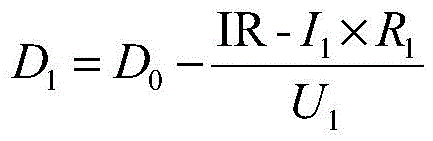
Figure BDA0002113429790000141
Formula 5:
Figure BDA0002113429790000141

其中,I1为每相电的目标电流,R1为每相线圈的等效阻抗,D1为每相桥臂的控制脉冲的目标占空比。Among them, I 1 is the target current of each phase of electricity, R 1 is the equivalent impedance of each phase coil, and D 1 is the target duty cycle of the control pulse of each phase bridge arm.

其中,当绕组线圈中电流的流动方向为从每相桥臂与每相线圈的连接点流向降压侧电容时,每相桥臂与每相线圈的连接点的电压大于降压侧电容的电压,每相桥臂与每相线圈的连接点的电压等于该相线圈上的压降与降压侧电容的目标电压之和,即U1×D1=R1×I1+U2,当绕组线圈中电流的流动方向为从降压侧电容流向每相桥臂与每相线圈的连接点时,每相桥臂与每相线圈的连接点的电压小于降压侧电容的电压,每相桥臂与每相线圈的连接点的电压等于降压侧电容的目标电压与该相线圈上的压降之差,即U1×D1=U2-R1×I1,再结合上述公式4即可得到公式5,即可以得到每相桥臂的控制脉冲的目标占空比。Among them, when the flow direction of the current in the winding coil is from the connection point of each phase bridge arm and each phase coil to the step-down side capacitor, the voltage of the connection point of each phase bridge arm and each phase coil is greater than the voltage of the step-down side capacitor. , the voltage of the connection point between the bridge arm of each phase and the coil of each phase is equal to the sum of the voltage drop on the phase coil and the target voltage of the capacitor on the step-down side, that is, U 1 ×D 1 =R 1 ×I 1 +U 2 , when The direction of current flow in the winding coil is from the capacitor on the step-down side to the connection point between the bridge arm of each phase and the coil of each phase. The voltage at the connection point between the bridge arm and each phase coil is equal to the difference between the target voltage of the buck-side capacitor and the voltage drop on the phase coil, that is, U 1 ×D 1 =U 2 -R 1 ×I 1 , combined with the above formula 4 to obtain formula 5, that is, to obtain the target duty cycle of the control pulse of each phase bridge arm.

作为一种实施方式,驱动加热放电电路的工作周期包括第七工作阶段和第八工作阶段;所述电机线圈包括第一线圈和第二线圈,所述桥臂变换器包括与所述第一线圈连接的第一桥臂和与所述第二线圈连接的第二桥臂;As an embodiment, the working cycle of driving the heating and discharging circuit includes a seventh working stage and an eighth working stage; the motor coil includes a first coil and a second coil, and the bridge arm converter includes a connection with the first coil a first bridge arm connected and a second bridge arm connected with the second coil;

在所述第七工作阶段,所述控制器根据所述电机的待驱动功率、所述外部用电设备的待充电功率以及所述电机线圈的待加热功率控制所述第一桥臂和所述第二桥臂的导通时刻及时长,使所述电池的电能经过所述第二桥臂、所述第二线圈、所述第一线圈及所述第一桥臂后流回至所述电池,同时使所述电能经过所述第二桥臂、所述第二线圈及所述用电设备后流回至所述电池;In the seventh working stage, the controller controls the first bridge arm and the The turn-on time and duration of the second bridge arm make the electric energy of the battery flow back to the battery after passing through the second bridge arm, the second coil, the first coil and the first bridge arm , and at the same time make the electric energy flow back to the battery after passing through the second bridge arm, the second coil and the electric device;

在所述第八工作阶段,所述控制器控制所述第一桥臂、所述第二桥臂导通的时刻及时长,电能在所述第二线圈、所述第一线圈、所述第一桥臂及所述第二桥臂之间形成环流,同时电能在所述第二线圈、所述用电设备以及所述第二桥臂之间形成环流。In the eighth working stage, the controller controls the conduction time and duration of the first bridge arm and the second bridge arm, and the electrical energy is A circulating current is formed between a bridge arm and the second bridge arm, and at the same time, electric energy forms a circulating current among the second coil, the electrical equipment and the second bridge arm.

其中,在第七工作阶段中,第一线圈为一相线圈或者至少两相连接在一起的线圈,第一桥臂为一路桥臂或者至少两路并联连接的桥臂,第一线圈中的一相线圈与第一桥臂中的一路桥臂连接,第二线圈为一相线圈或者至少两相连接在一起的线圈,第二桥臂为一路桥臂或者至少两路并联连接的桥臂,第二线圈中的一相线圈与第二桥臂中的一路桥臂连接,第一线圈与第二线圈之间的区别在于两个线圈的电流流向处于相反状态,例如,控制桥臂变换器102的第一桥臂使第一线圈中的电流方向为沿第一方向流动,该第一方向可以为从电机流向电机控制器104,控制桥臂变换器102的第二桥臂使第二线圈中的电流方向为沿第二方向流动,第二方向可以为从电机控制器104流向电机,即在第一工作阶段的电机线圈中同时存在不同方向电流的流动,因此,可以实现对电机驱动、对用电设备进行充电和电机线圈加热的控制。Wherein, in the seventh working stage, the first coil is a one-phase coil or a coil with at least two phases connected together, the first bridge arm is one bridge arm or at least two bridge arms connected in parallel, and one of the first coils The phase coil is connected with one bridge arm in the first bridge arm, the second coil is a one-phase coil or a coil with at least two phases connected together, the second bridge arm is one bridge arm or at least two bridge arms connected in parallel, the first One phase coil in the second coil is connected to one bridge arm in the second bridge arm. The difference between the first coil and the second coil is that the currents of the two coils are in opposite states. For example, the control of the bridge arm converter 102 The first bridge arm causes the current in the first coil to flow in a first direction, which may be from the motor to the motor controller 104, and controls the second bridge arm of the bridge arm converter 102 to make the current in the second coil flow. The direction of the current is to flow along the second direction, and the second direction can be from the motor controller 104 to the motor, that is, there are currents flowing in different directions in the motor coils in the first working stage. The electrical equipment performs charging and control of the heating of the motor coils.

需要说明的是,第一线圈和第二线圈中的线圈不是固定的,第一线圈和第二线圈是根据电流方向随时变化的,可以选择与线圈连接的桥臂的功率开关进行控制,例如,电机包括第一相线圈L1、第二相线圈L2以及第三相线圈L3,控制与第一相线圈L1连接的桥臂的下桥臂导通使第一相线圈L1中的电流流向为从电机线圈到桥臂变换器102,控制与第二相线圈L2和第三相线圈L3连接的桥臂的上桥臂导通使第二相线圈L2和第三相线圈L3中的电流流向为从桥臂变换器102到电机线圈,此时,第一线圈为第一相线圈L1,第二线圈为第二相线圈L2以及第三相线圈L3,当下一周期时,通过改变桥臂中导通的功率开关,实现对电机线圈中电流方向的改变,可以为第一线圈为第一相线圈L1以及第二相线圈L2,第二线圈为第三相线圈L3。It should be noted that the coils in the first coil and the second coil are not fixed, the first coil and the second coil are changed at any time according to the current direction, and the power switch of the bridge arm connected to the coil can be selected for control, for example, The motor includes a first-phase coil L1, a second-phase coil L2 and a third-phase coil L3, and the lower arm of the bridge arm connected to the first-phase coil L1 is controlled to be turned on so that the current in the first-phase coil L1 flows from the motor. The coil-to-bridge converter 102 controls the conduction of the upper bridge arm of the bridge arm connected to the second-phase coil L2 and the third-phase coil L3 so that the current in the second-phase coil L2 and the third-phase coil L3 flows from the bridge. The arm inverter 102 is connected to the motor coil. At this time, the first coil is the first-phase coil L1, the second coil is the second-phase coil L2 and the third-phase coil L3. In the next cycle, by changing the conduction in the bridge arm The power switch can change the direction of the current in the motor coil, and the first coil can be the first phase coil L1 and the second phase coil L2, and the second coil can be the third phase coil L3.

其中,第七工作阶段中使电池的电能经过第二桥臂、第二线圈、第一线圈及第一桥臂后流回至电池,用于实现将电池的电能存储在第一线圈和第二线圈中,即实现电池进行放电过程中的储能过程、电机驱动过程以及电机线圈的加热过程,由于第一线圈和第二线圈中有电流流过,此时可以驱动电机运行和产生热量,电能经过电池、第二桥臂、第二线圈、第一线圈及用电设备后流回至电池,用于使电池通过桥臂变换器102对用电设备进行放电,由于第一线圈和第二线圈连接在一起,因此,第一线圈和第二线圈中流经电流的方向不同,可以实现在电池对第一线圈和第二线圈进行储能和对用电设备进行放电的同时对电机进行连续驱动和加热。Wherein, in the seventh working stage, the electric energy of the battery flows back to the battery after passing through the second bridge arm, the second coil, the first coil and the first bridge arm, so as to realize the storage of the electric energy of the battery in the first coil and the second bridge arm. In the coil, the energy storage process, the motor driving process and the heating process of the motor coil during the discharging process of the battery are realized. Since there is current flowing in the first coil and the second coil, the motor can be driven to run and generate heat at this time. After passing through the battery, the second bridge arm, the second coil, the first coil and the electrical equipment, it flows back to the battery, so that the battery discharges the electrical equipment through the bridge arm converter 102. Since the first coil and the second coil Connected together, therefore, the directions of the current flowing in the first coil and the second coil are different, so that the motor can be continuously driven and heating.

其中,由于第七工作阶段和第八工作阶段构成一个周期,由于周期为定值,当第七工作阶段中第一桥臂和第二桥臂的导通时刻及时长确定之后,则第八工作阶段中第一桥臂和第二桥臂的导通时刻及时长可以直接确定。Among them, since the seventh working stage and the eighth working stage constitute a cycle, since the cycle is a fixed value, when the conduction time and length of the first bridge arm and the second bridge arm in the seventh working stage are determined, the eighth working stage The conduction time and duration of the first bridge arm and the second bridge arm in the stage can be directly determined.

其中,第八工作阶段中的电能经过第二线圈、用电设备以及第二桥臂之间形成环流,用于实现第二线圈对用电设备进行放电,即实现电池对用电设备进行放电过程中的续流放电过程,同时第二线圈中有电流流动可以实现驱动电机和使电机线圈加热,第八工作阶段中的电能在第二线圈、第一线圈、第一桥臂及第二桥臂之间形成环流,用于使第二线圈中的电流流向第一线圈,由于在第七工作过程中电池输出的电流通过第二桥臂流经第二线圈,再流经第二线圈和第一线圈,使第二线圈与第二桥臂之间连接点的电压升高,由于其中充放电口侧的电容的电压与线圈与第二桥臂之间连接点的电压的大小关系决定电流流动方向,如果第二线圈与第二桥臂之间连接点的电压大于充放电口侧的电容的电压时,则绕组电流方向为从第二线圈与第二桥臂之间连接点点流入,因此,可以实现第二线圈中的电流流向第一线圈,由于第一线圈和第二线圈连接在一起,因此,第一线圈和第二线圈中流经电流的方向不同,可以实现对电机进行驱动和使电机线圈耗电产生热量。Among them, the electric energy in the eighth working stage forms a circulating current between the second coil, the electric equipment and the second bridge arm, which is used to realize the discharge of the electric equipment by the second coil, that is, the discharge process of the battery to the electric equipment is realized. During the freewheeling discharge process in the second coil, at the same time, there is current flowing in the second coil to drive the motor and heat the motor coil. The electric energy in the eighth working stage is in the second coil, the first coil, the first bridge arm and the second bridge arm. A circulating current is formed between the two coils, so that the current in the second coil flows to the first coil, because in the seventh working process, the current output by the battery flows through the second coil through the second bridge arm, and then flows through the second coil and the first coil. The coil increases the voltage at the connection point between the second coil and the second bridge arm. The current flow direction is determined by the relationship between the voltage of the capacitor on the charging and discharging port side and the voltage at the connection point between the coil and the second bridge arm. , if the voltage of the connection point between the second coil and the second bridge arm is greater than the voltage of the capacitor on the charging and discharging port side, the direction of the winding current flows from the connection point between the second coil and the second bridge arm. Therefore, it is possible to The current in the second coil flows to the first coil. Since the first coil and the second coil are connected together, the directions of the current flowing through the first coil and the second coil are different, and the motor can be driven and the motor coil can be driven. Power consumption produces heat.

本实施方式中将驱动充电加热电路的工作周期分为第七工作阶段和第八工作阶段,每个工作阶段均包括对用电设备的放电过程、对电机的驱动过程以及对电机线圈的加热过程,通过控制第一桥臂和第二桥臂的导通时刻及时长,分别调节第一工作阶段和第二工作阶段中驱动充电加热电路的电流,使整个工作周期中电池输出的能量一部分用于对用电设备进行放电,一部分对电机进行驱动,一部分对电机线圈进行加热,实现了对用电设备进行放电、对电机进行驱动以及对电机线圈进行加热的协同工作。In this embodiment, the working cycle of driving the charging and heating circuit is divided into a seventh working stage and an eighth working stage, and each working stage includes the process of discharging the electrical equipment, the process of driving the motor, and the process of heating the motor coil. , by controlling the turn-on time and length of the first bridge arm and the second bridge arm, respectively adjust the current driving the charging and heating circuit in the first working stage and the second working stage, so that part of the energy output by the battery in the entire working cycle is used for The electric equipment is discharged, a part drives the motor, and the other part heats the motor coil, so as to realize the coordinated work of discharging the electric equipment, driving the motor and heating the motor coil.

本申请实施例二提供一种能量转换装置,如图19所示,能量转换装置包括:The second embodiment of the present application provides an energy conversion device. As shown in FIG. 19 , the energy conversion device includes:

电机;motor;

车载充电模块,包括充电连接端组,充电连接端组包括第一充电连接端和第二充电连接端;a vehicle-mounted charging module, including a charging connection terminal group, and the charging connection terminal group includes a first charging connection terminal and a second charging connection terminal;

电机控制模块,包括桥臂变换器102,桥臂变换器102连接电机的电机线圈;The motor control module includes a bridge arm converter 102, and the bridge arm converter 102 is connected to the motor coil of the motor;

能量储存模块,包括并联连接的母线电容103和能量存储连接端组109,母线电容103与桥臂变换器102并联连接,所述能量存储连接端组109包括第一能量存储连接端、第二能量存储连接端;The energy storage module includes a bus capacitor 103 and an energy storage connection terminal group 109 connected in parallel, the bus capacitor 103 is connected in parallel with the bridge arm converter 102, and the energy storage connection terminal group 109 includes a first energy storage connection terminal, a second energy storage connection terminal storage connection;

控制器104,其连接所述桥臂变换器102;a controller 104, which is connected to the bridge arm converter 102;

电机线圈、桥臂变换器102及母线电容103形成驱动和加热电路;控制器104根据电机的待驱动功率和外部的电池的待充电功率,控制桥臂变换器102使外部的电能流向驱动和加热电路,且调节驱动和加热电路的电流,使外部的电能驱动电机输出驱动功率的同时通过驱动和加热电路对外进行放电。The motor coil, the bridge arm converter 102 and the bus capacitor 103 form a driving and heating circuit; the controller 104 controls the bridge arm converter 102 to make the external electric energy flow to the driving and heating according to the to-be-driven power of the motor and the to-be-charged power of the external battery circuit, and adjusts the current of the driving and heating circuit, so that the external electric energy drives the motor to output the driving power while discharging externally through the driving and heating circuit.

进一步的,第一充电连接端、第二充电连接端分别与外部电源连接,外部电池分别与第一能量存储连接端、第二能量存储连接端连接;Further, the first charging connection terminal and the second charging connection terminal are respectively connected with an external power source, and the external battery is respectively connected with the first energy storage connection terminal and the second energy storage connection terminal;

控制器104获取桥臂变换器102的导通时刻和时长,并根据导通时刻和时长调节驱动和加热电路的电流,使电机101输出驱动功率的同时使电机线圈进行主动耗电产热来加热电池。The controller 104 obtains the turn-on time and duration of the bridge arm converter 102, and adjusts the currents of the driving and heating circuits according to the turn-on time and duration, so that the motor 101 outputs driving power and at the same time causes the motor coil to actively consume electricity and generate heat for heating Battery.

进一步的,外部电源为直流供电设备,驱动和加热电路的工作周期包括第一工作阶段和第二工作阶段;电机线圈包括第一线圈和第二线圈,桥臂变换器102包括与第一线圈连接的第一桥臂和与第二线圈连接的第二桥臂;Further, the external power supply is a DC power supply device, and the working cycle of the driving and heating circuit includes a first working stage and a second working stage; the motor coil includes a first coil and a second coil, and the bridge arm converter 102 includes a connection with the first coil. The first bridge arm and the second bridge arm connected with the second coil;

在第一工作阶段,控制器104根据电机的待驱动功率和电池的待充电功率控制第一桥臂和第二桥臂的导通时刻及时长,使直流供电设备的电能经过第一线圈及第一桥臂后流回至直流供电设备,同时,母线电容103上的电能经过第二桥臂、第二线圈、第一线圈及第一桥臂后流回至母线电容103;In the first working stage, the controller 104 controls the conduction time and duration of the first bridge arm and the second bridge arm according to the to-be-driven power of the motor and the to-be-charged power of the battery, so that the electric energy of the DC power supply device passes through the first coil and the second bridge arm. After a bridge arm flows back to the DC power supply equipment, at the same time, the electric energy on the bus capacitor 103 flows back to the bus capacitor 103 after passing through the second bridge arm, the second coil, the first coil and the first bridge arm;

在第二工作阶段,控制器104控制第一桥臂、第二桥臂导通的时刻及时长,直流供电设备的电能经过第一线圈及第一桥臂后流经电池和母线电容103并流回至直流供电设备,同时,电能在第二线圈、第一线圈、第一桥臂及第二桥臂之间形成环流。In the second working stage, the controller 104 controls the conduction time and duration of the first bridge arm and the second bridge arm, and the electric energy of the DC power supply device flows through the battery and the bus capacitor 103 after passing through the first coil and the first bridge arm. Returning to the DC power supply device, at the same time, the electric energy forms a circulating current among the second coil, the first coil, the first bridge arm and the second bridge arm.

进一步的,在第二工作阶段,控制器104根据电池的待充电功率控制第一桥臂、第二桥臂导通的时刻及时长,使直流供电设备的电能经过第一线圈及第一桥臂后流经电池和母线电容103并流回至直流供电设备,同时,电能在第二线圈、第一线圈、第一桥臂及第二桥臂之间形成环流。Further, in the second working stage, the controller 104 controls the conduction time and duration of the first bridge arm and the second bridge arm according to the power to be charged of the battery, so that the electric energy of the DC power supply device passes through the first coil and the first bridge arm. Afterwards, it flows through the battery and the bus capacitor 103 and flows back to the DC power supply device. At the same time, the electric energy forms a circulating current among the second coil, the first coil, the first bridge arm and the second bridge arm.

进一步的,其还包括双向桥臂,双向桥臂与桥臂变换器102并联连接,双向桥臂与桥臂变换器102并联连接,充电连接端组还包括第三充电连接端,双向桥臂还连接控制器104和第三充电连接端,第三充电连接端连接外部电源,外部电源、电机线圈、桥臂变换器102、双向桥臂、母线电容103及电池形成驱动和加热电路;Further, it also includes a bidirectional bridge arm, the bidirectional bridge arm is connected in parallel with the bridge arm converter 102, the bidirectional bridge arm is connected in parallel with the bridge arm converter 102, the charging connection end group further includes a third charging connection end, and the bidirectional bridge arm also The controller 104 is connected to the third charging connection terminal, and the third charging connection terminal is connected to an external power supply, and the external power supply, the motor coil, the bridge arm converter 102, the bidirectional bridge arm, the bus capacitor 103 and the battery form a driving and heating circuit;

控制器104获取桥臂变换器102的导通时刻和时长,并根据导通时刻和时长调节驱动和加热电路的电流,通过驱动和加热电路驱动电机输出驱动功率的同时电机线圈进行主动耗电产热来加热电池。The controller 104 obtains the turn-on time and duration of the bridge arm converter 102, and adjusts the current of the driving and heating circuits according to the turn-on time and duration, and drives the motor through the driving and heating circuits to output driving power while the motor coils actively consume power. heat to heat the battery.

进一步的,外部电源还包括交流供电设备,驱动和加热电路的工作周期包括第三工作阶段和第四工作阶段,电机线圈包括第一线圈和第二线圈,桥臂变换器102包括与第一线圈连接的第一桥臂和与第二线圈连接的第二桥臂;Further, the external power supply also includes an AC power supply device, the working cycle of the driving and heating circuit includes a third working stage and a fourth working stage, the motor coil includes a first coil and a second coil, and the bridge arm converter 102 includes a first coil and a second coil. a first bridge arm connected and a second bridge arm connected with the second coil;

在第三工作阶段,控制器104根据电机101的待驱动功率和电机线圈的待加热功率控制第一桥臂、第二桥臂以及双向桥臂的导通时刻及时长,使交流供电设备的电能经过第一线圈、第一桥臂以及双向桥臂后流回至交流供电设备或者使所述交流供电设备的电能经过所述双向桥臂、所述第二桥臂、第二线圈流回至所述交流供电设备,同时,母线电容103上的电能经过第二桥臂、第二线圈、第一线圈及第一桥臂后流回至母线电容103;In the third working stage, the controller 104 controls the conduction time and duration of the first bridge arm, the second bridge arm and the bidirectional bridge arm according to the to-be-driven power of the motor 101 and the to-be-heated power of the motor coil, so that the electric energy of the AC power supply device is After passing through the first coil, the first bridge arm and the bidirectional bridge arm, it flows back to the AC power supply device, or the electrical energy of the AC power supply device flows back to the AC power supply device through the bidirectional bridge arm, the second bridge arm and the second coil. At the same time, the electric energy on the bus capacitor 103 flows back to the bus capacitor 103 after passing through the second bridge arm, the second coil, the first coil and the first bridge arm;

在第四工作阶段,控制器104控制第一桥臂、第二桥臂以及双向桥臂导通的时刻及时长,使交流供电设备的电能经过第一线圈、第一桥臂及双向桥臂后流经电池和母线电容103并流回至交流供电设备或者使交流供电设备的电能经过双向桥臂、母线电容103、第二桥臂、所述第二线圈后流回至所述交流供电设备,同时,电能在第二线圈、第一线圈、第一桥臂及第二桥臂之间形成环流。In the fourth working stage, the controller 104 controls the conduction time and duration of the first bridge arm, the second bridge arm and the bidirectional bridge arm, so that the power of the AC power supply device passes through the first coil, the first bridge arm and the bidirectional bridge arm. Flow through the battery and the bus capacitor 103 and flow back to the AC power supply device or make the power of the AC power supply device flow back to the AC power supply device after passing through the bidirectional bridge arm, the bus capacitor 103, the second bridge arm, and the second coil, At the same time, electric energy forms a circulating current among the second coil, the first coil, the first bridge arm and the second bridge arm.

进一步的,当电池105作为供电设备时,驱动和加热电路的工作周期包括第五工作阶段和第六工作阶段;电机线圈包括第一线圈和第二线圈,桥臂变换器102包括与第一线圈连接的第一桥臂和与第二线圈连接的第二桥臂;Further, when the battery 105 is used as the power supply device, the working cycle of the driving and heating circuit includes the fifth working stage and the sixth working stage; the motor coil includes the first coil and the second coil, and the bridge arm converter 102 includes the first coil and the first coil. a first bridge arm connected and a second bridge arm connected with the second coil;

在第五工作阶段,控制器104根据电机101的待驱动功率和电机线圈的待加热功率控制第一桥臂和第二桥臂的导通时刻及时长,使电池105的电能经过第二桥臂、第二线圈、第一线圈及第一桥臂后流回至电池105;In the fifth working stage, the controller 104 controls the conduction time and duration of the first bridge arm and the second bridge arm according to the to-be-driven power of the motor 101 and the to-be-heated power of the motor coil, so that the electric energy of the battery 105 passes through the second bridge arm , the second coil, the first coil and the first bridge arm flow back to the battery 105;

在第六工作阶段,控制器104控制第一桥臂、第二桥臂导通的时刻及时长,电能在第二线圈、第一线圈、第一桥臂及第二桥臂之间形成环流。In the sixth working stage, the controller 104 controls the conduction time and duration of the first bridge arm and the second bridge arm, and electric energy forms a circulating current among the second coil, the first coil, the first bridge arm and the second bridge arm.

进一步的,电机线圈、桥臂变换器及母线电容103形成驱动加热放电电路;Further, the motor coil, the bridge arm converter and the bus capacitor 103 form a driving heating and discharging circuit;

在第一充电连接端和第二充电连接端连接至外部用电设备时,根据电机101的待驱动功率、外部用电设备的待充电功率以及电机线圈的待加热功率,控制桥臂变换器102使外部的电池105的电能流向驱动加热放电电路,且调节驱动加热放电电路的电流,使电机101输出驱动功率、对外部用电设备进行充电以及使电机线圈进行耗电产生热量同时进行。When the first charging connection end and the second charging connection end are connected to the external electrical equipment, the bridge arm converter 102 is controlled according to the to-be-driven power of the motor 101 , the to-be-charged power of the external electrical equipment and the to-be-heated power of the motor coil The electric energy of the external battery 105 is flowed to the driving heating and discharging circuit, and the current of the driving heating and discharging circuit is adjusted, so that the motor 101 outputs driving power, charges the external electrical equipment, and causes the motor coil to consume power and generate heat at the same time.

进一步的,驱动加热放电电路的工作周期包括第七工作阶段和第八工作阶段;电机线圈包括第一线圈和第二线圈,桥臂变换器包括与第一线圈连接的第一桥臂和与第二线圈连接的第二桥臂;Further, the working cycle of driving the heating and discharging circuit includes a seventh working stage and an eighth working stage; the motor coil includes a first coil and a second coil, and the bridge arm converter includes a first bridge arm connected to the first coil and a first bridge arm connected to the first coil. The second bridge arm connected by the two coils;

在第七工作阶段,控制器104根据电机101的待驱动功率、外部用电设备的待充电功率以及电机线圈的待加热功率控制第一桥臂和第二桥臂的导通时刻及时长,使电池105的电能经过第二桥臂、第二线圈、第一线圈及第一桥臂后流回至电池105,同时使电能经过第二桥臂、第二线圈及用电设备后流回至电池105;In the seventh working stage, the controller 104 controls the conduction time and duration of the first bridge arm and the second bridge arm according to the to-be-driven power of the motor 101, the to-be-charged power of the external electrical equipment, and the to-be-heated power of the motor coil, so that the The electric energy of the battery 105 flows back to the battery 105 after passing through the second bridge arm, the second coil, the first coil and the first bridge arm, and at the same time makes the electric energy flow back to the battery after passing through the second bridge arm, the second coil and the electrical equipment. 105;

在第八工作阶段,控制器104控制第一桥臂、第二桥臂导通的时刻及时长,电能在第二线圈、第一线圈、第一桥臂及第二桥臂之间形成环流,同时电能在第二线圈、用电设备以及第二桥臂之间形成环流。In the eighth working stage, the controller 104 controls the conduction time and duration of the first bridge arm and the second bridge arm, and the electric energy forms a circulating current among the second coil, the first coil, the first bridge arm and the second bridge arm, At the same time, electric energy forms a circulating current among the second coil, the electrical equipment and the second bridge arm.

本申请实施例三提供一种车辆,如图20所示,车辆还包括上述实施例的能量转换装置。The third embodiment of the present application provides a vehicle. As shown in FIG. 20 , the vehicle further includes the energy conversion device of the above embodiment.

以上实施例仅用以说明本申请的技术方案,而非对其限制;尽管参照前述实施例对本申请进行了详细的说明,本领域的普通技术人员应当理解:其依然可以对前述各实施例所记载的技术方案进行修改,或者对其中部分技术特征进行等同替换;而这些修改或者替换,并不使相应技术方案的本质脱离本申请各实施例技术方案的精神和范围,均应包含在本申请的保护范围之内。The above embodiments are only used to illustrate the technical solutions of the present application, but not to limit them; although the present application has been described in detail with reference to the foregoing embodiments, those of ordinary skill in the art should understand that: The recorded technical solutions are modified, or some technical features thereof are equivalently replaced; and these modifications or replacements do not make the essence of the corresponding technical solutions deviate from the spirit and scope of the technical solutions of the embodiments of the application, and should be included in the application. within the scope of protection.

Claims (18)

1.一种能量转换装置,其特征在于,包括电机的电机线圈、桥臂变换器、与所述桥臂变换器并联的母线电容和与所述桥臂变换器连接的控制器;1. An energy conversion device, characterized in that, comprising a motor coil of a motor, a bridge arm converter, a bus capacitor connected in parallel with the bridge arm converter and a controller connected with the bridge arm converter; 所述桥臂变换器与所述电机线圈连接;the bridge arm converter is connected to the motor coil; 所述电机线圈、所述母线电容以及所述桥臂变换器均与外部充放电口连接,所述母线电容与外部的电池并联连接;The motor coil, the bus capacitor and the bridge arm converter are all connected to an external charging and discharging port, and the bus capacitor is connected in parallel with an external battery; 所述电机线圈、所述桥臂变换器及所述母线电容形成驱动和加热电路;The motor coil, the bridge arm converter and the bus capacitor form a driving and heating circuit; 所述控制器根据所述电机的待驱动功率和所述电机线圈的待加热功率,控制所述桥臂变换器使与所述外部充放电口连接的外部电源或者所述外部的电池的电能流向所述驱动和加热电路,且调节所述驱动和加热电路的电流,使所述电机输出驱动功率的同时并使所述电机线圈进行耗电产生热量。According to the to-be-driven power of the motor and the to-be-heated power of the motor coil, the controller controls the bridge arm converter to make the electric energy of the external power supply connected to the external charging and discharging port or the external battery flow to the direction of the electric power of the external battery. The driving and heating circuit adjusts the current of the driving and heating circuit, so that the motor outputs driving power and at the same time causes the motor coil to consume electricity to generate heat. 2.如权利要求1所述的能量转换装置,其特征在于,所述控制器根据所述电机的待驱动功率和所述电机线圈的待加热功率获取所述桥臂变换器的导通时刻和时长,并根据所述导通时刻和时长调节所述驱动和加热电路的电流。2 . The energy conversion device according to claim 1 , wherein the controller obtains the on-time and duration, and adjust the currents of the driving and heating circuits according to the on-time and duration. 3.如权利要求1所述的能量转换装置,其特征在于,当所述外部充放电口连接外部电源并且所述外部电源为直流供电设备时,所述驱动和加热电路的工作周期包括第一工作阶段和第二工作阶段;所述电机线圈包括第一线圈和第二线圈,所述桥臂变换器包括与所述第一线圈连接的第一桥臂和与所述第二线圈连接的第二桥臂;3 . The energy conversion device according to claim 1 , wherein when the external charging and discharging port is connected to an external power source and the external power source is a DC power supply device, the duty cycle of the driving and heating circuit includes the first 3 . A working stage and a second working stage; the motor coil includes a first coil and a second coil, and the bridge arm converter includes a first bridge arm connected with the first coil and a first bridge arm connected with the second coil two bridge arms; 在所述第一工作阶段,所述控制器根据所述电机的待驱动功率和所述电机线圈的待加热功率控制所述第一桥臂和所述第二桥臂的导通时刻及时长,使所述直流供电设备的电能经过所述第一线圈及所述第一桥臂后流回至所述直流供电设备,同时,所述母线电容上的电能经过所述第二桥臂、所述第二线圈、所述第一线圈及所述第一桥臂后流回至所述母线电容;In the first working stage, the controller controls the conduction time and duration of the first bridge arm and the second bridge arm according to the to-be-driven power of the motor and the to-be-heated power of the motor coil, The electric energy of the DC power supply device flows back to the DC power supply device after passing through the first coil and the first bridge arm, and at the same time, the electric energy on the bus capacitor passes through the second bridge arm, the The second coil, the first coil and the first bridge arm flow back to the bus capacitor; 在所述第二工作阶段,所述控制器控制所述第一桥臂、所述第二桥臂导通的时刻及时长,所述直流供电设备的电能经过所述第一线圈及所述第一桥臂后流经所述母线电容并流回至所述直流供电设备,同时,电能在所述第二线圈、所述第一线圈、所述第一桥臂及所述第二桥臂之间形成环流。In the second working stage, the controller controls the timing and duration of the conduction of the first bridge arm and the second bridge arm, and the electric energy of the DC power supply device passes through the first coil and the second bridge arm. A bridge arm then flows through the bus capacitor and flows back to the DC power supply device. At the same time, the electrical energy flows between the second coil, the first coil, the first bridge arm and the second bridge arm. Circulation is formed between. 4.如权利要求3所述的能量转换装置,其特征在于,在所述驱动和加热电路的工作周期之前还包括驱动和加热电路的启动周期;4. The energy conversion device of claim 3, further comprising a start-up period of the driving and heating circuit before the operating period of the driving and heating circuit; 所述驱动和加热电路的启动周期包括第一启动阶段和第二启动阶段;The start-up cycle of the drive and heating circuit includes a first start-up phase and a second start-up phase; 在所述第一启动阶段,所述控制器根据所述电机的待驱动功率和所述电机线圈的待加热功率控制所述第一桥臂、所述第二桥臂导通时刻及时长,使所述直流供电设备的电能经过第一线圈及第一桥臂后流回至所述直流供电设备;In the first start-up stage, the controller controls the conduction time and duration of the first bridge arm and the second bridge arm according to the to-be-driven power of the motor and the to-be-heated power of the motor coil, so that the The electric energy of the DC power supply device flows back to the DC power supply device after passing through the first coil and the first bridge arm; 在所述第二启动阶段,所述控制器控制所述第一桥臂、所述第二桥臂导通时刻及时长,使所述直流供电设备的电能经过所述第一线圈及所述第一桥臂后流经所述母线电容并流回至所述直流供电设备。In the second start-up stage, the controller controls the conduction time and duration of the first bridge arm and the second bridge arm, so that the electric energy of the DC power supply device passes through the first coil and the second bridge arm. A bridge arm then flows through the bus capacitor and flows back to the DC power supply device. 5.如权利要求1所述的能量转换装置,其特征在于,其还包括双向桥臂,所述外部充放电口还包括交流充电口,所述双向桥臂与所述桥臂变换器并联连接,所述双向桥臂还连接所述控制器和所述交流充电口,所述交流充电口连接交流供电设备,所述驱动和加热电路的工作周期包括第三工作阶段和第四工作阶段;所述电机线圈包括第一线圈和第二线圈,所述桥臂变换器包括与所述第一线圈连接的第一桥臂和与所述第二线圈连接的第二桥臂;5 . The energy conversion device according to claim 1 , further comprising a bidirectional bridge arm, the external charging and discharging port further comprising an AC charging port, and the bidirectional bridge arm is connected in parallel with the bridge arm converter. 6 . , the bidirectional bridge arm is also connected to the controller and the AC charging port, the AC charging port is connected to the AC power supply device, and the working cycle of the driving and heating circuit includes the third working stage and the fourth working stage; The motor coil includes a first coil and a second coil, and the bridge arm converter includes a first bridge arm connected with the first coil and a second bridge arm connected with the second coil; 在所述第三工作阶段,所述控制器根据所述电机的待驱动功率和所述电机线圈的待加热功率控制所述第一桥臂、所述第二桥臂以及所述双向桥臂的导通时刻及时长,使所述交流供电设备的电能经过所述第一线圈、所述第一桥臂以及所述双向桥臂后流回至所述交流供电设备或者使所述交流供电设备的电能经过所述双向桥臂、所述第二桥臂、第二线圈流回至所述交流供电设备,同时,所述母线电容上的电能经过所述第二桥臂、所述第二线圈、所述第一线圈及所述第一桥臂后流回至所述母线电容;In the third working stage, the controller controls the power of the first bridge arm, the second bridge arm and the bidirectional bridge arm according to the to-be-driven power of the motor and the to-be-heated power of the motor coil The turn-on time and duration make the electric energy of the AC power supply device flow back to the AC power supply device after passing through the first coil, the first bridge arm and the two-way bridge arm, or make the power supply of the AC power supply device flow back to the AC power supply device. The electric energy flows back to the AC power supply device through the bidirectional bridge arm, the second bridge arm, and the second coil, and at the same time, the electric energy on the bus capacitor passes through the second bridge arm, the second coil, The first coil and the first bridge arm flow back to the bus capacitor; 在所述第四工作阶段,所述控制器控制所述第一桥臂、所述第二桥臂以及所述双向桥臂导通的时刻及时长,使所述交流供电设备的电能经过所述第一线圈、所述第一桥臂、所述母线电容并流经所述双向桥臂后流回至所述交流供电设备或者使所述交流供电设备的电能经过所述双向桥臂、所述母线电容、所述第二桥臂、所述第二线圈后流回至所述交流供电设备,同时,电能在所述第二线圈、所述第一线圈、所述第一桥臂及所述第二桥臂之间形成环流。In the fourth working stage, the controller controls the conduction time and duration of the first bridge arm, the second bridge arm and the bidirectional bridge arm, so that the electrical energy of the AC power supply device passes through the The first coil, the first bridge arm, and the bus capacitor flow through the two-way bridge arm and then flow back to the AC power supply device or make the power of the AC power supply device pass through the two-way bridge arm, the The bus capacitor, the second bridge arm, and the second coil flow back to the AC power supply device. A circulation is formed between the second bridge arms. 6.如权利要求5所述的能量转换装置,其特征在于,在所述驱动和加热电路的工作周期之前还包括驱动和加热电路的启动周期;6. The energy conversion device of claim 5, further comprising a start-up period of the driving and heating circuit before the operating period of the driving and heating circuit; 所述驱动和加热电路的启动周期包括第三启动阶段和第四启动阶段;The start-up cycle of the drive and heating circuit includes a third start-up phase and a fourth start-up phase; 在所述第三启动阶段,所述控制器根据所述电机的待驱动功率和所述电机线圈的待加热功率控制所述第一桥臂、所述第二桥臂以及所述双向桥臂的导通时刻及时长,使所述交流供电设备的电能经过第一线圈、第一桥臂以及所述双向桥臂后流回至所述交流供电设备或者使所述交流供电设备的电能经过所述双向桥臂、所述第二桥臂、第二线圈流回至所述交流供电设备;In the third start-up stage, the controller controls the power of the first bridge arm, the second bridge arm and the bidirectional bridge arm according to the to-be-driven power of the motor and the to-be-heated power of the motor coil The turn-on time and duration are such that the power of the AC power supply device flows back to the AC power supply device after passing through the first coil, the first bridge arm and the bidirectional bridge arm, or the power of the AC power supply device passes through the The bidirectional bridge arm, the second bridge arm and the second coil flow back to the AC power supply device; 在所述第四启动阶段,所述控制器控制所述第一桥臂、所述第二桥臂以及所述双向桥臂的导通时刻及时长,使所述交流供电设备的电能经过所述第一线圈、所述第一桥臂及所述双向桥臂后流经所述母线电容并流回至所述交流供电设备或者使所述交流供电设备的电能经过所述双向桥臂、所述母线电容、所述第二桥臂、所述第二线圈后流回至所述交流供电设备。In the fourth start-up stage, the controller controls the conduction time and duration of the first bridge arm, the second bridge arm and the bidirectional bridge arm, so that the electrical energy of the AC power supply device passes through the The first coil, the first bridge arm and the bidirectional bridge arm then flow through the bus capacitor and flow back to the AC power supply device or make the power of the AC power supply device pass through the two-way bridge arm, the The bus capacitor, the second bridge arm, and the second coil flow back to the AC power supply device. 7.如权利要求1所述的能量转换装置,其特征在于,当所述电池作为供电设备时,所述驱动和加热电路的工作周期包括第五工作阶段和第六工作阶段;所述电机线圈包括第一线圈和第二线圈,所述桥臂变换器包括与所述第一线圈连接的第一桥臂和与所述第二线圈连接的第二桥臂;7. The energy conversion device according to claim 1, wherein when the battery is used as a power supply device, the working cycle of the driving and heating circuit includes a fifth working stage and a sixth working stage; the motor coil comprising a first coil and a second coil, the bridge arm converter includes a first bridge arm connected with the first coil and a second bridge arm connected with the second coil; 在所述第五工作阶段,所述控制器根据所述电机的待驱动功率和所述电机线圈的待加热功率控制所述第一桥臂和所述第二桥臂的导通时刻及时长,使所述电池的电能经过所述第二桥臂、所述第二线圈、所述第一线圈及所述第一桥臂后流回至所述电池;In the fifth working stage, the controller controls the conduction time and duration of the first bridge arm and the second bridge arm according to the to-be-driven power of the motor and the to-be-heated power of the motor coil, making the electric energy of the battery flow back to the battery after passing through the second bridge arm, the second coil, the first coil and the first bridge arm; 在所述第六工作阶段,所述控制器控制所述第一桥臂、所述第二桥臂导通的时刻及时长,电能在所述第二线圈、所述第一线圈、所述第一桥臂及所述第二桥臂之间形成环流。In the sixth working stage, the controller controls the conduction time and duration of the first bridge arm and the second bridge arm, and the electrical energy is A circulation is formed between a bridge arm and the second bridge arm. 8.如权利要求1所述的能量转换装置,其特征在于,所述电机线圈、所述桥臂变换器及所述母线电容形成驱动加热放电电路;8. The energy conversion device according to claim 1, wherein the motor coil, the bridge arm converter and the bus capacitor form a driving heating and discharging circuit; 在所述外部的充放电口连接至外部用电设备时,根据所述电机的待驱动功率、所述外部用电设备的待充电功率以及所述电机线圈的待加热功率,控制所述桥臂变换器使所述外部的电池的电能流向所述驱动加热放电电路,且调节所述驱动加热放电电路的电流,使所述电机输出驱动功率、对所述外部用电设备进行充电以及使所述电机线圈进行耗电产生热量同时进行。When the external charging and discharging port is connected to an external electrical device, the bridge arm is controlled according to the to-be-driven power of the motor, the to-be-charged power of the external electrical device, and the to-be-heated power of the motor coil The inverter allows the electric energy of the external battery to flow to the driving heating and discharging circuit, and adjusts the current of the driving heating and discharging circuit, so that the motor outputs driving power, charges the external electrical equipment, and causes the The motor coils consume electricity and generate heat at the same time. 9.如权利要求8所述的能量转换装置,其特征在于,所述驱动加热放电电路的工作周期包括第七工作阶段和第八工作阶段;所述电机线圈包括第一线圈和第二线圈,所述桥臂变换器包括与所述第一线圈连接的第一桥臂和与所述第二线圈连接的第二桥臂;9 . The energy conversion device according to claim 8 , wherein the working cycle of the driving heating and discharging circuit includes a seventh working stage and an eighth working stage; the motor coil includes a first coil and a second coil, 10 . The bridge arm converter includes a first bridge arm connected with the first coil and a second bridge arm connected with the second coil; 在所述第七工作阶段,所述控制器根据所述电机的待驱动功率、所述外部用电设备的待充电功率以及所述电机线圈的待加热功率控制所述第一桥臂和所述第二桥臂的导通时刻及时长,使所述电池的电能经过所述第二桥臂、所述第二线圈、所述第一线圈及所述第一桥臂后流回至所述电池,同时使所述电能经过所述第二桥臂、所述第二线圈及所述外部用电设备后流回至所述电池;In the seventh working stage, the controller controls the first bridge arm and the The turn-on time and duration of the second bridge arm make the electric energy of the battery flow back to the battery after passing through the second bridge arm, the second coil, the first coil and the first bridge arm , and at the same time make the electric energy flow back to the battery after passing through the second bridge arm, the second coil and the external electrical equipment; 在所述第八工作阶段,所述控制器控制所述第一桥臂、所述第二桥臂导通的时刻及时长,电能在所述第二线圈、所述第一线圈、所述第一桥臂及所述第二桥臂之间形成环流,同时电能在所述第二线圈、所述外部用电设备以及所述第二桥臂之间形成环流。In the eighth working stage, the controller controls the conduction time and duration of the first bridge arm and the second bridge arm, and the electrical energy is A circulating current is formed between a bridge arm and the second bridge arm, and at the same time, electric energy forms a circulating current between the second coil, the external electrical device and the second bridge arm. 10.一种能量转换装置,其特征在于,所述能量转换装置包括:10. An energy conversion device, characterized in that the energy conversion device comprises: 电机;motor; 车载充电模块,包括充电连接端组,所述充电连接端组包括第一充电连接端和第二充电连接端;a vehicle-mounted charging module, including a charging connection terminal group, the charging connection terminal group including a first charging connection terminal and a second charging connection terminal; 电机控制模块,包括桥臂变换器,所述桥臂变换器连接所述电机的电机线圈;a motor control module, including a bridge arm converter, the bridge arm converter is connected to the motor coil of the motor; 能量储存模块,包括并联连接的母线电容和能量存储连接端组,所述母线电容与所述桥臂变换器并联连接,所述能量存储连接端组包括第一能量存储连接端、第二能量存储连接端;An energy storage module, comprising a bus capacitor connected in parallel and an energy storage connection terminal group, the bus capacitor is connected in parallel with the bridge arm converter, and the energy storage connection terminal group includes a first energy storage connection terminal, a second energy storage connection terminal connection end; 控制器,其与所述桥臂变换器连接;a controller connected to the bridge arm converter; 所述电机线圈、所述桥臂变换器及所述母线电容形成驱动和加热电路;The motor coil, the bridge arm converter and the bus capacitor form a driving and heating circuit; 所述控制器根据所述电机的待驱动功率和所述电机线圈的待加热功率,控制所述桥臂变换器使外部的电能流向所述驱动和加热电路,且调节所述驱动和加热电路的电流,使所述电机输出驱动功率的同时使所述电机线圈进行主动耗电产热来加热电池。According to the to-be-driven power of the motor and the to-be-heated power of the motor coil, the controller controls the bridge arm converter to make external electric energy flow to the driving and heating circuits, and adjusts the driving and heating circuits. The current is used to make the motor output driving power and at the same time make the motor coil actively consume electricity and generate heat to heat the battery. 11.如权利要求10所述的能量转换装置,其特征在于,所述第一充电连接端、所述第二充电连接端分别与外部电源连接;11. The energy conversion device according to claim 10, wherein the first charging connection end and the second charging connection end are respectively connected to an external power source; 所述控制器获取所述桥臂变换器的导通时刻和时长,并根据所述导通时刻和时长调节所述驱动和加热电路的电流,使所述电机输出驱动功率的同时使所述电机线圈进行主动耗电产热来加热电池。The controller obtains the turn-on time and duration of the bridge arm converter, and adjusts the currents of the driving and heating circuits according to the turn-on time and duration, so that the motor outputs driving power while making the motor output drive power. The coil actively consumes electricity and generates heat to heat the battery. 12.如权利要求11所述的能量转换装置,其特征在于,所述外部电源为直流供电设备,所述驱动和加热电路的工作周期包括第一工作阶段和第二工作阶段;所述电机线圈包括第一线圈和第二线圈,所述桥臂变换器包括与所述第一线圈连接的第一桥臂和与所述第二线圈连接的第二桥臂;12 . The energy conversion device according to claim 11 , wherein the external power source is a DC power supply device, and the working cycle of the driving and heating circuit includes a first working stage and a second working stage; the motor coil comprising a first coil and a second coil, the bridge arm converter includes a first bridge arm connected with the first coil and a second bridge arm connected with the second coil; 在所述第一工作阶段,所述控制器根据所述电机的待驱动功率和所述电机线圈的待加热功率控制所述第一桥臂和所述第二桥臂的导通时刻及时长,使所述直流供电设备的电能经过所述第一线圈及所述第一桥臂后流回至所述直流供电设备,同时,所述母线电容上的电能经过所述第二桥臂、所述第二线圈、所述第一线圈及所述第一桥臂后流回至所述母线电容;In the first working stage, the controller controls the conduction time and duration of the first bridge arm and the second bridge arm according to the to-be-driven power of the motor and the to-be-heated power of the motor coil, The electric energy of the DC power supply device flows back to the DC power supply device after passing through the first coil and the first bridge arm, and at the same time, the electric energy on the bus capacitor passes through the second bridge arm, the The second coil, the first coil and the first bridge arm flow back to the bus capacitor; 在所述第二工作阶段,所述控制器控制所述第一桥臂、所述第二桥臂导通的时刻及时长,所述直流供电设备的电能经过所述第一线圈及所述第一桥臂后流经所述电池和所述母线电容并流回至所述直流供电设备,同时,电能在所述第二线圈、所述第一线圈、所述第一桥臂及所述第二桥臂之间形成环流。In the second working stage, the controller controls the timing and duration of the conduction of the first bridge arm and the second bridge arm, and the electric energy of the DC power supply device passes through the first coil and the second bridge arm. A bridge arm then flows through the battery and the bus capacitor and flows back to the DC power supply device. A circulation is formed between the two bridge arms. 13.如权利要求10所述的能量转换装置,其特征在于,其还包括双向桥臂,所述双向桥臂与所述桥臂变换器并联连接,所述充电连接端组还包括第三充电连接端,所述双向桥臂还连接所述控制器和所述第三充电连接端,所述第三充电连接端连接外部电源;13 . The energy conversion device according to claim 10 , further comprising a bidirectional bridge arm, the bidirectional bridge arm is connected in parallel with the bridge arm converter, and the charging connection terminal group further comprises a third charging a connection end, the bidirectional bridge arm is further connected to the controller and the third charging connection end, and the third charging connection end is connected to an external power supply; 所述控制器获取所述桥臂变换器的导通时刻和时长,并根据所述导通时刻和时长调节所述驱动和加热电路的电流,使所述电机输出驱动功率的同时使所述电机线圈进行主动耗电产热来加热电池。The controller obtains the turn-on time and duration of the bridge arm converter, and adjusts the currents of the driving and heating circuits according to the turn-on time and duration, so that the motor outputs driving power while making the motor output drive power. The coil actively consumes electricity and generates heat to heat the battery. 14.如权利要求13所述的能量转换装置,其特征在于,所述外部电源为交流供电设备,所述驱动和加热电路的工作周期包括第三工作阶段和第四工作阶段;14. The energy conversion device according to claim 13, wherein the external power source is an AC power supply device, and the working cycle of the driving and heating circuit includes a third working stage and a fourth working stage; 在所述第三工作阶段,所述控制器根据所述电机的待驱动功率和所述电机线圈的待加热功率控制桥臂变换器的第一桥臂、桥臂变换器的第二桥臂以及所述双向桥臂的导通时刻及时长,使所述交流供电设备的电能经过第一线圈、所述第一桥臂以及所述双向桥臂后流回至所述交流供电设备或者使所述交流供电设备的电能经过所述双向桥臂、所述第二桥臂、第二线圈流回至所述交流供电设备,同时,所述母线电容上的电能经过所述第二桥臂、所述第二线圈、所述第一线圈及所述第一桥臂后流回至所述母线电容;In the third working stage, the controller controls the first bridge arm of the bridge arm converter, the second bridge arm of the bridge arm converter and the The conduction time and duration of the two-way bridge arm make the electric energy of the AC power supply device flow back to the AC power supply device after passing through the first coil, the first bridge arm and the two-way bridge arm, or to make the The electric energy of the AC power supply device flows back to the AC power supply device through the bidirectional bridge arm, the second bridge arm, and the second coil, and at the same time, the electric energy on the bus capacitor passes through the second bridge arm, the second bridge arm, and the second coil. The second coil, the first coil and the first bridge arm flow back to the bus capacitor; 在所述第四工作阶段,所述控制器控制所述第一桥臂、所述第二桥臂以及所述双向桥臂导通的时刻及时长,使所述交流供电设备的电能经过所述第一线圈、所述第一桥臂、所述母线电容并流经所述双向桥臂后流回至所述交流供电设备或者使所述交流供电设备的电能经过所述双向桥臂、所述母线电容、所述第二桥臂、所述第二线圈后流回至所述交流供电设备,同时,电能在所述第二线圈、所述第一线圈、所述第一桥臂及所述第二桥臂之间形成环流。In the fourth working stage, the controller controls the conduction time and duration of the first bridge arm, the second bridge arm and the bidirectional bridge arm, so that the electrical energy of the AC power supply device passes through the The first coil, the first bridge arm, and the bus capacitor flow through the two-way bridge arm and then flow back to the AC power supply device or make the power of the AC power supply device pass through the two-way bridge arm, the The bus capacitor, the second bridge arm, and the second coil flow back to the AC power supply device. A circulation is formed between the second bridge arms. 15.如权利要求10所述的能量转换装置,其特征在于,当所述电池作为供电设备时,所述驱动和加热电路的工作周期包括第五工作阶段和第六工作阶段;所述电机线圈包括第一线圈和第二线圈,所述桥臂变换器包括与所述第一线圈连接的第一桥臂和与所述第二线圈连接的第二桥臂;15. The energy conversion device according to claim 10, wherein when the battery is used as a power supply device, the duty cycle of the driving and heating circuit includes a fifth working stage and a sixth working stage; the motor coil comprising a first coil and a second coil, the bridge arm converter includes a first bridge arm connected with the first coil and a second bridge arm connected with the second coil; 在所述第五工作阶段,所述控制器根据所述电机的待驱动功率和所述电机线圈的待加热功率控制所述第一桥臂和所述第二桥臂的导通时刻及时长,使所述电池的电能经过所述第二桥臂、所述第二线圈、所述第一线圈及所述第一桥臂后流回至所述电池;In the fifth working stage, the controller controls the conduction time and duration of the first bridge arm and the second bridge arm according to the to-be-driven power of the motor and the to-be-heated power of the motor coil, making the electric energy of the battery flow back to the battery after passing through the second bridge arm, the second coil, the first coil and the first bridge arm; 在所述第六工作阶段,所述控制器控制所述第一桥臂、所述第二桥臂导通的时刻及时长,电能在所述第二线圈、所述第一线圈、所述第一桥臂及所述第二桥臂之间形成环流。In the sixth working stage, the controller controls the conduction time and duration of the first bridge arm and the second bridge arm, and the electrical energy is A circulation is formed between a bridge arm and the second bridge arm. 16.如权利要求10所述的能量转换装置,其特征在于,所述电机线圈、所述桥臂变换器及所述母线电容形成驱动加热放电电路;16. The energy conversion device according to claim 10, wherein the motor coil, the bridge arm converter and the bus capacitor form a driving heating and discharging circuit; 在所述第一充电连接端和所述第二充电连接端连接至外部用电设备时,根据所述电机的待驱动功率、所述外部用电设备的待充电功率以及所述电机线圈的待加热功率,控制所述桥臂变换器使所述外部的电池的电能流向所述驱动加热放电电路,且调节所述驱动加热放电电路的电流,使所述电机输出驱动功率、对所述外部用电设备进行充电以及使所述电机线圈进行耗电产生热量同时进行。When the first charging connection end and the second charging connection end are connected to an external electrical device, according to the to-be-driven power of the motor, the to-be-charged power of the external electrical device, and the standby power of the motor coil heating power, control the bridge arm converter to make the electric energy of the external battery flow to the driving heating and discharging circuit, and adjust the current of the driving heating and discharging circuit, so that the motor outputs driving power for the external use The electrical equipment is charged and the motor coils are consuming electricity to generate heat at the same time. 17.如权利要求16所述的能量转换装置,其特征在于,所述驱动加热放电电路的工作周期包括第七工作阶段和第八工作阶段;所述电机线圈包括第一线圈和第二线圈,所述桥臂变换器包括与所述第一线圈连接的第一桥臂和与所述第二线圈连接的第二桥臂;17. The energy conversion device according to claim 16, wherein the working cycle of the driving heating and discharging circuit comprises a seventh working stage and an eighth working stage; the motor coil comprises a first coil and a second coil, The bridge arm converter includes a first bridge arm connected with the first coil and a second bridge arm connected with the second coil; 在所述第七工作阶段,所述控制器根据所述电机的待驱动功率、所述外部用电设备的待充电功率以及所述电机线圈的待加热功率控制所述第一桥臂和所述第二桥臂的导通时刻及时长,使所述电池的电能经过所述第二桥臂、所述第二线圈、所述第一线圈及所述第一桥臂后流回至所述电池,同时使所述电能经过所述第二桥臂、所述第二线圈及所述外部用电设备后流回至所述电池;In the seventh working stage, the controller controls the first bridge arm and the The turn-on time and duration of the second bridge arm make the electric energy of the battery flow back to the battery after passing through the second bridge arm, the second coil, the first coil and the first bridge arm , and at the same time make the electric energy flow back to the battery after passing through the second bridge arm, the second coil and the external electrical equipment; 在所述第八工作阶段,所述控制器控制所述第一桥臂、所述第二桥臂导通的时刻及时长,电能在所述第二线圈、所述第一线圈、所述第一桥臂及所述第二桥臂之间形成环流,同时电能在所述第二线圈、所述外部用电设备以及所述第二桥臂之间形成环流。In the eighth working stage, the controller controls the conduction time and duration of the first bridge arm and the second bridge arm, and the electrical energy is A circulating current is formed between a bridge arm and the second bridge arm, and at the same time, electric energy forms a circulating current between the second coil, the external electrical device and the second bridge arm. 18.一种车辆,其特征在于,所述车辆还包括权利要求1至17任一项所述的能量转换装置。18. A vehicle, characterized in that the vehicle further comprises the energy conversion device of any one of claims 1 to 17.
CN201910582136.0A 2019-06-30 2019-06-30 Energy conversion device and vehicle Active CN112224034B (en)

Priority Applications (1)

Application Number Priority Date Filing Date Title
CN201910582136.0A CN112224034B (en) 2019-06-30 2019-06-30 Energy conversion device and vehicle

Applications Claiming Priority (1)

Application Number Priority Date Filing Date Title
CN201910582136.0A CN112224034B (en) 2019-06-30 2019-06-30 Energy conversion device and vehicle

Publications (2)

Publication Number Publication Date
CN112224034A CN112224034A (en) 2021-01-15
CN112224034B true CN112224034B (en) 2022-04-15

Family

ID=74110984

Family Applications (1)

Application Number Title Priority Date Filing Date
CN201910582136.0A Active CN112224034B (en) 2019-06-30 2019-06-30 Energy conversion device and vehicle

Country Status (1)

Country Link
CN (1) CN112224034B (en)

Families Citing this family (4)

* Cited by examiner, † Cited by third party
Publication number Priority date Publication date Assignee Title
CN114337421B (en) * 2021-01-30 2025-08-08 华为数字能源技术有限公司 Motor controller, heating method for power battery pack and power assembly
CN112838806A (en) * 2021-02-10 2021-05-25 华为技术有限公司 A motor controller, high-voltage power distribution box, powertrain and electric vehicle
CN116552320B (en) * 2023-06-28 2025-08-26 湖南行必达网联科技有限公司 Vehicle energy management method, device and vehicle
JP2025008106A (en) * 2023-07-04 2025-01-20 株式会社アイシン On-board charging equipment

Citations (4)

* Cited by examiner, † Cited by third party
Publication number Priority date Publication date Assignee Title
CN106025443A (en) * 2016-07-25 2016-10-12 北京理工大学 Power system capable of performing heating on the basis of LC resonance and vehicle
JP2017204902A (en) * 2016-05-09 2017-11-16 日産自動車株式会社 Power conversion device and control device for electric vehicle
CN107592954A (en) * 2015-05-12 2018-01-16 大陆汽车有限公司 Vehicle-side charging circuit for a vehicle with an electric drive, method for operating a vehicle-side converter and use of at least one winding of a vehicle-side electric machine for temporary storage
CN108390420A (en) * 2018-01-16 2018-08-10 知豆电动汽车有限公司 Realize that power battery exchanges the device and method of fast charge by electric machine controller

Family Cites Families (2)

* Cited by examiner, † Cited by third party
Publication number Priority date Publication date Assignee Title
JP2007245966A (en) * 2006-03-16 2007-09-27 Nissan Motor Co Ltd Vehicle drive control device
US9783070B2 (en) * 2014-02-14 2017-10-10 Jabil Circuit, Inc. Charge transfer system

Patent Citations (4)

* Cited by examiner, † Cited by third party
Publication number Priority date Publication date Assignee Title
CN107592954A (en) * 2015-05-12 2018-01-16 大陆汽车有限公司 Vehicle-side charging circuit for a vehicle with an electric drive, method for operating a vehicle-side converter and use of at least one winding of a vehicle-side electric machine for temporary storage
JP2017204902A (en) * 2016-05-09 2017-11-16 日産自動車株式会社 Power conversion device and control device for electric vehicle
CN106025443A (en) * 2016-07-25 2016-10-12 北京理工大学 Power system capable of performing heating on the basis of LC resonance and vehicle
CN108390420A (en) * 2018-01-16 2018-08-10 知豆电动汽车有限公司 Realize that power battery exchanges the device and method of fast charge by electric machine controller

Also Published As

Publication number Publication date
CN112224034A (en) 2021-01-15

Similar Documents

Publication Publication Date Title
JP7361807B2 (en) Energy conversion equipment and vehicles
CN111347924B (en) Motor control circuit, vehicle, heating method and charging and discharging method
CN111347926B (en) Power battery charging and discharging device, vehicle and heating device
AU2019410616B2 (en) Charging method for power battery, motor control circuit and vehicle
CN111347925B (en) Vehicle, motor control circuit, power battery charging method and heating method
CN111347893B (en) Motor control circuit, charging method and heating method of power battery
CN111355430B (en) Motor control circuit, charging and discharging method, heating method and vehicle
KR102787608B1 (en) Energy conversion devices and vehicles
CN111347937B (en) Heating method of power battery, motor control circuit and vehicle
CN111347853A (en) Motor control circuit, charging and discharging method, heating method and vehicle
CN112224034B (en) Energy conversion device and vehicle
CN111355435B (en) Motor control circuit, vehicle and heating method thereof
CN111355433B (en) Motor control circuit, vehicle and heating method thereof
CN111347900A (en) Vehicle, motor control circuit and power battery charging and heating method
CN111355000A (en) A vehicle and its power battery heating device and method
CN112398185B (en) Energy conversion device and its vehicle
CN112224056A (en) Vehicle and energy conversion device thereof
CN113067530A (en) Energy conversion device and vehicle
CN112224054B (en) Energy conversion device and vehicle
CN111355434A (en) Motor control circuit, vehicle and heating method thereof
CN113928183A (en) Vehicle, energy conversion device and control method thereof
CN114670685A (en) Single-phase vehicle-mounted integrated three-level NPC charging power supply module
CN116923135A (en) Vehicle-mounted integrated charging system and method for six-phase motor compatible AC/DC charging pile
HK40016274A (en) Charging method of power battery, motor control circuit and vehicle
HK40016274B (en) Charging method of power battery, motor control circuit and vehicle

Legal Events

Date Code Title Description
PB01 Publication
PB01 Publication
SE01 Entry into force of request for substantive examination
GR01 Patent grant
GR01 Patent grant
