CN112218612A - Hair grooming compositions and methods thereof - Google Patents
Hair grooming compositions and methods thereof Download PDFInfo
- Publication number
- CN112218612A CN112218612A CN201980036342.XA CN201980036342A CN112218612A CN 112218612 A CN112218612 A CN 112218612A CN 201980036342 A CN201980036342 A CN 201980036342A CN 112218612 A CN112218612 A CN 112218612A
- Authority
- CN
- China
- Prior art keywords
- acid
- hair
- hair care
- mixtures
- glycol
- Prior art date
- Legal status (The legal status is an assumption and is not a legal conclusion. Google has not performed a legal analysis and makes no representation as to the accuracy of the status listed.)
- Pending
Links
Images

Classifications
-
- A—HUMAN NECESSITIES
- A61—MEDICAL OR VETERINARY SCIENCE; HYGIENE
- A61K—PREPARATIONS FOR MEDICAL, DENTAL OR TOILETRY PURPOSES
- A61K8/00—Cosmetics or similar toiletry preparations
- A61K8/18—Cosmetics or similar toiletry preparations characterised by the composition
- A61K8/30—Cosmetics or similar toiletry preparations characterised by the composition containing organic compounds
- A61K8/49—Cosmetics or similar toiletry preparations characterised by the composition containing organic compounds containing heterocyclic compounds
- A61K8/4973—Cosmetics or similar toiletry preparations characterised by the composition containing organic compounds containing heterocyclic compounds with oxygen as the only hetero atom
-
- A—HUMAN NECESSITIES
- A61—MEDICAL OR VETERINARY SCIENCE; HYGIENE
- A61K—PREPARATIONS FOR MEDICAL, DENTAL OR TOILETRY PURPOSES
- A61K8/00—Cosmetics or similar toiletry preparations
- A61K8/18—Cosmetics or similar toiletry preparations characterised by the composition
- A61K8/30—Cosmetics or similar toiletry preparations characterised by the composition containing organic compounds
- A61K8/33—Cosmetics or similar toiletry preparations characterised by the composition containing organic compounds containing oxygen
- A61K8/34—Alcohols
- A61K8/345—Alcohols containing more than one hydroxy group
-
- A—HUMAN NECESSITIES
- A61—MEDICAL OR VETERINARY SCIENCE; HYGIENE
- A61K—PREPARATIONS FOR MEDICAL, DENTAL OR TOILETRY PURPOSES
- A61K8/00—Cosmetics or similar toiletry preparations
- A61K8/18—Cosmetics or similar toiletry preparations characterised by the composition
- A61K8/30—Cosmetics or similar toiletry preparations characterised by the composition containing organic compounds
- A61K8/33—Cosmetics or similar toiletry preparations characterised by the composition containing organic compounds containing oxygen
- A61K8/36—Carboxylic acids; Salts or anhydrides thereof
-
- A—HUMAN NECESSITIES
- A61—MEDICAL OR VETERINARY SCIENCE; HYGIENE
- A61K—PREPARATIONS FOR MEDICAL, DENTAL OR TOILETRY PURPOSES
- A61K8/00—Cosmetics or similar toiletry preparations
- A61K8/18—Cosmetics or similar toiletry preparations characterised by the composition
- A61K8/30—Cosmetics or similar toiletry preparations characterised by the composition containing organic compounds
- A61K8/33—Cosmetics or similar toiletry preparations characterised by the composition containing organic compounds containing oxygen
- A61K8/36—Carboxylic acids; Salts or anhydrides thereof
- A61K8/361—Carboxylic acids having more than seven carbon atoms in an unbroken chain; Salts or anhydrides thereof
-
- A—HUMAN NECESSITIES
- A61—MEDICAL OR VETERINARY SCIENCE; HYGIENE
- A61K—PREPARATIONS FOR MEDICAL, DENTAL OR TOILETRY PURPOSES
- A61K8/00—Cosmetics or similar toiletry preparations
- A61K8/18—Cosmetics or similar toiletry preparations characterised by the composition
- A61K8/30—Cosmetics or similar toiletry preparations characterised by the composition containing organic compounds
- A61K8/33—Cosmetics or similar toiletry preparations characterised by the composition containing organic compounds containing oxygen
- A61K8/36—Carboxylic acids; Salts or anhydrides thereof
- A61K8/362—Polycarboxylic acids
-
- A—HUMAN NECESSITIES
- A61—MEDICAL OR VETERINARY SCIENCE; HYGIENE
- A61K—PREPARATIONS FOR MEDICAL, DENTAL OR TOILETRY PURPOSES
- A61K8/00—Cosmetics or similar toiletry preparations
- A61K8/18—Cosmetics or similar toiletry preparations characterised by the composition
- A61K8/30—Cosmetics or similar toiletry preparations characterised by the composition containing organic compounds
- A61K8/33—Cosmetics or similar toiletry preparations characterised by the composition containing organic compounds containing oxygen
- A61K8/36—Carboxylic acids; Salts or anhydrides thereof
- A61K8/365—Hydroxycarboxylic acids; Ketocarboxylic acids
-
- A—HUMAN NECESSITIES
- A61—MEDICAL OR VETERINARY SCIENCE; HYGIENE
- A61K—PREPARATIONS FOR MEDICAL, DENTAL OR TOILETRY PURPOSES
- A61K8/00—Cosmetics or similar toiletry preparations
- A61K8/18—Cosmetics or similar toiletry preparations characterised by the composition
- A61K8/30—Cosmetics or similar toiletry preparations characterised by the composition containing organic compounds
- A61K8/40—Cosmetics or similar toiletry preparations characterised by the composition containing organic compounds containing nitrogen
- A61K8/44—Aminocarboxylic acids or derivatives thereof, e.g. aminocarboxylic acids containing sulfur; Salts; Esters or N-acylated derivatives thereof
-
- A—HUMAN NECESSITIES
- A61—MEDICAL OR VETERINARY SCIENCE; HYGIENE
- A61K—PREPARATIONS FOR MEDICAL, DENTAL OR TOILETRY PURPOSES
- A61K8/00—Cosmetics or similar toiletry preparations
- A61K8/18—Cosmetics or similar toiletry preparations characterised by the composition
- A61K8/72—Cosmetics or similar toiletry preparations characterised by the composition containing organic macromolecular compounds
- A61K8/73—Polysaccharides
- A61K8/733—Alginic acid; Salts thereof
-
- A—HUMAN NECESSITIES
- A61—MEDICAL OR VETERINARY SCIENCE; HYGIENE
- A61K—PREPARATIONS FOR MEDICAL, DENTAL OR TOILETRY PURPOSES
- A61K8/00—Cosmetics or similar toiletry preparations
- A61K8/18—Cosmetics or similar toiletry preparations characterised by the composition
- A61K8/92—Oils, fats or waxes; Derivatives thereof, e.g. hydrogenation products thereof
-
- A—HUMAN NECESSITIES
- A61—MEDICAL OR VETERINARY SCIENCE; HYGIENE
- A61Q—SPECIFIC USE OF COSMETICS OR SIMILAR TOILETRY PREPARATIONS
- A61Q5/00—Preparations for care of the hair
- A61Q5/002—Preparations for repairing the hair, e.g. hair cure
-
- A—HUMAN NECESSITIES
- A61—MEDICAL OR VETERINARY SCIENCE; HYGIENE
- A61Q—SPECIFIC USE OF COSMETICS OR SIMILAR TOILETRY PREPARATIONS
- A61Q5/00—Preparations for care of the hair
- A61Q5/04—Preparations for permanent waving or straightening the hair
-
- A—HUMAN NECESSITIES
- A61—MEDICAL OR VETERINARY SCIENCE; HYGIENE
- A61Q—SPECIFIC USE OF COSMETICS OR SIMILAR TOILETRY PREPARATIONS
- A61Q5/00—Preparations for care of the hair
- A61Q5/06—Preparations for styling the hair, e.g. by temporary shaping or colouring
-
- A—HUMAN NECESSITIES
- A61—MEDICAL OR VETERINARY SCIENCE; HYGIENE
- A61Q—SPECIFIC USE OF COSMETICS OR SIMILAR TOILETRY PREPARATIONS
- A61Q5/00—Preparations for care of the hair
- A61Q5/12—Preparations containing hair conditioners
-
- A—HUMAN NECESSITIES
- A61—MEDICAL OR VETERINARY SCIENCE; HYGIENE
- A61K—PREPARATIONS FOR MEDICAL, DENTAL OR TOILETRY PURPOSES
- A61K2800/00—Properties of cosmetic compositions or active ingredients thereof or formulation aids used therein and process related aspects
- A61K2800/20—Chemical, physico-chemical or functional or structural properties of the composition as a whole
- A61K2800/30—Characterized by the absence of a particular group of ingredients
-
- A—HUMAN NECESSITIES
- A61—MEDICAL OR VETERINARY SCIENCE; HYGIENE
- A61K—PREPARATIONS FOR MEDICAL, DENTAL OR TOILETRY PURPOSES
- A61K2800/00—Properties of cosmetic compositions or active ingredients thereof or formulation aids used therein and process related aspects
- A61K2800/40—Chemical, physico-chemical or functional or structural properties of particular ingredients
- A61K2800/41—Particular ingredients further characterized by their size
- A61K2800/413—Nanosized, i.e. having sizes below 100 nm
-
- A—HUMAN NECESSITIES
- A61—MEDICAL OR VETERINARY SCIENCE; HYGIENE
- A61K—PREPARATIONS FOR MEDICAL, DENTAL OR TOILETRY PURPOSES
- A61K2800/00—Properties of cosmetic compositions or active ingredients thereof or formulation aids used therein and process related aspects
- A61K2800/40—Chemical, physico-chemical or functional or structural properties of particular ingredients
- A61K2800/48—Thickener, Thickening system
-
- A—HUMAN NECESSITIES
- A61—MEDICAL OR VETERINARY SCIENCE; HYGIENE
- A61K—PREPARATIONS FOR MEDICAL, DENTAL OR TOILETRY PURPOSES
- A61K2800/00—Properties of cosmetic compositions or active ingredients thereof or formulation aids used therein and process related aspects
- A61K2800/40—Chemical, physico-chemical or functional or structural properties of particular ingredients
- A61K2800/54—Polymers characterized by specific structures/properties
- A61K2800/542—Polymers characterized by specific structures/properties characterized by the charge
- A61K2800/5426—Polymers characterized by specific structures/properties characterized by the charge cationic
-
- A—HUMAN NECESSITIES
- A61—MEDICAL OR VETERINARY SCIENCE; HYGIENE
- A61K—PREPARATIONS FOR MEDICAL, DENTAL OR TOILETRY PURPOSES
- A61K2800/00—Properties of cosmetic compositions or active ingredients thereof or formulation aids used therein and process related aspects
- A61K2800/40—Chemical, physico-chemical or functional or structural properties of particular ingredients
- A61K2800/60—Particulates further characterized by their structure or composition
- A61K2800/61—Surface treated
- A61K2800/62—Coated
- A61K2800/624—Coated by macromolecular compounds
-
- A—HUMAN NECESSITIES
- A61—MEDICAL OR VETERINARY SCIENCE; HYGIENE
- A61K—PREPARATIONS FOR MEDICAL, DENTAL OR TOILETRY PURPOSES
- A61K2800/00—Properties of cosmetic compositions or active ingredients thereof or formulation aids used therein and process related aspects
- A61K2800/80—Process related aspects concerning the preparation of the cosmetic composition or the storage or application thereof
- A61K2800/805—Corresponding aspects not provided for by any of codes A61K2800/81 - A61K2800/95
-
- A—HUMAN NECESSITIES
- A61—MEDICAL OR VETERINARY SCIENCE; HYGIENE
- A61K—PREPARATIONS FOR MEDICAL, DENTAL OR TOILETRY PURPOSES
- A61K2800/00—Properties of cosmetic compositions or active ingredients thereof or formulation aids used therein and process related aspects
- A61K2800/80—Process related aspects concerning the preparation of the cosmetic composition or the storage or application thereof
- A61K2800/88—Two- or multipart kits
- A61K2800/882—Mixing prior to application
Landscapes
- Health & Medical Sciences (AREA)
- Life Sciences & Earth Sciences (AREA)
- Veterinary Medicine (AREA)
- Animal Behavior & Ethology (AREA)
- General Health & Medical Sciences (AREA)
- Public Health (AREA)
- Birds (AREA)
- Epidemiology (AREA)
- Emergency Medicine (AREA)
- Dermatology (AREA)
- Chemical & Material Sciences (AREA)
- Oil, Petroleum & Natural Gas (AREA)
- Cosmetics (AREA)
- Treatments For Attaching Organic Compounds To Fibrous Goods (AREA)
- Chemical Or Physical Treatment Of Fibers (AREA)
Abstract
公开了用于修饰头发的组合物和方法。该方法包括用包含碳酸亚丙酯和选自丙二醇、1,3‑丙二醇、二丙二醇、三丙二醇及其混合物中的至少一种的二醇的组合物涂覆头发纤维,并使涂覆的头发与加热器具在至少150℃的温度下接触足够的时间以修饰头发纤维。

Compositions and methods for modifying hair are disclosed. The method comprises coating hair fibers with a composition comprising propylene carbonate and at least one glycol selected from propylene glycol, 1,3-propanediol, dipropylene glycol, tripropylene glycol, and mixtures thereof, and contacting the coated hair with a heating device at a temperature of at least 150° C. for a time sufficient to modify the hair fibers.
Description
Background
The present technology relates to hair care compositions for modifying hair fibers. The composition comprises a specific combination of propylene carbonate and at least one glycol selected from the group consisting of propylene glycol, 1, 2-propanediol, dipropylene glycol, tripropylene glycol, and mixtures thereof. The present technology can be used to straighten, smooth, condition and repair hair fibers by coating the hair with the disclosed compositions and then contacting the coated hair fibers with a heating device to modify the hair.
Semi-permanent and permanent hair modification can be performed using various methods that can leave the hair in a modified state for multiple washes. Many permanent treatment processes use harsh chemicals that can pose a hazard to personnel performing and receiving the treatment, or emit unpleasant odors. Some of these methods are based on the cleavage of the cystine disulfide bonds present in keratin. In one method, the disulfide bonds are first broken with a reducing agent. The disulfide bonds are then reconstituted in a different arrangement using a fixative (e.g., hydrogen peroxide) while the hair is stressed. The peroxide can damage hairAnd the scalp. Other methods use hydroxide bases using hydroxide ions in the first step and lanthionine bonds (-CH) in a two-step process using thiol groups in the second step2-S-CH2-) substitution of the disulfide linkage (-CH)2-S-S-CH2-). Hydroxides are used in high concentrations and can cause scalp burns, irritation or damage to the eyes and nose. Thiols can cause hair to emit unpleasant odors and can lead to degradation of hair fibers.
Semi-permanent methods use cross-linking agents to form the bond when the hair is heated. For example, formaldehyde is used in many commercial grooming products, either as an ingredient of the composition or as a reaction product formed when the hair is heated. However, it can cause allergic reactions to the skin, eyes and lungs, can cause serious damage to the eyes, and poses other health risks. The use of formaldehyde in hair compositions is discouraged or prohibited in certain countries, but due to its effectiveness, formaldehyde is still in widespread use. Relaxing compositions comprising denaturants such as urea have also been proposed. However, although urea is less corrosive than hydroxide-based compositions, it decomposes to ammonia and toxic isocyanic acid at the elevated temperatures used to thermally modify hair.
There has been a growing trend in the market for semi-permanent reduction of curl and/or modification of hair shape with minimal damage to the hair. These products affect the style configuration of the hair by significant curl reduction and easy styling attributes including shine, luster, smoothness, reduced volume and hair feel.
Us patent 3,966,903 discloses a hair curling (curling) composition comprising (a) a curling agent selected from compounds containing sulphite and bisulphite and (B) at least one hair curling promoter comprising an alkylene carbonate, such as propylene carbonate. The hair curling agent is said to introduce a sulfite or bisulfite curling agent into the cuticle of hair and to allow the curling agent to penetrate into the keratin of hair. As shown in example 1, the disclosed hair curling method comprises winding hair to be treated around a hair curling tool (i.e., a glass rod), placing the wound hair in the disclosed hair curling composition, and then rinsing the treated head with water. No heating step is disclosed.
Japanese published patent application JP 2007-176796 relates to compositions and methods for straightening curly hair. The composition comprises (a) an inositol phosphate derivative as the active hair straightening compound, and (b) an ethanol solvent. Various hair penetration enhancers may optionally be included in the composition, including alkylene carbonates (e.g., propylene carbonate) and aliphatic polyols containing 1 to 8 carbon atoms (e.g., propylene glycol, 1, 3-propanediol, dipropylene glycol). The process includes an optional heating step in which the hair is immersed in or applied to preheated hair straightening agent, or the hair may be heated alone and then immersed in or applied to the heated hair. The disclosed heating techniques include hair irons. The temperature range for all treatments is 30 to 160 ℃.
U.S. published patent application 2008/0075681 discloses compositions and methods for permanent hair styling. The composition comprises (a) an N-alkyl-2-mercaptoacetamide hair fixative, (b) a hair expansion agent and penetration aid, and (c) water. The hair expansion and penetration aids are selected from the list of compounds including trimethylene glycol (1, 3-propanediol), propylene carbonate. A variety of optional additional ingredients such as hair fixative polymers and polymeric plasticizers may be formulated into the disclosed compositions. The dispersed polymeric plasticizer is propylene glycol. The disclosed hair styling process includes (i) providing hair in a desired shape; (ii) applying the disclosed hair styling compositions to the hair before and/or after the hair is set to the desired shape; (iii) rinsing the hair with water or using an intermediate treatment comprising betaine, citric acid, lactic acid and/or glycolic acid; (iv) carrying out oxidation post-treatment on the hair; and (v) rinsing the hair with water, followed by dyeing.
U.S. published patent application 2008/0118455 relates to storage stable permanent hair curling compositions comprising (a) a cyclic thiol-containing mixture (e.g., 2-mercapto-lactone, 2-mercapto-lactam) in (b) an alkylene carbonate diluent (e.g., ethylene carbonate, propylene carbonate). The alkylene carbonates are said to stabilize the cyclic mercapto compounds against degradation. Optionally, the permanent hair waving composition may contain other additives including polyols, such as alcohols like propylene glycol and dipropylene glycol. Except for the curling efficiency test method (Kirby method) disclosed in the examples, no treatment method is generally disclosed. The test hair pieces were mounted on a Kirby test apparatus and then treated with the exemplary hair curling composition at 30 ℃ for 10 minutes and then rinsed.
French published patent application FR 2978038 relates to a process for dyeing keratin fibres, comprising (i) a first step of applying to the keratin fibres a composition comprising one or more ionic salt liquids, then (ii) a second step of heat-treating the keratin fibres, then (iii) a third step of applying to the keratin fibres one or more cosmetic compositions comprising one or more oxidation dyes and/or one or more direct dyes. The ionic liquid salts used according to this disclosure have an inorganic or organic cation, which is preferably selected from imidazolium, pyrazolinium, pyridinium, pyrimidinium, tetraalkyl (C)1-C6) Phosphonium and tetra (C)1-C6) Alkylammonium cations, guanidinium, choline onium, pyrrolidinium, uronium, thiouronium, and isothiouronium. The liquid ionic composition optionally includes a solvent selected from a variety of organic compounds, including propylene carbonate and propylene glycol. In step b), the keratin fibers are heated at a temperature in the range of 50 to 200 ℃. Heating may be by any conventional heating means, such as a hair dryer, helmet, hot iron (e.g., a straightener), curler, roaster (cake), or hair shaker. The heating step may be performed one or more times.
International published patent application WO 2013/125053 discloses a hair coloring composition and a process for coloring keratin fibers. The composition comprises (a) one or more natural hair coloring agents, and (b) a plurality of optional components, including an organic solvent that is a liquid at 25 ℃ and atmospheric pressure. The organic solvent disclosed comprises C3-C10The polyol and the polyol having a Hansen solubility parameter (delta H) of less than 15MPa at 25 DEG C1/2An alkylene carbonate of (a). In addition, the composition may comprise a Hansen solubility parameter (δ H) different from that defined in the present disclosureAnd at least one organic solvent (e.g., propylene glycol).
A method of coloring hair comprising (i) applying the disclosed hair coloring composition to keratin fibers to be dyed; (ii) placing the treated keratin fibers in an enclosed space; and (iii) heating the treated fibers in the enclosed space to a temperature in the range of 50 to 250 ℃. The so-called closed space may be formed by coating the treated keratin fibres with at least one coating device comprising ridges or flexible films or sheets. The heating step is accomplished by hot air, hot steam, high frequency induction, microwave, infrared, laser, and flash lamp devices. In one embodiment, mechanical tension by means of a curling iron, roller, clip, plate or ironing machine may be applied to the treated keratin fibres to provide the desired hairstyle.
International published patent application WO 2013/144263 relates to cosmetic compositions and methods for treating human keratin fibers. The disclosed compositions comprise (a) one or more non-silicone fatty substances present in the composition in an amount of greater than 40 wt.% (based on the amount of the total composition), (b) a particulate inorganic thickener, and optionally (C) one or more organic solvents selected from C1-C4An alcohol; polyols, such as propylene glycol and polyol ethers; and propylene carbonate. The method according to this publication comprises the step of heating the hair to a temperature of 60 to 250 ℃ by means of a heating iron after application of the cosmetic composition.
International published patent application WO 2015/094760 describes compositions and methods for shaping keratin fibres using carbonate formulations. The disclosed formulations comprise (a) a carbonate ester comprising 4-methyl-1, 3-dioxolan-2-one (propylene carbonate), (b) a sugar or a reducing sugar, and (c) a cosmetically acceptable carrier. The disclosed cosmetically acceptable carrier includes water and a water-alcohol system. The disclosed alcohols include ethanol, isopropanol, propanol, and mixtures thereof. The method according to the present invention comprises (i) applying a shaping composition to the hair; (ii) allowing the shaping composition to remain on the hair for a desired amount of time; and (iii) mechanically shaping the treated hair to a desired configuration with a heated hair appliance at a temperature of from 50 to 250 ℃.
U.S. published patent application 2016/0367462 relates to a method of cosmetically treating keratin materials by providing a liquid ionic composition that enables better penetration of the keratin by cosmetic active ingredients. The method comprises (i) applying a liquid composition comprising a first water-soluble ionic liquid A+X–Of a composition comprising an organic cation A+And ii) applying a liquid composition comprising a water-soluble salt B–Y+Of a composition comprising an anion B-Anion B-So that it reacts with the first ionic liquid A+X–Ion exchange of (a) to form a second hydrophobic ionic liquid A+Cation A disclosed under B DEG+Selected from imidazolium, pyrazolinium, pyridinium, pyrimidinium, tetrakis (C)1-C6) Alkyl phosphonium, tetra (C)1-C6) Alkylammonium, guanidinium, choline, pyrrolidinium, uronium, thiouronium and isothiouronium cations. The liquid ionic composition optionally includes a solvent selected from a variety of organic compounds, including propylene carbonate and propylene glycol. When applied to the hair, the method may include a heat treatment step at a temperature in the range of 150 to 250 ℃.
Us patent 9,872,824 discloses a composition and method for semi-permanently straightening hair. The composition discloses an alkylene carbonate hair straightening composition comprising ethylene carbonate and/or propylene carbonate. The composition may further comprise a solvent or diluent in which the alkylene carbonate is soluble or dispersible. The solvent disclosed is water, C1-C10Aliphatic and aromatic alcohols, including diols and triols, such as diols (e.g., ethylene glycol, propylene glycol, and glycerin), polyols, and mixtures thereof. The patent indicates that the active alkylene carbonate hair straightening agent may be present in the composition in an amount of from 5 to 95 wt.%, based on the total weight of the composition. However, the amount of solvent or diluent included in the disclosed formulations is not specifically disclosed. The disclosed hair treatment method entails coating the hair fibers to be straightened with a hair treatment composition and then straightening with a flat iron at a temperature of at least 150 ℃.
While the tresses treated with the ethylene carbonate formulation (table 3) and the formulation containing the 90/10 to 50/50(wt./wt.) ethylene carbonate/propylene carbonate composition (table 4) maintained the straightening effect after multiple wash cycles after the flat iron was straightened at elevated temperatures, tresses treated with the propylene carbonate formulation followed by similar flat iron exposures became frizzy even after 3 wash cycles (table 5).
None of the foregoing documents describes or contemplates hair modification compositions and methods wherein the compositions are free of harsh chemical reducing or oxidizing agents that can damage the hair and scalp and produce a smelly odor.
Surprisingly, the present inventors have found that a specific combination of propylene carbonate and a glycol selected from propylene glycol, 1, 3-propanediol, dipropylene glycol, tripropylene glycol and mixtures thereof, when applied to hair and thereafter styled with a heating appliance at a temperature of at least 150 ℃, the treated hair is able to retain the desired configuration after a number of wash cycles.
Disclosure of Invention
In accordance with one aspect of exemplary embodiments of the present technique, compositions and methods for modifying hair are disclosed. The hair modification composition comprises:
a) propylene carbonate;
b) a glycol selected from at least one of propylene glycol, 1, 3-propanediol, dipropylene glycol, tripropylene glycol, and mixtures thereof; and
c) a cosmetically acceptable carrier;
wherein the amount of propylene carbonate component a) + diol component b) is from about 16 to about 35 weight percent based on the total weight of the composition; and is
Wherein the weight ratio of propylene carbonate component/diol component in the composition is from about 0.3 to about 3.5.
The hair modification process comprises coating hair (keratin) fibers with a hair modification composition and subjecting the coated hair fibers to a temperature of at least 150 ℃ for a time sufficient to modify the keratin fibers to a desired configuration.
Drawings
Fig. 1 depicts hair bundle images of brazilian type III hair of various shape configurations reported in tables 1,2, 3 and 4.
Strand a is untreated hair in its natural state.
Tress B is treated by the compositions and methods of the present technology. The hair tresses shown are not subjected to a wash cycle.
Tress C was treated by the compositions and methods of the present technology. After the treatment process, the hair tresses shown were subjected to 3 washing cycles.
Tresses D and D' were treated with comparative compositions not of the present technology. After the treatment process, the hair tresses shown were subjected to 3 washing cycles.
Tresses E were treated with a comparative composition not of the present technology. The illustrated hair tress undergoes 3 wash cycles.
Detailed Description
In all aspects of the disclosed technology, all percentages are calculated by weight of the total composition. All ratios are expressed as weight ratios. Unless otherwise indicated, all numerical ranges are inclusive and combinable.
The term-cosmetically acceptable "means that the compositions, formulations, or components described with respect to the disclosed technology are suitable for contact with human keratinous tissue without toxicity, incompatibility, instability, allergic response. All compositions, formulations, components and ingredients described herein for direct application to keratinous tissue are limited to those that are cosmetically acceptable.
The term-substantially free "means less than 1% by weight, or less than 0.1% by weight or less than 0.01% by weight of the specified ingredient or component.
The term "free" means 0% by weight of the specified ingredient or component.
While overlapping weight ranges for various components and ingredients that may be included in the disclosed compositions have been expressed with respect to selected embodiments and aspects of the disclosed technology, the amount of each component in the disclosed compositions is selected from its disclosed range such that the sum of all components or ingredients in the composition is 100 wt%. The amount used will vary with the purpose and characteristics of the desired product and can be readily determined by one skilled in the art.
As disclosed herein, hair care compositions comprise various conventional additives and adjuvants known in the art, some of which may serve more than one function. For example, particular components may be listed herein as emollients, but may also be used as emulsifiers, humectants, and the like.
The hair care compositions of the disclosed technology may suitably comprise, consist essentially of, or consist of the components, elements, and process descriptions described herein. The disclosed techniques illustratively disclosed herein may be suitably practiced in the absence of any element which is not specifically disclosed herein.
Although not explicitly exemplified in combination, the embodiments and aspects described herein may be combined with other embodiments and/or aspects.
Aspects of exemplary embodiments of the disclosed technology relate to hair modification compositions and methods of use. In one embodiment, an exemplary composition comprises, consists essentially of, or consists of: a) propylene carbonate (4-methyl-1, 3-dioxolan-2-one) in combination with a glycol selected from the group consisting of propylene glycol (1, 2-propanediol), 1, 3-propanediol, dipropylene glycol, tripropylene glycol, and mixtures thereof, and c) a cosmetically suitable carrier. The total amount of the propylene carbonate component and the diol component in the composition is from about 16 to about 35 wt.%, or from about 17 to about 30 wt.%, or from about 18 to about 25 wt.%, based on the total weight of the composition. The weight ratio of propylene carbonate component/glycol component is from about 0.3 to about 3.5, or from about 0.5 to about 3.5, or from about 0.6 to about 3, or from about 0.7 to about 2.5, or from about 0.75 to about 2.
In one embodiment, an exemplary composition comprises, consists essentially of, or consists of: a) propylene carbonate in combination with a glycol selected from propylene glycol, 1, 3-propanediol and mixtures thereof, and c) a cosmetically suitable carrier. The total amount of the propylene carbonate component and the diol component in the composition is from about 16 to about 35 wt.%, or from about 17 to about 30 wt.%, or from about 18 to about 25 wt.%, based on the total weight of the composition. The weight ratio of propylene carbonate component/glycol component is from about 0.3 to about 3.5, or from 0.5 to about 3.5, or from about 0.6 to about 3, or from about 0.7 to about 2.5, or from about 0.75 to about 2.
In one embodiment, an exemplary composition comprises, consists essentially of, or consists of: a) propylene carbonate in combination with a glycol selected from propylene glycol, 1, 3-propanediol and mixtures thereof, and c) a cosmetically suitable carrier. The total amount of the propylene carbonate component and the diol component in the composition is from about 16 to about 35 wt.%, or from about 17 to about 30 wt.%, or from about 18 to about 25 wt.%, based on the total weight of the composition. The weight ratio of propylene carbonate component/glycol component is from about 0.3 to about 3.5, or from about 0.5 to about 3.5, or from about 0.6 to about 3, or from about 0.7 to about 2.5, or from about 0.75 to about 2.
In one embodiment, an exemplary composition comprises, consists essentially of, or consists of: a) propylene carbonate in combination with b) propylene glycol, and c) a cosmetically suitable carrier. The total amount of the propylene carbonate component and the propylene glycol component in the composition is from about 16 to about 35 wt%, or from about 17 to about 30 wt%, or from about 18 to about 25 wt%, based on the total weight of the composition. The weight ratio of propylene carbonate component/propylene glycol component is from about 0.3 to about 3.5, or from about 0.5 to about 3.5, or from about 0.6 to about 3, or from about 0.7 to about 2.5, or from about 0.75 to about 2.
In one embodiment, an exemplary composition comprises, consists essentially of, or consists of: a) propylene carbonate in combination with b)1, 3-propanediol, and c) a cosmetically suitable carrier. The total amount of the propylene carbonate component and the 1, 3-propanediol component in the composition is from about 16 to about 35 wt.%, or from about 17 to about 30 wt.%, or from about 18 to about 25 wt.%, based on the total weight of the composition. The weight ratio of propylene carbonate component/1, 3-propanediol component is from about 0.3 to about 3.5, or from about 0.5 to about 3.5, or from about 0.6 to about 3, or from about 0.7 to about 2.5, or from about 0.75 to about 2.
In one embodiment, the hair care composition is provided in a kit comprising at least two containers. The various components of the hair care composition may be packaged separately in two or more containers and when the contents of the containers are mixed, the hair care composition is provided. After mixing the contents of the container, the total amount of propylene carbonate component and glycol component in the hair care composition is from about 16 to about 35 wt%, or from about 17 to about 30 wt%, or from about 18 to about 25 wt%, based on the total weight of the mixed composition; and wherein the weight ratio of propylene carbonate component/glycol component in the hair care composition is from about 0.3 to about 3.5, or from about 0.5 to about 3.5, or from about 0.6 to about 3, or from about 0.75 to about 2.5, or from about 1 to about 2. Optionally, instructions for mixing and application of the components and the mixed hair care composition may be provided with the kit. The composition in the kit may be in the form of a liquid, cream, mousse, gel, paste, spray, and the like.
In another aspect, the disclosed technology relates to a method for modifying keratin fibers, such as human hair. The method includes contacting the keratin fibers with an exemplary composition to coat the fibers, maintaining the keratin fibers in contact with the composition for a sufficient time to effect modification upon heating the fibers, and optionally drying the fibers to remove at least some of the cosmetically acceptable carrier components. In one embodiment, the keratin fibers coated with the exemplary composition are heated with a heating device, such as a hand-held blower, a hat blower, an infrared dryer, and the like, at a temperature of from about 80 to about 250 ℃ for a sufficient time.
In another aspect, the method includes contacting the keratin fibers with an exemplary composition of the disclosed technology to coat the fibers, maintaining the keratin fibers in contact with the composition for a sufficient time to effect modification (contact time) upon heating the fibers, and optionally drying the fibers to remove at least some of the cosmetically acceptable carrier components. The keratin fibers coated with the exemplary composition are contacted with a surface of a heating appliance, such as a flat iron heated to a temperature range of: from about 150 to about 250 ℃, or from about 175 to about 240 ℃, or from about 200 to about 235 ℃, or from about 220 to about 230 ℃ to relax the keratin fibers, for example by reaching the glass transition temperature, which may vary somewhat depending on the moisture content.
In one aspect, a heated flat iron appliance is pulled through the coated strands of hair, thereby being mechanically rolled or straightened. The coated strands of hair are placed at the root end of the hair in a heated flat iron appliance and the flat iron is pulled from the root end through the length of the strands of hair to the tip end to mechanically shape the hair into the desired configuration. In one aspect, the flat iron is pulled over the hair strands from the root ends of the hair strands at least one pass, or at least 2 passes, or at least 3 passes, or at least 5 passes, or from 1 pass to 10 passes, over the tips.
In one aspect, the ironing appliance, which is drawn down the length of the coated strands, has a glide speed of at least about 1cm/sec, or at least about 2cm/sec, or at least about 3cm/sec, or at least about 4cm/sec, or at least about 5cm/sec, or may be in the range of about 1 to about 10 cm/sec.
In the above-mentioned treatment methods, the contact time (also referred to as the soaking time) is the time interval between the coating of the keratin fibers and the start of heating the coated keratin fibers. In one aspect, the soaking time is 0 minutes, or at least 1 minute, or at least 5 minutes, or at least 10 minutes, or at least 15 minutes, or at least 20 minutes or at least 25 minutes, or at least 30 minutes, or at least 45 minutes or at least 60 minutes.
The exemplary composition can be applied to hair by heating to impart an excellent grooming effect. In one aspect, the treatment method comprises first coating the hair with the composition. This can be done with any suitable applicator, such as a brush, comb, sponge, pad, cloth, finger, for example, while wearing a glove, to coat the fibers with the composition. The composition is contacted with the hair for a sufficient contact period (or soaking time) to allow the hair care composition agents to penetrate into the fibers, as previously described. The optimum contact time may vary depending on factors such as the concentration of the active hair treatment agent and the temperature of the heating means used to contact the hair during the heating phase. The composition in contact with the hair may optionally be applied under heat to improve penetration of the composition into the hair fibres. This can be accomplished in a variety of ways, including but not limited to a blower, an infrared lamp, and such temperatures can be in the range of but not limited to 30 ℃,50 ℃,55 ℃,90 ℃, 100 ℃, or 120 ℃.
After application and appropriate soaking time, heat may be applied with a heating appliance that provides a temperature sufficient to activate the hair care agents of the disclosed technology, such as a temperature of at least 150 ℃, or at least 190 ℃, or at least 200 ℃, or at least 205 ℃, or at least about 210 ℃, and up to 230 ℃, or up to 225 ℃, or up to 220 ℃. The heating means is maintained in contact with the hair for a sufficient time to achieve the desired grooming effect, such as smoothing, curling, conditioning, restoring, or, in the case of straightening hair, increasing the length of the hair strands by at least 5% or at least 10%. The time depends on many factors such as the moisture content of the hair, the temperature of the heating means, the concentration of the hair treatment agent, etc., but is typically at least 10 seconds, or at least 1 or 2 minutes in total, per cm of length of hair. Exemplary heating devices include flat or round irons, microwave generators, sources of infrared radiation, and the like. For example, in the case of a flat or round iron, the heating means has at least one surface (in contact with the fibers) which is raised, for example by a power supply, to a surface temperature of at least 150 °, or at least 190 ℃, or at least 200 ℃, or at least 205 ℃, or at least about 210 ℃, and at most 250 ℃, or at most 230 ℃, or at most 225 ℃, or at most 220 ℃.
Optionally, the hair may be dried to an extent after treatment with the modification composition and prior to applying heat to raise the temperature of the keratin fibers and/or to avoid substantial release of heat into the environment during the heating stage. For example, partial drying may be achieved by blow-drying with a blower, drying hood at a temperature of about 80 ℃, by free drying, wiping with a towel, and the like. For example, the moisture content of the composition can be reduced to 10% by weight or less, e.g., about 2% by weight, and then heated with a heating appliance. Typically, drying is carried out to remove the solvent while retaining at least a portion or all of the applied hair conditioning agent on the hair. For this reason, in exemplary embodiments, the hair is not rinsed (e.g., rinsed with water or other aqueous solution) between the application and heating stages.
The end of the iron that contacts the hair typically has two flat surfaces. These flat surfaces may be metallic or ceramic. They may be smooth or jagged. The application of the iron may be performed by successive touches a few seconds apart or by gradual movements or sliding along the hair strands, etc. As previously mentioned, the application of the iron in the exemplary process is performed by a continuous movement from the root to the tip of the hair. Finally, optionally, the taxi speeds and passes described above are utilized.
Without wishing to be bound by any particular theory, it is believed that the hot flat iron softens the hard alpha-keratin and straightens the hair fibers, and, in cooperation, the heat generated by the flat iron activates the reaction (e.g., crosslinking or other modification reaction) between the propylene/ethylene glycol and the amine groups of the hair fibers, possibly forming N, N' -disubstituted urea linkages. This results in a fixation of the newly formed shape.
In the above-described treatment methods, the modification of the straightened hair typically results in an increase of at least 5% or at least 10% in the average length of the keratin fibres, measured when a rate of crimped fibres is suspended from the support, which increase can be maintained over several shampooing cycles (including shampooing and drying the hair), for example at least 3 or at least 5 or at least 10 or at least 20 shampooing cycles. This exemplary process is semi-permanent in that over time the straightened fiber begins to return to its original crimped state. Although this method can be used to form very straight hair, it can also be used in the process of creating semi-permanent waves.
Propylene carbonate is particularly suitable for exemplary applications because it has low toxicity and does not form toxic by-products during the heating phase. The propylene carbonate is also soluble in water at room temperature (25 ℃), up to about 20 wt.%.
Propylene carbonate suitable for use herein is commercially available from a variety of sources, including Wego Chemical group, inc, of Great Neck, new york and seider Chemical co.
U.S. Pat. No. 2,873,282 describes a process for the preparation of alkylene carbonates by reacting alkylene oxides or compounds thereof with carbon dioxide. A similar approach is described in us patent 2,773,070.
Suitable propylene glycol, dipropylene glycol, and tripropylene glycol for use herein are available from the dow chemical company of midland, michigan.
1, 3-propanediol suitable for use in the present technology is available from Wego chemical group, Inc. of Great sock, N.Y..
In one aspect, 1, 3-propanediol of bio-based or renewable origin is utilized in the present technology. Bio-based 1, 3-propanediol is commercially available from DuPont Tate & Lyle Bio Products Company, LLC of Loudon, Tennessee under the SUSTERRA and ZEMA trademarks.
In one embodiment, the composition (and the treatment methods described herein) is free or substantially free of formaldehyde. Exemplary methods and compositions do not use formaldehyde directly in the composition or during the process by reaction of any formaldehyde source. Similarly, the compositions and methods may be free or substantially free of glyoxylic acid, urea, and derivatives thereof, which can decompose to form irritants.
In one embodiment, the composition (and the treatment methods described herein) is free or substantially free of a compound containing a thiol or thiol group.
In one embodiment, the compositions and methods are free or substantially free of sulfite and bisulfite containing compounds.
In one embodiment, the compositions and methods are free or substantially free of hair coloring agents, including but not limited to dye precursors, direct dyes, and oxidation dyes.
In one embodiment, the compositions and methods are free or substantially free of imidazolium, pyrazolinium, pyridinium, pyrimidinium, tetrakis (C)1-C6) Alkyl phosphonium, tetra (C)1-C6) Alkylammonium, guanidinium, choline, pyrrolidinium, uronium, thiouronium and isothiouronium cations.
In one embodiment, the compositions and methods are free or substantially free of sugar and/or reducing sugar.
In one embodiment, the compositions and methods are free or substantially free of photocatalyst.
In one embodiment, the compositions and methods are free or substantially free of inositol, inositol phosphates, and inositol phosphate derivatives.
In one embodiment, the compositions and methods are free or substantially free of particulate inorganic thickeners.
In one embodiment, the compositions and methods are free or substantially free of alkylene carbonates other than propylene carbonate (including ethylene carbonate, butylene carbonate, glycerol carbonate).
The semi-permanent hair modification composition can be provided and dispensed from a suitable packaging form, such as pressurized and non-pressurized containers, e.g., cans, bottles, packets, ampoules, jars, tubes, and the like. The spray composition may be dispensed from a finger-actuated pump device as a pressurized aerosol spray, mousse, spray, and propellant-containing foam, or as a non-pressurized mechanically-propelled spray and foam.
Solvent(s)
The composition can be prepared as an anhydrous or water-based formulation. In addition to the presence of the propylene carbonate and the selected diol component, the composition may also include a solvent in which the propylene carbonate and diol are soluble/dispersible. The solvent may be selected from water and organic solvents, and combinations of water and organic solvents. Examples of organic solvents other than water include straight and branched chain alcohols such as ethanol, propanol, isopropanol, hexanol, and the like; and aromatic alcohols such as benzyl alcohol, cyclohexanol, and the like. Other examples of nonaqueous solvents or diluents include siloxanes, and siloxane derivatives such as cyclomethicone and the like; ketones such as acetone and methyl ethyl ketone; natural and synthetic oils and waxes, e.g. vegetable, animal, essential, mineral oils, C7To C40An isoparaffin; alkyl carboxylates such as ethyl acetate, amyl acetate, ethyl lactate, etc., jojoba oil, shark liver oil, etc. Certain of the foregoing non-aqueous co-solvents or diluents may also be used as conditioning agents and emulsifiers. However, for purposes of calculating the weight basis in the composition, all liquids listed in this section are considered solvents/diluents.
Product formulations comprising the compositions of the disclosed technology may comprise various additives and cosmetic adjuncts, including but not limited to acidifying or basifying pH adjusters (neutralizers) and buffers; auxiliary fixatives and film formers, such as nonionic, anionic, cationic or amphoteric polymers of synthetic or natural origin, and the like; auxiliary rheology modifiers such as polymeric natural and derived gums that increase viscosity, resin thickeners or gelling agents; additives such as emulsifiers, emulsion stabilizers, waxes, dispersants, and the like, and viscosity control agents such as solvents, electrolytes, and the like; auxiliary conditioning agents, such as antistatic agents, synthetic oils, vegetable or animal oils, silicone oils, monomeric or polymeric quaternary ammonium compounds and derivatives thereof, shine enhancers, moisturizers, emollients, moisturizers, lubricants, sunscreens, and the like; an oxidizing agent; a reducing agent; surfactants such as anionic, cationic, nonionic, amphoteric, zwitterionic surfactants and siloxane derivatives thereof; polymeric film modifiers such as plasticizers, tackifiers, debonders, humectants, and the like; product stabilizers and finishing agents, such as chelating agents, opacifiers, pearlescers, proteinaceous materials and derivatives thereof, vitamins and derivatives thereof, preservatives, perfumes, solubilizers, colorants (temporary or permanent), such as pigments and dyes, ultraviolet light absorbers, and the like; propellants (water-miscible or water-immiscible), such as fluorinated hydrocarbons, liquid volatile hydrocarbons, compressed gases, and the like; and mixtures thereof.
Additive and adjuvant ingredients, products or materials that may be used with the hair modification compositions of the present invention discussed herein will be referred to by international nomenclature, commonly referred to as INCI names, given in the international cosmetic ingredient dictionary (hereinafter INCI dictionary) published by the personal care products committee, formally known as the cosmetics, toiletries and perfume associations, of washington, e.g. as may be found in any version thereof, e.g. sixth edition (1995) volumes 1 and 2, or seventh edition and eighth edition (1997, 2000) volumes 1-3, or using commonly used chemical names thereof. A large number of commercial suppliers of materials listed under INCI names, brand names, or both can be found in the INCI dictionary and in many commercial trade publications, including but not limited to 2001McCutcheon's guides, volume 1: emulsifiers and detergents and volume 2: functional materials from McCutcheon's Division, The Manufacturing Co, by Glen Rock, N.J.nfectioner Publishing co. (2001); and 2001cosmetic bench Reference, Cosmetics& Version 115(13), published by Allured Publishing Corporation (2001) of Carol Stream, Ill; the respective related disclosures are incorporated herein by reference. Such components and formulations of the compositions are also described in detail in well-known references, such as the cosmetic science and technology, first edition (edited by sararin) published in 1957, and the second edition (edited by Balsam et al) published in 1972-74; and the second edition (de Navarre) published 1975 and the third edition (Schlossman) published 2000 of chemistry and manufacture of cosmetics, both available from Allured Publishing Corporation; rieger (ed.), Harry's society, 8 th edition, Chemical Publishing, Co., Inc., New York, NY (2000); and various formulations that may be used by those skilled in the Pharmaceutical arts, such as Remington's Pharmaceutical Sciences, fourteenth edition, Mack Publishing Company, Easton, Pa (1970); the respective related disclosures are incorporated herein by reference.
Auxiliary components
Rheology modifier
To provide a composition that adheres well to hair fibers, the composition may include a rheology modifier that increases the overall viscosity of the composition. The brookfield viscosity of the composition, measured at 20rpm, when applied to hair, may be at least 400mpa.s, or at least 1000mpa.s, or at least 2000mpa.s, or at least 3000mpa.s, and up to 10,000 mpa.s.
To increase viscosity, the composition may comprise one or more rheology modifiers which may be synthetic or natural.
Examples include fatty alcohols, e.g. C10-C32Alcohols, e.g. C12-C22Alcohols, natural oils, and polymers of acrylic and/or methacrylic acid, such as carbomers. Exemplary natural oils include mineral oil (primarily C)15-C40Linear and branched aliphatic alkanes with small amounts of cycloparaffins) that can be sold as paraffinic liquids.
Exemplary synthetic rheology modifiers include acrylic polymers and copolymers. One class of acrylic-based rheology modifiers are carboxy-functional base-swellable and alkali-soluble thickeners (AST) produced by free radical polymerization of acrylic acid alone or in combination with other ethylenically unsaturated monomers. The polymers may be synthesized by solvent/precipitation as well as emulsion polymerization techniques. Exemplary synthetic rheology modifiers of this type comprise homopolymers of acrylic acid or methacrylic acid and mixtures of acrylic acid, substituted acrylic acids and salts of acrylic acid and substituted acrylic acids and C1-C30Copolymers obtained by polymerizing one or more monomers of an alkyl ester. As defined herein, substituted acrylic acids contain substituents positioned on the alpha and/or beta carbon atoms of the molecule, wherein in one aspect the substituents are independently selected from C1-4Alkyl, -CN and-COOH. Optionally, other ethylenically unsaturated monomers, such as, for example, styrene, vinyl acetate, ethylene, butadiene, acrylonitrile, and mixtures thereof, may be copolymerized into the backbone. The aforementioned polymers are optionally crosslinked by monomers containing two or more ethylenically unsaturated groups. In one aspect, the crosslinking agent is selected from polyalkenyl polyethers of polyols containing at least two alkenyl ether groups per molecule. Other exemplary crosslinking agents are selected from allyl ethers of sucrose and allyl ethers of pentaerythritol and mixtures thereof. These polymers are more fully described in the following U.S. patents: U.S. Pat. nos. 5,087,445; U.S. patent No. 4,509,949; and U.S. Pat. No. 2,798,053.
In one aspect, the AST rheology modifier or thickener is a crosslinked homopolymer polymerized from acrylic or methacrylic acid and is commonly referred to by the INCI name carbomer. Commercially available carbomers include those available from Luborun advanced materials, Inc Polymers 934, 940, 941, 956, 980, and 996. In a further aspect, the rheology modifier is selected from the group consisting of a first monomer and a second monomerA cross-linked copolymer of a first monomer selected from one or more monomers of acrylic acid, substituted acrylic acid, salts of acrylic acid and salts of substituted acrylic acid and a second monomer selected from one or more acrylic acids C of acrylic acid or methacrylic acid10-C30An alkyl ester. In one aspect, the monomers can be polymerized in the presence of a steric stabilizer, as disclosed in U.S. Pat. No.5,288,814, which is incorporated herein by reference. Some of the foregoing polymers are designated by INCI nomenclature as acrylate/C10-30 alkyl acrylate crosspolymers and may be tradename
 1342 and 1382,
 20 and 21,
 ETD 2020 and
 TR-1 and TR-2 are commercially available from Lubrizol Advanced Materials, Inc.
In another aspect, the auxiliary rheology modifier can be a crosslinked linear poly (vinylamide/acrylic acid) copolymer as disclosed in U.S. patent 7,205,271, the disclosure of which is incorporated herein by reference.
Another class of synthetic rheology modifiers suitable for use in the composition includes hydrophobically modified AST, commonly referred to as hydrophobically modified alkali swellable and alkali soluble emulsion (HASE) polymers. A typical HASE polymer is a free radical addition polymer polymerized from the following monomers: pH sensitive or hydrophilic monomers (e.g., acrylic acid and/or methacrylic acid), hydrophobic monomers (e.g., C of acrylic acid and/or methacrylic acid)1-C30Alkyl esters, acrylonitrile, styrene), -associative monomers (associative monomers), -and optionally crosslinking monomers. The associative monomer includes an ethylenically unsaturated polymerizable end group, a nonionic hydrophilic intermediate segment terminated by a hydrophobic end group. Non-ionicThe hydrophilic intermediate segment comprises polyoxyalkylene groups, for example, polyethylene oxide, polypropylene oxide, or a mixture of polyethylene oxide/polypropylene oxide segments. The terminal hydrophobic end group is typically C8-C40An aliphatic moiety. Exemplary aliphatic moieties are selected from the group consisting of linear and branched alkyl substituents, linear and branched alkenyl substituents, carbocyclic substituents, aryl substituents, aralkyl substituents, arylalkyl substituents, and alkylaryl substituents. In one aspect, the associative monomer may be formed by polyethoxylated and/or polypropoxylated aliphatic alcohols (typically containing branched or unbranched C)8-C40Aliphatic moieties) with the following monomers (e.g., esterification or etherification): ethylenically unsaturated monomers containing carboxylic acid groups (e.g., acrylic acid, methacrylic acid), unsaturated cyclic anhydride monomers (e.g., maleic anhydride, itaconic anhydride, citraconic anhydride), monoethylenically unsaturated monoisocyanates (e.g., α, α -dimethyl-m-isopropenyl benzyl isocyanate), or ethylenically unsaturated monomers containing hydroxyl groups (e.g., vinyl alcohol, allyl alcohol). The polyethoxylated and/or polypropoxylated fatty alcohols containing C8-C40Ethylene oxide and/or propylene oxide adducts of monohydric alcohols of the aliphatic moiety. Containing C8-C40Non-limiting examples of alcohols of the aliphatic moiety are octanol, isooctanol (2-ethylhexanol), nonanediol (1-nonanol), decanol, lauryl alcohol, myristyl alcohol, cetyl alcohol, cetostearyl alcohol (C)16-C18Mixtures of monohydric alcohols), stearyl alcohol, isostearyl alcohol, elaidyl alcohol, oleyl alcohol, arachidyl alcohol, behenyl alcohol, lignoceryl alcohol, ceryl alcohol, montanyl alcohol, melittin alcohol, ceryl alcohol, tetrantariol, and C2-C20Alkyl-substituted phenols (e.g., nonylphenol), and the like.
Exemplary HASE polymers are disclosed in U.S. patent nos. 3,657,175; no. 4,384,096; 4,464,524 No; 4,801,671 No; and No.5,292,843. In addition, a broad review of HASE polymers is found in the following references: shay, Alkali-Swellable and Alkali-Soluble Thickener technical Review (Alkali-Swellable and Alkali-solid thickner Technology A Review) "Chapter 25; polymer in aqueous Medium-Properties by Association (Polymers)in Aqueous Media-Performance Through Association), "chemical Advances in Chemistry Series 223(Advances in Chemistry Series 223), J.Edward Glass (eds.), ACS, pages 457-. Commercially available HASE polymers can be Rohm&Trade name of Haas 22(INCI name: acrylate/steareth-20 methacrylate copolymer),
 44(INCI name: PEG-150/decanol/SMDI copolymer), Aculyn
 (INCI name: PEG-150/stearyl alcohol/SMDI copolymer) and
 88(INCI name: Cross-linked acrylate/Steareth-20 methacrylate Polymer) and Novethix from Lubrizol Advanced Materials, IncTML-10(INCI name: acrylate/beheneth-25 methacrylate copolymer) is sold.
In another embodiment, an acid-swellable associative polymer may be used with the hydrophobically modified cationic polymers of the disclosed technology. Such polymers typically have cationic and associative properties. These polymers are prepared from hydrophilic monomers comprising acid-sensitive amino-substitution (e.g. dialkylaminoalkyl (meth) acrylates or (meth) acrylamides), associative monomers (as defined above), lower alkyl (meth) acrylates or other free-radically polymerizable comonomers selected from hydroxyalkyl (meth) acrylates, vinyl and/or allyl ethers of polyethylene glycol, vinyl and/or allyl ethers of polypropylene glycol, vinyl and/or allyl ethers of polyethylene/polypropylene glycol, polyethylene glycol esters of (meth) acrylic acid, polypropylene glycol esters of (meth) acrylic acid, copolymers of (meth) acrylic acidPolyethylene glycol/polypropylene glycol ester) and combinations thereof. These polymers may optionally be crosslinked. Acid sensitivity means that the amino substituent becomes cationic at low pH values (typically 0.5 to 6.5). Exemplary acid swellable associative polymers may be trademarked Plus (INCI name: acrylate/aminoacrylate/C)10-C30Alkyl PEG-20 itaconate) commercially available from Akzo Nobel, and
 aqua CC (INCI. name: polyacrylate-1 crosslinked Polymer) is commercially available from Lubrizol Advanced Materials, Inc. In one aspect, the acid-swellable polymer is one or more C of (meth) acrylic acid1-C5Alkyl ester, C1-C4Dialkylamino radical C1-C6Alkyl methacrylate, PEG/PPG-30/5 allyl ether, PEG 20-25 methacrylic acid C10-C30Alkyl ethers, hydroxy-C-methacrylates crosslinked with ethylene glycol dimethacrylate2-C6Copolymers of alkyl esters. Other useful acid-swellable associative polymers are disclosed in U.S. Pat. No. 7,378,479.
Hydrophobically modified alkoxylated methyl glucosides, such as, for example, available under the trade name DOE-120、GlucamateTMLT、GlucamateTMVLT and glucimateTMSSE-20 PEG-120 methyl glucose dioleate, PEG-120 methyl glucose trioleate, and PEG-20 methyl glucose sesquistearate available from Luborun advanced materials, Inc. are also suitable as rheology modifiers.
Polysaccharides obtained from tree and shrub exudates, such as gum arabic, gum ghatti and tragacanth, and pectin; seaweed extracts, such as alginates and carrageenans (e.g. lambda, kappa, iota, and salts thereof); algae extracts, such as agar; microbial polysaccharides, such as xanthan gum, gellan gum (gellan), and welan gum (wellan); cellulose ethers such as ethylhexylethylcellulose, hydroxybutylmethylcellulose, hydroxyethylmethylcellulose, hydroxypropylmethylcellulose, methylcellulose, carboxymethylcellulose, hydroxyethylcellulose and hydroxypropylcellulose; polygalactomannans such as fenugreek gum, cassia gum, locust bean gum, tara gum, and guar gum; starches, such as corn starch, tapioca starch, rice starch, wheat starch, potato starch, and sorghum starch may also be used as suitable rheology modifiers in the compositions herein.
The rheology modifiers can be used alone or in combination, and can be present in the composition at a total concentration of 0.001 to 50 wt.%, such as at least 0.1 wt.%, or at least 1 wt.%, such as up to 20 wt.%, or up to 10 wt.%, or up to 3 wt.%, based on the total weight of the composition, based on the active ingredient.
Surface active agent
The hair care composition may further comprise one or more surfactants, such as anionic, cationic, amphoteric and nonionic surfactants, and mixtures thereof.
In one aspect of the present technology, suitable anionic surfactants include, but are not limited to, alkyl sulfates, alkyl ether sulfates, alkyl sulfonates, alkaryl sulfonates, alpha-olefin sulfonates, alkylamide sulfonates, alkaryl polyether sulfates, alkylamido ether sulfates, alkyl monoglyceryl ether sulfates, alkyl monoglyceride sulfonates, alkyl succinates, alkyl sulfosuccinates, alkyl ether sulfosuccinates, alkyl amidosulfosuccinates; alkyl sulfoacetates, alkyl phosphates, alkyl ether carboxylates, alkyl amido ether carboxylates, acyl lactates, alkyl isethionates, acyl isethionates, carboxylates, and amino acid derived surfactants such as N-alkyl amino acids, N-acyl amino acids, and alkyl peptides. Mixtures of these anionic surfactants are also useful.
In one aspect, the cationic moiety of the foregoing surfactants is selected from the group consisting of sodium, potassium, magnesium, ammonium, and alkanolammonium ions, such as monoethanolammonium ion, diethanolammonium ion, triethanolammonium ion, and monoisopropylammonium ion, diisopropylammonium ion, and triisopropylammonium ion. In one embodiment, the alkyl and acyl groups of the foregoing surfactants contain from about 6 to about 24 carbon atoms in one aspect, from 8 to 22 carbon atoms in another aspect, and from about 12 to 18 carbon atoms in another aspect and may be unsaturated. The aryl group in the surfactant is selected from phenyl or benzyl. The ether-containing surfactants set forth above may contain, on the one hand, from 1 to 10 ethylene oxide and/or propylene oxide units per surfactant molecule, and, on the other hand, from 1 to 3 ethylene oxide units per surfactant molecule.
Examples of suitable anionic surfactants include laureth sulfate, trideceth sulfate, myristyl polyether sulfate, C12-C13Alkyl alcohol polyether sulfate, C12-C14Alkyl polyether sulfates and C12-C15Sodium, potassium, lithium, magnesium and ammonium salts of alkyl polyether sulfates ethoxylated with 1,2 and 3 moles of ethylene oxide; sodium, potassium, lithium, magnesium, ammonium and triethanolamine salts of lauryl sulfate, coco sulfate, tridecyl sulfate, myristyl sulfate, cetyl sulfate, cetostearyl sulfate, stearyl sulfate, oleic acid sulfate and tallow sulfate, disodium lauryl sulfosuccinate, disodium laureth sulfosuccinate, sodium cocoyl isethionate, sodium lauryl methyl isethionate, C12-C14Sodium salts of olefin sulfonates, sodium salts of laureth-6 carboxylic acid, sodium salts of dodecylbenzene sulfonate, triethanolamine monolauryl phosphate and fatty acid soaps, including the sodium, potassium, ammonium and triethanolamine salts of saturated and unsaturated fatty acids containing from about 8 to about 22 carbon atoms.
In one aspect, the amino acid surfactant is selected from N-acyl amino acids of the formula:

wherein R is1Is a saturated or unsaturated, linear or branched alkyl chain containing from 7 to 17 carbon atoms, R2Is H or methyl, R3Is H, COO-M+、CH2COO-M+Or COOH, n is 0 to 2, X is COO-Or SO3 -And M independently represents H, sodium, potassium, ammonium, or triethanolammonium.
In one aspect, the N-acyl amino acid surfactant represented directly by the above formula is derived from taurate, glutamate, alanine salt, sarcosinate, aspartate, glycinate and mixtures thereof.
Representative taurate surfactants conform to the formula:

wherein R is1Is a saturated or unsaturated, linear or branched alkyl chain containing from 7 to 17 carbon atoms on the one hand and from 9 to 13 carbon atoms on the other hand, R2Is H or methyl, and M is H, sodium, potassium, ammonium or triethanolammonium.
Non-limiting examples of taurate surfactants are potassium cocoyl taurate, potassium methyl cocoyl taurate, sodium caproyl methyl taurate, sodium cocoyl taurate, sodium lauroyl taurate, sodium methyl cocoyl taurate, sodium methyl lauroyl taurate, sodium methyl myristoyl taurate, sodium methyl oleoyl taurate, sodium methyl palmitoyl taurate, sodium methyl stearoyl taurate, and mixtures thereof.
Representative glutamate surfactants correspond to the formula:
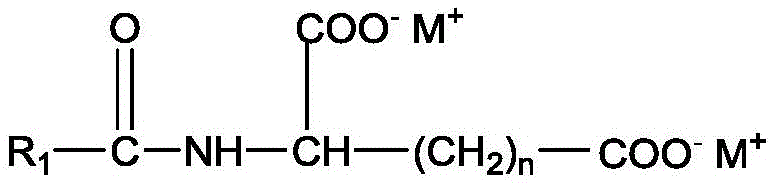
wherein R is1Is a saturated or unsaturated, linear or branched alkyl chain containing from 7 to 17 carbon atoms on the one hand and from 9 to 13 carbon atoms on the other hand, n is from 0 to 2, and M is independently H, sodium, potassium, ammonium or triethanolammonium.
Non-limiting examples of glutamate surfactants are dipotassium octanoyl glutamate, dipotassium undecylenoyl glutamate, disodium octanoyl glutamate, disodium cocoyl glutamate, disodium lauroyl glutamate, disodium stearoyl glutamate, disodium undecylenoyl glutamate, potassium octanoyl glutamate, potassium cocoyl glutamate, potassium lauroyl glutamate, potassium myristoyl glutamate, potassium stearoyl glutamate, potassium undecylenoyl glutamate, sodium octanoyl glutamate, sodium cocoyl glutamate, sodium lauroyl glutamate, sodium myristoyl glutamate, sodium oliveoyl glutamate, sodium palmitoyl glutamate, sodium stearoyl glutamate, sodium undecylenoyl glutamate and mixtures thereof.
Representative alanine and alanine salt surfactants correspond to the formula:

wherein R is1Is a saturated or unsaturated, linear or branched alkyl chain containing from 7 to 17 carbon atoms on the one hand and from 9 to 13 carbon atoms on the other hand, R2Is H or methyl, and M is H, sodium, potassium, ammonium or triethanolammonium.
Non-limiting examples of alanine and alanine salt surfactants are cocoyl methyl beta-alanine, lauroyl methyl beta-alanine, myristoyl beta-alanine, lauroyl methyl beta-alanine potassium, cocoyl alanine sodium, cocoyl methyl beta-alanine sodium, myristoyl methyl beta-alanine sodium, and mixtures thereof.
Representative glycinate surfactants correspond to the formula:

wherein R is1Is a saturated or unsaturated, linear or branched alkyl chain containing from 7 to 17 carbon atoms on the one hand and from 9 to 13 carbon atoms on the other hand, and M is H, sodium, potassium, ammonium or triethanolammonium.
Non-limiting examples of glycinate surfactants are sodium palmitoyl glycinate, sodium lauroyl glycinate, sodium cocoyl glycinate, sodium myristoyl glycinate, potassium lauroyl glycinate, potassium cocoyl glycinate, sodium stearoyl glycinate and mixtures thereof.
Representative sarcosinate surfactants correspond to the formula:

wherein R is1Is a saturated or unsaturated, linear or branched alkyl chain containing from 7 to 17 carbon atoms on the one hand and from 9 to 13 carbon atoms on the other hand, and M is H, sodium, potassium, ammonium or triethanolammonium.
Non-limiting examples of sarcosinate surfactants are potassium lauroyl sarcosinate, potassium cocoyl sarcosinate, sodium lauroyl sarcosinate, sodium myristoyl sarcosinate, sodium palmitoyl sarcosinate, and mixtures thereof.
Representative aspartate surfactants correspond to the formula:

wherein R is1Is a saturated or unsaturated, linear or branched alkyl chain containing from 7 to 17 carbon atoms on the one hand and from 9 to 13 carbon atoms on the other hand, and M is independently H, sodium, potassium, ammonium or triethanolammonium.
Non-limiting examples of aspartate surfactants are sodium lauroyl aspartate, sodium myristoyl aspartate, sodium cocoyl aspartate, sodium caproyl aspartate, disodium lauroyl aspartate, disodium myristoyl aspartate, disodium cocoyl aspartate, disodium caproyl aspartate, potassium lauroyl aspartate, potassium myristoyl aspartate, potassium cocoyl aspartate, potassium caproyl aspartate, dipotassium lauroyl aspartate, dipotassium myristoyl aspartate, dipotassium cocoyl aspartate, dipotassium caproyl aspartate, and mixtures thereof.
The presence of the cationic surfactant may act as a conditioning agent and assist the heating step by ensuring that the heating device runs smoothly over the hair fibres. Although surfactants may also help increase viscosity, they are not considered rheology modifiers for the purposes of describing the exemplary embodiments herein.
The cationic surfactant may be any of those known or previously used in the art of aqueous surfactant compositions. Suitable classes of cationic surfactants are alkylamines, alkylimidazolines, ethoxylated amines, quaternary compounds and quaternary esters. In addition, alkylamine oxides can be used as cationic surfactants at low pH.
The alkylamine surfactants can be substituted or unsubstituted primary, secondary and tertiary fatty C12-C22Salts of alkylamines, and what is sometimes referred to as-amidoamines. Examples of alkylamines and salts thereof include dimethyl cocoamine, dimethyl palmitamine, dioctyl amine, dimethyl stearyl amine, dimethyl soyamine, myristylamine, tridecyl amine, ethyl stearyl amine, N-tallow propane diamine, ethoxylated stearyl amine, dihydroxyethyl stearyl amine, arachidyl amine, dimethyl lauryl amine, stearyl amine hydrochloride, soy amine chloride, stearyl amine formate, N-tallow propane diamine dichloride, and amino terminated silicones (INCI name silicone polymer and terminated with amino functional groups such as aminoethylaminopropyl siloxane).
Examples of amidoamines and salts thereof include stearamidopropyl dimethylamine, stearamidopropyl dimethylamine citrate, palmitamidopropyl diethylamine, and cocamidopropyl dimethylamine lactate.
Examples of alkyl imidazoline surfactants include alkyl hydroxyethyl imidazolines, such as stearyl hydroxyethyl imidazoline, cocoyl hydroxyethyl imidazoline, ethylhydroxymethyl oleyl oxazoline, and the like.
Examples of ethoxylated amines include PEG-cocopolyamine, PEG-15 tallow amine, quaternary ammonium salt-52, and the like.
Among the quaternary ammonium compounds that can be used as cationic surfactants, some correspond to the general formula: (R)5R6R7R8N+)E-Wherein R is5、R6、R7And R8Independently selected from an aliphatic group having from 1 to about 22 carbon atoms, or an aromatic, alkoxy, polyoxyalkylene, alkylamido, hydroxyalkyl, aryl or alkylaryl group having from 1 to about 22 carbon atoms in the alkyl chain; and E-Are salt-forming anions such as those selected from the group consisting of halogen (e.g., chloride, bromide), acetate, citrate, lactate, glycolate, phosphate, nitrate, sulfate, and alkylsulfonate. In addition to carbon and hydrogen atoms, aliphatic groups may also contain ether linkages, ester linkages, and other groups such as amino groups. Longer chain aliphatic groups, e.g. those of about 12 carbons or more (C in the alkyl chain)10-C32) And may be saturated or unsaturated. In one aspect, the aryl group is selected from phenyl and benzyl.
Exemplary quaternary ammonium surfactants include, but are not limited to, cetyltrimethylammonium chloride (cetrimide), cetylpyridinium chloride, dicetyldimethylammonium chloride, dihexadecyldimethylammonium chloride, stearyldimethylbenzylammonium chloride, dioctadecyldimethylammonium chloride, didodecyldimethylammonium chloride, dihexadecyldimethylammonium acetate, behenyltrimethylammonium chloride (behentrimonium chloride), benzalkonium chloride, benzethonium chloride and di (cocoalkyl) dimethylammonium chloride, ditallow dimethylammonium chloride, di (hydrogenated tallow) dimethylammonium acetate, ditallow dimethyl methylammonium sulfate, ditallow dipropylammonium phosphate, and ditallow dimethyl ammonium nitrate.
At low pH, amine oxides can be protonated and behave like N-alkylamines. Examples include, but are not limited to, dimethyl-dodecylamine oxide, oleyl bis (2-hydroxyethyl) amine oxide, dimethyl tetradecylamine oxide, bis (2-hydroxyethyl) tetradecylamine oxide, dimethyl hexadecylamine oxide, behenamine oxide, cocoamine oxide, decyl tetradecylamine oxide, dihydroxyethyl C12-15Alkoxypropylamine oxide, dihydroxyethyl cocoamine oxide, dihydroxyethyl lauramine oxide, dihydroxyethyl stearylamine oxide, dihydroxyethyl tallow amine oxide, hydrogenated palm kernel amine oxide, hydrogenated tallow amine oxide, hydroxyethyl hydroxypropyl C12-C15Alkoxypropylamine oxide, laurylamine oxide, myristylamine oxide, cetylamine oxide, oleamidopropylamine oxide, oleylamine oxide, palmitylamine oxide, PEG-3 laurylamine oxide, dimethyllaurylamine oxide, potassium triphosphatidylmethylamine oxide, soya amidopropylamine oxide, cocamidopropylamine oxide, stearylamine oxide, tallow amine oxide, and mixtures thereof.
At low pH, amine oxides can be protonated and behave like N-alkylamines. Examples include, but are not limited to, dimethyl-dodecylamine oxide, oleyl bis (2-hydroxyethyl) amine oxide, dimethyl tetradecylamine oxide, bis (2-hydroxyethyl) tetradecylamine oxide, dimethyl hexadecylamine oxide, behenamine oxide, cocoamine oxide, decyl tetradecylamine oxide, dihydroxyethyl C12-15Alkoxypropylamine oxide, dihydroxyethyl cocoamine oxide, dihydroxyethyl lauramine oxide, dihydroxyethyl stearylamine oxide, dihydroxyethyl tallow amine oxide, hydrogenated palm kernel amine oxide, hydrogenated tallow amine oxide, hydroxyethyl hydroxypropyl C12-C15Alkoxypropylamine oxide, laurylamine oxide, myristylamine oxide, cetylamine oxide, oleamidopropylamine oxide, oleylamine oxide, palmitylamine oxide, PEG-3 laurylamine oxide, dimethyllaurylamine oxide, potassium triphosphatidylmethylamine oxide, soyaAmidopropylamine oxide, cocamidopropylamine oxide, stearylamine oxide, tallow amine oxide, and mixtures thereof.
In one aspect of the present technology, suitable amphoteric surfactants include, but are not limited to, alkyl betaines, e.g., lauryl betaine; alkylamidobetaines, for example, cocamidopropyl betaine and cococetyl dimethyl betaine; alkylamidobetaines, for example, cocamidopropyl hydroxysultaine; (mono-and di-) amphocarboxylates, for example, sodium cocoyl amphoacetate, sodium lauroyl amphoacetate, sodium caprylyl amphoacetate, disodium cocoyl amphodiacetate, disodium lauroyl amphodiacetate, disodium caprylyl amphodipropionate, disodium lauroamphodipropionate, disodium caprylyl amphodipropionate; and mixtures thereof.
The foregoing amphoteric surfactants (i.e., betaines and sultaines) are disclosed without counterions, as one of ordinary skill in the art will recognize that under the pH conditions of the amphoteric surfactant-containing compositions, these surfactants are either electrically neutral by having balanced positive and negative charges, or contain counterions such as alkali metal, alkaline earth metal, or ammonium ions as charge balancing moieties.
The nonionic surfactant can be any of the nonionic surfactants known or previously used in the art of aqueous surfactant compositions. Suitable nonionic surfactants include, but are not limited to, aliphatic (C)6-C18) Primary or secondary linear or branched acids, alcohols or phenols; an alkyl ethoxylate; alkylphenol alkoxylates (especially ethoxylates and mixed ethoxy/propoxy moieties); a block alkylene oxide condensate of an alkylphenol; alkylene oxide condensates of alkanols; and ethylene oxide/propylene oxide block copolymers. Other suitable nonionic surfactants include mono-or dialkyl alkanolamides; and Alkyl Polyglycosides (APG); sorbitan fatty acid esters; polyoxyethylene sorbitan fatty acid esters; poly(s) are polymerizedEthylene oxide sorbitol ester; polyoxyethylene acids and polyoxyethylene alcohols. Other examples of suitable nonionic surfactants include coco mono-or diethanolamide, coco glucoside, decyl diglucoside, lauryl diglucoside, coco diglucoside, polysorbates 20, 40, 60 and 80, ethoxylated linear alcohols, cetearyl alcohol, lanolin alcohol, stearic acid, glyceryl stearate, PEG-100 stearate, laureth-7 and oleyl polyether 20.
In another embodiment, the nonionic surfactant comprises an alkoxylated methyl glucoside, such as methyl glucose polyether-10, methyl glucose polyether-20, PPG-10 methyl glucose ether, and PPG-20 methyl glucose ether, each under the trade name PPG-20 methyl glucose ether E10、
E10、 E20、
E20、 P10 and
 p20 is available from Lubrizol Advanced Materials, Inc; also suitable are hydrophobically modified alkoxylated methyl glucosides, such as PEG 120 methyl glucose dioleate, PEG-120 methyl glucose trioleate and PEG-20 methyl glucose sesquistearate, each under the trade name PEG 120 methyl glucose dioleate, PEG-120 methyl glucose trioleate and PEG-20 methyl glucose sesquistearate
 DOE-120、GlucamateTMLT、GlucamateTMVLT and glucimateTMSSE-20 is available from Luobozun advanced materials. Other exemplary hydrophobically modified alkoxylated methyl glucosides are disclosed in U.S. Pat. nos. 6,573,375 and 6,727,357.
Other surfactants that may be used in the composition are described in more detail in WO 99/21530, U.S. patent nos. 3,929,678, 4,565,647, 5,720,964, and 5,858,948. Additionally, suitable surfactants are also described in McCutcheon's Emulsifiers and Detergents (North America and International editions, Schwartz, Perry and Berch), McCutcheon's Emulsifiers and Detergents.
While the amount of surfactant used in compositions comprising exemplary thermal activators may vary widely depending on the desired application, amounts typically used are typically from 1% to 80% by weight based on the active ingredient. For example, the surfactant may be present in the composition in a total concentration of 0.001 to 20% by weight, such as at least 0.1% by weight, based on the active ingredient.
Conditioning agent
Cationic polymers
Cationic polymers are components that can enhance the delivery of conditioning agents and/or provide auxiliary conditioning benefits to the hair, scalp or skin to improve and enhance the conditioning benefits delivered by the silicone conditioning agents of the presently disclosed technology. Cationic polymers are polymers containing at least one cationic moiety or at least one moiety that can be ionized to form a cationic moiety. Typically, these cationic moieties are nitrogen-containing groups, such as quaternary ammonium or protonated amino groups. The cationic protonated amines can be primary, secondary, or tertiary amines. The cationic charge density of the cationic polymer at the pH of the intended use of the composition typically ranges from about 0.2 to about 7 meq/g. The average molecular weight of the cationic polymer ranges from about 5,000 daltons to about 10,000,000 daltons.
Non-limiting examples of such polymers are described in CTFA International cosmetic ingredient Dictionary/Handbook (International cosmetic ingredient Dictionary/Handbook) which is visible through the CTFA website, and the ninth edition of CTFA cosmetic ingredient Handbook (2002) by cosmetic and Fragrance association of Washington, inc.
Non-limiting examples of suitable cationic polymers include copolymers of vinyl monomers having cationic protonated amine or quaternary ammonium functionality with water soluble spacer monomers such as acrylamide, methacrylamide, alkyl and dialkyl acrylamides, alkyl and dialkyl methacrylamides, alkyl acrylates, alkyl methacrylates, vinyl caprolactone or vinyl pyrrolidone.
Suitable cationic protonated amino and quaternary ammonium monomers for inclusion in the cationic polymers in the compositions herein include vinyl compounds substituted with dialkylaminoalkyl acrylate, dialkylaminoalkyl methacrylate, monoalkylaminoalkyl acrylate, monoalkylaminoalkyl methacrylate, trialkyl methacryloxyalkyl ammonium salt, trialkyl acryloxyalkyl ammonium salt, diallyl quaternary ammonium salts, and vinyl quaternary ammonium monomers having cyclic cationic nitrogen-containing rings, such as pyridinium, imidazolium, and quaternized pyrrolidones, such as alkyl vinyl imidazolium, alkyl vinyl pyridinium, alkyl vinyl pyrrolidone salts.
Other suitable cationic polymers for use in the composition include copolymers of 1-vinyl-2-pyrrolidone and 1-vinyl-3-methylimidazolium salts (e.g., chloride salts) (CTFA, Polyquaternium) -16); copolymers of 1-vinyl-2-pyrrolidone and dimethylaminoethyl methacrylate (CTFA, polyquaternium-11); cationic diallyl quaternary ammonium-containing polymers including, for example, dimethyldiallylammonium chloride homopolymer, copolymers of acrylamide and dimethyldiallylammonium chloride (CTFA, polyquaternium-6 and polyquaternium-7, respectively); amphoteric copolymers of acrylic acid, including copolymers of acrylic acid and dimethyldiallylammonium chloride (CTFA, polyquaternium-22); terpolymers of acrylic acid with dimethyldiallylammonium chloride and acrylamide (CTFA, polyquaternium-39); terpolymers of acrylic acid with methacrylamidopropyltrimethylammonium chloride and methyl acrylate (CTFA, polyquaternium-47); terpolymer of acrylic acid, methacrylamidopropyltrimethylammonium chloride and acrylamide (CTFA, polyquaternium-53). In one aspect, suitable cationically substituted monomers are cationically substituted dialkylaminoalkyl acrylamides, dialkylaminoalkyl methacrylamides, and combinations thereof.
Other suitable cationic polymers for use in the composition include polysaccharide polymers, such as cationic cellulose derivatives and cationic starch derivatives modified with quaternary ammonium halide moieties. An exemplary cationic cellulose polymer is a salt of hydroxyethyl cellulose reacted with trimethylammonium substituted epoxide (CTFA, polyquaternium-10). Other suitable types of cationic cellulose comprise polymeric quaternary ammonium salts of hydroxyethyl cellulose reacted with lauryl dimethyl ammonium-substituted epoxide (CTFA, polyquaternium-24).
Other suitable cationic polymers include cationic polygalactomannan derivatives, such as guar gum derivatives and cassia gum derivatives, such as guar hydroxypropyl trimonium chloride and cassia hydroxypropyl trimonium chloride, respectively. The guar hydroxypropyl ammonium trichloride may be JaguarTMTrade name series are commercially available from Rhodia Inc (Rhodia Inc.) and from Ashland Inc (Ashland Inc.) as the N-Hance trade name series. Cinnamon hydroxypropyl ammonium trichloride series Sensomer with trade nameTMCommercially available from luobutrin advanced materials, inc.
The amount of cationic polymer that can be used in the cleaning compositions of the disclosed technology can be from about 0.01 wt.% to about 10 wt.% in one aspect, from about 0.05 wt.% to about 3 wt.% in another aspect, and from about 0.1 wt.% to about 1 wt.% in still another aspect, based on the weight of the total composition.
Siloxanes
The silicone hair conditioner phase may be used in the composition, for example a silicone fluid, and may also contain other ingredients, for example a silicone resin, to improve the deposition efficiency of the silicone fluid or to enhance the gloss of the hair, especially at high refractive indices (e.g. above 1.46). The optional silicone hair conditioning agent phase may comprise volatile silicones, non-volatile silicones, or combinations thereof. The silicone droplets are typically suspended with an optional suspending agent. The silicone conditioning agent particles can comprise volatile silicones, non-volatile silicones, or combinations thereof. Preferred are non-volatile silicone conditioning agents. If volatile silicones are present, they are often used incidentally as a commercially available form of non-volatile silicone material ingredient such as silicone rubbers and resinsA solvent or carrier of (a). In one aspect, the silicone hair conditioning agents used in the disclosed technology have a viscosity of from about 20 to about 2,000,000 centistokes ((1 centistokes equal to 1x 10).-6m2In one aspect, from about 1,000 to about 1,800,000 centistokes, in a further aspect from about 50,000 to about 1,500,000 centistokes, and in yet a further aspect from about 100,000 to about 1,500,000 centistokes, as measured at 25 ℃.
The concentration of silicone conditioning agent can range from about 0.01% to about 10% by weight of the composition in which it is contained. In another aspect, the amount of silicone conditioning agent is from about 0.1 wt% to about 8 wt%, in yet another aspect from about 0.1 wt% to about 5 wt%, and in a further aspect from about 0.2 wt% to about 3 wt%, all based on the total weight of the composition.
In one embodiment, the dispersed silicone conditioning agent particles may have a volume average particle size of from about 5 μm to about 125 μm. For small particle application to hair, the volume average particle size is from about 0.01 μm to about 4 μm on the one hand, from about 0.01 μm to about 2 μm on the other hand, and from about 0.01 μm to about 0.5 μm on the other hand. For application of larger particles to hair, the volume average particle size is typically from about 5 μm to about 125 μm on the one hand, from about 10 μm to about 90 μm on the other hand, from about 15 μm to about 70 μm in yet another aspect, and from about 20 μm to about 50 μm in a further aspect.
Background materials on silicones (including discussion of silicone fluids, gums and resins and parts of their manufacture) are found in: encyclopedia of Polymer Science and Engineering (Encyclopedia of Polymer Science and Engineering), Vol.15, 2 nd edition, p.204-308, John Wiley & Sons, Inc. (1989), which is incorporated herein by reference. Silicone fluids are generally described as alkyl silicone polymers. Non-limiting examples of suitable silicone conditioning agents and optional suspending agents for silicones are described in Reissue Pat. No.34,584, u.s.pat. No.5,104,646 and u.s.pat. No.5,106,609, the descriptions of which are incorporated herein by reference.
The silicone fluid comprises silicone oil, which is a flowable silicone material having a viscosity of less than 1,000,000csk, typically from about 5csk to about 1,000,000csk, measured at 25 ℃. Suitable silicone oils include polyalkylsiloxanes, polyarylsiloxanes, polyalkylarylsiloxanes, polyether siloxane copolymers and mixtures thereof. Other insoluble, nonvolatile silicone fluids having hair conditioning properties can also be used.
The silicone oil comprises a polyalkyl, polyaryl or polyalkylaryl siloxane corresponding to the formula:

wherein R is20Is an aliphatic radical independently selected from alkyl, alkenyl and aryl radicals, R20May be substituted or unsubstituted, and w is an integer from 1 to about 8,000. Suitable unsubstituted R for use in personal cleansing compositions of the disclosed technology20Groups include, but are not limited to: alkoxy, aryloxy, alkaryl, arylalkyl, arylalkenyl, alkylamino and ether substituted, hydroxy substituted and halogen substituted aliphatic and aryl groups. Suitable R20Groups also include cationic amines and quaternary ammonium groups.
In one aspect of the disclosed technology, exemplary R20Alkyl and alkenyl substituents in the range of C1-C5Alkyl and alkenyl, in another aspect C1-C4In a further aspect is C1-C2. Other aliphatic moieties containing alkyl, alkenyl or alkynyl groups (e.g., alkoxy, alkaryl and alkylamino) can be straight or branched chain and are, in one aspect, C1-C5On the other hand, C1-C4In a further aspect is C1-C2. As mentioned above, R20The substituents may also contain amino functional groups (e.g., alkylamino groups), which may be primary, secondary, or tertiary amines or quaternary ammonium. These include mono-, di-and trialkylamino and alkoxyamino groups wherein the chain length of the aliphatic moiety is as described above.
Exemplary silicones are polydimethylsiloxane, polydiethylsiloxane and polymethylphenylsiloxane. These silicones are available, for example, from the general electric company, Viscasil R and SF 96 series, and from Dow Corning company, marketed as the Dow Corning 200 series. Exemplary polyalkylaryl siloxane fluids that may be used include, for example, polymethylphenylsiloxane. These silicones are available, for example, as SF 1075 methylphenyl fluid from general electric company, or 556 cosmetic grade fluid from dow corning company.
Cationic silicone fluids are also suitable for use in the disclosed technology. The cationic silicone fluid may represent, but is not limited to, the general formula:
(R21)eG3-f—Si—(OSiG2)g—(OSiGf(R1)(2-f)h—O—SiG3-e(R21)f
wherein G is hydrogen, phenyl, hydroxy or C1-C8Alkyl, preferably methyl; e is 0 or an integer from 1 to 3; f is 0 or 1; g is a number from 0 to 1,999; h is an integer from 1 to 2,000, preferably from 1 to 10; the sum of g and h is a number from 1 to 2,000 in one aspect and from 50 to 500 in another aspect of the disclosed technology; r21Is in accordance with the general formula CqH2qA monovalent group of L, wherein q is an integer having a value of 2 to 8, and L is selected from the group consisting of:
a)-N(R22)CH2CH2N(R22)2
b)-N(R22)
c)-N(R22)3CA-
d)-N(R22)CH2CH2N(R22)2H2 CA-
wherein R is22Independently selected from hydrogen, C1-C20Alkyl, phenyl, benzyl; and A-Is a halide ion selected from the group consisting of chloride, bromide, fluoride and iodide.
An exemplary cationic silicone corresponding to the immediately preceding formula defined above is a polymer called-trimethylsilylaminocilyl "of the formula:
(CH3)3-Si-[O-Si(CH3)2)]g-[O-(CH3)Si((CH2)3-NH-(CH2)2-NH2)]h-O-Si(CH3)3
another cationic siloxane useful in the disclosed technology can be represented by the formula:

wherein R is22Represents a group selected from C1-C18Alkyl and C1-C18A group of alkenyl groups; r23Independently represent a group selected from C1-C18Alkylene or C1-C18A group of alkyleneoxy groups; q is a halide; r represents an average statistical value of 2 to 20 on the one hand and 2 to 8 on the other hand; s represents on the one hand an average statistical value of 20-200, on the other hand 20-50. In one aspect, R22Is methyl. In another aspect, Q is chloride.
Other optional silicone fluids are insoluble silicone rubbers. These gums are silicone materials having a viscosity greater than or equal to 1,000,000 centistokes at 25 ℃. Silicone rubbers are described in U.S. Pat. nos. 4,152,416; noll and Walter, Chemistry and Technology of Silicones, New York: Academic Press 1968; and in general electric silicone rubber products data sheet SE 30, SE 33, SE 54 and SE 76, all incorporated herein by reference. Silicone rubbers will typically have a mass molecular weight in excess of about 200,000 daltons, typically between about 200,000 and about 1,000,000 daltons, specific examples of which include polydimethylsiloxane, polydimethylsiloxane/methylvinylsiloxane copolymer, polydimethylsiloxane/diphenylsiloxane/methylvinylsiloxane) copolymer, and mixtures thereof.
Another class of nonvolatile, insoluble silicone fluid conditioning agents are high refractive index silicones having a refractive index of at least about 1.46 in one aspect, at least about 1.48 in another aspect, at least about 1.52 in a further aspect, and at least about 1.55 in a further aspect. The refractive index of the polysiloxane fluid will typically be less than about 1.70, typically less than about 1.60. In this context, silicone-fluid "includes oils as well as gums.
High refractive index polysiloxane fluids include those represented by the general formulae set forth above with respect to polyalkyl, polyaryl and polyalkylaryl siloxanes, as well as cyclic polysiloxanes (cyclomethicones) represented by the formula:
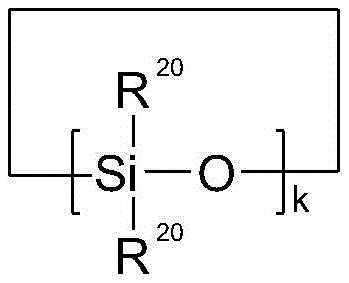
wherein the substituent R20As defined above, and the number k of repeating units is from about 3 to about 7 on the one hand, and from 3 to 5 on the other hand. The high refractive index polysiloxane fluid may contain a certain amount of R containing aryl groups20A substituent sufficient to raise the refractive index to the desired level, as described above. In addition, R must be selected20And k, such that the material is non-volatile. Aryl-containing substituents include those containing five-and six-membered aryl rings of alicyclic and heterocyclic rings and those containing fused five-or six-membered rings. The aryl ring may be substituted or unsubstituted. Substituents include aliphatic substituents, and may also include alkoxy substituents, acyl substituents, ketones, halogens (e.g., Cl and Br), amines, and the like. Exemplary aryl-containing groups include substituted and unsubstituted aromatic hydrocarbons, e.g., phenyl and phenyl derivatives, e.g., having C1-C5Alkyl-or alkenyl-substituted phenyl radicals, e.g. allylphenyl, methylphenyl and ethylphenyl, vinylphenyl, e.g. styryl, and phenylalkynyl (e.g. phenyl C)2-C4Alkynyl). Heterocyclic aryl groups include substituents derived from furan, imidazole, pyrrole, pyridine, and the like. Fused aromatic ring substituents include, for example, naphthalene, coumarin, and purine.
The high refractive index polysiloxane fluid will have at least about 15% by weight aryl-containing substituents on the one hand, at least about 20% by weight on the other hand, at least about 25% by weight on the further aspect, at least about 35% by weight on the further aspect, at least about 50% by weight on the weight of the polysiloxane fluid on the other hand. Typically, the degree of aryl substitution will be less than about 90 weight percent, more typically less than about 85 weight percent, and can typically range from about 55 weight percent to about 80 weight percent of the polysiloxane fluid.
In another aspect, the high refractive index polysiloxane fluid has a combination of phenyl or substituted phenyl derivatives. The substituents may be selected from C1-C4Alkyl (e.g. methyl), hydroxy and C1-C4Alkylamino (e.g. -R)24NHR25NH2Wherein each R is24And R25The radicals are independently C1-C3Alkyl, alkenyl and/or alkoxy).
When high refractive index silicones are used in the compositions of the present technology, they may optionally be used in solution with a spreading agent, such as a silicone resin or surfactant, to reduce the surface tension by a sufficient amount to enhance spreading and thus enhance the gloss (after drying) of hair treated with such compositions. Silicone fluids suitable for use in the compositions of the present technology are disclosed in U.S. patent No. 2,826,551, U.S. patent No.3,964,500, U.S. patent No. 4,364,837, british patent No. 849,433, and Silicon Compounds, petrichsystems, inc. (1984), which are incorporated herein by reference in their entirety. High refractive index polysiloxanes are available from Dow Corning Corporation (Midland, Mich.) Huls America (Piscataway, N.J.) and General Electric Silicones (Waterford, N.Y.).
The silicone resin may be included in silicone conditioning agents suitable for use in the compositions of the present invention. These resins are crosslinked polysiloxanes. In the manufacture of silicone resins, crosslinking is introduced by combining trifunctional and tetrafunctional silanes with monofunctional or difunctional (or both) silanes.
As is well known in the art, the degree of crosslinking required to produce a silicone resin will vary depending on the particular silane units incorporated into the silicone resin. Generally, silicone materials having a sufficient level of trifunctional and tetrafunctional siloxane monomer units (and thus a sufficient level of crosslinking) to dry them into a rigid or hard film are considered to be silicone resins. The ratio of oxygen atoms to silicon atoms represents the level of crosslinking in a particular silicone material. A silicone material having at least about 1.1 oxygen atoms per silicon atom will generally be a silicone resin herein. In one aspect, the ratio of oxygen: a ratio of silicon atoms of at least about 1.2: 1.0. silanes used in the manufacture of silicone resins include monomethyl, dimethyl, trimethyl, monophenyl, diphenyl, methylphenyl, monovinyl and methylvinylchlorosilanes and tetrachlorosilane, with methyl-substituted silanes being most commonly used. Silicone resins available from general electric are GE SS4230 and SS 4267.
Silicone materials, particularly silicone resins, are identified according to a shorthand nomenclature known to those of ordinary skill in the art as the MDTQ "nomenclature. Under this system, siloxanes are described in terms of the presence of the various siloxane monomer units that make up the siloxane. In short, the symbol M denotes a monofunctional unit (CH)3)3SiO0.5(ii) a D represents a bifunctional unit (CH)3)2SiO; t represents a trifunctional unit (CH)3)SiO1.5(ii) a Q represents a tetra (quadra) functional or tetra (tetra) functional unit SiO2. The reference to the unit symbols indicates (Prime) (e.g. M ', D', T 'and Q') represents a substituent other than methyl and must be specifically defined each time it occurs. Typical substituent substituents include groups such as vinyl, phenyl, amine, hydroxyl, and the like. The molar ratios of the individual units, whether in terms of subscripts to the symbols indicating the total number of each type of unit in the siloxane (or its average) or specifically indicated in combination with molecular weight, complete the description of the silicone material under the MDTQ system. Higher relative molar amounts of T, Q, T 'and/or Q' to D, D ', M and/or M' in the silicone resin indicate higher levels of crosslinking. However, as previously mentioned, the overall level of crosslinking may also be expressed by the ratio of oxygen to silicon.
Exemplary silicone resins for use in the compositions of the present technology include, but are not limited to, MQ, MT, MTQ, MDT, and MDTQ resins. In one aspect, methyl is a silicone resin substituent. In another aspect, the silicone resin is selected from MQ resins, wherein M: q ratio is about 0.5: 1.0 to about 1.5: 1.0 and the average molecular weight of the silicone resin is from about 1000 to about 10,000 daltons.
When used with a non-volatile silicone fluid having a refractive index of less than 1.46, in one aspect, the weight ratio of the non-volatile silicone fluid to the silicone resin component is from about 4: 1 to about 400: 1, in another aspect from about 9: 1 to about 200: 1, and in a further aspect from about 19: 1 to about 100: 1, particularly when the silicone fluid component is a polydimethylsiloxane fluid or a mixture of polydimethylsiloxane fluid and polydimethylsiloxane gum as described above. As long as the silicone resin forms part of the same phase as the silicone fluid, i.e., the conditioning active, in the compositions herein, the sum of the fluid and resin should be included in determining the level of silicone conditioning agent in the composition.
The volatile siloxane includes cyclic and linear polydimethylsiloxanes, and the like. Cyclic volatile siloxanes (cyclomethicones) typically contain from about 3 to about 7 silicon atoms alternating with oxygen atoms in the cyclic ring structure, as described above for non-volatile cyclic siloxanes. However, each R in the formula must be selected20Substituents and repeating units k to render the material non-volatile. In general, R20Substituted with two alkyl groups (e.g., methyl). The linear volatile siloxane is a silicone fluid as described above having a viscosity of no more than about 25 mPa-s. Volatile "means that the siloxane has a measurable vapor pressure, or a vapor pressure of at least 2mm Hg at 20 ℃. The non-volatile silicone has a vapor pressure of less than 2mm Hg at 20 ℃. Descriptions of cyclic and direct-bonded Volatile siloxanes can be found in "vollate Silicone Fluids for Cosmetics" by Todd and Byers, Cosmetics and Toiletries, Vol.91 (1), pp.27-32 (1976) and in "vollate Silicones" by kasprazak, Soap/Cosmetics/Chemical specialties, pp.40-43 (12 months 1986), all of which are incorporated herein by reference.
Exemplary volatile cyclomethicones are D4 cyclomethicone (octamethylcyclotetrasiloxane), D5 cyclomethicone (decamethylcyclopentasiloxane), D6 cyclomethicone and mixtures thereof (e.g., D4/D5 and D5/D6). Mixtures of volatile cyclomethicones and cyclomethicones are commercially available from g.e. silicones as SF1173, SF1202, SF1256 and SF1258, from Dow Corning Corporation as Dow 244. 245, 246, 345 and 1401 Fluids. Blends of volatile cyclomethicones and volatile linear dimethicone are also contemplated.
Exemplary volatile linear dimethylsiloxanes include hexamethyldisiloxane, octamethyltrisiloxane, decamethyltetrasiloxane, dodecamethylpentasiloxane, and mixtures thereof. Volatile linear dimethicone and dimethicone mixtures are available from Dow Corning Corporation as Dow Corning Fluid (e.g., product names 0.65CST, 1CST, 1.5CST, and 2CST) and Dow
 2-1184Fluid。
Emulsified silicones are also suitable for combinations in the disclosed technology. Typically, the silicone emulsion has an average silicone particle size in the composition of less than 30 μm in one aspect, less than 20 μm in another aspect, and less than 10 μm in a further aspect. In one embodiment of the disclosed technology, the emulsified silicone in the composition has an average silicone particle size of less than 2 μm, desirably in the range of 0.01 to 1 μm. Silicone emulsions having an average silicone particle size of < 0.15 microns are commonly referred to as microemulsions. Particle size can be measured by laser light scattering techniques using a 2600D particle sizer from Malvern Instruments. Suitable silicone emulsions for use in the disclosed technology are also commercially available in pre-emulsified form. Examples of suitable preformed emulsions include emulsions DC2-1766, DC2-1784, and microemulsions DC2-1865 and DC2-1870, all available from Dow Corning. These are all emulsions/microemulsions of dimethicone. Crosslinked silicone gums are also available in pre-emulsified form, which is advantageous for ease of formulation. Exemplary materials are available from Dow Corning as DCX2-1787, which are emulsions of cross-linked dimethyl silicone gum. Another exemplary material is available from Dow Corning as DCX2-1391, which is a microemulsion of cross-linked dimethyl silicone gum. Pre-formed emulsions of amino-functional silicones are also available from silicone oil suppliers such as Dow Corning and General Electric. Particularly suitable are emulsions of amino-functional silicone oils with nonionic and/or cationic surfactants. Specific examples include DC929 cationic emulsions, DC939 cationic emulsions, DC949 cationic and nonionic emulsions DC2-7224, DC2-8467, DC2-8177 and DC2-8154 (all available from Dow Corning). Mixtures of any of the above types of siloxanes may also be used. Specific examples of suitable amino-functional siloxanes are amino silicone oils DC2-8220, DC2-8166, DC2-8466 and DC2-8950-114 (all available from Dow Corning) and GE 1149-75 (available from General Electric Silicones). An example of a quaternary siloxane polymer useful in the disclosed technology is material K3474 available from Goldschmidt, germany.
Other suitable silicone oils include dimethicone copolyols, which are linear or branched copolymers of dimethicone (dimethylsilicone) modified with alkylene oxide units. The alkylene oxide units may be arranged in the form of random or block copolymers. One class of commonly useful polydimethylsiloxane polyols are block copolymers having terminal and/or side chain blocks of polydimethylsiloxane and blocks of polyalkylene oxide, such as blocks of polyethylene oxide, polypropylene oxide, or both. Depending on the amount of polyalkylene oxide present in the dimethicone polymer, the dimethicone copolyol may be water soluble or water insoluble, and may be anionic, cationic or nonionic in character.
Water soluble or water dispersible silicones can also be used in the disclosed technology. Such water-soluble silicones comprise suitable anionic, cationic and/or nonionic functionality to render the silicone water-soluble or water-dispersible. In one embodiment, the water-soluble silicone comprises a polysiloxane backbone onto which at least one anionic moiety is grafted. The anionic moiety may be grafted to the end of the polysiloxane backbone, or grafted as a pendant group, or both. Anionic groups refer to any hydrocarbon moiety that comprises at least one anionic group or at least one group that can be ionized as an anionic group after neutralization by a base. As previously mentioned, the number of hydrocarbon groups of anionic character grafted onto the siloxane chain is chosen such that, after neutralization of the ionizable groups with a base, the corresponding siloxane derivatives are water-soluble or water-dispersible. The anionic siloxane derivative may be selected from existing commercial products or may be synthesized by any method known in the art. The nonionic siloxanes contain alkylene oxide terminal and/or pendant side chain units (e.g., dimethicone copolyol).
Siloxanes having anionic groups can be synthesized by reaction between (i) polysiloxanes containing hydrosilicon and (ii) compounds containing olefinic unsaturation, which also contain anionic functional groups. Examples of such reactions are poly (dimethylsiloxanes) containing Si-H groups and the alkene CH2.=.CHR26Hydrosilylation reaction of (2), wherein R26Represents a moiety containing an anionic group. The olefin may be monomeric, oligomeric or polymeric. Polysiloxane compounds containing pendant reactive thiols (-SH) are also suitable for grafting unsaturated anionic group-containing compounds to the poly (siloxane) backbone.
According to one aspect of the disclosed technology, anionic monomers containing ethylenic unsaturation may be used alone or in combination and are selected from straight or branched chain unsaturated carboxylic acids. Exemplary unsaturated carboxylic acids are acrylic acid, methacrylic acid, maleic anhydride, itaconic acid, fumaric acid, and crotonic acid. The monomers may optionally be partially or fully neutralized with a base to form alkali metal, alkaline earth metal and ammonium salts. Suitable bases include, but are not limited to, alkali metals, alkaline earth metals (e.g., sodium, potassium, lithium, calcium), and ammonium hydroxide. It will be noted that, similarly, the oligomer and polymer graft segments formed from the aforementioned monomers can be post-neutralized with a base (sodium hydroxide, ammonia, etc.) to form a salt. Examples of siloxane derivatives suitable for use in the disclosed technology are described in patent application nos. EP- cA-0582,152 and WO 93/23009. One exemplary class of silicone polymers is polysiloxanes containing repeating units represented by the following structure:

wherein G is1Represents hydrogen, C1-C10Alkyl and phenyl groups; g2Is represented by C1-C10An alkylene group; g3Represents an anionic polymeric residue resulting from the polymerization of at least one anionic monomer containing ethylenic unsaturation; j is 0 or 1; t is an integer of 1 to 50; u is an integer of 10 to 350. In one embodiment of the disclosed technology, G1Is methyl; j is 1; and G2Is propylene; g3Denotes a polymeric group obtained by polymerization of at least one unsaturated monomer containing a carboxylic acid group (e.g. acrylic acid, methacrylic acid, itaconic acid, fumaric acid, crotonic acid, maleic acid or aconitic acid, etc.).
The carboxylate group content in the final polymer is preferably from 1 mole carboxylate per 200 grams of polymer to 1 mole carboxylate per 5000 grams of polymer. The number average molecular weight of the siloxane polymer is preferably 10,000 to 1,000,000, and still more preferably 10,000 to 100,000. Exemplary unsaturated monomers containing carboxylic acid groups are acrylic acid and methacrylic acid. In addition, for monomers containing carboxylic acid groups, C of acrylic acid and methacrylic acid1-C20The alkyl ester may be copolymerized into the polymer backbone. Exemplary esters include, but are not limited to, ethyl and butyl esters of acrylic and methacrylic acid. Commercially available silicone-acrylate polymers are sold by 3M company under the trademark Silicones-Plus "Polymer 9857C (VS80 Dry). These polymers comprise a Polydimethylsiloxane (PDMS) backbone onto which random repeating units of poly (meth) acrylic acid and poly (butyl (meth) acrylate are grafted (via a thiopropenyl group). These products can generally be obtained by radical copolymerization between a thiopropyl-functionalized polydimethylsiloxane and a mixture of monomers comprising (meth) acrylic acid and butyl (meth) acrylate.
In another embodiment, the water-soluble silicone copolyols useful in practicing the disclosed technology may be represented by a silicone copolyol carboxylate represented by the formula:

wherein R is27And R28Independently selected from C1-C30Alkyl radical, C6-C14Aryl radical, C7-C15Aralkyl radical, C1-C15Alkylaryl or alkenyl having 1 to 40 carbons, hydroxy, -R31-G' or- (CH)2)3O(EO)a(PO)b(EO)c-G', provided that R27And R28Are not methyl; r29Is selected from C1-C5Alkyl or phenyl; in the formula, a, b and c are integers independently ranging from 0 to 100; EO is ethylene oxide, - (CH)2CH2O) -; PO being propylene oxide, - (CH)2CH(CH3) O) -; in the formula, o is an integer of 1 to 200, p is an integer of 0 to 200, and q is an integer of 0 to 1000; r30Is hydrogen, C1-C30Alkyl, aryl, C7-C15Aralkyl radical, C7-C15Alkylaryl or alkenyl having 1 to 40 carbons or-C (O) -X, wherein X is C1-C30Alkyl radical, C6-C14Aryl radical, C7-C15Aralkyl radical, C1-C15An alkaryl or alkenyl group having 1 to 40 carbons, or mixtures thereof; r31Is a divalent radical selected from the group consisting of alkylene radicals of 1 to 40 carbon atoms, which may be interrupted by arylene radicals of 6 to 18 carbons or alkylene radicals containing unsaturation of 2 to 8 carbons; and G' is independently selected from:
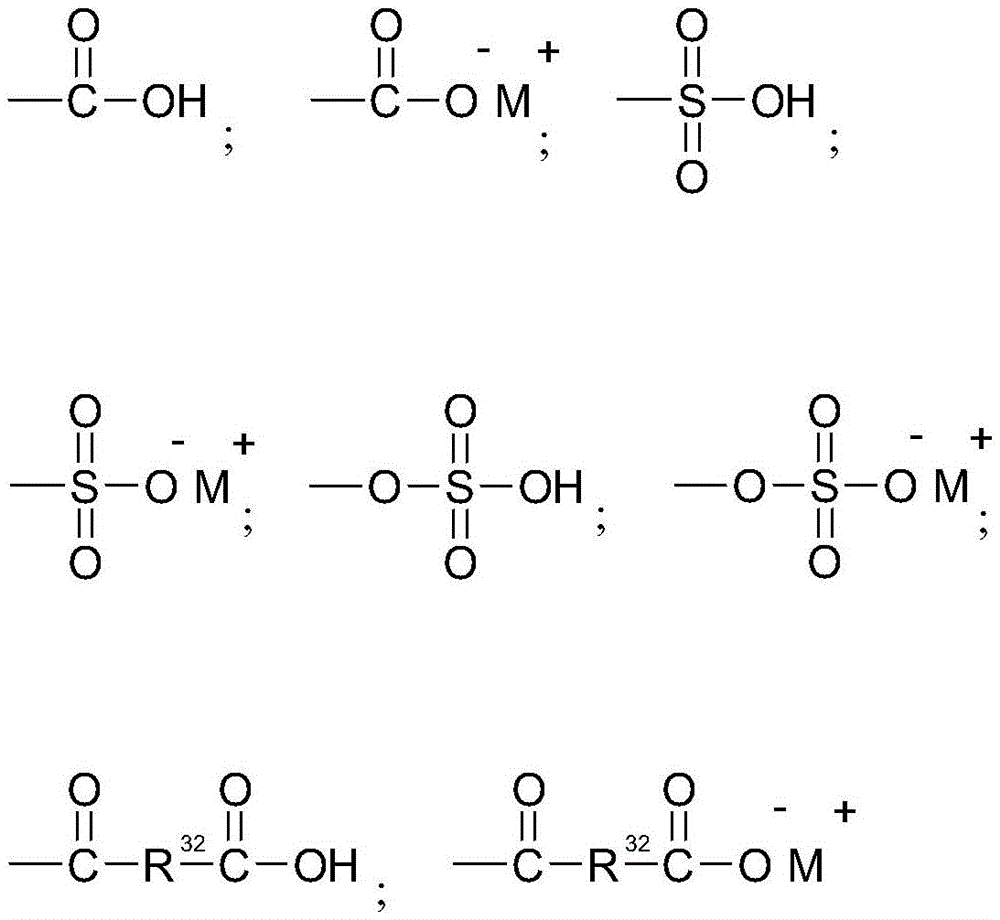
wherein R is32Is a divalent group selected from an alkylene group of 1 to 40 carbons, an unsaturated group containing 2 to 5 carbon atoms, or an arylene group having 6 to 12 carbon atoms; wherein M is selected from Na, K, Li, NH4Or contain C1-C10Alkyl radical, C6-C14Aryl (e.g. phenyl, naphthyl), C2-C10Alkenyl radical, C1-C10Hydroxyalkyl radical, C7-C24Aralkyl or C7-C24An alkylaryl amine. Representative of R32The radicals are: -CH2CH2-、-CH=CH-、-CH=CHCH2-and phenylene.
In another embodiment, the water-soluble silicones useful in practicing the disclosed technology can be represented as anionic silicone copolyols represented by the formula:

wherein R is33Is methyl or hydroxy; r34Is selected from C1-C8Alkyl or phenyl; r35Represents a group- (CH)2)3O(EO)x(PO)y(EO)z-SO3 -M+(ii) a Wherein M is selected from Na, K, Li or NH4A cation of (a); in the formula, x, y and z are independently integers of 0 to 100; r36Represents a group- (CH)2)3O(EO)x(PO)y(EO)z-H; in the formula, a and c are independently an integer of 0 to 50, b is an integer of 1 to 50; EO is ethylene oxide, e.g. - (CH)2CH2O) -; PO being propylene oxide, e.g. - (CH)2CH(CH3)O)-。
In yet another embodiment, the water-soluble silicones useful in practicing the disclosed technology can be represented as anionic silicone copolyols represented by the formula:

wherein R is37And R38Independently is-CH3Or a group represented by: - (CH)2)3O(EO)a(PO)b(EO)c-C(O)-R40-C (O) OH, with the proviso that R37And R38Are not simultaneously-CH3;R40Selected from divalent radicals-CH2CH2-CH ═ CH-and phenylene; r39Is selected from C1-C5Alkyl or phenyl; in the formula, a, b andc is an integer independently ranging from 0 to 20; EO is an oxirane residue, e.g. - (CH)2CH2O) -; PO being a propylene oxide residue, e.g. - (CH)2CH(CH3) O) -; in the formula, o is an integer of 1 to 200, and q is an integer of 0 to 500.
Other water-soluble silicones useful in the disclosed technology are quaternized silicone copolyol polymers. These polymers have pendant quaternary nitrogen functional groups and are represented by the formula:

wherein R is41Represents a quaternary substituent-N+R3R4R5X-Wherein R is3And R4And R5Independently of one another, from hydrogen and straight-chain and branched C1-C24Alkyl radical, X-Represents an anion suitable for balancing the cationic charge on the nitrogen atom; r42Is selected from C1-C10Alkyl and phenyl; r43Is- (CH)2)3O(EO)x(PO)y(EO)z-H, where EO is an oxirane residue, e.g., - (CH)2CH2O) -; PO being a propylene oxide residue, e.g. - (CH)2CH(CH3) O) -; in the formula, a is an integer of 0-200, b is an integer of 0-200, and c is an integer of 1-200; in the formula, x, y and z are integers and are independently selected from 0 to 20. In one aspect, the anion X-Represents an anion selected from chloride, bromide, iodide, sulfate, methylsulfate, sulfonate, nitrate, phosphate and acetate.
Other suitable water-soluble silicones are amine-substituted silicone copolyols represented by the formula:

wherein R is44Is selected from-NH (CH)2)nNH2Or- (CH)2)nNH2Wherein n is an integer of 2 to 6; and x is an integer from 0 to 20 n; wherein EO is an oxirane residue, e.g. - (CH)2CH2O) -; PO being a propylene oxide residue, e.g. - (CH)2CH(CH3) O) -; in the formula, a is an integer of 0-200, b is an integer of 0-200, and c is an integer of 1-200; in the formula, x, y and z are integers and are independently selected from 0 to 20.
The other water-soluble silicone may also be selected from nonionic silicone copolyols (dimethicone copolyols) represented by the formula:
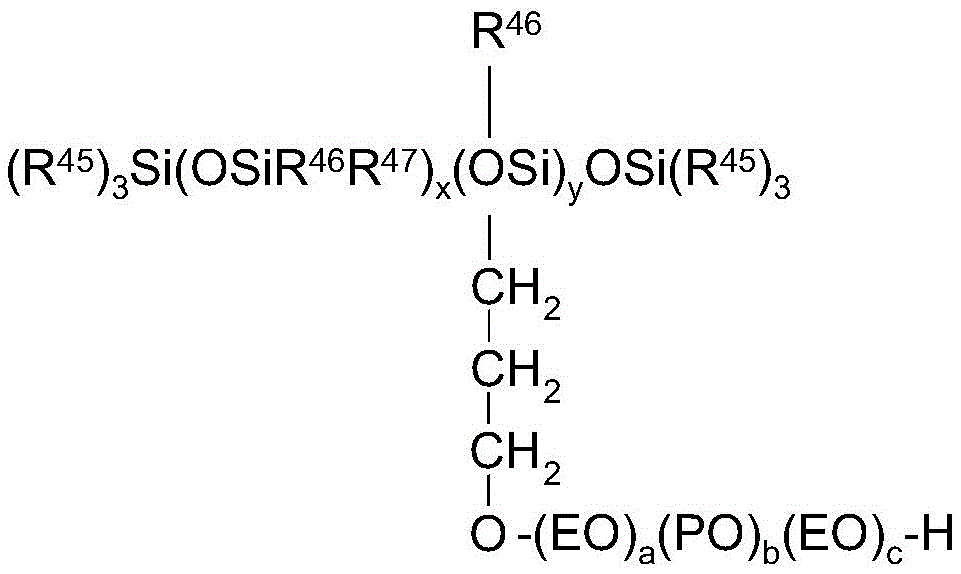
wherein R is45Independently represent a group selected from C1-C30Alkyl radical, C6-C14Aryl and C2-C20A group of alkenyl groups; r46Represents a group selected from C1-C30Alkyl radical, C6-C14Aryl and C2-C20A group of alkenyl groups; EO is an oxirane residue, e.g. - (CH)2CH2O) -; PO being a propylene oxide residue, e.g. - (CH)2CH(CH3) O) -; wherein a, b and c are independently 0 to 100; in the formula, x is 0 to 200; and y is 1 to 200.
In another embodiment, the water-soluble silicone may be selected from nonionic silicone copolyols represented by the formula:

wherein R is48And R49Independently represent a group selected from C1-C30Alkyl radical, C6-C14Aryl and C2-C20A group of alkenyl groups; EO is an oxirane residue, e.g. - (CH)2CH2O) -; PO being a propylene oxide residue, e.g. - (CH)2CH(CH3) O) -; wherein a, b and c are independently 0 to 100;in the formula, n is 0 to 200.
In the above-described embodiments of the copolyol, the EO and PO residues may be arranged in random, non-random, or block sequences.
Dimethicone copolyols are disclosed in U.S. patent nos. 5,136,063 and 5,180,843, the disclosures of which are incorporated herein by reference. Further, the dimethicone copolyol may be obtained from general electric company (GE-OSI) And
And trade name was purchased. Specific product names include, but are not limited to, Silsoft 305, 430, 475, 810, 895, Silwet L7604 (GE-OSi); dow of Dow Corning
 5103 and 5329; and Evonik Goldschmidt Corporation
 Dimethicone copolyols such as, for example, WE 09, WS 08, EM 90 and EM 97; and Silsense available from Lubrizol Advanced Materials, IncTMDimethicone copolyols, such as Silsense Copolyol-1 and Silsense Copolyol-7.
The silicone may be added in an amount of from about 0.05% to about 20% by weight of the composition, on the one hand, from about 0.08% to about 5% by weight, on the other hand, from about 0.1% to about 3% by weight, further on the other hand, alone or in combination with other conditioning agents described below.
Suitable conditioning oils for use as conditioning agents in the compositions of the disclosed technology include, but are not limited to, hydrocarbon oils having at least about 10 carbon atoms, such as cyclic hydrocarbons, straight chain aliphatic hydrocarbons (saturated or unsaturated), and branched chain aliphatic hydrocarbons (saturated or unsaturated), including polymers and mixtures thereof. Straight chain hydrocarbon oils typically contain from about 12 to 19 carbon atoms. Branched hydrocarbon oils, including hydrocarbon polymers, will typically contain more than 19 carbon atoms.
Specific non-limiting examples of these hydrocarbon oils include paraffin oil, mineral oil, saturated and unsaturated dodecane, saturated and unsaturated tridecane, saturated and unsaturated tetradecane, saturated and unsaturated pentadecane, saturated and unsaturated hexadecane, polybutene, polydecene, and mixtures thereof. Branched isomers of these compounds, as well as higher chain length hydrocarbons, may also be used, examples of which include highly branched, saturated or unsaturated alkanes, such as all-methyl substituted isomers of hexadecane and eicosane, such as 2,2,4,4,6,6,8, 8-dimethyl-10-methylundecane and 2,2,4,4,6, 6-dimethyl-8-methylnonane, available from Permethyl Corporation. Hydrocarbon polymers such as polybutene and polydecene. Preferred hydrocarbon polymers are polybutenes, such as copolymers of isobutylene and butene. A commercially available material of this type is L-14 polybutene from BP Chemical Company.
Natural oil conditioners can also be used in practicing the techniques of this disclosure, including, but not limited to, peanut, sesame, avocado, coconut, cocoa butter, almond, safflower, corn, cottonseed, sesame seed, walnut oil, castor, olive, jojoba oil, palm kernel, soybean, wheat germ, linseed, sunflower seed; eucalyptus essential oil, lavender essence, vetiver essential oil, litsea cubeba, lemon, sandalwood, rosemary, chamomile, essence, nutmeg, cinnamon, hyssop, caraway, orange, geranium, juniper and bergamot oil, fish oil, glycerol tricaprylin; and mixtures thereof. Natural oils may also be used as emollients.
Natural and synthetic wax conditioners can be used in the compositions of the disclosed technology, including but not limited to carnauba wax, candelilla wax, alpha wax, paraffin wax, ozokerite wax, olive wax, rice wax, hydrogenated jojoba wax, beeswax, modified beeswax, such as candelilla wax, marine wax, polyolefin waxes, such as polyethylene wax; and mixtures thereof.
Liquid polyolefin conditioning agents can be used in the compositions of the disclosed technology. Liquid polyolefin conditioning agents are typically polyalphaolefins that have been hydrogenated. The polyolefins useful herein may be through C4To about C14Polymerization of the olefin monomer(s) of (1). Non-limiting examples of olefin monomers useful in preparing the polyolefin liquids herein include ethylene, propylene, 1-butene, 1-pentene, 1-hexene, 1-octene, 1-decene, 1-dodecene, 1-tetradecene, branched chain isomers, such as 4-methyl-1-pentene, and mixtures thereof. In one aspect of the disclosed technology, hydrogenated α -olefin monomers include, but are not limited to: 1-hexene to 1-hexadecene, 1-octene to 1-tetradecene, and mixtures thereof.
Fluorinated or perfluorinated oils are also considered to be within the scope of the disclosed technology. Fluorinated oils include perfluoropolyethers described in european patent 0486135 and fluorinated hydrocarbon compounds described in WO 93/11103. The fluorinated oil may also be a fluorocarbon such as a fluoroamine, e.g., perfluorotributylamine, a fluorinated hydrocarbon, e.g., perfluorodecalin, a fluorinated ester, and a fluorinated ether.
Other suitable ingredients include, but are not limited to, fatty esters having at least 10 carbon atoms. These fatty esters include esters derived from fatty acids or alcohols (e.g., monoesters, polyol esters, and di-and tri-carboxylic acid esters). The fatty esters herein may include or have covalently bonded thereto other compatible functional groups such as amide and alkoxy moieties (e.g., ethoxy or ether linkages, etc.).
Exemplary fatty esters include, but are not limited to, isopropyl isostearate, hexyl laurate, isohexyl palmitate, isopropyl palmitate, decyl oleate, isodecyl oleate, cetyl stearate, decyl stearate, isopropyl isostearate, dihexyldecyl adipate, lauryl lactate, myristyl lactate, cetyl lactate, oleyl stearate, oleyl oleate, oleyl myristate, lauryl acetate, cetyl propionate, and oleyl adipate.
Other fatty esters suitable for use in the compositions of the disclosed technology are of the formula R50C(O)OR51Monocarboxylic acid esters of (2) wherein R is50And R51Is alkyl or alkenyl, and R50And R51The sum of the carbon atoms is at least 10 in one aspect and at least 22 in another aspect of the disclosed technology.
Other fatty esters suitable for use in the compositions of the disclosed technology are dialkyl and trialkyl and alkenyl esters of carboxylic acids, e.g. C4-C8Esters of dicarboxylic acids (e.g. C of succinic, glutaric, adipic acid)1-C22Esters, preferably C1-C6Esters). Specific non-limiting examples of dialkyl and trialkyl and alkenyl esters of carboxylic acids include isohexadecyl stearyl stearate, diisopropyl adipate, and tristearyl citrate.
Other fatty esters suitable for use in the compositions of the disclosed technology are those known as polyol esters. Such polyol esters include alkylene glycol esters, such as ethylene glycol mono and di-fatty acid esters, diethylene glycol mono and di-fatty acid esters, polyethylene glycol mono and di-fatty acid esters, propylene glycol mono and di-fatty acid esters, polypropylene glycol monooleate, polypropylene glycol 2000 monostearate, ethoxylated propylene glycol monostearate, glyceryl mono and di-fatty acid esters, polyglycerol poly-fatty acid esters, ethoxylated glyceryl monostearate, 1, 3-butylene glycol distearate, polyoxyethylene polyol fatty acid ester, sorbitan fatty acid esters and polyoxyethylene sorbitan fatty acid esters.
Specific non-limiting examples of suitable synthetic fatty esters for use in the personal cleansing compositions of the disclosed technology include: p-43 (C of trimethylolpropane)8-C10Triester), MCP-684 (tetraester of 3,3 diethanol-1, 5 pentanediol), MCP 121 (C of adipic acid)8-C10Diesters), all of which are available from the ExxonMobil Chemical Company.
Other oily material conditioning agents that may be used in combination with the polymers of the disclosed technology include, for example, acetylated lanolin alcohols; lanolin alcohol concentrate; esters of lanolin fatty acids, such as isopropyl ester of lanolin fatty acids; a polyol fatty acid; ethoxylated alcohols such as ethoxylates and castor oil; a sterol; a sterol ester; a sterol ethoxylate; and the like.
Preservative
In one aspect, any preservative suitable for use in personal care can be used in the composition for conditioning hair. Suitable preservatives include polymethoxybicylic oxazolidines, methylparaben, propylparaben, ethylparaben, butylparaben, benzyltriazole, DMDM hydantoin (also known as 1, 3-dimethyl-5, 5-dimethylhydantoin), imidazolidinyl urea, phenoxyethanol, phenoxyethyl paraben, methylisothiazolinone, methylchloroisothiazolone, benzisothiazolinone, triclosan, and suitable polyquaternium compounds as disclosed above (e.g., polyquaternium-1).
In another aspect, acid-based preservatives can be used in the exemplary compositions. The use of acid-based preservatives facilitates the formulation of products in low pH ranges. Reducing the pH of the formulation itself, in addition to being suitable for the modification process, also provides a harsh environment for the growth of microorganisms. In addition, formulation at low pH can enhance the efficacy of acid-based preservatives and provide personal care products that maintain an acidic pH balance on the skin. Any acid-based preservative that can be used in personal care products can be used in the exemplary compositions. In one aspect, the acid preservative is a carboxylic acid compound represented by the formula: r3C (O) OH, wherein R3Represents hydrogen, saturated and unsaturated hydrocarbon radicals containing 1 to 8 carbon atoms or C6To C10And (4) an aryl group. In another aspect, R3Selected from hydrogen, C1To C8Alkyl radical, C2To C8Alkenyl or phenyl. Exemplary acids are, but not limited to, formic, acetic, propionic, sorbic, octanoic, and benzoic acids, and mixtures thereof.
In another aspect, suitable acids include, but are not limited to, oxalic acid, succinic acid, glutaric acid, adipic acid, azelaic acid, maleic acid, fumaric acid, lactic acid, glyceric acid, tartronic acid, malic acid, tartaric acid, gluconic acid, citric acid, ascorbic acid, salicylic acid, phthalic acid, mandelic acid, benzoic acid, benzilic acid, and mixtures thereof.
Salts of the foregoing acids are also useful as long as they maintain efficacy at low pH values. Suitable salts include the alkali metal (e.g., sodium, potassium, calcium) and ammonium salts of the acids listed above.
The acid-based preservatives and/or salts thereof can be used alone or in combination with non-acidic preservatives commonly used in personal care, home care, health care, and institutional and industrial care products.
In one aspect, the preservative may comprise from 0.01 wt% to 3.0 wt%, or from 0.1 wt% to 1 wt%, or from 0.3 wt% to 1 wt% of the total weight of the hair modification composition.
Chelating agents
Chelating agents may be used to stabilize the composition against the deleterious effects of metal ions. Suitable chelating agents, if used, include ethylenediaminetetraacetic acid (EDTA) and salts thereof, such as disodium EDTA, citric acid and salts thereof, cyclodextrins, and analogs thereof, and mixtures thereof.
Such suitable chelating agents typically comprise from 0.001 wt% to 3 wt%, for example from 0.01 wt% to 2 wt%, or from 0.01 wt% to 1 wt% of the total weight of the hair modification composition.
Propellant
Where desired, any known aerosol propellant may be used to deliver the hair modification composition to the surface of the hair to be straightened. Exemplary propellants include low boiling hydrocarbons, e.g., C3-C6Straight and branched chain hydrocarbons. Exemplary hydrocarbon propellants include propane, butane, isobutene, and mixtures thereof. Other suitable propellants include ethers (e.g., dimethyl ether), hydrofluorocarbons (e.g., 1-difluoroethane), and compressed gases (e.g., air and carbon dioxide).
In one aspect, these compositions can comprise from 0.1 wt% to 60 wt%, or from 0.5 wt% to 35 wt% of a propellant, based on the total weight of the composition.
Fragrances and perfumes
Fragrances and fragrance components that may be used in the exemplary compositions include natural and synthetic fragrances, spices, scents and essences, and any other substance that emits a fragrance. As natural fragrances, there are natural fragrances of vegetable origin, for example from: flowers (e.g. lily, lavender, rose, jasmine, orange blossom, ylang), stems and leaves (geranium, patchouli, bitter orange leaves, peppermint), fruits (anise seeds, caraway, fennel, juniper needles), fruit peels (bergamot, lemon, orange), roots (nutmeg, angelica, celery, cardamom, costus, iris, acorus calamus), wood (pine, sandalwood, guaiacum, cedar, rosewood, cinnamon), herbs and grasses (tarragon, lemon grass, sage, thyme), needles and twigs (spruce, pine, pinus, lycopoda, pinus) and extracts of resins and balsams (white rosin, elemi, benzoin, myrrh, frankincense, acacia) and extracts of animal origin, such as musk, civet, castor bean, ambergris, or analogues and mixtures thereof.
Examples of synthetic fragrances and perfumes are aromatic esters, ethers, aldehydes, ketones, alcohols and hydrocarbons, including benzyl acetate, isobutoxyphenoxyethyl acetate, p-tert-butylcyclohexyl acetate, linalyl acetate, dimethylbenzylcarbonyl acetate, phenylethyl acetate, linalyl benzoate, benzyl formate, ethylmethylphenyl glycinate, allylcyclohexyl propionate, styryl propionate and benzyl salicylate; benzyl ethyl ether; linear alkanals having 8 to 18 carbon atoms, citral, citronellal, citronellyloxyaldehyde, cyclamen aldehyde, hydroxycitronellal, lilial and syringaldehyde (bougoenal); ionone compounds, alpha-isomethylionone and methyl cedrone; anethole, citronellol, eugenol, isoeugenol, geraniol, lavender alcohol, nerol, linalool, phenethyl alcohol and terpineol, alpha-pinene, terpenes (e.g. limonene) and balsam and mixtures thereof.
Plant medicine
Suitable plant agents useful herein may include, for example, extracts of: echinacea purpurea (Echinacea) (e.g., Angustifolia (angustifolia), Ascophyllum purpureum (purpurea), Carex verrucosa (pallida)), Yucca (yucca glauca), Salix alba (Willowherb), Ocimum basilicum (basil) leaf, origanum turkinum (Turkish Orange), Daucus carota root, grapefruit, fennel seed, Rosemary (Rosemary), Curcuma longa (turmeric), Thymus vulgaris (thyme), blueberry (blue berry), sweet Pepper (bell pepper), blackberry (blackberry), Spirulina (spirulina), black currant (black currant) fruit, Camellia sinensis (Chineeteera), Black tea (e.g., Orange flower Orange (Peakje), Golden flower white Orange (Golden Orange), coffee Orange (Orange peel), coffee Orange (Orange), Japanese white Orange (Orange), Orange (Orange peel (Orange), Japanese Orange (Orange flower) tea (Orange), Japanese white Orange (Orange peel), coffee (Orange flower Orange (Orange), Orange (Orange peel (Orange), coffee (Orange flower Green Orange (Orange), Orange peel (Orange), coffee (Orange peel), Orange (Orange peel), Green tea (Orange flower Green tea (Orange), Green tea (Orange), Orange (Orange peel), Green tea (Orange peel), Green tea (Orange peel, Orange peel, Ginkgo biloba (gingko leaf), green tea, hawthorn (haw berry), licorice (lichice), sage (sage), strawberry, sweet pea, tomato, vanilla (vanillic fruit), confossili (comfrey), arnica (arnica), centella (centella asiatica), cornflower (cornflower), horse chestnut (horse chestnuts), ivy (ivy), magnolia (magnolia), oat, pansy (pansy), scutellaria baicalensis (skullcap), sea buckthorn (seabuckthorn), white nettle (white nettle), and witch hazel (witch hazel). Plant extracts may also include, for example, chlorogenic acid (chlorotrogenic), glutathione, glycyrrhizin (glycrhizin), neohesperidin (neoheperidin), quercetin (quercetin), rutin (rutin), jasmine, myricetin (myricetin), wormwood (absinthe), and chamomile (chamomile).
Hair fixative
In addition to the exemplary thermal activators, hair fixatives can be included, including polymeric fixatives such as 3-aminopropylmethyl sulfate, dimethyl (a reaction product of silicone and siloxane with 2-ethyl-4, 5-dihydrooxazole homopolymer), ethyl esters such as polysiloxane-9.
Other commercially available auxiliary hair fixative polymers may be used, such as nonionic, cationic and amphoteric hair styling polymers, cationic conditioning polymers, and combinations thereof. Conventional polymeric hair fixatives and hair styling polymers well known in the art include natural gums and resins as well as neutral or anionic polymers of synthetic origin. A list of commercially available hair fixatives and conditioning fixative polymers can be easily found in the INCI dictionary, the supplier website, and the commercial literature. See, for example, inCosmetics& 117(12), Polymer Encyclopedia published in 2002, 12 months (Allored Publishing Corporation, Carol Stream, IL), the relevant disclosure of which is incorporated herein by reference.
Suitable commercially available nonionic (i.e., neutral) polymers for use as hair setting or fixative polymers include, but are not limited to, polyvinylpyrrolidone (PVP), polyvinylpyrrolidone/vinyl acetate copolymer (PVP/VA), and the like. Commercially available cationic fixative polymers include, but are not limited to, polymers having the INCI designation polyquaternium, such as polyquaternium-4 (a diallyl diammonium chloride/hydroxyethyl cellulose copolymer) (e.g. H-100, Akzo Nobel); polyquaternium 11 (a quaternized vinylpyrrolidone/dimethylaminoethyl methacrylate copolymer) (e.g. N-methyl pyrrolidone/N-methyl pyrrolidone copolymer)
 734. 755, 755N, ISP); polyquaternium-16 (a quaternized vinylpyrrolidone/vinylimidazole chloride copolymer) (e.g. polyquaternium-16)
 FC-370, BASF); polyquaternium-28 (a copolymer of vinylpyrrolidone/methacrylamidopropyl trimethylammonium chloride) (e.g. polyquaternium-28)
 HS-100, ISP); polyquaternium-46 (a quaternized vinylcaprolactam/vinylpyrrolidone/methylvinylimidazole methylsulfate copolymer); polyquaternary ammonium salt 55 (a quaternized vinyl pyrrolidone/dimethylaminopropyl methacrylamide/lauryl dimethyl propyl methacrylamide ammonium chloride copolymer) (e.g. STYLEZE)TMW, ISP), etc.; and amino-substituted polymers which are cationic at acidic pH, e.g. vinylcaprolactam/PVP/methacrylic acid bisMethylaminoethyl ester copolymers (e.g. ethylene-propylene-diene copolymer)
 VC-713, ISP); PVP/dimethylaminoethyl methacrylate Copolymer (e.g. Copolymer 845, ISP), PVP/DMAPA acrylate Copolymer (e.g. STYLEZE)TMCC-10, ISP), pyrrolidone carboxylate of chitosan having the INCI designation chitosan PCA (e.g., as
 PC, Amerchol), and the like.
Suitable amphoteric fixative polymers include, but are not limited to, octylacrylamide/acrylate/butylaminoethyl methacrylate copolymers (e.g., butyl acrylate/butyl methacrylate copolymer) Polymers, Akzo Nobel), acrylate/lauryl acrylate/stearyl acrylate/ethylamine oxide methacrylate copolymers (e.g.
 Polymers, Clariant Corp.), and the like.
Film-forming polymers, e.g. polyacrylic acids and sodium polyacrylate polymeric fixatives, e.g. FixateTMRSP, available from Lubrizol Advanced Materials, Inc. of Cleveland, Ohio, is also a suitable fixative.
The hair fixative may be present in the composition in an amount of 0.001 wt.% to 20 wt.%, such as at least 0.1 wt.%, or up to 5 wt.%.
Emollients, moisturizers and emulsifiers
Exemplary emulsifiers include, but are not limited to, C12-C18A fatty alcohol; alkoxylated C12-C18A fatty alcohol; c12-C18A fatty acid; and alkoxylated C12-C18Fatty acids, the alkoxylates each having from 10 to 30 units of ethylene oxide, propylene oxide, and a combination of ethylene oxide/propylene oxide; c8-C22Alkyl mono-and oligo-glycosides; ethoxylated sterols; partial esters of polyglycerols; esters and partial esters of polyhydric alcohols having from 2 to 6 carbon atoms with saturated and unsaturated fatty acids having from 12 to 30 carbon atoms; partial esters of polyglycerols; and an organosiloxane; and combinations thereof.
Fatty alcohols, acids and alkoxylated fatty alcohols and fatty acids are as described above in the description of the emollients. In one aspect of the disclosed technology, the fatty alcohol and fatty acid are each ethoxylated with 10 to 30 units of ethylene oxide.
Preparation of C by reacting glucose or oligosaccharides with a primary fatty alcohol having 8 to 22 carbon atoms8-C22Alkyl monoglycoside and oligoglycoside emulsifiers. By trade mark The products obtainable comprise C glycosidically bonded to oligoglycoside residues having an average degree of oligomerization of 1 to 28-C16An alkyl group. Exemplary alkyl and oligoglycosides are selected from octyl glycoside, decyl glycoside, lauryl glycoside, palmityl glycoside, isostearyl glycoside, stearyl glycoside, arachidonyl glycoside and behenyl glycoside and mixtures thereof.
Exemplary ethoxylated sterols include ethoxylated vegetable oil sterols, such as soy sterols. In one aspect, the degree of ethoxylation is greater than about 5 and in another aspect, the degree of ethoxylation is greater than about 10. Suitable ethoxylated sterols are PEG-10 soyasterol, PEG-16 soyasterol and PEG-25 soyasterol.
Partial esters of polyglycerols having 2 to 10 glycerol units and being saturated or unsaturated, linear or branched, optionally hydroxylated C1 to 48-C30Fatty acid residues are esterified. Representative partial esters of polyglycerol include diglycerol monocaprylate, diglycerol monocaprate, diglycerol monolaurate, triglycerol monocaprylate, triglycerol monocaprate, triglycerol monolaurate, tetraglycerol monocaprylate, tetraglycerol monocaprate, tetraglycerol monolaurate, pentaglycerol monocaprylate, pentaglycerol monocaprate, pentaglycerol monolaurate, hexaglycerol monocaprylate, hexaglycerol monocaprate,hexaglycerol monolaurate, hexaglycerol monomyristate, hexaglycerol monostearate, decaglycerol monocaprylate, decaglycerol monodecanoate, decaglycerol monolaurate, decaglycerol monomyristate, decaglycerol monoisostearate, decaglycerol monostearate, decaglycerol monooleate, decaglycerol monohydroxystearate, decaglycerol dicaprylate, decaglycerol dicaprate, decaglycerol dilaurate, decaglycerol dimyristate, decaglycerol diisostearate, decaglycerol distearate, decaglycerol dioleate, decaglycerol dihydroxystearate, decaglycerol tricaprylate, decaglycerol tricaprate, decaglycerol trilaurate, decaglycerol trimyristate, decaglycerol triisostearate, decaglycerol tristearate, decaglycerol trioleate, decaglycerol trihydroxystearate, and mixtures thereof.
Saturated C12-C30Fatty alcohol emulsifiers are described above in the description of emollients. In one aspect of the disclosed technology, the fatty alcohol emulsifier is selected from, but not limited to, cetyl alcohol, stearyl alcohol, arachidonyl alcohol, behenyl alcohol and lanolin alcohol or mixtures of these alcohols, and may be obtained in the hydrogenation of unsaturated vegetable oils and animal fatty acids.
Emulsifiers based on esters and partial esters of polyhydric alcohols having from 2 to 6 carbon atoms and of linear saturated and unsaturated fatty acids having from 12 to 30 carbon atoms are, for example, mono-and diesters of glycerol or ethylene glycol, or propylene glycol with saturated and unsaturated C12-C30Monoesters of fatty acids.
Partially esterified polyglycerol emulsifiers comprise from 2 to about 10 glycerol units and are saturated or unsaturated, linear or branched, optionally hydroxylated C from 1 to 58-C30Fatty acid residues are esterified.
In one aspect of the disclosed technology, the emulsifiers may be present in an amount of from about 0.5% to about 12%, in another aspect from about 1% to about 15%, and in a further aspect from about 5% to about 10% by weight based on the total weight of the personal care, home care, health care, and institutional care compositions in which they are included.
Suitable emollients include, but are not limited to, emollients selected from the group consisting of: silicone fluids (e.g., the volatile silicone oils and non-volatile silicone oils described above); mineral oil; petroleum jelly; a vegetable oil; fish oil; a fatty alcohol; a fatty acid; fatty acids and fatty alcohol esters; an alkoxylated fatty alcohol; an alkoxylated fatty acid ester; benzoic acid esters; guar gum ester; alkyl ether derivatives of polyethylene glycol, such as, for example, methoxypolyethylene glycol (MPEG); and a polyalkylene glycol; lanolin and lanolin derivatives; and so on.
Mineral oils and petroleum fats include USP and NF grades of cosmetics and are available from Penreco under the trade name Penreco And
And mineral oils include hexadecane and paraffin oils.
Suitable fatty alcohol emollients include, but are not limited to, fatty alcohols containing from 8 to 30 carbon atoms. Exemplary fatty alcohols include octanol, nonanol, decanol, lauryl alcohol, myristyl alcohol, cetyl alcohol, isocetyl alcohol, stearyl alcohol, isostearyl alcohol, cetostearyl alcohol, oleyl alcohol, ricinoleyl alcohol, arachidonyl alcohol, eicosenyl alcohol, behenyl alcohol, and mixtures thereof.
Suitable fatty acid emollients include, but are not limited to, fatty acids containing from 10 to 30 carbon atoms. Exemplary fatty acids are selected from capric acid, lauric acid, myristic acid, palmitic acid, stearic acid, oleic acid, linoleic acid, arachidic acid, behenic acid, and mixtures thereof.
Examples of fatty acid and fatty alcohol ester emollients include, but are not limited to, hexyl laurate, decyl oleate, isopropyl stearate, isopropyl isostearate, butyl stearate, octyl stearate, cetyl stearate, myristyl myristate, octyl stearate dodecaester, octyl stearate, diisopropyl adipate, isopropyl myristate, isopropyl palmitate, ethylhexyl palmitate, isodecyl oleate, isodecyl neopentanoate, diisopropyl decanoate, isostearyl lactate, lauryl lactate, diethylhexyl maleate, PPG-14 butyl ether and PPG-2 myristyl ether propionate, cetearyl caprylate, and mixtures thereof.
Alkoxylated fatty alcohol emollients are ethers formed by the reaction of a fatty alcohol with an alkylene oxide, typically ethylene oxide or propylene oxide. Suitable ethoxylated fatty alcohols are adducts of fatty alcohols with polyethylene oxide. In one aspect of the disclosed technology, the ethoxylated fatty alcohol can be represented by the formula R' - (OCH)2CH2)n'-OH, wherein R' represents the aliphatic residue of the parent fatty alcohol and n represents the number of ethylene oxide molecules. In another aspect of the disclosed technology, R' is derived from a fatty alcohol containing from 8 to 30 carbon atoms. N' is an integer from 2 to 50 in one aspect, from 3 to 25 in another aspect and from 3 to 10 in a further aspect. In yet another aspect, R' is derived from the fatty alcohol emollient described above. Exemplary ethoxylated fatty alcohols are, but are not limited to, octanol ethoxylate, lauryl alcohol ethoxylate, myristyl alcohol ethoxylate, cetyl alcohol ethoxylate, stearyl alcohol ethoxylate, cetearyl alcohol ethoxylate, oleyl alcohol ethoxylate, and behenyl alcohol ethoxylate, wherein in each of the foregoing ethoxylates the number of ethylene oxide units may be 2 and above on the one hand, and 2 to about 150 on the other hand. It should be recognized that propoxylated adducts of the foregoing fatty alcohols and mixed ethoxylated/propoxylated adducts of the foregoing fatty alcohols are also contemplated within the scope of the disclosed technology. The ethylene oxide and propylene oxide units of the ethoxylated/propoxylated fatty alcohols may be arranged in random or block sequence.
More specific examples of ethoxylated alcohols are, but are not limited to, Beheneth 5-30(5-30 refers to a range of ethylene oxide repeat units), Ceteaeth 2-100, Ceteth 1-45, Cetoleth 24-25, Cholesth 10-24, Coceth 3-10, C9-11 Pareth 3-8, C11-15 Pareth 5-40, C11-21 Pareth 3-10, C12-13Pareth 3-15, Deceth 4-6, Dodoxynol 5-12, Glycereth 7-26, isoceth 10-30, Isodeceth 4-6, Isolaureth 3-6, isosteareth 3-50, Laneth 5-75, Laureth 1-40, Nonoxynol 1-120, Nonylnoxynol 5-150, Octoxynol 3-70, Oleth 2-50, PEG 4-350, Steareth 2-100 and Trideceth 2-10.
Specific examples of propoxylated alcohols are, but are not limited to, PPG-10 cetyl ether, PPG-20 cetyl ether, PPG-28 cetyl ether, PPG-30 cetyl ether, PPG-50 cetyl ether, PPG-2 lanolin alcohol ether, PPG-5 lanolin alcohol ether, PPG-10 lanolin alcohol ether, PPG-20 lanolin alcohol ether, PPG-30 lanolin alcohol ether, PPG-4 lauryl ether, PPG-7 lauryl ether, PPG-10 oleyl ether, PPG-20 oleyl ether, PPG-23 oleyl ether, PPG-30 oleyl ether, PPG-37 oleyl ether, PPG-50 oleyl ether, PPG-11 stearyl ether, PPG-15 stearyl ether, PPG-2 lanolin ether, PPG-5 lanolin ether, PPG-10 lanolin ether, PPG-20 lanolin ether, PPG-30 lanolin ether and PPG-1 myristicin ether.
Specific examples of ethoxylated/propoxylated alcohols are, but are not limited to, PPG-1 Beheteth-15, PPG-12Capryleth-18, PPG-2-Ceteareth-9, PPG-4-Ceteareth-12, PPG-10-Ceteareth-20, PPG-1-Ceteth-1, PPG-1-Ceteth-5, PPG-1-Ceteth-10, PPG-1-Ceteth-20, PPG-2-Ceteth-1, PPG-2-Ceteth-5, PPG-2-Ceteth-10, PPG-2-Ceteth-20, PPG-4-Ceteth-1, PPG-4-Ceteth-5, PPG-4-Ceteth-10, PPG-4-Ceteth-20, PPG-5-Ceteth-20, PPG-1, PPG-4-Ceteth-10, PPG-4-Ceteth-20, PPG-8-Ceteth-1, PPG-8-Ceteth-2, PPG-8-Ceteth-5, PPG-8-Ceteth-10, PPG-8-Ceteth-20, PPG-2C12-13Pareth-8, PPG-2C12-15 Pareth-6, PPG-4C13-15 Pareth-15, PPG-5C 9-15 Pareth-6, PPG-6C 9-11 Pareth-5, PPG-6C12-15 Pareth-12, PPG-6C 12-18 Pareth-11, PPG-3C 12-14 Sec-Pareth-7, PPG-4C 12-14 Sec-Pareth-5, PPG-5C 12-14C-Pareth-7, PPG-4C 12-14 Sec-Pareth-7, PPG-5C 12-14 Sec-Pareth-9, PPG-1-Deceth-6, PPG-2-Deceth-3, PPG-2-Deceth-5, PPG-2-Deceth-7, PPG-2-Deceth-10, PPG-2-Deceth-12, PPG-2-Deceth-15, PPG-2-Deceth-20, PPG-2-Deceth-30, PPG-2-Deceth-40, PPG-2-Deceth-50, PPG-2-Deceth-60, PPG-4-Deceth-4, PPG-4-Deceth-6, PPG-6-Deceth-4, PPG-6-Deceth-9, PPG-8-Deceth-6, PPG-2-Deceth-4, PPG-2-Deceth-4, PPG-4-Deceth-9, PPG-8-Deceth-, PPG-14-Deceth-6, PPG-6-Decyltrepeteth-12, PPG-6-Decyltrepeteth-20, PPG-6-Decyltrepeteth-30, PPG-13-Decyltrepeteth-24, PPG-20-Decyltrepeteth-10, PPG-2-Isodreth-4, PPG-2-Isodreth-6, PPG-2-Isodreth-8, PPG-2-Isodreth-9, PPG-2-Isodreth-10, PPG-2-Isodreth-12, PPG-2-Isodreth-18, PPG-2-Isodreth-25, PPG-4-Isodreth-10, PPG-12-Laureth-50, net2-Laureth-5, PPG-2-Laureth-8, PPG-2-Isodreth-12, PPG-2-Isodreth-10, PPG-3-Laureth-8, PPG-3-Laureth-9, PPG-3-Laureth-10, PPG-3-Laureth-12, PPG-4Laureth-2, PPG-4Laureth-5, PPG-4Laureth-7, PPG-4-Laureth-15, PPG-5-Laureth-5, PPG-6-Laureth-3, PPG-25-Laureth-25, PPG-7 lauryl ether, PPG-3-Myreth-3, PPG-3-Myreth-11, PPG-20-PEG-20 hydrogenated lanolin, PPG-2-PEG-11 hydrogenated lauryl alcohol ether, PPG-12-PEG-50, PPG-12-PEG-65 lanolin oil, PPG-40-PEG-60 lanolin oil, PPG-20-PEG-20 hydrogenated lanolin oil, PPG-2-PEG-11 hydrogenated lanolin oil, PPG-12-PEG-50, PPG-12-PEG-65 lanolin oil, PP, PPG-1-PEG-9 lauryl alcohol ether, PPG-3-PEG-6 oleyl ether, PPG-23-Steareth-34, PPG-30Steareth-4, PPG-34-Steareth-3, PPG-38Steareth-6, PPG-1Trideceth-6, PPG-4Trideceth-6, and PPG-6 Trideceth-8.
Alkoxylated fatty acid emollients are formed when fatty acids are reacted with alkylene oxides or with preformed polymeric ethers. The resulting product may be a monoester, a diester or a mixture thereof. Suitable ethoxylated fatty acid ester emollients for use in the disclosed technology are the products of the addition of ethylene oxide to fatty acids. The product is a polyethylene oxide ester of a fatty acid. In one aspect of the disclosed technology, the ethoxylated fatty acid ester may be represented by the formula R' -C (O) O (CH)2CH2O)n"-H represents, wherein R "represents the aliphatic residue of a fatty acid and n represents the number of molecules of ethylene oxide. N "is an integer from 2 to 50 in another aspect, from 3 to 25 in another aspect and from 3 to 10 in a further aspect. In yet another aspect of the disclosed technology, R "is derived from a fatty acid containing from 8 to 24 carbon atoms. In another aspect, R "is derived from the fatty acid emollient described above. It should be recognized that the propoxylated and ethoxylated/propoxylated products of the foregoing fatty acids are also contemplated within the scope of the disclosed technology. Exemplary alkoxylated fatty esters include, but are not limited to, capric acid ethoxylate, lauric acid ethoxylate, myristic acid ethoxylate, stearic acid ethoxylate, oleic acid ethoxylate, coconut fatty acid ethoxylate, and polyethylene glycol 400 propoxylated monolaurate, wherein in each of the foregoing ethoxylates, the number of ethylene oxide units may be 2 or greater on the one hand, and from 2 to about 50 on the other hand. A more specific example of an ethoxylated fatty acid is PEG-8 distearate (8 represents a repeating ethylene oxideNumber of alkane units), PEG-8 behenate, PEG-8 caprate, PEG-8 caprylate/caprate, PEG cocoate (PEG not numbered indicates that the number of ethylene oxide units is 2 to 50), PEG-15 cocoate, PEG-2 diisononanoate, PEG-8 diisostearate, PEG-dilaurate, PEG-dioleate, PEG-distearate, PEG ditellolate, PEG-isostearate, PEG-jojoba acid, PEG-laurate, PEG-linolenate, PEG-myristate, PEG-oleate, PEG-palmitate, PEG-ricinoleate, PEG-stearate, PEG-tallate, and the like. Guerbet ester emollients are formed from the esterification of Guerbet alcohols with carboxylic acids. Guerbet ester emollients are commercially available from Noveon Consumer Specialties Division, Lubrizol Advanced Materials, Inc. under the trade names G-20, G-36, G-38 and G-66. The lanolin and lanolin derivatives are selected from the group consisting of lanolin, lanolin wax, lanolin oil, lanolin alcohols, lanolin fatty acids, alkoxylated lanolin, isopropyl lanolate, acetylated lanolin alcohols, and combinations thereof. Lanolin and Lanolin derivatives are available under the trade names Lanolin LP 108USP, Lanolin USP AAA, AcetylanTM,CeralanTM,LanocerinTM,LanogelTM(product names 21 and 41), LanogenTM,ModulanTM,OhlanTM,SolulanTM(product names 16, 75, L-575, 98 and C-24), VilvanolinTM(product names C, CAB, L-101 and P) are commercially available from Lubrizol Advanced Materials, Inc. Emollients may be used in amounts of from about 0.5% to about 30% by weight, on the one hand, from 0.1% to 25% by weight, on the other hand, and from 5% to 20% by weight, in a further aspect, based on the weight of the total personal care composition. Although emollients are commonly used in personal care compositions, they can be used in home care, health care and institutional care compositions in the same weight ratios as specified for personal care compositions, so long as they achieve the desired physical attributes (e.g., humectant properties) in such compositions.
Suitable humectants include allantoin, pyrrolidone carboxylic acid and its salts, hyaluronic acid and its salts, sorbic acid and its salts, salicylic acid and its salts, urea, lysine, arginineAcids, cystine, guanidine and other amino acids, polyhydric alcohols such as glycerol, propylene glycol, hexylene glycol, hexanetriol, ethoxydiglycol, dimethicone copolyol and sorbitol and esters thereof, polyethylene glycol, glycolic acid and glycolate salts (e.g., ammonium salts and quaternary alkylammonium salts), lactic acid and lactate salts (e.g., ammonium salts and quaternary alkylammonium salts), sugars and starches, sugar and starch derivatives (e.g., alkoxylated glucose), panthenol such as dl-panthenol, lactamide monoethanolamine, acetamide monoethanolamine, the like and mixtures thereof. In one embodiment, the humectant comprises C3-C6Diols and triols, such as glycerol, propylene glycol, hexylene glycol, hexanetriol, and the like, and mixtures thereof. Such suitable humectants typically comprise from about 1 wt% to about 10 wt%, preferably from about 2 wt% to about 8 wt%, more preferably from about 3 wt% to about 5 wt%, of the total weight of the personal care composition of the disclosed technology.
Buffering agent
Buffering agents may be used in the exemplary compositions. Suitable buffering agents include alkali or alkaline earth metal carbonates, phosphates, bicarbonates, citrates, borates, acetates, anhydrides, succinates and the like, for example sodium phosphate, sodium citrate, sodium acetate, sodium bicarbonate and sodium carbonate.
pH regulator
The pH of the composition may be 1.5-9.5, for example at least 2.0 or at least 2.5. In some embodiments, the pH is up to 4.0, or up to 6.5, or up to 8. To provide the selected pH, the composition may comprise one or more pH adjusting agents selected from organic and inorganic acids and bases.
The pH of the composition may be adjusted using any combination of acidic and/or basic pH adjusting agents known in the art. Acidic materials include organic and inorganic acids, particularly monocarboxylic, dicarboxylic and tricarboxylic acids, such as, but not limited to, acetic acid, citric acid, tartaric acid, alpha-hydroxy acids, beta-hydroxy acids, salicylic acid, malic acid, itaconic acid, maleic acid, alginic acid, glutamic acid, galactaric acid, fumaric acid, succinic acid, benzoic acid, oxalic acid, and amino acids (glycine, taurine, alanine, cysteine, cystine, creatine, valine, glutamine, leucine, arginine, lysine, and the like) and natural fruit acids or inorganic acids, such as hydrochloric acid, nitric acid, sulfuric acid, sulfamic acid, phosphoric acid, and combinations thereof.
Other acids may be used, such as carboxylic acids, for example Alpha Hydroxy Acids (AHA), Beta Hydroxy Acids (BHA), alpha amino acids, Alpha Keto Acids (AKA), and mixtures thereof. In such cosmeceuticals, AHAs may include, but are not limited to, lactic acid, glycolic acid, fruit acids (e.g., malic acid, citric acid, tartaric acid), extracts of natural compounds containing AHAs (e.g., apple extract, apricot extract, etc., and honey extract), 2-hydroxyoctanoic acid, glyceric acid (dihydroxypropionic acid), tartronic acid (hydroxymalonic acid), gluconic acid, mandelic acid, benzilic acid, azelaic acid, alpha-lipoic acid, salicylic acid, AHA salts and derivatives, e.g., arginine glycolate, ammonium glycolate, sodium glycolate, arginine lactate, sodium lactate, alpha-hydroxybutyric acid, alpha-hydroxyisobutyric acid, alpha-hydroxyisocaproic acid, alpha-hydroxyisovaleric acid, altrolac acid (atrolic acid), and the like. BHA may include, but is not limited to, 3-hydroxypropionic acid, beta-hydroxybutyric acid, beta-phenyllactic acid, beta-phenylpyruvic acid, and the like. Alpha-amino acids include, but are not limited to, alpha-aminodicarboxylic acids such as aspartic acid, glutamic acid, and mixtures thereof, sometimes used in combination with fruit acids. AKA includes pyruvate. In some anti-aging compositions, the acidic active agent can be retinoic acid, a halogenated carboxylic acid, such as trichloroacetic acid, an acidic antioxidant, such as ascorbic acid (vitamin C), a mineral acid, phytic acid, lysophosphatidic acid, and the like. Some acidic anti-acne actives may include, for example, salicylic acid, derivatives of salicylic acid, such as 5-octanoylsalicylic acid, retinoic acid and derivatives thereof.
The basic material includes inorganic and organic bases, and combinations thereof. Examples of inorganic bases include, but are not limited to, alkali metal hydroxides (especially sodium, potassium, and ammonium) and alkali metal salts such as sodium borate (borax), sodium phosphate, sodium pyrophosphate, and the like; and mixtures thereof. Examples of organic bases include Triethanolamine (TEA), diisopropanolamine, triisopropanolamine, aminomethyl propanol, dodecylamine, cocoamine, oleylamine, morpholine, tripentylamine, triethylamine, tetrakis (hydroxypropyl) ethylenediamine, L-arginine, aminomethyl propanol, tromethamine (2-amino-2-hydroxymethyl-1, 3-propanediol), and PEG-15 cocoamine.
Such pH adjusting agents may be present at 0.0001 wt% to 50 wt% based on the active ingredient.
Particles and insoluble components
Many particulate and substantially insoluble compounds and components that require stabilization and/or suspension can be used in the cleansing compositions of the disclosed technology to provide hair care, skin care, and/or aesthetic benefits to the user. The particles and insoluble components are insoluble in water. By insoluble in water is meant a solubility in water of 0.01% by weight or less at 25 ℃. Examples of such particulate and insoluble components include, but are not limited to, pigments, exfoliating agents, anti-dandruff agents, pearlescent/opacifying agents, and the like.
Pigment (I)
Exemplary pigments are metallic or semi-metallic compounds and can be used in ionic, non-ionic, or oxidized forms. The pigments may be present individually or in admixture or in the form of individual mixed oxides or mixtures thereof, including mixtures of mixed oxides and pure oxides. An example is titanium oxide (e.g. TiO)2) Zinc oxide (e.g., ZnO), aluminum oxide (e.g., Al)2O3) Iron oxide (e.g. Fe)2O3) Manganese oxide (e.g., MnO)), silicon oxide (e.g., SiO)2) Silicates, cerium oxide, zirconium oxide (e.g. ZrO)2) Barium sulfate (BaSO)4) Nylon-12, and mixtures thereof.
Other examples of pigments include thermochromic dyes that change color with temperature, calcium carbonate, aluminum hydroxide, calcium sulfate, kaolin, ferric ammonium ferrocyanide, magnesium carbonate, carmine, barium sulfate, mica, bismuth oxychloride, zinc stearate, manganese violet, chromium oxide, titanium dioxide nanoparticles, barium oxide, ultramarine blue, bismuth citrate, hydroxyapatite, zirconium silicate, carbon black particles, and the like.
The amount of pigment, if used, used in the formulation should be sufficient to provide the desired product aesthetics and well within the skill of the formulation art. The amount of pigment typically used in the compositions of the disclosed technology may range from about 0.5 wt.% to about 20 wt.% in one aspect, from about 1 wt.% to about 15 wt.% in another aspect, and from about 5 wt.% to about 10 wt.% in still another aspect, based on the total weight of the composition.
Pearling/opacifying agents
Certain formulations are often rendered opaque by the deliberate incorporation of a pearlescent material therein to achieve a cosmetically appealing pearlescent appearance (known as pearlescence). Sunscreens are often included in the compositions to mask undesirable aesthetic properties, for example to improve the color of the composition that darkens due to the presence of particular ingredients, or to mask the presence of particulate materials in the composition. Sunscreens are also included in aqueous compositions to improve aesthetics and consumer acceptance of otherwise aesthetically unsatisfactory compositions. For example, opacifiers may impart a pearlescent appearance to a transparent composition, thereby communicating a creamy, mild and aesthetic appearance to the consumer. One skilled in the art is aware of the problems that formulators face in stably preparing stable pearlescent formulations. A detailed discussion can be found in the article, opinions and pearling agents in shampoos, of Hunting, Cosmetic and Toiletries, volume 96, pages 65-78 (7 1981), which is incorporated herein by reference.
The light-screening or pearl material includes an organic compound and an inorganic compound. Typical examples of organic compounds are the mono-and/or diesters of ethylene glycol, propylene glycol, diethylene glycol, dipropylene glycol, triethylene glycol or tetraethylene glycol with fatty acids having from about 6 to about 22 carbon atoms on the one hand and from about 12 to 18 carbon atoms on the other hand. Such fatty acids include caproic acid, caprylic acid, 2-ethylhexanoic acid, capric acid, lauric acid, isotridecanoic acid, myristic acid, palmitic acid, palmitoleic acid, stearic acid, isostearic acid, oleic acid, elaidic acid, petroselic acid, linoleic acid, linolenic acid, arachidic acid, gadoleic acid, behenic acid, erucic acid, and mixtures thereof. In one aspect, Ethylene Glycol Monostearate (EGMS) and/or Ethylene Glycol Distearate (EGDS) and/or Polyethylene Glycol Monostearate (PGMS) and/or Polyethylene Glycol Distearate (PGDS) are suitable pearlescent agents for use in the compositions.
Inorganic pearlescent agents include those selected from the group consisting of: mica, mica coated with metal oxides, mica coated with silica, mica coated with bismuth oxychloride, myristyl myristate, glass coated with metal oxides, various aluminum and magnesium salts, guanine, fish scales, glitter (polyester or metal) and mixtures thereof.
Suitable micas include muscovite or potassium aluminum hydroxide fluoride. The mica platelets may be coated with a thin layer of metal oxide. The metal oxide is selected from rutile, titanium dioxide, ferric oxide, tin oxide, aluminum oxide and mixtures thereof.
A representative list of sunscreens can be found in CTFA Cosmetic Ingredient Handbook, j.nikitaikis, ed.,1988, page 75. Other pearlescent or opaque materials are disclosed in U.S. patent 4,654,207; us patent 5,019,376; and in us patent 5,384,114; which is incorporated herein by reference.
In one aspect, the pearlescent or opacifying material can be used in an amount of about 0.01 to about 10 weight percent in one aspect, about 0.1 to about 5 weight percent in another aspect, and 0.5 to about 3 weight percent in a further aspect, based on the total weight of the composition.
Other insoluble components
Other generally insoluble components suitable for use in the compositions of the present invention, ultraviolet light absorbers, antimicrobial compositions, anti-wrinkle and anti-aging compositions, microsponges, cosmetic beads and flakes. Cosmetic beads, flakes and capsules may be included in the composition for aesthetic purposes, or may be used as microcapsules and macrocapsules for delivering benefit agents to hair and skin. Exemplary bead components include, but are not limited to, agar beads, alginate beads, jojoba beads, gelatin beads, StyrofoamTMBeads, polyacrylate, Polymethylmethacrylate (PMMA), polyethylene beads, UnispheresTMAnd UnipearlsTMCosmetic beads (Induchem USA, inc., New York, NY), LipocapsuleTM、LiposphereTMAnd LipopearlTMMicrocapsules (Lipo Technologies inc., Vandalia, OH) and Confetti IITMA skin delivery sheet (United-Guardian, inc., Hauppauge, NY).
Solid lipid nanoparticles (SLN, NLC)
Solid Lipid Nanoparticles (SLNs) are a new delivery system for pharmaceutical, cosmetic and/or nutritional active ingredients based on polymeric nanocapsules comprising a water-in-oil (w/o) microemulsion and may comprise at least one hydrophilic active ingredient dissolved in the aqueous phase.
A new generation of solid lipid nanoparticles are Nanostructured Lipid Carriers (NLCs). These systems have the same advantages as SLNs and minimize or avoid some of the potential problems associated with SLNs, such as low loading and active ingredient expulsion during storage. In contrast to the at least partially crystalline state of the lipid phase in SLN, NLC shows a poorly organized solid lipid matrix. In the case of NLC, there are both solid and liquid compounds in the matrix, and therefore, the greater degree of disorder results in a greater number of pores, with a consequent increase in the capacity to encapsulate the active ingredient. To prepare NLCs, spatially very different lipid molecules are mixed together, i.e.a mixture of solid lipids and liquid lipids or oils [ Muller, R.H.et al.Adv.drug Deliv.Rev.54(Suppl.1): S131-S155 (2002) ].
SLNs and NLCs are 50 to 1000nm in size and are kept stable in aqueous suspension by surfactants or hydrophilic polymers. NLCs and SLNs are very suitable carriers for the delivery of active ingredients to the hair and scalp.
In one embodiment, the NLC is a polymer coated nanocapsule comprising a microemulsion of water in a liquid lipid or oil (w/o) and may comprise at least one hydrophilic active ingredient dissolved in an internal aqueous phase.
The nanocapsules comprise a matrix of liquid lipid or oil and a polymer coating. The w/o microemulsion of at least one hydrophilic active ingredient is incorporated into a lipid matrix. The coating of the nanocapsules constitutes the exterior thereof and provides a complete continuous coating of the inner matrix. The terms liquid lipid and oil are used indiscriminately.
The nanocapsule may comprise a hydrophilic active ingredient incorporated therein. The hydrophilic active incorporated into the nanocapsule may be, but is not limited to, a cosmetic active and/or an adjuvant.
The polymer coating of the nanocapsule constitutes the outer barrier of the nanocapsule; it can encapsulate its components and provide protection for the active ingredient. By interacting with other possible components of the composition, this increases their stability to chemical degradation due to hydrolysis and/or oxidation caused by the presence of oxygen and/or light. Furthermore, in the case of hydrophilic active ingredients such as peptides, it avoids the loss of active ingredient by diffusion into the external aqueous phase, which often occurs in aqueous dispersions of SLNs or NLCs.
The preparation procedures for SLN and NLC nanocapsules are disclosed in U.S. published patent applications 2013/0017239 and 2013/0216596, which are incorporated herein by reference in their entirety.
In one aspect, the polymer of the polymer coating of the nanocapsule is selected from, without limitation, proteins, polysaccharides, polyesters, polyacrylates, polycyanoacrylates, copolymers and/or mixtures thereof. In one aspect, the polymer of the coating of the nanocapsule is selected from the group consisting of: gelatin, albumin, soy protein, pea protein, broad bean protein, potato protein, wheat protein, whey protein, beta-lactoglobulin, caseinate, wheat starch, corn protein, alginates, carrageenans, pectin, arabinogalactans, gum arabic, xanthan gum, legume gum, tragacanth gum, galactomannan, guar gum, carob seed gum, chitosan, agar, poly (L-lysine), sodium dextran sulfate, carboxymethyl galactomannan, carboxymethyl cellulose, methyl cellulose, ethyl cellulose, hydroxypropyl methyl cellulose (HPMC), cellulose nitrate, cellulose acetate butyrate, cellulose acetate phthalate, hydroxypropyl methyl cellulose phthalate, succinyl hydroxypropyl methyl cellulose acetate, polyvinyl acetate phthalate, poly (epsilon-caprolactone), poly (p-dioxanone), poly (delta-valerolactone), poly (beta-hydroxybutyrate) and beta-hydroxyvalerate copolymersPoly (. beta. -hydroxy propionate), methacrylic acid copolymer(s) ((II-co-poly (II)) L and S), dimethylaminoethyl methacrylate copolymer (S)
 E) Trimethyl ammonium ethyl methacrylate copolymer (A)
 RL and RS), lactic acid and glycolic acid polymers and copolymers and polyethylene glycols and mixtures thereof.
Depending on the nature of the polymer used for the polymer coating of the nanocapsule, its specificity may be increased. Polymers that provide a positive charge to the polymer coating may provide a stronger bond between the nanocapsule and the hair or textile material. Optionally, the polymer of the coating of the nanocapsule may be a cationic polymer. The cationic Polymer may be a natural or synthetic Polymer, such as, but not limited to, a cationic derivative of cellulose, such as quaternized hydroxyethyl cellulose, which may be produced by Amerchol as Polymer JR 400TMObtaining the name of (1); a cationic starch; diallyl ammonium and acrylamide salt copolymers; quaternized vinylpyrrolidone/vinylimidazole polymers, e.g. LuviquatTM(BASF); condensation products of polyethylene glycol and amines; polyquaternium polymers and copolymers; polymers referred to as polyquaternium-6, polyquaternium-7, polyquaternium-16, polyquaternium-10 Merquats; polyquaternium-4 copolymers; dicocoyl ethyl hydroxyethyl ammonium, a graft copolymer having a cellulose backbone and quaternary ammonium groups; quaternary collagen polypeptides, e.g. Lamequat hydrolyzed collagen from Ladomonium hydroxypropylated (Gr nau)TM) (ii) a A quaternized wheat polypeptide; a polyethyleneimine; cationic silicone polymers such as amidomethicone or quaternary ammonium-22 siloxane; adipic acid and Dimethylaminohydroxypropyldiethylenetriamine copolymer (Cartaretin from Sandoz)TM) (ii) a With dimethyldiallylammonium chlorideAcrylic acid copolymer of (Chemvirone Merqot)TM550) (ii) a Cationic chitin derivatives, such as chitosan and its derivatives; condensation products of cationic dihaloalkylene groups such as dibromobutane with a bis-dialkylamine; bis-dimethylamino-1, 3-propane; derivatives of cationic guar gums, e.g. guar-hydroxypropyltriammonium, Jaguar by CelaneseTM CBS、JaguarTM C-17、JaguarTMC-16; quaternary ammonium salt polymers, e.g. Mirapol by MiranolTM A-15、MirapolTM AD-1、MirapolTMAZ-1; quaternized galactans, such as cationic cassia seed, cationic locust bean gum, quaternized polysaccharide polymers of natural derivatives (e.g., azarose); cationic proteins selected from gelatin, gum arabic; cationic polymers selected from the group consisting of polyamides, polycyanoacrylates, polylactides, polyglycolides, polyanilines, polypyrroles, polyvinylpyrrolidones, aminosiloxane polymers and copolymers, polystyrenes, polyvinyl alcohols, polystyrene and maleic anhydride copolymers, methyl vinyl ethers, epoxies, and copolymers of styrene and methyl methacrylate; dimethylamino methacrylates, cationic polyacrylates and polymethacrylates, e.g. Eudragit (c)TMRL 30D; polyamine derivatives optionally substituted with polyethylene glycol derivatives; a polyamino acid at a pH that is cationic; a polyethyleneimine; quaternized derivatives of polyvinylpyrrolidone (PVP) and hydrophilic urethane polymers, and any mixtures of the foregoing cationic groups.
Optionally, the polymer of the coating of the nanocapsules may comprise a plasticizing additive. The plasticizing additive is selected from alkyl citrates, such as triethyl citrate, tributyl citrate, acetyl tributyl citrate and acetyl triethyl citrate, phthalates, such as butyl and diethyl phthalate, glycerol, sorbitol, maltitol, propylene glycol, polyethylene glycol, glucose, sucrose, lanolin, palmitic acid, oleic acid, stearic acid, fatty acid metal salts such as stearic or palmitic acid, sodium stearate, potassium stearate, propylene glycol monostearate, acetylated monoglycerides such as monoacetyl glycerol and glyceryl triacetate or triacetin, glycerol lecithin, glycerol monostearate, alkyl sebacates such as dibutyl or diethyl sebacate, alkyl fumarates, alkyl succinates, Medium Chain Triglycerides (MCT), castor oil, hydrogenated vegetable oils, waxes and/or mixtures thereof.
Optionally, other industrial additives to the polymer may be added which improve or facilitate the encapsulation process, such as fluidizing agents, for example talc, colloidal silica, glycerol, polyethylene glycol, glycerol monostearate and/or metal stearates.
The term hydrophilic refers to a material that is soluble in water, the solubility of which is greater than 1 gram per 100 milliliters of water at 20 ℃. In the disclosed technology, the terms hydrophilic and water soluble are used indiscriminately.
The nature of the hydrophilic cosmetic active ingredient and/or adjuvant may be synthetic or natural, or from biotechnological procedures or from a combination of synthetic and biotechnological procedures. Preferably, the hydrophilic active ingredient of the nanocapsule is thermolabile. Thermolabile active ingredients are understood to mean a degradation of equal to or greater than 0.5% after being subjected to a temperature of 80 ℃ for 2 hours.
The cosmetic active ingredient is selected from the group consisting of, without limitation: amino acids, peptides, proteins, hydrolysed proteins, enzymes, hormones, vitamins, mineral salts, nucleotides, nucleic acids, molecules and extracts of biological and biotechnological origin, synthetic or partially synthetic hydrophilic molecules and/or mixtures thereof.
Amino acids, their salts and/or derivatives and commercial mixtures containing them such as, but not limited to, those selected from serine, proline, alanine, glutamic acid, arginine, glycine, methionine, citrulline, sodium methylglycinate diacetate (sold by BASF) M) containing cysteine, in particular N-acetyl cysteineDerivatives of amino acid, ergothioneine or S-carboxymethylcysteine, and/or mixtures thereof.
The peptides or commercial mixtures containing them are for example selected from, but not limited to, the group consisting of: cosmetic peptides, e.g. GHK [ INCI: tripeptide-1]Acetyl-glutamyl-methionyl-alanyl-isoleucine, acetyl-arginyl-phenylglycyl-phenylglycine, BodyfensineTM[ INCI: acetyl dipeptide-3 amino caproic acid],RelistaseTM[ INCI: acetyl arginyl triphenylethylamine diphenylglycine]Acetyl-arginyl-phenylglycyl-valyl-glycine, acetyl-arginyl-phenylglycyl-valyl-phenylglycine, diaminopropionyl-alanyl-asparaginyl-histidine, acetyl-arginyl-asparaginyl-histidyl-citrullinamide, [ INCI: hydrolyzed wheat protein, hydrolyzed soybean protein, tripeptide-1],
 [ INCI: tripeptide-10 citrulline],
 [ INCI: hexapeptide-10]Peptide AC29[ INCI: acetyl tripeptide-30 citrulline],VilasteneTM[ INCI: lysine HCl, lecithin, tripeptide-10 citrulline],dGlyageTM[ INCI: lysine HCl, lecithin, tripeptide-9 citrulline],
 [ INCI: acetyl tetrapeptide-5],
 [ INCI: diaminopropanoyl l tripeptide 33],
 [ INCI: acetyl hexapeptide-8]SNAP-7[ INCI: acetyl heptapeptide-4]SNAP-8[ INCI: second stepAcyl octapeptide-3],
 [ INCI: pentapeptide-18],
 [ INCI: pseudoalteromonas ferment extract, hydrolyzed wheat protein, hydrolyzed soybean protein, tripeptide-10 citrulline and tripeptide-1],InylineTM[ INCI: acetyl hexapeptide-30],MelatimeTM[ INCI: acetyl tripeptide-40],ThermostressineTM[ INCI: acetyl tetrapeptide-22]Or sold by Lipotec
 [ INCI: caffeine, extract of root of holly (Ruscus aculeatus), TEA-hydroiodide, carnitine, extract of ivy (Hedera helix), escin, tripeptide-1],
 [ INCI: palmitoyl pentapeptide-4],
 3000[ INCI: palmitoyl tetrapeptide-7, palmitoyl oligopeptide],
 [ INCI: palmitoyl oligopeptides],CalmosensineTM[ INCI: acetyl dipeptide-1]Biopeptide CL sold by SedermaTM[ INCI: polyglyceryl methacrylate, propylene glycol, palmitoyl oligopeptide]Or Biopeptide ELTM[ INCI: palmitoyl oligopeptides]Pseudodipeptides (pseudodipeptides), IP2000 sold by IEB and Atrium [ INCI: dextran, trifluoroacetyl tripeptide-2],
 [ INCI: human oligopeptide-20]Sold by atom Innovations
 [ INCI: Water (Aqua), GluGlycan, tripeptide-2]Or
 [ INCI: dextran, nonapeptide-1]Timp-Peptide [ proposed INCI: acetyl hexapeptides]Bronzing S.F. [ proposed INCI: butyryl pentapeptide]BONT-L-Peptide sold by infiitectoActivos [ INCI: palmitoyl hexapeptide-19]Or ECM Moduline [ proposed INCI: palmitoyl tripeptide]IP2000 sold by institut European de biologicelemulaire [ INCI: dextran, trifluoroacetyl tripeptide-2]Sold by Pentapharm
 [ INCI: palmitoyl tripeptide-5],NeutrazenTM[ INCI: water, butanediol, dextran, palmitoyl tripeptide-8]Chronoline sold by the atom Innovations/Unipex GroupTM[ INCI: capooyl tetrapeptide-3]Or Thymulen-4[ INCI: acetyl tetrapeptide-2]Marketed by institut Europ meen de biologicella/Unipex Group
 [ INCI: dextran, acetyl heptapeptide-1]Or
 [ INCI: acetyl hexapeptide-1]Skinasensiyl sold by Laboratoires Serobiologiques/CognisTM[ INCI: acetyl tetrapeptide-15],
 [ INCI: pentapeptide-3],
 [ INCI: dipeptide diaminobutyryl-benzylamide diacetate,
 [ INCI: palmitoyl tripeptide-5],SyniorageTM[ INCI: acetyl tetrapeptide-11]Dermican sold by Laboratoires S robiology/CognisTM[ INCI: acetyl tetrapeptide-9],InstitutEuropeen de BiolSold by ogleicellulaire
 [ INCI: tripeptide-1, dextran],
 IS [ INCI: hexapeptide-9],Laminixyl ISTM[ INCI: heptapeptides],QuintescineTMIS [ INCI: dipeptide-4]UCpeptide sold by Vincience/ISPTMV [ INCI: pentapeptide]Or AT PeptideTMIS [ INCI: tripeptide-3]Glutathione, carnosine and/or mixtures thereof; and pharmaceutically acceptable peptides such as glucagon, leuprolide, goserelin, triptorelin, buserelin, nafarelin, dessertraline, histrelin, avorelin, abarelix (abarelix), cetrorelix, ganirelix, degarelix, desmopressin, somatostatin and somatostatin analogues such as octreotide, vapreotide and lanreotide, and the like.
Proteins, hydrolyzed proteins, enzymes, and hormones, and commercial mixtures containing them are selected, for example and without limitation, from the group consisting of: sold by Pentapharm/DSM [ INCI: wild soybean protein]、
 [ INCI: wild soybean protein, oxidoreductase]Or
 [ INCI: hydrolyzed rice bran protein, wild soybean protein, oxidoreductase]Cadherin, integrins, selectins, hyaluronic acid receptors, immunoglobulins, fibroblast growth factor, connective tissue growth factor, platelet-derived growth factor, vascular endothelial growth factor, epidermal growth factor, insulin-like growth factor, keratinocyte growth factor, colony stimulating growth factor, transforming growth factor-beta, tumor necrosis factor-alpha, interferons, interleukins, basal cellsMetalloproteinases, receptor protein tyrosine phosphatases, hydrolysed plant proteins, such as hydrolysed wheat protein, hydrolysed soy protein or hydrolysed whey protein, Lipotec's lipopeptide [ INCI: hydrolyzed vegetable proteins]Marketed by Coletica/Engelhard
 [ INCI: hydrolyzed malt extract]Pentapharm sells [ INCI: hydrolyzed rice protein]Sold by laboratory serobiologiques/Cognis
 LS [ INCI: hydrolyzed casein, hydrolyzed yeast protein, lysine hydrochloride]Sold by Silab
 [ INCI: hydrolyzed wheat protein]Or Ridulisse
 [ hydrolyzed Soybean protein]Catalase, superoxide dismutase, lactoperoxidase, glutathione peroxidase, milk protein, casein, lactoperoxidase, lysozyme, glycosidase, cuticular chymotrypsin or SCCE, proteases such as trypsin, chymotrypsin, sutilain, papain or bromelain, DNA repair enzymes such as photolyase or T4 endonuclease V, lipase, Luteinizing Hormone (LH), follicle-stimulating hormone (FSH), growth hormone, insulin and/or mixtures thereof.
Vitamins are for example selected from, but not limited to, the group consisting of: water-soluble vitamins, such as vitamin C, vitamin B1, vitamin B2, vitamin B3, vitamin B5, vitamin B6, vitamin B7, vitamin B9, vitamin B12, carnitine and/or mixtures thereof.
Extracts of biological or biotechnological origin, which may be chemically modified, and commercial mixtures containing them, such as but not limited to extracts selected from vegetable extracts, marine extracts, cell extracts and extracts produced by microorganisms.
Vegetable extract selectionA group consisting of water soluble vegetable extracts, such as, but not limited to, the following water soluble extracts: chamomile, ivy, lemon, ginseng, raspberry, roasted amaranth, prepared rehmannia root, gardenia, carrot, orange, peach, pineapple, gentian, hibiscus flower, walnut leaf, pumpkin, peony, quinoa, leafflower of pineapple, spiranthes, salvia, pomegranate, oregano, ginger, marjoram, cranberry, grape, tomato, green tea, black tea, aloe (aloe vera), locust tree, papaya, pineapple, pumpkin, pachyrhizus, bupleurum, polygama, cockscomb, centella asiatica, quinoa, chrysanthemum indicum, bitter orange, arabian coffee, coleus forskohlia, commiphora, sea fennel, clove, ginkgo, ivy (ivy), rose, yerba mate, palmaria palmifolia, lotus, guarana, polenta, brown algae, prunella vulgaris, sweet almond, ruscus aculata (ruscus aculeatus extract), western bone algae, Uncaria, tonsil plants (Tonga), verbena Officinalis (Verbena Officinalis), Opuntia indica (Ountiaficus indica), Salix alba (Salix alba), Lupinus spp., rye, coltsfoot, Achillea millefolium, Azadirachta indica (Aradirachta indica), Asmuna japonica, Baker fruit trees (Autocarpusiius), Bidens pilosa (Bidens pilosa), Broussonetia papyrifera (Broussonetia papyrifera), Chlorella vulgaris (Chlorella vulgaris), Cimicifuga racemosa (Cimicuga racemosa), Phyllanthus Emblica (Emblica Officinalis), Glycyrrhiza glabra (Glycyrrhiza glabra), Glycyrrhiza glabra (Glycyrrhiza), Glycyrrhiza uralensis (Glycyrrhiza uralensis), Ilicis purpurea (Illustra), Ligustum lucidum (Ligusticum lucidum), Ligusticum wallichii (Ligusticum chuanxious), Samura chuanxioides (Sacalia), Moraceae (Moraceae), Morus Officinalis (Moraceae), Morus salicina (Moraceae), Morus Officinalis (Morinaceae), Morinaceae (Morus alba), Morus (Morinaceae), Morinaceae (Morinaceae), Morus (Morinaceae), Morus (Morus), Morinaceae), Morus (Morinaceae), Morus (Morus), Morus (Morinaceae), Morus (Morinaceae), Morus (Morus), Morinaceae), Morus (Morinaceae), Morus (, Wheat (Triticum Vulgare), bearberry (Uvaursi), nightshade (Whitaniasomnifera), marbled (aristoquia clematis), rose of musk (Rosa moschata), Echinacea angustifolia (Echinacea angustifolia), comfrey (Symphytum o)ffectinale), Equisetum arvense (Equisetum arvense), Hypericum perforatum (Hypericum perforatum), Mimosa tenuiflora, Alligator sinensis (Persea gratissima), Prunus africana (Prunus africana), Potentilla erecta (Tomentillaceae), Solanum tuberosum (Solanum), Rosmarinus officinalis (Rosmarinus officinalis), Vaccinium angustifolia (Vaccidum angustifolium), Macrocystis, Padus pulmonarius, Symphytum indica, Cynara scolymus, Nostoc gossypium, Urtica, Morus nigra, Sesamum indicum, Glycine max, Triticum aestivum, Hordeum vulgare, Glycine max, Mallotus japonicus, Cornus heterophylla, Zea mays, Zelkova rubra rubrum, Zea mays, Cinnamomum tenuiflora (Zeylaria nigra), Cinnamomum tenuiflora chamomilla japonica (Laminaria japonica), Laminaria japonica (Avena indica), Eugenia japonica (Ocimula indica), Eupatorium odorum sativum, Laminaria (Rotunica), Laminaria indica (Ocimum indica), Laminaria indica (Ocimum) and Laminaria indica (Ocimum officinalis), Laminaria indica (Laminaria indica), Laminaria indica (Rotata indica (Rotunica, Clove (Eugenia caryophyllata), hop (Humulus lupulus), Hypericum perforatum (Hypericum perforatum), Mentha piperita (Mentha piperita), Rosmarinus officinalis (Rosmarinus officinalis), Thymus vulgaris, extracts of plants of the genus Silybum, extracts of legume seeds, extracts of red algae of the genus Porphyra, Phytovityl sold by Solabia [ INCI: Water, corn extract]Micromerol sold by Coletica/Engelhard/BASFTM[ INCI: apple extract]Or a southwestern stonecrop extract [ INCI: photinia broom extract]Sold by Laboratoiires Robiologiques/Cognis
 LS8657[ INCI: pea extract, radicaltol sold by Solabia [ INCI: propylene glycol, water, passionflower flower extract, blackcurrant (blackcurrant) leaf extract, grape (grape) leaf extract]Or ViaPure marketed by SolianceTMBoswellia [ INCI: olivanum (boswellia serrata) extract]Equist [ INCI Begonia fruit extract of genus Citrus, Glycine somnifera seed extract, sold by Coletica/Engelhard]Lipuiderm sold by Laboratories S. robiology/CognisTM[ INCI: litchi rind extractionArticle (A)]Or ArganylTM[ INCI: extract of leaves of Argania arguta]Dailing sold by Soliance [ INCI: extract of bark of Amygdalus communis, Ulmus pumila, Prunus ulmaria]Actimp sold by Expanccience laboratory
 [ INCI: hydrolyzed lupin protein]Sold by Provision
 Tightening HSC [ INCI: semen Tritici Aestivi, herba Silybi Mariani, Glycine semen glycines, herba Equiseti Arvinsis, herba Alchemiae Yunnanensis, herba Medicaginis, and radix Raphani]Or
 Firming [ INCI: echinacea, centella asiatica, Fucus vesiculosus and Fenugreek]Sold by atom Innovations
 [ INCI: sorbitol, seaweed extract]Sold by laboratory serobiologiques/Cognis
 LS9120[ INCI: Terminalia catappa leaf extract, Sambucus nigra flower extract, PVP, tannic acid]And so on.
The cell extract and the extract produced by the microorganism, or a commercial mixture containing them, are selected from the group formed by water-soluble cell extracts and water-soluble extracts produced by microorganisms, such as, and not limited to, those sold by Lipotec [ INCI: pseudoalteromonas ferment extract]And
 [ INCI: pseudomonas fermented extract, hydrolyzed wheat protein, hydrolyzed soybean protein, tripeptide-10 citrulline, tripeptide-1]Yeast extract, saccharomyces cerevisiae extract and dairy products fermented with lactobacillus bulgaricus, and the like.
The active ingredient is included in the delivery system in an amount of 0.00001 to 50 wt%, preferably 0.0001 to 40 wt%, more preferably 0.001 to 30 wt%.
The nanocapsules comprise other cosmetic and/or active ingredients and/or adjuvants, hydrophobic agents, hydrophilic agents and amphiphiles of any nature, which may be present inside the nanocapsules in solution or suspended in a lipid matrix or in the aqueous phase of a microemulsion. In particular, the cosmetic and/or nutritional active ingredient and/or the adjuvant is for example and not limited to be selected from the group consisting of: surfactants, moisturizers or moisture-retaining substances, moisturizers or emollients, agents which stimulate healing, auxiliary healing agents, agents which stimulate re-epithelialization, co-adjuvant re-epithelialization agents, agents which synthesize dermal or epidermal macromolecules, agents which tighten and/or redden and/or restructure, cytokine growth factors, agents which act on the capillary circulation and/or microcirculation, anti-glycation agents, free radical scavengers and/or anti-atmospheric pollution agents, active carbonyl scavenger agents, 5 alpha-reductase inhibitors, lysyl and/or prolyl hydroxylase inhibitors, defensin synthesis stimulators, bactericides and/or bacteriostats and/or antimicrobials and/or microbicides and/or fungicides and/or fungistats and/or bacterial inhibitors, antiviral agents, antiparasitic agents, antihistamines, NO synthase inhibitors, desquamating agents or keratolytic agents and/or exfoliants, comedolytic agents, antipsoriatic agents, antidandruff agents, anti-inflammatory agents and/or analgesics, anesthetics, anti-wrinkle and/or anti-ageing agents, cosmetic and/or absorbent agents and/or deodorants for masking body odour, antiperspirants, perfuming and/or perfume oils and/or isolated aroma compounds, antioxidants, agents for inhibiting vascular permeability, epidermal hydrolases, whitening or skin depigmenting agents, agents for inhibiting sweat degrading enzymes, agents capable of filtering ultraviolet light, agents for stimulating or regulating keratinocyte differentiation, antipruritic agents, agents for stimulating or inhibiting melanin synthesis, pro-coloring agents, self-tanning agents, agents for stimulating melanocyte proliferation, liquid propellants, vitamins, amino acids, proteins, biopolymers, gel polymers, skin relaxants, agents capable of reducing or treating bags under the eyes, agents for treating and/or caring sensitive skin, astringents, agents for regulating sebum production, stretch-proofing markers, lipolytic or lipolysis-promoting agents, intravenous tensinic (venotonic) agents, anti-cellulite agents, sedatives, agents acting on cellular metabolism, agents for improving the dermal-epidermal junction, agents inducing hair growth or hair loss, body hair growth inhibitors or inhibitors, heat shock protein synthesis stimulators, muscle relaxants, muscle contraction inhibitors, agents inhibiting acetylcholine receptor aggregation, anticholinergic agents, elastase inhibitors, matrix metalloproteinase inhibitors, chelating agents, plant extracts, essential oils, marine extracts, mineral salts, cell extracts, emulsifiers, agents that stimulate the synthesis of lipids and stratum corneum components (ceramides, fatty acids, etc.), agents obtained from biological fermentation processes and/or mixtures thereof. The nature of these active ingredients and/or cosmetic and/or nutritional aids may be synthetic or natural, for example plant extracts, or from biotechnological processes or from a combination of synthetic and biotechnological processes. Other examples can be found in CTFA International cosmetic ingredient Dictionary and Handbook (CTFA International cosmetic ingredient Dictionary & Handbook), 12 th edition (2008). In the context of the disclosed technology, a biotechnological process is understood to be any process that produces an active ingredient or a part thereof in an organism or a part thereof.
A humectant or substance that retains moisture, a moisturizer or emollient such as, but not limited to, one selected from the group consisting of: polyols and polyethers, such as glycerol, ethylhexylglycerol, octanediol, pentanediol, propanediol and its derivatives, Glycereth-26, Sorbeth-30; panthenol; pyroglutamic acid and salts and derivatives thereof; amino acids such as serine, proline, alanine, glutamic acid, or arginine; ectoine and its derivatives; n- (2-hydroxyethyl) acetamide; n-lauroyl-pyrrolidone carboxylic acid; N-lauroyl-L-lysine; n- α -benzoyl-L-arginine; urea; creatine; alpha-and beta-hydroxy acids, such as lactic acid, glycolic acid, malic acid, citric acid or salicylic acid and salts thereof; a polyglycerol acrylate; sodium glucuronate, carrageenan (Chondrus crispus) or chitosan(ii) a Glycosaminoglycans such as hyaluronic acid and derivatives thereof; aloe in any form; honey; soluble collagen; lecithin and phosphatidylcholine; a ceramide; cholesterol and esters thereof; tocopherols and esters thereof, such as tocopheryl acetate or tocopheryl linoleate; long chain alcohols, such as cetostearyl alcohol; stearyl alcohol; cetyl alcohol; oleyl alcohol; isocetyl alcohol or octadecan-2-ol; long chain alcohol esters, such as lauryl lactate; myristyl lactate or benzoic acid C12-C15An alkyl ester; fatty acids, such as stearic acid; isostearic acid or palmitic acid; polyunsaturated fatty acids (PUFAs); sorbitan, such as sorbitan distearate; glycerides, such as glyceryl monoricinoleate; glyceryl monostearate; glyceryl citrate stearate or caprylic and capric triglycerides; sucrose esters, such as sucrose palmitate or sucrose oleate; butanediol esters, such as dicaprylate and dicaprate; fatty acid esters such as isopropyl isostearate, isobutyl palmitate, isocetyl stearate, isopropyl laurate, hexyl laurate, decyl oleate, cetyl palmitate, di-n-butyl sebacate, isopropyl myristate, isopropyl palmitate, isopropyl stearate, butyl myristate, isopropyl linoleate, 2-ethylhexyl palmitate, 2-ethylhexyl cocoate, decyl oleate, myristyl myristate; squalene; mink oil; lanolin and its derivatives; acetylated lanolin alcohol; siloxane derivatives such as cyclomethicone, dimethicone or dimethylpolysiloxane; sold by Lipotec [ INCI: pseudoalteromonas ferment extract]Or acetyl-glutamyl-methionyl-alanyl-isoleucine, acetyl-arginyl-phenylglycyl-phenylglycine or acetyl-arginyl-6-aminocaproyl-alanine; petrolatum; mineral oil; mineral and synthetic waxes; beeswax (white beeswax); paraffin wax; or waxes and oils of vegetable origin, such as candelilla wax (European cerafia), carnauba wax (Copernicia cerafia), shea butter (Butirospermummparkii), cocoa butter (Theobroma cacao), castor oil (R)icinus communis), sunflower oil (Helianthus annuus), olive oil (Olea europaea), coconut oil (Cocos nucifera), palm oil (Elaesis guineensis), wheat germ oil (Triticum vulgare), sweet almond oil (Prunus amygdalus dulcifucus), musk rose oil (Rosa moschata), soybean oil (Glycine max), grape seed oil (Vitis vinifera), Calendula oil (Calenda officinalis), jojoba oil (Simmonsis chinensis), mango oil (Mangifera indica), avocado oil (Persea grandis), and/or mixtures thereof, and the like.
The bactericide and/or bacteriostatic and/or antimicrobial and/or bacteriocidal and/or fungicidal and/or fungistatic and/or bacteriostatic agent is selected from the group formed by for example and without limitation: macrolides, pyranosides, calcium channel blockers such as, and not limited to, cinnarizine and diltiazem; hormones such as, but not limited to, estradiol, an analog thereof, or thyroxine and/or a salt thereof, octanediol, imidazolidinyl urea, methyl 4-hydroxybenzoate [ INCI: methylparaben ], ethyl 4-hydroxybenzoate [ INCI: ethyl p-hydroxybenzoate ], propyl 4-hydroxybenzoate [ INCI: propyl p-hydroxybenzoate ], butyl 4-hydroxybenzoate [ INCI: butyl p-hydroxybenzoate ], isobutyl 4-hydroxybenzoate [ INCI: isobutyl p-hydroxybenzoate ], 1, 3-bis (hydroxymethyl) -5, 5-dimethylimidazolidine-2, 4-dione [ INCI: DMDM Hydantoin ], benzyl 4-hydroxybenzoate [ INCI: benzyl paraben ], benzyl alcohol, dehydroacetic acid, benzoic acid, sorbic acid, salicylic acid, formic acid, propionic acid, 2-bromo-2 nitropropane-1, 3-diol, 3-p-chlorophenoxy-1, 2-propanediol [ INCI: chlorophenol ], dichlorobenzyl alcohol, iodopropynyl butylcarbamate, benzalkonium chloride, odor-absorbing fungicides, such as zinc ricinoleate, cyclodextrins, benzethonium chloride, chlorhexidine, ethanol, propanol, 1, 3-butanediol, 1, 2-propanediol, undecylenic acid, dehydroacetic acid, N-methylmorpholineacetonitrile (MMA), isopropanol, methanol, 1, 2-hexanediol, 1, 2-octanediol, pentanediol, glycerol laurate, glycerol octanoate, glycerol decanoate, benzoyl peroxide, chlorhexidine gluconate, triclosan and its derivatives, phenoxyethanol, terpin-4-ol, alpha-terpineol, resorcinol, steviomycin, erythromycin, neomycin, clindamycin and its esters, tetracycline, metronidazole, azelaic acid, tosylate, nystatin, clotrimazole, ketoconazole, zinc derivatives such as zinc tricarbamate (zinc piritinate) or zinc trithionate (zinc trithionate), zinc oxide and zinc undecylenate, piroctone olamine, isothiazolinone, selenothioic acid, benzyl hemiformaldehyde, boric acid, sodium borate, 6, 6-dibromo-4, 4-dichloro-2, 2' -methylenediol [ INCI: bromochlorobenzene ], 5-bromo-5-nitro-1, 3-dioxane, sodium tosyl chloride [ INCI: chloramine T ], chloroacetamide, p-chloro-m-cresol, 2-benzyl-4-chlorophenol [ INCI: chlorophenol ], dimethyloxazolidine, dodecyl dimethyl-2-phenoxyethyl ammonium bromide [ INCI: domiphen bromide ], 7-ethylbicyclooxazolidine, hexidine, glutaraldehyde, N- (4-chlorophenyl) -N- [ 4-chloro-3- (trifluoromethyl) phenyl ] -urea [ INCI: chlorofluorocarbonan ], 2-hydroxy-4-isopropyl-2, 4, 6-cycloheptatrien-1-one [ INCI: hinokitiol ], isopropylmethylphenol, mercuric salt, aluminum salt, nisin, phenoxyisopropanol, o-phenylphenol, 3-heptyl-2- [ (3-heptyl-4-methyl-3H-thiazol-2-ylidene) methyl ] -4-methylthiazol-iodide [ INCI: quanternium-73], silver chloride, sodium iodide, thymol, undecylenic acid, diethylenetriaminepentaacetic acid, ethylenediaminetetraacetic acid and ethylenediaminetetraacetate salts, lactoperoxidase, glucose oxidase, lactoferrin, alkylarylsulfonates, phenols halide, phenol-mercuric acetate and/or mixtures thereof, benzamidine, isothiazolines, derivatives of phthalimide, derivatives of pyridine, guanidine, quinoline, 1, 2-dibromo-2, 4-dicyanobutane, iodine-2-propylbutylcarbamate, iodine, iodophor (tamed iododine), peroxy compounds, 4-chloro-3, 5-dimethylphenol, 2,2' -methylene-bis (6-bromo-4-chlorophenol), 3-methyl-4- (1-methylethyl) phenol, 3- (4-chlorophenoxy) -1, 2-propanediol, 3,4,4' -trichlorocarbanilide (TTC), thiamine, eugenol, farnesol, glycerol monolaurate, diglycerol monocaprate, N-alkylsalicylamides such as N-octylsalicylamide or N-decylsalicylamide, derivatives of haloxylene and cresols such as p-chloro-m-cresol or p-chloro-m-xylene, garlic extract, calendula officinalis, chamomile, echinacea, American ginseng, melaleuca alternifolia or tea tree oil, carnation essence, mint and peppermint essence, and the like.
Hair growth inducers, agents acting on the capillary circulation and/or microcirculation, or hair loss blockers, such as, for example and without limitation, selected from the group formed by: extract of coltsfoot or milfoil, nicotinic acid ester such as nicotinic acid C3-C6Alkyl esters, such as methyl or hexyl nicotinate, benzyl nicotinate or tocopherol nicotinate; biotin, 5 α -reductase inhibitors, anti-inflammatory agents, retinoids such as, and without limitation, all-trans retinoic acid or tretinoin, isotretinoin, retinol or vitamin a and derivatives thereof, such as zinc acetate, palmitate, propionate, moratinib, abamectin and trans-abamectin; antibacterial agents, calcium channel blockers such as, and without limitation, cinnarizine and diltiazem; hormones such as, and not limited to, estriol, analogs thereof, or thyroxine, analogs and/or salts thereof; antiandrogens such as, but not limited to, oxitone, spironolactone, or diethylstilbestrol; anti-radical agents, esterified oligosaccharides such as, for example and without limitation, those described in documents EP 0211610 and EP 0064012; derivatives of hexonic acids, such as, and not limited to, gluconic acid or those described in document EP 0375388; glucosidase inhibitors such as, and not limited to, D-glucosyl-1, 5-lactam or those described in document EP 0334586; glycosaminoglycanases and proteanase inhibitors such as, for example and without limitation, L-galacto-1, 4-lactone or those described in document EP 0277428; tyrosine kinase inhibitors such as, without limitation, 1-amido-1-cyano (3, 4-dihydroxyphenyl) ethylene or those described in document EP 0403238, diazoxides such as, without limitation, 7- (acetylthio) -4', 5 ' -dihydrospiro [ androst-4-ene-17, 2' - (3H) furan]-3-keto, 3-methyl-7-chloro [2H ]]1, 1-dioxide of 1,2, 4-benzothiadiazine or spirooxazine; phospholipids, such as and not limited to lecithin; salicylic acid and its derivatives, hydroxycarboxylic or ketocarboxylic acids and their esters, lactones and their salts; anthralin, eicosa-5, 8, 11-trienoic acid and its esters or amides, etc., minoxidil and its derivatives or mixtures thereof.
Antioxidants are for example and not limited to being selected from the group formed by: butylated Hydroxytoluene (BHT), Butylated Hydroxyanisole (BHA), Tertiary Butyl Hydroquinone (TBHQ), 2,6-di-tert-butyl-4-methylphenol, gallic acid esters such as propyl gallate, probucol, polyphenols, ascorbic acid and its salts, enzymes such as catalase, superoxide dismutase and peroxidase; citric acid, citric acid esters, monoglycerides, calcium hydrogen metabisulphite, lactic acid, malic acid, succinic acid, tartaric acid, vitamin a or β -carotene, vitamins E and C, tocopherols (such as vitamin E acetate), ascorbates (such as ascorbyl palmitate and ascorbyl acetate), zinc, copper, mannitol, reduced glutathione, carotenoids such as cryptoxanthin, astaxanthin and lycopene; cysteine, uric acid, carnitine, taurine, tyrosine, lutein, zeaxanthin, N-acetylcysteine, carnosine, γ -glutamylcysteine, quercetin, lactoferrin, dihydrolipoic acid, tea catechin, retinyl palmitate and derivatives thereof, bisulfates, metabisulfites and sodium sulfite, chromans, chromens and analogs thereof, Lipochroman-6[ INCI: dimethyl methoxy chromanol]Chelating agents for metals, e.g. EDTA, sorbitol, phosphoric acid or dGlyageTM[ INCI: lysine HCl, lecithin, tripeptide-9 citrulline](ii) a Folium Ginkgo extract, and extracts of plants such as herba Salvia officinalis, fructus Punicae Granati, herba Rosmarini officinalis, Oregano, rhizoma Zingiberis recens, herba Majorana, cranberry, fructus Vitis Viniferae, fructus Lycopersici Esculenti, green tea or black tea; oleoresin extract containing plant extracts of vanillin, ellagic acid and resveratrol; tert-butylhydroquinone or mixtures thereof, metal salts having a valence of 2, such as selenium, cadmium, vanadium or zinc; alpha-lipoic acid, coenzyme Q, idebenone or derivatives thereof.
The agent capable of filtering ultraviolet rays is, for example and without limitation, selected from the group formed by: organic or inorganic photo-protecting agents active against the A and/or B UV rays, such as substituted benzotriazoles, substituted diphenylacrylates, organic nickel complexes, umbelliferones, urethane acids, biphenyl derivatives, stilbenes, 3-benzylidenecamphor and derivatives thereof, such as 3- (4-methylbenzylidene) camphor; derivatives of 4-aminobenzoic acid, 2-ethylhexyl 4- (dimethylamino) benzoate, 2-octyl 4- (dimethylamino) benzoate and pentyl 4- (dimethylamino) benzoate; cinnamic esters, e.g. 4-methoxycinnamic acid 2-ethylHexyl or diethylaminohydroxybenzoyl hexyl benzoate, propyl 4-methoxycinnamate, isoamyl 4-methoxycinnamate, 2-ethylhexyl (octadiene) 2-cyano-3, 3-phenylcinnamate; salicylates, such as 2-ethylhexyl salicylate, 4-isopropyl benzyl salicylate, homomenthyl salicylate; benzophenone derivatives such as 2-hydroxy-4-methoxybenzophenone, 2-hydroxy-4-methoxy-4 '-methylbenzophenone, 2' -dihydroxy-4-methoxybenzophenone; phenylmalonates, for example di-2-ethylhexyl 4-methoxyphenylmalonate; triazine derivatives, such as 2,4, 6-triphenylamino, p-carbonyl-2 '-ethyl-1' -hexyloxy-1, 3, 5-triazine, octyltriazone or dioctylbutylaminotriazinone; propane-1, 3-diones, such as 1- (4-tert-butylphenyl) -3- (4' -methoxyphenyl) propane-1, 3-dione; ketotricyclo (5.2.1.0) decane derivatives; 2-phenylbenzimidazole-5-sulfonic acid; benzophenone sulfonic acid derivatives such as 2-hydroxy-4-methoxybenzophenone-5-sulfonic acid and salts thereof; 4- (2-oxo-3-norbornylmethyl) benzenesulfonic acid, benzoylmethane derivatives, e.g. benzoylmethane 2-methyl-5- (2-oxo-3-norbornylene) sulfonic acid, e.g. 1- (4 '-tert-butylphenyl) -3- (4' -methoxyphenyl) propane-1, 3-dione, 4-tert-butyl-4 '-methoxydibenzoylmethane, 1-phenyl-3- (4' -isopropylphenyl) -propane-1, 3-dione, enamine compounds, anthranilates, silicones, benzimidazole derivatives, imidazolines, benzoyl derivatives, Chromabright, all marketed by LipotecTM[ INCI: dimethyl methoxy chroman palmitate]Or [ INCI: diaminopropionyl tripeptide-33]Metal oxides such as zinc oxide, titanium, iron, zirconium, silicon, manganese, aluminum and cerium; silicates, talc, barium sulfate, zinc stearate, carbon nanotubes and/or mixtures thereof.
The amount of SLN and/or NLC and other insoluble components used in the formulation, if used, should be sufficient to provide the desired product benefit and/or aesthetic effect and within the skill of the formulation art. In one aspect, the amount of these components generally used in the compositions of the disclosed technology can be from about 0.05 wt% to about 25 wt%, or from about 0.5 to about 20 wt%, or from about 1 to about 10 wt%, based on the total weight of the composition.
The following examples further describe and demonstrate embodiments within the technical scope of the present invention. These embodiments are presented for illustration only and should not be construed as limitations of the present technology, as many variations thereof are possible without departing from the spirit and scope of the invention. Weight percentages (wt.%) are given as weight percentages by weight of the total composition, unless otherwise indicated.
Exemplary cream formulations
The cream formulation may be formulated as follows.

It is understood that the combination of the ranges of examples 1 and 2 can form a composition. In addition, the selected process, such as contact time and heating temperature, can also affect the selection of the composition components and their amounts, as shown in the examples below.
The test results show that in combination with certain glycols at certain concentrations, the propylene carbonate can easily penetrate hair fibers and react with the stiff protein material via a flat iron at a temperature of about 150 ℃ or, for example, about 210 ℃. The hair tresses used in the tests, once straightened, can withstand up to 20 shampoo wash cycles. The straightened hair tresses appeared shiny, smooth and silky feeling, without malodor.
Examples
In the following examples, the hairstyle and curl are based on the definitions in L' Oreal (Roland de la Metete, et al. -. Shape Variability and Classification of Human Hair: A Worldwide Aproach, "Human Biology, Jun 2007). This assigns a number to hairs from I to VIII, where I is the straightest and VIII represents thick and very curly hair. Typically, the samples used herein are curly and are classified as types 4-5. After heat modification, the hair strands typically become type I. However, the hair may be loose during washing. If after 3 shampoo wash cycles, the hair strands relax to a 3-4 pattern, which may be considered inefficient straightening (relaxing).
To simulate human Hair on the head, Brazilian curly Hair tresses were obtained from International Hair injector and Product Inc. Each individual hair strand weighs about 2.5g, has a length dimension of about 20cm, and has a width at its widest point of 10 cm. Each hair strand is clamped at the root end.
Before use, a clear shampoo (VO 5) was usedTMOr SuaveTMShampoo) for 30 seconds and then rinsed with running warm water (35-38 c) for 60 seconds to clean each dark brown frizzy hair. Each washed hair strand was then dried at room temperature at 30-50% RH.
Two different application methods were evaluated:
A. solution impregnation
Typically, solutions of the propylene carbonate/ethylene glycol hair care components are prepared in a suitable solvent system. The strand is completely immersed in a solution that controls the concentration, pH, temperature, and soaking time of the candidate hair care components, e.g., up to 30 minutes or up to 60 minutes. The tress is then removed from the solution, excess material is squeezed out, and the tress is then blow dried to at least 95% dryness before being heat finished with a flat iron.
B. Hair coating
Another method is to apply 2.5g of a preparation containing a propylene carbonate/ethylene glycol component to 2g of tresses of dry-cleaned hair and allow them to soak for 30 minutes or 60 minutes. After the controlled application time, the hair tresses are blow dried to at least 95% dryness before the heat modification process with the flat iron.
Thermal modification procedure
For thermal modification by means of a flat iron, use is made of Nano Titanium, available under the trade name BaByliss PROTMA flat ironing device for sold goods. The protocol used was as follows:
1. the flat iron was set at the target temperature (210 ℃).
2. The heated flat iron was pulled at a glide speed of 5cm/sec from the top to the bottom of the hair bundle.
3. This heat treatment was repeated 10 times.
After the heat-straightening treatment, the tresses were allowed to cool to room temperature.
Fastness to washing
The shampoo wash cycle was performed by applying 0.5 grams of shampoo to a tress of hair weighing approximately 2 grams (g Or
Or Shampoo). The shampoo was massaged into the tresses with the fingers for 30 seconds and then rinsed with running warm water (32-35℃) for 60 seconds. The washed hair tresses were then dried at room temperature (23 ℃, 50% RH). A continuous shampoo rinse cycle is performed without the need for a drying step. The examination of the thermally straightened hair strands was carried out by visually examining the hair strands which had been treated with the hair care composition for 30 minutes and flat ironed (glide speed: 5cm. sec.; 10 times) at 210 ℃. Typically, the hair strands are straight. After three consecutive washing cycles, the tress was dried under room temperature conditions (23 ℃ and 50% RH) and the final appearance was again assessed visually. Tresses treated with compositions exhibiting a-slight curl recovery "and a-curl recovery" failed and were not considered effective straightening agents. Tresses treated with compositions that exhibit-no curl recovery "are effective and are considered effective straightening agents. The hair tress shown in fig. 1 illustrates the validity/failure criteria (D, D' and E for failure; C for validity).
Sensory professional panel testing for conditioning attributes
Various treatment compositions were compared by a trained panel of professionals (at least 3 professionals) to evaluate the conditioning attributes of the compositions of the present technology using a forced choice test design between two treated tresses of hair. Each professional was asked to indicate which tress performed better for the 4 sensory attributes evaluated when comparing the two test formulations on the treated tresses. Sensory attributes evaluated by the panel included: (1) the comb is easy to wet; (2) a wet sensation (slippery or moist conditioning sensation); (3) the comb is easy to dry; and (4) a dry feel (soft feel or dry conditioned feel). The test protocol employed a matrix design of 6 treated hair tresses (3 replicates per test formulation). The test matrix allows direct blind comparison of hair tresses treated with 3 replicates of treatment a with hair tresses treated with 3 replicates of comparative treatment B. By ranking 3 replicates of each test formulation (both the disclosed technology and the comparative), nine comparisons of paired hair strands (the disclosed technology formulation and the comparative formulation) were obtained. The matrix is designed to contain repeated evaluations of the panelists. The matrix design makes a total of 36 comparisons.
Results
Tables 1-6 show the results obtained with various formulation compositions on Brazilian type III hair tresses treated according to the dipping method, according to the procedure described previously, unless otherwise indicated.
Table 1:mixtures of propylene carbonate/propylene glycol



1Comparative example
1 post-wash curl recovery
PG ═ propylene glycol (1, 2-propylene glycol)
Propylene carbonate PC ═
D.i. ═ deionized water
Table 2:mixtures of propylene carbonate/non-diol adjuvants

1Comparative example
Propylene carbonate PC ═
D.i. ═ deionized water
Table 3:mixture with propylene carbonate/propylene glycol and acid
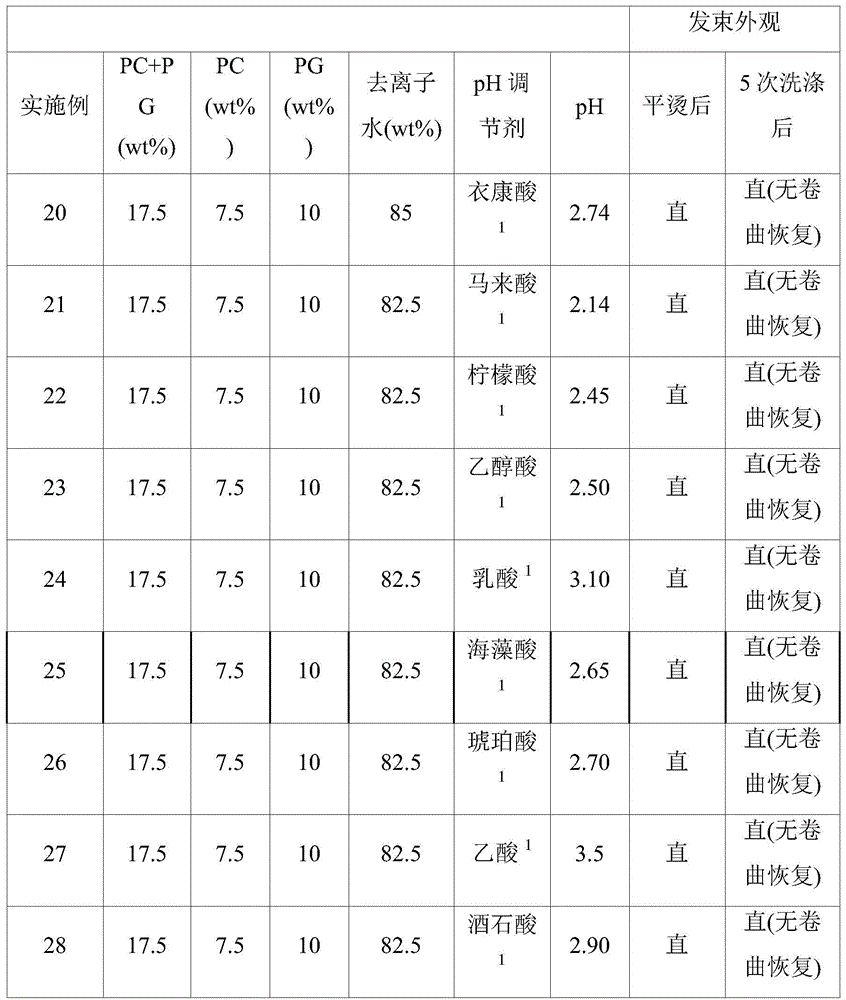
Propylene carbonate PC ═
PG ═ propylene glycol (1, 2-propylene glycol)
1Acid amount: 1.5 wt.%
Type III hair tresses of brazilian tan were treated with the following formulation according to the direct hair application procedure described previously.
Table 4:mixtures with propylene carbonate/1, 3-propanediol and acid

PD13 ═ 1, 3-propanediol
Propylene carbonate PC ═
1Acid amount: 1.5 wt.%
Table 5:addition of NLC
| Practice ofExample 34 | Example 35 | |
| Deionized water | To 100 | To 100 |
| Propylene carbonate | 7.5 | 7.5 |
| 1, 3-propanediol | 10 | 10 |
| NLC of arginine and soy protein | 4 | 0 |
D.i. ═ deionized water
Brazilian brown type III hair tresses were treated with the formulation of example 34 containing NLC of arginine and soy protein or the formulation of example 35 containing no NLC according to the impregnation procedure described previously. The soaking time was 30 minutes in each example. The heat treatment protocol was also followed according to the aforementioned procedure.
Panel sensory testing was performed according to the procedure previously described, comparing treatment formulation 34 to treatment formulation 35. Tresses treated with formulation 34 containing the NLC of arginine and soy protein had a better dry feel (softer and smoother) than tresses treated with formulation 35 containing no NLC.
Tresses treated with the formulation of example 34 containing NLC with arginine and soy protein were easier to comb when wet and dry than tresses treated with the formulation of example 35 without NLC. The two sets of tresses were shampooed repeatedly as previously described in the launder-fastness procedure. Sensory professional panel again evaluated the tresses. The results show that the hair tresses treated with the formulations of examples 34 and 35 have similar straightening performance after 5 washes. However, the hair tresses treated with the hair tresses of example 34 containing the NLC of arginine and soy protein exhibited better dry feel (maintained very soft and silky) and dry combing performance even after 5 shampoos than the hair tresses treated with the formulation of example 35 without NLC.
Claims (48)
1. A hair care composition comprising:
a) propylene carbonate;
b) a glycol selected from at least one of propylene glycol, 1, 3-propanediol, dipropylene glycol, tripropylene glycol, and mixtures thereof; and
c) a cosmetically acceptable carrier;
wherein the amount of component a) + component b) is from about 16 to about 35 wt.%, or from about 17 to about 30 wt.%, or from about 18 to about 25 wt.%, based on the total weight of the composition; and is
Wherein the weight ratio of component a)/component b) is from about 0.3 to about 3.5, or from about 0.5 to about 3.5, or from about 0.6 to about 3, or from about 0.7 to about 2.5, or from about 0.75 to about 2.
2. The hair care composition of claim 1, wherein the glycol is selected from at least one of propylene glycol, 1, 3-propanediol, and mixtures thereof.
3. The hair care composition according to any preceding claims, wherein the glycol is propylene glycol.
4. The hair care composition according to any preceding claims, wherein the glycol is 1, 3-propanediol.
5. The hair care composition according to any preceding claims, further comprising a pH adjusting agent.
6. The hair care composition according to any preceding claims, further comprising a pH adjusting agent selected from acidifying agents, alkalizing agents and mixtures thereof.
7. The hair care composition according to any preceding claims, further comprising an acidulant selected from organic acids.
8. The hair care composition according to any preceding claims, further comprising an organic acid selected from the group consisting of acetic acid, oxalic acid, succinic acid, glutaric acid, adipic acid, azelaic acid, maleic acid, itaconic acid, fumaric acid, lactic acid, glyceric acid, tartronic acid, malic acid, tartaric acid, gluconic acid, citric acid, ascorbic acid, salicylic acid, phthalic acid, mandelic acid, benzoic acid, benzilic acid, and mixtures thereof.
9. The hair care composition according to any preceding claims, further comprising ammonium hydroxide, sodium hydroxide, potassium hydroxide, sodium borate (borax), sodium phosphate, sodium pyrophosphate, triethanolamine, diisopropanolamine, triisopropanolamine, aminomethyl propanol, dodecylamine, cocoamine, oleylamine, morpholine, tripentylamine, triethylamine, tetrakis (hydroxypropyl) ethylenediamine, L-arginine, aminomethyl propanol, tromethamine (2-amino 2-hydroxymethyl-1, 3-propanediol), and PEG-15 cocoamine, and mixtures thereof.
10. The hair care composition according to any preceding claims, further comprising a conditioning agent.
11. The hair care composition according to any preceding claims, further comprising a conditioning agent selected from cationic compounds, cationic polymers, hydrocarbon oils, natural oils, ester oils, synthetic waxes, and combinations thereof.
12. The hair care composition according to any preceding claims, further comprising a rheology modifier.
13. The hair care composition of any preceding claim, further comprising lipid nanoparticles selected from Solid Lipid Nanoparticles (SLNs), Nanostructured Lipid Carriers (NLCs), and mixtures thereof.
14. The hair care composition of any preceding claim, further comprising lipid nanoparticles selected from Solid Lipid Nanoparticles (SLNs), Nanostructured Lipid Carriers (NLCs), and mixtures thereof, wherein the SLNs and NLCs are coated with a polymeric coating.
15. The hair care composition of any preceding claim, further comprising lipid nanoparticles selected from Solid Lipid Nanoparticles (SLNs), Nanostructured Lipid Carriers (NLCs), and mixtures thereof, wherein the SLNs and NLCs are coated with a cationic polymer.
16. The hair care composition according to any preceding claims, wherein the cosmetically acceptable carrier is water.
17. The hair care composition according to any preceding claims, wherein the composition is free of hair coloring agents.
18. The hair care composition according to any preceding claims, wherein the composition is free of sulfite, bisulfite, thiol and mercapto moieties.
19. The hair care composition according to any preceding claims, wherein the composition is free of alkylene carbonates other than propylene carbonate.
20. The hair care composition according to any preceding claims, wherein the composition is free of imidazolium, pyrazolinium, pyridinium,Pyrimidinium onium, tetrakis (C)1-C6) Alkyl phosphonium, tetra (C)1-C6) Alkylammonium, guanidinium, choline, pyrrolidinium, uronium, thiouronium and isothiouronium compounds.
21. A hair care kit comprising at least 2 containers, wherein such that when the contents of the containers are mixed, a hair care composition is provided; wherein after mixing, the total amount of the propylene carbonate component and the glycol component in the hair care composition is from about 16 to about 35 wt%, or from about 17 to about 30 wt%, or from about 18 to about 25 wt%, based on the total weight of the mixed composition; and wherein the weight ratio of propylene carbonate component/glycol component in the hair care composition is from about 0.3 to about 3.5, or from about 0.5 to about 3.5, or from about 0.6 to about 3, or from about 0.75 to about 2.5, or from about 1 to about 2.
22. The hair care kit of claim 21, wherein the at least one container comprises a glycol selected from the group consisting of propylene glycol, 1, 3-propanediol, and mixtures thereof.
23. The hair care kit of claim 21, wherein at least one container comprises a glycol selected from propylene glycol.
24. The hair care kit of claim 21, wherein at least one container comprises a glycol selected from 1, 3-propanediol.
25. The hair care kit according to any one of claims 21 to 24, wherein at least one of the containers comprises water.
26. The hair care kit according to any one of claims 21 to 25, wherein at least one of the containers comprises a pH adjusting agent.
27. The hair care kit according to any one of claims 21 to 26, wherein at least one of the containers comprises an organic acid.
28. The hair care kit of any one of claims 21 to 27 wherein at least one of the containers comprises an organic acid selected from the group consisting of acetic acid, oxalic acid, succinic acid, glutaric acid, adipic acid, azelaic acid, maleic acid, itaconic acid, fumaric acid, lactic acid, glyceric acid, tartronic acid, malic acid, tartaric acid, gluconic acid, citric acid, ascorbic acid, salicylic acid, phthalic acid, mandelic acid, benzoic acid, benzilic acid, and mixtures thereof.
29. The hair care kit according to any one of claims 21 to 28 wherein at least one of the containers comprises a conditioning agent.
30. The hair care kit of any one of claims 21 to 29, wherein at least one of the containers comprises a conditioning agent selected from the group consisting of cationic compounds, cationic polymers, hydrocarbon oils, natural oils, ester oils, synthetic waxes, and combinations thereof.
31. The hair care kit of any one of claims 21 to 30, wherein at least one of the containers comprises a rheology modifier.
32. The hair care kit of any one of claims 21 to 31, wherein at least one of the containers comprises lipid nanoparticles selected from the group consisting of Solid Lipid Nanoparticles (SLNs), Nanostructured Lipid Carriers (NLCs), and mixtures thereof.
33. The hair care kit of any one of claims 21 to 32, wherein at least one of the containers comprises lipid nanoparticles selected from the group consisting of Solid Lipid Nanoparticles (SLNs), Nanostructured Lipid Carriers (NLCs), and mixtures thereof, wherein the SLNs and NLCs are coated with a polymeric coating.
34. The hair care kit of any one of claims 21 to 33, wherein at least one of the containers comprises lipid nanoparticles selected from the group consisting of Solid Lipid Nanoparticles (SLNs), Nanostructured Lipid Carriers (NLCs), and mixtures thereof, wherein the SLNs and NLCs are coated with a cationic polymer.
35. The hair care kit according to any one of claims 21 to 34, wherein at least one of the containers comprises water.
36. The hair care kit of any one of claims 21 to 35, wherein the contents of the container are free of hair coloring agents.
37. The hair care kit of any one of claims 21 to 36, wherein the contents of the container are free of sulfite, bisulfite, and thiol-containing moieties.
38. The hair care kit of any one of claims 21 to 37, wherein the contents of the container are free of alkylene carbonates other than propylene carbonate.
39. The hair care kit according to any one of claims 21 to 38, wherein the contents of the container are free of imidazolium, pyrazolinium, pyridinium, pyrimidinium, tetrakis (C)1-C6) Alkyl phosphonium, tetra (C)1-C6) Alkylammonium, guanidinium, choline, pyrrolidinium, uronium, thiouronium and isothiouronium compounds.
40. A method of shaping hair fibers comprising:
a) coating hair fibres with a composition according to any one of claims 1 to 20;
b) contacting said hair fibers with said composition for a sufficient period of immersion time to allow said composition to penetrate into said hair fibers; and
c) applying heat to the coated fibers at least 150 ℃ for a time sufficient to modify the hair fibers to a desired configuration.
41. A method of shaping hair fibers comprising:
a) coating hair fibres with a composition according to any one of claims 1 to 20; and
b) contacting said composition with said hair fibers for a sufficient period of time to allow said composition to penetrate said hair fibers; and
c) contacting the coated hair fibers with a heating appliance at a temperature of at least about 150 ℃, and mechanically shaping the hair fibers into a desired configuration with the heating appliance.
42. The method according to any one of claims 40 and 41, wherein the soaking time in step b) is at least 5 minutes, or at least 10 minutes, or at least 15 minutes, or at least 20 minutes or at least 25 minutes, or at least 30 minutes or at least 45 minutes, or at least 60 minutes.
43. The method of any one of claims 40 to 42, wherein the soaking time in step b) is about 15 minutes to about 60 minutes.
44. The method according to any one of claims 41 to 43, wherein in step b) the coated hair is heated to a temperature of about 30 to about 120 ℃ during an immersion time interval.
45. The method according to any one of claims 41 to 44, wherein the hair appliance in contact with the hair fibre is pulled from the root end of the hair fibre to the tip end of the hair fibre to straighten the hair.
46. The method of any one of claims 41 to 45, wherein the hair appliance in contact with the hair fiber is pulled from the root end of the hair fiber to the tip end of the hair fiber at a sliding speed of at least 1cm/sec, or at least 3cm/sec, or at least 5cm/sec, or at least 7cm/sec, or at least 10 cm/sec.
47. The method according to any one of claims 41 to 46, wherein the hair appliance in contact with the hair fiber is pulled from the root end of the hair fiber to the tip end of the hair fiber at a sliding speed of about 1cm/sec to about 15 cm/sec.
48. The method according to any one of claims 41 to 47, wherein the hair appliance is at a temperature of from about 150 to about 250 ℃, or from about 175 to about 240 ℃, or from about 200 to about 235 ℃, or from about 220 to about 230 ℃.
Applications Claiming Priority (3)
| Application Number | Priority Date | Filing Date | Title |
|---|---|---|---|
| US201862656665P | 2018-04-12 | 2018-04-12 | |
| US62/656,665 | 2018-04-12 | ||
| PCT/US2019/026868 WO2019200027A1 (en) | 2018-04-12 | 2019-04-11 | Hair modification composition and method therefor |
Publications (1)
| Publication Number | Publication Date |
|---|---|
| CN112218612A true CN112218612A (en) | 2021-01-12 |
Family
ID=66287032
Family Applications (1)
| Application Number | Title | Priority Date | Filing Date |
|---|---|---|---|
| CN201980036342.XA Pending CN112218612A (en) | 2018-04-12 | 2019-04-11 | Hair grooming compositions and methods thereof |
Country Status (10)
| Country | Link |
|---|---|
| US (1) | US11478412B2 (en) |
| EP (1) | EP3773458A1 (en) |
| JP (1) | JP7377813B2 (en) |
| KR (1) | KR20210008483A (en) |
| CN (1) | CN112218612A (en) |
| AU (1) | AU2019251493A1 (en) |
| BR (1) | BR112020020814A2 (en) |
| CA (1) | CA3096683A1 (en) |
| MX (1) | MX394769B (en) |
| WO (1) | WO2019200027A1 (en) |
Cited By (1)
| Publication number | Priority date | Publication date | Assignee | Title |
|---|---|---|---|---|
| CN114010566A (en) * | 2021-12-21 | 2022-02-08 | 刘子抄 | Hair conditioner with hair growth function and preparation method thereof |
Families Citing this family (32)
| Publication number | Priority date | Publication date | Assignee | Title |
|---|---|---|---|---|
| CN111278511B (en) | 2017-10-10 | 2023-06-02 | 宝洁公司 | Compact shampoo compositions |
| WO2020190837A1 (en) * | 2019-03-15 | 2020-09-24 | Isp Investments Llc | A hair straightening or hair styling composition and method of use thereof |
| WO2021113583A1 (en) | 2019-12-06 | 2021-06-10 | The Procter & Gamble Company | Sulfate free composition with enhanced deposition of scalp active |
| FR3104969B1 (en) * | 2019-12-20 | 2022-01-07 | Oreal | Process for treating keratin fibers using a composition comprising a salt of carnitine or of a carnitine derivative comprising an aromatic organic anion |
| CN115151310B (en) | 2020-02-27 | 2024-12-20 | 宝洁公司 | Sulfur-containing anti-dandruff compositions with enhanced efficacy and aesthetics |
| DE102020207606A1 (en) * | 2020-06-19 | 2021-12-23 | Henkel Ag & Co. Kgaa | Pigment suspension and cosmetic agent produced using the pigment suspension |
| MX2023005560A (en) | 2020-11-23 | 2023-05-29 | Procter & Gamble | Personal care compositions free of sulfated surfactants. |
| JP7768985B2 (en) | 2020-12-04 | 2025-11-12 | ザ プロクター アンド ギャンブル カンパニー | Hair care compositions containing malodor-reducing substances |
| US11268054B1 (en) * | 2021-01-11 | 2022-03-08 | Hayden Products Llc | Single chamber water-soluble refill dose article enclosing a concentrated cleanser composition and kits having same |
| US11771635B2 (en) | 2021-05-14 | 2023-10-03 | The Procter & Gamble Company | Shampoo composition |
| US11986543B2 (en) | 2021-06-01 | 2024-05-21 | The Procter & Gamble Company | Rinse-off compositions with a surfactant system that is substantially free of sulfate-based surfactants |
| US12005134B2 (en) * | 2021-06-30 | 2024-06-11 | Abe Pharmaceutical | Composition for stimulating facial hair growth and methods of manufacturing a composition for stimulating facial hair growth |
| US20230019615A1 (en) * | 2021-06-30 | 2023-01-19 | L'oreal | Compositions and methods for styling hair |
| EP4536177A2 (en) * | 2021-07-21 | 2025-04-16 | Purvala Bioscience, Inc. | Cysteine reactive peptides |
| JP2024531280A (en) * | 2021-09-30 | 2024-08-29 | ロレアル | Hair care compositions, methods for imparting improved curl retention to hair, and methods for treating hair |
| EP4444431A1 (en) | 2021-12-09 | 2024-10-16 | The Procter & Gamble Company | Sulfate free personal cleansing composition comprising effective preservation |
| FR3130582B1 (en) * | 2021-12-22 | 2024-11-22 | Oreal | Process for coloring keratin fibers using a cosmetic composition comprising propane-1,3-diol and a coloring composition |
| FR3130575B1 (en) * | 2021-12-22 | 2024-11-29 | Oreal | Cosmetic composition comprising propane-1,3-diol, one or more alkaline agents, one or more nonionic surfactants, one or more non-associative anionic acrylic polymers and one or more colorants |
| KR102407702B1 (en) * | 2022-01-03 | 2022-06-15 | 조순남 | Permanent wave composition comprising natural extracts |
| CN115120538A (en) * | 2022-05-24 | 2022-09-30 | 广东博然堂生物科技有限公司 | Silicone oil-free anti-dandruff shampoo and preparation method thereof |
| WO2024019923A1 (en) * | 2022-07-20 | 2024-01-25 | Selora Haircare Llc | Hair treatment composition |
| CN115323778B (en) * | 2022-08-16 | 2023-07-18 | 汕头市润丰纺织科技实业有限公司 | Chitosan-I type collagen amino acid composite antibacterial finishing liquid, preparation method thereof and antibacterial fabric |
| US12263238B2 (en) * | 2022-09-30 | 2025-04-01 | L'oreal | Styling composition for providing various advantageous properties to the hair |
| CN116262097B (en) * | 2022-12-19 | 2025-04-11 | 杭州浪澄生物科技有限公司 | Natural active compound with moisturizing and skin repairing effects and its application |
| KR20240141143A (en) | 2023-03-15 | 2024-09-25 | 에스피투티엑스주식회사 | Peptide-binding agent complex capable of binding to thiol group of hair and hair treatment composition containing the same |
| KR102729778B1 (en) * | 2023-04-06 | 2024-11-14 | 주식회사 세이브더데이 | Shampoo composition containing natural surfactant derived from camellia oil and manufacturing method for thereof |
| WO2025019748A1 (en) * | 2023-07-20 | 2025-01-23 | L'oreal | Methods for reducing frizz and improving smoothness of hair |
| WO2025019731A1 (en) * | 2023-07-20 | 2025-01-23 | L'oreal | Hair treatment compositions and methods for smoothing hair |
| US20250195387A1 (en) * | 2023-12-14 | 2025-06-19 | L'oreal | Hair straightening compositions and methods for straightening hair |
| WO2025188317A1 (en) * | 2024-03-08 | 2025-09-12 | Neuvian Skincare Llc | Compositions and methods for hair treatment |
| US12409204B1 (en) | 2024-03-08 | 2025-09-09 | Neuvian Ip Holdings, Llc | Compositions and methods for hair treatment |
| US20250319008A1 (en) * | 2024-04-15 | 2025-10-16 | Function Inc. | Hair compositions uses and methods thereof |
Citations (4)
| Publication number | Priority date | Publication date | Assignee | Title |
|---|---|---|---|---|
| US5401497A (en) * | 1991-03-22 | 1995-03-28 | Goldwell Ag | Composition for permanent waving of human hair and use of ammonium carbamate in such compositions |
| CN102481461A (en) * | 2009-08-21 | 2012-05-30 | 荷兰联合利华有限公司 | Hair treatment composition |
| CN105073090A (en) * | 2013-02-06 | 2015-11-18 | 路博润先进材料公司 | Semi-permanent hair straightening composition and method |
| WO2017096005A1 (en) * | 2015-12-01 | 2017-06-08 | Isp Investments Llc | A hair care composition, process for preparing the same and method of use thereof |
Family Cites Families (58)
| Publication number | Priority date | Publication date | Assignee | Title |
|---|---|---|---|---|
| US34584A (en) | 1862-03-04 | Improvement in rakes for harvesters | ||
| US1723913A (en) | 1928-02-24 | 1929-08-06 | Bono Salvino | Curtain fixture |
| US2873282A (en) | 1952-04-05 | 1959-02-10 | Jefferson Chem Co Inc | Catalytic process for producing alkylene carbonates |
| US2798053A (en) | 1952-09-03 | 1957-07-02 | Goodrich Co B F | Carboxylic polymers |
| US2773070A (en) | 1952-10-31 | 1956-12-04 | Jefferson Chem Co Inc | Catalytic process for producing alkylene carbonates |
| US2826551A (en) | 1954-01-04 | 1958-03-11 | Simoniz Co | Nontangling shampoo |
| GB849433A (en) | 1957-08-22 | 1960-09-28 | Raymond Woolston | Hair washing preparations |
| US3657175A (en) | 1969-06-26 | 1972-04-18 | Standard Brands Chem Ind Inc | Carboxylic acid latices providing unique thickening and dispersing agents |
| JPS5710085B2 (en) | 1973-05-04 | 1982-02-24 | ||
| US3964500A (en) | 1973-12-26 | 1976-06-22 | Lever Brothers Company | Lusterizing shampoo containing a polysiloxane and a hair-bodying agent |
| DE2437090A1 (en) | 1974-08-01 | 1976-02-19 | Hoechst Ag | CLEANING SUPPLIES |
| US4152416A (en) | 1976-09-17 | 1979-05-01 | Marra Dorothea C | Aerosol antiperspirant compositions delivering astringent salt with low mistiness and dustiness |
| US4384096A (en) | 1979-08-27 | 1983-05-17 | The Dow Chemical Company | Liquid emulsion polymers useful as pH responsive thickeners for aqueous systems |
| FR2504535B1 (en) | 1981-04-28 | 1987-08-14 | Choay Sa | DISACCHARIDES DERIVED FROM URONIC ACID AND GLUCOSAMINE AND PHARMACEUTICAL COMPOSITIONS CONTAINING THEM FOR THE CONTROL OF BLOOD COAGULATION |
| US4364837A (en) | 1981-09-08 | 1982-12-21 | Lever Brothers Company | Shampoo compositions comprising saccharides |
| US4565647B1 (en) | 1982-04-26 | 1994-04-05 | Procter & Gamble | Foaming surfactant compositions |
| US4509949A (en) | 1983-06-13 | 1985-04-09 | The B. F. Goodrich Company | Water thickening agents consisting of copolymers of crosslinked acrylic acids and esters |
| US4464524A (en) | 1983-07-26 | 1984-08-07 | The Sherwin-Williams Company | Polymeric thickeners and coatings containing same |
| USRE34584E (en) | 1984-11-09 | 1994-04-12 | The Procter & Gamble Company | Shampoo compositions |
| US4654207A (en) | 1985-03-13 | 1987-03-31 | Helene Curtis Industries, Inc. | Pearlescent shampoo and method for preparation of same |
| GB8519416D0 (en) | 1985-08-01 | 1985-09-04 | Unilever Plc | Oligosaccharides |
| GB8630721D0 (en) | 1986-12-23 | 1987-02-04 | Unilever Plc | Cosmetic compositions |
| US4801671A (en) | 1987-06-25 | 1989-01-31 | Desoto, Inc. | Production of alkali-soluble, carboxyl-functional aqueous emulsion thickeners |
| GB8806892D0 (en) | 1988-03-23 | 1988-04-27 | Unilever Plc | Lactams their synthesis & use in cosmetic compositions |
| GB8830019D0 (en) | 1988-12-22 | 1989-02-15 | Unilever Plc | Cosmetic composition |
| US5019376A (en) | 1989-03-13 | 1991-05-28 | S. C. Johnson & Son, Inc. | Sparkling pearlescent personal care compositions |
| GB8913708D0 (en) | 1989-06-14 | 1989-08-02 | Unilever Plc | Cosmetic composition |
| US5104646A (en) | 1989-08-07 | 1992-04-14 | The Procter & Gamble Company | Vehicle systems for use in cosmetic compositions |
| US5106609A (en) | 1990-05-01 | 1992-04-21 | The Procter & Gamble Company | Vehicle systems for use in cosmetic compositions |
| US5087445A (en) | 1989-09-08 | 1992-02-11 | Richardson-Vicks, Inc. | Photoprotection compositions having reduced dermal irritation |
| US5136063A (en) | 1990-06-18 | 1992-08-04 | Siltech Inc. | Silicone fatty esters |
| US5180843A (en) | 1990-06-18 | 1993-01-19 | Lenick Jr Anthony J O | Terminal substituted silicone fatty esters |
| CA2050212C (en) | 1990-09-03 | 1997-09-30 | Andrew M. Murray | Hair treatment composition |
| FR2684668B1 (en) | 1991-12-04 | 1995-03-24 | Oreal | HYDRO-FLUOROCARBON COMPOUNDS, THEIR USE IN COSMETIC COMPOSITIONS, THEIR PREPARATION METHOD AND THE COSMETIC COMPOSITIONS COMPRISING SAME. |
| FI930458A7 (en) | 1992-03-27 | 1993-09-28 | Curtis Helene Ind Inc | Opacifier for water-based formulations |
| CA2117914A1 (en) | 1992-05-12 | 1993-11-25 | Kanta Kumar | Polymers in cosmetics and personal care products |
| US5292843A (en) | 1992-05-29 | 1994-03-08 | Union Carbide Chemicals & Plastics Technology Corporation | Polymers containing macromonomers |
| DE69332875T2 (en) | 1992-07-28 | 2003-12-04 | Mitsubishi Chem Corp | Hair cosmetic composition |
| US5288814A (en) | 1992-08-26 | 1994-02-22 | The B. F. Goodrich Company | Easy to disperse polycarboxylic acid thickeners |
| GB9320556D0 (en) | 1993-10-06 | 1993-11-24 | Unilever Plc | Hair conditioning composition |
| US5858948A (en) | 1996-05-03 | 1999-01-12 | Procter & Gamble Company | Liquid laundry detergent compositions comprising cotton soil release polymers and protease enzymes |
| US5968493A (en) | 1997-10-28 | 1999-10-19 | Amway Corportion | Hair care composition |
| JP2001220321A (en) * | 2000-02-04 | 2001-08-14 | Kao Corp | Hair beauty enhancer |
| JP4598930B2 (en) * | 2000-08-21 | 2010-12-15 | ホーユー株式会社 | Hair dye composition |
| US6573375B2 (en) | 2000-12-20 | 2003-06-03 | Union Carbide Chemicals & Plastics Technology Corporation | Liquid thickener for surfactant systems |
| US7378479B2 (en) | 2002-09-13 | 2008-05-27 | Lubrizol Advanced Materials, Inc. | Multi-purpose polymers, methods and compositions |
| US7205271B2 (en) | 2004-10-14 | 2007-04-17 | Isp Investments Inc. | Rheology modifier/hair styling resin |
| JP4950487B2 (en) | 2005-12-26 | 2012-06-13 | ライオン株式会社 | Hair straightener |
| EP1880710A1 (en) | 2006-07-21 | 2008-01-23 | Wella Aktiengesellschaft | Method and composition for permanently shaping hair |
| US8153109B2 (en) | 2006-11-21 | 2012-04-10 | San-Ei Kagaku Co., Ltd. | Alkylene carbonate dilution, alkylene carbonate for preparing the dilution, and aqueous reducing chemical agent |
| ES2384060B1 (en) | 2010-03-24 | 2013-09-23 | Lipotec S.A. | LIPID NANOPARTICLES CAPSULES. |
| WO2013125053A1 (en) | 2012-02-24 | 2013-08-29 | L'oreal | Process for treating keratin fibers |
| FR2988605B1 (en) | 2012-03-27 | 2014-12-19 | Oreal | DEFORMATION PROCESS AND COMPOSITION COMPRISING AT LEAST 40% BY WEIGHT OF NON-SILICONE FATTY BODIES AND AT LEAST ONE MINERAL THICKENING AGENT |
| JP2016539933A (en) * | 2013-11-08 | 2016-12-22 | ルブリゾル アドバンスド マテリアルズ, インコーポレイテッド | Semi-permanent hair straightening composition and method |
| JP6333541B2 (en) * | 2013-11-12 | 2018-05-30 | ホーユー株式会社 | Hair dye composition |
| MX2016007779A (en) | 2013-12-19 | 2016-09-07 | Procter & Gamble | Shaping keratin fibres using carbonate ester. |
| US10832235B2 (en) | 2015-03-10 | 2020-11-10 | Paypal, Inc. | Image based MMS transactions mechanism |
| US20190387856A1 (en) * | 2017-01-26 | 2019-12-26 | Lubrizol Advanced Materials, Inc. | Hair styling appliances and methods of operating same |
-
2019
- 2019-04-11 CN CN201980036342.XA patent/CN112218612A/en active Pending
- 2019-04-11 AU AU2019251493A patent/AU2019251493A1/en not_active Abandoned
- 2019-04-11 US US17/046,940 patent/US11478412B2/en active Active
- 2019-04-11 WO PCT/US2019/026868 patent/WO2019200027A1/en not_active Ceased
- 2019-04-11 CA CA3096683A patent/CA3096683A1/en not_active Abandoned
- 2019-04-11 KR KR1020207032641A patent/KR20210008483A/en not_active Ceased
- 2019-04-11 MX MX2020010776A patent/MX394769B/en unknown
- 2019-04-11 BR BR112020020814-0A patent/BR112020020814A2/en active Search and Examination
- 2019-04-11 EP EP19719737.9A patent/EP3773458A1/en not_active Withdrawn
- 2019-04-11 JP JP2020555439A patent/JP7377813B2/en active Active
Patent Citations (4)
| Publication number | Priority date | Publication date | Assignee | Title |
|---|---|---|---|---|
| US5401497A (en) * | 1991-03-22 | 1995-03-28 | Goldwell Ag | Composition for permanent waving of human hair and use of ammonium carbamate in such compositions |
| CN102481461A (en) * | 2009-08-21 | 2012-05-30 | 荷兰联合利华有限公司 | Hair treatment composition |
| CN105073090A (en) * | 2013-02-06 | 2015-11-18 | 路博润先进材料公司 | Semi-permanent hair straightening composition and method |
| WO2017096005A1 (en) * | 2015-12-01 | 2017-06-08 | Isp Investments Llc | A hair care composition, process for preparing the same and method of use thereof |
Cited By (1)
| Publication number | Priority date | Publication date | Assignee | Title |
|---|---|---|---|---|
| CN114010566A (en) * | 2021-12-21 | 2022-02-08 | 刘子抄 | Hair conditioner with hair growth function and preparation method thereof |
Also Published As
| Publication number | Publication date |
|---|---|
| JP2021521167A (en) | 2021-08-26 |
| AU2019251493A1 (en) | 2020-10-29 |
| KR20210008483A (en) | 2021-01-22 |
| EP3773458A1 (en) | 2021-02-17 |
| MX394769B (en) | 2025-03-24 |
| US20210154120A1 (en) | 2021-05-27 |
| BR112020020814A2 (en) | 2021-01-19 |
| JP7377813B2 (en) | 2023-11-10 |
| WO2019200027A1 (en) | 2019-10-17 |
| MX2020010776A (en) | 2022-08-15 |
| CA3096683A1 (en) | 2019-10-17 |
| US11478412B2 (en) | 2022-10-25 |
Similar Documents
| Publication | Publication Date | Title |
|---|---|---|
| JP7377813B2 (en) | Hair modification composition and method thereof | |
| US12350352B2 (en) | Composition for surface modification | |
| CN105722424B (en) | Methods of styling hair using fat bodies, non-silicone polymers or surfactants | |
| JP6346507B2 (en) | Hair cosmetics | |
| JP6033587B2 (en) | Polyester and cosmetics using the same | |
| EP4340807B1 (en) | Hair color compositions for mitigating color loss | |
| TW201601770A (en) | Semi-permanent hair straightening composition and method | |
| WO2018012021A1 (en) | Hair cosmetic | |
| JP7731654B2 (en) | Hair cavity repair agent and hair cavity repair method using the same | |
| US20180344606A1 (en) | A hair care composition, process for preparing the same and method of use thereof | |
| US20180353401A1 (en) | A hair care composition, process for preparing the same and method of use thereof | |
| CN115023271B (en) | Hair improvement method | |
| KR102415236B1 (en) | Composition for preventing loss of components of hair, skin, or fiber | |
| WO2021083616A1 (en) | Hair care composition | |
| JP6887826B2 (en) | Cosmetic composition | |
| JP7358110B2 (en) | Semi-permanent hair dye and hair dye treatment method | |
| EP3711743B1 (en) | Cationic cellulose and composition for treating hair, skin, or fiber including same | |
| JP2001213733A (en) | Cosmetic for hair | |
| JP2021075466A (en) | Lactate and cosmetics containing the same | |
| CA3168373C (en) | Compositions comprising hydrolysed proteins | |
| KR102025304B1 (en) | Composition for preventing loss of components of hair, skin, or fiber |
Legal Events
| Date | Code | Title | Description |
|---|---|---|---|
| PB01 | Publication | ||
| PB01 | Publication | ||
| SE01 | Entry into force of request for substantive examination | ||
| SE01 | Entry into force of request for substantive examination | ||
| WD01 | Invention patent application deemed withdrawn after publication | ||
| WD01 | Invention patent application deemed withdrawn after publication |
Application publication date: 20210112 |