CN112216871B - Lithium ion battery electrolyte, preparation method thereof, lithium ion battery and battery module - Google Patents
Lithium ion battery electrolyte, preparation method thereof, lithium ion battery and battery module Download PDFInfo
- Publication number
- CN112216871B CN112216871B CN201910621849.3A CN201910621849A CN112216871B CN 112216871 B CN112216871 B CN 112216871B CN 201910621849 A CN201910621849 A CN 201910621849A CN 112216871 B CN112216871 B CN 112216871B
- Authority
- CN
- China
- Prior art keywords
- ionic liquid
- electrolyte
- lithium
- ion battery
- present disclosure
- Prior art date
- Legal status (The legal status is an assumption and is not a legal conclusion. Google has not performed a legal analysis and makes no representation as to the accuracy of the status listed.)
- Active
Links
Images

Classifications
-
- H—ELECTRICITY
- H01—ELECTRIC ELEMENTS
- H01M—PROCESSES OR MEANS, e.g. BATTERIES, FOR THE DIRECT CONVERSION OF CHEMICAL ENERGY INTO ELECTRICAL ENERGY
- H01M10/00—Secondary cells; Manufacture thereof
- H01M10/05—Accumulators with non-aqueous electrolyte
- H01M10/056—Accumulators with non-aqueous electrolyte characterised by the materials used as electrolytes, e.g. mixed inorganic/organic electrolytes
- H01M10/0564—Accumulators with non-aqueous electrolyte characterised by the materials used as electrolytes, e.g. mixed inorganic/organic electrolytes the electrolyte being constituted of organic materials only
- H01M10/0566—Liquid materials
- H01M10/0569—Liquid materials characterised by the solvents
-
- H—ELECTRICITY
- H01—ELECTRIC ELEMENTS
- H01M—PROCESSES OR MEANS, e.g. BATTERIES, FOR THE DIRECT CONVERSION OF CHEMICAL ENERGY INTO ELECTRICAL ENERGY
- H01M10/00—Secondary cells; Manufacture thereof
- H01M10/05—Accumulators with non-aqueous electrolyte
- H01M10/052—Li-accumulators
- H01M10/0525—Rocking-chair batteries, i.e. batteries with lithium insertion or intercalation in both electrodes; Lithium-ion batteries
-
- H—ELECTRICITY
- H01—ELECTRIC ELEMENTS
- H01M—PROCESSES OR MEANS, e.g. BATTERIES, FOR THE DIRECT CONVERSION OF CHEMICAL ENERGY INTO ELECTRICAL ENERGY
- H01M2300/00—Electrolytes
- H01M2300/0017—Non-aqueous electrolytes
- H01M2300/0025—Organic electrolyte
- H01M2300/0028—Organic electrolyte characterised by the solvent
- H01M2300/0037—Mixture of solvents
-
- Y—GENERAL TAGGING OF NEW TECHNOLOGICAL DEVELOPMENTS; GENERAL TAGGING OF CROSS-SECTIONAL TECHNOLOGIES SPANNING OVER SEVERAL SECTIONS OF THE IPC; TECHNICAL SUBJECTS COVERED BY FORMER USPC CROSS-REFERENCE ART COLLECTIONS [XRACs] AND DIGESTS
- Y02—TECHNOLOGIES OR APPLICATIONS FOR MITIGATION OR ADAPTATION AGAINST CLIMATE CHANGE
- Y02E—REDUCTION OF GREENHOUSE GAS [GHG] EMISSIONS, RELATED TO ENERGY GENERATION, TRANSMISSION OR DISTRIBUTION
- Y02E60/00—Enabling technologies; Technologies with a potential or indirect contribution to GHG emissions mitigation
- Y02E60/10—Energy storage using batteries
Landscapes
- Chemical & Material Sciences (AREA)
- Engineering & Computer Science (AREA)
- Manufacturing & Machinery (AREA)
- Chemical Kinetics & Catalysis (AREA)
- Electrochemistry (AREA)
- General Chemical & Material Sciences (AREA)
- Physics & Mathematics (AREA)
- Condensed Matter Physics & Semiconductors (AREA)
- General Physics & Mathematics (AREA)
- Inorganic Chemistry (AREA)
- Materials Engineering (AREA)
- Secondary Cells (AREA)
Abstract
本公开涉及一种锂离子电池电解液及其制备方法、锂离子电池和电池模组,该电解液含有第一离子液体、第二离子液体、锂盐和成膜剂;第一离子液体含有第一咪唑阳离子,第二离子液体含有第二咪唑阳离子。本公开的电解液粘度低、稳定性高、电化学窗口宽、电导率高,且与电极具有较好的相容性,使得含有本公开电解液的锂离子电池具有良好的电化学性能。

The present disclosure relates to a lithium ion battery electrolyte and a preparation method thereof, a lithium ion battery and a battery module, the electrolyte contains a first ionic liquid, a second ionic liquid, a lithium salt and a film-forming agent; the first ionic liquid contains a first ionic liquid An imidazolium cation, and the second ionic liquid contains a second imidazolium cation. The electrolyte of the present disclosure has low viscosity, high stability, wide electrochemical window, high electrical conductivity, and good compatibility with electrodes, so that the lithium ion battery containing the electrolyte of the present disclosure has good electrochemical performance.
Description
技术领域technical field
本公开涉及锂离子电池领域,具体地,涉及一种锂离子电池电解液及其制备方法、锂离子电池和电池模组。The present disclosure relates to the field of lithium ion batteries, and in particular, to a lithium ion battery electrolyte and a preparation method thereof, a lithium ion battery and a battery module.
背景技术Background technique
锂离子电池是电动汽车的首选动力源,在储能领域体现出良好的应用前景。小容量的锂离子电池在各类电子产品领域中已广泛使用,但是对于功率密度要求高、高温性能优越、安全性好以及使用寿命长的动力电池需求,现有锂离子电池体系难以满足。传统锂离子电池电解液普遍使用的溶剂为易燃碳酸酯,该溶剂锂离子电池在滥用情况下发生燃烧、爆炸等安全事故的根源。Lithium-ion batteries are the preferred power source for electric vehicles, and have good application prospects in the field of energy storage. Small-capacity lithium-ion batteries have been widely used in various electronic products, but the existing lithium-ion battery systems are difficult to meet the needs of power batteries with high power density requirements, superior high temperature performance, good safety and long service life. The solvent commonly used in traditional lithium-ion battery electrolyte is flammable carbonate, which is the root cause of safety accidents such as combustion and explosion in lithium-ion batteries under abuse.
开发稳定性高、综合性能好的新型电解液是改善锂离子电池循环寿命的重要途径,也是近二十年来学术界与产业界一直致力于研究的热点问题。离子液体因其低蒸气压、难燃的特点,将其作为锂离子电池电解质,在杜绝锂离子电池安全隐患方面显示了良好的性能。1996年Bonhote等首次报道含[N(SO2CF3)2]-(TFSI)的咪唑鎓离子液体,此后离子液体不论在基础理论,还是应用研究都进入了一个飞速发展的时期。The development of new electrolytes with high stability and comprehensive performance is an important way to improve the cycle life of lithium-ion batteries, and it is also a hot issue that academia and industry have been working on in the past two decades. Ionic liquids are used as lithium-ion battery electrolytes because of their low vapor pressure and flame retardancy, and they have shown good performance in eliminating the safety hazards of lithium-ion batteries. In 1996, Bonhote et al. first reported imidazolium ionic liquids containing [N(SO 2 CF 3 ) 2 ] - (TFSI). Since then, ionic liquids have entered a period of rapid development in both basic theory and applied research.
然而对于将离子液体应用于锂离子电池中,目前同样存在明显的瓶颈问题,例如较大的粘度和较低的电导率严重限制了电池的倍率性能。为解决上述问题,有文献公开了用离子液体来部分替代有机溶剂而组成锂电池复合电解液,如专利CN101087035A和CN106876787A中公开的复合离子液体电解液均采用有机碳酸酯溶剂调节离子液体电解液体系的粘度。上述锂离子电池复合电解液只有限地解决了电解液易燃的问题,锂离子电池还存在循环充放电过程中因碳酸酯溶剂不断消耗导致离子液体复合电解液的体系遭到破坏,造成电池的循环寿命降低的问题。However, for the application of ionic liquids in lithium-ion batteries, there are also obvious bottlenecks, such as large viscosity and low conductivity, which severely limit the rate capability of batteries. In order to solve the above-mentioned problems, there are documents that disclose the use of ionic liquids to partially replace organic solvents to form lithium battery composite electrolytes, such as the composite ionic liquid electrolytes disclosed in patents CN101087035A and CN106876787A all adopt organic carbonate solvents to adjust the ionic liquid electrolyte system. viscosity. The above-mentioned lithium-ion battery composite electrolyte only solves the problem of flammability of the electrolyte to a limited extent, and the lithium-ion battery also has the destruction of the ionic liquid composite electrolyte system due to the continuous consumption of the carbonate solvent during the cyclic charge and discharge process, resulting in the battery's failure. The problem of reduced cycle life.
同时还有文献中公开了全离子液体作为锂离子电池电解液,但全离子液体电解液存在对石墨材料负极及隔膜浸润和兼容的问题。如专利文献CN106920910A采用一种安全性纤维素无纺布隔膜取代聚烯烃隔膜以提高全离子液体电解液对聚烯烃隔膜浸润性,但是该方法并未解决负极浸润性的问题。At the same time, all ionic liquids are disclosed in the literature as lithium-ion battery electrolytes, but the all-ionic liquid electrolytes have problems of infiltration and compatibility with graphite material anodes and separators. For example, patent document CN106920910A adopts a safe cellulose non-woven membrane to replace the polyolefin membrane to improve the wettability of the all-ionic liquid electrolyte to the polyolefin membrane, but this method does not solve the problem of negative electrode wettability.
发明内容SUMMARY OF THE INVENTION
本公开的目的是为了克服现有离子液体电解液的锂离子电池电化学窗口窄、电化学性能差的问题,提供一种锂离子电池电解液及其制备方法、锂离子电池和电池模组。The purpose of the present disclosure is to provide a lithium ion battery electrolyte and a preparation method thereof, a lithium ion battery and a battery module in order to overcome the problems of narrow electrochemical window and poor electrochemical performance of the lithium ion battery of the existing ionic liquid electrolyte.
为了实现上述目的,本公开第一方面提供一种锂离子电池电解液,该电解液含有第一离子液体、第二离子液体、锂盐和成膜剂;In order to achieve the above object, a first aspect of the present disclosure provides a lithium ion battery electrolyte, the electrolyte contains a first ionic liquid, a second ionic liquid, a lithium salt and a film-forming agent;
所述第一离子液体含有第一咪唑阳离子,所述第一咪唑阳离子具有如式(I)所示的结构,The first ionic liquid contains a first imidazolium cation, and the first imidazolium cation has a structure as shown in formula (I),

所述第二离子液体含有第二咪唑阳离子,所述第二咪唑阳离子具有如式(II)所示的结构,The second ionic liquid contains a second imidazolium cation, and the second imidazolium cation has a structure as shown in formula (II),

可选地,所述第一离子液体和所述第二离子液体各自独立地含有双氟磺酰亚胺阴离子、双三氟甲基磺酰亚胺阴离子、六氟磷酸阴离子和双草酸硼酸阴离子中的一种或几种。Optionally, the first ionic liquid and the second ionic liquid each independently contain bisfluorosulfonimide anion, bistrifluoromethylsulfonimide anion, hexafluorophosphate anion and bisoxaloborate anion. one or more of them.
可选地,所述第一离子液体和所述第二离子液体分别含有双氟磺酰亚胺阴离子。Optionally, the first ionic liquid and the second ionic liquid respectively contain bisfluorosulfonimide anions.
可选地,式(I)中,n1为1、2或3,n2为1或2;式(II)中,n3为1、2或3,n4为4、5、6或7。Optionally, in formula (I), n 1 is 1, 2 or 3, and n 2 is 1 or 2; in formula (II), n 3 is 1, 2 or 3, and n 4 is 4, 5, 6 or 7.
可选地,所述第一咪唑阳离子的R1与所述第二咪唑阳离子的R2相同。Optionally, R 1 of the first imidazolium cation is the same as R 2 of the second imidazolium cation.
可选地,以所述电解液的总重量为基准,所述第一离子液体的含量为50-90重量%,所述第二离子液体的含量为8.5-45重量%,所述成膜剂的含量为0.1-5重量%。Optionally, based on the total weight of the electrolyte, the content of the first ionic liquid is 50-90 wt %, the content of the second ionic liquid is 8.5-45 wt %, and the film-forming agent The content is 0.1-5% by weight.
可选地,以所述电解液的总重量为基准,所述第一离子液体的含量为80-90重量%,所述第二离子液体的含量为9.5-20重量%,所述成膜剂的含量为0.1-5重量%。Optionally, based on the total weight of the electrolyte, the content of the first ionic liquid is 80-90 wt %, the content of the second ionic liquid is 9.5-20 wt %, and the film-forming agent The content is 0.1-5% by weight.
可选地,所述锂盐的含量为1.5-3.0mol/L。Optionally, the content of the lithium salt is 1.5-3.0 mol/L.
可选地,所述锂盐选自双氟磺酰亚胺锂盐、双三氟甲基磺酰亚胺锂盐、六氟硼酸锂盐和双草酸硼酸锂盐中的一种或几种。Optionally, the lithium salt is selected from one or more of bisfluorosulfonimide lithium salt, bistrifluoromethylsulfonimide lithium salt, hexafluoroborate lithium salt and bisoxalatoborate lithium salt.
可选地,所述锂盐为双氟磺酰亚胺锂盐。可选地,所述成膜剂选自碳酸亚乙烯酯、氟代碳酸乙烯酯、亚硫酸乙烯酯和三(三甲基硅烷)磷酸酯中的一种或几种。Optionally, the lithium salt is a bisfluorosulfonimide lithium salt. Optionally, the film-forming agent is selected from one or more of vinylene carbonate, fluoroethylene carbonate, vinyl sulfite and tris(trimethylsilane) phosphate.
本公开第二方面提供一种制备本公开第一方面提供的电解液的方法,该方法包括以下步骤:在惰性气体氛围下,将第一离子液体、第二离子液体、成膜剂和锂盐混合,得到所述电解液。A second aspect of the present disclosure provides a method for preparing the electrolyte provided by the first aspect of the present disclosure, the method comprising the steps of: under an inert gas atmosphere, mixing a first ionic liquid, a second ionic liquid, a film-forming agent and a lithium salt mixed to obtain the electrolyte solution.
可选地,以所述电解液的总重量为基准,所述第一离子液体的用量为50-90重量%,所述第二离子液体的用量为8.5-45重量%,所述成膜剂的用量为0.1-5重量%,所述锂盐的用量为1.5-3.0mol/L。Optionally, based on the total weight of the electrolyte, the amount of the first ionic liquid is 50-90% by weight, the amount of the second ionic liquid is 8.5-45% by weight, the film-forming agent The dosage of the lithium salt is 0.1-5% by weight, and the dosage of the lithium salt is 1.5-3.0 mol/L.
本公开第三方面提供一种锂离子电池,该锂离子电池包括正极、负极和本公开第一方面提供的锂离子电池电解液。A third aspect of the present disclosure provides a lithium-ion battery, which includes a positive electrode, a negative electrode, and the lithium-ion battery electrolyte provided in the first aspect of the present disclosure.
本公开第四方面提供一种电池模组,该电池模组包括本公开第三方面提供的锂离子电池。A fourth aspect of the present disclosure provides a battery module including the lithium-ion battery provided in the third aspect of the present disclosure.
通过上述技术方案,本公开电解液中含有两种不同的离子液体,第一离子液体与第二离子液体的阳离子分别为具有特定取代基的三取代的咪唑阳离子,取代后的咪唑阳离子具有较低的粘度、较宽的电化学窗口、较高的稳定性和电导率;且第一离子液体的阳离子含有短链亚甲基,第二离子液体的阳离子含有长链亚甲基,二者相配合使得电解液与电极具有较优的相容性。含有本公开的电解液的锂离子电池具有良好的安全性能和电化学性能。Through the above technical solutions, the electrolyte of the present disclosure contains two different ionic liquids, the cations of the first ionic liquid and the second ionic liquid are tri-substituted imidazolium cations with specific substituents, respectively, and the substituted imidazolium cations have lower The viscosity, wider electrochemical window, higher stability and conductivity; and the cation of the first ionic liquid contains short-chain methylene, and the cation of the second ionic liquid contains long-chain methylene. The electrolyte and the electrode have better compatibility. The lithium ion battery containing the electrolyte of the present disclosure has good safety performance and electrochemical performance.
本公开的其他特征和优点将在随后的具体实施方式部分予以详细说明。Other features and advantages of the present disclosure will be described in detail in the detailed description that follows.
附图说明Description of drawings
附图是用来提供对本公开的进一步理解,并且构成说明书的一部分,与下面的具体实施方式一起用于解释本公开,但并不构成对本公开的限制。在附图中:The accompanying drawings are used to provide a further understanding of the present disclosure, and constitute a part of the specification, and together with the following detailed description, are used to explain the present disclosure, but not to limit the present disclosure. In the attached image:
图1为本公开实施例2、实施例3和实施例4制备得到的电解液的LSV曲线图。FIG. 1 is a graph of LSV curves of electrolytes prepared in Example 2, Example 3 and Example 4 of the present disclosure.
具体实施方式Detailed ways
以下结合附图对本公开的具体实施方式进行详细说明。应当理解的是,此处所描述的具体实施方式仅用于说明和解释本公开,并不用于限制本公开。The specific embodiments of the present disclosure will be described in detail below with reference to the accompanying drawings. It should be understood that the specific embodiments described herein are only used to illustrate and explain the present disclosure, but not to limit the present disclosure.
本公开第一方面提供一种锂离子电池电解液,该电解液含有第一离子液体、第二离子液体、锂盐和成膜剂;A first aspect of the present disclosure provides an electrolyte for a lithium ion battery, the electrolyte containing a first ionic liquid, a second ionic liquid, a lithium salt and a film-forming agent;
第一离子液体含有第一咪唑阳离子,第一咪唑阳离子具有如式(I)所示的结构,The first ionic liquid contains a first imidazolium cation, and the first imidazolium cation has a structure as shown in formula (I),

第二离子液体含有第二咪唑阳离子,第二咪唑阳离子具有如式(II)所示的结构,The second ionic liquid contains a second imidazolium cation, and the second imidazolium cation has a structure as shown in formula (II),

本公开的电解液中含有两种不同的离子液体,两种离子液体中的阳离子均为三取代的咪唑类阳离子。其中,第一离子液体中阳离子的咪唑环2位上的氢由甲基取代,可以显著增强离子液体的电化学稳定性,以使得离子液体的电化学窗口更宽;咪唑环3位上短链亚甲基连接的氰基也可以提高离子液体的电化学稳定性,特别是还原稳定性,以使得离子液体的电化学窗口加宽;咪唑环1位上短链亚甲基连接的氨基或磺酸酯基,氨基或磺酸酯基与负极石墨层具有较好的相容性,且含有短链亚甲基结构的阳离子的离子液体的结构具有一定的刚性,可以提高离子液体的熔点,保证离子液体具有较低粘度。优选地,当咪唑环1位上短链亚甲基连接有磺酸酯基时,负极的SEI膜中会形成Li2SO3,Li2SO3具有优异的导锂能力,以进一步提高电解液的电导率。第二离子液体的阳离子与第一离子液体的阳离子结构相似,但第二离子液体阳离子的咪唑环1位上为长链亚甲基连接的氨基或磺酸酯基,使得离子液体具有优异的表面活性,可以有效降低电解液在隔膜的界面张力,增加离子液体与隔膜的相容性,也有助于提高电解液的电导率。The electrolyte of the present disclosure contains two different ionic liquids, and the cations in the two ionic liquids are all trisubstituted imidazole cations. Among them, the hydrogen on the 2-position of the imidazole ring of the cation in the first ionic liquid is replaced by a methyl group, which can significantly enhance the electrochemical stability of the ionic liquid, so that the electrochemical window of the ionic liquid is wider; the short chain on the 3-position of the imidazole ring Methylene-linked cyano groups can also improve the electrochemical stability of ionic liquids, especially reduction stability, so as to broaden the electrochemical window of ionic liquids; short-chain methylene-linked amino or sulfonic acid groups on the 1-position of imidazole The ester group, amino or sulfonate group has good compatibility with the negative electrode graphite layer, and the structure of the ionic liquid containing cations with short-chain methylene structure has a certain rigidity, which can improve the melting point of the ionic liquid and ensure Ionic liquids have lower viscosity. Preferably, when the short-chain methylene group on the 1-position of the imidazole ring is connected with a sulfonate group, Li 2 SO 3 will be formed in the SEI film of the negative electrode, and Li 2 SO 3 has excellent lithium-conducting ability to further improve the electrolyte. the conductivity. The cation of the second ionic liquid is similar to the cationic structure of the first ionic liquid, but the 1-position of the imidazole ring of the second ionic liquid is an amino or sulfonate group connected by a long-chain methylene group, which makes the ionic liquid have excellent surface It can effectively reduce the interfacial tension of the electrolyte in the separator, increase the compatibility between the ionic liquid and the separator, and also help to improve the conductivity of the electrolyte.
综上所述,本公开的电解液含有离子液体,该离子液体的阳离子具有特定种类和位置的取代基,含有短链亚甲基取代基的第一离子液体与含有长链亚甲基取代基的第二离子液体具有协同作用。本公开的电解液粘度低、熔点高、电化学窗口宽、与电极的相容性好,使得锂离子电池同时具有优良的安全性能和电化学性能。本公开的锂离子电池电解液尤其适用于高压锂离子电池。In summary, the electrolyte of the present disclosure contains an ionic liquid whose cations have substituents of specific types and positions, a first ionic liquid containing a short-chain methylene substituent and a first ionic liquid containing a long-chain methylene substituent. The second ionic liquid has a synergistic effect. The electrolyte of the present disclosure has low viscosity, high melting point, wide electrochemical window, and good compatibility with electrodes, so that the lithium ion battery has both excellent safety performance and electrochemical performance. The lithium-ion battery electrolyte of the present disclosure is particularly suitable for high-voltage lithium-ion batteries.
根据本公开,第一离子液体和第二离子液体可以各自独立地含有双氟磺酰亚胺阴离子、双三氟甲基磺酰亚胺阴离子、六氟磷酸阴离子和双草酸硼酸阴离子中的一种或几种。优选地,第一离子液体与第二离子液体可以分别含有双氟磺酰亚胺阴离子,双氟磺酰亚胺阴离子[N(FSO2)2]-具有亚胺共轭体系,其结构为:
本公开将特定的阴离子双氟磺酰亚胺与阳离子相配合,可以进一步提高电解液的稳定性和导电率。具体地,[N(FSO2)2]-电化学窗口较宽、粘度较低、在水和空气中性质稳定;其次,其体积相对较大,而离子液体中阴离子的体积增大可以降低离子液体的熔点。同时,大体积的[N(FSO2)2]-具有更优的电荷分散能力,有效地降低了离子间的相互作用力而使其具有更低的粘度,有助于匹配粘度相对较低的离子液体,从而使得电解液的粘度也进一步降低,有助于提高电解液的导电率。The present disclosure combines a specific anion bisfluorosulfonimide with a cation, which can further improve the stability and conductivity of the electrolyte. Specifically, [N(FSO 2 ) 2 ] - has a wide electrochemical window, low viscosity, and stable properties in water and air; secondly, its volume is relatively large, and the increase in the volume of anions in ionic liquids can reduce ions The melting point of the liquid. At the same time, the large volume of [N(FSO 2 ) 2 ] - has better charge dispersion ability, effectively reducing the interaction force between ions and making it have a lower viscosity, which is helpful to match the relatively low viscosity. ionic liquid, so that the viscosity of the electrolyte is further reduced, which helps to improve the conductivity of the electrolyte.
根据本公开,式(I)中,R1可以为-NH2或-SO2OCH3,n1可以为1、2或3,优选为1或2,n2可以为1或2,优选为1;式(II)中,R2可以为-NH2或-SO2OCH3,n3可以为1、2或3,n4可以为4、5、6或7。当第一离子液体与第二离子液体的阳离子具有上述结构时,本公开的电解液具有更优的电化学性能和安全性。R1和R2可以相同或不同,例如一种实施方式中R1可以为-NH2,R2可以为-SO2OCH3,另一实施方式中R2可以为-NH2,R1可以为-SO2OCH3;进一步优选R1和R2相同,例如R1和R2分别为-NH2,或者R1和R2分别为-SO2OCH3,以进一步提高锂电解液的电化学性能和安全性。According to the present disclosure, in formula (I), R 1 may be -NH 2 or -SO 2 OCH 3 , n 1 may be 1, 2 or 3, preferably 1 or 2, and n 2 may be 1 or 2, preferably 1; In formula (II), R 2 may be -NH 2 or -SO 2 OCH 3 , n 3 may be 1, 2 or 3, and n 4 may be 4, 5, 6 or 7. When the cations of the first ionic liquid and the second ionic liquid have the above structures, the electrolyte of the present disclosure has better electrochemical performance and safety. R 1 and R 2 may be the same or different. For example, in one embodiment, R 1 may be -NH 2 , and R 2 may be -SO 2 OCH 3 . In another embodiment, R 2 may be -NH 2 , and R 1 may be is -SO 2 OCH 3 ; further preferably, R 1 and R 2 are the same, for example, R 1 and R 2 are respectively -NH 2 , or R 1 and R 2 are respectively -SO 2 OCH 3 , so as to further improve the electric power of the lithium electrolyte. Chemical Properties and Safety.
电解液各组分的含量影响电解液的物理化学性质,以电解液的总重量为基准,第一离子液体的含量可以为50-90重量%,第二离子液体的含量可以为8.5-45重量%,成膜剂的含量可以为0.1-5重量%。在上述比例范围内,锂离子电池电解液不但具有较低的粘度、较宽的电化学窗口,还具有良好的电导率,可以有效提高锂离子电池的电化学性能,特别是提高锂离子电池的循环性能。The content of each component of the electrolyte affects the physicochemical properties of the electrolyte. Based on the total weight of the electrolyte, the content of the first ionic liquid can be 50-90% by weight, and the content of the second ionic liquid can be 8.5-45% by weight %, the content of the film-forming agent can be 0.1-5% by weight. Within the above ratio range, the lithium-ion battery electrolyte not only has a lower viscosity, a wider electrochemical window, but also has good electrical conductivity, which can effectively improve the electrochemical performance of the lithium-ion battery, especially the lithium-ion battery. cycle performance.
优选地,以电解液的总重量为基准,第一离子液体的含量可以为80-90重量%,第二离子液体的含量可以为9.5-20重量%,成膜剂的含量可以为0.1-5重量%,在上述范围内可以进一步提高电解液的电化学性能。Preferably, based on the total weight of the electrolyte, the content of the first ionic liquid may be 80-90% by weight, the content of the second ionic liquid may be 9.5-20% by weight, and the content of the film-forming agent may be 0.1-5% % by weight, within the above range, the electrochemical performance of the electrolyte can be further improved.
根据本公开,锂盐的含量可以在较大范围内变化,优选地,锂盐的含量可以为1.5-3.0mol/L,更优选为2.0-2.5mol/L,在上述含量范围内,锂盐可以充分溶解于离子液体中,且可以在阳极表面形成厚度适宜的钝化层,从而使得电解液具有较高的离子电导率和良好的电化学性能。According to the present disclosure, the content of the lithium salt may vary within a wide range, preferably, the content of the lithium salt may be 1.5-3.0 mol/L, more preferably 2.0-2.5 mol/L, within the above content range, the lithium salt It can be fully dissolved in the ionic liquid, and a passivation layer with suitable thickness can be formed on the surface of the anode, so that the electrolyte has high ionic conductivity and good electrochemical performance.
根据本公开,锂盐的选择对电解液具有重要影响,锂盐可以选自双氟磺酰亚胺锂盐、双三氟甲基磺酰亚胺锂盐、六氟磷酸锂盐、四氟硼酸锂盐和双草酸硼酸锂盐中的一种或几种,上述锂盐在离子液体中的溶解度较高,进而使得电解液具有良好的电导率,以提高锂离子电池的电化学性能。According to the present disclosure, the choice of lithium salt has an important influence on the electrolyte, and the lithium salt can be selected from lithium bisfluorosulfonimide, lithium bistrifluoromethylsulfonimide, lithium hexafluorophosphate, lithium tetrafluoroborate and One or more of the lithium bis-oxalate borate salts, the above-mentioned lithium salts have relatively high solubility in the ionic liquid, so that the electrolyte has good electrical conductivity, so as to improve the electrochemical performance of the lithium-ion battery.
优选地,锂盐的阴离子与离子液体的阴离子相同,一种具体实施方式,锂盐可以为双氟磺酰亚胺锂盐,第一离子液体与第二离子液体中的阴离子可以分别为双氟磺酰亚胺阴离子。一方面,既保证了电解质间的相溶性良好,又避免了电解液中因阴离子不同而导致离子交换重排,而使得电解液体系变质、稳定性和化学性能变差的问题;另一方面,锂离子电池在充电时阳极表面会生成均匀的钝化膜,使其具有良好的阳极性能,而使锂离子电池具有综合性良好的电化学性能。成膜剂可以为本领域的技术人员所常规采用的,例如可以为碳酸亚乙烯酯、氟代碳酸乙烯酯、亚硫酸乙烯酯和三(三甲基硅烷)磷酸酯中的一种或几种,这些成膜添加剂先于所选用的离子液体在负极形成钝化保护膜。Preferably, the anion of the lithium salt is the same as the anion of the ionic liquid. In a specific embodiment, the lithium salt can be a lithium salt of bisfluorosulfonimide, and the anions in the first ionic liquid and the second ionic liquid can be bisfluorine respectively. Sulfonimide anion. On the one hand, it not only ensures good compatibility between electrolytes, but also avoids the problem of ion exchange rearrangement caused by different anions in the electrolyte, which makes the electrolyte system deteriorate, stability and chemical properties deteriorate; on the other hand, A uniform passivation film will be formed on the anode surface of the lithium-ion battery during charging, which makes it have good anode performance, and makes the lithium-ion battery have comprehensive and good electrochemical performance. The film-forming agent can be conventionally used by those skilled in the art, for example, can be one or more of vinylene carbonate, fluoroethylene carbonate, vinyl sulfite and tris(trimethylsilane) phosphate , these film-forming additives form a passivation protective film on the negative electrode prior to the selected ionic liquid.
本公开第二方面提供一种本公开第一方面提供的电解液的制备方法,该方法包括以下步骤:在惰性气体氛围下,将第一离子液体、第二离子液体、成膜剂和锂盐混合,得到电解液。操作条件可以为:温度为10-30℃,压力为0.10-0.15MPa。其中,第一离子液体和第二离子液体可以根据需要由商购得到,例如第一离子液体和第二离子液体均可以购自河北工业大学。A second aspect of the present disclosure provides a method for preparing the electrolyte provided in the first aspect of the present disclosure, the method comprising the steps of: under an inert gas atmosphere, mixing a first ionic liquid, a second ionic liquid, a film-forming agent and a lithium salt mixed to obtain an electrolyte. The operating conditions can be: the temperature is 10-30°C, and the pressure is 0.10-0.15MPa. Wherein, the first ionic liquid and the second ionic liquid can be obtained commercially as required, for example, both the first ionic liquid and the second ionic liquid can be purchased from Hebei University of Technology.
本公开的方法可以简单、便捷地制备得到锂离子电池电解液,制备得到的锂离子电池电解液与电极相容性良好,且具有较宽的电化学窗口、较低的粘度、较高的熔点和较大的电导率。The method of the present disclosure can simply and conveniently prepare a lithium ion battery electrolyte, and the prepared lithium ion battery electrolyte has good compatibility with electrodes, and has a wider electrochemical window, lower viscosity, and higher melting point. and higher conductivity.
根据本公开,以电解液的总重量为基准,第一离子液体的用量可以为50-90重量%,第二离子液体的用量可以为8.5-45重量%,成膜剂的用量可以为0.1-5重量%,锂盐的含量可以为1.5-3.0mol/L,在上述用量范围内可以制备得到电化学性能均衡、稳定且安全的锂离子电池电解液。According to the present disclosure, based on the total weight of the electrolyte, the amount of the first ionic liquid may be 50-90% by weight, the amount of the second ionic liquid may be 8.5-45% by weight, and the amount of the film-forming agent may be 0.1-90% by weight 5 wt%, the content of lithium salt can be 1.5-3.0 mol/L, and within the above dosage range, a lithium ion battery electrolyte with balanced, stable and safe electrochemical properties can be prepared.
本公开第三方面提供一种锂离子电池,该锂离子电池包括正极、负极和本公开第一方面提供的锂离子电池电解液。对本公开的锂离子电池的具体形式不做限制,例如可以为软包电池、扣式电池或方形电池。本公开的锂离子电池的安全性能良好,且具有优良的电化学性能,特别是循环稳定性。A third aspect of the present disclosure provides a lithium-ion battery, which includes a positive electrode, a negative electrode, and the lithium-ion battery electrolyte provided in the first aspect of the present disclosure. The specific form of the lithium ion battery of the present disclosure is not limited, for example, it can be a soft pack battery, a button battery or a prismatic battery. The lithium ion battery of the present disclosure has good safety performance and excellent electrochemical performance, especially cycle stability.
本公开的锂离子电池可以采用本领域的技术人员所常规采用的方法制备,对此不做限制。优选地,可以通过以下方法制备电池:The lithium ion battery of the present disclosure can be prepared by a method conventionally adopted by those skilled in the art, which is not limited thereto. Preferably, the battery can be prepared by the following methods:
正极制备:将活性物质NCM811与乙炔黑、聚偏氟乙烯(购自东莞市庆丰塑胶原料有限公司,牌号为FR900)按重量比为90:5:5溶于N-甲基吡咯烷酮(NMP)中形成固含量为50重量%的电池浆料,并将搅拌均匀后得到的浆料涂敷在厚度为16μm的铝箔两面上,并在110℃±5℃下烘烤,然后经过压延、真空干燥,形成厚度为140μm±5μm的材料层。Positive electrode preparation: The active material NCM811, acetylene black, polyvinylidene fluoride (purchased from Dongguan Qingfeng Plastic Materials Co., Ltd., brand name FR900) are dissolved in N-methylpyrrolidone (NMP) in a weight ratio of 90:5:5 A battery slurry with a solid content of 50% by weight is formed in the batter, and the slurry obtained after stirring is coated on both sides of an aluminum foil with a thickness of 16 μm, baked at 110 ° C ± 5 ° C, and then rolled and vacuum dried. , forming a material layer with a thickness of 140 μm±5 μm.
负极制备:将沥青包覆天然石墨(沥青包覆量为2%)与导电炭黑、丁苯橡胶、羧甲基纤维素按重量比为95:1:1.7:2.3分散在去离子水中得到负极浆料,并将搅拌均匀后的负极浆料涂敷在厚度为10μm的铜箔两面上,并在110℃±5℃下烘烤,然后经过压延、真空干燥,形成厚度为100μm±5μm的材料层。Negative electrode preparation: disperse the pitch-coated natural graphite (the amount of pitch coating is 2%) with conductive carbon black, styrene-butadiene rubber, and carboxymethyl cellulose in a weight ratio of 95:1:1.7:2.3 in deionized water to obtain a negative electrode Slurry, coat the negative electrode slurry after stirring evenly on both sides of copper foil with a thickness of 10 μm, bake at 110 ° C ± 5 ° C, and then calender and vacuum dry to form a material with a thickness of 100 μm ± 5 μm Floor.
电池的制备:将上述正、负极片与20μm厚的聚丙烯隔膜卷绕成方形锂离子电池组,装入电池壳中并进行焊接,随后将本公开第一方面或第二方面提供的电解液注入到电池壳中,密封制成453450A型锂离子电池。Preparation of the battery: the above positive and negative electrode sheets and a 20 μm thick polypropylene separator are wound into a square lithium ion battery pack, put into a battery case and welded, and then the electrolyte provided in the first aspect or the second aspect of the present disclosure is applied. Injected into the battery case, sealed to make 453450A lithium-ion battery.
本公开第四方面提供一种电池模组,该电池模组本公开第三方面提供的锂离子电池。本公开的电池模组不但具有较好的安全性能,且具有优良的电化学性能。A fourth aspect of the present disclosure provides a battery module, which includes the lithium ion battery provided in the third aspect of the present disclosure. The battery module of the present disclosure not only has good safety performance, but also has excellent electrochemical performance.
下面通过实施例来进一步说明本公开,但是本公开并不因此而受到任何限制。The present disclosure is further illustrated by the following examples, but the present disclosure is not limited thereby.
实施例和对比例中购自第一离子液体和第二离子液体购自河北工业大学,实施例和对比例中的六氟磷酸锂、双氟磺酰亚胺锂、碳酸乙烯酯、碳酸二甲酯、碳酸亚乙烯酯和氟代碳酸乙烯酯购自上海阿拉丁生化科技股份有限公司。In the embodiment and the comparative example, the first ionic liquid and the second ionic liquid were purchased from Hebei University of Technology, and the lithium hexafluorophosphate, lithium bisfluorosulfonimide, ethylene carbonate, dimethyl carbonate, carbonic acid in the embodiment and the comparative example. Vinylidene ester and fluoroethylene carbonate were purchased from Shanghai Aladdin Biochemical Technology Co., Ltd.
实施例1-12用于说明本公开的锂离子电池电解液。Examples 1-12 illustrate the lithium-ion battery electrolytes of the present disclosure.
实施例1-12Examples 1-12
在手套箱中配制电解液,手套箱中水分控制在≤10ppm,温度为20℃。将第一离子液体、第二离子液体、成膜剂和锂盐按表1中比例混合,得到电解液。其中,除了实施例9中第一离子液体与第二离子液体的阴离子为BF4 -,实施例10中第一离子液体与第二离子液体的阴离子为PF6 -,实施例1-12中第一离子液体与第二离子液体中的阴离子的结构均为:The electrolyte was prepared in a glove box, the moisture in the glove box was controlled at ≤ 10 ppm, and the temperature was 20 °C. The first ionic liquid, the second ionic liquid, the film-forming agent and the lithium salt were mixed according to the proportions in Table 1 to obtain an electrolyte solution. Wherein, except that the anions of the first ionic liquid and the second ionic liquid in Example 9 are BF 4 − , the anions of the first ionic liquid and the second ionic liquid in Example 10 are PF 6 − , and the anions of the first ionic liquid and the second ionic liquid in Example 10 are PF 6 − . The structures of the anions in the first ionic liquid and the second ionic liquid are:

实施例1中的第一离子液体中阳离子的结构为:The structure of the cation in the first ionic liquid in Example 1 is:

第二离子液体中阳离子的结构为:The structure of the cation in the second ionic liquid is:

实施例2中的第一离子液体中阳离子的结构为:The structure of the cation in the first ionic liquid in Example 2 is:

第二离子液体中阳离子的结构为:The structure of the cation in the second ionic liquid is:

实施例3中的第一离子液体中阳离子的结构为:The structure of the cation in the first ionic liquid in Example 3 is:

第二离子液体中阳离子的结构为:The structure of the cation in the second ionic liquid is:
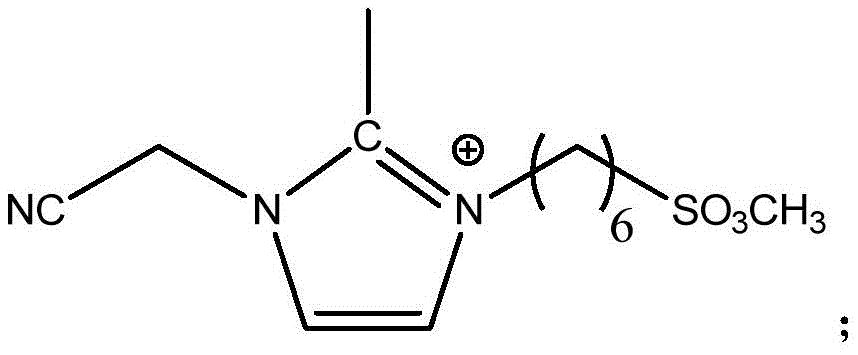
实施例4至实施例10中的第一离子液体中阳离子的结构为The structure of the cation in the first ionic liquid in Examples 4 to 10 is:

第二离子液体中阳离子的结构为:The structure of the cation in the second ionic liquid is:

实施例11中的第一离子液体中阳离子的结构为:The structure of the cation in the first ionic liquid in Example 11 is:

第二离子液体中阳离子的结构为:The structure of the cation in the second ionic liquid is:

实施例12中的第一离子液体中阳离子的结构为:The structure of the cation in the first ionic liquid in Example 12 is:
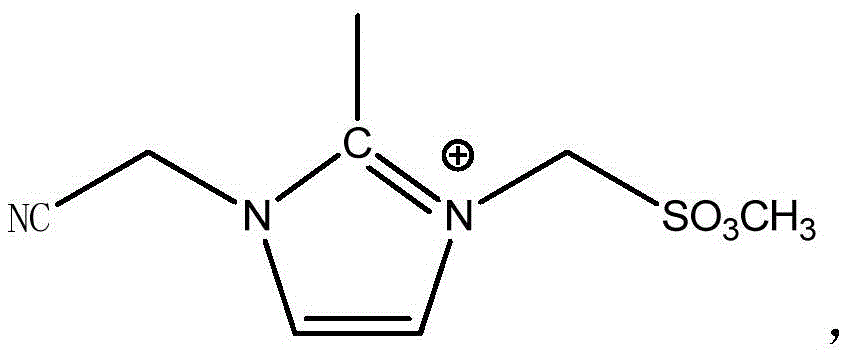
第二离子液体中阳离子的结构为:The structure of the cation in the second ionic liquid is:

对比例1中的第一离子液体的阳离子的结构为:The structure of the cation of the first ionic liquid in Comparative Example 1 is:

阴离子的结构为:The structure of the anion is:

第二离子液体的阳离子的结构为:The structure of the cation of the second ionic liquid is:

阴离子的结构为:The structure of the anion is:

对比例2只包含一种离子液体,阳离子的结构为:Comparative Example 2 contains only one ionic liquid, and the structure of the cation is:

阴离子的结构为:The structure of the anion is:

对比例3只包含一种离子液体,阳离子的结构为:Comparative Example 3 contains only one ionic liquid, and the structure of the cation is:

阴离子的结构为:The structure of the anion is:

对比例4只包含一种离子液体,阳离子的结构为:Comparative Example 4 contains only one ionic liquid, and the structure of the cation is:

阴离子的结构为:The structure of the anion is:

对比例5Comparative Example 5
在手套箱中配制电解液,手套箱中水分控制在≤10ppm,温度为20℃。将碳酸乙烯酯(EC)、碳酸二甲酯(DMC)、成膜剂和锂盐按表1中比例混合,得到电解液。The electrolyte was prepared in a glove box, the moisture in the glove box was controlled at ≤ 10 ppm, and the temperature was 20 °C. Ethylene carbonate (EC), dimethyl carbonate (DMC), film-forming agent and lithium salt were mixed according to the proportions in Table 1 to obtain an electrolyte solution.
对比例6中第一离子液体的阳离子的结构为:The structure of the cation of the first ionic liquid in Comparative Example 6 is:

阴离子的结构为:The structure of the anion is:

第二离子液体的阳离子的结构为:The structure of the cation of the second ionic liquid is:
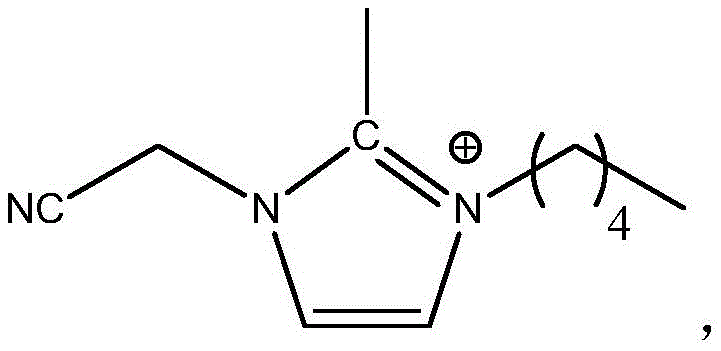
阴离子的结构为:The structure of the anion is:

表1Table 1

实施例13-24用于说明由本公开的电解液制备得到的锂离子电池。Examples 13-24 illustrate lithium ion batteries prepared from the electrolytes of the present disclosure.
实施例13Example 13
制备锂离子电池正极:将活性物质NCM811与乙炔黑、聚偏氟乙烯(购自东莞市庆丰塑胶原料有限公司,牌号为FR900)按重量比为90:5:5溶于N-甲基吡咯烷酮(NMP)中形成固含量为50wt%的电池浆料,并将搅拌均匀后得到的浆料涂敷在厚度为16μm的铝箔两面上,并在110℃±5℃下烘烤,然后经过压延、真空干燥,形成厚度为140μm±5μm的材料层,得到正极。Preparation of lithium-ion battery positive electrode: Dissolve active material NCM811, acetylene black, polyvinylidene fluoride (purchased from Dongguan Qingfeng Plastic Materials Co., Ltd., brand name FR900) in N-methylpyrrolidone in a weight ratio of 90:5:5 (NMP), a battery slurry with a solid content of 50 wt% was formed, and the slurry obtained after stirring was coated on both sides of an aluminum foil with a thickness of 16 μm, baked at 110 °C ± 5 °C, and then rolled, Vacuum-drying to form a material layer with a thickness of 140 μm±5 μm to obtain a positive electrode.
制备锂离子电池负极:将沥青包覆天然石墨(沥青包覆量为2%)与导电炭黑、丁苯橡胶、羧甲基纤维素按重量比为95:1:1.7:2.3分散于去离子水中得到负极浆料,并将搅拌均匀的负极浆料涂敷在厚度为10μm的铜箔两面上,并在110℃±5℃下烘烤,然后经过压延、真空干燥,形成厚度为100μm±5μm的材料层,得到负极。Preparation of negative electrode of lithium ion battery: natural graphite coated with asphalt (the amount of asphalt coating is 2%), conductive carbon black, styrene-butadiene rubber, and carboxymethyl cellulose in a weight ratio of 95:1:1.7:2.3 are dispersed in deionized The negative electrode slurry was obtained in water, and the uniformly stirred negative electrode slurry was coated on both sides of the copper foil with a thickness of 10 μm, baked at 110 °C ± 5 °C, and then rolled and vacuum dried to form a thickness of 100 μm ± 5 μm material layer to obtain a negative electrode.
电池制备:将上述正、负极片与20μm厚的聚丙烯隔膜卷绕成方形锂离子电池组,装入电池壳中并进行焊接,随后将实施例1中制备得到的电解液注入到电池壳中,密封制成锂离子电池。Battery preparation: The above-mentioned positive and negative electrode sheets and 20 μm thick polypropylene separators were wound into a square lithium-ion battery pack, put into the battery case and welded, and then the electrolyte prepared in Example 1 was injected into the battery case. , sealed into lithium-ion batteries.
实施例14-24采用与实施例13相同的方法制备锂离子电池,不同之处仅在于,实施例14-24中所采用的电解液依次为实施例2-12中制备的电解液。Examples 14-24 adopt the same method as that of Example 13 to prepare lithium ion batteries, except that the electrolytes used in Examples 14-24 are sequentially the electrolytes prepared in Examples 2-12.
对比例7-12采用与实施例12相同的方法制备锂离子电池,不同之处仅在于,对比例7-12中所采用的电解液依次为对比例1-6中制备的电解液。Comparative Examples 7-12 used the same method as Example 12 to prepare lithium ion batteries, except that the electrolytes used in Comparative Examples 7-12 were sequentially prepared in Comparative Examples 1-6.
测试实施例Test Example
(1)燃烧测试(1) Combustion test
将1mL全离子液体电解液加入容积为2mL的铁壳中,采用明火引燃进行可燃性测试,测试结果见表2。1mL of all-ionic liquid electrolyte was added to the iron shell with a volume of 2mL, and the flammability test was carried out by using an open flame to ignite. The test results are shown in Table 2.
(2)电解液的LSV测试(2) LSV test of electrolyte
采用线性扫描伏安法来测量电解液的氧化电位,确定其电化学稳定窗口。实验中使用简易的三电极装置来进行测试,分别以Pt丝作为工作电极,Li片作为对电极和参比电极,利用Autolab电化学工作站与计算机相连,测试时,扫描电压范围为0-5V,扫描速率为1mV/s。测试结果见图1。Linear sweep voltammetry was used to measure the oxidation potential of the electrolyte to determine its electrochemical stability window. In the experiment, a simple three-electrode device was used for testing, with Pt wire as the working electrode, Li sheet as the counter electrode and reference electrode, and the Autolab electrochemical workstation was used to connect with the computer. During the test, the scanning voltage range was 0-5V. The scan rate is 1mV/s. The test results are shown in Figure 1.
(3)常温首次充放电效率测试(3) First charge-discharge efficiency test at room temperature
将电池装入电池充放电测试柜(广州蓝奇BK6808)上,在25℃室温下,以1C的恒流充电至4.5V,记录充电容量,然后搁置10min,再以1C恒流放电至2.5V,记录放电容量。Put the battery into the battery charging and discharging test cabinet (Guangzhou Lanqi BK6808), charge it to 4.5V with a constant current of 1C at a room temperature of 25°C, record the charging capacity, then put it on hold for 10min, and then discharge it to 2.5V with a constant current of 1C , and record the discharge capacity.
首次充放电效率=(放电容量/充电容量)×100%,测试结果见表2。The first charge-discharge efficiency=(discharge capacity/charge capacity)×100%, and the test results are shown in Table 2.
(4)常温循环性能(4) Normal temperature cycle performance
将实施例与对比例中制备的锂离子电池装入电池充放电测试柜(广州蓝奇BK6808)上,在25℃室温下,以1C的电流,上限电压4.5V,下限电压2.5V的条件下,进行500次循环,记录第500次的放电容量与第1次的放电容量,The lithium-ion batteries prepared in the examples and comparative examples were loaded into the battery charge-discharge test cabinet (Guangzhou Lanqi BK6808), at a room temperature of 25°C, with a current of 1C, an upper limit voltage of 4.5V, and a lower limit voltage of 2.5V. , carry out 500 cycles, record the discharge capacity of the 500th time and the discharge capacity of the first time,
容量保持率=(循环500次后放电容量/第1次放电容量)×100%,测试结果见表2。Capacity retention rate=(discharge capacity after 500 cycles/first discharge capacity)×100%, and the test results are shown in Table 2.
(5)电池低温循环测试(5) Battery low temperature cycle test
将电池装入电池充放电测试柜(广州蓝奇BK6808)上,在低温-20℃下,以1C的电流,上限电压4.5V,下限电压2.5V的条件下,进行500次循环,记录第500次的放电容量与第1次的放电容量,Put the battery into the battery charging and discharging test cabinet (Guangzhou Lanqi BK6808), at a low temperature of -20 ℃, with a current of 1C, the upper limit voltage of 4.5V, and the lower limit voltage of 2.5V, 500 cycles were performed, and the 500th cycle was recorded. The discharge capacity of the second time and the discharge capacity of the first time,
容量保持率=(循环500次后放电容量/第1次放电容量)×100%,测试结果见表2。Capacity retention rate=(discharge capacity after 500 cycles/first discharge capacity)×100%, and the test results are shown in Table 2.
表2Table 2

由图1可知,本公开的电解液具有较高的电化学窗口,可以在4.4V宽的电压范围内不发生氧化反应(实施例2-4),高电压正极材料NCM811的电压平台在4.25V,本公开的具有4.4V宽的电化学窗口电解液可以满足其要求。It can be seen from FIG. 1 that the electrolyte of the present disclosure has a relatively high electrochemical window, and no oxidation reaction can occur in a wide voltage range of 4.4V (Example 2-4), and the voltage platform of the high-voltage cathode material NCM811 is 4.25V. , the electrolyte of the present disclosure with a wide electrochemical window of 4.4 V can meet its requirements.
由表1和表2可知,含有本公开电解液的锂离子电池具有较优的电化学性能,具体来说,本公开的电解液具有较宽的电化学窗口、稳定性好,使得锂离子电池在高压下可以进行充放电,而使其具有较好常温容量保持率,且有利于提高锂离子电池的低温容量保持率。同时,本公开的电解液具有较高的熔点,使得电解液具有更好的安全性能。优选地,当电解液中的锂盐的阴离子与离子液体的阴离子相同时,本公开的锂离子电池电解液电导率更高,具有更有电化学性能。优选地,以电解液的总重量为基准,第一离子液体的含量为80-90重量%,第二离子液体的含量为9.5-20重量%,成膜剂的含量为0.1-5重量%时,含有本公开的电解液的锂离子电池具有优的电化学性能,尤其是具有更高的容量保持率。优选地,电解液中锂盐的含量为1.5-3.0mol/L时,本公开的电解液具有更好的电化学性能。It can be seen from Table 1 and Table 2 that the lithium ion battery containing the electrolyte of the present disclosure has better electrochemical performance. Specifically, the electrolyte of the present disclosure has a wide electrochemical window and good stability, which makes the lithium ion battery. It can be charged and discharged under high pressure, so that it has a better capacity retention rate at room temperature, and is beneficial to improve the low temperature capacity retention rate of lithium ion batteries. At the same time, the electrolyte of the present disclosure has a higher melting point, so that the electrolyte has better safety performance. Preferably, when the anion of the lithium salt in the electrolyte is the same as the anion of the ionic liquid, the electrolyte of the lithium ion battery of the present disclosure has higher conductivity and better electrochemical performance. Preferably, based on the total weight of the electrolyte, the content of the first ionic liquid is 80-90% by weight, the content of the second ionic liquid is 9.5-20% by weight, and the content of the film-forming agent is 0.1-5% by weight , the lithium ion battery containing the electrolyte of the present disclosure has excellent electrochemical performance, especially higher capacity retention rate. Preferably, when the content of the lithium salt in the electrolyte is 1.5-3.0 mol/L, the electrolyte of the present disclosure has better electrochemical performance.
以上详细描述了本公开的优选实施方式,但是,本公开并不限于上述实施方式中的具体细节,在本公开的技术构思范围内,可以对本公开的技术方案进行多种简单变型,这些简单变型均属于本公开的保护范围。The preferred embodiments of the present disclosure are described above in detail, however, the present disclosure is not limited to the specific details of the above-mentioned embodiments. Within the scope of the technical idea of the present disclosure, various simple modifications can be made to the technical solutions of the present disclosure. These simple modifications All belong to the protection scope of the present disclosure.
另外需要说明的是,在上述具体实施方式中所描述的各个具体技术特征,在不矛盾的情况下,可以通过任何合适的方式进行组合,为了避免不必要的重复,本公开对各种可能的组合方式不再另行说明。In addition, it should be noted that, the specific technical features described in the above-mentioned specific embodiments can be combined in any suitable manner unless they are inconsistent. In order to avoid unnecessary repetition, the present disclosure provides The combination method will not be specified otherwise.
此外,本公开的各种不同的实施方式之间也可以进行任意组合,只要其不违背本公开的思想,其同样应当视为本公开所公开的内容。In addition, the various embodiments of the present disclosure can also be arbitrarily combined, as long as they do not violate the spirit of the present disclosure, they should also be regarded as the contents disclosed in the present disclosure.
Claims (15)


Priority Applications (1)
| Application Number | Priority Date | Filing Date | Title |
|---|---|---|---|
| CN201910621849.3A CN112216871B (en) | 2019-07-10 | 2019-07-10 | Lithium ion battery electrolyte, preparation method thereof, lithium ion battery and battery module |
Applications Claiming Priority (1)
| Application Number | Priority Date | Filing Date | Title |
|---|---|---|---|
| CN201910621849.3A CN112216871B (en) | 2019-07-10 | 2019-07-10 | Lithium ion battery electrolyte, preparation method thereof, lithium ion battery and battery module |
Publications (2)
| Publication Number | Publication Date |
|---|---|
| CN112216871A CN112216871A (en) | 2021-01-12 |
| CN112216871B true CN112216871B (en) | 2022-04-15 |
Family
ID=74047495
Family Applications (1)
| Application Number | Title | Priority Date | Filing Date |
|---|---|---|---|
| CN201910621849.3A Active CN112216871B (en) | 2019-07-10 | 2019-07-10 | Lithium ion battery electrolyte, preparation method thereof, lithium ion battery and battery module |
Country Status (1)
| Country | Link |
|---|---|
| CN (1) | CN112216871B (en) |
Families Citing this family (5)
| Publication number | Priority date | Publication date | Assignee | Title |
|---|---|---|---|---|
| CN113270644A (en) * | 2021-05-17 | 2021-08-17 | 惠州亿纬锂能股份有限公司 | Electrolyte and preparation method and application thereof |
| CN114171802B (en) * | 2021-12-08 | 2023-11-03 | 西安航空学院 | Lithium ion battery with low-temperature performance and preparation method thereof |
| WO2024028684A1 (en) * | 2022-08-04 | 2024-02-08 | 株式会社半導体エネルギー研究所 | Secondary battery |
| CN116404256B (en) * | 2023-05-31 | 2023-10-27 | 宁德时代新能源科技股份有限公司 | Electrolyte, battery cells, batteries and electrical equipment |
| CN119650315A (en) * | 2023-09-18 | 2025-03-18 | 中国科学院大连化学物理研究所 | An ionic liquid-based electrolyte, a wide temperature range high-voltage supercapacitor and its application |
Family Cites Families (22)
| Publication number | Priority date | Publication date | Assignee | Title |
|---|---|---|---|---|
| EP1557899B1 (en) * | 2004-01-15 | 2009-11-25 | Panasonic Corporation | Nonaqueous electrolyte for electrochemical devices |
| US7282295B2 (en) * | 2004-02-06 | 2007-10-16 | Polyplus Battery Company | Protected active metal electrode and battery cell structures with non-aqueous interlayer architecture |
| CN100423356C (en) * | 2006-04-20 | 2008-10-01 | 武汉大学 | Lithium-sulfur battery electrolyte and its rechargeable lithium-sulfur battery |
| CN100516126C (en) * | 2006-09-06 | 2009-07-22 | 北京理工大学 | an ionic liquid |
| CN101510622B (en) * | 2008-02-14 | 2012-07-04 | 比亚迪股份有限公司 | Electrolyte for lithium ion secondary battery and battery containing the electrolyte |
| CN102771000A (en) * | 2010-02-22 | 2012-11-07 | 丰田自动车株式会社 | Nonaqueous electrolyte solution type secondary battery and nonaqueous electrolyte solution for nonaqueous electrolyte solution type secondary battery |
| CN102195091A (en) * | 2010-03-10 | 2011-09-21 | 中国科学院过程工程研究所 | Ionic liquid electrolyte for lithium secondary battery |
| CN102280664B (en) * | 2010-06-09 | 2015-07-22 | 中国科学院物理研究所 | Electrolyte and secondary lithium battery and capacitor containing electrolyte |
| KR101779243B1 (en) * | 2010-09-30 | 2017-09-18 | 메르크 파텐트 게엠베하 | Electrolyte formulations, an electrochemical and/or optoelectronic device |
| KR101297786B1 (en) * | 2012-03-12 | 2013-08-20 | 서울대학교산학협력단 | Non-aqueous electrolyte for lithium secondary battery and lithium secondary battery including the same |
| US9300009B2 (en) * | 2012-10-22 | 2016-03-29 | Ut-Battelle, Llc | Electrolyte compositions for lithium ion batteries |
| KR20150096729A (en) * | 2012-12-20 | 2015-08-25 | 솔베이(소시에떼아노님) | Salts of n-containing heterocyclic anions as components in electrolytes |
| CN103066322B (en) * | 2013-01-08 | 2016-04-13 | 芜湖恒耀汽车零部件有限公司 | A kind of lithium ion battery composite electrolyte, lithium ion battery |
| CN103094610B (en) * | 2013-01-30 | 2015-12-23 | 江西优锂新材股份有限公司 | A kind of lithium ion battery ionic liquid mixed electrolyte |
| CA2907221A1 (en) * | 2013-03-15 | 2014-09-18 | Materials Modification Inc. | Functionalized ionic liquids and their applications |
| KR20160026644A (en) * | 2014-08-29 | 2016-03-09 | 삼성전자주식회사 | Composite, prepraring method thereof, electrolyte comprising the composite, and lithium secondary battery comprising the electrolyte |
| KR20150008353A (en) * | 2014-12-01 | 2015-01-22 | 주식회사 씨트리 | Ionic liquids having bisfluorosulfonylimide anion for electrolyte |
| EP3076470B1 (en) * | 2015-04-03 | 2019-10-16 | Samsung Electronics Co., Ltd. | Lithium secondary battery |
| US10096859B2 (en) * | 2016-04-07 | 2018-10-09 | StoreDot Ltd. | Electrolytes with ionic liquid additives for lithium ion batteries |
| CN108218785A (en) * | 2016-12-13 | 2018-06-29 | 中国科学院大连化学物理研究所 | A kind of secondary cell ionic liquid and synthetic method and application |
| CN108987811B (en) * | 2018-07-19 | 2020-07-10 | 辽宁九夷锂能股份有限公司 | Full-ionic liquid electrolyte and lithium battery containing electrolyte |
| CN109776423B (en) * | 2019-03-20 | 2020-12-08 | 厦门大学 | A kind of double imidazole ring functional ionic liquid and its preparation method and electrolyte and lithium secondary battery |
-
2019
- 2019-07-10 CN CN201910621849.3A patent/CN112216871B/en active Active
Also Published As
| Publication number | Publication date |
|---|---|
| CN112216871A (en) | 2021-01-12 |
Similar Documents
| Publication | Publication Date | Title |
|---|---|---|
| CN112216871B (en) | Lithium ion battery electrolyte, preparation method thereof, lithium ion battery and battery module | |
| CN102709588B (en) | A kind of lithium ion battery and electrolyte thereof | |
| WO2022143189A1 (en) | Lithium ion battery | |
| EP4092798A1 (en) | Gel electrolyte precursor and use thereof | |
| CN107834110A (en) | Lithium-ion battery electrolytes and lithium ion battery | |
| CN107359369B (en) | Electrolyte and lithium ion battery | |
| CN114142091A (en) | A lithium ion battery non-aqueous electrolyte and lithium ion battery | |
| CN116130766B (en) | Electrolyte and sodium ion battery | |
| CN106159325B (en) | A kind of low temperature electrolyte for lithium ion battery and low-temperature lithium ion battery | |
| CN105845984A (en) | Lithium ion battery electrolyte and lithium ion battery using same | |
| Liao et al. | Synergistic effect of electrolyte additives on the improvement in interfacial stability between ionic liquid based gel electrolyte and LiFePO4 cathode | |
| CN113629365A (en) | Electrolyte injection method and lithium ion battery | |
| CN105098236B (en) | Lithium ion battery and electrolyte thereof | |
| CN116632347A (en) | A kind of silicon-based lithium ion battery electrolyte and battery thereof | |
| CN110797544A (en) | A kind of high-performance lithium primary battery and preparation method thereof | |
| CN111048835A (en) | An overcharge-resistant electrolyte and a secondary lithium battery using the electrolyte and a preparation method thereof | |
| CN115051031A (en) | Electrolyte for sodium ion battery and sodium ion battery | |
| CN115275340A (en) | High-voltage electrolyte and preparation method and application thereof | |
| WO2026021540A1 (en) | Fast-charging lithium-ion battery, and preparation method therefor and application thereof | |
| CN114843610A (en) | An electrolyte and a lithium ion battery containing the same | |
| CN116706238B (en) | A high and low temperature electrolyte and its preparation method and application | |
| CN109004275A (en) | Electrolyte solution and secondary battery | |
| CN107181003A (en) | A kind of lithium ion battery of lithium ion battery with safe electrolyte and containing the electrolyte | |
| CN105098235A (en) | Lithium ion secondary battery and electrolyte thereof | |
| CN100466370C (en) | Electrolyte for supercapacitor battery |
Legal Events
| Date | Code | Title | Description |
|---|---|---|---|
| PB01 | Publication | ||
| PB01 | Publication | ||
| SE01 | Entry into force of request for substantive examination | ||
| SE01 | Entry into force of request for substantive examination | ||
| GR01 | Patent grant | ||
| GR01 | Patent grant |