CN112187351A - Method for calculating signal-to-noise ratio of ultraviolet experimental signal and simulation signal thereof - Google Patents
Method for calculating signal-to-noise ratio of ultraviolet experimental signal and simulation signal thereof Download PDFInfo
- Publication number
- CN112187351A CN112187351A CN202010995535.2A CN202010995535A CN112187351A CN 112187351 A CN112187351 A CN 112187351A CN 202010995535 A CN202010995535 A CN 202010995535A CN 112187351 A CN112187351 A CN 112187351A
- Authority
- CN
- China
- Prior art keywords
- signal
- experimental
- ultraviolet light
- noise
- simulation
- Prior art date
- Legal status (The legal status is an assumption and is not a legal conclusion. Google has not performed a legal analysis and makes no representation as to the accuracy of the status listed.)
- Pending
Links
Images


Classifications
-
- H—ELECTRICITY
- H04—ELECTRIC COMMUNICATION TECHNIQUE
- H04B—TRANSMISSION
- H04B10/00—Transmission systems employing electromagnetic waves other than radio-waves, e.g. infrared, visible or ultraviolet light, or employing corpuscular radiation, e.g. quantum communication
- H04B10/07—Arrangements for monitoring or testing transmission systems; Arrangements for fault measurement of transmission systems
- H04B10/075—Arrangements for monitoring or testing transmission systems; Arrangements for fault measurement of transmission systems using an in-service signal
- H04B10/079—Arrangements for monitoring or testing transmission systems; Arrangements for fault measurement of transmission systems using an in-service signal using measurements of the data signal
- H04B10/0795—Performance monitoring; Measurement of transmission parameters
- H04B10/07953—Monitoring or measuring OSNR, BER or Q
Landscapes
- Physics & Mathematics (AREA)
- Electromagnetism (AREA)
- Engineering & Computer Science (AREA)
- Computer Networks & Wireless Communication (AREA)
- Signal Processing (AREA)
- Photometry And Measurement Of Optical Pulse Characteristics (AREA)
Abstract
The invention discloses a method for calculating the signal-to-noise ratio of an ultraviolet experimental signal and a simulation signal thereof, which is implemented according to the following steps: collecting ultraviolet experimental signals and simulation signals thereof; extracting useful signal parts of the ultraviolet experimental signal and the simulation signal thereof and calculating useful power; extracting noise signal parts of the ultraviolet experimental signal and the simulation signal thereof and calculating noise power; and calculating the signal-to-noise ratio of the received signal according to the average useful signal power and the average noise power. The method can effectively calculate the signal-to-noise ratio of the signals acquired by experiments and the signal-to-noise ratio of the simulation signals obtained by simulation based on the Monte Carlo multiple scattering transmission model.
Description
Technical Field
The invention belongs to the technical field of ultraviolet light communication, and relates to a signal-to-noise ratio calculation method for an ultraviolet light experimental signal and a simulation signal thereof.
Background
The wireless ultraviolet light has the advantages of strong anti-interference performance, high confidentiality, capability of non-direct-view communication, all-weather work and the like, and the disadvantage that other free space optical communication needs to be aligned is avoided. The wireless ultraviolet networking is utilized for communication, the communication range can be expanded, and the prospect in the military field and the complex environment is good. In wireless ultraviolet light communication, however, the received signal includes not only the useful signal but also noise superimposed on the useful signal.
Signal to Noise Ratio (SNR) is a Ratio of an average useful Signal to an average Noise interference power in a received Signal, and is one of important parameters for measuring the quality of an ultraviolet light channel, and more algorithms and applications need performance optimization based on the SNR as a priori knowledge, such as power control, adaptive modulation, Turbo Code decoding, and the like, and are directly related to the error rate and the frame error rate. SNR in UVC (Ultraviolet Communication, UVC) systems is an important index for judging Communication quality. The signal-to-noise ratio of a receiving system in the UVC system is mainly calculated through a quantum limit signal-to-noise ratio formula, but the method is greatly different from experimental measurement.
Disclosure of Invention
The invention aims to provide a method for calculating the signal-to-noise ratio of an ultraviolet experimental signal and a simulation signal thereof, and solves the problem that the power of a useful signal and the power of a noise signal can not be accurately estimated in a low signal-to-noise ratio environment in the prior art.
The technical scheme adopted by the invention is a signal-to-noise ratio calculation method of an ultraviolet experimental signal and a simulation signal thereof, which is implemented according to the following steps:
step 3, extracting noise signal parts of the ultraviolet light experimental signal and the simulation signal thereof and calculating noise power;
and 4, calculating the signal-to-noise ratio of the received signal according to the average useful signal power and the average noise power.
In the step 1, an experimental signal is sent to a receiver through a transmitter and collected, and a simulation signal is obtained according to the experimental signal parameter.
The useful signal part of the ultraviolet experimental signal extracted in the step 2 is as follows: and (4) taking an absolute value of the amplitude of the ultraviolet experimental signal in the step 1, and then calculating an average value of the signal, wherein the average value is a useful signal.
The useful signal part of the simulation signal for extracting the ultraviolet experimental signal in the step 2 is as follows: and (3) squaring the pulse response sampling power of the simulation signal of the ultraviolet light experimental signal in the step (1) to obtain a voltage signal, and then calculating the average value of the voltage signal.
The useful power for extracting the ultraviolet light receiving experiment signal in the step 2 is solved according to the following formula:
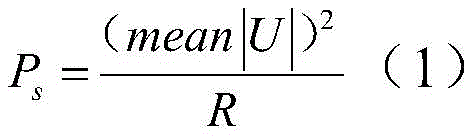
wherein U is the voltage amplitude of the ultraviolet light receiving signal, and R is the load resistance.
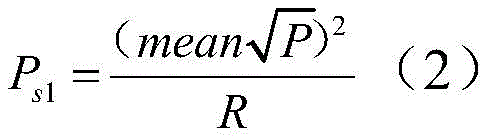
And 2, extracting the useful power of the simulation signal of the ultraviolet light receiving experiment signal in the step 2 and solving the useful power according to the following formula:

wherein P simulates the power density of the signal and R is the load resistance.
Extracting a noise signal part of the ultraviolet light receiving experiment signal in the step 3 and calculating noise power specifically as follows: subtracting the average value of the original ultraviolet experimental signal obtained by calculating the absolute value from the original ultraviolet experimental signal obtained in the step 2 to obtain a noise signal; solving for noise power using noise signals

Wherein, U is the voltage amplitude of the ultraviolet light receiving experiment signal, and R is the load resistance.
Extracting a simulation signal noise signal part of the ultraviolet light receiving experiment signal in the step 3 and calculating noise power specifically as follows: subtracting the average value of the voltage signal obtained in the step 2 to obtain a noise signal; solving for noise power using noise signals
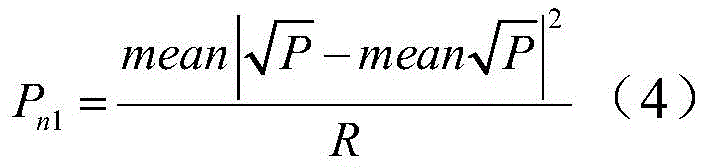
Where P is the power density of the simulated signal and R is the load resistance.
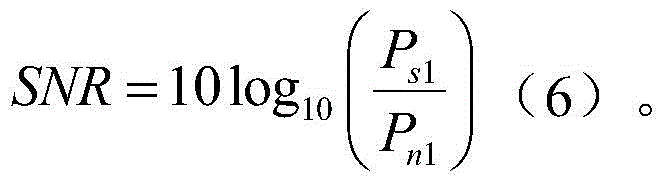
In step 4, calculating the SNR of the ultraviolet light receiving experimental signal by the formula (5):

calculating the SNR of the simulation signal of the ultraviolet light receiving experiment signal through the formula (6):

the invention has the beneficial effects that:
the method respectively calculates the power of a useful signal and the noise power of the signal based on an actual receiving signal received by ultraviolet light, and calculates the SNR of the ultraviolet light receiving signal through the definition of the signal-to-noise ratio. The invention calculates the signal-to-noise ratio of the signal according to the actually received signal, can effectively extract useful information submerged by noise, and can still accurately estimate the power of the useful signal and the noise signal under the environment of low signal-to-noise ratio.
(1) The method can effectively calculate the signal-to-noise ratio of the signals acquired by experiments and the signal-to-noise ratio of the simulation signals obtained by simulation based on the Monte Carlo multiple scattering transmission model.
(2) The signal-to-noise ratio of the transmission system in direct-view communication and non-direct-view communication can be calculated, and the performance of the ultraviolet light communication system can be evaluated better.
Drawings
FIG. 1 is a diagram of a multiple scattering transmission model based on a Monte Carlo method in a signal-to-noise ratio calculation method for an ultraviolet experimental signal and a simulation signal thereof according to the present invention;
FIG. 2 is a diagram of the extraction of original experimental signals and useful signals of ultraviolet light in the signal-to-noise ratio calculation method of experimental signals and simulated signals of ultraviolet light according to the present invention;
FIG. 3 is a graph of UV Monte Carlo simulation signals and useful signal extraction in the signal-to-noise ratio calculation method for UV experimental signals and simulation signals thereof according to the present invention;
FIG. 4 is a noise component distribution diagram of a signal to be measured in the signal-to-noise ratio calculation method of an ultraviolet experimental signal and a simulation signal thereof according to the present invention;
FIG. 5 is a noise component distribution diagram of the simulation signal to be measured in the method for calculating the signal-to-noise ratio of the ultraviolet experimental signal and the simulation signal thereof according to the present invention.
Detailed Description
The present invention will be described in detail below with reference to the accompanying drawings and specific embodiments.
The method for calculating the signal-to-noise ratio of the ultraviolet experimental signal and the simulation signal thereof is implemented according to the following steps:
step 3, extracting noise signal parts of the ultraviolet light experimental signal and the simulation signal thereof and calculating noise power;
and 4, calculating the signal-to-noise ratio of the received signal according to the average useful signal power and the average noise power.
In the step 1, an experimental signal is sent to a receiver through a transmitter and collected, in the example, the transmitter sends a pulse signal with 1.1kHz and 50% duty ratio, the receiving and sending elevation angle is 30 degrees, and the communication distance is 10 m.
As shown in fig. 1, according to the experimental signals, a simulation signal is obtained by using a wireless Ultraviolet (UV) multiple scattering transmission model based on an MC (Monte Carlo) method, in which the origin coordinate is a transmitter (T)x) D is the transmitter and receiver (R)x) The distance between them, with a value of 10m, was in accordance with the experimental conditions. CtAnd CrRespectively represents TxLight beam and RxField of view (FOV) cones. PhitAnd phirRespectively represent CtHalf beam angle of (C)rAngle of view (FOV) half angle. ThetatAnd thetarAre respectively CtElevation angle and C ofrThe elevation angle of (b) was set to 30 ° in the same manner as in the experiment. Alpha is alphatAnd alpharAre respectively CtAnd CrThe off-axis angle of (d) was 0 ° consistent with the parameters in the experimental environment. r0 is from TxTo S1A distance of r1Is from S1To RxA distance of rnIs from SnTo RxThe distance of (c). S1Is the first scattering point, reaches R after n scatteringx,SnIs the last scattering point.
As shown in fig. 2, the useful signal part of the experimental signal of ultraviolet light extracted in step 2 is: and (4) taking an absolute value of the amplitude of the ultraviolet experimental signal in the step 1, and then calculating an average value of the signal, wherein the average value is a useful signal.
As shown in fig. 3, the useful signal part of the simulation signal extracted from the experimental ultraviolet light signal in step 2 is: and (3) squaring the pulse response sampling power of the simulation signal of the ultraviolet light experimental signal in the step (1) to obtain a voltage signal, and then calculating the average value of the voltage signal.
The useful power for extracting the ultraviolet light receiving experiment signal in the step 2 is solved according to the following formula:
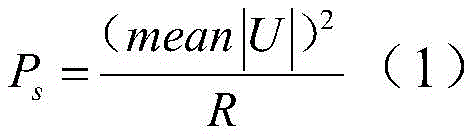
wherein U is the voltage amplitude of the ultraviolet light receiving signal, and R is the load resistance.
And 2, extracting the useful power of the simulation signal of the ultraviolet light receiving experiment signal in the step 2 and solving the useful power according to the following formula:
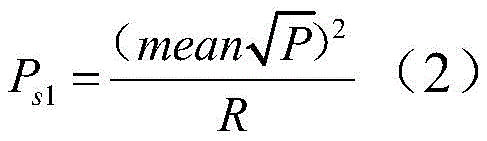
wherein P simulates the power density of the signal and R is the load resistance.
As shown in fig. 4, the extracting of the noise signal portion of the ultraviolet light receiving experimental signal and the calculating of the noise power in step 3 are specifically: subtracting the average value of the original ultraviolet experimental signal obtained by calculating the absolute value from the original ultraviolet experimental signal obtained in the step 2 to obtain a noise signal; solving for noise power using noise signals

Wherein, U is the voltage amplitude of the ultraviolet light receiving experiment signal, and R is the load resistance.
As shown in fig. 5, the step 3 of extracting the noise signal part of the simulation signal of the ultraviolet light receiving experimental signal and calculating the noise power specifically includes: subtracting the average value of the voltage signal obtained in the step 2 to obtain a noise signal; solving for noise power using noise signals
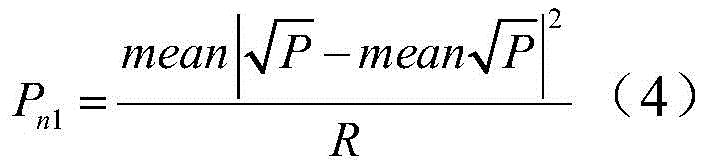
Where P is the power density of the simulated signal and R is the load resistance.
In step 4, calculating the SNR of the ultraviolet light receiving experimental signal by the formula (5):

calculating the SNR of the simulation signal of the ultraviolet light receiving experiment signal through the formula (6):
the method can evaluate the channel transmission performance of both ultraviolet direct-view communication and non-direct-view communication, can also be used for calculating the signal-to-noise ratio of experimental signals and simulated signals obtained by multiple scattering transmission based on Monte Carlo simulation, has simple implementation process, can accurately estimate the power of useful signals and noise signals in the environment with low signal-to-noise ratio, and is a signal-to-noise ratio calculation method with remarkable anti-noise effect and good estimation performance.
Claims (9)



Priority Applications (1)
| Application Number | Priority Date | Filing Date | Title |
|---|---|---|---|
| CN202010995535.2A CN112187351A (en) | 2020-09-21 | 2020-09-21 | Method for calculating signal-to-noise ratio of ultraviolet experimental signal and simulation signal thereof |
Applications Claiming Priority (1)
| Application Number | Priority Date | Filing Date | Title |
|---|---|---|---|
| CN202010995535.2A CN112187351A (en) | 2020-09-21 | 2020-09-21 | Method for calculating signal-to-noise ratio of ultraviolet experimental signal and simulation signal thereof |
Publications (1)
| Publication Number | Publication Date |
|---|---|
| CN112187351A true CN112187351A (en) | 2021-01-05 |
Family
ID=73956670
Family Applications (1)
| Application Number | Title | Priority Date | Filing Date |
|---|---|---|---|
| CN202010995535.2A Pending CN112187351A (en) | 2020-09-21 | 2020-09-21 | Method for calculating signal-to-noise ratio of ultraviolet experimental signal and simulation signal thereof |
Country Status (1)
| Country | Link |
|---|---|
| CN (1) | CN112187351A (en) |
Citations (6)
| Publication number | Priority date | Publication date | Assignee | Title |
|---|---|---|---|---|
| US8193302B2 (en) * | 2005-10-28 | 2012-06-05 | Eastman Chemical Company | Polyester compositions which comprise cyclobutanediol and certain phosphate thermal stabilizers, and/or reaction products thereof |
| CN105210313A (en) * | 2014-04-23 | 2015-12-30 | 华为技术有限公司 | Method and device for optimizing performance of optical communication network |
| WO2017087894A1 (en) * | 2015-11-19 | 2017-05-26 | Pacific Bioscienes Of California, Inc. | Compounds and systems for improving signal detection |
| CN107949060A (en) * | 2017-11-27 | 2018-04-20 | 电子科技大学 | A kind of power distribution method for mixing circulation prefix orthogonal frequency division multiple access |
| CN111082863A (en) * | 2019-12-24 | 2020-04-28 | 西安工程大学 | Bilateral node localization method for UV light mobile ad hoc network |
| CN111312291A (en) * | 2020-02-24 | 2020-06-19 | 厦门快商通科技股份有限公司 | Signal-to-noise ratio detection method, system, mobile terminal and storage medium |
-
2020
- 2020-09-21 CN CN202010995535.2A patent/CN112187351A/en active Pending
Patent Citations (6)
| Publication number | Priority date | Publication date | Assignee | Title |
|---|---|---|---|---|
| US8193302B2 (en) * | 2005-10-28 | 2012-06-05 | Eastman Chemical Company | Polyester compositions which comprise cyclobutanediol and certain phosphate thermal stabilizers, and/or reaction products thereof |
| CN105210313A (en) * | 2014-04-23 | 2015-12-30 | 华为技术有限公司 | Method and device for optimizing performance of optical communication network |
| WO2017087894A1 (en) * | 2015-11-19 | 2017-05-26 | Pacific Bioscienes Of California, Inc. | Compounds and systems for improving signal detection |
| CN107949060A (en) * | 2017-11-27 | 2018-04-20 | 电子科技大学 | A kind of power distribution method for mixing circulation prefix orthogonal frequency division multiple access |
| CN111082863A (en) * | 2019-12-24 | 2020-04-28 | 西安工程大学 | Bilateral node localization method for UV light mobile ad hoc network |
| CN111312291A (en) * | 2020-02-24 | 2020-06-19 | 厦门快商通科技股份有限公司 | Signal-to-noise ratio detection method, system, mobile terminal and storage medium |
Non-Patent Citations (1)
| Title |
|---|
| 欧世峰: "基于概率耦合的双直接判决先验信噪比估计算法", 《电子学报》 * |
Similar Documents
| Publication | Publication Date | Title |
|---|---|---|
| CN106130942A (en) | A kind of wireless communication signals Modulation Identification based on Cyclic Spectrum and method for parameter estimation | |
| CN109347579B (en) | Weak signal detection method under uncertain wireless channel fading condition | |
| CN106533577B (en) | A Non-Gaussian Noise Suppression Method Based on Energy Detection | |
| CN108181059B (en) | Multi-phase flow pipeline leakage sound wave signal identification method based on wavelet signals | |
| CN105785324B (en) | Linear frequency-modulated parameter estimating method based on MGCSTFT | |
| Panaro et al. | Underwater acoustic noise model for shallow water communications | |
| CN106597408A (en) | Method for estimating high-order PPS signal parameter based on time-frequency analysis and instantaneous frequency curve-fitting | |
| CN102075263B (en) | Segmented energy processing-based truncated sequential test method | |
| WO2017107316A1 (en) | Differential chaos shift keying communication method based on hybrid system | |
| CN106877907A (en) | A Noise Resistant Channel Estimation Method in Power Lines | |
| CN102594471A (en) | Fractal box dimension and third-order cyclic cumulant-based spectrum sensing method | |
| CN107094043B (en) | An improved MMSE low-complexity signal detection method based on block iterative method | |
| CN101841350B (en) | Doppler frequency shift estimation method based on stochastic resonance preprocessing | |
| CN117221053A (en) | An underwater acoustic communication channel estimation method and system using improved DDPM noise reduction | |
| CN101764785B (en) | Quadrature amplitude modulation signal identifying method based on mixed moment and fisher discrimination | |
| CN111756405A (en) | A PLC channel impulse noise detection method and system using F-square modulus | |
| CN113098638B (en) | Weak signal detection method based on grouped range diagram | |
| CN106452652A (en) | A multipath interference suppression method based on a chaotic wireless communication system | |
| CN112187351A (en) | Method for calculating signal-to-noise ratio of ultraviolet experimental signal and simulation signal thereof | |
| CN112202696B (en) | Automatic modulation and identification method of underwater acoustic signal based on fuzzy autoencoder | |
| CN104270328A (en) | Method for estimating signal-to-noise ratio in real time | |
| CN104270210A (en) | Soft decision spectrum sensing method based on compression and non-reconstruction | |
| CN103078661A (en) | An Interference Suppression Method for Spread Spectrum System Based on Iterative Threshold | |
| CN110719121A (en) | PLC channel impulse noise detection method and system using square exponential kernel | |
| CN102685058B (en) | Interference-to-noise ratio evaluation method of blind single of orthogonal frequency division multiplexing (OFDM) system under pulse interference environment |
Legal Events
| Date | Code | Title | Description |
|---|---|---|---|
| PB01 | Publication | ||
| PB01 | Publication | ||
| SE01 | Entry into force of request for substantive examination | ||
| SE01 | Entry into force of request for substantive examination | ||
| RJ01 | Rejection of invention patent application after publication |
Application publication date: 20210105 |
|
| RJ01 | Rejection of invention patent application after publication |