CN112182308B - Multi-feature fusion depth knowledge tracking method and system based on multi-thermal coding - Google Patents
Multi-feature fusion depth knowledge tracking method and system based on multi-thermal coding Download PDFInfo
- Publication number
- CN112182308B CN112182308B CN202011056680.0A CN202011056680A CN112182308B CN 112182308 B CN112182308 B CN 112182308B CN 202011056680 A CN202011056680 A CN 202011056680A CN 112182308 B CN112182308 B CN 112182308B
- Authority
- CN
- China
- Prior art keywords
- feature
- question
- student
- skill
- answer
- Prior art date
- Legal status (The legal status is an assumption and is not a legal conclusion. Google has not performed a legal analysis and makes no representation as to the accuracy of the status listed.)
- Active
Links
Images


Classifications
-
- G—PHYSICS
- G06—COMPUTING OR CALCULATING; COUNTING
- G06F—ELECTRIC DIGITAL DATA PROCESSING
- G06F16/00—Information retrieval; Database structures therefor; File system structures therefor
- G06F16/90—Details of database functions independent of the retrieved data types
- G06F16/901—Indexing; Data structures therefor; Storage structures
-
- G—PHYSICS
- G06—COMPUTING OR CALCULATING; COUNTING
- G06F—ELECTRIC DIGITAL DATA PROCESSING
- G06F16/00—Information retrieval; Database structures therefor; File system structures therefor
- G06F16/90—Details of database functions independent of the retrieved data types
- G06F16/903—Querying
- G06F16/90335—Query processing
- G06F16/90344—Query processing by using string matching techniques
-
- G—PHYSICS
- G06—COMPUTING OR CALCULATING; COUNTING
- G06F—ELECTRIC DIGITAL DATA PROCESSING
- G06F17/00—Digital computing or data processing equipment or methods, specially adapted for specific functions
- G06F17/10—Complex mathematical operations
- G06F17/16—Matrix or vector computation, e.g. matrix-matrix or matrix-vector multiplication, matrix factorization
-
- G—PHYSICS
- G06—COMPUTING OR CALCULATING; COUNTING
- G06F—ELECTRIC DIGITAL DATA PROCESSING
- G06F18/00—Pattern recognition
- G06F18/20—Analysing
- G06F18/21—Design or setup of recognition systems or techniques; Extraction of features in feature space; Blind source separation
- G06F18/214—Generating training patterns; Bootstrap methods, e.g. bagging or boosting
-
- G—PHYSICS
- G06—COMPUTING OR CALCULATING; COUNTING
- G06N—COMPUTING ARRANGEMENTS BASED ON SPECIFIC COMPUTATIONAL MODELS
- G06N3/00—Computing arrangements based on biological models
- G06N3/02—Neural networks
- G06N3/04—Architecture, e.g. interconnection topology
- G06N3/045—Combinations of networks
-
- Y—GENERAL TAGGING OF NEW TECHNOLOGICAL DEVELOPMENTS; GENERAL TAGGING OF CROSS-SECTIONAL TECHNOLOGIES SPANNING OVER SEVERAL SECTIONS OF THE IPC; TECHNICAL SUBJECTS COVERED BY FORMER USPC CROSS-REFERENCE ART COLLECTIONS [XRACs] AND DIGESTS
- Y02—TECHNOLOGIES OR APPLICATIONS FOR MITIGATION OR ADAPTATION AGAINST CLIMATE CHANGE
- Y02D—CLIMATE CHANGE MITIGATION TECHNOLOGIES IN INFORMATION AND COMMUNICATION TECHNOLOGIES [ICT], I.E. INFORMATION AND COMMUNICATION TECHNOLOGIES AIMING AT THE REDUCTION OF THEIR OWN ENERGY USE
- Y02D10/00—Energy efficient computing, e.g. low power processors, power management or thermal management
Landscapes
- Engineering & Computer Science (AREA)
- Theoretical Computer Science (AREA)
- Physics & Mathematics (AREA)
- Data Mining & Analysis (AREA)
- General Physics & Mathematics (AREA)
- Databases & Information Systems (AREA)
- General Engineering & Computer Science (AREA)
- Mathematical Physics (AREA)
- Software Systems (AREA)
- Evolutionary Computation (AREA)
- Computational Linguistics (AREA)
- Artificial Intelligence (AREA)
- Pure & Applied Mathematics (AREA)
- Mathematical Optimization (AREA)
- Life Sciences & Earth Sciences (AREA)
- Mathematical Analysis (AREA)
- Computational Mathematics (AREA)
- Computing Systems (AREA)
- Health & Medical Sciences (AREA)
- Bioinformatics & Cheminformatics (AREA)
- Bioinformatics & Computational Biology (AREA)
- Computer Vision & Pattern Recognition (AREA)
- Evolutionary Biology (AREA)
- Molecular Biology (AREA)
- General Health & Medical Sciences (AREA)
- Biophysics (AREA)
- Biomedical Technology (AREA)
- Algebra (AREA)
- Electrically Operated Instructional Devices (AREA)
Abstract
本发明公开了一种基于多热编码的多特征融合深度知识追踪方法及系统。该方法包括步骤:获取学生的答题数据集;提取问题编号特征p、技能编号特征s、答题表现特征c、尝试次数特征att、首次操作特征act、学生首次反应时间特征frt;将提取的6个特征转换为分类变量;将问题编号特征p和技能编号特征s进行多热编码,获得多热技能编码Multi(multi_s),将其他特征进行独热编码,获得独热编码O,将多热技能编码Multi(multi_s)和独热编码O进行拼接及降维处理后输入到深度知识追踪模型进行知识追踪。本发明可以提高数据集的数据利用率,并且实现多技能的预测。

The invention discloses a multi-feature fusion deep knowledge tracking method and system based on multi-hot encoding. The method includes the steps of: obtaining the student's answer data set; extracting the question number feature p, the skill number feature s, the answer performance feature c, the number of attempts feature att, the first operation feature act, and the student's first reaction time feature frt; the six extracted Convert features to categorical variables; perform multi-hot encoding on question number feature p and skill number feature s to obtain multi-hot skill encoding Multi(multi_s), perform one-hot encoding on other features to obtain one-hot encoding O, and encode multi-hot skills Multi(multi_s) and one-hot encoding O are spliced and dimensionally reduced, and then input to the deep knowledge tracking model for knowledge tracking. The invention can improve the data utilization rate of the data set and realize multi-skill prediction.
Description
技术领域Technical Field
本发明属于知识追踪技术领域,更具体地,涉及基于多热编码的多特征融合深度知识追踪方法及系统。The present invention belongs to the technical field of knowledge tracking, and more specifically, to a multi-feature fusion deep knowledge tracking method and system based on multi-hot encoding.
背景技术Background Art
知识追踪(Knowledge Tracing)任务是利用计算机技术,根据学生过去的答题记录,对学生的知识掌握情况进行建模,进一步得到学生当前知识状态的表示,从而可以准确预测学生在下一次答题时的表现。其中提到的学生过去的答题记录,通常以时间序列的形式呈现出来。由于题目设置和考察能力的综合性,每道问题往往不仅包含一个技能,这也是建立知识追踪模型非常困难的原因。The knowledge tracing task is to use computer technology to model the students' knowledge mastery based on their past answer records, and further obtain a representation of the students' current knowledge status, so as to accurately predict the students' performance in the next answer. The students' past answer records mentioned are usually presented in the form of a time series. Due to the comprehensiveness of the question setting and the ability to be tested, each question often contains more than one skill, which is why it is very difficult to establish a knowledge tracing model.
目前主流知识追踪模型将技能编号(skill id)和答题表现(correct)作为模型的输入,将多个特征引入深度知识追踪模型,对多特征均进行独热编码,拼接成新的特征向量作为模型的输入,预测学生对下一个问题的回答正确率。The current mainstream knowledge tracking model takes the skill number (skill id) and answer performance (correct) as the input of the model, introduces multiple features into the deep knowledge tracking model, performs one-hot encoding on multiple features, and splices them into a new feature vector as the input of the model to predict the correct rate of students' answers to the next question.
但是现有技术存在以下缺点:(1)大多数研究者仅选用技能编号(skill id)和正确性(correct)两个特征,数据利用率低;(2)将多技能问题拆分为多个单技能问题,没有考虑一道题目同时考察多个技能的情况,无法预测多技能问题的表现。However, the existing technologies have the following shortcomings: (1) Most researchers only use two features, skill ID and correctness, which results in low data utilization; (2) Multi-skill questions are split into multiple single-skill questions without considering the situation where a question tests multiple skills at the same time, making it impossible to predict the performance of multi-skill questions.
发明内容Summary of the invention
针对现有技术的至少一个缺陷或改进需求,本发明提供了一种基于多热编码的多特征融合深度知识追踪方法及系统,可以提高数据集的数据利用率,并且实现多技能的预测。In response to at least one defect or improvement need in the prior art, the present invention provides a multi-feature fusion deep knowledge tracking method and system based on multi-hot encoding, which can improve the data utilization of the data set and realize the prediction of multiple skills.
为实现上述目的,按照本发明的第一方面,提供了一种基于多热编码的多特征融合深度知识追踪方法,包括步骤:To achieve the above object, according to a first aspect of the present invention, a multi-feature fusion deep knowledge tracking method based on multi-hot encoding is provided, comprising the steps of:
获取学生的答题数据集,所述答题数据集包括多条答题记录,每条所述答题记录包括一个问题和一个学生在回答该问题时的交互信息,所述问题关联多个技能;Acquire a student's answer data set, the answer data set including multiple answer records, each of the answer records including a question and interactive information of a student when answering the question, the question being associated with multiple skills;
从所述答题数据集中提取问题编号特征p、技能编号特征s、答题表现特征c、尝试次数特征att、首次操作特征act和学生首次反应时间特征frt;Extracting question number feature p, skill number feature s, answer performance feature c, attempt number feature att, first operation feature act and student first reaction time feature frt from the answer data set;
将所述问题编号特征p、所述技能编号特征s、所述答题表现特征c、所述尝试次数特征att、所述首次操作特征act和所述学生首次反应时间特征frt转换为分类变量;Convert the question number feature p, the skill number feature s, the answer performance feature c, the attempt number feature att, the first operation feature act, and the student's first reaction time feature frt into categorical variables;
将转换为分类变量后的所述问题编号特征p和所述技能编号特征s进行多热编码,获得多热技能编码Multi(multi_s),将转换为分类变量后的所述答题表现特征c、所述尝试次数特征att、所述首次操作特征act、所述学生首次反应时间特征frt进行独热编码,获得独热编码O,将所述多热技能编码Multi(multi_s)和所述独热编码O进行拼接,获得输入向量vt;The question number feature p and the skill number feature s converted into categorical variables are multi-hot encoded to obtain a multi-hot skill code Multi(multi_s); the answer performance feature c, the number of attempts feature att, the first operation feature act, and the student's first reaction time feature frt converted into categorical variables are one-hot encoded to obtain a one-hot code O; the multi-hot skill code Multi(multi_s) and the one-hot code O are concatenated to obtain an input vector v t ;
将所述输入向量vt进行降维处理后输入到深度知识追踪模型,所述深度知识追踪模型用于输出每个技能的预测值,根据所述深度知识追踪模型的输出确定对下一个问题的预测结果。The input vector v t is input into a deep knowledge tracking model after dimension reduction. The deep knowledge tracking model is used to output a predicted value for each skill. The prediction result for the next question is determined based on the output of the deep knowledge tracking model.
优选的,所述进行多热编码包括步骤:Preferably, the multi-hot encoding comprises the steps of:
遍历所述答题数据集,引入一个嵌入矩阵Q,所述嵌入矩阵Q形式为:Q={Qij}M×K,其中M为问题总数目,K为技能总数目,在所述嵌入矩阵Q中,每一行对应一个问题,每一列对应一个技能,所述嵌入矩阵Q中的向量表达为Qes:Traverse the answering data set and introduce an embedding matrix Q. The embedding matrix Q is in the form of: Q = {Q ij } M × K , where M is the total number of questions and K is the total number of skills. In the embedding matrix Q, each row corresponds to a question and each column corresponds to a skill. The vector in the embedding matrix Q is expressed as Q es :

获取所述问题编号特征p和所述嵌入矩阵Q的向量积结果Multi(multi_s)。Get the vector product result Multi(multi_s) of the question number feature p and the embedding matrix Q.
优选的,所述进行独热编码包括步骤:将转换为分类变量后的所述答题表现特征c、所述尝试次数特征att、所述首次操作特征act和所述学生首次反应时间特征frt进行特征交叉并采用独热编码,然后利用交叉验证选取最优特征组合作为独热编码O。Preferably, the one-hot encoding includes the steps of: performing feature crossover and one-hot encoding on the answering performance feature c, the number of attempts feature att, the first operation feature act and the student's first reaction time feature frt after conversion into categorical variables, and then using cross-validation to select the optimal feature combination as the one-hot encoding O.
优选的,所述将所述问题编号特征p、所述技能编号特征s、所述答题表现特征c、尝试次数特征att、首次操作特征act和学生首次反应时间特征frt转换为分类变量包括步骤:Preferably, the step of converting the question number feature p, the skill number feature s, the answer performance feature c, the number of attempts feature att, the first operation feature act, and the student's first reaction time feature frt into categorical variables comprises the following steps:
将所述问题编号特征p的数值变量直接作为问题分类数,共n1类;The numerical variable of the question number feature p is directly used as the number of question categories, with a total of n 1 categories;
将所述技能编号特征s的数值变量作为技能分类数,共n2类;The numerical variable of the skill number feature s is used as the number of skill categories, with a total of n 2 categories;
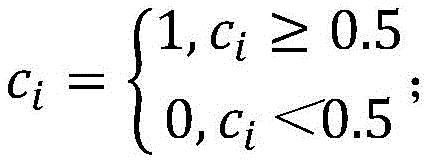
将所述答题表现特征c分为2类,0表示答错,1表示答对,若存在非0非1的中间值ci,则以0.5为阈值,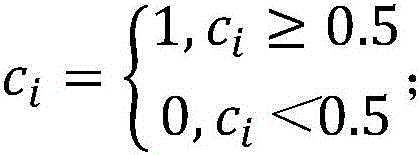
将所述尝试次数特征att分为3类,att={0,1,其他},若学生放弃该问题,则att=0,若学生一次性答对了该问题则att=1,若既没有放弃该问题也没有一次性答对了该问题,则att=其他;The feature of the number of attempts att is divided into three categories: att = {0, 1, other}, if the student gives up the question, then att = 0, if the student answers the question correctly in one try, then att = 1, if the student neither gives up the question nor answers the question correctly in one try, then att = other;
将所述首次操作特征act按数据集具体情况划分为n3类;Divide the first operation feature act into n 3 categories according to the specific situation of the data set;
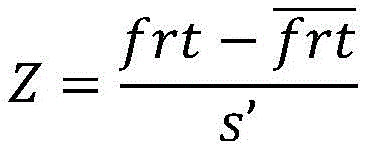
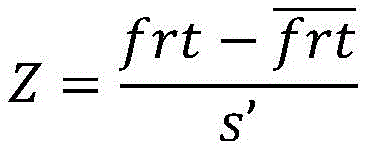
将所述学生首次反应时间特征frt作z分数处理,方法为:The student's first reaction time feature frt is processed as a z-score by:
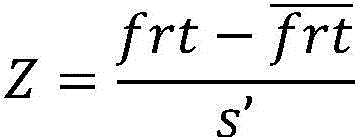
其中,Z是所述学生首次反应时间frt的z分数,
将所述z分数离散为一个范畴特征,按照预设正确率阈值划分为n4类;Discretize the z score into a category feature and divide it into n 4 categories according to a preset accuracy threshold;
优选的,所述进行降维处理是采用欠完备自编码器、或主成分分析、或多维尺度分析、或局部线性嵌入方法中的一种。Preferably, the dimensionality reduction process is performed by using one of an undercomplete autoencoder, principal component analysis, multidimensional scaling analysis, or a local linear embedding method.
优选的,所述欠完备自编码器的学习过程是最小化一个损失函数:Preferably, the learning process of the incomplete autoencoder is to minimize a loss function:
L=(x,g(f(x)))L = (x, g (f (x)))
其中,L是损失函数,计算输入x和经过编码器、解码器后的输出g(f(x))的差异,f(x)表示编码器,g(h)=g(f(x))表示解码器。Where L is the loss function, which calculates the difference between the input x and the output g(f(x)) after the encoder and decoder, where f(x) represents the encoder and g(h)=g(f(x)) represents the decoder.
优选的,所述欠完备自编码器采用tanh函数作为神经网络激活函数,公式为:Preferably, the incomplete autoencoder uses the tanh function as the neural network activation function, and the formula is:
v′t=tanh(Wih*vt+bih)v′ t =tanh(W ih *v t +b ih )

其中,vt是输入的拼接特征,v′t是所述欠完备自编码器隐含层提取的特征向量,yt是所述欠完备自编码器的输出,Wih表示所述欠完备自编码器输入层和隐含层之间的权重系数矩阵,
优选的,根据所述深度知识追踪模型的输出确定对下一个问题的预测结果包括步骤:Preferably, determining the prediction result for the next question according to the output of the deep knowledge tracking model comprises the steps of:
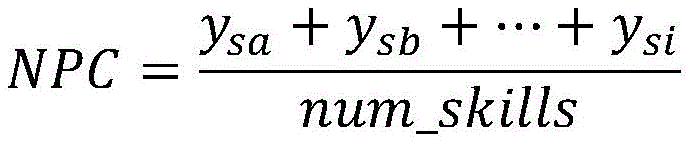
所述深度知识追踪模型输出的每个技能的预测值记为Ot=[ys1,ys2,...,ysK],K为技能总数目,根据下一个问题所包含的技能{sa,sb,...,si},读取输出矩阵Ot中对应位置的概率预测值{ysa,ysb,...,ysi},根据以下公式确定下一个问题的预测结果:The predicted value of each skill output by the deep knowledge tracking model is recorded as Ot = [ ys1 , ys2 , ..., ysK ], where K is the total number of skills. According to the skills { sa , sb, ..., si } contained in the next question, the probability prediction value { ysa , ysb , ..., ysi } of the corresponding position in the output matrix Ot is read, and the prediction result of the next question is determined according to the following formula:

其中,num_skills表示该问题所包含的技能的个数,NPC表示下一个问题答对的概率值。Among them, num_skills represents the number of skills included in the question, and NPC represents the probability value of answering the next question correctly.
按照本发明的第二方面,提供了一种基于多热编码的多特征融合深度知识追踪系统,包括:According to a second aspect of the present invention, a multi-feature fusion deep knowledge tracking system based on multi-hot encoding is provided, comprising:
获取模块,用于获取学生的答题数据集,所述答题数据集包括多条答题记录,每条所述答题记录包括一个问题和一个学生在回答该问题时的交互信息,所述问题关联多个技能;An acquisition module is used to acquire a student's answer data set, wherein the answer data set includes multiple answer records, each of which includes a question and interactive information of a student when answering the question, and the question is associated with multiple skills;
特征提取模块,用于从所述答题数据集中提取问题编号特征p、技能编号特征s、答题表现特征c、尝试次数特征att、首次操作特征act、学生首次反应时间特征frt;A feature extraction module is used to extract question number feature p, skill number feature s, answer performance feature c, attempt number feature att, first operation feature act, and student first reaction time feature frt from the answer data set;
转换模块,用于将所述问题编号特征p、所述技能编号特征s、所述答题表现特征c、所述尝试次数特征att、所述首次操作特征act、所述学生首次反应时间特征frt转换为分类变量;A conversion module, used to convert the question number feature p, the skill number feature s, the answer performance feature c, the number of attempts feature att, the first operation feature act, and the student's first reaction time feature frt into categorical variables;
编码模块,用于将转换为分类变量后的所述问题编号特征p和所述技能编号特征s进行多热编码,获得多热技能编码Multi(multi_s),将转换为分类变量后的所述答题表现特征c、所述尝试次数特征att、所述首次操作特征act、所述学生首次反应时间特征frt进行独热编码,获得独热编码O,将所述多热技能编码Multi(multi_s)和所述独热编码O进行拼接,获得输入向量vt;An encoding module is used to perform multi-hot encoding on the question number feature p and the skill number feature s converted into categorical variables to obtain a multi-hot skill code Multi(multi_s), perform one-hot encoding on the answer performance feature c, the number of attempts feature att, the first operation feature act, and the student's first reaction time feature frt converted into categorical variables to obtain a one-hot code O, and concatenate the multi-hot skill code Multi(multi_s) and the one-hot code O to obtain an input vector v t ;
预测模块,用于将所述输入向量vt进行降维处理后输入到深度知识追踪模型,所述深度知识追踪模型用于输出每个技能的预测值,根据所述深度知识追踪模型的输出确定对下一个问题的预测结果。The prediction module is used to reduce the dimension of the input vector v t and input it into the deep knowledge tracking model. The deep knowledge tracking model is used to output the predicted value of each skill, and determine the prediction result for the next question based on the output of the deep knowledge tracking model.
总体而言,本发明与现有技术相比,具有有益效果:从答题数据集中提取多个特征,以提高数据集的数据利用率;此外,针对多技能问题,提供了一种基于多热编码的特征编码方式,可以有效缩短学生答题序列长度,同时保证题目信息的完整性,弥补了一般深度知识追踪模型无法预测多技能问题的短板。In general, compared with the prior art, the present invention has beneficial effects: multiple features are extracted from the answer data set to improve the data utilization rate of the data set; in addition, for multi-skill questions, a feature encoding method based on multi-hot encoding is provided, which can effectively shorten the length of the student's answer sequence while ensuring the integrity of the question information, making up for the shortcoming that the general deep knowledge tracking model cannot predict multi-skill questions.
附图说明BRIEF DESCRIPTION OF THE DRAWINGS
图1是本发明实施例的基于多热编码的多特征融合深度知识追踪方法的原理示意图;FIG1 is a schematic diagram of the principle of a multi-feature fusion deep knowledge tracking method based on multi-hot encoding according to an embodiment of the present invention;
图2是本发明实施例的多热编码的嵌入矩阵Q的示意图;FIG2 is a schematic diagram of an embedding matrix Q of multi-hot encoding according to an embodiment of the present invention;
图3是本发明实施例的特征拼接示意图;FIG3 is a schematic diagram of feature splicing of an embodiment of the present invention;
图4是本发明实施例的欠完备自编码器示意图;FIG4 is a schematic diagram of an incomplete autoencoder according to an embodiment of the present invention;
图5是本发明实施例的基于多热编码的多特征融合深度知识追踪模型示意图。FIG5 is a schematic diagram of a multi-feature fusion deep knowledge tracking model based on multi-hot encoding according to an embodiment of the present invention.
具体实施方式DETAILED DESCRIPTION
为了使本发明的目的、技术方案及优点更加清楚明白,以下结合附图及实施例,对本发明进行进一步详细说明。应当理解,此处所描述的具体实施例仅用以解释本发明,并不用于限定本发明。此外,下面所描述的本发明各个实施方式中所涉及到的技术特征只要彼此之间未构成冲突就可以相互组合。In order to make the purpose, technical solutions and advantages of the present invention more clearly understood, the present invention is further described in detail below in conjunction with the accompanying drawings and embodiments. It should be understood that the specific embodiments described herein are only used to explain the present invention and are not intended to limit the present invention. In addition, the technical features involved in the various embodiments of the present invention described below can be combined with each other as long as they do not conflict with each other.
图1是本发明实施例的基于多热编码的多特征融合深度知识追踪方法的原理示意图。该方法包括以下步骤:Figure 1 is a schematic diagram of the principle of a multi-feature fusion deep knowledge tracking method based on multi-hot encoding according to an embodiment of the present invention. The method comprises the following steps:
S1.获取学生的答题数据集,该数据集包括多条记录,每一条记录包括一个问题信息和一个学生在回答该问题时产生的交互信息。S1. Obtain a student answer data set, which includes multiple records, each of which includes a question information and interactive information generated when a student answers the question.
具体地,可采用以下实现方式。数据集中包含n个问题序列{E1,E2,...,En},每个问题序列Ei包含m个问题,Ei={e1,e2,...,em},ei是问题序列中一个具体问题,每个问题关联若干个技能,学生对一个问题序列{e1,e2,...,em}的答题情况生成m条答题记录;若学生数目为N,技能总数目为K,则学生集合Stu={stu1,stu2,stu3,......,stuN},技能集合S={s1,s2,s3,...,sK}。在知识追踪领域,将技能作为问题标签输入模型中,因此,学生的答题记录可以表示为三元组(stu,s,r)的集合R,其中stu∈Stu,s∈S,r是学生stu在技能s(即问题e)上的表现(1表示答对,0表示答错)。Specifically, the following implementation method can be adopted. The data set contains n question sequences {E 1 , E 2 , ..., E n }, each question sequence E i contains m questions, E i = {e 1 , e 2 , ..., e m }, e i is a specific question in the question sequence, each question is associated with several skills, and the student's answer to a question sequence {e 1 , e 2 , ..., e m } generates m answer records; if the number of students is N and the total number of skills is K, then the student set Stu = {stu 1 , stu 2 , stu 3 , ..., stu N }, and the skill set S = {s 1 , s 2 , s 3 , ..., s K }. In the field of knowledge tracking, skills are input into the model as question labels. Therefore, the student's answer record can be represented as a set R of triples (stu, s, r), where stu∈Stu, s∈S, and r is the performance of student stu on skill s (i.e., question e) (1 indicates a correct answer and 0 indicates an incorrect answer).
S2.从答题数据集中提取问题编号特征p、技能编号特征s、答题表现特征c、尝试次数特征att、首次操作特征act、学生首次反应时间特征frt6个特征作为输入特征。也可以根据实际需要增加其他特征。S2. Extract six features from the answer data set: question number feature p, skill number feature s, answer performance feature c, attempt number feature att, first operation feature act, and student first reaction time feature frt as input features. Other features can also be added according to actual needs.
S3.将上述所选6个特征转换为分类变量。S3. Convert the above selected 6 features into categorical variables.
具体地,可采用以下实现方式。具体地,问题编号p作为问题的唯一索引,数值变量直接作为问题分类数,共n1类;技能编号s作为问题标签直接将数值变量作为技能分类数,共n2类;答题表现c作为对问题的响应,0表示答错,1表示答对,若存在非0非1的中间值ci,则以0.5为阈值,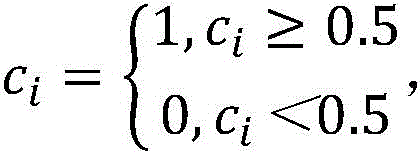
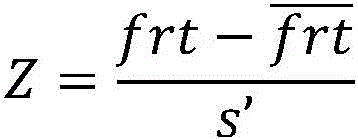
其中,Z是学生首次反应时间frt的z分数,frt是学生首次反应时间原始值,
将所述z分数离散为一个范畴特征,按照预设正确率阈值划分为n4类。例如,将首次反应时间frt的z分数离散为一个范畴特征,以正确率50%(随机正确率)和70%(高正确率)为界,将首次反应时间frt划分为若干类,共n4类;The z score is discretized into a category feature, and divided into n 4 categories according to a preset accuracy threshold. For example, the z score of the first reaction time frt is discretized into a category feature, and the first reaction time frt is divided into several categories with an accuracy of 50% (random accuracy) and 70% (high accuracy) as the boundary, a total of n 4 categories;
S4.将S3处理的6个分类变量特征分别作特征编码。S4. Encode the six categorical variable features processed in S3 respectively.
具体地,可采用以下实现方式。处理技能特征s时,对该问题所涉及的多个技能进行多热编码(multi-hot encoding),即将问题编号特征p和所述技能编号特征s进行多热编码。具体方法为:遍历数据集,引入一个嵌入矩阵Q。Q矩阵形式为:Q={Qij}M×K,其中M为问题总数目,K为技能总数目。如图2所示,在Q矩阵中,每一行对应一个问题,每一列对应一个技能,嵌入矩阵Q中的向量表达为Qes:Specifically, the following implementation method can be adopted. When processing the skill feature s, multi-hot encoding is performed on the multiple skills involved in the question, that is, the question number feature p and the skill number feature s are multi-hot encoded. The specific method is: traverse the data set and introduce an embedding matrix Q. The Q matrix is in the form of: Q = {Q ij } M×K , where M is the total number of questions and K is the total number of skills. As shown in Figure 2, in the Q matrix, each row corresponds to a question, and each column corresponds to a skill. The vector in the embedding matrix Q is expressed as Q es :

Q矩阵中保存了问题编号p和技能编号s的对应关系,最终关于技能的编码为问题编号p和Q矩阵的向量积结果,即多热技能编码(multi-hot skill id),记为Multi(multi_s):The Q matrix stores the correspondence between the question number p and the skill number s. The final encoding of the skill is the vector product of the question number p and the Q matrix, that is, the multi-hot skill encoding (multi-hot skill id), denoted as Multi(multi_s):
Multi(multi_s)=p×QMulti(multi_s)=p×Q
其中,Multi()表示多热编码格式,multi_s表示一个问题所包含的所有技能,即多技能编号。Among them, Multi() represents the multi-hot encoding format, and multi_s represents all the skills contained in a question, that is, the multi-skill number.
此时,一个问题e对应一个多技能multi_s,学生的答题记录可以重新表示为三元组(stu,e,r)的集合,其中stu∈Stu,e∈E。对于技能编号s,以上述处理的多热技能编码Multi(multi_s)作为最终的问题标签输入深度知识追踪模型。At this time, a question e corresponds to a multi-skill multi_s, and the student's answer record can be re-expressed as a set of triples (stu, e, r), where stu∈Stu, e∈E. For the skill number s, the multi-hot skill encoding Multi(multi_s) processed above is used as the final question label to input into the deep knowledge tracking model.
除此以外,对首次操作act、尝试次数att、首次反应时间frt、答题表现c等分类特征进行特征交叉并采用独热编码,最终利用交叉验证选取最优特征组合。In addition, the classification features such as the first operation act, the number of attempts att, the first reaction time frt, and the answer performance c are cross-encoded and encoded using one-hot encoding. Finally, cross-validation is used to select the optimal feature combination.
特征交叉是将两个或多个特征编码为一个特征的方法,通过特征交叉可以以一个编码格式同时表示多个特征的并发外观,其本质是对多个特征的取值作笛卡尔积。具体方法为将多个特征随机组合,取其笛卡尔积,如两个特征的取值分别为集合A和集合B,则这两个特征的笛卡尔积A×B={(i,j)|i∈A∩j∈B}。若为多个特征交叉,则先进行两个特征的交叉,再与第三个特征进行交叉,以此类推。Feature crossover is a method of encoding two or more features into one feature. Through feature crossover, the concurrent appearance of multiple features can be represented in one encoding format. Its essence is to make a Cartesian product of the values of multiple features. The specific method is to randomly combine multiple features and take their Cartesian product. For example, if the values of two features are set A and set B respectively, then the Cartesian product of these two features is A×B={(i, j)|i∈A∩j∈B}. If multiple features are crossed, cross two features first, then cross with the third feature, and so on.
交叉验证最常用的方法有K折交叉验证和留一验证,其本质都是将样本分割为F个子样本,选取其中的一个子样本作为验证集,其他的(F-1)个子样本作为训练集,检验模型效果。实验一共进行F次,保证所有的子样本均被当作一次验证集。取F次实验结果的平均值作为本次交叉验证的性能指标。The most commonly used methods of cross-validation are K-fold cross-validation and leave-one-out validation. The essence of both is to divide the sample into F sub-samples, select one of the sub-samples as the validation set, and the other (F-1) sub-samples as the training set to test the model effect. The experiment is performed F times in total to ensure that all sub-samples are used as a validation set. The average of the F experimental results is taken as the performance indicator of this cross-validation.
经过上述的特征交叉过程我们可以得到若干组交叉特征,将所有的交叉特征分别在模型上作交叉验证,最终选择交叉验证效果最好的一组交叉特征作为模型的最终输入特征。After the above feature crossover process, we can obtain several groups of crossover features. All the crossover features are cross-validated on the model respectively, and finally a group of crossover features with the best cross-validation effect is selected as the final input features of the model.
具体地,将上述处理完成的分类特征组合成交叉特征作为模型输入,以首次操作act和答题表现c的交叉特征为例,特征交叉的公式为:Specifically, the classification features processed above are combined into cross features as model input. Taking the cross features of the first operation act and the answer performance c as an example, the formula for feature cross is:
C(actt,ct)=actt+n3*ct C(act t , c t )=act t +n 3 *c t
其中,C()表示交叉特征,actt表示在时间步t时对该问题的首次操作编号,ct表示在时间步t时的在该问题上的答题表现,n3是首次操作act的分类个数。Among them, C() represents the cross feature, act t represents the first operation number of the question at time step t, c t represents the answer performance on the question at time step t, and n 3 is the number of categories of the first operation act.
假设经过交叉验证后,最终选择了act和c的交叉特征,frt和multi_s这三个特征,特征交叉后得到的输入向量为:Assume that after cross-validation, the cross features of act and c, frt and multi_s are finally selected. The input vector obtained after feature crossover is:
vt=O(C(actt,ct))^O(frtt)^Multi(multi_st)v t =O(C(act t ,c t ))^O(frt t )^Multi(multi_s t )
其中,vt表示输入向量,frtt表示在时间步t时的学生首次反应时间编号,multi_st表示在时间步t时的多技能。O()是独热编码格式,Multi()是多热技能编码格式,^运算符用于表示拼接,示意图如图3所示。图3中的设置仅为示例,可以依据交叉检验得到的具体数据来选取拼接的交叉特征和单个特征。Among them, v t represents the input vector, frt t represents the student's first reaction time number at time step t, and multi_s t represents the multi-skill at time step t. O() is the one-hot encoding format, Multi() is the multi-hot skill encoding format, and the ^ operator is used to represent concatenation, as shown in Figure 3. The settings in Figure 3 are only examples, and the concatenated cross features and single features can be selected based on the specific data obtained by cross-validation.
S5.将拼接得到的向量vt输入到自编码器(Autoencoder,AE)进行降维,将自编码器的隐含层连接到深度知识追踪模型,作为深度知识追踪模型的输入层参与模型运算,并最终得到模型预测结果;具体地,对于输入的拼接得到的长特征向量vt,导致输入层维数迅速增加,将向量vt输入到一个欠完备自编码器(undercomplete Autoencoder)来进行降维,欠完备自编码器包含一个编码器(encoder)和一个解码器(decoder),其隐层的维度小于输入层的维度,达到降维效果,示意图如图4所示。S5. The concatenated vector v t is input into an autoencoder (AE) for dimensionality reduction, and the hidden layer of the autoencoder is connected to the deep knowledge tracking model, and it participates in the model operation as the input layer of the deep knowledge tracking model, and finally obtains the model prediction result; specifically, for the long feature vector v t obtained by input concatenation, the dimension of the input layer increases rapidly, and the vector v t is input into an undercomplete autoencoder (undercomplete Autoencoder) for dimensionality reduction. The undercomplete autoencoder includes an encoder and a decoder, and the dimension of its hidden layer is smaller than that of the input layer, so as to achieve the dimensionality reduction effect, as shown in FIG4 .
欠完备自编码器的学习过程是最小化一个损失函数:The learning process of the undercomplete autoencoder is to minimize a loss function:
L=(x,g(f(x)))L = (x, g (f (x)))
其中,L是损失函数,计算输入x和经过编码器、解码器后的输出g(f(x))的差异,f(x)表示编码器,g(h)=g(f(x))表示解码器。Where L is the loss function, which calculates the difference between the input x and the output g(f(x)) after the encoder and decoder, where f(x) represents the encoder and g(h)=g(f(x)) represents the decoder.
在本模型中,该欠完备自编码器采用tanh函数作为神经网络激活函数,公式为:In this model, the incomplete autoencoder uses the tanh function as the neural network activation function, and the formula is:
v′t=tanh(Wih*vt+bih)v′ t =tanh(W ih *v t +b ih )

其中,vt是输入的拼接特征,v′t是欠完备自编码器隐含层提取的特征向量,yt是欠完备自编码器的输出,Wih表示欠完备自编码器输入层和隐含层之间的权重系数矩阵,
在本模型中,去除自编码器的输出层,直接将自编码器隐含层降维得到的v′t连接到深度知识追踪模型LSTM的输入层,参与模型运算。In this model, the output layer of the autoencoder is removed, and the v′ t obtained by dimensionality reduction of the hidden layer of the autoencoder is directly connected to the input layer of the deep knowledge tracking model LSTM to participate in the model operation.
当然,欠完备自编码器仅为一个降维具体实现方式的示例,还可以依据主成分分析(Principal Component Analysis,PCA)、多维尺度分析(Multidimensional Scaling,MDS)、局部线性嵌入(Locally Linear Embedding,LLE)等方法进行降维,可依据模型的需要进行相应的调整。Of course, the incomplete autoencoder is only an example of a specific implementation method of dimensionality reduction. Dimensionality reduction can also be performed based on methods such as principal component analysis (PCA), multidimensional scaling (MDS), and locally linear embedding (LLE), and corresponding adjustments can be made according to the needs of the model.
S6.将输入向量vt进行降维处理后输入到深度知识追踪模型,深度知识追踪模型用于输出每个技能的预测值,根据深度知识追踪模型的输出确定对下一个问题的预测结果。图5为基于多热编码的多特征融合深度知识追踪模型的结构示意图。根据下一个问题的多技能编号,对应深度知识追踪模型的输出矩阵,取多技能对应位置预测概率值的平均作为最终的对于下一个问题是否可以正确回答的预测结果;具体地,深度知识追踪模型的输出Ot=[ys1,ys2,...,ysK]预测了每种技能的表现,根据下一个问题所包含的技能{sa,sb,...,si},读取输出矩阵Ot中对应位置的概率预测值{ysa,ysb,...,ysi},对其取平均,作为最终的对于下一个问题是否可以正确回答的预测结果:S6. The input vector v t is processed by dimensionality reduction and then input into the deep knowledge tracking model. The deep knowledge tracking model is used to output the predicted value of each skill, and the prediction result of the next question is determined according to the output of the deep knowledge tracking model. Figure 5 is a schematic diagram of the structure of the multi-feature fusion deep knowledge tracking model based on multi-hot encoding. According to the multi-skill number of the next question, the output matrix of the corresponding deep knowledge tracking model is taken, and the average of the predicted probability values of the corresponding positions of the multi-skills is taken as the final prediction result of whether the next question can be answered correctly; specifically, the output O t = [y s1 , y s2 , ..., y sK ] of the deep knowledge tracking model predicts the performance of each skill. According to the skills {s a , s b , ..., s i } contained in the next question, the probability prediction values {y sa , y sb , ..., y si } of the corresponding positions in the output matrix O t are read and averaged as the final prediction result of whether the next question can be answered correctly:

其中,num_skills表示该问题所包含的技能的个数,NPC表示下一个问题答对的概率值。Among them, num_skills represents the number of skills included in the question, and NPC represents the probability value of answering the next question correctly.
本发明实施例的一种基于多热编码的多特征融合深度知识追踪系统,包括:A multi-feature fusion deep knowledge tracking system based on multi-hot encoding according to an embodiment of the present invention includes:
获取模块,用于获取学生的答题数据集,所述答题数据集包括多条答题记录,每条所述答题记录包括一个问题和一个学生在回答该问题时的交互信息,所述问题关联多个技能;An acquisition module is used to acquire a student's answer data set, wherein the answer data set includes multiple answer records, each of which includes a question and interactive information of a student when answering the question, and the question is associated with multiple skills;
特征提取模块,用于从所述答题数据集中提取问题编号特征p、技能编号特征s、答题表现特征c、尝试次数特征att、首次操作特征act、学生首次反应时间特征frt;A feature extraction module is used to extract question number feature p, skill number feature s, answer performance feature c, attempt number feature att, first operation feature act, and student first reaction time feature frt from the answer data set;
转换模块,用于将所述问题编号特征p、所述技能编号特征s、所述答题表现特征c、尝试次数特征att、首次操作特征act、学生首次反应时间特征frt转换为分类变量;A conversion module, used to convert the question number feature p, the skill number feature s, the answer performance feature c, the number of attempts feature att, the first operation feature act, and the student's first reaction time feature frt into categorical variables;
编码模块,用于将转换为分类变量后的所述问题编号特征p和所述技能编号特征s进行多热编码,获得多热技能编码Multi(multi_s),将转换为分类变量后的所述答题表现特征c、尝试次数特征att、首次操作特征act、学生首次反应时间特征frt进行独热编码,获得独热编码O,将所述多热技能编码Multi(multi_s)和所述独热编码O进行拼接,获得输入向量vt;The encoding module is used to perform multi-hot encoding on the question number feature p and the skill number feature s converted into categorical variables to obtain a multi-hot skill code Multi(multi_s), perform one-hot encoding on the answer performance feature c, the number of attempts feature att, the first operation feature act, and the student's first reaction time feature frt converted into categorical variables to obtain a one-hot code O, and concatenate the multi-hot skill code Multi(multi_s) and the one-hot code O to obtain an input vector v t ;
预测模块,用于将所述输入向量vt进行降维处理后输入到深度知识追踪模型,所述深度知识追踪模型用于输出每个技能的预测值,根据所述深度知识追踪模型的输出确定对下一个问题的预测结果。The prediction module is used to reduce the dimension of the input vector v t and input it into the deep knowledge tracking model. The deep knowledge tracking model is used to output the predicted value of each skill, and determine the prediction result for the next question based on the output of the deep knowledge tracking model.
基于多热编码的多特征融合深度知识追踪系统的实现原理、技术效果与上述方法类似,此处不再赘述。The implementation principle and technical effect of the multi-feature fusion deep knowledge tracking system based on multi-hot encoding are similar to the above method and will not be repeated here.
必须说明的是,上述任一实施例中,方法并不必然按照序号顺序依次执行,只要从执行逻辑中不能推定必然按某一顺序执行,则意味着可以以其他任何可能的顺序执行。It must be noted that in any of the above embodiments, the method is not necessarily executed in sequence according to the sequence number. As long as it cannot be inferred from the execution logic that it must be executed in a certain order, it means that it can be executed in any other possible order.
本领域的技术人员容易理解,以上所述仅为本发明的较佳实施例而已,并不用以限制本发明,凡在本发明的精神和原则之内所作的任何修改、等同替换和改进等,均应包含在本发明的保护范围之内。It will be easily understood by those skilled in the art that the above description is only a preferred embodiment of the present invention and is not intended to limit the present invention. Any modifications, equivalent substitutions and improvements made within the spirit and principles of the present invention should be included in the protection scope of the present invention.
Claims (8)






Priority Applications (1)
| Application Number | Priority Date | Filing Date | Title |
|---|---|---|---|
| CN202011056680.0A CN112182308B (en) | 2020-09-29 | 2020-09-29 | Multi-feature fusion depth knowledge tracking method and system based on multi-thermal coding |
Applications Claiming Priority (1)
| Application Number | Priority Date | Filing Date | Title |
|---|---|---|---|
| CN202011056680.0A CN112182308B (en) | 2020-09-29 | 2020-09-29 | Multi-feature fusion depth knowledge tracking method and system based on multi-thermal coding |
Publications (2)
| Publication Number | Publication Date |
|---|---|
| CN112182308A CN112182308A (en) | 2021-01-05 |
| CN112182308B true CN112182308B (en) | 2023-03-24 |
Family
ID=73946110
Family Applications (1)
| Application Number | Title | Priority Date | Filing Date |
|---|---|---|---|
| CN202011056680.0A Active CN112182308B (en) | 2020-09-29 | 2020-09-29 | Multi-feature fusion depth knowledge tracking method and system based on multi-thermal coding |
Country Status (1)
| Country | Link |
|---|---|
| CN (1) | CN112182308B (en) |
Families Citing this family (6)
| Publication number | Priority date | Publication date | Assignee | Title |
|---|---|---|---|---|
| CN112990464B (en) * | 2021-03-12 | 2022-06-28 | 东北师范大学 | A knowledge tracking method and system |
| CN112949929B (en) * | 2021-03-15 | 2022-06-07 | 华中师范大学 | Knowledge tracking method and system based on collaborative embedded enhanced topic representation |
| CN113239699B (en) * | 2021-04-15 | 2023-11-07 | 北京师范大学 | Depth knowledge tracking method and system integrating multiple features |
| CN113793239B (en) * | 2021-08-13 | 2023-12-19 | 华南理工大学 | Personalized knowledge tracking method and system integrating learning behavior characteristics |
| CN113989075B (en) * | 2021-10-12 | 2025-01-28 | 中国科学技术大学 | Methods for predicting future technological knowledge flows |
| CN116662483A (en) * | 2023-05-29 | 2023-08-29 | 兰州大学 | Method, device and equipment for skill label generation of knowledge tracking model |
Family Cites Families (9)
| Publication number | Priority date | Publication date | Assignee | Title |
|---|---|---|---|---|
| US9466024B2 (en) * | 2013-03-15 | 2016-10-11 | Northrop Grumman Systems Corporation | Learning health systems and methods |
| US9740985B2 (en) * | 2014-06-04 | 2017-08-22 | International Business Machines Corporation | Rating difficulty of questions |
| US9727637B2 (en) * | 2014-08-19 | 2017-08-08 | International Business Machines Corporation | Retrieving text from a corpus of documents in an information handling system |
| CN106844368B (en) * | 2015-12-03 | 2020-06-16 | 华为技术有限公司 | Method for man-machine conversation, neural network system and user equipment |
| US10943497B2 (en) * | 2018-04-27 | 2021-03-09 | Adobe Inc. | Personalized e-learning using a deep-learning-based knowledge tracing and hint-taking propensity model |
| CN110807509A (en) * | 2018-08-06 | 2020-02-18 | 北京博智天下信息技术有限公司 | Depth knowledge tracking method based on Bayesian neural network |
| CN110428010B (en) * | 2019-08-05 | 2022-09-06 | 中国科学技术大学 | Knowledge tracking method |
| CN111444432A (en) * | 2020-04-01 | 2020-07-24 | 中国科学技术大学 | Domain-adaptive deep knowledge tracking and personalized exercise recommendation method |
| CN111581396B (en) * | 2020-05-06 | 2023-03-31 | 西安交通大学 | Event graph construction system and method based on multi-dimensional feature fusion and dependency syntax |
-
2020
- 2020-09-29 CN CN202011056680.0A patent/CN112182308B/en active Active
Also Published As
| Publication number | Publication date |
|---|---|
| CN112182308A (en) | 2021-01-05 |
Similar Documents
| Publication | Publication Date | Title |
|---|---|---|
| CN112182308B (en) | Multi-feature fusion depth knowledge tracking method and system based on multi-thermal coding | |
| CN113656570B (en) | Visual question-answering method and device based on deep learning model, medium and equipment | |
| US20210256354A1 (en) | Artificial intelligence learning-based user knowledge tracing system and operating method thereof | |
| KR102688187B1 (en) | Answer selection device and computer equipment for parenthesis insertion problem | |
| CN116059646B (en) | Interactive expert guidance system | |
| CN113239699B (en) | Depth knowledge tracking method and system integrating multiple features | |
| EP4394759A1 (en) | Artificial intelligence-based audio processing method and apparatus, electronic device, computer program product, and computer-readable storage medium | |
| CN115935969A (en) | Heterogeneous data feature extraction method based on multi-mode information fusion | |
| CN115310520A (en) | Multi-feature-fused depth knowledge tracking method and exercise recommendation method | |
| CN110852071B (en) | Knowledge point detection methods, devices, equipment and readable storage media | |
| CN113283488A (en) | Learning behavior-based cognitive diagnosis method and system | |
| CN116151242B (en) | An intelligent exercise recommendation method, system and storage medium for programming learning scenarios | |
| CN113011196A (en) | Concept-enhanced representation and one-way attention-containing subjective question automatic scoring neural network model | |
| CN111325387A (en) | Interpretable law automatic decision prediction method and device | |
| KR20110018109A (en) | Individual learning method and system according to ability evaluation | |
| CN118551035A (en) | Method for automatically generating personalized experiment report comment based on large model and decision tree | |
| CN116502713A (en) | A Knowledge Tracking Method Based on Weighted Meta-Path Enhancing Topic Similarity Embedding | |
| CN119202212B (en) | Visual question-answering unbiasing method based on dual-counter facts | |
| CN118569447B (en) | A programming knowledge tracking method integrating code and score information | |
| CN117830074B (en) | Chinese character font generation method based on font outline information | |
| CN119720945A (en) | A multimodal test knowledge point annotation method, system, device and storage medium | |
| KR20240059296A (en) | Device and method for feedback of foreign language writing errors by language phenomenon through learning of bilingual corpus | |
| Obionwu et al. | Expert Agent Guided Learning with Transformers and Knowledge Graphs. | |
| CN120523919B (en) | Dynamic text response method and system for educational question-answering robot | |
| CN120317380B (en) | Data processing method, device, system, computing equipment and storage medium |
Legal Events
| Date | Code | Title | Description |
|---|---|---|---|
| PB01 | Publication | ||
| PB01 | Publication | ||
| SE01 | Entry into force of request for substantive examination | ||
| SE01 | Entry into force of request for substantive examination | ||
| GR01 | Patent grant | ||
| GR01 | Patent grant |