CN112150767B - Fatigue driving monitoring system based on Internet of things and computer - Google Patents
Fatigue driving monitoring system based on Internet of things and computer Download PDFInfo
- Publication number
- CN112150767B CN112150767B CN202011035073.6A CN202011035073A CN112150767B CN 112150767 B CN112150767 B CN 112150767B CN 202011035073 A CN202011035073 A CN 202011035073A CN 112150767 B CN112150767 B CN 112150767B
- Authority
- CN
- China
- Prior art keywords
- monitoring
- coefficient
- module
- processor
- vehicle
- Prior art date
- Legal status (The legal status is an assumption and is not a legal conclusion. Google has not performed a legal analysis and makes no representation as to the accuracy of the status listed.)
- Active
Links
- 238000012544 monitoring process Methods 0.000 title claims abstract description 135
- 238000013500 data storage Methods 0.000 claims abstract description 31
- 210000000744 eyelid Anatomy 0.000 claims description 22
- LFQSCWFLJHTTHZ-UHFFFAOYSA-N Ethanol Chemical compound CCO LFQSCWFLJHTTHZ-UHFFFAOYSA-N 0.000 claims description 20
- 230000036772 blood pressure Effects 0.000 claims description 19
- 230000036760 body temperature Effects 0.000 claims description 19
- 238000007781 pre-processing Methods 0.000 claims description 16
- 238000001514 detection method Methods 0.000 claims description 12
- 230000007613 environmental effect Effects 0.000 claims description 10
- 238000012545 processing Methods 0.000 claims description 9
- 230000010365 information processing Effects 0.000 claims description 7
- 238000004458 analytical method Methods 0.000 claims description 5
- 238000000034 method Methods 0.000 claims description 5
- 238000001914 filtration Methods 0.000 claims description 4
- 230000029058 respiratory gaseous exchange Effects 0.000 claims description 4
- 238000007689 inspection Methods 0.000 claims 2
- 238000009423 ventilation Methods 0.000 claims 1
- 230000009286 beneficial effect Effects 0.000 abstract description 6
- 210000004556 brain Anatomy 0.000 description 9
- 230000001105 regulatory effect Effects 0.000 description 3
- 206010039203 Road traffic accident Diseases 0.000 description 2
- 238000006243 chemical reaction Methods 0.000 description 2
- 230000001815 facial effect Effects 0.000 description 2
- 239000000463 material Substances 0.000 description 2
- 210000000056 organ Anatomy 0.000 description 2
- 230000000241 respiratory effect Effects 0.000 description 2
- 208000000044 Amnesia Diseases 0.000 description 1
- 208000026139 Memory disease Diseases 0.000 description 1
- 206010041349 Somnolence Diseases 0.000 description 1
- 238000007792 addition Methods 0.000 description 1
- 230000003321 amplification Effects 0.000 description 1
- 239000008280 blood Substances 0.000 description 1
- 210000004369 blood Anatomy 0.000 description 1
- 238000004364 calculation method Methods 0.000 description 1
- 238000012937 correction Methods 0.000 description 1
- 230000003111 delayed effect Effects 0.000 description 1
- 238000010586 diagram Methods 0.000 description 1
- 230000006984 memory degeneration Effects 0.000 description 1
- 208000023060 memory loss Diseases 0.000 description 1
- 238000012986 modification Methods 0.000 description 1
- 230000004048 modification Effects 0.000 description 1
- 238000003199 nucleic acid amplification method Methods 0.000 description 1
- 238000006467 substitution reaction Methods 0.000 description 1
Images

Classifications
-
- G—PHYSICS
- G08—SIGNALLING
- G08B—SIGNALLING OR CALLING SYSTEMS; ORDER TELEGRAPHS; ALARM SYSTEMS
- G08B21/00—Alarms responsive to a single specified undesired or abnormal condition and not otherwise provided for
- G08B21/02—Alarms for ensuring the safety of persons
- G08B21/04—Alarms for ensuring the safety of persons responsive to non-activity, e.g. of elderly persons
- G08B21/0438—Sensor means for detecting
- G08B21/0453—Sensor means for detecting worn on the body to detect health condition by physiological monitoring, e.g. electrocardiogram, temperature, breathing
-
- G—PHYSICS
- G08—SIGNALLING
- G08B—SIGNALLING OR CALLING SYSTEMS; ORDER TELEGRAPHS; ALARM SYSTEMS
- G08B21/00—Alarms responsive to a single specified undesired or abnormal condition and not otherwise provided for
- G08B21/02—Alarms for ensuring the safety of persons
- G08B21/06—Alarms for ensuring the safety of persons indicating a condition of sleep, e.g. anti-dozing alarms
-
- G—PHYSICS
- G08—SIGNALLING
- G08B—SIGNALLING OR CALLING SYSTEMS; ORDER TELEGRAPHS; ALARM SYSTEMS
- G08B7/00—Signalling systems according to more than one of groups G08B3/00 - G08B6/00; Personal calling systems according to more than one of groups G08B3/00 - G08B6/00
- G08B7/06—Signalling systems according to more than one of groups G08B3/00 - G08B6/00; Personal calling systems according to more than one of groups G08B3/00 - G08B6/00 using electric transmission, e.g. involving audible and visible signalling through the use of sound and light sources
Landscapes
- Physics & Mathematics (AREA)
- General Physics & Mathematics (AREA)
- Business, Economics & Management (AREA)
- Emergency Management (AREA)
- Health & Medical Sciences (AREA)
- Biophysics (AREA)
- Life Sciences & Earth Sciences (AREA)
- Cardiology (AREA)
- Heart & Thoracic Surgery (AREA)
- Physical Education & Sports Medicine (AREA)
- Physiology (AREA)
- Pulmonology (AREA)
- General Health & Medical Sciences (AREA)
- Gerontology & Geriatric Medicine (AREA)
- Traffic Control Systems (AREA)
Abstract
The invention discloses a fatigue driving monitoring system based on the Internet of things and a computer, which comprises a processor, an initial monitoring module, an audio acquisition module, a physiological information monitoring module, a path monitoring module, a scheme planning module, a data storage module and an early warning control module, wherein the initial monitoring module is used for acquiring audio information; the invention is provided with the initial monitoring module, which is helpful for preventing fatigue driving of drivers in advance; the invention is provided with the audio acquisition module which is used for acquiring monitoring information in a cab in real time, and the audio acquisition module provides external parameter data for monitoring fatigue driving of a driver, thereby being beneficial to improving the monitoring precision of the fatigue driving; the invention is provided with the physiological information monitoring module which is used for providing internal parameter data for monitoring the fatigue driving of a driver, thereby being beneficial to improving the monitoring speed of the fatigue driving; the invention is provided with the early warning control module, and different measures are taken according to the warning instruction, so that the harm caused by fatigue driving can be effectively reduced.
Description
Technical Field
The invention belongs to the technical field of fatigue driving monitoring, and particularly relates to a fatigue driving monitoring system based on the Internet of things and a computer.
Background
Fatigue driving is a serious traffic violation, when a driver is tired, the driver feels sleepy, weak limbs, inattention, low judgment ability, even absentmindedness or instant memory loss, delayed or early action, improper operation pause or correction time and other unsafe factors occur, and road traffic accidents are easy to happen. One fifth of the traffic accidents are caused by fatigue driving, and according to studies it has been shown that after two hours of driving the driver makes the same mistake as 0.05% alcohol in blood.
The patent with publication number CN106859644A provides a fatigue driving monitoring system and a monitoring method based on brain waves, the monitoring system includes a head-mounted brain wave signal collecting device, a brain wave analyzer and a warning controller; the head-wearing brain wave signal acquisition device comprises a plurality of groups of electrode sensors, the brain wave analyzer comprises a pre-amplification circuit, a band-pass filter circuit, an A/D conversion circuit and a main control chip, and the main control chip is connected with the warning controller; the monitoring method comprises the following steps: 1) collecting brain wave signals; 2) amplifying the signal and then filtering; 3) combining all the brain wave signals into one path; 4) the merged signals are input into a main control chip after A/D conversion; 5) the main control chip judges that the driver is in a fatigue driving state and sends a warning signal to the warning controller.
The scheme can accurately monitor fatigue driving, has high reliability, and can simultaneously warn a driver and surrounding vehicles; however, the above-mentioned solutions require special equipment such as a head-mounted brain wave signal collecting device, a brain wave analyzer, etc., which not only increases the cost but also reduces the driving comfort of the driver, so that the above-mentioned solutions still need further improvement.
Disclosure of Invention
In order to solve the problems existing in the scheme, the invention provides a fatigue driving monitoring system based on the Internet of things and a computer.
The purpose of the invention can be realized by the following technical scheme: a fatigue driving monitoring system based on the Internet of things and a computer comprises a processor, an initial monitoring module, an audio acquisition module, a physiological information monitoring module, a path monitoring module, a scheme planning module, a data storage module and an early warning control module;
the initial monitoring module acquires environmental data in a cab before an automobile is started, the environmental data comprise alcohol concentration, average temperature and air flow rate, and the specific acquisition steps are as follows:
z1: acquiring the alcohol concentration in the cab through an alcohol concentration sensor, and marking the alcohol concentration as JN;
z2: acquiring the average temperature in the cab through a temperature sensor, and marking the average temperature as PW;
z3: acquiring the air flow in a cab through an air flow meter, and marking the air flow as KL;
z4: acquiring an initial detection coefficient CX through a formula CX ═ alpha 1 × JN + alpha 2 × PW × KL + alpha 3; wherein α 1, α 2, and α 3 are preset scaling coefficients, and α 1+ α 2+ α 3 is 1.125;
z5: sending the alcohol concentration, the average temperature, the air flow and the initial detection coefficient to a data storage module through a processor;
the audio acquisition module is used for collecting monitoring information in a cab in real time, the monitoring information comprises monitoring video and sound wave signals, and the specific collection steps are as follows:
x1: collecting monitoring videos of drivers in real time through a high-definition camera;
x2: collecting sound wave signals in a cab in real time through a sound sensor;
x3: sending the monitoring video and the sound wave signals to a processor in real time; the processor carries out information processing on the monitoring video and the sound wave signals;
x4: sending the monitoring video and the sound wave signals to a data storage module through a processor;
the physiological information monitoring module is used for monitoring physiological information of a driver and acquiring a physiological monitoring coefficient through a formula, wherein the physiological information comprises blood pressure, body temperature and heart rate;
the path monitoring module is used for monitoring the driving track of the vehicle and acquiring a path monitoring coefficient;
the processor is used for analyzing theoretical coefficients, the theoretical coefficients comprise an initial detection coefficient CX, an auxiliary monitoring coefficient FJ, a physiological monitoring coefficient SL and a path monitoring coefficient LJ, and the specific analysis steps are as follows:
n1: when CX is greater than L1, judging that the driver is in low-risk fatigue driving, and sending a low-level alarm instruction to an early warning control module through a processor, wherein L1 is a preset initial detection coefficient threshold value;
n2: by the formula Obtaining an auxiliary judgmentA coefficient FP; wherein δ 1 and δ 2 are predetermined proportionality coefficients, and 0<δ1<δ2;
N3: when CX is greater than L1 and FP is greater than L2, the driver is judged to be in-risk fatigue driving, and a middle-level alarm command is sent to the early warning control module through the processor, wherein L2 is a preset auxiliary judgment coefficient threshold value;
n4: when FP is greater than L2 and LJ < L3, high-risk fatigue driving is judged, and a high-level alarm command is sent to an early warning control module through a processor, wherein L3 is a preset path monitoring coefficient threshold value, and L3 is greater than 0;
n5: sending the low-level alarm instruction sending record, the medium-level alarm instruction sending record and the high-level alarm instruction sending record to a data storage module through a processor;
early warning control module carries out the early warning to alarm command, alarm command includes low-level alarm command, intermediate alarm command and senior alarm command, early warning control module includes alarm lamp, bee calling organ, automatic dialing unit, warning unit and regulating unit, and concrete early warning step is:
m1: when the early warning control module receives a low-level warning instruction, the warning lamp is set to be in a red flashing state, and meanwhile, the adjusting unit opens the vehicle window to ventilate;
m2: when the early warning control module receives a middle-level warning instruction, the warning lamp is set to be in a red flashing state, the buzzer gives an alarm, and meanwhile the adjusting unit turns on the vehicle clearance lamp to give an alarm;
m3: when the early warning control module receives advanced warning instructions, the warning lamp is set to be in a red flashing state, the buzzer gives an alarm, the vehicle clearance lamp is turned on, and meanwhile, the warning telephone is dialed to give an alarm, and the specific dialing step is as follows:
m31: dialing an alarm call, and waiting for the call to be connected;
m32: after the call is connected, sending an alarm keyword by a voice robot, wherein the alarm keyword is 'suspected fatigue driving';
m33: acquiring the speed and the position of the vehicle, and sending the speed and the position of the vehicle to the other end of the telephone in a voice broadcast mode;
m34: the method comprises the steps that the name, the mobile phone number and the license plate number of a driver are obtained through a data storage module, and the name, the mobile phone number and the license plate number are sent to the other end of a telephone in a voice broadcasting mode;
m35: the M32-M34 steps were repeated twice.
Preferably, the acquiring step of the physiological monitoring coefficient is as follows:
v1: acquiring a blood pressure value of a driver through a blood pressure sensor, and marking the blood pressure value as XY;
v2: acquiring a body temperature value of a driver through a body temperature sensor, and marking the body temperature value as TW;
v3: acquiring the heart rate of a driver through a heart rate sensor, and marking the heart rate as XL;
v4: by the formula Obtaining a physiological monitoring coefficient SL, wherein gamma 1 and gamma 2 are preset proportionality coefficients, e is a natural constant, and
v5: and the blood pressure value, the body temperature value, the heart rate and the physiological monitoring coefficient are sent to the data storage module through the processor.
Preferably, the step of obtaining the path monitoring coefficient comprises:
b1: judging whether the vehicle runs in the lane line or not through a vehicle data recorder, marking the judgment result as CX, wherein the CX is 0 or 1, wherein 0 represents that the vehicle does not run in the lane line, and 1 represents that the vehicle does not run in the lane line;
b2: acquiring a rotating angle of a steering wheel of the vehicle through an angle sensor, and marking the rotating angle as XD;
b3: acquiring a path monitoring coefficient LJ through a formula LJ ═ CX × | XD |;
b4: and sending the judgment result, the rotation angle and the path monitoring coefficient to a data storage module through a processor.
Preferably, the information processing steps described in X3 are specifically as follows:
c1: after the processor receives the monitoring video, analyzing and processing the monitoring video, wherein the specific analyzing steps are as follows:
c11: video preprocessing is carried out on the video;
c12: identifying eyelid closing frequency and eyelid single closing time of a driver through a processor, and marking the eyelid closing frequency and the eyelid single closing time as YB and YD;
c13: identifying, by a processor, an angle of a driver's facial orientation to a horizontal plane, and marking the angle as JD;
c14: by the formula Acquiring a video acquisition coefficient SC; wherein beta 1, beta 2 and beta 3 are preset proportionality coefficients and are 0<β1<β2<β3;
C2: after the processor receives the sound wave signals, analyzing and matching the sound wave signals, wherein the specific analyzing and matching steps are as follows:
c21: carrying out sound preprocessing on the sound wave signal;
c22: acquiring noise characteristic information through a data storage module; removing noise characteristic information from the preprocessed sound wave signals to obtain breathing characteristic information;
c23: acquiring sleep sound characteristic information through a data storage module, matching the respiratory characteristic information with the sleep sound characteristic information to acquire a matching degree, and marking the matching degree as PP;
c3: acquiring an auxiliary monitoring coefficient FJ through a formula FJ ═ beta 4 × SC + PP, wherein beta 4 is a preset proportionality coefficient, and beta 4 is greater than 0;
c4: and the eyelid closing frequency, the single eyelid closing time, the angle, the matching degree, the video acquisition coefficient and the auxiliary monitoring coefficient are sent to the data storage module through the processor.
Preferably, the video preprocessing can not only improve the quality of the coded video, but also improve the coding efficiency, and the video preprocessing comprises band-limited filtering, noise removal, image enhancement, dim light processing, automatic exposure and backlight compensation; the sound preprocessing comprises pre-emphasis processing and frame windowing preprocessing; the noise characteristic information includes transmitter noise, air noise, and vehicle body structure noise.
Preferably, the plan planning module searches a rest place for a driver, the plan planning module includes a path planning unit and a car center console, the rest place includes a service area and a hotel, and the specific search steps are as follows:
k1: when the early warning control module receives a middle-level warning instruction or a high-level warning instruction, a path planning unit is started;
k2: obtaining vehicle state parameters, wherein the vehicle state parameters comprise a current position, a vehicle speed, a driving direction, a vehicle width and a vehicle height;
k3: acquiring a potential rest place within a square circle L5 kilometers of the current position of the vehicle through a path planning unit, wherein L5 is a preset range threshold;
k4: the vehicle state parameters are combined with special conditions to extract an optimal rest place from potential rest places, wherein the special conditions comprise that the road height limit is lower than the vehicle height and the road width limit is smaller than the vehicle width, and the optimal rest place is the rest place closest to the current vehicle;
k5: sending a route from the current position to the optimal rest place to an automobile central console, and navigating a driver through voice;
k6: and sending the vehicle state parameters and the position of the optimal rest place to a data storage module through a processor.
Compared with the prior art, the invention has the beneficial effects that:
1. the invention is provided with an initial monitoring module, which is used for acquiring environmental data in a cab before an automobile is started, respectively acquiring alcohol concentration, average temperature and air flow in the cab through sensors, and acquiring an initial detection coefficient through a formula; according to the device, environmental data in a cab are monitored, the monitored environmental data are data which are easy to cause fatigue driving of a driver, and the device is beneficial to preventing the fatigue driving of the driver in advance;
2. the system is provided with an audio acquisition module, a high-definition camera and a sound sensor, wherein the audio acquisition module is used for acquiring monitoring information in a cab in real time, acquiring a monitoring video of a driver in real time through the high-definition camera, acquiring a sound wave signal in the cab in real time through the sound sensor, and sending the monitoring video and the sound wave signal to a processor in real time, and the processor is used for processing the information of the monitoring video and the sound wave signal; the arrangement monitors the eyelid closing frequency, single eyelid closing time, angle and matching degree of a driver, provides external parameter data for monitoring fatigue driving of the driver, and is beneficial to improving the monitoring precision of the fatigue driving;
3. the invention is provided with a physiological information monitoring module, which is used for monitoring the physiological information of a driver, acquiring the blood pressure value, the body temperature value and the heart rate of the driver through a sensor and acquiring a physiological monitoring coefficient through a formula; the device monitors the blood pressure value, the body temperature value and the heart rate of the driver, provides internal parameter data for monitoring the fatigue driving of the driver, and is beneficial to improving the monitoring speed of the fatigue driving;
4. the invention is provided with an early warning control module which carries out early warning aiming at an alarm instruction, when the early warning control module receives a low-level alarm instruction, an alarm lamp is set to be in a red flashing state, when the early warning control module receives a medium-level alarm instruction, the alarm lamp is set to be in the red flashing state, a buzzer alarms, meanwhile, a regulating unit turns on a vehicle clearance lamp to alarm, when the early warning control module receives the high-level alarm instruction, the alarm lamp is set to be in the red flashing state, the buzzer alarms, the vehicle clearance lamp is turned on, and an alarm telephone is dialed to alarm; this setting takes different measures according to alarm command, can remind navigating mate, can effectively reduce the harm that driver fatigue brought.
Drawings
In order to more clearly illustrate the embodiments of the present invention or the technical solutions in the prior art, the drawings used in the description of the embodiments or the prior art will be briefly described below, it is obvious that the drawings in the following description are only some embodiments of the present invention, and for those skilled in the art, other drawings can be obtained according to the drawings without creative efforts.
Fig. 1 is a schematic diagram of the principle of the present invention.
Detailed Description
The technical solutions of the present invention will be described clearly and completely with reference to the following embodiments, and it should be understood that the described embodiments are only a part of the embodiments of the present invention, and not all of the embodiments. All other embodiments, which can be derived by a person skilled in the art from the embodiments given herein without making any creative effort, shall fall within the protection scope of the present invention.
Referring to fig. 1, a fatigue driving monitoring system based on internet of things and a computer includes a processor, an initial monitoring module, an audio acquisition module, a physiological information monitoring module, a path monitoring module, a data storage module and an early warning control module;
the initial monitoring module obtains the environmental data in the driver's cabin before the automobile starts, and the environmental data includes alcohol concentration, average temperature and air velocity, specifically obtains the step and does:
z1: acquiring the alcohol concentration in the cab through an alcohol concentration sensor, and marking the alcohol concentration as JN;
z2: acquiring the average temperature in the cab through a temperature sensor, and marking the average temperature as PW;
z3: acquiring the air flow in a cab through an air flow meter, and marking the air flow as KL;
z4: acquiring an initial detection coefficient CX through a formula CX ═ alpha 1 × JN + alpha 2 × PW × KL + alpha 3; wherein α 1, α 2, and α 3 are preset scaling coefficients, and α 1+ α 2+ α 3 is 1.125;
z5: sending the alcohol concentration, the average temperature, the air flow and the initial detection coefficient to a data storage module through a processor;
the audio acquisition module is used for gathering the monitoring information in the driver's cabin in real time, and monitoring information includes surveillance video and acoustic signal, and concrete collection step is:
x1: collecting monitoring videos of drivers in real time through a high-definition camera;
x2: collecting sound wave signals in a cab in real time through a sound sensor;
x3: sending the monitoring video and the sound wave signals to a processor in real time; the processor carries out information processing on the monitoring video and the sound wave signals;
x4: sending the monitoring video and the sound wave signals to a data storage module through a processor;
the physiological information monitoring module is used for monitoring physiological information of a driver and acquiring a physiological monitoring coefficient through a formula, wherein the physiological information comprises blood pressure, body temperature and heart rate;
the path monitoring module is used for monitoring the driving track of the vehicle and acquiring a path monitoring coefficient;
the processor is used for analyzing theoretical coefficients, the theoretical coefficients comprise an initial detection coefficient CX, an auxiliary monitoring coefficient FJ, a physiological monitoring coefficient SL and a path monitoring coefficient LJ, and the specific analysis steps are as follows:
n1: when CX is greater than L1, judging that the driver is in low-risk fatigue driving, and sending a low-level alarm instruction to an early warning control module through a processor, wherein L1 is a preset initial detection coefficient threshold value;
n2: by the formula Acquiring an auxiliary judgment coefficient FP; wherein δ 1 and δ 2 are predetermined proportionality coefficients, and 0<δ1<δ2;
N3: when CX is greater than L1 and FP is greater than L2, the driver is judged to be in-risk fatigue driving, and a middle-level alarm command is sent to the early warning control module through the processor, wherein L2 is a preset auxiliary judgment coefficient threshold value;
n4: when FP is greater than L2 and LJ < L3, high-risk fatigue driving is judged, and a high-level alarm command is sent to an early warning control module through a processor, wherein L3 is a preset path monitoring coefficient threshold value, and L3 is greater than 0;
n5: sending the low-level alarm instruction sending record, the medium-level alarm instruction sending record and the high-level alarm instruction sending record to a data storage module through a processor;
early warning control module carries out the early warning to alarm command, and alarm command includes low-level alarm command, intermediate alarm command and senior alarm command, and early warning control module includes alarm lamp, bee calling organ, automatic dialing unit, warning unit and regulating unit, and concrete early warning step is:
m1: when the early warning control module receives a low-level warning instruction, the warning lamp is set to be in a red flashing state, and meanwhile, the adjusting unit opens the vehicle window to ventilate;
m2: when the early warning control module receives a middle-level warning instruction, the warning lamp is set to be in a red flashing state, the buzzer gives an alarm, and meanwhile the adjusting unit turns on the vehicle clearance lamp to give an alarm;
m3: when the early warning control module receives advanced warning instructions, the warning lamp is set to be in a red flashing state, the buzzer gives an alarm, the vehicle clearance lamp is turned on, and meanwhile, the warning telephone is dialed to give an alarm, and the specific dialing step is as follows:
m31: dialing an alarm call, and waiting for the call to be connected;
m32: after the call is connected, sending an alarm keyword by the voice robot, wherein the alarm keyword is 'suspected fatigue driving';
m33: acquiring the speed and the position of the vehicle, and sending the speed and the position of the vehicle to the other end of the telephone in a voice broadcast mode;
m34: the method comprises the steps that the name, the mobile phone number and the license plate number of a driver are obtained through a data storage module, and the name, the mobile phone number and the license plate number are sent to the other end of a telephone in a voice broadcasting mode;
m35: the M32-M34 steps were repeated twice.
Further, the physiological monitoring coefficient is obtained by the following steps:
v1: acquiring a blood pressure value of a driver through a blood pressure sensor, and marking the blood pressure value as XY;
v2: acquiring a body temperature value of a driver through a body temperature sensor, and marking the body temperature value as TW;
v3: acquiring the heart rate of a driver through a heart rate sensor, and marking the heart rate as XL;
v4: by the formula Obtaining a physiological monitoring coefficient SL, wherein gamma 1 and gamma 2 are preset proportionality coefficients, e is a natural constant, and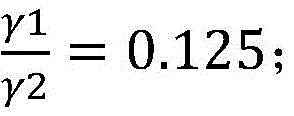
v5: and the blood pressure value, the body temperature value, the heart rate and the physiological monitoring coefficient are sent to the data storage module through the processor.
Further, the path monitoring coefficient obtaining step is as follows:
b1: judging whether the vehicle runs in the lane line or not through a vehicle data recorder, marking the judgment result as CX, wherein the CX is 0 or 1, wherein 0 represents that the vehicle does not run in the lane line, and 1 represents that the vehicle does not run in the lane line;
b2: acquiring a rotating angle of a steering wheel of the vehicle through an angle sensor, and marking the rotating angle as XD;
b3: acquiring a path monitoring coefficient LJ through a formula LJ ═ CX × | XD |;
b4: and sending the judgment result, the rotation angle and the path monitoring coefficient to a data storage module through a processor.
Further, the information processing steps in X3 are specifically as follows:
c1: after the processor receives the monitoring video, analyzing and processing the monitoring video, wherein the specific analyzing steps are as follows:
c11: video preprocessing is carried out on the video;
c12: identifying eyelid closing frequency and eyelid single closing time of a driver through a processor, and marking the eyelid closing frequency and the eyelid single closing time as YB and YD;
c13: identifying, by a processor, an angle of a driver's facial orientation to a horizontal plane, and marking the angle as JD;
c14: by the formula Acquiring a video acquisition coefficient SC; wherein beta 1, beta 2 and beta 3 are preset ratiosExample coefficient, and 0<β1<β2<β3;
C2: after the processor receives the sound wave signals, analyzing and matching the sound wave signals, wherein the specific analyzing and matching steps are as follows:
c21: carrying out sound preprocessing on the sound wave signal;
c22: acquiring noise characteristic information through a data storage module; removing noise characteristic information from the preprocessed sound wave signals to obtain breathing characteristic information;
c23: acquiring sleep sound characteristic information through a data storage module, matching the respiratory characteristic information with the sleep sound characteristic information to acquire a matching degree, and marking the matching degree as PP;
c3: acquiring an auxiliary monitoring coefficient FJ through a formula FJ ═ beta 4 × SC + PP, wherein beta 4 is a preset proportionality coefficient, and beta 4 is greater than 0;
c4: and the eyelid closing frequency, the single eyelid closing time, the angle, the matching degree, the video acquisition coefficient and the auxiliary monitoring coefficient are sent to the data storage module through the processor.
Furthermore, video preprocessing, which includes band-limited filtering, noise removal, image enhancement, dim light processing, automatic exposure and backlight compensation, can not only improve the quality of coded video, but also improve the coding efficiency; the sound preprocessing comprises pre-emphasis processing and frame windowing preprocessing; the noise characteristic information includes transmitter noise, air noise, and vehicle body structure noise.
Further, the scheme planning module searches a rest place for the driver, the scheme planning module comprises a path planning unit and an automobile center console, the rest place comprises a service area and a hotel, and the specific searching steps are as follows:
k1: when the early warning control module receives a middle-level warning instruction or a high-level warning instruction, a path planning unit is started;
k2: acquiring vehicle state parameters, wherein the vehicle state parameters comprise a current position, a vehicle speed, a driving direction, a vehicle width and a vehicle height;
k3: acquiring a potential rest place within a square circle L5 kilometers of the current position of the vehicle through a path planning unit, wherein L5 is a preset range threshold;
k4: the vehicle state parameters are combined with special conditions to extract an optimal rest place from potential rest places, the special conditions comprise that the road height limit is lower than the vehicle height and the road width limit is smaller than the vehicle width, and the optimal rest place is the rest place closest to the current vehicle;
k5: sending a route from the current position to the optimal rest place to an automobile central console, and navigating a driver through voice;
k6: and sending the vehicle state parameters and the position of the optimal rest place to a data storage module through a processor.
The above formulas are all quantitative calculation, the formula is a formula obtained by acquiring a large amount of data and performing software simulation to obtain the latest real situation, and the preset parameters in the formula are set by the technical personnel in the field according to the actual situation.
The working principle of the invention is as follows:
the initial monitoring module is used for acquiring environmental data in a cab before the automobile is started, acquiring the alcohol concentration in the cab through an alcohol concentration sensor, and marking the alcohol concentration as JN; acquiring the average temperature in the cab through a temperature sensor, and marking the average temperature as PW; acquiring the air flow in a cab through an air flow meter, and marking the air flow as KL; obtaining an initial detection coefficient through a formula;
the audio acquisition module is used for acquiring monitoring information in a cab in real time, acquiring a monitoring video of a driver in real time through the high-definition camera, acquiring a sound wave signal in the cab in real time through the sound sensor, and sending the monitoring video and the sound wave signal to the processor in real time, and the processor performs information processing on the monitoring video and the sound wave signal to acquire eyelid closing frequency, single eyelid closing time, an angle, a matching degree, a video acquisition coefficient and an auxiliary monitoring coefficient of the driver;
the physiological information monitoring module is used for monitoring the physiological information of the driver, acquiring the blood pressure value of the driver through the blood pressure sensor and marking the blood pressure value as XY; acquiring a body temperature value of a driver through a body temperature sensor, and marking the body temperature value as TW; acquiring the heart rate of a driver through a heart rate sensor, and marking the heart rate as XL; and obtaining a physiological monitoring coefficient through a formula;
the path monitoring module is used for monitoring the driving track of the vehicle and acquiring a path monitoring coefficient; judging whether the vehicle runs in the lane line or not through a vehicle event data recorder, and marking the judgment result as CX; acquiring a rotating angle of a steering wheel of the vehicle through an angle sensor, and marking the rotating angle as XD; obtaining a path monitoring coefficient LJ through a formula;
the early warning control module carries out the early warning to alarm command, when early warning control module received low-grade alarm command, the alarm lamp sets up to red scintillation state, when early warning control module received middle-grade alarm command, the alarm lamp sets up to red scintillation state, the buzzer is reported to the police, adjusting unit opens vehicle clearance lamp simultaneously and reports to the police, when early warning control module received high-grade alarm command, the alarm lamp sets up to red scintillation state, the buzzer is reported to the police, open vehicle clearance lamp, dial the warning telephone simultaneously and report to the police.
In the description herein, references to the description of "one embodiment," "an example," "a specific example" or the like are intended to mean that a particular feature, structure, material, or characteristic described in connection with the embodiment or example is included in at least one embodiment or example of the invention. In this specification, the schematic representations of the terms used above do not necessarily refer to the same embodiment or example. Furthermore, the particular features, structures, materials, or characteristics described may be combined in any suitable manner in any one or more embodiments or examples.
The foregoing is merely exemplary and illustrative of the present invention and various modifications, additions and substitutions may be made by those skilled in the art to the specific embodiments described without departing from the scope of the invention as defined in the following claims.
Claims (2)




Priority Applications (1)
| Application Number | Priority Date | Filing Date | Title |
|---|---|---|---|
| CN202011035073.6A CN112150767B (en) | 2020-09-27 | 2020-09-27 | Fatigue driving monitoring system based on Internet of things and computer |
Applications Claiming Priority (1)
| Application Number | Priority Date | Filing Date | Title |
|---|---|---|---|
| CN202011035073.6A CN112150767B (en) | 2020-09-27 | 2020-09-27 | Fatigue driving monitoring system based on Internet of things and computer |
Publications (2)
| Publication Number | Publication Date |
|---|---|
| CN112150767A CN112150767A (en) | 2020-12-29 |
| CN112150767B true CN112150767B (en) | 2021-11-23 |
Family
ID=73895585
Family Applications (1)
| Application Number | Title | Priority Date | Filing Date |
|---|---|---|---|
| CN202011035073.6A Active CN112150767B (en) | 2020-09-27 | 2020-09-27 | Fatigue driving monitoring system based on Internet of things and computer |
Country Status (1)
| Country | Link |
|---|---|
| CN (1) | CN112150767B (en) |
Families Citing this family (3)
| Publication number | Priority date | Publication date | Assignee | Title |
|---|---|---|---|---|
| CN113256981B (en) * | 2021-06-09 | 2021-09-21 | 天津所托瑞安汽车科技有限公司 | Alarm analysis method, device, equipment and medium based on vehicle driving data |
| CN114505456A (en) * | 2022-02-25 | 2022-05-17 | 麦特勒智能科技(张家港)有限公司 | Dynamic electromagnetic stirring system of continuous casting machine |
| CN117292505B (en) * | 2022-11-08 | 2024-04-05 | 南宁桂港程锦科技有限公司 | Intelligent traffic fatigue driving monitoring system and monitoring method based on data processing |
Family Cites Families (8)
| Publication number | Priority date | Publication date | Assignee | Title |
|---|---|---|---|---|
| FR2773521B1 (en) * | 1998-01-15 | 2000-03-31 | Carlus Magnus Limited | METHOD AND DEVICE FOR CONTINUOUSLY MONITORING THE DRIVER'S VIGILANCE STATE OF A MOTOR VEHICLE, IN ORDER TO DETECT AND PREVENT A POSSIBLE TREND AS IT GOES TO SLEEP |
| US10482333B1 (en) * | 2017-01-04 | 2019-11-19 | Affectiva, Inc. | Mental state analysis using blink rate within vehicles |
| US10074024B2 (en) * | 2010-06-07 | 2018-09-11 | Affectiva, Inc. | Mental state analysis using blink rate for vehicles |
| US10448867B2 (en) * | 2014-09-05 | 2019-10-22 | Vision Service Plan | Wearable gait monitoring apparatus, systems, and related methods |
| CN106419867A (en) * | 2016-08-09 | 2017-02-22 | 上海斐讯数据通信技术有限公司 | Wearable electronic instrument, human health monitoring system comprising same and human health monitoring method |
| US11158179B2 (en) * | 2017-07-27 | 2021-10-26 | NXT-ID, Inc. | Method and system to improve accuracy of fall detection using multi-sensor fusion |
| CN108099601A (en) * | 2018-01-30 | 2018-06-01 | 成都四海万联科技有限公司 | A kind of detecting system for improving drive safety |
| US10373466B1 (en) * | 2018-03-15 | 2019-08-06 | Arm Ltd. | Systems, devices, and/or processes for tracking behavioral and/or biological state |
-
2020
- 2020-09-27 CN CN202011035073.6A patent/CN112150767B/en active Active
Also Published As
| Publication number | Publication date |
|---|---|
| CN112150767A (en) | 2020-12-29 |
Similar Documents
| Publication | Publication Date | Title |
|---|---|---|
| CN112150767B (en) | Fatigue driving monitoring system based on Internet of things and computer | |
| CN106157614B (en) | Method and system for determining responsibility for automobile accident | |
| CN101470951B (en) | Vehicle security drive monitoring system | |
| CN103770780B (en) | A kind of active safety systems of vehicles alarm shield device | |
| CN112428952A (en) | Vehicle safety early warning system based on Internet of things | |
| CN112784695B (en) | Method for detecting abnormal state of driver based on image and voice recognition | |
| CN206757846U (en) | A kind of fatigue driving four-dimension monitoring system | |
| CN110648075A (en) | Driving safety assessment method and device | |
| CN104691333B (en) | Coach driver fatigue state evaluation method based on the deviation frequency | |
| CN114067612A (en) | Vehicle perception and danger early warning method and system based on environmental sound analysis | |
| CN109034111A (en) | A kind of driver's hand based on deep learning is from steering wheel detection method and system | |
| CN103700220A (en) | Fatigue driving monitoring device | |
| CN108312964A (en) | A kind of fatigue driving state identification early warning system and method | |
| CN109849784A (en) | A kind of DAS (Driver Assistant System) based on environment voice recognition and positioning | |
| CN108573210A (en) | A fatigue driving alarm method and device | |
| CN110717477A (en) | Intelligent early warning and analyzing device for track | |
| CN115402334A (en) | An auxiliary rescue method and system based on driver's physiological monitoring | |
| CN111797788A (en) | Passenger-cargo vehicle running state monitoring system | |
| CN111899471A (en) | Driver fatigue monitoring system | |
| CN110705416B (en) | Safe driving early warning method and system based on driver face image modeling | |
| CN106004439A (en) | Remote control intelligent on-board host computer for bus | |
| CN105761431A (en) | Behavior monitor early-warning method and system | |
| CN111627131A (en) | Driving recording device and method with driver auxiliary monitoring warning function | |
| CN118387114B (en) | Vehicle control system based on driver sudden disease discriminant analysis method | |
| CN106845393A (en) | Safety belt identification model construction method and device |
Legal Events
| Date | Code | Title | Description |
|---|---|---|---|
| PB01 | Publication | ||
| PB01 | Publication | ||
| SE01 | Entry into force of request for substantive examination | ||
| SE01 | Entry into force of request for substantive examination | ||
| GR01 | Patent grant | ||
| GR01 | Patent grant |