CN112135349A - Electronic device and method for wireless communication, computer-readable storage medium - Google Patents
Electronic device and method for wireless communication, computer-readable storage medium Download PDFInfo
- Publication number
- CN112135349A CN112135349A CN201910551238.6A CN201910551238A CN112135349A CN 112135349 A CN112135349 A CN 112135349A CN 201910551238 A CN201910551238 A CN 201910551238A CN 112135349 A CN112135349 A CN 112135349A
- Authority
- CN
- China
- Prior art keywords
- time
- resource blocks
- electronic device
- frequency
- data
- Prior art date
- Legal status (The legal status is an assumption and is not a legal conclusion. Google has not performed a legal analysis and makes no representation as to the accuracy of the status listed.)
- Pending
Links
Images


Classifications
-
- H—ELECTRICITY
- H04—ELECTRIC COMMUNICATION TECHNIQUE
- H04L—TRANSMISSION OF DIGITAL INFORMATION, e.g. TELEGRAPHIC COMMUNICATION
- H04L1/00—Arrangements for detecting or preventing errors in the information received
- H04L1/08—Arrangements for detecting or preventing errors in the information received by repeating transmission, e.g. Verdan system
-
- H—ELECTRICITY
- H04—ELECTRIC COMMUNICATION TECHNIQUE
- H04W—WIRELESS COMMUNICATION NETWORKS
- H04W72/00—Local resource management
- H04W72/04—Wireless resource allocation
- H04W72/044—Wireless resource allocation based on the type of the allocated resource
-
- H—ELECTRICITY
- H04—ELECTRIC COMMUNICATION TECHNIQUE
- H04W—WIRELESS COMMUNICATION NETWORKS
- H04W72/00—Local resource management
- H04W72/04—Wireless resource allocation
- H04W72/044—Wireless resource allocation based on the type of the allocated resource
- H04W72/0446—Resources in time domain, e.g. slots or frames
-
- H—ELECTRICITY
- H04—ELECTRIC COMMUNICATION TECHNIQUE
- H04L—TRANSMISSION OF DIGITAL INFORMATION, e.g. TELEGRAPHIC COMMUNICATION
- H04L1/00—Arrangements for detecting or preventing errors in the information received
- H04L1/12—Arrangements for detecting or preventing errors in the information received by using return channel
- H04L1/16—Arrangements for detecting or preventing errors in the information received by using return channel in which the return channel carries supervisory signals, e.g. repetition request signals
- H04L1/18—Automatic repetition systems, e.g. Van Duuren systems
- H04L1/1812—Hybrid protocols; Hybrid automatic repeat request [HARQ]
-
- H—ELECTRICITY
- H04—ELECTRIC COMMUNICATION TECHNIQUE
- H04L—TRANSMISSION OF DIGITAL INFORMATION, e.g. TELEGRAPHIC COMMUNICATION
- H04L1/00—Arrangements for detecting or preventing errors in the information received
- H04L1/12—Arrangements for detecting or preventing errors in the information received by using return channel
- H04L1/16—Arrangements for detecting or preventing errors in the information received by using return channel in which the return channel carries supervisory signals, e.g. repetition request signals
- H04L1/18—Automatic repetition systems, e.g. Van Duuren systems
- H04L1/1822—Automatic repetition systems, e.g. Van Duuren systems involving configuration of automatic repeat request [ARQ] with parallel processes
-
- H—ELECTRICITY
- H04—ELECTRIC COMMUNICATION TECHNIQUE
- H04L—TRANSMISSION OF DIGITAL INFORMATION, e.g. TELEGRAPHIC COMMUNICATION
- H04L1/00—Arrangements for detecting or preventing errors in the information received
- H04L1/12—Arrangements for detecting or preventing errors in the information received by using return channel
- H04L1/16—Arrangements for detecting or preventing errors in the information received by using return channel in which the return channel carries supervisory signals, e.g. repetition request signals
- H04L1/18—Automatic repetition systems, e.g. Van Duuren systems
- H04L1/1825—Adaptation of specific ARQ protocol parameters according to transmission conditions
-
- H—ELECTRICITY
- H04—ELECTRIC COMMUNICATION TECHNIQUE
- H04L—TRANSMISSION OF DIGITAL INFORMATION, e.g. TELEGRAPHIC COMMUNICATION
- H04L1/00—Arrangements for detecting or preventing errors in the information received
- H04L1/12—Arrangements for detecting or preventing errors in the information received by using return channel
- H04L1/16—Arrangements for detecting or preventing errors in the information received by using return channel in which the return channel carries supervisory signals, e.g. repetition request signals
- H04L1/18—Automatic repetition systems, e.g. Van Duuren systems
- H04L1/1867—Arrangements specially adapted for the transmitter end
- H04L1/188—Time-out mechanisms
-
- H—ELECTRICITY
- H04—ELECTRIC COMMUNICATION TECHNIQUE
- H04L—TRANSMISSION OF DIGITAL INFORMATION, e.g. TELEGRAPHIC COMMUNICATION
- H04L1/00—Arrangements for detecting or preventing errors in the information received
- H04L1/12—Arrangements for detecting or preventing errors in the information received by using return channel
- H04L1/16—Arrangements for detecting or preventing errors in the information received by using return channel in which the return channel carries supervisory signals, e.g. repetition request signals
- H04L1/18—Automatic repetition systems, e.g. Van Duuren systems
- H04L1/1867—Arrangements specially adapted for the transmitter end
- H04L1/1887—Scheduling and prioritising arrangements
-
- H—ELECTRICITY
- H04—ELECTRIC COMMUNICATION TECHNIQUE
- H04L—TRANSMISSION OF DIGITAL INFORMATION, e.g. TELEGRAPHIC COMMUNICATION
- H04L1/00—Arrangements for detecting or preventing errors in the information received
- H04L1/12—Arrangements for detecting or preventing errors in the information received by using return channel
- H04L1/16—Arrangements for detecting or preventing errors in the information received by using return channel in which the return channel carries supervisory signals, e.g. repetition request signals
- H04L1/18—Automatic repetition systems, e.g. Van Duuren systems
- H04L1/1867—Arrangements specially adapted for the transmitter end
- H04L1/1893—Physical mapping arrangements
-
- H—ELECTRICITY
- H04—ELECTRIC COMMUNICATION TECHNIQUE
- H04W—WIRELESS COMMUNICATION NETWORKS
- H04W4/00—Services specially adapted for wireless communication networks; Facilities therefor
- H04W4/30—Services specially adapted for particular environments, situations or purposes
- H04W4/40—Services specially adapted for particular environments, situations or purposes for vehicles, e.g. vehicle-to-pedestrians [V2P]
- H04W4/44—Services specially adapted for particular environments, situations or purposes for vehicles, e.g. vehicle-to-pedestrians [V2P] for communication between vehicles and infrastructures, e.g. vehicle-to-cloud [V2C] or vehicle-to-home [V2H]
-
- H—ELECTRICITY
- H04—ELECTRIC COMMUNICATION TECHNIQUE
- H04W—WIRELESS COMMUNICATION NETWORKS
- H04W4/00—Services specially adapted for wireless communication networks; Facilities therefor
- H04W4/30—Services specially adapted for particular environments, situations or purposes
- H04W4/40—Services specially adapted for particular environments, situations or purposes for vehicles, e.g. vehicle-to-pedestrians [V2P]
- H04W4/46—Services specially adapted for particular environments, situations or purposes for vehicles, e.g. vehicle-to-pedestrians [V2P] for vehicle-to-vehicle communication [V2V]
-
- H—ELECTRICITY
- H04—ELECTRIC COMMUNICATION TECHNIQUE
- H04W—WIRELESS COMMUNICATION NETWORKS
- H04W4/00—Services specially adapted for wireless communication networks; Facilities therefor
- H04W4/70—Services for machine-to-machine communication [M2M] or machine type communication [MTC]
-
- H—ELECTRICITY
- H04—ELECTRIC COMMUNICATION TECHNIQUE
- H04W—WIRELESS COMMUNICATION NETWORKS
- H04W72/00—Local resource management
- H04W72/20—Control channels or signalling for resource management
-
- H—ELECTRICITY
- H04—ELECTRIC COMMUNICATION TECHNIQUE
- H04W—WIRELESS COMMUNICATION NETWORKS
- H04W72/00—Local resource management
- H04W72/50—Allocation or scheduling criteria for wireless resources
- H04W72/56—Allocation or scheduling criteria for wireless resources based on priority criteria
-
- H—ELECTRICITY
- H04—ELECTRIC COMMUNICATION TECHNIQUE
- H04W—WIRELESS COMMUNICATION NETWORKS
- H04W72/00—Local resource management
- H04W72/50—Allocation or scheduling criteria for wireless resources
- H04W72/56—Allocation or scheduling criteria for wireless resources based on priority criteria
- H04W72/566—Allocation or scheduling criteria for wireless resources based on priority criteria of the information or information source or recipient
-
- H—ELECTRICITY
- H04—ELECTRIC COMMUNICATION TECHNIQUE
- H04L—TRANSMISSION OF DIGITAL INFORMATION, e.g. TELEGRAPHIC COMMUNICATION
- H04L1/00—Arrangements for detecting or preventing errors in the information received
- H04L1/12—Arrangements for detecting or preventing errors in the information received by using return channel
- H04L1/16—Arrangements for detecting or preventing errors in the information received by using return channel in which the return channel carries supervisory signals, e.g. repetition request signals
- H04L1/18—Automatic repetition systems, e.g. Van Duuren systems
- H04L1/1812—Hybrid protocols; Hybrid automatic repeat request [HARQ]
- H04L1/1819—Hybrid protocols; Hybrid automatic repeat request [HARQ] with retransmission of additional or different redundancy
-
- H—ELECTRICITY
- H04—ELECTRIC COMMUNICATION TECHNIQUE
- H04L—TRANSMISSION OF DIGITAL INFORMATION, e.g. TELEGRAPHIC COMMUNICATION
- H04L1/00—Arrangements for detecting or preventing errors in the information received
- H04L1/12—Arrangements for detecting or preventing errors in the information received by using return channel
- H04L1/16—Arrangements for detecting or preventing errors in the information received by using return channel in which the return channel carries supervisory signals, e.g. repetition request signals
- H04L1/18—Automatic repetition systems, e.g. Van Duuren systems
- H04L1/1867—Arrangements specially adapted for the transmitter end
- H04L1/1874—Buffer management
-
- H—ELECTRICITY
- H04—ELECTRIC COMMUNICATION TECHNIQUE
- H04W—WIRELESS COMMUNICATION NETWORKS
- H04W92/00—Interfaces specially adapted for wireless communication networks
- H04W92/16—Interfaces between hierarchically similar devices
- H04W92/18—Interfaces between hierarchically similar devices between terminal devices
Landscapes
- Engineering & Computer Science (AREA)
- Computer Networks & Wireless Communication (AREA)
- Signal Processing (AREA)
- Mobile Radio Communication Systems (AREA)
Abstract
本公开提供了一种用于无线通信的电子设备、方法和计算机可读存储介质,其中,用于无线通信的电子设备包括:处理电路,被配置为:利用由为电子设备提供服务的基站配置的或者预配置的时频重复模式TFRP时频资源进行数据传输,其中,TFRP时频资源在一个周期内包括多个时频资源块,所述多个时频资源块包括专用资源块,并且在满足预定条件的情况下还包括共享资源块,专用资源块用于对特定于专用资源块的数据进行传输,共享资源块被所有待传输数据共享来进行传输,以及,具有相同频域范围的不同共享资源块在时域上连续。
The present disclosure provides an electronic device, method, and computer-readable storage medium for wireless communication, wherein the electronic device for wireless communication includes: a processing circuit configured to utilize a configuration by a base station serving the electronic device TFRP time-frequency resources in a preconfigured or pre-configured time-frequency repetition pattern for data transmission, wherein the TFRP time-frequency resources include multiple time-frequency resource blocks in one cycle, the multiple time-frequency resource blocks include dedicated resource blocks, and When the predetermined conditions are met, it also includes shared resource blocks, dedicated resource blocks are used for transmission of data specific to the dedicated resource blocks, shared resource blocks are shared by all data to be transmitted for transmission, and, different with the same frequency domain range. Shared resource blocks are contiguous in the time domain.
Description
技术领域technical field
本公开涉及无线通信技术领域,具体地涉及时频重复模式TFRP时频资源的设计和该模式下的数据传输机制。更具体地,涉及一种用于无线通信的电子设备和方法以及计算机可读存储介质。The present disclosure relates to the technical field of wireless communication, and in particular, to the design of time-frequency repetition mode TFRP time-frequency resources and a data transmission mechanism in this mode. More particularly, it relates to an electronic device and method for wireless communication and a computer-readable storage medium.
背景技术Background technique
V2X(车对外界的信息交换,车联网)场景、D2D(设备到设备)场景、MTC(移动云测试中心)场景、无人机场景是当前热门的无线通信应用场景。考虑到下一代移动通信的发展趋势,在TS 36.213中分别定义了在NR(3GPP新空口无线接入技术)V2X中模式1和模式2下用户用于传输PSCCH(物理直通链路控制信道)和相应PSSCH(物理直通链路共享信道)时频资源的确定方式和接收PSCCH的UE(用户设备)过程,同时定义了SCI(直通链路控制信息)的信息域和配置方式。另外,在TS 38.885中定义在NR V2X中SL(sidelink,直通链路)资源分配方式和HARQ(混合自动重传请求)反馈的过程,其中,在NR V2X资源分配子模式2c中定义了时频重复模式TFRP的传输机制。V2X (Vehicle-to-External Information Exchange, Internet of Vehicles) scenarios, D2D (Device-to-Device) scenarios, MTC (Mobile Cloud Test Center) scenarios, and UAV scenarios are currently popular wireless communication application scenarios. Taking into account the development trend of next-generation mobile communications, TS 36.213 defines the use of PSCCH (Physical Direct Link Control Channel) and The determination method of the corresponding PSSCH (Physical Direct Link Shared Channel) time-frequency resource and the UE (User Equipment) process receiving PSCCH define the information domain and configuration mode of the SCI (Direct Link Control Information). In addition, the SL (sidelink, direct link) resource allocation method and HARQ (Hybrid Automatic Repeat Request) feedback process in NR V2X are defined in TS 38.885, wherein the time-frequency is defined in the NR V2X resource allocation sub-mode 2c Transport mechanism for repeat mode TFRP.
发明内容SUMMARY OF THE INVENTION
在下文中给出了关于本发明的简要概述,以便提供关于本发明的某些方面的基本理解。应当理解,这个概述并不是关于本发明的穷举性概述。它并不是意图确定本发明的关键或重要部分,也不是意图限定本发明的范围。其目的仅仅是以简化的形式给出某些概念,以此作为稍后论述的更详细描述的前序。The following presents a brief summary of the present invention in order to provide a basic understanding of certain aspects of the invention. It should be understood that this summary is not an exhaustive overview of the invention. It is not intended to identify key or essential parts of the invention nor to limit the scope of the invention. Its sole purpose is to present some concepts in a simplified form as a prelude to the more detailed description that is discussed later.
根据本公开的一个方面,提供了一种用于无线通信的电子设备,包括:处理电路,被配置为:利用由为电子设备提供服务的基站配置的或者预配置的时频重复模式TFRP时频资源进行数据传输,其中,TFRP时频资源在一个周期内包括多个时频资源块,多个时频资源块包括专用资源块,并且在满足预定条件的情况下还包括共享资源块,专用资源块用于对特定于专用资源块的数据进行传输,共享资源块被所有待传输数据共享来进行传输,以及,具有相同频域范围的不同共享资源块在时域上连续。According to one aspect of the present disclosure, there is provided an electronic device for wireless communication, comprising: a processing circuit configured to utilize a time-frequency repetition pattern TFRP time-frequency configured or preconfigured by a base station serving the electronic device resources for data transmission, wherein the TFRP time-frequency resources include multiple time-frequency resource blocks in one cycle, the multiple time-frequency resource blocks include dedicated resource blocks, and also include shared resource blocks when predetermined conditions are met, dedicated resources Blocks are used to transmit data specific to dedicated resource blocks, shared resource blocks are shared for transmission by all data to be transmitted, and different shared resource blocks with the same frequency domain extent are contiguous in time domain.
根据本公开的一个方面,提供了一种用于无线通信的方法,包括:利用由为电子设备提供服务的基站配置的或者预配置的时频重复模式TFRP时频资源进行数据传输,其中,TFRP时频资源在一个周期内包括多个时频资源块,多个时频资源块包括专用资源块,并且在满足预定条件的情况下还包括共享资源块,专用资源块用于对特定于专用资源块的数据进行传输,共享资源块被所有待传输数据共享来进行传输,以及,具有相同频域范围的不同共享资源块在时域上连续。According to one aspect of the present disclosure, there is provided a method for wireless communication, comprising: utilizing time-frequency repetition pattern TFRP time-frequency resources configured or preconfigured by a base station serving an electronic device for data transmission, wherein the TFRP The time-frequency resources include multiple time-frequency resource blocks in one cycle, the multiple time-frequency resource blocks include dedicated resource blocks, and also include shared resource blocks if a predetermined condition is met, and the dedicated resource blocks are used for specific resources. Blocks of data are transmitted, shared resource blocks are shared by all data to be transmitted for transmission, and different shared resource blocks with the same frequency domain range are consecutive in time domain.
根据本公开的另一个方面,提供了一种用于无线通信的电子设备,包括:处理电路,被配置为:为电子设备覆盖范围内的用户设备配置时频重复模式TFRP时频资源以进行数据传输,其中,TFRP时频资源在一个周期内包括多个时频资源块,多个时频资源块包括专用资源块,并且在满足预定条件的情况下还包括共享资源块,专用资源块用于对特定于专用资源块的数据进行传输,共享资源块被所有待传输数据共享来进行传输,以及,具有相同频域范围的不同共享资源块在时域上连续。According to another aspect of the present disclosure, there is provided an electronic device for wireless communication, comprising: a processing circuit configured to: configure time-frequency repetition pattern TFRP time-frequency resources for user equipment within the coverage of the electronic device for data processing transmission, wherein the TFRP time-frequency resource includes multiple time-frequency resource blocks in one cycle, the multiple time-frequency resource blocks include dedicated resource blocks, and also includes shared resource blocks when a predetermined condition is met, and the dedicated resource blocks are used for Data specific to dedicated resource blocks is transmitted, shared resource blocks are shared for transmission by all data to be transmitted, and different shared resource blocks with the same frequency domain extent are consecutive in time domain.
根据本公开的另一个方面,提供了一种用于无线通信的方法,包括:为基站覆盖范围内的用户设备配置时频重复模式TFRP时频资源以进行数据传输,其中,TFRP时频资源在一个周期内包括多个时频资源块,多个时频资源块包括专用资源块,并且在满足预定条件的情况下还包括共享资源块,专用资源块用于对特定于专用资源块的数据进行传输,共享资源块被所有待传输数据共享来进行传输,以及,具有相同频域范围的不同共享资源块在时域上连续。According to another aspect of the present disclosure, there is provided a method for wireless communication, comprising: configuring time-frequency repetition pattern TFRP time-frequency resources for data transmission for user equipment within the coverage of a base station, wherein the TFRP time-frequency resources are in A cycle includes multiple time-frequency resource blocks, the multiple time-frequency resource blocks include dedicated resource blocks, and if a predetermined condition is met, it also includes shared resource blocks, and the dedicated resource blocks are used for data specific to the dedicated resource block. For transmission, the shared resource block is shared by all data to be transmitted for transmission, and different shared resource blocks with the same frequency domain range are consecutive in the time domain.
依据本发明的其它方面,还提供了用于实现上述用于无线通信的方法的计算机程序代码和计算机程序产品以及其上记录有该用于实现上述用于无线通信的方法的计算机程序代码的计算机可读存储介质。According to other aspects of the present invention, there are also provided a computer program code and a computer program product for implementing the above-mentioned method for wireless communication, and a computer on which the computer program code for implementing the above-mentioned method for wireless communication is recorded Readable storage medium.
通过以下结合附图对本发明的优选实施例的详细说明,本发明的这些以及其他优点将更加明显。These and other advantages of the present invention will become more apparent from the following detailed description of the preferred embodiments of the present invention in conjunction with the accompanying drawings.
附图说明Description of drawings
为了进一步阐述本发明的以上和其它优点和特征,下面结合附图对本发明的具体实施方式作进一步详细的说明。所述附图连同下面的详细说明一起包含在本说明书中并且形成本说明书的一部分。具有相同的功能和结构的元件用相同的参考标号表示。应当理解,这些附图仅描述本发明的典型示例,而不应看作是对本发明的范围的限定。在附图中:In order to further illustrate the above and other advantages and features of the present invention, the specific embodiments of the present invention will be described in further detail below with reference to the accompanying drawings. The accompanying drawings, together with the following detailed description, are incorporated into and form a part of this specification. Elements that have the same function and structure are denoted with the same reference numerals. It is to be understood that these drawings depict only typical examples of the invention and should not be considered as limiting the scope of the invention. In the attached image:
图1示出了根据本公开的一个实施例的用于无线通信的电子设备的功能模块框图;FIG. 1 shows a functional block diagram of an electronic device for wireless communication according to an embodiment of the present disclosure;
图2示出了根据本公开实施例的TFRP时频资源的示意图;2 shows a schematic diagram of TFRP time-frequency resources according to an embodiment of the present disclosure;
图3(a)和3(b)示出了根据本公开实施例的将时频资源块在时间上划分为基于微时隙的资源块的示意图;3(a) and 3(b) show schematic diagrams of dividing a time-frequency resource block into minislot-based resource blocks in time according to an embodiment of the present disclosure;
图4示出了基站为UE配置TFRP时频资源的信息流程;Fig. 4 shows the information flow that the base station configures TFRP time-frequency resources for UE;
图5(a)和5(b)示出了根据本公开实施例的根据划分粒度对时频资源块进行划分的示意图;5(a) and 5(b) show schematic diagrams of dividing time-frequency resource blocks according to division granularity according to an embodiment of the present disclosure;
图6示出了基站周期性更新UE的时频资源块的配置的信息流程;Fig. 6 shows the information flow that the base station periodically updates the configuration of the time-frequency resource block of the UE;
图7示出了基站基于事件触发而更新UE的时频资源块的配置的信息流程;FIG. 7 shows the information flow of the base station updating the configuration of the time-frequency resource block of the UE based on the event trigger;
图8示出了数据在专用资源块开始之后才到达从而造成传输时延的示意图;Figure 8 shows a schematic diagram of data arriving after the dedicated resource block starts, thereby causing transmission delay;
图9示出了基站、作为发送方的电子设备以及基站覆盖范围内的邻近电子设备之间的关于抢占的信息流程;Fig. 9 shows the information flow about preemption among the base station, the electronic device serving as the sender, and the neighboring electronic devices within the coverage of the base station;
图10示出了基站、作为发送方的电子设备以及作为接收方的电子设备之间的关于借用的信息流程;Fig. 10 shows the information flow about borrowing among the base station, the electronic device as the sender, and the electronic device as the receiver;
图11示出了根据本公开实施例的预配置的TFRP池的示意图;Figure 11 shows a schematic diagram of a preconfigured TFRP pool according to an embodiment of the present disclosure;
图12示出了根据本公开实施例的使用共享资源块进行数据传输的示意图;12 shows a schematic diagram of data transmission using shared resource blocks according to an embodiment of the present disclosure;
图13示出了在V2X的子模式2c下,在基站的覆盖范围外的作为发送方的UE和作为接收方的UE之间进行数据传输的信息流程;Fig. 13 shows the information flow of data transmission between the UE as the sender and the UE as the receiver outside the coverage of the base station under the sub-mode 2c of V2X;
图14示出了资源碰撞的示意图;Figure 14 shows a schematic diagram of resource collision;
图15示出了在V2X的子模式2c下作为发送方的UE和作为接收方的UE之间进行HARQ反馈的一个示例信息流程;FIG. 15 shows an example information flow for HARQ feedback between a UE serving as a sender and a UE serving as a receiver under sub-mode 2c of V2X;
图16示出了在V2X的子模式2c下作为发送方的UE和作为接收方的UE之间进行HARQ反馈的另一示例信息流程;FIG. 16 shows another example information flow for HARQ feedback between a UE serving as a sender and a UE serving as a receiver under sub-mode 2c of V2X;
图17示出了根据本公开的另一个实施例的电子设备的功能模块框图;17 shows a functional block diagram of an electronic device according to another embodiment of the present disclosure;
图18示出了根据本申请的一个实施例的用于无线通信的方法的流程图;18 shows a flowchart of a method for wireless communication according to an embodiment of the present application;
图19示出了根据本申请的另一个实施例的用于无线通信的方法的流程图;19 shows a flowchart of a method for wireless communication according to another embodiment of the present application;
图20是示出可以应用本公开内容的技术的eNB或gNB的示意性配置的第一示例的框图;20 is a block diagram illustrating a first example of a schematic configuration of an eNB or gNB to which the techniques of this disclosure may be applied;
图21是示出可以应用本公开内容的技术的eNB或gNB的示意性配置的第二示例的框图;21 is a block diagram illustrating a second example of a schematic configuration of an eNB or gNB to which techniques of this disclosure may be applied;
图22是示出可以应用本公开内容的技术的智能电话的示意性配置的示例的框图;22 is a block diagram showing an example of a schematic configuration of a smartphone to which the techniques of the present disclosure may be applied;
图23是示出可以应用本公开内容的技术的汽车导航设备的示意性配置的示例的框图;以及23 is a block diagram showing an example of a schematic configuration of a car navigation apparatus to which the technology of the present disclosure can be applied; and
图24是其中可以实现根据本发明的实施例的方法和/或装置和/或系统的通用个人计算机的示例性结构的框图。24 is a block diagram of an exemplary structure of a general-purpose personal computer in which methods and/or apparatuses and/or systems according to embodiments of the present invention may be implemented.
具体实施方式Detailed ways
在下文中将结合附图对本发明的示范性实施例进行描述。为了清楚和简明起见,在说明书中并未描述实际实施方式的所有特征。然而,应该了解,在开发任何这种实际实施例的过程中必须做出很多特定于实施方式的决定,以便实现开发人员的具体目标,例如,符合与系统及业务相关的那些限制条件,并且这些限制条件可能会随着实施方式的不同而有所改变。此外,还应该了解,虽然开发工作有可能是非常复杂和费时的,但对得益于本公开内容的本领域技术人员来说,这种开发工作仅仅是例行的任务。Exemplary embodiments of the present invention will hereinafter be described with reference to the accompanying drawings. In the interest of clarity and conciseness, not all features of an actual implementation are described in the specification. It should be appreciated, however, that many implementation-specific decisions must be made in the development of any such practical embodiment in order to achieve the developer's specific goals, such as compliance with those constraints associated with the system and business, and these Restrictions may vary from implementation to implementation. Furthermore, it should also be appreciated that while development work can be very complex and time consuming, such development work would be a routine undertaking for those skilled in the art having the benefit of this disclosure.
在此,还需要说明的一点是,为了避免因不必要的细节而模糊了本发明,在附图中仅仅示出了与根据本发明的方案密切相关的设备结构和/或处理步骤,而省略了与本发明关系不大的其他细节。Here, it should also be noted that, in order to avoid obscuring the present invention due to unnecessary details, only the equipment structures and/or processing steps closely related to the solution according to the present invention are shown in the accompanying drawings, and are omitted. other details not relevant to the present invention.
<第一实施例><First Embodiment>
图1示出了根据本公开的一个实施例的用于无线通信的电子设备100的功能模块框图,如图1所示,电子设备100包括:处理单元101,被配置为利用由为电子设备提供服务的基站配置的或者预配置的时频重复模式TFRP时频资源进行数据传输,其中,TFRP时频资源在一个周期内包括多个时频资源块,多个时频资源块包括专用资源块,并且在满足预定条件的情况下还包括共享资源块,专用资源块用于对特定于专用资源块的数据进行传输,共享资源块被所有待传输数据共享来进行传输,以及,具有相同频域范围的不同共享资源块在时域上连续。FIG. 1 shows a block diagram of functional modules of an
其中,处理单元101可以由一个或多个处理电路实现,该处理电路例如可以实现为芯片。The
电子设备100例如可以设置在用户设备(UE)侧或者可通信地连接到UE。这里,还应指出,电子设备100可以以芯片级来实现,或者也可以以设备级来实现。例如,电子设备100可以工作为用户设备本身,并且还可以包括诸如存储器、收发器(图中未示出)等外部设备。存储器可以用于存储用户设备实现各种功能需要执行的程序和相关数据信息。收发器可以包括一个或多个通信接口以支持与不同设备(例如,基站、其他用户设备等等)间的通信,这里不具体限制收发器的实现形式。The
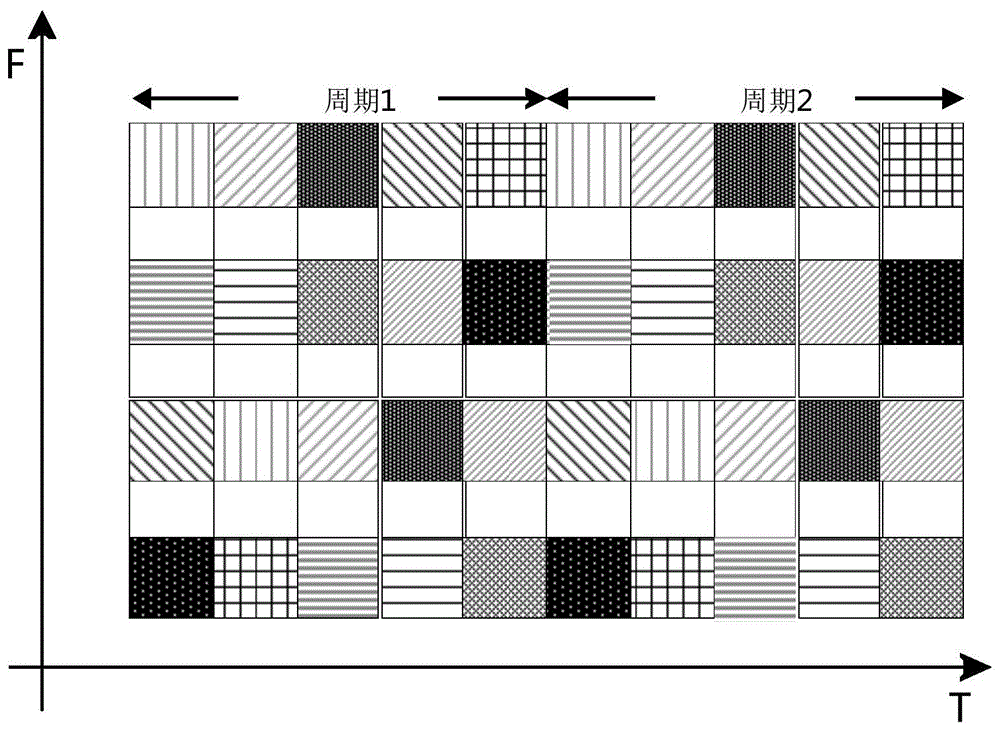
图2示出了根据本公开实施例的TFRP时频资源的示意图。TFRP时频资源是周期性重复的,在图2中,为了简洁,仅示出了两个周期(例如,周期1和周期2)的TFRP时频资源,其中,横坐标T表示时间,纵坐标F表示频率。类似于图2所示的TFRP时频资源在下文中有时也被称为TFRP池。FIG. 2 shows a schematic diagram of TFRP time-frequency resources according to an embodiment of the present disclosure. TFRP time-frequency resources are repeated periodically. In FIG. 2, for brevity, only two periods (for example, period 1 and period 2) of TFRP time-frequency resources are shown, where the abscissa T represents time and the ordinate F stands for frequency. A TFRP time-frequency resource similar to that shown in FIG. 2 is also sometimes referred to as a TFRP pool hereinafter.
TFRP时频资源在一个周期内包括多个时频资源块,图2中的没有被任何图案填充的白色时频资源块是共享资源块,其余的有图案填充的时频资源块是专用资源块。在TFRP时频资源的一个周期内,一个TB(传输块)需要重复发送repK次,其中repK是由TFRP的配置所决定的。专用资源块规定了初传一个TB和若干次重传该TB所使用的时域和频域资源。为了简化描述,在图2中假设在TFRP时频资源的一个周期内,具有相同图案的专用资源块重复出现两次。由此,repK为2。以图2中的周期1的TFRP时频资源为例,两个相同图案的专用资源块可以用于一个TB的一次初传和一次重传,也就是说,一旦初传TB的专用资源块确定了,那么重传该TB所使用的专用资源块也就确定了。共享资源块被所有待传输TB共享,如果初传TB与重传TB所使用的都是共享资源块,这两个共享资源块之间是没有关系的。此外,如图2所示,具有相同频域范围的不同共享资源块在时域上连续。TFRP time-frequency resources include multiple time-frequency resource blocks in one cycle. The white time-frequency resource blocks in Figure 2 that are not filled with any pattern are shared resource blocks, and the remaining time-frequency resource blocks that are filled with patterns are dedicated resource blocks. . In one period of TFRP time-frequency resources, one TB (transport block) needs to repeatedly send repK times, where repK is determined by the configuration of TFRP. The dedicated resource block specifies the time and frequency domain resources used for initial transmission of a TB and several retransmissions of the TB. In order to simplify the description, it is assumed in FIG. 2 that in one period of the TFRP time-frequency resource, dedicated resource blocks with the same pattern appear twice repeatedly. Thus, repK is 2. Taking the TFRP time-frequency resource of period 1 in Figure 2 as an example, two dedicated resource blocks of the same pattern can be used for one initial transmission and one retransmission of a TB, that is, once the dedicated resource block of the initial transmission TB is determined. , then the dedicated resource block used for retransmission of the TB is also determined. Shared resource blocks are shared by all TBs to be transmitted. If both the initial transmission TB and the retransmission TB use shared resource blocks, there is no relationship between the two shared resource blocks. Furthermore, as shown in Fig. 2, different shared resource blocks with the same frequency domain range are consecutive in the time domain.
在电子设备在基站覆盖范围内的情况下,通过基站为电子设备配置时频资源块。在基站覆盖范围内的电子设备较多从而时频资源紧张的情况下,TFRP时频资源不包括共享资源块,则所有数据均由专用资源块传输。In the case that the electronic device is within the coverage of the base station, the time-frequency resource block is configured for the electronic device through the base station. Under the circumstance that there are many electronic devices within the coverage of the base station and the time-frequency resources are tight, the TFRP time-frequency resources do not include shared resource blocks, and all data are transmitted by dedicated resource blocks.
所述预定条件的一个示例是基站覆盖范围内的时频资源比较充裕,在满足该预定条件的情况下,TFRP时频资源可以包括共享资源块,则数据可以由专用资源块和/或共享资源块传输。在电子设备在基站覆盖范围外的情况下,电子设备基于包括时频资源块的预配置的TFRP池进行数据传输;所述预定条件的另一个示例是电子设备在基站覆盖范围外,在满足该预定条件的情况下,电子设备的预配置的TFRP时频资源包括共享资源块,则数据由专用资源块和/或共享资源块传输。An example of the predetermined condition is that the time-frequency resources within the coverage area of the base station are relatively abundant. If the predetermined condition is satisfied, the TFRP time-frequency resources may include shared resource blocks, and the data may be composed of dedicated resource blocks and/or shared resources. block transfer. In the case that the electronic device is out of the coverage of the base station, the electronic device performs data transmission based on a pre-configured TFRP pool including time-frequency resource blocks; another example of the predetermined condition is that the electronic device is out of the coverage of the base station, and the electronic device is out of the coverage of the base station. In the case of predetermined conditions, the pre-configured TFRP time-frequency resources of the electronic device include shared resource blocks, and data is transmitted by dedicated resource blocks and/or shared resource blocks.
另外,需要说明的是,上述电子设备100可以用于V2X场景、D2D场景、MTC场景以及无人机场景等的无线通信。然而,为了方便和简洁的目的,以下仅以V2X场景为例来进行描述。In addition, it should be noted that the above
优选地,共享资源块的频域带宽等于或小于专用资源块的频域带宽。在图2中,示出了共享资源块的频域带宽小于专用资源块的频域带宽。Preferably, the frequency domain bandwidth of the shared resource block is equal to or smaller than the frequency domain bandwidth of the dedicated resource block. In FIG. 2, it is shown that the frequency domain bandwidth of the shared resource block is smaller than the frequency domain bandwidth of the dedicated resource block.
NR V2X中的一些高级应用场景要求低时延(低至3ms端到端时延)以及高可靠性(高至99.999%),为了满足上述要求,可以对上述时频资源块在时间上进行划分。Some advanced application scenarios in NR V2X require low latency (as low as 3ms end-to-end latency) and high reliability (as high as 99.999%). In order to meet the above requirements, the above time-frequency resource blocks can be divided in time .
优选地,每个时频资源块在时间上可以被划分为至少两个基于微时隙的资源块。也就是说,专用资源块和共享资源块在时间上可以被划分为至少两个基于微时隙的资源块。Preferably, each time-frequency resource block may be divided in time into at least two minislot-based resource blocks. That is, the dedicated resource block and the shared resource block may be divided in time into at least two minislot-based resource blocks.
图3(a)和3(b)示出了根据本公开实施例的将时频资源块在时间上划分为基于微时隙的资源块的示意图。在要与基于微时隙的资源块相区别,在下文的描述中,可以将被划分前的专用资源块和共享资源块称为基于时隙的资源块。在图3(a)中,示出了TFRP周期长度PL1内包括的多个基于时隙的资源块。在图3(b)中,为了简便起见,将每个专用资源块和共享资源块在时间上划分为两个基于微时隙的资源块。基于微时隙的资源块的时间长度短于基于时隙的资源块的时间长度(在图3(a)和3(b)的示例中,微时隙的资源块的时间长度是基于时隙的资源块的时间长度的一半),因此,可以通过更快的重传来降低时延;此外,基于微时隙的资源块的TFRP周期长度PL2是基于时隙的资源块的TFRP周期长度PL1的一半(PL1/2),也就是说,在包括基于时隙的资源块的TFRP时频资源的一个TRRP周期(周期长度为PL1)内,包括基于微时隙的资源块的TFRP时频资源可以利用两个TRRP周期(周期长度为PL2=PL1/2)进行数据传输,因此,包括基于微时隙的资源块的TFRP时频资源可以通过提高重传的次数来保证数据的可靠性。3(a) and 3(b) illustrate schematic diagrams of temporally dividing a time-frequency resource block into minislot-based resource blocks according to an embodiment of the present disclosure. To be distinguished from the mini-slot-based resource blocks, in the following description, the dedicated resource blocks and the shared resource blocks before being divided may be referred to as time-slot-based resource blocks. In Fig. 3(a), a plurality of slot-based resource blocks included in the TFRP cycle length PL1 are shown. In Figure 3(b), for simplicity, each dedicated resource block and shared resource block is temporally divided into two minislot-based resource blocks. The time length of the minislot-based resource block is shorter than the time length of the time slot-based resource block (in the examples of Figures 3(a) and 3(b), the time length of the minislot-based resource block is half of the time length of the resource block), therefore, the delay can be reduced by faster retransmission; in addition, the TFRP period length PL2 of the minislot-based resource block is the TFRP period length PL1 of the slot-based resource block half (PL1/2), that is, within one TRRP period (period length is PL1) including the TFRP time-frequency resource of the slot-based resource block, the TFRP time-frequency resource of the minislot-based resource block is included Data transmission can be performed using two TRRP cycles (the cycle length is PL2=PL1/2). Therefore, the TFRP time-frequency resources including minislot-based resource blocks can ensure data reliability by increasing the number of retransmissions.
当电子设备进入基站的覆盖范围内(基站覆盖的小区)后,为电子设备预配置的TFRP时频资源禁止在本小区内使用。如上所示,在电子设备在基站覆盖范围内的情况下,通过基站为电子设备配置时频资源块。下面描述在电子设备在基站的覆盖范围内的情况下的TFRP时频资源的配置以及数据传输机制。After the electronic device enters the coverage area of the base station (the cell covered by the base station), the TFRP time-frequency resources preconfigured for the electronic device are prohibited from being used in this cell. As shown above, when the electronic device is within the coverage of the base station, the electronic device is configured with time-frequency resource blocks through the base station. The following describes the configuration of the TFRP time-frequency resources and the data transmission mechanism when the electronic device is within the coverage of the base station.
TFRP时频资源的配置指标是基于小区的,即TFRP时频资源如何配置是由本小区决定的。不同的小区之间的TFRP时频资源配置可以是相同的也可以是不同的。而且,同一小区的TFRP时频资源配置也会随着小区时频资源的使用情况随时更新。The configuration index of the TFRP time-frequency resources is based on the cell, that is, how to configure the TFRP time-frequency resources is determined by the cell. The TFRP time-frequency resource configuration between different cells may be the same or different. Moreover, the TFRP time-frequency resource configuration of the same cell will also be updated at any time according to the usage of the time-frequency resources of the cell.
优选地,处理单元101向为其提供服务的基站上报信息,以使基站基于所上报的信息为电子设备配置时频资源块,以及所上报的信息至少包括指示电子设备是否支持微时隙传输的信息EquipmentIdentifier,其中,在微时隙传输中,时频资源块在时间上被划分为至少两个基于微时隙的资源块。Preferably, the
作为示例,所上报的信息还可以包括:信道状态信息CSI、信道忙率CBR、参考信号(DMRS/SRS)、用户的测量结果(SL RSRP和SL RSSI)以及位置信息LocationInfor。As an example, the reported information may further include: channel state information CSI, channel busy rate CBR, reference signals (DMRS/SRS), user measurement results (SL RSRP and SL RSSI), and location information LocationInfor.
优选地,处理单元101被配置为从基站接收包括有关时频资源块的信息的无线资源控制RRC信令,其中,RRC信令基于电子设备所上报的信息生成,并且至少包括共享资源块的频域带宽BandWidthShared和时频资源块的划分粒度PeriodScaler。Preferably, the
作为示例,所述RRC信令还可以包括TFRP时频资源的周期长度PeriodLength、TFRP时频资源的周期数目NumberOfPeriod、每个时频资源块所占的符号数目NumberOfSymbolOfRep、一个周期内的数据重传次数NumberOfRepetition、每个时频资源块的开始时刻StartTime以及专用资源块的带宽BandWidthDedicate。As an example, the RRC signaling may further include the period length of the TFRP time-frequency resource, PeriodLength, the number of periods of the TFRP time-frequency resource, NumberOfPeriod, the number of symbols occupied by each time-frequency resource block, NumberOfSymbolOfRep, and the number of data retransmissions in one period. NumberOfRepetition, the start time StartTime of each time-frequency resource block, and the bandwidth BandWidthDedicate of the dedicated resource block.
为了便于理解,图4示出了基站(例如,gNB)为UE配置TFRP时频资源的信息流程。如图4所示,首先,UE向基站上报信息。然后,基站根据上报信息确定时频资源块配置,并且通过RRC信令向UE传送有关所配置的时频资源块的信息。UE基于所配置的时频资源块进行数据传输。应该注意,图4中的信息流程仅是示意性的,并不对本公开构成限制。For ease of understanding, FIG. 4 shows an information flow of configuring a TFRP time-frequency resource for a UE by a base station (eg, a gNB). As shown in FIG. 4 , first, the UE reports information to the base station. Then, the base station determines the time-frequency resource block configuration according to the reported information, and transmits information about the configured time-frequency resource block to the UE through RRC signaling. The UE performs data transmission based on the configured time-frequency resource blocks. It should be noted that the information flow in FIG. 4 is merely illustrative and does not limit the present disclosure.
作为示例,RRC信令分为模式一和模式二两种。模式一用于配置支持微时隙传输的电子设备,如上所述,电子设备是否支持微时隙传输是由其所上报的信息中的EquipmentIdentifier域来表明。若基站根据电子设备上报的信息判断该电子设备支持微时隙传输,则使用RRC模式一为电子设备配置TFRP时频资源。As an example, the RRC signaling is divided into two modes: mode one and mode two. Mode 1 is used to configure an electronic device that supports mini-slot transmission. As mentioned above, whether the electronic device supports mini-slot transmission is indicated by the EquipmentIdentifier field in the information reported by the electronic device. If the base station determines, according to the information reported by the electronic device, that the electronic device supports mini-slot transmission, RRC mode 1 is used to configure TFRP time-frequency resources for the electronic device.
当电子设备上报信息指示该电子设备不支持微时隙传输,则基站使用RRC模式二为电子设备配置TFRP时频资源。When the information reported by the electronic device indicates that the electronic device does not support mini-slot transmission, the base station configures TFRP time-frequency resources for the electronic device using RRC mode 2.
RRC模式一与RRC模式二的区别在于划分粒度PeriodScaler域。The difference between RRC mode 1 and RRC mode 2 is the division granularity PeriodScaler field.
优选地,在电子设备支持微时隙传输的情况下,划分粒度PeriodScaler指示时频资源块被划分成基于微时隙的资源块的数目。而在电子设备不支持所述微时隙传输的情况下,划分粒度的值缺省而没有含义。Preferably, in the case where the electronic device supports minislot transmission, the division granularity PeriodScaler indicates the number of time-frequency resource blocks divided into minislot-based resource blocks. In the case that the electronic device does not support the transmission of the mini-slot, the value of the division granularity is default and has no meaning.
作为示例,在RRC模式一中,PeriodScaler域可以是若干整数的集合,如{2,3,4…},每个整数用于指示时频资源块被划分成基于微时隙的资源块的数目;而在RRC模式二中,PeriodScaler域的值缺省没有任何含义。As an example, in RRC mode one, the PeriodScaler field may be a set of several integers, such as {2, 3, 4...}, each integer used to indicate the number of time-frequency resource blocks divided into minislot-based resource blocks ; In RRC mode 2, the value of the PeriodScaler field has no meaning by default.
电子设备在收到RRC信令后,可以根据PeriodScaler域对每一个时频资源块进一步进行划分。After receiving the RRC signaling, the electronic device can further divide each time-frequency resource block according to the PeriodScaler field.
图5(a)和5(b)示出了根据本公开实施例的根据划分粒度对时频资源块进行划分的示意图。在图5(a)中,假设在TFRP的周期长度PL1内,对一个TB要传送两次。每个基于时隙的时频资源块包含8个OFDM符号,例如,基于时隙的时频资源块1包括8个OFDM符号,以及用于与基于时隙的时频资源块1传送相同TB的基于时隙的时频资源块2包括8个OFDM符号。如果PeriodScaler域为{4},则电子设备可以将包含8个OFDM符号的每个基于时隙的时频资源块进一步划分为2个基于微时隙的资源块,其中,每个基于微时隙的资源块包含4个OFDM符号。例如,在图5(b)中,将基于时隙的时频资源块1划分成包括4个OFDM符号的基于微时隙的时频资源块3和包括4个OFDM符号的基于微时隙的时频资源块4。类似地,可以将基于时隙的时频资源块2划分成包括4个OFDM符号的基于微时隙的时频资源块5和包括4个OFDM符号的基于微时隙的时频资源块6。需要说明的是,尽管在图5(b)中,基于微时隙的时频资源块3和基于微时隙的时频资源块5被表示为相同颜色、以及基于微时隙的时频资源块4和基于微时隙的时频资源块6被表示为相同颜色,但并不应理解为基于微时隙的时频资源块3和基于微时隙的时频资源块5必须用来传送相同的TB,也不应理解为基于微时隙的时频资源块4和基于微时隙的时频资源块6必须用来传送相同的TB。5(a) and 5(b) are schematic diagrams illustrating division of time-frequency resource blocks according to division granularity according to an embodiment of the present disclosure. In Fig. 5(a), it is assumed that within the period length PL1 of the TFRP, one TB is transmitted twice. Each slot-based time-frequency resource block contains 8 OFDM symbols, eg, slot-based time-frequency resource block 1 includes 8 OFDM symbols, and is used to transmit the same TB as slot-based time-frequency resource block 1 The slot-based time-frequency resource block 2 includes 8 OFDM symbols. If the PeriodScaler field is {4}, the electronic device may further divide each slot-based time-frequency resource block containing 8 OFDM symbols into 2 mini-slot-based resource blocks, where each mini-slot-based resource block The resource block contains 4 OFDM symbols. For example, in Figure 5(b), the slot-based time-frequency resource block 1 is divided into a mini-slot-based time-frequency resource block 3 including 4 OFDM symbols and a mini-slot-based resource block 3 including 4 OFDM symbols Time-frequency resource block 4. Similarly, the slot-based time-frequency resource block 2 may be divided into a mini-slot-based time-frequency resource block 5 comprising 4 OFDM symbols and a mini-slot-based time-frequency resource block 6 comprising 4 OFDM symbols. It should be noted that although in Fig. 5(b), the minislot-based time-frequency resource block 3 and the minislot-based time-frequency resource block 5 are represented as the same color, and the minislot-based time-frequency resource Block 4 and minislot-based time-frequency resource block 6 are represented in the same color, but should not be understood to mean that minislot-based time-frequency resource block 3 and minislot-based time-frequency resource block 5 must be used to transmit The same TB should also not be understood that the mini-slot-based time-frequency resource block 4 and the mini-slot-based time-frequency resource block 6 must be used to transmit the same TB.
如参照图3(a)和3(b)所描述的,基于微时隙的资源块的时间长度短于基于时隙的资源块的时间长度,因此,可以通过更快的重传来降低时延。此外,如图5(b)所示,在PL1内,包括基于微时隙的资源块的TFRP时频资源可以传送TB达四次,因此,包括基于微时隙的资源块的TFRP时频资源可以通过提高重传的次数来保证数据的可靠性。As described with reference to FIGS. 3( a ) and 3 ( b ), the time length of a minislot-based resource block is shorter than that of a slot-based resource block, and therefore, the time length can be reduced by faster retransmissions extension. In addition, as shown in Fig. 5(b), within PL1, the TFRP time-frequency resources including minislot-based resource blocks can transmit TB up to four times, therefore, the TFRP time-frequency resources including minislot-based resource blocks Data reliability can be guaranteed by increasing the number of retransmissions.
优选地,时频资源块的配置由基站周期性地和/或基于事件触发进行动态更新。也就是说,基站可以对时频资源块的配置进行动态更新。这种更新机制既可以是例如根据电子设备的周期性上报而周期性进行的,和/或可以是事件触发的(例如,基站根据电子设备的上报通过DCI(下行链路控制信息)来指示电子设备的时频资源块的配置更新)。Preferably, the configuration of the time-frequency resource blocks is dynamically updated by the base station periodically and/or triggered by events. That is, the base station can dynamically update the configuration of the time-frequency resource blocks. This update mechanism may be performed periodically, for example, according to the periodic report of the electronic device, and/or may be triggered by an event (for example, the base station indicates the electronic device through DCI (Downlink Control Information) according to the report of the electronic device. configuration update of the time-frequency resource block of the device).
为了便于理解,图6示出了基站周期性更新UE的时频资源块的配置的信息流程。图6中的“UE向基站上报信息”和“基站通过RRC信令向UE传送有关所配置的时频资源块的信息”与图4中的相同,这里不再累述。如图6中的两个虚线箭头所述,UE周期性地向基站上报信息,然后,基站通过RRC信令对时频资源块进行重新配置。应该注意,图6中的信息流程仅是示意性的,并不对本公开构成限制。For ease of understanding, FIG. 6 shows an information flow for the base station to periodically update the configuration of the time-frequency resource block of the UE. "The UE reports information to the base station" and "the base station transmits information about the configured time-frequency resource blocks to the UE through RRC signaling" in FIG. 6 are the same as those in FIG. 4 , and will not be repeated here. As shown by the two dashed arrows in FIG. 6 , the UE periodically reports information to the base station, and then the base station reconfigures the time-frequency resource blocks through RRC signaling. It should be noted that the information flow in FIG. 6 is only illustrative and does not limit the present disclosure.
图7示出了基站基于事件触发而更新UE的时频资源块的配置的信息流程。图7中的“UE向基站上报信息”和“基站通过RRC信令向UE传送有关所配置的时频资源块的信息”与图4中的相同,这里不再累述。如图7中的两个虚线箭头所述,UE基于事件触发而向基站上报信息,然后,基站通过DCI对该UE的时频资源块进行重新配置。应该注意,图7中的信息流程仅是示意性的,并不对本公开构成限制。FIG. 7 shows the information flow of the base station updating the configuration of the time-frequency resource block of the UE based on the event trigger. "The UE reports information to the base station" and "the base station transmits information about the configured time-frequency resource blocks to the UE through RRC signaling" in FIG. 7 are the same as those in FIG. 4 , and will not be repeated here. As shown by the two dashed arrows in FIG. 7 , the UE reports information to the base station based on the event trigger, and then the base station reconfigures the time-frequency resource blocks of the UE through DCI. It should be noted that the information flow in FIG. 7 is only illustrative and does not limit the present disclosure.
需要说明的是,只有在基站具有可用时频资源的情况下,才动态更新时频资源块的配置。It should be noted that the configuration of time-frequency resource blocks is dynamically updated only when the base station has available time-frequency resources.
在电子设备被配置有单组时频资源块的情况下,处理单元101不需要进行感测(sensing)过程。In the case where the electronic device is configured with a single group of time-frequency resource blocks, the
优选地,在电子设备被配置有多组时频资源块的情况下,处理单元101被配置为基于数据类型、服务质量、通信方式以及位置信息中的至少之一来选择一组时频资源块用于数据传输。也就是说,在电子设备被配置有多组时频资源块的情况下,处理单元101需要选择一组合适的时频资源块来进行数据传输。Preferably, when the electronic device is configured with multiple groups of time-frequency resource blocks, the
当电子设备使用所配置的时频资源块进行数据传输时,处理单元101被配置为向作为接收方的电子设备发送SCI,其中,该SCI包括在TFRP时频资源的一个周期内的重复传输次数repK、HARQ进程ID(其指示HARQ进程,用于作为接收方的电子设备进行软合并)、冗余版本号RV、有关所使用的时频资源块的信息TFRP configuration、以及数据优先级PacketPrio。When the electronic device uses the configured time-frequency resource block for data transmission, the
在上文曾经提及,在基站覆盖范围内的电子设备较多从而时频资源紧张的情况下,TFRP时频资源不包括共享资源块,下文中描述TFRP时频资源不包括共享资源块的情况下的数据传输机制。由于电子设备无法预知数据何时到达,因此,基站为电子设备配置的专用资源块可能不能全部被用来进行数据的发送。图8示出了数据在专用资源块开始之后才到达从而造成传输时延的示意图。如图8所示,假设两个黑色专用资源块被指定用于初传和重传数据,而数据在第一个黑色专用资源块开始之后才到达,那么此时电子设备不能利用第一个黑色专用资源块进行数据的传输,只能在第二个黑色专用资源块开始时发送该数据。这样,就会造成时延。而且,由于电子设备在图8所示的周期1内只能发送一次该数据,因此数据的可靠性也会下降。为了解决上述问题,本申请提出了TFRP抢占机制来保证高优先级的用户优先得到服务。As mentioned above, when there are many electronic devices within the coverage of the base station and the time-frequency resources are tight, the TFRP time-frequency resources do not include shared resource blocks. The following describes the case where the TFRP time-frequency resources do not include shared resource blocks. under the data transfer mechanism. Since the electronic device cannot predict when the data will arrive, the dedicated resource blocks configured by the base station for the electronic device may not all be used for data transmission. FIG. 8 shows a schematic diagram of data arriving after the start of the dedicated resource block, causing transmission delay. As shown in Figure 8, assuming that two black dedicated resource blocks are designated for initial transmission and retransmission of data, and the data arrives after the first black dedicated resource block starts, then the electronic device cannot use the first black dedicated resource block at this time. The dedicated resource block is used for data transmission, and the data can only be sent at the beginning of the second black dedicated resource block. This will cause a delay. Moreover, since the electronic device can only transmit the data once in the period 1 shown in FIG. 8 , the reliability of the data is also reduced. In order to solve the above-mentioned problems, the present application proposes a TFRP preemption mechanism to ensure that users with high priority are preferentially served.
优选地,处理单元101被配置为:从基站接收有关基站覆盖范围内的其他电子设备的专用资源块的配置的信息;比较该电子设备的业务与其他电子设备的业务的优先级;抢占比该电子设备的业务的优先级低的电子设备的专用资源块用于数据传输;以及向被抢占的电子设备发送资源抢占信息PreemptionInfor。Preferably, the
优选地,处理单元101被配置为通过直通链路控制信息SCI发送资源抢占信息PreemptionInfor,其中,SCI包括数据优先级PacketPrio、占用资源时长TimeDuration、以及指示所占用的专用资源块的信息TFRP configuration。Preferably, the
优选地,如果被抢占的电子设备被抢占时正在通过被抢占的专用资源块发送数据,则被抢占的电子设备的数据传输中断,并且被抢占的电子设备向基站上报有关资源被抢占的信息并且请求基站重新配置时频资源块。如果被抢占的电子设备在被抢占时所述被抢占的专用资源块处于空闲状态,则在占用资源时长低于预定阈值的情况下,不向基站上报所述有关资源被抢占的信息,而在占用资源时长高于预定阈值的情况下,向基站上报有关资源被抢占的信息。Preferably, if the preempted electronic device is sending data through the preempted dedicated resource block when the preempted electronic device is preempted, the data transmission of the preempted electronic device is interrupted, and the preempted electronic device reports information about the resource preemption to the base station and Request the base station to reconfigure the time-frequency resource block. If the preempted dedicated resource block is in an idle state when the preempted electronic device is preempted, if the duration of the resource occupation is lower than the predetermined threshold, the information about the preemption of the resource will not be reported to the base station, but In the case that the duration of occupied resources is higher than the predetermined threshold, the information about resource preemption is reported to the base station.
图9示出了基站、作为发送方的电子设备(以下简称为发送UE)以及基站覆盖范围内(小区内)的邻近UE之间的关于抢占的信息流程。首先,基站对小区内所有UE配置完专用资源块时,将小区内的专用资源块配置信息广播给小区内的所有UE;发送UE利用感测过程,通过SCI获得小区内的邻近UE使用的专用资源块的可用性以及发送的业务的优先级;当新数据到来而基站为发送UE配置的专用资源块不能满足新数据的传输时,发送UE比较自己业务的优先级与邻近UE的优先级;若发送UE发现自己业务的优先级要高于邻近UE的业务的优先级,那么发送UE会抢占一个适合自己业务发送的专用资源块来进行数据传输,在抢占邻近UE的专用资源块时,发送UE会发送一个资源抢占信息来告知被抢占的UE;如果被抢占的UE被抢占时正在通过被抢占的专用资源块发送数据,则被抢占的UE向基站上报有关资源被抢占的信息并且请求基站重新配置专用资源块,基站基于上报信息为被抢占的UE重新配置专用资源块。如果被抢占的UE在被抢占时所述被抢占的专用资源块处于空闲状态,则在占用资源时长高于预定阈值的情况下,向基站上报有关资源被抢占的信息。应该注意,图9中的信息流程仅是示意性的,并不对本公开构成限制。FIG. 9 shows a flow of information regarding preemption among a base station, an electronic device serving as a sender (hereinafter referred to as a sending UE), and neighboring UEs within the coverage area (in a cell) of the base station. First, when the base station configures the dedicated resource blocks for all UEs in the cell, it broadcasts the dedicated resource block configuration information in the cell to all UEs in the cell; the sending UE uses the sensing process to obtain the dedicated resource blocks used by neighboring UEs in the cell through SCI. The availability of resource blocks and the priority of the service to be sent; when new data arrives and the dedicated resource block configured by the base station for the sending UE cannot meet the transmission of the new data, the sending UE compares the priority of its own service with the priority of the neighboring UE; if The sending UE finds that the priority of its own service is higher than the priority of the service of the neighboring UE, then the sending UE will preempt a dedicated resource block suitable for its own service transmission for data transmission, and when preempting the dedicated resource block of the neighboring UE, the sending UE will A resource preemption message will be sent to inform the preempted UE; if the preempted UE is sending data through the preempted dedicated resource block when it is preempted, the preempted UE will report the resource preemption information to the base station and request the base station to restart A dedicated resource block is configured, and the base station reconfigures the dedicated resource block for the preempted UE based on the reported information. If the preempted UE is in an idle state when the preempted dedicated resource block is preempted, the preempted UE reports information about the preempted resources to the base station when the duration of occupying resources is longer than a predetermined threshold. It should be noted that the information flow in FIG. 9 is only illustrative and does not limit the present disclosure.
根据以上描述可知,即使基站为电子设备配置的专用资源块可能不能全部被用来进行数据的发送,电子设备仍然能够通过抢占机制抢占其他电子设备的专用资源块,从而保证在TFRP的一个周期内按照预定的传送次数发送数据,从而保证了快速并且可靠地传输数据。According to the above description, even if the dedicated resource blocks configured by the base station for the electronic device may not all be used for data transmission, the electronic device can still preempt the dedicated resource blocks of other electronic devices through the preemption mechanism, thereby ensuring that within a period of TFRP Data is sent according to a predetermined number of transmissions, thereby ensuring fast and reliable data transmission.
此外,本申请还提出了TFRP借用机制来保证高优先级的用户优先得到服务。In addition, the present application also proposes a TFRP borrowing mechanism to ensure that high-priority users are preferentially served.
优选地,处理单元101被配置为:从基站接收有关基站覆盖范围内的其他电子设备的专用资源块的配置的信息;向其他电子设备中的作为接收方的电子设备或者比电子设备的业务的优先级低的用于发送的电子设备发送借用资源申请消息;如果从被申请借用的电子设备接收到同意借用的反馈信息,则从被申请借用的电子设备的专用资源块中选择专用资源块来进行数据传输,以及如果没有从被申请借用的电子设备接收到反馈信息,则向基站申请时频资源块用于数据传输。Preferably, the
优选地,处理单元101被配置为通过SCI发送借用资源申请消息,其中,该SCI包括数据包发送时长TimeDuration、数据包大小PacketSize、以及数据优先级PacketPrio。Preferably, the
优选地,被申请借用的电子设备在收到借用资源申请消息时,如果其专用资源块处于空闲状态,则向电子设备回复同意借用的反馈信息,而如果其专用资源块没有处于空闲状态,则不进行回复。Preferably, when the electronic device that is applying for borrowing receives the resource borrowing application message, if its dedicated resource block is in an idle state, it will reply to the electronic device with feedback information of agreeing to borrow, and if its dedicated resource block is not in an idle state, then No reply.
图10示出了基站、作为发送方的电子设备(以下简称为发送UE)以及作为接收方的电子设备(以下简称为接收UE)之间的关于借用的信息流程。首先,基站对小区内所有UE配置完专用资源块时,将小区内的专用资源块配置信息广播给小区内的所有UE;发送UE不断进行感测过程;当新数据到来而基站为发送UE配置的专用资源块不能满足新数据的传输时,发送UE向接收UE发出借用资源申请消息;接收UE收到借用资源申请消息之后,若其专用资源块处于空闲状态,则向发送UE反馈信息,指示可用的专用资源块;反之,则不予回复;当发送UE接收到接收UE的反馈信息后,可以依据例如数据的QoS来选择合适的专用资源块进行数据的发送。若没有接收到反馈信息,则发送UE上报基站,并申请专用资源块用于数据发送。应该注意,图10中的信息流程仅是示意性的,并不对本公开构成限制。此外,基站、发送UE以及比发送UE的业务的优先级低的用于发送的其他UE之间的关于借用的信息流程与图10所示的信息流程类似,这里不再重复。FIG. 10 shows a flow of information about borrowing among a base station, an electronic device as a sender (hereinafter referred to as a sending UE) and an electronic device as a receiver (hereinafter referred to as a receiver UE). First, when the base station configures the dedicated resource blocks for all UEs in the cell, it broadcasts the dedicated resource block configuration information in the cell to all UEs in the cell; the sending UE continuously performs the sensing process; when new data arrives and the base station configures the sending UE When the dedicated resource block cannot satisfy the transmission of new data, the sending UE sends a borrowed resource application message to the receiving UE; after the receiving UE receives the borrowed resource application message, if its dedicated resource block is in an idle state, it will feed back information to the sending UE, indicating that The available dedicated resource block; otherwise, no reply is given; after the sending UE receives the feedback information from the receiving UE, it can select an appropriate dedicated resource block to send data according to, for example, the QoS of the data. If no feedback information is received, the UE sends a report to the base station, and applies for a dedicated resource block for data transmission. It should be noted that the information flow in FIG. 10 is only illustrative and does not limit the present disclosure. In addition, the information flow about borrowing between the base station, the sending UE and other UEs for sending with a lower priority than the sending UE's service is similar to the information flow shown in FIG. 10 , and will not be repeated here.
根据以上描述可知,电子设备可以通过借用机制借用作为接收方的电子设备或者比该电子设备的业务的优先级低的用于发送的电子设备的专用资源块,从而保证在TFRP的一个周期内按照预定的传送次数发送数据,从而保证了快速并且可靠地传输数据。As can be seen from the above description, the electronic device can use the borrowing mechanism to borrow the electronic device as the receiver or the dedicated resource block of the sending electronic device with a lower priority than the service of the electronic device, so as to ensure that within a period of TFRP according to the Data is sent in a predetermined number of transfers, thus ensuring fast and reliable data transfer.
在上文曾经提及,在电子设备在基站覆盖范围内的情况下,在满足预定条件(例如,基站覆盖范围内的时频资源比较充裕)的情况下,TFRP时频资源可以包括共享资源块。由于不同的业务数据包大小不同,而且即使是同一业务,不同时间的数据包大小也会发生变化。优选地,在满足预定条件的情况下,TFRP时频资源包括共享资源块,处理单元101被配置为同时使用专用资源块和与专用资源块频域上相邻的共享资源块来共同传输数据,以利用相邻的共享资源块在频域上对专用资源块进行扩展,以适应不同的数据包大小。此外,上面描述的电子设备在基站覆盖范围内并且TFRP时频资源不包括共享资源块的情况下的数据传输机制也可以应用于电子设备在基站覆盖范围内并且TFRP时频资源包括共享资源块的情况,在此不再重复。As mentioned above, in the case where the electronic device is within the coverage of the base station, and in the case where a predetermined condition is met (for example, the time-frequency resources within the coverage of the base station are relatively abundant), the TFRP time-frequency resources may include shared resource blocks . Because different services have different packet sizes, and even for the same service, the packet sizes at different times will change. Preferably, when a predetermined condition is met, the TFRP time-frequency resource includes a shared resource block, and the
上文中描述了电子设备在基站的覆盖范围内的情况下的数据传输机制,下面描述电子设备在基站的覆盖范围外的情况下的数据传输机制。The data transmission mechanism when the electronic device is within the coverage of the base station is described above, and the data transmission mechanism when the electronic device is outside the coverage of the base station is described below.
如上所述,在电子设备在基站的覆盖范围外的情况下,电子设备基于包括时频资源块的预配置的TFRP池进行数据传输。即,当电子设备处于基站覆盖范围外时,基站为电子设备配置的TFRP时频资源被禁止使用,电子设备使用预配置的TFRP池来进行数据传输。作为示例,电子设备的预配置的TFRP可以是电子设备的出厂配置。上文曾经提到,在电子设备在基站的覆盖范围内的情况下,在基站覆盖范围内的电子设备较多从而时频资源紧张的情况下,基站为电子设备所配置的TFRP时频资源不包括共享资源块;而在基站覆盖范围内的时频资源比较充裕的情况下,基站所配置的TFRP时频资源可以包括共享资源块。然而,在电子设备在基站的覆盖范围外的情况下,电子设备的预配置的TFRP时频资源包括共享资源块。As described above, when the electronic device is out of coverage of the base station, the electronic device performs data transmission based on a preconfigured TFRP pool including time-frequency resource blocks. That is, when the electronic device is outside the coverage of the base station, the TFRP time-frequency resources configured by the base station for the electronic device are prohibited from being used, and the electronic device uses the preconfigured TFRP pool for data transmission. As an example, the preconfigured TFRP of the electronic device may be the factory configuration of the electronic device. As mentioned above, when the electronic equipment is within the coverage of the base station, when there are many electronic equipment within the coverage of the base station and the time-frequency resources are tight, the TFRP time-frequency resources configured by the base station for the electronic equipment are not sufficient. Including shared resource blocks; and when the time-frequency resources within the coverage of the base station are relatively abundant, the TFRP time-frequency resources configured by the base station may include shared resource blocks. However, in the case where the electronic device is out of coverage of the base station, the pre-configured TFRP time-frequency resources of the electronic device include shared resource blocks.
图11示出了根据本公开实施例的预配置的TFRP池的示意图。图11所示的预配置的TFRP池与图2示出的TFRP时频资源的结构相似,这里不再累述。Figure 11 shows a schematic diagram of a preconfigured TFRP pool according to an embodiment of the present disclosure. The preconfigured TFRP pool shown in FIG. 11 is similar in structure to the TFRP time-frequency resource shown in FIG. 2 , and will not be repeated here.
优选地,处理单元101被配置为使用共享资源块来传送数据。在电子设备在基站的覆盖范围外的情况下,UE不知道其他UE的时频资源的使用情况,当UE的预配置的时频资源块在例如资源冲突等情况下不能满足数据的传输时,UE使用共享资源块来传送数据可以保证快速并且可靠地传输数据。Preferably, the
由于不同的业务数据包大小不同,而且即使是同一业务,不同时间的数据包大小也会发生变化。针对此问题,UE可以通过共享资源块在频域上对专用资源块进行扩展,以适应不同的数据包大小。优选地,处理单元101被配置为同时使用专用资源块和与专用资源块频域上相邻的共享资源块来共同传送数据,以利用所述相邻的共享资源块在频域上对专用资源块进行扩展。图12示出了根据本公开实施例的使用共享资源块进行数据传输的示意图。如图12所示,UE使用TFRP时频资源块来进行数据的发送,为了描述简便,假设一共发送两个TB,在TFRP的一个周期内每个TB被发送两次。假设第一个TB的数据包比较大,在初次发送时,UE同时使用例如灰色的专用资源块1和与该专用资源块1频域上相邻灰色的共享资源块1来共同发送第一个TB;在第二次发送时,UE同时使用例如灰色的专用资源块2和与该专用资源块2频域上相邻的灰色的共享资源块2来共同发送第一个TB,从而利用与专用资源块在频域上相邻的共享资源块在频域上对专用资源块进行扩展。Because different services have different packet sizes, and even for the same service, the packet sizes at different times will change. In response to this problem, the UE can extend the dedicated resource block in the frequency domain through the shared resource block to adapt to different data packet sizes. Preferably, the
优选地,处理单元101被配置为使用TFRP时频资源的一个周期内的时间上连续的共享资源块进行数据的初传和重传。如图12所示,在发送第二个TB时,UE使用TFRP时频资源的周期1内的时间上连续的两个共享资源块(例如,黑色的两个共享资源块3和4)进行初传和重传以保证数据的快速发送和接收。Preferably, the
优选地,微时隙传输是时频资源块在时间上被划分为至少两个基于微时隙的资源块的传输方式,在基站覆盖范围外的电子设备支持微时隙传输的情况下,处理单元101被配置为根据预配置的信息,自主选择时频资源块的划分粒度。作为示例,基站覆盖范围外的电子设备支持微时隙传输的情况下,类似于电子设备在基站覆盖范围内的场景,基站覆盖范围外的UE可以根据预配置信息中的PeriodScaler域值,根据通信需求自主选择TFRP时频资源块的划分粒度。Preferably, the mini-slot transmission is a transmission method in which the time-frequency resource block is divided into at least two mini-slot-based resource blocks in time. The
优选地,处理单元101被配置成为待传输的数据预定TFRP池中的时频资源块。作为示例,若TFRP池中的为UE预配置的时频资源块无法满足传输要求,UE可以通过SCI预定TFRP池中的其他时频资源块。结合图12举例,UE可以在第一个TB发送结束时,在SCI中预定TFRP池中的其他时频资源块。例如,UE可以预定发送第二个TB使用的TFRP池中的时频资源块。Preferably, the
在电子设备在基站的覆盖范围外的情况下,电子设备进行感测过程和TFRP选择来确定合适的TFRP时频资源块进行数据传输。优选地,处理单元101被配置为:从TFRP池中排除其他用户使用的时频资源块和所述其他用户预定的时频资源块从而得到剩余时频资源块;测量剩余时频资源块的受干扰水平,并基于测量的结果对剩余时频资源块进行排序;以及基于排序结果,结合数据的优先级和服务质量中的至少之一选择时频资源块来传输数据。When the electronic device is outside the coverage of the base station, the electronic device performs a sensing process and TFRP selection to determine an appropriate TFRP time-frequency resource block for data transmission. Preferably, the
图13示出了在V2X的子模式2c下,在基站的覆盖范围外的作为发送方的UE(以下简称为发送UE)和作为接收方的UE(以下简称为接收UE)之间进行数据传输的信息流程。如图13所示,发送UE要基于包括预配置的TFRP池进行数据传输;发送UE不断地进行感测过程,其中,发送UE的感测过程包含对SCI的解码与相关测量:发送UE解码SCI来确定其他用户使用的时频资源块和其他用户预定的时频资源块,从而排除其他用户正在使用的时频资源块和其他用户预定的时频资源块,发送UE通过测量得到剩余时频资源块的受干扰水平(作为示例,SL RSRP和SL RSSI),然后依据测量结果对剩余时频资源块进行排序;在新数据到来时,发送UE进行TFRP选择,即,基于排序结果,结合数据的优先级和服务质量中的至少之一选择TFRP时频资源块来传输数据,从而确定发送UE用于传输PSCCH和相应PSSCH的时频资源块。Figure 13 shows the data transmission between the UE as the sender (hereinafter referred to as the sender UE) and the UE as the receiver (hereinafter referred to as the receiver UE) outside the coverage of the base station under the sub-mode 2c of V2X information flow. As shown in FIG. 13 , the sending UE shall perform data transmission based on a pre-configured TFRP pool; the sending UE continuously performs a sensing process, wherein the sensing process of the sending UE includes decoding and related measurement of the SCI: the sending UE decodes the SCI To determine the time-frequency resource blocks used by other users and the time-frequency resource blocks predetermined by other users, so as to exclude the time-frequency resource blocks being used by other users and the time-frequency resource blocks predetermined by other users, the sending UE obtains the remaining time-frequency resources through measurement. The interference level of the block (as an example, SL RSRP and SL RSSI), then the remaining time-frequency resource blocks are sorted according to the measurement results; when new data arrives, the sending UE performs TFRP selection, that is, based on the sorting results, combined with the data At least one of priority and quality of service selects the TFRP time-frequency resource block to transmit data, thereby determining the time-frequency resource block used by the transmitting UE to transmit the PSCCH and the corresponding PSSCH.
优选地,处理单元101被配置为根据信道状态和所述测量的结果,确定数据在TFRP时频资源的一个周期内的重复传输次数。Preferably, the
在电子设备在基站的覆盖范围外的情况下,当电子设备使用预配置的TFRP池中的时频资源块发送数据时,处理单元101被配置为向作为接收方的电子设备发送SCI,其中,所述SCI至少包括指示是否在频域上对专用资源块进行了扩展的信息ExtensionIndicator和指示被预定的时频资源块的信息ReservationInfor。In the case where the electronic device is outside the coverage of the base station, when the electronic device sends data using the time-frequency resource blocks in the preconfigured TFRP pool, the
此外,上述SCI还可以包括在TFRP时频资源的一个周期内的重复传输次数repK、HARQ进程ID(其指示HARQ进程,用于作为接收方的电子设备进行软合并)、冗余版本号RV、有关所使用的时频资源块的信息TFRP configuration、以及数据优先级PacketPrio。In addition, the above-mentioned SCI may also include the number of repeated transmissions repK in one cycle of the TFRP time-frequency resource, the HARQ process ID (which indicates the HARQ process and is used for soft combining by the electronic device as the receiver), the redundancy version number RV, Information about the time-frequency resource blocks used TFRP configuration, and the data priority PacketPrio.
在V2X的子模式2c中,UE基于TFRP资源块来进行数据的发送。发送UE根据感测过程和相关测量结果决定数据的重复发送次数repK,以此来保证数据的可靠性。在Uu链路中,在Grant free发送模式下,发送UE的多次重发不是基于接收端的HARQ反馈消息,而是基于基站的预配置信息。UE在发送数据时,会开启一个定时器,在定时时间未到时,当发送UE收到来自基站新的grant指示用于重发时,发送UE发送指定的冗余版本;在定时器超时后,发送UE默认数据成功接收,然后刷新缓存器开始新的数据发送。在SL中,在V2X的子模式2c下,与Uu链路相同的反馈机制会导致资源的碰撞。图14示出了资源碰撞的示意图。如图14所示,UE1和UE2使用交叠的资源块进行数据发送,从而导致资源碰撞。In sub-mode 2c of V2X, the UE transmits data based on TFRP resource blocks. The sending UE determines the number of repeated data transmission repK according to the sensing process and related measurement results, so as to ensure the reliability of the data. In the Uu link, in the Grant free transmission mode, the multiple retransmissions of the sending UE are not based on the HARQ feedback message of the receiving end, but are based on the pre-configuration information of the base station. When the UE sends data, it will start a timer. Before the timing time expires, when the sending UE receives a new grant instruction from the base station for retransmission, the sending UE sends the specified redundancy version; after the timer expires , the default data of the sending UE is successfully received, and then the buffer is refreshed to start new data transmission. In SL, under sub-mode 2c of V2X, the same feedback mechanism as Uu link leads to resource collision. Figure 14 shows a schematic diagram of resource collision. As shown in Figure 14, UE1 and UE2 use overlapping resource blocks for data transmission, resulting in resource collision.
另外,在上述反馈机制中,在定时未到的情况下,即使接收UE已成功接收到了数据,发送UE依旧会重复若干次发送数据直到达到预配置的重复传输次数。In addition, in the above feedback mechanism, even if the receiving UE has successfully received the data, the sending UE will still repeatedly send the data several times until the preset number of repeated transmissions is reached when the timing has not yet arrived.
在UE在基站覆盖范围外的情形下,不同UE使用的是预配置的TFRP池中的时频资源块,那么不可避免地多个UE可能选择同一个TFRP时频资源块进行数据的发送;在数据已经被成功接收的情形下,多余的重复发送会导致资源碰撞,而且这种碰撞会持续很久;此外,由于定时未到,发送UE不能刷新缓存器,则无法进行新数据的发送。另外,在UE在基站覆盖范围内的情形下,在数据已经被成功接收的情形下,由于定时未到,发送UE不能刷新缓存器,则无法进行新数据的发送。In the case where the UE is outside the coverage of the base station, different UEs use the time-frequency resource blocks in the pre-configured TFRP pool, then inevitably multiple UEs may select the same TFRP time-frequency resource block for data transmission; In the case that data has been successfully received, redundant repeated transmission will cause resource collision, and this collision will last for a long time; in addition, because the timing has not arrived, the sending UE cannot refresh the buffer, and cannot send new data. In addition, when the UE is within the coverage of the base station, when the data has been successfully received, the sending UE cannot refresh the buffer because the timing has not yet arrived, and cannot send new data.
针对上述问题,本申请提出了新的反馈机制。在电子设备发送数据的情况下,处理单元101被配置为针对每个HARQ进程:如果从作为接收方的接收电子设备接收到确认接收反馈,则确定数据被成功接收并且发送新的数据。为了简便描述,下文中将作为发送方的UE简称为发送UE,以及将作为接收方的UE简称为接收UE。作为示例,如果发送UE收到来自接收UE的确认接收反馈ACK,则发送UE认为数据成功接收,然后刷新缓存区发送新数据。图15示出了在V2X的子模式2c下作为发送方的UE(以下简称为发送UE)和作为接收方的UE(以下简称为接收UE)之间进行HARQ反馈的一个示例信息流程。为了简便描述,在图15中,假设发送UE在基站的覆盖范围外。如图15所示,发送UE基于预配置的TFRP池中的时频资源块发送数据;在新数据到来时,发送UE向接收UE重复发送新数据,如果在第二次发送之后,接收UE接收到新数据并成功解码,则接收UE向发送UE发送HARQ ACK;发送UE在收到HARQ ACK之后,停止重复发送。In response to the above problems, this application proposes a new feedback mechanism. In the case where the electronic device transmits data, the
处理单元101被配置为针对每个HARQ进程:如果没有从接收电子设备接收到反馈,则等待直到发送定时结束,然后发送新的数据。The
此外,处理单元101被配置为针对每个HARQ进程:如果发送数据达到重复传输次数之后,从接收电子设备接收到有关重新传送数据的时频资源块的反馈信息,则结合反馈信息选择时频资源块重新发送数据。In addition, the
图16示出了在V2X的子模式2c下作为发送方的UE(以下简称为发送UE)和作为接收方的UE(以下简称为接收UE)之间进行HARQ反馈的另一示例信息流程。为了简便描述,在图16中,假设发送UE在基站的覆盖范围外。如图16所示,发送UE基于预配置的TFRP池中的时频资源块发送数据;在新数据到来时,发送UE向接收UE重复发送新数据;如果发送UE发送新数据达到预配置的重复传输次数repK之后,接收UE不能正确解码新数据,则接收UE向发送UE发送有关重新发送新数据的时频资源块的反馈信息;发送UE结合反馈信息选择时频资源块重新发送所述新数据。FIG. 16 shows another example information flow of HARQ feedback between a UE serving as a sender (hereinafter referred to as a sending UE) and a UE serving as a receiver (hereinafter referred to as a receiving UE) in sub-mode 2c of V2X. For simplicity of description, in FIG. 16 , it is assumed that the transmitting UE is outside the coverage of the base station. As shown in Figure 16, the sending UE sends data based on the time-frequency resource blocks in the preconfigured TFRP pool; when new data arrives, the sending UE repeatedly sends the new data to the receiving UE; if the sending UE sends new data to the preconfigured repeat After the number of transmission repK, if the receiving UE cannot correctly decode the new data, the receiving UE sends feedback information about the time-frequency resource block for resending the new data to the sending UE; the sending UE selects the time-frequency resource block in combination with the feedback information to resend the new data .
另外,在电子设备接收数据的情况下,处理单元101被配置为针对每个HARQ进程:如果成功接收了数据,则向作为发送方的发送电子设备发送确认接收反馈。作为示例,如果接收UE成功接收数据,则在PSFCH信道中发送确认接收反馈ACK。如果从发送电子设备接收数据尚未达到发送电子设备所配置的重复传输次数并且还要继续接收,则不反馈任何信息。如果从发送电子设备接收数据达到重复传输次数之后无法解码数据,则向发送电子设备发送指示有关重新传送数据的时频资源块的信息。作为示例,如果接收UE在数据的传输次数已达到重复传输次数repK次时,仍无法成功解码数据,则发送SFCI(Sidelinkfeedback control information,直通链路反馈控制信息)指示信道状态更好的时频资源块的位置,以调度发送UE在新的时频资源块上重新发送数据。In addition, in the case where the electronic device receives data, the
由以上描述可知,根据本公开实施例的HARQ反馈机制能够避免资源碰撞,并且能在数据被成功地接收之后及时地刷新缓存器,从而使发送UE更快地进行其他数据的发送。As can be seen from the above description, the HARQ feedback mechanism according to the embodiment of the present disclosure can avoid resource collision, and can refresh the buffer in time after data is successfully received, thereby enabling the sending UE to send other data faster.
<第二实施例><Second Embodiment>
图17示出了根据本公开的另一个实施例的电子设备200的功能模块框图,如图17所示,电子设备200包括配置单元201,被配置为电子设备200覆盖范围内的用户设备配置时频重复模式TFRP时频资源以进行数据传输。其中,TFRP时频资源在一个周期内包括多个时频资源块,多个时频资源块包括专用资源块,并且在满足预定条件的情况下还包括共享资源块,专用资源块用于对特定于专用资源块的数据进行传输,共享资源块被所有待传输数据共享来进行传输,以及,具有相同频域范围的不同共享资源块在时域上连续。FIG. 17 shows a block diagram of functional modules of an
其中,配置单元201可以由一个或多个处理电路实现,该处理电路例如可以实现为芯片。The
电子设备200例如可以设置在基站侧或者可通信地连接到基站。这里,还应指出,电子设备200可以以芯片级来实现,或者也可以以设备级来实现。例如,电子设备200可以工作为基站本身,并且还可以包括诸如存储器、收发器(未示出)等外部设备。存储器可以用于存储基站实现各种功能需要执行的程序和相关数据信息。收发器可以包括一个或多个通信接口以支持与不同设备(例如,用户设备、其他基站等等)间的通信,这里不具体限制收发器的实现形式。The
优选地,共享资源块的频域带宽等于或小于专用资源块的频域带宽。在第一实施例中结合图2已经详细描述了TFRP时频资源的示例,在此不再重复。Preferably, the frequency domain bandwidth of the shared resource block is equal to or smaller than the frequency domain bandwidth of the dedicated resource block. An example of the TFRP time-frequency resource has been described in detail with reference to FIG. 2 in the first embodiment, and will not be repeated here.
优选地,每个时频资源块在时间上被划分为至少两个基于微时隙的资源块。利用基于微时隙的资源块进行数据传输可以通过更快的重传来降低时延并且可以通过提高重传的次数来保证数据的可靠性。在第一实施例中结合图3(a)和3(b)已经详细描述了将每个时频资源块在时间上划分为基于微时隙的资源块的示例,在此不再重复。Preferably, each time-frequency resource block is temporally divided into at least two minislot-based resource blocks. Using minislot-based resource blocks for data transmission can reduce latency through faster retransmissions and ensure data reliability by increasing the number of retransmissions. The example of dividing each time-frequency resource block into mini-slot-based resource blocks in time has been described in detail with reference to FIGS. 3( a ) and 3 ( b ) in the first embodiment, and will not be repeated here.
基站基于用户设备上报的信息为用户设备配置TFRP时频资源。优选地,配置单元201被配置为从用户设备接收至少包括指示用户设备是否支持微时隙传输的上报信息,以用于为用户设备配置用于微时隙传输的资源块,其中,在微时隙传输中,时频资源块在时间上被划分为至少两个基于微时隙的资源块。作为示例,上报信息还可以包括:信道状态信息CSI、信道忙率CBR、参考信号(DMRS/SRS)、用户的测量结果(SL RSRP和SL RSSI)以及位置信息LocationInfor。The base station configures TFRP time-frequency resources for the user equipment based on the information reported by the user equipment. Preferably, the
优选地,配置单元201被配置成为用户设备发送包括有关所配置的时频资源块的信息的RRC信令,其中,所述RRC信令基于上报信息生成,并且至少包括共享资源块的频域带宽BandWidthSahred和时频资源块的划分粒度PeriodScaler。作为示例,所述RRC信令还可以包括TFRP时频资源的周期长度PeriodLength、TFRP时频资源的周期数目NumberOfPeriod、每个时频资源块所占的符号数目NumberOfSymbolOfRep、一个周期内的数据重传次数NumberOfRepetition、每个时频资源块的开始时刻StartTime以及专用资源块的带宽BandWidthDedicate。Preferably, the
在第一实施例中结合图4已经详细描述了基站为用户设备配置TFRP时频资源的信息流程的示例,在此不再重复。In the first embodiment, an example of the information flow of configuring the TFRP time-frequency resource for the user equipment by the base station has been described in detail with reference to FIG. 4 , which will not be repeated here.
优选地,配置单元201被配置为周期性地和/或基于事件触发动态更新为用户设备配置的时频资源块。在第一实施例中结合图6和图7已经详细描述了周期性地和/或基于事件触发动态更新为用户设备配置的时频资源块的示例,在此不再重复。Preferably, the
优选地,配置单元201被配置为在接收到用户设备上报的有关资源被抢占的信息时,根据用户设备的申请为用户设备重新配置时频资源块。在第一实施例中结合图9已经详细描述了抢占机制的示例,在此不再重复。Preferably, the
优选地,配置单元201被配置为在接收到用户设备上报的有关向作为接收方的用户设备或者比该用户设备的业务的优先级低的用于发送的用户设备借用资源失败的信息时,根据该用户设备的申请为该用户设备重新配置时频资源块。在第一实施例中结合图10已经详细描述了借用机制的示例,在此不再重复。Preferably, the
上述电子设备200可以用于V2X场景、D2D场景、MTC场景以及无人机场景等的无线通信。The above
<第三实施例><Third Embodiment>
在上文的实施方式中描述用于无线通信的电子设备的过程中,显然还公开了一些处理或方法。下文中,在不重复上文中已经讨论的一些细节的情况下给出这些方法的概要,但是应当注意,虽然这些方法在描述用于无线通信的电子设备的过程中公开,但是这些方法不一定采用所描述的那些部件或不一定由那些部件执行。例如,用于无线通信的电子设备的实施方式可以部分地或完全地使用硬件和/或固件来实现,而下面讨论的用于无线通信的方法可以完全由计算机可执行的程序来实现,尽管这些方法也可以采用用于无线通信的电子设备的硬件和/或固件。In the process of describing the electronic device for wireless communication in the above embodiments, it is apparent that some processes or methods are also disclosed. In the following, a summary of these methods is given without repeating some of the details already discussed above, but it should be noted that although these methods are disclosed in the description of an electronic device for wireless communication, these methods do not necessarily employ Those components described may or may not necessarily be performed by those components. For example, embodiments of an electronic device for wireless communications may be implemented partially or entirely using hardware and/or firmware, while the methods for wireless communications discussed below may be implemented entirely by computer-executable programs, although these The method may also employ hardware and/or firmware of an electronic device for wireless communication.
图18示出了根据本公开的一个实施例的用于无线通信的方法1800的流程图。方法1800在步骤S1802开始。在步骤S1804中,利用由为电子设备提供服务的基站配置的或者预配置的时频重复模式时频资源进行数据传输,其中,TFRP时频资源在一个周期内包括多个时频资源块,多个时频资源块包括专用资源块,并且在满足预定条件的情况下还包括共享资源块,专用资源块用于对特定于专用资源块的数据进行传输,共享资源块被所有待传输数据共享来进行传输,以及,具有相同频域范围的不同共享资源块在时域上连续。方法1800在步骤S1806结束。该方法1800可以在UE侧执行。Figure 18 shows a flowchart of a
该方法例如可以通过第一实施例中所描述的电子设备100来执行,其具体细节可参见以上相应位置的描述,在此不再重复。For example, the method can be performed by the
图19示出了根据本公开的另一个实施例的用于无线通信的方法1900的流程图,方法1900在步骤S1902开始。在步骤S1904中,为基站覆盖范围内的用户设备配置时频重复模式TFRP时频资源以进行数据传输,其中,所述TFRP时频资源在一个周期内包括多个时频资源块,所述多个时频资源块包括专用资源块,并且在满足预定条件的情况下还包括共享资源块,所述专用资源块用于对特定于所述专用资源块的数据进行传输,所述共享资源块被所有待传输数据共享来进行传输,以及,具有相同频域范围的不同共享资源块在时域上连续。方法1900在步骤S1906结束。方法1900可以在基站侧执行。19 shows a flowchart of a
该方法例如可以通过第二实施例中所描述的电子设备200来执行,其具体细节可参见以上相应位置的描述,在此不再重复。For example, the method can be performed by the
注意,上述各个方法可以结合或单独使用。Note that the various methods described above may be used in combination or individually.
本公开内容的技术能够应用于各种产品。The techniques of this disclosure can be applied to various products.
例如,电子设备200可以被实现为各种基站。基站可以被实现为任何类型的演进型节点B(eNB)或gNB(5G基站)。eNB例如包括宏eNB和小eNB。小eNB可以为覆盖比宏小区小的小区的eNB,诸如微微eNB、微eNB和家庭(毫微微)eNB。对于gNB也可以由类似的情形。代替地,基站可以被实现为任何其他类型的基站,诸如NodeB和基站收发台(BTS)。基站可以包括:被配置为控制无线通信的主体(也称为基站设备);以及设置在与主体不同的地方的一个或多个远程无线头端(RRH)。另外,各种类型的用户设备均可以通过暂时地或半持久性地执行基站功能而作为基站工作。For example, the
电子设备100可以被实现为各种用户设备。用户设备可以被实现为移动终端(诸如智能电话、平板个人计算机(PC)、笔记本式PC、便携式游戏终端、便携式/加密狗型移动路由器和数字摄像装置)或者车载终端(诸如汽车导航设备)。用户设备还可以被实现为执行机器对机器(M2M)通信的终端(也称为机器类型通信(MTC)终端)。此外,用户设备可以为安装在上述终端中的每个终端上的无线通信模块(诸如包括单个晶片的集成电路模块)。The
[关于基站的应用示例][About application examples of base stations]
(第一应用示例)(First application example)
图20是示出可以应用本公开内容的技术的eNB或gNB的示意性配置的第一示例的框图。注意,以下的描述以eNB作为示例,但是同样可以应用于gNB。eNB 800包括一个或多个天线810以及基站设备820。基站设备820和每个天线810可以经由RF线缆彼此连接。20 is a block diagram illustrating a first example of a schematic configuration of an eNB or gNB to which the techniques of this disclosure may be applied. Note that the following description takes an eNB as an example, but the same can be applied to a gNB.
天线810中的每一个均包括单个或多个天线元件(诸如包括在多输入多输出(MIMO)天线中的多个天线元件),并且用于基站设备820发送和接收无线信号。如图20所示,eNB 800可以包括多个天线810。例如,多个天线810可以与eNB 800使用的多个频带兼容。虽然图20示出其中eNB 800包括多个天线810的示例,但是eNB 800也可以包括单个天线810。Each of the
基站设备820包括控制器821、存储器822、网络接口823以及无线通信接口825。The
控制器821可以为例如CPU或DSP,并且操作基站设备820的较高层的各种功能。例如,控制器821根据由无线通信接口825处理的信号中的数据来生成数据分组,并经由网络接口823来传递所生成的分组。控制器821可以对来自多个基带处理器的数据进行捆绑以生成捆绑分组,并传递所生成的捆绑分组。控制器821可以具有执行如下控制的逻辑功能:该控制诸如为无线资源控制、无线承载控制、移动性管理、接纳控制和调度。该控制可以结合附近的eNB或核心网节点来执行。存储器822包括RAM和ROM,并且存储由控制器821执行的程序和各种类型的控制数据(诸如终端列表、传输功率数据以及调度数据)。The
网络接口823为用于将基站设备820连接至核心网824的通信接口。控制器821可以经由网络接口823而与核心网节点或另外的eNB进行通信。在此情况下,eNB 800与核心网节点或其他eNB可以通过逻辑接口(诸如S1接口和X2接口)而彼此连接。网络接口823还可以为有线通信接口或用于无线回程线路的无线通信接口。如果网络接口823为无线通信接口,则与由无线通信接口825使用的频带相比,网络接口823可以使用较高频带用于无线通信。The
无线通信接口825支持任何蜂窝通信方案(诸如长期演进(LTE)和LTE-先进),并且经由天线810来提供到位于eNB 800的小区中的终端的无线连接。无线通信接口825通常可以包括例如基带(BB)处理器826和RF电路827。BB处理器826可以执行例如编码/解码、调制/解调以及复用/解复用,并且执行层(例如L1、介质访问控制(MAC)、无线链路控制(RLC)和分组数据汇聚协议(PDCP))的各种类型的信号处理。代替控制器821,BB处理器826可以具有上述逻辑功能的一部分或全部。BB处理器826可以为存储通信控制程序的存储器,或者为包括被配置为执行程序的处理器和相关电路的模块。更新程序可以使BB处理器826的功能改变。该模块可以为插入到基站设备820的槽中的卡或刀片。可替代地,该模块也可以为安装在卡或刀片上的芯片。同时,RF电路827可以包括例如混频器、滤波器和放大器,并且经由天线810来传送和接收无线信号。The
如图20所示,无线通信接口825可以包括多个BB处理器826。例如,多个BB处理器826可以与eNB 800使用的多个频带兼容。如图20所示,无线通信接口825可以包括多个RF电路827。例如,多个RF电路827可以与多个天线元件兼容。虽然图20示出其中无线通信接口825包括多个BB处理器826和多个RF电路827的示例,但是无线通信接口825也可以包括单个BB处理器826或单个RF电路827。As shown in FIG. 20 , the
在图20所示的eNB 800中,电子设备200的收发器可以由无线通信接口825实现。功能的至少一部分也可以由控制器821实现。例如,控制器821可以通过执行配置单元201的功能来为覆盖范围内的用户设备配置TFRP时频资源以进行数据传输。In the
(第二应用示例)(Second application example)
图21是示出可以应用本公开内容的技术的eNB或gNB的示意性配置的第二示例的框图。注意,类似地,以下的描述以eNB作为示例,但是同样可以应用于gNB。eNB 830包括一个或多个天线840、基站设备850和RRH 860。RRH 860和每个天线840可以经由RF线缆而彼此连接。基站设备850和RRH 860可以经由诸如光纤线缆的高速线路而彼此连接。21 is a block diagram illustrating a second example of a schematic configuration of an eNB or gNB to which the techniques of this disclosure may be applied. Note that similarly, the following description takes an eNB as an example, but is equally applicable to a gNB.
天线840中的每一个均包括单个或多个天线元件(诸如包括在MIMO天线中的多个天线元件)并且用于RRH 860发送和接收无线信号。如图21所示,eNB 830可以包括多个天线840。例如,多个天线840可以与eNB 830使用的多个频带兼容。虽然图21示出其中eNB 830包括多个天线840的示例,但是eNB 830也可以包括单个天线840。Each of the
基站设备850包括控制器851、存储器852、网络接口853、无线通信接口855以及连接接口857。控制器851、存储器852和网络接口853与参照图20描述的控制器821、存储器822和网络接口823相同。The
无线通信接口855支持任何蜂窝通信方案(诸如LTE和LTE-先进),并且经由RRH860和天线840来提供到位于与RRH 860对应的扇区中的终端的无线通信。无线通信接口855通常可以包括例如BB处理器856。除了BB处理器856经由连接接口857连接到RRH 860的RF电路864之外,BB处理器856与参照图20描述的BB处理器826相同。如图21所示,无线通信接口855可以包括多个BB处理器856。例如,多个BB处理器856可以与eNB 830使用的多个频带兼容。虽然图21示出其中无线通信接口855包括多个BB处理器856的示例,但是无线通信接口855也可以包括单个BB处理器856。
连接接口857为用于将基站设备850(无线通信接口855)连接至RRH 860的接口。连接接口857还可以为用于将基站设备850(无线通信接口855)连接至RRH 860的上述高速线路中的通信的通信模块。The
RRH 860包括连接接口861和无线通信接口863。The
连接接口861为用于将RRH 860(无线通信接口863)连接至基站设备850的接口。连接接口861还可以为用于上述高速线路中的通信的通信模块。The
无线通信接口863经由天线840来传送和接收无线信号。无线通信接口863通常可以包括例如RF电路864。RF电路864可以包括例如混频器、滤波器和放大器,并且经由天线840来传送和接收无线信号。如图21所示,无线通信接口863可以包括多个RF电路864。例如,多个RF电路864可以支持多个天线元件。虽然图21示出其中无线通信接口863包括多个RF电路864的示例,但是无线通信接口863也可以包括单个RF电路864。The
在图21所示的eNB 830中,电子设备200的收发器可以由无线通信接口825实现。功能的至少一部分也可以由控制器821实现。例如,控制器821可以通过执行配置单元201的功能来为覆盖范围内的用户设备配置TFRP时频资源以进行数据传输。In the
[关于用户设备的应用示例][Example of application on user equipment]
(第一应用示例)(First application example)
图22是示出可以应用本公开内容的技术的智能电话900的示意性配置的示例的框图。智能电话900包括处理器901、存储器902、存储装置903、外部连接接口904、摄像装置906、传感器907、麦克风908、输入装置909、显示装置910、扬声器911、无线通信接口912、一个或多个天线开关915、一个或多个天线916、总线917、电池918以及辅助控制器919。FIG. 22 is a block diagram showing an example of a schematic configuration of a
处理器901可以为例如CPU或片上系统(SoC),并且控制智能电话900的应用层和另外层的功能。存储器902包括RAM和ROM,并且存储数据和由处理器901执行的程序。存储装置903可以包括存储介质,诸如半导体存储器和硬盘。外部连接接口904为用于将外部装置(诸如存储卡和通用串行总线(USB)装置)连接至智能电话900的接口。The
摄像装置906包括图像传感器(诸如电荷耦合器件(CCD)和互补金属氧化物半导体(CMOS)),并且生成捕获图像。传感器907可以包括一组传感器,诸如测量传感器、陀螺仪传感器、地磁传感器和加速度传感器。麦克风908将输入到智能电话900的声音转换为音频信号。输入装置909包括例如被配置为检测显示装置910的屏幕上的触摸的触摸传感器、小键盘、键盘、按钮或开关,并且接收从用户输入的操作或信息。显示装置910包括屏幕(诸如液晶显示器(LCD)和有机发光二极管(OLED)显示器),并且显示智能电话900的输出图像。扬声器911将从智能电话900输出的音频信号转换为声音。The
无线通信接口912支持任何蜂窝通信方案(诸如LTE和LTE-先进),并且执行无线通信。无线通信接口912通常可以包括例如BB处理器913和RF电路914。BB处理器913可以执行例如编码/解码、调制/解调以及复用/解复用,并且执行用于无线通信的各种类型的信号处理。同时,RF电路914可以包括例如混频器、滤波器和放大器,并且经由天线916来传送和接收无线信号。注意,图中虽然示出了一个RF链路与一个天线连接的情形,但是这仅是示意性的,还包括一个RF链路通过多个移相器与多个天线连接的情形。无线通信接口912可以为其上集成有BB处理器913和RF电路914的一个芯片模块。如图22所示,无线通信接口912可以包括多个BB处理器913和多个RF电路914。虽然图22示出其中无线通信接口912包括多个BB处理器913和多个RF电路914的示例,但是无线通信接口912也可以包括单个BB处理器913或单个RF电路914。The
此外,除了蜂窝通信方案之外,无线通信接口912可以支持另外类型的无线通信方案,诸如短距离无线通信方案、近场通信方案和无线局域网(LAN)方案。在此情况下,无线通信接口912可以包括针对每种无线通信方案的BB处理器913和RF电路914。Furthermore, in addition to cellular communication schemes, the
天线开关915中的每一个在包括在无线通信接口912中的多个电路(例如用于不同的无线通信方案的电路)之间切换天线916的连接目的地。Each of the
天线916中的每一个均包括单个或多个天线元件(诸如包括在MIMO天线中的多个天线元件),并且用于无线通信接口912传送和接收无线信号。如图22所示,智能电话900可以包括多个天线916。虽然图22示出其中智能电话900包括多个天线916的示例,但是智能电话900也可以包括单个天线916。Each of the
此外,智能电话900可以包括针对每种无线通信方案的天线916。在此情况下,天线开关915可以从智能电话900的配置中省略。Additionally, the
总线917将处理器901、存储器902、存储装置903、外部连接接口904、摄像装置906、传感器907、麦克风908、输入装置909、显示装置910、扬声器911、无线通信接口912以及辅助控制器919彼此连接。电池918经由馈线向图22所示的智能电话900的各个块提供电力,馈线在图中被部分地示为虚线。辅助控制器919例如在睡眠模式下操作智能电话900的最小必需功能。The
在图22所示的智能电话900中,电子设备100的收发器可以由无线通信接口912实现。功能的至少一部分也可以由处理器901或辅助控制器919实现。例如,处理器901或辅助控制器919可以通过执行处理单元101的功能来利用基站配置的或者预配置的TFRP时频资源进行数据传输。In the
(第二应用示例)(Second application example)
图23是示出可以应用本公开内容的技术的汽车导航设备920的示意性配置的示例的框图。汽车导航设备920包括处理器921、存储器922、全球定位系统(GPS)模块924、传感器925、数据接口926、内容播放器927、存储介质接口928、输入装置929、显示装置930、扬声器931、无线通信接口933、一个或多个天线开关936、一个或多个天线937以及电池938。FIG. 23 is a block diagram showing an example of a schematic configuration of a
处理器921可以为例如CPU或SoC,并且控制汽车导航设备920的导航功能和另外的功能。存储器922包括RAM和ROM,并且存储数据和由处理器921执行的程序。The
GPS模块924使用从GPS卫星接收的GPS信号来测量汽车导航设备920的位置(诸如纬度、经度和高度)。传感器925可以包括一组传感器,诸如陀螺仪传感器、地磁传感器和空气压力传感器。数据接口926经由未示出的终端而连接到例如车载网络941,并且获取由车辆生成的数据(诸如车速数据)。The
内容播放器927再现存储在存储介质(诸如CD和DVD)中的内容,该存储介质被插入到存储介质接口928中。输入装置929包括例如被配置为检测显示装置930的屏幕上的触摸的触摸传感器、按钮或开关,并且接收从用户输入的操作或信息。显示装置930包括诸如LCD或OLED显示器的屏幕,并且显示导航功能的图像或再现的内容。扬声器931输出导航功能的声音或再现的内容。The
无线通信接口933支持任何蜂窝通信方案(诸如LTE和LTE-先进),并且执行无线通信。无线通信接口933通常可以包括例如BB处理器934和RF电路935。BB处理器934可以执行例如编码/解码、调制/解调以及复用/解复用,并且执行用于无线通信的各种类型的信号处理。同时,RF电路935可以包括例如混频器、滤波器和放大器,并且经由天线937来传送和接收无线信号。无线通信接口933还可以为其上集成有BB处理器934和RF电路935的一个芯片模块。如图23所示,无线通信接口933可以包括多个BB处理器934和多个RF电路935。虽然图23示出其中无线通信接口933包括多个BB处理器934和多个RF电路935的示例,但是无线通信接口933也可以包括单个BB处理器934或单个RF电路935。The
此外,除了蜂窝通信方案之外,无线通信接口933可以支持另外类型的无线通信方案,诸如短距离无线通信方案、近场通信方案和无线LAN方案。在此情况下,针对每种无线通信方案,无线通信接口933可以包括BB处理器934和RF电路935。Also, in addition to the cellular communication scheme, the
天线开关936中的每一个在包括在无线通信接口933中的多个电路(诸如用于不同的无线通信方案的电路)之间切换天线937的连接目的地。Each of the
天线937中的每一个均包括单个或多个天线元件(诸如包括在MIMO天线中的多个天线元件),并且用于无线通信接口933传送和接收无线信号。如图23所示,汽车导航设备920可以包括多个天线937。虽然图23示出其中汽车导航设备920包括多个天线937的示例,但是汽车导航设备920也可以包括单个天线937。Each of the
此外,汽车导航设备920可以包括针对每种无线通信方案的天线937。在此情况下,天线开关936可以从汽车导航设备920的配置中省略。In addition, the
电池938经由馈线向图23所示的汽车导航设备920的各个块提供电力,馈线在图中被部分地示为虚线。电池938累积从车辆提供的电力。The
在图23示出的汽车导航设备920中,电子设备100的收发器可以由无线通信接口912实现。功能的至少一部分也可以由处理器901或辅助控制器919实现。例如,处理器901或辅助控制器919可以通过执行处理单元101的功能来利用基站配置的或者预配置的TFRP时频资源进行数据传输。In the
本公开内容的技术也可以被实现为包括汽车导航设备920、车载网络941以及车辆模块942中的一个或多个块的车载系统(或车辆)940。车辆模块942生成车辆数据(诸如车速、发动机速度和故障信息),并且将所生成的数据输出至车载网络941。The techniques of this disclosure may also be implemented as an in-vehicle system (or vehicle) 940 that includes one or more blocks of a
以上结合具体实施例描述了本发明的基本原理,但是,需要指出的是,对本领域的技术人员而言,能够理解本发明的方法和装置的全部或者任何步骤或部件,可以在任何计算装置(包括处理器、存储介质等)或者计算装置的网络中,以硬件、固件、软件或者其组合的形式实现,这是本领域的技术人员在阅读了本发明的描述的情况下利用其基本电路设计知识或者基本编程技能就能实现的。The basic principles of the present invention have been described above in conjunction with specific embodiments, but it should be pointed out that those skilled in the art can understand all or any steps or components of the method and device of the present invention, and can be used in any computing device ( Including a processor, a storage medium, etc.) or a network of computing devices, it is implemented in the form of hardware, firmware, software or a combination thereof, which is the basic circuit design used by those skilled in the art after reading the description of the present invention Knowledge or basic programming skills can be achieved.
而且,本发明还提出了一种存储有机器可读取的指令代码的程序产品。所述指令代码由机器读取并执行时,可执行上述根据本发明实施例的方法。Furthermore, the present invention also provides a program product storing machine-readable instruction codes. When the instruction code is read and executed by a machine, the above method according to the embodiment of the present invention can be executed.
相应地,用于承载上述存储有机器可读取的指令代码的程序产品的存储介质也包括在本发明的公开中。所述存储介质包括但不限于软盘、光盘、磁光盘、存储卡、存储棒等等。Correspondingly, a storage medium for carrying the above-mentioned program product storing the machine-readable instruction code is also included in the disclosure of the present invention. The storage medium includes, but is not limited to, a floppy disk, an optical disk, a magneto-optical disk, a memory card, a memory stick, and the like.
在通过软件或固件实现本发明的情况下,从存储介质或网络向具有专用硬件结构的计算机(例如图24所示的通用计算机2600)安装构成该软件的程序,该计算机在安装有各种程序时,能够执行各种功能等。When the present invention is implemented by software or firmware, a program constituting the software is installed from a storage medium or a network to a computer having a dedicated hardware configuration (for example, a general-
在图24中,中央处理单元(CPU)2601根据只读存储器(ROM)2602中存储的程序或从存储部分2608加载到随机存取存储器(RAM)2603的程序执行各种处理。在RAM 2603中,也根据需要存储当CPU 2601执行各种处理等等时所需的数据。CPU 2601、ROM 2602和RAM 2603经由总线2604彼此连接。输入/输出接口2605也连接到总线2604。In FIG. 24, a central processing unit (CPU) 2601 executes various processes according to a program stored in a read only memory (ROM) 2602 or a program loaded from a
下述部件连接到输入/输出接口2605:输入部分2606(包括键盘、鼠标等等)、输出部分2607(包括显示器,比如阴极射线管(CRT)、液晶显示器(LCD)等,和扬声器等)、存储部分2608(包括硬盘等)、通信部分2609(包括网络接口卡比如LAN卡、调制解调器等)。通信部分2609经由网络比如因特网执行通信处理。根据需要,驱动器2610也可连接到输入/输出接口2605。可移除介质2611比如磁盘、光盘、磁光盘、半导体存储器等等根据需要被安装在驱动器2610上,使得从中读出的计算机程序根据需要被安装到存储部分2608中。The following components are connected to the input/output interface 2605: an input section 2606 (including a keyboard, mouse, etc.), an output section 2607 (including a display such as a cathode ray tube (CRT), a liquid crystal display (LCD), etc., and a speaker, etc.), A storage part 2608 (including a hard disk, etc.), a communication part 2609 (including a network interface card such as a LAN card, a modem, etc.). The
在通过软件实现上述系列处理的情况下,从网络比如因特网或存储介质比如可移除介质2611安装构成软件的程序。In the case where the above-described series of processes are realized by software, a program constituting the software is installed from a network such as the Internet or a storage medium such as the removable medium 2611 .
本领域的技术人员应当理解,这种存储介质不局限于图24所示的其中存储有程序、与设备相分离地分发以向用户提供程序的可移除介质2611。可移除介质2611的例子包含磁盘(包含软盘(注册商标))、光盘(包含光盘只读存储器(CD-ROM)和数字通用盘(DVD))、磁光盘(包含迷你盘(MD)(注册商标))和半导体存储器。或者,存储介质可以是ROM 2602、存储部分2608中包含的硬盘等等,其中存有程序,并且与包含它们的设备一起被分发给用户。It should be understood by those skilled in the art that such a storage medium is not limited to the removable medium 2611 shown in FIG. 24 in which the program is stored and distributed separately from the device to provide the program to the user. Examples of the removable medium 2611 include magnetic disks (including floppy disks (registered trademark)), optical disks (including compact disk read only memory (CD-ROM) and digital versatile disk (DVD)), magneto-optical disks (including minidisc (MD) (registered trademark) trademark)) and semiconductor memory. Alternatively, the storage medium may be the
还需要指出的是,在本发明的装置、方法和系统中,各部件或各步骤是可以分解和/或重新组合的。这些分解和/或重新组合应该视为本发明的等效方案。并且,执行上述系列处理的步骤可以自然地按照说明的顺序按时间顺序执行,但是并不需要一定按时间顺序执行。某些步骤可以并行或彼此独立地执行。It should also be pointed out that, in the apparatus, method and system of the present invention, each component or each step can be decomposed and/or recombined. These disaggregations and/or recombinations should be considered equivalents of the present invention. Also, the steps of executing the above-described series of processes can naturally be executed in chronological order in the order described, but need not necessarily be executed in chronological order. Certain steps may be performed in parallel or independently of each other.
最后,还需要说明的是,术语“包括”、“包含”或者其任何其他变体意在涵盖非排他性的包含,从而使得包括一系列要素的过程、方法、物品或者设备不仅包括那些要素,而且还包括没有明确列出的其他要素,或者是还包括为这种过程、方法、物品或者设备所固有的要素。此外,在没有更多限制的情况下,由语句“包括一个……”限定的要素,并不排除在包括所述要素的过程、方法、物品或者设备中还存在另外的相同要素。Finally, it should also be noted that the terms "comprising", "comprising" or any other variation thereof are intended to encompass a non-exclusive inclusion such that a process, method, article or device comprising a series of elements includes not only those elements, but also Also included are other elements not expressly listed or inherent to such a process, method, article or apparatus. Furthermore, without further limitation, an element defined by the phrase "comprising a..." does not preclude the presence of additional identical elements in a process, method, article, or device that includes the element.
以上虽然结合附图详细描述了本发明的实施例,但是应当明白,上面所描述的实施方式只是用于说明本发明,而并不构成对本发明的限制。对于本领域的技术人员来说,可以对上述实施方式作出各种修改和变更而没有背离本发明的实质和范围。因此,本发明的范围仅由所附的权利要求及其等效含义来限定。Although the embodiments of the present invention have been described in detail above with reference to the accompanying drawings, it should be understood that the above-described embodiments are only used to illustrate the present invention, but not to limit the present invention. For those skilled in the art, various modifications and changes can be made to the above-described embodiments without departing from the spirit and scope of the present invention. Accordingly, the scope of the present invention is to be limited only by the appended claims and their equivalents.
本技术还可以如下实现。The present technology can also be implemented as follows.
(1)、一种用于无线通信的电子设备,包括:(1), an electronic device for wireless communication, comprising:
处理电路,被配置为:processing circuitry, configured as:
利用由为所述电子设备提供服务的基站配置的或者预配置的时频重复模式TFRP时频资源进行数据传输,Data transmission is performed using the time-frequency repetition pattern TFRP time-frequency resources configured or pre-configured by the base station serving the electronic device,
其中,所述TFRP时频资源在一个周期内包括多个时频资源块,所述多个时频资源块包括专用资源块,并且在满足预定条件的情况下还包括共享资源块,所述专用资源块用于对特定于所述专用资源块的数据进行传输,所述共享资源块被所有待传输数据共享来进行传输,以及,具有相同频域范围的不同共享资源块在时域上连续。Wherein, the TFRP time-frequency resource includes multiple time-frequency resource blocks in one cycle, the multiple time-frequency resource blocks include dedicated resource blocks, and also include shared resource blocks when a predetermined condition is met, and the dedicated resource blocks are also included. A resource block is used for transmission of data specific to the dedicated resource block, the shared resource block is shared for transmission by all data to be transmitted, and different shared resource blocks having the same frequency domain extent are consecutive in the time domain.
(2)、根据(1)所述的电子设备,其中,所述共享资源块的频域带宽等于或小于所述专用资源块的频域带宽。(2) The electronic device according to (1), wherein a frequency domain bandwidth of the shared resource block is equal to or smaller than a frequency domain bandwidth of the dedicated resource block.
(3)、根据(1)或(2)所述的电子设备,其中,每个时频资源块在时间上被划分为至少两个基于微时隙的资源块。(3) The electronic device according to (1) or (2), wherein each time-frequency resource block is temporally divided into at least two minislot-based resource blocks.
(4)、根据(1)或(2)所述的电子设备,其中,在所述电子设备在所述基站的覆盖范围内的情况下,通过所述基站为所述电子设备配置所述时频资源块。(4) The electronic device according to (1) or (2), wherein, when the electronic device is within the coverage of the base station, the time is configured for the electronic device through the base station frequency resource block.
(5)、根据(4)所述的电子设备,其中,(5), the electronic device according to (4), wherein,
所述处理电路被配置为:The processing circuit is configured to:
从所述基站接收有关所述基站覆盖范围内的其他电子设备的专用资源块的配置的信息;receiving information from the base station about the configuration of dedicated resource blocks for other electronic devices within the coverage area of the base station;
比较所述电子设备的业务与所述其他电子设备的业务的优先级;comparing the priorities of the services of the electronic device with the services of the other electronic devices;
抢占比所述电子设备的业务的优先级低的电子设备的专用资源块用于数据传输;以及preempting dedicated resource blocks of electronic devices with a lower priority to the electronic device's traffic for data transmission; and
向被抢占的电子设备发送资源抢占信息。Send resource preemption information to the preempted electronic device.
(6)、根据(5)所述的电子设备,其中,所述处理电路被配置为通过直通链路控制信息SCI发送所述资源抢占信息,其中,所述SCI包括数据优先级、占用资源时长、以及指示所占用的专用资源块的信息。(6) The electronic device according to (5), wherein the processing circuit is configured to send the resource preemption information through the cut-through link control information SCI, wherein the SCI includes data priority, resource occupation duration , and information indicating the dedicated resource blocks occupied.
(7)、根据(5)或(6)所述的电子设备,其中,(7) The electronic device according to (5) or (6), wherein,
如果所述被抢占的电子设备被抢占时正在通过被抢占的专用资源块发送数据,则向所述基站上报有关资源被抢占的信息并且请求所述基站重新配置时频资源块,以及if the preempted electronic device is sending data through the preempted dedicated resource block when it is preempted, reporting information about the preempted resource to the base station and requesting the base station to reconfigure the time-frequency resource block, and
如果所述被抢占的电子设备在被抢占时所述被抢占的专用资源块处于空闲状态,则在所述占用资源时长低于预定阈值的情况下,不向所述基站上报所述有关资源被抢占的信息,而在所述占用资源时长高于所述预定阈值的情况下,向所述基站上报所述有关资源被抢占的信息。If the preempted dedicated resource block is in an idle state when the preempted electronic device is preempted, if the duration of the occupied resource is lower than a predetermined threshold, do not report the relevant resource to the base station The preempted information is reported, and the information about the resource preemption is reported to the base station when the duration of the occupied resource is higher than the predetermined threshold.
(8)、根据(4)所述的电子设备,其中,(8), the electronic device according to (4), wherein,
所述处理电路被配置为:The processing circuit is configured to:
从所述基站接收有关所述基站覆盖范围内的其他电子设备的专用资源块的配置的信息;receiving information from the base station about the configuration of dedicated resource blocks for other electronic devices within the coverage area of the base station;
向所述其他电子设备中的作为接收方的电子设备或者比所述电子设备的业务的优先级低的用于发送的电子设备发送借用资源申请消息;Sending a resource borrowing application message to an electronic device serving as a recipient among the other electronic devices or an electronic device for sending with a lower priority than the service of the electronic device;
如果从被申请借用的电子设备接收到同意借用的反馈信息,则从所述被申请借用的电子设备的专用资源块中选择专用资源块来进行数据传输,以及如果没有从所述被申请借用的电子设备接收到反馈信息,则向所述基站申请时频资源块用于数据传输。If a feedback message agreeing to borrow is received from the electronic device that is applying for borrowing, select a dedicated resource block from the dedicated resource blocks of the electronic device that is applying for borrowing for data transmission, and if there is no application for borrowing from the After receiving the feedback information, the electronic device applies to the base station for a time-frequency resource block for data transmission.
(9)、根据(8)所述的电子设备,其中,所述处理电路被配置为通过直通链路控制信息SCI发送所述借用资源申请消息,其中,所述SCI包括数据包发送时长、数据包大小、以及数据优先级。(9) The electronic device according to (8), wherein the processing circuit is configured to send the borrowed resource application message through the cut-through link control information SCI, wherein the SCI includes the data packet sending duration, data Packet size, and data priority.
(10)、根据(8)或(9)所述的电子设备,其中,所述被申请借用的电子设备在收到所述借用资源申请消息时,如果其专用资源块处于空闲状态,则向所述电子设备回复所述同意借用的反馈信息,而如果其专用资源块没有处于空闲状态,则不进行回复。(10) The electronic device according to (8) or (9), wherein, when the electronic device applied for borrowing receives the borrowing resource application message, if its dedicated resource block is in an idle state, it sends a request to The electronic device replies to the feedback message agreeing to borrow, but does not reply if its dedicated resource block is not in an idle state.
(11)、根据(4)至(10)中任一项所述的电子设备,其中,(11) The electronic device according to any one of (4) to (10), wherein,
所述处理电路被配置为向所述基站上报信息,以使所述基站基于所上报的信息为所述电子设备配置所述时频资源块,以及the processing circuit is configured to report information to the base station so that the base station configures the time-frequency resource block for the electronic device based on the reported information, and
所述所上报的信息至少包括指示所述电子设备是否支持微时隙传输的信息,其中,在所述微时隙传输中,所述时频资源块在时间上被划分为至少两个基于微时隙的资源块。The reported information at least includes information indicating whether the electronic device supports mini-slot transmission, wherein, in the mini-slot transmission, the time-frequency resource block is temporally divided into at least two micro-slot-based transmissions. The resource block of the slot.
(12)、根据(11)所述的电子设备,其中,(12) The electronic device according to (11), wherein,
所述处理电路被配置为从所述基站接收包括有关所述时频资源块的信息的无线资源控制RRC信令,其中,所述RRC信令基于所述电子设备所上报的信息生成,并且至少包括共享资源块的频域带宽和所述时频资源块的划分粒度。The processing circuit is configured to receive, from the base station, radio resource control RRC signaling including information about the time-frequency resource block, wherein the RRC signaling is generated based on the information reported by the electronic device, and at least The frequency domain bandwidth of the shared resource block and the division granularity of the time-frequency resource block are included.
(13)、根据(12)所述的电子设备,其中,(13), the electronic device according to (12), wherein,
在所述电子设备支持所述微时隙传输的情况下,所述划分粒度指示所述时频资源块被划分成所述基于微时隙的资源块的数目。Where the electronic device supports the minislot transmission, the division granularity indicates the number of the time-frequency resource blocks into which the minislot-based resource blocks are divided.
(14)、根据(4)至(13)中任一项所述的电子设备,其中,所述时频资源块的配置由所述基站周期性地和/或基于事件触发进行动态更新。(14) The electronic device according to any one of (4) to (13), wherein the configuration of the time-frequency resource block is dynamically updated by the base station periodically and/or triggered based on an event.
(15)、根据(4)至(14)中任一项所述的电子设备,其中,(15) The electronic device according to any one of (4) to (14), wherein,
在所述电子设备被配置有多组时频资源块的情况下,所述处理电路被配置为所述基于数据类型、服务质量、通信方式以及位置信息中的至少之一来选择一组时频资源块用于数据传输。When the electronic device is configured with multiple sets of time-frequency resource blocks, the processing circuit is configured to select a set of time-frequency resource blocks based on at least one of data type, quality of service, communication method, and location information Resource blocks are used for data transfer.
(16)、根据(4)至(15)所述的电子设备,其中,在满足所述预定条件的情况下,所述处理电路被配置为同时使用所述专用资源块和与所述专用资源块频域上相邻的共享资源块来共同传输数据,以利用所述相邻的共享资源块在频域上对所述专用资源块进行扩展。(16) The electronic device according to (4) to (15), wherein, when the predetermined condition is satisfied, the processing circuit is configured to use the dedicated resource block and the dedicated resource simultaneously Block adjacent shared resource blocks in the frequency domain to jointly transmit data, so as to extend the dedicated resource blocks in the frequency domain by using the adjacent shared resource blocks.
(17)、根据(1)或(2)所述的电子设备,其中,在所述电子设备在所述基站的覆盖范围外的情况下,所述电子设备基于包括所述时频资源块的预配置的TFRP池进行数据传输。(17) The electronic device according to (1) or (2), wherein when the electronic device is outside the coverage of the base station, the electronic device is based on a Preconfigured TFRP pool for data transfer.
(18)、根据(17)所述的电子设备,其中,所述处理电路被配置为使用所述共享资源块来传送数据。(18) The electronic device of (17), wherein the processing circuit is configured to transmit data using the shared resource block.
(19)、根据(18)所述的电子设备,其中,所述处理电路被配置为同时使用所述专用资源块和与所述专用资源块频域上相邻的共享资源块来共同传送数据,以利用所述相邻的共享资源块在频域上对所述专用资源块进行扩展。(19) The electronic device according to (18), wherein the processing circuit is configured to simultaneously use the dedicated resource block and a shared resource block adjacent to the dedicated resource block in the frequency domain to jointly transmit data , to extend the dedicated resource block in the frequency domain with the adjacent shared resource block.
(20)、根据(18)所述的电子设备,其中,所述处理电路被配置为使用所述TFRP时频资源的一个周期内的时间上连续的共享资源块进行数据的初传和重传。(20) The electronic device according to (18), wherein the processing circuit is configured to perform initial transmission and retransmission of data using temporally continuous shared resource blocks within one cycle of the TFRP time-frequency resource .
(21)、根据(17)至(20)中任一项所述的电子设备,其中,(21) The electronic device according to any one of (17) to (20), wherein,
微时隙传输是所述时频资源块在时间上被划分为至少两个基于微时隙的资源块的传输方式,Mini-slot transmission is a transmission mode in which the time-frequency resource block is temporally divided into at least two mini-slot-based resource blocks,
在所述电子设备支持所述微时隙传输的情况下,所述处理电路被配置为根据预配置的信息,自主选择所述时频资源块的划分粒度。In the case that the electronic device supports the transmission of the mini-slot, the processing circuit is configured to autonomously select the division granularity of the time-frequency resource block according to preconfigured information.
(22)、根据(17)至(21)中任一项所述的电子设备,其中,所述处理电路被配置成为待传输的数据预定所述TFRP池中的时频资源块。(22) The electronic device according to any one of (17) to (21), wherein the processing circuit is configured to reserve time-frequency resource blocks in the TFRP pool for the data to be transmitted.
(23)、根据(17)至(22)中任一项所述的电子设备,其中,(23) The electronic device according to any one of (17) to (22), wherein,
所述处理电路被配置为:The processing circuit is configured to:
从所述TFRP池中排除其他用户使用的时频资源块和所述其他用户预定的时频资源块从而得到剩余时频资源块;Excluding the time-frequency resource blocks used by other users and the time-frequency resource blocks predetermined by the other users from the TFRP pool to obtain the remaining time-frequency resource blocks;
测量所述剩余时频资源块的受干扰水平,并基于测量的结果对所述剩余时频资源块进行排序;以及measuring the interference level of the remaining time-frequency resource blocks, and ranking the remaining time-frequency resource blocks based on the results of the measurements; and
基于排序结果,结合数据的优先级和服务质量中的至少之一选择时频资源块来传输数据。Based on the sorting result, the time-frequency resource block is selected to transmit the data in combination with at least one of the priority of the data and the quality of service.
(24)、根据(23)所述的电子设备,其中,所述处理电路被配置为根据信道状态和所述测量的结果,确定数据在所述TFRP时频资源的一个周期内的重复传输次数。(24) The electronic device according to (23), wherein the processing circuit is configured to determine, according to the channel state and the result of the measurement, the number of times of repeated data transmission within one period of the TFRP time-frequency resource .
(25)、根据(17)至(24)中任一项所述的电子设备,其中,所述处理电路被配置为向作为接收方的电子设备发送直通链路控制信息SCI,其中,所述SCI至少包括指示是否在频域上对所述专用资源块进行了扩展的信息和指示被预定的时频资源块的信息。(25) The electronic device according to any one of (17) to (24), wherein the processing circuit is configured to send the cut-through link control information SCI to the electronic device as a recipient, wherein the The SCI includes at least information indicating whether the dedicated resource block is extended in the frequency domain and information indicating a reserved time-frequency resource block.
(26)、根据(1)至(25)中任一项所述的电子设备,其中,(26) The electronic device according to any one of (1) to (25), wherein,
在所述电子设备发送数据的情况下,所述处理电路被配置为针对每个混合自动重传请求HARQ进程:Where the electronic device transmits data, the processing circuit is configured to, for each HARQ process:
如果从作为接收方的接收电子设备接收到确认接收反馈,则确定数据被成功接收并且发送新的数据,If an acknowledgment reception feedback is received from the receiving electronic device as the receiver, it is determined that the data has been successfully received and new data is transmitted,
如果没有从所述接收电子设备接收到反馈,则等待直到发送定时结束,然后发送新的数据,以及if no feedback is received from the receiving electronics, wait until the transmission timing expires, then transmit new data, and
如果发送所述数据达到所述重复传输次数之后,从所述接收电子设备接收到有关重新传送所述数据的时频资源块的反馈信息,则结合所述反馈信息选择时频资源块重新发送所述数据。If the receiving electronic device receives feedback information on the time-frequency resource block that retransmits the data after the data is sent for the number of repeated transmissions, the time-frequency resource block is selected in combination with the feedback information to retransmit the time-frequency resource block. stated data.
(27)、根据(1)至(26)中任一项所述的电子设备,其中,(27) The electronic device according to any one of (1) to (26), wherein,
在所述电子设备接收数据的情况下,所述处理电路被配置为针对每个混合自动重传请求HARQ进程:Where the electronic device receives data, the processing circuit is configured to, for each HARQ process:
如果成功接收了所述数据,则向作为发送方的发送电子设备发送确认接收反馈,If the data is successfully received, send confirmation receipt feedback to the sending electronic device as the sender,
如果从所述发送电子设备接收所述数据尚未达到所述发送电子设备所配置的重复传输次数并且还要继续接收,则不反馈任何信息,以及如果从所述发送电子设备接收所述数据达到所述重复传输次数之后无法解码所述数据,则向所述发送电子设备发送指示有关重新传送所述数据的时频资源块的信息。If receiving the data from the sending electronic device has not reached the number of repeated transmissions configured by the sending electronic device and continues to receive, no information is fed back, and if the data received from the sending electronic device reaches the required number of times If the data cannot be decoded after the number of repeated transmissions, information indicating the time-frequency resource block for retransmitting the data is sent to the sending electronic device.
(28)、一种用于无线通信的电子设备,包括:(28), an electronic device for wireless communication, comprising:
处理电路,被配置为:processing circuitry, configured as:
为所述电子设备覆盖范围内的用户设备配置时频重复模式TFRP时频资源以进行数据传输,configuring time-frequency repetition pattern TFRP time-frequency resources for user equipment within the coverage of the electronic equipment for data transmission,
其中,所述TFRP时频资源在一个周期内包括多个时频资源块,所述多个时频资源块包括专用资源块,并且在满足预定条件的情况下还包括共享资源块,所述专用资源块用于对特定于所述专用资源块的数据进行传输,所述共享资源块被所有待传输数据共享来进行传输,以及,具有相同频域范围的不同共享资源块在时域上连续。Wherein, the TFRP time-frequency resource includes multiple time-frequency resource blocks in one cycle, the multiple time-frequency resource blocks include dedicated resource blocks, and also includes shared resource blocks when a predetermined condition is met, and the dedicated resource blocks are also included. Resource blocks are used to transmit data specific to the dedicated resource blocks, the shared resource blocks are shared for transmission by all data to be transmitted, and different shared resource blocks having the same frequency domain extent are consecutive in the time domain.
(29)、根据(28)所述的电子设备,其中,所述共享资源块的频域带宽等于或小于所述专用资源块的频域带宽。(29) The electronic device according to (28), wherein a frequency domain bandwidth of the shared resource block is equal to or smaller than a frequency domain bandwidth of the dedicated resource block.
(30)、根据(28)或(29)所述的电子设备,其中,每个时频资源块在时间上被划分为至少两个基于微时隙的资源块。(30) The electronic device according to (28) or (29), wherein each time-frequency resource block is temporally divided into at least two minislot-based resource blocks.
(31)、根据(28)至(30)中任一项所述的电子设备,其中,所述处理电路被配置为周期性地和/或基于事件触发动态更新为所述用户设备配置的所述时频资源块。(31) The electronic device according to any one of (28) to (30), wherein the processing circuit is configured to periodically and/or based on an event trigger to dynamically update all the information configured for the user equipment time-frequency resource blocks.
(32)、根据(28)至(31)中任一项所述的电子设备,其中,所述处理电路被配置成在接收到所述用户设备上报的有关资源被抢占的信息时,根据所述用户设备的申请为所述用户设备重新配置所述时频资源块。(32) The electronic device according to any one of (28) to (31), wherein the processing circuit is configured to, when receiving the information about resource preemption reported by the user equipment, according to the The application of the user equipment reconfigures the time-frequency resource block for the user equipment.
(33)、根据(28)至(31)中任一项所述的电子设备,其中,所述处理电路被配置成在接收到所述用户设备上报的有关向作为接收方的用户设备或者比所述用户设备的业务的优先级低的用于发送的用户设备借用资源失败的信息时,根据所述用户设备的申请为所述用户设备重新配置所述时频资源块。(33) The electronic device according to any one of (28) to (31), wherein the processing circuit is configured to, upon receiving the relevant information reported by the user equipment, report to the user equipment as the recipient or the ratio The time-frequency resource block is reconfigured for the user equipment according to the application of the user equipment when the user equipment with a low priority of the service is used for sending the information that the user equipment fails to borrow resources.
(34)、根据(28)至(33)中任一项所述的电子设备,其中,(34) The electronic device according to any one of (28) to (33), wherein,
所述处理电路被配置为从所述用户设备接收至少包括指示所述用户设备是否支持微时隙传输的上报信息,以用于为所述用户设备配置用于所述微时隙传输的资源块,其中,在所述微时隙传输中,所述时频资源块在时间上被划分为至少两个基于微时隙的资源块。The processing circuit is configured to receive, from the user equipment, at least reporting information indicating whether the user equipment supports minislot transmission, for configuring the user equipment for resource blocks for the minislot transmission , wherein, in the mini-slot transmission, the time-frequency resource block is temporally divided into at least two mini-slot-based resource blocks.
(35)、根据(34)所述的电子设备,其中,所述处理电路被配置为向所述用户设备发送包括有关所配置的时频资源块的信息的无线资源控制RRC信令,其中,所述RRC信令基于所述上报信息生成,并且至少包括所述共享资源块的频域带宽和所述时频资源块的划分粒度。(35) The electronic device according to (34), wherein the processing circuit is configured to send radio resource control RRC signaling including information about the configured time-frequency resource blocks to the user equipment, wherein, The RRC signaling is generated based on the reporting information, and includes at least the frequency domain bandwidth of the shared resource block and the division granularity of the time-frequency resource block.
(36)、一种用于无线通信的方法,包括:(36), a method for wireless communication, comprising:
利用由为电子设备提供服务的基站配置的或者预配置的时频重复模式TFRP时频资源进行数据传输,Data transmission is performed using the time-frequency repetition pattern TFRP time-frequency resources configured or pre-configured by the base station serving the electronic device,
其中,所述TFRP时频资源在一个周期内包括多个时频资源块,所述多个时频资源块包括专用资源块,并且在满足预定条件的情况下还包括共享资源块,所述专用资源块用于对特定于所述专用资源块的数据进行传输,所述共享资源块被所有待传输数据共享来进行传输,以及,具有相同频域范围的不同共享资源块在时域上连续。Wherein, the TFRP time-frequency resource includes multiple time-frequency resource blocks in one cycle, the multiple time-frequency resource blocks include dedicated resource blocks, and also include shared resource blocks when a predetermined condition is met, and the dedicated resource blocks are also included. A resource block is used for transmission of data specific to the dedicated resource block, the shared resource block is shared for transmission by all data to be transmitted, and different shared resource blocks having the same frequency domain extent are consecutive in the time domain.
(37)、一种用于无线通信的方法,包括:(37), a method for wireless communication, comprising:
为基站覆盖范围内的用户设备配置时频重复模式TFRP时频资源以进行数据传输,Configure time-frequency repetition pattern TFRP time-frequency resources for user equipment within the coverage of the base station for data transmission,
其中,所述TFRP时频资源在一个周期内包括多个时频资源块,所述多个时频资源块包括专用资源块,并且在满足预定条件的情况下还包括共享资源块,所述专用资源块用于对特定于所述专用资源块的数据进行传输,所述共享资源块被所有待传输数据共享来进行传输,以及,具有相同频域范围的不同共享资源块在时域上连续。Wherein, the TFRP time-frequency resource includes multiple time-frequency resource blocks in one cycle, the multiple time-frequency resource blocks include dedicated resource blocks, and also include shared resource blocks when a predetermined condition is met, and the dedicated resource blocks are also included. A resource block is used for transmission of data specific to the dedicated resource block, the shared resource block is shared for transmission by all data to be transmitted, and different shared resource blocks having the same frequency domain extent are consecutive in the time domain.
(38)、一种计算机可读存储介质,其上存储有计算机可执行指令,当所述计算机可执行指令被执行时,执行根据36至37中任意一项所述的用于无线通信的方法。(38) A computer-readable storage medium having computer-executable instructions stored thereon, when the computer-executable instructions are executed, the method for wireless communication according to any one of 36 to 37 is executed .
Claims (10)
Priority Applications (4)
| Application Number | Priority Date | Filing Date | Title |
|---|---|---|---|
| CN201910551238.6A CN112135349A (en) | 2019-06-24 | 2019-06-24 | Electronic device and method for wireless communication, computer-readable storage medium |
| CN202080045938.9A CN114009124A (en) | 2019-06-24 | 2020-06-17 | Electronic device and method for wireless communication, computer-readable storage medium |
| PCT/CN2020/096520 WO2020259363A1 (en) | 2019-06-24 | 2020-06-17 | Electronic device and method for wireless communication, and computer-readable storage medium |
| US17/611,920 US20220256518A1 (en) | 2019-06-24 | 2020-06-17 | Electronic device and method for wireless communication, and computer-readable storage medium |
Applications Claiming Priority (1)
| Application Number | Priority Date | Filing Date | Title |
|---|---|---|---|
| CN201910551238.6A CN112135349A (en) | 2019-06-24 | 2019-06-24 | Electronic device and method for wireless communication, computer-readable storage medium |
Publications (1)
| Publication Number | Publication Date |
|---|---|
| CN112135349A true CN112135349A (en) | 2020-12-25 |
Family
ID=73850012
Family Applications (2)
| Application Number | Title | Priority Date | Filing Date |
|---|---|---|---|
| CN201910551238.6A Pending CN112135349A (en) | 2019-06-24 | 2019-06-24 | Electronic device and method for wireless communication, computer-readable storage medium |
| CN202080045938.9A Pending CN114009124A (en) | 2019-06-24 | 2020-06-17 | Electronic device and method for wireless communication, computer-readable storage medium |
Family Applications After (1)
| Application Number | Title | Priority Date | Filing Date |
|---|---|---|---|
| CN202080045938.9A Pending CN114009124A (en) | 2019-06-24 | 2020-06-17 | Electronic device and method for wireless communication, computer-readable storage medium |
Country Status (3)
| Country | Link |
|---|---|
| US (1) | US20220256518A1 (en) |
| CN (2) | CN112135349A (en) |
| WO (1) | WO2020259363A1 (en) |
Cited By (1)
| Publication number | Priority date | Publication date | Assignee | Title |
|---|---|---|---|---|
| CN114040440A (en) * | 2021-11-09 | 2022-02-11 | 北京泰利斯达科技有限公司 | Wireless transmission method, device, equipment and storage medium |
Families Citing this family (28)
| Publication number | Priority date | Publication date | Assignee | Title |
|---|---|---|---|---|
| WO2021063275A1 (en) * | 2019-10-03 | 2021-04-08 | JRD Communication (Shenzhen) Ltd. | Sidelink scheduling in cellular networks |
| EP4035493B1 (en) * | 2019-10-04 | 2025-12-10 | Huawei Technologies Co., Ltd. | Low power communication on sidelink |
| US12513528B2 (en) | 2020-05-01 | 2025-12-30 | Digital Global Systems, Inc. | System, method, and apparatus for providing dynamic, prioritized spectrum management and utilization |
| US11665547B2 (en) | 2020-05-01 | 2023-05-30 | Digital Global Systems, Inc. | System, method, and apparatus for providing dynamic, prioritized spectrum management and utilization |
| US12256225B2 (en) | 2020-05-01 | 2025-03-18 | Digital Global Systems, Inc. | System, method, and apparatus for providing dynamic, prioritized spectrum management and utilization |
| US12219365B2 (en) | 2020-05-01 | 2025-02-04 | Digital Global Systems, Inc. | System, method, and apparatus for providing dynamic, prioritized spectrum management and utilization |
| US12096230B2 (en) | 2020-05-01 | 2024-09-17 | Digital Global Systems, Inc. | System, method, and apparatus for providing dynamic, prioritized spectrum management and utilization |
| US12212974B2 (en) | 2020-05-01 | 2025-01-28 | Digital Global Systems, Inc. | System, method, and apparatus for providing dynamic, prioritized spectrum management and utilization |
| US12413984B2 (en) | 2020-05-01 | 2025-09-09 | Digital Global Systems, Inc. | System, method, and apparatus for providing dynamic, prioritized spectrum management and utilization |
| US11638160B2 (en) | 2020-05-01 | 2023-04-25 | Digital Global Systems, Inc. | System, method, and apparatus for providing dynamic, prioritized spectrum management and utilization |
| US11700533B2 (en) | 2020-05-01 | 2023-07-11 | Digital Global Systems, Inc. | System, method, and apparatus for providing dynamic, prioritized spectrum management and utilization |
| US12309599B2 (en) | 2020-05-01 | 2025-05-20 | Digital Global Systems, Inc. | System, method, and apparatus for providing dynamic, prioritized spectrum management and utilization |
| US12133082B2 (en) | 2020-05-01 | 2024-10-29 | Digital Global Systems, Inc. | System, method, and apparatus for providing dynamic, prioritized spectrum management and utilization |
| US12262211B2 (en) | 2020-05-01 | 2025-03-25 | Digital Global Systems, Inc. | System, method, and apparatus for providing dynamic, prioritized spectrum management and utilization |
| US12177679B2 (en) | 2020-05-01 | 2024-12-24 | Digital Global Systems, Inc. | System, method, and apparatus for providing dynamic, prioritized spectrum management and utilization |
| US12294866B2 (en) | 2020-05-01 | 2025-05-06 | Digital Global Systems, Inc. | System, method, and apparatus for providing dynamic, prioritized spectrum management and utilization |
| US12262213B2 (en) | 2020-05-01 | 2025-03-25 | Digital Global Systems, Inc. | System, method, and apparatus for providing dynamic, prioritized spectrum management and utilization |
| US12302113B2 (en) | 2020-05-01 | 2025-05-13 | Digital Global Systems, Inc. | System, method, and apparatus for providing dynamic, prioritized spectrum management and utilization |
| US12192777B2 (en) | 2020-05-01 | 2025-01-07 | Digital Global Systems, Inc. | System, method, and apparatus for providing dynamic, prioritized spectrum management and utilization |
| US11653213B2 (en) | 2020-05-01 | 2023-05-16 | Digital Global Systems. Inc. | System, method, and apparatus for providing dynamic, prioritized spectrum management and utilization |
| US11849332B2 (en) | 2020-05-01 | 2023-12-19 | Digital Global Systems, Inc. | System, method, and apparatus for providing dynamic, prioritized spectrum management and utilization |
| US11395149B2 (en) | 2020-05-01 | 2022-07-19 | Digital Global Systems, Inc. | System, method, and apparatus for providing dynamic, prioritized spectrum management and utilization |
| US12323812B2 (en) | 2020-05-01 | 2025-06-03 | Digital Global Systems, Inc. | System, method, and apparatus for providing dynamic, prioritized spectrum management and utilization |
| US12289612B2 (en) | 2020-07-22 | 2025-04-29 | Qualcomm Incorporated | Cooperative full-duplex techniques for sidelink communications |
| US11606806B2 (en) * | 2020-07-22 | 2023-03-14 | Qualcomm Incorporated | Resource management techniques for full-duplex and half-duplex vehicle-to-everything systems |
| US12279144B2 (en) * | 2021-01-19 | 2025-04-15 | Mediatek Singapore Pte. Ltd. | Resource allocation enhancements for sidelink communications |
| WO2023040920A1 (en) * | 2021-09-17 | 2023-03-23 | 上海推络通信科技合伙企业(有限合伙) | Method and apparatus used in node for wireless communication |
| CN116073977B (en) * | 2023-02-13 | 2024-04-09 | 中国联合网络通信集团有限公司 | Data transmission method, device and server based on time division duplex |
Family Cites Families (6)
| Publication number | Priority date | Publication date | Assignee | Title |
|---|---|---|---|---|
| US9756646B2 (en) * | 2014-04-18 | 2017-09-05 | Soongsil University Research Consortium Techno- Park | D2D communications system and allocation method of resources and power using the same |
| CN107431950A (en) * | 2015-04-09 | 2017-12-01 | 株式会社Ntt都科摩 | Communication terminal |
| WO2017026973A1 (en) * | 2015-08-12 | 2017-02-16 | Intel Corporation | Resource access in device to device communication |
| CN109548078A (en) * | 2017-09-22 | 2019-03-29 | 索尼公司 | Electronic device, wireless communications method and computer-readable medium |
| US11425723B2 (en) * | 2019-01-11 | 2022-08-23 | Huawei Technologies Co., Ltd. | Transmission pattern indication and selection for sidelink grant free transmission |
| US11310776B2 (en) * | 2019-05-13 | 2022-04-19 | Huawei Technologies Co., Ltd. | Sensing and resource selection for sidelink grant-free transmissions |
-
2019
- 2019-06-24 CN CN201910551238.6A patent/CN112135349A/en active Pending
-
2020
- 2020-06-17 US US17/611,920 patent/US20220256518A1/en not_active Abandoned
- 2020-06-17 WO PCT/CN2020/096520 patent/WO2020259363A1/en not_active Ceased
- 2020-06-17 CN CN202080045938.9A patent/CN114009124A/en active Pending
Cited By (1)
| Publication number | Priority date | Publication date | Assignee | Title |
|---|---|---|---|---|
| CN114040440A (en) * | 2021-11-09 | 2022-02-11 | 北京泰利斯达科技有限公司 | Wireless transmission method, device, equipment and storage medium |
Also Published As
| Publication number | Publication date |
|---|---|
| US20220256518A1 (en) | 2022-08-11 |
| WO2020259363A1 (en) | 2020-12-30 |
| CN114009124A (en) | 2022-02-01 |
Similar Documents
| Publication | Publication Date | Title |
|---|---|---|
| CN112135349A (en) | Electronic device and method for wireless communication, computer-readable storage medium | |
| US11997716B2 (en) | Electronic device for wireless communication system, method and storage medium | |
| US12418364B2 (en) | Electronic device, wireless communication method, and computer readable medium | |
| EP3876452B1 (en) | User devices and wireless communication method | |
| EP3742766B1 (en) | Data transmission method and apparatus | |
| CN110784874A (en) | Electronic device and method for wireless communication, computer-readable storage medium | |
| CN116261896A (en) | User equipment and resource selection method in sidelink communication | |
| US12543219B2 (en) | Electronic device and method for use in radio communication, and computer-readable storage medium | |
| CN116349259B (en) | Communication method and device | |
| CN112970214A (en) | Feedback signaling for sidelink | |
| CN112423393B (en) | Data transmission method and device | |
| CN112237027B (en) | Electronic devices, methods and storage media for wireless communication systems | |
| EP4447526A1 (en) | Data transmission method and apparatus | |
| WO2019029463A1 (en) | Method and device for receiving control information and sending control information | |
| WO2022007770A1 (en) | Electronic device, communication method and storage medium | |
| US20240388387A1 (en) | User equipment, scheduling node, method for user equipment, and method for scheduling node | |
| WO2021204108A1 (en) | Electronic device, communication method, and storage medium | |
| US11096205B2 (en) | Device and method for controlling communication of downlink data | |
| CN111316718B (en) | Carrier aggregation for sidelink communications | |
| CN113905447A (en) | Method, device and system for sending uplink signal | |
| CN116508336A (en) | Feedback channel enhancement method and device in wireless communication | |
| CN111245576A (en) | Electronic device, wireless communication method, and computer-readable medium | |
| WO2025092225A1 (en) | Communication method and apparatus | |
| WO2021062626A1 (en) | Methods and devices for configuring channel busy ratio measurement | |
| CN118102470A (en) | A communication method and device |
Legal Events
| Date | Code | Title | Description |
|---|---|---|---|
| PB01 | Publication | ||
| PB01 | Publication | ||
| WD01 | Invention patent application deemed withdrawn after publication | ||
| WD01 | Invention patent application deemed withdrawn after publication |
Application publication date: 20201225 |