CN112119278A - Viewing optics with wind direction capture and methods of using same - Google Patents
Viewing optics with wind direction capture and methods of using same Download PDFInfo
- Publication number
- CN112119278A CN112119278A CN201980032418.1A CN201980032418A CN112119278A CN 112119278 A CN112119278 A CN 112119278A CN 201980032418 A CN201980032418 A CN 201980032418A CN 112119278 A CN112119278 A CN 112119278A
- Authority
- CN
- China
- Prior art keywords
- sensor
- viewing optics
- wind
- target
- processor
- Prior art date
- Legal status (The legal status is an assumption and is not a legal conclusion. Google has not performed a legal analysis and makes no representation as to the accuracy of the status listed.)
- Granted
Links
Images


Classifications
-
- F—MECHANICAL ENGINEERING; LIGHTING; HEATING; WEAPONS; BLASTING
- F41—WEAPONS
- F41G—WEAPON SIGHTS; AIMING
- F41G3/00—Aiming or laying means
- F41G3/02—Aiming or laying means using an independent line of sight
-
- F—MECHANICAL ENGINEERING; LIGHTING; HEATING; WEAPONS; BLASTING
- F41—WEAPONS
- F41G—WEAPON SIGHTS; AIMING
- F41G3/00—Aiming or laying means
- F41G3/06—Aiming or laying means with rangefinder
- F41G3/065—Structural association of sighting-devices with laser telemeters
-
- F—MECHANICAL ENGINEERING; LIGHTING; HEATING; WEAPONS; BLASTING
- F41—WEAPONS
- F41G—WEAPON SIGHTS; AIMING
- F41G3/00—Aiming or laying means
- F41G3/06—Aiming or laying means with rangefinder
-
- F—MECHANICAL ENGINEERING; LIGHTING; HEATING; WEAPONS; BLASTING
- F41—WEAPONS
- F41G—WEAPON SIGHTS; AIMING
- F41G3/00—Aiming or laying means
- F41G3/08—Aiming or laying means with means for compensating for speed, direction, temperature, pressure, or humidity of the atmosphere
-
- F—MECHANICAL ENGINEERING; LIGHTING; HEATING; WEAPONS; BLASTING
- F41—WEAPONS
- F41G—WEAPON SIGHTS; AIMING
- F41G3/00—Aiming or laying means
- F41G3/14—Indirect aiming means
- F41G3/16—Sighting devices adapted for indirect laying of fire
- F41G3/165—Sighting devices adapted for indirect laying of fire using a TV-monitor
-
- G—PHYSICS
- G01—MEASURING; TESTING
- G01C—MEASURING DISTANCES, LEVELS OR BEARINGS; SURVEYING; NAVIGATION; GYROSCOPIC INSTRUMENTS; PHOTOGRAMMETRY OR VIDEOGRAMMETRY
- G01C3/00—Measuring distances in line of sight; Optical rangefinders
- G01C3/02—Details
-
- G—PHYSICS
- G01—MEASURING; TESTING
- G01C—MEASURING DISTANCES, LEVELS OR BEARINGS; SURVEYING; NAVIGATION; GYROSCOPIC INSTRUMENTS; PHOTOGRAMMETRY OR VIDEOGRAMMETRY
- G01C3/00—Measuring distances in line of sight; Optical rangefinders
- G01C3/02—Details
- G01C3/04—Adaptation of rangefinders for combination with telescopes or binoculars
-
- F—MECHANICAL ENGINEERING; LIGHTING; HEATING; WEAPONS; BLASTING
- F41—WEAPONS
- F41G—WEAPON SIGHTS; AIMING
- F41G1/00—Sighting devices
- F41G1/46—Sighting devices for particular applications
- F41G1/473—Sighting devices for particular applications for lead-indicating or range-finding, e.g. for use with rifles or shotguns
Landscapes
- Engineering & Computer Science (AREA)
- General Engineering & Computer Science (AREA)
- Physics & Mathematics (AREA)
- Optics & Photonics (AREA)
- General Physics & Mathematics (AREA)
- Remote Sensing (AREA)
- Radar, Positioning & Navigation (AREA)
- Electromagnetism (AREA)
- Optical Radar Systems And Details Thereof (AREA)
- Indicating Or Recording The Presence, Absence, Or Direction Of Movement (AREA)
- Telescopes (AREA)
- Aiming, Guidance, Guns With A Light Source, Armor, Camouflage, And Targets (AREA)
- Measurement Of Optical Distance (AREA)
Abstract
本公开涉及一种观察光学器件。在一个实施例中,观察光学器件具有用来捕获风向的方向传感器。在一个实施例中,观察光学器件具有用来确定到目标的距离的测距系统。在一个实施例中,观察光学器件具有处理器,所述处理器具有弹道程序,所述弹道程序能使用所述距离和风向来确定弹道轨迹。此外,本公开涉及用户捕获风向的方法。
The present disclosure relates to an observation optical device. In one embodiment, the observation optical device includes a direction sensor for capturing wind direction. In another embodiment, the observation optical device includes a rangefinder system for determining the distance to a target. In another embodiment, the observation optical device includes a processor having a ballistics program that uses the distance and wind direction to determine a ballistic trajectory. Furthermore, the present disclosure relates to a method for a user to capture wind direction.
Description
相关申请的交叉引用CROSS-REFERENCE TO RELATED APPLICATIONS
本申请要求于2018年4月13日提交的临时申请号为62/657,450号的优先权,本申请是其非临时申请,该临时申请通过参考全部并入本文。This application claims priority from Provisional Application No. 62/657,450, filed on April 13, 2018, of which this application is a non-provisional application, which is incorporated herein by reference in its entirety.
技术领域technical field
本公开涉及观察光学器件,尤其涉及具有集成的方向传感器的观察光学器件,该集成的方向传感器具有风向捕获能力。在另一个实施例中,本公开涉及一种用于将观察光学器件与具有风向捕获能力的集成的方向传感器一起使用的方法。The present disclosure relates to observation optics, and more particularly, to observation optics having an integrated direction sensor with wind direction capture capability. In another embodiment, the present disclosure relates to a method for using viewing optics with an integrated directional sensor with wind direction capture capability.
背景技术Background technique
包括集成弹道计算器的以前的观察光学器件(例如激光测距仪)要求用户手动输入风向或将外部设备连接到观察光学器件。手动将风向输入到观察光学器件中非常麻烦且非常不准确。风速和风向是计算弹道解的很重要的因素。同样重要的是在风向改变或目标移动之前输入此信息的及时性。Previous viewing optics, such as laser rangefinders, that included integrated ballistic calculators required the user to manually enter the wind direction or connect an external device to the viewing optics. Manually entering the wind direction into the viewing optics is cumbersome and very inaccurate. Wind speed and direction are very important factors in calculating ballistic solutions. Equally important is the timeliness of entering this information before the wind direction changes or the target moves.
通常,在第一设备上观察和/或测量风向,然后将其手动输入到观察光学器件中。例如,考虑一个猎人试图射击在750码处的一只鹿。猎人根据相对于猎人75°的8英里/小时的风获得弹道解,并且该数据是先前输入的。就在拉动扳机之前,风改变了方向,现在相对于猎人为130°。如果猎人必须通过循环浏览多个菜单然后更新风信息来再次手动输入风向,则很有可能猎人将无法进行射击。Typically, the wind direction is observed and/or measured on a first device and then manually entered into the viewing optics. For example, consider a hunter trying to shoot a deer at 750 yards. The hunter obtained a ballistic solution based on 8 mph winds at 75° relative to the hunter, and this data was previously entered. Just before pulling the trigger, the wind changed direction and is now 130° relative to the hunter. If the hunter has to manually enter the wind direction again by cycling through multiple menus and then updating the wind information, there is a good chance that the hunter will not be able to shoot.
风向只是弹道计算器用来确定子弹轨迹的一个因素。诸如大气压力、湿度和温度等其他环境因素也会影响子弹的轨迹。在许多情况下,用户必须携带多种仪器以便捕获期望输入到弹道计算器中的环境数据以生成更完整的弹道轨迹。Wind direction is just one factor that ballistic calculators use to determine bullet trajectories. Other environmental factors such as atmospheric pressure, humidity and temperature also affect the trajectory of the bullet. In many cases, the user must carry multiple instruments in order to capture environmental data desired to be input into the ballistic calculator to generate a more complete ballistic trajectory.
相同的场景也可以应用于比赛射击,其中每个射击者都对自己的射击计时并且必须进行快速调整。在射击之前,射击者迅速输入所有环境参数。通常,风向和风速是唯一未直接输入到弹道计算器中的参数。因此,射击者必须快速输入它们并进行设置以射击目标。如果正好在射击前风改变了方向或速度,那么射击者将需要将新的风数据输入到观察光学器件上的弹道计算器中。The same scenario can also be applied to match shooting, where each shooter timed his own shot and had to make quick adjustments. Before firing, the shooter quickly enters all environmental parameters. Often, wind direction and wind speed are the only parameters not directly entered into the ballistic calculator. So the shooter has to enter them quickly and set it up to shoot the target. If the wind changes direction or speed just before the shot, the shooter will need to enter the new wind data into the ballistic calculator on the viewing optics.
以下是输入来自作为参考的离真实北向320°的方向的10英里/小时风速所需步骤的示例:Here is an example of the steps required to enter 10 mph winds from a direction of 320° from true north as a reference:
(1)按住特定的按钮一段预编程的时间,以显示必要的菜单;(1) Press and hold a specific button for a pre-programmed time to display the necessary menu;
(2)按下特定的按钮,在菜单选项中导航至另一个菜单,该菜单允许用户修改风向;(2) Press a specific button to navigate within the menu options to another menu that allows the user to modify the wind direction;
(3)按下特定的按钮来更改风向,例如,使用从1:00到12:00的标准时钟小时值,每个小时代表360°圆的30°分段;(3) Pressing a specific button to change the wind direction, for example, using a standard clock hour value from 1:00 to 12:00, each hour represents a 30° segment of a 360° circle;
(4)按下特定的按钮导航至允许您修改风速的菜单;(4) Press a specific button to navigate to a menu that allows you to modify the wind speed;
(5)按下特定的按钮以输入10mph的风速,例如,通过按下特定的增加或减小按钮,直到显示的值为10mph;(5) Press a specific button to enter a wind speed of 10mph, for example, by pressing a specific increase or decrease button until the displayed value is 10mph;
(6)按住特定的按钮一段预编程的时间以退出菜单;以及(6) Press and hold a specific button for a preprogrammed time to exit the menu; and
(7)按下特定的按钮以进行测距。(7) Press a specific button to measure the distance.
如上所述,具有机载弹道计算器的观察光学器件要求用户导航浏览多个菜单以输入风向和风速和/或使用多种仪器以获得完成弹道计算所需的信息。因此,仍然需要能够快速获得风向和/或消除用户携带多个仪器的需要的观察光学器件,例如双筒望远镜或单筒望远镜。As mentioned above, viewing optics with an on-board ballistics calculator requires the user to navigate through multiple menus to enter wind direction and speed and/or use a variety of instruments to obtain the information needed to complete the ballistics calculations. Therefore, there remains a need for viewing optics that can quickly obtain wind direction and/or eliminate the need for a user to carry multiple instruments, such as binoculars or monoculars.
发明内容SUMMARY OF THE INVENTION
在一个实施例中,本公开提供了一种观察光学器件。在一个实施例中,观察光学器件包括用来确定风产生的方向的方向传感器。在另一个实施例中,观察光学器件还包括用来确定从用户到目标的距离的测距系统。在另一个实施例中,观察光学器件还包括与测距系统和方向传感器通信的处理器。In one embodiment, the present disclosure provides an observation optics. In one embodiment, the viewing optics include a direction sensor for determining the direction of wind generation. In another embodiment, the viewing optics further include a ranging system for determining the distance from the user to the target. In another embodiment, the viewing optics further includes a processor in communication with the ranging system and the orientation sensor.
在另一个实施例中,本公开涉及一种方向传感器,该方向传感器用于在激活测距系统时确定指向目标的方向。在一个实施例中,本公开涉及单个方向传感器,其用于在激活测距系统时确定风产生的方向以及目标的方向。在一个实施例中,仅需要一个方向传感器来确定风产生的方向和目标的方向。In another embodiment, the present disclosure relates to a direction sensor for determining a direction to a target when a ranging system is activated. In one embodiment, the present disclosure relates to a single direction sensor for determining the direction of wind generation and the direction of a target when a ranging system is activated. In one embodiment, only one direction sensor is required to determine the direction of wind generation and the direction of the target.
在一个实施例中,观察光学器件包括方向传感器、与方向传感器通信的弹道计算器以及可操作地连接到方向传感器的至少一个按钮。在一个实施例中,方向传感器是罗盘,其捕获/确定风产生的方向。在一个实施例中,当测距系统被激活时,方向传感器还捕获/确定目标的方向。In one embodiment, the viewing optics includes an orientation sensor, a ballistic calculator in communication with the orientation sensor, and at least one button operably connected to the orientation sensor. In one embodiment, the direction sensor is a compass, which captures/determines the direction of wind generation. In one embodiment, the orientation sensor also captures/determines the orientation of the target when the ranging system is activated.
在一个实施例中,本公开涉及一种观察光学器件,该观察光学器件包括:主体,该主体包括显示器;测距系统,用于测量到目标的距离并安装在主体内;方向传感器,其安装在主体内,用于在激活测距系统时确定风向和目标的方向;以及处理器,其安装在主体内并能够控制用于显示在显示器上的信息。在一实施例中,处理器与方向传感器和测距系统通信。在一实施例中,处理器具有弹道计算机程序。在一个实施例中,弹道计算机程序使用风向、指向目标的方向以及到目标的距离来计算弹道轨迹。In one embodiment, the present disclosure relates to an observation optics comprising: a body including a display; a ranging system for measuring a distance to a target and mounted within the body; a direction sensor mounted within the body within the main body for determining the direction of the wind and the target when the ranging system is activated; and a processor mounted in the main body and capable of controlling information for display on the display. In one embodiment, the processor is in communication with the orientation sensor and the ranging system. In one embodiment, the processor has a ballistic computer program. In one embodiment, the ballistics computer program uses the wind direction, the direction to the target, and the distance to the target to calculate the ballistic trajectory.
在一个实施例中,本公开涉及一种测距仪。在一个实施例中,测距仪包括:测距系统,用于确定从用户到目标的距离;以及方向传感器,用于确定风产生的方向。在另一个实施例中,测距仪还包括与测距系统和风向传感器通信的处理器。在一个实施例中,当测距系统被激活时,方向传感器还捕获/确定目标的方向。In one embodiment, the present disclosure relates to a rangefinder. In one embodiment, the rangefinder includes: a rangefinder system for determining the distance from the user to the target; and a direction sensor for determining the direction of wind generation. In another embodiment, the rangefinder further includes a processor in communication with the rangefinder system and the wind direction sensor. In one embodiment, the orientation sensor also captures/determines the orientation of the target when the ranging system is activated.
在一个实施例中,测距仪的处理器与第二设备通信。在一个实施例中,第二设备包括但不限于单筒望远镜、双筒望远镜、观察光学器件、步枪镜、计算机监视器、移动设备或具有用于观察的屏幕的任何其他设备。在一个实施例中,测距仪的处理可以与第二设备无线通信。In one embodiment, the processor of the rangefinder is in communication with the second device. In one embodiment, the second device includes, but is not limited to, a monocular, binoculars, viewing optics, riflescope, computer monitor, mobile device, or any other device that has a screen for viewing. In one embodiment, the processing of the rangefinder may communicate wirelessly with the second device.
在一个实施例中,测距仪直接耦合到第二设备。在一个实施例中,测距仪间接耦合到第二设备。In one embodiment, the rangefinder is directly coupled to the second device. In one embodiment, the rangefinder is indirectly coupled to the second device.
在一个实施例中,本公开涉及一种测距仪,其包括:主体;测距系统,用于测量到目标的距离并安装在主体内;方向传感器,其安装在主体内,用于在激活测距系统时确定风向和指向目标的方向;以及处理器,其安装在主体内并能够将信息从方向传感器传送到第二设备。在一个实施例中,第二设备具有用于显示相关信息的显示器,该相关信息包括但不限于风向和弹道轨迹。In one embodiment, the present disclosure relates to a rangefinder comprising: a body; a rangefinder system for measuring a distance to a target and mounted within the body; a direction sensor mounted within the body for activating upon activation a ranging system to determine wind direction and direction to a target; and a processor mounted in the main body and capable of transmitting information from the direction sensor to the second device. In one embodiment, the second device has a display for displaying relevant information including, but not limited to, wind direction and ballistic trajectory.
在一个实施例中,本公开涉及一种安装在武器上的激光测距仪。In one embodiment, the present disclosure relates to a laser rangefinder mounted on a weapon.
在一个实施例中,本公开涉及一种测距仪,其包括:主体,该主体包括显示器;测距系统,用于测量到目标的距离并安装在主体内;方向传感器,用于确定风向并安装在主体内;以及处理器,其安装在主体内并与测距系统和方向传感器通信,该处理器具有弹道计算机程序,该弹道计算机程序使用来自测距系统的距离和来自方向传感器的风向来确定弹道轨迹,所述弹道轨迹被传送到显示器。在一个实施例中,当测距系统被激活时,方向传感器还捕获/确定目标的方向。在一个实施例中,弹道计算机程序还使用目标的方向来计算弹道轨迹。In one embodiment, the present disclosure relates to a rangefinder comprising: a body including a display; a rangefinder system for measuring a distance to a target and mounted within the body; a direction sensor for determining wind direction and mounted within the body; and a processor mounted within the body and in communication with the ranging system and the directional sensor, the processor having a ballistic computer program that uses the distance from the ranging system and the wind direction from the directional sensor A ballistic trajectory is determined, which is communicated to the display. In one embodiment, the orientation sensor also captures/determines the orientation of the target when the ranging system is activated. In one embodiment, the ballistic computer program also uses the orientation of the target to calculate the ballistic trajectory.
在一个实施例中,本公开涉及一种测距仪,其包括:主体;测距系统,用于测量到目标的距离并安装在主体内;方向传感器,其安装在主体内,用于确定风向和目标的方向;处理器,其安装在主体内并与测距系统和方向传感器通信,该处理器具有弹道计算机程序,该弹道计算机程序使用来自测距系统的距离、来自方向传感器的风向和目标的方向来确定弹道轨迹。In one embodiment, the present disclosure relates to a range finder comprising: a main body; a ranging system for measuring a distance to a target and installed in the main body; a direction sensor installed in the main body for determining wind direction and the orientation of the target; a processor mounted in the body and in communication with the ranging system and the orientation sensor, the processor having a ballistic computer program that uses the distance from the ranging system, the wind direction from the orientation sensor and the target direction to determine the trajectory of the ballistic.
在一个实施例中,观察光学器件或测距仪的处理器包括用于分析信息的弹道计算机程序,该信息包括但不限于距离和风向,以将射弹精确地瞄准目标。在一个实施例中,使用许多因素(包括但不限于距离信号、风向、风速和附加弹道信息)的弹道计算机程序确定射弹的校正的瞄准点。In one embodiment, the viewing optics or rangefinder processor includes a ballistic computer program for analyzing information, including but not limited to distance and wind direction, to accurately aim the projectile at the target. In one embodiment, a ballistic computer program determines the corrected aiming point of the projectile using a number of factors including, but not limited to, distance signals, wind direction, wind speed, and additional ballistic information.
在另一个实施例中,本公开提供了一种用于确定风向的方法。该方法包括:访问观察光学器件的风向捕获模式;将观察光学器件指向与风产生的方向相对应的方向;通过激活方向传感器来捕获风向。在一个实施例中,该方法还包括输入风速。在一实施例中,输入风速包括推动/按下/滑动一个或多个控制装置,例如按钮。In another embodiment, the present disclosure provides a method for determining wind direction. The method includes: accessing a wind direction capture mode of the viewing optics; pointing the viewing optics in a direction corresponding to the direction in which the wind is generated; and capturing the wind direction by activating a direction sensor. In one embodiment, the method further includes inputting the wind speed. In one embodiment, inputting wind speed includes pushing/depressing/sliding one or more controls, such as buttons.
在另一个实施例中,本公开提供了一种用于确定弹道轨迹的方法,该方法包括:访问观察光学器件的风向捕获模式,该观察光学器件具有主体、用于确定风产生的方向并安装在主体内的方向传感器、安装在主体内并与方向传感器通信并具有弹道计算机程序的处理器;将观察光学器件指向与风产生的方向相对应的方向;通过激活方向传感器来捕获风向;将风向从方向传感器传送到处理器的弹道计算机程序,并使用处理器的弹道计算机程序确定弹道轨迹。In another embodiment, the present disclosure provides a method for determining a ballistic trajectory, the method comprising: accessing a wind direction capture mode of viewing optics having a body for determining the direction of wind generation and mounted Direction sensor within the body, a processor mounted within the body and in communication with the direction sensor and having a ballistic computer program; directs the viewing optics in a direction corresponding to the direction of wind generation; captures the wind direction by activating the direction sensor; directs the wind direction The ballistics computer program is transmitted from the direction sensor to the processor, and the ballistic trajectory is determined using the ballistics computer program of the processor.
在另一个实施例中,本公开提供一种用于确定弹道轨迹的方法,该方法包括:访问观察光学器件的风向捕获模式,该观察光学器件具有主体、用于确定到目标的距离的测距系统、安装在主体内用于在激活测距系统时确定风产生的方向和目标的方向的方向传感器、安装在主体内并与方向传感器通信且具有弹道计算机程序的处理器;将观察光学器件指向与风产生的方向相对应的方向;通过激活方向传感器来捕获风向并将风向传送给处理器;通过激活测距系统确定到目标的距离并同时利用方向传感器确定目标的方向,将来自方向传感器的目标的方向以及来自测距系统的距离传送到处理器的弹道计算机程序,并且使用处理器的弹道计算机程序来确定弹道轨迹。In another embodiment, the present disclosure provides a method for determining a ballistic trajectory, the method comprising: accessing a wind direction capture mode of a viewing optics having a body, ranging for determining a distance to a target system, a direction sensor installed in the main body for determining the direction of wind generation and the direction of the target when the ranging system is activated, a processor installed in the main body and in communication with the direction sensor and having a ballistic computer program; pointing the viewing optics The direction corresponding to the direction in which the wind is generated; the wind direction is captured by activating the direction sensor and transmitted to the processor; the distance to the target is determined by activating the ranging system and the direction of the target is determined by the direction sensor at the same time, and the direction from the direction sensor is determined. The direction of the target and the distance from the ranging system are communicated to the processor's ballistics computer program, and the processor's ballistics computer program is used to determine the ballistic trajectory.
通过考虑附图和本文提供的详细描述,其他实施例将显而易见。Other embodiments will be apparent from consideration of the drawings and detailed description provided herein.
附图说明Description of drawings
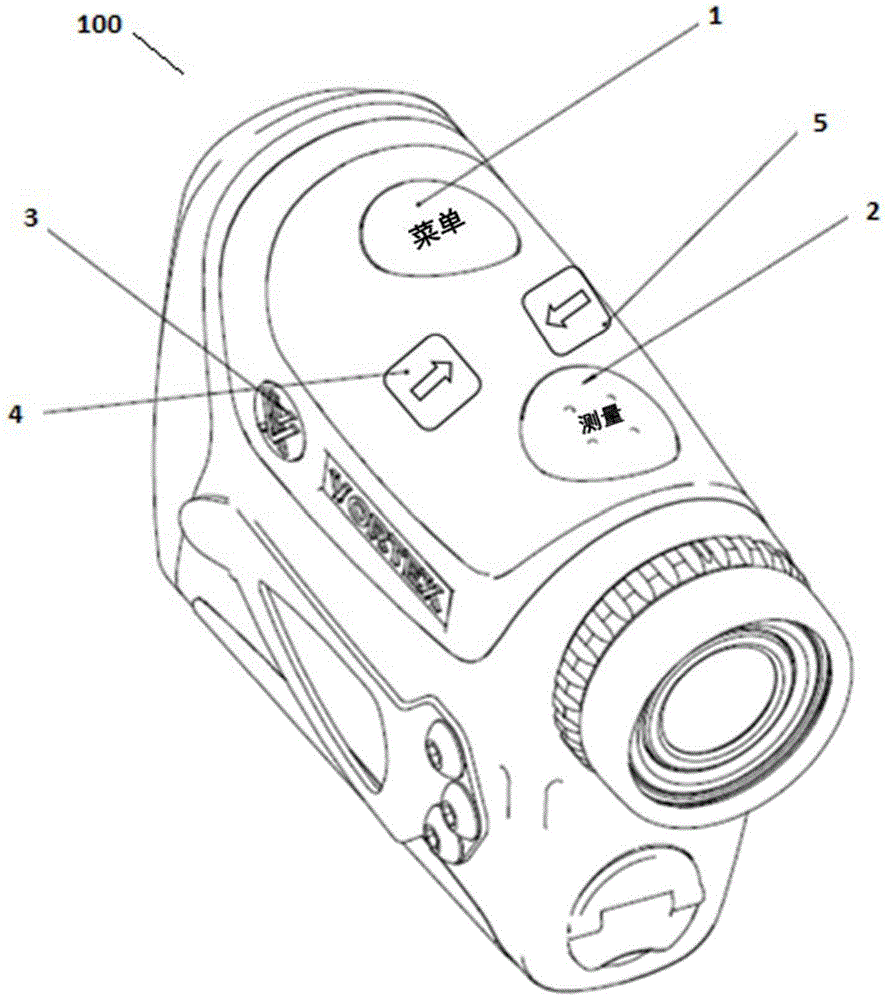
图1是根据本公开的实施例的示例性观察光学器件的等距视图,其是测距单筒望远镜,结合了风向捕获功能。1 is an isometric view of an exemplary viewing optics, which is a ranging monocular, incorporating a wind direction capture function, according to an embodiment of the present disclosure.
图2是根据本公开的实施例的示例性观察光学器件的等距视图,其是测距双筒望远镜,结合了风向捕获功能。2 is an isometric view of exemplary viewing optics, which are ranging binoculars, incorporating wind direction capture functionality, in accordance with embodiments of the present disclosure.
图3示出了根据本公开实施例的使用观察光学器件的示例性方法。3 illustrates an exemplary method of using viewing optics according to an embodiment of the present disclosure.
具体实施方式Detailed ways
在一个实施例中,本公开涉及观察光学器件,并且更具体地涉及具有风向捕获功能的观察光学器件。在另一个实施例中,本公开涉及测距仪,并且更具体地涉及具有风向捕获功能的测距仪。下面参考附图描述本公开的某些优选和说明性实施例。本公开不限于这些实施例;而是,提供这些实施例是为了使得本公开将是彻底和完整的,并且将向本领域技术人员充分传达本公开的范围。In one embodiment, the present disclosure relates to observation optics, and more particularly, to observation optics with wind direction capture functionality. In another embodiment, the present disclosure relates to rangefinders, and more particularly to rangefinders with wind direction capture functionality. Certain preferred and illustrative embodiments of the present disclosure are described below with reference to the accompanying drawings. The present disclosure is not limited to these embodiments; rather, these embodiments are provided so that this disclosure will be thorough and complete, and will fully convey the scope of the disclosure to those skilled in the art.
本领域技术人员将认识到,该组特征和/或能力可以容易地在独立观察光学器件的范围内适应,诸如武器瞄准器、前部安装或后部安装的夹式武器瞄准器以及场地部署的光学武器瞄准器的其他排列。此外,本领域技术人员将认识到,特征和能力的各种组合可以被结合到附加模块中,用于翻新任何种类的现有的固定或可变观察光学器件。Those skilled in the art will recognize that this set of features and/or capabilities can be readily adapted within a range of stand-alone viewing optics, such as weapon sights, front-mounted or rear-mounted clip-on weapon sights, and field-deployed Other arrangements of optical weapon sights. Furthermore, those skilled in the art will recognize that various combinations of features and capabilities can be incorporated into add-on modules for retrofitting any kind of existing fixed or variable viewing optics.
定义definition
贯穿全文,相似数字指代相似元件。将理解,尽管术语第一、第二等在本文中可用于描述各种元件、组件、区域和/或部分,但是这些元件、组件、区域和/或部分不应受这些术语限制。这些术语仅用于区分一个元件、组件、区域和/或部分与另一元件、组件、区域和/或部分。因此,在不脱离本公开的情况下,第一元件、组件、区域或部分可以被称为第二元件、组件、区域或部分。Throughout the text, like numbers refer to like elements. It will be understood that, although the terms first, second, etc. may be used herein to describe various elements, components, regions and/or sections, these elements, components, regions and/or sections should not be limited by these terms. These terms are only used to distinguish one element, component, region and/or section from another element, component, region and/or section. Thus, a first element, component, region or section could be termed a second element, component, region or section without departing from the present disclosure.
本公开中的数值范围是近似的,因此,除非另外指出,否则可以包括该范围之外的值。数值范围包括上下限值之间的所有值(包括下限值和上限值,除非另有特别说明),以一个单位为增量,但前提是在任何下限值和上限值之间有至少两个单位的分隔。例如,如果组成、物理或其他特性(例如,距离、速度、速率等)为10到100,则旨在明确列举了所有单独的值(例如10、11、12,等等)和子范围(诸如10至44、55至70、97至100等)。对于包含小于1的值或包含大于1的小数(例如1.1、1.5等)的范围,适当时将一个单位视为0.0001、0.001、0.01或0.1。对于包含小于10的单位数字(例如1到5)的范围,通常将一个单位视为0.1。这些仅是具体意图的示例,并且在所列举的最小值和最大值之间的数值的所有可能的组合应被认为在本公开中明确地陈述。在本公开内,为其他事项中的从设备的使用者到目标的距离提供了数值范围。Numerical ranges in this disclosure are approximate and therefore, unless otherwise indicated, values outside the range may be included. Numerical ranges include all values between upper and lower values (including lower and upper values, unless otherwise specified), in increments of one unit, provided that there is a difference between any lower and upper value. Separation of at least two units. For example, if a composition, physical, or other characteristic (eg, distance, speed, velocity, etc.) is 10 to 100, it is intended that all individual values (eg, 10, 11, 12, etc.) and sub-ranges (eg, 10) be explicitly enumerated to 44, 55 to 70, 97 to 100, etc.). For ranges containing values less than 1 or containing decimals greater than 1 (eg, 1.1, 1.5, etc.), one unit is considered to be 0.0001, 0.001, 0.01, or 0.1, as appropriate. For ranges containing unit numbers less than 10, such as 1 to 5, one unit is generally considered to be 0.1. These are only examples of what is specifically intended, and all possible combinations of numerical values between the minimum and maximum values recited are to be considered to be expressly set forth in this disclosure. Within this disclosure, numerical ranges are provided for the distance from the user of the device to the target, among other things.
为了便于描述,本文中可以使用诸如“在...下方”、“在...以下”、“下”、“在…上方”、“上”之类的空间术语,以便于描述如图所示的一个元件或特征与另一元件或特征的关系。将理解的是,除了附图中描绘的取向之外,空间相对术语还意图涵盖设备在使用或操作中的不同取向。例如,如果附图中的设备被翻转,则被描述为在其他元件或特征“以下”或“下方”的元件将被定向为在其他元件或特征“上方”。因此,示例性术语“在……以下”可以包括在……上方和在……以下两个方位。可以以其他方式定向设备(旋转90°或其他取向),并相应地解释本文中使用的空间相对描述语。For ease of description, spatial terms such as "below", "below", "under", "above", "on" and the like may be used herein to facilitate description as shown in the figures The relationship of one element or feature shown to another element or feature. It will be understood that the spatially relative terms are intended to encompass different orientations of the device in use or operation in addition to the orientation depicted in the figures. For example, if the device in the figures is turned over, elements described as "below" or "beneath" other elements or features would then be oriented "above" the other elements or features. Thus, the exemplary term "below" can encompass both an orientation of above and below. The device may be otherwise oriented (rotated 90° or at other orientations) and the spatially relative descriptors used herein interpreted accordingly.
如本文所用,术语“和/或”包括一个或多个相关联的所列项目的任何和所有组合。例如,当用在诸如“A和/或B”之类的短语中时,短语“和/或”旨在既包括A也包括B;A或B;A(单独);和B(单独)。同样地,用在诸如“A,B和/或C”之类的短语中的术语“和/或”旨在涵盖以下每个实施例“A,B和C;A,B或C;A或C;A或B;B或C;A和C;A和B;B和C;A(单独);B(单独);和C(单独)”。As used herein, the term "and/or" includes any and all combinations of one or more of the associated listed items. For example, when used in a phrase such as "A and/or B," the phrase "and/or" is intended to include both A and B; A or B; A (alone); and B (alone). Likewise, the term "and/or" used in a phrase such as "A, B and/or C" is intended to cover each of the following embodiments "A, B and C; A, B or C; A or C; A or B; B or C; A and C; A and B; B and C; A (alone); B (alone); and C (alone)."
如本文所使用的,术语“风速计”是指用于测量风的力、速率以及在一些实施例中方向的仪器。风速计包括但不限于叶轮型风速计、超声波风速计、热线风速计、压力管风速计、杯型风速计和激光多普勒风速计。As used herein, the term "anemometer" refers to an instrument used to measure the force, velocity and, in some embodiments, direction of wind. Anemometers include, but are not limited to, vane anemometers, ultrasonic anemometers, hot wire anemometers, pressure tube anemometers, cup anemometers, and laser Doppler anemometers.
如本文所用,术语“弹道学”指的是涉及射弹,特别是子弹、非制导炸弹、火箭等的发射、飞行、行为和作用的力学领域,以及设计和加速射弹以达到所需性能的科学或技术。As used herein, the term "ballistics" refers to the field of mechanics concerned with the launch, flight, behavior and action of projectiles, particularly bullets, unguided bombs, rockets, etc., and the design and acceleration of projectiles to achieve desired properties science or technology.
如本文所使用的,术语“弹道计算器”是指一种计算机程序,其为用户/射击者/观察者提供射弹的轨迹的解。在一个实施例中,弹道计算器用于产生射弹的校正的瞄准点。如本文所使用的,术语“弹道计算器”和“弹道计算机程序”可互换使用。As used herein, the term "ballistic calculator" refers to a computer program that provides a user/shooter/observer with a solution to the trajectory of a projectile. In one embodiment, a ballistics calculator is used to generate a corrected aiming point for the projectile. As used herein, the terms "ballistics calculator" and "ballistics computer program" are used interchangeably.
如本文所用,术语“大气压力传感器”是指测量由大气施加的压力以及这种压力的变化的装置、仪器或组件。As used herein, the term "barometric pressure sensor" refers to a device, instrument or assembly that measures the pressure exerted by the atmosphere and changes in such pressure.
如本文中所使用的,术语“子弹”是指用于从枪械(诸如步枪或左轮手枪)上取下的射弹,其通常由金属制成,圆柱形和尖头。子弹有时可能包含爆炸物。As used herein, the term "bullet" refers to a projectile for removal from a firearm, such as a rifle or revolver, which is generally made of metal, cylindrical and pointed. Bullets can sometimes contain explosives.
如本文所使用,术语“计算机存储器”和“计算机存储设备”是指计算机处理器可读的任何存储介质。计算机存储器的示例包括但不限于RAM、ROM、计算机芯片、数字视频光盘(DVD)、光盘(CD)、硬盘驱动器(HDD)和磁带。As used herein, the terms "computer memory" and "computer storage device" refer to any storage medium readable by a computer processor. Examples of computer memory include, but are not limited to, RAM, ROM, computer chips, digital video disks (DVDs), compact disks (CDs), hard disk drives (HDDs), and magnetic tapes.
如本文所使用的,术语“计算机可读介质”是指用于存储信息(例如,数据和指令)并将信息提供给计算机处理器的任何设备或系统。计算机可读介质的示例包括但不限于DVD、CD、硬盘驱动器、存储器芯片、磁带和用于通过网络流式传输媒体的服务器。As used herein, the term "computer-readable medium" refers to any device or system for storing information (eg, data and instructions) and providing information to a computer processor. Examples of computer-readable media include, but are not limited to, DVDs, CDs, hard drives, memory chips, magnetic tapes, and servers for streaming media over a network.
如本文所使用,术语“处理器”和“中央处理单元”或“CPU”可互换使用,并且是指能够从计算机存储器(例如,ROM或其他计算机存储器)读取程序并根据程序执行一组步骤的设备。As used herein, the terms "processor" and "central processing unit" or "CPU" are used interchangeably and refer to a program capable of reading a program from a computer memory (eg, ROM or other computer memory) and executing a set of programs in accordance with the program step device.
如本文中所使用的,术语“方向传感器”是指用于方向传感器连接或集成到的设备相对于基本方向的取向的设备、仪器或组件。在一个实施例中,方向传感器是罗盘。As used herein, the term "orientation sensor" refers to a device, instrument or component for the orientation of the device to which the orientation sensor is connected or integrated relative to the cardinal direction. In one embodiment, the direction sensor is a compass.
如本文所使用的,术语“枪支”是指便携式枪,是发射通常由爆炸力的作用而驱动的一个或多个射弹的桶装武器。示例性枪支包括但不限于手枪、长枪、步枪、猎枪、卡宾枪、自动武器、半自动武器、机枪、冲锋枪、自动步枪和突击步枪。As used herein, the term "firearm" refers to a portable gun, a barreled weapon that fires one or more projectiles, usually driven by the action of explosive force. Exemplary firearms include, but are not limited to, pistols, long guns, rifles, shotguns, carbines, automatic weapons, semi-automatic weapons, machine guns, submachine guns, automatic rifles, and assault rifles.
如本文所用,术语“湿度传感器”是指感测、测量并且在一些实施例中报告设备、仪器或组件所暴露于的环境(例如空气)中的相对湿度的设备、仪器或组件。As used herein, the term "humidity sensor" refers to a device, instrument, or component that senses, measures, and in some embodiments reports relative humidity in the environment (eg, air) to which the device, instrument, or component is exposed.
如本文中所使用的,术语“激光测距仪”是指使用激光束来确定到目标物体的距离的设备或组件。As used herein, the term "laser rangefinder" refers to a device or component that uses a laser beam to determine the distance to a target object.
如本文所用,术语“在...上”,“连接至”和“耦合至”在用于两个部件、元件或层时是指这两个部件、元件或层直接或间接地彼此物理或可操作地耦合,并且可以存在一个或多个中间组件、元件或层。相反,术语“直接在...上”,“直接连接至”和“直接耦合至”是指两个部件、元件或层物理或操作地彼此耦合,没有中间的部件、元件或层。As used herein, the terms "on", "connected to" and "coupled to" when used in reference to two components, elements or layers mean that the two components, elements or layers are directly or indirectly physically or Operably coupled, and one or more intervening components, elements or layers may be present. In contrast, the terms "directly on", "directly connected to" and "directly coupled to" mean that two components, elements or layers are physically or operatively coupled to each other without intervening components, elements or layers.
如本文中所使用的,术语“温度传感器”是指感测、测量并且在一些实施例中报告温度传感器所暴露于的环境(例如空气)的温度的设备、仪器或组件。As used herein, the term "temperature sensor" refers to a device, instrument, or component that senses, measures, and in some embodiments reports the temperature of the environment (eg, air) to which the temperature sensor is exposed.
如本文中所使用的,术语“用户”是指进行射击的操作员或与进行射击的操作员协作观察射击的个人。As used herein, the term "user" refers to an operator who conducts the shot or an individual who observes the shot in collaboration with the operator who conducts the shot.
如本文中所使用的,术语“观察光学器件”是指由用户、射击者或观察者用来选择、识别和/或监视目标的装置或组件。观察光学器件可以依赖于对目标的目视观察,或者例如依赖于红外(IR)、紫外(UV)、雷达、热、微波、磁成像、包括X射线、伽马射线、同位素和粒子辐射的辐射、夜视、振动接收器(包括超声波、声脉冲、声纳、地震振动、磁共振、重力接收器)、广播频率(包括无线电波、电视和蜂窝接收器)或目标的其他图像。通过观察光学器件呈现给用户/射击者/观察者的目标图像可以保持不变,或者可以例如通过扩大、放大、减法、叠加、过滤、稳定化、模板匹配或其他方式来增强。由观察光学器件选择、识别和/或监视的目标可以在射击者的视线内或与射击者的视线相切。在其他实施例中,当观察光学器件呈现目标的聚焦图像时,射击者的视线可能会被遮挡。由观察光学器件获取的目标的图像可以例如是模拟或数字的,并且可以通过例如视频、物理电缆或电线、IR、无线电波、蜂窝连接、激光脉冲、光学802.1lb或使用例如诸如html、SML、SOAP、X.25、SNA等协议、BluetoothTM、串行、USB的其他无线传输或其他合适的图像分发方法,在一个或多个射击者和观察者的网络内共享、存档或传输。As used herein, the term "viewing optics" refers to a device or component used by a user, shooter, or observer to select, identify, and/or monitor a target. Observation optics may rely on visual observation of the target, or, for example, on infrared (IR), ultraviolet (UV), radar, thermal, microwave, magnetic imaging, radiation including X-rays, gamma rays, isotopic and particle radiation , night vision, vibration receivers (including ultrasonic, sonic, sonar, seismic vibration, magnetic resonance, gravity receivers), broadcast frequencies (including radio waves, television, and cellular receivers), or other images of the target. The target image presented to the user/shooter/observer by viewing optics may remain unchanged, or may be enhanced, eg, by upscaling, magnification, subtraction, overlay, filtering, stabilization, template matching, or other means. Targets selected, identified and/or monitored by viewing optics may be within or tangent to the shooter's line of sight. In other embodiments, the shooter's line of sight may be blocked when the viewing optics present a focused image of the target. The image of the target acquired by the viewing optics can be, for example, analog or digital, and can be obtained by, for example, video, physical cables or wires, IR, radio waves, cellular connections, laser pulses, optical 802.1lb, or using, for example, html, SML, Protocols such as SOAP, X.25, SNA, Bluetooth ™ , Serial, USB, or other wireless transmissions, or other suitable image distribution methods, are shared, archived or transmitted within a network of one or more shooters and observers.
本文公开的装置和方法涉及观察光学器件。在一个实施例中,观察光学器件具有主体,以及安装在主体内的用于确定风向的方向传感器。在一实施例中,方向传感器耦合到观察光学器件。在一实施例中,方向传感器直接或间接耦合至观察光学器件。在一实施例中,方向传感器被集成到观察光学器件中。在一个实施例中,方向传感器是具有3轴加速度计和3轴磁力计的罗盘。The devices and methods disclosed herein relate to viewing optics. In one embodiment, the viewing optics has a body, and a direction sensor mounted within the body for determining wind direction. In one embodiment, the direction sensor is coupled to the viewing optics. In one embodiment, the orientation sensor is coupled directly or indirectly to the viewing optics. In one embodiment, the orientation sensor is integrated into the viewing optics. In one embodiment, the orientation sensor is a compass with a 3-axis accelerometer and a 3-axis magnetometer.
在一个实施例中,本文公开的装置和方法涉及具有测距能力的观察光学器件。在一个实施例中,本文公开的观察光学器件可以确定影响射弹轨迹的一个或多个变量。在一个实施例中,本文公开的观察光学器件可以确定到目标距离的信息,并且可以自动确定大气压力、环境温度和相对湿度,并且提供用于确定风向的便利方法。In one embodiment, the apparatus and methods disclosed herein relate to viewing optics with ranging capabilities. In one embodiment, the viewing optics disclosed herein can determine one or more variables that affect the trajectory of the projectile. In one embodiment, the viewing optics disclosed herein can determine distance to target information, and can automatically determine barometric pressure, ambient temperature, and relative humidity, and provide a convenient method for determining wind direction.
在一个实施例中,观察光学器件具有用于确定到目标距离的信息的测距系统;用于确定风向的风向传感器,以及与测距系统和风向传感器通信并具有弹道计算机程序的处理器,其中弹道计算机程序使用该距离和风向来确定射弹的轨迹。在一个实施例中,弹道计算机程序可以计算校正的瞄准点。In one embodiment, the viewing optics has a ranging system for determining distance to target information; a wind direction sensor for determining wind direction, and a processor in communication with the ranging system and the wind direction sensor and having a ballistic computer program, wherein A ballistic computer program uses this distance and wind direction to determine the trajectory of the projectile. In one embodiment, a ballistics computer program can calculate the corrected aiming point.
图1是根据本公开的实施例的示例性观察光学器件100的等距视图,其是测距单筒望远镜,结合了风向捕获功能。在一个实施例中,观察光学器件100具有主体,该主体具有方向传感器,该方向传感器可以确定风向,而无需用户将变量输入到系统中。方向传感器可以自动确定风向。在一个实施例中,观察光学器件100使用方向传感器基于观察光学器件100的位置来确定风的方向。在一个实施例中,观察光学器件100可以具有显示器。1 is an isometric view of an
在所示的实施例中,观察光学器件100分别包括菜单按钮1、测量按钮2、风捕获按钮3以及第一和第二选择按钮4、5。观察光学器件100还包括机载测距仪功能。菜单按钮1允许用户访问机载测距仪功能,例如进入和/或退出各种模式。测量按钮2用于发射激光,以获得到预期目标的距离。风捕获按钮3用于进入和/或退出模式,该模式允许捕获风向和/或捕获风速。第一和第二选择按钮4、5允许用户导航浏览菜单和/或在风捕获模式下增加和/或减小风速。在一个实施例中,第一和第二选择按钮4、5允许用户增加和/或减小风速,而不管机载测距仪的模式如何。In the embodiment shown, the
在一个实施例中,在激活测量按钮2时,方向传感器可以确定指向目标的方向。In one embodiment, when the
在一个实施例中,可以在菜单模式下调整的变量和特征的类型包括但不限于轮廓、风速、弹道系数、枪口速度、阻力标准、瞄准高度和零范围。在一些实施例中,可以被调整或可以被输入数据的观察光学器件的参数可以被分类为菜单选项和菜单选择。例如,菜单选项可以是参数或变量本身,例如距离单位或弹道系数。菜单选择将是针对该参数的选定值或数据输入,并且可以通过滚动或单击可以选择的选项来提供,甚至可以手动输入到观察光学器件本身中,或者通过从另一设备输入的数据来提供。在一个实施例中,菜单选项允许选择距离单位,并且用户可以从菜单选择中选择码或米。In one embodiment, the types of variables and features that can be adjusted in menu mode include, but are not limited to, profile, wind speed, ballistic coefficient, muzzle velocity, drag level, aiming height, and zero range. In some embodiments, the parameters of the viewing optics that can be adjusted or data can be entered can be categorized into menu options and menu selections. For example, menu options can be parameters or variables themselves, such as distance units or ballistic coefficients. The menu selection will be the selected value or data entry for that parameter and can be provided by scrolling or clicking an option that can be selected, or even manually entered into the viewing optics itself, or through data entry from another device. supply. In one embodiment, a menu option allows selection of distance units, and the user can select yards or meters from the menu selection.
图2是根据本公开实施例的示例性观察光学器件100′的等距视图,其是测距双筒望远镜,结合了风向捕获功能。类似于测距单筒望远镜100,双筒望远镜100′也分别具有机载弹道计算器(如上所述)、菜单按钮1、测量按钮2、风捕获按钮3以及第一和第二选择按钮4、5。菜单按钮1允许用户访问机载测距仪功能,例如进入和/或退出各种模式。测量按钮2用于发射激光,以获得到预期目标的距离。风捕获按钮3用于进入和/或退出模式,该模式允许捕获风向和/或捕获风速。第一和第二选择按钮4、5允许用户导航浏览菜单和/或在风捕获模式下时增加和/或减小风速。在一个实施例中,第一和第二选择按钮4、5允许用户增加和/或减小风速,而不管机载测距仪的模式如何。2 is an isometric view of an exemplary viewing optics 100', which is a ranging binocular, incorporating wind direction capture functionality, in accordance with an embodiment of the present disclosure. Similar to the
在一个实施例中,观察光学器件100/100'进一步包括集成的方向传感器,例如罗盘(未示出)。方向传感器可以独立于弹道计算器,或者在其他实施例中,与弹道计算器通信(直接或间接)。在所示的特定实施例中,方向传感器可操作地耦合到风捕获按钮3。风捕获按钮3的激活使得风向被测量和/或捕获。In one embodiment,
在一个实施例中,方向传感器是具有6轴集成线性加速度计和磁力计的罗盘。在一个实施例中,方向传感器是具有3轴加速度计和3轴磁力计的罗盘。In one embodiment, the orientation sensor is a compass with a 6-axis integrated linear accelerometer and magnetometer. In one embodiment, the orientation sensor is a compass with a 3-axis accelerometer and a 3-axis magnetometer.
在一个实施例中,在激活距离测量按钮2时,方向传感器还可以确定指向目标的方向。在一个实施例中,当测距系统被激活时,方向传感器确定指向目标的方向。在一个实施例中,针对捕获的风向计算目标的方向。In one embodiment, when the
在一个实施例中,方向传感器相对于捕获的风的方向确定指向目标的方向,其可以被存储在一个或多个存储设备中。In one embodiment, the direction sensor determines the direction to the target relative to the direction of the captured wind, which may be stored in one or more storage devices.
在一个实施例中,观察光学器件100/100'还包括测距系统(未示出)。标准测距系统使用激光束来确定到物体或目标的距离,并通过向目标发送激光脉冲并测量该脉冲从目标反射并返回所用的时间来进行操作。一般而言,激光脉冲是从发射器发出的,例如脉冲激光二极管。发射的一部分光束穿过光束分离器,一部分反射到检测器。发出的激光脉冲穿过传输透镜到达目标,目标将一部分激光脉冲反射经过接收透镜,然后再经过接收器到微控制器单元,该微控制器单元使用众所周知的数学原理计算到目标的距离。测距系统还可以是具有附加或替代部件的更复杂的系统,例如,包括增益控制部件、充电电容器和模数转换器。In one embodiment, the
在一实施例中,观察光学器件100/100'还包括风速计、大气压力传感器、湿度传感器和温度传感器中的至少一个传感器。在一优选实施例中,观察光学器件100/100′包括风速计、大气压力传感器、湿度传感器和温度传感器中的至少一个、至少两个、至少三个或全部四个。这些传感器可操作地耦合到弹道计算器,使得弹道计算器可以利用由一个或多个传感器捕获的数据来确定子弹轨迹。In one embodiment, the
在另一实施例中,一个或多个传感器可操作地耦合到存储设备。存储设备存储由一个或多个传感器捕获的数据。In another embodiment, one or more sensors are operably coupled to the storage device. The storage device stores data captured by one or more sensors.
在又一实施例中,一个或多个传感器可操作地耦合到显示器,使得能够显示由一个或多个传感器捕获的数据。In yet another embodiment, the one or more sensors are operably coupled to the display such that data captured by the one or more sensors can be displayed.
在一个实施例中,分别通过温度计、气压计、湿度计、高度计和测光计感测与温度、大气压力、湿度、高度和环境光条件相关的弹道参数。从这些数字弹道参数仪器中的每一个感测到的数字读数还被配置为被发送(例如,实时)到具有弹道计算机程序的处理器。In one embodiment, ballistic parameters related to temperature, barometric pressure, humidity, altitude, and ambient light conditions are sensed by thermometers, barometers, hygrometers, altimeters, and light meters, respectively. The digital readings sensed from each of these digital ballistic parameter instruments are also configured to be sent (eg, in real time) to a processor with a ballistics computer program.
在一个实施例中,观察光学器件可具有惯性导航单元,其包括但不限于3轴罗盘、3轴加速度计和3轴陀螺仪。在其他实施例中,利用适当的软件,3轴罗盘、3轴加速度计和3轴陀螺仪可以作为单独的部件结合到观察光学器件100/100'中,而不是作为整体单元结合到观察光学器件100/100'中。并且在其他实施例中,可以省略陀螺仪。此外,可以使用其他倾斜传感器代替加速度计。其他倾斜传感器的示例包括电解液位倾斜传感器、光学气泡倾斜传感器、电容式气泡倾斜传感器、摆机构、旋转光学编码器、旋转电阻式编码器、霍尔效应器件和陶瓷电容式倾斜传感器。In one embodiment, the viewing optics may have an inertial navigation unit including, but not limited to, a 3-axis compass, a 3-axis accelerometer, and a 3-axis gyroscope. In other embodiments, with appropriate software, the 3-axis compass, 3-axis accelerometer, and 3-axis gyroscope may be incorporated into the
在一个实施例中,观察光学器件100/100'具有包含弹道计算器或弹道计算机程序的处理器或计算设备,用户可以使用与弹道计算器可操作地连接的一个或多个按钮,访问弹道计算器或弹道计算机程序以基于一种或多种因素(例如射弹重量、到目标的距离和环境因素(例如风速和风向))来确定射弹的轨迹。In one embodiment,
在一个实施例中,弹道计算器使用从方向传感器获得的两个变量来计算弹道解:(1)风的产生方向;和(2)指向目标的方向。在一个实施例中,在通过测距系统确定到目标的距离的同时捕获指向目标的方向。在一个实施例中,指向目标的方向是相对于捕获的风向来计算的。In one embodiment, the ballistics calculator uses two variables obtained from the directional sensor to calculate the ballistic solution: (1) the direction of wind generation; and (2) the direction towards the target. In one embodiment, the direction to the target is captured while the distance to the target is determined by the ranging system. In one embodiment, the direction to the target is calculated relative to the captured wind direction.
在一个实施例中,包含弹道计算器程序的处理器可以接收弹道数据的一个或多个方面,包括但不限于有关外部场况的信息(例如,日期、时间、温度、相对湿度、目标图像分辨率、气压、风速、风向、半球、纬度、经度、高度),枪支信息(例如,枪管扭转的速率和方向、内部枪管直径、枪管内径和枪管长度),射弹信息(例如射弹重量、射弹直径、射弹口径、射弹横截面密度、一个或多个射弹弹道系数(如本文所用,“弹道系数”由美国步枪兵WilliamDavis举例说明,1989年3月,以引用方式并入本文)、射弹配置、推进剂类型、推进剂量、推进剂势力、底火(primer)和弹壳的枪口速度),目标获取设备和分划板信息(例如,分划板的类型、放大倍数、功能的第一、第二或固定平面、目标获取设备与镜筒之间的距离、目标获取设备与镜筒之间的位置关系、使用特定的枪支和弹壳将望远镜的瞄准器清零的范围),有关射击者的信息(例如,射击者的视敏度、视觉特质、心率和节律、呼吸频率、血氧饱和度、肌肉活动、脑波活动以及协助射击者的观察者的数量和位置坐标),以及射击者与目标之间的关系(例如,射击者与目标之间的距离、目标相对于射击者移动的速度和方向、或射击者相对于目标移动的速度和方向(例如,射击者在移动的车辆中)以及离真实北向的方向、以及步枪枪管相对于垂直于重力绘制的线的角度)。In one embodiment, a processor containing a ballistics calculator program may receive one or more aspects of ballistics data, including but not limited to information about external field conditions (eg, date, time, temperature, relative humidity, target image resolution rate, air pressure, wind speed, wind direction, hemisphere, latitude, longitude, altitude), gun information (e.g., rate and direction of barrel twist, internal barrel diameter, barrel ID, and barrel length), projectile information (e.g., shot Projectile weight, projectile diameter, projectile caliber, projectile cross-sectional density, one or more projectile ballistic coefficients (as used herein, "ballistic coefficient" exemplified by U.S. Rifleman William Davis, March 1989, by reference incorporated herein), projectile configuration, propellant type, propellant amount, propellant power, primer and cartridge muzzle velocity), target acquisition equipment and reticle information (e.g., reticle type, magnification) multiplier, first, second or fixed plane of function, distance between target acquisition device and lens barrel, positional relationship between target acquisition device and lens barrel, use of specific firearms and cartridges to zero out the scope of the telescope range), information about the shooter (e.g., the shooter's visual acuity, visual traits, heart rate and rhythm, breathing rate, oxygen saturation, muscle activity, brain wave activity, and the number and location of observers assisting the shooter coordinates), and the relationship between the shooter and the target (e.g., the distance between the shooter and the target, the speed and direction at which the target is moving relative to the shooter, or the speed and direction at which the shooter is moving relative to the target (e.g., shooting in a moving vehicle) and the direction from true north, and the angle of the rifle barrel relative to a line drawn perpendicular to gravity).
在一个实施例中,观察光学器件100,尤其是弹道计算器,具有至少两个用户选择的模式,包括但不限于“弹道”模式。弹道计算对于在超过500码的距离处的射击者极为重要。在这些距离下,重力、子弹特性、枪支特性、温度、大气压、相对湿度、风向和风速的作用对子弹的总体轨迹影响更大。In one embodiment,
在一个实施例中,还可以从遥感设备向处理器馈送风数据、温度数据和其他环境现场数据。在一个实施例中,遥感设备可以无线地链接到处理器。处理器可以根据从测距仪、测斜仪和遥感设备收集的数据确定一个或多个弹道参数,然后基于这些弹道参数计算所需的瞄准点(POA)至弹着点(POI)调整量。然后,处理器可以将表示POA至POI调整所需的或期望的竖直和左右瞄准调整的数据信号传输到显示器。如本文所述,可以通过基于有线的链路或无线链路来实现处理器与显示器之间的信号的这种通信。In one embodiment, the processor may also be fed wind data, temperature data, and other environmental field data from the remote sensing device. In one embodiment, the telemetry device may be wirelessly linked to the processor. The processor may determine one or more ballistic parameters from data collected from rangefinders, inclinometers, and remote sensing devices, and then calculate the required point of sight (POA) to point of impact (POI) adjustments based on these ballistic parameters. The processor may then transmit a data signal to the display representing the required or desired vertical and left-right aiming adjustments for POA-to-POI adjustments. Such communication of signals between the processor and the display may be accomplished through a wire-based link or a wireless link, as described herein.
在一个实施例中,观察光学器件100/100'还包括存储设备(未示出)。存储设备可以是内部的,从而包含在观察光学器件100/100'内,或者在观察光学器件100/100'外部且与观察光学器件100/100'通信(有线或无线)。在这样的实施例中,存储设备可操作地连接到方向传感器和弹道计算器两者。在实施例中,与方向传感器和/或弹道计算器的连接可以是有线的或利用无线通信技术。在具有存储设备的实施例中,捕获的风向数据可以存储在存储设备中并且可以由弹道计算器访问。In one embodiment,
此外,在捕获并存储风向的情况下,除非风向或风速发生变化,否则用户可以连续地对目标进行测距并获得进行了风校正的弹道解。但是,如果风稳定,则用户只需要对新目标进行测距,这提供了简单有效的过程来获得进行了风校正的弹道解。Additionally, with the wind direction captured and stored, unless the wind direction or speed changes, the user can continuously range the target and obtain a wind-corrected ballistic solution. However, if the wind is stable, the user only needs to range the new target, which provides a simple and efficient process to obtain a wind-corrected ballistic solution.
在实施例中,观察光学器件100/100'包括显示器。显示器可以集成在观察光学镜100/100'的视线内,或者在观察光学镜100/100'的外部可见。在其他实施例中,显示器可以是与观察光学器件100/100'分离的部件,例如计算机、平板电脑、移动电话、电视或其他设备,并且与观察光学器件100/100'通信。显示器配置为显示各种信息,包括菜单选项和弹道数据。In an embodiment, the
在特定实施例中,显示器被配置为显示到目标的距离。例如,当观察光学器件100/100'包括激光测距仪功能时,如上所述,并且特别参考测量按钮2,弹道计算机将计算到目标的距离。当测量按钮2被激活(例如,被按下)时,观察光学器件100/100'将发射激光束,用户将激光束指向期望的目标。激光束从目标反射离开,返回到观察光学器件100/100'。弹道计算机基于信号强度和接收反射光束所需的时间来计算从观察光学器件100/100'到目标的距离。In certain embodiments, the display is configured to display the distance to the target. For example, when the
在另一个实施例中,观察光学器件100/100'包括测斜仪。在这样的实施例中,显示器可以被配置为显示目标的仰角。In another embodiment, the
将会认识到,本文所述的按钮1-5的具体形状、布置和物理设计可以变化,只要按钮1-5可操作地连接至机载测距仪系统以实现功能即可。It will be appreciated that the specific shape, arrangement and physical design of the buttons 1-5 described herein may vary, so long as the buttons 1-5 are operably connected to the onboard rangefinder system to function.
在实施例中,观察光学器件100/100'帮助用户补偿风向和风速。In an embodiment, the
如上所述,风向和风速会对子弹轨迹产生重大影响。另外,大气压力、环境温度和相对湿度也会影响轨迹。尽管从射击者到目标的距离通常是最重要的因素,但上面列出的每个环境因素也可以极大地影响轨迹。下表说明了其中一些参数变化10%的效果。As mentioned above, wind direction and speed can have a significant impact on bullet trajectory. In addition, atmospheric pressure, ambient temperature, and relative humidity also affect the trajectory. While the distance from the shooter to the target is usually the most important factor, each of the environmental factors listed above can also greatly affect the trajectory. The table below illustrates the effect of changing some of these parameters by 10%.
表1Table 1

实际上,表1显示,改变到目标的距离对轨迹的影响最大,其次是大气压和风速。例如,当使用特定的枪支,给定的弹药和在1,000码处的一致目标时,风向和风速会极大地影响子弹的行进甚至达到80英寸或更大。通过特定的示例,以下值显示了基于用户使用温彻斯特.308步枪,霍纳迪ELD-X 178谷物子弹,步枪零射程100码,枪口速度为每秒2650英尺,大气压为29.08inHg,温度为70°F,相对湿度为60%,射击1,000码处的目标,风可以对子弹轨迹的影响:In fact, Table 1 shows that changing the distance to the target has the greatest impact on the trajectory, followed by atmospheric pressure and wind speed. For example, when using a specific gun, a given ammo, and a consistent target at 1,000 yards, wind direction and speed can greatly affect the bullet's travel even up to 80 inches or more. By way of a specific example, the following values show that based on a user using a Winchester .308 rifle, a Hornady ELD-X 178 grain bullet, the rifle has a zero range of 100 yards, a muzzle velocity of 2650 feet per second, and an atmospheric pressure of 29.08 inHg, With a temperature of 70°F and a relative humidity of 60%, shooting at a target at 1,000 yards, wind can affect the trajectory of the bullet:
(1)风向是相对于目标为0°,时速为0英里/小时(mph)-子弹将下降约357英寸,并向左移动约6英寸。(1) The wind direction is 0° relative to the target and the speed is 0 miles per hour (mph) - the bullet will drop about 357 inches and move about 6 inches to the left.
(2)风向是相对于目标为90°,以10mph的速度-子弹将下降约357英寸,并向左移动约75英寸。(2) The wind direction is 90° relative to the target at 10mph - the bullet will drop about 357 inches and move about 75 inches to the left.
(3)风向是相对于目标为40°,以10mph的速度-子弹将下降约359英寸,并向左移动约47英寸。(3) The wind direction is 40° relative to the target at 10mph - the bullet will drop about 359 inches and move about 47 inches to the left.
以上情形仅示出了当来自不同方向时,10mph的风对子弹轨迹有多大影响。应当理解,到目标的距离越大,风对子弹轨迹的影响越大。The above scenario just shows how much a 10mph wind affects the bullet trajectory when coming from different directions. It should be understood that the greater the distance to the target, the greater the effect of wind on the bullet trajectory.
图3示出了根据本公开的实施例的将来自一个方向的风速输入到观察光学器件中的示例性方法300。FIG. 3 illustrates an
首先,访问允许使用方向传感器捕获风向的模式。在一个实施例中,访问模式305的步骤包括按住按钮(或按下特定的按钮序列)以进入将允许使用方向传感器捕获风向的模式。在一个实施例中,特定的按钮是如本文所述的风捕获按钮3。在一个实施例中,按住特定的按钮305的步骤包括按住特定的按钮达特定的时间,例如3至6秒,更优选地3至5秒。要注意的是,如果已经访问了风捕获模式,则可以不需要步骤305。First, access a mode that allows the wind direction to be captured using the directional sensor. In one embodiment, accessing the
接下来,将观察光学器件指向风来自的方向(步骤310)。Next, point the viewing optics in the direction the wind is coming from (step 310).
一旦观察光学器件处于适当的模式并且指向正确的方向,则用户按下按钮以捕获风向(步骤315)。在一个实施例中,该按钮可以与步骤305的特定按钮相同。在另一个实施例中,该按钮是如本文所述的风捕获按钮3。在一个实施例中,按下按钮以捕获风向的步骤包括将按住该按钮达特定的时间,该时间通常小于步骤305的特定时间,例如,小于2秒,或更优选地小于1秒。Once the viewing optics are in the proper mode and pointed in the correct direction, the user presses a button to capture the wind direction (step 315). In one embodiment, this button may be the same as the specific button of
在一个实施例中,按下按钮以捕获风向的步骤315还包括将风向数据自动输入到观察光学器件的机载弹道计算器和/或存储设备。In one embodiment, the
步骤320是按下一个或多个按钮以操纵风速值。在一个实施例中,观察光学器件包括两个按钮,例如上述的第一和第二选择按钮4、5,其中一个用于允许用户增大风速值,另一个用于减小风速值。Step 320 is to press one or more buttons to manipulate the wind speed value. In one embodiment, the viewing optics includes two buttons, such as the first and
接下来,通过激活测距系统来获得距离值(步骤325)。另外,在激活测距系统后,方向传感器还将捕获指向目标的方向。在一个实施例中,获得距离值的步骤包括将观察光学器件瞄准目标并按下特定的按钮以进行测距。同时,方向传感器确定指向目标的方向。Next, the distance value is obtained by activating the ranging system (step 325). In addition, the orientation sensor will also capture the direction towards the target when the ranging system is activated. In one embodiment, the step of obtaining the distance value includes aiming the viewing optics at the target and pressing a specific button to measure the distance. At the same time, the orientation sensor determines the direction towards the target.
在一个实施例中,特定的按钮是如本文所述的测量按钮2。在一个实施例中,按下特定的按钮325的步骤包括按住特定的按钮,例如,持续为获得一致的测量结果所需的一时间段。在一个实施例中。In one embodiment, the specific button is the
可选地,在最后的步骤330中按住特定的按钮(或按下一系列按钮)以退出输入模式。在一个实施例中,特定的按钮是如本文所述的菜单按钮1。在一个实施例中,按住特定的按钮的步骤330包括按住特定的按钮330达特定的时间,例如3至6秒,或者优选地3至5秒。尽管在设置上述每个参数后退出弹道计算器模式非常有用,但通常不需要这样做才能使用观察光学器件。Optionally, a specific button (or series of buttons) is held down in the
在另一实施例中,该方法还包括以下步骤:按下(并且在某些情况下还按住)特定的按钮以进入/退出不同的模式,以捕获和/或显示从附加传感器获得的信息,包括但不限于风速计、气压传感器、湿度传感器和温度传感器。与捕获和/或显示从风速计、气压传感器、湿度传感器和温度传感器获得的数据相关的步骤可以在步骤305、320、325或330之前或在步骤330之后完成。用一个或多个传感器捕获的信息可以存储在存储设备中。In another embodiment, the method further comprises the step of pressing (and in some cases also holding down) specific buttons to enter/exit different modes to capture and/or display information obtained from additional sensors , including but not limited to anemometers, barometric pressure sensors, humidity sensors, and temperature sensors. Steps related to capturing and/or displaying data obtained from anemometers, barometric pressure sensors, humidity sensors, and temperature sensors may be done before
在其他实施例中,该方法包括以下步骤:使用弹道计算器从风速计、气压传感器、湿度传感器和温度传感器中的一个或多个传感器自动捕获数据。当自动地捕获来自风速计、气压传感器、湿度传感器和温度传感器的数据时,可以与步骤305-330中的任何一个同时或在步骤305-330中的任何一个之前或之后捕获数据。In other embodiments, the method includes the step of automatically capturing data from one or more of an anemometer, a barometric pressure sensor, a humidity sensor, and a temperature sensor using a ballistic calculator. When automatically capturing data from anemometers, barometric pressure sensors, humidity sensors, and temperature sensors, the data may be captured concurrently with or before or after any of steps 305-330.
将会认识到,即使风向和风速保持不变,本文公开的方法和结构也可以提高射击的准确性和及时性。允许用户将观察光学器件简单地指向风的方向,并将风信息存储在存储设备中,就可以使弹道计算器在所有范围内参考方向,而不必考虑观察光学器件的取向。It will be appreciated that the methods and structures disclosed herein can improve the accuracy and timeliness of firing even if the wind direction and speed remain the same. Allowing the user to simply point the viewing optics in the direction of the wind and store the wind information in the storage device allows the ballistic calculator to reference the direction at all ranges, regardless of the viewing optics orientation.
通过以下段落进一步描述本文公开的装置和方法:The apparatus and methods disclosed herein are further described by the following paragraphs:
1.一种观察光学器件/测距仪,包括:主体;方向传感器,用于确定风向并安装在主体内;以及处理器,其安装在主体内并能够控制用于在显示器上显示的信息。What is claimed is: 1. A viewing optics/range finder comprising: a main body; a direction sensor for determining wind direction and mounted in the main body; and a processor mounted in the main body and capable of controlling information for display on a display.
2.一种观察光学器件/测距仪,包括:主体;方向传感器,用于确定风向并安装在主体内;以及处理器,其安装在主体内并与方向传感器通信并且能够控制用于在显示器上显示的信息。2. A viewing optics/range finder comprising: a main body; a direction sensor for determining wind direction and mounted in the main body; and a processor mounted in the main body and in communication with the direction sensor and capable of controlling information displayed above.
3.一种观察光学器件/测距仪,包括:主体;用于确定风向并安装在主体内的方向传感器;以及处理器,其安装在主体内并与方向传感器通信,该处理器能够在显示器上显示风向。3. A viewing optics/range finder comprising: a main body; a direction sensor for determining wind direction and mounted in the main body; and a processor mounted in the main body and in communication with the direction sensor, the processor capable of Wind direction is displayed above.
4.一种观察光学器件/测距仪,包括:主体,所述主体包括显示器;测距系统,用于测量到目标的距离并安装在主体内;方向传感器,用于确定风向并安装在主体内;以及处理器,其安装在主体内并能够控制用于在显示器上显示的信息。4. An observation optics/range finder, comprising: a main body, the main body including a display; a ranging system for measuring the distance to a target and installed in the main body; a direction sensor for determining the wind direction and installed in the main body and a processor mounted in the main body and capable of controlling information for display on the display.
5.一种观察光学器件/测距仪,包括:主体,所述主体包括显示器;测距系统,用于测量到目标的距离并安装在主体内;方向传感器,用于确定风向并安装在主体内;以及处理器,其安装在主体内并与测距系统和方向传感器通信,并且能够控制用于在显示器上显示的信息。5. An observation optics/range finder, comprising: a main body, the main body including a display; a ranging system for measuring the distance to a target and installed in the main body; a direction sensor for determining the wind direction and installed in the main body and a processor mounted within the body and in communication with the ranging system and the orientation sensor and capable of controlling information for display on the display.
6.一种观察光学器件/测距仪,包括:主体,所述主体包括显示器;测距系统,用于测量到目标的距离并安装在主体内;方向传感器,用于确定风向并安装在主体内;以及处理器,其安装在主体内并与测距系统和方向传感器通信,并具有弹道计算器,该弹道计算器使用来自测距系统的距离和来自方向传感器的风向来确定被传送到显示器的弹道轨迹。6. An observation optics/range finder, comprising: a main body, the main body including a display; a ranging system for measuring the distance to a target and installed in the main body; a direction sensor for determining the wind direction and installed in the main body and a processor mounted within the body and in communication with the ranging system and the directional sensor and having a ballistic calculator that uses the distance from the ranging system and the wind direction from the directional sensor to determine which is transmitted to the display ballistic trajectory.
7.一种观察光学器件/测距仪,包括:主体,所述主体包括显示器;测距系统,用于测量到目标的距离并安装在主体内;方向传感器,用于确定风向并安装在主体内;以及处理器,其安装在主体内并与测距系统和方向传感器通信,并且具有弹道计算器,该弹道计算器使用来自测距系统的距离和来自方向传感器的风向来确定校正的瞄准点。7. An observation optics/range finder, comprising: a main body, the main body including a display; a ranging system for measuring the distance to a target and installed in the main body; a direction sensor for determining the wind direction and installed in the main body and a processor mounted within the body and in communication with the ranging system and the directional sensor and having a ballistics calculator that uses the distance from the ranging system and the wind direction from the directional sensor to determine a corrected aiming point .
8.前述段落中任一项所述的观察光学器件/测距仪,还包括安装在主体内的处理器。8. The viewing optics/rangefinder of any preceding paragraph, further comprising a processor mounted within the body.
9.前述段落中任一项所述的观察光学器件/测距仪,还包括测距系统,该测距系统确定到目标的距离并安装在主体内。9. The viewing optics/range finder of any preceding paragraph, further comprising a ranging system that determines the distance to the target and is mounted within the body.
10.前述段落中任一项所述的观察光学器件/测距仪,其中,处理器与测距系统通信。10. The viewing optics/range finder of any preceding paragraph, wherein the processor is in communication with a ranging system.
11.前述段落中任一项所述的观察光学器件/测距仪,其中,处理器与方向传感器通信。11. The viewing optics/range finder of any preceding paragraph, wherein the processor is in communication with the orientation sensor.
12.前述段落中任一项所述的观察光学器件/测距仪,其中,处理器具有弹道计算机程序,该弹道计算机程序使用来自测距系统的距离和来自方向传感器的风向来确定弹道轨迹。12. The viewing optics/range finder of any of the preceding paragraphs, wherein the processor has a ballistic computer program that uses the distance from the ranging system and the wind direction from the directional sensor to determine the ballistic trajectory.
13.前述段落中任一项所述的观察光学器件/测距仪,还包括用于存储来自方向传感器的信息的存储设备,其中该存储设备与方向传感器通信。13. The viewing optics/range finder of any preceding paragraph, further comprising a storage device for storing information from the orientation sensor, wherein the storage device is in communication with the orientation sensor.
14.前述段落中任一项所述的观察光学器件/测距仪,还包括选自由以下各项组成的组的至少一个附加传感器:风速计、气压传感器、湿度传感器和温度传感器及其组合。14. The viewing optics/range finder of any of the preceding paragraphs, further comprising at least one additional sensor selected from the group consisting of an anemometer, a barometric pressure sensor, a humidity sensor, and a temperature sensor, and combinations thereof.
15.前述段落中任一项所述的观察光学器件/测距仪,还包括安装在主体上并且可操作地连接到测距系统的第一按钮。15. The viewing optics/rangefinder of any preceding paragraph, further comprising a first button mounted on the body and operably connected to the rangefinder system.
16.前述段落中任一项所述的观察光学器件/测距仪,还包括安装在主体上并且可操作地连接至方向传感器的第二按钮。16. The viewing optics/rangefinder of any preceding paragraph, further comprising a second button mounted on the body and operably connected to the orientation sensor.
17.前述段落中任一项所述的观察光学器件/测距仪,还包括用来在方向传感器接合后调整风速的第三按钮。17. The viewing optics/range finder of any preceding paragraph, further comprising a third button for adjusting wind speed after the orientation sensor is engaged.
18.前述段落中任一项所述的观察光学器件/测距镜,其是一种测距双筒望远镜。18. The viewing optics/rangefinder of any preceding paragraph, which is a rangefinder binocular.
19.前述段落中任一项所述的观察光学器件/测距镜,其是一种测距单筒望远镜。19. The viewing optics/ranging scope of any preceding paragraph, which is a ranging monocular.
20.前述段落中任一项所述的观察光学器件/测距仪,其中方向传感器是罗盘。20. The viewing optics/rangefinder of any preceding paragraph, wherein the directional sensor is a compass.
21.前述段落中任一项所述的观察光学器件/测距仪,其中,方向传感器是具有3轴加速度计和3轴磁力计的罗盘。21. The viewing optics/rangefinder of any preceding paragraph, wherein the orientation sensor is a compass having a 3-axis accelerometer and a 3-axis magnetometer.
22.一种计算弹道轨迹的方法,包括:将观察光学器件指向与风产生的方向相对应的方向;该观察光学器件具有主体,安装在该主体内的方向传感器以及与该方向传感器通信并具有弹道程序的处理器;通过激活方向传感器或与方向传感器通信来捕获风向;将风向传送给处理器;以及使用弹道程序来确定弹道轨迹。22. A method of calculating a ballistic trajectory comprising: pointing a viewing optics in a direction corresponding to a direction in which wind is generated; the viewing optics having a body, a directional sensor mounted in the body and in communication with the directional sensor and having A processor for the ballistics program; captures the wind direction by activating or communicating with the direction sensor; communicates the wind direction to the processor; and uses the ballistics program to determine the ballistic trajectory.
23.一种计算弹道轨迹的方法,包括:将观察光学器件指向与风产生的方向相对应的方向;该观察光学器件具有主体,安装在该主体内的方向传感器,以及与该方向传感器通信并具有弹道程序的处理器;通过按下与方向传感器通信的按钮来捕获风向;按下一个或多个按钮输入风速;并且将风向和风速传送给处理器;并且在弹道程序中使用风向和风速来确定弹道轨迹。23. A method of calculating a ballistic trajectory, comprising: pointing a viewing optics in a direction corresponding to a direction in which wind is generated; the viewing optics having a body, a directional sensor mounted within the body, and in communication with the directional sensor and A processor with a ballistics program; captures wind direction by pressing a button in communication with a direction sensor; pressing one or more buttons to enter wind speed; and communicates wind direction and wind speed to the processor; and uses wind direction and wind speed in the ballistics program to Determine the ballistic trajectory.
24.一种计算弹道轨迹的方法,包括:将观察光学器件指向与风产生的方向相对应的方向;该观察光学器件具有主体,安装在该主体内的方向传感器,用于确定到目标的距离的测距系统,以及与该方向传感器和测距系统通信并具有弹道程序的处理器;通过激活方向传感器来捕获风向;输入风速;通过激活测距系统来确定到目标的距离;将风向、风速和到目标的距离传送给处理器;以及在弹道程序中使用风向、风速和距离来确定弹道轨迹。24. A method of calculating a ballistic trajectory, comprising: pointing a viewing optics in a direction corresponding to a direction in which wind is generated; the viewing optics having a body, a directional sensor mounted in the body for determining a distance to a target and a processor in communication with the direction sensor and the ranging system and having a ballistic program; capturing the wind direction by activating the direction sensor; inputting the wind speed; determining the distance to the target by activating the ranging system; and distance to the target are sent to the processor; and the wind direction, wind speed, and distance are used in the ballistics program to determine the ballistic trajectory.
25.一种计算弹道轨迹的方法,包括:将观察光学器件指向与风产生的方向相对应的方向;该观察光学器件具有主体,安装在该主体内的方向传感器,用于确定到目标的距离的测距系统,以及与该方向传感器和测距系统通信并具有弹道程序的处理器;通过按下与方向传感器通信的按钮来捕获风向;按下一个或多个按钮输入风速;通过按下与测距系统通信的按钮来确定到目标的距离;将风向、风速和到目标的距离传送给处理器;以及在弹道程序中使用风向、风速和距离来确定弹道轨迹。25. A method of calculating a ballistic trajectory, comprising: pointing a viewing optics in a direction corresponding to a direction in which wind is generated; the viewing optics having a body, a directional sensor mounted in the body for determining a distance to a target a ranging system, and a processor in communication with the direction sensor and the ranging system and having a ballistic program; capturing wind direction by pressing a button in communication with the direction sensor; entering wind speed by pressing one or more buttons; A button that communicates with the ranging system to determine the distance to the target; transmits the wind direction, wind speed, and distance to the target to the processor; and uses the wind direction, wind speed, and distance in the ballistics program to determine the ballistic trajectory.
26.一种确定风向的方法,包括:将观察光学器件指向与风产生的方向相对应的方向;该观察光学器件具有主体,安装在该主体内的方向传感器以及与该方向传感器通信的处理器,该主体具有显示器;通过按下与方向传感器通信的按钮来捕获风向,并将风向传送到显示器。26. A method of determining wind direction, comprising: pointing a viewing optics in a direction corresponding to the direction in which the wind is generated; the viewing optics having a body, a direction sensor mounted in the body, and a processor in communication with the direction sensor , the main body has a display; the wind direction is captured by pressing a button that communicates with an orientation sensor, and the wind direction is transmitted to the display.
27.一种确定风向的方法,包括:访问观察光学器件的风捕获模式,所述观察光学器件具有主体,安装在所述主体内的方向传感器,以及与方向传感器通信的处理器,所述主体具有显示器;将观察光学器件指向与风产生的方向相对应的方向;通过按下与方向传感器通信的按钮来捕获风向,并且将风向传送到显示器。27. A method of determining wind direction, comprising: accessing a wind capture mode of viewing optics, the viewing optics having a body, a direction sensor mounted within the body, and a processor in communication with the direction sensor, the body Have a display; point the viewing optics in a direction corresponding to the direction the wind is producing; capture the wind direction by pressing a button that communicates with the direction sensor, and transmit the wind direction to the display.
28.前述段落中任一项所述的方法,还包括在指向观察光学器件之前,访问观察光学器件的风向捕获模式。28. The method of any of the preceding paragraphs, further comprising accessing a wind direction capture mode of the viewing optics prior to pointing the viewing optics.
29.前述段落中任一项所述的方法,还包括在指向观察光学器件之前,通过按下与方向传感器通信的按钮来访问风向捕获模式。29. The method of any preceding paragraph, further comprising accessing a wind direction capture mode by pressing a button in communication with the direction sensor prior to pointing the viewing optics.
30.前述段落中任一项所述的方法,还包括输入风速并将风速传送给处理器。30. The method of any of the preceding paragraphs, further comprising inputting the wind speed and communicating the wind speed to the processor.
31.前述段落中任一项所述的方法,其中激活方向传感器包括按压/推动/滑动控制装置,使得方向传感器是激活的或处于开启模式。31. The method of any of the preceding paragraphs, wherein activating the orientation sensor comprises pressing/pushing/sliding a control such that the orientation sensor is active or in an on mode.
32.根据前述段落中的任一项所述的方法,其中,激活测距系统包括按压/推动/滑动控制装置,使得测距系统是激活的或处于开启模式。32. The method of any of the preceding paragraphs, wherein activating the ranging system comprises pressing/pushing/sliding a control such that the ranging system is active or in an on mode.
33.前述段落中任一项所述的方法,还通过按下一个或多个按钮或控制装置来输入风速。33. The method of any preceding paragraph, further entering wind speed by pressing one or more buttons or controls.
34.前述段落中的任一项所述的方法,还包括将风向存储在存储设备上。34. The method of any of the preceding paragraphs, further comprising storing the wind direction on a storage device.
35.前述段落中任一项所述的方法,还包括通过将观察光学器件瞄准目标并激活测距系统来获得距离值。35. The method of any of the preceding paragraphs, further comprising obtaining the distance value by aiming the viewing optics at the target and activating the ranging system.
36.前述段落中任一项所述的方法,还包括通过将观察光学器件瞄准目标并按下与测距系统通信的特定按钮来获得距离值。36. The method of any preceding paragraph, further comprising obtaining the distance value by aiming the viewing optics at the target and pressing a specific button in communication with the ranging system.
37.前述段落中任一项所述的方法,还包括从观察光学器件的一个或多个传感器捕获信息的步骤,所述传感器选自由风速计、气压传感器、湿度传感器以及温度传感器构成的组。37. The method of any preceding paragraph, further comprising the step of capturing information from one or more sensors of the viewing optics selected from the group consisting of an anemometer, a barometric pressure sensor, a humidity sensor, and a temperature sensor.
38.前述段落中任一项所述的观察光学器件/测距仪,其中,方向传感器还确定目标的方向。38. The viewing optics/rangefinder of any preceding paragraph, wherein the orientation sensor also determines the orientation of the target.
39.前述段落中任一项所述的观察光学器件/测距仪,其中,方向传感器还在测距系统激活时确定目标的方向。39. The viewing optics/rangefinder of any preceding paragraph, wherein the orientation sensor also determines the orientation of the target when the rangefinder system is activated.
40.前述段落中任一项所述的观察光学器件/测距仪,其中,弹道计算机程序还使用来自方向传感器的目标的方向来确定弹道轨迹。40. The viewing optics/rangefinder of any of the preceding paragraphs, wherein the ballistic computer program further uses the direction of the target from the direction sensor to determine the ballistic trajectory.
41.前述段落中任一项所述的观察光学器件/测距仪,其中,单个方向传感器确定风产生的方向和目标的方向。41. The viewing optics/rangefinder of any preceding paragraph, wherein a single direction sensor determines the direction of wind generation and the direction of the target.
42.前述段落中任一项所述的测距仪,其中,所述测距仪没有显示器。42. The range finder of any preceding paragraph, wherein the range finder has no display.
43.前述段落中任一项所述的测距仪,其中,所述测距仪与具有显示器的第二设备通信。43. The range finder of any preceding paragraph, wherein the range finder is in communication with a second device having a display.
尽管这里已经详细描述了观察光学器件/测距仪的多个实施例,但是显然可以对其进行修改和变型,所有这些修改和变型都落入本发明的真实精神和范围内。然后,关于以上描述,将认识到,本公开的观察光学器件的部件的最佳尺寸关系,包括尺寸、材料、形状、形式、功能和操作方式、组装和使用方式的变化,对于本领域的技术人员来说被认为是显而易见的,并且与附图中示出的以及说明书中所描述的那些内容的所有等同关系旨在被本公开的实施例所涵盖。此外,由于本领域技术人员将容易想到许多修改和改变,因此不希望将本发明限制于所示出和描述的确切构造和操作,因此,在本公开的范围可以采用所有合适的修改和等同方式。Although various embodiments of the viewing optics/rangefinder have been described in detail herein, it is evident that modifications and variations can be made thereto, all of which fall within the true spirit and scope of the present invention. Then, with respect to the above description, it will be appreciated that the optimal dimensional relationships of the components of the viewing optics of the present disclosure, including variations in size, material, shape, form, function and manner of operation, assembly and use, are relevant to those skilled in the art All equivalents to those shown in the drawings and described in the specification are intended to be apparent to those skilled in the art and are intended to be encompassed by embodiments of the present disclosure. Furthermore, since many modifications and changes will readily occur to those skilled in the art, it is not desired to limit the invention to the precise construction and operation shown and described, but all suitable modifications and equivalents may be employed within the scope of this disclosure .
Claims (20)
Priority Applications (1)
| Application Number | Priority Date | Filing Date | Title |
|---|---|---|---|
| CN202410707005.1A CN118500199A (en) | 2018-04-13 | 2019-04-15 | Observation optics with wind direction capture and methods of using the same |
Applications Claiming Priority (3)
| Application Number | Priority Date | Filing Date | Title |
|---|---|---|---|
| US201862657450P | 2018-04-13 | 2018-04-13 | |
| US62/657,450 | 2018-04-13 | ||
| PCT/US2019/027535 WO2019200399A1 (en) | 2018-04-13 | 2019-04-15 | Viewing optic with wind direction capture and method of using the same |
Related Child Applications (1)
| Application Number | Title | Priority Date | Filing Date |
|---|---|---|---|
| CN202410707005.1A Division CN118500199A (en) | 2018-04-13 | 2019-04-15 | Observation optics with wind direction capture and methods of using the same |
Publications (3)
| Publication Number | Publication Date |
|---|---|
| CN112119278A true CN112119278A (en) | 2020-12-22 |
| CN112119278B CN112119278B (en) | 2024-06-18 |
| CN112119278B8 CN112119278B8 (en) | 2024-07-12 |
Family
ID=68160237
Family Applications (2)
| Application Number | Title | Priority Date | Filing Date |
|---|---|---|---|
| CN201980032418.1A Active CN112119278B8 (en) | 2018-04-13 | 2019-04-15 | Observation optics with wind direction capture and method of using the same |
| CN202410707005.1A Pending CN118500199A (en) | 2018-04-13 | 2019-04-15 | Observation optics with wind direction capture and methods of using the same |
Family Applications After (1)
| Application Number | Title | Priority Date | Filing Date |
|---|---|---|---|
| CN202410707005.1A Pending CN118500199A (en) | 2018-04-13 | 2019-04-15 | Observation optics with wind direction capture and methods of using the same |
Country Status (13)
| Country | Link |
|---|---|
| US (3) | US11002514B2 (en) |
| EP (1) | EP3775754A4 (en) |
| JP (2) | JP2021521449A (en) |
| KR (2) | KR102756232B1 (en) |
| CN (2) | CN112119278B8 (en) |
| AU (1) | AU2019253107B2 (en) |
| CA (1) | CA3096881C (en) |
| IL (1) | IL277948A (en) |
| MX (1) | MX2020010833A (en) |
| MY (1) | MY209088A (en) |
| PH (1) | PH12020551693A1 (en) |
| WO (1) | WO2019200399A1 (en) |
| ZA (1) | ZA202007011B (en) |
Families Citing this family (8)
| Publication number | Priority date | Publication date | Assignee | Title |
|---|---|---|---|---|
| JP2021521449A (en) * | 2018-04-13 | 2021-08-26 | シェルタード ウィングス インコーポレイテッド | Observation optics with wind direction capture and how to use them |
| USD919460S1 (en) * | 2019-06-12 | 2021-05-18 | Hvrt Corp. | Laser range finder |
| TWD212580S (en) * | 2020-07-01 | 2021-07-11 | 亞洲光學股份有限公司 | Rangefinder |
| EP4211417A4 (en) * | 2020-09-10 | 2024-08-21 | Sheltered Wings, Inc. D/b/a/ Vortex Optics | VIEWING OPTICS |
| KR102400115B1 (en) * | 2021-08-13 | 2022-05-23 | (주)텔미전자 | Sensor system of remote controlled pistol device |
| AU2023245705A1 (en) | 2022-03-30 | 2024-11-14 | Sheltered Wings, Inc. D/B/A Vortex Optics | User interface for viewing optic with wind direction capture |
| US20240019229A1 (en) * | 2022-07-18 | 2024-01-18 | Michael Robert Christensen | Attachable Anemometer for Firearm |
| USD1022731S1 (en) * | 2022-08-03 | 2024-04-16 | Arizona Board of Regents on Behalf of the University | Golf rangefinder |
Citations (4)
| Publication number | Priority date | Publication date | Assignee | Title |
|---|---|---|---|---|
| US20130206836A1 (en) * | 2012-02-15 | 2013-08-15 | Burris Company, Inc. | Optical device having windage measurement instruments |
| US20160091282A1 (en) * | 2014-04-01 | 2016-03-31 | Joe D. Baker | Mobile ballistics processing and targeting display system |
| CN105683706A (en) * | 2013-08-22 | 2016-06-15 | 夏尔特银斯公司 | Laser rangefinder with improved display |
| US20170176143A1 (en) * | 2015-12-22 | 2017-06-22 | Huntercraft Limited | Photoelectric sighting device capable of performing 3d positioning and display of target object |
Family Cites Families (43)
| Publication number | Priority date | Publication date | Assignee | Title |
|---|---|---|---|---|
| US3475821A (en) | 1969-02-04 | 1969-11-04 | Charles R Huddleston | Sub-target aiming device |
| US3609299A (en) | 1970-03-30 | 1971-09-28 | Jerauld G Wright | Navigational computer |
| US3744133A (en) | 1971-04-15 | 1973-07-10 | Tasco Sales | Collimating device for telescopic sights |
| US5291262A (en) | 1989-03-27 | 1994-03-01 | Dunne Jeremy G | Laser surveying instrument |
| JPH0843561A (en) * | 1994-07-29 | 1996-02-16 | Casio Comput Co Ltd | Wind direction and anemometer |
| US5574552A (en) | 1995-01-19 | 1996-11-12 | Laser Technology, Inc. | Self-calibrating precision timing circuit and method for a laser range finder |
| GB9620001D0 (en) | 1996-09-25 | 1996-11-13 | Firearms Research Ltd | Optical sighting devices |
| US5914775A (en) | 1997-05-23 | 1999-06-22 | Browning | Triangulation rangefinder and sight positioning system |
| US6516699B2 (en) | 1997-12-08 | 2003-02-11 | Horus Vision, Llc | Apparatus and method for calculating aiming point information for rifle scopes |
| US7832137B2 (en) | 1997-12-08 | 2010-11-16 | Horus Vision, Llc | Apparatus and method for calculating aiming point information |
| US6453595B1 (en) | 1997-12-08 | 2002-09-24 | Horus Vision, Llc | Gunsight and reticle therefor |
| US5920995A (en) | 1997-12-08 | 1999-07-13 | Sammut; Dennis J. | Gunsight and reticle therefor |
| US7937878B2 (en) | 1997-12-08 | 2011-05-10 | Horus Vision Llc | Apparatus and method for calculating aiming point information |
| US7856750B2 (en) | 1997-12-08 | 2010-12-28 | Horus Vision Llc | Apparatus and method for calculating aiming point information |
| US6405107B1 (en) | 2001-01-11 | 2002-06-11 | Gary Derman | Virtual instrument pilot: an improved method and system for navigation and control of fixed wing aircraft |
| US6873406B1 (en) | 2002-01-11 | 2005-03-29 | Opti-Logic Corporation | Tilt-compensated laser rangefinder |
| US9310165B2 (en) | 2002-05-18 | 2016-04-12 | John Curtis Bell | Projectile sighting and launching control system |
| US8468930B1 (en) | 2002-05-18 | 2013-06-25 | John Curtis Bell | Scope adjustment method and apparatus |
| US6933859B2 (en) | 2003-08-07 | 2005-08-23 | Honeywell International Inc. | Lateral acceleration indicator for aircraft |
| US7603804B2 (en) | 2003-11-04 | 2009-10-20 | Leupold & Stevens, Inc. | Ballistic reticle for projectile weapon aiming systems and method of aiming |
| US7516571B2 (en) | 2004-05-12 | 2009-04-14 | Scrogin Andrew D | Infrared range-finding and compensating scope for use with a projectile firing device |
| US20050268521A1 (en) | 2004-06-07 | 2005-12-08 | Raytheon Company | Electronic sight for firearm, and method of operating same |
| US7411590B1 (en) | 2004-08-09 | 2008-08-12 | Apple Inc. | Multimedia file format |
| WO2006060490A2 (en) | 2004-11-30 | 2006-06-08 | Bernard Thomas Windauer | Locking turret knob |
| US20060273932A1 (en) | 2005-06-02 | 2006-12-07 | Wise Nathan C | Data entry apparatus and method |
| US7933929B1 (en) | 2005-06-27 | 2011-04-26 | Google Inc. | Network link for providing dynamic data layer in a geographic information system |
| TWI429875B (en) | 2005-11-01 | 2014-03-11 | Leupold & Stevens Inc | Ballistic ranging methods and systems for inclined shooting |
| US20070103671A1 (en) | 2005-11-08 | 2007-05-10 | Honeywell International Inc. | Passive-optical locator |
| US7658031B2 (en) | 2005-12-21 | 2010-02-09 | Bushnell, Inc. | Handheld rangefinder operable to determine hold over ballistic information |
| US8072581B1 (en) | 2007-01-19 | 2011-12-06 | Rockwell Collins, Inc. | Laser range finding system using variable field of illumination flash lidar |
| US7836626B2 (en) | 2007-02-28 | 2010-11-23 | Shepherd Daniel R | Telescopic gun sight windage correction system |
| US7683962B2 (en) | 2007-03-09 | 2010-03-23 | Eastman Kodak Company | Camera using multiple lenses and image sensors in a rangefinder configuration to provide a range map |
| WO2011139291A2 (en) | 2009-09-11 | 2011-11-10 | Laurence Andrew Bay | System and method for ballistic solutions |
| US8408460B2 (en) | 2010-06-03 | 2013-04-02 | United States Of America As Represented By The Secretary Of The Navy | Auto adjusting ranging device |
| US8172139B1 (en) | 2010-11-22 | 2012-05-08 | Bitterroot Advance Ballistics Research, LLC | Ballistic ranging methods and systems for inclined shooting |
| US8713843B2 (en) | 2011-01-16 | 2014-05-06 | Bernard T. Windauer | Operator-programmable-trajectory turret knob |
| US8650220B2 (en) | 2012-06-05 | 2014-02-11 | Google Inc. | System and method for storing and retrieving geospatial data |
| US8529380B1 (en) | 2012-08-20 | 2013-09-10 | Dale Edward Hubenthal | Apparatus, system and method for golf club recommendation |
| US9151570B2 (en) | 2012-10-26 | 2015-10-06 | Bushnell, Inc. | Synchronized elevation trajectory riflescope |
| US9062961B2 (en) | 2013-02-18 | 2015-06-23 | Laxco Inc. | Systems and methods for calculating ballistic solutions |
| US10184758B2 (en) | 2014-09-19 | 2019-01-22 | Philip Lyren | Weapon targeting system |
| AT519642B1 (en) * | 2015-01-20 | 2019-01-15 | Leupold & Stevens Inc | Real-time ballistic solutions for calculating a target match and specifying a subsonic threshold |
| JP2021521449A (en) * | 2018-04-13 | 2021-08-26 | シェルタード ウィングス インコーポレイテッド | Observation optics with wind direction capture and how to use them |
-
2019
- 2019-04-15 JP JP2020556274A patent/JP2021521449A/en active Pending
- 2019-04-15 WO PCT/US2019/027535 patent/WO2019200399A1/en not_active Ceased
- 2019-04-15 KR KR1020207031869A patent/KR102756232B1/en active Active
- 2019-04-15 MX MX2020010833A patent/MX2020010833A/en unknown
- 2019-04-15 MY MYPI2020005347A patent/MY209088A/en unknown
- 2019-04-15 KR KR1020257001227A patent/KR20250042742A/en active Pending
- 2019-04-15 US US16/384,515 patent/US11002514B2/en active Active
- 2019-04-15 CN CN201980032418.1A patent/CN112119278B8/en active Active
- 2019-04-15 EP EP19784441.8A patent/EP3775754A4/en active Pending
- 2019-04-15 CA CA3096881A patent/CA3096881C/en active Active
- 2019-04-15 AU AU2019253107A patent/AU2019253107B2/en active Active
- 2019-04-15 CN CN202410707005.1A patent/CN118500199A/en active Pending
-
2020
- 2020-10-11 IL IL277948A patent/IL277948A/en unknown
- 2020-10-13 PH PH12020551693A patent/PH12020551693A1/en unknown
- 2020-11-11 ZA ZA2020/07011A patent/ZA202007011B/en unknown
-
2021
- 2021-05-07 US US17/314,238 patent/US11802752B2/en active Active
-
2023
- 2023-10-30 US US18/497,418 patent/US20240060747A1/en active Pending
- 2023-12-28 JP JP2023222906A patent/JP2024026607A/en active Pending
Patent Citations (4)
| Publication number | Priority date | Publication date | Assignee | Title |
|---|---|---|---|---|
| US20130206836A1 (en) * | 2012-02-15 | 2013-08-15 | Burris Company, Inc. | Optical device having windage measurement instruments |
| CN105683706A (en) * | 2013-08-22 | 2016-06-15 | 夏尔特银斯公司 | Laser rangefinder with improved display |
| US20160091282A1 (en) * | 2014-04-01 | 2016-03-31 | Joe D. Baker | Mobile ballistics processing and targeting display system |
| US20170176143A1 (en) * | 2015-12-22 | 2017-06-22 | Huntercraft Limited | Photoelectric sighting device capable of performing 3d positioning and display of target object |
Also Published As
| Publication number | Publication date |
|---|---|
| MY209088A (en) | 2025-06-20 |
| IL277948A (en) | 2020-11-30 |
| EP3775754A4 (en) | 2022-01-05 |
| CA3096881A1 (en) | 2019-10-17 |
| JP2021521449A (en) | 2021-08-26 |
| AU2019253107B2 (en) | 2025-03-27 |
| US11002514B2 (en) | 2021-05-11 |
| JP2024026607A (en) | 2024-02-28 |
| US11802752B2 (en) | 2023-10-31 |
| WO2019200399A1 (en) | 2019-10-17 |
| KR102756232B1 (en) | 2025-01-20 |
| ZA202007011B (en) | 2021-10-27 |
| US20240060747A1 (en) | 2024-02-22 |
| KR20250042742A (en) | 2025-03-27 |
| PH12020551693A1 (en) | 2021-07-19 |
| CA3096881C (en) | 2025-04-08 |
| CN112119278B8 (en) | 2024-07-12 |
| CN118500199A (en) | 2024-08-16 |
| EP3775754A1 (en) | 2021-02-17 |
| KR20210005618A (en) | 2021-01-14 |
| US20190316880A1 (en) | 2019-10-17 |
| AU2019253107A1 (en) | 2020-11-05 |
| MX2020010833A (en) | 2021-01-15 |
| US20210262761A1 (en) | 2021-08-26 |
| CN112119278B (en) | 2024-06-18 |
Similar Documents
| Publication | Publication Date | Title |
|---|---|---|
| CN112119278B (en) | Observation optics with wind direction capture and method of using the same | |
| US10254082B2 (en) | Apparatus and method for calculating aiming point information | |
| US8172139B1 (en) | Ballistic ranging methods and systems for inclined shooting | |
| EP2781875A2 (en) | Precision aiming system for a weapon | |
| US20240191970A1 (en) | Ballistic calculator hub | |
| US12366953B2 (en) | User interface for viewing optic with wind direction capture | |
| JP7644753B2 (en) | Rangefinder with multiple ballistic calculators | |
| CN121498474A (en) | Ballistics Calculator Center |
Legal Events
| Date | Code | Title | Description |
|---|---|---|---|
| PB01 | Publication | ||
| PB01 | Publication | ||
| SE01 | Entry into force of request for substantive examination | ||
| SE01 | Entry into force of request for substantive examination | ||
| GR01 | Patent grant | ||
| GR01 | Patent grant | ||
| CI03 | Correction of invention patent | ||
| CI03 | Correction of invention patent |
Correction item: Inventor Correct: Richard Campbell|David M. Hamilton|Scott Parks|Paul Nice False: Richard Campbell|David M. Hamilton|Scott Parks|Paul Nice Number: 25-01 Page: The title page Volume: 40 Correction item: Inventor Correct: Richard Campbell|David M. Hamilton|Scott Parks|Paul Nice False: Richard Campbell|David M. Hamilton|Scott Parks|Paul Nice Number: 25-01 Volume: 40 |
|
| OR01 | Other related matters | ||
| OR01 | Other related matters |