CN112105957A - Method for handling GNSS reference frame information of a reference station - Google Patents
Method for handling GNSS reference frame information of a reference station Download PDFInfo
- Publication number
- CN112105957A CN112105957A CN201980033528.XA CN201980033528A CN112105957A CN 112105957 A CN112105957 A CN 112105957A CN 201980033528 A CN201980033528 A CN 201980033528A CN 112105957 A CN112105957 A CN 112105957A
- Authority
- CN
- China
- Prior art keywords
- reference frame
- network node
- location
- network
- frame
- Prior art date
- Legal status (The legal status is an assumption and is not a legal conclusion. Google has not performed a legal analysis and makes no representation as to the accuracy of the status listed.)
- Pending
Links
- 238000000034 method Methods 0.000 title claims abstract description 124
- 238000005259 measurement Methods 0.000 claims abstract description 69
- 230000009466 transformation Effects 0.000 claims abstract description 21
- 238000012545 processing Methods 0.000 claims description 112
- 230000015654 memory Effects 0.000 claims description 32
- 230000004044 response Effects 0.000 claims description 8
- 230000005540 biological transmission Effects 0.000 claims description 7
- 238000004590 computer program Methods 0.000 claims description 6
- 238000013519 translation Methods 0.000 abstract description 4
- 230000000295 complement effect Effects 0.000 abstract 1
- 238000004891 communication Methods 0.000 description 55
- 230000006870 function Effects 0.000 description 40
- 238000003860 storage Methods 0.000 description 29
- 230000008901 benefit Effects 0.000 description 17
- 238000010586 diagram Methods 0.000 description 13
- 230000003993 interaction Effects 0.000 description 13
- 230000000875 corresponding effect Effects 0.000 description 12
- 230000008569 process Effects 0.000 description 12
- 238000007726 management method Methods 0.000 description 11
- 238000005516 engineering process Methods 0.000 description 9
- 230000010267 cellular communication Effects 0.000 description 6
- 230000011664 signaling Effects 0.000 description 6
- 238000004364 calculation method Methods 0.000 description 5
- 230000003287 optical effect Effects 0.000 description 5
- 238000003491 array Methods 0.000 description 4
- 230000002596 correlated effect Effects 0.000 description 4
- 230000001413 cellular effect Effects 0.000 description 3
- 238000012937 correction Methods 0.000 description 3
- 238000001514 detection method Methods 0.000 description 3
- 230000007774 longterm Effects 0.000 description 3
- 238000012544 monitoring process Methods 0.000 description 3
- 230000006855 networking Effects 0.000 description 3
- 238000004422 calculation algorithm Methods 0.000 description 2
- 239000000470 constituent Substances 0.000 description 2
- 125000004122 cyclic group Chemical group 0.000 description 2
- 230000003111 delayed effect Effects 0.000 description 2
- 238000009434 installation Methods 0.000 description 2
- 238000013507 mapping Methods 0.000 description 2
- 230000002085 persistent effect Effects 0.000 description 2
- 238000001228 spectrum Methods 0.000 description 2
- 238000000844 transformation Methods 0.000 description 2
- 241001061260 Emmelichthys struhsakeri Species 0.000 description 1
- 241000760358 Enodes Species 0.000 description 1
- 241000699670 Mus sp. Species 0.000 description 1
- 101150069124 RAN1 gene Proteins 0.000 description 1
- 101150014328 RAN2 gene Proteins 0.000 description 1
- 101100355633 Salmo salar ran gene Proteins 0.000 description 1
- 230000006978 adaptation Effects 0.000 description 1
- 230000002776 aggregation Effects 0.000 description 1
- 238000004220 aggregation Methods 0.000 description 1
- 238000013475 authorization Methods 0.000 description 1
- 239000000969 carrier Substances 0.000 description 1
- 230000008859 change Effects 0.000 description 1
- 230000006835 compression Effects 0.000 description 1
- 238000007906 compression Methods 0.000 description 1
- 238000013500 data storage Methods 0.000 description 1
- 238000013501 data transformation Methods 0.000 description 1
- RGNPBRKPHBKNKX-UHFFFAOYSA-N hexaflumuron Chemical compound C1=C(Cl)C(OC(F)(F)C(F)F)=C(Cl)C=C1NC(=O)NC(=O)C1=C(F)C=CC=C1F RGNPBRKPHBKNKX-UHFFFAOYSA-N 0.000 description 1
- 230000006872 improvement Effects 0.000 description 1
- 230000010354 integration Effects 0.000 description 1
- 239000005433 ionosphere Substances 0.000 description 1
- 238000012423 maintenance Methods 0.000 description 1
- 238000004519 manufacturing process Methods 0.000 description 1
- 238000010295 mobile communication Methods 0.000 description 1
- 238000012986 modification Methods 0.000 description 1
- 230000004048 modification Effects 0.000 description 1
- 230000001151 other effect Effects 0.000 description 1
- 239000003208 petroleum Substances 0.000 description 1
- 230000008439 repair process Effects 0.000 description 1
- 230000011218 segmentation Effects 0.000 description 1
- 230000001568 sexual effect Effects 0.000 description 1
- 239000000779 smoke Substances 0.000 description 1
- 239000007787 solid Substances 0.000 description 1
- 230000001360 synchronised effect Effects 0.000 description 1
- 210000003813 thumb Anatomy 0.000 description 1
- 238000012546 transfer Methods 0.000 description 1
- 230000001131 transforming effect Effects 0.000 description 1
- 230000007704 transition Effects 0.000 description 1
- 230000001960 triggered effect Effects 0.000 description 1
- 239000005436 troposphere Substances 0.000 description 1
- 230000000007 visual effect Effects 0.000 description 1
Images


Classifications
-
- G—PHYSICS
- G01—MEASURING; TESTING
- G01S—RADIO DIRECTION-FINDING; RADIO NAVIGATION; DETERMINING DISTANCE OR VELOCITY BY USE OF RADIO WAVES; LOCATING OR PRESENCE-DETECTING BY USE OF THE REFLECTION OR RERADIATION OF RADIO WAVES; ANALOGOUS ARRANGEMENTS USING OTHER WAVES
- G01S19/00—Satellite radio beacon positioning systems; Determining position, velocity or attitude using signals transmitted by such systems
- G01S19/01—Satellite radio beacon positioning systems transmitting time-stamped messages, e.g. GPS [Global Positioning System], GLONASS [Global Orbiting Navigation Satellite System] or GALILEO
- G01S19/03—Cooperating elements; Interaction or communication between different cooperating elements or between cooperating elements and receivers
- G01S19/04—Cooperating elements; Interaction or communication between different cooperating elements or between cooperating elements and receivers providing carrier phase data
-
- G—PHYSICS
- G01—MEASURING; TESTING
- G01S—RADIO DIRECTION-FINDING; RADIO NAVIGATION; DETERMINING DISTANCE OR VELOCITY BY USE OF RADIO WAVES; LOCATING OR PRESENCE-DETECTING BY USE OF THE REFLECTION OR RERADIATION OF RADIO WAVES; ANALOGOUS ARRANGEMENTS USING OTHER WAVES
- G01S19/00—Satellite radio beacon positioning systems; Determining position, velocity or attitude using signals transmitted by such systems
- G01S19/01—Satellite radio beacon positioning systems transmitting time-stamped messages, e.g. GPS [Global Positioning System], GLONASS [Global Orbiting Navigation Satellite System] or GALILEO
- G01S19/03—Cooperating elements; Interaction or communication between different cooperating elements or between cooperating elements and receivers
- G01S19/07—Cooperating elements; Interaction or communication between different cooperating elements or between cooperating elements and receivers providing data for correcting measured positioning data, e.g. DGPS [differential GPS] or ionosphere corrections
- G01S19/073—Cooperating elements; Interaction or communication between different cooperating elements or between cooperating elements and receivers providing data for correcting measured positioning data, e.g. DGPS [differential GPS] or ionosphere corrections involving a network of fixed stations
-
- G—PHYSICS
- G01—MEASURING; TESTING
- G01S—RADIO DIRECTION-FINDING; RADIO NAVIGATION; DETERMINING DISTANCE OR VELOCITY BY USE OF RADIO WAVES; LOCATING OR PRESENCE-DETECTING BY USE OF THE REFLECTION OR RERADIATION OF RADIO WAVES; ANALOGOUS ARRANGEMENTS USING OTHER WAVES
- G01S19/00—Satellite radio beacon positioning systems; Determining position, velocity or attitude using signals transmitted by such systems
- G01S19/01—Satellite radio beacon positioning systems transmitting time-stamped messages, e.g. GPS [Global Positioning System], GLONASS [Global Orbiting Navigation Satellite System] or GALILEO
- G01S19/03—Cooperating elements; Interaction or communication between different cooperating elements or between cooperating elements and receivers
- G01S19/05—Cooperating elements; Interaction or communication between different cooperating elements or between cooperating elements and receivers providing aiding data
-
- G—PHYSICS
- G01—MEASURING; TESTING
- G01S—RADIO DIRECTION-FINDING; RADIO NAVIGATION; DETERMINING DISTANCE OR VELOCITY BY USE OF RADIO WAVES; LOCATING OR PRESENCE-DETECTING BY USE OF THE REFLECTION OR RERADIATION OF RADIO WAVES; ANALOGOUS ARRANGEMENTS USING OTHER WAVES
- G01S19/00—Satellite radio beacon positioning systems; Determining position, velocity or attitude using signals transmitted by such systems
- G01S19/01—Satellite radio beacon positioning systems transmitting time-stamped messages, e.g. GPS [Global Positioning System], GLONASS [Global Orbiting Navigation Satellite System] or GALILEO
- G01S19/13—Receivers
- G01S19/24—Acquisition or tracking or demodulation of signals transmitted by the system
- G01S19/25—Acquisition or tracking or demodulation of signals transmitted by the system involving aiding data received from a cooperating element, e.g. assisted GPS
-
- G—PHYSICS
- G01—MEASURING; TESTING
- G01S—RADIO DIRECTION-FINDING; RADIO NAVIGATION; DETERMINING DISTANCE OR VELOCITY BY USE OF RADIO WAVES; LOCATING OR PRESENCE-DETECTING BY USE OF THE REFLECTION OR RERADIATION OF RADIO WAVES; ANALOGOUS ARRANGEMENTS USING OTHER WAVES
- G01S19/00—Satellite radio beacon positioning systems; Determining position, velocity or attitude using signals transmitted by such systems
- G01S19/01—Satellite radio beacon positioning systems transmitting time-stamped messages, e.g. GPS [Global Positioning System], GLONASS [Global Orbiting Navigation Satellite System] or GALILEO
- G01S19/13—Receivers
- G01S19/24—Acquisition or tracking or demodulation of signals transmitted by the system
- G01S19/29—Acquisition or tracking or demodulation of signals transmitted by the system carrier including Doppler, related
-
- G—PHYSICS
- G01—MEASURING; TESTING
- G01S—RADIO DIRECTION-FINDING; RADIO NAVIGATION; DETERMINING DISTANCE OR VELOCITY BY USE OF RADIO WAVES; LOCATING OR PRESENCE-DETECTING BY USE OF THE REFLECTION OR RERADIATION OF RADIO WAVES; ANALOGOUS ARRANGEMENTS USING OTHER WAVES
- G01S19/00—Satellite radio beacon positioning systems; Determining position, velocity or attitude using signals transmitted by such systems
- G01S19/38—Determining a navigation solution using signals transmitted by a satellite radio beacon positioning system
- G01S19/39—Determining a navigation solution using signals transmitted by a satellite radio beacon positioning system the satellite radio beacon positioning system transmitting time-stamped messages, e.g. GPS [Global Positioning System], GLONASS [Global Orbiting Navigation Satellite System] or GALILEO
- G01S19/42—Determining position
- G01S19/43—Determining position using carrier phase measurements, e.g. kinematic positioning; using long or short baseline interferometry
-
- G—PHYSICS
- G01—MEASURING; TESTING
- G01S—RADIO DIRECTION-FINDING; RADIO NAVIGATION; DETERMINING DISTANCE OR VELOCITY BY USE OF RADIO WAVES; LOCATING OR PRESENCE-DETECTING BY USE OF THE REFLECTION OR RERADIATION OF RADIO WAVES; ANALOGOUS ARRANGEMENTS USING OTHER WAVES
- G01S19/00—Satellite radio beacon positioning systems; Determining position, velocity or attitude using signals transmitted by such systems
- G01S19/38—Determining a navigation solution using signals transmitted by a satellite radio beacon positioning system
- G01S19/39—Determining a navigation solution using signals transmitted by a satellite radio beacon positioning system the satellite radio beacon positioning system transmitting time-stamped messages, e.g. GPS [Global Positioning System], GLONASS [Global Orbiting Navigation Satellite System] or GALILEO
- G01S19/42—Determining position
- G01S19/43—Determining position using carrier phase measurements, e.g. kinematic positioning; using long or short baseline interferometry
- G01S19/44—Carrier phase ambiguity resolution; Floating ambiguity; LAMBDA [Least-squares AMBiguity Decorrelation Adjustment] method
Landscapes
- Engineering & Computer Science (AREA)
- Radar, Positioning & Navigation (AREA)
- Remote Sensing (AREA)
- Computer Networks & Wireless Communication (AREA)
- Physics & Mathematics (AREA)
- General Physics & Mathematics (AREA)
- Mobile Radio Communication Systems (AREA)
- Position Fixing By Use Of Radio Waves (AREA)
Abstract
示例性实施例包括联合多个参考站估计用户设备UE的地点的方法。此类实施例可包括:执行一个或多个定位测量(例如,GNSS卫星信号的载波‑相位测量);以及接收第一参考系和第二参考系之间的变换信息。此类实施例还可包括基于UE的定位测量、变换信息和多个实体(例如,参考站)的位置坐标来确定UE的地点的估计,其中至少一个实体的位置坐标与第一参考系相关联,并且至少一个其它实体的位置坐标与第二参考系相关联。其它实施例包括由网络节点执行的互补方法以及配置成执行此类方法的网络节点和UE。

Exemplary embodiments include a method of estimating the location of a user equipment UE in conjunction with a plurality of reference stations. Such embodiments may include: performing one or more positioning measurements (eg, carrier-phase measurements of GNSS satellite signals); and receiving translation information between a first frame of reference and a second frame of reference. Such embodiments may also include determining an estimate of the location of the UE based on the UE's positioning measurements, transformation information, and location coordinates of a plurality of entities (eg, reference stations), wherein the location coordinates of at least one entity are associated with the first frame of reference , and the position coordinates of at least one other entity are associated with the second frame of reference. Other embodiments include complementary methods performed by network nodes and network nodes and UEs configured to perform such methods.
Description
技术领域technical field
本公开一般涉及无线通信的领域,并且更具体地涉及用于联合多个参考站确定(例如,在无线网络中操作的)无线装置的地点(position)的技术,其中所述多个参考站提供信息以改善地点确定的精度。The present disclosure relates generally to the field of wireless communications, and more particularly to techniques for determining the position of a wireless device (eg, operating in a wireless network) in conjunction with a plurality of reference stations, wherein the plurality of reference stations provide information to improve the accuracy of location determination.
背景技术Background technique
一般来说,本文中使用的所有术语都要根据它们在相关技术领域中的普通含义来解释,除非从在其中使用它的上下文中清楚地给出和/或暗示了不同的含义。对一(a/an)/该(the)元件、设备、组件、部件、步骤等的所有引用都要开放式地解释为涉及该元件、设备、组件、部件、步骤等的至少一个实例,除非另有明确声明。本文中公开的任何方法的步骤不必按照公开的确切顺序来执行,除非步骤被明确描述为在另一个步骤之后或之前,和/或其中暗示一步骤必须在另一步骤之后或之前。在任何适当的情况下,本文中公开的实施例中的任何实施例的任何特征都可应用于任何其它实施例。同样,实施例中的任何实施例的任何优点都可应用于任何其它实施例,并且反之亦然。根据以下描述,所附实施例的其它目的、特征和优点将显而易见。Generally, all terms used herein are to be interpreted according to their ordinary meaning in the relevant technical field, unless a different meaning is clearly given and/or implied from the context in which it is used. All references to an (a/an)/the (the) element, device, component, component, step, etc. are to be interpreted openly as referring to at least one instance of that element, device, component, component, step, etc., unless otherwise expressly stated. The steps of any method disclosed herein do not have to be performed in the exact order disclosed, unless a step is explicitly described as being after or before another step, and/or where it is implied that one step must be after or before another step. Any feature of any of the embodiments disclosed herein may be applied to any other embodiment, where appropriate. Likewise, any advantage of any of the embodiments may be applied to any other embodiment, and vice versa. Other objects, features and advantages of the appended embodiments will become apparent from the following description.
长期演进(LTE)是在第三代合作伙伴计划(3GPP)内开发并且最初在第8版和第9版中标准化的所谓的第四代(4G)无线电接入技术的总括术语,它还称为演进的UTRAN(E-UTRAN)。LTE以各种许可频带(licensed frequency band)为目标,并且伴有非无线电方面的改进,非无线电方面通常称为系统架构演进(SAE),它包括演进的分组核心(EPC)网络。LTE通过后续版本继续演进,这些版本是根据3GPP及其工作组(WG)(包括无线电接入网络(RAN)WG)和子工作组(例如,RAN1、RAN2等)的标准设置过程开发的。Long Term Evolution (LTE) is an umbrella term for the so-called fourth generation (4G) radio access technologies developed within the 3rd Generation Partnership Project (3GPP) and initially standardized in Releases 8 and 9, which also says For Evolved UTRAN (E-UTRAN). LTE targets various licensed frequency bands and is accompanied by improvements in non-radio aspects, often referred to as System Architecture Evolution (SAE), which include evolved packet core (EPC) networks. LTE continues to evolve through subsequent releases, which were developed according to the standard setting process of 3GPP and its Working Groups (WGs), including the Radio Access Network (RAN) WG, and sub-working groups (eg, RAN1, RAN2, etc.).
LTE版本10(Rel-10)支持大于20 MHz的带宽。对Rel-10的一个重要要求是要确保与LTE Release-8的向后兼容性。这还应包括频谱兼容性。照此,宽带LTE Rel-10载波(例如,比20 MHz宽)应表现为到LTE Rel-8(“传统(legacy)”)终端的多个载波。每个这样的载波可称为分量载波(Component Carrier)(CC)。为了也将宽载波高效地用于传统终端,可在宽带LTE Rel-10载波的所有部分中调度传统终端。实现这一点的一种示例性方式是借助于载波聚合(CA),由此Rel-10终端可接收多个CC,每个CC优选地具有与Rel-8载波相同的结构。类似地,LTE Rel-11中的增强之一是增强的物理下行链路控制信道(ePDCCH),其具有增加容量并改善控制信道资源的空间再利用、改善小区间干扰协调(ICIC)、并支持控制信道的传输分集和/或天线波束成形的目标。LTE Release 10 (Rel-10) supports bandwidths greater than 20 MHz. An important requirement for Rel-10 is to ensure backward compatibility with LTE Release-8. This should also include spectrum compatibility. As such, a wideband LTE Rel-10 carrier (eg, wider than 20 MHz) should appear as multiple carriers to LTE Rel-8 ("legacy") terminals. Each such carrier may be referred to as a Component Carrier (CC). To efficiently use the wide carrier for legacy terminals as well, legacy terminals can be scheduled in all parts of the wideband LTE Rel-10 carrier. An exemplary way to achieve this is by means of carrier aggregation (CA) whereby a Rel-10 terminal can receive multiple CCs, each CC preferably having the same structure as a Rel-8 carrier. Similarly, one of the enhancements in LTE Rel-11 is the Enhanced Physical Downlink Control Channel (ePDCCH), which has increased capacity and improved spatial reuse of control channel resources, improved inter-cell interference coordination (ICIC), and supports The goal of transmit diversity and/or antenna beamforming for control channels.
图1中示出了包括LTE和SAE的网络的总体示例性架构。E-UTRAN 120包括一个或多个演进的节点B(eNB)(诸如eNB 105、110和115)以及一个或多个用户设备(UE)(诸如UE120)。如在3GPP标准内所使用的,“用户设备”或“UE”意味着能够与符合3GGP标准的网络设备(包括E-UTRAN以及通常称为第三代(“3G”)和第二代(“2G”)3GPP无线电接入网络的UTRAN和/或GERAN)通信的任何无线通信装置(例如,智能电话或计算装置)。An overall exemplary architecture of a network including LTE and SAE is shown in FIG. 1 . E-UTRAN 120 includes one or more evolved Node Bs (eNBs), such as eNBs 105, 110, and 115, and one or more user equipments (UEs), such as UE 120. As used within the 3GPP standards, "User Equipment" or "UE" means capable of communicating with 3GGP-compliant network equipment (including E-UTRAN and commonly referred to as third generation ("3G") and second generation ("3G") 2G") UTRAN and/or GERAN) of a 3GPP radio access network (eg, smartphone or computing device).
如由3GPP规定的,E-UTRAN 100负责网络中的所有无线电相关的功能,包括无线电承载控制(radio bearer control)、无线电准入控制(radio admission control)、无线电移动性控制、调度、在上行链路和下行链路中到UE的资源的动态分配以及与UE通信的安全性。这些功能驻留在诸如eNB 105、110和115的eNB中。如图1中所示,E-UTRAN中的eNB经由X2接口彼此通信。As specified by 3GPP, E-UTRAN 100 is responsible for all radio related functions in the network, including radio bearer control, radio admission control, radio mobility control, scheduling, in uplink Dynamic allocation of resources to the UE in the road and downlink and security of communication with the UE. These functions reside in eNBs such as eNBs 105 , 110 and 115 . As shown in Figure 1, the eNBs in E-UTRAN communicate with each other via the X2 interface.
eNB还负责到EPC 130的E-UTRAN接口,特别是到图1中统称为MME/S-GW 134和138所示的移动管理实体(MME)和服务网关(SGW)的S1接口。一般来说,MME/S-GW处置UE的总体控制以及UE和EPC的其余部分之间的数据流两者。更具体来说,MME处理UE和EPC之间的信令(例如,控制平面)协议,这些协议称为非接入层(NAS)协议。S-GW处置UE和EPC之间的所有因特网协议(IP)数据分组(例如,数据或用户平面),并当UE在eNB(诸如eNB 105、110和115)之间移动时充当数据承载的本地移动锚点(local mobility anchor)。The eNB is also responsible for the E-UTRAN interface to the
EPC 130还可包括归属订户服务器(Home Subscriber Server)(HSS)131,它管理用户和订户相关的信息。HSS 131还可提供移动性管理、呼叫和会话设置、用户认证和访问授权方面的支持功能。HSS 131的功能可与传统的归属位置寄存器(HLR)的功能和认证中心(AuC)功能或操作有关。The
在一些实施例中,HSS 131可经由Ud接口与在图1中标记为EPC-UDR 135的用户数据存储库(UDR)通信。EPC-UDR 135可存储通过AuC算法加密之后的用户凭证。这些算法不是标准化的(即,供应商特定的),使得除了HSS 131的供应商之外,存储在EPC-UDR 135中的加密凭证不可供任何其它供应商访问。In some embodiments,
图2A示出了在示例性LTE架构的构成实体(UE、E-UTRAN和EPC)和划分成接入层(AS)和非接入层(NAS)的高级功能方面的示例性LTE架构的高级框图。图1还示出两个特定的接口点,即Uu(UE/E-UTRAN无线电接口)和S1(E-UTRAN/EPC接口),每个接口点使用特定的协议集合,即,无线电协议和S1协议。这两种协议中的每种协议可进一步分割成用户平面(或“U-平面”)和控制平面(或“C-平面”)协议功能性。在Uu接口上,U-平面携带(carry)用户信息(例如,数据分组),而C-平面携带UE和E-UTRAN之间的控制信息。Figure 2A shows the high level of the example LTE architecture in terms of its constituent entities (UE, E-UTRAN and EPC) and high level functions divided into access stratum (AS) and non-access stratum (NAS) block diagram. Figure 1 also shows two specific interface points, namely Uu (UE/E-UTRAN Radio Interface) and S1 (E-UTRAN/EPC Interface), each using a specific set of protocols, namely Radio Protocol and S1 protocol. Each of these two protocols can be further split into user plane (or "U-plane") and control plane (or "C-plane") protocol functionality. On the Uu interface, the U-plane carries user information (eg, data packets), while the C-plane carries control information between the UE and the E-UTRAN.
图2B示出了Uu接口上的示例性C-平面协议栈的框图,该协议栈包括物理层(PHY)、媒体接入控制层(MAC)、无线电链路控制层(RLC)、分组数据收敛协议层(PDCP)和无线电资源控制层(RRC)。PHY层涉及如何使用以及使用什么样的特性来在LTE无线电接口上通过传输信道变换(transfer)数据。MAC层在逻辑信道上提供数据变换服务,将逻辑信道映射到PHY传输信道,并重新分配PHY资源以支持这些服务。RLC层对变换到上层或从上层变换的数据提供错误检测和/或校正、拼接(concatenation)、分割、和重组、重新排序。PHY、MAC和RLC层对U-平面和C-平面两者执行相同的功能。PDCP层为U-平面和C-平面提供加密/解密和完整性保护,并为U-平面提供其它功能,诸如报头压缩。FIG. 2B shows a block diagram of an exemplary C-plane protocol stack on the Uu interface, the protocol stack includes physical layer (PHY), medium access control layer (MAC), radio link control layer (RLC), packet data convergence Protocol layer (PDCP) and Radio Resource Control layer (RRC). The PHY layer is concerned with how and what features are used to transfer data over the LTE radio interface through the transport channel. The MAC layer provides data transformation services on logical channels, maps logical channels to PHY transport channels, and reallocates PHY resources to support these services. The RLC layer provides error detection and/or correction, concatenation, segmentation, and reassembly, reordering of data transformed to and from the upper layer. The PHY, MAC and RLC layers perform the same functions for both the U-plane and C-plane. The PDCP layer provides encryption/decryption and integrity protection for the U-plane and C-plane, and other functions, such as header compression, for the U-plane.
图2C从PHY的角度示出了示例性LTE无线电接口协议架构的框图。各个层之间的接口由图2C中的椭圆形所指示的服务接入点(SAP)提供。PHY层与上文描述的MAC和RRC协议层通过接口连接。MAC向RLC协议层(也在上文描述)提供不同的逻辑信道,其特征在于变换的信息的类型,而PHY向MAC提供传输信道,其特征在于如何通过无线电接口变换信息。在提供这种传输服务时,PHY执行各种功能,包括:错误检测和校正;速率匹配以及将编码的传输信道映射到物理信道上;功率加权(power weighting)、调制;和物理信道的解调;传输分集、波束成形多输入多输出(MIMO)天线处理;以及向诸如RRC的更高层提供无线电测量。2C shows a block diagram of an exemplary LTE radio interface protocol architecture from a PHY perspective. The interface between the various layers is provided by the Service Access Point (SAP) indicated by the oval in Figure 2C. The PHY layer interfaces with the MAC and RRC protocol layers described above. The MAC provides different logical channels to the RLC protocol layer (also described above), characterized by the type of information to be transformed, while the PHY provides the MAC with transport channels, characterized by how the information is transformed over the radio interface. In providing this transport service, the PHY performs various functions including: error detection and correction; rate matching and mapping of encoded transport channels onto physical channels; power weighting, modulation; and demodulation of physical channels ; transmit diversity, beamforming multiple-input multiple-output (MIMO) antenna processing; and providing radio measurements to higher layers such as RRC.
由LTE PHY提供的下行链路(即,eNB到UE)物理信道包括物理下行链路共享信道(PDSCH)、物理多播信道(PMCH)、物理下行链路控制信道(PDCCH)、中继物理下行链路控制信道(R-PDCCH)、物理广播信道(PBCH)、物理控制格式指示符信道(PCFICH)和物理混合ARQ指示符信道(PHICH)。另外,LTE PHY下行链路包括各种参考信号、同步信号和发现信号。Downlink (ie, eNB to UE) physical channels provided by LTE PHY include Physical Downlink Shared Channel (PDSCH), Physical Multicast Channel (PMCH), Physical Downlink Control Channel (PDCCH), Relay Physical Downlink Link Control Channel (R-PDCCH), Physical Broadcast Channel (PBCH), Physical Control Format Indicator Channel (PCFICH) and Physical Hybrid ARQ Indicator Channel (PHICH). Additionally, the LTE PHY downlink includes various reference signals, synchronization signals, and discovery signals.
由LTE PHY提供的上行链路(即,UE到eNB)物理信道包括物理上行链路共享信道(PUSCH)、物理上行链路控制信道(PUCCH)和物理随机接入信道(PRACH)。另外,LTE PHY上行链路包括各种参考信号,所述参考信号包括解调参考信号(DM-RS),传送它们以帮助eNB接收相关联的PUCCH或PUSCH;以及与任何上行链路信道无关联的探测参考信号(SRS)。The uplink (ie, UE to eNB) physical channels provided by the LTE PHY include Physical Uplink Shared Channel (PUSCH), Physical Uplink Control Channel (PUCCH) and Physical Random Access Channel (PRACH). Additionally, the LTE PHY uplink includes various reference signals, including demodulation reference signals (DM-RS), which are transmitted to help the eNB receive the associated PUCCH or PUSCH; and are not associated with any uplink channel Sounding Reference Signal (SRS).
LTE PHY的多址接入方案基于下行链路中具有循环前缀(CP)的正交频分复用(OFDM)和上行链路中具有循环前缀的单载波频分多址(SC-FDMA)。为了支持配对和未配对的频谱中的传输,LTE PHY支持频分双工(FDD)(包括全双工和半双工操作)和时分双工(TDD)两者。LTE FDD下行链路(DL)无线电帧具有10 ms的固定持续时间,并且由标记为0到19的20个时隙组成,每个时隙具有0.5 ms的固定持续时间。1-ms的子帧包括两个连续时隙,其中子帧i由时隙2i和2i+1组成。每个示例性FDD DL时隙由NDL symb个OFDM符号组成,符号中的每个由Nsc个OFDM子载波组成。对于15 kHz的子载波带宽,NDL symb的示例性值可以是7(具有正常CP)或6(具有扩展长度的CP)。Nsc的值可基于可用的信道带宽是可配置的。由于本领域技术人员熟悉OFDM的原理,所以本描述中省略了进一步的细节。The multiple access scheme of LTE PHY is based on Orthogonal Frequency Division Multiplexing (OFDM) with Cyclic Prefix (CP) in the downlink and Single Carrier Frequency Division Multiple Access (SC-FDMA) with Cyclic Prefix in the uplink. To support transmission in the paired and unpaired spectrum, the LTE PHY supports both frequency division duplex (FDD) (including full and half duplex operation) and time division duplex (TDD). An LTE FDD downlink (DL) radio frame has a fixed duration of 10 ms and consists of 20 slots labeled 0 to 19, each slot having a fixed duration of 0.5 ms. A 1-ms subframe consists of two consecutive slots, where subframe i consists of slots 2i and 2i +1. Each exemplary FDD DL slot consists of NDLsymb OFDM symbols, each of which consists of Nsc OFDM subcarriers. For a subcarrier bandwidth of 15 kHz, an exemplary value for N DL symb may be 7 (with normal CP) or 6 (with extended length CP). The value of Nsc may be configurable based on the available channel bandwidth. Since those skilled in the art are familiar with the principles of OFDM, further details are omitted from this description.
特定符号中的特定子载波的组合称为资源元素(RE)。每个RE用于传送特定数量的位,这取决于用于该RE的位-映射星座和/或调制的类型。例如,一些RE可使用QPSK调制来携带两个位,而其它RE可分别使用16-或64-QAM来携带四个或六个位。还用物理资源块(PRB)来定义LTE PHY的无线电资源。一PRB在一时隙(即,NDL symb个符号)的持续时间内跨越NRB sc个子载波,其中NRB sc通常是12(在有15-kHz子载波带宽的情况下)或24(7.5-kHz带宽)。在整个子帧(即,2NDL symb个符号)期间跨越相同的NRB sc个子载波的PRB称为PRB对。因此,在LTE PHYDL的子帧中可用的资源包括NDL RB个PRB对,PRB对中的每对包括2NDL symb•NRB sc个RE。对于正常CP和15-kHz子载波带宽,PRB对包括168个RE。The combination of a specific subcarrier in a specific symbol is called a resource element (RE). Each RE is used to transmit a certain number of bits, depending on the type of bit-mapped constellation and/or modulation used for that RE. For example, some REs may use QPSK modulation to carry two bits, while other REs may use 16- or 64-QAM to carry four or six bits, respectively. The radio resources of the LTE PHY are also defined with physical resource blocks (PRBs). A PRB spans N RB sc subcarriers for the duration of a slot (ie, N DL symb symbols), where N RB sc is typically 12 (with 15-kHz subcarrier bandwidth) or 24 (7.5- kHz bandwidth). A PRB that spans the same N RB sc subcarriers during an entire subframe (ie, 2N DL symb symbols) is called a PRB pair. Therefore, the resources available in a subframe of LTE PHYDL include N DL RB PRB pairs, each of which includes 2N DL symb • N RB sc REs. For normal CP and 15-kHz subcarrier bandwidth, a PRB pair includes 168 REs.
以与FDD DL无线电帧类似的方式配置LTE FDD上行链路(UL)无线电帧。使用与以上DL描述一致的术语,每个UL时隙由NUL symb个OFDM符号组成,OFDM符号中的每个由Nsc个OFDM子载波组成。LTE FDD uplink (UL) radio frames are configured in a similar manner to FDD DL radio frames. Using terminology consistent with the DL description above, each UL slot consists of N UL symb OFDM symbols, each of which consists of N sc OFDM subcarriers.
定位一直是LTE中的一重要特征。在LTE定位架构中,定位节点(称为E-SMLC或位置服务器)将目标装置(例如,UE)、eNB或专门用于定位测量的无线电节点(例如,位置测量单元LMU)配置成取决于定位方法执行一个或多个定位测量。由目标装置、测量节点或定位节点使用定位测量来确定目标装置的位置。Positioning has always been an important feature in LTE. In the LTE positioning architecture, a positioning node (referred to as E-SMLC or location server) configures a target device (eg UE), eNB or radio node dedicated for positioning measurements (eg position measurement unit LMU) to depend on the positioning The method performs one or more positioning measurements. Positioning measurements are used by the target device, the measuring node or the positioning node to determine the position of the target device.
图3是示出用于在LTE网络中支持UE定位的高级架构的框图。在该图中,由实线指示直接接口,并由虚线指示端点之间的协议(例如,经由一个或多个直接接口)。3 is a block diagram illustrating a high-level architecture for supporting UE positioning in an LTE network. In this figure, direct interfaces are indicated by solid lines, and protocols between endpoints (eg, via one or more direct interfaces) are indicated by dashed lines.
在该架构中,UE和位置服务器(称为E-SMLC)之间的直接交互经由在3GPP TS36.355中规定的LTE定位协议(LPP)发生。E-SMLC和eNB(例如,服务于UE的eNB)之间的交互经由(诸如在3GPP TS 36.455中规定的)LPPa协议发生。在一定程度上,这是由eNB和UE之间通过Uu接口的经由3GPP TS 36.331中规定的无线电资源控制(RRC)协议的交互来支持的。LCS-AP协议(在3GPP TS 29.171中规定)支持E-SMLC和MME之间通过SLs接口的交互,并且ELP协议(如在3GPP TS 29.172中规定)支持MME和网关移动位置中心(GMLC)之间通过SLg接口的交互。In this architecture, the direct interaction between the UE and the location server (referred to as E-SMLC) occurs via the LTE Positioning Protocol (LPP) specified in 3GPP TS36.355. The interaction between the E-SMLC and the eNB (eg, the eNB serving the UE) occurs via the LPPa protocol (such as specified in 3GPP TS 36.455). To a certain extent, this is supported by the interaction between the eNB and the UE over the Uu interface via the Radio Resource Control (RRC) protocol specified in 3GPP TS 36.331. The LCS-AP protocol (as specified in 3GPP TS 29.171) supports the interaction between the E-SMLC and the MME over the SLs interface, and the ELP protocol (as specified in 3GPP TS 29.172) supports the interaction between the MME and the Gateway Mobile Location Center (GMLC) Interaction through the SLg interface.
3GPP TS 36.305规定了对于以下LTE定位技术的支持:3GPP TS 36.305 specifies support for the following LTE positioning technologies:


在LTE版本15定位工作项(WI)中,一个目标是要为实时运动学(RTK)GNSS定位提供支持。还已经达成一致的是,将支持基于UE的和协助UE的GNSS RTK定位两者。关于基于UE的GNSS RTK定位(其中,UE从位置服务器/网络节点(例如,E-SMLC)获得协助数据以支持UE中的地点计算),可基于来自一个或多个参考站的观测结果生成协助数据。一般来说,“参考站”可以指具有已知的地点和已知的天线配置并且还具有能够测量来自一个或多个卫星系统的信号的GNSS接收器的节点。每个GNSS(例如,GPS)可包括一个或多个卫星,其中每个卫星在一个或多个频带中传送一个或多个信号。In the LTE Release 15 Positioning Work Item (WI), one goal is to provide support for real-time kinematic (RTK) GNSS positioning. It has also been agreed that both UE-based and UE-assisted GNSS RTK positioning will be supported. Regarding UE-based GNSS RTK positioning (where the UE obtains assistance data from a location server/network node (eg, E-SMLC) to support location calculations in the UE), assistance may be generated based on observations from one or more reference stations data. In general, a "reference station" may refer to a node that has a known location and a known antenna configuration and also has a GNSS receiver capable of measuring signals from one or more satellite systems. Each GNSS (eg, GPS) may include one or more satellites, where each satellite transmits one or more signals in one or more frequency bands.
参考站网络可采集各种GNSS卫星信号的多个参考站观测结果,并且可内插(interpolate)以在与实际(“物理”)参考站地点不同的其它位置处生成计算的观测结果。这些位置可称为“非物理”或“虚拟”参考站。图4示出可用于UE定位的示例性参考站网络。以此方式,所服务的UE从一个或多个物理和/或虚拟参考站获得观测结果,该UE可将这些观测结果用于与它自己的GNSS卫星测量一起定位它本身。采集参考站观测结果、计算非物理参考站观测结果以及将该信息提供给UE可由诸如网络RTK(NRTK)服务器的服务器来执行。此类功能性也可以是3GPP网络中的定位节点或定位服务器的一部分,诸如LTE中的E-SMLC或5G/NR网络中的位置管理功能(LMF)。A network of reference stations may collect multiple reference station observations for various GNSS satellite signals, and may interpolate to generate computed observations at other locations than actual ("physical") reference station locations. These locations may be referred to as "non-physical" or "virtual" reference stations. Figure 4 illustrates an example reference station network that may be used for UE positioning. In this way, the served UE obtains observations from one or more physical and/or virtual reference stations, which the UE can use to locate itself along with its own GNSS satellite measurements. Collecting reference station observations, computing non-physical reference station observations, and providing this information to the UE may be performed by a server such as a network RTK (NRTK) server. Such functionality may also be part of a positioning node or positioning server in a 3GPP network, such as E-SMLC in LTE or a Location Management Function (LMF) in 5G/NR networks.
物理或非物理参考站的地点信息通常在WGS 84中表示为地球参考地固(EREF)坐标(X, Y, Z)。然而,已知这些表示在局部有点不准确,并且与区域性地图相比可能存在显著的不匹配,从而当将估计的地点与此类地图组合时造成显著的问题。Location information for a physical or non-physical reference station is usually expressed in
发明内容SUMMARY OF THE INVENTION
本文中公开的示例性实施例通过提供一种用于促进坐标与可以是区域性和/或局部的参考系单独关联的灵活而高效的方法致力于解决现有解决方案的这些难题、问题和/或缺点。照此,本公开的示例性实施例可使得和/或促进估计的地点能够与局部和/或区域性坐标系相关联的地图数据对齐。Exemplary embodiments disclosed herein address these difficulties, problems and/or existing solutions by providing a flexible and efficient method for facilitating the individual association of coordinates with reference frames that may be regional and/or local or shortcomings. As such, exemplary embodiments of the present disclosure may enable and/or facilitate alignment of estimated locations with map data associated with local and/or regional coordinate systems.
本公开的示例性实施例包括用于联合多个参考站估计用户设备(UE)的地点的方法(例如,过程(procedure))。这些示例性方法可由UE或无线装置执行。Exemplary embodiments of the present disclosure include methods (eg, procedures) for estimating the location of a user equipment (UE) in conjunction with multiple reference stations. These example methods may be performed by a UE or a wireless device.
示例性方法可包括执行UE的一个或多个定位测量。在一些实施例中,所述一个或多个定位测量可包括由多个全球导航卫星系统(GNSS)卫星传送的信号的载波-相位测量。在一些实施例中,所述多个GNSS卫星可包括多个GPS卫星,并且载波-相位测量可以是由GPS卫星传送的L1信号的载波-相位测量。An example method may include performing one or more positioning measurements of the UE. In some embodiments, the one or more positioning measurements may include carrier-phase measurements of signals transmitted by a plurality of Global Navigation Satellite System (GNSS) satellites. In some embodiments, the plurality of GNSS satellites may comprise a plurality of GPS satellites, and the carrier-phase measurements may be carrier-phase measurements of L1 signals transmitted by the GPS satellites.
在一些实施例中,示例性方法还可包括获得参考站的坐标以及与参考站相关联的参考系的指示(例如,坐标的参考系)。在各种实施例中,这可包括第一参考站的坐标以及第一参考系的指示、和/或第二参考站的坐标以及第二参考系的指示。关系的指示可以是显式的或隐式的。In some embodiments, the example method may further include obtaining coordinates of the reference station and an indication of a frame of reference associated with the reference station (eg, a frame of reference of coordinates). In various embodiments, this may include the coordinates of the first reference station and an indication of the first frame of reference, and/or the coordinates of the second reference station and an indication of the second frame of reference. The indication of a relationship can be explicit or implicit.
在一些实施例中,示例性方法还可包括向网络节点发送第一参考站、第二参考站和第一参考系的标识符。在一些实施例中,该信息可作为参考系(RS)变换请求的一部分发送。示例性方法还可包括接收第一参考系和第二参考系之间的变换信息。在一些实施例中,可响应于发送标识符而接收该变换信息。In some embodiments, the example method may further comprise sending the identifiers of the first reference station, the second reference station and the first reference frame to the network node. In some embodiments, this information may be sent as part of a reference frame (RS) transformation request. The example method may also include receiving transformation information between the first frame of reference and the second frame of reference. In some embodiments, the transformation information may be received in response to sending the identifier.
示例性方法还可包括基于定位测量、变换信息和多个实体的位置坐标确定UE的地点的估计。至少一个实体的位置坐标可与第一参考系相关联,并且至少一个其它实体的位置坐标可与第二参考系相关联。例如,与第一参考系相关联的所述至少一个实体可以是第一参考站,并且与第二参考系相关联的所述至少一个其它实体可以是第二参考站。在一些实施例中,示例性方法还可包括向无线网络发送与第一参考系或第二参考系相关联的UE的地点的估计。The example method may also include determining an estimate of the location of the UE based on the positioning measurements, the transform information, and the location coordinates of the plurality of entities. The location coordinates of at least one entity may be associated with a first frame of reference, and the location coordinates of at least one other entity may be associated with a second frame of reference. For example, the at least one entity associated with the first reference frame may be a first reference station and the at least one other entity associated with the second reference frame may be a second reference station. In some embodiments, the example method may further include sending an estimate of the location of the UE associated with the first frame of reference or the second frame of reference to the wireless network.
其它示例性实施例包括用于联合多个参考站协助用户设备(UE)的定位的方法。这些示例性方法可在网络节点(例如,定位服务器、基站、eNB、E-SMLC、gNB、LMF等或其组件)中实现。Other exemplary embodiments include methods for assisting the positioning of user equipment (UE) in conjunction with multiple reference stations. These exemplary methods may be implemented in network nodes (eg, location servers, base stations, eNBs, E-SMLCs, gNBs, LMFs, etc., or components thereof).
在一些实施例中,示例性方法可包括向UE发送参考站的坐标以及与参考站相关联的参考系的指示(例如,坐标的参考系)。在各种实施例中,这可包括第一参考站的坐标以及第一参考系的指示、和/或第二参考站的坐标以及第二参考系的指示。关系的指示可以是显式的或隐式的。In some embodiments, an example method may include sending to the UE the coordinates of the reference station and an indication of the frame of reference associated with the reference station (eg, the frame of reference of the coordinates). In various embodiments, this may include the coordinates of the first reference station and an indication of the first frame of reference, and/or the coordinates of the second reference station and an indication of the second frame of reference. The indication of a relationship can be explicit or implicit.
在一些实施例中,示例性方法还可包括从UE接收第一参考站、第二参考站和第一参考系的标识符。在一些实施例中,该信息可作为参考系(RS)变换请求的一部分接收。示例性方法还可包括向UE发送第一参考系和第二参考系之间的变换信息。在一些实施例中,可响应于接收到标识符而发送该变换信息。In some embodiments, the example method may further include receiving, from the UE, identifiers of the first reference station, the second reference station, and the first reference frame. In some embodiments, this information may be received as part of a reference frame (RS) transform request. The example method may also include sending transformation information between the first frame of reference and the second frame of reference to the UE. In some embodiments, the transformation information may be sent in response to receiving the identifier.
在一些实施例中,示例性方法还可包括从UE接收与第一参考系或第二参考系相关联的UE的地点的估计。即使UE的地点估计基于来自与不同的第一和第二参考系相关联的第一和第二参考站的载波-相位测量,但是由于先前提供的变换信息,所以地点估计仍可与任一参考系相关联。In some embodiments, the example method may further include receiving, from the UE, an estimate of the location of the UE associated with the first frame of reference or the second frame of reference. Even though the UE's location estimate is based on carrier-phase measurements from first and second reference stations associated with different first and second reference frames, the location estimate can still be compared with either reference due to the previously provided transform information relation.
其它示例性实施例包括配置成执行与本文中描述的示例性方法中的任何示例性方法对应的操作的用户设备(UE,例如无线装置)或网络节点(例如,定位服务器、基站、eNB、E-SMLC、gNB、LMF等或其组件)。其它示例性实施例包括存储程序指令的非暂时性计算机可读介质,程序指令在由至少一个处理器执行时将此类UE或网络节点配置成执行与本文中描述的示例性方法中的任何示例性方法对应的操作。Other exemplary embodiments include user equipment (UE, eg, a wireless device) or network node (eg, location server, base station, eNB, E) configured to perform operations corresponding to any of the exemplary methods described herein. - SMLC, gNB, LMF, etc. or components thereof). Other exemplary embodiments include non-transitory computer-readable media storing program instructions that, when executed by at least one processor, configure such UEs or network nodes to perform any of the exemplary methods described herein. The corresponding operation of the sexual method.
鉴于下文简短描述的附图,在阅读以下详细描述之后,本公开的示例性实施例的这些和其它目的、特征和优点将变得显而易见。These and other objects, features and advantages of exemplary embodiments of the present disclosure will become apparent upon reading the following detailed description in view of the accompanying drawings briefly described below.
附图说明Description of drawings
图1是由3GPP标准化的长期演进(LTE)演进的UTRAN(E-UTRAN)和演进的分组核心(EPC)网络的示例性架构的高级框图。1 is a high-level block diagram of an exemplary architecture of a Long Term Evolution (LTE) Evolved UTRAN (E-UTRAN) and Evolved Packet Core (EPC) networks standardized by 3GPP.
图2A是在E-UTRAN架构的构成组件、协议和接口方面的示例性E-UTRAN架构的高级框图。2A is a high-level block diagram of an exemplary E-UTRAN architecture in terms of constituent components, protocols, and interfaces of the E-UTRAN architecture.
图2B是用户设备(UE)和E-UTRAN之间的无线电(Uu)接口的控制平面部分的示例性协议层的框图。2B is a block diagram of exemplary protocol layers of the control plane portion of the radio (Uu) interface between user equipment (UE) and E-UTRAN.
图2C是从PHY层的角度的示例性LTE无线电接口协议架构的框图。2C is a block diagram of an exemplary LTE radio interface protocol architecture from a PHY layer perspective.
图3示出用于支持LTE网络中的UE定位的高级架构。Figure 3 shows a high-level architecture for supporting UE positioning in an LTE network.
图4示出可用于UE定位的示例性参考站网络。Figure 4 illustrates an example reference station network that may be used for UE positioning.
图5A-B示出两个示例性坐标系的示例性熟知文本(WKT)字符串定义。5A-B illustrate exemplary well-known text (WKT) string definitions for two exemplary coordinate systems.
图6示出LTE定位架构的更详细的视图。Figure 6 shows a more detailed view of the LTE positioning architecture.
图7示出由GPS卫星传送的L1信号中的码相位(code phase)和载波频率(或相位)之间的示例性关系。FIG. 7 shows an exemplary relationship between code phase and carrier frequency (or phase) in L1 signals transmitted by GPS satellites.
图8示出配备有接近于参考站的网格操作的GNSS接收器的UE的示例性布置。Figure 8 shows an exemplary arrangement of a UE equipped with a GNSS receiver operating close to a grid of reference stations.
图9示出根据本文中描述的各个方面的无线网络的示例性实施例。9 illustrates an example embodiment of a wireless network in accordance with various aspects described herein.
图10示出根据本文中描述的各个方面的UE的示例性实施例。10 illustrates an example embodiment of a UE in accordance with various aspects described herein.
图11是示出可用于实现本文中描述的网络节点的各种实施例的示例性虚拟化环境的框图。11 is a block diagram illustrating an exemplary virtualization environment that may be used to implement various embodiments of network nodes described herein.
图12是示出根据本公开的各种示例性实施例的由无线装置和/或UE执行的示例性方法和/或过程的流程图。12 is a flowchart illustrating exemplary methods and/or processes performed by a wireless device and/or UE in accordance with various exemplary embodiments of the present disclosure.
图13是示出根据本公开的各种示例性实施例的由网络节点(例如,定位服务器、基站、eNB、E-SMLC、gNB、LMF等或其组件)执行的示例性方法和/或过程的流程图。13 is a diagram illustrating exemplary methods and/or procedures performed by a network node (eg, a location server, base station, eNB, E-SMLC, gNB, LMF, etc., or components thereof) in accordance with various exemplary embodiments of the present disclosure flow chart.
图14是示出根据本公开的各种示例性实施例的在UE和网络节点之间的操作的流程图。Figure 14 is a flowchart illustrating operations between a UE and a network node according to various exemplary embodiments of the present disclosure.
图15-18示出根据本公开的各种示例性实施例的在UE和网络节点之间的各种示例性GNSS协助数据信令的示例性ASN.1代码规范(code specification)。15-18 illustrate exemplary ASN.1 code specifications for various exemplary GNSS assistance data signaling between a UE and a network node in accordance with various exemplary embodiments of the present disclosure.
具体实施方式Detailed ways
现在将参考附图更全面地描述本文中设想的实施例中的一些实施例。然而,在本文中公开的主题的范围内含有其它实施例,所公开的主题不应被解释为仅限于本文中阐述的实施例;而是,这些实施例是通过示例的方式提供的,以向本领域技术人员传达主题的范围。此外,贯穿下文给出的描述,使用以下术语:Some of the embodiments contemplated herein will now be described more fully with reference to the accompanying drawings. However, other embodiments are included within the scope of the subject matter disclosed herein, and the disclosed subject matter should not be construed as limited to the embodiments set forth herein; rather, these embodiments are provided by way of example to demonstrate Those skilled in the art convey the scope of the subject matter. Furthermore, throughout the description given below, the following terms are used:


如上文简短地提到,物理或非物理参考站的地点信息通常在WGS 84中表示为地球参考地固(EREF)坐标(X, Y, Z)。然而,已知这些表示在局部有点不准确,并且与区域性地图相比存在显著的不匹配,从而当将估计的地点与此类地图组合时造成显著的问题。下文更详细地论述这些问题。As mentioned briefly above, location information for a physical or non-physical reference station is typically expressed in
空间参考系(SRS)或坐标参考系(CRS)(在本文中简称为“参考系”)是可用于定位地理实体的基于坐标的局部、区域性或全球系统。参考系一般定义特定的地图投影,它是三维坐标(例如,在球体或椭球体的表面上的纬度和经度)成为二维位置(例如,在地图上)的转换。参考系还可包括到/来自其它参考系的转换。参考系可由开放地理空间联盟(OGC)的简单要素访问(simple feature access)使用熟知文本来定义,并且已经由若干个基于标准的地理信息系统(GIS)实现了支持。A Spatial Reference System (SRS) or Coordinate Reference System (CRS) (referred to herein simply as a "reference system") is a coordinate-based local, regional, or global system that can be used to locate geographic entities. A reference frame generally defines a particular map projection, which is the transformation of three-dimensional coordinates (eg, latitude and longitude on the surface of a sphere or ellipsoid) into two-dimensional positions (eg, on a map). Reference frames may also include transformations to/from other reference frames. Reference systems can be defined by the Open Geospatial Consortium's (OGC) Simple Feature Access using well-known text, and are already supported by several standards-based geographic information system (GIS) implementations.
可使用空间参考系标识符(SRID)来引用参考系。SRID是用于明确标识投影的、未投影的和局部空间坐标系定义的唯一的整数值。这些坐标系形成所有GIS应用的核心。示例性SRID是欧洲石油勘探组(EPSG)码,自2005年起,这些码由国际油气生产者协会(OGP)勘探和定位委员会维护。实际上,所有主要的空间供应商已经创建了他们自己的SRID实现,或者引用诸如EPSG的权威机构的SRID实现。Reference systems can be referenced using spatial reference system identifiers (SRIDs). SRID is a unique integer value used to unambiguously identify projected, unprojected, and local space coordinate system definitions. These coordinate systems form the core of all GIS applications. Exemplary SRIDs are the European Petroleum Exploration Group (EPSG) codes, which have been maintained by the International Association of Oil and Gas Producers (OGP) Exploration and Location Committee since 2005. In fact, all major space providers have created their own SRID implementations, or referenced SRID implementations by authorities such as EPSG.
如上所述,SRID对于SQL规范版本1.1和1.2的简单要素的OGC spatial_ref_sys元数据表非常重要,所述OGC spatial_ref_sys元数据表是如下定义的:As mentioned above, the SRID is important to the OGC spatial_ref_sys metadata table for simple features of SQL specification versions 1.1 and 1.2, which is defined as follows:
CREATE TABLE SPATIAL_REF_SYSCREATE TABLE SPATIAL_REF_SYS
((
SRID INTEGER NOT NULL PRIMARY KEY, SRID INTEGER NOT NULL PRIMARY KEY,
AUTH_NAME CHARACTER VARYING(256), AUTH_NAME CHARACTER VARYING(256),
AUTH_SRID INTEGER, AUTH_SRID INTEGER,
SRTEXT CHARACTER VARYING(2048) SRTEXT CHARACTER VARYING (2048)
))
在空间上启用的数据库(诸如IBM DB2、IBM Informix、Microsoft SQL Server、MySQL、Oracle RDBMS、Teradata、PostGIS和SQL Anywhere)中,使用SRID来唯一地标识用于定义空间数据的列或空间列中的各个空间对象(取决于空间实现)的坐标系。SRID通常与坐标系的熟知文本(WKT)字符串定义(上面的SRTEXT)相关联。例如,图5A中示出SRID2029的WKT字符串(UTM,Zone 17N,NAD27 SRS)。作为进一步示例,图5B中示出SRID 4326的WKT字符串(WGS84 SRS)。In spatially enabled databases such as IBM DB2, IBM Informix, Microsoft SQL Server, MySQL, Oracle RDBMS, Teradata, PostGIS, and SQL Anywhere, SRIDs are used to uniquely identify columns used to define spatial data or within a spatial column The coordinate system of the individual spatial objects (depending on the spatial implementation). The SRID is usually associated with the Well-Known Text (WKT) string definition of the coordinate system (SRTEXT above). For example, the WKT string (UTM,
定位一直是LTE中的一重要特征。在LTE中,定位节点(例如,E-SMLC或位置服务器)将目标装置(例如UE)、eNB或专门用于定位测量的无线电节点(例如,位置测量单元LMU)配置成取决于定位方法执行一个或多个定位测量。由目标装置、测量节点或定位节点使用定位测量来确定目标装置的位置。在LTE中,定位节点使用LTE定位协议(LPP)与UE通信,并使用LTE定位协议附件(LPPa)与eNode B通信。Positioning has always been an important feature in LTE. In LTE, a positioning node (eg E-SMLC or location server) configures a target device (eg UE), eNB or radio node dedicated to positioning measurements (eg position measurement unit LMU) to perform a or multiple positioning measurements. Positioning measurements are used by the target device, the measuring node or the positioning node to determine the position of the target device. In LTE, the positioning node communicates with the UE using the LTE Positioning Protocol (LPP) and communicates with the eNode B using the LTE Positioning Protocol Attachment (LPPa).
图6示出LTE定位架构的更详细的网络图。该架构中的三个重要元素是LCS客户端、LCS目标和LCS服务器。LCS目标是被定位的实体,例如用户设备(UE)。LCS客户端是为了获得一个或多个LCS目标的位置信息而与LCS服务器交互的软件和/或硬件实体。LCS客户端也可驻留在LCS目标本身中。例如,UE可包括请求自定位的LCS客户端。3GPP网络中的其它节点(例如,RAN节点)可包括LCS客户端,这些LCS客户端可请求LCS服务器对在3GPP网络中操作的LCS目标进行定位。LCS客户端也可位于3GPP网络的外部,诸如图6中所示。Figure 6 shows a more detailed network diagram of the LTE positioning architecture. The three important elements in this architecture are the LCS client, the LCS target and the LCS server. LCS targets are located entities, such as user equipment (UE). An LCS client is a software and/or hardware entity that interacts with an LCS server in order to obtain location information for one or more LCS targets. The LCS client can also reside in the LCS target itself. For example, the UE may include an LCS client requesting self-location. Other nodes in the 3GPP network (eg, RAN nodes) may include LCS clients that may request the LCS server to locate LCS targets operating in the 3GPP network. The LCS client may also be located outside the 3GPP network, such as shown in FIG. 6 .
LCS服务器是通过收集测量结果和其它位置信息、在必要时协助终端进行测量、并估计LCS目标位置来管理LCS目标的定位的物理或逻辑实体。LCS客户端向LCS服务器发送获得一个或多个LCS目标的位置信息的请求,并且LCS服务器管理接收的请求,并向LCS客户端发送请求的结果(以及可选的速度估计)。The LCS server is a physical or logical entity that manages the positioning of LCS targets by collecting measurements and other location information, assisting terminals in making measurements when necessary, and estimating LCS target locations. The LCS client sends a request to the LCS server to obtain location information for one or more LCS targets, and the LCS server manages the received requests and sends the result of the request (and optionally a velocity estimate) to the LCS client.
图6中示出的示例LCS服务器包括E-SMLC/GMLC和安全用户平面位置平台(SLP)。GMLC代表E-SMLC与位于3GPP网络外部的LCS客户端交互。备选地,外部LCS客户端可经由SLP使用安全用户平面位置(SUPL)协议直接与UE交互。The example LCS server shown in Figure 6 includes E-SMLC/GMLC and Secure User Plane Location Platform (SLP). The GMLC interacts with the LCS client located outside the 3GPP network on behalf of the E-SMLC. Alternatively, the external LCS client may interact directly with the UE via the SLP using the Secure User Plane Location (SUPL) protocol.
假定由UE进行定位测量,可由定位服务器(例如,LTE中的E-SMLC或SLP、5G/NR中的LMF)或UE来执行地点计算。前一方法对应于协助UE的定位,而后一方法对应于基于UE的定位模式。配备有GNSS接收器的UE可对GNSS卫星信号执行测量,这些测量可用于UE的基于UE的或协助UE的定位。此外,UE(或其它实体)可获得来自一个或多个物理或非物理参考站的观测结果,这些观测结果可与GNSS卫星测量一起用于定位UE本身。Assuming that the positioning measurements are made by the UE, the location calculation may be performed by a positioning server (eg, E-SMLC or SLP in LTE, LMF in 5G/NR) or the UE. The former method corresponds to assisting UE positioning, while the latter method corresponds to UE based positioning mode. A UE equipped with a GNSS receiver can perform measurements on GNSS satellite signals that can be used for UE-based or UE-assisted positioning of the UE. In addition, the UE (or other entity) may obtain observations from one or more physical or non-physical reference stations, which may be used in conjunction with GNSS satellite measurements to locate the UE itself.
通常,每个GNSS卫星在多个载波频率上传送定位信号(还称为“测距码(rangingcode)”)。最初的全球定位系统(GPS)卫星利用两个频率,一个在1575.42 MHz(L1)并且另一个在1227.60 MHz(L2)。使用BPSK调制作为1.023 MHz(或码片/秒(chip/sec))信号在L1上来传送伪随机C/A测距码,而使用相同BPSK调制作为10.23 MHz信号在L1和L2频率两者上来传送伪随机P(Y)测距码。Typically, each GNSS satellite transmits positioning signals (also known as "ranging codes") on multiple carrier frequencies. The original Global Positioning System (GPS) satellites utilized two frequencies, one at 1575.42 MHz (L1) and the other at 1227.60 MHz (L2). The pseudorandom C/A ranging code is transmitted on L1 as a 1.023 MHz (or chip/sec) signal using BPSK modulation, while the same BPSK modulation is used as a 10.23 MHz signal on both L1 and L2 frequencies Pseudorandom P(Y) ranging code.
图7示出在由GPS卫星传送的L1信号中的码相位和载波频率(或相位)之间的示例性关系。L1载波的波长是0.19m(19cm),而与1.023-MHz码片速率对应的“波长”是293m。如图中所示,载波频率难以计数,因为它是如此均匀,即,每个载波周期看起来相同。另一方面,伪随机码有意地复杂化,以使其更易于区分。换句话说,GNSS接收器的载波相位测量(即,采用单个载波周期)可以非常准确,但是接收器和卫星之间的整数周期数一般对于接收器不可知。FIG. 7 shows an exemplary relationship between code phase and carrier frequency (or phase) in L1 signals transmitted by GPS satellites. The wavelength of the L1 carrier is 0.19m (19cm), and the "wavelength" corresponding to the 1.023-MHz chip rate is 293m. As shown in the figure, the carrier frequency is difficult to count because it is so uniform, that is, each carrier cycle looks the same. Pseudo-random codes, on the other hand, are intentionally complicated to make them easier to distinguish. In other words, a GNSS receiver's carrier phase measurements (ie, using a single carrier cycle) can be very accurate, but the integer number of cycles between the receiver and the satellite is generally agnostic to the receiver.
然而,基于网络协助数据和观测结果,基于UE的GNSS接收器可确定该整数。更具体来说,UE可获得与一个或多个参考站相关联的观测结果,使用这些观测结果来估计某个位置(例如,UE的位置)处的GNSS测量的误差并在将它们报道给E-SMLC之前对测量结果进行校正。However, the UE-based GNSS receiver may determine this integer based on network assistance data and observations. More specifically, the UE may obtain observations associated with one or more reference stations, use these observations to estimate errors in GNSS measurements at a location (eg, the UE's location) and report them to the E. - Correction of measurement results prior to SMLC.
一般来说,GNSS接收器测量与到卫星的几何距离(或范围)有关的相位量ϕ,它可表示为:In general, GNSS receivers measure a phase quantity ϕ related to the geometric distance (or range) to the satellite, which can be expressed as:

其中:in:



如上所述,载波-相位周期的整数N一般未知或不明确。在一些情况下,两个不同的GNSS接收器(a和b,例如UE和参考站)在两个不同的卫星(1和2)上进行同时相位测量,由此导致四个相位测量结果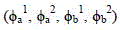


其中,in,

并且具有坐标{x1, y1, z1}、{x2, y2, z2}的卫星1、2和具有坐标{xa, ya, za}、{xb,yb, zb}的接收器a、b之间的相应范围由下式给定:and
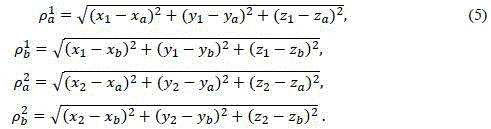
在等式(3)中的这个双差可观测量内,若干个常见的误差项抵消,从而允许UE计算先前未知的整数值Nab 12 = Na 12 - Nb 12。例如,卫星坐标{x1, y1, z1}、{x2, y2, z2}和参考站接收器坐标{xb, yb, zb}都非常准确地已知。如果可在某种合理程度的精度估计未知的UE接收器坐标{xa, ya, za}(例如,服务基站位置),那么可使(5)中的范围


图8示出配备有接近于参考站的网格操作的GNSS接收器的UE的示例性布置。在该图中,假设UE移动通过网格,并且因此将它标记为“漫游者(rover)”的“UE(r)”。网格包括标记为R(a)-R(h)和R(m)-R(p)的12个参考站。相对于第一参考系RS1指定参考站R(a)-R(h)的位置,而相对于第二参考系RS2指定参考站R(m)-R(p)的位置,RS2以某种方式不同于RS1。假设示出的UE(r)和所有12个参考站均能够接收由GNSS卫星S1和S2传送的信号。Figure 8 shows an exemplary arrangement of a UE equipped with a GNSS receiver operating close to a grid of reference stations. In this figure, the UE is assumed to be moving through the mesh and is therefore labeled "UE(r)" for "rover". The grid includes 12 reference stations labeled R(a)-R(h) and R(m)-R(p). Specifies the location of reference stations R(a)-R(h) with respect to a first frame of reference RS1, and specifies the location of reference stations R(m)-R(p) with respect to a second frame of reference RS2, which in some way Different from RS1. It is assumed that the UE(r) shown and all 12 reference stations are capable of receiving the signals transmitted by the GNSS satellites S1 and S2.
如图8中所示,UE(r)接近于R(c)操作。在此类情况下,由UE(r)相对于R(c)、S1和S2计算的整数-模糊度解为:As shown in Figure 8, UE(r) operates close to R(c). In such cases, the integer-ambiguity solution computed by UE(r) with respect to R(c), S1 and S2 is:

UE可经由移动网络(例如,从SMLC/E-SMLC/LMF)接收(由R(c)测量和/或确定的)两个卫星整数差Nc1 - Nc2作为协助。给定由UE和R(c)两者观测的多个卫星对的整数差,UE可精确地确定它相对于R(c)的地点,R(c)的地点一般高精度地已知。The UE may receive the two satellite integer differences Nc 1 - Nc 2 (measured and/or determined by R(c)) as assistance via the mobile network (eg, from SMLC/E-SMLC/LMF). Given the integer difference of multiple satellite pairs observed by both the UE and R(c), the UE can accurately determine its location relative to R(c), which is generally known to high precision.
然而,由于UE(r)是移动的,所以在某个点,与接近于R(c)相比,它可能变成更接近于不同的参考站(例如,R(d))。在此类情况下,为了保持最高的精度,UE应当使用由更靠近的参考站确定的两个卫星差,即,Nd1 - Nd2。然而,简单地切换到该差将要求UE重新启动整数-模糊度求解,从而导致暂时退回到具有差得多的定位精度的基于码相位测量的定位。However, since UE(r) is mobile, at some point it may become closer to a different reference station (eg, R(d)) than to R(c). In such cases, in order to maintain the highest accuracy, the UE should use the two satellite differences determined by the closer reference station, ie, Nd 1 - Nd 2 . However, simply switching to this difference would require the UE to restart integer-ambiguity solving, resulting in a temporary fallback to code-phase measurement based positioning with much worse positioning accuracy.
幸运地,可由UE使用卫星i、j的差


如上文简短地提到,相对于特定参考系来定义协助数据的坐标(例如,参考站位置)。因此,可能会出现这样的场景,其中移动UE变成更接近于与UE当前正用于其整数-模糊度解的参考站不同的参考系相关联的参考站。在图8的上下文中,如果接近于(与RS1相关联的)R(d)操作的UE移动,从而使得它变成更接近于与RS2相关联的R(n),那么可能会出现这种场景。在更实际的示例中,UE可跨越使用RS1的国家(或区域)和使用RS2的国家(或区域)之间的边界。As mentioned briefly above, the coordinates of the assistance data (eg, reference station locations) are defined relative to a particular frame of reference. Thus, scenarios may arise where the mobile UE becomes closer to a reference station associated with a different reference station than the reference station the UE is currently using for its integer-ambiguity resolution. In the context of Figure 8, this may occur if a UE operating close to R(d) (associated with RS1) moves such that it becomes closer to R(n) associated with RS2 Scenes. In a more practical example, the UE may straddle the border between a country (or region) using RS1 and a country (or region) using RS2.
通常,存在参考系的区域性适应性以适应考虑的空间区域并更新该参考系与地界参考系的关系。地壳不同部分的水平和竖直移动的不同量可能需要此类区域性变化。一般来说,区域性参考系比诸如WGS84的更具全球性的参考系更好地与区域性地图对齐。鉴于这些和其它原因,不同的国家(或区域)可使用不同的参考系。然而,这可能会在使用不同参考系的区域之间的接壤区域中造成困难,诸如在与不同参考系相关联的参考站之间过渡时整数-模糊度解(以及得到的位置确定)的不准确。Typically, there is a regional adaptation of a reference frame to accommodate the spatial region considered and to update the relation of the reference frame to the bounded reference frame. Different amounts of horizontal and vertical movement of different parts of the Earth's crust may require such regional changes. In general, regional reference systems align better with regional maps than more global reference systems such as WGS84. For these and other reasons, different countries (or regions) may use different reference systems. However, this may cause difficulties in bordering regions between regions using different reference frames, such as inconsistencies in the integer-ambiguity solution (and resulting position determination) when transitioning between reference stations associated with different reference frames. precise.
通过促进坐标与可以是区域性的参考系的单独关联,本公开的示例性实施例可使得和/或促进估计的地点能够与局部和/或区域性坐标系相关联的地图数据对齐。By facilitating the separate association of coordinates with reference frames, which may be regional, exemplary embodiments of the present disclosure may enable and/or facilitate alignment of estimated locations with map data associated with local and/or regional coordinate systems.
图12是示出根据本公开的各种示例性实施例的用于联合多个参考站估计用户设备(UE)的地点的示例性方法(例如,过程)的流程图。图12中所示的示例性方法可在例如本文中的其它图中示出或关于本文中的其它图描述的无线装置和/或UE中实现。此外,可与本文中(例如,图13)描述的其它示例性方法和/或过程协作地利用图12中所示的示例性方法,以提供本文中描述的各种示例性益处。尽管图12按照特定的顺序示出方框,但是该顺序仅仅是示例性的,并且示例性方法的操作可按照与示出的顺序不同的顺序执行,并且可以组合和/或划分成具有与示出的功能性不同的功能性的方框。由虚线指示可选操作。12 is a flow diagram illustrating an exemplary method (eg, process) for estimating the location of a user equipment (UE) in conjunction with multiple reference stations in accordance with various exemplary embodiments of the present disclosure. The example method shown in FIG. 12 may be implemented, for example, in a wireless device and/or UE as shown in or described with respect to other figures herein. Furthermore, the example method shown in FIG. 12 may be utilized in conjunction with other example methods and/or processes described herein (eg, FIG. 13 ) to provide the various example benefits described herein. Although FIG. 12 shows the blocks in a particular order, this order is exemplary only, and the operations of the example methods may be performed in a different order than shown, and may be combined and/or divided into Out of functional blocks with different functionalities. Optional operations are indicated by dashed lines.
在一些实施例中,示例性方法可包括方框1210的操作,其中UE可从网络节点(例如,E-SMLC或LMF)接收对UE的参考系能力的请求。在一些实施例中,示例性方法还可包括方框1220的操作,其中UE可通过向网络节点发送UE的参考系能力的指示来对请求做出响应。In some embodiments, the example method may include the operations of
在一些实施例中,示例性方法还可包括方框1225的操作,其中UE可接收优选的参考系的指示。在这些实施例中,优选的参考系可以是下文更详细论述的第一参考系或第二参考系。在各种实施例中,优选参考系的指示可以通过以下方式中的任何方式接收:通过接收来自无线网络的消息,通过接收到UE的用户接口的输入,或者通过从UE内的存储器读取。In some embodiments, the example method may further include the operations of
示例性方法还可包括方框1230的操作,其中UE可执行UE的一个或多个定位测量。在一些实施例中,方框1230的操作可包括子方框1232的操作,其中UE可对由多个全球导航卫星系统(GNSS)卫星传送的信号执行第一载波-相位测量。在一些实施例中,所述多个GNSS卫星可包括多个GPS卫星,并且载波-相位测量可以是由GPS卫星传送的L1信号的载波-相位测量。The example method may also include the operations of
在一些实施例中,示例性方法还可包括方框1235的操作,其中UE可获得参考站的坐标以及与参考站相关联的参考系的指示(例如坐标的参考系)。在各种实施例中,这可包括第一参考站的坐标以及第一参考系的指示、和/或第二参考站的坐标以及第二参考系的指示。图15-18中示出一些示例。该信息可作为参考系(RS)变换指示(其在本文中还称为“参考系指示”)的一部分发送。In some embodiments, the example method may further include the operations of
更一般地,UE可获得与定位协助数据的实体(诸如物理和非物理参考站)相关联的坐标的坐标系的指示、基站地点、传输和/或接收点地点、路边单元地点、在地面上、在空中、在水下、在室内、在户外等的其它装置的地点。More generally, the UE may obtain an indication of a coordinate system of coordinates associated with entities of positioning assistance data, such as physical and non-physical reference stations, base station locations, transmission and/or reception point locations, roadside unit locations, on the ground The location of other installations on, in the air, underwater, indoors, outdoors, etc.
例如,UE可获得描述规定的坐标的参考系的显式信息元素。它可以是信息元素的特定字段,其中坐标是相同信息元素的部分,或是不同信息元素的部分。在一些实施例中,可由UE将关于相关联参考系的最近接收的信息视为关联到包括实体的坐标的所有后续信息元素。在一些实施例中,参考系指示可包括关联到不同组的实体及其坐标的参考系的两个或更多个指示。For example, the UE may obtain an explicit information element describing the frame of reference of the specified coordinates. It can be a specific field of an information element where the coordinates are part of the same information element, or part of a different information element. In some embodiments, the most recently received information about the associated frame of reference may be considered by the UE as being associated to all subsequent information elements including the coordinates of the entity. In some embodiments, the reference frame indications may include two or more indications of reference frames associated to different sets of entities and their coordinates.
在一些实施例中,可由UE中的较高层(诸如较高层协议)基于从无线网络接收的消息提供参考系指示。例如,较高层协议可以是应用层协议。在其它实施例中,可在规范文本中、作为订购协定的细节的一部分、在包括UE的订户模块(例如,SIM卡)中、在UE上运行的应用中等来预先配置参考系指示。在其它实施例中,可经由装置中的接口(诸如人类交互接口或应用层接口)提供参考系指示,其中从服务器检索参考系指示。In some embodiments, the frame of reference indication may be provided by higher layers in the UE, such as higher layer protocols, based on messages received from the wireless network. For example, the higher layer protocol may be an application layer protocol. In other embodiments, the reference frame indication may be pre-configured in the specification text, as part of the details of the subscription agreement, in a subscriber module (eg, SIM card) including the UE, in an application running on the UE, or the like. In other embodiments, the reference frame indication may be provided via an interface in the device, such as a human interaction interface or an application layer interface, where the reference frame indication is retrieved from a server.
作为示例,可经由域名服务器查找来检索服务器的传输层地址,其中基于诸如移动网络码(MNC)和移动国家码(MCC)(在3GGP TS 23.003中规定)的运营商信息来编译域名,其中标签扩展对应于参考系信息检索,诸如:posinfo.mnc<MNC>.mcc<MCC>.3gppnetwork.org。例如,Telia Sweden具有MNC 01和MCC 240,这给定完全限定的域名(FQDN):posinfo.mnc01.mcc240.3gppnetwork.org。可将诸如跟踪区域等的额外信息添加到FQDN。As an example, a server's transport layer address may be retrieved via a domain name server lookup, where the domain name is compiled based on operator information such as Mobile Network Code (MNC) and Mobile Country Code (MCC) (specified in 3GGP TS 23.003), where the tag The extension corresponds to reference frame information retrieval, such as: posinfo.mnc<MNC>.mcc<MCC>.3gppnetwork.org. For example, Telia Sweden has MNC 01 and MCC 240, which are given the fully qualified domain name (FQDN): posinfo.mnc01.mcc240.3gppnetwork.org. Additional information such as tracking areas can be added to the FQDN.
在其它实施例中,在接收的参考站坐标和参考系之间可存在隐式而不是显式的关系。例如,可用各种方式将接收的坐标关联到先前接收的参考系指示。在其它实施例中,可用各种方式将接收的坐标关联到后来接收的参考系指示。在此类实施例中,必须延迟关系的确定,直到获得坐标和参考系指示两者为止。In other embodiments, there may be an implicit rather than an explicit relationship between the received reference station coordinates and the reference frame. For example, the received coordinates may be correlated to previously received reference frame indications in various ways. In other embodiments, received coordinates may be correlated to subsequently received reference frame indications in various ways. In such embodiments, the determination of the relationship must be delayed until both the coordinates and the reference frame indication are obtained.
在一些实施例中,示例性方法还可包括方框1240的操作,其中UE可向无线网络发送第一参考站、第二参考站和第一参考系的标识符。在一些实施例中,该信息可作为参考系(RS)变换请求的一部分发送。In some embodiments, the example method may further include the operations of
示例性方法还可包括方框1250的操作,其中UE可接收第一参考系和第二参考系之间的变换信息。在一些实施例中,UE可响应于在方框1240中发送标识符而从无线网络接收该变换信息。在此类实施例中,该变换信息可作为RS变换指示(在本文中还称为“参考系指示”)的一部分发送。在一些实施例中,变换信息可与一对或多对GNSS卫星有关。The example method may also include the operations of
示例性方法还可包括方框1260的操作,其中UE可基于定位测量、变换信息和多个实体的位置坐标来确定UE的地点的估计。至少一个实体的位置坐标可与第一参考系相关联,并且至少一个其它实体的位置坐标可与第二参考系相关联。在各种实施例中,所述多个实体可包括以下任何实体:物理参考站、虚拟参考站、UE的服务网络节点、邻居网络节点、网络传输或接收点、全球导航卫星系统GNSS卫星和另一个UE。然而,为了便于理解,以下解释将集中在两个实体上:第一参考站(物理的或虚拟的)和第二参考站(物理的或虚拟的)。The example method may also include the operations of
在一些实施例中,方框1260的操作可包括子方框1261的操作,其中UE可接收由GNSS卫星传送的信号的第二载波-相位测量。第二载波-相位测量可由与第一参考系相关联的第一参考站进行。在此类实施例中,方框1260的操作还可包括子方框1262的操作,其中UE可基于第一参考站的(例如,在方框1235中接收的)位置坐标和第二载波-相位测量来为第一载波-相位测量确定第一整数-模糊度解。In some embodiments, the operations of
在一些实施例中,子方框1262的操作可包括子方框1262a的操作,其中UE可基于变换信息将第一参考站的位置坐标转换(transform)到第二参考系。在此类实施例中,可基于第一参考站的经转换的位置坐标来确定第一整数-模糊度解。In some embodiments, the operations of sub-block 1262 may include the operations of sub-block 1262a, wherein the UE may transform the location coordinates of the first reference station to a second frame of reference based on the transformation information. In such embodiments, the first integer-ambiguity solution may be determined based on the transformed position coordinates of the first reference station.
在一些实施例中,方框1260的操作还可包括子方框1263的操作,其中UE可接收由GNSS卫星传送的信号的第三载波-相位测量。第三载波-相位测量可由与第二参考系相关联的第二参考站进行。在此类实施例中,方框1260的操作还可包括子方框1264的操作,其中UE可基于以下信息来为第一载波-相位测量确定第二整数-模糊度解:第一整数-模糊度解、第三载波-相位测量、和第二参考站的(例如,在方框1235中接收的)位置坐标。In some embodiments, the operations of
在一些实施例中,子方框1264的操作可包括子方框1264a的操作,其中UE可基于变换信息将第二参考站的位置坐标转换到第一参考系。在此类实施例中,基于第二参考站的经转换的位置坐标来确定第二整数-模糊度解。In some embodiments, the operations of sub-block 1264 may include the operations of sub-block 1264a, wherein the UE may transform the location coordinates of the second reference station to the first reference frame based on the transformation information. In such embodiments, the second integer-ambiguity solution is determined based on the transformed position coordinates of the second reference station.
在一些实施例中,方框1260的操作还可包括子方框1265的操作,其中UE可基于第二整数-模糊度解和定位测量来确定UE的地点的估计。在一些实施例中,可相对于第二参考系来确定UE的地点(例如,当第一参考站坐标已经转换到第二参考系时)。在其它实施例中,可相对于第一参考系来确定UE的地点(例如,当第二参考站坐标已经转换到第一参考系时)。In some embodiments, the operations of
在一些实施例中,示例性方法还可包括方框1280的操作,其中UE可向网络节点发送与第一参考系或第二参考系相关联的UE的地点的估计。这可取决于例如用于确定UE的地点(例如,在子方框1265中)的参考系。此外,在UE先前获得了优选的参考系的指示(例如,在方框1225中)的情况下,UE地点估计可与该优选的参考系相关联。In some embodiments, the example method may further include the operations of block 1280, wherein the UE may send to the network node an estimate of the location of the UE associated with the first frame of reference or the second frame of reference. This may depend, for example, on the frame of reference used to determine the location of the UE (eg, in sub-block 1265). Additionally, where the UE previously obtained an indication of a preferred frame of reference (eg, in block 1225), the UE location estimate may be associated with the preferred frame of reference.
图13是示出根据本公开的各种示例性实施例的用于联合多个参考站协助用户设备(UE)的定位的示例性方法(例如,过程)的流程图。图13中所示的示例性方法可例如在本文中的其它图中示出或关于本文中的其它图描述的网络节点(例如,定位服务器、基站、eNB、E-SMLC、gNB、LMF等或其组件)中实现。此外,可与本文中(例如,图12)描述的其它示例性方法和/或过程协作地利用图13中所示的示例性方法,以提供本文中描述的各种示例性益处。另外,尽管图13按照特定的顺序示出方框,但是该顺序仅仅是示例性的,并且示例性方法的操作可按照与示出的顺序不同的顺序执行,并且可组合和/或划分成具有与示出的功能性不同的功能性的方框。由虚线指示可选操作。13 is a flowchart illustrating an exemplary method (eg, procedure) for assisting the positioning of a user equipment (UE) in conjunction with multiple reference stations in accordance with various exemplary embodiments of the present disclosure. The exemplary method shown in FIG. 13 may, for example, be shown in or described in other figures herein with respect to network nodes (eg, location servers, base stations, eNBs, E-SMLCs, gNBs, LMFs, etc. or its components). Furthermore, the example method shown in FIG. 13 may be utilized in conjunction with other example methods and/or processes described herein (eg, FIG. 12 ) to provide the various example benefits described herein. Additionally, although FIG. 13 shows the blocks in a particular order, this order is exemplary only, and the operations of the example methods may be performed in a different order than shown, and may be combined and/or divided to have Blocks of functionality that differs from the functionality shown. Optional operations are indicated by dashed lines.
在一些实施例中,示例性方法可包括方框1310的操作,其中网络节点可向UE发送对UE的参考系能力的请求。在一些实施例中,示例性方法还可包括方框1320的操作,其中网络节点可在来自UE的响应中接收UE的参考系能力的指示。在一些实施例中,示例性方法还可包括方框1325的操作,其中网络可向UE发送优选的参考系的指示。在此类实施例中,优选的参考系可以是下文更详细论述的第一参考系或第二参考系。In some embodiments, the example method may include the operations of
在一些实施例中,示例性方法还可包括方框1330的操作,其中网络节点可向UE发送参考站的坐标以及与参考站相关联的参考系的指示(例如,坐标的参考系)。在各种实施例中,这可包括第一参考站的坐标以及第一参考系的指示、和/或第二参考站的坐标以及第二参考系的指示。In some embodiments, the example method may also include the operations of
更一般地,网络可发送与定位协助数据的实体(诸如物理和非物理参考站)的坐标相关联的坐标系的指示、基站地点、传输和/或接收点地点、路边单元地点、在地面上、在空中、在水下、在室内、在户外等的其它装置的地点。此外,上文关于图12的方框1235描述的各种示例同样适用于图13的方框1330,包括图15-18中所示的示例。More generally, the network may send an indication of a coordinate system associated with the coordinates of entities for positioning assistance data (such as physical and non-physical reference stations), base station locations, transmission and/or reception point locations, roadside unit locations, on the ground The location of other installations on, in the air, underwater, indoors, outdoors, etc. Furthermore, the various examples described above with respect to block 1235 of FIG. 12 are equally applicable to block 1330 of FIG. 13, including the examples shown in FIGS. 15-18.
在其它实施例中,在传送的参考站坐标和参考系之间可存在隐式而不是显式的关系。例如,可用各种方式将传送的坐标关联到先前传送的参考系指示。在其它实施例中,可用各种方式将传送的坐标关联到后来传送的参考系指示。在此类实施例中,必须延迟关系的确定(例如,由UE进行),直到获得坐标和参考系指示两者为止。In other embodiments, there may be an implicit rather than explicit relationship between the transmitted reference station coordinates and the reference frame. For example, the communicated coordinates may be correlated to previously communicated reference frame indications in various ways. In other embodiments, the transmitted coordinates may be correlated to a later transmitted reference frame indication in various ways. In such embodiments, the determination of the relationship must be delayed (eg, by the UE) until both the coordinates and the reference frame indication are obtained.
图13中所示的示例性方法还包括方框1340的操作,其中网络节点可从UE接收第一参考站、第二参考站和与第一参考站相关联的第一参考系的标识符。在一些实施例中,该信息可作为参考系(RS)变换请求的一部分接收。The example method shown in FIG. 13 also includes the operations of
示例性方法还可包括方框1350的操作,其中网络节点可向UE发送第一参考系和与第二参考站相关联的第二参考系之间的变换信息。在一些实施例中,网络节点可响应于在方框1340中接收到标识符而将该变换信息发送到UE。在此类实施例中,该变换信息可作为参考系(RS)变换指示(其在本文中还称为“参考系指示”)的一部分发送。在一些示例性实施例中,变换信息可与一对或多对GNSS卫星有关。The example method may also include the operations of
在一些实施例中,示例性方法还可包括方框1360的操作,其中网络节点可从UE接收与第一参考系或第二参考系相关联的UE的地点的估计。在网络节点先前给UE提供了优选的参考系(例如,在方框1325中)的情况下,UE地点估计可与该优选的参考系相关联。In some embodiments, the example method may also include the operations of
图14中示出图12-13中所示的示例性操作的备选视图,该图是示出根据本公开的各种示例性实施例的UE和网络节点之间的交互性操作的流程图。另外,图15-18示出根据这些示例性实施例的可用于UE和网络节点之间的通信的各种示例性信令消息。更具体来说,图15-18示出UE和网络节点之间的示例性GNSS协助数据信令的ASN.1代码规范。An alternate view of the example operations shown in FIGS. 12-13 is shown in FIG. 14, which is a flow chart showing the interoperability between the UE and the network node according to various example embodiments of the present disclosure. . Additionally, Figures 15-18 illustrate various exemplary signaling messages that may be used for communication between a UE and a network node in accordance with these exemplary embodiments. More specifically, Figures 15-18 illustrate the ASN.1 code specification for exemplary GNSS assistance data signaling between the UE and a network node.
图15A-B示出示例性GNSS-RTK-ReferenceStationInfo消息和/或信息元素(IE)。可由位置服务器使用该示例性GNSS-RTK-ReferenceStationInfo IE来提供静止参考站的天线参考点(ARP)的地心地固(ECEF)坐标、或在可选配置的大地测量参考框架中的坐标,为所述静止参考站提供GNSS-RTK-Observations协助数据以及参考站天线描述。如针对3GPPTS 36.355中所定义的消息类型1006、1033和1032所规定的那样,使用在示例性GNSS-RTK- ReferenceStationInfo中提供的参数。15A-B illustrate exemplary GNSS-RTK-ReferenceStationInfo messages and/or information elements (IEs). This exemplary GNSS-RTK-ReferenceStationInfo IE may be used by the location server to provide the geocentric earth fixed (ECEF) coordinates of the antenna reference point (ARP) of the stationary reference station, or the coordinates in the optionally configured geodetic reference frame, for all The geostationary reference station provides GNSS-RTK-Observations assistance data as well as reference station antenna descriptions. The parameters provided in the exemplary GNSS-RTK-ReferenceStationInfo are used as specified for
图16A-B示出示例性GNSS-RTK-AuxiliaryStationData消息和/或信息元素(IE)。可由位置服务器使用该示例性GNSS-RTK-AuxiliaryStationData IE来提供辅助参考站的天线参考点(ARP)相对于IE GNSS-RTK-ReferenceStationInfo中提供的坐标的坐标。在IEGNSS-RTK-ReferenceStationInfo中提供的参考站是主参考站。照此,在单个ProvideAssistance Data(提供协助数据)消息中使用一个主参考站及其相关联的辅助站。如针对3GPP TS 36.355中所定义的消息类型1014所规定的那样,使用在IE GNSS-RTK- AuxiliaryStationData中提供的参数。16A-B illustrate exemplary GNSS-RTK-AuxiliaryStationData messages and/or information elements (IEs). This exemplary GNSS-RTK-AuxiliaryStationData IE may be used by the location server to provide the coordinates of the antenna reference point (ARP) of the auxiliary reference station relative to the coordinates provided in the IE GNSS-RTK-ReferenceStationInfo . The reference station provided in IE GNSS-RTK-ReferenceStationInfo is the primary reference station. As such, one primary reference station and its associated secondary station are used in a single ProvideAssistance Data message. The parameters provided in IE GNSS-RTK- AuxiliaryStationData are used as specified for message type 1014 defined in 3GPP TS 36.355.
图17A-B示出另一个示例性GNSS-RTK-ReferenceStationInfo消息和/或信息元素(IE)。在该实施例中,除了ECEF WGS84坐标之外,还提供备选参考系(例如,参考框架)中的坐标。图17B只示出这些额外元素的定义;如图15B中一样定义图17A的ASN.1数据结构中的其它元素。17A-B illustrate another exemplary GNSS-RTK-ReferenceStationInfo message and/or information element (IE). In this embodiment, in addition to ECEF WGS84 coordinates, coordinates in an alternative reference frame (eg, a frame of reference) are also provided. Figure 17B only shows the definition of these additional elements; the other elements in the ASN.1 data structure of Figure 17A are defined as in Figure 15B.
类似地,图18A-B示出另一个示例性GNSS-RTK-AuxiliaryStationData消息和/或信息元素(IE)。在该实施例中,除了ECEF WGS84坐标之外,还提供备选参考系(例如,参考框架)中的坐标。图18B只示出这些额外元素的定义;如图16B中一样定义图18A的ASN.1数据结构中的其它元素。Similarly, Figures 18A-B illustrate another exemplary GNSS-RTK-AuxiliaryStationData message and/or Information Element (IE). In this embodiment, in addition to ECEF WGS84 coordinates, coordinates in an alternative reference frame (eg, a frame of reference) are also provided. Figure 18B only shows the definition of these additional elements; the other elements in the ASN.1 data structure of Figure 18A are defined as in Figure 16B.
尽管本文中描述的主题可使用任何合适的组件在任何适当类型的系统中实现,但是本文中公开的实施例是关于无线网络(诸如图9中示出的示例无线网络)描述的。为了简单起见,图9的无线网络仅描绘网络906、网络节点960和960b以及WD 910、910b和910c。在实践中,无线网络可进一步包括适合于支持无线装置之间或者无线装置与另一通信装置之间通信的任何附加元件,另一通信装置诸如陆线电话、服务提供者或任何其它网络节点或最终装置。在示出的组件中,用附加细节来描绘网络节点960和无线装置(WD)910。无线网络可向一个或多个无线装置提供通信和其它类型的服务,以促进无线装置对由或经由无线网络提供的服务的接入和/或使用。Although the subject matter described herein may be implemented in any suitable type of system using any suitable components, the embodiments disclosed herein are described with respect to a wireless network, such as the example wireless network shown in FIG. 9 . For simplicity, the wireless network of Figure 9 depicts only network 906, network nodes 960 and 960b, and WDs 910, 910b, and 910c. In practice, the wireless network may further comprise any additional elements suitable for supporting communication between the wireless devices or between the wireless device and another communication device, such as a landline telephone, a service provider or any other network node or final device. In the illustrated components, network node 960 and wireless device (WD) 910 are depicted with additional detail. A wireless network may provide communications and other types of services to one or more wireless devices to facilitate wireless device access and/or use of services provided by or via the wireless network.
无线网络可包括任何类型的通信、电信、数据、蜂窝和/或无线电网络或其它类似类型的系统和/或与之通过接口连接。在一些实施例中,无线网络可配置成根据特定标准或其它类型的预定义规则或过程来操作。因此,无线网络的特定实施例可实现:通信标准,诸如全球移动通信系统(GSM)、通用移动电信系统(UMTS)、长期演进(LTE)和/或其它合适的2G、3G、4G或5G标准;无线局域网(WLAN)标准,诸如IEEE 802.11标准;和/或任何其它适当的无线通信标准,诸如全球微波接入互操作性(WiMax)、蓝牙、Z-wave和/或ZigBee标准。A wireless network may comprise and/or interface with any type of communication, telecommunication, data, cellular and/or radio network or other similar type of system. In some embodiments, the wireless network may be configured to operate according to certain standards or other types of predefined rules or procedures. Accordingly, certain embodiments of wireless networks may implement: communication standards such as Global System for Mobile Communications (GSM), Universal Mobile Telecommunications System (UMTS), Long Term Evolution (LTE) and/or other suitable 2G, 3G, 4G or 5G standards ; a wireless local area network (WLAN) standard, such as the IEEE 802.11 standard; and/or any other suitable wireless communication standard, such as the Worldwide Interoperability for Microwave Access (WiMax), Bluetooth, Z-wave and/or ZigBee standards.
网络906可包括一个或多个回程网络(backhaul network)、核心网络、IP网络、公用交换电话网(PSTN)、分组数据网、光网、广域网(WAN)、局域网(LAN)、无线局域网(WLAN)、有线网络、无线网络、城域网以及能够实现装置之间通信的其它网络。The network 906 may include one or more backhaul networks, core networks, IP networks, public switched telephone networks (PSTNs), packet data networks, optical networks, wide area networks (WANs), local area networks (LANs), wireless local area networks (WLANs) ), wired networks, wireless networks, metropolitan area networks, and other networks that enable communication between devices.
网络节点960和WD 910包括下文更详细描述的各种组件。这些组件一起工作以便提供网络节点和/或无线装置功能性,诸如提供无线网络中的无线连接。在不同的实施例中,无线网络可包括任何数量的有线或无线网络、网络节点、基站、控制器、无线装置、中继站和/或可促进或参与无论是经由有线连接还是经由无线连接的数据和/或信号的通信的任何其它组件或系统。Network node 960 and WD 910 include various components described in more detail below. These components work together to provide network node and/or wireless device functionality, such as to provide wireless connectivity in a wireless network. In various embodiments, a wireless network may include any number of wired or wireless networks, network nodes, base stations, controllers, wireless devices, relay stations, and/or may facilitate or participate in data and and/or any other component or system of communication of signals.
网络节点的示例包括但不限于接入点(AP)(例如,无线电接入点)、基站(BS)(例如,无线电基站、节点B、演进的节点B(eNB)和NR NodeB(gNB))。基站可基于它们提供的覆盖量(或者,换句话说,它们的传送功率级)进行分类,并且然后还可被称为毫微微基站、微微基站、微基站或宏基站。基站可以是中继节点或控制中继的中继施主节点。网络节点还可包括分布式无线电基站的一个或多个(或所有)部分,诸如集中式数字单元和/或远程无线电单元(RRU),有时称为远程无线电头(RRH)。这种远程无线电单元可或者可不与天线集成为天线集成无线电。分布式无线电基站的部分也可被称为分布式天线系统(DAS)中的节点。Examples of network nodes include, but are not limited to, Access Points (APs) (eg, Radio Access Points), Base Stations (BSs) (eg, Radio Base Stations, Node Bs, Evolved Node Bs (eNBs), and NR NodeBs (gNBs)) . Base stations may be classified based on the amount of coverage they provide (or, in other words, their transmit power levels), and may then also be referred to as femto, pico, micro, or macro base stations. The base station may be a relay node or a relay donor node that controls the relay. A network node may also include one or more (or all) parts of a distributed radio base station, such as a centralized digital unit and/or a remote radio unit (RRU), sometimes referred to as a remote radio head (RRH). Such a remote radio unit may or may not be integrated with the antenna as an antenna-integrated radio. Parts of distributed radio base stations may also be referred to as nodes in a distributed antenna system (DAS).
网络节点的进一步示例包括多标准无线电(MSR)设备(诸如,MSR BS)、网络控制器(诸如,无线电网络控制器(RNC)或基站控制器(BSC))、基站收发信台(BTS)、传输点、传输节点、多小区/多播协调实体(MCE)、核心网络节点(例如,MSC、MME)、O&M节点、OSS节点、SON节点、定位节点(例如,E-SMLC)和/或MDT。作为另一个示例,网络节点可以是如下文更详细描述的虚拟网络节点。Further examples of network nodes include multi-standard radio (MSR) equipment (such as MSR BS), network controllers (such as radio network controllers (RNC) or base station controllers (BSC)), base transceiver stations (BTS), Transmission point, transport node, multi-cell/multicast coordination entity (MCE), core network node (eg, MSC, MME), O&M node, OSS node, SON node, positioning node (eg, E-SMLC) and/or MDT . As another example, a network node may be a virtual network node as described in more detail below.
在图9中,网络节点960包括处理电路970、装置可读介质980、接口990、辅助设备984、电源986、电力电路987和天线962。尽管在图9的示例无线网络中示出的网络节点960可表示包括硬件组件的所示组合的装置,但是其它实施例可包括具有不同组件组合的网络节点。要理解,网络节点包括执行本文中公开的任务、特征、功能和方法和/或过程所需的硬件和/或软件的任何合适的组合。此外,尽管网络节点960的组件被描绘为嵌套在多个框内或者位于较大框内的单个框,但是实际上,网络节点可包括构成单个所示组件的多个不同的物理组件(例如,装置可读介质980可包括多个单独的硬驱动装置以及多个RAM模块)。In FIG. 9 , network node 960 includes
类似地,网络节点960可由多个物理上分离的组件(例如,NodeB组件和RNC组件、或BTS组件和BSC组件等)组成,它们可各自具有它们自己的相应组件。在其中网络节点960包括多个单独组件(例如,BTS和BSC组件)的某些场景中,可在若干个网络节点之间共享单独的组件中的一个或多个。例如,单个RNC可控制多个NodeB。在此类场景中,每个唯一的NodeB和RNC对在一些实例中可被视为单个单独的网络节点。在一些实施例中,网络节点960可配置成支持多种无线电接入技术(RAT)。在此类实施例中,可复制一些组件(例如,用于不同RAT的单独装置可读存储介质980),并且可再使用一些组件(例如,可由RAT共享相同的天线962)。网络节点960还可包括用于集成到网络节点960中的不同无线技术(诸如例如,GSM、WCDMA、LTE、NR、WiFi或蓝牙无线技术)的各种所示组件的多种集合。这些无线技术可集成到网络节点960内的相同或不同的芯片或芯片集以及其它组件中。Similarly, network node 960 may be composed of multiple physically separate components (eg, NodeB components and RNC components, or BTS components and BSC components, etc.), which may each have their own corresponding components. In some scenarios where network node 960 includes multiple separate components (eg, BTS and BSC components), one or more of the separate components may be shared among several network nodes. For example, a single RNC can control multiple NodeBs. In such scenarios, each unique NodeB and RNC pair may in some instances be considered a single separate network node. In some embodiments, the network node 960 may be configured to support multiple radio access technologies (RATs). In such embodiments, some components may be duplicated (eg, separate device-readable storage media 980 for different RATs), and some components may be reused (eg, the
处理电路970可配置成执行本文中描述为由网络节点提供的任何确定、计算或类似操作(例如,某些获得操作)。由处理电路970执行的这些操作可包括:例如通过将由处理电路970获得的信息转变(convert)成其它信息、将所获得的信息或所转变的信息与存储在网络节点中的信息进行比较、和/或基于所获得的信息或所转变的信息执行一个或多个操作来处理由所获得的信息,并且作为所述处理的结果进行确定。The
处理电路970可包括以下项中的一个或多个的组合:微处理器、控制器、微控制器、中央处理单元、数字信号处理器、专用集成电路、现场可编程门阵列或任何其它适合的计算装置、资源、或可操作以单独或者结合其它网络节点960组件(诸如,装置可读介质980)提供网络节点960功能性的硬件、软件和/或编码逻辑的组合。例如,处理电路970可执行存储在装置可读介质980中或处理电路970内的存储器中的指令。此类功能性可包括提供本文中论述的各种无线特征、功能或益处中的任何无线特征、功能或益处。在一些实施例中,处理电路970可包括片上系统(SOC)。
在一些实施例中,处理电路970可包括射频(RF)收发器电路972和基带处理电路974中的一个或多个。在一些实施例中,射频(RF)收发器电路972和基带处理电路974可在单独的芯片(或芯片集)、板或单元(诸如无线电单元和数字单元)上。在备选实施例中,RF收发器电路972和基带处理电路974的部分或全部可在同一芯片或芯片集、板或单元上。In some embodiments,
在某些实施例中,本文中描述为由网络节点、基站、eNB或其它此类网络装置提供的功能性中的一些或全部功能性可由执行存储在处理电路970内的存储器或装置可读介质980上的指令的处理电路970来执行。在备选实施例中,在不执行存储在单独的或分立的装置可读介质上的指令的情况下,功能性中的一些或全部可由处理电路970提供(诸如,以硬连线方式)。在那些实施例中的任何实施例中,不管是否执行存储在装置可读存储介质上的指令,处理电路970都可配置成执行描述的功能性。由此类功能性提供的益处不限于独自的处理电路970或者网络节点960的其它组件,而是由网络节点960作为整体享用,和/或由最终用户和无线网络一般地享用。In certain embodiments, some or all of the functionality described herein as being provided by a network node, base station, eNB, or other such network device may be executed by a memory or device-readable medium stored within the
装置可读介质980可包括任何形式的易失性或非易失性计算机可读存储器,包括但不限于永久性存储设备、固态存储器、远程安装的存储器、磁介质、光介质、随机存取存储器(RAM)、只读存储器(ROM)、大容量存储介质(例如,硬盘)、可移动存储介质(例如,闪速驱动装置、致密盘(CD)或数字视频盘(DVD))和/或用于存储可由处理电路970使用的信息、数据和/或指令的任何其它易失性或非易失性、非暂时性装置可读和/或计算机可执行存储器装置。装置可读介质980可存储任何合适的指令、数据或信息,包括计算机程序、软件、包括逻辑、规则、代码、表等中的一个或多个的应用和/或能够由处理电路970执行并由网络节点960利用的其它指令。例如,介质980可存储计算机可执行指令(例如,以计算机程序产品的形式),这些指令在由处理电路970执行时可将节点960配置成执行本文中描述的各种示例性方法和/或过程。Device readable media 980 may include any form of volatile or non-volatile computer readable storage including, but not limited to, persistent storage, solid state storage, remotely mounted storage, magnetic media, optical media, random access memory (RAM), read only memory (ROM), mass storage media (eg, hard disks), removable storage media (eg, flash drives, compact discs (CDs), or digital video discs (DVDs)) and/or Any other volatile or non-volatile, non-transitory device-readable and/or computer-executable memory device for storing information, data, and/or instructions usable by processing
装置可读介质980可用于存储由处理电路970进行的任何计算和/或经由接口990接收的任何数据。在一些实施例中,处理电路970和装置可读介质980可被视为集成的。Device-readable medium 980 may be used to store any calculations performed by processing
接口990被用在网络节点960、网络906和/或WD 910之间的信令和/或数据的有线或无线通信中。如图所示,接口990包括(一个或多个)端口/(一个或多个)接线端(terminal)994,以例如通过有线连接向网络906发送数据和从网络906接收数据。接口990还包括无线电前端电路992,无线电前端电路992可耦合到天线962,或者在某些实施例中是天线962的一部分。无线电前端电路992包括滤波器998和放大器996。无线电前端电路992可连接到天线962和处理电路970。无线电前端电路可配置成调节在天线962和处理电路970之间传递的信号。无线电前端电路992可接收要经由无线连接发送出到其它网络节点或WD的数字数据。无线电前端电路992可使用滤波器998和/或放大器996的组合,将数字数据转变成具有适当信道和带宽参数的无线电信号。然后,可经由天线962传送无线电信号。类似地,当接收到数据时,天线962可收集无线电信号,这些信号然后由无线电前端电路992转变成数字数据。数字数据可被传到处理电路970。在其它实施例中,接口可包括不同的组件和/或组件的不同组合。
在某些备选实施例中,网络节点960可不包括单独的无线电前端电路992,相反,处理电路970可包括无线电前端电路,并且可在没有单独的无线电前端电路992的情况下连接到天线962。类似地,在一些实施例中,RF收发器电路972中的全部或一些可被认为是接口990的一部分。在仍有的其它实施例中,接口990可包括作为无线电单元(未示出)的一部分的一个或多个端口或接线端994、无线电前端电路992和RF收发器电路972,并且接口990可与基带处理电路974通信,基带处理电路274是数字单元(未示出)的一部分。In some alternative embodiments, the network node 960 may not include a separate radio
天线962可包括被配置成发送和/或接收无线信号的一个或多个天线或天线阵列。天线962可耦合到无线电前端电路990,并且可以是能够无线传送和接收数据和/或信号的任何类型的天线。在一些实施例中,天线962可包括一个或多个全向、扇形或平板天线,这些天线可操作以传送/接收例如2GHz和66GHz之间的无线电信号。全向天线可用于在任何方向上传送/接收无线电信号,扇形天线可用于传送/接收来自具体区域内的装置的无线电信号,并且平板天线可以是用于以相对直线传送/接收无线电信号的视线天线。在一些实例中,多于一个天线的使用可称为MIMO。在某些实施例中,天线962可与网络节点960分开,并且可通过接口或端口可连接到网络节点960。
天线962、接口990和/或处理电路970可配置成执行本文中描述为由网络节点执行的任何接收操作和/或某些获得操作。可从无线装置、另一网络节点和/或任何其它网络设备接收任何信息、数据和/或信号。类似地,天线962、接口990和/或处理电路970可配置成执行本文中描述为由网络节点执行的任何传送操作。可向无线装置、另一网络节点和/或任何其它网络设备传送任何信息、数据和/或信号。
电力电路987可包括或者耦合到电力管理电路,并且可配置成向网络节点960的组件供应用于执行本文中描述的功能性的电力。电力电路987可从电源986接收电力。电源986和/或电力电路987可配置成以适合于各个组件的形式(例如,以每个相应组件所需的电压和电流电平)向网络节点960的相应组件提供电力。电源986可包括在电力电路987和/或网络节点960中,或者在其外部。例如,网络节点960可经由输入电路或接口(诸如电缆)连接到外部电源(例如电插座),由此外部电源向电力电路987供应电力。作为进一步的示例,电源986可包括采用电池或电池组形式的电源,其连接到或集成在电力电路987中。如果外部电源出现故障,则电池可提供备用电力。还可使用其它类型的电源,诸如光伏装置。
网络节点960的备选实施例可包括除了图9中所示的那些组件之外的附加组件,它们可负责提供网络节点的功能性的某些方面,包括本文中描述的功能性中的任何功能性和/或支持本文中描述的主题所必需的任何功能性。例如,网络节点960可包括用户接口设备,以允许和/或促进将信息输入到网络节点960中,并允许和/或促进从网络节点960输出信息。这可允许和/或促进用户对网络节点960执行诊断、维护、修理和其它管理功能。Alternative embodiments of the network node 960 may include additional components other than those shown in FIG. 9 that may be responsible for providing certain aspects of the functionality of the network node, including any of the functionality described herein functionality and/or any functionality necessary to support the subject matter described herein. For example, network node 960 may include user interface devices to allow and/or facilitate input of information into network node 960 and to allow and/or facilitate output of information from network node 960 . This may allow and/or facilitate users to perform diagnostic, maintenance, repair, and other management functions on network node 960 .
在一些实施例中,无线装置(WD)可配置成在没有直接人类交互的情况下传送和/或接收信息。例如,WD可设计成当由内部或外部事件触发时或者响应于来自网络的请求而按预确定的计划表向网络传送信息。WD的示例包括但不限于智能电话、移动电话、蜂窝电话、IP上的语音(VoIP)电话、无线本地环路电话、桌上型计算机、个人数字助理(PDA)、无线相机、游戏控制台或装置、音乐存储装置、回放电器、可穿戴终端装置、无线端点、移动台、平板、膝上型计算机、膝上型嵌入式设备(LEE)、膝上型安装设备(LME)、智能装置、无线客户驻地设备(customer premise equipment)(CPE)、交通工具安装的无线终端装置等。In some embodiments, a wireless device (WD) may be configured to transmit and/or receive information without direct human interaction. For example, the WD may be designed to transmit information to the network on a predetermined schedule when triggered by internal or external events or in response to a request from the network. Examples of WD include, but are not limited to, smart phones, mobile phones, cellular phones, voice over IP (VoIP) phones, wireless local loop phones, desktop computers, personal digital assistants (PDAs), wireless cameras, game consoles or Devices, Music Storage Devices, Playback Appliances, Wearable Terminal Devices, Wireless Endpoints, Mobile Stations, Tablets, Laptops, Laptop Embedded Equipment (LEE), Laptop Mount Equipment (LME), Smart Devices, Wireless Customer premise equipment (CPE), wireless terminal devices installed in vehicles, etc.
WD可例如通过实现用于侧链路通信、交通工具到交通工具(V2V)、交通工具到基础设施(V2I)、交通工具到一切(V2X)的3GPP标准来支持装置到装置(D2D)通信,并且在这种情况下可称为D2D通信装置。作为又一个特定示例,在物联网(IoT)场景中,WD可表示执行监测和/或测量其它并且将此类监测和/或测量的结果传送到另一个WD和/或网络节点的机器或其它装置。在这种情况下,WD可以是机器对机器(M2M)装置,其在3GPP上下文中可称为MTC装置。作为一个特定示例,WD可以是实现3GPP窄带物联网(NB-IoT)标准的UE。此类机器或装置的特定示例是传感器、计量装置(诸如,功率计)、工业机械或家用或个人电器(例如,冰箱、电视等)、个人可穿戴装置(例如,手表、健身跟踪器等)。在其它场景中,WD可表示能够监测和/或报告其操作状态或与其操作关联的其它功能的交通工具或其它设备。如上所述的WD可表示无线连接的端点,在这种情况下,该装置可称为无线终端。此外,如上所述的WD可以是移动的,在这种情况下,它也可被称为移动装置或移动终端。WD may support device-to-device (D2D) communication, for example, by implementing 3GPP standards for side-link communication, vehicle-to-vehicle (V2V), vehicle-to-infrastructure (V2I), vehicle-to-everything (V2X), And in this case, it may be called a D2D communication device. As yet another specific example, in an Internet of Things (IoT) scenario, a WD may represent a machine or other performing monitoring and/or measuring others and communicating the results of such monitoring and/or measurements to another WD and/or network node device. In this case, the WD may be a machine-to-machine (M2M) device, which may be referred to as an MTC device in the context of 3GPP. As a specific example, the WD may be a UE implementing the 3GPP Narrowband Internet of Things (NB-IoT) standard. Specific examples of such machines or devices are sensors, metering devices (such as power meters), industrial machinery or household or personal appliances (eg, refrigerators, televisions, etc.), personal wearable devices (eg, watches, fitness trackers, etc.) . In other scenarios, a WD may represent a vehicle or other device capable of monitoring and/or reporting its operational status or other functions associated with its operation. WD as described above may represent an endpoint of a wireless connection, in which case the device may be referred to as a wireless terminal. Furthermore, the WD as described above may be mobile, in which case it may also be referred to as a mobile device or a mobile terminal.
如图所示,无线装置910包括天线911、接口914、处理电路920、装置可读介质930、用户接口设备932、辅助设备934、电源936和电力电路937。WD 910可包括用于由WD 910支持的不同无线技术的图示组件中的一个或多个的多个集合,这些无线技术诸如例如,GSM、WCDMA、LTE、NR、WiFi、WiMax或蓝牙无线技术,只提到几个。这些无线技术可集成到与WD 910内的其它组件相同或不同的芯片或芯片集中。As shown, wireless device 910 includes antenna 911 , interface 914 , processing circuitry 920 , device-readable medium 930 , user interface device 932 , auxiliary device 934 , power source 936 , and
天线911可包括被配置成发送和/或接收无线信号的一个或多个天线或天线阵列,并且连接到接口914。在某些备选实施例中,天线911可与WD 910分开,并且通过接口或端口可连接到WD 910。天线911、接口914和/或处理电路920可配置成执行本文中描述为由WD执行的任何接收或传送操作。可从网络节点和/或另一WD接收任何信息、数据和/或信号。在一些实施例中,无线电前端电路和/或天线911可被认为是接口。Antenna 911 may include one or more antennas or antenna arrays configured to transmit and/or receive wireless signals, and is connected to interface 914 . In some alternative embodiments, the antenna 911 may be separate from the WD 910 and connectable to the WD 910 through an interface or port. Antenna 911, interface 914, and/or processing circuit 920 may be configured to perform any of the receive or transmit operations described herein as being performed by the WD. Any information, data and/or signals may be received from the network node and/or another WD. In some embodiments, radio front-end circuitry and/or antenna 911 may be considered an interface.
如图所示,接口914包括无线电前端电路912和天线911。无线电前端电路912包括一个或多个滤波器918和放大器916。无线电前端电路914连接到天线911和处理电路920,并且可配置成调节在天线911与处理电路920之间传递的信号。无线电前端电路912可耦合到或是天线911的一部分。在一些实施例中,WD 910可以不包括单独的无线电前端电路912;而是,处理电路920可包括无线电前端电路,并且可连接到天线911。类似地,在一些实施例中,RF收发器电路922中的一些或全部可被认为是接口914的一部分。无线电前端电路912可接收要经由无线连接发送出到其它网络节点或WD的数字数据。无线电前端电路912可使用滤波器918和/或放大器916的组合,将数字数据转变成具有适当信道和带宽参数的无线电信号。无线电信号然后可经由天线911传送。类似地,当接收到数据时,天线911可收集无线电信号,这些信号然后由无线电前端电路912转变成数字数据。数字数据可被传到处理电路920。在其它实施例中,接口可包括不同的组件和/或组件的不同组合。As shown, interface 914 includes radio front-end circuitry 912 and antenna 911 . The radio front-end circuit 912 includes one or more filters 918 and amplifiers 916 . The radio front-end circuit 914 is connected to the antenna 911 and the processing circuit 920 and may be configured to condition the signals passed between the antenna 911 and the processing circuit 920 . The radio front end circuit 912 may be coupled to or be part of the antenna 911 . In some embodiments, the WD 910 may not include a separate radio front end circuit 912; instead, the processing circuit 920 may include a radio front end circuit, and may be connected to the antenna 911. Similarly, some or all of RF transceiver circuitry 922 may be considered part of interface 914 in some embodiments. The radio front-end circuit 912 may receive digital data to be sent out to other network nodes or WDs via the wireless connection. Radio front-end circuitry 912 may use a combination of filters 918 and/or amplifiers 916 to convert the digital data into radio signals with appropriate channel and bandwidth parameters. The radio signal may then be transmitted via the antenna 911 . Similarly, when data is received, the antenna 911 may collect radio signals, which are then converted into digital data by the radio front-end circuit 912. Digital data may be passed to processing circuit 920 . In other embodiments, the interface may include different components and/or different combinations of components.
处理电路920可包括以下项中的一个或多个的组合:微处理器、控制器、微控制器、中央处理单元、数字信号处理器、专用集成电路、现场可编程门阵列或任何其它适合的计算装置、资源、或可操作以单独或者结合其它WD 910组件(诸如,装置可读介质930)提供WD910功能性的硬件、软件和/或编码逻辑的组合。此类功能性可包括提供本文中论述的各种无线特征或益处中的任何无线特征或益处。例如,处理电路920可执行存储在装置可读介质930中或处理电路920内的存储器中的指令以提供本文中公开的功能性。Processing circuit 920 may include a combination of one or more of the following: microprocessors, controllers, microcontrollers, central processing units, digital signal processors, application specific integrated circuits, field programmable gate arrays, or any other suitable A computing device, resource, or combination of hardware, software, and/or encoded logic operable to provide WD 910 functionality, alone or in conjunction with other WD 910 components, such as device-readable media 930 . Such functionality may include providing any of the various wireless features or benefits discussed herein. For example, processing circuitry 920 may execute instructions stored in device-readable medium 930 or in memory within processing circuitry 920 to provide the functionality disclosed herein.
如图所示,处理电路920包括以下项中的一个或多个:RF收发器电路922、基带处理电路924和应用处理电路926。在其它实施例中,处理电路可包括不同的组件和/或组件的不同组合。在某些实施例中,WD 910的处理电路920可包括SOC。在一些实施例中,RF收发器电路922、基带处理电路924和应用处理电路926可在单独的芯片或芯片集上。在备选实施例中,基带处理电路924和应用处理电路926的部分或全部可被组合到一个芯片或芯片集中,并且RF收发器电路922可在单独的芯片或芯片集上。在仍有的备选实施例中,RF收发器电路922和基带处理电路924的部分或全部可在同一芯片或芯片集上,并且应用处理电路926可在单独的芯片或芯片集上。在仍有的其它备选实施例中,RF收发器电路922、基带处理电路924和应用处理电路926的部分或全部可被组合在同一芯片或芯片集中。在一些实施例中,RF收发器电路922可以是接口914的一部分。RF收发器电路922可调节用于处理电路920的RF信号。As shown, processing circuitry 920 includes one or more of: RF transceiver circuitry 922 , baseband processing circuitry 924 , and application processing circuitry 926 . In other embodiments, the processing circuit may include different components and/or different combinations of components. In some embodiments, the processing circuit 920 of the WD 910 may include an SOC. In some embodiments, RF transceiver circuitry 922, baseband processing circuitry 924, and application processing circuitry 926 may be on separate chips or chipsets. In alternative embodiments, some or all of baseband processing circuitry 924 and application processing circuitry 926 may be combined into one chip or chipset, and RF transceiver circuitry 922 may be on a separate chip or chipset. In still alternative embodiments, some or all of RF transceiver circuitry 922 and baseband processing circuitry 924 may be on the same chip or chipset, and application processing circuitry 926 may be on a separate chip or chipset. In still other alternative embodiments, some or all of RF transceiver circuitry 922, baseband processing circuitry 924, and application processing circuitry 926 may be combined on the same chip or chipset. In some embodiments, RF transceiver circuitry 922 may be part of interface 914 . RF transceiver circuitry 922 may condition RF signals for processing circuitry 920 .
在某些实施例中,本文中描述为由WD执行的功能性中的一些或全部功能性可由执行存储在装置可读介质930上的指令的处理电路920提供,在某些实施例中,装置可读介质930可以是计算机可读存储介质。在备选实施例中,在不执行存储在单独的或分立的装置可读存储介质上的指令的情况下,功能性中的一些或全部功能性可由处理电路920提供(诸如,以硬连线方式)。在那些特定实施例中的任何实施例中,无论是否执行存储在装置可读存储介质上的指令,处理电路920都可配置成执行所描述的功能性。由此类功能性提供的益处不限于独自的处理电路920或者WD 910的其它组件,而是由WD 910作为整体享用,和/或由最终用户和无线网络一般地享用。In certain embodiments, some or all of the functionality described herein as being performed by the WD may be provided by the processing circuit 920 executing instructions stored on the device-readable medium 930, in certain embodiments the device The readable medium 930 may be a computer-readable storage medium. In alternative embodiments, some or all of the functionality may be provided by processing circuitry 920 (such as in a hardwired manner without executing instructions stored on a separate or discrete device-readable storage medium) Way). In any of those specific embodiments, processing circuitry 920 may be configured to perform the described functionality with or without executing instructions stored on a device-readable storage medium. The benefits provided by such functionality are not limited to processing circuitry 920 alone or other components of WD 910, but are enjoyed by WD 910 as a whole, and/or by end users and wireless networks in general.
处理电路920可配置成执行本文中描述为由WD执行的任何确定、计算或类似操作(例如,某些获得操作)。如由处理电路920执行的这些操作可包括例如通过将由处理电路920获得的信息转变成其它信息、将所获得的信息或所转变的信息与WD 910存储的信息进行比较、和/或基于所获得的信息或所转变的信息执行一个或多个操作来处理所获得的信息,并且作为所述处理的结果进行确定。The processing circuit 920 may be configured to perform any determination, calculation, or similar operation described herein as being performed by the WD (eg, certain obtaining operations). These operations as performed by the processing circuit 920 may include, for example, by transforming information obtained by the processing circuit 920 into other information, comparing the obtained information or the transformed information with information stored by the WD 910, and/or based on the obtained information The information or transformed information performs one or more operations to process the obtained information, and a determination is made as a result of the processing.
装置可读介质930能够可操作以存储计算机程序、软件、包括逻辑、规则、代码、表等中的一个或多个的应用和/或能够由处理电路920执行的其它指令。例如,介质930可存储计算机可执行指令(例如,以计算机程序产品的形式),指令在由处理电路920执行时可将装置910配置成执行本文中描述的各种示例性方法和/或过程。The device-readable medium 930 can be operable to store computer programs, software, applications including one or more of logic, rules, codes, tables, etc., and/or other instructions executable by the processing circuit 920 . For example, medium 930 may store computer-executable instructions (eg, in the form of a computer program product) that, when executed by processing circuitry 920, may configure apparatus 910 to perform various exemplary methods and/or processes described herein.
装置可读介质930可包括计算机存储器(例如,随机存取存储器(RAM)或只读存储器(ROM))、大容量存储介质(例如,硬盘)、可移动存储介质(例如,致密盘(CD)或数字视频盘(DVD))和/或存储可由处理电路920使用的信息、数据和/或指令的任何其它易失性或非易失性、非暂时性装置可读和/或计算机可执行存储器装置。在一些实施例中,处理电路920和装置可读介质930可被视为集成的。Device-readable media 930 may include computer memory (eg, random access memory (RAM) or read only memory (ROM)), mass storage media (eg, hard disk), removable storage media (eg, compact disc (CD) or Digital Video Disc (DVD)) and/or any other volatile or non-volatile, non-transitory device-readable and/or computer-executable memory that stores information, data, and/or instructions usable by the processing circuit 920 device. In some embodiments, processing circuit 920 and device-readable medium 930 may be considered integrated.
用户接口设备932可包括允许和/或促进人类用户与WD 910交互的组件。此类交互可以有多种形式,诸如视觉、听觉、触觉等。用户接口设备932能够可操作以向用户产生输出,并允许和/或促进用户向WD 910提供输入。交互的类型可取决于安装在WD 910中的用户接口设备932的类型而变化。例如,如果WD 910是智能电话,则交互可经由触摸屏进行;如果WD 910是智能仪表,则交互可通过提供使用情况(例如,所使用的加仑数)的屏幕或提供听觉警报(例如,如果检测到烟雾)的扬声器进行。用户接口设备932可包括输入接口、装置和电路,以及输出接口、装置和电路。用户接口设备932可配置成允许和/或促进将信息输入到WD 910中,并且被连接到处理电路920以允许和/或促进处理电路920处理输入信息。用户接口设备932可包括例如麦克风、接近传感器或其它传感器、按键/按钮、触摸显示器、一个或多个相机、USB端口或其它输入电路。用户接口设备932还被配置成允许和/或促进从WD 910输出信息,并允许和/或促进处理电路920从WD 910输出信息。用户接口设备932可包括例如扬声器、显示器、振动电路、USB端口、耳机接口或其它输出电路。使用用户接口设备932的一个或多个输入和输出接口、装置和电路,WD 910可与最终用户和/或无线网络通信,并允许和/或促进它们受益于本文中描述的功能性。User interface device 932 may include components that allow and/or facilitate human user interaction with WD 910 . Such interactions can take many forms, such as visual, auditory, tactile, and the like. The user interface device 932 can be operable to generate output to the user and to allow and/or facilitate the user to provide input to the WD 910 . The type of interaction may vary depending on the type of user interface device 932 installed in the WD 910 . For example, if the WD 910 is a smartphone, the interaction may be via a touch screen; if the WD 910 is a smart meter, the interaction may be through a screen that provides usage (eg, gallons used) or provides an audible alert (eg, if a detection to smoke) speakers. User interface device 932 may include input interfaces, devices, and circuits, and output interfaces, devices, and circuits. User interface device 932 may be configured to allow and/or facilitate input of information into WD 910 and be connected to processing circuit 920 to allow and/or facilitate processing circuit 920 to process the input information. User interface device 932 may include, for example, a microphone, a proximity sensor or other sensor, keys/buttons, a touch display, one or more cameras, a USB port, or other input circuitry. User interface device 932 is also configured to allow and/or facilitate the output of information from WD 910 and to allow and/or facilitate the output of information from WD 910 by processing circuit 920 . User interface device 932 may include, for example, a speaker, a display, a vibration circuit, a USB port, a headphone jack, or other output circuit. Using one or more input and output interfaces, devices, and circuits of user interface device 932, WD 910 may communicate with end users and/or wireless networks and allow and/or facilitate their benefit from the functionality described herein.
辅助设备934可操作以提供通常不是由WD执行的更特定的功能性。这可包括用于为各种目的进行测量的专用传感器、用于诸如有线通信等的附加类型的通信的接口等。辅助设备934的组件的包含(inclusion)和类型可取决于实施例和/或场景而变化。Auxiliary device 934 is operable to provide more specific functionality not normally performed by a WD. This may include dedicated sensors for taking measurements for various purposes, interfaces for additional types of communications such as wired communications, and the like. The inclusion and types of components of auxiliary device 934 may vary depending on the embodiment and/or scenario.
在一些实施例中,电源936可采用电池或电池组的形式。还可使用其它类型的电源,诸如外部电源(例如,电插座)、光伏装置或功率电池。WD 910可进一步包括电力电路937,以用于从电源936向WD 910的各个部分递送电力,所述部分需要来自电源936的电力以实行本文中描述或指示的任何功能性。在某些实施例中,电力电路937可包括电力管理电路。电力电路937可附加地或备选地可操作以从外部电源接收电力;在这种情况下,WD 910可经由输入电路或接口(诸如电力电缆)可连接到外部电源(诸如电插座)。在某些实施例中,电力电路937还可可操作以从外部电源向电源936递送电力。例如,这可用于电源936的充电。电力电路937可对来自电源936的电力执行任何转变或其它修改,以使其适合于供应给WD 910的相应组件。In some embodiments, the power source 936 may take the form of a battery or battery pack. Other types of power sources may also be used, such as external power sources (eg, electrical outlets), photovoltaic devices, or power batteries. WD 910 may further include
图10示出根据本文中描述的各个方面的UE的一个实施例。如本文中所使用的,用户设备或UE在拥有和/或操作相关装置的人类用户的意义上可能不一定具有用户。相反,UE可表示打算出售给人类用户或由人类用户操作的装置,但是该装置可能不与,或者可能最初不与特定人类用户(例如,智能喷洒器控制器)关联。备选地,UE可表示不打算出售给最终用户或由最终用户操作,但是可与用户的利益关联或为用户的利益而操作的装置(例如,智能电表)。UE 1000可以是由第三代合作伙伴计划(3GPP)标识的任何UE,包括NB-IoT UE、机器型通信(MTC)UE和/或增强型MTC(eMTC)UE。如图10中所示的UE 1000是配置用于根据由第三代合作伙伴计划(3GPP)颁布的一个或多个通信标准(诸如,3GPP的GSM、UMTS、LTE和/或5G标准)进行通信的WD的一个示例。如先前所提及的,术语WD和UE可互换使用。因此,尽管图10是UE,但是本文中论述的组件同样适用于WD,并且反之亦然。10 illustrates one embodiment of a UE in accordance with various aspects described herein. As used herein, a user equipment or UE may not necessarily have a user in the sense of a human user who owns and/or operates the relevant device. Conversely, a UE may represent a device that is intended to be sold to or operated by a human user, but the device may not be, or may not be initially associated with, a particular human user (eg, a smart sprinkler controller). Alternatively, the UE may represent a device (eg, a smart meter) that is not intended to be sold to or operated by an end user, but may be associated with or operated for the user's benefit.
在图10中,UE 1000包括处理电路1001,该处理电路可操作地耦合到输入/输出接口1005、射频(RF)接口1009、网络连接接口1011、包括随机存取存储器(RAM)1017、只读存储器(ROM)1019和存储介质1021等的存储器1015、通信子系统1031、电源1033和/或任何其它组件或者其任何组合。存储介质1021包括操作系统1023、应用程序1025和数据1027。在其它实施例中,存储介质1021可包括其它类似类型的信息。某些UE可利用图10中所示的组件中的所有组件,或者只利用组件的子集。组件之间的集成级别可从一个UE到另一个UE而变化。另外,某些UE可含有组件的多个实例,诸如多个处理器、存储器、收发器、传送器、接收器等。In Figure 10,
在图10中,处理电路1001可配置成处理计算机指令和数据。处理电路1001可配置成实现可操作以执行作为机器可读计算机程序存储在存储器中(例如,存储在介质1021中)的机器指令的任何顺序状态机,诸如一个或多个硬件实现的状态机(例如,在分立逻辑、FPGA、ASIC等中);可编程逻辑连同适当的固件;一个或多个存储的程序、通用处理器(诸如,微处理器或数字信号处理器(DSP))连同适当的软件;或上述的任何组合。例如,处理电路1001可包括两个中央处理单元(CPU)。数据可以是以由计算机适用的形式的信息。In Figure 10,
在所描绘的实施例中,输入/输出接口1005可配置成向输入装置、输出装置或输入和输出装置提供通信接口。UE 1000可配置成经由输入/输出接口1005使用输出装置。输出装置可使用与输入装置相同类型的接口端口。例如,可使用USB端口向UE 1000提供输入和从UE 1000提供输出。输出装置可以是扬声器、声卡、视频卡、显示器、监测器、打印机、致动器、发射器、智能卡、另一输出装置或其任何组合。UE 1000可配置成经由输入/输出接口1005使用输入装置,以允许和/或促进用户将信息捕获到UE 1000中。输入装置可包括触敏或存在敏感显示器、相机(例如,数字相机、数字摄像机、web相机等)、麦克风、传感器、鼠标、轨迹球、方向板(directional pad)、轨迹板(trackpad)、滚轮、智能卡等。存在敏感显示器可包括电容性或电阻性触摸传感器,以感测来自用户的输入。传感器可以是例如加速度计、陀螺仪、倾斜传感器、力传感器、磁力计、光传感器、接近传感器、另一个相似的传感器或其任何组合。例如,输入装置可以是加速度计、磁力计、数字相机、麦克风和光传感器。In the depicted embodiment, the input/
在图10中,RF接口1009可配置成向RF组件(诸如,传送器、接收器和天线)提供通信接口。网络连接接口1011可配置成向网络1043a提供通信接口。网络1043a可包含有线和/或无线网络,诸如局域网(LAN)、广域网(WAN)、计算机网络、无线网络、电信网络、另一个相似网络或其任何组合。例如,网络1043a可包括Wi-Fi网络。网络连接接口1011可配置成包括用于根据一个或多个通信协议(诸如,以太网、TCP/IP、SONET、ATM等)通过通信网络与一个或多个其它装置通信的接收器和传送器接口。网络连接接口1011可实现适于通信网络链路(例如,光、电等)的接收器和传送器功能性。传送器和接收器功能可共享电路组件、软件或固件,或者备选地可单独实现。In Figure 10, RF interface 1009 may be configured to provide a communication interface to RF components such as transmitters, receivers and antennas. The
RAM 1017可配置成经由总线1002与处理电路1001通过接口连接,以在诸如操作系统、应用程序和装置驱动器的软件程序的执行期间提供数据或计算机指令的存储或高速缓存。ROM 1019可配置成向处理电路1001提供计算机指令或数据。例如,ROM 1019可配置成存储被存储在非易失性存储器中的基本系统功能(诸如,基本输入和输出(I/O)、启动或来自键盘的击键(keystroke)的接收)的不变低级系统代码或数据。存储介质1021可配置成包括存储器,诸如RAM、ROM、可编程只读存储器(PROM)、可擦除可编程只读存储器(EPROM)、电可擦除可编程只读存储器(EEPROM)、磁盘、光盘、软盘、硬盘、可移动盒式磁带或闪存驱动装置。在一个示例中,存储介质1021可被配置成包括操作系统1023、应用程序1025(诸如,web浏览器应用、小部件(widget)或小工具(gadget)引擎或另一应用)以及数据文件1027。存储介质1021可存储各种操作系统或操作系统的组合中的任何一种,以供UE 1000使用。
存储介质1021可配置成包括多个物理驱动单元,诸如独立盘冗余阵列(RAID)、软盘驱动装置、闪速存储器、USB闪存驱动装置、外部硬盘驱动装置、拇指驱动装置(thumbdrive)、笔驱动装置、键驱动装置、高密度数字多功能盘(HD-DVD)光盘驱动装置、内部硬盘驱动装置、蓝光光盘驱动装置、全息数字数据存储(HDDS)光盘驱动装置、外部迷你双列直插式存储器模块(DIMM)、同步动态随机存取存储器(SDRAM)、外部微DIMM SDRAM、智能卡存储器(诸如,订户身份模块或可移动用户身份(SIM/RUIM)模块)、其它存储器或其任何组合。存储介质1021可允许和/或促进UE 1000访问存储在暂时性或非暂时性存储介质上的计算机可执行指令、应用程序等,以卸载数据或上载数据。制品(诸如,利用通信系统的一个制品)可有形地体现在存储介质1021中,存储介质1021可包括装置可读介质。Storage medium 1021 may be configured to include multiple physical drive units, such as redundant array of independent disks (RAID), floppy disk drives, flash memory, USB flash drives, external hard drives, thumb drives, pen drives devices, key drives, HD-DVD disc drives, internal hard disk drives, Blu-ray disc drives, holographic digital data storage (HDDS) disc drives, external mini-dual inline memory Modules (DIMMs), Synchronous Dynamic Random Access Memory (SDRAM), external micro-DIMM SDRAM, smart card memory such as Subscriber Identity Module or Removable Subscriber Identity (SIM/RUIM) module, other memory, or any combination thereof. The storage medium 1021 may allow and/or facilitate the
在图10中,处理电路1001可配置成使用通信子系统1031与网络1043b通信。网络1043a和网络1043b可以是相同的一个或多个网络或者不同的一个或多个网络。通信子系统1031可配置成包括用于与网络1043b通信的一个或多个收发器。例如,通信子系统1031可配置成包括一个或多个收发器,其用于根据一个或多个通信协议(诸如,IEEE 802.10、CDMA、WCDMA、GSM、LTE、UTRAN、WiMax等)与能够进行无线通信的另一个装置(诸如,另一个WD、UE或无线电接入网络(RAN)的基站)的一个或多个远程收发器进行通信。每个收发器可包括传送器1033和/或接收器1035,以分别实现适于RAN链路的传送器或接收器功能性(例如,频率分配等)。另外,每个收发器的传送器1033和接收器1035可共享电路组件、软件或固件,或者备选地可单独实现。In FIG. 10,
在所示实施例中,通信子系统1031的通信功能可包括数据通信、语音通信、多媒体通信、诸如蓝牙的短程通信、近场通信、诸如使用全球定位系统(GPS)来确定位置的基于位置的通信、另一种相似的通信功能或其任何组合。例如,通信子系统1031可包括蜂窝通信、Wi-Fi通信、蓝牙通信和GPS通信。网络1043b可包含有线和/或无线网络,诸如局域网(LAN)、广域网(WAN)、计算机网络、无线网络、电信网络、另一个相似网络或其任何组合。例如,网络1043b可以是蜂窝网络、Wi-Fi网络和/或近场网络。电源1013可配置成向UE 1000的组件提供交流(AC)或直流(DC)电力。In the illustrated embodiment, the communication functions of the communication subsystem 1031 may include data communication, voice communication, multimedia communication, short-range communication such as Bluetooth, near field communication, location-based communication such as using a global positioning system (GPS) to determine position communication, another similar communication function, or any combination thereof. For example, the communications subsystem 1031 may include cellular communications, Wi-Fi communications, Bluetooth communications, and GPS communications. The network 1043b may include wired and/or wireless networks, such as a local area network (LAN), a wide area network (WAN), a computer network, a wireless network, a telecommunications network, another similar network, or any combination thereof. For example, the network 1043b may be a cellular network, a Wi-Fi network, and/or a near field network. The
本文中描述的特征、益处和/或功能可在UE 1000的组件之一中被实现,或者跨UE1000的多个组件被划分。另外,本文中描述的特征、益处和/或功能可用硬件、软件或固件的任何组合实现。在一个示例中,通信子系统1031可配置成包括本文中描述的组件中的任何组件。另外,处理电路1001可配置成通过总线1002与此类组件中的任何组件通信。在另一个示例中,此类组件中的任何组件都可由存储在存储器中的程序指令表示,这些指令当由处理电路1001执行时执行本文中描述的对应功能。在另一个示例中,此类组件中的任何此类组件的功能性都可在处理电路1001和通信子系统1031之间划分。在另一个示例中,此类组件中的任何此类组件的非计算密集型功能都可用软件或固件实现,并且计算密集型功能可用硬件实现。The features, benefits, and/or functionality described herein may be implemented in one of the components of the
图11是示出虚拟化环境1100的示意性框图,其中由一些实施例实现的功能可被虚拟化。在本上下文中,虚拟化意味着创建虚拟版本的设备或装置,其可包括虚拟化硬件平台、存储装置和联网资源。如本文中所使用的,虚拟化可应用于节点(例如,虚拟化基站或虚拟化无线电接入节点)或装置(例如,UE、无线装置或任何其它类型的通信装置)或其组件,并且涉及其中至少一部分功能性被实现为一个或多个虚拟组件的实现(例如,经由在一个或多个网络中的一个或多个物理处理节点上执行的一个或多个应用、组件、功能、虚拟机或容器)。Figure 11 is a schematic block diagram illustrating a
在一些实施例中,本文中描述的功能中的一些或所有功能可被实现为由一个或多个虚拟机执行的虚拟组件,所述一个或多个虚拟机在由硬件节点1130中的一个或多个硬件节点托管的一个或多个虚拟环境1100中实现。另外,在实施例中,其中虚拟节点不是无线电接入节点,或者不要求无线电连接性(例如,核心网络节点),然后网络节点可被完全虚拟化。In some embodiments, some or all of the functions described herein may be implemented as virtual components executed by one or more virtual machines that are executed by one or more of the
这些功能可由可操作以实现本文中公开的实施例中的一些的特征、功能和/或益处中的一些的一个或多个应用1120(备选地它们可被称为软件实例、虚拟电器、网络功能、虚拟节点、虚拟网络功能等)来实现。应用1120在虚拟化环境1100中运行,虚拟化环境1100提供包括处理电路1160和存储器1190的硬件1130。存储器1190含有由处理电路1160可执行的指令1195,由此应用1120可操作以提供本文中公开的特征、益处和/或功能中的一个或多个。These functions may be by one or more applications 1120 (alternatively they may be referred to as software instances, virtual appliances, networks) operable to implement some of the features, functions, and/or benefits of some of the embodiments disclosed herein functions, virtual nodes, virtual network functions, etc.).
虚拟化环境1100包括通用或专用网络硬件装置1130,装置1130包括一组一个或多个处理器或处理电路1160,处理器或处理电路1160可以是商用现货(COTS)处理器、专门的专用集成电路(ASIC)或包括数字或模拟硬件组件或专用处理器的任何其它类型的处理电路。每个硬件装置可包括存储器1190-1,存储器1190-1可以是非永久性存储器,以用于临时存储由处理电路1160执行的软件或指令1195。每个硬件装置可包括一个或多个网络接口控制器(NIC)1170(还称为网络接口卡),其包括物理网络接口1180。每个硬件装置还可包括其中存储有由处理电路1160可执行的指令和/或软件1195的非暂时性、永久性、机器可读存储介质1190-2。软件1195可包括任何类型的软件,所述软件包括用于实例化一个或多个虚拟化层1150(还称为管理程序)的软件、执行虚拟机1140的软件以及允许其执行结合本文中所述的一些实施例描述的功能、特征和/或益处的软件。
虚拟机1140包括虚拟处理、虚拟存储器、虚拟联网或接口以及虚拟存储装置,并且可由对应的虚拟化层1150或管理程序运行。虚拟电器1120的实例的不同实施例可在虚拟机1140中的一个或多个上实现,并且该实现可以以不同的方式进行。A
在操作期间,处理电路1160执行软件1195来实例化管理程序或虚拟化层1150,其有时可称为虚拟机监测器(VMM)。虚拟化层1150可向虚拟机1140呈现看起来像联网硬件的虚拟操作平台。During operation, processing circuitry 1160 executes
如图11中所示,硬件1130可以是具有通用或特定组件的独立网络节点。硬件1130可包括天线11225,并且可经由虚拟化来实现一些功能。备选地,硬件1130可以是更大的硬件集群(例如,诸如在数据中心或客户驻地设备(CPE)中)的一部分,其中许多硬件节点一起工作,并且经由管理和编排(MANO)11100来管理,管理和编排(MANO)除了别的以外还监督应用1120的生命周期管理。As shown in FIG. 11,
硬件虚拟化在一些上下文中被称为网络功能虚拟化(NFV)。NFV可用于将许多网络设备类型合并到行业标准大容量服务器硬件、物理交换机和物理存储装置上,这些装置可位于数据中心和客户驻地设备中。Hardware virtualization is known in some contexts as Network Functions Virtualization (NFV). NFV can be used to incorporate many network equipment types onto industry-standard high-capacity server hardware, physical switches, and physical storage devices, which can be located in data centers and customer premises equipment.
在NFV的上下文中,虚拟机1140可以是物理机器的软件实现,该物理机器运行程序就像它们在物理的、非虚拟化机器上执行一样。虚拟机1140中的每个以及执行该虚拟机的硬件1130的那部分(无论它是专用于该虚拟机的硬件和/或由该虚拟机与虚拟机1140中的其它虚拟机共享的硬件)形成单独的虚拟网络元件(VNE)。In the context of NFV,
仍然在NFV的上下文中,虚拟网络功能(VNF)负责处置在硬件联网基础设施1130之上的一个或多个虚拟机1140中运行的特定网络功能,并且对应于图11中的应用1120。Still in the context of NFV, a virtual network function (VNF) is responsible for handling specific network functions running in one or more
在一些实施例中,每个都包括一个或多个传送器11220和一个或多个接收器11210的一个或多个无线电单元11200可耦合到一个或多个天线11225。无线电单元11200可经由一个或多个适当的网络接口直接与硬件节点1130通信,并且可与虚拟组件组合使用,以给虚拟节点提供无线电能力,诸如无线电接入节点或基站。In some embodiments, one or
在一些实施例中,一些信令可通过使用控制系统11230来实现,该控制系统11230备选地可用于硬件节点1130和无线电单元11200之间的通信。In some embodiments, some signaling may be accomplished through the use of
本文中公开的任何适当的步骤、方法、特征、功能或益处可通过一个或多个虚拟设备的一个或多个功能单元或模块来执行。每个虚拟设备可包括多个这些功能单元。这些功能单元可经由处理电路实现,处理电路可包括一个或多个微处理器或微控制器以及其它数字硬件,其它数字硬件可包括数字信号处理器(DSP)、专用数字逻辑等。处理电路可被配置成执行存储在存储器中的程序代码,该存储器可包括一种或若干种类型的存储器,诸如只读存储器(ROM)、随机存取存储器(RAM)、高速缓冲存储器、闪速存储器装置、光存储装置等。存储在存储器中的程序代码包括用于执行一个或多个电信和/或数据通信协议的程序指令以及用于执行本文中描述的技术中的一个或多个技术的指令。在一些实现中,可使用处理电路来使相应的功能单元执行根据本公开的一个或多个实施例的对应的功能。Any suitable steps, methods, features, functions or benefits disclosed herein may be performed by one or more functional units or modules of one or more virtual appliances. Each virtual device may include a plurality of these functional units. These functional units may be implemented via processing circuitry, which may include one or more microprocessors or microcontrollers, and other digital hardware, which may include digital signal processors (DSPs), special-purpose digital logic, and the like. The processing circuitry may be configured to execute program code stored in memory, which may include one or several types of memory, such as read only memory (ROM), random access memory (RAM), cache memory, flash memory Memory devices, optical storage devices, etc. Program code stored in memory includes program instructions for executing one or more telecommunications and/or data communication protocols and instructions for executing one or more of the techniques described herein. In some implementations, processing circuitry may be used to cause corresponding functional units to perform corresponding functions in accordance with one or more embodiments of the present disclosure.
本文中描述的技术和设备的示例实施例包括但不限于以下列举的示例:Example embodiments of the techniques and devices described herein include, but are not limited to, the examples listed below:
1. 一种在包括与多个坐标参考系相关联的多个参考站的网络中估计用户设备(UE)的地点的方法,该方法包括:1. A method of estimating a location of a user equipment (UE) in a network comprising a plurality of reference stations associated with a plurality of coordinate reference systems, the method comprising:
相对于第一参考系执行一个或多个定位测量;performing one or more positioning measurements relative to the first frame of reference;
接收第一参考系和与第二参考站相关联的第二参考系之间的变换信息;receiving translation information between the first reference frame and a second reference frame associated with the second reference station;
将一个或多个实体的位置坐标与第二参考系相关联;以及associating the location coordinates of the one or more entities with the second frame of reference; and
基于与第二参考系相关联的一个或多个实体的位置坐标来确定UE的地点的估计。An estimate of the location of the UE is determined based on location coordinates of one or more entities associated with the second frame of reference.
2. 实施例1的方法,进一步包括:2. The method of
从网络节点接收对UE的参考系能力的请求;以及receiving a request for reference frame capabilities of the UE from a network node; and
向网络节点发送UE的参考系能力的指示。An indication of the reference frame capabilities of the UE is sent to the network node.
3. 实施例1-2中任一实施例的方法,其中相对于第一参考系执行一个或多个定位测量包括:3. The method of any of embodiments 1-2, wherein performing one or more positioning measurements relative to the first frame of reference comprises:
对由多个全球导航卫星系统(GNSS)卫星传送的信号执行载波-相位测量;以及Perform carrier-phase measurements on signals transmitted by multiple Global Navigation Satellite System (GNSS) satellites; and
确定载波-相位测量的第一整数-模糊度解,第一整数-模糊度解与第一参考系相关联的第一参考站相关联。A first integer-ambiguity solution of the carrier-phase measurement is determined, the first integer-ambiguity solution being associated with a first reference station associated with a first reference frame.
4. 实施例3的方法,进一步包括:4. The method of embodiment 3, further comprising:
向网络节点发送以下项的标识符:第一参考站、第二参考站和第一参考系;以及sending identifiers of the following items to the network node: the first reference station, the second reference station, and the first reference frame; and
响应于发送标识符,从网络节点接收变换信息。In response to sending the identifier, translation information is received from the network node.
5. 实施例3的方法,其中确定UE的地点的估计包括:5. The method of embodiment 3, wherein determining the estimate of the location of the UE comprises:
基于接收的变换信息和第一整数-模糊度解,确定与第二参考站相关联的第二整数-模糊度解,第二参考站与第二参考系相关联;以及determining a second integer-ambiguity solution associated with a second reference station associated with a second frame of reference based on the received transform information and the first integer-ambiguity solution; and
基于第二整数-模糊度解来确定UE的地点的估计。An estimate of the location of the UE is determined based on the second integer-ambiguity solution.
6. 实施例1-5中任一实施例的方法,进一步包括向网络节点发送与第二参考系相关联的UE的地点的估计。6. The method of any of embodiments 1-5, further comprising sending an estimate of the location of the UE associated with the second reference frame to the network node.
7. 实施例1-6中任一实施例的方法,其中变换信息与一对或多对GNSS卫星有关。7. The method of any of embodiments 1-6, wherein the transform information relates to one or more pairs of GNSS satellites.
8. 一种在网络节点中用于协助在包括与多个坐标参考系相关联的多个参考站的网络中定位用户设备(UE)的方法,该方法包括:8. A method in a network node for assisting in locating a user equipment (UE) in a network comprising a plurality of reference stations associated with a plurality of coordinate reference systems, the method comprising:
从UE接收以下项的标识符:第一参考站、第二参考站和与第一参考站相关联的第一参考系;以及receiving from the UE an identifier of a first reference station, a second reference station, and a first frame of reference associated with the first reference station; and
向UE发送第一参考系和与第二参考站相关联的第二参考系之间的变换信息。Transition information between the first reference frame and the second reference frame associated with the second reference station is sent to the UE.
9. 实施例8的方法,进一步包括:9. The method of embodiment 8, further comprising:
向UE发送对UE的参考系能力的请求;以及sending a request to the UE for the UE's reference frame capabilities; and
从UE接收UE的参考系能力的指示。An indication of the UE's reference frame capabilities is received from the UE.
10. 实施例8-9中任一实施例的方法,进一步包括从UE接收与第二参考系相关联的UE的地点的估计。10. The method of any of embodiments 8-9, further comprising receiving from the UE an estimate of the location of the UE associated with the second reference frame.
11. 实施例8-10中任一实施例的方法,其中变换信息与一对或多对全球导航卫星系统(GNSS)卫星有关。11. The method of any of embodiments 8-10, wherein the transform information relates to one or more pairs of Global Navigation Satellite System (GNSS) satellites.
12. 一种可操作以用于在包括与多个坐标参考系相关联的多个参考站的网络中进行地点估计的用户设备(UE),该UE包括:12. A user equipment (UE) operable for location estimation in a network comprising a plurality of reference stations associated with a plurality of coordinate reference systems, the UE comprising:
配置成发送和接收无线网络信号和定位信号的一个或多个天线;one or more antennas configured to transmit and receive wireless network signals and positioning signals;
在操作上耦合到所述一个或多个天线的无线电电路;以及a radio circuit operatively coupled to the one or more antennas; and
处理电路,它在操作上耦合到无线电前端电路并且可配置成执行与实施例1-8的方法中的任何方法对应的操作。A processing circuit operatively coupled to the radio front end circuit and configurable to perform operations corresponding to any of the methods of Embodiments 1-8.
13. 实施例12的UE,进一步包括:13. The UE of embodiment 12, further comprising:
输入接口,它连接到处理电路并且配置成允许输入要由处理电路处理的信息;an input interface connected to the processing circuit and configured to allow input of information to be processed by the processing circuit;
输出接口,它连接到处理电路并且配置成输出已经由处理电路处理的信息;以及an output interface connected to the processing circuit and configured to output information that has been processed by the processing circuit; and
电池,它连接到处理电路并且配置成向UE供电。A battery, which is connected to the processing circuit and configured to supply power to the UE.
14. 一种可操作以用于协助在包括与多个坐标参考系相关联的多个参考站的网络中定位用户设备(UE)的网络节点,该网络节点包括:14. A network node operable to assist in locating user equipment (UE) in a network comprising a plurality of reference stations associated with a plurality of coordinate reference systems, the network node comprising:
可操作以与UE交换信息的通信电路;以及communication circuitry operable to exchange information with the UE; and
处理电路,它在操作上耦合到通信电路并且可配置成执行与实施例9-12的方法中的任何方法对应的操作。A processing circuit operatively coupled to the communication circuit and configurable to perform operations corresponding to any of the methods of Embodiments 9-12.
Claims (30)
Applications Claiming Priority (3)
| Application Number | Priority Date | Filing Date | Title |
|---|---|---|---|
| US201862673206P | 2018-05-18 | 2018-05-18 | |
| US62/673206 | 2018-05-18 | ||
| PCT/IB2019/054105 WO2019220413A1 (en) | 2018-05-18 | 2019-05-17 | Methods for handling gnss reference system information of reference stations |
Publications (1)
| Publication Number | Publication Date |
|---|---|
| CN112105957A true CN112105957A (en) | 2020-12-18 |
Family
ID=67180817
Family Applications (1)
| Application Number | Title | Priority Date | Filing Date |
|---|---|---|---|
| CN201980033528.XA Pending CN112105957A (en) | 2018-05-18 | 2019-05-17 | Method for handling GNSS reference frame information of a reference station |
Country Status (4)
| Country | Link |
|---|---|
| US (1) | US11821992B2 (en) |
| EP (1) | EP3794377A1 (en) |
| CN (1) | CN112105957A (en) |
| WO (1) | WO2019220413A1 (en) |
Cited By (1)
| Publication number | Priority date | Publication date | Assignee | Title |
|---|---|---|---|---|
| CN117322018A (en) * | 2021-05-18 | 2023-12-29 | 上海诺基亚贝尔股份有限公司 | Enhancements to satellite positioning measurements |
Families Citing this family (11)
| Publication number | Priority date | Publication date | Assignee | Title |
|---|---|---|---|---|
| US11142892B2 (en) * | 2019-07-09 | 2021-10-12 | Deere & Company | Work machine with automatic detection of positioning correction data transmitters |
| EP4101106A1 (en) * | 2020-02-07 | 2022-12-14 | Telefonaktiebolaget LM Ericsson (publ) | Srs spatial relation to dl prs resource set |
| BR112022027010A2 (en) * | 2020-07-28 | 2023-02-07 | Beijing Xiaomi Mobile Software Co Ltd | METHOD AND APPARATUS FOR DETERMINING A LOCATION, COMMUNICATION DEVICE, AND STORAGE MEDIA |
| US11671938B2 (en) | 2020-11-16 | 2023-06-06 | Nokia Technologies Oy | Device positioning for multi-SIM user equipment |
| US11802971B2 (en) | 2021-03-02 | 2023-10-31 | Qualcomm Incorporated | Real-time kinematic (RTK) and differential global navigation satellite system (DGNSS) corrections using multiple reference stations |
| CN113050137B (en) * | 2021-03-09 | 2022-04-26 | 江西师范大学 | A spatial information acquisition method for multi-point co-measurement |
| WO2023019526A1 (en) * | 2021-08-19 | 2023-02-23 | 展讯通信(上海)有限公司 | Negotiation method for positioning coordinate system, and related product |
| CN114666804B (en) * | 2022-03-28 | 2023-06-23 | 北京四维图新科技股份有限公司 | A method, device and equipment for selecting base station erection coordinates based on different environmental scenarios |
| US12081984B2 (en) | 2022-04-27 | 2024-09-03 | T-Mobile Usa, Inc. | Increasing efficiency of communication between a mobile device and a satellite associated with a wireless telecommunication network |
| CN117082617B (en) * | 2023-08-17 | 2024-06-07 | 北京慧清科技有限公司 | Relative positioning method independent of high-precision position reference |
| CN120018048A (en) * | 2023-11-14 | 2025-05-16 | 华为技术有限公司 | Position determination method and related device |
Citations (7)
| Publication number | Priority date | Publication date | Assignee | Title |
|---|---|---|---|---|
| US5477458A (en) * | 1994-01-03 | 1995-12-19 | Trimble Navigation Limited | Network for carrier phase differential GPS corrections |
| US20050080563A1 (en) * | 2003-09-08 | 2005-04-14 | Petrovski Ivan G. | RTK positioning system and positioning method therefor |
| US20090295630A1 (en) * | 2006-11-10 | 2009-12-03 | Qualcomm Incorporated | Method and apparatus for position determination with extended sps orbit information |
| US20140274115A1 (en) * | 2013-03-15 | 2014-09-18 | Grid-Roots, LLC | Tracking device and remote monitoring system |
| EP3035080A1 (en) * | 2014-12-16 | 2016-06-22 | Trimble Navigation Limited | Navigation satellite system positioning involving the generation of correction information |
| US20170276800A1 (en) * | 2016-03-24 | 2017-09-28 | Hitachi Zosen Corporation | Positioning method and positioning apparatus using satellite positioning system |
| US20180120442A1 (en) * | 2016-10-28 | 2018-05-03 | Sonardyne International Limited | Offshore gnss reference station apparatus, offshore gnss positioning system, and method of generating positioning reference data offshore |
Family Cites Families (8)
| Publication number | Priority date | Publication date | Assignee | Title |
|---|---|---|---|---|
| US5734348A (en) * | 1995-08-31 | 1998-03-31 | Nikon Corporation | Surveying system using GPS |
| US7522098B2 (en) * | 2005-06-01 | 2009-04-21 | Global Locate, Inc. | Method and apparatus for validating a position in a satellite positioning system using range-rate measurements |
| US9671501B2 (en) * | 2012-09-26 | 2017-06-06 | Trimble Inc. | Global navigation satellite systems (GNSS) positioning using precise satellite data |
| JP2016205881A (en) * | 2015-04-17 | 2016-12-08 | カシオ計算機株式会社 | Electronic apparatus, positioning control method, and program |
| US10816673B2 (en) * | 2015-10-21 | 2020-10-27 | Texas Instruments Incorporated | Memory optimized GNSS correlator |
| JP2017133896A (en) * | 2016-01-27 | 2017-08-03 | ソニー株式会社 | Information processing apparatus, calculation method, positioning system |
| WO2018201501A1 (en) * | 2017-05-05 | 2018-11-08 | 华为技术有限公司 | Auxiliary data transmission method, device and system |
| WO2019103258A1 (en) * | 2017-11-23 | 2019-05-31 | 가천대학교산학협력단 | Indoor wireless positioning method and apparatus, and computer readable recording medium |
-
2019
- 2019-05-17 EP EP19736489.6A patent/EP3794377A1/en active Pending
- 2019-05-17 WO PCT/IB2019/054105 patent/WO2019220413A1/en not_active Ceased
- 2019-05-17 US US17/049,399 patent/US11821992B2/en active Active
- 2019-05-17 CN CN201980033528.XA patent/CN112105957A/en active Pending
Patent Citations (7)
| Publication number | Priority date | Publication date | Assignee | Title |
|---|---|---|---|---|
| US5477458A (en) * | 1994-01-03 | 1995-12-19 | Trimble Navigation Limited | Network for carrier phase differential GPS corrections |
| US20050080563A1 (en) * | 2003-09-08 | 2005-04-14 | Petrovski Ivan G. | RTK positioning system and positioning method therefor |
| US20090295630A1 (en) * | 2006-11-10 | 2009-12-03 | Qualcomm Incorporated | Method and apparatus for position determination with extended sps orbit information |
| US20140274115A1 (en) * | 2013-03-15 | 2014-09-18 | Grid-Roots, LLC | Tracking device and remote monitoring system |
| EP3035080A1 (en) * | 2014-12-16 | 2016-06-22 | Trimble Navigation Limited | Navigation satellite system positioning involving the generation of correction information |
| US20170276800A1 (en) * | 2016-03-24 | 2017-09-28 | Hitachi Zosen Corporation | Positioning method and positioning apparatus using satellite positioning system |
| US20180120442A1 (en) * | 2016-10-28 | 2018-05-03 | Sonardyne International Limited | Offshore gnss reference station apparatus, offshore gnss positioning system, and method of generating positioning reference data offshore |
Cited By (1)
| Publication number | Priority date | Publication date | Assignee | Title |
|---|---|---|---|---|
| CN117322018A (en) * | 2021-05-18 | 2023-12-29 | 上海诺基亚贝尔股份有限公司 | Enhancements to satellite positioning measurements |
Also Published As
| Publication number | Publication date |
|---|---|
| EP3794377A1 (en) | 2021-03-24 |
| US20210080591A1 (en) | 2021-03-18 |
| WO2019220413A1 (en) | 2019-11-21 |
| US11821992B2 (en) | 2023-11-21 |
Similar Documents
| Publication | Publication Date | Title |
|---|---|---|
| US11821992B2 (en) | Methods for handling GNSS reference system information of reference stations | |
| CN114073139B (en) | Device-based positioning that relies on timing measurements | |
| US11785451B2 (en) | Managing identifier privacy | |
| US20230393230A1 (en) | Methods for aggregating downlink positioning reference signals | |
| US20200169336A1 (en) | Apparatuses and Methods for Positioning | |
| US12335750B2 (en) | Methods of managing communication based on information defining an operational environment and related nodes | |
| US20220361027A1 (en) | Multi-cell rtt measurements and signaling thereof | |
| CN111165022A (en) | Efficient PLMN coding for 5G | |
| KR102502953B1 (en) | Handling identifier validation | |
| EP4055798B1 (en) | Methods providing v2x application server registration | |
| US12348977B2 (en) | Methods providing generation and deployment of network configurations and related management nodes, computer programs, and computer program products | |
| WO2021219357A1 (en) | User positioning validation service | |
| EP4494276A1 (en) | Methods and apparatuses for positioning based on uplink signals to a non-terrestrial network | |
| EP3912367B1 (en) | Supporting positioning | |
| US20250294503A1 (en) | Timing advance assisted ranging | |
| US20250102660A1 (en) | Secure ranging sequence generation | |
| US12284529B2 (en) | Methods of obtaining radio access node installation data and related user equipment devices, radio nodes, and management nodes |
Legal Events
| Date | Code | Title | Description |
|---|---|---|---|
| PB01 | Publication | ||
| PB01 | Publication | ||
| SE01 | Entry into force of request for substantive examination | ||
| SE01 | Entry into force of request for substantive examination |