CN112036543A - Time domain equalizer combining neural network equalization and linear equalization and equalization method - Google Patents
Time domain equalizer combining neural network equalization and linear equalization and equalization method Download PDFInfo
- Publication number
- CN112036543A CN112036543A CN202010686983.4A CN202010686983A CN112036543A CN 112036543 A CN112036543 A CN 112036543A CN 202010686983 A CN202010686983 A CN 202010686983A CN 112036543 A CN112036543 A CN 112036543A
- Authority
- CN
- China
- Prior art keywords
- symbol
- output
- neural network
- equalization module
- symbols
- Prior art date
- Legal status (The legal status is an assumption and is not a legal conclusion. Google has not performed a legal analysis and makes no representation as to the accuracy of the status listed.)
- Granted
Links
Images


Classifications
-
- G—PHYSICS
- G06—COMPUTING OR CALCULATING; COUNTING
- G06N—COMPUTING ARRANGEMENTS BASED ON SPECIFIC COMPUTATIONAL MODELS
- G06N3/00—Computing arrangements based on biological models
- G06N3/02—Neural networks
- G06N3/04—Architecture, e.g. interconnection topology
- G06N3/045—Combinations of networks
-
- G—PHYSICS
- G06—COMPUTING OR CALCULATING; COUNTING
- G06N—COMPUTING ARRANGEMENTS BASED ON SPECIFIC COMPUTATIONAL MODELS
- G06N3/00—Computing arrangements based on biological models
- G06N3/02—Neural networks
- G06N3/06—Physical realisation, i.e. hardware implementation of neural networks, neurons or parts of neurons
- G06N3/067—Physical realisation, i.e. hardware implementation of neural networks, neurons or parts of neurons using optical means
- G06N3/0675—Physical realisation, i.e. hardware implementation of neural networks, neurons or parts of neurons using optical means using electro-optical, acousto-optical or opto-electronic means
-
- G—PHYSICS
- G06—COMPUTING OR CALCULATING; COUNTING
- G06N—COMPUTING ARRANGEMENTS BASED ON SPECIFIC COMPUTATIONAL MODELS
- G06N3/00—Computing arrangements based on biological models
- G06N3/02—Neural networks
- G06N3/08—Learning methods
- G06N3/084—Backpropagation, e.g. using gradient descent
-
- H—ELECTRICITY
- H04—ELECTRIC COMMUNICATION TECHNIQUE
- H04B—TRANSMISSION
- H04B10/00—Transmission systems employing electromagnetic waves other than radio-waves, e.g. infrared, visible or ultraviolet light, or employing corpuscular radiation, e.g. quantum communication
- H04B10/25—Arrangements specific to fibre transmission
Landscapes
- Engineering & Computer Science (AREA)
- Physics & Mathematics (AREA)
- Theoretical Computer Science (AREA)
- Health & Medical Sciences (AREA)
- Life Sciences & Earth Sciences (AREA)
- Biomedical Technology (AREA)
- Biophysics (AREA)
- General Health & Medical Sciences (AREA)
- General Physics & Mathematics (AREA)
- Evolutionary Computation (AREA)
- Computational Linguistics (AREA)
- Molecular Biology (AREA)
- Computing Systems (AREA)
- General Engineering & Computer Science (AREA)
- Data Mining & Analysis (AREA)
- Mathematical Physics (AREA)
- Software Systems (AREA)
- Artificial Intelligence (AREA)
- Electromagnetism (AREA)
- Computer Networks & Wireless Communication (AREA)
- Signal Processing (AREA)
- Neurology (AREA)
- Cable Transmission Systems, Equalization Of Radio And Reduction Of Echo (AREA)
Abstract
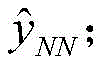
本发明公开了一种神经网络均衡与线性均衡相结合的时域均衡器及均衡方法。本方法为:1)向时域均衡器的输入寄存模块输入一段长度为L1符号序列;2)将序列中的L2个符号构成向量XNN并传入神经网络均衡模块进行处理,得到输出结果
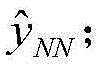
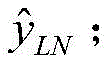

The invention discloses a time domain equalizer and an equalization method combining neural network equalization and linear equalization. The method is as follows: 1) input a sequence of symbols of length L 1 to the input register module of the time domain equalizer; 2) form a vector X NN with L 2 symbols in the sequence and transmit it to the neural network equalization module for processing to obtain the output result
Description
技术领域technical field
本发明属于光通信传输领域,涉及一种将神经网络均衡与线性均衡相结合的时域均衡器及均衡方法。The invention belongs to the field of optical communication transmission, and relates to a time domain equalizer and an equalization method combining neural network equalization and linear equalization.
背景技术Background technique
光信号在光纤传输系统中容易受到各类非线性的影响,如光纤非线性效应、电光器件非线性响应等。这些非线性会对信号造成畸变,导致误码的产生。如何减轻光纤传输系统的非线性损伤以提高系统性能是需要解决的重要课题。Optical signals are easily affected by various nonlinearities in optical fiber transmission systems, such as optical fiber nonlinear effects, nonlinear responses of electro-optical devices, etc. These nonlinearities can distort the signal, resulting in bit errors. How to alleviate the nonlinear damage of the optical fiber transmission system to improve the system performance is an important issue to be solved.
采用非线性时域均衡器是解决上述问题的常用手段。目前,非线性时域均衡器主要有两类,一类是基于沃特尔级数的时域均衡器,另一类是基于神经网络的时域均衡器。The use of nonlinear time domain equalizer is a common means to solve the above problems. At present, there are mainly two types of nonlinear time-domain equalizers, one is the time-domain equalizer based on the Voter series, and the other is the time-domain equalizer based on neural networks.
1)基于沃特尔级数的时域均衡器。沃特尔级数模型是其中一种常见的模型,这种模型对非线性自适应均衡非常有用。一方面线性自适应均衡器的经典公式都可以很容易推广到这种模型。另一方面,沃特尔级数在输入能量有限的条件下可以以任意精度逼近绝大多数非线性系统。其缺点是:算法复杂度随着考虑的级数项的增加而急剧增大。1) Time-domain equalizer based on Voltaire series. One of the common models is the Voltaire series model, which is very useful for nonlinear adaptive equalization. On the one hand the classical formulations of linear adaptive equalizers can be easily generalized to this model. On the other hand, Voltaire series can approximate most nonlinear systems with arbitrary precision under the condition of limited input energy. The disadvantage is that the algorithm complexity increases dramatically with the number of series terms considered.
2)基于神经网络的时域均衡器。神经网络算法拥有强大的非线性拟合能力,得益于其隐藏层非线性激活函数的使用。基于神经网络的时域均衡算法的非线性补偿能力很强,但缺点是由于神经网络拓扑层数较多,算法复杂度往往较高。2) Time domain equalizer based on neural network. The neural network algorithm has a strong nonlinear fitting ability, thanks to the use of the nonlinear activation function of its hidden layer. The time domain equalization algorithm based on neural network has strong nonlinear compensation ability, but the disadvantage is that the complexity of the algorithm is often high due to the large number of neural network topology layers.
发明内容SUMMARY OF THE INVENTION
本发明提供一种神经网络均衡与线性均衡相结合的时域均衡器及其均衡方法,能够有效地补偿光纤传输系统中的各类非线性损伤,并降低传统全连接神经网络算法的计算复杂度。The invention provides a time domain equalizer combining neural network equalization and linear equalization and an equalization method thereof, which can effectively compensate various nonlinear damages in an optical fiber transmission system and reduce the computational complexity of traditional fully connected neural network algorithms .
所述时域均衡器的结构如图1所示,主要包括:一个输入寄存模块,一个神经网络均衡模块,一个线性均衡模块以及一个加和输出模块。具体均衡步骤如下:The structure of the time domain equalizer is shown in FIG. 1 , and mainly includes: an input register module, a neural network equalization module, a linear equalization module and a summation output module. The specific equalization steps are as follows:
(1)每均衡一个符号,向时域均衡器的输入寄存模块输入一段符号序列,符号序列的长度记为L1,包括待均衡符号本身,及其时域上前后若干个延迟符号;优选地,应尽量保证待均衡符号本身位于序列的中心位置,前、后延迟符号数目尽可能接近;(1) For each symbol equalized, input a segment of symbol sequence to the input register module of the time domain equalizer, and the length of the symbol sequence is denoted as L 1 , including the symbol to be equalized and several delay symbols before and after it in the time domain; preferably , should try to ensure that the symbol to be equalized is located in the center of the sequence, and the number of delayed symbols before and after is as close as possible;
(2)上述输入寄存模块,将时域上最接近待均衡符号的L2个符号(L2<=L1,包含待均衡符号本身及若干前后延迟符号)组成向量XNN,输入神经网络均衡模块的输入层缓存;本发明并不是将全部符号(即L1个符号)输入神经网络是本专利的创新点所在,好处是可以使贡献小的延迟符号不参与神经网络均衡,从而减小计算复杂度。(2) The above-mentioned input register module forms a vector X NN of L 2 symbols (L 2 <= L 1 , including the symbol to be equalized and several pre- and post-delay symbols) that are closest to the symbol to be equalized in the time domain, and is input to the neural network equalization The input layer cache of the module; the invention is not to input all symbols (ie L 1 symbols) into the neural network, which is the innovation of this patent. the complexity.
(3)上述输入寄存模块,将(2)中未进入神经网络均衡模块的L1-L2个符号,输入线性均衡模块的输入层缓存,可选择地,也可将全部L1个符号输入线性均衡模块缓存,输入上述线性均衡模块的符号构成的向量记为XLN;(3) In the above-mentioned input register module, the L 1 -L 2 symbols that have not entered the neural network equalization module in (2) are input into the input layer buffer of the linear equalization module, optionally, all L 1 symbols can also be input The linear equalization module buffers, and the vector formed by the symbols inputting the above-mentioned linear equalization module is denoted as X LN ;
(4)上述神经网络均衡模块采用传统全连接神经网络结构,包含:1个输入层,h个(h>0)隐藏层和1个输出层。输入层神经元数量和传入的符号数对应,各隐藏层神经元数应综合考量计算复杂度与均衡效果而定,输出层仅设置一个神经元。各层之间的权重连接矩阵分别定义为w1,w2,…,wh+1,相应的偏置向量分别记为b1,b2,…,bh+1,加粗字母表示矩阵或向量。可选地,也可不添加任何偏置。每个隐藏层都会对输入的数据作用一个非线性激活函数,非线性激活函数的种类包括但不局限于ReLU函数,第1至第h层隐藏层的激活函数分别定义为f1(·),f2(·),…,fh(·),输出层不作用任何激活函数。在均衡开始前,需要对所有权重连接矩阵和偏置向量的取值进行随机初始化。神经网络的前向传播过程可描述为:输入层每个神经元直接将(2)中缓存的符号作为该神经元的输出;自第一隐藏层开始至最后的输出层,每个神经元会接收来自上一层所有神经元各自输出的并分别乘以对应权重系数的信号,进一步地,神经元会对这些信号求和、加上偏置项并作用相应的非线性激活函数(输出层没有激活函数),作为该神经元的输出。因此,神经网络均衡模块的输出可表示为:(4) The above-mentioned neural network equalization module adopts a traditional fully connected neural network structure, including: 1 input layer, h (h>0) hidden layers and 1 output layer. The number of neurons in the input layer corresponds to the number of incoming symbols. The number of neurons in each hidden layer should be determined by comprehensively considering the computational complexity and balance effect. Only one neuron is set in the output layer. The weight connection matrix between each layer is defined as w 1 ,w 2 ,…,w h+1 , the corresponding bias vector is denoted as b 1 ,b 2 ,…,b h+1 , the bold letters represent the matrix or vector. Optionally, no offset may be added. Each hidden layer will act on the input data with a nonlinear activation function. The types of nonlinear activation functions include but are not limited to ReLU functions. The activation functions of the 1st to hth hidden layers are respectively defined as f 1 ( ), f 2 (·),…,f h (·), the output layer does not apply any activation function. Before equalization starts, the values of all weight connection matrices and bias vectors need to be randomly initialized. The forward propagation process of the neural network can be described as: each neuron in the input layer directly uses the symbol cached in (2) as the output of the neuron; from the first hidden layer to the last output layer, each neuron will Receive the signals from the respective outputs of all neurons in the previous layer and multiply the corresponding weight coefficients respectively. Further, the neurons will sum these signals, add a bias term and act on the corresponding nonlinear activation function (the output layer does not have activation function) as the output of this neuron. Therefore, the output of the neural network equalization module can be expressed as:

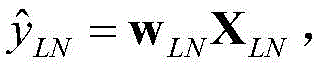
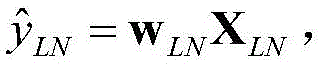
(5)上述线性均衡模块,将该模块输入层的每个符号分别乘以一个相应的权重系数,并全部求和得到该模块的输出层,权重系数构成的向量记为wLN,在均衡开始前同样需要对该权重向量进行随机初始化。因此,线性均衡模块的输出可表示为: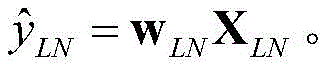
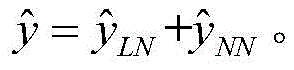
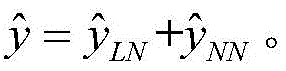
(6)线性均衡模块和神经网络均衡模块的输出分别传入加和输出模块,通过加和作用,得到均衡器的最终均衡输出符号: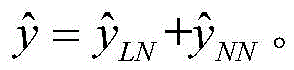
(7)在训练模式中,均衡器的输出符号
(8)完成训练后,均衡器直接将每次均衡后的符号输出,用于后续判决等处理。(8) After completing the training, the equalizer directly outputs the symbols after each equalization for subsequent processing such as judgment.
与现有技术相比,本发明的有益效果:Compared with the prior art, the beneficial effects of the present invention:
采用本发明所述均衡结构,与传统全连接神经网络均衡结构相比,具有以下两个优点:Using the balanced structure of the present invention, compared with the traditional fully connected neural network balanced structure, has the following two advantages:
(1)算法复杂度更小。因为输入符号序列中传入计算量相对更大的神经网络均衡模块的符号数减少,而传入线性均衡模块的符号消耗的计算量很小。(1) The algorithm complexity is smaller. Because the number of symbols passed into the neural network equalization module, which is relatively more computationally intensive, in the input symbol sequence is reduced, and the symbols passed into the linear equalization module consume a small amount of computation.
(2)补偿非线性的效果更好。因为待均衡符号本身及其邻近的符号受到的非线性影响更严重,含有的非线性畸变信息最多,而在时域上相距待均衡符号较远的符号几乎不含有非线性畸变信息,传入神经网络均衡会引起一定程度的均衡噪声,反而恶化均衡性能。而在时域上相距待均衡符号较远的符号仍含有线性畸变信息,通过线性均衡网络均衡可以更好地提升系统性能。因此可以合理优化传入神经网络均衡模块的符号数L2使均衡性能达到最佳。(2) The effect of compensating nonlinearity is better. Because the symbol to be equalized and its adjacent symbols are more seriously affected by nonlinearity, they contain the most nonlinear distortion information, while the symbols that are far away from the symbol to be equalized in the time domain hardly contain nonlinear distortion information. Network equalization will cause a certain level of equalization noise, which will worsen the equalization performance. However, the symbols that are far away from the symbols to be equalized in the time domain still contain linear distortion information, and the system performance can be better improved through linear equalization network equalization. Therefore, the number of symbols L 2 passed into the equalization module of the neural network can be reasonably optimized to achieve the best equalization performance.
附图说明Description of drawings
图1是本发明所述的时域均衡器的整体结构图。FIG. 1 is an overall structural diagram of the time domain equalizer according to the present invention.
图2是本发明在单边带PAM4信号高速光纤传输系统中的实施例。FIG. 2 is an embodiment of the present invention in a high-speed optical fiber transmission system for single-sideband PAM4 signals.
图3是104G波特率单边带PAM4信号80公里的传输实验结果。Figure 3 is the experimental result of 80 km transmission of 104G baud rate SSB PAM4 signal.
具体实施方式Detailed ways
下面结合附图2,详细描述本发明所述的均衡方案在单边带PAM4信号高速光纤传输系统中的应用。The application of the equalization scheme of the present invention in a high-speed optical fiber transmission system for single-sideband PAM4 signals will be described in detail below with reference to FIG. 2 .
该实施例包括以下步骤:This embodiment includes the following steps:
(1)通过发端数字信号处理(DSP)生成单边带PAM4信号,主要流程包括:PAM-4符号映射、上采样、根升余弦滤波、单边带滤波、数字域光纤色散预补偿、下采样等操作,生成104G波特率的单边带PAM4数字信号。(1) The single-sideband PAM4 signal is generated by the digital signal processing (DSP) at the origin. The main process includes: PAM-4 symbol mapping, upsampling, root raised cosine filtering, single-sideband filtering, digital domain fiber dispersion pre-compensation, downsampling and other operations to generate a single-sideband PAM4 digital signal with a baud rate of 104G.
(2)将上述生成的单边带PAM4数字信号传入光发射机,调制成光域上的单边带PAM-4信号,将光信号送入80公里的标准单模光纤进行传输,进一步地,传输后的光信号传入光接收机将光信号转化电信号,进一步地转为数字信号,传入收端DSP处理。(2) The single-sideband PAM4 digital signal generated above is transmitted to the optical transmitter, modulated into a single-sideband PAM-4 signal in the optical domain, and the optical signal is sent into a standard single-mode fiber of 80 kilometers for transmission, and further , the transmitted optical signal is transmitted to the optical receiver to convert the optical signal into an electrical signal, further converted into a digital signal, and then transmitted to the receiving end DSP for processing.
(3)通过收端DSP恢复发端符号,在经过重采样、Kramers-Kronig接收、相位纠正、取实部、匹配滤波、帧同步等步骤后,进一步地,将符号序列传入本发明所述的均衡器进行均衡处理,同时作为对照,也将相同的符号序列传入传统的线性均衡器和传统的神经网络均衡器进行处理,为了公平比较,每个均衡器都使用相同长度的符号序列进行训练,并在训练后恢复相同长度的符号序列;(3) recovering the symbol of the transmitting end through the receiving end DSP, after going through the steps of resampling, Kramers-Kronig reception, phase correction, taking the real part, matched filtering, frame synchronization, etc., further, the symbol sequence is introduced into the method of the present invention. The equalizer performs equalization processing. At the same time, as a control, the same symbol sequence is also passed into the traditional linear equalizer and the traditional neural network equalizer for processing. For fair comparison, each equalizer uses the same length of symbol sequence for training. , and recover a sequence of symbols of the same length after training;
进一步地,将三种均衡器恢复出的符号序列进行判决、解调、误码统计,并进行对比。Further, the symbol sequences recovered by the three equalizers are subjected to judgment, demodulation, and error statistics, and compared.
本发明所述的均衡器在该实施例中的具体应用步骤为:The specific application steps of the equalizer of the present invention in this embodiment are:
1.对于每一个待均衡符号,向时域均衡器的输入寄存模块输入待均衡符号本身,及其时域上前后各40个延迟符号,共81个符号;1. For each symbol to be equalized, input the symbol to be equalized itself to the input register module of the time domain equalizer, and 40 delay symbols before and after it in the time domain, a total of 81 symbols;
2.将待均衡符号本身及其时域上前后各15个延迟符号,共31个符号,传入神经网络均衡模块的输入层;2. The symbol to be equalized and its 15 delayed symbols before and after in the time domain, a total of 31 symbols, are passed into the input layer of the neural network equalization module;
3.将步骤1中全部81个符号传入线性均衡模块的输入层;3. Pass all 81 symbols in
4.上述神经网络均衡模块采用传统全连接神经网络结构,具体参数配置为:包含1个输入层,1个隐藏层和1个输出层。输入层神经元数量为31(和传入的符号数对应),单隐藏层神经元数被优化为8,输出层仅设置一个神经元。隐藏层激活函数为ReLU,输出层不复合任何激活函数。在均衡开始前,对所有权重连接矩阵和偏置向量的取值进行随机初始化。神经网络通过前向传播得到神经网络均衡模块的输出值。4. The above-mentioned neural network equalization module adopts a traditional fully connected neural network structure, and the specific parameters are configured as follows: including 1 input layer, 1 hidden layer and 1 output layer. The number of neurons in the input layer is 31 (corresponding to the number of incoming symbols), the number of neurons in a single hidden layer is optimized to 8, and only one neuron is set in the output layer. The activation function of the hidden layer is ReLU, and the output layer does not compound any activation function. The values of all weight connection matrices and bias vectors are randomly initialized before equalization starts. The neural network obtains the output value of the neural network equalization module through forward propagation.
5.上述线性均衡模块将输入层的81个符号分别乘以权重系数,并全部求和得到该模块的输出值,在均衡开始前同样需要权重向量进行随机初始化。5. The linear equalization module above multiplies the 81 symbols of the input layer by the weight coefficients, and sums them all up to obtain the output value of the module. The weight vector also needs to be randomly initialized before the equalization starts.
6.线性均衡模块和神经网络均衡模块的输出分别传入加和输出模块,通过加和作用,得到均衡器的最终均衡输出符号。6. The outputs of the linear equalization module and the neural network equalization module are respectively sent to the addition and output modules, and the final equalized output symbol of the equalizer is obtained through the addition function.
7.首先在训练模式中,提供6400个发端初始符号作为均衡器输出符号的参考,计算相应误差代价,这里选择最小均方误差(MSE)函数作为代价函数。算出代价之后,通过经典的反向传输算法(Back Propagation Algorithm)计算线性均衡模块、神经网络均衡模块中的参数梯度,包括权重连接参数和偏置参数,这里选用Adam算法优化器,调整并优化上述参数。迭代以上过程直到各参数收敛,完成训练过程。7. First, in the training mode, provide 6400 initial symbols of the origin as a reference for the output symbols of the equalizer, and calculate the corresponding error cost. Here, the minimum mean square error (MSE) function is selected as the cost function. After calculating the cost, the classical Back Propagation Algorithm is used to calculate the parameter gradients in the linear equalization module and the neural network equalization module, including the weight connection parameters and bias parameters. Here, the Adam algorithm optimizer is used to adjust and optimize the above parameter. The above process is iterated until the parameters converge, and the training process is completed.
8.完成训练后,均衡器将每次均衡后的符号直接输出,用于后续判决等处理。8. After the training is completed, the equalizer will directly output the symbols after each equalization for subsequent decision and other processing.
图3为104G波特率单边带PAM4信号80公里的传输实验结果,纵轴为误码率(BER),横轴为接收信号光信噪比(OSNR)。为公平比较,三种均衡方案的输入寄存模块的长度统一优化为81。Figure 3 shows the experimental results of the 80-kilometer transmission of a 104G baud rate single-sideband PAM4 signal. The vertical axis is the bit error rate (BER), and the horizontal axis is the received signal optical signal-to-noise ratio (OSNR). For fair comparison, the lengths of the input register modules of the three equalization schemes are uniformly optimized to be 81.
对于参考用的传统神经网络均衡方案,也采用单隐藏层、单输出神经元结构,隐藏层神经元数优化为8,隐藏层激活函数同样为ReLU。For the traditional neural network equalization scheme used for reference, a single hidden layer and single output neuron structure is also used, the number of neurons in the hidden layer is optimized to 8, and the activation function of the hidden layer is also ReLU.
通过对比3条BER曲线可以发现,本发明的均衡算法优于常用的线性均衡算法和神经网络算法,原因在于L2被合理的优化。另外从复杂度方面考虑,在本实施例中,本发明所述的均衡方案每均衡一个符号需要的乘法次数为337,而传统的神经网络算法需要656次,本发明所述的均衡方案大幅度降低了非线性均衡的计算复杂度。By comparing the three BER curves, it can be found that the equalization algorithm of the present invention is superior to the commonly used linear equalization algorithm and neural network algorithm because L 2 is reasonably optimized. In addition, from the aspect of complexity, in this embodiment, the number of multiplications required for each symbol equalized by the equalization scheme of the present invention is 337 times, while the traditional neural network algorithm requires 656 times. The computational complexity of nonlinear equalization is reduced.
以上实施例仅用以说明本发明的技术方案而非对其进行限制,本领域的普通技术人员可以对本发明的技术方案进行修改或者等同替换,而不脱离本发明的精神和范围,本发明的保护范围应以权利要求所述为准。The above embodiments are only used to illustrate the technical solutions of the present invention rather than limit them. Those of ordinary skill in the art can modify or equivalently replace the technical solutions of the present invention without departing from the spirit and scope of the present invention. The scope of protection shall be subject to what is stated in the claims.
Claims (8)




Priority Applications (1)
| Application Number | Priority Date | Filing Date | Title |
|---|---|---|---|
| CN202010686983.4A CN112036543B (en) | 2020-07-16 | 2020-07-16 | Time Domain Equalizer and Equalization Method Combined with Neural Network Equalization and Linear Equalization |
Applications Claiming Priority (1)
| Application Number | Priority Date | Filing Date | Title |
|---|---|---|---|
| CN202010686983.4A CN112036543B (en) | 2020-07-16 | 2020-07-16 | Time Domain Equalizer and Equalization Method Combined with Neural Network Equalization and Linear Equalization |
Publications (2)
| Publication Number | Publication Date |
|---|---|
| CN112036543A true CN112036543A (en) | 2020-12-04 |
| CN112036543B CN112036543B (en) | 2022-05-03 |
Family
ID=73579557
Family Applications (1)
| Application Number | Title | Priority Date | Filing Date |
|---|---|---|---|
| CN202010686983.4A Active CN112036543B (en) | 2020-07-16 | 2020-07-16 | Time Domain Equalizer and Equalization Method Combined with Neural Network Equalization and Linear Equalization |
Country Status (1)
| Country | Link |
|---|---|
| CN (1) | CN112036543B (en) |
Cited By (5)
| Publication number | Priority date | Publication date | Assignee | Title |
|---|---|---|---|---|
| CN112865866A (en) * | 2021-01-20 | 2021-05-28 | 重庆邮电大学 | Visible light PAM system nonlinear compensation method based on GSN |
| CN114070399A (en) * | 2022-01-17 | 2022-02-18 | 网络通信与安全紫金山实验室 | Vector signal direct detection system, method, electronic device and storage medium |
| WO2022121386A1 (en) * | 2020-12-07 | 2022-06-16 | 华为技术有限公司 | Signal processing method and apparatus, and communication system |
| CN115208721A (en) * | 2022-06-23 | 2022-10-18 | 上海交通大学 | Volterra-like neural network equalizer construction method and system |
| CN115659563A (en) * | 2022-11-09 | 2023-01-31 | 吉林大学 | A MZM Nonlinear Equalization Method Based on LM-BP Algorithm |
Citations (5)
| Publication number | Priority date | Publication date | Assignee | Title |
|---|---|---|---|---|
| US6052349A (en) * | 1996-09-30 | 2000-04-18 | Kabushiki Kaisha Toshiba | Waveform equalizer and memory device having a waveform equalizer |
| US20150249554A1 (en) * | 2013-06-21 | 2015-09-03 | Dhadesugoor Vaman | Adaptive demodulation method and apparatus using an artificial neural network to improve data recovery in high speed channels |
| WO2019082239A1 (en) * | 2017-10-23 | 2019-05-02 | 三菱電機株式会社 | Equalization device and equalization method |
| CN109905337A (en) * | 2019-01-13 | 2019-06-18 | 浙江大学 | A kind of channel equalization method based on NARX neural network and blocky feedback |
| CN110392006A (en) * | 2019-06-20 | 2019-10-29 | 东南大学 | Adaptive channel equalizer and method based on integrated learning and neural network |
-
2020
- 2020-07-16 CN CN202010686983.4A patent/CN112036543B/en active Active
Patent Citations (5)
| Publication number | Priority date | Publication date | Assignee | Title |
|---|---|---|---|---|
| US6052349A (en) * | 1996-09-30 | 2000-04-18 | Kabushiki Kaisha Toshiba | Waveform equalizer and memory device having a waveform equalizer |
| US20150249554A1 (en) * | 2013-06-21 | 2015-09-03 | Dhadesugoor Vaman | Adaptive demodulation method and apparatus using an artificial neural network to improve data recovery in high speed channels |
| WO2019082239A1 (en) * | 2017-10-23 | 2019-05-02 | 三菱電機株式会社 | Equalization device and equalization method |
| CN109905337A (en) * | 2019-01-13 | 2019-06-18 | 浙江大学 | A kind of channel equalization method based on NARX neural network and blocky feedback |
| CN110392006A (en) * | 2019-06-20 | 2019-10-29 | 东南大学 | Adaptive channel equalizer and method based on integrated learning and neural network |
Non-Patent Citations (3)
| Title |
|---|
| AMI KUMAR PARIDA ETC.: "A Strategy on Channel Equalization for Digital Communication Based on Neural Network System", 《2019 5TH INTERNATIONAL CONFERENCE ON ADVANCED COMPUTING & COMMUNICATION SYSTEMS (ICACCS)》 * |
| QINGYI ZHOU ETC.: "AdaNN: Adaptive Neural Network-based Equalizer via Online Semi-supervised Learning", 《HTTPS://ARXIV.ORG/PDF/1907.10258.PDF》 * |
| 肖瑛等: "线性修正下的神经网络盲均衡算法", 《声学技术》 * |
Cited By (8)
| Publication number | Priority date | Publication date | Assignee | Title |
|---|---|---|---|---|
| WO2022121386A1 (en) * | 2020-12-07 | 2022-06-16 | 华为技术有限公司 | Signal processing method and apparatus, and communication system |
| CN112865866A (en) * | 2021-01-20 | 2021-05-28 | 重庆邮电大学 | Visible light PAM system nonlinear compensation method based on GSN |
| CN114070399A (en) * | 2022-01-17 | 2022-02-18 | 网络通信与安全紫金山实验室 | Vector signal direct detection system, method, electronic device and storage medium |
| CN114070399B (en) * | 2022-01-17 | 2022-05-03 | 网络通信与安全紫金山实验室 | Vector signal direct detection system, vector signal direct detection method, electronic device, and storage medium |
| CN115208721A (en) * | 2022-06-23 | 2022-10-18 | 上海交通大学 | Volterra-like neural network equalizer construction method and system |
| CN115208721B (en) * | 2022-06-23 | 2024-01-23 | 上海交通大学 | Volterra-like neural network equalizer construction method and system |
| CN115659563A (en) * | 2022-11-09 | 2023-01-31 | 吉林大学 | A MZM Nonlinear Equalization Method Based on LM-BP Algorithm |
| CN115659563B (en) * | 2022-11-09 | 2025-07-25 | 吉林大学 | MZM nonlinear equalization method based on LM-BP algorithm |
Also Published As
| Publication number | Publication date |
|---|---|
| CN112036543B (en) | 2022-05-03 |
Similar Documents
| Publication | Publication Date | Title |
|---|---|---|
| CN112036543B (en) | Time Domain Equalizer and Equalization Method Combined with Neural Network Equalization and Linear Equalization | |
| CN115882959B (en) | Nonlinear compensation method based on machine learning | |
| CN103780519B (en) | A Joint Parallel Method for Channel Equalization and Frequency Offset Estimation Based on LMS | |
| CN108123908B (en) | Improved SVM (support vector machine) equalization method and system for NG-PON (NG-Passive optical network) | |
| CN114204993B (en) | Nonlinear equalization method and system based on polynomial mapping feature construction | |
| CN113938198B (en) | Optical fiber transmission system, LDA-based method and module for simplifying nonlinear equalizer | |
| WO2015123989A1 (en) | Channel equalization method and system based on time-domain channel estimation | |
| US6430287B1 (en) | Combined parallel adaptive equalizer/echo canceller | |
| WO2020179726A1 (en) | Light receiving device and coefficient optimization method | |
| CN111988249B (en) | A receiving end equalization method based on adaptive neural network and receiving end | |
| CN114301529B (en) | Volterra equalization method and system based on multi-symbol processing | |
| CN112511472B (en) | A time-frequency second-order equalization method and communication system based on neural network | |
| CN116418405B (en) | A fiber nonlinear equalization method based on perturbation theory and complex-valued convolutional neural networks. | |
| CN116886192B (en) | Specific gravity sharing nonlinear precoding method for compensating IMDD optical fiber system damage | |
| CN115668811B (en) | Adaptive equalizer, adaptive equalization method, and optical communication system | |
| JP2025513935A (en) | Learning-Based Nonlinear Compensation Using Physics-Information Neural Networks for Data Access | |
| Song et al. | Blind frequency-domain equalization using vector-quantized variational autoencoders | |
| CN110266388A (en) | A kind of PMD equalization method, device, electronic equipment and storage medium | |
| Shah et al. | Low-complexity design of noninteger fractionally spaced adaptive equalizers for coherent optical receivers | |
| CN118337293B (en) | PAM4 balanced transmission system and method under bandwidth limitation | |
| CN119210951B (en) | Self-adaptive channel response matching neural network equalization method and system | |
| CN106656879A (en) | High speed and higher-order variable step size self-adaptive equalization method | |
| WO2022048355A1 (en) | Frequency domain generalized linear equilibrium method, apparatus and system, and non-volatile storage medium | |
| CN113708845A (en) | Equalization demultiplexing method, apparatus, electronic device and computer readable storage medium | |
| CN101924718B (en) | Hybrid wavelet neural network blind equalization method controlled by fuzzy neutral network |
Legal Events
| Date | Code | Title | Description |
|---|---|---|---|
| PB01 | Publication | ||
| PB01 | Publication | ||
| SE01 | Entry into force of request for substantive examination | ||
| SE01 | Entry into force of request for substantive examination | ||
| GR01 | Patent grant | ||
| GR01 | Patent grant |