[go: up one dir, main page]

CN112016240B - Prediction method for residual stable service life of incomplete degradation equipment with similar evidence - Google Patents

Prediction method for residual stable service life of incomplete degradation equipment with similar evidence Download PDF

Info

Publication number
CN112016240B
CN112016240B CN202010683969.9A CN202010683969A CN112016240B CN 112016240 B CN112016240 B CN 112016240B CN 202010683969 A CN202010683969 A CN 202010683969A CN 112016240 B CN112016240 B CN 112016240B
Authority
CN
China
Prior art keywords
equipment
service life
data
stability
prediction
Prior art date
Legal status (The legal status is an assumption and is not a legal conclusion. Google has not performed a legal analysis and makes no representation as to the accuracy of the status listed.)
Active
Application number
CN202010683969.9A
Other languages
Chinese (zh)
Other versions
CN112016240A (en
Inventor
殷林飞
王涛
雷嘉明
马晨骁
李钰
高放
Current Assignee (The listed assignees may be inaccurate. Google has not performed a legal analysis and makes no representation or warranty as to the accuracy of the list.)
Guangxi University
Original Assignee
Guangxi University
Priority date (The priority date is an assumption and is not a legal conclusion. Google has not performed a legal analysis and makes no representation as to the accuracy of the date listed.)
Filing date
Publication date
Application filed by Guangxi University filed Critical Guangxi University
Priority to CN202010683969.9A priority Critical patent/CN112016240B/en
Publication of CN112016240A publication Critical patent/CN112016240A/en
Application granted granted Critical
Publication of CN112016240B publication Critical patent/CN112016240B/en
Active legal-status Critical Current
Anticipated expiration legal-status Critical

Links

Images

Classifications

    • GPHYSICS
    • G06COMPUTING OR CALCULATING; COUNTING
    • G06FELECTRIC DIGITAL DATA PROCESSING
    • G06F30/00Computer-aided design [CAD]
    • G06F30/20Design optimisation, verification or simulation
    • G06F30/27Design optimisation, verification or simulation using machine learning, e.g. artificial intelligence, neural networks, support vector machines [SVM] or training a model
    • GPHYSICS
    • G06COMPUTING OR CALCULATING; COUNTING
    • G06FELECTRIC DIGITAL DATA PROCESSING
    • G06F2119/00Details relating to the type or aim of the analysis or the optimisation
    • G06F2119/04Ageing analysis or optimisation against ageing

Landscapes

  • Engineering & Computer Science (AREA)
  • Physics & Mathematics (AREA)
  • Evolutionary Computation (AREA)
  • Theoretical Computer Science (AREA)
  • Computer Vision & Pattern Recognition (AREA)
  • Medical Informatics (AREA)
  • Software Systems (AREA)
  • Artificial Intelligence (AREA)
  • Computer Hardware Design (AREA)
  • Geometry (AREA)
  • General Engineering & Computer Science (AREA)
  • General Physics & Mathematics (AREA)
  • Management, Administration, Business Operations System, And Electronic Commerce (AREA)
  • Testing And Monitoring For Control Systems (AREA)

Abstract

本发明提供一种相似证据非完全降解设备剩余稳定使用寿命预测方法,该方法能对设备剩余稳定使用寿命进行预测,无需设备从开始使用到当前状态的所有数据,只需设备当前数据即可预测设备未来稳定使用寿命。本发明提出了结合证据相关性分析法,通过设备参数相关性分析计算得到相关参数类型、相关系数及其权重函数,本发明提出了表示设备使用稳定性的稳定因子概念,利用马尔科夫预测链对表示设备使用稳定性的稳定因子进行预测,通过设备证据构建反向传播神经网络得到设备使用寿命稳定性的稳定因子变化曲线,利用神经网络分析当前及未来时刻设备稳定因子的稳定性,从而得出未来非完全降解设备剩余稳定使用寿命。

Figure 202010683969

The present invention provides a method for predicting the remaining stable service life of equipment with similar evidence of incomplete degradation. The method can predict the remaining stable service life of the equipment without requiring all data from the beginning of use to the current state of the equipment, and only needs the current data of the equipment to predict The future stable service life of the equipment. The present invention proposes a combination of evidence correlation analysis method, and obtains related parameter types, correlation coefficients and weight functions through equipment parameter correlation analysis and calculation. Predict the stability factor representing the stability of equipment use, construct the backpropagation neural network through equipment evidence to obtain the stability factor change curve of equipment service life stability, and use the neural network to analyze the stability of the equipment stability factor at present and in the future, so as to obtain The remaining stable service life of the non-completely degradable equipment in the future.

Figure 202010683969

Description

Prediction method for residual stable service life of incomplete degradation equipment with similar evidence
Technical Field
The invention belongs to the technical field of equipment detection, and relates to a method for detecting the residual stable service life of equipment.
Background
With the rapid development of modern industrial technology, modern mechanical equipment is gradually automated, intelligentized, complicated and precise, and meanwhile, the economic loss caused by equipment failure caused by damage of the mechanical equipment is not small. The reliability and safety of modern mechanical equipment become stable gradually with the development of industrial technology, and research and practice now show that most of the failure and shutdown reasons of the mechanical equipment are performance degradation and failure, so that the reliability and safety of the modern mechanical equipment become important for predicting the residual service life of the mechanical equipment. To date, various data-driven methods have been proposed at home and abroad to predict the remaining useful life of a non-fully degraded device, i.e., the time from the present until the device stops performing its designed function. However, the current data driving method depends on data collection of equipment in the field working period, the collected data are fitted and clustered, the whole service life of the equipment is divided into a plurality of stages, similarity analysis is carried out on the data and real-time data of the equipment, the equipment is roughly judged to be in a certain stage at present, and then the residual service life of the equipment is predicted. With the popularization and application of some artificial intelligence algorithms, at present, the non-linear regression method based on the artificial neural network is also very effective for predicting the residual service life of the equipment, but the method needs to adjust a large number of parameters, and a certain deviation exists in an equipment degradation curve model due to scarcity of training of a neural network example.
In addition, similarity-based methods have been successfully applied to equipment fault prediction, and these methods construct local fuzzy models through fuzzy algorithms, and obtain regression prediction curves of the remaining service life of the equipment through these models to predict the remaining service life of future equipment, but such prediction methods can predict that the future service life may be too long, data does not have specificity, and the future service life of the equipment cannot be estimated more accurately. In addition, some model estimation predictions are conservative, the obtained predictions have short service lives, and extra cost is caused for future economic planning.
The invention provides a method for predicting the remaining stable service life of equipment with similar evidence and incomplete degradation, which utilizes an evidence similarity analysis method to obtain related parameter types, related coefficients and weight functions thereof through equipment parameter correlation analysis calculation.
Disclosure of Invention
The invention provides a method for predicting the residual stable service life of non-complete degradation equipment with similar evidence. The method is different from the conventional method for predicting the residual service life of the equipment. At present, the common prediction of the residual service life of the equipment generally carries out cluster analysis on equipment evidences through a fuzzy algorithm, the service life of the equipment is divided into a plurality of stages, the stage of the service life of the equipment where the current equipment is located is obtained through comparison and analysis of real-time data of the current equipment, and then the residual service life of the equipment is predicted. The method is used for predicting the residual stable service life of the equipment which is not completely degraded, namely predicting that the equipment can be stably put into operation in a plurality of years in the future, the prediction result is more accurate compared with common prediction information, and when the equipment finishes the predicted stable service life, the subsequent residual stable service life of the equipment can be predicted according to the real-time data of the current equipment.
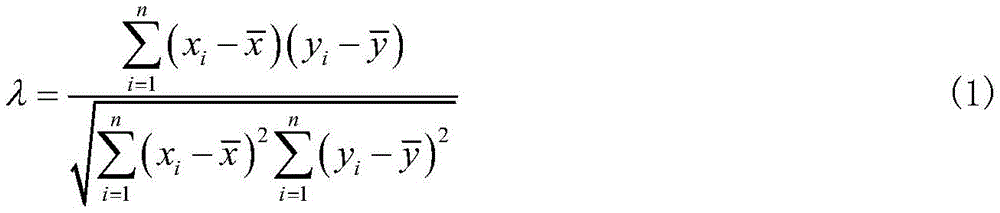
When the residual stable service life of the equipment is predicted, the method screens the relevant parameters of the service life of the equipment by using an index screening algorithm based on evidence correlation. And under the condition that the data volume of the equipment is large and complex, parameters for predicting the residual stable service life of the equipment are screened through evidence correlation analysis. The correlation analysis method can reflect the degree of relationship among variables in a data mode, and the calculation formula is shown in the following formula (1):
Figure BDA0002586819500000021
in the formula, λ is the correlation coefficient of the remaining stable service life of the device, when λ | =0 is completely irrelevant, 0 < | λ | < 0.3 is low relevant, 0.3 < | λ | < 0.5 is not significant relevant, 0.5 < | λ | < 0.8 is significant relevant, 0.8 < | λ | < 1 is high relevant, and | λ | =1 is completely relevant; n is the number of data types;
Figure BDA0002586819500000022
are respectively a variable x i ,y i Average value of (d); as shown in the following equation (2):
Figure BDA0002586819500000023
the correlation coefficient of the residual stable service life of the equipment is obtained through the calculation method, the characteristic quantity which is high in correlation and above is screened out, and when complex data in evidence are processed, the characteristic quantity of the residual stable service life of the corresponding equipment can be rapidly screened out corresponding to different equipment. In the prediction process, the data characteristic quantity with high correlation and above is endowed with a higher weight function, and in the process of endowing the weight function, the following formula is shown:
Figure BDA0002586819500000024
in the formula, omega i Is a weight value; n is the number of sample data; lambda i The sample data with higher correlation is the sample data with higher weight value.
The method comprises the steps of obtaining the parameter type and the parameter weight function of the residual stable service life of the equipment through a correlation analysis method, and predicting the stability factor of the residual stable service life function of the equipment in the future by utilizing a Markov chain. The change trend of the stability factor in the future age is predicted through the Markov chain, and the stability factor is brought into the back propagation neural network trained through the evidence, so that the residual stable service life of the equipment can be obtained.
The Markov prediction chain can well express the current state and the future variation trend of the system variables, can predict the possible situations of the system variables in a specific time period in the future, and can express the multi-class data prediction in the form of a single factor through the expression form of the weight function, so that the system variation trend caused by a plurality of variables can be more clearly and directly seen.
Suppose system Z is at t i Is in state i at the moment n Then at t i+1 The state of the system at time t i The state before the moment is irrelevant, and the prediction mode is consistent with the prediction of the service life of future equipment which can be stably used through the current state value at a certain moment, and the following formula (4) shows that:
P{Y n+1 =i n+1 |Y 0 =i 0 ,…Y n =i n }=P{Y n+1 =i n+1 |Y n =i n } (4)
in the formula, Y n Predicting chains for Markov; p is a probability function, then at t i+m The probability function for the system at time and in state j is shown as follows:
Figure BDA0002586819500000031
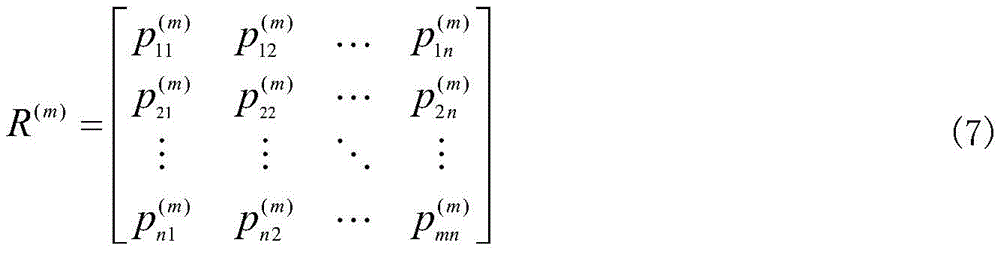
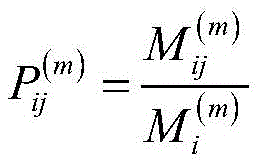
when the parameter data is predicted, the actual parameter sequence can be divided into a plurality of states X according to requirements 1 ,X 2 ,…,X n Then, the state transition probability of the m steps is shown in the following formula (6):
Figure BDA0002586819500000032
in the formula (I), the compound is shown in the specification,
Figure BDA0002586819500000033
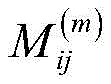
from state X for a sequence of system parameters i Through m steps, the state is transferred to the state X j The number of (1) is
Figure BDA0002586819500000034
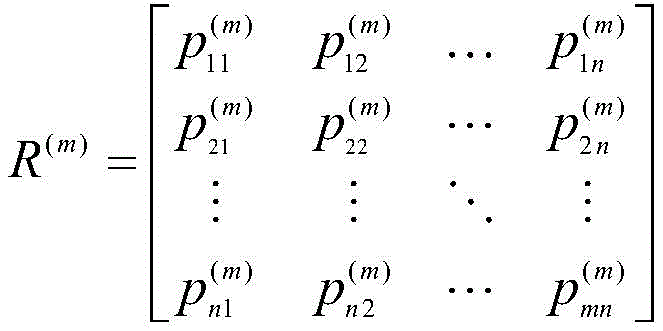
Then the state transition matrix is defined as follows:
Figure BDA0002586819500000035
in the Markov prediction chain, if a one-step state transition matrix is used, the parameter data of the previous moment is in the state X 3 Then R is (1) The third row of the matrix is used, if the prediction is performed by using parameter data of a plurality of moments, the data state is X when the prediction is transferred to the moment to be predicted after one step 3 Then R is adopted (l) The third row of (2). If the average and standard deviation of the parameter data sequence are used for dividing the state interval, and the parameter type and data obtained before are used, the residual error correction prediction at the next time is as shown in the following formula (8):
Figure BDA0002586819500000041
in the formula, ω i Is the weight of the relevant parameter; v. of i State center of the relevant parameter; therefore, through the Markov chain prediction, the stability factor prediction of the relevant parameter can be obtained, which is shown in the following formula (9):
Figure BDA0002586819500000042
in the formula, K (0) (t i+1 ) Is the original stability factor, i.e.
Figure BDA0002586819500000043
Wherein s is i For the relevant parameter data, K represents a stable performance parameter, i.e., a stable factor, of the current state of the system.
After the stable performance parameter factors in the current state and at the future moment are obtained, the invention provides a back propagation neural network learning method, big data learning and training are carried out on evidence, a stable factor function curve related to the residual stable service life of the equipment is obtained through analysis, processing and learning of equipment data, the performance of the current equipment and the stable parameter factors at the future moment are brought into a neural system for prediction, the situation that the stable factors of the equipment are in a healthy state in the next years can be analyzed, and the residual stable service life of the equipment can be obtained through function prediction operation.
The device stable service life prediction work can be completed by analyzing the nonlinear relation of the interaction of various factors of the device in the life cycle. The invention provides a three-layer back propagation neural network, wherein the three-layer back propagation neural network screens parameter types highly related to the service life of equipment through correlation relation analysis, so that the data is taken as neurons of an input layer, the data of the input layer and the data of an output layer are required to be normalized, the input data can be processed through a weight function mode in the training work of a middle hidden layer, the output layer is required to output a fitting function of a stable service life stability factor of the equipment, namely a K value is a dependent variable, and the stable service life of the corresponding equipment is output.
Drawings
FIG. 1 is a flow chart of the stability factor solution of the method of the present invention.
FIG. 2 is a diagram of a back propagation neural network architecture for the method of the present invention.
FIG. 3 is a flow chart of the prediction of the remaining stable service life of the incomplete degradation equipment of the method of the present invention.
Detailed Description
The invention provides a method for predicting the residual stable service life of non-complete degradation equipment with similar evidence, which is described in detail in the following steps in combination with the attached drawings:
FIG. 1 is a flow chart of the stability factor solution of the method of the present invention. As shown in the flow chart of FIG. 1, after the device evidence of which the remaining stable service life needs to be predicted is obtained, the device data is subjected to correlation calculation analysis by using an evidence correlation analysis method, so that the data type and the correlation coefficient lambda which have higher correlation with the remaining stable service life of the device are obtained. After the correlation coefficient is obtained, the correlation data is subjected to calculation of a weight function to obtain a corresponding weight function omega. The Markov chain can well express the current state and the future change trend of the system variable in prediction, and can predict the possible situation of the system variable in a specific time period in the future, and meanwhile, the Markov chain can express the multi-class data prediction in the form of a single factor through the expression form of the weight function, so that the characteristic value is extracted from the parameter type with high correlation, and a state transition matrix is constructed by calculating the state transition probability, as shown in FIG. 1. And after the state transition matrix is obtained, performing data fitting by using a Markov residual prediction chain through a weight function and a related characteristic value to obtain a change function of a stability factor K at the future moment, and expressing the characteristic quantity of the stability of the equipment at the future moment by using the stability factor.
FIG. 2 is a diagram of a back propagation neural network architecture for the method of the present invention. According to the method, the learning analysis of the system on the equipment evidence is completed through the construction of the back propagation neural network, the data of the parameter sample related to the residual stable service life of the equipment is used as input, and after the data of the input layer and the data of the output layer are normalized, the function prediction of the stable factor of the stable service life of the equipment can be completed on the output layer, so that the change curve of the stable factor in the complete degradation process of the equipment is obtained. The stability factor of the equipment which is not completely degraded is brought into a neural network for analysis through prediction, if the stability factor of the equipment reaches a threshold value at the future moment, the prediction is stopped, and the stable residual service life of the equipment is further obtained. The training process of the back propagation neural network is as follows:
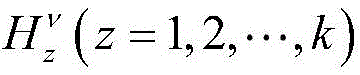
establishing an input sample data set v to be
Figure BDA0002586819500000051
As input layer neural network cells;
Figure BDA0002586819500000052
as output layer neural network cells;
Figure BDA0002586819500000053
As hidden layer neural network cells; omega iz Is a function of weights from the input layer to the hidden layer; omega zj Is a function of weights from the hidden layer to the output layer; it is assumed that the status function of a back-propagating neuronal cell is ^ based>
Figure BDA0002586819500000054
Then the hidden layer cell input is shown in equation (10) below:
Figure BDA0002586819500000055
the output function of the hidden layer is shown in equation (11) below:
Figure BDA0002586819500000056
the output layer cellular input is shown in the following formula (12):
Figure BDA0002586819500000057
the output layer cellular output is shown in the following formula (12):
Figure BDA0002586819500000061
setting the output of the input sample data set v as
Figure BDA0002586819500000062
The error function is then as shown in equation (14) below:
Figure BDA0002586819500000063
the weighting function is corrected by the steepest descent method according to the above formula, as shown in the following formulas (15) and (16):
Figure BDA0002586819500000064
Figure BDA0002586819500000065
FIG. 3 is a flow chart of the prediction of the remaining stable service life of the incomplete degradation equipment of the method of the present invention. The invention provides a method for predicting the remaining stable service life of non-complete degradation equipment with similar evidences, as shown in figure 3, the method can predict the remaining stable service life of the equipment without using all data of the equipment from the beginning to the current state, and can predict the future stable service life of the equipment only by using the current equipment data. The invention provides a method for predicting a stability factor at a future moment by using an evidence correlation analysis method to obtain a correlation coefficient and a weight function of the remaining stable service life of equipment, predicting the stability factor at the future moment by using a Markov prediction chain, constructing a back propagation neural network by using equipment evidence to obtain a stability factor change function of the service life stability of the equipment, bringing the currently predicted equipment stability factor into the neural network for analysis, continuing prediction if the current stability factor meets the stability requirement obtained in equipment data analysis, stopping prediction until the equipment stability factor exceeds a stability requirement threshold, and obtaining the remaining stable service life of the equipment corresponding to the stability factor by data fitting.

Claims (2)
1. A method for predicting the remaining stable service life of equipment with similar evidence incomplete degradation is characterized in that the method can predict the remaining stable service life of the equipment without all data of the equipment from the beginning to the current state and only the current data of the equipment, and the method comprises the following steps in the using process:
(1) Screening the parameter types which have high correlation with the stable service life of the equipment from the equipment evidence by using an evidence correlation analysis method, and obtaining a weight function through a correlation coefficient;
(2) Predicting a stability factor representing the use stability of the equipment by utilizing a Markov prediction chain;
suppose system Z is at t i Is in state i at the moment n Then at t i+1 The state of the system at time t i The state before the moment is irrelevant, and the prediction mode accords with the prediction of the service life of the future equipment which can be stably used through the current state value at a certain moment, and the following formula is shown:
P{Y n+1 =i n+1 |Y 0 =i 0 ,…Y n =i n }=P{Y n+1 =i n+1 |Y n =i n }
in the formula, Y n Predicting a chain for Markov; p is a probability function, then at t i+m The probability function for the system at time and in state j is:
Figure FDA0003776400240000011
when predicting the parameter data, dividing the actual parameter sequence into a plurality of states X according to the requirement 1 ,X 2 ,…,X n Then, the state transition probability of the m steps is:
Figure FDA0003776400240000012
in the formula (I), the compound is shown in the specification,
Figure FDA0003776400240000013
from state X for a sequence of system parameters i Transferring to the state X through m steps j The number of (1), then->
Figure FDA0003776400240000014
The state transition matrix is defined as follows:
Figure FDA0003776400240000015
in the Markov prediction chain, if a one-step state transition matrix is used, the parameter data of the previous moment is in the state X 3 Then R is (1) The third row of the matrix is taken; if the parameter data of a plurality of moments are used for prediction, the data state is X when the data is transferred to the moment to be predicted after the step I 3 Then R is adopted (l) The third row of (2); the division of the state interval uses the average number and standard deviation of the parameter data sequence, and then uses the parameter type and data obtained before, and the residual error correction prediction at the next moment is shown in the following formula:
Figure FDA0003776400240000016
in the formula, ω i A weight of the relevant parameter; v. of i State center of the relevant parameter; therefore, through Markov chain prediction, a stability factor prediction of the relevant parameter is obtained, namely, the following formula is shown:
Figure FDA0003776400240000021
in the formula, K (0) (t i+1 ) Is the original stability factor, i.e.
Figure FDA0003776400240000022
Wherein s is i K represents the stable performance parameter, namely the stable factor, of the current state of the system, which is the related parameter data; n is the number of sample data; lambda [ alpha ] i A correlation coefficient of the remaining stable service life of the equipment is obtained;
(3) Constructing a back propagation neural network by using the equipment evidence to obtain a stability factor change function of the service life stability of the equipment, introducing the currently predicted equipment stability factor into the neural network for analysis, continuing prediction if the current stability factor meets the stability requirement obtained in the equipment data analysis, and stopping prediction until the equipment stability factor exceeds a stability requirement threshold;
(4) And obtaining the residual stable service life of the equipment corresponding to the stability factor through data fitting.
2. The method for predicting the residual stable service life of the equipment with the similar evidence and incomplete degradation according to claim 1, wherein the step (2) provides a stability factor representing the use stability of the equipment, and the stability factor representing the use stability of the equipment is predicted by using a Markov prediction chain; the step (3) provides that a back propagation neural network is constructed by using equipment evidence, a stability factor change function of the service life stability of the equipment is obtained through neural network learning training, the currently predicted equipment stability factor is brought into the neural network for analysis, if the current stability factor meets the stability requirement obtained in equipment data analysis, prediction is continued, and the prediction is stopped until the equipment stability factor exceeds a stability requirement threshold; and (4) obtaining the residual stable service life of the equipment corresponding to the stability factor through data fitting, and predicting the residual stable service life of the non-complete degradation equipment only by current equipment data without all data of the equipment from the beginning to the current state.
CN202010683969.9A 2020-07-16 2020-07-16 Prediction method for residual stable service life of incomplete degradation equipment with similar evidence Active CN112016240B (en)

Priority Applications (1)

Application Number Priority Date Filing Date Title
CN202010683969.9A CN112016240B (en) 2020-07-16 2020-07-16 Prediction method for residual stable service life of incomplete degradation equipment with similar evidence

Applications Claiming Priority (1)

Application Number Priority Date Filing Date Title
CN202010683969.9A CN112016240B (en) 2020-07-16 2020-07-16 Prediction method for residual stable service life of incomplete degradation equipment with similar evidence

Publications (2)

Publication Number Publication Date
CN112016240A CN112016240A (en) 2020-12-01
CN112016240B true CN112016240B (en) 2023-03-31

Family

ID=73499656

Family Applications (1)

Application Number Title Priority Date Filing Date
CN202010683969.9A Active CN112016240B (en) 2020-07-16 2020-07-16 Prediction method for residual stable service life of incomplete degradation equipment with similar evidence

Country Status (1)

Country Link
CN (1) CN112016240B (en)

Families Citing this family (1)

* Cited by examiner, † Cited by third party
Publication number Priority date Publication date Assignee Title
CN115470438B (en) * 2022-08-24 2023-05-12 青岛海洋生物医药研究院股份有限公司 A method for intelligently predicting degradation time based on process parameters of degradable microspheres

Citations (1)

* Cited by examiner, † Cited by third party
Publication number Priority date Publication date Assignee Title
US5465321A (en) * 1993-04-07 1995-11-07 The United States Of America As Represented By The Administrator Of The National Aeronautics And Space Administration Hidden markov models for fault detection in dynamic systems

Family Cites Families (3)

* Cited by examiner, † Cited by third party
Publication number Priority date Publication date Assignee Title
US10401433B2 (en) * 2015-01-21 2019-09-03 Samsung Electronics Co., Ltd. Method and apparatus for estimating battery life
KR102697627B1 (en) * 2018-11-09 2024-08-26 삼성전자주식회사 Method for generating aging model and manufacturing semiconductor chip using the same
US12258594B2 (en) * 2018-12-05 2025-03-25 The Broad Institute, Inc. Cas proteins with reduced immunogenicity and methods of screening thereof

Patent Citations (1)

* Cited by examiner, † Cited by third party
Publication number Priority date Publication date Assignee Title
US5465321A (en) * 1993-04-07 1995-11-07 The United States Of America As Represented By The Administrator Of The National Aeronautics And Space Administration Hidden markov models for fault detection in dynamic systems

Non-Patent Citations (4)

* Cited by examiner, † Cited by third party
Title
"A Novel Estimation Method for the State of Health of Lithium-Ion Battery Using Prior Knowledge-Based Neural Network and Markov Chain";Houde Dai等;《IEEE TRANSACTIONS ON INDUSTRIAL ELECTRONICS》;20181115;第66卷(第10期);第7706-7716页 *
"Expandable deep learning for real-time economic generation dispatch and control of three-state energies based future smart grids";Linfei Yin等;《Energy》;20191119;第191卷;第1-15页 *
"智能视频监控下的目标跟踪关键技术研究";吴国星;《中国博士学位论文全文数据库》;20180715(第7期);第I138-73页 *
基于马尔科夫链蒙特卡洛方法的光伏电站可靠性评估;朱晓荣等;《高电压技术》;20170331;第43卷(第03期);第1034-1042页 *

Also Published As

Publication number Publication date
CN112016240A (en) 2020-12-01

Similar Documents

Publication Publication Date Title
CN112149316B (en) Prediction method of remaining life of aero-engine based on improved CNN model
Hesabi et al. A deep learning predictive model for selective maintenance optimization
CN114898121B (en) Automatic generation method for concrete dam defect image description based on graph attention network
CN111460728B (en) A method, device, storage medium and device for predicting remaining life of industrial equipment
US12493752B2 (en) Automatic concrete dam defect image description generation method based on graph attention network
CN114282443B (en) Residual service life prediction method based on MLP-LSTM supervised joint model
CN114218872B (en) DBN-LSTM semi-supervised joint model-based residual service life prediction method
CN118051827A (en) Power Grid Fault Prediction Method Based on Deep Learning
CN110738349A (en) Prediction method of power grid fault emergency repair time based on multi-model fusion
CN118094343B (en) Attention mechanism-based LSTM machine residual service life prediction method
CN114266278A (en) A method for predicting the remaining service life of equipment based on dual attention network
CN113989550A (en) Electric vehicle charging pile operation state prediction method based on CNN and LSTM hybrid network
CN116628444B (en) A Water Quality Early Warning Method Based on Improved Meta-Learning
CN115081591B (en) A method for predicting the probability of electric valve failure
CN115935818B (en) EEFG-LSTM-attribute-based elevator energy consumption prediction method and device
CN115221776A (en) Training method and device for intelligent sensing diagnosis model of novel power distribution network
CN118941071A (en) Industrial safety risk assessment and management system and method based on cognitive computing
CN110779988A (en) A deep learning-based bolt life prediction method
CN112016240B (en) Prediction method for residual stable service life of incomplete degradation equipment with similar evidence
CN114266201B (en) Self-attention elevator trapping prediction method based on deep learning
CN113469013B (en) Motor fault prediction method and system based on transfer learning and time sequence
CN116432525A (en) A Lifespan Prediction Method Based on Convolutional Bayesian Recurrent Neural Networks Based on Physical Health Step
CN113821974B (en) Engine residual life prediction method based on multiple fault modes
CN119668235B (en) Nuclear power plant fault diagnosis method based on interpretable deep migration learning
CN116400675B (en) Fault diagnosis system and method based on improved CNN-LSTM model

Legal Events

Date Code Title Description
PB01 Publication
PB01 Publication
SE01 Entry into force of request for substantive examination
GR01 Patent grant
GR01 Patent grant
OL01 Intention to license declared
EE01 Entry into force of recordation of patent licensing contract

Application publication date: 20201201

Assignee: Guangxi Nanning Xinyi Painting Technology Co.,Ltd.

Assignor: GUANGXI University

Contract record no.: X2024980034788

Denomination of invention: A method for predicting the remaining stable service life of incomplete degradation equipment with similar evidence

Granted publication date: 20230331

License type: Common License

Record date: 20241212

EE01 Entry into force of recordation of patent licensing contract

Application publication date: 20201201

Assignee: Guangxi shimaoda Technology Co.,Ltd.

Assignor: GUANGXI University

Contract record no.: X2024980037697

Denomination of invention: A method for predicting the remaining stable service life of incomplete degradation equipment with similar evidence

Granted publication date: 20230331

License type: Common License

Record date: 20241215

EE01 Entry into force of recordation of patent licensing contract

Application publication date: 20201201

Assignee: GUANGXI CHAOXING SOLAR ENERGY TECHNOLOGY Co.,Ltd.

Assignor: GUANGXI University

Contract record no.: X2024980038685

Denomination of invention: A method for predicting the remaining stable service life of incomplete degradation equipment with similar evidence

Granted publication date: 20230331

License type: Common License

Record date: 20241216

Application publication date: 20201201

Assignee: Guangxi Jikuan Energy Technology Co.,Ltd.

Assignor: GUANGXI University

Contract record no.: X2024980038675

Denomination of invention: A method for predicting the remaining stable service life of incomplete degradation equipment with similar evidence

Granted publication date: 20230331

License type: Common License

Record date: 20241216

EE01 Entry into force of recordation of patent licensing contract

Application publication date: 20201201

Assignee: Guangxi Zegang Technology Co.,Ltd.

Assignor: GUANGXI University

Contract record no.: X2024980044612

Denomination of invention: A method for predicting the remaining stable service life of incomplete degradation equipment with similar evidence

Granted publication date: 20230331

License type: Open License

Record date: 20241231

EE01 Entry into force of recordation of patent licensing contract

Application publication date: 20201201

Assignee: NANNING QUANYU ELECTRIC POWER DESIGN Co.,Ltd.

Assignor: GUANGXI University

Contract record no.: X2025980000104

Denomination of invention: A method for predicting the remaining stable service life of incomplete degradation equipment with similar evidence

Granted publication date: 20230331

License type: Open License

Record date: 20250103

EE01 Entry into force of recordation of patent licensing contract

Application publication date: 20201201

Assignee: GUANGXI ZHONGLIAN ZHIHAO TECHNOLOGY Co.,Ltd.

Assignor: GUANGXI University

Contract record no.: X2025980002974

Denomination of invention: A method for predicting the remaining stable service life of incomplete degradation equipment with similar evidence

Granted publication date: 20230331

License type: Open License

Record date: 20250124

EE01 Entry into force of recordation of patent licensing contract

Application publication date: 20201201

Assignee: Guangxi Yingrihe Education Technology Co.,Ltd.

Assignor: GUANGXI University

Contract record no.: X2025980042157

Denomination of invention: A method for predicting the remaining stable service life of incomplete degradation equipment with similar evidence

Granted publication date: 20230331

License type: Common License

Record date: 20251205

Application publication date: 20201201

Assignee: Nanning Niuma Internet Technology Co.,Ltd.

Assignor: GUANGXI University

Contract record no.: X2025980042158

Denomination of invention: A method for predicting the remaining stable service life of incomplete degradation equipment with similar evidence

Granted publication date: 20230331

License type: Common License

Record date: 20251205

EE01 Entry into force of recordation of patent licensing contract

Application publication date: 20201201

Contract record no.: X2026980000044

Denomination of invention: A method for predicting the remaining stable service life of incomplete degradation equipment with similar evidence

Granted publication date: 20230331

License type: Common License

Record date: 20260104

Application publication date: 20201201

Contract record no.: X2026980000048

Denomination of invention: A method for predicting the remaining stable service life of incomplete degradation equipment with similar evidence

Granted publication date: 20230331

License type: Common License

Record date: 20260104

Application publication date: 20201201

Contract record no.: X2026980000050

Denomination of invention: A method for predicting the remaining stable service life of incomplete degradation equipment with similar evidence

Granted publication date: 20230331

License type: Common License

Record date: 20260104

EE01 Entry into force of recordation of patent licensing contract

Application publication date: 20201201

Contract record no.: X2026980000829

Denomination of invention: A method for predicting the remaining stable service life of incomplete degradation equipment with similar evidence

Granted publication date: 20230331

License type: Common License

Record date: 20260114