CN111970958A - System and method for detecting neurological disorders and measuring general cognitive abilities - Google Patents
System and method for detecting neurological disorders and measuring general cognitive abilities Download PDFInfo
- Publication number
- CN111970958A CN111970958A CN201880088256.9A CN201880088256A CN111970958A CN 111970958 A CN111970958 A CN 111970958A CN 201880088256 A CN201880088256 A CN 201880088256A CN 111970958 A CN111970958 A CN 111970958A
- Authority
- CN
- China
- Prior art keywords
- subject
- eye
- reading
- pupil diameter
- text
- Prior art date
- Legal status (The legal status is an assumption and is not a legal conclusion. Google has not performed a legal analysis and makes no representation as to the accuracy of the status listed.)
- Pending
Links
Images


Classifications
-
- A—HUMAN NECESSITIES
- A61—MEDICAL OR VETERINARY SCIENCE; HYGIENE
- A61B—DIAGNOSIS; SURGERY; IDENTIFICATION
- A61B5/00—Measuring for diagnostic purposes; Identification of persons
- A61B5/40—Detecting, measuring or recording for evaluating the nervous system
- A61B5/4058—Detecting, measuring or recording for evaluating the nervous system for evaluating the central nervous system
- A61B5/4064—Evaluating the brain
-
- G—PHYSICS
- G16—INFORMATION AND COMMUNICATION TECHNOLOGY [ICT] SPECIALLY ADAPTED FOR SPECIFIC APPLICATION FIELDS
- G16H—HEALTHCARE INFORMATICS, i.e. INFORMATION AND COMMUNICATION TECHNOLOGY [ICT] SPECIALLY ADAPTED FOR THE HANDLING OR PROCESSING OF MEDICAL OR HEALTHCARE DATA
- G16H50/00—ICT specially adapted for medical diagnosis, medical simulation or medical data mining; ICT specially adapted for detecting, monitoring or modelling epidemics or pandemics
- G16H50/20—ICT specially adapted for medical diagnosis, medical simulation or medical data mining; ICT specially adapted for detecting, monitoring or modelling epidemics or pandemics for computer-aided diagnosis, e.g. based on medical expert systems
-
- A—HUMAN NECESSITIES
- A61—MEDICAL OR VETERINARY SCIENCE; HYGIENE
- A61B—DIAGNOSIS; SURGERY; IDENTIFICATION
- A61B3/00—Apparatus for testing the eyes; Instruments for examining the eyes
- A61B3/0016—Operational features thereof
- A61B3/0025—Operational features thereof characterised by electronic signal processing, e.g. eye models
-
- A—HUMAN NECESSITIES
- A61—MEDICAL OR VETERINARY SCIENCE; HYGIENE
- A61B—DIAGNOSIS; SURGERY; IDENTIFICATION
- A61B3/00—Apparatus for testing the eyes; Instruments for examining the eyes
- A61B3/0016—Operational features thereof
- A61B3/0041—Operational features thereof characterised by display arrangements
-
- A—HUMAN NECESSITIES
- A61—MEDICAL OR VETERINARY SCIENCE; HYGIENE
- A61B—DIAGNOSIS; SURGERY; IDENTIFICATION
- A61B3/00—Apparatus for testing the eyes; Instruments for examining the eyes
- A61B3/10—Objective types, i.e. instruments for examining the eyes independent of the patients' perceptions or reactions
- A61B3/11—Objective types, i.e. instruments for examining the eyes independent of the patients' perceptions or reactions for measuring interpupillary distance or diameter of pupils
- A61B3/112—Objective types, i.e. instruments for examining the eyes independent of the patients' perceptions or reactions for measuring interpupillary distance or diameter of pupils for measuring diameter of pupils
-
- A—HUMAN NECESSITIES
- A61—MEDICAL OR VETERINARY SCIENCE; HYGIENE
- A61B—DIAGNOSIS; SURGERY; IDENTIFICATION
- A61B3/00—Apparatus for testing the eyes; Instruments for examining the eyes
- A61B3/10—Objective types, i.e. instruments for examining the eyes independent of the patients' perceptions or reactions
- A61B3/113—Objective types, i.e. instruments for examining the eyes independent of the patients' perceptions or reactions for determining or recording eye movement
-
- A—HUMAN NECESSITIES
- A61—MEDICAL OR VETERINARY SCIENCE; HYGIENE
- A61B—DIAGNOSIS; SURGERY; IDENTIFICATION
- A61B5/00—Measuring for diagnostic purposes; Identification of persons
- A61B5/16—Devices for psychotechnics; Testing reaction times ; Devices for evaluating the psychological state
- A61B5/162—Testing reaction times
-
- A—HUMAN NECESSITIES
- A61—MEDICAL OR VETERINARY SCIENCE; HYGIENE
- A61B—DIAGNOSIS; SURGERY; IDENTIFICATION
- A61B5/00—Measuring for diagnostic purposes; Identification of persons
- A61B5/16—Devices for psychotechnics; Testing reaction times ; Devices for evaluating the psychological state
- A61B5/163—Devices for psychotechnics; Testing reaction times ; Devices for evaluating the psychological state by tracking eye movement, gaze, or pupil change
-
- A—HUMAN NECESSITIES
- A61—MEDICAL OR VETERINARY SCIENCE; HYGIENE
- A61B—DIAGNOSIS; SURGERY; IDENTIFICATION
- A61B5/00—Measuring for diagnostic purposes; Identification of persons
- A61B5/16—Devices for psychotechnics; Testing reaction times ; Devices for evaluating the psychological state
- A61B5/168—Evaluating attention deficit, hyperactivity
-
- A—HUMAN NECESSITIES
- A61—MEDICAL OR VETERINARY SCIENCE; HYGIENE
- A61B—DIAGNOSIS; SURGERY; IDENTIFICATION
- A61B5/00—Measuring for diagnostic purposes; Identification of persons
- A61B5/40—Detecting, measuring or recording for evaluating the nervous system
- A61B5/4058—Detecting, measuring or recording for evaluating the nervous system for evaluating the central nervous system
-
- A—HUMAN NECESSITIES
- A61—MEDICAL OR VETERINARY SCIENCE; HYGIENE
- A61B—DIAGNOSIS; SURGERY; IDENTIFICATION
- A61B5/00—Measuring for diagnostic purposes; Identification of persons
- A61B5/40—Detecting, measuring or recording for evaluating the nervous system
- A61B5/4076—Diagnosing or monitoring particular conditions of the nervous system
- A61B5/4082—Diagnosing or monitoring movement diseases, e.g. Parkinson, Huntington or Tourette
-
- A—HUMAN NECESSITIES
- A61—MEDICAL OR VETERINARY SCIENCE; HYGIENE
- A61B—DIAGNOSIS; SURGERY; IDENTIFICATION
- A61B5/00—Measuring for diagnostic purposes; Identification of persons
- A61B5/40—Detecting, measuring or recording for evaluating the nervous system
- A61B5/4076—Diagnosing or monitoring particular conditions of the nervous system
- A61B5/4088—Diagnosing of monitoring cognitive diseases, e.g. Alzheimer, prion diseases or dementia
-
- A—HUMAN NECESSITIES
- A61—MEDICAL OR VETERINARY SCIENCE; HYGIENE
- A61B—DIAGNOSIS; SURGERY; IDENTIFICATION
- A61B5/00—Measuring for diagnostic purposes; Identification of persons
- A61B5/72—Signal processing specially adapted for physiological signals or for diagnostic purposes
-
- A—HUMAN NECESSITIES
- A61—MEDICAL OR VETERINARY SCIENCE; HYGIENE
- A61B—DIAGNOSIS; SURGERY; IDENTIFICATION
- A61B5/00—Measuring for diagnostic purposes; Identification of persons
- A61B5/72—Signal processing specially adapted for physiological signals or for diagnostic purposes
- A61B5/7235—Details of waveform analysis
- A61B5/7264—Classification of physiological signals or data, e.g. using neural networks, statistical classifiers, expert systems or fuzzy systems
- A61B5/7267—Classification of physiological signals or data, e.g. using neural networks, statistical classifiers, expert systems or fuzzy systems involving training the classification device
-
- G—PHYSICS
- G06—COMPUTING OR CALCULATING; COUNTING
- G06N—COMPUTING ARRANGEMENTS BASED ON SPECIFIC COMPUTATIONAL MODELS
- G06N20/00—Machine learning
-
- G—PHYSICS
- G16—INFORMATION AND COMMUNICATION TECHNOLOGY [ICT] SPECIALLY ADAPTED FOR SPECIFIC APPLICATION FIELDS
- G16H—HEALTHCARE INFORMATICS, i.e. INFORMATION AND COMMUNICATION TECHNOLOGY [ICT] SPECIALLY ADAPTED FOR THE HANDLING OR PROCESSING OF MEDICAL OR HEALTHCARE DATA
- G16H40/00—ICT specially adapted for the management or administration of healthcare resources or facilities; ICT specially adapted for the management or operation of medical equipment or devices
- G16H40/60—ICT specially adapted for the management or administration of healthcare resources or facilities; ICT specially adapted for the management or operation of medical equipment or devices for the operation of medical equipment or devices
- G16H40/63—ICT specially adapted for the management or administration of healthcare resources or facilities; ICT specially adapted for the management or operation of medical equipment or devices for the operation of medical equipment or devices for local operation
Landscapes
- Health & Medical Sciences (AREA)
- Life Sciences & Earth Sciences (AREA)
- Engineering & Computer Science (AREA)
- Medical Informatics (AREA)
- Biomedical Technology (AREA)
- Public Health (AREA)
- Physics & Mathematics (AREA)
- General Health & Medical Sciences (AREA)
- Veterinary Medicine (AREA)
- Molecular Biology (AREA)
- Biophysics (AREA)
- Animal Behavior & Ethology (AREA)
- Surgery (AREA)
- Heart & Thoracic Surgery (AREA)
- Neurology (AREA)
- Pathology (AREA)
- Developmental Disabilities (AREA)
- Psychiatry (AREA)
- Psychology (AREA)
- Hospice & Palliative Care (AREA)
- Neurosurgery (AREA)
- Child & Adolescent Psychology (AREA)
- Physiology (AREA)
- Ophthalmology & Optometry (AREA)
- Educational Technology (AREA)
- Social Psychology (AREA)
- Artificial Intelligence (AREA)
- Computer Vision & Pattern Recognition (AREA)
- Signal Processing (AREA)
- Data Mining & Analysis (AREA)
- Primary Health Care (AREA)
- Evolutionary Computation (AREA)
- Epidemiology (AREA)
- Mathematical Physics (AREA)
- Theoretical Computer Science (AREA)
- Software Systems (AREA)
- Human Computer Interaction (AREA)
- Databases & Information Systems (AREA)
- General Physics & Mathematics (AREA)
- Computing Systems (AREA)
Abstract
Description
发明领域Field of Invention
本发明涉及尤其通过测量眼球运动和/或在眼球运动任务期间的瞳孔直径来检测神经障碍以及测量一般认知能力的系统和方法。The present invention relates to systems and methods for detecting neurological disorders and for measuring general cognitive abilities, inter alia, by measuring eye movement and/or pupil diameter during eye movement tasks.
背景技术Background technique
本领域中已实施使用眼球追踪作为一种诊断工具:The use of eye tracking as a diagnostic tool has been implemented in the art:
美国专利4,889,422公开了一种用于确定是否存在诵读困难的自动系统。所述系统包括眼球刺激装置、眼球运动检测器、收集代表随时间变化的眼球位置的数据的处理器以及用于分析数据并将眼球运动分类为微动、眼跳、追随运动、会聚-散开运动、注视和眨眼的分析程序。如果总的注视次数大于视觉刺激的次数,则记录首次指示出现诵读困难。US Patent 4,889,422 discloses an automated system for determining the presence of dyslexia. The system includes an eye stimulation device, an eye movement detector, a processor for collecting data representing eye position over time, and for analyzing the data and classifying eye movements into fretting, saccade, follow-up, convergence-spread Analysis procedures for movement, gaze and blinking. If the total number of fixations was greater than the number of visual stimuli, the first indication of dyslexia was recorded.
Fielding等人公布“对多发性硬化症认知功能障碍的眼部运动测量II:工作记忆”(J Nerol,2015年4月9日在线公布),其中公开了通过测量任务错误、眼跳潜伏期和对工作记忆负荷的相对敏感性的工作记忆视觉测试来检验患有临床确诊多发性硬化症(CDMS)或临床孤立综合症(CIS)的患者的工作记忆的实验。Fielding et al. published "Measurement of Eye Movement in Cognitive Impairment in Multiple Sclerosis II: Working Memory" (J Nerol, published online April 9, 2015), which discloses the measurement of task error, saccade latency, and Working Memory Visual Test of Relative Sensitivity to Working Memory Load An experiment to examine working memory in patients with clinically diagnosed multiple sclerosis (CDMS) or clinically isolated syndrome (CIS).
长期以来需要一种广泛可用的用于诊断神经障碍的工具。There has long been a need for a widely available tool for diagnosing neurological disorders.
发明内容SUMMARY OF THE INVENTION
本发明的目标在于提供一种通过测量眼球运动检测受试者的一种或多种神经障碍的系统;所述测量眼球运动在受试者阅读时进行;所述系统包含:An object of the present invention is to provide a system for detecting one or more neurological disorders in a subject by measuring eye movement; the measurement of eye movement is performed while the subject is reading; the system comprises:
a.眼动仪[10],配置成用于在受试者[5]阅读文本[15]时监控受试者[5]的眼球运动;a. an eye tracker [10] configured to monitor eye movements of the subject [5] while the subject [5] reads the text [15];
b.处理器[20],配置成用于在受试者[5]阅读所述文本[15]时接收来自眼动仪[10]的数据;和b. a processor [20] configured to receive data from the eye tracker [10] as the subject [5] reads the text [15]; and
c.显示器装置[40],配置成用于显示自处理器[20]接收到的测试报告[50];c. Display means [40] configured to display the test report [50] received from the processor [20];
其中所述处理器[20]进一步配置成用于分析眼球追踪数据来为一种或多种神经障碍或一般认知能力提供证据并在测试报告[50]中报告对受试者[5]的一种或多种神经障碍的检测或对认知能力的测量。wherein the processor [20] is further configured to analyze the eye-tracking data to provide evidence for one or more neurological disorders or general cognitive abilities and to report in the test report [50] the assessment of the subject [5] Detection of one or more neurological disorders or measures of cognitive ability.
本发明的另一目标如上文所述,其中所述处理器进一步配置成用于在自眼动仪接收到眼球追踪数据后:Another object of the present invention is as described above, wherein the processor is further configured to, upon receipt of eye tracking data from the eye tracker:
a.对受试者在阅读文本时的注视总次数进行计数;且a. Count the total number of fixations the subject made while reading the text; and
b.如果受试者阅读时的注视总次数高于对照组,则在测试报告中报告检测到注意过程受损。b. If the subject's total number of fixations while reading is higher than that of the control group, the detection of impaired attentional processes is reported in the test report.
本发明的另一目标如上文所述,其中所述处理器进一步配置成用于在自眼动仪接收到眼球追踪数据后:Another object of the present invention is as described above, wherein the processor is further configured to, upon receipt of eye tracking data from the eye tracker:
a.对受试者在阅读文本时的正向注视次数进行计数;且a. Counting the number of positive fixations the subject made while reading the text; and
b.如果受试者的正向注视次数低于对照组;且受试者在阅读时的注视次数高于对照组,则在测试报告[50]中报告检测到工作记忆受损。b. If the subject's number of positive fixations is lower than that of the control group; and the subject's number of fixations while reading is higher than that of the control group, the detection of impaired working memory is reported in the test report [50].
本发明的另一目标如上文所述,其中所述处理器进一步配置成用于在自眼动仪接收到眼球追踪数据后:Another object of the present invention is as described above, wherein the processor is further configured to, upon receipt of eye tracking data from the eye tracker:
a.对受试者在阅读文本时仅注视一次的字数进行计数;且a. Count the number of words that the subject gazes at only once while reading the text; and
b.如果受试者仅注视一次的字数低于对照组,则在测试报告中报告检测到检索记忆受损。b. If the number of words that the subject fixated only once was lower than that of the control group, the detection of impaired retrieval memory was reported in the test report.
本发明的另一目标如上文所述,其中所述处理器进一步配置成用于在自眼动仪接收到眼球追踪数据后:Another object of the present invention is as described above, wherein the processor is further configured to, upon receipt of eye tracking data from the eye tracker:
a.对受试者在阅读文本时多次注视的次数进行计数;且a. Counting the number of times the subject fixed multiple gazes while reading the text; and
b.如果多次注视的次数高于对照组,则在测试报告中报告检测到执行过程受损。b. If the number of multiple fixations is higher than in the control group, report the detection of impaired execution in the test report.
本发明的另一目标在于通过测量眼球运动检测受试者的一种或多种神经障碍,其中所述处理器进一步配置成用于在自眼动仪接收到眼球追踪数据后:Another object of the present invention is to detect one or more neurological disorders in a subject by measuring eye movement, wherein the processor is further configured to, upon receipt of the eye tracking data by the automatic eye tracker:
a.计算从一次注视至下一次注视的平均眼跳幅度;且a. Calculate the average saccade amplitude from one fixation to the next; and
b.如果平均眼跳幅度低于对照组,则在测试报告中报告检测到执行过程受损。b. If the mean saccade amplitude is lower than that of the control group, report detection of impaired execution in the test report.
本发明的另一目标如上文所述,还包含用于测量受试者瞳孔直径的装置[17],其中所述处理器进一步配置成用于:Another object of the present invention is as described above, further comprising a device for measuring the pupil diameter of a subject [17], wherein the processor is further configured to:
a.追踪受试者在阅读文本时的瞳孔直径;且a. Track the pupil diameter of the subject while reading the text; and
b.如果受试者的瞳孔直径在继续阅读文本时未显示减小,则在测试报告中报告检测到执行过程受损。b. If the subject's pupil diameter did not show a decrease as he continued to read the text, report the detection of impaired performance in the test report.
本发明的目标在于提供一种通过测量眼球运动和瞳孔行为并应用智能算法来检测受试者的一种或多种神经障碍和检查认知能力的系统;所述测量眼球运动在受试者阅读时进行;所述系统包含:It is an object of the present invention to provide a system for detecting one or more neurological disorders and examining cognitive abilities in a subject by measuring eye movement and pupil behavior and applying intelligent algorithms; time; the system includes:
a.眼动仪[10],所述眼动仪配置成用于在受试者[5]阅读文本[15]时监控受试者[5]的眼球运动和瞳孔行为;a. an eye tracker [10] configured to monitor the subject [5]'s eye movements and pupillary behavior as the subject [5] reads text [15];
b.处理器[20],所述处理器配置成用于在受试者[5]阅读文本[15]时接收来自眼动仪[10]的数据;b. a processor [20] configured to receive data from the eye tracker [10] as the subject [5] reads the text [15];
c.用于对病理学中以及病理学内的眼球运动特征进行获悉、辨识、典型化和分类的智能算法;和c. Intelligent algorithms for learning, identifying, typifying and classifying eye movement characteristics in and within pathologies; and
d.显示器装置[40],所述显示器装置配置成用于在自处理器[20]接收到的测试报告[50]上显示智能算法的结果;d. a display device [40] configured to display the results of the intelligent algorithm on a test report [50] received from the processor [20];
其中所述处理器[20]进一步配置成用于对眼球追踪数据进行分析和建模来为一种或多种神经障碍和认知能力提供证据并在测试报告[50]中报告对受试者[5]的一种或多种神经障碍在病理学之间以及病理学内的检测和分类。wherein the processor [20] is further configured to analyze and model the eye-tracking data to provide evidence for one or more neurological disorders and cognitive abilities and to report in the test report [50] an assessment of the subject Detection and classification of one or more neurological disorders of [5] between and within pathologies.
本发明的另一目标如上文所述,其中所述处理器进一步配置成用于在自眼动仪接收到眼球追踪数据后对阅读文本期间的眼球运动特征和瞳孔行为进行辨识和分类,提供分类器的结果以供在测试报告中报告受试者的认知能力和/或病理分型(即,与所述受试者因其眼球运动特征所对应的病状);和病状内的值(即,所述受试者在特定病状内所显示的认知、行为和生物学受损的水平)。Another object of the present invention is as described above, wherein the processor is further configured to identify and classify eye movement characteristics and pupil behavior during reading of the text upon receipt of eye tracking data from the eye tracker, providing a classification results of the device for reporting the subject's cognitive ability and/or pathological type (i.e., the condition corresponding to the subject's eye movement characteristics) in the test report; and the values within the condition (i.e., , the level of cognitive, behavioral and biological impairment exhibited by the subject within a particular condition).
本发明的另一目标如上文所述,其中所述智能算法配置成用于读取至少一种输入,所述输入选自:Another object of the present invention is as described above, wherein the intelligent algorithm is configured to read at least one input selected from:
a.受试者在阅读文本时的注视总次数指数。a. The subject's total fixation index while reading the text.
b.所述受试者在阅读文本时的正向注视指数。b. The subject's positive gaze index while reading text.
c.所述受试者在阅读文本时仅注视一次的字数指数c. The word count index of the subject's gaze only once while reading the text
d.所述受试者在阅读文本时的多次注视指数d. The multiple gaze index of the subject while reading the text
e.从一次注视至下一次注视的平均眼跳幅度e. Average saccade amplitude from one fixation to the next
f.阅读文本的受试者的瞳孔直径f. Pupil diameter of subjects reading the text
g.左眼、右眼或双眼的眨眼指数。g. Blink index of left eye, right eye or both eyes.
h.微跳视的形式因子(FF):h. Form factor (FF) for microsaccades:
i.HEWI:表示微跳视的高度/宽度关系。i.HEWI: Represents the height/width relationship of microsaccades.
ii.AREA:表示微跳视内接的矩形面积。ii.AREA: Represents the rectangular area inscribed in the microsaccade.
iii.LONG:微跳视的水平-垂直平面轨迹的经度。iii.LONG: Longitude of the horizontal-vertical plane trajectory of microsaccades.
iv.ANG:微跳视的水平面-垂直面中所有角度的总和。iv.ANG: The sum of all angles in the horizontal-vertical plane of microsaccades.
v.AANG:微跳视的水平面-垂直面中所有弧度角度绝对值的总和。这后两个FF评估微跳视轨迹的规律性。v.AANG: The sum of the absolute values of all radian angles in the horizontal plane of the microsaccade-vertical plane. These latter two FFs assess the regularity of the microsaccadic visual trajectory.
vi.MOD和THETA:笛卡尔坐标(cartesian coordinate)总和的极坐标的模数和角度。给出了微跳视相对于注视中线的空间定向。vi. MOD and THETA: Modulus and angle of polar coordinates of the sum of Cartesian coordinates. The spatial orientation of microsaccades relative to the gaze midline is given.
vii.TIME:微跳视的以毫秒计的持续时间。vii.TIME: The duration in milliseconds of microsaccades.
viii.VMIN和VMAX:微跳视的以度数/秒计的最小和最大速度度数/秒。viii. VMIN and VMAX: The minimum and maximum velocity in degrees per second for microsaccades in degrees per second.
ix.微跳视速率:每个时间框中的瞬时速率。ix. Microsaccade rate: The instantaneous rate in each time frame.
x.方向一致性:微跳视方向与刺激位置之间的一致性。x. Orientation Consistency: Consistency between microsaccade visual direction and stimulus location.
i.阅读文本期间左眼、右眼或双眼的眼球位置(即,横坐标和纵坐标)。i. Eyeball position (ie, abscissa and ordinate) of the left, right or both eyes during reading of the text.
j.阅读文本期间的注视次序(即,视觉行为),此次序由图像、矩阵等可得。j. Gaze order (ie, visual behavior) during reading of text, which order can be derived from images, matrices, and the like.
k.阅读文本期间注视之间的分开距离。k. The separation distance between gazes during text reading.
l.受试者的Filia信息(即,年龄、受教育年限、性别、族群、职业、每周体育活动的小时数)。l. Subject's Filia information (ie, age, years of education, gender, ethnic group, occupation, hours of physical activity per week).
m.总阅读时间(即,受试者在阅读文本上花费的时间)。m. Total reading time (ie, the time the subject spends reading the text).
本发明的目标在于提供一种用于评估与多发性硬化症[MS]相关的神经功能受损的方法[300],所述方法包括:It is an object of the present invention to provide a method for assessing neurological impairment associated with multiple sclerosis [MS] [300], the method comprising:
a.提供用于评估与MS相关的神经功能受损的系统[305];a. Provide a system for assessing neurological impairment associated with MS [305];
b.要求受试者注视图表上的参考目标[310];b. Ask the subject to focus on the reference target on the chart [310];
c.多次重复在区域之一向受试者呈现刺激图像[315];要求受试者记住每个刺激图像以何次序出现在哪个区域中;c. Presenting stimulus images to the subject in one of the regions repeatedly [315]; asking the subject to remember in which region each stimulus image appeared in which order;
d.向受试者呈现与所呈现刺激图像之一相对应的提示[320];d. Presenting the subject with a cue corresponding to one of the presented stimulus images [320];
e.测量受试者对呈现提示步骤作出反应的眼跳[325];要求受试者看向与提示相对应呈现刺激图像的区域;e. Measure the subject's saccade in response to the step of presenting the cue [325]; ask the subject to look at the area where the stimulus image is presented corresponding to the cue;
f.重复呈现提示和测量眼跳的步骤[330];f. Repeat the steps of presenting the cue and measuring the saccade [330];
g.重复步骤b-f多次试验[335];g. Repeat steps b-f multiple times [335];
h.计算以下中的一个或多个:h. Calculate one or more of the following:
i.WM效应[340](即,WM效应为随WM要求增加而增加的测量值。对于每个提示数字而言,WM效应由受试者在所有试验中所报告的错误次数与试验次数的比值来表示);和i. WM effect [340] (i.e., WM effect is a measure that increases with increasing WM requirement. For each cue digit, the WM effect is determined by the number of errors reported by the subject over all trials versus the number of trials ratio); and
ii.平均眼跳潜伏期[345],眼跳潜伏期定义为受试者对所述区域引发眼跳的时间量;且ii. the mean saccade latency [345], which is defined as the amount of time a subject elicits saccades to the region; and
i.报告以下中的一个或多个:i. Report one or more of the following:
i.随着WM效应增加,工作记忆的受损程度[350];和i. The degree of impairment of working memory as the WM effect increases [350]; and
ii.随着眼跳潜伏期增加,执行过程的受损程度[355];ii. The degree of impairment of execution as saccade latency increases [355];
j.其中所述方法还包括其它步骤,包括在呈现刺激图像的步骤[315]期间进行测量,在此期间再次要求受试者看向刺激图像;所述测量包括测量以下中的一个或多个j. wherein the method further comprises further steps comprising measuring during the step [315] of presenting the stimulation image, during which the subject is again asked to look at the stimulation image; the measuring comprising measuring one or more of the following
i.受试者的瞳孔散大幅度[360];i. The subject's pupils have a large degree of dilation [360];
ii.受试者对刺激图像的注视次数[365];和ii. The number of subject fixations to the stimulus image [365]; and
iii.受试者对刺激图像的凝视持续时间[370];且iii. The subject's gaze duration on the stimulus image [370]; and
k.所述其它步骤还包括计算和报告以下中的一个或多个k. The other steps also include calculating and reporting one or more of the following
i.随着瞳孔散大幅度增加,皮层下过程的受损程度[375];i. The degree of impairment of subcortical processes with a large increase in mydriasis [375];
ii.随着注视次数增加,执行过程的受损程度[380];和ii. The degree of impairment of execution as the number of fixations increases [380]; and
iii.随着凝视持续时间增加,执行过程和工作记忆的受损程度[385]。iii. Degree of impairment of executive processes and working memory with increasing gaze duration [385].
本发明的另一目标如上文所述,其中所述参考目标位于图表的中心位置,且所述多个区域安置在参考目标周围。Another object of the present invention is as described above, wherein the reference object is located at the center of the graph and the plurality of regions are arranged around the reference object.
本发明的另一目标如上文所述,其中所述提示位于参考目标的位置。Another object of the present invention is as described above, wherein the cue is located at the location of the reference object.
本发明的另一目标如上文所述,其中所述错误定义为朝向非正确区域的位置的眼球运动和/或在时限内未引发眼跳。Another object of the present invention is as described above, wherein the error is defined as eye movement towards the location of the incorrect area and/or no saccade within a time limit.
本发明的另一目标如上文所述,其中从所呈现的提示数字中排除与第一次呈现的刺激相对应的提示。Another object of the present invention is as described above, wherein the cue corresponding to the stimulus presented for the first time is excluded from the number of cues presented.
本发明的另一目标如上文所述,其中只有在呈现提示数字步骤后的最小眼跳潜伏期以上引发眼跳,才在计算WM效应和眼跳潜伏期的步骤中包括所述眼跳。Another object of the present invention is as described above, wherein the saccade is included in the step of calculating the WM effect and saccade latency only if the saccade is elicited above the minimum saccade latency after the step of presenting the cue number.
本发明的另一目标如上文所述,其中如果在时限内未对所述区域之一发生眼跳、在对所述角区域之一发生眼跳之前无法对参考目标保持注视以及眨眼引起不确定的眼球运动,则在计算WM时排除所述眼跳。Another object of the present invention is as described above, wherein if saccades do not occur to one of said regions within a time limit, that gaze cannot be maintained on a reference object until saccades occur to one of said angular regions, and blinks cause uncertainty eye movements, the saccades are excluded from the calculation of WM.
本发明的目标在于提供一种通过测量眼球运动检测受试者的一种或多种神经障碍的系统;所述测量眼球运动在受试者进行视觉检查时进行;所述系统包含:An object of the present invention is to provide a system for detecting one or more neurological disorders in a subject by measuring eye movement; the measurement of eye movement is performed while the subject is undergoing a visual examination; the system comprises:
a.眼动仪[10],配置成用于在受试者[5]进行视觉检查[15]时监控受试者[5]的眼球运动;a. an eye tracker [10] configured to monitor eye movements of the subject [5] while the subject [5] is undergoing a visual examination [15];
b.要求受试者连续注视作为在同一图片(即,迷宫或迷阵)中一起呈现的一组目标物(例如,点)的一部分的目标物[605];b. Ask the subject to continuously fixate on an object that is part of a set of objects (eg, dots) presented together in the same picture (ie, a maze or maze) [605];
c.要求受试者每次只注视在一个目标物上,直到依照迷宫或迷阵方向(即,从所述迷宫或迷阵底部进入并从顶部离开)完成观察图片中的所有目标物[610]。c. Ask the subject to focus on only one object at a time until all objects in the picture have been observed following the maze or maze orientation (ie, entering from the bottom of the maze or maze and exiting from the top) [610] ].
d.处理器[20],配置成用于在受试者[5]进行视觉检查[15]时接收来自眼动仪[10]的数据;和d. a processor [20] configured to receive data from the eye tracker [10] while the subject [5] is undergoing a visual examination [15]; and
e.显示器装置[40],配置成用于显示自处理器[20]接收的测试报告[50];e. a display device [40] configured to display the test report [50] received from the processor [20];
其中所述处理器[20]进一步配置成用于分析眼球追踪数据来为神经和注意力障碍提供证据并在测试报告[50]中报告检测到受试者[5]的一种或多种神经和注意力障碍。wherein the processor [20] is further configured to analyze the eye-tracking data to provide evidence for neurological and attentional disorders and to report in the test report [50] detection of one or more neurological disorders of the subject [5] and attention disorders.
本发明的另一目标如上文所述,其中所述处理器进一步配置成用于在所述受试者在对目标物进行观察、识别、维持、控制、抑制和排序时自眼动仪接收到眼球追踪数据后:Another object of the present invention is as described above, wherein the processor is further configured to receive from the eye tracker when the subject observes, recognizes, maintains, controls, suppresses and ranks objects. After eye tracking data:
a.对受试者在进行视觉检查时的注视总次数进行计数[615];且a. Counting the total number of fixations the subject made during the visual examination [615]; and
b.如果受试者在观察目标物时的注视总次数高于对照组,则在测试报告中报告检测到注意过程受损。b. If the subject's total number of fixations while observing the target is higher than that of the control group, the detection of impaired attentional processes is reported in the test report.
本发明的另一目标如上文所述,其中所述处理器进一步配置成用于在自眼动仪接收到眼球追踪数据后:Another object of the present invention is as described above, wherein the processor is further configured to, upon receipt of eye tracking data from the eye tracker:
a.测量受试者从一个目标物转移至另一个目标物时的眼跳平均速度[620];且a. Measure the mean saccade velocity of subjects as they move from one object to another [620]; and
b.如果受试者的眼跳平均速度[620]低于对照组,则在测试报告[50]中报告检测到执行功能受损。b. If the subject's average saccade speed [620] is lower than that of the control group, the detection of impaired executive function is reported in the test report [50].
本发明的另一目标如上文所述,其中所述处理器进一步配置成用于在自眼动仪接收到眼球追踪数据后:Another object of the present invention is as described above, wherein the processor is further configured to, upon receipt of eye tracking data from the eye tracker:
a.对正确目标识别的次数进行计数[625];且a. count the number of correct object recognitions [625]; and
b.如果受试者正确目标识别的次数[625]低于对照组,则在测试报告中报告检测到工作记忆受损。b. If the number of correct object recognition [625] by the subject is lower than in the control group, the detection of impaired working memory is reported in the test report.
本发明的另一目标如上文所述,其中所述处理器进一步配置成用于在自眼动仪接收到眼球追踪数据后:Another object of the present invention is as described above, wherein the processor is further configured to, upon receipt of eye tracking data from the eye tracker:
a.计算平均眼跳幅度[630];且a. Calculate the mean saccade amplitude [630]; and
b.如果平均眼跳幅度[630]低于对照组,则在测试报告中报告检测到执行过程受损。b. If the mean saccade amplitude [630] is lower than the control group, report the detection of impaired execution in the test report.
本发明的另一目标如上文所述,其中所述处理器进一步配置成用于在自眼动仪接收到眼球追踪数据后:Another object of the present invention is as described above, wherein the processor is further configured to, upon receipt of eye tracking data from the eye tracker:
a.进行视觉检查消耗的总时间[635];且a. Total time spent performing visual inspections [635]; and
b.如果进行视觉检查消耗的总时间[635]高于对照组,则在测试报告中报告检测到注意过程受损。b. If the total time [635] consumed to perform the visual inspection is higher than the control group, report detection of impaired attentional processes in the test report.
本发明的另一目标如上文所述,还包含用于测量受试者瞳孔直径的装置[17],其中所述处理器进一步配置成用于:Another object of the present invention is as described above, further comprising a device for measuring the pupil diameter of a subject [17], wherein the processor is further configured to:
a.追踪受试者在进行视觉检查时的瞳孔直径[640];且a. Track the pupil diameter of the subject at the time of the visual examination [640]; and
b.如果受试者的瞳孔直径[640]在继续执行任务时未显示增加,则在测试报告中报告检测到注意过程受损。b. If the subject's pupil diameter [640] does not show an increase as the task continues, report the detection of impaired attentional processes in the test report.
本发明的另一目标如上文所述,还包含用于测量受试者瞳孔直径的装置[17],其中所述处理器进一步配置成用于计算人们在进行视觉检查时在目标物上的注视持续时间,如果受试者注视在目标物上的注视持续时间[645]低于对照组,则在测试报告中报告检测到注意和执行过程受损。Another object of the present invention, as described above, further comprises a device for measuring the pupil diameter of a subject [17], wherein the processor is further configured to calculate the gaze of a person on an object during a visual examination Duration, if the subject's fixation duration [645] on the target was lower than that of the control group, the detection of impaired attention and execution processes was reported in the test report.
本发明的目标在于提供一种通过测量受试者的眼球运动来检测是否存在一种或多种神经障碍或测量受试者的一般认知能力的方法[400];所述测量眼球运动在受试者阅读时进行;所述方法包括以下步骤:It is an object of the present invention to provide a method for detecting the presence of one or more neurological disorders or for measuring a subject's general cognitive abilities by measuring the subject's eye movement; the measurement of eye movement in a subject When the test taker is reading; the method includes the following steps:
a.提供如权利要求1或权利要求18所述的用于检测一种或多种神经障碍的系统;a. providing a system for detecting one or more neurological disorders as claimed in claim 1 or claim 18;
b.在受试者阅读文本时,接收受试者的眼球追踪数据和/或瞳孔直径数据[415];b. Receive the subject's eye tracking data and/or pupil diameter data as the subject reads the text [415];
其中所述方法还包括以下步骤:对眼球追踪数据和/或瞳孔直径数据进行分析来为一种或多种神经障碍提供证据[417]且展示神经障碍的检测报告[4Fi99]。The method described therein further includes the steps of analyzing eye tracking data and/or pupil diameter data to provide evidence for one or more neurological disorders [417] and presenting a report of detection of neurological disorders [4Fi99].
本发明的另一目标如上文所述,还包括以下步骤:Another object of the present invention is as described above, and also includes the following steps:
a.在受试者阅读文本时,对受试者的注视总次数进行计数[420];且a. Count the total number of times the subject's fixations are counted while the subject is reading the text [420]; and
b.如果受试者在阅读文本时的注视总次数高于对照组,则报告检测到注意过程受损[460]。b. Reports detected impaired attentional processes if subjects had higher total fixations than controls while reading the text [460].
本发明的另一目标如上文所述,还包括以下步骤:Another object of the present invention is as described above, and also includes the following steps:
a.在受试者阅读文本时,对受试者的注视总次数进行计数[420];a. Count the total number of fixations of the subject while the subject is reading the text [420];
b.对受试者在阅读文本时的正向注视次数进行计数[430];且b. Counting the number of positive fixations the subject made while reading the text [430]; and
c.如果受试者在阅读文本时的正向注视次数[430]低于对照组;且受试者在阅读时的注视次数高于对照组,则报告检测到工作记忆受损[470]。c. If the subject's number of positive fixations while reading text [430] is lower than that of the control group; and if the subject's number of fixations while reading is higher than that of the control group, then report detection of impaired working memory [470].
本发明的另一目标如上文所述,还包括以下步骤:Another object of the present invention is as described above, and also includes the following steps:
a.在受试者阅读文本时,对受试者在每个字上的注视次数进行计数[440];a. Count the number of times the subject fixates on each word as the subject reads the text [440];
b.对受试者在阅读文本时仅注视一次的字数进行计数[445];且b. Counting the number of words that the subject fixed only once while reading the text [445]; and
c.如果受试者在阅读文本时仅注视一次的字数[445]低于对照组,则报告检测到检索记忆受损[480]。c. Reports detected impaired retrieval memory [480] if the number of words that the subject fixated only once when reading the text [445] was lower than that of the control group.
本发明的另一目标如上文所述,还包括以下步骤:Another object of the present invention is as described above, and also includes the following steps:
a.对受试者在阅读文本时多次注视的次数进行计数[450];且a. Counting the number of times the subject fixed multiple gazes while reading the text [450]; and
b.如果受试者在阅读文本时多次注视的次数[450]高于对照组,则报告检测到执行过程受损[490]。b. Reports detected impaired execution [490] if the subject had a higher number of multiple fixations [450] than the control group while reading the text.
本发明的另一目标如上文所述,还包括以下步骤:Another object of the present invention is as described above, and also includes the following steps:
a.计算受试者在阅读文本时从一次注视至下一次注视的平均眼跳幅度[454];且a. Calculate the subject's average saccade amplitude from one fixation to the next while reading the text [454]; and
b.如果受试者在阅读文本时从一次注视至下一次注视的平均眼跳幅度[454]低于对照组,则在测试报告中报告检测到执行过程受损[491]。b. If the subject's average saccade amplitude from one fixation to the next fixation [454] while reading the text is lower than that of the control group, the detection of impaired execution is reported in the test report [491].
本发明的另一目标如上文所述,还包括以下步骤:Another object of the present invention is as described above, and also includes the following steps:
a.追踪受试者在阅读文本时的瞳孔直径[456];且a. Track the pupil diameter of the subject while reading the text [456]; and
b.如果受试者在阅读文本时的瞳孔直径在继续阅读文本时未显示减小,则在测试报告中报告检测到执行过程受损[492]。b. If the subject's pupil diameter while reading the text does not show a decrease as they continue to read the text, report detection of impaired execution in the test report [492].
本发明的目标在于提供一种用于检测受试者的记忆绑定功能障碍的系统[100],所述系统包含:An object of the present invention is to provide a system [100] for detecting memory binding dysfunction in a subject, the system comprising:
a.眼动仪[10];a. Eye tracker [10];
b.测量瞳孔直径的装置;b. A device for measuring pupil diameter;
c.处理器[20],配置成用于:c. A processor [20], configured to:
i.自眼动仪[10]接收受试者[5]的眼球追踪数据;且i. The automatic eye tracker [10] receives eye tracking data from the subject [5]; and
ii.自测量瞳孔直径的装置接收受试者[5]的瞳孔直径数据;ii. Receive pupil diameter data of the subject [5] from a device for measuring pupil diameter;
d.显示器装置[40],配置成用于显示自处理器[20]接收到的测试报告[50];d. a display device [40] configured to display the test report [50] received from the processor [20];
其中所述处理器[20]进一步配置成用于分析眼球追踪和瞳孔直径数据并在测试报告[50]中报告对受试者[5]的一种或多种记忆绑定功能障碍的检测。wherein the processor [20] is further configured to analyze eye tracking and pupil diameter data and to report the detection of one or more memory binding dysfunctions of the subject [5] in a test report [50].
本发明的另一目标如上文所述,其中所述处理器[20]进一步配置成用于在自眼动仪[10]接收到眼球追踪数据后:Another object of the present invention is as described above, wherein the processor [20] is further configured to, upon receipt of the eye tracking data by the automatic eye tracker [10]:
a.测量受试者[5]对所述受试者[5]所观察的一个或多个目标物中每一者的一个或多个凝视持续时间;a. measuring one or more gaze durations of the subject [5] on each of the one or more targets observed by the subject [5];
b.计算受试者[5]对目标物的平均凝视持续时间;且b. Calculate the subject's [5] average gaze duration at the target; and
c.如果受试者[5]的平均凝视持续时间比对照组的平均凝视持续时间长,则在测试报告[50]中报告在受试者[5]中检测到对目标物的编码和识别受损。c. If the mean gaze duration of the subject [5] is longer than the mean gaze duration of the control group, report in the test report [50] that the encoding and recognition of the target was detected in the subject [5] damaged.
本发明的另一目标如上文所述,其中所述处理器[20]进一步配置成用于在自眼动仪[10]接收到眼球追踪数据后:Another object of the present invention is as described above, wherein the processor [20] is further configured to, upon receipt of the eye tracking data by the automatic eye tracker [10]:
a.对受试者[5]在观察一个或多个目标物时所进行的注视次数进行计数;且a. Counting the number of fixations made by the subject [5] while observing one or more objects; and
b.如果受试者[5]在观察目标物时所进行的注视次数高于对照组,则在测试报告[50]中报告在受试者[5]中检测到注意过程受损。b. If the subject [5] performed a higher number of fixations while observing the target than the control group, then reported in the test report [50] that impaired attentional processes were detected in the subject [5].
本发明的另一目标如上文所述,其中所述处理器[20]进一步配置成用于应用智能算法且:Another object of the present invention is as described above, wherein the processor [20] is further configured to apply an intelligent algorithm and:
a.当受试者[5]进行需要较低认知努力的活动时,自用于测量瞳孔直径的装置接收受试者[5]的瞳孔直径;a. receiving the pupil diameter of the subject [5] from a device for measuring pupil diameter while the subject [5] is performing an activity requiring lower cognitive effort;
b.当受试者[5]进行需要较强认知努力的活动时,自用于测量瞳孔直径的装置接收受试者[5]的瞳孔直径;且b. Receive the pupil diameter of the subject [5] from a device for measuring pupil diameter when the subject [5] is engaged in an activity requiring greater cognitive effort; and
c.如果受试者[5]在进行需要较强认知努力的活动时的瞳孔直径未显示与受试者[5]在进行需要减少/最小认知努力的活动时的瞳孔直径相比而言有所增加时,在测试报告[50]中报告在受试者[5]中检测到认知资源受损。c. If the pupil diameter of subject [5] while performing activities requiring greater cognitive effort is not shown to be comparable to the pupil diameter of subject [5] performing activities requiring reduced/minimal cognitive effort Cognitive resource impairment detected in subjects [5] was reported in the test report [50] when there was an increase in speech.
本发明的另一目标如上文所述,其中所述处理器[20]进一步在测试报告[50]中报告关于在受试者[5]中由系统[100]未检测到的记忆绑定功能障碍的结果。Another object of the present invention is as described above, wherein the processor [20] further reports in the test report [50] about memory binding functions not detected by the system [100] in the subject [5] obstacle results.
本发明的目标在于提供一种检测受试者[505]记忆绑定功能障碍的方法[500],所述方法包括以下步骤:An object of the present invention is to provide a method [500] for detecting memory binding dysfunction in a subject [505], the method comprising the steps of:
a.提供如权利要求1或权利要求33所述的系统;a. providing a system as claimed in claim 1 or claim 33;
b.呈现目标物[510];b. Presenting the target [510];
c.要求受试者注视目标物并记住它们(编码)[515];c. Ask subjects to look at objects and memorize them (codes) [515];
d.呈现空屏幕[520];d. Presenting an empty screen [520];
e.呈现目标物并要求受试者确认目标物是否与以前观察的完全相同(识别)。如果目标物完全相同,则必须给出“相同”的答案。如果不完全相同,则必须给出“不同”的答案。必须使用键盘或类似支持物来收集两种答案[525]。重复步骤[510-525]多次试验[530];e. The target is presented and the subject is asked to confirm that the target is identical to what was previously observed (identification). If the objects are exactly the same, the "same" answer must be given. If not exactly the same, a "different" answer must be given. Both answers must be collected using a keyboard or similar support [525]. Repeat steps [510-525] for multiple trials [530];
f.重复步骤[510-525]多次试验[530];f. Repeat steps [510-525] for multiple trials [530];
g.接收眼球追踪数据;g. Receive eye tracking data;
h.受试者观察一个或多个目标物[540];h. The subject observes one or more objects [540];
i.测量受试者在每个目标物上的凝视持续时间[545];i. Measure the subject's gaze duration on each target [545];
j.计算受试者对目标物的平均凝视持续时间[550];j. Calculate the subject's average gaze duration on the target [550];
k.测量受试者在进行需要较低认知努力的活动时的瞳孔直径[555];k. Measure pupil diameter of subjects while performing activities that require lower cognitive effort [555];
l.对受试者在观察目标物时进行的注视次数进行计数[560];l. Counting the number of fixations the subject made while observing the target [560];
m.其中所述方法还包括以下步骤:m. wherein the method further comprises the following steps:
i.如果受试者的平均凝视持续时间比对照组的平均凝视持续时间长,则报告在受试者中检测到目标编码和识别过程受损[565];i. Report detection of impaired object encoding and recognition processes in subjects if their mean gaze duration was longer than that of controls [565];
ii.如果受试者在进行需要较强认知努力的活动时的瞳孔直径未显示与受试者在进行需要较低认知努力的活动时的瞳孔直径相比而言有所增加,则报告在受试者中检测到认知资源受损[570];且ii. If the subject's pupil diameter does not show an increase in pupil diameter when performing an activity requiring a higher cognitive effort compared to the subject's pupil diameter when performing an activity requiring a lower cognitive effort, report Impaired cognitive resources are detected in subjects [570]; and
iii.如果受试者在观察目标物时进行的注视次数高于对照组,则报告在受试者中检测到注意过程受损[575]。iii. Reports detected impaired attentional processes in subjects if they performed more fixations while observing the target than in controls [575].
本发明的另一目标如上文所述,其中智能算法配置成用于读取至少一个输入,所述输入选自:Another object of the present invention is as described above, wherein the intelligent algorithm is configured to read at least one input selected from:
a.受试者在进行每次绑定任务时的注视总次数。a. The total number of fixations of the subject during each binding task.
b.绑定评估任务,即“未绑定颜色”的“绑定颜色”。b. Bound evaluation task, i.e. "bound color" for "unbound color".
c.绑定试验的识别号码。c. The identification number of the binding test.
d.试验的正确行为答案(即,“相同”或“不同”)。d. The correct behavioral answer to the trial (ie, "same" or "different").
e.受试者的行为反应。e. Subject's behavioral responses.
f.试验的部分,即编码或检索。f. The part of the test, i.e. coding or retrieval.
g.受试者在进行进行绑定评估时的瞳孔直径。g. The pupil diameter of the subject at the time of the binding assessment.
h.左眼、右眼或双眼的眨眼次数。h. The number of blinks of the left, right or both eyes.
i.微跳视;形式因子(FF):i. Microsaccade; Form Factor (FF):
i.HEWI:表示微跳视的高度/宽度关系。i.HEWI: Represents the height/width relationship of microsaccades.
ii.AREA:表示微跳视内接的矩形面积。ii.AREA: Represents the rectangular area inscribed in the microsaccade.
iii.LONG:微跳视的水平-垂直平面轨迹的经度。iii.LONG: Longitude of the horizontal-vertical plane trajectory of microsaccades.
iv.ANG:微跳视的水平面-垂直面中所有角度的总和。iv.ANG: The sum of all angles in the horizontal-vertical plane of microsaccades.
v.AANG:微跳视的水平面-垂直面中所有弧度角度绝对值的总和。这后两个FF评估微跳视轨迹的规律性。v.AANG: The sum of the absolute values of all radian angles in the horizontal plane of the microsaccade-vertical plane. These latter two FFs assess the regularity of the microsaccadic visual trajectory.
vi.MOD和THETA:笛卡尔坐标总和的极坐标的模数和角度。给出了微跳视相对于注视中线的空间定向。vi.MOD and THETA: Modulus and angle of polar coordinates of the sum of Cartesian coordinates. The spatial orientation of microsaccades relative to the gaze midline is given.
vii.TIME:微跳视的以毫秒计的持续时间。vii.TIME: The duration in milliseconds of microsaccades.
viii.VMIN和VMAX:微跳视的以度数/秒计的最小和最大速度。viii. VMIN and VMAX: Minimum and maximum velocity in degrees/second for microsaccades.
ix.微跳视速率:每个时间框中的瞬时速率。ix. Microsaccade rate: The instantaneous rate in each time frame.
x.方向一致性:微跳视方向与刺激位置之间的一致性。x. Orientation Consistency: Consistency between microsaccade visual direction and stimulus location.
j.左眼、右眼或双眼在进行绑定评估时的眼球位置(即,横坐标和纵坐标)。j. Eyeball position (ie, abscissa and ordinate) of the left eye, right eye, or both eyes at the time of binding assessment.
k.处理目标物时的眼跳幅度。k. Saccade amplitude when dealing with the target.
l.处理目标物过程中的注视次序(即,视觉行为)。此次序由图像、矩阵等可得。l. Gaze order (ie, visual behavior) during processing of objects. This order is available from images, matrices, etc.
m.进行绑定评估时右眼与左眼注视点之间的距离。m. The distance between the fixation point of the right eye and the left eye at the time of binding assessment.
n.受试者的Filia信息(即,年龄、受教育年限、性别、族群、职业、每周体育活动的小时数)。n. Subject's Filia information (ie, age, years of education, gender, ethnic group, occupation, hours of physical activity per week).
o.处理目标物时的注视持续时间。o. Gaze duration when handling the target.
p.处理目标物时的凝视持续时间。p. Gaze duration when dealing with the target.
q.在每个目标物上的注视次数。q. The number of fixations on each target.
r.在每个目标物以外的注视次数。r. The number of gazes outside each target.
s.在每个目标物上的注视次数。s. The number of fixations on each target.
本发明的目标在于提供一种检测受试者的神经和注意障碍的方法[600],所述方法包括以下步骤:It is an object of the present invention to provide a method [600] for detecting neurological and attentional disturbances in a subject, the method comprising the steps of:
a.提供眼动仪[10];a. Provide eye tracker [10];
b.用于测量瞳孔直径的装置;b. A device for measuring pupil diameter;
c.处理器[20],配置成用于:c. A processor [20], configured to:
i.自眼动仪[10]接收受试者[5]的眼球追踪数据;i. The automatic eye tracker [10] receives the eye tracking data of the subject [5];
ii.自用于测量瞳孔直径的装置接收受试者[5]的瞳孔直径数据;和ii. receiving pupil diameter data of the subject [5] from a device for measuring pupil diameter; and
iii.显示器装置[40],配置成用于显示自处理器[20]接收到的测试报告[50];iii. Display means [40] configured to display the test report [50] received from the processor [20];
其中处理器[20]进一步配置成用于分析眼球追踪和瞳孔直径数据并在测试报告[50]中报告检测到受试者[5]的一种或多种神经和注意障碍。wherein the processor [20] is further configured to analyze the eye tracking and pupil diameter data and report in the test report [50] that one or more neurological and attentional disorders of the subject [5] have been detected.
本发明的另一目标如上文所述,其中处理器[20]进一步配置成用于在自眼动仪[10]接收到眼球追踪数据后:Another object of the present invention is as described above, wherein the processor [20] is further configured to, upon receipt of the eye tracking data from the automatic eye tracker [10]:
a.测量受试者[5]在受试者[5]观察的一个或多个目标物中每一者上的一个或多个注视持续时间;a. measuring one or more fixation durations of the subject [5] on each of the one or more targets observed by the subject [5];
b.计算受试者[5]从一个目标物至另一个目标物的平均眼跳幅度;且b. Calculate the mean saccade amplitude of the subject [5] from one target to another; and
c.如果受试者[5]的平均眼跳幅度比对照组的平均眼跳幅度短,则在测试报告[50]中报告在受试者[5]中检测到对目标物的观察、识别、维持、控制、抑制和排序受损。c. If the mean saccade amplitude of the subject [5] is shorter than the mean saccade amplitude of the control group, report in the test report [50] that the observation, recognition of the object detected in the subject [5] , maintenance, control, inhibition and sequencing are impaired.
本发明的另一目标如上文所述,其中处理器[20]进一步配置成用于在自眼动仪[10]接收到眼球追踪数据后:Another object of the present invention is as described above, wherein the processor [20] is further configured to, upon receipt of the eye tracking data from the automatic eye tracker [10]:
a.对受试者[5]在观察一个或多个目标物时进行的注视次数进行计数;且a. Counting the number of fixations the subject [5] makes while observing one or more objects; and
b.如果受试者[5]在观察目标物时进行的注视次数高于对照组,则在测试报告[50]中报告在受试者[5]中检测到注意过程受损。b. If the subject [5] performed a higher number of fixations while observing the target than the control group, then reported in the test report [50] that impaired attentional processes were detected in the subject [5].
本发明的另一目标如上文所述,其中处理器[20]进一步配置成用于:Another object of the present invention is as described above, wherein the processor [20] is further configured to:
a.在受试者[5]进行需要主要注意力资源的活动时,自用于测量瞳孔直径的装置接收受试者[5]的瞳孔直径;a. Receiving the pupil diameter of the subject [5] from a device for measuring pupil diameter while the subject [5] is performing an activity that requires a primary attention resource;
b.在受试者[5]进行需要较多注意力的活动时,自用于测量瞳孔直径的装置接收受试者[5]的瞳孔直径;且b. receiving the pupil diameter of the subject [5] from a device for measuring pupil diameter while the subject [5] is engaged in activities that require more attention; and
c.如果受试者[5]在进行需要较多注意力的活动时的瞳孔直径未显示与受试者[5]在进行需要较少注意力的活动时的瞳孔直径相比而言有所增加,则在测试报告[50]中报告在受试者[5]中检测到认知资源受损。c. If the pupil diameter of the subject [5] while performing activities that require more attention does not show a difference compared to the pupil diameter of the subject [5] performing activities that require less attention increase, the cognitive resource impairment detected in subjects [5] is reported in the test report [50].
本发明的目标在于提供一种检测受试者的神经和执行障碍的方法[600],所述方法包括以下步骤:It is an object of the present invention to provide a method [600] for detecting neurological and executive disorders in a subject, the method comprising the steps of:
a.提供如上文所述的系统;a. provide a system as described above;
b.接收眼球追踪数据;b. Receive eye tracking data;
c.受试者观察一个或多个目标物[605-610];c. The subject observes one or more targets [605-610];
d.计算受试者对目标物的平均眼跳幅度[630];d. Calculate the subject's average saccade amplitude to the target [630];
e.测量受试者在进行需要较多注意力的活动时的瞳孔直径[640];e. measure the pupil diameter of the subject during activities that require more attention [640];
f.测量受试者在进行需要比较少注意力更多注意力的活动时的瞳孔直径;且f. measure the pupil diameter of the subject while performing activities that require less attention and more attention; and
g.对受试者在观察目标物时进行的注视次数进行计数[615];g. Counting the number of fixations the subject made while observing the target [615];
h.其中所述方法还包括以下步骤:h. wherein the method further comprises the steps of:
i.如果受试者的平均眼跳幅度比对照组的平均眼跳幅度短,则报告在受试者中检测到对目标物的观察、识别、维持、控制、抑制和排序受损;i. If the subject's mean saccade amplitude is shorter than the control group's mean saccade amplitude, report detection of impaired observation, recognition, maintenance, control, inhibition, and sequencing of objects in the subject;
ii.如果受试者在进行需要较多注意力的活动时的瞳孔直径未显示与受试者在进行需要较少注意力的活动时的瞳孔直径相比而言有所增加,则报告在受试者中检测到认知和功能资源受损;且ii. If the subject's pupil diameter does not show an increase in pupil diameter when performing activities that require more attention compared to the pupil diameter when the subject is performing activities that require less attention, report Impaired cognitive and functional resources are detected in the subjects; and
iii.如果受试者在观察目标物时进行的注视次数高于对照组,则报告在受试者中检测到注意过程受损,iii. Report detection of impaired attentional processes in the subject if the subject performed a higher number of fixations while observing the target than in the control group,
iv.如果受试者的平均眼跳潜伏期(速度)比对照组的平均眼跳潜伏期短,则报告在受试者中检测到执行过程受损;iv. Report detection of impaired executive processes in subjects if their mean saccade latency (speed) is shorter than that of the control group;
本发明的另一目标如上文所述,其中所述方法配置成用于如果受试者的平均眼跳持续时间比对照组的平均注视持续时间短,则报告在受试者中检测到执行过程受损。Another object of the present invention is as described above, wherein the method is configured to report detection of a performance in a subject if the subject's mean saccade duration is shorter than the mean fixation duration of the control group damaged.
本发明的另一目标如上文所述,其中神经障碍选自帕金森病(ParkinsonDisorder)或注意缺陷多动障碍(Attention Deficit Hyperactive Disorder)。Another object of the present invention is as described above, wherein the neurological disorder is selected from Parkinson Disorder or Attention Deficit Hyperactive Disorder.
附图说明Description of drawings
图1和图2显示根据本发明的一些实施例的一种检测受试者的一种或多种神经障碍的系统。1 and 2 illustrate a system for detecting one or more neurological disorders in a subject, according to some embodiments of the present invention.
图3A和3B显示根据本发明的一些实施例的一种评估与MS相关的神经功能受损的方法。3A and 3B illustrate a method of assessing neurological impairment associated with MS, according to some embodiments of the present invention.
图4A和4B显示根据本发明的一些实施例的一种检测阅读受试者的一种或多种神经障碍的方法。4A and 4B illustrate a method of detecting one or more neurological disorders in a reading subject, according to some embodiments of the present invention.
图5显示根据本发明的一些实施例的一种检测记忆绑定功能障碍的方法。Figure 5 shows a method of detecting memory binding dysfunction according to some embodiments of the invention.
图5B显示根据5A的评估方法的测试结果:对照组和AD患者在两种实验条件下的校正识别(误差条=平均值的标准误差)。Figure 5B shows the test results according to the evaluation method of 5A: corrected identification of control group and AD patients under two experimental conditions (error bars = standard error of the mean).
图5C显示根据5A的评估方法的测试结果:绑定任务对对照组和阿尔茨海默病(Alzheimer Disease,AD)患者在编码和识别时刻的凝视持续时间的影响。图示显示LMM的部分效应(即,除去其它固定效应和方差分量之后)。阴影面积表示95%置信区间。以对数图尺绘制凝视持续时间与LMM相对应。Figure 5C shows the test results of the assessment method according to 5A: the effect of the binding task on the gaze duration of the control group and Alzheimer's disease (AD) patients at the moment of encoding and recognition. The graph shows the partial effects of the LMM (ie, after removing other fixed effects and variance components). Shaded areas indicate 95% confidence intervals. Gaze duration was plotted against the LMM on a logarithmic scale.
图6A和6B显示一种检测帕金森病和注意缺陷多动障碍的方法。Figures 6A and 6B show a method for detecting Parkinson's disease and attention deficit hyperactivity disorder.
具体实施方式Detailed ways
术语“认知努力”反映受试者执行任务所需的脑力总量。在本申请中,术语“较低认知努力”指的是执行任务时的工作记忆需求减少。The term "cognitive effort" reflects the total amount of mental effort required by a subject to perform a task. In this application, the term "lower cognitive effort" refers to a reduction in working memory demands when performing a task.
在本申请中,术语“微跳视”,也称作“快速移动(flick)”是注视过程期间进行的小幅跳视。它们是最大最快的注视性眼球运动。在本申请中,术语“跳视”指的是两只眼睛在两个或两个以上注视阶段之间的快速同时运动。In this application, the term "microsaccade", also referred to as "flick", is a small saccade that occurs during a fixation process. They are the largest and fastest fixative eye movements. In this application, the term "saccade" refers to the rapid simultaneous movement of both eyes between two or more stages of fixation.
在本申请中,术语“眼漂移”是注视性的眼球运动,其特征为眼睛在注视物体时的更顺畅更慢的漫游运动。In this application, the term "eye drift" is fixative eye movement characterized by a smoother and slower wandering movement of the eye when gazing at an object.
在本申请中,术语“眼微震”(OMT)是发生在40至100Hz频率范围内的眼睛的小幅、快速且同步的震动,尽管在平均健康个体中通常发生在90Hz左右。眼微震的特征在于其高频率和仅数弧秒的极小振幅。In this application, the term "ocular microtremity" (OMT) is a small, rapid and synchronized vibration of the eye that occurs in the frequency range of 40 to 100 Hz, although typically occurs around 90 Hz in the average healthy individual. Ocular microseisms are characterized by their high frequency and extremely small amplitude of only a few arcseconds.
在本申请中,术语“刺激图像”指的是在显示器上呈现给受试者的特定视觉图形或目标物。术语“视觉任务”或“视觉检查”指的是受试者在处理每个刺激图像时进行的活动。In this application, the term "stimulus image" refers to a specific visual graphic or object presented to a subject on a display. The term "visual task" or "visual examination" refers to the activities that the subject performs while processing each stimulus image.
现将详细描述本发明的非限制性实施例。Non-limiting embodiments of the present invention will now be described in detail.
现参考图1,显示根据本发明的一些实施例的一种检测受试者[5]的神经障碍或神经功能的系统[100]。Referring now to FIG. 1, a system [100] for detecting a neurological disorder or neurological function in a subject [5] is shown according to some embodiments of the present invention.
系统[100]包含眼动仪[10]、用于测量瞳孔直径的装置[17]、处理器[20]和显示器装置[40]。The system [100] comprises an eye tracker [10], a device for measuring pupil diameter [17], a processor [20] and a display device [40].
眼动仪[10]可以是本领域中已知的任何类型;例如佩戴式眼动仪(eye-attachedtracker)、光学眼动仪或眼电图眼动仪。The eye tracker [10] can be of any type known in the art; eg an eye-attached tracker, an optical eye tracker or an electrooculographic eye tracker.
用于测量瞳孔直径的装置[17]可包含例如配置成用于获取眼睛图像的照相机和用于由图像测量瞳孔直径的处理单元。作为处理单元的替代选择,用于测量瞳孔直径的装置[17]可包含图像显示器,在观察显示器时进行手动测量。The means for measuring pupil diameter [17] may comprise, for example, a camera configured for acquiring an image of the eye and a processing unit for measuring pupil diameter from the image. As an alternative to a processing unit, the device for measuring pupil diameter [17] may include an image display, with manual measurements being taken while viewing the display.
眼动仪[10]和用于测量瞳孔直径的装置[17]与处理器[20]互连。互连可以是本领域中已知的任何形式,且可以是有线的(例如,USB、并行端口或类似方式)或无线的(例如,WiFi、蓝牙或类似方式)。An eye tracker [10] and a device for measuring pupil diameter [17] are interconnected with a processor [20]. The interconnection may be of any form known in the art, and may be wired (eg, USB, parallel port, or the like) or wireless (eg, WiFi, Bluetooth, or the like).
处理器[20]接收并执行储存在一种或多种存储媒体[60](诸如RAM、CD/DVD、HDD、快闪存储器和/或任何合适的媒体)中的指令。指令命令处理器[20]:1)自眼动仪[10]接收眼球追踪数据;2)自测量瞳孔直径的装置[17]接收瞳孔直径数据;3)分析眼球追踪和瞳孔直径数据(在本文中进一步解释);4)在测试报告50中报告在受试者[5]中检测到或未检测到一种或多种记忆绑定功能障碍以显示在显示器装置[40]上。显示器装置[40]可以是监控器、移动装置(诸如,智能手机)的屏幕、打印输出或显示测试报告[50]的任何合适的装置。处理器[20]可在存储媒体[60]中储存任何接收到的眼球追踪数据、任何分析阶段的中间结果和/或测试报告[50]。The processor [20] receives and executes instructions stored in one or more storage media [60], such as RAM, CD/DVD, HDD, flash memory, and/or any suitable media. The instruction command processor [20]: 1) receives eye tracking data from an eye tracker [10]; 2) receives pupil diameter data from a device for measuring pupil diameter [17]; 3) analyzes the eye tracking and pupil diameter data (in this paper Further explained in); 4) report in the
系统[100]检测的神经障碍可包括阅读功能,诸如对目标物的编码和识别受损、注意过程受损、认知资源受损或其任意组合。在其它实施例中,检测的病症可包括多发性硬化症(MS)、注意缺陷多动障碍(Attention deficit-hyperactive disorder,ADHD)、帕金森病(PD)、阿尔茨海默病(AD)等。Neurological disorders detected by the system [100] may include reading functions, such as impaired encoding and recognition of objects, impaired attentional processes, impaired cognitive resources, or any combination thereof. In other embodiments, the detected condition may include multiple sclerosis (MS), attention deficit-hyperactive disorder (ADHD), Parkinson's disease (PD), Alzheimer's disease (AD), etc. .
在一些实施例中,处理器[20]在受试者[5]观察一个或多个目标物[30]中的每一者时自眼动仪[10]接收眼球追踪数据。处理器[20]测量受试者[5]在受试者[5]观察的每个目标物[30]上的凝视持续时间。处理器[20]计算受试者[5]在每个目标物[30]上的平均凝视持续时间。如果受试者[5]在目标物[30]上的凝视持续时间的平均值比对照组的平均凝视持续时间长,则处理器[20]在测试报告[50]中报告在受试者[5]中检测到目标编码和识别过程受损。In some embodiments, the processor [20] receives eye tracking data from the eye tracker [10] as the subject [5] observes each of the one or more targets [30]. The processor [20] measures the gaze duration of the subject [5] on each target [30] observed by the subject [5]. The processor [20] calculates the average gaze duration of the subject [5] on each target [30]. If the average gaze duration of the subject [5] on the target [30] is longer than the average gaze duration of the control group, the processor [20] reports in the test report [50] that the subject [50] 5] detected impaired object encoding and recognition processes.
在一些实施例中,处理器[20]另外或或者对受试者[5]在观察每个目标物[30]时进行的注视次数进行计数。如果受试者[5]在观察目标物[30]时进行的注视次数高于对照组,则处理器[20]在测试报告[50]中报告在受试者[5]中检测到注意过程受损。In some embodiments, the processor [20] additionally or alternatively counts the number of fixations made by the subject [5] while observing each object [30]. If the subject [5] performed more fixations while observing the target [30] than the control group, the processor [20] reports in the test report [50] that an attentional process was detected in the subject [5] damaged.
在一些实施例中,处理器[20]自用于测量瞳孔直径的装置[17]接收受试者[5]在进行需要较少认知努力的活动时的瞳孔直径数据。处理器[20]还自用于测量瞳孔直径的装置[17]接收受试者[5]在进行比需要较低认知努力的活动需要更强认知努力的活动时的瞳孔直径数据。如果受试者5在进行需要较强认知努力的活动时的平均瞳孔直径未显示与受试者[5]在进行需要较低认知努力的活动的平均瞳孔直径相比而言有所增加,则处理器[20]在测试报告[50]中报告在受试者[5]中检测到认知资源受损。In some embodiments, the processor [20] receives pupil diameter data of the subject [5] from the device for measuring pupil diameter [17] while performing activities that require less cognitive effort. The processor [20] also receives pupil diameter data from the device for measuring pupil diameter [17] for the subject [5] while performing activities that require greater cognitive effort than activities that require lower cognitive effort. If subject 5 did not show an increase in mean pupil diameter while performing activities requiring higher cognitive effort compared to the mean pupil diameter of subject [5] performing activities requiring lower cognitive effort , then the processor [20] reports in the test report [50] that cognitive resource impairment was detected in the subject [5].
对照组可包含与受试者[5]相同人口结构部门中的统计学代表性典型(例如,与受试者[5]相同性别、种族、民族文化、年龄群体和/或其它人口结构特征)。对照组的眼球追踪数据可由系统[100]获得或由以前的调查研究和/或临床研究收集而来。当受试者[5]的平均凝视持续时间或注视次数在对照组的平均数值的选定范围内时——对照组相应数值分布的约一个标准偏差,系统[100]可将受试者[5]的平均凝视持续时间或注视次数处理成等于对照组的平均对应数值。The control group may comprise a statistically representative representative in the same demographic sector as subject [5] (eg, the same gender, race, ethnic culture, age group, and/or other demographic characteristics as subject [5]) . Eye-tracking data for the control group can be obtained from the system [100] or collected from previous research studies and/or clinical studies. When the subject's [5] mean fixation duration or number of fixations is within a selected range of the mean values for the control group—about one standard deviation of the distribution of the corresponding values in the control group, the system [100] can assign the subject [100] to 5] was processed to equal the mean corresponding value of the control group.
应了解,处理器[20]接收的眼球追踪数据可为由眼动仪[10]测量的一系列眼球位置,处理器[20]分析找出受试者[5]的凝视持续时间和注视。或者,处理器[20]可自眼动仪[10]接收一系列经过预先处理的信号,每个信号表示凝视持续时间或发生了注视。信号可任选地带有元数据(例如,注视的眼球位置、时间和/或长度)。It will be appreciated that the eye tracking data received by the processor [20] may be a series of eye positions measured by the eye tracker [10], which the processor [20] analyzes to find the gaze duration and fixation of the subject [5]. Alternatively, the processor [20] may receive a series of pre-processed signals from the eye tracker [10], each signal representing the duration of fixation or the occurrence of fixation. The signal may optionally carry metadata (eg, eye position, time and/or length of fixation).
多发性硬化症multiple sclerosis
现参考图3A和3B,根据本发明的一些实施例,显示一种用于评估与多发性硬化症[MS]相关的神经功能受损的方法[300]。所述方法[300]包括以下步骤:Referring now to Figures 3A and 3B, according to some embodiments of the present invention, a method for assessing neurological impairment associated with multiple sclerosis [MS] is shown [300]. The method [300] includes the following steps:
a.提供一种用于评估与MS相关的神经功能受损的系统[305];a. providing a system for assessing neurological impairment associated with MS [305];
b.要求受试者注视图表上的参考目标[310];b. Ask the subject to focus on the reference target on the chart [310];
c.多次重复在图表上的多个区域之一向受试者呈现刺激图像[315];要求受试者记住每个刺激图像以何次序出现在哪个区域中;c. Presenting stimulus images to the subject in one of multiple regions on the graph repeated multiple times [315]; asking the subject to remember in which region each stimulus image appeared in which order;
d.向受试者呈现与所呈现刺激图像之一相对应的提示[320];d. Presenting the subject with a cue corresponding to one of the presented stimulus images [320];
e.测量受试者对呈现提示步骤作出反应的眼跳[325];要求受试者看向呈现的刺激图像与提示相对应的区域;e. Measure the subject's saccade in response to the step of presenting the cue [325]; ask the subject to look at the area where the presented stimulus image corresponds to the cue;
f.重复呈现提示和测量眼跳的步骤[330];f. Repeat the steps of presenting the cue and measuring the saccade [330];
g.重复步骤b-f多次试验[335];g. Repeat steps b-f multiple times [335];
h.计算以下中的一个或多个:h. Calculate one or more of the following:
i.WM效应[340](即,WM效应为随WM要求增加而增加的测量值。对于每个提示数字而言,WM效应由受试者在所有试验中所报告的错误次数与试验次数之间的比值来表示);和i. WM effect [340] (i.e., WM effect is a measure that increases with increasing WM requirements. For each cue digit, the WM effect is determined by the number of errors reported by the subject over all trials divided by the number of trials expressed as the ratio between); and
ii.平均眼跳潜伏期[345],眼跳潜伏期定义为受试者对所述区域引发眼跳的时间量;且ii. the mean saccade latency [345], which is defined as the amount of time a subject elicits saccades to the region; and
i.报告以下中的一个或多个:i. Report one or more of the following:
i.随着WM效应增加,工作记忆的受损程度[350];和i. The degree of impairment of working memory as the WM effect increases [350]; and
ii.随着眼跳潜伏期增加,执行过程的受损程度[355];ii. The degree of impairment of execution as saccade latency increases [355];
其中所述方法还包括其它步骤,在呈现刺激图像的步骤[315]期间进行;在此期间再次要求受试者看向刺激图像;wherein the method further comprises further steps, performed during the step [315] of presenting the stimulus image; during which the subject is again asked to look at the stimulus image;
j.其它步骤包括测量以下中的一个或多个:j. Other steps include measuring one or more of the following:
i.受试者的瞳孔散大幅度[360];i. The subject's pupils have a large degree of dilation [360];
ii.受试者对刺激图像的注视次数[365];和ii. The number of subject fixations to the stimulus image [365]; and
iii.受试者对刺激图像的凝视持续时间[370]。iii. The subject's gaze duration on the stimulus image [370].
k.其它步骤还包括计算和报告以下中的一个或多个:k. Other steps also include calculating and reporting one or more of the following:
i.保持瞳孔散大幅度不变时,皮层下过程的受损程度[375];i. The extent of impairment of subcortical processes while keeping the magnitude of mydriasis constant [375];
ii.随着注视次数增加,执行过程的受损程度[380];和ii. The degree of impairment of execution as the number of fixations increases [380]; and
iii.随着凝视持续时间增加,执行过程和工作记忆的受损程度[385]。iii. Degree of impairment of executive processes and working memory with increasing gaze duration [385].
所述方法采用智能算法,利用以下变量来对受试者进行分析:The method employs intelligent algorithms to analyze subjects using the following variables:
a.受试者在进行n-Back任务时的注视总次数。a. The total number of fixations of the subject during the n-Back task.
b.n-Back任务试验的识别号码(即,如果有20次n-Back任务试验,第5次试验即用数字5来标识。第20次试验即用数字20来标识,等等。)b. Identification number of the n-Back task trial (ie, if there are 20 n-Back task trials, the 5th trial is identified by the number 5. The 20th trial is identified by the
c.试验部分,即1、2和3。c. Test sections i.e. 1, 2 and 3.
d.部分试验,即编码、检索。d. Partial experiments, namely coding and retrieval.
e.受试者在进行n-Back任务时的瞳孔直径。e. The pupil diameter of the subject during the n-Back task.
f.左眼、右眼或双眼的眨眼次数。f. The number of blinks of the left eye, right eye or both eyes.
g.微跳视;形式因子(FF):g. Microsaccade; Form Factor (FF):
i.HEWI:表示微跳视的高度/宽度关系。i.HEWI: Represents the height/width relationship of microsaccades.
ii.AREA:表示微跳视内接的矩形面积。ii.AREA: Represents the rectangular area inscribed in the microsaccade.
iii.LONG:微跳视的水平-垂直平面轨迹的经度。iii.LONG: Longitude of the horizontal-vertical plane trajectory of microsaccades.
iv.ANG:微跳视的水平面-垂直面中所有角度的总和。iv.ANG: The sum of all angles in the horizontal-vertical plane of microsaccades.
v.AANG:微跳视的水平面-垂直面中所有弧度角度绝对值的总和。这后两个FF评估微跳视轨迹的规律性。v.AANG: The sum of the absolute values of all radian angles in the horizontal plane of the microsaccade-vertical plane. These latter two FFs assess the regularity of the microsaccadic visual trajectory.
vi.MOD和THETA:笛卡尔坐标总和的极坐标的模数和角度。给出了微跳视相对于注视中线的空间定向。vi.MOD and THETA: Modulus and angle of polar coordinates of the sum of Cartesian coordinates. The spatial orientation of microsaccades relative to the gaze midline is given.
vii.TIME:微跳视的以毫秒计的持续时间。vii.TIME: The duration in milliseconds of microsaccades.
viii.VMIN和VMAX:微跳视的以度数/秒计的最小和最大速度。viii. VMIN and VMAX: Minimum and maximum velocity in degrees/second for microsaccades.
ix.微跳视速率:每个时间框中的瞬时速率。ix. Microsaccade rate: The instantaneous rate in each time frame.
x.方向一致性:微跳视方向与刺激位置之间的一致性。x. Orientation Consistency: Consistency between microsaccade visual direction and stimulus location.
h.左眼、右眼或双眼在进行n-Back任务时的眼球位置(即,横坐标和纵坐标)。h. The eye position (ie, abscissa and ordinate) of the left eye, right eye, or both eyes during the n-Back task.
i.处理目标物时的眼跳幅度。i. Saccade amplitude when dealing with the target.
j.眼跳潜伏期。j. Saccade latency.
k.处理目标物时的注视次序(即,视觉行为),此次序由图像、矩阵等可得。k. Gaze order (ie, visual behavior) when processing the object, which order can be derived from images, matrices, etc.
l.进行处理目标物时右眼与左眼注视点之间的距离。l. The distance between the fixation point of the right eye and the left eye when processing the target.
m.受试者的Filia信息(即,年龄、受教育年限、性别、族群、职业、每周体育活动的小时数)。m. Subject's Filia information (ie, age, years of education, gender, ethnicity, occupation, hours of physical activity per week).
n.处理目标物时的注视持续时间。n. The duration of fixation when dealing with the target.
o.处理目标物时的凝视持续时间。o. Gaze duration when dealing with the target.
p.在每个目标物上的注视次数。p. The number of fixations on each target.
q.在每个目标物以外的注视次数。q. The number of gazes outside each target.
在呈现刺激图像时进行的测量(方法[300]中的特征j)提供编码期间的信息,在受试者首次识别视觉刺激的位置时进行编码。在发明人进行的初步研究中,发现患有MS的受试者在编码视觉信息时受损(例如,受试者多次注视显示器)。编码期间的测量是除了识别期间进行的测量以外,如在Fielding等人的研究中,在呈现视觉刺激后以带有提示的方式呈现(方法[300]中的步骤a-i)。总而言之,受试者在编码和识别期间的表现可有助于识别其它缺陷(即,皮层下过程、执行过程和/或执行过程的受损程度)并对受试者的病况提供比单独识别期间的表现更多的深刻见解。Measurements (feature j in method [300]), taken when the stimulus image is presented, provide information during encoding, which occurs when the subject first identifies the location of the visual stimulus. In preliminary studies conducted by the inventors, it was found that subjects with MS were impaired in encoding visual information (eg, subjects looked at a display multiple times). Measurements during encoding are in addition to those performed during recognition, as in Fielding et al., where visual stimuli are presented with cues (steps a-i in Method [300]). Taken together, a subject's performance during coding and recognition may help identify other deficits (ie, the extent of impairment of subcortical processes, executive processes, and/or executive processes) and provide more insight into the subject's condition than during the identification alone. More insights into performance.
阅读read
现参考图4A和4B,根据本发明的一些实施例,显示一种通过测量受试者在阅读时,所述受试者的眼球运动和/或瞳孔直径来测量受试者的一般认知能力和检测一种或多种神经障碍的方法。4A and 4B, according to some embodiments of the present invention, there is shown a method for measuring a subject's general cognitive ability by measuring the subject's eye movement and/or pupil diameter as the subject reads and methods of detecting one or more neurological disorders.
方法[400]包括以下步骤:提供一种通过测量眼球运动和/或瞳孔直径来测量一般认知能力和检测是否存在一种或多种神经障碍的系统;接收受试者在阅读文本时的眼球追踪数据和/或瞳孔直径数据;分析眼球追踪数据来为一种或多种神经障碍提供证据;并显示神经障碍的检测报告。The method [400] includes the steps of: providing a system for measuring general cognitive ability and detecting the presence of one or more neurological disorders by measuring eye movement and/or pupil diameter; receiving a subject's eyeballs while reading text Tracking data and/or pupil diameter data; analyzing eye tracking data to provide evidence for one or more neurological disorders; and displaying a report of the detection of neurological disorders.
在一些实施例中,方法[400]包括以下步骤:在受试者阅读文本时,对受试者的注视总次数进行计数[405];且如果受试者在阅读文本时的注视总次数高于对照组,则报告检测到注意过程受损[460]。In some embodiments, the method [400] includes the steps of: counting the total number of fixations of the subject while the subject is reading the text [405]; and if the total number of fixations the subject has while reading the text is high In the control group, impaired attentional processes were reported to be detected [460].
在一些实施例中,方法[400]还包括以下步骤:对受试者在阅读文本时的注视总次数进行计数[405];对受试者在阅读文本时的正向注视次数进行计数[430];且如果受试者的正向注视次数高于对照组且受试者在阅读时的注视总次数高于对照组,则报告检测到工作记忆受损[470]。In some embodiments, the method [400] further comprises the steps of: counting the total number of fixations of the subject while reading the text [405]; counting the number of positive fixations of the subject while reading the text [430] ]; and if the subject's number of positive fixations was higher than that of the control group and the subject's total number of fixations while reading was higher than that of the control group, a detected impairment of working memory was reported [470].
在生理学上,工作记忆受损与额叶退化相关。在一些实施例中,工作记忆受损的报告[470]可用在其它治疗中。例如,如果指定神经外科,则在方法[400]后可研究受试者额叶的大脑影像。Physiologically, impaired working memory is associated with frontal lobe degeneration. In some embodiments, reports of impaired working memory [470] can be used in other treatments. For example, if neurosurgery is specified, a brain image of the subject's frontal lobe can be studied following method [400].
在一些实施例中,方法[400]包括以下步骤:在受试者阅读文本时,对受试者在文本中每个字上的注视次数进行计数[440];对受试者仅注视一次的字数进行计数[445];且如果受试者仅注视一次的字数低于对照组,则报告检测到检索记忆受损[480]。In some embodiments, the method [400] includes the steps of: as the subject reads the text, counting the number of times the subject fixates on each word in the text [440]; The number of words was counted [445]; and if the number of words that the subject fixed only once was lower than that of the control group, the detection of impaired retrieval memory was reported [480].
在生理学上,检索记忆受损与颞叶退化相关。在一些实施例中,检索记忆受损的报告[480]可用在其它治疗中。例如,如果指定神经外科,则在方法[400]后可研究受试者额叶的大脑影像。Physiologically, impaired retrieval memory is associated with temporal lobe degeneration. In some embodiments, retrieval of reports of memory impairment [480] may be used in other treatments. For example, if neurosurgery is specified, a brain image of the subject's frontal lobe can be studied following method [400].
在一些实施例中,方法[400]包括以下步骤:对受试者在阅读文本时多次注视的次数进行计数[450];且如果多次注视的次数高于对照组,则报告检测到执行过程受损[490]。In some embodiments, the method [400] includes the steps of: counting the number of multiple fixations the subject has while reading the text [450]; and if the number of multiple fixations is higher than the control group, reporting that execution was detected Impaired process [490].
在一些实施例中,方法[400]包括以下步骤:计算受试者在阅读文本时从一次注视至下一次注视的平均眼跳幅度[454];且如果平均眼跳幅度低于对照组,则报告检测到执行过程受损[491]。In some embodiments, the method [400] comprises the steps of: calculating the mean saccade amplitude [454] of the subject from one fixation to the next while reading the text; and if the mean saccade amplitude is lower than the control group, then reported detection of corrupted execution [491].
在一些实施例中,方法[400]包括以下步骤:追踪受试者在阅读文本时的瞳孔直径[456];且如果在继续阅读文本时受试者的瞳孔直径未显示减小,则报告检测到执行过程受损[492]。In some embodiments, the method [400] includes the steps of: tracking the pupil diameter of the subject while reading the text [456]; and reporting the detection if the subject's pupil diameter does not show a decrease as the subject continues to read the text until the execution process is compromised [492].
在生理学上,执行过程受损与额叶、颞叶和/或顶叶退化相关。在一些实施例中,执行过程受损的报告[490-491-492]可用在其它治疗中。例如,如果指定神经外科,则在方法[400]后可研究受试者额叶、颞叶和/或顶叶的大脑影像。Physiologically, impaired executive processes are associated with degeneration of the frontal, temporal, and/or parietal lobes. In some embodiments, reports of impaired performance [490-491-492] may be used in other treatments. For example, if neurosurgery is specified, the subject's frontal, temporal, and/or parietal lobes may be studied following method [400].
在50位健康对照和50位轻度AD患者上测试所述系统方法[400]。两组都阅读40个规整的句子。The systematic approach was tested on 50 healthy controls and 50 mild AD patients [400]. Both groups read 40 regular sentences.


表1Table 1
参考文献references
以上规则部分基于以下研究中的发现:The above rules are based in part on findings from the following research:
1.Fernández G,Mandolesi P,Rotstein NP,Colombo O,Agamennoni O,PolitiLE.(2013)Eye movement alterations during reading in patients with earlyAlzheimer disease.Invest Ophthalmol Vis Sci.pii:iovs.13-12877vl.doi:10.1167/iovs.13-12877.1. Fernández G, Mandolesi P, Rotstein NP, Colombo O, Agamennoni O, Politi LE. (2013) Eye movement alterations during reading in patients with early Alzheimer disease. Invest Ophthalmol Vis Sci.pii:iovs.13-12877vl.doi:10.1167/ iovs.13-12877.
2.Fernández G.,Manes F.,Politi L.,Orozco D.,Schumacher M.,Castro L.,Agamennoni O.,Rotstein N.(2016).Patients with Mild Alzheimer Disease FailWhen Using Their Working Memory:Evidence from the Eye TrackingTechnique.Journal of Alzheimer Disease;50,827-828.2. Fernández G., Manes F., Politi L., Orozco D., Schumacher M., Castro L., Agamennoni O., Rotstein N. (2016). Patients with Mild Alzheimer Disease FailWhen Using Their Working Memory: Evidence from the Eye TrackingTechnique. Journal of Alzheimer Disease; 50, 827-828.
3.Fernández,G.,Laubrock,J.,Mandolesi P.,Colombo O.,Agamennoni O.(2014)Registering eye movements during reading in Alzheimer disease:difficulties in predicting upcoming words.Journal of Clinical andExperimental Neuropsychology;36,302-16.3. Fernández, G., Laubrock, J., Mandolesi P., Colombo O., Agannoni O. (2014) Registering eye movements during reading in Alzheimer disease: difficulties in predicting upcoming words. Journal of Clinical and Experimental Neuropsychology; 36, 302-16 .
4.Fernández G.,Sapognikoff M.,Guinjoan S.,Orozco D.,Agamennoni O.(2016).Word processing during reading sentences in patients withschizophrenia:evidences from the eyetracking technique.COMPREHENSIVEPSYCHIATRY;68,193-200.4. Fernández G., Sapognikoff M., Guinjoan S., Orozco D., Agamennoni O. (2016). Word processing during reading sentences in patients with schizophrenia: evidences from the eyetracking technique. COMPREHENSIVEPSYCHIATRY; 68, 193-200.
5.Fernández G,Manes F,Rotstein N,Colombo O,Mandolesi P,Politi L,Agamennoni O.(2014)Lack of contextual-word predictability during reading inpatients with mild Alzheimer disease.Neuropsychologia;62,143-51.5. Fernández G, Manes F, Rotstein N, Colombo O, Mandolesi P, Politi L, Agannoni O. (2014) Lack of contextual-word predictability during reading inpatients with mild Alzheimer disease. Neuropsychologia; 62, 143-51.
6.Fernández G.,Schumacher M.,Castro L.,Orozco D.,Agamennoni O.,(2015).Patients with Alzheimer disease produced shorter outgoing saccadeswhen reading sentences.Psychiatry Research,229,470-478.6. Fernández G., Schumacher M., Castro L., Orozco D., Agannoni O., (2015). Patients with Alzheimer disease shorter produced outgoing saccades when reading sentences. Psychiatry Research, 229, 470-478.
7.Fernández G.,Biondi J.,Castro S.,Agamennoni O.(2017).Pupil sizebehavior during online processing of sentences.Journal of IntegrativeNeurosciences 15(4)485-496.7. Fernández G., Biondi J., Castro S., Agannoni O. (2017). Pupil sizebehavior during online processing of sentences. Journal of Integrative Neurosciences 15(4) 485-496.
记忆绑定memory binding
现将详细描述本发明的非限制性实施例。Non-limiting embodiments of the present invention will now be described in detail.
现参考图5,根据本发明的一些实施例,显示一种检测受试者记忆绑定功能障碍的方法[500]。Referring now to FIG. 5, a method for detecting memory binding dysfunction in a subject is shown [500], according to some embodiments of the present invention.
所述方法包括提供一种用于检测受试者记忆绑定功能障碍的系统的步骤[505]。The method includes the step of providing a system for detecting memory binding dysfunction in a subject [505].
在一些实施例中,方法[500]包括受试者观察一个或多个目标物的步骤[510-535];测量受试者在每个目标物上的凝视持续时间的步骤[545];计算受试者对目标物的平均凝视持续时间的步骤[550];和如果受试者的凝视持续时间的平均值比对照组的平均凝视持续时间长,则报告在受试者中检测到目标编码和识别过程受损的步骤[565]。In some embodiments, the method [500] includes the steps of the subject observing one or more objects [510-535]; the steps of measuring the subject's gaze duration on each object [545]; calculating Steps of subject's mean gaze duration to the target [550]; and reporting detection of target encoding in the subject if the subject's mean gaze duration is longer than the control's mean gaze duration and identifying steps where the process is compromised [565].
在一些实施例中,方法[500]包括测量受试者在进行需要较低认知努力的活动时的一种或多种瞳孔直径的步骤[555](例如,识别三种目标物或区分目标物);和如果受试者[5]在进行需要较强认知努力的活动时的平均瞳孔直径未显示与受试者[5]在进行需要较低认知努力的活动时的平均瞳孔直径相比而言有所增加,则报告在受试者[5]中检测到认知资源受损的步骤[570]。In some embodiments, the method [500] includes the step [555] of measuring one or more pupil diameters of the subject while performing activities that require lower cognitive effort (eg, identifying three objects or distinguishing between objects and if the mean pupil diameter of subjects [5] while performing activities requiring greater cognitive effort did not show the same increased in comparison, the step [570] where impairment of cognitive resources was detected in subjects [5] was reported.
在一些实施例中,方法[500]包括对受试者[5]在观察目标物[30]时的注视次数进行计数的步骤[560];和如果受试者[5]在观察目标物[30]时进行的注视次数高于对照组,则报告在受试者[5]中检测到注意过程受损的步骤[575]。In some embodiments, the method [500] includes the step [560] of counting the number of fixations of the subject [5] while observing the target [30]; and if the subject [5] is observing the target [560] 30] than in the control group, the steps in which impaired attentional processes were detected in subjects [5] were reported [575].
参考文献references
以上规则部分基于以下研究中的发现:The above rules are based in part on findings from the following research:
1.Fernández G,Mandolesi P,Rotstein NP,Colombo O,Agamennoni O,PolitiLE.(2013)Eye movement alterations during reading in patients with earlyAlzheimer disease.Invest Ophthalmol Vis Sci.pii:iovs.13-12877vl.doi:10.1167/iovs.13-12877.1. Fernández G, Mandolesi P, Rotstein NP, Colombo O, Agamennoni O, Politi LE. (2013) Eye movement alterations during reading in patients with early Alzheimer disease. Invest Ophthalmol Vis Sci.pii:iovs.13-12877vl.doi:10.1167/ iovs.13-12877.
2.Fernández G.,Manes F.,Politi L.,Orozco D.,Schumacher M.,Castro L.,Agamennoni O.,Rotstein N.(2016).Patients with Mild Alzheimer Disease FailWhen Using Their Working Memory:Evidence from the Eye TrackingTechnique.Journal of Alzheimer Disease;50,827-828.2. Fernández G., Manes F., Politi L., Orozco D., Schumacher M., Castro L., Agamennoni O., Rotstein N. (2016). Patients with Mild Alzheimer Disease FailWhen Using Their Working Memory: Evidence from the Eye TrackingTechnique. Journal of Alzheimer Disease; 50, 827-828.
3.Fernández,G.,Laubrock,J.,Mandolesi P.,Colombo O.,Agamennoni O.(2014)Registering eye movements during reading in Alzheimer disease:difficulties in predicting upcoming words.Journal of Clinical andExperimental Neuropsychology;36,302-16.3. Fernández, G., Laubrock, J., Mandolesi P., Colombo O., Agannoni O. (2014) Registering eye movements during reading in Alzheimer disease: difficulties in predicting upcoming words. Journal of Clinical and Experimental Neuropsychology; 36, 302-16 .
4.Fernández G.,Sapognikoff M.,Guinjoan S.,Orozco D.,Agamennoni O.(2016).Word processing during reading sentences in patients withschizophrenia:evidences from the eyetracking technique.COMPREHENSIVEPSYCHIATRY;68,193-200.4. Fernández G., Sapognikoff M., Guinjoan S., Orozco D., Agamennoni O. (2016). Word processing during reading sentences in patients with schizophrenia: evidences from the eyetracking technique. COMPREHENSIVEPSYCHIATRY; 68, 193-200.
5.Fernández G,Manes F,Rotstein N,Colombo O,Mandolesi P,Politi L,Agamennoni O.(2014)Lack of contextual-word predictability during reading inpatients with mild Alzheimer disease.Neuropsychologia;62,143-51.5. Fernández G, Manes F, Rotstein N, Colombo O, Mandolesi P, Politi L, Agannoni O. (2014) Lack of contextual-word predictability during reading inpatients with mild Alzheimer disease. Neuropsychologia; 62, 143-51.
6.Fernández G.,Schumacher M.,Castro L.,Orozco D.,Agamennoni O.,(2015).Patients with Alzheimer disease produced shorter outgoing saccadeswhen reading sentences.Psychiatry Research,229,470-478.6. Fernández G., Schumacher M., Castro L., Orozco D., Agannoni O., (2015). Patients with Alzheimer disease shorter produced outgoing saccades when reading sentences. Psychiatry Research, 229, 470-478.
7.Fernández G.,Biondi J.,Castro S.,Agamennoni O.(2017).Pupil sizebehavior during online processing of sentences.Journal of IntegrativeNeurosciences 15(4)485-496.7. Fernández G., Biondi J., Castro S., Agannoni O. (2017). Pupil sizebehavior during online processing of sentences. Journal of Integrative Neurosciences 15(4) 485-496.
8.Biondi J.,Fernández G.,Castro S.,Agamennoni O.(2018).Eye-movementbehavior identification for Alzheimer Disease diagnosis.Journal ofIntegrative Neurosciences(in Press).8. Biondi J., Fernández G., Castro S., Agannoni O. (2018). Eye-movementbehavior identification for Alzheimer Disease diagnosis. Journal of Integrative Neurosciences (in Press).
9.Fernández,Orozco,Agamennoni,Schumacher,
帕金森病(PD)和注意缺陷多动障碍(ADHD)Parkinson's Disease (PD) and Attention Deficit Hyperactivity Disorder (ADHD)
现参考图6A和6B,根据本发明的一些实施例,显示一种通过在人进行视觉检查时测量人的眼球运动和/或瞳孔直径来检测人的一种或多种认知、神经和行为缺陷的方法。6A and 6B, according to some embodiments of the present invention, there is shown a method for detecting one or more cognitive, neurological and behavioral aspects of a person by measuring the person's eye movement and/or pupil diameter while the person is undergoing a visual examination flawed method.
方法[600]包括以下步骤:提供一种通过在人对目标物进行观察、识别、维持、控制、抑制和排序时测量眼球运动来检测是否存在一种或多种认知缺陷和神经障碍的系统;接收人在对目标物进行观察、识别、维持、控制、抑制和排序时的眼球追踪数据;分析眼球追踪数据来为一种或多种认知缺陷和神经障碍提供证据;和显示认知缺陷和神经障碍的检测报告。The method [600] includes the steps of providing a system for detecting the presence of one or more cognitive deficits and neurological disorders by measuring eye movements as a person observes, recognizes, maintains, controls, inhibits, and ranks objects ; the recipient's eye-tracking data while observing, identifying, maintaining, controlling, inhibiting, and ranking objects; analyzing the eye-tracking data to provide evidence of one or more cognitive deficits and neurological disorders; and showing cognitive deficits and neurological disorders.
在一些实施例中,方法[600]包括以下步骤:在人进行视觉检查时,对人的注视总次数进行计数[615];且如果人的注视次数高于对照组,则报告检测到注意、执行和抑制过程受损。In some embodiments, the method [600] includes the steps of: counting the total number of fixations of the person [615] while the person is undergoing a visual inspection; and reporting that attention is detected, if the number of fixations of the person is higher than that of the control group Impaired execution and inhibition processes.
在一些实施例中,方法[600]包括以下步骤:计算在受试者[5]进行视觉检查时,受试者[5]从一个目标物至另一个目标物的眼跳平均速度[620];如果此人的眼跳平均速度低于对照组,则报告检测到执行功能受损。In some embodiments, the method [600] includes the step of calculating the mean saccade speed [620] of the subject [5] from one object to another while the subject [5] is undergoing a visual examination ; if the person's average saccade speed was lower than that of the control group, a detected impairment of executive function was reported.
在生理学上,眼跳速度较慢与额叶视区、基底神经节和上丘退化相关。在一些实施例中,眼跳速度受损的报告可用在其它治疗中。Physiologically, slower saccades are associated with degeneration of the frontal optic area, basal ganglia, and superior colliculus. In some embodiments, reports of impaired saccade velocity can be used in other treatments.
在一些实施例中,方法[600]包括以下步骤:对人在进行视觉检查时的正确目标识别次数进行计数[625];且如果正确目标识别的次数低于对照组,则报告检测到工作记忆受损。In some embodiments, the method [600] includes the steps of: counting the number of correct object recognitions [625] by a person while performing a visual inspection; and reporting detection of working memory if the number of correct object recognitions is lower than the control group damaged.
在生理学上,工作记忆受损与前额皮质和后顶叶皮质退化相关。在一些实施例中,工作记忆、抑制过程和思维灵活度受损的报告可用在其它治疗中。Physiologically, impaired working memory is associated with degeneration of the prefrontal and posterior parietal cortices. In some embodiments, reports of impaired working memory, inhibitory processes, and mental flexibility may be used in other treatments.
在一些实施例中,方法[600]包括以下步骤:计算从一次注视至下一次注视的平均眼跳幅度[630];且如果平均眼跳幅度低于对照组,则报告检测到执行过程受损。In some embodiments, the method [600] includes the steps of: calculating the average saccade amplitude from one fixation to the next fixation [630]; and reporting detection of impaired performance if the average saccade amplitude is lower than the control group .
在一些实施例中,方法[600]包括以下步骤:追踪人在进行视觉检查时的瞳孔直径[640];且如果受试者的瞳孔直径在继续进行视觉检查时未显示增加,则报告检测到注意过程受损。In some embodiments, the method [600] includes the steps of tracking a person's pupil diameter while undergoing a visual examination [640]; and if the subject's pupil diameter does not show an increase as the visual examination continues, reporting a detected Note that the process is damaged.
在生理学上,注意过程受损与蓝斑、去甲肾上腺素能系统和上丘退化相关。在一些实施例中,执行过程受损的报告可用在其它治疗中。Physiologically, impaired attentional processes are associated with degeneration of the locus coeruleus, the noradrenergic system, and the superior colliculus. In some embodiments, reporting of impaired performance can be used in other treatments.
在一些实施例中,方法[600]包括以下步骤:计算人进行视觉试验耗费的总时间[635];且如果进行试验需要的总时间大于对照组报告的总时间,则报告检测到注意过程受损。In some embodiments, the method [600] includes the steps of: calculating the total time it takes a person to perform a visual trial [635]; and reporting that the attentional process is detected to be affected if the total time required to perform the trial is greater than the total time reported by the control group damage.
在生理学上,注意和抑制过程以及思维灵活度受损与前额皮质、后顶叶皮质、前额纹状体小脑和前额纹状体丘脑环路退化相关。在一些实施例中,执行过程受损的报告可用在其它治疗中。Physiologically, impaired attentional and inhibitory processes and mental flexibility are associated with degeneration of the prefrontal cortex, posterior parietal cortex, prefrontal striatocerebellar, and prefrontal striatal-thalamic circuits. In some embodiments, reporting of impaired performance can be used in other treatments.
在一些实施例中,方法[600]包括以下步骤:计算人在进行视觉检查时对目标物的注视持续时间[645];且如果对目标物的注视持续时间低于对照组,则报告检测到工作记忆受损。In some embodiments, the method [600] includes the steps of: calculating a person's fixation duration [645] on an object while performing a visual inspection; and reporting a detection if the fixation duration on the object is lower than that of a control group Impaired working memory.
在生理学上,注意和抑制过程以及思维灵活度受损与前额皮质、额叶视区和背顶叶皮质退化相关。在一些实施例中,执行过程受损的报告可用在其它治疗中。Physiologically, impaired attentional and inhibitory processes and mental flexibility are associated with degeneration of the prefrontal cortex, frontal visual area, and dorsoparietal cortex. In some embodiments, reporting of impaired performance can be used in other treatments.
所述方法采用智能算法,利用以下变量来对受试者进行分析:The method employs intelligent algorithms to analyze subjects using the following variables:
a.受试者在进行视觉检查时的注视总次数。a. The total number of fixations by the subject during the visual inspection.
b.每个目标物的识别号码,取决于其在迷宫或迷阵中的位置。b. The identification number of each object, depending on its position in the maze or maze.
c.受试者在进行视觉检查时的瞳孔直径。c. The pupil diameter of the subject at the time of visual examination.
d.左眼、右眼或双眼的眨眼次数。d. The number of blinks of the left eye, right eye or both eyes.
e.微跳视;形式因子(FF):e. Microsaccade; Form Factor (FF):
i.HEWI:表示微跳视的高度/宽度关系。i.HEWI: Represents the height/width relationship of microsaccades.
ii.AREA:表示微跳视内接的矩形面积。ii.AREA: Represents the rectangular area inscribed in the microsaccade.
iii.LONG:微跳视的水平-垂直平面轨迹的经度。iii.LONG: Longitude of the horizontal-vertical plane trajectory of microsaccades.
iv.ANG:微跳视的水平面-垂直面中所有角度的总和。iv.ANG: The sum of all angles in the horizontal-vertical plane of microsaccades.
v.AANG:微跳视的水平面-垂直面中所有弧度角度绝对值的总和。这后两个FF评估微跳视轨迹的规律性。v.AANG: The sum of the absolute values of all radian angles in the horizontal plane of the microsaccade-vertical plane. These latter two FFs assess the regularity of the microsaccadic visual trajectory.
vi.MOD和THETA:笛卡尔坐标总和的极坐标的模数和角度。给出了微跳视相对于注视中线的空间定向。vi.MOD and THETA: Modulus and angle of polar coordinates of the sum of Cartesian coordinates. The spatial orientation of microsaccades relative to the gaze midline is given.
vii.TIME:微跳视的以毫秒计的持续时间。vii.TIME: The duration in milliseconds of microsaccades.
viii.VMIN和VMAX:微跳视的以度数/秒计的最小和最大速度。viii. VMIN and VMAX: Minimum and maximum velocity in degrees/second for microsaccades.
ix.微跳视速率:每个时间框中的瞬时速率。ix. Microsaccade rate: The instantaneous rate in each time frame.
x.方向一致性:微跳视方向与刺激位置之间的一致性。x. Orientation Consistency: Consistency between microsaccade visual direction and stimulus location.
f.在执行视觉任务时左眼、右眼或双眼的眼球位置(即,横坐标和纵坐标)。f. Eyeball position (ie, abscissa and ordinate) of the left, right, or both eyes while performing the visual task.
g.在处理目标物时的眼跳幅度。g. Saccade amplitude when dealing with the target.
h.眼跳潜伏期。h. Saccade latency.
i.在处理目标物时的注视次序(即,视觉行为),此次序由图像、矩阵等可得。i. The gaze order (ie, visual behavior) when processing the object, which order can be derived from images, matrices, etc.
j.在进行处理目标物时右眼与左眼注视点之间的距离。j. The distance between the fixation point of the right eye and the left eye when processing the target.
k.受试者的Filia信息(即,年龄、受教育年限、性别、族群、职业、每周体育活动的小时数)。k. Subject's Filia information (ie, age, years of education, gender, ethnic group, occupation, hours of physical activity per week).
l.在处理目标物时的注视持续时间。l. The duration of fixation when dealing with the target.
m.在每个目标物上的注视次数。m. The number of fixations on each target.
n.在每个目标物以外的注视次数。n. The number of gazes outside each target.
o.视觉任务总时间(即,受试者进行整个试验耗费多长时间)。o. Total visual task time (ie, how long did the subject take the entire trial).
此方法[600]对患有PD和ADHD的受试者进行测试,并与健康对照组进行比较:This method [600] was tested on subjects with PD and ADHD and compared to healthy controls:
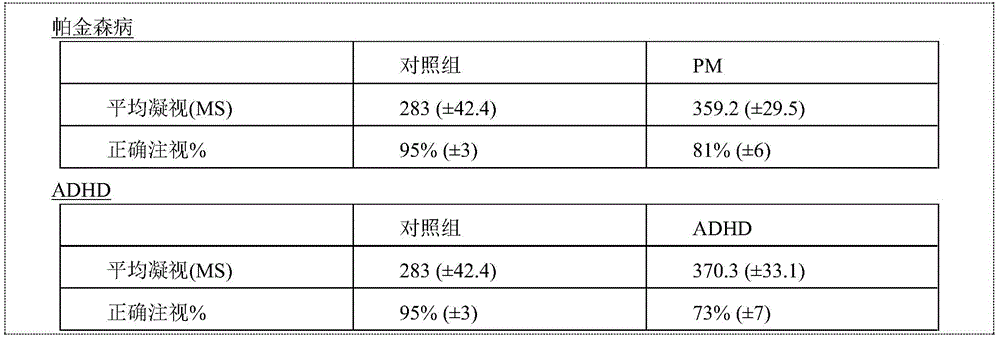
表2。 Table 2 .
Claims (39)
Priority Applications (1)
| Application Number | Priority Date | Filing Date | Title |
|---|---|---|---|
| CN202310476526.6A CN116784795A (en) | 2017-11-30 | 2018-11-30 | Methods for assessing impaired neurological function associated with multiple sclerosis |
Applications Claiming Priority (5)
| Application Number | Priority Date | Filing Date | Title |
|---|---|---|---|
| US201762592517P | 2017-11-30 | 2017-11-30 | |
| US62/592,517 | 2017-11-30 | ||
| US201862617622P | 2018-01-16 | 2018-01-16 | |
| US62/617,622 | 2018-01-16 | ||
| PCT/IL2018/051316 WO2019106678A1 (en) | 2017-11-30 | 2018-11-30 | System and method for detecting neurological disorders and for measuring general cognitive performance |
Related Child Applications (1)
| Application Number | Title | Priority Date | Filing Date |
|---|---|---|---|
| CN202310476526.6A Division CN116784795A (en) | 2017-11-30 | 2018-11-30 | Methods for assessing impaired neurological function associated with multiple sclerosis |
Publications (1)
| Publication Number | Publication Date |
|---|---|
| CN111970958A true CN111970958A (en) | 2020-11-20 |
Family
ID=66664395
Family Applications (2)
| Application Number | Title | Priority Date | Filing Date |
|---|---|---|---|
| CN202310476526.6A Pending CN116784795A (en) | 2017-11-30 | 2018-11-30 | Methods for assessing impaired neurological function associated with multiple sclerosis |
| CN201880088256.9A Pending CN111970958A (en) | 2017-11-30 | 2018-11-30 | System and method for detecting neurological disorders and measuring general cognitive abilities |
Family Applications Before (1)
| Application Number | Title | Priority Date | Filing Date |
|---|---|---|---|
| CN202310476526.6A Pending CN116784795A (en) | 2017-11-30 | 2018-11-30 | Methods for assessing impaired neurological function associated with multiple sclerosis |
Country Status (6)
| Country | Link |
|---|---|
| US (3) | US11694803B2 (en) |
| EP (1) | EP3716837B1 (en) |
| JP (3) | JP7442454B2 (en) |
| CN (2) | CN116784795A (en) |
| CA (1) | CA3086037A1 (en) |
| WO (1) | WO2019106678A1 (en) |
Cited By (1)
| Publication number | Priority date | Publication date | Assignee | Title |
|---|---|---|---|---|
| CN118415588A (en) * | 2024-03-20 | 2024-08-02 | 无锡市精神卫生中心 | Parkinson's disease diagnosis system and equipment based on virtual reality and eye tracking technology |
Families Citing this family (17)
| Publication number | Priority date | Publication date | Assignee | Title |
|---|---|---|---|---|
| US11694803B2 (en) * | 2017-11-30 | 2023-07-04 | Viewmind, Inc. | System and method for detecting neurological disorders and for measuring general cognitive performance |
| US12419514B2 (en) * | 2019-11-04 | 2025-09-23 | Versitech Limited | Eye movement analysis with co-clustering of hidden Markov models (EMHMM with co-clustering) and with switching hidden Markov models (EMSHMM) |
| US10685748B1 (en) * | 2020-02-12 | 2020-06-16 | Eyetech Digital Systems, Inc. | Systems and methods for secure processing of eye tracking data |
| JP7496982B2 (en) * | 2020-05-18 | 2024-06-10 | 国立大学法人鳥取大学 | Information processing device, identification method, and program |
| CN116669615A (en) * | 2020-12-23 | 2023-08-29 | 视觉心理公司 | Systems and methods for detecting neurological disorders and for measuring general cognitive performance |
| US12118825B2 (en) | 2021-05-03 | 2024-10-15 | NeuraLight Ltd. | Obtaining high-resolution oculometric parameters |
| US12217424B2 (en) | 2021-05-03 | 2025-02-04 | NeuraLight Ltd. | Determining digital markers indicative of a neurological condition using eye movement parameters |
| KR102734758B1 (en) * | 2021-06-16 | 2024-11-28 | (주)해피마인드 | System and method for diagnosing mental disorders and predicting treatment response based on psychiatric examination data using eye tracking |
| KR102784522B1 (en) * | 2021-12-20 | 2025-03-21 | 순천향대학교 산학협력단 | Screening system for identifyng mild cognitive impairment using eye movements and autonomic nervouse response and metrhod thereof |
| WO2023214535A1 (en) * | 2022-05-02 | 2023-11-09 | Kikura株式会社 | Device and program for diagnosis of brain disorders or dysautonomia through visual evaluation of independent display images with right and left eyes |
| CA3262795A1 (en) * | 2022-07-28 | 2024-02-01 | Viewmind, Inc. | Identifying disease-specific oculomotor patterns using visual stimuli, drug or treatment |
| CN115064275B (en) * | 2022-08-19 | 2022-12-02 | 山东心法科技有限公司 | Method, equipment and medium for quantifying and training children computing capacity |
| WO2024044242A1 (en) * | 2022-08-23 | 2024-02-29 | Viewmind, Inc. | A method for training and quantifying specific motor skills and cognitive processes in persons by analysing oculomotor patterns w using a 3-d virtual reality device with embedded eye-tracking technology, specific visual stimuli, sensors to show the movement of limbs |
| EP4646704A1 (en) | 2023-01-05 | 2025-11-12 | Neuralight Ltd. | Estimating a delay from a monitor output to a sensor |
| US12217421B2 (en) | 2023-01-05 | 2025-02-04 | NeuraLight Ltd. | Point of gaze tracking with integrated calibration process |
| US12326972B2 (en) * | 2023-03-09 | 2025-06-10 | International Business Machines Corporation | Saccade driven text comprehension artificial intelligence engine |
| WO2025090347A1 (en) * | 2023-10-26 | 2025-05-01 | The Johns Hopkins University | Obtaining eye movement data using patient-holdable device |
Citations (19)
| Publication number | Priority date | Publication date | Assignee | Title |
|---|---|---|---|---|
| JPS62249637A (en) * | 1986-01-28 | 1987-10-30 | ジヨ−ジ パブリテイス | Method and apparatus for determining nerve disorder |
| US20020099305A1 (en) * | 2000-12-28 | 2002-07-25 | Matsushita Electic Works, Ltd. | Non-invasive brain function examination |
| US20050175218A1 (en) * | 2003-11-14 | 2005-08-11 | Roel Vertegaal | Method and apparatus for calibration-free eye tracking using multiple glints or surface reflections |
| CN101466305A (en) * | 2006-06-11 | 2009-06-24 | 沃尔沃技术公司 | Method and apparatus for determining and analyzing a location of visual interest |
| US20120059282A1 (en) * | 2009-03-17 | 2012-03-08 | Emory University | Internet-based cognitive diagnostics using visual paired comparison task |
| US20140148728A1 (en) * | 2012-11-20 | 2014-05-29 | El-Mar Inc. | Method of identifying an individual with a disorder or efficacy of a treatment of a disorder |
| US20140313488A1 (en) * | 2013-03-15 | 2014-10-23 | Neuro Kinetics, Inc. | Method of measuring and analyzing ocular response in a subject using stable pupillary parameters with video oculography system |
| CN104254281A (en) * | 2012-04-24 | 2014-12-31 | 巴塞罗纳大学 | Methods of Measuring Attention |
| US20150245766A1 (en) * | 2014-02-28 | 2015-09-03 | Board Of Regents, The University Of Texas System | System for traumatic brain injury detection using oculomotor tests |
| CN105163648A (en) * | 2013-03-11 | 2015-12-16 | 亚特兰大儿童医疗保健公司 | Systems and methods for detection of cognitive and developmental conditions |
| US20160022136A1 (en) * | 2013-03-13 | 2016-01-28 | The Henry M. Jackson Foundation for the Advance- ment of Military Medicine, Inc. | Enhanced neuropsychological assessment with eye tracking |
| US20160022137A1 (en) * | 2013-03-14 | 2016-01-28 | Virginia Commonwealth University | Automated analysis system for the detection and screening of neurological disorders and defects |
| WO2016115895A1 (en) * | 2015-01-23 | 2016-07-28 | 北京工业大学 | On-line user type identification method and system based on visual behaviour |
| JP2016523112A (en) * | 2013-05-31 | 2016-08-08 | ディグニティー ヘルス | System and method for detecting neurological diseases |
| US20170007119A1 (en) * | 2011-03-02 | 2017-01-12 | Brien Holden Vision Diagnostics Inc. | Systems, Methods, and Devices for Measuring Eye Movement and Pupil Response |
| US20170112427A1 (en) * | 2014-05-30 | 2017-04-27 | Adam J. Simon | Multimodal health assessment with neuro-opthalmological saccade tests |
| US20170135577A1 (en) * | 2014-04-25 | 2017-05-18 | Texas State University | Health Assessment via Eye Movement Biometrics |
| CN107106094A (en) * | 2014-12-16 | 2017-08-29 | 皇家飞利浦有限公司 | The assessment of attention deficit |
| US20170255766A1 (en) * | 2016-03-07 | 2017-09-07 | Magic Leap, Inc. | Blue light adjustment for biometric security |
Family Cites Families (14)
| Publication number | Priority date | Publication date | Assignee | Title |
|---|---|---|---|---|
| JP2004337348A (en) * | 2003-05-15 | 2004-12-02 | New Opto Corp | Eye movement analysis system |
| EP2081636A4 (en) | 2006-10-26 | 2010-12-22 | Wicab Inc | Systems and methods for altering brain and body functions and for treating conditions and diseases |
| BR112012006957A2 (en) | 2009-09-29 | 2016-06-14 | Novartis Ag | Dosing regimen of an s1p receptor modulator |
| CA2867866C (en) * | 2012-03-26 | 2022-06-21 | New York University | Methods and kits for assessing central nervous system integrity |
| US10602927B2 (en) * | 2013-01-25 | 2020-03-31 | Wesley W. O. Krueger | Ocular-performance-based head impact measurement using a faceguard |
| US9717459B2 (en) | 2013-03-04 | 2017-08-01 | Anne Bibiana Sereno | Touch sensitive system and method for cognitive and behavioral testing and evaluation |
| US20170293356A1 (en) | 2016-04-08 | 2017-10-12 | Vizzario, Inc. | Methods and Systems for Obtaining, Analyzing, and Generating Vision Performance Data and Modifying Media Based on the Vision Performance Data |
| US10643741B2 (en) * | 2016-11-03 | 2020-05-05 | RightEye, LLC | Systems and methods for a web platform hosting multiple assessments of human visual performance |
| US11229385B2 (en) | 2016-11-23 | 2022-01-25 | Cognifisense, Inc. | Identifying and measuring bodily states and feedback systems background |
| US10657837B2 (en) | 2017-05-18 | 2020-05-19 | Pearson Education, Inc. | Multi-level executive functioning tasks |
| US11694803B2 (en) * | 2017-11-30 | 2023-07-04 | Viewmind, Inc. | System and method for detecting neurological disorders and for measuring general cognitive performance |
| GB2599831B (en) | 2019-06-14 | 2024-07-10 | Quantum Interface Llc | Predictive virtual training systems, apparatuses, interfaces, and methods for implementing same |
| US10722165B1 (en) | 2019-09-30 | 2020-07-28 | BioMech Sensor LLC | Systems and methods for reaction measurement |
| CN116669615A (en) | 2020-12-23 | 2023-08-29 | 视觉心理公司 | Systems and methods for detecting neurological disorders and for measuring general cognitive performance |
-
2018
- 2018-11-30 US US16/768,738 patent/US11694803B2/en active Active
- 2018-11-30 CN CN202310476526.6A patent/CN116784795A/en active Pending
- 2018-11-30 EP EP18883832.0A patent/EP3716837B1/en active Active
- 2018-11-30 CN CN201880088256.9A patent/CN111970958A/en active Pending
- 2018-11-30 JP JP2020547480A patent/JP7442454B2/en active Active
- 2018-11-30 CA CA3086037A patent/CA3086037A1/en active Pending
- 2018-11-30 WO PCT/IL2018/051316 patent/WO2019106678A1/en not_active Ceased
-
2023
- 2023-07-03 US US18/217,688 patent/US12165770B2/en active Active
- 2023-10-26 JP JP2023184073A patent/JP7656007B2/en active Active
-
2024
- 2024-10-29 US US18/929,952 patent/US20250054632A1/en active Pending
-
2025
- 2025-03-19 JP JP2025045564A patent/JP2025108439A/en active Pending
Patent Citations (19)
| Publication number | Priority date | Publication date | Assignee | Title |
|---|---|---|---|---|
| JPS62249637A (en) * | 1986-01-28 | 1987-10-30 | ジヨ−ジ パブリテイス | Method and apparatus for determining nerve disorder |
| US20020099305A1 (en) * | 2000-12-28 | 2002-07-25 | Matsushita Electic Works, Ltd. | Non-invasive brain function examination |
| US20050175218A1 (en) * | 2003-11-14 | 2005-08-11 | Roel Vertegaal | Method and apparatus for calibration-free eye tracking using multiple glints or surface reflections |
| CN101466305A (en) * | 2006-06-11 | 2009-06-24 | 沃尔沃技术公司 | Method and apparatus for determining and analyzing a location of visual interest |
| US20120059282A1 (en) * | 2009-03-17 | 2012-03-08 | Emory University | Internet-based cognitive diagnostics using visual paired comparison task |
| US20170007119A1 (en) * | 2011-03-02 | 2017-01-12 | Brien Holden Vision Diagnostics Inc. | Systems, Methods, and Devices for Measuring Eye Movement and Pupil Response |
| CN104254281A (en) * | 2012-04-24 | 2014-12-31 | 巴塞罗纳大学 | Methods of Measuring Attention |
| US20140148728A1 (en) * | 2012-11-20 | 2014-05-29 | El-Mar Inc. | Method of identifying an individual with a disorder or efficacy of a treatment of a disorder |
| CN105163648A (en) * | 2013-03-11 | 2015-12-16 | 亚特兰大儿童医疗保健公司 | Systems and methods for detection of cognitive and developmental conditions |
| US20160022136A1 (en) * | 2013-03-13 | 2016-01-28 | The Henry M. Jackson Foundation for the Advance- ment of Military Medicine, Inc. | Enhanced neuropsychological assessment with eye tracking |
| US20160022137A1 (en) * | 2013-03-14 | 2016-01-28 | Virginia Commonwealth University | Automated analysis system for the detection and screening of neurological disorders and defects |
| US20140313488A1 (en) * | 2013-03-15 | 2014-10-23 | Neuro Kinetics, Inc. | Method of measuring and analyzing ocular response in a subject using stable pupillary parameters with video oculography system |
| JP2016523112A (en) * | 2013-05-31 | 2016-08-08 | ディグニティー ヘルス | System and method for detecting neurological diseases |
| US20150245766A1 (en) * | 2014-02-28 | 2015-09-03 | Board Of Regents, The University Of Texas System | System for traumatic brain injury detection using oculomotor tests |
| US20170135577A1 (en) * | 2014-04-25 | 2017-05-18 | Texas State University | Health Assessment via Eye Movement Biometrics |
| US20170112427A1 (en) * | 2014-05-30 | 2017-04-27 | Adam J. Simon | Multimodal health assessment with neuro-opthalmological saccade tests |
| CN107106094A (en) * | 2014-12-16 | 2017-08-29 | 皇家飞利浦有限公司 | The assessment of attention deficit |
| WO2016115895A1 (en) * | 2015-01-23 | 2016-07-28 | 北京工业大学 | On-line user type identification method and system based on visual behaviour |
| US20170255766A1 (en) * | 2016-03-07 | 2017-09-07 | Magic Leap, Inc. | Blue light adjustment for biometric security |
Non-Patent Citations (2)
| Title |
|---|
| GERARDO FERNÁNDEZ等: "Registering eye movements during reading in Alzheimer’s disease:Difficulties in predicting upcoming words", 《JOURNAL OF CLINICAL AND EXPERIMENTAL NEUROPSYCHOLOGY》, vol. 36, no. 3, pages 301 - 316 * |
| 董为伟: "《实用临床神经病学》", vol. 2001, 30 September 2001, 中国医药科技出版社, pages: 452 * |
Cited By (1)
| Publication number | Priority date | Publication date | Assignee | Title |
|---|---|---|---|---|
| CN118415588A (en) * | 2024-03-20 | 2024-08-02 | 无锡市精神卫生中心 | Parkinson's disease diagnosis system and equipment based on virtual reality and eye tracking technology |
Also Published As
| Publication number | Publication date |
|---|---|
| US12165770B2 (en) | 2024-12-10 |
| US20230352175A1 (en) | 2023-11-02 |
| WO2019106678A1 (en) | 2019-06-06 |
| JP7656007B2 (en) | 2025-04-02 |
| US11694803B2 (en) | 2023-07-04 |
| JP2021504093A (en) | 2021-02-15 |
| US20250054632A1 (en) | 2025-02-13 |
| JP2024016094A (en) | 2024-02-06 |
| JP2025108439A (en) | 2025-07-23 |
| CN116784795A (en) | 2023-09-22 |
| EP3716837A1 (en) | 2020-10-07 |
| JP7442454B2 (en) | 2024-03-04 |
| EP3716837B1 (en) | 2026-01-21 |
| EP3716837A4 (en) | 2021-09-08 |
| US20210174959A1 (en) | 2021-06-10 |
| CA3086037A1 (en) | 2019-06-06 |
Similar Documents
| Publication | Publication Date | Title |
|---|---|---|
| JP7656007B2 (en) | Systems and methods for detecting neurological disorders and measuring general cognitive performance - Patents.com | |
| US20240188879A1 (en) | System and method for detecting neurological disease | |
| EP2800507B1 (en) | Apparatus for psychiatric evaluation | |
| US9872615B2 (en) | Systems and methods for improved ease and accuracy of gaze tracking | |
| Wiecek et al. | Effects of peripheral visual field loss on eye movements during visual search | |
| Norouzifard et al. | Automated glaucoma diagnosis using deep and transfer learning: proposal of a system for clinical testing | |
| Mantokoudis et al. | Impact of artifacts on VOR gain measures by video-oculography in the acute vestibular syndrome | |
| CN116669615A (en) | Systems and methods for detecting neurological disorders and for measuring general cognitive performance | |
| CN119997878A (en) | Use of visual stimulation, drugs, or treatments to identify disease-specific eye movement patterns | |
| Veneri et al. | Eye fixations identification based on statistical analysis-case study | |
| US20230368919A1 (en) | Method for identifying specific alterations in subjects with defined diseases analyzing oculomotor patterns when using specific visual stimuli, where a specific drug or treatment would enhance visual processing, cognitive performance and related brain activities | |
| Heynen et al. | Assessing Visuospatial Abilities Related to Visual Scanning in Cerebral Visual Impairment Using the Star Cancellation Test Combined with Wearable Eye Tracking | |
| CN119998890A (en) | Method for training and quantifying a person's specific motor skills and cognitive processes by analyzing eye movement patterns using a 3D virtual reality device with embedded eye tracking technology, specific visual stimulation, and sensors that display limb movements | |
| EP3479752B1 (en) | System and method for the determination of parameters of eye fixation | |
| Rajaraman | Functional Biomarkers for Detecting Glaucoma Progression | |
| JP2015006340A (en) | Analysis method |
Legal Events
| Date | Code | Title | Description |
|---|---|---|---|
| PB01 | Publication | ||
| PB01 | Publication | ||
| SE01 | Entry into force of request for substantive examination | ||
| SE01 | Entry into force of request for substantive examination | ||
| TA01 | Transfer of patent application right | ||
| TA01 | Transfer of patent application right |
Effective date of registration: 20220301 Address after: 903-576 Fifth Avenue, New York, USA Applicant after: Thinking Co.,Ltd. Address before: Santa Fe, Argentina Applicant before: Thinking stock Co. |