CN111931934A - Affine transformation solving method under mass control points based on improved genetic algorithm - Google Patents
Affine transformation solving method under mass control points based on improved genetic algorithm Download PDFInfo
- Publication number
- CN111931934A CN111931934A CN202010858269.9A CN202010858269A CN111931934A CN 111931934 A CN111931934 A CN 111931934A CN 202010858269 A CN202010858269 A CN 202010858269A CN 111931934 A CN111931934 A CN 111931934A
- Authority
- CN
- China
- Prior art keywords
- algorithm
- mutation
- probability
- affine transformation
- selection
- Prior art date
- Legal status (The legal status is an assumption and is not a legal conclusion. Google has not performed a legal analysis and makes no representation as to the accuracy of the status listed.)
- Pending
Links
Images


Classifications
-
- G—PHYSICS
- G06—COMPUTING OR CALCULATING; COUNTING
- G06N—COMPUTING ARRANGEMENTS BASED ON SPECIFIC COMPUTATIONAL MODELS
- G06N3/00—Computing arrangements based on biological models
- G06N3/12—Computing arrangements based on biological models using genetic models
- G06N3/126—Evolutionary algorithms, e.g. genetic algorithms or genetic programming
Landscapes
- Engineering & Computer Science (AREA)
- Physics & Mathematics (AREA)
- Health & Medical Sciences (AREA)
- Life Sciences & Earth Sciences (AREA)
- Biophysics (AREA)
- Bioinformatics & Cheminformatics (AREA)
- Bioinformatics & Computational Biology (AREA)
- Evolutionary Biology (AREA)
- Theoretical Computer Science (AREA)
- Computational Linguistics (AREA)
- Molecular Biology (AREA)
- Biomedical Technology (AREA)
- Genetics & Genomics (AREA)
- Data Mining & Analysis (AREA)
- Evolutionary Computation (AREA)
- General Health & Medical Sciences (AREA)
- Artificial Intelligence (AREA)
- Computing Systems (AREA)
- General Engineering & Computer Science (AREA)
- General Physics & Mathematics (AREA)
- Mathematical Physics (AREA)
- Software Systems (AREA)
- Physiology (AREA)
- Image Analysis (AREA)
Abstract
The invention discloses an improved genetic algorithm-based affine transformation solving method under a mass control point, which is used for solving problems by using the improved genetic algorithm aiming at affine transformation parameters under the mass control point. The ' improvement ' of the algorithm is mainly embodied in the're-screening operation ' additionally added after ' first selection-then cross-then mutation ' which is the most basic ' in the algorithm flow, and is established on the basis of the reasonable coding and decoding modes, the selection operators, the cross operators and the cross probabilities thereof, and the mutation operators and the mutation probabilities thereof. The new optimization method provided by the invention not only has relatively accurate calculation, but also has relatively fast algorithm, and can solve the special problem that more candidate solutions of the optimization problem, namely more control points are generated when affine transformation parameters are optimized and solved.
Description
Technical Field
The invention relates to the field of computer science and geographic information science, in particular to an optimization method for solving affine transformation parameter calculation under massive control points based on an improved genetic algorithm.
Background
The method comprises the steps of firstly, introducing a research background and a research status, including introducing the concept of affine transformation and coordinate transformation, particularly the application scene and the significance of affine transformation, reviewing the development status of a traditional optimization algorithm and a swarm intelligence optimization algorithm, describing the domestic and foreign research status of realizing affine transformation based on the optimization algorithm, and describing the subjective requirements of affine transformation on mass control points and the favorable conditions of objective acquisition of the mass control points. The method comprises the following specific steps:
(1) recall affine transformation oriented parameter solving
In a real 2D/3D environment, there are many coordinate Transformation types, such as Rigid Transformation (also called eustachian Transformation) formed by Translation (Translation) and Rotation (Rotation), as shown in fig. 1. The rigid Transformation together with the equal scaling (Isotropic scaling) constitutes a similarity Transformation (similarity Transformation). For scaling (scaling), there is also non-equal scaling in addition to the above equal scaling, and the non-equal scaling operation may produce symmetry (Reflection); based on the similarity Transformation, the Affine Transformation (affinity Transformation) is formed by adding non-equal-scale scaling, symmetry and Shear (Shear). In other words, in affine transformation, three basic operations of translation, rotation, and scaling, as well as symmetry and miscut derived from the above three, are allowed. The affine Transformation together with the Perspective operation (Perspective) forms the Perspective Transformation (project/Perspective Transformation). Of all the above types of transformations, affine transformations are more common and are of interest herein (the value of their application in map matching is detailed in the second section below).
The mathematical expression for affine transformation is given below: theoretically, the two-dimensional point (x ', y') after transformation is formed by affine transformation T from the two-dimensional point (x, y) before transformation. For convenience of calculation, the two-dimensional point is described in a homogeneous coordinate mode, the homogeneous coordinate of the two-dimensional point (x, y) is (x, y,1), and the homogeneous coordinate of the two-dimensional point (x ', y') is (x ', y', 1). Based on the above description, the transformation process is as shown in formula (1), that is, the two-dimensional point (x, y,1) before transformation forms the two-dimensional point (x ', y',1) after transformation by affine transformation T. The affine transformation of the three-dimensional points is similar to that of the two-dimensional points, and is not described in detail.

In equation (1), there are theoretically 3 × 3 — 9 parameters in the transformation matrix T, but only 6 of them need to be solved in fact according to the homogeneous feature. In other words, there are 6 total unknowns (i.e., a, c, l, b, d, m). Equation (2) is equivalent to equation (1).

As can be seen from equation (2), a pair of control points can result in two equations. To solve for the 6 parameters above, at least 3 pairs of control points are needed. In other words, if the point pair number N is equal to 3, the above 6 parameters can be accurately calculated. When the point logarithm N is more than 3, redundant (N-3) pairs of control points can be used for optimizing the 6 parameters; in other words, the above problem can be converted into two single-objective optimization problems when controlling point N (N > -3) (single-objective optimization is detailed in the third section below), as shown in equations (3) and (4):
min(Z1)=min∑(a*xi+c*yi+l-xi')2 (3)
min(Z2)=min∑(b*xi+d*yi+m-yi')2 (4)
the two objective functions are independent from each other, so that the solution is optimized respectively in general. In some special cases, however, the above can also be combined into a multi-objective optimization problem, as shown in equation (5). The vast majority of cases are considered herein, i.e. solutions are given for equation (3) and equation (4) above, respectively.
min(Z)=min(Z1,Z2) (5)
Figure 2 shows an example of affine transformation of a simple object (expressed with 9 control points). The object is firstly translated by one unit along the negative direction of the X axis and is translated by one unit along the negative direction of the Y axis, and the generated transformation matrix is shown as T1 in the figure; then, it rotates 90 degrees around the counterclockwise direction with the origin as the center, and the generated transformation matrix is shown as T2 in the figure; it is then symmetric along the X-axis, and the resulting transformation matrix is shown as T3. The above three transformation matrices form the final result of the affine transformation.
(2) Widely applicable scenarios setting forth coordinate transformation (affine transformation) -based map matching
Affine transformations (as commonly used coordinate transformations) are typically applied in the field of map matching. In affine transformation applied to map matching, point pairs (rather than line segment pairs or polygon pairs) are generally employed because points are easier to locate than line segments or polygons. As described above, the affine transformation requires at least three pairs of points. Each pair of such points is called a homologous point (homologous point) in application, i.e. represents the same feature; technically called control points (control points), which are used to control the correspondence between maps. A typical process for map matching based on coordinate transformation (especially affine transformation) is as follows: at least three pairs of control point data are taken, for example, Beijing city has marks on Chinese administrative zoning images and remote sensing images, and the affine transformation relation between Chinese administrative zoning and remote sensing images can be determined through three pairs of similar control points (for example, Beijing city, Shanghai city and Chengdu city, which are not on the same straight line).
Besides the application of overlaying the administrative region map and the remote sensing image map, the map matching has a plurality of real application scenes, and is particularly common in various application fields related to a Geographic Information System (GIS). For example, the digital sea chart and the digital topographic map are fused in navigation application, the power transmission and transformation equipment is superposed on a map in power application, a GPS linear track is covered on a map base map in the field of vehicle navigation, a house distribution diagram is superposed on the latest high-resolution remote sensing image in the field of disaster prevention and reduction, the high-resolution remote sensing images of adjacent map sheets are spliced, remote sensing images of different sources in the same city area are registered, and the like. In the above applications, from the perspective of the drawing industry, the Digital Landscape Model (DLM) is a fusion of a Digital Landscape Model (DLM) and a Digital graphic Model (DCM), the DLM is often in a vector format, typically such as an instantaneous position of a vehicle (in a dot vector format), a GPS time sequence track (in a linear vector format), and a house coverage (in a polygonal vector format), and the DCM is often in a grid format, typically such as a remote ground sensing image (in a grid format); from the perspective of a digital city, the method is called multi-source heterogeneous data fusion, wherein multiple sources are embodied in that a base map is from satellite photographing, real-time traffic thermal information is from traffic committee, hydrological conditions are from a water conservancy bureau, a political region map is from a natural resource bureau, population data is from a statistical bureau and the like, and isomers are in picture formats, character formats and spatial data formats (various formats such as points, lines, surfaces and the like). The map matching applications typically serve the aspects of disaster prevention and reduction, natural resource investigation, disease geographic space analysis, land resource management and the like.
The idea of realizing the matching of the graphic images based on the coordinate transformation (typical affine transformation) can also be used for registering two medical images describing the same patient region in the medical field so as to assist in analyzing the condition of an illness, and registering street view photographed images of different angles in the same region so as to realize street view three-dimensional reconstruction and the like. The idea can be even applied to the conversion solving of the same region among different mapping coordinate systems, which is most obvious in the mutual conversion of the mapping coordinate systems commonly used in the mapping of China. Specifically, as follows, the following description will be given,
in the field of surveying and mapping in China, the most commonly used are 5 coordinate systems, namely, 1954 Beijing coordinate system, 1980 Western Ann coordinate system, 1984WGS coordinate system, 2000 national geodetic coordinate system and city/place independent coordinate system. The ministry of natural resources in China decides that a 2000 national geodetic coordinate system is started from 2008, 7 and 1, 2009 provides technical guidance for converting the existing surveying and mapping result into the 2000 national geodetic coordinate system, and 2013 provides technical guidance for popularizing and using the 2000 national geodetic coordinate system and technical regulation for converting geodetic measurement control point coordinates. In the above technical guidelines and specifications, methods of conversion between coordinate systems are given, typically comprising: the method comprises the following steps of three-dimensional seven-parameter coordinate conversion (relating to three translation parameters, three rotation parameters and one scale change parameter), two-dimensional seven-parameter coordinate conversion (relating to two translation parameters, four rotation-related parameters and one scale change parameter), three-dimensional four-parameter conversion, two-dimensional four-parameter conversion (relating to two translation parameters, one rotation parameter and one scale change parameter) and polynomial fitting models. Among them, the well-known boolean sand-wolff (burst-Wolf) model is seven parameters and is most widely used. In fact, the above boolean sand-wolff seven parameters, after being combined by mathematical decomposition, are equivalent to the affine transformation six parameters described in the first section above.
The applicability of the relevant specifications to the above coordinate system conversion method is specified as follows: the coordinate transformation in the national and provincial ranges selects a two-dimensional seven-parameter transformation model, and the coordinate transformation below the provincial range can select a three-dimensional four-parameter model or a plane four-parameter model (mostly mainly plane four parameters). The method provides a new method aiming at solving the six parameters of the affine transformation (namely the Boolean-Walff seven parameters), applies the new method to a specific case of map transformation of a certain grade city in China, meets the above applicability requirements, and adopts a transformation model (namely a seven-parameter model) to fully meet the accuracy requirement of the transformation.
(3) Reviewing the current state of research for solving an optimization problem
As described above, it is required that a plurality of pairs (at least three pairs) of control points can be given an affine transformation parameter solution (applied to map matching). Then, how do it solve in particular? Solving the problem for affine transformation parameters of multiple control points is essentially an optimization problem (optimization). The optimization method is a method for researching how a scheme achieves the optimal goal, is based on the principles of mathematics and operation research, is very wide in practical application, and comprises the practical application of resource scheduling, scheduling/course scheduling/bed scheduling, image processing, mechanical parameter correction and the like, and the application of traveler problems, knapsack problems, drawing coloring problems and the like is a classical optimization problem. The Optimization Problem can be divided into a Single-object Optimization Problem (SOP) having only one objective function and a multi-object Optimization Problem (MOP) having a plurality of objective functions according to the number of the Optimization objective functions. The optimization with constraint conditions is more complex than the optimization without constraint conditions according to the division of the difficulty degree of the problem, and the optimization solving difficulty is increased in sequence from linear optimization, integer optimization, quadratic optimization (simple nonlinear optimization) and nonlinear optimization in any form.
The traditional optimization solving method comprises a Marquardt method (Levenberg-Marquardt), a Quasi-Newton method (Quasi-Newton), a conjugate gradient method, a gradiometer algorithm and the like, and is developed to the present. Taking a Gradient computing method as an example, a Stochastic Gradient Descent method (SGD, abbreviated) developed from the most primitive Gradient computing concept, a Momentum method (Momentum), an Adaptive Gradient (adabasal), an Adaptive Momentum Estimation (Adam, abbreviated) and the like have been rapidly developed and widely popularized in Artificial Intelligence (Artificial Intelligence), that is, training of neural networks in image understanding, natural language processing and speech recognition, which are three major branches of Artificial Intelligence, are widely based on the Gradient computing concept. Although the traditional methods are stable, the methods are too mechanical, the time spent on optimization solution is long, and the time complexity for obtaining the optimal solution is high.
In contrast, Heuristic (Heuristic) optimization algorithms have been rapidly developed in recent decades, and in particular, swarm intelligence optimization algorithms have been designed and developed, and in particular, a large number of swarm intelligence optimization methods named by animals are born and developed. The heuristic and swarm intelligent optimization algorithms typically comprise, as shown in fig. 3, algorithms with obvious position and speed updating (such as a particle swarm algorithm, a fruit fly algorithm, a bat algorithm, a firefly algorithm, a brood bird algorithm and a bacterial foraging algorithm), algorithms with obvious cooperation among individuals in a swarm (such as an artificial ant swarm algorithm, an artificial bee swarm algorithm and an artificial fish swarm algorithm), algorithms with obvious inner-outer two-layer nested circulation (such as a simulated annealing algorithm and a mixed frog-leaping algorithm), and algorithms with obvious mechanisms of reproduction and evolution (such as a genetic algorithm, a differential evolution algorithm and an artificial immune algorithm). In addition, the system also comprises a tabu search algorithm, a monkey swarm algorithm, a wolf swarm algorithm, a cat swarm algorithm, a cockroach algorithm, a longicorn searching algorithm, a chicken swarm algorithm, a harmony algorithm and the like with obvious position and speed updating. These algorithms are simulations of the development and adaptation of living and natural world through countless generations, encompassing the wisdom crystals of living and natural world, and are the objective results of countless generations of accepted natural choices. The particle swarm algorithm, the simulated annealing algorithm and the genetic algorithm are provided with earlier time and developed most mature up to now; among the three, the genetic algorithm is put forward earliest, developed most mature so far, has strict mode theoretical basis and is widely applied to various fields of optimization application. The new approach presented herein is based upon the improvement of conventional genetic algorithms (described in detail below).
(4) Review the current domestic and foreign research situation of using a swarm intelligence optimization method to give affine transformation parameters, review the relevant domestic and foreign research situation of using a swarm intelligence optimization algorithm to give affine transformation parameter solution (for point pair matching, image matching and other applications). Researches have found that the researches using the classical genetic algorithm are the most, and related researches based on a particle swarm optimization, a simulated annealing algorithm and an artificial ant colony algorithm exist. Specifically, as follows, the following description will be given,
the Peng-Yeng Yin (2006) gives a point matching research of 50 points based on a Particle swarm PSO algorithm, and is applied to fingerprint matching (Peng-Yeng Yin (2006). Particle swarm optimization for point pattern matching [ J)].Journal of Visual Communication&Image reproduction, vol.17, pp.143-162.). Seedling promotion et al (2008) and spring improvement et al (2016) study image registration of 2 images by combining particle swarm PSO algorithm and mutual information measure standard, and are respectively applied to registration of infrared images and remote sensing images (seedling promotion et al (2008); image automatic registration method based on normalized mutual information and fuzzy self-adaptive PSO [ J]Computer science, vol.35, No.6, pp.175-177). Leiwei et al (2007) give an affine transformation six-parameter solving idea of 2 images through an artificial ant colony ACO algorithm (Leiwei et al (2007)]Infrared technology, vol.29, No.11, pp.662-665.). N.k. sreeja et al (2015) also studied how two images are registered by point matching based on ACO algorithm, and adopted is photographed image matching verification in daily life (n.k. sreeja et al (2015)].European Journal of Operational Research, vol.246, pp.154-169). Korean beauty (2013) et al propose an image registration algorithm combining simulated annealing SA algorithm and particle filtering (korean beauty et al (2013). image registration based on particle filtering and simulated annealing method [ J]Computer and digital engineering, vol.41, No.12, pp.1903-1905). Nirwan Anasari et al (1990) earlier proposed the use of genetic algorithms to give Point matching studies, algorithm configurations using integer coding, roulette selection, partial match crossover (crossover rate 0.5), reciprocal variation (variation rate 0.02) for 12 points (Nirwan Anasari et al (1990) Point pattern matching by genetic algorithm].Industrial Electronics Society,IECON’90,16thAnnual Conference on IEEE,6 p). Subsequently, Ashish Agrawal et al (1994) also studied the 12-point-to-point matching problem using genetic algorithms, using integer coding, roulette-selected variants, uniform crossover, and multiple variant strategies (Ashish Agrawal et al (1994)]IEEE World consistency on IEEE International Conference on Neural Networks,6 p). Zhang et al, given a theoretical study of genetic algorithm-based point matching in 2000 and 2003, respectively, for a 12-point configuration (Zhang et al (2000)) using integer coding, roulette selection, partial match crossover (crossover rate 0.94), and reciprocal variation (variation rate 0.1)]Journal of electronics, vol.28, No.10, pp.36-40.), the latter employing a configuration of binary coding, roulette selection, single-point crossing (cross rates 0.05 and 0.03), inverse variation (variation rates 0.02 and 0.03) for 15 pairs (Zhang Lihua et al (2003). Genetic algorithm for affinity point mapping [ J]Pattern Recognition Letters, vol.24, pp.9-19). Subsequently, shenjin (2003) gave a medical image registration study based on genetic algorithms, which were divided into two parts using genetic algorithms, with the strategies of real number coding, roulette selection, variation of arithmetic reorganization, homogeneity variation being used in the early stage of the algorithm, and gray code coding, roulette selection, two-point intersection (intersection rate 0.8), basic place variation (variation rate 0.01) (shenjin (2003) the application of genetic algorithms in medical image registration technology [ J]University of capital medical scienceVol.24, No.1, pp.30-32). Furthermore, zhan et al (2010) apply a genetic algorithm to the registration of remote sensing images (zhan et al (2010))]Scientific technology and engineering, vol.10, No.21, pp.5168-5170), also applied to remote sensing image registration, is a xiaodong (2015), which adopts integer coding, two-point intersection, and basic bit variation algorithm configuration (xiaodong (2015).]Master academic thesis, west ampere university of electronic technology, west ampere, 86 p). And Roots et al (2006) combine the profile curve energy measure thought on the basis of the genetic algorithm to provide image registration research for military striking targets (Roots et al (2006). affine transformation solving method based on energy and genetic algorithm [ J]The proceedings of Wuhan chemical academy of sciences, vol.28, No.3, pp.78-82.), similarly, Zhang Guimei, etc. (2013) combines chord height points on the basis of genetic algorithm to give registration research of digital images, and adopts specific strategies of Gray code coding, elite retention strategy, single-point crossing (crossing rate 0.8) and basic bit variation (variation rate 0.2) (Zhang Guimei, etc. (2013). affine registration based on chord height points and genetic algorithm [ J]Automated journal, vol.39, No.9, pp.1447-1457.).
In summary, in the process of implementing affine transformation parameter solving by using various group intelligent optimization algorithms, there are 12 pairs of input points, 15 pairs of input points, 50 pairs of input points at most, and no more than hundreds of pairs of control points, so that the calculation amount of the objective function is relatively small (as there are few input control points, see formulas 3 and 4 for details), in other words, the number of terms in the objective function is relatively small and the calculation amount is relatively low. In the above research that does not employ control point pairs but employs direct image comparison, when the entire image or a part of the image (such as the outline containing the object) employs entropy (entropy) as the optimization objective function to achieve image registration, the calculation strategy of entropy is constant no matter how large the image size changes and how rich the image content is, which makes the calculation of the optimization objective function relatively simple at this time, although the measurement of entropy may be various (typically, mutual information measurement may be employed). The traditional group intelligent optimization method or the traditional genetic algorithm can be used for solving for reference.
More intuitively, the more or less number of control points has an effect on the algorithm operation as follows:
if the number of control points is known to be smaller, the straight line swing space sandwiched between the points is relatively larger, i.e. the solution space is relatively large, but the calculation amount of the objective function (or fitness function) is small (because the number of summation terms in equations 3 and 4 is small).
In contrast, if more control points are known, the linear swing space between the points is relatively small, i.e., the solution space is relatively small, but the calculation amount of the objective function (or fitness function) is large (because the number of summation terms in equations 3 and 4 is large).
(5) Setting forth subjective requirements of affine transformation on mass control points and favorable conditions for objective acquisition of mass control points
As described above, at present, a small number of control points are commonly used at home and abroad to solve affine transformation. In other words, the vast majority defaults to: since three pairs of control points can already be solved, more points than three pairs (e.g., more than 10 pairs) are sufficient for optimization; meanwhile, the conventional cognition of people is that control points are not easy to acquire, and a great deal of time, energy and financial resources are not needed to acquire the control point pairs, however, the fact is not consistent with the subjective cognition. In other words, actual data generation or real-scene applications are not as perfect as theoretically, including several typical objective cases as follows:
(1) the personnel of the interior and exterior can locate accurately (correct) but not accurately (not precision) for the homonymy point, for example, the center or the mass center of a typical feature with an irregular shape can have deviation of manual judgment (such as decimeters);
(2) the positioning of the same point of the same map is completed by different internal and external workers in different batches, and the positioning concepts or positioning methods of different operators are different, for example, the large gate positioning of schools may have cognitive gaps (for example, multiple meters);
(3) the final large graph is formed by jointly splicing a plurality of (administrative division) sub-graphs, and errors can exist when the sub-graphs form the splicing of the large graph.
The above cases (1) to (3) are highly likely to occur in an objective real remote sensing image map or a vector map generated by interpretation of a remote sensing image. In addition to this, the following may also occur:
(4) even if the same map is produced and produced, local deformation is generated, typically, a map with human characters is generated by means of digitalization of a base map of a remote sensing image, even if the map is produced, the semi-automatic and semi-manual operation characters of the map can cause deviation of ground objects, and even if the map is produced, vector ground object extraction and digitalization based on the remote sensing image map are proved to be incapable of being completely automatic by practice.
Based on the above, in order to improve the accuracy of correspondence between two maps based on the coordinates of the control points, it is naturally conceivable to propose a new method from the mathematical principle to improve the coordinate correspondence, in addition to specifying that the relevant operator should correctly collect and produce data. A typical mathematical improvement is to use more control point pairs (i.e., more pairs of homonymous points).
Then is a large number, or even a large number, of control points objectively easy to acquire? The general trend of various applications (typical image registration) realized by matching homonymous points at present is that homonymous points are more and more convenient to acquire and the point location accuracy is higher and higher. In particular, the method comprises the following steps of,
on one hand, the acquisition of the same-name point is more and more convenient, which is most obvious in the development of the related technology of Computer Vision (Computer Vision), the same-name point in Computer Vision is generally called a feature point (key point), a special feature point located at an obvious corner of an object edge is called an angle point (corner point), the development of the related algorithm for extracting the angle point and the feature point is more and more mature, and the algorithm performance is more and more good, as shown in fig. 4, fig. 4 is an angle point detection (corner point detection) algorithm and a feature point detection (key point detection) algorithm. For the corner point extraction method, there are Moravec algorithm proposed in 1981, Harris algorithm proposed in 1988, Shi-Tomasi algorithm proposed in 1994, SUSAN (small Uni-value Segment optimizing algorithm) algorithm proposed in 1997, FAST from estimated Segment Test (FAST) algorithm proposed in 2006, and AGAST (Adaptive and Generic estimated Segment Test) algorithm proposed in 2010, among which Harris and its improved Shi-Tomasi are the most famous and widely used. For the Feature point extraction method, there are a Scale Inversion Feature Transform (SIFT) algorithm developed in 2004 in 1999, a speed Up project (SURF) algorithm developed in 2008 in 2006, a BRIEF (Binary Robust Independent Features) algorithm developed in 2010 in 2006, an ORB (organized FAST and rotaed BRIEF) algorithm developed in 2011, a BRISK (Binary Robust exchangeable keys) algorithm developed in 2011, a KAZE algorithm developed in 2012, and an AKAZE algorithm developed in 2013, where SIFT and its improved SURF algorithm, the above-mentioned t and BRIEF are combined to form an ORB algorithm, which are the best known.
On the other hand, the BeiDou Satellite Navigation System BeiDou System, which is one of the four major Global Navigation Satellite systems GNSS (Global Navigation Satellite System) at present, completes Global Satellite networking in 6 months of 2020 (the first System of BeiDou in 1994 is built, the second System of BeiDou in 2004 is built, the third System of BeiDou in 2009 is built, and the last 55 th Satellite of the BeiDou System is launched in 6 months of 2020), and the Global networking of the BeiDou Satellite Navigation System in china is completed finally, so that higher accuracy and lower cost based on autonomous property rights can be brought to map positioning of the same-name point, the cost is low, more control point pairs can be set, and the map matching is more accurate due to high accuracy. In the GNSS, in addition to beidou, there are three systems, namely, Global Positioning System (Global Positioning System) in the united states, GLONASS System in russia, and Galileo Positioning System in the european union.
Disclosure of Invention
The invention provides an improved genetic algorithm for solving affine transformation parameters under the condition of facing mass control points. The new method provided by the invention is an improvement on the traditional genetic algorithm, adopts octave to express, and particularly adopts a novel strategy of fair competition between children and parents in the algorithm flow, so that the special condition of more candidate solutions in the optimization process can be processed. The optimization new method provided by the invention not only has relatively accurate calculation, but also has relatively fast algorithm.
The technical scheme of the invention is as follows: an improved genetic algorithm-based affine transformation solving method under mass control points adopts an octave group to give expression, as shown in a formula (6):
IGAATLCP={ED,SEL,CR,MT,P,PRO,POP,ITER} (6)
wherein, IGAATLCP is an abbreviation of Improved Genetic Algorithm for affinity Transformation under Lots of Control Points, namely an Improved Genetic Algorithm for Affine Transformation reference under the condition of a large number of Control Points; ED is a coding and decoding mode; SEL is the selection operator; CR is the crossover and recombination operator; MT is a mutation operator; p is the crossover probability and the mutation probability; PRO is the algorithm flow of the genetic algorithm; POP is the population size; ITER is an iteration convergence condition; the method specifically comprises the following steps:
determining the encoding and decoding mode ED of the method, for numerical calculation problems, including testing
The numerical calculation of the function and the numerical calculation of parameter solving by affine transformation are uniformly coded by real numbers
A code mode; for the problem of the traveling salesman, uniformly adopting permutation codes;
step two, determining a selection operator SEL of the method, namely randomly selecting some individuals from parents to survive according to a preselected strategy by referring to a fitness function, eliminating the rest individuals, and adopting a roulette selection method RWS;
determining a crossover operator CR of the method, namely simulating the mating in the natural gene transfer process, carrying out optimized combination on certain genes of the survived parent individuals, and adopting a partial matching crossover operator PMX;
determining a Mutation operator MT of the method, namely changing or mutating genes at certain positions of codes according to certain probability, and adopting a reverse Mutation operator Invert Mutation;
determining the cross probability and the mutation probability P of the method, wherein the fixed cross probability and the mutation probability are adopted, the fixed cross probability is set to be 0.5, and the fixed mutation probability is set to be 0.2;
determining an algorithm flow PRO of a genetic algorithm of the method, and expressing the flow PRO by adopting the following formula (10):
PRO-3={ED(Real-Integer+Permutation),SEL(RWS),CR(PMX),MT(InvertMutation),P(pc=0.5,pm=0.2),Child(Rank(MT+Parent)),ED} (10)
in the above formula (10), PRO-3 represents an improved algorithm flow, ED (Real-Integer + Permutation) represents coding using Real numbers or Permutation first, SEL (RWS) represents roulette selection, CR (PMX) represents partial matching intersection, MT (InvertMutation) represents inverse mutation, P (pm ═ 0.5, pc ═ 0.2) represents that the probability of intersection is set to 0.5 and the probability of mutation is set to 0.2, Child (Rank (MT + Parent)) represents that the set formed by the offspring derived from the above operation and the ancestor itself together gives a fair sorting operation, R (R-Integer + Parent)) represents that the ancestor gives a fair sorting operation, and R (R-Integer + Parent) represents that the set is formed by the offspring derived from the above operation and the ancestor itselfank is the sorting algorithm, ED represents the final decoding; adopting a certain amount of individuals as a population scale, setting the most initial population scale as parents, after roulette selection is carried out between the individuals of the parents, partial matching intersection is realized according to the intersection probability of 0.5, and reverse mutation is realized according to the mutation probability of 0.2, deriving descendants which are the same as the certain amount, then forming a chromosome set by the certain amount of parents and the certain amount of descendants together, and carrying out next round of circulation by taking the real child as a new parent for the next preferential screening of the chromosome set.
In the above, the fair sorting operation means that the optimal front-end part in the sorting result is reserved as a child.
In the above, the optimum leading end portion is the ratio of the first 50%.
In the above, the roulette selection means: the probability of each individual being selected is proportional to its fitness.
In the above, the partial matching intersection means: randomly selecting 2 gene positions on the chromosome, exchanging gene segments between the two positions according to a certain probability by the two chromosomes, and realizing collision detection and adjustment of the rest gene positions on the chromosome according to the corresponding relation between the two positions.
In the above, the reverse mutation is: 2 gene positions are randomly selected on a chromosome, segments among the 2 positions on the chromosome are reversed according to a certain probability, and the lengths of the segments subjected to the reversal are random because the gene positions are random.
In the above, the next round-robin iteration is performed with the true child as the new parent until the theoretical minimum value of the function value is found or a single line is found, and the actual total length of the line is close to the theoretical route minimum value.
The method aims at solving the problem of affine transformation parameter under the mass control points, and adopts the improved genetic algorithm for processing. The ' improvement ' of the algorithm is mainly embodied in the're-screening operation ' additionally added after ' first selection-then cross-then mutation ' which is the most basic ' in the algorithm flow, and is established on the basis of the reasonable coding and decoding modes, the selection operators, the cross operators and the cross probabilities thereof, and the mutation operators and the mutation probabilities thereof. The method can solve the special problem that the optimization problem has more candidate solutions (namely, more control points are needed when affine transformation parameters are optimized and solved).
Drawings
FIG. 1 is a diagram illustrating the relationship between affine transformation and other transformations in the prior art.
Fig. 2 is a schematic diagram of an example affine transformation in the prior art, in which the control point pairs are 9 pairs.
FIG. 3 is a diagram illustrating classification of a classical group intelligence optimization algorithm in the prior art.
Fig. 4 is a schematic diagram of a corner point detection algorithm and a feature point detection algorithm in the prior art.
FIG. 5 is a schematic diagram of the IGAATLCP octant expression proposed in the method of the present invention.
FIG. 6 is a visualization diagram of the Rastrigin function in the standard test function of the optimization algorithm in the embodiment of the present invention.
Figure 7 is a graphical representation of the traveler TSP data set Eil-76 in the standard test function of the optimization algorithm in an embodiment of the present invention.
FIG. 8 is a schematic diagram of administrative division of Shenzhen city according to an embodiment of the present invention.
FIG. 9 is a schematic diagram of coordinate transformation of a Shenzhen City control point in the embodiment of the present invention.
Detailed Description
In order to facilitate an understanding of the invention, the invention is described in more detail below with reference to the accompanying drawings and specific examples. Unless defined otherwise, all technical and scientific terms used herein have the same meaning as commonly understood by one of ordinary skill in the art to which this invention belongs. The terminology used in the description of the invention herein is for the purpose of describing particular embodiments only and is not intended to be limiting of the invention. As used herein, the term "and/or" includes any and all combinations of one or more of the associated listed items.
The invention provides an improved genetic algorithm for solving affine transformation parameters under the condition of facing mass control points. The new method provided by the invention is an improvement on the traditional genetic algorithm, adopts octave to express, and particularly adopts a novel strategy of fair competition between children and parents in the algorithm flow, so that the special condition of more candidate solutions in the optimization process can be processed. The optimization new method provided by the invention not only has relatively accurate calculation, but also has relatively fast algorithm.
Image registration in computer science and map registration in geographic information science are typical application scenes adopting affine transformation, group intelligent optimization is adopted in traditional affine transformation parameter solving to solve affine transformation parameters of a plurality of pairs of control points, and only the scale of the control points is smaller, and the application scene precision requirement is lower. In the face of the current situation that the current control points are increasingly demanded and are easily acquired, the novel method provided by the invention can effectively realize relatively accurate and relatively quick optimal calculation of affine transformation parameter solving under massive control points. The method comprises the following specific steps:
the improved genetic algorithm provided by the invention is expressed by adopting an octave group as shown in figure 5, and is expressed by a formula (6):
IGAATLCP={ED,SEL,CR,MT,P,PRO,POP,ITER} (6)
the above is an octave, and IGAATLCP is an abbreviation of Improved Genetic Algorithm for affinity Transformation under Lots of Control Points, i.e. an Improved Genetic Algorithm for Affine Transformation referencing under a large number of Control Points.
The term ED 1 is an abbreviation of Encoding and Decoding, i.e., Encoding and Decoding method. Encoding once determined, decoding is relatively simple and is generally written only as encoding. The coding is the basis for transforming the feasible solution of a problem from its solution space to a search space that can be processed by genetic algorithms. The specific implementation method of the coding includes Binary coding (Binary)/Gray coding (Gray), Integer coding (Integer)/natural number coding, Real number coding (Real)/floating point coding (Float), Permutation coding (permatation) and Matrix coding (Matrix).
Term 3 CR is an abbreviation for Cross-over and Recombination, i.e., crossover and Recombination operators (commonly abbreviated as crossover operators). The crossover operator is the core of global optimization and guarantees the solution diversity. The specific implementation modes of the crossover operator include single-point crossover, two-point crossover, multi-point crossover, uniform crossover, partial matching crossover, sequential crossover, position-based crossover, sequential-based crossover, discrete recombination, arithmetic recombination and intermediate recombination.
Item 5P is an abbreviation for Proavailability, i.e. Probability. There are two probabilities, one is the crossover rate (pc for short) and the other is the mutation rate (pm for short). The crossing rate and the variation rate have fixed values and also have dynamic changes. The specific implementation manner of the adaptive change rate includes a basic adaptive change rate, a linear adaptive change rate, a cosine adaptive change rate and an improved adaptive change rate.
POP in item 7 is an abbreviation for POPulation, i.e., POPulation size. Item 8, ITER is an abbreviation for iterating, i.e. iterative convergence condition, which can be characterized by ITERation number, or convergence threshold, the former is commonly used. The population size of item 7 and the iterative convergence condition of item 8 are general parameters of various intelligent optimization algorithms (i.e., the same exists in the particle swarm algorithm, the artificial ant colony algorithm, and other algorithms), and thus are not described herein again.
In the 8 tuples, items 1 to 6 are respectively coding and decoding, selection operators, crossover and recombination operators, mutation operators, crossover rate and mutation rate, and algorithm processes, which are core contents. In items 1-6, item 1 encoding and decoding is a precondition, items 2-4 selection operators, crossover and recombination operators, mutation operators are bases, item 5 crossover rate and mutation rate are assistance of items 2-4, and item 6 algorithm flow is an integrator of items 1-5. Before giving details, the general description of the selection operators, crossover and recombination operators and mutation operators is given in items 2-4. Specifically, as follows, the following description will be given,
selection operation (selection), or selection operator, refers to selecting some individuals from the parent randomly according to a preselected strategy to survive and eliminate the remaining individuals by referring to the fitness function. Crossover operation (or crossover operator) refers to the process of crossing to match with natural gene transfer to optimize and combine some genes of the surviving parents. Mutation operation (mutation), or mutation operator, refers to the process of changing or mutating the gene at certain positions of the code according to a certain probability. The effects of the above three operations are as follows: the selection operator is the embodiment of the superiority and inferiority in heredity, in other words, the selection operator is the key of the global convergence of the algorithm. The purpose of the crossover and recombination operators is to pass the superior gene-optimized combination in the male parent to the next generation while creating a new optimization space, in other words, the crossover and recombination operators are the core for finding the global optimal solution. The mutation operator can enable the genetic algorithm to have local random search capability, and meanwhile, the genetic algorithm can also maintain diversity, in other words, the mutation operator is a guarantee for solving local optimization.
Following the above octave group, in order to construct a new method for solving affine transformation parameters based on an improved genetic algorithm under the condition of realizing a large number of control points, the following six steps are required, specifically:
step one, determining the coding mode ED of the method
Where the coding ED is the basis. Encoding (encoding) refers to a method of converting a feasible solution to a problem from its solution space to a search space that can be processed by genetic algorithms. Common encoding methods include binary encoding/gray encoding, integer encoding/natural number encoding, real number/floating point number encoding, permutation encoding, matrix encoding, and the like.
Typically, Binary coding (Binary) is the earliest proposed coding mode, has strong global search capability but relatively weak local search capability, has a strict mode theorem basis, and can solve most of function optimization problems. Gray code (Gray) is also binary in nature, Gray code can express adjacent integers by only changing one binary bit, and the improvement can avoid the defect that binary codes of adjacent integers possibly have larger Hamming distance (also called Hamming cliff), and improve the local searching capability to a certain extent. In addition to binary coding, Integer coding (Integer) is also commonly used. Real number coding (Real) has strong local searching capability but relatively weak global searching capability, and is used more in solving the continuous function optimization problem in industry. Permutation coding (permatation) is mostly used for solving the traveler problem. The above encoding modes are all one-dimensional, they can be regarded as special cases of two-dimensional Matrix encoding, and two-dimensional Matrix encoding (Matrix) is generalization of the above one-dimensional encoding.
In the numerical calculation problem (including numerical calculation of a test function and numerical calculation of affine transformation parameters), a real number encoding mode is uniformly adopted; for the problem of travelers, permutation codes are uniformly adopted.
Step two, determining the selection mode SEL of the method
The selection operator (select) is the key and is the key of the global convergence of the algorithm, because from the perspective of the genetic algorithm, the evolution of the solution is mainly completed by a selection mechanism and a crossover strategy, the mutation is only used for repairing and supplementing some genetic genes which are possibly lost in the selection and crossover processes, and the mutation is only a background operation in the global sense of the genetic algorithm; and the interleaving operation is built on the result of the selecting operation, i.e. the object of the interleaving operation is the result of the selecting operation. It can be seen that in solving practical problems using genetic algorithms, selection operations occupy an extremely important position, which is also the most important factor in determining whether genetic algorithms converge.
Common Selection operators are Roulette Selection (Roulette Wheel Selection), Tournament Selection (season Selection), Elite retention strategy (Elite Copy Selection), Truncation Selection (Truncation Selection), Linear-Rank Selection (Linear-Rank Selection), and Exponential-Rank Selection (exponentiation-Rank Selection). The Roulette method (RWS) is also called a proportional Selection method, and means that the probability of an individual being selected is proportional to the fitness value of the individual, and the higher the fitness of the individual is, the higher the probability of the individual being selected is. Tournament Selection (TOUR for short) refers to taking a certain number of individuals from a population each time, then selecting the best one of the individuals to enter a offspring population, and repeating the operation until the new population size reaches the original population size, and the Tournament Selection TOUR is also called a pairwise competition method. An Elite Copy Selection (abbreviated as ECS) is also called as an optimal individual storage strategy, and in the problem solving process of a genetic algorithm, although more and more excellent individuals can be generated along with the evolution process of a population, due to the randomness of genetic operations such as Selection, intersection, variation and the like, the individual with the best fitness in the current population can be damaged, so that the average fitness of the population is reduced, and the operation efficiency and the convergence speed of the genetic algorithm are influenced; therefore, the individuals with the best fitness are reserved in the next generation group to perform the selection and elimination operation, namely, the individuals with the highest fitness in the current group do not participate in the cross operation and the mutation operation, but replace the individuals with the lowest fitness generated after the genetic operations such as cross operation, mutation and the like in the group of the current generation.
The roulette Selection method RWS, the tournament Selection method TOUR, and the elite reservation policy ECS are basically all directly selecting according to the fitness value, and in addition to this, there are methods of first making a ranking according to the fitness and then giving a Selection according to the ranking result, such as a Truncation Selection (Truncation Selection), which is a Selection method of selecting N individuals with the highest fitness after ranking according to the fitness; the Linear-Rank Selection (Linear-Rank Selection) and the Exponential-Rank Selection (Exponential-Rank Selection) are different in the sorting method, the Linear-Rank Selection is a Linear sorting operation, the Exponential-Rank Selection is a sorting operation, and the Exponential-Rank Selection is an Exponential-Rank sorting operation.
Here, the roulette selection method RWS is used uniformly.
Step three, determining the cross mode CR of the method
The crossover operator (crossover) is the core and the global optimum core, and the crossover operation is a gene recombination process simulating sexual reproduction in nature, and has the function of inheriting the original excellent genes to next generation individuals and generating new individuals containing more complex gene structures. Therefore, the cross operation is the most important method for generating new individuals. Among operators, crossover operators are known for their strong global search capability, in contrast, mutation operators are known for their strong local search capability.
Commonly used (under binary coding) Crossover operators include One-Point Crossover (One Point cross), Two-Point Crossover (Two Point cross), Multiple Point cross (Multiple Point cross), and Uniform cross (Uniform cross). Wherein, the One Point cross (One Point cross) means that a cross position is randomly generated for two selected chromosomes, and then the two chromosomes exchange the chromosome structure behind the position, thereby forming two new individuals. Two-Point crossing (Two Point cross) means that Two crossing positions are randomly generated for Two selected chromosomes, and then the Two chromosomes exchange the chromosome structure between the Two crossing positions, thereby forming Two new individuals. Multipoint crossing (also called generalized crossing) means that a plurality of crossing positions are randomly generated for two selected chromosomes, and then the two chromosomes exchange structures among the plurality of crossing positions, so that two new individuals are formed; indeed, the crossing of an even number of points can be seen as a result of the sequential multiple action of the crossing of two points. The intersection of an odd number of points can be viewed as the result of the sequential multiple action of a point intersection with multiple two-point intersections. Uniform Crossover (Uniform Crossover), also called Uniform Crossover, means that each of the corresponding digits on two selected chromosomes are interchanged with a certain probability to form a new individual. It is worth noting that the above cross operators of single-point cross, two-point cross, multi-point cross, and uniform cross are consistent in the result of the chromosome effect when the evolution algebra tends to be infinite, which is understandable because the single-point cross and the two-point cross can be regarded as special cases of the multi-point cross. The above Crossover operator is mostly used for Crossover operation in the binary coding mode, and besides, there are partial matching Crossover (abbreviated PMX), Order Crossover (abbreviated OX), Position-based Crossover (Position-based Crossover), Order-based Crossover (Order-based Crossover), and the like, which are formed on the basis of the above single-point Crossover, two-point Crossover, multi-point Crossover, and uniform Crossover.
For interleaving under real number coding, besides the above commonly used interleaving under binary, there are many interleaving operators independently suitable for real number coding, which are also called Recombination operators (Recombination), such as Discrete Recombination (Discrete Recombination), Arithmetic Recombination (arithmetric Recombination), and Intermediate Recombination (Intermediate Recombination). Here, Discrete Recombination (Discrete Recombination) refers to exchanging values of variables between individuals, and each variable of a child individual can randomly pick a parent individual according to an equal probability. Arithmetic Recombination (arithmetric Recombination), also known as Linear Recombination (Linear Recombination), refers to the Linear combination of two individuals to produce two new individuals. Intermediate Recombination (Intermediate Recombination), also known as Intermediate crossover, is a special case of arithmetic crossover.
Here, a partial matching cross operator (PMX) is uniformly employed, which is applicable to both binary and real number encoding cases.
Step four, determining the variation mode MT of the method
The mutation operator (mutation) is a guarantee, and is a guarantee for algorithm diversity and local optimization, the mutation is changed according to a small probability to a certain gene on a gene chain, the mutation operator is an important operation for generating a new individual by a genetic algorithm, and the generation of the new individual in a local space is beneficial to searching for a local optimal solution. The mutation operator keeps the diversity of individuals, overcomes the premature phenomenon and indirectly influences the convergence performance of the algorithm.
Common Mutation operators include base Bit Mutation (Bit Flip Mutation), interchange Mutation (Swap Mutation), reverse/inverted Mutation (reverse/inverted Mutation), Uniform Mutation (Uniform Mutation), boundary Mutation (bound Mutation), Non-Uniform Mutation, and Gaussian Mutation (Gaussian Mutation). The basic Mutation (Bit Flip Mutation) refers to that for each locus of an individual, it is designated as a Mutation point according to the Mutation probability, and the gene value of the Mutation point is inverted or replaced by other alleles. Crossover variation (Swap Mutation) refers to the reciprocal exchange of the position of the corresponding gene at two loci. Reverse Mutation (Reverse/Invert Mutation) refers to the Reverse ordering between two loci at a locus.
Uniform Mutation (Uniform Mutation) refers to replacing the original gene value at each locus in an individual code string with a small probability by random numbers that are uniformly distributed within a certain range. Boundary Mutation (bound Mutation) is a variation of Uniform Mutation (Uniform Mutation) and refers to randomly replacing the original gene value with one of two corresponding boundary genes of a locus. The specific operation process of Non-Uniform Mutation (Non-Uniform Mutation) is similar to that of Uniform Mutation (Uniform Mutation), but its focus is to search a micro area near the original individual. Gaussian variation (Gaussian variation) is that when a variation operation is performed, a random number which is in accordance with normal distribution of a certain mean value and a certain variance is used to replace an original gene value. From the characteristics of the normal distribution, it is known that the gaussian variation is also an important search for a local region near the original individual. In addition to the above common Mutation operators, there are Mutation operators such as Polynomial Mutation (multinomial Mutation).
Here, the inversion Mutation operator (inversed Mutation) is uniformly employed.
Step five, determining the cross probability and the mutation probability P of the method
Unlike the selection operator, the crossover operator and the mutation operator carry respective probabilities, representing the likelihood of crossover and mutation operations occurring at the respective probabilities.
The crossing rate is called probability for cross, abbreviated as pc. The mutation rate is called probability for mutation, abbreviated as pm. Theoretically, the cross rate pc and the variation rate pm are greater than 0 and less than 1, and the general cross rate pc is greater than the variation rate pm.
The crossover rate pc and the variation rate pm may be fixed (i.e., remain constant) or may be dynamically variable, the latter being more complex than the former. The rate of change, which is sometimes selected to be dynamically changing, is based on the following considerations: as the iteration number of the algorithm is increased, the fitness values of the algorithm in the early stage, the middle stage and the later stage can present different laws, so that sometimes fixed pc and pm are replaced by dynamically changed pc and pm. The dynamically changing pc and pm are also called "adaptive", and are used to express the dynamic change of the probability. The adaptive change rate comprises a basic adaptive change rate, a linear adaptive change rate, a cosine adaptive change rate and an improved adaptive change rate. In the basic Adaptive change rate (AGA), the tendency that the cross rate pc and the variation rate pm are linearly changed along with the Adaptive value is adopted. While the Linear Adaptive variability (LAGA) can be considered as a modified version of the AGA, the LAGA modifies the calculation such that the cross-over rate pc and the variability pm for the individual of maximum fitness in the population are not 0, which is obtained by substituting the initial and end values of the cross-over rate pc1 and pc2, the initial and end values of the variability pm1 and pm2 into the Linear formula in the above AGA, it can be found that LAA and AGA are essentially identical, they are both Linear, except that the AGA can be considered as a special case of LAGA, and the LAGA is a generalization of the AGA. In addition, the Cosine Adaptive Genetic Algorithm (CAGA) is different from the AGA and LAGA above in that the change curve is changed from linear to Cosine trigonometric function Cosine, which is a typical nonlinear function. The Improved Adaptive Genetic Algorithm (IAGA) differs from the above lag a and CAGA in that-the change of the IAGA variation curve is changed into a Sigmoid function, which is also a typical nonlinear function.
From the comparison of curvature, the mean curvature of the IAGA with Sigmoid nonlinear variation, the CAGA with Cosine nonlinear variation, and the LAGA and AGA with linear variation is reduced in sequence, and the curvature has influence on the algorithm performance-the IAGA performance is relatively best under the condition that other conditions are not changed. The design of the variation curve is not based on null, and it actually uses the design idea of activation function in the classical neural network, i.e. among various activation functions of the neural network, Sigmoid activation function (also called Logistic activation function, using Sigmoid function) has no more change performance than Identity activation function (using linear change) and Relu activation function (simpler non-linear change). In fact, there are other non-linear activation functions like Sigmoid in the neural network, typically TanH (hyperbolic tangent activation function) and ArcTan (ArcTan activation function), which can also be introduced into the calculation formula of the variation curves of the adaptive crossover rate pc and the variation rate pm according to the above idea.
Here, the kernel is not in the cross rate and the variance rate, but in the algorithm flow setting in the next step, so that the fixed cross rate and the variance rate are uniformly adopted, the fixed cross rate is set to be 0.5, and the fixed variance rate is set to be 0.2.
Step six, determining the process PRO of the method
The algorithm flow of the method is actually the arrangement flow of various operators (namely, a selection operator, a crossover operator and a mutation operator), the genetic algorithm basically follows the basic flow of 'first selection, second crossover and last mutation', and the differential evolution algorithm developed based on the genetic algorithm basically follows the basic flow of 'first mutation, second crossover and last selection', namely, the method is opposite to the above flow. The encoding must precede the three operators and the decoding must follow the three operators.
As described above, continuous iteration of "selection-crossover-mutation" is the most basic genetic optimization process, and in fact, it is not always possible to obtain an accurate optimization solution — particularly, in the case of complex objective functions and many candidate solutions, selection is more important than crossover and mutation; in such cases, variations are often given to the basic procedure, typically involving the administration of a screening treatment (which may be understood as a "selection-crossover-variation-rescreening operation") after the variation. In other words, the output after the last re-screening operation in the previous iteration is the input to the initial selection operator of the next iteration, rather than the previous mechanical iteration operation. To be compatible with the above mechanical selections (including the cases of only roulette selection RWS, tournament selection TOUR, etc., all collectively referred to as mechanical selections), it is referred to herein as human selection (i.e., to consider a more human re-screening operation).
The re-screening operation can effectively process the situation that the objective function is complex, and can deal with the optimization problem with more candidate solutions.
Here, typically three specific strategies are proposed, algorithm 1, algorithm 2, algorithm 3. In particular, for the sake of clear comparison between the above three specific strategies and the most basic genetic algorithm, an algorithm flow of the most basic genetic algorithm is also given, namely algorithm 0:
algorithm 0: encoding, roulette selection, partial match crossover (crossover rate set to 0.5), reverse mutation (mutation rate set to 0.2), and decoding; after the fitness calculation, the next cycle can be substituted, and the above process can be expressed by the following formula (7):
PRO-0={ED(Real-Integer+Permutation),SEL(RWS),CR(PMX),MT(InvertMutation),P(pc=0.5,pm=0.2),Child(MT),ED} (7)
in the above formula (7), PRO-0 represents the most basic algorithm flow of the genetic algorithm, ED (Real-Integer + Permutation) represents that the code is given by Real number or Permutation, SEL (RWS) represents roulette selection, CR (PMX) represents that the intersection is partially matched again, MT (invertmution) represents that the mutation is reversed again, P (pm ═ 0.5, pc ═ 0.2) represents that the probability of intersection is set to 0.5 and the probability of mutation is set to 0.2, Child (MT) represents that the Child is derived from the parent through the above operations, and ED represents the final decoding; the above process can be substituted into the next cycle after fitness calculation.
Algorithm 1: encoding, selecting by roulette (directly reserving the best individual in parent), partially matching and crossing the selection results of the rest parts (the crossing rate is set to be 0.5), reversing mutation (the mutation rate is set to be 0.2), adding the reserved best individual to the mutation results to form child, and finally decoding; after the fitness calculation, the next cycle can be substituted, and the above process can be expressed by the following formula (8):
PRO-1={ED(Real-Integer+Permutation),SEL(RWS-1),CR(PMX),MT(InvertMutation),P(pc=0.5,pm=0.2),Child(best-Parent+MT),ED} (8)
in the above formula (8), PRO-1 represents the algorithm flow of the improved algorithm 1, ED (Real-Integer + Permutation) represents that the code is given by using Real number or Permutation, SEL (RWS-1) represents that the rest of the parents are selected by roulette after being stored, CR (PMX) represents that the intersections are partially matched again, MT (inversed mutation) represents that the mutation is reversed again, P (pm ═ 0.5, pc ═ 0.2) represents that the intersection probability is set to 0.5 and the mutation probability is set to 0.2, Child (best-Parent + MT) represents that the best parents (directly stored above) and the rest of the parents are derived through the above operations together form a Child, ED represents the final decoding; the above process can be substituted into the next cycle after fitness calculation.
And 2, algorithm: encoding, roulette selection (keeping a certain proportion of parent, such as 10%, and 90% replaced), partial matching intersection (setting the intersection rate to be 0.5), reversion mutation (setting the mutation rate to be 0.2), forming child with the optimal 90% of parent in mutation result, and decoding; after the fitness calculation, the next cycle can be substituted, and the above process can be expressed by the following formula (9):
PRO-2={ED(Real-Integer+Permutation),SEL(RWS),CR(PMX),MT(InvertMutation),P(pc=0.5,pm=0.2),Child(MT*90%+Parent*10%),ED} (9)
in equation (9) above, PRO-2 represents the algorithm flow of the improved algorithm 2, ED (Real-Integer + probability) represents that the code is given first using Real numbers or Permutation, SEL (RWS) represents roulette selection, CR (PMX) represents that the intersection is partially matched again, MT (inversmutation) represents that the mutation is reversed again, P (pm ═ 0.5, pc ═ 0.2) represents that the probability of intersection is set to 0.5 and the probability of mutation is set to 0.2, Child (MT: + 90% + component: + 10%) represents that the optimal 10% of the generations and the optimal 90% of the offspring (from which the parents are derived through the above operations) together form a Child, ED represents the final decoding; the above process can be substituted into the next cycle after fitness calculation.
Algorithm 3: encoding, roulette selection (keeping all parent's temporary), partial matching intersection (cross rate set to 0.5), reverse mutation (mutation rate set to 0.2), sorting the mutation result and parent's set (i.e. the optimal front part in the sorting result is kept as child), and decoding; after the fitness calculation, the next cycle can be substituted, and the above process can be expressed by the following formula (10):
PRO-3={ED(Real-Integer+Permutation),SEL(RWS),CR(PMX),MT(InvertMutation),P(pc=0.5,pm=0.2),Child(Rank(MT+Parent)),ED} (10)
in the above formula (10), PRO-3 represents the algorithm flow of the improved algorithm 3, ED (Real-Integer + Permutation) represents that coding is given by Real number or Permutation, SEL (RWS) represents roulette selection, CR (PMX) represents that intersection is partially matched again, MT (inversmutation) represents that mutation is reversed again, P (pm is 0.5, and pc is 0.2) represents that the probability of intersection is set to 0.5 and the probability of mutation is set to 0.2, Child (Rank (MT + Parent)) represents that a set formed by parents derived from the above operations together with the parents themselves gives fair ranking operations (i.e. the optimal front part in the ranking results is retained as a Child), where fair ranking operation Rank is the ranking algorithm in nature, ED represents the final decoding; after the fitness calculation, the next cycle can be substituted.
The roulette selection RWS refers to: the probability of each individual being selected is proportional to its fitness. For example, there are now 4 levels of prizes for a lottery, where the first-class probability is 0.14, the second-class probability is 0.49, the third-class probability is 0.06, and the fourth-class probability is 0.31, and the above probability distributions may also be expressed by cumulative probabilities, that is, the first-class cumulative probability is 0.14, the second-class cumulative probability is 0.14+ 0.49-0.63, the third-class cumulative probability is 0.63+ 0.06-0.69, and the fourth-class cumulative probability is 0.69+ 0.31-1, which naturally results in the "greater chance of winning a prize in a statistically greater probability" result.
Partial match crossover PMX refers to: randomly selecting 2 gene positions on the chromosome, exchanging gene segments between the two positions according to a certain probability by the two chromosomes, and realizing collision detection and adjustment of the rest gene positions on the chromosome according to the corresponding relation between the two positions. For example, parent soft chromosome 1 is [8,4,5,6,7,1,3,2], and parent chromosome 2 is [8,7,1,2,3,5,4,6 ]; then, two random positions are randomly generated, for example, the two positions are numbered 2 and 5, then the segment between the 2 nd bit and the 5 th bit in the parent 1 is [5,6,7], and the segment between the 2 nd bit and the 5 th bit in the parent 2 is [1,2,3 ]; then, after exchanging the above two fragments, parent 1 becomes [8,4,1,2,3,1,3,2] and parent 2 becomes [8,7,5,6,7,5,4,6 ]; finally, collision detection and adjustment of the rest of the loci on the chromosome is achieved based on the correspondence between the above fragments, because there is a correspondence of 1-5, 2-6, 3-7 above, so that the parent chromosome 1 is finally [8,4,1,2,3,5,7,6] and the parent chromosome 2 is finally [8,3,5,6,7,1,4,2 ].
Reverse Mutation inversion Mutation refers to: 2 gene positions are randomly selected on a chromosome, and the segments between the above 2 positions on the chromosome are reversed according to a certain probability, and because the above gene positions are random, the length of the segments where the reversal occurs is random. For example, when 1346798205 is obtained before a chromosome mutation, randomly generated positions are 3 rd from the first to the last and 3 rd from the last to the last, the 3 rd gene from the last is 4, and the 3 rd gene from the last is 2, and the number of genes is changed from 467982 to 289764, the chromosome becomes 1328976405 later.
Here, for clearer explanation, two example explanations of the above equation 10 are given.
Taking a test function Sphere two-dimensional function as an example, taking real number coding as a premise, and adopting 100 individuals as population scales, wherein the initial 100 population scales are parents; after RWS is selected among the 100 parents through roulette, partial matching intersection is realized according to the intersection probability of 0.5, and inverse mutation is realized according to the mutation probability of 0.2, the derived descendants are also 100 (the 100 newly generated descendants and 100 original parents have the same number but different contents, and the contents are mainly derived from the intersection operators and the mutation operators, meanwhile, the descendants are preferentially inherited from the parents and are not randomly inherited, and the selective operation is mainly embodied in the roulette selection operator); then, the 100 chromosomes of the parent and the 100 chromosomes of the descendants form a set of 200 chromosomes together, the set is subjected to preferential screening again (namely the 200 chromosomes are ranked in the top 100 according to the fitness after being sorted), namely the top 50% of the 200 chromosomes are selected), and then the 200 top 100 chromosomes are true child generations; according to the above idea, the real child is taken as the new parent to perform the next round of loop, and this iteration is performed until the near function value theoretical minimum y _ min is found to be 0 (here, the near threshold may be expressed by 0.000001) in the vicinity of x being (0,0), and the algorithm converges before 200 iterations.
Similarly, taking the traveling salesman problem Ts-225 as an example, and taking the permutation code as a premise, 200 individual population scales are adopted, and the initial 200 population scales are parents; after the 200 parents are subjected to roulette selection of RWS, partial matching intersection is realized according to the intersection probability of 0.5, and inverse mutation is realized according to the mutation probability of 0.2, the derived descendants are also 200 (the 200 newly generated descendants and the 200 original parents have the same number but different contents, and the contents are mainly derived from the intersection operators and the mutation operators, meanwhile, the descendants are preferentially inherited from the parents and are not randomly inherited, which is mainly reflected by the roulette selection operator); then, the 200 chromosomes of the parent and the 200 chromosomes of the descendants form a 400-chromosome set together, the set is subjected to preferential screening again (namely 400 chromosomes with the fitness ranking in the top 200 positions are selected after the fitness ranking, namely the top 50% of the selection ratio), and then the 400 top 200 positions are real child generations; following the above thought, the next round of iteration is performed with the true child as the new parent until a line is found that has a single pass through the above 225 cities, the actual total length of the line (e.g., the actual total length of the line is 131036) is close to the theoretical line minimum value 126643, and the algorithm has converged at about 24000 iterations.
As can be seen from the above 2 examples, each individual in the descendants (newly generated from the parent) and each individual in the (original) parent in algorithm 3 are fairly competitive (i.e. sorted in descending order of fitness and then screened preferentially again), unlike algorithm 1, which retains only 1 parent's best individual regardless of the other parents, and unlike algorithm 2, which retains parents in a fixed percentage (which may cause 10% of the retained parents to remain less excellent than 90% of the descendants), in other words, algorithm 3 embodies fairness for both parents and descendants, is unilaterally consistent for both parents and descendants, which is advantageous for ensuring overall superiority of the population.
Among the above algorithms 0 to 4, algorithm 0 is the most basic genetic algorithm flow, i.e. the results after the parent gives the intersection and mutation are directly used as the child, and the iterative update of the new individual and the old individual is very abrupt. In algorithm 1, the best parent individual is directly reserved into the children without participating in crossing and mutation, the rest parents still perform crossing and mutation operations, and the iterative updating of the new individual and the old individuals begins to consider the original parent individual (the idea is basically equivalent to the idea of the elite individual reservation algorithm). In algorithm 2, although all parents participate in the intersection and mutation, a certain percentage (e.g., 10%) of the best individuals of the parents remain in the children, and the remaining percentage (e.g., 90%) of the children are selected from the results of the above intersection and mutation, although there are extremes in which 10% of the best individuals of the parents may be worse than the remaining 90%, at least a reasonable transition between the parents and the children is considered at this time (more reasonable than the above algorithm 1 transition). In algorithm 3, the same parents participate in crossover and mutation, but the children that result from crossover and mutation compete commonly with all the original parents (i.e. sort within the same set, rather than separate different sets for individual sorting), the idea of fair competition between parents and children is logically the most reasonable (the rationality core is represented by fair competition after mixing the above new and old individuals together), and in fact the optimization effect is the best (the specific example data below verifies).
The method aims at solving the problem of affine transformation parameter under the mass control points, and adopts the improved genetic algorithm for processing. The ' improvement ' of the algorithm is mainly embodied in the're-screening operation ' additionally added after the ' first selection-then cross-then mutation ' which is the most basic ' in the algorithm flow, and is established on the basis of the reasonable coding and decoding mode, the selection operator, the cross operator (and the cross probability thereof) and the mutation operator (and the mutation probability thereof). The method can solve the special problem that the optimization problem has more candidate solutions (namely, more control points are needed when affine transformation parameters are optimized and solved). Among them, the above algorithm 0 is the most basic genetic method flow, the algorithm 3 is the improved genetic method flow proposed by the present invention, and the algorithm 1 and the algorithm 2 are in between. Compared with the implementation of the algorithms, it can be seen that the algorithm 3 (the improved genetic method provided by the invention) is better than the algorithms 1 and 2 in performance effect under the condition that a large number of candidate solutions exist in optimization. The following examples are used to demonstrate.
Example data analysis
As described above, there are many optimization methods (including a swarm intelligence optimization algorithm), and there are not only ant colony algorithm, genetic algorithm, particle swarm algorithm, simulated annealing algorithm, and the like, but also different variants of the same genetic algorithm. For that many algorithm implementations, in order to compare the advantages and disadvantages of the respective algorithm methods, it is often desirable to be able to give a comparison of the performance results of different algorithms on the same data set, such data set is also called an optimized data reference (benchmark). The reference data set typically includes various types of test functions, traveler's questions, etc. Where test function reference data and traveler problem reference data are example data used herein. In addition, specific case data for solving affine transformation parameters under the condition of large number of control points is also provided.
On the basis of the reference data, the quality of an algorithm is judged, which is often judged as follows:
for most numerical calculation algorithms, the evaluation can be basically divided into the following three levels:
(1) the calculated pair is not correct, i.e. whether the correct solution (correct) can be found;
(2) the inaccuracy of the calculation is whether the fraction point part of the obtained solution is accurate enough (accurate);
(3) the calculation is not fast, namely whether the solution with the same precision can adopt less iteration times or take less time (cost);
for the optimization algorithm, it gives an approximate solution, rather than a theoretically optimal solution, so the evaluation takes the following:
(1) and calculating the quasi-inaccuracy to obtain the difference between the actual approximate solution and the theoretical optimal solution. For example, for the Booth function, it is possible to obtain a minimum value close to 0 in the vicinity of the points x1 ═ 1 and x2 ═ 3; it is worth noting that since the approximate solution is obtained every time in the optimization algorithm, the strategy of calculating the average value by solving for many times is more reasonable, and the difference between the average value of the approximate solution and the theoretical optimal solution can be measured by relative percentage;
(2) fast and fast, i.e., whether fewer iterations or less time can be used to obtain the same approximate solution. The convergence of the algorithm is generally represented by the fact that the difference between two adjacent times of calculation is smaller than a threshold value, so that the maximum value of the preset iteration times is usually larger than an actual value;
example data analysis-test function
The test function is a simple or complex function for testing a single-objective optimization algorithm or a multi-objective optimization algorithm. Here, only test functions oriented to a single-objective optimization algorithm are involved, and they range from simple to complex — in the case of many test functions, they can be generally classified into 5 levels, specifically as follows:
first level (simplest): the minimum value is 1, the minimum value is obvious, and the method is typically a Sphere function;
second level (relatively simple): the minimum value is flat, 1 minimum value exists, the minimum value is not obvious, and the minimum value is typically represented by a Beale function, a GoldStein function and a Rosenbrew function;
third level (slightly more complex): n minimum values exist, the minimum value is 1, the minimum value is obvious, and the method is typically an Ackley function;
fourth level (medium complexity): n minimum values exist, the minimum value is 1, the minimum value is not obvious, and the minimum value is typically a Schwefel function, a Rastrigin function and a Griewank function;
fifth level (most complex): the minimum value is N, the minimum value is not obvious, and the minimum value is typically a Shubert function;
table 1 shows the characteristics of each test function, including the function name, the function characteristics, the number of variables that can be taken, and the theoretical optimal solution (including the X value and the Y value). For example, Sphere is the simplest test function of the first level, there are 1 minimum values, the minimum value is obvious, 2 or more variables can be taken, and theoretically, the minimum value (i.e., the optimal solution) taken at the value of the X variable (0, 0.). For another example, a visualization of the rastigin function is shown in fig. 6.
Substituting the above IGAATLCP into the above test function dataset, the above algorithms 1,2,3 can all give an approximately optimal solution for multiple test functions, as shown in table 1.
TABLE 1 test functions typically used for numerical calculations and their characterization

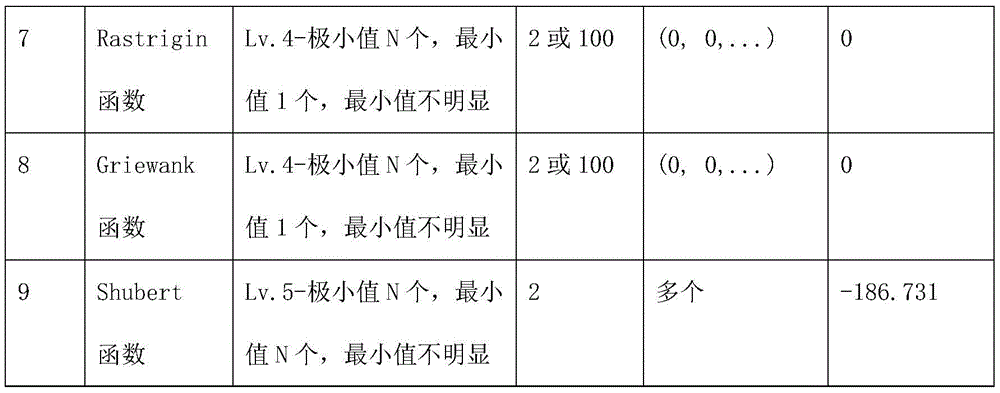
Example data analysis-traveler problem
Traveler Problem, also known as travel Salesman Problem (TSP for short). It is a problem of the type: given a series of cities and the distance between each pair of cities, the shortest loop that visits each city once and returns to the starting city is solved. Typical TSP datasets, including Att-48, Eil-51, St-70, etc., are characterized by the 9 datasets shown in the first three columns of Table 2, as follows:
TABLE 2 problem data set for traveling salesman and results of each algorithm run

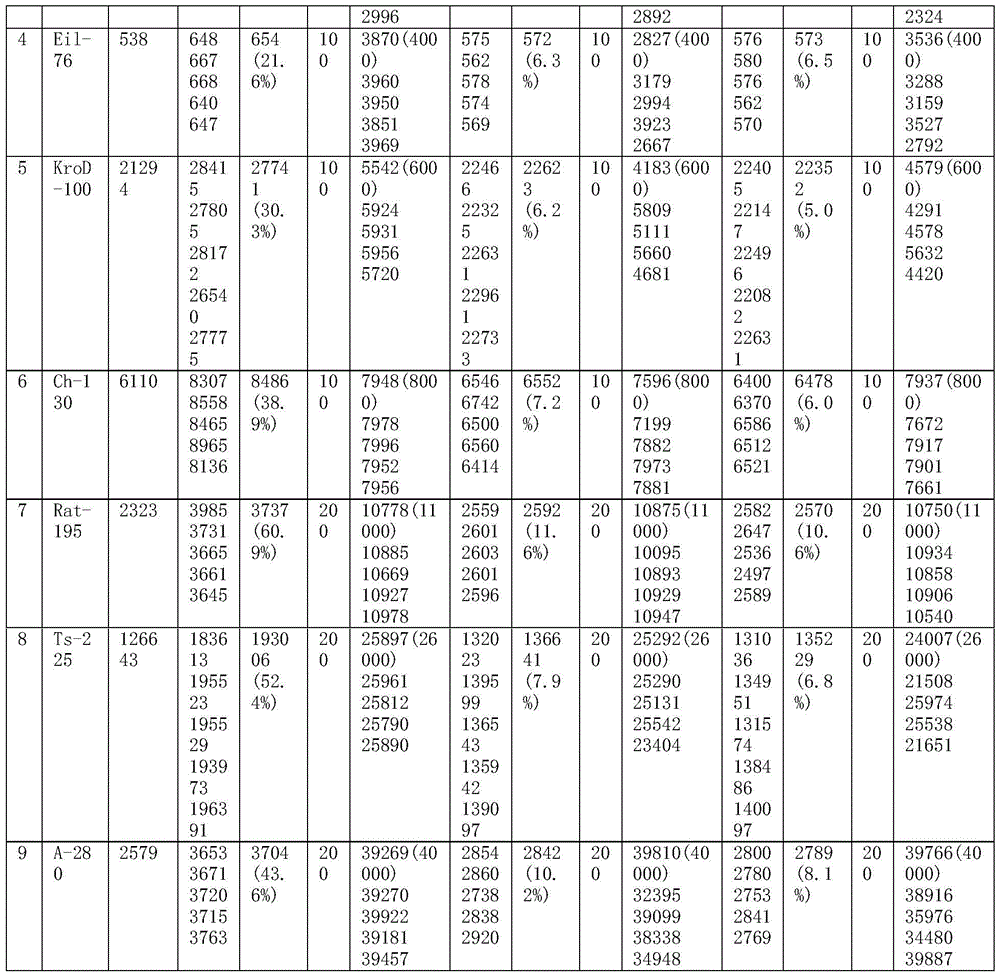
In the table: the Att-48 dataset is a TSP problem between 48 cities with a distance theoretical optimal solution of 33522. The Eil-51 dataset is a TSP problem between 51 cities with a distance theoretical optimal solution of 426. The St-70 dataset is a TSP problem between 70 cities with a distance theory optimal solution of 675. The Eil-76 data set is a TSP problem between 76 cities with a distance theoretical optimal solution of 538. The KroD-100 dataset is a TSP problem between 100 cities with a distance theoretical optimal solution of 21294. The Ch-130 dataset is a TSP problem between 130 cities, with a distance theoretical optimal solution of 6110. The Rat-195 dataset is a TSP problem between 195 cities, with a distance theoretical optimal solution of 2323. The Ts-225 dataset is a TSP problem between 225 cities with a distance theoretical optimal solution of 126643. The a-280 dataset is a TSP problem between 280 cities with a distance theoretical optimal solution of 2579.
Substituting the IGAATLCP octave group into the TSP data set, and finding that the optimization solution of each TSP problem data set is much more complex than the optimization solution of the test function after operation. Columns 4 to 7 in table 2 show the algorithm behavior of the above algorithm 1 (based on the genetic algorithm retained by the best individual of the parent), columns 8 to 11 in table 2 show the algorithm behavior of the above algorithm 2 (based on the genetic algorithm with the child partially replacing the parent), and columns 12 to 15 in table 2 show the algorithm behavior of the above algorithm 3 (based on the improved genetic algorithm with fair competition between the parent and the child, i.e., the present invention proposes a new method).
The above algorithms 1,2,3 are run multiple times on each data set respectively and averaged. For example, algorithm 1 has converged at 1748 iterations the first time on an Att-48 dataset with a population size of 100 and a maximum iteration threshold of 2000, resulting in an approximate solution 35920, which runs 5 times in total, with the average value of the optimal approximate solution being 37489 and the difference from the theoretical optimal solution 33522 being 11.8%. For another example, in the case of using the population size 200 and the maximum iteration threshold 11000 on the Rat-195 data set, the algorithm 3 converges already at 10750 iterations for the first time, and obtains an approximate solution 2582, which runs for 5 times in total, the average value of the optimal approximate solution is 2570, and the difference from the theoretical optimal solution 2323 is 10.6%. The algorithm runs Eil-76 on a single run result visualization of the data set, as shown in FIG. 7.
Summary of the 3 algorithms above a total of 3 x 9 x 5 to 135 runs on 9 data sets, summary findings: most of the data are converged before a preset maximum iteration threshold or when the data are close to the threshold, the algorithm 2 is found to be superior to the algorithm 1 and the algorithm 3 is found to be superior to the algorithm 2 by comparing the average optimal solution with the theoretical optimal solution, the convergence number of the algorithm 3 is found to be generally not greater than that of the algorithm 2 by comparing the convergence number, and the optimal overall optimization effect of the algorithm 3 (namely, the new method provided by the invention) is found.
Example data analysis-affine transformation parameter solving under mass control point oriented condition
The above is the operation of the algorithm on the reference data, and the operation of the algorithm for affine transformation real cases is given here. Here, taking Shenzhen, Guangdong province, China as an example, the above algorithm 3 in IGAATLCP is applied to coordinate transformation (from the Shenzhen independent planar coordinate system to the Western Ann 1980 coordinate system). Among them, shenzhen city is also called a pengcheng city, which is a city in south of China, and its administrative division generally considers that there are 10 regions, and its core region includes 4 regions (from west to east, in order, a southern mountain region, a futian region, a luhu region, and a saltern region), and the rest 6 regions (from west to east, in order, a baoan region, a lucent region, a longhua region, a dragon hillock region, a plateau region, and a new region of Roc) as shown in fig. 8.
Here, the coordinate transformation calculations are given using 202 sets of control point coordinates obtained from Shenzhen municipality surveying and mapping related units. For the independent planar coordinate system of Shenzhen city, the transverse direction is approximately between 85000 and 170000, and the longitudinal direction is approximately between 7800 and 56000, and the coordinate transformation diagram of the Shenzhen city control point is shown in the drawing (i.e. the transformation diagram is transformed from the Shenzhen independent planar coordinate system to the Dian 1980 coordinate system). FIG. 9 shows a visualization of the Shenzhen independent planar coordinate positions of 14 of 202 control points (superimposed on the Shenzhen City remote sensing image base map). Of these 14 control points, the corresponding sitan 1980 coordinates of point (100000,52000) were (49 × 33,252 × 253), and the corresponding sitan 1980 coordinates of point (100000,43000) were (49 × 833,251 × 651). Since the coordinates of the control points are themselves kept secret, partial values in the hidden are uniformly used.
As mentioned in the first part of the background, the core of affine transformation parameter is to solve the three parameters a, c, l and the three parameters b, d, m (see the above equations 3 and 4). The IGAATLCP is substituted into the above 202 control point coordinates, six parameters of a, c, l and b, d and m are obtained through smooth solution (the values of a, c, l and b, d and m are not given at this time because the control point coordinate data are secret), but it is clear that the optimization calculation results of the above affine transformation parameter calculation are all correct, because the multiple calculation results of the optimal approximate solution of a, c, l and b, d and m are consistent, the Root Mean Square Error (RMSE) of each calculation is less than 0.001, the Sum of the Square residuals (SSE, Sum of Squared Error) is less than 0.00001, and the two Error thresholds are almost ignored compared with the coordinate values of the control point.
The technical features mentioned above are combined with each other to form various embodiments which are not listed above, and all of them are regarded as the scope of the present invention described in the specification; also, modifications and variations may be suggested to those skilled in the art in light of the above teachings, and it is intended to cover all such modifications and variations as fall within the true spirit and scope of the invention as defined by the appended claims.
The invention is Funded By The subjects of ' national soil resource Monitoring and Simulation Key Laboratory Open Fund funding of Natural Resources department, Project number KF-2019-04-017(The Project Supported By The Open function of Key Laboratory of inorganic Land Resources Monitoring and Simulation, Ministry of Natural Resources) (Project ID: KF-2019-04-017) ' and ' Zhejiang province Natural Science funding Project, Project number LQ19D010005 (Zhengjiang national Science Foundation of Chinese feeder Grant No. L1D010005) ' and ' Ningbo city Natural funding Project, Project number 2018A610121(Ningbo national Science Foundation No.2018A610121) ' and ' Application of Digital and environmental Information Mapping Project of national Research and Mapping Laboratory Open Fund funding of geographic Information, map Information of geographic Mapping Project, map Project number of geographic Mapping of Application, map Project 801, NASG under Grant No. gcwd201801) ".
Claims (7)
1. An affine transformation solving method under a mass control point based on an improved genetic algorithm is characterized in that an octave group is adopted for expression, as shown in a formula (6):
IGAATLCP={ED,SEL,CR,MT,P,PRO,POP,ITER} (6)
wherein, IGAATLCP is an abbreviation of Improved Genetic Algorithm for affinity Transformation under Lots of Control Points, namely an Improved Genetic Algorithm for Affine Transformation reference under the condition of a large number of Control Points; ED is a coding and decoding mode; SEL is the selection operator; CR is the crossover and recombination operator; MT is a mutation operator; p is the crossover probability and the mutation probability; PRO is the algorithm flow of the genetic algorithm; POP is the population size; ITER is an iteration convergence condition; the method specifically comprises the following steps:
determining an encoding and decoding mode ED of the method, wherein for the numerical calculation problem, the numerical calculation comprises the numerical calculation of a test function and the numerical calculation of parameter solving through affine transformation, and a real number encoding mode is uniformly adopted; for the problem of the traveling salesman, uniformly adopting permutation codes;
step two, determining a selection operator SEL of the method, namely randomly selecting some individuals from parents to survive according to a preselected strategy by referring to a fitness function, eliminating the rest individuals, and adopting a roulette selection method RWS;
determining a crossover operator CR of the method, namely simulating the mating in the natural gene transfer process, carrying out optimized combination on certain genes of the survived parent individuals, and adopting a partial matching crossover operator PMX;
determining a Mutation operator MT of the method, namely changing or mutating genes at certain positions of codes according to certain probability, and adopting a reverse Mutation operator Invert Mutation;
determining the cross probability and the mutation probability P of the method, wherein the fixed cross probability and the mutation probability are adopted, the fixed cross probability is set to be 0.5, and the fixed mutation probability is set to be 0.2;
determining an algorithm flow PRO of a genetic algorithm of the method, and expressing the flow PRO by adopting the following formula (10):
PRO-3={ED(Real-Integer+Permutation),SEL(RWS),CR(PMX),MT(InvertMutation),P(pc=0.5,pm=0.2),Child(Rank(MT+Parent)),ED} (10)
in the above formula (10), PRO-3 represents an improved algorithm flow, ED (Real-Integer + Permutation) represents coding using Real numbers or Permutation first, SEL (RWS) represents roulette selection, CR (PMX) represents partial matching intersection, MT (InvertMutation) represents inverse mutation, P (pm ═ 0.5, pc ═ 0.2) represents that the probability of intersection is set to 0.5 and the probability of mutation is set to 0.2, Child (Rank (MT + Parent)) represents that offspring derived from the above operation gives a fair ranking operation to a set formed by the offspring together with the ancestor itself, Rank is a ranking algorithm, and ED represents final decoding; adopting a certain amount of individuals as a population scale, setting the most initial population scale as parents, after roulette selection is carried out between the individuals of the parents, partial matching intersection is realized according to the intersection probability of 0.5, and reverse mutation is realized according to the mutation probability of 0.2, deriving descendants which are the same as the certain amount, then forming a chromosome set by the certain amount of parents and the certain amount of descendants together, and carrying out next round of circulation by taking the real child as a new parent for the next preferential screening of the chromosome set.
2. The affine transformation solution method of claim 1 wherein said fair ranking operation means that an optimal front portion of ranking results is retained as a child.
3. The affine transformation solving method as recited in claim 2, wherein the optimal front end portion is a proportion of the first 50%.
4. The affine transformation solution method of claim 3 wherein said roulette selection is: the probability of each individual being selected is proportional to its fitness.
5. The affine transformation solving method of claim 4, wherein the partial matching intersection is: randomly selecting 2 gene positions on the chromosome, exchanging gene segments between the two positions according to a certain probability by the two chromosomes, and realizing collision detection and adjustment of the rest gene positions on the chromosome according to the corresponding relation between the two positions.
6. The affine transformation solving method of claim 5, wherein the inverse variation is: 2 gene positions are randomly selected on a chromosome, segments among the 2 positions on the chromosome are reversed according to a certain probability, and the lengths of the segments subjected to the reversal are random because the gene positions are random.
7. The affine transformation solution method of claim 6 wherein said performing a next round-robin iteration with the true child as the new parent until finding a theoretical minimum value near the function value or finding a single line with an actual total length near the theoretical route minimum.
Priority Applications (1)
| Application Number | Priority Date | Filing Date | Title |
|---|---|---|---|
| CN202010858269.9A CN111931934A (en) | 2020-08-24 | 2020-08-24 | Affine transformation solving method under mass control points based on improved genetic algorithm |
Applications Claiming Priority (1)
| Application Number | Priority Date | Filing Date | Title |
|---|---|---|---|
| CN202010858269.9A CN111931934A (en) | 2020-08-24 | 2020-08-24 | Affine transformation solving method under mass control points based on improved genetic algorithm |
Publications (1)
| Publication Number | Publication Date |
|---|---|
| CN111931934A true CN111931934A (en) | 2020-11-13 |
Family
ID=73306016
Family Applications (1)
| Application Number | Title | Priority Date | Filing Date |
|---|---|---|---|
| CN202010858269.9A Pending CN111931934A (en) | 2020-08-24 | 2020-08-24 | Affine transformation solving method under mass control points based on improved genetic algorithm |
Country Status (1)
| Country | Link |
|---|---|
| CN (1) | CN111931934A (en) |
Cited By (6)
| Publication number | Priority date | Publication date | Assignee | Title |
|---|---|---|---|---|
| CN112558119A (en) * | 2020-11-30 | 2021-03-26 | 中航机载系统共性技术有限公司 | Satellite selection method based on self-adaptive BFO-PSO |
| CN112765299A (en) * | 2021-01-26 | 2021-05-07 | 中国科学院西北生态环境资源研究院 | Visualization method and device for irregular raster data, electronic equipment and storage medium |
| CN112884254A (en) * | 2021-04-15 | 2021-06-01 | 广州市交通技师学院(广州市交通高级技工学校) | Optimization method for automobile distribution path planning |
| CN115689247A (en) * | 2022-11-19 | 2023-02-03 | 南昌大学 | An Optimization Method for Vehicle Logistics Scheduling Based on Improved Genetic Algorithm |
| CN116245346A (en) * | 2023-05-12 | 2023-06-09 | 深圳大学 | Multi-unmanned aerial vehicle task allocation method based on multiple swarm genetic algorithms and local search |
| CN120074979A (en) * | 2025-04-25 | 2025-05-30 | 齐鲁工业大学(山东省科学院) | Message scheduling mechanism improvement method based on adaptive genetic algorithm |
Citations (6)
| Publication number | Priority date | Publication date | Assignee | Title |
|---|---|---|---|---|
| CN1900956A (en) * | 2006-07-11 | 2007-01-24 | 南京大学 | Design method for improved mixed genetic algorithm optimizing water quality model parameter |
| JP2008187604A (en) * | 2007-01-31 | 2008-08-14 | P & W Solutions Co Ltd | Method, apparatus, and program for calculating required number of operators |
| CN103761308A (en) * | 2014-01-23 | 2014-04-30 | 杭州电子科技大学 | Materialized view selection method based on self-adaption genetic algorithm |
| CN106407549A (en) * | 2016-09-12 | 2017-02-15 | 哈尔滨工业大学 | Comprehensive optimization method of array antenna directional diagram on the basis of genetic algorithm |
| CN109359740A (en) * | 2018-11-02 | 2019-02-19 | 北京华如科技股份有限公司 | Motor-driven route optimal selection method and storage medium based on more habitat genetic algorithms |
| CN110647994A (en) * | 2019-08-09 | 2020-01-03 | 广东科学技术职业学院 | TSP (Total suspended particulate) optimization method based on improved mutation operator genetic algorithm |
-
2020
- 2020-08-24 CN CN202010858269.9A patent/CN111931934A/en active Pending
Patent Citations (6)
| Publication number | Priority date | Publication date | Assignee | Title |
|---|---|---|---|---|
| CN1900956A (en) * | 2006-07-11 | 2007-01-24 | 南京大学 | Design method for improved mixed genetic algorithm optimizing water quality model parameter |
| JP2008187604A (en) * | 2007-01-31 | 2008-08-14 | P & W Solutions Co Ltd | Method, apparatus, and program for calculating required number of operators |
| CN103761308A (en) * | 2014-01-23 | 2014-04-30 | 杭州电子科技大学 | Materialized view selection method based on self-adaption genetic algorithm |
| CN106407549A (en) * | 2016-09-12 | 2017-02-15 | 哈尔滨工业大学 | Comprehensive optimization method of array antenna directional diagram on the basis of genetic algorithm |
| CN109359740A (en) * | 2018-11-02 | 2019-02-19 | 北京华如科技股份有限公司 | Motor-driven route optimal selection method and storage medium based on more habitat genetic algorithms |
| CN110647994A (en) * | 2019-08-09 | 2020-01-03 | 广东科学技术职业学院 | TSP (Total suspended particulate) optimization method based on improved mutation operator genetic algorithm |
Cited By (11)
| Publication number | Priority date | Publication date | Assignee | Title |
|---|---|---|---|---|
| CN112558119A (en) * | 2020-11-30 | 2021-03-26 | 中航机载系统共性技术有限公司 | Satellite selection method based on self-adaptive BFO-PSO |
| CN112558119B (en) * | 2020-11-30 | 2023-10-10 | 中航机载系统共性技术有限公司 | A satellite selection method based on adaptive BFO-PSO |
| CN112765299A (en) * | 2021-01-26 | 2021-05-07 | 中国科学院西北生态环境资源研究院 | Visualization method and device for irregular raster data, electronic equipment and storage medium |
| CN112884254A (en) * | 2021-04-15 | 2021-06-01 | 广州市交通技师学院(广州市交通高级技工学校) | Optimization method for automobile distribution path planning |
| CN112884254B (en) * | 2021-04-15 | 2022-09-30 | 广州市交通技师学院(广州市交通高级技工学校) | Optimization method for automobile distribution path planning |
| CN115689247A (en) * | 2022-11-19 | 2023-02-03 | 南昌大学 | An Optimization Method for Vehicle Logistics Scheduling Based on Improved Genetic Algorithm |
| CN115689247B (en) * | 2022-11-19 | 2025-08-15 | 南昌大学 | Whole vehicle logistics scheduling optimization method based on improved genetic algorithm |
| CN116245346A (en) * | 2023-05-12 | 2023-06-09 | 深圳大学 | Multi-unmanned aerial vehicle task allocation method based on multiple swarm genetic algorithms and local search |
| CN116245346B (en) * | 2023-05-12 | 2023-07-28 | 深圳大学 | Multi-unmanned aerial vehicle task allocation method based on multiple swarm genetic algorithms and local search |
| CN120074979A (en) * | 2025-04-25 | 2025-05-30 | 齐鲁工业大学(山东省科学院) | Message scheduling mechanism improvement method based on adaptive genetic algorithm |
| CN120074979B (en) * | 2025-04-25 | 2025-08-05 | 齐鲁工业大学(山东省科学院) | Message scheduling mechanism improvement method based on adaptive genetic algorithm |
Similar Documents
| Publication | Publication Date | Title |
|---|---|---|
| CN111931934A (en) | Affine transformation solving method under mass control points based on improved genetic algorithm | |
| Zhang et al. | Parameter-free voronoi neighborhood for evolutionary multimodal optimization | |
| CN115512785A (en) | Three-dimensional protein-ligand activity prediction method based on attention mechanism | |
| Han et al. | Improving educational equity by maximizing service coverage in rural Changyuan, China: An evaluation-optimization-validation framework based on spatial accessibility to schools | |
| CN113297174B (en) | Land use change simulation method based on deep learning | |
| Kong et al. | Embedding ecological sensitivity analysis and new satellite town construction in an agent-based model to simulate urban expansion in the beijing metropolitan region, China | |
| Dai et al. | Agent-based model of land system: Theory, application and modelling framework | |
| CN109743196A (en) | It is a kind of based on the network characterisation method across double-layer network random walk | |
| CN117253037B (en) | Semantic segmentation model structure search method, automatic semantic segmentation method and system | |
| CN108470358A (en) | A kind of point cloud registration method for shaking artificial bee colony algorithm based on second order | |
| CN102646164A (en) | Land use change modeling method and system implemented in combination with spatial filtering | |
| CN111797833A (en) | Automatic machine learning method and system oriented to remote sensing semantic segmentation | |
| CN117119395A (en) | Indoor positioning fingerprint library construction method based on federal generation countermeasure network of CycleGAN | |
| Jalali et al. | Novel uncertainty-aware deep neuroevolution algorithm to quantify tidal forecasting | |
| CN116933146B (en) | Classification system creation method and device for digital twin space entity | |
| CN114841402A (en) | A method and system for predicting groundwater level height based on multi-feature map network | |
| Ma et al. | Complex buildings orientation recognition and description based on vector reconstruction | |
| CN112488413A (en) | AWA-DRCN-based population spatialization method | |
| CN114549689B (en) | River pattern recognition method and device based on graph convolution neural network | |
| Feng et al. | An optimised cellular automata model based on adaptive genetic algorithm for urban growth simulation | |
| Li et al. | Differential evolution with exponential crossover: An experimental analysis on numerical optimization | |
| CN120258311A (en) | A method for constructing the evaluation index system of main functional areas based on GIS | |
| CN119514643A (en) | A method for adversarial generation of hierarchical road network topology based on pseudo-node attention | |
| CN108154221B (en) | An Improved Particle Swarm Optimization Algorithm for "Three-Line" Co-optimization | |
| CN118643578B (en) | Railway line design method in plateau areas based on deep convolutional generative adversarial network |
Legal Events
| Date | Code | Title | Description |
|---|---|---|---|
| PB01 | Publication | ||
| PB01 | Publication | ||
| SE01 | Entry into force of request for substantive examination | ||
| SE01 | Entry into force of request for substantive examination | ||
| WD01 | Invention patent application deemed withdrawn after publication | ||
| WD01 | Invention patent application deemed withdrawn after publication |
Application publication date: 20201113 |