Disclosure of Invention
In view of the above, the invention provides a shale oil reservoir oil-water two-phase relative permeability calculation method, which fully considers the characteristics of dynamic viscosity change, stress sensitivity, starting pressure gradient, real sliding length, multiphase flow of fracturing fluid in pores and the influence of TOC content on fracturing fluid flowback.
In order to achieve the above object, an embodiment of the present invention provides a method for calculating oil-water two-phase relative permeability of a shale oil reservoir, including the following steps:
1) establishing a basic flow equation of the two-phase flow of the nano-pores based on the Newton's internal friction law of Bingham fluid;
2) calculating the effective sliding length by considering the sliding boundary formed by the contact interface of the solid and the fluid in the nanometer pores;
3) considering the viscosity difference of the wet-phase fluid in a bound fluid area and a wet-phase fluid area, and establishing a viscosity correction equation of the wet-phase fluid by adopting a volume weighting method;
4) establishing a fluid flow equation after the starting pressure gradient is considered;
5) based on the generalized Darcy law, introducing a capillary bundle fractal theory, synthesizing a real sliding length, fluid viscosity and a starting pressure gradient correction equation, and establishing a porous medium oil-water two-phase relative permeability model through the TOC content.
Further, the basic flow equation of the wet phase fluid nanopore in the step 1) is as follows:
the basic flow equation for a non-wet phase fluid nanopore is:
the basic flow equation of the nanopores of the two-phase mixing zone fluid is:
wherein the w subscript represents the wet phase fluid, the nw subscript represents the non-wet phase fluid, and the m subscript represents the mixed phase fluid; q represents a flow rate, r1Is the interface radius of the wet phase and the oil-water two-phase region, r2Is the radius of the interface between the non-wet phase and the oil-water two-phase region, r0Is the pore radius of the nanopore, v is the flow velocity, Δ p is the pressure difference between the inlet and the outlet of the nanopore, μ is the dynamic viscosity, L is the length of the nanopore, δ is the thickness of the constrained region, LsIs the slip length;
wherein the interface radius of the wet phase and the oil-water two-phase area and the interface radius of the non-wet phase and the oil-water two-phase area are obtained by the following method:
wherein s is the saturation.
Further, the effective slip length in step 2) is calculated as:
in the formula IseFor effective slip length, /)saTo apparent slip length, μdFor the constrained region fluid viscosity, d is the pore diameter.
Further, step 3) comprises the steps of:
establishing a viscosity correction equation of the wet-phase fluid;
wherein:
in the formula ofweCorrected viscosity for wet phase fluid; a. theidIs the area of the binding region; a. thetdIs the total cross-sectional area of the nanopore.
Further, the fluid flow equation established in step 4) is:
in the formula qstwConsidering the nanopore wet phase flow after starting the pressure gradient; q. q.sstnwTo account for nanopore non-wet phase flow after the pressure gradient is initiated.
Further, step 5) comprises:
(5.1) establishing a flow equation for a single discrete unit of the wet phase fluid, the non-wet phase fluid and the two-phase mixing zone fluid:
wherein i is the number of discrete units, DfIs fractal dimension, DtFractal dimension of tortuosity, λminIs the minimum pore size; lambda [ alpha ]maxIs the maximum pore diameter; mu.s∞Is the wet phase viscosity;
wherein:
(5.2) establishing a total flow equation of the wet-phase fluid, the non-wet-phase fluid and the two-phase mixing zone fluid based on the superposition principle:
the flow rate of each phase fluid in the porous medium can be expressed as:
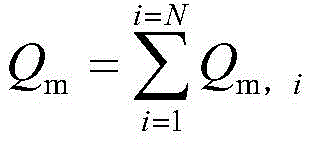
wherein alpha is TOC content; q
TwIs the total flow of the wet phase; q
ToIs the total flow of the oil phase;
is a non-wet phase body in organic poresThe volume flow rate;
the volume flow of the wet phase fluid in the inorganic pores;
is the wet phase fluid volume flow in the organic pores;
a non-wet phase fluid volumetric flow rate in the inorganic pores;
(5.3) establishing an apparent permeability equation of the oil phase and the water phase in the shale porous medium;
in the formula KTwAs the apparent permeability of the aqueous phase, mD; kToAs the apparent permeability of the oil phase, mD;
and (5.4) calculating the relative permeability of the oil phase and the water phase through the apparent permeability.
In summary, the invention has the following advantages: the invention provides a shale oil reservoir oil-water two-phase relative permeability calculation method. The invention comprehensively considers the characteristics of dynamic viscosity change, stress sensitivity, starting pressure gradient, real sliding length, multiphase flow of fracturing fluid in pores and the influence of TOC content on the flow of the pores, effectively solves the technical problems in the prior art and provides theoretical guidance for the development of shale oil reservoirs.
Detailed Description
The invention provides a shale oil reservoir oil-water two-phase relative permeability calculation method, which mainly comprises the following steps:
step 1, establishing a basic flow equation of the two-phase flow of the nano-pores based on a Bingham fluid Newton internal friction law;
step 2, considering a slip boundary formed by a contact interface of a solid and a fluid in the nanometer pore, and calculating an effective slip length;
step 3, taking the viscosity difference of the wet-phase fluid in the bound fluid area and the wet-phase fluid area into consideration, and establishing a viscosity correction equation of the wet-phase fluid by adopting a volume weighting method;
step 4, establishing a fluid flow equation after the starting pressure gradient is considered;
and 5, introducing a capillary bundle fractal theory based on the generalized Darcy law, integrating the real sliding length, the fluid viscosity and the starting pressure gradient correction equation, and establishing a porous medium oil-water two-phase relative permeability model through the TOC content.
Step 1, establishing a single-nanopore two-phase flow equation based on a Bingham fluid Newton internal friction law;
specifically, the fluid viscosity is equal at equal distances from the nanopore center point, and therefore the viscous forces it generates are also equal. As shown in fig. 1, taking the cylindrical layer at a distance r from the center line as an example, the driving force acting on the cylindrical layer is equal to the viscous vertical force, so the force balance equation of the single nanopore fluid is as follows:
-2πrLχ+πr2Δp=0 (1)
wherein χ is shear stress, Pa; delta p is the pressure difference between the inlet and the outlet of the nanopore, Pa; l is the nanopore length, m;
the expression for shear stress can be derived from newton's law of internal friction:
wherein mu is dynamic viscosity, mPa.s; du/dy is a velocity gradient, m/s;
the wet phase fluid, the non-wet phase fluid and the two-phase mixing area fluid can be obtained by substituting the formula (2) into the formula (1) according to the stress balance equation:
wherein:
μm=swμw+snwμnw (6)
wherein the w subscript represents the wet phase fluid, the m subscript represents the mixed phase fluid, and the nw subscript represents the non-wet phase fluid;
introducing a boundary condition:
wherein δ is the thickness of the confinement region, m; lsIs the slip length, m; mu.swIs the wet phase viscosity, mPa.s; mu.smIs the miscible viscosity, mPa.s; mu.snwIs a non-wet phase viscosity, mPa · s; v. ofwIs the wet phase flow velocity, m/s; v. ofmIs the miscible flow velocity, m/s; v. ofnwIs the non-wet phase flow velocity, m/s; swWet phase saturation,%; snwNon-wet phase saturation,%;
integrating the equations (3), (4) and (5) to obtain a wet-phase fluid, wherein the flow equation of the single nanopore of the non-wet-phase fluid and the fluid in the two-phase mixing zone is as follows:
as shown in FIG. 1, the radius r of the interface between the wet phase and the oil-water two-phase region1Radius r of interface between non-wet phase and oil-water two-phase region2Usable pore radius r0And saturation represents:
high order terms are omitted:
step 2, considering a slip boundary formed by a contact interface of a solid and a fluid in a nanometer pore, and establishing a real slip length correction equation;
during nanoscale flow, the wettability of a solid wall surface of a slip boundary formed by a fluid and a solid interface is a main factor influencing the real slip length, so that the real slip length of the fluid can be calculated through given conditions such as wetting contact angles:
ls=C/(cos θ+1)2 (17)
c is a slip constant and is dimensionless; theta is the wetting angle, °;
in the nanopore throat, the viscosity of the fluid in the bound region and the viscosity of the fluid in the wet phase are obviously different, so that obvious slippage can be generated between the fluid in the bound region and the fluid in the wet phase, in the actual calculation process, the real slippage of the fluid and the slippage generated due to the viscosity difference are generally considered to occur at the interface of the bound region and the fluid in the wet phase, and the effective slippage length can be expressed as follows:
in the formula IseEffective slip length, m; lsaApparent slip length, m; mu.swIs the wet phase fluid viscosity, mPa · s; mu.sdFluid viscosity in the constrained region, mPa s;
step 3, considering the viscosity difference of the wet-phase fluid in the bound fluid area and the wet-phase fluid area, and establishing a fluid viscosity correction equation;
the effective viscosity of the wet phase fluid cannot be expressed using the apparent viscosity of the wet phase fluid due to the difference in viscosity of the wet phase fluid in the captive fluid region and the wet phase fluid region. The effective viscosity depends largely on the viscosity of each part of the fluid and its volume occupied, therefore, the effective viscosity of the wet phase fluid is calculated by a volume-weighted method:
wherein:
in the formula ofweIs truly wetPhase fluid viscosity, mPa · s; a. theidArea of bound region, m2;AtdTotal cross-sectional area of single nanopore, m2;dcCritical thickness, m;
the relationship between the fluid viscosity in the confinement region and the wetting angle of the solid wall is:
step 4, considering that the flow characteristics of the fluid in the shale meet the requirement of the Bingham fluid, establishing a starting pressure gradient correction equation;
shale reservoirs are very dense and have a complex pore structure in which the flow of fluids does not conform to darcy's law. A great deal of research shows that the flow characteristics of the fluid in the shale are very similar to those of the Bingham fluid, and the fluid shear stress is composed of two parts, namely internal friction and ultimate shear stress.
In the formula eta0Is ultimate shear stress, Pa;
the re-integration of equation (23) in equation (1) yields the wet phase fluid flow equation that takes into account the starting pressure gradient as:
the total flow of the wet and non-wet phases in a single nanopore can be expressed as:
in the formula qstwIs a nano-poreWet phase flow, m3/s;qstnwIs the nanopore non-wet phase flow, m3/s;
When the pressure is applied, the wet-phase fluid flows firstly, so that the single nanopore starting pressure gradient is the pressure gradient when the flow of the wet-phase fluid is 0, and q is madestwAvailable as 0:
and 5, introducing a capillary bundle fractal theory based on the generalized Darcy law, integrating the real sliding length, the fluid viscosity and the starting pressure gradient correction equation, and establishing a porous medium oil-water two-phase relative permeability model through the TOC content.
The pores of the shale reservoir have fractal characteristics on a certain scale, which means that fractal theory can be used for predicting the transmission characteristics of fluid in the shale porous medium. Therefore, fractal dimension of the pore diameter of the nano-pores can be calculated by applying fractal theory, and the number of pores with the diameter being more than or equal to lambda in the shale reservoir can be expressed as follows:
differentiating two sides of the formula (28):
wherein:
in the formula D
fFractal dimension, dimensionless;
porosity,%; lambda [ alpha ]
minIs the minimum pore diameter, m; lambda [ alpha ]
maxIs the maximum pore diameter, m;
in the porous medium, when the measurement scale is the diameter of the nanometer pore, the real length of the capillary is as follows:
wherein:
along with the reduction of the pore pressure of the shale, the oil shale reservoir can generate stress sensitivity, and the stress sensitivity can be corrected from the angle of pipe diameter:
λ=λ0(pe-p)0.5(q-s) (35)
in the formula DtThe fractal dimension of tortuosity is dimensionless; ltThe real capillary length, m; l0Linear capillary length, m; tau isavIs average tortuosity and dimensionless; lambda [ alpha ]avIs the average pore diameter, m; p is a radical ofeIs the original formation pressure, Pa; q and s are experimental constants and are dimensionless;
cross-sectional area of porous medium:
after introducing the fractal theory, it can be known that the total flow of all nanopores in a unit area is equal to the sum of the fluid flow in each nanopore, wherein the gas viscosity is not constant but is regarded as constant in a small range, so that the change range of the pipe diameter is dispersed into N sections, and the total gas volume flow of the capillary can be expressed as:
wherein:
substituting equations (10), (11), (12) and equations (18), (19), (29) into equation (37) yields the flow equations for a single discrete unit of wet phase fluid, non-wet phase fluid and two-phase mixing zone fluid, respectively:
wherein:
in the formula snwWet phase saturation,%; swWet phase saturation,%;
the equations (39), (40) and (41) are added to obtain the total flow equation of the wet phase fluid, the non-wet phase fluid and the two-phase mixing zone fluid.
In a real shale matrix, organic pores and inorganic pores exist, so that the total flow of each phase fluid needs to be corrected by referring to the TOC. The wet phase in the inorganic pores is a water phase, the non-wet phase is an oil phase, the wet phase in the organic pores is an oil phase, and the non-wet phase is a water phase. The flow rate of each phase fluid in the porous medium can be expressed as:
in the formula, alpha is TOC content and is dimensionless; q
TwIs the total flow rate of the wet phase, m
3/s;Q
ToIs the total flow rate of the oil phase, m
3/s;
Is the non-wet phase volume flow in the organic pores, m
3/s;
Is the volume flow of the wet phase fluid in the inorganic pores, m
3/s;
Is the volume flow of the wet phase fluid in the organic pores, m
3/s;
Volume flow of non-wet phase fluid in inorganic pores, m
3/s;
Generalized darcy's law combined with consideration of the onset pressure gradient:
the apparent permeability of the oil phase and the water phase in the shale porous medium can be obtained:
in the formula KTwAs the apparent permeability of the aqueous phase, mD; kToAs the apparent permeability of the oil phase, mD;
the relative permeability expression of each phase can be obtained from the relative permeability formula, which is common knowledge technology here, and therefore, the description is omitted:
in the formula KrwRelative permeability of water phase without dimension; kroRelative permeability of water phase, without dimension.
In order to facilitate the technicians in this field to fully understand the advantages of the invention, the calculation results of the invention are compared and analyzed through example calculation and models.
Example calculation and analysis
(1) Basic data
TABLE 1 basic data
(2) Analysis of example results
As can be seen from fig. 2, as the thickness δ of the constrained wet phase region increases, the relative permeability of both the oil phase and the water phase decreases, and when the saturation of one of the phases is 1, the relative permeability cannot reach 1 because the thickness of the constrained wet phase region is greater than that of some tiny pores in which the wet phase fluid is saturated and cannot be discharged. As the thickness of the wet-phase fluid in the constrained region increases, the apparent viscosity of the wet-phase fluid increases, the resistance to fluid flow increases, and the relative permeability of the fluid decreases.
As can be seen from FIG. 3, the relative permeability of both the oil phase and the water phase decreases with the increase in the thickness of the oil-water two-phase region, which is the same as the relationship between the thickness of the single-pore oil-water two-phase region and the relative permeability. This is because, under the condition of certain saturation of the wet phase, the increase of the thickness of the oil-water two-phase region reduces the flow area of the wet phase, and the viscosity of the water phase fluid increases and the flow resistance becomes large after the increase of the area of the oil-water two-phase region, so that the relative permeability of the wet phase fluid is reduced. In the inorganic pores, the boundary velocity of the non-wet phase fluid is reduced by increasing the thickness of the oil-water two-phase region, and thus the oil phase permeability is also reduced to some extent.
As can be seen from fig. 4, when the saturation of the aqueous phase is less than 0.4, the ultimate shear stress has a large influence on the oil phase, mainly because the ultimate shear stress acts only on the wet phase fluid, and when the relative permeability of the aqueous phase is small, the oil phase has a large flow rate as the wet phase fluid in the organic pores, and is thus more influenced by the ultimate shear stress. Similarly, when the relative permeability of the aqueous phase is greater than 0.8, the aqueous phase is severely affected by the ultimate shear stress in the inorganic pores as a wet-phase fluid. The ultimate shear stress mainly influences the relative permeability by influencing the fluid starting pressure gradient, the fluid starting pressure gradient is related to the fluid parameters of the fluid and the physical properties of pores, the oil phase fluid has higher viscosity, and the fractal dimension of organic pores is slightly larger than that of inorganic pores, so that the influence of the ultimate shear stress on the oil phase fluid is more obvious compared with water.
As can be seen from fig. 5, when the wetting angle θ 1 of the inorganic pores is increased to 90 ° or more, the relative permeability of the oil phase and the water phase increases significantly, because when the wetting angle is greater than 90 °, the originally hydrophilic inorganic pores undergo wetting reversal, and the inorganic pores change into lipophilic pores, so the binding force to the water phase decreases, the viscosity change of the bound region decreases, the slip length increases significantly, and the boundary speed between the wet phase fluid and the oil-water two-phase region increases significantly.
As can be seen from FIG. 6, the relative permeability of the aqueous phase is dependent on D f1 did not change significantly, while the relative permeability of the oil phase varied with DfThe rise of 1 is markedly increased. This is due to D f1 is increased, the pore permeation condition of inorganic pores is improved, and the water as a wet phase is influenced by viscosity change, starting pressure gradient and other factors, and the relative permeability of the water is influenced by D in the range that the water phase saturation is less than 0.9f1, when the water phase saturation is more than 0.9, the water occupies larger volume in the inorganic pores, the water phase close to the center of the pores is less interfered by the influence factors, and the relative permeability is along with DfThe rise of 1 rises.
As can be seen from FIG. 7, the relative permeability of the oil phase and D t1 is in an obvious negative correlation relationship and is subjected to D when the water phase saturation is lowt1, the water phase permeability is only affected by D in the case of higher water phase saturation t1 has a large influence and is also in a negative correlation relationship. The reason for this is the same as the influence of the fractal dimension of the pore diameter on the relative permeability.
While the present invention has been described in detail with reference to the illustrated embodiments, it should not be construed as limited to the scope of the present patent. Various modifications and changes may be made by those skilled in the art without inventive step within the scope of the appended claims.