CN111914949B - Zero sample learning model training method and device based on reinforcement learning - Google Patents
Zero sample learning model training method and device based on reinforcement learning Download PDFInfo
- Publication number
- CN111914949B CN111914949B CN202010846632.5A CN202010846632A CN111914949B CN 111914949 B CN111914949 B CN 111914949B CN 202010846632 A CN202010846632 A CN 202010846632A CN 111914949 B CN111914949 B CN 111914949B
- Authority
- CN
- China
- Prior art keywords
- model
- reinforcement learning
- picture
- trained
- training
- Prior art date
- Legal status (The legal status is an assumption and is not a legal conclusion. Google has not performed a legal analysis and makes no representation as to the accuracy of the status listed.)
- Active
Links
Images


Classifications
-
- G—PHYSICS
- G06—COMPUTING OR CALCULATING; COUNTING
- G06F—ELECTRIC DIGITAL DATA PROCESSING
- G06F18/00—Pattern recognition
- G06F18/20—Analysing
- G06F18/21—Design or setup of recognition systems or techniques; Extraction of features in feature space; Blind source separation
- G06F18/214—Generating training patterns; Bootstrap methods, e.g. bagging or boosting
-
- G—PHYSICS
- G06—COMPUTING OR CALCULATING; COUNTING
- G06F—ELECTRIC DIGITAL DATA PROCESSING
- G06F16/00—Information retrieval; Database structures therefor; File system structures therefor
- G06F16/50—Information retrieval; Database structures therefor; File system structures therefor of still image data
- G06F16/53—Querying
-
- G—PHYSICS
- G06—COMPUTING OR CALCULATING; COUNTING
- G06F—ELECTRIC DIGITAL DATA PROCESSING
- G06F16/00—Information retrieval; Database structures therefor; File system structures therefor
- G06F16/50—Information retrieval; Database structures therefor; File system structures therefor of still image data
- G06F16/55—Clustering; Classification
-
- G—PHYSICS
- G06—COMPUTING OR CALCULATING; COUNTING
- G06F—ELECTRIC DIGITAL DATA PROCESSING
- G06F18/00—Pattern recognition
- G06F18/20—Analysing
- G06F18/24—Classification techniques
-
- G—PHYSICS
- G06—COMPUTING OR CALCULATING; COUNTING
- G06N—COMPUTING ARRANGEMENTS BASED ON SPECIFIC COMPUTATIONAL MODELS
- G06N3/00—Computing arrangements based on biological models
- G06N3/02—Neural networks
- G06N3/08—Learning methods
-
- G—PHYSICS
- G06—COMPUTING OR CALCULATING; COUNTING
- G06T—IMAGE DATA PROCESSING OR GENERATION, IN GENERAL
- G06T3/00—Geometric image transformations in the plane of the image
- G06T3/40—Scaling of whole images or parts thereof, e.g. expanding or contracting
- G06T3/4084—Scaling of whole images or parts thereof, e.g. expanding or contracting in the transform domain, e.g. fast Fourier transform [FFT] domain scaling
Landscapes
- Engineering & Computer Science (AREA)
- Theoretical Computer Science (AREA)
- Physics & Mathematics (AREA)
- Data Mining & Analysis (AREA)
- General Physics & Mathematics (AREA)
- General Engineering & Computer Science (AREA)
- Life Sciences & Earth Sciences (AREA)
- Artificial Intelligence (AREA)
- Evolutionary Computation (AREA)
- Computer Vision & Pattern Recognition (AREA)
- Evolutionary Biology (AREA)
- Bioinformatics & Computational Biology (AREA)
- Bioinformatics & Cheminformatics (AREA)
- Databases & Information Systems (AREA)
- Computational Linguistics (AREA)
- Biophysics (AREA)
- Biomedical Technology (AREA)
- General Health & Medical Sciences (AREA)
- Molecular Biology (AREA)
- Computing Systems (AREA)
- Mathematical Physics (AREA)
- Software Systems (AREA)
- Health & Medical Sciences (AREA)
- Image Analysis (AREA)
Abstract
The invention discloses a zero sample learning model training method and device based on reinforcement learning and a computer readable storage medium, wherein the method comprises the following steps: obtaining a trained classification model; fixing the parameters of the trained classification model, and inputting training data into the trained classification model; acquiring feature data obtained by feature extraction of training data from the trained classification model, and converting the feature data into a state vector; inputting the state vector into an action prediction model based on reinforcement learning, predicting according to a current reward value to obtain an action prediction result and executing a corresponding action so as to adjust input training data; and optimizing parameters of the reinforcement learning-based action prediction model through a loss function to obtain a trained reinforcement learning-based action prediction model, and then forming a trained reinforcement learning-based zero sample learning model together with the trained classification model. The invention realizes the effect of further improving the performance of the zero sample learning model.
Description
Technical Field
The present application relates to the field of image recognition technologies, and in particular, to a zero sample learning model training method and apparatus based on reinforcement learning, and a computer-readable storage medium.
Background
Zero Sample Learning (ZSL) is an image classification technique where the training and test sets do not intersect over the data classes. The traditional image classification technology belongs to supervised learning, and labels need to be printed on each picture to facilitate model training. However, the variety of real-world organisms is large, a lot of labor cost is consumed for labeling pictures of all species, and some species even need expert knowledge for labeling. This limits the generation of data sets, which in turn makes conventional image classification techniques difficult to generalize on a large scale. The zero sample learning does not need to label all the pictures of the classes, and the information of the labeled classes is transferred to the unlabeled classes through the attributes of the classes, so that the pictures of the unlabeled classes are classified. The bridge connecting the marked and unmarked categories is an attribute feature which can represent the information of the categories such as color, food habits, wing width and the like. When zero sample learning is used for image classification, in order to pay attention to a target region better and improve zero sample learning performance, a target in an image is often required to be searched. The traditional technology usually adopts a method of directly learning the clipping coefficient to search the target, but the effect brought by the method is still poor.
Disclosure of Invention
By providing the zero sample learning model training method and device based on reinforcement learning and the computer readable storage medium, the problem of poor effect of the traditional technology in target search of images is solved, serialization operation of the images is realized, the precision and effect of target search of the images are improved, and the effect of further improving the performance of the zero sample learning model is achieved.
The embodiment of the application provides a zero sample learning model training method based on reinforcement learning, which comprises the following steps:
obtaining a trained classification model;
fixing parameters in the trained classification model, and inputting training data into the trained classification model;
acquiring feature data obtained by feature extraction of the training data from the trained classification model, and converting the feature data into a state vector;
inputting the state vector to an action prediction model based on reinforcement learning, predicting according to a current reward value to obtain an action prediction result and executing a corresponding action so as to adjust input training data;
and optimizing parameters in the action prediction model based on reinforcement learning through a loss function to obtain a trained action prediction model based on reinforcement learning, so that the trained zero sample learning model based on reinforcement learning is formed with the trained classification model.
In an embodiment, the step of obtaining the trained classification model specifically includes:
obtaining an image dataset for a classification model;
zooming the pictures in the image data set to a preset size, and performing random cutting and horizontal turning processing with a set size;
extracting feature data of the processed picture, and mapping the feature data into a classification result corresponding to the picture category;
judging the prediction category of the picture according to the classification result;
and optimizing parameters in the classification model through a loss function to obtain a trained classification model.
In an embodiment, the step of determining the prediction category of the picture according to the classification result specifically includes:
and if the most probable classification result in the classification results meets a preset condition, the picture is considered to belong to a known class, and the picture class corresponding to the most probable classification result is taken as the prediction class of the picture.
In an embodiment, the step of determining the prediction category of the picture according to the classification result further includes:
if the most probable classification result in the classification results does not meet the preset condition, the picture is considered to belong to an unknown category, and the characteristic data is processed by utilizing the attribute characteristics in the image data set;
and mapping the processed feature data into a new classification result corresponding to the picture category, and taking the picture category corresponding to the most possible classification result as the prediction category of the picture.
In an embodiment, the step of converting the feature data into a state vector specifically includes:
and processing the characteristic data to obtain a characteristic vector, and splicing the characteristic vector with the historical motion vector to obtain a state vector.
In an embodiment, the reinforcement learning based motion prediction model is applied to a picture, the motion comprising top left, top right, bottom left, bottom right and center cropping motion and terminating motion.
In an embodiment, the step of inputting the state vector to a motion prediction model based on reinforcement learning, predicting according to a current reward value to obtain a motion prediction result, and executing a corresponding motion to adjust the input training data specifically includes:
inputting the state vector to an action prediction model based on reinforcement learning, and predicting according to a current reward value to obtain an action prediction result;
updating the current reward value by using a preset reward function according to the action prediction result;
if the action prediction result is that the iteration number of the termination action or the cutting action reaches a set value, receiving the action prediction result;
and if the action prediction result is a cutting action and the iteration number does not reach a set value, executing the cutting action on the picture, and continuing to perform action prediction on the cut picture.
In an embodiment, the method further comprises:
reconstructing an image data set aiming at a classification model by utilizing the trained action prediction model based on reinforcement learning to obtain a reconstructed image data set;
retraining the trained reinforcement learning-based zero-sample learning model using the reconstructed image dataset.
The embodiment of the present application further provides an apparatus, where the apparatus includes a processor, a memory, and a zero sample learning model training program stored in the memory and executable on the processor, and when the zero sample learning model training program is executed by the processor, the steps of the training method based on the reinforcement learning zero sample learning model as described above are implemented.
The embodiment of the present application further provides a computer-readable storage medium, where a zero sample learning model training program is stored on the computer-readable storage medium, and when being executed by a processor, the zero sample learning model training program implements the steps of the training method for zero sample learning model based on reinforcement learning as described above.
The technical scheme of the zero sample learning model training method and device based on reinforcement learning and the computer readable storage medium provided in the embodiment of the application at least has the following technical effects:
the trained classification model is obtained; fixing parameters in the trained classification model, and inputting training data into the trained classification model; acquiring feature data obtained by feature extraction of the training data from the trained classification model, and converting the feature data into a state vector; inputting the state vector to an action prediction model based on reinforcement learning, predicting according to a current reward value to obtain an action prediction result and executing a corresponding action so as to adjust input training data; and optimizing parameters in the reinforced learning-based action prediction model through a loss function to obtain a trained reinforced learning-based action prediction model, so that the trained zero sample learning model based on reinforced learning is formed with the trained classification model. Therefore, the problem that the traditional technology is poor in effect when the target search is carried out on the image is effectively solved, the serialization operation on the image is realized, the precision and the effect of the target search on the image are improved, and the effect of further improving the performance of the zero sample learning model is achieved.
Drawings
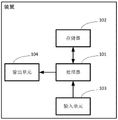
FIG. 1 is a schematic structural diagram of an apparatus according to an embodiment of the present disclosure;
FIG. 2 is a schematic flowchart of a first embodiment of a zero-sample learning model training method based on reinforcement learning according to the present application;
FIG. 3 is a flowchart illustrating a second embodiment of the zero-sample learning model training method based on reinforcement learning according to the present invention;
FIG. 4 is a schematic flowchart of a third embodiment of the zero-sample learning model training method based on reinforcement learning according to the present application;
FIG. 5 is a schematic diagram of a classification model according to an embodiment of the present application;
FIG. 6 is a schematic diagram of a reinforcement learning-based zero-sample learning model according to an embodiment of the present application;
FIG. 7 is a schematic illustration of actions involved in an embodiment of the present application;
fig. 8 is a schematic diagram of a clipping process according to an embodiment of the present application.
Detailed Description
In order to solve the problem of poor effect of the traditional technology in target search of images, a trained classification model is obtained; fixing parameters in the trained classification model, and inputting training data into the trained classification model; acquiring feature data obtained by feature extraction of the training data from the trained classification model, and converting the feature data into a state vector; inputting the state vector to an action prediction model based on reinforcement learning, predicting according to a current reward value to obtain an action prediction result and executing a corresponding action so as to adjust input training data; and optimizing parameters in the action prediction model based on reinforcement learning through a loss function to obtain a trained action prediction model based on reinforcement learning, so that the trained zero sample learning model based on reinforcement learning and the trained classification model form a technical scheme of the trained zero sample learning model based on reinforcement learning. The method and the device realize the serialization operation of the images, improve the precision and effect of target search of the images and further improve the performance of the zero sample learning model.
For a better understanding of the above technical solutions, exemplary embodiments of the present application will be described in more detail below with reference to the accompanying drawings. While exemplary embodiments of the present application are shown in the drawings, it should be understood that the present application may be embodied in various forms and should not be limited to the embodiments set forth herein. Rather, these embodiments are provided so that this disclosure will be thorough and complete, and will fully convey the scope of the disclosure to those skilled in the art.
Referring to fig. 1, it is a schematic diagram of a hardware structure of an apparatus involved in various embodiments of the present application, where the apparatus may include: processor 101, memory 102, input unit 103, output unit 104, and the like. Those skilled in the art will appreciate that the hardware configuration of the apparatus shown in fig. 1 does not constitute a limitation of the apparatus, which may include more or less components than those shown, or some components in combination, or a different arrangement of components.
The various components of the device are described in detail below with reference to fig. 1:
the processor 101 is a control center of the apparatus, connects various parts of the entire apparatus, and performs various functions of the apparatus or processes data by running or executing a program stored in the memory 102 and calling the data stored in the memory 102, thereby monitoring the entire apparatus. Further, the processor 101 includes at least a graphics processor GPU.
The memory 102 may be used to store various programs of the device as well as various data. The memory 102 mainly includes a program storage area and a data storage area, wherein the program storage area at least stores programs required for zero sample learning model training; the storage data area may store various data of the device. Further, the memory 102 may include high speed random access memory, and may also include non-volatile memory, such as at least one magnetic disk storage device, flash memory device, or other volatile solid state storage device.
The input unit 103 may be used to input data required for zero sample learning model training from outside the device.
The output unit 104 may be used to output a prediction result corresponding to the input data when performing zero sample learning model training.
In an embodiment of the present application, the processor 101 may be configured to invoke a zero sample learning model training program stored in the memory 102 and perform the following operations:
obtaining a trained classification model;
fixing parameters in the trained classification model, and inputting training data into the trained classification model;
acquiring feature data obtained by feature extraction of the training data from the trained classification model, and converting the feature data into a state vector;
inputting the state vector to an action prediction model based on reinforcement learning, predicting according to a current reward value to obtain an action prediction result and executing a corresponding action so as to adjust input training data;
and optimizing parameters in the action prediction model based on reinforcement learning through a loss function to obtain a trained action prediction model based on reinforcement learning, so that the trained zero sample learning model based on reinforcement learning is formed with the trained classification model.
In one embodiment, the processor 101 may be configured to invoke a zero sample learning model training program stored in the memory 102 and perform the following operations:
obtaining an image dataset for a classification model;
zooming the pictures in the image data set to a preset size, and performing random cutting and horizontal turning processing with a set size;
extracting feature data of the processed picture, and mapping the feature data into a classification result corresponding to the picture category;
judging the prediction category of the picture according to the classification result;
and optimizing parameters in the classification model through a loss function to obtain a trained classification model.
In one embodiment, the processor 101 may be configured to invoke a zero sample learning model training program stored in the memory 102 and perform the following operations:
and if the most probable classification result in the classification results meets a preset condition, the picture is considered to belong to a known class, and the picture class corresponding to the most probable classification result is taken as the prediction class of the picture.
In one embodiment, the processor 101 may be configured to invoke a zero sample learning model training program stored in the memory 102 and perform the following operations:
if the most probable classification result in the classification results does not meet the preset condition, the picture is considered to belong to an unknown category, and the characteristic data is processed by utilizing the attribute characteristics in the image data set;
and mapping the processed feature data into a new classification result corresponding to the picture category, and taking the picture category corresponding to the most possible classification result as the prediction category of the picture.
In one embodiment, the processor 101 may be configured to invoke a zero sample learning model training program stored in the memory 102 and perform the following operations:
and processing the characteristic data to obtain a characteristic vector, and splicing the characteristic vector with the historical motion vector to obtain a state vector.
In an embodiment, the reinforcement learning based motion prediction model is applied to a picture, the motion comprising top left, top right, bottom left, bottom right and center cropping motion and terminating motion.
In one embodiment, the processor 101 may be configured to invoke a zero sample learning model training program stored in the memory 102 and perform the following operations:
inputting the state vector to an action prediction model based on reinforcement learning, and predicting according to a current reward value to obtain an action prediction result;
updating the current reward value by using a preset reward function according to the action prediction result;
if the action prediction result is that the iteration number of the termination action or the cutting action reaches a set value, receiving the action prediction result;
and if the action prediction result is a cutting action and the iteration number does not reach a set value, executing the cutting action on the picture, and continuing to perform action prediction on the cut picture.
In one embodiment, the processor 101 may be configured to invoke a zero sample learning model training program stored in the memory 102 and perform the following operations:
reconstructing an image data set aiming at a classification model by utilizing the trained action prediction model based on reinforcement learning to obtain a reconstructed image data set;
retraining the trained reinforcement learning-based zero-sample learning model using the reconstructed image dataset.
According to the technical scheme, the trained classification model is obtained; fixing parameters in the trained classification model, and inputting training data into the trained classification model; acquiring feature data obtained by feature extraction of the training data from the trained classification model, and converting the feature data into a state vector; inputting the state vector to an action prediction model based on reinforcement learning, predicting according to a current reward value to obtain an action prediction result and executing a corresponding action so as to adjust input training data; and optimizing parameters in the action prediction model based on reinforcement learning through a loss function to obtain a trained action prediction model based on reinforcement learning, so that the trained zero sample learning model based on reinforcement learning and the trained classification model form a technical scheme of the trained zero sample learning model based on reinforcement learning. Therefore, the problem that the traditional technology is poor in effect when the target search is carried out on the image is effectively solved, the serialization operation on the image is realized, the precision and the effect of the target search on the image are improved, and the effect of further improving the performance of the zero sample learning model is achieved.
In order to better understand the technical solution, the technical solution will be described in detail with reference to the drawings and the specific embodiments.
Referring to fig. 2, in a first embodiment of the present application, a method for training a zero-sample learning model based on reinforcement learning specifically includes the following steps:
step S110, obtaining the trained classification model.
In this embodiment, the classification model is an initial zero-sample learning model, and may be used to classify input data, where the input data may be data of a known data category or data of an unknown data category, that is, the classification model may not only identify an existing data category in training data, but also distinguish data of an unknown data category. In an embodiment, the input data is an image, i.e. the classification model may be a zero-sample learning model for classifying image data. It is to be understood that, according to actual needs, the classification model may also be a zero-sample learning model for classifying other data capable of zero-sample learning. In one embodiment, the obtaining the trained classification model mainly includes the following steps: obtaining a data set for the classification model; processing the data set; extracting characteristic data of the data in the data set; mapping the feature data into a classification result; determining the corresponding data category of the data according to the classification result; and training the classification model by optimizing parameters in the classification model to obtain the trained classification model.
Step S120, fixing parameters in the trained classification model, and inputting training data to the trained classification model.
In this embodiment, to improve the performance of the zero-sample learning model, we choose a method of processing the input data before classifying the input data using the trained classification model. I.e. the corresponding action is performed before the input data is classified. In an embodiment, the method performs cropping on a non-target area of the input picture, and the action is cropping or termination. It will be appreciated that the method may be other methods that enable the input data to be better classified, depending on the actual needs. To implement the method, we add a motion prediction model to the trained classification model to predict the motion of processing the input data. After the motion prediction model is added to the trained classification model, the motion prediction model needs to be trained. In this case, it is necessary to obtain data necessary for training the motion prediction model by fixing parameters in the trained classification model and inputting training data for training the motion prediction model to the trained classification model.
Step S130, feature data obtained after feature extraction of the training data is obtained from the trained classification model, and the feature data is converted into a state vector.
In this embodiment, in order to improve the performance of the zero sample learning model, we also add a technical means of reinforcement learning to the motion prediction model. Wherein reinforcement learning refers to learning from environmental states to action maps, which finds the optimal strategy in a given Markov process through a trial and error mechanism. The reinforcement learning technology is introduced into zero sample learning, and the target area is gradually focused by regarding the search of the target to be classified as a Markov process, so that the performance of a zero sample learning model is improved. The markov process is simply a cyclic process in which an agent takes action to change its state to obtain a reward for interacting with the environment. In this embodiment, feature data obtained by extracting features from training data is used as a current state, and a historical action is added to the feature data to obtain a state vector of the training data.
And step S140, inputting the state vector to a motion prediction model based on reinforcement learning, predicting according to the current reward value to obtain a motion prediction result, and executing a corresponding motion so as to adjust the input training data.
In the present embodiment, the technical means of adding reinforcement learning to the motion prediction model obtains a motion prediction model based on reinforcement learning, and the current state is obtained by converting feature data of training data into a state vector. After the state vector is input to the motion prediction model based on reinforcement learning, motion prediction can be performed by the motion prediction model according to the state vector and the current reward value of each motion, thereby obtaining a motion prediction result. After the action prediction result is obtained, the action corresponding to the action prediction result is executed on the training data to adjust the input training data to obtain the training data of the next state, and the action prediction is continuously performed on the training data of the next state until the preset condition is met. In an embodiment, the preset condition may be that the number of times of executing the action reaches a set value. Notably, after the action is performed, the reward value for the action needs to be updated according to the reward function, and updating the reward value needs to precede the prediction of the action for the next state.
And S150, optimizing parameters in the reinforced learning-based action prediction model through a loss function to obtain a trained reinforced learning-based action prediction model, so that the trained reinforced learning-based zero sample learning model is formed with the trained classification model.
In this embodiment, parameters in the reinforcement learning based motion prediction model may be optimized through a loss function, so as to obtain a trained reinforcement learning based motion prediction model. And since the trained classification model is obtained before, a trained zero sample learning model based on reinforcement learning, which is composed of the two models, can be obtained.
The method has the advantages that the trained classification model is obtained; fixing parameters in the trained classification model, and inputting training data into the trained classification model; acquiring feature data obtained by feature extraction of the training data from the trained classification model, and converting the feature data into a state vector; inputting the state vector to an action prediction model based on reinforcement learning, predicting according to a current reward value to obtain an action prediction result and executing a corresponding action so as to adjust input training data; and optimizing parameters in the action prediction model based on reinforcement learning through a loss function to obtain a trained action prediction model based on reinforcement learning, so that the trained zero sample learning model based on reinforcement learning and the trained classification model form a technical scheme of the trained zero sample learning model based on reinforcement learning. Therefore, the problem that the traditional technology is poor in effect when the target search is carried out on the image is effectively solved, the serialization operation on the image is realized, the precision and the effect of the target search on the image are improved, and the effect of further improving the performance of the zero sample learning model is achieved.
Referring to fig. 3, in a second embodiment of the present application, a training method of a zero sample learning model based on reinforcement learning specifically includes the following steps:
step S210, obtaining the trained classification model.
In this embodiment, the classification model is a zero-sample learning model for classifying images, and in an embodiment, the obtaining of the trained classification model mainly includes the following five steps.
Step S211, an image dataset for the classification model is acquired.
The image data set for the classification model comprises two parts of pictures and attribute features, and the pictures can be divided into pictures of known classes and pictures of unknown classes. Wherein, the pictures of known class can be used for training the model, and the mixed data of the pictures of known class and the pictures of unknown class is used for testing the model. The attribute features are typically matrices with dimensions k × m, where k represents the number of categories and m represents the number of attributes. Wherein the attribute may be a flag representing a characteristic of the category. Taking the bird data set CUB as an example, the data set is a fine-grained data set proposed in 2010 by the california institute of technology. The data set comprises 11788 bird pictures and 200 bird subclasses, wherein the number of marked and unmarked classes is 150 and 50 respectively, and the number of training sets, verification sets and test sets is 7057, 1764 and 2967 respectively. And each bird category has an attribute vector of 312 dimensions, so the matrix dimension of its attribute features is 200 x 312.
Step S212, scaling the pictures in the image data set to a preset size, and performing a random cropping and horizontal flipping process with a set size.
After the image dataset for the classification model has been acquired, the pictures in the image dataset need to be processed. In one embodiment, the classification model may be as shown in fig. 5, and the number of pictures input to the classification model at a time may be 128. First, in order to unify the sizes of pictures input to the classification model, the pictures in the image data set need to be scaled to a preset size. In one embodiment, the predetermined size is 480 × 480. After the pictures in the image data set are scaled to a preset size, the scaled pictures are further required to be subjected to random cropping processing with a set size and random horizontal inversion processing, so that the purpose of expanding the picture data is to improve the model accuracy of the trained classification model and enhance the model stability of the trained classification model. Wherein the set size needs to be smaller than the preset size. In one embodiment, the set size is 448 x 448.
Step S213, extracting feature data of the processed picture, and mapping the feature data to a classification result corresponding to the picture category.
After the processed picture is obtained, feature data of the picture can be obtained by extracting feature data of the processed picture by using a feature extraction network, and then the feature data is mapped into a classification result corresponding to the picture category through a mapping network. In an embodiment, the classification model is as shown in fig. 5, a picture first passes through a convolutional neural network to obtain a feature map of the picture, wherein the dimension of the feature map corresponding to each picture is 2048 × 28 × 28; then, the feature map of the picture is convoluted by one layer, and a one-dimensional feature vector with the dimension of 2048 is output, wherein the feature vector is used for representing the features of the picture; the feature vector passes through an output full-connection layer with dimension of 200 and passes through a softmax layer to obtain output with dimension of 200, and then a classification result corresponding to the picture category can be obtained.
And step S214, judging the prediction type of the picture according to the classification result.
After the classification result corresponding to the picture category is obtained, the prediction category of the picture can be judged according to the classification result. In an embodiment, the determining the prediction category of the picture according to the classification result may include the following three steps.
Step a, if the most probable classification result in the classification results meets a preset condition, the picture is considered to belong to a known class, and the picture class corresponding to the most probable classification result is taken as the prediction class of the picture.
And b, if the most possible classification result in the classification results does not meet the preset condition, the picture is considered to belong to an unknown class, and the feature data is processed by utilizing the attribute features in the image data set.
In one embodiment, the most likely classification result is the highest probability classification result; and the preset condition may be that the probability of the most likely classification result is greater than a threshold τ, which is set to 0.8 as in the CUB data set. Wherein the processing the feature data using the attribute features in the image dataset may be: inputting the attribute features with the dimension of 312 × 200 into two fully-connected layers with the input of 312 and the output of 2048, mapping the attribute features into a 2048 × 200 matrix, and performing point multiplication on the matrix and the feature vectors with the dimension of 2048 in the feature data to obtain vectors with the dimension of 200.
And c, mapping the processed characteristic data into a new classification result corresponding to the picture category, and taking the picture category corresponding to the most possible classification result as the prediction category of the picture.
And S215, optimizing parameters in the classification model through a loss function to obtain a trained classification model.
In this embodiment, parameters in the classification model may be optimized through a loss function, so as to obtain a trained classification model. In one embodiment, since the classification model contains a softmax layer, the loss function after containing softmax loss can be as follows:
Lall=Lsem+Lvis

wherein C (·) is the prediction probability, and N is the category number; f (-) is a convolutional neural network, g (-) is a full connection layer, is a picture or a video, and is,
 is attribute information.
Step S220, fixing parameters in the trained classification model, and inputting training data to the trained classification model.
Step S231, obtaining feature data obtained by feature extraction of the training data from the trained classification model.
In this embodiment, the training data is a picture. And obtaining the feature data obtained by feature extraction of the training data from the trained classification model, namely inputting the picture for training into the trained classification model, and obtaining the feature data of the picture by processing and extracting the feature data. In one embodiment, the process is to take one picture at a time and input the picture into the model shown in fig. 6, first zoom the input picture to a preset size, wherein the preset size is 480 × 480, and perform random cropping and horizontal flipping processing with a set size, wherein the set size is 448 × 448; then extracting a characteristic map with the dimension of 2048 multiplied by 28 of the picture through a convolutional neural network.
Step S232, processing the characteristic data to obtain a characteristic vector, and splicing the characteristic vector and the historical motion vector to obtain a state vector.
In this embodiment, after obtaining the feature data of the picture, processing is further performed to obtain a feature vector, and the feature vector is spliced with the historical motion vector to obtain a state vector. In an embodiment, the feature map with the dimension of 2048 × 28 × 28 obtained in step S231 is subjected to pooling to obtain a feature map with the dimension of 2048 × 7 × 7, and then stretched to obtain a feature vector with the dimension of 100352; and splicing the feature vector with the historical four motion vectors to obtain a state vector with dimension 100376. Wherein the motion vector is a 6-dimensional vector and the initial motion vector is a zero vector.
And step S240, inputting the state vector to a motion prediction model based on reinforcement learning, predicting according to the current reward value to obtain a motion prediction result, and executing a corresponding motion so as to adjust the input training data.
In this embodiment, when the state vector is obtained and input to the motion prediction model based on reinforcement learning, a motion prediction result can be obtained by predicting according to the state vector and the current reward value of the motion, and a corresponding motion can be executed after the motion prediction result is obtained, so as to adjust the input picture. In an embodiment, the step S240 may specifically include the following four steps.
And step S241, inputting the state vector to an action prediction model based on reinforcement learning, and predicting according to the current reward value to obtain an action prediction result.
Inputting the state vector into the motion prediction model based on reinforcement learning as shown in fig. 6, a 6-dimensional motion vector can be obtained, i.e. a motion prediction result, and corresponds to one of 6 motions for processing a picture. Wherein the 6 actions include top left, top right, bottom left, bottom right, and center crop and terminate actions as shown in FIG. 7.
In step S242, the current reward value is updated by using a preset reward function according to the action prediction result.
After the prediction result is obtained, the current reward value needs to be updated by using a preset reward function according to the action prediction result. The reward function of the clipping action is:
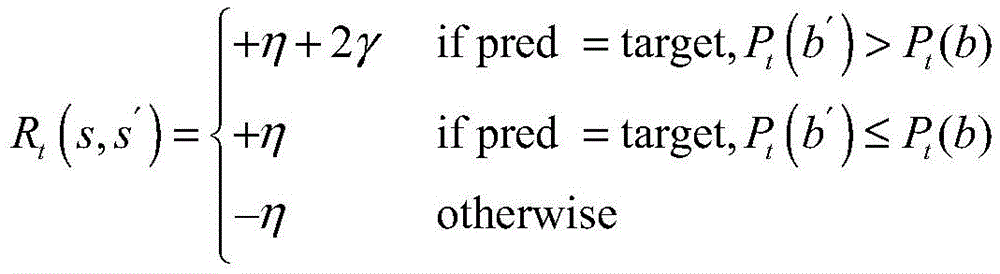
the reward function for terminating an action is:
Ra(s,s′)=γsign(Pt(b′)-Pt(b))
where η is the set base clipping action reward value, which in one embodiment is set to 1; a γ -based termination action award value, set to 3 in one embodiment; pred is the prediction category, target is the label, Pt() Obtaining confidence coefficient of the prediction category from the trained classification model; b represents an image area selected at the current state, and b' represents an image area selected at the next state; s and s' are the current state and the next state, respectively.
In step S243, if the action prediction result is that the number of iterations of the termination action or the cutting action reaches a set value, the action prediction result is received.
In step S244, if the motion prediction result is a cropping motion and the number of iterations does not reach a set value, the cropping motion is performed on the picture, and motion prediction is continuously performed on the cropped picture.
In one embodiment, the set value of the number of iterations is 6. The process in which the picture is cropped may be as shown in fig. 8.
And step S250, optimizing parameters in the reinforcement learning-based action prediction model through a loss function to obtain a trained reinforcement learning-based action prediction model, so that the trained reinforcement learning-based zero sample learning model is formed with the trained classification model.
In this embodiment, the loss function may be:
La=E[(TargetQ-Q(s,a))2]
wherein TargetQ is a value of the selection action, i.e. an output value of the action corresponding to the action prediction model, Q (s, a) is a predicted value of the selection action, wherein the predicted value is calculated by the following formula:
Q(s,a)=R+λmaxaQ(s′,a′)
where R is the accumulated award, λ may be set to 0.9, a is the current action, and a' is the previous action.
The method has the beneficial effect that the steps of training the classification model and the action prediction model based on reinforcement learning are refined. The problem of the traditional technology that the effect is poor when the target search is carried out on the image is solved, the serialization operation on the image is realized, the precision and the effect of the target search on the image are improved, and the effect of further improving the performance of a zero sample learning model is achieved.
Referring to fig. 4, in a third embodiment of the present application, a training method of a zero sample learning model based on reinforcement learning specifically includes the following steps:
step S310, obtaining the trained classification model.
Step S320, fixing parameters in the trained classification model, and inputting training data to the trained classification model.
Step S330, feature data obtained after feature extraction of the training data is obtained from the trained classification model, and the feature data is converted into a state vector.
Step S340, inputting the state vector to a motion prediction model based on reinforcement learning, predicting according to the current reward value to obtain a motion prediction result, and executing a corresponding motion, so as to adjust the input training data.
And step S350, optimizing parameters in the reinforcement learning-based action prediction model through a loss function to obtain a trained reinforcement learning-based action prediction model, so that the trained reinforcement learning-based zero sample learning model is formed with the trained classification model.
And step S360, reconstructing the image data set aiming at the classification model by using the trained motion prediction model based on reinforcement learning to obtain a reconstructed image data set.
In this embodiment, after obtaining the trained reinforcement learning based motion prediction model, the trained reinforcement learning based motion prediction model may be used to reconstruct the image dataset for the classification model, that is, the image dataset for the classification model is input into the trained classification model and the trained reinforcement learning based motion prediction model again, and the motion prediction is performed on the pictures in the image dataset to obtain a new processed image dataset. In one embodiment, the trained reinforcement learning-based motion prediction model is used to crop the pictures in the image data set, resulting in a reconstructed image data set.
Step S370, retraining the trained reinforcement learning-based zero sample learning model using the reconstructed image dataset.
In this embodiment, after obtaining the reconstructed image data set, the reconstructed image data set is input to the trained classification model again, the trained classification model is retrained again, and after the retraining is completed, parameters in the retrained classification model are fixed, the reconstructed image data set is input to the retrained classification model, and the trained motion prediction model based on reinforcement learning is retrained again.
The method has the beneficial effect that the step of training the zero sample learning model based on reinforcement learning again after processing the image data set is added. The zero sample learning model based on reinforcement learning is retrained again by using the processed image data set, so that the problem of poor effect of the traditional technology in target search of the images is solved, the serialization operation of the images is further realized, the precision and the effect of target search of the images are improved, and the effect of further improving the performance of the zero sample learning model is achieved.
Based on the same inventive concept, an embodiment of the present application further provides an apparatus, where the apparatus includes a processor, a memory, and a zero sample learning model training program that is stored in the memory and can be run on the processor, and when the zero sample learning model training program is executed by the processor, the zero sample learning model training program implements each process of the above zero sample learning model training method embodiment based on reinforcement learning, and can achieve the same technical effect, and is not described here again to avoid repetition.
Since the apparatus provided in the embodiments of the present application is an apparatus used for implementing the method in the embodiments of the present application, based on the method described in the embodiments of the present application, a person skilled in the art can understand the specific structure and the variation of the apparatus, and thus details are not described herein again. All devices used in the methods of the embodiments of the present application are within the scope of the present application.
Based on the same inventive concept, an embodiment of the present application further provides a computer-readable storage medium, where a zero sample learning model training program is stored in the computer-readable storage medium, and when executed by a processor, the zero sample learning model training program implements each process of the above zero sample learning model training method embodiment based on reinforcement learning, and can achieve the same technical effect, and is not described herein again to avoid repetition.
Since the computer-readable storage medium provided in the embodiments of the present application is a computer-readable storage medium used for implementing the method in the embodiments of the present application, based on the method described in the embodiments of the present application, those skilled in the art can understand the specific structure and modification of the computer-readable storage medium, and thus details are not described herein. Any computer-readable storage medium that can be used with the methods of the embodiments of the present application is intended to be within the scope of the present application.
As will be appreciated by one skilled in the art, embodiments of the present invention may be provided as a method, system, or computer program product. Accordingly, the present invention may take the form of an entirely hardware embodiment, an entirely software embodiment or an embodiment combining software and hardware aspects. Furthermore, the present invention may take the form of a computer program product embodied on one or more computer-usable storage media (including, but not limited to, disk storage, CD-ROM, optical storage, and the like) having computer-usable program code embodied therein.
The present invention is described with reference to flowchart illustrations and/or block diagrams of methods, apparatus (systems), and computer program products according to embodiments of the invention. It will be understood that each flow and/or block of the flow diagrams and/or block diagrams, and combinations of flows and/or blocks in the flow diagrams and/or block diagrams, can be implemented by computer program instructions. These computer program instructions may be provided to a processor of a general purpose computer, special purpose computer, embedded processor, or other programmable data processing apparatus to produce a machine, such that the instructions, which execute via the processor of the computer or other programmable data processing apparatus, create means for implementing the functions specified in the flowchart flow or flows and/or block diagram block or blocks.
These computer program instructions may also be stored in a computer-readable memory that can direct a computer or other programmable data processing apparatus to function in a particular manner, such that the instructions stored in the computer-readable memory produce an article of manufacture including instruction means which implement the function specified in the flowchart flow or flows and/or block diagram block or blocks.
These computer program instructions may also be loaded onto a computer or other programmable data processing apparatus to cause a series of operational steps to be performed on the computer or other programmable apparatus to produce a computer implemented process such that the instructions which execute on the computer or other programmable apparatus provide steps for implementing the functions specified in the flowchart flow or flows and/or block diagram block or blocks.
It should be noted that in the claims, any reference signs placed between parentheses shall not be construed as limiting the claim. The word "comprising" does not exclude the presence of elements or steps not listed in a claim. The word "a" or "an" preceding an element does not exclude the presence of a plurality of such elements. The invention may be implemented by means of hardware comprising several distinct elements, and by means of a suitably programmed computer. In the unit claims enumerating several means, several of these means may be embodied by one and the same item of hardware. The usage of the words first, second and third, etcetera do not indicate any ordering. These words may be interpreted as names.
While preferred embodiments of the present invention have been described, additional variations and modifications in those embodiments may occur to those skilled in the art once they learn of the basic inventive concepts. Therefore, it is intended that the appended claims be interpreted as including preferred embodiments and all such alterations and modifications as fall within the scope of the invention.
It will be apparent to those skilled in the art that various changes and modifications may be made in the present invention without departing from the spirit and scope of the invention. Thus, if such modifications and variations of the present invention fall within the scope of the claims of the present invention and their equivalents, the present invention is also intended to include such modifications and variations.
Claims (9)
1. A zero sample learning model training method based on reinforcement learning is characterized by comprising the following steps:
obtaining a trained classification model;
fixing parameters in the trained classification model, and inputting training data into the trained classification model;
acquiring feature data obtained by feature extraction of the training data from the trained classification model, and converting the feature data into a state vector;
inputting the state vector to an action prediction model based on reinforcement learning, predicting according to a current reward value to obtain an action prediction result and executing a corresponding action so as to adjust input training data;
optimizing parameters in the reinforcement learning-based action prediction model through a loss function to obtain a trained reinforcement learning-based action prediction model, so that the trained reinforcement learning-based zero sample learning model is formed with the trained classification model;
wherein the reinforcement learning based action prediction model is applied to a picture, and the actions comprise top-left, top-right, bottom-left, bottom-right and central clipping actions and termination actions.
2. The method for training the reinforcement learning-based zero-sample learning model according to claim 1, wherein the step of obtaining the trained classification model specifically comprises:
obtaining an image dataset for a classification model;
zooming the pictures in the image data set to a preset size, and performing random cutting and horizontal turning processing with a set size;
extracting feature data of the processed picture, and mapping the feature data into a classification result corresponding to the picture category;
judging the prediction category of the picture according to the classification result;
and optimizing parameters in the classification model through a loss function to obtain a trained classification model.
3. The method for training the reinforcement learning-based zero sample learning model according to claim 2, wherein the step of determining the prediction type of the picture according to the classification result specifically comprises:
and if the most probable classification result in the classification results meets a preset condition, the picture is considered to belong to a known class, and the picture class corresponding to the most probable classification result is taken as the prediction class of the picture.
4. The method as claimed in claim 2, wherein the step of determining the prediction type of the picture according to the classification result further comprises:
if the most probable classification result in the classification results does not meet the preset condition, the picture is considered to belong to an unknown category, and the characteristic data is processed by utilizing the attribute characteristics in the image data set;
and mapping the processed feature data into a new classification result corresponding to the picture category, and taking the picture category corresponding to the most possible classification result as the prediction category of the picture.
5. The method for training the reinforcement learning-based zero-sample learning model according to claim 1, wherein the step of converting the feature data into the state vector specifically comprises:
and processing the characteristic data to obtain a characteristic vector, and splicing the characteristic vector with the historical motion vector to obtain a state vector.
6. The method for training the reinforcement learning-based zero sample learning model according to claim 1, wherein the step of inputting the state vector to the reinforcement learning-based motion prediction model, predicting according to the current reward value to obtain a motion prediction result, and executing a corresponding motion to adjust the input training data specifically comprises:
inputting the state vector to an action prediction model based on reinforcement learning, and predicting according to a current reward value to obtain an action prediction result;
updating the current reward value by using a preset reward function according to the action prediction result;
if the action prediction result is that the iteration number of the termination action or the cutting action reaches a set value, receiving the action prediction result;
and if the action prediction result is a cutting action and the iteration number does not reach a set value, executing the cutting action on the picture, and continuing to perform action prediction on the cut picture.
7. The method for training a reinforcement learning-based zero-sample learning model according to claim 1, wherein the method further comprises:
reconstructing an image data set aiming at a classification model by utilizing the trained action prediction model based on reinforcement learning to obtain a reconstructed image data set;
retraining the trained reinforcement learning-based zero-sample learning model using the reconstructed image dataset.
8. An apparatus for training a zero-sample learning model based on reinforcement learning, the apparatus comprising a processor, a memory and a zero-sample learning model training program stored in the memory and executable on the processor, wherein the zero-sample learning model training program, when executed by the processor, implements the steps of the method for training a zero-sample learning model based on reinforcement learning according to any one of claims 1 to 7.
9. A computer-readable storage medium, wherein the computer-readable storage medium has stored thereon a zero sample learning model training program, which when executed by a processor implements the steps of the training method for zero sample learning model based reinforcement learning according to any one of claims 1 to 7.
Priority Applications (1)
| Application Number | Priority Date | Filing Date | Title |
|---|---|---|---|
| CN202010846632.5A CN111914949B (en) | 2020-08-20 | 2020-08-20 | Zero sample learning model training method and device based on reinforcement learning |
Applications Claiming Priority (1)
| Application Number | Priority Date | Filing Date | Title |
|---|---|---|---|
| CN202010846632.5A CN111914949B (en) | 2020-08-20 | 2020-08-20 | Zero sample learning model training method and device based on reinforcement learning |
Publications (2)
| Publication Number | Publication Date |
|---|---|
| CN111914949A CN111914949A (en) | 2020-11-10 |
| CN111914949B true CN111914949B (en) | 2021-06-11 |
Family
ID=73278549
Family Applications (1)
| Application Number | Title | Priority Date | Filing Date |
|---|---|---|---|
| CN202010846632.5A Active CN111914949B (en) | 2020-08-20 | 2020-08-20 | Zero sample learning model training method and device based on reinforcement learning |
Country Status (1)
| Country | Link |
|---|---|
| CN (1) | CN111914949B (en) |
Families Citing this family (5)
| Publication number | Priority date | Publication date | Assignee | Title |
|---|---|---|---|---|
| CN112528447B (en) * | 2020-12-18 | 2024-04-12 | 中国南方电网有限责任公司 | Power grid model classification identification method, system, electronic equipment and storage medium |
| CN112957740B (en) * | 2021-03-26 | 2023-09-29 | 南京大学 | A method for automatically decomposing game environments adapted to hierarchical reinforcement learning |
| CN114169258A (en) * | 2021-11-08 | 2022-03-11 | 四川大学 | Flow measuring method, device, equipment and storage medium for open channel |
| CN114937160B (en) * | 2022-03-07 | 2025-06-20 | 上海交通大学 | High-resolution image target detection acceleration method and system based on image block screening |
| CN115640897A (en) * | 2022-10-27 | 2023-01-24 | 国网江苏省电力有限公司 | Line loss prediction method and system based on deep belief network |
Citations (3)
| Publication number | Priority date | Publication date | Assignee | Title |
|---|---|---|---|---|
| CN108764006A (en) * | 2018-02-05 | 2018-11-06 | 北京航空航天大学 | A kind of SAR image object detection method based on deeply study |
| CN111242199A (en) * | 2020-01-07 | 2020-06-05 | 中国科学院苏州纳米技术与纳米仿生研究所 | Image classification model training method and classification method |
| CN111476302A (en) * | 2020-04-08 | 2020-07-31 | 北京工商大学 | Faster-RCNN target object detection method based on deep reinforcement learning |
Family Cites Families (1)
| Publication number | Priority date | Publication date | Assignee | Title |
|---|---|---|---|---|
| US10706324B2 (en) * | 2017-01-19 | 2020-07-07 | Hrl Laboratories, Llc | Multi-view embedding with soft-max based compatibility function for zero-shot learning |
-
2020
- 2020-08-20 CN CN202010846632.5A patent/CN111914949B/en active Active
Patent Citations (3)
| Publication number | Priority date | Publication date | Assignee | Title |
|---|---|---|---|---|
| CN108764006A (en) * | 2018-02-05 | 2018-11-06 | 北京航空航天大学 | A kind of SAR image object detection method based on deeply study |
| CN111242199A (en) * | 2020-01-07 | 2020-06-05 | 中国科学院苏州纳米技术与纳米仿生研究所 | Image classification model training method and classification method |
| CN111476302A (en) * | 2020-04-08 | 2020-07-31 | 北京工商大学 | Faster-RCNN target object detection method based on deep reinforcement learning |
Non-Patent Citations (4)
| Title |
|---|
| Hierarchical Object Detection with Deep Reinforcement Learning;Miriam Bellver 等;《Deep Reinforcement Learning Workshop》;20161125;全文 * |
| 融合深度强化学习和关系网络的图像分类研究;庞振全;《信息科技辑》;20191215(第12期);全文 * |
| 零样本图像分类综述:十年进展;冀中 等;《中国科学:信息科学》;20191016;第49卷(第10期);全文 * |
| 零样本目标检测算法研究;邵逸岚;《信息科技辑》;20200815(第8期);全文 * |
Also Published As
| Publication number | Publication date |
|---|---|
| CN111914949A (en) | 2020-11-10 |
Similar Documents
| Publication | Publication Date | Title |
|---|---|---|
| CN111914949B (en) | Zero sample learning model training method and device based on reinforcement learning | |
| CN112232232B (en) | Target detection method | |
| CN111819580B (en) | Neural architecture search for dense image prediction tasks | |
| CN109754015B (en) | Neural network and related methods, media and devices for multi-label recognition of paintings | |
| US20210326638A1 (en) | Video panoptic segmentation | |
| CN111027493A (en) | Pedestrian detection method based on deep learning multi-network soft fusion | |
| CN112966691A (en) | Multi-scale text detection method and device based on semantic segmentation and electronic equipment | |
| CN115205150B (en) | Image deblurring method, device, equipment, medium and computer program product | |
| CN114492581B (en) | A method based on transfer learning and attention mechanism meta-learning applied to small sample image classification | |
| CN112634296A (en) | RGB-D image semantic segmentation method and terminal for guiding edge information distillation through door mechanism | |
| CN112364933B (en) | Image classification method, device, electronic equipment and storage medium | |
| CN114118207A (en) | Incremental learning image identification method based on network expansion and memory recall mechanism | |
| CN112991281B (en) | Visual detection method, system, electronic equipment and medium | |
| CN117152500A (en) | A method for classifying ship targets in SAR images based on multi-task learning | |
| CN118038163A (en) | A model training method, cross-domain target detection method and electronic device | |
| CN112598076A (en) | Motor vehicle attribute identification method and system | |
| US20250272978A1 (en) | Machine learning models for video object segmentation | |
| CN116844032A (en) | A method, device, equipment and medium for target detection and recognition in a marine environment | |
| CN117437423A (en) | Weakly supervised medical image segmentation method and device based on SAM collaborative learning and cross-layer feature aggregation enhancement | |
| CN113807354A (en) | Image semantic segmentation method, device, equipment and storage medium | |
| CN117809230A (en) | A water flow velocity identification method based on image recognition and related products | |
| CN112950553A (en) | Multi-scale lung lobe segmentation method and system, storage medium and electronic equipment | |
| CN115359484A (en) | Image processing method, device, equipment and storage medium | |
| Xue et al. | Fast and unsupervised neural architecture evolution for visual representation learning | |
| CN113436199A (en) | Semi-supervised video target segmentation method and device |
Legal Events
| Date | Code | Title | Description |
|---|---|---|---|
| PB01 | Publication | ||
| PB01 | Publication | ||
| SE01 | Entry into force of request for substantive examination | ||
| SE01 | Entry into force of request for substantive examination | ||
| GR01 | Patent grant | ||
| GR01 | Patent grant |