CN111881291A - A text sentiment classification method and system - Google Patents
A text sentiment classification method and system Download PDFInfo
- Publication number
- CN111881291A CN111881291A CN202010565182.2A CN202010565182A CN111881291A CN 111881291 A CN111881291 A CN 111881291A CN 202010565182 A CN202010565182 A CN 202010565182A CN 111881291 A CN111881291 A CN 111881291A
- Authority
- CN
- China
- Prior art keywords
- feature
- text
- attention
- keyword
- matrix
- Prior art date
- Legal status (The legal status is an assumption and is not a legal conclusion. Google has not performed a legal analysis and makes no representation as to the accuracy of the status listed.)
- Granted
Links
Images


Classifications
-
- G—PHYSICS
- G06—COMPUTING OR CALCULATING; COUNTING
- G06F—ELECTRIC DIGITAL DATA PROCESSING
- G06F16/00—Information retrieval; Database structures therefor; File system structures therefor
- G06F16/30—Information retrieval; Database structures therefor; File system structures therefor of unstructured textual data
- G06F16/35—Clustering; Classification
-
- G—PHYSICS
- G06—COMPUTING OR CALCULATING; COUNTING
- G06F—ELECTRIC DIGITAL DATA PROCESSING
- G06F16/00—Information retrieval; Database structures therefor; File system structures therefor
- G06F16/30—Information retrieval; Database structures therefor; File system structures therefor of unstructured textual data
- G06F16/33—Querying
- G06F16/3331—Query processing
- G06F16/334—Query execution
- G06F16/3344—Query execution using natural language analysis
-
- G—PHYSICS
- G06—COMPUTING OR CALCULATING; COUNTING
- G06F—ELECTRIC DIGITAL DATA PROCESSING
- G06F40/00—Handling natural language data
- G06F40/30—Semantic analysis
-
- G—PHYSICS
- G06—COMPUTING OR CALCULATING; COUNTING
- G06N—COMPUTING ARRANGEMENTS BASED ON SPECIFIC COMPUTATIONAL MODELS
- G06N3/00—Computing arrangements based on biological models
- G06N3/02—Neural networks
- G06N3/04—Architecture, e.g. interconnection topology
- G06N3/045—Combinations of networks
-
- G—PHYSICS
- G06—COMPUTING OR CALCULATING; COUNTING
- G06N—COMPUTING ARRANGEMENTS BASED ON SPECIFIC COMPUTATIONAL MODELS
- G06N3/00—Computing arrangements based on biological models
- G06N3/02—Neural networks
- G06N3/08—Learning methods
Landscapes
- Engineering & Computer Science (AREA)
- Theoretical Computer Science (AREA)
- Physics & Mathematics (AREA)
- General Physics & Mathematics (AREA)
- General Engineering & Computer Science (AREA)
- Artificial Intelligence (AREA)
- Computational Linguistics (AREA)
- Data Mining & Analysis (AREA)
- General Health & Medical Sciences (AREA)
- Health & Medical Sciences (AREA)
- Biomedical Technology (AREA)
- Molecular Biology (AREA)
- Computing Systems (AREA)
- Evolutionary Computation (AREA)
- Biophysics (AREA)
- Mathematical Physics (AREA)
- Software Systems (AREA)
- Life Sciences & Earth Sciences (AREA)
- Databases & Information Systems (AREA)
- Audiology, Speech & Language Pathology (AREA)
- Machine Translation (AREA)
- Information Retrieval, Db Structures And Fs Structures Therefor (AREA)
Abstract
本发明公开了一种文本情感分类方法及系统,包括对文本句以词为单位进行划分,对每个词映射为词向量;提取文本句中的关键词,根据关键词的词向量、关键词在文本句中的位置以及关键词所属的情感词性类型分别构建词向量注意力矩阵、位置注意力矩阵和词性注意力矩阵,并将三者融合构建第一特征;采用BiGRU网络根据关键词的上下文语义信息得到第二特征;采用由第一特征和第二特征作为训练集训练的多注意力卷积神经网络模型对待测文本句的情感类型进行分类。结合多注意力机制的CNN模型获取关键词情感分类第一维度特征,通过BiGRU获取初始句子情感分类第二维度特征,将两个维度特征融合,提升对文本深层次语义的感知能力进而提升文本情感分类准确率。
The invention discloses a text sentiment classification method and system, including dividing text sentences in units of words, mapping each word into a word vector; extracting keywords in the text sentences, The position in the text sentence and the emotional part-of-speech type to which the keyword belongs respectively construct the word vector attention matrix, the position attention matrix and the part of speech attention matrix, and fuse the three to construct the first feature; the BiGRU network is used according to the context of the keyword. Semantic information obtains a second feature; a multi-attention convolutional neural network model trained with the first feature and the second feature as a training set is used to classify the sentiment type of the text sentence to be tested. The CNN model combined with the multi-attention mechanism obtains the first dimension feature of keyword sentiment classification, obtains the second dimension feature of the initial sentence sentiment classification through BiGRU, and fuses the two dimension features to improve the perception ability of the deep semantics of the text and then improve the text sentiment Classification accuracy.
Description
技术领域technical field
本发明涉及自然语言处理和深度学习技术领域,特别是涉及一种文本情感分类方法及系统。The invention relates to the technical field of natural language processing and deep learning, and in particular, to a text emotion classification method and system.
背景技术Background technique
本部分的陈述仅仅是提供了与本发明相关的背景技术信息,不必然构成在先技术。The statements in this section merely provide background information related to the present invention and do not necessarily constitute prior art.
随着社交网络的不断发展,互联网用户的角色也由原本的信息接受者转变为信息创造者,互联网用户习惯通过网络表达观点,在网络平台上发布带有情感态度的内容,形成以短文本为主的表达方式,其中文本信息数据量较大,且文本内容排列分散性,杂乱性较高,人工很难区分整理。因此如何利用自然语言处理相关技术分析社交网络短文本的情感极性,成为当今关注的热点之一。With the continuous development of social networks, the role of Internet users has also changed from original information receivers to information creators. Internet users are accustomed to expressing their opinions through the Internet, publishing content with emotional attitudes on the Internet platform, and forming short texts as The main expression method, in which the amount of text information data is large, and the arrangement of text content is scattered and cluttered, and it is difficult to distinguish and organize manually. Therefore, how to use natural language processing related technologies to analyze the sentiment polarity of short texts in social networks has become one of the hotspots of today's attention.
目前文本情感分类方法有基于机器学习进行特征抽取和分类的研究;深度学习是机器学习的一条重要分支,深度学习是利用多重非线性变换结构对数据进行高阶抽象的算法。随着深度学习在图像与语音识别领域屡创佳绩,越来越多的研究人员开始使用深度学习技术解决文本情感分类的相关问题。Kim提出了英文分类模型,将经过预处理的词向量作为输入,利用卷积神经网络实现句子级别的分类任务;YinW等人用卷积神经网络(convolution neural networks,CNN)解决twitter的极性判断问题;虽然CNN在文本分类领域取得了巨大的突破,但是其更加关注局部特征进而忽略词的上下文含义,从而影响了分类的准确度。At present, text sentiment classification methods include research on feature extraction and classification based on machine learning. Deep learning is an important branch of machine learning. Deep learning is an algorithm that uses multiple nonlinear transformation structures to perform high-level abstraction on data. With the success of deep learning in the field of image and speech recognition, more and more researchers have begun to use deep learning technology to solve the related problems of text sentiment classification. Kim proposed an English classification model, which takes the preprocessed word vectors as input, and uses convolutional neural networks to achieve sentence-level classification tasks; YinW et al. used convolutional neural networks (CNN) to solve the polarity judgment of twitter Problem; although CNN has made great breakthroughs in the field of text classification, it pays more attention to local features and ignores the contextual meaning of words, thus affecting the accuracy of classification.
在改进CNN模型的研究中,Zhao W等人在卷积神经网络基础上提出了capsulenetworks和动态路由,取得了比传统CNN更好的分类效果;Mikolov T等人相继提出将RNN模型并应用到文本分类任务。由于RNN当前节点的输出值由当前的输入和上一个节点的输出两部分共同决定,考虑了文本的语序结构问题,但是RNN容易出现梯度弥散等问题。In the study of improving the CNN model, Zhao W et al. proposed capsulenetworks and dynamic routing based on convolutional neural networks, which achieved better classification results than traditional CNN; Mikolov T et al. successively proposed to apply the RNN model to text. classification task. Since the output value of the current node of RNN is determined by the current input and the output of the previous node, the word order structure of the text is considered, but RNN is prone to problems such as gradient dispersion.
LSTM(Long Short-Term Memory)虽然可以解决RNN中存在的梯度弥散问题,但是LSTM由于其结构的复杂性计算开销很大,存储了大量冗余的中间变量,因此需要大量的训练时间和内存空间,并且其过度依赖历史信息,无法利用有实际价值的未来信息;Although LSTM (Long Short-Term Memory) can solve the gradient dispersion problem in RNN, LSTM has a large computational cost due to its complex structure and stores a large number of redundant intermediate variables, so it requires a lot of training time and memory space. , and it relies too much on historical information and cannot use future information with actual value;
BiGRU是BiLSTM与GRU的一个变体,BiGRU在模型逻辑结构上精简优化BiLSTM三门(forget,input,output)结构为两个门,即(update和reset),因此参数更少,加速了模型收敛的速度;同时,BiGRU结合短文本内容与上下文相关性较高的特点,充分考虑了词在上下文的含义,克服了原始GRU无法考虑词之后的语义信息的问题。BiGRU is a variant of BiLSTM and GRU. BiGRU simplifies and optimizes the three-gate (forget, input, output) structure of BiLSTM in the model logic structure into two gates, namely (update and reset), so there are fewer parameters, which accelerates the model convergence At the same time, BiGRU combines the characteristics of high correlation between short text content and context, fully considers the meaning of words in the context, and overcomes the problem that the original GRU cannot consider the semantic information after the word.
传统的LSTM模型通过引入递归的网络结构能够有效地解决文本数据的远程依赖关系,从文本数据中提取序列语义特征,并且有效避免了RNN梯度爆炸的问题。LSTM的变体BiGRU模型可以有效的提取文本前后语义信息,对句子整体语义的感知能力更强,并且模型相比于LSTM更加精简;虽然通过BiGRU模型能够有效地学习到与情感倾向性密切相关的文本序列语义特征,但是无法更进一步地学习文本的局部语义特征。The traditional LSTM model can effectively solve the long-range dependencies of text data by introducing a recursive network structure, extract sequence semantic features from text data, and effectively avoid the problem of RNN gradient explosion. The BiGRU model, a variant of LSTM, can effectively extract the semantic information before and after the text, and has a stronger perception of the overall semantics of the sentence, and the model is more compact than LSTM; although the BiGRU model can effectively learn the emotional tendencies closely related. Semantic features of text sequences, but cannot further learn local semantic features of texts.
发明内容SUMMARY OF THE INVENTION
为了解决上述问题,本发明提出了一种文本情感分类方法及系统,结合多注意力机制的CNN模型获取关键词情感分类第一维度特征,通过BiGRU获取初始句子情感分类第二维度特征,将两个维度特征融合,提升对文本深层次语义的感知能力进而提升文本情感分类准确率。In order to solve the above problems, the present invention proposes a text sentiment classification method and system, which combines the CNN model of the multi-attention mechanism to obtain the first dimension feature of keyword sentiment classification, obtains the second dimension feature of the initial sentence sentiment classification through BiGRU, and combines the two The feature fusion of each dimension improves the perception ability of the deep semantics of the text and improves the accuracy of text sentiment classification.
为了实现上述目的,本发明采用如下技术方案:In order to achieve the above object, the present invention adopts the following technical solutions:
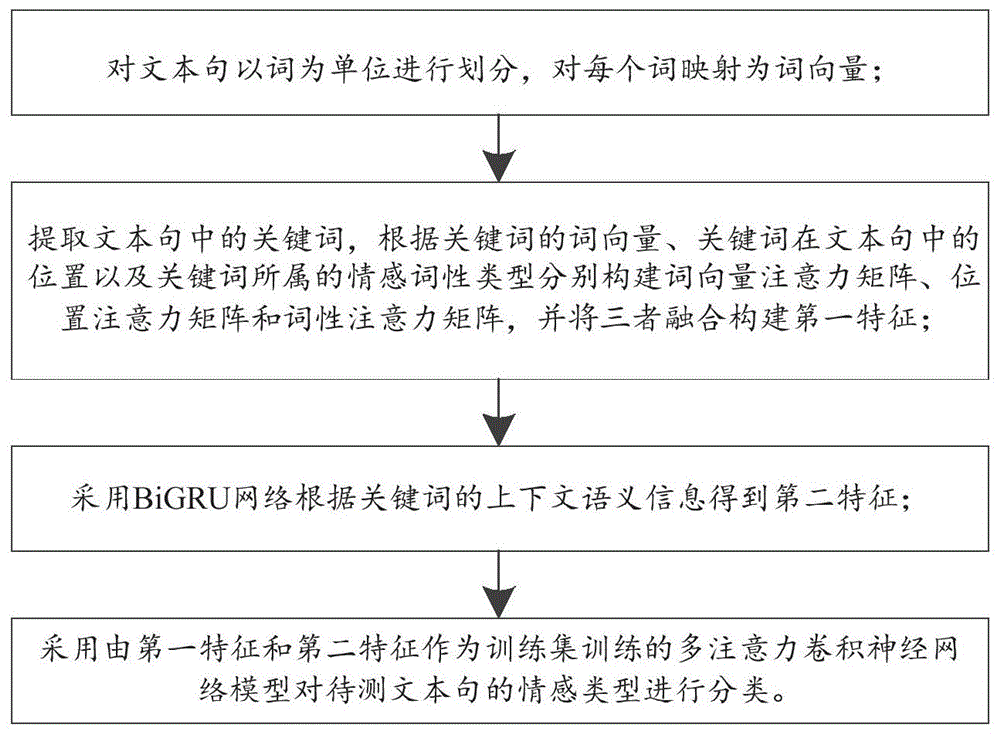
第一方面,本发明提供一种文本情感分类方法,包括:In a first aspect, the present invention provides a text sentiment classification method, including:
对文本句以词为单位进行划分,对每个词映射为词向量;Divide the text sentence in units of words, and map each word to a word vector;
提取文本句中的关键词,根据关键词的词向量、关键词在文本句中的位置以及关键词所属的情感词性类型分别构建词向量注意力矩阵、位置注意力矩阵和词性注意力矩阵,并将三者融合构建第一特征;Extract the keywords in the text sentence, and construct the word vector attention matrix, the position attention matrix and the part of speech attention matrix according to the word vector of the keyword, the position of the keyword in the text sentence and the emotional part of speech type to which the keyword belongs. Integrate the three to construct the first feature;
采用BiGRU网络根据关键词的上下文语义信息得到第二特征;The BiGRU network is used to obtain the second feature according to the contextual semantic information of the keyword;
采用由第一特征和第二特征作为训练集训练的多注意力卷积神经网络模型对待测文本句的情感类型进行分类。A multi-attention convolutional neural network model trained with the first feature and the second feature as a training set is used to classify the sentiment type of the text sentence to be tested.
第二方面,本发明提供一种文本情感分类系统,包括:In a second aspect, the present invention provides a text emotion classification system, including:
分割模块,用于对文本句以词为单位进行划分,对每个词映射为词向量;The segmentation module is used to divide the text sentence in units of words, and map each word into a word vector;
第一特征提取模块,用于提取文本句中的关键词,根据关键词的词向量、关键词在文本句中的位置以及关键词所属的情感词性类型分别构建词向量注意力矩阵、位置注意力矩阵和词性注意力矩阵,并将三者融合构建第一特征;The first feature extraction module is used to extract the keywords in the text sentence. According to the word vector of the keyword, the position of the keyword in the text sentence, and the emotional part-of-speech type to which the keyword belongs, the word vector attention matrix and the position attention matrix are respectively constructed. matrix and part-of-speech attention matrix, and fuse the three to construct the first feature;
第二特征提取模块,用于采用BiGRU网络根据关键词的上下文语义信息得到第二特征;The second feature extraction module is used to obtain the second feature according to the contextual semantic information of the keyword by using the BiGRU network;
分类模块,用于采用由第一特征和第二特征作为训练集训练的多注意力卷积神经网络模型对待测文本句的情感类型进行分类。The classification module is used for classifying the sentiment type of the text sentence to be tested using the multi-attention convolutional neural network model trained by the first feature and the second feature as a training set.
第三方面,本发明提供一种电子设备,包括存储器和处理器以及存储在存储器上并在处理器上运行的计算机指令,所述计算机指令被处理器运行时,完成第一方面所述的方法。In a third aspect, the present invention provides an electronic device, comprising a memory, a processor, and computer instructions stored in the memory and executed on the processor, and when the computer instructions are executed by the processor, the method described in the first aspect is completed .
第四方面,本发明提供一种计算机可读存储介质,用于存储计算机指令,所述计算机指令被处理器执行时,完成第一方面所述的方法。In a fourth aspect, the present invention provides a computer-readable storage medium for storing computer instructions, and when the computer instructions are executed by a processor, the method described in the first aspect is completed.
与现有技术相比,本发明的有益效果为:Compared with the prior art, the beneficial effects of the present invention are:
本发明提出MATT-CNN+BiGRU融合模型,既能利用多注意力CNN对特征提取和目标关键词局部特征提取的优势,又结合BiGRU模型结构简单并且兼顾文本的全局特征从而充分考虑词的上下文语义信息的优势;其中多注意力机制CNN结合了特定目标情感分类方法,提取目标关键词在句子中情感极性,BiGRU分析句子级情感极性,将二者特征进行融合,构造融合全局特征向量,提升融合模型对文本深层次语义的感知能力进而提升文本情感分类准确率。The invention proposes a MATT-CNN+BiGRU fusion model, which can not only utilize the advantages of multi-attention CNN for feature extraction and target keyword local feature extraction, but also combine the simple structure of the BiGRU model and take into account the global features of the text, so as to fully consider the contextual semantics of words The advantage of information; the multi-attention mechanism CNN combines the specific target sentiment classification method to extract the sentiment polarity of the target keyword in the sentence, BiGRU analyzes the sentence-level sentiment polarity, fuses the two features, and constructs a fusion global feature vector. Improve the perception ability of the fusion model to the deep semantics of the text and then improve the accuracy of text sentiment classification.
本发明将三种注意力机制,即词向量注意力机制、词性注意力机制、位置注意力机制构成融合多注意力机制输入融合模型CNN模块,提高注意力机制的功能多样性;考虑目标关键词的影响作用,丰富文本的情感特征表示,使文本的情感倾向性判断更准确。The present invention combines three attention mechanisms, namely word vector attention mechanism, part of speech attention mechanism, and position attention mechanism to form a fusion multi-attention mechanism and input it into the fusion model CNN module, so as to improve the functional diversity of the attention mechanism; It enriches the emotional feature representation of the text and makes the judgment of the emotional tendency of the text more accurate.
附图说明Description of drawings
构成本发明的一部分的说明书附图用来提供对本发明的进一步理解,本发明的示意性实施例及其说明用于解释本发明,并不构成对本发明的不当限定。The accompanying drawings forming a part of the present invention are used to provide further understanding of the present invention, and the exemplary embodiments of the present invention and their descriptions are used to explain the present invention, and do not constitute an improper limitation of the present invention.
图1为本发明实施例1提供的文本情感分类方法流程图;1 is a flowchart of a text emotion classification method provided in
图2为本发明实施例1提供的结合多注意力机制的卷积神经网络模块图;FIG. 2 is a diagram of a convolutional neural network module combined with a multi-attention mechanism provided by
图3为本发明实施例1提供的注意力机制运行图;3 is an operation diagram of the attention mechanism provided by
图4为本发明实施例1提供的位置计算示例图;FIG. 4 is an example diagram of position calculation provided by
图5为本发明实施例1提供的特殊词词性标注示例图;5 is an example diagram of special part-of-speech tagging provided in
图6为本发明实施例1提供的BiGRU与多注意力CNN(MATT-CNN)融合模型结构图;6 is a structural diagram of a BiGRU and multi-attention CNN (MATT-CNN) fusion model provided in
图7为本发明实施例1提供的MATT-CNN+BiGRU与传统的单CNN与BiLSTM的损失函数变化图;Fig. 7 is the loss function change diagram of MATT-CNN+BiGRU and traditional single CNN and BiLSTM provided by Embodiment 1 of the present invention;
图8为本发明实施例1提供的MRD数据集下不同的学习率对MATT-CNN+BiGRU性能影响图;8 is a graph showing the influence of different learning rates on the performance of MATT-CNN+BiGRU under the MRD data set provided in
图9为本发明实施例1提供的在Laptop数据集上不同网络模型完成一次迭代的训练时间对比结果图;Fig. 9 is the training time comparison result diagram that different network models on the Laptop data set complete one iteration provided by
图10为本发明实施例1提供的分类准确率与特征值累计贡献率的关系图;10 is a relationship diagram between the classification accuracy rate and the cumulative contribution rate of feature values provided in
图11为本发明实施例1提供的不同维度词性向量的分类正确率比较图。FIG. 11 is a comparison diagram of classification accuracy of part-of-speech vectors of different dimensions according to
具体实施方式:Detailed ways:
下面结合附图与实施例对本发明做进一步说明。The present invention will be further described below with reference to the accompanying drawings and embodiments.
应该指出,以下详细说明都是例示性的,旨在对本发明提供进一步的说明。除非另有指明,本文使用的所有技术和科学术语具有与本发明所属技术领域的普通技术人员通常理解的相同含义。It should be noted that the following detailed description is exemplary and intended to provide further explanation of the invention. Unless otherwise defined, all technical and scientific terms used herein have the same meaning as commonly understood by one of ordinary skill in the art to which this invention belongs.
需要注意的是,这里所使用的术语仅是为了描述具体实施方式,而非意图限制根据本发明的示例性实施方式。如在这里所使用的,除非上下文另外明确指出,否则单数形式也意图包括复数形式,此外,还应当理解的是,术语“包括”和“具有”以及他们的任何变形,意图在于覆盖不排他的包含,例如,包含了一系列步骤或单元的过程、方法、系统、产品或设备不必限于清楚地列出的那些步骤或单元,而是可包括没有清楚地列出的或对于这些过程、方法、产品或设备固有的其它步骤或单元。It should be noted that the terminology used herein is for the purpose of describing specific embodiments only, and is not intended to limit the exemplary embodiments according to the present invention. As used herein, unless the context clearly dictates otherwise, the singular is intended to include the plural as well, furthermore, it is to be understood that the terms "including" and "having" and any conjugations thereof are intended to cover the non-exclusive A process, method, system, product or device comprising, for example, a series of steps or units is not necessarily limited to those steps or units expressly listed, but may include those steps or units not expressly listed or for such processes, methods, Other steps or units inherent to the product or equipment.
在不冲突的情况下,本发明中的实施例及实施例中的特征可以相互组合。Embodiments of the invention and features of the embodiments may be combined with each other without conflict.
实施例1Example 1
目标关键词在句子级别语义短文本情感分析领域发挥着重要作用,甚至在一定层面上决定了整个句子的情感判断。因此,本实施例考虑目标关键词的影响作用,丰富文本的情感特征表示,使文本的情感倾向性判断更准确;目前在特定目标情感分类领域中,基于注意力机制的卷积神经网络模型被证明在语义细粒度的目标关键词抽取方面取得了良好的效果;基于此,基于上述两个模型的自身特点,本实施例提出MATT-CNN+BiGRU文本情感分类模型,建立了情感分类两个维度:即,结合多注意力机制的CNN(MATT-CNN)模型获取关键词情感分类第一维度,通过BiGRU获取初始句子情感分类第二维度,将两个维度的情感分类结果进行拼接构造融合模型,以此提升融合模型对文本深层次语义的感知能力进而提升文本情感分类准确率。Target keywords play an important role in the field of sentence-level semantic short text sentiment analysis, and even determine the sentiment judgment of the entire sentence to a certain level. Therefore, this embodiment considers the influence of target keywords, enriches the emotional feature representation of the text, and makes the judgment of the emotional tendency of the text more accurate; currently, in the field of specific target sentiment classification, the convolutional neural network model based on the attention mechanism is It is proved that good results have been achieved in semantically fine-grained target keyword extraction; based on this, based on the characteristics of the above two models, this embodiment proposes the MATT-CNN+BiGRU text sentiment classification model, and establishes two dimensions of sentiment classification : That is, the CNN (MATT-CNN) model combined with the multi-attention mechanism obtains the first dimension of keyword sentiment classification, obtains the second dimension of the initial sentence sentiment classification through BiGRU, and splices the sentiment classification results of the two dimensions to construct a fusion model. In this way, the fusion model's ability to perceive the deep-level semantics of the text is improved, and the accuracy of text sentiment classification is improved.
如图1所示,本实施例提供一种文本情感分类方法,包括:As shown in FIG. 1, this embodiment provides a text sentiment classification method, including:
S1:对文本句以词为单位进行划分,对每个词映射为词向量,构建词向量矩阵;S1: Divide the text sentence in units of words, map each word to a word vector, and construct a word vector matrix;
S2:提取文本句中的关键词,以关键词的词向量为初始注意力矩阵,将其与词向量矩阵构建词向量注意力矩阵;S2: Extract the keywords in the text sentence, take the word vector of the keyword as the initial attention matrix, and construct the word vector attention matrix with the word vector matrix;
S3:采用双向扫描算法确定每个词和关键词之间的位置取值,根据由位置取值映射得到的位置向量和词向量矩阵构建位置注意力矩阵;S3: Use the bidirectional scanning algorithm to determine the position value between each word and the keyword, and construct the position attention matrix according to the position vector and word vector matrix obtained by the position value mapping;
S4:根据情感词性类别获取的关键词的情感词性构建词性注意力矩阵;S4: construct a part-of-speech attention matrix according to the emotional part-of-speech of the keywords obtained by the emotional part-of-speech category;
S5:由词向量注意力矩阵、位置注意力矩阵和词性注意力矩阵构建第一特征;S5: Construct the first feature from the word vector attention matrix, the position attention matrix and the part of speech attention matrix;
S6:采用BiGRU网络根据关键词的上下文语义信息得到第二特征;S6: The BiGRU network is used to obtain the second feature according to the contextual semantic information of the keyword;
S7:采用由第一特征和第二特征作为训练集训练的多注意力卷积神经网络模型对待测文本句的情感类别进行分类。S7: Use the multi-attention convolutional neural network model trained by the first feature and the second feature as a training set to classify the sentiment category of the text sentence to be tested.
所述步骤S1中:将文本句通过预处理操作后,以词为单位构造词序列,将每个词映射为多维的连续值词向量,得到词向量矩阵;In the step S1: after the text sentence is subjected to a preprocessing operation, a word sequence is constructed in units of words, and each word is mapped to a multi-dimensional continuous-valued word vector to obtain a word vector matrix;
对于长度为n的句子s={w1,w2,…tvital,…wn},其中tvital为经过关键词抽取算法抽取的关键词,即目标关键词;将句子以词为单位形成词序列,然后将每个词映射为多维的连续值词向量,得到词向量矩阵E∈Rk×|v|,其中k为词向量维度,即把每个词映射为k维向量xi∈Rk,|V|为词典大小,即数据集包含所有词的数量;For a sentence of length n s={w 1 ,w 2 ,...t vital ,...w n }, where t vital is the keyword extracted by the keyword extraction algorithm, that is, the target keyword; the sentence is formed in units of words word sequence, and then map each word into a multi-dimensional continuous-valued word vector to obtain a word vector matrix E∈R k×|v| , where k is the word vector dimension, that is, map each word to a k-dimensional vector x i ∈ R k , |V| is the size of the dictionary, that is, the number of all words contained in the dataset;
对于长度为n的句子表示为矩阵:For a sentence of length n represented as a matrix:

其中,
用类别特征词嵌入拼接而成的矩阵表示类别,采用tf-idf和交叉熵结合的方法对文本关键词和类别的相关度进行评价;给定关于类别的文档集为p=[p1,p2,...pl],在每个类别中选用相关系数排名靠前的关键词作为类别特征词,即:The category is represented by a matrix composed of category feature word embeddings, and the correlation between text keywords and categories is evaluated by the combination of tf-idf and cross entropy; the given document set about categories is p=[p 1 ,p 2 ,...p l ], in each category, the keywords with the highest correlation coefficients are selected as category feature words, namely:

S=[s1,s2,…,sL]S=[s 1 ,s 2 ,...,s L ]
其中,S为类别矩阵,
本实施例采用下述算法1,首先利用NLTK对每篇文本进行分词,分词后利用word2vec生成词向量,即第3行;第4-5行是使用tf-idf方法得到每个类别文章的高频词汇,通过交叉熵将这个类别的高频词与其他类别的高频词进行对比,判断这个类别的高频词在其他类别中是否出现的频率高,第6行得到关于这个类别的k个关键词,最后将其拼接成关键词文本特征向量;This embodiment adopts the following


注意力机制最早应用在图像处理领域,Mnih等人在2014年提出将注意力机制用在图像分类任务中取得了不错的实验效果,2015年Yin等人提出基于多层注意力机制的卷积神经网络,并将该网络应用在句子建模上,使其更好的捕获局部文本特征,验证了注意力机制和卷积神经网络结合的有效性。在本实施例中,如图2所示,采用多注意力卷积神经网络模型MATT-CNN,在特定目标情感分析(Aspect-based Sentiment Analysis,ABSA)中,相比于句子级别的文本情感分类来说是细粒度情感分类任务,作为情感分析的一个重要子任务,是更深层次的情感分析,其目标是识别不同的Aspect上下文中的情感极性(积极、中性、消极)等,而基于注意力机制的卷积神经网络模型被证明在语义细粒度的目标关键词抽取方面取得了良好的效果。The attention mechanism was first applied in the field of image processing. In 2014, Mnih et al. proposed using the attention mechanism in image classification tasks and achieved good experimental results. In 2015, Yin et al. proposed a convolutional neural network based on a multi-layer attention mechanism. The network is applied to sentence modeling to make it better capture local text features, which verifies the effectiveness of the combination of attention mechanism and convolutional neural network. In this embodiment, as shown in FIG. 2 , the multi-attention convolutional neural network model MATT-CNN is adopted, and in the specific target sentiment analysis (Aspect-based Sentiment Analysis, ABSA), compared with the sentence-level text sentiment classification It is a fine-grained sentiment classification task. As an important sub-task of sentiment analysis, it is a deeper sentiment analysis. Its goal is to identify the sentiment polarity (positive, neutral, negative) in different Aspect contexts, and based on The convolutional neural network model of attention mechanism has been shown to achieve good results in semantically fine-grained target keyword extraction.
所述步骤S2中,构造词向量注意力机制,提取目标关键词的词向量作为其注意力矩阵,将注意力矩阵和词向量矩阵进行运算操作;In the step S2, construct a word vector attention mechanism, extract the word vector of the target keyword as its attention matrix, and perform an operation on the attention matrix and the word vector matrix;
为了更好地学习不同目标的特征信息以及识别不同目标的情感极性,本实施例运用了词向量注意力机制和位置距离注意力机制以不同的方式侧重学习不同需要关注的信息。In order to better learn the feature information of different targets and identify the emotional polarity of different targets, this embodiment uses the word vector attention mechanism and the position distance attention mechanism to focus on learning different information that needs attention in different ways.
针对包含t个关键词的句子,将其划分为t个分句,并用特殊符号《》来标记其位置;由于本实施例实验部分采用的数据集为semEval2014数据集,其目标词已完成标记工作,可以减小关键词抽取的工作量;For a sentence containing t keywords, it is divided into t clauses, and the special symbol " " is used to mark its position; since the data set used in the experimental part of this example is the semEval2014 data set, the target word has been marked. , which can reduce the workload of keyword extraction;
词向量注意力机制的目的是让模型在训练的过程中,关注不同的侧重点,了解哪一部分信息是重要的,从而使模型高度关注这些信息,对于特定目标分析,内容层面的信息至关重要的。The purpose of the word vector attention mechanism is to let the model pay attention to different focuses during the training process, and understand which part of the information is important, so that the model pays great attention to this information. For specific target analysis, content-level information is very important. of.
对于句子s={w1,w2,…ti,…,wn},提取出关键词ti的词向量作为注意力矩阵,将注意力矩阵和s的词向量矩阵进行下列公式所示运算操作,可以得到注意力特征矩阵Ac,操作过程如图3所示,其中Ac为对角矩阵:For the sentence s={w 1 ,w 2 ,…t i ,…,w n }, the word vector of the keyword t i is extracted as the attention matrix, and the attention matrix and the word vector matrix of s are expressed as the following formula Operation operation, the attention feature matrix A c can be obtained. The operation process is shown in Figure 3, where A c is a diagonal matrix:

其中,α为可调节参数,类似于神经网络中的学习率η,用来控制不同词向量对目标关键词的影响程度;α在开始时可以人工设定预值,也可以由位置注意力机制计算给出,通过α可以表示出每一个词的重要程度。Among them, α is an adjustable parameter, similar to the learning rate η in the neural network, which is used to control the degree of influence of different word vectors on the target keyword; The calculation gives, the importance of each word can be represented by α.
利用计算得到的注意力特征矩阵Ac和原来的词向量做运算可得到卷积神经网络的输入矩阵:Using the calculated attention feature matrix A c and the original word vector to operate, the input matrix of the convolutional neural network can be obtained:


所述步骤S3中,构造位置注意力矩阵包括:In the step S3, constructing the position attention matrix includes:
在本实施例中,以句子“The《atmosphere》is magnificent,but the《performance》of the actors are awful.”为例,按照以往的理解,距离目标关键词近的情感词往往对其影响更大;例如目标关键词atmosphere,毫无疑问情感词magnificent距离其更近,同时也是对其的正确表达;但是对于目标词performance来说,结果却不尽然,因为其距离描述自身的情感词awful的距离大于magnificent,如图4所示;在特定目标情感分类中,词语和目标关键词之间的位置往往隐藏着关键的信息,因此无法获取其真实情感内容;In this embodiment, taking the sentence "The "atmosphere" is magnificent, but the "performance" of the actors are awful." as an example, according to the past understanding, emotional words that are close to the target keyword tend to have a greater impact on it. ; For example, the target keyword atmosphere, there is no doubt that the emotional word magnificent is closer to it, and it is also the correct expression for it; but for the target word performance, the result is not quite the same, because its distance from the emotional word awesome that describes itself is greater than magnificent, as shown in Figure 4; in the specific target emotion classification, the position between the word and the target keyword often hides key information, so its true emotional content cannot be obtained;
针对此问题,本实施例提出一种双向扫描算法来确定词语和目标之间的位置取值,有效标识不同词语在句子中的程度,使卷积神经网络可以充分利用所提取关键词的位置信息;算法2如下:In response to this problem, this embodiment proposes a bidirectional scanning algorithm to determine the position value between the word and the target, effectively identifying the degree of different words in the sentence, so that the convolutional neural network can make full use of the position information of the extracted keywords ;
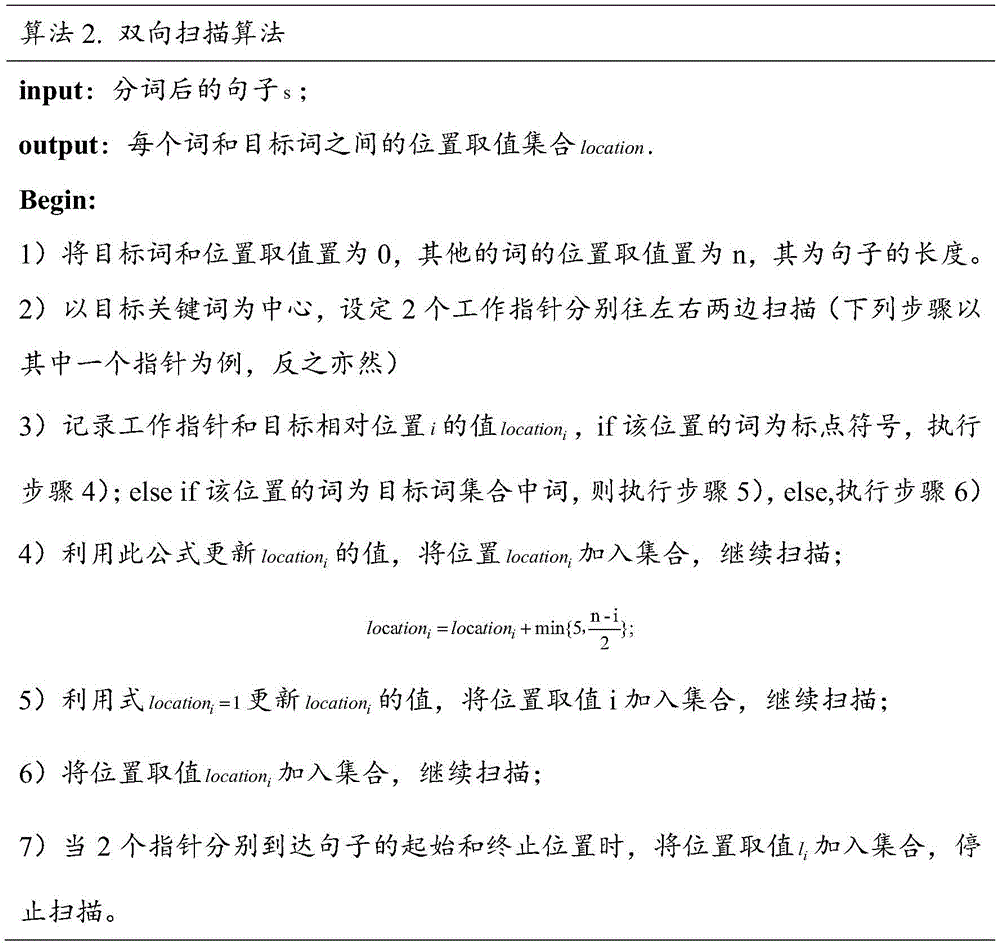
本实施例采用矩阵ψ来存储数据集所有位置的取值,然后计算β的取值:This embodiment uses the matrix ψ to store the values of all positions in the data set, and then calculates the value of β:

将矩阵ψ中储存所有位置取值映射为一个多维向量,即ψi∈Rk,计算的输入矩阵:Map all position values stored in the matrix ψ into a multi-dimensional vector, namely ψ i ∈ R k , and calculate the input matrix:

可以理解的,位置注意力矩阵可以以参数的形式加入到词向量注意力矩阵辅助其运算;也可以以独立的注意力机制输入到网络中,将位置注意力矩阵和其他注意力矩阵结合,充分表示每一个词在句子中的重要程度,Understandably, the position attention matrix can be added to the word vector attention matrix in the form of parameters to assist its operation; it can also be input into the network as an independent attention mechanism, and the position attention matrix can be combined with other attention matrices to fully Indicates the importance of each word in the sentence,
所述步骤S4中,构造词性注意力矩阵,对词向量注意力机制的补充,关联句子中词语词性,对文本内容词性进行分析,从而学习到更多的隐藏信息;In the step S4, a part-of-speech attention matrix is constructed to supplement the word vector attention mechanism, correlate the part-of-speech of the words in the sentence, and analyze the part-of-speech of the text content, thereby learning more hidden information;
在本实施例中,在一些情感词涵盖率低的数据集和分词出现异常等情况下,情感分类工作仅仅依靠文本内容信息对文本情感进行分类的准确率将会大大降低;本实施例所述的词性注意力机制,通过对特殊词的词性重新标注,可以让融合模型加深目标关键词和情感词之间相互关联性。In this embodiment, in the case of some datasets with low emotional word coverage and abnormal word segmentation, the accuracy of the sentiment classification work to classify text sentiments only by relying on text content information will be greatly reduced; The part-of-speech attention mechanism of the Fusion Model allows the fusion model to deepen the correlation between target keywords and sentiment words by re-labeling the part-of-speech of special words.
以例句“The《atmosphere》is magnificent,but the performance of theactors are awful”为例,如图5所示,只分析关键目标词《atmosphere》,其中DA代表定冠词,LV代表系动词,Tar代表目标关键词,CC代表转折介词,Positive代表具有积极情感极性的情感词,Negative代表消极情感词;和词向量一样,将每个情感词映射成多维的连续值向量,称为词性向量,即Targeti∈Rl,其中l为词性向量维度;假设长度为m的句子,将词性向量按照向量矩阵表示:Take the example sentence "The "atmosphere" is magnificent, but the performance of the actors are awful", as shown in Figure 5, only the key target word "atmosphere" is analyzed, where DA stands for definite article, LV stands for copula, and Tar stands for Target keywords, CC stands for transitional preposition, Positive stands for emotional words with positive emotional polarity, and Negative represents negative emotional words; like word vectors, each emotional word is mapped into a multi-dimensional continuous value vector, called part-of-speech vector, that is Target i ∈R l , where l is the dimension of the part-of-speech vector; assuming a sentence of length m, the part-of-speech vector is represented as a vector matrix:

其中,Tar为目标关键词的词性向量。Among them, Tar is the part-of-speech vector of the target keyword.
所提取目标关键词的词性向量作为词性注意力特征矩阵,即At=Tar,计算网络的输入矩阵:The part-of-speech vector of the extracted target keyword is used as the part-of-speech attention feature matrix, that is, At = Tar , and the input matrix of the calculation network is:
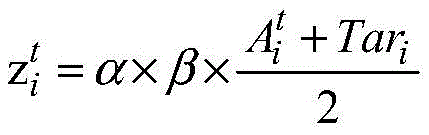
其中,β为权重系数值,通过调整β的取值,可以充分利用句子的情感特征。Among them, β is the weight coefficient value, and by adjusting the value of β, the emotional characteristics of the sentence can be fully utilized.
所述步骤S5中,对词向量注意力矩阵、位置注意力矩阵和词性注意力矩阵进行融合,使用不同的运算操作构成输入文本的融合表示,作为融合模型卷积神经网络部分的输入,本实施例采用三种窗口大小的滑动窗口与多注意力机制结合进行卷积运算;In the step S5, the word vector attention matrix, the position attention matrix and the part of speech attention matrix are fused, and different operation operations are used to form the fusion representation of the input text, which is used as the input of the convolutional neural network part of the fusion model. For example, the sliding window of three window sizes is combined with the multi-attention mechanism for convolution operation;
在具体实施中,CNN网络可以通过卷积核同时对文本中的多个词进行卷积计算,保留词与词之间的关联性;In the specific implementation, the CNN network can perform convolution calculation on multiple words in the text at the same time through the convolution kernel, and retain the correlation between words;
对于长度为h的滑动窗口,对输入矩阵的卷机操作为:For a sliding window of length h, the convolution operation on the input matrix is:
Ci=f(w·xi:i+h-1+b)C i =f(w·x i:i+h-1 +b)
其中,W∈Rh×k为卷积核权重,b∈R为bias值f为激活函数,xi:i+h-1为一个卷积窗口的文本局部特征矩阵;Among them, W∈R h×k is the convolution kernel weight, b∈R is the bias value, f is the activation function, and x i:i+h-1 is the text local feature matrix of a convolution window;
对于长度为n的句子,通过卷积核操作可得到所示的特征图:For a sentence of length n, the feature map shown can be obtained through the convolution kernel operation:
c=[c1,c2…,cn-h+1]c=[c1,c2...,c n-h+1 ]
即c∈Rn-h+1。That is, c∈R n-h+1 .
多注意力CNN模块(MATT-CNN)通过k-max pooling池化层进行下采样操作,从池化层提取得到的不同注意力机制的最重要的信息,并运用Softmax分类器输出考虑关键词影响力的情感分类第一维度结果。The multi-attention CNN module (MATT-CNN) performs downsampling operation through the k-max pooling layer, extracts the most important information of different attention mechanisms from the pooling layer, and uses the Softmax classifier output to consider the influence of keywords 1st dimension results for sentiment classification of power.
本实施例采用k-max池化方法进行下采样:This embodiment uses the k-max pooling method for downsampling:

其中,h代表卷积核即滑动窗口的高度,s代表短文本句子的长度(控制在30个字符之内);相比于最大值池化策略,k-max方法可以根据多滑动窗口卷积层的特性,动态的提取多个重要的语义组合特征,保留特征之间的相对顺序关系。Among them, h represents the height of the convolution kernel, that is, the sliding window, and s represents the length of the short text sentence (controlled within 30 characters); compared with the maximum pooling strategy, the k-max method can be convolution based on multiple sliding windows Layer features, dynamically extract multiple important semantic combination features, and preserve the relative order relationship between features.
所述步骤S6中,运用BiGRU网络根据关键词的上下文语义信息输出句子级情感分类第二维度特征;In the step S6, the BiGRU network is used to output the second dimension feature of sentence-level sentiment classification according to the contextual semantic information of the keyword;
在具体实施中,BiGRU模块第一层为词嵌入层,将嵌入层的句子矩阵作为输入;本实施例设置的词向量维度与MATTT-CNN模块一致,均为100维,其他参数保持不变。In the specific implementation, the first layer of the BiGRU module is the word embedding layer, and the sentence matrix of the embedding layer is used as input; the word vector dimension set in this embodiment is consistent with the MATTT-CNN module, which is 100 dimensions, and other parameters remain unchanged.
采用BiGRU的双向扫描操作,分别从两个方向输入融合模型,经过隐含层保存两个方向的信息,即历史信息和未来信息;最后将两个隐层输出部分拼接,得到最后的BiGRU的输出,Tensorflow框架下的代码如下:Using BiGRU's bidirectional scanning operation, the fusion model is input from two directions respectively, and the information in two directions, namely historical information and future information, is saved through the hidden layer; finally, the output parts of the two hidden layers are spliced to obtain the final output of BiGRU , the code under the Tensorflow framework is as follows:
Output_bgru=rnn.static_bidirectional_rnn(fw,bw,inputs)Output_bgru=rnn.static_bidirectional_rnn(fw,bw,inputs)
所述步骤S7中,将融合模型全局特征表示运用PCA方法降维,通过softmax函数输出融合模型的卷积神经网络模块的文本分类结果,如图6所示。In the step S7, the global feature representation of the fusion model is reduced by using the PCA method, and the text classification result of the convolutional neural network module of the fusion model is output through the softmax function, as shown in FIG. 6 .
在具体实施中,下采样层输出的特征向量作为全连接层的输入,所提模型采样softmax函数输出分类结果:In the specific implementation, the feature vector output by the downsampling layer is used as the input of the fully connected layer, and the proposed model samples the softmax function to output the classification result:
y=softmax(WfXP+Bf)y=softmax(W f X P +B f )
其中,Xp为下采样层输出,

其中,D为训练数据集大小,C为类别数,y为预测类别,
将融合后的特征保存在output中,作为第一个全连接层输入,在两个FC layer中引入了drouput机制,防止过拟合,每次迭代都会放弃部分训练好的参数,使得权重更新不再依赖部分固有特征。在将特征融合向量通过softmax分类器输出结果之前先运用之前介绍的PCA方法进行降维,保留又有用的主要信息,从而提高模型的收敛速度。本实施例模型中的softmax回归中将x分类为的概率为:The fused features are saved in the output as the input of the first fully connected layer, and the drouput mechanism is introduced into the two FC layers to prevent overfitting. Each iteration will discard some of the trained parameters, so that the weight update does not work. Relying on some inherent characteristics. Before the feature fusion vector is output through the softmax classifier, the PCA method introduced earlier is used to reduce the dimension, and the useful main information is retained, thereby improving the convergence speed of the model. The probability of classifying x in the softmax regression in the model of this example is:

为了验证本实施例所提模型的有效性,采用康奈尔大学影评数据创建的MRD(Movie Review Data)和采用SemEval2016两种数据集,各项实验证明了比起目前广泛使用的注意力情感分类模型,本实施例所提MATT-CNN+BiGRU融合模型能够在提高准确率的同时降低模型的训练时间;In order to verify the effectiveness of the model proposed in this example, the MRD (Movie Review Data) created by Cornell University movie review data and the SemEval2016 dataset are used. Various experiments have proved that the attention emotion classification widely used is better than the currently widely used emotion classification. Model, the MATT-CNN+BiGRU fusion model proposed in this embodiment can reduce the training time of the model while improving the accuracy;
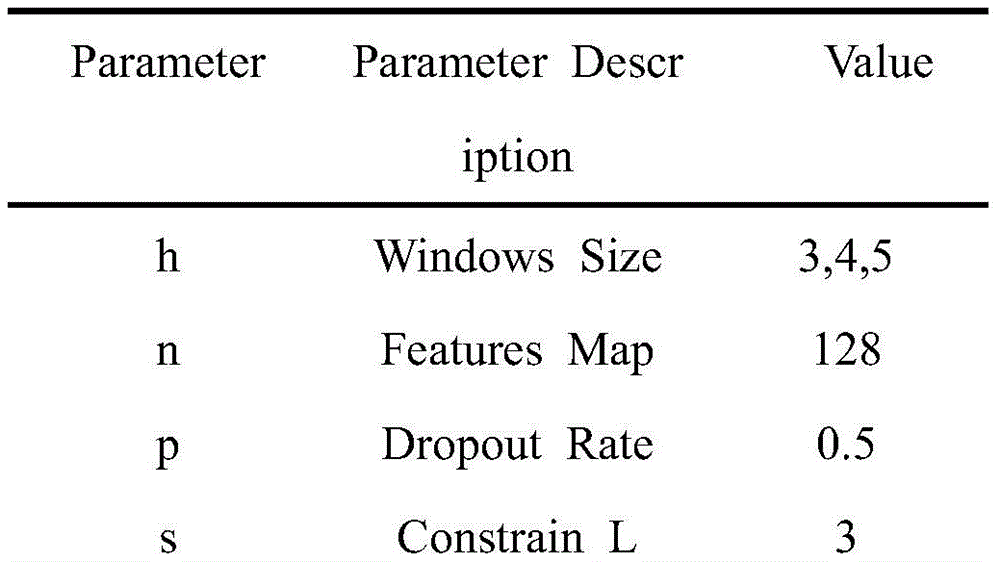
实验中使用多种窗口卷积核对输入矩阵进行卷积操作,卷积核函数为rectifiedlinear units,训练过程中采用Zeiler提出的Adadelta更新规则,其他超参数如表1所示:In the experiment, a variety of window convolution kernels are used to convolve the input matrix. The convolution kernel function is rectified linear units. The Adadelta update rule proposed by Zeiler is used in the training process. Other hyperparameters are shown in Table 1:
表1 Experimental parametersTable 1 Experimental parameters

采用准确率指标(Accuracy)来衡量评价情感分类算法的性能,其计算方法为:The accuracy index (Accuracy) is used to measure and evaluate the performance of the sentiment classification algorithm, and its calculation method is as follows:

其中,TP表示实际为正,预测为正的样本数;FN表示实际为正,预测为负的样本数;TN表示实际为负,预测为负的样本数;FP表示实际为负,预测为正的样本数。Among them, TP represents the number of samples that are actually positive and predicted to be positive; FN represents the number of samples that are actually positive and predicted to be negative; TN represents the number of samples that are actually negative and predicted to be negative; FP represents the number of samples that are actually negative and predicted to be positive the number of samples.
图7表示MATT-CNN+BiGRU模型和传统的单CNN与BiLSTM的损失函数对比变化;图8为在MRD数据集下不同的学习率对MATT-CNN+BiGRU性能的影响。经过对比,传统的CNN模型Loss值比BiLSTM和MATT-CNN+BiGRU损失函数迭代稳定值要低,但MATT-CNN+BiGRU模型相比于BiLSTM下降的速度更快,而且三者最终loss值都下降到了一个很低的数值,收敛效果良好。Figure 7 shows the comparative change of the loss function of the MATT-CNN+BiGRU model and the traditional single CNN and BiLSTM; Figure 8 shows the impact of different learning rates on the performance of MATT-CNN+BiGRU under the MRD dataset. After comparison, the loss value of the traditional CNN model is lower than the iterative stability value of the loss function of BiLSTM and MATT-CNN+BiGRU, but the MATT-CNN+BiGRU model decreases faster than BiLSTM, and the final loss value of the three decreases. To a very low value, the convergence effect is good.
在梯度下降算法中,若学习率设置的初始值过小,则会导致迭代次数增多,或陷入局部最优解形成死循环;若学习率设置过大,则会导致代价函数震荡不稳定,无法接近实际最小值,使算法收敛变慢。In the gradient descent algorithm, if the initial value of the learning rate is set too small, the number of iterations will increase, or it will fall into a local optimal solution to form an infinite loop; if the learning rate is set too large, it will cause the cost function to oscillate unstable and cannot Approaching the actual minimum makes the algorithm slower to converge.
为了验证PCA对于降维后的特征融合向量训练的积极影响,分析了不同网络模型在相同CPU,GPU和框架下完成所有实验,同时词向量构造方法等其他超参数也保持一致。In order to verify the positive effect of PCA on the training of feature fusion vectors after dimensionality reduction, all experiments are analyzed under the same CPU, GPU and framework for different network models, and other hyperparameters such as word vector construction methods are also consistent.
图9给出不同网络模型在Laptop数据集上完成一次迭代的训练时间对比结果,可以看出LSTM网络的训练时间代价是非常高的,这主要是因为LSTM网络训练的是序列性数据,其在Restaurant与Laptop迭代一次的训练时长分别为437s和500s;Figure 9 shows the comparison results of the training time of different network models on the Laptop dataset for one iteration. It can be seen that the training time cost of the LSTM network is very high, mainly because the LSTM network is trained on sequential data, which is in the The training time for one iteration of Restaurant and Laptop is 437s and 500s respectively;
此外,不加任何注意力机制的CNN是最快的,仅需要4s和5s,符合对CNN的惯性理解,本实施例所提出的MATT-CNN+BiGRU模型改变原始冗繁的LSTM模型,在两个数据集上与LSTM相比都有明显的提高;在加入了PCA降维之后,MATT-CNN+BiGRU模型在两个数据集上的训练时间分别降到了48s,53s,因此验证了PCA对本实施例所提MATT-CNN+BiGRU模型训练开销上的积极影响。In addition, CNN without any attention mechanism is the fastest, only 4s and 5s are needed, which is in line with the inertial understanding of CNN. The MATT-CNN+BiGRU model proposed in this embodiment changes the original redundant LSTM model. Compared with LSTM, the data set has obvious improvement; after adding PCA dimensionality reduction, the training time of MATT-CNN+BiGRU model on the two data sets is reduced to 48s and 53s respectively, so it is verified that PCA is effective for this example. Positive impact on the training overhead of the proposed MATT-CNN+BiGRU model.
为了研究主成分特征值值累计贡献率对MATT-CNN+BiGRU模型的分类性能的影响,在MRD数据集下,分析了不同累计贡献率对MATT-CNN+BiGRU模型的分类准确度变化关系,分类准确率与特征值累计贡献率的关系如图10所示;设特征值累计贡献率为α,当α从100%到95%过程中,经过MATT-CNN模块提取到的文本特征经PCA降维处理,文本特征中的冗余被逐渐剔除,分类准确度增加;当α=95%时,文本特征中的冗余信息剔除较充分,分类准确度也最高;当α从95%逐渐减小时,部分用于的文本也被剔除,导致分类准确度下降。由此可得,主成分的维度对分类准确率的影响至关重要。In order to study the influence of the cumulative contribution rate of the principal component eigenvalues on the classification performance of the MATT-CNN+BiGRU model, under the MRD data set, the relationship between the classification accuracy changes of the MATT-CNN+BiGRU model with different cumulative contribution rates was analyzed. The relationship between the accuracy rate and the cumulative contribution rate of eigenvalues is shown in Figure 10; set the cumulative contribution rate of eigenvalues α, when α is from 100% to 95%, the text features extracted by the MATT-CNN module are reduced by PCA. After processing, the redundancy in the text features is gradually eliminated, and the classification accuracy increases; when α=95%, the redundant information in the text features is more fully eliminated, and the classification accuracy is also the highest; when α gradually decreases from 95%, the Part of the used text is also culled, resulting in a drop in classification accuracy. It can be seen that the dimension of the principal components is very important to the classification accuracy.
本实施例加入了词性注意力机制,为了验证词性注意力机制的有效性,在MRD数据集和Restaurant数据集上分别提取2500和2000条数据进行验证试验;其中,词性向量维度为0表示不适用词性注意力机制,结果如图11所示。加入词性注意力机制后,在两个数据集下MATT-CNN+BiGRU模型上的分类效果都有了明显的提升;以峰值进行计算的话,在MRD数据集上MATT-CNN+BiGRU提升了8.9%,在Restaurant数据集上提升了9.9%;证明了加入词性注意力机制可以让模型更加充分地学习文本的情感信息,达到更好的情感分类效果。In this embodiment, the part-of-speech attention mechanism is added. In order to verify the effectiveness of the part-of-speech attention mechanism, 2500 and 2000 pieces of data are extracted from the MRD data set and the Restaurant data set respectively for verification experiments; among them, the dimension of the part of speech vector is 0, indicating that it is not applicable Part of speech attention mechanism, the results are shown in Figure 11. After adding the part-of-speech attention mechanism, the classification effect of MATT-CNN+BiGRU model is significantly improved in both datasets; if the peak value is calculated, MATT-CNN+BiGRU improves by 8.9% on the MRD dataset , an increase of 9.9% on the Restaurant dataset; it is proved that adding part-of-speech attention mechanism can make the model more fully learn the emotional information of the text, and achieve a better emotional classification effect.
当词向量大于100维时,模型在两个数据集都出现了波动;经过分析,其原因为MATT-CNN+BiGRU模型的输入矩阵是注意力机制有联系的输入。词向量注意力作为模型训练的主要特征,当词性向量的维度超过一定阈值时会影响其参数调整,降低了内容层面特征信息的学习效果;此外,随着向量维度的增加模型的训练代价也会相应的增大,因此在上述实验中本实施例使用了经验参数值100作为词性注意力向量的维度。When the word vector is larger than 100 dimensions, the model fluctuates in both datasets; after analysis, the reason is that the input matrix of the MATT-CNN+BiGRU model is the input of the attention mechanism. Word vector attention is the main feature of model training. When the dimension of the part-of-speech vector exceeds a certain threshold, it will affect its parameter adjustment, reducing the learning effect of content-level feature information; in addition, as the vector dimension increases, the training cost of the model will also increase. Therefore, in the above experiment, this embodiment uses the empirical parameter value of 100 as the dimension of the part-of-speech attention vector.
实施例2Example 2
本实施例提供一种文本情感分类系统,包括:This embodiment provides a text sentiment classification system, including:
分割模块,用于对文本句以词为单位进行划分,对每个词映射为词向量;The segmentation module is used to divide the text sentence in units of words, and map each word into a word vector;
第一特征提取模块,用于提取文本句中的关键词,根据关键词的词向量、关键词在文本句中的位置以及关键词所属的情感词性类型分别构建词向量注意力矩阵、位置注意力矩阵和词性注意力矩阵,并将三者融合构建第一特征;The first feature extraction module is used to extract the keywords in the text sentence. According to the word vector of the keyword, the position of the keyword in the text sentence, and the emotional part-of-speech type to which the keyword belongs, the word vector attention matrix and the position attention matrix are respectively constructed. matrix and part-of-speech attention matrix, and fuse the three to construct the first feature;
第二特征提取模块,用于采用BiGRU网络根据关键词的上下文语义信息得到第二特征;The second feature extraction module is used to obtain the second feature according to the contextual semantic information of the keyword by using the BiGRU network;
分类模块,用于采用由第一特征和第二特征作为训练集训练的多注意力卷积神经网络模型对待测文本句的情感类型进行分类。The classification module is used for classifying the sentiment type of the text sentence to be tested using the multi-attention convolutional neural network model trained by the first feature and the second feature as a training set.
其中,第一特征提取模块包括:Wherein, the first feature extraction module includes:
第一矩阵模块,提取文本句中的关键词,以关键词的词向量为初始注意力矩阵,将其与词向量矩阵构建词向量注意力矩阵;The first matrix module extracts the keywords in the text sentence, takes the word vector of the keyword as the initial attention matrix, and constructs the word vector attention matrix with the word vector matrix;
第二矩阵模块,采用双向扫描算法确定每个词和关键词之间的位置取值,根据由位置取值映射得到的位置向量和词向量矩阵构建位置注意力矩阵;The second matrix module adopts the bidirectional scanning algorithm to determine the position value between each word and the keyword, and constructs the position attention matrix according to the position vector and the word vector matrix obtained by the position value mapping;
第三矩阵模块,根据情感词性类别获取的关键词的情感词性构建词性注意力矩阵;The third matrix module constructs a part-of-speech attention matrix according to the emotional part-of-speech of the keywords obtained by the emotional part-of-speech category;
融合模块,由词向量注意力矩阵、位置注意力矩阵和词性注意力矩阵构建第一特征。The fusion module constructs the first feature from the word vector attention matrix, the position attention matrix and the part of speech attention matrix.
此处需要说明的是,上述模块对应于实施例1中的步骤S1至S7,上述模块与对应的步骤所实现的示例和应用场景相同,但不限于上述实施例1所公开的内容。需要说明的是,上述模块作为系统的一部分可以在诸如一组计算机可执行指令的计算机系统中执行。It should be noted here that the foregoing modules correspond to steps S1 to S7 in
在更多实施例中,还提供:In further embodiments, there is also provided:
一种电子设备,包括存储器和处理器以及存储在存储器上并在处理器上运行的计算机指令,所述计算机指令被处理器运行时,完成实施例1中所述的方法。为了简洁,在此不再赘述。An electronic device includes a memory, a processor, and computer instructions stored on the memory and executed on the processor, and when the computer instructions are executed by the processor, the method described in
应理解,本实施例中,处理器可以是中央处理单元CPU,处理器还可以是其他通用处理器、数字信号处理器DSP、专用集成电路ASIC,现成可编程门阵列FPGA或者其他可编程逻辑器件、分立门或者晶体管逻辑器件、分立硬件组件等。通用处理器可以是微处理器或者该处理器也可以是任何常规的处理器等。It should be understood that, in this embodiment, the processor may be a central processing unit CPU, and the processor may also be other general-purpose processors, digital signal processors DSP, application-specific integrated circuits ASIC, off-the-shelf programmable gate array FPGA or other programmable logic devices , discrete gate or transistor logic devices, discrete hardware components, etc. A general purpose processor may be a microprocessor or the processor may be any conventional processor or the like.
存储器可以包括只读存储器和随机存取存储器,并向处理器提供指令和数据、存储器的一部分还可以包括非易失性随机存储器。例如,存储器还可以存储设备类型的信息。The memory may include read-only memory and random access memory and provide instructions and data to the processor, and a portion of the memory may also include non-volatile random access memory. For example, the memory may also store device type information.
一种计算机可读存储介质,用于存储计算机指令,所述计算机指令被处理器执行时,完成实施例1中所述的方法。A computer-readable storage medium for storing computer instructions, when the computer instructions are executed by a processor, the method described in
实施例1中的方法可以直接体现为硬件处理器执行完成,或者用处理器中的硬件及软件模块组合执行完成。软件模块可以位于随机存储器、闪存、只读存储器、可编程只读存储器或者电可擦写可编程存储器、寄存器等本领域成熟的存储介质中。该存储介质位于存储器,处理器读取存储器中的信息,结合其硬件完成上述方法的步骤。为避免重复,这里不再详细描述。The method in
本领域普通技术人员可以意识到,结合本实施例描述的各示例的单元即算法步骤,能够以电子硬件或者计算机软件和电子硬件的结合来实现。这些功能究竟以硬件还是软件方式来执行,取决于技术方案的特定应用和设计约束条件。专业技术人员可以对每个特定的应用来使用不同方法来实现所描述的功能,但是这种实现不应认为超出本申请的范围。Those of ordinary skill in the art can realize that the unit, that is, the algorithm step of each example described in conjunction with this embodiment, can be implemented by electronic hardware or a combination of computer software and electronic hardware. Whether these functions are performed in hardware or software depends on the specific application and design constraints of the technical solution. Skilled artisans may implement the described functionality using different methods for each particular application, but such implementations should not be considered beyond the scope of this application.
以上仅为本发明的优选实施例而已,并不用于限制本发明,对于本领域的技术人员来说,本发明可以有各种更改和变化。凡在本发明的精神和原则之内,所作的任何修改、等同替换、改进等,均应包含在本发明的保护范围之内。The above are only preferred embodiments of the present invention, and are not intended to limit the present invention. For those skilled in the art, the present invention may have various modifications and changes. Any modification, equivalent replacement, improvement, etc. made within the spirit and principle of the present invention shall be included within the protection scope of the present invention.
上述虽然结合附图对本发明的具体实施方式进行了描述,但并非对本发明保护范围的限制,所属领域技术人员应该明白,在本发明的技术方案的基础上,本领域技术人员不需要付出创造性劳动即可做出的各种修改或变形仍在本发明的保护范围以内。Although the specific embodiments of the present invention have been described above in conjunction with the accompanying drawings, they do not limit the scope of protection of the present invention. Those skilled in the art should understand that on the basis of the technical solutions of the present invention, those skilled in the art do not need to pay creative work. Various modifications or deformations that can be made are still within the protection scope of the present invention.
Claims (10)
Priority Applications (1)
| Application Number | Priority Date | Filing Date | Title |
|---|---|---|---|
| CN202010565182.2A CN111881291B (en) | 2020-06-19 | 2020-06-19 | A text sentiment classification method and system |
Applications Claiming Priority (1)
| Application Number | Priority Date | Filing Date | Title |
|---|---|---|---|
| CN202010565182.2A CN111881291B (en) | 2020-06-19 | 2020-06-19 | A text sentiment classification method and system |
Publications (2)
| Publication Number | Publication Date |
|---|---|
| CN111881291A true CN111881291A (en) | 2020-11-03 |
| CN111881291B CN111881291B (en) | 2024-12-31 |
Family
ID=73157259
Family Applications (1)
| Application Number | Title | Priority Date | Filing Date |
|---|---|---|---|
| CN202010565182.2A Active CN111881291B (en) | 2020-06-19 | 2020-06-19 | A text sentiment classification method and system |
Country Status (1)
| Country | Link |
|---|---|
| CN (1) | CN111881291B (en) |
Cited By (51)
| Publication number | Priority date | Publication date | Assignee | Title |
|---|---|---|---|---|
| CN112328797A (en) * | 2020-11-24 | 2021-02-05 | 山东师范大学 | A method and system for emotion classification based on neural network and attention mechanism |
| CN112381057A (en) * | 2020-12-03 | 2021-02-19 | 上海芯翌智能科技有限公司 | Handwritten character recognition method and device, storage medium and terminal |
| CN112417153A (en) * | 2020-11-20 | 2021-02-26 | 虎博网络技术(上海)有限公司 | Text classification method and device, terminal equipment and readable storage medium |
| CN112487191A (en) * | 2020-12-16 | 2021-03-12 | 清华大学 | Text classification method and device based on CNN-BilSTM/BiGRU hybrid combination model |
| CN112579778A (en) * | 2020-12-23 | 2021-03-30 | 重庆邮电大学 | Aspect-level emotion classification method based on multi-level feature attention |
| CN112580352A (en) * | 2021-03-01 | 2021-03-30 | 腾讯科技(深圳)有限公司 | Keyword extraction method, device and equipment and computer storage medium |
| CN112597279A (en) * | 2020-12-25 | 2021-04-02 | 北京知因智慧科技有限公司 | Text emotion analysis model optimization method and device |
| CN112597312A (en) * | 2020-12-28 | 2021-04-02 | 深圳壹账通智能科技有限公司 | Text classification method and device, electronic equipment and readable storage medium |
| CN112765348A (en) * | 2021-01-08 | 2021-05-07 | 重庆创通联智物联网有限公司 | Short text classification model training method and device |
| CN112784573A (en) * | 2021-01-25 | 2021-05-11 | 中南民族大学 | Text emotion content analysis method, device and equipment and storage medium |
| CN112784047A (en) * | 2021-01-25 | 2021-05-11 | 重庆邮电大学 | Controllable and interpretable judicial text classification method based on self-attention mechanism |
| CN112800875A (en) * | 2021-01-14 | 2021-05-14 | 北京理工大学 | Multi-mode emotion recognition method based on mixed feature fusion and decision fusion |
| CN112836519A (en) * | 2021-02-08 | 2021-05-25 | 网易(杭州)网络有限公司 | Training method of text generation model, and text generation method and device |
| CN112836049A (en) * | 2021-01-28 | 2021-05-25 | 网易(杭州)网络有限公司 | Text classification method, device, medium and computing equipment |
| CN112883166A (en) * | 2021-03-18 | 2021-06-01 | 江西师范大学 | Dual-channel attention convolution neural network emotion analysis model fusing strokes and sememes |
| CN113095085A (en) * | 2021-03-30 | 2021-07-09 | 北京达佳互联信息技术有限公司 | Text emotion recognition method and device, electronic equipment and storage medium |
| CN113171104A (en) * | 2021-04-25 | 2021-07-27 | 安徽十锎信息科技有限公司 | Congestive heart failure automatic diagnosis method based on deep learning |
| CN113191138A (en) * | 2021-05-14 | 2021-07-30 | 长江大学 | Automatic text emotion analysis method based on AM-CNN algorithm |
| CN113468292A (en) * | 2021-06-29 | 2021-10-01 | 中国银联股份有限公司 | Method and device for analyzing aspect level emotion and computer readable storage medium |
| CN113536773A (en) * | 2021-07-20 | 2021-10-22 | 北京明略软件系统有限公司 | Commodity comment sentiment analysis method and system, electronic equipment and storage medium |
| CN113656583A (en) * | 2021-08-18 | 2021-11-16 | 中国平安人寿保险股份有限公司 | Fine-grained emotion analysis method and device, computer equipment and storage medium |
| CN113761186A (en) * | 2021-01-19 | 2021-12-07 | 北京沃东天骏信息技术有限公司 | Text emotion classification method and device |
| CN113849646A (en) * | 2021-09-28 | 2021-12-28 | 西安邮电大学 | Text emotion analysis method |
| CN114048288A (en) * | 2021-11-10 | 2022-02-15 | 北京明略软件系统有限公司 | Fine-grained emotion analysis method and system, computer equipment and storage medium |
| CN114298019A (en) * | 2021-12-29 | 2022-04-08 | 中国建设银行股份有限公司 | Emotion recognition method, emotion recognition apparatus, emotion recognition device, storage medium, and program product |
| CN114416971A (en) * | 2021-11-10 | 2022-04-29 | 北京邮电大学 | Equipment intention analysis method and device based on artificial intelligence and electronic equipment |
| CN114547303A (en) * | 2022-02-18 | 2022-05-27 | 哈尔滨工程大学 | Text multi-feature classification method and device based on Bert-LSTM |
| CN114547299A (en) * | 2022-02-18 | 2022-05-27 | 重庆邮电大学 | Short text sentiment classification method and device based on composite network model |
| CN114579707A (en) * | 2022-03-07 | 2022-06-03 | 桂林旅游学院 | BERT neural network and multi-semantic learning-based aspect-level emotion analysis method |
| CN114582305A (en) * | 2020-11-30 | 2022-06-03 | 北京达佳互联信息技术有限公司 | Melody generation method and device |
| CN114595307A (en) * | 2022-02-14 | 2022-06-07 | 北京中交兴路信息科技有限公司 | Logistics industry word vector matrix construction method and device, storage medium and electronic equipment |
| CN114676692A (en) * | 2021-12-21 | 2022-06-28 | 天翼云科技有限公司 | Comment sentence specific target keyword sentiment analysis method and system |
| CN114742070A (en) * | 2022-04-24 | 2022-07-12 | 广东工业大学 | Text emotion analysis method based on word vector deformation and bidirectional bit sequence convolution |
| CN114756676A (en) * | 2022-03-16 | 2022-07-15 | 中国农业银行股份有限公司 | Text feature extraction method and device and electronic equipment |
| CN114792099A (en) * | 2022-04-22 | 2022-07-26 | 成都数之联科技股份有限公司 | Case element extraction method, device, electronic device and storage medium |
| CN114969334A (en) * | 2022-05-20 | 2022-08-30 | 北京九章云极科技有限公司 | Abnormal log detection method and device, electronic equipment and readable storage medium |
| CN115048515A (en) * | 2022-06-09 | 2022-09-13 | 广西力意智能科技有限公司 | Document classification method, device, equipment and storage medium |
| CN115599915A (en) * | 2022-10-19 | 2023-01-13 | 广西大学(Cn) | Long text classification method based on TextRank and attention mechanism |
| CN116090450A (en) * | 2022-11-28 | 2023-05-09 | 荣耀终端有限公司 | Text processing method and computing device |
| CN116127062A (en) * | 2022-11-16 | 2023-05-16 | 马上消费金融股份有限公司 | Training method of pre-training language model, text emotion classification method and device |
| CN116304013A (en) * | 2022-12-04 | 2023-06-23 | 武汉烽火普天信息技术有限公司 | Long text classification method, system, storage medium and equipment |
| CN116467447A (en) * | 2023-04-23 | 2023-07-21 | 南京特尔顿信息科技有限公司 | Brand public opinion monitoring method and system based on big data technology |
| CN116756306A (en) * | 2022-03-03 | 2023-09-15 | 腾讯科技(深圳)有限公司 | Object classification method, device, computer equipment and computer-readable storage medium |
| CN117393003A (en) * | 2023-12-13 | 2024-01-12 | 广州云趣信息科技有限公司 | An emotion recognition method and system based on semantic understanding |
| CN118152570A (en) * | 2024-03-25 | 2024-06-07 | 顺通科技发展(山东)有限公司 | An intelligent text classification method |
| CN118171648A (en) * | 2024-05-11 | 2024-06-11 | 中移(苏州)软件技术有限公司 | Text extraction method, device, electronic device and storage medium |
| CN118484540A (en) * | 2024-07-16 | 2024-08-13 | 山东省计算中心(国家超级计算济南中心) | Text classification method and system based on feature perception |
| CN118643875A (en) * | 2024-08-13 | 2024-09-13 | 国网福建省电力有限公司 | CVT error prediction method, system, device and medium based on dual-stage attention mechanism |
| CN118690014A (en) * | 2024-06-04 | 2024-09-24 | 人工智能与数字经济广东省实验室(深圳) | A text emotion recognition method, device, equipment and storage medium |
| CN119128574A (en) * | 2024-06-03 | 2024-12-13 | 电子科技大学 | Radar text processing method and related device |
| CN119830902A (en) * | 2025-03-18 | 2025-04-15 | 贵州中信博裕教育科技有限公司 | A text analysis method based on natural language processing and related device |
Citations (5)
| Publication number | Priority date | Publication date | Assignee | Title |
|---|---|---|---|---|
| CN110059191A (en) * | 2019-05-07 | 2019-07-26 | 山东师范大学 | A kind of text sentiment classification method and device |
| CN110717334A (en) * | 2019-09-10 | 2020-01-21 | 上海理工大学 | Text emotion analysis method based on BERT model and double-channel attention |
| CN110765269A (en) * | 2019-10-30 | 2020-02-07 | 华南理工大学 | Document-level sentiment classification method based on dynamic word vector and hierarchical neural network |
| CN110807320A (en) * | 2019-11-11 | 2020-02-18 | 北京工商大学 | Short text emotion analysis method based on CNN bidirectional GRU attention mechanism |
| CN111027313A (en) * | 2018-10-08 | 2020-04-17 | 中国科学院沈阳计算技术研究所有限公司 | BiGRU judgment result tendency analysis method based on attention mechanism |
-
2020
- 2020-06-19 CN CN202010565182.2A patent/CN111881291B/en active Active
Patent Citations (5)
| Publication number | Priority date | Publication date | Assignee | Title |
|---|---|---|---|---|
| CN111027313A (en) * | 2018-10-08 | 2020-04-17 | 中国科学院沈阳计算技术研究所有限公司 | BiGRU judgment result tendency analysis method based on attention mechanism |
| CN110059191A (en) * | 2019-05-07 | 2019-07-26 | 山东师范大学 | A kind of text sentiment classification method and device |
| CN110717334A (en) * | 2019-09-10 | 2020-01-21 | 上海理工大学 | Text emotion analysis method based on BERT model and double-channel attention |
| CN110765269A (en) * | 2019-10-30 | 2020-02-07 | 华南理工大学 | Document-level sentiment classification method based on dynamic word vector and hierarchical neural network |
| CN110807320A (en) * | 2019-11-11 | 2020-02-18 | 北京工商大学 | Short text emotion analysis method based on CNN bidirectional GRU attention mechanism |
Non-Patent Citations (1)
| Title |
|---|
| 陈洁等: ""基于并行混合神经网络模型的短文本情感分析"", 《计算机应用》, vol. 39, no. 8, 10 August 2019 (2019-08-10), pages 2193 - 2196 * |
Cited By (71)
| Publication number | Priority date | Publication date | Assignee | Title |
|---|---|---|---|---|
| CN112417153A (en) * | 2020-11-20 | 2021-02-26 | 虎博网络技术(上海)有限公司 | Text classification method and device, terminal equipment and readable storage medium |
| CN112417153B (en) * | 2020-11-20 | 2023-07-04 | 虎博网络技术(上海)有限公司 | Text classification method, device, terminal device and readable storage medium |
| CN112328797A (en) * | 2020-11-24 | 2021-02-05 | 山东师范大学 | A method and system for emotion classification based on neural network and attention mechanism |
| CN114582305A (en) * | 2020-11-30 | 2022-06-03 | 北京达佳互联信息技术有限公司 | Melody generation method and device |
| CN112381057A (en) * | 2020-12-03 | 2021-02-19 | 上海芯翌智能科技有限公司 | Handwritten character recognition method and device, storage medium and terminal |
| CN112487191B (en) * | 2020-12-16 | 2024-09-27 | 清华大学 | Text classification method and device based on CNN-BiLSTM/BiGRU hybrid combination model |
| CN112487191A (en) * | 2020-12-16 | 2021-03-12 | 清华大学 | Text classification method and device based on CNN-BilSTM/BiGRU hybrid combination model |
| CN112579778A (en) * | 2020-12-23 | 2021-03-30 | 重庆邮电大学 | Aspect-level emotion classification method based on multi-level feature attention |
| CN112597279A (en) * | 2020-12-25 | 2021-04-02 | 北京知因智慧科技有限公司 | Text emotion analysis model optimization method and device |
| WO2022142593A1 (en) * | 2020-12-28 | 2022-07-07 | 深圳壹账通智能科技有限公司 | Text classification method and apparatus, electronic device, and readable storage medium |
| CN112597312A (en) * | 2020-12-28 | 2021-04-02 | 深圳壹账通智能科技有限公司 | Text classification method and device, electronic equipment and readable storage medium |
| CN112765348B (en) * | 2021-01-08 | 2023-04-07 | 重庆创通联智物联网有限公司 | Short text classification model training method and device |
| CN112765348A (en) * | 2021-01-08 | 2021-05-07 | 重庆创通联智物联网有限公司 | Short text classification model training method and device |
| CN112800875A (en) * | 2021-01-14 | 2021-05-14 | 北京理工大学 | Multi-mode emotion recognition method based on mixed feature fusion and decision fusion |
| CN113761186A (en) * | 2021-01-19 | 2021-12-07 | 北京沃东天骏信息技术有限公司 | Text emotion classification method and device |
| CN112784573B (en) * | 2021-01-25 | 2023-12-19 | 中南民族大学 | Text emotional content analysis methods, devices, equipment and storage media |
| CN112784047A (en) * | 2021-01-25 | 2021-05-11 | 重庆邮电大学 | Controllable and interpretable judicial text classification method based on self-attention mechanism |
| CN112784573A (en) * | 2021-01-25 | 2021-05-11 | 中南民族大学 | Text emotion content analysis method, device and equipment and storage medium |
| CN112784047B (en) * | 2021-01-25 | 2023-02-28 | 重庆邮电大学 | A Controllable and Interpretable Judicial Text Classification Method Based on Self-Attention Mechanism |
| CN112836049A (en) * | 2021-01-28 | 2021-05-25 | 网易(杭州)网络有限公司 | Text classification method, device, medium and computing equipment |
| CN112836519A (en) * | 2021-02-08 | 2021-05-25 | 网易(杭州)网络有限公司 | Training method of text generation model, and text generation method and device |
| CN112580352A (en) * | 2021-03-01 | 2021-03-30 | 腾讯科技(深圳)有限公司 | Keyword extraction method, device and equipment and computer storage medium |
| CN112580352B (en) * | 2021-03-01 | 2021-06-04 | 腾讯科技(深圳)有限公司 | Keyword extraction method, device and equipment and computer storage medium |
| CN112883166A (en) * | 2021-03-18 | 2021-06-01 | 江西师范大学 | Dual-channel attention convolution neural network emotion analysis model fusing strokes and sememes |
| CN113095085B (en) * | 2021-03-30 | 2024-04-19 | 北京达佳互联信息技术有限公司 | Emotion recognition method and device for text, electronic equipment and storage medium |
| CN113095085A (en) * | 2021-03-30 | 2021-07-09 | 北京达佳互联信息技术有限公司 | Text emotion recognition method and device, electronic equipment and storage medium |
| CN113171104A (en) * | 2021-04-25 | 2021-07-27 | 安徽十锎信息科技有限公司 | Congestive heart failure automatic diagnosis method based on deep learning |
| CN113191138B (en) * | 2021-05-14 | 2023-10-31 | 长江大学 | An automatic text sentiment analysis method based on AM-CNN algorithm |
| CN113191138A (en) * | 2021-05-14 | 2021-07-30 | 长江大学 | Automatic text emotion analysis method based on AM-CNN algorithm |
| CN113468292A (en) * | 2021-06-29 | 2021-10-01 | 中国银联股份有限公司 | Method and device for analyzing aspect level emotion and computer readable storage medium |
| CN113536773A (en) * | 2021-07-20 | 2021-10-22 | 北京明略软件系统有限公司 | Commodity comment sentiment analysis method and system, electronic equipment and storage medium |
| CN113536773B (en) * | 2021-07-20 | 2025-04-04 | 北京明略软件系统有限公司 | Product review sentiment analysis method, system, electronic device and storage medium |
| CN113656583B (en) * | 2021-08-18 | 2023-08-08 | 中国平安人寿保险股份有限公司 | Fine granularity emotion analysis method, device, computer equipment and storage medium |
| CN113656583A (en) * | 2021-08-18 | 2021-11-16 | 中国平安人寿保险股份有限公司 | Fine-grained emotion analysis method and device, computer equipment and storage medium |
| CN113849646A (en) * | 2021-09-28 | 2021-12-28 | 西安邮电大学 | Text emotion analysis method |
| CN114416971A (en) * | 2021-11-10 | 2022-04-29 | 北京邮电大学 | Equipment intention analysis method and device based on artificial intelligence and electronic equipment |
| CN114048288A (en) * | 2021-11-10 | 2022-02-15 | 北京明略软件系统有限公司 | Fine-grained emotion analysis method and system, computer equipment and storage medium |
| CN114676692A (en) * | 2021-12-21 | 2022-06-28 | 天翼云科技有限公司 | Comment sentence specific target keyword sentiment analysis method and system |
| CN114676692B (en) * | 2021-12-21 | 2024-09-27 | 天翼云科技有限公司 | A method and system for sentiment analysis of specific target keywords in comment sentences |
| CN114298019A (en) * | 2021-12-29 | 2022-04-08 | 中国建设银行股份有限公司 | Emotion recognition method, emotion recognition apparatus, emotion recognition device, storage medium, and program product |
| CN114595307A (en) * | 2022-02-14 | 2022-06-07 | 北京中交兴路信息科技有限公司 | Logistics industry word vector matrix construction method and device, storage medium and electronic equipment |
| CN114595307B (en) * | 2022-02-14 | 2025-01-24 | 北京中交兴路信息科技有限公司 | Method, device, storage medium and electronic device for constructing word vector matrix in logistics industry |
| CN114547299A (en) * | 2022-02-18 | 2022-05-27 | 重庆邮电大学 | Short text sentiment classification method and device based on composite network model |
| CN114547303A (en) * | 2022-02-18 | 2022-05-27 | 哈尔滨工程大学 | Text multi-feature classification method and device based on Bert-LSTM |
| CN116756306A (en) * | 2022-03-03 | 2023-09-15 | 腾讯科技(深圳)有限公司 | Object classification method, device, computer equipment and computer-readable storage medium |
| CN114579707B (en) * | 2022-03-07 | 2023-07-28 | 桂林旅游学院 | Aspect-level emotion analysis method based on BERT neural network and multi-semantic learning |
| CN114579707A (en) * | 2022-03-07 | 2022-06-03 | 桂林旅游学院 | BERT neural network and multi-semantic learning-based aspect-level emotion analysis method |
| CN114756676A (en) * | 2022-03-16 | 2022-07-15 | 中国农业银行股份有限公司 | Text feature extraction method and device and electronic equipment |
| CN114792099B (en) * | 2022-04-22 | 2024-12-27 | 成都数之联科技股份有限公司 | Case element extraction method, device, electronic device and storage medium |
| CN114792099A (en) * | 2022-04-22 | 2022-07-26 | 成都数之联科技股份有限公司 | Case element extraction method, device, electronic device and storage medium |
| CN114742070B (en) * | 2022-04-24 | 2024-08-16 | 广东工业大学 | A text sentiment analysis method based on word vector deformation and bidirectional convolution |
| CN114742070A (en) * | 2022-04-24 | 2022-07-12 | 广东工业大学 | Text emotion analysis method based on word vector deformation and bidirectional bit sequence convolution |
| CN114969334A (en) * | 2022-05-20 | 2022-08-30 | 北京九章云极科技有限公司 | Abnormal log detection method and device, electronic equipment and readable storage medium |
| CN115048515A (en) * | 2022-06-09 | 2022-09-13 | 广西力意智能科技有限公司 | Document classification method, device, equipment and storage medium |
| CN115599915B (en) * | 2022-10-19 | 2025-06-10 | 广西大学 | Long text classification method based on TextRank and attention mechanism |
| CN115599915A (en) * | 2022-10-19 | 2023-01-13 | 广西大学(Cn) | Long text classification method based on TextRank and attention mechanism |
| CN116127062A (en) * | 2022-11-16 | 2023-05-16 | 马上消费金融股份有限公司 | Training method of pre-training language model, text emotion classification method and device |
| CN116090450A (en) * | 2022-11-28 | 2023-05-09 | 荣耀终端有限公司 | Text processing method and computing device |
| CN116304013A (en) * | 2022-12-04 | 2023-06-23 | 武汉烽火普天信息技术有限公司 | Long text classification method, system, storage medium and equipment |
| CN116467447A (en) * | 2023-04-23 | 2023-07-21 | 南京特尔顿信息科技有限公司 | Brand public opinion monitoring method and system based on big data technology |
| CN117393003B (en) * | 2023-12-13 | 2024-03-15 | 广州云趣信息科技有限公司 | An emotion recognition method and system based on semantic understanding |
| CN117393003A (en) * | 2023-12-13 | 2024-01-12 | 广州云趣信息科技有限公司 | An emotion recognition method and system based on semantic understanding |
| CN118152570B (en) * | 2024-03-25 | 2024-12-27 | 吉喵云(武汉)数字科技有限公司 | An Intelligent Text Classification Method |
| CN118152570A (en) * | 2024-03-25 | 2024-06-07 | 顺通科技发展(山东)有限公司 | An intelligent text classification method |
| CN118171648A (en) * | 2024-05-11 | 2024-06-11 | 中移(苏州)软件技术有限公司 | Text extraction method, device, electronic device and storage medium |
| CN119128574A (en) * | 2024-06-03 | 2024-12-13 | 电子科技大学 | Radar text processing method and related device |
| CN118690014A (en) * | 2024-06-04 | 2024-09-24 | 人工智能与数字经济广东省实验室(深圳) | A text emotion recognition method, device, equipment and storage medium |
| CN118484540A (en) * | 2024-07-16 | 2024-08-13 | 山东省计算中心(国家超级计算济南中心) | Text classification method and system based on feature perception |
| CN118643875B (en) * | 2024-08-13 | 2024-11-12 | 国网福建省电力有限公司 | CVT error prediction method, system, device and medium based on dual-stage attention mechanism |
| CN118643875A (en) * | 2024-08-13 | 2024-09-13 | 国网福建省电力有限公司 | CVT error prediction method, system, device and medium based on dual-stage attention mechanism |
| CN119830902A (en) * | 2025-03-18 | 2025-04-15 | 贵州中信博裕教育科技有限公司 | A text analysis method based on natural language processing and related device |
Also Published As
| Publication number | Publication date |
|---|---|
| CN111881291B (en) | 2024-12-31 |
Similar Documents
| Publication | Publication Date | Title |
|---|---|---|
| CN111881291A (en) | A text sentiment classification method and system | |
| CN112101041B (en) | Entity relationship extraction method, device, equipment and medium based on semantic similarity | |
| CN111738003B (en) | Named entity recognition model training method, named entity recognition method and medium | |
| CN113591483A (en) | Document-level event argument extraction method based on sequence labeling | |
| WO2021047286A1 (en) | Text processing model training method, and text processing method and apparatus | |
| CN107423284B (en) | Construction method and system of sentence representation fused with internal structure information of Chinese words | |
| CN112347248A (en) | Aspect-level text emotion classification method and system | |
| CN110263325B (en) | Chinese word segmentation system | |
| US20240111956A1 (en) | Nested named entity recognition method based on part-of-speech awareness, device and storage medium therefor | |
| KR101715118B1 (en) | Deep Learning Encoding Device and Method for Sentiment Classification of Document | |
| CN113177412A (en) | Named entity identification method and system based on bert, electronic equipment and storage medium | |
| CN112199956A (en) | Entity emotion analysis method based on deep representation learning | |
| CN113535904A (en) | Aspect level emotion analysis method based on graph neural network | |
| CN114896983A (en) | Model training method, text processing device and computer equipment | |
| CN115964459A (en) | Multi-hop reasoning question answering method and system based on food safety cognitive map | |
| CN114781380A (en) | Chinese named entity recognition method, equipment and medium fusing multi-granularity information | |
| CN114528374A (en) | Movie comment emotion classification method and device based on graph neural network | |
| CN112765357B (en) | Text classification method, device and electronic device | |
| WO2021129410A1 (en) | Method and device for text processing | |
| CN114416981A (en) | A long text classification method, device, equipment and storage medium | |
| CN116956936A (en) | Semantic error recognition method, device, terminal and medium | |
| CN116701605A (en) | Reply optimization method and device for question answering robot, electronic device, storage medium | |
| CN113139057A (en) | Domain-adaptive chemical potential safety hazard short text classification method and system | |
| CN116451686A (en) | A Text Data Enhancement Method Combining TF-IDF Algorithm and Pre-trained Model | |
| CN117216189A (en) | A long text matching method combining noise filtering and divide-and-conquer strategy |
Legal Events
| Date | Code | Title | Description |
|---|---|---|---|
| PB01 | Publication | ||
| PB01 | Publication | ||
| SE01 | Entry into force of request for substantive examination | ||
| SE01 | Entry into force of request for substantive examination | ||
| GR01 | Patent grant | ||
| GR01 | Patent grant |